WO2020137026A1 - Matériau d'électrolyte solide et batterie l'utilisant - Google Patents
Matériau d'électrolyte solide et batterie l'utilisant Download PDFInfo
- Publication number
- WO2020137026A1 WO2020137026A1 PCT/JP2019/035795 JP2019035795W WO2020137026A1 WO 2020137026 A1 WO2020137026 A1 WO 2020137026A1 JP 2019035795 W JP2019035795 W JP 2019035795W WO 2020137026 A1 WO2020137026 A1 WO 2020137026A1
- Authority
- WO
- WIPO (PCT)
- Prior art keywords
- solid electrolyte
- electrolyte material
- material according
- battery
- group
- Prior art date
- Legal status (The legal status is an assumption and is not a legal conclusion. Google has not performed a legal analysis and makes no representation as to the accuracy of the status listed.)
- Ceased
Links
Images
Classifications
-
- C—CHEMISTRY; METALLURGY
- C01—INORGANIC CHEMISTRY
- C01F—COMPOUNDS OF THE METALS BERYLLIUM, MAGNESIUM, ALUMINIUM, CALCIUM, STRONTIUM, BARIUM, RADIUM, THORIUM, OR OF THE RARE-EARTH METALS
- C01F17/00—Compounds of rare earth metals
- C01F17/30—Compounds containing rare earth metals and at least one element other than a rare earth metal, oxygen or hydrogen, e.g. La4S3Br6
- C01F17/36—Compounds containing rare earth metals and at least one element other than a rare earth metal, oxygen or hydrogen, e.g. La4S3Br6 halogen being the only anion, e.g. NaYF4
-
- H—ELECTRICITY
- H01—ELECTRIC ELEMENTS
- H01B—CABLES; CONDUCTORS; INSULATORS; SELECTION OF MATERIALS FOR THEIR CONDUCTIVE, INSULATING OR DIELECTRIC PROPERTIES
- H01B1/00—Conductors or conductive bodies characterised by the conductive materials; Selection of materials as conductors
- H01B1/06—Conductors or conductive bodies characterised by the conductive materials; Selection of materials as conductors mainly consisting of other non-metallic substances
-
- H—ELECTRICITY
- H01—ELECTRIC ELEMENTS
- H01B—CABLES; CONDUCTORS; INSULATORS; SELECTION OF MATERIALS FOR THEIR CONDUCTIVE, INSULATING OR DIELECTRIC PROPERTIES
- H01B1/00—Conductors or conductive bodies characterised by the conductive materials; Selection of materials as conductors
- H01B1/06—Conductors or conductive bodies characterised by the conductive materials; Selection of materials as conductors mainly consisting of other non-metallic substances
- H01B1/08—Conductors or conductive bodies characterised by the conductive materials; Selection of materials as conductors mainly consisting of other non-metallic substances oxides
-
- H—ELECTRICITY
- H01—ELECTRIC ELEMENTS
- H01B—CABLES; CONDUCTORS; INSULATORS; SELECTION OF MATERIALS FOR THEIR CONDUCTIVE, INSULATING OR DIELECTRIC PROPERTIES
- H01B13/00—Apparatus or processes specially adapted for manufacturing conductors or cables
-
- H—ELECTRICITY
- H01—ELECTRIC ELEMENTS
- H01M—PROCESSES OR MEANS, e.g. BATTERIES, FOR THE DIRECT CONVERSION OF CHEMICAL ENERGY INTO ELECTRICAL ENERGY
- H01M10/00—Secondary cells; Manufacture thereof
- H01M10/05—Accumulators with non-aqueous electrolyte
- H01M10/052—Li-accumulators
-
- H—ELECTRICITY
- H01—ELECTRIC ELEMENTS
- H01M—PROCESSES OR MEANS, e.g. BATTERIES, FOR THE DIRECT CONVERSION OF CHEMICAL ENERGY INTO ELECTRICAL ENERGY
- H01M10/00—Secondary cells; Manufacture thereof
- H01M10/05—Accumulators with non-aqueous electrolyte
- H01M10/052—Li-accumulators
- H01M10/0525—Rocking-chair batteries, i.e. batteries with lithium insertion or intercalation in both electrodes; Lithium-ion batteries
-
- H—ELECTRICITY
- H01—ELECTRIC ELEMENTS
- H01M—PROCESSES OR MEANS, e.g. BATTERIES, FOR THE DIRECT CONVERSION OF CHEMICAL ENERGY INTO ELECTRICAL ENERGY
- H01M10/00—Secondary cells; Manufacture thereof
- H01M10/05—Accumulators with non-aqueous electrolyte
- H01M10/056—Accumulators with non-aqueous electrolyte characterised by the materials used as electrolytes, e.g. mixed inorganic/organic electrolytes
- H01M10/0561—Accumulators with non-aqueous electrolyte characterised by the materials used as electrolytes, e.g. mixed inorganic/organic electrolytes the electrolyte being constituted of inorganic materials only
- H01M10/0562—Solid materials
-
- H—ELECTRICITY
- H01—ELECTRIC ELEMENTS
- H01M—PROCESSES OR MEANS, e.g. BATTERIES, FOR THE DIRECT CONVERSION OF CHEMICAL ENERGY INTO ELECTRICAL ENERGY
- H01M4/00—Electrodes
- H01M4/02—Electrodes composed of, or comprising, active material
- H01M4/62—Selection of inactive substances as ingredients for active masses, e.g. binders, fillers
-
- C—CHEMISTRY; METALLURGY
- C01—INORGANIC CHEMISTRY
- C01P—INDEXING SCHEME RELATING TO STRUCTURAL AND PHYSICAL ASPECTS OF SOLID INORGANIC COMPOUNDS
- C01P2002/00—Crystal-structural characteristics
- C01P2002/50—Solid solutions
- C01P2002/52—Solid solutions containing elements as dopants
-
- C—CHEMISTRY; METALLURGY
- C01—INORGANIC CHEMISTRY
- C01P—INDEXING SCHEME RELATING TO STRUCTURAL AND PHYSICAL ASPECTS OF SOLID INORGANIC COMPOUNDS
- C01P2002/00—Crystal-structural characteristics
- C01P2002/70—Crystal-structural characteristics defined by measured X-ray, neutron or electron diffraction data
- C01P2002/72—Crystal-structural characteristics defined by measured X-ray, neutron or electron diffraction data by d-values or two theta-values, e.g. as X-ray diagram
-
- C—CHEMISTRY; METALLURGY
- C01—INORGANIC CHEMISTRY
- C01P—INDEXING SCHEME RELATING TO STRUCTURAL AND PHYSICAL ASPECTS OF SOLID INORGANIC COMPOUNDS
- C01P2006/00—Physical properties of inorganic compounds
- C01P2006/40—Electric properties
-
- H—ELECTRICITY
- H01—ELECTRIC ELEMENTS
- H01M—PROCESSES OR MEANS, e.g. BATTERIES, FOR THE DIRECT CONVERSION OF CHEMICAL ENERGY INTO ELECTRICAL ENERGY
- H01M2300/00—Electrolytes
- H01M2300/0017—Non-aqueous electrolytes
- H01M2300/0065—Solid electrolytes
- H01M2300/0068—Solid electrolytes inorganic
- H01M2300/008—Halides
-
- Y—GENERAL TAGGING OF NEW TECHNOLOGICAL DEVELOPMENTS; GENERAL TAGGING OF CROSS-SECTIONAL TECHNOLOGIES SPANNING OVER SEVERAL SECTIONS OF THE IPC; TECHNICAL SUBJECTS COVERED BY FORMER USPC CROSS-REFERENCE ART COLLECTIONS [XRACs] AND DIGESTS
- Y02—TECHNOLOGIES OR APPLICATIONS FOR MITIGATION OR ADAPTATION AGAINST CLIMATE CHANGE
- Y02E—REDUCTION OF GREENHOUSE GAS [GHG] EMISSIONS, RELATED TO ENERGY GENERATION, TRANSMISSION OR DISTRIBUTION
- Y02E60/00—Enabling technologies; Technologies with a potential or indirect contribution to GHG emissions mitigation
- Y02E60/10—Energy storage using batteries
Definitions
- the present disclosure relates to a solid electrolyte material and a battery using the solid electrolyte material.
- Patent Document 1 discloses an all-solid-state battery using a sulfide solid electrolyte material.
- An object of the present disclosure is to provide a solid electrolyte material that can maintain high ionic conductivity even when made into fine particles.
- a solid electrolyte material according to the present disclosure is composed of Li, M, and X, M is at least one element selected from the group consisting of metal elements other than Li and metalloid elements, X is at least one element selected from the group consisting of F, Cl, Br, and I,
- the following formula (I) is satisfied, FWHM/2 ⁇ p ⁇ 0.015 (I) here, FWHM shows the highest intensity in the X-ray diffraction pattern obtained by the X-ray diffraction measurement of the above-mentioned solid electrolyte material using Cu-K ⁇ ray within the range of the diffraction angle 2 ⁇ of the diffraction angle of 25° or more and 35° or less.
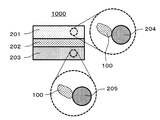
- FIG. 1 shows a cross-sectional view of a battery 1000 according to the second embodiment.
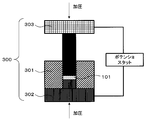
- FIG. 2 shows a schematic diagram of a pressure molding die 300 used for evaluating the ionic conductivity of a solid electrolyte material.
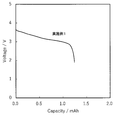
- FIG. 3 is a graph showing the initial discharge characteristics of the battery according to Example 1.
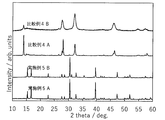
- FIG. 4 is a graph showing X-ray diffraction patterns of solid electrolyte materials according to Example 5A, Example 5B, Comparative Example 4A, and Comparative Example 4B.
- the solid electrolyte material according to the first embodiment is composed of Li, M, and X, M is at least one element selected from the group consisting of metal elements other than Li and metalloid elements, X is at least one element selected from the group consisting of F, Cl, Br, and I,
- the following formula (I) is satisfied, FWHM/2 ⁇ p ⁇ 0.015 (I) here, FWHM shows the highest intensity in the X-ray diffraction pattern obtained by the X-ray diffraction measurement of the above-mentioned solid electrolyte material using Cu-K ⁇ ray within the range of the diffraction angle 2 ⁇ of the diffraction angle of 25° or more and 35° or less.
- Si-metal element means B, Si, Ge, As, Sb, and Te.
- the solid electrolyte material according to the first embodiment can maintain high lithium ion conductivity even when made into fine particles. That is, in the process of producing a battery (for example, an all-solid secondary battery) using the solid electrolyte material according to the first embodiment, even when the solid electrolyte material is pulverized into fine particles, the ionic conductivity of the solid electrolyte material decreases. Can be suppressed. Therefore, a battery having excellent charge/discharge characteristics can be obtained.
- the solid electrolyte material according to the first embodiment does not contain sulfur, hydrogen sulfide is not generated even when exposed to the atmosphere. Therefore, the solid electrolyte material according to the first embodiment is excellent in safety.
- the average ionic radius of Li and M contained in the solid electrolyte material according to the first embodiment is calculated based on the following equation. ⁇ (r C ⁇ R C )/ ⁇ R C
- r C represents the ionic radius of the element (namely, cation) contained in Li and M
- RC represents the substance amount of the elements contained in Li and M.
- the average ionic radius of X contained in the solid electrolyte material according to the first embodiment is calculated based on the following equation. ⁇ (r A ⁇ R A )/ ⁇ R A
- r A represents the ionic radius of the element (that is, anion) contained in X
- RA represents the substance amount of the element contained in X.
- average ionic radius ratio When the value obtained by dividing the average ionic radius of Li and M by the average ionic radius of X (hereinafter, also referred to as “average ionic radius ratio”) exceeds 0.424, a crystal phase belonging to hexagonal crystal is precipitated. Even if the particles are made into fine particles, the crystal structure of the crystal phase belonging to the hexagonal crystal is maintained, and it is considered that the decrease in ionic conductivity is suppressed.
- hexagonal crystalline phase has a crystalline structure similar to Li 3 ErCl 6 disclosed in ICSD (Inorganic Crystal Structure Database) # 01-087-0132, and It means a crystalline phase having an X-ray diffraction pattern characteristic of a crystal structure. Therefore, the presence of the crystal phase belonging to the hexagonal crystal contained in the solid electrolyte material is determined based on the X-ray diffraction pattern. At this time, the diffraction angle and/or the peak intensity ratio of the diffraction pattern can be changed from that of Li 3 ErCl 6 depending on the type of element contained in the solid electrolyte material. Therefore, the presence or absence of the "crystal phase belonging to the hexagonal crystal” is judged based on not only the diffraction angle of the diffraction peak but also the pattern of three or more diffraction peaks having high intensity.
- the solid electrolyte material according to the first embodiment may contain 30% by volume or more of a crystal phase belonging to hexagonal crystal.
- the solid electrolyte material according to the first embodiment may contain 50% by volume or more of a crystal phase belonging to hexagonal crystal.
- the solid electrolyte material according to the first embodiment may substantially consist of a crystal phase belonging to hexagonal crystal.
- “the solid electrolyte material according to the first embodiment is substantially composed of a crystal phase belonging to hexagonal crystal” means that the solid electrolyte material according to the first embodiment is a crystal phase belonging to hexagonal crystal. Is contained in an amount of 90% by volume or more.
- the solid electrolyte material according to the first embodiment may be composed only of a crystal phase belonging to hexagonal crystal.
- the solid electrolyte material according to the first embodiment may substantially consist of Li, M, and X.
- the solid electrolyte material according to the first embodiment is substantially composed of Li, M, and X
- the solid electrolyte material according to the first embodiment means that in the solid electrolyte material according to the first embodiment, substances of all elements constituting the solid electrolyte material. It means that the molar ratio of the substance amounts of Li, M, and X contained in the solid electrolyte material to the total amount is 90% or more. The molar ratio may be 95% or more.
- the solid electrolyte material according to the first embodiment may be composed only of Li, M, and X.
- M may contain a trivalent metal element in order to maintain the lithium ion conductivity at a higher maintenance rate even if it is made into fine particles.
- M contains a trivalent element
- the solid electrolyte material according to the first embodiment can form a solid solution in a relatively wide composition region.
- M may contain a rare earth element in order to maintain the lithium ion conductivity at a higher maintenance rate even when it is made into fine particles.
- M may contain at least one element selected from the group consisting of Y (that is, yttrium) and Gd (that is, gadolinium) in order to maintain the lithium ion conductivity at a higher maintenance rate even when it is made into fine particles. Good.
- M may contain a Group 2 element in order to maintain the lithium ion conductivity at a higher retention rate even if it is made into fine particles.
- M may contain Ca (that is, calcium) in order to maintain the lithium ion conductivity at a higher maintenance rate even when it is made into fine particles.
- X may be at least one element selected from the group consisting of Cl and Br in order to maintain the lithium ion conductivity at a higher retention rate even if it is made into fine particles.
- X may be Cl and Br in order to maintain the lithium ion conductivity at a higher maintenance rate even when it is made into fine particles.
- the average ionic radius ratio may be greater than 0.424 and less than or equal to 0.460 in order to maintain the lithium ion conductivity at a higher retention rate even if it is made into fine particles.
- the average ionic radius ratio may be greater than 0424 and 0.455 or less.
- the average ionic radius ratio may be greater than 0424 and 0.450 or less.
- the average ionic radius ratio may be greater than 0.424 and less than or equal to 0.442.
- the average ionic radius ratio may be greater than 0.426 and less than or equal to 0.442.
- the average ionic radius ratio may be 0.427 or more and 0.442 or less.
- the molar ratio of Li to X, Li/X may be 0.3 or more and 0.6 or less in order to maintain the lithium ion conductivity at a higher maintenance rate even when the particles are made into fine particles.
- the molar ratio Li/X may be 0.33 or more and 0.6 or less.
- the molar ratio Li/X may be 0.37 or more and 0.55 or less.
- the solid electrolyte material according to the first embodiment may include an amorphous phase.
- the shape of the solid electrolyte material according to the first embodiment is not limited. Examples of the shape of the solid electrolyte material according to the first embodiment are acicular, spherical, elliptic spherical, or fibrous.
- the solid electrolyte material according to the first embodiment may be particles.
- the solid electrolyte material according to the first embodiment may be formed to have a pellet or plate shape.
- the solid electrolyte material according to the first embodiment is particulate (eg, spherical)
- the solid electrolyte material according to the first embodiment may have a median diameter of 0.1 ⁇ m or more and 100 ⁇ m or less.
- the median diameter may be 0.5 ⁇ m or more and 10 ⁇ m or less.
- the median diameter means the particle diameter when the cumulative volume in the volume-based particle size distribution is equal to 50%.
- the volume-based particle size distribution can be measured by a laser diffraction measurement device or an image analysis device.
- the solid electrolyte material is smaller than the active material. It may have a median diameter.
- the solid electrolyte material according to the first embodiment can be manufactured, for example, by the following method.
- the raw material powder may be, for example, a halide.
- LiBr, LiCl, and GdCl 3 are prepared in a molar ratio of 2.0:1.0:1.0.
- the raw material powders may be mixed in a preliminarily prepared molar ratio so as to offset the compositional change that may occur during the synthesis process.
- the raw material powder is not limited to the above.
- it may be a combination of LiBr, LiCl, and GdBr 3 .
- a complex anion compound such as LiBr 0.5 Cl 0.5 may be used as the raw material powder.
- Mixtures of oxygen-containing raw powders (eg oxides, hydroxides, sulphates or nitrates) and halides (eg ammonium halides) may be used.
- the raw material powder well with a mortar and pestle, ball mill, or mixer to obtain a mixed powder.
- the mixed powder is fired in a vacuum or an inert atmosphere.
- the firing may be performed, for example, in the range of 100° C. or higher and 650° C. or lower for 1 hour or more.
- the battery according to the second embodiment includes a positive electrode, a negative electrode, and an electrolyte layer.
- the electrolyte layer is arranged between the positive electrode and the negative electrode.
- At least one selected from the group consisting of a positive electrode, an electrolyte layer, and a negative electrode contains the solid electrolyte material according to the first embodiment.
- the battery according to the second embodiment contains the solid electrolyte material according to the first embodiment, the charge/discharge characteristics of the battery according to the second embodiment can be improved.
- FIG. 1 shows a sectional view of a battery 1000 according to the second embodiment.
- the battery 1000 includes a positive electrode 201, an electrolyte layer 202, and a negative electrode 203.
- the positive electrode 201 contains positive electrode active material particles 204 and solid electrolyte particles 100.
- the electrolyte layer 202 is arranged between the positive electrode 201 and the negative electrode 203.
- the electrolyte layer 202 contains an electrolyte material (for example, a solid electrolyte material).
- the negative electrode 203 contains negative electrode active material particles 205 and solid electrolyte particles 100.
- the solid electrolyte particles 100 are particles made of the solid electrolyte material according to the first embodiment or particles containing the solid electrolyte material according to the first embodiment as a main component.
- the particle containing the solid electrolyte material according to the first embodiment as a main component means a particle in which the most contained component is the solid electrolyte material according to the first embodiment.
- the positive electrode 201 contains a material capable of inserting and extracting metal ions (for example, lithium ions).
- the positive electrode 201 contains, for example, a positive electrode active material (for example, positive electrode active material particles 204).
- positive electrode active materials are lithium-containing transition metal oxides, transition metal fluorides, polyanion materials, fluorinated polyanion materials, transition metal sulfides, transition metal oxyfluorides, transition metal oxysulfides, or transition metal oxynitrides. is there.
- lithium-containing transition metal oxides are Li(NiCoMn)O 2 , Li(NiCoAl)O 2 , or LiCoO 2 .
- the positive electrode active material particles 204 may have a median diameter of 0.1 ⁇ m or more and 100 ⁇ m or less. When the positive electrode active material particles 204 have a median diameter of 0.1 ⁇ m or more, the positive electrode active material particles 204 and the solid electrolyte particles 100 can be favorably dispersed in the positive electrode. This improves the charge/discharge characteristics of the battery. When the positive electrode active material particles 204 have a median diameter of 100 ⁇ m or less, the diffusion rate of lithium in the positive electrode active material particles 204 is improved. This allows the battery to operate at high power.
- the positive electrode active material particles 204 may have a median diameter larger than that of the solid electrolyte particles 100. Thereby, the positive electrode active material particles 204 and the solid electrolyte particles 100 can be favorably dispersed.
- the ratio of the volume Vca1 of the positive electrode active material particles 204 to the total of the volume Vca1 of the positive electrode active material particles 204 and the volume Vce1 of the solid electrolyte particles 100 is 0.30 or more. It may be 0.95 or less. That is, the ratio of (Vca1)/(Vca1+Vce1) may be 0.30 or more and 0.95 or less.
- the positive electrode 201 may have a thickness of 10 ⁇ m or more and 500 ⁇ m or less.
- the electrolyte layer 202 contains an electrolyte material.
- the electrolyte material is, for example, a solid electrolyte material. That is, the electrolyte layer 202 may be a solid electrolyte layer.
- the solid electrolyte material included in the electrolyte layer 202 may include the solid electrolyte material according to the first embodiment.
- the electrolyte layer 202 may contain the solid electrolyte material according to the first embodiment as a main component.
- the mass ratio of the solid electrolyte material according to the first embodiment to the whole electrolyte layer 202 may be 50% or more.
- the mass ratio may be 70% or more in order to improve the charge/discharge characteristics of the battery.
- the electrolyte layer 202 may contain unavoidable impurities in addition to the solid electrolyte material according to the first embodiment.
- the electrolyte layer 202 may contain a starting material of a solid electrolyte material as an unreacted material.
- the electrolyte layer 202 may contain a by-product generated during the synthesis of the solid electrolyte material.
- the electrolyte layer 202 may contain a decomposition product generated by decomposition of the solid electrolyte material.
- the mass ratio may be 100% (excluding unavoidable impurities). That is, the electrolyte layer 202 may be composed only of the solid electrolyte material according to the first embodiment.
- the electrolyte layer 202 may be composed only of a solid electrolyte material different from the solid electrolyte material according to the first embodiment.
- a solid electrolyte material different from the solid electrolyte material according to the first embodiment for example, Li 2 MgX 4 , Li 2 FeX 4 , Li(Al,Ga,In)X 4 , Li 3 (Al,Ga,In)X 6 are used.
- LiI (where X is at least one selected from the group consisting of F, Cl, Br, and I) can be used.
- the electrolyte layer 202 may simultaneously contain a solid electrolyte material according to the first embodiment and a solid electrolyte material different from the solid electrolyte material according to the first embodiment. At this time, both may be dispersed uniformly.
- a layer made of the solid electrolyte material according to the first embodiment and a layer made of a solid electrolyte material different from the solid electrolyte material according to the first embodiment may be sequentially arranged in the stacking direction of the battery.
- the electrolyte layer 202 may have a thickness of 1 ⁇ m or more and 100 ⁇ m or less. When the electrolyte layer 202 has a thickness of 1 ⁇ m or more, it is difficult for the positive electrode 201 and the negative electrode 203 to be short-circuited. When the electrolyte layer 202 has a thickness of 100 ⁇ m or less, the battery can operate at high power.
- the negative electrode 203 contains a material capable of inserting and extracting metal ions (for example, lithium ions).
- the negative electrode 203 contains, for example, a negative electrode active material (for example, negative electrode active material particles 205).
- Examples of the negative electrode active material are metallic materials, carbon materials, oxides, nitrides, tin compounds, or silicon compounds.
- the metal material may be a simple metal or an alloy.
- Examples of metallic materials are lithium metal or lithium alloys.
- Examples of carbon materials are natural graphite, coke, graphitizing carbon, carbon fibers, spherical carbon, artificial graphite, or amorphous carbon. From the viewpoint of capacity density, a preferable example of the negative electrode active material is silicon (Si), tin (Sn), a silicon compound, or a tin compound.
- the negative electrode active material particles 205 may have a median diameter of 0.1 ⁇ m or more and 100 ⁇ m or less. When the negative electrode active material particles 205 have a median diameter of 0.1 ⁇ m or more, the negative electrode active material particles 205 and the solid electrolyte particles 100 can be favorably dispersed in the negative electrode 203. This improves the charge/discharge characteristics of the battery. When the negative electrode active material particles 205 have a median diameter of 100 ⁇ m or less, the diffusion rate of lithium in the negative electrode active material particles 205 is improved. This allows the battery to operate at high power.
- the negative electrode active material particles 205 may have a median diameter larger than that of the solid electrolyte particles 100. Thereby, the negative electrode active material particles 205 and the solid electrolyte particles 100 can be favorably dispersed.
- the ratio of the volume vaa1 of the negative electrode active material particles 205 to the total of the volume vaa1 of the negative electrode active material particles 205 and the volume vae1 of the solid electrolyte particles 100 is 0.30 or more. It may be 0.95 or less. That is, the ratio of (vaa1)/(vaa1+vae1)) may be 0.30 or more and 0.95 or less.
- the negative electrode 203 may have a thickness of 10 ⁇ m or more and 500 ⁇ m or less.
- At least one selected from the group consisting of the positive electrode 201, the electrolyte layer 202, and the negative electrode 203 is the solid electrolyte material according to the first embodiment for the purpose of enhancing ionic conductivity, chemical stability, and electrochemical stability.
- a solid electrolyte material different from that may be included.
- the solid electrolyte material different from the solid electrolyte material according to the first embodiment are a sulfide solid electrolyte material, an oxide solid electrolyte material, a halide solid electrolyte material, or an organic polymer solid electrolyte.
- Examples of the sulfide solid electrolyte material are Li 2 S-P 2 S 5 , Li 2 S-SiS 2 , Li 2 S-B 2 S 3 , Li 2 S-GeS 2 , Li 3.25 Ge 0.25 P. 0.75 S 4, or Li 10 GeP 2 S 12.
- oxide solid electrolyte materials are: (I) a NASICON-type solid electrolyte such as LiTi 2 (PO 4 ) 3 or a substitution product thereof. (Ii) (LaLi)TiO 3 -based perovskite-type solid electrolyte, (Iii) Li 14 ZnGe 4 O 16, Li 4 SiO 4, LiGeO 4, or LISICON solid electrolyte such as its elemental substituents, (Iv) a garnet-type solid electrolyte such as Li 7 La 3 Zr 2 O 12 or an element-substituted product thereof, or (v) Li 3 PO 4 and an N-substituted product thereof.
- NASICON-type solid electrolyte such as LiTi 2 (PO 4 ) 3 or a substitution product thereof.
- LaLi)TiO 3 -based perovskite-type solid electrolyte Li 14 ZnGe 4 O 16, Li 4 SiO 4, LiGeO 4, or LISICON solid
- An example of an organic polymer solid electrolyte is a compound of a polymer compound and a lithium salt.
- the polymer compound may have an ethylene oxide structure. Since the polymer compound having an ethylene oxide structure can contain a large amount of lithium salt, the ionic conductivity can be further increased.
- lithium salt LiPF 6, LiBF 4, LiSbF 6, LiAsF 6, LiSO 3 CF 3, LiN (SO 2 CF 3) 2, LiN (SO 2 C 2 F 5) 2, LiN (SO 2 CF 3) (SO 2 C 4 F 9 ) or LiC(SO 2 CF 3 ) 3 .
- One lithium salt selected from these may be used alone. Alternatively, a mixture of two or more lithium salts selected from these may be used.
- a non-aqueous electrolyte solution for the purpose of facilitating the transfer of lithium ions to at least one selected from the group consisting of the positive electrode 201, the electrolyte layer 202, and the negative electrode 203, and improving the output characteristics of the battery, a non-aqueous electrolyte solution, a gel electrolyte, or ions. It may contain a liquid.
- the non-aqueous electrolyte solution contains a non-aqueous solvent and a lithium salt dissolved in the non-aqueous solvent.
- non-aqueous solvents examples include cyclic carbonate solvents, chain carbonate solvents, cyclic ether solvents, chain ether solvents, cyclic ester solvents, chain ester solvents, or fluorine solvents.
- cyclic carbonic acid ester solvents are ethylene carbonate, propylene carbonate, or butylene carbonate.
- chain carbonic acid ester solvent is dimethyl carbonate, ethyl methyl carbonate, or diethyl carbonate.
- cyclic ether solvents examples include tetrahydrofuran, 1,4-dioxane, or 1,3-dioxolane.
- An example of a chain ether solvent is 1,2-dimethoxyethane or 1,2-diethoxyethane.
- An example of a cyclic ester solvent is ⁇ -butyrolactone.
- chain ester solvent is methyl acetate.
- fluorine solvents are fluoroethylene carbonate, methyl fluoropropionate, fluorobenzene, fluoroethylmethyl carbonate, or fluorodimethylene carbonate.
- One non-aqueous solvent selected from these may be used alone. Alternatively, a mixture of two or more non-aqueous solvents selected from these may be used.
- lithium salt LiPF 6, LiBF 4, LiSbF 6, LiAsF 6, LiSO 3 CF 3, LiN (SO 2 CF 3) 2, LiN (SO 2 C 2 F 5) 2, LiN (SO 2 CF 3) (SO 2 C 4 F 9 ) or LiC(SO 2 CF 3 ) 3 .
- lithium salt selected from these may be used alone. Alternatively, a mixture of two or more lithium salts selected from these may be used.
- the concentration of the lithium salt may be, for example, 0.5 mol/liter or more and 2 mol/liter or less.
- a polymer material impregnated with a non-aqueous electrolyte may be used.
- polymeric materials are polyethylene oxide, polyacrylonitrile, polyvinylidene fluoride, polymethylmethacrylate, or polymers with ethylene oxide linkages.
- ionic liquids examples include: (I) aliphatic chain quaternary salts such as tetraalkylammonium or tetraalkylphosphonium, (Ii) Pyrrolidiniums, Morpholiniums, Imidazoliniums, Tetrahydropyrimidiniums, Piperaziniums, and Aliphatic Cyclic Ammoniums such as Piperidiniums, or (iii) Pyridiniums or Nitrogen-Containing Heterologous Compounds It is a ring aromatic cation.
- aliphatic chain quaternary salts such as tetraalkylammonium or tetraalkylphosphonium
- Pyrrolidiniums Morpholiniums, Imidazoliniums, Tetrahydropyrimidiniums, Piperaziniums
- Aliphatic Cyclic Ammoniums such as Piperidiniums, or (iii) Pyridiniums or Nitrogen-Con
- anion contained in the ionic liquid PF 6 -, BF 4 - , SbF 6- -, AsF 6 -, SO 3 CF 3 -, N (SO 2 CF 3) 2 -, N (SO 2 C 2 F 5) 2 -, N (SO 2 CF 3) (SO 2 C 4 F 9) -, or C (SO 2 CF 3) 3 - a.
- the ionic liquid may contain a lithium salt.
- At least one selected from the group consisting of the positive electrode 201, the electrolyte layer 202, and the negative electrode 203 may contain a binder for the purpose of improving the adhesion between particles.
- binder examples include polyvinylidene fluoride, polytetrafluoroethylene, polyethylene, polypropylene, aramid resin, polyamide, polyimide, polyamideimide, polyacrylonitrile, polyacrylic acid, polyacrylic acid methyl ester, polyacrylic acid ethyl ester, Polyacrylic acid hexyl ester, polymethacrylic acid, polymethacrylic acid methyl ester, polymethacrylic acid ethyl ester, polymethacrylic acid hexyl ester, polyvinyl acetate, polyvinylpyrrolidone, polyether, polyether sulfone, hexafluoropolypropylene, styrene butadiene rubber , Or carboxymethyl cellulose.
- Copolymers can also be used as binders.
- binders are tetrafluoroethylene, hexafluoroethylene, hexafluoropropylene, perfluoroalkyl vinyl ether, vinylidene fluoride, chlorotrifluoroethylene, ethylene, propylene, pentafluoropropylene, fluoromethyl vinyl ether, acrylic acid.
- a copolymer of at least two materials selected from the group consisting of hexadiene are examples of such binders.
- a mixture of two or more selected from the above materials may be used as the binder.
- At least one selected from the positive electrode 201 and the negative electrode 203 may contain a conductive auxiliary agent for the purpose of enhancing electron conductivity.
- Examples of conductive aids are (I) Graphites such as natural graphite or artificial graphite, (Ii) carbon blacks such as acetylene black or Ketjen black, (Iii) conductive fibers such as carbon fibers or metal fibers, (Iv) Carbon fluoride (v) Metal powders such as aluminum, (Vi) conductive whiskers such as zinc oxide or potassium titanate, (Vii) a conductive metal oxide such as titanium oxide, or (viii) a conductive polymer compound such as polyaniline, polypyrrole, or polythiophene.
- the above-mentioned (i) or (ii) may be used as a conductive auxiliary agent in order to reduce the cost.
- the battery is a coin battery, a cylindrical battery, a prismatic battery, a sheet battery, a button battery (that is, a button cell), a flat battery, or a stacked battery. ..
- Example 1 [Preparation of solid electrolyte material]
- the fired product ie, coarse particles
- the coarse particles of one group were pulverized with a pestle and a mortar for 1 minute to obtain a powder of the solid electrolyte material according to Example 1A.
- the remaining coarse particles were pulverized for 6 minutes to obtain a powder of the solid electrolyte material according to Example 1B.
- the solid electrolyte material according to Example 1A was a solid electrolyte material before pulverization, that is, not pulverized.
- the solid electrolyte material according to Example 1B was a solid electrolyte material after pulverization, that is, atomized.
- FIG. 2 shows a schematic diagram of the pressure molding die 300 used for evaluating the ionic conductivity of the solid electrolyte material.
- the pressure molding die 300 was equipped with a frame die 301, a punch lower portion 302, and a punch upper portion 303.
- the frame die 301 was made of insulating polycarbonate.
- the punch upper part 303 and the punch lower part 302 were both formed of electronically conductive stainless steel.
- the ionic conductivity was measured by the following method using the pressure molding die 300 shown in FIG.
- the powder 101 of the solid electrolyte material according to Example 1 was filled inside the pressure molding die 300 in a dry atmosphere having a dew point of ⁇ 30° C. or lower. Inside the pressure molding die 300, a pressure of 400 MPa was applied to the solid electrolyte material according to Example 1 using the lower punch part 302 and the upper punch part 303.
- a potentiostat manufactured by Princeton Applied Research, product name "VersaSTAT4"
- VersaSTAT4 room temperature through the lower punch 302 and the upper punch 303.
- the impedance of the solid electrolyte material according to Example 1 was measured at ⁇ 3 degrees Celsius.
- the real value of the impedance at the measurement point where the absolute value of the phase of the complex impedance is the smallest was regarded as the resistance value for the ionic conduction of the solid electrolyte material.
- the ionic conductivity was calculated based on the following mathematical formula (2).
- ⁇ (R SE ⁇ S/t) ⁇ 1 (2) here, ⁇ is the ionic conductivity, S is the contact area of the solid electrolyte material with the punch upper portion 303 (in FIG. 2, equal to the cross-sectional area of the hollow portion of the frame die 301)
- R SE is the resistance value of the solid electrolyte material in impedance measurement, and
- t is the thickness of the solid electrolyte material to which pressure is applied (equal to the thickness of the layer formed from the solid electrolyte particles 100 in FIG. 2 ).
- the crystal structure of the solid electrolyte material according to Example 1 was analyzed.
- the X-ray diffraction pattern of the solid electrolyte material according to Example 1 was measured in a dry atmosphere having a dew point of ⁇ 45° C. or lower using an X-ray diffractometer (MiniFlex 600 manufactured by RIGAKU).
- Cu-K ⁇ rays were used as the X-ray source. That is, the X-ray diffraction pattern was measured by the ⁇ -2 ⁇ method using Cu-K ⁇ rays (wavelengths 0.15405 nanometers and 0.15444 nanometers) as X-rays.
- the crystal structure is determined to be a hexagonal crystal when it is similar to the X-ray diffraction pattern of Li 3 ErCl 6. Was done.
- the crystal structure of the solid electrolyte material according to Example 1 is shown in Table 1.
- the full width at half maximum of the peak having the highest intensity in the range where the diffraction angle 2 ⁇ is 25° or more and 35° or less is FWHM, and the center of the peak is If the diffraction angle of is 2 ⁇ p , then FWHM/2 ⁇ p ⁇ 0.015.
- the solid electrolyte material according to Example 1 contains Li, Ca, and Y as cations, and Cl and Br as anions.
- the ionic radii of Li, Ca, Y, Cl, and Br are 0.76, 1.00, 0.90, 1.81, and 1.96, respectively.
- the substance amounts of Li, Ca, Y, Cl, and Br are 2.800, 0.100, 1.000, 4.000, and 2.000, respectively. Therefore, the average ionic radius r C of the cation can be calculated to be (2.800 ⁇ 0.76+0.100 ⁇ 1.00+1.000 ⁇ 0.90)/(2.800+0.100+1.000) to be 0. Calculated as 8020.
- the average ionic radius r A of the anion was calculated to be 1.860 by calculating (4.00 ⁇ 1.81+2.000 ⁇ 1.96)/(4.00+2.000). Therefore, the average ionic radius ratio was calculated to be 0.431 by calculating r C /r A.
- the sulfide solid electrolyte Li 6 PS 5 Cl 60 mg
- the solid electrolyte material according to Example 1B 20 mg, equal to 700 ⁇ m thickness
- the positive electrode mixture 9.6 mg
- a pressure of 720 MPa was applied to the laminate to form the first electrode and the solid electrolyte layer.
- metal InLi was laminated on the solid electrolyte layer.
- a pressure of 80 MPa was applied to this laminate to form the second electrode.
- the second electrode after pressing had a thickness of 600 micrometers. In this way, a laminated body of the first electrode, the solid electrolyte layer, and the second electrode was produced.
- the first electrode was the positive electrode and the second electrode was the negative electrode.
- FIG. 3 is a graph showing the initial discharge characteristics of the secondary battery according to Example 1.
- the initial discharge characteristics shown in FIG. 3 were measured by the following method.
- the secondary battery according to Example 1 was placed in a constant temperature bath at 25°C.
- the battery was charged at a current density of 0.1 mA/cm 2 until a voltage of 3.7 V was reached.
- the cell was then discharged at a current density of 0.1 mA/cm 2 until a voltage of 1.9 V was reached.
- the current density corresponds to a 0.05 C rate.
- the secondary battery according to Example 1 had an initial discharge capacity of 1.2 mAh.
- Example 2A that is, a solid electrolyte material before crushing
- Example 2B that is, a solid electrolyte material after crushing
- Example 2 “Ionic conductivity retention rate of the solid electrolyte material after pulverization” in Example 2 is shown in Table 1.
- Example 2 [Mole ratio of Li to X Li/X] Also in Example 2, the molar ratio Li/X to X was determined in the same manner as in Example 1. The molar ratio Li/X of the solid electrolyte material according to Example 2 is shown in Table 1.
- Example 2 [Average ion radius ratio] Also in Example 2, the average ion radius ratio was calculated in the same manner as in Example 1. The calculated values are shown in Table 1.
- Example 3A that is, a solid electrolyte material before crushing
- Example 3B that is, a solid electrolyte material after crushing
- Example 3 “Ionic conductivity maintenance rate of solid electrolyte material after pulverization” in Example 3 is shown in Table 1.
- Example 3 in the same manner as in Example 1, the molar ratio of Li to X, Li/X, was determined.
- the molar ratio Li/X of the solid electrolyte material according to Example 3 is shown in Table 1.
- Example 3 the average ion radius ratio was calculated in the same manner as in Example 1. The calculated values are shown in Table 1.
- Example 4A that is, a solid electrolyte material before grinding
- Example 4B that is, a solid electrolyte material after grinding
- Example 4 “Ion conductivity maintenance rate of solid electrolyte material after pulverization” in Example 4 is shown in Table 1.
- Example 4 [Mole ratio of Li to X Li/X] Also in Example 4, in the same manner as in Example 1, the molar ratio of Li to X, Li/X, was determined. The molar ratio Li/X of the solid electrolyte material according to Example 4 is shown in Table 1.
- Example 4 [Average ion radius ratio] Also in Example 4, the average ion radius ratio was calculated in the same manner as in Example 1. The calculated values are shown in Table 1.
- Example 5A that is, a solid electrolyte material before crushing
- Example 5B that is, a solid electrolyte material after crushing
- Example 5 “Ionic conductivity maintenance rate of solid electrolyte material after pulverization” in Example 5 is shown in Table 1.
- Example 5 in Example 5 as well, in the same manner as in Example 1, the molar ratio Li/X of Li/X was determined. The molar ratio Li/X of the solid electrolyte material according to Example 5 is shown in Table 1.
- Example 5 Also in Example 5, as in Example 1, the average ion radius ratio was calculated. The calculated values are shown in Table 1.
- Example 6A that is, a solid electrolyte material before crushing
- Example 6B that is, a solid electrolyte material after crushing
- Example 6 “Ionic conductivity maintenance rate of solid electrolyte material after pulverization” in Example 6 is shown in Table 1.
- Example 6 in Example 6 as well, in the same manner as in Example 1, the molar ratio of Li to X, Li/X, was determined. The molar ratio Li/X in the solid electrolyte material according to Example 6 is shown in Table 1.
- Example 6 [Average ion radius ratio] Also in Example 6, the average ion radius ratio was calculated in the same manner as in Example 1. The calculated values are shown in Table 1.
- a solid electrolyte material according to Comparative Example 1A that is, a solid electrolyte material before crushing
- a solid electrolyte material according to Comparative Example 1B that is, a solid electrolyte material after crushing
- a solid electrolyte material according to Comparative Example 2A (that is, a solid electrolyte material before crushing) and a solid electrolyte material according to Comparative Example 2B (that is, a solid electrolyte material after crushing) are obtained in the same manner as in Example 1 except for the above. It was
- the ionic conductivity retention rate is good, when the solid electrolyte material undergoes atomization such as pulverization, the ionic conductivity of the solid electrolyte material containing hexagonal crystals is the ionic conductivity of the solid electrolyte material consisting of only monoclinic crystals. Less likely to fall.
- the solid electrolyte materials of Examples 1 to 6 do not generate hydrogen sulfide because they do not contain sulfur.
- the battery of the present disclosure can be used, for example, as an all-solid-state lithium-ion secondary battery.
- Solid Electrolyte Particles 101 Solid Electrolyte Material Powder 201 Positive Electrode 202 Electrolyte Layer 203 Negative Electrode 204 Positive Electrode Active Material Particles 205 Negative Electrode Active Material Particles 300 Pressure Molding Dies 301 Frame Mold 302 Punch Lower 303 Punch Upper 1000 Battery
Landscapes
- Chemical & Material Sciences (AREA)
- Engineering & Computer Science (AREA)
- General Chemical & Material Sciences (AREA)
- Electrochemistry (AREA)
- Chemical Kinetics & Catalysis (AREA)
- Manufacturing & Machinery (AREA)
- Organic Chemistry (AREA)
- Inorganic Chemistry (AREA)
- Condensed Matter Physics & Semiconductors (AREA)
- Geology (AREA)
- General Physics & Mathematics (AREA)
- Physics & Mathematics (AREA)
- Life Sciences & Earth Sciences (AREA)
- Materials Engineering (AREA)
- Secondary Cells (AREA)
- Conductive Materials (AREA)
- Battery Electrode And Active Subsutance (AREA)
Abstract
La présente invention concerne un matériau d'électrolyte solide qui est capable de maintenir une conductivité d'ions lithium élevée dans un processus d'atomisation. Ce matériau d'électrolyte solide comprend Li, M et X, où M est au moins un élément choisi dans le groupe constitué par les éléments métalliques autres que le Li et les éléments métalloïdes, X est au moins un élément choisi dans le groupe constitué par F, Cl, Br Et I, la formule mathématique FWHM/2θp≤0.015 est satisfaite, où FWHM représente la largeur totale à mi-hauteur d'un pic de diffraction des rayons X ayant l'intensité la plus élevée dans la plage d'angles de diffraction 2θ entre 25° et 35° dans un motif de diffraction des rayons X obtenu par la mesure de diffraction des rayons X du matériau d'électrolyte solide à l'aide d'un rayonnement Cu-Kα et 2θp représente l'angle de diffraction du centre du pic de diffraction des rayons X, la valeur obtenue en divisant le rayon ionique moyen de Li et M par le rayon ionique moyen de X est supérieure à 0.424, et le matériau d'électrolyte solide contient une phase cristalline qui appartient à un cristal hexagonal.
Priority Applications (5)
| Application Number | Priority Date | Filing Date | Title |
|---|---|---|---|
| EP19905741.5A EP3905276A4 (fr) | 2018-12-26 | 2019-09-12 | Matériau d'électrolyte solide et batterie l'utilisant |
| JP2020562351A JP7445874B2 (ja) | 2018-12-26 | 2019-09-12 | 固体電解質材料、およびそれを用いた電池 |
| CN201980064371.7A CN112789692B (zh) | 2018-12-26 | 2019-09-12 | 固体电解质材料和使用它的电池 |
| US17/326,390 US20210273259A1 (en) | 2018-12-26 | 2021-05-21 | Solid electrolyte material and battery using same |
| US18/753,861 US20240347766A1 (en) | 2018-12-26 | 2024-06-25 | Solid electrolyte material and battery using same |
Applications Claiming Priority (10)
| Application Number | Priority Date | Filing Date | Title |
|---|---|---|---|
| JP2018243605 | 2018-12-26 | ||
| JP2018-243605 | 2018-12-26 | ||
| JP2018243604 | 2018-12-26 | ||
| JP2018-243602 | 2018-12-26 | ||
| JP2018-243604 | 2018-12-26 | ||
| JP2018243602 | 2018-12-26 | ||
| JP2018243603 | 2018-12-26 | ||
| JP2018-243603 | 2018-12-26 | ||
| JP2018-248595 | 2018-12-28 | ||
| JP2018248595 | 2018-12-28 |
Related Child Applications (1)
| Application Number | Title | Priority Date | Filing Date |
|---|---|---|---|
| US17/326,390 Continuation US20210273259A1 (en) | 2018-12-26 | 2021-05-21 | Solid electrolyte material and battery using same |
Publications (1)
| Publication Number | Publication Date |
|---|---|
| WO2020137026A1 true WO2020137026A1 (fr) | 2020-07-02 |
Family
ID=71126381
Family Applications (1)
| Application Number | Title | Priority Date | Filing Date |
|---|---|---|---|
| PCT/JP2019/035795 Ceased WO2020137026A1 (fr) | 2018-12-26 | 2019-09-12 | Matériau d'électrolyte solide et batterie l'utilisant |
Country Status (5)
| Country | Link |
|---|---|
| US (2) | US20210273259A1 (fr) |
| EP (1) | EP3905276A4 (fr) |
| JP (1) | JP7445874B2 (fr) |
| CN (1) | CN112789692B (fr) |
| WO (1) | WO2020137026A1 (fr) |
Cited By (11)
| Publication number | Priority date | Publication date | Assignee | Title |
|---|---|---|---|---|
| WO2021209380A1 (fr) * | 2020-04-14 | 2021-10-21 | Solvay Sa | Nouveaux halogénures de lithium des terres rares |
| WO2022019098A1 (fr) * | 2020-07-22 | 2022-01-27 | パナソニックIpマネジメント株式会社 | Matériau d'électrode positive et batterie |
| US20220149430A1 (en) * | 2020-11-12 | 2022-05-12 | Samsung Electronics Co., Ltd. | Solid ion conductor compound, solid electrolyte comprising the same, electrochemical cell comprising the same, and method of preparing the same |
| JP2022137635A (ja) * | 2021-03-09 | 2022-09-22 | Tdk株式会社 | 正極及び全固体電池 |
| CN117296108A (zh) * | 2021-05-27 | 2023-12-26 | 松下知识产权经营株式会社 | 固体电解质材料及使用该固体电解质材料的电池 |
| US11961962B2 (en) | 2020-07-02 | 2024-04-16 | Samsung Electronics Co., Ltd. | Solid ion conductor compound, solid electrolyte including the same, electrochemical cell including the same, and preparation method thereof |
| KR20250068625A (ko) | 2022-09-12 | 2025-05-16 | 스미또모 가가꾸 가부시키가이샤 | 알칼리 금속 함유 할로겐화물, 전해질, 전지 및 할로겐화물 고체 전해질의 제조 방법 |
| US12542300B2 (en) * | 2020-10-28 | 2026-02-03 | Panasonic Intellectual Property Management Co., Ltd. | Solid electrolyte material and battery using same |
| US12548794B2 (en) * | 2020-03-31 | 2026-02-10 | Panasonic Intellectual Property Management Co., Ltd. | Solid electrolyte material and battery using same |
| US12614752B2 (en) | 2019-12-27 | 2026-04-28 | Panasonic Intellectual Property Management Co., Ltd. | Solid electrolyte composition, method for producing solid electrolyte composition, and method for producing solid electrolyte member |
| US12626951B2 (en) * | 2020-03-31 | 2026-05-12 | Panasonic Intellectual Property Management Co., Ltd. | Solid electrolyte material and battery using same |
Families Citing this family (2)
| Publication number | Priority date | Publication date | Assignee | Title |
|---|---|---|---|---|
| CN113363567A (zh) * | 2021-06-29 | 2021-09-07 | 国联汽车动力电池研究院有限责任公司 | 一种卤化物固态电解质及其制备方法和应用 |
| CN116315050B (zh) * | 2023-02-23 | 2024-10-01 | 苏州清陶新能源科技有限公司 | 固态电解质材料、制备方法、电极及锂离子电池 |
Citations (2)
| Publication number | Priority date | Publication date | Assignee | Title |
|---|---|---|---|---|
| JP2011129312A (ja) | 2009-12-16 | 2011-06-30 | Toyota Motor Corp | 硫化物固体電解質材料の製造方法、硫化物固体電解質材料およびリチウム電池 |
| WO2018025582A1 (fr) * | 2016-08-04 | 2018-02-08 | パナソニックIpマネジメント株式会社 | Matériau d'électrolyte solide, et cellule |
Family Cites Families (5)
| Publication number | Priority date | Publication date | Assignee | Title |
|---|---|---|---|---|
| WO1995026031A1 (fr) | 1994-03-18 | 1995-09-28 | Toto Ltd. | Couche mince d'electrolyte solide et son procede de production |
| JP4392618B2 (ja) | 2006-05-15 | 2010-01-06 | 住友電気工業株式会社 | 固体電解質の形成方法 |
| JP6724571B2 (ja) | 2016-06-07 | 2020-07-15 | トヨタ自動車株式会社 | 固体電池 |
| CN107425218B (zh) * | 2017-08-04 | 2019-10-15 | 郑州新世纪材料基因组工程研究院有限公司 | 一种锂离子固体电解质及其制备方法、应用 |
| WO2019135344A1 (fr) * | 2018-01-05 | 2019-07-11 | パナソニックIpマネジメント株式会社 | Matériau d'électrolyte solide, et batterie |
-
2019
- 2019-09-12 JP JP2020562351A patent/JP7445874B2/ja active Active
- 2019-09-12 EP EP19905741.5A patent/EP3905276A4/fr active Pending
- 2019-09-12 WO PCT/JP2019/035795 patent/WO2020137026A1/fr not_active Ceased
- 2019-09-12 CN CN201980064371.7A patent/CN112789692B/zh active Active
-
2021
- 2021-05-21 US US17/326,390 patent/US20210273259A1/en not_active Abandoned
-
2024
- 2024-06-25 US US18/753,861 patent/US20240347766A1/en active Pending
Patent Citations (2)
| Publication number | Priority date | Publication date | Assignee | Title |
|---|---|---|---|---|
| JP2011129312A (ja) | 2009-12-16 | 2011-06-30 | Toyota Motor Corp | 硫化物固体電解質材料の製造方法、硫化物固体電解質材料およびリチウム電池 |
| WO2018025582A1 (fr) * | 2016-08-04 | 2018-02-08 | パナソニックIpマネジメント株式会社 | Matériau d'électrolyte solide, et cellule |
Non-Patent Citations (2)
| Title |
|---|
| See also references of EP3905276A4 |
| SHANNON ET AL., ACTA, vol. A32, 1976, pages 751 |
Cited By (17)
| Publication number | Priority date | Publication date | Assignee | Title |
|---|---|---|---|---|
| US12614752B2 (en) | 2019-12-27 | 2026-04-28 | Panasonic Intellectual Property Management Co., Ltd. | Solid electrolyte composition, method for producing solid electrolyte composition, and method for producing solid electrolyte member |
| US12626951B2 (en) * | 2020-03-31 | 2026-05-12 | Panasonic Intellectual Property Management Co., Ltd. | Solid electrolyte material and battery using same |
| US12548794B2 (en) * | 2020-03-31 | 2026-02-10 | Panasonic Intellectual Property Management Co., Ltd. | Solid electrolyte material and battery using same |
| WO2021209380A1 (fr) * | 2020-04-14 | 2021-10-21 | Solvay Sa | Nouveaux halogénures de lithium des terres rares |
| JP2023521225A (ja) * | 2020-04-14 | 2023-05-23 | ソルヴェイ(ソシエテ アノニム) | 新規なリチウム希土類ハロゲン化物 |
| JP7856578B2 (ja) | 2020-04-14 | 2026-05-11 | サイエンスコ エスアー | 新規なリチウム希土類ハロゲン化物 |
| US11961962B2 (en) | 2020-07-02 | 2024-04-16 | Samsung Electronics Co., Ltd. | Solid ion conductor compound, solid electrolyte including the same, electrochemical cell including the same, and preparation method thereof |
| JPWO2022019098A1 (fr) * | 2020-07-22 | 2022-01-27 | ||
| WO2022019098A1 (fr) * | 2020-07-22 | 2022-01-27 | パナソニックIpマネジメント株式会社 | Matériau d'électrode positive et batterie |
| JP7766272B2 (ja) | 2020-07-22 | 2025-11-10 | パナソニックIpマネジメント株式会社 | 正極材料および電池 |
| US12542300B2 (en) * | 2020-10-28 | 2026-02-03 | Panasonic Intellectual Property Management Co., Ltd. | Solid electrolyte material and battery using same |
| US20220149430A1 (en) * | 2020-11-12 | 2022-05-12 | Samsung Electronics Co., Ltd. | Solid ion conductor compound, solid electrolyte comprising the same, electrochemical cell comprising the same, and method of preparing the same |
| US12456751B2 (en) * | 2020-11-12 | 2025-10-28 | Samsung Electronics Co., Ltd. | Solid ion conductor compound, solid electrolyte comprising the same, electrochemical cell comprising the same, and method of preparing the same |
| JP2022137635A (ja) * | 2021-03-09 | 2022-09-22 | Tdk株式会社 | 正極及び全固体電池 |
| JP7724624B2 (ja) | 2021-03-09 | 2025-08-18 | Tdk株式会社 | 正極及び全固体電池 |
| CN117296108A (zh) * | 2021-05-27 | 2023-12-26 | 松下知识产权经营株式会社 | 固体电解质材料及使用该固体电解质材料的电池 |
| KR20250068625A (ko) | 2022-09-12 | 2025-05-16 | 스미또모 가가꾸 가부시키가이샤 | 알칼리 금속 함유 할로겐화물, 전해질, 전지 및 할로겐화물 고체 전해질의 제조 방법 |
Also Published As
| Publication number | Publication date |
|---|---|
| EP3905276A4 (fr) | 2022-02-16 |
| CN112789692B (zh) | 2024-01-09 |
| US20240347766A1 (en) | 2024-10-17 |
| US20210273259A1 (en) | 2021-09-02 |
| JP7445874B2 (ja) | 2024-03-08 |
| EP3905276A1 (fr) | 2021-11-03 |
| JPWO2020137026A1 (ja) | 2021-11-04 |
| CN112789692A (zh) | 2021-05-11 |
Similar Documents
| Publication | Publication Date | Title |
|---|---|---|
| US12199237B2 (en) | Solid electrolyte material and battery | |
| JP7445874B2 (ja) | 固体電解質材料、およびそれを用いた電池 | |
| JP7445868B2 (ja) | 固体電解質材料、およびそれを用いた電池 | |
| US12009476B2 (en) | Solid electrolyte material and battery using same | |
| JP7535712B2 (ja) | 固体電解質材料およびこれを用いた電池 | |
| WO2021070595A1 (fr) | Matériau d'électrolyte solide et batterie faisant appel à celui-ci | |
| EP3736823A1 (fr) | Matériau d'électrolyte solide et batterie | |
| US20230021952A1 (en) | Solid electrolyte material and battery using same | |
| WO2021199677A1 (fr) | Matériau d'électrolyte solide, batterie l'utilisant et procédé de production de matériau d'électrolyte solide | |
| WO2022018946A1 (fr) | Matériau d'électrolyte solide et batterie l'utilisant | |
| JP7535711B2 (ja) | 固体電解質材料およびこれを用いた電池 | |
| WO2023238496A1 (fr) | Oxyde de vanadium et batterie l'utilisant | |
| JP7496509B2 (ja) | 固体電解質材料およびこれを用いた電池 | |
| WO2022018952A1 (fr) | Matériau d'électrolyte solide et batterie l'utilisant | |
| WO2022215337A1 (fr) | Matériau d'électrolyte solide et batterie l'utilisant | |
| JP7417952B2 (ja) | 固体電解質材料およびそれを用いた電池 | |
| WO2022018990A1 (fr) | Matériau d'électrolyte solide et batterie faisant appel à celui-ci | |
| JP7656876B2 (ja) | 固体電解質材料およびそれを用いた電池 | |
| WO2023171055A1 (fr) | Matériau d'électrolyte solide et batterie l'utilisant | |
| WO2022259782A1 (fr) | Matériau d'électrolyte solide et batterie correspondante | |
| WO2023013206A1 (fr) | Matériau d'électrolyte solide et batterie l'utilisant | |
| WO2022249760A1 (fr) | Matériau d'électrolyte solide et batterie correspondante | |
| WO2020137356A1 (fr) | Matériau d'électrolyte solide et batterie l'utilisant | |
| WO2023181686A1 (fr) | Matériau d'électrolyte solide, batterie l'utilisant et procédé de production de matériau d'électrolyte solide | |
| WO2022259781A1 (fr) | Matériau d'électrolyte solide et batterie l'utilisant |
Legal Events
| Date | Code | Title | Description |
|---|---|---|---|
| 121 | Ep: the epo has been informed by wipo that ep was designated in this application |
Ref document number: 19905741 Country of ref document: EP Kind code of ref document: A1 |
|
| ENP | Entry into the national phase |
Ref document number: 2020562351 Country of ref document: JP Kind code of ref document: A |
|
| NENP | Non-entry into the national phase |
Ref country code: DE |
|
| ENP | Entry into the national phase |
Ref document number: 2019905741 Country of ref document: EP Effective date: 20210726 |