WO2020137902A1 - 撥水剤組成物 - Google Patents
撥水剤組成物 Download PDFInfo
- Publication number
- WO2020137902A1 WO2020137902A1 PCT/JP2019/050154 JP2019050154W WO2020137902A1 WO 2020137902 A1 WO2020137902 A1 WO 2020137902A1 JP 2019050154 W JP2019050154 W JP 2019050154W WO 2020137902 A1 WO2020137902 A1 WO 2020137902A1
- Authority
- WO
- WIPO (PCT)
- Prior art keywords
- water
- water repellent
- particles
- group
- hydrocarbon group
- Prior art date
- Legal status (The legal status is an assumption and is not a legal conclusion. Google has not performed a legal analysis and makes no representation as to the accuracy of the status listed.)
- Ceased
Links
- 0 *NCOC(C=C)=O Chemical compound *NCOC(C=C)=O 0.000 description 1
Classifications
-
- D—TEXTILES; PAPER
- D06—TREATMENT OF TEXTILES OR THE LIKE; LAUNDERING; FLEXIBLE MATERIALS NOT OTHERWISE PROVIDED FOR
- D06M—TREATMENT, NOT PROVIDED FOR ELSEWHERE IN CLASS D06, OF FIBRES, THREADS, YARNS, FABRICS, FEATHERS OR FIBROUS GOODS MADE FROM SUCH MATERIALS
- D06M23/00—Treatment of fibres, threads, yarns, fabrics or fibrous goods made from such materials, characterised by the process
- D06M23/08—Processes in which the treating agent is applied in powder or granular form
-
- D—TEXTILES; PAPER
- D06—TREATMENT OF TEXTILES OR THE LIKE; LAUNDERING; FLEXIBLE MATERIALS NOT OTHERWISE PROVIDED FOR
- D06M—TREATMENT, NOT PROVIDED FOR ELSEWHERE IN CLASS D06, OF FIBRES, THREADS, YARNS, FABRICS, FEATHERS OR FIBROUS GOODS MADE FROM SUCH MATERIALS
- D06M15/00—Treating fibres, threads, yarns, fabrics, or fibrous goods made from such materials, with macromolecular compounds; Such treatment combined with mechanical treatment
- D06M15/19—Treating fibres, threads, yarns, fabrics, or fibrous goods made from such materials, with macromolecular compounds; Such treatment combined with mechanical treatment with synthetic macromolecular compounds
- D06M15/21—Macromolecular compounds obtained by reactions only involving carbon-to-carbon unsaturated bonds
- D06M15/263—Macromolecular compounds obtained by reactions only involving carbon-to-carbon unsaturated bonds of unsaturated carboxylic acids; Salts or esters thereof
-
- C—CHEMISTRY; METALLURGY
- C08—ORGANIC MACROMOLECULAR COMPOUNDS; THEIR PREPARATION OR CHEMICAL WORKING-UP; COMPOSITIONS BASED THEREON
- C08F—MACROMOLECULAR COMPOUNDS OBTAINED BY REACTIONS ONLY INVOLVING CARBON-TO-CARBON UNSATURATED BONDS
- C08F120/00—Homopolymers of compounds having one or more unsaturated aliphatic radicals, each having only one carbon-to-carbon double bond, and only one being terminated by only one carboxyl radical or a salt, anhydride, ester, amide, imide or nitrile thereof
- C08F120/02—Monocarboxylic acids having less than ten carbon atoms; Derivatives thereof
- C08F120/10—Esters
- C08F120/12—Esters of monohydric alcohols or phenols
- C08F120/14—Methyl esters, e.g. methyl (meth)acrylate
-
- C—CHEMISTRY; METALLURGY
- C08—ORGANIC MACROMOLECULAR COMPOUNDS; THEIR PREPARATION OR CHEMICAL WORKING-UP; COMPOSITIONS BASED THEREON
- C08F—MACROMOLECULAR COMPOUNDS OBTAINED BY REACTIONS ONLY INVOLVING CARBON-TO-CARBON UNSATURATED BONDS
- C08F120/00—Homopolymers of compounds having one or more unsaturated aliphatic radicals, each having only one carbon-to-carbon double bond, and only one being terminated by only one carboxyl radical or a salt, anhydride, ester, amide, imide or nitrile thereof
- C08F120/02—Monocarboxylic acids having less than ten carbon atoms; Derivatives thereof
- C08F120/10—Esters
- C08F120/12—Esters of monohydric alcohols or phenols
- C08F120/16—Esters of monohydric alcohols or phenols of phenols or of alcohols containing two or more carbon atoms
- C08F120/18—Esters of monohydric alcohols or phenols of phenols or of alcohols containing two or more carbon atoms with acrylic or methacrylic acids
-
- C—CHEMISTRY; METALLURGY
- C08—ORGANIC MACROMOLECULAR COMPOUNDS; THEIR PREPARATION OR CHEMICAL WORKING-UP; COMPOSITIONS BASED THEREON
- C08F—MACROMOLECULAR COMPOUNDS OBTAINED BY REACTIONS ONLY INVOLVING CARBON-TO-CARBON UNSATURATED BONDS
- C08F120/00—Homopolymers of compounds having one or more unsaturated aliphatic radicals, each having only one carbon-to-carbon double bond, and only one being terminated by only one carboxyl radical or a salt, anhydride, ester, amide, imide or nitrile thereof
- C08F120/02—Monocarboxylic acids having less than ten carbon atoms; Derivatives thereof
- C08F120/10—Esters
- C08F120/34—Esters containing nitrogen, e.g. N,N-dimethylaminoethyl (meth)acrylate
- C08F120/36—Esters containing nitrogen, e.g. N,N-dimethylaminoethyl (meth)acrylate containing oxygen in addition to the carboxy oxygen, e.g. 2-N-morpholinoethyl (meth)acrylate or 2-isocyanatoethyl (meth)acrylate
-
- C—CHEMISTRY; METALLURGY
- C08—ORGANIC MACROMOLECULAR COMPOUNDS; THEIR PREPARATION OR CHEMICAL WORKING-UP; COMPOSITIONS BASED THEREON
- C08K—Use of inorganic or non-macromolecular organic substances as compounding ingredients
- C08K9/00—Use of pretreated ingredients
- C08K9/04—Ingredients treated with organic substances
- C08K9/06—Ingredients treated with organic substances with silicon-containing compounds
-
- C—CHEMISTRY; METALLURGY
- C09—DYES; PAINTS; POLISHES; NATURAL RESINS; ADHESIVES; COMPOSITIONS NOT OTHERWISE PROVIDED FOR; APPLICATIONS OF MATERIALS NOT OTHERWISE PROVIDED FOR
- C09K—MATERIALS FOR MISCELLANEOUS APPLICATIONS, NOT PROVIDED FOR ELSEWHERE
- C09K3/00—Materials not provided for elsewhere
- C09K3/18—Materials not provided for elsewhere for application to surfaces to minimize adherence of ice, mist or water thereto; Thawing or antifreeze materials for application to surfaces
-
- D—TEXTILES; PAPER
- D06—TREATMENT OF TEXTILES OR THE LIKE; LAUNDERING; FLEXIBLE MATERIALS NOT OTHERWISE PROVIDED FOR
- D06B—TREATING TEXTILE MATERIALS USING LIQUIDS, GASES OR VAPOURS
- D06B1/00—Applying liquids, gases or vapours onto textile materials to effect treatment, e.g. washing, dyeing, bleaching, sizing or impregnating
- D06B1/04—Applying liquids, gases or vapours onto textile materials to effect treatment, e.g. washing, dyeing, bleaching, sizing or impregnating by pouring or allowing to flow on to the surface of the textile material
-
- D—TEXTILES; PAPER
- D06—TREATMENT OF TEXTILES OR THE LIKE; LAUNDERING; FLEXIBLE MATERIALS NOT OTHERWISE PROVIDED FOR
- D06M—TREATMENT, NOT PROVIDED FOR ELSEWHERE IN CLASS D06, OF FIBRES, THREADS, YARNS, FABRICS, FEATHERS OR FIBROUS GOODS MADE FROM SUCH MATERIALS
- D06M11/00—Treating fibres, threads, yarns, fabrics or fibrous goods made from such materials, with inorganic substances or complexes thereof; Such treatment combined with mechanical treatment, e.g. mercerising
- D06M11/32—Treating fibres, threads, yarns, fabrics or fibrous goods made from such materials, with inorganic substances or complexes thereof; Such treatment combined with mechanical treatment, e.g. mercerising with oxygen, ozone, ozonides, oxides, hydroxides or percompounds; Salts derived from anions with an amphoteric element-oxygen bond
- D06M11/36—Treating fibres, threads, yarns, fabrics or fibrous goods made from such materials, with inorganic substances or complexes thereof; Such treatment combined with mechanical treatment, e.g. mercerising with oxygen, ozone, ozonides, oxides, hydroxides or percompounds; Salts derived from anions with an amphoteric element-oxygen bond with oxides, hydroxides or mixed oxides; with salts derived from anions with an amphoteric element-oxygen bond
- D06M11/45—Oxides or hydroxides of elements of Groups 3 or 13 of the Periodic Table; Aluminates
-
- D—TEXTILES; PAPER
- D06—TREATMENT OF TEXTILES OR THE LIKE; LAUNDERING; FLEXIBLE MATERIALS NOT OTHERWISE PROVIDED FOR
- D06M—TREATMENT, NOT PROVIDED FOR ELSEWHERE IN CLASS D06, OF FIBRES, THREADS, YARNS, FABRICS, FEATHERS OR FIBROUS GOODS MADE FROM SUCH MATERIALS
- D06M11/00—Treating fibres, threads, yarns, fabrics or fibrous goods made from such materials, with inorganic substances or complexes thereof; Such treatment combined with mechanical treatment, e.g. mercerising
- D06M11/77—Treating fibres, threads, yarns, fabrics or fibrous goods made from such materials, with inorganic substances or complexes thereof; Such treatment combined with mechanical treatment, e.g. mercerising with silicon or compounds thereof
- D06M11/79—Treating fibres, threads, yarns, fabrics or fibrous goods made from such materials, with inorganic substances or complexes thereof; Such treatment combined with mechanical treatment, e.g. mercerising with silicon or compounds thereof with silicon dioxide, silicic acids or their salts
-
- D—TEXTILES; PAPER
- D06—TREATMENT OF TEXTILES OR THE LIKE; LAUNDERING; FLEXIBLE MATERIALS NOT OTHERWISE PROVIDED FOR
- D06M—TREATMENT, NOT PROVIDED FOR ELSEWHERE IN CLASS D06, OF FIBRES, THREADS, YARNS, FABRICS, FEATHERS OR FIBROUS GOODS MADE FROM SUCH MATERIALS
- D06M15/00—Treating fibres, threads, yarns, fabrics, or fibrous goods made from such materials, with macromolecular compounds; Such treatment combined with mechanical treatment
- D06M15/19—Treating fibres, threads, yarns, fabrics, or fibrous goods made from such materials, with macromolecular compounds; Such treatment combined with mechanical treatment with synthetic macromolecular compounds
- D06M15/21—Macromolecular compounds obtained by reactions only involving carbon-to-carbon unsaturated bonds
- D06M15/285—Macromolecular compounds obtained by reactions only involving carbon-to-carbon unsaturated bonds of unsaturated carboxylic acid amides or imides
-
- D—TEXTILES; PAPER
- D06—TREATMENT OF TEXTILES OR THE LIKE; LAUNDERING; FLEXIBLE MATERIALS NOT OTHERWISE PROVIDED FOR
- D06M—TREATMENT, NOT PROVIDED FOR ELSEWHERE IN CLASS D06, OF FIBRES, THREADS, YARNS, FABRICS, FEATHERS OR FIBROUS GOODS MADE FROM SUCH MATERIALS
- D06M15/00—Treating fibres, threads, yarns, fabrics, or fibrous goods made from such materials, with macromolecular compounds; Such treatment combined with mechanical treatment
- D06M15/19—Treating fibres, threads, yarns, fabrics, or fibrous goods made from such materials, with macromolecular compounds; Such treatment combined with mechanical treatment with synthetic macromolecular compounds
- D06M15/37—Macromolecular compounds obtained otherwise than by reactions only involving carbon-to-carbon unsaturated bonds
- D06M15/564—Polyureas, polyurethanes or other polymers having ureide or urethane links; Precondensation products forming them
-
- D—TEXTILES; PAPER
- D06—TREATMENT OF TEXTILES OR THE LIKE; LAUNDERING; FLEXIBLE MATERIALS NOT OTHERWISE PROVIDED FOR
- D06M—TREATMENT, NOT PROVIDED FOR ELSEWHERE IN CLASS D06, OF FIBRES, THREADS, YARNS, FABRICS, FEATHERS OR FIBROUS GOODS MADE FROM SUCH MATERIALS
- D06M2101/00—Chemical constitution of the fibres, threads, yarns, fabrics or fibrous goods made from such materials, to be treated
- D06M2101/16—Synthetic fibres, other than mineral fibres
- D06M2101/30—Synthetic polymers consisting of macromolecular compounds obtained otherwise than by reactions only involving carbon-to-carbon unsaturated bonds
- D06M2101/32—Polyesters
-
- D—TEXTILES; PAPER
- D06—TREATMENT OF TEXTILES OR THE LIKE; LAUNDERING; FLEXIBLE MATERIALS NOT OTHERWISE PROVIDED FOR
- D06M—TREATMENT, NOT PROVIDED FOR ELSEWHERE IN CLASS D06, OF FIBRES, THREADS, YARNS, FABRICS, FEATHERS OR FIBROUS GOODS MADE FROM SUCH MATERIALS
- D06M2200/00—Functionality of the treatment composition and/or properties imparted to the textile material
- D06M2200/10—Repellency against liquids
- D06M2200/12—Hydrophobic properties
-
- D—TEXTILES; PAPER
- D06—TREATMENT OF TEXTILES OR THE LIKE; LAUNDERING; FLEXIBLE MATERIALS NOT OTHERWISE PROVIDED FOR
- D06M—TREATMENT, NOT PROVIDED FOR ELSEWHERE IN CLASS D06, OF FIBRES, THREADS, YARNS, FABRICS, FEATHERS OR FIBROUS GOODS MADE FROM SUCH MATERIALS
- D06M23/00—Treatment of fibres, threads, yarns, fabrics or fibrous goods made from such materials, characterised by the process
- D06M23/10—Processes in which the treating agent is dissolved or dispersed in organic solvents; Processes for the recovery of organic solvents thereof
-
- D—TEXTILES; PAPER
- D10—INDEXING SCHEME ASSOCIATED WITH SUBLASSES OF SECTION D, RELATING TO TEXTILES
- D10B—INDEXING SCHEME ASSOCIATED WITH SUBLASSES OF SECTION D, RELATING TO TEXTILES
- D10B2401/00—Physical properties
- D10B2401/02—Moisture-responsive characteristics
- D10B2401/021—Moisture-responsive characteristics hydrophobic
Definitions
- the present disclosure relates to a water repellent composition.
- telomers may produce PFOA by degradation or metabolism (telomers are long-chain fluoroalkyl groups). It also announced that telomers are used in many products such as water- and oil-repellent, anti-fouling foams, care products, cleaning products, carpets, textiles, paper and leather. There is. It is feared that fluorine-containing compounds will accumulate in the environment.
- Patent Document 1 JP-A-2018-104866 discloses a water repellent composition containing (I) silica modified with a hydrophilizing agent and a hydrophobizing agent, and (II) a resin.
- Patent Document 2 JP-A-2017-206775 discloses an aqueous dispersion for water-repellent finishing of a textile product, which contains hydrophobic inorganic fine particles as a seam slippage-preventing component and a polymer as a water-repellent component. There is.
- the fluorine-free water repellents described in Patent Document 1 and Patent Document 2 are 100 points when evaluated by the spray method in JIS L1092 (spray water repellent). However, from the viewpoint of the sliding property and the sliding speed of water drops, it is much inferior to the water repellent containing fluorine. In this specification, the sliding property and the sliding speed of water droplets are collectively referred to as "strong water repellency".
- the present disclosure provides a water repellent composition capable of imparting excellent water repellency to a substrate.
- the present invention relates to a water repellent composition containing (A) water repellent particles and (B) water repellent resin.
- a water-repellent particles in which the number of surface alkyl groups of the water-repellent particles is 600 ⁇ 10 18 to 50,000 ⁇ 10 18 per 1 g of water-repellent particles, and (B) a long-chain hydrocarbon group having 7 to 40 carbon atoms.
- a water repellent composition comprising a water repellent resin which is a polymer having (C) and a liquid medium.
- the water-repellent particles are at least one inorganic particle selected from hydrophobic silica obtained by treating silica with a hydrophobizing agent, and hydrophobic alumina obtained by treating alumina with a hydrophobizing agent, or a hydrophobic organic particle [1].
- a polymer having a long-chain hydrocarbon group having 7 to 40 carbon atoms has a repeating unit formed from an acrylic monomer having a long-chain hydrocarbon group having 7 to 40 carbon atoms
- X is a hydrogen atom, a methyl group, or a halogen atom excluding a fluorine atom
- Y is a divalent or trivalent hydrocarbon group having 1 carbon atom, —C 6 H 6 —, —O—, —C( ⁇ O)—, —S(C ⁇ O) 2 — or —NH—
- a group composed of at least one selected (excluding hydrocarbon groups) R is a hydrocarbon group having 7 to 40 carbon atoms
- n is an integer of 1 to 3.
- the water repellent composition according to [6] which is a monomer represented by:
- a method for treating fibers which comprises treating the fibers with a treatment liquid containing the water repellent composition according to any one of [1] to [12].
- a method for producing a treated fiber product comprising the step of treating the fiber by the treatment method according to the item [13].
- the water repellent composition of the present disclosure can impart excellent water repellency to substrates such as textiles. Textile products treated with the water repellent composition of the present disclosure have excellent water drop slipperiness. Further, since the sliding speed is particularly high, it is suitable for applications requiring high water repellency. Unlike the conventional anti-slip agent, the water repellent composition of the present disclosure provides a large number of fine irregularities on the surface of the substrate, and thus provides high water repellency (for example, high strong water repellency).
- the water repellent composition contains water repellent particles (A), a water repellent resin (B), and a liquid medium (C).
- the water repellent composition may consist of only the water repellent particles (A), the water repellent resin (B) and the liquid medium (C).
- the water-repellent particles (A) and the water-repellent resin (B) are active ingredients that exhibit water repellency.
- the weight ratio of the water-repellent particles (A) to the water-repellent resin (B) is 10:90 to 95:5, preferably 25/75 to 90/10, more preferably 30/65 to 88/12, eg 35/. It may be from 65 to 85/15, especially from 40/60 to 80/20. Within this range, the water-repellent particles do not fall off, and the strong water repellency (water drop sliding property and sliding speed) increases.
- the water repellent composition may contain a fluorine atom, but preferably does not contain a fluorine atom.
- the water repellent composition (all of the water repellent particles (A), the water repellent resin (B) and the liquid medium (C)) is preferably non-fluorine.
- the water repellent composition contains (A) water repellent particles.
- the water-repellent particles (A) are preferably particles having a hydrophobicity of 20% or more.
- the hydrophobicity can be, for example, 20 to 100%, especially 25 to 99%.
- 1 g of the sample was measured in a separating funnel (200 ml), 100 ml of pure water was added to the funnel, the stopper was added, the mixture was shaken for 10 minutes in a turbuler mixer, and allowed to stand for 10 minutes.
- the lower layer mixed solution is dispensed into a quartz cell (10 mm), the mixture is subjected to a colorimeter with pure water as a blank, and the transmittance at 500 nm is determined as the hydrophobicity.
- the hydrophobicity of particles can also be evaluated by the M value.
- the M value is preferably 45 or more or 50 or more.
- the upper limit of the M value may be 70 or 75.
- the M value was obtained by adding 0.2 g of the sample to 50 ml of water, adding methanol with stirring to this, and terminating at the time when the total amount of the sample powder became wet with the solvent, and The volume% of methanol can be measured as the hydrophobicity (M value).
- M value is a numerical value that reflects the affinity of the particles for the hydrophilic solvent (methanol)
- the above-mentioned hydrophobicity is preferable from the viewpoint of evaluating the hydrophobicity of the particles.
- the water-repellent particles (A) may be made of an inorganic material and/or an organic material.
- inorganic materials include silicon oxide, alumina, silicon carbide, silicon nitride, sapphire, forsterite, silicon carbide, silicon oxide, and silicon nitride.
- organic materials include olefin resins (for example, polyethylene, polypropylene, polyisobutylene), polyester resins (for example, polyethylene terephthalate), acrylic resins, unsaturated polyesters, polyvinyl chloride, polyvinylidene chloride, polyvinyl acetate, polyvinyl alcohol, Polyvinyl acetal, polyacrylonitrile, polystyrene, acetal resin, polycarbonate, polyamide, phenol resin, urea resin, epoxy resin, melamine resin, styrene-acrylonitrile copolymer, acrylonitrile-butadienestyrene copolymer, silicone resin, polyphenylene oxide and polysulfone Can be mentioned.
- the organic material is preferably acrylic resin or polystyrene.
- the particles of the inorganic material and/or the organic material may be used as they are, but it is preferable to surface-treat the particles with a hydrophobizing agent.
- the hydrophobizing agent is a substance that replaces a hydrophilic group (for example, a hydroxyl group) existing on the surface of particles of an inorganic material and/or an organic material with a hydrophobic group by a chemical reaction.
- hydrophobizing agents examples include chlorosilanes (eg, methyltrichlorosilane, dimethyldichlorosilane, trimethylchlorosilane); alkoxysilanes (eg, tetraalkoxysilanes such as tetramethoxysilane and tetraethoxysilane; methyltrimethoxysilane, methyltrisilane).
- chlorosilanes eg, methyltrichlorosilane, dimethyldichlorosilane, trimethylchlorosilane
- alkoxysilanes eg, tetraalkoxysilanes such as tetramethoxysilane and tetraethoxysilane; methyltrimethoxysilane, methyltrisilane.
- Monoalkyltrialkoxysilanes such as ethoxysilane; Dialkyldialkoxysilanes such as dimethyldimethoxysilane, dimethyldiethoxysilane, diethyldiethoxysilane; Trialkylmonoalkoxysilanes such as trimethylmethoxysilane, trimethylethoxysilane, triethylethoxysilane); Alkylsilanes (eg, triethylsilane, octylsilane); Alkylsilazanes (eg, hexamethyldisilazane, 1,3-divinyl 1,1,3,3-tetramethyldisilazane, octamethyltrisilazane, hexamethylcyclo) Trisilazane).
- the carbon number of the alkyl and alkoxy groups in the hydrophobizing agent may be, for example, 1 to 10, especially 1 or 2.
- hydrophobic groups examples include hydrocarbon groups such as alkyl groups and alkyl-substituted silyl groups such as trialkylsilyl groups.
- the carbon number of the hydrocarbon group, the alkyl group and the alkyl-substituted silyl group may be, for example, 1 to 10, especially 1 or 2.
- the number X of surface alkyl groups per 1 g of particles is generally 600 ⁇ 10 18 to 50,000 ⁇ 10 18 .
- the number X of surface alkyl groups per 1 g of particles is, for example, 1,000 ⁇ 10 18 to 10,000 ⁇ 10 18 , particularly 1,200 ⁇ 10 18 to 5,000 ⁇ 10 18 , especially 1,300 ⁇ 10 18.
- Particles that have been subjected to a hydrophobic treatment so that the particle size is up to 3,000 ⁇ 10 18 (or 1,350 ⁇ 10 18 to 2,000 ⁇ 10 18 ) are preferable.
- the number X of surface alkyl groups per 1 g of particles may be 800 ⁇ 10 18 to 3,000 ⁇ 10 18 or 900 ⁇ 10 18 to 1800 ⁇ 10 18 .
- the hydrophobizing agent is In the case of methyltrichlorosilane, B is 3 and C is 1, In the case of methyltrimethoxysilane, B is 3 and C is 1, In the case of dimethyldiethoxysilane, B is 2 and C is 2, In the case of triethylethoxysilane, B is 1 and C is 3, In the case of 1,1,1,3,3,3-hexamethyldisilazane, B is 2 and C is 6.
- the treatment degree D of the hydrophobizing agent is (Number of surface-reactive hydroxyl groups before hydrophobizing treatment-Number of surface-reactive hydroxyl groups after treatment with a hydrophobizing agent)/Number of surface-reactive hydroxyl groups before hydrophobizing treatment *100
- the reactive hydroxyl group is preferably a silanol group (surface-reactive silanol group).
- the treatment degree D can usually be calculated by elemental analysis.
- the hydrophilic group may exist on the surface of the particle, but it is preferable that the hydrophilic group does not exist on the surface of the particle.
- Examples of hydrophilic groups are hydroxyl groups, amino groups, and carboxyl groups.
- the chemical surface treatment is preferably performed by a wet treatment method or a dry treatment method, and particularly preferably a dry treatment method.
- a hydrophobizing agent liquid
- the temperature is set to 50 to 300° C. in an inert gas atmosphere such as nitrogen or argon gas, for example.
- the surface chemical reaction is carried out at a temperature of 100 to 250° C. for 5 to 100 minutes, for example.
- the hydrophobizing agent may be a substance that physically covers the surface of the particle of the inorganic material and/or the organic material without reacting with the surface of the particle to make the surface of the particle hydrophobic.
- examples of such hydrophobizing agents include silicone oils, paraffin base oils, naphthene base oils, and polyol ester oils. It is preferable not to use a hydrophilizing agent (for example, a chlorosilane having a hydroxyl group or an amino group) in the surface treatment.
- Physical surface treatment surface treatment by physical adsorption
- a dry treatment method a hydrophobizing agent (liquid) is attached to the surface of particles (solid) of an inorganic material and/or an organic material, and the temperature is 50 to 360° C. under an inert gas atmosphere such as nitrogen or argon gas.
- the hydrophobizing agent is attached to the surface of the particles, for example over a period of 5-100 minutes.
- preferable water-repellent particles (A) are hydrophobic silica obtained by treating silica with a hydrophobizing agent, hydrophobic alumina obtained by treating alumina with a hydrophobizing agent, and hydrophobic titania obtained by treating titania with a hydrophobizing agent. ..
- the water-repellent particles (A) are fine particles.
- the average primary particle size of the water-repellent particles (A) may be 0.5 to 200 nm, more preferably 1 to 100 nm, for example 2 to 50 nm, especially 3 to 30 nm. In particular, the average primary particle size is preferably 1 to 20 nm.
- the average primary particle diameter means the average of the Feret diameters of 100 or more randomly extracted independent minimum unit particles (primary particles) observed by a scanning electron microscope (SEM).
- the specific surface area of the water-repellent particles (A) may be 10 m 2 /g to 500 m 2 /g, for example 50 m 2 /g to 400 m 2 /g, and in particular 100 m 2 /g to 350 m 2 /g.
- the specific surface area can be measured by the BET method.
- the amount of the water repellent particles (A) may be 0.01 to 50% by weight, particularly 0.1 to 40% by weight, for example 1 to 30% by weight, based on the water repellent composition.
- the amount of the water-repellent particles (A) is 10 to 95% by weight, preferably 25 to 90% by weight, more preferably 30 to 88% by weight based on the total weight of the water-repellent particles (A) and the water-repellent resin (B). It may be, for example, 35 (or 33) to 85% by weight, in particular 40 to 80% by weight. Within this range, the water-repellent particles do not fall off, and the strong water repellency (water drop sliding property and sliding speed) increases.
- the water repellent composition contains a water repellent resin (B).
- the water-repellent resin comprises a polymer having a long chain hydrocarbon group having 7 to 40 carbon atoms.
- the polymer means a reaction product obtained by reacting at least two compounds (for example, monomers) (one kind of compound or two kinds of compounds).
- Polymers include reaction products that are high molecular weight (eg, molecular weight of 2,000 to 10,000,000) as well as reaction products that are oligomers (eg, molecular weight of 200 to less than 2,000).
- the long-chain hydrocarbon group having 7 to 40 carbon atoms is preferably a linear or branched hydrocarbon group having 7 to 40 carbon atoms.
- the carbon number of the long chain hydrocarbon group is preferably 10 to 40, for example, 12 to 30, and particularly 16 to 26.
- the long chain hydrocarbon group is particularly preferably a stearyl group, an icosyl group or a behenyl group.
- the side chain of the polymer has a long chain hydrocarbon group having 7 to 40 carbon atoms.
- a polymer side chain the formula: -Y'-R n [Wherein Y'is a hydrocarbon group having 1 to 10 carbon atoms, R is a long-chain hydrocarbon group having 7 to 40 carbon atoms, n is an integer of 1 to 3.
- Y' include a cyclic hydrocarbon group, for example, a cycloaliphatic group and an aromatic group.
- Examples of the main chain of the polymer having a long-chain hydrocarbon group include polyacrylate, polyurethane, polyolefin, polyester, polyether, polyamide, polyimide, polystyrene and combinations thereof.
- monomers constituting a polymer having a long chain hydrocarbon group for example, polyisocyanate and/or polyol in polyurethane can be classified into monomers in addition to acrylic monomers in polyacrylate.
- polymer reaction it is possible to introduce a long chain hydrocarbon group into a polymer having no long chain hydrocarbon group to produce a polymer having a long chain hydrocarbon group.
- the polymer having a long-chain hydrocarbon group preferably has a repeating unit formed from an acrylic monomer having a long-chain hydrocarbon group having 7 to 40 carbon atoms.
- the polymer having a long chain hydrocarbon group may be a polyurethane having a long chain hydrocarbon group having 7 to 40 carbon atoms.
- the acrylic monomer having a long chain hydrocarbon group having 7 to 40 carbon atoms can form a polymer having a long chain hydrocarbon group.
- X may be a hydrogen atom, a methyl group, a halogen excluding a fluorine atom, a substituted or unsubstituted benzyl group, or a substituted or unsubstituted phenyl group.
- Examples of X are a hydrogen atom, a methyl group, a chlorine atom, a bromine atom, an iodine atom and a cyano group.
- X is preferably a hydrogen atom, a methyl group, or a chlorine atom, and more preferably a hydrogen atom or a methyl group, because the less rigid the main chain of the obtained polymer is, the more it does not hinder the crystallinity of the side chain. Particularly preferably, it is a hydrogen atom.
- Y is at least one selected from a hydrocarbon group having 1 carbon atom, —C 6 H 4 —, —O—, —C( ⁇ O)—, —S( ⁇ O) 2 — or —NH—. It is preferably a constituent group (excluding a hydrocarbon group). Examples of the hydrocarbon group having 1 carbon atom include —CH 2 —, —CH ⁇ having a branched structure, or —C ⁇ having a branched structure.
- Y is —O— or —O—(CH 2 ) m —NH—C( ⁇ O)—, especially —O—(CH 2 ) m —NH—C( ⁇ O)—.
- R is preferably a linear or branched hydrocarbon group.
- the hydrocarbon radical may in particular be a straight-chain hydrocarbon radical.
- the hydrocarbon group is preferably an aliphatic hydrocarbon group, particularly a saturated aliphatic hydrocarbon group, especially an alkyl group.
- the carbon-hydrogen hydrogen group has 12 to 30, for example, 16 to 26, and particularly 18 to 22 carbon atoms.
- n is an integer of 1 to 3, preferably 1.
- Y has a tetravalent hydrocarbon group having 1 carbon atom
- n 3.
- Y has a trivalent hydrocarbon group having 1 carbon atom
- N 1 when Y does not have a trivalent and tetravalent hydrocarbon group having 1 carbon atom.
- the acrylic monomer (a2) is a compound different from the acrylic monomer (a1).
- the acrylic monomer (a1) is a long chain acrylate ester monomer in which Y 1 is —O—, or a long chain acrylamide monomer in which Y 1 is —NH—.
- X 1 may be a hydrogen atom, a methyl group, a halogen excluding a fluorine atom, a substituted or unsubstituted benzyl group, or a substituted or unsubstituted phenyl group.
- Examples of X 1 are hydrogen atom, methyl group, chlorine atom, bromine atom, iodine atom and cyano group.
- X 1 is preferably a hydrogen atom, a methyl group or a chlorine atom, and more preferably a hydrogen atom or a methyl group, since the less rigid the main chain of the obtained polymer is, the more the crystallinity of the side chain is not hindered.
- a hydrogen atom is preferable and a hydrogen atom is particularly preferable.
- Y 1 is —O— or —NH—.
- R 1 is preferably a linear or branched hydrocarbon group.
- the hydrocarbon radical may in particular be a straight-chain hydrocarbon radical.
- the hydrocarbon group is preferably an aliphatic hydrocarbon group, particularly a saturated aliphatic hydrocarbon group, especially an alkyl group.
- the carbon-hydrogen hydrogen group has 12 to 30, for example, 16 to 26, and particularly 18 to 22 carbon atoms.
- Preferred specific examples of the long chain acrylate ester monomer are stearyl (meth)acrylate, icosyl (meth)acrylate, behenyl (meth)acrylate, stearyl ⁇ -chloroacrylate, icosyl ⁇ -chloroacrylate and behenyl ⁇ -chloroacrylate.
- Preferred specific examples of the long chain acrylamide monomer are stearyl (meth)acrylamide, icosyl (meth)acrylamide and behenyl (meth)acrylamide.
- the acrylic monomer (a2) is a monomer different from the acrylic monomer (a1).
- the acrylic monomer (a2) has at least one group selected from —O—, —C( ⁇ O)—, —S( ⁇ O) 2 —, and —NH— as a C( It may be (meth)acrylate or (meth)acrylamide having between ⁇ O)—O— or C( ⁇ O)—NH— and a hydrocarbon group having 7 to 40 carbon atoms.
- X 2 is a hydrogen atom, a monovalent organic group, or a halogen atom excluding a fluorine atom
- Y 2 is —O— or —NH—
- Z 1 is a direct bond or a divalent or trivalent hydrocarbon group having 1 to 5 carbon atoms
- Z 2 s are each independently a direct bond, a group composed of at least one selected from —O—, —C( ⁇ O)—, —S( ⁇ O) 2 — or —NH—.
- R 2's each independently represent a hydrocarbon group having 7 to 40 carbon atoms
- p is 1 or 2.
- the acrylic monomer (a2) is a long chain acrylate ester monomer in which Y 2 is —O— or a long chain acrylamide monomer in which Y 2 is —NH—.
- X 2 may be a hydrogen atom, a methyl group, a halogen excluding a fluorine atom, a substituted or unsubstituted benzyl group, or a substituted or unsubstituted phenyl group.
- Examples of X 2 are hydrogen atom, methyl group, chlorine atom, bromine atom, iodine atom and cyano group.
- X 2 is preferably a hydrogen atom, a methyl group or a chlorine atom, and more preferably a hydrogen atom or a methyl group, since the less rigid the main chain of the resulting polymer is, the more it does not hinder the crystallinity of the side chain.
- a hydrogen atom is preferable and a hydrogen atom is particularly preferable.
- Y 2 is —O— or —NH—.
- Z 1 is a direct bond or a divalent or trivalent hydrocarbon group having 1 to 5 carbon atoms, and may have a linear structure or a branched structure.
- the carbon number of Z 1 is preferably 2 to 4, particularly 2.
- Z 1 and Z 2 are not direct bonds at the same time.
- R 2 is preferably a linear or branched hydrocarbon group.
- the hydrocarbon radical may in particular be a straight-chain hydrocarbon radical.
- the hydrocarbon group is preferably an aliphatic hydrocarbon group, particularly a saturated aliphatic hydrocarbon group, especially an alkyl group.
- the carbon-hydrogen hydrogen group has 12 to 30, for example, 16 to 26, and particularly 18 to 22 carbon atoms.
- the acrylic monomer (a2) can be produced by reacting a hydroxyalkyl (meth)acrylate or a hydroxyalkyl (meth)acrylamide with a long chain alkyl isocyanate.
- long-chain alkyl isocyanates include lauryl isocyanate, myristyl isocyanate, cetyl isocyanate, stearyl isocyanate, oleyl isocyanate, and behenyl isocyanate.
- the acrylic monomer (a2) can also be produced by reacting a (meth)acrylate having an isocyanate group in the side chain, for example, 2-methacryloyloxyethyl methacrylate with a long chain alkylamine or a long chain alkyl alcohol.
- a long chain alkylamine or a long chain alkyl alcohol examples include laurylamine, myristylamine, cetylamine, stearylamine, oleylamine, and behenylamine.
- Examples of the long chain alkyl alcohol include lauryl alcohol, myristyl alcohol, cetyl alcohol, stearyl alcohol, oleyl alcohol and behenyl alcohol.
- the compound represented by the following chemical formula is an acrylic compound in which the ⁇ -position is a hydrogen atom, and specific examples thereof may be a meticle compound in which the ⁇ -position is a methyl group and an ⁇ -chloroacrylic compound in which the ⁇ -position is a chlorine atom.
- n is an integer of 7 to 40.
- the polymer having a long-chain hydrocarbon group may contain a monomer other than the monomer having a long-chain hydrocarbon group, or may not contain the other monomer.
- examples of other monomers are acrylic monomers that do not have long chain hydrocarbon groups.
- the other monomer examples include an acrylic monomer having a short chain hydrocarbon group having 1 to 6 carbon atoms, a cyclic hydrocarbon group-containing acrylate ester monomer, and a halogenated olefin.
- X 3 is a hydrogen atom, a monovalent organic group, or a halogen atom excluding a fluorine atom
- Y 3 is —O— or —NH—
- R 3 is a hydrocarbon group having 1 to 6 carbon atoms (which may contain an oxygen atom).
- X 3 may be a hydrogen atom, a methyl group, a halogen excluding a fluorine atom, a substituted or unsubstituted benzyl group, or a substituted or unsubstituted phenyl group.
- Examples of X 3 are hydrogen atom, methyl group, chlorine atom, bromine atom, iodine atom and cyano group.
- X 3 is preferably a hydrogen atom, a methyl group or a chlorine atom, and more preferably a hydrogen atom or a methyl group, because the crystallinity of the side chain is not hindered as the main chain of the obtained polymer is not rigid.
- a hydrogen atom is preferable and a hydrogen atom is particularly preferable.
- Y 3 is —O— or —NH—.
- R 3 is a linear or branched hydrocarbon group.
- the linear or branched hydrocarbon group has 1 to 6 carbon atoms.
- the linear or branched hydrocarbon group preferably has 1 to 4 carbon atoms, and is generally an aliphatic hydrocarbon group, particularly preferably a saturated aliphatic hydrocarbon group, and particularly preferably an alkyl group. Further, it may contain an oxygen atom.
- the short-chain acrylic monomer include methyl (meth)acrylate, methyl ⁇ -chloroacrylate, ethyl (meth)acrylate, ethyl ⁇ -chloroacrylate, n-butyl (meth)acrylate, t-butyl (meth)acrylate. , N-butyl ⁇ -chloroacrylate, t-butyl ⁇ -chloroacrylate, methyl (meth)acrylamide, n-butyl (meth)acrylamide, t-butyl (meth)acrylamide, glycidyl (meth)acrylate, glycidyl (meth)acrylamide. ..
- X 4 is a hydrogen atom, a monovalent organic group, or a halogen atom excluding a fluorine atom
- Y 4 is —O— or —NH—
- R 4 is a hydrocarbon group of a cyclic hydrocarbon-containing group having 4 to 30 carbon atoms.
- the cyclic hydrocarbon group-containing acrylic monomer is a homopolymer whose glass transition point is, for example, 25° C. or lower, particularly 10° C. or lower so as not to impair the crystallinity of the polymer having a long chain hydrocarbon group. It is preferably a monomer.
- X 4 may be a hydrogen atom, a methyl group, a halogen excluding a fluorine atom, a substituted or unsubstituted benzyl group, or a substituted or unsubstituted phenyl group.
- Examples of X 4 are hydrogen atom, methyl group, chlorine atom, bromine atom, iodine atom and cyano group.
- X 4 is preferably a hydrogen atom, a methyl group or a chlorine atom, and more preferably a hydrogen atom or a methyl group, because the less rigid the main chain of the obtained polymer is, the more it does not hinder the crystallinity of the side chain.
- a hydrogen atom is preferable and a hydrogen atom is particularly preferable.
- Y 4 is —O— or —NH—.
- R 4 is a cyclic hydrocarbon group which may have a chain group (for example, a linear or branched hydrocarbon group).
- the cyclic hydrocarbon group include saturated or unsaturated monocyclic groups, polycyclic groups, bridged ring groups and the like.
- the cyclic hydrocarbon group is preferably saturated.
- the cyclic hydrocarbon group has 4 to 30 carbon atoms, preferably 4 to 20 carbon atoms.
- Examples of the cyclic hydrocarbon group include 4 to 30 carbon atoms, preferably 4 to 20 carbon atoms, particularly 5 to 12 carbon atoms, 6 to 30 carbon atoms, preferably 6 to 20 aromatic hydrocarbon groups, and carbon atoms. 7 to 30, preferably 7 to 20 araliphatic hydrocarbon groups.
- cyclic hydrocarbon group examples include saturated or unsaturated monocyclic groups, polycyclic groups, bridged ring groups and the like.
- the cyclic hydrocarbon group is preferably saturated.
- the carbon number of the cyclic hydrocarbon group is particularly preferably 15 or less, for example 10 or less.
- cyclic hydrocarbon group examples include cyclohexyl group, t-butylcyclohexyl group, isobornyl group, dicyclopentanyl group, dicyclopentenyl group and adamantyl group.
- the acrylate group is preferably an acrylate group or a methacrylate group, but an acrylate group is particularly preferable.
- the monomer having a cyclic hydrocarbon group examples include cyclohexyl (meth)acrylate, t-butylcyclohexyl (meth)acrylate, benzyl (meth)acrylate, isobornyl (meth)acrylate, dicyclopentanyl (meth)acrylate. , Dicyclopentenyl(meth)acrylate, dicyclopentanyloxyethyl(meth)acrylate, tricyclopentanyl(meth)acrylate, adamantyl(meth)acrylate, 2-methyl-2-adamantyl(meth)acrylate, 2-ethyl -2-Adamantyl (meth)acrylate and the like can be mentioned.
- the halogenated olefin may be a halogenated olefin having 2 to 20 carbon atoms, which is substituted with 1 to 10 chlorine atom, bromine atom or iodine atom.
- the halogenated olefin is preferably a chlorinated olefin having 2 to 20 carbon atoms, particularly an olefin having 2 to 5 carbon atoms and having 1 to 5 chlorine atoms.
- Preferred examples of halogenated olefins are vinyl halides such as vinyl chloride, vinyl bromide, vinyl iodide, vinylidene halides such as vinylidene chloride, vinylidene bromide, vinylidene iodide.
- the halogenated olefin has no fluorine atom.
- the amount of the other monomer may be 0 to 50% by weight, for example, 0 to 30% by weight, particularly 1 to 20% by weight, based on the polymer having a long chain hydrocarbon group.
- the weight average molecular weight (Mw) of the polymers having long-chain hydrocarbon groups may generally be 1,000 to 1,000,000, for example 2,000 to 500,000, especially 3,000 to 300,000. ..
- the weight average molecular weight (Mw) of a polymer having a long chain hydrocarbon group is generally measured by GPC (gel permeation chromatography).
- the water repellent resin may be a high molecular weight product obtained by crosslinking a compound having a long chain hydrocarbon group having 7 to 40 carbon atoms with a crosslinking agent.
- a crosslinking agent is preferably a polyvalent isocyanate crosslinking agent.
- the compound having a long-chain hydrocarbon group having 7 to 40 carbon atoms preferably has at least one functional group capable of urethane-crosslinking with isocyanate, for example, one hydroxyl group.
- the polyurethane water-repellent resin may be a polyurethane having a long-chain hydrocarbon group having 7 to 40 carbon atoms.
- the polyurethane having a long chain hydrocarbon group having 7 to 40 carbon atoms has an isocyanate group-containing compound (eg, monoisocyanate or polyisocyanate, specifically diisocyanate) and a long chain hydrocarbon group having 7 to 40 carbon atoms. It can be produced by reacting a hydroxyl group-containing compound.
- the isocyanate group-containing compound is not particularly limited, but for example, an aliphatic polyisocyanate compound, an alicyclic polyisocyanate compound, an aromatic polyisocyanate compound, an araliphatic polyisocyanate compound, or a modified form of these isocyanate compounds is used. be able to. Moreover, you may use these in combination of 2 or more types.
- the isocyanate group-containing compound is preferably an aliphatic polyisocyanate compound, an aromatic polyisocyanate compound, or a modified product of these isocyanate compounds.
- Examples of the aliphatic polyisocyanate compound include tetramethylene diisocyanate, dodecamethylene diisocyanate, hexamethylene diisocyanate (HDI), 2,2,4-trimethylhexamethylene diisocyanate, 2,4,4-trimethylhexamethylene diisocyanate, lysine diisocyanate, 2- Methylpentane-1,5-diisocyanate, 3-methylpentane-1,5-diisocyanate and the like can be used. Moreover, you may use these in combination of 2 or more types.
- Examples of the alicyclic polyisocyanate compound include isophorone diisocyanate, hydrogenated xylylene diisocyanate, 4,4′-dicyclohexylmethane diisocyanate, 1,4-cyclohexane diisocyanate, methylcyclohexylene diisocyanate, and 1,3-bis(isocyanatomethyl)cyclohexane. Can be used. Moreover, you may use these in combination of 2 or more types.
- aromatic polyisocyanate compound examples include dialkyldiphenylmethane diisocyanate, tolylene diisocyanate, 2,2′-diphenylmethane diisocyanate, 2,4′-diphenylmethane diisocyanate, 4,4′-diphenylmethane diisocyanate (monomeric MDI), polymethylene polyphenyl polyisocyanate.
- Isocyanates (polymeric MDI), 4,4'-dibenzyl diisocyanate, 1,5-naphthylene diisocyanate, 1,3-phenylene diisocyanate, 1,4-phenylene diisocyanate and the like can be used. Moreover, you may use these in combination of 2 or more types.
- araliphatic polyisocyanate compound xylylene diisocyanate, tetraalkyldiphenylmethane diisocyanate, ⁇ , ⁇ , ⁇ , ⁇ -tetramethylxylylene diisocyanate, etc. can be used. Moreover, you may use these in combination of 2 or more types.
- an isocyanurate modified product As the modified product of the polyisocyanate compound, an isocyanurate modified product, a biuret modified product, an adduct modified product, a carbodiimide modified product, a bifunctional modified product, or the like can be used. Moreover, you may use these in combination of 2 or more types.
- Examples of the hydroxyl group-containing compound having a long-chain hydrocarbon group having 7 to 40 carbon atoms include a long-chain hydrocarbon group having 7 to 40 carbon atoms in a polyhydric alcohol or polycarboxylic acid such as sorbitan, citrate, and pentaerythritol.
- the introduced hydroxyl group-containing compound polyhydric alcohol derivative or polycarboxylic acid derivative.
- the hydroxyl group-containing compound having a long-chain hydrocarbon group having 7 to 40 carbon atoms has at least one (eg, 1 or 2 or 3) hydroxyl group.
- hydroxyl group-containing compound having a long-chain hydrocarbon group having 7 to 40 carbon atoms include sorbitan (1a), citrate (1b), and pentaerythritol (1c) polyhydric alcohol derivative or polyvalent carboxylic acid represented by the following formulas.
- each R is independently -H, -R 1 , -C(O)R 1 , -(CH 2 CH 2 O) n (CH(CH 3 )CH 2 O) m R 2 Or --(CH 2 CH 2 O) n (CH(CH 3 )CH 2 O) m C(O)R 1 ;
- Each n is independently 0 to 20,
- Each m is independently 0 to 20,
- m+n is greater than 0,
- Each R 1 is independently a long chain hydrocarbon group having 7 to 40 carbon atoms, optionally containing at least one unsaturated bond
- Each R 2 is independently —H, or a long chain hydrocarbon group having 7 to 40 carbon atoms, optionally containing at least one unsaturated bond,
- Each R 3 is independently —H, —R 1 , —C(O)R 1 , —(CH 2 CH 2 O) n′ (CH(CH 3 )CH 2 O) m′ R 2 , Or —(CH 2 CH 2 O
- said compound is of formula (Ia), at least one R or R 2 is —H, Provided that said compound is of formula (Ib), at least one of R 2 , R 3 or R 4 is —H, Provided that said compound is of formula (Ic), at least one R 19 or R is —H.
- hydroxyl group-containing compound having a long-chain hydrocarbon group having 7 to 40 carbon atoms include sorbitan monocarboxylate, sorbitan dicarboxylate, sorbitan tricarboxylate, monoalkyl citrate, dialkyl citrate, trialkyl citrate, Pentaerythritol monocarboxylate, pentaerythritol dicarboxylate, and pentaerythritol tricarboxylate.
- the carboxylate is preferably stearate or behenate.
- Alkyl is preferably stearyl or behenyl.
- the amount of the water repellent resin (B) may be 0.01 to 50% by weight, 0.1 to 40% by weight, for example 5 to 30% by weight, based on the water repellent composition.
- the amount of the water repellent resin (B) is 5 to 90% by weight, preferably 10 to 75% by weight, more preferably 12 to 70% by weight based on the total weight of the water repellent particles (A) and the water repellent resin (B). It may be, for example, 15 to 65% by weight, especially 20 to 60% by weight (or 30 to 55% by weight).
- the liquid medium water repellent composition (C) contains a liquid medium.
- the liquid medium is an organic solvent, or water, or a mixture of water and an organic solvent.
- the water repellent composition is generally a solution or dispersion.
- the solution is a solution in which the polymer is dissolved in an organic solvent.
- the dispersion liquid is an aqueous dispersion liquid in which the polymer is dispersed in an aqueous medium (water or a mixture of water and an organic solvent).
- organic solvents examples include esters (eg, esters having 2 to 40 carbon atoms, specifically ethyl acetate, butyl acetate), ketones (eg, ketones having 2 to 40 carbon atoms, specifically, methyl ethyl ketone, diisobutyl). Ketone, methyl isobutyl ketone), alcohol (for example, alcohol having 1 to 40 carbon atoms, specifically ethanol, butanol, isopropyl alcohol), aromatic solvent (for example, toluene and xylene), petroleum solvent (for example, Alkanes having 5 to 10 carbon atoms, specifically naphtha and kerosene).
- esters eg, esters having 2 to 40 carbon atoms, specifically ethyl acetate, butyl acetate
- ketones eg, ketones having 2 to 40 carbon atoms, specifically, methyl ethyl ketone, diisobutyl.
- the liquid medium may be water alone or a mixture of water and a (water-miscible) organic solvent.
- the amount of the organic solvent may be 30% by weight or less, for example, 10% by weight or less (preferably 0.1% by weight or more) based on the liquid medium.
- the aqueous medium is preferably water alone.
- the amount of the liquid medium (C) may be 5 to 99.9% by weight, for example 10 to 99% by weight, particularly 10 to 80% by weight, based on the water repellent composition. ..
- the water repellent composition may contain a component (D) other than the water repellent particles (A), the water repellent resin (B) and the liquid medium (C).
- Other components (D) include additives and surfactants.
- the water repellent composition may include an additive (D1).
- the additive (D1) are silicon-containing compounds, wax, acrylic emulsion and the like.
- the water-repellent composition may include a surfactant (D2) particularly when it is an aqueous dispersion.
- Surfactant (D2) may be one or more surfactants selected from nonionic surfactants, cationic surfactants, anionic surfactants, and amphoteric surfactants.
- the amount of the other component (D) is 0 to 100 parts by weight, for example 0.1 to 30 parts by weight, and particularly 1 to 100 parts by weight based on 100 parts by weight of the total of the water repellent particles (A) and the water repellent resin (B). It may be 10 weights.
- the amount of the additive (D1) is 0 to 80 parts by weight, for example 0.1 to 20 parts by weight, particularly 1 to 10 parts by weight, based on 100 parts by weight of the total of the water repellent particles (A) and the water repellent resin (B). It may be by weight.
- the amount of the surfactant (D2) is 0 to 20 parts by weight, for example 0.1 to 15 parts by weight, particularly 1 to 100 parts by weight based on 100 parts by weight of the total of the water repellent particles (A) and the water repellent resin (B). It may be 10 weights.
- the water repellent composition can be produced by adding powder of water repellent particles to a solution or dispersion of a water repellent resin.
- the water repellent composition can be produced by mixing a solution or dispersion of a water repellent resin and a dispersion of water repellent particles.
- the water-repellent resin solution is a solution in which the water-repellent resin is dissolved in an organic solvent.
- the water-repellent resin dispersion is a dispersion in which the water-repellent resin is dispersed in an aqueous medium.
- the dispersion liquid of the water-repellent particles is a dispersion liquid in which the water-repellent particles are dispersed in an aqueous medium.
- the water repellent composition Since the water repellent composition has high water repellency, it is preferable to subject the water repellent composition to ultrasonic waves (ultrasonic treatment). Ultrasonic treatment is preferably performed immediately before application to the object to be treated. For example, the water repellent composition is applied to the object to be treated 1 minute to 1 hour after ultrasonic treatment. The ultrasonic treatment can be performed by applying ultrasonic waves to the water repellent composition.
- the ultrasonic generator is not particularly limited, but an output of 500 W or more, for example, 500 to 2000 W is preferable in terms of efficient mixing.
- the treatment time of ultrasonic treatment may be 0.5 minutes to 60 minutes. For example, a uniform water repellent composition can be obtained by treating with an ultrasonic generator of 500 W for 10 minutes.
- aggregated particles obtained by aggregating primary particles are separated into primary particles by ultrasonic treatment (ultrasonic cleaning), and have a suitable particle size, whereby high water repellency can be obtained. It is conceivable that.
- the solution or dispersion of the water-repellent resin is a solution or dispersion of a polymer having a long chain hydrocarbon group.
- a polymer having a long chain hydrocarbon group can be produced by any ordinary polymerization method, and the polymerization reaction conditions can be arbitrarily selected. Examples of such a polymerization method include solution polymerization, suspension polymerization, and emulsion polymerization.
- a method is used in which the monomer is dissolved in an organic solvent in the presence of a polymerization initiator, the atmosphere is replaced with nitrogen, and the mixture is heated and stirred at 30 to 120° C. for 1 to 10 hours.
- the polymerization initiator include azobisisobutyronitrile, benzoyl peroxide, di-t-butyl peroxide, lauryl peroxide, cumene hydroperoxide, t-butyl peroxypivalate, diisopropyl peroxydicarbonate and the like. Can be mentioned.
- the polymerization initiator is used in an amount of 0.01 to 20 parts by weight, for example 0.01 to 10 parts by weight, based on 100 parts by weight of the monomer.
- the organic solvent is one that is inert to the monomers and dissolves them, and examples thereof include esters (eg, esters having 2 to 40 carbon atoms, specifically ethyl acetate, butyl acetate), ketones (eg, carbon). It may be a ketone having a number of 2 to 40, specifically methyl ethyl ketone, diisobutyl ketone, methyl isobutyl ketone), an alcohol (for example, an alcohol having 1 to 40 carbon atoms, specifically ethanol, butanol, isopropyl alcohol). ..
- esters eg, esters having 2 to 40 carbon atoms, specifically ethyl acetate, butyl acetate
- ketones eg, carbon
- It may be a ketone having a number of 2 to 40, specifically methyl ethyl ketone, diisobutyl ketone, methyl isobutyl ketone
- an alcohol for example, an
- organic solvent examples include acetone, chloroform, HCHC225, isopropyl alcohol, cyclohexane, benzene, toluene, xylene, petroleum ether, tetrahydrofuran, 1,4-dioxane, methyl ethyl ketone, methyl isobutyl ketone, diisobutyl ketone, ethyl acetate, butyl acetate.
- Examples include 1,1,2,2-tetrachloroethane, 1,1,1-trichloroethane, trichloroethylene, perchloroethylene, tetrachlorodifluoroethane, trichlorotrifluoroethane and the like.
- the organic solvent is used in an amount of 10 to 3000 parts by weight, for example, 50 to 2000 parts by weight, based on 100 parts by weight of the total amount of the monomers.
- emulsion polymerization a method is employed in which a monomer is emulsified in water in the presence of a polymerization initiator and an emulsifier, and after nitrogen substitution, polymerization is performed by stirring at 50 to 80° C. for 1 to 20 hours.
- Polymerization initiators include benzoyl peroxide, lauroyl peroxide, t-butyl perbenzoate, 1-hydroxycyclohexyl hydroperoxide, 3-carboxypropionyl peroxide, acetyl peroxide, azobisisobutylamidine dihydrochloride, and peroxide.
- Water-soluble substances such as sodium oxide, potassium persulfate and ammonium persulfate, azobisisobutyronitrile, benzoyl peroxide, di-t-butyl peroxide, lauryl peroxide, cumene hydroperoxide, t-butyl peroxypi Oil-soluble substances such as barrate and diisopropyl peroxydicarbonate are used.
- the polymerization initiator is used in the range of 0.01 to 10 parts by weight based on 100 parts by weight of the monomer.
- the monomer is polymerized into fine particles in water using an emulsifying device such as a high-pressure homogenizer or an ultrasonic homogenizer that can impart strong crushing energy.
- an emulsifying device such as a high-pressure homogenizer or an ultrasonic homogenizer that can impart strong crushing energy.
- the emulsifier various anionic, cationic or nonionic emulsifiers can be used, and they are used in the range of 0.5 to 20 parts by weight with respect to 100 parts by weight of the monomer. Preference is given to using anionic and/or nonionic and/or cationic emulsifiers.
- a compatibilizing agent that makes them sufficiently compatible, such as a water-soluble organic solvent or a low molecular weight monomer.
- the addition of the compatibilizer can improve the emulsifying property and the copolymerizability.
- water-soluble organic solvent examples include acetone, methyl ethyl ketone, ethyl acetate, propylene glycol, dipropylene glycol monomethyl ether, dipropylene glycol, tripropylene glycol, ethanol, etc., and 1 to 50 parts by weight with respect to 100 parts by weight of water. For example, it may be used in the range of 10 to 40 parts by weight.
- examples of the low molecular weight monomer include methyl methacrylate, glycidyl methacrylate, 2,2,2-trifluoroethyl methacrylate, etc., and 1 to 50 parts by weight based on 100 parts by weight of the total amount of the monomers, For example, it may be used in the range of 10 to 40 parts by weight.
- a chain transfer agent may be used in the polymerization.
- the molecular weight of the polymer can be changed depending on the amount of the chain transfer agent used.
- chain transfer agents include mercaptan group-containing compounds such as lauryl mercaptan, thioglycol, and thioglycerol (particularly, alkylmercaptans having 1 to 40 carbon atoms), inorganic salts such as sodium hypophosphite and sodium bisulfite. And so on.
- the chain transfer agent may be used in an amount of 0.01 to 10 parts by weight, for example 0.1 to 5 parts by weight, based on 100 parts by weight of the total amount of the monomers.
- the water repellent composition may be in the form of a solution, an emulsion (particularly an aqueous dispersion) or an aerosol.
- the amount of the liquid medium (C) may be 5 to 99.9% by weight, for example 10 to 99% by weight, particularly 10 to 80% by weight, based on the water repellent composition. ..
- the total concentration of the water repellent particles (A) and the water repellent resin (B) is 0.01 to 95% by weight, for example 0.1 to 60% by weight, based on the water repellent composition. %, in particular 0.5 to 30% by weight.
- the water repellent composition can be applied to the object to be treated by a conventionally known method.
- a suitable crosslinking agent for example, blocked isocyanate
- an insect repellent, a softening agent, an antibacterial agent, a flame retardant, an antistatic agent, a paint fixing agent, an anti-wrinkle agent, etc. may be added to the water repellent composition and used in combination.
- the concentration of the polymer having long-chain hydrocarbon groups in the treatment liquid which is brought into contact with the substrate may be 0.01 to 10% by weight (particularly in the case of dip coating), for example 0.05 to 10% by weight.
- the object to be treated with the water repellent composition includes textiles, stone materials, filters (eg, electrostatic filters), dust masks, fuel cell parts (eg, gas diffusion electrodes). And gas diffusion supports), glass, paper, wood, leather, fur, asbestos, bricks, cements, metals and oxides, ceramic products, plastics, painted surfaces, plaster and the like.
- textile product for example, natural animal and vegetable fibers such as cotton, hemp, wool and silk, synthetic fibers such as polyamide, polyester, polyvinyl alcohol, polyacrylonitrile, polyvinyl chloride and polypropylene, semi-synthetic fibers such as rayon and acetate, glass fibers and carbon fibers. , Inorganic fibers such as asbestos fibers, and mixed fibers thereof.
- Textile products may be in the form of fibers, cloth, or the like.
- the water repellent composition can be applied to the fibrous substrate (eg, textile, etc.) by any of the known methods for treating textiles with liquids.
- the textile is a cloth
- the cloth may be dipped in the solution, or the solution may be deposited or sprayed on the cloth.
- Typical application methods are a dip coating method and a drop casting method.
- the drop cast method is preferable because excellent adhesion of the water-repellent particles and the water-repellent resin to the fiber product can be obtained.
- the treated textile is dried and preferably heated, for example at 100°C to 200°C.
- the textiles to be treated are typically cloths, which include wovens, knits and nonwovens, cloths and carpets in the form of clothing, but with fibers or yarns or intermediate textiles (eg sliver or Roving).
- the textile material may be natural fibers (eg cotton or wool), chemical fibers (eg viscose rayon or rheocell) or synthetic fibers (eg polyester, polyamide or acrylic fibers), or , A mixture of fibers such as a mixture of natural and synthetic fibers.
- Polymers having long chain hydrocarbon groups of the present disclosure are particularly effective in rendering cellulosic fibers (such as cotton or rayon) oleophobic and oleophobic.
- the methods of the present disclosure generally render textiles hydrophobic and water repellent.
- the fibrous substrate may be leather.
- Polymers with long-chain hydrocarbon groups are used to make the leather hydrophobic and oleophobic at various stages of leather processing, for example during the wet processing of the leather or during the finishing of the leather.
- it may be applied to leather from aqueous solutions or emulsions.
- the fibrous substrate may be paper. Polymers having long chain hydrocarbon groups may be applied to preformed paper or at various stages of papermaking, for example during the drying of the paper.
- Treatment means applying a treatment agent to an object to be treated by dipping, spraying, coating, or the like.
- the treatment causes the water-repellent particles and the water-repellent resin, which are the active ingredients of the treatment agent, to adhere to the surface of the object to be treated.
- the falling rate of water is preferably 200 mm/sec or more, for example, 300 mm/sec or more, and particularly 350 mm/sec or more.
- the water-repellent resin and water-repellent particles adhered to the surface of the fiber product treated with the treatment liquid containing the water repellent composition were 80% or more with respect to the entire surface of the fiber. It is preferable to cover the area. It is preferable that substantially no aggregates having a size of 10 ⁇ m or more are present on the fiber surface.
- substantially free of aggregates means that the area occupied by the aggregates is less than 10% of the visual field area under a laser microscope (400 ⁇ magnification).
- Textile products treated with a water repellent composition are excellent in strong water repellency, and therefore, in particular, they are used outdoors, such as various sportswear, sports equipment such as sports shoes, jogging wear, jogging equipment such as jogging shoes, and walking wear. It is suitable for walking articles such as walking shoes, mountaineering articles such as backpacks, tents, trekking shoes, cycling articles such as cycling wear and cycling bags, and rain gear articles such as raincoats and rain shoes.
- Hydrophobicity (particle) Weigh 1 g of the sample into a separating funnel (200 ml), add 100 ml of pure water to it, stopper it, shake with a turblar mixer for 10 minutes, let stand for 10 minutes, and then remove 20 to 30 ml of the lower layer from the funnel.
- the lower layer mixed solution is dispensed into a quartz cell (10 mm), and the pure water is used as a blank for a colorimeter, and the transmittance at 500 nm is taken as the hydrophobicity.
- Falling speed Falling speed is a high-speed camera (20 ⁇ L of water is dropped from a microsyringe onto a base material with an inclination of 30° using a fully automatic contact angle meter (DropMaster 701 manufactured by Kyowa Interface Science). The average fall rate at a distance of about 40 mm was measured using VW-9000 manufactured by Keyence Corporation.
- the contact angle was measured with a fully automatic contact angle meter (DropMaster 701 manufactured by Kyowa Interface Science) by dropping 2 ⁇ L of water from a microsyringe on a horizontally placed treated cloth.
- the falling angle was measured with a fully automatic contact angle meter (DropMaster 701 manufactured by Kyowa Interface Science Co., Ltd.) by dropping 20 ⁇ L of water from a microsyringe on a horizontally placed treated cloth.
- the fiber treated with the treatment liquid is observed, and if aggregates of 10 ⁇ m or more are 50% or more of the visual field, x are 25% or more. ⁇ : If 10% or more, ⁇ : If less than 10%, ⁇ . Further, when the fiber surface is treated with the treatment liquid, since the particles are mixed, the surface state is obviously different from the fiber itself, and the surface state can be visually judged. The surface coverage of the fibers treated with the treatment liquid was visually evaluated. When the coverage is 80% or more, it is ⁇ , when it is 50% or more, it is ⁇ , when it is 25% or more, it is ⁇ , and when 10% or less, it is x.
- the water repellency of the cloth was evaluated according to the spray method of JIS-L-1092 (AATCC-22). At that time, the strong water repellency was evaluated from the following points of view from the repellency of water droplets landed on the cloth, the falling property, and the remaining property of the water droplets on the cloth. ⁇ Almost no water droplets are formed and they flow down. ⁇ Water droplets do not stay on the cloth but roll down. ⁇ Water droplets form and roll and fall, but many water drops remain on the cloth.
- Spray water repellency The water repellency of the cloth was evaluated according to the spray method of JIS-L-1092 (AATCC-22). As shown in the table below, the water repellency No. Represented by The larger the score, the better the water repellency, and depending on the state, an intermediate value (95, 85, 75) is set.
- the water repellency is controlled by making the rainfall amount 80 cc/min, the rainfall water temperature 20° C., and the rainfall time 10 minutes. evaluated. As shown in Table 1, the evaluation method is the same as in the spray water repellency test. Represented by In the above test, when a numerical value or symbol is marked with "+” (or "-"), it means slightly better (or worse) than the evaluation of the numerical value or symbol.
- a 1 L four-necked flask was charged with 80.2 g of hydroxyethyl acrylate, 100 g of ethyl acetate, 0.03 g of a polymerization inhibitor, and 0.03 g of a tin catalyst.
- a stirring bar, a thermometer, and a reflux tube were set, 201.4 g of octadecyl isocyanate was dissolved in 100 g of ethyl acetate, and the solution was placed in a dropping funnel.
- the dropping funnel was set in the flask and the temperature was raised to 70°C.
- Synthesis example 2 [Synthesis of PStA (Polystearyl Acrylate)] To a 1 L two-necked flask, 375 g of toluene, 100 g of StA, and 2.5 g of AIBN are put, nitrogen bubbling is performed for 15 minutes or more, and then nitrogen flow is performed. The temperature was raised to 80° C. in an oil bath, and the mixture was heated with stirring for 4 hours. After confirming the consumption of the monomer by NMR, the heating was stopped. Chloroform was added to the reaction solution to dissolve the precipitated polymer, which was then reprecipitated twice with methanol for purification to produce PStA (polystearyl acrylate).
- Synthesis example 3 [Synthesis of C18SBU] In a 500 ml four-necked flask, 100 g of sorbitan tristearate and 120 g of dehydrated 4-methyl-2-pentanone were placed, and hexamethylene diisocyanate (0.33 molar equivalent to sorbitan tristearate) was added, followed by dibutyltin dilaurate (sorbitan tristearate). 0.0033 molar equivalents relative to stearate) was added and the solution was heated to 50° C. for 1 hour. After removing the solvent, the product was washed with methanol to obtain a reaction product of sorbitan tristearate and hexamethylene diisocyanate.
- Synthesis example 4 [Synthesis of PMMA (polymethylmethacrylate)] To a 1 L two-necked flask, 375 g of toluene, 100 g of MMA and 2.5 g of AIBN are put, nitrogen bubbling is performed for 15 minutes or more, and then nitrogen flow is performed. The temperature was raised to 80° C. in an oil bath and the mixture was heated with stirring for 4 hours. After confirming the consumption of the monomer by NMR, the heating was stopped. Chloroform was added to the reaction solution to dissolve the precipitated polymer, which was then reprecipitated twice with methanol for purification to produce PMMA (polymethylmethacrylate).
- Example 1 A silica powder surface-treated to have a trimethylsilyl group was prepared.
- the silica powder had an average primary particle size of 7 nm, a specific surface area of 250 m 2 /g, a carbon content of 3% by weight, and an apparent specific gravity of 60 g/L.
- the trimethylsilyl group was introduced by using 1,1,1,3,3,3-hexamethyldisilazane as a water repellent agent.
- the treatment degree D obtained from elemental analysis was 60%.
- the number X of surface alkyl groups on the water-repellent particles was 1,365 ⁇ 10 18 per 1 g of the water-repellent particles.
- the hydrophobicity was 30%.
- Silica powder (water-repellent particles) was dispersed in toluene to prepare a toluene dispersion (particle concentration 1.5% by weight).
- a toluene solution of the C18URA homopolymer (resin concentration: 1.5% by weight) was prepared.
- a treatment liquid 1 was manufactured by mixing the dispersion liquid of the water-repellent particles and the solution of the water-repellent resin in a weight ratio of 1:1.
- Treatment liquid 1 contained water-repellent particles in an amount of 0.75% by weight and water-repellent resin in an amount of 0.75% by weight.
- Example 2 The same procedure as in Example 1 was repeated, except that silicone wax (dimethyl silicone, melting point 37° C.) was added to the treatment liquid 1 obtained in Example 1 in an amount of 10% by weight with respect to the water-repellent resin. Treatment liquid 2 was produced.
- silicone wax dimethyl silicone, melting point 37° C.
- Example 3 A treatment liquid 3 was produced by repeating the same procedure as in Example 1 except that PStA obtained in Synthesis Example 2 was used instead of the C18URA homopolymer.
- Example 4 A silica powder surface-treated to have a trimethylsilyl group was prepared.
- the silica powder had an average primary particle size of 7 nm, a specific surface area of 210 m 2 /g, a carbon content of 5% by weight, and an apparent specific gravity of 50 g/L.
- the trimethylsilyl group was introduced by using 1,1,1,3,3,3-hexamethyldisilazane as a water repellent agent.
- the treatment degree D obtained from the elemental analysis was almost 100%.
- the number of surface alkyl groups on the water-repellent particles was 1575 ⁇ 10 18 per 1 g of the water-repellent particles, and the hydrophobicity was 98%.
- Silica powder (water-repellent particles) was dispersed in toluene to prepare a toluene dispersion (particle concentration 1.5% by weight).
- a toluene solution of PStA (resin concentration: 1.5% by weight) was prepared from PStA (water-repellent resin) obtained in Synthesis Example 2.
- a treatment liquid 4 was manufactured by mixing the dispersion liquid of the water-repellent particles and the solution of the water-repellent resin at a weight ratio of 1:1.
- Treatment liquid 4 contained water-repellent particles in an amount of 0.75% by weight and water-repellent resin in an amount of 0.75% by weight.
- Example 5 A silica powder surface-treated to have a trimethylsilyl group was prepared.
- the silica powder had an average primary particle size of 12 nm, a specific surface area of 150 m 2 /g, a carbon content of 6.5% by weight, and an apparent specific gravity of 60 g/L.
- the trimethylsilyl group was introduced by using 1,1,1,3,3,3-hexamethyldisilazane as a water repellent agent.
- the treatment degree D obtained from the elemental analysis was about 70%.
- the number of surface alkyl groups on the water-repellent particles was 1000 ⁇ 10 18 per 1 g of the water-repellent particles, and the hydrophobicity was 30%.
- Treatment liquid 5 contained the water-repellent particles in an amount of 0.75% by weight and the water-repellent resin in an amount of 0.75% by weight.
- Example 6 The procedure similar to that of Example 1 was repeated except that the C18SBU obtained in Synthesis Example 3 was used instead of the C18URA homopolymer, and a silicone wax (alkyl-modified dimethyl silicone, melting point 37° C.) was added to the prepared treatment liquid to make it water repellent. Treatment liquid 6 was produced by adding 10% by weight to the resin.
- a silicone wax alkyl-modified dimethyl silicone, melting point 37° C.
- Example 7 A treatment liquid 7 was produced by repeating the same procedure as in Example 5 except that C18SBU obtained in Synthesis Example 3 was used instead of PStA.
- Example 8 The same procedure as in Example 1 was repeated except that PStA obtained in Synthesis Example 2 was used instead of the C18URA homopolymer, and the dispersion liquid of the water-repellent particles and the solution of the water-repellent resin were mixed at a weight ratio of 20:80. Repeatedly, the treatment liquid 8 was manufactured. Treatment liquid 8 contained water-repellent particles in an amount of 0.3% by weight and water-repellent resin in an amount of 1.2%.
- Example 9 The same procedure as in Example 1 was repeated except that PStA obtained in Synthesis Example 2 was used instead of the C18URA homopolymer, and the dispersion liquid of the water-repellent particles and the solution of the water-repellent resin were mixed at a weight ratio of 40:60. Repeatedly, the treatment liquid 9 was manufactured. Treatment liquid 9 contained water-repellent particles in an amount of 0.6% by weight and water-repellent resin in an amount of 0.9%.
- Example 10 A procedure similar to that of Example 1 was repeated except that PStA obtained in Synthesis Example 2 was used instead of the C18URA homopolymer, and the dispersion liquid of the water-repellent particles and the solution of the water-repellent resin were mixed at a weight ratio of 60:40.
- the treatment liquid 10 was manufactured repeatedly.
- Treatment liquid 10 contained water-repellent particles in an amount of 0.9% by weight and water-repellent resin in an amount of 0.6%.
- Example 11 The same procedure as in Example 1 was repeated except that PStA obtained in Synthesis Example 2 was used instead of the C18URA homopolymer, and the dispersion liquid of the water-repellent particles and the solution of the water-repellent resin were mixed at a weight ratio of 80:20. Repeatedly, the treatment liquid 11 was manufactured. Treatment liquid 11 contained water-repellent particles in an amount of 1.2% by weight and water-repellent resin in an amount of 0.3%.
- Comparative Example 1 A silica powder surface-treated with an alkylsilane was prepared.
- the silica powder had an average primary particle diameter of 5,900 nm, a specific surface area of 3.6 m 2 /g, a carbon content of 0.2% by weight, and an apparent specific gravity of 880 g/L.
- the number of surface alkyl groups on the water-repellent particles was 9 ⁇ 10 18 per 1 g of the water-repellent particles, and the hydrophobicity was 0%.
- a treatment liquid C1 was produced by repeating the same procedure as in Example 1 except that this silica powder was used.
- Comparative example 2 The same procedure as in Example 1 was repeated except that silicone wax (dimethyl silicone, melting point 37° C.) was added to the treatment liquid C1 obtained in Comparative Example 1 in an amount of 10% by weight with respect to the water-repellent resin. Processing liquid C2 was produced.
- silicone wax dimethyl silicone, melting point 37° C.
- Comparative Example 3 A silica powder surface-treated with an alkylsilane was prepared.
- the average primary particle diameter of the silica powder was 2,000 nm, the specific surface area was 15 m 2 /g, the carbon content was 0.2% by weight, and the apparent specific gravity was 920 g/L.
- the number of surface alkyl groups on the water-repellent particles was 40 ⁇ 10 18 per 1 g of the water-repellent particles, and the hydrophobicity was 0%.
- a treatment liquid C3 was produced by repeating the same procedure as in Example 1 except that this silica powder was used.
- Comparative Example 4 A silica powder surface-treated to have a dimethylsilyl group was prepared.
- the silica powder had an average primary particle size of 7 nm, a specific surface area of 250 m 2 /g, a carbon content of 2.2% by weight, and an apparent specific gravity of 50 g/L.
- the dimethylsilyl group was introduced by using dimethyldimethoxysilyl as a water repellent agent.
- the degree of treatment D obtained from elemental analysis was 85%.
- the number of surface alkyl groups on the water-repellent particles was 531 ⁇ 10 18 . Further, the hydrophobicity could not be measured because the powder was completely absorbed in water. The value was 0.
- the silica powder was dispersed in toluene to prepare a toluene dispersion liquid (particle concentration: 1.5% by weight).
- a toluene solution of PStA resin concentration: 1.5% by weight
- PStA water-repellent resin
- the dispersion liquid of silica powder and the solution of the water-repellent resin were mixed at a weight ratio of 1:1 to prepare a treatment liquid C4.
- Treatment liquid C4 contained silica powder in an amount of 0.75% by weight and water-repellent resin in an amount of 0.75% by weight.
- Comparative Example 5 A silica powder surface-treated to have a trimethylsilyl group and an amino group of 1:1 was prepared.
- the silica powder had an average primary particle size of 30 nm, a specific surface area of 40 m 2 /g, a carbon content of 2% by weight, and an apparent specific gravity of 50 g/L.
- 3-aminopropyltriethoxysilane was used as the amino group and 1,1,1,3,3,3-hexamethyldisilazane was used as the trimethylsilyl group, and the trimethylsilyl group was introduced after the introduction of the amino group.
- the ratio of amino group to trimethylsilyl group and the overall degree of treatment were obtained from elemental analysis at each synthesis stage. The final treatment degree D was almost 100%.
- the number of surface alkyl groups on the water-repellent particles was 75 ⁇ 10 18 . Further, the hydrophobicity could not be measured because the powder was completely absorbed in water. The value was 0.
- PStA was used as the water-repellent resin to prepare a treatment liquid C5.
- Treatment liquid C5 contained silica powder in an amount of 0.75% by weight and water-repellent resin in an amount of 0.75% by weight.
- Comparative Example 6 A treatment liquid C6 was produced by repeating the same procedure as in Example 1 except that the PMMA obtained in Synthesis Example 4 was used instead of the C18URA homopolymer.
- Comparative Example 7 The 1.5 wt% toluene solution of PStA obtained in Synthesis Example 2 (treatment liquid C7) was produced without using the water-repellent particles.
- Comparative Example 8 A silica powder surface-treated to have a dimethylsilyl group was prepared.
- the silica powder had an average primary particle size of 12 nm, a specific surface area of 170 m 2 /g, a carbon content of 1.1% by weight, and an apparent specific gravity of 50 g/L.
- the dimethylsilyl group was introduced by using dimethyldimethoxysilyl as a water repellent agent.
- the degree of treatment D obtained from elemental analysis was 85%.
- the number of surface alkyl groups on the water-repellent particles was 531 ⁇ 10 18 .
- the silica powder was dispersed in toluene to prepare a toluene dispersion (particle concentration 0.15% by weight).
- a toluene solution of PStA (resin concentration: 1.35% by weight) was prepared from PStA (water-repellent resin) obtained in Synthesis Example 2.
- the treatment liquid C8 was manufactured by mixing the dispersion liquid of silica powder and the solution of the water-repellent resin in a weight ratio of 1:9.
- Treatment liquid C8 contained silica powder in an amount of 0.15% by weight and water-repellent resin in an amount of 1.35% by weight.
- Test example 1 The treatment liquid 1 was applied to a polyester cloth (beige) by a drop casting method and passed through a mangle. This treated cloth was passed through a pin tenter at 170° C. for 3 minutes, dried and cured. The treated fabric was subjected to a strong water repellency test, a spray water repellency test and a Bundesmann water repellency test. The results are shown in Table 1.
- Test example 2 The same procedure as in Test Example 1 was repeated except that the treatment liquid 2 of Example 2 was used. The results are shown in Table 1.
- Test example 3 The same procedure as in Test Example 1 was repeated except that the treatment liquid 3 of Example 3 was used and the dip coating method was used instead of the drop casting method. The results are shown in Table 1.
- Test example 4 The same procedure as in Test Example 1 was repeated, except that the treatment liquid 3 of Example 3 was used and the treatment liquid was subjected to ultrasonic treatment (10 minutes with an ultrasonic irradiator under ultrasonic treatment conditions of 250 W). The results are shown in Table 1.
- Test example 5 The same procedure as in Test Example 3 was repeated except that the treatment liquid 4 of Example 4 was used.
- Test Examples 6 to 12 whose results are shown in Table 2 Treatment liquid 5 of Example 5 (Test Example 6), treatment liquid 6 of Example 6 (Test Example 7), treatment liquid 7 of Example 7 (Test Example 8), treatment liquid 8 of Example 8 (Test Example 9) ), the treatment liquid 9 of Example 9 (Test Example 10), the treatment liquid 10 of Example 10 (Test Example 11) or the treatment liquid 11 of Example 11 (Test Example 12), except that Test Example 1 was used. The same procedure was repeated. The results are shown in Table 2.
- Comparative test examples 1 to 3 Test Example 1 except that the treatment liquid C1 of Comparative Example 1 (Comparative Test Example 1), the treatment liquid C2 of Comparative Example 2 (Comparative Test Example 2) and the treatment liquid C3 of Comparative Example 3 (Comparative Test Example 3) were used. The same procedure was repeated. The results are shown in Table 3.
- Comparative Test Examples 4-8 Treatment liquid C4 of Comparative Example 4 (Comparative test example 4), Treatment liquid C5 of Comparative example 5 (Comparative test example 5), Treatment liquid C6 of Comparative example 6 (Comparative test example 6), Treatment liquid C7 of Comparative example 7 ( The same procedure as in Test Example 1 was repeated except that the treatment liquid C8 (Comparative Test Example 8) of Comparative Test Example 7) and Comparative Example 8 was used. The results are shown in Table 4.
- the water repellent composition can be used as a surface treatment agent that imparts high water repellency to a substrate, particularly a textile product.
Landscapes
- Chemical & Material Sciences (AREA)
- Engineering & Computer Science (AREA)
- Textile Engineering (AREA)
- Chemical Kinetics & Catalysis (AREA)
- Organic Chemistry (AREA)
- Polymers & Plastics (AREA)
- Medicinal Chemistry (AREA)
- Health & Medical Sciences (AREA)
- Combustion & Propulsion (AREA)
- Materials Engineering (AREA)
- Materials Applied To Surfaces To Minimize Adherence Of Mist Or Water (AREA)
- Treatments For Attaching Organic Compounds To Fibrous Goods (AREA)
- Compositions Of Macromolecular Compounds (AREA)
- Addition Polymer Or Copolymer, Post-Treatments, Or Chemical Modifications (AREA)
Abstract
Description
最近の研究結果[EPAレポート"PRELIMINARY RISK ASSESSMENT OF THE DEVELOPMENTAL TOXICITY ASSOCIATED WITH EXPOSURE TO PERFLUOROOCTANOIC ACID AND ITS SALTS" (http://www.epa.gov/opptintr/pfoa/pfoara.pdf) ]などから、長鎖フルオロアルキル化合物の一種であるPFOA(perfluorooctanoic acid)に対する環境への負荷の懸念が明らかとなってきており、2003年4月14日にEPA(米国環境保護庁)がPFOAに対する科学的調査を強化すると発表した。
一方、Federal Register(FR Vol.68, No.73/April 16, 2003[FRL-2303-8], http://www.epa.gov/opptintr/pfoa/pfoafr.pdf)やEPA Environmental News FOR RELEASE: MONDAY APRIL 14, 2003 EPA INTENSIFIES SCIENTIFIC INVESTIGATION OF A CHEMICAL PROCESSING AID(http://www.epa.gov/opptintr/pfoa/pfoaprs.pdf)やEPA OPPT FACT SHEET April 14, 2003(http://www.epa.gov/opptintr/pfoa/pfoafacts.pdf)は、テロマーが分解または代謝によりPFOAを生成する可能性があると公表している(テロマーとは長鎖フルオロアルキル基のことを意味する)。また、テロマーが、撥水撥油性、防汚性を付与された泡消火剤、ケア製品、洗浄製品、カーペット、テキスタイル、紙、皮革などの多くの製品に使用されていることをも公表している。含フッ素化合物が環境に蓄積することが懸念されている。
特許文献1(特開2018-104866号公報)は、(I)親水化剤と疎水化剤とにより改質されたシリカ、および(II)樹脂、を含有する撥水剤組成物を開示している。
特許文献2(特開2017-206775)は、縫目滑脱防止成分として疎水性無機微粒子を含み、はっ水成分として重合物を含む、繊維製品のはっ水加工用水系分散体を開示している。
(A)撥水性粒子と
(B)撥水性樹脂と
を含む撥水剤組成物に関する。
[1]
(A)撥水性粒子の表面アルキル基個数が撥水性粒子1gあたり600×1018個~50,000×1018個である撥水性粒子と
(B)炭素数7~40の長鎖炭化水素基を有する重合体である撥水性樹脂と
(C)液状媒体と
を含む撥水剤組成物。
撥水性粒子が、疎水率20%以上を有する粒子である[1]に記載の撥水剤組成物。
[3]
撥水性粒子の表面アルキル基個数が撥水性粒子1gあたり1,000×1018個~10,000×1018個である[1]または[2]に記載の撥水剤組成物。
[4]
撥水性粒子が、シリカを疎水化剤で処理した疎水性シリカ、およびアルミナを疎水化剤で処理した疎水性アルミナから選択された少なくとも1種の無機粒子、または疎水性有機粒子である[1]~[3]のいずれかに記載の撥水剤組成物。
撥水性粒子の平均一次粒径が1~100nmである[1]~[4]のいずれかに記載の撥水剤組成物。
[6]
撥水性樹脂において、炭素数7~40の長鎖炭化水素基が、ステアリル基、イコシル基またはベヘニル基である[1]~[5]のいずれかに記載の撥水剤組成物。
炭素数7~40の長鎖炭化水素基を有する重合体が、炭素数7~40の長鎖炭化水素基を有するアクリル単量体から形成された繰り返し単位を有し、
長鎖炭化水素基を有するアクリル単量体が、式:
CH2=C(-X)-C(=O)-Y-Rn
[式中、Xは、水素原子、メチル基、またはフッ素原子を除くハロゲン原子であり、
Yは、2価または3価の炭素数1の炭化水素基、-C6H6-、-O-、-C(=O)-、-S(C=O)2-または-NH-から選ばれる少なくとも1つ以上で構成される基(但し、炭化水素基を除く)であり、
Rは、炭素数7~40の炭化水素基であり、
nは1~3の整数である。]
で表される単量体である[6]に記載の撥水剤組成物。
長鎖炭化水素基を有するアクリル単量体において、Xは水素原子、メチル基または塩素原子である[6]または[7]に記載の撥水剤組成物。
[9]
撥水性粒子と撥水性樹脂の重量比が25:75~90:10であり、(A)撥水性粒子と(B)撥水性樹脂の合計量が撥水剤組成物に対して、0.5~50重量%である[1]~[8]のいずれかに記載の撥水剤組成物。
液状媒体が有機溶剤および/または水である[1]~[9]のいずれかに記載の撥水剤組成物。
[11]
フッ素原子を含まない[1]~[10]のいずれかに記載の撥水剤組成物。
[12]
繊維製品用である[1]~[11]のいずれかに記載の撥水剤組成物。
[1]~[12]のいずれかに記載の撥水剤組成物を含む処理液で繊維を処理する繊維の処理方法。
[14]
項[13]に記載の処理方法によって繊維を処理する工程を含む、処理繊維製品の製造方法。
[1]~[12]のいずれかに記載の撥水剤組成物から形成されている膜。
[16]
[1]~[12]に記載の撥水剤組成物を含む処理液で処理された繊維製品。
[17]
[1]~[12]のいずれかに記載の撥水剤組成物における撥水性粒子と撥水性樹脂が表面に付着している繊維製品。
非フッ素撥水剤によって処理されており、水の転落速度が300mm/sec以上である繊維製品。
[19]
[1]~[12]のいずれかに記載の撥水剤組成物を含む処理液で処理されており、水の転落速度が300mm/sec以上であり、繊維製品の表面に付着した撥水性粒子および撥水性樹脂が10μm以上の大きさで実質的に凝集することなく繊維表面を80%以上おおっている繊維製品。
従来の滑脱防止剤と異なって、本開示の撥水剤組成物は、基材の表面に微細な凹凸を多数で設けるので、高い撥水性(例えば、高い強撥水性)を与える。
撥水剤組成物は、フッ素原子を含んでいてもよいが、フッ素原子を含まないことが好ましい。撥水性粒子(A)と撥水性樹脂(B)と液状媒体(C)の全てがフッ素原子を有しないことが好ましい。撥水剤組成物(撥水性粒子(A)と撥水性樹脂(B)と液状媒体(C)の全て)が、非フッ素であることが好ましい。
撥水剤組成物は、(A)撥水性粒子を含む。
撥水性粒子(A)は、疎水率20%以上を有する粒子であることが好ましい。疎水率は、例えば20~100%、特に25~99%であってよい。疎水率は、試料1gを分液ロート(200ml)に計りとり、これに純水100mlを加えて栓をし、ターブラーミキサーで10分間振盪し、10分間静置した後、下層の20~30mlをロートから抜き取り、下層の混合液を石英セル(10mm)に分取し、純水をブランクとして比色計にかけ、その500nmの透過率を疎水率とすることによって求められる。
無機材料の例として、酸化ケイ素、アルミナ、炭化ケイ素、窒化ケイ素、サファイア、フォルステライト、炭化ケイ素、酸化ケイ素、窒化ケイ素が挙げられる。
有機材料の例として、オレフィン樹脂(例えば、ポリエチレン、ポリプロピレン、ポリイソブチレン)、ポリエステル樹脂(例えば、ポリエチレンテレフタレート)、アクリル樹脂、不飽和ポリエステル、ポリ塩化ビニル、ポリ塩化ビニリデン、ポリ酢酸ビニル、ポリビニルアルコール、ポリビニルアセタール、ポリアクリロニトリル、ポリスチレン、アセタール樹脂、ポリカーボネート、ポリアミド、フェノール樹脂、ユリア樹脂、エポキシ樹脂、メラミン樹脂、スチレン・アクリロニトリル共重合体、アクリロニトリル・ブタジエンスチレン共重合体、シリコン樹脂、ポリフェニレンオキサイドおよびポリスルホンが挙げられる。有機材料としては、アクリル樹脂、ポリスチレンが好ましい。
X={[(L/B)×C×D]/100}×1018
(ここで、
Lは疎水化剤で処理する前の粒子1gあたりの疎水基と反応する基の個数、
Bは疎水化剤の粒子側との反応点の数、
Cは疎水化剤の疎水性アルキル基の数、
Dは疎水化剤の処理度である。)
例えば、疎水化剤が、
メチルトリクロロシランの場合、Bは3でCは1となり、
メチルトリメトキシシランの場合、Bは3でCは1となり、
ジメチルジエトキシシランの場合、Bは2でCは2となり、
トリエチルエトキシシランの場合、Bは1でCは3となり、
1,1,1,3,3,3-ヘキサメチルジシラザンの場合、Bは2でCは6となる。
(疎水化処理前の表面反応性水酸基の数 - 疎水化剤で処理後の表面反応性水酸基の数)/疎水化処理前の表面反応性水酸基の数 * 100
を意味する。
反応性水酸基(表面反応性水酸基)は、シラノール基(表面反応性シラノール基)であることが好ましい。
処理度Dは、通常、元素分析で計算できる。
表面処理において、親水化剤(例えば、ヒドロキシル基またはアミノ基を有するクロロシラン)を使用しないことが好ましい。
撥水性粒子(A)の量は、撥水性粒子(A)と撥水性樹脂(B)の合計重量に対して、10~95重量%、好ましくは25~90重量%、より好ましくは30~88重量%、例えば35(または33)~85重量%、特に40~80重量%であってよい。この範囲にあると、撥水性粒子の脱落なく、強撥水性(水滴の滑落性および滑落速度)が高くなる。
撥水剤組成物は、撥水性樹脂(B)を含む。
-Y'-Rn
[式中、Y’は、炭素数1~10の炭化水素基であり、
Rは、炭素数7~40の長鎖炭化水素基であり、
nは、1~3の整数である。]
で示される基、および
-C(=O)-Y’’-Rn
[式中、Y’’は、2価または3価の炭素数1の炭化水素基、-C6H6-、-O-、-C(=O)-、-S(C=O)2-または-NH-から選ばれる少なくとも1つ以上で構成される基、あるいは炭素数1~10の炭化水素基であり、
Rは、炭素数7~40の長鎖炭化水素基であり、
nは、1~3の整数である。]
で示される基が挙げられる。
[式中、mは1~5の整数、特に2または4である。]
が挙げられる。
およびこれらの組み合わせが挙げられる。
一般に、長鎖炭化水素基を有する重合体を構成する単量体に関して、例えば、ポリウレタンにおけるポリイソシアネートおよび/またはポリオールは、ポリアクリレートにおけるアクリル単量体に加えて、単量体に分類できる。
高分子反応により、長鎖炭化水素基を有しない重合体に長鎖炭化水素基を導入し、長鎖炭化水素基を有する重合体を生成することが可能である。
(a)長鎖炭化水素基を有するアクリル単量体
長鎖炭化水素基を有するアクリル単量体(a)は、式:
CH2=C(-X)-C(=O)-Y-Rn
[式中、Xは、水素原子、一価の有機基、またはフッ素原子を除くハロゲン原子であり、
Yは、2価~4価の炭素数1の炭化水素基、-C6H6-、-O-、-C(=O)-、-S(C=O)2-または-NH-から選ばれる少なくとも1つ以上で構成される基(但し、炭化水素基を除く)であり、
Rは、炭素数7~40の炭化水素基であり、
nは1~3の整数である。]
で示される単量体であることが好ましい。
[式中、Y’は、直接結合、-O-、-NH-または-S(=O)2-であり、
R’は-(CH2)m-(mは1~5の整数である)または-C6H4-(フェニレン基)である。]
であってよい。
[式中、mは1~5の整数、特に2または4である。]
が挙げられる。
[式中、mは1~5の整数、特に2または4である。]
であることが好ましい。Yは、-O-または-O-(CH2)m-NH-C(=O)-、特に-O-(CH2)m-NH-C(=O)-であることがより好ましい。
Yが4価の炭素数1の炭化水素基を有する場合、n=3であることが好ましい。Yが3価の炭素数1の炭化水素基を有する場合、n=2であることが好ましい。Yが3価および4価の炭素数1の炭化水素基を有しない場合に、n=1である。
(a1)C(=O)-O-またはC(=O)-NH-が炭素数7~40の炭化水素基に直接に結合しているアクリル単量体、および
(a2)C(=O)-O-またはC(=O)-NH-が炭素数7~40の炭化水素基に直接に結合していないアクリル単量体である。
アクリル単量体(a1)は、式:
CH2=C(-X1)-C(=O)-Y1-R1
[式中、X1は、水素原子、一価の有機基、またはフッ素原子を除くハロゲン原子であり、
Y1は、-O-または-NH-であり、
R1は、炭素数7~40の炭化水素基である。]
で示される化合物であることが好ましい。
長鎖アクリルアミド単量体の好ましい具体例は、ステアリル(メタ)アクリルアミド、イコシル(メタ)アクリルアミド、ベヘニル(メタ)アクリルアミドである。
アクリル単量体(a2)は、アクリル単量体(a1)とは異なる単量体である。アクリル単量体(a2)は、-O-、-C(=O)-、-S(=O)2-、または-NH-から選ばれる少なくとも1つ以上で構成される基を、C(=O)-O-またはC(=O)-NH-と炭素数7~40の炭化水素基との間に有する(メタ)アクリレートまたは(メタ)アクリルアミドであってよい。
アクリル単量体(a2)は、式:
CH2=C(-X2)-C(=O)-Y2-Z1(-Z2-R2)p
[式中、X2は、水素原子、一価の有機基、またはフッ素原子を除くハロゲン原子であり、
Y2は、-O-または-NH-であり、
Z1は、直接結合、あるいは2価または3価の炭素数1~5の炭化水素基であり、
Z2は、それぞれ独立的に、直接結合、-O-、-C(=O)-、-S(=O)2-または-NH-から選ばれる少なくとも1つ以上で構成される基であり、
R2は、それぞれ独立的に、炭素数7~40の炭化水素基であり、
pは、1または2である。]
で示される化合物であることが好ましい。
あるいは、アクリル単量体(a2)は、側鎖にイソシアネート基を有する(メタ)アクリレート、例えば、2-メタクリロイルオキシエチルメタクリレートと長鎖アルキルアミンまたは長鎖アルキルアルコールを反応させることでも製造できる。長鎖アルキルアミンとしては例えば、ラウリルアミン、ミリスチルアミン、セチルアミン、ステアリルアミン、オレイルアミン、ベヘニルアミンなどがある。長鎖アルキルアルコールとしては例えば、ラウリルアルコール、ミリスチルアルコール、セチルアルコール、ステアリルアルコール、オレイルアルコール、ベヘニルアルコールなどがある。


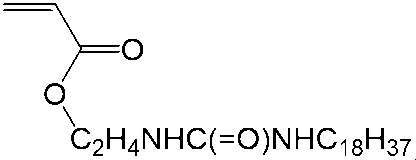


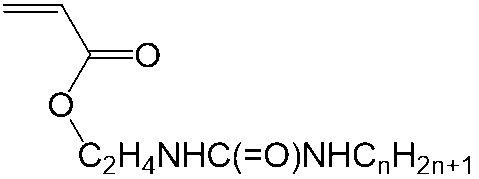
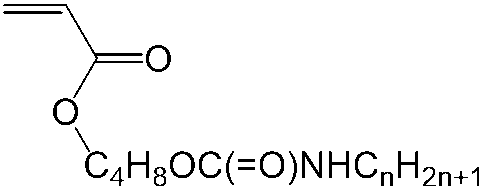
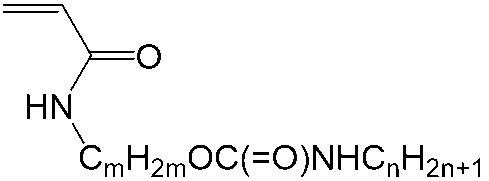


[上記式中、mは1~5の整数であり、nは7~40の整数である。]
CH2=C(-X3)-C(=O)-Y3-R3
[式中、X3は、水素原子、一価の有機基、またはフッ素原子を除くハロゲン原子であり、
Y3は、-O-または-NH-であり、
R3は、炭素数1~6の炭化水素基(酸素原子を含んでもよい)である。]
で示される化合物である。
式:
CH2=C(X4)-C(=O)-Y4-R4
[式中、X4は、水素原子、一価の有機基、またはフッ素原子を除くハロゲン原子であり、
Y4は、-O-または-NH-であり、
R4は、炭素数4~30の環状炭化水素含有基の炭化水素基である。]
で示される化合物である。
環状炭化水素基としては、飽和または不飽和である、単環基、多環基、橋かけ環基などが挙げられる。環状炭化水素基は、飽和であることが好ましい。
環状炭化水素基の炭素数は、15以下、例えば10以下であることが特に好ましい。
撥水性樹脂は、炭素数7~40の長鎖炭化水素基を有するポリウレタンであってよい。
炭素数7~40の長鎖炭化水素基を有するポリウレタンは、イソシアネート基含有化合物(例えば、モノイソシアネートまたはポリイソシアネート、具体的には、ジイソシアネート)と炭素数7~40の長鎖炭化水素基を有する水酸基含有化合物を反応させることによって製造できる。

それぞれのnは、独立して0~20であり、
それぞれのmは、独立して0~20であり、
m+nは、0より大きく、
それぞれのR1は、独立して、任意選択的に少なくとも1つの不飽和結合を含む炭素数7~40の長鎖炭化水素基であり、
それぞれのR2は、独立して、-H、または任意選択的に少なくとも1つの不飽和結合を含む炭素数7~40の長鎖炭化水素基であり、
それぞれのR3は、独立して、-H、-R1、-C(O)R1、-(CH2CH2O)n'(CH(CH3)CH2O)m'R2、または-(CH2CH2O)n'(CH(CH3)CH2O)m'C(O)R1であり、
それぞれのR4は、独立して、-H、任意選択的に少なくとも1つの不飽和結合を含む炭素数7~40の長鎖炭化水素基、またはこれらの組み合わせ;-(CH2CH2O)n'(CH(CH3)CH2O)m'R2;または-(CH2CH2O)n'(CH(CH3)CH2O)m'C(O)R1;であり、
それぞれのn'は、独立して0~20であり、
それぞれのm'は、独立して0~20であり、
m'+n'は、0より大きい、
それぞれのR19は、-H、-C(O)R1、または-CH2C[CH2OR]3である。]
で示される化合物である。
前記化合物が式(Ib)である場合に、少なくとも1つのR2、R3またはR4が-Hであることを条件とし、
前記化合物が式(Ic)である場合に、少なくとも1つのR19またはRが-Hであることを条件とする。
撥水性樹脂(B)の量は、撥水性粒子(A)と撥水性樹脂(B)の合計重量に対して、5~90重量%、好ましくは10~75重量%、より好ましくは12~70重量%、例えば15~65重量%、特に20~60重量%(または30~55重量%)であってよい。
撥水剤組成物は、液状媒体を含有する。液状媒体は、有機溶剤であるか、あるいは水、または水と有機溶剤の混合物である。
撥水剤組成物は、一般に、溶液または分散液である。溶液は、重合体が有機溶剤に溶解している溶液である。分散液は、重合体が水性媒体(水、または水と有機溶剤の混合物)に分散している水性分散液である。
撥水剤組成物は、撥水性粒子(A)と撥水性樹脂(B)と液状媒体(C)以外の他の成分(D)を含んでもよい。他の成分(D)として、添加剤および界面活性剤が挙げられる。
撥水剤組成物は、添加剤(D1)を含んでよい。
添加剤(D1)の例は、含ケイ素化合物、ワックス、アクリルエマルションなどである。添加剤の他の例は、他の重合体、乾燥速度調整剤、架橋剤、造膜助剤、相溶化剤、界面活性剤、凍結防止剤、粘度調整剤、紫外線吸収剤、酸化防止剤、pH調整剤、消泡剤、風合い調整剤、すべり性調整剤、帯電防止剤、親水化剤、抗菌剤、防腐剤、防虫剤、芳香剤、難燃剤等である。
撥水組成物は、水性分散液である場合に特に、界面活性剤(D2)を含んでよい。界面活性剤(D2)は、ノニオン性界面活性剤、カチオン性界面活性剤、アニオン性界面活性剤、および両性界面活性剤から選択された1種以上の界面活性剤であってよい。
撥水剤組成物は、撥水性樹脂の溶液または分散液に、撥水性粒子の粉末を添加することによって、製造できる。あるいは、撥水剤組成物は、撥水性樹脂の溶液または分散液と、撥水性粒子の分散液を混合することによって、製造できる。
撥水性樹脂の溶液は、撥水性樹脂を有機溶剤に溶解した溶液である。撥水性樹脂の分散液は、撥水性樹脂を水系媒体に分散した分散液である。撥水性粒子の分散液は、撥水性粒子を水系媒体に分散した分散液である。
超音波発生器としては特に制限はないが、出力としては500W以上、例えば500~2000Wが、効率よく混合可能な点で好ましい。超音波処理の処理時間は、0.5分~60分であってよい。例えば、500Wの超音波発生器にて10分間処理することで均一な撥水剤組成物となる。
撥水剤組成物において、撥水性粒子(A)および撥水性樹脂(B)の合計の濃度は、撥水剤組成物に対して、0.01~95重量%、例えば0.1~60重量%、特に0.5~30重量%であってよい。
撥水剤組成物は、従来既知の方法により被処理物に適用することができる。通常、該処理剤を有機溶剤または水に分散して希釈して、浸漬塗布、スプレー塗布、泡塗布、キャスト塗布などのような既知の方法により、被処理物の表面に付着させ、乾燥する方法が採られる。また、必要ならば、適当な架橋剤(例えば、ブロックドイソシアネート)と共に適用し、キュアリングを行ってもよい。さらに、撥水剤組成物に、防虫剤、柔軟剤、抗菌剤、難燃剤、帯電防止剤、塗料定着剤、防シワ剤などを添加して併用することも可能である。基材と接触させる処理液における長鎖炭化水素基を有する重合体の濃度は0.01~10重量%(特に、浸漬塗布の場合)、例えば0.05~10重量%であってよい。
あるいは、繊維状基材は紙であってもよい。長鎖炭化水素基を有する重合体を、予め形成した紙に適用してよく、または、製紙の様々な段階で、例えば、紙の乾燥期間中に適用してもよい。
以下において、部または%または比は、特記しない限り、重量部または重量%または重量比を表す。
試験の手順は次のとおりである。
試料1gを分液ロート(200ml)に計りとり、これに純水100mlを加えて栓をし、ターブラーミキサーで10分間振盪し、10分間静置した後、下層の20~30mlをロートから抜き取り、下層の混合液を石英セル(10mm)に分取し、純水をブランクとして比色計にかけ、その500nmの透過率を疎水率とする。
粒子0.2gを300mLのビーカーに計りとり、50mlの水に加え、ここに攪拌しながらメタノールを加え、試料粉末の全量が溶媒に湿潤した時点を終点とした場合の、終点におけるメタノール-水混合溶媒中のメタノールの容量%を疎水度(M値)とする。
転落速度は、全自動接触角計(協和界面科学製DropMaster701)によって、30°の傾斜をつけた基材にマイクロシリンジから水を20μL滴下して、転落していく様子をハイスピードカメラ(キーエンス社製VW-9000)を用いて約40mmの距離の平均転落速度を測定した。
接触角は、水平に置いた処理布にマイクロシリンジから水を2μL滴下して、全自動接触角計(協和界面科学製DropMaster701)によって測定した。
転落角は、水平に置いた処理布にマイクロシリンジから水を20μL滴下して、全自動接触角計(協和界面科学製DropMaster701)によって測定した。
キーエンス社製レーザー顕微鏡(倍率400倍)を用いて、処理液で処理した繊維を観察し、10μm以上のサイズの凝集物が視野の50%以上あれば×、25%以上あれば△、10%以上あれば○、10%未満であれば◎とした。
また、繊維表面が処理液で処理されていると、粒子が配合してあるため、明らかに繊維自体と表面状態が異なり、目視で表面状態を判断できる。処理液により処理された繊維の表面被覆度を目視判定した。被覆度が80%以上であれば◎、50%以上であれば○、25%以上であれば△、10%以下を×とした。
JIS-L-1092(AATCC-22)のスプレー法に準じて布の撥水性を評価した。その際に、布に着弾した水滴のはじき性、転落性、水滴の布への残り性から強撥水性を以下の観点で評価した。
○ 水滴はほとんどできず、流れ落ちていく
△ 水滴が、布の上にはとどまらずに転がって落ちていく
× 水滴ができ、転がって落ちていくが布上にとどまる水滴が多い
JIS-L-1092(AATCC-22)のスプレー法に準じて布の撥水性を評価した。下記表に示されるように撥水性No.によって表す。点数が大きいほど撥水性が良好なことを示し、状態によっては中間値(95、85、75)をつける。

JIS-L-1092(C)法に記載のブンデスマン試験にしたがって、降雨量を80cc/分、降雨水温を20℃、降雨時間を10分とする条件で降雨させ、撥水性を評価した。評価方法はスプレー撥水性試験と同様に表1に示されるように撥水性No.によって表す。
上記試験において、数値または記号に「+」(または「-」)を付けている場合、その数値または記号の評価よりもわずかに良い(または悪い)ことを示す。

[C18URA(ステアリル基含有ウレタンアクリレート)ホモポリマーの合成]
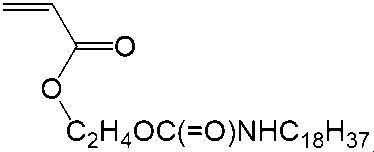
示差走査熱量計(DSC)より化合物の融点は約73℃であった。
1Lの2口フラスコにトルエン375g、C18URA100g、AIBN2.5gを入れ、窒素バブリングを15分以上おこない、その後、窒素フローする。オイルバスで80℃まで昇温し、4時間加熱撹拌した。NMRでモノマーの消費を確認した後、加熱を止めた。反応溶液にクロロホルムを添加し、析出したポリマーを溶解させた後、メタノールを用いて再沈殿を2回行い精製し、C18URA(ステアリル基含有ウレタンアクリレート)ホモポリマーを製造した。
[PStA(ポリステアリルアクリレート)の合成]
1Lの2口フラスコにトルエン375g、StA100g、AIBN2.5gを入れ、窒素バブリングを15分以上おこない、その後、窒素フローする。オイルバスで80℃まで昇温し、4時間加熱撹拌した。NMRでモノマーの消費を確認した後、加熱を止めた。反応溶液にクロロホルムを添加し、析出したポリマーを溶解させた後、メタノールを用いて再沈殿を2回行い精製し、PStA(ポリステアリルアクリレート)を製造した。
[C18SBUの合成]
500mlの四つ口フラスコに、ソルビタントリステアレート 100gと脱水4-メチル-2-ペンタノン120gをいれ、ヘキサメチレンジイソシアネート(ソルビタントリステアレートに対して0.33モル当量)、続いてジラウリン酸ジブチルスズ(ソルビタントリステアレートに対して0.0033モル当量)を添加して、溶液を50℃まで1時間加熱した。溶媒を除去後、メタノールで洗浄することで、ソルビタントリステアレートとヘキサメチレンジイソシアネートとの反応物を得た。IRおよびNMRより、ソルビタントリステアレートの水酸基がほぼ消失したのを確認した。また、反応の前後でGPC分析をおこなったところ、ピーク位置が示す分子量がほぼ3倍になり、ステアリル基を分子中に約9個もつ、長鎖アルキル基含有撥水性樹脂(C18SBU)を得た。
[PMMA(ポリメチルメタクリレート)の合成]
1Lの2口フラスコにトルエン375g、MMA100g、AIBN2.5gを入れ、窒素バブリングを15分以上おこない、その後、窒素フローする。オイルバスで80℃まで昇温し、4時間加熱撹拌した。NMRでモノマーの消費を確認した後、加熱を止めた。反応溶液にクロロホルムを添加し、析出したポリマーを溶解させた後、メタノールを用いて再沈殿を2回行い精製し、PMMA(ポリメチルメタクルレート)を製造した。
トリメチルシリル基を有するように表面処理されたシリカの粉末を準備した。シリカ粉末の平均一次粒径は7nmであり、比表面積は250m2/gであり、炭素含量は3重量%であり、見かけ比重は60g/Lであった。トリメチルシリル基は1,1,1,3,3,3-ヘキサメチルジシラザンを撥水化剤として使用し導入した。元素分析からもとめた処理度Dは60%であった。撥水性粒子の表面アルキル基個数Xは、撥水性粒子1gあたり、1,365×1018であった。また、疎水率は30%であった。
シリカ粉末(撥水性粒子)をトルエンに分散させてトルエン分散液(粒子濃度1.5重量%)を調製した。
合成例1で得たC18URAホモポリマー(撥水性樹脂)から、C18URAホモポリマーのトルエン溶液(樹脂濃度1.5重量%)を調製した。
撥水性粒子の分散液と撥水性樹脂の溶液を1:1の重量比で混合し、処理液1を製造した。処理液1は、撥水性粒子を0.75重量%の量で、および撥水性樹脂を0.75重量%の量で含んでいた。
実施例1で得られた処理液1にシリコーンワックス(ジメチルシリコーン、融点37℃)を、撥水性樹脂に対して10重量%の量で加える以外は、実施例1と同様の手順を繰り返して、処理液2を製造した。
C18URAホモポリマーに代えて、合成例2で得たPStAを用いる以外は、実施例1と同様の手順を繰り返して、処理液3を製造した。
トリメチルシリル基を有するように表面処理されたシリカの粉末を準備した。シリカ粉末の平均一次粒径は7nmであり、比表面積は210m2/gであり、炭素含量は5重量%であり、見かけ比重は50g/Lであった。トリメチルシリル基は1,1,1,3,3,3-ヘキサメチルジシラザンを撥水化剤として使用し導入した。元素分析からもとめた処理度Dはほぼ100%であった。撥水性粒子の表面アルキル基個数は、撥水性粒子1gあたり、1575×1018個であり、疎水率は98%であった。
シリカ粉末(撥水性粒子)をトルエンに分散させてトルエン分散液(粒子濃度1.5重量%)を調製した。
合成例2で得たPStA(撥水性樹脂)から、PStAのトルエン溶液(樹脂濃度1.5重量%)を調製した。
撥水性粒子の分散液と撥水性樹脂の溶液を1:1の重量比で混合し、処理液4を製造した。処理液4は、撥水性粒子を0.75重量%の量で、および撥水性樹脂を0.75重量%の量で含んでいた。
トリメチルシリル基を有するように表面処理されたシリカの粉末を準備した。シリカ粉末の平均一次粒径は12nmであり、比表面積は150m2/gであり、炭素含量は6.5重量%であり、見かけ比重は60g/Lであった。トリメチルシリル基は1,1,1,3,3,3-ヘキサメチルジシラザンを撥水化剤として使用し導入した。元素分析からもとめた処理度Dはほぼ70%であった。撥水性粒子の表面アルキル基個数は、撥水性粒子1gあたり、1000×1018個であり、疎水率は30%であった。
実施例4と同様に撥水性樹脂としてPStAを用い、処理液5を製造した。処理液5は、撥水性粒子を0.75重量%の量で、および撥水性樹脂を0.75重量%の量で含んでいた。
C18URAホモポリマーに代えて、合成例3で得たC18SBUを用いる以外は、実施例1と同様の手順を繰り返して、作製した処理液にシリコーンワックス(アルキル変性ジメチルシリコーン、融点37℃)を撥水性樹脂に対して10重量%の量を加えて処理液6を製造した。
PStAに代えて、合成例3で得たC18SBUを用いる以外は、実施例5と同様の手順を繰り返して、処理液7を製造した。
C18URAホモポリマーに代えて、合成例2で得たPStAを用い、撥水性粒子の分散液と撥水性樹脂の溶液を20:80の重量比で混合する以外は、実施例1と同様の手順を繰り返して、処理液8を製造した。処理液8は、撥水性粒子を0.3重量%の量でおよび撥水性樹脂を1.2%の量で含んでいた。
C18URAホモポリマーに代えて、合成例2で得たPStAを用い、撥水性粒子の分散液と撥水性樹脂の溶液を40:60の重量比で混合する以外は、実施例1と同様の手順を繰り返して、処理液9を製造した。処理液9は、撥水性粒子を0.6重量%の量でおよび撥水性樹脂を0.9%の量で含んでいた。
C18URAホモポリマーに代えて、合成例2で得たPStAを用い、撥水性粒子の分散液と撥水性樹脂の溶液を60:40の重量比で混合する以外は、実施例1と同様の手順を繰り返して、処理液10を製造した。処理液10は、撥水性粒子を0.9重量%の量でおよび撥水性樹脂を0.6%の量で含んでいた。
C18URAホモポリマーに代えて、合成例2で得たPStAを用い、撥水性粒子の分散液と撥水性樹脂の溶液を80:20の重量比で混合する以外は、実施例1と同様の手順を繰り返して、処理液11を製造した。処理液11は、撥水性粒子を1.2重量%の量でおよび撥水性樹脂を0.3%の量で含んでいた。
アルキルシランで表面処理されたシリカの粉末を準備した。シリカ粉末の平均一次粒径は5,900nmであり、比表面積は3.6m2/gであり、炭素含量は0.2重量%であり、見かけ比重は880g/Lであった。撥水性粒子の表面アルキル基個数は、撥水性粒子1gあたり、9×1018個であり、疎水率は0%であった。
このシリカ粉末を用いる以外は、実施例1と同様の手順を繰り返して、処理液C1を製造した。
比較例1で得られた処理液C1にシリコーンワックス(ジメチルシリコーン、融点37℃)を、撥水性樹脂に対して10重量%の量で加える以外は、実施例1と同様の手順を繰り返して、処理液C2を製造した。
アルキルシランで表面処理されたシリカの粉末を準備した。シリカ粉末の平均一次粒径は2,000nmであり、比表面積は15m2/gであり、炭素含量は0.2重量%であり、見かけ比重は920g/Lであった。撥水性粒子の表面アルキル基個数は、撥水性粒子1gあたり、40×1018個であり、疎水率は0%であった。
このシリカ粉末を用いる以外は、実施例1と同様の手順を繰り返して、処理液C3を製造した。
ジメチルシリル基を有するように表面処理されたシリカの粉末を準備した。シリカ粉末の平均一次粒径は7nmであり、比表面積は250m2/gであり、炭素含量は2.2重量%であり、見かけ比重は50g/Lであった。ジメチルシリル基はジメチルジメトキシシリルを撥水化剤として使用し導入した。元素分析からもとめた処理度Dは85%であった。撥水性粒子の表面アルキル基個数は531×1018個であった。また、疎水率は水に粉末が完全になじんでしまうため測定できなかった。値としては0となった。
シリカ粉末をトルエンに分散させてトルエン分散液(粒子濃度1.5重量%)を調製した。
合成例2で得たPStA(撥水性樹脂)から、PStAのトルエン溶液(樹脂濃度1.5重量%)を調製した。
シリカ粉末の分散液と撥水性樹脂の溶液を1:1の重量比で混合し、処理液C4を製造した。処理液C4は、シリカ粉末を0.75重量%の量で、および撥水性樹脂を0.75重量%の量で含んでいた。
トリメチルシリル基およびアミノ基が1:1になるように表面処理されたシリカの粉末を準備した。シリカ粉末の平均一次粒径は30nmであり、比表面積は40m2/gであり、炭素含量は2重量%であり、見かけ比重は50g/Lであった。アミノ基は3-アミノプロピルトリエトキシシランをトリメチルシリル基は1,1,1,3,3,3-ヘキサメチルジシラザンを使用し、アミノ基の導入後、トリメチルシリル基を導入した。アミノ基とトリメチルシリル基の比および全体の処理度は各合成段階での元素分析からもとめた。最終処理度Dはほぼ100%であった。撥水性粒子の表面アルキル基個数は75×1018個であった。また、疎水率は水に粉末が完全になじんでしまうため測定できなかった。値としては0となった。
比較例4と同様に撥水性樹脂としてPStAを用い、処理液C5を製造した。処理液C5は、シリカ粉末を0.75重量%の量で、および撥水性樹脂を0.75重量%の量で含んでいた。
C18URAホモポリマーに代えて、合成例4で得られたPMMAを用いる以外は、実施例1と同様の手順を繰り返して、処理液C6を製造した。
撥水性粒子は用いずに、合成例2で得られたPStAの1.5重量%トルエン溶液(処理液C7)を製造した。
ジメチルシリル基を有するように表面処理されたシリカの粉末を準備した。シリカ粉末の平均一次粒径は12nmであり、比表面積は170m2/gであり、炭素含量は1.1重量%であり、見かけ比重は50g/Lであった。ジメチルシリル基はジメチルジメトキシシリルを撥水化剤として使用し導入した。元素分析からもとめた処理度Dは85%であった。撥水性粒子の表面アルキル基個数は531×1018個であった。
シリカ粉末をトルエンに分散させてトルエン分散液(粒子濃度0.15重量%)を調製した。
合成例2で得たPStA(撥水性樹脂)から、PStAのトルエン溶液(樹脂濃度1.35重量%)を調製した。
シリカ粉末の分散液と撥水性樹脂の溶液を1:9の重量比で混合し、処理液C8を製造した。処理液C8は、シリカ粉末を0.15重量%の量で、および撥水性樹脂を1.35重量%の量で含んでいた。
処理液1を、ドロップキャスト法により、ポリエステル布(ベージュ)に適用し、マングルに通した。この処理布を170℃で3分間、ピンテンターに通し、乾燥、キュアリングした。
処理布を強撥水性試験、スプレー撥水性試験およびブンデスマン撥水性試験に付した。結果を表1に示す。
実施例2の処理液2を使用する以外は、試験例1と同様の手順を繰り返した。結果を表1に示す。
実施例3の処理液3を使用し、ドロップキャスト法に代えてディップコート法を用いる以外は、試験例1と同様の手順を繰り返した。結果を表1に示す。
実施例3の処理液3を使用し、処理液を超音波処理(超音波処理条件250Wの超音波照射機で10分間)する以外は、試験例1と同様の手順を繰り返した。結果を表1に示す。
実施例4の処理液4を使用する以外は、試験例3と同様の手順を繰り返した。結果を表2に示す
試験例6~12
実施例5の処理液5(試験例6)、実施例6の処理液6(試験例7)、実施例7の処理液7(試験例8)、実施例8の処理液8(試験例9)、実施例9の処理液9(試験例10)、実施例10の処理液10(試験例11)または実施例11の処理液11(試験例12)を使用する以外は、試験例1と同様の手順を繰り返した。結果を表2に示す
比較例1の処理液C1(比較試験例1)、比較例2の処理液C2(比較試験例2)および比較例3の処理液C3(比較試験例3)を使用する以外は、試験例1と同様の手順を繰り返した。結果を表3に示す。
比較例4の処理液C4(比較試験例4)、比較例5の処理液C5(比較試験例5)、比較例6の処理液C6(比較試験例6)、比較例7の処理液C7(比較試験例7)および比較例8の処理液C8(比較試験例8)を使用する以外は、試験例1と同様の手順を繰り返した。結果を表4に示す。
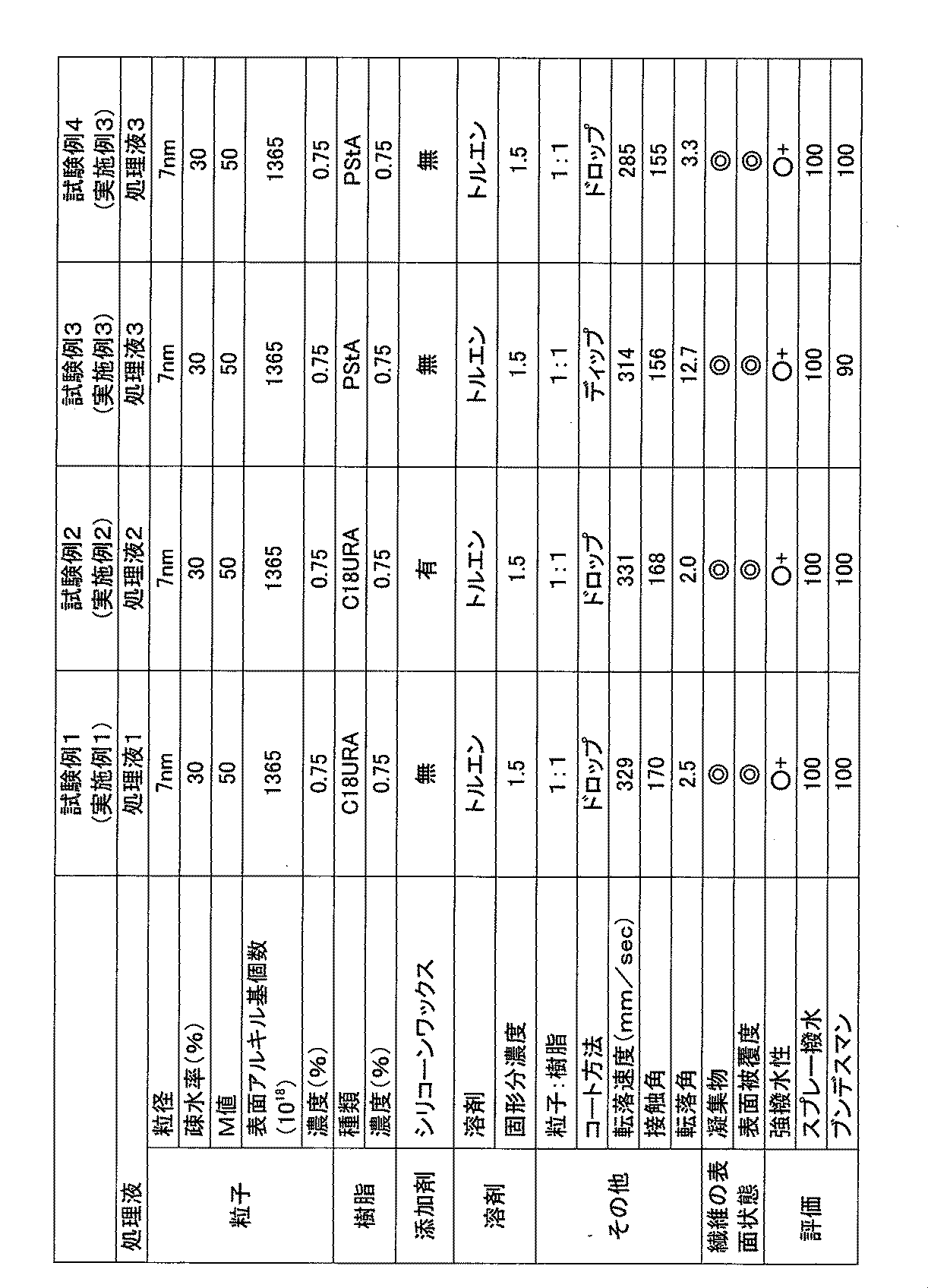


Claims (19)
- (A)撥水性粒子の表面アルキル基個数が撥水性粒子1gあたり600×1018個~50,000×1018個である撥水性粒子と
(B)炭素数7~40の長鎖炭化水素基を有する重合体である撥水性樹脂と
(C)液状媒体と
を含む撥水剤組成物。 - 撥水性粒子が、疎水率20%以上を有する粒子である請求項1に記載の撥水剤組成物。
- 撥水性粒子の表面アルキル基個数が撥水性粒子1gあたり1,000×1018個~10,000×1018個である請求項1または2記載の撥水剤組成物。
- 撥水性粒子が、シリカを疎水化剤で処理した疎水性シリカ、およびアルミナを疎水化剤で処理した疎水性アルミナから選択された少なくとも1種の無機粒子、または疎水性有機粒子である請求項1~3のいずれかに記載の撥水剤組成物。
- 撥水性粒子の平均一次粒径が1~100nmである請求項1~4のいずれかに記載の撥水剤組成物。
- 撥水性樹脂において、炭素数7~40の長鎖炭化水素基が、ステアリル基、イコシル基またはベヘニル基である請求項1~5のいずれかに記載の撥水剤組成物。
- 炭素数7~40の長鎖炭化水素基を有する重合体が、炭素数7~40の長鎖炭化水素基を有するアクリル単量体から形成された繰り返し単位を有し、
長鎖炭化水素基を有するアクリル単量体が、式:
CH2=C(-X)-C(=O)-Y-Rn
[式中、Xは、水素原子、メチル基、またはフッ素原子を除くハロゲン原子であり、
Yは、2価または3価の炭素数1の炭化水素基、-C6H6-、-O-、-C(=O)-、-S(C=O)2-または-NH-から選ばれる少なくとも1つ以上で構成される基(但し、炭化水素基を除く)であり、
Rは、炭素数7~40の炭化水素基であり、
nは1~3の整数である。]
で表される単量体である請求項6に記載の撥水剤組成物。 - 長鎖炭化水素基を有するアクリル単量体において、Xは水素原子、メチル基または塩素原子である請求項6または7に記載の撥水剤組成物。
- 撥水性粒子と撥水性樹脂の重量比が25:75~90:10であり、(A)撥水性粒子と(B)撥水性樹脂の合計量が撥水剤組成物に対して、0.5~50重量%である請求項1~8のいずれかに記載の撥水剤組成物。
- 液状媒体が有機溶剤および/または水である請求項1~9のいずれかに記載の撥水剤組成物。
- フッ素原子を含まない請求項1~10のいずれかに記載の撥水剤組成物。
- 繊維製品用である請求項1~11のいずれかに記載の撥水剤組成物。
- 請求項1~12のいずれかに記載の撥水剤組成物を含む処理液で繊維を処理する繊維の処理方法。
- 請求項13に記載の処理方法によって繊維を処理する工程を含む、処理繊維製品の製造方法。
- 請求項1~12のいずれかに記載の撥水剤組成物から形成されている膜。
- 請求項1~12に記載の撥水剤組成物を含む処理液で処理された繊維製品。
- 請求項1~12のいずれかに記載の撥水剤組成物における撥水性粒子と撥水性樹脂が表面に付着している繊維製品。
- 非フッ素撥水剤によって処理されており、水の転落速度が300mm/sec以上である繊維製品。
- 請求項1~12のいずれかに記載の撥水剤組成物を含む処理液で処理されており、水の転落速度が300mm/sec以上であり、繊維製品の表面に付着した撥水性粒子および撥水性樹脂が10μm以上の大きさで実質的に凝集することなく繊維表面を80%以上おおっている繊維製品。
Priority Applications (5)
| Application Number | Priority Date | Filing Date | Title |
|---|---|---|---|
| JP2020563209A JP7168878B2 (ja) | 2018-12-28 | 2019-12-20 | 撥水剤組成物 |
| KR1020217019447A KR102506157B1 (ko) | 2018-12-28 | 2019-12-20 | 발수제 조성물 |
| EP19905610.2A EP3904588B1 (en) | 2018-12-28 | 2019-12-20 | Water repellent composition |
| CN201980086035.2A CN113227484B (zh) | 2018-12-28 | 2019-12-20 | 拨水剂组合物 |
| US17/359,065 US11982048B2 (en) | 2018-12-28 | 2021-06-25 | Water-repellent composition |
Applications Claiming Priority (2)
| Application Number | Priority Date | Filing Date | Title |
|---|---|---|---|
| JP2018248130 | 2018-12-28 | ||
| JP2018-248130 | 2018-12-28 |
Related Child Applications (1)
| Application Number | Title | Priority Date | Filing Date |
|---|---|---|---|
| US17/359,065 Continuation US11982048B2 (en) | 2018-12-28 | 2021-06-25 | Water-repellent composition |
Publications (1)
| Publication Number | Publication Date |
|---|---|
| WO2020137902A1 true WO2020137902A1 (ja) | 2020-07-02 |
Family
ID=71125914
Family Applications (1)
| Application Number | Title | Priority Date | Filing Date |
|---|---|---|---|
| PCT/JP2019/050154 Ceased WO2020137902A1 (ja) | 2018-12-28 | 2019-12-20 | 撥水剤組成物 |
Country Status (7)
| Country | Link |
|---|---|
| US (1) | US11982048B2 (ja) |
| EP (1) | EP3904588B1 (ja) |
| JP (1) | JP7168878B2 (ja) |
| KR (1) | KR102506157B1 (ja) |
| CN (1) | CN113227484B (ja) |
| TW (1) | TWI775029B (ja) |
| WO (1) | WO2020137902A1 (ja) |
Cited By (7)
| Publication number | Priority date | Publication date | Assignee | Title |
|---|---|---|---|---|
| WO2022138853A1 (ja) * | 2020-12-25 | 2022-06-30 | ダイキン工業株式会社 | スリップ防止効果のある撥水性有機微粒子 |
| WO2022220198A1 (ja) * | 2021-04-15 | 2022-10-20 | Agc株式会社 | 撥液剤組成物、基材の処理方法及び物品 |
| WO2023281793A1 (ja) * | 2021-07-07 | 2023-01-12 | 株式会社ケミコート | 玩具向けの超撥水コーティング剤の製造方法、超撥水コーティング剤及びそれを用いる玩具 |
| JP2023010656A (ja) * | 2021-07-08 | 2023-01-20 | ダイキン工業株式会社 | 耐油剤組成物 |
| EP4083078A4 (en) * | 2019-12-24 | 2024-01-10 | Mitsui Chemicals, Inc. | WATER-REPELLENT COMPOSITION, METHOD FOR MANUFACTURING WATER-REPELLENT COMPOSITION AND TEXTILE PRODUCT |
| JPWO2024161574A1 (ja) * | 2023-02-02 | 2024-08-08 | ||
| US12351674B2 (en) | 2019-12-24 | 2025-07-08 | Mitsui Chemicals, Inc. | Polyurethane resin composition, repellent, water repellent for fibers, and stain-proof coating agent |
Families Citing this family (3)
| Publication number | Priority date | Publication date | Assignee | Title |
|---|---|---|---|---|
| CN115992452A (zh) * | 2021-10-20 | 2023-04-21 | 大金工业株式会社 | 拨水剂组合物 |
| EP4490217A1 (de) * | 2022-03-08 | 2025-01-15 | Unilin, BV | Fluorfreie beschichtungszusammensetzung |
| CN114875659A (zh) * | 2022-06-13 | 2022-08-09 | 安徽元琛环保科技股份有限公司 | 一种超疏水滤料及其制备方法 |
Citations (9)
| Publication number | Priority date | Publication date | Assignee | Title |
|---|---|---|---|---|
| JPH07328532A (ja) * | 1994-06-07 | 1995-12-19 | Sekisui Chem Co Ltd | 撥水性被膜 |
| JP2002029733A (ja) * | 2000-07-07 | 2002-01-29 | Toyota Central Res & Dev Lab Inc | 球状多孔体の製造方法 |
| JP2002166506A (ja) * | 2000-11-30 | 2002-06-11 | Asahi Glass Co Ltd | 疎水性基材およびその製造方法 |
| JP2007261315A (ja) * | 2006-03-27 | 2007-10-11 | Fujitsu Ltd | アンテナ、車両用ドア、車両及び通信システム |
| WO2015002012A1 (ja) * | 2013-07-02 | 2015-01-08 | 東洋製罐グループホールディングス株式会社 | 滑水性に優れた表面を有する樹脂成形体 |
| JP2017206775A (ja) | 2016-05-16 | 2017-11-24 | 明成化学工業株式会社 | 繊維製品のはっ水処理用水系分散体及びその製造方法、はっ水加工方法及びはっ水性繊維製品 |
| JP2018104866A (ja) | 2016-12-28 | 2018-07-05 | 日華化学株式会社 | 撥水剤組成物、撥水性繊維製品及び撥水性繊維製品の製造方法 |
| WO2018180982A1 (ja) * | 2017-03-31 | 2018-10-04 | 住友化学株式会社 | 組成物 |
| WO2018180983A1 (ja) * | 2017-03-31 | 2018-10-04 | 住友化学株式会社 | 組成物 |
Family Cites Families (13)
| Publication number | Priority date | Publication date | Assignee | Title |
|---|---|---|---|---|
| JP2002029783A (ja) | 2000-07-14 | 2002-01-29 | Nissan Motor Co Ltd | 表面改質ガラス及びその製造方法 |
| FR2840912B1 (fr) * | 2002-06-18 | 2005-10-21 | Rhodia Chimie Sa | Emulsion silicone aqueuse pour le revetement de supports fibreux tisses ou non |
| ATE489497T1 (de) * | 2003-02-04 | 2010-12-15 | Dow Corning | Beschichtungszusammensetzungen und damit beschichtete textile flächengebilde |
| JP2007291315A (ja) | 2006-03-30 | 2007-11-08 | Fujifilm Corp | 滑水性被膜及びその製造方法 |
| JP2008138336A (ja) * | 2006-12-05 | 2008-06-19 | Teijin Techno Products Ltd | 耐熱性撥水撥油加工布帛 |
| AU2009302329B2 (en) * | 2008-10-07 | 2015-10-29 | Ssw Advanced Technologies, Llc | Spill resistant surfaces having hydrophobic and oleophobic borders |
| EP2729610B1 (en) * | 2011-07-05 | 2018-06-27 | Luna Innovations Incorporated | Fluid-resistant textile fabrics and methods |
| KR101872133B1 (ko) * | 2013-11-22 | 2018-06-27 | 다이킨 고교 가부시키가이샤 | 수계 표면 처리제 |
| WO2017145918A1 (ja) * | 2016-02-23 | 2017-08-31 | ダイキン工業株式会社 | 表面処理剤 |
| CN107177982B (zh) * | 2016-03-11 | 2021-09-07 | 大金工业株式会社 | 表面处理剂组合物 |
| CN106087420B (zh) * | 2016-06-07 | 2019-04-09 | 苏州联胜化学有限公司 | 一种无氟防水剂及其制备方法 |
| JP6883434B2 (ja) * | 2017-01-27 | 2021-06-09 | 日華化学株式会社 | 撥水剤組成物、撥水性繊維製品及び撥水性繊維製品の製造方法 |
| JP2018184692A (ja) | 2017-04-27 | 2018-11-22 | 小松精練株式会社 | 撥水性布帛およびその製造方法 |
-
2019
- 2019-12-20 WO PCT/JP2019/050154 patent/WO2020137902A1/ja not_active Ceased
- 2019-12-20 EP EP19905610.2A patent/EP3904588B1/en active Active
- 2019-12-20 JP JP2020563209A patent/JP7168878B2/ja active Active
- 2019-12-20 CN CN201980086035.2A patent/CN113227484B/zh active Active
- 2019-12-20 KR KR1020217019447A patent/KR102506157B1/ko active Active
- 2019-12-25 TW TW108147613A patent/TWI775029B/zh active
-
2021
- 2021-06-25 US US17/359,065 patent/US11982048B2/en active Active
Patent Citations (9)
| Publication number | Priority date | Publication date | Assignee | Title |
|---|---|---|---|---|
| JPH07328532A (ja) * | 1994-06-07 | 1995-12-19 | Sekisui Chem Co Ltd | 撥水性被膜 |
| JP2002029733A (ja) * | 2000-07-07 | 2002-01-29 | Toyota Central Res & Dev Lab Inc | 球状多孔体の製造方法 |
| JP2002166506A (ja) * | 2000-11-30 | 2002-06-11 | Asahi Glass Co Ltd | 疎水性基材およびその製造方法 |
| JP2007261315A (ja) * | 2006-03-27 | 2007-10-11 | Fujitsu Ltd | アンテナ、車両用ドア、車両及び通信システム |
| WO2015002012A1 (ja) * | 2013-07-02 | 2015-01-08 | 東洋製罐グループホールディングス株式会社 | 滑水性に優れた表面を有する樹脂成形体 |
| JP2017206775A (ja) | 2016-05-16 | 2017-11-24 | 明成化学工業株式会社 | 繊維製品のはっ水処理用水系分散体及びその製造方法、はっ水加工方法及びはっ水性繊維製品 |
| JP2018104866A (ja) | 2016-12-28 | 2018-07-05 | 日華化学株式会社 | 撥水剤組成物、撥水性繊維製品及び撥水性繊維製品の製造方法 |
| WO2018180982A1 (ja) * | 2017-03-31 | 2018-10-04 | 住友化学株式会社 | 組成物 |
| WO2018180983A1 (ja) * | 2017-03-31 | 2018-10-04 | 住友化学株式会社 | 組成物 |
Non-Patent Citations (1)
| Title |
|---|
| See also references of EP3904588A4 |
Cited By (13)
| Publication number | Priority date | Publication date | Assignee | Title |
|---|---|---|---|---|
| US12540245B2 (en) | 2019-12-24 | 2026-02-03 | Mitsui Chemicals, Inc. | Water repellent composition, method for producing water repellent composition, and fiber product |
| EP4083078A4 (en) * | 2019-12-24 | 2024-01-10 | Mitsui Chemicals, Inc. | WATER-REPELLENT COMPOSITION, METHOD FOR MANUFACTURING WATER-REPELLENT COMPOSITION AND TEXTILE PRODUCT |
| US12351674B2 (en) | 2019-12-24 | 2025-07-08 | Mitsui Chemicals, Inc. | Polyurethane resin composition, repellent, water repellent for fibers, and stain-proof coating agent |
| JP2022103125A (ja) * | 2020-12-25 | 2022-07-07 | ダイキン工業株式会社 | スリップ防止効果のある撥水性有機微粒子 |
| WO2022138853A1 (ja) * | 2020-12-25 | 2022-06-30 | ダイキン工業株式会社 | スリップ防止効果のある撥水性有機微粒子 |
| JP7288209B2 (ja) | 2020-12-25 | 2023-06-07 | ダイキン工業株式会社 | スリップ防止効果のある撥水性有機微粒子 |
| WO2022220198A1 (ja) * | 2021-04-15 | 2022-10-20 | Agc株式会社 | 撥液剤組成物、基材の処理方法及び物品 |
| JP7678267B2 (ja) | 2021-07-07 | 2025-05-16 | 株式会社ケミコート | 玩具用水玉形成超撥水性コーティング剤、および製造方法 |
| WO2023281793A1 (ja) * | 2021-07-07 | 2023-01-12 | 株式会社ケミコート | 玩具向けの超撥水コーティング剤の製造方法、超撥水コーティング剤及びそれを用いる玩具 |
| JP2023010488A (ja) * | 2021-07-07 | 2023-01-20 | 株式会社ケミコート | 水玉形成用超撥水性コーティング剤、超撥水性コーティング剤の製造方法及びその超撥水性コーティング剤を用いた玩具 |
| JP7252502B2 (ja) | 2021-07-08 | 2023-04-05 | ダイキン工業株式会社 | 耐油剤組成物 |
| JP2023010656A (ja) * | 2021-07-08 | 2023-01-20 | ダイキン工業株式会社 | 耐油剤組成物 |
| JPWO2024161574A1 (ja) * | 2023-02-02 | 2024-08-08 |
Also Published As
| Publication number | Publication date |
|---|---|
| KR102506157B1 (ko) | 2023-03-07 |
| TWI775029B (zh) | 2022-08-21 |
| CN113227484A (zh) | 2021-08-06 |
| JPWO2020137902A1 (ja) | 2021-10-21 |
| TW202035648A (zh) | 2020-10-01 |
| CN113227484B (zh) | 2023-08-01 |
| US20220064851A1 (en) | 2022-03-03 |
| KR20210091318A (ko) | 2021-07-21 |
| US11982048B2 (en) | 2024-05-14 |
| JP7168878B2 (ja) | 2022-11-10 |
| EP3904588A1 (en) | 2021-11-03 |
| EP3904588B1 (en) | 2026-03-11 |
| EP3904588A4 (en) | 2022-10-05 |
Similar Documents
| Publication | Publication Date | Title |
|---|---|---|
| JP7168878B2 (ja) | 撥水剤組成物 | |
| JP7845919B2 (ja) | 表面処理剤 | |
| JP5670453B2 (ja) | 含フッ素重合体および処理剤 | |
| JP5670454B2 (ja) | 含フッ素重合体および表面処理剤 | |
| JP7759808B2 (ja) | 有機微粒子 | |
| TWI675045B (zh) | 共聚物及表面處理劑 | |
| JP7307365B2 (ja) | 耐水圧向上効果のある撥水性有機微粒子 | |
| TWI849371B (zh) | 具有防滑移效果的撥水性有機微粒子 | |
| JP2021187952A (ja) | 表面処理剤 | |
| JP2022015731A (ja) | 有機微粒子 |
Legal Events
| Date | Code | Title | Description |
|---|---|---|---|
| 121 | Ep: the epo has been informed by wipo that ep was designated in this application |
Ref document number: 19905610 Country of ref document: EP Kind code of ref document: A1 |
|
| ENP | Entry into the national phase |
Ref document number: 2020563209 Country of ref document: JP Kind code of ref document: A |
|
| ENP | Entry into the national phase |
Ref document number: 20217019447 Country of ref document: KR Kind code of ref document: A |
|
| NENP | Non-entry into the national phase |
Ref country code: DE |
|
| ENP | Entry into the national phase |
Ref document number: 2019905610 Country of ref document: EP Effective date: 20210728 |
|
| WWG | Wipo information: grant in national office |
Ref document number: 2019905610 Country of ref document: EP |