WO2020138445A1 - Film de base de transfert hydraulique et film d'impression par transfert hydraulique - Google Patents
Film de base de transfert hydraulique et film d'impression par transfert hydraulique Download PDFInfo
- Publication number
- WO2020138445A1 WO2020138445A1 PCT/JP2019/051494 JP2019051494W WO2020138445A1 WO 2020138445 A1 WO2020138445 A1 WO 2020138445A1 JP 2019051494 W JP2019051494 W JP 2019051494W WO 2020138445 A1 WO2020138445 A1 WO 2020138445A1
- Authority
- WO
- WIPO (PCT)
- Prior art keywords
- film
- pva
- hydraulic transfer
- base film
- amount
- Prior art date
- Legal status (The legal status is an assumption and is not a legal conclusion. Google has not performed a legal analysis and makes no representation as to the accuracy of the status listed.)
- Ceased
Links
Images
Classifications
-
- C—CHEMISTRY; METALLURGY
- C08—ORGANIC MACROMOLECULAR COMPOUNDS; THEIR PREPARATION OR CHEMICAL WORKING-UP; COMPOSITIONS BASED THEREON
- C08J—WORKING-UP; GENERAL PROCESSES OF COMPOUNDING; AFTER-TREATMENT NOT COVERED BY SUBCLASSES C08B, C08C, C08F, C08G or C08H
- C08J5/00—Manufacture of articles or shaped materials containing macromolecular substances
- C08J5/18—Manufacture of films or sheets
-
- B—PERFORMING OPERATIONS; TRANSPORTING
- B29—WORKING OF PLASTICS; WORKING OF SUBSTANCES IN A PLASTIC STATE IN GENERAL
- B29D—PRODUCING PARTICULAR ARTICLES FROM PLASTICS OR FROM SUBSTANCES IN A PLASTIC STATE
- B29D7/00—Producing flat articles, e.g. films or sheets
- B29D7/01—Films or sheets
-
- B—PERFORMING OPERATIONS; TRANSPORTING
- B41—PRINTING; LINING MACHINES; TYPEWRITERS; STAMPS
- B41M—PRINTING, DUPLICATING, MARKING, OR COPYING PROCESSES; COLOUR PRINTING
- B41M5/00—Duplicating or marking methods; Sheet materials for use therein
- B41M5/50—Recording sheets characterised by the coating used to improve ink, dye or pigment receptivity, e.g. for ink-jet or thermal dye transfer recording
- B41M5/502—Recording sheets characterised by the coating used to improve ink, dye or pigment receptivity, e.g. for ink-jet or thermal dye transfer recording characterised by structural details, e.g. multilayer materials
-
- B—PERFORMING OPERATIONS; TRANSPORTING
- B44—DECORATIVE ARTS
- B44C—PRODUCING DECORATIVE EFFECTS; MOSAICS; TARSIA WORK; PAPERHANGING
- B44C1/00—Processes, not specifically provided for elsewhere, for producing decorative surface effects
- B44C1/16—Processes, not specifically provided for elsewhere, for producing decorative surface effects for applying transfer pictures or the like
- B44C1/165—Processes, not specifically provided for elsewhere, for producing decorative surface effects for applying transfer pictures or the like for decalcomanias; sheet material therefor
- B44C1/175—Transfer using solvent
- B44C1/1758—Decalcomanias applied under pressure only, e.g. provided with a pressure sensitive layer
-
- B—PERFORMING OPERATIONS; TRANSPORTING
- B65—CONVEYING; PACKING; STORING; HANDLING THIN OR FILAMENTARY MATERIAL
- B65D—CONTAINERS FOR STORAGE OR TRANSPORT OF ARTICLES OR MATERIALS, e.g. BAGS, BARRELS, BOTTLES, BOXES, CANS, CARTONS, CRATES, DRUMS, JARS, TANKS, HOPPERS, FORWARDING CONTAINERS; ACCESSORIES, CLOSURES, OR FITTINGS THEREFOR; PACKAGING ELEMENTS; PACKAGES
- B65D65/00—Wrappers or flexible covers; Packaging materials of special type or form
- B65D65/38—Packaging materials of special type or form
- B65D65/42—Applications of coated or impregnated materials
-
- C—CHEMISTRY; METALLURGY
- C08—ORGANIC MACROMOLECULAR COMPOUNDS; THEIR PREPARATION OR CHEMICAL WORKING-UP; COMPOSITIONS BASED THEREON
- C08K—Use of inorganic or non-macromolecular organic substances as compounding ingredients
- C08K5/00—Use of organic ingredients
- C08K5/04—Oxygen-containing compounds
- C08K5/05—Alcohols; Metal alcoholates
- C08K5/053—Polyhydroxylic alcohols
-
- B—PERFORMING OPERATIONS; TRANSPORTING
- B29—WORKING OF PLASTICS; WORKING OF SUBSTANCES IN A PLASTIC STATE IN GENERAL
- B29C—SHAPING OR JOINING OF PLASTICS; SHAPING OF MATERIAL IN A PLASTIC STATE, NOT OTHERWISE PROVIDED FOR; AFTER-TREATMENT OF THE SHAPED PRODUCTS, e.g. REPAIRING
- B29C41/00—Shaping by coating a mould, core or other substrate, i.e. by depositing material and stripping-off the shaped article; Apparatus therefor
- B29C41/24—Shaping by coating a mould, core or other substrate, i.e. by depositing material and stripping-off the shaped article; Apparatus therefor for making articles of indefinite length
- B29C41/26—Shaping by coating a mould, core or other substrate, i.e. by depositing material and stripping-off the shaped article; Apparatus therefor for making articles of indefinite length by depositing flowable material on a rotating drum
-
- B—PERFORMING OPERATIONS; TRANSPORTING
- B29—WORKING OF PLASTICS; WORKING OF SUBSTANCES IN A PLASTIC STATE IN GENERAL
- B29C—SHAPING OR JOINING OF PLASTICS; SHAPING OF MATERIAL IN A PLASTIC STATE, NOT OTHERWISE PROVIDED FOR; AFTER-TREATMENT OF THE SHAPED PRODUCTS, e.g. REPAIRING
- B29C41/00—Shaping by coating a mould, core or other substrate, i.e. by depositing material and stripping-off the shaped article; Apparatus therefor
- B29C41/24—Shaping by coating a mould, core or other substrate, i.e. by depositing material and stripping-off the shaped article; Apparatus therefor for making articles of indefinite length
- B29C41/28—Shaping by coating a mould, core or other substrate, i.e. by depositing material and stripping-off the shaped article; Apparatus therefor for making articles of indefinite length by depositing flowable material on an endless belt
-
- B—PERFORMING OPERATIONS; TRANSPORTING
- B29—WORKING OF PLASTICS; WORKING OF SUBSTANCES IN A PLASTIC STATE IN GENERAL
- B29K—INDEXING SCHEME ASSOCIATED WITH SUBCLASSES B29B, B29C OR B29D, RELATING TO MOULDING MATERIALS OR TO MATERIALS FOR MOULDS, REINFORCEMENTS, FILLERS OR PREFORMED PARTS, e.g. INSERTS
- B29K2029/00—Use of polyvinylalcohols, polyvinylethers, polyvinylaldehydes, polyvinylketones or polyvinylketals or derivatives thereof as moulding material
- B29K2029/04—PVOH, i.e. polyvinyl alcohol
-
- B—PERFORMING OPERATIONS; TRANSPORTING
- B65—CONVEYING; PACKING; STORING; HANDLING THIN OR FILAMENTARY MATERIAL
- B65D—CONTAINERS FOR STORAGE OR TRANSPORT OF ARTICLES OR MATERIALS, e.g. BAGS, BARRELS, BOTTLES, BOXES, CANS, CARTONS, CRATES, DRUMS, JARS, TANKS, HOPPERS, FORWARDING CONTAINERS; ACCESSORIES, CLOSURES, OR FITTINGS THEREFOR; PACKAGING ELEMENTS; PACKAGES
- B65D65/00—Wrappers or flexible covers; Packaging materials of special type or form
- B65D65/38—Packaging materials of special type or form
- B65D65/46—Applications of disintegrable, dissolvable or edible materials
-
- C—CHEMISTRY; METALLURGY
- C08—ORGANIC MACROMOLECULAR COMPOUNDS; THEIR PREPARATION OR CHEMICAL WORKING-UP; COMPOSITIONS BASED THEREON
- C08J—WORKING-UP; GENERAL PROCESSES OF COMPOUNDING; AFTER-TREATMENT NOT COVERED BY SUBCLASSES C08B, C08C, C08F, C08G or C08H
- C08J2329/00—Characterised by the use of homopolymers or copolymers of compounds having one or more unsaturated aliphatic radicals, each having only one carbon-to-carbon double bond, and at least one being terminated by an alcohol, ether, aldehydo, ketonic, acetal, or ketal radical; Hydrolysed polymers of esters of unsaturated alcohols with saturated carboxylic acids; Derivatives of such polymer
- C08J2329/02—Homopolymers or copolymers of unsaturated alcohols
- C08J2329/04—Polyvinyl alcohol; Partially hydrolysed homopolymers or copolymers of esters of unsaturated alcohols with saturated carboxylic acids
-
- C—CHEMISTRY; METALLURGY
- C08—ORGANIC MACROMOLECULAR COMPOUNDS; THEIR PREPARATION OR CHEMICAL WORKING-UP; COMPOSITIONS BASED THEREON
- C08J—WORKING-UP; GENERAL PROCESSES OF COMPOUNDING; AFTER-TREATMENT NOT COVERED BY SUBCLASSES C08B, C08C, C08F, C08G or C08H
- C08J2331/00—Characterised by the use of copolymers of compounds having one or more unsaturated aliphatic radicals, each having only one carbon-to-carbon double bond, and at least one being terminated by an acyloxy radical of a saturated carboxylic acid, or carbonic acid, or of a haloformic acid
- C08J2331/02—Characterised by the use of omopolymers or copolymers of esters of monocarboxylic acids
- C08J2331/04—Homopolymers or copolymers of vinyl acetate
-
- C—CHEMISTRY; METALLURGY
- C08—ORGANIC MACROMOLECULAR COMPOUNDS; THEIR PREPARATION OR CHEMICAL WORKING-UP; COMPOSITIONS BASED THEREON
- C08J—WORKING-UP; GENERAL PROCESSES OF COMPOUNDING; AFTER-TREATMENT NOT COVERED BY SUBCLASSES C08B, C08C, C08F, C08G or C08H
- C08J2403/00—Characterised by the use of starch, amylose or amylopectin or of their derivatives or degradation products
- C08J2403/04—Starch derivatives
Definitions
- the present invention relates to a hydraulic transfer base film suitable for imparting a high-definition design to a molded product having an uneven three-dimensional surface or a curved surface, and a hydraulic transfer printing film using the base film.
- water-soluble films are used in a wide range of fields such as packaging of various chemicals such as liquid detergents and agricultural chemicals, seed tapes containing seeds, etc. by utilizing their excellent solubility in water.
- a printing film for hydraulic transfer having a printing layer When printing on the surface of a non-planar molded article having irregularities, a printing film for hydraulic transfer having a printing layer is generally used. In this case, float on the water surface with the printing surface of the hydraulic transfer printing film facing upward and allow it to swell sufficiently, then press the molded body that is the transferred material into the water and press it against the printing layer from above, to the surface of the transferred material. The method of transferring the print layer is adopted.
- a printing film for hydraulic transfer a film made of a water-soluble or water-swellable resin such as a polyvinyl alcohol resin (hereinafter, the polyvinyl alcohol resin may be abbreviated as “PVA”) has been used as a raw material.
- PVA polyvinyl alcohol resin
- the hydraulic transfer base film may be abbreviated as "base film”).
- the base film for hydraulic transfer is used as a base material for a printing layer, and a laminate of the printing layer on the base film serves as a printing film for hydraulic transfer.
- a base film for hydraulic transfer made of PVA as a raw material is easily stretched under the influence of humidity, temperature and film tension when forming a printing layer.
- the print pattern is deformed because the base film extends in the longitudinal direction.
- the print pattern printed first and the print patterns of different colors printed later do not properly overlap with each other and are easily displaced.
- a hydraulic transfer printing film is used, there is a problem that it is difficult to perform high-definition transfer printing on a molded body.
- a printing layer, a release layer, or the like is formed on a plastic film or paper to form a pre-transfer film, the pre-transfer film and the base film are overlaid, and after pre-transfer by heating and pressing.
- a method for producing a printing film for hydraulic transfer by peeling off the pre-transfer film see, for example, Patent Document 1), or a hydraulic transfer base comprising a multilayer body of a water-soluble PVA layer and any one of the following layers I to III A film (for example, refer to Patent Document 2) has been proposed.
- the layer I is a layer containing water-soluble PVA satisfying a specific relationship with the water-soluble PVA layer
- the layer II is a layer containing water-soluble PVA and inorganic particles having an average particle diameter of 2 to 20 ⁇ m.
- Layer III is a layer containing at least one water-soluble resin selected from the group consisting of polysaccharides and acrylic resins.
- pulsed NMR Nuclear Magnetic Resonance
- the present invention is a single-layer hydraulic transfer base film that is excellent in water solubility and can perform high-definition transfer printing without breaking even when printing at high speed, and a film for hydraulic transfer printing using the same. I will provide a.
- the present inventors have found that the above problems can be solved by setting the amount of crystalline components, the amount of constrained amorphous components, and the water content in a PVA-containing base film to specific ranges, and have completed the present invention. ..
- a first aspect of the present invention relates to a hydraulic transfer base film that contains a polyvinyl alcohol resin and forms a printing layer that is transferred by hydraulic transfer to a transfer target.
- This hydraulic transfer base film has a crystalline component amount (A1) of 60% or less obtained from a spin-spin relaxation curve obtained when 1 H pulse NMR measurement of the hydraulic transfer base film is performed in deuterated methanol.
- the amount of the constrained amorphous component (A2) is 10 to 50%, and the water content is 1 to 5%.
- the ratio (A1/A2) of the crystalline component amount (A1) to the constrained amorphous component amount (A2) may be 0.1 to 5. ..
- the ratio (A2/A3) between the amount of the constrained amorphous component (A2) and the amount of the amorphous component (A3) obtained from the spin-spin relaxation curve is It may be 1.5 or less.
- the complete dissolution time when the hydraulic transfer base film is immersed in deionized water at 10° C. may be 90 seconds or less.
- 0.5 to 15 parts by mass of the plasticizer and/or 0.1 to 15 parts by mass of the polyvinyl alcohol-based resin (PVA) is used. Starch may be blended.
- the hydraulic transfer base film may have a thickness of 15 to 50 ⁇ m.
- a hydraulic transfer printing film which has the hydraulic transfer base film according to one aspect and a printing layer formed on the surface of the hydraulic transfer base film.
- the printing layer may be a laminated printing layer in which printing patterns different in at least one of hue, saturation and lightness are laminated.
- ADVANTAGE OF THE INVENTION According to this invention, even if it prints on a single-layer hydraulic transfer base film at high speed, it does not break, but it can perform high-definition transfer printing, and the hydraulic transfer base film which used PVA as a raw material, and it.
- the hydraulic transfer printing film used is provided.
- the hydraulic transfer base film of the present invention contains a polyvinyl alcohol resin (PVA). Then, when 1 H pulse NMR measurement of the base film for hydraulic transfer is performed in deuterated methanol, the amount of crystal component (A1) obtained from the obtained spin-spin relaxation curve is 60% or less, and the bound amorphous The component amount (A2) is 10 to 50%.
- the water content of the hydraulic transfer base film is 1 to 5% by mass.
- the base film for hydraulic transfer containing the PVA of this invention may be called a "PVA film.”
- pulsed NMR is an analytical method capable of measuring the relaxation time of 1 H nucleus associated with molecular mobility in the system. Further, in the pulsed NMR, the existence ratio of each motion component in the system can be obtained by utilizing its high quantification property.
- the pulsed NMR measurement device there is a static magnetic field generated by an electromagnet in the device.
- a static magnetic field the directions of nuclear spins of hydrogen nuclei are oriented along the static magnetic field.
- the nuclear spins of hydrogen nuclei are brought into a state (excited state) tilted by 90° from the direction along the static magnetic field.
- the direction of the excited nuclear spin macroscopically returns to the direction along the original static magnetic field.
- T2 relaxation The process in which the direction of the nuclear spin returns from the excited state to the original state is called "T2 relaxation", and the time required for this process is called the relaxation time (tau).
- T2 relaxation The process in which the direction of the nuclear spin returns from the excited state to the original state
- the relaxation time (tau) the time required for this process.
- the magnetization intensity (y) at time (t) is expressed by the following equation using the intensity (a) in the excited state, the relaxation time (tau) and the constant (y0, W). To be done.
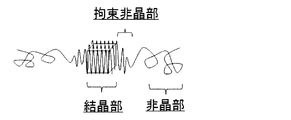
- the hydrogen nucleus decays to the original state while exchanging energy with the other hydrogen nucleus from the excited state. Therefore, when the molecular mobility of the sample is high, the interaction between protons that are close to each other is small, so that the energy decay of the entire system is difficult to occur and the relaxation time becomes long. On the contrary, when the molecular mobility of the sample is low, the relaxation time becomes short. Therefore, a crystalline polymer has a short relaxation time for a crystalline component and a long relaxation time for an amorphous component. Furthermore, in the constrained amorphous component (see FIG. 1), which is the boundary between the crystalline component and the amorphous component, the relaxation time is intermediate between the two.
- the crystalline component amount and the amorphous component amount can be measured, but in the pulse NMR, the restrained amorphous component amount can be measured in addition to the crystalline component amount and the amorphous component amount.
- the abundance ratio of each kinetic component is determined based on the mobility of the crystalline polymer, which cannot be obtained by X-ray measurement.
- the abundance ratio is a value that more accurately reflects various performances required for the PVA film. Therefore, by using pulsed NMR, the characteristics of the PVA film can be evaluated extremely appropriately.
- the above-mentioned crystalline component, constrained amorphous component and amorphous component are mixed. Therefore, when the PVA film containing the crystalline polymer is subjected to pulse NMR measurement, the relaxation curves obtained show that the relaxation component derived from the crystalline component having a short relaxation time, the relaxation component derived from the amorphous component having a long relaxation time, and It is observed as the sum of the relaxation components derived from the constrained amorphous component having a relaxation time of about the middle.
- the relaxation curve obtained by the linear least squares method was fitted to the following formula.
- the relaxation time of the crystalline component is tau1
- the relaxation time of the constrained amorphous component is tau2
- the relaxation time of the amorphous component is tau3
- the magnetization intensity (y) of the entire sample at time (t) is constant y0 and It is shown by the following formula using a1, a2, and a3 in the excited state.
- the crystalline component and the constrained amorphous component are each Gaussian type as an equation (fitting equation) that can be fitted stably and with good reproducibility between PVA films produced under each film forming condition.
- a1, a2, a3 and y0 derived from the above formula are obtained, and the ratio (%) of each component to the total (a1+a2+a3) of a1, a2 and a3 is the amount of crystalline component (A1), the amount of constrained amorphous component. (A2) and the amount of amorphous component (A3) are defined.
- the value of the constrained amorphous component amount (A2) is represented by a2/(a1+a2+a3) ⁇ 100.
- the amount of crystal component (A1) is 60% or less. When the amount of crystal component (A1) exceeds 60%, the water solubility of the PVA film is insufficient.
- the upper limit of the amount of crystal component (A1) may be 60% or less, preferably 55% or less, and more preferably 50% or less.
- the lower limit of the amount of crystal component (A1) is not particularly limited, but is preferably 10% or more, more preferably 20% or more.
- the amount of constrained amorphous component (A2) is 10 to 50%.
- the lower limit of the amount of constrained amorphous component (A2) is preferably 15% or more, more preferably 20% or more.
- the upper limit of the amount of constrained amorphous component (A2) is preferably 45% or less, more preferably 40% or less.
- the lower limit of the amount of the amorphous component (A3) is not particularly limited, but is preferably 10% or more, more preferably 20% or more, further preferably 30% or more.
- the upper limit of the amount of the amorphous component (A3) is not particularly limited, but is preferably 70% or less, more preferably 60% or less, still more preferably 50% or less.
- the ratio (A1/A2) between the amount of crystalline component (A1) and the amount of constrained amorphous component (A2) is not particularly limited, but is preferably 0.1 to 5.
- the upper limit of (A1/A2) is more preferably 2 or less.
- the lower limit of (A1/A2) is not particularly limited, but is preferably 0.5 or more.
- the ratio (A2/A3) of the bound amorphous component amount (A2) to the amorphous component amount (A3) is not particularly limited, but is preferably 1.5 or less.
- the upper limit of (A2/A3) is more preferably 1.3 or less, still more preferably 1.0 or less.
- the lower limit of (A2/A3) is not particularly limited, but 0.1 or more is more preferable.
- the method of controlling the parameters include a method of adjusting the type of the polyvinyl alcohol resin (saponification degree, modification amount, unmodified PVA/modified PVA blend ratio, etc.), a method of adjusting the addition amount of the plasticizer, and a film.
- a method of adjusting the production conditions the surface temperature of the support, a heat treatment condition, etc.
- a method of adjusting the combination of the above methods include a method of adjusting the production conditions (the surface temperature of the support, a heat treatment condition, etc.) or a method of adjusting the combination of the above methods.
- the PVA film of the present invention contains a polyvinyl alcohol resin (PVA).
- PVA polyvinyl alcohol resin
- a polymer produced by saponifying a vinyl ester polymer obtained by polymerizing a vinyl ester monomer can be used.
- vinyl ester monomers include vinyl formate, vinyl acetate, vinyl propionate, vinyl valerate, vinyl laurate, vinyl stearate, vinyl benzoate, vinyl pivalate, vinyl versatate and the like.
- vinyl acetate is preferable as the vinyl ester monomer.
- the vinyl ester polymer is not particularly limited, but a polymer obtained by using only one kind or two or more kinds of vinyl ester monomer as a monomer is preferable, and only one kind of vinyl ester monomer is used as a monomer. The polymer thus obtained is more preferable.
- the vinyl ester polymer may be a copolymer of one or more vinyl ester monomers and another monomer copolymerizable with one or more vinyl ester monomers.
- Examples of other monomers include ethylene; olefins having 3 to 30 carbon atoms such as propylene, 1-butene, and isobutene; acrylic acid or salts thereof; methyl acrylate, ethyl acrylate, n-propyl acrylate, acrylic acid Acrylic acid esters such as i-propyl, n-butyl acrylate, i-butyl acrylate, t-butyl acrylate, 2-ethylhexyl acrylate, dodecyl acrylate, octadecyl acrylate; methacrylic acid or its salts; methacrylic Methyl acid ester, ethyl methacrylate, n-propyl methacrylate, i-propyl methacrylate, n-butyl methacrylate, i-butyl methacrylate, t-butyl methacrylate, 2-ethylhexyl methacrylate,
- Methacrylamide derivatives such as; N-vinylformamide, N-vinylacetamide, N-vinylamides such as N-vinylpyrrolidone; methyl vinyl ether, ethyl vinyl ether, n-propyl vinyl ether, i-propyl vinyl ether, n-butyl vinyl ether, i-butyl Vinyl ethers such as vinyl ether, t-butyl vinyl ether, dodecyl vinyl ether and stearyl vinyl ether; vinyl cyanides such as acrylonitrile and methacrylonitrile; vinyl halides such as vinyl chloride, vinylidene chloride, vinyl fluoride and vinylidene fluoride; allyl acetate, chloride Allyl compounds such as allyl; maleic acid or its salts, esters or acid anhydrides; itaconic acid or its salts, esters or acid anhydrides; vinylsilyl compounds such as vinyltrimethoxysilane; isoprop
- the ratio (A2/A3) to (A3) tends to decrease. This tendency is presumed to be because when the number of structural units derived from another monomer increases, the interaction between PVA molecules weakens, and crystallization by heat treatment becomes difficult to proceed.
- the ratio of the structural unit derived from another monomer is the amount of the crystalline component (A1) and the amount of the constrained amorphous component (A2), or the ratio of the amount of the crystalline component (A1) and the amount of the constrained amorphous component (A2) in a desired range.
- the PVA film From the viewpoint of facilitating the adjustment of the PVA film and increasing both the water solubility and the mechanical strength of the PVA film, it is not particularly limited, but 15 mol% or less based on the number of moles of all structural units constituting the vinyl ester polymer is used. It is preferably 5 mol% or less, and more preferably 5 mol% or less.
- the degree of polymerization of PVA is not particularly limited, but the following range is preferable. That is, the lower limit of the degree of polymerization is preferably 200 or higher, more preferably 300 or higher, and even more preferably 500 or higher, from the viewpoint of maintaining sufficient mechanical strength of the PVA film.
- the upper limit of the degree of polymerization is not particularly limited, but from the viewpoint of enhancing the productivity of PVA, the productivity of PVA film, and the like, it is preferably 8,000 or less, more preferably 5,000 or less, and further preferably 3,000 or less. preferable.
- the degree of saponification of PVA is not particularly limited, but 70 to 97 mol% is preferable.
- the saponification degree of PVA in the range of 70 to 97 mol %, the amount of crystalline component (A1) and the amount of constrained amorphous component (A2), and the amount of crystalline component (A1) and the amount of constrained amorphous component (A2) It becomes easy to adjust the ratio to a desired range, and it is easy to achieve both water solubility and mechanical strength of the PVA film.
- the lower limit of the saponification degree is not particularly limited, but is preferably 75 mol% or more, more preferably 80 mol% or more.
- the upper limit of the degree of saponification is not particularly limited, but is preferably 95 mol% or less, more preferably 93 mol% or less, and particularly preferably 90 mol% or less.
- the degree of saponification of PVA is such that the number of moles of vinyl alcohol units is based on the total number of moles of structural units (typically vinyl ester monomer units) that can be converted into vinyl alcohol units by saponification and vinyl alcohol units. It means the ratio (mol %).
- the degree of saponification of PVA can be measured according to the description of JIS K 6726-1994.
- the PVA film may contain one type of PVA alone, or may contain two or more types of PVA having different polymerization degrees, saponification degrees, modification degrees, and the like.
- the upper limit of the PVA content in the PVA film is not particularly limited, but 100% by mass or less is preferable.
- the lower limit of the PVA content is not particularly limited, but is preferably 50% by mass or more, more preferably 80% by mass or more, and further preferably 85% by mass or more.
- the PVA film of the present invention has a water content of 1 to 5% by mass, preferably 1.5 to 4.5% by mass, more preferably 2 to 4% by mass.
- the water content of the PVA film exceeds 5% by mass, the print pattern tends to shift during high speed printing, or the PVA film tends to stretch unevenly during printing.
- the water content is less than 1% by mass, the PVA film easily breaks when the PVA film wound in a roll shape is unwound. Further, since static electricity is easily generated on the PVA film, dust and dirt may adhere to the PVA film, and high-definition printing may be impossible.
- the water content of the PVA film is calculated by drying the PVA film in a vacuum dryer at 50° C. for 2 hours and changing the weight of the PVA film before and after drying.
- the PVA film may contain, but is not necessarily limited to, a plasticizer.
- the content of the plasticizer is preferably 0.5 to 15 parts by mass with respect to 100 parts by mass of PVA. When the content of the plasticizer exceeds 15 parts by mass, uneven stretching is likely to occur during high-speed printing depending on the temperature and humidity of the atmosphere during printing.
- the content of the plasticizer may be 0.5 parts by mass, but if the content of the plasticizer is small, the PVA film tends to be broken when unwound. From this viewpoint, the content of the plasticizer is more preferably 0.5 to 8 parts by mass, still more preferably 1 to 6 parts by mass, and particularly preferably 1.5 to 5 parts by mass, relative to 100 parts by mass of PVA.
- each motion component (crystal component, constrained amorphous component, amorphous component) in PVA.
- a PVA film containing a small amount of a plasticizer is more likely to be crystallized by heat treatment than a PVA film containing no plasticizer. It is presumed that this is because the molecules of PVA tend to move easily and tend to have an energetically more stable crystal or constrained amorphous structure.
- a PVA film containing an excessive amount of plasticizer tends to inhibit the progress of crystallization.
- the amount of the plasticizer that interacts with the hydroxyl group of the PVA molecule increases and the interaction between the PVA molecules weakens. Therefore, the amount of crystalline component (A1) and the amount of constrained amorphous component (A2) in the PVA film, and the ratio of the amount of crystalline component (A1) and the amount of constrained amorphous component (A2) are adjusted to appropriate ranges.
- the content of the plasticizer is preferably 0.5 to 15 parts by mass with respect to 100 parts by mass of PVA.
- plasticizer examples include polyhydric alcohols such as ethylene glycol, glycerin, diglycerin, propylene glycol, diethylene glycol, triethylene glycol, tetraethylene glycol, trimethylolpropane and sorbitol. These plasticizers may be used alone or in combination of two or more. Among the above, the plasticizer is not particularly limited because it is difficult to bleed out to the surface of the PVA film, but ethylene glycol or glycerin is preferable, and glycerin is more preferable.
- the PVA film preferably contains at least one of starch and a water-soluble polymer other than PVA.
- the mechanical strength required when forming a print layer on the PVA film (base film), and the moisture resistance when handling the PVA film on which the print layer is formed Properties, flexibility of the PVA film floating on the water surface due to water absorption, spreadability on the water surface, diffusibility, etc. can be adjusted.
- starch examples include natural starches such as corn starch, potato starch, sweet potato starch, wheat starch, rice starch, tapioca starch and sago starch; processed starches that have been subjected to etherification, esterification, oxidation, etc.
- the modified starches are particularly preferable.
- the addition of starch brings about the effect of suppressing the adhesion between PVA films and the adhesion between the PVA film and the metal roll. If the PVA films are in close contact with each other, it may cause the PVA film to stretch when continuously printing the PVA film (base film), which is not preferable.
- the content of starch in the PVA film is not particularly limited, but is preferably 0.1 to 15 parts by mass, more preferably 0.3 to 10 parts by mass, and further preferably 0, relative to 100 parts by mass of PVA. 0.5 to 5 parts by mass.
- water-soluble polymer other than PVA for example, dextrin, gelatin, glue, casein, shellac, gum arabic, polyacrylic acid amide, sodium polyacrylate, polyvinyl methyl ether, a copolymer of methyl vinyl ether and maleic anhydride
- examples thereof include copolymers of vinyl acetate and itaconic acid, polyvinylpyrrolidone, cellulose, acetyl cellulose, acetyl butyl cellulose, carboxymethyl cellulose, methyl cellulose, ethyl cellulose, hydroxyethyl cellulose, sodium alginate and the like.
- the content of the water-soluble polymer other than PVA in the PVA film is not particularly limited, but is preferably 15 parts by mass or less, and more preferably 10 parts by mass or less with respect to 100 parts by mass of PVA.
- the content of the water-soluble polymer other than PVA is within the above range, the water solubility of the PVA film can be sufficiently increased.
- the PVA film is not particularly limited, but preferably contains a surfactant.
- a surfactant By including the surfactant, the handling property of the PVA film and the peeling property of the PVA film from the film forming apparatus during production can be improved.
- the surfactant is not particularly limited and, for example, an anionic surfactant, a nonionic surfactant and the like can be used.
- anionic surfactants include carboxylic acid type surfactants such as potassium laurate; sulfate ester type surfactants such as octyl sulfate; sulfonic acid type surfactants such as dodecylbenzene sulfonate.
- nonionic surfactants include alkyl ether type surfactants such as polyoxyethylene lauryl ether and polyoxyethylene oleyl ether; alkylphenyl ether type surfactants such as polyoxyethylene octyl phenyl ether; polyoxyethylene lauryl Alkyl ester type surfactants such as rate; alkylamine type surfactants such as polyoxyethylene lauryl amino ether; alkylamide type surfactants such as polyoxyethylene lauric acid amide; polypropylene such as polyoxyethylene polyoxypropylene ether Examples thereof include glycol ether type surfactants; alkanolamide type surfactants such as lauric acid diethanolamide and oleic acid diethanolamide; and allyl phenyl ether type surfactants such as polyoxyalkylene allyl phenyl ether.
- alkyl ether type surfactants such as polyoxyethylene lauryl ether and polyoxyethylene oleyl ether
- Such surfactants may be used alone or in combination of two or more.
- the surfactant is not particularly limited because it is excellent in the effect of reducing the surface abnormality at the time of forming the PVA film, but nonionic surfactants are preferable, and alkanolamide-type surfactants are preferable. Agents are more preferable, and dialkanolamides (for example, diethanolamide) of aliphatic carboxylic acids (for example, saturated or unsaturated aliphatic carboxylic acids having 8 to 30 carbon atoms) are further preferable.
- the lower limit of the content of the surfactant in the PVA film is not particularly limited, but is preferably 0.01 parts by mass or more, more preferably 0.02 parts by mass or more, and 0.05 parts by mass or more with respect to 100 parts by mass of PVA. Is more preferable.
- the upper limit of the content of the surfactant is not particularly limited, but is preferably 10 parts by mass or less, more preferably 1 part by mass or less, further preferably 0.5 parts by mass or less, and 0, based on 100 parts by mass of PVA. It is particularly preferably not more than 0.3 parts by mass.
- the peelability of the PVA film from the film forming apparatus at the time of production is improved, and a problem such as blocking between PVA films is less likely to occur. Further, problems such as bleed-out of the surfactant on the surface of the PVA film and deterioration of the appearance of the PVA film due to aggregation of the surfactant are unlikely to occur.
- the inorganic salt is not particularly limited, and examples thereof include boric acid and borax.
- the addition amount thereof is preferably 5 parts by mass or less, and more preferably 1 part by mass or less with respect to 100 parts by mass of PVA. If it exceeds 5 parts by mass, the water solubility of the PVA film is significantly reduced, which is not preferable.
- PVA films include plasticizers, starch, water-soluble polymers other than PVA, surfactants, inorganic salts, and water, as well as antioxidants, ultraviolet absorbers, lubricants, crosslinking agents, colorants, fillers, preservatives, Ingredients such as antifungal agents and other polymer compounds may be contained within a range that does not impair the effects of the present invention.
- the proportion of the total mass of PVA, plasticizer, starch, water-soluble polymer other than PVA, and surfactant to the total mass of the PVA film is not particularly limited, but is preferably 60 to 100% by mass, and 80 to 100% by mass. Mass% is more preferable, and 90 to 100% is further preferable.
- the complete dissolution time of the base film (PVA film) using the PVA of the present invention as the raw material when immersed in deionized water at 10° C. is preferably 90 seconds or less, more preferably 5 to 90 seconds.
- the upper limit of the complete dissolution time is more preferably 80 seconds or less, further preferably 70 seconds or less, and particularly preferably 65 seconds or less.
- the lower limit of the complete dissolution time is more preferably 10 seconds or more, further preferably 15 seconds or more, and particularly preferably 20 seconds or more.
- the complete dissolution time is less than 5 seconds, depending on the temperature and humidity of the atmosphere in which the PVA film is stored, occurrence of blocking between the PVA films due to absorption of moisture in the atmosphere, reduction in mechanical strength, etc. May cause problems.
- the complete dissolution time when the PVA film is immersed in deionized water at 10°C can be measured as follows. ⁇ 1> The PVA film is placed in a thermo-hygrostat adjusted to 20° C.-65% RH for 16 hours or more to regulate the humidity. ⁇ 2> After a rectangular sample having a length of 40 mm and a width of 35 mm was cut out from the humidity-controlled PVA film, two 50 mm ⁇ 50 mm plastic plates with rectangular windows (holes) having a length of 35 mm ⁇ width of 23 mm were opened. The sample is sandwiched and fixed so that the length direction of the sample is parallel to the length direction of the window and the window is located substantially at the center in the width direction of the sample.
- ⁇ 3> 300 mL of deionized water was put into a 500 mL beaker, and the water temperature was adjusted to 10° C. while stirring with a magnetic stirrer equipped with a bar having a length of 3 cm at a rotation speed of 280 rpm.
- the sample fixed to the plastic plate in the above ⁇ 2> is immersed in deionized water in a beaker, taking care not to contact the bar of the magnetic stirrer.
- ⁇ 5> The time from the immersion in deionized water to the complete disappearance of the sample pieces dispersed in deionized water is measured.
- the thickness of the PVA film is not particularly limited, but the following range is preferable. That is, the upper limit of the thickness is preferably 50 ⁇ m or less, more preferably 48 ⁇ m or less, and further preferably 45 ⁇ m or less. On the other hand, the lower limit of the thickness is not particularly limited, but is preferably 15 ⁇ m or more, more preferably 20 ⁇ m or more, further preferably 22 ⁇ m or more, and particularly preferably 25 ⁇ m or more. When the thickness exceeds 50 ⁇ m, it takes time for the PVA film floated on the water surface to swell, and it takes time for the PVA film after transfer to be removed from the molded product, resulting in reduced productivity. May occur, which is not preferable.
- the thickness of the PVA film can be obtained as an average value of the measured thicknesses by measuring the thicknesses at arbitrary 10 positions (for example, at arbitrary 10 positions on a straight line drawn in the length direction of the PVA film). ..
- the method for producing the PVA film of the present invention is not particularly limited, and for example, the following arbitrary methods can be used.
- a method for producing a PVA film a film-forming undiluted solution obtained by adding a solvent, an additive and the like to PVA and homogenizing the solution is cast film-forming method, wet film-forming method (discharging into poor solvent), dry-wet film-forming method.
- a gel film forming method (a method of once forming a gel forming solution by cooling and then removing the solvent), or a method of forming a film by a combination of the above methods, or an extruder
- examples thereof include a melt extrusion film forming method and an inflation molding method in which a film forming solution is extruded from a T die or the like to form a film.
- the casting film forming method and the melt extrusion film forming method are preferable as the method for producing the PVA film.
- the casting film forming method and the melt extrusion film forming method By using the casting film forming method and the melt extrusion film forming method, a uniform PVA film can be obtained with high productivity.
- a case of producing a PVA film by a casting film forming method or a melt extrusion film forming method will be described.
- a film forming stock solution containing PVA, a solvent and, if necessary, an additive such as a plasticizer or starch is prepared. To do.
- the stock solution for film formation contains an additive, the ratio of the additive to PVA in the stock solution for film formation is substantially equal to the ratio of the additive to PVA in the PVA film described above.
- the stock solution for film formation is dripped (supplied) in a film form on a rotating support such as a metal roll or a metal belt. As a result, a liquid film of the stock solution for film formation is formed on the support.
- the liquid film is heated on the support to remove the solvent, thereby solidifying to form a film.
- the solidified long film (PVA film) is peeled from the support, dried by a drying roll, a drying oven or the like if necessary, and further heat-treated as necessary, and wound into a roll.
- the drying step (solvent removing step) of the liquid coating film drowned on the support, and the subsequent drying step of the PVA film crystallization progresses while PVA is heated.
- the degree of crystallization of PVA can be controlled by the drying rate in the drying process. For example, when the drying speed is increased, crystal growth is hindered, and the crystal component amount (A1) tends to decrease.
- the drying rate can be adjusted by the temperature of the support, the contact time with the support, the temperature and amount of hot air, the temperature of the drying roll and the drying oven, and the like.
- the volatile content ratio of the above-mentioned stock solution for film formation is not particularly limited, but is preferably 50 to 90% by mass, and 55 to 80% by mass. Is more preferable.
- the viscosity of the stock solution for film formation can be adjusted to a suitable range, so that the film formability of the PVA film (liquid coating) is improved and a PVA film having a uniform thickness is obtained. It becomes easy to obtain.
- the volatile content of the stock solution for film formation is appropriate, crystallization of PVA on the support proceeds appropriately, so that the amount of the constrained amorphous component (A2) and the amount of crystalline component (A1) are balanced. Easy to take.
- the “volatile content of the film-forming stock solution” in the present specification means a value obtained by the following formula.
- (Equation 5) Volatile content (mass %) of the film-forming stock solution ⁇ (Wa-Wb)/Wa ⁇ 100
- Wa represents the mass (g) of the film-forming stock solution
- Wb represents the mass (g) after drying the film-forming stock solution of Wa(g) in an electric heat dryer at 105° C. for 16 hours.
- the method for adjusting the stock solution for film formation is not particularly limited, and for example, a method of dissolving PVA and an additive such as a plasticizer and a surfactant in a dissolution tank or a single-screw or twin-screw extruder is used. Examples thereof include a method of melting and kneading water-containing PVA together with additives such as a plasticizer and a surfactant.
- the surface temperature of the support on which the film-forming stock solution is drowned is not particularly limited, but is preferably 50 to 110°C, more preferably 60 to 100°C, and further preferably 65 to 95°C.
- the drying of the liquid coating proceeds at an appropriate speed to prevent the crystal component amount (A1) from becoming too large, and the time required for drying the liquid coating does not become too long. Therefore, the productivity of the PVA film does not decrease.
- the drying of the liquid coating proceeds at an appropriate speed, abnormalities such as foaming are unlikely to occur on the surface of the PVA film, the amount of the amorphous component (A3) becomes too large, and the amount of the constrained amorphous component (relatively It is also possible to suitably prevent A2) from becoming too small.
- hot air with a wind speed of 1 to 10 m/sec may be uniformly blown to the entire area of the non-contact surface side of the liquid film.
- the temperature of the hot air blown to the non-contact surface side is not particularly limited, but is preferably 50 to 150°C, more preferably 70 to 120°C.
- the temperature of the hot air is within the above range, it is possible to further improve the drying efficiency and the uniformity of drying of the liquid film.
- the support for the film-forming stock solution is preferably in the following range. That is, the upper limit of (S1/S0) is not particularly limited, but is preferably 7 or less, more preferably 6.8 or less, and further preferably 6.5 or less.
- the lower limit of (S1/S0) is not particularly limited, but is preferably more than 3, more preferably more than 5, more preferably more than 5.2, and particularly preferably more than 5.5.
- (S1/S0) is in the above range, crystallization due to the orientation of the molecular chain of PVA in the liquid film appropriately progresses, and the amount of crystal component (A1) becomes an appropriate amount. Further, since the deformation of the liquid coating due to gravity can be suppressed between the die lip and the support, problems such as uneven thickness of the PVA film hardly occur.
- the feed rate (S0) of the film-forming stock solution means the linear velocity in the flow direction of the film-forming stock solution.
- the supply rate (S0) of the film-forming stock solution is defined by the volume per unit time of the film-forming stock solution supplied (discharged) from the film-form discharge apparatus to the opening area of the slit part of the film-form discharge apparatus ( It can be obtained by dividing by the product of the slit width of the film discharge device and the average value of the slit opening.
- the PVA film is dried (solvent removal) on the support, preferably to a volatile content of 5 to 50% by mass, then peeled from the support, and further dried if necessary.
- the drying method is not particularly limited, and examples thereof include a method of passing it through a drying furnace and a method of contacting with a drying roll.
- the PVA film is dried using a plurality of drying rolls, it is preferable that one surface and the other surface of the PVA film are alternately contacted with the drying roll. Thereby, the crystallinity of PVA on both surfaces of the PVA film can be made uniform.
- the number of drying rolls is not particularly limited, but is preferably 3 or more, more preferably 4 or more, and further preferably 5 to 30.
- the temperature of the drying furnace or the drying roll is not particularly limited, but is preferably 40 to 110°C.
- the upper limit of the temperature of the drying furnace or the drying roll is more preferably 100°C or lower, further preferably 90°C or lower, and particularly preferably 85°C or lower.
- the lower limit of the temperature of the drying oven or the drying roll is not particularly limited, but is preferably 45°C or higher, more preferably 50°C or higher.
- the PVA film after drying can be further heat-treated if necessary.
- properties such as mechanical strength and water solubility of the PVA film can be adjusted.
- the heat treatment temperature is not particularly limited, but is preferably 60 to 135°C.
- the upper limit of the heat treatment temperature is more preferably 130°C or lower.
- the PVA film can be further embossed if necessary. Even in the embossing process, by heating the PVA film, properties such as mechanical strength and water solubility of the PVA film can be adjusted.
- the embossing temperature is not particularly limited, but is preferably 60 to 135°C.
- the upper limit of the embossing temperature is more preferably 130°C or lower.
- the PVA film produced in this way is further subjected to humidity control treatment, cutting of both ends (ears) of the film, etc., if necessary, and then wound into a roll on a cylindrical core.
- the product is packaged in a moisture-proof manner.
- the PVA film of the present invention is usually used as a hydraulic transfer printing film by continuously printing the surface thereof. Therefore, the PVA film of the present invention is preferably wound in a length of about 1 to 3000 m, and a width of about 0.5 to 4 m is preferably used.
- the PVA film of the present invention uses a printing ink usually used by those skilled in the art, adopts a printing method such as gravure printing, screen printing, offset printing, or roll coating to form a printing layer by continuously printing. Can be provided. Therefore, the printing film for hydraulic transfer of the present invention has the PVA film (base film) of the present invention and the printing layer formed on the surface of the PVA film.
- Such printing films for water pressure transfer include wood base materials such as wood boards, plywood and particle boards; various plastic molded products; pulp cement boards, slate boards, asbestos cement boards, GRC (glass fiber reinforced cement) molded products, concrete boards and the like. Fiber cement products; Inorganic plate materials such as gypsum board, calcium silicate board, magnesium silicate board; Metal plates made of iron, copper, aluminum, etc. or alloy plates of these; and used for printing composites of these To be done.
- the shape of the surface of the molded body (transfer target) to be printed may be flat, rough or uneven, but the printing film for hydraulic transfer has an uneven shape. It is suitably used for printing on the surface of a molded article having a.
- the method for printing on the surface of the molded article using the hydraulic transfer printing film of the present invention is, for example, the first step of floating the hydraulic transfer printing film on the water surface with the printing layer facing upward, the printing layer with a solvent or the like.
- the second step of activating the third step of lowering the transferred film of the surface of the molded article from above the printing film for hydraulic transfer floating on the water surface to the lower side, the printing layer of the hydraulic transfer sheet After sufficiently adhering to the transfer surface of the molded body, the fourth step of removing the PVA film and the fifth step of sufficiently drying the molded body to which the printing layer has been transferred to obtain the target product.
- the print layer may be a single-layer print layer, but is preferably a laminated print layer in which print patterns different in at least one of hue, saturation and lightness are laminated. According to the present invention, high-definition transfer printing can be performed on a molded body by preventing misalignment between printing layers in a laminated printing layer.
- Measuring device NMR Analyzer mq20 the minispec (manufactured by BRUKER) Pulse sequence: Solid-Eco method Pulse width: 7.22 ⁇ s Pulse repetition time: 1 s Dummy Shot: 0 Pulsed Atten: 0 dB Number of integrations: 32 times Measurement temperature: 40°C Gain: 70 to 110 dB (adjusted according to the observation intensity of the sample)
- the amount of crystalline component (A1), the amount of restrained amorphous component (A2) and the amount of amorphous component (A3) in the sample were quantified.
- the high-speed printability was evaluated according to the following criteria by observing the printed surface after drying.
- Example 1 First, 100 parts by mass of PVA (saponification degree 88 mol %, viscosity average degree of polymerization 1700) obtained by saponifying polyvinyl acetate, 5 parts by mass of etherified starch, 5 parts by mass of glycerin as a plasticizer, and as a surfactant. 0.5 parts by mass of lauric acid diethanolamide and water were mixed to prepare a stock solution for film formation. The volatile matter content of the film-forming stock solution was 70% by mass. Next, the stock solution for film formation was discharged in a film form from a T-die onto a metal roll (first roll, surface temperature 90° C.) as a support to form a liquid film on the metal roll.
- PVA response degree 88 mol %, viscosity average degree of polymerization 1700
- the obtained PVA film was embossed under conditions of an embossing roll temperature of 100° C. and a linear pressure of 30 kg/cm to obtain a roll-shaped PVA film having a thickness of 35 ⁇ m.
- the obtained PVA film had a water content of 2.1%, a width of 1.2 m and a length of 1000 m.
- the wound roll of PVA film was immediately subjected to moisture-proof packaging using an aluminum laminate film.
- the crystalline component amount (A1) was 28%
- the constrained amorphous component amount (A2) was 39%
- the amorphous component amount (A3) was 33%.
- (A1/A2) was 0.73
- (A2/A3) was 1.19.
- the complete dissolution time of the obtained PVA film was measured, the complete dissolution time was 62 seconds.
- the high-speed printability of the packaging body produced from the obtained PVA film was evaluated, it was A rank. The number of breakages that occurred during printing was zero.
- Example 2 and Comparative Examples 1 and 2> The surface temperature of a metal roll, which is a support for discharging the film forming solution from the T-die, and the temperature of hot air blown on the entire non-contact surface of the liquid film with the metal roll are 105° C. and 120, respectively.
- a PVA film was obtained in the same manner as in Example 1 except that the temperature of the drying roll was changed to 70° C., and the temperature of the drying roll was changed to 70° C. and 60° C., respectively.
- Example 3 and Comparative Example 3> A PVA film was obtained in the same manner as in Example 1 except that the temperatures of the embossing rolls during embossing were changed to 120°C and 140°C, respectively.
- ⁇ Comparative example 4> The surface temperature of the metal roll, which is a support for discharging the film forming stock solution from the T-die, and the temperature of the hot air blown on the entire non-contact surface of the liquid coating with the metal roll on the metal roll are changed to 110° C.
- a PVA film was obtained in the same manner as in Example 1 except that the temperature of the embossing roll during embossing was changed to 90°C.
- Examples 4 and 5> A PVA film was obtained in the same manner as in Example 1 except that the amount of glycerin as the plasticizer was changed to 15 parts by mass and 0 part by mass with respect to 100 parts by mass of PVA, respectively.
- Example 6 The procedure of Example 1 was repeated except that the PVA used for preparing the membrane-forming stock solution was changed to maleic acid monomethyl ester (MMM)-modified PVA (saponification degree: 88 mol %, polymerization degree: 1700, MMM modification amount: 5 mol %). , PVA film was obtained.
- MMM maleic acid monomethyl ester
- Examples 7 and 8> A PVA film was obtained in the same manner as in Example 1 except that the surface temperature of each drying roll was changed to 80° C. and 67° C., respectively.
- the PVA films of Examples 1 to 8 are excellent in water solubility, and when used as a base film, even if the printing speed is relatively high (50 m/min), the PVA films do not break, It was possible to perform fine transfer printing.
- the PVA films of Comparative Examples 1 to 6 had a large number of breakages or were inferior in either water solubility or high-speed printability.
Landscapes
- Chemical & Material Sciences (AREA)
- Engineering & Computer Science (AREA)
- Manufacturing & Machinery (AREA)
- Mechanical Engineering (AREA)
- Chemical Kinetics & Catalysis (AREA)
- Medicinal Chemistry (AREA)
- Polymers & Plastics (AREA)
- Organic Chemistry (AREA)
- Health & Medical Sciences (AREA)
- Materials Engineering (AREA)
- Manufacture Of Macromolecular Shaped Articles (AREA)
- Wrappers (AREA)
- Moulding By Coating Moulds (AREA)
- Decoration By Transfer Pictures (AREA)
- Laminated Bodies (AREA)
- Compositions Of Macromolecular Compounds (AREA)
Abstract
La présente invention concerne : un film de base de transfert hydraulique monocouche qui présente une solubilité dans l'eau supérieure et permet d'effectuer une impression par transfert haute définition sans rompre le film, même si l'impression est réalisée à des vitesses élevées ; et un film d'impression par transfert hydraulique utilisant le film de base. La présente invention concerne un film de base de transfert hydraulique qui contient une résine d'alcool polyvinylique et forme une couche imprimée à transférer sur un objet de transfert par transfert hydraulique. Lorsqu'une mesure de RMN impulsionnelle 1H du film de base de transfert hydraulique est réalisée dans du méthanol lourd, la proportion de constituants cristallins (A1) trouvée à partir d'une courbe de relaxation spin-spin obtenue à partir de la mesure est inférieure ou égale à 60 %, une proportion de constituants amorphes restreints (A2) est de 10 à 50 % et la teneur en eau est de 1 à 5 % en masse.
Priority Applications (4)
| Application Number | Priority Date | Filing Date | Title |
|---|---|---|---|
| JP2020562516A JP7240423B2 (ja) | 2018-12-28 | 2019-12-27 | 水圧転写用ベースフィルムおよび水圧転写用印刷フィルム |
| EP19905031.1A EP3904033A4 (fr) | 2018-12-28 | 2019-12-27 | Film de base de transfert hydraulique et film d'impression par transfert hydraulique |
| CN201980086834.XA CN113286685A (zh) | 2018-12-28 | 2019-12-27 | 水压转印用基膜以及水压转印用印刷膜 |
| US17/360,098 US12049546B2 (en) | 2018-12-28 | 2021-06-28 | Hydraulic transfer base film, and hydraulic transfer printing film |
Applications Claiming Priority (2)
| Application Number | Priority Date | Filing Date | Title |
|---|---|---|---|
| JP2018248286 | 2018-12-28 | ||
| JP2018-248286 | 2018-12-28 |
Related Child Applications (1)
| Application Number | Title | Priority Date | Filing Date |
|---|---|---|---|
| US17/360,098 Continuation US12049546B2 (en) | 2018-12-28 | 2021-06-28 | Hydraulic transfer base film, and hydraulic transfer printing film |
Publications (1)
| Publication Number | Publication Date |
|---|---|
| WO2020138445A1 true WO2020138445A1 (fr) | 2020-07-02 |
Family
ID=71126340
Family Applications (2)
| Application Number | Title | Priority Date | Filing Date |
|---|---|---|---|
| PCT/JP2019/051487 Ceased WO2020138438A1 (fr) | 2018-12-28 | 2019-12-27 | Film soluble dans l'eau, son procédé de fabrication, et emballage |
| PCT/JP2019/051494 Ceased WO2020138445A1 (fr) | 2018-12-28 | 2019-12-27 | Film de base de transfert hydraulique et film d'impression par transfert hydraulique |
Family Applications Before (1)
| Application Number | Title | Priority Date | Filing Date |
|---|---|---|---|
| PCT/JP2019/051487 Ceased WO2020138438A1 (fr) | 2018-12-28 | 2019-12-27 | Film soluble dans l'eau, son procédé de fabrication, et emballage |
Country Status (6)
| Country | Link |
|---|---|
| US (2) | US12466925B2 (fr) |
| EP (2) | EP3904034A4 (fr) |
| JP (2) | JP7240423B2 (fr) |
| CN (2) | CN113286685A (fr) |
| TW (1) | TWI812828B (fr) |
| WO (2) | WO2020138438A1 (fr) |
Families Citing this family (6)
| Publication number | Priority date | Publication date | Assignee | Title |
|---|---|---|---|---|
| JP7431626B2 (ja) * | 2020-03-12 | 2024-02-15 | 積水化学工業株式会社 | ポリビニルアルコールフィルム、及びパッケージ材料 |
| JP7431627B2 (ja) * | 2020-03-12 | 2024-02-15 | 積水化学工業株式会社 | ポリビニルアルコールフィルム、及びパッケージ材料 |
| US20230257535A1 (en) * | 2020-06-29 | 2023-08-17 | Kuraray Co., Ltd. | Water-soluble film and packaging |
| JP7684965B2 (ja) * | 2020-06-29 | 2025-05-28 | 株式会社クラレ | 水溶性フィルムおよび包装体 |
| EP4463491A1 (fr) | 2022-01-14 | 2024-11-20 | Sekisui Specialty Chemicals America, LLC | Résine d'alcool polyvinylique modifiée à solubilité améliorée dans des mélanges d'alcools |
| WO2024024940A1 (fr) * | 2022-07-28 | 2024-02-01 | 三菱ケミカル株式会社 | Film soluble dans l'eau, emballage de produit chimique et procédé de production d'emballage de produit chimique |
Citations (14)
| Publication number | Priority date | Publication date | Assignee | Title |
|---|---|---|---|---|
| JP2000006595A (ja) | 1998-06-22 | 2000-01-11 | Think Laboratory Co Ltd | 水圧転写シートの製造方法 |
| JP2002030162A (ja) * | 2000-07-17 | 2002-01-31 | Kuraray Co Ltd | ポリビニルアルコールフィルムおよび偏光フィルム |
| JP2005060636A (ja) | 2003-08-20 | 2005-03-10 | Kuraray Co Ltd | 水圧転写用ベースフィルムおよび水圧転写用印刷シートの製造法 |
| JP2006305923A (ja) * | 2005-04-28 | 2006-11-09 | Nippon Synthetic Chem Ind Co Ltd:The | ポリビニルアルコール系フィルムの製造方法、並びにポリビニルアルコール系フィルム、偏光膜および偏光板 |
| WO2009075202A1 (fr) * | 2007-12-11 | 2009-06-18 | The Nippon Synthetic Chemical Industry Co., Ltd. | Film de base pour impression par transfert hydraulique et procédé de fabrication |
| WO2010061790A1 (fr) * | 2008-11-28 | 2010-06-03 | 株式会社クラレ | Procédé de fabrication d'un film de transfert hydraulique |
| JP2010155453A (ja) * | 2008-12-02 | 2010-07-15 | Nippon Synthetic Chem Ind Co Ltd:The | 液圧転写印刷用ベースフィルム |
| WO2010082522A1 (fr) | 2009-01-13 | 2010-07-22 | 株式会社クラレ | Film de base à couches multiples pour transfert hydraulique |
| WO2013146146A1 (fr) * | 2012-03-30 | 2013-10-03 | 株式会社クラレ | Film polymère à base d'alcool polyvinylique (pva) et film polarisant |
| WO2015020046A1 (fr) | 2013-08-09 | 2015-02-12 | 株式会社クラレ | Film polymère à base d'alcool vinylique |
| WO2015020045A1 (fr) * | 2013-08-09 | 2015-02-12 | 株式会社クラレ | Film |
| WO2016093259A1 (fr) * | 2014-12-12 | 2016-06-16 | 株式会社クラレ | Film polymère à base d'alcool polyvinylique, et procédé de fabrication de celui-ci |
| WO2016190235A1 (fr) * | 2015-05-28 | 2016-12-01 | 株式会社クラレ | Film polymère d'alcool polyvinylique et procédé de fabrication associé |
| JP2018028662A (ja) * | 2016-08-10 | 2018-02-22 | 住友化学株式会社 | 偏光フィルム |
Family Cites Families (58)
| Publication number | Priority date | Publication date | Assignee | Title |
|---|---|---|---|---|
| US4478971A (en) | 1983-07-08 | 1984-10-23 | Shakespeare Company | High temperature extruded polyvinyl alcohol monofilament and process for the preparation thereof |
| IL90585A (en) | 1988-06-15 | 1996-05-14 | May & Baker Ltd | Package releasing its contents on contact with water |
| JPH06138321A (ja) | 1992-10-27 | 1994-05-20 | Kuraray Co Ltd | ポリビニルアルコール系重合体フィルム |
| JPH10296820A (ja) | 1997-04-28 | 1998-11-10 | Nippon Synthetic Chem Ind Co Ltd:The | 水溶性樹脂成形物の製造法 |
| JP4242509B2 (ja) | 1999-04-16 | 2009-03-25 | 帝人化成株式会社 | 流延製膜方法 |
| JP5116911B2 (ja) | 2000-05-19 | 2013-01-09 | 株式会社クラレ | 水溶性フィルムの製造法 |
| JP5122039B2 (ja) * | 2000-07-07 | 2013-01-16 | 株式会社クラレ | 耐衝撃性に優れたポリビニルアルコール系水溶性フィルム |
| JP5122040B2 (ja) | 2000-07-13 | 2013-01-16 | 株式会社クラレ | ポリビニルアルコール系水溶性フィルムおよびその製造法 |
| JP4226766B2 (ja) * | 2000-08-21 | 2009-02-18 | 日本合成化学工業株式会社 | ポリビニルアルコール系フィルムの製造方法 |
| JP2002241797A (ja) | 2001-02-20 | 2002-08-28 | Kao Corp | 洗濯用物品 |
| JP4705267B2 (ja) | 2001-05-29 | 2011-06-22 | 日本合成化学工業株式会社 | 水溶性エンボスフィルムの製造方法 |
| GB0129983D0 (en) * | 2001-12-14 | 2002-02-06 | Unilever Plc | Unit dose products |
| AU2003228268A1 (en) * | 2002-03-04 | 2003-09-22 | Buckley, Chad | Improved polyvinyl alcohol film and method of producing the same |
| JP4392320B2 (ja) * | 2003-10-22 | 2009-12-24 | 株式会社クラレ | 水圧転写用ベースフィルム及び水圧転写方法 |
| JP4630396B2 (ja) | 2003-12-16 | 2011-02-09 | 日本合成化学工業株式会社 | 水溶性フィルム |
| JP2005194295A (ja) | 2003-12-26 | 2005-07-21 | Nippon Synthetic Chem Ind Co Ltd:The | 水溶性フィルム及びその製造方法 |
| JP4841241B2 (ja) | 2004-12-28 | 2011-12-21 | 日本合成化学工業株式会社 | ポリビニルアルコール系フィルム、およびそれを用いた偏光膜、偏光板 |
| GB2442626A (en) * | 2005-06-16 | 2008-04-09 | Nippon Synthetic Chem Ind | Water-soluble film |
| US8664158B2 (en) * | 2010-02-18 | 2014-03-04 | Policrom Screens S.P.A. | Media used for transferring an image on a bi-dimensional or tri-dimensional article by a thermal transfer printing process and process for making such media |
| CN107315217B (zh) | 2012-03-30 | 2020-11-06 | 株式会社可乐丽 | 聚乙烯醇系聚合物膜及其制造方法 |
| JP5563725B1 (ja) | 2012-09-26 | 2014-07-30 | 株式会社クラレ | ポリビニルアルコールフィルムおよび偏光フィルム |
| CN104662071B (zh) | 2012-09-26 | 2018-09-07 | 株式会社可乐丽 | 聚乙烯醇系聚合物薄膜及其制造方法 |
| ES2797484T3 (es) * | 2013-03-15 | 2020-12-02 | Toray Industries | Película laminada que utiliza resina basada en ácido poliláctico |
| EP3088429B1 (fr) | 2013-12-25 | 2020-02-05 | Kuraray Co., Ltd. | Alcool polyvinylique modifié et film hydrosoluble contenant celui-ci |
| JP6512516B2 (ja) * | 2013-12-25 | 2019-05-15 | 株式会社クラレ | 変性ポリビニルアルコールおよびそれを含有する水溶性フィルム |
| CN105940050B (zh) | 2014-02-06 | 2018-07-10 | 株式会社可乐丽 | 聚乙烯醇膜 |
| JP5781676B1 (ja) | 2014-09-12 | 2015-09-24 | 株式会社アイセロ | 水溶性フィルム、包装袋、内容物放出体、及び水溶性フィルムの製造方法 |
| WO2016056574A1 (fr) | 2014-10-09 | 2016-04-14 | 株式会社クラレ | Alcool polyvinylique modifié, composition de résine et film |
| AU2015333791B2 (en) | 2014-10-13 | 2017-11-09 | The Procter & Gamble Company | Articles comprising water-soluble polyvinyl alcohol film with plasticizer blend and related methods |
| TWI689547B (zh) * | 2014-10-13 | 2020-04-01 | 美商摩諾索公司 | 具有塑化劑摻合物的水溶性聚乙烯醇膜、相關方法及相關物品 |
| WO2016084836A1 (fr) * | 2014-11-26 | 2016-06-02 | 株式会社クラレ | Film polymère à base de polyalcool de vinyle, et procédé de fabrication de celui-ci |
| JP6906888B2 (ja) | 2015-02-17 | 2021-07-21 | 大日本印刷株式会社 | ヒートシール性樹脂フィルムおよびその製造方法、積層体、包装材料、ならびに成形ロール |
| JP2016222834A (ja) | 2015-06-02 | 2016-12-28 | 株式会社クラレ | ポリビニルアルコールフィルムの製造方法 |
| JP6805828B2 (ja) | 2015-09-11 | 2020-12-23 | 三菱ケミカル株式会社 | 水溶性フィルム、薬剤包装体及び水溶性フィルムの製造方法 |
| WO2017043514A1 (fr) | 2015-09-11 | 2017-03-16 | 日本合成化学工業株式会社 | Rouleau de film et emballage d'agent chimique |
| WO2017043505A1 (fr) | 2015-09-11 | 2017-03-16 | 日本合成化学工業株式会社 | Film soluble dans l'eau, et emballage de produits chimiques |
| US20180265656A1 (en) * | 2015-09-11 | 2018-09-20 | The Nippon Synthetic Chemical Industry Co., Ltd. | Water-soluble film, chemical agent package and water-soluble film production method |
| WO2017043508A1 (fr) | 2015-09-11 | 2017-03-16 | 日本合成化学工業株式会社 | Film hydrosoluble et corps d'emballage de produit chimique |
| JP6729279B2 (ja) | 2015-10-19 | 2020-07-22 | 三菱ケミカル株式会社 | 水溶性フィルム及び薬剤包装体 |
| JP6888256B2 (ja) | 2015-11-12 | 2021-06-16 | 三菱ケミカル株式会社 | 水溶性フィルム及び薬剤包装体 |
| JP2017110213A (ja) | 2015-12-14 | 2017-06-22 | 日本合成化学工業株式会社 | 薬剤包装体及び薬剤包装体の製造方法 |
| JP6787064B2 (ja) | 2015-12-17 | 2020-11-18 | 三菱ケミカル株式会社 | 水溶性フィルム及び薬剤包装体 |
| JP2017114931A (ja) | 2015-12-21 | 2017-06-29 | 日本合成化学工業株式会社 | 紫外線遮蔽フィルム |
| JP6859696B2 (ja) | 2015-12-24 | 2021-04-14 | 三菱ケミカル株式会社 | 水溶性フィルム、薬剤包装体及び水溶性フィルムの製造方法 |
| JP2017119434A (ja) | 2015-12-25 | 2017-07-06 | 日本合成化学工業株式会社 | 水溶性フィルム、薬剤包装体及び水溶性フィルムの製造方法 |
| PL3443030T3 (pl) | 2016-04-13 | 2022-10-10 | Monosol, Llc | Folia rozpuszczalna w wodzie, opakowania z folią oraz sposoby jej wytwarzania i stosowania |
| JP6828276B2 (ja) | 2016-06-09 | 2021-02-10 | 大日本印刷株式会社 | ヒートシール性樹脂フィルムおよびその製造方法、積層体ならびに包装材料 |
| US10899518B2 (en) | 2016-06-13 | 2021-01-26 | Monosol, Llc | Water-soluble packets |
| CN110177837B (zh) * | 2016-12-27 | 2022-06-17 | 三菱化学株式会社 | 水溶性薄膜及药剂包装体 |
| WO2018199140A1 (fr) * | 2017-04-26 | 2018-11-01 | 日本合成化学工業株式会社 | Film d'alcool polyvinylique, film polarisant et plaque polarisante, et procédé de production de film d'alcool polyvinylique |
| JP7099317B2 (ja) | 2017-06-12 | 2022-07-12 | 三菱ケミカル株式会社 | 水溶性フィルム及び薬剤包装体、ならびに水溶性フィルムの製造方法 |
| JP6487978B2 (ja) | 2017-08-30 | 2019-03-20 | 積水化学工業株式会社 | 水溶性包装用フィルム |
| CN111032312B (zh) | 2017-08-30 | 2022-08-16 | 积水化学工业株式会社 | 水溶性包装用膜 |
| CN107746467B (zh) * | 2017-10-31 | 2020-11-24 | 华南理工大学 | 一种使用多次涂覆成膜工艺制备聚乙烯醇薄膜的方法 |
| JP7326670B2 (ja) | 2018-04-10 | 2023-08-16 | 株式会社アイセロ | 水溶性フィルム |
| EP3904232B1 (fr) | 2018-12-28 | 2023-11-22 | Kuraray Co., Ltd. | Film soluble dans l'eau et emballage |
| JP7240420B2 (ja) | 2018-12-28 | 2023-03-15 | 株式会社クラレ | 水溶性フィルム、その製造方法および包装体 |
| WO2020138441A1 (fr) | 2018-12-28 | 2020-07-02 | 株式会社クラレ | Film hydrosoluble et emballage |
-
2019
- 2019-12-27 JP JP2020562516A patent/JP7240423B2/ja active Active
- 2019-12-27 EP EP19905634.2A patent/EP3904034A4/fr active Pending
- 2019-12-27 TW TW108148017A patent/TWI812828B/zh active
- 2019-12-27 CN CN201980086834.XA patent/CN113286685A/zh active Pending
- 2019-12-27 WO PCT/JP2019/051487 patent/WO2020138438A1/fr not_active Ceased
- 2019-12-27 EP EP19905031.1A patent/EP3904033A4/fr active Pending
- 2019-12-27 WO PCT/JP2019/051494 patent/WO2020138445A1/fr not_active Ceased
- 2019-12-27 CN CN201980086856.6A patent/CN113226687B/zh active Active
- 2019-12-27 JP JP2020562509A patent/JP7240421B2/ja active Active
-
2021
- 2021-06-28 US US17/359,960 patent/US12466925B2/en active Active
- 2021-06-28 US US17/360,098 patent/US12049546B2/en active Active
Patent Citations (14)
| Publication number | Priority date | Publication date | Assignee | Title |
|---|---|---|---|---|
| JP2000006595A (ja) | 1998-06-22 | 2000-01-11 | Think Laboratory Co Ltd | 水圧転写シートの製造方法 |
| JP2002030162A (ja) * | 2000-07-17 | 2002-01-31 | Kuraray Co Ltd | ポリビニルアルコールフィルムおよび偏光フィルム |
| JP2005060636A (ja) | 2003-08-20 | 2005-03-10 | Kuraray Co Ltd | 水圧転写用ベースフィルムおよび水圧転写用印刷シートの製造法 |
| JP2006305923A (ja) * | 2005-04-28 | 2006-11-09 | Nippon Synthetic Chem Ind Co Ltd:The | ポリビニルアルコール系フィルムの製造方法、並びにポリビニルアルコール系フィルム、偏光膜および偏光板 |
| WO2009075202A1 (fr) * | 2007-12-11 | 2009-06-18 | The Nippon Synthetic Chemical Industry Co., Ltd. | Film de base pour impression par transfert hydraulique et procédé de fabrication |
| WO2010061790A1 (fr) * | 2008-11-28 | 2010-06-03 | 株式会社クラレ | Procédé de fabrication d'un film de transfert hydraulique |
| JP2010155453A (ja) * | 2008-12-02 | 2010-07-15 | Nippon Synthetic Chem Ind Co Ltd:The | 液圧転写印刷用ベースフィルム |
| WO2010082522A1 (fr) | 2009-01-13 | 2010-07-22 | 株式会社クラレ | Film de base à couches multiples pour transfert hydraulique |
| WO2013146146A1 (fr) * | 2012-03-30 | 2013-10-03 | 株式会社クラレ | Film polymère à base d'alcool polyvinylique (pva) et film polarisant |
| WO2015020046A1 (fr) | 2013-08-09 | 2015-02-12 | 株式会社クラレ | Film polymère à base d'alcool vinylique |
| WO2015020045A1 (fr) * | 2013-08-09 | 2015-02-12 | 株式会社クラレ | Film |
| WO2016093259A1 (fr) * | 2014-12-12 | 2016-06-16 | 株式会社クラレ | Film polymère à base d'alcool polyvinylique, et procédé de fabrication de celui-ci |
| WO2016190235A1 (fr) * | 2015-05-28 | 2016-12-01 | 株式会社クラレ | Film polymère d'alcool polyvinylique et procédé de fabrication associé |
| JP2018028662A (ja) * | 2016-08-10 | 2018-02-22 | 住友化学株式会社 | 偏光フィルム |
Also Published As
| Publication number | Publication date |
|---|---|
| TWI812828B (zh) | 2023-08-21 |
| US20210324164A1 (en) | 2021-10-21 |
| US12049546B2 (en) | 2024-07-30 |
| US12466925B2 (en) | 2025-11-11 |
| CN113226687B (zh) | 2023-09-29 |
| JPWO2020138445A1 (ja) | 2021-11-11 |
| WO2020138438A1 (fr) | 2020-07-02 |
| EP3904033A4 (fr) | 2022-10-05 |
| CN113286685A (zh) | 2021-08-20 |
| EP3904034A4 (fr) | 2022-09-28 |
| JPWO2020138438A1 (ja) | 2021-11-11 |
| EP3904033A1 (fr) | 2021-11-03 |
| JP7240423B2 (ja) | 2023-03-15 |
| EP3904034A1 (fr) | 2021-11-03 |
| TW202039598A (zh) | 2020-11-01 |
| US20210324157A1 (en) | 2021-10-21 |
| JP7240421B2 (ja) | 2023-03-15 |
| CN113226687A (zh) | 2021-08-06 |
Similar Documents
| Publication | Publication Date | Title |
|---|---|---|
| JP7546030B2 (ja) | 水溶性フィルム、その製造方法および包装体 | |
| JP7240423B2 (ja) | 水圧転写用ベースフィルムおよび水圧転写用印刷フィルム | |
| JP7804713B2 (ja) | 水溶性フィルムおよび包装体 | |
| CN1871138B (zh) | 水压转印方法以及水压转印基膜 | |
| JP6242192B2 (ja) | 液圧転写用ベースフィルム | |
| CN101835628B (zh) | 液压转印印刷用基膜及其制造方法 | |
| JP5290274B2 (ja) | 水圧転写フィルムの製造方法 | |
| JP7217295B2 (ja) | 水溶性フィルムおよび包装体 | |
| JP7344907B2 (ja) | 水溶性フィルムおよび包装体 | |
| JP7314438B1 (ja) | 水溶性フィルム、製造方法及び包装体 | |
| JP6706257B2 (ja) | 液圧転写用ベースフィルム | |
| WO2022004343A1 (fr) | Film hydrosoluble, et emballage | |
| JP7684967B2 (ja) | 水溶性フィルムおよび包装体 | |
| JP5595118B2 (ja) | 転写印刷用ベースフィルム | |
| WO2022004346A1 (fr) | Film soluble dans l'eau et emballage |
Legal Events
| Date | Code | Title | Description |
|---|---|---|---|
| 121 | Ep: the epo has been informed by wipo that ep was designated in this application |
Ref document number: 19905031 Country of ref document: EP Kind code of ref document: A1 |
|
| ENP | Entry into the national phase |
Ref document number: 2020562516 Country of ref document: JP Kind code of ref document: A |
|
| NENP | Non-entry into the national phase |
Ref country code: DE |
|
| ENP | Entry into the national phase |
Ref document number: 2019905031 Country of ref document: EP Effective date: 20210728 |