WO2020149385A1 - Copolymère séquencé réticulable et agent de revêtement - Google Patents
Copolymère séquencé réticulable et agent de revêtement Download PDFInfo
- Publication number
- WO2020149385A1 WO2020149385A1 PCT/JP2020/001386 JP2020001386W WO2020149385A1 WO 2020149385 A1 WO2020149385 A1 WO 2020149385A1 JP 2020001386 W JP2020001386 W JP 2020001386W WO 2020149385 A1 WO2020149385 A1 WO 2020149385A1
- Authority
- WO
- WIPO (PCT)
- Prior art keywords
- block copolymer
- crosslinkable
- meth
- polymer
- spin
- Prior art date
- Legal status (The legal status is an assumption and is not a legal conclusion. Google has not performed a legal analysis and makes no representation as to the accuracy of the status listed.)
- Ceased
Links
Images
Classifications
-
- C—CHEMISTRY; METALLURGY
- C08—ORGANIC MACROMOLECULAR COMPOUNDS; THEIR PREPARATION OR CHEMICAL WORKING-UP; COMPOSITIONS BASED THEREON
- C08F—MACROMOLECULAR COMPOUNDS OBTAINED BY REACTIONS ONLY INVOLVING CARBON-TO-CARBON UNSATURATED BONDS
- C08F293/00—Macromolecular compounds obtained by polymerisation on to a macromolecule having groups capable of inducing the formation of new polymer chains bound exclusively at one or both ends of the starting macromolecule
-
- C—CHEMISTRY; METALLURGY
- C09—DYES; PAINTS; POLISHES; NATURAL RESINS; ADHESIVES; COMPOSITIONS NOT OTHERWISE PROVIDED FOR; APPLICATIONS OF MATERIALS NOT OTHERWISE PROVIDED FOR
- C09D—COATING COMPOSITIONS, e.g. PAINTS, VARNISHES OR LACQUERS; FILLING PASTES; CHEMICAL PAINT OR INK REMOVERS; INKS; CORRECTING FLUIDS; WOODSTAINS; PASTES OR SOLIDS FOR COLOURING OR PRINTING; USE OF MATERIALS THEREFOR
- C09D133/00—Coating compositions based on homopolymers or copolymers of compounds having one or more unsaturated aliphatic radicals, each having only one carbon-to-carbon double bond, and at least one being terminated by only one carboxyl radical, or of salts, anhydrides, esters, amides, imides, or nitriles thereof; Coating compositions based on derivatives of such polymers
- C09D133/04—Homopolymers or copolymers of esters
-
- C—CHEMISTRY; METALLURGY
- C09—DYES; PAINTS; POLISHES; NATURAL RESINS; ADHESIVES; COMPOSITIONS NOT OTHERWISE PROVIDED FOR; APPLICATIONS OF MATERIALS NOT OTHERWISE PROVIDED FOR
- C09D—COATING COMPOSITIONS, e.g. PAINTS, VARNISHES OR LACQUERS; FILLING PASTES; CHEMICAL PAINT OR INK REMOVERS; INKS; CORRECTING FLUIDS; WOODSTAINS; PASTES OR SOLIDS FOR COLOURING OR PRINTING; USE OF MATERIALS THEREFOR
- C09D153/00—Coating compositions based on block copolymers containing at least one sequence of a polymer obtained by reactions only involving carbon-to-carbon unsaturated bonds; Coating compositions based on derivatives of such polymers
Definitions
- the present invention relates to a crosslinkable block copolymer and a coating agent.
- Patent Documents 1 and 2 Since acrylic block copolymers are excellent in moldability and flexibility, they have been developed in the coating field and put to practical use (Patent Documents 1 and 2).
- Patent Document 1 has an A block having a structural unit derived from a vinyl monomer having a polycyclic aliphatic hydrocarbon group and a B block having a structural unit derived from a vinyl monomer, and the average of the A blocks.
- Block copolymers having a difference of 50° C. or more have been proposed.
- Patent Document 2 discloses a block containing 45 to 67% by weight of a methacrylic polymer block (a) made of methyl methacrylate and 55 to 33% by weight of an acrylic polymer block (b) made of butyl acrylate. A film for coating a metal plate obtained by molding the polymer (A) is disclosed.
- the present invention provides a crosslinkable block copolymer capable of forming a tough and tackless film, and a coating agent using the same.
- the crosslinkable block copolymer is Polymer block B, A polymer block A containing a monomer unit having crosslinkability and bound to each of both ends of the polymer block B, After cross-linking, when the decay curve obtained by the Solid echo method in 1 H pulsed NMR (20 MHz) at 40° C. was fitted with a two-component relaxation curve using the nonlinear least squares method, the shorter spin-spin relaxation was obtained.
- the time T 2 (1) is 18 to 35 ⁇ sec, and the component ratio A 1 of the relaxation curve having the spin-spin relaxation time T 2 (1) is 40 to 70%.
- the crosslinkable block copolymer is an ABA type crosslinkable block copolymer in which the polymer block A is bound to both ends of the polymer block B.
- the polymer block A contains a monomer unit having crosslinkability
- the crosslinkable block copolymer of the present invention is an ABA type triblock copolymer in which the polymer block A is bound to both ends of the polymer block B.
- the monomer constituting the polymer block A of the crosslinkable block copolymer is not particularly limited, and examples thereof include a monomer capable of undergoing a polymerization reaction such as radical polymerization, cationic polymerization, or anionic polymerization.
- the monomers having are preferred.
- monomers other than the monomer having crosslinkability described later that is, the monomer having no crosslinkability (hereinafter, referred to as “monomer having no crosslinkable group” or “non-crosslinkable monomer”). May be mentioned)) include, for example, vinyl-based monomers, (meth)acrylic-based monomers, (meth)acrylamide-based monomers, and the like, which have excellent radical polymerization reactivity, and therefore (meth)acrylic-based monomers and (Meth)acrylamide monomers are preferred.
- (meth)acryl means acryl or methacryl.
- vinyl monomers examples include styrene, o-methylstyrene, m-methylstyrene, p-methylstyrene, ⁇ -methylstyrene, o-ethylstyrene, m-ethylstyrene, p-ethylstyrene and 2,4-dimethyl.
- styrene-based monomers such as p-methoxystyrene, p-phenylstyrene, p-chlorostyrene, and 3,4-dichlorostyrene.
- the vinyl monomers may be used alone or in combination of two or more kinds.
- Examples of the (meth)acrylic monomer include methyl (meth)acrylate, ethyl (meth)acrylate, n-propyl (meth)acrylate, n-butyl (meth)acrylate, isobutyl (meth)acrylate, sec-butyl (meth).
- n-hexyl(meth)acrylate 2-ethylhexyl(meth)acrylate, n-octyl(meth)acrylate, isooctyl(meth)acrylate, n-nonyl(meth)acrylate, isononyl(meth)acrylate, n-decyl (Meth)acrylate, lauryl (meth)methacrylate, stearyl (meth)acrylate, benzyl (meth)acrylate, isobornyl (meth)acrylate, cyclohexyl (meth)acrylate, tert-butylcyclohexyl (meth)acrylate, 3,5,5- Examples thereof include acrylates such as trimethylcyclohexyl (meth)acrylate, phenyl (meth)acrylate, dicyclopentanyl (meth)acrylate, dicyclopentenyl (meth)acrylate, and adamanty
- the (meth)acrylate-based monomer is preferably (meth)acrylate, because it improves the toughness and tacklessness of the film formed after the crosslinking of the crosslinkable block copolymer, and is (meth)acrylate, and isobornyl (meth)acrylate and butylcyclohexyl (meth).
- Acrylate is more preferable, isobornyl acrylate and 4-t-butylcyclohexyl (meth)acrylate are more preferable, and isobornyl acrylate and 4-t-butylcyclohexyl acrylate are more preferable.
- the (meth)acrylic monomers may be used alone or in combination of two or more.
- (Meth)acrylate means methacrylate or acrylate.
- Examples of the (meth)acrylamide-based monomer include N,N-dimethyl(meth)acrylamide, N,N-diethyl(meth)acrylamide, N-isopropyl(meth)acrylamide, N-phenyl(meth)acrylamide, N-benzyl.
- the (meth)acrylamide-based monomer may be used alone or in combination of two or more kinds.
- the non-crosslinkable monomer unit that constitutes the polymer block A preferably contains a monomer unit having a saturated aliphatic ring structure, such as an isobornyl (meth)acrylate unit and 4-t-butylcyclohexyl ( It preferably contains at least one monomer unit selected from the group consisting of (meth)acrylate units and N-(meth)acryloylmorpholine units.
- a monomer unit having a saturated aliphatic ring structure such as an isobornyl (meth)acrylate unit and 4-t-butylcyclohexyl
- It preferably contains at least one monomer unit selected from the group consisting of (meth)acrylate units and N-(meth)acryloylmorpholine units.
- the saturated aliphatic ring structure refers to a structure having no aromaticity among carbocyclic structures having a structure in which carbon atoms are cyclically bonded.
- the saturated aliphatic ring structure may contain a hetero atom such as a nitrogen atom or an oxygen atom.
- Examples of the monomer having a saturated aliphatic ring structure include isobornyl (meth)acrylate, cyclohexyl (meth)acrylate, 4-t-butylcyclohexyl (meth)acrylate, 3,5,5-trimethylcyclohexyl (meth)acrylate and di- Cyclopentanyl (meth)acrylate, adamantyl (meth)acrylate, N-isobornyl (meth)acrylamide, N-cyclohexyl (meth)acrylamide, N-3,5,5-trimethylcyclohexyl (meth)acrylamide, N-dicyclopenta Examples thereof include nyl(meth)acrylamide, N-adamantyl(meth)acrylamide, N-(meth)acryloylmorpholine.
- the monomers having a saturated aliphatic ring structure may be used alone or in combination of two or more.
- the content of the monomer unit having no crosslinkability improves the toughness and tacklessness of the film formed after the crosslinking of the crosslinkable block copolymer, 60 mass% or more is preferable, 90 mass% or more is more preferable, 95 mass% or more is more preferable, and 98 mass% or more is especially preferable.
- the content of the non-crosslinkable monomer unit improves the toughness of the film formed after the crosslinking of the crosslinkable block copolymer, and thus 99.9. It is preferably at most% by mass, more preferably at most 99.8% by mass, particularly preferably at most 99.7% by mass.
- the content of the monomer unit having a saturated aliphatic ring structure improves the toughness and tacklessness of the film formed after the crosslinking of the crosslinkable block copolymer. Therefore, 60 mass% or more is preferable, 90 mass% or more is more preferable, and 95 mass% or more is more preferable.
- the content of the monomer unit having a saturated alicyclic structure improves the toughness of the film formed after crosslinking of the crosslinkable block copolymer. 9.9 mass% or less is preferable, 99.8 mass% or less is more preferable, and 99.7 mass% or less is more preferable.
- the polymer block A contains a monomer unit having crosslinkability. Since the polymer block A contains a monomer unit having a crosslinking property, the polymer block A and the polymer block B are made to have different polarities from each other so as to develop a layer separation structure, and at the same time, the polymer block A By positively introducing a crosslinked structure into the crosslinkable block copolymer, the crosslinkable block copolymer forms a tough film after crosslinking.
- a crosslinkable monomer is a chemical bond formed by crosslinking treatment such as irradiation with radiation such as ultraviolet rays and electron beams, heating, reaction with moisture (water), acid, base and/or crosslinking agent. And a monomer having a crosslinkable group capable of being crosslinked.
- the crosslinkable monomer is preferably a monomer having a crosslinkable group capable of forming a chemical bond by irradiation with radiation to be crosslinked (radiation crosslinkable monomer), and a crosslinkable monomer forming a chemical bond by irradiation of ultraviolet ray to be crosslinked.
- a monomer having a functional group (UV crosslinkable monomer) is more preferable.
- Crosslinkability means that a chemical bond is formed by a crosslinking treatment such as irradiation with radiation such as ultraviolet rays and electron beams, heating, reaction with moisture (water), acid, base and/or a crosslinking agent to allow crosslinking.
- a crosslinking treatment such as irradiation with radiation such as ultraviolet rays and electron beams, heating, reaction with moisture (water), acid, base and/or a crosslinking agent to allow crosslinking.
- the crosslinkable group is not particularly limited, and examples thereof include a hydroxyl group, a thiol group, a carboxyl group, a glycidyl group, an oxetanyl group, a trimethoxysilyl group, an isocyanate group, an amino group, a vinyl group, a (meth)acryloyl group, and a benzophenone group.
- a benzoin group, a thioxanthone group and the like, a glycidyl group, a benzophenone group, a benzoin group and a thioxanthone group are preferable, and a glycidyl group and a benzophenone group are more preferable.
- (meth)acryloyl means methacryloyl or acryloyl.
- (Meth)acryloxy means methacryloxy or acryloxy.
- the crosslinkable monomer is not particularly limited, and examples thereof include 4-hydroxybutyl acrylate glycidyl ether, 4-(meth)acryloyloxybenzophenone, 4-[2-((meth)acryloyloxy)ethoxy]benzophenone, 4- (Meth)acryloyloxy-4′-methoxybenzophenone, 4-(meth)acryloyloxyethoxy-4′-methoxybenzophenone, 4-(meth)acryloyloxy-4′-bromobenzophenone, 4-(meth)acryloyloxyethoxy- 4'-Bromobenzophenone and the like can be mentioned, and 4-hydroxybutyl acrylate glycidyl ether, 4-(meth)acryloyloxybenzophenone and 4-[2-((meth)acryloyloxy)ethoxy]benzophenone are preferable.
- the monomer having a crosslinkable group may be used alone or in combination of two or more kinds.
- the content of the monomer unit having crosslinkability is 40% by mass because the toughness and tacklessness of the film formed after crosslinking of the crosslinkable block copolymer are improved. % Or less is preferable, 10% by mass or less is more preferable, 5% by mass or less is more preferable, and 2% by mass or less is particularly preferable.
- the content of the monomer unit having crosslinkability is 0.1% by mass because the toughness of the film formed after crosslinking of the crosslinkable block copolymer is improved. The above is preferable, 0.2 mass% or more is more preferable, and 0.3 mass% or more is particularly preferable.
- the polymer block A is bonded to both ends of the polymer block B described later, and the crosslinkable block copolymer has an ABA type triblock structure.
- the two polymer blocks A bonded to both ends of the polymer block B do not have to be the same and may be different. That is, in the two polymer blocks A bonded to both ends of the polymer block B, the type and content of the monomer units constituting the two polymer blocks A may be the same or different, The molecular weights may be the same or different.
- the molecular weight of the polymer constituting the polymer block A is preferably 2,000 or more, more preferably 7,000 or more, and further preferably 10,000 or more.
- the molecular weight of the polymer constituting the polymer block A is preferably 100,000 or less, more preferably 80,000 or less, and even more preferably 30,000 or less.
- the molecular weight of the polymer constituting the polymer block A is 2000 or more, the toughness of the film formed after the crosslinking of the crosslinkable block copolymer is improved.
- the molecular weight of the polymer constituting the polymer block A is 100,000 or less, the toughness of the film formed after the crosslinking of the crosslinkable block copolymer is improved.
- the ratio of the molecular weights of the two polymer blocks A bonded to both ends of the polymer block B is preferably 2.0 or less, more preferably 1.6 or less, and particularly preferably 1.2 or less.
- the ratio of the molecular weights is the value obtained by dividing the large molecular weight by the small molecular weight of the two polymer blocks A and A.
- the molecular weight of the polymer constituting the polymer block A is determined from the peak top molecular weight of the partial polymer of the polymer block A and the peak top molecular weight of the crosslinkable block copolymer. The value obtained by subtracting the peak top molecular weight of the polymer block B partial polymer.
- the monomer forming the polymer block B of the crosslinkable block copolymer preferably has no crosslinkability (noncrosslinkability). That is, the monomer constituting the polymer block B of the crosslinkable block copolymer is preferably a monomer having no crosslinkable group (hereinafter sometimes referred to as "non-crosslinkable monomer").
- non-crosslinkable monomer a monomer having no crosslinkable group
- the monomer constituting the polymer block B of the crosslinkable block copolymer is not particularly limited, and examples thereof include a monomer capable of undergoing a polymerization reaction such as radical polymerization, cationic polymerization or anionic polymerization, and an ethylenically unsaturated bond.
- the monomers having are preferred.
- Examples of the monomer constituting the polymer block B include a vinyl-based monomer, a (meth)acrylic-based monomer, a (meth)acrylamide-based monomer, and the like. Since they have excellent radical polymerization reactivity, (meth) Acrylic monomers and (meth)acrylamide monomers are preferred. In addition, (meth)acryl means acryl or methacryl.
- vinyl monomers examples include styrene, o-methylstyrene, m-methylstyrene, p-methylstyrene, ⁇ -methylstyrene, o-ethylstyrene, m-ethylstyrene, p-ethylstyrene and 2,4-dimethyl.
- styrene-based monomers such as p-methoxystyrene, p-phenylstyrene, p-chlorostyrene, and 3,4-dichlorostyrene.
- the vinyl monomers may be used alone or in combination of two or more kinds.
- Examples of the (meth)acrylic monomer include methyl (meth)acrylate, ethyl (meth)acrylate, n-propyl (meth)acrylate, n-butyl (meth)acrylate, isobutyl (meth)acrylate, sec-butyl (meth).
- the (meth)acrylic monomers may be used alone or in combination of two or more. 2 or more are preferable and, as for carbon number of the alkyl group of alkyl (meth)acrylate, 4 or more are more preferable. 12 or less is preferable, as for carbon number of the alkyl group of alkyl (meth)acrylate, 10 or less is more preferable, and 8 or less is more preferable.
- the alkyl group has 2 or more carbon atoms, the toughness of the film formed by crosslinking the crosslinkable block copolymer is improved.
- the alkyl group has 12 or less carbon atoms, the toughness of the film formed by crosslinking the crosslinkable block copolymer is improved.
- Examples of the (meth)acrylamide-based monomer include N,N-dimethyl(meth)acrylamide, N,N-diethyl(meth)acrylamide, N-isopropyl(meth)acrylamide, N-phenyl(meth)acrylamide, N-benzyl.
- the (meth)acrylamide-based monomers may be used alone or in combination of two or more kinds.
- the monomer constituting the polymer block B and the non-crosslinking monomer among the monomers constituting the polymer block A may be the same or different.
- the molecular weight of the polymer constituting the polymer block B is preferably 5,000 or more, more preferably 20,000 or more, and even more preferably 30,000 or more.
- the polymer constituting the polymer block B has a molecular weight of preferably 300,000 or less, more preferably 240000 or less, particularly preferably 140000 or less.
- the toughness of the film formed after the crosslinking of the crosslinkable block copolymer is improved.
- the molecular weight of the polymer constituting the polymer block A is 300,000 or less, the toughness of the film formed after the crosslinking of the crosslinkable block copolymer is improved.
- the molecular weight of the polymer constituting the polymer block B means the value calculated according to the following procedure.
- the polymer constituting the polymer block B The molecular weight of is a value obtained by subtracting the peak top molecular weight of the polymer block A partial polymer from the peak top molecular weight of the polymer block A-polymer block B partial polymer.
- the polymer constituting the polymer block B Is the value obtained by subtracting the peak top molecular weight of the polymer block A partial polymer from the peak top molecular weight of the crosslinkable block copolymer.
- the total content of the polymer block A is preferably 31% by mass or more, more preferably 33% by mass or more, and further preferably 35% by mass or more.
- the toughness of the film formed after the crosslinking of the crosslinkable block copolymer is improved.
- the total content of the polymer block A is preferably 59% by mass or less, more preferably 57% by mass or less, and particularly preferably 55% by mass or less.
- the toughness of the film formed after the crosslinking of the crosslinkable block copolymer is improved.
- the content of the polymer block B is preferably 41% by mass or more, more preferably 43% by mass or more, and further preferably 45% by mass or more.
- the toughness of the film formed after the crosslinking of the crosslinkable block copolymer is improved.
- the content of the polymer block B is preferably 69% by mass or less, more preferably 67% by mass or less, and particularly preferably 65% by mass or less.
- the toughness of the film formed after the crosslinking of the crosslinkable block copolymer is improved.
- the ratio of the molecular weight of the polymer block A and the molecular weight of the polymer block B is preferably 0.10 or more, and is preferably 0. 15 or more is more preferable, and 0.20 or more is particularly preferable.
- the ratio of the molecular weight of the polymer block A and the molecular weight of the polymer block B is preferably 0.60 or less, 50 or less is more preferable, and 0.35 or less is particularly preferable.
- the weight average molecular weight of the polymer block A refers to the arithmetic average value of the molecular weights of the polymer block A bonded to both ends of the polymer block B.
- the weight average molecular weight (Mw) of the crosslinkable block copolymer is preferably 10,000 or more, more preferably 40,000 or more, more preferably 45,000 or more, and further preferably 50,000 or more.
- the weight average molecular weight (Mw) of the crosslinkable block copolymer is preferably 500000 or less, more preferably 400000 or less, more preferably 300000 or less, and more preferably 200000 or less.
- the weight average molecular weight (Mw) is 10,000 or more, the film formed by crosslinking the crosslinkable block copolymer has more excellent toughness.
- the weight average molecular weight (Mw) is 500000 or less, the film formed by crosslinking the crosslinkable block copolymer has more excellent tackless property.
- the dispersity (weight average molecular weight Mw/number average molecular weight Mn) of the crosslinkable block copolymer is preferably 3.0 or less, more preferably 2.5 or less, and particularly preferably 2.0 or less. When the dispersity is 3.0 or less, the film formed by crosslinking the crosslinkable block copolymer has more excellent toughness and tacklessness.
- the molecular weight of the polymer constituting the polymer block of the crosslinkable block copolymer, and the weight average molecular weight and number average molecular weight are polystyrene-converted values measured by the GPC (gel permeation chromatography) method. .. Specifically, 0.01 g of the crosslinkable block copolymer was collected, the collected crosslinkable block copolymer was supplied to a test tube, and THF (tetrahydrofuran) was added to the test tube to add the crosslinkable block copolymer. The combined sample is diluted 500 times and filtered to prepare a measurement sample.
- GPC gel permeation chromatography
- the molecular weight of the polymer constituting the polymer block of the crosslinkable block copolymer, and the weight average molecular weight Mw and the number average molecular weight Mn of the crosslinkable block copolymer were measured by the GPC method. can do.
- the molecular weight of the polymer constituting the polymer block of the crosslinkable block copolymer, and the weight average molecular weight Mw and the number average molecular weight Mn of the crosslinkable block copolymer are, for example, in the following measurement device and measurement conditions. Can be measured. Measuring apparatus Waters ACQUITY APC system Measurement conditions Column: Waters HSPgel(TM) HR MB-M Mobile phase: using tetrahydrofuran 0.5 mL/min Detector: RI detector Standard substance: polystyrene SEC temperature: 40°C
- the shorter spin The spin relaxation time T 2 (1) (hereinafter sometimes simply referred to as “relaxation time T 2 (1)”) is preferably 18 ⁇ sec or more, and more preferably 20 ⁇ sec or more.
- the spin relaxation time T 2 (1) is preferably 35 ⁇ sec or less, and more preferably 30 ⁇ sec or less.
- the spin-spin relaxation time T 2 (1) is 18 ⁇ sec or more, the toughness of the film formed by crosslinking the crosslinkable block copolymer is improved.
- the spin-spin relaxation time T 2 (1) is 35 ⁇ sec or less, the toughness and tacklessness of the film formed by crosslinking the crosslinkable block copolymer are improved.
- the longer relaxation time T 2 (2) of the relaxation times of the two relaxation curves (hereinafter, may be simply referred to as “relaxation time T 2 (2)”) is It is preferably 500 ⁇ sec or more, more preferably 600 ⁇ sec or more.
- the longer relaxation time T 2 (2) of the relaxation times of the two relaxation curves is preferably 1000 ⁇ sec or less, more preferably 800 ⁇ sec or less.
- the spin-spin relaxation time T 2 (2) is 500 ⁇ sec or more, the toughness of the film formed by crosslinking the crosslinkable block copolymer is improved.
- the spin-spin relaxation time T 2 (2) is 1000 ⁇ sec or less, the toughness of the film formed by crosslinking the crosslinkable block copolymer is improved.
- the decay curve obtained by the Solid echo method at 1 H pulse NMR (20 MHz) at 40° C. is subjected to two-component relaxation using the nonlinear least squares method.
- the shorter spin-spin relaxation time T 2 (1) is 18 ⁇ sec or more, preferably 20 ⁇ sec or more.
- the decay curve obtained by the Solid echo method at 1 H pulse NMR (20 MHz) at 40° C. is subjected to two-component relaxation using the nonlinear least squares method.
- the shorter spin-spin relaxation time T 2 (1) is 35 ⁇ sec or less, preferably 30 ⁇ sec or less.
- the spin-spin relaxation time T 2 (1) is 18 ⁇ sec or more, the toughness of the film formed by crosslinking the crosslinkable block copolymer is improved.
- the spin-spin relaxation time T 2 (1) is 35 ⁇ sec or less, the toughness and tacklessness of the film formed by crosslinking the crosslinkable block copolymer are improved.
- the longer spin-spin relaxation time T 2 (2) among the spin-spin relaxation times of the two relaxation curves is 500 ⁇ sec. The above is preferable, and 600 ⁇ s or more is more preferable.
- the longer spin-spin relaxation time T 2 (2) of the spin-spin relaxation times of the two relaxation curves is 1000 ⁇ sec. The following is preferable, and 800 ⁇ sec or less is more preferable.
- the relaxation time T 2 (2) is 500 ⁇ sec or more, the toughness of the film formed by crosslinking the crosslinkable block copolymer is improved.
- the relaxation time T 2 (2) is 1000 ⁇ sec or less, the toughness of the film formed by crosslinking the crosslinkable block copolymer is improved.
- the rate of change of the relaxation time T 2 (2) is preferably 12% or less, more preferably 10% or less, particularly preferably 8% or less.
- the rate of change of the relaxation time T 2 (2) is 12% or less, the polymer block A of the crosslinkable block copolymer is more selectively crosslinked and is formed by crosslinking the crosslinkable block copolymer. The toughness of the coating is improved.
- the decay curve obtained by the Solid echo method in 1 H pulsed NMR (20 MHz) at 40° C. was fitted to the two-component relaxation curve spin-spin obtained by fitting as described below.
- the component ratio A 1 of the relaxation curve having the shorter spin-spin relaxation time T 2 (1) is 35% or more, preferably 38% or more, and more preferably 40% or more.
- the component ratio A 1 of the relaxation curve having the shorter spin-spin relaxation time T 2 (1) is preferably 65% or less, more preferably 60% or less, and further preferably 55%.
- the component ratio A 1 is 35% or more, the toughness and tacklessness of the film formed by crosslinking the crosslinkable block copolymer are improved.
- the component ratio A 1 is 65% or less, the toughness of the film formed by crosslinking the crosslinkable block copolymer is improved.
- the spin-spin relaxation time of the two-component relaxation curve obtained by fitting the decay curve obtained by the Solid echo method in 1 H pulsed NMR (20 MHz) at 40° C. as described below.
- the component ratio A 2 of the relaxation curve having the longer spin-spin relaxation time T 2 (2) is preferably 35% or more, more preferably 40% or more, and particularly preferably 45% or more.
- the component ratio A 2 of the relaxation curve having the longer spin-spin relaxation time T 2 (2) is preferably 65% or less, more preferably 62% or less, and particularly preferably 60% or less.
- the component ratio A 2 is 35% or more, the toughness of the film formed by crosslinking the crosslinkable block copolymer is improved.
- the component ratio A 2 is 65% or less, the toughness and tacklessness of the film formed by crosslinking the crosslinkable block copolymer are improved.
- a block copolymer obtained by crosslinking a crosslinkable block copolymer it was obtained by fitting the decay curve obtained by the Solid echo method in 1 H pulse NMR (20 MHz) at 40° C. according to the procedure described below.
- the component ratio A 1 of the relaxation curve having the shorter spin-spin relaxation time T 2 (1) is 40% or more, preferably 42% or more. , 44% or more is more preferable.
- the decay curve obtained by the Solid echo method in 1 H pulse NMR (20 MHz) at 40° C. was obtained by fitting 2 as described below.
- the relaxation curve component ratio A 1 having the shorter spin-spin relaxation time T 2 (1) is 70% or less, preferably 65% or less, 58 % Or less is more preferable.
- the component ratio A 1 is 40% or more, the toughness and tacklessness of the film formed by crosslinking the crosslinkable block copolymer are improved.
- the component ratio A 1 is 70% or less, the toughness of the film formed by crosslinking the crosslinkable block copolymer is improved.
- the decay curve obtained by the Solid echo method in 1 H pulse NMR (20 MHz) at 40° C. was obtained by fitting 2 as described below.
- the component ratio A 2 of the relaxation curve having the longer spin-spin relaxation time T 2 (2) in the relaxation curve of the component relaxation curve is preferably 30% or more, more preferably 35% or more, 42% or more is more preferable.
- the decay curve obtained by the Solid echo method in 1 H pulse NMR (20 MHz) at 40° C. was obtained by fitting 2 as described below.
- the component ratio A 2 of the relaxation curve having the longer spin-spin relaxation time T 2 (2) in the relaxation curve of the component relaxation curve is preferably 60% or less, more preferably 58% or less, 56% or less is more preferable.
- the component ratio A 2 is 30% or more, the toughness of the film formed by crosslinking the crosslinkable block copolymer is improved.
- the component ratio A 2 is 60% or less, the toughness and tacklessness of the film formed by crosslinking the crosslinkable block copolymer are improved.
- the relaxation time T 2 (1) and the component ratio A 1 of the relaxation curve having the relaxation time T 2 (1) satisfy the above range.
- the hard component and the soft component are present in a predetermined ratio, the block copolymer obtained by crosslinking the crosslinkable block copolymer, while expressing a good layer separation structure, the hard component Has a proper hardness, the block copolymer obtained by crosslinking the crosslinkable block copolymer forms a film having excellent toughness.
- the crosslinkable block copolymer is an ABA type triblock copolymer, and the hard component is mainly composed of one of the polymer blocks A and B having a high glass transition temperature.
- the soft component is mainly composed of one of the polymer blocks A and B having a low glass transition temperature.
- a crosslinkable block copolymer is obtained. It is possible to favorably form a layer separation structure due to the polarity difference between the polymer blocks A and B of the block copolymer obtained by crosslinking the crosslinkable block copolymer while imparting appropriate hardness.
- the block copolymer obtained by crosslinking the crosslinkable block copolymer is preferable because it can form a film having excellent toughness.
- the hard component is added at a high ratio.
- the block copolymer which can be composed of the united block A and is obtained by crosslinking the crosslinkable block copolymer forms a film having more excellent toughness.
- N-(meth)acryloylmorpholine as a non-crosslinkable monomer that constitutes the polymer block A, the block copolymer obtained by crosslinking the crosslinkable block copolymer has more excellent toughness. To form a film having.
- a 1 H pulse NMR measuring device is used.
- the 1 H pulse NMR measurement apparatus irradiates all protons existing in a measurement sample with pulsed radio waves at a low frequency (tens of MHz) by a permanent magnet to cause nuclear magnetic resonance, and its response (spin-spin relaxation time). ) Is a measuring device for observing.
- each of the cross-linkable block copolymer before cross-linking or the block copolymer after cross-linking is measured at the bottom of the NMR tube, set in a 1 H pulse NMR measuring device, and measured under the following conditions. To obtain the decay curve.
- a 1 H pulse NMR measuring device a measuring device commercially available from Bruker under the trade name “minispec mq20” can be used.
- the block copolymer after cross-linking is prepared as follows. A cross-linkable block copolymer before cross-linking is applied onto a release-treated polyethylene terephthalate sheet so as to have a thickness of 20 ⁇ m. Next, the crosslinkable block copolymer is crosslinked so that the gel fraction is 50 to 90% by mass to prepare a crosslinked block copolymer.
- the crosslinkable block copolymer is irradiated with ultraviolet rays under the conditions of UV-C irradiation intensity of about 48 mW/cm 2 and UV-C integrated light amount of 100 mJ/cm 2 using an ultraviolet irradiation device.
- the united body is crosslinked to produce a crosslinked block copolymer.
- an ultraviolet irradiation device for example, an ultraviolet irradiation device commercially available from Heraeus (former Fusion UV Systems) under the trade name "Light Hammer 6" (using H bulb) can be used.
- the illuminance meter for example, an illuminance meter commercially available from EIT Instrument Markets under the trade name "UV Power Puck II" can be used.
- the decay curve of the crosslinkable block copolymer before crosslinking or the block copolymer after crosslinking measured in the above manner is decomposed into a two-component relaxation curve.
- the Weibull coefficient is set to 1 (exponential function), and fitting is performed using the nonlinear least squares method. That is, the spin-spin relaxation time T 2 and the component ratio A in the following formula are calculated.
- T 2 the spin-spin relaxation time
- the [err] of [SSR/err] is 0 or 1 and that the data after the two-component fitting is sufficiently close to the measured attenuation curve.
- " ⁇ " means exponentiation.
- f(t) A 1 ⁇ exp ⁇ -1/W(1)(t/T 2 (1)) ⁇ W(1) ⁇ + A 2 ⁇ exp ⁇ -1/W(2)(t/T 2 ( 2)) ⁇ W(2) ⁇
- the shorter spin-spin relaxation time is defined as spin-spin relaxation time T 2 (1)
- the longer spin-spin relaxation time is defined as spin-spin relaxation time T 2 (2).
- the relaxation curve component ratio having the spin-spin relaxation time T 2 (1) is A 1
- the relaxation curve component ratio having the spin-spin relaxation time T 2 (2) is A 2 .
- W(1) and W(2) be Weibull coefficients (both are 1) of each relaxation curve.
- analysis software analysis software commercially available from Bruker under the trade name "TD-NMR Analyzer" can be used.
- the higher the glass transition temperature of the monomer constituting the polymer block mainly forming the hard component the shorter the spin-spin relaxation time T 2 becomes. can do.
- the lower the glass transition temperature of the monomer forming the polymer block mainly forming the hard component the longer the spin-spin relaxation time T 2 can be made.
- the spin-spin relaxation time T 2 can be shortened as the glass transition temperature of the monomer constituting the polymer block mainly forming the soft component is increased.
- the lower the glass transition temperature of the monomer forming the polymer block mainly forming the soft component the longer the spin-spin relaxation time T 2 can be made.
- the component ratio A 1 can be increased as the content of the polymer block mainly forming the hard component is increased.
- the component ratio A 1 can be lowered as the content of the polymer block mainly forming the soft component is increased.
- the content of the non-crosslinkable monomer in the polymer block mainly forming the hard component is preferably 30.0% by mass or more, more preferably 32.0% by mass or more, and 35. 0 mass% or more is more preferable, and 39.6 mass% or more is more preferable.
- the content of the non-crosslinkable monomer in the polymer block mainly forming the hard component is preferably 59.6% by mass or less, more preferably 57.0% by mass or less, and 55. 0 mass% or less is more preferable, and 50.0 mass% or less is more preferable.
- the content of the non-crosslinkable monomer in the polymer block that mainly forms the hard component is 30.0 mass% or more, the tackless property of the film formed by crosslinking the crosslinkable block copolymer is improved. To do.
- the content of the non-crosslinkable monomer in the polymer block mainly forming the hard component is 59.6% by mass or less, the toughness of the film formed by crosslinking the crosslinkable block copolymer is improved. To do.
- the content of the non-crosslinkable monomer in the polymer block mainly forming the soft component is preferably 40.4% by mass or more, more preferably 45.0% by mass or more, and 50. 0 mass% or more is more preferable.
- the content of the non-crosslinkable monomer in the polymer block mainly forming the soft component is preferably 70.0% by mass or less, more preferably 65.0% by mass or less, and 60. It is more preferably 0% by mass or less.
- the content of the non-crosslinking monomer in the polymer block that mainly forms the soft component is 40.4% by mass or more, the toughness of the film formed by crosslinking the crosslinkable block copolymer is improved. To do.
- the content of the non-crosslinking monomer in the polymer block mainly forming the soft component is 70.0% by mass or less, the tackless property of the film formed by crosslinking the crosslinkable block copolymer is improved. To do.
- the crosslinkable block copolymer can be produced using a general-purpose polymerization method, but it is preferable to produce it using living polymerization.
- living polymerization examples include living radical polymerization, living cationic polymerization, and living anionic polymerization, but living radical polymerization is preferable from the viewpoint of high versatility and safety of polymerization reaction.
- Examples of the living radical polymerization method include iniferter polymerization, nitroxide-mediated polymerization (NMP), transition metal-catalyzed atom transfer radical addition polymerization (ATRP), dithioester compound reversible chain transfer polymerization (RAFT), and organic tellurium compound.
- NMP nitroxide-mediated polymerization
- ATRP transition metal-catalyzed atom transfer radical addition polymerization
- RAFT dithioester compound reversible chain transfer polymerization
- organic tellurium compound organic tellurium compound.
- Polymerization TERP
- RTCP reversible transfer catalytic polymerization
- RCMP reversible coordination-mediated polymerization
- RAFT reversible chain transfer polymerization
- monomers (2) does not cause an extreme decrease in reactivity to oxygen and light, and (3) at extremely low or high temperatures. Since the reaction proceeds even without it, it can be carried out in a simple polymerization reaction environment and has high productivity, (4) no poisons such as metals and halogens are used, and (5) a crosslinkable block having a sufficient molecular weight. It is preferable because a copolymer can be produced.
- the dithioester compound used for carrying out the reversible chain transfer polymerization (RAFT) is not particularly limited as long as it is a dithioester compound having exchange chain reactivity, and examples thereof include a dithiobenzoate compound, a trithiocarbonate compound, Examples thereof include dithiocarbamate compounds and xanthate compounds, with trithiocarbonate compounds being preferred.
- the trithiocarbonate compound is not particularly limited, and examples thereof include 2-[(dodecylsulfanylthiocarbonyl)sulfanyl]propanoic acid, 4- ⁇ [(2-carboxyethyl)sulfanylthiocarbonyl]sulfanyl ⁇ propanoic acid, 4-cyano.
- a trithiocarbonate compound having only one exchange chain reaction site such as -4-[(dodecylsulfanylthiocarbonyl)sulfanyl]pentanoic acid and 4-[(2-carboxyethylsulfanylthiocarbonyl)sulfanyl]-4-cyanopentanoic acid , S,S-dibenzyltrithiocarbonate, bis ⁇ 4-[ethyl-(2-hydroxyethyl)carbamoyl]benzyl ⁇ trithiocarbonate, 1,4-bis ⁇ [(dodecylsulfanylthiocarbonyl)sulfanyl]methyl ⁇ benzene
- a trithiocarbonate compound having two exchange chain reaction sites a trithiocarbonate compound having only one exchange chain reaction site is preferable, and 2-[(dodecylsulfanylthiocarbonyl)sulfanyl]propanoic acid and 4- ⁇ [(2-Carboxyeth
- the introduction position of the trithiocarbonate compound residue in the crosslinkable block copolymer differs due to the chemical structure of the trithiocarbonate compound.
- the trithiocarbonate compound residue is a polymer that forms a crosslinkable block copolymer. It is introduced at the end of the block.
- the trithiocarbonate compound residue is a polymer which forms a crosslinkable block copolymer. It is introduced inside the united block.
- a crosslinkable block copolymer produced by reversible chain transfer polymerization (RAFT) using a trithiocarbonate compound having only one exchange chain reaction site decomposes the trithiocarbonate compound residue by heat or light.
- RAFT reversible chain transfer polymerization
- the crosslinkable block copolymer structure itself is not decomposed, it is more excellent in thermal stability and UV crosslinking reactivity.
- the crosslinkable block copolymer is preferably produced by reversible chain transfer polymerization (RAFT) with a dithioester compound.
- RAFT reversible chain transfer polymerization
- examples of the reversible chain transfer polymerization (RAFT) polymerization mode include bulk polymerization, solution polymerization, suspension polymerization and emulsion polymerization, and solution polymerization is preferable.
- the crosslinkable block copolymer is produced by solution polymerization, it is necessary to remove the solvent in the system in order to use the crosslinkable block copolymer as a coating agent.
- Multistep polymerization is performed to produce a crosslinkable block copolymer.
- RAFT reversible chain transfer polymerization
- a monomer constituting the polymer block A is converted into a dithioester compound (dithioester compound). It polymerizes sufficiently (in the presence of a compound) to obtain a polymer block A partial polymer (first stage polymerization).
- a monomer that constitutes the polymer block B is supplied into the polymerization reaction system and sufficiently polymerized to obtain a polymer block A-polymer block B partial polymer (second-stage polymerization).
- an ABA type triblock obtained by supplying the monomer constituting the polymer block A into the polymerization reaction system and sufficiently polymerizing it to bond the polymer block A to both ends of the polymer block B.
- a crosslinkable block copolymer which is a copolymer can be obtained.
- RAFT reversible chain transfer polymerization
- a dithioester compound having two exchange chain reaction sites particularly, only one dithioester structure such as S,S-dibenzyltrithiocarbonate is included.
- the monomers constituting the polymer block A are sufficiently polymerized using the dithioester compound (in the presence of the dithioester compound).
- a polymer block A partial polymer is obtained (first stage polymerization).
- a monomer constituting the polymer block B is supplied into the polymerization reaction system and polymerized (second-stage polymerization) to form a polymer block B in the intermediate part of the polymer block A partial polymer, and A A crosslinkable block copolymer which is a —BA type triblock copolymer can be obtained.
- RAFT reversible chain transfer polymerization
- dithioester compound having two dithioester structures such as 1,4-bis ⁇ [(dodecylsulfanylthiocarbonyl)sulfanyl]methyl ⁇ benzene
- the monomer constituting the above is sufficiently polymerized using a dithioester compound (in the presence of the dithioester compound) to obtain a polymer block B partial polymer (first stage polymerization).
- a monomer constituting the polymer block A is supplied into the polymerization reaction system and polymerized (second-stage polymerization) to form the polymer block A at both ends of the polymer block B partial polymer,
- a crosslinkable block copolymer that is an ABA type triblock copolymer can be obtained.
- the content of the non-crosslinkable monomer improves the toughness and tacklessness of the film formed after the crosslinking of the crosslinkable block copolymer. 60 mass% or more is preferable, 90 mass% or more is more preferable, 95 mass% or more is more preferable, and 98 mass% or more is especially preferable.
- the content of the non-crosslinkable monomer improves the toughness of the film formed after the crosslinking of the crosslinkable block copolymer. 9 mass% or less is preferable, 99.8 mass% or less is more preferable, and 99.7 mass% or less is especially preferable.
- the content of the monomer having crosslinkability improves the toughness and tacklessness of the film formed after crosslinking of the crosslinkable block copolymer. 40 mass% or less is preferable, 10 mass% or less is more preferable, 5 mass% or less is more preferable, and 2 mass% or less is particularly preferable.
- the content of the crosslinkable monomer is 0.1 because the toughness of the film formed after crosslinking of the crosslinkable block copolymer is improved. Mass% or more is preferable, 0.2 mass% or more is more preferable, and 0.3 mass% or more is particularly preferable.
- a crosslinkable block copolymer produced using a dithioester compound may have a coloring derived from its chemical structure or a unique odor derived from a sulfur atom.
- a treatment for reducing or removing a dithioester compound residue in the crosslinkable block copolymer, and a residual dithioester mixed in the crosslinkable block copolymer It is preferable to perform a compound reduction or removal treatment.
- the treatment method for reducing or removing the dithioester compound residue or the residual dithioester compound include treatment with heat, treatment with ultraviolet light, treatment with excess radical initiator, treatment with nucleophile or reducing agent, treatment with oxidizing agent.
- the crosslinkable block copolymer can be suitably used as a coating agent by adding an additive such as a photoacid generator, if necessary.
- the crosslinkable block copolymer When the crosslinkable block copolymer is subjected to a crosslinking treatment, the crosslinkable group of the monomer unit having crosslinkability contained in the polymer block A forms a crosslinked structure, and the crosslinked structure is formed in the polymer block A. Will be introduced.
- the block copolymer having the cross-linked structure formed forms a film having excellent toughness and tacklessness.
- the probe tack of the film obtained by crosslinking the crosslinkable block copolymer is preferably 3N or less, more preferably 2N or less, particularly preferably 1N or less.
- probe tack of the film obtained by crosslinking the crosslinkable block copolymer refers to the value measured according to the following procedure.
- a cross-linkable block copolymer solution is applied onto a polyethylene terephthalate film having a thickness of 50 ⁇ m so that the thickness of the cross-linkable block copolymer after removing the solvent will be 20 ⁇ m.
- ⁇ Crosslinkable block copolymer is crosslinked to form a film.
- Crosslinking of the crosslinkable block copolymer is adjusted so that the gel fraction of the obtained film is 50 to 90% by mass.
- UV-C irradiation intensity approx. Irradiate with ultraviolet rays (UV-C) at 48 mW/cm 2 and UV-C integrated light quantity: 60 mJ/cm 2 .
- UV-C irradiation device for example, an ultraviolet irradiation device commercially available from Heraeus (former Fusion UV Systems) under the trade name "Light Hammer 6" (using H bulb) can be used.
- illuminance meter for example, an illuminance meter commercially available from EIT Instrument Markets under the trade name "UV Power Puck II" can be used.
- the obtained coating is cut into a flat square shape having a side of 20 mm to prepare a test piece.
- the probe tack of the test piece is measured at 10 arbitrary locations under the measurement conditions of a probe load of 20 g (100 g/cm 2 ) and a contact time of 1 second.
- the maximum value, the second highest value, the second lowest value and the minimum value of 4 points were excluded, and the arithmetic mean value of the remaining 6 points of the probe tacks was used as the film probe tack (N ).
- the gel fraction of the film is the value measured by the following procedure. 0.2 g of coating is fed into a glass bottle. 30 g of tetrahydrofuran was supplied to a glass bottle and left at room temperature for 24 hours to swell the cross-linked block copolymer.
- the coating agent may contain additives such as an ultraviolet polymerization initiator, a plasticizer, an antioxidant, a colorant, a flame retardant and an antistatic agent, as long as the physical properties are not impaired.
- the crosslinkable block copolymer of the present invention can be crosslinked to form a film having excellent toughness and tacklessness.
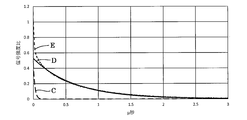
- Example 3 is a graph showing an attenuation curve of the crosslinkable block copolymer obtained in Example 1 and a relaxation curve obtained by fitting the attenuation curve to a two-component relaxation curve.
- Examples 1 to 13 and Comparative Examples 1 to 4 In a separable flask equipped with a stirrer, a cooling tube, a thermometer and a nitrogen gas inlet, isobornyl acrylate, N-acryloylmorpholine, 4-t-butylcyclohexyl acrylate and n-butyl acrylate were used as non-crosslinking monomers.
- reaction solution After purging the inside of the separable flask with nitrogen gas, the reaction solution was kept at 60° C. using a water bath. Then, 2,2′-azobis(isobutyronitrile) as a polymerization initiator was supplied to the reaction solution in the separable flask in the compounding amounts shown in Tables 1 and 2 to start reversible chain transfer polymerization (RAFT). did.
- the reaction liquid was kept at 60° C. for 6 hours to obtain a polymer block A partial polymer.
- the peak top molecular weight and the weight average molecular weight of the polymer block A partial polymer are shown in Tables 1 and 2.
- a reaction liquid containing a polymer block A partial polymer n-butyl acrylate and ethyl acrylate as non-crosslinkable monomers, 4-acryloyloxybenzophenone as a crosslinkable monomer, and ethyl acetate as a solvent are shown in Tables 1 and 2, respectively. Each of the indicated amounts was supplied.
- the reaction solution was kept at 60° C. for 6 hours for reversible chain transfer polymerization (RAFT) to obtain a polymer block A-polymer block B partial polymer.
- RAFT reversible chain transfer polymerization
- the peak top molecular weight and the weight average molecular weight of the polymer block A-polymer block B partial polymer are shown in Tables 5 and 6.
- a reaction solution containing a polymer block A-polymer block B partial polymer is crosslinked with isobornyl acrylate, N-acryloylmorpholine, 4-t-butylcyclohexyl acrylate and n-butyl acrylate as non-crosslinkable monomers.
- 4-Acryloyloxybenzophenone, 4-[2-(acryloyloxy)ethoxy]benzophenone and 4-hydroxybutyl acrylate glycidyl ether were used as monomers, and ethyl acetate was used as a solvent in the amounts shown in Tables 1 and 2, respectively.
- the reaction solution was kept at 60° C.
- RAFT reversible chain transfer polymerization
- Ethyl acetate was added to the reaction solution so that the content of the crosslinkable block copolymer was 50% by mass to obtain a crosslinkable block copolymer solution.
- the crosslinkable block copolymer was an ABA type triblock copolymer in which the polymer block A was bound to both ends of the polymer block B.
- the peak top molecular weight, the weight average molecular weight and the dispersity of the crosslinkable block copolymer are shown in Tables 5 and 6.
- the total content of polymer block A and the content of polymer block B in the crosslinkable block copolymer are shown in Tables 5 and 6.
- RAFT reversible chain transfer polymerization
- Table 3 shows the peak top molecular weight, weight average molecular weight and dispersity of the crosslinkable random polymer.
- reaction solution After purging the inside of the separable flask with nitrogen gas, the reaction solution was kept at 60° C. using a water bath. Next, 2,2'-azobis(isobutyronitrile) as a polymerization initiator was supplied to the reaction solution in the separable flask in the compounding amounts shown in Table 4 to initiate reversible chain transfer polymerization (RAFT). The reaction solution was kept at 60° C. for 6 hours to obtain a polymer block B partial polymer. The peak top molecular weight and the weight average molecular weight of the polymer block B partial polymer are shown in Table 4.
- RAFT reversible chain transfer polymerization
- reaction liquid containing a polymer block B partial polymer N-acryloylmorpholine as a non-crosslinkable monomer, 4-acryloyloxybenzophenone as a crosslinkable monomer, and ethyl acetate as a solvent were added in amounts shown in Table 4, respectively. Supplied each.
- the reaction solution was kept at 60° C. for 6 hours to carry out reversible chain transfer polymerization (RAFT) to prepare a crosslinkable block copolymer.
- RAFT reversible chain transfer polymerization
- Ethyl acetate was added to the reaction solution so that the content of the crosslinkable block copolymer was 50% by mass to obtain a crosslinkable block copolymer solution.
- the crosslinkable block copolymer was an ABA type triblock copolymer in which the polymer block A was bound to both ends of the polymer block B.
- Table 4 shows the peak top molecular weight, weight average molecular weight, and dispersity of the crosslinkable block copolymer.
- Table 4 shows the total content of the polymer block A and the content of the polymer block B in the crosslinkable block copolymer.
- the attenuation curve was measured in the above-mentioned manner, based on the attenuation curve, The spin-spin relaxation times T 2 (1) and T 2 (2) and the component ratios A 1 and A 2 were obtained. The rate of change (%) of the relaxation time T 2 (2) was also calculated.
- the gel fractions of the block copolymer and the random polymer after crosslinking are shown in Tables 3 to 6.
- a graph showing an attenuation curve of the crosslinkable block copolymer obtained in Example 1 and a relaxation curve obtained by fitting the attenuation curve to a two-component relaxation curve is shown in FIG.
- the vertical axis represents the "signal intensity ratio when the maximum intensity of the attenuation curve is 1."
- the component ratio A 1 of the relaxation curve can be read from the value of the intercept on the Y axis of the relaxation curve having the spin-spin relaxation time T 2 (1).
- the relaxation curve component ratio A 2 can be read from the value of the intercept on the Y axis of the relaxation curve having the spin-spin relaxation time T 2 (2).
- the probe tack of the film formed by crosslinking the crosslinkable block copolymer and the crosslinkable random polymer obtained in the Examples and Comparative Examples was measured in the above manner, and the results are shown in Tables 3 to 6.
- the gel fraction of the coating is shown in the column of "Gel fraction at the time of probe tack measurement" in Tables 3 to 6.
- UV-C irradiation intensity about 48 mW/cm 2
- UV-C integrated light intensity 100 mJ/cm using an ultraviolet irradiation device (Hereus (former Fusion UV Systems) product name “Light Hammer 6” (H bulb used))
- UV-C ultraviolet rays
- the coated test piece and the film test piece were masked at both ends in the longitudinal direction of 25 mm to expose the coated film of the coated test piece and the film of the film test piece in a flat square shape with a side of 50 mm.
- the polyethylene terephthalate film was peeled from the coated test piece and the coating test piece to prepare a sample for measuring a stress-strain curve.
- a sample for stress-strain curve measurement was subjected to a tensile test using an autograph (trade name “AGS-X100N” manufactured by Shimadzu Corporation) at a tensile speed of 500 mm/min.
- Breaking stress (N/mm 2 ) Test force (N)/[Sample thickness for stress-strain curve measurement ( ⁇ m) x 50 (mm)]
- Elongation at break (%) displacement (mm) x 2
- the relaxation curve D having the shorter spin-spin relaxation time T 2 (1) is used as the nonlinear least squares method.
Landscapes
- Chemical & Material Sciences (AREA)
- Organic Chemistry (AREA)
- Life Sciences & Earth Sciences (AREA)
- Engineering & Computer Science (AREA)
- Materials Engineering (AREA)
- Wood Science & Technology (AREA)
- Chemical Kinetics & Catalysis (AREA)
- Health & Medical Sciences (AREA)
- Medicinal Chemistry (AREA)
- Polymers & Plastics (AREA)
- Graft Or Block Polymers (AREA)
- Paints Or Removers (AREA)
Abstract
La présente invention concerne: un copolymère séquencé réticulable qui permet de former un film de revêtement dur et non collant; et un agent de revêtement qui utilise le copolymère séquencé réticulable. Ce copolymère séquencé réticulable est caractérisé en ce qu'il comprend un bloc polymère B et un bloc polymère A qui est lié aux deux extrémités du bloc polymère B et contient une unité monomère réticulable. Le copolymère séquencé réticulable est également caractérisé en ce que, après réticulation, lorsque la méthode des moindres carrés non linéaire est utilisée pour effectuer un ajustement de courbe de relaxation à deux composantes sur une courbe de décroissance qui est obtenue par application de la technique d'echo solide à une RMN d'impulsion de 1H (20 MHz) à 40 °C, le temps de relaxation spin-spin plus court T2(1) est de 18 à 35 μsec, et le rapport des composantes A1 de la courbe de relaxation qui comprend ledit temps de relaxation spin-spin T2(1) est de 40 % à 70 %.
Priority Applications (1)
| Application Number | Priority Date | Filing Date | Title |
|---|---|---|---|
| JP2020533041A JPWO2020149385A1 (ja) | 2019-01-16 | 2020-01-16 | 架橋性ブロック共重合体及びコーティング剤 |
Applications Claiming Priority (2)
| Application Number | Priority Date | Filing Date | Title |
|---|---|---|---|
| JP2019-005254 | 2019-01-16 | ||
| JP2019005254 | 2019-01-16 |
Publications (1)
| Publication Number | Publication Date |
|---|---|
| WO2020149385A1 true WO2020149385A1 (fr) | 2020-07-23 |
Family
ID=71613048
Family Applications (1)
| Application Number | Title | Priority Date | Filing Date |
|---|---|---|---|
| PCT/JP2020/001386 Ceased WO2020149385A1 (fr) | 2019-01-16 | 2020-01-16 | Copolymère séquencé réticulable et agent de revêtement |
Country Status (2)
| Country | Link |
|---|---|
| JP (1) | JPWO2020149385A1 (fr) |
| WO (1) | WO2020149385A1 (fr) |
Cited By (1)
| Publication number | Priority date | Publication date | Assignee | Title |
|---|---|---|---|---|
| EP4310115A1 (fr) * | 2022-07-20 | 2024-01-24 | Arkema France | Oligomères comprenant des monomères polymérisés à haute tg |
Citations (14)
| Publication number | Priority date | Publication date | Assignee | Title |
|---|---|---|---|---|
| JP2003055630A (ja) * | 2001-06-20 | 2003-02-26 | Tesa Ag | 特に非極性表面用の感圧接着剤 |
| JP2008038116A (ja) * | 2006-08-10 | 2008-02-21 | Asahi Kasei Chemicals Corp | 高耐久性エマルション |
| US20080233348A1 (en) * | 2007-03-19 | 2008-09-25 | 3M Innovative Properties Company | Adhesive sheet article |
| JP2012229354A (ja) * | 2011-04-27 | 2012-11-22 | Hitachi Chemical Co Ltd | 両末端にポリグリシジルブロックを有するアクリル樹脂及びその製造方法、それを用いた樹脂組成物 |
| JP2013057058A (ja) * | 2011-08-15 | 2013-03-28 | Kawamura Institute Of Chemical Research | ブロック共重合体 |
| WO2015030207A1 (fr) * | 2013-08-30 | 2015-03-05 | 株式会社クラレ | Copolymère bloc acrylique modifié, son procédé de production, et son utilisation |
| WO2017014154A1 (fr) * | 2015-07-22 | 2017-01-26 | 株式会社クラレ | Copolymère à bloc (méth)acrylique |
| WO2017217363A1 (fr) * | 2016-06-13 | 2017-12-21 | 東亞合成株式会社 | Composition de résine pour moulage, et article moulé |
| WO2018013330A1 (fr) * | 2016-07-11 | 2018-01-18 | 3M Innovative Properties Company | Matériau polymère et procédés permettant de le fabriquer au moyen d'amorceurs radicalaires contrôlés |
| WO2018016407A1 (fr) * | 2016-07-21 | 2018-01-25 | 大塚化学株式会社 | Copolymère séquencé, composition, et film |
| JP2018504509A (ja) * | 2014-12-15 | 2018-02-15 | ヘンケル アイピー アンド ホールディング ゲゼルシャフト ミット ベシュレンクテル ハフツング | ホットメルト接着剤用の光架橋性ブロックコポリマー |
| US20180112021A1 (en) * | 2016-10-25 | 2018-04-26 | Avery Dennison Corporation | Controlled Architecture Polymerization with Photoinitiator Groups in Backbone |
| WO2018181251A1 (fr) * | 2017-03-31 | 2018-10-04 | 東亞合成株式会社 | Composition de résine durcissable et son procédé de production |
| WO2019098153A1 (fr) * | 2017-11-15 | 2019-05-23 | 株式会社クラレ | Copolymère séquencé (méth)acrylique et composition durcissable par rayonnement d'énergie active le contenant |
Family Cites Families (2)
| Publication number | Priority date | Publication date | Assignee | Title |
|---|---|---|---|---|
| JP2002069412A (ja) * | 2000-09-01 | 2002-03-08 | Nitto Denko Corp | 反応型ホツトメルト粘着剤組成物およびその粘着シ―トならびにこれらの製造方法 |
| JP6786789B2 (ja) * | 2015-10-30 | 2020-11-18 | 三菱ケミカル株式会社 | アクリル系樹脂、アクリル系粘着剤組成物、粘着シート |
-
2020
- 2020-01-16 WO PCT/JP2020/001386 patent/WO2020149385A1/fr not_active Ceased
- 2020-01-16 JP JP2020533041A patent/JPWO2020149385A1/ja active Pending
Patent Citations (14)
| Publication number | Priority date | Publication date | Assignee | Title |
|---|---|---|---|---|
| JP2003055630A (ja) * | 2001-06-20 | 2003-02-26 | Tesa Ag | 特に非極性表面用の感圧接着剤 |
| JP2008038116A (ja) * | 2006-08-10 | 2008-02-21 | Asahi Kasei Chemicals Corp | 高耐久性エマルション |
| US20080233348A1 (en) * | 2007-03-19 | 2008-09-25 | 3M Innovative Properties Company | Adhesive sheet article |
| JP2012229354A (ja) * | 2011-04-27 | 2012-11-22 | Hitachi Chemical Co Ltd | 両末端にポリグリシジルブロックを有するアクリル樹脂及びその製造方法、それを用いた樹脂組成物 |
| JP2013057058A (ja) * | 2011-08-15 | 2013-03-28 | Kawamura Institute Of Chemical Research | ブロック共重合体 |
| WO2015030207A1 (fr) * | 2013-08-30 | 2015-03-05 | 株式会社クラレ | Copolymère bloc acrylique modifié, son procédé de production, et son utilisation |
| JP2018504509A (ja) * | 2014-12-15 | 2018-02-15 | ヘンケル アイピー アンド ホールディング ゲゼルシャフト ミット ベシュレンクテル ハフツング | ホットメルト接着剤用の光架橋性ブロックコポリマー |
| WO2017014154A1 (fr) * | 2015-07-22 | 2017-01-26 | 株式会社クラレ | Copolymère à bloc (méth)acrylique |
| WO2017217363A1 (fr) * | 2016-06-13 | 2017-12-21 | 東亞合成株式会社 | Composition de résine pour moulage, et article moulé |
| WO2018013330A1 (fr) * | 2016-07-11 | 2018-01-18 | 3M Innovative Properties Company | Matériau polymère et procédés permettant de le fabriquer au moyen d'amorceurs radicalaires contrôlés |
| WO2018016407A1 (fr) * | 2016-07-21 | 2018-01-25 | 大塚化学株式会社 | Copolymère séquencé, composition, et film |
| US20180112021A1 (en) * | 2016-10-25 | 2018-04-26 | Avery Dennison Corporation | Controlled Architecture Polymerization with Photoinitiator Groups in Backbone |
| WO2018181251A1 (fr) * | 2017-03-31 | 2018-10-04 | 東亞合成株式会社 | Composition de résine durcissable et son procédé de production |
| WO2019098153A1 (fr) * | 2017-11-15 | 2019-05-23 | 株式会社クラレ | Copolymère séquencé (méth)acrylique et composition durcissable par rayonnement d'énergie active le contenant |
Cited By (2)
| Publication number | Priority date | Publication date | Assignee | Title |
|---|---|---|---|---|
| EP4310115A1 (fr) * | 2022-07-20 | 2024-01-24 | Arkema France | Oligomères comprenant des monomères polymérisés à haute tg |
| WO2024018041A1 (fr) * | 2022-07-20 | 2024-01-25 | Arkema France | Oligomères comprenant des monomères polymérisés à tg élevée |
Also Published As
| Publication number | Publication date |
|---|---|
| JPWO2020149385A1 (ja) | 2021-02-18 |
Similar Documents
| Publication | Publication Date | Title |
|---|---|---|
| Barner et al. | Reversible addition–fragmentation chain transfer polymerization initiated with γ-radiation at ambient temperature: an overview | |
| JP6698269B2 (ja) | (メタ)アクリル系共重合体、それを含む粘着剤組成物および粘着シート | |
| CN104125984B (zh) | 具有低动态表面张力的氟代丙烯酸酯嵌段共聚物 | |
| US11479620B2 (en) | 3D printing with polymeric nanogel particles | |
| KR101984421B1 (ko) | (메트)아크릴계 공중합체, 그것을 포함하는 점착 조성물 및 점착 시트 그리고 그것을 사용한 피복재 및 도장물 | |
| BRPI0803411B1 (pt) | método de produção de uma solução polimérica, solução polimérica, método de produção de uma mistura curável, e, mistura curável | |
| JP2020100852A (ja) | ブロックポリマ | |
| Roberge et al. | Emulsion-based pressure sensitive adhesives from conjugated linoleic acid/styrene/butyl acrylate terpolymers | |
| WO2018101460A1 (fr) | Composition de résine pour adhésif, et feuille adhésive | |
| JPH07505431A (ja) | 紫外線硬化性アクリレート感圧接着剤組成物 | |
| JP5277425B2 (ja) | 光学部材用プロテクトフィルム | |
| WO2020149385A1 (fr) | Copolymère séquencé réticulable et agent de revêtement | |
| JP7289148B2 (ja) | 架橋性ブロック共重合体及びホットメルト粘着剤 | |
| JP2015168765A (ja) | エネルギー線硬化型樹脂組成物 | |
| CN107001548A (zh) | 固化性组合物及膜 | |
| WO2020149387A1 (fr) | Copolymere sequence reticulable, son procede de fabrication ainsi qu'element elastique | |
| Muppalla et al. | Synthesis, morphology and properties of poly (dimethylsiloxane)/poly (n-butyl acrylate) mixed soft block-based copolymers: A new class of thermoplastic elastomer | |
| WO2020149386A1 (fr) | Copolymere sequence reticulable, son procede de fabrication ainsi qu'adhesif thermofusible | |
| JP2023030451A (ja) | 粘着部材及びその製造方法 | |
| JP2005290209A (ja) | 硬化用組成物 | |
| JPS63210182A (ja) | 感圧接着剤組成物 | |
| EP3640296A1 (fr) | Composition de couche neutre | |
| JP2007079527A (ja) | カラーフィルター保護膜用一液型熱硬化性組成物およびこれを用いたカラーフィルター | |
| JP7356674B2 (ja) | 硬化性組成物及び硬化膜 | |
| JP2022173644A (ja) | 星形ポリマー、塗料、塗膜、及び星形ポリマーの製造方法 |
Legal Events
| Date | Code | Title | Description |
|---|---|---|---|
| ENP | Entry into the national phase |
Ref document number: 2020533041 Country of ref document: JP Kind code of ref document: A |
|
| 121 | Ep: the epo has been informed by wipo that ep was designated in this application |
Ref document number: 20741471 Country of ref document: EP Kind code of ref document: A1 |
|
| NENP | Non-entry into the national phase |
Ref country code: DE |
|
| 122 | Ep: pct application non-entry in european phase |
Ref document number: 20741471 Country of ref document: EP Kind code of ref document: A1 |