WO2020152878A1 - Dispositif d'analyse d'opération, procédé d'analyse d'opération, programme d'analyse d'opération et système d'analyse d'opération - Google Patents
Dispositif d'analyse d'opération, procédé d'analyse d'opération, programme d'analyse d'opération et système d'analyse d'opération Download PDFInfo
- Publication number
- WO2020152878A1 WO2020152878A1 PCT/JP2019/008942 JP2019008942W WO2020152878A1 WO 2020152878 A1 WO2020152878 A1 WO 2020152878A1 JP 2019008942 W JP2019008942 W JP 2019008942W WO 2020152878 A1 WO2020152878 A1 WO 2020152878A1
- Authority
- WO
- WIPO (PCT)
- Prior art keywords
- series information
- unit
- time
- clusters
- motion
- Prior art date
- Legal status (The legal status is an assumption and is not a legal conclusion. Google has not performed a legal analysis and makes no representation as to the accuracy of the status listed.)
- Ceased
Links
Images



Classifications
-
- G—PHYSICS
- G06—COMPUTING OR CALCULATING; COUNTING
- G06Q—INFORMATION AND COMMUNICATION TECHNOLOGY [ICT] SPECIALLY ADAPTED FOR ADMINISTRATIVE, COMMERCIAL, FINANCIAL, MANAGERIAL OR SUPERVISORY PURPOSES; SYSTEMS OR METHODS SPECIALLY ADAPTED FOR ADMINISTRATIVE, COMMERCIAL, FINANCIAL, MANAGERIAL OR SUPERVISORY PURPOSES, NOT OTHERWISE PROVIDED FOR
- G06Q10/00—Administration; Management
- G06Q10/06—Resources, workflows, human or project management; Enterprise or organisation planning; Enterprise or organisation modelling
- G06Q10/063—Operations research, analysis or management
- G06Q10/0633—Workflow analysis
-
- G—PHYSICS
- G06—COMPUTING OR CALCULATING; COUNTING
- G06F—ELECTRIC DIGITAL DATA PROCESSING
- G06F16/00—Information retrieval; Database structures therefor; File system structures therefor
- G06F16/70—Information retrieval; Database structures therefor; File system structures therefor of video data
- G06F16/75—Clustering; Classification
-
- G—PHYSICS
- G06—COMPUTING OR CALCULATING; COUNTING
- G06Q—INFORMATION AND COMMUNICATION TECHNOLOGY [ICT] SPECIALLY ADAPTED FOR ADMINISTRATIVE, COMMERCIAL, FINANCIAL, MANAGERIAL OR SUPERVISORY PURPOSES; SYSTEMS OR METHODS SPECIALLY ADAPTED FOR ADMINISTRATIVE, COMMERCIAL, FINANCIAL, MANAGERIAL OR SUPERVISORY PURPOSES, NOT OTHERWISE PROVIDED FOR
- G06Q10/00—Administration; Management
- G06Q10/06—Resources, workflows, human or project management; Enterprise or organisation planning; Enterprise or organisation modelling
- G06Q10/063—Operations research, analysis or management
- G06Q10/0631—Resource planning, allocation, distributing or scheduling for enterprises or organisations
- G06Q10/06312—Adjustment or analysis of established resource schedule, e.g. resource or task levelling, or dynamic rescheduling
-
- G—PHYSICS
- G06—COMPUTING OR CALCULATING; COUNTING
- G06Q—INFORMATION AND COMMUNICATION TECHNOLOGY [ICT] SPECIALLY ADAPTED FOR ADMINISTRATIVE, COMMERCIAL, FINANCIAL, MANAGERIAL OR SUPERVISORY PURPOSES; SYSTEMS OR METHODS SPECIALLY ADAPTED FOR ADMINISTRATIVE, COMMERCIAL, FINANCIAL, MANAGERIAL OR SUPERVISORY PURPOSES, NOT OTHERWISE PROVIDED FOR
- G06Q10/00—Administration; Management
- G06Q10/06—Resources, workflows, human or project management; Enterprise or organisation planning; Enterprise or organisation modelling
- G06Q10/063—Operations research, analysis or management
- G06Q10/0631—Resource planning, allocation, distributing or scheduling for enterprises or organisations
- G06Q10/06316—Sequencing of tasks or work
Definitions
- the present invention relates to a motion analysis device, a motion analysis method, a motion analysis program, and a motion analysis system.
- one or more cameras may be installed on the product manufacturing line to record the movements of the worker in images or moving images.
- an image recognition process is performed on a captured image or moving image to analyze the motion of the worker.
- Patent Document 1 there is provided a monitoring device for monitoring a worker, and based on at least one of position information and posture information of the worker and a human body model of the worker, There is described a monitoring device that calculates motion information and determines whether or not the motion of the worker is appropriate based on the motion model and the motion information when the worker performs the work.
- the reference motion information may be extracted by an expert from the motion information accumulated in the past. In that case, it takes a lot of time to extract the reference motion information, and it may be difficult to secure human resources having extraction skills.
- the present invention provides a motion analysis device, a motion analysis method, a motion analysis program, and a motion analysis system that make it easier to extract information indicating a standard motion from the accumulated motion information. To do.
- An operation analysis device includes an acquisition unit that acquires a plurality of time-series information indicating an operation recorded when one or more workers perform a predetermined operation one or more times, and Of the time series information, a calculation unit that calculates the degree of similarity between the two time series information, a classification unit that classifies the plurality of time series information into a plurality of clusters based on the similarity, and a A selection unit that selects one or a plurality of clusters that satisfy a predetermined condition and a first extraction unit that extracts time-series information indicating a reference operation from the selected one or a plurality of clusters are provided.
- a plurality of time-series information indicating a predetermined operation performed by the worker is classified into a plurality of clusters, and one or a plurality of clusters satisfying a predetermined condition is selected from among the plurality of clusters. It is possible to select a cluster of time-series information indicating a standard action of a plurality of workers, and it becomes easier to extract information indicating a reference action.
- the classification unit may classify a plurality of time series information into a plurality of clusters by hierarchical clustering in which the time series information is collected in a cluster in descending order of similarity.
- the selection unit selects a subtree whose number of leaf nodes is greater than or equal to a first threshold value and less than a second threshold value from the tree diagram of the plurality of time-series information obtained by hierarchical clustering as a predetermined condition. It may be selected as one or more clusters to fill.
- the first extraction unit may extract time series information indicating a reference operation from each of one or a plurality of clusters satisfying a predetermined condition, based on the length of the time series information. ..
- the time-series information indicating the reference operation it is possible to extract, from the candidates of the time-series information indicating the reference operation, the time-series information that does not include an unnecessary operation and has a high probability as the time-series information indicating the reference operation. ..
- the second extraction unit that extracts one or more feature points from the time-series information indicating the reference action, and the information indicating the division point of the action as the reference based on the one or more feature points.
- the operation unit may further include an adding unit that adds to the time-series information indicating the following operation.
- the division point of the motion can be clarified, and the comparison for each motion can be performed when comparing with other time-series information. Become.
- the second extracting unit extracts the first feature point included in the time-series information indicating the reference action, excludes the first and the second feature points from the extraction target, and indicates the reference action.
- the second feature point included in the time-series information may be extracted.
- the plurality of time series information may be information obtained by adding the velocities or accelerations of a plurality of parts of one or a plurality of workers.
- a motion analysis method includes acquiring a plurality of time-series information indicating a motion recorded when one or a plurality of workers perform a predetermined motion one or more times, and Calculating the degree of similarity between two pieces of time-series information, classifying the plurality of pieces of time-series information into a plurality of clusters based on the degree of similarity, It includes selecting one or a plurality of clusters that satisfy the condition and extracting time series information indicating a reference operation from the selected one or a plurality of clusters.
- a plurality of time-series information indicating a predetermined operation performed by the worker is classified into a plurality of clusters, and one or a plurality of clusters satisfying a predetermined condition is selected from among the plurality of clusters. It is possible to select a cluster of time-series information indicating a standard action of a plurality of workers, and it becomes easier to extract information indicating a reference action.
- a motion analysis program includes a plurality of operation units included in the motion analysis apparatus, which indicate motions recorded when one or more workers perform a predetermined motion one or more times.
- a calculation unit that calculates the degree of similarity between two pieces of time series information among the plurality of pieces of time series information, and the plurality of time series information is classified into a plurality of clusters based on the degree of similarity.
- a classification unit for selecting, a selection unit for selecting one or a plurality of clusters satisfying a predetermined condition from a plurality of clusters, and extracting time series information indicating a reference operation from the selected one or a plurality of clusters; 1 function as an extraction unit.
- a plurality of time-series information indicating a predetermined operation performed by the worker is classified into a plurality of clusters, and one or a plurality of clusters satisfying a predetermined condition is selected from among the plurality of clusters. It is possible to select a cluster of time-series information indicating a standard action of a plurality of workers, and it becomes easier to extract information indicating a reference action.
- a motion analysis system includes a shooting unit that shoots a plurality of moving images in which one or more workers perform a predetermined motion one or a plurality of times, and an acquisition unit that acquires a plurality of moving images.
- a calculating unit that calculates a similarity between two moving images of the plurality of moving images, a classifying unit that classifies the plurality of moving images into a plurality of clusters based on the similarity, and a predetermined condition of the plurality of clusters.
- a selection unit that selects one or a plurality of clusters and a first extraction unit that extracts a moving image showing a reference operation from the selected one or a plurality of clusters are provided.
- a plurality of time-series information indicating a predetermined operation performed by the worker is classified into a plurality of clusters, and one or a plurality of clusters satisfying a predetermined condition is selected from among the plurality of clusters. It is possible to select a cluster of time-series information indicating a standard action of a plurality of workers, and it becomes easier to extract information indicating a reference action.
- a motion analysis device a motion analysis method, a motion analysis program, and a motion analysis system that make it easier to extract information indicating a reference motion from the accumulated information indicating the motion. can do.
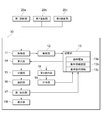
- the motion analysis system 100 includes a first shooting unit 20a, a second shooting unit 20b, and a third shooting unit 20c that shoot a moving image showing a worker's motion performed in a certain work area R.
- the work area R in this example is an area including the entire manufacturing line, but the work area R may be an arbitrary area, for example, an area in which a predetermined process is performed or a predetermined element operation is performed. It may be an area.
- the elemental motion is a unit of motion executed by an operator, and includes, for example, motions such as picking parts, arranging parts, fixing parts, and packing products.
- three steps are performed in the work area R, and the first shooting unit 20a, the second shooting unit 20b, and the third shooting unit 20c each shoot a moving image of a worker who executes a predetermined process. It may be
- the first worker A1 can perform operations such as picking, arranging, and fixing the first component
- the second worker A2 can perform operations such as picking, arranging, and fixing the second component.
- the first worker A1 and the second worker A2 are collectively referred to as the worker A.
- the motion analysis system 100 includes a motion analysis device 10.
- the motion analysis apparatus 10 has a degree of similarity between two pieces of time-series information among a plurality of pieces of time-series information indicating a motion, which is recorded when one or more workers A perform a predetermined motion one or more times. And a calculation unit for calculating Here, the motion analysis device 10 may calculate the degree of similarity between two pieces of time-series information for all combinations that select two pieces of time-series information from a plurality of pieces of time-series information.
- the motion analysis device 10 selects a classification unit that classifies a plurality of time series information into a plurality of clusters and one or a plurality of clusters satisfying a predetermined condition among the plurality of clusters based on the calculated similarity.
- a selection unit and a first extraction unit that extracts time-series information indicating a reference operation from one or a plurality of selected clusters.
- the motion analysis device 10 includes a display unit 10f that displays time-series information indicating the extracted reference motion.
- the degree of similarity is a measure indicating how similar two pieces of time-series information are.
- the degree of similarity between two pieces of time-series information may be calculated by, for example, a DTW (Dynamic Time Warping) method.
- the predetermined condition for selecting the cluster may be a condition that the size of the cluster is equal to or larger than the first threshold and smaller than the second threshold.
- the first threshold value and the second threshold value may be predetermined.
- the standard action may be a standard action of one or more workers.
- the motion analysis apparatus 10 classifies a plurality of time-series information indicating a predetermined motion performed by the worker into a plurality of clusters, and selects one or a plurality of clusters satisfying a predetermined condition from among the plurality of clusters. It is possible to select a cluster of time-series information indicating standard actions of a plurality of workers. Furthermore, the motion analysis device 10 extracts time-series information indicating a reference motion from the selected one or a plurality of clusters.
- the motion analysis device 10 it is possible to extract the information indicating the reference motion from the accumulated information indicating the motion. As a result, even if there is no specialist who has the skill to extract the information indicating the reference movement from the accumulated movement information, the information indicating the reference movement should be generated appropriately. You can Further, it is possible to generate the information indicating the reference operation in a short time.
- the motion analysis system 100 includes a first imaging unit 20a, a second imaging unit 20b, a third imaging unit 20c, and the motion analysis device 10. Then, the motion analysis device 10 includes the acquisition unit 11, the analysis unit 12, the storage unit 13, the calculation unit 14, the classification unit 15, the selection unit 16, the first extraction unit 17, the second extraction unit 18, the addition unit 19, and the display unit. With 10f.
- the first photographing unit 20a, the second photographing unit 20b, and the third photographing unit 20c may each be configured by a general-purpose camera, and the first worker A1 and the second worker A2 perform operations in the work area R. You may take a video that includes a scene.
- the first image capturing unit 20a, the second image capturing unit 20b, and the third image capturing unit 20c may each capture a part of the work area R, and may capture a moving image in a smaller area than the work area R. Specifically, a moving image that closes up the operations performed by the first worker A1 and the second worker A2 may be taken.
- the first image capturing unit 20a, the second image capturing unit 20b, and the third image capturing unit 20c may capture, for example, a moving image that closes up the hands of the first worker A1 and the second worker A2.
- the first photographing unit 20a, the second photographing unit 20b, and the third photographing unit 20c may photograph a plurality of moving images that photograph a plurality of portions of the work area R, respectively.
- the first shooting unit 20a mainly shoots a moving image in which the first worker A1 is performing an operation
- the third shooting unit 20c is mainly moving image in which the second worker A2 is performing an operation.
- the second image capturing unit 20b may capture both a moving image in which the first worker A1 is performing an operation and a moving image in which the second worker A2 is performing an operation.
- the first photographing unit 20a, the second photographing unit 20b, and the third photographing unit 20c may photograph moving images in which different steps are performed at a plurality of positions in the work area R, respectively.
- the acquisition unit 11 acquires a plurality of pieces of time-series information indicating the motion of the worker A, which is recorded when one or a plurality of workers A perform a predetermined motion once or a plurality of times.
- the time-series information may be a moving image showing the motion of the worker A.
- the time-series information is information about coordinate values indicating the motion of the worker A measured by motion capture, or the motion of the worker A measured by mounting the acceleration sensor or the gyro sensor on the worker A. It may be information indicating.
- the time-series information may be numerical information obtained by analyzing a moving image showing the motion of the worker A.
- the time series information (moving image in this example) acquired by the acquisition unit 11 is transmitted to the storage unit 13 and stored as a moving image history 13a.
- the analysis unit 12 analyzes a moving image showing the motion of the worker A, and calculates motion information including coordinate values indicating the motion of the worker A.
- the motion information may be information indicating the displacement of the representative position of the body of the worker A.
- the representative position of the body of the worker may be one position of the body, but typically, there may be a plurality of positions.
- the motion information may be information indicating the position of the joint of the worker A by a skeleton model.
- the analysis unit 12 uses, for example, the technique disclosed by Zhe Cao, three others, “Realtime Multi-Person 2D Pose Estimation using Part Affinity Fields”, arXiv:1611.08050, 2016 to show the motion of the worker A from the moving image.
- the motion information including the indicated coordinate value may be calculated.
- the analysis unit 12 calculates motion information including coordinate values indicating the motion of the worker A from the moving image. No processing is required.
- the plurality of time-series information may be information obtained by adding speeds or accelerations of a plurality of parts of one or a plurality of workers A.
- the velocity vector or the acceleration vector of a plurality of parts of the worker A may be calculated by differentiating the coordinate vector with respect to time.
- the time series information may be calculated by adding the velocity vectors or the acceleration vectors of a plurality of parts.
- the plurality of parts of the one or more workers A may include both hands of the one or more workers A.
- the time-series information may be information obtained by adding speeds or accelerations of both hands of the worker A.
- the coordinates of both hands may be the coordinates of a specific joint of the hand or the coordinates of the back of the hand. As a result, it is possible to extract the information indicating the reference motion for the movements of both hands of the worker A.
- the storage unit 13 stores the moving image history 13a, the motion information history 13b, and the reference motion information 13c.
- the moving image history 13a includes a history of moving images shot by the first shooting unit 20a, the second shooting unit 20b, and the third shooting unit 20c.
- the motion information history 13b includes a history of motion information calculated by the analysis unit 12.
- the motion information history 13b may be stored for each worker.
- the reference movement information 13c includes a history of reference movement information including time series information indicating a reference movement.
- the reference motion information is extracted by the first extraction unit 17 from the motion information history 13b. Further, the reference motion information may include information indicating the division point of the motion added to the time-series information indicating the motion as the reference.
- the calculation unit 14 calculates the degree of similarity between two pieces of time-series information among a plurality of pieces of time-series information.
- the calculating unit 14 may calculate the degree of similarity between two pieces of time-series information by the DTW method for all combinations that select two pieces of time-series information from a plurality of pieces of time-series information.
- the calculating unit 14 may calculate the similarity between the plurality of pieces of time-series information by any method other than DTW.
- the classifying unit 15 classifies the plurality of time series information into a plurality of clusters based on the similarity calculated by the calculating unit 14.
- the classifying unit 15 may classify time series information having a high degree of similarity into the same cluster and classify time series information having a low degree of similarity into a different cluster.
- the classifying unit 15 may classify the plurality of time-series information into a plurality of clusters by hierarchical clustering in which the time-series information is grouped into clusters in descending order of similarity. By using the hierarchical clustering, it is possible to appropriately cluster the time-series information so as not to depend on the initial condition and extract the information indicating the reference operation, as compared with the case of using the k-means method, for example. it can.
- the selection unit 16 selects one or a plurality of clusters satisfying a predetermined condition from the plurality of clusters.
- the selection unit 16 may select one or a plurality of clusters having a cluster size equal to or larger than the first threshold and smaller than the second threshold, among the plurality of clusters. More specifically, when the classifying unit 15 classifies a plurality of time series information into a plurality of clusters by hierarchical clustering, the selecting unit 16 selects the leaf nodes of the tree diagram obtained by the hierarchical clustering. Subtrees whose number is equal to or larger than the first threshold and smaller than the second threshold may be selected as one or a plurality of clusters that satisfy a predetermined condition. With this, it is possible to narrow down the candidates of the time series information indicating the reference operation while excluding the outliers.
- the first extraction unit 17 extracts time-series information indicating a reference operation from the selected one or a plurality of clusters.
- the first extraction unit 17 may randomly extract time series information indicating a reference operation from each of one or a plurality of clusters satisfying a predetermined condition.
- the first extraction unit 17 may randomly extract time-series information indicating a reference operation from each of one or a plurality of clusters satisfying a predetermined condition, using a pseudo-random number, for example.
- the time-series information indicating the reference operation can be uniformly extracted from the time-series information candidates indicating the reference operation.
- the first extraction unit 17 may extract time-series information indicating a reference operation from the selected one or a plurality of clusters according to another extraction criterion.
- the first extraction unit 17 may extract time series information indicating a reference operation based on the length of the time series information from each of one or a plurality of clusters satisfying a predetermined condition. For example, the first extraction unit 17 may extract the time series information having the smallest length as the time series information indicating the reference operation.
- the length of the time series information may be defined by the file size of the time series information.
- the motion analysis apparatus 10 classifies a plurality of time-series information indicating a predetermined motion performed by the worker A into a plurality of clusters, and selects one or a plurality of clusters satisfying a predetermined condition from the clusters. By selecting, it is possible to select a cluster of time-series information indicating a standard action of one or more workers, and it is possible to extract information indicating a reference action.
- the second extraction unit 18 extracts one or a plurality of feature points from the time series information indicating the reference motion.
- the second extraction unit 18 may acquire the reference movement information 13c stored in the storage unit 13 and extract one or a plurality of feature points from the time series information indicating the reference movement.
- the feature points may be any points as long as they represent the features that can be extracted in the time-series information. For example, when the time-series information is plotted on the time axis and expressed in a graph. May be the peak (maximum point and minimum point of the time series information graph).
- Such a feature point corresponds to, for example, a time at which an operation of abruptly changing the moving direction or moving speed of a part of a worker (such as a hand) is performed.
- the extracted one or more feature points respectively correspond to specific times.
- the time-series information is information about coordinate values indicating the motion of the worker A measured by motion capture, or the motion of the worker A. It may be numerical information obtained by analyzing a moving image showing.
- the second extraction unit 18 extracts the first feature point included in the time series information indicating the reference motion, excludes the first feature point and the front and back of the first feature point from the extraction target, and sets the time series information indicating the reference motion.
- the second feature points included in the may be extracted. That is, the second extraction unit 18 may exclude other feature points before and after the extracted feature points from the extraction target.
- the second extracting unit 18 extracts the characteristic points, excludes the points before and after the characteristic points from the extraction target, and extracts the other characteristic points from the entire time series information from the extraction target or a predetermined number. It may be repeated until the feature points are extracted. By excluding the front and back of the extracted feature points from the extraction target, it is possible to prevent noise from being erroneously extracted as a feature point, and it is possible to extract the motion division points more accurately.
- the assigning unit 19 assigns the information indicating the division point of the action to the time-series information indicating the reference action, based on the one or more feature points extracted by the second extracting unit 18.
- the information indicating the division point of the operation may be in any form, but may be, for example, the division ID associated with the frame of the time series information. In this way, it is possible to clarify the dividing points of the motion of the worker indicated by the time-series information that is the reference, and to compare each motion when comparing it with other time-series information. ..
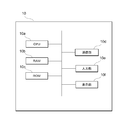
- the operation analysis device 10 includes a CPU (Central Processing Unit) 10a corresponding to an arithmetic device, a RAM (Random Access Memory) 10b corresponding to the storage unit 13, and a ROM (Read only Memory) 10c corresponding to the storage unit 13. It has a communication unit 10d, an input unit 10e, and a display unit 10f. These respective configurations are connected to each other via a bus so that data can be transmitted and received.
- a bus so that data can be transmitted and received.
- the motion analysis device 10 is configured by one computer will be described, but the motion analysis device 10 may be realized by using a plurality of computers.
- the CPU 10a is a control unit that controls the execution of a program stored in the RAM 10b or the ROM 10c, calculates data, and processes the data.
- the CPU 10a is an arithmetic unit that executes a program (motion analysis program) that extracts time series information indicating a reference motion from a plurality of time series information.
- the CPU 10a receives various input data from the input unit 10e and the communication unit 10d, displays the calculation result of the input data on the display unit 10f, and stores the calculation result in the RAM 10b and the ROM 10c.
- the RAM 10b is a data rewritable part of the storage unit 13, and may be composed of, for example, a semiconductor storage element.
- the RAM 10b stores a motion analysis program executed by the CPU 10a and data such as the moving image history 13a, the motion information history 13b, and the reference motion information 13c.
- the ROM 10c is a storage unit 13 capable of reading data, and may be composed of, for example, a semiconductor storage element.
- the ROM 10c stores, for example, a motion analysis program and data that is not rewritten.
- the communication unit 10d is an interface that connects the motion analysis device 10 to an external device.
- the communication unit 10d is connected to the first photographing unit 20a, the second photographing unit 20b, and the third photographing unit 20c by, for example, a LAN (Local Area Network), and the first photographing unit 20a, the second photographing unit 20b, and the third photographing unit.
- the moving image may be received from the unit 20c.
- the communication unit 10d may be connected to the Internet to receive a moving image or operation information via the Internet.
- the communication unit 10d may also transmit the extracted time series information to an external device via the Internet.
- the input unit 10e receives data input from the user, and may include, for example, a keyboard, a mouse, and a touch panel.
- the display unit 10f is for visually displaying the calculation result by the CPU 10a, and may be configured by, for example, an LCD (Liquid Crystal Display).
- the operation analysis program may be provided by being stored in a computer-readable storage medium such as the RAM 10b or the ROM 10c, or may be provided via a communication network connected by the communication unit 10d.
- the CPU 10a executes the motion analysis program, so that the acquisition unit 11, the analysis unit 12, the calculation unit 14, the classification unit 15, the selection unit 16, the first extraction unit 17, which are described with reference to FIG.
- the operations of the second extracting unit 18 and the adding unit 19 are realized.
- the motion analysis device 10 may include an LSI (Large-Scale Integration) in which the CPU 10a and the RAM 10b and the ROM 10c are integrated.
- LSI Large-Scale Integration
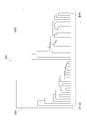
- FIG. 4 is a diagram showing a first example of the tree diagram DG selected by the operation analysis device 10 according to the present embodiment.
- the tree diagram DG is generated by hierarchical clustering in which a plurality of time-series information are arranged in a cluster in descending order of similarity.
- there are 44 pieces of time series information which are illustrated as the first time series information D1 and the second time series information D2 to 44th time series information D44, and form a leaf node of the tree diagram DG.
- the selection unit 16 of the behavior analysis device 10 has the number of leaf nodes equal to or larger than the first threshold value and the second threshold value. Subtrees less than the threshold are selected as one or more clusters that satisfy a predetermined condition.
- the first threshold is 5 and the second threshold is 10.
- the selecting unit 16 divides the tree diagram DG into two at the highest level, and specifies the first tree diagram DG1 and the second tree diagram GD2 that are subtrees. Then, the selection unit 16 determines that the number of leaf nodes included in the first tree diagram DG1 and the second tree diagram GD2 is greater than or equal to the first threshold value (5 in this example) and less than the second threshold value (10 in this example). Determine if there is. Since the number of leaf nodes included in the first tree diagram DG1 is 1 and the number of leaf nodes included in the second tree diagram DG2 is 43, neither condition is satisfied. Therefore, the selection unit 16 does not select the first tree diagram DG1 and the second tree diagram GD2 as one or a plurality of clusters satisfying a predetermined condition.
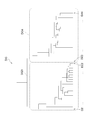
- FIG. 5 is a diagram showing a second example of the tree diagram DG selected by the motion analysis device 10 according to the present embodiment.
- the selection unit 16 of the motion analysis device 10 has the number of leaf nodes not less than the first threshold value (5 in this example) and less than the second threshold value (10 in this example), but the number of leaf nodes is not less than the first threshold value.
- the second tree diagram GD2 is divided into two at the highest level, and the third tree diagram DG3 and the fourth tree diagram GD4 that are subtrees are specified.
- the third tree diagram DG3 includes the second time series information D2 to the 22nd time series information D22 as leaf nodes.
- the fourth tree diagram DG4 includes the 23rd time series information D23 to the 44th time series information D44 as leaf nodes.
- the selection unit 16 determines whether the number of leaf nodes included in the third tree diagram DG3 and the fourth tree diagram GD4 is greater than or equal to the first threshold value (5 in this example) and less than the second threshold value (10 in this example) by the selection unit 16 To judge. Since the number of leaf nodes included in the third tree diagram DG3 is 21 and the number of leaf nodes included in the fourth tree diagram DG4 is 22, neither of them satisfies the condition. Therefore, the selection unit 16 does not select the third tree diagram DG3 and the fourth tree diagram GD4 as one or a plurality of clusters satisfying a predetermined condition.
- FIG. 6 is a diagram showing a third example of the tree diagram DG selected by the motion analysis device 10 according to the present embodiment.
- the selection unit 16 of the motion analysis apparatus 10 repeats the process of dividing the top of the dendrogram into two, and the number of leaf nodes is equal to or greater than the first threshold value (5 in this example) and less than the second threshold value (10 in this example).
- the fifth tree diagram DG5, the sixth tree diagram GD6, and the seventh tree diagram GD7 that are partial trees of are selected as one or a plurality of clusters satisfying a predetermined condition.
- the fifth tree diagram DG5 includes the eighth time series information D8 to the twelfth time series information D12 as leaf nodes.
- the number of leaf nodes included in the fifth tree diagram DG5 is 5, which satisfies the condition of being equal to or more than the first threshold and less than the second threshold.
- the sixth tree diagram DG6 includes the thirteenth time series information D13 to the twenty-first time series information D21 as leaf nodes.
- the number of leaf nodes included in the sixth tree diagram DG6 is 9, which satisfies the condition of being equal to or more than the first threshold and less than the second threshold.
- the seventh tree diagram DG7 includes the 36th time series information D36 to the 44th time series information D44 as leaf nodes.
- the number of leaf nodes included in the seventh tree diagram DG7 is 9, which satisfies the condition of being equal to or greater than the first threshold and less than the second threshold.
- the first extracting unit 17 randomly extracts time series information indicating a reference operation from each of one or a plurality of clusters satisfying a predetermined condition.
- the first extraction unit 17 may extract the time-series information having the minimum length as the time-series information indicating the reference operation from each of one or a plurality of clusters satisfying a predetermined condition.
- the first extraction unit 17 randomly selects time-series information indicating a reference motion from each of the fifth tree diagram DG5, the sixth tree diagram GD6, and the seventh tree diagram GD7. Extract one each.
- the first extraction unit 17 extracts the eighth time series information D8 from the fifth tree diagram DG5 as time series information indicating a reference operation, and extracts the sixth tree diagram GD6 from the sixth tree diagram GD6.
- the 13th time series information D13 is extracted as time series information indicating the reference operation
- the 40th time series information D40 is extracted from the seventh tree diagram GD7 as the time series information indicating the reference operation. In this way, it is possible to select a cluster of time-series information indicating a standard movement of one or more workers A and extract information indicating a reference movement.
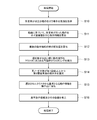
- FIG. 7 is a flowchart of the reference motion information extraction process executed by the motion analysis device 10 according to the present embodiment.
- the motion analysis device 10 acquires a moving image when the worker A performs a predetermined motion (S10).
- the motion analysis device 10 calculates motion information including coordinate values indicating the motion performed by the worker A based on the moving image (S11).
- the motion information is an example of time-series information indicating the motion of the worker A.
- the motion analysis device 10 calculates the degree of similarity between the plurality of motion information (S12).
- the motion analysis device 10 executes hierarchical clustering in which motion information is collected into clusters in descending order of similarity (S13).
- the behavior analysis device 10 divides the tree diagram obtained by the hierarchical clustering into two, and selects a subtree in which the number of leaf nodes is equal to or larger than the first threshold and smaller than the second threshold (S14). Then, the motion analysis device 10 randomly extracts reference motion information from the selected cluster (S15). The extracted motion information is stored in the storage unit 13 as the reference motion information 13c.
- the motion analysis device 10 displays the reference motion information and its moving image on the display unit 10f (S16).
- the reference motion information and the moving image thereof may not necessarily be displayed on the display unit 10f and may be transmitted to the external device via the communication unit 10d.
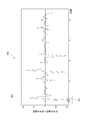
- FIG. 8 is a diagram showing a first example of feature points and masks set by the motion analysis system 100 according to the present embodiment.
- the vertical axis represents a value obtained by adding the right hand speed and the left hand speed dimensionlessly
- the horizontal axis represents an example of a graph of the reference motion information R1 in which time is dimensionlessly illustrated.
- the second extraction unit 18 of the motion analysis device 10 extracts the first feature point P1 from the reference motion information R1.
- the second extraction unit 18 extracts, as the first feature point P1, a point where the absolute value of the sum of the speed of the right hand and the speed of the left hand, which is the value of the reference motion information R1, is maximum.
- the second extracting unit 18 extracts the second feature points included in the reference motion information R1 by excluding the areas before and after the first feature point P1 from the extraction target.
- the second extraction unit 18 excludes the area before and after the first feature point P1 from the extraction target by setting the first mask M1 that covers the area before and after the first feature point P1.
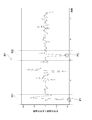
- FIG. 9 is a diagram showing a second example of feature points and masks set by the motion analysis system 100 according to the present embodiment.
- the second feature point P2 extracted by the second extraction unit 18 after the first feature point P1 shown in FIG. 8 is extracted and the first mask M1 is set is illustrated.
- the second extraction unit 18 extracts the second feature point P2 included in the reference motion information R1 by excluding the range in which the first mask M1 is set from the extraction target.
- the second extraction unit 18 excludes the range in which the first mask M1 is set from the extraction target, and then extracts the point where the absolute value of the reference motion information R1 is the maximum as the second feature point P2.
- the second extraction unit 18 extracts the third feature points included in the reference motion information R1 by excluding the areas before and after the second feature point P2 from the extraction target.
- the second extraction unit 18 excludes the areas before and after the second feature point P2 from the extraction target by setting the second mask M2 that covers the area before and after the second feature point P2.
- the second extraction unit 18 repeats the extraction process until a mask is set over the entire area of the reference motion information R1 or the number of extracted feature points reaches a predetermined number.
- the assigning unit 19 assigns information indicating the division point of the motion to the standard motion information R1 based on the extracted one or more feature points.
- the assigning unit 19 assigns at least two pieces of information indicating the division points of the motion to the reference motion information R1 based on the first feature point P1 and the second feature point P2. In this way, the division point of the movement of the worker A indicated by the reference movement information R1 can be clarified, and the comparison for each movement can be performed when comparing with other movement information.
- FIG. 10 is a flowchart of the motion division processing executed by the motion analysis device 10 according to this embodiment.
- the motion analysis device 10 extracts the maximum peak point as a feature point from the extraction range of the reference motion information (S20).
- the maximum peak point is a point where the absolute value of the value of the reference motion information is maximum.
- the motion analysis device 10 sets a mask that excludes the front and back of the feature point from the extraction target (S21). Then, the motion analysis device 10 determines whether a predetermined number of feature points have been extracted or a mask has been set in the entire range (S22). When the predetermined number of feature points are not extracted and the mask is not set in the entire range (S22: NO), the motion analysis device 10 sets the maximum peak point as the feature point from the extraction range of the reference motion information. The process of extracting (S20) and setting a mask for excluding the points before and after the feature point from the extraction target (S21) is repeated.
- the motion analysis device 10 displays the reference motion information and the feature points on the display unit 10f (S23), The correction of the characteristic points is accepted (S24).
- the correction of the feature points may be thinning of the extracted feature points or addition of the feature points.
- the motion analysis device 10 adds information indicating the motion division point to the reference motion information based on the extracted feature points, and stores it in the storage unit 13 (S25). With the above, the motion division processing ends.
- Embodiments of the present invention may be described as the following supplementary notes. However, the embodiments of the present invention are not limited to the forms described in the following supplementary notes. Further, the embodiments of the present invention may have a form in which the descriptions between the supplementary notes are replaced or combined.
- a selection unit (16) for selecting one or a plurality of clusters satisfying a predetermined condition from the plurality of clusters;
- a motion analysis device (10) comprising:
- the classifying unit (15) classifies the plurality of time series information into the plurality of clusters by hierarchical clustering in which the time series information is grouped into clusters in descending order of similarity.
- the motion analysis apparatus (10 according to claim 1.
- the selection unit (16) determines a subtree in which the number of leaf nodes is equal to or more than a first threshold value and less than a second threshold value as the predetermined value. Select as one or more clusters that satisfy the condition of The motion analysis apparatus (10) according to claim 2.
- the first extracting unit (17) extracts time series information indicating the reference operation based on the length of the time series information from each of one or a plurality of clusters satisfying the predetermined condition.
- the motion analysis device (10) according to claim 3.
- a motion analysis apparatus (10) according to any one of claims 1 to 4.
- the second extraction unit (18) extracts the first feature point included in the time-series information indicating the reference operation, excludes the first and the second feature points from the extraction target, and serves as the reference.
- the second feature point included in the time series information indicating the operation is extracted,
- the motion analysis apparatus (10) according to claim 5.
- the plurality of time series information is information obtained by adding speeds or accelerations of a plurality of parts of the one or more workers, A motion analysis device (10) according to any one of claims 1 to 6.
- the plurality of parts include both hands of the one or more workers, A motion analysis apparatus (10) according to claim 7.
- [Appendix 9] Acquiring a plurality of time-series information indicating the action recorded when one or more workers perform a predetermined action one or more times; Calculating the degree of similarity between the plurality of time series information, Classifying the plurality of time series information into a plurality of clusters based on the similarity, Selecting one or more clusters satisfying a predetermined condition from the plurality of clusters; Extracting time-series information indicating a reference operation from the selected one or more clusters, A motion analysis method including.
- the operation unit provided in the motion analysis device 10
- An acquisition unit (11) for acquiring a plurality of time-series information indicating the motion recorded when one or a plurality of workers perform a predetermined motion one or more times.
- a calculation unit (14) for calculating the similarity between the plurality of time-series information,
- a classifying unit (15) for classifying the plurality of time-series information into a plurality of clusters based on the similarity.
- a selection unit (16) for selecting one or a plurality of clusters satisfying a predetermined condition from the plurality of clusters;
- a first extraction unit (17) for extracting time-series information indicating a reference operation from the selected one or a plurality of clusters, Motion analysis program that functions as a.
- a selection unit (16) for selecting one or a plurality of clusters satisfying a predetermined condition from the plurality of clusters;
- a motion analysis system (100) comprising.
Landscapes
- Business, Economics & Management (AREA)
- Human Resources & Organizations (AREA)
- Engineering & Computer Science (AREA)
- Strategic Management (AREA)
- Entrepreneurship & Innovation (AREA)
- Economics (AREA)
- Theoretical Computer Science (AREA)
- Physics & Mathematics (AREA)
- General Physics & Mathematics (AREA)
- Educational Administration (AREA)
- Tourism & Hospitality (AREA)
- General Business, Economics & Management (AREA)
- Development Economics (AREA)
- Quality & Reliability (AREA)
- Game Theory and Decision Science (AREA)
- Operations Research (AREA)
- Marketing (AREA)
- Multimedia (AREA)
- Data Mining & Analysis (AREA)
- Databases & Information Systems (AREA)
- General Engineering & Computer Science (AREA)
- General Factory Administration (AREA)
- Information Retrieval, Db Structures And Fs Structures Therefor (AREA)
- Management, Administration, Business Operations System, And Electronic Commerce (AREA)
- Image Analysis (AREA)
Abstract
L'invention concerne un dispositif d'analyse d'opération ou similaire qui permet d'extraire des informations qui indiquent une opération de référence parmi des éléments d'informations accumulées pour indiquer des opérations avec facilité. Ce dispositif d'analyse d'opération comprend : une unité d'acquisition (11) qui acquiert une pluralité d'éléments d'informations de série chronologique qui indiquent une opération prescrite enregistrée lorsque l'opération est effectuée une ou plusieurs fois par un ou plusieurs travailleurs ; une unité de calcul (14) qui calcule des similarités entre la pluralité d'éléments d'informations de série chronologique ; une unité de classification (15) qui classifie, sur la base des similarités, la pluralité d'éléments d'informations de série chronologique en une pluralité de groupes ; une unité de sélection (16) qui sélectionne un groupe ou une pluralité de groupes qui satisfont une condition prescrite parmi la pluralité de groupes ; et une première unité d'extraction (17) qui extrait des informations de séries chronologiques qui indiquent une opération de référence à partir du ou des groupes sélectionnés.
Priority Applications (2)
| Application Number | Priority Date | Filing Date | Title |
|---|---|---|---|
| EP19911557.7A EP3916654B1 (fr) | 2019-01-23 | 2019-03-06 | Dispositif d'analyse d'opération, procédé d'analyse d'opération, programme d'analyse d'opération et système d'analyse d'opération |
| CN201980052702.5A CN112567402B (zh) | 2019-01-23 | 2019-03-06 | 动作分析装置、动作分析方法、存储介质及动作分析系统 |
Applications Claiming Priority (2)
| Application Number | Priority Date | Filing Date | Title |
|---|---|---|---|
| JP2019009007A JP7502849B2 (ja) | 2019-01-23 | 2019-01-23 | 動作分析装置、動作分析方法、動作分析プログラム及び動作分析システム |
| JP2019-009007 | 2019-01-23 |
Publications (1)
| Publication Number | Publication Date |
|---|---|
| WO2020152878A1 true WO2020152878A1 (fr) | 2020-07-30 |
Family
ID=71736286
Family Applications (1)
| Application Number | Title | Priority Date | Filing Date |
|---|---|---|---|
| PCT/JP2019/008942 Ceased WO2020152878A1 (fr) | 2019-01-23 | 2019-03-06 | Dispositif d'analyse d'opération, procédé d'analyse d'opération, programme d'analyse d'opération et système d'analyse d'opération |
Country Status (4)
| Country | Link |
|---|---|
| EP (1) | EP3916654B1 (fr) |
| JP (1) | JP7502849B2 (fr) |
| CN (1) | CN112567402B (fr) |
| WO (1) | WO2020152878A1 (fr) |
Families Citing this family (3)
| Publication number | Priority date | Publication date | Assignee | Title |
|---|---|---|---|---|
| WO2022158216A1 (fr) * | 2021-01-22 | 2022-07-28 | オムロン株式会社 | Dispositif de gestion de travail, procédé de gestion de travail et programme de gestion de travail |
| EP4318396A4 (fr) | 2021-04-13 | 2024-05-08 | Mitsubishi Electric Corporation | Dispositif d'inférence, dispositif d'apprentissage, procédé d'inférence, procédé d'apprentissage, programme d'inférence, et programme d'apprentissage |
| JP2025082631A (ja) * | 2023-11-17 | 2025-05-29 | 東芝テック株式会社 | 情報処理装置および情報処理プログラム |
Citations (5)
| Publication number | Priority date | Publication date | Assignee | Title |
|---|---|---|---|---|
| JP2008108008A (ja) * | 2006-10-24 | 2008-05-08 | Omron Corp | 移動パターン特定装置、移動パターン特定方法、移動パターン特定プログラム、およびこれを記録した記録媒体 |
| JP2011034234A (ja) * | 2009-07-30 | 2011-02-17 | Kozo Keikaku Engineering Inc | 動作分析装置、動作分析方法及び動作分析プログラム |
| US20160239769A1 (en) * | 2015-02-12 | 2016-08-18 | Wipro Limited | Methods for determining manufacturing waste to optimize productivity and devices thereof |
| JP2017146661A (ja) | 2016-02-15 | 2017-08-24 | オムロン株式会社 | 監視装置、制御装置、制御システム、監視方法およびプログラム |
| JP2018109882A (ja) * | 2017-01-05 | 2018-07-12 | 株式会社東芝 | 動作解析装置、動作解析方法およびプログラム |
Family Cites Families (9)
| Publication number | Priority date | Publication date | Assignee | Title |
|---|---|---|---|---|
| JP2003316796A (ja) | 2002-04-26 | 2003-11-07 | Fuji Xerox Co Ltd | 階層クラスタリング装置及び階層クラスタリング方法、階層クラスタリングプログラム、階層クラスタリングシステム |
| JP2005242418A (ja) * | 2004-02-24 | 2005-09-08 | Matsushita Electric Works Ltd | 作業評価装置、作業評価方法をコンピュータに実現させる作業評価プログラムおよび当該作業評価プログラムを記憶した記憶媒体 |
| JP4267531B2 (ja) * | 2004-07-13 | 2009-05-27 | 京セラミタ株式会社 | 画像形成装置 |
| CN102027338B (zh) | 2008-05-14 | 2013-06-19 | 日东纺音响工程株式会社 | 信号判定方法、信号判定装置、信号判定系统 |
| JP5495235B2 (ja) * | 2010-12-02 | 2014-05-21 | 株式会社日立製作所 | 監視対象者の行動を監視する装置及び方法 |
| JP6717572B2 (ja) * | 2015-06-22 | 2020-07-01 | 株式会社ブロードリーフ | 作業分析システム及び作業分析方法 |
| JP2018094248A (ja) * | 2016-12-15 | 2018-06-21 | カシオ計算機株式会社 | 運動解析装置、運動解析方法及びプログラム |
| CN107730120A (zh) * | 2017-10-19 | 2018-02-23 | 伊婕 | 一种服装标准工时系统 |
| CN107808144A (zh) * | 2017-11-10 | 2018-03-16 | 深圳市唯特视科技有限公司 | 一种基于视频时空关系进行自我监督嵌入姿态学习方法 |
-
2019
- 2019-01-23 JP JP2019009007A patent/JP7502849B2/ja active Active
- 2019-03-06 CN CN201980052702.5A patent/CN112567402B/zh active Active
- 2019-03-06 EP EP19911557.7A patent/EP3916654B1/fr active Active
- 2019-03-06 WO PCT/JP2019/008942 patent/WO2020152878A1/fr not_active Ceased
Patent Citations (5)
| Publication number | Priority date | Publication date | Assignee | Title |
|---|---|---|---|---|
| JP2008108008A (ja) * | 2006-10-24 | 2008-05-08 | Omron Corp | 移動パターン特定装置、移動パターン特定方法、移動パターン特定プログラム、およびこれを記録した記録媒体 |
| JP2011034234A (ja) * | 2009-07-30 | 2011-02-17 | Kozo Keikaku Engineering Inc | 動作分析装置、動作分析方法及び動作分析プログラム |
| US20160239769A1 (en) * | 2015-02-12 | 2016-08-18 | Wipro Limited | Methods for determining manufacturing waste to optimize productivity and devices thereof |
| JP2017146661A (ja) | 2016-02-15 | 2017-08-24 | オムロン株式会社 | 監視装置、制御装置、制御システム、監視方法およびプログラム |
| JP2018109882A (ja) * | 2017-01-05 | 2018-07-12 | 株式会社東芝 | 動作解析装置、動作解析方法およびプログラム |
Non-Patent Citations (2)
| Title |
|---|
| See also references of EP3916654A4 |
| ZHE CAO ET AL.: "Realtime Multi-Person 2D Pose Optimization using Part Affinity Fields", ARXIV: 1611.08050, 2016 |
Also Published As
| Publication number | Publication date |
|---|---|
| CN112567402B (zh) | 2024-08-09 |
| EP3916654A4 (fr) | 2022-06-08 |
| EP3916654A1 (fr) | 2021-12-01 |
| JP7502849B2 (ja) | 2024-06-19 |
| JP2020119164A (ja) | 2020-08-06 |
| CN112567402A (zh) | 2021-03-26 |
| EP3916654B1 (fr) | 2025-12-03 |
Similar Documents
| Publication | Publication Date | Title |
|---|---|---|
| CN111798487B (zh) | 目标跟踪方法、装置和计算机可读存储介质 | |
| CN102077250B (zh) | 移动体检测方法及移动体检测装置 | |
| CN112489077B (zh) | 目标跟踪方法、装置及计算机系统 | |
| CN107431786A (zh) | 图像处理设备、图像处理系统、图像处理方法和计算机程序 | |
| JP6570786B2 (ja) | 動作学習装置、技能判別装置および技能判別システム | |
| US10289884B2 (en) | Image analyzer, image analysis method, computer program product, and image analysis system | |
| CN113297963A (zh) | 多人姿态的估计方法、装置、电子设备以及可读存储介质 | |
| JP6577397B2 (ja) | 画像解析装置、画像解析方法、画像解析プログラム、および画像解析システム | |
| CN111783665A (zh) | 一种动作识别方法、装置、存储介质和电子设备 | |
| JP2011133984A (ja) | 動作特徴抽出装置および動作特徴抽出方法 | |
| KR20170084643A (ko) | 듀얼 스마트 밴드를 이용한 모션 분석 장치 및 방법 | |
| JP2020170252A (ja) | 画像処理装置、情報処理方法及びプログラム | |
| JP7502849B2 (ja) | 動作分析装置、動作分析方法、動作分析プログラム及び動作分析システム | |
| JP2016014954A (ja) | 手指形状の検出方法、そのプログラム、そのプログラムの記憶媒体、及び、手指の形状を検出するシステム。 | |
| CN110991292A (zh) | 动作识别比对方法、系统、计算机存储介质和电子装置 | |
| CN112602100B (zh) | 动作分析装置、动作分析方法、存储介质及动作分析系统 | |
| JP7623631B2 (ja) | 周期動作検知装置、周期動作検知方法及び周期動作検知プログラム | |
| JP5186656B2 (ja) | 動作評価装置および動作評価方法 | |
| JP6384167B2 (ja) | 移動体追跡装置及び移動体追跡方法、並びにコンピュータ・プログラム | |
| CN110910426A (zh) | 动作过程和动作趋势识别方法、存储介质和电子装置 | |
| JP6312991B2 (ja) | 画像出力装置 | |
| CN119672766A (zh) | 眼镜设备中手关节检测的方法、存储介质、电子设备及产品 | |
| JP2021125048A (ja) | 情報処理装置、情報処理方法、画像処理装置、及びプログラム | |
| JP2022130227A (ja) | 設定方法、設定プログラム及び設定装置 | |
| CN119396322A (zh) | 实时渲染方法及装置 |
Legal Events
| Date | Code | Title | Description |
|---|---|---|---|
| 121 | Ep: the epo has been informed by wipo that ep was designated in this application |
Ref document number: 19911557 Country of ref document: EP Kind code of ref document: A1 |
|
| NENP | Non-entry into the national phase |
Ref country code: DE |
|
| ENP | Entry into the national phase |
Ref document number: 2019911557 Country of ref document: EP Effective date: 20210823 |
|
| WWG | Wipo information: grant in national office |
Ref document number: 2019911557 Country of ref document: EP |