WO2020153455A1 - Appareil de traitement, procédé de traitement et corps pulvérulent - Google Patents
Appareil de traitement, procédé de traitement et corps pulvérulent Download PDFInfo
- Publication number
- WO2020153455A1 WO2020153455A1 PCT/JP2020/002423 JP2020002423W WO2020153455A1 WO 2020153455 A1 WO2020153455 A1 WO 2020153455A1 JP 2020002423 W JP2020002423 W JP 2020002423W WO 2020153455 A1 WO2020153455 A1 WO 2020153455A1
- Authority
- WO
- WIPO (PCT)
- Prior art keywords
- organic matter
- water
- treatment
- tank
- stirring
- Prior art date
- Legal status (The legal status is an assumption and is not a legal conclusion. Google has not performed a legal analysis and makes no representation as to the accuracy of the status listed.)
- Ceased
Links
Images

Classifications
-
- B—PERFORMING OPERATIONS; TRANSPORTING
- B09—DISPOSAL OF SOLID WASTE; RECLAMATION OF CONTAMINATED SOIL
- B09B—DISPOSAL OF SOLID WASTE NOT OTHERWISE PROVIDED FOR
- B09B3/00—Destroying solid waste or transforming solid waste into something useful or harmless
- B09B3/50—Destroying solid waste or transforming solid waste into something useful or harmless involving radiation, e.g. electro-magnetic waves
-
- A—HUMAN NECESSITIES
- A23—FOODS OR FOODSTUFFS; TREATMENT THEREOF, NOT COVERED BY OTHER CLASSES
- A23K—FODDER
- A23K40/00—Shaping or working-up of animal feeding-stuffs
-
- A—HUMAN NECESSITIES
- A23—FOODS OR FOODSTUFFS; TREATMENT THEREOF, NOT COVERED BY OTHER CLASSES
- A23K—FODDER
- A23K10/00—Animal feeding-stuffs
- A23K10/20—Animal feeding-stuffs from material of animal origin
- A23K10/26—Animal feeding-stuffs from material of animal origin from waste material, e.g. feathers, bones or skin
-
- A—HUMAN NECESSITIES
- A23—FOODS OR FOODSTUFFS; TREATMENT THEREOF, NOT COVERED BY OTHER CLASSES
- A23K—FODDER
- A23K10/00—Animal feeding-stuffs
- A23K10/30—Animal feeding-stuffs from material of plant origin, e.g. roots, seeds or hay; from material of fungal origin, e.g. mushrooms
- A23K10/37—Animal feeding-stuffs from material of plant origin, e.g. roots, seeds or hay; from material of fungal origin, e.g. mushrooms from waste material
-
- A—HUMAN NECESSITIES
- A23—FOODS OR FOODSTUFFS; TREATMENT THEREOF, NOT COVERED BY OTHER CLASSES
- A23N—MACHINES OR APPARATUS FOR TREATING HARVESTED FRUIT, VEGETABLES OR FLOWER BULBS IN BULK, NOT OTHERWISE PROVIDED FOR; PEELING VEGETABLES OR FRUIT IN BULK; APPARATUS FOR PREPARING ANIMAL FEEDING- STUFFS
- A23N17/00—Apparatus specially adapted for preparing animal feeding-stuffs
-
- A—HUMAN NECESSITIES
- A23—FOODS OR FOODSTUFFS; TREATMENT THEREOF, NOT COVERED BY OTHER CLASSES
- A23N—MACHINES OR APPARATUS FOR TREATING HARVESTED FRUIT, VEGETABLES OR FLOWER BULBS IN BULK, NOT OTHERWISE PROVIDED FOR; PEELING VEGETABLES OR FRUIT IN BULK; APPARATUS FOR PREPARING ANIMAL FEEDING- STUFFS
- A23N17/00—Apparatus specially adapted for preparing animal feeding-stuffs
- A23N17/001—Apparatus specially adapted for preparing animal feeding-stuffs by treating with chemicals, e.g. ammoniac, sodium hydroxide
-
- A—HUMAN NECESSITIES
- A23—FOODS OR FOODSTUFFS; TREATMENT THEREOF, NOT COVERED BY OTHER CLASSES
- A23N—MACHINES OR APPARATUS FOR TREATING HARVESTED FRUIT, VEGETABLES OR FLOWER BULBS IN BULK, NOT OTHERWISE PROVIDED FOR; PEELING VEGETABLES OR FRUIT IN BULK; APPARATUS FOR PREPARING ANIMAL FEEDING- STUFFS
- A23N17/00—Apparatus specially adapted for preparing animal feeding-stuffs
- A23N17/004—Apparatus specially adapted for preparing animal feeding-stuffs for treating by application of heat, e.g. by means of potato cookers
-
- A—HUMAN NECESSITIES
- A23—FOODS OR FOODSTUFFS; TREATMENT THEREOF, NOT COVERED BY OTHER CLASSES
- A23N—MACHINES OR APPARATUS FOR TREATING HARVESTED FRUIT, VEGETABLES OR FLOWER BULBS IN BULK, NOT OTHERWISE PROVIDED FOR; PEELING VEGETABLES OR FRUIT IN BULK; APPARATUS FOR PREPARING ANIMAL FEEDING- STUFFS
- A23N17/00—Apparatus specially adapted for preparing animal feeding-stuffs
- A23N17/007—Apparatus specially adapted for preparing animal feeding-stuffs for mixing feeding-stuff components
-
- A—HUMAN NECESSITIES
- A23—FOODS OR FOODSTUFFS; TREATMENT THEREOF, NOT COVERED BY OTHER CLASSES
- A23N—MACHINES OR APPARATUS FOR TREATING HARVESTED FRUIT, VEGETABLES OR FLOWER BULBS IN BULK, NOT OTHERWISE PROVIDED FOR; PEELING VEGETABLES OR FRUIT IN BULK; APPARATUS FOR PREPARING ANIMAL FEEDING- STUFFS
- A23N17/00—Apparatus specially adapted for preparing animal feeding-stuffs
- A23N17/008—Apparatus specially adapted for preparing animal feeding-stuffs for treating of silage, e.g. upgrading with water
-
- B—PERFORMING OPERATIONS; TRANSPORTING
- B01—PHYSICAL OR CHEMICAL PROCESSES OR APPARATUS IN GENERAL
- B01F—MIXING, e.g. DISSOLVING, EMULSIFYING OR DISPERSING
- B01F23/00—Mixing according to the phases to be mixed, e.g. dispersing or emulsifying
- B01F23/30—Mixing gases with solids
-
- B—PERFORMING OPERATIONS; TRANSPORTING
- B01—PHYSICAL OR CHEMICAL PROCESSES OR APPARATUS IN GENERAL
- B01F—MIXING, e.g. DISSOLVING, EMULSIFYING OR DISPERSING
- B01F23/00—Mixing according to the phases to be mixed, e.g. dispersing or emulsifying
- B01F23/30—Mixing gases with solids
- B01F23/34—Mixing gases with solids by introducing gases in solid materials, e.g. in masses of powder or particles
-
- B—PERFORMING OPERATIONS; TRANSPORTING
- B01—PHYSICAL OR CHEMICAL PROCESSES OR APPARATUS IN GENERAL
- B01F—MIXING, e.g. DISSOLVING, EMULSIFYING OR DISPERSING
- B01F27/00—Mixers with rotary stirring devices in fixed receptacles; Kneaders
- B01F27/60—Mixers with rotary stirring devices in fixed receptacles; Kneaders with stirrers rotating about a horizontal or inclined axis
- B01F27/70—Mixers with rotary stirring devices in fixed receptacles; Kneaders with stirrers rotating about a horizontal or inclined axis with paddles, blades or arms
-
- B—PERFORMING OPERATIONS; TRANSPORTING
- B09—DISPOSAL OF SOLID WASTE; RECLAMATION OF CONTAMINATED SOIL
- B09B—DISPOSAL OF SOLID WASTE NOT OTHERWISE PROVIDED FOR
- B09B3/00—Destroying solid waste or transforming solid waste into something useful or harmless
- B09B3/30—Destroying solid waste or transforming solid waste into something useful or harmless involving mechanical treatment
- B09B3/38—Stirring or kneading
-
- B—PERFORMING OPERATIONS; TRANSPORTING
- B09—DISPOSAL OF SOLID WASTE; RECLAMATION OF CONTAMINATED SOIL
- B09B—DISPOSAL OF SOLID WASTE NOT OTHERWISE PROVIDED FOR
- B09B3/00—Destroying solid waste or transforming solid waste into something useful or harmless
- B09B3/40—Destroying solid waste or transforming solid waste into something useful or harmless involving thermal treatment, e.g. evaporation
-
- B—PERFORMING OPERATIONS; TRANSPORTING
- B09—DISPOSAL OF SOLID WASTE; RECLAMATION OF CONTAMINATED SOIL
- B09B—DISPOSAL OF SOLID WASTE NOT OTHERWISE PROVIDED FOR
- B09B3/00—Destroying solid waste or transforming solid waste into something useful or harmless
- B09B3/60—Biochemical treatment, e.g. by using enzymes
-
- B—PERFORMING OPERATIONS; TRANSPORTING
- B09—DISPOSAL OF SOLID WASTE; RECLAMATION OF CONTAMINATED SOIL
- B09B—DISPOSAL OF SOLID WASTE NOT OTHERWISE PROVIDED FOR
- B09B5/00—Operations not covered by a single other subclass or by a single other group in this subclass
-
- C—CHEMISTRY; METALLURGY
- C02—TREATMENT OF WATER, WASTE WATER, SEWAGE, OR SLUDGE
- C02F—TREATMENT OF WATER, WASTE WATER, SEWAGE, OR SLUDGE
- C02F11/00—Treatment of sludge; Devices therefor
- C02F11/12—Treatment of sludge; Devices therefor by de-watering, drying or thickening
- C02F11/13—Treatment of sludge; Devices therefor by de-watering, drying or thickening by heating
-
- C—CHEMISTRY; METALLURGY
- C05—FERTILISERS; MANUFACTURE THEREOF
- C05F—ORGANIC FERTILISERS NOT COVERED BY SUBCLASSES C05B, C05C, e.g. FERTILISERS FROM WASTE OR REFUSE
- C05F1/00—Fertilisers made from animal corpses, or parts thereof
- C05F1/002—Fertilisers made from animal corpses, or parts thereof from fish or from fish-wastes
-
- C—CHEMISTRY; METALLURGY
- C05—FERTILISERS; MANUFACTURE THEREOF
- C05F—ORGANIC FERTILISERS NOT COVERED BY SUBCLASSES C05B, C05C, e.g. FERTILISERS FROM WASTE OR REFUSE
- C05F1/00—Fertilisers made from animal corpses, or parts thereof
- C05F1/005—Fertilisers made from animal corpses, or parts thereof from meat-wastes or from other wastes of animal origin, e.g. skins, hair, hoofs, feathers, blood
-
- C—CHEMISTRY; METALLURGY
- C05—FERTILISERS; MANUFACTURE THEREOF
- C05F—ORGANIC FERTILISERS NOT COVERED BY SUBCLASSES C05B, C05C, e.g. FERTILISERS FROM WASTE OR REFUSE
- C05F1/00—Fertilisers made from animal corpses, or parts thereof
- C05F1/02—Apparatus for the manufacture
-
- C—CHEMISTRY; METALLURGY
- C05—FERTILISERS; MANUFACTURE THEREOF
- C05F—ORGANIC FERTILISERS NOT COVERED BY SUBCLASSES C05B, C05C, e.g. FERTILISERS FROM WASTE OR REFUSE
- C05F11/00—Other organic fertilisers
- C05F11/08—Organic fertilisers containing added bacterial cultures, mycelia or the like
-
- C—CHEMISTRY; METALLURGY
- C05—FERTILISERS; MANUFACTURE THEREOF
- C05F—ORGANIC FERTILISERS NOT COVERED BY SUBCLASSES C05B, C05C, e.g. FERTILISERS FROM WASTE OR REFUSE
- C05F5/00—Fertilisers from distillery wastes, molasses, vinasses, sugar plant or similar wastes or residues, e.g. from waste originating from industrial processing of raw material of agricultural origin or derived products thereof
-
- C—CHEMISTRY; METALLURGY
- C05—FERTILISERS; MANUFACTURE THEREOF
- C05F—ORGANIC FERTILISERS NOT COVERED BY SUBCLASSES C05B, C05C, e.g. FERTILISERS FROM WASTE OR REFUSE
- C05F5/00—Fertilisers from distillery wastes, molasses, vinasses, sugar plant or similar wastes or residues, e.g. from waste originating from industrial processing of raw material of agricultural origin or derived products thereof
- C05F5/002—Solid waste from mechanical processing of material, e.g. seed coats, olive pits, almond shells, fruit residue, rice hulls
-
- C—CHEMISTRY; METALLURGY
- C05—FERTILISERS; MANUFACTURE THEREOF
- C05F—ORGANIC FERTILISERS NOT COVERED BY SUBCLASSES C05B, C05C, e.g. FERTILISERS FROM WASTE OR REFUSE
- C05F5/00—Fertilisers from distillery wastes, molasses, vinasses, sugar plant or similar wastes or residues, e.g. from waste originating from industrial processing of raw material of agricultural origin or derived products thereof
- C05F5/004—Liquid waste from mechanical processing of material, e.g. wash-water, milling fluid, filtrate
-
- C—CHEMISTRY; METALLURGY
- C05—FERTILISERS; MANUFACTURE THEREOF
- C05F—ORGANIC FERTILISERS NOT COVERED BY SUBCLASSES C05B, C05C, e.g. FERTILISERS FROM WASTE OR REFUSE
- C05F7/00—Fertilisers from waste water, sewage sludge, sea slime, ooze or similar masses
-
- C—CHEMISTRY; METALLURGY
- C05—FERTILISERS; MANUFACTURE THEREOF
- C05F—ORGANIC FERTILISERS NOT COVERED BY SUBCLASSES C05B, C05C, e.g. FERTILISERS FROM WASTE OR REFUSE
- C05F9/00—Fertilisers from household or town refuse
- C05F9/02—Apparatus for the manufacture
-
- A—HUMAN NECESSITIES
- A23—FOODS OR FOODSTUFFS; TREATMENT THEREOF, NOT COVERED BY OTHER CLASSES
- A23V—INDEXING SCHEME RELATING TO FOODS, FOODSTUFFS OR NON-ALCOHOLIC BEVERAGES AND LACTIC OR PROPIONIC ACID BACTERIA USED IN FOODSTUFFS OR FOOD PREPARATION
- A23V2002/00—Food compositions, function of food ingredients or processes for food or foodstuffs
-
- B—PERFORMING OPERATIONS; TRANSPORTING
- B01—PHYSICAL OR CHEMICAL PROCESSES OR APPARATUS IN GENERAL
- B01F—MIXING, e.g. DISSOLVING, EMULSIFYING OR DISPERSING
- B01F35/00—Accessories for mixers; Auxiliary operations or auxiliary devices; Parts or details of general application
- B01F35/90—Heating or cooling systems
- B01F2035/99—Heating
-
- B—PERFORMING OPERATIONS; TRANSPORTING
- B01—PHYSICAL OR CHEMICAL PROCESSES OR APPARATUS IN GENERAL
- B01F—MIXING, e.g. DISSOLVING, EMULSIFYING OR DISPERSING
- B01F2101/00—Mixing characterised by the nature of the mixed materials or by the application field
- B01F2101/25—Mixing waste with other ingredients
-
- B—PERFORMING OPERATIONS; TRANSPORTING
- B01—PHYSICAL OR CHEMICAL PROCESSES OR APPARATUS IN GENERAL
- B01F—MIXING, e.g. DISSOLVING, EMULSIFYING OR DISPERSING
- B01F2101/00—Mixing characterised by the nature of the mixed materials or by the application field
- B01F2101/32—Mixing fertiliser ingredients
- B01F2101/33—Mixing compost ingredients or organic waste
-
- B—PERFORMING OPERATIONS; TRANSPORTING
- B09—DISPOSAL OF SOLID WASTE; RECLAMATION OF CONTAMINATED SOIL
- B09B—DISPOSAL OF SOLID WASTE NOT OTHERWISE PROVIDED FOR
- B09B2101/00—Type of solid waste
- B09B2101/70—Kitchen refuse; Food waste
-
- C—CHEMISTRY; METALLURGY
- C02—TREATMENT OF WATER, WASTE WATER, SEWAGE, OR SLUDGE
- C02F—TREATMENT OF WATER, WASTE WATER, SEWAGE, OR SLUDGE
- C02F11/00—Treatment of sludge; Devices therefor
- C02F11/02—Biological treatment
-
- C—CHEMISTRY; METALLURGY
- C02—TREATMENT OF WATER, WASTE WATER, SEWAGE, OR SLUDGE
- C02F—TREATMENT OF WATER, WASTE WATER, SEWAGE, OR SLUDGE
- C02F11/00—Treatment of sludge; Devices therefor
- C02F11/18—Treatment of sludge; Devices therefor by thermal conditioning
- C02F11/185—Treatment of sludge; Devices therefor by thermal conditioning by pasteurisation
-
- C—CHEMISTRY; METALLURGY
- C02—TREATMENT OF WATER, WASTE WATER, SEWAGE, OR SLUDGE
- C02F—TREATMENT OF WATER, WASTE WATER, SEWAGE, OR SLUDGE
- C02F2103/00—Nature of the water, waste water, sewage or sludge to be treated
- C02F2103/22—Nature of the water, waste water, sewage or sludge to be treated from the processing of animals, e.g. poultry, fish, or parts thereof
-
- C—CHEMISTRY; METALLURGY
- C02—TREATMENT OF WATER, WASTE WATER, SEWAGE, OR SLUDGE
- C02F—TREATMENT OF WATER, WASTE WATER, SEWAGE, OR SLUDGE
- C02F2103/00—Nature of the water, waste water, sewage or sludge to be treated
- C02F2103/32—Nature of the water, waste water, sewage or sludge to be treated from the food or foodstuff industry, e.g. brewery waste waters
-
- C—CHEMISTRY; METALLURGY
- C02—TREATMENT OF WATER, WASTE WATER, SEWAGE, OR SLUDGE
- C02F—TREATMENT OF WATER, WASTE WATER, SEWAGE, OR SLUDGE
- C02F2209/00—Controlling or monitoring parameters in water treatment
- C02F2209/02—Temperature
-
- C—CHEMISTRY; METALLURGY
- C02—TREATMENT OF WATER, WASTE WATER, SEWAGE, OR SLUDGE
- C02F—TREATMENT OF WATER, WASTE WATER, SEWAGE, OR SLUDGE
- C02F2303/00—Specific treatment goals
- C02F2303/02—Odour removal or prevention of malodour
-
- Y—GENERAL TAGGING OF NEW TECHNOLOGICAL DEVELOPMENTS; GENERAL TAGGING OF CROSS-SECTIONAL TECHNOLOGIES SPANNING OVER SEVERAL SECTIONS OF THE IPC; TECHNICAL SUBJECTS COVERED BY FORMER USPC CROSS-REFERENCE ART COLLECTIONS [XRACs] AND DIGESTS
- Y02—TECHNOLOGIES OR APPLICATIONS FOR MITIGATION OR ADAPTATION AGAINST CLIMATE CHANGE
- Y02A—TECHNOLOGIES FOR ADAPTATION TO CLIMATE CHANGE
- Y02A40/00—Adaptation technologies in agriculture, forestry, livestock or agroalimentary production
- Y02A40/10—Adaptation technologies in agriculture, forestry, livestock or agroalimentary production in agriculture
- Y02A40/20—Fertilizers of biological origin, e.g. guano or fertilizers made from animal corpses
-
- Y—GENERAL TAGGING OF NEW TECHNOLOGICAL DEVELOPMENTS; GENERAL TAGGING OF CROSS-SECTIONAL TECHNOLOGIES SPANNING OVER SEVERAL SECTIONS OF THE IPC; TECHNICAL SUBJECTS COVERED BY FORMER USPC CROSS-REFERENCE ART COLLECTIONS [XRACs] AND DIGESTS
- Y02—TECHNOLOGIES OR APPLICATIONS FOR MITIGATION OR ADAPTATION AGAINST CLIMATE CHANGE
- Y02P—CLIMATE CHANGE MITIGATION TECHNOLOGIES IN THE PRODUCTION OR PROCESSING OF GOODS
- Y02P20/00—Technologies relating to chemical industry
- Y02P20/141—Feedstock
- Y02P20/145—Feedstock the feedstock being materials of biological origin
-
- Y—GENERAL TAGGING OF NEW TECHNOLOGICAL DEVELOPMENTS; GENERAL TAGGING OF CROSS-SECTIONAL TECHNOLOGIES SPANNING OVER SEVERAL SECTIONS OF THE IPC; TECHNICAL SUBJECTS COVERED BY FORMER USPC CROSS-REFERENCE ART COLLECTIONS [XRACs] AND DIGESTS
- Y02—TECHNOLOGIES OR APPLICATIONS FOR MITIGATION OR ADAPTATION AGAINST CLIMATE CHANGE
- Y02P—CLIMATE CHANGE MITIGATION TECHNOLOGIES IN THE PRODUCTION OR PROCESSING OF GOODS
- Y02P60/00—Technologies relating to agriculture, livestock or agroalimentary industries
- Y02P60/80—Food processing, e.g. use of renewable energies or variable speed drives in handling, conveying or stacking
- Y02P60/87—Re-use of by-products of food processing for fodder production
-
- Y—GENERAL TAGGING OF NEW TECHNOLOGICAL DEVELOPMENTS; GENERAL TAGGING OF CROSS-SECTIONAL TECHNOLOGIES SPANNING OVER SEVERAL SECTIONS OF THE IPC; TECHNICAL SUBJECTS COVERED BY FORMER USPC CROSS-REFERENCE ART COLLECTIONS [XRACs] AND DIGESTS
- Y02—TECHNOLOGIES OR APPLICATIONS FOR MITIGATION OR ADAPTATION AGAINST CLIMATE CHANGE
- Y02W—CLIMATE CHANGE MITIGATION TECHNOLOGIES RELATED TO WASTEWATER TREATMENT OR WASTE MANAGEMENT
- Y02W10/00—Technologies for wastewater treatment
- Y02W10/20—Sludge processing
-
- Y—GENERAL TAGGING OF NEW TECHNOLOGICAL DEVELOPMENTS; GENERAL TAGGING OF CROSS-SECTIONAL TECHNOLOGIES SPANNING OVER SEVERAL SECTIONS OF THE IPC; TECHNICAL SUBJECTS COVERED BY FORMER USPC CROSS-REFERENCE ART COLLECTIONS [XRACs] AND DIGESTS
- Y02—TECHNOLOGIES OR APPLICATIONS FOR MITIGATION OR ADAPTATION AGAINST CLIMATE CHANGE
- Y02W—CLIMATE CHANGE MITIGATION TECHNOLOGIES RELATED TO WASTEWATER TREATMENT OR WASTE MANAGEMENT
- Y02W30/00—Technologies for solid waste management
- Y02W30/20—Waste processing or separation
Definitions
- the present invention relates to a treatment device, a treatment method and a powder body, and is suitable for application when treating a water-containing organic substance such as vegetable waste.
- a general food waste treatment device employs a method in which a culture substrate such as sawdust and chaff is stored in a treatment tank equipped with blades and a ventilation device, and a crusher is used to stir the crushed food waste. ..
- Patent Document 1 it has been proposed to sterilize and decompose the molecules that cause bacteria and foul odors emitted to the atmosphere with ozone, convert them into harmless molecules, and release them to the atmosphere.
- Patent Document 1 there is a problem that when the culture substrate is in poor condition, the water-containing organic matter is not processed and is putrefy. In addition, there is a problem that the volume of the hydrated organic matter to be added to the treatment tank must be reduced by the amount of the culture substrate added, and as a result, it is difficult to efficiently treat the hydrated organic matter.
- An object of the present invention is to provide a treatment device and a treatment method capable of treating a water-containing organic substance more efficiently, and a powder body produced by the treatment device and treatment method.
- the treatment apparatus is a treatment apparatus for treating a water-containing organic matter, wherein the treatment tank contains the water-containing organic matter, a stirring unit for stirring the water-containing organic matter contained in the treatment tank, and the inside of the treatment tank.
- a heater for heating the gas an exhaust unit for exhausting gas from the processing tank at 1 [m 3 /min] or more and 300 [m 3 /min] or less, and exhaust of the gas from the processing tank,
- An ion gas supply unit for supplying an ion gas having an ion density of 2,000,000 [pcs/cc] or more into the treatment tank, and the treatment unit is treated by the heater while stirring the water-containing organic matter by the stirring unit.
- the water-containing organic matter is processed by heating the inside and supplying the ion gas into the processing tank by exhausting the exhaust unit.
- the treatment method according to the present invention is a treatment method for treating a water-containing organic matter, in which an accommodating step of accommodating the water-containing organic matter in a treatment tank and the water-containing organic matter accommodated in the treatment tank is stirred by a stirring unit.
- An ion gas supply step of supplying an ion gas having an ion density of 2,000,000 [pcs/cc] or more to the inside of the treatment tank with the exhaust of the gas from the inside of the treatment tank.
- the water-containing organic matter is treated by heating the inside of the treatment tank with the heater while agitating the water-containing organic matter and supplying the ion gas into the treatment tank by evacuation by the exhaust unit.
- the powder body of the present invention is a powder body obtained from a hydrated organic matter, wherein the powder body has a water content of 20% or less and a mesophilic aerobic bacterium population of 10 5 /g or less, Used as fertilizer or feed.
- the water-containing organic matter is treated using stirring of the water-containing organic matter, heating in the treatment tank, exhaust of gas from the treatment tank, and supply of ion gas into the treatment tank.
- the capacity of the treatment tank can be effectively utilized as much as the culture substrate is not used, and the treatment can be performed more efficiently. Further, it is possible to provide a powder body obtained by efficiently treating the hydrous organic matter.
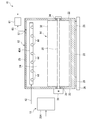
- FIG. 1 is a cross-sectional view showing a cross-sectional configuration of the processing apparatus 10 according to the present embodiment when viewed from the side portion 24 side
- FIG. 2 is a cross-sectional configuration when the processing apparatus 10 is viewed from the end portion 22 side. It is sectional drawing which showed.
- the processing apparatus 10 includes a processing tank 12, a stirring unit 14, an ion gas supply unit 15, an exhaust unit 61, and a heater 72. It treats the water-containing organic matter stored in.
- examples of the water-containing organic matter include vegetable waste, fruit waste, organic residue after beverage extraction, meat waste, fish waste such as salmon, waste, and waste food.
- the organic matter residue after extraction of beverages includes apple meal, tangerine meal, grape meal, grapefruit meal, peach meal, carrot meal, bell pepper meal, sake lees, green tea meal, barley meal, coffee cake, etc. There is.
- the processing tank 12 includes a bottom portion 20, a pair of end portions 22 (FIG. 1) arranged to face each other in the longitudinal direction, a pair of side portions 24 (FIG. 2) arranged to face each other in the lateral direction, and an upper portion 25. And has a closed space inside.
- the processing tank 12 is not particularly limited, but can be formed of, for example, fiber-reinforced plastic (FRP).
- a base 26 is provided on the bottom portion 20 of the processing tank 12 via a load cell 28.
- the load cell 28 measures the load applied from the processing tank 12 installed on the load cell 28, and when receiving a reset command from an operation panel (not shown), the measured value at the time of receiving the reset command is a reference value. Set as. Thereby, the load cell 28 can be installed with the weight of the hydrated organic matter before treatment as a reference value by being given a reset command immediately after the hydrated organic matter is stored in the treatment tank 12, and the reference value is used as a guideline. It is possible to measure the weight reduction tendency of the hydrous organic substance during the treatment and the weight of the hydrous organic substance after the treatment.
- the upper portion 25 is provided with a charging port 68 opened at a predetermined position in the thickness direction and a lid 70 for opening and closing the charging port 68.
- the lid 70 is rotatably fixed to the upper portion 25 at one end via a hinge, and opens and closes the input port 68.
- the water-containing organic matter is charged into the processing tank 12 through the charging port 68 exposed when the lid 70 is opened, and is housed in the closed processing tank 12 when the lid 70 is closed.
- the side portion 24 is provided with a heater 72 such as a heat ray heater or a PTC heater.
- the heater 72 heats the inside of the processing tank 12 to change the temperature inside the processing tank 12 in the range of 25° C. or higher and 70° C. or lower.
- the temperature in the treatment tank 12 is a value measured by a thermometer installed in a closed space in the treatment tank 12 in which the water-containing organic matter is stored.
- the phenomenon in which the temperature in the treatment tank 12 changes in the range of 25° C. or higher and 70° C. or lower is because the temperature in the treatment tank 12 changes according to the treatment state of the water-containing organic substance.
- the average temperature in the processing tank 12 is preferably 30° C. or higher and 50° C. or lower.
- the average temperature in the treatment tank 12 means that when the temperature in the treatment tank 12 is in the range of 25° C. or higher and 70° C. or lower due to heating by the heater 72, the temperature in the treatment tank 12 is set at a predetermined interval or at an arbitrary value. It is the average temperature when the measurement is repeated a plurality of times and the treatment of the water-containing organic matter is finally completed.
- the average temperature in the treatment tank 12 is preferably 30° C. or higher when the water-containing organic matter is treated by heat treatment such that the average temperature in the treatment tank 12 is less than 30° C. Further, if the hydrated organic matter is treated by a heat treatment such that the average temperature in the treatment tank 12 exceeds 50° C., the hydrated organic matter may be excessively dried, and the hydrated organic matter becomes dust at the end of the treatment.
- the average temperature in the processing tank 12 is preferably 50° C. or lower because it is easily diffused therein.
- the stirring unit 14 provided in the processing tank 12 includes a first stirring unit 74 arranged on one side in the lateral direction of the processing tank 12 and a second stirring unit arranged on the other side. And 76.
- the first stirring unit 74 and the second stirring unit 76 have the same configuration, and as shown in FIG. 1, the rotary shaft 30 disposed between the end portions 22 and the blade 32 provided on the rotary shaft 30. Have and.
- the rotating shaft 30 is rotatably supported with respect to the processing tank 12 by bearings 34 provided at the end portions 22, respectively.
- One end of the rotary shaft 30 is connected to the drive unit 36.
- the first stirring unit 74 rotates counterclockwise and the second stirring unit 76 rotates clockwise, so that the water-containing organic matter contained in the treatment tank 12 is transferred from the bottom 20 side of the treatment tank 12 to the first side.
- the 1st stirring part 74 and the 2nd stirring part 76 are stirred so that it may guide toward.
- the bottom portion 20 has curved curved surfaces 78 and 80 along the first stirring portion 74 and the second stirring portion 76.
- the curved surfaces 78 and 80 are formed along an orbit around which the blades 32 of the first stirring section 74 and the second stirring section 76, which rotate about the rotation shaft 30, rotate in a circular shape.
- an exhaust port 57 penetrating in the thickness direction is provided at a predetermined position in the upper portion 25 of the processing tank 12 in the present embodiment.
- An exhaust unit 61 is connected to the exhaust port 57 via a flow path 60.
- the exhaust unit 61 is, for example, a blower, sucks the gas in the processing tank 12 and exhausts the gas in the processing tank 12 to the outside when the water-containing organic matter is processed in the processing tank 12.
- the exhaust unit 61 allows the gas from the processing tank 12 to be 1 [m 3 /min] or more and 300 [m 3 /min] or less, more preferably 50 [m 3 /min] or more and 300 [m 3 /min] or more. min] or less is desirable.
- the amount of gas exhausted from the processing tank 12 is the amount of gas exhausted from the exhaust unit 61 that discharges the gas in the processing tank 12 to the outside air.
- the exhaust unit 61 is a blower, By adjusting the set value of the blower, it is possible to adjust to a desired displacement.
- an amount of gas exhausted from the processing tank 12 corresponds to an ion gas (here, a gas containing negative ions (eg, air containing negative ions)) from an ion gas supply unit 15 described later. Is supplied.
- an ion gas here, a gas containing negative ions (eg, air containing negative ions)
- the ion gas supply amount supplied from the ion gas supply unit 15 to be described later into the processing tank 12 is maintained at an optimum value.
- by appropriately circulating the gas in the treatment tank 12 it is possible to prevent the occurrence of dew condensation in the treatment tank 12 and accelerate the evaporation of water from the water-containing organic matter.
- the flow rate By setting the flow rate to 50 [m 3 /min] or more, the amount of ion gas supplied from the ion gas supply unit 15 can be increased, and the gas is further circulated in the processing tank 12 to more reliably generate dew condensation. Effects such as prevention can be obtained.
- the ion gas introduced from the ion gas supply unit 15 into the processing tank 12 can be retained in the processing tank 12, In addition, it is possible to prevent the water-containing organic matter from becoming excessively vaporized by the gas circulating in the processing tank 12 and becoming the dust.
- the ion gas supply unit 15 has a negative ion generator 38A, an upper supply pipe 40A in which an upper nozzle 44 is formed, and a flow path 42 that connects the negative ion generator 38A and the upper supply pipe 40A.
- the ion gas supply unit 15 causes the negative ion generator 38A to generate negative ions by, for example, corona discharge or thermal ionization, and supplies the ion gas containing the negative ions to the upper supply pipe 40A via the flow path 42. It is discharged into the processing tank 12 from the upper nozzle 44 of the upper supply pipe 40A.
- the outside air is sucked from the negative ion generator 38A as the gas is discharged from the processing tank 12, and negative ions are generated in the gas passing through the negative ion generator 38A.
- the negative ion generator 38A ionizes gas molecules by, for example, desorbing electrons from gas molecules such as oxygen and nitrogen contained in the outside air.
- the ion gas supply amount supplied from the ion gas supply unit 15 into the processing tank 12 is adjusted.
- the ion gas supplied from the ion gas supply unit 15 into the processing tank 12 has an ion density of 2 million [pcs/cc] or more, preferably more than 20 million [pcs/cc], and more preferably 60 million [ It is desirable that it is not less than pcs/cc].
- the negative ions used in the conventional garbage disposer are used to deodorize the inside of the garbage disposer, and are used from the viewpoint of treating water-containing organic substances such as garbage directly by themselves. Absent. Therefore, the ion gas generated in the garbage disposer is only diffused into the odor (gas) in the garbage disposer, and diffusion of negative ions into the garbage is not considered.
- the ion density in the processing tank 12 is set to 2 million [pcs/cc] or more, preferably more than 20 million [pcs/cc], and more preferably 60 million [pcs/cc] or more.
- the remaining water molecules that is, the water molecules maintaining the cluster structure, stay at the boundary between the agitated hydrated organic matter and the space filled with the gas in the treatment tank 12, but the ion gas is above the boundary.
- the negative ions in the ion gas decompose the cluster structure of water molecules.
- the water molecules whose cluster structure is decomposed are easily evaporated by the amount of heat applied by the heater 72, and are discharged to the outside by the exhaust unit 61.
- the processing apparatus 10 can easily reduce the amount of water contained in the water-containing organic matter by evaporating.
- the ion density in the treatment tank 12 exceeds 20 million [pcs/cc]
- negative ions are more easily diffused in the hydrated organic matter, and accordingly, the negative ions are included in the hydrated organic matter by that amount.
- the water contained therein can be separated from the water-containing organic matter, and the decomposition of the cluster structure of water molecules can be promoted.
- the ion density in the treatment tank 12 is set to 60 million [pcs/cc] or more, negative ions can be more surely diffused in the water-containing organic matter.
- the upper supply pipe 40A communicating with the negative ion generator 38A is provided with upper nozzles 44 formed of, for example, circular openings at predetermined positions at predetermined intervals. Further, the upper supply pipe 40A is arranged in parallel with the rotation shaft 30 and is provided at a position above the rotation shaft 30.
- the upper supply pipe 40A is arranged so as to be located above the hydrated organic matter when the hydrated organic matter is accommodated in the treatment tank 12, and the hydrated organic matter is accommodated in the treatment tank 12. At this time, the ion gas can be irradiated from above the water-containing organic material through the upper nozzle 44 without being buried in the water-containing organic material.
- the upper supply pipe 40A has a first pipe 64 and a second pipe 66 arranged on both sides of the exhaust port 57 provided in the center of the processing tank 12 in the lateral direction.
- the first pipe 64 is arranged along one side 24 (the left side in FIG. 2), and the second pipe 66 is arranged along the other side 24 (the right side in FIG. 2). There is.
- the first upper nozzle 45 is formed as the upper nozzle 44 in the first pipe 64
- the second upper nozzle 47 is formed as the upper nozzle 44 in the second pipe 66. It is preferable that the first upper nozzle 45 and the second upper nozzle 47 open in a range from the center of the processing tank 12 in the horizontal direction to the downward in the vertical direction.
- a straight line a1 that connects the central portion of the first pipe 64 and the first upper nozzle 45, and a straight line a1 that connects the central portion of the second pipe 66 and the second upper nozzle 47 are the first stirring portion 74. It extends toward the second stirring portion 76.
- the first pipe 64 and the second pipe 66 are filled with the water-containing organic matter introduced from the bottom portion 20 of the treatment tank 12 between the first stirring portion 74 and the second stirring portion 76 and the gas in the treatment tank 12. Ion gas is irradiated toward the boundary between the created space.
- the processing apparatus 10 drives the exhaust unit 61 to start exhausting gas from the processing tank 12 at 1 [m 3 /min] or more and 300 [m 3 /min] or less. (Exhaust step), the negative ion generator 38A is driven to generate negative ions in the gas.
- the negative ion generator 38A sucks the outside air by the amount of the gas exhausted from the processing tank 12 by the exhaust unit 61, desorbs electrons from the gas molecules such as oxygen and nitrogen contained in the outside air, and ionizes the gas molecules. ..
- the exhaust amount by the exhaust unit 61 is adjusted, and, for example, the ion density is 2 million [pcs/cc] or more, preferably more than 20 million [pcs/cc], and more preferably 60 million [pcs/cc] or more.
- Ion gas is supplied into the processing tank 12 from the ion gas supply unit 15, and the processing tank 12 is filled with the ion gas (ion gas supply step).
- the processing apparatus 10 drives the heater 72 to heat the inside of the processing tank 12 to change the temperature in the processing tank 12 between 25° C. and 70° C., and within this temperature range.
- the average temperature in the treatment tank 12 at the end of the treatment is adjusted to 30° C. or higher and 50° C. or lower (heating step).
- the processing apparatus 10 stirs water-containing organic matter, heats the inside of the processing tank 12, exhausts gas from the inside of the processing tank 12, and supplies ion gas having an ion density of a predetermined value or more into the processing tank 12. And are continuously performed for a predetermined time.
- the processing apparatus 10 performs stirring and heating of the hydrated organic matter, circulation of gas in the treatment tank 12 by exhaust, and supply of ion gas into the treatment tank 12, and due to the synergistic effect, it is included in the hydrated organic matter. It facilitates the separation of water molecules to be decomposed and decomposes the hydrous organic matter, and also decomposes the cluster structure of the water molecules to efficiently decompose the hydrous organic matter.
- the hydrated organic matter treated by the treatment device 10 can finally be a powder body having a desired moisture content and having a significantly reduced amount compared to the initial hydrated organic matter.
- the time for finishing the treatment of the hydrated organic matter is determined based on the water content of the hydrated organic matter. More specifically, when the water content of the powder is 2% or more and 20% or less, more preferably 10% or more and 20% or less, it is desirable to finish the treatment of the water-containing organic substance.
- the water content is a value measured by the loss on drying method.
- the dry weight loss method is to first measure the weight of the water-containing organic matter before treatment containing water, and then heat the water-containing organic matter to evaporate the water content, by measuring the weight of the water-containing organic matter in which the water content becomes zero. The reduced weight is assumed to be moisture, and the moisture content is measured.
- the water content of the powder body obtained by treating the water-containing organic matter is less than 2%, the powder body will be too dry and become dust, and the powder body will rise to the atmosphere when the processing tank 12 is opened. Therefore, the water content of the powder body is preferably 2% or more. Further, by setting the water content of the powder body to 20% or less, the number of mesophilic aerobic bacteria can be set to 10 5 /g or less, and the powder body can be used as a fertilizer or feed. When the powder is used as fertilizer or feed, it is desirable that the water content of the powder is 10% or more and 20% or less for easy handling.
- the treatment time of such a hydrated organic substance is determined by the amount of the hydrated organic substance, the type of the hydrated organic substance, the moisture state of the hydrated organic substance, the heating temperature in the treatment tank 12, the amount of ion gas supplied, Although it varies depending on the amount of gas exhausted, it should be general vegetable waste with a moisture content of 40% to 90% and approximately 30 [kg] to 300 [kg], or organic residue after beverage extraction. For example, by setting the ion density to 60 million [pcs/cc] or more under the above-mentioned treatment conditions and continuously treating the hydrated organic matter for a time of 2 hours or more and 70 hours or less, the water content is 20% or less. A powder body can be obtained.
- the number of mesophilic aerobic bacteria in the water-containing organic matter is 10 5 /g or less in a treatment tank at a low temperature of 50° C. or lower.
- the treatment apparatus 10 when treating the water-containing organic matter, by stirring the water-containing organic matter, circulating gas in the treatment tank 12, and supplying ion gas to the water-containing organic matter, the average in the treatment tank 12 is increased. Even if the temperature is lowered to 50° C. or lower, due to these synergistic effects, the number of mesophilic aerobic bacteria in powder form can be reduced to 10 5 /g or less in a short time.
- the treatment time of the hydrated organic matter is based on the result of the weight measurement of the hydrated organic matter obtained by the load cell 28. You can also decide.
- the water-containing organic matter in the treatment tank 12 before treatment is continuously treated for 1/8 to 3 minutes by continuously treating the water-containing organic matter for 2 hours or more and 70 hours or less. Can be reduced to less than 1.
- the processing apparatus 10 detects, by the load cell 28, that the weight of the water-containing organic matter in the processing tank 12 before the processing has decreased to 1 ⁇ 8 or more and 1 ⁇ 3 or less, and the user detects it by sound or light. By notifying the user, the user can be notified when the treatment of the water-containing organic substance is completed.
- the water-containing organic matter is processed by the processing device 10, and the powder obtained can have a water content of 20% or less, and since it has a high nutritional value, it can be used as a fertilizer or a feed.
- the water-containing organic matter to be fertilizer or feed as described above, for example, vegetable scraps, fruit scraps, organic residue after extraction of beverages, meat scraps, fish scraps such as salmon, wastes, waste foods, etc.
- the organic residues after extraction include apple meal, mandarin orange meal, grape meal, grapefruit meal, peach meal, carrot meal, bell pepper meal, sake meal, green tea meal, barley tea meal, coffee cake and the like.
- the treatment time may be slightly different for each type of hydrated organic substance. It is desirable to produce fertilizer or feed by treating with the treatment device 10.
- the powder body produced by the food waste treating device that treats water-containing organic matter such as food waste by pulverizing and heating, immediately after the production, even if the moisture content is 20% or less, with time, The water content increases, and the water content exceeds 20%.
- the number of mesophilic aerobic bacteria in the powder body became 10 8 /g or more, and putrefaction began, which made long-term storage difficult.
- the powder obtained by treating the coffee grounds or apple dregs using the processing apparatus 10 is at room temperature (20°C ⁇ 15°C (5 to 35°C)) for about one year after production. Although it was left to stand, the moisture content was measured about one year after production, and it was confirmed that the moisture content was still 20% or less. From this, it can be said that the powder body having a water content of 20% or less can be maintained for a long time at a water content of 20% or less because many cell walls of the powder body are not destroyed unlike the conventional case. You can guess. Therefore, it is possible to provide a long-term storable fertilizer or feed that can maintain the water content at 20% or less for a long time.
- the verification test of the water content after the long-term storage of the powder body manufactured by the processing apparatus 10 will be described in detail later in “(6) ⁇ Verification test on powder body manufactured by the processing apparatus according to this embodiment>”. Explained.
- the water-containing organic matter is stirred by using the stirring of the water-containing organic material, the heating of the inside of the processing tank 12, the exhaust of the gas from the inside of the processing tank 12, and the supply of the ion gas to the water-containing organic material.
- the capacity of the treatment tank 12 can be effectively utilized by the amount not using the culture substrate as compared with the case of using the conventional culture substrate, and the treatment can be performed more efficiently.
- the temperature in the treatment tank 12 is changed in the range of 25° C. or higher and 70° C. or lower by the heater 72 during the treatment of the water-containing organic matter, and the ion density is desirably 60 million [pcs/cc] or higher.
- the treatment of the water-containing organic substance is continuously carried out in the treatment tank 12 for a period of 2 hours or more and 70 hours or less.
- the processing apparatus 10 can generate a powder body having a water content of 20% or less from the water-containing organic matter.
- the processing tank is provided between the first stirring unit 74 and the second stirring unit 76 by the first stirring unit 74 rotating counterclockwise and the second stirring unit 76 rotating clockwise.
- the hydrated organic matter is guided from the bottom portion 20 of 12 and the ion gas is irradiated toward the boundary between the hydrated organic matter between the first stirring section 74 and the second stirring section 76 and the gas-filled space of the processing tank 12. did.
- the entire water-containing organic substance scraped up between the first stirring unit 74 and the second stirring unit 76 can be uniformly irradiated with the ion gas.
- the exhaust port 57 for exhausting the gas in the processing tank 12 is provided above the first stirring unit 74 and the second stirring unit 76, the first stirring unit 74 and the first stirring unit 74 The water-containing organic matter is scraped up between the two agitating units 76, so that the excess vapor rising from the water-containing organic matter can be directly discharged to the outside through the exhaust port 57.
- the powdered body obtained by the processing step of heating the water-containing organic matter in the processing tank 12 while stirring, exhausting gas from the inside of the processing tank 12, and irradiating the water-containing organic matter with ion gas is Since it has a water content of 20% or less and a high nutritional value, it can be used as a fertilizer or a feed.
- a negative ion generator 38A is provided as an ion gas supply unit, and the ion density of negative ions is 2 million [pcs/cc] or more, preferably more than 20 million [pcs/cc], More preferably, the ion gas supply unit 15 for supplying the ion gas of 60 million [pcs/cc] or more into the processing tank 12 is applied, but the present invention is not limited to this, and a positive ion generator is provided to generate a positive ion.
- An ion gas supply unit that supplies an ion gas having an ion density of 2 million [pcs/cc] or more, preferably more than 20 million [pcs/cc], and more preferably 60 million [pcs/cc] or more into the processing tank 12. May be applied.
- an ion generator for generating both positive and negative ions is provided, and the ion density of the positive and negative ions combined is 2,000,000 [pcs/cc] or more, preferably You may apply the ion gas supply part which supplies the ion gas more than 20 million [pcs/cc], and more preferably 60 million [pcs/cc] or more into the processing tank 12.
- the rotation directions of the first stirring unit 74 and the second stirring unit 76 may be arbitrary directions, and further, one stirring shaft is provided in the processing tank 12, and the stirring unit is provided with blades on the rotation shaft. May be applied.
- the first pipe 64 and the second pipe 66 are provided on both sides of the exhaust port 57, but only one of them is provided. Ion gas may be supplied into the tank 12.
- the blower is provided as the exhaust unit 61 to forcibly exhaust the gas from the inside of the processing tank 12
- the present invention is not limited to this.
- the negative ion generator 38A on the suction side is provided with a blower serving as an intake section, and the exhaust section is simply a filter or the like, and the suction section sucks the gas in the processing tank 12 from the exhaust section to 1 [m 3 /Min] or more and 300 [m 3 /min] or less may be exhausted.
- the gas is exhausted from the processing tank 12 at 50 [m 3 /min], the ion density of the ion gas supplied into the processing tank 12 is maintained at 60 million [pcs/cc] or more, and the water-containing organic material is treated.
- the temperature in the inside treatment tank 12 was changed from 20° C. to 70° C., and such treatment was continuously performed for about 20 hours to produce a powder body from the apple juice slag and the coffee slag.
- an apple juice slag and a coffee slag different from the apple juice slag and the coffee slag of the example described in “(3) ⁇ Fertilizer or feed>” were used. ..
- the powder body (henceforth an apple dregs processing powder body) produced by processing the apple juice squeezing residue using the processing apparatus 10 of this embodiment, and coffee squeezing using the processing apparatus 10 of this embodiment.
- the powder body produced by treating the slag hereinafter referred to as the coffee slag-treated powder body
- rehydration of water was observed when the powder body was stored for a long period of time without being subjected to treatment such as strict sealing.
- a flexible container bag with a capacity of 1000 kg made by Atsuta Material Co., Ltd., product name AS-002F (one-way container bag)
- a sheet woven from durable chemical fibers such as polyethylene and polypropylene
- the above-mentioned apple slag-treated powder was prepared, and the apple slag-treated powder was put into the flexible container bag to make it flexible.
- the entire container bag was filled with apple slag-treated powder.
- the opening of the flexible container bag filled with the apple slag-treated powder was tied to form a sealed state.
- the flexible container bags packed with such apple slag-treated powder were simply arranged without being stacked in the warehouse on the premises of the above factory (Hirosaki City, Aomori Prefecture, Japan) and left alone.
- the warehouse in which the flexible container bag was left unattended had a side wall made of concrete blocks and a roof made of galvanized iron, and was a warehouse that did not use any heat insulating material or the like to protect against rain and wind.
- the flexible container bag was packed in a flexible container bag, the openings were connected and sealed, and the flexible container bag packed with the apple slag powder was left in the same warehouse. did.
- the moisture content of each of the apple slag-treated powder body and the coffee slag-treated powder body when the verification test was started by packing in a flexible container bag was measured.
- the water content in this verification test is a value measured by the loss on drying method.
- the dry weight loss method is to first measure the weight of the water-containing organic matter before treatment containing water, and then heat the water-containing organic matter to evaporate the water content, by measuring the weight of the water-containing organic matter in which the water content becomes zero. The reduced weight is assumed to be moisture, and the moisture content is measured.
- the apple slag-treated powder started the verification test on June 20, 2019, and the water content at the start of the verification test was 11.8%. Then, the flexible container bag packed with the apple slag processing powder was left standing at room temperature in the warehouse in Hirosaki City, Aomori Prefecture, Japan at room temperature, and on January 7, 2020, the apple slag processing in the flexible container bag was performed. The water content of the powder body was measured again.
- the moisture content of the apple slag-treated powder in the flexible container bag left in the warehouse from June 20, 2019 to January 7, 2020 was 12.2%.
- the number of bacteria is checked during the verification test, and the flexible container bag is opened about every month.
- the apple dregs treated powder produced by the treatment apparatus 10 of the present embodiment can have a moisture content of 20% or less at the time of production, and the moisture content at the time of production remains at 20% or less for a long period of time. It was confirmed that it could be maintained.
- the verification test of the coffee slag-treated powder was started on July 6, 2019, and the water content at the start of the verification test was 9.4%. Then, the flexible container bag filled with the powdered powder of coffee slag was left standing at room temperature in the warehouse in Hirosaki City, Aomori Prefecture, Japan at room temperature, and on January 7, 2020, the coffee slag in the flexible container bag was treated. The moisture content of the powder body was measured again.
Landscapes
- Engineering & Computer Science (AREA)
- Chemical & Material Sciences (AREA)
- Life Sciences & Earth Sciences (AREA)
- Polymers & Plastics (AREA)
- Environmental & Geological Engineering (AREA)
- Food Science & Technology (AREA)
- Organic Chemistry (AREA)
- Botany (AREA)
- Chemical Kinetics & Catalysis (AREA)
- Animal Husbandry (AREA)
- Health & Medical Sciences (AREA)
- Zoology (AREA)
- Physiology (AREA)
- Biotechnology (AREA)
- Molecular Biology (AREA)
- Mechanical Engineering (AREA)
- General Chemical & Material Sciences (AREA)
- Biochemistry (AREA)
- Mycology (AREA)
- Manufacturing & Machinery (AREA)
- Thermal Sciences (AREA)
- Physics & Mathematics (AREA)
- Biomedical Technology (AREA)
- General Health & Medical Sciences (AREA)
- Toxicology (AREA)
- Hydrology & Water Resources (AREA)
- Water Supply & Treatment (AREA)
- Processing Of Solid Wastes (AREA)
- Fertilizers (AREA)
- Physical Water Treatments (AREA)
Abstract
Priority Applications (7)
| Application Number | Priority Date | Filing Date | Title |
|---|---|---|---|
| AU2020213054A AU2020213054B2 (en) | 2019-01-23 | 2020-01-23 | Processing apparatus, processing method, and powder body |
| CA3127533A CA3127533C (fr) | 2019-01-23 | 2020-01-23 | Appareil de traitement des matieres organiques contenant de l'eau, methode de traitement et corps de poudre obtenu |
| US17/425,252 US12420320B2 (en) | 2019-01-23 | 2020-01-23 | Processing apparatus, processing method, and powder body |
| CN202080008859.0A CN113613512B (zh) | 2019-01-23 | 2020-01-23 | 处理装置、处理方法和粉末体 |
| KR1020217026156A KR102759702B1 (ko) | 2019-01-23 | 2020-01-23 | 처리 장치, 처리 방법 및 분말체 |
| EP20745811.8A EP3915402A4 (fr) | 2019-01-23 | 2020-01-23 | Appareil de traitement, procédé de traitement et corps pulvérulent |
| TW109102723A TWI861051B (zh) | 2019-01-23 | 2020-01-30 | 處理裝置及處理方法 |
Applications Claiming Priority (2)
| Application Number | Priority Date | Filing Date | Title |
|---|---|---|---|
| JP2019009817A JP6712419B1 (ja) | 2019-01-23 | 2019-01-23 | 処理装置及び処理方法 |
| JP2019-009817 | 2019-05-07 |
Publications (1)
| Publication Number | Publication Date |
|---|---|
| WO2020153455A1 true WO2020153455A1 (fr) | 2020-07-30 |
Family
ID=71103892
Family Applications (1)
| Application Number | Title | Priority Date | Filing Date |
|---|---|---|---|
| PCT/JP2020/002423 Ceased WO2020153455A1 (fr) | 2019-01-23 | 2020-01-23 | Appareil de traitement, procédé de traitement et corps pulvérulent |
Country Status (9)
| Country | Link |
|---|---|
| US (1) | US12420320B2 (fr) |
| EP (1) | EP3915402A4 (fr) |
| JP (1) | JP6712419B1 (fr) |
| KR (1) | KR102759702B1 (fr) |
| CN (1) | CN113613512B (fr) |
| AU (1) | AU2020213054B2 (fr) |
| CA (1) | CA3127533C (fr) |
| TW (1) | TWI861051B (fr) |
| WO (1) | WO2020153455A1 (fr) |
Families Citing this family (6)
| Publication number | Priority date | Publication date | Assignee | Title |
|---|---|---|---|---|
| JP7098176B2 (ja) * | 2020-06-19 | 2022-07-11 | グレンカル・テクノロジー株式会社 | 成形材料、成形体、及び、成形材料の製造方法 |
| JP7535772B2 (ja) * | 2020-06-19 | 2024-08-19 | グレンカル・テクノロジー株式会社 | 粉末体及び粉末体の製造方法 |
| CN116921405A (zh) * | 2023-07-13 | 2023-10-24 | 格林生态环境有限公司 | 一种用于破碎后餐厨垃圾抑菌除臭的设备 |
| CN117897236A (zh) * | 2023-07-20 | 2024-04-16 | 米凯·亚历山大维奇·米山尼诺夫 | 用于处理废物的装置的反应器 |
| US11984237B1 (en) | 2023-07-20 | 2024-05-14 | Mikhail Aleksandrovich Meshchaninov | Source of charged particles |
| WO2025018909A1 (fr) * | 2023-07-20 | 2025-01-23 | Михаил Александрович МЕЩАНИНОВ | Source de particules chargées |
Citations (3)
| Publication number | Priority date | Publication date | Assignee | Title |
|---|---|---|---|---|
| JP2002355002A (ja) * | 2001-05-30 | 2002-12-10 | Oogawara Kakoki Kk | 乾燥おから |
| JP2004066196A (ja) * | 2002-08-09 | 2004-03-04 | Sanyo Electric Co Ltd | 有機物処理装置 |
| JP2005118743A (ja) * | 2003-10-20 | 2005-05-12 | Sharp Corp | 生ごみ処理機 |
Family Cites Families (23)
| Publication number | Priority date | Publication date | Assignee | Title |
|---|---|---|---|---|
| JPH05163089A (ja) | 1991-12-12 | 1993-06-29 | Enza:Kk | 高温醗酵菌による有機肥料の製造方法 |
| JPH07136629A (ja) | 1993-11-24 | 1995-05-30 | Hitachi Ltd | 生ごみ処理機 |
| JP2002292357A (ja) * | 2001-03-30 | 2002-10-08 | Nippon Recycling Kk | 生ゴミ消滅機能を長期安定化した生ゴミ処理方法 |
| JP2003047938A (ja) * | 2001-08-08 | 2003-02-18 | Eiwa Kogyo:Kk | ゴミ処理機 |
| JP2004344710A (ja) * | 2003-05-20 | 2004-12-09 | Kankyo Kogaku Kenkyusho:Kk | 生物系有機廃棄物を処理するための加熱方法とその装置 |
| JP2005007385A (ja) * | 2003-05-23 | 2005-01-13 | Sanyo Electric Co Ltd | 生ゴミ処理システム |
| JP4280850B2 (ja) | 2004-02-26 | 2009-06-17 | 有限会社大分Tlo | 有機肥料の製造方法 |
| JP2006055761A (ja) * | 2004-08-20 | 2006-03-02 | Masashige Nishi | 有機廃棄物からの重金属の分離方法およびその装置 |
| JP2006214421A (ja) * | 2005-02-01 | 2006-08-17 | Fujiya Kobe | 高密度プラスイオンによる低燃費化、低排気ガス化システム。 |
| TW200728212A (en) * | 2006-01-27 | 2007-08-01 | Horizon Tech Ltd | Anaerobic hydrogen fermentation system |
| JP2007252346A (ja) | 2006-03-27 | 2007-10-04 | Suzuki Farm:Kk | 家畜飼料又は養殖餌料 |
| CN101264479B (zh) * | 2007-03-15 | 2011-09-07 | 珊瑚海生化科技股份有限公司 | 碳化装置 |
| JP4538595B1 (ja) * | 2009-10-07 | 2010-09-08 | 克守 谷黒 | バイオマス材料の処理方法及び熱エネルギー利用方法 |
| JP5311145B2 (ja) | 2010-03-29 | 2013-10-09 | 株式会社グリーンランド | 空気清浄システム |
| CN102585094A (zh) * | 2011-12-23 | 2012-07-18 | 山东宝莫生物化工股份有限公司 | 一种除油絮凝剂的制备方法 |
| TW201429922A (zh) * | 2013-01-25 | 2014-08-01 | Jing Xing Internat Dev Co Ltd | 有機固體廢棄物的高速製肥生產方法及高速製肥生產設備 |
| CN203330105U (zh) * | 2013-07-08 | 2013-12-11 | 苑忠宝 | 一种无动力生活垃圾闪蒸矿化处理器 |
| HK1210670A1 (en) | 2013-12-16 | 2016-05-06 | Procell Investments Limited | Methods of processing waste activated sludge |
| CN204752349U (zh) * | 2015-04-10 | 2015-11-11 | 王冰 | 一种污水、污泥、生活垃圾同时进行循环利用的系统 |
| KR102054380B1 (ko) | 2017-04-03 | 2019-12-10 | 장아람 | 복수의 교반기와 미생물을 이용한 음식물쓰레기 처리장치 |
| CN107540432A (zh) * | 2017-10-19 | 2018-01-05 | 北京三际生态科技有限公司 | 一种用活性氧及活化操作高速处理有机固体废弃物的方法和装置 |
| GB2610943B (en) | 2018-03-09 | 2023-09-20 | Green Eco Int Pty Ltd | A food waste processing system |
| CN108620414B (zh) * | 2018-04-24 | 2020-09-22 | 江苏生久环境科技有限公司 | 一种生活垃圾分类处理系统 |
-
2019
- 2019-01-23 JP JP2019009817A patent/JP6712419B1/ja active Active
-
2020
- 2020-01-23 KR KR1020217026156A patent/KR102759702B1/ko active Active
- 2020-01-23 AU AU2020213054A patent/AU2020213054B2/en active Active
- 2020-01-23 CN CN202080008859.0A patent/CN113613512B/zh active Active
- 2020-01-23 CA CA3127533A patent/CA3127533C/fr active Active
- 2020-01-23 EP EP20745811.8A patent/EP3915402A4/fr active Pending
- 2020-01-23 WO PCT/JP2020/002423 patent/WO2020153455A1/fr not_active Ceased
- 2020-01-23 US US17/425,252 patent/US12420320B2/en active Active
- 2020-01-30 TW TW109102723A patent/TWI861051B/zh active
Patent Citations (3)
| Publication number | Priority date | Publication date | Assignee | Title |
|---|---|---|---|---|
| JP2002355002A (ja) * | 2001-05-30 | 2002-12-10 | Oogawara Kakoki Kk | 乾燥おから |
| JP2004066196A (ja) * | 2002-08-09 | 2004-03-04 | Sanyo Electric Co Ltd | 有機物処理装置 |
| JP2005118743A (ja) * | 2003-10-20 | 2005-05-12 | Sharp Corp | 生ごみ処理機 |
Also Published As
| Publication number | Publication date |
|---|---|
| JP6712419B1 (ja) | 2020-06-24 |
| US12420320B2 (en) | 2025-09-23 |
| CA3127533C (fr) | 2024-11-26 |
| EP3915402A4 (fr) | 2022-08-17 |
| CN113613512B (zh) | 2023-10-13 |
| KR102759702B1 (ko) | 2025-02-04 |
| CA3127533A1 (fr) | 2020-07-30 |
| TW202038738A (zh) | 2020-11-01 |
| TWI861051B (zh) | 2024-11-11 |
| JP2020116521A (ja) | 2020-08-06 |
| CN113613512A (zh) | 2021-11-05 |
| EP3915402A1 (fr) | 2021-12-01 |
| US20220088651A1 (en) | 2022-03-24 |
| AU2020213054B2 (en) | 2024-03-21 |
| AU2020213054A1 (en) | 2021-08-26 |
| KR20210116580A (ko) | 2021-09-27 |
Similar Documents
| Publication | Publication Date | Title |
|---|---|---|
| WO2020153455A1 (fr) | Appareil de traitement, procédé de traitement et corps pulvérulent | |
| JP2742016B2 (ja) | 水分含有率の高い有機物をコンポスト化する方法及び装置 | |
| EP0556101A1 (fr) | Procédé et appareil de stérilisation en continu et de sèchage d'epices et fines herbes à feuilles | |
| JP7282386B2 (ja) | 粉末体 | |
| JPH07171547A (ja) | 有機性廃棄物の発酵処理システム | |
| JP7098176B2 (ja) | 成形材料、成形体、及び、成形材料の製造方法 | |
| HK40062985B (zh) | 处理装置、处理方法和粉末体 | |
| HK40062985A (en) | Processing apparatus, processing method, and powder body | |
| JP7535772B2 (ja) | 粉末体及び粉末体の製造方法 | |
| JP2003275717A (ja) | 廃棄物処理装置 | |
| JP2005231912A (ja) | 熱風炉を用いた有機廃棄物の堆肥化処理装置および堆肥化処理方法 | |
| JP2002308687A (ja) | 超好熱菌を利用した生態系廃棄物処理方法及び処理装置 | |
| JP3740412B2 (ja) | 有機廃棄物処理機 | |
| JPH06206786A (ja) | 未乾燥廃棄物の醗酵乾燥装置 | |
| JPH08163978A (ja) | 微生物利用処理装置の構造 |
Legal Events
| Date | Code | Title | Description |
|---|---|---|---|
| 121 | Ep: the epo has been informed by wipo that ep was designated in this application |
Ref document number: 20745811 Country of ref document: EP Kind code of ref document: A1 |
|
| DPE1 | Request for preliminary examination filed after expiration of 19th month from priority date (pct application filed from 20040101) | ||
| ENP | Entry into the national phase |
Ref document number: 3127533 Country of ref document: CA |
|
| NENP | Non-entry into the national phase |
Ref country code: DE |
|
| ENP | Entry into the national phase |
Ref document number: 20217026156 Country of ref document: KR Kind code of ref document: A |
|
| ENP | Entry into the national phase |
Ref document number: 2020213054 Country of ref document: AU Date of ref document: 20200123 Kind code of ref document: A |
|
| ENP | Entry into the national phase |
Ref document number: 2020745811 Country of ref document: EP Effective date: 20210823 |
|
| WWG | Wipo information: grant in national office |
Ref document number: 778863 Country of ref document: NZ |
|
| WWG | Wipo information: grant in national office |
Ref document number: 17425252 Country of ref document: US |