WO2020158813A1 - 光学材料用重合性組成物の製造方法 - Google Patents
光学材料用重合性組成物の製造方法 Download PDFInfo
- Publication number
- WO2020158813A1 WO2020158813A1 PCT/JP2020/003203 JP2020003203W WO2020158813A1 WO 2020158813 A1 WO2020158813 A1 WO 2020158813A1 JP 2020003203 W JP2020003203 W JP 2020003203W WO 2020158813 A1 WO2020158813 A1 WO 2020158813A1
- Authority
- WO
- WIPO (PCT)
- Prior art keywords
- group
- polymerizable composition
- optical material
- compound
- bis
- Prior art date
- Legal status (The legal status is an assumption and is not a legal conclusion. Google has not performed a legal analysis and makes no representation as to the accuracy of the status listed.)
- Ceased
Links
- 0 CC*N(C)C(C)(C)OC Chemical compound CC*N(C)C(C)(C)OC 0.000 description 2
Classifications
-
- C—CHEMISTRY; METALLURGY
- C09—DYES; PAINTS; POLISHES; NATURAL RESINS; ADHESIVES; COMPOSITIONS NOT OTHERWISE PROVIDED FOR; APPLICATIONS OF MATERIALS NOT OTHERWISE PROVIDED FOR
- C09K—MATERIALS FOR MISCELLANEOUS APPLICATIONS, NOT PROVIDED FOR ELSEWHERE
- C09K9/00—Tenebrescent materials, i.e. materials for which the range of wavelengths for energy absorption is changed as a result of excitation by some form of energy
- C09K9/02—Organic tenebrescent materials
-
- C—CHEMISTRY; METALLURGY
- C08—ORGANIC MACROMOLECULAR COMPOUNDS; THEIR PREPARATION OR CHEMICAL WORKING-UP; COMPOSITIONS BASED THEREON
- C08G—MACROMOLECULAR COMPOUNDS OBTAINED OTHERWISE THAN BY REACTIONS ONLY INVOLVING UNSATURATED CARBON-TO-CARBON BONDS
- C08G18/00—Polymeric products of isocyanates or isothiocyanates
- C08G18/06—Polymeric products of isocyanates or isothiocyanates with compounds having active hydrogen
- C08G18/08—Processes
- C08G18/16—Catalysts
- C08G18/22—Catalysts containing metal compounds
- C08G18/24—Catalysts containing metal compounds of tin
- C08G18/242—Catalysts containing metal compounds of tin organometallic compounds containing tin-carbon bonds
-
- C—CHEMISTRY; METALLURGY
- C08—ORGANIC MACROMOLECULAR COMPOUNDS; THEIR PREPARATION OR CHEMICAL WORKING-UP; COMPOSITIONS BASED THEREON
- C08G—MACROMOLECULAR COMPOUNDS OBTAINED OTHERWISE THAN BY REACTIONS ONLY INVOLVING UNSATURATED CARBON-TO-CARBON BONDS
- C08G18/00—Polymeric products of isocyanates or isothiocyanates
- C08G18/06—Polymeric products of isocyanates or isothiocyanates with compounds having active hydrogen
- C08G18/28—Polymeric products of isocyanates or isothiocyanates with compounds having active hydrogen characterised by the compounds used containing active hydrogen
- C08G18/30—Low-molecular-weight compounds
- C08G18/38—Low-molecular-weight compounds having heteroatoms other than oxygen
- C08G18/3855—Low-molecular-weight compounds having heteroatoms other than oxygen having sulfur
- C08G18/3876—Low-molecular-weight compounds having heteroatoms other than oxygen having sulfur containing mercapto groups
-
- C—CHEMISTRY; METALLURGY
- C08—ORGANIC MACROMOLECULAR COMPOUNDS; THEIR PREPARATION OR CHEMICAL WORKING-UP; COMPOSITIONS BASED THEREON
- C08G—MACROMOLECULAR COMPOUNDS OBTAINED OTHERWISE THAN BY REACTIONS ONLY INVOLVING UNSATURATED CARBON-TO-CARBON BONDS
- C08G18/00—Polymeric products of isocyanates or isothiocyanates
- C08G18/06—Polymeric products of isocyanates or isothiocyanates with compounds having active hydrogen
- C08G18/28—Polymeric products of isocyanates or isothiocyanates with compounds having active hydrogen characterised by the compounds used containing active hydrogen
- C08G18/40—High-molecular-weight compounds
- C08G18/48—Polyethers
- C08G18/4825—Polyethers containing two hydroxy groups
-
- C—CHEMISTRY; METALLURGY
- C08—ORGANIC MACROMOLECULAR COMPOUNDS; THEIR PREPARATION OR CHEMICAL WORKING-UP; COMPOSITIONS BASED THEREON
- C08G—MACROMOLECULAR COMPOUNDS OBTAINED OTHERWISE THAN BY REACTIONS ONLY INVOLVING UNSATURATED CARBON-TO-CARBON BONDS
- C08G18/00—Polymeric products of isocyanates or isothiocyanates
- C08G18/06—Polymeric products of isocyanates or isothiocyanates with compounds having active hydrogen
- C08G18/28—Polymeric products of isocyanates or isothiocyanates with compounds having active hydrogen characterised by the compounds used containing active hydrogen
- C08G18/40—High-molecular-weight compounds
- C08G18/48—Polyethers
- C08G18/4833—Polyethers containing oxyethylene units
- C08G18/4837—Polyethers containing oxyethylene units and other oxyalkylene units
-
- C—CHEMISTRY; METALLURGY
- C08—ORGANIC MACROMOLECULAR COMPOUNDS; THEIR PREPARATION OR CHEMICAL WORKING-UP; COMPOSITIONS BASED THEREON
- C08G—MACROMOLECULAR COMPOUNDS OBTAINED OTHERWISE THAN BY REACTIONS ONLY INVOLVING UNSATURATED CARBON-TO-CARBON BONDS
- C08G18/00—Polymeric products of isocyanates or isothiocyanates
- C08G18/06—Polymeric products of isocyanates or isothiocyanates with compounds having active hydrogen
- C08G18/28—Polymeric products of isocyanates or isothiocyanates with compounds having active hydrogen characterised by the compounds used containing active hydrogen
- C08G18/65—Low-molecular-weight compounds having active hydrogen with high-molecular-weight compounds having active hydrogen
- C08G18/66—Compounds of groups C08G18/42, C08G18/48, or C08G18/52
- C08G18/6666—Compounds of group C08G18/48 or C08G18/52
-
- C—CHEMISTRY; METALLURGY
- C08—ORGANIC MACROMOLECULAR COMPOUNDS; THEIR PREPARATION OR CHEMICAL WORKING-UP; COMPOSITIONS BASED THEREON
- C08G—MACROMOLECULAR COMPOUNDS OBTAINED OTHERWISE THAN BY REACTIONS ONLY INVOLVING UNSATURATED CARBON-TO-CARBON BONDS
- C08G18/00—Polymeric products of isocyanates or isothiocyanates
- C08G18/06—Polymeric products of isocyanates or isothiocyanates with compounds having active hydrogen
- C08G18/70—Polymeric products of isocyanates or isothiocyanates with compounds having active hydrogen characterised by the isocyanates or isothiocyanates used
- C08G18/72—Polyisocyanates or polyisothiocyanates
- C08G18/74—Polyisocyanates or polyisothiocyanates cyclic
- C08G18/75—Polyisocyanates or polyisothiocyanates cyclic cycloaliphatic
- C08G18/758—Polyisocyanates or polyisothiocyanates cyclic cycloaliphatic containing two or more cycloaliphatic rings
-
- C—CHEMISTRY; METALLURGY
- C08—ORGANIC MACROMOLECULAR COMPOUNDS; THEIR PREPARATION OR CHEMICAL WORKING-UP; COMPOSITIONS BASED THEREON
- C08K—Use of inorganic or non-macromolecular organic substances as compounding ingredients
- C08K5/00—Use of organic ingredients
- C08K5/04—Oxygen-containing compounds
- C08K5/15—Heterocyclic compounds having oxygen in the ring
- C08K5/151—Heterocyclic compounds having oxygen in the ring having one oxygen atom in the ring
- C08K5/1545—Six-membered rings
-
- C—CHEMISTRY; METALLURGY
- C08—ORGANIC MACROMOLECULAR COMPOUNDS; THEIR PREPARATION OR CHEMICAL WORKING-UP; COMPOSITIONS BASED THEREON
- C08K—Use of inorganic or non-macromolecular organic substances as compounding ingredients
- C08K5/00—Use of organic ingredients
- C08K5/49—Phosphorus-containing compounds
- C08K5/51—Phosphorus bound to oxygen
- C08K5/52—Phosphorus bound to oxygen only
- C08K5/521—Esters of phosphoric acids, e.g. of H3PO4
-
- G—PHYSICS
- G02—OPTICS
- G02B—OPTICAL ELEMENTS, SYSTEMS OR APPARATUS
- G02B5/00—Optical elements other than lenses
- G02B5/20—Filters
- G02B5/22—Absorbing filters
- G02B5/23—Photochromic filters
-
- C—CHEMISTRY; METALLURGY
- C09—DYES; PAINTS; POLISHES; NATURAL RESINS; ADHESIVES; COMPOSITIONS NOT OTHERWISE PROVIDED FOR; APPLICATIONS OF MATERIALS NOT OTHERWISE PROVIDED FOR
- C09K—MATERIALS FOR MISCELLANEOUS APPLICATIONS, NOT PROVIDED FOR ELSEWHERE
- C09K2211/00—Chemical nature of organic luminescent or tenebrescent compounds
- C09K2211/10—Non-macromolecular compounds
- C09K2211/1018—Heterocyclic compounds
-
- G—PHYSICS
- G02—OPTICS
- G02B—OPTICAL ELEMENTS, SYSTEMS OR APPARATUS
- G02B1/00—Optical elements characterised by the material of which they are made; Optical coatings for optical elements
- G02B1/04—Optical elements characterised by the material of which they are made; Optical coatings for optical elements made of organic materials, e.g. plastics
- G02B1/041—Lenses
-
- G—PHYSICS
- G02—OPTICS
- G02C—SPECTACLES; SUNGLASSES OR GOGGLES INSOFAR AS THEY HAVE THE SAME FEATURES AS SPECTACLES; CONTACT LENSES
- G02C7/00—Optical parts
- G02C7/02—Lenses; Lens systems ; Methods of designing lenses
- G02C7/022—Ophthalmic lenses having special refractive features achieved by special materials or material structures
-
- G—PHYSICS
- G02—OPTICS
- G02C—SPECTACLES; SUNGLASSES OR GOGGLES INSOFAR AS THEY HAVE THE SAME FEATURES AS SPECTACLES; CONTACT LENSES
- G02C7/00—Optical parts
- G02C7/10—Filters, e.g. for facilitating adaptation of the eyes to the dark; Sunglasses
Definitions
- the present invention relates to a method for producing a polymerizable composition for optical materials.
- plastic lenses are lightweight, difficult to break, and can be dyed, they are rapidly becoming widespread as optical materials for eyeglass lenses, camera lenses, etc., and molded lenses for lenses using various plastic materials have been developed and used so far. ing.
- Representative examples include allyl resins obtained from diethylene glycol bisallyl carbonate and diallyl isophthalate, (meth)acrylic resins obtained from (meth)acrylate, and polythiourethane resins obtained from isocyanate and thiol.
- high-performance plastic lenses with various functions have been developed, for example, a lens that blocks light of harmful wavelengths, a lens whose surface scratches are suppressed, or a lens surface generated by a temperature difference.
- a lens in which fogging is suppressed is known.
- a plastic lens having photochromic performance is one of such high-performance plastic lenses, and its development is underway.
- a plastic lens with such photochromic performance it functions as ordinary transparent glasses indoors, and when outdoors it reacts to sunlight (ultraviolet rays), the lens is colored gray or brown, and from the glare. It is possible to obtain eyeglasses that exhibit the function of protecting the eyes.
- These glasses are highly functional glasses that do not need to be re-dressed indoors or outdoors like sunglasses, and can be used both indoors and outdoors with a single pair of glasses. It is expanding globally.
- a plastic lens having such photochromic performance is required to have a fast response in coloring and decoloring and to exhibit good coloring performance.
- a specific aliphatic or alicyclic isocyanate a urethane resin-based optical material containing a photochromic compound or a thiourethane resin-based optical material and a plastic lens can be obtained without degrading the performance of the photochromic compound.
- the photochromic compound exhibits excellent photochromic performance without degrading the performance of the photochromic compound, and also has excellent physical properties such as mechanical strength.
- a polyurethane optical material or a polythiourethane optical material containing a compound can be obtained (Patent Document 2).
- Patent Documents 3 to 7 polymer fine particles including a photochromic compound in a polymer have been proposed.
- Patent Document 8 a resin for optical materials having a refractive index of 1.595 to 1.695 including nanoparticles containing a photochromic compound has also been proposed.
- Patent Document 9 a polymerizable composition for an optical material containing a specific polymer, a photochromic compound, and a polymerization-reactive compound, and a method for producing the composition. It is also described in the document that polymer particles are contained in a molded product obtained from the composition, and the photochromic compound is included in the polymer particles.
- the optical material obtained from the polymerizable composition may affect the transparency due to the occurrence of white turbidity, generate fine aggregates, and There was room for improvement, such as when distortion (stria) may occur.
- the present inventors pay attention to the production conditions of the polymerizable composition, the specific polymer, the polymerizable composition for an optical material obtained by mixing the photochromic compound under predetermined conditions, white turbidity is suppressed As a result, they have found that it is possible to provide an optical material in which the generation of fine agglomerates and the generation of optical distortion can be suppressed, and the present invention has been completed. That is, the present invention can be shown as follows.
- a 1 and A 2 each represent a different polymer chain.
- R 1 is an n-valent organic group
- R 2 is a linking group that links two types of polymer chains
- R 3 is an organic group
- n is an integer of 1 to 6.
- Step A is Any of [1] to [3] including a step of mixing the polyisocyanate compound (i) and the polymer (ii), and then mixing the photochromic compound (iii) and the internal release agent (iv).
- a method for producing the polymerizable composition for an optical material according to 1. [5] The method for producing a polymerizable composition for an optical material according to any one of [1] to [4], wherein the mixing temperature in step A is 10 to 25°C.
- the method for producing a polymerizable composition for an optical material according to any one of [1] to [5], wherein the photochromic compound (iii) is a naphthopyran compound.
- the polyisocyanate compound (i) includes pentamethylene diisocyanate, hexamethylene diisocyanate, xylylene diisocyanate, bis(isocyanatocyclohexyl)methane, isophorone diisocyanate, 2,5-bis(isocyanatomethyl)bicyclo-[2.2.
- R 1 and R 2 each represent a hydrogen atom or an alkyl group having 1 to 18 carbon atoms, at least one of which is a hydrogen atom.
- Plural existing R 1 s are the same or different.
- R 2 existing in plural may be the same or different from each other.
- m represents an integer of 15 or more and 500 or less.
- the polythiol compound (v) is 4-mercaptomethyl-1,8-dimercapto-3,6-dithiaoctane, 5,7-dimercaptomethyl-1,11-dimercapto-3,6,9-trithiaundecane.
- a 1 and A 2 represent different polymer chains.
- R 1 is an n-valent organic group
- R 2 is a linking group that links two types of polymer chains
- R 3 is an organic group
- n is an integer of 1 to 6.
- the mixed liquid obtained in the step B is further mixed with a polymerization catalyst (vi) to obtain a polymerizable composition for an optical material, the step C.
- step A the internal release agent (iv) is added so as to be contained in the polymerizable composition for optical materials in an amount of 500 to 3000 ppm
- step C the polymerization catalyst (vi) is added to the polymerizable composition for optical materials. It is added so as to be contained in the composition at 120 to 500 ppm.
- a 1 and A 2 represent different polymer chains.
- R 1 is an n-valent organic group
- R 2 is a linking group that links two types of polymer chains
- R 3 is an organic group.
- n is an integer of 1 to 6.
- the internal release agent (iv) is added so that the polymerizable composition for optical materials contains 500 to 3000 ppm, preferably 500 to 1000 ppm.
- the mixing temperature can be 10 to 25°C, preferably 15 to 20°C.
- the mixing method is not particularly limited, and mixing can be performed by a conventionally known method, and a method of stirring by a known means or the like can be adopted.
- the stirring speed is preferably adjusted appropriately depending on the stirring means and scale used, but is about 100 to 250 rpm.
- the addition order of the polyisocyanate compound (i), the polymer (ii), the photochromic compound (iii), and the internal mold release agent (iv) is not particularly limited as long as they can be mixed. They may be added all at once and mixed, or they may be added in any order and mixed.
- the polyisocyanate compound (i) and the polymer (ii) are mixed, and then the obtained mixed liquid is mixed with the photochromic compound (iii) and internal separation. It is preferable to mix with the mold agent (iv). By first mixing the polyisocyanate compound (i) and the polymer (ii), the transparency is more excellent, and the generation of fine aggregates and the generation of optical distortion are further suppressed.
- the addition method is not particularly limited, and it can be added by batch addition, divided addition, continuous addition, or the like. In the present embodiment, it is preferable to add each component at once in the order of mixing.
- the mixing time is not particularly limited, but may be 2 hours or less, preferably 1.5 hours or less, more preferably 1 hour or less, and particularly preferably 30 minutes or less.
- the lower limit of the mixing time is not particularly limited, but is 5 minutes or more, preferably 15 minutes or more.
- the mixing time is the time after all the components have been added. Hereinafter, each component will be described.
- the polyisocyanate compound (i) is a compound having two or more isocyanato groups, and is not particularly limited as long as the effects of the present invention can be obtained, and various compounds can be used.
- polyisocyanate compound (i) in the present embodiment examples include tetramethylene diisocyanate, pentamethylene diisocyanate, hexamethylene diisocyanate, heptamethylene diisocyanate, octamethylene diisocyanate, 2,2,4-trimethylhexamethylene diisocyanate, 2,4.
- Aliphatic polyisocyanate compounds such as 4-trimethylhexamethylene diisocyanate, lysine diisocyanatomethyl ester, lysine triisocyanate and xylylene diisocyanate; Isophorone diisocyanate, bis(isocyanatomethyl)cyclohexane, bis(isocyanatocyclohexyl)methane, dicyclohexyldimethylmethane isocyanate, 2,5-bis(isocyanatomethyl)bicyclo-[2.2.1]-heptane, 2,6- Bis(isocyanatomethyl)bicyclo-[2.2.1]-heptane, 3,8-bis(isocyanatomethyl)tricyclodecane, 3,9-bis(isocyanatomethyl)tricyclodecane, 4,8- Alicyclic polyisocyanate compounds such as bis(isocyanatomethyl)tricyclodecane and 4,9-bis(isocyanatomethyl)
- the polyisocyanate compound (i) in the present embodiment pentamethylene diisocyanate, hexamethylene diisocyanate, xylylene diisocyanate, bis(isocyanatocyclohexyl)methane, isophorone diisocyanate, 2,5-bis( Isocyanatomethyl)bicyclo-[2.2.1]-heptane, 2,6-bis(isocyanatomethyl)bicyclo-[2.2.1]-heptane, tolylene diisocyanate, 4,4'-diphenylmethane diisocyanate, And at least one selected from phenylene diisocyanate.
- Polymer (ii) The polymer (ii) of this embodiment is represented by the following general formula (ii).
- a 1 and A 2 represent different polymer chains.
- R 1 is an n-valent organic group
- R 2 is a linking group that links two types of polymer chains
- R 3 is an organic group.
- n is an integer of 1 to 6.
- polymer chains examples include polyalkylene chains, polyester chains, polysiloxane chains, polyethyleneimine chains, and polyalkylene oxide chains.
- polymer chain a polyalkylene oxide chain is preferable.
- polyalkylene chain that is a polymer chain examples include polyethylene chains, polypropylene chains, polystyrene chains, poly(meth)acrylic acid ester chains, poly(meth)acrylic acid chains, and polymethyleneindane chains.
- polyester chain that is a polymer chain examples include poly ⁇ -acetolactone chain, poly ⁇ -propiolactone chain, poly ⁇ -butyrolactone chain, poly ⁇ -valerolactone chain, poly ⁇ -caprolactone chain, polylactic acid chain, and polyglycolic acid. Chain, polylactic acid glycolic acid copolymer chain, polyethylene terephthalate chain and the like.
- polysiloxane chain that is a polymer chain include a polydimethylsiloxane chain and a polymethylphenylsiloxane chain.
- Examples of the polyethyleneimine chain that is a polymer chain include a polyethyleneimine chain, a polypropionyl aziridine chain, a polyacetyl aziridine chain, and a polyformyl aziridine chain.
- Examples of the polyalkylene oxide chain that is a polymer chain include a polyethylene glycol chain, a polypropylene glycol chain, a polybutylene glycol chain, a polypentene glycol chain, a polyhexene glycol chain, and a polyheptene glycol chain.
- n is 2 or more, the plurality of A 1 and A 2 may have different polyalkylene oxide chains.
- R 1 is a monovalent to hexavalent organic group.
- the monovalent organic group include an methoxy group, an ethoxy group, a 1-propanoxy group, a 2-propanoxy group, an alkoxy group such as a methoxyethoxy group, an alkylthio group such as a methylmercapto group and an ethylmercapto group, and an acetyl group. ..
- divalent organic group examples include bifunctional alkoxy groups such as ethylene glycolate group, propylene glycolate group and butylene glycolate group, and bifunctional thiolate groups such as ethanedithiolate group and propanedithiolate group.
- trifunctional organic groups include trifunctional alkoxy groups such as glycerolate groups, trioxyethylamine groups, and trioxyethyl(alkyl)ammonium salts.
- Examples of the tetrafunctional organic group include a tetravalent amino group such as an ethylenediamino group and an alkylammonium salt thereof, a tetraoxyethylenediamine group, and a tetravalent alkoxy group such as an oxy form of pentaerythritol.
- Examples of the hexafunctional organic group include an oxy form of dipentaerythritol.
- R 2 is a divalent linking group having 1 to 10 carbon atoms that connects two types of polymer chains.
- divalent linking group examples include ether type linking groups such as ethylene glycol group and propylene glycol group, biscarboxylate type linking groups such as Michael adduct of ⁇ -mercaptopropionic acid and (meth)acrylic acid group, glycol Examples thereof include ether carboxylate-type linking groups such as acid groups, and any linking group can be used depending on the synthesis method of the block copolymer.
- R 3 is a terminal functional group and affects the dispersibility of the polymer (ii). From the viewpoint of maintaining the dispersed state of the nanodomains after polymerization of the composition, R 3 is preferably a polymerizable organic group having reactivity with the polymerizable functional groups of the polyisocyanate compound (i) and polythiol compound (v).
- Examples of such a polymerizable organic group include an organic group having a hydroxyl group such as a hydroxyethyl group, a hydroxypropyl group, a hydroxybutyl group, and a dihydroxypropyl group; an organic group having an amino group such as an aminoethyl group and an aminopropyl group.
- Group Organic group having mercapto group such as mercaptoethyl group, mercaptopropionic acid group, mercaptoethylcarbonyl group, mercaptopropylcarbonyl group, thioglycolic acid group; organic group having epoxy group such as glycidyl ether group; thioglycidyl Organic group having thioepoxy group such as ether group; Organic group having carboxylic acid such as glycolic acid ether; Organic group having unsaturated double bond at the terminal such as vinyl group, allyl group, acrylate group and methacrylate group An organic group having an unsaturated triple bond at the terminal such as a propargyl group. Note that R 3 may not have reactivity with the polymerizable functional group depending on the type of block copolymer.
- Non-reactive organic groups include methoxymethyl group, methoxyethyl group, methoxypropyl group, methoxybutyl group, ethoxymethyl group, ethoxyethyl group, ethoxypropyl group, ethoxybutyl group, propioxymethyl group, propioxyethyl group.
- Specific examples of the polymer (ii) represented by the general formula (ii) include compounds represented by the following general formula (iia) and compounds (a) and (b).
- R 1 and R 2 represent a hydrogen atom or an alkyl group having 1 to 18 carbon atoms, and at least one of them is a hydrogen atom.
- Plural R 1 s may be the same or different, and plural R 2 s may be the same or different.
- m represents an integer of 15 or more and 500 or less, preferably 30 or more and 500 or less.
- those having a number average molecular weight of 150 or more, preferably 200 or more can be used as the compound represented by the general formula (iia).
- a compound represented by the following general formula (iia-1) can be used.
- R 1 is an alkylene (C2-C20) glycolate group
- a 1 is a polyalkylene (C2-C20) glycol chain
- R 2 is an oxypropylene group
- a 2 is When it is a polyethylene glycol chain
- R 3 has a hydroxyethylene group
- n has a valence of 2 of a propylene glycolate group
- the compound is represented by the following general formula (iia-1).
- R 3 and R 4 represent a hydrogen atom or an alkyl group having 1 to 18 carbon atoms, and at least one of them is a hydrogen atom.
- a+c is an integer of 2 or more and 600 or less, preferably 2 or more and 400 or less
- b is an integer of 1 or more and 300 or less, preferably 1 or more and 100 or less.
- a plurality of R 3 and R 4 may be the same or different.
- Examples of such compounds include the Pluronic series manufactured by BASF.
- the structure of compounds included in Pluronic is shown in Non-Patent Document 1.
- the terminal hydroxyl group of the compound represented by the general formula (iia) may react with the polymerizable compound such as the polyisocyanate compound (i).
- the compound represented by the general formula (iia) can be used alone or in combination of two or more kinds.
- the compounds (a) and (b) can be used as the polymer (ii) represented by the general formula (ii).
- the polymer (ii) can be used alone or in combination of two or more selected from the following compounds (a) and (b).
- R 1 is a propylene glycolate group
- a 1 is a polypropylene glycol chain
- R 2 is an oxypropylene group
- a 2 is a polyethylene glycol chain
- R 3 is When the hydroxyethylene group and n have a valence of 2 of the propylene glycolate group, the compound is represented by the following general formula (a-1).
- a, b, and c each represent the number of units, and are each independently an integer of 3 or more and 300 or less. Examples of such compounds include Pluronic series (manufactured by BASF).
- R 1 is an ethylene glycolate group
- a 1 is a polyethylene glycol chain
- R 2 is an oxyethylene group
- a 2 is a polypropylene glycol chain
- R 3 is hydroxypropylene.
- a, b, and c each represent the number of units, and are each independently an integer of 3 or more and 300 or less.
- Examples of such compounds include Pluronic R series (manufactured by BASF).
- R 1 is a glycerolate group
- a 1 is a polypropylene glycol chain
- R 2 is an oxypropylene group
- a 2 is a polyethylene glycol chain
- R 3 is hydroxy.
- b and c each represent the number of units, and are each independently an integer of 3 or more and 300 or less. * Indicates a bond. Examples of such compounds include glycerol polypropylene oxide block polyethylene oxide (manufactured by Aldrich) and the like. Moreover, the compound represented by the following general formula (b-2) in which the propylene oxide chain and the ethylene oxide chain are replaced in Q in the formula is also given as an example.
- polymer one kind or a combination of two or more kinds selected from the polymers (ii) represented by the general formula (ii) can be used.
- 0.01 to 50 parts by weight of the polymer (ii) of the general formula (ii) is added to 100 parts by weight of the polymerization-reactive compound (polyisocyanate compound (i) and polythiol compound (v) described later). It may be included by weight, preferably 0.05 to 20 parts by weight, preferably 0.1 to 10 parts by weight.
- photochromic compound (iii) The photochromic compound (iii) reversibly changes its molecular structure upon irradiation with light of a specific wavelength, and its absorption characteristics (absorption spectrum) change accordingly.
- the photochromic compound (iii) used in this embodiment include compounds whose absorption characteristics (absorption spectrum) change with respect to light of a specific wavelength.
- the photochromic compound (iii) is not particularly limited, and any compound can be appropriately selected and used from the conventionally known compounds that can be used for the photochromic lens.
- any compound can be appropriately selected and used from the conventionally known compounds that can be used for the photochromic lens.
- one or more of spiropyran compounds, spirooxazine compounds, fulgide compounds, naphthopyran compounds, bisimidazole compounds, etc. can be used depending on the desired color.
- PC-L-Chain (1) PC-L-Chain-L'-PC' (2)
- PC and PC' represent monovalent groups derived from the compounds of the general formulas (3) to (6).
- PC and PC' may be the same or different.
- R 1 to R 18 are hydrogen, a halogen atom, a carboxyl group, an acetyl group, a formyl group, an optionally substituted C1 to C20 aliphatic group, or an optionally substituted C3.
- C20 alicyclic group or optionally substituted C6 to C20 aromatic organic group which may be the same or different.
- the aliphatic group, alicyclic group or aromatic organic group may contain an oxygen atom or a nitrogen atom. Any one group contained in the compounds represented by the general formulas (3) to (6) is bonded to L or L′ which is a divalent organic group.
- the C1 to C20 aliphatic group which may be substituted is a straight chain or branched chain C1 to C10 alkyl group, a straight chain or branched chain C1 to C10 alkoxy group, a straight chain or branched chain.
- C2-C10 alkenyl group C1-C10 hydroxyalkyl group, C1-C10 hydroxyalkoxy group, C1-C10 alkyl group substituted by C1-C10 alkoxy group, C1-C10 alkoxy group substituted by C1-C10 alkoxy group , C1-C5 haloalkyl group, C1-C5 dihaloalkyl group, C1-C5 trihaloalkyl group, C1-C10 alkylamino group, C1-C10 aminoalkyl group, linear or branched C1-C20 alkoxycarbonyl group, etc. Can be mentioned.
- Examples of the C3 to C20 alicyclic group which may be substituted include a C3 to C20 cycloalkyl group and a C6 to C20 bicycloalkyl group.
- a C6 to C20 aromatic organic group which may be substituted a phenyl group, a C7 to C16 alkoxyphenyl group, an arylamino group, a diarylamino group, an arylC1 to C5 alkylamino group, a cyclic amino group, an arylcarbonyl group, An aroyl group etc. can be mentioned.
- R 1 and R 2 are preferably hydrogen atom; halogen atom; A linear or branched C1 to C10 alkyl group, a linear or branched C1 to C10 alkoxy group, a C1 to C10 hydroxyalkoxy group, a C1 to C10 alkoxy group substituted with a C1 to C10 alkoxy group, An optionally substituted C1 to C20 aliphatic group such as a C1 to C5 haloalkyl group, a C1 to C5 dihaloalkyl group, a C1 to C5 trihaloalkyl group, a C1 to C5 alkylamino group; Optionally substituted C6 to C20 aromatic group such as phenyl group, C7 to C16 alkoxyphenyl group, C1 to C5 dialkylamino group, arylamino group, diarylamino group, aryl C1 to C5 alkylamino group and cyclic amino group Organic groups; and the like.
- R 3 is preferably a hydrogen atom; a halogen atom; a carboxyl group; an acetyl group; Straight-chain or branched C1-C10 alkyl group, straight-chain or branched C2-C10 alkenyl group, straight-chain or branched C1-C10 alkoxy group, C1-C10 hydroxyalkyl group
- C1 to C20 fats such as C1 to C10 alkyl groups substituted with C1 to C10 alkoxy groups, C1 to C10 aminoalkyl groups, and linear or branched C1 to C20 alkoxycarbonyl groups.
- C3 to C20 alicyclic group such as C3 to C20 cycloalkyl group and C6 to C20 bicycloalkyl group
- C6 to C20 optionally substituted aromatic organic groups such as arylcarbonyl group, formyl group and aroyl group; and the like.
- R 4 is preferably a hydrogen atom; a halogen atom; a carboxyl group; an acetyl group; a formyl group; Straight-chain or branched C1-C10 alkyl group, straight-chain or branched C2-C10 alkenyl group, straight-chain or branched C1-C10 alkoxy group, C1-C10 hydroxyalkyl group
- C1 to C20 fats such as C1 to C10 alkyl groups substituted with C1 to C10 alkoxy groups, C1 to C10 aminoalkyl groups, and linear or branched C1 to C20 alkoxycarbonyl groups.
- C3 to C20 alicyclic group such as C3 to C20 cycloalkyl group and C6 to C20 bicycloalkyl group
- C6-C20 such as arylcarbonyl group, aroyl group, phenyl group, C7-C16 alkoxyphenyl group, C1-C10 dialkoxyphenyl group, C1-C10 alkylphenyl group, C1-C10 dialkylphenyl group
- Aromatic organic groups and the like.
- R 3 and R 4 may be bonded to each other.
- general formula (7) or (8) can be mentioned.
- the dotted line portion represents a bond between the carbon atom to which R 3 is bonded and the carbon atom to which R 4 is bonded.
- R 5, R 6, R 7 , R 8, R 9, R 10, R 14, R 15, R 16 represents the same functional group as R 1, R 2.
- a plurality of R 5 to R 7 may be the same or different.
- R 11 is preferably a hydrogen atom; a halogen atom;
- An optionally substituted C1 to C20 aliphatic group such as a linear or branched C1 to C20 alkyl group, a C1 to C5 haloalkyl group, a C1 to C5 dihaloalkyl group, and a C1 to C5 trihaloalkyl group; C3-C20 cycloalkyl group, C6-C20 bicycloalkyl group, C3-C20 cycloalkyl group substituted with C1-C5 alkyl group, C6-C20 bicycloalkyl group substituted with C1-C5 alkyl group, etc.
- R 12 and R 13 are preferably hydrogen atom; halogen atom; C1 to C20 alkyl groups, C1 to C5 alkylalkoxycarbonyl groups, and other optionally substituted C1 to C20 aliphatic groups; C5 to C7 cycloalkyl groups, and other optionally substituted C3 to C20 alicyclic rings Group group;
- R 17 and R 18 are preferably a hydrogen atom; a halogen atom; A linear or branched C1 to C10 alkyl group, a C1 to C10 hydroxyalkyl group or the like, which may be substituted, a C1 to C20 aliphatic group; a C5 to C7 cycloalkyl group or the like, which may be substituted C3 to C20 alicyclic group;
- L and L'in the general formula (1) or (2) are divalent organic groups containing at least one group selected from an oxyethylene chain, an oxypropylene chain, a (thio)ester group, and a (thio)amide group. Indicates a group.
- L and L′ are represented by general formulas (9) to (15). L and L'may be the same or different.
- Y represents oxygen and sulfur.
- R 19 represents hydrogen, a linear or branched C1 to C10 alkyl group.
- R 20 represents a linear or branched C1 to C10 alkyl group.
- p represents an integer of 0 to 15 and r represents an integer of 0 to 10.
- Q is a divalent group derived from a linear or branched C1 to C10 alkylene group, a C1 to C10 alkenylene group, and a substituted aryl group at the 1,2-, 1,3-, and 1,4-positions.
- *1 and *2 represent a bond, *1 binds to a monovalent or divalent organic group represented by "Chain", and *2 represents a monovalent organic group represented by PC or PC'. Join.
- Chain in the general formula (1) or (2) represents a monovalent or divalent organic group containing at least one kind of chain selected from a polysiloxane chain and a polyoxyalkylene chain.
- polysiloxane chains include polydimethylsiloxane chains, polymethylphenylsiloxane chains, and polymethylhydrosiloxane chains.
- polyoxyalkylene chain include polyoxyethylene chain, polyoxypropylene chain, polyoxyhexamethylene chain and the like.
- Chain represents a monovalent organic group represented by the general formula (16) or (17) when the photochromic compound has the general formula (1).
- Chain indicates a divalent organic group represented by the general formula (18) or (19) when the photochromic compound is represented by the general formula (2).
- R 21 represents a linear or branched C1 to C10 alkyl group.
- R 22 represents a linear or branched C1 to C10 alkyl group.
- R 23 represents hydrogen, a methyl group or an ethyl group.
- n represents an integer of 4 to 75, and m represents an integer of 1 to 50.
- q represents an integer of 1 to 3.
- *3 and *4 represent a bond, *3 binds to a divalent organic group represented by L, and *4 binds to a divalent organic group represented by L′.
- the photochromic compound (iii) of the present embodiment can be obtained by the method described in WO2009/146509, WO2010/20770, WO2012/149599 and WO2012/162725.
- photochromic (iii) of the present embodiment examples include Reversacol Humber Blue (polydimethylsiloxane chain, naphthopyran chromophore (general formula 3)), Reversacol Calder Blue (polydimethylsiloxane chain, naphthopyran chromophore (general formula) manufactured by Vivimed.
- Reversacol Humber Blue polydimethylsiloxane chain, naphthopyran chromophore (general formula 3)
- Reversacol Calder Blue polydimethylsiloxane chain, naphthopyran chromophore (general formula) manufactured by Vivimed.
- Reversacol Trent Blue polydimethylsiloxane chain, naphthopyran-based chromophore (general formula 3)
- Reversacol Pennine Green polydimethylsiloxane chain, naphthopyran-based chromophore (general formula 3)
- Reversacol Heath Green polyoxy) Alkylene chain, naphthopyran-based chromophore (general formula 3)
- Reversacol Chilli Red polydimethylsiloxane chain, naphthopyran-based chromophore (general formula 3)
- Reversacol Wembley Gray polyoxyalkylene chain, naphthopyran-based chromophore (general formula) 3)
- Reversacol Cayenne Red polyoxyalkylene chain, naphthopyran chromophore (general formula 3)) and the like, and they can be used alone or in combination of two or more.
- Reversacol Cayenne Red polyoxy
- the weight ratio of the polymer (ii) and the photochromic compound (iii) is not particularly limited, but the photochromic compound (iii) is preferably 0.01 to 100 parts by weight with respect to 100 parts by weight of the polymer (ii). Parts, more preferably 1 to 10 parts by weight.
- the photochromic compound (iii) can also be added as a premix of the photochromic compound (iii) and the polyisocyanate compound (i).
- the total amount of the polyisocyanate compound (i) used in this embodiment includes the amount of the polyisocyanate compound (i) used in the premix.
- the internal release agent (iv) is not particularly limited as long as the effects of the present invention can be obtained, and various compounds can be used.
- an acidic phosphoric acid ester can be used as the internal release agent (iv).
- acidic phosphoric acid esters include phosphoric acid monoesters and phosphoric acid diesters, which may be used alone or in admixture of two or more.
- the acidic phosphoric acid ester used as the internal release agent (iv) can be represented by the general formula (iv).
- x represents an integer of 1 or 2
- y represents an integer of 0 to 18
- R 27 represents an alkyl group having 1 to 20 carbon atoms
- R 28 and R 29 are each independently. Indicates a hydrogen atom, a methyl group or an ethyl group.
- the number of carbon atoms in []x is preferably 4 to 20.
- the plurality of R 27 s , the plurality of R 28 s , or the plurality of R 29 s may be the same or different.
- R 27 in the general formula (iv) examples include linear aliphatic groups such as methane, ethane, propane, butane, pentane, hexane, heptane, octane, nonane, decane, undecane, dodecane, tetradecane, and hexadecane.
- y is preferably 0 or 1.
- R 27 is preferably a linear or branched alkyl group having 4 to 12 carbon atoms, and more preferably a linear alkyl group having 4 to 12 carbon atoms.
- R 27 is preferably a linear or branched alkyl group having 1 to 20 carbon atoms, and more preferably a linear or branched alkyl group having 3 to 12 carbon atoms.
- the acidic phosphoric acid ester can be used as one kind or a mixture of two or more kinds selected from these.
- Examples of the acidic phosphoric acid ester are ZelecUN (manufactured by STEPAN), an internal mold release agent for MR (manufactured by Mitsui Chemicals, Inc.), JP series manufactured by Johoku Chemical Industry Co., Ltd., phosphanol series manufactured by Toho Chemical Industry Co., Ltd., and Daihachi Chemicals.
- the AP and DP series manufactured by Kogyo Co., Ltd. can be used, and ZelecUN (manufactured by STEPAN), an internal mold release agent for MR (manufactured by Mitsui Chemicals, Inc.), and the JP series manufactured by Johoku Chemical Co., Ltd. are more preferable.
- an ultraviolet absorber and a hindered amine light stabilizer can be further added in order to prevent the optical material of the present embodiment from deteriorating even when exposed to the outside for a long period of time.
- the ultraviolet absorber is not particularly limited, and examples thereof include benzotriazole-based ultraviolet absorbers, triazine-based ultraviolet absorbers, benzophenone-based ultraviolet absorbers, benzoate-based ultraviolet absorbers, propanedioic acid ester-based ultraviolet absorbers, and oxanilide-based ultraviolet absorbers.
- Various ultraviolet absorbers such as an ultraviolet absorber can be used.
- a substance included in the microphase-separated structure composed of the polymer (ii) can be added.
- examples of such a substance include fine metal particles.
- the microphase-separated structure can also exert an effect as a dispersant for a substance that easily aggregates in the composition.
- infrared absorbers if necessary, infrared absorbers, radical scavengers, antioxidants, polymerization inhibitors, dyes and dyes that are not light control, binders, dispersants, defoamers, leveling agents, nanometer size
- additives such as organic or inorganic particles may be added.
- step B the polythiol compound (v) is further mixed with the mixed solution obtained in step A.
- the addition method is not particularly limited, and it can be added by batch addition, divided addition, continuous addition, or the like.
- the mixing method is not particularly limited, and the mixing can be carried out by a conventionally known method, and a method of stirring by a known means can be employed.
- the mixing temperature may be the same as or different from that in step A and is appropriately selected from the range of 10 to 25°C.
- the stirring time is not particularly limited as long as the polythiol compound (v) is mixed, and is usually within 1 hour.
- the polythiol compound (v) is a compound having two or more mercapto groups and is not particularly limited as long as the effects of the present invention can be obtained, and various compounds can be used.
- polythiol compound (v) in the present embodiment examples include methanedithiol, 1,2-ethanedithiol, 1,2,3-propanetrithiol, 1,2-cyclohexanedithiol, bis(2-mercaptoethyl)ether, Tetrakis(mercaptomethyl)methane, diethylene glycol bis(2-mercaptoacetate), diethylene glycol bis(3-mercaptopropionate), ethylene glycol bis(2-mercaptoacetate), ethylene glycol bis(3-mercaptopropionate), tri Methylolpropane tris(2-mercaptoacetate), trimethylolpropane tris(3-mercaptopropionate), trimethylolethanetris(2-mercaptoacetate), trimethylolethanetris(3-mercaptopropionate), pentaerythritol tetrakis (2-mercaptoacetate), pentaerythritol tetrakis(3-
- the polythiol compound (v) in the present embodiment is 4-mercaptomethyl-1,8-dimercapto-3,6-dithiaoctane, 5,7-dimercaptomethyl-1,11-dimercapto.
- the use ratio is within the above range, various performances required for optical materials such as plastic lenses and transparent materials such as refractive index and heat resistance can be well balanced.
- a bluing agent or the like can be added in addition to the polythiol compound (v).
- step C the polymerization catalyst (vi) is further mixed with the mixed liquid obtained in step B.
- the polymerization catalyst (vi) is contained in the polymerizable composition for optical materials in an amount of 120 to 500 ppm, preferably 150 to 500 ppm, more preferably 200 to 500 ppm, more preferably 200 to 400 ppm, particularly preferably 200 to 300 ppm. Is added.
- the method of mixing the polymerization catalyst (vi) is not particularly limited, and a conventionally known method can be used, and a method of stirring by a known means can be adopted.
- the polymerization catalyst (vi) is preferably added as a premix of the polymerization catalyst (vi) and the polyisocyanate compound (i).
- the total amount of the polyisocyanate compound (i) used in this embodiment includes the amount of the polyisocyanate compound (i) used in the premix.
- the mixing temperature may be the same as or different from that in step A and is appropriately selected from the range of 10 to 25°C.
- the stirring time is not particularly limited as long as the polymerization catalyst (vi) is mixed, and is usually within 1 hour.
- the polymerization catalyst (vi) is not particularly limited as long as the effects of the present invention can be obtained, and various compounds can be used.
- examples of the polymerization catalyst (vi) include Lewis acids, amines, tertiary amine compounds and their inorganic or organic acid salts, metal compounds, quaternary ammonium salts, organic sulfonic acids, and the like. ..
- Examples of the metal compound used as the polymerization catalyst (vi) include dimethyltin dichloride, dibutyltin dichloride and dibutyltin dilaurate.
- the polymerization catalyst (vi) is preferably added as a premix of the polymerization catalyst (vi) and the polyisocyanate compound (i).
- the total amount of the polyisocyanate compound (i) used in this embodiment includes the amount of the polyisocyanate compound (i) used in the premix.
- the polymerizable composition for an optical material of the present embodiment obtained by the above steps may be degassed under reduced pressure, if necessary.
- the polymerizable composition for an optical material of the present embodiment A polyisocyanate compound (i), A polymer (ii) represented by the following general formula (ii), A photochromic compound (iii), An internal release agent (iv), A polythiol compound (v), And a polymerization catalyst (vi).
- the polymerizable composition for an optical material of the present embodiment contains the internal release agent (iv) in an amount of 500 to 3000 ppm, preferably 500 to 1000 ppm, and the polymerization catalyst (vi) in an amount of 120 to 500 ppm, preferably 150 to It is contained in an amount of 500 ppm, more preferably 200 to 500 ppm, more preferably 200 to 400 ppm, and particularly preferably 200 to 300 ppm. According to the polymerizable composition for an optical material of the present embodiment, it is possible to provide an optical material having excellent photochromic performance, which is excellent in transparency and in which generation of fine aggregates and generation of optical distortion are suppressed. ..
- molded products of various shapes and optical materials made of such molded products can be obtained by changing the mold shape when polymerizing the above polymerizable composition for optical materials.
- the molded body of the present embodiment can be used as various optical materials by forming it into a desired shape and including a coat layer and other members formed as necessary.
- the cured product of the present embodiment comprises a microphase-separated structure composed of a polymer (ii), a photochromic compound (iii), and a thiourethane resin obtained by polymerizing a polyisocyanate compound (i) and a polythiol compound (v). Contains as the main ingredient.
- the microphase-separated structure include polymer particles (micelle-shaped particles) having a microphase-separated structure composed of the polymer (ii).
- the molded product containing the microphase-separated structure can provide an optical material having excellent photochromic properties, heat resistance, and mechanical properties. At least a part of the photochromic compound (iii) may be included in the microphase-separated structure composed of the polymer (ii). In this case, the photochromic properties and mechanical properties are particularly excellent.
- the polymer particles that are microphase-separated structures have a volume 50% average particle diameter of 1 nm or more and 1000 nm or less.
- the structure can be confirmed by a transmission electron microscope.
- a block copolymer is a polymer composed of a plurality of different copolymer moieties linked via covalent bonds.
- the copolymer moieties have different physical properties and affinities.
- block copolymers that are amphiphilic the copolymer sites tend to separate due to the strong repulsion forces and do not mix like water and oil, thus causing phase separation.
- the respective copolymer sites are chemically bonded, complete macroscopic phase separation as in the case of simply mixing two kinds of homopolymers is not caused.
- microphase separation of a block copolymer composed of copolymer sites of different A and B a micro-assembly of a site rich in copolymer A and a site rich in copolymer B is formed.
- some morphologies such as nano-sized spherical polymeric micelles can be observed, depending on the structure of the block copolymer. Details of such microphase separation of block copolymers are described in, for example, the reference (Chem. Soc. Rev., 2012, 41, 5969-5985).
- a micro phase separation structure such as polymer particles having a micro phase separation structure, a transparent cured product with less turbidity can be obtained.
- the optical material examples include a plastic lens, a light emitting diode (LED), a prism, an optical fiber, an information recording substrate and a filter.
- a plastic lens it is suitable as a plastic lens.
- the plastic lens made of the molded product of the present embodiment will be described.
- the plastic lens can be manufactured as follows.
- ⁇ Plastic lens manufacturing method> The method for producing a plastic lens of the present embodiment, a step of preparing the polymerizable composition for the optical material described above, A step of forming a lens substrate by casting polymerization of the obtained polymerizable composition for an optical material is included.
- the obtained composition of the present embodiment is poured into a cavity formed of a glass mold and a gasket or tape, and heated to be polymerized and cured to form a plastic lens base made of a resin.
- the material is manufactured.
- the polymerization-reactive compounds polyisocyanate compound (i) and polythiol compound (v)
- the polymer (ii) forms a microphase-separated structure
- the resin and the A lens substrate composed of the microphase-separated structure and the photochromic compound (iii) can be obtained.
- heating is usually carried out by gradually increasing the temperature from a low temperature for the purpose of preventing non-uniformity of polymerization (stria) due to convection.
- the polymerization conditions are not limited because they vary greatly depending on the polymerizable composition for optical materials, the type and amount of catalyst used, the shape of the mold, etc., but the range of about -50 to 150°C is 1 to It will take 50 hours. In some cases, it is preferable to hold in the temperature range of 10 to 150° C. or gradually raise the temperature to cure for 1 to 25 hours.
- the plastic lens substrate obtained by releasing from the mold may be reheated (annealed) if necessary for the purpose of completing polymerization or removing strain due to residual stress.
- the plastic lens substrate made of the resin thus obtained is provided on its surface with a hard coat, an antireflection coat, a light control coat, a slipperiness imparting coat or a slipperiness imparting treatment, and a functional coat layer such as an antistatic coat.
- a hard coat an antireflection coat
- a light control coat a slipperiness imparting coat or a slipperiness imparting treatment
- a functional coat layer such as an antistatic coat.
- Various functions such as dyeing treatment to give fashionability, polishing such as surface and edge polishing, put polarizing film inside or sticking to the surface for the purpose of imparting polarizing property You may perform the process etc. which give property.
- the surface of the obtained cured resin of the present embodiment and the plastic lens made of the resin is subjected to corona treatment, ozone treatment, oxygen gas or Physical or chemical treatment such as low-temperature plasma treatment using nitrogen gas, glow discharge treatment, oxidation treatment with chemicals, flame treatment, etc. can also be performed.
- a primer layer formed by primer treatment, undercoat treatment, anchor coat treatment, or the like may be provided between the two.
- the cured resin of the present embodiment may be applied to other than plastic lenses, and examples of applications other than plastic lenses include sheets and films produced in the same manner as plastic lenses using a flat mold.
- Sheets and films made of the cured resin of the present embodiment may have their surfaces physically or chemically treated in the same manner as the plastic lens, and the above-mentioned primer layer and physically or chemically treated, etc.
- a functional outermost layer (atmosphere contact surface) formed by may be laminated.
- the plastic lens made of the cured resin of the present embodiment is a laminate including the above-mentioned primer layer between the surface of the cured resin and the functional outermost layer (atmosphere contact surface) formed by the above-mentioned physical or chemical treatment. May be
- the plastic lens of this embodiment can be used for various lens applications such as a spectacle lens, a camera lens, a pickup lens, a Fresnel lens, a prism lens, and a lenticular lens.
- a spectacle lens having a smooth surface, a camera lens, and a pickup lens.
- Sheets and films of the present embodiment obtained in the same manner are flat panel, display members such as smartphone panels, shatterproof film, specific wavelength cut film, film members such as decorative films, building material window glass, vehicle window glass, mirror. It can be used for various flat member applications requiring high transparency, such as glass substitute members.
- the devitrification degree was adopted as an analysis item for evaluating the transparency of the molded body.
- the devitrification degree was obtained by the following procedure.
- a light source (Luminar Ace LA-150A, manufactured by HAYASHI) is irradiated onto a circular flat plate having a thickness of 9 mm and a diameter of 75 mm, and measurement is performed with a grayscale image device.
- the captured image was digitized by grayscale image processing to obtain devitrification.
- the following criteria evaluated transparency ⁇ : The devitrification degree is 100 or less and the transparency is excellent.
- X The devitrification exceeds 100 and the transparency is poor.
- Fine agglomerates (defects present inside the lens in a granular form and confirmed by the light source): The presence or absence of fine agglomerates was visually evaluated.
- Striae The lens was projected with an ultra-high pressure mercury lamp (light source type OPM-252HEG: manufactured by Ushio Inc.), and the transmitted image was visually evaluated for striae.
- Example 1 A composition containing 2,5-bis(isocyanatomethyl)bicyclo-[2.2.1]-heptane and 2,6-bis(isocyanatomethyl)bicyclo-[2.2.1]-heptane in advance 9.8
- a photochromic compound 0.035 parts by weight of Vivimed Reversacol Wembley Gray as a photochromic compound, 0.058 parts by weight of Vivimed Reversacol Heath Green, 0.029 parts by weight of Vivimed Peacock Blue, and 0.023 parts by weight of Vivimed Jalapeno Red, UV absorption.
- As the agent 0.073 parts by weight of HOSTAVIN PR-25 was dissolved to prepare a master solution.
- This solution was added to the mixed solution obtained in the mixing step B and stirred at 15° C. to 20° C. for 15 minutes to obtain a polymerizable composition (mixing step C).
- the polymerizable composition is stirred under depressurized environment of 400 Pa or less at 15°C to 20°C for 1H and degassed, and then filtered using a 1.0 ⁇ m PTFE filter.
- the material was cast into a glass mold. After the polymerizable composition was polymerized in the range of 10° C. to 130° C. for 48 hours, the molding die was taken out of the furnace, the molding die was removed, and the molding obtained by polymerization was taken out.
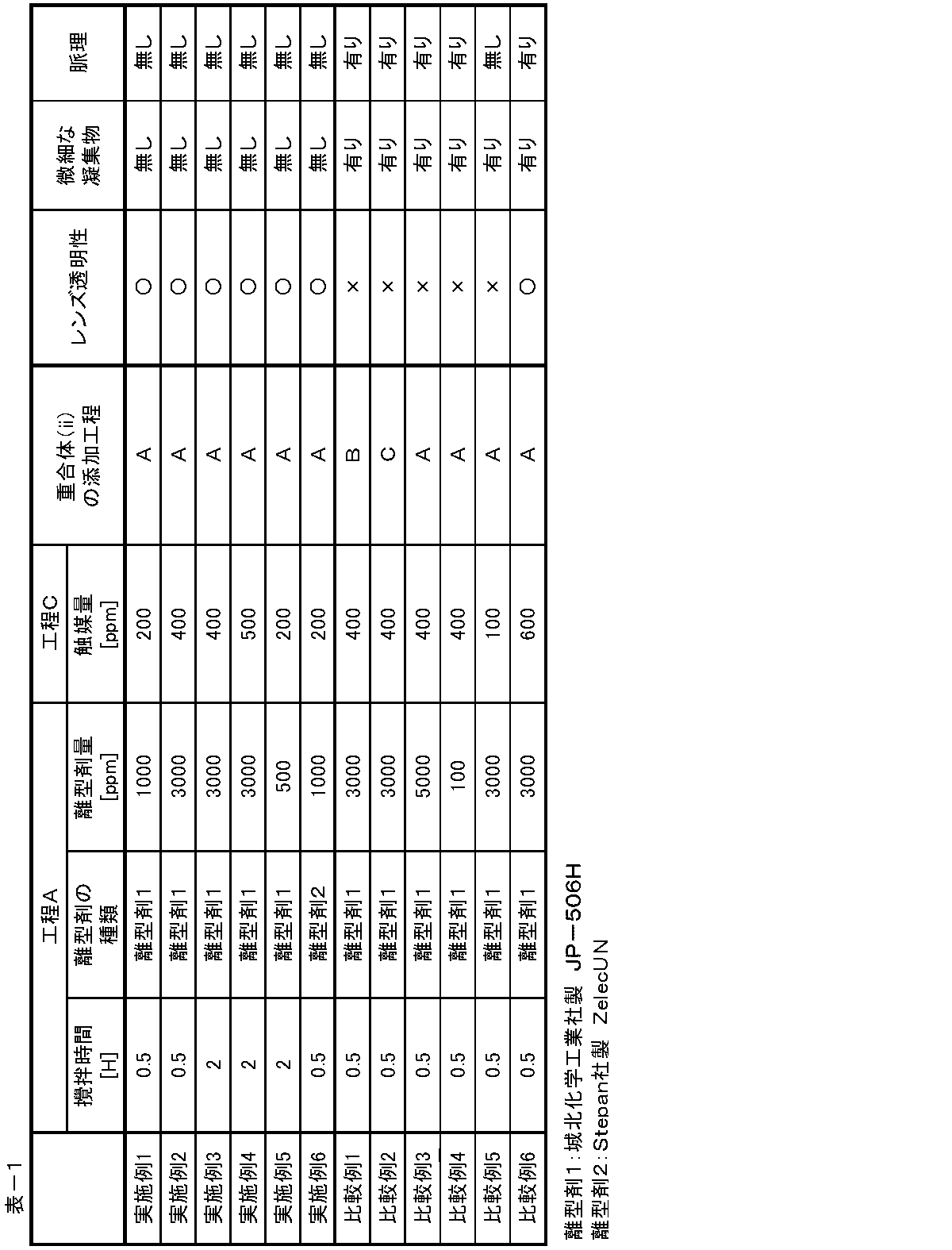
- the molded product was colorless and transparent, and had a good dimming property that it was colored immediately when placed under sunlight and was erased when light was blocked. Furthermore, fine aggregates and striae were not confirmed in the molded body. Table 1 shows the evaluation results of the obtained molded body.
- Example 2 to 6 The polymerizable composition was the same as in Example 1 except that the stirring time, the type of release agent, the addition amount of the release agent in step A, and the addition amount of the polymerization catalyst in step C were appropriately changed as shown in Table 1. The thing and the molded object were created. The molded product was colorless and transparent, and had a good dimming property that it was colored immediately when placed under sunlight and was erased when light was blocked. Furthermore, fine aggregates and striae were not confirmed in the molded body. Table 1 shows the evaluation results of the obtained molded body.
Landscapes
- Chemical & Material Sciences (AREA)
- Organic Chemistry (AREA)
- Health & Medical Sciences (AREA)
- Chemical Kinetics & Catalysis (AREA)
- Medicinal Chemistry (AREA)
- Polymers & Plastics (AREA)
- Physics & Mathematics (AREA)
- Engineering & Computer Science (AREA)
- Materials Engineering (AREA)
- Inorganic Chemistry (AREA)
- General Physics & Mathematics (AREA)
- Optics & Photonics (AREA)
- Polyurethanes Or Polyureas (AREA)
- Compositions Of Macromolecular Compounds (AREA)
Abstract
Description
例えば、特定の脂肪族、脂環族イソシアネートを用いることにより、フォトクロミック化合物を含むウレタン樹脂系光学材料またはチオウレタン樹脂系光学材料およびプラスチックレンズを、フォトクロミック化合物の性能低下を起こすことなく得ることができる(特許文献1)。
すなわち、本発明は、以下に示すことができる。
工程Aで得られた混合液に、ポリチオール化合物(v)を混合する工程Bと、
工程Bで得られた混合液に、さらに重合触媒(vi)を混合して光学材料用重合性組成物を得る工程Cと、
を含み、
工程Aにおいて、内部離型剤(iv)が前記光学材料用重合性組成物中に500~3000ppm含まれるように添加され、
工程Cにおいて、重合触媒(vi)が前記光学材料用重合性組成物中に120~500ppm含まれるように添加される、光学材料用重合性組成物の製造方法。

[2] 工程Aにおいて、ポリイソシアネート化合物(i)と、重合体(ii)と、フォトクロミック化合物(iii)と、内部離型剤(iv)とを2時間以下の時間で混合する、[1]に記載の光学材料用重合性組成物の製造方法。
[3] 工程Cにおいて、重合触媒(vi)が前記光学材料用重合性組成物中に200~500ppm含まれるように添加される、[1]または[2]に記載の光学材料用重合性組成物の製造方法。
[4] 工程Aは、
ポリイソシアネート化合物(i)と、重合体(ii)とを混合し、次いでフォトクロミック化合物(iii)と、内部離型剤(iv)とを混合する工程を含む、[1]~[3]のいずれかに記載の光学材料用重合性組成物の製造方法。
[5] 工程Aの混合温度は10~25℃である、[1]~[4]のいずれかに記載の光学材料用重合性組成物の製造方法。
[6] フォトクロミック化合物(iii)がナフトピラン系化合物である、[1]~[5]のいずれかに記載の光学材料用重合性組成物の製造方法。
[7] ポリイソシアネート化合物(i)は、ペンタメチレンジイソシアネート、ヘキサメチレンジイソシアネート、キシリレンジイソシアネート、ビス(イソシアナトシクロヘキシル)メタン、イソホロンジイソシアネート、2,5-ビス(イソシアナトメチル)ビシクロ-[2.2.1]-ヘプタン、2,6-ビス(イソシアナトメチル)ビシクロ-[2.2.1]-ヘプタン、トリレンジイソシアネート、4,4'-ジフェニルメタンジイソシアネート、およびフェニレンジイソシアネートから選択される少なくとも1種である、[1]~[6]のいずれかに記載の光学材料用重合性組成物の製造方法。
[8] 重合体(ii)は、下記一般式(iia)で表される化合物である、[1]~[7]のいずれかに記載の光学材料用重合性組成物の製造方法。

[9] ポリチオール化合物(v)は、4-メルカプトメチル-1,8-ジメルカプト-3,6-ジチアオクタン、5,7-ジメルカプトメチル-1,11-ジメルカプト-3,6,9-トリチアウンデカン、4,7-ジメルカプトメチル-1,11-ジメルカプト-3,6,9-トリチアウンデカン、4,8-ジメルカプトメチル-1,11-ジメルカプト-3,6,9-トリチアウンデカン、ペンタエリスリトールテトラキス(2-メルカプトアセテート)、ペンタエリスリトールテトラキス(3-メルカプトプロピオネート)、ビス(メルカプトエチル)スルフィド、2,5-ジメルカプトメチル-1,4-ジチアン、1,1,3,3-テトラキス(メルカプトメチルチオ)プロパン、4,6-ビス(メルカプトメチルチオ)-1,3-ジチアン、および2-(2,2-ビス(メルカプトメチルチオ)エチル)-1,3-ジチエタンから選択される少なくとも1種である、[1]~[8]のいずれかに記載の光学材料用重合性組成物の製造方法。
[10] [1]~[9]のいずれかに記載の製造方法に記載の工程と、
得られた前記光学材料用重合性組成物を注型重合することによりレンズ基材を形成する工程を含む、プラスチックレンズの製造方法。
[11] ポリイソシアネート化合物(i)と、
下記一般式(ii)で表される重合体(ii)と、
フォトクロミック化合物(iii)と、
内部離型剤(iv)と、
ポリチオール化合物(v)と、
重合触媒(vi)と、を含み、
内部離型剤(iv)を500~3000ppm、重合触媒(vi)を120~500ppmの量で含む、光学材料用重合性組成物。

[12] 内部離型剤(iv)は酸性リン酸エステルを含む、[11]に記載の光学材料用重合性組成物。
本実施形態の光学材料用重合性組成物の製造方法は、
ポリイソシアネート化合物(i)と、下記一般式(ii)で表される重合体(ii)と、フォトクロミック化合物(iii)と、内部離型剤(iv)とを、混合する工程Aと、
工程Aで得られた混合液に、ポリチオール化合物(v)を混合する工程Bと、
工程Bで得られた混合液に、さらに重合触媒(vi)を混合して光学材料用重合性組成物を得る工程Cと、を含む。
工程Aにおいては、内部離型剤(iv)が前記光学材料用重合性組成物中に500~3000ppm含まれるように添加され、工程Cにおいては、重合触媒(vi)が前記光学材料用重合性組成物中に120~500ppm含まれるように添加される。

本工程においては、ポリイソシアネート化合物(i)と、下記一般式(ii)で表される重合体(ii)と、フォトクロミック化合物(iii)と、内部離型剤(iv)とを混合する。
混合方法は特に限定されず、従来公知の方法で混合することができ、公知の手段で攪拌する方法等を採用することができる。攪拌回転数は、用いる攪拌手段やスケールにより適宜調整することが好ましいが、100~250rpm程度である。
なお、混合時間は、全成分が添加された後の時間である。
以下、各成分について説明する。
本実施形態において、ポリイソシアネート化合物(i)は、イソシアナト基を2個以上有する化合物であり、本発明の効果を得ることができれば特に限定されず様々な化合物を用いることができる。
イソホロンジイソシアネート、ビス(イソシアナトメチル)シクロヘキサン、ビス(イソシアナトシクロヘキシル)メタン、ジシクロヘキシルジメチルメタンイソシアネート、2,5-ビス(イソシアナトメチル)ビシクロ-[2.2.1]-ヘプタン、2,6-ビス(イソシアナトメチル)ビシクロ-[2.2.1]-ヘプタン、3,8-ビス(イソシアナトメチル)トリシクロデカン、3,9-ビス(イソシアナトメチル)トリシクロデカン、4,8-ビス(イソシアナトメチル)トリシクロデカン、4,9-ビス(イソシアナトメチル)トリシクロデカン等の脂環族ポリイソシアネート化合物;
トリレンジイソシアネート、4,4'-ジフェニルメタンジイソシアネート、ジフェニルスルフィド-4,4-ジイソシアネート、フェニレンジイソシアネート等の芳香族ポリイソシアネート化合物;
2,5-ジイソシアナトチオフェン、2,5-ビス(イソシアナトメチル)チオフェン、2,5-ジイソシアナトテトラヒドロチオフェン、2,5-ビス(イソシアナトメチル)テトラヒドロチオフェン、3,4-ビス(イソシアナトメチル)テトラヒドロチオフェン、2,5-ジイソシアナト-1,4-ジチアン、2,5-ビス(イソシアナトメチル)-1,4-ジチアン、4,5-ジイソシアナト-1,3-ジチオラン、4,5-ビス(イソシアナトメチル)-1,3-ジチオラン等の複素環ポリイソシアネート化合物;等を挙げることができ、1種または2種以上を組み合わせて用いることができる。
本実施形態の重合体(ii)は、下記一般式(ii)で表される。

ポリマー鎖であるポリシロキサン鎖としては、ポリジメチルシロキサン鎖、ポリメチルフェニルシロキサン鎖等を挙げることができる。
ポリマー鎖であるポリアルキレンオキシド鎖としては、ポリエチレングリコール鎖、ポリプロピレングリコール鎖、ポリブチレングリコール鎖、ポリペンテングリコール鎖、ポリヘキセングリコール鎖、ポリヘプテングリコール鎖等を挙げることができる。また、nが2以上の場合、複数のA1、A2はそれぞれ異なるポリアルキレンオキシド鎖を有していてもよい。
1価の有機基としては、メトキシ基、エトキシ基、1-プロパノキシ基、2-プロパノキシ基、メトキシエトキシ基などのアルコキシ基、メチルメルカプト基、エチルメルカプト基などのアルキルチオ基、アセチル基などが挙げられる。
6官能の有機基としては、ジペンタエリスリトールのオキシ体等が挙げられる。
R2は2種類のポリマー鎖を連結する炭素数1~10の2価の連結基である。
なお、R3は、ブロックコポリマーの種類によっては、前記重合性官能基と反応性が無くてもよい場合もある。
一般式(ii)で表される重合体(ii)の具体的な例としては、下記一般式(iia)で表される化合物、化合物(a)~(b)等を挙げることができる。
本実施形態においては、一般式(ii)で表される重合体(ii)として下記一般式(iia)で表される化合物を用いることができる。

一般式(iia)で表される化合物としては、数平均分子量が150以上、好ましくは200以上のものを用いることができる。

なお、一般式(iia)で表される化合物の末端水酸基は、ポリイソシアネート化合物(i)等の重合性化合物と反応する場合もある。
本実施形態においては、一般式(ii)で表される重合体(ii)として化合物(a)~(b)を用いることができる。重合体(ii)は、以下の化合物(a)および(b)から選択される1種または2種以上を組み合わせて用いることができる。
一般式(ii)において、R1がプロピレングリコレート基であり、A1がポリプロピレングリコール鎖、R2がオキシプロピレン基、A2がポリエチレングリコール鎖であり、R3がヒドロキシエチレン基、nがプロピレングリコレート基の価数の2の場合、当該化合物は下記一般式(a-1)で表される。

このような化合物の例としてはPluronicシリーズ(BASF社製)などが挙げられる。
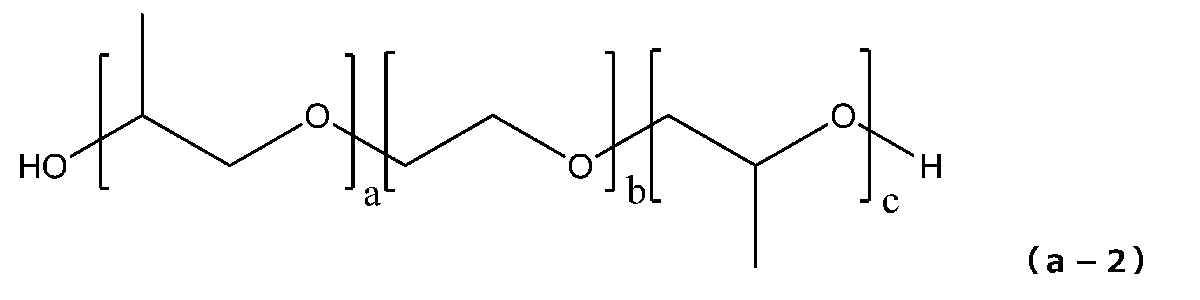
このような化合物の例としてはPluronic Rシリーズ(BASF社製)などが挙げられる。
一般式(ii)において、R1がグリセロレート基であり、A1がポリプロピレングリコール鎖、R2がオキシプロピレン基、A2がポリエチレングリコール鎖であり、R3がヒドロキシエチレン基、nがグリセロール基の価数の3の場合、当該化合物は下記一般式(b-1)で表される。

このような化合物の例としては、グリセロールポリプロピレンオキシドブロックポリエチレンオキシド(Aldrich社製)などが挙げられる。
また、式中Qにおいて、プロピレンオキシド鎖とエチレンオキシド鎖が入れ替わった下記一般式(b-2)で表される化合物も例として挙げられる。

フォトクロミック化合物(iii)は特定波長の光照射により、分子構造が可逆的に変化し、それに伴って吸光特性(吸収スペクトル)が変化する。本実施形態で用いるフォトクロミック化合物(iii)としては、特定の波長の光に対して吸光特性(吸収スペクトル)が変化する化合物が挙げられる。
PC-L-Chain (1)
PC-L-Chain-L'-PC' (2)
PCとPC'は一般式(3)~(6)の化合物から誘導される1価の基を示す。PCとPC'は同一でも異なっていてもよい。

置換されてもよいC6~C20の芳香族有機基としては、フェニル基、C7~C16アルコキシフェニル基、アリールアミノ基、ジアリールアミノ基、アリールC1~C5アルキルアミノ基、環状アミノ基、アリールカルボニル基、アロイル基等を挙げることができる。
直鎖あるいは分枝鎖状のC1~C10アルキル基、直鎖あるいは分枝鎖状のC1~C10アルコキシ基、C1~C10ヒドロキシアルコキシ基、C1~C10アルコキシ基で置換されたC1~C10アルコキシ基、C1~C5ハロアルキル基、C1~C5ジハロアルキル基、C1~C5トリハロアルキル基、C1~C5アルキルアミノ基等の、置換されてもよいC1~C20の脂肪族基;
フェニル基、C7~C16アルコキシフェニル基、C1~C5ジアルキルアミノ基、アリールアミノ基、ジアリールアミノ基、アリールC1~C5アルキルアミノ基、環状アミノ基等の、置換されてもよいC6~C20の芳香族有機基;等を挙げることができる。R1とR2は、それぞれ同一でも異なってもよい。
直鎖あるいは分枝鎖状のC1~C10アルキル基、直鎖あるいは分枝鎖状のC2~C10アルケ二ル基、直鎖あるいは分枝鎖状のC1~C10アルコキシ基、C1~C10ヒドロキシアルキル基、C1~C10アルコキシ基で置換されたC1~C10アルキル基、C1~C10アミノアルキル基、直鎖あるいは分枝鎖状のC1~C20アルコキシカルボニル基等の、置換されてもよいC1~C20の脂肪族基;
C3~C20のシクロアルキル基、C6~C20のビシクロアルキル基等の、置換されてもよいC3~C20の脂環族基;
アリールカルボニル基、ホルミル基、アロイル基等の、置換されてもよいC6~C20の芳香族有機基;等を挙げることができる。
直鎖あるいは分枝鎖状のC1~C10アルキル基、直鎖あるいは分枝鎖状のC2~C10アルケ二ル基、直鎖あるいは分枝鎖状のC1~C10アルコキシ基、C1~C10ヒドロキシアルキル基、C1~C10アルコキシ基で置換されたC1~C10アルキル基、C1~C10アミノアルキル基、直鎖あるいは分枝鎖状のC1~C20アルコキシカルボニル基等の、置換されてもよいC1~C20の脂肪族基;
C3~C20のシクロアルキル基、C6~C20のビシクロアルキル基等の、置換されてもよいC3~C20の脂環族基;
アリールカルボニル基、アロイル基、フェニル基、C7~C16アルコキシフェニル基、C1~C10ジアルコキシフェニル基、C1~C10アルキルフェニル基、C1~C10ジアルキルフェニル基等の、置換されてもよいC6~C20の芳香族有機基;等を挙げることができる。

直鎖あるいは分枝鎖状のC1~C20アルキル基、C1~C5ハロアルキル基、C1~C5ジハロアルキル基、C1~C5トリハロアルキル基等の、置換されてもよいC1~C20の脂肪族基;
C3~C20のシクロアルキル基、C6~C20のビシクロアルキル基、C1~C5アルキル基で置換されたC3~C20シクロアルキル基、C1~C5アルキル基で置換されたC6~C20のビシクロアルキル基等の、置換されてもよいC3~C20の脂環族基;
C1~C5アルキル基で置換されたアリール基等の、置換されてもよいC6~C20の芳香族有機基;等を挙げることができる。
C1~C10アルキル基、C1~C5アルキルアルコキシカルボニル基等の、置換されてもよいC1~C20の脂肪族基;C5~C7のシクロアルキル基等の、置換されてもよいC3~C20の脂環族基;等を示す。
直鎖あるいは分枝鎖状のC1~C10アルキル基、C1~C10ヒドロキシアルキル基等の、置換されてもよいC1~C20の脂肪族基;C5~C7のシクロアルキル基等の、置換されてもよいC3~C20の脂環族基;等を示す。
具体的には、LとL'は、一般式(9)~(15)で表される。LとL'は同一でも異なっていてもよい。

Yは、酸素、硫黄を示す。
R19は、水素、直鎖あるいは分枝鎖状のC1~C10アルキル基を示す。
R20は、直鎖あるいは分枝鎖状のC1~C10アルキル基を示す。
pは、0~15の整数を示し、rは、0~10の整数を示す。
Qは、直鎖あるいは分枝鎖状のC1~C10アルキレン基、C1~C10アルケニレン基、1,2-、1,3-、1,4-位の置換アリール基から誘導される2価の基、置換ヘテロアリール基から誘導される2価の基等を示す。
*1、*2は結合手を表し、*1は「Chain」で表される1価または2価の有機基と結合し、*2はPCまたはPC' で表される1価の有機基と結合する。
ポリシロキサン鎖としては、ポリジメチルシロキサン鎖、ポリメチルフェニルシロキサン鎖、ポリメチルヒドロシロキサン鎖等が挙げられる。
ポリオキシアルキレン鎖としては、ポリオキシエチレン鎖、ポリオキシプロピレン鎖、ポリオキシヘキサメチレン鎖等が挙げられる。
「Chain」は、フォトクロミック化合物が一般式(1)の場合は、一般式(16)または(17)の1価の有機基を示す。


R21は、直鎖あるいは分枝鎖状のC1~C10アルキル基を示す。
R22は、直鎖あるいは分枝鎖状のC1~C10アルキル基を示す。
R23は、水素、メチル基、エチル基を示す。
nは4~75の整数を示し、mは1~50の整数を示す。
qは1~3の整数を示す。
*3、*4は結合手を表し、*3はLで表される2価の有機基と結合し、*4はL'で表される2価の有機基と結合する。
フォトクロミック化合物(iii)は、当該フォトクロミック化合物(iii)とポリイソシアネート化合物(i)とのプレミックスにより添加することもできる。なお、本実施形態におけるポリイソシアネート化合物(i)の使用全量は、プレミックスに用いられるポリイソシアネート化合物(i)の量を含む。
内部離型剤(iv)としては、本発明の効果を得ることができれば特に限定されず様々な化合物を用いることができる。
内部離型剤(iv)として用いる酸性リン酸エステルは、一般式(iv)で表すことができる。

ン、へキサデカン等の直鎖の脂肪族化合物から誘導される有機残基、2-メチルプロパン、2-メチルブタン、2-メチルペンタン、3-メチルペンタン、3-エチルペンタン、2-メチルヘキサン、3-メチルヘキサン、3-エチルヘキサン、2-メチルへプタン、3-メチルへプタン、4-メチルへプタン、3-エチルへプタン、4-エチルへプタン、4-プロピルへプタン、2-メチルオクタン、3-メチルオクタン、4-メチルオクタン、3-エチルオクタン、4-エチルオクタン、4-プロピルオクタン等の分岐鎖の脂肪族化合物から誘導される有機残基、シクロペンタン、シクロへキサン、1,2-ジメチルシクロヘキサン、1,3-ジメチルシクロヘキサン、1,4-ジメチルシクロヘキサン等の脂環族化合物から誘導される有機残基等を挙げることができ、これらから選択される少なくとも一種を用いることができる。なお、これら例示化合物のみに限定されるものではない。酸性リン酸エステルは、少なくとも一種または二種以上の混合物を用いることができる。
yが0の場合、R27は、炭素数4~12の直鎖または分岐鎖アルキル基が好ましく、炭素数4~12の直鎖アルキル基がさらに好ましい。
yが1の場合、R27は、炭素数1~20の直鎖または分岐鎖アルキル基が好ましく、炭素数3~12の直鎖または分岐鎖アルキル基が好ましい。
酸性リン酸エステルは、これらから選択される一種または二種以上の混合物として用いることができる。
本工程においては、本実施形態における光学材料が長期間外部に曝されても変質しないようにするために、さらに紫外線吸収剤およびヒンダードアミン系光安定剤を添加することができる。
ミクロ相分離構造体は、組成物中では凝集し易い物質の分散剤としての効果を発揮することもできる。
工程Bにおいては、工程Aで得られた混合液に、さらにポリチオール化合物(v)を混合する。
本実施形態において、ポリチオール化合物(v)は、メルカプト基を2個以上有する化合物であり、本発明の効果を得ることができれば特に限定されず様々な化合物を用いることができる。
1,2-ジメルカプトベンゼン、1,3-ジメルカプトベンゼン、1,4-ジメルカプトベンゼン、1,2-ビス(メルカプトメチル)ベンゼン、1,3-ビス(メルカプトメチル)ベンゼン、1,4-ビス(メルカプトメチル)ベンゼン、1,2-ビス(メルカプトエチル)ベンゼン、1,3-ビス(メルカプトエチル)ベンゼン、1,4-ビス(メルカプトエチル)ベンゼン、1,3,5-トリメルカプトベンゼン、1,3,5-トリス(メルカプトメチル)ベンゼン、1,3,5-トリス(メルカプトメチレンオキシ)ベンゼン、1,3,5-トリス(メルカプトエチレンオキシ)ベンゼン、2,5-トルエンジチオール、3,4-トルエンジチオール、1,5-ナフタレンジチオール、2,6-ナフタレンジチオール等の芳香族ポリチオール化合物;
2-メチルアミノ-4,6-ジチオール-sym-トリアジン、3,4-チオフェンジチオール、ビスムチオール、4,6-ビス(メルカプトメチルチオ)-1,3-ジチアン、2-(2,2-ビス(メルカプトメチルチオ)エチル)-1,3-ジチエタン等の複素環ポリチオール化合物;等を挙げることができ、1種または2種以上を組み合わせて用いることができる。
本工程においては、ポリチオール化合物(v)以外に、ブルーイング剤等を添加することができる。
工程Cにおいては、工程Bで得られた混合液に、さらに重合触媒(vi)を混合する。
重合触媒(vi)は、光学材料用重合性組成物中に120~500ppm、好ましくは150~500ppm、さらに好ましくは200~500ppm、より好ましくは200~400ppm、特に好ましくは200~300ppm含まれるように添加される。
重合触媒(vi)は、本発明の効果を得ることができれば特に限定されず様々な化合物を用いることができる。
重合触媒(vi)は、当該重合触媒(vi)とポリイソシアネート化合物(i)とのプレミックスにより添加することが好ましい。なお、本実施形態におけるポリイソシアネート化合物(i)の使用全量は、プレミックスに用いられるポリイソシアネート化合物(i)の量を含む。
本実施形態の光学材料用重合性組成物は、
ポリイソシアネート化合物(i)と、
下記一般式(ii)で表される重合体(ii)と、
フォトクロミック化合物(iii)と、
内部離型剤(iv)と、
ポリチオール化合物(v)と、
重合触媒(vi)と、を含む。
本実施形態の光学材料用重合性組成物は、内部離型剤(iv)を500~3000ppm、好ましくは500~1000ppmの量で含み、かつ重合触媒(vi)を120~500ppm、好ましくは150~500ppm、さらに好ましくは200~500ppm、より好ましくは200~400ppm、特に好ましくは200~300ppmの量で含む。
本実施形態の光学材料用重合性組成物によれば、透明性に優れ、微細な凝集物の生成や光学歪みの発生が抑制された、優れたフォトクロミック性能を備える光学材料を提供することができる。
本実施形態においては、上述の光学材料用重合性組成物を重合させる際のモールド形状を変えることにより種々の形状の成形体およびかかる成形体からなる光学材料を得ることができる。本実施形態の成形体は、所望の形状とし、必要に応じて形成されるコート層や他の部材等を備えることにより、様々な光学材料として用いることができる。
なお、フォトクロミック化合物(iii)の少なくとも一部が重合体(ii)から構成されるミクロ相分離構造体に内包されていてもよく、この場合、フォトクロミック特性や機械物性に特に優れる。
ミクロ相分離構造とは以下のように説明される。ブロックコポリマーは共有結合を介してつながった複数の異なるコポリマー部位からなるポリマーである。このコポリマー部位は互いに異なる物性や親和性を有している。たとえば両親媒性のブロックコポリマーに関しては、強力な反発力のためにコポリマー部位はそれぞれ分離する傾向にあり、水と油のように混ざらず、そのため相分離を引き起こす。しかし、それぞれのコポリマー部位が化学的に結合しているために単純に二種類のホモポリマーを混合した場合のように完全に巨視的な相分離は引き起こされない。一方、AとBの異なるコポリマー部位からなるブロックコポリマーのミクロ相分離においてはコポリマーAに富んだ部位とコポリマーBに富んだ部位のミクロ集合体を形成する。この結果、ブロックコポリマーの構造に依存して、ナノサイズの球状ポリマーミセルのようないくつかのモルフォロジーが観察されうる。このようなブロックコポリマーのミクロ相分離の詳細に関しては、例えば参考文献(Chem. Soc. Rev., 2012, 41, 5969-5985)中に述べられている。ミクロ相分離構造を備える重合体粒子のようなミクロ相分離構造体を含むことで、濁りの少ない透明な硬化体を得ることができる。
以下、本実施形態の成形体からなるプラスチックレンズについて説明する。プラスチックレンズは以下のように製造することができる。
本実施形態のプラスチックレンズの製造方法は、上述の光学材料用重合性組成物を調製する工程と、
得られた前記光学材料用重合性組成物を注型重合することによりレンズ基材を形成する工程を含む。
加熱によりレンズ基材を製造する場合、対流による重合不均一(脈理)を防止する目的で、加熱は、通常、低温から徐々に昇温して重合される。
○:失透度が100以下であり透明性に優れる。
×:失透度が100を超え透明性に劣る。
・微細な凝集物(レンズ内部に粒状に存在し光源により確認される不良):目視にて微細な凝集物の有無を評価した。
・脈理:レンズを超高圧水銀灯(光源型式OPM-252HEG:ウシオ電機社製)で投影し、透過した像を目視にて脈理の有無を評価した。
事前に2,5-ビス(イソシアナトメチル)ビシクロ-[2.2.1]-ヘプタンと2,6-ビス(イソシアナトメチル)ビシクロ-[2.2.1]-ヘプタンを含む組成物9.8重量部に、フォトクロミック化合物としてVivimed社製Reversacol Wembley Greyを0.035重量部、Vivimed社製Reversacol Heath Greenを0.058重量部、Vivimed社製 Peacock Blue 0.029重量部, およびVivimed社製 Jalapeno Red 0.023重量部、紫外線吸収剤としてHOSTAVIN PR-25を0.073重量部を溶解し、マスター液を準備した。2,5-ビス(イソシアナトメチル)ビシクロ-[2.2.1]-ヘプタンと2,6-ビス(イソシアナトメチル)ビシクロ-[2.2.1]-ヘプタンを含む組成物30.25重量部に、得られたマスター液10重量部を加えて攪拌し、そこにアデカ社製アデカプルロニックL-64を2.52重量部、酸性リン酸エステルとして城北化学工業社製JP-506Hを0.1重量部、をそれぞれ加えて、15℃~20℃の間で30min攪拌した(混合工程A)。
混合工程Aで得られた混合液に、ペンタエリスリトールテトラキス(3-メルカプトプロピオネート)を19.98重量部、4-メルカプトメチル-1,8-ジメルカプト-3,6-ジチアオクタンを27.25重量部、それぞれ加えて15℃~20℃の間で15min攪拌した(混合工程B)。
事前に2,5-ビス(イソシアナトメチル)ビシクロ-[2.2.1]-ヘプタンと2,6-ビス(イソシアナトメチル)ビシクロ-[2.2.1]-ヘプタンを含む組成物10重量部に、ジメチルチンジクロリドを0.02重量部加え、均一に溶解させて溶液を作成した。この溶液を、混合工程Bで得られた混合液に加えて15℃~20℃の間で15min攪拌し、重合性組成物を得た(混合工程C)。
その後、重合性組成物を、400Pa以下の減圧環境下・15℃~20℃の間で1H 攪拌・脱気を行った後、1.0μmのPTFEフィルターを使用してろ過を行い、この重合性組成物をガラスモールドへ注型した。重合性組成物を10℃~130℃の範囲で48時間かけて重合させた後、炉から成形型を取り出し、成形型をはずして、重合して得られた成形体を取り出した。
成形体は無色透明であり、太陽光線下に置くと直ちに発色し、光線を遮断すると消色するという良好な調光性能を有するものであった。さらに、成形体には、微細な凝集物および脈理が確認されなかった。得られた成形体の評価結果を表-1に示す。
工程Aにおいて、攪拌時間、離型剤の種類、離型剤の添加量、工程Cにおいて重合触媒の添加量を表-1のように適宜変更した以外は、実施例1と同様に重合性組成物および成形体を作成した。
成形体は無色透明であり、太陽光線下に置くと直ちに発色し、光線を遮断すると消色するという良好な調光性能を有するものであった。さらに、成形体には、微細な凝集物および脈理が確認されなかった。得られた成形体の評価結果を表-1に示す。
工程Aにおいて攪拌時間、離型剤の添加量、工程Cにおいて重合触媒の添加量、さらに重合体(ii)(アデカ社製アデカプルロニックL-64)を添加する工程を表-1のように適宜変更した以外は、実施例1と同様に重合性組成物および成形体を作成した。
成形体は、太陽光線下に置くと直ちに発色し、光線を遮断すると消色するという良好な調光性能を有するものであった。しかしながら、成形体は透明性に劣り、微細な凝集物および脈理が確認された。得られた成形体の評価結果を表-1に示す。
Claims (12)
- ポリイソシアネート化合物(i)と、下記一般式(ii)で表される重合体(ii)と、フォトクロミック化合物(iii)と、内部離型剤(iv)とを混合する工程Aと、
工程Aで得られた混合液に、ポリチオール化合物(v)を混合する工程Bと、
工程Bで得られた混合液に、さらに重合触媒(vi)を混合して光学材料用重合性組成物を得る工程Cと、
を含み、
工程Aにおいて、内部離型剤(iv)が前記光学材料用重合性組成物中に500~3000ppm含まれるように添加され、
工程Cにおいて、重合触媒(vi)が前記光学材料用重合性組成物中に120~500ppm含まれるように添加される、光学材料用重合性組成物の製造方法。

- 工程Aにおいて、ポリイソシアネート化合物(i)と、重合体(ii)と、フォトクロミック化合物(iii)と、内部離型剤(iv)とを2時間以下の時間で混合する、請求項1に記載の光学材料用重合性組成物の製造方法。
- 工程Cにおいて、重合触媒(vi)が前記光学材料用重合性組成物中に200~500ppm含まれるように添加される、請求項1または2に記載の光学材料用重合性組成物の製造方法。
- 工程Aは、
ポリイソシアネート化合物(i)と、重合体(ii)とを混合し、次いでフォトクロミック化合物(iii)と、内部離型剤(iv)とを混合する工程を含む、請求項1~3のいずれかに記載の光学材料用重合性組成物の製造方法。 - 工程Aの混合温度は10~25℃である、請求項1~4のいずれかに記載の光学材料用重合性組成物の製造方法。
- フォトクロミック化合物(iii)がナフトピラン系化合物である、請求項1~5のいずれかに記載の光学材料用重合性組成物の製造方法。
- ポリイソシアネート化合物(i)は、ペンタメチレンジイソシアネート、ヘキサメチレンジイソシアネート、キシリレンジイソシアネート、ビス(イソシアナトシクロヘキシル)メタン、イソホロンジイソシアネート、2,5-ビス(イソシアナトメチル)ビシクロ-[2.2.1]-ヘプタン、2,6-ビス(イソシアナトメチル)ビシクロ-[2.2.1]-ヘプタン、トリレンジイソシアネート、4,4'-ジフェニルメタンジイソシアネート、およびフェニレンジイソシアネートから選択される少なくとも1種である、請求項1~6のいずれかに記載の光学材料用重合性組成物の製造方法。
- 重合体(ii)は、下記一般式(iia)で表される化合物である、請求項1~7のいずれかに記載の光学材料用重合性組成物の製造方法。

- ポリチオール化合物(v)は、4-メルカプトメチル-1,8-ジメルカプト-3,6-ジチアオクタン、5,7-ジメルカプトメチル-1,11-ジメルカプト-3,6,9-トリチアウンデカン、4,7-ジメルカプトメチル-1,11-ジメルカプト-3,6,9-トリチアウンデカン、4,8-ジメルカプトメチル-1,11-ジメルカプト-3,6,9-トリチアウンデカン、ペンタエリスリトールテトラキス(2-メルカプトアセテート)、ペンタエリスリトールテトラキス(3-メルカプトプロピオネート)、ビス(メルカプトエチル)スルフィド、2,5-ジメルカプトメチル-1,4-ジチアン、1,1,3,3-テトラキス(メルカプトメチルチオ)プロパン、4,6-ビス(メルカプトメチルチオ)-1,3-ジチアン、および2-(2,2-ビス(メルカプトメチルチオ)エチル)-1,3-ジチエタンから選択される少なくとも1種である、請求項1~8のいずれかに記載の光学材料用重合性組成物の製造方法。
- 請求項1~9のいずれかに記載の製造方法に記載の工程と、
得られた前記光学材料用重合性組成物を注型重合することによりレンズ基材を形成する工程を含む、プラスチックレンズの製造方法。 - ポリイソシアネート化合物(i)と、
下記一般式(ii)で表される重合体(ii)と、
フォトクロミック化合物(iii)と、
内部離型剤(iv)と、
ポリチオール化合物(v)と、
重合触媒(vi)と、を含み、
内部離型剤(iv)を500~3000ppm、重合触媒(vi)を120~500ppmの量で含む、光学材料用重合性組成物。

- 内部離型剤(iv)は、酸性リン酸エステルを含む、請求項11に記載の光学材料用重合性組成物。
Priority Applications (4)
| Application Number | Priority Date | Filing Date | Title |
|---|---|---|---|
| JP2020569693A JP7105928B2 (ja) | 2019-01-30 | 2020-01-29 | 光学材料用重合性組成物の製造方法 |
| CN202080010596.7A CN113348223B (zh) | 2019-01-30 | 2020-01-29 | 光学材料用聚合性组合物的制造方法 |
| US17/426,755 US11866648B2 (en) | 2019-01-30 | 2020-01-29 | Process for producing polymerizable composition for optical materials |
| EP20748717.4A EP3919584B1 (en) | 2019-01-30 | 2020-01-29 | Method for producing polymerizable composition for optical material |
Applications Claiming Priority (2)
| Application Number | Priority Date | Filing Date | Title |
|---|---|---|---|
| JP2019-013922 | 2019-01-30 | ||
| JP2019013922 | 2019-01-30 |
Publications (1)
| Publication Number | Publication Date |
|---|---|
| WO2020158813A1 true WO2020158813A1 (ja) | 2020-08-06 |
Family
ID=71841441
Family Applications (1)
| Application Number | Title | Priority Date | Filing Date |
|---|---|---|---|
| PCT/JP2020/003203 Ceased WO2020158813A1 (ja) | 2019-01-30 | 2020-01-29 | 光学材料用重合性組成物の製造方法 |
Country Status (5)
| Country | Link |
|---|---|
| US (1) | US11866648B2 (ja) |
| EP (1) | EP3919584B1 (ja) |
| JP (1) | JP7105928B2 (ja) |
| CN (1) | CN113348223B (ja) |
| WO (1) | WO2020158813A1 (ja) |
Cited By (6)
| Publication number | Priority date | Publication date | Assignee | Title |
|---|---|---|---|---|
| JPWO2022075048A1 (ja) * | 2020-10-05 | 2022-04-14 | ||
| US20220267509A1 (en) * | 2021-02-25 | 2022-08-25 | Jiangsu Conant Optical Co., Ltd. | Polyurethane-based photochromic resin lens and preparation method thereof |
| WO2024203896A1 (ja) * | 2023-03-29 | 2024-10-03 | 三井化学株式会社 | 光学部材および光学部材の製造方法 |
| EP4318103A4 (en) * | 2021-03-22 | 2025-03-26 | Mitsui Chemicals, Inc. | Production method for photochromic lens and photochromic lens |
| WO2025205700A1 (ja) * | 2024-03-28 | 2025-10-02 | ホヤ レンズ タイランド リミテッド | プラスチックレンズの製造方法 |
| WO2025205701A1 (ja) * | 2024-03-28 | 2025-10-02 | ホヤ レンズ タイランド リミテッド | フィニッシュレンズの製造方法 |
Families Citing this family (1)
| Publication number | Priority date | Publication date | Assignee | Title |
|---|---|---|---|---|
| KR20240015317A (ko) * | 2022-07-27 | 2024-02-05 | 현대자동차주식회사 | 차량의 영상 처리 방법 및 시스템 |
Citations (19)
| Publication number | Priority date | Publication date | Assignee | Title |
|---|---|---|---|---|
| JPS6429489A (en) | 1987-07-24 | 1989-01-31 | Toray Industries | Fine photochromic polymer particle |
| JPH01152182A (ja) | 1987-12-08 | 1989-06-14 | Toray Ind Inc | フォトクロミック材料およびその製造方法 |
| WO2004011506A1 (en) | 2002-07-31 | 2004-02-05 | Ppg Industries Ohio, Inc. | A high refractive index polymerizable composition |
| WO2009146509A1 (en) | 2008-06-05 | 2009-12-10 | Advanced Polymerik Pty Ltd | Photochromic polymer and composition comprising photochromic polymer |
| WO2010020770A1 (en) | 2008-08-18 | 2010-02-25 | James Robinson Limited | Polydialkylsiloxane-bridged bi-photochromic molecules |
| DE102009052986A1 (de) | 2008-11-12 | 2010-05-27 | Rodenstock Gmbh | Photochromer Kunststoffgegenstand mit sphärischen Nanopartikeln zur Verbesserung der Photochromie-Eigenschaften |
| WO2012149599A1 (en) | 2011-05-03 | 2012-11-08 | Advanced Polymerik Pty Ltd | Photochromic polymer |
| WO2012162725A1 (en) | 2011-06-03 | 2012-12-06 | Advanced Polymerik Pty Ltd | Photochromic polymers |
| WO2014002844A1 (ja) | 2012-06-26 | 2014-01-03 | 三井化学株式会社 | 光学材料用重合性組成物、当該組成物から得られる光学材料およびプラスチックレンズ |
| WO2014007154A1 (ja) | 2012-07-06 | 2014-01-09 | 三井化学株式会社 | 重合体粒子およびその用途 |
| WO2015115648A1 (ja) | 2014-02-03 | 2015-08-06 | 三井化学株式会社 | 光学材料用重合性組成物、当該組成物から得られる光学材料およびプラスチックレンズ |
| WO2016143910A1 (ja) * | 2015-03-10 | 2016-09-15 | 株式会社トクヤマ | フォトクロミック硬化体の製造方法 |
| WO2017047744A1 (ja) * | 2015-09-16 | 2017-03-23 | 三井化学株式会社 | 成形体および光学材料用重合性組成物 |
| WO2017047745A1 (ja) * | 2015-09-16 | 2017-03-23 | 三井化学株式会社 | 光学材料用重合性組成物、該組成物から得られる光学材料およびプラスチックレンズ |
| JP2018021161A (ja) * | 2016-08-05 | 2018-02-08 | 株式会社トクヤマ | 硬化体の製造方法 |
| WO2018124063A1 (ja) * | 2016-12-28 | 2018-07-05 | 伊藤光学工業株式会社 | 光学要素およびその製造方法 |
| WO2019009230A1 (ja) * | 2017-07-03 | 2019-01-10 | 三井化学株式会社 | 光学材料用重合性組成物および成形体 |
| JP2019013922A (ja) | 2017-07-03 | 2019-01-31 | 株式会社デンソーテン | はんだ付け装置およびはんだ付け方法 |
| JP2019215450A (ja) * | 2018-06-13 | 2019-12-19 | 三井化学株式会社 | 光学材料用重合性組成物およびその用途 |
Family Cites Families (12)
| Publication number | Priority date | Publication date | Assignee | Title |
|---|---|---|---|---|
| US20040138401A1 (en) * | 2002-11-05 | 2004-07-15 | Nina Bojkova | High impact poly (urethane urea) polysulfides |
| US8153344B2 (en) | 2004-07-16 | 2012-04-10 | Ppg Industries Ohio, Inc. | Methods for producing photosensitive microparticles, aqueous compositions thereof and articles prepared therewith |
| FR2883880B1 (fr) * | 2005-03-31 | 2007-05-11 | Essilor Int | Formulation poly(thio)urethane thermodurcissable comprenant au moins un copolymere a blocs et son application dans l'optique pour la fabrication de verres organiques a tenacite amelioree |
| EP1923415B1 (en) * | 2005-08-18 | 2010-12-08 | Mitsui Chemicals, Inc. | Polyurethane/thiourethane-based optical resin and process for producing the same |
| JP5357165B2 (ja) * | 2008-09-22 | 2013-12-04 | 三井化学株式会社 | 光学材料用重合性組成物、光学材料および光学材料の製造方法 |
| JP5743713B2 (ja) * | 2011-05-23 | 2015-07-01 | 株式会社トクヤマ | 積層体、フォトクロミックレンズ、及びその製造方法 |
| KR101776540B1 (ko) * | 2013-08-02 | 2017-09-07 | 미쯔이가가꾸가부시끼가이샤 | 포토크로믹 광학 재료의 제조 방법 |
| KR101930604B1 (ko) * | 2013-12-10 | 2018-12-18 | 피피지 인더스트리즈 오하이오 인코포레이티드 | 폴리우레탄 우레아-함유 조성물 및 광학 물품 및 이의 제조 방법 |
| US9944029B2 (en) * | 2014-02-20 | 2018-04-17 | Mitsui Chemicals, Inc. | Process for producing optical material |
| BR112018001382A2 (ja) * | 2015-08-06 | 2018-09-11 | Mitsui Chemicals, Inc. | The manufacturing method of the polymerization constituent for optical media, and the polymerization constituent for optical media |
| US11639413B2 (en) | 2016-10-11 | 2023-05-02 | Mitsui Chemicals, Inc. | Polymerizable composition for optical materials and application of same |
| WO2018123077A1 (ja) * | 2016-12-28 | 2018-07-05 | 伊藤光学工業株式会社 | 光学要素 |
-
2020
- 2020-01-29 EP EP20748717.4A patent/EP3919584B1/en active Active
- 2020-01-29 WO PCT/JP2020/003203 patent/WO2020158813A1/ja not_active Ceased
- 2020-01-29 US US17/426,755 patent/US11866648B2/en active Active
- 2020-01-29 CN CN202080010596.7A patent/CN113348223B/zh active Active
- 2020-01-29 JP JP2020569693A patent/JP7105928B2/ja active Active
Patent Citations (19)
| Publication number | Priority date | Publication date | Assignee | Title |
|---|---|---|---|---|
| JPS6429489A (en) | 1987-07-24 | 1989-01-31 | Toray Industries | Fine photochromic polymer particle |
| JPH01152182A (ja) | 1987-12-08 | 1989-06-14 | Toray Ind Inc | フォトクロミック材料およびその製造方法 |
| WO2004011506A1 (en) | 2002-07-31 | 2004-02-05 | Ppg Industries Ohio, Inc. | A high refractive index polymerizable composition |
| WO2009146509A1 (en) | 2008-06-05 | 2009-12-10 | Advanced Polymerik Pty Ltd | Photochromic polymer and composition comprising photochromic polymer |
| WO2010020770A1 (en) | 2008-08-18 | 2010-02-25 | James Robinson Limited | Polydialkylsiloxane-bridged bi-photochromic molecules |
| DE102009052986A1 (de) | 2008-11-12 | 2010-05-27 | Rodenstock Gmbh | Photochromer Kunststoffgegenstand mit sphärischen Nanopartikeln zur Verbesserung der Photochromie-Eigenschaften |
| WO2012149599A1 (en) | 2011-05-03 | 2012-11-08 | Advanced Polymerik Pty Ltd | Photochromic polymer |
| WO2012162725A1 (en) | 2011-06-03 | 2012-12-06 | Advanced Polymerik Pty Ltd | Photochromic polymers |
| WO2014002844A1 (ja) | 2012-06-26 | 2014-01-03 | 三井化学株式会社 | 光学材料用重合性組成物、当該組成物から得られる光学材料およびプラスチックレンズ |
| WO2014007154A1 (ja) | 2012-07-06 | 2014-01-09 | 三井化学株式会社 | 重合体粒子およびその用途 |
| WO2015115648A1 (ja) | 2014-02-03 | 2015-08-06 | 三井化学株式会社 | 光学材料用重合性組成物、当該組成物から得られる光学材料およびプラスチックレンズ |
| WO2016143910A1 (ja) * | 2015-03-10 | 2016-09-15 | 株式会社トクヤマ | フォトクロミック硬化体の製造方法 |
| WO2017047744A1 (ja) * | 2015-09-16 | 2017-03-23 | 三井化学株式会社 | 成形体および光学材料用重合性組成物 |
| WO2017047745A1 (ja) * | 2015-09-16 | 2017-03-23 | 三井化学株式会社 | 光学材料用重合性組成物、該組成物から得られる光学材料およびプラスチックレンズ |
| JP2018021161A (ja) * | 2016-08-05 | 2018-02-08 | 株式会社トクヤマ | 硬化体の製造方法 |
| WO2018124063A1 (ja) * | 2016-12-28 | 2018-07-05 | 伊藤光学工業株式会社 | 光学要素およびその製造方法 |
| WO2019009230A1 (ja) * | 2017-07-03 | 2019-01-10 | 三井化学株式会社 | 光学材料用重合性組成物および成形体 |
| JP2019013922A (ja) | 2017-07-03 | 2019-01-31 | 株式会社デンソーテン | はんだ付け装置およびはんだ付け方法 |
| JP2019215450A (ja) * | 2018-06-13 | 2019-12-19 | 三井化学株式会社 | 光学材料用重合性組成物およびその用途 |
Non-Patent Citations (4)
| Title |
|---|
| CHEM. SOC. REV., vol. 41, 2012, pages 5969 - 5985 |
| P. ALEXANDRIDIST.A. HATTON: "Colloids Surfaces A: Physicochem", ENG. ASPECTS, vol. 96, 1995, pages 1 - 46 |
| PHYS. CHEM. CHEM. PHYS., vol. 1, 1999, pages 3331 - 3334 |
| See also references of EP3919584A4 |
Cited By (10)
| Publication number | Priority date | Publication date | Assignee | Title |
|---|---|---|---|---|
| JPWO2022075048A1 (ja) * | 2020-10-05 | 2022-04-14 | ||
| JP7305236B2 (ja) | 2020-10-05 | 2023-07-10 | 株式会社朝日ラバー | 紫外線led用光学部材 |
| US12270977B2 (en) | 2020-10-05 | 2025-04-08 | Asahi Rubber Inc. | Ultraviolet led optical member |
| US20220267509A1 (en) * | 2021-02-25 | 2022-08-25 | Jiangsu Conant Optical Co., Ltd. | Polyurethane-based photochromic resin lens and preparation method thereof |
| CN114957594A (zh) * | 2021-02-25 | 2022-08-30 | 江苏康耐特光学有限公司 | 一种聚氨酯基光致变色树脂镜片及其制备方法 |
| WO2022178928A1 (zh) * | 2021-02-25 | 2022-09-01 | 江苏康耐特光学有限公司 | 一种聚氨酯基光致变色树脂镜片及其制备方法 |
| EP4318103A4 (en) * | 2021-03-22 | 2025-03-26 | Mitsui Chemicals, Inc. | Production method for photochromic lens and photochromic lens |
| WO2024203896A1 (ja) * | 2023-03-29 | 2024-10-03 | 三井化学株式会社 | 光学部材および光学部材の製造方法 |
| WO2025205700A1 (ja) * | 2024-03-28 | 2025-10-02 | ホヤ レンズ タイランド リミテッド | プラスチックレンズの製造方法 |
| WO2025205701A1 (ja) * | 2024-03-28 | 2025-10-02 | ホヤ レンズ タイランド リミテッド | フィニッシュレンズの製造方法 |
Also Published As
| Publication number | Publication date |
|---|---|
| US11866648B2 (en) | 2024-01-09 |
| JP7105928B2 (ja) | 2022-07-25 |
| EP3919584A4 (en) | 2022-09-28 |
| US20220098473A1 (en) | 2022-03-31 |
| EP3919584B1 (en) | 2025-12-24 |
| CN113348223A (zh) | 2021-09-03 |
| CN113348223B (zh) | 2024-08-09 |
| JPWO2020158813A1 (ja) | 2021-10-14 |
| EP3919584A1 (en) | 2021-12-08 |
Similar Documents
| Publication | Publication Date | Title |
|---|---|---|
| JP7105928B2 (ja) | 光学材料用重合性組成物の製造方法 | |
| JP6542982B2 (ja) | 光学材料用重合性組成物およびその用途 | |
| CN110831992B (zh) | 光学材料用聚合性组合物及成型体 | |
| JP6586170B2 (ja) | 光学材料用重合性組成物、光学材料、光学材料用重合性組成物の製造方法および光学材料の製造方法 | |
| CN107209283A (zh) | 光学材料用聚合性组合物、光学材料及其用途 | |
| CN105793737A (zh) | 光学材料用聚合性组合物 | |
| JP6475848B2 (ja) | 光学材料用重合性組成物の製造方法および光学材料の製造方法 | |
| JP6307209B1 (ja) | フォトクロミックレンズおよび重合性組成物 | |
| JPWO2012176439A1 (ja) | 重合性組成物 | |
| CN108026241B (zh) | 成型体和光学材料用聚合性组合物 | |
| KR101855034B1 (ko) | 광학 재료용 중합성 조성물 및 그 용도 | |
| WO2015088013A1 (ja) | 光学材料用重合性組成物、光学材料及びその製造方法 | |
| JP2015533874A (ja) | チオウレタン系光学材料の製造方法 | |
| JPWO2019022131A1 (ja) | 光学材料用重合性組成物、光学材料およびその用途 | |
| WO2015088011A1 (ja) | 光学材料用重合性組成物、光学材料およびその用途 | |
| CN106232660A (zh) | 光学材料用聚合性组合物及由其得到的光学材料及其制造方法 | |
| JP2019215450A (ja) | 光学材料用重合性組成物およびその用途 | |
| WO2021132559A1 (ja) | 光学材料用重合性組成物、当該組成物から得られる成形体およびその用途 | |
| JP2023011059A (ja) | 光学材料用重合性組成物、当該組成物から得られる成形体およびその用途 |
Legal Events
| Date | Code | Title | Description |
|---|---|---|---|
| 121 | Ep: the epo has been informed by wipo that ep was designated in this application |
Ref document number: 20748717 Country of ref document: EP Kind code of ref document: A1 |
|
| ENP | Entry into the national phase |
Ref document number: 2020569693 Country of ref document: JP Kind code of ref document: A |
|
| NENP | Non-entry into the national phase |
Ref country code: DE |
|
| ENP | Entry into the national phase |
Ref document number: 2020748717 Country of ref document: EP Effective date: 20210830 |
|
| WWG | Wipo information: grant in national office |
Ref document number: 2020748717 Country of ref document: EP |