WO2020162434A1 - Adhésif thermodurcissable et feuille adhésive - Google Patents
Adhésif thermodurcissable et feuille adhésive Download PDFInfo
- Publication number
- WO2020162434A1 WO2020162434A1 PCT/JP2020/004058 JP2020004058W WO2020162434A1 WO 2020162434 A1 WO2020162434 A1 WO 2020162434A1 JP 2020004058 W JP2020004058 W JP 2020004058W WO 2020162434 A1 WO2020162434 A1 WO 2020162434A1
- Authority
- WO
- WIPO (PCT)
- Prior art keywords
- adhesive
- thermosetting adhesive
- thermosetting
- epoxy
- sheet
- Prior art date
- Legal status (The legal status is an assumption and is not a legal conclusion. Google has not performed a legal analysis and makes no representation as to the accuracy of the status listed.)
- Ceased
Links
Images






Classifications
-
- C—CHEMISTRY; METALLURGY
- C08—ORGANIC MACROMOLECULAR COMPOUNDS; THEIR PREPARATION OR CHEMICAL WORKING-UP; COMPOSITIONS BASED THEREON
- C08G—MACROMOLECULAR COMPOUNDS OBTAINED OTHERWISE THAN BY REACTIONS ONLY INVOLVING UNSATURATED CARBON-TO-CARBON BONDS
- C08G18/00—Polymeric products of isocyanates or isothiocyanates
- C08G18/06—Polymeric products of isocyanates or isothiocyanates with compounds having active hydrogen
- C08G18/28—Polymeric products of isocyanates or isothiocyanates with compounds having active hydrogen characterised by the compounds used containing active hydrogen
- C08G18/30—Low-molecular-weight compounds
- C08G18/34—Carboxylic acids; Esters thereof with monohydroxyl compounds
- C08G18/348—Hydroxycarboxylic acids
-
- C—CHEMISTRY; METALLURGY
- C09—DYES; PAINTS; POLISHES; NATURAL RESINS; ADHESIVES; COMPOSITIONS NOT OTHERWISE PROVIDED FOR; APPLICATIONS OF MATERIALS NOT OTHERWISE PROVIDED FOR
- C09J—ADHESIVES; NON-MECHANICAL ASPECTS OF ADHESIVE PROCESSES IN GENERAL; ADHESIVE PROCESSES NOT PROVIDED FOR ELSEWHERE; USE OF MATERIALS AS ADHESIVES
- C09J175/00—Adhesives based on polyureas or polyurethanes; Adhesives based on derivatives of such polymers
- C09J175/04—Polyurethanes
-
- C—CHEMISTRY; METALLURGY
- C08—ORGANIC MACROMOLECULAR COMPOUNDS; THEIR PREPARATION OR CHEMICAL WORKING-UP; COMPOSITIONS BASED THEREON
- C08G—MACROMOLECULAR COMPOUNDS OBTAINED OTHERWISE THAN BY REACTIONS ONLY INVOLVING UNSATURATED CARBON-TO-CARBON BONDS
- C08G18/00—Polymeric products of isocyanates or isothiocyanates
- C08G18/06—Polymeric products of isocyanates or isothiocyanates with compounds having active hydrogen
- C08G18/28—Polymeric products of isocyanates or isothiocyanates with compounds having active hydrogen characterised by the compounds used containing active hydrogen
- C08G18/40—High-molecular-weight compounds
- C08G18/58—Epoxy resins
-
- C—CHEMISTRY; METALLURGY
- C08—ORGANIC MACROMOLECULAR COMPOUNDS; THEIR PREPARATION OR CHEMICAL WORKING-UP; COMPOSITIONS BASED THEREON
- C08G—MACROMOLECULAR COMPOUNDS OBTAINED OTHERWISE THAN BY REACTIONS ONLY INVOLVING UNSATURATED CARBON-TO-CARBON BONDS
- C08G18/00—Polymeric products of isocyanates or isothiocyanates
- C08G18/06—Polymeric products of isocyanates or isothiocyanates with compounds having active hydrogen
- C08G18/28—Polymeric products of isocyanates or isothiocyanates with compounds having active hydrogen characterised by the compounds used containing active hydrogen
- C08G18/40—High-molecular-weight compounds
- C08G18/64—Macromolecular compounds not provided for by groups C08G18/42 - C08G18/63
- C08G18/6407—Reaction products of epoxy resins with at least equivalent amounts of compounds containing active hydrogen
-
- C—CHEMISTRY; METALLURGY
- C08—ORGANIC MACROMOLECULAR COMPOUNDS; THEIR PREPARATION OR CHEMICAL WORKING-UP; COMPOSITIONS BASED THEREON
- C08G—MACROMOLECULAR COMPOUNDS OBTAINED OTHERWISE THAN BY REACTIONS ONLY INVOLVING UNSATURATED CARBON-TO-CARBON BONDS
- C08G18/00—Polymeric products of isocyanates or isothiocyanates
- C08G18/06—Polymeric products of isocyanates or isothiocyanates with compounds having active hydrogen
- C08G18/28—Polymeric products of isocyanates or isothiocyanates with compounds having active hydrogen characterised by the compounds used containing active hydrogen
- C08G18/65—Low-molecular-weight compounds having active hydrogen with high-molecular-weight compounds having active hydrogen
- C08G18/6541—Low-molecular-weight compounds having active hydrogen with high-molecular-weight compounds having active hydrogen the low-molecular compounds being compounds of group C08G18/34
-
- C—CHEMISTRY; METALLURGY
- C08—ORGANIC MACROMOLECULAR COMPOUNDS; THEIR PREPARATION OR CHEMICAL WORKING-UP; COMPOSITIONS BASED THEREON
- C08G—MACROMOLECULAR COMPOUNDS OBTAINED OTHERWISE THAN BY REACTIONS ONLY INVOLVING UNSATURATED CARBON-TO-CARBON BONDS
- C08G18/00—Polymeric products of isocyanates or isothiocyanates
- C08G18/06—Polymeric products of isocyanates or isothiocyanates with compounds having active hydrogen
- C08G18/70—Polymeric products of isocyanates or isothiocyanates with compounds having active hydrogen characterised by the isocyanates or isothiocyanates used
- C08G18/72—Polyisocyanates or polyisothiocyanates
- C08G18/74—Polyisocyanates or polyisothiocyanates cyclic
- C08G18/76—Polyisocyanates or polyisothiocyanates cyclic aromatic
- C08G18/7614—Polyisocyanates or polyisothiocyanates cyclic aromatic containing only one aromatic ring
- C08G18/7621—Polyisocyanates or polyisothiocyanates cyclic aromatic containing only one aromatic ring being toluene diisocyanate including isomer mixtures
-
- C—CHEMISTRY; METALLURGY
- C08—ORGANIC MACROMOLECULAR COMPOUNDS; THEIR PREPARATION OR CHEMICAL WORKING-UP; COMPOSITIONS BASED THEREON
- C08G—MACROMOLECULAR COMPOUNDS OBTAINED OTHERWISE THAN BY REACTIONS ONLY INVOLVING UNSATURATED CARBON-TO-CARBON BONDS
- C08G18/00—Polymeric products of isocyanates or isothiocyanates
- C08G18/06—Polymeric products of isocyanates or isothiocyanates with compounds having active hydrogen
- C08G18/70—Polymeric products of isocyanates or isothiocyanates with compounds having active hydrogen characterised by the isocyanates or isothiocyanates used
- C08G18/72—Polyisocyanates or polyisothiocyanates
- C08G18/74—Polyisocyanates or polyisothiocyanates cyclic
- C08G18/76—Polyisocyanates or polyisothiocyanates cyclic aromatic
- C08G18/7657—Polyisocyanates or polyisothiocyanates cyclic aromatic containing two or more aromatic rings
- C08G18/7664—Polyisocyanates or polyisothiocyanates cyclic aromatic containing two or more aromatic rings containing alkylene polyphenyl groups
- C08G18/7671—Polyisocyanates or polyisothiocyanates cyclic aromatic containing two or more aromatic rings containing alkylene polyphenyl groups containing only one alkylene bisphenyl group
-
- C—CHEMISTRY; METALLURGY
- C09—DYES; PAINTS; POLISHES; NATURAL RESINS; ADHESIVES; COMPOSITIONS NOT OTHERWISE PROVIDED FOR; APPLICATIONS OF MATERIALS NOT OTHERWISE PROVIDED FOR
- C09J—ADHESIVES; NON-MECHANICAL ASPECTS OF ADHESIVE PROCESSES IN GENERAL; ADHESIVE PROCESSES NOT PROVIDED FOR ELSEWHERE; USE OF MATERIALS AS ADHESIVES
- C09J11/00—Features of adhesives not provided for in group C09J9/00, e.g. additives
- C09J11/02—Non-macromolecular additives
- C09J11/04—Non-macromolecular additives inorganic
-
- C—CHEMISTRY; METALLURGY
- C09—DYES; PAINTS; POLISHES; NATURAL RESINS; ADHESIVES; COMPOSITIONS NOT OTHERWISE PROVIDED FOR; APPLICATIONS OF MATERIALS NOT OTHERWISE PROVIDED FOR
- C09J—ADHESIVES; NON-MECHANICAL ASPECTS OF ADHESIVE PROCESSES IN GENERAL; ADHESIVE PROCESSES NOT PROVIDED FOR ELSEWHERE; USE OF MATERIALS AS ADHESIVES
- C09J11/00—Features of adhesives not provided for in group C09J9/00, e.g. additives
- C09J11/02—Non-macromolecular additives
- C09J11/06—Non-macromolecular additives organic
-
- C—CHEMISTRY; METALLURGY
- C09—DYES; PAINTS; POLISHES; NATURAL RESINS; ADHESIVES; COMPOSITIONS NOT OTHERWISE PROVIDED FOR; APPLICATIONS OF MATERIALS NOT OTHERWISE PROVIDED FOR
- C09J—ADHESIVES; NON-MECHANICAL ASPECTS OF ADHESIVE PROCESSES IN GENERAL; ADHESIVE PROCESSES NOT PROVIDED FOR ELSEWHERE; USE OF MATERIALS AS ADHESIVES
- C09J151/00—Adhesives based on graft polymers in which the grafted component is obtained by reactions only involving carbon-to-carbon unsaturated bonds; Adhesives based on derivatives of such polymers
- C09J151/08—Adhesives based on graft polymers in which the grafted component is obtained by reactions only involving carbon-to-carbon unsaturated bonds; Adhesives based on derivatives of such polymers grafted on to macromolecular compounds obtained otherwise than by reactions only involving carbon-to-carbon unsaturated bonds
-
- C—CHEMISTRY; METALLURGY
- C09—DYES; PAINTS; POLISHES; NATURAL RESINS; ADHESIVES; COMPOSITIONS NOT OTHERWISE PROVIDED FOR; APPLICATIONS OF MATERIALS NOT OTHERWISE PROVIDED FOR
- C09J—ADHESIVES; NON-MECHANICAL ASPECTS OF ADHESIVE PROCESSES IN GENERAL; ADHESIVE PROCESSES NOT PROVIDED FOR ELSEWHERE; USE OF MATERIALS AS ADHESIVES
- C09J171/00—Adhesives based on polyethers obtained by reactions forming an ether link in the main chain; Adhesives based on derivatives of such polymers
- C09J171/08—Polyethers derived from hydroxy compounds or from their metallic derivatives
- C09J171/10—Polyethers derived from hydroxy compounds or from their metallic derivatives from phenols
-
- C—CHEMISTRY; METALLURGY
- C09—DYES; PAINTS; POLISHES; NATURAL RESINS; ADHESIVES; COMPOSITIONS NOT OTHERWISE PROVIDED FOR; APPLICATIONS OF MATERIALS NOT OTHERWISE PROVIDED FOR
- C09J—ADHESIVES; NON-MECHANICAL ASPECTS OF ADHESIVE PROCESSES IN GENERAL; ADHESIVE PROCESSES NOT PROVIDED FOR ELSEWHERE; USE OF MATERIALS AS ADHESIVES
- C09J5/00—Adhesive processes in general; Adhesive processes not provided for elsewhere, e.g. relating to primers
- C09J5/08—Adhesive processes in general; Adhesive processes not provided for elsewhere, e.g. relating to primers using foamed adhesives
-
- C—CHEMISTRY; METALLURGY
- C09—DYES; PAINTS; POLISHES; NATURAL RESINS; ADHESIVES; COMPOSITIONS NOT OTHERWISE PROVIDED FOR; APPLICATIONS OF MATERIALS NOT OTHERWISE PROVIDED FOR
- C09J—ADHESIVES; NON-MECHANICAL ASPECTS OF ADHESIVE PROCESSES IN GENERAL; ADHESIVE PROCESSES NOT PROVIDED FOR ELSEWHERE; USE OF MATERIALS AS ADHESIVES
- C09J7/00—Adhesives in the form of films or foils
- C09J7/30—Adhesives in the form of films or foils characterised by the adhesive composition
-
- C—CHEMISTRY; METALLURGY
- C09—DYES; PAINTS; POLISHES; NATURAL RESINS; ADHESIVES; COMPOSITIONS NOT OTHERWISE PROVIDED FOR; APPLICATIONS OF MATERIALS NOT OTHERWISE PROVIDED FOR
- C09J—ADHESIVES; NON-MECHANICAL ASPECTS OF ADHESIVE PROCESSES IN GENERAL; ADHESIVE PROCESSES NOT PROVIDED FOR ELSEWHERE; USE OF MATERIALS AS ADHESIVES
- C09J7/00—Adhesives in the form of films or foils
- C09J7/30—Adhesives in the form of films or foils characterised by the adhesive composition
- C09J7/35—Heat-activated
-
- C—CHEMISTRY; METALLURGY
- C08—ORGANIC MACROMOLECULAR COMPOUNDS; THEIR PREPARATION OR CHEMICAL WORKING-UP; COMPOSITIONS BASED THEREON
- C08K—Use of inorganic or non-macromolecular organic substances as compounding ingredients
- C08K2201/00—Specific properties of additives
- C08K2201/002—Physical properties
- C08K2201/005—Additives being defined by their particle size in general
-
- C—CHEMISTRY; METALLURGY
- C08—ORGANIC MACROMOLECULAR COMPOUNDS; THEIR PREPARATION OR CHEMICAL WORKING-UP; COMPOSITIONS BASED THEREON
- C08K—Use of inorganic or non-macromolecular organic substances as compounding ingredients
- C08K3/00—Use of inorganic substances as compounding ingredients
- C08K3/01—Use of inorganic substances as compounding ingredients characterized by their specific function
- C08K3/013—Fillers, pigments or reinforcing additives
-
- C—CHEMISTRY; METALLURGY
- C08—ORGANIC MACROMOLECULAR COMPOUNDS; THEIR PREPARATION OR CHEMICAL WORKING-UP; COMPOSITIONS BASED THEREON
- C08K—Use of inorganic or non-macromolecular organic substances as compounding ingredients
- C08K7/00—Use of ingredients characterised by shape
- C08K7/22—Expanded, porous or hollow particles
-
- C—CHEMISTRY; METALLURGY
- C09—DYES; PAINTS; POLISHES; NATURAL RESINS; ADHESIVES; COMPOSITIONS NOT OTHERWISE PROVIDED FOR; APPLICATIONS OF MATERIALS NOT OTHERWISE PROVIDED FOR
- C09J—ADHESIVES; NON-MECHANICAL ASPECTS OF ADHESIVE PROCESSES IN GENERAL; ADHESIVE PROCESSES NOT PROVIDED FOR ELSEWHERE; USE OF MATERIALS AS ADHESIVES
- C09J2203/00—Applications of adhesives in processes or use of adhesives in the form of films or foils
- C09J2203/326—Applications of adhesives in processes or use of adhesives in the form of films or foils for bonding electronic components such as wafers, chips or semiconductors
-
- C—CHEMISTRY; METALLURGY
- C09—DYES; PAINTS; POLISHES; NATURAL RESINS; ADHESIVES; COMPOSITIONS NOT OTHERWISE PROVIDED FOR; APPLICATIONS OF MATERIALS NOT OTHERWISE PROVIDED FOR
- C09J—ADHESIVES; NON-MECHANICAL ASPECTS OF ADHESIVE PROCESSES IN GENERAL; ADHESIVE PROCESSES NOT PROVIDED FOR ELSEWHERE; USE OF MATERIALS AS ADHESIVES
- C09J2301/00—Additional features of adhesives in the form of films or foils
- C09J2301/10—Additional features of adhesives in the form of films or foils characterized by the structural features of the adhesive tape or sheet
- C09J2301/12—Additional features of adhesives in the form of films or foils characterized by the structural features of the adhesive tape or sheet by the arrangement of layers
- C09J2301/124—Additional features of adhesives in the form of films or foils characterized by the structural features of the adhesive tape or sheet by the arrangement of layers the adhesive layer being present on both sides of the carrier, e.g. double-sided adhesive tape
-
- C—CHEMISTRY; METALLURGY
- C09—DYES; PAINTS; POLISHES; NATURAL RESINS; ADHESIVES; COMPOSITIONS NOT OTHERWISE PROVIDED FOR; APPLICATIONS OF MATERIALS NOT OTHERWISE PROVIDED FOR
- C09J—ADHESIVES; NON-MECHANICAL ASPECTS OF ADHESIVE PROCESSES IN GENERAL; ADHESIVE PROCESSES NOT PROVIDED FOR ELSEWHERE; USE OF MATERIALS AS ADHESIVES
- C09J2301/00—Additional features of adhesives in the form of films or foils
- C09J2301/40—Additional features of adhesives in the form of films or foils characterized by the presence of essential components
- C09J2301/408—Additional features of adhesives in the form of films or foils characterized by the presence of essential components additives as essential feature of the adhesive layer
-
- C—CHEMISTRY; METALLURGY
- C09—DYES; PAINTS; POLISHES; NATURAL RESINS; ADHESIVES; COMPOSITIONS NOT OTHERWISE PROVIDED FOR; APPLICATIONS OF MATERIALS NOT OTHERWISE PROVIDED FOR
- C09J—ADHESIVES; NON-MECHANICAL ASPECTS OF ADHESIVE PROCESSES IN GENERAL; ADHESIVE PROCESSES NOT PROVIDED FOR ELSEWHERE; USE OF MATERIALS AS ADHESIVES
- C09J2301/00—Additional features of adhesives in the form of films or foils
- C09J2301/40—Additional features of adhesives in the form of films or foils characterized by the presence of essential components
- C09J2301/412—Additional features of adhesives in the form of films or foils characterized by the presence of essential components presence of microspheres
-
- C—CHEMISTRY; METALLURGY
- C09—DYES; PAINTS; POLISHES; NATURAL RESINS; ADHESIVES; COMPOSITIONS NOT OTHERWISE PROVIDED FOR; APPLICATIONS OF MATERIALS NOT OTHERWISE PROVIDED FOR
- C09J—ADHESIVES; NON-MECHANICAL ASPECTS OF ADHESIVE PROCESSES IN GENERAL; ADHESIVE PROCESSES NOT PROVIDED FOR ELSEWHERE; USE OF MATERIALS AS ADHESIVES
- C09J2400/00—Presence of inorganic and organic materials
- C09J2400/20—Presence of organic materials
- C09J2400/24—Presence of a foam
-
- C—CHEMISTRY; METALLURGY
- C09—DYES; PAINTS; POLISHES; NATURAL RESINS; ADHESIVES; COMPOSITIONS NOT OTHERWISE PROVIDED FOR; APPLICATIONS OF MATERIALS NOT OTHERWISE PROVIDED FOR
- C09J—ADHESIVES; NON-MECHANICAL ASPECTS OF ADHESIVE PROCESSES IN GENERAL; ADHESIVE PROCESSES NOT PROVIDED FOR ELSEWHERE; USE OF MATERIALS AS ADHESIVES
- C09J2451/00—Presence of graft polymer
-
- C—CHEMISTRY; METALLURGY
- C09—DYES; PAINTS; POLISHES; NATURAL RESINS; ADHESIVES; COMPOSITIONS NOT OTHERWISE PROVIDED FOR; APPLICATIONS OF MATERIALS NOT OTHERWISE PROVIDED FOR
- C09J—ADHESIVES; NON-MECHANICAL ASPECTS OF ADHESIVE PROCESSES IN GENERAL; ADHESIVE PROCESSES NOT PROVIDED FOR ELSEWHERE; USE OF MATERIALS AS ADHESIVES
- C09J2463/00—Presence of epoxy resin
-
- C—CHEMISTRY; METALLURGY
- C09—DYES; PAINTS; POLISHES; NATURAL RESINS; ADHESIVES; COMPOSITIONS NOT OTHERWISE PROVIDED FOR; APPLICATIONS OF MATERIALS NOT OTHERWISE PROVIDED FOR
- C09J—ADHESIVES; NON-MECHANICAL ASPECTS OF ADHESIVE PROCESSES IN GENERAL; ADHESIVE PROCESSES NOT PROVIDED FOR ELSEWHERE; USE OF MATERIALS AS ADHESIVES
- C09J2475/00—Presence of polyurethane
-
- Y—GENERAL TAGGING OF NEW TECHNOLOGICAL DEVELOPMENTS; GENERAL TAGGING OF CROSS-SECTIONAL TECHNOLOGIES SPANNING OVER SEVERAL SECTIONS OF THE IPC; TECHNICAL SUBJECTS COVERED BY FORMER USPC CROSS-REFERENCE ART COLLECTIONS [XRACs] AND DIGESTS
- Y10—TECHNICAL SUBJECTS COVERED BY FORMER USPC
- Y10T—TECHNICAL SUBJECTS COVERED BY FORMER US CLASSIFICATION
- Y10T428/00—Stock material or miscellaneous articles
- Y10T428/249921—Web or sheet containing structurally defined element or component
- Y10T428/249953—Composite having voids in a component [e.g., porous, cellular, etc.]
- Y10T428/249982—With component specified as adhesive or bonding agent
- Y10T428/249984—Adhesive or bonding component contains voids
-
- Y—GENERAL TAGGING OF NEW TECHNOLOGICAL DEVELOPMENTS; GENERAL TAGGING OF CROSS-SECTIONAL TECHNOLOGIES SPANNING OVER SEVERAL SECTIONS OF THE IPC; TECHNICAL SUBJECTS COVERED BY FORMER USPC CROSS-REFERENCE ART COLLECTIONS [XRACs] AND DIGESTS
- Y10—TECHNICAL SUBJECTS COVERED BY FORMER USPC
- Y10T—TECHNICAL SUBJECTS COVERED BY FORMER US CLASSIFICATION
- Y10T428/00—Stock material or miscellaneous articles
- Y10T428/28—Web or sheet containing structurally defined element or component and having an adhesive outermost layer
- Y10T428/2852—Adhesive compositions
- Y10T428/287—Adhesive compositions including epoxy group or epoxy polymer
-
- Y—GENERAL TAGGING OF NEW TECHNOLOGICAL DEVELOPMENTS; GENERAL TAGGING OF CROSS-SECTIONAL TECHNOLOGIES SPANNING OVER SEVERAL SECTIONS OF THE IPC; TECHNICAL SUBJECTS COVERED BY FORMER USPC CROSS-REFERENCE ART COLLECTIONS [XRACs] AND DIGESTS
- Y10—TECHNICAL SUBJECTS COVERED BY FORMER USPC
- Y10T—TECHNICAL SUBJECTS COVERED BY FORMER US CLASSIFICATION
- Y10T428/00—Stock material or miscellaneous articles
- Y10T428/28—Web or sheet containing structurally defined element or component and having an adhesive outermost layer
- Y10T428/2852—Adhesive compositions
- Y10T428/2896—Adhesive compositions including nitrogen containing condensation polymer [e.g., polyurethane, polyisocyanate, etc.]
Definitions
- the present invention relates to an adhesive sheet provided with a thermosetting adhesive and an adhesive layer containing the thermosetting adhesive.
- thermosetting adhesive containing a thermosetting resin such as an epoxy resin or an unsaturated polyester resin as an adhesive component
- an adhesive sheet in which an adhesive layer containing a thermosetting adhesive is laminated on a base material sheet can be inserted in a narrow place or can be used by bending, so that the application range is wide, It is used in various applications.
- thermosetting adhesives of this type usually exhibit high adhesive strength even at high temperatures, so electrical devices or power machinery that generate heat when driven are used. It is widely used for the purpose of bonding parts together.
- thermosetting adhesive composed of only an adhesive component or a thermosetting adhesive containing an adhesive component and a foaming agent component and having a heat resistance superior to conventional ones
- the application range of the curable adhesive and the adhesive sheet can be expanded.
- An epoxy-modified polyurethane resin obtained by binding an epoxy to a polyurethane resin is excellent in heat resistance and is therefore suitable as a constituent material of the adhesive component of the thermosetting adhesive as described above.
- the epoxy-modified polyurethane resin has excellent toughness. For example, when it is contained in the adhesive layer of the adhesive sheet, it causes cracks in the adhesive layer when the adhesive sheet is bent. There is. The problem of cracking due to insufficient toughness may occur regardless of whether or not the thermosetting adhesive is foamed.
- the present invention has been made by paying attention to such a point, and provides a thermosetting adhesive having both the heat resistance of an epoxy-modified polyurethane resin and the toughness of a phenoxy resin.
- An object of the present invention is to provide an adhesive sheet in which a layer is unlikely to be cracked.
- thermosetting adhesive agent containing an adhesive component, and the dynamic viscoelastic spectrum of the hardened
- the adhesive component has a peak indicating a temperature and does not have a peak in a region of 160° C. or lower, and the adhesive component contains polyurethane, isocyanate, and epoxy forming an epoxy-modified polyurethane resin,
- the agent component further contains a phenoxy resin.
- the present invention comprises a base material layer composed of a sheet-shaped base material, and an adhesive layer composed of a thermosetting adhesive as described above, and one surface of the base material layer.
- a base material layer composed of a sheet-shaped base material
- an adhesive layer composed of a thermosetting adhesive as described above, and one surface of the base material layer.
- an adhesive sheet in which the adhesive layer is laminated on both surfaces is provided.
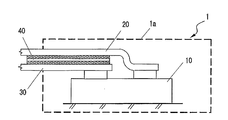
- FIG. 3 is a schematic plan view of a semiconductor device.
- FIG. 3 is a schematic side view of a semiconductor device.
- the schematic sectional drawing of the adhesive sheet concerning one embodiment.
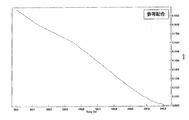
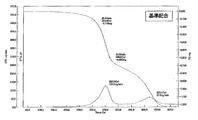
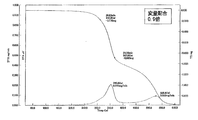
- cured material of a thermosetting adhesive (measurement curve in a reference compounding).
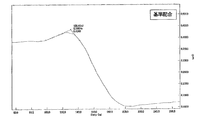
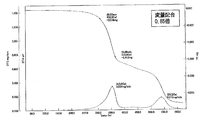
- cured material of a thermosetting adhesive (measurement curve in a standard combination).
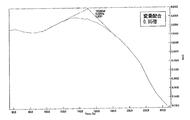
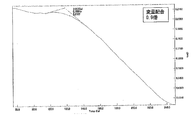
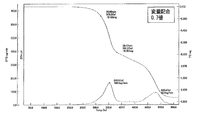
- cured material of a thermosetting adhesive (measurement curve in a variable amount mix (isocyanate content is 0.95 times of standard mix)).
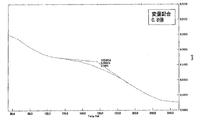
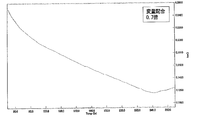
- thermosetting adhesive The figure which shows the result of having measured the dynamic viscoelastic spectrum of the hardened
- cured material of a thermosetting adhesive measured the dynamic viscoelastic spectrum of the hardened
- cured material of a thermosetting adhesive measured curve in reference formulation.
- cured material of a thermosetting adhesive measurement curve in a standard combination
- cured material of a thermosetting adhesive measured curve in variable amount formulation (isocyanate content is 0.9 times of standard formulation)
- cured material of a thermosetting adhesive (measurement curve in variable amount formulation (isocyanate content is 0.85 times of standard formulation)).
- cured material of a thermosetting adhesive (measurement curve in a variable amount mix (isocyanate content is 0.8 times of a standard mix)).
- cured material of a thermosetting adhesive measurement curve in a variable amount mix (isocyanate content is 0.75 times of standard mix)
- cured material of a thermosetting adhesive (measurement curve in variable amount formulation (isocyanate content is 0.7 times of standard formulation)).
- Embodiments of the present invention will be described with reference to specific examples.
- embodiments of the present invention will be described, taking as an example the case where an adhesive sheet is used in a semiconductor device such as an inverter or a converter. More specifically, an embodiment relating to an adhesive sheet will be described by taking as an example a case where it is used instead of an insulating paper used for insulating between terminals.
- FIG. 1 is a plan view of a semiconductor device 1 according to this embodiment
- FIG. 2 is a side view.
- the semiconductor device 1 according to the present embodiment has a semiconductor element 10 and a housing 1 a that houses the semiconductor element 10.
- the semiconductor device 1 further includes a positive electrode terminal 20 made of a metal plate electrically connected to the positive electrode of the semiconductor element 10 and a negative electrode terminal 30 made of a metal plate electrically connected to the negative electrode of the semiconductor element 10.
- the positive electrode terminal 20 and the negative electrode terminal 30 are arranged so that their surfaces are opposed to each other, and they are adhered by the adhesive sheet 40 in the present embodiment and electrically insulated by the adhesive sheet 40. That is, the adhesive sheet in the present embodiment is interposed between two members (the positive electrode terminal 20 and the negative electrode terminal 30) and is used to bond the members together.
- the adhesive sheet 40 in the present embodiment includes a first adhesive surface 40a that is adhered to the surface of one of the two terminals 20 and 30 (the positive electrode terminal 20) and an opposite surface of the first adhesive surface 40a. It has two bonding surfaces, that is, a second bonding surface 40b bonded to the surface of the other terminal (negative electrode terminal 30) of the two terminals 20 and 30.
- the adhesive sheet 40 in the present embodiment includes an adhesive layer having one or both surfaces serving as the adhesive surface.
- the adhesive sheet 40 of the present embodiment includes two adhesive layers each having an adhesive surface on one side.
- the adhesive sheet 40 in the present embodiment includes a base material layer 43 formed of a sheet-like base material at the center in the thickness direction, and is laminated on one surface side of the base material layer 43.
- Two adhesive layers, one adhesive layer 41 and a second adhesive layer 42 laminated on the other surface side of the base material layer 43, are provided.
- the first adhesive layer 41 constitutes the first adhesive surface 40a, and the surface opposite to the surface in contact with the base material layer 43 is the first adhesive surface 40a.
- the first adhesive layer 42 constitutes the second adhesive surface 40b, and the surface opposite to the surface in contact with the base material layer 43 is the second adhesive surface 40b.
- At least one of the first adhesive layer 41 and the second adhesive layer 42 has a foaming agent component together with an adhesive component having thermosetting property so that it becomes a foam that is thermoset by heating. It is formed of a thermosetting adhesive containing. In this embodiment, both the first adhesive layer 41 and the second adhesive layer 42 are formed of a thermosetting adhesive containing a foaming agent component.
- thermosetting adhesive of the present embodiment when measuring the dynamic viscoelastic spectrum of the cured product obtained by curing the thermosetting adhesive, a peak showing a softening temperature appears in a region of 200° C. or higher.
- the peak can be confirmed by a measurement curve of loss tangent (tan ⁇ : E′′/E′) showing the ratio of the loss elastic modulus (E′′) to the storage elastic modulus (E′), and the measurement temperature can be measured horizontally. It can be confirmed as an upwardly convex peak in the measurement curve with the loss tangent (tan ⁇ ) on the axis of ordinate.
- the softening temperature of the cured product obtained by curing the thermosetting adhesive is the first point on the lower side of 10 to 30° C.
- thermosetting adhesive does not show a peak in a region of 160° C. or lower when the dynamic viscoelastic spectrum of a cured product of the thermosetting adhesive is measured. Further, the thermosetting adhesive of the present embodiment does not have a peak even in the range above 160° C. and below the softening temperature. That is, the thermosetting adhesive of the present embodiment is at least room temperature (30° C.) to 200° C. when the dynamic viscoelastic spectrum is measured on the cured product obtained by curing the thermosetting adhesive. No peak appears until.
- the dynamic viscoelastic spectrum can be determined under the following conditions using a test piece prepared from a cured product of a thermosetting adhesive.
- a strip-shaped test piece cut out from a test sheet obtained by impregnating a glass cloth having a warp and a weft with a thickness of 100 ⁇ m with the thermosetting adhesive and curing the glass cloth is used. ..
- As the strip-shaped test piece a strip-shaped test piece with a width of about 3 mm cut out from the test sheet so that the warp and the weft make an angle of 45 degrees with respect to the longitudinal direction is adopted.
- Measurement mode tension Measurement frequency: 1 Hz Strain: 0.1% Distance between fulcrums: 20 mm Temperature rising rate: 5/min (30°C-260°C)
- the adhesive component in the thermosetting adhesive contains polyurethane, isocyanate, and epoxy forming an epoxy-modified polyurethane resin.
- the adhesive component further contains a phenoxy resin.
- the isocyanate is preferably a blocked isocyanate in which a part or all of the isocyanate group is blocked with a blocking agent from the viewpoint that the pot life of the thermosetting adhesive can be extended. Further, blocked isocyanate can be said to be suitable in that the blocking agent may bring an advantageous effect to the thermosetting adhesive as described later.
- all the isocyanates are the blocked isocyanates.
- the blocked isocyanate has a plurality of blocked isocyanate groups that become an isocyanate group by removing the blocking agent when heated.
- the polyurethane has a plurality of active hydrogens so that they can be connected via the blocked isocyanate. Specifically, the polyurethane has a plurality of hydroxyl groups in the molecule.
- the polyurethane has a functional group for chemically bonding with epoxy, and has a carboxyl group in the present embodiment.
- the polyurethane has a chain-like molecular structure, has the hydroxyl groups at both ends of the molecule, and has the carboxyl group at one or more positions between the hydroxyl groups.
- the epoxy has a plurality of epoxy groups in one molecule.
- thermosetting adhesive the polyurethane, the blocked isocyanate, and the epoxy are chemically bonded to each other by being heated to form an epoxy-modified polyurethane resin.
- thermosetting adhesive is provided on the main chain while the blocked isocyanate becomes polyisocyanate by heating to bond the polyurethanes to each other to form the main chain of the epoxy-modified polyurethane resin.
- the epoxy is grafted to form an epoxy-modified polyurethane resin by the reaction with the existing carboxyl group.
- the active hydrogen of the polyol and the isocyanate group of the polyisocyanate are mixed in an equimolar number.
- the blocked isocyanate group of the blocked isocyanate is in a state of being insufficient with respect to active hydrogen, and the number of moles of active hydrogen contained per unit mass is “ MAH (mol /G)”, the number “M CN (mol/g)” of blocked isocyanate groups contained per unit mass is 0.85 M AH or less.
- the phenoxy resin When the number of isocyanate groups during the reaction is insufficient with respect to active hydrogen, the phenoxy resin easily participates in the reaction. When the isocyanate group is sufficiently present during the reaction and the phenoxy resin is less likely to participate in the reaction, the effect of the phenoxy resin is likely to appear on the heat resistance of the cured product after curing. Although the phenoxy resin is excellent in toughness, it has a softening temperature of only about 100° C. and is insufficient in heat resistance as compared with an epoxy-modified polyurethane resin showing a softening temperature of 200° C. or higher.
- the adhesive sheet may come off from one of the terminals.
- the thermosetting adhesive of the present embodiment during the curing reaction of the epoxy-modified polyurethane resin, the phenoxy resin easily participates in the reaction and is firmly bound in the cured product. Therefore, in the present embodiment, the loosening due to the heating as described above hardly occurs.
- the number “M CN (mol/g)” of blocked isocyanate groups per unit mass in the thermosetting adhesive may be 0.80 M AH or less. More preferably, it is more preferably 0.77 M AH or less. However, if the isocyanate group is too short, it may take a long time for the curing reaction of the thermosetting adhesive or the cured product may not exhibit sufficient strength. From this viewpoint, the number of blocked isocyanate groups "M CN (mol / g)" is preferably at 0.6M AH or more, and more preferably 0.65 M AH above.
- the suitable amount of the blocked isocyanate can be accurately determined by measuring the dynamic viscoelastic spectrum.
- the blocked isocyanate has a general blending amount (for example, 0.9 M AH to 1.1 M AH )
- the dynamic viscoelastic spectrum of the cured product obtained by curing the thermosetting adhesive is measured to determine the phenoxy resin.
- a peak is observed at the softening temperature of. Therefore, a cured product of a few points (for example, 3 points of 0.7M AH , 0.75M AH , and 0.8M AH ) with a small amount of blocked isocyanate was prepared as a sample for measurement, and the dynamic viscoelasticity was measured for this sample.
- the spectrum may be measured, and the one having the highest blocked isocyanate content among those in which the peak derived from the softening temperature of the phenoxy resin did not appear may be determined as a suitable compounding amount.
- the adhesive component of such a thermosetting adhesive is exerted between the steel plates under all conditions.
- the shear adhesive strength at 0° C. is preferably 1.5 MPa or more, more preferably 15 MPa or more.
- the adhesive component has a shear adhesive strength at 200° C. exerted between the steel plates under all conditions when two steel plates are bonded under the following conditions (1) to (4).
- the pressure is preferably 0.8 MPa or more, more preferably 3.5 MPa or more.
- the polyurethane may be composed of a polyol having two or more hydroxyl groups in one molecule and a polyisocyanate having two or more isocyanate groups in one molecule.
- a carboxyl group can be introduced into the obtained polyurethane by using one having a carboxyl group in either the polyol or the polyisocyanate.
- the carboxyl group is preferably provided on the polyol side.
- the polyol having a carboxyl group for example, a hydroxycarboxylic acid having 5 to 20 carbon atoms is suitable, and as the hydroxycarboxylic acid, for example, 3,5-dihydroxybenzoic acid, 2,2-bis(hydroxymethyl)propionic acid , 2,2-bis(hydroxymethyl)butanoic acid, 2,2-bis(2-hydroxyethyl)propionic acid, 2,2-bis(3-hydroxypropyl)propionic acid, bis(hydroxymethyl)acetic acid, bis( 4-hydroxyphenyl)acetic acid, 2,2-bis(hydroxymethyl)butyric acid, 4,4-bis(4-hydroxyphenyl)pentanoic acid, tartaric acid, and N,N-dihydroxyethylglycine are among these.
- the polyol for introducing a carboxyl group into the polyurethane is preferably dimethylolpropanoic acid or dimethylolbutanoic acid, and particularly preferably dimethylolpropanoic acid.
- the polyurethane contains a polyol not containing a carboxyl group as its constituent unit in adjusting the proportion of the carboxyl group.
- polyols include general polyester polyols, polyether polyols, polycarbonate polyols, and other polyols.
- polyester polyol examples include polyethylene adipate diol, polybutylene adipate diol, polyhexamethylene adipate diol, polyneopentyl adipate diol, polyethylene/butylene adipate diol, polyneopentyl/hexyl adipate diol, poly-3-methylpentane adipate. Examples thereof include diol, polybutylene isophthalate diol, polycaprolactone diol, and poly-3-methylvalerolactone diol. Polyester polyols have higher heat resistance than polyether polyols. Therefore, the polyester polyol is more advantageous than the polyether polyol in obtaining the adhesive layer having excellent heat resistance.
- polyether polyol examples include polyethylene glycol, polypropylene glycol, polytetramethylene glycol, and random/block copolymers thereof.
- Polyether polyol is more excellent in hydrolysis resistance than polyester polyol. Therefore, the polyether polyol is more advantageous than the polyester polyol in obtaining an adhesive layer having excellent hydrolysis resistance.
- polycarbonate polyols include polytetramethylene carbonate diol, polypentamethylene carbonate diol, polyneopentyl carbonate diol, polyhexamethylene carbonate diol, poly(1,4-cyclohexane dimethylene carbonate) diol, and random/pure of these.
- a block copolymer etc. can be mentioned.
- Polycarbonate polyol is excellent in hydrolysis resistance and heat resistance, and therefore can be suitably used as the polyol.
- polyhexamethylene carbonate is preferred.
- polystyrene resin examples include dimer diol and hydrogenated products thereof, polybutadiene polyol and hydrogenated products thereof, and polyisoprene polyol and hydrogenated products thereof.
- a diol obtained from a hydrogenated product of a dimer diol or a hydrogenated product of a polybutadiene polyol is excellent in hydrolysis resistance and heat resistance as in the case of the polycarbonate diol, and therefore can be suitably used as a polyol.
- the polyol containing no carboxyl group can be used alone or in combination of two or more.
- the number average molecular weight of these polyols (Mn, by a terminal functional group quantification method) is not particularly limited, but is preferably 500 to 6,000. If the number average molecular weight (Mn) of the polyol is too large, the cohesive force of the urethane bond is difficult to develop and the mechanical properties of the epoxy-modified polyurethane resin tend to deteriorate.
- a short chain diol having a molecular weight of less than 500 may be adopted as the polyol.
- the short chain diol include ethylene glycol, 1,2-propylene glycol, 1,3-propylene glycol, 1,3-butylene glycol, 1,4-butylene glycol, 1,6-hexamethylene glycol, neopentyl.
- Aliphatic glycols such as glycols and their low molar adducts of alkylene oxides (number average molecular weight less than 500 by the end functional group quantitative method); 1,4-bishydroxymethylcyclohexane, 2-methyl-1,1-cyclohexanedimethanol, etc.
- Alicyclic glycols and low alkylene oxide low molar adducts (number average molecular weight less than 500, ibid.); Aromatic glycols such as xylylene glycol and their alkylene oxide low molar adducts (number average molecular weight less than 500, ibid.); Bisphenol A , Bisphenol such as thiobisphenol, sulfone bisphenol, and the like, and a low molar adduct of alkylene oxide (number average molecular weight less than 500, same as above).
- ethylene glycol, 1,3-propylene glycol, 1,3-butylene glycol, 1,4-butylene glycol, 1,6-hexamethylene glycol, neopentyl glycol and the like are preferable, and particularly preferable are They are ethylene glycol, 1,3-butylene glycol and 1,4-butylene glycol.
- These short chain diols may be used alone or in combination of two or more.
- the polyol may contain a polyhydric alcohol compound, if necessary.
- polyhydric alcohol compounds include, for example, glycerin, trimethylolethane, trimethylolpropane, pentaerythritol, tris-(2-hydroxyethyl)isocyanurate, 1,1,1-trimethylolethane, 1,1. , 1-trimethylolpropane and the like.
- polyisocyanate that constitutes polyurethane with these polyols
- conventionally known polyisocyanates can be used.
- Specific examples of the polyisocyanate include toluene-2,4-diisocyanate, toluene-2,6-diisocyanate, a mixture thereof, 4-methoxy-1,3-phenylene diisocyanate, 4-isopropyl-1,3-phenylene diisocyanate.
- Aromatic diisocyanates such as dullylene diisocyanate, xylylene diisocyanate (XDI), 1,5-naphthalene diisocyanate, benzidine diisocyanate, o-nitrobenzidine diisocyanate, 4,4′-diisocyanate dibenzyl; methylene diisocyanate, 1,4-tetramethylene Aliphatic diisocyanates such as diisocyanate, 1,6-hexamethylene diisocyanate, 1,10-decamethylene diisocyanate; 1,4-cyclohexylene diisocyanate, 4,4′-methylene bis(cyclohexyl isocyanate), 1,5-
- the polyisocyanate is preferably an aromatic isocyanate from the viewpoint of obtaining an adhesive that is industrially stable, inexpensive, and excellent in heat resistance.
- Particularly preferred polyisocyanates are toluene-2,4-diisocyanate, toluene-2,6-diisocyanate, mixtures thereof, 4,4′-methylenebis(phenylene isocyanate) (MDI), and crude or polymeric MDI. .. These polyisocyanates can be used alone or in combination of two or more.
- the polyurethane composed of the polyisocyanate and the polyol preferably contains a carboxyl group so as to exhibit a predetermined acid value.
- the polyurethane preferably has an acid value of 5 to 30 mgKOH/g, more preferably 9 to 25 mgKOH/g.
- the acid value of polyurethane can be measured according to the method described in JIS K1557-5:2007 by dissolving polyurethane in solution with methyl ethyl ketone (MEK) or the like.
- epoxy that constitutes the epoxy-modified urethane resin together with the polyurethane
- general epoxy can be used alone or in combination of two or more.
- the epoxy include novolac type epoxy such as phenol novolac type epoxy and cresol novolac type epoxy; and bisphenol type epoxy such as bisphenol A type epoxy and bisphenol F type epoxy.
- the blocking agent is not particularly limited as long as it is a blocking agent that is dissociated from an isocyanate group by heating, and the blocking agent may be used alone or in combination of two or more.
- the blocking agent include oxime compounds, alcohol compounds, phenol compounds, active methylene compounds, amine compounds, imine compounds, carbamic acid compounds, urea compounds, acid amide compounds (lactam compounds). Examples thereof include acid imide compounds, triazole compounds, pyrazole compounds, imidazole compounds, imidazoline compounds, mercaptan compounds and bisulfites.
- oxime compound examples include formaldoxime, acetoaldoxime, acetoxime, methyl ethyl ketone oxime, cyclohexanone oxime, diacetyl monooxime, benzopheno oxime, 2,2,6,6-tetramethylcyclohexanone oxime, diisopropyl ketone.
- Oxime methyl t-butyl ketone oxime, diisobutyl ketone oxime, methyl isobutyl ketone oxime, methyl isopropyl ketone oxime, methyl 2,4-dimethylpentyl ketone oxime, methyl 3-ethylheptyl ketone oxime, methyl isoamyl ketone oxime, n-amyl Examples thereof include ketone oxime, 2,2,4,4-tetramethyl-1,3-cyclobutanedione monooxime, 4,4′-dimethoxybenzophenone oxime and 2-heptanone oxime.
- Examples of the alcohol compound include methanol, ethanol, 2-propanol, n-butanol, s-butanol, 2-ethylhexyl alcohol, 1- or 2-octanol, cyclohexyl alcohol, ethylene glycol, benzyl alcohol, 2, 2,2-trifluoroethanol, 2,2,2-trichloroethanol, 2-(hydroxymethyl)furan, 2-methoxyethanol, methoxypropanol, 2-ethoxyethanol, n-propoxyethanol, 2-butoxyethanol, 2- Ethoxyethoxyethanol, 2-ethoxybutoxyethanol, butoxyethoxyethanol, 2-ethylhexyloxyethanol, 2-butoxyethylethanol, 2-butoxyethoxyethanol, N,N-dibutyl-2-hydroxyacetamide, N-hydroxysuccinimide, N- Morpholine ethanol, 2,2-dimethyl-1,3-dioxolane-4-methanol, 3-oxazolidineethanol, 2-hydroxymethylpyridine,
- phenol compound examples include phenol, cresol, ethylphenol, n-propylphenol, isopropylphenol, n-butylphenol, s-butylphenol, t-butylphenol, n-hexylphenol, 2-ethylhexylphenol, n-octylphenol, n-nonylphenol, di-n-propylphenol, diisopropylphenol, isopropylcresol, di-n-butylphenol, di-s-butylphenol, di-t-butylphenol, di-n-octylphenol, di-2-ethylhexylphenol, di- n-nonylphenol, nitrophenol, bromophenol, chlorophenol, fluorophenol, dimethylphenol, styrenated phenol, methyl salicylate, methyl 4-hydroxybenzoate, benzyl 4-hydroxybenzoate, 2-ethylhexyl hydroxybenzoate,
- Examples of the active methylene compound include Meldrum's acid, dialkyl malonate (eg, dimethyl malonate, diethyl malonate, di-n-butyl malonate, di-t-butyl malonate, di2-ethylhexyl malonate, malon).
- dialkyl malonate eg, dimethyl malonate, diethyl malonate, di-n-butyl malonate, di-t-butyl malonate, di2-ethylhexyl malonate, malon.
- amine compounds examples include dibutylamine, diphenylamine, aniline, N-methylaniline, carbazole, bis(2,2,6,6-tetramethylpiperidinyl)amine, di-n-propylamine, diisopropylamine.
- imine compound examples include ethyleneimine, polyethyleneimine, 1,4,5,6-tetrahydropyrimidine and guanidine.
- Examples of the carbamic acid compound include phenyl N-phenylcarbamate.
- urea compound examples include urea, thiourea, ethylene urea and the like.
- acid amide (lactam) compound examples include acetanilide, N-methylacetamide, acetic acid amide, ⁇ -caprolactam, ⁇ -valerolactam, ⁇ -butyrolactam, pyrrolidone, 2,5-piperazinedione and laurolactam. Can be mentioned.
- Examples of the acid imide-based compound include succinimide, maleic acid imide, and phthalimide.
- triazole compound examples include 1,2,4-triazole and benzotriazole.
- pyrazole-based compound examples include pyrazole, 3,5-dimethylpyrazole, 3-methylpyrazole, 4-benzyl-3,5-dimethylpyrazole, 4-nitro-3,5-dimethylpyrazole, 4-bromo-3 , 5-dimethylpyrazole, 3-methyl-5-phenylpyrazole and the like.
- imidazole compound examples include imidazole, benzimidazole, 2-methylimidazole, 4-methylimidazole, 2-ethylimidazole, 2-isopropylimidazole, 2,4-dimethylimidazole, 2-ethyl-4-methylimidazole, Examples thereof include 2-phenylimidazole and 4-methyl-2-phenylimidazole.
- imidazoline compound examples include 2-methylimidazoline and 2-phenylimidazoline.
- Examples of the mercaptan compound include butyl mercaptan, dodecyl mercaptan, and hexyl mercaptan.
- Examples of the bisulfite include sodium bisulfite and the like.
- the blocking agent may be, for example, benzoxazolone, isatoic anhydride, tetrabutylphosphonium acetate, phenol, alcohol, oxime, lactam or the like.
- the blocking agent is preferably a phenol compound or an oxime compound.
- the blocking agent is selected in accordance with the storage temperature and thermosetting temperature of the thermosetting adhesive to be mixed, according to the desorption temperature of the blocking agent.
- Phenol compounds and oxime compounds which have a high storage stability at room temperature of the thermosetting adhesive and can be thermoset at low temperature by removing the blocking agent at low temperature, are preferable.
- the oxime compound is particularly desirable because it exhibits good wettability to the adherend (in the present embodiment, the positive electrode terminal 20 and the negative electrode terminal 30) and exhibits good penetrability into the details.
- a typical example of the oxime compound is methyl ethyl ketone oxime.
- the phenoxy resin which constitutes the adhesive component of the thermosetting adhesive together with the epoxy-modified urethane resin composed of the blocked isocyanate, the polyurethane and the epoxy, is good for the cured product of the thermosetting adhesive.
- a soft material having a low softening point to some extent is suitable.
- the phenoxy resin preferably has a softening temperature of 50° C. or higher and 90° C. or lower.
- the softening temperature of the phenoxy resin is determined by the ring and ball method of JIS K 7234 "Testing method for softening point of epoxy resin":1986.
- thermosetting adhesive of the present embodiment, the effect of such a phenoxy resin can be made difficult to manifest in the cured product, so that the characteristics relating to the toughness of the phenoxy resin and the heat resistance of the epoxy-modified polyurethane resin are compatible. Becomes
- the phenoxy resin may have an epoxy group.
- the phenoxy resin is preferably a bisphenol A type phenoxy resin having a predetermined epoxy equivalent.
- the epoxy equivalent of the phenoxy resin is more preferably 7,000 g/eq or more.
- the epoxy equivalent of the phenoxy resin is usually 30,000 g/eq or less.
- the epoxy equivalent can be determined by the method described in JIS K7236:2001.
- the thermosetting adhesive preferably contains the epoxy in an amount of 5 parts by mass or more and 40 parts by mass or less based on 100 parts by mass of the polyurethane.
- the thermosetting adhesive preferably contains 15 parts by mass or more and 60 parts by mass or less of the phenoxy resin with respect to 100 parts by mass of the polyurethane.
- the content of the epoxy is more preferably 10 parts by mass or more and even more preferably 15 parts by mass or more with respect to 100 parts by mass of the polyurethane.
- the content of the epoxy is more preferably 30 parts by mass or less, and further preferably 25 parts by mass or less with respect to 100 parts by mass of the polyurethane.
- the content of the phenoxy resin is more preferably 20 parts by mass or more and even more preferably 25 parts by mass or more with respect to 100 parts by mass of the polyurethane.
- the content of the phenoxy resin is more preferably 45 parts by mass or less and even more preferably 40 parts by mass or less with respect to 100 parts by mass of the polyurethane.
- the thermosetting adhesive preferably contains the blocked isocyanate in a ratio of 2 parts by mass or more and 10 parts by mass or less. ..
- the adhesive component of the thermosetting adhesive may contain a filler together with the epoxy-modified polyurethane resin or the like so that the thermosetting adhesive exhibits excellent cohesive force.
- the filler include short fibers and particles made of organic substances and inorganic substances.
- particles (inorganic substance filler) made of an inorganic substance such as silica, alumina, calcium carbonate, talc, and clay are suitable as a filler to be contained in the thermosetting adhesive.
- the adhesive component of the thermosetting adhesive preferably contains an inorganic filler having an average particle size of 0.5 ⁇ m or more and 2 ⁇ m or less together with the epoxy modified polyurethane resin and the like.
- the average particle diameter of the inorganic filler can be usually obtained as a median value (D50) in a volume-based cumulative particle size distribution curve measured by a laser diffraction scattering method.
- the content of the filler in the thermosetting adhesive can be, for example, 10 parts by mass or more and 60 parts by mass or less, and 15 parts by mass or more and 55 parts by mass or less with respect to 100 parts by mass of the epoxy-modified polyurethane resin. It is preferable that the amount is 20 parts by mass or more and 50 parts by mass or less.
- the first adhesive layer 41 and the second adhesive layer 42 have excellent resistance even if they contain an inorganic filler. It can exhibit abrasion resistance.
- abrasion powder is generated when the scrape abrasion according to ISO6722 is reciprocated three times for at least one of the first adhesive layer 41 and the second adhesive layer 42. Is preferably not seen.
- abrasion powder is not generated at least until the scraper makes three reciprocations. Is preferred.
- the scrape abrasion can be carried out, for example, by using a testing machine manufactured by TVAB (model name: 5420-7N).
- the adhesive sheet 40 is attached to the outer peripheral surface of the metal rod having a diameter of 5 mm so that the first adhesive layer 41 or the second adhesive layer 42 (the side for evaluating the abrasion resistance) is the outer surface side.
- the attached one can be used as a test body.
- a scraper equipped with a piano wire having a diameter of 0.45 mm was used, and the scraper was brought into contact with the test body so that the piano wire was orthogonal to the metal rod, and the scraper was moved in the length direction of the metal rod.
- the thermosetting adhesive has excellent bending elasticity in consideration of the fact that the adhesive sheet can be interposed not only in the flat space but also in the bent space.
- the thermosetting adhesive can exhibit excellent bending elasticity with respect to the first adhesive layer 41 and the second adhesive layer 42.
- the first adhesive surface 40a even if the first adhesive surface 40a is folded at 90 degrees at room temperature (30° C.) so that the second adhesive surface 40b becomes a mountain fold and the second adhesive surface 40b becomes a mountain fold, the first adhesive surface 40a It is preferable that the thermosetting adhesive does not peel off from the base material layer 43 even if 90-degree bending is performed so that the surface 40a becomes a mountain fold and the second adhesive surface 40b becomes a valley fold.
- the adhesive sheet 40 of the present embodiment is heat-cured even if the first adhesive surface 40a is folded inside (folded 180 degrees) or the second adhesive surface 40b is folded inside (folded 180 degrees). It is further preferred that no peeling of the adhesive is observed.
- the thermosetting adhesive contains an inorganic filler
- silane is used as the additive. It is preferable to include a coupling agent.
- the silane coupling agent is preferably one having an alkoxysilane at one molecular end and an epoxy group at the other molecular end, specifically, 2-(3,4-epoxycyclohexyl)ethyltrimethoxy.
- Silane, 3-glycidoxypropylmethyldimethoxysilane, 3-glycidoxypropyltrimethoxysilane, 3-glycidoxypropylmethyldiethoxysilane, 3-glycidoxypropyltriethoxysilane and the like are preferable.
- the silane coupling agent can be contained in the thermosetting adhesive at a ratio of 5 parts by mass or more and 20 parts by mass or less, when the content of the inorganic filler is 100 parts by mass.
- additives examples include antioxidants (hindered phenol-based, phosphite-based, thioether-based, etc.) and light stabilizers (hindered amine-based). Etc.), ultraviolet absorbers (benzophenone-based, benzotriazole-based, etc.), gas discoloration stabilizers (hydrazine-based, etc.), metal deactivators and the like. These additives can be used alone or in combination of two or more.
- the foaming agent component contained in the thermosetting adhesive is, for example, a chemical foaming foaming agent that reacts with heat to generate a gas, or a physical foaming system such as a microcapsule containing a physical foaming agent.
- the chemical foaming agents include inorganic foaming agents such as sodium bicarbonate, sodium carbonate, ammonium bicarbonate, ammonium carbonate and ammonium nitrite, azodicarbonamide (ADCA), N,N′-dinitrosopentamethylene.
- Examples include organic foaming agents such as tetramine, benzenesulfonyl hydrazide, and 4,4′-diphenyldisulfonyl azide.
- the physical foaming agent is a type in which a physical foaming agent such as n-pentane, isopentane, isobutane, a hydrocarbon such as petroleum ether, or a halide thereof is enclosed in a capsule made of various thermoplastic resins. Can be mentioned.
- the heat-expandable microcapsules enclosing a physical foaming agent are preferable because the foaming start temperature can be easily controlled.
- foaming agents can be used alone or in combination of two or more.
- the foaming agent component it is preferable to employ the thermally expandable microcapsules.
- the thermosetting adhesive of the present embodiment contains at least two types of heat-expandable microcapsules having different foaming initiation temperatures. In the expansion by the heat-expandable microcapsules, there is a tendency of once expanding to the maximum volume and then slightly contracting. However, by containing at least two kinds of heat-expandable microcapsules, the contraction can be suppressed. it can. Further, the inclusion of two types of heat-expandable microcapsules is effective in suppressing that the foaming state of the adhesive layer greatly differs due to the difference in heating conditions.
- the foaming start temperature of the foaming agent is preferably 60° C. or higher and 170° C. or lower, and more preferably 80° C. or higher and 160° C. or lower.
- the content of the foaming agent in the thermosetting adhesive can be, for example, 8 parts by mass or more and 60 parts by mass or less, and 10 parts by mass or more and 55 parts by mass or less with respect to 100 parts by mass of the adhesive component.
- the amount is preferably 20 parts by mass or more and 45 parts by mass or less.
- the first adhesive layer 41 and the second adhesive layer 42 may be made of the same thermosetting adhesive or different thermosetting adhesives.
- the first adhesive layer 41 and the second adhesive layer 42 may have the same thickness or different thicknesses.
- the thickness of each of the first adhesive layer 41 and the second adhesive layer 42 is usually 5 ⁇ m or more and 100 ⁇ m or less, preferably 10 ⁇ m or more and 80 ⁇ m or less, and more preferably 20 ⁇ m or more and 70 ⁇ m or less. ..
- the adhesive sheet 40 of the present embodiment has a smaller thickness before expansion due to the foaming agent component than the shortest distance from the surface of the positive electrode terminal 20 to the surface of the negative electrode terminal 30 (hereinafter, also referred to as “terminal gap”), and The first adhesive layer 41 and the second adhesive layer 42 expand in the thickness direction by being heated in a state of being interposed between the first adhesive surface 40a and the second adhesive surface 40b.
- the terminal 20 and the negative electrode terminal 30 are configured to be thermally bonded.
- At least one of the first adhesive layer 41 and the second adhesive layer 42 has a thickness when heat-treated at a temperature of 200° C. for 100 hours in a state after foaming and thermosetting.
- the thickness reduction rate is preferably 1% or less, and more preferably the thickness reduction rate of both the first adhesive layer 41 and the second adhesive layer 42 is 1% or less.
- the thermosetting adhesive that constitutes the adhesive layer of at least one of the first adhesive layer 41 and the second adhesive layer 42 is composed of two steel plates with components excluding the foaming agent component as described above.
- the shear adhesive strength at 200° C. exerted between the steel sheets when bonded in a non-foaming state is preferably 3.5 MPa or more.
- the shear adhesive strength at 200° C. of only the adhesive component excluding the foaming agent component is more preferably 4.0 MPa or more, and particularly preferably 4.5 MPa or more.
- the shear adhesive strength is usually 50 MPa or less.
- the thermosetting adhesive exhibiting such shear adhesive strength is preferably used as a constituent material for both the first adhesive layer 41 and the second adhesive layer 42.
- the shear adhesive strength can be measured by a tensile tester equipped with a constant temperature bath, and can be measured at a tensile speed of 5 mm/min.
- a test piece for measuring the shear adhesive strength at 200°C is manufactured as follows. First, a sheet of 10 mm ⁇ 15 mm prepared by using only an adhesive component excluding the foaming agent component, while preparing two strip-shaped metal pieces of 15 mm width ⁇ 100 mm length ⁇ 1.0 mm thickness made of SPC steel plate. A piece (thickness, about 50 ⁇ m) is prepared.
- the two strip-shaped metal pieces are vertically overlapped so that their contours are aligned, and from this state, the two strip-shaped metal pieces are relatively moved in the longitudinal direction to reduce the overlapping area, and the length of the overlapping area is 10 mm. Then, fix the positions of the strip-shaped metal pieces.
- a sheet piece made of an adhesive component is sandwiched in an area where the two strip-shaped metal pieces are overlapped with each other, and hot pressing is performed to bond the two strip-shaped metal pieces with the sheet piece. Use as a test piece for tensile test. At this time, the sheet piece is in a sufficiently thermoset state (for example, heated at 150° C. for 15 minutes or more).
- the test piece is housed in a thermostatic chamber set at 200° C., and the strip-shaped metal pieces are sandwiched by the upper and lower chucks of the tensile tester arranged in the thermostatic chamber. In this state, wait for the test piece to reach a temperature of 200° C., then perform a tensile test, and divide the maximum load (N) measured by the tensile test by the adhesive area (150 mm 2 ) to obtain the shear adhesive force. ..
- the shear adhesive force is usually obtained as an arithmetic mean value obtained by measuring a plurality (for example, 5) of test pieces.
- thermosetting adhesive can exhibit excellent shear adhesive strength even when it is foamed by the foaming agent component because the adhesive component exhibits excellent shear adhesive strength as described above.
- the base material layer 43 which serves as a support for the first adhesive layer 41 and the second adhesive layer 42 in exhibiting excellent heat resistance of the adhesive sheet 40, is a heat-resistant resin film or heat-resistant resin fiber. It is preferably formed by a sheet or a composite sheet of these.
- the adhesive sheet 40 of the present embodiment is preferably formed of a composite sheet having a laminated structure as shown in FIG. 3 in order to allow the adhesive sheet 40 to exhibit excellent heat resistance and electrical insulation. More specifically, the base material layer 43 in the present embodiment has a five-layer structure in which a heat-resistant resin fiber sheet 432 is bonded to both surfaces of a heat-resistant resin film 431 via an adhesive layer 433. It has become a thing.
- the heat resistant resin film 431 is preferably, for example, a polyethylene naphthalate resin film or a polyimide resin film having a thickness of 10 ⁇ m to 100 ⁇ m.
- the heat resistant resin fiber sheet 432 is preferably, for example, an aromatic polyamide fiber sheet or a polyether sulfone fiber sheet having a thickness of 10 ⁇ m to 100 ⁇ m.
- the heat-resistant resin fiber sheet 432 is preferably an aromatic polyamide fiber sheet called aramid paper.
- the adhesive layer 433 can be made of, for example, an acrylic adhesive having excellent heat resistance.
- the adhesive layer 433 may be composed of a component obtained by removing the foaming agent from the thermosetting adhesive forming the first adhesive layer 41 and the second adhesive layer 42, if necessary.
- the base material layer 43 preferably has a total thickness of 50 ⁇ m to 200 ⁇ m.
- the total thickness of the adhesive sheet 40 including the base material layer 43 and the adhesive layers (41, 42) is preferably 100 ⁇ m to 250 ⁇ m.
- the adhesive sheet 40 has a volume resistivity determined by JIS K6911 of preferably 1 ⁇ 10 12 ⁇ cm or more, more preferably 1 ⁇ 10 13 ⁇ cm or more.
- the volume resistivity of the adhesive sheet 40 is usually 1 ⁇ 10 17 ⁇ cm or less.
- the adhesive sheet 40 preferably has an insulation breakdown voltage of AC2 kVrms or more, and more preferably AC3 kVrms or more, which is obtained by JIS C2110-1 (short-time (rapid pressure rising) test).
- the dielectric breakdown voltage of the adhesive sheet 40 is usually AC 20 kVrms or less.
- the adhesive sheet 40 of the present embodiment exhibits a function of bonding the positive electrode terminal 20 and the negative electrode terminal 30 by being interposed between the positive electrode terminal 20 and the negative electrode terminal 30 and then heated.
- the adhesive sheet 40 of the present embodiment can more reliably exhibit the above functions.
- the average distance between the positive electrode terminal 20 and the negative electrode terminal 30, which is more preferable when the adhesive sheet 40 of the present embodiment is used, is 300 ⁇ m or more and 500 ⁇ m or less.
- the average distance between the positive electrode terminal 20 and the negative electrode terminal 30 is obtained by measuring the distance from the surface of the positive electrode terminal 20 to the surface of the negative electrode terminal 30 at at least 10 locations where the adhesive sheet 40 is interposed. It can be obtained by arithmetically averaging the measured values.
- a positive electrode terminal 20, an adhesive sheet 40, and a negative electrode terminal 30 set in a predetermined state are prepared, and the temperature is equal to or higher than the foaming start temperature of the foaming agent (for example, It may be heated in an oven set to a temperature of 180° C. or higher) for a certain period of time.
- the adhesive sheet 40 of the present embodiment since the first adhesive layer 41 and the second adhesive layer 42 undergo volume expansion, the positive electrode terminal 20 and the negative electrode terminal 30 can be bonded with high adhesive force. ..
- the adhesive sheet 40 of the present embodiment after the first adhesive layer 41 and the second adhesive layer 42 are foamed by the foaming agent and volume-expanded, the adhesive layers are bonded even in a high temperature environment (for example, 200° C.). The force is not likely to decrease, and the thickness of these adhesive layers does not easily decrease due to shrinkage or the like even when exposed to a high temperature environment for a long time (for example, 100 hours). A good adhesive state can be continuously exerted for a long period of time.
- the adhesive sheet 40 of the present embodiment exhibits excellent shear adhesive strength even in a high temperature environment (for example, 200° C.) after the first adhesive layer 41 and the second adhesive layer 42 are foamed by the foaming agent. Therefore, it is possible to prevent the good adhesion between the positive electrode terminal 20 and the negative electrode terminal 30 from being accidentally released.
- the adhesive sheet 40 of the present embodiment has the first adhesive layer 41 and the second adhesive layer 42 having excellent wear resistance and bending elasticity, and therefore, when the adhesive sheet 40 is inserted into a bent portion, “Peeling” and “scraping” are unlikely to occur in the first adhesive layer 41 and the second adhesive layer 42. That is, the adhesive sheet 40 of the present embodiment is unlikely to cause the problem that the powder of the thermosetting adhesive is generated and adheres to a place other than the necessary place. Therefore, it is suitable not only for bonding the terminals of the semiconductor device 1 but also for various purposes.
- the adhesive sheet 40 Since the adhesive sheet 40 has excellent electrical insulation properties, it can be used, for example, in a place where space insulation is provided in a semiconductor device such as an inverter or a converter. When the printed circuit board is fixed by providing a gap for spatial insulation between the adhesive sheet 40 and the inner wall surface of the metal housing of the semiconductor device, the adhesive sheet 40 is adhered to the housing. -Useful for fixing. Further, when the semiconductor device has a power unit including a power element in the housing, the adhesive sheet 40 can be effectively used for bonding the power unit and the housing.
- the adhesive sheet 40 is excellent in electrical insulation, for example, a metal plate for electromagnetic shielding is arranged between a power element whose inverter turns the power on and off and a control board which controls the on/off of the power element. , So that an induced potential is generated in the metal plate due to noise generated by the power element, and when the induced potential exceeds a specified value, the metal plate can be discharged into a metal housing and guided to the ground through the housing. When configured, it may be used instead of an insulator interposed between the metal plate and the housing to keep the discharge distance constant.
- the adhesive sheet 40 can be bonded to each other by utilizing the expansion force, and can firmly fix the metal plate and the housing.
- the adhesive sheet 40 can exhibit excellent adhesiveness even under high temperature conditions, and can firmly fix the metal plate and the housing.
- a fastener such as a screw for fixing the members to each other, so that it is possible to increase the effective space in the housing.
- the adhesive sheet of the present invention can be used for various purposes.
- the adhesive sheet 40 including the base material layer 43 having a laminated structure is shown as an example for ensuring reliable insulation reliability between the positive electrode terminal 20 and the negative electrode terminal 30, but the base material is Layer 43 may be of unitary construction.
- the adhesive sheet 40 having a laminated structure is exemplified as a suitable mode of the adhesive sheet, but the adhesive sheet of the present invention has a single layer structure formed by a thermosetting adhesive. May be
- the adhesive sheet of the present invention is not limited to the above examples.
- thermosetting adhesive and the adhesive sheet according to this embodiment are configured as described above, they have the following advantages.
- the present invention is a thermosetting adhesive containing an adhesive component, and the dynamic viscoelastic spectrum of a cured product obtained by curing the thermosetting adhesive has a peak showing a softening temperature in a region of 200° C. or higher. And has no peak in the region of 160° C. or lower, and the adhesive component contains polyurethane, isocyanate, and epoxy constituting the epoxy-modified polyurethane resin, and the adhesive component is Further provided is a thermosetting adhesive containing a phenoxy resin.
- the present invention comprises a base material layer composed of a sheet-shaped base material, and an adhesive layer composed of a thermosetting adhesive as described above, wherein the one or both sides of the base material layer are Provided is an adhesive sheet on which an adhesive layer is laminated.
- thermosetting adhesive having both the heat resistance of an epoxy-modified polyurethane resin and the toughness of a phenoxy resin is provided, and by extension, an adhesive sheet in which cracks or the like hardly occur in the adhesive layer is provided. obtain.
- thermosetting adhesive and the adhesive sheet according to the present invention are not limited to the above embodiment. Further, the thermosetting adhesive and the adhesive sheet according to the present invention are not limited by the above-mentioned effects. The thermosetting adhesive and the adhesive sheet according to the present invention can be variously modified without departing from the scope of the present invention.
- thermosetting adhesive As a thermosetting adhesive of standard formulation, (A) Polyurethane obtained by reacting a plurality of polyols containing 2,2-bis(hydroxymethyl)propionic acid (DMPA) with 4,4′-methylenebis(phenylene isocyanate) (MDI), and (b) bisphenol epoxy And (c) a mixture of isocyanate (toluene-2,4-diisocyanate, toluene-2,6-diisocyanate, and 4,4′-methylenebis(phenylene isocyanate)), and (d) a phenoxy resin.
- DMPA 2,2-bis(hydroxymethyl)propionic acid
- MDI 4,4′-methylenebis(phenylene isocyanate)
- MDI 4,4′-methylenebis(phenylene isocyanate)
- a mixture of isocyanate toluene-2,4-diisocyanate, toluene-2,6-diisocyanate, and 4,4′
- thermosetting adhesive containing no phenoxy resin was prepared. That is, a thermosetting adhesive was prepared with a reference composition composed only of the above (a) to (c).
- thermosetting adhesive was prepared in a variable composition in which only (c) isocyanate was reduced relative to the standard composition. Specifically, the amount of (c) isocyanate is gradually increased to 0.95 times, 0.9 times, 0.85 times, 0.80 times, 0.75 times, 0.7 times with respect to the standard composition. I prepared the one reduced to.
- thermogravimetric differential thermal analysis shows the measurement results of the dynamic viscoelastic spectrum (temperature-loss tangent) and the thermogravimetric differential thermal analysis (TG/DTA).
- TG/DTA thermogravimetric differential thermal analysis
- the present invention can provide a thermosetting adhesive having both the heat resistance of an epoxy-modified polyurethane resin and the toughness of a phenoxy resin.
- 10 semiconductor element
- 20 positive electrode terminal
- 30 negative electrode terminal
- 40 adhesive sheet
- 40a first adhesive surface
- 40b second adhesive surface
- 41 first adhesive layer
- 42 second adhesive layer
- 43 Base material layer.
Landscapes
- Chemical & Material Sciences (AREA)
- Organic Chemistry (AREA)
- Chemical Kinetics & Catalysis (AREA)
- Health & Medical Sciences (AREA)
- Medicinal Chemistry (AREA)
- Polymers & Plastics (AREA)
- Inorganic Chemistry (AREA)
- Adhesives Or Adhesive Processes (AREA)
- Adhesive Tapes (AREA)
Abstract
La présente invention concerne un adhésif thermodurcissable comprenant un polyuréthane, un isocyanate, un époxy, et une résine phénoxy, le spectre de viscoélasticité dynamique d'un produit durci ayant un pic montrant la température de ramollissement située dans une plage de 200 °C ou plus et ne présente pas de pic dans une région de 160 °C ou moins.
Priority Applications (4)
| Application Number | Priority Date | Filing Date | Title |
|---|---|---|---|
| KR1020217024401A KR102721048B1 (ko) | 2019-02-05 | 2020-02-04 | 열경화성 접착제 및 접착 시트 |
| EP20752910.8A EP3922691A4 (fr) | 2019-02-05 | 2020-02-04 | Adhésif thermodurcissable et feuille adhésive |
| US17/426,072 US12134714B2 (en) | 2019-02-05 | 2020-02-04 | Thermosetting adhesive and adhesive sheet |
| CN202080011812.XA CN113412313A (zh) | 2019-02-05 | 2020-02-04 | 热固性粘接剂和粘接片 |
Applications Claiming Priority (2)
| Application Number | Priority Date | Filing Date | Title |
|---|---|---|---|
| JP2019018648A JP7256022B2 (ja) | 2019-02-05 | 2019-02-05 | 熱硬化性接着剤、及び、接着シート |
| JP2019-018648 | 2019-02-05 |
Publications (1)
| Publication Number | Publication Date |
|---|---|
| WO2020162434A1 true WO2020162434A1 (fr) | 2020-08-13 |
Family
ID=71947729
Family Applications (1)
| Application Number | Title | Priority Date | Filing Date |
|---|---|---|---|
| PCT/JP2020/004058 Ceased WO2020162434A1 (fr) | 2019-02-05 | 2020-02-04 | Adhésif thermodurcissable et feuille adhésive |
Country Status (6)
| Country | Link |
|---|---|
| US (1) | US12134714B2 (fr) |
| EP (1) | EP3922691A4 (fr) |
| JP (1) | JP7256022B2 (fr) |
| KR (1) | KR102721048B1 (fr) |
| CN (1) | CN113412313A (fr) |
| WO (1) | WO2020162434A1 (fr) |
Families Citing this family (3)
| Publication number | Priority date | Publication date | Assignee | Title |
|---|---|---|---|---|
| JP7756485B2 (ja) * | 2020-03-25 | 2025-10-20 | 大日本印刷株式会社 | 発泡性接着シートおよび物品の製造方法 |
| JP7231129B2 (ja) * | 2020-12-15 | 2023-03-01 | Dic株式会社 | 接着シート、並びに物品及び物品の製造方法 |
| JP7709189B2 (ja) * | 2021-05-20 | 2025-07-16 | ニッカン工業株式会社 | 加熱膨張シート |
Citations (4)
| Publication number | Priority date | Publication date | Assignee | Title |
|---|---|---|---|---|
| WO2012173242A1 (fr) * | 2011-06-17 | 2012-12-20 | 太陽インキ製造株式会社 | Composition de résine photodurcissable/thermodurcissable |
| JP2013076031A (ja) | 2011-09-30 | 2013-04-25 | Sekisui Chem Co Ltd | 接着剥離シート |
| JP2013229277A (ja) * | 2012-03-31 | 2013-11-07 | Aica Kogyo Co Ltd | 導電性接着フィルム |
| JP2015081329A (ja) * | 2013-10-24 | 2015-04-27 | Dic株式会社 | ウレタン変性エポキシ樹脂、硬化性組成物、その硬化物、繊維強化複合材料、及び繊維強化樹脂成型品 |
Family Cites Families (12)
| Publication number | Priority date | Publication date | Assignee | Title |
|---|---|---|---|---|
| US6846559B2 (en) * | 2002-04-01 | 2005-01-25 | L&L Products, Inc. | Activatable material |
| US7125461B2 (en) * | 2003-05-07 | 2006-10-24 | L & L Products, Inc. | Activatable material for sealing, baffling or reinforcing and method of forming same |
| JP2008144141A (ja) * | 2006-11-15 | 2008-06-26 | Shin Etsu Chem Co Ltd | 接着シート |
| JP5104411B2 (ja) | 2007-03-07 | 2012-12-19 | Dic株式会社 | 熱硬化性ポリウレタン樹脂組成物 |
| US8702889B2 (en) | 2007-06-12 | 2014-04-22 | Zephyros, Inc. | Method of forming a toughened adhesive material |
| JP5311772B2 (ja) * | 2007-06-27 | 2013-10-09 | デクセリアルズ株式会社 | 接着フィルム |
| JP5174134B2 (ja) * | 2010-11-29 | 2013-04-03 | 富士フイルム株式会社 | レーザー彫刻用樹脂組成物、レーザー彫刻用レリーフ印刷版原版、レリーフ印刷版の製版方法及びレリーフ印刷版 |
| GB201102672D0 (en) * | 2011-02-15 | 2011-03-30 | Zephyros Inc | Improved structural adhesives |
| JP6499860B2 (ja) | 2014-12-25 | 2019-04-10 | 大日精化工業株式会社 | 接着剤 |
| JP2016195090A (ja) | 2015-04-02 | 2016-11-17 | 日立金属株式会社 | 絶縁電線、該絶縁電線の製造方法および該絶縁電線を用いたコイル |
| CN108410376B (zh) | 2015-04-10 | 2022-03-18 | 株式会社寺冈制作所 | 粘接片 |
| TWI689573B (zh) | 2016-05-23 | 2020-04-01 | 日商拓自達電線股份有限公司 | 導電性接著劑組成物 |
-
2019
- 2019-02-05 JP JP2019018648A patent/JP7256022B2/ja active Active
-
2020
- 2020-02-04 CN CN202080011812.XA patent/CN113412313A/zh active Pending
- 2020-02-04 WO PCT/JP2020/004058 patent/WO2020162434A1/fr not_active Ceased
- 2020-02-04 KR KR1020217024401A patent/KR102721048B1/ko active Active
- 2020-02-04 EP EP20752910.8A patent/EP3922691A4/fr active Pending
- 2020-02-04 US US17/426,072 patent/US12134714B2/en active Active
Patent Citations (4)
| Publication number | Priority date | Publication date | Assignee | Title |
|---|---|---|---|---|
| WO2012173242A1 (fr) * | 2011-06-17 | 2012-12-20 | 太陽インキ製造株式会社 | Composition de résine photodurcissable/thermodurcissable |
| JP2013076031A (ja) | 2011-09-30 | 2013-04-25 | Sekisui Chem Co Ltd | 接着剥離シート |
| JP2013229277A (ja) * | 2012-03-31 | 2013-11-07 | Aica Kogyo Co Ltd | 導電性接着フィルム |
| JP2015081329A (ja) * | 2013-10-24 | 2015-04-27 | Dic株式会社 | ウレタン変性エポキシ樹脂、硬化性組成物、その硬化物、繊維強化複合材料、及び繊維強化樹脂成型品 |
Non-Patent Citations (2)
| Title |
|---|
| See also references of EP3922691A4 |
| TESTING METHODS FOR SOFTENING POINT OF EPOXIDE RESINS, 1986 |
Also Published As
| Publication number | Publication date |
|---|---|
| JP2020125410A (ja) | 2020-08-20 |
| CN113412313A (zh) | 2021-09-17 |
| KR102721048B1 (ko) | 2024-10-24 |
| EP3922691A4 (fr) | 2022-09-28 |
| EP3922691A1 (fr) | 2021-12-15 |
| KR20210123315A (ko) | 2021-10-13 |
| JP7256022B2 (ja) | 2023-04-11 |
| US12134714B2 (en) | 2024-11-05 |
| US20220098458A1 (en) | 2022-03-31 |
Similar Documents
| Publication | Publication Date | Title |
|---|---|---|
| JP7064636B2 (ja) | 接着シート | |
| WO2020162434A1 (fr) | Adhésif thermodurcissable et feuille adhésive | |
| US20230407142A1 (en) | Adhesive sheet | |
| KR102162494B1 (ko) | 수지 조성물 | |
| EP3686230A1 (fr) | Composition de résine | |
| JP2003504893A (ja) | 半導体パッケージのアンダーフィル材 | |
| KR102268268B1 (ko) | 수지 조성물 및 이를 포함하는 배터리 모듈 | |
| WO2022244535A1 (fr) | Feuille thermiquement expansible | |
| KR102146541B1 (ko) | 수지 조성물 | |
| US20200181459A1 (en) | Adhesive sheet and production method thereof | |
| JP7748969B2 (ja) | 電池セル用クッション材及び電池 | |
| JP2023036159A (ja) | 発泡性接着シートおよび物品の製造方法 | |
| US12244035B2 (en) | Battery assembly | |
| JP7578128B2 (ja) | 発泡性接着シートおよび構造体の製造方法 | |
| JPS58191151A (ja) | 音響用の侵入されたフオ−ム系及びその製造法 | |
| CN121906021A (zh) | 电池组件 | |
| CN118867519A (zh) | 电池组件 |
Legal Events
| Date | Code | Title | Description |
|---|---|---|---|
| 121 | Ep: the epo has been informed by wipo that ep was designated in this application |
Ref document number: 20752910 Country of ref document: EP Kind code of ref document: A1 |
|
| ENP | Entry into the national phase |
Ref document number: 20217024401 Country of ref document: KR Kind code of ref document: A |
|
| NENP | Non-entry into the national phase |
Ref country code: DE |
|
| ENP | Entry into the national phase |
Ref document number: 2020752910 Country of ref document: EP Effective date: 20210906 |