WO2020170854A1 - Système de point de vente en libre service, dispositif terminal de point de vente en libre service, procédé de commande et support non transitoire lisible par ordinateur dans lequel est stocké un programme de commande - Google Patents
Système de point de vente en libre service, dispositif terminal de point de vente en libre service, procédé de commande et support non transitoire lisible par ordinateur dans lequel est stocké un programme de commande Download PDFInfo
- Publication number
- WO2020170854A1 WO2020170854A1 PCT/JP2020/004787 JP2020004787W WO2020170854A1 WO 2020170854 A1 WO2020170854 A1 WO 2020170854A1 JP 2020004787 W JP2020004787 W JP 2020004787W WO 2020170854 A1 WO2020170854 A1 WO 2020170854A1
- Authority
- WO
- WIPO (PCT)
- Prior art keywords
- product
- self
- image
- sensor
- customer
- Prior art date
- Legal status (The legal status is an assumption and is not a legal conclusion. Google has not performed a legal analysis and makes no representation as to the accuracy of the status listed.)
- Ceased
Links
Images




Classifications
-
- G—PHYSICS
- G06—COMPUTING OR CALCULATING; COUNTING
- G06Q—INFORMATION AND COMMUNICATION TECHNOLOGY [ICT] SPECIALLY ADAPTED FOR ADMINISTRATIVE, COMMERCIAL, FINANCIAL, MANAGERIAL OR SUPERVISORY PURPOSES; SYSTEMS OR METHODS SPECIALLY ADAPTED FOR ADMINISTRATIVE, COMMERCIAL, FINANCIAL, MANAGERIAL OR SUPERVISORY PURPOSES, NOT OTHERWISE PROVIDED FOR
- G06Q20/00—Payment architectures, schemes or protocols
- G06Q20/08—Payment architectures
- G06Q20/20—Point-of-sale [POS] network systems
- G06Q20/203—Inventory monitoring
-
- G—PHYSICS
- G06—COMPUTING OR CALCULATING; COUNTING
- G06Q—INFORMATION AND COMMUNICATION TECHNOLOGY [ICT] SPECIALLY ADAPTED FOR ADMINISTRATIVE, COMMERCIAL, FINANCIAL, MANAGERIAL OR SUPERVISORY PURPOSES; SYSTEMS OR METHODS SPECIALLY ADAPTED FOR ADMINISTRATIVE, COMMERCIAL, FINANCIAL, MANAGERIAL OR SUPERVISORY PURPOSES, NOT OTHERWISE PROVIDED FOR
- G06Q10/00—Administration; Management
- G06Q10/08—Logistics, e.g. warehousing, loading or distribution; Inventory or stock management
- G06Q10/087—Inventory or stock management, e.g. order filling, procurement or balancing against orders
-
- G—PHYSICS
- G06—COMPUTING OR CALCULATING; COUNTING
- G06Q—INFORMATION AND COMMUNICATION TECHNOLOGY [ICT] SPECIALLY ADAPTED FOR ADMINISTRATIVE, COMMERCIAL, FINANCIAL, MANAGERIAL OR SUPERVISORY PURPOSES; SYSTEMS OR METHODS SPECIALLY ADAPTED FOR ADMINISTRATIVE, COMMERCIAL, FINANCIAL, MANAGERIAL OR SUPERVISORY PURPOSES, NOT OTHERWISE PROVIDED FOR
- G06Q20/00—Payment architectures, schemes or protocols
- G06Q20/08—Payment architectures
- G06Q20/20—Point-of-sale [POS] network systems
- G06Q20/208—Input by product or record sensing, e.g. weighing or scanner processing
-
- G—PHYSICS
- G06—COMPUTING OR CALCULATING; COUNTING
- G06Q—INFORMATION AND COMMUNICATION TECHNOLOGY [ICT] SPECIALLY ADAPTED FOR ADMINISTRATIVE, COMMERCIAL, FINANCIAL, MANAGERIAL OR SUPERVISORY PURPOSES; SYSTEMS OR METHODS SPECIALLY ADAPTED FOR ADMINISTRATIVE, COMMERCIAL, FINANCIAL, MANAGERIAL OR SUPERVISORY PURPOSES, NOT OTHERWISE PROVIDED FOR
- G06Q50/00—Information and communication technology [ICT] specially adapted for implementation of business processes of specific business sectors, e.g. utilities or tourism
- G06Q50/10—Services
-
- G—PHYSICS
- G07—CHECKING-DEVICES
- G07G—REGISTERING THE RECEIPT OF CASH, VALUABLES, OR TOKENS
- G07G1/00—Cash registers
- G07G1/0036—Checkout procedures
- G07G1/0045—Checkout procedures with a code reader for reading of an identifying code of the article to be registered, e.g. barcode reader or radio-frequency identity [RFID] reader
-
- G—PHYSICS
- G07—CHECKING-DEVICES
- G07G—REGISTERING THE RECEIPT OF CASH, VALUABLES, OR TOKENS
- G07G1/00—Cash registers
- G07G1/12—Cash registers electronically operated
Definitions
- the present disclosure relates to a self-POS system, a self-POS terminal device, a control method, and a control program, and particularly to an illegal recording technique at the time of settlement.
- Patent Document 1 describes a product box in which a product is placed in a box, a customer takes out the product from the box and charges the price of the product in a charge box. In this product box, even if the customer who takes out the product from the box does not commit the price of the product into the charge box, it cannot be recorded.
- Patent Document 1 has a problem that an illegal act cannot be recorded as described above.
- the present disclosure has been made to solve such a problem, and an object of the present disclosure is to provide a self-POS system, a self-POS terminal device, a control method, and a control program capable of recording a fraudulent act at the time of payment. ..
- a self-POS system is a self-POS system in which a customer performs product registration and payment, and a sensor that detects that the customer has taken out a product in a display state, and an imaging device that images the customer. And a control unit connected to the sensor and the imaging device, the control unit including an image of the time when the product is taken out when registration of the product detected by the sensor is not performed. The image is recorded as a problem image.
- the self-POS terminal device is a self-POS terminal device in which a customer performs registration and settlement of a product, and when registration of the product is not performed after the sensor detects that the customer has taken out the product. Is to record an image including the image at the time of taking out the product as a problem image.
- a control method is a control method of a self-POS system in which a customer performs registration and settlement of a product, and a step of detecting taking-out of a product by a customer by a sensor, and registration of the detected product are performed. If there is not, an image including the image at the time of taking out the product is recorded as a problem image.
- a control program in a self-POS system in which a customer performs registration and settlement of a product, a step of deciding a product removal by the customer based on a sensor output, And a step of recording an image including an image of the time when the product is taken out as a problem image when the detected product is not registered, operating the computer.
- FIG. 1 is a block diagram showing a configuration of a self-POS system according to the first exemplary embodiment.
- FIG. 6 is a schematic diagram of a self-POS system according to a second embodiment.
- FIG. 6 is a block diagram showing a configuration of a self-POS terminal device according to a second exemplary embodiment.
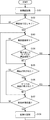
- 9 is a flowchart showing processing of the self-POS system according to the second exemplary embodiment.
- FIG. 7 is a diagram showing a master table of products managed by the self-POS system according to the second embodiment.
- FIG. 9 is a block diagram showing a configuration of a self-POS system according to a third exemplary embodiment. It is a schematic diagram of a self-POS system according to a fourth embodiment. It is a schematic diagram of a self-POS system according to a fourth embodiment.
- the self-POS system 1 is a system in which a customer himself/herself registers and pays for a product without the help of a clerk.
- the self-POS system 1 includes a sensor 2, an image pickup device 3, and a control unit 4.
- the sensor 2 is a detection unit that detects that a customer has taken out a product on display.
- the image pickup device 3 is an image pickup means for picking up an image of a customer.
- the control unit 4 is connected to the sensor 2 and the imaging device 3. The control unit 4 executes a process of recording, as a problem image, an image including an image at the time when the product is taken out, when the product for which the sensor 2 has detected the taking out is not registered.
- the self-POS system it is possible to record, as a problem image, an image of an act that is highly likely to be fraudulent at the time of payment.
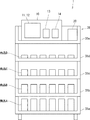
- FIG. 2 is a schematic view of the self-POS system according to the second embodiment as seen from the customer side, that is, from the front.
- the self-POS system 1 includes a self-POS terminal device 10, an imaging device 20, and a product shelf 30.
- the self-POS terminal device 10 is a settlement device that executes settlement processing.
- the self-POS terminal device 10 includes an input unit 11, a display unit 12, a bar code reader 13, an electronic money reader/writer 14, and a control unit 15 (not shown in FIG. 2).
- the control unit 15, the input unit 11, the display unit 12, the barcode reader 13, and the electronic money reader 14 are wired, but some or all of them may be wirelessly connected. These configurations will be described later in detail.
- the image capturing device 20 is a camera that captures a moving image by capturing an image of a customer located in front of the product shelf 30 to purchase a product.
- the imaging device 20 is installed so that the customer's face can be photographed so that the customer who wants to purchase the product can be identified. Further, it is desirable that the imaging device 20 is installed so as to be able to capture an image at the customer's hand, unless the image capturing device 20 cannot be captured because it is hidden in the product shelf 30.
- the imaging device 20 is connected to the control unit 15 of the self-POS terminal device 10 by wire or wirelessly. The imaging device 20 outputs the imaging data to the control unit 15 of the self-POS terminal device 10.
- the product shelf 30 is a display fixture that displays products.
- the product shelf 30 has five shelfs 31a to 31e arranged vertically. A plurality of products A are placed on the shelf 31a, a plurality of products B on the shelf 31b, a plurality of products C on the shelf 31c, and a plurality of products D on the shelf 31d.
- the self-POS terminal device 10 and the imaging device 20 are installed on the shelf 31e.
- the number of shelves may be 4 or less, or 6 or more. In FIG. 2, different products are placed on each shelf, but the same product may be placed, or different products may be placed on each shelf in a mixed manner.
- a sheet-shaped weight sensor 40 (not shown in FIG. 2) is provided on the upper surface of each of the shelves 31a to 31d of the product shelf 30.
- the product shelf 30 has a size that can be occupied by one customer who purchases the product. That is, in the self-POS system according to the present embodiment, when one customer is in the process of purchasing a product, another customer is operated so that the other customer cannot take out the product from the product shelf or perform settlement.
- the customer takes out the desired product from the product shelf 30.
- the customer scans the barcode of the product with the barcode reader 13 to register the product.
- the customer holds the electronic money medium over the electronic money reader/writer 14 to make a payment.
- the self-POS terminal device 10 outputs a receipt from a printer (not shown).
- the self-POS terminal device 10 identifies the customer by reading the membership card with the bar code, and after settlement, sends the electronic receipt to the address of the customer terminal registered in advance via the communication unit (not shown). You can
- the input unit 11 is an input unit such as a touch panel or a keyboard.
- the display unit 12 is a display unit such as a liquid crystal panel or an organic EL (Electro Luminescence) panel.
- the input unit 11 and the display unit 12 can be configured by a display with a touch panel.
- the bar code reader 13 is a product information reading means for executing product registration by reading a bar code displayed on a product, a package, or a tag.
- the electronic money reader/writer 14 executes a read/write process of electronic money with an electronic terminal such as a smartphone terminal or a card type terminal owned by the customer at the time of payment.
- the control unit 15 includes a CPU (Central Processor Unit), a ROM (Read Only Memory) for storing software programs such as a control program and data, a RAM (Random Access Memory), and a control unit (controller) configured by a storage unit such as a hard disk. ).
- the control unit 15 can realize various control functions and control processes by operating a control program on a computer.
- the control unit 15 controls each processing unit of the self-POS terminal device 10, such as the input unit 11, the display unit 12, the barcode reader 13, and the electronic money reader/writer 14. In addition, the control unit 15 also controls the imaging device 20, acquires a moving image that captures the behavior of the customer who may be fraudulent, and records it in the storage unit. Further, the control unit 15 detects that the product is taken out of the product shelf based on the weight change information of the product detected by the weight sensors 41 (41a to 41d) provided on the shelf 31 of the product shelf 30. Detects that an item has been returned to the item shelf.
- the control unit 15 stores the initial values of the weight sensors 41a to 41d installed on each of the shelves 31a to 31d (step S101).
- the imaging device 20 always executes the imaging process, and stores a predetermined amount of moving image data in the storage unit of the control unit 15. Then, when the moving image data exceeds the predetermined amount, the control unit 15 erases the image data in order from the oldest image data. That is, the control unit 15 saves the moving image data by the FIFO (First In First Out) method.
- FIFO First In First Out
- the control unit 15 acquires the detection values of the weight sensors 41a to 41d and compares the detection values with the initial value. When the control unit 15 determines that the detected value is lower than the initial value as a result of the comparison process, the control unit 15 determines that the product has been taken out from the shelf 31a to the shelf 31d of the product shelf 30 by that amount. When the control unit 15 determines that the product has been taken out (Y in step S102), the control unit 15 executes a process of specifying the taken-out product and the number of products. Specifically, the control unit 15 refers to a product master table as shown in FIG. 5 and determines whether or not there is a product corresponding to the weight reduced by taking out the product in the product master table. In the product master table shown in FIG.
- a product code functioning as product identification information, a product name, price information, and weight information per product are stored in association with each other. For example, when the weight detected by the weight sensor 41 is reduced by 130 g, the control unit 15 determines that the taken-out product is one product B.
- the control unit 15 sets a plurality of possible products as extraction product candidates as below, and sets their identification information in the extraction product list area provided in the storage unit.
- a plurality of product groups that are the target of the taken-out product candidates are provided with individual identification information such as a candidate number, etc., so that the taken-out product can be identified by one (one) or another taken-out product candidate. It is stored in the taken-out product list in a state in which it can be distinguished from (a plurality of product groups).
- the control unit 15 adds the product E (1 piece) and the product F (1 piece) to the taken-out product list. Is taken out and stored as a product candidate. After that, if either the product E (1 piece) or the product F (1 piece) is registered by reading the barcode by the barcode reader 13 or the like within a predetermined time, the product E (1 piece) is displayed. Both the product and the product F (1) are deleted from the taken-out product list.
- the control unit 15 adds the product G (two pieces) and the product H(1 to the product list to be taken out. Individual items) and are stored as product candidates. After this, when either the product G (2 pieces) or the product H (1 piece) is registered as a product, the control unit 15 extracts both the product G (2 pieces) and the product H (1 piece). Remove from list.
- the product A and the product B are taken out at the same time, the product A (1 piece) and the product B (1 piece) are taken out and stored as the product candidates. Further, when the product B is taken out within a few seconds (for example, 3 seconds) after the product A is first taken out, it is considered that they are taken out at the same time, and similarly, the product A (one piece) and the product B ( 1) is taken out and stored as a commodity candidate. The same applies when a plurality of the same products are taken out at the same time or within the time considered to be the same.
- the control unit 15 refers to the product master table to identify the product that has been taken out, stores the identification information of the product in the taken-out product list, starts the counting of the timer, and shifts to the processing of step S103.
- the control unit 15 determines that the output values detected by the weight sensors 41a to 41d have not changed (N in step S102), the process of step S102 is continuously repeated.
- control unit 15 determines that product registration has been performed (Y in step S103)
- the control unit 15 proceeds to the process of the next step S104.
- the control unit 15 determines that the product registration has not been performed (N in step S103)
- the control unit 15 proceeds to the process of step S105.
- the control unit 15 takes out the registered product and deletes it from the product list. Then, the control unit 15 determines whether all the products stored in the taken-out product list have been registered and deleted (step S104). When it is determined that no product is stored in the taken-out product list and all the taken-out products have been registered (Y in step S104), the control unit 15 returns to the process of step S102. On the other hand, when the product stored in the taken-out product list remains in a state where the product is not registered, that is, when the product is stored in the taken-out product list (N in step S104), the control unit 15 causes the step to be performed. The process moves to S105.
- control unit 15 checks whether the weight value detected by the gravity sensor 41 of any of the weight sensors 41a to 41d has increased to determine whether the once taken-out merchandise is returned to the merchandise shelf 30. Is determined (step S105). When the control unit 15 determines that the weight value detected by the weight sensor 41 has increased and the product has been returned to the product shelf 30 (Y in step S105), the process proceeds to step S106. When there is no change in the weight values detected by the weight sensors 41a to 41d (N in step S105), the control unit 15 proceeds to the process of step S107.
- control unit 15 determines that the product has been returned to the product shelf 30, the control unit 15 identifies the product returned to the product shelf 30 based on the increase in the weight value, and deletes the product from the taken-out product list. Further, the control unit 15 determines whether all the products stored in the taken-out product list have been returned as a result of deleting the products returned to the product shelf 30 from the taken-out product list. Specifically, the control unit 15 executes such a determination by checking whether all the products stored in the taken-out product list are deleted and no products are stored. When the product is not stored in the taken-out product list (Y in step S106), the control unit 15 returns to the processing step S102. On the other hand, if all the products in the taken-out product list have not been returned, that is, if the products are stored in the taken-out product list (N in step S106), the control unit 15 proceeds to step S107.
- the control unit 15 determines whether or not a predetermined time (for example, 30 seconds) has elapsed from the time when it was determined that the product was taken out in step S102 (step S107). When the control unit 15 determines that the predetermined time has elapsed (Y in step S107), the control unit 15 proceeds to the process in step S108. When the control unit 15 determines that the predetermined time has not elapsed (N in step S107), the process returns to step S103.
- a predetermined time for example, 30 seconds
- the control unit 15 acquires the image data from the storage unit until the time when a predetermined time (for example, 30 seconds) has elapsed from the time when it is determined that the product is taken out, and stores the image data together with the time data in another area of the storage unit, and step S102. The process returns to step S108.
- the data newly stored in the information storage means in this way is problem image data obtained by capturing an image of a possibility that the customer has taken out a product but has not registered the product, which may be an unauthorized act.
- the imaged data of the illegal act may be image data from the time when the product is taken out to an arbitrary time before a predetermined time elapses.
- each shelf is divided into several areas, each area is provided with a separate weight sensor, and each area is provided with a separate weight sensor.
- Different types of products may be placed. By doing so, since the weight sensor and the product can be associated with each other, the product can be identified by determining which weight sensor has changed.
- the customer can take out the product from the product shelf and settle it with the self-POS device installed in the product shelf, and the possibility of fraud An image can be recorded as a problem image.
- Embodiment 3 The self-POS system according to the present embodiment will be described with reference to FIG. In the present embodiment, as shown in the figure, the function described as the self-POS terminal device 10 in the second embodiment is realized by both the self-POS terminal device 10A and the management device 50.
- the management device 50 includes an input unit 51, a display unit 52, a communication unit 53, and a control unit 54.
- the management device 50 controls the imaging device 20 and records an image (moving image) that may be fraudulent. Further, the management device 50 detects that a product is taken out of the shelf or returned to the shelf by using a weight sensor provided on the shelf of the product shelf.
- the control unit 54 of the management device 50 executes control processing of the input unit 51, the display unit 52, and the imaging device 20, and transmits/receives data to/from the self-POS device 10A connected via the communication unit 53.
- the control unit 54 also acquires the gravity value measured by the gravity sensor 40.
- the flowchart of the process executed by the control unit 54 to record an image that may be fraudulent is the same as in FIG. However, the information on whether or not the product is registered is acquired from the self-POS terminal device via the communication unit 53.
- the self-POS system according to the third embodiment also has the same effect as that of the second embodiment, in which the customer takes out the product from the product shelf and pays it by the self-POS device installed in the product shelf. In addition, it is possible to record an image that may be fraudulent as a problem image.
- the self-POS terminal device 10 is provided with a notification means such as a speaker, and is taken out until a predetermined time (for example, 30 seconds) elapses (for example, after 20 seconds elapse).
- a predetermined time for example, 30 seconds
- a voice message prompting product registration may be output together with the product name and the number of products.
- the image data may be stored and a voice message including a product name and the number of products, which prompts product registration, may be output. By doing so, the occurrence of fraud can be reduced.
- the weight sensor detects removal of the product from the product shelf and return of the product to the product shelf.
- an ultrasonic sensor is used instead of the weight sensor.
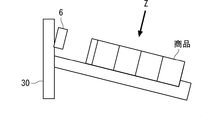
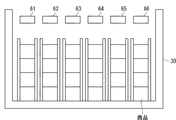
- FIG. 7A and FIG. 7B are views showing a shelf when the ultrasonic sensor 6 is used. 7A is a side view of the cross section of the shelf, and FIG. 7B is a view of the shelf viewed from the direction of arrow Z in FIG. 7A.
- Ultrasonic sensors 6 are arranged for each row of products. As shown in FIG. 7A, since the shelf is inclined (for example, 20 degrees), when one product is taken out of the product shelf, the product moves downward by its own weight and the distance from the ultrasonic sensor is increased. Changes for one item.
- the ultrasonic sensor measures the distance to the product, and the increase or decrease in the distance detects the removal of the product from the product shelf and the return of the product to the product shelf.
- the weight sensor and the ultrasonic sensor may be mixed and used together.
- an imaging device can be used as the sensor. In this case, the image analysis technique is used to execute the process of identifying the product.
- the camera always captures the image and acquires the image data from the time when the product is detected to be taken out from the product shelf to the time when a predetermined time has elapsed and stores the image data together with the time data.
- the image capturing may be started at a time when the product is detected to be taken out from the product shelf, the image capturing may be ended at a time when a predetermined time has elapsed, and the image data may be acquired and stored together with the time data. ..
- control program software can be stored using various types of non-transitory computer-readable media and supplied to the computer.
- Non-transitory computer readable media include various types of tangible storage media. Examples of the non-transitory computer readable medium include, for example, a magnetic recording medium such as a flexible disk, a magnetic tape, or a hard disk, a magneto-optical recording medium such as a magneto-optical disk, a CD (compact disk), or a DVD (digital versatile disk).
- an optical disk medium such as a mask ROM (read only memory), a PROM (programmable ROM), an EPROM (erasable PROM), a flash ROM, or a semiconductor memory such as a RAM (random access memory).
- the program may be supplied to the computer using various types of temporary computer-readable media.
- Examples of transitory computer-readable media include electrical signals, optical signals, and electromagnetic waves.
- the transitory computer-readable medium can supply the program to the computer via a wired communication path such as an electric wire and an optical fiber, or a wireless communication path.
- the present invention is not limited to the above-mentioned embodiments, but can be modified as appropriate without departing from the spirit of the present invention.
- the image of the action that is highly likely to be an illegal act is a moving image, but it may be a still image.
- the still image is preferably a plurality of still images.
- the image data is stored in the storage unit of the control unit, but the storage unit outside the control unit, the storage unit inside the image pickup device, and the self-POS terminal device and the outside of the management device are not limited to this. You may make it store it in the memory
- the image pickup device is installed in a display fixture such as a product shelf.
- the image pickup device is not limited to this, and may be installed in a self-POS terminal device, or may be installed on a ceiling or a wall of a store. Good.
Landscapes
- Business, Economics & Management (AREA)
- Accounting & Taxation (AREA)
- Engineering & Computer Science (AREA)
- Physics & Mathematics (AREA)
- General Physics & Mathematics (AREA)
- Strategic Management (AREA)
- General Business, Economics & Management (AREA)
- Theoretical Computer Science (AREA)
- Finance (AREA)
- Economics (AREA)
- Tourism & Hospitality (AREA)
- Marketing (AREA)
- Human Resources & Organizations (AREA)
- Development Economics (AREA)
- Operations Research (AREA)
- Quality & Reliability (AREA)
- Entrepreneurship & Innovation (AREA)
- Health & Medical Sciences (AREA)
- General Health & Medical Sciences (AREA)
- Primary Health Care (AREA)
- Cash Registers Or Receiving Machines (AREA)
- Management, Administration, Business Operations System, And Electronic Commerce (AREA)
- Financial Or Insurance-Related Operations Such As Payment And Settlement (AREA)
Abstract
La présente invention concerne un système de point de vente en libre service (1) dans lequel un client effectue un enregistrement et un paiement d'un produit. Ledit système comprend un capteur (2) qui détecte que le client a retiré le produit qui était dans un état d'affichage, un dispositif de capture d'image (3) qui capture une image du client, et une unité de commande (4) qui est connectée au capteur (2) et au dispositif de capture d'image (3). Si un enregistrement n'est pas effectué pour le produit dont le retrait est détecté par le capteur (2), l'unité de commande (4) enregistre comme image de problème une image qui comprend au moins une image d'un horodatage du moment où le produit est retiré. Ainsi, un système de point de vente en libre service, un dispositif terminal de point de vente en libre service, un procédé de commande et un programme de commande permettant d'enregistrer une action illicite au moment du paiement peuvent être fournis.
Priority Applications (1)
| Application Number | Priority Date | Filing Date | Title |
|---|---|---|---|
| US17/431,525 US12020229B2 (en) | 2019-02-20 | 2020-02-07 | Self-POS system, self-POS terminal apparatus, control method, and non-transitory computer readable medium storing control program |
Applications Claiming Priority (2)
| Application Number | Priority Date | Filing Date | Title |
|---|---|---|---|
| JP2019-028133 | 2019-02-20 | ||
| JP2019028133A JP6849234B2 (ja) | 2019-02-20 | 2019-02-20 | セルフposシステム、制御方法及び制御プログラム |
Publications (1)
| Publication Number | Publication Date |
|---|---|
| WO2020170854A1 true WO2020170854A1 (fr) | 2020-08-27 |
Family
ID=72144787
Family Applications (1)
| Application Number | Title | Priority Date | Filing Date |
|---|---|---|---|
| PCT/JP2020/004787 Ceased WO2020170854A1 (fr) | 2019-02-20 | 2020-02-07 | Système de point de vente en libre service, dispositif terminal de point de vente en libre service, procédé de commande et support non transitoire lisible par ordinateur dans lequel est stocké un programme de commande |
Country Status (3)
| Country | Link |
|---|---|
| US (1) | US12020229B2 (fr) |
| JP (1) | JP6849234B2 (fr) |
| WO (1) | WO2020170854A1 (fr) |
Cited By (1)
| Publication number | Priority date | Publication date | Assignee | Title |
|---|---|---|---|---|
| WO2023170784A1 (fr) * | 2022-03-08 | 2023-09-14 | 日本電気株式会社 | Système de surveillance, dispositif de surveillance, procédé de surveillance et support d'enregistrement |
Families Citing this family (3)
| Publication number | Priority date | Publication date | Assignee | Title |
|---|---|---|---|---|
| JP7318684B2 (ja) | 2021-07-30 | 2023-08-01 | 富士通株式会社 | 情報処理プログラム、情報処理方法、および情報処理装置 |
| JP7318683B2 (ja) | 2021-07-30 | 2023-08-01 | 富士通株式会社 | 情報処理プログラム、情報処理方法、および情報処理装置 |
| JP7831165B2 (ja) | 2022-07-07 | 2026-03-17 | 富士通株式会社 | 情報処理プログラム、情報処理方法、および情報処理装置 |
Citations (8)
| Publication number | Priority date | Publication date | Assignee | Title |
|---|---|---|---|---|
| JPH08174387A (ja) * | 1994-12-26 | 1996-07-09 | Nissan Motor Co Ltd | 工順編成装置 |
| JP2009088648A (ja) * | 2007-09-27 | 2009-04-23 | Sogo Keibi Hosho Co Ltd | 画像抽出装置および画像抽出方法 |
| JP2009284167A (ja) * | 2008-05-21 | 2009-12-03 | Toshiba Tec Corp | 人物行動監視装置及び人物行動監視プログラム |
| JP2010044479A (ja) * | 2008-08-11 | 2010-02-25 | Ishida Co Ltd | Pos端末装置 |
| JP2010277264A (ja) * | 2009-05-27 | 2010-12-09 | Takachiho Koeki Kk | 防犯装置、その制御方法、プログラム、及び防犯システム |
| JP2012242912A (ja) * | 2011-05-16 | 2012-12-10 | Ishida Co Ltd | 販売管理システム |
| WO2018163547A1 (fr) * | 2017-03-06 | 2018-09-13 | 日本電気株式会社 | Dispositif de surveillance de produit, système de surveillance de produit, dispositif de destination de sortie, procédé de surveillance de produit, procédé d'affichage et programme |
| JP2018206372A (ja) * | 2018-05-15 | 2018-12-27 | 株式会社 ディー・エヌ・エー | 商品を管理するためのシステム、方法、及びプログラム |
Family Cites Families (5)
| Publication number | Priority date | Publication date | Assignee | Title |
|---|---|---|---|---|
| JP3213696B2 (ja) * | 1996-11-29 | 2001-10-02 | 東芝テック株式会社 | 買上商品登録装置及びこの登録装置を用いた買上商品決済システム |
| JP3986057B2 (ja) | 2002-09-27 | 2007-10-03 | 江崎グリコ株式会社 | 商品ボックス管理装置、商品ボックス管理システムおよびプログラム |
| US10083430B2 (en) * | 2012-06-08 | 2018-09-25 | Ronny Hay | Computer-controlled, unattended, automated checkout store outlet system and related method |
| US10733565B1 (en) * | 2014-09-30 | 2020-08-04 | Amazon Technologies, Inc. | Interactive data processing system |
| US20200034812A1 (en) * | 2018-07-26 | 2020-01-30 | Walmart Apollo, Llc | System for dynamic smart cart content notifications |
-
2019
- 2019-02-20 JP JP2019028133A patent/JP6849234B2/ja active Active
-
2020
- 2020-02-07 WO PCT/JP2020/004787 patent/WO2020170854A1/fr not_active Ceased
- 2020-02-07 US US17/431,525 patent/US12020229B2/en active Active
Patent Citations (8)
| Publication number | Priority date | Publication date | Assignee | Title |
|---|---|---|---|---|
| JPH08174387A (ja) * | 1994-12-26 | 1996-07-09 | Nissan Motor Co Ltd | 工順編成装置 |
| JP2009088648A (ja) * | 2007-09-27 | 2009-04-23 | Sogo Keibi Hosho Co Ltd | 画像抽出装置および画像抽出方法 |
| JP2009284167A (ja) * | 2008-05-21 | 2009-12-03 | Toshiba Tec Corp | 人物行動監視装置及び人物行動監視プログラム |
| JP2010044479A (ja) * | 2008-08-11 | 2010-02-25 | Ishida Co Ltd | Pos端末装置 |
| JP2010277264A (ja) * | 2009-05-27 | 2010-12-09 | Takachiho Koeki Kk | 防犯装置、その制御方法、プログラム、及び防犯システム |
| JP2012242912A (ja) * | 2011-05-16 | 2012-12-10 | Ishida Co Ltd | 販売管理システム |
| WO2018163547A1 (fr) * | 2017-03-06 | 2018-09-13 | 日本電気株式会社 | Dispositif de surveillance de produit, système de surveillance de produit, dispositif de destination de sortie, procédé de surveillance de produit, procédé d'affichage et programme |
| JP2018206372A (ja) * | 2018-05-15 | 2018-12-27 | 株式会社 ディー・エヌ・エー | 商品を管理するためのシステム、方法、及びプログラム |
Cited By (3)
| Publication number | Priority date | Publication date | Assignee | Title |
|---|---|---|---|---|
| WO2023170784A1 (fr) * | 2022-03-08 | 2023-09-14 | 日本電気株式会社 | Système de surveillance, dispositif de surveillance, procédé de surveillance et support d'enregistrement |
| JPWO2023170784A1 (fr) * | 2022-03-08 | 2023-09-14 | ||
| JP7806880B2 (ja) | 2022-03-08 | 2026-01-27 | 日本電気株式会社 | 監視システム、監視装置、監視方法、およびプログラム |
Also Published As
| Publication number | Publication date |
|---|---|
| US12020229B2 (en) | 2024-06-25 |
| JP2020135422A (ja) | 2020-08-31 |
| JP6849234B2 (ja) | 2021-03-24 |
| US20220147963A1 (en) | 2022-05-12 |
Similar Documents
| Publication | Publication Date | Title |
|---|---|---|
| US11948364B2 (en) | Portable computing device installed in or mountable to a shopping cart | |
| JP7318697B2 (ja) | 商品監視システム、出力先装置、商品監視方法、表示方法及びプログラム | |
| JP6249021B2 (ja) | セキュリティシステム、セキュリティ方法及びセキュリティプログラム | |
| JP6283806B2 (ja) | 情報処理システム | |
| WO2020170854A1 (fr) | Système de point de vente en libre service, dispositif terminal de point de vente en libre service, procédé de commande et support non transitoire lisible par ordinateur dans lequel est stocké un programme de commande | |
| CN107992779A (zh) | 一种顾客行为监督方法、系统及无人商店 | |
| JP2008257488A (ja) | 顔認証応用インストアマーケティング分析システム | |
| JP5673888B1 (ja) | 情報通知プログラム及び情報処理装置 | |
| JP7700611B2 (ja) | 通知プログラム、通知方法および情報処理装置 | |
| JP7278043B2 (ja) | 情報処理装置 | |
| JP5865316B2 (ja) | 商品登録装置およびプログラム | |
| JP7707810B2 (ja) | 情報処理プログラム、情報処理方法、および情報処理装置 | |
| JP2016162256A (ja) | 情報処理装置及び情報処理プログラム | |
| JP7700629B2 (ja) | 行動判定プログラム、行動判定方法及び行動判定装置 | |
| JP6908491B2 (ja) | 商品情報読取装置およびプログラム | |
| JP7590382B2 (ja) | 情報処理システム、情報処理方法、および情報処理プログラム | |
| JP7739912B2 (ja) | 通知プログラム、通知方法および情報処理装置 | |
| JP2015099550A (ja) | 商品認識装置及び商品認識プログラム | |
| JP7715270B2 (ja) | 退店管理システム、退店管理方法、及び、プログラム | |
| JP7799088B2 (ja) | 報知システム、報知方法、およびプログラム | |
| JP2026072041A (ja) | Posシステム及びposシステム運用方法 | |
| JP2026055695A (ja) | 不正検知プログラム、不正検知装置および不正検知システム |
Legal Events
| Date | Code | Title | Description |
|---|---|---|---|
| 121 | Ep: the epo has been informed by wipo that ep was designated in this application |
Ref document number: 20759204 Country of ref document: EP Kind code of ref document: A1 |
|
| NENP | Non-entry into the national phase |
Ref country code: DE |
|
| 122 | Ep: pct application non-entry in european phase |
Ref document number: 20759204 Country of ref document: EP Kind code of ref document: A1 |