WO2020171176A1 - Élément absorbant et article absorbant associé - Google Patents
Élément absorbant et article absorbant associé Download PDFInfo
- Publication number
- WO2020171176A1 WO2020171176A1 PCT/JP2020/006868 JP2020006868W WO2020171176A1 WO 2020171176 A1 WO2020171176 A1 WO 2020171176A1 JP 2020006868 W JP2020006868 W JP 2020006868W WO 2020171176 A1 WO2020171176 A1 WO 2020171176A1
- Authority
- WO
- WIPO (PCT)
- Prior art keywords
- sap
- base material
- liquid
- absorber
- sheet
- Prior art date
- Legal status (The legal status is an assumption and is not a legal conclusion. Google has not performed a legal analysis and makes no representation as to the accuracy of the status listed.)
- Ceased
Links
Images
















Classifications
-
- A—HUMAN NECESSITIES
- A61—MEDICAL OR VETERINARY SCIENCE; HYGIENE
- A61F—FILTERS IMPLANTABLE INTO BLOOD VESSELS; PROSTHESES; DEVICES PROVIDING PATENCY TO, OR PREVENTING COLLAPSING OF, TUBULAR STRUCTURES OF THE BODY, e.g. STENTS; ORTHOPAEDIC, NURSING OR CONTRACEPTIVE DEVICES; FOMENTATION; TREATMENT OR PROTECTION OF EYES OR EARS; BANDAGES, DRESSINGS OR ABSORBENT PADS; FIRST-AID KITS
- A61F13/00—Bandages or dressings; Absorbent pads
- A61F13/15—Absorbent pads, e.g. sanitary towels, swabs or tampons for external or internal application to the body; Supporting or fastening means therefor; Tampon applicators
- A61F13/53—Absorbent pads, e.g. sanitary towels, swabs or tampons for external or internal application to the body; Supporting or fastening means therefor; Tampon applicators characterised by the absorbing medium
-
- A—HUMAN NECESSITIES
- A61—MEDICAL OR VETERINARY SCIENCE; HYGIENE
- A61F—FILTERS IMPLANTABLE INTO BLOOD VESSELS; PROSTHESES; DEVICES PROVIDING PATENCY TO, OR PREVENTING COLLAPSING OF, TUBULAR STRUCTURES OF THE BODY, e.g. STENTS; ORTHOPAEDIC, NURSING OR CONTRACEPTIVE DEVICES; FOMENTATION; TREATMENT OR PROTECTION OF EYES OR EARS; BANDAGES, DRESSINGS OR ABSORBENT PADS; FIRST-AID KITS
- A61F13/00—Bandages or dressings; Absorbent pads
- A61F13/15—Absorbent pads, e.g. sanitary towels, swabs or tampons for external or internal application to the body; Supporting or fastening means therefor; Tampon applicators
- A61F13/53—Absorbent pads, e.g. sanitary towels, swabs or tampons for external or internal application to the body; Supporting or fastening means therefor; Tampon applicators characterised by the absorbing medium
- A61F13/534—Absorbent pads, e.g. sanitary towels, swabs or tampons for external or internal application to the body; Supporting or fastening means therefor; Tampon applicators characterised by the absorbing medium having an inhomogeneous composition through the thickness of the pad
-
- A—HUMAN NECESSITIES
- A61—MEDICAL OR VETERINARY SCIENCE; HYGIENE
- A61F—FILTERS IMPLANTABLE INTO BLOOD VESSELS; PROSTHESES; DEVICES PROVIDING PATENCY TO, OR PREVENTING COLLAPSING OF, TUBULAR STRUCTURES OF THE BODY, e.g. STENTS; ORTHOPAEDIC, NURSING OR CONTRACEPTIVE DEVICES; FOMENTATION; TREATMENT OR PROTECTION OF EYES OR EARS; BANDAGES, DRESSINGS OR ABSORBENT PADS; FIRST-AID KITS
- A61F13/00—Bandages or dressings; Absorbent pads
- A61F13/15—Absorbent pads, e.g. sanitary towels, swabs or tampons for external or internal application to the body; Supporting or fastening means therefor; Tampon applicators
- A61F13/53—Absorbent pads, e.g. sanitary towels, swabs or tampons for external or internal application to the body; Supporting or fastening means therefor; Tampon applicators characterised by the absorbing medium
- A61F13/534—Absorbent pads, e.g. sanitary towels, swabs or tampons for external or internal application to the body; Supporting or fastening means therefor; Tampon applicators characterised by the absorbing medium having an inhomogeneous composition through the thickness of the pad
- A61F13/535—Absorbent pads, e.g. sanitary towels, swabs or tampons for external or internal application to the body; Supporting or fastening means therefor; Tampon applicators characterised by the absorbing medium having an inhomogeneous composition through the thickness of the pad inhomogeneous in the plane of the pad, e.g. core absorbent layers being of different sizes
-
- A—HUMAN NECESSITIES
- A61—MEDICAL OR VETERINARY SCIENCE; HYGIENE
- A61F—FILTERS IMPLANTABLE INTO BLOOD VESSELS; PROSTHESES; DEVICES PROVIDING PATENCY TO, OR PREVENTING COLLAPSING OF, TUBULAR STRUCTURES OF THE BODY, e.g. STENTS; ORTHOPAEDIC, NURSING OR CONTRACEPTIVE DEVICES; FOMENTATION; TREATMENT OR PROTECTION OF EYES OR EARS; BANDAGES, DRESSINGS OR ABSORBENT PADS; FIRST-AID KITS
- A61F13/00—Bandages or dressings; Absorbent pads
- A61F13/15—Absorbent pads, e.g. sanitary towels, swabs or tampons for external or internal application to the body; Supporting or fastening means therefor; Tampon applicators
- A61F13/53—Absorbent pads, e.g. sanitary towels, swabs or tampons for external or internal application to the body; Supporting or fastening means therefor; Tampon applicators characterised by the absorbing medium
- A61F13/534—Absorbent pads, e.g. sanitary towels, swabs or tampons for external or internal application to the body; Supporting or fastening means therefor; Tampon applicators characterised by the absorbing medium having an inhomogeneous composition through the thickness of the pad
- A61F13/537—Absorbent pads, e.g. sanitary towels, swabs or tampons for external or internal application to the body; Supporting or fastening means therefor; Tampon applicators characterised by the absorbing medium having an inhomogeneous composition through the thickness of the pad characterised by a layer facilitating or inhibiting flow in one direction or plane, e.g. a wicking layer
Definitions
- the present invention relates to an absorber including SAP that is a superabsorbent polymer.
- Absorbent articles such as disposable diapers, urine pads, and sanitary products are equipped with absorbent bodies that absorb liquids such as urine and body fluids.
- Pulp or super absorbent polymer (Super Absorbent Polymer: SAP) is used as the absorber.
- SAP Super Absorbent Polymer
- the absorber is formed into a thin sheet shape, a mat shape, or the like.
- Patent Document 1 discloses an absorbent composite in which SAP particles are fixed to a non-woven fabric substrate or the like using a binder such as a thermoplastic resin.
- the absorber in which SAP particles are fixed to the nonwoven fabric substrate absorbs and holds the liquid by SAP.
- the liquid that has moved to the end of the nonwoven fabric through the surface or inside of the nonwoven fabric base material may leak from the absorber without being absorbed by SAP.
- an object of the present invention is to provide a technique capable of suppressing liquid leakage.
- an SAP layer containing particles of SAP which is a superabsorbent polymer, is provided on the front surface and the back surface of a substrate formed of a nonwoven fabric.
- the present invention relates to an absorbent body, which comprises a base material formed of a non-woven fabric, and a superabsorbent polymer which is disposed on both sides in the width direction of the surface of the base material along the longitudinal direction of the base material. And a second SAP layer that is disposed on the back surface of the base material and that includes SAP particles.
- a groove extending in the longitudinal direction of the base material may be formed on the front surface side of the base material and in the widthwise central portion of the base material.
- the absorber may include a first nonwoven fabric sheet arranged to cover the front surface of the base material and a second nonwoven fabric sheet arranged to cover the back surface of the base material.
- the absorbent body includes a core wrap sheet that covers the outer periphery of an absorbent composite including the base material, the first SAP layer, the second SAP layer, the first nonwoven fabric sheet, and the second nonwoven fabric sheet. May be.
- the present invention is an absorbent article that absorbs urine discharged by a wearer, a liquid-impermeable backsheet, a liquid-permeable topsheet joined to the backsheet, and the backsheet.
- the absorber according to any one of the above, which is arranged between the top sheet and the absorbent article.
- liquid leakage can be suppressed.
- FIG. 1 is a plan view of the absorber according to the first embodiment.
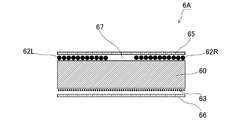
- FIG. 2 is a cross-sectional view of the absorber according to the first embodiment.
- FIG. 3 is a sectional view of the absorber according to the first embodiment.
- FIG. 4 is a plan view of the absorber according to the first embodiment.
- FIG. 5 is a sectional view of the absorber according to the first embodiment.
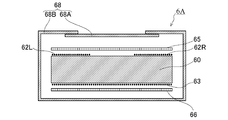
- FIG. 6 is a cross-sectional view of the absorber according to the first embodiment.
- FIG. 7 is a plan view of the absorber according to the second embodiment.
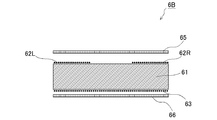
- FIG. 8 is a cross-sectional view of the absorber according to the second embodiment.
- FIG. 9 is a plan view of the absorber according to the second embodiment.
- FIG. 1 is a plan view of the absorber according to the first embodiment.
- FIG. 2 is a cross-sectional view of the absorber according to the first embodiment.
- FIG. 3 is a sectional view of the absorber according to the first embodiment.
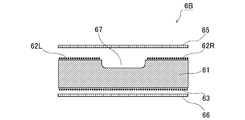
- FIG. 10 is a cross-sectional view of the absorbent body according to the second embodiment.
- FIG. 11 is a cross-sectional view of the absorber according to the second embodiment.
- FIG. 12 is a plan view of the absorber according to the third embodiment.
- FIG. 13 is a cross-sectional view of the absorber according to the third embodiment.
- FIG. 14 is a plan view of the absorber according to the third embodiment.
- FIG. 15 is a sectional view of the absorber according to the third embodiment.
- FIG. 16 is a cross-sectional view of the absorber according to the third embodiment.
- FIG. 17 is a plan view of the absorber according to the third embodiment.
- FIG. 18 is a cross-sectional view of the absorber according to the third embodiment.
- FIG. 19 is a plan view of the absorber according to the fourth embodiment.
- 20 is a cross-sectional view of the absorbent body cut along the AA cross section shown in FIG. 19.
- 21 is a cross-sectional view of an absorber similar to FIG.
- FIG. 22 is a diagram showing a first example of a portion that is water repellent.
- FIG. 23 is a diagram showing a second example of a portion that has been subjected to water repellent finishing.
- FIG. 24 is a cross-sectional view of the absorber taken along the line BB shown in FIG.
- FIG. 25: is sectional drawing of the absorber similar to FIG.
- FIG. 26 is a plan view of the absorber according to the fifth embodiment.
- FIG. 27 is a sectional view of the absorber according to the fifth embodiment.
- FIG. 28 is a plan view of the absorber according to the fifth embodiment.
- FIG. 29 is a cross-sectional view of the absorber according to the fifth embodiment.
- FIG. 30 is a cross-sectional view of the absorber according to the fifth embodiment.
- FIG. 31 is a perspective view of a tape-type disposable diaper.
- FIG. 32 is an exploded perspective view of the diaper.
- FIG. 33 is a cross-sectional view when the crotch region is cut in the width direction.
- FIG. 34 is a cross-sectional view when the crotch region is cut in the width direction.
- the absorber according to the first embodiment of the present invention will be described.
- the absorber in which the SAP particles are fixed to the nonwoven fabric substrate absorbs and holds the liquid by SAP.
- SAP absorbs urine
- the absorbent body expands as a whole.
- the position facing the urethral meatus absorbs and swells urine in an early stage of the urination period as compared with other regions. If the position of the absorbent body facing the urethral meatus expands at an early stage of the urination period, then the excreted urine may flow in the width direction of the absorbent body. If a liquid such as urine flows in the width direction of the absorber, the liquid may leak.
- the present embodiment aims to provide a technique capable of suppressing liquid leakage.
- the liquid diffusion layer is formed on the surface of the liquid diffusion layer formed of a non-woven fabric, and on both sides in the width direction along the center portion in the width direction of the liquid diffusion layer.
- a SAP layer extending in the longitudinal direction.
- the present embodiment is an absorber, which is a liquid diffusion layer formed of a non-woven fabric, and an SAP layer containing particles of SAP that is a superabsorbent polymer. And a SAP layer that is arranged on both sides in the width direction along the center in the width direction of the liquid diffusion layer and that extends in the longitudinal direction of the liquid diffusion layer.
- a groove may be formed on the surface side of the liquid diffusion layer in the widthwise central portion and along the SAP layers on both sides.
- the absorbent body may include a first nonwoven fabric sheet arranged to cover the surface of the liquid diffusion layer and a second nonwoven fabric sheet arranged to cover the back surface of the liquid diffusion layer.
- the absorbent body may include a core wrap sheet that covers the outer periphery of an absorbent composite including the liquid diffusion layer, the SAP layer, the first nonwoven fabric sheet, and the second nonwoven fabric sheet.
- the absorbent article absorbs the liquid discharged by the wearer, the absorbent article absorbs the liquid discharged by the wearer, and the liquid impermeable backsheet is joined to the backsheet.
- a liquid-permeable topsheet and the absorber arranged between the backsheet and the topsheet may be provided.
- liquid leakage can be suppressed.
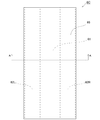
- FIG. 1 is a plan view of the absorber according to the first embodiment.
- the absorber 6A is formed in a sheet shape having a rectangular shape in a plan view.
- FIG. 1 shows a state in which the absorber 6A is viewed from the surface side, which is the skin facing surface side facing the wearer's skin when the absorber 6A is arranged in an absorbent article such as a diaper.
- FIG. 2 is a cross-sectional view of the absorbent body 6A taken along the line AA shown in FIG. 1 (a cross section along the width direction of the absorbent body 6A).
- the absorber 6A has a uniform cross section over the entire longitudinal direction. Note that, in FIG. 2, gaps are provided between the constituent elements in order to make the constituent elements of the absorber 6A easy to understand, but in reality, almost no gap is formed between the constituent elements.
- the absorber 6A includes a liquid diffusion layer 60.
- the liquid diffusion layer 60 is formed in a rectangular sheet shape.
- a bulky nonwoven fabric having a thickness of about 1 mm to 10 mm manufactured by an air-through method or a needle punch method is used.
- the absorber 6A is disposed on the surface of the liquid diffusion layer 60, and is provided with SAP layers 62L and 62R containing particles of SAP (Super Absorbent Polymer) which is a superabsorbent polymer.
- SAP Super Absorbent Polymer
- the surface of the liquid diffusion layer 60 is arranged on the skin facing surface side, and the back surface of the liquid diffusion layer 60 is the skin non-facing surface opposite to the skin facing surface side. Placed on the side.
- the SAP layers 62L and 62R are arranged on the surface of the liquid diffusion layer 60, on both sides in the width direction along the center portion of the liquid diffusion layer 60 in the width direction, and extend in the longitudinal direction of the liquid diffusion layer 60.
- the longitudinal direction of the liquid diffusion layer 60 is orthogonal to the width direction of the liquid diffusion layer 60.
- the SAP layer 62L is located on the left side of the wearer of the absorbent article, and the SAP layer 62R is located on the right side of the wearer of the absorbent article.
- the SAP layers 62L and 62R are formed by attaching a plurality of SAP particles to the surface of the liquid diffusion layer 60 with an adhesive. In the SAP layers 62L and 62R, the SAP particles are arranged substantially uniformly.
- the liquid diffusion layer 60 holds the SAP layers 62L and 62R.
- the SAP layers 62L and 62R extend over the entire length of the liquid diffusion layer 60 in the longitudinal direction.
- SAP absorbs 10 to 100 times its own weight of liquid.
- SAP for example, a granular material in a state before liquid absorption is used.
- the SAP layers 62L and 62R absorb and hold the liquid diffused by the liquid diffusion layer 60.
- FIG. 3 is a cross-sectional view of the absorber 6A similar to FIG. 2, showing a state where the SAP layers 62L and 62R have absorbed liquid and expanded. During urination, the SAP layers 62L and 62R that have absorbed and expanded urine serve as banks.
- the grooves 67 extend along the SAP layers 62L and 62R (banks) in the widthwise center of the liquid diffusion layer 60, that is, the grooves 67 that extend in the longitudinal direction of the liquid diffusion layer 60. Is formed.
- the groove 67 is located at a position facing the urethral opening of the absorbent article so that the urine excreted by the wearer can easily flow into the absorbent article 6A when the absorbent body 6A is placed on the absorbent article (hereinafter, “urethral opening facing position”). Is called).
- the absorber 6A causes the groove 67 to diffuse the urine in the longitudinal direction of the liquid diffusion layer 60.
- the absorber 6A diffuses urine throughout the liquid diffusion layer 60, so that the absorption rate and the diffusion rate can be maintained even in the subsequent urination. Furthermore, when the wearer of the absorbent article is a male, a groove 67 can be formed at the position of the male genital area facing the urethral opening, and the direction of urination from the urethral opening can be guided by the groove 67.
- the absorber 6A diffuses urine in the entire liquid diffusion layer 60 by the liquid diffusion layer 60, the SAP layers 62L and 62R are allowed to absorb the urine evenly so that the SAP layers 62L and 62R are substantially uniformly expanded. You can As a result, the absorbent body 6A prevents only a part of the SAP layers 62L and 62R from expanding, thereby forming a dent in the bank formed by the SAP layers 62L and 62R and preventing a hole from being formed in the bank. It is possible to prevent the leakage of urine, thereby suppressing the leakage of urine.
- the absorber 6A temporarily holds the urine diffused in the entire liquid diffusion layer 60 in the liquid diffusion layer 60, and the urine is absorbed and held in the SAP layers 62L and 62R with the passage of time. As a result, the absorber 6A can cause the SAP layers 62L and 62R to evenly absorb and retain urine.
- the absorber 6A is provided on the back surface of the liquid diffusion layer 60, and includes the SAP layer 63 containing SAP particles.
- the SAP layer 63 is formed on almost the entire back surface of the liquid diffusion layer 60.
- the SAP layer 63 is formed by attaching a plurality of SAP particles to the back surface of the liquid diffusion layer 60 with an adhesive. In the SAP layer 63, the SAP particles are arranged substantially uniformly.
- the liquid diffusion layer 60 holds the SAP layer 63.
- the absorber 6A increases the liquid absorption and holding amount as a whole. Note that SAP particles may be included in the gaps in the liquid diffusion layer 60.
- the absorbent body 6A includes a first nonwoven fabric sheet 65 arranged to cover the surface of the liquid diffusion layer 60 and a second nonwoven fabric sheet 66 arranged to cover the back surface of the liquid diffusion layer 60. There is.
- a liquid-permeable nonwoven fabric is used for the first nonwoven fabric sheet 65 and the second nonwoven fabric sheet 66.
- air-laid non-woven fabric is used for the first non-woven fabric sheet 65 and the second non-woven fabric sheet 66.
- the first nonwoven fabric sheet 65 and the second nonwoven fabric sheet 66 diffuse the liquid in the width direction and the longitudinal direction of the absorber 6A.
- the absorber 6A prevents the liquid such as urine discharged by the wearer from concentrating on the center of the absorber 6A in the width direction or the center of the absorber 6A in the longitudinal direction. Further, by providing the first nonwoven fabric sheet 65, the wearer's feeling of wearing the absorbent article can be improved.
- the liquid diffusion layer 60 may have grooves formed in advance.
- FIG. 4 is a plan view similar to FIG.
- FIG. 5 is a cross-sectional view when cut along the BB cross section (cross section along the width direction of the absorber 6A) shown in FIG.
- a groove 67 is formed at the center portion in the width direction of the liquid diffusion layer 60 and along the SAP layers 62L and 62R on both sides.
- the groove 67 is formed at a position facing the urethral opening so that the urine excreted by the wearer can easily flow in when the absorbent body 6A is arranged in the absorbent article.
- the groove 67 is formed by pressing the groove forming region from the surface side of the liquid diffusion layer 60 after the liquid diffusion layer 60 is formed.
- the groove 67 may be formed by reducing the basis weight of the non-woven fabric in the groove forming region when the liquid diffusion layer 60 is manufactured.
- the groove 67 is made deeper when the SAP layers 62L and 62R expand and form a bank.
- the volume of the groove 67 can be increased, and a larger amount of urine can be guided in the groove 67.
- the absorber 6A can diffuse a large amount of urine through the entire liquid diffusion layer 60, and can suppress leakage of urine even when a large amount of urine is discharged.
- FIG. 6 is a sectional view of the absorber 6A similar to that of FIG.
- the core wrap sheet 68 includes a first sheet 68A that covers the first non-woven fabric sheet 65 side, a widthwise end of the first non-woven fabric sheet 65, a side surface of the liquid diffusion layer 60, and a second non-woven fabric sheet 66. And a second sheet 68B covering the side.
- the first sheet 68A and the second sheet 68B are joined and integrated to wrap the entire absorbent composite.
- the core wrap sheet 68 for example, thin paper such as liquid-permeable tissue paper or non-woven fabric is used.
- the core wrap sheet 68 can diffuse the liquid discharged by the wearer throughout the absorber 6A.
- the core wrap sheet 68 may be composed of a single sheet.
- the absorber according to the second embodiment of the present invention will be described.
- the absorbent preferably holds the liquid distal to the wearer's skin.
- the SAP particles are fixed to the non-woven fabric base material, if the SAP particles necessary for absorbing and retaining a predetermined amount of liquid are arranged only on the back surface side of the base material that is distal from the wearer's skin, Since the SAP density on the side becomes too high, the SAP tends to cause gel blocking after absorbing the liquid.
- the SAP disposed on the surface of the nonwoven fabric substrate becomes a gel
- the liquid permeability on the surface side is reduced and the liquid diffuses throughout the absorber. And it causes liquid leakage. Therefore, it is required that the surface of the nonwoven fabric substrate in the absorbent body has both liquid absorbability and liquid permeability. Furthermore, if the SAP becomes gel and the amount of liquid retained decreases, the liquid once absorbed by the absorber will come back to the skin side of the wearer, which will cause a reversion.
- the present embodiment aims to provide a technique capable of suppressing liquid leakage and backflow.
- the liquid permeability of the upper SAP layer is increased and the liquid absorbability of the lower SAP layer is increased.
- the present embodiment is an absorber, which is formed of a non-woven fabric, and includes a substrate that is permeable to liquid, and an upper portion that is disposed on the surface of the substrate and that includes particles of SAP that is a superabsorbent polymer.
- An SAP layer and a lower SAP layer that is disposed on the back surface of the base material and that includes particles of SAP that is a superabsorbent polymer, and the upper SAP layer has a liquid permeability of 30 (ml/min) or more.
- the lower SAP layer has a liquid absorbency of 35 (g/g) or more.
- the upper SAP layer may be arranged on both sides in the width direction along the center portion in the width direction of the base material and may extend in the longitudinal direction of the base material.
- a groove may be formed on the front surface side of the base material so as to extend along the center portion in the width direction and along the upper SAP layers on both sides.
- the absorbent body may include a first nonwoven fabric sheet arranged so as to cover the front surface of the base material, and a second nonwoven fabric sheet arranged so as to cover the back surface of the base material.
- the absorbent body includes a core wrap sheet that covers the outer periphery of an absorbent composite including the base material, the upper SAP layer, the lower SAP layer, the first nonwoven fabric sheet, and the second nonwoven fabric sheet. May be.
- an absorbent article that absorbs the liquid discharged by the wearer, a liquid-impermeable backsheet, a liquid-permeable topsheet joined to the backsheet, the backsheet and the topsheet. And the above-mentioned absorber arranged between.
- FIG. 7 is a plan view of the absorber according to the second embodiment.
- the absorber 6 is formed in a sheet shape having a rectangular shape in a plan view.
- FIG. 7 shows a state in which the absorber 6 is viewed from the surface side, which is the skin facing surface side facing the wearer's skin when the absorber 6 is arranged in an absorbent article such as a diaper.
- FIG. 8 is a cross-sectional view of the absorbent body 6 taken along the line AA shown in FIG. 7 (a cross section taken along the width direction of the absorbent body 6 ).
- the absorber 6 has a uniform cross section in the entire longitudinal direction. It should be noted that in FIG. 8, gaps are provided between the constituent elements in order to make the constituent elements of the absorber 6 easy to understand, but in reality, almost no gap is formed between the constituent elements.
- the absorber 6 includes a base material 61.
- the base material 61 is formed in a rectangular sheet shape.
- As the base material 61 a bulky nonwoven fabric having a thickness of about 1 mm to 10 mm manufactured by an air-through method or a needle punch method is used.
- the base material 61 penetrates and diffuses the liquid.
- the absorber 6 is disposed on the surface of the base material 61, and is provided with SAP layers 62L and 62R (an example of “upper SAP layer”) including particles of SAP (Super Absorbent Polymer) that is a superabsorbent polymer.
- SAP Super Absorbent Polymer
- the front surface of the base material 61 is arranged on the skin facing surface side
- the back surface of the base material 61 is on the skin non-facing surface side opposite to the skin facing surface side. Will be placed.
- the SAP layers 62L and 62R are arranged on the front surface of the base material 61, on both sides in the width direction along the center portion of the base material 61 in the width direction, and extend in the longitudinal direction of the base material 61.
- the longitudinal direction of the base material 61 is orthogonal to the width direction of the base material 61.
- the SAP layer 62L is located on the left side of the wearer of the absorbent article, and the SAP layer 62R is located on the right side of the wearer of the absorbent article.
- the SAP layers 62L and 62R are formed by attaching a plurality of SAP particles to the surface of the base material 61 with an adhesive. In the SAP layers 62L and 62R, the SAP particles are arranged substantially uniformly.
- the base material 61 holds the SAP layers 62L and 62R.
- the SAP layers 62L and 62R extend over the entire longitudinal direction of the base material 61.
- the absorber 6 is disposed on the back surface of the base material 61, and includes the SAP layer 63 containing SAP particles (an example of a “lower SAP layer”).
- the SAP layer 63 is formed on substantially the entire back surface of the base material 61.
- the SAP layer 63 is formed by attaching a plurality of SAP particles to the back surface of the base material 61 with an adhesive. In the SAP layer 63, the SAP particles are arranged substantially uniformly.
- the base material 61 holds the SAP layer 63.
- the absorber 6 increases the liquid absorption and holding amount as a whole. Note that SAP particles may be included in the gaps in the base material 61.
- SAP absorbs 10 to 100 times its own weight of liquid.
- SAP for example, a granular material in a state before liquid absorption is used.
- the SAP layers 62L and 62R have higher liquid permeability than the SAP layer 63, and the SAP layer 63 has higher liquid absorbency than the SAP layers 62L and 62R. These can be set depending on the type of SAP arranged in each SAP layer.
- Liquid permeability is defined as the volume (ml) of liquid that permeates in 1 minute.
- a biocolumn having an inner diameter of 25.4 mm (Biocolumn CF-30K etc. manufactured by AS ONE Co., Ltd.) equipped with a filter (Biocolumn filter 30SUS manufactured by AS ONE Co., Ltd.) is prepared.
- Biocolumn filter 30SUS manufactured by AS ONE Co., Ltd. those with marks on the liquid volumes of 60 ml and 40 ml, or those with marks on the liquid volumes of 60 ml and 40 ml are used.
- the cock of the biocolumn is opened, the liquid level is lowered until the liquid level in the biocolumn tube is about 5 cm above the 60 ml line, and the state is waited for 1 minute.
- the cock of the biocolumn is opened, and the time (T1) required for the liquid level to drop from the 60 ml line to the 40 ml line is measured.
- the same test is performed with no SAP, and the time (T0) is measured.
- a SAP having a liquid permeability of 30 (ml/min) or more is used for the SAP layers 62L and 62R. Therefore, the SAP layers 62L and 62R have a liquid permeability of 30 (ml/min) or more.
- the SAP layer 63 has a liquid permeability lower than 30 (ml/min).
- the liquid absorbency is defined by the amount (g) of liquid absorbed per 1 g of SAP.
- a nylon sheet with an opening of 57 ⁇ m is cut into a size of 10 cm in length and 40 cm in width, the cut nylon sheet is folded in half in the longitudinal direction, and both ends are heat-sealed to form a bag of 10 cm ⁇ 20 cm to form a nylon bag.
- To do. Put 1.00 g ( ⁇ 0.01 g) of SAP in this nylon bag. Then, the nylon bag is placed in a physiological saline solution having a concentration of 0.900% ( ⁇ 0.009%) and a temperature of 25° C. ( ⁇ 2° C.) and immersed for 1 hour.
- the nylon bag is pulled up and drained for 15 minutes. Then, the centrifugal force is set to 150 G with a centrifugal dehydrator, dehydration is performed for 90 seconds, and the weight (A) of the nylon bag is measured. Also, a similar nylon bag containing no SAP is prepared and the same test is performed to measure the weight (B) of the nylon bag.
- the SAP layer 63 is made of SAP having a liquid absorbency of 35 (g/g) or more. Therefore, the SAP layer 63 has a liquid absorbency of 35 (g/g) or more.
- the SAP layers 62L and 62R have a liquid absorbency smaller than 35 (g/g).
- the SAP closer to the wearer's skin absorbs a larger amount of urine. Therefore, after the absorbent absorbs urine a plurality of times, the SAP closer to the wearer's skin swells and the liquid permeability decreases, and the inside of the absorbent and the non-skin-facing surface side (lower side) are absorbed. It is difficult for urine to enter, and this urine may flow on the skin-facing surface side of the absorbent body and leak.
- the SAP layers 62L and 62R are located on the skin facing surface side, and the SAP layer 63 is located on the skin non-facing surface side.
- the SAP layer 63 is arranged more distal to the wearer's skin than the SAP layers 62L and 62R.
- the SAP layers 62L and 62R have a liquid permeability of 30 (ml/min) or more. Therefore, the absorbent body 6 ensures the liquid permeability of the SAP layers 62L and 62R arranged closer to the wearer's skin even after absorbing the urine a plurality of times, and the inside of the base material 61 and the SAP layer are secured.
- the SAP layer 63 has a liquid absorbency of 35 (g/g) or more. Since the absorbent body 6 according to the present embodiment holds a relatively large amount of urine in the SAP layer 63 disposed distally from the wearer's skin, it suppresses the feeling of wetting the skin surface and suppresses the deterioration of the feeling of wearing. it can.
- SAP layers are arranged on the front surface and the back surface of the base material 61, and SAP required for absorbing and retaining a predetermined amount of liquid may be separately arranged in the SAP layers 62L, 62R, 63.
- the absorbent body 6 can prevent the SAP in the SAP layers 62L, 62R, 63 from being gelled, and can prevent the SAP layers 62L, 62R, 63 from absorbing and holding the liquid, thereby preventing the SAP from being absorbed once. It is possible to prevent the liquid from returning to the skin side of the wearer.
- SAP is not provided in the central portion in the width direction, and SAP layers 62L and 62R are arranged on both sides in the width direction.
- the central portion in the front side width direction of the base material 61 is arranged at a position facing the urethral opening (hereinafter, referred to as “urethral opening facing position”) when the absorbent body 6 is arranged on the absorbent article.
- urethral opening facing position a position facing the urethral opening
- the SAP layer may be formed on the entire surface of the base material 61.
- the absorber 6 also includes a first nonwoven fabric sheet 65 arranged to cover the front surface of the base material 61 and a second nonwoven fabric sheet 66 arranged to cover the back surface of the base material 61.
- a liquid-permeable nonwoven fabric is used for the first nonwoven fabric sheet 65 and the second nonwoven fabric sheet 66.
- air-laid non-woven fabric is used for the first non-woven fabric sheet 65 and the second non-woven fabric sheet 66.
- the first nonwoven fabric sheet 65 and the second nonwoven fabric sheet 66 diffuse the liquid in the width direction and the longitudinal direction of the absorber 6.
- the absorbent body 6 prevents liquid such as urine discharged by the wearer from being concentrated in the widthwise center or the longitudinal center of the absorbent body 6.
- the wearer's feeling of wearing the absorbent article can be improved.
- FIG. 9 is a plan view similar to FIG. 7.
- FIG. 10 is a cross-sectional view when cut along the BB cross section (cross section along the width direction of the absorber 6) shown in FIG. 9.
- a groove 67 is formed in the center portion in the width direction of the base material 61 and along the SAP layers 62L and 62R on both sides. The groove 67 is formed at a position facing the urethral opening so that the urine excreted by the wearer can easily flow in when the absorbent body 6 is arranged in the absorbent article.
- the groove 67 is formed by pressing the groove forming region from the front surface side of the base material 61 after the base material 61 is formed.
- the groove 67 may be formed by reducing the basis weight of the non-woven fabric in the groove forming region when the base material 61 is manufactured.
- FIG. 11 is a cross-sectional view of the absorber 6 similar to FIG.
- the core wrap sheet 68 includes a first sheet 68A that covers the first non-woven fabric sheet 65 side, a widthwise end of the first non-woven fabric sheet 65, a side surface of the base material 61, and a second non-woven fabric sheet 66 side. And a second sheet 68B that covers the.
- the first sheet 68A and the second sheet 68B are joined and integrated to wrap the entire absorbent composite.
- the core wrap sheet 68 for example, thin paper such as liquid-permeable tissue paper or non-woven fabric is used.
- the core wrap sheet 68 can diffuse the liquid discharged by the wearer throughout the absorbent body 6.
- the core wrap sheet 68 may be composed of a single sheet.
- the absorbent preferably holds the liquid distal to the wearer's skin.
- the SAP particles are fixed to the non-woven fabric base material, if the SAP particles necessary for absorbing and retaining a predetermined amount of liquid are arranged only on the back surface side of the base material that is distal from the wearer's skin, Since the SAP density on the side becomes too high, the SAP tends to cause gel blocking after absorbing the liquid.
- the SAP disposed on the surface of the nonwoven fabric substrate becomes a gel
- the liquid permeability on the surface side is reduced and the liquid diffuses throughout the absorber. And it causes liquid leakage. Therefore, it is required that the surface of the nonwoven fabric substrate in the absorbent body has both liquid absorbability and liquid permeability. Furthermore, if the SAP becomes gel and the amount of liquid retained decreases, the liquid once absorbed by the absorber will come back to the skin side of the wearer, which will cause a reversion.
- the present embodiment has an object to provide a technique capable of suppressing liquid leakage and backflow.
- the upper SAP layer has a smaller amount of SAP than the lower SAP layer.
- the present embodiment is an absorber, which is formed of a non-woven fabric, and includes a substrate that is permeable to liquid, and an upper portion that is disposed on the surface of the substrate and that includes particles of SAP that is a superabsorbent polymer.
- An SAP layer and a lower SAP layer disposed on the back surface of the base material and including particles of SAP that is a superabsorbent polymer, wherein the upper SAP layer has a lower amount of SAP than the lower SAP layer. ..
- the upper SAP layer is arranged on both sides in the width direction along the center portion in the width direction of the base material, extends in the longitudinal direction of the base material, and is provided on the front surface side of the base material. May have a groove formed in the center portion in the width direction and along the upper SAP layers on both sides.
- the upper SAP layer may have higher liquid permeability than the lower SAP layer.
- the absorbent body may include a first nonwoven fabric sheet arranged so as to cover the front surface of the base material, and a second nonwoven fabric sheet arranged so as to cover the back surface of the base material.
- the absorbent body includes a core wrap sheet that covers the outer periphery of an absorbent composite including the base material, the upper SAP layer, the lower SAP layer, the first nonwoven fabric sheet, and the second nonwoven fabric sheet. May be.
- the absorber may include a squeeze groove formed by compressing the core wrap sheet, the first nonwoven fabric sheet and the base material.
- an absorbent article that absorbs the liquid discharged by the wearer, a liquid-impermeable backsheet, a liquid-permeable topsheet joined to the backsheet, the backsheet and the topsheet. And the absorber disposed between the two.
- the absorbent article may include a squeeze groove formed by compressing a part of the base material of the absorber from the top sheet.
- FIG. 12 is a plan view of the absorber according to the third embodiment.
- the absorber 6C is formed in a sheet shape having a rectangular shape in a plan view.
- FIG. 12 shows a state in which the absorber 6C is viewed from the surface side which is the skin facing surface side facing the wearer's skin when the absorber 6C is arranged in an absorbent article such as a diaper.
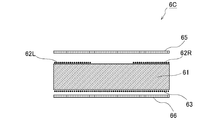
- FIG. 13 is a cross-sectional view of the absorber 6C taken along the line AA shown in FIG. 12 (cross section along the width direction of the absorber 6C).
- the absorber 6C has a uniform cross section in the entire longitudinal direction. Note that, in FIG. 13, gaps are provided between the constituent elements for easy understanding of the constituent elements of the absorber 6C, but in reality, almost no gap is formed between the constituent elements.
- the absorber 6C includes a base material 61.
- the base material 61 is formed in a rectangular sheet shape.
- As the base material 61 a bulky nonwoven fabric having a thickness of about 1 mm to 10 mm manufactured by an air-through method or a needle punch method is used.
- the base material 61 penetrates and diffuses the liquid.
- the absorber 6C is disposed on the surface of the base material 61, and is provided with SAP layers 62L and 62R (an example of “upper SAP layer”) including particles of SAP (Super Absorbent Polymer) that is a superabsorbent polymer.
- SAP Super Absorbent Polymer
- the front surface of the base material 61 is arranged on the skin-facing surface side
- the back surface of the base material 61 is on the skin-non-facing surface side opposite to the skin-facing surface side. Will be placed.
- the SAP layers 62L and 62R are arranged on the front surface of the base material 61, on both sides in the width direction along the center portion of the base material 61 in the width direction, and extend in the longitudinal direction of the base material 61.
- the longitudinal direction of the base material 61 is orthogonal to the width direction of the base material 61.
- the SAP layer 62L is located on the left side of the wearer of the absorbent article, and the SAP layer 62R is located on the right side of the wearer of the absorbent article.
- the SAP layers 62L and 62R are formed by attaching a plurality of SAP particles to the surface of the base material 61 with an adhesive. In the SAP layers 62L and 62R, the SAP particles are arranged substantially uniformly.
- the base material 61 holds the SAP layers 62L and 62R.
- the SAP layers 62L and 62R extend over the entire longitudinal direction of the base material 61.
- the absorber 6C is disposed on the back surface of the base material 61 and includes the SAP layer 63 containing SAP particles (an example of a “lower SAP layer”).
- the SAP layer 63 is formed on substantially the entire back surface of the base material 61.
- the SAP layer 63 is formed by attaching a plurality of SAP particles to the back surface of the base material 61 with an adhesive. In the SAP layer 63, the SAP particles are arranged substantially uniformly.
- the base material 61 holds the SAP layer 63.
- the absorber 6C increases the liquid absorption and holding amount as a whole. Note that SAP particles may be included in the gaps in the base material 61.
- SAP absorbs 10 to 100 times its own weight of liquid.
- SAP for example, a granular material in a state before liquid absorption is used.
- the SAP layers 62L and 62R have a smaller amount of SAP than the SAP layer 63.
- the liquid absorption amount (liquid holding amount) in the SAP layer is proportional to the amount of SAP.
- the absorber 6C according to the present embodiment is provided with the SAP layer 63 containing a larger amount of SAP than the SAP layers 62L and 63R, and thus suppresses liquid leakage without reducing the liquid absorption and retention amount as a whole. it can.
- the absorbent body 6C has the SAP layers 62L and 62R having a smaller amount of SAP than the SAP layer 63, so that the SAP layer 62L is disposed proximally from the wearer's skin when disposed in the absorbent article.
- the amount of SAP in the SAP layer may be defined by the basis weight or the amount of application (g).
- the SAP layers 62L and 62R may have higher liquid permeability than the SAP layer 63. These can be set depending on the type of SAP arranged in each SAP layer. Liquid permeability is defined as the volume (ml) of liquid that permeates in 1 minute.
- a biocolumn having an inner diameter of 25.4 mm (Biocolumn CF-30K etc. manufactured by AS ONE Co., Ltd.) equipped with a filter (Biocolumn filter 30SUS manufactured by AS ONE Co., Ltd.) is prepared.
- Biocolumn filter 30SUS manufactured by AS ONE Co., Ltd. those with marks on the liquid volumes of 60 ml and 40 ml, or those with marks on the liquid volumes of 60 ml and 40 ml are used.
- the cock of the biocolumn is opened, the liquid level is lowered until the liquid level in the biocolumn tube is about 5 cm above the 60 ml line, and the state is waited for 1 minute.
- the cock of the biocolumn is opened, and the time (T1) required for the liquid level to drop from the 60 ml line to the 40 ml line is measured.
- the same test is performed with no SAP, and the time (T0) is measured.
- SAP having a liquid permeability of 30 (ml/min) or more may be used.
- the SAP layers 62L and 62R have a liquid permeability of 30 (ml/min) or more than that of the SAP layer 63.
- the SAP layer 63 has a liquid permeability lower than 30 (ml/min).
- the SAP closer to the wearer's skin absorbs a larger amount of urine. Therefore, after the absorbent absorbs urine a plurality of times, the SAP closer to the wearer's skin swells and the liquid permeability decreases, and the inside of the absorbent and the non-skin-facing surface side (lower side) are absorbed. It is difficult for urine to enter, and this urine may flow on the skin-facing surface side of the absorbent body and leak.
- the SAP layers 62L and 62R are located on the skin facing surface side, and the SAP layer 63 is located on the skin non-facing surface side.
- the SAP layer 63 is arranged more distal to the wearer's skin than the SAP layers 62L and 62R.
- the SAP layers 62L and 62R have higher liquid permeability than the SAP layer 63. Therefore, the absorber 6C ensures the liquid permeability of the SAP layers 62L and 62R arranged closer to the wearer's skin even after absorbing the urine a plurality of times, and the inside of the base material 61 and the SAP layer are secured.
- SAP layers are arranged on the front surface and the back surface of the base material 61, and SAP required for absorbing and retaining a predetermined amount of liquid can be separately arranged in the SAP layers 62L, 62R, 63. Therefore, it is possible to prevent the SAP density in the SAP layers 62L, 62R, 63 from becoming too high, and prevent gel blocking from occurring. Further, the absorbent body 6C can prevent the SAP in the SAP layers 62L, 62R, 63 from being gelled, and can prevent the SAP layers 62L, 62R, 63 from decreasing in the amount of liquid absorbed and retained, thereby temporarily absorbing the liquid. It is possible to prevent the liquid from returning to the skin side of the wearer.
- SAP is not provided in the central portion in the width direction, and SAP layers 62L and 62R are arranged on both sides in the width direction.
- the front side widthwise central portion of the base material 61 is arranged at a position facing the urethral opening (hereinafter referred to as “urethral opening facing position”) when the absorbent body 6C is arranged on the absorbent article.
- urethral opening facing position a position facing the urethral opening
- the SAP is not provided at the position facing the urethral meatus, so that the discharged urine can be introduced into the base material 61 and diffused throughout.
- the SAP layer may be formed on the entire surface of the base material 61.
- the absorbent body 6C has a large liquid permeability of the SAP layer arranged closer to the wearer's skin as described above, urine easily enters the inside of the base material 61 and the SAP layer 63. Then, the leakage of this urine can be suppressed.
- the absorber 6C also includes a first nonwoven fabric sheet 65 arranged to cover the front surface of the base material 61 and a second nonwoven fabric sheet 66 arranged to cover the back surface of the base material 61.
- a liquid-permeable nonwoven fabric is used for the first nonwoven fabric sheet 65 and the second nonwoven fabric sheet 66.
- air-laid non-woven fabric is used for the first non-woven fabric sheet 65 and the second non-woven fabric sheet 66.
- the first nonwoven fabric sheet 65 and the second nonwoven fabric sheet 66 diffuse the liquid in the width direction and the longitudinal direction of the absorber 6C.
- the absorber 6C prevents the liquid such as urine discharged by the wearer from concentrating on the center in the width direction or the center in the longitudinal direction of the absorber 6C. Further, by providing the first nonwoven fabric sheet 65, the wearer's feeling of wearing the absorbent article can be improved.
- the base material 61 may have grooves formed therein.
- FIG. 14 is a plan view similar to FIG.
- FIG. 15 is a cross-sectional view when cut along the BB cross section (cross section along the width direction of the absorber 6C) shown in FIG.
- a groove 67 is formed in the center portion in the width direction of the base material 61 and along the SAP layers 62L and 62R on both sides.
- the groove 67 is formed at a position opposite to the urethral opening so that the urine excreted by the wearer can easily flow in when the absorber 6C is arranged in the absorbent article.
- the groove 67 is formed by pressing the groove forming region from the front surface side of the base material 61 after the base material 61 is formed.
- the groove 67 may be formed by reducing the basis weight of the non-woven fabric in the groove forming region when the base material 61 is manufactured.
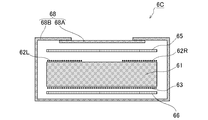
- FIG. 16 is a sectional view of the absorber 6C similar to that of FIG.
- the core wrap sheet 68 includes a first sheet 68A that covers the first non-woven fabric sheet 65 side, a widthwise end of the first non-woven fabric sheet 65, a side surface of the base material 61, and a second non-woven fabric sheet 66 side. And a second sheet 68B that covers the.
- the first sheet 68A and the second sheet 68B are joined and integrated to wrap the entire absorbent composite.
- the core wrap sheet 68 for example, thin paper such as liquid-permeable tissue paper or non-woven fabric is used.
- the core wrap sheet 68 can diffuse the liquid discharged by the wearer throughout the absorber 6C.
- the core wrap sheet 68 may be composed of a single sheet.
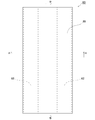
- FIG. 17 is a plan view of the absorbent core 6C seen from the first sheet 68a side of the core wrap sheet 68 shown in FIG.
- the first sheet 68a is placed on the skin facing surface side.
- Compressed grooves 70 and 71 are formed on the surface of the first sheet 68a.
- the compressed grooves 70 and 71 are formed in a plurality of straight lines that are inclined with respect to the longitudinal direction of the absorber 6C.
- a plurality of compression grooves 70 extend from the upper left to the lower right of the absorbent body 6C toward the paper surface and are formed in parallel to each other. Further, a plurality of compressed grooves 71 extend from the upper right side to the lower left side of the absorbent body 6C toward the paper surface and are formed in parallel to each other. The compressed groove 70 and the compressed groove 71 intersect at a substantially right angle. These compressed grooves 70, 71 are formed in a grid pattern as a whole.
- the formation pattern of the compressed grooves 70, 71 is not limited to this, and may be formed, for example, so as to extend along the longitudinal direction of the absorber 6C, or may be formed in a curved shape. ..
- FIG. 18 is a cross-sectional view when cut along the CC cross section (cross section along the width direction of the absorber 6C) shown in FIG.
- the compressed grooves 70, 71 are formed by compressing the core wrap sheet 68, the first nonwoven fabric sheet 65 and the base material 61. Further, the compressed grooves 70, 71 are formed to a depth that reaches a part of the base material 61 from the front surface side of the absorber 6C.
- the absorber 6C allows air to flow into the compressed grooves 70 and 71 to improve liquid permeability. Further, since the liquid flows in the compression grooves 70, 71, the diffusibility of the liquid is improved. In this way, the compressed grooves 70, 71 are provided to improve the liquid permeability and the liquid diffusivity of the absorber 6C.
- the compression grooves 70 and 71 are compressed by compressing the core wrap sheet 68 and the first nonwoven fabric sheet 65 toward the surface of the base material 61 by passing the absorber 6C through a press roll having a convex grid pattern. It is formed by being processed.
- the SAP layer when the SAP layer is formed on the surface of the base material 61, the SAP may break the core wrap sheet or the non-woven fabric sheet when the compression processing is performed from the surface side of the absorber 6C.
- the absorber 6C according to the present embodiment, the amount of SAP in the SAP layers 62L and 62R arranged on the surface side of the absorber 6C is reduced.
- the absorber 6C can improve the yield when the compression processing is performed.
- the present embodiment aims to provide a technique capable of suppressing liquid leakage.
- a water repellent processed area is provided on the surface of the base material, centering on the urethral opening facing the wearer's urethral opening.
- the present embodiment is an absorber, a base material formed of a non-woven fabric, an SAP layer disposed on the front and back surfaces of the base material, and containing SAP particles that are a superabsorbent polymer,
- the surface of the base material is provided with a water-repellent processed region centered on the urethral opening facing the wearer's urethral opening.
- the water repellent processed area may be provided so that the water repellency decreases as the distance from the urethral opening facing position increases.
- water-repellent processed regions are arranged alternately with the non-water-repellent processed regions in the longitudinal direction of the base material, and the ratio of the water-repellent processed region to the non-water-repellent processed region per unit area gradually increases. It may be provided so as to be small.
- a groove extending in the longitudinal direction of the base material may be formed on the front surface side of the base material and in the central portion in the width direction of the base material.
- the absorbent body may include a first nonwoven fabric sheet arranged so as to cover the front surface of the base material, and a second nonwoven fabric sheet arranged so as to cover the back surface of the base material.
- the absorbent body may include a core wrap sheet that covers the outer periphery of the absorbent composite including the base material, the SAP layer, the first nonwoven fabric sheet, and the second nonwoven fabric sheet.
- an absorbent article that absorbs urine discharged by the wearer, a liquid-impermeable backsheet, a liquid-permeable topsheet joined to the backsheet, the backsheet and the topsheet.
- the absorbent body according to any one of the above, which is disposed between the two.
- liquid leakage can be suppressed.
- FIG. 19 is a plan view of the absorber according to the fourth embodiment.
- the absorber 6D is formed in a sheet shape having a rectangular shape in a plan view.
- FIG. 19 shows a state in which the absorber 6D is viewed from the surface side which is the skin facing surface side facing the wearer's skin when the absorber 6D is arranged in an absorbent article such as a diaper.
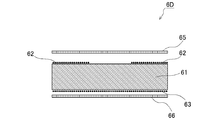
- FIG. 20 is a cross-sectional view of the absorbent body 6D taken along the line AA shown in FIG. 19 (cross section taken along the width direction of the absorbent body 6D).
- the absorber 6D has a uniform cross section in the entire longitudinal direction. Note that, in FIG. 20, gaps are provided between the constituent elements in order to facilitate understanding of the constituent elements of the absorber 6D, but in reality, almost no gap is formed between the constituent elements.
- the absorber 6D includes a base material 61.
- the base material 61 is formed in a rectangular sheet shape.
- As the base material 61 a bulky nonwoven fabric having a thickness of about 1 mm to 3 mm manufactured by an air-through method or a needle punch method is used.
- the absorber 6D is disposed on the front surface and the back surface of the base material 61, and is provided with a SAP layer containing particles of SAP (Super Absorbent Polymer) that is a superabsorbent polymer.
- SAP Super Absorbent Polymer
- the front surface of the base material 61 is arranged on the skin facing surface side
- the back surface of the base material 61 is on the skin non-facing surface side opposite to the skin facing surface side. Will be placed.
- the SAP layer 62 is arranged on the front surface of the base material 61
- the SAP layer 63 is arranged on the rear surface of the base material 61.
- the SAP layer 62 is formed by attaching a plurality of SAP particles to the surface of the base material 61 with an adhesive.
- the SAP layer 63 is formed by attaching a plurality of SAP particles to the back surface of the base material 61 with an adhesive.
- the SAP particles are arranged substantially uniformly.
- the base material 61 holds the SAP layers 62 and 63.
- the SAP layer 62 is arranged over the entire front surface side longitudinal direction of the base material 61.
- the SAP layer 63 is arranged on substantially the entire back surface of the base material 61. Note that SAP particles may be included in the gaps in the base material 61.
- SAP absorbs 10 to 100 times its own weight of liquid.
- SAP for example, a granular material in a state before liquid absorption is used.
- the SAP layers 62 and 63 absorb and hold the liquid diffused by the base material 61.
- the SAP layers 62 arranged on the surface of the base material 61 are arranged on both sides in the width direction of the base material 61 along the longitudinal direction of the base material 61.
- the urethral opening facing position which is the position facing the wearer's urethral opening, is arranged in the widthwise central portion of the base material 61. Therefore, if the SAP layers 62 are thus arranged on both sides in the width direction of the base material 61 along the longitudinal direction of the base material 61, urine excreted from the wearer is absorbed into the SAP layer 62 via the base material 61. Or, it is easily absorbed into the SAP layer 63 via the base material 61.
- the absorbent body 6D includes a first non-woven fabric sheet 65 arranged so as to cover the surface of the base material 61 and a second non-woven fabric sheet 66 arranged so as to cover the back surface of the base material 61.
- a liquid-permeable nonwoven fabric is used for the first nonwoven fabric sheet 65 and the second nonwoven fabric sheet 66.
- air-laid non-woven fabric is used for the first non-woven fabric sheet 65 and the second non-woven fabric sheet 66.
- the first nonwoven fabric sheet 65 and the second nonwoven fabric sheet 66 diffuse the liquid in the width direction and the longitudinal direction of the absorber 6D.
- the absorber 6D prevents the liquid discharged by the wearer from concentrating on the center of the absorber 6D in the width direction and the center of the absorber 6D in the longitudinal direction. Further, by providing the first nonwoven fabric sheet 65, the wearer's feeling of wearing the absorbent article can be improved.
- a groove may be formed in the base material 61.
- 21 is a cross-sectional view of the absorber 6D similar to FIG.
- a groove 67 extending in the longitudinal direction of the base material 61 is formed on the front surface side of the base material 61 and in the central portion in the width direction of the base material 61.
- the groove 67 is formed at a position facing the urethral opening so that the urine excreted by the wearer can easily flow in when the absorber 6D is arranged in the absorbent article.
- the groove 67 is formed by pressing the groove forming region from the front surface side of the base material 61 after the base material 61 is formed.
- the groove 67 may be formed by reducing the basis weight of the non-woven fabric in the groove forming region when the base material 61 is manufactured.
- the groove 67 immediately guides the liquid excreted from the wearer's urethral opening to the outside of the urethral opening facing position, and diffuses this liquid to the base material 61 in the region other than the urethral opening facing position.
- the absorber 6D can suppress lateral leakage of the liquid that leaks from the side surface of the base material 61.
- the surface of the base material 61 is treated to be water repellent.
- the water-repellent treatment means that the surface of the base material 61 is repelled by liquid, and the liquid is less likely to flow from the surface of the base material 61 into the base material 61 at the processed part.
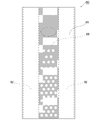
- FIG. 22 is a diagram showing a first example of a portion that is water repellent.
- the part surrounded by the alternate long and short dash line indicates the position facing the urethral meatus.
- the water repellency is highest near the urethral-opposite position on the surface of the base material 61, and gradually increases as the distance from the urethral-opposite position increases. The water repellency is reduced. That is, in the present embodiment, for example, as shown by hatching in FIG.
- the largest water-repellent processed area 69 is provided at the position facing the urethral meatus, and the non-water-repellent processed area not subjected to the water-repellent processing is provided.
- the water treatment regions 69 are alternately provided such that the area of the water repellent treatment regions 69 per unit area gradually decreases as the distance from the urethral orifice facing position increases. Therefore, in the example shown in FIG. 22, it can be said that the water-repellent processed area 69 is formed so as to draw a striped pattern along the longitudinal direction of the base material 61.
- the water-repellent treatment centering on the urethral-opposite position is not a concept intended to precisely decrease the water-repellent property from the urethral-opposite position as a strict central position, but mainly This is a concept that includes a water-repellent treatment in which the water repellency near the urethral orifice is slightly higher than the other.
- the water repellent finish is not limited to the striped water repellent finish region 69 as shown in FIG. 22, as long as the urine excreted by the wearer is diffused over the entire base material 61.
- the water-repellent treatment is continuously performed along the longitudinal direction of the base material 61, and the water-repellent force is highest near the urethral-mouth facing position, and gradually decreases as the distance from the urethral-mouth facing position increases.
- the size of the non-water-repellent regions discretely provided in the water-repellent region may be gradually increased with increasing distance from the urethral-opposite position.
- FIG. 23 is a diagram showing a second example of a portion that has been subjected to water repellent finishing.
- the water repellent treatment is performed along the longitudinal direction of the base material 61, and even if the non-water repellent region is provided in the water repellent treated region 69 like a polka dot pattern. Good.
- the water-repellent treatment can be realized, for example, by subjecting the surface of the base material 61 to physical treatment such as heat treatment or pressure treatment, or by performing chemical treatment such as application of water-repellent ink.
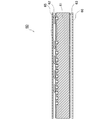
- FIG. 24 is a cross-sectional view of the absorbent body 6D taken along the line BB shown in FIG. 19 (cross section taken along the longitudinal direction of the absorbent body 6D).
- a white arrow shows how the water excreted from the urethral meatus flows.
- the surface of the base material 61 is subjected to the water repellent treatment for diffusing the urine excreted by the wearer over the entire base material 61, it is excreted from the urethral opening of the wearer. As shown by the outline arrow in FIG.
- the liquid does not diffuse into the base material 61 in the vicinity of the urethral opening facing position, and is guided to a position on the surface of the base material 61 away from the urethral opening facing position. In the water repellent area, this liquid is diffused over the entire base material 61.
- the liquid diffused from the surface of the base material 61 to the entire base material 61 through the non-water-repellent region is the SAP layer 62 provided on the front surface of the base material 61 or the SAP provided on the back surface of the base material 61. It is absorbed by the layer 63. As a result, the absorber 6D can suppress lateral leakage of the liquid that leaks from the side surface of the base material 61.
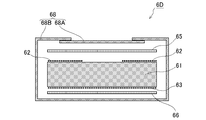
- FIG. 25 is sectional drawing of the absorber 6D similar to FIG.
- the core wrap sheet 68 includes a first sheet 68A that covers the first non-woven fabric sheet 65, a widthwise end portion of the first non-woven fabric sheet 65, a side surface of the base material 61, and a second non-woven fabric sheet 66 side. And a second sheet 68B for covering.
- the first sheet 68A and the second sheet 68B are joined and integrated to wrap the entire absorbent composite.
- the core wrap sheet 68 for example, thin paper such as liquid-permeable tissue paper or non-woven fabric is used.
- the core wrap sheet 68 can diffuse the liquid discharged by the wearer throughout the absorber 6D.
- the core wrap sheet 68 may be composed of a single sheet.
- the present embodiment has an object to provide a technique capable of suppressing liquid leakage and backflow.
- the liquid absorption rate of the upper SAP layer is high, and the liquid absorbability of the lower SAP layer is increased.
- the present embodiment is an absorber, which is formed of a non-woven fabric, and includes a substrate that is permeable to liquid, and an upper portion that is disposed on the surface of the substrate and that includes particles of SAP that is a superabsorbent polymer.
- An SAP layer and a lower SAP layer disposed on the back surface of the substrate and containing particles of SAP that is a superabsorbent polymer, and a liquid absorption rate of 45 (sec) measured by the upper SAP layer vortex method.
- the liquid absorption property of the lower SAP layer is 35 (g/g) or more.
- the upper SAP layer may be arranged on both sides in the width direction along the center portion in the width direction of the base material and may extend in the longitudinal direction of the base material.
- a groove may be formed on the front surface side of the base material so as to extend along the center portion in the width direction and along the upper SAP layers on both sides.
- the absorbent body may include a first nonwoven fabric sheet arranged so as to cover the front surface of the base material, and a second nonwoven fabric sheet arranged so as to cover the back surface of the base material.
- the absorbent body includes a core wrap sheet that covers the outer periphery of an absorbent composite including the base material, the upper SAP layer, the lower SAP layer, the first nonwoven fabric sheet, and the second nonwoven fabric sheet. May be.
- an absorbent article that absorbs the liquid discharged by the wearer, a liquid-impermeable backsheet, a liquid-permeable topsheet joined to the backsheet, the backsheet and the topsheet. And the above-mentioned absorber arranged between.
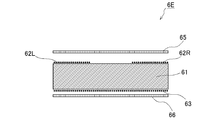
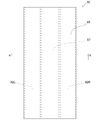
- FIG. 26 is a plan view of the absorber according to the fifth embodiment.
- the absorber 6E is formed in a sheet shape having a rectangular shape in a plan view.
- FIG. 26 shows a state in which the absorber 6E is viewed from the surface side, which is the skin-facing surface side facing the wearer's skin when the absorber 6E is arranged in an absorbent article such as a diaper.
- FIG. 27 is a cross-sectional view of the absorbent body 6E taken along the line AA shown in FIG. 26 (cross section taken along the width direction of the absorbent body 6E).
- the absorber 6E has a uniform cross section in the entire longitudinal direction. Note that, in FIG. 27, gaps are provided between the constituent elements in order to make the constituent elements of the absorber 6E easy to understand, but in reality, almost no gap is formed between the constituent elements.
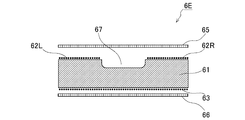
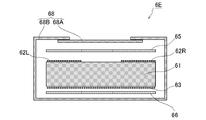
- the absorber 6E includes a base material 61.
- the base material 61 is formed in a rectangular sheet shape.
- As the base material 61 a bulky nonwoven fabric having a thickness of about 1 mm to 10 mm manufactured by an air-through method or a needle punch method is used.
- the base material 61 penetrates and diffuses the liquid.
- the absorber 6E is disposed on the surface of the base material 61 and includes SAP layers 62L and 62R (an example of “upper SAP layer”) including particles of SAP (Super Absorbent Polymer) that is a superabsorbent polymer.
- SAP Super Absorbent Polymer
- the front surface of the base material 61 is arranged on the skin-facing surface side
- the back surface of the base material 61 is on the skin-non-facing surface side opposite to the skin-facing surface side. Will be placed.
- the SAP layers 62L and 62R are arranged on the front surface of the base material 61, on both sides in the width direction along the center portion of the base material 61 in the width direction, and extend in the longitudinal direction of the base material 61.
- the longitudinal direction of the base material 61 is orthogonal to the width direction of the base material 61.
- the SAP layer 62L is located on the left side of the wearer of the absorbent article, and the SAP layer 62R is located on the right side of the wearer of the absorbent article.
- the SAP layers 62L and 62R are formed by attaching a plurality of SAP particles to the surface of the base material 61 with an adhesive. In the SAP layers 62L and 62R, the SAP particles are arranged substantially uniformly.
- the base material 61 holds the SAP layers 62L and 62R.
- the SAP layers 62L and 62R extend over the entire longitudinal direction of the base material 61.
- the absorber 6E is disposed on the back surface of the base material 61 and includes the SAP layer 63 containing SAP particles (an example of a “lower SAP layer”).
- the SAP layer 63 is formed on substantially the entire back surface of the base material 61.
- the SAP layer 63 is formed by attaching a plurality of SAP particles to the surface of the base material 61 with an adhesive. In the SAP layer 63, the SAP particles are arranged substantially uniformly.
- the base material 61 holds the SAP layer 63.
- the absorber 6E increases the liquid absorption and holding amount as a whole. Note that SAP particles may be included in the gaps in the base material 61.
- SAP absorbs 10 to 100 times its own weight of liquid.
- SAP for example, a granular material in a state before liquid absorption is used.
- the SAP layers 62L and 62R have a higher liquid absorption speed than the SAP layer 63, and the SAP layer 63 has a higher liquid absorption property than the SAP layers 62L and 62R. These can be set depending on the type of SAP arranged in each SAP layer.
- the liquid absorption rate of SAP can be measured by the vortex method.
- 50.0 ml ( ⁇ 0.5 ml) of physiological saline having a concentration of 0.900% ( ⁇ 0.009%) and a temperature of 25° C. ( ⁇ 2° C.) is placed in a beaker having a volume of 100 ml.
- the stirrer bar is rotated at 600 rpm ( ⁇ 30 rpm), and it is confirmed that the physiological saline in the beaker stably forms a vortex.
- measurement was started with a stopwatch, and the time until the vortex disappeared and the liquid surface became horizontal was measured.
- the liquid absorption rate of SAP is obtained by the vortex method described above.
- SAP whose liquid absorption rate measured by the vortex method is 45 (sec) or less is used. Therefore, the SAP layers 62L and 62R have a liquid absorption rate of 45 (sec) or less measured by the vortex method.
- the SAP layer 63 has a liquid absorption rate of greater than 45 (sec) measured by the vortex method.
- the liquid absorbency is defined by the amount (g) of liquid absorbed per 1 g of SAP.
- a nylon sheet with an opening of 57 ⁇ m is cut into a size of 10 cm in length and 40 cm in width, the cut nylon sheet is folded in half in the longitudinal direction, and both ends are heat-sealed to form a bag of 10 cm ⁇ 20 cm to form a nylon bag.
- To do. Put 1.00 g ( ⁇ 0.01 g) of SAP in this nylon bag. Then, the nylon bag is placed in a physiological saline solution having a concentration of 0.900% ( ⁇ 0.009%) and a temperature of 25° C. ( ⁇ 2° C.) and immersed for 1 hour.
- the nylon bag is pulled up and drained for 15 minutes. Then, the centrifugal force is set to 150 G with a centrifugal dehydrator, dehydration is performed for 90 seconds, and the weight (A) of the nylon bag is measured. Also, a similar nylon bag containing no SAP is prepared and the same test is performed to measure the weight (B) of the nylon bag.
- liquid absorbency of SAP is determined by applying the values of A and B obtained by the above test to the following equation (4).
- Liquid absorbency (g/g) (AB)/SAP collection amount...(4)
- the SAP layer 63 is made of SAP having a liquid absorbency of 35 (g/g) or more. Therefore, the SAP layer 63 has a liquid absorbency of 35 (g/g) or more.
- the SAP layers 62L and 62R have a liquid absorbency smaller than 35 (g/g).
- the SAP layers 62L and 62R are located on the skin facing surface side, and the SAP layer 63 is located on the skin non-facing surface side.
- the SAP layer 63 is arranged more distal to the wearer's skin than the SAP layers 62L and 62R.
- the SAP layers 62L and 62R have a liquid absorption rate of 45 (sec) or less. Therefore, the absorber 6E is disposed closer to the wearer's skin, and the SAP layers 62L and 62R having a relatively high liquid absorption rate can quickly absorb urine and prevent the urine from leaking.
- the SAP layer 63 has a liquid absorbency of 35 (g/g) or more. Since the absorbent body 6E according to the present embodiment holds a relatively large amount of urine by the SAP layer 63 disposed distally from the wearer's skin, it suppresses the feeling of wetness on the skin surface and suppresses the deterioration of the feeling of wearing. it can. Further, in the absorbent body, holding the liquid as far as possible is effective in suppressing the reversion of the liquid even when pressure or the like is applied to the absorbent body due to body weight or the like. Since the absorbent body 6E according to the present embodiment holds a relatively large amount of urine in the SAP layer 63 disposed distally from the wearer's skin, it is possible to prevent the liquid from returning back.
- the absorbent body 6E when the wearer takes a sleeping position while wearing absorbent articles, urine flows on the surface of the diaper during urination, which leads to leakage.
- the SAP layers 62L and 62R having a high liquid absorption rate are arranged on the skin facing surface side so that the urine flowing on the surface of the absorbent body 6E is absorbed by the SAP layers 62L and 62R. Therefore, urine leakage can be prevented.
- SAP is not provided in the central portion in the width direction, and SAP layers 62L and 62R are arranged on both sides in the width direction.
- the front side widthwise central portion of the base material 61 is arranged at a position facing the urethral opening (hereinafter, referred to as “urethral opening facing position”) when the absorbent body 6E is arranged on the absorbent article.
- SAP is not provided at the position facing the urethral meatus, so that the discharged urine can be introduced into the base material 61 and diffused throughout.
- the SAP layer may be formed on the entire surface of the base material 61.
- the absorber 6E includes a first non-woven fabric sheet 65 arranged so as to cover the surface of the base material 61 and a second non-woven fabric sheet 66 arranged so as to cover the back surface of the base material 61.
- a liquid-permeable nonwoven fabric is used for the first nonwoven fabric sheet 65 and the second nonwoven fabric sheet 66.
- air-laid non-woven fabric is used for the first non-woven fabric sheet 65 and the second non-woven fabric sheet 66.
- the first nonwoven fabric sheet 65 and the second nonwoven fabric sheet 66 diffuse the liquid in the width direction and the longitudinal direction of the absorber 6E.
- the absorber 6E prevents the liquid such as urine discharged by the wearer from concentrating on the center in the width direction or the center in the longitudinal direction of the absorber 6E. Further, by providing the first nonwoven fabric sheet 65, the wearer's feeling of wearing the absorbent article can be improved.
- the base material 61 may be provided with a groove.
- 28 is a plan view similar to FIG.
- FIG. 29 is a cross-sectional view when cut along the BB cross section (cross section along the width direction of the absorber 6E) shown in FIG.
- a groove 67 is formed in the center portion in the width direction of the base material 61 and along the SAP layers 62L and 62R on both sides.
- the groove 67 is formed at a position opposite to the urethral opening so that the urine excreted by the wearer can easily flow in when the absorber 6E is arranged in the absorbent article.
- the groove 67 is formed by pressing the groove forming region from the front surface side of the base material 61 after the base material 61 is formed.
- the groove 67 may be formed by reducing the basis weight of the non-woven fabric in the groove forming region when the base material 61 is manufactured.
- FIG. 30 is a sectional view of the absorber 6E similar to that of FIG.
- the core wrap sheet 68 is a second sheet 68B that covers the first non-woven fabric sheet 65 side, the widthwise end of the first non-woven fabric sheet 65, the side surface of the base material 61, and the second non-woven fabric sheet 66 side. And are equipped with.
- the first sheet 68A and the second sheet 68B are joined and integrated to wrap the entire absorbent composite.
- the core wrap sheet 68 for example, thin paper such as liquid-permeable tissue paper or non-woven fabric is used.
- the core wrap sheet 68 can diffuse the liquid discharged by the wearer over the entire absorbent body 6E.
- the core wrap sheet 68 may be composed of a single sheet.
- FIG. 31 is a perspective view of a tape-type disposable diaper (hereinafter, simply referred to as “diaper”) 1.
- the diaper 1 has a crotch region 1B that covers the wearer's pubic area in a worn state, a front body region 1F located on the front side of the crotch region 1B, and a back body region 1R located on the rear side of the crotch region 1B.
- Tapes 2L, 2R that can be attached to the front patch 2F provided on the non-wearer side surface of the front body region 1F are provided on the left and right edges of the rear body region 1R. Therefore, in the diaper 1, when the front body region 1F is arranged on the wearer's ventral side and the back body region 1R is arranged on the wearer's back side, the tapes 2L, 2R are attached to the front patch 2F. , It is fixed to the wearer's body while surrounding the wearer's abdominal circumference and thighs.
- an absorber capable of absorbing and holding a liquid is arranged mainly in the vicinity of the crotch region 1B.
- the absorber 6 is used as the absorber.
- the absorber 6 may be any of the absorbers 6A to 6E according to the first to fifth embodiments.
- three-dimensional gathers 3BL, 3BR are provided on the region surrounding the thigh of the wearer in order to suppress the formation of a gap serving as a liquid outflow route between the diaper 1 and the wearer's skin. Is provided, and the waist gather 3R is provided in a region surrounding the waist circumference of the wearer.
- the three-dimensional gathers 3BL and 3BR and the waist gather 3R are in close contact with the wearer's skin by the elastic force of the rubber thread. Therefore, the liquid discharged from the pubic area of the wearer is absorbed by the absorbent body of the diaper 1 with almost no leakage from the diaper 1.
- FIG. 32 is an exploded perspective view of the diaper 1. Further, FIG. 33 is a cross-sectional view when the crotch region 1B is cut in the width direction thereof.
- the diaper 1 has a cover sheet 4 which forms an outer surface in a worn state.
- the cover sheet 4 is a sheet-shaped member having a substantially rectangular outer shape in which constrictions 4KL and 4KR are provided in a portion corresponding to the long side.
- the constrictions 4KL and 4KR are provided at positions where the wearer's thighs are located.
- the cover sheet 4 is provided to reinforce the back sheet 5 and to improve the touch.
- a nonwoven fabric made of a liquid impermeable thermoplastic resin is used as the material. it can.
- the liquid-impermeable thermoplastic resin include polyethylene (PE) and polypropylene (PP).
- the diaper 1 has a back sheet 5, an absorbent body 6, and a top sheet 7, which are sequentially laminated on the wearer side surface of the cover sheet 4.
- Each of the back sheet 5, the absorber 6, and the top sheet 7 is a sheet-shaped member having a rectangular appearance, and is laminated in order on the cover sheet 4 in a state in which the longitudinal direction matches the longitudinal direction of the cover sheet 4. .
- the back sheet 5 is a sheet formed of a liquid-impermeable thermoplastic resin as a material in order to suppress the leakage of excrement.
- the top sheet 7 is a sheet-like member that is arranged on the wearer's skin surface side so as to cover the water absorbing surface (surface) of the absorber 6.
- the top sheet 7 is partially or wholly liquid-permeable. Therefore, in the state where the diaper 1 is worn, the liquid excreted from the wearer enters the absorber 6 through the top sheet 7 that can come into contact with the wearer's skin, and is absorbed there.
- a woven cloth, a nonwoven cloth, or a porous film can be used as the material of the top sheet 7.
- the top sheet 7 may also have hydrophilicity.
- the cover sheet 4 on which the back sheet 5, the absorber 6 and the top sheet 7 are laminated is used to cover the pubic area of the wearer, the back sheet 5, the absorber 6 and the top sheet 7 have their respective longitudinal ends.
- the state is located on the ventral side and the dorsal side of the wearer. That is, the wearer's genital area is in a state of being covered with the absorber 6 from the wearer's ventral side to the back side. Therefore, even if the wearer discharges the liquid out of the body in any of the posture in which the belly faces down and the posture in which the back faces down, the discharged liquid touches the absorber 6 through the top sheet 7. It will be.
- Diaper 1 also has elongated strip-shaped side sheets 8L and 8R for forming the above-mentioned three-dimensional gathers 3BL and 3BR.
- the side sheets 8L and 8R are provided on the long side portions of the top sheet 7. Similar to the three-dimensional gathers 3BL and 3BR of the diaper 1, the side seats 8L and 8R are provided with constrictions 8KL and 8KR at positions where the wearer's thighs are located. Thread rubbers 8EL and 8ER are knitted in the constrictions 8KL and 8KR along the longitudinal direction.
- the constrictions 8KL and 8KR are pulled in the longitudinal direction by the contracting force of the rubber threads 8EL and 8ER and are pulled from the top sheet 7. It becomes a three-dimensional gather that stands up and prevents the outflow of liquid.
- the rubber thread 9ER for forming the above-mentioned waist gather 3R is provided between the backsheet 5 and the topsheet 7 at a position further back than the end portion of the absorbent body 6.
- the rubber thread 9ER is provided between the backsheet 5 and the topsheet 7 in a direction in which the longitudinal direction that is the stretching direction is the left-right direction of the diaper 1. Therefore, when the tapes 2L and 2R provided on both the left and right sides of the thread rubber 9ER are attached to the front patch 2F on the wearer's abdominal side, the thread rubber 9ER exerts a contracting force on the wearer of the diaper 1. The close contact prevents the formation of a gap between the diaper 1 and the wearer's abdominal girth.
- thread rubbers 9SL and 9SR that prevent a gap from being formed between the diaper 1 and the wearer's abdominal circumference are also provided on both sides of the absorbent body 6.
- the absorbent body 6A according to the first embodiment is a liquid that is formed on the surface of the liquid diffusion layer 60 in which a bulky non-woven fabric is used as shown in FIGS. 1 to 6 and along the center portion in the width direction of the liquid diffusion layer 60.
- SAP layers 62L and 62R are provided on both sides in the width direction of the diffusion layer 60 and extend in the longitudinal direction of the liquid diffusion layer 60.
- the absorber 6 diffuses urine throughout the liquid diffusion layer 60, and causes the SAP layers 62L and 62R to uniformly absorb and retain urine.
- the SAP layers 62L and 62R that have absorbed and expanded urine serve as banks. Since the SAP layers 62L and 62R serve as banks, the grooves 67 extend along the SAP layers 62L and 62R (banks) in the widthwise center of the liquid diffusion layer 60, that is, the grooves 67 that extend in the longitudinal direction of the liquid diffusion layer 60. Is formed.
- the groove 67 is formed at a position facing the urethral opening so that the urine excreted by the wearer can easily flow in.
- the absorber 6 diffuses urine in the longitudinal direction of the liquid diffusion layer 60 by the groove 67.
- the diaper 1 diffuses urine throughout the liquid diffusion layer 60, so that the absorption rate and the diffusion rate can be maintained during the subsequent urination.
- a groove 67 can be formed at a position opposite to the urethral meatus at the tip of the male genitalia, and the urination direction from the urethral meatus can be guided by the groove 67.
- the SAP layers 62L and 62R can absorb the urine evenly and expand the SAP layers 62L and 62R substantially uniformly. it can.
- the absorbent body 6 prevents only a part of the SAP layers 62L and 62R from expanding, thereby forming a depression in the bank formed by the SAP layers 62L and 62R and preventing a hole from being formed in the bank. It is possible to prevent the leakage of urine, thereby suppressing the leakage of urine.
- the diaper 1 temporarily holds the urine diffused in the entire liquid diffusion layer 60 in the liquid diffusion layer 60, and absorbs and retains this urine in the SAP layers 62L and 62R with the passage of time. As a result, the diaper 1 allows the SAP layers 62L and 62R to evenly absorb and retain urine.
- the absorbent body 6B according to the second embodiment includes SAP layers 62L and 62R on the surface of a base material 61 using a bulky nonwoven fabric as shown in FIGS. 7 to 11.
- the absorbent body 6 secures the liquid permeability of the SAP layers 62L and 62R arranged closer to the wearer's skin even after absorbing the urine a plurality of times, and the inside of the base material 61 is secured. It is possible to make it easier for urine to enter the or SAP layer 63 and prevent the urine from leaking.
- the SAP layer 63 has a liquid absorbency of 35 (g/g) or more.
- the diaper 1 Since the diaper 1 according to the present embodiment retains a relatively large amount of urine by the SAP layer 63 arranged distally from the wearer's skin, it is possible to suppress a feeling of getting wet on the skin surface and a decrease in feeling of wearing. .. Further, the diaper 1 has SAP layers arranged on the front surface and the back surface of the base material 61, and the SAP required for absorbing and retaining a predetermined amount of liquid can be separately arranged in the SAP layers 62L, 62R, 63. , SAP layers 62L, 62R, and 63 can be prevented from becoming too high in density, and gel blocking can be prevented from occurring.
- the diaper 1 can prevent the SAP in the SAP layers 62L, 62R, 63 from being gelled, and can prevent the SAP layers 62L, 62R, 63 from absorbing and holding the liquid so that the SAP layers 62L, 62R, 63 are once absorbed. It is possible to prevent the liquid from returning to the skin side of the wearer.
- SAP layers 62L, 62R, 63 are arranged on a base material 61 using a bulky nonwoven fabric.
- the diaper 1 configured in this way, when the liquid is excreted from the wearer, the discharged liquid comes into contact with the absorbent body 6 via the top sheet 7. Then, as described above, the diaper 1 is provided with the SAP layer 63 containing a larger amount of SAP than the SAP layers 62L and 63R, thereby suppressing the liquid leakage without lowering the liquid absorption and retention amount as a whole. it can. Furthermore, the diaper 1 is arranged more distally from the skin than the SAP layer 62 arranged proximally from the wearer's skin by making the SAP layers 62L and 62R have a smaller amount of SAP than the SAP layer 63. A larger amount of liquid can be absorbed and retained by the SAP layer 63.
- the diaper 1 holds a relatively large amount of urine in the SAP layer 63 disposed distally from the wearer's skin, so that the feeling of getting wet on the skin surface can be suppressed and the deterioration of wearing comfort can be suppressed.
- the diaper 1 has SAP layers arranged on the front surface and the back surface of the base material 61, and the SAP required for absorbing and retaining a predetermined amount of liquid can be separately arranged in the SAP layers 62L, 62R, 63. , SAP layers 62L, 62R, and 63 can be prevented from becoming too high in density, and gel blocking can be prevented from occurring.
- the diaper 1 can prevent the SAP in the SAP layers 62L, 62R, 63 from being gelled, and can prevent the SAP layers 62L, 62R, 63 from absorbing and holding the liquid so that the SAP layers 62L, 62R, 63 are once absorbed. It is possible to prevent the liquid from returning to the skin side of the wearer.
- the absorbent body 6 may be formed with the compression grooves 70 and 71 similarly to the absorbent body 6C.
- the diaper 1 has a small amount of SAP in the SAP layers 62L and 62R arranged on the skin-facing surface side of the absorber 6. This can prevent the SAP from breaking through the first non-woven fabric sheet 65 and the first sheet 68a of the core wrap sheet 68 when the absorbent body 6 is pressed.
- the squeezing grooves 70, 71 are also formed on the central portion in the width direction of the base material 61 on the surface of the base material 61 where the SAP layer is not formed.
- the diaper 1 can improve the yield when it is pressed.
- the pressing grooves 70, 71 may be formed by compressing a part of the top sheet 7, the first sheet 68a of the core wrap sheet 68, the first nonwoven fabric sheet 65, and the base material 61. Similar to FIG. 33, FIG. 34 is a cross-sectional view when the crotch region 1B is cut in the width direction.
- the diaper 1 includes compression grooves 70 and 71 formed by compressing a part of the base material 61 of the absorber 6 from the top sheet 7.
- the formation pattern of the compressed grooves 70 and 71 may be the same as the example shown in FIG.
- the diaper 1 can improve the liquid permeability and the liquid diffusivity by including the compressed grooves 70 and 71.
- the diaper 1 including the absorber 6D when the liquid is excreted from the wearer, the discharged liquid comes into contact with the absorber 6D via the top sheet 7. Then, as described above, since the surface of the base material 61 is subjected to the water repellent treatment, the discharged liquid diffuses mainly along the longitudinal direction of the base material 61, and with the passage of time. This liquid is absorbed and retained by the SAP in the SAP layers 62 and 63. Thereby, the diaper 1 can suppress liquid leakage.
- the absorber 6E according to the fifth embodiment includes SAP layers 62L and 62R on the surface of a base material 61 using a bulky nonwoven fabric as shown in FIGS. 26 to 30.
- the absorber 6E when the liquid is excreted from the wearer, the discharged liquid contacts the absorber 6E via the top sheet 7. Then, as described above, in the absorber 6E, the liquid absorption speed of the SAP layers 62L and 62R is 45 (sec) or less than that of the SAP layer 63. Therefore, the absorber 6E is disposed closer to the wearer's skin, and the SAP layers 62L and 62R having a relatively high liquid absorption rate can quickly absorb urine and prevent the urine from leaking. In the absorber 6E, the SAP layer 63 has a liquid absorbency of 35 (g/g) or more than the SAP layers 62L and 62R.
- the diaper 1 according to the present embodiment retains a relatively large amount of urine by the SAP layer 63 arranged distally from the wearer's skin, it is possible to suppress a feeling of getting wet on the skin surface and a decrease in feeling of wearing. .. Further, in the absorbent article, holding the liquid as far as possible is effective in suppressing the liquid from returning even when pressure or the like is applied to the absorbent body due to the weight or the like.
- the diaper 1 according to the present embodiment retains a relatively large amount of urine in the SAP layer 63 arranged distally from the skin of the wearer, and therefore can prevent the liquid from returning back.
- the diaper 1 when the wearer takes a sleeping posture while wearing absorbent articles such as diapers, urine flows on the surface of the diaper during urination, which leads to leakage.
- the urine flowing on the surface of the diaper 1 (the surface of the top sheet 7) is disposed in the SAP layer 62L by disposing the SAP layers 62L and 62R having a high liquid absorption rate on the skin facing surface side. , 62R to prevent leakage of urine.
- the tape-type disposable diaper was illustrated, but the absorbent bodies 6A to 6E can be applied to other forms of absorbent articles.
- absorbent articles to which the absorbent bodies 6A to 6E can be applied include various types of absorbent articles with gathers such as pants-type disposable diapers, urine pads, and light incontinence pads, and flat absorbent articles without gathers. Can be mentioned.
- the absorber in the above embodiment is summarized as follows.
- a liquid diffusion layer formed of a non-woven fabric A SAP layer containing particles of SAP that is a superabsorbent polymer, the SAP layer being disposed on the surface of the liquid diffusion layer and on both sides in the width direction along the center portion in the width direction of the liquid diffusion layer.
- a SAP layer extending in the longitudinal direction of the diffusion layer, An absorber comprising.
- A2) On the surface side of the liquid diffusion layer, a groove is formed in the center portion in the width direction and along the SAP layers on both sides. The absorber according to A1.
- A5 An absorbent article that absorbs the liquid discharged by the wearer, Liquid impermeable backsheet, A liquid-permeable topsheet joined to the backsheet, The absorber according to any one of A1 to A4 arranged between the back sheet and the top sheet, An absorbent article comprising:
- (B1) A base material formed of a non-woven fabric and permeable to liquid, An upper SAP layer disposed on the surface of the substrate, the upper SAP layer including particles of SAP which is a superabsorbent polymer; A lower SAP layer disposed on the back surface of the substrate and containing particles of SAP, a superabsorbent polymer, Equipped with The upper SAP layer has a liquid permeability of 30 (ml/min) or more, The lower SAP layer has a liquid absorbency of 35 (g/g) or more, Absorber.
- the upper SAP layer is arranged on both sides in the width direction along the center of the base in the width direction, and extends in the longitudinal direction of the base. The absorber according to B1.
- (B3) On the front surface side of the base material, a groove is formed in the central portion in the width direction and along the upper SAP layers on both sides.
- the absorber according to B2. (B4) A first nonwoven sheet arranged so as to cover the surface of the base material; A second nonwoven sheet arranged to cover the back surface of the base material;
- the absorbent body according to any one of B1 to B3, comprising: (B5) B4, which comprises a core wrap sheet for covering the outer periphery of an absorbent composite including the base material, the upper SAP layer, the lower SAP layer, the first nonwoven fabric sheet and the second nonwoven fabric sheet. Absorber.
- An absorbent article that absorbs the liquid discharged by the wearer, Liquid impermeable backsheet, A liquid-permeable topsheet joined to the backsheet, The absorbent body according to any one of B1 to B5 arranged between the back sheet and the top sheet, An absorbent article comprising:
- (C1) A base material formed of a non-woven fabric and permeable to liquid, An upper SAP layer disposed on the surface of the substrate, the upper SAP layer including particles of SAP which is a superabsorbent polymer; A lower SAP layer disposed on the back surface of the substrate and containing particles of SAP, a superabsorbent polymer, Equipped with The upper SAP layer has a lower amount of SAP than the lower SAP layer, Absorber.
- the upper SAP layer is arranged on both sides in the width direction along the center portion in the width direction of the base material and extends in the longitudinal direction of the base material, On the front surface side of the base material, a groove is formed in the central portion in the width direction and along the upper SAP layers on both sides.
- the absorber according to C1.
- the upper SAP layer has greater liquid permeability than the lower SAP layer,
- C4 A first nonwoven sheet arranged so as to cover the surface of the base material;
- a second nonwoven sheet arranged to cover the back surface of the base material;
- the absorber according to any one of C1 to C3, comprising:
- C5 The core wrap sheet that covers the outer periphery of the absorbent composite including the base material, the upper SAP layer, the lower SAP layer, the first nonwoven fabric sheet, and the second nonwoven fabric sheet.
- Absorber. The absorbent body according to C5, comprising a squeeze groove formed by compressing the core wrap sheet, the first nonwoven fabric sheet, and the base material.
- (C7) An absorbent article that absorbs the liquid discharged by the wearer, Liquid impermeable backsheet, A liquid-permeable topsheet joined to the backsheet, The absorbent body according to any one of C1 to C6 arranged between the back sheet and the top sheet, An absorbent article comprising: (C8) The absorbent article according to C7, further comprising a compression groove formed by compressing a part of the base material of the absorber from the top sheet.
- (D1) A base material formed of a non-woven fabric, A SAP layer that is disposed on the front and back surfaces of the base material and that includes SAP particles that are a superabsorbent polymer; The surface of the base material is provided with a water repellent processed region centered on the urethral opening facing position facing the wearer's urethral opening. Absorber. (D2) The water-repellent processed region is provided so that the water-repellent property decreases as the distance from the urethral opening facing position increases, The absorber according to D1.
- the water-repellent processed areas are arranged alternately with the non-water-repellent processed areas in the longitudinal direction of the base material, and the ratio of the water-repellent processed area to the non-water-repellent processed area per unit area is gradually increased. Is designed to be small, The absorber according to D1 or D2.
- D4 A groove extending in the longitudinal direction of the base material is formed in the central portion in the width direction of the base material on the surface side of the base material, The absorber according to any one of D1 to D3.
- D5 A first nonwoven sheet arranged so as to cover the surface of the base material; A second non-woven sheet arranged so as to cover the back surface of the substrate, The absorber according to any one of D1 to D4.
- D6 A core wrap sheet that covers the outer periphery of an absorbent composite including the base material, the SAP layer, the first nonwoven fabric sheet, and the second nonwoven fabric sheet, The absorber according to D5.
- D7 An absorbent article that absorbs urine discharged by a wearer, Liquid impermeable backsheet, A liquid-permeable topsheet joined to the backsheet, The absorbent body according to any one of D1 to D6 arranged between the back sheet and the top sheet, Absorbent article.
- (E1) A base material formed of a non-woven fabric and permeable to liquid, An upper SAP layer disposed on the surface of the substrate, the upper SAP layer including particles of SAP which is a superabsorbent polymer; A lower SAP layer disposed on the back surface of the substrate and containing particles of SAP, a superabsorbent polymer, Equipped with The upper SAP layer has a liquid absorption rate of 45 (sec) or less measured by a vortex method, The lower SAP layer has a liquid absorbency of 35 (g/g) or more, Absorber.
- the upper SAP layer is arranged on both sides in the width direction along the center of the base in the width direction, and extends in the longitudinal direction of the base. The absorber according to E1.
- An absorbent article that absorbs the liquid discharged by the wearer, Liquid impermeable backsheet, A liquid-permeable topsheet joined to the backsheet, The absorbent body according to any one of E1 to E5 arranged between the back sheet and the top sheet, An absorbent article comprising:
Landscapes
- Health & Medical Sciences (AREA)
- Epidemiology (AREA)
- Engineering & Computer Science (AREA)
- Biomedical Technology (AREA)
- Heart & Thoracic Surgery (AREA)
- Vascular Medicine (AREA)
- Life Sciences & Earth Sciences (AREA)
- Animal Behavior & Ethology (AREA)
- General Health & Medical Sciences (AREA)
- Public Health (AREA)
- Veterinary Medicine (AREA)
- Absorbent Articles And Supports Therefor (AREA)
Abstract
La présente invention vise à procurer une technologie permettant d'éliminer une fuite de liquide. Un élément absorbant selon la présente invention est pourvu : d'un matériau de base qui est formé d'un tissu non tissé ; de premières couches de SAP qui sont disposées sur les deux côtés dans le sens de la largeur de la surface avant du matériau de base de façon à s'étendre dans la direction longitudinale du matériau de base, et contiennent des particules de SAP, un polymère hautement absorbant ; et une seconde couche de SAP qui est disposée sur la surface arrière du matériau de base, et contient des particules de SAP.
Priority Applications (4)
| Application Number | Priority Date | Filing Date | Title |
|---|---|---|---|
| CN202310268683.8A CN116370202B (zh) | 2019-02-20 | 2020-02-20 | 吸收体以及设置有吸收体的吸收性物品 |
| CN202310272382.2A CN116370203B (zh) | 2019-02-20 | 2020-02-20 | 吸收体以及设置有吸收体的吸收性物品 |
| CN202310262218.3A CN116370201B (zh) | 2019-02-20 | 2020-02-20 | 吸收体以及设置有吸收体的吸收性物品 |
| CN202080013901.8A CN113423372B (zh) | 2019-02-20 | 2020-02-20 | 吸收体以及设置有吸收体的吸收性物品 |
Applications Claiming Priority (10)
| Application Number | Priority Date | Filing Date | Title |
|---|---|---|---|
| JP2019028700A JP6631732B1 (ja) | 2019-02-20 | 2019-02-20 | 吸収体及びそれを備える吸収性物品 |
| JP2019028704A JP6631733B1 (ja) | 2019-02-20 | 2019-02-20 | 吸収体及びそれを備える吸収性物品 |
| JP2019-028699 | 2019-02-20 | ||
| JP2019028702A JP6583575B1 (ja) | 2019-02-20 | 2019-02-20 | 吸収体及びそれを備える吸収性物品 |
| JP2019-028700 | 2019-02-20 | ||
| JP2019-028704 | 2019-02-20 | ||
| JP2019-028698 | 2019-02-20 | ||
| JP2019028699A JP6631731B1 (ja) | 2019-02-20 | 2019-02-20 | 吸収体及びそれを備える吸収性物品 |
| JP2019028698A JP6590098B1 (ja) | 2019-02-20 | 2019-02-20 | 吸収体及びそれを備える吸収性物品 |
| JP2019-028702 | 2019-02-20 |
Publications (1)
| Publication Number | Publication Date |
|---|---|
| WO2020171176A1 true WO2020171176A1 (fr) | 2020-08-27 |
Family
ID=72144556
Family Applications (1)
| Application Number | Title | Priority Date | Filing Date |
|---|---|---|---|
| PCT/JP2020/006868 Ceased WO2020171176A1 (fr) | 2019-02-20 | 2020-02-20 | Élément absorbant et article absorbant associé |
Country Status (2)
| Country | Link |
|---|---|
| CN (4) | CN116370201B (fr) |
| WO (1) | WO2020171176A1 (fr) |
Citations (3)
| Publication number | Priority date | Publication date | Assignee | Title |
|---|---|---|---|---|
| JP2014068813A (ja) * | 2012-09-28 | 2014-04-21 | Daio Paper Corp | 吸収体及びこれを用いた吸収性物品 |
| JP2018057707A (ja) * | 2016-10-07 | 2018-04-12 | 日本製紙クレシア株式会社 | 吸収性物品 |
| JP2019022677A (ja) * | 2018-09-06 | 2019-02-14 | 王子ホールディングス株式会社 | 吸収性物品 |
Family Cites Families (11)
| Publication number | Priority date | Publication date | Assignee | Title |
|---|---|---|---|---|
| JP3457417B2 (ja) * | 1995-04-17 | 2003-10-20 | 花王株式会社 | 吸収紙、その製造方法及びそれを用いた吸収性物品 |
| JP2004024570A (ja) * | 2002-06-26 | 2004-01-29 | Daio Paper Corp | 吸収性物品 |
| EP1518567B1 (fr) * | 2003-09-25 | 2017-06-28 | The Procter & Gamble Company | Articles absorbants comprenant des zones d'acquisition et des particules revêtues et superabsorbantes |
| US20060069367A1 (en) * | 2004-09-29 | 2006-03-30 | Andrew Waksmundzki | Absorbent core having two or more types of superabsorbent |
| WO2009005432A1 (fr) * | 2007-07-05 | 2009-01-08 | Sca Hygiene Products Ab | Procédé de fabrication d'articles absorbants contenant des élastiques |
| KR101697384B1 (ko) * | 2009-03-19 | 2017-01-17 | 유니챰 가부시키가이샤 | 흡수성 물품 |
| JP5765910B2 (ja) * | 2010-09-30 | 2015-08-19 | ユニ・チャーム株式会社 | 吸収性物品 |
| JP6025736B2 (ja) * | 2011-03-04 | 2016-11-16 | ユニ・チャーム株式会社 | 使い捨ておむつ |
| CN109551043B (zh) * | 2013-04-09 | 2022-02-01 | 创元配件有限责任公司 | 拆除剪及拆除剪的刺尖插件和端头部配件 |
| JP6320785B2 (ja) * | 2014-02-12 | 2018-05-09 | 株式会社リブドゥコーポレーション | 吸収性物品 |
| NZ732546A (en) * | 2014-12-10 | 2018-05-25 | Oji Holdings Corp | Absorbent article |
-
2020
- 2020-02-20 WO PCT/JP2020/006868 patent/WO2020171176A1/fr not_active Ceased
- 2020-02-20 CN CN202310262218.3A patent/CN116370201B/zh active Active
- 2020-02-20 CN CN202080013901.8A patent/CN113423372B/zh not_active Expired - Fee Related
- 2020-02-20 CN CN202310272382.2A patent/CN116370203B/zh active Active
- 2020-02-20 CN CN202310268683.8A patent/CN116370202B/zh active Active
Patent Citations (3)
| Publication number | Priority date | Publication date | Assignee | Title |
|---|---|---|---|---|
| JP2014068813A (ja) * | 2012-09-28 | 2014-04-21 | Daio Paper Corp | 吸収体及びこれを用いた吸収性物品 |
| JP2018057707A (ja) * | 2016-10-07 | 2018-04-12 | 日本製紙クレシア株式会社 | 吸収性物品 |
| JP2019022677A (ja) * | 2018-09-06 | 2019-02-14 | 王子ホールディングス株式会社 | 吸収性物品 |
Also Published As
| Publication number | Publication date |
|---|---|
| CN116370201B (zh) | 2024-11-05 |
| CN116370202B (zh) | 2025-07-15 |
| CN116370203B (zh) | 2024-11-05 |
| CN113423372A (zh) | 2021-09-21 |
| CN116370203A (zh) | 2023-07-04 |
| CN113423372B (zh) | 2023-02-17 |
| CN116370201A (zh) | 2023-07-04 |
| CN116370202A (zh) | 2023-07-04 |
Similar Documents
| Publication | Publication Date | Title |
|---|---|---|
| EP2640331B1 (fr) | Article absorbant | |
| JP5054454B2 (ja) | 吸収性物品 | |
| JP6399306B2 (ja) | 吸収性物品 | |
| JP2011502693A (ja) | 成形吸収用品 | |
| JP2000333992A (ja) | 便処理用の使い捨て着用物品 | |
| JP2008284190A (ja) | 吸収性物品 | |
| JP5318614B2 (ja) | 吸収性物品 | |
| JP2009519098A (ja) | 吸収性用品 | |
| CN105338937A (zh) | 吸收性物品 | |
| JP2007130504A (ja) | 吸収性物品 | |
| CN114305879B (zh) | 短裤型吸收性物品 | |
| KR102592392B1 (ko) | 흡수성 물품 | |
| KR102593672B1 (ko) | 흡수성 물품 | |
| JP2008289640A (ja) | 吸収性物品 | |
| JP6181068B2 (ja) | 流体流れ制御部材を有する吸収性物品 | |
| JP6631732B1 (ja) | 吸収体及びそれを備える吸収性物品 | |
| JP2007144101A (ja) | 吸収性物品 | |
| WO2020171176A1 (fr) | Élément absorbant et article absorbant associé | |
| JP6631731B1 (ja) | 吸収体及びそれを備える吸収性物品 | |
| JP6590098B1 (ja) | 吸収体及びそれを備える吸収性物品 | |
| JP2021129836A (ja) | 吸収体及びそれを備える吸収性物品 | |
| JP6631733B1 (ja) | 吸収体及びそれを備える吸収性物品 | |
| CN113164302A (zh) | 吸收性物品 | |
| JP7435251B2 (ja) | 吸収性物品 | |
| JP6583575B1 (ja) | 吸収体及びそれを備える吸収性物品 |
Legal Events
| Date | Code | Title | Description |
|---|---|---|---|
| 121 | Ep: the epo has been informed by wipo that ep was designated in this application |
Ref document number: 20758695 Country of ref document: EP Kind code of ref document: A1 |
|
| NENP | Non-entry into the national phase |
Ref country code: DE |
|
| 122 | Ep: pct application non-entry in european phase |
Ref document number: 20758695 Country of ref document: EP Kind code of ref document: A1 |