WO2020174772A1 - Dispositif utilisateur et procédé de communication - Google Patents
Dispositif utilisateur et procédé de communication Download PDFInfo
- Publication number
- WO2020174772A1 WO2020174772A1 PCT/JP2019/044736 JP2019044736W WO2020174772A1 WO 2020174772 A1 WO2020174772 A1 WO 2020174772A1 JP 2019044736 W JP2019044736 W JP 2019044736W WO 2020174772 A1 WO2020174772 A1 WO 2020174772A1
- Authority
- WO
- WIPO (PCT)
- Prior art keywords
- transmission
- resource
- communication
- channel
- user
- Prior art date
- Legal status (The legal status is an assumption and is not a legal conclusion. Google has not performed a legal analysis and makes no representation as to the accuracy of the status listed.)
- Ceased
Links
Images





Classifications
-
- H—ELECTRICITY
- H04—ELECTRIC COMMUNICATION TECHNIQUE
- H04W—WIRELESS COMMUNICATION NETWORKS
- H04W4/00—Services specially adapted for wireless communication networks; Facilities therefor
- H04W4/70—Services for machine-to-machine communication [M2M] or machine type communication [MTC]
-
- H—ELECTRICITY
- H04—ELECTRIC COMMUNICATION TECHNIQUE
- H04L—TRANSMISSION OF DIGITAL INFORMATION, e.g. TELEGRAPHIC COMMUNICATION
- H04L1/00—Arrangements for detecting or preventing errors in the information received
- H04L1/12—Arrangements for detecting or preventing errors in the information received by using return channel
- H04L1/16—Arrangements for detecting or preventing errors in the information received by using return channel in which the return channel carries supervisory signals, e.g. repetition request signals
- H04L1/18—Automatic repetition systems, e.g. Van Duuren systems
- H04L1/1829—Arrangements specially adapted for the receiver end
- H04L1/1854—Scheduling and prioritising arrangements
-
- H—ELECTRICITY
- H04—ELECTRIC COMMUNICATION TECHNIQUE
- H04L—TRANSMISSION OF DIGITAL INFORMATION, e.g. TELEGRAPHIC COMMUNICATION
- H04L1/00—Arrangements for detecting or preventing errors in the information received
- H04L1/12—Arrangements for detecting or preventing errors in the information received by using return channel
- H04L1/16—Arrangements for detecting or preventing errors in the information received by using return channel in which the return channel carries supervisory signals, e.g. repetition request signals
- H04L1/18—Automatic repetition systems, e.g. Van Duuren systems
- H04L1/1829—Arrangements specially adapted for the receiver end
- H04L1/1858—Transmission or retransmission of more than one copy of acknowledgement message
-
- H—ELECTRICITY
- H04—ELECTRIC COMMUNICATION TECHNIQUE
- H04L—TRANSMISSION OF DIGITAL INFORMATION, e.g. TELEGRAPHIC COMMUNICATION
- H04L1/00—Arrangements for detecting or preventing errors in the information received
- H04L1/12—Arrangements for detecting or preventing errors in the information received by using return channel
- H04L1/16—Arrangements for detecting or preventing errors in the information received by using return channel in which the return channel carries supervisory signals, e.g. repetition request signals
- H04L1/18—Automatic repetition systems, e.g. Van Duuren systems
- H04L1/1829—Arrangements specially adapted for the receiver end
- H04L1/1861—Physical mapping arrangements
-
- H—ELECTRICITY
- H04—ELECTRIC COMMUNICATION TECHNIQUE
- H04L—TRANSMISSION OF DIGITAL INFORMATION, e.g. TELEGRAPHIC COMMUNICATION
- H04L1/00—Arrangements for detecting or preventing errors in the information received
- H04L1/12—Arrangements for detecting or preventing errors in the information received by using return channel
- H04L1/16—Arrangements for detecting or preventing errors in the information received by using return channel in which the return channel carries supervisory signals, e.g. repetition request signals
- H04L1/18—Automatic repetition systems, e.g. Van Duuren systems
- H04L1/1867—Arrangements specially adapted for the transmitter end
- H04L1/189—Transmission or retransmission of more than one copy of a message
-
- H—ELECTRICITY
- H04—ELECTRIC COMMUNICATION TECHNIQUE
- H04W—WIRELESS COMMUNICATION NETWORKS
- H04W4/00—Services specially adapted for wireless communication networks; Facilities therefor
- H04W4/30—Services specially adapted for particular environments, situations or purposes
- H04W4/40—Services specially adapted for particular environments, situations or purposes for vehicles, e.g. vehicle-to-pedestrians [V2P]
- H04W4/46—Services specially adapted for particular environments, situations or purposes for vehicles, e.g. vehicle-to-pedestrians [V2P] for vehicle-to-vehicle communication [V2V]
Definitions
- the present invention relates to a user device and a communication method in a wireless communication system.
- LTE Long Term Evolution
- LTE-A Long Term Evolution Advanced
- NR New Radio
- 5G New Radio
- D2D reduces the traffic between the user equipment and the base station equipment, and enables communication between the user equipment even when the base station equipment becomes unable to communicate due to a disaster or the like.
- D2D is referred to as “sidelink”, but in this specification, a more general term D2D is used. However, side links are also used as necessary in the description of the embodiments below.
- D2D communication is D2D discovery (D2D discovery, also referred to as D2D discovery) for discovering another user device with which communication is possible, and D2D communication (D2D direct communication, D2D communication, terminal) for directly communicating between user devices. Also referred to as direct communication between.), and.
- D2D communication, D2D discovery, and the like will be simply referred to as D2D unless otherwise distinguished.
- a signal transmitted/received in D2D is called a D2D signal.
- Various use cases of services related to V2X (Vehicle to Everything) in NR have been studied (for example, Non-Patent Document 2).
- SFCI Segmentlink Feedback Control Information
- PSSCH Physical Sidelink Shared Channel
- PSFCH Physical Sidelink Feedback Channel
- the present invention has been made in view of the above points, and provides a technique capable of appropriately determining PSFCH resources used for PSSCH repetition transmission (PSSCH repetition) in direct communication between terminals.
- the purpose is to
- a receiving unit that receives repetitive transmission of a data channel from another user apparatus, a control unit that determines a resource of a feedback channel for the repetitive transmission of the data channel, and using the determined resource, And a transmitter for transmitting the feedback channel for repetitive transmission of the data channel to the other user equipment.
- retransmission control can be appropriately performed in direct communication between terminals.
- V2X It is a figure for demonstrating V2X. It is a figure for demonstrating the example (1) of the transmission mode of V2X. It is a figure for demonstrating the example (2) of the transmission mode of V2X. It is a figure for demonstrating the example (3) of the transmission mode of V2X. It is a figure for demonstrating the example (4) of the transmission mode of V2X. It is a figure for demonstrating the example (5) of the transmission mode of V2X. It is a figure for demonstrating the example (1) of the communication type of V2X. It is a figure for demonstrating the example (2) of the communication type of V2X. It is a figure for demonstrating the example (3) of the communication type of V2X. It is a figure for explaining a subject.
- LTE Long Term Evolution
- NR Universal Terrestrial Radio Access
- LAN Local Area Network
- the duplex system may be a TDD (Time Division Duplex) system, an FDD (Frequency Division Duplex) system, or other (for example, Flexible Duplex). May be used.
- “configuring” a wireless parameter and the like may mean that a predetermined value is preset (Pre-configure), or the base station device 10 Alternatively, the wireless parameter notified from the user device 20 may be set.
- FIG. 1 is a diagram for explaining V2X.
- V2X Vehicle to Everything
- eV2X enhanced V2X
- FIG. 1 V2X is a part of ITS (Intelligent Transport Systems), which means a communication mode between vehicles, V2V (Vehicle to Vehicle), and a roadside installed alongside a vehicle.
- ITS Intelligent Transport Systems
- V2I Vehicle to Infrastructure
- V2N Vehicle to Network
- V2P Vehicle to Pedestrian
- V2X using LTE or NR cellular communication is also referred to as cellular V2X.
- V2X using cellular communication is also referred to as cellular V2X.
- studies are underway to realize large capacity, low delay, high reliability, and QoS (Quality of Service) control.
- LTE or NR V2X it is envisaged that future studies not limited to the 3GPP specifications will be advanced. For example, ensuring interoperability, reducing costs by implementing upper layers, combining or switching multiple RATs (Radio Access Technology), complying with regulations in each country, acquiring data of LTE or NR V2X platform, distribution, database management and It is expected that usage methods will be examined.
- RATs Radio Access Technology
- the communication device is mounted on a vehicle, but the embodiment of the present invention is not limited to the form.
- the communication device may be a terminal held by a person, the communication device may be a device installed in a drone or an aircraft, the communication device may be a base station, an RSU, a relay station (relay node), It may be a user equipment or the like having a scheduling capability.
- SL may be distinguished based on any one or combination of UL (Uplink) or DL (Downlink) and 1)-4) below. Further, SL may have another name. 1) Resource allocation in time domain 2) Resource allocation in frequency domain 3) Reference synchronization signal (including SLSS (Sidelink Synchronization Signal)) 4) Reference signal used for path loss measurement for transmission power control
- OFDM Orthogonal Frequency Division Multiplexing
- CP-OFDM Cyclic-Prefix OFDM
- DFT-S-OFDM Discrete Fourier Transform-Spread-OFDM
- OFDM Orthogonal Frequency Division Multiplexing
- Any of the existing OFDM may be applied.
- Mode 3 and Mode 4 are defined with respect to SL resource allocation to the user device 20.
- transmission resources are dynamically allocated by DCI (Downlink Control Information) transmitted from the base station device 10 to the user device 20.
- DCI Downlink Control Information
- SPS Semi Persistent Scheduling
- the user device 20 autonomously selects a transmission resource from the resource pool.
- the slot in the embodiment of the present invention may be read as a symbol, a minislot, a subframe, a radio frame, or a TTI (Transmission Time Interval).
- the cell in the embodiment of the present invention may be replaced with a cell group, carrier component, BWP, resource pool, resource, RAT (Radio Access Technology), system (including wireless LAN), and the like.
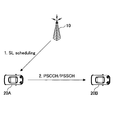
- FIG. 2 is a diagram for explaining an example (1) of the V2X transmission mode.
- the base station device 10 transmits the side link scheduling to the user device 20A.
- the user apparatus 20A transmits a PSCCH (Physical Sidelink Control Channel) and a PSSCH (Physical Sidelink Shared Channel) to the user apparatus 20B based on the received scheduling (step 2).
- the transmission mode of the side link communication shown in FIG. 2 may be referred to as side link transmission mode 3 in LTE.
- side link transmission mode 3 in LTE Uu-based side link scheduling is performed.
- Uu is a wireless interface between UTRAN (Universal Terrestrial Radio Access Network) and UE (User Equipment).
- the transmission mode of the side link communication shown in FIG. 2 may be called side link transmission mode 1 in NR.
- FIG. 3 is a diagram for explaining an example (2) of the V2X transmission mode.
- the user equipment 20A uses the autonomously selected resource to transmit the PSCCH and PSSCH to the user equipment 20B.
- the transmission mode of the side link communication shown in FIG. 3 may be referred to as side link transmission mode 4 in LTE.
- side link transmission mode 4 in LTE the user apparatus 20A itself executes resource selection.
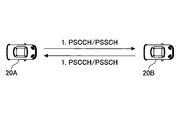
- FIG. 4 is a diagram for explaining an example (3) of the V2X transmission mode.
- the user equipment 20A uses the autonomously selected resources to transmit the PSCCH and PSSCH to the user equipment 20B.
- the user equipment 20B uses the autonomously selected resource to transmit the PSCCH and PSSCH to the user equipment 20A (step 1).
- the transmission mode of the side link communication shown in FIG. 4 may be called a side link transmission mode 2a in NR.
- the user apparatus 20 itself which transmits PSCCH and PSSCH performs resource selection.
- FIG. 5 is a diagram for explaining an example (4) of the V2X transmission mode.
- the base station device 10 transmits the side link scheduling grant to the user device 20A via the RRC (Radio Resource Control) setting.
- the user apparatus 20A transmits the PSSCH to the user apparatus 20B based on the received scheduling (step 1).
- the user apparatus 20A transmits the PSSCH to the user apparatus 20B based on the settings specified in the specifications in advance.
- the transmission mode of the side link communication shown in FIG. 5 may be called a side link transmission mode 2c in NR.
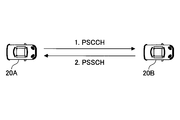
- FIG. 6 is a diagram for explaining an example (5) of the V2X transmission mode.
- the user equipment 20A transmits the side link scheduling to the user equipment 20B via the PSCCH.
- the user apparatus 20B transmits the PSSCH to the user apparatus 20A based on the received scheduling (step 2). That is, one user device 20 schedules another user device 20.
- the transmission mode of the side link communication shown in FIG. 6 may be referred to as the side link transmission mode 2d in NR.
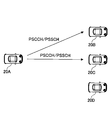
- FIG. 7 is a diagram for explaining an example (1) of the V2X communication type.
- the communication type of the side link shown in FIG. 7 is unicast.
- User device 20A transmits PSCCH and PSSCH to user device 20.
- the user equipment 20A performs unicast to the user equipment 20B and also performs unicast to the user equipment 20C.
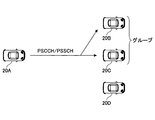
- FIG. 8 is a diagram for explaining an example (2) of the V2X communication type.
- the communication type of the side link shown in FIG. 8 is group cast.
- the user equipment 20A transmits the PSCCH and the PSSCH to the group to which one or more user equipments 20 belong.
- the group includes the user device 20B and the user device 20C, and the user device 20A performs group casting on the group.
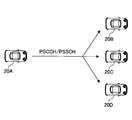
- FIG. 9 is a diagram for explaining an example (3) of the V2X communication type.
- the communication type of the side link shown in FIG. 9 is broadcast.
- User device 20A transmits PSCCH and PSSCH to one or more user devices 20.
- the user device 20A broadcasts to the user devices 20B, 20C, and 20D.
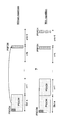
- FIG. 10 is a diagram for explaining the problem.
- SFCI Segmentlink Feedback Control Information
- PSSCH Physical Sidelink Shared Channel
- PSFCH Physical Sidelink Feedback Channel
- the present invention has been made to solve such a problem.
- the interval between the PSSCH and the PSFCH associated with the PSSCH may be set in advance.
- the side link PSSCH resource is selected for one TB (Transport Block) (for two TBs when two TBs are supported by the MIMO (Multiple Input Multiple Output) method). Selected).
- sidelink PSSCH resources are selected for transmission of multiple TBs.
- an option to apply the dynamic method for both initial transmission and retransmission an option to apply the quasi-persistent method for both initial transmission and retransmission, and a quasi-persistent method for initial transmission.
- the options are to apply the method and apply the dynamic method to the retransmission, and to apply the dynamic method to the initial transmission and apply the quasi-persistent method to the retransmission.
- 1 SCI scheduling SL can schedule multiple PSSCH resources (repeated transmission) for 1 TB.
- the effects obtained by the first embodiment are that a unique (specific one) PSFCH resource can be determined, sufficient processing time can be obtained, and the like.
- the PSFCH resource associated with the "first" PSSCH above is the "first" PSSCH in the PSSCH that satisfies the required predetermined time between PSCCH/PSSCH and PSFCH among the PSSCHs for repeated transmission. Good.
- the effects obtained by the second embodiment include that a unique (specific one) PSFCH resource can be determined, that delay in repeated PSSCH transmission can be suppressed, and so on.
- the user equipment 20 may use any PSFCH associated with the PSSCH resource for repeated transmission as the PSFCH resource for HARQ-ACK transmission for the repeated transmission of PSSCH.
- the same HARQ-ACK bit may be reported on all PSFCH resources.
- different HARQ-ACK bits may be notified on each PSFCH resource according to the time required for decoding the PSSCH.
- resource the HARQ-ACK is notified may depend on the implementation of the user apparatus 20.
- a PSFCH satisfying the required predetermined time between the PSCCH/PSSCH and the PSFCH (the time interval from the last PSSCH to the PSFCH (that is, the time required to process the user equipment 20)) may be used. ..
- the user equipment 20 may notify the ACK by using only the PSFCH associated with the PSSCH that has been successfully received as the PSFCH resource for HARQ-ACK transmission for the repeated transmission of the PSSCH.
- the user equipment 20 may notify NACK on the PSFCH resource associated with the last PSSCH resource of the repeated transmission.
- the user device 20 on the transmitting side may stop the rest of the repeated transmission, or may continue the transmission depending on the implementation of the user device 20.
- the user device 20 can appropriately determine the PSFCH resource used for PSSCH repetition transmission (PSSCH repetition).
- retransmission control can be appropriately performed in direct communication between terminals.
- the base station device 10 and the user device 20 include a function for implementing the above-described embodiment. However, each of the base station device 10 and the user device 20 may be provided with only a part of the functions in the embodiment.
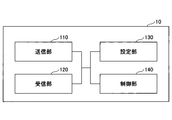
- FIG. 11 is a diagram showing an example of a functional configuration of the base station device 10.
- the base station device 10 includes a transmission unit 110, a reception unit 120, a setting unit 130, and a control unit 140.
- the functional configuration shown in FIG. 11 is merely an example. As long as the operation according to the embodiment of the present invention can be executed, the function categories and the names of the function units may be any names.
- the transmitting unit 110 includes a function of generating a signal to be transmitted to the user device 20 side and wirelessly transmitting the signal.
- the reception unit 120 includes a function of receiving various signals transmitted from the user device 20 and acquiring, for example, information of a higher layer from the received signals. Further, the transmission unit 110 has a function of transmitting NR-PSS, NR-SSS, NR-PBCH, DL/UL control signal, DL reference signal, etc. to the user apparatus 20.
- the setting unit 130 stores preset setting information and various setting information to be transmitted to the user device 20 in the storage device, and reads it from the storage device as necessary.
- the content of the setting information is, for example, information related to the setting of D2D communication.
- the control unit 140 performs processing related to the setting for the user device 20 to perform D2D communication, as described in the embodiment. In addition, the control unit 140 transmits the D2D communication scheduling to the user device 20 via the transmission unit 110.
- the functional unit related to signal transmission in the control unit 140 may be included in the transmission unit 110, and the functional unit related to signal reception in the control unit 140 may be included in the reception unit 120.
- FIG. 12 is a diagram illustrating an example of a functional configuration of the user device 20.
- the user device 20 includes a transmission unit 210, a reception unit 220, a setting unit 230, and a control unit 240.
- the functional configuration shown in FIG. 12 is merely an example. As long as the operation according to the embodiment of the present invention can be executed, the function categories and the names of the function units may be any names.
- the transmitter 210 creates a transmission signal from the transmission data and wirelessly transmits the transmission signal.
- the receiving unit 220 wirelessly receives various signals and acquires signals of higher layers from the received physical layer signals. Further, the receiving unit 220 has a function of receiving NR-PSS, NR-SSS, NR-PBCH, DL/UL/SL control signals or reference signals transmitted from the base station apparatus 10.
- the transmission unit 210 performs P2CH communication to other user apparatuses 20 by using PSCCH (Physical Sidelink Control Channel), PSSCH (Physical Sidelink Shared Channel), PSDCH (Physical Sidelink Discovery Channel), and PSBCH (Physical Sidelink Broadcast Channel). ), PSFCH (Physical Sidelink Feedback Channel), etc., and the receiving unit 220 receives PSCCH, PSSCH, PSDCH, PSBCH, PSFCH, etc. from another user apparatus 20.
- PSCCH Physical Sidelink Control Channel
- PSSCH Physical Sidelink Shared Channel
- PSDCH Physical Sidelink Discovery Channel
- the setting unit 230 stores various setting information received from the base station device 10 or the user device 20 by the receiving unit 220 in a storage device, and reads from the storage device as necessary.
- the setting unit 230 also stores preset setting information.
- the content of the setting information is, for example, information related to the setting of D2D communication.
- the control unit 240 controls D2D communication with another user device 20, as described in the embodiment. In addition, the control unit 240 performs processing related to HARQ of D2D communication. The control unit 240 may also schedule D2D communication with another user device 20.
- the functional unit related to signal transmission in the control unit 240 may be included in the transmission unit 210, and the functional unit related to signal reception in the control unit 240 may be included in the reception unit 220.
- each functional block may be realized by using one device physically or logically coupled, or directly or indirectly (for example, two or more devices physically or logically separated). , Wired, wireless, etc.) and may be implemented using these multiple devices.
- the functional block may be implemented by combining the one device or the plurality of devices with software.
- Functions include judgment, decision, judgment, calculation, calculation, processing, derivation, investigation, search, confirmation, reception, transmission, output, access, resolution, selection, selection, establishment, comparison, assumption, expectation, observation, Broadcasting, notifying, communicating, forwarding, configuring, reconfiguring, allocating, mapping, assigning, etc., but not limited to these.
- I can't.
- functional blocks (components) that function transmission are called a transmitting unit and a transmitter.
- the implementation method is not particularly limited.
- the base station device 10, the user device 20, and the like according to the embodiment of the present disclosure may function as a computer that performs the process of the wireless communication method of the present disclosure.
- FIG. 13 is a diagram illustrating an example of a hardware configuration of the base station device 10 and the user device 20 according to the embodiment of the present disclosure.
- the base station device 10 and the user device 20 described above are physically configured as a computer device including a processor 1001, a storage device 1002, an auxiliary storage device 1003, a communication device 1004, an input device 1005, an output device 1006, a bus 1007, and the like. May be done.
- the word “apparatus” can be read as a circuit, device, unit, or the like.
- the hardware configurations of the base station device 10 and the user device 20 may be configured to include one or a plurality of each device illustrated in the figure, or may be configured not to include some devices.
- Each function in the base station device 10 and the user device 20 causes a predetermined software (program) to be loaded onto hardware such as the processor 1001, the storage device 1002, etc., so that the processor 1001 performs an arithmetic operation and communication by the communication device 1004. It is realized by controlling or at least one of reading and writing of data in the storage device 1002 and the auxiliary storage device 1003.
- the processor 1001 operates an operating system to control the entire computer, for example.
- the processor 1001 may be configured by a central processing unit (CPU) including an interface with peripheral devices, a control device, a calculation device, a register, and the like.
- CPU central processing unit
- the control unit 140, the control unit 240, and the like described above may be realized by the processor 1001.
- the processor 1001 reads a program (program code), a software module, data or the like from at least one of the auxiliary storage device 1003 and the communication device 1004 to the storage device 1002, and executes various processes according to these.
- a program that causes a computer to execute at least part of the operations described in the above-described embodiments is used.
- the control unit 140 of the base station device 10 illustrated in FIG. 11 may be realized by a control program stored in the storage device 1002 and operated by the processor 1001.
- the control unit 240 of the user device 20 illustrated in FIG. 12 may be realized by a control program stored in the storage device 1002 and operated by the processor 1001.
- the various processes described above are executed by one processor 1001, they may be executed simultaneously or sequentially by two or more processors 1001.
- the processor 1001 may be implemented by one or more chips.
- the program may be transmitted from the network via an electric communication line.
- the storage device 1002 is a computer-readable recording medium, and is, for example, at least one of ROM (Read Only Memory), EPROM (Erasable Programmable ROM), EEPROM (ElectricallyErasable Programmable ROM), RAM (Random Access Memory), and the like. It may be configured.
- the storage device 1002 may be called a register, a cache, a main memory (main storage device), or the like.
- the storage device 1002 can store an executable program (program code), a software module, or the like for implementing the communication method according to the embodiment of the present disclosure.
- the auxiliary storage device 1003 is a computer-readable recording medium, and is, for example, an optical disc such as a CD-ROM (Compact Disc ROM), a hard disk drive, a flexible disc, a magneto-optical disc (for example, a compact disc, a digital versatile disc, a Blu disc). -Ray disk), smart card, flash memory (eg card, stick, key drive), floppy disk, magnetic strip, etc.
- the above-described storage medium may be, for example, a database including at least one of the storage device 1002 and the auxiliary storage device 1003, a server, or another appropriate medium.
- the communication device 1004 is hardware (transmission/reception device) for performing communication between computers via at least one of a wired network and a wireless network, and is also called, for example, a network device, a network controller, a network card, a communication module, or the like.
- the communication device 1004 includes, for example, a high frequency switch, a duplexer, a filter, a frequency synthesizer, etc. in order to realize at least one of a frequency division duplex (FDD: Frequency Division Duplex) and a time division duplex (TDD: Time Division Duplex). May be composed of
- FDD Frequency Division Duplex
- TDD Time Division Duplex
- the transmitter/receiver may be implemented by physically or logically separating the transmitter and the receiver.
- the input device 1005 is an input device (eg, keyboard, mouse, microphone, switch, button, sensor, etc.) that receives an input from the outside.
- the output device 1006 is an output device (for example, a display, a speaker, an LED lamp, etc.) that outputs to the outside.
- the input device 1005 and the output device 1006 may be integrated (for example, a touch panel).
- each device such as the processor 1001 and the storage device 1002 is connected by a bus 1007 for communicating information.
- the bus 1007 may be configured using a single bus, or may be configured using different buses for each device.
- the base station device 10 and the user device 20 include a microprocessor, a digital signal processor (DSP: Digital Signal Processor), an ASIC (Application Specific Integrated Circuit), a PLD (Programmable Logic Device), an FPGA (Field Programmable Gate Array), and the like. It may be configured to include hardware, and the hardware may implement part or all of each functional block. For example, the processor 1001 may be implemented using at least one of these hardware.
- DSP Digital Signal Processor
- ASIC Application Specific Integrated Circuit
- PLD Programmable Logic Device
- FPGA Field Programmable Gate Array
- a transmitting unit that transmits to another user apparatus via a control channel and a data channel, and a HARQ (Hybrid automatic repeat request) response to the transmission is transmitted.
- a receiving unit that receives from another user device, a control unit that notifies the other user device of information related to the resource of the channel that receives the HARQ response, and performs retransmission control related to the transmission based on the HARQ response;
- a user equipment having:
- the user device 20 can notify the resource reporting the HARQ response in the side link communication by the position of the SCI, PSSCH or PSCCH, the upper layer parameter, or the like. That is, retransmission control can be appropriately performed in direct communication between terminals.
- the information on the resource of the channel receiving the HARQ response may specify at least one of the time domain, the frequency domain, and the code domain of the resource of the channel receiving the HARQ response.
- the control unit may notify the other user apparatus of the information related to the resource of the channel that receives the HARQ response, via the control channel.
- the user equipment 20 can notify the resource for reporting the HARQ response in the side link communication by SCI.
- the control unit may further notify the other user apparatus via the control channel of information indicating whether the HARQ response is valid or invalid.
- the user device 20 can notify by SCI whether the HARQ response in the side link communication is valid or invalid.
- the controller implicitly associates the information related to the resource of the channel that receives the HARQ response with the resource of the control channel or the data channel and the resource of the channel that receives the HARQ response to the other information.
- the user device may be notified.
- the user equipment 20 can notify the resource for reporting the HARQ response in the side link communication by the position of the PSSCH or PSCCH.
- the control unit transmits information that does not include a field indicating a resource of a channel that receives a HARQ response via the control channel, as information related to a resource of a channel that receives the HARQ response.
- the other user apparatus may be notified that the resource of the channel for receiving the is set by the upper layer parameter. With this configuration, the user device 20 can set the resource for reporting the HARQ response in the side link communication by using the upper layer parameter.
- the operation of the plurality of functional units may be physically performed by one component, or the operation of one functional unit may be physically performed by the plurality of components.
- the order of processing may be changed as long as there is no contradiction.
- the base station apparatus 10 and the user apparatus 20 have been described using functional block diagrams for convenience of processing description, such an apparatus may be realized by hardware, software, or a combination thereof.
- the software operated by the processor included in the base station device 10 according to the embodiment of the present invention and the software operated by the processor included in the user device 20 according to the embodiment of the present invention are respectively a random access memory (RAM), a flash memory, and a read memory. It may be stored in a dedicated memory (ROM), EPROM, EEPROM, register, hard disk (HDD), removable disk, CD-ROM, database, server, or any other suitable storage medium.
- the notification of information is not limited to the mode/embodiment described in the present disclosure, and may be performed using another method.
- information is notified by physical layer signaling (for example, DCI (Downlink Control Information), UCI (Uplink Control Information)), upper layer signaling (for example, RRC (Radio Resource Control) signaling, MAC (Medium Access Control) signaling, It may be implemented by broadcast information (MIB (Master Information Block), SIB (System Information Block)), other signals, or a combination thereof, and RRC signaling may be called an RRC message, for example, RRC message. It may be a connection setup (RRC Connection Setup) message, an RRC connection reconfiguration message, or the like.
- LTE Long Term Evolution
- LTE-A Long Term Evolution-Advanced
- SUPER 3G IMT-Advanced
- 4G fourth generation mobile communication system
- 5G 5th generation mobile communication system
- FRA Full Radio Access
- NR new Radio
- W-CDMA registered trademark
- GSM registered trademark
- CDMA2000 Code Division Multiple Access 2000
- UMB Universal Mobile Broadband
- IEEE 802.11 Wi-Fi (registered trademark)
- IEEE 802.16 WiMAX (registered trademark)
- IEEE 802.20 UWB (Ultra-WideBand)
- Bluetooth registered trademark
- other systems using appropriate systems, and extensions based on these It may be applied to at least one of the next-generation systems.
- a plurality of systems may be combined and applied (for example, a combination of at least one of LTE and LTE-A and 5G).
- the specific operation that is assumed to be performed by the base station device 10 in this specification may be performed by its upper node in some cases.
- various operations performed for communication with the user device 20 are other than the base station device 10 and the base station device 10. It is clear that it can be performed by at least one of the network nodes of (for example, but not limited to, MME or S-GW, etc.).
- the other network node may be a combination of a plurality of other network nodes (for example, MME and S-GW). Good.
- Information, signals, etc. described in the present disclosure may be output from the upper layer (or lower layer) to the lower layer (or upper layer). Input/output may be performed via a plurality of network nodes.
- Information that has been input and output may be stored in a specific location (for example, memory), or may be managed using a management table. Information that is input/output may be overwritten, updated, or added. The output information and the like may be deleted. The input information and the like may be transmitted to another device.
- the determination in the present disclosure may be performed by a value (0 or 1) represented by 1 bit, may be performed by a Boolean value (Boolean: true or false), and may be performed by comparing numerical values (for example, , Comparison with a predetermined value).
- software, instructions, information, etc. may be transmitted and received via a transmission medium.
- the software uses a wired technology (coaxial cable, optical fiber cable, twisted pair, digital subscriber line (DSL: Digital Subscriber Line), etc.) and/or wireless technology (infrared, microwave, etc.) websites, When sent from a server, or other remote source, at least one of these wired and wireless technologies is included within the definition of transmission medium.
- wired technology coaxial cable, optical fiber cable, twisted pair, digital subscriber line (DSL: Digital Subscriber Line), etc.
- wireless technology infrared, microwave, etc.
- data, instructions, commands, information, signals, bits, symbols, chips, etc. that may be referred to throughout the above description include voltage, current, electromagnetic waves, magnetic fields or magnetic particles, optical fields or photons, or any of these. May be represented by a combination of
- At least one of the channel and the symbol may be a signal (signaling).
- the signal may also be a message.
- a component carrier CC may be called a carrier frequency, a cell, a frequency carrier, or the like.
- system and “network” used in this disclosure are used interchangeably.
- the information, parameters, etc. described in the present disclosure may be represented by using an absolute value, may be represented by using a relative value from a predetermined value, or by using other corresponding information. May be represented.
- the radio resources may be those indicated by the index.
- base station Base Station
- radio base station base station
- base station device fixed station
- NodeB NodeB
- eNodeB eNodeB
- GNB nodeB
- access point access point
- transmission point transmission point
- reception point transmission/reception point
- cell cell
- cell group carrier
- component carrier component carrier
- a base station can accommodate one or more (eg, three) cells.
- a base station accommodates multiple cells, the entire coverage area of the base station can be divided into multiple smaller areas, each smaller area being defined by a base station subsystem (eg, indoor small base station (RRH: It is also possible to provide communication services by Remote Radio Head).
- RRH indoor small base station
- the term "cell” or “sector” means a part or the whole coverage area of at least one of the base station and the base station subsystem that perform communication services in this coverage. Refers to.
- MS Mobile Station
- UE User Equipment
- Mobile stations are defined by those skilled in the art as subscriber stations, mobile units, subscriber units, wireless units, remote units, mobile devices, wireless devices, wireless communication devices, remote devices, mobile subscriber stations, access terminals, mobile terminals, wireless. It may also be referred to as a terminal, remote terminal, handset, user agent, mobile client, client, or some other suitable term.
- At least one of the base station and the mobile station may be called a transmission device, a reception device, a communication device, or the like.
- the base station and the mobile station may be a device mounted on the mobile body, the mobile body itself, or the like.
- the moving body may be a vehicle (eg, car, airplane, etc.), an unmanned moving body (eg, drone, self-driving car, etc.), or a robot (manned type or unmanned type).
- At least one of the base station and the mobile station also includes a device that does not necessarily move during communication operation.
- at least one of the base station and the mobile station may be an IoT (Internet of Things) device such as a sensor.
- IoT Internet of Things
- the base station in the present disclosure may be replaced by the user terminal.
- the communication between the base station and the user terminal is replaced with communication between a plurality of user devices 20 (eg, may be called D2D (Device-to-Device), V2X (Vehicle-to-Everything), etc.)
- a plurality of user devices 20 eg, may be called D2D (Device-to-Device), V2X (Vehicle-to-Everything), etc.
- the user apparatus 20 may have the function of the base station apparatus 10 described above.
- the words such as “up” and “down” may be replaced with the words corresponding to the terminal-to-terminal communication (for example, “side”).
- the uplink channel and the downlink channel may be replaced with the side channel.
- the user terminal in the present disclosure may be replaced by the base station.
- the base station may have the function of the above-mentioned user terminal.
- determining and “determining” as used in this disclosure may encompass a wide variety of actions.
- “Judgment” and “decision” are, for example, judgment, calculating, computing, processing, deriving, investigating, and looking up, search, inquiry. (Eg, searching in a table, database, or another data structure), considering ascertaining as “judging” or “deciding”, and the like.
- “decision” and “decision” include receiving (eg, receiving information), transmitting (eg, transmitting information), input (input), output (output), access (accessing) (for example, accessing data in a memory) may be regarded as “judging” or “deciding”.
- judgment and “decision” are considered to be “judgment” and “decision” when things such as resolving, selecting, choosing, selecting, establishing, and comparing are done. May be included. That is, the “judgment” and “decision” may include considering some action as “judgment” and “decision”. In addition, “determination (decision)” may be read as “assuming”, “expecting”, “considering”, and the like.
- connection means any direct or indirect connection or coupling between two or more elements, and It can include the presence of one or more intermediate elements between two elements that are “connected” or “coupled.”
- the connections or connections between the elements may be physical, logical, or a combination thereof.
- connection may be read as “access”.
- two elements are in the radio frequency domain, with at least one of one or more wires, cables and printed electrical connections, and as some non-limiting and non-exhaustive examples. , Can be considered to be “connected” or “coupled” to each other, such as with electromagnetic energy having wavelengths in the microwave and light (both visible and invisible) regions.
- the reference signal may be abbreviated as RS (Reference Signal), or may be referred to as a pilot (Pilot) depending on the applied standard.
- RS Reference Signal
- Pilot pilot
- the phrase “based on” does not mean “based only on,” unless expressly specified otherwise. In other words, the phrase “based on” means both "based only on” and “based at least on.”
- references to elements using designations such as “first”, “second”, etc. used in this disclosure does not generally limit the amount or order of those elements. These designations may be used in this disclosure as a convenient way to distinguish between two or more elements. Thus, references to the first and second elements do not mean that only two elements may be employed, or that the first element must precede the second element in any way.
- the term “A and B are different” may mean “A and B are different from each other”.
- the term may mean that “A and B are different from C”.
- the terms “remove”, “coupled” and the like may be construed similarly as “different”.
- the notification of the predetermined information (for example, the notification of “being X”) is not limited to the explicit notification, and is performed implicitly (for example, the notification of the predetermined information is not performed). Good.
- the side link communication is an example of direct communication between terminals.
- PSCCH is an example of a control channel.
- PSSCH is an example of a data channel.
- PSFCH is an example of a feedback channel for transmitting a HARQ response.
- base station device 110 transmission unit 120 reception unit 130 setting unit 140 control unit 20 user device 210 transmission unit 220 reception unit 230 setting unit 240 control unit 1001 processor 1002 storage device 1003 auxiliary storage device 1004 communication device 1005 input device 1006 output device
Landscapes
- Engineering & Computer Science (AREA)
- Computer Networks & Wireless Communication (AREA)
- Signal Processing (AREA)
- Mobile Radio Communication Systems (AREA)
Abstract
L'invention concerne un dispositif utilisateur comprenant : une unité de réception qui reçoit une transmission répétitive d'un canal de données en provenance d'un autre dispositif utilisateur ; une unité de commande qui détermine une ressource d'un canal de rétroaction par rapport à la transmission répétitive du canal de données ; et une unité de transmission qui transmet, à l'aide de la ressource déterminée, le canal de rétroaction par rapport à la transmission répétitive du canal de données à l'autre dispositif utilisateur.
Priority Applications (1)
| Application Number | Priority Date | Filing Date | Title |
|---|---|---|---|
| EP19916977.2A EP3934344A4 (fr) | 2019-02-28 | 2019-11-14 | Dispositif utilisateur et procédé de communication |
Applications Claiming Priority (2)
| Application Number | Priority Date | Filing Date | Title |
|---|---|---|---|
| JP2019036095A JP2022065213A (ja) | 2019-02-28 | 2019-02-28 | ユーザ装置および通信方法 |
| JP2019-036095 | 2019-02-28 |
Publications (1)
| Publication Number | Publication Date |
|---|---|
| WO2020174772A1 true WO2020174772A1 (fr) | 2020-09-03 |
Family
ID=72238907
Family Applications (1)
| Application Number | Title | Priority Date | Filing Date |
|---|---|---|---|
| PCT/JP2019/044736 Ceased WO2020174772A1 (fr) | 2019-02-28 | 2019-11-14 | Dispositif utilisateur et procédé de communication |
Country Status (3)
| Country | Link |
|---|---|
| EP (1) | EP3934344A4 (fr) |
| JP (1) | JP2022065213A (fr) |
| WO (1) | WO2020174772A1 (fr) |
Citations (2)
| Publication number | Priority date | Publication date | Assignee | Title |
|---|---|---|---|---|
| WO2016076301A1 (fr) * | 2014-11-14 | 2016-05-19 | 株式会社Nttドコモ | Dispositif utilisateur, procédé de commande de rétroaction et procédé de commande de retransmission |
| JP2019036095A (ja) | 2017-08-14 | 2019-03-07 | 富士通株式会社 | 情報処理システム、管理装置、情報処理システムの制御方法 |
-
2019
- 2019-02-28 JP JP2019036095A patent/JP2022065213A/ja active Pending
- 2019-11-14 EP EP19916977.2A patent/EP3934344A4/fr not_active Withdrawn
- 2019-11-14 WO PCT/JP2019/044736 patent/WO2020174772A1/fr not_active Ceased
Patent Citations (2)
| Publication number | Priority date | Publication date | Assignee | Title |
|---|---|---|---|---|
| WO2016076301A1 (fr) * | 2014-11-14 | 2016-05-19 | 株式会社Nttドコモ | Dispositif utilisateur, procédé de commande de rétroaction et procédé de commande de retransmission |
| JP2019036095A (ja) | 2017-08-14 | 2019-03-07 | 富士通株式会社 | 情報処理システム、管理装置、情報処理システムの制御方法 |
Non-Patent Citations (4)
| Title |
|---|
| "Consideration on NR Uu-based sidelink resource allocation", 3GPP TSG RAN WG1 ADHOC_NR_AH_1901 R1-1900715, 12 January 2019 (2019-01-12), pages 2, XP051576255 * |
| "Discussion on blind/HARQ-less repetition for scheduled DL-SCH operation", 3GPP TSG RAN WG1 #92B R1-1804531, 7 April 2018 (2018-04-07), pages 3, 4, XP051413953 * |
| CMCC: "Discussion on HARQ feedback", 3GPP TSG RAN WG1 ADHOC_NR_AH_1901 R1-1900405, 12 January 2019 (2019-01-12), pages 1, 2, XP051576014 * |
| See also references of EP3934344A4 |
Also Published As
| Publication number | Publication date |
|---|---|
| JP2022065213A (ja) | 2022-04-27 |
| EP3934344A4 (fr) | 2022-11-16 |
| EP3934344A1 (fr) | 2022-01-05 |
Similar Documents
| Publication | Publication Date | Title |
|---|---|---|
| JP7325447B2 (ja) | 端末及び通信方法 | |
| WO2020136852A1 (fr) | Dispositif utilisateur et dispositif de communication | |
| WO2020136854A1 (fr) | Dispositif d'utilisateur | |
| JP7300499B2 (ja) | 端末及び通信方法 | |
| JP7453986B2 (ja) | 端末、通信方法及び無線通信システム | |
| JP7213893B2 (ja) | 端末及び通信方法 | |
| JP7394861B2 (ja) | 端末、通信システム及び通信方法 | |
| JP7544380B2 (ja) | 端末、無線通信システム、及び通信方法 | |
| WO2020144787A1 (fr) | Équipement utilisateur et procédé de transmission d'informations de rétroaction | |
| WO2020202485A1 (fr) | Dispositif utilisateur | |
| JP7408668B2 (ja) | 端末及び通信方法 | |
| WO2020245895A1 (fr) | Terminal | |
| JP7248779B2 (ja) | 端末、通信方法、及び無線通信システム | |
| JP7420824B2 (ja) | 端末、端末により実行される方法及びシステム | |
| WO2020230369A1 (fr) | Dispositif utilisateur | |
| WO2021156986A1 (fr) | Terminal et procédé de mesure | |
| WO2020222266A1 (fr) | Dispositif utilisateur | |
| JP7443395B2 (ja) | 端末、通信システム及び通信方法 | |
| WO2020179129A1 (fr) | Dispositif utilisateur | |
| WO2020166089A1 (fr) | Dispositif utilisateur | |
| WO2020174772A1 (fr) | Dispositif utilisateur et procédé de communication | |
| JP7615169B2 (ja) | 端末及び通信方法 | |
| JP7704340B2 (ja) | 端末及び通信方法 |
Legal Events
| Date | Code | Title | Description |
|---|---|---|---|
| 121 | Ep: the epo has been informed by wipo that ep was designated in this application |
Ref document number: 19916977 Country of ref document: EP Kind code of ref document: A1 |
|
| NENP | Non-entry into the national phase |
Ref country code: DE |
|
| ENP | Entry into the national phase |
Ref document number: 2019916977 Country of ref document: EP Effective date: 20210928 |
|
| NENP | Non-entry into the national phase |
Ref country code: JP |