WO2020179309A1 - Produit à base d'argent et procédé de fabrication d'un produit à base d'argent - Google Patents
Produit à base d'argent et procédé de fabrication d'un produit à base d'argent Download PDFInfo
- Publication number
- WO2020179309A1 WO2020179309A1 PCT/JP2020/003737 JP2020003737W WO2020179309A1 WO 2020179309 A1 WO2020179309 A1 WO 2020179309A1 JP 2020003737 W JP2020003737 W JP 2020003737W WO 2020179309 A1 WO2020179309 A1 WO 2020179309A1
- Authority
- WO
- WIPO (PCT)
- Prior art keywords
- silver
- silver product
- product
- vickers hardness
- value
- Prior art date
- Legal status (The legal status is an assumption and is not a legal conclusion. Google has not performed a legal analysis and makes no representation as to the accuracy of the status listed.)
- Ceased
Links
Images




Classifications
-
- B—PERFORMING OPERATIONS; TRANSPORTING
- B23—MACHINE TOOLS; METAL-WORKING NOT OTHERWISE PROVIDED FOR
- B23P—METAL-WORKING NOT OTHERWISE PROVIDED FOR; COMBINED OPERATIONS; UNIVERSAL MACHINE TOOLS
- B23P9/00—Treating or finishing surfaces mechanically, with or without calibrating, primarily to resist wear or impact, e.g. smoothing or roughening turbine blades or bearings; Features of such surfaces not otherwise provided for, their treatment being unspecified
-
- C—CHEMISTRY; METALLURGY
- C22—METALLURGY; FERROUS OR NON-FERROUS ALLOYS; TREATMENT OF ALLOYS OR NON-FERROUS METALS
- C22F—CHANGING THE PHYSICAL STRUCTURE OF NON-FERROUS METALS AND NON-FERROUS ALLOYS
- C22F1/00—Changing the physical structure of non-ferrous metals or alloys by heat treatment or by hot or cold working
- C22F1/14—Changing the physical structure of non-ferrous metals or alloys by heat treatment or by hot or cold working of noble metals or alloys based thereon
-
- A—HUMAN NECESSITIES
- A44—HABERDASHERY; JEWELLERY
- A44C—PERSONAL ADORNMENTS, e.g. JEWELLERY; COINS
- A44C27/00—Making jewellery or other personal adornments
- A44C27/001—Materials for manufacturing jewellery
- A44C27/002—Metallic materials
-
- B—PERFORMING OPERATIONS; TRANSPORTING
- B24—GRINDING; POLISHING
- B24B—MACHINES, DEVICES, OR PROCESSES FOR GRINDING OR POLISHING; DRESSING OR CONDITIONING OF ABRADING SURFACES; FEEDING OF GRINDING, POLISHING, OR LAPPING AGENTS
- B24B31/00—Machines or devices designed for polishing or abrading surfaces on work by means of tumbling apparatus or other apparatus in which the work and/or the abrasive material is loose; Accessories therefor
- B24B31/02—Machines or devices designed for polishing or abrading surfaces on work by means of tumbling apparatus or other apparatus in which the work and/or the abrasive material is loose; Accessories therefor involving rotary barrels
-
- B—PERFORMING OPERATIONS; TRANSPORTING
- B24—GRINDING; POLISHING
- B24B—MACHINES, DEVICES, OR PROCESSES FOR GRINDING OR POLISHING; DRESSING OR CONDITIONING OF ABRADING SURFACES; FEEDING OF GRINDING, POLISHING, OR LAPPING AGENTS
- B24B49/00—Measuring or gauging equipment for controlling the feed movement of the grinding tool or work; Arrangements of indicating or measuring equipment, e.g. for indicating the start of the grinding operation
- B24B49/006—Measuring or gauging equipment for controlling the feed movement of the grinding tool or work; Arrangements of indicating or measuring equipment, e.g. for indicating the start of the grinding operation taking regard of the speed
-
- B—PERFORMING OPERATIONS; TRANSPORTING
- B44—DECORATIVE ARTS
- B44C—PRODUCING DECORATIVE EFFECTS; MOSAICS; TARSIA WORK; PAPERHANGING
- B44C1/00—Processes, not specifically provided for elsewhere, for producing decorative surface effects
- B44C1/18—Applying ornamental structures, e.g. shaped bodies consisting of plastic material
-
- C—CHEMISTRY; METALLURGY
- C22—METALLURGY; FERROUS OR NON-FERROUS ALLOYS; TREATMENT OF ALLOYS OR NON-FERROUS METALS
- C22C—ALLOYS
- C22C5/00—Alloys based on noble metals
- C22C5/06—Alloys based on silver
-
- A—HUMAN NECESSITIES
- A44—HABERDASHERY; JEWELLERY
- A44C—PERSONAL ADORNMENTS, e.g. JEWELLERY; COINS
- A44C27/00—Making jewellery or other personal adornments
- A44C27/001—Materials for manufacturing jewellery
- A44C27/002—Metallic materials
- A44C27/003—Metallic alloys
Definitions
- the present invention relates to a silver product and a method for manufacturing a silver product.
- a silver product which has high hardness and is less likely to cause metal allergy, metal corrosion, discoloration, etc. and its production.
- the method Regarding the method.
- SV925 which is a silver alloy having a purity of about 92.5%, for silver products such as silver tableware.
- this SV925 contains a predetermined amount of copper or the like as another metal component, so that when a silver product such as silver tableware comes into direct contact with the skin, metal allergy or metal corrosion occurs. It was a cause of discoloration.
- SV999 having a purity of 99.9% by weight or more is blended with a minute amount of Al, cast into a casting, and then melted and molded again to obtain an Ag alloy having a Vickers hardness of a predetermined level or more.
- a manufacturing method has been proposed (for example, Patent Document 1). More specifically, 100 parts by weight of silver (Ag) having a purity of 99.9% by weight or more and a minute amount of aluminum (Al) are put into a melting furnace, cast into a casting, and then melted again. There is proposed a method for producing an Ag alloy having a Vickers hardness of 50 or more, which is formed by coating a minute amount of Al with Ag by molding.
- the silver alloy and the like disclosed in Patent Document 1 after 100 parts by weight of Ag having a purity of 99.9% by weight or more is coated with a minute amount of Al by Ag and cast into a casting, Since it is melted and molded again, there are problems that it is difficult to uniformly disperse Al, the manufacturing cost increases, and it becomes economically disadvantageous. Further, the Vickers hardness of the obtained Ag alloy is 50 HV or more, more specifically, when the Al compounding amount is 0.05% by weight, it is about 63 HV, and when the Al compounding amount is 0.09% by weight. Even if there was, it was about 83 HV, which was still insufficient as Vickers hardness. In addition, the obtained Ag alloy contains 0.05% by weight or 0.09% by weight of Al, so that the volume resistivity increases, metal corrosion occurs, and discoloration occurs. There were problems such as occurrence of.
- the inventors of the present invention have found that pure silver or an ultra-high purity silver alloy of 99.9% by weight or more has a predetermined crystal structure without substantially blending a metal such as Al. It was found that a silver product with high Vickers hardness and low volume resistivity, and with less metal allergy, metal corrosion, and discoloration can be obtained by adjusting the amount to be adjusted, to complete the present invention. ..
- the present invention since the silver product is formed from pure silver having a predetermined crystal structure or ultra-high purity silver alloy, Vickers hardness can be easily controlled, and metal allergy and metal corrosion It is an object of the present invention to provide a silver product in which the occurrence of heat generation and discoloration is small, and an efficient and economical method for producing such a silver product.
- a silver product having a value of 0.2 or more is provided, and the above-mentioned problems can be solved.
- the silver product of the present invention since it is formed from pure silver or a silver alloy having a predetermined crystal structure, a high Vickers hardness can be easily obtained in a silver product with or without a plating layer. In addition, it is possible to obtain a silver product that does not require any compounding of Al, etc., has less metal allergy, metal corrosion or discoloration in the user, and has excellent appearance over a long period of time. ..
- the silver product of the present invention it is preferable to further have a silver-plated layer made of sterling silver or a silver alloy having a purity of 99.9% by weight or more on the silver product.
- a silver-plated layer made of sterling silver or a silver alloy having a purity of 99.9% by weight or more on the silver product.
- the Vickers hardness of the silver product is HV
- the value of HV ⁇ W2 be 18 or more.
- the value of HV ⁇ (W1/W2) is preferably 48 or more.
- the volume resistivity it is preferable to set the volume resistivity to a value of 2 ⁇ cm or less.
- the conductivity of the processed silver product can be further enhanced, and by extension, good conductivity and antistatic property can be exhibited as a whole or a part of various conductive products.
- the silver product is any one of an electrode member, a heat transfer product, a circuit member, a solder substitute material, a medical device, a reflective material, an accessory, an ornament, silver clay, and silver tableware. It is preferably one. That is, since the silver product of the present invention has a predetermined crystal structure, the curability of the silver product can be easily controlled, and by extension, after processing, the metal is further maintained while maintaining excellent processability. It is possible to obtain an electrode member, a circuit member, or the like with less allergy or discoloration, and further less metal corrosion.
- Another aspect of the present invention is a method for producing a silver product formed from pure silver or a silver alloy having a purity of more than 99.9% by weight, which includes the following steps (1) and (2). And a method for producing a silver product.
- a silver product derived from a plated silver base metal and subjected to a predetermined barrel treatment or the like can easily obtain a high Vickers hardness in the silver product. Further, it is possible to economically and efficiently produce a silver product having excellent appearance for a long period of time with less occurrence of metal allergy and discoloration in the employee.
- FIG. 1A is an X-ray diffraction chart obtained by XRD analysis of a silver product (corresponding to Example 1)
- FIG. 1B is an XRD analysis of a silver product (corresponding to Comparative Example 1) before barrel treatment. It is an X-ray diffraction chart obtained by.
- FIG. 2 is a diagram showing the relationship between the Vickers hardness (initial value) of a silver product and the ratio (h2/h1) of the heights (h1, h2) of predetermined peaks of the X-ray diffraction chart obtained by XRD analysis. is there.
- FIGS. 4A to 4B show changes in the Vickers hardness (initial value) of the silver product and the change in the Vickers hardness (initial value) of the silver product when the processing time of the silver product subjected to the plating treatment and the press treatment by the barrel treatment is changed. It is a figure which shows the change of Vickers hardness (after aging).
- FIGS. 4A to 4B show changes in the Vickers hardness (initial value) of the silver product and the change in the Vickers hardness (initial value) of the silver product when the processing time of the silver product subjected to the plating treatment and the press treatment by the barrel treatment is changed. It is a figure which shows the change of Vickers hardness (after aging).
- FIGS. 4A to 4B show changes in the Vickers hardness (initial value) of the silver product and the change in the Vickers hardness (initial value) of the silver product when the processing time of the silver product subjected to the plating treatment and the press treatment by the barrel
- FIG. 5(a) to 5(c) show silver when the processing time (0, 5, 10, 30, 45, 60 minutes) by the barrel treatment for silver products not subjected to the plating treatment and the pressing treatment is changed. It is a figure which shows the half value width change (W1, W2) and the ratio change (W2/W1) in the predetermined peak of the X-ray-diffraction chart of a product.
- FIG. 6A is a diagram showing a change in the value of HV ⁇ W2 when the processing time by the barrel treatment for a silver product not subjected to the plating treatment and the pressing treatment is changed, and FIG.
- FIG. 7 is a diagram showing changes in the volume resistivity of a silver product (linear object) when the processing time by the barrel treatment for a silver product not subjected to plating treatment and pressing treatment is changed.
- FIGS. 8A to 8C are views provided for explaining silver products each having a plating layer.
- FIG. 9A shows Vickers hardness (initial value) of a silver product plated with barrel treatment and heights of predetermined peaks (h1, h2) of an X-ray diffraction chart obtained by XRD analysis.
- FIG. 10 (a) is a diagram showing an example of a polygonal pattern (turtle shell pattern) confirmed on the surface by barrel treatment (corresponding to Example 1) for a silver product
- FIG. 10 (b) is a diagram showing a barrel for a silver product. It is a figure provided for demonstrating the surface state (corresponding to Comparative Example 1) before treatment.
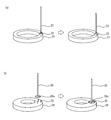
- FIGS. 11A and 11B are views provided for explaining the method for manufacturing the caulking structure.
- FIG. 12 is a schematic diagram provided for explaining the configuration of the barrel device.
- FIG. 13A and 13B are views showing an example for explaining the use of the processed silver product.
- FIG. 14 is a figure which shows the change of the Vickers hardness with respect to the time heated at 100 degreeC about the silver product which performed the barrel process, and the silver product which performed the plating process and the barrel process.
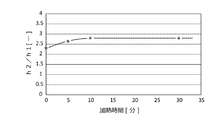
- FIG. 15 shows the ratio (h2 / h1) of the height (h1, h2) of a predetermined peak of a predetermined peak height (h1, h2) of an X-ray diffraction chart obtained by XRD analysis to a time of heating at 100 ° C. for a silver product that has been plated and barrel-treated. It is a figure which shows the change of.
- the first embodiment is a silver product made of sterling silver or a silver alloy having a purity of 99.9% by weight or more, wherein the Vickers hardness of the silver product is 60 HV or more, and FIGS.
- the silver product is characterized in that the value of h2 / h1 is 0.2 or more, where h2 is the height of the peak (S2) of °. Note that FIG.
- FIG. 1A is an X-ray diffraction chart obtained by XRD analysis based on Example 1
- FIG. 1B shows X-ray diffraction obtained by XRD analysis based on Comparative Example 1. It is a chart.
- FIG. 2 shows the relationship between the Vickers hardness (initial value) of a silver product and the ratio (h2/h1) of the heights (h1, h2) of predetermined peaks of the X-ray diffraction chart obtained by XRD analysis. It is a figure.
- the silver product of the first embodiment is characterized by being formed from sterling silver or a silver alloy having a purity of 99.9% by weight or more. That is, it is characterized in that it contains pure silver or 99.9% by weight or more of extremely high-purity silver, because metal corrosion and discoloration are less likely to occur when a voltage is applied.
- pure silver refers to elements other than silver element, for example, those which do not exceed 0.001 wt% in mass fraction measured by a glow discharge mass spectrometer or the like. Therefore, the purity of silver is a value in the range of 99.9 to 100% by weight, more preferably a value in the range of 99.93 to 100% by weight, and 99.98 to 100% by weight.
- the value is within the range.
- the residual components other than silver preferably include gold (Au), platinum (Pt), tin (Sn), or the like.
- Au gold
- Pt platinum
- Sn tin
- the purity of silver and the amount of trace components contained in a silver alloy of 99.9% by weight or more are determined by elemental analysis methods such as fluorescent X-ray analysis (XPS), atomic absorption method (AAS), and ICP emission spectroscopy. Etc. can be used.
- Shape The shape and configuration of the silver product of the first embodiment are not particularly limited, but for example, an electrode member, a circuit member, a heat transfer product, a reflective material, a medical device, an accessory, an ornament, and silver. It is preferably any one of clay and the like. The reason for this is that a silver product having these predetermined shapes can more enjoy the effect of less occurrence of metal allergy, metal corrosion and discoloration. Furthermore, if it is a silver product with a predetermined shape, the curability can be easily controlled, and even after processing, the occurrence of metal allergy and metal corrosion and discoloration can be reduced while maintaining excellent processability. can do.
- the electrode members include bumps of semiconductor devices, lead frames of semiconductor devices, wire bonds of semiconductor devices, electrodes of liquid crystal display devices and organic EL elements (auxiliary electrodes). ), Internal wiring of semiconductor devices, connector terminals, spring terminals, and the like. That is, in FIG. 13A, which is shown as an example for explaining the application of the silver product, it is preferable to configure the lead frame 32 of the semiconductor integrated circuit 33 and the lead 31 of the TAB tape 34 as a silver product.
- examples of the circuit member include at least one of electrical wiring in a ceramic circuit board, an epoxy resin circuit board, a phenol resin circuit board, a flexible circuit board, or the like. That is, in FIG. 13B, which is shown as an example for explaining the application of the silver product, it is also preferable to configure the conductor 35 covered with the base material 37 and the insulation protection portion 36 as the silver product. ..
- the heat transfer product the heat transfer material contained in the cooling material of the semiconductor device, the cooling material of the heat generating element electrically connected to the flexible circuit board, the tape-shaped cooling member, the irregular shape cooling member, etc. There is at least one.
- solder substitute material at least one of lead-free solder, Ag-Cu conductive material, Ag-Cu-Sn conductive material, and Ag-Cu-Zn-Sn conductive material is a substitute material for lead-containing solder. Can be mentioned.
- Examples of medical instruments include at least one such as tweezers for surgery, scalpels, scissors, forceps, robot hands, bolts and metal fittings for temporarily holding bones, tooth fillings, coverings, and the like.
- Examples of the reflective material and accessory include a wristwatch, buckle, tie pin, cuff, glasses, nail art material, and a reflective member laminated on a part of the particle surface of the reflective particles in the retroreflective sheet having a predetermined shape.
- the ornamental product at least one of an emblem, a decorative chain, a mirror, a figurine, and the like can be given, and an item made by sintering silver clay can also be given.
- examples of the silver tableware include at least one of a plate, a bowl, a cup, a tea cup, a knife, a fork, a spoon, a butter knife, a muddler, a bottle opener, a tong, and the like.
- Vickers hardness (1) initial value The silver product of the first embodiment is characterized in that the Vickers hardness (initial value) after barrel processing is set to a value of 60 HV or more.
- the reason for this is that if the value of the Vickers hardness is less than 60 HV, it may be easily deformed by an external pressure, or the durability of the obtained product may be insufficient.
- FIG. 3A in the plating process as well, when the processing time (0, 5, 10, 30, 40, 60 minutes) of the barrel process for the silver product which has not been pressed is changed. , The change in Vickers hardness (initial value) of silver products will be explained. More specifically, in FIG. 3A, the horizontal axis shows the processing time by barrel processing, and the vertical axis shows Vickers after barrel processing of silver products that have not been plated or pressed. The hardness (initial value) is shown. Then, judging from the characteristic curve in FIG. 3A, it is understood that the processing time by the barrel processing can be adjusted to obtain a suitable Vickers hardness (initial value), that is, a value of 60 HV or more.
- a suitable Vickers hardness initial value
- the Vickers hardness can be further increased by subjecting the barrel-treated silver product to a metal coating treatment (hereinafter, may be referred to as a plating treatment). Therefore, as shown in FIG. 9B, the Vickers hardness (initial value) per unit thickness of the plating process is 0.8-1.2 HV for the silver product only subjected to the barrel process. Can be higher. For example, it is understood that a value of 100 HV or more can be obtained when plating with a thickness of 30 ⁇ m is applied. In this phenomenon, the crystal growth of the plating follows the surface condition of the barrel-treated silver product, resulting in higher crystal orientation, and the Vickers hardness (initial value) increases without re-barreling the plated surface. It seems to have been raised.
- the Vickers hardness (initial value) of the silver product after barrel treatment is further increased. can do. Therefore, as shown in FIG. 4A, it is understood from this tendency that the Vickers hardness (initial value) after barrel treatment can be set to a value of 140 HV or more in the case of silver products that have been plated and pressed. Will be done. Therefore, it is more preferable that the Vickers hardness (initial value) of the silver product after the barrel treatment is in the range of 150 to 200 HV, and further preferably in the range of 160 to 180 HV. In addition, in terms of Vickers hardness after barrel processing for a plated or pressed silver product, it indicates the Vickers hardness when plated or pressed for a barrel-treated silver product. ..
- the silver product of the first embodiment shall have a Vickers hardness of 60 HV or more after being subjected to aging treatment at 80 ° C. for 48 hours after barrel treatment. Is preferable.
- the reason for this is that if the Vickers hardness value is less than 60 HV due to the return effect of the silver product, it will be easily deformed by external pressure, or the durability of the obtained silver product will be insufficient. This is because there are cases. Therefore, it is more preferable to set the Vickers hardness to a value in the range of 70 to 200 HV after aging the silver product at 80° C. for 48 hours after the barrel treatment, and to set the Vickers hardness in the range of 80 to 180 HV. Is more preferable.
- the processing time (0, 5, 10, 30, 40, 60 minutes) by the barrel process for the silver product not subjected to the press process is changed.
- the change in Vickers hardness (after aging) of silver products will be explained. More specifically, in FIG. 3B, the horizontal axis indicates the processing time by the barrel treatment, and the vertical axis indicates the Vickers after the barrel treatment of the silver product not subjected to the plating treatment or the pressing treatment. The hardness (after aging) is taken and shown. Then, judging from the characteristic curve in FIG. 3 (b), it is understood that the processing time by barrel processing can be adjusted to a suitable Vickers hardness (after aging), that is, a value of at least 60 HV or more. ..
- the Vickers hardness after barrel treatment (not only at the initial stage but also after aging) is considerably high for silver products that have been plated and pressed. It turns out to be. Therefore, from this tendency, it is more preferable that the Vickers hardness (after aging) after barrel treatment is in the range of 120 to 200 HV, and 140 to 180 HV for silver products that have been plated and pressed. It can be said that the value within the range is more preferable.
- the annealed silver product has a Vickers hardness of 60 HV or more.
- the reason for this is that the once hardened silver product is softened by heating, and when the hardness becomes less than 60 HV, the durability of the obtained silver product may be insufficient. That is, in general, a metal has a property of becoming hard by being processed (plastically deformed) such as being stretched, but it may be softened by heating and its hardness may be lowered. Therefore, it is more preferable to set the Vickers hardness of the silver product annealed at 100° C.
- the horizontal axis represents the annealing time at 100 ° C.
- the vertical axis represents the Vickers hardness of the silver product.
- the change in Vickers hardness when (B) is heated at 100° C. for a predetermined time is shown. From these results, it can be understood that the Vickers hardness of A and B is set to a value of 60 HV or more even when heated at 100° C. for 30 minutes or more. Further, especially for A, it can be understood that the Vickers hardness can be maintained at a value of 100 HV or more even when heated at 100° C. for 30 minutes or more.
- the value of h2/h1 is 0.2 or more.
- the value of the ratio (h2 / h1) of the peak heights (h1, h2) is 0.2 or more, the crystal structure of the silver product is preferable with or without the plating layer. This is because it is possible to obtain a high Vickers hardness. Further, when a high Vickers hardness is obtained, it becomes easy to maintain the Vickers hardness for a long time. Therefore, the value of h2 / h1 is more preferably 0.5 or more, and further preferably 1.0 or more.
- the peak height ratio value (h2/h1) may be set to 1.0 or more.
- the plating treatment and the press treatment may be performed on the silver product in advance.
- 2 ⁇ 38 ° ⁇ 0.2 in the X-ray diffraction chart obtained by the XRD analysis of the barrel-treated silver product subjected to the plating treatment of 30 ⁇ m.
- the value of h2/h1 may be 1.1 or more. preferable.
- the value of h2/h1 is more preferably 1.3 or more, and further preferably 1.5 or more. That is, as shown in the upper part of the characteristic curve of FIG. 2, by performing these treatments, the value of h2 / h1 is greatly increased, the crystal structure of the silver product becomes more suitable, and the Vickers hardness is further increased. It can be controlled to a high value.
- the value of h2/h1 can be 1.1 or more. preferable.
- the reason for this is to prevent the silver product once cured, as well as the Vickers hardness, from being softened by heating and the durability of the obtained silver product becomes insufficient. That is, it is more preferable that the h2 / h1 value of the silver product annealed at 100 ° C. for 10 minutes after the barrel treatment is 1.3 or more, and further preferably 1.5 or more.
- the h2 / h1 value of the silver product annealed at 100 ° C. for 10 minutes after the barrel treatment is 1.3 or more, and further preferably 1.5 or more.
- the horizontal axis represents the annealing time at 100 ° C.
- the vertical axis represents the h2 / h1 value of the silver product
- the barrel-treated and plated silver product is heated at 100 ° C. for a predetermined time.
- the change of the Vickers hardness at the time of doing is shown. From these results, it can be understood that the value of h2/h1 can be set to 1.5 or more even when the barrel-treated and plated silver product is heated at 100° C. for 30 minutes or more. ..
- FIGS. 5 (a) to 5 (c) show 2 ⁇ in the X-ray diffraction chart obtained by the XRD analysis of the silver product which has no plating layer, is not pressed, and has been processed only by barrel processing.
- the value of HV ⁇ (W1/W2) is preferably 48 or more. The reason for this is that when the value of HV ⁇ (W1 / W2) is 48 or more, the crystal structure of the silver product can be made more suitable, and it becomes easier to obtain a high Vickers hardness. Is.
- volume resistivity Further, in constructing the silver product of the first embodiment, it is preferable to set the volume resistivity to a value of 2 ⁇ cm or less. The reason for this is that, as shown in FIG. 7, by adjusting the barrel processing time and the like to control the volume resistivity, the conductivity of the processed silver product is improved, and the antistatic property is further enhanced. This is because you can Therefore, the conductivity of the silver product is further improved, and the antistatic property and the impedance characteristic are also improved. Therefore, the volume resistivity of the silver product is set to a value within the range of 0.001 to 1.8 ⁇ cm. It is more preferable that the value is in the range of 0.01 to 1.5 ⁇ ⁇ cm.
- the volume resistivity of silver products can be measured by a four-terminal method using a digital voltmeter by changing the measurement length (for example, 4 points). More specifically, it can be calculated from the slope of a straight line obtained by plotting the resistance for each measurement length measured by the four-terminal method on the vertical axis and the measurement length on the horizontal axis.
- Plating layer when forming a silver product, it is preferable to form a plating layer on the surface as shown in FIGS. 8A to 8C.
- the reason for this is that, as described in detail in the second embodiment, a higher Vickers hardness can be obtained in a silver product by plating under predetermined conditions and forming a plating layer with a predetermined thickness. ..
- the silver plating repairs the unevenness of the surface, and the polishing treatment can obtain a silver product having higher surface smoothness and glossiness.
- the thickness of the plating layer can be determined in consideration of the improvement of Vickers hardness, the increase of glossiness, and the easiness of polishing treatment, etc., but it is usually within the range of 0.01 to 100 ⁇ m. A value is preferable.
- the reason for this is that a plating layer having such a thickness can be stably formed in a short time by a normal electrolytic plating method or an electroless plating method, and by extension, the Vickers hardness is improved. This is because the glossiness can be increased and the polishing process can be easily performed. Therefore, when the plating layer is formed on the silver product, the average thickness thereof is more preferably within the range of 0.1 to 80 ⁇ m, and even more preferably within the range of 1 to 50 ⁇ m.
- selenium (Se) and antimony (Sb), or one of them (hereinafter, simply referred to as simply), with respect to the silver product subjected to the barrel treatment before forming the plating layer.
- a surface treatment agent containing sometimes referred to as selenium or the like.
- the Vickers hardness of the plating layer can be increased to some extent by including selenium or the like in the silver plating solution, but a higher Vickers hardness than when the plating solution is mixed with selenium or the like of the same concentration. It can be hardness.
- the reason for this is that by performing the surface treatment on the barrel-treated silver product and forming a plating layer with high crystal orientation, a layer is formed without selenium or the like being dispersed, and the Vickers hardness is increased. It is believed that it worked effectively. Therefore, by performing the surface treatment by the method, the Vickers hardness when the plating layer is formed can be further increased.
- the surface has a polygonal pattern (sometimes referred to as a hexagonal pattern). That is, it is preferable that the surface of the silver product whose surface is simply smooth as shown in FIG. 10B be the surface of the silver product having a polygonal pattern as shown in FIG. 10A.
- the reason for this is that it is possible to infer the degree of barrel polishing and the Vickers hardness of the silver product after processing by using the polygonal pattern as a marker in this way, and it is possible to confirm that the Vickers hardness is within a predetermined range. Because you can. Therefore, it can be visually inferred that the curability of the processed silver product is stably maintained and the stability of the processed silver product with time is surely improved. It is possible to easily confirm that the surface of the silver product has a polygonal pattern by using an optical microscope.
- the attached silver accessories, etc. are often fixed to the main body of the silver product using silver wax.
- the amount of silver wax used in the total amount of these silver products is extremely small, it has been revealed that metal allergy, metal corrosion and discoloration are considerably small.
- the content of metals other than silver contained in silver wax for example, Ni, Cu, Zn, Al, etc. is set to 0.1 ppm or less. It is preferably 0.01 ppm or less, and more preferably 0.001 ppm or less.
- the attached needle-shaped silver member 23 or the like is fixed to the main body 21 of the silver product, it is preferable to fix the attached needle-shaped silver member 23 or the like by a caulking structure that is mechanically pressed without using silver wax. More specifically, part of the manufacturing process is shown in FIG. 11A, but as an example, it is preferable that the cylindrical hole 22 and the needle-shaped silver member 23 have a caulking structure. Further, instead of the needle-shaped silver member 23, a nail-shaped silver member 26 whose head 26a is spread flat in a direction perpendicular to the axis by a press or the like and hardened by barrel treatment is used. It is preferable. With such a structure, as shown in FIG.
- 2 to 8 claws preferably 3 to 6 claws, are formed in a circular shape on the main body 24 of the silver product so as to surround the head 26a in advance. This is because the claw 25 can be easily and firmly fixed by disposing 25 and folding the claw 25 so that the head 26a is located at the center of the circle.
- the second embodiment is a method for producing a silver product formed of sterling silver or a silver alloy having a purity of 99.9% by weight or more, which comprises the following steps (1) and (2). It is a method of manufacturing a silver product.
- Preparation step of silver product of predetermined shape In the process of preparing sterling silver or a silver alloy having a purity of 99.9% by weight or more, heating and melting it, and preparing a silver product of a predetermined shape using a mold or the like. is there.
- a flat body such as a spring terminal and accessories such as a thin spring
- FIG. 12 shows an example of a barrel device 10 for polishing the surface of a silver product having a predetermined shape. That is, for example, a barrel tank 1 containing a barrel liquid 2 containing a silver product to be processed, a barrel material 3 (3a, 3b), a rotating magnet 4, a magnet case 5, a motor 6, a rotating shaft 7, an exterior 8 and a barrel. It is preferable that the device 10 is configured. Then, as shown by the arrow A in FIG. 12, the rotating shaft 7 connected to the motor 6 rotates, and the rotating magnet 4 also rotates accordingly, and the object to be processed in the barrel liquid 2 (not shown). ) And the barrel material 3 (3a, 3b) are rotationally moved while colliding with each other to perform barrel treatment as surface treatment.
- the agitation processing time for the silver product having a predetermined shape by the barrel device can be appropriately changed, but it is usually preferable to set the value within a range of 1 to 120 minutes.
- the reason for this is that if the stirring treatment time is excessively short and less than 1 minute, work hardening may not occur and it may be difficult to obtain a desired crystal structure.
- the stirring treatment time by the barrel device is more preferably set to a value within the range of 5 to 60 minutes, and further preferably set to a value within the range of 10 to 30 minutes.
- the stirring speed of the silver product having a predetermined shape by the barrel device can be changed as appropriate, but it is usually preferable to set the stirring speed in the range of 1 to 120 rpm in consideration of the rotation speed.
- the reason for this is that if the stirring speed is excessively short and less than 1 rpm, the ratio of surface collision between the silver product and the barrel material is significantly reduced, and work hardening does not occur, making it difficult to obtain a desired crystal structure. This is because there may be cases where On the other hand, if the stirring speed is excessively long and exceeds 120 rpm, the treatment liquid may excessively foam, or the desired crystal structure once formed may change and the effect of work hardening may not occur. is there. Therefore, the stirring speed by the barrel device is more preferably set to a value within the range of 10 to 80 rpm, and further preferably set to a value within the range of 20 to 60 rpm.
- the barrel material (sometimes referred to as media) used in the barrel device for surface polishing of a silver product having a predetermined shape can be appropriately changed, but usually stainless steel (SUS304, SUS304, It is preferable to use a spherical object or a needle-shaped object made of 403 etc.). More specifically, as an example, usually, a stainless spherical barrel material having a diameter of 0.1 to 5 mm and a needle-shaped stainless needle having a diameter of 0.5 to 5 mm and a diameter of 0.005 to 5 mm. It is preferable to mix and use the barrel material in the range of 10:90 to 90:10 by weight, and more preferably to mix and use in the range of 20:80 to 80:20. Since the barrel material such as a spherical shape or a needle shape tends to increase the collision energy in relation to the magnetic barrel device, even if the barrel material is the above-mentioned stainless steel, it is magnetized. It is preferably composed of
- Aqueous Solution when carrying out the barrel treatment in the barrel apparatus, it is preferable to carry out in a solution state called barrel liquid.
- tap water may be used as the barrel liquid, but it is more preferable to use distilled water for safe and secure processing.
- the temperature of the barrel liquid is controlled at 20 to 50° C.
- the pH of the barrel liquid is controlled at 6 to 8
- the inevitable copper, iron, and aluminum contents in the barrel liquid are each 0.1 ppm.
- the value is preferably the following value, more preferably 0.05 ppm or less, still more preferably 0.01 ppm or less.
- Plating process (1) Type When plating the surface of a silver product having a predetermined shape, it is preferable that the plating type is mainly silver, but other plating such as gold or platinum is also preferable. This is because even if the plating is silver, gold, platinum, etc., the Vickers hardness can be improved, the glossiness can be increased, and the polishing treatment can be easily performed.
- plating processing conditions known processing conditions are adopted, and typically, electroless plating and electrolytic plating are suitable. In the case of electroless plating, there is a problem that it takes a relatively long time to obtain a thick film of the obtained plating, but although a power supply device or the like for forming an electric field to the plating solution is required, the variation is small and the plating is relatively small. A plating having a uniform thickness can be obtained.
- the current value is usually 10 to 200 mA / cm 2 and the current application time is within the range of 30 seconds to 30 minutes, using the silver product as one electrode. Is preferable.
- electroless plating and electrolytic plating it is also preferable to appropriately combine electroless plating and electrolytic plating to form composite plating.
- a thin film plating layer having a thickness t1 of 1 ⁇ m or less is directly and partially formed on the surface of the silver product by electroless plating 12.
- electroplating is performed on the electroless plating 12 which has been polished by 1 to 10% with respect to t1 and smoothed to a thickness of t2.
- step 13 it is preferable to indirectly form a plating layer having a thickness t3 of 1 ⁇ m or more, and more preferably 10 ⁇ m or more, on the surface of the silver product. Then, it is preferable that the electrolytic plating 13 is smoothed to a thickness t4 by performing a polishing treatment of 1 to 10% with respect to t3, and the entire surface of the silver product is effectively smoothed.
- the silver product is pressed in order to obtain a predetermined shape.
- the reason for this is that by processing by press processing, a force is applied to the inside of the material of the silver product, and it becomes easier to obtain a higher Vickers hardness.
- mass production is easy and the manufacturing cost can be reduced in some cases.
- the applied pressure is a value within the range of 2 to 100 N/cm as the linear pressure of the roller.
- the applied pressure is more preferably set to a value within the range of 10 to 80 N / cm, and further set to a value within the range of 20 to 50 N / cm. preferable.
- Example 1 Preparation process for silver products of a predetermined shape Prepare silver having a purity of 100% by weight, vacuum-deposit it on a tempered glass substrate with a thickness of 0.5 mm using a metal vapor deposition device, and form a silver thin film with a thickness of 1 ⁇ m. Formed.
- the silver thin film on the prepared tempered glass substrate was barrel-processed using a magnetic barrel device, Pritic M (manufactured by Priority Co., Ltd.), which is outlined in FIG. That is, 1000 g of water, 100 g of a silver product having a predetermined shape, 100 g of a barrel material made of a magnetic material obtained by magnetizing a spherical SUS (SUS304) having a diameter of 1 mm, and 1 g of a brightening agent were put into a stirring layer inside the barrel device. Next, the barrel device was driven, and the barrel treatment was performed at a rotation speed of 60 rpm while rotating the stirring layer in the horizontal / vertical direction with a barrel treatment time of 10 minutes.
- Pritic M manufactured by Priority Co., Ltd.
- volume resistivity (evaluation 6) The obtained silver thin film on the tempered glass substrate was photoetched to form a plurality of linear silver thin films having a width of 1.0 mm and a space of 0.2 mm. Next, using the four-terminal method, the resistance values of the line-shaped silver thin film were measured at four points at 1 cm intervals, and the length was taken on the horizontal axis and the resistance value was taken on the vertical axis for graphing. Next, the volume resistivity ( ⁇ ⁇ cm) of the silver thin film was measured with the slope of the characteristic straight line in the graph, and evaluated according to the following criteria. A: 1.5 ⁇ cm or less. ⁇ : 1.8 ⁇ cm or less. ⁇ : 2.0 ⁇ cm or less X: More than 2.0 ⁇ cm.
- Metal corrosiveness (evaluation 7) A sample similar to that used for measuring the volume resistivity was prepared, and a voltage of 25 V was continuously applied between adjacent conductors (space 0.2 mm) for 48 hours to visually examine whether metal corrosion occurred. , was evaluated according to the following criteria. A: No occurrence of metal corrosion was observed. ⁇ : Occurrence of metal corrosion was slightly observed. ⁇ : Occurrence of metal corrosion was slightly observed. X: Significant occurrence of metal corrosion was observed.
- Discoloration evaluation 8
- a sample similar to the one whose volume resistivity was measured was prepared and immersed in 200 g of hydrogen sulfide water contained in a 500 liter container. Then, the discoloration generated in the silver thin film in the 500 liter container was evaluated according to the following criteria. ⁇ : No significant discoloration even after 168 hours. ⁇ : After 168 hours, slight discoloration was observed. ⁇ : Significant discoloration was observed after 168 hours. X: Significant discoloration was observed in less than 168 hours.
- Example 2 In Example 2, a silver product was obtained and Vickers hardness and the like were evaluated in the same manner as in Example 1 except that the barrel treatment time was increased to 30 minutes.
- Example 3 In Example 3, a silver product was obtained and Vickers hardness and the like were evaluated in the same manner as in Example 1 except that the barrel treatment time was longer than 45 minutes.
- Example 4 In Example 4, a silver product was obtained and Vickers hardness and the like were evaluated in the same manner as in Example 1 except that the barrel treatment time was further increased to 60 minutes.
- Example 5 In Example 5, a silver product was obtained and Vickers hardness and the like were evaluated in the same manner as in Example 1 except that the barrel treatment time was shortened to 5 minutes.
- Example 6 In Example 6, instead of the silver thin film of Example 1, a silver layer having a thickness of 10 ⁇ m was formed, and electrolytic plating was performed thereon to form a silver plating layer having a thickness of 20 ⁇ m, which was barrel-polished. Then, a silver product was obtained in the same manner as in Example 1 except that the surface was smoothed, and the Vickers hardness and the like were evaluated.
- Example 7 In Example 7, a silver layer having a thickness of 10 ⁇ m was formed in place of the silver thin film of Example 1, electrolytic plating having a thickness of 30 ⁇ m was performed thereon, and then barrel polishing treatment was performed on the silver layer. In the same manner as in Example 4, a silver product was obtained and the Vickers hardness and the like were evaluated.
- Example 8 In Example 8, instead of the silver thin film of Example 1, a silver layer having a thickness of 10 ⁇ m was formed, and electrolytic plating was performed thereon to form a silver plating layer having a thickness of 10 ⁇ m, which was barrel-polished. Then, a silver product was obtained in the same manner as in Example 4 except that the surface was smoothed, and the Vickers hardness and the like were evaluated.
- Example 9 to 16 the silver products of Examples 1 to 8 were each subjected to press treatment under a linear pressure of 50 N/cm using a metal press roll device before barrel treatment and the like. Obtained a silver product and evaluated the Vickers hardness and the like in the same manner as in Examples 1 to 8. As a result, it was confirmed that each metal allergenicity can obtain a high Vickers hardness of 100 HV or more while maintaining good results.
- Comparative Example 1 In Comparative Example 1, a silver thin film was obtained and Vickers hardness and the like were evaluated in the same manner as in Example 1 except that no barrel treatment was performed.
- Comparative Example 2 In Comparative Example 2, a silver product was obtained and Vickers hardness and the like were evaluated in the same manner as in Comparative Example 1 except that electrolytic plating was performed to form a silver plating layer having a thickness of 20 ⁇ m.
- the silver product of the present invention and the method for producing a silver product, although sterling silver and an ultra-high purity silver alloy are used, the Vickers hardness (HV) equal to or higher than that of sterling silver is obtained by performing barrel treatment or the like. ), And it has become possible to provide silver products and methods for producing them, which are less likely to cause metal allergy, metal corrosion, and discoloration.
- HV Vickers hardness
- a silver product made of pure silver or an ultrahigh-purity silver alloy is subjected to a predetermined barrel treatment, and then a pure silver plating treatment is performed, thereby exhibiting a higher Vickers hardness (HV) than a predetermined value, and It has become possible to provide silver products with less occurrence of metal corrosion and discoloration and methods for producing the same.
- HV Vickers hardness
- the plastic deformation of silver is large, and even if the silver is aged under predetermined conditions (80 ° C., 48 hours), the crystal structure is restored and the Vickers hardness is increased. There was no particular phenomenon such as a decrease.
- the volume resistivity of pure silver can be adjusted to a predetermined value or less by performing barrel treatment or the like. Therefore, if the silver itself constituting the silver product derived from the present invention is used, it is expected to be used for the use of a conductive material having a small heat generation characteristic.
Landscapes
- Chemical & Material Sciences (AREA)
- Engineering & Computer Science (AREA)
- Mechanical Engineering (AREA)
- Materials Engineering (AREA)
- Organic Chemistry (AREA)
- Metallurgy (AREA)
- Manufacturing & Machinery (AREA)
- Crystallography & Structural Chemistry (AREA)
- Thermal Sciences (AREA)
- Physics & Mathematics (AREA)
- Electroplating Methods And Accessories (AREA)
- Table Devices Or Equipment (AREA)
- Other Surface Treatments For Metallic Materials (AREA)
- Adornments (AREA)
Abstract
Priority Applications (6)
| Application Number | Priority Date | Filing Date | Title |
|---|---|---|---|
| EP20766965.6A EP3778257A4 (fr) | 2019-03-01 | 2020-01-31 | Produit à base d'argent et procédé de fabrication d'un produit à base d'argent |
| US17/053,071 US11220726B2 (en) | 2019-03-01 | 2020-01-31 | Silver article and method for producing silver article |
| CN202080002970.9A CN112166042B (zh) | 2019-03-01 | 2020-01-31 | 银制品和银制品的制造方法 |
| JP2020524258A JP6934570B2 (ja) | 2019-03-01 | 2020-01-31 | 銀製品及び銀製品の製造方法 |
| KR1020207033956A KR102526552B1 (ko) | 2019-03-01 | 2020-01-31 | 은 제품 및 은 제품의 제조 방법 |
| US17/564,234 US11655522B2 (en) | 2019-03-01 | 2021-12-29 | Silver article |
Applications Claiming Priority (2)
| Application Number | Priority Date | Filing Date | Title |
|---|---|---|---|
| JP2019037169 | 2019-03-01 | ||
| JP2019-037169 | 2019-03-01 |
Related Child Applications (2)
| Application Number | Title | Priority Date | Filing Date |
|---|---|---|---|
| US17/053,071 A-371-Of-International US11220726B2 (en) | 2019-03-01 | 2020-01-31 | Silver article and method for producing silver article |
| US17/564,234 Continuation-In-Part US11655522B2 (en) | 2019-03-01 | 2021-12-29 | Silver article |
Publications (1)
| Publication Number | Publication Date |
|---|---|
| WO2020179309A1 true WO2020179309A1 (fr) | 2020-09-10 |
Family
ID=72336980
Family Applications (1)
| Application Number | Title | Priority Date | Filing Date |
|---|---|---|---|
| PCT/JP2020/003737 Ceased WO2020179309A1 (fr) | 2019-03-01 | 2020-01-31 | Produit à base d'argent et procédé de fabrication d'un produit à base d'argent |
Country Status (7)
| Country | Link |
|---|---|
| US (1) | US11220726B2 (fr) |
| EP (1) | EP3778257A4 (fr) |
| JP (2) | JP6934570B2 (fr) |
| KR (1) | KR102526552B1 (fr) |
| CN (1) | CN112166042B (fr) |
| TW (1) | TWI737185B (fr) |
| WO (1) | WO2020179309A1 (fr) |
Citations (6)
| Publication number | Priority date | Publication date | Assignee | Title |
|---|---|---|---|---|
| JPS632780B2 (fr) | 1981-08-04 | 1988-01-20 | Scott Paper Co | |
| JPH05184697A (ja) * | 1992-01-13 | 1993-07-27 | Tanaka Kikinzoku Kogyo Kk | ゴルフパター |
| JPH06279961A (ja) * | 1993-03-25 | 1994-10-04 | Tanaka Kikinzoku Kogyo Kk | 純Ag材 |
| JP2000239814A (ja) * | 1999-02-19 | 2000-09-05 | Suzuki Takeshi | 銀の製造方法 |
| JP3196546U (ja) * | 2015-01-06 | 2015-03-19 | 株式会社ミキモト装身具 | ブローチクリップ |
| JP2016020526A (ja) * | 2014-07-14 | 2016-02-04 | 株式会社グローバルコーポレーション | 高硬度と高圧縮強度を有する999金合金及び999銀合金、並びにその製造方法 |
Family Cites Families (10)
| Publication number | Priority date | Publication date | Assignee | Title |
|---|---|---|---|---|
| US4456527A (en) | 1982-10-20 | 1984-06-26 | Chevron Research Company | Hydrocarbon conversion process |
| JPS6362894A (ja) * | 1986-09-04 | 1988-03-19 | Tosoh Corp | 電解二酸化マンガン調製用陰極 |
| US6139652A (en) * | 1997-01-23 | 2000-10-31 | Stern-Leach | Tarnish-resistant hardenable fine silver alloys |
| JP2001049364A (ja) * | 2000-07-03 | 2001-02-20 | Kazuo Ogasa | 硬質貴金属合金部材とその製造方法 |
| JP5387742B2 (ja) * | 2012-04-06 | 2014-01-15 | 株式会社オートネットワーク技術研究所 | めっき部材、コネクタ用めっき端子、めっき部材の製造方法、及びコネクタ用めっき端子の製造方法 |
| CN103243253B (zh) * | 2013-05-16 | 2016-01-20 | 成都斯锐特钨钢刀具有限公司 | 硬质合金及其制备方法 |
| CA2898513A1 (fr) * | 2015-07-27 | 2017-01-27 | Stephan HEATH | Methodes, produits et systemes portant sur la fabrication, la fourniture et l'utilisation de produits nanocristallins renfermant de la cellulose nanocristalline, des polymeres nanocristallins ou des plastiques nanocristallins ou d'autres nanocristaux de composites ou structures de cellulose, en combinaison avec d'autres materiaux |
| JP6239067B2 (ja) * | 2015-08-24 | 2017-11-29 | Dowaエレクトロニクス株式会社 | 銀粉およびその製造方法、ならびに導電性ペースト |
| CN108350591B (zh) * | 2015-09-02 | 2021-05-25 | 席勒斯材料科学有限公司 | 镀覆或涂覆方法 |
| JP6723678B1 (ja) * | 2019-03-01 | 2020-07-15 | 株式会社ミスティー・コレクション | 銀宝飾品及び銀宝飾品の製造方法 |
-
2020
- 2020-01-31 EP EP20766965.6A patent/EP3778257A4/fr active Pending
- 2020-01-31 US US17/053,071 patent/US11220726B2/en active Active
- 2020-01-31 JP JP2020524258A patent/JP6934570B2/ja active Active
- 2020-01-31 WO PCT/JP2020/003737 patent/WO2020179309A1/fr not_active Ceased
- 2020-01-31 KR KR1020207033956A patent/KR102526552B1/ko active Active
- 2020-01-31 CN CN202080002970.9A patent/CN112166042B/zh active Active
- 2020-02-20 TW TW109105533A patent/TWI737185B/zh active
-
2021
- 2021-05-17 JP JP2021082955A patent/JP7160396B2/ja active Active
Patent Citations (6)
| Publication number | Priority date | Publication date | Assignee | Title |
|---|---|---|---|---|
| JPS632780B2 (fr) | 1981-08-04 | 1988-01-20 | Scott Paper Co | |
| JPH05184697A (ja) * | 1992-01-13 | 1993-07-27 | Tanaka Kikinzoku Kogyo Kk | ゴルフパター |
| JPH06279961A (ja) * | 1993-03-25 | 1994-10-04 | Tanaka Kikinzoku Kogyo Kk | 純Ag材 |
| JP2000239814A (ja) * | 1999-02-19 | 2000-09-05 | Suzuki Takeshi | 銀の製造方法 |
| JP2016020526A (ja) * | 2014-07-14 | 2016-02-04 | 株式会社グローバルコーポレーション | 高硬度と高圧縮強度を有する999金合金及び999銀合金、並びにその製造方法 |
| JP3196546U (ja) * | 2015-01-06 | 2015-03-19 | 株式会社ミキモト装身具 | ブローチクリップ |
Also Published As
| Publication number | Publication date |
|---|---|
| JPWO2020179309A1 (ja) | 2021-03-11 |
| KR20210002644A (ko) | 2021-01-08 |
| US20210115534A1 (en) | 2021-04-22 |
| JP2021151782A (ja) | 2021-09-30 |
| EP3778257A4 (fr) | 2021-07-21 |
| CN112166042B (zh) | 2022-03-29 |
| KR102526552B1 (ko) | 2023-04-27 |
| TWI737185B (zh) | 2021-08-21 |
| JP6934570B2 (ja) | 2021-09-15 |
| JP7160396B2 (ja) | 2022-10-25 |
| TW202033777A (zh) | 2020-09-16 |
| US11220726B2 (en) | 2022-01-11 |
| EP3778257A1 (fr) | 2021-02-17 |
| CN112166042A (zh) | 2021-01-01 |
Similar Documents
| Publication | Publication Date | Title |
|---|---|---|
| TW200923142A (en) | Sn-plated conductive material, method for making such material and electric conduction part | |
| KR19990045402A (ko) | 금속 복합 밴드 제조 방법 | |
| WO2008072485A1 (fr) | Elément en alliage métallique élastique à haute performance et son procédé de production | |
| TWI424072B (zh) | Copper - zinc - tin alloy plate and copper - zinc - tin alloy tin - plated | |
| JP7160396B2 (ja) | 銀製品 | |
| US11655522B2 (en) | Silver article | |
| CN113322394B (zh) | 一种封装用高性能键合铂合金微细材及其制备方法 | |
| JP2003301292A (ja) | めっきアルミニウム線およびエナメル被覆めっきアルミニウム線 | |
| JP2022024267A (ja) | 銀合金及び銀合金の製造方法 | |
| JP6723678B1 (ja) | 銀宝飾品及び銀宝飾品の製造方法 | |
| CN111885940B (zh) | 银首饰和银首饰的制造方法 | |
| JP2009001886A (ja) | パラジウム−コバルト合金めっき液、パラジウム−コバルト合金被膜の形成方法及びパラジウム−コバルト合金硬質被膜の製造方法 | |
| JP2009030146A (ja) | 高性能弾性金属合金部材とその製造方法 | |
| JPH0297696A (ja) | Ni‐Ti基合金材及びその製造方法 | |
| JPWO2003074745A1 (ja) | 硬質金属合金部材とその製造方法 | |
| JPS58108761A (ja) | 電子部品 | |
| WO1986007205A1 (fr) | Dispositif de contact electrique a base de nickel | |
| CN108598059A (zh) | 一种引线框架 | |
| JPH0548601B2 (fr) | ||
| JPS5916992A (ja) | 錫・ニツケル被膜を形成する方法及び錫被膜の耐蝕加工方法 | |
| JPH03199356A (ja) | 電子機器用高力高導電銅合金の製造方法 | |
| JPS62503061A (ja) | ニッケルを基礎とした電気的接触デバイス |
Legal Events
| Date | Code | Title | Description |
|---|---|---|---|
| ENP | Entry into the national phase |
Ref document number: 2020524258 Country of ref document: JP Kind code of ref document: A |
|
| 121 | Ep: the epo has been informed by wipo that ep was designated in this application |
Ref document number: 20766965 Country of ref document: EP Kind code of ref document: A1 |
|
| ENP | Entry into the national phase |
Ref document number: 2020766965 Country of ref document: EP Effective date: 20201104 |
|
| ENP | Entry into the national phase |
Ref document number: 20207033956 Country of ref document: KR Kind code of ref document: A |
|
| NENP | Non-entry into the national phase |
Ref country code: DE |