WO2020179412A1 - 積層フィルム - Google Patents
積層フィルム Download PDFInfo
- Publication number
- WO2020179412A1 WO2020179412A1 PCT/JP2020/005779 JP2020005779W WO2020179412A1 WO 2020179412 A1 WO2020179412 A1 WO 2020179412A1 JP 2020005779 W JP2020005779 W JP 2020005779W WO 2020179412 A1 WO2020179412 A1 WO 2020179412A1
- Authority
- WO
- WIPO (PCT)
- Prior art keywords
- oxide particles
- coating layer
- film
- laminated film
- silica
- Prior art date
- Legal status (The legal status is an assumption and is not a legal conclusion. Google has not performed a legal analysis and makes no representation as to the accuracy of the status listed.)
- Ceased
Links
Images

Classifications
-
- C—CHEMISTRY; METALLURGY
- C08—ORGANIC MACROMOLECULAR COMPOUNDS; THEIR PREPARATION OR CHEMICAL WORKING-UP; COMPOSITIONS BASED THEREON
- C08J—WORKING-UP; GENERAL PROCESSES OF COMPOUNDING; AFTER-TREATMENT NOT COVERED BY SUBCLASSES C08B, C08C, C08F, C08G or C08H
- C08J7/00—Chemical treatment or coating of shaped articles made of macromolecular substances
- C08J7/04—Coating
- C08J7/054—Forming anti-misting or drip-proofing coatings
-
- C—CHEMISTRY; METALLURGY
- C09—DYES; PAINTS; POLISHES; NATURAL RESINS; ADHESIVES; COMPOSITIONS NOT OTHERWISE PROVIDED FOR; APPLICATIONS OF MATERIALS NOT OTHERWISE PROVIDED FOR
- C09D—COATING COMPOSITIONS, e.g. PAINTS, VARNISHES OR LACQUERS; FILLING PASTES; CHEMICAL PAINT OR INK REMOVERS; INKS; CORRECTING FLUIDS; WOODSTAINS; PASTES OR SOLIDS FOR COLOURING OR PRINTING; USE OF MATERIALS THEREFOR
- C09D7/00—Features of coating compositions, not provided for in group C09D5/00; Processes for incorporating ingredients in coating compositions
- C09D7/40—Additives
- C09D7/66—Additives characterised by particle size
- C09D7/67—Particle size smaller than 100 nm
-
- B—PERFORMING OPERATIONS; TRANSPORTING
- B32—LAYERED PRODUCTS
- B32B—LAYERED PRODUCTS, i.e. PRODUCTS BUILT-UP OF STRATA OF FLAT OR NON-FLAT, e.g. CELLULAR OR HONEYCOMB, FORM
- B32B5/00—Layered products characterised by the non- homogeneity or physical structure, i.e. comprising a fibrous, filamentary, particulate or foam layer; Layered products characterised by having a layer differing constitutionally or physically in different parts
- B32B5/16—Layered products characterised by the non- homogeneity or physical structure, i.e. comprising a fibrous, filamentary, particulate or foam layer; Layered products characterised by having a layer differing constitutionally or physically in different parts characterised by features of a layer formed of particles, e.g. chips, powder or granules
-
- C—CHEMISTRY; METALLURGY
- C08—ORGANIC MACROMOLECULAR COMPOUNDS; THEIR PREPARATION OR CHEMICAL WORKING-UP; COMPOSITIONS BASED THEREON
- C08J—WORKING-UP; GENERAL PROCESSES OF COMPOUNDING; AFTER-TREATMENT NOT COVERED BY SUBCLASSES C08B, C08C, C08F, C08G or C08H
- C08J5/00—Manufacture of articles or shaped materials containing macromolecular substances
- C08J5/18—Manufacture of films or sheets
-
- C—CHEMISTRY; METALLURGY
- C08—ORGANIC MACROMOLECULAR COMPOUNDS; THEIR PREPARATION OR CHEMICAL WORKING-UP; COMPOSITIONS BASED THEREON
- C08J—WORKING-UP; GENERAL PROCESSES OF COMPOUNDING; AFTER-TREATMENT NOT COVERED BY SUBCLASSES C08B, C08C, C08F, C08G or C08H
- C08J7/00—Chemical treatment or coating of shaped articles made of macromolecular substances
- C08J7/04—Coating
- C08J7/0427—Coating with only one layer of a composition containing a polymer binder
-
- C—CHEMISTRY; METALLURGY
- C08—ORGANIC MACROMOLECULAR COMPOUNDS; THEIR PREPARATION OR CHEMICAL WORKING-UP; COMPOSITIONS BASED THEREON
- C08K—Use of inorganic or non-macromolecular organic substances as compounding ingredients
- C08K3/00—Use of inorganic substances as compounding ingredients
- C08K3/34—Silicon-containing compounds
- C08K3/36—Silica
-
- C—CHEMISTRY; METALLURGY
- C09—DYES; PAINTS; POLISHES; NATURAL RESINS; ADHESIVES; COMPOSITIONS NOT OTHERWISE PROVIDED FOR; APPLICATIONS OF MATERIALS NOT OTHERWISE PROVIDED FOR
- C09D—COATING COMPOSITIONS, e.g. PAINTS, VARNISHES OR LACQUERS; FILLING PASTES; CHEMICAL PAINT OR INK REMOVERS; INKS; CORRECTING FLUIDS; WOODSTAINS; PASTES OR SOLIDS FOR COLOURING OR PRINTING; USE OF MATERIALS THEREFOR
- C09D183/00—Coating compositions based on macromolecular compounds obtained by reactions forming in the main chain of the macromolecule a linkage containing silicon, with or without sulfur, nitrogen, oxygen, or carbon only; Coating compositions based on derivatives of such polymers
- C09D183/04—Polysiloxanes
-
- C—CHEMISTRY; METALLURGY
- C09—DYES; PAINTS; POLISHES; NATURAL RESINS; ADHESIVES; COMPOSITIONS NOT OTHERWISE PROVIDED FOR; APPLICATIONS OF MATERIALS NOT OTHERWISE PROVIDED FOR
- C09D—COATING COMPOSITIONS, e.g. PAINTS, VARNISHES OR LACQUERS; FILLING PASTES; CHEMICAL PAINT OR INK REMOVERS; INKS; CORRECTING FLUIDS; WOODSTAINS; PASTES OR SOLIDS FOR COLOURING OR PRINTING; USE OF MATERIALS THEREFOR
- C09D7/00—Features of coating compositions, not provided for in group C09D5/00; Processes for incorporating ingredients in coating compositions
- C09D7/40—Additives
- C09D7/60—Additives non-macromolecular
- C09D7/61—Additives non-macromolecular inorganic
- C09D7/62—Additives non-macromolecular inorganic modified by treatment with other compounds
-
- C—CHEMISTRY; METALLURGY
- C09—DYES; PAINTS; POLISHES; NATURAL RESINS; ADHESIVES; COMPOSITIONS NOT OTHERWISE PROVIDED FOR; APPLICATIONS OF MATERIALS NOT OTHERWISE PROVIDED FOR
- C09D—COATING COMPOSITIONS, e.g. PAINTS, VARNISHES OR LACQUERS; FILLING PASTES; CHEMICAL PAINT OR INK REMOVERS; INKS; CORRECTING FLUIDS; WOODSTAINS; PASTES OR SOLIDS FOR COLOURING OR PRINTING; USE OF MATERIALS THEREFOR
- C09D7/00—Features of coating compositions, not provided for in group C09D5/00; Processes for incorporating ingredients in coating compositions
- C09D7/40—Additives
- C09D7/66—Additives characterised by particle size
- C09D7/68—Particle size between 100-1000 nm
-
- C—CHEMISTRY; METALLURGY
- C08—ORGANIC MACROMOLECULAR COMPOUNDS; THEIR PREPARATION OR CHEMICAL WORKING-UP; COMPOSITIONS BASED THEREON
- C08G—MACROMOLECULAR COMPOUNDS OBTAINED OTHERWISE THAN BY REACTIONS ONLY INVOLVING UNSATURATED CARBON-TO-CARBON BONDS
- C08G77/00—Macromolecular compounds obtained by reactions forming a linkage containing silicon with or without sulfur, nitrogen, oxygen or carbon in the main chain of the macromolecule
- C08G77/04—Polysiloxanes
-
- C—CHEMISTRY; METALLURGY
- C08—ORGANIC MACROMOLECULAR COMPOUNDS; THEIR PREPARATION OR CHEMICAL WORKING-UP; COMPOSITIONS BASED THEREON
- C08J—WORKING-UP; GENERAL PROCESSES OF COMPOUNDING; AFTER-TREATMENT NOT COVERED BY SUBCLASSES C08B, C08C, C08F, C08G or C08H
- C08J2367/00—Characterised by the use of polyesters obtained by reactions forming a carboxylic ester link in the main chain; Derivatives of such polymers
- C08J2367/02—Polyesters derived from dicarboxylic acids and dihydroxy compounds
-
- C—CHEMISTRY; METALLURGY
- C08—ORGANIC MACROMOLECULAR COMPOUNDS; THEIR PREPARATION OR CHEMICAL WORKING-UP; COMPOSITIONS BASED THEREON
- C08J—WORKING-UP; GENERAL PROCESSES OF COMPOUNDING; AFTER-TREATMENT NOT COVERED BY SUBCLASSES C08B, C08C, C08F, C08G or C08H
- C08J2483/00—Characterised by the use of macromolecular compounds obtained by reactions forming in the main chain of the macromolecule a linkage containing silicon with or without sulfur, nitrogen, oxygen, or carbon only; Derivatives of such polymers
- C08J2483/04—Polysiloxanes
-
- C—CHEMISTRY; METALLURGY
- C08—ORGANIC MACROMOLECULAR COMPOUNDS; THEIR PREPARATION OR CHEMICAL WORKING-UP; COMPOSITIONS BASED THEREON
- C08K—Use of inorganic or non-macromolecular organic substances as compounding ingredients
- C08K2201/00—Specific properties of additives
- C08K2201/002—Physical properties
- C08K2201/003—Additives being defined by their diameter
-
- C—CHEMISTRY; METALLURGY
- C08—ORGANIC MACROMOLECULAR COMPOUNDS; THEIR PREPARATION OR CHEMICAL WORKING-UP; COMPOSITIONS BASED THEREON
- C08K—Use of inorganic or non-macromolecular organic substances as compounding ingredients
- C08K2201/00—Specific properties of additives
- C08K2201/011—Nanostructured additives
-
- C—CHEMISTRY; METALLURGY
- C08—ORGANIC MACROMOLECULAR COMPOUNDS; THEIR PREPARATION OR CHEMICAL WORKING-UP; COMPOSITIONS BASED THEREON
- C08K—Use of inorganic or non-macromolecular organic substances as compounding ingredients
- C08K9/00—Use of pretreated ingredients
- C08K9/04—Ingredients treated with organic substances
- C08K9/06—Ingredients treated with organic substances with silicon-containing compounds
-
- Y—GENERAL TAGGING OF NEW TECHNOLOGICAL DEVELOPMENTS; GENERAL TAGGING OF CROSS-SECTIONAL TECHNOLOGIES SPANNING OVER SEVERAL SECTIONS OF THE IPC; TECHNICAL SUBJECTS COVERED BY FORMER USPC CROSS-REFERENCE ART COLLECTIONS [XRACs] AND DIGESTS
- Y10—TECHNICAL SUBJECTS COVERED BY FORMER USPC
- Y10T—TECHNICAL SUBJECTS COVERED BY FORMER US CLASSIFICATION
- Y10T428/00—Stock material or miscellaneous articles
- Y10T428/31504—Composite [nonstructural laminate]
- Y10T428/31652—Of asbestos
- Y10T428/31663—As siloxane, silicone or silane
Definitions
- the present invention relates to a laminated film. More specifically, the present invention relates to a coated laminated film having water and oil repellency.
- a water-repellent treatment method for exhibiting water repellency a method of applying a fluorine-based resin or a silicon-based resin having a surface energy lower than that of water to the film surface, or in addition to these, fine irregularities are formed on the film surface.
- a method of forming the same is known.
- Patent Document 1 describes a method in which a fluorine-based compound layer is wet-coated on the outermost surface of the film to have water repellency and stain resistance.
- a coating method has a problem that the adhesion to the base material is poor and the durability is low.
- it has been studied to use a silica layer which exhibits excellent water repellency and antifouling property and has a small surface energy.
- the support is coated with a silica layer having water repellency and antifouling properties, there is a problem that the adhesion between the support and the support is poor due to the small surface energy of the silica layer.
- Patent Document 2 in order to improve the adhesiveness between the support and the surface silica layer, a silica layer having a large surface energy is provided between the surface silica layer and the support, thereby providing the support and the surface silica layer.
- a method for improving the adhesion with the silica is described.
- Patent Document 3 describes a film having fine irregularities formed on the surface in order to exhibit water repellency, but there is a problem that the manufacturing method is complicated.
- Patent Document 4 describes a film having a surface showing water repellency and oil repellency.
- the properties as a film material such as smoothness and transparency were insufficient.
- an object of the present invention is to provide a laminated film having a coating layer surface exhibiting excellent water and oil repellency.
- the present invention has the following configurations.
- the laminated film of the present invention includes at least a base material layer and a coating layer, and contains hydrophobic oxide particles in the coating layer, so that the laminated film has good water and oil repellency on the surface of the coating layer. is there. Further, since the size of the hydrophobic oxide particles is very small, it has excellent transparency.
- the present invention provides a laminated film having useful water and oil repellency showing excellent antifouling property. That is, it is a laminated film in which a coating layer is laminated directly on a base film or via another layer, the coating layer is the outermost layer of at least one surface of the laminated film, and the coating layer is a primary.
- a coating layer is laminated directly on a base film or via another layer
- the coating layer is the outermost layer of at least one surface of the laminated film
- the coating layer is a primary.
- the coating liquid is coated with substantially no binder component but only the hydrophobic oxide particles as a solid content. It can also include an embodiment in which the coating layer is formed only of hydrophobic oxide particles.
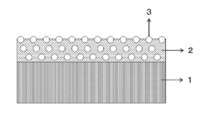
- Reference numeral 1 is a base film
- reference numeral 2 is a coating layer composed of hydrophobic oxide particles and a binder component
- reference numeral 3 is hydrophobic oxide particles
- reference numeral 4 is an arbitrary resin containing no hydrophobic oxide particles. Each layer is shown.
- the binder component forming the arbitrary resin layer of reference numeral 4 may be the same as or different from the binder component in the coating layer formed of the hydrophobic oxide particles of reference numeral 2 and the binder component.
- the outermost surface thereof is substantially covered with hydrophobic oxide particles.
- FIG. 2 shows a schematic cross-sectional view of a typical conventional product, in which the coating layer contains hydrophobic oxide particles, but the outermost surface is not covered with the hydrophobic oxide particles. There is a part.
- the laminated film in the present invention has a base film.
- the material of this base film is not particularly limited, but a resin film is preferable from the viewpoint of handleability such as flexibility.
- the resin constituting the resin film include polyethylene, polypropylene, polyolefins such as polystyrene and diene polymers, polyesters such as polyethylene terephthalate, polypropylene terephthalate, polybutylene terephthalate, and polyethylene naphthalate, nylon 6, nylon 6,6.
- Polypolymers such as nylons 6, 10 and nylon 12, acrylate resins such as polymethyl methacrylate, polymethacrylic acid esters, polymethyl acrylates and polyacrylic acid esters, polyacrylic acid resins, polymethacrylic acid resins, Polyurethane resin, cellulose resin such as cellulose acetate, ethyl cellulose, polyarylate, aramid, polycarbonate, polyphenylene sulfide, polyphenylene oxide, polysulfone, polyether sulfone, polyether ether ketone, polyetherimide, polyimide, polyamideimide, polybenzimidazole , Aromatic hydrocarbon polymers such as polybenzoxazole and polybenzthiazole, fluororesins such as polytetrafluoroethylene and polyvinylidene fluoride, epoxy resins, phenolic resins, novolak resins and benzoxazine resins.
- acrylate resins such as polymethyl methacrylate, polymethacryl
- polyester resin examples include polyethylene terephthalate, polypropylene terephthalate, polybutylene terephthalate, and polyethylene naphthalate. Of these, polyethylene terephthalate is preferably used from the viewpoint of balancing physical properties and cost.
- the base film may be a single layer, or two or more types of layers may be laminated. When two or more layers are laminated, the same or different types of films can be laminated. Further, the resin composition may be laminated on the base film. Further, if necessary, various additives can be contained in the base film as long as the effects of the present invention are achieved. Examples of the additive include an antioxidant, a light resistance agent, an antigelling agent, an organic wetting agent, an antistatic agent, an ultraviolet absorber, and a surfactant. When the base film is composed of two or more layers, additives can be added depending on the function of each layer. In order to improve handling properties such as slipperiness and winding property of the base film, inert particles may be contained in the base film.
- the thickness of the base film is not particularly limited, but is preferably 5 ⁇ m or more and 300 ⁇ m or less. It is more preferably 10 ⁇ m or more and 280 ⁇ m or less, and further preferably 12 ⁇ m or more and 260 ⁇ m or less. If it is 12 ⁇ m or more, it is easy to apply when laminating the coating layer, and if it is 260 ⁇ m or less, it is advantageous in terms of cost.
- the surface of the base material film may be used in an untreated state, but may be surface-treated in order to improve the adhesion with the coating layer.
- those having an anchor coating layer (easy adhesion layer) or subjected to surface treatment such as plasma treatment, corona treatment and flame treatment can be used.
- the coating layer of the laminated film of the present invention contains hydrophobic oxide particles.
- the hydrophobic oxide particles are not particularly limited as long as they have hydrophobicity.
- hydrophilic oxide particles may be hydrophobized by surface treatment. That is, it is possible to use those obtained by subjecting the hydrophilic oxide particles to a surface treatment with an arbitrary reagent such as a silane coupling agent to make the surface hydrophobic.
- the type of oxide is not particularly limited.
- at least one kind of oxide such as silica (silicon dioxide), alumina, and titania can be used. These may be those synthesized via any compound, and known or commercially available ones may be used. Of these oxides, silica particles can be particularly preferably used.
- silica particles surface treatment with various known reagents such as silicone oil, silane coupling agent and silazane is preferably used.
- various known reagents such as silicone oil, silane coupling agent and silazane is preferably used.
- 1H, 1H, 2H, 2H-perfluorooctyl group, 1H, 1H, 2H, 2H-perfluorodecyl group, 1H, 1H, 2H, 2H are exhibited on the surface.
- -Fluorine functional group represented by perfluorohexyl group, 3,3,3-trifluoropropyl group, etc., methyl group, ethyl group, n-propyl group, isopropyl group, n-butyl group, isobutyl group, sec- It is more preferable to introduce an alkyl group typified by a butyl group, a tert-butyl group, an octyl group, an alkenyl group, an alkynyl group, a vinyl group, a cyclohexyl group, a styryl group, a phenyl group, a trimethylsilyl group and the like.
- hydrophobic silica into which a trimethylsilyl group has been introduced is more preferable because it exhibits more excellent water and oil repellency.
- the size of the hydrophobic oxide particles in the present invention is such that the average primary particle diameter is 10 nm or more and 300 nm or less, preferably 10 nm or more and 200 nm or less, and more preferably 10 nm or more and 100 nm or less.
- the size of the average primary particle diameter can be determined as a result of morphological observation with a microscope such as a scanning electron microscope or a transmission electron microscope. Specifically, the average of the diameters of 20 particles arbitrarily selected in these microscope observations is defined as the average primary particle diameter.
- the average primary particle diameter of irregularly shaped particles can be calculated as a circle equivalent diameter.
- the equivalent circle diameter is a value obtained by dividing the observed particle area by ⁇ , calculating the square root, and doubling the square root.
- hydrophobic oxide particles can be usually described as “hydrophobic metal oxide particles”.
- silica is simply described as “oxide” because there are various interpretations regarding whether or not it is included in “metal oxide”.
- oxide particles in the present invention those synthesized by a known method such as a wet method or a dry method can be used.
- the sol-gel method is known as one of the methods for producing oxide particles of silica, titania, zirconia, alumina and the like.
- oxide particles are obtained by a hydrolysis reaction and polycondensation of a metal alkoxide in an organic solvent containing water in the presence of an acidic catalyst or a basic catalyst.
- the sol-gel method is preferable because fine oxide particles having a spherical shape and a relatively uniform particle size can be obtained.
- the synthesis of silica particles by the sol-gel method can be performed by the precisely controlled method described in Non-Patent Document 1 or Non-Patent Document 2.
- the methods in these documents do not require a long process of dropping the metal alkoxide into an organic solvent containing water, and mix the metal alkoxide and water at once. Therefore, a simpler process and experimental equipment are used to synthesize oxide particles. can do.
- Non-patent document 1 Controlled Growth of Monodisperse Silica Spheres in the Micron Size Range. (1968) Journal of Colloid and Interface Science, 26, 62-69.
- Non-patent document 2 Influence of the initial chemical conditions on the relational design of silica particles. (2018) Journal of Sol-Gel Science and Technology, 88, 430-441.
- the metal alkoxide used for the synthesis of the oxide particles is not particularly limited as long as it is a compound used for producing the oxide particles by the reaction of the sol-gel method, and is appropriately selected according to the type of the oxide particles to be produced.
- silicon alkoxides include methyltrimethoxysilane, methyltriethoxysilane, tetramethoxysilane, tetraethoxysilane, tetraisopropoxysilane, and tetrabutoxysilane.
- tetramethoxysilane and tetraethoxysilane are preferable because they are industrially easily available and easy to handle.
- a known catalyst used in the sol-gel method can be used, and either an acidic catalyst or a basic catalyst may be used.
- a basic catalyst from the viewpoint that it is easy to obtain spherical particles having a uniform particle size.
- particle growth may be carried out after preliminary hydrolysis in the presence of an acidic catalyst, but in the present invention, an acidic catalyst is used during this preliminary hydrolysis. The possibility is not excluded, and any method may be used as long as a basic catalyst is used during grain growth.
- the basic catalyst used in the present invention include amine compounds and alkali metal hydroxides.
- an amine compound from the viewpoint that the amount of impurities containing a metal other than the metal element constituting the target oxide particles is small and high-purity oxide particles can be obtained.
- amine compounds include ammonia, methylamine, dimethylamine, trimethylamine, ethylamine, diethylamine, triethylamine and the like.
- ammonia from the viewpoint of high volatility and easy removal after synthesis.
- the above basic catalysts may be used alone or in combination of two or more.
- an industrially available one may be used as it is in a commercially available form, or a catalyst diluted with water or an organic solvent such as ammonia water may be used. good.
- a catalyst diluted with water or an organic solvent such as ammonia water may be used. good.
- an aqueous solution in which the basic catalyst is diluted with water and the concentration of which is adjusted as necessary, because the reaction progress rate can be easily controlled.
- the concentration is preferably in the range of 1 to 30% by mass from the viewpoints of industrial availability and easy concentration adjustment.
- the proportion of the basic catalyst used can be appropriately selected in consideration of the reaction rate of hydrolysis and polycondensation reaction of the metal alkoxide.
- any polar solvent used in the sol-gel method can be used, and water or water is dissolved at an arbitrary ratio. Any organic solvent that can be used will do. Two or more kinds of organic solvents other than water may be mixed and used, and in this case, the organic solvent after mixing may satisfy the above requirements.
- Specific examples of the polar solvent other than water include alcohols such as methanol, ethanol, isopropyl alcohol and butanol, ethers such as diethyl ether, tetrahydrofuran and dioxane, and amides such as dimethylformamide, dimethylacetamide and N-methylpyrrolidone.
- Alcohols are by-produced in the sol-gel reaction, so it is possible to use alcohols such as methanol, ethanol, isopropyl alcohol, and butanol among the above organic solvents in the dispersion after the reaction. It is more preferable from the viewpoint of suppressing the possibility that the above impurities may enter.
- the sol-gel method requires the addition of water, but water is required for the reaction when the basic catalyst is added as an aqueous solution as described above, or when water is used as part or all of the solvent. It can also be used as part or all of the water.
- the proportion of water used may be appropriately selected according to the particle size of the oxide particles to be produced.
- reaction conditions If the mixing time of the metal alkoxide and the basic catalyst is too short, the particle size distribution tends to widen, and if it is too long, stable particle growth tends to be impossible.
- the reaction temperature is not particularly limited as long as it is a temperature at which the reaction of the sol-gel method proceeds rapidly, and can be appropriately selected according to the particle diameter of the target oxide particles. Generally, the lower the reaction temperature, the larger the particle size of the obtained oxide particles tends to be.
- an aging step may be performed after the dropping of the metal alkoxide and the basic catalyst is completed. The aging step here means that some time is left until the next surface modification treatment agent is added.
- the aging temperature is preferably about the same as the reaction temperature.
- a method such as adding a metal alkoxide and a basic catalyst after aging to grow the particle size of the oxide particles can be used.
- the present invention by adding at least one surface treatment agent selected from the group consisting of silicon oil, a silane coupling agent and silazane to the dispersion liquid of oxide particles obtained by the above method,
- the oxide particles are surface-treated.
- the silicone oil a known silicone oil that is usually used for surface treatment of oxide particles can be used without particular limitation. Specifically, dimethyl silicone oil, methylphenyl silicone oil, methylhydrogen silicone oil, alkyl modified silicone oil, amino modified silicone oil, epoxy modified silicone oil, carboxyl modified silicone oil, carbinol modified silicone oil, methacryl modified silicone oil. Polyether-modified silicone oil, fluorine-based silicone oil, etc. may be appropriately selected and used.
- silane coupling agent examples include methyltrimethoxysilane, methyltriethoxysilane, hexyltrimethoxysilane, decyltrimethoxysilane, phenyltriethoxysilane, vinyltrimethoxysilane, vinyltriethoxysilane, and 3-methacryloyl.
- silazane a known silazane usually used for surface treatment can be used without particular limitation.
- silazane it is preferable to use 1,1,1,3,3,3-hexamethyldisilazane (HMDS) from the viewpoints of good reactivity and good handleability.
- HMDS 1,1,1,3,3,3-hexamethyldisilazane
- HMDS 1,1,1,3,3,3-hexamethyldisilazane
- Non-patent document 3 Surface chemistry and trimethylsilyl fusion of Studio silica sols. (20 03) Journal of Non-Crystalline Solids, 316, 349-363.
- the above-mentioned surface treatment agent may be used alone or in combination of two or more.
- these surface treatment agents at least one selected from the group consisting of a silane coupling agent and silazane is preferably used because the obtained oxide particles after the surface treatment have good fluidity. It is more preferable to use.
- the method of adding the surface treatment agent is not particularly limited.
- the surface treatment agent is a liquid having a low viscosity at room temperature and atmospheric pressure, it may be dropped into the dispersion liquid or sprayed onto the dispersion liquid, but it is dropped from the viewpoint of easy operation. Is preferable.
- the surface treatment agent is a high-viscosity liquid or solid, it can be added in the same manner as in the case of a low-viscosity liquid after diluting with a suitable organic solvent.
- the surface treatment agent is a gas, it can be added by blowing it into the dispersion liquid in the form of fine bubbles.
- the treatment temperature and treatment time at the time of surface treatment may be appropriately selected in consideration of the reactivity of the surface treatment agent to be used and the like.
- the measurement result by the X-ray photoelectron spectrometer can be used as an index of the modification rate by the functional group having water repellency and oil repellency on the surface of the hydrophobic oxide particles.
- the atomic composition ratio can be obtained in a depth region of about 10 nm, and comparison can be made with respect to the ratio of specific atoms, for example, carbon atoms, which form the functional group having water/oil repellency.
- the carbon atom ratio is preferably 9 at% or more. More preferably, it is 12 at% or more.
- the ratio of carbon atoms is preferably large, but is usually 50 at% or less, and may be 30 at% or less.
- the coating layer in the present invention may contain components other than the above hydrophobic oxide particles. Specific examples thereof include a binder component, an antioxidant, a light resistant agent, an antioxidant, an organic wetting agent, an antistatic agent, an ultraviolet absorber, a surfactant, and the like, and these components are appropriately contained as necessary. Can be made.
- the binder component is not particularly limited as long as it is a component that can bind the hydrophobic oxide particles well.
- siloxane-based inorganic polymers represented by polysiloxane (including organopolysiloxane, dimethylpolysiloxane, etc.), polytitanoxane, polyaluminoxane, polyzirconoxane, polysilazane, perhydropolysilazane, alkoxysilane, alkylalkoxysilane, etc.
- polysiloxane, polysilazane, perhydropolysilazane, alkoxysilane, and alkylalkoxysilane are preferable.
- polysiloxane is more preferable from the viewpoint of binding the hydrophobic oxide particles in the present invention well.
- Colcoat registered trademark
- PX manufactured by Colcoat Co., Ltd.
- the binder component in the present invention it is preferable to adopt a method in which an inorganic polymer is formed by a thermosetting reaction using a sol-gel method.
- Such an inorganic polymer is obtained by hydrolyzing and polycondensing a solution of a metal alkoxide, which is a precursor thereof, as a starting material to form a sol, and then polycondensing it with water in the air to form a gel.
- the above-mentioned metal alkoxide can be used by diluting it with one kind of solvent or two or more kinds of mixed solvent which are uniformly mixed with water.
- the curing reaction proceeds to form a film.
- the polysiloxane in the present invention may be a reaction product using a metal alkoxide as a starting material, or may be a product modified by an addition reaction or the like.
- the hydrophobic oxide particles in the coating layer can be used in any proportion capable of exhibiting the water repellency and oil repellency of the laminated film, but the solid content should be 30 to 100% by mass of the coating layer. Is preferable. More preferably, it is 50 to 100% by mass. By using the hydrophobic oxide particles in the above ratio, excellent water repellency and oil repellency can be exhibited in the laminated film.
- a laminated film is obtained by laminating a coating layer on the substrate film directly or via another layer.
- the coating liquid for forming the coating layer the dispersion liquid of the hydrophobic oxide particles prepared by the above-mentioned method can be used as it is, but various components for forming the coating layer such as a binder component and suitable
- the solvent may be contained alone or in a plurality of types.
- the dispersion liquid can be used as it is without using the binder component.
- silica sol alone does not have a film-forming property, so that when the silica sol dispersion is used for coating, it must be used in combination with a binder resin or the like.
- fine monodisperse particles can form a surface with an appropriate cohesive force, and since the hydrophobic oxide particles in the present invention have film-forming properties even when used alone, the hydrophobic oxide particles can be used as a coating liquid.
- the dispersion liquid of can be used as it is.
- the coating method is not particularly limited.
- it can be produced by a known method such as roll coating, gravure coating, bar coating, doctor blade coating, spin coating, spray coating, and brush coating.
- the solvent used for coating by these methods is not particularly limited, and for example, organic solvents such as water, alcohols, ketones, normal hexane, cyclohexane, toluene, butyl acetate, and glycols are appropriately selected and used. can do. These solvents may be used alone or in combination of two or more.
- the amount of the hydrophobic oxide particles dispersed in the solvent can be selected at any ratio so that a uniform dispersion can be obtained.
- the method of drying after coating may be either natural drying or heat drying, but from the viewpoint of industrial production, heat drying is more preferable.
- the drying temperature is not particularly limited as long as it does not affect the components contained in the base film or the coating layer, but is usually preferably 200 ° C. or lower, and more preferably 50 ° C. or higher and 160 ° C. or lower.
- the drying method is not particularly limited, and a known method for drying the film such as a hot plate or a hot air oven can be used.
- the drying time is appropriately selected depending on other conditions such as the drying temperature, but may be in a range that does not affect the components contained in the base film or the coating layer.
- the water/oil repellency of the laminated film according to the present invention can be evaluated by a known method. Specifically, water repellency can be evaluated by contact angle measurement using water, and oil repellency can be evaluated by contact angle measurement using diiodomethane.
- the contact angle of water is preferably 90 degrees or more, and more preferably 120 degrees or more.
- a water contact angle of 90 degrees or more is preferable because it exhibits excellent water repellency, and a water contact angle of 120 degrees or more is equivalent to or higher than that of a conventional fluororesin sheet typified by polytetrafluoroethylene (PTFE). It is more preferable because it is water-based.
- the range of the contact angle of diiodomethane in the present invention is preferably 60 degrees or more, more preferably 90 degrees or more.
- the contact angle of diiodomethane is 60 degrees or more, it is preferable from the viewpoint of imparting oil repellency that can suppress oil stains and the like, and when it is 90 degrees or more, the oil repellency equal to or higher than that of the conventional fluorine-based resin sheet is obtained. It is more preferable because it is shown. It can be said that the larger the contact angle of water and the contact angle of diiodomethane, the better, and no upper limit is set. Usually, the most preferable state is that the contact angle is so large that the droplet does not adhere to the coating layer and the contact angle cannot be clearly shown.
- the laminated film of the present invention preferably has high transparency, and the film haze is preferably 20% or less. It is more preferably 15% or less, and further preferably 10% or less. A film haze of 20% or less is preferable because it can be applied to applications in which transparency and aesthetics of contents are required.
- the contact angle with respect to the solvent of the produced film was measured.
- a fully automatic contact angle meter DM-701 manufactured by Kyowa Interface Science Co., Ltd. was used for the contact angle measurement. Pure water and diiodomethane were used as the measurement solvents.
- the contact angle of water (abbreviated as WCA) was measured by dropping 1.8 ⁇ L of water droplet and 60 seconds later.
- the contact angle of diiodomethane (abbreviated as DCA) was measured 30 seconds after dropping 0.9 ⁇ L of a droplet of diiodomethane.
- the average primary particle diameter of the hydrophobic oxide particles was measured by observing with a scanning electron microscope or a transmission electron microscope. The average of the diameters of 20 particles arbitrarily selected in these microscopic observations was defined as the primary particle average diameter.
- the average primary particle diameter of irregularly shaped particles can be calculated as a circle equivalent diameter.
- the equivalent circle diameter is a value obtained by dividing the observed particle area by ⁇ , calculating the square root, and doubling the square root.
- the hydrophobic silica nanoparticle dispersion liquid was dropped on a clean aluminum foil and dried to form a hydrophobic silica nanoparticle thin film on the aluminum foil. At this time, it was quickly dried to prevent surface contamination as much as possible, and immediately sampled for surface composition analysis.
- K-Alpha + manufactured by Thermo Fisher Scientific was used as the device. Details of the measurement conditions are shown below. In the analysis, the background was removed by the shirley method. The surface composition ratio was the average value of the measurement results of three or more sites where Al of the base material was not detected.
- Example 1 [Hydrophobic silica particle dispersion]
- HMDS 1,1,1,3,3,3-hexamethyldisilazane
- silica A The average primary particle diameter of silica A was 50 nm.
- This silica A dispersion was mixed with Colcoat (registered trademark) PX (manufactured by Colcoat) to prepare a coating solution.
- This coating liquid was applied to a corona-treated surface of a Toyobo Ester (registered trademark) film (product number: E5100, thickness: 75 ⁇ m), which is a film made of polyethylene terephthalate (abbreviated as PET), using a bar coater #6 by a bar coating method. After coating, a coating film was obtained by drying at 130° C. for 1 minute.
- Comparative example 1 As Comparative Example 1, uncoated PET film E5100 was used. A corona-treated surface was used for the contact angle measurement.
- Comparative example 2 A coating film was obtained by applying Colcoat (registered trademark) PX to the corona-treated surface of the PET film E5100 by a bar coat method using a bar coater # 6 and then drying at 130 ° C. for 1 minute.
- silica B As the hydrophobic silica, commercially available AEROSIL (registered trademark) R812S (manufactured by Evonik Industries, Ltd., primary particle average diameter 7 nm) having a trimethylsilyl group on the surface was used. Hereinafter, this silica is referred to as silica B. Silica B was stirred and dispersed in ethanol so that the solid content concentration was 6% by mass to obtain a dispersion liquid. A coating liquid was prepared in the same manner as in Example 1 except that this silica B dispersion liquid was used to obtain a coating film.
- AEROSIL registered trademark
- R812S manufactured by Evonik Industries, Ltd., primary particle average diameter 7 nm
- Table 1 shows the measurement results of the films obtained in Examples and Comparative Examples.
- Example 1 both the contact angle of water and the contact angle of diiodomethane are compared with Comparative Example 1 in the case of using only the base material and in the case of applying only Corcoat (registered trademark) PX. It was found that it was larger than Example 2 and had excellent water and oil repellency. In particular, in Example 2 in which the ratio of silica was large, it was found that the droplets did not adhere to the film surface in the contact angle measurement, and the water and oil repellency were extremely excellent. Further, it was found that the haze values of Examples 1 and 2 were not extremely increased as compared with Comparative Examples 1 and 2, and the transparency was also excellent.
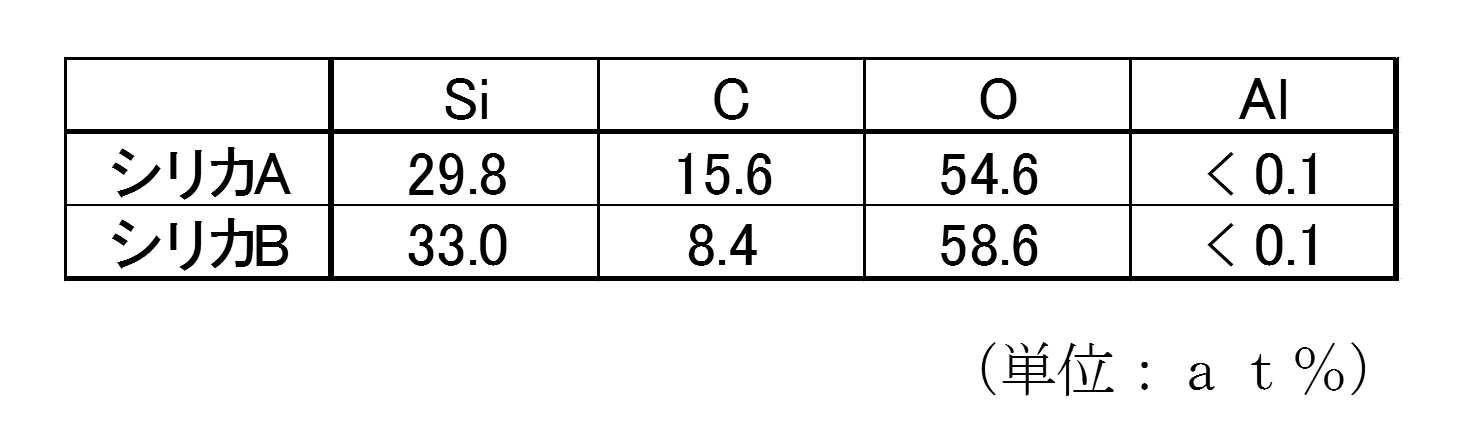
- Table 2 shows the results of ESCA analysis of the surfaces of silica A and silica B only.
- silica A and silica B are hydrophobic silica particles whose surfaces are modified with a trimethylsilyl group. As shown in Table 2, silica A has a larger carbon ratio as an index of the trimethylsilyl group than silica B. Therefore, silica A has a larger amount of trimethylsilyl group on the particle surface than silica B, and as shown in Table 1, the result that silica A shows better water and oil repellency is obtained. It is presumed that it has become.
- the present invention it is possible to provide a transparent laminated film having excellent water and oil repellency and exhibiting antifouling property.
- the laminated film according to the present invention is useful because it can be expected to be applied to applications such as packaging, coating, and release film.
- Base film 2 Coating layer composed of hydrophobic oxide particles and a binder component 3: Hydrophobic oxide particles 4: Any resin layer containing no hydrophobic oxide particles
Landscapes
- Chemical & Material Sciences (AREA)
- Organic Chemistry (AREA)
- Engineering & Computer Science (AREA)
- Chemical Kinetics & Catalysis (AREA)
- Polymers & Plastics (AREA)
- Health & Medical Sciences (AREA)
- Medicinal Chemistry (AREA)
- Materials Engineering (AREA)
- Life Sciences & Earth Sciences (AREA)
- Wood Science & Technology (AREA)
- Manufacturing & Machinery (AREA)
- Inorganic Chemistry (AREA)
- Nanotechnology (AREA)
- Laminated Bodies (AREA)
- Paints Or Removers (AREA)
Abstract
Description
1. 基材フィルム上に直接又は他の層を介してコーティング層が積層された積層フィルムであって、前記コーティング層が積層フィルムの少なくとも一方の面の最外層であり、前記コーティング層が、一次粒子平均径10nm以上300nm以下の疎水性酸化物粒子を固形分の含有量として30質量%以上100質量%以下含有する積層フィルム。
2. 疎水性酸化物粒子が、疎水性シリカである上記第1に記載の積層フィルム。
3. コーティング層中の疎水性酸化物粒子の固形分の含有量が、50~100質量%である上記第1または第2に記載の積層フィルム。
4. コーティング層中にシロキサン系無機高分子を含有する上記第1~第3のいずれかに記載の積層フィルム。
5. コーティング層の表面において測定したジヨードメタンに対する接触角が、60度以上である上記第1~第4のいずれかに記載の積層フィルム。
6. ヘイズが20%以下である請求項1~5のいずれかに記載の積層フィルム。
本発明における積層フィルムは、基材フィルムを有する。この基材フィルムの材質は特に限定されないが、可撓性など取り扱い性の観点から樹脂フィルムであることが好ましい。樹脂フィルムを構成する樹脂としては、例えば、ポリエチレン、ポリプロピレン、ポリスチレンやジエン系ポリマーなどのポリオレフィン類、ポリエチレンテレフタレート、ポリプロピレンテレフタレート、ポリブチレンテレフタレート、ポリエチレンナフタレートなどのポリエステル類、ナイロン6、ナイロン6,6、ナイロン6、10、ナイロン12などのポリアミド類、ポリメチルメタクリレート、ポリメタクリル酸エステル類、ポリメチルアクリレート、ポリアクリル酸エステル類などのアクリレート系樹脂、ポリアクリル酸系樹脂、ポリメタクリル酸系樹脂、ポリウレタン系樹脂、酢酸セルロース、エチルセルロースなどのセルロース系樹脂、ポリアリレート、アラミド、ポリカーボネート、ポリフェニレンスルフィド、ポリフェニレンオキシド、ポリスルホン、ポリエーテルスルホン、ポリエーテルエーテルケトン、ポリエーテルイミド、ポリイミド、ポリアミドイミド、ポリベンズイミダゾール、ポリベンズオキサゾール、ポリベンズチアゾールなどの芳香族系炭化水素系ポリマー、ポリテトラフルオロエチレン、ポリビニリデンフルオリドなどのフッ素系樹脂、エポキシ樹脂、フェノール樹脂、ノボラック樹脂、ベンゾオキサジン樹脂などが挙げられる。また、前記のような樹脂の構成ユニットの一部を他の構成ユニットに置き換えた共重合物であってもよい。これらのうち、透明性と寸法安定性の観点から、ポリエステル樹脂やアクリレート樹脂からなるフィルムであることが好ましい。ポリエステル樹脂としては、具体的には、ポリエチレンテレフタレート、ポリプロピレンテレフタレート、ポリブチレンテレフタレート、ポリエチレンナフタレートなどが挙げられる。これらのうち、物性とコストのバランスという観点から、ポリエチレンテレフタレートを用いることが好ましい。
本発明における積層フィルムのコーティング層は、疎水性酸化物粒子を含有する。この疎水性酸化物粒子は、疎水性を有するものであれば特に限定されず、例えば、親水性酸化物粒子を表面処理によって疎水化したものであっても良い。すなわち、親水性酸化物粒子に対してシランカップリング剤などの任意の試薬で表面処理を行い、その表面を疎水化したものを用いることができる。
本発明において、「疎水性酸化物粒子」と記載しているのは、通常は「疎水性金属酸化物粒子」と記載することもできると思われる。しかし、例えば、下記のシリカについては、「金属酸化物」に含まれるかどうかについて解釈が種々あるため、単に「酸化物」とだけ記載している。本発明における酸化物粒子は、湿式法、乾式法など公知の方法で合成されたものを用いることができる。これらのうち、ゾル‐ゲル法は、シリカ、チタニア、ジルコニア、アルミナなどの酸化物粒子の製造方法の一つとして知られる。この製造方法では、酸性触媒または塩基性触媒の存在下、水を含有する有機溶媒中で、金属アルコキシドの加水分解反応および重縮合によって酸化物粒子が得られる。ゾル‐ゲル法は、球状かつ粒径が比較的揃った微細な酸化物粒子が得られることから好ましい。例えば、ゾル‐ゲル法によるシリカ粒子の合成は、非特許文献1や非特許文献2に記載されている精密に制御された方法で合成することができる。これら文献の方法では金属アルコキシドを水を含有する有機溶剤に滴下する長時間を要するプロセスが必要なく、金属アルコキシドと水を一度に混合するため、より簡易なプロセス、実験装置で酸化物粒子を合成することができる。
Controlled Growth of Monodisperse Silica
Spheres in the Micron Size Range.(1968)Journal of Colloid and Interface Science,26,62-69.
Influence of the initial chemical conditions on the rational design of silica particles.(2018) Journal of Sol-Gel Science and Technology,88,430-441.
酸化物粒子の合成に使用する触媒は、ゾル‐ゲル法に使用される公知の触媒を使用することができ、酸性触媒、塩基性触媒のいずれを用いても良い。これらのうち、粒子径の揃った球状の粒子を得ることが容易であるという観点から、塩基性触媒を用いることが好ましい。ただし、ゾル‐ゲル法においては、まず酸性触媒存在下で予備的に加水分解を行った後に粒子成長を実施することもあるが、本発明においては、この予備的な加水分解時に酸性触媒を用いる可能性を排除するものではなく、粒子成長時に塩基性触媒を用いる方法であれば良い。本発明において用いられる塩基性触媒としては、例えば、アミン化合物、水酸化アルカリ金属などを挙げることができる。特に、目的とする酸化物粒子を構成する金属元素以外の金属を含有する不純物量が少なく、高純度の酸化物粒子が得られるという観点から、アミン化合物を用いることが好ましい。このようなアミン化合物としては、例えば、アンモニア、メチルアミン、ジメチルアミン、トリメチルアミン、エチルアミン、ジエチルアミン、トリエチルアミンなどを挙げることができる。これらのうち、揮発性が高く、合成後に除去しやすいという観点から、アンモニアを使用することがより好ましい。なお、上記の塩基性触媒は、単独で使用しても良く、二種類以上を使用しても良い。上記の塩基性触媒は、工業的に入手可能なものを市販されている形態のまま使用しても良く、例えばアンモニア水などのように、水や有機溶媒で希釈されているものを用いても良い。特に、反応の進行速度を制御しやすいことから、塩基性触媒を水に希釈して、必要に応じて濃度調整した水溶液を用いることがより好ましい。塩基性触媒として水溶液を使用する場合の濃度は、工業的に入手が容易であること、濃度調整が容易であるなどの観点から、1~30質量%の範囲とすることが好ましい。塩基性触媒の使用割合は、金属アルコキシドの加水分解および重縮合反応の反応速度などを考慮して適宜選択することができる。
本発明において、上記金属アルコキシドの加水分解および重縮合反応に使用される溶媒としては、ゾル‐ゲル法で用いられる任意の極性溶媒を用いることができ、水または水を任意の割合で溶解することができる有機溶媒であれば良い。水以外の有機溶媒を二種類以上混合して使用しても良く、この場合には混合後の有機溶媒が上記の要件を満たせば良い。水以外の極性溶媒としては、具体的には、メタノール、エタノール、イソプロピルアルコール、ブタノールなどのアルコール類、ジエチルエーテル、テトラヒドロフラン、ジオキサンなどのエーテル類、ジメチルホルムアミド、ジメチルアセトアミド、N-メチルピロリドンなどのアミド類などを挙げることができる。アルコールは、ゾル‐ゲル法の反応において副生するものであるので、上記の有機溶媒のうち、メタノール、エタノール、イソプロピルアルコール、ブタノールなどのアルコール類を使用することが、反応後の分散液中への不純物が入る可能性を抑制できる観点から、より好ましい。
金属アルコキシドと塩基性触媒の混合時間は、短すぎると粒径分布幅が広くなる傾向にあり、長すぎると安定した粒子成長ができない傾向にある。反応温度は、ゾル‐ゲル法の反応が速やかに進行する温度であれば特に限定されず、目的とする酸化物粒子の粒径に応じて適宜選択することができる。一般的に、反応温度が低いほど得られる酸化物粒子の粒径が大きくなる傾向がある。また、ゾル‐ゲル法の反応を確実に進行させるために、金属アルコキシドおよび塩基性触媒の滴下が終了した後、熟成工程を経ても良い。ここでの熟成工程とは、次の表面修飾処理剤の添加まで、しばらく時間を置くことを意味する。この場合、熟成温度としては反応温度と同程度の温度とすることが好ましい。また、所望の粒径の酸化物粒子を得るために、熟成後にさらに金属アルコキシドおよび塩基性触媒を添加して酸化物粒子の粒径を成長させるなどの手法を用いることもできる。
本発明においては、前述の方法で得られた酸化物粒子の分散液に、シリコンオイル、シランカップリング剤およびシラザンよりなる群から選ばれる少なくとも1種類以上の表面処理剤を添加することにより、前記酸化物粒子の表面処理を行う。シリコンオイルとしては、通常、酸化物粒子の表面処理に用いられる公知のシリコンオイルを特に制限なく使用することが可能である。具体的には、ジメチルシリコンオイル、メチルフェニルシリコンオイル、メチルハイドロジェンシリコンオイル、アルキル変性シリコンオイル、アミノ変性シリコンオイル、エポキシ変性シリコンオイル、カルボキシル変性シリコンオイル、カルビノール変性シリコンオイル、メタクリル変性シリコンオイル、ポリエーテル変性シリコンオイル、フッ素系シリコンオイルなどを、適宜選択して使用すれば良い。
Surface chemistry and trimethylsilyl functionalization of Stober silica sols.(20
03) Journal of Non-Crystalline Solids,316,349-363.
本発明におけるコーティング層には、上記疎水性酸化物粒子以外の成分を含んでいても良い。具体的には、バインダー成分、酸化防止剤、耐光剤、ゲル化防止剤、有機湿潤剤、帯電防止剤、紫外線吸収剤、界面活性剤などが挙げられ、これらの成分を必要に応じて適宜含有させることができる。
本発明においては、基材フィルム上に直接又は他の層を介してコーティング層を積層することにより、積層フィルムを得る。このコーティング層を形成するためのコーティング液は、前述の方法で作製した疎水性酸化物粒子の分散液をそのまま用いることもできるが、バインダー成分など、前記のコーティング層を形成する各種成分や、適当な溶媒を単独または複数種類含んでいても良い。
本発明の積層フィルムの製造において、コーティングの方法は特に制限されない。例えば、ロールコーティング、グラビアコーティング、バーコート、ドクターブレードコート、スピンコート、スプレーコート、刷毛塗工などの公知の方法に従って作製することができる。これらの方法でコーティングを行う際に使用する溶媒は特に限定されず、例えば、水、アルコール類、ケトン類、ノルマルヘキサン、シクロヘキサン、トルエン、酢酸ブチル、グリコール類などの有機溶媒を適宜選択して使用することができる。これらの溶媒は単独で用いても良く、複数を混合して用いても良い。溶媒に対する疎水性酸化物粒子の分散量は、均一な分散液が得られる任意の割合で選択することができる。コーティング後に乾燥する方法は、自然乾燥または加熱乾燥のいずれであっても良いが、工業的な製造という観点からは、加熱乾燥がより好ましい。乾燥温度は、基材フィルムやコーティング層の含有成分に影響を与えない範囲であれば特に限定されないが、通常は200°C以下が好ましく、50°C以上160°C以下がより好ましい。乾燥方法は特に限定されず、ホットプレートや熱風オーブン等、フィルムを乾燥させる公知の方法を用いることができる。乾燥時間については、乾燥温度等の他の条件により適宜選択されるが、基材フィルムやコーティング層の含有成分に影響を与えない範囲であれば良い。
本発明による積層フィルムの撥水・撥油性は公知の方法で評価することができる。具体的には、撥水性は水を用いた接触角測定により評価することができ、また撥油性はジヨードメタンを用いた接触角測定により評価することができる。本発明における好ましい水の接触角の範囲は90度以上、より好ましくは120度以上である。水の接触角が90度以上であると優れた撥水性を示すことから好ましく、120度以上であると、ポリテトラフルオロエチレン(PTFE)に代表される従来のフッ素系樹脂シートと同等以上の撥水性を示すことからより好ましい。また、本発明における好ましいジヨードメタンの接触角の範囲は60度以上、より好ましくは90度以上である。ジヨードメタンの接触角が60度以上であると、油汚れ等を抑制することができる撥油性を付与できる観点から好ましく、90度以上であると、従来のフッ素系樹脂シートと同等以上の撥油性を示すことからより好ましい。水の接触角、ジヨードメタンの接触角はともに大きいほどよいと言え、上限は特に設けない。通常、最も好ましい状態は、液滴がコーティング層上に付着せず、接触角を明瞭に示すことができないほどに接触角が大きい状態であると言える。
本発明の積層フィルムは透明性が高いほうが好ましく、フィルムヘイズは20%以下であることが好ましい。より好ましくは15%以下であり、さらに好ましくは10%以下である。フィルムヘイズが20%以下であると、透明性や内容物の審美性が必要とされる用途にも展開できることから好ましい。
作製したフィルムについて、溶剤に対する接触角を測定した。接触角測定には、協和界面科学株式会社製の全自動接触角計DM-701を用いた。測定溶剤には純水とジヨードメタンを用いた。水の接触角(WCAと省略)は水滴を1.8μL滴下し、60秒後に測定した。ジヨードメタンの接触角(DCAと省略)はジヨードメタンの液滴を0.9μL滴下し、30秒後に測定した。
フィルムのヘイズは、日本電色工業株式会社製のNDH-5000を用いて測定した。
疎水性酸化物粒子の一次粒子平均径は、走査型電子顕微鏡または透過型電子顕微鏡による観察して測定した。これらの顕微鏡観察において任意に選んだ20個分の粒子の直径の平均を一次粒子平均径とした。不定形の粒子の一次粒子平均径は円相当径として計算することができる。円相当径は、観察された粒子の面積をπで除し、平方根を算出し2倍した値である。
疎水性シリカナノ粒子分散液を清浄なアルミホイル上に滴下、乾燥させ、アルミホイル上に疎水性シリカナノ粒子薄膜を形成させた。この時、極力表面汚染が生じないよう速やかに乾燥させ、直ちにサンプリングして表面組成分析に供した。
装置にはK-Alpha+(Thermo Fisher Scientific社製)を用いた。測定条件の詳細は以下に示した。なお、解析の際、バックグラウンドの除去はshirley法にて行った。また、表面組成比は、基材のAlが検出されない部位3箇所以上の測定結果の平均値とした。
・測定条件
励起X線 : モノクロ化AlKα線
X線出力: 12kV、6mA
光電子脱出角度 : 90度
スポットサイズ : 400μmΦ
パスエネルギー : 50eV
ステップ : 0.1eV
〔疎水性シリカ粒子分散液〕
一次平均粒子径35nmの単分散シリカ粒子を1,1,1,3,3,3-ヘキサメチルジシラザン(HMDS)を用いて表面処理することにより、トリメチルシリル基を導入し、表面を修飾して、均一に分散した疎水性シリカ粒子分散液を得た。以下、このシリカをシリカAと称する。シリカAの一次粒子平均径は50nmであった。
このシリカA分散液をコルコート(登録商標)PX(コルコート社製)と混合してコート液を作製した。混合比は、コルコート(登録商標)PX:シリカ=1:2(固形分の質量比)となるように作製した。このコート液を、ポリエチレンテレフタレート(PETと省略)製のフィルムである東洋紡エステル(登録商標)フィルム(品番:E5100、厚み:75μm)のコロナ処理面に、バーコーター#6を用いてバーコート方式で塗布した後、130℃で1分間乾燥させることにより、コーティングフィルムを得た。
実施例1において、コーティング液のシリカとコルコート(登録商標)PXの混合比をコルコート(登録商標)PX:シリカ=1:64となるように作製した以外は、実施例1と同様にしてコーティングフィルムを得た。
比較例1として、コーティングをしていないPETフィルムE5100を用いた。接触角測定にはコロナ処理面を用いた。
PETフィルムE5100のコロナ処理面に、コルコート(登録商標)PXをバーコーター#6を用いてバーコート方式で塗布した後、130℃で1分間乾燥させることにより、コーティングフィルムを得た。
疎水性シリカとして、表面にトリメチルシリル基を有する、市販のAEROSIL(登録商標)R812S(エボニック社製、一次粒子平均径7nm)を用いた。以下、このシリカをシリカBと称する。シリカBを、固形分濃度が6質量%となるようにエタノール中に撹拌・分散させ、分散液を得た。このシリカB分散液を用いた以外は、実施例1と同様にコーティング液を作製し、コーティングフィルムを得た。

2 : 疎水性酸化物粒子とバインダー成分からなるコーティング層
3 : 疎水性酸化物粒子
4 : 疎水性酸化物粒子を含まない任意の樹脂層
Claims (6)
- 基材フィルム上に直接又は他の層を介してコーティング層が積層された積層フィルムであって、前記コーティング層が積層フィルムの少なくとも一方の面の最外層であり、前記コーティング層が、一次粒子平均径10nm以上300nm以下の疎水性酸化物粒子を固形分の含有量として30質量%以上100質量%以下含有する積層フィルム。
- 疎水性酸化物粒子が、疎水性シリカである請求項1に記載の積層フィルム。
- コーティング層中の疎水性酸化物粒子の固形分の含有量が、50~100質量%である請求項1または2に記載の積層フィルム。
- コーティング層中にシロキサン系無機高分子を含有する請求項1~3のいずれかに記載の積層フィルム。
- コーティング層の表面において測定したジヨードメタンに対する接触角が、60度以上である請求項1~4のいずれかに記載の積層フィルム。
- ヘイズが20%以下である請求項1~5のいずれかに記載の積層フィルム。
Priority Applications (5)
| Application Number | Priority Date | Filing Date | Title |
|---|---|---|---|
| KR1020217031661A KR20210137091A (ko) | 2019-03-07 | 2020-02-14 | 적층 필름 |
| CN202080018674.8A CN113543964B (zh) | 2019-03-07 | 2020-02-14 | 层叠膜 |
| EP20766603.3A EP3936329A4 (en) | 2019-03-07 | 2020-02-14 | COMPOSITE FILM |
| US17/433,960 US20220162411A1 (en) | 2019-03-07 | 2020-02-14 | Laminated film |
| JP2020516492A JP7452416B2 (ja) | 2019-03-07 | 2020-02-14 | 積層フィルム |
Applications Claiming Priority (2)
| Application Number | Priority Date | Filing Date | Title |
|---|---|---|---|
| JP2019041705 | 2019-03-07 | ||
| JP2019-041705 | 2019-03-07 |
Publications (1)
| Publication Number | Publication Date |
|---|---|
| WO2020179412A1 true WO2020179412A1 (ja) | 2020-09-10 |
Family
ID=72338322
Family Applications (1)
| Application Number | Title | Priority Date | Filing Date |
|---|---|---|---|
| PCT/JP2020/005779 Ceased WO2020179412A1 (ja) | 2019-03-07 | 2020-02-14 | 積層フィルム |
Country Status (6)
| Country | Link |
|---|---|
| US (1) | US20220162411A1 (ja) |
| EP (1) | EP3936329A4 (ja) |
| JP (1) | JP7452416B2 (ja) |
| KR (1) | KR20210137091A (ja) |
| CN (1) | CN113543964B (ja) |
| WO (1) | WO2020179412A1 (ja) |
Cited By (3)
| Publication number | Priority date | Publication date | Assignee | Title |
|---|---|---|---|---|
| WO2022038899A1 (ja) * | 2020-08-19 | 2022-02-24 | 東洋紡株式会社 | 積層フィルム |
| WO2022049900A1 (ja) * | 2020-09-02 | 2022-03-10 | 東洋紡株式会社 | 積層フィルム |
| WO2023112934A1 (ja) * | 2021-12-16 | 2023-06-22 | 東洋アルミニウム株式会社 | 積層体 |
Citations (11)
| Publication number | Priority date | Publication date | Assignee | Title |
|---|---|---|---|---|
| JP2000284102A (ja) | 1999-03-30 | 2000-10-13 | Fuji Photo Film Co Ltd | 反射防止膜および画像表示装置 |
| JP2001013303A (ja) * | 1999-06-30 | 2001-01-19 | Dainippon Printing Co Ltd | プラスチック基材フィルム用ハードコート膜、ホログラム及び回折格子シート |
| JP2002113805A (ja) | 2000-10-10 | 2002-04-16 | Dainippon Printing Co Ltd | 撥水性防汚フィルム |
| JP2004204131A (ja) * | 2002-12-26 | 2004-07-22 | Kao Corp | 撥水コーティング剤組成物 |
| JP2007138027A (ja) | 2005-11-18 | 2007-06-07 | Dainippon Ink & Chem Inc | ポリイミド系コーティング用組成物 |
| JP2009161579A (ja) * | 2007-12-28 | 2009-07-23 | Car Mate Mfg Co Ltd | コーティング組成物 |
| JP2013123660A (ja) * | 2011-12-13 | 2013-06-24 | Nicca Chemical Co Ltd | 撥水性コーティング膜の製造方法、それに用いる下地膜形成用組成物及び撥水性コーティング膜を備えた機能性材料 |
| JP2017019276A (ja) * | 2015-07-10 | 2017-01-26 | 東洋アルミエコープロダクツ株式会社 | 結露抑制シート |
| WO2017159654A1 (ja) * | 2016-03-14 | 2017-09-21 | デンカ株式会社 | 撥液性樹脂シート及びそれを用いた物品 |
| WO2017159854A1 (ja) * | 2016-03-18 | 2017-09-21 | 三菱マテリアル電子化成株式会社 | 被膜形成用組成物及びその製造方法、並びに被膜 |
| JP2018103534A (ja) | 2016-12-27 | 2018-07-05 | 綜研化学株式会社 | ハードコートフィルム及びその製造方法 |
Family Cites Families (14)
| Publication number | Priority date | Publication date | Assignee | Title |
|---|---|---|---|---|
| US6013724A (en) * | 1997-03-05 | 2000-01-11 | Nippon Paint Co., Ltd. | Raindrop fouling-resistant paint film, coating composition, film-forming method, and coated article |
| JP2000290535A (ja) * | 1999-04-05 | 2000-10-17 | Mitsubishi Chemicals Corp | 活性エネルギー線硬化性被覆組成物 |
| JP2003139908A (ja) * | 2001-11-07 | 2003-05-14 | Lintec Corp | 光学用フィルム |
| TWI388876B (zh) * | 2003-12-26 | 2013-03-11 | Fujifilm Corp | 抗反射膜、偏光板,其製造方法,液晶顯示元件,液晶顯示裝置,及影像顯示裝置 |
| US7998554B2 (en) * | 2004-07-06 | 2011-08-16 | Bridgestone Corporation | Hydrophobic surfaces with nanoparticles |
| US7419707B2 (en) * | 2005-02-21 | 2008-09-02 | Fujifilm Corporation | Coating composition for the formation of low refractive index layer, antireflection film, polarizing plate and liquid crystal display device |
| JPWO2008072707A1 (ja) * | 2006-12-15 | 2010-04-02 | 旭硝子株式会社 | 撥水性表面を有する物品 |
| TWI488746B (zh) * | 2009-02-13 | 2015-06-21 | Toyo Aluminium Kk | 層積體及容器 |
| EP2407521B1 (en) * | 2009-03-11 | 2015-07-29 | Asahi Kasei E-Materials Corporation | Coating composition, coating film, laminate, and process for production of laminate |
| US9896549B2 (en) * | 2010-04-13 | 2018-02-20 | Aaron Kessman | Hydrophobic and oleophobic coatings |
| US9260629B2 (en) * | 2010-09-02 | 2016-02-16 | United Technologies Corporation | Hydrophobic coating for coated article |
| KR20150094693A (ko) * | 2012-12-07 | 2015-08-19 | 덴끼 가가꾸 고교 가부시키가이샤 | 발수성을 구비한 열가소성 수지 시트 및 성형품 |
| US9644113B2 (en) * | 2014-04-25 | 2017-05-09 | Mitsubishi Materials Corporation | Composition for forming a thin layer with low refractive index, manufacturing method thereof, and manufacturing method of a thin layer with low refractive index |
| JP6498146B2 (ja) * | 2016-04-19 | 2019-04-10 | 富士フイルム株式会社 | 積層フィルムおよびその製造方法、偏光板、液晶パネル、液晶表示装置ならびにタッチパネル |
-
2020
- 2020-02-14 WO PCT/JP2020/005779 patent/WO2020179412A1/ja not_active Ceased
- 2020-02-14 JP JP2020516492A patent/JP7452416B2/ja active Active
- 2020-02-14 KR KR1020217031661A patent/KR20210137091A/ko not_active Withdrawn
- 2020-02-14 US US17/433,960 patent/US20220162411A1/en not_active Abandoned
- 2020-02-14 EP EP20766603.3A patent/EP3936329A4/en not_active Withdrawn
- 2020-02-14 CN CN202080018674.8A patent/CN113543964B/zh active Active
Patent Citations (11)
| Publication number | Priority date | Publication date | Assignee | Title |
|---|---|---|---|---|
| JP2000284102A (ja) | 1999-03-30 | 2000-10-13 | Fuji Photo Film Co Ltd | 反射防止膜および画像表示装置 |
| JP2001013303A (ja) * | 1999-06-30 | 2001-01-19 | Dainippon Printing Co Ltd | プラスチック基材フィルム用ハードコート膜、ホログラム及び回折格子シート |
| JP2002113805A (ja) | 2000-10-10 | 2002-04-16 | Dainippon Printing Co Ltd | 撥水性防汚フィルム |
| JP2004204131A (ja) * | 2002-12-26 | 2004-07-22 | Kao Corp | 撥水コーティング剤組成物 |
| JP2007138027A (ja) | 2005-11-18 | 2007-06-07 | Dainippon Ink & Chem Inc | ポリイミド系コーティング用組成物 |
| JP2009161579A (ja) * | 2007-12-28 | 2009-07-23 | Car Mate Mfg Co Ltd | コーティング組成物 |
| JP2013123660A (ja) * | 2011-12-13 | 2013-06-24 | Nicca Chemical Co Ltd | 撥水性コーティング膜の製造方法、それに用いる下地膜形成用組成物及び撥水性コーティング膜を備えた機能性材料 |
| JP2017019276A (ja) * | 2015-07-10 | 2017-01-26 | 東洋アルミエコープロダクツ株式会社 | 結露抑制シート |
| WO2017159654A1 (ja) * | 2016-03-14 | 2017-09-21 | デンカ株式会社 | 撥液性樹脂シート及びそれを用いた物品 |
| WO2017159854A1 (ja) * | 2016-03-18 | 2017-09-21 | 三菱マテリアル電子化成株式会社 | 被膜形成用組成物及びその製造方法、並びに被膜 |
| JP2018103534A (ja) | 2016-12-27 | 2018-07-05 | 綜研化学株式会社 | ハードコートフィルム及びその製造方法 |
Non-Patent Citations (4)
| Title |
|---|
| "Controlled Growth of Monodisperse Silica Spheres in the Micron Size Range", JOURNAL OF COLLOID AND INTERFACE SCIENCE, vol. 26, 1968, pages 62 - 69 |
| "Influence of the initial chemical conditions on the rational design of silica particles", JOURNAL OF SOL-GEL SCIENCE AND TECHNOLOGY, vol. 88, 2018, pages 430 - 441 |
| "Surface chemistry and trimethylsilyl functionalization of Stober silica sols", JOURNAL OF NON-CRYSTALLINE SOLIDS, vol. 316, 2003, pages 349 - 363 |
| See also references of EP3936329A4 |
Cited By (3)
| Publication number | Priority date | Publication date | Assignee | Title |
|---|---|---|---|---|
| WO2022038899A1 (ja) * | 2020-08-19 | 2022-02-24 | 東洋紡株式会社 | 積層フィルム |
| WO2022049900A1 (ja) * | 2020-09-02 | 2022-03-10 | 東洋紡株式会社 | 積層フィルム |
| WO2023112934A1 (ja) * | 2021-12-16 | 2023-06-22 | 東洋アルミニウム株式会社 | 積層体 |
Also Published As
| Publication number | Publication date |
|---|---|
| EP3936329A4 (en) | 2022-11-23 |
| JP7452416B2 (ja) | 2024-03-19 |
| CN113543964A (zh) | 2021-10-22 |
| CN113543964B (zh) | 2024-05-10 |
| US20220162411A1 (en) | 2022-05-26 |
| JPWO2020179412A1 (ja) | 2020-09-10 |
| EP3936329A1 (en) | 2022-01-12 |
| KR20210137091A (ko) | 2021-11-17 |
Similar Documents
| Publication | Publication Date | Title |
|---|---|---|
| JP6598750B2 (ja) | 光学部材及び光学部材の製造方法 | |
| JP4689467B2 (ja) | 機能性皮膜被覆物品、その製造方法及び機能性皮膜形成用塗工材料 | |
| US9798045B2 (en) | Antireflection film and method of producing the same | |
| US20140287243A1 (en) | Superhydrophobic coatings | |
| JP7187631B2 (ja) | 光学部材及び光学部材の製造方法 | |
| Zhao et al. | A high-adhesion binding strategy for silica nanoparticle-based superhydrophobic coatings | |
| WO2014035742A2 (en) | Sprayable superhydrophobic coatings | |
| JP5677144B2 (ja) | 撥水性部材及びその製造方法、並びに空調機室外機 | |
| JP7452416B2 (ja) | 積層フィルム | |
| Teng et al. | Facile fabrication of superhydrophobic paper with durability, chemical stability and self-cleaning by roll coating with modified nano-TiO2 | |
| WO2014106922A1 (ja) | コーティング組成物、その製造方法及びコーティング物品 | |
| JP2011140625A (ja) | 撥油性コーティング物品およびその製造方法 | |
| Topcu et al. | Preparation of stable, transparent superhydrophobic film via one step one pot sol-gel method | |
| US12162794B2 (en) | Glass sheet with porous coating film and method of producing same | |
| JP2017177683A (ja) | 撥水性被膜付基材およびその製造方法 | |
| CN108572404B (zh) | 光学构件、摄像设备和光学构件的制造方法 | |
| US20210147647A1 (en) | Superhydrophobic films | |
| JP5375204B2 (ja) | 反射防止膜の製造方法、並びに反射防止膜及び光学素子 | |
| JP7118614B2 (ja) | 光学部材、撮像装置、及び光学部材の製造方法 | |
| JP6672657B2 (ja) | 反射防止膜の製造方法 | |
| JP2018058914A (ja) | 多孔質膜形成用組成物、多孔質膜形成用組成物の製造方法、多孔質膜の製造方法、積層体、及び太陽電池モジュール | |
| JP2023007055A (ja) | ナノセルロース含有積層体及びその製造方法 | |
| EP4091815A1 (en) | Laminated film | |
| WO2022049900A1 (ja) | 積層フィルム | |
| JP7729730B2 (ja) | 光学積層体、光学積層体の製造方法、光学部材、光学装置、光学部材の製造方法、及び光学装置の製造方法 |
Legal Events
| Date | Code | Title | Description |
|---|---|---|---|
| ENP | Entry into the national phase |
Ref document number: 2020516492 Country of ref document: JP Kind code of ref document: A |
|
| 121 | Ep: the epo has been informed by wipo that ep was designated in this application |
Ref document number: 20766603 Country of ref document: EP Kind code of ref document: A1 |
|
| NENP | Non-entry into the national phase |
Ref country code: DE |
|
| ENP | Entry into the national phase |
Ref document number: 20217031661 Country of ref document: KR Kind code of ref document: A |
|
| WWE | Wipo information: entry into national phase |
Ref document number: 2020766603 Country of ref document: EP |
|
| ENP | Entry into the national phase |
Ref document number: 2020766603 Country of ref document: EP Effective date: 20211007 |