WO2020179659A1 - Poudre de particules magnétique d'oxyde de fer epsilon de type substitution, méthode de production de poudre de particules magnétique d'oxyde de fer epsilon de type substitution, compact vert, méthode de production de compact vert et absorbeur d'ondes électromagnétiques - Google Patents
Poudre de particules magnétique d'oxyde de fer epsilon de type substitution, méthode de production de poudre de particules magnétique d'oxyde de fer epsilon de type substitution, compact vert, méthode de production de compact vert et absorbeur d'ondes électromagnétiques Download PDFInfo
- Publication number
- WO2020179659A1 WO2020179659A1 PCT/JP2020/008278 JP2020008278W WO2020179659A1 WO 2020179659 A1 WO2020179659 A1 WO 2020179659A1 JP 2020008278 W JP2020008278 W JP 2020008278W WO 2020179659 A1 WO2020179659 A1 WO 2020179659A1
- Authority
- WO
- WIPO (PCT)
- Prior art keywords
- iron
- substituted
- magnetic particle
- iron oxide
- particle powder
- Prior art date
- Legal status (The legal status is an assumption and is not a legal conclusion. Google has not performed a legal analysis and makes no representation as to the accuracy of the status listed.)
- Ceased
Links
Images



Classifications
-
- C—CHEMISTRY; METALLURGY
- C01—INORGANIC CHEMISTRY
- C01G—COMPOUNDS CONTAINING METALS NOT COVERED BY SUBCLASSES C01D OR C01F
- C01G51/00—Compounds of cobalt
- C01G51/40—Complex oxides containing cobalt and at least one other metal element
-
- C—CHEMISTRY; METALLURGY
- C01—INORGANIC CHEMISTRY
- C01G—COMPOUNDS CONTAINING METALS NOT COVERED BY SUBCLASSES C01D OR C01F
- C01G49/00—Compounds of iron
- C01G49/02—Oxides; Hydroxides
- C01G49/06—Ferric oxide [Fe2O3]
-
- C—CHEMISTRY; METALLURGY
- C08—ORGANIC MACROMOLECULAR COMPOUNDS; THEIR PREPARATION OR CHEMICAL WORKING-UP; COMPOSITIONS BASED THEREON
- C08K—Use of inorganic or non-macromolecular organic substances as compounding ingredients
- C08K3/00—Use of inorganic substances as compounding ingredients
- C08K3/18—Oxygen-containing compounds, e.g. metal carbonyls
- C08K3/20—Oxides; Hydroxides
- C08K3/22—Oxides; Hydroxides of metals
-
- H—ELECTRICITY
- H01—ELECTRIC ELEMENTS
- H01F—MAGNETS; INDUCTANCES; TRANSFORMERS; SELECTION OF MATERIALS FOR THEIR MAGNETIC PROPERTIES
- H01F1/00—Magnets or magnetic bodies characterised by the magnetic materials therefor; Selection of materials for their magnetic properties
- H01F1/01—Magnets or magnetic bodies characterised by the magnetic materials therefor; Selection of materials for their magnetic properties of inorganic materials
- H01F1/03—Magnets or magnetic bodies characterised by the magnetic materials therefor; Selection of materials for their magnetic properties of inorganic materials characterised by their coercivity
- H01F1/032—Magnets or magnetic bodies characterised by the magnetic materials therefor; Selection of materials for their magnetic properties of inorganic materials characterised by their coercivity of hard-magnetic materials
- H01F1/10—Magnets or magnetic bodies characterised by the magnetic materials therefor; Selection of materials for their magnetic properties of inorganic materials characterised by their coercivity of hard-magnetic materials non-metallic substances, e.g. ferrites, e.g. [(Ba,Sr)O(Fe2O3)6] ferrites with hexagonal structure
- H01F1/11—Magnets or magnetic bodies characterised by the magnetic materials therefor; Selection of materials for their magnetic properties of inorganic materials characterised by their coercivity of hard-magnetic materials non-metallic substances, e.g. ferrites, e.g. [(Ba,Sr)O(Fe2O3)6] ferrites with hexagonal structure in the form of particles
-
- H—ELECTRICITY
- H01—ELECTRIC ELEMENTS
- H01F—MAGNETS; INDUCTANCES; TRANSFORMERS; SELECTION OF MATERIALS FOR THEIR MAGNETIC PROPERTIES
- H01F1/00—Magnets or magnetic bodies characterised by the magnetic materials therefor; Selection of materials for their magnetic properties
- H01F1/01—Magnets or magnetic bodies characterised by the magnetic materials therefor; Selection of materials for their magnetic properties of inorganic materials
- H01F1/03—Magnets or magnetic bodies characterised by the magnetic materials therefor; Selection of materials for their magnetic properties of inorganic materials characterised by their coercivity
- H01F1/12—Magnets or magnetic bodies characterised by the magnetic materials therefor; Selection of materials for their magnetic properties of inorganic materials characterised by their coercivity of soft-magnetic materials
- H01F1/34—Magnets or magnetic bodies characterised by the magnetic materials therefor; Selection of materials for their magnetic properties of inorganic materials characterised by their coercivity of soft-magnetic materials non-metallic substances, e.g. ferrites
- H01F1/342—Oxides
- H01F1/344—Ferrites, e.g. having a cubic spinel structure (X2+O)(Y23+O3), e.g. magnetite Fe3O4
-
- H—ELECTRICITY
- H01—ELECTRIC ELEMENTS
- H01F—MAGNETS; INDUCTANCES; TRANSFORMERS; SELECTION OF MATERIALS FOR THEIR MAGNETIC PROPERTIES
- H01F1/00—Magnets or magnetic bodies characterised by the magnetic materials therefor; Selection of materials for their magnetic properties
- H01F1/01—Magnets or magnetic bodies characterised by the magnetic materials therefor; Selection of materials for their magnetic properties of inorganic materials
- H01F1/03—Magnets or magnetic bodies characterised by the magnetic materials therefor; Selection of materials for their magnetic properties of inorganic materials characterised by their coercivity
- H01F1/12—Magnets or magnetic bodies characterised by the magnetic materials therefor; Selection of materials for their magnetic properties of inorganic materials characterised by their coercivity of soft-magnetic materials
- H01F1/34—Magnets or magnetic bodies characterised by the magnetic materials therefor; Selection of materials for their magnetic properties of inorganic materials characterised by their coercivity of soft-magnetic materials non-metallic substances, e.g. ferrites
- H01F1/36—Magnets or magnetic bodies characterised by the magnetic materials therefor; Selection of materials for their magnetic properties of inorganic materials characterised by their coercivity of soft-magnetic materials non-metallic substances, e.g. ferrites in the form of particles
-
- H—ELECTRICITY
- H01—ELECTRIC ELEMENTS
- H01F—MAGNETS; INDUCTANCES; TRANSFORMERS; SELECTION OF MATERIALS FOR THEIR MAGNETIC PROPERTIES
- H01F1/00—Magnets or magnetic bodies characterised by the magnetic materials therefor; Selection of materials for their magnetic properties
- H01F1/01—Magnets or magnetic bodies characterised by the magnetic materials therefor; Selection of materials for their magnetic properties of inorganic materials
- H01F1/03—Magnets or magnetic bodies characterised by the magnetic materials therefor; Selection of materials for their magnetic properties of inorganic materials characterised by their coercivity
- H01F1/12—Magnets or magnetic bodies characterised by the magnetic materials therefor; Selection of materials for their magnetic properties of inorganic materials characterised by their coercivity of soft-magnetic materials
- H01F1/34—Magnets or magnetic bodies characterised by the magnetic materials therefor; Selection of materials for their magnetic properties of inorganic materials characterised by their coercivity of soft-magnetic materials non-metallic substances, e.g. ferrites
- H01F1/36—Magnets or magnetic bodies characterised by the magnetic materials therefor; Selection of materials for their magnetic properties of inorganic materials characterised by their coercivity of soft-magnetic materials non-metallic substances, e.g. ferrites in the form of particles
- H01F1/37—Magnets or magnetic bodies characterised by the magnetic materials therefor; Selection of materials for their magnetic properties of inorganic materials characterised by their coercivity of soft-magnetic materials non-metallic substances, e.g. ferrites in the form of particles in a bonding agent
-
- H—ELECTRICITY
- H05—ELECTRIC TECHNIQUES NOT OTHERWISE PROVIDED FOR
- H05K—PRINTED CIRCUITS; CASINGS OR CONSTRUCTIONAL DETAILS OF ELECTRIC APPARATUS; MANUFACTURE OF ASSEMBLAGES OF ELECTRICAL COMPONENTS
- H05K9/00—Screening of apparatus or components against electric or magnetic fields
- H05K9/0073—Shielding materials
- H05K9/0075—Magnetic shielding materials
-
- H—ELECTRICITY
- H05—ELECTRIC TECHNIQUES NOT OTHERWISE PROVIDED FOR
- H05K—PRINTED CIRCUITS; CASINGS OR CONSTRUCTIONAL DETAILS OF ELECTRIC APPARATUS; MANUFACTURE OF ASSEMBLAGES OF ELECTRICAL COMPONENTS
- H05K9/00—Screening of apparatus or components against electric or magnetic fields
- H05K9/0073—Shielding materials
- H05K9/0081—Electromagnetic shielding materials, e.g. EMI, RFI shielding
- H05K9/0083—Electromagnetic shielding materials, e.g. EMI, RFI shielding comprising electro-conductive non-fibrous particles embedded in an electrically insulating supporting structure, e.g. powder, flakes, whiskers
-
- B—PERFORMING OPERATIONS; TRANSPORTING
- B82—NANOTECHNOLOGY
- B82Y—SPECIFIC USES OR APPLICATIONS OF NANOSTRUCTURES; MEASUREMENT OR ANALYSIS OF NANOSTRUCTURES; MANUFACTURE OR TREATMENT OF NANOSTRUCTURES
- B82Y25/00—Nanomagnetism, e.g. magnetoimpedance, anisotropic magnetoresistance, giant magnetoresistance or tunneling magnetoresistance
-
- C—CHEMISTRY; METALLURGY
- C01—INORGANIC CHEMISTRY
- C01P—INDEXING SCHEME RELATING TO STRUCTURAL AND PHYSICAL ASPECTS OF SOLID INORGANIC COMPOUNDS
- C01P2002/00—Crystal-structural characteristics
- C01P2002/50—Solid solutions
- C01P2002/52—Solid solutions containing elements as dopants
-
- C—CHEMISTRY; METALLURGY
- C01—INORGANIC CHEMISTRY
- C01P—INDEXING SCHEME RELATING TO STRUCTURAL AND PHYSICAL ASPECTS OF SOLID INORGANIC COMPOUNDS
- C01P2002/00—Crystal-structural characteristics
- C01P2002/70—Crystal-structural characteristics defined by measured X-ray, neutron or electron diffraction data
- C01P2002/74—Crystal-structural characteristics defined by measured X-ray, neutron or electron diffraction data by peak-intensities or a ratio thereof only
-
- C—CHEMISTRY; METALLURGY
- C01—INORGANIC CHEMISTRY
- C01P—INDEXING SCHEME RELATING TO STRUCTURAL AND PHYSICAL ASPECTS OF SOLID INORGANIC COMPOUNDS
- C01P2004/00—Particle morphology
- C01P2004/60—Particles characterised by their size
- C01P2004/64—Nanometer sized, i.e. from 1-100 nanometer
-
- C—CHEMISTRY; METALLURGY
- C01—INORGANIC CHEMISTRY
- C01P—INDEXING SCHEME RELATING TO STRUCTURAL AND PHYSICAL ASPECTS OF SOLID INORGANIC COMPOUNDS
- C01P2006/00—Physical properties of inorganic compounds
- C01P2006/12—Surface area
-
- C—CHEMISTRY; METALLURGY
- C01—INORGANIC CHEMISTRY
- C01P—INDEXING SCHEME RELATING TO STRUCTURAL AND PHYSICAL ASPECTS OF SOLID INORGANIC COMPOUNDS
- C01P2006/00—Physical properties of inorganic compounds
- C01P2006/42—Magnetic properties
-
- C—CHEMISTRY; METALLURGY
- C08—ORGANIC MACROMOLECULAR COMPOUNDS; THEIR PREPARATION OR CHEMICAL WORKING-UP; COMPOSITIONS BASED THEREON
- C08K—Use of inorganic or non-macromolecular organic substances as compounding ingredients
- C08K3/00—Use of inorganic substances as compounding ingredients
- C08K3/18—Oxygen-containing compounds, e.g. metal carbonyls
- C08K3/20—Oxides; Hydroxides
- C08K3/22—Oxides; Hydroxides of metals
- C08K2003/2265—Oxides; Hydroxides of metals of iron
- C08K2003/2272—Ferric oxide (Fe2O3)
-
- C—CHEMISTRY; METALLURGY
- C08—ORGANIC MACROMOLECULAR COMPOUNDS; THEIR PREPARATION OR CHEMICAL WORKING-UP; COMPOSITIONS BASED THEREON
- C08K—Use of inorganic or non-macromolecular organic substances as compounding ingredients
- C08K2201/00—Specific properties of additives
- C08K2201/01—Magnetic additives
-
- H—ELECTRICITY
- H01—ELECTRIC ELEMENTS
- H01F—MAGNETS; INDUCTANCES; TRANSFORMERS; SELECTION OF MATERIALS FOR THEIR MAGNETIC PROPERTIES
- H01F1/00—Magnets or magnetic bodies characterised by the magnetic materials therefor; Selection of materials for their magnetic properties
- H01F1/01—Magnets or magnetic bodies characterised by the magnetic materials therefor; Selection of materials for their magnetic properties of inorganic materials
- H01F1/03—Magnets or magnetic bodies characterised by the magnetic materials therefor; Selection of materials for their magnetic properties of inorganic materials characterised by their coercivity
- H01F1/032—Magnets or magnetic bodies characterised by the magnetic materials therefor; Selection of materials for their magnetic properties of inorganic materials characterised by their coercivity of hard-magnetic materials
- H01F1/10—Magnets or magnetic bodies characterised by the magnetic materials therefor; Selection of materials for their magnetic properties of inorganic materials characterised by their coercivity of hard-magnetic materials non-metallic substances, e.g. ferrites, e.g. [(Ba,Sr)O(Fe2O3)6] ferrites with hexagonal structure
- H01F1/11—Magnets or magnetic bodies characterised by the magnetic materials therefor; Selection of materials for their magnetic properties of inorganic materials characterised by their coercivity of hard-magnetic materials non-metallic substances, e.g. ferrites, e.g. [(Ba,Sr)O(Fe2O3)6] ferrites with hexagonal structure in the form of particles
- H01F1/113—Magnets or magnetic bodies characterised by the magnetic materials therefor; Selection of materials for their magnetic properties of inorganic materials characterised by their coercivity of hard-magnetic materials non-metallic substances, e.g. ferrites, e.g. [(Ba,Sr)O(Fe2O3)6] ferrites with hexagonal structure in the form of particles in a bonding agent
Definitions
- the present invention relates to a substitution type ⁇ iron oxide magnetic particle powder suitable for high density magnetic recording media, radio wave absorbers, etc., and in particular, contains a non-magnetic ⁇ type iron-based oxide which is a different phase for substitution type ⁇ iron oxide.
- the present invention relates to a reduced amount of substituted ⁇ iron oxide magnetic particle powder and a method for producing the same.
- an oxide obtained by substituting a part of the Fe site of ⁇ -Fe 2 O 3 with another metal element is the same as an ⁇ type iron-based oxide and has the same crystal system as that of ⁇ -Fe 2 O 3 .
- Substituted ⁇ -iron oxide particles may be referred to as ⁇ -type iron oxides.
- ⁇ -Fe 2 O 3 is an extremely rare phase among iron oxides, but at room temperature, particles of nanometer order have a huge coercive force (Hc) of about 20 kOe (1.59 ⁇ 10 6 A/m). ), a study on a manufacturing method for synthesizing ⁇ -Fe 2 O 3 in a single phase has been made conventionally (Patent Document 1). However, when ⁇ -Fe 2 O 3 is used for a magnetic recording medium, there is currently no corresponding material for a magnetic head having a high level of saturation magnetic flux density, and therefore ⁇ -Fe 2 O is practically used. It is necessary to replace a part of the Fe site of No.
- Patent Document 2 since magnetic particles of ⁇ -type iron-based oxide are extremely fine, some of the Fe sites of ⁇ -Fe 2 O 3 are made heat-resistant in order to improve environmental stability and thermal stability.
- A is a divalent metal element such as Co, Ni, Mn, and Zn
- B is a tetravalent metal element such as Ti
- C is a trivalent metal element such as In, Ga, and Al.
- Patent Document 3 Since ⁇ -Fe 2 O 3 and ⁇ -type iron-based oxides are not thermodynamically stable phases, a special method is required for their production.
- Patent Documents 1 to 3 fine crystals of iron oxyhydroxide produced by the liquid phase method or iron oxyhydroxide containing a substituent are used as a precursor, and silicon oxide is used as the precursor by the sol-gel method.
- a method for producing an ⁇ -Fe 2 O 3 or ⁇ -type iron oxide that is heat-treated after coating is disclosed.
- As a liquid phase method a reverse micelle method using an organic solvent as a reaction medium and an aqueous solution as a reaction medium are disclosed. Each method is disclosed using only one.
- Patent Documents 1 to 3 are non-magnetic ⁇ -type iron-based oxides as impurities. It contains a considerable amount of.
- Patent Document 6 discloses a technique for reducing the amount of ⁇ -type iron-based oxide as an impurity contained in the substituted ⁇ -iron oxide magnetic particle powder.
- Patent Document 7 discloses a method for producing an ⁇ -type iron-based oxide, which coats a silicon oxide with a sol-gel method in a wide pH range.
- JP 2008-174405 A International Publication No. 2008/029861 International Publication No. 2008/149785 JP, 2008-277726, A JP, 2009-224414, A JP, 2016-130208, A Japanese Patent Laid-Open No. 2018-092691
- the ⁇ -type iron-based oxide produced by the production method disclosed in Patent Document 4 in which a part of the Fe sites is replaced is an impurity compared to the ⁇ -type iron-based oxide produced by the conventional method.
- the content of ⁇ -type iron oxide is reduced.
- the ⁇ -type iron-based oxide is a metastable phase, and when the substitution amount of Fe by another metal element is small, ⁇ -Fe 2 O is used even if the production method disclosed in Patent Document 4 is used. It became difficult to take the same space group as in No. 3, and the reduction of the content of ⁇ -type iron-based oxides was sometimes insufficient.
- the technical problem to be solved in the present invention is a method for producing substituted ⁇ -iron oxide magnetic particle powder and substituted ⁇ -iron oxide magnetic particle powder in which the content of non-magnetic ⁇ -type iron oxide is reduced. Is to provide.
- the present inventors have conducted diligent research focusing on the fact that in order to obtain a substituted ⁇ -iron oxide magnetic particle powder, it is necessary to heat the precursor of the magnetic particle powder in a state of being coated with a silicon oxide.
- a hydrolyzable silicon compound used for coating By adding a hydrolyzable silicon compound used for coating to an aqueous solution containing the precursor at a pH of 2.0 or more and 7.0 or less, the content of ⁇ -type iron-based oxide was reduced. It turned out that it could be done.
- the present inventors have completed the present invention described below.
- the substitution amount of Fe by another metal element defined by Me/(Fe+Me) is 0.08.
- a substitutional type ⁇ iron oxide magnetic particle powder which is 0.17 or less and the content of ⁇ -type iron-based oxide measured by X-ray diffraction is 3% or less.
- the other metal element that partially replaces the Fe site is preferably one or more selected from Co, Ti, and Ga and Al.
- an ⁇ -type iron-based oxide containing Co and Ti and at least one selected from Ga and Al as another metal element that partially replaces the Fe site is a suitable target.
- the present invention also provides a green compact made of the above-mentioned substituted ⁇ -iron oxide magnetic particle powder.
- the present invention also provides a radio wave absorber in which the above-mentioned substituted ⁇ -iron oxide magnetic particle powder is dispersed in a resin or rubber.
- an acidic aqueous solution containing trivalent iron ions and metal ions partially replacing the Fe sites is used as a raw material solution, and an alkali is added to the raw material solution to adjust the pH to 8.0 or higher.
- a dispersion liquid containing iron oxyhydroxide or a mixture of iron oxyhydroxide and a hydroxide of a substituted metal element and the silicon compound described above is maintained at a pH of 8.0 or more and 10.0 or less, and oxywater containing
- a part of the Fe site of ⁇ -Fe 2 O 3 including a aging step of coating the chemical reaction product of the silicon compound with iron oxide or a mixture of oxyhydroxide and a hydroxide of a substituted metal element, etc.
- both the addition of the alkali and the addition of the silicon compound may be carried out intermittently, or the addition of the alkali may be carried out intermittently and the addition of the silicon compound may be carried out continuously.
- the other metal element partially substituting the Fe site is at least one selected from Co, Ti, and Ga and Al.
- Co and Ti are contained as other metal elements that partially replace Fe sites, and one or more selected from Ga and Al are contained.
- the present invention also provides a method for producing a green compact, which obtains a green compact by compression molding the above-mentioned substituted iron oxide magnetic particle powder.
- the production method of the present invention is for producing a substitutional type ⁇ iron oxide magnetic particle powder mainly containing an ⁇ type iron-based oxide in which a part of the Fe sites of ⁇ -Fe 2 O 3 is substituted with another metal element.
- the magnetic particle powder contains different phases, which are unavoidable impurities in its production.
- the heterogeneous phase is mainly ⁇ -type iron-based oxide
- the iron oxide magnetic particle powder obtained by the present invention is substantially composed of ⁇ -type iron-based oxide magnetic particles and ⁇ -type iron-based oxide.
- An object of the present invention is to reduce the content of ⁇ -type iron-based oxide that is a different phase.
- a partially substituted product in which a part of the Fe site of ⁇ -Fe 2 O 3 is replaced with another metal element has an ⁇ structure is determined by X-ray diffraction (XRD), high-speed electron diffraction (HEED), etc. It is possible to confirm using.
- XRD X-ray diffraction
- HEED high-speed electron diffraction
- the ⁇ type and ⁇ type iron-based oxides are identified by XRD.
- the following are examples of partially substituted products that can be produced by the production method of the present invention. It is represented by the general formula ⁇ -C z Fe 2-z O 3 (where C is one or more trivalent metal elements selected from In, Ga, and Al).
- Formula ⁇ -A x B y Fe 2 -x-y O 3 (where A is Co, Ni, Mn, 1 or more divalent metal element selected from Zn, B is selected Ti, Sn, One or more kinds of tetravalent metal elements).
- General formula ⁇ -A x C z Fe 2-x-z O 3 (where A is one or more divalent metal elements selected from Co, Ni, Mn, Zn, and C is from In, Ga, Al. One or more selected trivalent metal elements).
- General formula ⁇ -B y C z Fe 2-yz O 3 (where B is one or more tetravalent metal elements selected from Ti and Sn, C is selected from In, Ga and Al 1 Those represented by (trivalent metal elements above the species).
- Formula ⁇ -A x B y C z Fe 2-x-y-z O 3 (where A is Co, Ni, Mn, 1 or more divalent metal element selected from Zn, B is Ti, One or more tetravalent metal elements selected from Sn, and C is one or more trivalent metal elements selected from In, Ga, and Al).
- the type in which only the C element is substituted has the advantage that the coercive force of the magnetic particles can be arbitrarily controlled and that the same space group as ⁇ -Fe 2 O 3 can be easily obtained, but when the thermal stability is poor.
- the thermal stability of the obtained substituted ⁇ -iron oxide magnetic particle powder is slightly inferior, so that it is preferable to replace them with A and / or B elements at the same time.
- the three-element substitution type of A, B, and C has the best balance of the above-mentioned characteristics, is excellent in heat resistance, is easy to obtain a single phase, and has controllability of coercive force.
- the production method of the present invention can be applied to any of the above-mentioned substitution type iron oxide magnetic particles.
- the production method of the present invention which will be described later, can be applied to any value of the substitution amount of the metal element that replaces the Fe site, but is applied at a substitution amount that easily forms an ⁇ -type iron oxide. Is effective. Specifically, when the number of moles of Fe contained in the substituted ⁇ iron oxide magnetic particle powder is Fe and the number of moles of all metal elements substituted with Fe sites is Me, it is defined as Me / (Fe + Me).
- the substituted ⁇ iron oxide magnetic particle powder obtained by the present invention functions as a radio wave absorber having an excellent radio wave absorbing ability by forming a packed structure of the powder particles.
- the packed structure referred to here means that each particle constitutes a three-dimensional structure in a state where the particles are in contact with each other or in close proximity to each other. It is necessary to maintain the packed structure in order to put the radio wave absorber into practical use.
- a method of compression-molding the substitution type ⁇ iron oxide magnetic particle powder into a green compact, or a filling structure by fixing the substitution type ⁇ iron oxide magnetic particle powder using a non-magnetic polymer compound as a binder The method of forming is mentioned.
- the substituted ⁇ -iron oxide magnetic particle powder is mixed with a non-magnetic polymer base material to obtain a kneaded product.
- the blending amount of the radio wave absorbing material powder in the kneaded material is preferably 60% by mass or more. The larger the amount of the radio wave absorbing material powder, the more advantageous it is in improving the radio wave absorbing characteristics, but if it is too large, it becomes difficult to knead with the polymer base material, so care must be taken.
- the blending amount of the radio wave absorbing material powder can be 80 to 95% by mass or 85 to 95% by mass.
- polymer base material various materials satisfying heat resistance, flame retardancy, durability, mechanical strength, and electrical characteristics can be used depending on the usage environment.
- an appropriate resin nylon or the like
- gel silicone gel or the like
- thermoplastic elastomer rubber or the like
- two or more kinds of polymer compounds may be blended and used as a base material.
- the average particle size of the iron oxide magnetic particle powder obtained by the production method of the present invention is not particularly specified, but it is preferable that each particle is fine enough to have a single magnetic domain structure. Usually, particles having an average particle size measured by a transmission electron microscope of 10 nm or more and 40 nm or less are obtained.
- an acidic aqueous solution (hereinafter referred to as a raw material solution) containing trivalent iron ions as a starting material of iron-based oxide magnetic particle powder and metal ions of a metal element that finally replaces Fe sites. .) Is used.
- a divalent Fe ion is used instead of the trivalent Fe ion as a starting material
- a divalent iron hydrate oxide or a divalent iron hydrate oxide is used as a precipitate in addition to the trivalent iron hydrate oxide. Since a mixture containing magnetite and the like is produced and the shape of the iron-based oxide particles finally obtained varies, the content of the ⁇ -type iron-based oxide as in the present invention is reduced.
- Substituted ⁇ iron oxide magnetic particle powder cannot be obtained.
- acidity means that the pH of the liquid is less than 7.0.
- a water-soluble inorganic acid salt such as nitrate, sulfate, or chloride from the viewpoint of availability and price.
- these metal salts When these metal salts are dissolved in water, the metal ions dissociate and the aqueous solution becomes acidic.
- alkali is added to the acidic aqueous solution containing metal ions to neutralize it, a mixture of iron oxyhydroxide and hydroxide of a substituent or oxyhydroxide in which a part of Fe site is substituted with another metal element.
- a precipitate of iron (hereinafter, these are collectively referred to as iron oxyhydroxide containing a substituent) is obtained.
- iron oxyhydroxide containing these substituents is used as a precursor of the substituted ⁇ iron oxide magnetic particle powder.
- the total metal ion concentration in the raw material solution is not particularly specified in the present invention, but is preferably 0.01 mol / L or more and 0.5 mol / L or less. If it is less than 0.01 mol / L, the amount of the substituted ⁇ -iron oxide magnetic particle powder obtained in one reaction is small, which is economically unfavorable. If the total metal ion concentration exceeds 0.5 mol/L, rapid precipitation of hydroxide causes the reaction solution to gel easily, which is not preferable.
- a dispersion liquid containing a precipitate of iron oxyhydroxide containing a substitution element is prepared.
- the hydroxide of trivalent iron ions is mainly composed of oxyhydroxide.
- the pH of the dispersion liquid is set to 8.0 or higher in order to complete the precipitation formation of the hydroxide of the substitution metal element, for example, Co, and to accelerate the condensation reaction of the silanol derivative which is a hydrolysis product. This is because.
- the upper limit of the pH reached in the neutralization step is not particularly specified, but the effect of neutralization is saturated and the effect of promoting the condensation reaction of the silanol derivative described later is reduced. It is preferably 0.
- the alkali used for the neutralization may be any of alkali metal or alkaline earth hydroxides, aqueous ammonia, and ammonium salts such as ammonium hydrogencarbonate, but the final heat treatment is ⁇ -type iron-based oxidation. It is preferable to use aqueous ammonia or ammonium hydrogen carbonate, which does not leave impurities when made into a product.
- alkalis may be added as solids to the aqueous solution of the starting material, but from the viewpoint of ensuring the uniformity of the reaction, it is preferable to add them in the state of aqueous solution.
- a precipitate of iron oxyhydroxide containing a substitution element is deposited. Stir by known mechanical means.
- the addition of alkali to the raw material solution may be carried out continuously from the start to the end of the addition. Further, the addition of the alkali may be interrupted and a predetermined pH holding time may be provided before the pH of the dispersion liquid reaches 8.0.
- the pH holding time can be set a plurality of times, and the addition of alkali can be performed intermittently.
- the number of times the pH holding time is provided, that is, the number of times the alkali addition is interrupted is preferably 3 times or less in order to avoid complication of the manufacturing process.
- the reaction temperature during the neutralization treatment is 5 ° C. or higher and 60 ° C. or lower. If the reaction temperature is less than 5 ° C., the cost of cooling increases, which is not preferable. If the temperature exceeds 60 ° C., ⁇ -type oxides having a different phase are likely to be formed in the end, which is not preferable. More preferably, it is 10 ° C. or higher and 40 ° C.
- the iron oxyhydroxide containing a substituent which is a precursor of the substituted ⁇ -iron oxide magnetic particle powder produced in the above step is ⁇ -type iron even if it is heat-treated as it is. Since it is difficult to change the phase to a system oxide, it is necessary to coat iron oxyhydroxide containing a substituent with a chemical reaction product obtained by a hydrolysis reaction and a condensation reaction of a silicon compound prior to the heat treatment.
- the chemical reaction product of the silicon compound means not only a silicon oxide having a stoichiometric composition but also a non-stoichiometric composition such as a silanol derivative or a polysiloxane structure which will be described later, and a silicon oxide obtained by heat treatment. It is used as a general term for things that have changed into things.
- the sol-gel method is used as a method for coating the chemical reaction product of the silicon compound, the neutralization treatment of the raw material solution is completed, and the pH of the reaction solution is alkaline. After that, a silicon compound having a hydrolyzing group is added to the reaction solution.
- the sol-gel method is also used as the coating method for the silicon oxide, but the pH of the reaction solution is 2.0 or more on the acidic side before the neutralization of the raw material solution is completed. It is characterized in that the addition of the silicon compound having a hydrolyzing group is started at a time in the range of .0 or less. The end time of the addition of the silicon compound will be described later.
- a silicon compound having a hydrolyzing group such as tetraethoxysilane (TEOS), tetramethoxysilane (TMS) and other alcoholicylans in a dispersion containing iron oxyhydroxide containing a substituent, and A silane compound such as various silane coupling agents is added to cause a hydrolysis reaction under stirring, and the generated silanol derivative is condensed to form a polysiloxane bond. Cover the surface.
- the present inventors have started the addition of the above-mentioned silicon compound having a hydrolyzing group at pH 2.0 or more and 7.0 or less, and the ⁇ -type iron contained in the finally obtained substituted ⁇ -iron oxide magnetic particle powder.
- the rate of the hydrolysis reaction of the silicon compound having a hydrolysis group and the condensation reaction of the silanol derivative which is a hydrolysis product changes depending on the pH of the reaction system.
- the hydrolysis reaction rate is generally large in the low pH region on the acidic side, decreases with increasing pH, and increases again in the high pH region on the alkaline side.
- the rate of the condensation reaction is small in the low pH range on the acidic side, increases with increasing pH, and increases in the pH range on the neutral to alkaline side.
- a silicon compound having a hydrolyzing group is added to a dispersion containing a precipitate of iron oxyhydroxide containing a substituent in a low pH region on the acidic side, the hydrolysis of the silicon compound proceeds rapidly, and the organic component becomes a component. While a small amount of silanol derivative is produced, the condensation reaction of the produced silanol derivative does not proceed.
- the silanol derivative since the silanol derivative has an OH group which is a hydrophilic group and is uniformly distributed in an aqueous solution, the precipitation of iron oxyhydroxide containing a substitution element and the silanol derivative coexist in the dispersion liquid. It is considered to be in a state. After that, when the pH of the dispersion is further increased, the condensation reaction of the silanol derivative becomes dominant, so that the precipitate of iron oxyhydroxide containing the substitution element is uniformly coated with the silanol derivative or its condensation reaction product. Become. Therefore, it is considered that the content of ⁇ -type iron oxide contained in the substituted ⁇ -iron oxide magnetic particle powder finally obtained by heat treatment is reduced.
- Patent Document 5 discloses that the silicon oxide is coated by the sol-gel method in a wide pH range, but in that case, the addition of the silicon compound is constant after the completion of the neutralization treatment. As in the present invention, the technical idea of considering both the hydrolysis reaction rate and the condensation reaction rate of the silicon compound is not disclosed.
- the pH at the start of addition of the silicon compound having a hydrolyzable group is preferably 2.0 or higher. If the pH is less than 2.0, the precipitation formation of the hydroxide of trivalent iron ions contained in the raw material solution, which is the main component of the substituted iron oxide magnetic particle powder, may be insufficient.
- the pH at the time of starting the addition is more preferably 3.0 or higher. Further, the pH at the time of starting the addition of the silicon compound having a hydrolyzing group is preferably 7.0 or less. If the pH exceeds 7.0, the hydrolysis reaction will be delayed and the silanol derivative will be insufficiently produced.
- the pH at the time of starting the addition is preferably 6.0 or less, more preferably 4.0 or less.
- Addition of the silicon compound having a hydrolyzing group is started when the pH of the raw material solution reaches a desired value in the neutralization step.
- the addition of the silicon compound may be carried out continuously from the start to the end of the addition.
- continuous includes adding the entire amount of the silicon compound added to the dispersion liquid to the dispersion liquid at one time. Further, the addition of the silicon compound may be divided into a plurality of times and may be performed intermittently.
- the amount of the silicon compound added to the dispersion must satisfy the following two conditions at the same time.
- the first condition is the amount of silicon compound added to the dispersion having a pH of 2.0 or more and 7.0 or less.
- the number of moles of the silicon compound added to the dispersion having a pH of 2.0 or more and 7.0 or less was S1
- the number of moles of Fe ions contained in the raw material solution was F
- the total number of moles of substituted metal element ions was M.
- S1 / (F + M) is set to 0.01 or more and 10.0 or less.
- S1/(F+M) is less than 0.01
- the amount of the silanol derivative coexisting with the precipitation of the iron oxyhydroxide containing the substitution element is small, and the precipitation of the iron oxyhydroxide containing the substitution element causes the silanol derivative or its condensation reaction. It is not preferable because the product reduces the effect of uniformly coating.
- S1 / (F + M) is preferably 10.0 or less.
- the second condition is the amount of silicon compound added throughout the manufacturing process.
- the total number of moles of the silicon compound to be added is S2
- the number of moles of Fe ions contained in the raw material solution is F
- the total number of moles of substituted metal element ions is M
- S2/(F+M) is 0.50 or more 10 It shall be .0 or less.
- S2 is less than 0.50, the amount of the chemical reaction product of the silicon compound coated on the surface of the precipitate of iron oxyhydroxide containing a substituent is reduced, and as a result, the ⁇ -type iron oxide is produced. There is a demerit that it becomes easy to generate, which is not preferable.
- FIG. 1 schematically illustrates the time course of an embodiment in which both the addition of alkali and the addition of a silicon compound are continuously performed.
- the addition of the silicon compound is started when the pH of the raw material solution reaches a predetermined pH in the range of 2.0 or more and 7.0 or less.
- the neutralization step and the silicon compound addition step are not continuous steps in time but parallel steps.
- the addition of the silicon compound may be continued after the addition of the alkali is finished, or even when the addition of the alkali is finished, it is finished when the pH is 7.0 or less. It doesn't matter.
- the silicon compound is added even after the completion of the alkali addition, it is preferable to finish the addition of the silicon compound within 120 minutes after the completion of the alkali addition in consideration of the time of the entire production process.
- the aging step described later is provided.
- the addition of the silicon compound may be divided into several times and may be performed intermittently.
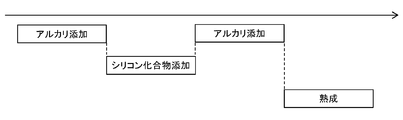
- FIG. 2 schematically illustrates the time course of an example of an embodiment in which the addition of alkali is interrupted in the middle of the neutralization step.
- FIG. 3 schematically illustrates a time course of another example of the embodiment in which the alkali addition is once interrupted.
- the addition of the silicon compound is started when the pH of the raw material solution reaches a predetermined pH in the range of 2.0 or more and 7.0 or less, but the end time of the addition is after the end of the neutralization step.
- the form of addition of the silicone compound is continuous.
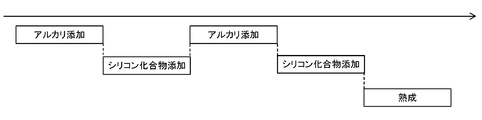
- FIGS. 4 and 5 schematically illustrate the passage of time in an example of an embodiment in which the addition of alkali is interrupted once and the silicon compound is added intermittently.
- the addition of the silicon compound is carried out in two steps in FIG. 4 and in three steps in FIG.
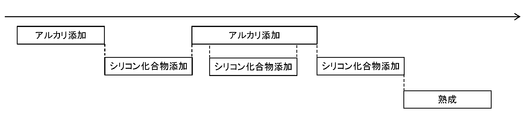
- FIG. 6 schematically illustrates the passage of time in an example of an embodiment in which the addition of alkali is interrupted twice and the addition of the silicon compound is intermittently performed three times.
- the production method of the present invention is not limited to the embodiments illustrated in FIGS. 1 to 6, and the addition of alkali in the neutralization step and the addition of the silicon compound in the silicon compound addition step. It is possible to arbitrarily combine the forms of.
- this coating layer covers almost the entire surface of the precipitate of iron oxyhydroxide containing the substituting element, but within the range where the effect of the present invention can be achieved, the surface of the precipitate of iron oxyhydroxide containing the substituting element.
- the presence of uncoated parts in is acceptable.
- the aging time is preferably 1 h or more and 24 hours or less. If the holding time is less than 1 h, the coating of the precipitation of iron oxyhydroxide containing a substitution element by condensation of the silanol derivative is not completed, and ⁇ -type iron-based oxides are easily generated. Is saturated, which is not preferable.
- the aging time is set after the addition of the silicon compound is completed when the addition of the silicon compound is continued even after the completion of the neutralization step, and when the addition of the silicon compound is completed before the completion of the neutralization step, the addition of alkali is performed. It is the time after the end of.
- the steps after the aging step can use the same steps as the conventional production methods described in Patent Documents 1 to 4, for example. .. Specifically, the following steps can be mentioned.
- Heating process In the production method of the present invention, iron oxyhydroxide containing a substituent coated with the condensation reaction product of the silanol derivative is recovered by a known solid-liquid separation method and then heat-treated to form an ⁇ type. To obtain the iron-based oxide of. A washing and drying steps may be provided before the heat treatment. The heat treatment is performed in an oxidizing atmosphere, but the oxidizing atmosphere may be an atmospheric atmosphere. Heating can be carried out in a range of approximately 700 ° C.
- the heat treatment is preferably performed at 900 ° C. or higher and 1200 ° C. or lower, more preferably 950 ° C. or higher and 1150 ° C. or lower.
- the heat treatment time can be adjusted in the range of 0.5H or more and 10H or less, but good results are likely to be obtained in the range of 2H or more and 5H or less.
- the presence of the silicon-containing substance covering the particles has an advantageous effect on causing the phase change to the ⁇ -type iron-based oxide instead of the phase change to the ⁇ -type iron-based oxide.
- the silicon oxide coating has an effect of preventing sintering of iron oxyhydroxide crystals containing a substituent during heat treatment.
- the silicon oxide coating may be removed after the heat treatment.
- composition analysis by radio frequency inductively coupled plasma emission spectroscopy (ICP)
- the composition analysis of the obtained substitution type ⁇ iron oxide magnetic particle powder was performed by a dissolution method.
- ICP-720ES manufactured by Agilent Technologies was used for composition analysis, and the measurement wavelength (nm) was Fe; 259.940 nm, Ga; 294.363 nm, Co; 230.786 nm, Ti; 336.122 nm, Si; 288. At 158 nm.
- the BET specific surface area was determined by the BET one-point method using a Macsorb model-1210 manufactured by Mountech Co., Ltd.
- the TEM observation of the substituted ⁇ -iron oxide magnetic particle powder obtained by the production method of the present invention was carried out under the following conditions. JEM-1011 manufactured by JEOL Ltd. was used for TEM observation. For particle observation, TEM photographs taken at a magnification of 10,000 times and a magnification of 100,000 times were used. (Use the one after removing the silicon oxide coating). -Measurement of average particle size and particle size distribution evaluation (coefficient of variation (%))- Digitization was used for TEM average particle size and particle size distribution evaluation (coefficient of variation (%)). As image processing software, Mac-View Ver.4.0 was used.
- the particle size of a particle is calculated as the length of the long side of the rectangle having the smallest area among the rectangles circumscribing the particle.
- the number 200 or more were measured.
- the selection criteria for the particles to be measured were as follows. [1] Some particles that are outside the visual field of the photograph are not measured. [2] Particles with a well-defined contour and existing independently are measured. [3] Even if the particle shape deviates from the average particle shape, particles that are independent and can be measured as a single particle are measured. [4] Particles that overlap each other, but the boundaries between the particles are clear, and the shape of the entire particle can be determined are measured as individual particles.
- Example 1 In a 5 L reaction tank, 2833.21 g of pure water, 283.26 g of 99% ferric nitrate nonahydrate (III), 56.36 g of Ga(III) nitrate solution having a Ga concentration of 11.55 mass%, and a purity of 97 6.25 g of% cobalt nitrate (II) hexahydrate and 6.61 g of titanium (IV) sulfate having a Ti concentration of 15.1 mass% were dissolved in an air atmosphere while mechanically stirring with a stirring blade to prepare a raw material solution. (Procedure 1). The pH of this raw material solution was about 1.
- the Roman numeral in parentheses after the reagent name indicates the valence of the metal element.
- 29.85 g of 22.30 mass% aqueous ammonia solution was added over 90 minutes while mechanically stirring the raw material solution at 20° C. with a stirring blade (procedure 2).
- 519.22 g of tetraethoxysilane (TEOS) having a purity of 95.0 mass% was concurrently used as a silicon compound having a hydrolyzing group.
- TEOS tetraethoxysilane
- the amount of Si element contained in the tetraethoxysilane added to the dispersion having a pH of 2.0 or more and 7.0 or less, and the amount of iron, gallium, cobalt, or titanium ions contained in the raw material solution The molar ratio of S1 / (F + M) is 0.34, and the total amount of Si elements contained in tetraethoxysilane dropped in the dispersion and the amount of iron, gallium, cobalt, and titanium ions contained in the raw material solution.
- the molar ratio S2 / (F + M) of is 2.84.
- step 3 The slurry obtained in step 3 is filtered, and the water of the iron oxyhydroxide precipitate containing the substitution element coated with the obtained chemical reaction product of the silicon compound is drained as much as possible and then dispersed again in pure water. Repulp washed. The washed slurry was filtered again and the resulting cake was dried in the air at 110 ° C. (step 4).
- the dried product obtained in Procedure 4 was heat-treated at 1090° C. for 4 hours in the atmosphere using a box-type firing furnace to obtain iron oxide magnetic powder coated with silicon oxide (Procedure 5).
- the chemical reaction product of the silicon compound is dehydrated and converted into an oxide when heat-treated in an air atmosphere.
- Table 1 shows the production conditions such as the preparation conditions of the raw material solution of this example. Table 1 also shows the production conditions of other examples and comparative examples.
- the heat-treated powder obtained in step 5 obtained by heat-treating the precipitate of iron oxyhydroxide containing a substituent coated with the chemical reaction product of the silicon compound was subjected to heat treatment in a 17.58 mass% NaOH aqueous solution at about 60 ° C., 24. After stirring for a time, the silicon oxide coating on the particle surface was removed (procedure 6). Then, the slurry was washed using a centrifuge until the conductivity of the slurry became 500 mS / m or less, filtered through a membrane filter, and then dried. Chemical analysis, XRD measurement and XRD measurement of the composition of the obtained iron-based oxide magnetic powder were performed. It was used for measurement of magnetic properties. Table 2 shows the measurement results.
- Table 2 also shows the physical property values of the substituted ⁇ -iron oxide magnetic particle powder obtained in the other examples and comparative examples.
- the substituted ⁇ iron oxide magnetic particle powder according to Example 1 was subjected to XRD measurement, and the ⁇ phase content was determined to be 1.3%. This value is for the substituted ⁇ -iron oxide powder obtained in Comparative Example 1 in which an intermediate aging step was provided after the pH was 8.9 after the addition of the ammonia solution, which will be described later, and then TEOS was added in the state of pH 8.9. It's better than that.
- chemical analysis of the composition and evaluation of magnetic properties were performed. The measurement results are also shown in Table 2.
- Example 2 As Example 2, the temperature at the time of adding the aqueous ammonia solution was 30° C., the adding time of the aqueous ammonia solution was 30 min, the starting pH of TEOS addition was 6.0, the addition rate of TEOS was 5.88 g/min during the addition of the aqueous ammonia solution, After the addition of the aqueous ammonia solution was completed, a substitutional type ⁇ iron oxide magnetic particle powder was obtained by the same procedure as in Example 1 except that the amount was 22.47 g/min.
- the pH at the end of the addition of the aqueous ammonia solution was 8.9, and the pH of the reaction solution at the end of the addition of TEOS and the pH of the reaction solution during the stirring for 20 hours were both 8.8. there were.
- the substituted ⁇ iron oxide magnetic particle powder according to Example 2 was subjected to XRD measurement, and the ⁇ phase content was determined to be 3.0%. This value is determined for the substituted ⁇ -iron oxide magnetic particle powder obtained in Comparative Example 3 in which a aging step was performed for 30 minutes after the pH became 8.9 after the addition of the ammonia solution, which will be described later, and then TEOS was added in the state of pH 8.9. It is better than that of.
- chemical analysis of the composition and evaluation of magnetic properties were performed. The measurement results are also shown in Table 2.
- Comparative Example 1 As Comparative Example 1, substituted ⁇ iron oxide magnetic particles were added in the same procedure as in Example 1 except that TEOS was added when the pH reached 8.9 by adding an aqueous ammonia solution, and then an aging step was provided. I got the powder. The pH at the end of the ammonia addition was 8.9, and the pH of the reaction liquid at the end of the TEOS addition and the pH of the reaction liquid during the stirring for 20 h were both 8.8.
- the substitution type ⁇ iron oxide magnetic particle powder according to Comparative Example 1 was subjected to XRD measurement, and the content of ⁇ phase was determined to be 3.6%, which was a high value as compared with Examples 1 to 6. In addition, chemical analysis of the composition and evaluation of magnetic properties were performed. The measurement results are also shown in Table 2.
- Comparative Example 3 As Comparative Example 3, a aging step was provided after adding an aqueous ammonia solution to a pH of 8.9, and then TEOS was added in a state of pH 8.9. Substitution-type ⁇ -oxidation was carried out in the same procedure as in Example 2. Iron magnetic particle powder was obtained. The pH of the reaction solution at the end of addition of TEOS and the pH of the reaction solution during the stirring for 20 hours were both 8.8. The substitution type ⁇ iron oxide magnetic particle powder according to Comparative Example 3 was subjected to XRD measurement, and the content of ⁇ phase was determined to be 5.4%, which was a high value as compared with Examples 1 to 6. In addition, chemical analysis of the composition and evaluation of magnetic properties were performed. The measurement results are also shown in Table 2.
- Example 3 As Example 3, after adding the aqueous ammonia solution to pH 4.0 (first neutralization step), the addition of the aqueous ammonia solution was stopped, the addition of TEOS was immediately started without providing an intermediate aging step, and the addition of TEOS was performed. Substituted ⁇ -iron oxide magnetic particle powder was obtained in the same procedure as in Example 1 except that the remaining aqueous ammonia solution was added (second neutralization step) after completion. The pH of the reaction solution at the end of the second neutralization step and the pH of the reaction solution during the stirring for 20 hours were both 8.8. The substitution type ⁇ iron oxide magnetic particle powder according to Example 3 was subjected to XRD measurement, and the content rate of the ⁇ phase was 0%.
- Example 4 In a 1 L reaction tank, in pure water 737.71 g, ferric sulfate (III) sulfate solution 104.81 g with Fe concentration 11.65 mass%, nitric acid Ga (III) solution 14.32 g with Ga concentration 11.55 mass%, purity 1.91 g of 97% cobalt nitrate (II) hexahydrate and 2.02 g of titanium (IV) sulfate having a Ti concentration of 15.1 mass% were dissolved in an air atmosphere while mechanically stirring with a stirring blade (procedure 1). .. The pH of this solution was about 1.
- 15.00 g of a 22.30 mass% aqueous ammonia solution was added in 1.9 min while mechanically stirring the prepared solution under the condition of 30 ° C. with a stirring blade (first neutralization step). Then, after the completion of the dropping, stirring was continued for 30 minutes to mature the produced precipitate (intermediate aging step). At that time, the pH of the slurry containing the precipitate was 2.0 (procedure 2).
- TEOS tetraethoxysilane
- Procedure 2 While stirring the slurry obtained in Procedure 2, 158.88 g of tetraethoxysilane (TEOS) having a purity of 95.0 mass% was added dropwise at 30° C. in the air over 10 minutes. After the addition of TEOS was completed, 62.77 g of a 22.30 mass% ammonia solution was added in 8.1 min (second neutralization step). The pH after the second neutralization step was 8.8. After that, stirring was continued for 20 hours, and the precipitate was coated with the chemical reaction product of the silicon compound (procedure 3). The pH of the reaction solution during the stirring for 20 hours was 8.8.
- TEOS tetraethoxysilane
- the molar ratio of S1 / (F + M) is 2.84, and the total amount of Si elements contained in tetraethoxysilane dropped in the dispersion and the amount of iron, gallium, cobalt, and titanium ions contained in the raw material solution.
- the substituted ⁇ iron oxide powder according to Example 4 was subjected to XRD measurement, and the ⁇ phase content was determined to be 0%. This value is superior to those for the substituted ⁇ -oxidized magnetic particle powder obtained in Comparative Examples 4 and 5 described later.
- chemical analysis of the composition and evaluation of magnetic properties were performed. The measurement results are also shown in Table 2.
- Example 5 As Example 5, the addition amount and the addition time of the aqueous ammonia solution used in the first neutralization step are 51.00 g and 6.5 min, the pH after the first neutralization step is 3.0, and the second neutralization step is performed. Substituted ⁇ iron oxide magnetic particle powder was obtained in the same procedure as in Example 4 except that the addition amount and addition time of the ammonia solution used were 27.24 g and 3.5 min. The pH of the reaction solution at the end of the second neutralization step and the pH of the reaction solution during the stirring for 20 hours were both 8.8. The substitution type ⁇ iron oxide magnetic particle powder according to Example 5 was subjected to XRD measurement, and the content of the ⁇ phase was determined to be 0%. This value is superior to those for the substituted ⁇ -iron oxide magnetic particles obtained in Comparative Examples 4 and 5 described later. In addition, chemical analysis of the composition and evaluation of magnetic properties were performed. The measurement results are also shown in Table 2.
- Example 6 As Example 6, the addition amount and the addition time of the aqueous ammonia solution used in the first neutralization step were 53.00 g and 6.8 min, the pH after the first neutralization step was 4.0, and the second neutralization step was performed. Substituted ⁇ iron oxide magnetic particle powder was obtained in the same procedure as in Example 4 except that the addition amount and addition time of the ammonia solution used were 24.78 g and 3.2 min. The pH of the reaction solution after the second neutralization step and the pH of the reaction solution during the stirring for 20 hours were 8.8. The substituted ⁇ iron oxide powder according to Example 5 was subjected to XRD measurement, and the ⁇ phase content was determined to be 0%. This value is superior to those for the substituted ⁇ -iron oxide magnetic particle powder obtained in Comparative Examples 4 and 5 described later. In addition, chemical analysis of the composition and evaluation of magnetic properties were performed. The measurement results are also shown in Table 1.
- Example 7 In a 1-liter reaction tank, in 746.26 g of pure water, 102.73 g of a ferric sulfate (III) solution having a Fe concentration of 11.65 mass%, purity of 98% aluminum nitrate (III) nonahydrate 10.74 g, purity of 97 % Cobalt(II) nitrate hexahydrate (1.91 g) and titanium sulfate (IV) having a Ti concentration of 15.1 mass% (2.02 g) were dissolved in an air atmosphere with mechanical stirring using a stirring blade (procedure 1). The pH of this solution was about 1.
- 51.59 g of a 22.30 mass% aqueous ammonia solution was added in 60 minutes (first neutralization step) while mechanically stirring the prepared solution under the condition of 30 ° C. with a stirring blade. After the completion of the dropping, stirring was continued for 10 minutes to ripen the produced precipitate (intermediate aging step). At that time, the pH of the slurry containing the precipitate was 3.0 (procedure 2).
- TEOS tetraethoxysilane
- 27.09 g of a 22.30 mass% ammonia solution was added in 14 minutes (second neutralization step).
- the pH after the second neutralization step was 8.8.
- stirring was continued for 20 hours, and the precipitate was coated with the chemical reaction product of the silicon compound (procedure 3).
- the pH of the reaction solution during the stirring for 20 hours was 8.8.
- the molar ratio S1/(F+M) is 2.84, and the total amount of Si element contained in the tetraethoxysilane dropped into the dispersion and the amount of iron, aluminum, cobalt, and titanium ions contained in the raw material solution.
- the molar ratio S2/(F+M) is 2.84.
- Comparative Example 4 As Comparative Example 4, a substituted ⁇ -iron oxide powder was obtained in the same procedure as in Example 6 except that the second neutralization step was not carried out.
- the pH of the reaction solution at the end of the addition of TEOS and the pH of the reaction solution during the stirring for 20 hours were 4.0.
- the substitution type ⁇ iron oxide magnetic particle powder according to Comparative Example 4 was subjected to XRD measurement, and the content rate of the ⁇ phase was determined to be 87.5%, which was a high value as compared with Examples 1 to 7.
- chemical analysis of the composition and evaluation of magnetic properties were performed. The measurement results are also shown in Table 2.
- Comparative Example 5 As Comparative Example 5, Comparative Example except that the addition amount and addition time of the aqueous ammonia solution used in the first neutralization step were 57.00 g and 7.3 min, and the pH at the end of the first neutralization step was 6.0. Substituted ⁇ iron oxide magnetic particle powder was obtained in the same procedure as in 4. The pH of the reaction solution at the end of the addition of TEOS and the pH of the reaction solution during the stirring for 20 hours were 6.0. The substitution type ⁇ iron oxide magnetic particle powder according to Comparative Example 5 was subjected to XRD measurement, and the content of ⁇ phase was determined to be 36.9%, which was a high value as compared with Examples 1 to 7. In addition, chemical analysis of the composition and evaluation of magnetic properties were performed.
- Example 8 Substitution type ⁇ iron oxide magnetic particle powder was obtained by the same procedure as in Example 5 except that the stirring time in the intermediate aging step was 10 min, and tetraethoxysilane (TEOS) was added over 5 min.
- the pH of the reaction solution at the end of the addition of TEOS was 3.0, and the pH of the reaction solution during the stirring for 20 hours was 8.6.
- the ⁇ phase content of the obtained substituted ⁇ iron oxide magnetic particle powder was 0%, and the radio wave absorption characteristics were measured by the method described above.
- the maximum absorption frequency of the green compact in the frequency range of 50 GHz to 100 GHz was 67.2 GHz
- the transmission attenuation per unit thickness was 4.6 dB / mm.
- the charged solution was mechanically stirred by a stirring blade, and 388.91 g of 22.30 mass% aqueous ammonia solution was added in 10 minutes (first neutralization step), After the completion of the dropping, stirring was continued for 30 minutes to ripen the produced precipitate (intermediate aging step). At that time, the pH of the slurry containing the precipitate was 8.6 (procedure 2).
- Example 9 Substitution type ⁇ iron oxide powder was obtained by the same procedure as in Example 7 except that 101.50 g of ferric (III) sulfate solution and 11.7 g of aluminum (III) nitrate nonahydrate were used.
- the pH of the reaction solution at the end of the addition of TEOS was 3.0, and the pH of the reaction solution during the stirring for 20 hours was 8.6.
- Chemical analysis of the composition, magnetic properties and radio wave absorption properties were evaluated. The measurement results are also shown in Table 2.
- the molar ratio S2 / (F + M) is 2.84.
- a substituted ⁇ iron oxide magnetic particle powder was obtained by the same procedure as in Example 1.
- the substitution type ⁇ iron oxide powder according to Comparative Example 7 was subjected to XRD measurement, and the content rate of the ⁇ phase was determined to be 8.7%, which was a high value as compared with Additional Example 2.
- chemical analysis, magnetic characteristics and radio wave absorption characteristics were evaluated. The measurement results are also shown in Table 2.
- Comparative Example 8 This comparative example is an experimental example corresponding to the conventional manufacturing method of the composition ratio of Example 7. Additional Comparative Example 2 except that the amount of the metal salt to be added was 102.73 g of a ferric sulfate (III) solution having an Fe concentration of 11.65 mass% and 10.74 g of a 98% pure Al (III) nitrate nine hydrate. Substituted ⁇ iron oxide magnetic particle powder was obtained by the same procedure. The pH of the reaction solution at the end of the addition of TEOS and the pH of the reaction solution during the stirring for 20 hours were both 8.6.
- III ferric sulfate
- the substitution type ⁇ iron oxide magnetic particle powder according to the comparative example was subjected to XRD measurement, and the content rate of the ⁇ phase was determined to be 8.1%, which was a high value as compared with Example 7.
- chemical analysis of the composition and evaluation of magnetic properties were performed. The measurement results are also shown in Table 2.
Landscapes
- Chemical & Material Sciences (AREA)
- Organic Chemistry (AREA)
- Engineering & Computer Science (AREA)
- Power Engineering (AREA)
- Dispersion Chemistry (AREA)
- Inorganic Chemistry (AREA)
- Microelectronics & Electronic Packaging (AREA)
- Health & Medical Sciences (AREA)
- Chemical Kinetics & Catalysis (AREA)
- Medicinal Chemistry (AREA)
- Polymers & Plastics (AREA)
- Physics & Mathematics (AREA)
- Electromagnetism (AREA)
- Compounds Of Iron (AREA)
- Hard Magnetic Materials (AREA)
Abstract
Le problème décrit par la présente invention est de fournir une poudre de particules magnétiques d'oxyde de fer epsilon de type substitution dans laquelle la teneur en oxydes de fer alpha non magnétiques est réduite et dans laquelle une partie du site ferrique de ε-Fe2O3 est substituée par un autre élément métallique, et un procédé de production de la poudre de particules magnétiques d'oxyde de fer epsilon de type substitution. La solution selon l'invention porte sur une poudre de particules magnétiques d'oxyde de fer epsilon de type substitution dans laquelle la teneur en oxydes de fer alpha est réduite qui est obtenue par neutralisation à un pH de 2,0 à 7,0 d'une solution aqueuse acide contenant des ions métalliques avec lesquels certains des sites ferriques des ions fer trivalent doivent être substitués, puis ajout d'un composé de silicium ayant un groupe hydrolysable à un liquide de dispersion contenant de l'oxyhydroxyde de fer généré qui contient l'élément métallique substitué ou à un liquide de dispersion contenant un mélange d'oxyhydroxyde de fer et d'un hydroxyde de l'élément métallique substitué, puis neutralisation du liquide de dispersion à un pH de 8,0 ou plus, puis maintien et vieillissement du résultat, revêtement de l'oxyhydroxyde de fer qui contient l'élément métallique substitué ou le mélange d'oxyhydroxyde de fer et d'un hydroxyde de l'élément métallique substitué avec un produit de réaction chimique du composé de silicium, et chauffage du résultat.
Priority Applications (3)
| Application Number | Priority Date | Filing Date | Title |
|---|---|---|---|
| CN202080018538.9A CN113508442B (zh) | 2019-03-05 | 2020-02-28 | 置换型ε氧化铁磁性粒子粉、置换型ε氧化铁磁性粒子粉的制造方法、压粉体、压粉体的制造方法和电波吸收体 |
| US17/433,672 US20220089456A1 (en) | 2019-03-05 | 2020-02-28 | Substitution-type epsilon-iron oxide magnetic particle powder, method for producing substitution-type epsilon-iron oxide magnetic particle powder, green compact, method for producing green compact, and electromagnetic wave |
| EP20766384.0A EP3937194A4 (fr) | 2019-03-05 | 2020-02-28 | Poudre de particules magnétique d'oxyde de fer epsilon de type substitution, méthode de production de poudre de particules magnétique d'oxyde de fer epsilon de type substitution, compact vert, méthode de production de compact vert et absorbeur d'ondes électromagnétiques |
Applications Claiming Priority (4)
| Application Number | Priority Date | Filing Date | Title |
|---|---|---|---|
| JP2019040063 | 2019-03-05 | ||
| JP2019-040063 | 2019-03-05 | ||
| JP2019-180329 | 2019-09-30 | ||
| JP2019180329A JP7509524B2 (ja) | 2019-03-05 | 2019-09-30 | 置換型ε酸化鉄磁性粒子粉、置換型ε酸化鉄磁性粒子粉の製造方法、圧粉体、圧粉体の製造方法および電波吸収体 |
Publications (1)
| Publication Number | Publication Date |
|---|---|
| WO2020179659A1 true WO2020179659A1 (fr) | 2020-09-10 |
Family
ID=72338605
Family Applications (1)
| Application Number | Title | Priority Date | Filing Date |
|---|---|---|---|
| PCT/JP2020/008278 Ceased WO2020179659A1 (fr) | 2019-03-05 | 2020-02-28 | Poudre de particules magnétique d'oxyde de fer epsilon de type substitution, méthode de production de poudre de particules magnétique d'oxyde de fer epsilon de type substitution, compact vert, méthode de production de compact vert et absorbeur d'ondes électromagnétiques |
Country Status (3)
| Country | Link |
|---|---|
| US (1) | US20220089456A1 (fr) |
| EP (1) | EP3937194A4 (fr) |
| WO (1) | WO2020179659A1 (fr) |
Citations (3)
| Publication number | Priority date | Publication date | Assignee | Title |
|---|---|---|---|---|
| JP2016130208A (ja) * | 2015-01-09 | 2016-07-21 | Dowaエレクトロニクス株式会社 | 鉄系酸化物磁性粒子粉およびその製造方法並びに塗料および磁気記録媒体 |
| JP2018092691A (ja) * | 2016-11-30 | 2018-06-14 | 富士フイルム株式会社 | ε−酸化鉄型強磁性粉末およびその製造方法ならびにε−酸化鉄型強磁性粉末含有組成物 |
| JP2019003970A (ja) * | 2017-06-09 | 2019-01-10 | 富士フイルム株式会社 | 磁性粉、磁性粉の製造方法、及び磁気記録媒体 |
Family Cites Families (5)
| Publication number | Priority date | Publication date | Assignee | Title |
|---|---|---|---|---|
| JP4859791B2 (ja) * | 2006-09-01 | 2012-01-25 | 国立大学法人 東京大学 | 電波吸収材料用の磁性結晶および電波吸収体 |
| JP5445843B2 (ja) * | 2007-05-31 | 2014-03-19 | 国立大学法人 東京大学 | 磁性酸化鉄粒子、磁性体、および電波吸収体 |
| JP5071902B2 (ja) * | 2008-02-20 | 2012-11-14 | 国立大学法人 東京大学 | 電波吸収材料および当該電波吸収材料を用いた電波吸収体 |
| WO2017018407A1 (fr) * | 2015-07-27 | 2017-02-02 | Dowaエレクトロニクス株式会社 | Procédé de production de poudre de particules magnétiques d'oxyde à base de fer |
| WO2018062478A1 (fr) * | 2016-09-30 | 2018-04-05 | Dowaエレクトロニクス株式会社 | Particule magnétique d'oxyde de fer de type epsilon, son procédé de fabrication, poudre magnétique formée à partir de particules magnétiques, peinture magnétique et support d'enregistrement magnétique |
-
2020
- 2020-02-28 EP EP20766384.0A patent/EP3937194A4/fr active Pending
- 2020-02-28 WO PCT/JP2020/008278 patent/WO2020179659A1/fr not_active Ceased
- 2020-02-28 US US17/433,672 patent/US20220089456A1/en not_active Abandoned
Patent Citations (3)
| Publication number | Priority date | Publication date | Assignee | Title |
|---|---|---|---|---|
| JP2016130208A (ja) * | 2015-01-09 | 2016-07-21 | Dowaエレクトロニクス株式会社 | 鉄系酸化物磁性粒子粉およびその製造方法並びに塗料および磁気記録媒体 |
| JP2018092691A (ja) * | 2016-11-30 | 2018-06-14 | 富士フイルム株式会社 | ε−酸化鉄型強磁性粉末およびその製造方法ならびにε−酸化鉄型強磁性粉末含有組成物 |
| JP2019003970A (ja) * | 2017-06-09 | 2019-01-10 | 富士フイルム株式会社 | 磁性粉、磁性粉の製造方法、及び磁気記録媒体 |
Non-Patent Citations (2)
| Title |
|---|
| See also references of EP3937194A4 * |
| TOWATA, ATSUYA: "Influence of ε-Fe2O3 Synthesis Conditions on Particle Properties in Silica Xerogels", JOURNAL OF THE SOCIETY OF POWDER TECHNOLOGY, vol. 54, no. 9, 10 September 2017 (2017-09-10), Kyoto, pages 569 - 575, XP009529771, ISSN: 0386-6157, DOI: 10.4164/sptj.54.569 * |
Also Published As
| Publication number | Publication date |
|---|---|
| EP3937194A4 (fr) | 2022-12-14 |
| US20220089456A1 (en) | 2022-03-24 |
| EP3937194A1 (fr) | 2022-01-12 |
Similar Documents
| Publication | Publication Date | Title |
|---|---|---|
| US10622127B2 (en) | Iron-based oxide magnetic particle powder, method for producing same, coating material, and magnetic recording medium | |
| JP6676493B2 (ja) | 鉄系酸化物磁性粒子粉の製造方法 | |
| JP5966064B1 (ja) | 鉄系酸化物磁性粒子粉および鉄系酸化物磁性粒子粉の製造方法 | |
| JP6480715B2 (ja) | 鉄系酸化物磁性粒子粉の前駆体およびそれを用いた鉄系酸化物磁性粒子粉の製造方法 | |
| WO2016047559A1 (fr) | Poudre de particules magnétiques d'oxyde à base de fer et son procédé de fabrication | |
| WO2016111224A1 (fr) | Poudre de particules magnétiques d'oxyde à base de fer, procédé pour sa production, revêtement et support d'enregistrement magnétique | |
| TWI732445B (zh) | 鐵系氧化物磁性粉及其製造方法 | |
| JP7509524B2 (ja) | 置換型ε酸化鉄磁性粒子粉、置換型ε酸化鉄磁性粒子粉の製造方法、圧粉体、圧粉体の製造方法および電波吸収体 | |
| JP2020167365A (ja) | 置換型ε酸化鉄磁性粒子粉、置換型ε酸化鉄磁性粒子粉の製造方法、圧粉体、圧粉体の製造方法および電波吸収体 | |
| TWI761154B (zh) | 鐵系氧化物磁性粉,以及使用該磁性粉而得的壓粉體及電波吸收體 | |
| WO2020179659A1 (fr) | Poudre de particules magnétique d'oxyde de fer epsilon de type substitution, méthode de production de poudre de particules magnétique d'oxyde de fer epsilon de type substitution, compact vert, méthode de production de compact vert et absorbeur d'ondes électromagnétiques | |
| US20220162089A1 (en) | Substituted epsilon-iron oxide magnetic particle powder, production method for substituted epsilon-iron oxide magnetic particle powder, green compact, production method for green compact, and electromagnetic wave absorber | |
| JP7497258B2 (ja) | 置換型ε酸化鉄磁性粒子粉および置換型ε酸化鉄磁性粒子粉の製造方法 | |
| WO2021200481A1 (fr) | Poudre magnétique d'oxyde à base de fer et son procédé de fabrication | |
| JP7659408B2 (ja) | 鉄系酸化物磁性粉の製造方法 | |
| JP2021150448A (ja) | 鉄系酸化物磁性粉の製造方法 |
Legal Events
| Date | Code | Title | Description |
|---|---|---|---|
| 121 | Ep: the epo has been informed by wipo that ep was designated in this application |
Ref document number: 20766384 Country of ref document: EP Kind code of ref document: A1 |
|
| NENP | Non-entry into the national phase |
Ref country code: DE |
|
| ENP | Entry into the national phase |
Ref document number: 2020766384 Country of ref document: EP Effective date: 20211005 |