WO2020182918A1 - Primer und kit aus primer und dentalmaterial - Google Patents
Primer und kit aus primer und dentalmaterial Download PDFInfo
- Publication number
- WO2020182918A1 WO2020182918A1 PCT/EP2020/056567 EP2020056567W WO2020182918A1 WO 2020182918 A1 WO2020182918 A1 WO 2020182918A1 EP 2020056567 W EP2020056567 W EP 2020056567W WO 2020182918 A1 WO2020182918 A1 WO 2020182918A1
- Authority
- WO
- WIPO (PCT)
- Prior art keywords
- meth
- acrylate
- group
- monomers
- organic
- Prior art date
- Legal status (The legal status is an assumption and is not a legal conclusion. Google has not performed a legal analysis and makes no representation as to the accuracy of the status listed.)
- Ceased
Links
- 0 CC(C(OCC(C(C(C1OC(C(C)=C)=*(C)C1)OC(C(C)=C)=O)OC(C(C)=C)=O)OC(C(C)=C)=O)=O)=C Chemical compound CC(C(OCC(C(C(C1OC(C(C)=C)=*(C)C1)OC(C(C)=C)=O)OC(C(C)=C)=O)OC(C(C)=C)=O)=O)=C 0.000 description 1
- QRNJAQUNBRODGN-UHFFFAOYSA-N CC(C(OCC(COC(C(C)=C)=O)OC(c(cc(C(O)=O)c(C(OC(COC(C(C)=C)=O)COC(C(C)=C)=O)=O)c1)c1C(O)=O)=O)=O)=C Chemical compound CC(C(OCC(COC(C(C)=C)=O)OC(c(cc(C(O)=O)c(C(OC(COC(C(C)=C)=O)COC(C(C)=C)=O)=O)c1)c1C(O)=O)=O)=O)=C QRNJAQUNBRODGN-UHFFFAOYSA-N 0.000 description 1
Classifications
-
- A—HUMAN NECESSITIES
- A61—MEDICAL OR VETERINARY SCIENCE; HYGIENE
- A61K—PREPARATIONS FOR MEDICAL, DENTAL OR TOILETRY PURPOSES
- A61K6/00—Preparations for dentistry
- A61K6/60—Preparations for dentistry comprising organic or organo-metallic additives
- A61K6/61—Cationic, anionic or redox initiators
-
- A—HUMAN NECESSITIES
- A61—MEDICAL OR VETERINARY SCIENCE; HYGIENE
- A61K—PREPARATIONS FOR MEDICAL, DENTAL OR TOILETRY PURPOSES
- A61K6/00—Preparations for dentistry
- A61K6/60—Preparations for dentistry comprising organic or organo-metallic additives
- A61K6/62—Photochemical radical initiators
-
- A—HUMAN NECESSITIES
- A61—MEDICAL OR VETERINARY SCIENCE; HYGIENE
- A61K—PREPARATIONS FOR MEDICAL, DENTAL OR TOILETRY PURPOSES
- A61K6/00—Preparations for dentistry
- A61K6/60—Preparations for dentistry comprising organic or organo-metallic additives
- A61K6/64—Thermal radical initiators
-
- A—HUMAN NECESSITIES
- A61—MEDICAL OR VETERINARY SCIENCE; HYGIENE
- A61K—PREPARATIONS FOR MEDICAL, DENTAL OR TOILETRY PURPOSES
- A61K6/00—Preparations for dentistry
- A61K6/70—Preparations for dentistry comprising inorganic additives
- A61K6/79—Initiators
Definitions
- Primer and kit consisting of primer and dental material
- the present invention relates to a primer for binding dental restoratives to dentine and / or tooth enamel, which contains a polymerizable (meth) acrylate or (meth) acrylamide monomer (i) at least one acidic group such as a phosphoric acid group and with (ii) at least a hydrophilic group such as a terminal hydroxy group or two polymerizable (meth) acrylate or (meth) acrylamide monomers of which one (i) has at least one acidic group and one (ii) has at least one hydrophilic group, one of which is polymerizable (meth) acrylate - or (meth) acrylamide monomers (i) and / or (ii) or another polymerizable (meth) acrylate or (meth) acrylamide monomer (iii) a 3,4,5,6,7,8, 9, 10-polyfunctionality, in particular in the form of preferably terminal, (meth) acrylate, (meth) acrylamide and / or
- polymerizable dental materials are often used. It is crucial for the quality of the result of the restored tooth that the aesthetic and functional requirements are met. From an aesthetic point of view, these dental materials must therefore not be visually distinguishable from natural tooth substance. In addition, however, they must also be sufficiently hard and the construction materials used must be attached to the natural tooth parts in such a way that the applied dental materials withstand the high forces they are exposed to when chewing.
- the polymerizable dental materials used to build up missing tooth substance are usually referred to as core build-up materials. Preferably used in this hydrophobic methacrylate monomers.
- stump building materials are present in paste form so that the dentist can build and model them in the patient's mouth.
- Such a model is usually applied in several layers and, after application, hardened, i.e. polymerized, layer by layer.
- this procedure is very time-consuming due to the multiple curing steps.
- polymerizable dental materials are also used in what are known as polymerizable composite cements. These cements are used to fix dental crowns and other dental prosthesis materials.
- polymerizable dental materials are also used as so-called bulk-fill composites.
- tooth cavities i.e. the spaces created by fleas after the removal of caries, are filled with the material.
- one of the many requirements placed on the polymerizable dental material is that a firm connection between the applied material and the natural tooth substance must be established, which ensures years of stability under the considerable mechanical requirements.
- a fluffing can be achieved by using adhesives (dental bonding agents), the adhesives on the tooth substance leading to better wetting and thus also to better flapping of the applied material.
- adhesives dental bonding agents
- three different mechanisms of action are required for this.
- such adhesives therefore had three components, which initiated different mechanisms of action one after the other in three steps.
- the natural tooth substance is etched by means of the first component, whereby the surface of the natural tooth substance, in particular also the tooth enamel, is roughened.
- the etching removes minerals from the collagen composite of the natural tooth substance, so that the collagen fibers essentially remain on the tooth surface.
- 35% by weight of phosphoric acid was usually used, which is applied to the natural tooth substance. The acid must then be removed by rinsing with water and then drying with air.
- the adhesion between the applied dental material and the natural tooth substance must be ensured.
- the etched tooth surface is coated with a so-called primer.
- This usually contains hydrophilic monomers, which can penetrate the exposed collagen-fiber composite.
- the primer has to be cured.
- a third step it must then be ensured that there is sufficient adhesion between the primer and the polymerizable dental material. This is problematic because, as described, the primer has hydrophilic monomers, but the dental material has hydrophobic monomers. Therefore, a further coating, a so-called bonding, must first be applied in order to achieve sufficient adhesion between the polymerizable dental material and the natural tooth substance.
- a particular disadvantage of the method described is the long treatment time due to the three separate steps.
- the different substances must be stored in different packaging and the risk of contamination and mix-up is increased.
- Products have already been developed in the past which combine one or more of the above-mentioned steps in one substance or a substance mixture, so that at least one step is omitted.
- the etching is carried out first and then a product is applied which comprises both hydrophilic and hydrophobic monomers and therefore combines the function of primer and bonding in itself.
- the etching can be combined with the primer, which is usually done in such a way that the hydrophilic monomers of the primer have phosphoric acid groups which etch the natural tooth substance. The substance required for bonding is then applied separately.
- the curing of the polymerizable dental materials is a complex process in itself:
- the polymerizable dental materials to be applied must be able to cure at moderate temperatures, since they are used in the patient's mouth.
- redox initiators are therefore used, which accelerate the curing process at temperatures of around 37 ° C.
- a redox initiator system is used which comprises a per-compound together with a co-initiator.
- the per compound is presented as a so-called catalyst paste in a first paste and the co-initiator in the so-called base paste in a second paste.
- the dental compound and co-initiator are brought together by mixing the pastes, so that a redox reaction takes place, which supplies the radicals required for polymerizing the organic monomers contained in the dental material.
- the pastes are stored separately from one another in order to ensure high storage stability.
- dental materials with an initiator system made of inorganic peroxides for example sodium or potassium peroxide sulfate in combination with an alkali or alkaline earth metal toluenesulfinate or an alkali or alkaline earth metal sulfite can be found in WO 2014/033280 A1.
- light-curing dental materials can also be used which have a photoinitiator.
- the disadvantage here is that the treating dentist has to apply these materials in thin layers, since the irradiated light cannot penetrate into deeper layers of the dental material. In the individual layers are modeled and cured with light in the meantime, the treatment time is significantly extended.
- EP 2 409 997 A1 describes a composition which penetrates the tooth substance and uses the moisture contained in the tooth substance to accelerate it To achieve curing of the dental material.
- the composition described comprises a monomer mixture, an inorganic peroxide, a reducing agent and other polymerization accelerators.
- the polymerization accelerator is dissolved by the moisture on the surface of the tooth substance, whereby the polymerization hardening at the adhesive interface and within the hardenable composition is improved.
- Be accelerator examples include sulfites but also ammonium salts such as the tetramethylammonium salt and the tetraethylammonium salt of benzenesulfonic acid.
- the polymerization accelerator is usually present in the base paste.
- EP 1 780 223 B1 describes an adhesive for the dental sector, a polymerization accelerator, namely a water-soluble sulfite, being added as an additional co-initiator.
- the sulfite is dispersed in the polymerizable monomer and dissolved at the interface with the natural tooth substance by moisture in the tooth. Due to the additional reducing effect of the sulfite, there is accelerated hardening of the polymerizable dental material at the interface between adhesive and polymerizable dental material.
- EP 2 554 154 A1 describes an adhesive and a curable composition in the form of a core build-up material with a high level of adhesion and durability.
- the adhesive includes a monomer mixture, water and a amine-based, sulfur-free reducing agent.
- the core build-up material also comprises a monomer mixture, a water-soluble, sulfur-containing reducing agent, an organic peroxide and an amine-based, sulfur-free reducing agent.
- DE 10 2015 103 427 describes a composition that is intended to ensure that there is sufficient curing both within the polymerizable dental material and at the interface with adhesives, in particular all-in-one adhesives.
- the object of the present invention to provide a primer to which the polymerizable dental material can be applied directly.
- the task is to provide a kit made of primer and polymerizable dental material, which is exactly matched to one another and thus ensures simplified processing with very good adhesion conditions at the same time.
- Such an aqueous primer composition is self-etching and self-priming. It has a polymerizable (meth) acrylate or (meth) acrylamide monomer with (i) at least one acidic group such as a phosphoric acid group and with (ii) at least one hydrophilic group such as a terminal hydroxyl group or two polymerizable (meth) acrylate or (meth) acrylamide monomers of which one (i) at least one acidic group and one (ii) at least one hydrophilic group on.
- a polymerizable (meth) acrylate or (meth) acrylamide monomer with (i) at least one acidic group such as a phosphoric acid group and with (ii) at least one hydrophilic group such as a terminal hydroxyl group or two polymerizable (meth) acrylate or (meth) acrylamide monomers of which one (i) at least one acidic group and one (ii) at least one hydrophilic group on.
- At least one of the polymerizable (meth) acrylate or methylacrylamide monomers (i) has a polyfunctionality, preferably at least three times the polyfunctionality, particularly preferably a 3-, 4-, 5-, 6-, 7-, 8-, 9- or 10-fold polyfunctionality and / or (ii) it is a further polymerisable (meth) acrylate or methyl acrylamide monomer (iii) with a polyfunctionality.
- This polyfunctionality is preferably an at least three-fold polyfunctionality, particularly preferably a 3-, 4-, 5-, 6-, 7-, 8-, 9- or 10-fold polyfunctionality. This polyfunctionality lies in the ability to polymerize.
- This primer composition is also characterized by the absence of the following substances: photoinitiators, vanadium compounds as polymerization catalysts, in particular in the form of organometallic vanadium compounds, e.g. vanadyl (V) derivatives, aromatic amines, and sulfinates and sulfonates, especially aromatic sulfonates such as sodium 4-toluenesulfonate.
- the primer composition according to the invention is characterized by the absence of an organic solvent.
- polyfunctionality in the context of the invention relates to the ability to polymerize and thus to crosslink density.
- a 3-polyfunctional monomer has three polymerizable groups.
- This composite composition has the ability to act as a reducing agent (sodium sulfite), which can start a polymerization reaction by diffusing into the claimed primer composition after it has been applied.
- the polymerization is therefore no longer started by a catalyst and / or an initiator which is contained in the composition itself, but rather is rather based on mass transport, in particular based on diffusion. It is consequently possible for the dentist, even without the risk of premature hardening, to prepare the tooth for the application of the dental material, then to apply the dental material and to achieve hardening of the entire system in a single step.
- a polymerization catalyst copper and / or iron compound
- an organic, water-soluble oxidizing agent e.g. sodium persulfate
- Iron is preferably in the +11 or +111 oxidation state and copper in the +1 or +11 oxidation state.
- the iron compounds can be inorganic iron compounds such as in particular iron halides, iron sulfates, iron nitrates, iron perchlorates, iron phosphates, iron pyrophosphates, iron tetrafluoroborates and / or iron thiocyanates.
- Organometallic iron compounds such as in particular iron acetylacetonates, iron carboxylates such as e.g.
- Iron-2-ethylhexanoate, iron acetate, iron oxalate, iron ethylenediamine tetraacetate, iron citrate, iron phthalcyanine, iron gluconate, iron ascorbate, iron lactate, iron fumarate, egg sentartrate, iron methacrylate and / or iron alkoxide are possible.
- inorganic copper compounds such as in particular copper halides, copper sulfates, copper nitrates, copper perchlorates, copper phosphates, copper pyrophosphates, copper tetrafluoroborates and / or copper thiocyanates can be used.
- organometallic copper compounds such as, in particular, copper acetylacetonates, copper carboxylates such as Copper-2-ethylhexanoates, copper acetates, copper oxalates, copper ethylenediamine tetraacetates, copper citrates, copper phthalcyanines, copper gluconates, copper ascorbates, copper lactates, copper fumarates, copper tartrates, copper methacrylates and / or copper alkoxides.
- copper acetylacetonates such as Copper-2-ethylhexanoates, copper acetates, copper oxalates, copper ethylenediamine tetraacetates, copper citrates, copper phthalcyanines, copper gluconates, copper ascorbates, copper lactates, copper fumarates, copper tartrates, copper methacrylates and / or copper alkoxides.
- adhesion values even after thermocycling are still above a value of> 10 MPa with a variance of 4 MPa.
- Such a system particularly preferably has an adhesion value of> 12 MPa with a variance of 4 MPa.
- a system in which the adhesion value does not deviate by more than a variance of 4 MPa is very preferred.
- (meth) acrylamide group and the term (meth) acrylate group are to be understood in the sense of the invention in such a way that both methacrylamide groups and acrylamide groups or methacrylate groups and acrylate groups are to be understood.
- PENTA Dipentaerythritol penta (meth) acrylate phosphate
- the acidic group is also to be understood as a hydrophilic group.
- Examples of monomers that also have an additional hydrophilic group are 1 -mono (methacrylate) -1-phosphoric acid-1-hydroxytrimethylolethane or propane or sorbitol tri (meth) acrylate monophosphoric acid monohydroxide.
- 2-methylprop-2-enoate It is also possible for two monomers to be present, the monomer which has the polyfunctionality also having an acidic or a hydrophilic group, whereas the second monomer then has at least one functionality in each case acidic or a hydrophilic group.
- connection between the framework, the so-called spacer, and functional groups is typically made via a connecting group, the so-called linking element.
- This can in particular be a carboxylic acid ester, urethane and / or amide group.
- a polyfunctional monomer with, for example, a tri-functionality and an additional hydrophilic group therefore has the following structure:
- Functional groups in the sense of polyfunctionality are in particular to be understood as meaning styrene, methacrylic, acrylic, allyl, methacrylamide and / or acrylamide groups in any combination. These groups are radically polymerizable.
- Acid groups in the context of the invention are in particular to be understood as meaning carbonate, sulfate, sulfonate, sulfinate, phosphate, phosphonate, phosphinate groups or that a monomer is selected as containing at least one monomer from a group
- MDP (10-methacryloyloxydecyl dihydrogen phosphate), or MAC (carboxylic acid-substituted MDP),
- PENTA dipentaerythritol penta (meth) acrylate phosphate
- A-MDP 10-methacrylamidodecyl dihydrogen phosphate
- PMGDM pyromellitic acid-bis-glycerol dimethacrylate
- a hydrophilic group in the context of the invention is to be understood as meaning at least one hydroxyl, one amino, one amine, one thiol, one hydrochloride or one polyether group.
- the hydrophilic groups it has been found to be particularly favorable if the hydrophilic group is an n-position hydroxyl or an n-position amine or a chain polyether group, since this increases their functionality.
- the claimed primer composition is preferably a one-component composition in order to keep handling as simple as possible for the dentist.
- the pH of the monomer mixture is ⁇ 3.5, preferably ⁇ 2.5 and particularly preferably between 1.5 and 2.5. In any case, the lower limit is favorably but not necessarily> 1.5.
- the proportion of a polyfunctional monomer is between 0.1 and 10% by weight, preferably between 1 and 5% by weight, which ensures particularly good polymerization.
- a composition according to the invention has a proportion of 15 to 35 wt.%, Preferably 20 to 30 wt.% MDP (GDMAP, 4-META, A-MDP, PMGDM), a proportion of 0.05 up to 5% by weight, preferably 0.05 to 2% by weight BHT, a proportion of 0.05 to 0.5% by weight, preferably 0.1 to 5% by weight 2- (dimethylaminoethyl methacrylate ( DMAEMA), hydroquinone monomethylether (MEHQ), catechol derivatives and / or HALS (sterically hindered amines))) and a proportion of 25 to 35% by weight, preferably 27 to 33% by weight of water (preferably deionized).
- MDP GDMAP, 4-META, A-MDP, PMGDM
- BHT a proportion of 0.05 up to 5% by weight
- a proportion of 0.05 to 10% by weight, preferably 1 to 5% by weight of the polyfunctional monomer is added, which is particularly advantageously trimethylpropane trimethacrylate (glycerol propoxytriacrylate), pentaerythritol trimethacrylate, sorbitol pentamethacrylate GENOMER * ® 4691, N, N diallyl methacrylamide, N, N-iso-valerylidene bis-methacrylamide.
- the proportion of HEMA (N-2-hydroxyethyl methacrylamide), N- (2-hydroxypropyl) methacrylamide corresponds to the difference to 100% by weight. It is particularly important in this context that the polyfunctional monomer used is soluble in the mixture contained.
- it is soluble in a mixture of water with the monomer having an acidic group and / or the monomer having the hydrophilic group. It is very particularly preferably soluble in a mixture of water, MDP or one of its derivatives and HEMA or one of its derivatives, very particularly preferably in the proportions given above.
- the per-oxygen compound is preferably a peroxide, a peroxide ester, a diacyl peroxide, a dialkyl peroxide, a peroxyketal, a peroxyketone, a hydroperoxide or hydrogen peroxide.
- the organic per-oxygen compound is a diacyl peroxide, in particular a benzoyl peroxide, preferably dibenzoyl peroxide.
- suitable peroxides include m-toluoyl peroxide, 2,5-dimethyl-2,5-bis (benzoyl peroxide) hexane, tert-butyl peroxy-2-ethylhexanoate and tert-butyl peroxyisopropyl carbonate.
- suitable peroxide esters include tert-butyl peroxybenzoate and bis-tert-butyl peroxy isophthalate.
- dialkyl peroxides examples include dicumyl peroxide, di-tert-butyl peroxide and lauroyl peroxide.
- suitable peroxyketals include 1,1-bis (tert-butylperoxy) -3,3,5-trimethylcyclohexane, 1,1-bis (tert-butylperoxy) cyclohexane and 1,1-bis (tert-hexylperoxy) cyclohexane.
- suitable peroxy ketones include methyl ethyl ketone peroxide, cyclohexanone peroxide and methyl acetoacetate peroxide.
- suitable hydroperoxides include tert-butyl hydroperoxide, cumene hydroperoxide and p-diisopropylbenzene peroxide.
- the primer according to the invention preferably contains one or more additives, preferably buffer salts, metal scavengers, surfactants, active ingredients, flavorings and / or odorants, fluoridizing agents, bleaching substances, desensitizers, bonding agents, dyes, color pigments, indicators, others Initiators or initiator components, stabilizers, polymerization inhibitors, thixotropic auxiliaries and antibacterial substances or combinations of two or more thereof.
- additives preferably buffer salts, metal scavengers, surfactants, active ingredients, flavorings and / or odorants, fluoridizing agents, bleaching substances, desensitizers, bonding agents, dyes, color pigments, indicators, others Initiators or initiator components, stabilizers, polymerization inhibitors, thixotropic auxiliaries and antibacterial substances or combinations of two or more thereof.
- the invention is also based on the object of also providing a kit in which a primer according to the invention is used together with a pasty two-component composite and thereby optimal adhesion results can be achieved.
- such a kit has a polymerizable dental material.
- the polymerizable dental material contains at least one catalyst paste (A) and at least one base paste (B).
- the catalyst paste comprises at least one organic peroxygen compound and at least one filler.
- the base paste contains at least one radically polymerizable organic (meth) acrylic monomer, at least one filler, a co-initiator of the free radical polymerization and at least one salt-like, water-soluble and powdery reducing agent (hereinafter also: reducing agent) dispersed in the base paste (B) .
- At least one phase transfer catalyst is provided in the at least one catalyst paste and / or the at least one base paste, which is an ammonium, a phosphonium and / or a sulfonium salt which contains an inorganic or organic anion, preferably with the exception of anions Sulfinic acids or sulfonic acids.
- phase transfer catalyst improves the adhesion to the tooth substance. This can be explained by the fact that the salt-like, water-soluble and powdery reducing agent is dissolved at the interface with the primer and can then diffuse through the phase transfer catalyst at the interface between the composite and the primer in order to accelerate the polymerization through reaction with the Achieve per-oxygen connection. Due to the division of the polymerizable dental material into at least one catalyst paste and at least one base paste, high storage stability is achieved. By mixing these individual components, the polymerizable dental material is produced, which quickly hardens under oral conditions (appropriate temperature and humidity).
- the proportion of the phase transfer catalyst in the catalyst paste and / or the base paste, based on the total mass of the catalyst paste and / or the base paste, is preferably 0.01 to 5% by weight, preferably 0.01 to 2% by weight, particularly preferred 0.05 to 1% by weight and very particularly preferably 0.05 to 0.5% by weight.
- the mentioned weight fraction of the phase transfer catalyst in the catalyst paste and / or the base paste based on the total mass of the catalyst paste and / or the base paste must be chosen so low that the curing of the polymerizable dental material does not proceed so quickly that processing of the dental material is difficult or even prevented. At the same time, the weight percentage mentioned must be selected to be so high that the polymerization of the dental material is accelerated as intended within the dental material mass.
- the phase transfer catalyst is contained in the catalyst paste. This has been found to be particularly favorable in terms of storage stability, since potential activation of the reducing agent present in the base paste with the phase transfer catalyst and subsequent reaction of the reducing agent with air oxygen can be prevented as described above.
- Drying agents can be added for further stabilization.
- Examples include: silica gel, zeolites, aluminum oxide, calcium oxide, calcium sulfate, potassium carbonate, potassium hydroxide, copper sulfate and / or sodium hydroxide.
- bases include: sodium hydroxide, calcium hydroxide, calcium oxide.
- a reducing agent is understood to be a substance which, in combination with the peroxygen compound, forms a redox system which is suitable for initiating a free-radical polymerization of the polymerizable (meth) acrylic monomer. Furthermore, the reducing agent reduces a reaction of a free-radical, growing polymer chain with the diradical oxygen, which can lead to the termination of the polymerization reaction in that the reducing agent reacts with the oxygen after it has dissolved.
- a substance which has a solubility of at least 10 g / L, preferably at least 15 g / L, particularly preferably at least 30 g / L, and very particularly preferably at least 50 g / L in having distilled water at a temperature of 25 ° C.
- the reducing agent is preferably selected from the group of sulfites, in particular from the group of alkali metal sulfites, alkaline earth metal sulfites, (NH 4 ) 2 SO 3, hydrogen sulfites, disulfites, thiosulfites, thionates and dithionites.
- Sodium sulfite is particularly preferably used as the reducing agent.
- the reducing agents mentioned have been found to be particularly suitable for the present invention, since they have low solubility in the organic monomer and are dispersed in the base paste, but can be introduced into the organic monomer particularly well by the phase transfer catalyst used according to the invention.
- the weight proportion of the reducing agent, based on the total mass of the at least one base paste, is preferably less than 10% by weight, particularly preferably less than 5% by weight, particularly preferably less than 3% by weight and very particularly preferably (2nd ⁇ 1) wt%.
- a co-initiator is provided in the at least one base paste, which is suitable for initiating a polymerization reaction of the organic (meth) acrylic monomer with the per-oxygen compound, regardless of the reducing agent.
- the co-initiator is preferably selected from the group of primary, secondary and / or tertiary amines, in particular secondary amines and / or tertiary amines.
- suitable secondary amines and / or suitable tertiary amines include o-tolyldiethanolamine, m-tolyldiethanolamine, p-tolyldiethanolamine, N-methylaniline, N, 2-dimethylaniline, N, 3-dimethylaniline, N, 4-dimethylaniline, Ethyl 2-methylaminobenzoate, ethyl 3-methylaminobenzoate, ethyl 4-methylaminobenzoate, ethyl 2-dimethylaminobenzoate, ethyl 3-dimethylaminobenzoate, ethyl 4-dimethylaminobenzoate, methyl 2-anisidine, methyl 3-anisidine, methyl-4-anisidine, N, N, -
- the weight fraction of the co-initiator used, based on the total mass of the at least one base paste, is preferably less than 5% by weight, particularly preferably less than 2% by weight, particularly preferably less than 1.5% by weight , but in any case also more than (0.1 ⁇ 0.05) wt .-%, given before (0.8 ⁇ 0.05) wt .-%.
- the per-oxygen compound is preferably a peroxide, a peroxide ester, a diacyl peroxide, a dialkyl peroxide, a peroxyketal, a peroxyketone or a hydroperoxide. It is crucial for the per-oxygen compound used that the per-oxygen compound, in combination with the reducing agent and the co-initiator, forms a redox system which is suitable for initiating a radical polymerization of the organic (meth) acrylic monomer.
- the redox potentials of the per-oxygen compound and the reducing agent or the co-initiator must be coordinated with one another in such a way that that there is a redox reaction between the two and that radicals are formed which start polymerization of the (meth) acrylic monomer.
- the organic per-oxygen compound is a diacyl peroxide, in particular a benzoyl peroxide, preferably dibenzoyl peroxide.
- suitable peroxides include m-toluoyl peroxide, 2,5-dimethyl-2,5-bis (benzoyl peroxide) hexane, tert-butyl peroxy-2-ethylhexanoate and tert-butyl peroxyisopropyl carbonate.
- suitable peroxide esters include tert-butyl peroxybenzoate and bis-tert-butyl peroxy isophthalate.
- suitable dialkyl peroxides include dicumyl peroxide, di-tert-butyl peroxide and lauroyl peroxide.
- suitable peroxyketals include 1,1-bis (tert-butylperoxy) 3,3,5-trimethylcyclohexane, 1,1-bis (tert-butylperoxy) cyclohexane and 1,1-bis (tert-hexylperoxy) cyclohexane.
- suitable peroxy ketones include methyl ethyl ketone peroxide, cyclohexanone peroxide and methyl acetoacetate peroxide.
- suitable hydroperoxides include tert-butyl hydroperoxide, cumene hydroperoxide, and p-diisopropylbenzene peroxide.
- the weight fraction of the per-oxygen compound, based on the total mass of the at least one catalyst paste, is preferably less than 5% by weight, particularly preferably less than 2% by weight, particularly preferably less than 1% by weight and very particularly preferably (1.0 ⁇ 0.2)% by weight.
- the redox initiator systems mentioned can also be supplemented with at least one other initiator system.
- at least one photoinitiator or at least one thermally activatable radical initiator for example azo compounds
- these additional initiator systems can be provided in the at least one catalyst paste and / or the at least one base paste.
- Such initiator classes are known to those skilled in the art.
- a photoinitiator which is preferably provided, enables the practitioner to cure prematurely with a polymerization lamp at any time.
- Photoinitiator systems made from camphorquinone and an aromatic amine are usually used to light-cure dental materials. When irradiated with blue light with a wavelength in the range of 470 nm, such a mixture generates radicals which completely cure the material in less than a minute.
- the photoinitiator can be present in the catalyst paste and / or the base paste.
- Suitable photoinitiators are, for example, alpha-diketones such as camphorchinone, especially D, L-camphorquinone, in conjunction with secondary and tertiary amines and, if necessary, mono- and bisacylphosphine oxides, such as 2,4,6-trimethylbenzoyldiphenylphosphine oxide and bis- (2 , 6-dichlorobenzoyl) -4-n-propylphenylphosphine oxide and benzaldehydes, Ivocerin, BAPO, TPO etc.
- alpha-diketones such as camphorchinone, especially D, L-camphorquinone
- secondary and tertiary amines and, if necessary, mono- and bisacylphosphine oxides, such as 2,4,6-trimethylbenzoyldiphenylphosphine oxide and bis- (2 , 6-dichlorobenzoyl) -4-n-propylphenylphosphine oxide and
- the weight fraction of the photoinitiator preferably used based on the total mass of the at least one base paste and / or the at least one catalyst paste is preferably less than 1% by weight, particularly preferably less than 0.5% by weight, particularly preferably less than 0 , 2% by weight and very particularly preferably (0.09 ⁇ 0.04)% by weight.
- the polymerizable dental material is selected from the group of the acrylamides and / or the acrylates or methacrylates (collectively called (meth) acrylates). Both bifunctional or higher functional acrylic acid and methacrylic acid esters or monofunctional (meth) acrylic acid esters can be provided.
- the free-radically polymerizable organic (meth) acrylic monomers used with preference include acrylates or methacrylates containing aromatic groups, acrylates or methacrylates containing aliphatic groups, acrylates or methacrylates containing polyether groups, acrylates or methacrylates containing polyester groups, acrylates or methacrylates containing polyurethane groups or combinations of two or more several of these monomers.
- suitable (meth) acrylates include bisphenol A di (meth) acrylate, bis GMA (an addition product of methacrylic acid and bisphenol A diglycidyl ether), ethoxylated bisphenol A di (meth) acrylate, UDMA (a mixture of isomers of di - 2-methacryloxyethyl-2,2,4-trimethylhexamethylene dicarbamate and di-2- (meth) -acryloxyethyl-2,3,3-trimethylhexamethylene dicarbamate), trimethylolpropane trimethacrylate (TMPTMA), isobornyl methacrylate (IBMA), 2- Hydroxyethyl methacrylate (HEMA) and / or glycerol-1,3-dimethacrylate (GDMA), as well as ethyl (meth) acrylate, isopropyl (meth) acrylate, n-butyl (meth) acrylate, isobutyl (meth)
- ethylene glycol di (meth) acrylate diethylene glycol di (meth) acrylate and triethylene glycol di (meth) acrylate, mono- or polypropylene glycol di (meth) acrylate, and mono- or polybutylene glycol di (meth) acrylate, in particular mono- or polytetramethylene glycol di (meth) acrylate, where the polyalkylene glycol derivatives include both those with branched and linear structures.
- (meth) acrylics with urethane bond (s) are included as examples of mixture components for the (meth) acrylics mentioned.
- suitable examples include di-2- (meth) acryloxyethyl-2,2 ' , 4-trimethylhexa-methylenedi-carbamate, di-2- (meth) acryl-oxyethyl-2,4,4 ' -trimethylhexamethylene dicarbamate and 1, 3,5-tris [1,3-bis ⁇ (meth) -acryloyloxy ⁇ -2-propoxycarbonylamino-hexane] -1,3,5- (1H, 3H, 5H) triazine-2,4,6-trione.
- a (meth) acrylate of a urethane oligomer is mentioned as an example, which is derived from 2,2'-di (4-hydroxy-cyclohexyl) propane, 2-oxepanone, hexamethylene diisocyanate and 2-hydroxy-ethyl (meth) acrylate, and a ( Meth) acrylate of a urethane oligomer, which is derived from 1,3-butanediol, hexa methylene diisocyanate and 2-hydroxy-ethyl (meth) acrylate.
- These (meth) acrylates can be used alone or as a mixture of two or more in combination in the polymerizable dental material.
- the phase transfer catalyst is selected from the group of ammonium salts, phosphonium salts and / or sulfonium salts with inorganic or organic anions, anions of sulfinic acids and anions of sulfonic acids being excluded.
- the salts can be used either in water or in water-free form.
- heterocyclic ammonium salts include N- (allyloxycarbonyloxy) succinime, 3-benzyl-5- (2-hydroxyethyl) -4-methyl-thiazolium chloride, 1-butyl-2,3-dimethylimidazolium chloride, 1-butyl -2,3-dimethylimidazolium hexafluorophosphate, 1-butyl-2,3-dimethylimidazolium tetrafluoroborate, 1.3-Didecyl-2-methylimidazolium chloride, 1-ethyl-2,3-dimethylimidazolium ethyl sulfate, 3-ethyl 5- (2-hydroxyethyl) -4-methylthiazolium bromide, hexacylpyridinium bromide, hexadecylpyridinium chloride, 5- (2-Hydroxyethyl) -3,4-dimethylthiazolium iod
- phase transfer catalysts can also be used with the present invention. Suitable examples include Aliquat® 336, a quaternary ammonium salt, where Ri is methyl and R2, R3 and R4 are octyl and / or decyl, mainly octyl, or Arquad® 2HT-75.
- Examples of preferred anions are anions selected from the group of halides, hydroxides, anions of inorganic acids, anions of organic acids, with the exception of anions of sulfinic acids and anions of sulfonic acids, pseudohalogen anions or halogen complexes of aluminate, silicate, phosphate or arsenate.
- Particularly preferred anions are fluoride, chloride, bromide, iodide, hydroxide, sulfate, hydrogen sulfate, dihydrogen phosphate, phosphate, phosphonate, borate, chlorate, perchlorate, nitrite, nitrate, hydrogen carbonate, carbonate, tetrafluoroborate, tetrachloroaluminate, hexafluorophosphate, hexafluorophosphate, Acetate, butyrate, fumarate, maleate, glutarate, lactate, malate, malonate, oxalate, pyruvate or tartrate.
- Inorganic or organic materials can be used as fillers for the catalyst paste and the base paste.
- the fillers can be reinforcing fillers or non-reinforcing fillers or mixtures thereof. Highly disperse, active fillers with a BET surface area of at least 50 m 2 / g are particularly suitable as reinforcing fillers. Particularly suitable are those with an individual particle size in the nanometer range, which can be present as aggregates and / or agglomerates.
- Preferred reinforcing fillers are substances selected from the group consisting of aluminum hydroxide, zinc oxide, titanium dioxide, zirconium oxide, silicon dioxide and precipitated and / or pyrogenic silica. Of course, the compounds mentioned above can be used individually or in any combination with one another, both in hydrophilic and in hydrophobized form.
- the at least one reinforcing filler is preferably in the form of nanoparticles, as a fibrous or lamellar filler, for example as a mineral, fibrous filler, or as a synthetic, fibrous filler.
- the proportion of reinforcing filler in the dental material according to the invention is usually 0.1 to 80% by weight, preferably 0.5 to 50% by weight and particularly preferably 1 to 40% by weight, based on the total dental material.
- non-reinforcing fillers are suitable as non-reinforcing fillers as for the reinforcing fillers, but the non-reinforcing fillers necessarily have a BET surface area of less than 50 m 2 / g (series Pigments Degussa Kiesel acids, number 12, page 5 and number 13, page 3) exhibit.
- Preferred non-reinforcing fillers are substances which are selected from the group consisting of alkaline earth metal oxides, alkaline earth metal hydroxides, alkaline earth metal fluorides, alkaline earth metal carbonates, calcium apatite (Cas [(F, CI, OH, V CO)
- bisphenol A-free and aromatic-free monomer compositions in the composite non-reinforcing fillers with a refractive index less than 1.55 are often preferred.
- grain sizes smaller than or equal to 1.5 ⁇ m are preferred.
- the non-reinforcing fillers used preferably have an average grain size greater than 0.1 ⁇ m (Ullmann Encyclopadie der Technischen Chemie, Volume 21, page 523).
- the proportion of non-reinforcing filler in the dental material according to the invention is usually 0.1 to 80% by weight, preferably 0.5 to 50% by weight and particularly preferably 1 to 40% by weight, based on the total dental material.
- the total proportion of reinforcing and non-reinforcing fillers in the dental material according to the invention is usually 0.1 to 80% by weight, preferably 0.5 to 80% by weight, particularly preferably 1 to 75% by weight, and very particularly preferably 5 to 70% by weight, based on the total dental material.
- radiopaque fillers can also be present in the at least one base paste and / or the at least one catalyst paste.
- These are preferably irregularly shaped or spherical YbF3 or YF3 powder with an average grain size of the primary particles of 40 nm to 1.5 ⁇ m and particularly preferably core-shell combination products made from YF3 or YbF3 core and SiC -Bowl, the Si0 2 shell surface being very particularly preferably silanized.
- such a core-shell combination product has a refractive index of 1.48 to 1.54, a mean grain size of the agglomerated particles between 0.5 and 5 pm measured with a laser diffraction particle size measuring device SALD-2001 (Schimadzu) and a specific one BET surface area, measured with a Tristar 3000 device from Micromeritics, from 2 m 2 / g to 5 m 2 / g.
- the refractive index of the core-shell combination product made of YbF3 core and SiC shell is between 1.52 and 1.54.
- the at least one basic component and / or the at least one catalyst component preferably contains one or more additives, preferably buffer salts, water scavengers, metal scavengers, metal complexing agents, other paste formers, surfactants, active ingredients, substances that enable optical scanning, flavorings and / or odors, diagnostics enabling substances, tooth substance corrosive and / or adhesive substances such as MDP or A-MDP, fluoridizing agents, bleaching substances, desensitizing agents, adhesion promoters, dyes, colored pigments, indicators, further initiators or initiator components, stabilizers, polymerization inhibitors, thixotropic auxiliaries and antibacterial substances or combinations of two or more thereof.
- additives preferably buffer salts, water scavengers, metal scavengers, metal complexing agents, other paste formers, surfactants, active ingredients, substances that enable optical scanning, flavorings and / or odors, diagnostics enabling substances, tooth substance corrosive and
- the weight fraction of the additives based on the total mass of the at least one base component and / or the at least one catalyst component is generally 0 to 20% by weight, based on the total mass of the respective component, preferably 0.0001 to 15% by weight and particularly preferably from 0.001 to 10% by weight.
- kits which, in addition to the components described, also contain dental adhesion promoter compositions, in particular one-component compositions, for pretreating the restoration surface (for example glass ceramic, oxide ceramic, metal).
- these further primers preferably consist of (i) one or more alkoxysilane monomers (e.g. MPS) and / or (ii) one or more acidic monomers (e.g. phosphoric acid ester or carboxylic acid ester monomer (e.g.
- MDP and 4-META) and / or (iii) one or more sulfur-containing monomers (e.g. 6- (4-vinylbenzyl-n-propyl) am ino-1, 3,5-triazine-2,4-dithiol ( VBATDT for short)) and / or one or more stabilizers such as BHT, and / or MEHQ and (v) an organic solvent.
- sulfur-containing monomers e.g. 6- (4-vinylbenzyl-n-propyl) am ino-1, 3,5-triazine-2,4-dithiol ( VBATDT for short
- stabilizers such as BHT, and / or MEHQ
- an organic solvent e.g. 6- (4-vinylbenzyl-n-propyl) am ino-1, 3,5-triazine-2,4-dithiol ( VBATDT for short
- compositions as dental adhesive material, as dental composite resin, as dental cement or the like, which contain a radical polymerizable monomer without an acidic group, an organic hydroperoxide compound, preferably with 5 or more carbon atoms with at least one hydroperoxide group bonded to a tertiary carbon , a thiourea system and fillers.
- an acidic component is included, which is added approximately in a weight proportion which corresponds to the sum of the masses of the monomer, the hydroperoxide and the thiourea system.
- the catalyst paste A comprises the organic hydroperoxide and the free-radically polymerizable monomer, which is preferably methacrylate, as well as fillers.
- the base paste B comprises the thiourea and also the itself or another radically polymerizable monomer, which is preferably methacrylate, as well as fillers.
- radical polymerizable monomer having no acidic group examples include an aromatic radical polymerizable monomer (having no acidic group and an aliphatic radical polymerizable monomer having no acidic group.
- a free-radically polymerizable monomer without an acidic group can be monofunctional, bifunctional or trifunctional or higher.
- Examples of the monofunctional, aromatic, radically polymerizable monomer without an acidic group are benzyl (meth) acrylate, phenoxyethyl (meth) acrylate, phenoxydiethylene glycol (meth) acrylate, phenoxy polyethylene glycol (meth) acrylate, 2-hydroxy-3-phenoxypro - pyl (meth) acrylate, 2- (meth) acryloyloxyethyl-2-hydroxyethyl-phthalic acid, neopentylglycol- (meth) acrylic acid-benzoic acid
- Examples are esters.
- the bifunctional, aromatic, radical polymerizable monomer, which does not have an acidic group has a hydroxyl group in the molecule) and a hydroxyl group in the molecule.
- the preferred amount of the monomer, especially a hydrophilic monomer, in the catalyst and base paste is between 0.1 and 20% by weight, preferably 5 to 15% by weight.
- the hydroperoxide compound having preferably 5 or more carbon atoms and at least one hydroperoxide group bonded to the tertiary carbon is a component which serves as an oxidizing agent for the redox polymerization initiator.
- hydroperoxide compound used in this invention having 5 or more carbon atoms and having at least one hydroperoxide group bonded to a tertiary carbon are cumene hydroperoxide, t-amyl hydroperoxide,
- the blending amount of the hydroperoxide compound is preferably 0.01 to 10% by weight, more preferably 0.05 to 5% by weight of the total mass.
- Pyridylthiourea or its derivative is a component that is preferably used as the thiourea that serves as a reducing agent for the redox polymerization initiator.
- the pyridylthiourea or its derivative is not particularly limited as long as the thiourea has a pyridyl group as a substituent and a compound of the following formula is used. (2-pyridyl) thiourea is particularly preferred.
- the amount of pyridylthiourea or its derivative in the total mass is preferably 0.003 to 5% by weight, more preferably 0.008 to 1% by weight, based on the total mass.
- fillers already described are also used here as fillers.
- the mixing amount is limited.
- the acidic compound are phosphoric acid group, phosphoric acid mono ester group, pyrophosphoric acid group, thiophosphoric acid group, phosphonic acid group, phosphonic acid monoester group, carboxylic acid group, acid anhydride group, sulfonic acid group, sulfur.
- organic compounds with an acid group e.g. an acid group
- inorganic acids such as e.g. Hydrochloric acid, nitric acid, sulfuric acid and phosphoric acid.
- vanadium and / or copper compounds are preferably present in base paste B.
- the vanadium compound are vanadium acetylacetonate, vanadyl acetylacetonate, vanadyl stearate, vanadium naphthenate, vanadium benzoylacetonate, vanadium oxalate, bis (maltolate) oxovanadium (IV), oxobis (1-phenyl-1), 3-butanedionate), Vanadium (V) oxytriisopropoxide, ammonium metavanadate (V), sodium ummetavanadate (V), vanadium pentoxide (V), ditetraoxide examples of these are vanadium (IV) and vanadyl sulfate (IV). Solubility of the concrete connection is a prerequisite. It is possible to combine the various vanadium compounds with one another.
- the copper compound is preferably a compound which is soluble in a radical polymerizable monomer.
- Specific examples are copper acetate, copper isobutyrate, copper gluconate, copper citrate, copper phthalate, copper tartrate, copper oleate, copper octylate, copper octenoate, copper naphthenate, methacrylate acid copper, 4-cyclohexylbutyrate copper; ß-diketone copper: acetylacetone copper, trifluoroacetylacetone copper, hexafluoroacetylacetone copper, 2,2,6,6-tetramethyl-3,5-heptanedionate copper, benzoylacetone copper; ß-ketoester copper as copper acetoacetate; Copper alkoxide as copper methoxide, copper ethoxide, copper isopropoxide, copper 2- (2-butoxyethoxy) ethoxide, copper 2- (2-methoxyethoxyethoxy) ethoxid
- phase transfer catalysts as already described, is possible.
- Persulfates such as alkali persulfates, for example sodium persulfate, potassium persulfate or alkaline earth sulfates, such as calcium persulfate and ammonium persulfate are particularly preferred.
- percarbonates such as alkali percarbonate, e.g. B. sodium percarbonate, potassium percarbonate, or alkaline earth metal percarbonate or ammonium percarbonate.
- Per borates such as alkali metal perborates such. B.
- the invention therefore also relates to a modular system (kit-of-parts) comprising the above-described components primer (one-component primer) and dental material (one-component or two-component composite) and possibly further primers.
- the bulk-fill composite can be used for the other component, the bulk-fill composite, regardless of the monomers used in the primer.
- a longer-chain spacer group e.g. alkyl, cycloalkyl and / or aryl ether group, polybutadiene, polyethylene glycol, polypropylene glycol, polytetrahydrofuran
- polymerizable group e.g. (Meth) acrylate, (meth) acrylamide, allyl, styrene.
- linking groups such as urethane, amide, carbonic acid ester or carboxylic acid ester groups can be contained between the spacer group and the polymerizable group (s).
- functionality can be increased further by incorporating one or more framework structures (the tabular listing of possible framework structures) at any point between spacer, linking group and / or polymerizable group.
- Alpha-diketones and their derivatives such as 9, 10-phenanthrenequinone, especially D, L-camphorquinone, in conjunction with secondary and tertiary amines and / or mono- and bisacylphosphine oxides, such as diphenyl ( 2,4,6-trimethylbenzoyl) phosphine oxide (TPO) and phenylbis (2,4,6-trimethylbenzoyl) phosphine oxide (BAPO) and bis- (2,6-dichlorobenzoyl) -4-n-propylphenylphosphine oxide.
- TPO 2,4,6-trimethylbenzoyl
- BAPO phenylbis (2,4,6-trimethylbenzoyl) phosphine oxide
- bis- (2,6-dichlorobenzoyl) -4-n-propylphenylphosphine oxide bis- (2,6-dichlorobenzoyl) -4-n-propylphenylphos
- Organometallic photoinitiators are also suitable, for example benzoylgermanium derivatives such as bis (4-methoxybenzoyl) diethylgermanium and titanocenes such as bis [2,6-difluoro-3- (1-hydropyrrol-1-yl) phenyl] titanocene.
- the invention also relates to a hardened dental material which is obtained by mixing the catalyst paste (A) according to the invention and base paste (B) preferably in a ratio of 1:20 to 1: 1 and by polymerizing the polymerizable dental material.
- the invention also relates to the use of a polymerizable dental material containing at least one catalyst paste (A) described above and at least one base paste (B) described above for the production of a core build-up material, a polymerizable composite cement and / or a bulk-fill composite for the production of core build-ups , Fixings and / or dental fillings.
- a polymerizable dental material containing at least one catalyst paste (A) described above and at least one base paste (B) described above for the production of a core build-up material, a polymerizable composite cement and / or a bulk-fill composite for the production of core build-ups , Fixings and / or dental fillings.
- the invention also relates to hardened denatal material, in which only one-component systems for both primers and composites are used to produce a core build-up material, a polymerizable composite cement and / or a bulk-fill composite for the manufacture of core build-ups, fastenings and / or dental fillings.
- the polyfunctional monomer was used in the same molar ratio, in other words in the same amount of substance.
- the teeth are embedded in a suitable material (VariKwick liquid (LOT: 2013004123)) and the surface preparation is carried out by grinding in an automatic grinding machine with rotating grinding wheels and automatic water supply.
- a suitable material VariKwick liquid (LOT: 2013004123)
- P400 silicon carbide sandpaper is used to prepare a sufficiently large bond area. After grinding whoever rinsed the embedded teeth thoroughly with water to remove all foreign substances such. B. to remove remaining abrasive grains. The prepared surfaces must then be used for the test within 4 hours.
- the tooth is rinsed under running water for 10 seconds. Then water is applied with filter paper or by a light / briefly A jet of oil- and water-free compressed air removed immediately before the adhesive was applied.
- the adhesive is applied evenly to the entire prepared tooth surface and massaged in for 20 s.
- the tooth is then inserted into a compound screw clamp, which contains a white plug-in form for the composite cylinder with a hole diameter of (2.38 ⁇ 0.03) mm.
- the filling trough of the mold is arranged centrally over a point on the tooth that is suitable for the bond, whereby it is ensured that the bond point consists only of the dentine seen before.
- the mold is then lowered down to the tooth surface.
- Its base paste has the following composition:
- the catalyst paste of this composite has the following composition:
- the composite test specimens are stored for 24 ( ⁇ 2) hours in water at 37 ( ⁇ 2) ° C.
- the bond strength of the test specimens is tested immediately after they have been removed from the water.
- thermocycling device Thermocycler THE 1200, from SD Mechatronik GmbH, Feldmün-Westerham, Germany
- the test specimens remained in each of the two baths for 30 seconds, with a draining time of 5 seconds in between.
- the bonded area is 4.45 mm 2 in all measurements carried out.
- the following values in the examples each represent the mean values over the five test specimens concerned.
- Example 1 therefore does not fall under the inventive idea. Be in the manner described
- BHT butylhydoxytoluene
- Glycerol propoxylate triacrylate with the following structural formula is used as a polyfunctional compound:
- the bond is not only ensured in the long term, but also improves over the simulated aging cycle.
- Example 3 The polyfunctional compound used is pentaerythritol dimethyl acrylate in a mixture of approx. 25% by weight of mono-, 50% by weight, di- and 25% by weight of tri-methacrylate with the following structural formula:
- Mono-, di-, trimethacrylate In the manner described, 20 wt .-% MDP, 48.1 wt .-% HEMA, 0.1 wt .-% BHT and 0.2 wt .-% 2- (dimethylamino) ethyl methyl acrylate and 1.6 wt .-% % Pentaerythritol dimethacrylate as dimethacrylate first alone and then mixed together with 30% by weight of water.
- the average adhesive value was initially 12.8 MPa, but rose to 14.4 MPa after the thermocycling described.
- the adhesive bond is not only ensured in the long term, but also improves over the simulated aging cycle.
- Trimethylpropane trimethacrylate with the following structural formula is used as a polyfunctional compound:
- Trimethylolpropane trimethacrylate with the following structural formula is used as a polyfunctional compound:
- MDP is replaced by GDMAP, so that in the manner described, 19.1% by weight of GDMAP, 48.6% by weight of HEMA, 0.1% by weight of BHT and 0.2% by weight % 2- (dimethylamino) ethyl methacrylate and 2% trimethylpropane trimethacrylate as trimethacrylate are mixed first alone and then together with 30% by weight of water.
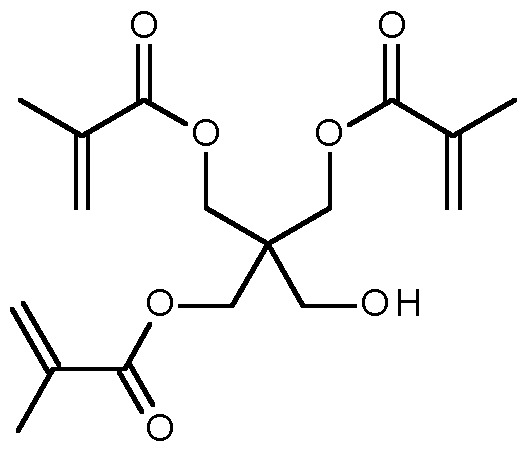
- Pentaerythritol trimethacrylate with the following structural formula is used as a polyfunctional monomer:
- the average adhesive value initially averaged 22.3 MPa and then fell to a value of 16.9 MPa after the thermocycling described. These adhesion values are significantly better than the limit value of 10 MPa that is usually used, so that these values also ensure a very good adhesive bond between the tooth and the polymerizable dental material in the long term.
- Example 7 The polyfunctional compound used is sorbitol pentamethacrylate with the following structural formula:
- the average adhesion value was initially 14.9 MPa and after the described thermocycling 18.3 MPa. Once again, very good permanent adhesion is ensured here.
- Table 3 shows an overview of the different adhesion values for different polyfunctional compounds:
- Example 9 A tetrafunctional alkoxylated pentaerythritol tetramethacrylate with the following assumed structural formula is used as the polyfunctional compound: In the manner described, 20% by weight MDP, 46.1% by weight / HEMA, 0.1% by weight BHT and 0.2% by weight 2- (dimethylamino) ethyl methyl acrylate and 3.6% by weight % tetrafunctional alkoxylated pentaerythritol tetramethacrylate as tetra methacrylate, first alone and then mixed together with 30% by weight of water.
- the average adhesion value was initially 11.0 MPa and after the described thermocycling 12.3 MPa.
- the adhesive bond is not only ensured in the long term, but also improves over the simulated aging cycle.
- Example 10 Analogous to Example 4, trimethylolpropane tri-methacrylate with the following assumed structural formula is used as the polyfunctional compound:
- Example 11 As a polyfunctional compound, analogously to Example 4, trimethylolpropane trimethacrylate with the following assumed structural formula is used:
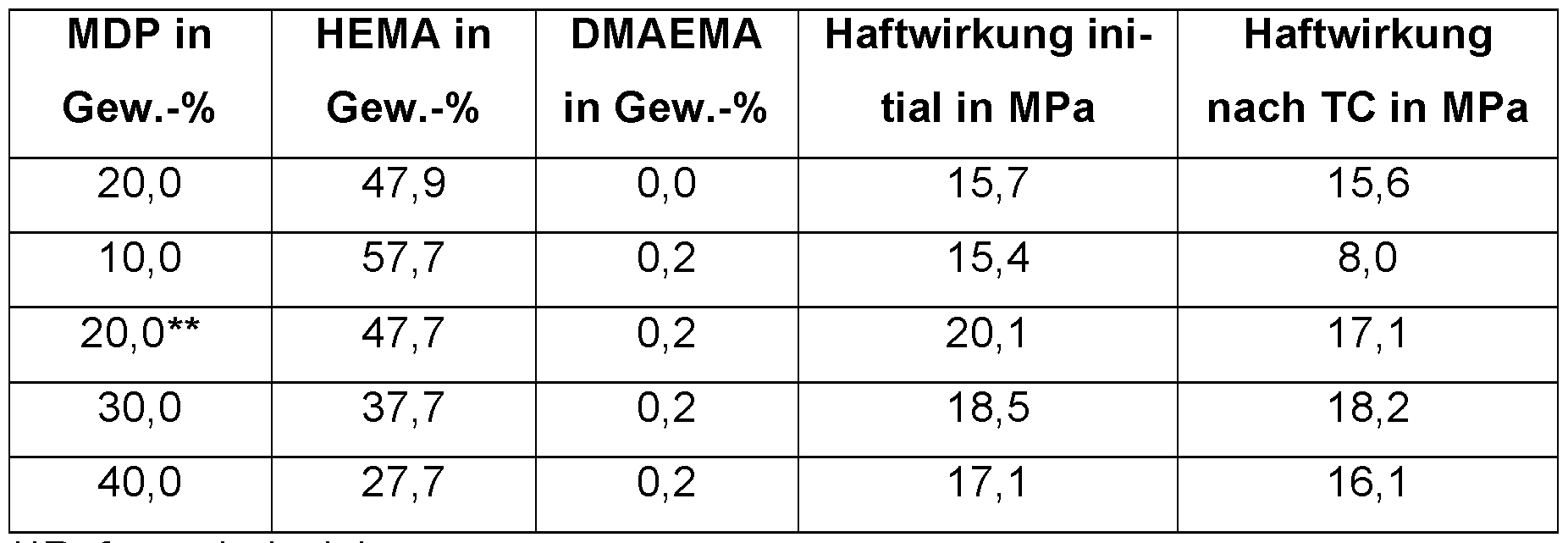
- the average adhesive value was initially 14.9 MPa and after the thermocycling (TC) described, 18.3 MPa. So again here is a very good permanent adhesion ensured. The influence of the hydrophilicity is particularly evident after the thermocycling described.
- Copper-containing primer (Cu) In the manner described, 20% by weight MDP, 47.2% by weight HEMA, 0.1% by weight BHT, 0.2% by weight 2- (Dimethyla- mino) ethyl methyl acrylate and 2% by weight trimethylpropane trimethacrylate as trimethacrylate and 0.5% by weight copper (II) acetylacetonate first alone and then mixed together with 30% by weight water.
- Iron-containing primer (Fe) In the manner described, 20 wt .-% MDP, 47.0 wt .-% HEMA, 0.1 wt .-% BHT, 0.2 wt .-% 2- (dimethylamino) ethyl methyl acrylate and 2% by weight of trimethylpropane trimethacrylate as trimethacrylate and 0.7% by weight of iron (III) EDTA, first alone and then mixed together with 30% by weight of water. The primers were then tested with the previously described base pastes 2B and 3B as well as the corresponding catalyst pastes 2 and 3. The results are summarized in Table 5 below.
Landscapes
- Health & Medical Sciences (AREA)
- Life Sciences & Earth Sciences (AREA)
- Oral & Maxillofacial Surgery (AREA)
- Epidemiology (AREA)
- Animal Behavior & Ethology (AREA)
- General Health & Medical Sciences (AREA)
- Public Health (AREA)
- Veterinary Medicine (AREA)
- Chemical & Material Sciences (AREA)
- Inorganic Chemistry (AREA)
- Biophysics (AREA)
- Dental Preparations (AREA)
Abstract
Description






Claims
Priority Applications (6)
| Application Number | Priority Date | Filing Date | Title |
|---|---|---|---|
| EP20712254.0A EP3937880A1 (de) | 2019-03-11 | 2020-03-11 | Primer und kit aus primer und dentalmaterial |
| CN202080020505.8A CN113631136A (zh) | 2019-03-11 | 2020-03-11 | 底漆及底漆与牙科材料的套件 |
| JP2021551750A JP2022522769A (ja) | 2019-03-11 | 2020-03-11 | プライマーおよび歯科材料のキット |
| BR112021015302-0A BR112021015302B1 (pt) | 2019-03-11 | 2020-03-11 | Kits de material adesivo dentário, e seu uso |
| US17/436,799 US12433826B2 (en) | 2019-03-11 | 2020-03-11 | Primer and kit of primer and dental material |
| JP2025165129A JP2025186520A (ja) | 2019-03-11 | 2025-10-01 | プライマーおよび歯科材料のキット |
Applications Claiming Priority (2)
| Application Number | Priority Date | Filing Date | Title |
|---|---|---|---|
| DE102019106119.9 | 2019-03-11 | ||
| DE102019106119.9A DE102019106119A1 (de) | 2019-03-11 | 2019-03-11 | Primer und Kit aus Primer und Dentalmaterial |
Publications (1)
| Publication Number | Publication Date |
|---|---|
| WO2020182918A1 true WO2020182918A1 (de) | 2020-09-17 |
Family
ID=69846067
Family Applications (1)
| Application Number | Title | Priority Date | Filing Date |
|---|---|---|---|
| PCT/EP2020/056567 Ceased WO2020182918A1 (de) | 2019-03-11 | 2020-03-11 | Primer und kit aus primer und dentalmaterial |
Country Status (6)
| Country | Link |
|---|---|
| US (1) | US12433826B2 (de) |
| EP (1) | EP3937880A1 (de) |
| JP (2) | JP2022522769A (de) |
| CN (1) | CN113631136A (de) |
| DE (1) | DE102019106119A1 (de) |
| WO (1) | WO2020182918A1 (de) |
Families Citing this family (1)
| Publication number | Priority date | Publication date | Assignee | Title |
|---|---|---|---|---|
| CN120423985B (zh) * | 2025-07-02 | 2025-12-16 | 深圳市贝特瑞新能源技术研究院有限公司 | 一种多官能度单体及其制备方法、固态电解质、锂离子电池和涉电设备 |
Citations (6)
| Publication number | Priority date | Publication date | Assignee | Title |
|---|---|---|---|---|
| US4966934A (en) * | 1984-11-29 | 1990-10-30 | Dentsply Research & Development Corp. | Biological compatible adhesive containing a phosphorous adhesion promoter and accelerator |
| EP1780223B1 (de) | 2004-08-09 | 2010-07-28 | Kuraray Medical Inc. | Nichtwässrige härtbare zusammensetzung vom redoxhärtungstyp |
| EP2409997A1 (de) | 2009-03-18 | 2012-01-25 | Kuraray Medical Inc. | Redoxhärtende zusammensetzung |
| EP2554154A1 (de) | 2010-03-30 | 2013-02-06 | Kuraray Noritake Dental Inc. | Dentales haftmaterialkit |
| WO2014033280A2 (de) | 2012-08-31 | 2014-03-06 | Kettenbach Gmbh & Co. Kg | Radikalisch polymerisierbares dentalmaterial, gehärtetes produkt und verwendung |
| DE102015103427A1 (de) | 2015-03-09 | 2016-09-15 | Kettenbach Gmbh & Co. Kg | Polymerisierbares Dentalmaterial mit Phasentransferkatalysator |
Family Cites Families (1)
| Publication number | Priority date | Publication date | Assignee | Title |
|---|---|---|---|---|
| AU2016365959B2 (en) * | 2015-12-07 | 2021-09-16 | Kuraray Noritake Dental Inc. | Dental adhesive |
-
2019
- 2019-03-11 DE DE102019106119.9A patent/DE102019106119A1/de active Pending
-
2020
- 2020-03-11 JP JP2021551750A patent/JP2022522769A/ja active Pending
- 2020-03-11 EP EP20712254.0A patent/EP3937880A1/de active Pending
- 2020-03-11 US US17/436,799 patent/US12433826B2/en active Active
- 2020-03-11 WO PCT/EP2020/056567 patent/WO2020182918A1/de not_active Ceased
- 2020-03-11 CN CN202080020505.8A patent/CN113631136A/zh active Pending
-
2025
- 2025-10-01 JP JP2025165129A patent/JP2025186520A/ja active Pending
Patent Citations (6)
| Publication number | Priority date | Publication date | Assignee | Title |
|---|---|---|---|---|
| US4966934A (en) * | 1984-11-29 | 1990-10-30 | Dentsply Research & Development Corp. | Biological compatible adhesive containing a phosphorous adhesion promoter and accelerator |
| EP1780223B1 (de) | 2004-08-09 | 2010-07-28 | Kuraray Medical Inc. | Nichtwässrige härtbare zusammensetzung vom redoxhärtungstyp |
| EP2409997A1 (de) | 2009-03-18 | 2012-01-25 | Kuraray Medical Inc. | Redoxhärtende zusammensetzung |
| EP2554154A1 (de) | 2010-03-30 | 2013-02-06 | Kuraray Noritake Dental Inc. | Dentales haftmaterialkit |
| WO2014033280A2 (de) | 2012-08-31 | 2014-03-06 | Kettenbach Gmbh & Co. Kg | Radikalisch polymerisierbares dentalmaterial, gehärtetes produkt und verwendung |
| DE102015103427A1 (de) | 2015-03-09 | 2016-09-15 | Kettenbach Gmbh & Co. Kg | Polymerisierbares Dentalmaterial mit Phasentransferkatalysator |
Also Published As
| Publication number | Publication date |
|---|---|
| JP2022522769A (ja) | 2022-04-20 |
| DE102019106119A1 (de) | 2020-09-17 |
| JP2025186520A (ja) | 2025-12-23 |
| CN113631136A (zh) | 2021-11-09 |
| US12433826B2 (en) | 2025-10-07 |
| BR112021015302A2 (pt) | 2021-10-05 |
| US20220168190A1 (en) | 2022-06-02 |
| EP3937880A1 (de) | 2022-01-19 |
Similar Documents
| Publication | Publication Date | Title |
|---|---|---|
| DE19526224B4 (de) | Dentalglasionomerzement-Zusammensetzung | |
| DE19818210C5 (de) | Radikalisch polymerisierbarer Dentalwerkstoff | |
| DE69214287T2 (de) | Universeller medizinischer und dental-zement auf wasserbasis | |
| EP1839640B1 (de) | Härtbare, dentale Massen | |
| DE69817760T2 (de) | Polymerisierbare zusammensetzung für dentalanwendungen | |
| EP4205724A1 (de) | Selbsthaftende dentale kompositzemente mit guter transparenz auf basis säurebehandelter füllstoffe | |
| EP3692974B1 (de) | Dentalmaterialien mit verbesserten mechanischen eigenschaften | |
| EP3692976A1 (de) | Dentalmaterialien auf basis von redoxsystemen mit geruchsarmen cumolhyd-hydroperoxid-derivaten | |
| DE60313911T2 (de) | Einflaschen-Dentalbindungszusammensetzung | |
| EP3267963B1 (de) | Polymerisierbares dentalmaterial mit phasentransferkatalysator | |
| DE112013002309B4 (de) | Radikalisch polymerisierbares Dentalmaterial, gehärtetes Produkt und Verwendung | |
| EP2512400A2 (de) | Mehrkomponentensystem zur herstellung eines dentalmaterials | |
| EP2921154B1 (de) | Photopolymerisierbare und dualhärtende Dentalwerkstoffe auf der Basis von Thioharnstoffderivaten und Bisacyldialkylgermanium-Verbindungen | |
| EP2198824B1 (de) | Polymerisierbares Dentalmaterial mit Initiatorsystem | |
| EP2233123B1 (de) | Selbsthaftender mehrkomponentiger Dentalwerkstoff | |
| EP3338756B1 (de) | Lagerstabiler kunststoffmodifizierter glasionomerzement | |
| JP2025186520A (ja) | プライマーおよび歯科材料のキット | |
| EP3692975B1 (de) | Dentalmaterialien mit verbessertem abbindeverhalten | |
| EP2236122B1 (de) | Kunststoffmodifizierter Glasionomerzement | |
| AT393355B (de) | Klebstoff | |
| BR112021015302B1 (pt) | Kits de material adesivo dentário, e seu uso | |
| EP4066811A1 (de) | Lagerstabiles dentaladhäsivset zur anwendung mit peroxidisch und hydroperoxidisch redoxinitiierten kompositen | |
| DE29825053U1 (de) | Radikalisch polymerisierbarer Dentalwerkstoff | |
| WO2017042025A1 (de) | Radikalisch polymerisierbares dentalmaterial |
Legal Events
| Date | Code | Title | Description |
|---|---|---|---|
| 121 | Ep: the epo has been informed by wipo that ep was designated in this application |
Ref document number: 20712254 Country of ref document: EP Kind code of ref document: A1 |
|
| REG | Reference to national code |
Ref country code: BR Ref legal event code: B01A Ref document number: 112021015302 Country of ref document: BR |
|
| ENP | Entry into the national phase |
Ref document number: 2021551750 Country of ref document: JP Kind code of ref document: A |
|
| NENP | Non-entry into the national phase |
Ref country code: DE |
|
| ENP | Entry into the national phase |
Ref document number: 112021015302 Country of ref document: BR Kind code of ref document: A2 Effective date: 20210803 |
|
| ENP | Entry into the national phase |
Ref document number: 2020712254 Country of ref document: EP Effective date: 20211011 |
|
| WWG | Wipo information: grant in national office |
Ref document number: 17436799 Country of ref document: US |