WO2020184441A1 - Aliments pour animaux et denrées alimentaires - Google Patents
Aliments pour animaux et denrées alimentaires Download PDFInfo
- Publication number
- WO2020184441A1 WO2020184441A1 PCT/JP2020/009720 JP2020009720W WO2020184441A1 WO 2020184441 A1 WO2020184441 A1 WO 2020184441A1 JP 2020009720 W JP2020009720 W JP 2020009720W WO 2020184441 A1 WO2020184441 A1 WO 2020184441A1
- Authority
- WO
- WIPO (PCT)
- Prior art keywords
- spore
- forming
- lactic acid
- feed
- forming lactic
- Prior art date
- Legal status (The legal status is an assumption and is not a legal conclusion. Google has not performed a legal analysis and makes no representation as to the accuracy of the status listed.)
- Ceased
Links
Images
Classifications
-
- A—HUMAN NECESSITIES
- A61—MEDICAL OR VETERINARY SCIENCE; HYGIENE
- A61P—SPECIFIC THERAPEUTIC ACTIVITY OF CHEMICAL COMPOUNDS OR MEDICINAL PREPARATIONS
- A61P3/00—Drugs for disorders of the metabolism
- A61P3/12—Drugs for disorders of the metabolism for electrolyte homeostasis
-
- A—HUMAN NECESSITIES
- A23—FOODS OR FOODSTUFFS; TREATMENT THEREOF, NOT COVERED BY OTHER CLASSES
- A23K—FODDER
- A23K10/00—Animal feeding-stuffs
- A23K10/10—Animal feeding-stuffs obtained by microbiological or biochemical processes
- A23K10/16—Addition of microorganisms or extracts thereof, e.g. single-cell proteins, to feeding-stuff compositions
- A23K10/18—Addition of microorganisms or extracts thereof, e.g. single-cell proteins, to feeding-stuff compositions of live microorganisms
-
- A—HUMAN NECESSITIES
- A23—FOODS OR FOODSTUFFS; TREATMENT THEREOF, NOT COVERED BY OTHER CLASSES
- A23K—FODDER
- A23K20/00—Accessory food factors for animal feeding-stuffs
- A23K20/10—Organic substances
- A23K20/158—Fatty acids; Fats; Products containing oils or fats
-
- A—HUMAN NECESSITIES
- A23—FOODS OR FOODSTUFFS; TREATMENT THEREOF, NOT COVERED BY OTHER CLASSES
- A23K—FODDER
- A23K20/00—Accessory food factors for animal feeding-stuffs
- A23K20/10—Organic substances
- A23K20/174—Vitamins
-
- A—HUMAN NECESSITIES
- A23—FOODS OR FOODSTUFFS; TREATMENT THEREOF, NOT COVERED BY OTHER CLASSES
- A23K—FODDER
- A23K50/00—Feeding-stuffs specially adapted for particular animals
- A23K50/70—Feeding-stuffs specially adapted for particular animals for birds
- A23K50/75—Feeding-stuffs specially adapted for particular animals for birds for poultry
-
- A—HUMAN NECESSITIES
- A23—FOODS OR FOODSTUFFS; TREATMENT THEREOF, NOT COVERED BY OTHER CLASSES
- A23L—FOODS, FOODSTUFFS OR NON-ALCOHOLIC BEVERAGES, NOT OTHERWISE PROVIDED FOR; PREPARATION OR TREATMENT THEREOF
- A23L13/00—Meat products; Meat meal; Preparation or treatment thereof
-
- A—HUMAN NECESSITIES
- A23—FOODS OR FOODSTUFFS; TREATMENT THEREOF, NOT COVERED BY OTHER CLASSES
- A23L—FOODS, FOODSTUFFS OR NON-ALCOHOLIC BEVERAGES, NOT OTHERWISE PROVIDED FOR; PREPARATION OR TREATMENT THEREOF
- A23L33/00—Modifying nutritive qualities of foods; Dietetic products; Preparation or treatment thereof
- A23L33/10—Modifying nutritive qualities of foods; Dietetic products; Preparation or treatment thereof using additives
- A23L33/135—Bacteria or derivatives thereof, e.g. probiotics
-
- A—HUMAN NECESSITIES
- A61—MEDICAL OR VETERINARY SCIENCE; HYGIENE
- A61K—PREPARATIONS FOR MEDICAL, DENTAL OR TOILETRY PURPOSES
- A61K35/00—Medicinal preparations containing materials or reaction products thereof with undetermined constitution
- A61K35/66—Microorganisms or materials therefrom
- A61K35/74—Bacteria
- A61K35/741—Probiotics
- A61K35/742—Spore-forming bacteria, e.g. Bacillus coagulans, Bacillus subtilis, clostridium or Lactobacillus sporogenes
-
- A—HUMAN NECESSITIES
- A61—MEDICAL OR VETERINARY SCIENCE; HYGIENE
- A61K—PREPARATIONS FOR MEDICAL, DENTAL OR TOILETRY PURPOSES
- A61K9/00—Medicinal preparations characterised by special physical form
- A61K9/0012—Galenical forms characterised by the site of application
- A61K9/0053—Mouth and digestive tract, i.e. intraoral and peroral administration
- A61K9/0056—Mouth soluble or dispersible forms; Suckable, eatable, chewable coherent forms; Forms rapidly disintegrating in the mouth; Lozenges; Lollipops; Bite capsules; Baked products; Baits or other oral forms for animals
-
- A—HUMAN NECESSITIES
- A61—MEDICAL OR VETERINARY SCIENCE; HYGIENE
- A61P—SPECIFIC THERAPEUTIC ACTIVITY OF CHEMICAL COMPOUNDS OR MEDICINAL PREPARATIONS
- A61P3/00—Drugs for disorders of the metabolism
- A61P3/02—Nutrients, e.g. vitamins, minerals
-
- A—HUMAN NECESSITIES
- A61—MEDICAL OR VETERINARY SCIENCE; HYGIENE
- A61P—SPECIFIC THERAPEUTIC ACTIVITY OF CHEMICAL COMPOUNDS OR MEDICINAL PREPARATIONS
- A61P39/00—General protective or antinoxious agents
- A61P39/06—Free radical scavengers or antioxidants
-
- A—HUMAN NECESSITIES
- A23—FOODS OR FOODSTUFFS; TREATMENT THEREOF, NOT COVERED BY OTHER CLASSES
- A23V—INDEXING SCHEME RELATING TO FOODS, FOODSTUFFS OR NON-ALCOHOLIC BEVERAGES AND LACTIC OR PROPIONIC ACID BACTERIA USED IN FOODSTUFFS OR FOOD PREPARATION
- A23V2002/00—Food compositions, function of food ingredients or processes for food or foodstuffs
Definitions
- the present invention relates to feeds and foods for reducing lipid peroxides.
- feed has been used as a nutrient source in the fields of aquaculture, pig farming, poultry farming, etc., but these feeds have a function of enhancing digestion, an odor reduction function, an intestinal regulation function, and a calorie absorption rate adjustment function.
- Those having various functions such as a meat quality improving function, an immunity enhancing function, a conception rate improving function, and a feed-type water purification function are desired.
- antibiotics and antibacterial agents are used to prevent the spread of infectious diseases and the decrease in physical strength and resistance of livestock caused by stress caused by overcrowding in an attempt to increase productivity by increasing the number of animals raised per area.
- Drugs such as drugs are mixed with feed and fed, but the emergence of resistant bacteria has become a global issue, and safe materials that replace these drugs are required.
- Patent Document 1 by feeding livestock with a feed containing Bacillus coagulans, which is a spore-forming lactic acid bacterium, as an active ingredient, the occurrence of diarrhea is suppressed and the intestinal flora is improved (intestinal regulation effect). It has been reported that the health condition of livestock is improved, and that the weight gain at the time of shipment and the decrease in feed conversion ratio are observed to promote the growth of livestock.
- Patent Document 2 proposes to add a group of thermophilic microorganisms to feed, but since it uses an aggregate of unspecified microorganisms, there is a problem in reproducibility and stability of the effect.
- An object of the present invention is to provide a feed capable of reducing lipid peroxide in the tissue of an edible portion.
- the present inventors have proceeded with research to solve the above problems, and by adding either or both of spore-forming lactic acid bacteria and spore-forming thermophiles to the feed, the effect of improving meat quality by reducing lipid peroxide It was found that the present invention could be obtained, and the present invention was completed.
- the present invention is as follows.
- a feed for reducing lipid peroxide in the tissues of edible parts of livestock which contains either a spore-forming lactic acid bacterium or a spore-forming thermophile that does not correspond to the spore-forming lactic acid bacterium.
- a feed for reducing lipid peroxide in the tissues of edible parts of livestock which contains spore-forming lactic acid bacteria and spore-forming thermophiles that do not correspond to the spore-forming lactic acid bacteria.
- a method for reducing lipid peroxide in tissues of edible parts of livestock which comprises a step of ingesting a feed containing either a spore-forming lactic acid bacterium or a spore-forming thermophile that does not correspond to the spore-forming lactic acid bacterium. .. [9] A method for reducing lipid peroxide in tissues of edible parts of livestock, which comprises a step of ingesting a feed containing spore-forming lactic acid bacteria and spore-forming thermophiles not corresponding to the spore-forming lactic acid bacteria to livestock.
- a food for reducing lipid peroxide in the human body which contains spore-forming lactic acid bacteria and spore-forming thermophiles that do not correspond to the spore-forming lactic acid bacteria.
- thermophile Bacillus hisashii.
- a method for reducing lipid peroxide in the human body which comprises the step of ingesting a food containing either a spore-forming lactic acid bacterium or a spore-forming thermophile that does not correspond to the spore-forming lactic acid bacterium.
- a method for reducing lipid peroxide in the human body which comprises the step of ingesting a food containing a spore-forming lactic acid bacterium and a spore-forming thermophile that does not correspond to the spore-forming lactic acid bacterium.
- the effect of improving meat quality by reducing lipid peroxide can be obtained.
- the first embodiment of the present invention is either a spore-forming lactic acid bacterium or a spore-forming thermophile that does not correspond to the spore-forming lactic acid (hereinafter, may be simply referred to as "spore-forming thermophile").
- a feed containing either or both By ingesting the feed according to the present embodiment to livestock or aquatic organisms, lipid peroxide in the tissues of the edible part of livestock or aquatic organisms can be reduced. That is, livestock (meat) or aquatic organisms with improved meat quality can be provided by breeding with the feed of the present embodiment.
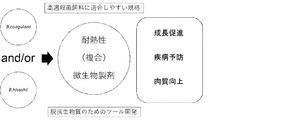
- the feed according to the present embodiment may contain only one of the spore-forming lactic acid bacterium and the spore-forming lactic acid, and may contain both, but it is preferable to contain both. This is because when the feed contains both spore-forming lactic acid bacteria and the spore-forming lactic acid, effects such as improvement of immunity, prevention of diseases by expression of biological defense factors, and growth promotion by improvement of feed conversion ratio can be obtained. is there.
- Spore-forming lactic acid bacteria are spore-forming lactic acid bacteria that are extremely resistant to dryness, heat and acid, and even when orally administered to humans, they reach the intestine without being killed by gastric acid or bile and germinate in the intestine. Proliferates to produce lactic acid.
- Examples of spore-forming lactic acid bacteria can typically include bacteria belonging to the genus Bacillus and the genus Sporolactobacillus.
- the spore-forming lactic acid bacteria include the genus Bacillus. Bacteria belonging to the above are preferable. Specific examples of the fungus belonging to the genus Bacillus include Bacillus coagulans.
- the preferred spore-forming lactic acid bacterium in the present embodiment is Bacillus coagulans, and as Bacillus coagulans, SANK70258 strain, P-22 strain, lilac-01 strain, SIM-7 DSM14043 strain, C101 strain, and NBRC12583 strain of Bacillus coagulans. , GBI-1, GBI-20, GBI-30, GBI-40, etc. Among them, SANK70258 strain of Bacillus coagulans is preferable from the viewpoint of supply stability and availability.
- spore-forming lactic acid bacterium a commercially available spore-forming lactic acid bacterium can be used (for example, Mitsubishi Chemical Foods Co., Ltd. "Lacris-S”, “Lacris-S granules”, “Lacris-10 for feed”, Ganeden Inc. "Ganeden BC30", SABINSA “Lactospore”, Kerry “BC30”, Aterio Bio “Lilac Lactic Acid Bacteria”, UNIQUE BIOTECH “Unique IS2", Asahi Calpis Wellness “Carita”, etc.). This may be appropriately cultured and used in an appropriate medium.
- the spore-forming lactic acid bacterium in the present embodiment may be a heat-dried killed cell.
- the content is usually 1.0 ⁇ 10 4 cfu / g or more, preferably 3.0 ⁇ 10 4 cfu / g or more, more preferably 5.0 ⁇ 10 4 or more. It is cfu / g or more, more preferably 8.0 ⁇ 10 4 cfu / g or more, particularly preferably 1.0 ⁇ 10 5 cfu / g or more, and usually 1.0 ⁇ 10 12 cfu / g or less, preferably 1.0 ⁇ 10 12 cfu / g or less.
- the content of spore-forming lactic acid bacteria is within the above range, the cost aspect is improved, the mixing uniformity when mixed with the feed is improved, and the feed contains both spore-forming lactic acid bacteria and spore-forming thermophiles. It is advantageous in that it is easy to obtain the growth promoting effect in.
- the spore-forming thermophile is a microorganism having an optimum growth temperature of 40 ° C. or higher. Specific examples thereof include microorganisms belonging to the genus Bacillus, Oceanobacillus, Paenibacillus, Anoxybacillus, Lysinibacillus and the like, which are thermophilic.
- the genus Methanopyrus, Geogemma, Pyrolobus, Pyrodictium, Hyperthermus, Pyrococcus, Pyrobaculum, Thermococcus, Aeropyrum, Aquifex, Thermoga, Thermodesulfobacterium, Thermos, Geobacillus Examples include microorganisms belonging to the genus Clostridium.
- bacteria belonging to the genus Bacillus are preferable, and bacteria belonging to the genus Bacillus include Bacillus thermomylorans, Bacillus thermocloacae, and more specifically, Bacillus hisashii (Bacillus hisashii), which is a closely related species of Bacillus thermomylocaae. Hisashi), a closely related species of Bacillus thermocloacae belonging to Firmicutes as a bacterial phylum (registered as no.AB298562 in the GenBank database), a closely related species of Bacillus thermomylorans (registered as no.AB298559 in the same database)
- Bacillus hisashii which is a closely related species of Bacillus thermomylovolans, is preferable.
- thermophile Bacillus hisashii As Bacillus hisashii, BP-863 (N-11) is preferable.
- the thermophile Bacillus hisashii's BP-863 was sent to the Patent Microorganisms Depositary Center of the National Institute of Technology and Evaluation, whose address is Room 122, 2-5-8 Kazusakamatari, Kisarazu City, Chiba Prefecture, on January 15, 2010. It has been deposited (trust number: NITE BP-863).
- the spore-forming thermophile may be a heat-dried killed cell. Further, the spore-forming thermophile may be a complex bacterium, and examples thereof include a thermophilic inoculum PTA-1773 and a thermophilic complex BP-1051.
- thermophilic inoculum PTA-1773 was internationally deposited with ATCC (American Type Culture Collection, 10801 University Boulevard Manassas, Virginia 20110-2209 U.S.A.) on May 1, 2000 (trust number: PTA-1773).
- ATCC American Type Culture Collection, 10801 University Boulevard Manassas, Virginia 20110-2209 U.S.A.
- thermophile complex BP-1051 was sent to the Patent Microorganisms Depositary Center of the National Institute of Technology and Evaluation, whose address is Room 122, 2-5-8 Kazusakamatari, Kisarazu City, Chiba Prefecture, on January 18, 2011. It has been deposited internationally (deposit number: NITE BP-1051).
- the content thereof is usually 1.0 ⁇ 10 cfu / g or more, preferably 1.0 ⁇ 10 2 cfu / g or more, more preferably 1.0 ⁇ 10 3 It is cfu / g or more, more preferably 1.0 ⁇ 10 4 cfu / g or more, particularly preferably 5.0 ⁇ 10 4 cfu / g or more, and usually 1.0 ⁇ 10 12 cfu / g or less, preferably 1.0 ⁇ 10 12 cfu / g or less.
- the content of spore-forming thermophiles is within the above range, a fat accumulation reducing effect can be obtained, and a growth promoting effect can be obtained in an embodiment in which the feed contains both spore-forming lactic acid bacteria and spore-forming thermophiles. It is advantageous in that it is easy.
- the mixing ratio of the spore-forming lactic acid bacteria and the spore-forming thermophiles is usually 1: 1 or more, preferably 1: 1 or more on a number basis. 2: 1 or more, more preferably 3: 1 or more, still more preferably 5: 1 or more, and usually 1,000,000: 1 or less, preferably 500,000: 1 or less, more preferably 100,000: 1 or less. Hereinafter, it is more preferably 50,000: 1 or less. Within the above range, the effect of the present invention can be easily obtained by using the spore-forming lactic acid bacterium and the spore-forming thermophile in combination, which is preferable.
- the feed referred to here is not limited as long as it is fed for raising livestock, and includes not only solid feed but also liquid feed and water.
- oligosaccharides In addition to mannose and manno-oligosaccharides, other oligosaccharides, organic acids, water-soluble dietary fiber, starch, insoluble dietary fiber, etc. may be added to the feed as prebiotics for the purpose of assisting the action of live bacteria. ..
- stabilizers and excipients may be included, if desired.
- Stabilizers include silicic anhydride and the like, and excipients include cereals such as corn, wheat, soybeans and mylo, sugars such as lactose, sucrose and glucose, soybean meal, corn gluten meal and sesame oil residue.
- Vegetable oil residue such as corn farm meal, rapeseed oil residue, distilled grain residue, bran, rice bran, defatted rice bran, bran such as corn gluten feed, animal material such as fish flour, plant such as palm oil, lard, corn oil
- cereals such as sex fats and oils, corn starch and potato starch, minerals such as calcium carbonate, vitamins such as vitamin E, dextrin, corn starch, paprika extract, alfalfa meal and the like.
- disease prevention refers to a state in which animals including humans and aquatic organisms are less likely to get sick by improving their immunity. It can be judged by the improved expression of the biological defense factor.
- improved of meat quality means reduction of lipid peroxide in the tissues of edible parts of livestock or aquatic organisms. It is said that triglyceride-derived lipid peroxides generate superoxide anions in cells, which have the effect of damaging DNA in the nucleus, which is one of the many causes of cancer development, or aging. It is thought to be associated with lifestyle-related diseases.
- the final product of the lipid peroxidation reaction may be mutagenic and carcinogenic.
- the final product, malondialdehyde reacts with deoxyadenosine and deoxyguanosine in DNA to produce DNA adducts.
- the TBARS measurement which is often used as an index related to the quality of meat, is known as an index that reflects the content of malondialdehyde.
- the effect of the feed according to the present embodiment means peroxidation per tissue weight of the edible part of livestock or aquatic organisms.
- the amount of lipid is such that livestock or aquatic organisms are fed the feed according to the present embodiment and the feed is not ingested (for example, spore-forming lactic acid bacteria and spore-like preference from the feed according to the present embodiment). It means that the amount of feed excluding heat bacteria is reduced compared to the case where livestock or aquatic organisms are fed).
- the feed according to this embodiment can be given to livestock or aquatic organisms.
- livestock or aquatic organisms As a feed to which spore-forming lactic acid bacteria and spore-forming thermophiles are added, commercially available feeds can be used.
- Livestock include cattle, horses, pigs, sheep, goats, poultry and the like, and are preferably poultry.
- poultry include chickens (broilers, broilers, broilers, etc., preferably broilers), geese, mallards, duck, ducks, quail, turkeys, and pheasants.
- Aquatic organisms include fish, amphibians, aquatic mammals and the like that can be bred.
- Examples of fish include amberjack, carp, tuna, mackerel, salmon, bonito, herring, sama, horse mackerel, cod, yellowtail, hamachi, Thailand, amberjack, amberjack, kawahagi, eel, nigga, trout, pufferfish, sougyo, and silver carp.
- Examples include carp, amberjack, and bighead carp.
- the amount of feed to be ingested by livestock or aquatic organisms is not particularly limited and can be appropriately set according to the type and age of livestock or aquatic organisms.
- the number of times and the number of days for feeding livestock or aquatic organisms can be appropriately set according to the type and age of livestock or aquatic organisms. For example, it can be ingested at least once / day, preferably 1 to 5 / day, continuously for 2 days or more, preferably 10 days or more, and more preferably 30 days or more.
- a second embodiment of the present invention is a food containing either or both of spore-forming lactic acid bacteria and spore-forming thermophiles that do not correspond to the spore-forming lactic acid bacteria.
- lipid peroxides in the human body can be reduced.
- the lipid peroxide in the human body is not particularly limited, and may be, for example, a lipid peroxide in tissues such as muscle and internal organs, or may be a lipid peroxide in blood.
- the food according to the present embodiment may contain only one of the spore-forming lactic acid bacteria and the spore-forming lactic acid, or may contain both, but it is preferable to contain both. This is because when the food contains both the spore-forming lactic acid bacterium and the spore-forming lactic acid, the effect of improving immunity or preventing diseases by expressing a biological defense factor can be obtained.
- the spore-forming lactic acid bacterium which is a component of the food according to the present embodiment As an explanation of the spore-forming lactic acid bacterium which is a component of the food according to the present embodiment and the spore-forming thermophile which does not correspond to the spore-forming lactic acid bacterium, the spore-forming lactic acid bacterium which is a component of the feed according to the first embodiment And the explanation of the spore-forming thermophile which does not correspond to the spore-forming lactic acid bacterium is incorporated.
- the content is usually 1.0 ⁇ 10 4 cfu / g or more and 1.0 ⁇ 10 9 cfu / g or less, preferably 1.0 ⁇ 10 5 cfu / g or more. It is 1.0 ⁇ 10 8 cfu / g or less.
- the content is usually 1.0 ⁇ 10 4 cfu / g or more and 1.0 ⁇ 10 9 cfu / g or less, preferably 1.0 ⁇ 10 5 cfu / g. g or more and 1.0 ⁇ 10 8 cfu / g or less.
- the mixing ratio of spore-forming lactic acid bacteria and spore-forming thermophiles is usually 1: 1 or more and 100,000: 1 on a number basis. Hereinafter, it is preferably 2: 1 or more and 10,000: 1 or less.
- the daily intake of spore-forming lactic acid bacteria is usually 1.0 ⁇ 10 7 cfu / day or more and 2.0 ⁇ 10 9 cfu / day or less, preferably 5.0 ⁇ 10 7 cfu / day. It is 2.0 ⁇ 10 8 cfu / day or less.
- the daily intake can be divided into one or two or more times a day.
- the daily intake of spore-forming thermophiles is usually 1.0 ⁇ 10 4 cfu / day or more and 2.0 ⁇ 10 9 cfu / day or less, preferably 5.0 ⁇ 10 5 cfu. It is 2.0 ⁇ 10 6 cfu / day or more and 2.0 ⁇ 10 6 cfu / day or less.
- the daily intake can be divided into one or two or more times a day.
- Chunky was used as the chicken species to be tested, and the feed was divided as shown in Table 1 and the test was conducted as Examples 1 to 3 and Comparative Example 1.
- the chicks are bred in battery cages 10 days after the test subject hatches, and the chicks are bred in flat breeding during the middle to large chicks 11 to 52 days after hatching. did.
- spore lactic acid bacteria is a mixture obtained by mixing the bacteria "Rakurisu -10" as excipient (Mitsubishi Chemical Foods Co., Ltd.: Bacillus coagulans, 1.0 ⁇ 10 9 cfu / g or higher) and spore thermophilic bacterium "BP-863" (manufactured Thermus manufactured: Bacillus hisashii, 1.0 ⁇ 10 5 cfu / g or higher) was used.
- Example 2 Drinking water or feed for chicks was prepared in the same manner as in Example 1 except that the bacterial species to be added were only spore-forming lactic acid bacteria from spore-forming lactic acid bacteria and spore-forming thermophiles.
- Example 3 Drinking water or feed for chicks was prepared in the same manner as in Example 1 except that the bacterial species to be added were only spore-forming thermophiles from spore-forming lactic acid bacteria and spore-forming thermophiles.
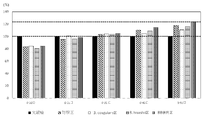
- Feed conversion ratios of chicks in each test group of Examples 1 to 3 and Comparative Example 1 on days 0 to 52 are literature values (“Chunky broiler performance target 2014” Eviagen Co., Ltd., Japan Chunky Co., Ltd .; undifferentiated results). Was set to 100% and calculated. The results are shown in FIG. The feed conversion ratio tended to be slightly lower than the literature value at the time of the first chicks, but then gradually improved, and at 41 days and 52 days, it improved remarkably in the BB combination group.
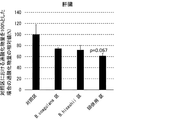
- Test Example 2 The amount of peroxide (malondialdehyde equivalent) per tissue weight in chicken liver of each test group of Examples 1 to 3 and Comparative Example 1 was measured according to a conventional method.
- FIG. 2 shows the results of calculating the measured values in each of the test plots of Examples 1 to 3 as relative values when the measured value in Comparative Example 1 (control plot) is 100%. From FIG. 2, it was shown that the ratio of peroxide per tissue weight in the liver to the control group decreased in the B. coagulans group, the B. hisashii group, and the BB combination group in which B. coagulans and B. hisashii were used in combination. It was. Of these, the peroxide ratio was the lowest in the BB combination group. It can be seen that the addition of B. coagulans or B. hisashii to the feed has a meat quality improving effect, and the addition of both B. coagulans and B. hisashii has a synergistic effect on meat quality improvement.
Landscapes
- Life Sciences & Earth Sciences (AREA)
- Health & Medical Sciences (AREA)
- Chemical & Material Sciences (AREA)
- Polymers & Plastics (AREA)
- Engineering & Computer Science (AREA)
- Microbiology (AREA)
- Food Science & Technology (AREA)
- Zoology (AREA)
- Veterinary Medicine (AREA)
- Animal Behavior & Ethology (AREA)
- Medicinal Chemistry (AREA)
- Public Health (AREA)
- Pharmacology & Pharmacy (AREA)
- General Health & Medical Sciences (AREA)
- Mycology (AREA)
- Animal Husbandry (AREA)
- Nutrition Science (AREA)
- Birds (AREA)
- Molecular Biology (AREA)
- Chemical Kinetics & Catalysis (AREA)
- Organic Chemistry (AREA)
- General Chemical & Material Sciences (AREA)
- Nuclear Medicine, Radiotherapy & Molecular Imaging (AREA)
- Epidemiology (AREA)
- Physiology (AREA)
- Biochemistry (AREA)
- Bioinformatics & Cheminformatics (AREA)
- Diabetes (AREA)
- Hematology (AREA)
- Obesity (AREA)
- Biomedical Technology (AREA)
- Biotechnology (AREA)
- Toxicology (AREA)
- Fodder In General (AREA)
- Feed For Specific Animals (AREA)
- Coloring Foods And Improving Nutritive Qualities (AREA)
- Meat, Egg Or Seafood Products (AREA)
Abstract
La présente invention concerne des aliments pour animaux permettant de réduire les peroxydes lipidiques dans des tissus des parties comestibles du bétail ou d'améliorer la qualité de la viande, lesdits aliments pour animaux comprenant une bactérie d'acide lactique sporogène et/ou une bactérie thermophile sporogène ne correspondant pas à la bactérie d'acide lactique sporogène.
Priority Applications (1)
| Application Number | Priority Date | Filing Date | Title |
|---|---|---|---|
| US17/445,975 US12262723B2 (en) | 2019-03-08 | 2021-08-26 | Feed and food |
Applications Claiming Priority (2)
| Application Number | Priority Date | Filing Date | Title |
|---|---|---|---|
| JP2019042569 | 2019-03-08 | ||
| JP2019-042569 | 2019-03-08 |
Related Child Applications (1)
| Application Number | Title | Priority Date | Filing Date |
|---|---|---|---|
| US17/445,975 Continuation US12262723B2 (en) | 2019-03-08 | 2021-08-26 | Feed and food |
Publications (1)
| Publication Number | Publication Date |
|---|---|
| WO2020184441A1 true WO2020184441A1 (fr) | 2020-09-17 |
Family
ID=72426964
Family Applications (1)
| Application Number | Title | Priority Date | Filing Date |
|---|---|---|---|
| PCT/JP2020/009720 Ceased WO2020184441A1 (fr) | 2019-03-08 | 2020-03-06 | Aliments pour animaux et denrées alimentaires |
Country Status (3)
| Country | Link |
|---|---|
| US (1) | US12262723B2 (fr) |
| JP (1) | JP2020146035A (fr) |
| WO (1) | WO2020184441A1 (fr) |
Cited By (1)
| Publication number | Priority date | Publication date | Assignee | Title |
|---|---|---|---|---|
| WO2026004954A1 (fr) * | 2024-06-26 | 2026-01-02 | 三菱ケミカル株式会社 | Composition pour réduire des produits terminaux de glycation avancée |
Families Citing this family (2)
| Publication number | Priority date | Publication date | Assignee | Title |
|---|---|---|---|---|
| JP2022063836A (ja) * | 2020-10-12 | 2022-04-22 | 三菱ケミカル株式会社 | 敷料改善剤 |
| JP2023023981A (ja) * | 2021-08-06 | 2023-02-16 | 三菱ケミカル株式会社 | 生体内のIgAとIFN-γ産生を促進する乳酸菌製剤及び経口組成物 |
Citations (4)
| Publication number | Priority date | Publication date | Assignee | Title |
|---|---|---|---|---|
| JP2006333842A (ja) * | 2005-06-06 | 2006-12-14 | Unitika Ltd | 飼料配合剤 |
| CN106822522A (zh) * | 2017-03-17 | 2017-06-13 | 哈尔滨中科生物工程有限公司 | 一种提高家禽生长性能和免疫力中药发酵制剂的制备方法和应用 |
| JP2017190298A (ja) * | 2016-04-13 | 2017-10-19 | 博 小田 | 体内で水素を産生する組成物、及びサプリメント |
| JP2018199642A (ja) * | 2017-05-26 | 2018-12-20 | 日環科学株式会社 | 筋肉改質剤 |
Family Cites Families (3)
| Publication number | Priority date | Publication date | Assignee | Title |
|---|---|---|---|---|
| JP2006333845A (ja) | 2005-06-06 | 2006-12-14 | Unitika Ltd | 飼料配合剤 |
| JP5041228B2 (ja) | 2007-10-19 | 2012-10-03 | 日環科学株式会社 | 消化力増強飼料、臭気軽減飼料、整腸剤型飼料、カロリー吸収率調整型飼料、肉質改善飼料、免疫力増強飼料、ならびに受胎率改善飼料、飼料型水質浄化剤、多機能性食品 |
| WO2017066777A1 (fr) * | 2015-10-15 | 2017-04-20 | Kemin Industries, Inc. | Compositions et procédés d'amélioration des performances et de la santé intestinale de la volaille |
-
2020
- 2020-03-06 WO PCT/JP2020/009720 patent/WO2020184441A1/fr not_active Ceased
- 2020-03-06 JP JP2020038806A patent/JP2020146035A/ja active Pending
-
2021
- 2021-08-26 US US17/445,975 patent/US12262723B2/en active Active
Patent Citations (4)
| Publication number | Priority date | Publication date | Assignee | Title |
|---|---|---|---|---|
| JP2006333842A (ja) * | 2005-06-06 | 2006-12-14 | Unitika Ltd | 飼料配合剤 |
| JP2017190298A (ja) * | 2016-04-13 | 2017-10-19 | 博 小田 | 体内で水素を産生する組成物、及びサプリメント |
| CN106822522A (zh) * | 2017-03-17 | 2017-06-13 | 哈尔滨中科生物工程有限公司 | 一种提高家禽生长性能和免疫力中药发酵制剂的制备方法和应用 |
| JP2018199642A (ja) * | 2017-05-26 | 2018-12-20 | 日環科学株式会社 | 筋肉改質剤 |
Cited By (2)
| Publication number | Priority date | Publication date | Assignee | Title |
|---|---|---|---|---|
| WO2026004954A1 (fr) * | 2024-06-26 | 2026-01-02 | 三菱ケミカル株式会社 | Composition pour réduire des produits terminaux de glycation avancée |
| JP7838717B1 (ja) * | 2024-06-26 | 2026-04-01 | 三菱ケミカル株式会社 | 終末糖化産物を低減するための組成物 |
Also Published As
| Publication number | Publication date |
|---|---|
| US12262723B2 (en) | 2025-04-01 |
| JP2020146035A (ja) | 2020-09-17 |
| US20210386094A1 (en) | 2021-12-16 |
Similar Documents
| Publication | Publication Date | Title |
|---|---|---|
| CN102480995B (zh) | 用于动物饲料的组分及其用途 | |
| Bernardeau et al. | Overview of differences between microbial feed additives and probiotics for food regarding regulation, growth promotion effects and health properties and consequences for extrapolation of farm animal results to humans | |
| ES2902034T3 (es) | Combinaciones de probióticos de levadura y bacterias y métodos de uso para mejorar la producción porcina | |
| CN1437467A (zh) | 可用作抗微生物剂的中链脂肪酸 | |
| KR101216669B1 (ko) | 흑운모와 유용미생물을 이용한 발효물을 함유하는 생육촉진용 가축사료 첨가제 | |
| US20160128337A1 (en) | Antibacterial compositions and methods of use | |
| KR20170033433A (ko) | 동물 사료 조성물 및 사료 첨가제 | |
| US9826758B2 (en) | Feed composition and production method for same | |
| US12262723B2 (en) | Feed and food | |
| Sjofjan et al. | The utilization of bay leaf (SyzygiumpolyanthumWalp) Flour in feed on carcass quality, microflora instestine of broiler | |
| Khayoon et al. | Effects of feeding various levels of postbiotics produced by lactic acid bacteria on growth performance, gastrointestinal microbiota count, and digestibility of some nutrients in broiler chickens | |
| CN108835456A (zh) | 一种能提高免疫力的鸡饲料及其制备方法 | |
| Yuanita et al. | The effect of red dragon fruit (Hylocereus polyrhizus) peel meal on internal organs, ileal coliform, and growth performances in broiler chickens | |
| WO2012042223A2 (fr) | Aliment fermenté | |
| Mangisah et al. | Feeding combination of Lactobacillus casei and extracts of dahlia tuber or garlic on intestinal bacteria, nutrients digestibility and performance of broiler chickens | |
| Savvidou et al. | Probiotics as Feed Additives in Monogastric Animals | |
| KR101734591B1 (ko) | 기능성 사료 조성물 | |
| JP2004329056A (ja) | 飼料添加物、飼料添加物の製造法、及び調合飼料。 | |
| RU2807800C1 (ru) | Кормовая добавка для сельскохозяйственной птицы с использованием штаммов Bacillus subtilis и Bacillus lichenifopmis | |
| Al-Salhi et al. | Biotrophy and Its Biological Role Productivity, Physiological and Microbial Indicators of Broiler Chickens and Layng Hens | |
| WO2016129100A1 (fr) | Agent permettant d'augmenter le nombre de bactéries utiles dans les intestins d'animaux, et méthode permettant d'améliorer l'environnement intestinal du bétail dans lequel est utilisé ledit agent | |
| Abedalhammed et al. | Effect of addition of Lactobacillus reuteri, inulin and Jerusalem Artichoke (Helianthus tuberosus) powder in diets of common carp (Cyprinus carpio L.) on growth performance and feed utilization | |
| CN109170201A (zh) | 一种含有果寡糖和百里香提取物的具有抑菌作用的饲料添加剂及生产方法 | |
| Belim et al. | Recent advances and future directions in poultry nutrition-A Review | |
| Sandi et al. | The Effect of Probiotic Derived from Kumpai Minyak (Hymenachne Amplexicaulis) Silage on Performance and Egg Quality Characteristics of Pegagan Ducks |
Legal Events
| Date | Code | Title | Description |
|---|---|---|---|
| 121 | Ep: the epo has been informed by wipo that ep was designated in this application |
Ref document number: 20768981 Country of ref document: EP Kind code of ref document: A1 |
|
| NENP | Non-entry into the national phase |
Ref country code: DE |
|
| 122 | Ep: pct application non-entry in european phase |
Ref document number: 20768981 Country of ref document: EP Kind code of ref document: A1 |