WO2020189900A1 - Micro-capsule d'extinction d'incendie, son procédé de fabrication, et extincteur d'incendie la comprenant - Google Patents
Micro-capsule d'extinction d'incendie, son procédé de fabrication, et extincteur d'incendie la comprenant Download PDFInfo
- Publication number
- WO2020189900A1 WO2020189900A1 PCT/KR2020/002432 KR2020002432W WO2020189900A1 WO 2020189900 A1 WO2020189900 A1 WO 2020189900A1 KR 2020002432 W KR2020002432 W KR 2020002432W WO 2020189900 A1 WO2020189900 A1 WO 2020189900A1
- Authority
- WO
- WIPO (PCT)
- Prior art keywords
- fire extinguishing
- shell
- microcapsules
- digestive
- resin
- Prior art date
- Legal status (The legal status is an assumption and is not a legal conclusion. Google has not performed a legal analysis and makes no representation as to the accuracy of the status listed.)
- Ceased
Links
Images
Classifications
-
- A—HUMAN NECESSITIES
- A62—LIFE-SAVING; FIRE-FIGHTING
- A62D—CHEMICAL MEANS FOR EXTINGUISHING FIRES OR FOR COMBATING OR PROTECTING AGAINST HARMFUL CHEMICAL AGENTS; CHEMICAL MATERIALS FOR USE IN BREATHING APPARATUS
- A62D1/00—Fire-extinguishing compositions; Use of chemical substances in extinguishing fires
- A62D1/0007—Solid extinguishing substances
- A62D1/0021—Microcapsules
-
- B—PERFORMING OPERATIONS; TRANSPORTING
- B01—PHYSICAL OR CHEMICAL PROCESSES OR APPARATUS IN GENERAL
- B01J—CHEMICAL OR PHYSICAL PROCESSES, e.g. CATALYSIS OR COLLOID CHEMISTRY; THEIR RELEVANT APPARATUS
- B01J13/00—Colloid chemistry, e.g. the production of colloidal materials or their solutions, not otherwise provided for; Making microcapsules or microballoons
- B01J13/02—Making microcapsules or microballoons
- B01J13/06—Making microcapsules or microballoons by phase separation
- B01J13/14—Polymerisation; cross-linking
- B01J13/18—In situ polymerisation with all reactants being present in the same phase
Definitions
- the present invention relates to a microcapsule for fire extinguishing, a method for producing the same, and a fire extinguishing device including the same, and more particularly, a capsule containing a fire extinguishing agent, a production method for producing the same, and a microcapsule for fire extinguishing. It relates to possible fire extinguishing devices.
- Encapsulation is a physico-chemical process in which a liquid, solid, or gas is used as a core and a shell surrounding the outside of the core is formed.
- the encapsulated core is Prevent interaction.
- encapsulation processes are widely used to expand the functionality of various materials.
- the main purpose of encapsulation is the controlled external release of the encapsulated core. In general, during storage and processing, the encapsulated core needs complete separation from the outside.
- the external release of the core upon encapsulation may vary depending on the intended use.
- a core such as drugs, pesticides, flavors and mineral fertilizers may be encapsulated and used.
- the fire extinguishing microcapsule is encapsulated inside the shell with a fire extinguishing agent as the core.
- a fire extinguishing agent as the core.
- the fire extinguishing agent is decapsulated (decapsulation) in a short time within a narrow temperature range to quickly extinguish the fire. And increase the efficiency of fire suppression.
- the function required for the core-shell fire extinguishing microcapsules is to be able to separate the fire extinguishing agent, which is the core, from the external environment, and increase stability by blocking the leakage of the fire extinguishing agent during storage, and above the boiling point (boiling point). It maintains its properties when stored for a long period of time, and the stability of the extinguishing agent itself should be ensured against exposure to moisture and other solvents.
- the digestive microcapsules are released to the outside by destroying the shell while the volume of the digestive agent expands rapidly at a temperature of 70°C or higher (de-encapsulation temperature), which is the boiling point of the digestive agent.
- This shell breakdown rate should be faster than the rate of extinguishing agent breakdown in the flame during extinguishing. Otherwise, the concentration value of the extinguishing agent required for fire suppression cannot be obtained. The release of the encapsulated extinguishing agent must proceed rapidly to achieve the extinguishing concentration values required for fire fighting.
- the present invention is a method for microencapsulating a fire extinguishing agent in a shell, comprising a compound of polyvinyl alcohol and a urea-resorcinol-formaldehyde resin or a crosslinked gelatin filled with a 1-5 nm-thick mineral film (peeled montrylonite).
- the shell made is described.
- This polymer shell (outer wall) reacts in a temperature range of 90 to 270°C.
- the encapsulated extinguishing agent retains its properties during storage, and the weight loss of the capsule does not exceed 1.5% within 70 to 100 days.
- the disadvantage of the above invention is the low temperature deencapsulation of the extinguishing agent. Since the boiling point of the fire extinguishing agent Novec 1310 is 90 °C and the Novec 114 is 120 °C, deencapsulation occurring at low temperatures adversely affects the physical properties of the digestive microcapsules.
- the stepwise de-encapsulation of the capsule which can be deduced from the thermogravimetric analysis data of the present invention, has a limitation in that the extinguishing agent cannot be diffused in a short time and a narrow temperature range, and thus does not exhibit a rapid extinguishing effect.
- Patent Document 1 International Patent Publication WO 2012/177181 (2012.12.27)
- the present invention is to solve the problems of the prior art as described above, and an object of the present invention is to show long-term preservation and safety above room temperature and boiling point, and in a short time within a narrow temperature range during the de-encapsulation process of a fire extinguishing agent. It has improved kinetics (reaction rate, dynamics) so that the release of the extinguishing agent can occur quickly, the shell thickness is 5 ⁇ m at 200 nm, and it is resistant to the influence of water and other solvents (alcohols, ketones, esters, etc.). Eggplant is to provide a microcapsule for fire extinguishing, a method for manufacturing the same, and a fire extinguishing device using the same.
- the present invention has a core-shell structure, wherein the core is a fire extinguishing agent, the shell is a non-porous polymer polymer, and contains a precipitating agent and/or a coagulant.
- the core is a fire extinguishing agent
- the shell is a non-porous polymer polymer, and contains a precipitating agent and/or a coagulant.
- the extinguishing agent is characterized in that the formula C x H y O z Hal k (where x, y, z, k are 0, 1, 2, ..., Hal is Br, I, F) do.
- the shell is cross-linked polyvinyl acetate, ethyl vinyl acetate, polyvinyl alcohol, polyurea, polyurethane, polyester resin, epoxy resin, urea formaldehyde resin, melamine formaldehyde resin, phenol formaldehyde resin and resorsi It is characterized in that it is formed of one or more resins selected from the group consisting of formaldehyde resins.
- the precipitant comprises at least one precipitant selected from the group consisting of potassium acetate, sodium citrate, sodium chloride, ammonium chloride, sodium iodide, potassium iodide, copper sulfate, and sodium thiocyanate.
- the coagulant is characterized in that it comprises at least one coagulant selected from the group consisting of aluminum sulfate, zinc hydroxide, iron hydroxide, and iron chloride.
- a decapsulation process in which the fire extinguishing agent leaves the shell occurs in a short time within a narrow temperature range, and a decapsulation rate exceeds 150%/min.
- the weight of the digestive microcapsules falls from 95% to 15% (the fire extinguishing agent is released to the outside) temperature range is characterized in that within 40 °C.
- the thickness of the shell is characterized in that the range of 200 nm to 5 ⁇ m.
- the weight loss is 0.5% or less of the initial weight.
- the weight loss is 1% or less of the initial weight.
- the shell maintains physical-mechanical properties when exposed to water, alcohols, ketones, ethers, and mixtures thereof, and the weight loss after drying is characterized in that 0.5% or less of the initial weight.
- the present invention comprises the steps of: (a) preparing a first colloidal solution in which the dispersed phase is a core, and the dispersion solvent is polar or non-polar; (b) preparing a second colloidal solution in which the dispersed phase is a prepolymer or oligomer of the shell, and the dispersion solvent is polar or non-polar; (c) mixing the first colloidal solution and the second colloidal solution prepared in steps (a) and (b) with a precipitant and/or coagulant; (d) forming a microcapsule for digestion by precipitation and hardening of the second colloidal solution at the interface of the first colloidal solution mixed in step (c) to form a core-shell; And (e) washing and filtering the digestive microcapsules formed in step (d).
- the extinguishing agent of step (a) is the formula C x H y O z Hal k (where x, y, z, k are 0, 1, 2, ..., Hal is Br, I, F Im).
- the shell of the step (b) is crosslinked polyvinyl acetate, ethyl vinyl acetate, polyvinyl alcohol, polyurea, polyurethane, polyester resin, epoxy resin, urea formaldehyde resin, melamine formaldehyde resin, phenol It is characterized in that at least one resin selected from the group consisting of formaldehyde resins and resorcinol formaldehyde resins.
- step (a) is characterized in that a nonionic material or an ionic surfactant is further included as a stabilizer or emulsifier.
- step (a) is characterized in that a polymer material is further included as a stabilizer.
- step (a) is characterized in that at least one selected from the group consisting of water, ketones, alcohols or aliphatic hydrocarbons is further included in the dispersed phase.
- the precipitating agent of step (c) is characterized in that it comprises at least one precipitant selected from the group consisting of potassium acetate, sodium citrate, sodium chloride, ammonium chloride, sodium iodide, potassium iodide, copper sulfate, and sodium thiocyanate.
- the coagulant in step (c) is characterized in that it contains at least one coagulant selected from the group consisting of aluminum sulfate, zinc hydroxide, iron hydroxide, and iron chloride.
- step (d) is characterized in that the shell hardening accelerator or curing catalysts are further included.
- UV, microwave, infrared, or induction heating is applied to cure the shell.
- the present invention provides a fire extinguishing device in which the microcapsules for fire extinguishing are dispersed in a polymer matrix.
- the polymer matrix is at least one selected from the group consisting of phenol formaldehyde resin, polyester resin, epoxy resin, urea resin, resorcinol formaldehyde resin, polyurethane, polyurea, polyacrylate, or polymethyl methacrylate. It is characterized by being a resin.
- the fire extinguishing microcapsules are characterized in that contained in 0.1 to 90% by weight of the fire extinguishing device.
- the fire extinguishing device is characterized in that it further comprises a de-encapsulation agent, a de-encapsulation catalyst, a de-encapsulation temperature control agent, a diffusion accelerator, a gas permeability improver, and a thermal conductivity improvement component.
- the fire extinguishing device is characterized in that the flexible (flexible) or solid (solid) form.
- the fire extinguishing device is characterized in that a case including a gas-permeable membrane is formed on one side.
- the case is characterized in that it is formed of any one selected from the group consisting of glass fiber, carbon fiber, stainless steel, aluminum reinforced phenol-formaldehyde and epoxy.
- the gas permeable membrane is characterized in that the cell size is 10 to 400 ⁇ m.
- the microcapsule for fire extinguishing according to the present invention contains a fire extinguishing agent encapsulated inside the shell in a core-shell structure, and the shell made of a polymer is strong and has high resistance to water or other solvents, and long-term storage at room temperature and boiling point or higher. And safety, thus improving operational reliability, and in the process of de-encapsulation of the extinguishing agent, de-encapsulation in which the extinguishing agent destroys and releases the shell in a short time within a narrow temperature range occurs quickly, causing a fire to occur above a predetermined temperature. When the ambient temperature rises, it is effective to extinguish a fire at an early stage or prevent a fire from spreading through the release of extinguishing agents.
- the fire extinguishing microcapsule according to the present invention maintains the shell at a high temperature so that it can carry the fire extinguishing agent above the boiling point, thereby maintaining the performance without malfunctions in the ESS, lithium-ion battery module, etc., where the temperature rises and falls rapidly. It can have an effect.
- microcapsules for fire extinguishing according to the present invention exhibit high resistance to water or other solvents, even when dispersing in a polymer matrix and manufacturing them with various fire extinguishing devices, there is little leakage of the fire extinguishing agent, which is the core inside the shell, so it is stable and reliable It is possible to manufacture as a fire extinguishing device.
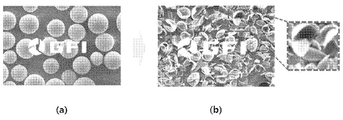
- 1 is a SEM image of (a) digestive microcapsules and (b) digestive microcapsules destroyed at a decapsulation temperature or higher according to an embodiment of the present invention.
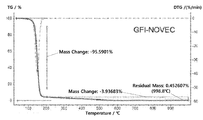
- FIG. 2 is a graph showing the results of thermogravimetric analysis of microcapsules for digestion according to an embodiment of the present invention.
- the present invention provides a microcapsule for digestion comprising a core-shell structure, wherein the core is an extinguishing agent, the shell is a high-density non-porous polymer, and a precipitant and/or a coagulant.
- 1(a) is a SEM photograph of a microcapsule for digestion according to an embodiment of the present invention, the microcapsule has a spherical shape, and the size of the digestive microcapsule may be 150 to 300 ⁇ m, but is limited thereto. no.
- the extinguishing agent of the present invention can be used with the formula C x H y O z Hal k (where x, y, z, k are 0, 1, 2, ..., Hal is Br, I, F) And, as an example, 3M's Novec 1230 (Novec 1230) may be used.
- the shell of the present invention is a cross-linked polyvinyl acetate, ethyl vinyl acetate, polyvinyl alcohol, polyurea, polyurethane, polyester resin, epoxy resin, urea formaldehyde resin, melamine formaldehyde resin, phenol formaldehyde resin and resorsi Nol may be formed of one or more resins selected from the group consisting of formaldehyde resins.
- the shell can be formed by using two or more copolymers of resin and resorcinol formaldehyde resin.
- the precipitating agent of the present invention may include one or more precipitating agents selected from the group consisting of potassium acetate, sodium citrate, sodium chloride, ammonium chloride, sodium iodide, potassium iodide, copper sulfate, and sodium thiocyanate.
- the coagulant may include one or more coagulants selected from the group consisting of aluminum sulfate, zinc hydroxide, iron hydroxide, and iron chloride.
- the decapsulation process in which the digestive agent, which is the core, leaves the shell occurs in a short time in a narrow temperature range, and decapsulation, which is the rate at which the digestive agent leaves the shell.
- the rate may exceed 150%/min.
- Figure 1(b) is a SEM photograph of a shell after the extinguishing agent, which is a core contained in the shell, is converted from liquid to gas due to an increase in ambient temperature, destroys the shell due to the increase in volume, and flows out to the outside. to be.
- this de-encapsulation process is the weight of the digestive microcapsules. It is preferable that the temperature range falling from 95% to 15% (the extinguishing agent is released to the outside) is within 40°C.
- FIG. 2 is a graph showing the results of a thermogravimetric analysis of the digestive microcapsules according to an embodiment of the present invention.
- the temperature at which the weight of the digestive microcapsules is 95% is 130 °C
- the temperature at which the weight of the digestive microcapsules is 15% is 170 °C. If the temperature range at which the de-encapsulation process of the extinguishing agent occurs is more than 40°C, the internal extinguishing agent is released in stages, and the appropriate concentration of the extinguishing agent to extinguish the fire cannot be met. The fire extinguishing agent must be released so that the fire can be extinguished quickly. Therefore, the digestive microcapsules may be configured such that the weight of the digestive microcapsules is 95% to 15% within a temperature range of 40°C.
- the deencapsulation rate using unencapsulated digestive microcapsules as the denominator and deencapsulated digestive microcapsules as the molecule may exceed 150%/min.
- the shell thickness of the fire extinguishing microcapsule of the present invention may be in the range of 200 nm to 5 ⁇ m, and if it is thinner than 200 nm, the stability of the shell is lowered, so that the internal extinguishing agent leaks to the outside or the shape is damaged due to the weight of the shells. If the shell thickness is thicker than 5 ⁇ m, the decapsulation process in which the internal extinguishing agent is released to the outside is difficult to occur.
- the weight loss is less than 0.5% of the initial weight, and left at 60°C for 30 days.
- the shell can be formed so that the weight loss is less than 1% of the initial weight.
- the shell formed in the digestive microcapsules can maintain physical-mechanical properties when exposed to water, alcohol, ketone, ether, and mixtures thereof that can be in contact with the external environment, and the weight loss after drying is the first weight.
- the shell can be formed to be less than 0.5%.
- the dispersed phase is a core extinguishing agent
- the dispersion solvent is a polar or non-polar first colloidal solution
- the dispersed phase is a prepolymer or oligomer of the shell
- the dispersion solvent is polar or Preparing a second colloidal solution that is non-polar
- the second colloidal solution is precipitated and cured at the interface of the first colloidal solution mixed in step (c) to form a core-shell, thereby forming a digestive microcapsule
- the step (d) It provides a method of manufacturing a digestive microcapsules comprising washing and filtering the digestive microcapsules formed in ).
- the fire extinguishing agent used in step (a) of the present invention is the formula C x H y O z Hal k (where x, y, z, k are 0, 1, 2, ..., and Hal is Br, I, F) can be used, and as an example, 3M's Novec 1230 (Novec 1230) can be used.
- the shell used in step (b) is cross-linked polyvinyl acetate, ethyl vinyl acetate, polyvinyl alcohol, polyurea, polyurethane, polyester resin, epoxy resin, urea formaldehyde resin, melamine formaldehyde resin, phenol. It may be formed of one or more resins selected from the group consisting of formaldehyde resins and resorcinol formaldehyde resins.
- the shell can be formed by using two or more copolymers of resin and resorcinol formaldehyde resin.
- a polymer or commercial emulsion of an oligomer may be further included in this step.
- step (a) may further include a nonionic material or an ionic surfactant as a stabilizer or emulsifier, or a polymer material may be further included as a stabilizer.
- the stabilizer may be formed as a part of the shell during the manufacturing process.
- Step (a) may further include one or more selected from the group consisting of water, ketones, alcohols or aliphatic hydrocarbons as a dispersed phase.
- the size of the digestive microcapsules may be selectively formed depending on whether a disperser, a propeller, or a turbine mixer is used to prepare the first colloid.
- the precipitating agent of step (c) of the present invention may include one or more precipitating agents selected from the group consisting of potassium acetate, sodium citrate, sodium chloride, ammonium chloride, sodium iodide, potassium iodide, copper sulfate, and sodium thiocyanate.
- the coagulant of step (c) may include at least one coagulant selected from the group consisting of aluminum sulfate, zinc hydroxide, iron hydroxide, and iron chloride.
- the step (d) of the present invention may further include a shell accelerator or curing catalysts.
- step (d) when the second colloidal solution is precipitated and cured at the interface of the first colloidal solution, UV, microwave, infrared, or induction heating is applied to precipitate the second colloidal solution at the interface of the first colloidal solution. When hardened, it can help harden into the shell.
- the present invention provides a fire extinguishing device in which microcapsules for fire extinguishing are dispersed in a polymer matrix.
- microcapsules for fire extinguishing dispersed in the fire extinguishing device of the present invention are microcapsules for fire extinguishing described above, a description will be omitted.
- the polymer matrix of the present invention is at least one selected from the group consisting of phenol formaldehyde resin, polyester resin, epoxy resin, urea resin, resorcinol formaldehyde resin, polyurethane, polyurea, polyacrylate or polymethyl methacrylate. What is resin can be used.
- the fire extinguishing device may include 0.1 to 90% by weight of microcapsules for fire extinguishing. If the fire extinguishing device contains less than 0.1% by weight of the fire extinguishing microcapsule, it is difficult to extinguish the fire because the amount of fire extinguishing agent is small in the event of a fire, and if it contains more than 90% by weight, it is difficult to form a fire extinguishing device. have.
- the fire extinguishing apparatus may further include a de-encapsulation agent, a de-encapsulation catalyst, a de-encapsulation temperature control agent, a diffusion accelerator, a gas permeability improver, and a thermal conductivity improvement component.
- the fire extinguishing device may be formed in a flexible or solid form depending on the physical properties of the polymer matrix, and may exhibit rigidity in the case of a solid.
- the fire extinguishing device may have a case including a gas-permeable membrane on one side.
- a case may be formed of any one selected from the group consisting of glass fiber, carbon fiber, stainless steel, aluminum reinforced phenol-formaldehyde and epoxy, and in the case of a gas permeable membrane, a cell size of 10 to 400 ⁇ m can be used. have.
- the fire extinguishing device manufactured in this way maintains the shell without releasing the fire extinguishing agent until the ambient temperature is about 140 °C, and the de-encapsulation process proceeds at a temperature higher than that, and a rapid rise in heat such as ESS, lithium ion battery module, and fab is expected. It can be installed in high-temperature devices.
- a specific operating temperature can be controlled by adjusting the shell thickness and/or the combination (binder material) of the digestive microcapsules.
- the fire extinguishing device of the present invention can be manufactured in various forms such as films, sheets, pads, wires, paints and faces by combining and applying various combinations (binding materials).
- the voids due to the air in the assembly do not lower the thermal conductivity, and heat transfer can be performed equally to the microcapsules for fire extinguishing in the fire extinguishing device.
- the fire extinguishing device can be prepared using a softened suspension when the content of the microcapsules for fire extinguishing is less than 60% by weight.
- the suspension may be prepared from digestive microcapsules, additives as needed, and a polymer matrix pre-cured about 20 to 30%.
- the pre-softening of the suspension is effected by microwave or induction heating at 60° C., depending on the resistance of the mixture, and exposed for 60 minutes to obtain a fluid state.
- the content of the digestive microcapsules of the fire extinguishing device is 60% by weight or more, it can be prepared by pressing the paste.
- the paste may be prepared from digestive microcapsules, additives as needed, and a polymer matrix cured in advance of about 40 to 60%.
- the pre-softening of the suspension is effected by microwave or induction heating at 60° C. depending on the resistance of the mixture, and exposed for 60 minutes to obtain an elastic state.
- the core-in fire extinguishing agent is 1,1,2,2-tetrafluoro dibromoethane
- the shell is an epoxy resin.
- the polymer matrix used in the fire extinguishing device was a phenol-formaldehyde resin.
- a colloidal solution of 1,1,2,2-tetrafluorovibroethane incubated with an aqueous resin solution in a ratio of 10 parts by weight of anhydrous epoxy resin per 100 parts by weight of 1,1,2,2- tetrafluoro vibroethane To prepare a second colloidal solution. Immediately after adding the epoxy resin solution, a precipitant (3% by weight of ammonium chloride in anhydrous epoxy resin) is introduced into the solution.
- the temperature profile is as follows; Ammonium chloride was added, heated to 40° C. at a rate of 1 K/min, maintained at 40° C. for 35 minutes, cooled at a rate of 10 K/min at 35° C., and temperature control was continued for 24 hours. After 24 hours the mixture was heated to 50° C.
- phenol-formaldehyde resin 100 g of phenol-formaldehyde resin is thoroughly mixed using a mixer. Thereafter, a shell made of 10 g of urotropin and 50 g of an epoxy resin and a microcapsule for fire extinguishing containing 1,1,2,2-tetrafluoro dibromoethane as a fire extinguishing agent were put into a mixer. Mix under constant stirring. The resulting composition was thoroughly mixed until a homogeneous mass was formed. Vacuum was applied to the kneader tank until it reached a pressure of 0.01 MPa, and it was maintained for 20 minutes after completion of mixing in a vacuum state.
- the resulting mass was taken out of the kneading bowl, dispersed in a casting mold, heated to 120° C., and removed from the mold to prepare a fire extinguishing device including microcapsules for fire extinguishing.
- This fire extinguishing device was finally manufactured by additional heat treatment for 36 hours at a temperature of 70° C. for further hardening.
- the core fire extinguishing agent is perfluoro-2-methyl-3-pentanone, and the shell is cross-linked polyvinyl alcohol.
- the polymer matrix used in the fire extinguishing device was polypropylene.
- a first colloidal solution was prepared while stirring at 110 rpm for 20 minutes. The first colloidal solution was incubated for 50 minutes at a temperature of 25° C. with constant stirring. Epichlorohydrin was added 10 parts by weight per 100 parts by weight of polyvinyl alcohol as a crosslinking agent for crosslinking polyvinyl alcohol, and these two were 1,1,2,2,-tetrafluoro dibromomethane incubated 1
- a second colloidal solution was prepared by adding to a colloidal solution of ,1,2,2-tetrafluorovibroethane.
- a precipitant anhydrous polyvinyl alcohol 1% by weight sodium thiocyanate
- the temperature profile is as follows; Sodium thiocyanate was added, heated to 45° C. at a rate of 1 K/min, maintained at 40° C. for 5 hours, cooled at 30° C. at a rate of 10 K/min, and temperature control was continued for 5 hours. The resulting mixture was drained, washed and dried in a suction filter immediately after the formation of a suspension of the digestive microcapsules was completed.
- the shell thickness is 1 ⁇ m, has a porosity of 1.2%, a de-encapsulation temperature of 140°C, and a yield of 95%, and a fire extinguishing micro containing perfluoro-2-methyl-3-pentanone as a fire extinguishing agent.
- Capsules were prepared.
- a fire extinguishing device including microcapsules for fire extinguishing was manufactured, and the dimensions were cut according to the intended use.
- the core-in fire extinguishing agent was 1,1,2,2-tetrafluorodibromethane, and the shell was polyurea.
- Polymethyl methacrylate (PMMA) was used as the polymer matrix used in the fire extinguishing device.
- a first colloidal solution was prepared while stirring at 3000 rpm for 40 minutes. The first colloidal solution is incubated for 90 minutes at a temperature of 25° C. with constant stirring. Isocyanate and polyamine aqueous solution were used as starting components of the shell, and these aqueous solutions were 1,1,2, incubated at a ratio of 15 parts by weight of anhydrous epoxy resin per 100 parts by weight of 1,1,2,2-tetrafluorovibroethane, A second colloidal solution was prepared by adding to the colloidal solution of 2-tetrafluorovibroethane.
- a precipitant (8% by weight of anhydrous polyurea resin potassium iodide) is introduced into the solution.
- the temperature profile is as follows; Potassium iodide added, heated to 40°C at a rate of 1 K/min, maintained at 40°C for 60 minutes, heated to 50°C at a rate of 1 K/min, held at 50°C for 60 minutes, maintained at a rate of 1 K/min at 60°C
- the furnace was heated, and temperature control was continued at 60° C. for 24 hours.
- the resulting mixture was drained, washed and dried in a suction filter immediately after the formation of a suspension of the digestive microcapsules was completed.
- 300 g of acrylic emulsion polymer (30%) is thoroughly mixed using a mixer. Thereafter, a shell made of 50 g of polyurea resin and microcapsules for extinguishing containing 1,1,2,2-tetrafluoro dibromoethane as a extinguishing agent were put into a mixer and mixed under constant stirring. The resulting composition was thoroughly mixed until a homogeneous mass was formed. The kneader tank was vacuumed until it reached a pressure of 0.01 MPa, and was maintained for 30 minutes after completion of mixing in a vacuum state.
- the resulting mass was taken out of the kneading bowl, dispersed in a casting mold, heated to 60° C., removed from the mold to have elasticity, and a fire extinguishing device including microcapsules for fire extinguishing was manufactured.
- This fire extinguishing device was finally manufactured by additional heat treatment for 36 hours at a temperature of 70° C. for further hardening.
Landscapes
- Chemical & Material Sciences (AREA)
- Organic Chemistry (AREA)
- Chemical Kinetics & Catalysis (AREA)
- Dispersion Chemistry (AREA)
- General Chemical & Material Sciences (AREA)
- Business, Economics & Management (AREA)
- Emergency Management (AREA)
- Manufacturing Of Micro-Capsules (AREA)
- Fire-Extinguishing Compositions (AREA)
Abstract
La présente invention concerne une micro-capsule d'extinction d'incendie, son procédé de fabrication, et un extincteur d'incendie l'utilisant. La micro-capsule d'extinction d'incendie a une structure cœur-écorce dans laquelle le cœur comprend des produits chimiques d'extinction d'incendie liquides et l'écorce utilise un matériau polymère non-poreux à haute densité. Le processus de décapsulation de la micro-capsule d'extinction d'incendie se produit à une vitesse d'au moins 150 %/min dans des plages de temps et de températures étroites, et la stabilité des produits chimiques dans l'eau et d'autres solvants est significativement augmentée. L'extincteur d'incendie comprenant la micro-capsule d'extinction d'incendie présente les avantages d'une durée de vie et d'une efficacité fonctionnelle améliorées.
Priority Applications (4)
| Application Number | Priority Date | Filing Date | Title |
|---|---|---|---|
| US17/438,660 US12685887B2 (en) | 2019-03-19 | 2020-02-19 | Fire extinguishing micro-capsule, method for manufacturing same, and fire extinguisher including same |
| CN202080016929.7A CN113573786B (zh) | 2019-03-19 | 2020-02-19 | 灭火用微包囊,其制备方法及包括其的灭火装置 |
| JP2021550311A JP7384917B2 (ja) | 2019-03-19 | 2020-02-19 | 消火用マイクロカプセル、これの製造方法及びこれを含む消火装置 |
| US19/405,780 US20260137972A1 (en) | 2019-03-19 | 2025-12-02 | Fire extinguishing micro-capsule, method for manufacturing same, and fire extinguisher including same |
Applications Claiming Priority (2)
| Application Number | Priority Date | Filing Date | Title |
|---|---|---|---|
| KR10-2019-0031519 | 2019-03-19 | ||
| KR1020190031519A KR102123554B1 (ko) | 2019-03-19 | 2019-03-19 | 소화용 마이크로 캡슐, 이의 제조 방법 및 이를 포함하는 소화 장치 |
Related Child Applications (2)
| Application Number | Title | Priority Date | Filing Date |
|---|---|---|---|
| US17/438,660 A-371-Of-International US12685887B2 (en) | 2019-03-19 | 2020-02-19 | Fire extinguishing micro-capsule, method for manufacturing same, and fire extinguisher including same |
| US19/405,780 Division US20260137972A1 (en) | 2019-03-19 | 2025-12-02 | Fire extinguishing micro-capsule, method for manufacturing same, and fire extinguisher including same |
Publications (1)
| Publication Number | Publication Date |
|---|---|
| WO2020189900A1 true WO2020189900A1 (fr) | 2020-09-24 |
Family
ID=71141873
Family Applications (1)
| Application Number | Title | Priority Date | Filing Date |
|---|---|---|---|
| PCT/KR2020/002432 Ceased WO2020189900A1 (fr) | 2019-03-19 | 2020-02-19 | Micro-capsule d'extinction d'incendie, son procédé de fabrication, et extincteur d'incendie la comprenant |
Country Status (5)
| Country | Link |
|---|---|
| US (2) | US12685887B2 (fr) |
| JP (1) | JP7384917B2 (fr) |
| KR (1) | KR102123554B1 (fr) |
| CN (1) | CN113573786B (fr) |
| WO (1) | WO2020189900A1 (fr) |
Cited By (1)
| Publication number | Priority date | Publication date | Assignee | Title |
|---|---|---|---|---|
| US12677396B2 (en) | 2023-03-06 | 2026-07-07 | International Business Machines Corporation | Heatsink with phase changing plugs and extinguishing coolant |
Families Citing this family (15)
| Publication number | Priority date | Publication date | Assignee | Title |
|---|---|---|---|---|
| CN113230577A (zh) * | 2021-04-26 | 2021-08-10 | 深圳供电局有限公司 | 锂离子电池微胶囊灭火剂及其制备方法与应用 |
| KR102508290B1 (ko) | 2021-07-02 | 2023-03-09 | 주식회사 가온테크놀러지 | 자기 소화 마이크로캡슐 조성물 |
| CN115463371B (zh) * | 2021-11-02 | 2023-08-18 | 湖北省汉楚澳龙消防设备有限公司 | 环保型复合泡沫灭火剂及其制备方法 |
| KR102687779B1 (ko) * | 2021-12-03 | 2024-07-24 | 벽산페인트 주식회사 | 저장안정성, 내구성 및 내용제성을 갖는 마이크로 소화캡슐 및 이의 제조방법 |
| KR102730029B1 (ko) | 2021-12-20 | 2024-11-15 | 주식회사 가온테크놀러지 | Iot기능을 겸비한 자기 소화 마이크로캡슐 패드 |
| WO2023244137A1 (fr) * | 2022-06-14 | 2023-12-21 | Александр Дмитриевич ВИЛЕСОВ | Agent d'extinction de feu à microcapsules |
| CN115487460B (zh) * | 2022-06-15 | 2023-07-14 | 浙江虹达特种橡胶制品有限公司杭州分公司 | 防火和/或灭火材料 |
| CN116059574B (zh) * | 2023-02-13 | 2024-05-03 | 哲弗智能系统(上海)有限公司 | 一种锂电池复合灭火剂及其制备方法和应用 |
| KR102729003B1 (ko) * | 2023-03-27 | 2024-11-11 | 이정원 | 리튬배터리 화재진압을 위한 소화약제 제조방법 |
| CN116850522B (zh) * | 2023-05-26 | 2024-04-23 | 广东黑卫防火技术有限公司 | 固态气凝胶全氟己酮灭火片材及其制备方法、磁吸灭火贴以及储能装置 |
| CN116870415B (zh) * | 2023-06-08 | 2024-10-01 | 香港科技大学 | 一种灭火微胶囊及其制备方法和应用 |
| CN117018529B (zh) * | 2023-07-20 | 2025-05-02 | 东莞澳中新材料科技股份有限公司 | 一种灭火微胶囊、灭火胶带及其应用 |
| KR20260010054A (ko) | 2024-07-12 | 2026-01-20 | 한국생산기술연구원 | 소화용 마이크로셀을 포함하는 플라스틱 및 복합소재 제품 및 이의 제조 방법 |
| KR102816162B1 (ko) * | 2024-08-16 | 2025-06-10 | 전서연 | 리튬배터리 화재진압에 적용되는 소화약제 제조방법 |
| JP7828667B1 (ja) | 2024-11-28 | 2026-03-12 | ファイターコリアコンパニーリミテッド | マイクロカプセル消火成分の製造方法、その消火成分を用いた消火パッチの製造方法、及びそれによる消火パッチ |
Citations (5)
| Publication number | Priority date | Publication date | Assignee | Title |
|---|---|---|---|---|
| WO2012177181A1 (fr) * | 2011-06-23 | 2012-12-27 | Общество С Ограниченной Ответственностью "Делси" | Agent d'extinction d'incendie micro-encapsulé et procédé de production correspondant |
| JP2014509230A (ja) * | 2011-02-10 | 2014-04-17 | オブシェストヴォ エス オグラニシェノイ オトヴェツトヴェン ノスチュ “ピロチミカ−センター” | 自動消火剤 |
| JP2016176013A (ja) * | 2015-03-20 | 2016-10-06 | 三菱製紙株式会社 | 蓄熱材マイクロカプセル造粒物 |
| KR101733423B1 (ko) * | 2016-02-22 | 2017-05-08 | 주식회사 지에프아이 | 할로겐계 가스 소화약제 조성물 및 그 제조방법 |
| EP3228366A1 (fr) * | 2014-12-04 | 2017-10-11 | Limited Liability Company "Rusintech" | Micro-capsules, procédé de production, et agents, matériaux, revêtements et articles d'extinction d'incendie les comprenant |
Family Cites Families (11)
| Publication number | Priority date | Publication date | Assignee | Title |
|---|---|---|---|---|
| US8453751B2 (en) * | 2001-08-01 | 2013-06-04 | Firetrace Usa, Llc | Methods and apparatus for extinguishing fires |
| US7867613B2 (en) * | 2005-02-04 | 2011-01-11 | Oxane Materials, Inc. | Composition and method for making a proppant |
| RU2389525C2 (ru) * | 2006-07-14 | 2010-05-20 | Общество С Ограниченной Ответственностью "Делси" | Микрокапсулированный огнегасящий агент и способ его получения, огнегасящий композиционный материал, огнегасящее покрытие из краски и огнегасящая ткань, содержащие такой агент |
| CN101664587A (zh) * | 2009-06-10 | 2010-03-10 | 张奕 | 一种感温自控干粉灭火弹 |
| JP5374309B2 (ja) * | 2009-09-30 | 2013-12-25 | 積水化学工業株式会社 | マイクロカプセル型消火剤、樹脂組成物及び樹脂成型体 |
| US8465833B2 (en) * | 2011-08-30 | 2013-06-18 | Empire Technology Development Llc | Ferrocene/carbon dioxide releasing system |
| CN103170087B (zh) * | 2011-12-20 | 2015-12-09 | 西安坚瑞安全应急设备有限责任公司 | 一种含有糖类及糖类衍生物的灭火组合物 |
| JP2012136713A (ja) * | 2012-04-16 | 2012-07-19 | Hitachi Chemical Co Ltd | コアシェルポリマ |
| CN106807027B (zh) * | 2017-01-24 | 2019-09-03 | 北京安科控源科技有限公司 | 微胶囊灭火剂 |
| CN109420281A (zh) * | 2017-09-04 | 2019-03-05 | 西安威西特消防科技有限责任公司 | 一种微胶囊自动灭火剂 |
| CN108905038B (zh) * | 2018-08-27 | 2020-07-03 | 安徽理工大学 | 一种基于激波二次抛洒的微囊灭火剂及其制备方法 |
-
2019
- 2019-03-19 KR KR1020190031519A patent/KR102123554B1/ko active Active
-
2020
- 2020-02-19 WO PCT/KR2020/002432 patent/WO2020189900A1/fr not_active Ceased
- 2020-02-19 CN CN202080016929.7A patent/CN113573786B/zh active Active
- 2020-02-19 US US17/438,660 patent/US12685887B2/en active Active
- 2020-02-19 JP JP2021550311A patent/JP7384917B2/ja active Active
-
2025
- 2025-12-02 US US19/405,780 patent/US20260137972A1/en active Pending
Patent Citations (5)
| Publication number | Priority date | Publication date | Assignee | Title |
|---|---|---|---|---|
| JP2014509230A (ja) * | 2011-02-10 | 2014-04-17 | オブシェストヴォ エス オグラニシェノイ オトヴェツトヴェン ノスチュ “ピロチミカ−センター” | 自動消火剤 |
| WO2012177181A1 (fr) * | 2011-06-23 | 2012-12-27 | Общество С Ограниченной Ответственностью "Делси" | Agent d'extinction d'incendie micro-encapsulé et procédé de production correspondant |
| EP3228366A1 (fr) * | 2014-12-04 | 2017-10-11 | Limited Liability Company "Rusintech" | Micro-capsules, procédé de production, et agents, matériaux, revêtements et articles d'extinction d'incendie les comprenant |
| JP2016176013A (ja) * | 2015-03-20 | 2016-10-06 | 三菱製紙株式会社 | 蓄熱材マイクロカプセル造粒物 |
| KR101733423B1 (ko) * | 2016-02-22 | 2017-05-08 | 주식회사 지에프아이 | 할로겐계 가스 소화약제 조성물 및 그 제조방법 |
Cited By (1)
| Publication number | Priority date | Publication date | Assignee | Title |
|---|---|---|---|---|
| US12677396B2 (en) | 2023-03-06 | 2026-07-07 | International Business Machines Corporation | Heatsink with phase changing plugs and extinguishing coolant |
Also Published As
| Publication number | Publication date |
|---|---|
| CN113573786A (zh) | 2021-10-29 |
| JP2022522213A (ja) | 2022-04-14 |
| US20220152439A1 (en) | 2022-05-19 |
| US20260137972A1 (en) | 2026-05-21 |
| KR102123554B1 (ko) | 2020-06-16 |
| US12685887B2 (en) | 2026-07-21 |
| JP7384917B2 (ja) | 2023-11-21 |
| CN113573786B (zh) | 2022-12-30 |
Similar Documents
| Publication | Publication Date | Title |
|---|---|---|
| US20260137972A1 (en) | Fire extinguishing micro-capsule, method for manufacturing same, and fire extinguisher including same | |
| US3594326A (en) | Method of making microscopic capsules | |
| CN101611509B (zh) | 由碳和可交联的树脂纤维形成的用于电化学电池的电极基质 | |
| CN114917521B (zh) | 一种温度响应型双壳层微胶囊灭火剂及其制备方法 | |
| CN117018529B (zh) | 一种灭火微胶囊、灭火胶带及其应用 | |
| WO2023277564A1 (fr) | Composition de microcapsule auto-extinguible et son procédé de fabrication | |
| KR102123659B1 (ko) | 소화용 마이크로 캡슐을 포함하는 소화용 시트 | |
| US20100061897A1 (en) | Microencapsulation of amines | |
| KR102595797B1 (ko) | 소화용 마이크로캡슐을 포함하는 자기소화 복합 시트 및 이의 제조 방법 | |
| CN109957208A (zh) | 一种轻质微烧蚀型复合材料及其制备方法 | |
| CN121035523B (zh) | 一种干法耐高温锂电池隔膜及其制备方法 | |
| CN120714194B (zh) | 一种微胶囊化高效自动灭火贴片及其制备方法 | |
| WO2019212080A1 (fr) | Isolation souple à base d'aérogel et procédé pour sa fabrication | |
| CN120818346B (zh) | 一种冲砂暂堵剂及其制备方法 | |
| CN121601344A (zh) | 一种超级快充液冷电缆及其制备方法 | |
| CN111320453A (zh) | 一种用于抑制电池热失控扩散的隔离材料 | |
| CN118253064A (zh) | 一种含灭火微胶囊的混合物的制法 | |
| CN108807788A (zh) | 一种锂离子动力电池用复合隔膜及其制备方法 | |
| US3406119A (en) | Encapsulation | |
| WO2024101585A1 (fr) | Matériau composite comprenant un matériau à changement de phase, et son procédé de production | |
| JPH11166071A (ja) | ミクロ多孔体及びその製造方法 | |
| CN119752106B (zh) | 一种具有糖类污秽自降解功能的脂环族环氧树脂材料及其制备方法 | |
| CN121028311B (zh) | 一种具有防鼠涂层结构的防鼠光缆及制备工艺 | |
| CN121108870A (zh) | 一种微胶囊灭火点胶及其制备方法 | |
| CN115678077B (zh) | 聚酰胺网络增强导热、绝缘复合材料及其制备方法 |
Legal Events
| Date | Code | Title | Description |
|---|---|---|---|
| 121 | Ep: the epo has been informed by wipo that ep was designated in this application |
Ref document number: 20774637 Country of ref document: EP Kind code of ref document: A1 |
|
| ENP | Entry into the national phase |
Ref document number: 2021550311 Country of ref document: JP Kind code of ref document: A |
|
| NENP | Non-entry into the national phase |
Ref country code: DE |
|
| 122 | Ep: pct application non-entry in european phase |
Ref document number: 20774637 Country of ref document: EP Kind code of ref document: A1 |