WO2020191641A1 - 用于随机机接入的方法和设备 - Google Patents
用于随机机接入的方法和设备 Download PDFInfo
- Publication number
- WO2020191641A1 WO2020191641A1 PCT/CN2019/079767 CN2019079767W WO2020191641A1 WO 2020191641 A1 WO2020191641 A1 WO 2020191641A1 CN 2019079767 W CN2019079767 W CN 2019079767W WO 2020191641 A1 WO2020191641 A1 WO 2020191641A1
- Authority
- WO
- WIPO (PCT)
- Prior art keywords
- information
- scheduling information
- terminal device
- network device
- uplink data
- Prior art date
- Legal status (The legal status is an assumption and is not a legal conclusion. Google has not performed a legal analysis and makes no representation as to the accuracy of the status listed.)
- Ceased
Links
Images




Classifications
-
- H—ELECTRICITY
- H04—ELECTRIC COMMUNICATION TECHNIQUE
- H04W—WIRELESS COMMUNICATION NETWORKS
- H04W74/00—Wireless channel access
- H04W74/08—Non-scheduled access, e.g. ALOHA
- H04W74/0833—Random access procedures, e.g. with 4-step access
- H04W74/0841—Random access procedures, e.g. with 4-step access with collision treatment
-
- H—ELECTRICITY
- H04—ELECTRIC COMMUNICATION TECHNIQUE
- H04W—WIRELESS COMMUNICATION NETWORKS
- H04W72/00—Local resource management
- H04W72/04—Wireless resource allocation
- H04W72/044—Wireless resource allocation based on the type of the allocated resource
- H04W72/0466—Wireless resource allocation based on the type of the allocated resource the resource being a scrambling code
-
- H—ELECTRICITY
- H04—ELECTRIC COMMUNICATION TECHNIQUE
- H04W—WIRELESS COMMUNICATION NETWORKS
- H04W72/00—Local resource management
- H04W72/12—Wireless traffic scheduling
- H04W72/1263—Mapping of traffic onto schedule, e.g. scheduled allocation or multiplexing of flows
-
- H—ELECTRICITY
- H04—ELECTRIC COMMUNICATION TECHNIQUE
- H04W—WIRELESS COMMUNICATION NETWORKS
- H04W74/00—Wireless channel access
- H04W74/002—Transmission of channel access control information
- H04W74/006—Transmission of channel access control information in the downlink, i.e. towards the terminal
-
- H—ELECTRICITY
- H04—ELECTRIC COMMUNICATION TECHNIQUE
- H04W—WIRELESS COMMUNICATION NETWORKS
- H04W74/00—Wireless channel access
- H04W74/08—Non-scheduled access, e.g. ALOHA
- H04W74/0833—Random access procedures, e.g. with 4-step access
-
- H—ELECTRICITY
- H04—ELECTRIC COMMUNICATION TECHNIQUE
- H04W—WIRELESS COMMUNICATION NETWORKS
- H04W72/00—Local resource management
- H04W72/20—Control channels or signalling for resource management
- H04W72/23—Control channels or signalling for resource management in the downlink direction of a wireless link, i.e. towards a terminal
-
- H—ELECTRICITY
- H04—ELECTRIC COMMUNICATION TECHNIQUE
- H04W—WIRELESS COMMUNICATION NETWORKS
- H04W74/00—Wireless channel access
- H04W74/08—Non-scheduled access, e.g. ALOHA
- H04W74/0833—Random access procedures, e.g. with 4-step access
- H04W74/0836—Random access procedures, e.g. with 4-step access with 2-step access
Definitions
- the embodiments of the present application relate to the field of communications, and more specifically, to a method and device for random machine access.
- Random access is the most basic function of a cellular system. It makes it possible for terminal equipment to establish a communication connection with network equipment.
- NR new radio
- 5G system or 5G network a four-step random access process similar to long term evolution (LTE) is adopted.
- LTE long term evolution
- the signaling overhead of the process is relatively large.
- the embodiment of the present application provides a method and device for random machine access, and provides a data transmission method for a terminal device that uses a two-step random access method for random access.
- a method for random machine access including: a terminal device sends a first preamble and first uplink data to a network device; the terminal device receives scheduling information sent by the network device; The terminal device performs subsequent transmission according to the scheduling information.
- a method for random machine access which includes: a network device detects a first preamble and first uplink data sent by a terminal device; , Sending scheduling information to the terminal device; the network device has performed subsequent transmissions according to the scheduling information.
- a terminal device configured to execute the method described in the foregoing first aspect or any optional implementation manner of the first aspect.
- the terminal device includes a functional module for executing the method described in the foregoing first aspect or any optional implementation of the first aspect.
- a network device configured to execute the method described in the foregoing second aspect or any optional implementation manner of the second aspect.
- the network device includes a functional module for executing the method described in the foregoing second aspect or any optional implementation of the second aspect.
- a terminal device including a processor and a memory.
- the memory is used to store a computer program
- the processor is used to call and run the computer program stored in the memory to execute the method in the above-mentioned first aspect or each of its implementation modes.
- a network device including a processor and a memory.
- the memory is used to store a computer program
- the processor is used to call and run the computer program stored in the memory to execute the method in the above-mentioned second aspect or each of its implementation modes.
- a device for implementing the foregoing first aspect or any possible implementation of the first aspect.
- the device includes a processor, configured to call and run a computer program from the memory, so that the device installed with the device executes the method in the first aspect or any possible implementation of the first aspect.
- a device is provided to implement the foregoing second aspect or any possible implementation of the second aspect.
- the device includes a processor, configured to call and run a computer program from the memory, so that the device installed with the device executes the method in the above-mentioned second aspect or any possible implementation of the second aspect.
- a computer-readable storage medium for storing a computer program that enables a computer to execute the above-mentioned first aspect or the method in any possible implementation of the first aspect.
- a computer-readable storage medium for storing a computer program that enables a computer to execute the method in the foregoing second aspect or any possible implementation of the second aspect.
- a computer program product including computer program instructions that cause a computer to execute the above-mentioned first aspect or the method in any possible implementation of the first aspect.
- a computer program product including computer program instructions that cause a computer to execute the foregoing second aspect or any possible implementation of the second aspect.
- a computer program which, when run on a computer, causes the computer to execute the method in the first aspect or any possible implementation of the first aspect.
- a computer program which when running on a computer, causes the computer to execute the above-mentioned second aspect or any possible implementation of the second aspect.
- the terminal device when the terminal device selects a two-step random access process for random access, it will send the first preamble and the first uplink data to the network device.
- the network device may send different scheduling information to the terminal device according to the receiving situation of the first uplink data.
- the terminal equipment can perform different transmissions with the network equipment according to the scheduling information. By sending scheduling information, the flexibility of transmission between terminal equipment and network equipment can be improved.
- Fig. 1 is a schematic diagram of a wireless communication system applied in an embodiment of the present application.
- Fig. 2 is a schematic diagram of a four-step random access process provided by an embodiment of the present application.
- Fig. 3 is a schematic structural diagram of a RAR format provided by an embodiment of the present application.
- FIG. 4 is a schematic structural diagram of another RAR format provided by an embodiment of the present application.
- Fig. 5 is a schematic structural diagram of a MAC PDU provided by an embodiment of the present application.
- Fig. 6 is a schematic structural diagram of another RAR format provided by an embodiment of the present application.
- Fig. 7 is a schematic diagram of a two-step random access process provided by an embodiment of the present application.
- FIG. 8 is a schematic flowchart of a method for random access provided by an embodiment of the present application.
- FIG. 9 is a schematic block diagram of a terminal device provided by an embodiment of the present application.
- FIG. 10 is a schematic block diagram of a network device provided by an embodiment of the present application.
- FIG. 11 is a schematic structural diagram of a communication device provided by an embodiment of the present application.
- FIG. 12 is a schematic structural diagram of a device provided by an embodiment of the present application.
- FIG. 13 is a schematic block diagram of a communication system provided by an embodiment of the present application.
- GSM Global System of Mobile communication
- CDMA Code Division Multiple Access
- WCDMA Wideband Code Division Multiple Access
- GPRS General Packet Radio Service
- LTE Long Term Evolution
- FDD Frequency Division Duplex
- TDD Time Division Duplex
- LTE Long Term Evolution
- NR New Radio
- evolution system of NR system LTE (LTE-based access to unlicensed spectrum, LTE-U) system on unlicensed spectrum, NR (NR) on unlicensed spectrum -based access to unlicensed spectrum (NR-U) system, Universal Mobile Telecommunication System (UMTS), Worldwide Interoperability for Microwave Access (WiMAX) communication system , Wireless Local Area Networks (WLAN), Wireless Fidelity (WiFi), next-generation communication systems or other communication systems, etc.
- the embodiment of this application does not limit the applied spectrum.
- the embodiments of this application can be applied to licensed spectrum or unlicensed spectrum.
- Fig. 1 shows a wireless communication system 100 applied in an embodiment of the present application.
- the wireless communication system 100 may include a network device 110.
- the network device 100 may be a device that communicates with terminal devices.
- the network device 100 may provide communication coverage for a specific geographic area, and may communicate with terminal devices (such as UE) located in the coverage area.
- the network device 100 may be a base station (Base Transceiver Station, BTS) in a GSM system or a CDMA system, a base station (NodeB, NB) in a WCDMA system, or a base station in an LTE system or an NR system.
- BTS Base Transceiver Station
- NodeB NodeB
- An evolved base station (Evolutional Node B, eNB or eNodeB), or a wireless controller in a cloud radio access network (Cloud Radio Access Network, CRAN), or the network device can be a relay station, an access point, a vehicle Wearable devices, network side devices in 5G networks, or network devices in the future evolution of the Public Land Mobile Network (PLMN), etc.
- eNB evolved Node B
- CRAN Cloud Radio Access Network
- PLMN Public Land Mobile Network
- the wireless communication system 100 also includes at least one terminal device 120 located within the coverage area of the network device 110.
- the terminal device 120 may be mobile or fixed.
- the terminal device 120 may refer to an access terminal, user equipment (UE), user unit, user station, mobile station, mobile station, remote station, remote terminal, mobile equipment, user terminal, terminal, wireless communication Equipment, user agent or user device.
- UE user equipment
- the access terminal can be a cellular phone, a cordless phone, a Session Initiation Protocol (SIP) phone, a wireless local loop (Wireless Local Loop, WLL) station, a personal digital processing (Personal Digital Assistant, PDA), with wireless communication Functional handheld devices, computing devices or other processing devices connected to wireless modems, in-vehicle devices, wearable devices, terminal devices in the future 5G network or terminal devices in the future evolved PLMN, etc.
- SIP Session Initiation Protocol
- WLL Wireless Local Loop
- PDA Personal Digital Assistant
- D2D direct terminal
- the 5G system or network may also be referred to as an NR system or network.
- Figure 1 exemplarily shows one network device and two terminal devices.
- the wireless communication system 100 may include multiple network devices and the coverage of each network device may include other numbers of terminal devices.
- the application embodiment does not limit this.
- the wireless communication system 100 may also include access and mobility management functions (Access and Mobility Management Function, AMF), session management functions (Session Management Function, SMF), and unified data management (Unified Data Management, UDM).
- AMF Access and Mobility Management Function
- SMF Session Management Function
- UDM Unified Data Management
- AUSF Authentication Server Function
- computer-readable media may include, but are not limited to: magnetic storage devices (for example, hard disks, floppy disks, or tapes, etc.), optical disks (for example, compact discs (Compact Disc, CD), digital versatile discs (Digital Versatile Disc, DVD)) Etc.), smart cards and flash memory devices (for example, Erasable Programmable Read-Only Memory (EPROM), cards, sticks or key drives, etc.).
- magnetic storage devices for example, hard disks, floppy disks, or tapes, etc.
- optical disks for example, compact discs (Compact Disc, CD), digital versatile discs (Digital Versatile Disc, DVD)) Etc.
- smart cards and flash memory devices for example, Erasable Programmable Read-Only Memory (EPROM), cards, sticks or key drives, etc.
- various storage media described herein may represent one or more devices and/or other machine-readable media for storing information.
- the term "machine-readable medium” may include, but is not limited to, various media capable of storing, containing, and/or carrying instructions and/or data.
- the terminal equipment usually can perform uplink transmission only after obtaining synchronization with the network equipment through a random access process.
- the random access process usually adopts a four-step random access process based on contention.
- the four-step random access process is described below with reference to FIG. 2.
- the method includes steps S210-S240.
- the terminal device selects physical random access channel (PRACH) resources, such as at least one of PRACH time domain resources, frequency domain resources, and code domain resources.
- PRACH physical random access channel
- the terminal device sends a message 1 (message1, MSG1) to the network device on the selected PRACH resource, and the MSG1 contains the random access preamble selected by the terminal device.
- the network device can estimate the uplink transmission time according to the preamble sent by the terminal device, and the size of the uplink resource required for the terminal device to send MSG3 in step S230.
- the network device After receiving MSG1, the network device sends MSG2 on a downlink shared channel (DL-SCH), where MSG2 is a random access response (Random Access Response, RAR).
- DL-SCH downlink shared channel
- RAR Random Access Response
- the RAR carries the uplink transmission timing advance (timeing advance, TA) and available uplink resource information, as well as the temporary cell radio network temporary identifier (T-CRNTI), that is, the temporary CRNTI .
- TA timeing advance
- T-CRNTI temporary cell radio network temporary identifier
- the RAR may be generated by the Media Access Control (MAC) layer of the network device, and the RAR generated by the MAC layer may also be referred to as MAC RAR.
- MAC Media Access Control
- One MSG2 can simultaneously respond to random access requests from multiple terminal devices.
- the terminal device After sending the MSG1, the terminal device can open a RAR window, and monitor the physical downlink control channel (PDCCH) in the RAR window.
- PDCCH physical downlink control channel
- the PDCCH is a PDCCH scrambled by using random access RNTI (radom access RNTI, RA-RNTI), where RA-RNTI is calculated as follows:
- RA-RNTI 1+s_id+14 ⁇ t_id+14 ⁇ 80 ⁇ f_id+14 ⁇ 80 ⁇ 8 ⁇ ul_carrier_id.
- s_id represents the index of the first symbol of the PRACH opportunity
- t_id represents the index number of the first subframe where PRACH is sent
- f_id represents the frequency domain position index of the first subframe
- ul_carrier_id represents the random access preamble transmission
- the type of uplink carrier (0 is the uplink carrier, 1 is the supplementary uplink carrier).
- the RA-RNTI is related to the PRACH time-frequency resource selected by the terminal equipment. Both the terminal equipment and the network equipment can determine the RA-RNTI according to the time-frequency resources of the PRACH.
- the network device may scramble the PDCCH according to the determined RA-RNTI, and send the scrambled PDCCH to the terminal device.
- the terminal equipment can decode the PDCCH sent by the network equipment according to the determined RA-RNTI.
- the terminal device After the terminal device successfully monitors the PDCCH scrambled by the RA-RNTI, and obtains the physical downlink shared channel (PDSCH) scheduled by the PDCCH according to the PDCCH.
- the PDSCH may include RAR, where the format of RAR may be as shown in Figs. 3-6.
- a MAC RAR can be carried in a MAC protocol data unit (protocol data unit, PDU).
- PDU protocol data unit
- a MAC PDU can include three parts in structure. One part is the MAC header, which has a variable size; the other is the RAR load, which is the RAR load. It can include one or more MAC RARs; the other part is padding information, which is optional.
- One MAC header may include one or more MAC sub-headers.
- the MAC header may include two types of sub-headers, as shown in Figures 3 and 4.
- Figures 3 and 4 show schematic diagrams of the two types of MAC sub-headers. These two types of subheaders can be distinguished by the type field "T".
- the BI can be used to indicate the back-off time for retransmitting MSG1.
- RAPID is the preamble in MSG1 received in response to the network device, and the value of RAPID may be the value of the preamble sent by the terminal device to the network device.
- the field "BI" represents a backoff indicator, which is used to indicate the backoff time for retransmission of MSG1.
- Figure 5 shows a schematic structural diagram of a MAC PDU including a MAC RAR.
- Figure 5 shows a case where the MAC header includes multiple MAC subheaders. Of course, one MAC header may also include one MAC subheader.
- the RAR may include at least one of the following information: uplink timing advance, uplink grant (UL grant) information, and temporary C-RNTI.
- uplink grant information is used to indicate the uplink resources that the terminal device can use to send the MSG.
- the uplink timing advance is used to adjust the uplink timing of the terminal device sending uplink data.
- Temporary C-RNTI is used to scramble the PDCCH in MSG4.
- the uplink authorization information may include at least one of the following information: frequency hopping information, physical uplink shared channel (physical uplink shared channel, PUSCH) frequency domain resources, PUSCH time domain resources, modulation and coding strategy (modulation and coding scheme) , MCS), used for PUSCH transmit power control (transmit power control, TPC) commands, and channel state information (channel state information, CSI) requests.
- frequency hopping information physical uplink shared channel (physical uplink shared channel, PUSCH) frequency domain resources, PUSCH time domain resources, modulation and coding strategy (modulation and coding scheme) , MCS), used for PUSCH transmit power control (transmit power control, TPC) commands, and channel state information (channel state information, CSI) requests.
- TPC power control
- CSI channel state information
- frequency hopping information occupies 1 bit
- PUSCH frequency domain resources occupies 14 bits
- PUSCH time domain resources occupies 4 bits
- MCS occupies 4 bits
- the CSI request occupies 1 bit.
- Table 2 shows a corresponding relationship between TPC commands and power adjustment information.
- the bit value of the TPC command indicates the value of 3 bits occupied by the TPC command.
- the bit value of the TPC command is 0, it means that the transmission power of PUSCH needs to be adjusted by -6dB; when the bit value of the TPC command is 1, it means that the transmission power of PUSCH needs to be adjusted by -4dB; when the bit value of the TPC command is 2, It means that the transmission power of PUSCH needs to be adjusted by -2dB; when the bit value of the TPC command is 3, it means that the transmission power of PUSCH needs to be adjusted by 0dB; when the bit value of the TPC command is 4, it means that the transmission power of PUSCH needs to be adjusted by 2dB; when TPC When the bit value of the command is 5, it means that the PUSCH transmission power needs to be adjusted by 4dB; when the bit value of the TPC command is 6, it means that the PUSCH transmission power needs to be adjusted by 6dB; when the bit value of the TPC command is 7, it means PUSCH transmission The
- the terminal device judges whether the MSG2 belongs to its own RAR message. After determining that the MSG2 is its own RAR message, the MSG3 message can be sent on the available uplink resources indicated by the network device.
- the MSG3 message can be a radio resource control (RRC) message.
- RRC radio resource control
- the MSG3 message can carry the RNTI dedicated to the terminal device.
- the main function of the MSG3 message is to inform the network equipment of what event triggered the random access process.
- the MSG3 message may carry the terminal device identification and the establishment event, and the establishment event is, for example, an RRC connection request message.
- the MSG3 message may carry the terminal device identification in the connected state and an establishment event, and the establishment event is, for example, an RRC connection re-establishment process.
- terminal device identification carried in MSG3 can be used to determine whether the competition is successful in MSG4.
- the terminal device receives the MSG4 sent by the network device.
- the MSG4 can also be called a contention resolution message, which can be used to determine whether the contention is successful.
- MSG4 may also include uplink resources allocated by network equipment to terminal equipment.
- the terminal device identifier carried in the MSG4 is consistent with the terminal device identifier sent by the terminal device to the network device in MSG3, it indicates that the random access is successful, and the terminal device can perform uplink transmission on the uplink resource indicated in MSG4.
- the terminal device identifier carried in the MSG4 is inconsistent with the terminal device identifier sent by the terminal device to the network device in MSG3, it means that the terminal device has failed random access. After the random access fails, the terminal device can re-execute the steps S210 to S240. Re-initiate random access.
- MSG4 has two functions. One is to indicate to the terminal device whether the random access competition is successful, and the other is to transmit an RRC configuration message to the terminal device.
- the traditional four-step random access process requires four signaling interactions between the terminal device and the network device to successfully access.
- the four-step random access process is likely to cause high signaling overhead and prolonged access time.
- a two-step random access procedure is proposed.
- the two-step random access process in simple terms, it is equivalent to combining the first and third steps of the four-step random access process into the first step in the two-step random access process.
- the second and fourth steps of the process are combined into the second step in the two-step random access process.
- step S710 the terminal device sends MSGA to the network device.
- the MSGA includes random access preamble, uplink data and terminal equipment identification.
- the uplink data can be carried on the PUSCH.
- the PUSCH may carry a terminal device specific RNTI.
- the content of the uplink data may be different according to different random access scenarios.
- the uplink data may include an RRC connection request message.
- the uplink data may include an RRC connection re-establishment request message.
- the uplink data may also be uplink information carried in the PDCCH.
- the random access preamble may be a preamble randomly selected by the terminal device.
- the preamble may be one of multiple preambles provided by the network device.
- step S720 the network device sends the MSGB to the terminal device.
- the MSGB may include RAR and contention resolution messages.
- MSG3 supports Hybrid Automatic Repeat reQuest (HARQ) retransmission, that is, network equipment can pass temporary C-RNTI scrambled cyclic redundancy check (cyclic redundancy check, CRC) ) MSG3 retransmission scheduled by UL grant.
- HARQ Hybrid Automatic Repeat reQuest
- CRC cyclic redundancy check
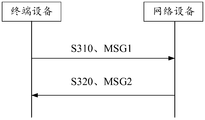
- the embodiment of the present application provides a method for random access, and provides a data transmission method based on two-step random access. As shown in FIG. 8, the method includes steps S810 to S830.
- the terminal device sends the first preamble and the first uplink data to the network device.
- the content sent by the terminal device to the network device can be the same as the content of the MSGA described above.
- the first preamble is a preamble used by the terminal device for random access, and the terminal device can select a resource for sending the first preamble, and send the first preamble on the selected resource.
- the resources of the first preamble may include at least one of the following resources: time domain resources, frequency domain resources, and code domain resources.
- the terminal device can also send the identification information of the terminal device to the network device.
- the network device sends scheduling information to the terminal device according to the receiving situation of the first uplink data. Similarly, the terminal device can receive the scheduling information sent by the network device.
- the network device can detect the first uplink data sent by the terminal device, and the network device may have two reception conditions.
- the first case is that the network device receives the first preamble, but the first uplink data is not correctly received
- the second case is that the network device correctly receives the first preamble and the first uplink data.
- this embodiment of the application will not consider it temporarily. Therefore, the following descriptions are based on the situation that the network device correctly receives the first preamble.
- the network device can send different scheduling information to the terminal device. For example, if the network device does not correctly receive the first uplink data, the network device can send the first scheduling information to the terminal device to trigger the terminal device to retransmit the uplink data. The first scheduling information can be used to instruct the terminal device to send uplink data. data. For another example, if the network device correctly receives the first uplink data, the network device may send the second scheduling information and the MSGB to the terminal device, and the second scheduling information is used to instruct the terminal device to receive the downlink data.
- the network device described above does not correctly receive the first uplink data includes two cases.
- the first case is that the network device does not receive the first uplink data, that is, the network device does not detect the first uplink data at all; the second case It is the network device that received the first uplink data, but the network device only received a part of the first uplink data, the first uplink data was not completely received, or the network device did not correctly decode the first uplink data, etc.
- the terminal device After sending the MSGA, the terminal device receives the scheduling information sent by the network device within a time window, where the MSGA may include the first preamble and the first uplink data.
- the time window may refer to a period of time after the terminal device sends MSGA.
- the start of the time window is later than the load of MSGA, or the start of the time window may be delayed by N symbols and time slots based on the subframe in which the load of MSGA is sent. Or milliseconds, etc., N is a positive integer.
- the duration of the time window can be K symbols, time slots, or milliseconds, etc., and K is a positive integer.
- the time window can be similar to the existing RAR time window.
- the time window in the embodiment of the present application may be smaller than the RAR time window in the four-step random access process, so that the random access delay of the terminal device can be reduced.
- the terminal device After receiving the scheduling information sent by the network device, the terminal device performs subsequent transmission. Similarly, the network device can also perform subsequent transmissions based on the scheduling information.
- the terminal device can perform different transmissions with the network device according to the type of scheduling information sent by the network device.
- the terminal device detects that the scheduling information sent by the network device is the first scheduling information, it means that the network device does not correctly receive the first uplink data, and the terminal device may resend the uplink data to the network device.
- the terminal device detects that the scheduling information sent by the network device is the second scheduling information, it means that the network device correctly receives the first uplink data, and the terminal device can receive the data sent by the network device according to the resource location indicated in the second scheduling information
- the terminal device may receive the contention resolution message sent by the network device according to the resource location indicated in the second scheduling information.
- the uplink data re-sent by the terminal device to the network device may be the first uplink data or the newly selected uplink data. If the uplink data re-sent by the terminal device to the network device is the first uplink data, it means that the terminal device is retransmitting MSGA. If the uplink data re-sent by the terminal device to the network device is second uplink data that is different from the first uplink data, it means that the random access process of the terminal device falls back to the four-step random access process, and the second uplink data sent by the terminal device It can be understood as MSG3 in the four-step random access process.
- the network device may indicate through certain fields in the scheduling information. For specific instructions, please refer to the following description.
- the network device can also perform different transmissions with the terminal device according to the difference in the scheduling information sent to the terminal device. If the scheduling information sent by the network device to the terminal device is the first scheduling information, the network device can receive the uplink data sent by the terminal device. If the scheduling information sent by the network device to the terminal device is the second scheduling information, the network device may send the MSGB to the terminal device.
- the network device may send the second scheduling information and the MSGB to the terminal device simultaneously, that is, the network device sends the second scheduling information and the MSGB to the terminal device at the same time.
- the network device can combine the first uplink data received this time with the first uplink data previously received to improve the reception detection performance and the reception The correct rate of receiving the first uplink data.
- the terminal device only needs to upload the first uplink data and does not need to send the first preamble to the network device together, which can avoid redundant transmission of the preamble.
- the terminal device may also send the first preamble and the first uplink data to the network device together. Since the preamble has a certain auxiliary effect on the detection and reception of the first uplink data, for example, the preamble is used as a part of the demodulation pilot, which is beneficial to the reception of the first uplink data. Therefore, transmitting the first preamble can also improve the first uplink data. The correct rate of reception.
- the above technical solution provides a load retransmission mechanism in MSGA, so that network equipment can combine multiple transmissions of the same load, improve the signal to interference plus noise ratio (SINR), and can Improve the probability of correctly detecting the uplink data, reduce the number of retransmissions, and enhance MSGA coverage.
- the load in MSGA can be understood as uplink data.
- the first scheduling information and the second scheduling information may both be carried on the PDSCH.
- the first scheduling information and the second scheduling information may be carried on the RAR in the PDSCH.
- the format of RAR can be as shown in Figure 6.
- the RAR may be generated by the MAC layer.
- the network equipment can carry all the content of the scheduling information on the RAR.
- the timing advance included in the scheduling information, uplink transmission parameters, and information for identifying terminal equipment are all carried on the RAR.
- the scheduling information carried on the RAR may mean that the scheduling information is carried in the UL grant.
- the terminal device may receive the RAR within a time window. Specifically, the terminal device may receive the PDCCH scrambled by the RA-RNTI within a time window, and obtain the PDSCH scheduled by the PDCCH. The terminal device detects the PDSCH, and transmits the transport block (TB) of the PDSCH to the higher layer.
- RAPID random access preamble identity
- the first scheduling information and the second scheduling information are carried in the same manner, that is, both are carried by RAR, which can prevent the terminal device from detecting multiple PDCCHs at the same time. Since one PDCCH can schedule different PDSCHs, and different PDSCHs can carry different scheduling information, a terminal device can obtain multiple types of scheduling information carried by multiple PDSCHs by detecting the same PDCCH.
- the difference information between the first scheduling information and the second scheduling information can be indicated by any bit in the RAR, in other words, the type of scheduling information can be indicated by any bit in the RAR.
- the difference information between the first scheduling information and the second scheduling information can be indicated by at least one of the following bits: a reserved (R) bit in RAR, a bit indicating the timing advance , Indicating the bits of the temporary C-RNTI.
- R when R is set to 1, it means that the RAR bears the first scheduling information, and when R is set to 0, it means that the RAR bears the second scheduling information.
- the difference information between the first scheduling information and the second scheduling information may be indicated by at least one of the bits used to indicate the UL grant in the RAR.
- the current UL grant information can be compressed, and the extra bits indicate the difference between the first scheduling information and the second scheduling information.
- the UL grant information can be compressed from the current 27 bits to 26 bits, and the extra bit is used to indicate the difference between the first scheduling information and the second scheduling information.
- the extra bit can be called the first bit. When the value of the first bit is 1, it means that the RAR carries the first scheduling information; when the value of the first bit is 1, When it is 0, it means that the RAR bears the second scheduling information.
- compressing UL grant information can be achieved by compressing at least one piece of information in Table 1.
- the difference information between the first scheduling information and the second scheduling information may be indicated by compressing the bits used to indicate the MCS in the UL grant.
- the difference information between the first scheduling information and the second scheduling information may be indicated by compressing or deleting the bits used to indicate the CSI request message in the UL grant.
- the difference information between the first scheduling information and the second scheduling information may be indicated by one bit, or may be indicated by multiple bits, which is not specifically limited in the embodiment of the present application. Using one bit to indicate the first scheduling information and the second scheduling information can save signaling overhead.
- Case 2 The first scheduling information is carried by PDSCH, and the second scheduling information is carried by PDCCH.
- the terminal device can determine whether the received scheduling information is the first scheduling information or the second scheduling information according to the difference of the channels.
- the first scheduling information is carried by the PDSCH, and the PDSCH may be scheduled by the PDCCH with the CRC scrambled by the RA-RNTI.
- the first scheduling information may be the scheduling information that the network device sends to the terminal device for the first time after receiving the first preamble sent by the terminal device. In other words, when the network device sends the first scheduling information to the terminal device for the first time, the first scheduling information may be carried on the PDSCH and sent to the terminal device.
- the network device may carry the first scheduling information through the PDSCH, and may also carry the first scheduling information through the PDCCH.
- the second scheduling information is carried by the PDCCH, and the downlink control information (DCI) in the PDCCH may be scrambled by using the first RNTI, and the first RNTI may be used to identify the terminal device.
- DCI downlink control information
- the first RNTI may be a C-RNTI, and the C-RNTI may be obtained by the terminal device from scheduling information previously sent by the network device. Alternatively, the first RNTI may also be determined according to the resource of the first preamble and/or the resource of the PUSCH carrying the first uplink data and/or the carrying information in the PUSCH carrying the first uplink data.
- the resources of the first preamble include at least one of the following: time domain resources of the first preamble, frequency domain resources of the first preamble, and code domain resources of the first preamble.
- the resource of the PUSCH carrying the first uplink data includes the pilot resource and/or the code domain resource of the PUSCH.
- the bearer information in the PUSCH that bears the first uplink data includes the information used to identify the terminal device that is borne in the PUSCH.
- the first RNTI may be generated according to at least one of the following information: time domain information of the first preamble, frequency domain information of the first preamble, code domain information of the first preamble, and carry the first uplink
- the first scheduling information and the second scheduling information may both be carried on the PDCCH.
- the first scheduling information and the second scheduling information may be carried by different PDCCHs.
- the scheduling information is carried on the PDCCH, which can mean that all the scheduling information is carried on the PDCCH, or that part of the scheduling information is carried on the PDCCH, and the other part of the scheduling information is carried on the PDSCH scheduled by the PDCCH.
- the DCI in the PDCCH may be scrambled by using a temporary C-RNTI, or it may be scrambled by using a first RNTI.
- the first RNTI may be used to identify a terminal device. The first RNTI can be determined by referring to the above description.
- the first RNTI can be close to the RNTI dedicated to the terminal device, and can be used to identify the terminal device to a certain extent.
- the first scheduling information carried in the DCI may be the scheduling information sent by the network device to the terminal device for the first time after receiving the first preamble.
- the way for the terminal device to obtain the temporary C-RNTI may be obtained from the scheduling information that the network device sends to the terminal device for the first time.
- DCI can also be scrambled by RA-RNTI.
- the scheduling information carried in the PDCCH can be the scheduling information that the network device sends to the terminal device for the first time, or it can be the non-first time that the network device sends to the terminal device. Scheduling information. Because whether it is the first transmission or the non-first transmission, the terminal equipment and the network equipment can determine the RA-RNTI according to Formula 1, and the terminal equipment can correctly decode the PDCCH according to the RA-RNTI.
- the terminal device may receive the PDCCH sent by the network device within a time window. Specifically, the terminal device may receive the PDCCH scrambled by the X-RNTI within a time window, and the X-RNTIC-RNTI may also be the first RNTI described above.
- PDCCH scheduling Due to the greater flexibility of PDCCH scheduling, it can allocate appropriate resources for terminal equipment, such as time-frequency resources and modulation and coding schemes, to ensure the reliability of data transmission, and terminal equipment can use appropriate resources for transmission when transmitting uplink data . Therefore, the PDCCH is used to carry scheduling information, which can improve the efficiency of retransmission.
- the difference information between the first scheduling information and the second scheduling information may be indicated by the RNTI that scrambles the DCI.
- the difference information between the first scheduling information and the second scheduling information may be indicated by at least one of the bits used to indicate uplink and downlink transmission in the DCI in the PDCCH.
- the DCI in the PDCCH may include a bit indicating uplink and downlink transmission, and the difference information may be multiplexed with the bit to indicate. For example, when the bit indicates uplink transmission, it indicates that the DCI is the first scheduling information. When the bit indicates downlink transmission, it indicates that the DCI is the second scheduling information.
- Case 3 can be used in combination with Case 1 and Case 2.
- the network device may send the first scheduling information to the terminal device.
- the first scheduling information is that the network device receives the first The scheduling information sent to the terminal device for the first time after the preamble.
- the first scheduling information is carried on the PDSCH, and the PDSCH may be scheduled by using the DCI scrambled by RA-RNTI. Since the terminal device can determine the RA-RNTI, the terminal device can correctly receive the first scheduling information carried in the PDSCH. While sending the first scheduling information to the terminal device, the network device may also send the C-RNTI to the terminal device.
- the terminal device may resend the uplink data to the network device. If the network device still does not correctly receive the uplink data re-sent by the Austrian terminal device, the network device may continue to send the first scheduling information to the network device.
- the first scheduling information may be carried on the PDCCH. Since the terminal device has previously sent the C-RNTI to the terminal device, in this transmission, the C-RNTI may be used to scramble the DCI in the PDCCH.
- the network equipment can also carry all subsequent scheduling information in the PDCCH.
- scrambled DCI in the embodiment of the present application can be understood as scrambled CRC in the DCI.
- the content in the first scheduling information is described below.
- the first scheduling information may include at least one of the following information: a timing advance, information for identifying terminal equipment, and uplink transmission parameters.
- the timing advance can be used to indicate the timing advance of uplink transmission, which can improve the transmission reliability of retransmission and reduce interference to other terminal devices.
- the information used to identify the terminal device can be obtained in a display or implicit manner.
- the information used to identify the terminal device may include preamble resource and/or X-RNTI.
- the information used to identify the terminal device may include preamble resources, and the preamble resources may include at least one of the following: time domain resources, frequency domain resources, and code domain resources.
- the preamble resource may include RAPID.
- the terminal device can determine whether the RAR is its own RAR according to the RAPID information in the RAR.
- the information used to identify the terminal device may include X-RNTI, and the X-RNTI may be used to scramble the DCI in the PDCCH.
- the terminal equipment can use X-RNTI to decode the PDCCH. If the terminal equipment can decode the PDCCH correctly, it means that the PDCCH belongs to the terminal equipment; if the terminal equipment cannot decode the PDCCH correctly, it means that the PDCCH does not belong to the terminal equipment. The terminal equipment.
- the uplink transmission parameters include at least one of the following information: time domain resources, frequency domain resources, pilot resources, MCS, power information, new data indicator (new date indicator, NDI) information, and redundancy version (RV) )information.
- NDI can be used to indicate whether the uplink data sent by the terminal device is a retransmission of the first uplink data.
- the case where the terminal device retransmits the first uplink data may be referred to as retransmission, and the case where the uplink data sent by the terminal device is not limited to the first uplink data is referred to as initial transmission.
- RV represents the RV version adopted by the uplink data.
- RV value is ⁇ 0,1 ⁇
- the corresponding RV version is 0,3 respectively.
- the corresponding RV versions are 0,2,3,1 respectively.
- NDI information and RV information can be indicated by different bits, or can be indicated by the same bit.
- one bit can be used to indicate both the NDI information and the RV information. For example, when the value of this bit is 1, it means retransmission and the RV version is 3; when the value of this bit is 0, it means the initial transmission and the RV version is 0.
- Using the same bit to indicate both NDI information and RV information can mean retaining the original NDI bit.
- RV information can be obtained indirectly through the value of the NDI bit, or it can mean retaining the original RV bit.
- NDI information can be obtained through The value of the RV bit is obtained indirectly.
- the embodiment of the present application may also use multiple identical bits to indicate NDI information and RV information. For example, 2 bits are used to indicate NDI information and RV information.
- Using the same bits to indicate both NDI information and RV information can reduce signaling overhead, and using fewer bits to indicate NDI information and RV information. Since NDI information and RV information require fewer bits, only the remaining bits after compressing the bits in the UL grant can be used for indication, which can avoid the use of timing advance and temporary C-RNTI bits, which can reduce Impact on timing advance and temporary C-RNTI transmission.
- the following describes how to carry the information included in the scheduling information according to the different bearing situations of the scheduling information.
- the scheduling information is carried on the PDCCH
- all the information included in the scheduling information can be carried on the PDCCH, or part of the information can be carried on the PDCCH, and the other part of the information can be carried on the PDSCH scheduled by the PDCCH.
- the information used to identify the terminal equipment and the uplink transmission parameters can be carried on the PDCCH, and the timing advance can be carried by the MAC control element (CE) in the subsequent PDSCH. Since the information and uplink transmission parameters used to identify the terminal equipment are originally included in the DCI, and the DCI does not include the timing advance, the way of carrying the timing advance through the PDSCH has little impact on the existing protocol and can reduce the terminal the complexity.
- CE MAC control element
- the information used to identify the terminal equipment, the uplink transmission parameters and the timing advance are all carried on the PDCCH.
- the excess bits can be used to indicate the timing advance by compressing or multiplexing the bits in the existing DCI.
- the terminal device can obtain the timing advance while acquiring the uplink transmission parameters. After the terminal device obtains the timing advance in time, it can avoid interference with other terminal devices. Therefore, this method can complete the synchronization of the uplink data in time, improve the transmission reliability of the retransmission, and reduce the interference to other users.
- Multiplexing or compressing the bits in the existing DCI can include the following two methods:
- Reusing or compressing the bits in the existing DCI may refer to compressing the bits indicating at least one of the following information: RV information, frequency resources, time domain resources, and HARQ process numbers. Because the size of the uplink data sent by the terminal device can basically be determined, the time domain resources and frequency domain resources used by the terminal device to send the uplink data are also basically determined. Therefore, the information of the above time domain resources and frequency domain resources can be compressed to indicate the time. Advance amount. In the case where data transmission does not occur, that is, when the terminal device is initially connected, the HARQ process number of the terminal device is unique, so the HARQ process number can be compressed to indicate the timing advance.
- NDI information By multiplexing at least one bit of at least one of the following information: NDI information, RV information, and HARQ process number.
- NDI information and RV information can be indicated by the same bits, and the other information can be implicitly indicated, the existing bits for indicating NDI information and RV information can be reused to indicate time advance the amount.
- the process number of the terminal device For the HARQ process number, for the initial access situation, the process number of the terminal device is unique and does not need to be indicated. Therefore, the bit used to indicate the HARQ process number can be used to indicate the timing advance.
- scheduling information is carried on the RAR
- all the information included in the scheduling information can be carried on the RAR.
- Figure 6 shows a schematic diagram of a RAR format.
- Table 1 shows the occupancy of various information bits included in the uplink authorization information in the existing RAR.
- the uplink authorization information does not include NDI information and RV information.
- NDI information and RV information it may be indicated by bits in the RAR used to indicate at least one of the following information: uplink grant information and temporary C-RNTI.
- the NDI information and the RV information can be indicated by compressing the extra bits used to indicate the time domain resources in the uplink grant information. as shown in Table 3.
- the NDI information and/or RV information can also be indicated by compressing other information in the uplink grant information.
- the UL grant and temporary C-RNTI bits in the RAR may be used to indicate NDI information and/or RV information.
- Example 1 Adding temporary C-RNTI bits to indicate NDI information and/or RV information. As shown in Table 4.
- the temporary C-RNTI bits can be increased by 3, that is, the temporary C-RNTI bits are increased from the original 13 to 16.
- the added 1 bit is used to increase the bit indicating the MCS, and the MCS bit is increased from the original 4 to 5; the added 2 bits are used to indicate the RV information.
- RAR Authorized Domain Number of bits Frequency hopping 1 PUSCH frequency domain resources 14 PUSCH time domain resources 4 MCS 5 TPC commands for PUSCH 3 CSI request 1 RV 2 Padding 13
- Example 2 By compressing the bits of the temporary C-RNTI to indicate the NDI information and/or RV information, the compressed bits of the temporary C-RNTI can be notified to the terminal device through protocol agreement or notification by the network device. For example, set the high or low bits of the temporary C-RNTI to a special value. If the upper three bits of the temporary C-RNTI are defaulted to 0, the extra bits after compression can be used to indicate NDI information and/or RV information. As shown in Table 5.
- RAR Authorized Domain Number of bits Frequency hopping 1 PUSCH frequency domain resources 14 PUSCH time domain resources 4 MCS 5 TPC commands for PUSCH 3 CSI request 1 RV 2 Temporary C-RNTI 13
- the number of temporary C-RNTI bits can be increased by 3, that is, the number of C-RNTI bits has been increased from 13 to 16, and the added 1 bit can be used to increase the bit indicating MCS To increase the indication range of the MSC, the additional 2 bits can be used to indicate RV information.
- the terminal device may determine whether the uplink data retransmitted to the network device is the first uplink data according to the NDI information and/or RV information in the first scheduling information. When the NDI information and/or RV information indicate retransmission, the terminal device retransmits the first uplink data to the network device. When the NDI information and/or the RV information indicate initial transmission, the terminal device may send second uplink data to the network device, and the second uplink data may be the same as the first uplink data or different from the first uplink data.
- Retransmission may mean that the terminal device continues to use the two-step random access process for access, and the terminal device needs to re-send the same data as the first uplink data in the MSGA to the network device.
- Initial transmission means that the terminal device reverts to the four-step random machine access process, and the uplink data sent to the network device may not be limited to the first uplink data.
- the terminal device can send uplink data based on the first scheduling information sent by the network device, and the uplink data sent by the terminal device is equivalent to MSG3 in the four-step random access process.
- the terminal device after the terminal device receives the scheduling information sent by the network device, it can perform different transmissions according to different scheduling information.
- the scheduling information received by the terminal device is the second scheduling information, and the terminal device receives the MSGB based on the second scheduling information; in one case, the scheduling information received by the terminal device is the first scheduling information, and the first scheduling information is The scheduling information indicates retransmission, and retransmission means that the uplink data re-sent by the terminal device is the first uplink data, and the terminal device may send the first uplink data to the network device based on the first scheduling information; if the scheduling information received by the terminal device is the first uplink data One scheduling information, and the first scheduling information indicates initial transmission.
- the initial transmission means that the uplink data re-sent by the terminal device may not be limited to the first uplink data, and the terminal device may send second uplink data to the network device.
- the data may be the same as or different from the first uplink data.
- the first scheduling information indicates whether retransmission or initial transmission may be indicated by NDI information and/or RV information,
- the transmission block size and/or power of the uplink data sent by the terminal device will be different.
- the transmission block size used by the terminal device to send the first uplink data is the same as the transmission block size used for the previous transmission of the first uplink data, regardless of the time domain voluntary sum in the first scheduling information.
- the transport block size used by the terminal device to send the second uplink data may be determined according to at least one of the following information: time domain resources, frequency domain resources, and MCS.
- the power at which the terminal device sends the first uplink data may be determined according to the TPC command in the first scheduling information and the power used to send the first uplink data last time, that is, the first
- the TPC command in a scheduling information is the adjustment information relative to the most recent PUSCH transmission power. If it is the initial transmission, the power of the terminal device to send the first uplink data can be determined according to the TPC command in the first scheduling information and the power used to send the first preamble last time, that is, the first scheduling information
- the TPC command in is the adjustment information relative to the transmission power of the most recent preamble. This method can distinguish the power adjustment mechanism and adapt to different modes.
- the TPC command in the first scheduling information may be adjustment information relative to the transmission power of the most recent PUSCH. This can achieve rapid accumulation of capacity.
- the terminal device may choose to re-initiate random access.
- the maximum number of retransmissions can be configured by the network device, or it can be the amount agreed by the agreement.
- the maximum number of retransmissions may be 4, for example.
- the embodiment of the application does not specifically limit the random access mode re-initiated by the terminal device.
- a four-step random access may be initiated to resend the random access preamble to the network device.
- a two-step random access can also be initiated to send a random access preamble and uplink data to the network device.
- the wireless communication method according to the embodiment of the present application is described in detail above.
- the device according to the embodiment of the present application will be described below in conjunction with FIG. 9 to FIG. 13.
- the technical features described in the method embodiment are applicable to the following device embodiments.
- FIG. 9 is a schematic block diagram of a terminal device according to an embodiment of the present application.
- the terminal device 900 in FIG. 9 includes a communication unit 910 and a processing unit 920, where:
- the communication unit 910 sends the first preamble and the first uplink data to the network device.
- the communication unit 910 is also configured to receive scheduling information sent by the network device.
- the processing unit 920 is configured to perform subsequent transmission according to the scheduling information.
- the scheduling information is first scheduling information or second scheduling information
- the first scheduling information is used to instruct the terminal device to send uplink data
- the second scheduling information is used to instruct the terminal device to receive Downlink data.
- the communication unit 910 is configured to resend the first uplink data to the network device when the scheduling information is the first scheduling information.
- the communication unit 910 is further configured to resend the first preamble to the network device.
- both the first scheduling information and the second scheduling information are carried on a physical downlink shared channel PDSCH.
- both the first scheduling information and the second scheduling information are carried on a random access response RAR in the PDSCH.
- the difference information between the first scheduling information and the second scheduling information is indicated by at least one of the following bits: a reserved bit in the RAR, compressed to indicate a timing advance
- the surplus bits after the bits are compressed to indicate the surplus bits after the bits of the temporary cell radio network temporary identification C-RNTI.
- the difference information between the first scheduling information and the second scheduling information is indicated by at least one of the bits used for indicating uplink grant information in the RAR.
- the difference information between the first scheduling information and the second scheduling information is indicated by compressing the extra bits used to indicate the modulation and coding strategy MCS in the uplink grant information.
- the difference information between the first scheduling information and the second scheduling information is indicated by multiplexing bits used to indicate the channel state information CSI request message in the uplink grant information.
- the first scheduling information is carried on the PDSCH
- the second scheduling information is carried on the physical downlink control channel PDCCH.
- the PDSCH is scheduled by DCI scrambled by a random access wireless network temporary identifier RA-RNTI.
- the DCI in the PDCCH is scrambled by using a first RNTI, and the first RNTI is used to identify a terminal device.
- the first scheduling information is scheduling information sent to the terminal device for the first time after the network device receives the first preamble.
- both the first scheduling information and the second scheduling information are carried on the PDCCH.
- the difference information between the first scheduling information and the second scheduling information is indicated by scrambling the RNTI of the DCI carried in the PDCCH.
- the difference information between the first scheduling information and the second scheduling information is indicated by at least one of the bits used to indicate uplink and downlink transmission in the DCI in the PDCCH.
- the first scheduling information is scheduling information sent to the terminal device for the first time after the network device receives the first preamble.
- the PDCCH is scrambled by using a temporary cell radio network temporary identification C-RNTI, and the temporary C-RNTI is obtained from the first scheduling information sent by the network device to the terminal device for the first time.
- the first scheduling information includes at least one of the following information: a timing advance, information for identifying a terminal device, and uplink transmission parameters.
- the uplink transmission parameters include at least one of the following information: time domain resources, frequency domain resources, pilot resources, MCS, power information, new data indicator NDI information, and redundancy version RV information.
- the NDI information and the RV information are indicated by the same bit.
- the first scheduling information is carried on the PDCCH
- the information for identifying the terminal equipment and the uplink transmission parameters are carried on the PDCCH
- the timing advance is carried on the PDSCH scheduled by the PDCCH on.
- the first scheduling information is carried on a PDCCH, and the information for identifying a terminal device, the uplink transmission parameter, and the timing advance are all carried on the PDCCH.
- the timing advance is indicated by compressing the extra bits used to indicate at least one of the following information: NDI information, RV information, frequency resources, time domain resources, hybrid automatic retransmission Request HARQ process ID.
- the first scheduling information is carried in the RAR, and the NDI information and the RV information are redundant after compressing the bits used to indicate uplink grant information and/or temporary C-RNTI information in the RAR. The bits are indicated.
- the NDI information and the RV information are indicated by compressing extra bits used to indicate the time domain resource in the uplink grant information.
- the information used to identify the terminal device includes at least one of the following information: a preamble resource and the first RNTI.
- the first scheduling information is carried by RAR, and the information for identifying the terminal device includes the preamble resource.
- the preamble resource includes a random access preamble identifier RAPID.
- the first scheduling information is carried by a PDCCH, and the information for identifying a terminal device is indicated by the first RNTI scrambling the DCI carried in the PDCCH.
- the terminal device further includes a processing unit, configured to, in a case where the scheduling information is the first scheduling information, determine to send the information to the first scheduling information according to RV information and/or NDI information in the first scheduling information Whether the uplink data re-sent by the network device is the first uplink data.
- a processing unit configured to, in a case where the scheduling information is the first scheduling information, determine to send the information to the first scheduling information according to RV information and/or NDI information in the first scheduling information Whether the uplink data re-sent by the network device is the first uplink data.
- the terminal device sends the uplink data to the network
- the transmission block size used by the device to resend the first uplink data is the same as the transmission block size used by the terminal device to send the first uplink data to the network device for the first time, or,
- the terminal device sends the uplink data to the network device.
- the size of the resource block used for the uplink data retransmitted by the device is determined according to at least one of the time domain resource, the frequency domain resource, and the MCS in the first scheduling information.
- the terminal device sends the uplink data to the network
- the power used by the device to retransmit the first uplink data is based on the transmit power control TPC information in the first scheduling information, and the power used by the terminal device to transmit the first uplink data to the network device last time Power determined, or,
- the terminal device sends the uplink data to the network device.
- the power used for the uplink data retransmitted by the device is determined according to the TPC information in the first scheduling information and the power at which the terminal device previously sent the first preamble to the network device.
- the communication unit 910 is configured to: in the case that the scheduling information is the first scheduling information, and the terminal device continuously receives the first scheduling information for a maximum number of retransmissions, re-initiate random Access.
- the maximum number of retransmissions is configured by the network device, or the maximum number of retransmissions is specified in a protocol.
- the value of the maximum number of retransmissions is 4.
- the communication unit 910 is configured to: resend the random access preamble and uplink data to the network device; or, resend the random access preamble to the network device.
- terminal device 900 can perform the corresponding operations performed by the terminal device in the foregoing method, and for brevity, details are not described herein again.
- FIG. 10 is a schematic block diagram of a network device provided by an embodiment of the present application.
- the network device 1000 shown in FIG. 10 includes a processing unit 1010 and a communication unit 1020, where:
- the processing unit 1010 is configured to detect the first preamble and the first uplink data sent by the terminal device.
- the communication unit 1020 is configured to send scheduling information to the terminal device according to the receiving situation of the first uplink data.
- the communication unit 1020 is also used to perform subsequent transmissions according to the scheduling information.
- the scheduling information is first scheduling information or second scheduling information
- the first scheduling information is used to instruct the terminal device to send uplink data
- the second scheduling information is used to instruct the terminal device to receive Downlink data.
- the communication unit 1010 is configured to: if the first uplink data is not correctly received, send first scheduling information to the terminal device; according to the scheduling information, receive the terminal device again The first uplink data sent.
- the communication unit 1010 is further configured to: receive the first preamble sent by the terminal device.
- both the first scheduling information and the second scheduling information are carried on a physical downlink shared channel PDSCH.
- both the first scheduling information and the second scheduling information are carried on a random access response RAR in the PDSCH.
- the difference information between the first scheduling information and the second scheduling information is indicated by at least one of the following bits: a reserved bit in the RAR, compressed to indicate a timing advance
- the surplus bits after the bits are compressed to indicate the surplus bits after the bits of the temporary cell radio network temporary identification C-RNTI.
- the difference information between the first scheduling information and the second scheduling information is indicated by at least one of the bits used to indicate uplink grant information in the RAR.
- the difference information between the first scheduling information and the second scheduling information is indicated by compressing the extra bits used to indicate the modulation and coding strategy MCS in the uplink grant information.
- the difference information between the first scheduling information and the second scheduling information is indicated by multiplexing bits used to indicate the channel state information CSI request message in the uplink grant information.
- the first scheduling information is carried on the PDSCH
- the second scheduling information is carried on the physical downlink control channel PDCCH.
- the PDSCH is scheduled by downlink control information DCI scrambled by the random access radio network temporary identifier RA-RNTI.
- the DCI in the PDCCH is scrambled by using a first RNTI, and the first RNTI is used to identify a terminal device.
- the first scheduling information is scheduling information sent to the terminal device for the first time after the network device receives the first preamble.
- both the first scheduling information and the second scheduling information are carried on the PDCCH.
- the difference information between the first scheduling information and the second scheduling information is indicated by scrambling the RNTI of the DCI carried in the PDCCH.
- the difference information between the first scheduling information and the second scheduling information is indicated by at least one of the bits used to indicate uplink and downlink transmission in the DCI in the PDCCH.
- the first scheduling information is scheduling information sent to the terminal device for the first time after the network device receives the first preamble.
- the PDCCH is scrambled by using a temporary cell radio network temporary identification C-RNTI, and the temporary C-RNTI is obtained from the first scheduling information sent by the network device to the terminal device for the first time.
- the first scheduling information includes at least one of the following information: a timing advance, information for identifying a terminal device, and uplink transmission parameters.
- the uplink transmission parameters include at least one of the following information: time domain resources, frequency domain resources, pilot resources, MCS, power information, new data indicator NDI information, and redundancy version RV information.
- the NDI information and the RV information are indicated by the same bit.
- the first scheduling information is carried on the PDCCH
- the information for identifying the terminal equipment and the uplink transmission parameters are carried on the PDCCH
- the timing advance is carried on the PDSCH scheduled by the PDCCH on.
- the first scheduling information is carried on a PDCCH, and the information for identifying a terminal device, the uplink transmission parameter, and the timing advance are all carried on the PDCCH.
- the timing advance is indicated by compressing the extra bits used to indicate at least one of the following information: NDI information, RV information, frequency resources, time domain resources, hybrid automatic retransmission Request HARQ process ID.
- the first scheduling information is carried in the RAR, and the NDI information and the RV information are redundant after compressing the bits used to indicate uplink grant information and/or temporary C-RNTI information in the RAR. The bits are indicated.
- the NDI information and the RV information are indicated by compressing extra bits used to indicate the time domain resource in the uplink grant information.
- the information used to identify the terminal device includes at least one of the following information: a preamble resource and the first RNTI.
- the first scheduling information is carried by RAR, and the information for identifying the terminal device includes the preamble resource.
- the preamble resource includes a random access preamble identifier RAPID.
- the first scheduling information is carried by a PDCCH, and the information for identifying a terminal device is indicated by the first RNTI scrambling the DCI carried in the PDCCH.
- the first scheduling information includes RV information and/or NDI information
- the RV information and/or NDI information is used to indicate whether the uplink data retransmitted by the terminal device to the network device is the The first upstream data.
- the terminal device sends the uplink data to the network
- the transmission block size used by the device to resend the first uplink data is the same as the transmission block size used by the terminal device to send the first uplink data to the network device for the first time, or,
- the terminal device sends the uplink data to the network device.
- the size of the resource block used for the uplink data retransmitted by the device is determined according to at least one of the time domain resource, the frequency domain resource, and the MCS in the first scheduling information.
- the terminal device sends the uplink data to the network
- the power used by the device to retransmit the first uplink data is based on the transmit power control TPC information in the first scheduling information, and the power used by the terminal device to transmit the first uplink data to the network device last time Power determined, or,
- the terminal device sends the uplink data to the network device.
- the power used for the uplink data retransmitted by the device is determined according to the TPC information in the first scheduling information and the power at which the terminal device previously sent the first preamble to the network device.
- the communication unit 1020 is configured to: when the scheduling information is the first scheduling information, and the network device continuously transmits the first scheduling information for a maximum number of retransmissions, receiving the Random access re-initiated by the terminal device.
- the maximum number of retransmissions is specified in the protocol.
- the value of the maximum number of retransmissions is 4.
- the communication unit 1020 is configured to: receive the random access preamble and uplink data re-sent by the terminal device; or, receive the random access preamble re-sent by the terminal device.
- FIG. 11 is a schematic structural diagram of a communication device 1100 according to an embodiment of the present application.
- the communication device 1100 shown in FIG. 11 includes a processor 1110, and the processor 1110 can call and run a computer program from a memory to implement the method in the embodiment of the present application.
- the communication device 1100 may further include a memory 1120.
- the processor 1110 may call and run a computer program from the memory 1120 to implement the method in the embodiment of the present application.
- the memory 1120 may be a separate device independent of the processor 1110, or may be integrated in the processor 1110.
- the communication device 1100 may further include a transceiver 1130, and the processor 1110 may control the transceiver 1130 to communicate with other devices. Specifically, it may send information or data to other devices, or receive other devices. Information or data sent by the device.
- the transceiver 1130 may include a transmitter and a receiver.
- the transceiver 1130 may further include an antenna, and the number of antennas may be one or more.
- the communication device 1100 may specifically be a network device in an embodiment of the application, and the communication device 1100 may implement the corresponding process implemented by the network device in each method of the embodiment of the application. For the sake of brevity, details are not repeated here. .
- the communication device 1100 may specifically be a mobile terminal/terminal device of an embodiment of the application, and the communication device 1100 may implement the corresponding processes implemented by the mobile terminal/terminal device in each method of the embodiment of the application.
- I won’t repeat it here.
- Fig. 12 is a schematic structural diagram of a device in an embodiment of the present application.
- the apparatus 1200 shown in FIG. 12 includes a processor 1210, and the processor 1210 can call and run a computer program from a memory to implement the method in the embodiment of the present application.
- the apparatus 1200 may further include a memory 1220.
- the processor 1210 can call and run a computer program from the memory 1220 to implement the method in the embodiment of the present application.
- the memory 1220 may be a separate device independent of the processor 1210, or it may be integrated in the processor 1210.
- the device 1200 may further include an input interface 1230.
- the processor 1210 can control the input interface 1230 to communicate with other devices or chips, and specifically, can obtain information or data sent by other devices or chips.
- the device 1200 may further include an output interface 1240.
- the processor 1210 can control the output interface 1240 to communicate with other devices or chips, specifically, can output information or data to other devices or chips.
- the device can be applied to the network equipment in the embodiments of the present application, and the device can implement the corresponding processes implemented by the network equipment in the various methods of the embodiments of the present application.
- the device can implement the corresponding processes implemented by the network equipment in the various methods of the embodiments of the present application.
- details are not described herein again.
- the device can be applied to the mobile terminal/terminal device in the embodiment of this application, and the device can implement the corresponding process implemented by the mobile terminal/terminal device in each method of the embodiment of this application.
- the device can implement the corresponding process implemented by the mobile terminal/terminal device in each method of the embodiment of this application.
- the device can implement the corresponding process implemented by the mobile terminal/terminal device in each method of the embodiment of this application.
- the device 1200 in the embodiment of the present application may be a chip, and the chip may also be referred to as a system-level chip, a system-on-chip, a system-on-chip, or a system-on-chip.
- FIG. 13 is a schematic block diagram of a communication system 1300 according to an embodiment of the present application. As shown in FIG. 13, the communication system 1300 includes a terminal device 1310 and a network device 1320.
- the terminal device 1310 can be used to implement the corresponding function implemented by the terminal device in the above method
- the network device 1320 can be used to implement the corresponding function implemented by the network device in the above method. For brevity, it will not be repeated here. .
- the processor of the embodiment of the present application may be an integrated circuit chip with signal processing capability.
- the steps of the foregoing method embodiments can be completed by hardware integrated logic circuits in the processor or instructions in the form of software.
- the aforementioned processor may be a general-purpose processor, a digital signal processor (Digital Signal Processor, DSP), an application specific integrated circuit (ASIC), a ready-made programmable gate array (Field Programmable Gate Array, FPGA) or other Programming logic devices, discrete gates or transistor logic devices, discrete hardware components.
- DSP Digital Signal Processor
- ASIC application specific integrated circuit
- FPGA ready-made programmable gate array
- the methods, steps, and logical block diagrams disclosed in the embodiments of the present application can be implemented or executed.
- the general-purpose processor may be a microprocessor or the processor may also be any conventional processor or the like.
- the steps of the method disclosed in the embodiments of the present application may be directly embodied as being executed and completed by a hardware decoding processor, or executed and completed by a combination of hardware and software modules in the decoding processor.
- the software module can be located in a mature storage medium in the field such as random access memory, flash memory, read-only memory, programmable read-only memory or electrically erasable programmable memory, registers.
- the storage medium is located in the memory, and the processor reads the information in the memory and completes the steps of the above method in combination with its hardware.
- the memory in the embodiment of the present application may be a volatile memory or a non-volatile memory, or may include both volatile and non-volatile memory.
- the non-volatile memory can be read-only memory (Read-Only Memory, ROM), programmable read-only memory (Programmable ROM, PROM), erasable programmable read-only memory (Erasable PROM, EPROM), and electrically available Erase programmable read-only memory (Electrically EPROM, EEPROM) or flash memory.
- the volatile memory may be a random access memory (Random Access Memory, RAM), which is used as an external cache.
- RAM random access memory
- SRAM static random access memory
- DRAM dynamic random access memory
- DRAM synchronous dynamic random access memory
- SDRAM double data rate synchronous dynamic random access memory
- Double Data Rate SDRAM DDR SDRAM
- ESDRAM enhanced synchronous dynamic random access memory
- Synchlink DRAM SLDRAM
- DR RAM Direct Rambus RAM
- the memory in the embodiment of the present application may also be static random access memory (static RAM, SRAM), dynamic random access memory (dynamic RAM, DRAM), Synchronous dynamic random access memory (synchronous DRAM, SDRAM), double data rate synchronous dynamic random access memory (double data rate SDRAM, DDR SDRAM), enhanced synchronous dynamic random access memory (enhanced SDRAM, ESDRAM), synchronous connection Dynamic random access memory (synch link DRAM, SLDRAM) and direct memory bus random access memory (Direct Rambus RAM, DR RAM), etc. That is to say, the memory in the embodiment of the present application is intended to include but not limited to these and any other suitable types of memory.
- the embodiment of the present application also provides a computer-readable storage medium for storing computer programs.
- the computer-readable storage medium may be applied to the network device in the embodiment of the present application, and the computer program causes the computer to execute the corresponding process implemented by the network device in each method of the embodiment of the present application.
- the computer program causes the computer to execute the corresponding process implemented by the network device in each method of the embodiment of the present application.
- the computer-readable storage medium can be applied to the mobile terminal/terminal device in the embodiment of the present application, and the computer program enables the computer to execute the corresponding process implemented by the mobile terminal/terminal device in each method of the embodiment of the present application ,
- the computer program enables the computer to execute the corresponding process implemented by the mobile terminal/terminal device in each method of the embodiment of the present application ,
- I will not repeat it here.
- the embodiments of the present application also provide a computer program product, including computer program instructions.
- the computer program product may be applied to the network device in the embodiment of the present application, and the computer program instructions cause the computer to execute the corresponding process implemented by the network device in each method of the embodiment of the present application.
- the computer program instructions cause the computer to execute the corresponding process implemented by the network device in each method of the embodiment of the present application.
- the computer program instructions cause the computer to execute the corresponding process implemented by the network device in each method of the embodiment of the present application.
- the computer program product can be applied to the mobile terminal/terminal device in the embodiment of the present application, and the computer program instructions cause the computer to execute the corresponding process implemented by the mobile terminal/terminal device in each method of the embodiment of the present application, For brevity, I won't repeat them here.
- the embodiment of the present application also provides a computer program.
- the computer program can be applied to the network device in the embodiment of the present application.
- the computer program runs on the computer, the computer is caused to execute the corresponding process implemented by the network device in each method of the embodiment of the present application.
- I won’t repeat it here.
- the computer program can be applied to the mobile terminal/terminal device in the embodiment of the present application.
- the computer program runs on the computer, the computer executes each method in the embodiment of the present application. For the sake of brevity, the corresponding process will not be repeated here.
- the disclosed system, device, and method may be implemented in other ways.
- the device embodiments described above are only illustrative.
- the division of the units is only a logical function division, and there may be other divisions in actual implementation, for example, multiple units or components can be combined or It can be integrated into another system, or some features can be ignored or not implemented.
- the displayed or discussed mutual coupling or direct coupling or communication connection may be indirect coupling or communication connection through some interfaces, devices or units, and may be in electrical, mechanical or other forms.
- the units described as separate components may or may not be physically separated, and the components displayed as units may or may not be physical units, that is, they may be located in one place, or they may be distributed on multiple network units. Some or all of the units may be selected according to actual needs to achieve the objectives of the solutions of the embodiments.
- each unit in each embodiment of the present application may be integrated into one processing unit, or each unit may exist alone physically, or two or more units may be integrated into one unit.
- the function is implemented in the form of a software functional unit and sold or used as an independent product, it can be stored in a computer readable storage medium.
- the technical solution of this application essentially or the part that contributes to the existing technology or the part of the technical solution can be embodied in the form of a software product, and the computer software product is stored in a storage medium, including Several instructions are used to make a computer device (which may be a personal computer, a server, or a network device, etc.) execute all or part of the steps of the method described in each embodiment of the present application.
- the aforementioned storage media include: U disk, mobile hard disk, read-only memory (Read-Only Memory,) ROM, random access memory (Random Access Memory, RAM), magnetic disk or optical disk and other media that can store program code .
Landscapes
- Engineering & Computer Science (AREA)
- Computer Networks & Wireless Communication (AREA)
- Signal Processing (AREA)
- Mobile Radio Communication Systems (AREA)
Priority Applications (4)
| Application Number | Priority Date | Filing Date | Title |
|---|---|---|---|
| CN201980093343.8A CN113519195A (zh) | 2019-03-26 | 2019-03-26 | 用于随机机接入的方法和设备 |
| EP19921634.2A EP3930403B1 (de) | 2019-03-26 | 2019-03-26 | Direktzugriffsverfahren und -vorrichtung |
| PCT/CN2019/079767 WO2020191641A1 (zh) | 2019-03-26 | 2019-03-26 | 用于随机机接入的方法和设备 |
| US17/478,678 US12317337B2 (en) | 2019-03-26 | 2021-09-17 | Random access method and device |
Applications Claiming Priority (1)
| Application Number | Priority Date | Filing Date | Title |
|---|---|---|---|
| PCT/CN2019/079767 WO2020191641A1 (zh) | 2019-03-26 | 2019-03-26 | 用于随机机接入的方法和设备 |
Related Child Applications (1)
| Application Number | Title | Priority Date | Filing Date |
|---|---|---|---|
| US17/478,678 Continuation US12317337B2 (en) | 2019-03-26 | 2021-09-17 | Random access method and device |
Publications (1)
| Publication Number | Publication Date |
|---|---|
| WO2020191641A1 true WO2020191641A1 (zh) | 2020-10-01 |
Family
ID=72610764
Family Applications (1)
| Application Number | Title | Priority Date | Filing Date |
|---|---|---|---|
| PCT/CN2019/079767 Ceased WO2020191641A1 (zh) | 2019-03-26 | 2019-03-26 | 用于随机机接入的方法和设备 |
Country Status (4)
| Country | Link |
|---|---|
| US (1) | US12317337B2 (de) |
| EP (1) | EP3930403B1 (de) |
| CN (1) | CN113519195A (de) |
| WO (1) | WO2020191641A1 (de) |
Cited By (1)
| Publication number | Priority date | Publication date | Assignee | Title |
|---|---|---|---|---|
| CN116438912A (zh) * | 2023-02-16 | 2023-07-14 | 北京小米移动软件有限公司 | 一种多物理随机接入信道prach传输的方法及其装置 |
Families Citing this family (5)
| Publication number | Priority date | Publication date | Assignee | Title |
|---|---|---|---|---|
| EP3965517A4 (de) * | 2019-05-02 | 2022-11-16 | Ntt Docomo, Inc. | Basisstationsvorrichtung und benutzerausrüstung |
| WO2021226923A1 (en) * | 2020-05-14 | 2021-11-18 | Qualcomm Incorporated | Piggybacking downlink control informtion (dci) for semi-persistent scheduling |
| KR20230109998A (ko) * | 2022-01-14 | 2023-07-21 | 삼성전자주식회사 | 통신 시스템에서 제어 정보 및 데이터를 송수신하기 위한 장치 및 방법 |
| WO2025241146A1 (en) * | 2024-05-23 | 2025-11-27 | Mediatek Singapore Pte. Ltd. | Methods to support orthogonal cover code on ul channel in iot ntn |
| WO2026055928A1 (zh) * | 2024-09-13 | 2026-03-19 | Oppo广东移动通信有限公司 | 无线通信的方法、终端设备及网络设备 |
Citations (3)
| Publication number | Priority date | Publication date | Assignee | Title |
|---|---|---|---|---|
| US20070165567A1 (en) * | 2006-01-17 | 2007-07-19 | Motorola, Inc. | Preamble sequencing for random access channel in a communication system |
| CN108617001A (zh) * | 2017-01-20 | 2018-10-02 | 中兴通讯股份有限公司 | 上行数据传输方法及装置 |
| CN108924829A (zh) * | 2017-04-07 | 2018-11-30 | 中兴通讯股份有限公司 | 一种发送、处理上行数据和认证的方法及装置 |
Family Cites Families (8)
| Publication number | Priority date | Publication date | Assignee | Title |
|---|---|---|---|---|
| US10405342B2 (en) * | 2016-11-01 | 2019-09-03 | Qualcomm Incorporated | Two step random access procedure |
| CN115208540B (zh) * | 2017-01-08 | 2024-10-15 | Lg电子株式会社 | 在无线通信系统中发送或接收上行链路信号的方法和设备 |
| US11129190B2 (en) * | 2017-03-22 | 2021-09-21 | Lg Electronics Inc. | Method for performing random access procedure and apparatus therefor |
| US20180324869A1 (en) * | 2017-05-04 | 2018-11-08 | Qualcomm Incorporated | Uplink early data transmission |
| US11350445B2 (en) * | 2017-08-10 | 2022-05-31 | Kyocera Corporation | Communication control method for controlling a user equipment to perform early data transmission |
| US11102764B2 (en) * | 2018-02-07 | 2021-08-24 | Apple Inc. | Minimization of padding and resource wastage in message 3 (MSG3) for early data transmission (EDT) |
| EP3777437B1 (de) * | 2018-04-05 | 2026-04-01 | Nokia Technologies Oy | Übertragung eines kurzen konfliktauflösungsidentifikators |
| EP3788833B1 (de) * | 2018-05-11 | 2023-11-15 | Sony Group Corporation | Verfahren, kommunikationsvorrichtung und infrastrukturausrüstung |
-
2019
- 2019-03-26 EP EP19921634.2A patent/EP3930403B1/de active Active
- 2019-03-26 WO PCT/CN2019/079767 patent/WO2020191641A1/zh not_active Ceased
- 2019-03-26 CN CN201980093343.8A patent/CN113519195A/zh active Pending
-
2021
- 2021-09-17 US US17/478,678 patent/US12317337B2/en active Active
Patent Citations (3)
| Publication number | Priority date | Publication date | Assignee | Title |
|---|---|---|---|---|
| US20070165567A1 (en) * | 2006-01-17 | 2007-07-19 | Motorola, Inc. | Preamble sequencing for random access channel in a communication system |
| CN108617001A (zh) * | 2017-01-20 | 2018-10-02 | 中兴通讯股份有限公司 | 上行数据传输方法及装置 |
| CN108924829A (zh) * | 2017-04-07 | 2018-11-30 | 中兴通讯股份有限公司 | 一种发送、处理上行数据和认证的方法及装置 |
Non-Patent Citations (1)
| Title |
|---|
| See also references of EP3930403A4 * |
Cited By (1)
| Publication number | Priority date | Publication date | Assignee | Title |
|---|---|---|---|---|
| CN116438912A (zh) * | 2023-02-16 | 2023-07-14 | 北京小米移动软件有限公司 | 一种多物理随机接入信道prach传输的方法及其装置 |
Also Published As
| Publication number | Publication date |
|---|---|
| EP3930403A4 (de) | 2022-03-16 |
| EP3930403B1 (de) | 2024-12-11 |
| EP3930403A1 (de) | 2021-12-29 |
| CN113519195A (zh) | 2021-10-19 |
| US12317337B2 (en) | 2025-05-27 |
| US20220007436A1 (en) | 2022-01-06 |
Similar Documents
| Publication | Publication Date | Title |
|---|---|---|
| US12041623B2 (en) | Random access method, terminal device and network device | |
| KR102258359B1 (ko) | 업링크 송신 방법, 단말 디바이스, 및 네트워크 디바이스 | |
| CN104602359B (zh) | 在无线通信系统中处理随机接入的方法 | |
| US12317337B2 (en) | Random access method and device | |
| KR20200036797A (ko) | 무선통신 시스템에서 랜덤 액세스 방법 및 장치 | |
| TW202008834A (zh) | 一種訊號傳輸方法及適用該方法的裝置、終端設備及網路設備 | |
| EP3941150B1 (de) | Direktzugriffsverfahren, endgerätevorrichtung und netzwerkvorrichtung | |
| US20210307083A1 (en) | Method and apparatus for indicating channel access | |
| US11856612B2 (en) | Method and apparatus for performing random access in wireless communication system | |
| CN112970319B (zh) | 一种消息重传方法、设备及存储介质 | |
| EP4262301A1 (de) | Verfahren und vorrichtung zur übertragung von planungsanfragen | |
| WO2022237732A1 (zh) | 上行传输的方法和装置 | |
| US12273873B2 (en) | Wireless communication method and device | |
| WO2023130473A1 (zh) | 无线通信的方法、终端设备和网络设备 | |
| US12250733B2 (en) | Random access method and device, and terminal | |
| WO2021062874A1 (zh) | 竞争窗口大小的确定方法,网络设备,终端设备 | |
| KR20220035874A (ko) | 무선 통신 방법, 단말 장치 및 네트워크 장치 | |
| WO2020206597A1 (zh) | 功率分配的方法和终端设备 | |
| WO2020199001A1 (zh) | 信息发送方法、信息发送装置和通信系统 |
Legal Events
| Date | Code | Title | Description |
|---|---|---|---|
| 121 | Ep: the epo has been informed by wipo that ep was designated in this application |
Ref document number: 19921634 Country of ref document: EP Kind code of ref document: A1 |
|
| NENP | Non-entry into the national phase |
Ref country code: DE |
|
| ENP | Entry into the national phase |
Ref document number: 2019921634 Country of ref document: EP Effective date: 20210923 |