WO2020194596A1 - Système de proposition d'article - Google Patents
Système de proposition d'article Download PDFInfo
- Publication number
- WO2020194596A1 WO2020194596A1 PCT/JP2019/013337 JP2019013337W WO2020194596A1 WO 2020194596 A1 WO2020194596 A1 WO 2020194596A1 JP 2019013337 W JP2019013337 W JP 2019013337W WO 2020194596 A1 WO2020194596 A1 WO 2020194596A1
- Authority
- WO
- WIPO (PCT)
- Prior art keywords
- item
- information
- phrase
- terminal
- information group
- Prior art date
- Legal status (The legal status is an assumption and is not a legal conclusion. Google has not performed a legal analysis and makes no representation as to the accuracy of the status listed.)
- Ceased
Links
Images






Classifications
-
- G—PHYSICS
- G06—COMPUTING OR CALCULATING; COUNTING
- G06Q—INFORMATION AND COMMUNICATION TECHNOLOGY [ICT] SPECIALLY ADAPTED FOR ADMINISTRATIVE, COMMERCIAL, FINANCIAL, MANAGERIAL OR SUPERVISORY PURPOSES; SYSTEMS OR METHODS SPECIALLY ADAPTED FOR ADMINISTRATIVE, COMMERCIAL, FINANCIAL, MANAGERIAL OR SUPERVISORY PURPOSES, NOT OTHERWISE PROVIDED FOR
- G06Q30/00—Commerce
- G06Q30/02—Marketing; Price estimation or determination; Fundraising
- G06Q30/0282—Rating or review of business operators or products
-
- G—PHYSICS
- G06—COMPUTING OR CALCULATING; COUNTING
- G06Q—INFORMATION AND COMMUNICATION TECHNOLOGY [ICT] SPECIALLY ADAPTED FOR ADMINISTRATIVE, COMMERCIAL, FINANCIAL, MANAGERIAL OR SUPERVISORY PURPOSES; SYSTEMS OR METHODS SPECIALLY ADAPTED FOR ADMINISTRATIVE, COMMERCIAL, FINANCIAL, MANAGERIAL OR SUPERVISORY PURPOSES, NOT OTHERWISE PROVIDED FOR
- G06Q30/00—Commerce
- G06Q30/06—Buying, selling or leasing transactions
- G06Q30/0601—Electronic shopping [e-shopping]
- G06Q30/0631—Recommending goods or services
-
- G—PHYSICS
- G06—COMPUTING OR CALCULATING; COUNTING
- G06F—ELECTRIC DIGITAL DATA PROCESSING
- G06F16/00—Information retrieval; Database structures therefor; File system structures therefor
- G06F16/90—Details of database functions independent of the retrieved data types
- G06F16/95—Retrieval from the web
- G06F16/953—Querying, e.g. by the use of web search engines
-
- G—PHYSICS
- G06—COMPUTING OR CALCULATING; COUNTING
- G06Q—INFORMATION AND COMMUNICATION TECHNOLOGY [ICT] SPECIALLY ADAPTED FOR ADMINISTRATIVE, COMMERCIAL, FINANCIAL, MANAGERIAL OR SUPERVISORY PURPOSES; SYSTEMS OR METHODS SPECIALLY ADAPTED FOR ADMINISTRATIVE, COMMERCIAL, FINANCIAL, MANAGERIAL OR SUPERVISORY PURPOSES, NOT OTHERWISE PROVIDED FOR
- G06Q30/00—Commerce
- G06Q30/02—Marketing; Price estimation or determination; Fundraising
- G06Q30/0241—Advertisements
- G06Q30/0251—Targeted advertisements
- G06Q30/0255—Targeted advertisements based on user history
Definitions
- the present invention relates to an item proposal system that proposes items to a user who visits a website according to the consumption tendency of the user.
- Patent Document 2 is an information distribution that acquires a browsing history from a user terminal, collects an action history of the user terminal, and displays an image according to the user's propensity to consume from the browsing history and the action history on a display device near the user.
- the action history is, for example, how the user carrying the user terminal moves in the store (eg, did the user stop at the Sweets sales floor in the store or pass through). It is considered to be information.
- the information distribution system can analyze the customer classification of the user with higher accuracy than when analyzing only the browsing information of the user, and present the user with the information of the item according to the customer classification. it can.
- the items of interest to the user are limited to the items that can be extracted from the cookie information.
- the user who visits the website for the first time is highly interested in the item even though the item is in a field different from the item field that can be extracted from the cookie information of the user's terminal. I can't find a field and find items in that field.
- Patent Document 2 cannot grasp a user's favorite item until the user's behavior is observed for a while after acquiring the browsing history from the user terminal who visited the store.
- the item is an item obtained from the user's behavior that the user is directly interested in, and is not an item that is irrelevant to the item but does not match the user's consumption attribute.
- An object of the present invention is to propose to a user who first accesses a website an item that matches the consumption attribute of the user, even though the item is in a field that cannot be extracted only from the recorded information of the user's terminal. It is to provide an item proposal system that can be done.
- the item proposal system of the present invention Reference information in which each item is a reference item, and the reference item is associated with a reference phrase as a phrase associated with the reference item and a reference attribute as an attribute of a target customer assumed for the reference item.
- a database that stores Regarding the reference information in the database reference information having the same reference phrase is regarded as one information group, and the attributes of the information group are characterized for each information group based on the reference attributes of the reference information belonging to the information group.
- the allocation part that assigns the group attribute and A record information acquisition unit that acquires record information generated in the terminal when the terminal accesses a second website different from the first website from a terminal that has accessed the first website.
- An extraction unit that extracts one or more user phrases associated with an item from the record information acquired by the record information acquisition unit, and an extraction unit.
- An information group detection unit that detects each information group corresponding to a reference phrase that matches each user phrase extracted by the extraction unit as an extraction information group, and an information group detection unit.
- a search unit that searches for a non-extracted information group whose reference attribute correlates with the reference attribute of the extracted information group, which is an information group other than the extracted information group detected by the information group detection unit.
- An item proposal unit that selects a reference item of the non-extracted information group searched by the search unit as a proposal item, and A transmission unit that transmits information on the proposed item selected by the item proposal unit to the terminal, and a transmission unit. To be equipped.
- the user phrase is extracted from the recorded information acquired from the terminal, the extracted information group corresponding to the reference phrase matching the user phrase is extracted, and further, the information group other than the extracted information group is referred to.
- Non-extracted information groups whose attributes correlate with the reference attributes of the extracted information group are searched. Then, the reference item of the non-extracted information group is selected as the proposed item. In this way, it is possible to propose to a user who first accesses the website an item that matches the consumption attribute of the user, even though the item is in a field that cannot be extracted from the recorded information of the user's terminal.
- the reference phrase of the extracted information group and the reference phrase of the non-extracted information group do not partially overlap in terms of the concept of the phrase.
- the reference phrase of the extracted information group and the reference phrase of the non-extracted information group partially overlap in terms of the concept of the phrase, or both reference terms are the superordinate concept and the lower level.
- the reference phrase of the extracted information group and the reference phrase of the non-extracted information group partially overlap in terms of the concept of the phrase, or both reference terms are the superordinate concept and the lower level.
- the reference phrase may conceptually overlap only partially with the user phrase that can be extracted from the recorded information (in other words, it does not overlap in the central region of the concept, but in the peripheral region. Only overlap.), Or a reference item that is a superordinate concept or a subordinate concept can be proposed.
- the item proposal system of the present invention When the terminal first accesses the first website, an ID is assigned to the terminal and the assigned ID is recorded in the recording information of the terminal.
- a number determination unit that determines the number of times the terminal has accessed the first website based on the ID extracted from the recorded information of the terminal for the terminal that has accessed the first website.
- the transmission unit transmits the information of the proposed item to the terminal only when the number of accesses determined by the number of times determination unit is equal to or less than the threshold value.
- the proposal of the reference item of the non-extracted information group is stopped for the user of the terminal whose access count exceeds the threshold value. This avoids long-lasting suggestions for reference items that have considerable uncertainty about conforming to the user's consumption attributes.
- the item proposal system of the present invention Each time the terminal accesses the first website, the terminal is provided with a performance information storage unit that stores and stores performance information related to item-related processing operations by the terminal on the first website.
- the search unit searches for items related to the achievement information stored and accumulated in the achievement information as achievement-related items.
- the transmission unit transmits the information of the performance-related item searched by the search unit to the terminal.
- each reference information is generated based on the response information of one or more respondents to the questionnaire relating to the reference item, the reference phrase, and the reference attribute. ..
- the reference information for each reference item is generated for each reference item based on the answer of a person, not a machine.
- the proposed item can be brought closer to the human sensibility.
- the questionnaire includes a questionnaire item that asks the respondent to answer the first phrase that has a small influence from the subjectivity of the respondent and the second phrase that has a large influence from the subjectivity of the respondent for each item.
- the reference phrase is a combination of one or more of the first phrase and zero or more of the second phrase.
- the reference phrase is a combination of the first phrase of 1 or more and the second phrase of 0 or more.
- various reference information and information groups are generated for the same reference item, and it is possible to deal with the diversity of user consumption attributes.
- the answer information is used as an intermediary item presented at the intermediary virtual store by the owner of the intermediary virtual store by linking to the original item sold at the original virtual store of another person.
- the answer information is used as an intermediary item presented at the intermediary virtual store by the owner of the intermediary virtual store by linking to the original item sold at the original virtual store of another person.
- it is based on the answers to the questionnaire about the brokerage item.
- each brokerage virtual store is associated with a predetermined market segment.
- the brokerage virtual store that is the respondent is associated with a predetermined market segment.
- the owner of the brokerage virtual store, which is the respondent responds to the questionnaire from the viewpoint of the market segment set for the item of the brokerage virtual store. Therefore, each store owner can easily attract a user who is close to his / her sensibility to his / her brokerage virtual store through the proposal item, and the user can also receive the proposal item which is close to his / her sensibility.
- each brokerage virtual store is opened on the first website.
- the operator of the item proposal system becomes the operator who controls the brokerage virtual store, so that the overall operational efficiency can be improved.
- FIG. 1 Hardware configuration diagram of the item proposal system.
- Functional block diagram of the item proposal server Illustrative diagram of green tea beverage items.
- Illustrative diagram of soccer shoe items An example diagram of a type A questionnaire. Illustration of the B type questionnaire. The figure which shows the answer contents to the A type questionnaire about the item of green tea. The figure which shows the answer contents to the A type questionnaire about the item of a soccer shoe. The figure which shows the answer contents to the B type questionnaire about the item of a soccer shoe.
- Flowchart of database maintenance routine performed by item proposal system Flowchart of the item proposal routine implemented by the item proposal system.
- the figure which illustrates the non-extracted information group detected in the item proposal routine of FIG. The figure which shows the net environment to which a virtual store provision system is applied.
- Flowchart of enrollment processing by virtual store provision system An explanatory diagram of the work in which each member selects a member item to be posted in his / her member virtual store using the application provided by the virtual store provision system.
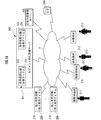
- FIG. 1 is an overall schematic view of a network system in which the item proposal system 1 is incorporated.
- the network system includes an item proposal system 1 for transmitting and receiving data via the Internet 4 as a network, and a plurality of terminals 3.
- the item proposal system 1 includes an item proposal server 2 and a D / B (database) 8.
- the item proposal server 2 is connected to the D / B8 by an intranet or a dedicated cable.
- the D / B 8 may be connected to the item proposal server 2 via the Internet 4.
- the item proposal server 2 can add, update, or delete the data stored in the D / B 8.
- the terminal 3 is an information processor such as a personal computer, a tablet PC or a smart phone. Each user 15 operates his / her own terminal 3 to send / receive information to / from the item proposal server 2.
- a domain is assigned to the website 12 of the item proposal server 2 by a URL.
- Each user 15 can browse any Web page 11 in the website 12 from the home terminal 3 by designating the URL of the website 12 on the browser implemented as an application on the terminal 3. ..
- the item presentation page 11a is a Web page of the portal of the website 12.
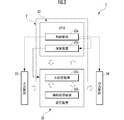
- FIG. 2 is a hardware configuration diagram of the item proposal system 1. Wavy lines with arrows indicate the flow of control signals between elements. Solid arrows indicate the flow of data between elements.
- the item proposal system 1 includes a CPU 20, a storage device 22, an input device 23, and an output device 24 as hardware.
- the CPU 20 has a control device 20a and an arithmetic unit 20b.
- the storage device 22 has a main storage device 22a and an auxiliary storage device 22b.
- the main storage device 22a is a volatile memory
- the auxiliary storage device 22b is a non-volatile memory.
- the CPU 20 and the main storage device 22a belong to the item proposal server 2 and send and receive data by a bus (not shown).
- the auxiliary storage device 22b includes a D / B8.
- the processing related to the operation of the item proposal system 1 is performed by executing the program stored in the auxiliary storage device 22b in the CPU 20.
- the D / B 8 of FIG. 1 also serves as an input device 23 and an output device 24 as an external storage device of the item proposal server 2.
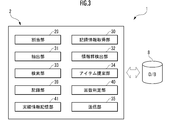
- FIG. 3 is a functional block diagram of the item proposal server 2.
- the item proposal server 2 has an allocation unit 29, a record information acquisition unit 30, an extraction unit 31, an information group detection unit 32, a search unit 33, an item proposal unit 34, and a transmission unit 35 as functional blocks generated by executing software. To be equipped.
- the item proposal server 2 further includes a recording unit 39, a number of times determination unit 40, and a performance information storage unit 41 as functional blocks. Details of these functional blocks will be described later in FIGS. 11 and 12.
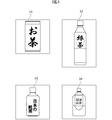
- FIG. 4 illustrates items Ir1 to Ir4 of green tea beverages. Items Ir1 to Ir4 have the same common name as green tea, but are different items.
- FIG. 5 illustrates items Is1 to Is4 of soccer shoes. Items Is1 to Is4 have the same common name as soccer shoes, but are different items.
- item I when individual items (eg, items Ir1 to Ir4 and items Is1 to Is4) are not distinguished, they are collectively referred to as "item I".
- the reference information accumulated in the D / B8 is generated based on the answers given by the respondents to the questions of the type A questionnaire 47 and the type B questionnaire 50.
- the respondent is, for example, the owner of the member virtual store 223 (FIG. 16) described later.
- the operator of the item proposal system 1 recruits respondents (employees of the operating company are also acceptable) as appropriate, and conducts questionnaires of type A questionnaire 47 and type B questionnaire 50 for each item I to the recruited respondents.
- the accumulated amount of reference information in D / B8 is gradually increased, and the reference information is updated.
- both the A type questionnaire 47 and the B type questionnaire 50 are carried out at the same time.
- a plurality of respondents answer each item I.
- Each respondent typically answers for a plurality of different items I.
- One unit of reference information in D / B8 corresponds to the answer of one respondent to a group of questions of type A questionnaire 47 and type B questionnaire 50 for one item I.
- the answer information on the collected answer sheet is converted into electronic data by OCR or the like.
- Each respondent answers the questions of both the A type questionnaire 47 and the B type questionnaire 50 from the standpoint of the consumer or the seller.
- Respondents who respond from the consumer's point of view are required to respond in terms of consumption attributes associated with their lifestyle when purchasing Item I.
- Respondents who respond from the standpoint of the seller are required to respond to the item from the perspective of the assumed target customer when operating a virtual store that collects item I of a predetermined market segment.
- the response information defines the consumption attributes of consumers who are interested in item I.
- the consumer's consumption attribute also defines the consumer's customer classification for item I (see FIG. 14 described later).
- each item I belongs to the market segment corresponding to the consumer's consumption attribute.
- the same item I belongs to a plurality of market segments according to different consumption attributes.
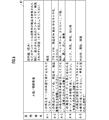
- the answers by the respondents to each question in the Type A questionnaire 47 are descriptive.
- the answers by the respondents to each question of the B type questionnaire 50 are check mark type.
- the check mark given by the respondent is illustrated by the number "1".
- the questions in the Type A questionnaire 47 include those that are likely to vary from respondent to respondent and those that are unlikely to occur.
- the reason why the answers vary from respondent to respondent is that the subjectivity of the respondents is strongly reflected in the answers.
- the question items of question numbers A-1 to A-3 correspond to the question items for answering the first phrase with little variation among the respondents.
- the question items of question numbers A-4 to A-5 correspond to the question items for answering the second phrase, which varies widely among the respondents.
- FIG. 8 shows the response contents 47r1 to 47r4 answered by the respondents Pr1 to Pr4 to the A-type questionnaire 47 for the items Ir1 to Ir4, respectively.
- FIG. 9 shows the response contents 47s1 to 47s4 answered by the respondents Ps1 to Ps4 to the A-type questionnaire 47 for the items Is1 to Is4, respectively.
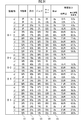
- FIG. 10 shows the response contents 50s1 to 50s4 in which the respondents Ps1 to Ps4 responded to the items Is1 to Is4, respectively.
- Respondents Pr1 to Pr4 are different from each other, and respondents Ps1 to Ps4 are different from each other.
- respondent P when individual respondents are not distinguished, they are collectively referred to as "respondent P”.
- answers to the Type A questionnaire are not distinguished, they are collectively referred to as "answer contents 47t”.
- responses to the Type B questionnaire are not distinguished, they are collectively referred to as "response content 50t”.
- answers contents 47t and 50t are not distinguished, they are collectively referred to as "answer content 55".
- FIGS. 8 to 10 only the answer content 55 of one respondent P is shown for one item I.
- a plurality of respondents P are made to answer each item I, and each respondent P has a plurality of respondents P. Answer item I.
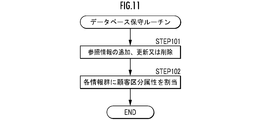
- FIG. 11 is a flowchart of the database maintenance routine implemented by the item proposal system 1. Prior to the description of the flowchart, terms such as reference information will be described.
- the reference information includes each item item I as a reference item, the reference item, the reference phrase as the phrase associated with the reference item, and the reference attribute as the attribute of the target customer assumed for the reference item. , Means the information associated with.
- phrase associated with the reference item is typically the common name of item I. Respondents are urged to answer the generic name to the question with question number A-1 in FIG.
- the item proposal server 2 stores reference information (specifically, reference information data) for each item item I in the D / B 8.
- the item proposal server 2 also adds, updates, and deletes reference information stored in the D / B 8 as appropriate. As a result, the reference information of the D / B8 maintains the latest reference information for each item I.
- the information of the response content 55 (a set of the response content 47t and the response content 50t) of each respondent P for each item item I constitutes one reference information.
- All of the words and phrases described in the questions A-1 to A-5 of the answer contents 47t of FIGS. 8 and 9 are reference words and phrases.
- the processing load of the item proposal server 2 when setting the reference group described later increases.
- the item proposal server 2 thins out or narrows down the reference terms used to set the reference group.
- the item proposal server 2 can use only the words and phrases answered to the question item A-1 (common name of item I) as reference words and phrases, and can exclude the answer words and phrases for other question items from the reference words and phrases.
- the one reference word When associating a plurality of answer words for a plurality of questions with one reference word, the one reference word shall be a combination of a plurality of answer words. Since the number of reference terms is increased by using such a combination, the item proposal server 2 can deal with the combination when it wants to finely classify the customer categories of the user 15 corresponding to the market segment.
- the reference attribute as the attribute of the target customer assumed for the reference item is defined as each response content 50t in FIG. 10, and the customer classification of each user 15 is determined based on the reference attribute.
- Each answer content 50t is an answer to the questions B-1 to B-5.
- the item proposal server 2 does not answer all of the questions B-1 to B-5, but one of them, as in the case of reducing the processing load of the reference phrase described above, as the reference attribute based on the customer classification. You can narrow down to only the answers of the department.
- the item proposal server 2 adds, updates, or deletes reference information. Specifically, the item proposal server 2 collects (receives) the response content 55 as appropriate via the Internet 4. The information of the response content 55 of one respondent P to one item I corresponds to one unit of reference information. The item proposal server 2 stores the generated reference information in the D / B 8. The item proposal server 2 can also update (including correction) the reference information at the request of the respondent P. The item proposal server 2 can also delete the reference information when the item corresponding to the reference information is sold out or the like.
- the allocation unit 29 assigns a group attribute to each reference information group stored in the D / B 8.
- the reference information group is a set of reference information having the same reference phrase for the reference information in D / B8.
- the reference words and phrases are the same as "green tea", so from the answer contents 47r1 to 47r4.
- the four generated reference information constitutes an information group called "green tea”.
- the reference phrase is a combination of the phrase of the answer content to the question item A-1 and one or more words / phrases of a plurality of words / phrases of the answer content to the other question items, for example, the question items A-2 to A-5. It is also possible to set each reference information group by using as one reference phrase. Further, the item proposal server 2 can change the combination of reference terms and phrases according to the situation and execute the processing of the proposal item in FIG. 12, which will be described later.
- the allocation unit 29 specifically determines the group attribute of each information group as follows. For example, the four answer contents 50t in FIG. 10 have reference attributes of reference items in which the reference terms of the reference items are the same as those of soccer shoes (FIG. 9). For each information group, the allocation unit 29 determines as a group attribute what characterizes the attribute of the information group based on the reference attribute of the reference information belonging to the information group.
- the group attribute is, for example, the average value of the reference attributes included in the same information group.
- the group attribute is, for example, the average value of the reference attributes included in the same information group.
- FIG. 10 there are four respondents P.
- question B-1 the number of respondents who answered that they were infants, infants, and 5 to 10 years old was 0, so the average value was 0%, respectively. Since there are two respondents who answered that they were 10 to 15 years old, the average value is 50%. Since there are three respondents who answered that they were 15 to 20 years old, the average value is 75%.
- the majority vote method can be used, and the answers with the largest number of respondents can be set as the group attribute from the top to the predetermined number (example: 3rd).
- the most common answers are 20 to 30 years old and 30 to 40 years old with four respondents P.
- the third most common answer is 15 to 20 years old and 40 to 50 years old with three respondents P. Therefore, the group attribute of the target customer of the information group whose reference item is soccer shoes can be determined to be 15 to 50 years old.
- the group attribute was explained only from the viewpoint of age, but the group attribute is typically determined from a plurality of viewpoints (example: gender and lifestyle of the target customer).
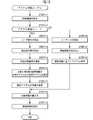
- FIG. 12 is a flowchart of the item proposal routine implemented by the item proposal system 1.
- the item proposal system 1 executes the item proposal routine every time it detects an access to the website 12 from the terminal 3.
- the recording information acquisition unit 30 acquires the recording information held by the terminal 3 from the terminal 3 that has accessed the website 12.
- the recorded information is, for example, a cookie.
- the record information acquisition unit 30 acquires a cookie as record information, the acquired cookie is both a first party and a third party.
- the record information acquisition unit 30 can also acquire the record information that the terminal 3 accesses a website other than the website 12 and browses or processes the website.
- the number-of-times determination unit 40 determines whether or not the number of times the terminal 3 has accessed the website 12 is equal to or less than the threshold value n.
- the number-of-times determination unit 40 can know the number of times of access from the user ID of the recorded information.
- the user ID is written in the recorded information of the terminal 3 when the terminal 3 accesses the website 12 for the first time and moves from the website 12 to another website.
- the process proceeds to STEP 113. If a negative determination is made, the process proceeds to STEP 120.
- the threshold value n in STEP 112 can be set to an integer of 1 or more.
- the threshold value n is set to, for example, 1.
- the number of times of access to the website 12 by the terminal 3 is 1, it means that the terminal 3 has accessed the website 12 for the first time.
- the terminal 3 accesses the website 12 for the first time, the user ID described later is not recorded in the cookie read from the terminal 3.
- the number of times determination unit 40 can also dynamically set n based on the recorded information (example: amount of information) acquired from the terminal 3. Even if it is not the first time for the terminal 3 to access the website 12, the amount of information (FIG. 12 / STEP122) of the performance information described later for the user 15 of the terminal 3 is small, and the customer classification of the user 15 cannot be sufficiently grasped. Because there are times.
- the extraction unit 31 extracts one or more user phrases associated with the item I from the record information acquired by the record information acquisition unit 30. A specific extraction method will be described with reference to FIG.
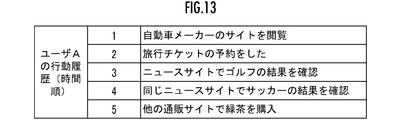
- FIG. 13 is an action record (or an operation record of the user 15 of the terminal 3) extracted from the record information of the terminal 3 that the extraction unit 31 has accessed the website 12.
- the user 15 of the terminal 3 is named "user A”.
- user A arranges the action history performed on the Internet 4 using his terminal 3 in chronological order from the past to the present, (1) browsing a car site, (2) booking a travel ticket, and (3) on a news site. Confirmation of golf results, (4) confirmation of soccer results on the same news site, and (5) purchase of green tea on other online shopping sites (sites different from website 12).
- browsing sites (1) to (5) above mean a plurality of second website sites different from the first website when the website 12 is named the first website for convenience.
- the extraction unit 31 extracts five reference terms of automobile, travel, golf, soccer, and green tea as user phrases related to item I from the five action histories of user A.
- the information group detection unit 32 detects the extracted information group. Specifically, the information group detection unit 32 detects each information group corresponding to the reference phrase matching each user phrase extracted by the extraction unit 31 as the extraction information group. As described above, the extracted information group is associated with the customer category of user A and the market segment of user A via the consumption attribute of user A. Further, as the number of extracted information groups increases, the consumption attribute of user A can be determined in detail.
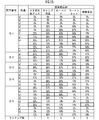
- FIG. 14 is a diagram showing an example of evaluating the customer category of user A from the extracted information group.
- B-1 to B5 and a), b), ... In FIG. 14 are partially omitted, but B-1 to B5 and a), b), ... In FIG. 10 described above. Means that it is the same as.
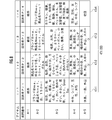
- the five information groups such as automobiles in FIG. 14 correspond to the five reference terms such as automobiles extracted from the behavior history of FIG.
- Each reference phrase is a common reference phrase of reference information belonging to the corresponding information group.
- the numerical value (%) in each column of FIG. 14 is the average value (group attribute [%] of FIG. 10) of each value of the information group to which the reference information including each reference phrase belongs.
- the equality method and the latest history method are shown in the customer classification.
- (V1 + V2 + V3 + V4 + V5) / 5 is calculated as the sum of the values in each row of FIG. 14 divided by the number of 5.
- the latest history weighting method it is calculated as (V1 + V2 + V3) / 3+ (V4 + V5) / 2.
- the average value is calculated.
- the customer classification is calculated by weighting the latest behavior history more than the old behavior history.
- the customer classification of user A can be predicted as follows.
- the customer category of user A is predicted as follows. It is likely that they are 20 to 70 years old, but especially 20 to 50 years old (B-1). User A is likely to be male (B-2). User A is likely to be in the middle-income group (B-3). User A satisfies the purpose of purchasing to be happy, calm, and enjoyable (B-4). User A is highly health conscious and active (B-5).
- the search unit 33 searches for the non-extracted information group. Specifically, the search unit 33 searches for an information group other than the extracted information group whose reference attribute correlates with the reference attribute of the extracted information group as a non-extracted information group.
- FIG. 15 illustrates a group of non-extracted information searched by the search unit 33 by executing the process of STEP 115.
- FIG. 15 correspond to B-1 to B5 and a), b), ...
- the cells shown in thick frames indicate cells having a value of 70% or more and matching the above-mentioned customer classification prediction for user A.
- each of "metabolic syndrome countermeasure goods", “camping equipment”, “motorcycle”, “ramen set” and “health food” is referred to as “automobile”, “travel”, “golf”, “soccer” in FIG. Like each of the “green teas", it constitutes one information group.
- the information group such as “automobile” in FIG. 14 corresponds to the extracted information group
- the information group such as “metabolic syndrome countermeasure goods” in FIG. 15 corresponds to the non-extracted information group.
- the reference phrase of one extracted information group arbitrarily selected from a plurality of extracted information groups and the reference phrase of one non-extracted non-extracted information group arbitrarily selected from a plurality of non-extracted information groups are different.
- a reference phrase of any one of a plurality of (five in FIG. 14) extracted information groups and an arbitrary one of a plurality of (five in FIG. 15) non-extracted information groups Suppose you make a set of reference words for. At this time, since the two reference words and phrases are different in each set, the extracted information group and the non-extracted information group do not match in terms of the concept of the words and phrases.
- the pair of the "automobile” included as the extracted information group in FIG. 14 and the “motorcycle” included as the non-extracted information group in FIG. 15 has the relationship of (b) above.
- the pair of "green tea” included as the extracted information group in FIG. 14 and “health food” included as the non-extracted information group in FIG. 15 has the relationship (c).
- the "ramen set” included as the non-extracted information group in FIG. 15 has the relationship (a) in the set with any of the extracted information groups in FIG.
- the item proposal unit 34 selects the reference item of the reference information included in the non-extracted information group searched by the search unit 33 as the proposal item.
- the transmission unit 35 transmits the information of the proposed item to the terminal 3.
- Images of the proposed item (reference item) (eg, FIGS. 4 and 5) are displayed on the browser screen of the terminal 3 that has received the information of the proposal item from the transmission unit 35, and are associated with the reference item.
- the reference phrase is displayed as the item description of the proposed item (eg, description of the item or service).
- the item proposal unit 34 selects one or more non-extracted information groups from the five non-extracted information groups of "metabolic syndrome countermeasure goods", “camping equipment”, “motorcycle”, “ramen set” and "health food”. Then, one or more reference items are selected from each selected non-extracted information group. Then, one or more selected reference items are set as proposal items.
- STEP118 is also carried out after the processing of STEP120 to STEP122 is completed.
- STEP 120 to STEP 122 will be described.
- the recording information acquisition unit 30 extracts the user ID (ID of the terminal 3) from the recording information acquired in STEP 111.
- the search unit 33 reads out the actual information stored in the auxiliary storage device 22b by the actual information storage unit 41 in association with the extracted user ID. Each time the terminal 3 accesses the website 12, the actual information is stored and stored in the D / B 8 or the auxiliary storage device 22b as the processing result by the terminal 3 on the website 12. (STEP 119 described later).
- the item proposal unit 34 performs item processing based on the read actual information.
- the performance information includes an item-related processing operation on the website 12 when the terminal 3 accesses the website 12 before the previous time.
- the item proposal unit 34 for example, an item purchased by the user 15 via the terminal 3 on the website 12, or a content (performance, price, etc.) prior to the purchase, although the item was not purchased.
- the item grasps information such as the processing date and time as actual information.
- the performance information may include information on the domain of the virtual store accessed by the user 15 of the terminal 3 (which is a subdomain of the domain of the website 12). it can.
- the item proposal unit 34 determines the item I belonging to the item classification (including both the product classification and the service classification) to which the user 15 of the terminal 3 is directly interested based on the performance information. Select as a suggested item.
- the item proposal unit 34 correlates the plurality of hit URLs with the item classification of the first example.
- the hit results are presented to the user 15 in order.
- the item proposal unit 34 extracts a plurality of item I (hereinafter referred to as "actual") from the actual information. Then, after replacing the extracted phrase of STEP 113 with the common name of the actual item, the processing of STEP 114 to STEP 116 is performed, and the proposed item of the processing result of STEP 116 is presented to the user 15.
- actual a plurality of item I
- the reference information accumulated in the D / B8 can be used to determine the proposal item for the user 15 who has already accessed the website 12 multiple times.
- the proposed item determined by STEP 122 is set as the item I having a high correlation with the actual customer category of the user 15. be able to.
- STEP118 is executed after the processing of STEP117 or STEP122 is completed.
- the processes of STEP 118 and 119 are processes when the terminal 3 moves from the website 12 to another site.
- the recording unit 39 writes the recording information (example: cookie) in the terminal 3.
- the user ID assigned to the terminal 3 by the item proposal server 2 is included.
- the performance information storage unit 41 writes the performance information to the D / B 8 or the auxiliary storage device 22b.
- the item proposal system 1 stores reference information in the D / B 8.
- the reference information is based on the response information obtained by conducting a questionnaire to the respondents.
- the item proposal system 1 can use the virtual store providing system 201 in order to efficiently collect the response information.
- the operator of the item proposal system 1 can also operate the item proposal system 1 and the virtual store provision system 201 integrally.
- the item proposal server 2 of the item proposal system 1 and the segment specialization server 205 of the virtual store provision system 201 can be shared.
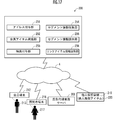
- FIG. 16 is a diagram showing a net environment to which the virtual store providing system 201 is applied.
- the Internet 4 interconnects a segment specialization server 205, an advertising agency server 208, a D / B (database) 210, a plurality of member terminals 212, a plurality of viewer terminals 216, and a plurality of other people's virtual stores 219. There is.
- Each member terminal 212 is operated by the member 213 who is the owner of the member virtual store 223.
- Each viewer terminal 216 is operated by a viewer 217 who is a purchaser of item I.
- the D / B 210 includes an operation history database, a member information database, and an item selection information database.
- the member terminal 212 and the viewer terminal 216 are, for example, a smart phone, a tablet PC, or a personal computer.
- the other person virtual store 219 is typically built in a server connected to the Internet 4.
- the virtual store providing system 201 includes software implemented in the segment specialized server 205 connected to the Internet 4 and D / B210.
- the D / B 210 may be connected to the segment specialization server 205 via an intranet (not shown) without being connected via the Internet 4.
- Each member 213 has a member virtual store 223 exclusively built by the virtual store providing system 201.
- Each member virtual store 223 is given a subdomain that belongs to a common root domain and is mutually identifiable.
- the member item 224 selected by each member 213 from the other person's sales item 220 is posted on the other person's sale item 220 to be selected with a hyperlink.
- a plurality of other people's virtual stores 219 are connected to the Internet 4 and post and sell other people's sales items 220 as products and / or services on their own Web pages by images, texts, and the like.
- Each viewer 217 can directly access the other person's virtual store 219 from his / her own information device, and follows the hyperlink of the member item 224 of the member virtual store 223 of the segment specialization server 205 to reach each other person's virtual store 219. You can also access it.
- FIG. 17 is a diagram showing details of the functional blocks of the virtual store providing system 201 in the Internet environment.
- FIG. 17 for the sake of simplification of illustration, only one member terminal 212, the member 213, and the like are illustrated one by one even though there are actually a plurality of members.
- the virtual store providing system 201 includes an address giving unit 251, a member item posting unit 252, a privilege giving unit 253, a segment information collecting unit 254, a segment information providing unit 255, and a link item information providing unit 256.
- the segment-specific server 205 has an internal structure (not shown) that is well known as a server.
- the internal structure includes at least a CPU, RAM, ROM, input / output I / Fs, a bus connecting them, and a hard disk for storing an OS and various application programs.
- FIG. 18 is a flowchart of the enrollment process by the virtual store providing system 201.
- the address giving unit 251 accepts the membership application from the information device of the applicant for membership. Applicants who wish to join become members 213 when they are admitted. Access from the applicant for membership to the virtual store provision system 201 is performed on the browser by designating the Web page of the membership reception of the virtual store provision system 201 with the browser on the information device of the applicant for membership.
- the address assignment unit 251 causes the applicant to enter the admission examination information.
- the admission examination information includes a set of personal information such as gender, age, address, telephone number, occupation, educational background, income, family structure, hobbies, and bank account.
- the addressing unit 251 conducts an admission examination of applicants for admission based on the admission examination information. As a result of the admission examination, the address giving unit 251 advances the process to STEP284 when permitting, and ends the admission process when refusing.
- the address assigning unit 251 assigns a dedicated subdomain to the member 213.
- the address assigning unit 251 registers the member information (including the above-mentioned personal information and subdomain) in the D / B 210. As a result, member information is sequentially accumulated in the D / B 210 as the number of members 213 increases.
- member 213 can change the member information as appropriate after joining, for example, by changing the address or telephone number.
- member information is collected at the time of enrollment of member 213, but at the time of enrollment, only the information necessary for admission examination should be collected, and other member information should be collected at a predetermined time after enrollment. You can also.
- the segment information collection unit 254 collects segment information indicating which segment the member virtual store 223 of the member 213 belongs to.
- a segment is a group of customers who have common needs in the market and have similar ways of recognizing, valuing, and using item I (goods and services), and the process leading up to purchasing, that is, purchasing behavior. Is defined as. Furthermore, in order to discover a segment, it is necessary to set an axis for subdividing a meaningful market. In the virtual store provision system 201, the segment of item I is identified by using one or more axes set to subdivide a meaningful market.
- a plurality of axes can be set in order to identify the segment. If the contrasting segments have different occupancy ranges on each axis, it is judged that both segments are different. For example, set the age of a boy as an axis that defines a group of customers. If the first segment occupies the range of 10 to 20 years old on the axis and the second segment occupies the range of 50 to 70 years old of the type B questionnaire on the axis, the first segment and the second segment Is determined to be a different segment for that axis.
- the first segment and the second segment Is determined to be a partially overlapping segment for the axis.
- the range occupied by the segments on each axis is not limited to the one defined by the numerical value. It may not be specified by the numerical value such as the genre of the member item 224.
- a plurality of (2 or more, preferably 3 or 4 or more) axes for identifying the segments are set as described above. For example, the age of a boy is set as the first axis related to the customer, and the area (an example of the axis whose occupancy range is not defined by a numerical value) is set as the second axis related to the customer.
- first segment occupies the coordinate range of 30 to 40 years old on the first axis and the second segment occupies the coordinate range of 30 to 40 years old on the first axis, the same is true for the first axis. It becomes a segment of.
- first segment occupies Hokkaido on the second axis and the second segment occupies Kyushu on the second axis, the two are different segments for the second axis. After all, if the contrasting segments differ on at least one axis, the two segments are different segments.
- the axis for identifying the segment can be appropriately set to identify the segment of the member virtual store 223.
- identifying the segment of each member virtual store 223 it is not necessary to make sure that all the member items 224 of the member virtual store 223 belong to the same segment.
- the member item 224 of a predetermined ratio (example: 90%) or more belongs to the same segment, it can be determined that the segment is the segment of the member virtual store 223.
- the member item 224 that does not belong to the segment is processed as the exceptional member item 224 in the virtual store providing system 201.
- the segment information collection carried out by the segment information collection unit 254 is specifically carried out by the segment information collection unit 254 conducting a segment survey questionnaire in which the member 213 is asked to answer a plurality of question items.
- gender male and female
- age eg teens, 20s, ...)
- address area eg Hokkaido, Kyushu, Kanagawa prefecture, and Chiba city
- occupation eg student
- Hobbies eg watching movies, traveling, sports and fishing.
- genres eg, men's kimono
- price ranges eg: 10,000 yen or less).
- Segment information means information that can identify the segment thus determined, and is generated based on the determined segment.
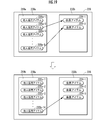
- FIG. 19 is an explanatory diagram of a work in which each member 213 selects a member item 224 to be posted on his / her own member virtual store 223 using an application provided by the virtual store providing system 201.
- the app may be a dedicated app for each member 213 to select only the member item 224 of his / her member virtual store 223, or may be included as a part of the member support app as an integrated app. You can also.
- the member 213 activates the application on his / her own information device (example: personal computer), and causes the display unit to display the member item selection screen 228 shown in FIG. 19 as a predetermined screen.
- his / her own information device example: personal computer
- the member item selection screen 228 includes the other person Web portion 230a on the left and the member Web portion 230b on the right.
- the member Web portion 230b on the right both corresponds to the Web page of the member virtual store 223.
- the other person's Web portion 230a on the left displays the different Web pages of the other person's virtual store 219 on the upper and lower member item selection screens 228.
- the other person's virtual store of the other person Web part 230a of the upper member item selection screen 228 is indicated by the code "219a", and the recorded information of the lower member item selection screen 228.
- the other person's virtual store of the acquisition unit 30a is indicated by the code "219b".
- Items 220a-1 to 220a-9 sold by others are displayed on the other person's Web portion 230a of the other person's virtual store 219a.
- Items 220b-1 to 220b-14 sold by others are displayed on the other person's Web portion 230a of the other person's virtual store 219b.
- Items 220a-1 to 220a-9 sold by others and items 220b-1 to 220b-14 sold by others are viewers 217 of what the items of goods and services (eg, reservations for accommodations and concerts or reservations for transportation) are. It is an image, icon or text that can be understood concretely.
- the member 213 selects the other person's sales item 220a-2, 220a-9 as the member item 224-1,224-2 of his / her own member virtual store 223 from among the other person's sales items 220a-1 to 220a-9. Select. The member 213 also selects the other person's sales item 220b-14 as the member item 224-3 of his / her own member virtual store 223 from the other person's sales items 220b-1 to 220b-14 in the other person's virtual store 219b. Link item information to items 220a-2, 220a-9, 220b-14 sold by others is attached to each of the member items 224-1 to 24-3, respectively.
- the selection operation of the other person's sale item 220a-2, 220a-9, 220b-14 by the member 213 on the member item selection screen 228 is the other person's sale item 220a-2, 220a-9, from the other person's Web part 230a to the member's Web part 230b. This is done by the drag-and-drop operation of 220b-14. As a result, the member items 224-1,224-2,224-3 become the same image as the hyperlink destination items sold by others 220a-2, 220a-9, 220b-14.
- the application is terminated. After that, the selection of the member item 224 can be appropriately executed by restarting the application, and the member item 224 can be added.
- the member item 224 is deleted, the member item 224 to be deleted is moved from the inside to the outside of the member Web portion 230b by dragging and dropping.
- the above-mentioned application can carry out an item selection reason questionnaire to the member 213 when the member 213 newly adds the member item 224.
- An example of the item selection reason questionnaire is a questionnaire in which the above-mentioned type A questionnaire 47 in FIG. 6 and the type B questionnaire 50 in FIG. 7 are combined.
- the link item information providing unit 256 stores the response information related to the response of the member 213 to the item selection reason questionnaire in the D / B 210.
- the item proposal server 2 (FIG. 1) generates reference information based on the response information and stores it in the D / B 8.
- the viewer 217 specifies the subdomain of the member virtual store 223 and browses the member item 224 in the designated member virtual store 223. Then, when the favorite member item 224 is found, the cursor is moved onto the favorite member item 224, and then the hyperlink operation such as clicking or tapping is performed. As a result, the screen of the display unit of the information device of the viewer 217 is switched from the Web page of the member virtual store 223 to the Web page of the other person virtual store 219 on which the hyperlink destination other person sales item 220 is posted.
- the segment information providing unit 255 accumulates the operation of using the hyperlink by the viewer 217 for each member item 224 in the D / B 210 as the operation history of the hyperlink for each member item 224 of each member virtual store 223.
- the operation history naturally includes the date and time of the operation.
- the viewer 217 performs a purchase procedure for the item 220 sold by another person at the hyperlink destination on the Web page of the other person's virtual store 219 after being moved by the hyperlink.
- the purchase procedure includes payment of money and arrangement of delivery. Therefore, each member virtual store 223 only posts the member item 224 with the hyperlink and introduces the item 220 sold by others at the hyperlink destination, and the member 213 omits the complicated purchase procedure with the viewer 217. can do.
- the member 213 can reduce the funds, labor, and bankruptcy risk when opening and operating the member virtual store 223.
- the advertising agency server 208 is managed by the advertising agency. As described above, in the D / B 210, the operation of using the hyperlink by the viewer 217 for each member item 224 is accumulated online as the operation history of the hyperlink for each member item 224 of each member virtual store 223. .. The operator of the virtual store providing system 201 sends the information related to the operation history of the D / B 210 accumulated in this way to the advertising agency server 208 via the Internet 4 when it is determined to be periodic or necessary.
- the advertising agency server 208 collects the advertising fee in cash from the other person in the other person's virtual store 219 based on the received operation history. Specifically, for the other person's virtual store 219 sold by another person 220, money is collected from the other person's virtual store 219 according to the number of times the hyperlink is operated from the member virtual store 223 of the virtual store providing system 201. ..
- the advertising agency server 208 collects the advertising fee collected from the other person's virtual store 219, and the member of the member virtual store 223 who has operated the hyperlink by the provider (also the owner) of the virtual store providing system 201 and the viewer 217. Distribute to 213 on a regular or appropriate basis. At that time, the advertising agency server 208 receives a collection fee at a predetermined rate with respect to the advertising fee. Then, the remaining amount is distributed at a predetermined distribution rate between the provider of the virtual store providing system 201 and the member 213.
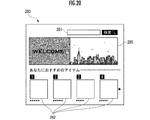
- FIG. 20 shows the top Web page 260 of the portal site of the virtual store providing system 201.
- the top Web page 260 also serves as a menu Web page of the portal site.
- the top Web page 260 can be the item presentation page 11a (FIG. 1).
- the top Web page 260 of FIG. 20 also serves as an item presentation page 11a, is described, and is displayed on the browser of the viewer terminal 216.
- a search window 261 and a plurality of proposed item windows 262 are displayed together with a banner 265.
- a banner 265. When the top Web page 260 also serves as the item presentation page 11a, one or more proposed items selected by the item proposal unit 34 are displayed in the corresponding proposal item window 262.
- the search window 261 is used only for searching within the site.
- the viewer 217 may enter the store name of the member virtual store 223 in the search window 261 to instruct the search. it can.
- the viewer 217 can search the member virtual store 223 after inputting one or more words and phrases of his / her interest in the search window 261.
- the member virtual store 223 that has a correlation with the input phrase is displayed. For example, when the viewer 217 inputs "automobile”, “travel” and “golf” of the extracted information group of FIG. 14 into the search window 261 and then executes the search, "automobile” and “travel” are set as member items 224. And the member virtual store 223 including all of "golf” is displayed.
- members whose market segment is "metabolic syndrome countermeasure goods” and "camping equipment” shown in FIG. 15 together with or separately from the member virtual store 223 that includes all of “automobile”, “travel”, and “golf”. It is also possible to display the virtual store 223.
Landscapes
- Business, Economics & Management (AREA)
- Engineering & Computer Science (AREA)
- Finance (AREA)
- Accounting & Taxation (AREA)
- Strategic Management (AREA)
- Development Economics (AREA)
- Theoretical Computer Science (AREA)
- General Physics & Mathematics (AREA)
- Physics & Mathematics (AREA)
- Marketing (AREA)
- Economics (AREA)
- General Business, Economics & Management (AREA)
- Databases & Information Systems (AREA)
- Game Theory and Decision Science (AREA)
- Entrepreneurship & Innovation (AREA)
- General Engineering & Computer Science (AREA)
- Data Mining & Analysis (AREA)
- Information Retrieval, Db Structures And Fs Structures Therefor (AREA)
- Management, Administration, Business Operations System, And Electronic Commerce (AREA)
Abstract
Le système de proposition d'article selon l'invention propose un article approprié, même lors du premier accès d'un utilisateur. Une base de données (8) stocke des informations de référence associant un article de référence, une locution de référence et un attribut de référence, qui est un attribut d'un client cible. Des éléments d'informations de référence comportant des locutions de référence identiques constituent un groupe d'informations. Une unité d'extraction (31) extrait une locution d'utilisateur sur la base d'informations enregistrées acquises par un terminal (3). Une unité de détection de groupe d'informations (32) détecte un groupe d'informations extrait qui correspond à une locution de référence correspondant à la locution d'utilisateur. Une unité de proposition d'article (34) sélectionne, en tant qu'article proposé, un article de référence d'un groupe d'informations non extrait qui constitue un groupe d'informations autre que le groupe d'informations extrait, et dont un attribut de référence est corrélé à un attribut de référence du groupe d'informations extrait.
Priority Applications (5)
| Application Number | Priority Date | Filing Date | Title |
|---|---|---|---|
| JP2019564557A JP6651163B1 (ja) | 2019-03-27 | 2019-03-27 | アイテム提案システム |
| PCT/JP2019/013337 WO2020194596A1 (fr) | 2019-03-27 | 2019-03-27 | Système de proposition d'article |
| CN201980094736.0A CN113632126A (zh) | 2019-03-27 | 2019-03-27 | 项目推荐系统 |
| EP19920986.7A EP3933740A4 (fr) | 2019-03-27 | 2019-03-27 | Système de proposition d'article |
| US17/441,567 US20220180417A1 (en) | 2019-03-27 | 2019-03-27 | Item proposal system |
Applications Claiming Priority (1)
| Application Number | Priority Date | Filing Date | Title |
|---|---|---|---|
| PCT/JP2019/013337 WO2020194596A1 (fr) | 2019-03-27 | 2019-03-27 | Système de proposition d'article |
Publications (1)
| Publication Number | Publication Date |
|---|---|
| WO2020194596A1 true WO2020194596A1 (fr) | 2020-10-01 |
Family
ID=69568378
Family Applications (1)
| Application Number | Title | Priority Date | Filing Date |
|---|---|---|---|
| PCT/JP2019/013337 Ceased WO2020194596A1 (fr) | 2019-03-27 | 2019-03-27 | Système de proposition d'article |
Country Status (5)
| Country | Link |
|---|---|
| US (1) | US20220180417A1 (fr) |
| EP (1) | EP3933740A4 (fr) |
| JP (1) | JP6651163B1 (fr) |
| CN (1) | CN113632126A (fr) |
| WO (1) | WO2020194596A1 (fr) |
Cited By (1)
| Publication number | Priority date | Publication date | Assignee | Title |
|---|---|---|---|---|
| JP2024079330A (ja) * | 2022-11-30 | 2024-06-11 | 株式会社リコー | 情報提供装置、情報処理システム、情報提供方法、及びプログラム |
Citations (6)
| Publication number | Priority date | Publication date | Assignee | Title |
|---|---|---|---|---|
| JPS5843983B2 (ja) | 1975-02-14 | 1983-09-30 | 株式会社日立製作所 | ヒヨウジホウシキ |
| JPS6337332B2 (fr) | 1978-10-19 | 1988-07-25 | Cobe Lab | |
| WO2011146112A1 (fr) * | 2010-05-18 | 2011-11-24 | Alibaba Group Holding Limited | Utilisation de groupes d'informations de modèle dans une recherche |
| WO2012082561A2 (fr) * | 2010-12-14 | 2012-06-21 | Alibaba Group Holding Limitted | Procédé et système d'affichage d'informations inter site web |
| WO2015132886A1 (fr) * | 2014-03-04 | 2015-09-11 | 楽天株式会社 | Dispositif et procédé de traitement d'informations, programme et support de stockage |
| JP2016053784A (ja) * | 2014-09-03 | 2016-04-14 | 富士ゼロックス株式会社 | 情報推薦プログラム及び情報処理装置 |
Family Cites Families (10)
| Publication number | Priority date | Publication date | Assignee | Title |
|---|---|---|---|---|
| US7974888B2 (en) * | 2007-03-30 | 2011-07-05 | Amazon Technologies, Inc. | Services for providing item association data |
| US11068374B2 (en) * | 2010-05-26 | 2021-07-20 | Userzoom Technologies, Inc. | Generation, administration and analysis of user experience testing |
| US9514167B2 (en) * | 2011-08-01 | 2016-12-06 | Qatar Foundation | Behavior based record linkage |
| CN103514204B (zh) * | 2012-06-27 | 2018-11-20 | 华为技术有限公司 | 信息推荐方法和装置 |
| CN103971259A (zh) * | 2013-01-31 | 2014-08-06 | 深圳市亿商屋广告传媒有限公司 | 一种电子商务推荐营销平台服务器、系统及方法 |
| US9959563B1 (en) * | 2013-12-19 | 2018-05-01 | Amazon Technologies, Inc. | Recommendation generation for infrequently accessed items |
| CN106033577A (zh) * | 2015-03-12 | 2016-10-19 | 阿里巴巴集团控股有限公司 | 信息的推荐方法及装置 |
| JP5913722B1 (ja) * | 2015-11-26 | 2016-04-27 | 株式会社博報堂 | 情報処理システム及びプログラム |
| CN107862542A (zh) * | 2017-09-28 | 2018-03-30 | 北京三快在线科技有限公司 | 一种菜品推荐方法和装置 |
| CN109409998A (zh) * | 2018-10-18 | 2019-03-01 | 徐碧远 | 一种推荐系统 |
-
2019
- 2019-03-27 EP EP19920986.7A patent/EP3933740A4/fr not_active Withdrawn
- 2019-03-27 US US17/441,567 patent/US20220180417A1/en not_active Abandoned
- 2019-03-27 JP JP2019564557A patent/JP6651163B1/ja active Active
- 2019-03-27 WO PCT/JP2019/013337 patent/WO2020194596A1/fr not_active Ceased
- 2019-03-27 CN CN201980094736.0A patent/CN113632126A/zh active Pending
Patent Citations (6)
| Publication number | Priority date | Publication date | Assignee | Title |
|---|---|---|---|---|
| JPS5843983B2 (ja) | 1975-02-14 | 1983-09-30 | 株式会社日立製作所 | ヒヨウジホウシキ |
| JPS6337332B2 (fr) | 1978-10-19 | 1988-07-25 | Cobe Lab | |
| WO2011146112A1 (fr) * | 2010-05-18 | 2011-11-24 | Alibaba Group Holding Limited | Utilisation de groupes d'informations de modèle dans une recherche |
| WO2012082561A2 (fr) * | 2010-12-14 | 2012-06-21 | Alibaba Group Holding Limitted | Procédé et système d'affichage d'informations inter site web |
| WO2015132886A1 (fr) * | 2014-03-04 | 2015-09-11 | 楽天株式会社 | Dispositif et procédé de traitement d'informations, programme et support de stockage |
| JP2016053784A (ja) * | 2014-09-03 | 2016-04-14 | 富士ゼロックス株式会社 | 情報推薦プログラム及び情報処理装置 |
Non-Patent Citations (1)
| Title |
|---|
| See also references of EP3933740A4 |
Cited By (1)
| Publication number | Priority date | Publication date | Assignee | Title |
|---|---|---|---|---|
| JP2024079330A (ja) * | 2022-11-30 | 2024-06-11 | 株式会社リコー | 情報提供装置、情報処理システム、情報提供方法、及びプログラム |
Also Published As
| Publication number | Publication date |
|---|---|
| EP3933740A4 (fr) | 2022-03-23 |
| US20220180417A1 (en) | 2022-06-09 |
| EP3933740A1 (fr) | 2022-01-05 |
| JP6651163B1 (ja) | 2020-02-19 |
| CN113632126A (zh) | 2021-11-09 |
| JPWO2020194596A1 (ja) | 2021-04-08 |
Similar Documents
| Publication | Publication Date | Title |
|---|---|---|
| Li et al. | How do recommender systems lead to consumer purchases? A causal mediation analysis of a field experiment | |
| US8626602B2 (en) | Consumer shopping and purchase support system and marketplace | |
| US8069075B2 (en) | Method and system for evaluating performance of a website using a customer segment agent to interact with the website according to a behavior model | |
| US20180357703A1 (en) | Recommendations Based Upon Explicit User Similarity | |
| US20060004704A1 (en) | Method for monitoring link & content changes in web pages | |
| CN107004203A (zh) | 信息处理系统以及方法 | |
| JP2001282982A (ja) | Webマーケティングシステム | |
| US20130304543A1 (en) | Method and apparatus for performing web analytics | |
| KR101646312B1 (ko) | 개인행동기반 관심 대상 및 선호 분야 분석시스템 및 그 방법 | |
| JP2011039909A (ja) | 提示情報の最適化方法及びシステム | |
| Dai et al. | Frontiers: which firms gain from digital advertising? Evidence from a field experiment | |
| WO2017158798A1 (fr) | Dispositif de traitement d'informations, système de distribution d'informations, procédé et programme de traitement d'informations | |
| JP6813917B1 (ja) | アンケート結果解析システム、及び、アンケート結果解析方法 | |
| CN118822700B (zh) | 一种基于大数据与电子商城的商品搜索方法 | |
| US20140188838A1 (en) | Information search engine, processing and rating system | |
| JP2019527906A (ja) | 通信ネットワーク内で個人向けコンテンツを配信するための手段 | |
| JP2020166785A (ja) | テレビ番組評価システム | |
| KR102429104B1 (ko) | 인공지능에 기반한 상품 카탈로그 자동 분류 시스템 | |
| JP6651163B1 (ja) | アイテム提案システム | |
| JP2025081670A (ja) | 情報処理装置および情報処理プログラム | |
| KR102323153B1 (ko) | 고객의 무의식 영역에 기반하여 의사결정 지원자료를 제공하는 의사결정 지원서버 및 그 의사결정 지원방법 | |
| JP7042787B2 (ja) | 判定装置、判定方法、および判定プログラム | |
| JP7488622B1 (ja) | 情報処理装置およびコンピュータプログラム | |
| US20240177204A1 (en) | Systems and methods for attribute characterization of usability testing participants | |
| CN120013600A (zh) | 一种基于客户等级的权益智能推荐方法 |
Legal Events
| Date | Code | Title | Description |
|---|---|---|---|
| ENP | Entry into the national phase |
Ref document number: 2019564557 Country of ref document: JP Kind code of ref document: A |
|
| 121 | Ep: the epo has been informed by wipo that ep was designated in this application |
Ref document number: 19920986 Country of ref document: EP Kind code of ref document: A1 |
|
| NENP | Non-entry into the national phase |
Ref country code: DE |
|
| ENP | Entry into the national phase |
Ref document number: 2019920986 Country of ref document: EP Effective date: 20210929 |