WO2020194897A1 - 固体電解質材料およびそれを用いた電池 - Google Patents
固体電解質材料およびそれを用いた電池 Download PDFInfo
- Publication number
- WO2020194897A1 WO2020194897A1 PCT/JP2019/048207 JP2019048207W WO2020194897A1 WO 2020194897 A1 WO2020194897 A1 WO 2020194897A1 JP 2019048207 W JP2019048207 W JP 2019048207W WO 2020194897 A1 WO2020194897 A1 WO 2020194897A1
- Authority
- WO
- WIPO (PCT)
- Prior art keywords
- solid electrolyte
- electrolyte material
- material according
- examples
- battery
- Prior art date
- Legal status (The legal status is an assumption and is not a legal conclusion. Google has not performed a legal analysis and makes no representation as to the accuracy of the status listed.)
- Ceased
Links
Images



Classifications
-
- H—ELECTRICITY
- H01—ELECTRIC ELEMENTS
- H01M—PROCESSES OR MEANS, e.g. BATTERIES, FOR THE DIRECT CONVERSION OF CHEMICAL ENERGY INTO ELECTRICAL ENERGY
- H01M10/00—Secondary cells; Manufacture thereof
- H01M10/05—Accumulators with non-aqueous electrolyte
- H01M10/056—Accumulators with non-aqueous electrolyte characterised by the materials used as electrolytes, e.g. mixed inorganic/organic electrolytes
- H01M10/0561—Accumulators with non-aqueous electrolyte characterised by the materials used as electrolytes, e.g. mixed inorganic/organic electrolytes the electrolyte being constituted of inorganic materials only
- H01M10/0562—Solid materials
-
- C—CHEMISTRY; METALLURGY
- C01—INORGANIC CHEMISTRY
- C01F—COMPOUNDS OF THE METALS BERYLLIUM, MAGNESIUM, ALUMINIUM, CALCIUM, STRONTIUM, BARIUM, RADIUM, THORIUM, OR OF THE RARE-EARTH METALS
- C01F17/00—Compounds of rare earth metals
- C01F17/30—Compounds containing rare earth metals and at least one element other than a rare earth metal, oxygen or hydrogen, e.g. La4S3Br6
- C01F17/36—Compounds containing rare earth metals and at least one element other than a rare earth metal, oxygen or hydrogen, e.g. La4S3Br6 halogen being the only anion, e.g. NaYF4
-
- C—CHEMISTRY; METALLURGY
- C01—INORGANIC CHEMISTRY
- C01F—COMPOUNDS OF THE METALS BERYLLIUM, MAGNESIUM, ALUMINIUM, CALCIUM, STRONTIUM, BARIUM, RADIUM, THORIUM, OR OF THE RARE-EARTH METALS
- C01F7/00—Compounds of aluminium
- C01F7/48—Halides, with or without other cations besides aluminium
-
- C—CHEMISTRY; METALLURGY
- C01—INORGANIC CHEMISTRY
- C01G—COMPOUNDS CONTAINING METALS NOT COVERED BY SUBCLASSES C01D OR C01F
- C01G15/00—Compounds of gallium, indium or thallium
- C01G15/006—Compounds containing gallium, indium or thallium, with or without oxygen or hydrogen, and containing two or more other elements
-
- C—CHEMISTRY; METALLURGY
- C01—INORGANIC CHEMISTRY
- C01G—COMPOUNDS CONTAINING METALS NOT COVERED BY SUBCLASSES C01D OR C01F
- C01G29/00—Compounds of bismuth
- C01G29/006—Compounds containing bismuth, with or without oxygen or hydrogen, and containing two or more other elements
-
- C—CHEMISTRY; METALLURGY
- C01—INORGANIC CHEMISTRY
- C01G—COMPOUNDS CONTAINING METALS NOT COVERED BY SUBCLASSES C01D OR C01F
- C01G9/00—Compounds of zinc
- C01G9/006—Compounds containing zinc, with or without oxygen or hydrogen, and containing two or more other elements
-
- H—ELECTRICITY
- H01—ELECTRIC ELEMENTS
- H01B—CABLES; CONDUCTORS; INSULATORS; SELECTION OF MATERIALS FOR THEIR CONDUCTIVE, INSULATING OR DIELECTRIC PROPERTIES
- H01B1/00—Conductors or conductive bodies characterised by the conductive materials; Selection of materials as conductors
- H01B1/06—Conductors or conductive bodies characterised by the conductive materials; Selection of materials as conductors mainly consisting of other non-metallic substances
-
- H—ELECTRICITY
- H01—ELECTRIC ELEMENTS
- H01M—PROCESSES OR MEANS, e.g. BATTERIES, FOR THE DIRECT CONVERSION OF CHEMICAL ENERGY INTO ELECTRICAL ENERGY
- H01M10/00—Secondary cells; Manufacture thereof
- H01M10/05—Accumulators with non-aqueous electrolyte
- H01M10/052—Li-accumulators
-
- H—ELECTRICITY
- H01—ELECTRIC ELEMENTS
- H01M—PROCESSES OR MEANS, e.g. BATTERIES, FOR THE DIRECT CONVERSION OF CHEMICAL ENERGY INTO ELECTRICAL ENERGY
- H01M10/00—Secondary cells; Manufacture thereof
- H01M10/05—Accumulators with non-aqueous electrolyte
- H01M10/052—Li-accumulators
- H01M10/0525—Rocking-chair batteries, i.e. batteries with lithium insertion or intercalation in both electrodes; Lithium-ion batteries
-
- H—ELECTRICITY
- H01—ELECTRIC ELEMENTS
- H01M—PROCESSES OR MEANS, e.g. BATTERIES, FOR THE DIRECT CONVERSION OF CHEMICAL ENERGY INTO ELECTRICAL ENERGY
- H01M4/00—Electrodes
- H01M4/02—Electrodes composed of, or comprising, active material
- H01M4/04—Processes of manufacture in general
- H01M4/0402—Methods of deposition of the material
- H01M4/0407—Methods of deposition of the material by coating on an electrolyte layer
-
- H—ELECTRICITY
- H01—ELECTRIC ELEMENTS
- H01M—PROCESSES OR MEANS, e.g. BATTERIES, FOR THE DIRECT CONVERSION OF CHEMICAL ENERGY INTO ELECTRICAL ENERGY
- H01M4/00—Electrodes
- H01M4/02—Electrodes composed of, or comprising, active material
- H01M4/13—Electrodes for accumulators with non-aqueous electrolyte, e.g. for lithium-accumulators; Processes of manufacture thereof
- H01M4/131—Electrodes based on mixed oxides or hydroxides, or on mixtures of oxides or hydroxides, e.g. LiCoOx
-
- H—ELECTRICITY
- H01—ELECTRIC ELEMENTS
- H01M—PROCESSES OR MEANS, e.g. BATTERIES, FOR THE DIRECT CONVERSION OF CHEMICAL ENERGY INTO ELECTRICAL ENERGY
- H01M4/00—Electrodes
- H01M4/02—Electrodes composed of, or comprising, active material
- H01M4/36—Selection of substances as active materials, active masses, active liquids
- H01M4/48—Selection of substances as active materials, active masses, active liquids of inorganic oxides or hydroxides
- H01M4/52—Selection of substances as active materials, active masses, active liquids of inorganic oxides or hydroxides of nickel, cobalt or iron
- H01M4/525—Selection of substances as active materials, active masses, active liquids of inorganic oxides or hydroxides of nickel, cobalt or iron of mixed oxides or hydroxides containing iron, cobalt or nickel for inserting or intercalating light metals, e.g. LiNiO2, LiCoO2 or LiCoOxFy
-
- C—CHEMISTRY; METALLURGY
- C01—INORGANIC CHEMISTRY
- C01P—INDEXING SCHEME RELATING TO STRUCTURAL AND PHYSICAL ASPECTS OF SOLID INORGANIC COMPOUNDS
- C01P2002/00—Crystal-structural characteristics
- C01P2002/30—Three-dimensional structures
- C01P2002/32—Three-dimensional structures spinel-type (AB2O4)
-
- C—CHEMISTRY; METALLURGY
- C01—INORGANIC CHEMISTRY
- C01P—INDEXING SCHEME RELATING TO STRUCTURAL AND PHYSICAL ASPECTS OF SOLID INORGANIC COMPOUNDS
- C01P2002/00—Crystal-structural characteristics
- C01P2002/70—Crystal-structural characteristics defined by measured X-ray, neutron or electron diffraction data
- C01P2002/72—Crystal-structural characteristics defined by measured X-ray, neutron or electron diffraction data by d-values or two theta-values, e.g. as X-ray diagram
-
- C—CHEMISTRY; METALLURGY
- C01—INORGANIC CHEMISTRY
- C01P—INDEXING SCHEME RELATING TO STRUCTURAL AND PHYSICAL ASPECTS OF SOLID INORGANIC COMPOUNDS
- C01P2004/00—Particle morphology
- C01P2004/60—Particles characterised by their size
- C01P2004/61—Micrometer sized, i.e. from 1-100 micrometer
-
- C—CHEMISTRY; METALLURGY
- C01—INORGANIC CHEMISTRY
- C01P—INDEXING SCHEME RELATING TO STRUCTURAL AND PHYSICAL ASPECTS OF SOLID INORGANIC COMPOUNDS
- C01P2004/00—Particle morphology
- C01P2004/60—Particles characterised by their size
- C01P2004/62—Submicrometer sized, i.e. from 0.1-1 micrometer
-
- H—ELECTRICITY
- H01—ELECTRIC ELEMENTS
- H01M—PROCESSES OR MEANS, e.g. BATTERIES, FOR THE DIRECT CONVERSION OF CHEMICAL ENERGY INTO ELECTRICAL ENERGY
- H01M2300/00—Electrolytes
- H01M2300/0017—Non-aqueous electrolytes
- H01M2300/0065—Solid electrolytes
- H01M2300/0068—Solid electrolytes inorganic
-
- H—ELECTRICITY
- H01—ELECTRIC ELEMENTS
- H01M—PROCESSES OR MEANS, e.g. BATTERIES, FOR THE DIRECT CONVERSION OF CHEMICAL ENERGY INTO ELECTRICAL ENERGY
- H01M2300/00—Electrolytes
- H01M2300/0017—Non-aqueous electrolytes
- H01M2300/0065—Solid electrolytes
- H01M2300/0068—Solid electrolytes inorganic
- H01M2300/008—Halides
-
- Y—GENERAL TAGGING OF NEW TECHNOLOGICAL DEVELOPMENTS; GENERAL TAGGING OF CROSS-SECTIONAL TECHNOLOGIES SPANNING OVER SEVERAL SECTIONS OF THE IPC; TECHNICAL SUBJECTS COVERED BY FORMER USPC CROSS-REFERENCE ART COLLECTIONS [XRACs] AND DIGESTS
- Y02—TECHNOLOGIES OR APPLICATIONS FOR MITIGATION OR ADAPTATION AGAINST CLIMATE CHANGE
- Y02E—REDUCTION OF GREENHOUSE GAS [GHG] EMISSIONS, RELATED TO ENERGY GENERATION, TRANSMISSION OR DISTRIBUTION
- Y02E60/00—Enabling technologies; Technologies with a potential or indirect contribution to GHG emissions mitigation
- Y02E60/10—Energy storage using batteries
Definitions
- the present disclosure relates to a solid electrolyte material and a battery using the same.
- Patent Document 1 discloses an all-solid-state battery in which a sulfide solid electrolyte material is used.
- Non-Patent Document 1 discloses a halide solid electrolyte having a spinel structure.
- An object of the present disclosure is to provide a solid electrolyte material having high lithium ion conductivity.
- the solid electrolyte material of the present disclosure comprises Li, M1, M2, and X, M1 is at least one element selected from the group consisting of Mg and Zn, and M2 is Al, Ga, Y, In, And at least one element selected from the group consisting of Bi, X is at least one element selected from the group consisting of F, Cl, Br, and I, and has a spinel structure.
- the present disclosure provides a solid electrolyte material having high lithium ion conductivity.
- FIG. 1 shows a cross-sectional view of the battery 1000 according to the second embodiment.
- FIG. 2 shows a schematic view of a pressure forming die 300 used to evaluate the ionic conductivity of a solid electrolyte material.
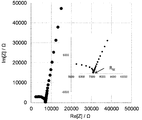
- FIG. 3 is a graph showing a Core-Cole diagram of the impedance measurement results of the solid electrolyte material according to Example 1.
- FIG. 4 is a graph showing the X-ray diffraction pattern of the solid electrolyte material according to Example 1 and Comparative Example 1 and the X-ray diffraction pattern of Li 2 MgCl 4 having a spinel structure.
- the solid electrolyte material according to the first embodiment is composed of Li, M1, M2, and X and has a spinel structure.
- M1 is at least one element selected from the group consisting of Mg and Zn.
- M2 is at least one element selected from the group consisting of Al, Ga, Y, In, and Bi.
- X is at least one element selected from the group consisting of F, Cl, Br, and I.
- the solid electrolyte material according to the first embodiment has high lithium ion conductivity. Therefore, the solid electrolyte material according to the first embodiment can be used to obtain a battery having excellent charge / discharge characteristics.
- An example of such a battery is an all-solid-state secondary battery.
- the solid electrolyte material according to the first embodiment does not contain sulfur, hydrogen sulfide is not generated even when exposed to the atmosphere. Therefore, the solid electrolyte material according to the first embodiment is excellent in safety.
- the solid electrolyte material according to the first embodiment may contain an element that is inevitably mixed. Examples of such elements are hydrogen, nitrogen, or oxygen. Such elements may be present in the raw material powder of the solid electrolyte material or in the atmosphere for producing or storing the solid electrolyte material.
- M1 is at least one element selected from the group consisting of Mg and Zn.
- the solid electrolyte material according to the first embodiment can form a spinel structure. Therefore, the solid electrolyte material according to the first embodiment has high ionic conductivity and high stability as shown in Non-Patent Document 1.
- the coordination number of the anion In order for lithium ions to conduct, it is necessary to break the bond between the lithium ions and the anions that are close to the lithium ions. The smaller the energy for breaking the bond, the easier it is for lithium ions to conduct. Therefore, the smaller the coordination number of the anion, the smaller the number of bonds to break, and the smaller the energy for breaking the bonds. As a result, lithium ions are more easily conducted.
- the coordination number of anions with respect to lithium ions is generally 4 or 6.
- the coordination number of the anion to the lithium ion In the spinel structure, the coordination number of the anion to the lithium ion is high in the ratio of 4, so that high lithium ion conductivity can be realized.
- M1 may be Mg or Zn, or may contain both Mg and Zn. This is because both Mg and Zn can form a spinel structure. Further, both Mg and Zn are inexpensive elements. Therefore, Mg and Zn can be used to reduce the cost of the solid electrolyte material.
- M2 may be one kind of element or two or more kinds of elements.
- M2 is at least one element selected from the group consisting of Al, Ga, Y, In, and Bi. That is, M2 is a trivalent or pentavalent metal element. Therefore, since M2 has a higher valence than M1, Li can be deficient in the solid electrolyte material according to the first embodiment. As a result, the ionic conductivity of the solid electrolyte material can be improved. The reason for this is shown below.
- M2 mainly replaces the site of M1.
- the introduction of M2 having a valence higher than that of M1 makes it impossible to satisfy the electrically neutral condition of the solid electrolyte material.
- Li can be deleted.
- the site to which they are conducted is not occupied. This can be achieved by deleting Li. Therefore, when M2 is an element having a valence higher than that of M1, the ionic conductivity of the solid electrolyte material is improved.
- the solid electrolyte material according to the first embodiment may be a material represented by the following composition formula (1). Li 2-a M1 1-a M2 a X 4 ... (1) Here, 0 ⁇ a ⁇ 1 is satisfied.
- 0.05 ⁇ a ⁇ 0.6 may be satisfied in order to increase the ionic conductivity of the solid electrolyte material. From the viewpoint of ionic conductivity, preferably 0.1 ⁇ a ⁇ 0.4 may be satisfied. More preferably, 0.2 ⁇ a ⁇ 0.4 may be satisfied from the viewpoint of ionic conductivity.
- X may be at least one element selected from the group consisting of Cl, Br, and I.
- the electronegativity of X affects the lithium ion conductivity.
- the shape of the solid electrolyte material according to the first embodiment is not limited. Examples of such shapes are needle-shaped, spherical, or elliptical spherical.
- the solid electrolyte material according to the first embodiment may be in the form of particles.
- the solid electrolyte material according to the first embodiment may be formed to have the shape of a pellet or a plate.
- the solid electrolyte material according to the first embodiment is particulate (for example, spherical)
- the solid electrolyte material may have a median diameter of 0.1 ⁇ m or more and 100 ⁇ m or less. Desirably, it may be 0.5 ⁇ m or more and 10 ⁇ m or less.
- the solid electrolyte material according to the first embodiment has higher ionic conductivity.
- the solid electrolyte material and other materials according to the first embodiment can be well dispersed.
- the median diameter means the particle size when the cumulative volume in the volume-based particle size distribution is equal to 50%.
- the volume-based particle size distribution can be measured by a laser diffraction measuring device or an image analyzer.
- the solid electrolyte material according to the first embodiment may have a median diameter smaller than that of the active material.
- the solid electrolyte material according to the first embodiment is produced, for example, by the following method.
- the raw material powder of the halide is mixed so as to have the desired composition.
- the raw material is not limited to powder, and may be granular or liquid.
- LiCl raw material powder, the MgCl 2 raw material powder, and the AlCl 3 raw material powder are 1.9: 0.9: 0.1.
- LiCl: MgCl 2 : AlCl 3 mol ratio is mixed.
- the feedstock may be mixed in a pre-adjusted molar ratio to offset any compositional changes that may occur during the synthesis process.
- the raw material powders are mechanically reacted with each other in a mixing device such as a planetary ball mill (that is, using the method of mechanochemical milling) to obtain a reactant.
- the reaction may be calcined in vacuum or in an inert atmosphere.
- the mixture of raw material powders may be calcined in vacuum or in an inert atmosphere.
- the firing may be carried out for 1 hour or more within the range of 100 ° C. or higher and 400 ° C. or lower, for example.
- the raw material powder may be sealed in a closed container such as a quartz tube and the raw material powder may be fired.
- the solid electrolyte material according to the first embodiment can be obtained.
- the battery according to the second embodiment includes a positive electrode, an electrolyte layer, and a negative electrode.
- the electrolyte layer is arranged between the positive electrode and the negative electrode.
- At least one selected from the group consisting of a positive electrode, an electrolyte layer, and a negative electrode contains the solid electrolyte material according to the first embodiment.
- the battery according to the second embodiment contains the solid electrolyte material according to the first embodiment, it has high charge / discharge characteristics.
- FIG. 1 shows a cross-sectional view of the battery 1000 according to the second embodiment.
- the battery 1000 includes a positive electrode 201, an electrolyte layer 202, and a negative electrode 203.
- the electrolyte layer 202 is arranged between the positive electrode 201 and the negative electrode 203.
- the positive electrode 201 contains positive electrode active material particles 204 and solid electrolyte particles 100.
- the electrolyte layer 202 contains an electrolyte material (for example, a solid electrolyte material).
- the negative electrode 203 contains negative electrode active material particles 205 and solid electrolyte particles 100.
- the solid electrolyte particle 100 is a particle containing the solid electrolyte material according to the first embodiment as a main component.
- the particles containing the solid electrolyte material according to the first embodiment as a main component mean the particles in which the component contained most is the solid electrolyte material according to the first embodiment.
- the solid electrolyte particles 100 may be particles made of the solid electrolyte material according to the first embodiment.
- the positive electrode 201 contains a material capable of occluding and releasing metal ions (for example, lithium ions).
- the material is, for example, a positive electrode active material (for example, positive electrode active material particles 204).
- Examples of positive electrode active materials are lithium-containing transition metal oxides, transition metal fluorides, polyanionic materials, fluorinated polyanionic materials, transition metal sulfides, transition metal oxyfluorides, transition metal oxysulfides, or transition metal oxynitrides. is there.
- Examples of the lithium-containing transition metal oxide is Li (NiCoAl) O 2 or LiCoO 2.
- the positive electrode active material particles 204 may have a median diameter of 0.1 ⁇ m or more and 100 ⁇ m or less. When the positive electrode active material particles 204 have a median diameter of 0.1 ⁇ m or more, the positive electrode active material particles 204 and the solid electrolyte particles 100 can be well dispersed in the positive electrode 201. As a result, the charge / discharge characteristics of the battery are improved. When the positive electrode active material particles 204 have a median diameter of 100 ⁇ m or less, the lithium diffusion rate in the positive electrode active material particles 204 is improved. This allows the battery to operate at high output.
- the positive electrode active material particles 204 may have a median diameter larger than that of the solid electrolyte particles 100. As a result, the positive electrode active material particles 204 and the solid electrolyte particles 100 can be well dispersed.
- the ratio of the volume of the positive electrode active material particle 204 to the total volume of the positive electrode active material particle 204 and the volume of the solid electrolyte particle 100 is 0.30 or more and 0.95. It may be as follows.
- the positive electrode 201 may have a thickness of 10 ⁇ m or more and 500 ⁇ m or less.
- the electrolyte layer 202 contains an electrolyte material.
- the electrolyte material is, for example, a solid electrolyte material.
- the electrolyte layer 202 may contain the solid electrolyte material according to the first embodiment.
- the electrolyte layer 202 may be composed of only the solid electrolyte material according to the first embodiment.
- the electrolyte layer 202 may be composed only of a solid electrolyte material different from the solid electrolyte material according to the first embodiment.
- a solid electrolyte material different from the solid electrolyte material according to the first embodiment.
- different solid electrolyte material and the solid electrolyte material according to the first embodiment Li 2 MgX '4, Li 2 FeX' 4, Li (Al, Ga, In) X '4, Li 3 (Al, Ga, In ) X '6, or LiI.
- X' is at least one element selected from the group consisting of F, Cl, Br, and I.
- the solid electrolyte material according to the first embodiment is referred to as the first solid electrolyte material.
- a solid electrolyte material different from the solid electrolyte material according to the first embodiment is called a second solid electrolyte material.
- the electrolyte layer 202 may contain not only the first solid electrolyte material but also the second solid electrolyte material.
- the first solid electrolyte material and the second solid electrolyte material may be uniformly dispersed.
- the layer made of the first solid electrolyte material and the layer made of the first solid electrolyte material may be laminated along the stacking direction of the battery 1000.
- the electrolyte layer 202 may have a thickness of 1 ⁇ m or more and 100 ⁇ m or less. When the electrolyte layer 202 has a thickness of 1 ⁇ m or more, the positive electrode 201 and the negative electrode 203 are less likely to be short-circuited. When the electrolyte layer 202 has a thickness of 100 ⁇ m or less, the battery can operate at high output.
- the negative electrode 203 contains a material capable of occluding and releasing metal ions (for example, lithium ions).
- the material is, for example, a negative electrode active material (for example, negative electrode active material particles 205).
- Examples of negative electrode active materials are metal materials, carbon materials, oxides, nitrides, tin compounds, or silicon compounds.
- the metal material may be a simple substance metal or an alloy.
- Examples of metallic materials are lithium metals or lithium alloys.
- Examples of carbon materials are natural graphite, coke, graphitizing carbon, carbon fibers, spherical carbon, artificial graphite, or amorphous carbon. From the point of view of capacitance density, suitable examples of the negative electrode active material are silicon (ie, Si), tin (ie, Sn), a silicon compound, or a tin compound.
- the negative electrode active material particles 205 may have a median diameter of 0.1 ⁇ m or more and 100 ⁇ m or less.
- the negative electrode active material particles 205 have a median diameter of 0.1 ⁇ m or more, the negative electrode active material particles 205 and the solid electrolyte particles 100 can be well dispersed in the negative electrode 203. As a result, the charge / discharge characteristics of the battery are improved.
- the negative electrode active material particles 205 have a median diameter of 100 ⁇ m or less, the lithium diffusion rate in the negative electrode active material particles 205 is improved. This allows the battery to operate at high output.
- the negative electrode active material particles 205 may have a median diameter larger than that of the solid electrolyte particles 100. As a result, the negative electrode active material particles 205 and the solid electrolyte particles 100 can be well dispersed.
- the ratio of the volume of the negative electrode active material particles 205 to the total volume of the negative electrode active material particles 205 and the volume of the solid electrolyte particles 100 is 0.30 or more and 0.95. It may be as follows.
- the negative electrode 203 may have a thickness of 10 ⁇ m or more and 500 ⁇ m or less.
- At least one selected from the group consisting of the positive electrode 201, the electrolyte layer 202, and the negative electrode 203 contains a second solid electrolyte material for the purpose of enhancing ionic conductivity, chemical stability, and electrochemical stability. You may have it.
- the second solid electrolyte material may be a sulfide solid electrolyte.
- Examples of sulfide solid electrolytes are Li 2 SP 2 S 5 , Li 2 S-SiS 2 , Li 2 SB 2 S 3 , Li 2 S-GeS 2 , Li 3.25 Ge 0.25 P 0. .75 S 4 or Li 10 GeP 2 S 12 .
- the second solid electrolyte material may be an oxide solid electrolyte.
- an oxide solid electrolyte is (I) NASICON type solid electrolytes such as LiTi 2 (PO 4 ) 3 or elemental substituents thereof, (Ii) A perovskite-type solid electrolyte such as (LaLi) TiO 3 , (Iii) A LISION type solid electrolyte such as Li 14 ZnGe 4 O 16 , Li 4 SiO 4 , LiGeO 4 or an elemental substitution product thereof. (Iv) a garnet-type solid electrolyte such as Li 7 La 3 Zr 2 O 12 or an elemental substituent thereof, or (v) Li 3 PO 4 or an N-substituted product thereof.
- the second solid electrolyte material may be a halide solid electrolyte.
- halide solid electrolyte Li 2 MgX '4, Li 2 FeX' 4, Li (Al, Ga, In) X '4, Li 3 (Al, Ga, In) X' 6, or LiI.
- halide solid electrolyte material is a compound represented by Li p Me q Y r Z 6 .
- Me is at least one element selected from the group consisting of metal elements other than Li and Y and metalloid elements.
- Z is at least one element selected from the group consisting of F, Cl, Br, and I.
- m' represents the valence of Me.
- Metalloid element represents B, Si, Ge, As, Sb, and Te.
- Metallic elements are all elements contained in groups 1 to 12 of the periodic table (excluding hydrogen) and all elements contained in groups 13 to 16 of the periodic table (however). , B, Si, Ge, As, Sb, Te, C, N, P, O, S, and Se).
- Me is at least one selected from the group consisting of Mg, Ca, Sr, Ba, Zn, Sc, Al, Ga, Bi, Zr, Hf, Ti, Sn, Ta, and Nb. It may be an element.
- the second solid electrolyte material may be an organic polymer solid electrolyte.
- Examples of organic polymer solid electrolytes are polymer compounds and compounds of lithium salts.
- the polymer compound may have an ethylene oxide structure. Since the polymer compound having an ethylene oxide structure can contain a large amount of lithium salts, the ionic conductivity can be further increased.
- Examples of the lithium salt LiPF 6, LiBF 4, LiSbF 6, LiAsF 6, LiSO 3 CF 3, LiN (SO 2 CF 3) 2, LiN (SO 2 C 2 F 5) 2, LiN (SO 2 CF 3) (SO 2 C 4 F 9 ) or LiC (SO 2 CF 3 ) 3 .
- One kind of lithium salt selected from these may be used alone. Alternatively, a mixture of two or more lithium salts selected from these may be used.
- At least one selected from the group consisting of the positive electrode 201, the electrolyte layer 202, and the negative electrode 203 is a non-aqueous electrolyte solution, a gel electrolyte, or ions for the purpose of facilitating the transfer of lithium ions and improving the output characteristics of the battery. It may contain a liquid.
- the non-aqueous electrolyte solution contains a non-aqueous solvent and a lithium salt dissolved in the non-aqueous solvent.
- non-aqueous solvents are cyclic carbonate solvents, chain carbonate solvents, cyclic ether solvents, chain ether solvents, cyclic ester solvents, chain ester solvents, or fluorine solvents.
- cyclic carbonate solvents are ethylene carbonate, propylene carbonate, or butylene carbonate.
- Examples of chain carbonate solvents are dimethyl carbonate, ethyl methyl carbonate, or diethyl carbonate.
- Examples of cyclic ether solvents are tetrahydrofuran, 1,4-dioxane, or 1,3-dioxolane.
- Examples of chain ether solvents are 1,2-dimethoxyethane or 1,2-diethoxyethane.
- An example of a cyclic ester solvent is ⁇ -butyrolactone.
- An example of a chain ester solvent is methyl acetate.
- Examples of fluorine solvents are fluoroethylene carbonate, methyl fluoropropionate, fluorobenzene, fluoroethyl methyl carbonate, or fluorodimethylene carbonate.
- One non-aqueous solvent selected from these may be used alone. Alternatively, a mixture of two or more non-aqueous solvents selected from these may be used.
- lithium salt LiPF 6, LiBF 4, LiSbF 6, LiAsF 6, LiSO 3 CF 3, LiN (SO 2 CF 3) 2, LiN (SO 2 C 2 F 5) 2, LiN (SO 2 CF 3) (SO 2 C 4 F 9 ) or LiC (SO 2 CF 3 ) 3 .
- One kind of lithium salt selected from these may be used alone. Alternatively, a mixture of two or more lithium salts selected from these may be used.
- the concentration of the lithium salt is, for example, 0.5 mol / liter or more and 2 mol / liter or less.
- a polymer material impregnated with a non-aqueous electrolyte solution can be used.
- polymer materials are polyethylene oxide, polyacrylonitrile, polyvinylidene fluoride, polymethylmethacrylate, or polymers with ethylene oxide bonds.
- cations contained in ionic liquids are (I) Aliphatic chain quaternary salts such as tetraalkylammonium or tetraalkylphosphonium, (Ii) Aliphatic cyclic ammonium such as pyrrolidiniums, morpholiniums, imidazoliniums, tetrahydropyraniums, piperaziniums, or piperidiniums, or nitrogen-containing heterocyclic aromatics such as pyridiniums or imidazoliums It is a cation.
- anion contained in the ionic liquid PF 6 -, BF 4 - , SbF 6- -, AsF 6 -, SO 3 CF 3 -, N (SO 2 CF 3) 2 -, N (SO 2 C 2 F 5) 2 -, N (SO 2 CF 3) (SO 2 C 4 F 9) -, or C (SO 2 CF 3) 3 - a.
- the ionic liquid may contain a lithium salt.
- At least one selected from the group consisting of the positive electrode 201, the electrolyte layer 202, and the negative electrode 203 may contain a binder for the purpose of improving the adhesion between the particles.
- binders are vinylidene fluoride, polytetrafluoroethylene, polyethylene, polypropylene, aramid resin, polyamide, polyimide, polyamideimide, polyacrylic nitrile, polyacrylic acid, polyacrylic acid methyl ester, polyacrylic acid ethyl ester, Polyacrylic acid hexyl ester, polymethacrylic acid, polymethacrylic acid methyl ester, polymethacrylic acid ethyl ester, polymethacrylic acid hexyl ester, polyvinyl acetate, polyvinylpyrrolidone, polyether, polyether sulfone, hexafluoropolypropylene, styrene butadiene rubber , Or carboxymethyl cellulose.
- Copolymers can also be used as binders.
- binders are tetrafluoroethylene, hexafluoroethylene, hexafluoropropylene, perfluoroalkyl vinyl ether, vinylidene fluoride, chlorotrifluoroethylene, ethylene, propylene, pentafluoropropylene, fluoromethyl vinyl ether, acrylic acid, and It is a copolymer of two or more materials selected from the group consisting of hexadiene. A mixture of two or more selected from the above materials may be used as a binder.
- At least one selected from the positive electrode 201 and the negative electrode 203 may contain a conductive auxiliary agent for the purpose of enhancing electron conductivity.
- a conductive aid is (I) Graphites such as natural graphite or artificial graphite, (Ii) Carbon blacks such as acetylene black or ketjen black, (Iii) Conductive fibers such as carbon fibers or metal fibers, (Iv) Carbon fluoride, (V) Metal powders such as aluminum, (Vi) Conductive whiskers, such as zinc oxide or potassium titanate, Conductive metal oxides such as (vii) titanium oxide, or conductive polymer compounds such as (vii) polyaniline, polypyrrole, or polythiophene. Is. In order to reduce the cost, the conductive auxiliary agent (i) or (ii) described above may be used.
- Examples of the shape of the battery according to the second embodiment are coin type, cylindrical type, square type, sheet type, button type, flat type, or laminated type.
- Example 1 Preparation of solid electrolyte material
- argon atmosphere having a dew point of -60 ° C. or lower
- LiCl, MgCl 2 and AlCl 3 as raw material powders were 1.9: 0.9: 0.1. It was prepared so as to have a LiCl: MgCl 2 : AlCl 3 molar ratio. These materials were ground and mixed in a mortar. The resulting mixture was milled at 500 rpm for 12 hours using a planetary ball mill.
- the solid electrolyte material according to Example 1 had a composition represented by Li 1.9 Mg 0.9 Al 0.1 Cl 4 .
- FIG. 2 shows a schematic view of a pressure forming die 300 used to evaluate the ionic conductivity of a solid electrolyte material.
- the pressure forming die 300 included a frame type 301, a punch lower part 302, and a punch upper part 303.
- the frame type 301 was formed of insulating polycarbonate.
- Both the lower punch 302 and the upper punch 303 were made of electron-conducting stainless steel.
- the impedance of the solid electrolyte material according to Example 1 was measured by the following method.
- the powder of the solid electrolyte material according to Example 1 (that is, the powder 101 of the solid electrolyte material in FIG. 8) was filled inside the pressure forming die 300. Inside the pressure forming die 300, a pressure of 400 MPa was applied to the powder of the solid electrolyte material according to Example 1 using the lower punch 302 and the upper punch 303.
- the lower punch 302 and the upper punch 303 were connected to a potentiostat (Princeton Applied Research, VersaSTAT4) equipped with a frequency response analyzer.
- the upper part 303 of the punch was connected to the working electrode and the terminal for measuring the potential.
- the lower punch 302 was connected to the counter electrode and the reference electrode.
- the impedance of the solid electrolyte material was measured at room temperature by an electrochemical impedance measurement method.
- FIG. 3 is a graph showing a Core-Cole diagram of the impedance measurement results of the solid electrolyte material according to Example 1.
- the real value of the impedance at the measurement point where the absolute value of the phase of the complex impedance is the smallest was regarded as the resistance value of the solid electrolyte material to the ion conduction.
- the real value refer to the arrow R SE shown in FIG.
- the ionic conductivity was calculated based on the following mathematical formula (2).
- ⁇ (R SE ⁇ S / t) -1 ...
- ⁇ represents ionic conductivity.
- S represents the contact area of the solid electrolyte material with the punch upper portion 303 (in FIG. 2, it is equal to the cross-sectional area of the hollow portion of the frame mold 301).
- R SE represents the resistance value of the solid electrolyte material in the impedance measurement.
- t represents the thickness of the solid electrolyte material to which the pressure is applied (in FIG. 2, the thickness of the layer formed from the powder 101 of the solid electrolyte material).
- the ionic conductivity of the solid electrolyte material according to Example 1 measured at 25 ° C. was 6.6 ⁇ 10 -6 S / cm.
- FIG. 4 is a graph showing an X-ray diffraction pattern of the solid electrolyte material according to Example 1.
- FIG. 4 also shows an X-ray diffraction pattern of Li 2 MgCl 4 having a spinel structure.
- the solid electrolyte material according to Example 1 had a spinel structure.
- a part of Mg constituting Li 2 MgCl 4 is replaced with Al.
- no peak derived from impurities was observed.
- LiCl, MgCl 2 , and AlCl 3 were prepared as raw material powders so as to have a LiCl: MgCl 2 : AlCl 3 molar ratio of (2-a) :( 1-a): a. ..
- Example 5 Example 26, and Example 28, LiBr, MgBr 2 , MgCl 2 , and AlCl 3 as raw material powders were 1.8: 0.1: 0.7: 0.2 LiBr: MgBr 2 : It was prepared to have a MgCl 2 : AlCl 3 molar ratio.
- LiCl, LiBr, MgCl 2 , and AlCl 3 as raw material powders have a LiCl: LiBr: MgCl 2 : AlCl 3 molar ratio of 0.8: 1.0: 0.8: 0.2. Prepared for.
- LiBr, MgCl 2 , MgBr 2 , and AlCl 3 as raw material powders had a ratio of 1.8: 0.2: 0.6: 0.2 to LiBr: MgCl 2 : MgBr 2 : AlCl 3 mol. It was prepared to be.
- LiBr, MgBr 2 , and AlBr 3 were prepared as raw material powders so as to have a LiBr: MgBr 2 : AlBr 3 molar ratio of 1.8: 0.8: 0.2.
- LiBr, LiI, MgCl 2 , MgBr 2 and AlCl 3 were used as raw material powders in 0.8: 1.0: 0.2: 0.6: 0.2.
- LiBr: LiI: MgCl 2 : MgBr 2 : AlCl 3 mol ratio was prepared.
- LiCl, MgCl 2 , and BiCl 3 were prepared as raw material powders so as to have a LiCl: MgCl 2 : BiCl 3 molar ratio of 1.9: 0.9: 0.1.
- Example 11 LiCl, MgCl 2 , and YCl 3 were prepared as raw material powders so as to have a LiCl: MgCl 2 : YCl 3 molar ratio of 1.9: 0.9: 0.1.
- LiCl, MgCl 2 , and GaCl 3 were prepared as raw material powders so as to have a LiCl: MgCl 2 : GaCl 3 molar ratio of (2-a) :( 1-a): a. ..
- Example 17 LiBr, MgBr 2 , MgCl 2 , and GaCl 3 were used as raw material powders in a ratio of 1.8: 0.1: 0.7: 0.1 to LiBr: MgBr 2 : MgCl 2 : GaCl 3 mol. It was prepared to be.
- LiCl, MgCl 2 and InCl 3 were prepared as raw material powders so as to have a LiCl: MgCl 2 : InCl 3 molar ratio of (2-a) :( 1-a): a. ..
- LiCl, ZnCl 2 , and AlCl 3 were prepared as raw material powders so as to have a LiCl: ZnCl 2 : AlCl 3 molar ratio of (2-a) :( 1-a): a. ..
- Example 24 LiCl, MgCl 2 , and AlCl 3 were prepared as raw material powders so as to have a LiCl: MgCl 2 : AlCl 3 molar ratio of 1.8: 0.8: 0.2.
- Example 25 LiBr, MgBr 2 , and AlBr 3 were prepared as raw material powders so as to have a LiBr: MgBr 2 : AlBr 3 molar ratio of 1.8: 0.8: 0.2.
- Example 2 to 23 the solid electrolyte materials according to Examples 2 to 23 were obtained in the same manner as in Example 1 except for the above items.
- Example 24 to 29 each sample was obtained in the same manner as in Example 1 except for the above items.
- the obtained sample was placed in an alumina crucible in an argon atmosphere and calcined using an electric furnace. In this way, the solid electrolyte material according to Examples 24-29 was obtained.
- the firing temperature and firing time are shown in Table 1.
- Comparative Examples 1 to 4 [Preparation of solid electrolyte material]
- LiCl and MgCl 2 were prepared as raw material powders so as to have a LiCl: MgCl 2 molar ratio of 2.0: 1.0.
- Comparative Example 2 LiCl, MgCl 2 , and CaCl 2 were prepared as raw material powders so as to have a LiCl: MgCl 2 : CaCl 2 molar ratio of 2.0: 0.9: 0.1.
- Comparative Example 3 LiCl and ZnCl 2 were prepared as raw material powders so as to have a LiCl: ZnCl 2 molar ratio of 2: 1.
- Comparative Example 4 LiCl, ZnCl 2 , and CaCl 2 were prepared as raw material powders so as to have a LiCl: ZnCl 2 : CaCl 2 molar ratio of 2: 0.5: 0.5.
- FIG. 4 is a graph showing an X-ray diffraction pattern of the solid electrolyte material according to Comparative Example 1.
- the solid electrolyte material according to Comparative Example 1 had a spinel structure.
- Table 1 shows the configurations of the solid electrolyte materials according to Examples 1 to 29 and Comparative Examples 1 to 4 and the evaluation results of each.
- the ionic conductivity of the solid electrolyte material according to Comparative Example 2 was 4.1 ⁇ 10 -7 S / cm. It is considered that this is because when Ca having the same valence as Mg is contained together with M1 (that is, Mg), Li cannot be deleted and the diffusion of Li is inhibited.
- the solid electrolyte material according to the present disclosure is suitable for providing a battery that does not generate hydrogen sulfide and has high lithium ion conductivity.
- the solid electrolyte material according to the present disclosure is used, for example, in an all-solid-state lithium ion secondary battery.
- Solid Electrode Particles 101 Solid Electrode Material Powder 201 Positive Electrode 202 Electrode Layer 203 Negative Electrode 204 Positive Electrode Active Material Particle 205 Negative Electrode Active Material Particle 300 Pressurized Die 301 Frame Type 302 Punch Bottom 303 Punch Top 1000 Battery
Landscapes
- Chemical & Material Sciences (AREA)
- Organic Chemistry (AREA)
- Inorganic Chemistry (AREA)
- Engineering & Computer Science (AREA)
- Chemical Kinetics & Catalysis (AREA)
- Electrochemistry (AREA)
- General Chemical & Material Sciences (AREA)
- Manufacturing & Machinery (AREA)
- Condensed Matter Physics & Semiconductors (AREA)
- Materials Engineering (AREA)
- Physics & Mathematics (AREA)
- General Physics & Mathematics (AREA)
- Geology (AREA)
- Life Sciences & Earth Sciences (AREA)
- Secondary Cells (AREA)
- Conductive Materials (AREA)
- Battery Electrode And Active Subsutance (AREA)
Abstract
本開示は、高いリチウムイオン伝導度を有する固体電解質材料を提供する。本開示による固体電解質材料は、Li、M1、M2、およびXからなり、スピネル構造を有する。M1は、MgおよびZnからなる群より選択される少なくとも一種の元素である。M2は、Al、Ga、Y、In、およびBiからなる群より選択される少なくとも一種の元素である。Xは、F、Cl、Br、およびIからなる群より選択される少なくとも一種の元素である。
Description
本開示は、固体電解質材料およびそれを用いた電池に関する。
特許文献1は、硫化物固体電解質材料が用いられた全固体電池を開示している。
非特許文献1は、スピネル構造を有するハロゲン化物固体電解質を開示している。
Kanno R, Takeda Y, Takeda K and Yamamoto O, 1984 J. Electrochem. Soc., 131, 469-74
本開示の目的は、高いリチウムイオン伝導度を有する固体電解質材料を提供することにある。
本開示の固体電解質材料は、Li、M1、M2、およびXからなり、M1は、MgおよびZnからなる群より選択される少なくとも一種の元素であり、M2は、Al、Ga、Y、In、およびBiからなる群より選択される少なくとも一種の元素であり、Xは、F、Cl、Br、およびIからなる群より選択される少なくとも一種の元素であり、かつスピネル構造を有する。
本開示は、高いリチウムイオン伝導度を有する固体電解質材料を提供する。
以下、本開示の実施形態が、図面を参照しながら説明される。
(第1実施形態)
第1実施形態による固体電解質材料は、Li、M1、M2、およびXからなり、スピネル構造を有する。M1は、MgおよびZnからなる群より選択される少なくとも一種の元素である。M2は、Al、Ga、Y、In、およびBiからなる群より選択される少なくとも一種の元素である。Xは、F、Cl、Br、およびIからなる群より選択される少なくとも一種の元素である。
第1実施形態による固体電解質材料は、Li、M1、M2、およびXからなり、スピネル構造を有する。M1は、MgおよびZnからなる群より選択される少なくとも一種の元素である。M2は、Al、Ga、Y、In、およびBiからなる群より選択される少なくとも一種の元素である。Xは、F、Cl、Br、およびIからなる群より選択される少なくとも一種の元素である。
第1実施形態による固体電解質材料は、高いリチウムイオン伝導度を有する。このため、第1実施形態による固体電解質材料は、充放電特性に優れた電池を得るために用いられ得る。当該電池の例は、全固体二次電池である。
第1実施形態による固体電解質材料は、硫黄を含有しないので、大気に暴露されても、硫化水素が発生しない。したがって、第1実施形態による固体電解質材料は、安全性に優れている。
第1実施形態による固体電解質材料は、不可避的に混入される元素を含有していてもよい。当該元素の例は、水素、窒素、または酸素である。このような元素は、固体電解質材料の原料粉、または、固体電解質材料を製造あるいは保管するための雰囲気中に存在し得る。
M1は、MgおよびZnからなる群より選択される少なくとも一種の元素である。これにより、第1実施形態による固体電解質材料は、スピネル構造を形成することができる。このため、第1実施形態による固体電解質材料は、非特許文献1に示されるように、高いイオン伝導度および高い安定性を有する。
リチウムイオン伝導性を有する固体電解質材料については、リチウムイオンに対するアニオン(例えば、第1実施形態による固体電解質材料におけるX)の配位数が小さいことが望ましい。この理由は以下のとおりである。
リチウムイオンが伝導するためには、リチウムイオンと、当該リチウムイオンに近接するアニオンとの結合を切断する必要がある。結合を切断するためのエネルギーが小さい方が、リチウムイオンが伝導しやすい。したがって、アニオンの配位数が小さい方が、切断する結合が少ないため、結合を切断するためのエネルギーが小さくなる。その結果、リチウムイオンがより伝導しやすくなる。リチウムイオンを含む結晶では、一般に、リチウムイオンに対するアニオンの配位数が4または6である。スピネル構造においては、リチウムイオンに対するアニオンの配位数は4の割合が高いため、高いリチウムイオン伝導度を実現できる。
M1は、MgまたはZnであってもよいし、あるいはMgおよびZnの両方を 含んでもよい。これは、MgおよびZnは、共に、スピネル構造を形成することができるからである。また、MgおよびZnは、共に、安価な元素である。したがって、MgおよびZnは、固体電解質材料のコストを抑えるために用いられ得る。
M2は、一種の元素であってもよいし、あるいは二種以上の元素であってもよい。M2は、Al、Ga、Y、In、およびBiからなる群より選択される少なくとも一種の元素である。すなわち、M2は、3価または5価の金属元素である。したがって、M2はM1よりも大きい価数を有するため、第1実施形態による固体電解質材料において、Liを欠損させることができる。これにより、固体電解質材料のイオン伝導度の向上が実現できる。この理由を以下に示す。
M2は、主にM1のサイトを置換する。このとき、M1よりも大きい価数を有するM2が導入されることで、固体電解質材料の電気的中性条件が成立しなくなる。その結果、Liを欠損させることができる。リチウムイオンが伝導するためには、伝導した先にあるサイトが占有されていないことが望ましい。これは、Liを欠損させることにより実現できる。したがって、M2が、M1よりも大きい価数を有する元素であることにより、固体電解質材料のイオン伝導度が向上する。
固体電解質材料のイオン伝導性を高めるために、第1実施形態による固体電解質材料は、以下の組成式(1)により表される材料であってもよい。
Li2-aM11-aM2aX4 ・・・(1)
ここで、0<a<1が充足される。
Li2-aM11-aM2aX4 ・・・(1)
ここで、0<a<1が充足される。
固体電解質材料のイオン伝導性を高めるために、組成式(1)において、0.05≦a≦0.6が充足されてもよい。イオン伝導性の観点から、望ましくは、0.1≦a≦0.4が充足されてもよい。イオン伝導性の観点から、より望ましくは、0.2≦a≦0.4が充足されてもよい。
M1に対するM2の置換量を大きくすること、すなわち組成式(1)におけるaの値を大きくすることにより、Liをより多く欠損させることができる。その結果、固体電解質材料のイオン伝導性が向上する。
固体電解質材料のイオン伝導性をさらに高めるために、Xは、Cl、Br、およびIからなる群より選択される少なくとも一種の元素であってもよい。
Xの電気陰性度は、リチウムイオン伝導度に影響する。LiおよびXの電気陰性度の差が大きい方が、LiおよびXの結合が強く、当該結合が切断されにくい。したがって、リチウムイオン伝導度を向上させるために、Xとして、比較的小さい電気陰性度を有するCl、Br、およびIからなる群より選択される少なくとも一種の元素を用いてもよい。
第1実施形態による固体電解質材料の形状は、限定されない。当該形状の例は、針状、球状、または楕円球状である。第1実施形態による固体電解質材料は、粒子状であってもよい。第1実施形態による固体電解質材料は、ペレットまたは板の形状を有するように形成されてもよい。
第1実施形態による固体電解質材料が粒子状(例えば、球状)である場合、当該固体電解質材料は、0.1μm以上かつ100μm以下のメジアン径を有していてもよい。望ましくは、0.5μm以上かつ10μm以下であってもよい。これにより、第1実施形態による固体電解質材料は、より高いイオン伝導性を有する。さらに、第1実施形態による固体電解質材料および他の材料が良好に分散し得る。メジアン径は、体積基準の粒度分布における累積体積が50%に等しい場合の粒径を意味する。体積基準の粒度分布は、レーザー回折式測定装置または画像解析装置により測定され得る。
第1実施形態による固体電解質材料および活物質を良好に分散させるために、第1実施形態よる固体電解質材料は、活物質よりも小さいメジアン径を有していてもよい。
次に、第1実施形態による固体電解質材料の製造方法について説明する。
第1実施形態による固体電解質材料は、例えば、下記の方法により、製造される。
目的の組成を有するように、ハロゲン化物の原料粉が混合される。原料は粉体に限らず、粒状または液体であってもよい。
例えば、Li1.9Mg0.9Al0.1Cl4を作製する場合には、LiCl原料粉、MgCl2原料粉、およびAlCl3原料粉が、1.9:0.9:0.1のLiCl:MgCl2:AlCl3モル比で混合される。合成過程において生じ得る組成変化を相殺するように、あらかじめ調整されたモル比で原料粉は混合されてもよい。
原料粉を遊星型ボールミルのような混合装置内でメカノケミカル的に(すなわち、メカノケミカルミリングの方法を用いて)互いに反応させ、反応物を得る。反応物は、真空中または不活性雰囲気中で焼成されてもよい。あるいは、原料粉の混合物が、真空中または不活性雰囲気中で焼成されてもよい。焼成は、例えば、100℃以上かつ400℃以下の範囲内で、1時間以上行ってもよい。
焼成過程において生じ得る組成変化を抑えるために、石英管等の密閉容器に原料粉を封入して、当該原料粉が焼成されてもよい。
これらの方法により、第1実施形態による固体電解質材料が得られる。
(第2実施形態)
以下、第2実施形態が説明される。第1実施形態において説明された事項は、適宜、省略される。
以下、第2実施形態が説明される。第1実施形態において説明された事項は、適宜、省略される。
第2実施形態による電池は、正極、電解質層、および負極を備える。電解質層は、正極および負極の間に配置されている。
正極、電解質層、および負極からなる群より選択される少なくとも1つは、第1実施形態による固体電解質材料を含有する。
第2実施形態による電池は、第1実施形態による固体電解質材料を含有するため、高い充放電特性を有する。
以下、第2実施形態による電池の具体例が説明される。
図1は、第2実施形態による電池1000の断面図を示す。
電池1000は、正極201、電解質層202、および負極203を備える。電解質層202は、正極201および負極203の間に配置されている。
正極201は、正極活物質粒子204および固体電解質粒子100を含有する。
電解質層202は、電解質材料(例えば、固体電解質材料)を含有する。
負極203は、負極活物質粒子205および固体電解質粒子100を含有する。
固体電解質粒子100は、第1実施形態による固体電解質材料を主たる成分として含有する粒子である。第1実施形態による固体電解質材料を主たる成分として含有する粒子とは、最も多く含まれる成分が第1実施形態による固体電解質材料である粒子を意味する。固体電解質粒子100は、第1実施形態による固体電解質材料からなる粒子であってもよい。
正極201は、金属イオン(例えば、リチウムイオン)を吸蔵かつ放出可能な材料を含有する。当該材料は、例えば、正極活物質(例えば、正極活物質粒子204)である。
正極活物質の例は、リチウム含有遷移金属酸化物、遷移金属フッ化物、ポリアニオン材料、フッ素化ポリアニオン材料、遷移金属硫化物、遷移金属オキシフッ化物、遷移金属オキシ硫化物、または遷移金属オキシ窒化物である。リチウム含有遷移金属酸化物の例は、Li(NiCoAl)O2またはLiCoO2である。
正極活物質粒子204は、0.1μm以上かつ100μm以下のメジアン径を有していてもよい。正極活物質粒子204が0.1μm以上のメジアン径を有する場合、正極201において、正極活物質粒子204および固体電解質粒子100が良好に分散し得る。これにより、電池の充放電特性が向上する。正極活物質粒子204が100μm以下のメジアン径を有する場合、正極活物質粒子204内のリチウム拡散速度が向上する。これにより、電池が高出力で動作し得る。
正極活物質粒子204は、固体電解質粒子100よりも大きいメジアン径を有していてもよい。これにより、正極活物質粒子204および固体電解質粒子100が良好に分散し得る。
電池のエネルギー密度および出力の観点から、正極201において、正極活物質粒子204の体積および固体電解質粒子100の体積の合計に対する正極活物質粒子204の体積の比は、0.30以上かつ0.95以下であってもよい。
電池のエネルギー密度および出力の観点から、正極201は、10μm以上かつ500μm以下の厚みを有していてもよい。
電解質層202は、電解質材料を含有する。当該電解質材料は、例えば、固体電解質材料である。電解質層202は、第1実施形態による固体電解質材料を含有していてもよい。
電解質層202は、第1実施形態による固体電解質材料のみから構成されていてもよい。
電解質層202は、第1実施形態による固体電解質材料とは異なる固体電解質材料のみから構成されていてもよい。第1実施形態による固体電解質材料とは異なる固体電解質材料の例は、Li2MgX’4、Li2FeX’4、Li(Al、Ga、In)X’4、Li3(Al、Ga、In)X’6、またはLiIである。ここで、X’は、F、Cl、Br、およびIからなる群より選択される少なくとも1つの元素である。
以下、第1実施形態による固体電解質材料は、第1固体電解質材料と呼ばれる。第1実施形態による固体電解質材料とは異なる固体電解質材料は、第2固体電解質材料と呼ばれる。
電解質層202は、第1固体電解質材料だけでなく、第2固体電解質材料をも含有していてもよい。第1固体電解質材料および第2固体電解質材料は、均一に分散していてもよい。
第1固体電解質材料からなる層および第1固体電解質材料からなる層が、電池1000の積層方向に沿って積層されていてもよい。
電解質層202は、1μm以上かつ100μm以下の厚みを有していてもよい。電解質層202が1μm以上の厚みを有する場合、正極201および負極203が短絡しにくくなる。電解質層202が100μm以下の厚みを有する場合、電池が高出力で動作し得る。
負極203は、金属イオン(例えば、リチウムイオン)を吸蔵かつ放出可能な材料を含有する。当該材料は、例えば、負極活物質(例えば、負極活物質粒子205)である。
負極活物質の例は、金属材料、炭素材料、酸化物、窒化物、錫化合物、または珪素化合物である。金属材料は、単体の金属であってもよく、あるいは合金であってもよい。金属材料の例は、リチウム金属またはリチウム合金である。炭素材料の例は、天然黒鉛、コークス、黒鉛化途上炭素、炭素繊維、球状炭素、人造黒鉛、または非晶質炭素である。容量密度の観点から、負極活物質の好適な例は、珪素(すなわち、Si)、錫(すなわち、Sn)、珪素化合物、または錫化合物である。
負極活物質粒子205は、0.1μm以上かつ100μm以下のメジアン径を有していてもよい。負極活物質粒子205が0.1μm以上のメジアン径を有する場合、負極203において、負極活物質粒子205および固体電解質粒子100が良好に分散し得る。これにより、電池の充放電特性が向上する。負極活物質粒子205が100μm以下のメジアン径を有する場合、負極活物質粒子205内のリチウム拡散速度が向上する。これにより、電池が高出力で動作し得る。
負極活物質粒子205は、固体電解質粒子100よりも大きいメジアン径を有していてもよい。これにより、負極活物質粒子205および固体電解質粒子100が良好に分散し得る。
電池のエネルギー密度および出力の観点から、負極203において、負極活物質粒子205の体積および固体電解質粒子100の体積の合計に対する負極活物質粒子205の体積の比は、0.30以上かつ0.95以下であってもよい。
電池のエネルギー密度および出力の観点から、負極203は、10μm以上かつ500μm以下の厚みを有していてもよい。
正極201、電解質層202、および負極203からなる群より選択される少なくとも1つは、イオン伝導性、化学的安定性、および電気化学的安定性を高める目的で、第2固体電解質材料を含有していていもよい。
第2固体電解質材料は、硫化物固体電解質であってもよい。
硫化物固体電解質の例は、Li2S-P2S5、Li2S-SiS2、Li2S-B2S3、Li2S-GeS2、Li3.25Ge0.25P0.75S4、またはLi10GeP2S12である。
第2固体電解質材料は、酸化物固体電解質であってもよい。
酸化物固体電解質の例は、
(i)LiTi2(PO4)3またはその元素置換体のようなNASICON型固体電解質、
(ii)(LaLi)TiO3のようなペロブスカイト型固体電解質、
(iii)Li14ZnGe4O16、Li4SiO4、LiGeO4またはその元素置換体のようなLISICON型固体電解質、
(iv)Li7La3Zr2O12またはその元素置換体のようなガーネット型固体電解質、または
(v)Li3PO4またはそのN置換体
である。
(i)LiTi2(PO4)3またはその元素置換体のようなNASICON型固体電解質、
(ii)(LaLi)TiO3のようなペロブスカイト型固体電解質、
(iii)Li14ZnGe4O16、Li4SiO4、LiGeO4またはその元素置換体のようなLISICON型固体電解質、
(iv)Li7La3Zr2O12またはその元素置換体のようなガーネット型固体電解質、または
(v)Li3PO4またはそのN置換体
である。
上述のように、第2固体電解質材料は、ハロゲン化物固体電解質であってもよい。ハロゲン化物固体電解質の例は、Li2MgX’4、Li2FeX’4、Li(Al、Ga、In)X’4、Li3(Al、Ga、In)X’6、またはLiIである。
ハロゲン化物固体電解質材料の他の例は、LipMeqYrZ6で表される化合物である。ここで、p+m′q+3r=6、およびr>0が充足される。Meは、LiおよびY以外の金属元素と半金属元素とからなる群より選択される少なくとも1つの元素である。Zは、F、Cl、Br、およびIからなる群より選択される少なくとも1つの元素である。m′は、Meの価数を表す。「半金属元素」は、B、Si、Ge、As、Sb、およびTeを表す。「金属元素」は、周期表第1族から第12族中に含まれるすべての元素(ただし、水素を除く)、および、周期表第13族から第16族中に含まれるすべての元素(ただし、B、Si、Ge、As、Sb、Te、C、N、P、O、S、およびSeを除く)を表す。
イオン伝導性の観点から、Meは、Mg、Ca、Sr、Ba、Zn、Sc、Al、Ga、Bi、Zr、Hf、Ti、Sn、Ta、およびNbからなる群より選択される少なくとも1つの元素であってもよい。
第2固体電解質材料は、有機ポリマー固体電解質であってもよい。
有機ポリマー固体電解質の例は、高分子化合物およびリチウム塩の化合物である。高分子化合物は、エチレンオキシド構造を有していてもよい。エチレンオキシド構造を有する高分子化合物は、リチウム塩を多く含有できるため、イオン導電率をより高めることができる。リチウム塩の例は、LiPF6、LiBF4、LiSbF6、LiAsF6、LiSO3CF3、LiN(SO2CF3)2、LiN(SO2C2F5)2、LiN(SO2CF3)(SO2C4F9)、またはLiC(SO2CF3)3である。これらから選択される1種のリチウム塩が、単独で使用されてもよい。あるいは、これらから選択される2種以上のリチウム塩の混合物が使用されてもよい。
正極201、電解質層202、および負極203からなる群より選択される少なくとも1つは、リチウムイオンの授受を容易にし、電池の出力特性を向上する目的で、非水電解質液、ゲル電解質、またはイオン液体を含有していていもよい。
非水電解液は、非水溶媒および当該非水溶媒に溶けたリチウム塩を含む。非水溶媒の例は、環状炭酸エステル溶媒、鎖状炭酸エステル溶媒、環状エーテル溶媒、鎖状エーテル溶媒、環状エステル溶媒、鎖状エステル溶媒、またはフッ素溶媒である。環状炭酸エステル溶媒の例は、エチレンカーボネート、プロピレンカーボネート、またはブチレンカーボネートである。鎖状炭酸エステル溶媒の例は、ジメチルカーボネート、エチルメチルカーボネート、またはジエチルカーボネートである。環状エーテル溶媒の例は、テトラヒドロフラン、1,4-ジオキサン、または1,3-ジオキソランである。鎖状エーテル溶媒の例は、1,2-ジメトキシエタンまたは1,2-ジエトキシエタンである。環状エステル溶媒の例は、γ-ブチロラクトンである。鎖状エステル溶媒の例は、酢酸メチルである。フッ素溶媒の例は、フルオロエチレンカーボネート、フルオロプロピオン酸メチル、フルオロベンゼン、フルオロエチルメチルカーボネート、またはフルオロジメチレンカーボネートである。これらから選択される1種の非水溶媒が、単独で使用されてもよい。あるいは、これらから選択される2種以上の非水溶媒の混合物が使用されてもよい。
リチウム塩の例は、LiPF6、LiBF4、LiSbF6、LiAsF6、LiSO3CF3、LiN(SO2CF3)2、LiN(SO2C2F5)2、LiN(SO2CF3)(SO2C4F9)、またはLiC(SO2CF3)3である。これらから選択される1種のリチウム塩が、単独で使用されてもよい。あるいは、これらから選択される2種以上のリチウム塩の混合物が使用されてもよい。リチウム塩の濃度は、例えば、0.5mol/リットル以上かつ2mol/リットル以下である。
ゲル電解質として、非水電解液を含浸させたポリマー材料が使用され得る。ポリマー材料の例は、ポリエチレンオキシド、ポリアクリルニトリル、ポリフッ化ビニリデン、ポリメチルメタクリレート、またはエチレンオキシド結合を有するポリマーである。
イオン液体に含まれるカチオンの例は、
(i)テトラアルキルアンモニウムまたはテトラアルキルホスホニウムのような脂肪族鎖状4級塩類、
(ii)ピロリジニウム類、モルホリニウム類、イミダゾリニウム類、テトラヒドロピリミジニウム類、ピペラジニウム類、またはピペリジニウム類のような脂肪族環状アンモニウム、または
ピリジニウム類またはイミダゾリウム類のような含窒ヘテロ環芳香族カチオン
である。
(i)テトラアルキルアンモニウムまたはテトラアルキルホスホニウムのような脂肪族鎖状4級塩類、
(ii)ピロリジニウム類、モルホリニウム類、イミダゾリニウム類、テトラヒドロピリミジニウム類、ピペラジニウム類、またはピペリジニウム類のような脂肪族環状アンモニウム、または
ピリジニウム類またはイミダゾリウム類のような含窒ヘテロ環芳香族カチオン
である。
イオン液体に含まれるアニオンの例は、PF6
-、BF4
-、SbF6-
-、AsF6
-、SO3CF3
-、N(SO2CF3)2
-、N(SO2C2F5)2
-、N(SO2CF3)(SO2C4F9)-、またはC(SO2CF3)3
-である。イオン液体はリチウム塩を含有していてもよい。
正極201、電解質層202、および負極203からなる群より選択される少なくとも1つは、粒子同士の密着性を向上する目的で、結着剤を含有していていもよい。
結着剤の例は、ポリフッ化ビニリデン、ポリテトラフルオロエチレン、ポリエチレン、ポリプロピレン、アラミド樹脂、ポリアミド、ポリイミド、ポリアミドイミド、ポリアクリルニトリル、ポリアクリル酸、ポリアクリル酸メチルエステル、ポリアクリル酸エチルエステル、ポリアクリル酸ヘキシルエステル、ポリメタクリル酸、ポリメタクリル酸メチルエステル、ポリメタクリル酸エチルエステル、ポリメタクリル酸ヘキシルエステル、ポリ酢酸ビニル、ポリビニルピロリドン、ポリエーテル、ポリエーテルサルフォン、ヘキサフルオロポリプロピレン、スチレンブタジエンゴム、またはカルボキシメチルセルロースである。共重合体もまた、結着剤として使用され得る。当該結着剤の例は、テトラフルオロエチレン、ヘキサフルオロエチレン、ヘキサフルオロプロピレン、パーフルオロアルキルビニルエーテル、フッ化ビニリデン、クロロトリフルオロエチレン、エチレン、プロピレン、ペンタフルオロプロピレン、フルオロメチルビニルエーテル、アクリル酸、およびヘキサジエンからなる群より選択された2種以上の材料の共重合体である。上記の材料から選択された2種以上の混合物が、結着剤として用いられてもよい。
正極201および負極203から選択される少なくとも1つは、電子伝導性を高める目的で、導電助剤を含有していていもよい。
導電助剤の例は、
(i)天然黒鉛または人造黒鉛のようなグラファイト類、
(ii)アセチレンブラックまたはケッチェンブラックのようなカーボンブラック類、
(iii)炭素繊維または金属繊維のような導電性繊維類、
(iv)フッ化カーボン、
(v)アルミニウムのような金属粉末類、
(vi)酸化亜鉛またはチタン酸カリウムのような導電性ウィスカー類、
(vii)酸化チタンのような導電性金属酸化物、または
(viii)ポリアニリン、ポリピロール、またはポリチオフェンのような導電性高分子化合物、
である。低コスト化のために、上記(i)または(ii)の導電助剤が使用されてもよい。
(i)天然黒鉛または人造黒鉛のようなグラファイト類、
(ii)アセチレンブラックまたはケッチェンブラックのようなカーボンブラック類、
(iii)炭素繊維または金属繊維のような導電性繊維類、
(iv)フッ化カーボン、
(v)アルミニウムのような金属粉末類、
(vi)酸化亜鉛またはチタン酸カリウムのような導電性ウィスカー類、
(vii)酸化チタンのような導電性金属酸化物、または
(viii)ポリアニリン、ポリピロール、またはポリチオフェンのような導電性高分子化合物、
である。低コスト化のために、上記(i)または(ii)の導電助剤が使用されてもよい。
第2実施形態による電池の形状の例は、コイン型、円筒型、角型、シート型、ボタン型、扁平型、または積層型である。
(実施例)
以下、実施例および比較例を参照しながら、本開示が詳細に説明される。
以下、実施例および比較例を参照しながら、本開示が詳細に説明される。
(実施例1)
[固体電解質材料の作製]
-60℃以下の露点を有するアルゴン雰囲気(以下、単に「アルゴン雰囲気」と表記する)中で、原料粉としてLiCl、MgCl2、およびAlCl3が、1.9:0.9:0.1のLiCl:MgCl2:AlCl3モル比となるように用意された。これらの材料は乳鉢中で 粉砕され、混合された。得られた混合物は、遊星型ボールミルを用い、12時間、500rpmでミリング処理された。
[固体電解質材料の作製]
-60℃以下の露点を有するアルゴン雰囲気(以下、単に「アルゴン雰囲気」と表記する)中で、原料粉としてLiCl、MgCl2、およびAlCl3が、1.9:0.9:0.1のLiCl:MgCl2:AlCl3モル比となるように用意された。これらの材料は乳鉢中で 粉砕され、混合された。得られた混合物は、遊星型ボールミルを用い、12時間、500rpmでミリング処理された。
このようにして、実施例1による固体電解質材料が得られた。実施例1による固体電解質材料は、Li1.9Mg0.9Al0.1Cl4により表される組成を有していた。
[イオン伝導度の評価]
図2は、固体電解質材料のイオン伝導度を評価するために用いられた加圧成形ダイス300の模式図を示す。
図2は、固体電解質材料のイオン伝導度を評価するために用いられた加圧成形ダイス300の模式図を示す。
加圧成形ダイス300は、枠型301、パンチ下部302、およびパンチ上部303を具備していた。枠型301は、絶縁性のポリカーボネートから形成されていた。パンチ下部302およびパンチ上部303は、いずれも電子伝導性のステンレスから形成されていた。
図2に示される加圧成形ダイス300を用いて、下記の方法により、実施例1による固体電解質材料のインピーダンスが測定された。
アルゴン雰囲気中で、実施例1による固体電解質材料の粉末(すなわち、図8において固体電解質材料の粉末101)が、加圧成形ダイス300の内部に充填された。加圧成形ダイス300の内部で、パンチ下部302およびパンチ上部303を用いて、実施例1による固体電解質材料の粉末に、400MPaの圧力が印加された。
圧力が印加されたまま、パンチ下部302およびパンチ上部303が、周波数応答アナライザを搭載したポテンショスタット(Princeton Applied Research社、VersaSTAT4)に接続された。パンチ上部303は、作用極および電位測定用端子に接続された。パンチ下部302は、対極および参照極に接続された。固体電解質材料のインピーダンスは、電気化学的インピーダンス測定法により、室温において測定された。
図3は、実施例1による固体電解質材料のインピーダンス測定結果のCole-Cole線図を示すグラフである。
図3において、複素インピーダンスの位相の絶対値が最も小さい測定点でのインピーダンスの実数値が、固体電解質材料のイオン伝導に対する抵抗値とみなされた。当該実数値は、図9に示される矢印RSEを参照せよ。
当該抵抗値を用いて、以下の数式(2)に基づいて、イオン伝導度が算出された。
σ=(RSE×S/t)-1 ・・・(2)
ここで、σはイオン伝導度を表す。Sは、固体電解質材料のパンチ上部303との接触面積(図2において、枠型301の中空部の断面積に等しい )を表す。RSEは、インピーダンス測定における固体電解質材料の抵抗値を表す。tは、圧力が印加された固体電解質材料の厚み(図2において、固体電解質材料の粉末101から形成される層の厚み)を表す。25℃で測定された、実施例1による固体電解質材料のイオン伝導度は、6.6×10⁻⁶S/cmであった。
σ=(RSE×S/t)-1 ・・・(2)
ここで、σはイオン伝導度を表す。Sは、固体電解質材料のパンチ上部303との接触面積(図2において、枠型301の中空部の断面積に等しい )を表す。RSEは、インピーダンス測定における固体電解質材料の抵抗値を表す。tは、圧力が印加された固体電解質材料の厚み(図2において、固体電解質材料の粉末101から形成される層の厚み)を表す。25℃で測定された、実施例1による固体電解質材料のイオン伝導度は、6.6×10⁻⁶S/cmであった。
[X線回折パターン]
図4は、実施例1による固体電解質材料のX線回折パターンを示すグラフである。図4は、スピネル構造を有するLi2MgCl4のX線回折パターンも示す。実施例1による固体電解質材料は、スピネル構造を有していた。実施例1による固体電解質材料は、Li2MgCl4を構成するMgの一部がAlで置換されている。実施例1による固体電解質材料のX線回折パターンにおいて、不純物に由来するピークは観測されなかった。
図4は、実施例1による固体電解質材料のX線回折パターンを示すグラフである。図4は、スピネル構造を有するLi2MgCl4のX線回折パターンも示す。実施例1による固体電解質材料は、スピネル構造を有していた。実施例1による固体電解質材料は、Li2MgCl4を構成するMgの一部がAlで置換されている。実施例1による固体電解質材料のX線回折パターンにおいて、不純物に由来するピークは観測されなかった。
(実施例2~29)
[固体電解質材料の作製]
[固体電解質材料の作製]
実施例2~4では、原料粉としてLiCl、MgCl2、およびAlCl3が、(2-a):(1-a):aのLiCl:MgCl2:AlCl3モル比となるように用意された。
実施例5、実施例26および実施例28では、原料粉としてLiBr、MgBr2、MgCl2、およびAlCl3が、1.8:0.1:0.7:0.2のLiBr:MgBr2:MgCl2:AlCl3モル比となるように用意された。
実施例6では、原料粉としてLiCl、LiBr、MgCl2、およびAlCl3が、0.8:1.0:0.8:0.2のLiCl:LiBr:MgCl2:AlCl3モル比となるように用意された。
実施例7では、原料粉としてLiBr、MgCl2、MgBr2、およびAlCl3が、1.8:0.2:0.6:0.2のLiBr:MgCl2:MgBr2:AlCl3モル比となるように用意された。
実施例8では、原料粉としてLiBr、MgBr2、およびAlBr3が、1.8:0.8:0.2のLiBr:MgBr2:AlBr3モル比となるように用意された。
実施例9、実施例27および実施例29では、原料粉としてLiBr、LiI、MgCl2、MgBr2、およびAlCl3が、0.8:1.0:0.2:0.6:0.2のLiBr:LiI:MgCl2:MgBr2:AlCl3モル比となるように用意された。
実施例10では、原料粉としてLiCl、MgCl2、およびBiCl3が、1.9:0.9:0.1のLiCl:MgCl2:BiCl3モル比となるように用意された。
実施例11では、原料粉としてLiCl、MgCl2、およびYCl3が、1.9:0.9:0.1のLiCl:MgCl2:YCl3モル比となるように用意された。
実施例12~16では、原料粉としてLiCl、MgCl2、およびGaCl3が、(2-a):(1-a):aのLiCl:MgCl2:GaCl3モル比となるように用意された。
実施例17では、原料粉としてLiBr、MgBr2、MgCl2、およびGaCl3が、1.8:0.1:0.7:0.1のLiBr:MgBr2:MgCl2:GaCl3モル比となるように用意された。
実施例18~19では、原料粉としてLiCl、MgCl2、およびInCl3が、(2-a):(1-a):aのLiCl:MgCl2:InCl3モル比となるように用意された。
実施例20~23では、原料粉としてLiCl、ZnCl2、およびAlCl3が、(2-a):(1-a):aのLiCl:ZnCl2:AlCl3モル比となるように用意された。
実施例24では、原料粉としてLiCl、MgCl2、およびAlCl3が、1.8:0.8:0.2のLiCl:MgCl2:AlCl3モル比となるように用意された。
実施例25では、原料粉としてLiBr、MgBr2、およびAlBr3が、1.8:0.8:0.2のLiBr:MgBr2:AlBr3モル比となるように用意された。
実施例2~23では、上記の事項以外は、実施例1と同様にして、実施例2~23による固体電解質材料が得られた。
実施例24~29では、上記の事項以外は、実施例1と同様にして、それぞれの試料を得た。得られた試料は、アルゴン雰囲気中でアルミナ坩堝に試料を入れられ、電気炉を用いて焼成された。このようにして実施例24~29による固体電解質材料が得られた。焼成温度および焼成時間は、表1に示される。
[イオン伝導度の評価]
実施例2~29による固体電解質材料のイオン伝導度が、実施例1と同様に測定された。測定結果は、表1に示される。
実施例2~29による固体電解質材料のイオン伝導度が、実施例1と同様に測定された。測定結果は、表1に示される。
(比較例1~4)
[固体電解質材料の作製]
比較例1では、原料粉としてLiClおよびMgCl2が、2.0:1.0のLiCl:MgCl2モル比となるように用意された。
比較例2では、原料粉としてLiCl、MgCl2、およびCaCl2が、2.0:0.9:0.1のLiCl:MgCl2:CaCl2モル比となるように用意された。
比較例3では、原料粉としてLiClおよびZnCl2が、2:1のLiCl:ZnCl2モル比となるように用意された。
比較例4では、原料粉としてLiCl、ZnCl2、およびCaCl2が、2:0.5:0.5のLiCl:ZnCl2:CaCl2モル比となるように用意された。
[固体電解質材料の作製]
比較例1では、原料粉としてLiClおよびMgCl2が、2.0:1.0のLiCl:MgCl2モル比となるように用意された。
比較例2では、原料粉としてLiCl、MgCl2、およびCaCl2が、2.0:0.9:0.1のLiCl:MgCl2:CaCl2モル比となるように用意された。
比較例3では、原料粉としてLiClおよびZnCl2が、2:1のLiCl:ZnCl2モル比となるように用意された。
比較例4では、原料粉としてLiCl、ZnCl2、およびCaCl2が、2:0.5:0.5のLiCl:ZnCl2:CaCl2モル比となるように用意された。
[イオン伝導度の評価]
比較例1~4による固体電解質材料のイオン伝導度が、実施例1と同様に測定された。測定結果は、表1に示される。
比較例1~4による固体電解質材料のイオン伝導度が、実施例1と同様に測定された。測定結果は、表1に示される。
[X線回折パターン]
比較例1による固体電解質材料のX線回折パターンが、実施例1と同様に測定された。図4は、比較例1による固体電解質材料のX線回折パターンを示すグラフである。比較例1による固体電解質材料は、スピネル構造を有していた。
比較例1による固体電解質材料のX線回折パターンが、実施例1と同様に測定された。図4は、比較例1による固体電解質材料のX線回折パターンを示すグラフである。比較例1による固体電解質材料は、スピネル構造を有していた。
実施例1~29および比較例1~4による固体電解質材料の構成および各評価結果が、表1に示される。

(考察)
実施例1による固体電解質材料(すなわち、Li1.9Mg0.9Al0.1Cl4)のイオン伝導度は、6.6×10⁻⁶S/cmであった。一方、比較例1による固体電解質材料(すなわち、Li2MgCl4)のイオン伝導度は、1.0×10-6S/cmであった。これらの結果から、固体電解質材料がM1だけでなく、M1よりも大きい価数を有するM2を含むことにより、固体電解質材料のLiを欠損させることができる。その結果、イオン伝導度が向上したと考えられる。比較例2による固体電解質材料(すなわち、Li2Mg0.9Ca0.1Cl4)のイオン伝導度は、4.1×10-7S/cmであった。これは、M1(すなわち、Mg)とともに、Mgと同じ価数を有するCaを含む場合、Liを欠損させることができず、Liの拡散が阻害されたためであると考えられる。
実施例1による固体電解質材料(すなわち、Li1.9Mg0.9Al0.1Cl4)のイオン伝導度は、6.6×10⁻⁶S/cmであった。一方、比較例1による固体電解質材料(すなわち、Li2MgCl4)のイオン伝導度は、1.0×10-6S/cmであった。これらの結果から、固体電解質材料がM1だけでなく、M1よりも大きい価数を有するM2を含むことにより、固体電解質材料のLiを欠損させることができる。その結果、イオン伝導度が向上したと考えられる。比較例2による固体電解質材料(すなわち、Li2Mg0.9Ca0.1Cl4)のイオン伝導度は、4.1×10-7S/cmであった。これは、M1(すなわち、Mg)とともに、Mgと同じ価数を有するCaを含む場合、Liを欠損させることができず、Liの拡散が阻害されたためであると考えられる。
実施例2~4、13~15、および21~23を、それぞれ実施例1、12、および20と比較すると明らかなように、M2のモル分率を表すaの値が、0.2以上かつ0.4以下であれば、リチウムイオン伝導性がさらに高くなる。
実施例1~29による固体電解質材料は、硫黄を含有しないため、硫化水素が発生しない。
以上のように、本開示による固体電解質材料は、硫化水素の発生が無く、かつ、高いリチウムイオン伝導度を有する電池を提供するために適切である。
本開示による固体電解質材料は、例えば、全固体リチウムイオン二次電池において利用される。
100 固体電解質粒子
101 固体電解質材料の粉末
201 正極
202 電解質層
203 負極
204 正極活物質粒子
205 負極活物質粒子
300 加圧成形ダイス
301 枠型
302 パンチ下部
303 パンチ上部
1000 電池
101 固体電解質材料の粉末
201 正極
202 電解質層
203 負極
204 正極活物質粒子
205 負極活物質粒子
300 加圧成形ダイス
301 枠型
302 パンチ下部
303 パンチ上部
1000 電池
Claims (6)
- Li、M1、M2、およびXからなり、
M1は、MgおよびZnからなる群より選択される少なくとも一種の元素であり、
M2は、Al、Ga、Y、In、およびBiからなる群より選択される少なくとも一種の元素であり、
Xは、F、Cl、Br、およびIからなる群より選択される少なくとも一種の元素であり 、かつ
スピネル構造を有する、
固体電解質材料。 - 以下の組成式(1)により表され、
Li2-aM11-aM2aX4 ・・・(1)
ここで、0<a<1が充足される、
請求項1に記載の固体電解質材料。 - 0.1≦a≦0.4が充足される、
請求項2に記載の固体電解質材料。 - 0.2≦a≦0.4が充足される、
請求項3に記載の固体電解質材料。 - Xは、Cl、Br、およびIからなる群より選択される少なくとも一種の元素である、
請求項1から4のいずれか一項に記載の固体電解質材料。 - 正極、
負極、および
前記正極および前記負極の間に配置されている電解質層、
を備え、
前記正極、前記負極、および前記電解質層からなる群より選択される少なくとも1つは、請求項1から5のいずれか一項に記載の固体電解質材料を含有する、
電池。
Priority Applications (4)
| Application Number | Priority Date | Filing Date | Title |
|---|---|---|---|
| CN201980093443.0A CN113508482A (zh) | 2019-03-26 | 2019-12-10 | 固体电解质材料及使用了该固体电解质材料的电池 |
| EP19921241.6A EP3951973A4 (en) | 2019-03-26 | 2019-12-10 | SOLID ELECTROLYTIC MATERIAL AND BATTERY USING IT |
| JP2021508732A JP7445876B2 (ja) | 2019-03-26 | 2019-12-10 | 固体電解質材料およびそれを用いた電池 |
| US17/471,767 US12009476B2 (en) | 2019-03-26 | 2021-09-10 | Solid electrolyte material and battery using same |
Applications Claiming Priority (2)
| Application Number | Priority Date | Filing Date | Title |
|---|---|---|---|
| JP2019058334 | 2019-03-26 | ||
| JP2019-058334 | 2019-03-26 |
Related Child Applications (1)
| Application Number | Title | Priority Date | Filing Date |
|---|---|---|---|
| US17/471,767 Continuation US12009476B2 (en) | 2019-03-26 | 2021-09-10 | Solid electrolyte material and battery using same |
Publications (1)
| Publication Number | Publication Date |
|---|---|
| WO2020194897A1 true WO2020194897A1 (ja) | 2020-10-01 |
Family
ID=72608417
Family Applications (1)
| Application Number | Title | Priority Date | Filing Date |
|---|---|---|---|
| PCT/JP2019/048207 Ceased WO2020194897A1 (ja) | 2019-03-26 | 2019-12-10 | 固体電解質材料およびそれを用いた電池 |
Country Status (5)
| Country | Link |
|---|---|
| US (1) | US12009476B2 (ja) |
| EP (1) | EP3951973A4 (ja) |
| JP (1) | JP7445876B2 (ja) |
| CN (1) | CN113508482A (ja) |
| WO (1) | WO2020194897A1 (ja) |
Cited By (9)
| Publication number | Priority date | Publication date | Assignee | Title |
|---|---|---|---|---|
| US20210399333A1 (en) * | 2020-06-23 | 2021-12-23 | Toyota Motor Engineering & Manufacturing North America, Inc. | LiZnCl4 DERIVATIVES IN THE SPACE GROUP of Pmn21 as Li SUPER-IONIC CONDUCTOR, SOLID ELECTROLYTE, and COATING LAYER for Li METAL BATTERY and Li-ION BATTERY |
| WO2021260592A1 (en) * | 2020-06-23 | 2021-12-30 | Toyota Jidosha Kabushiki Kaisha | Metal lithium chloride derivatives in the space group of p21/c as li super-ionic conductor, solid electrolyte, and coating layer for li metal battery and li-ion battery |
| CN114006051A (zh) * | 2021-10-26 | 2022-02-01 | 西安交通大学 | 一种氯化物全无机复合固态电解质及其制备方法 |
| WO2022259749A1 (ja) * | 2021-06-10 | 2022-12-15 | パナソニックIpマネジメント株式会社 | 固体電解質材料および電池 |
| WO2022264659A1 (ja) * | 2021-06-14 | 2022-12-22 | パナソニックIpマネジメント株式会社 | 固体電解質材料および電池 |
| JP2023520060A (ja) * | 2020-03-30 | 2023-05-15 | ビーエーエスエフ ソシエタス・ヨーロピア | エネルギー貯蔵用途のための固体電解質 |
| WO2024262147A1 (ja) * | 2023-06-20 | 2024-12-26 | パナソニックIpマネジメント株式会社 | 固体電解質材料およびそれを用いた電池 |
| WO2025033470A1 (ja) * | 2023-08-10 | 2025-02-13 | 住友化学株式会社 | イオン伝導性物質、固体電解質、及び電池 |
| WO2025203399A1 (ja) * | 2024-03-27 | 2025-10-02 | 日本碍子株式会社 | 固体電解質及びリチウムイオン電池 |
Families Citing this family (2)
| Publication number | Priority date | Publication date | Assignee | Title |
|---|---|---|---|---|
| US11462766B2 (en) * | 2020-06-23 | 2022-10-04 | Toyota Motor Engineering & Manufacturing North America, Inc. | LiAlC14 derivatives in the space group of Pnma as Li super-ionic conductor, solid electrolyte, and coating layer for Li metal battery and Li-ion battery |
| US20260031386A1 (en) * | 2024-07-29 | 2026-01-29 | Nissan North America, Inc. | Multi-cation Compositions of Halospinel Solid State Electrolytes |
Citations (3)
| Publication number | Priority date | Publication date | Assignee | Title |
|---|---|---|---|---|
| JP2011129312A (ja) | 2009-12-16 | 2011-06-30 | Toyota Motor Corp | 硫化物固体電解質材料の製造方法、硫化物固体電解質材料およびリチウム電池 |
| JP2016134294A (ja) * | 2015-01-20 | 2016-07-25 | 株式会社クラレ | リチウムイオン二次電池及びこれを用いた電気機器 |
| WO2018092359A1 (ja) * | 2016-11-15 | 2018-05-24 | パナソニックIpマネジメント株式会社 | 電池用正極活物質、および、電池 |
Family Cites Families (4)
| Publication number | Priority date | Publication date | Assignee | Title |
|---|---|---|---|---|
| CN102244257B (zh) * | 2011-06-15 | 2014-02-05 | 清华大学深圳研究生院 | 一种高温型锰酸锂正极材料及其制备方法 |
| US10587012B2 (en) * | 2015-03-26 | 2020-03-10 | Basf Corporation | Electrolyte compositions comprising ionic liquids and metal hydride batteries comprising same |
| KR101684127B1 (ko) * | 2015-06-15 | 2016-12-07 | 현대자동차주식회사 | 스피넬계 고체전해질 및 이를 이용한 전고체 전지 |
| WO2017024023A1 (en) * | 2015-08-04 | 2017-02-09 | The Regents Of The University Of California | Novel high voltage 10 and 12-vertex carborane and borane electrolytes, their use in rechargable batteries, and processes for their preparation |
-
2019
- 2019-12-10 EP EP19921241.6A patent/EP3951973A4/en not_active Withdrawn
- 2019-12-10 CN CN201980093443.0A patent/CN113508482A/zh active Pending
- 2019-12-10 JP JP2021508732A patent/JP7445876B2/ja active Active
- 2019-12-10 WO PCT/JP2019/048207 patent/WO2020194897A1/ja not_active Ceased
-
2021
- 2021-09-10 US US17/471,767 patent/US12009476B2/en active Active
Patent Citations (3)
| Publication number | Priority date | Publication date | Assignee | Title |
|---|---|---|---|---|
| JP2011129312A (ja) | 2009-12-16 | 2011-06-30 | Toyota Motor Corp | 硫化物固体電解質材料の製造方法、硫化物固体電解質材料およびリチウム電池 |
| JP2016134294A (ja) * | 2015-01-20 | 2016-07-25 | 株式会社クラレ | リチウムイオン二次電池及びこれを用いた電気機器 |
| WO2018092359A1 (ja) * | 2016-11-15 | 2018-05-24 | パナソニックIpマネジメント株式会社 | 電池用正極活物質、および、電池 |
Non-Patent Citations (2)
| Title |
|---|
| KANNO RTAKEDA YTAKEDA KYAMAMOTO O, J. ELECTROCHEM. SOC., vol. 131, 1984, pages 469 - 74 |
| See also references of EP3951973A4 |
Cited By (17)
| Publication number | Priority date | Publication date | Assignee | Title |
|---|---|---|---|---|
| JP2023520060A (ja) * | 2020-03-30 | 2023-05-15 | ビーエーエスエフ ソシエタス・ヨーロピア | エネルギー貯蔵用途のための固体電解質 |
| JP7719809B2 (ja) | 2020-06-23 | 2025-08-06 | トヨタ自動車株式会社 | リチウム金属電池およびリチウムイオン電池用のリチウム超イオン伝導体、固体電解質、および被覆層としての空間群Pmn21内のLiZnCl4誘導体 |
| WO2021260592A1 (en) * | 2020-06-23 | 2021-12-30 | Toyota Jidosha Kabushiki Kaisha | Metal lithium chloride derivatives in the space group of p21/c as li super-ionic conductor, solid electrolyte, and coating layer for li metal battery and li-ion battery |
| WO2021260584A1 (en) * | 2020-06-23 | 2021-12-30 | Toyota Jidosha Kabushiki Kaisha | Li zn cl4 derivatives in the space group of pmn2_1 as li super-ionic conductor, solid electrolyte, and coating layer for li metal battery and li-ion battery |
| JP7719810B2 (ja) | 2020-06-23 | 2025-08-06 | トヨタ自動車株式会社 | リチウム金属電池およびリチウムイオン電池用のリチウム超イオン伝導体、固体電解質、および被覆層としての空間群P21/c内の塩化金属リチウム誘導体 |
| US20210399333A1 (en) * | 2020-06-23 | 2021-12-23 | Toyota Motor Engineering & Manufacturing North America, Inc. | LiZnCl4 DERIVATIVES IN THE SPACE GROUP of Pmn21 as Li SUPER-IONIC CONDUCTOR, SOLID ELECTROLYTE, and COATING LAYER for Li METAL BATTERY and Li-ION BATTERY |
| US11641029B2 (en) | 2020-06-23 | 2023-05-02 | Toyota Motor Engineering & Manufacturing North America, Inc. | Metal lithium chloride derivatives in the space group of P21/c as Li super-ionic conductor, solid electrolyte, and coating layer for Li metal battery and Li-ion battery |
| JP2023531235A (ja) * | 2020-06-23 | 2023-07-21 | トヨタ自動車株式会社 | リチウム金属電池およびリチウムイオン電池用のリチウム超イオン伝導体、固体電解質、および被覆層としての空間群Pmn21内のLiZnCl4誘導体 |
| JP2023531236A (ja) * | 2020-06-23 | 2023-07-21 | トヨタ自動車株式会社 | リチウム金属電池およびリチウムイオン電池用のリチウム超イオン伝導体、固体電解質、および被覆層としての空間群P21/c内の塩化金属リチウム誘導体 |
| US12034113B2 (en) | 2020-06-23 | 2024-07-09 | Toyota Motor Engineering & Manufacturing North America, Inc. | LiZnCl4 derivatives in the group of Pmn21 as Li super-ionic conductor, solid electrolyte, and coating layer for Li metal battery and Li-ion battery |
| WO2022259749A1 (ja) * | 2021-06-10 | 2022-12-15 | パナソニックIpマネジメント株式会社 | 固体電解質材料および電池 |
| WO2022264659A1 (ja) * | 2021-06-14 | 2022-12-22 | パナソニックIpマネジメント株式会社 | 固体電解質材料および電池 |
| CN114006051B (zh) * | 2021-10-26 | 2022-12-09 | 西安交通大学 | 一种氯化物全无机复合固态电解质及其制备方法 |
| CN114006051A (zh) * | 2021-10-26 | 2022-02-01 | 西安交通大学 | 一种氯化物全无机复合固态电解质及其制备方法 |
| WO2024262147A1 (ja) * | 2023-06-20 | 2024-12-26 | パナソニックIpマネジメント株式会社 | 固体電解質材料およびそれを用いた電池 |
| WO2025033470A1 (ja) * | 2023-08-10 | 2025-02-13 | 住友化学株式会社 | イオン伝導性物質、固体電解質、及び電池 |
| WO2025203399A1 (ja) * | 2024-03-27 | 2025-10-02 | 日本碍子株式会社 | 固体電解質及びリチウムイオン電池 |
Also Published As
| Publication number | Publication date |
|---|---|
| EP3951973A4 (en) | 2022-04-27 |
| US12009476B2 (en) | 2024-06-11 |
| EP3951973A1 (en) | 2022-02-09 |
| US20210408586A1 (en) | 2021-12-30 |
| JP7445876B2 (ja) | 2024-03-08 |
| JPWO2020194897A1 (ja) | 2020-10-01 |
| CN113508482A (zh) | 2021-10-15 |
Similar Documents
| Publication | Publication Date | Title |
|---|---|---|
| US12009476B2 (en) | Solid electrolyte material and battery using same | |
| JP7418014B2 (ja) | 固体電解質材料およびそれを用いた電池 | |
| JPWO2019135317A1 (ja) | 固体電解質材料、および、電池 | |
| JPWO2019135318A1 (ja) | 固体電解質材料、および、電池 | |
| JPWO2019135315A1 (ja) | 固体電解質材料、および、電池 | |
| WO2021070595A1 (ja) | 固体電解質材料およびそれを用いた電池 | |
| JPWO2019135316A1 (ja) | 固体電解質材料、および、電池 | |
| WO2021186809A1 (ja) | 固体電解質材料およびそれを用いた電池 | |
| WO2020188914A1 (ja) | 固体電解質材料およびこれを用いた電池 | |
| JP7417953B2 (ja) | 固体電解質およびそれを用いた電池 | |
| JPWO2020175171A1 (ja) | 電解質材料およびそれを用いた電池 | |
| JPWO2020137026A1 (ja) | 固体電解質材料、およびそれを用いた電池 | |
| WO2021161604A1 (ja) | 固体電解質材料およびそれを用いた電池 | |
| JP7417951B2 (ja) | リチウムイオン伝導性固体電解質材料、およびこれを用いた電池 | |
| WO2021186833A1 (ja) | 固体電解質材料およびそれを用いた電池 | |
| WO2021250985A1 (ja) | 固体電解質材料およびそれを用いた電池 | |
| WO2021199676A1 (ja) | 固体電解質材料およびそれを用いた電池 | |
| WO2021199677A1 (ja) | 固体電解質材料、それを用いた電池、および固体電解質材料の製造方法 | |
| WO2020188913A1 (ja) | 固体電解質材料およびこれを用いた電池 | |
| WO2021186845A1 (ja) | 固体電解質材料およびそれを用いた電池 | |
| WO2020188915A1 (ja) | 固体電解質材料およびこれを用いた電池 | |
| WO2020137042A1 (ja) | 固体電解質材料、およびこれを用いた電池 | |
| WO2022215337A1 (ja) | 固体電解質材料およびそれを用いた電池 | |
| WO2022018990A1 (ja) | 固体電解質材料およびそれを用いた電池 | |
| WO2021199642A1 (ja) | 固体電解質材料およびこれを用いた電池 |
Legal Events
| Date | Code | Title | Description |
|---|---|---|---|
| 121 | Ep: the epo has been informed by wipo that ep was designated in this application |
Ref document number: 19921241 Country of ref document: EP Kind code of ref document: A1 |
|
| ENP | Entry into the national phase |
Ref document number: 2021508732 Country of ref document: JP Kind code of ref document: A |
|
| NENP | Non-entry into the national phase |
Ref country code: DE |
|
| ENP | Entry into the national phase |
Ref document number: 2019921241 Country of ref document: EP Effective date: 20211026 |