WO2020194897A1 - Matériau électrolytique solide et batterie l'utilisant - Google Patents
Matériau électrolytique solide et batterie l'utilisant Download PDFInfo
- Publication number
- WO2020194897A1 WO2020194897A1 PCT/JP2019/048207 JP2019048207W WO2020194897A1 WO 2020194897 A1 WO2020194897 A1 WO 2020194897A1 JP 2019048207 W JP2019048207 W JP 2019048207W WO 2020194897 A1 WO2020194897 A1 WO 2020194897A1
- Authority
- WO
- WIPO (PCT)
- Prior art keywords
- solid electrolyte
- electrolyte material
- material according
- examples
- battery
- Prior art date
- Legal status (The legal status is an assumption and is not a legal conclusion. Google has not performed a legal analysis and makes no representation as to the accuracy of the status listed.)
- Ceased
Links
Images



Classifications
-
- H—ELECTRICITY
- H01—ELECTRIC ELEMENTS
- H01M—PROCESSES OR MEANS, e.g. BATTERIES, FOR THE DIRECT CONVERSION OF CHEMICAL ENERGY INTO ELECTRICAL ENERGY
- H01M10/00—Secondary cells; Manufacture thereof
- H01M10/05—Accumulators with non-aqueous electrolyte
- H01M10/056—Accumulators with non-aqueous electrolyte characterised by the materials used as electrolytes, e.g. mixed inorganic/organic electrolytes
- H01M10/0561—Accumulators with non-aqueous electrolyte characterised by the materials used as electrolytes, e.g. mixed inorganic/organic electrolytes the electrolyte being constituted of inorganic materials only
- H01M10/0562—Solid materials
-
- C—CHEMISTRY; METALLURGY
- C01—INORGANIC CHEMISTRY
- C01F—COMPOUNDS OF THE METALS BERYLLIUM, MAGNESIUM, ALUMINIUM, CALCIUM, STRONTIUM, BARIUM, RADIUM, THORIUM, OR OF THE RARE-EARTH METALS
- C01F17/00—Compounds of rare earth metals
- C01F17/30—Compounds containing rare earth metals and at least one element other than a rare earth metal, oxygen or hydrogen, e.g. La4S3Br6
- C01F17/36—Compounds containing rare earth metals and at least one element other than a rare earth metal, oxygen or hydrogen, e.g. La4S3Br6 halogen being the only anion, e.g. NaYF4
-
- C—CHEMISTRY; METALLURGY
- C01—INORGANIC CHEMISTRY
- C01F—COMPOUNDS OF THE METALS BERYLLIUM, MAGNESIUM, ALUMINIUM, CALCIUM, STRONTIUM, BARIUM, RADIUM, THORIUM, OR OF THE RARE-EARTH METALS
- C01F7/00—Compounds of aluminium
- C01F7/48—Halides, with or without other cations besides aluminium
-
- C—CHEMISTRY; METALLURGY
- C01—INORGANIC CHEMISTRY
- C01G—COMPOUNDS CONTAINING METALS NOT COVERED BY SUBCLASSES C01D OR C01F
- C01G15/00—Compounds of gallium, indium or thallium
- C01G15/006—Compounds containing gallium, indium or thallium, with or without oxygen or hydrogen, and containing two or more other elements
-
- C—CHEMISTRY; METALLURGY
- C01—INORGANIC CHEMISTRY
- C01G—COMPOUNDS CONTAINING METALS NOT COVERED BY SUBCLASSES C01D OR C01F
- C01G29/00—Compounds of bismuth
- C01G29/006—Compounds containing bismuth, with or without oxygen or hydrogen, and containing two or more other elements
-
- C—CHEMISTRY; METALLURGY
- C01—INORGANIC CHEMISTRY
- C01G—COMPOUNDS CONTAINING METALS NOT COVERED BY SUBCLASSES C01D OR C01F
- C01G9/00—Compounds of zinc
- C01G9/006—Compounds containing zinc, with or without oxygen or hydrogen, and containing two or more other elements
-
- H—ELECTRICITY
- H01—ELECTRIC ELEMENTS
- H01B—CABLES; CONDUCTORS; INSULATORS; SELECTION OF MATERIALS FOR THEIR CONDUCTIVE, INSULATING OR DIELECTRIC PROPERTIES
- H01B1/00—Conductors or conductive bodies characterised by the conductive materials; Selection of materials as conductors
- H01B1/06—Conductors or conductive bodies characterised by the conductive materials; Selection of materials as conductors mainly consisting of other non-metallic substances
-
- H—ELECTRICITY
- H01—ELECTRIC ELEMENTS
- H01M—PROCESSES OR MEANS, e.g. BATTERIES, FOR THE DIRECT CONVERSION OF CHEMICAL ENERGY INTO ELECTRICAL ENERGY
- H01M10/00—Secondary cells; Manufacture thereof
- H01M10/05—Accumulators with non-aqueous electrolyte
- H01M10/052—Li-accumulators
-
- H—ELECTRICITY
- H01—ELECTRIC ELEMENTS
- H01M—PROCESSES OR MEANS, e.g. BATTERIES, FOR THE DIRECT CONVERSION OF CHEMICAL ENERGY INTO ELECTRICAL ENERGY
- H01M10/00—Secondary cells; Manufacture thereof
- H01M10/05—Accumulators with non-aqueous electrolyte
- H01M10/052—Li-accumulators
- H01M10/0525—Rocking-chair batteries, i.e. batteries with lithium insertion or intercalation in both electrodes; Lithium-ion batteries
-
- H—ELECTRICITY
- H01—ELECTRIC ELEMENTS
- H01M—PROCESSES OR MEANS, e.g. BATTERIES, FOR THE DIRECT CONVERSION OF CHEMICAL ENERGY INTO ELECTRICAL ENERGY
- H01M4/00—Electrodes
- H01M4/02—Electrodes composed of, or comprising, active material
- H01M4/04—Processes of manufacture in general
- H01M4/0402—Methods of deposition of the material
- H01M4/0407—Methods of deposition of the material by coating on an electrolyte layer
-
- H—ELECTRICITY
- H01—ELECTRIC ELEMENTS
- H01M—PROCESSES OR MEANS, e.g. BATTERIES, FOR THE DIRECT CONVERSION OF CHEMICAL ENERGY INTO ELECTRICAL ENERGY
- H01M4/00—Electrodes
- H01M4/02—Electrodes composed of, or comprising, active material
- H01M4/13—Electrodes for accumulators with non-aqueous electrolyte, e.g. for lithium-accumulators; Processes of manufacture thereof
- H01M4/131—Electrodes based on mixed oxides or hydroxides, or on mixtures of oxides or hydroxides, e.g. LiCoOx
-
- H—ELECTRICITY
- H01—ELECTRIC ELEMENTS
- H01M—PROCESSES OR MEANS, e.g. BATTERIES, FOR THE DIRECT CONVERSION OF CHEMICAL ENERGY INTO ELECTRICAL ENERGY
- H01M4/00—Electrodes
- H01M4/02—Electrodes composed of, or comprising, active material
- H01M4/36—Selection of substances as active materials, active masses, active liquids
- H01M4/48—Selection of substances as active materials, active masses, active liquids of inorganic oxides or hydroxides
- H01M4/52—Selection of substances as active materials, active masses, active liquids of inorganic oxides or hydroxides of nickel, cobalt or iron
- H01M4/525—Selection of substances as active materials, active masses, active liquids of inorganic oxides or hydroxides of nickel, cobalt or iron of mixed oxides or hydroxides containing iron, cobalt or nickel for inserting or intercalating light metals, e.g. LiNiO2, LiCoO2 or LiCoOxFy
-
- C—CHEMISTRY; METALLURGY
- C01—INORGANIC CHEMISTRY
- C01P—INDEXING SCHEME RELATING TO STRUCTURAL AND PHYSICAL ASPECTS OF SOLID INORGANIC COMPOUNDS
- C01P2002/00—Crystal-structural characteristics
- C01P2002/30—Three-dimensional structures
- C01P2002/32—Three-dimensional structures spinel-type (AB2O4)
-
- C—CHEMISTRY; METALLURGY
- C01—INORGANIC CHEMISTRY
- C01P—INDEXING SCHEME RELATING TO STRUCTURAL AND PHYSICAL ASPECTS OF SOLID INORGANIC COMPOUNDS
- C01P2002/00—Crystal-structural characteristics
- C01P2002/70—Crystal-structural characteristics defined by measured X-ray, neutron or electron diffraction data
- C01P2002/72—Crystal-structural characteristics defined by measured X-ray, neutron or electron diffraction data by d-values or two theta-values, e.g. as X-ray diagram
-
- C—CHEMISTRY; METALLURGY
- C01—INORGANIC CHEMISTRY
- C01P—INDEXING SCHEME RELATING TO STRUCTURAL AND PHYSICAL ASPECTS OF SOLID INORGANIC COMPOUNDS
- C01P2004/00—Particle morphology
- C01P2004/60—Particles characterised by their size
- C01P2004/61—Micrometer sized, i.e. from 1-100 micrometer
-
- C—CHEMISTRY; METALLURGY
- C01—INORGANIC CHEMISTRY
- C01P—INDEXING SCHEME RELATING TO STRUCTURAL AND PHYSICAL ASPECTS OF SOLID INORGANIC COMPOUNDS
- C01P2004/00—Particle morphology
- C01P2004/60—Particles characterised by their size
- C01P2004/62—Submicrometer sized, i.e. from 0.1-1 micrometer
-
- H—ELECTRICITY
- H01—ELECTRIC ELEMENTS
- H01M—PROCESSES OR MEANS, e.g. BATTERIES, FOR THE DIRECT CONVERSION OF CHEMICAL ENERGY INTO ELECTRICAL ENERGY
- H01M2300/00—Electrolytes
- H01M2300/0017—Non-aqueous electrolytes
- H01M2300/0065—Solid electrolytes
- H01M2300/0068—Solid electrolytes inorganic
-
- H—ELECTRICITY
- H01—ELECTRIC ELEMENTS
- H01M—PROCESSES OR MEANS, e.g. BATTERIES, FOR THE DIRECT CONVERSION OF CHEMICAL ENERGY INTO ELECTRICAL ENERGY
- H01M2300/00—Electrolytes
- H01M2300/0017—Non-aqueous electrolytes
- H01M2300/0065—Solid electrolytes
- H01M2300/0068—Solid electrolytes inorganic
- H01M2300/008—Halides
-
- Y—GENERAL TAGGING OF NEW TECHNOLOGICAL DEVELOPMENTS; GENERAL TAGGING OF CROSS-SECTIONAL TECHNOLOGIES SPANNING OVER SEVERAL SECTIONS OF THE IPC; TECHNICAL SUBJECTS COVERED BY FORMER USPC CROSS-REFERENCE ART COLLECTIONS [XRACs] AND DIGESTS
- Y02—TECHNOLOGIES OR APPLICATIONS FOR MITIGATION OR ADAPTATION AGAINST CLIMATE CHANGE
- Y02E—REDUCTION OF GREENHOUSE GAS [GHG] EMISSIONS, RELATED TO ENERGY GENERATION, TRANSMISSION OR DISTRIBUTION
- Y02E60/00—Enabling technologies; Technologies with a potential or indirect contribution to GHG emissions mitigation
- Y02E60/10—Energy storage using batteries
Definitions
- the present disclosure relates to a solid electrolyte material and a battery using the same.
- Patent Document 1 discloses an all-solid-state battery in which a sulfide solid electrolyte material is used.
- Non-Patent Document 1 discloses a halide solid electrolyte having a spinel structure.
- An object of the present disclosure is to provide a solid electrolyte material having high lithium ion conductivity.
- the solid electrolyte material of the present disclosure comprises Li, M1, M2, and X, M1 is at least one element selected from the group consisting of Mg and Zn, and M2 is Al, Ga, Y, In, And at least one element selected from the group consisting of Bi, X is at least one element selected from the group consisting of F, Cl, Br, and I, and has a spinel structure.
- the present disclosure provides a solid electrolyte material having high lithium ion conductivity.
- FIG. 1 shows a cross-sectional view of the battery 1000 according to the second embodiment.
- FIG. 2 shows a schematic view of a pressure forming die 300 used to evaluate the ionic conductivity of a solid electrolyte material.
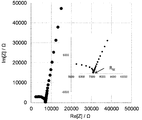
- FIG. 3 is a graph showing a Core-Cole diagram of the impedance measurement results of the solid electrolyte material according to Example 1.
- FIG. 4 is a graph showing the X-ray diffraction pattern of the solid electrolyte material according to Example 1 and Comparative Example 1 and the X-ray diffraction pattern of Li 2 MgCl 4 having a spinel structure.
- the solid electrolyte material according to the first embodiment is composed of Li, M1, M2, and X and has a spinel structure.
- M1 is at least one element selected from the group consisting of Mg and Zn.
- M2 is at least one element selected from the group consisting of Al, Ga, Y, In, and Bi.
- X is at least one element selected from the group consisting of F, Cl, Br, and I.
- the solid electrolyte material according to the first embodiment has high lithium ion conductivity. Therefore, the solid electrolyte material according to the first embodiment can be used to obtain a battery having excellent charge / discharge characteristics.
- An example of such a battery is an all-solid-state secondary battery.
- the solid electrolyte material according to the first embodiment does not contain sulfur, hydrogen sulfide is not generated even when exposed to the atmosphere. Therefore, the solid electrolyte material according to the first embodiment is excellent in safety.
- the solid electrolyte material according to the first embodiment may contain an element that is inevitably mixed. Examples of such elements are hydrogen, nitrogen, or oxygen. Such elements may be present in the raw material powder of the solid electrolyte material or in the atmosphere for producing or storing the solid electrolyte material.
- M1 is at least one element selected from the group consisting of Mg and Zn.
- the solid electrolyte material according to the first embodiment can form a spinel structure. Therefore, the solid electrolyte material according to the first embodiment has high ionic conductivity and high stability as shown in Non-Patent Document 1.
- the coordination number of the anion In order for lithium ions to conduct, it is necessary to break the bond between the lithium ions and the anions that are close to the lithium ions. The smaller the energy for breaking the bond, the easier it is for lithium ions to conduct. Therefore, the smaller the coordination number of the anion, the smaller the number of bonds to break, and the smaller the energy for breaking the bonds. As a result, lithium ions are more easily conducted.
- the coordination number of anions with respect to lithium ions is generally 4 or 6.
- the coordination number of the anion to the lithium ion In the spinel structure, the coordination number of the anion to the lithium ion is high in the ratio of 4, so that high lithium ion conductivity can be realized.
- M1 may be Mg or Zn, or may contain both Mg and Zn. This is because both Mg and Zn can form a spinel structure. Further, both Mg and Zn are inexpensive elements. Therefore, Mg and Zn can be used to reduce the cost of the solid electrolyte material.
- M2 may be one kind of element or two or more kinds of elements.
- M2 is at least one element selected from the group consisting of Al, Ga, Y, In, and Bi. That is, M2 is a trivalent or pentavalent metal element. Therefore, since M2 has a higher valence than M1, Li can be deficient in the solid electrolyte material according to the first embodiment. As a result, the ionic conductivity of the solid electrolyte material can be improved. The reason for this is shown below.
- M2 mainly replaces the site of M1.
- the introduction of M2 having a valence higher than that of M1 makes it impossible to satisfy the electrically neutral condition of the solid electrolyte material.
- Li can be deleted.
- the site to which they are conducted is not occupied. This can be achieved by deleting Li. Therefore, when M2 is an element having a valence higher than that of M1, the ionic conductivity of the solid electrolyte material is improved.
- the solid electrolyte material according to the first embodiment may be a material represented by the following composition formula (1). Li 2-a M1 1-a M2 a X 4 ... (1) Here, 0 ⁇ a ⁇ 1 is satisfied.
- 0.05 ⁇ a ⁇ 0.6 may be satisfied in order to increase the ionic conductivity of the solid electrolyte material. From the viewpoint of ionic conductivity, preferably 0.1 ⁇ a ⁇ 0.4 may be satisfied. More preferably, 0.2 ⁇ a ⁇ 0.4 may be satisfied from the viewpoint of ionic conductivity.
- X may be at least one element selected from the group consisting of Cl, Br, and I.
- the electronegativity of X affects the lithium ion conductivity.
- the shape of the solid electrolyte material according to the first embodiment is not limited. Examples of such shapes are needle-shaped, spherical, or elliptical spherical.
- the solid electrolyte material according to the first embodiment may be in the form of particles.
- the solid electrolyte material according to the first embodiment may be formed to have the shape of a pellet or a plate.
- the solid electrolyte material according to the first embodiment is particulate (for example, spherical)
- the solid electrolyte material may have a median diameter of 0.1 ⁇ m or more and 100 ⁇ m or less. Desirably, it may be 0.5 ⁇ m or more and 10 ⁇ m or less.
- the solid electrolyte material according to the first embodiment has higher ionic conductivity.
- the solid electrolyte material and other materials according to the first embodiment can be well dispersed.
- the median diameter means the particle size when the cumulative volume in the volume-based particle size distribution is equal to 50%.
- the volume-based particle size distribution can be measured by a laser diffraction measuring device or an image analyzer.
- the solid electrolyte material according to the first embodiment may have a median diameter smaller than that of the active material.
- the solid electrolyte material according to the first embodiment is produced, for example, by the following method.
- the raw material powder of the halide is mixed so as to have the desired composition.
- the raw material is not limited to powder, and may be granular or liquid.
- LiCl raw material powder, the MgCl 2 raw material powder, and the AlCl 3 raw material powder are 1.9: 0.9: 0.1.
- LiCl: MgCl 2 : AlCl 3 mol ratio is mixed.
- the feedstock may be mixed in a pre-adjusted molar ratio to offset any compositional changes that may occur during the synthesis process.
- the raw material powders are mechanically reacted with each other in a mixing device such as a planetary ball mill (that is, using the method of mechanochemical milling) to obtain a reactant.
- the reaction may be calcined in vacuum or in an inert atmosphere.
- the mixture of raw material powders may be calcined in vacuum or in an inert atmosphere.
- the firing may be carried out for 1 hour or more within the range of 100 ° C. or higher and 400 ° C. or lower, for example.
- the raw material powder may be sealed in a closed container such as a quartz tube and the raw material powder may be fired.
- the solid electrolyte material according to the first embodiment can be obtained.
- the battery according to the second embodiment includes a positive electrode, an electrolyte layer, and a negative electrode.
- the electrolyte layer is arranged between the positive electrode and the negative electrode.
- At least one selected from the group consisting of a positive electrode, an electrolyte layer, and a negative electrode contains the solid electrolyte material according to the first embodiment.
- the battery according to the second embodiment contains the solid electrolyte material according to the first embodiment, it has high charge / discharge characteristics.
- FIG. 1 shows a cross-sectional view of the battery 1000 according to the second embodiment.
- the battery 1000 includes a positive electrode 201, an electrolyte layer 202, and a negative electrode 203.
- the electrolyte layer 202 is arranged between the positive electrode 201 and the negative electrode 203.
- the positive electrode 201 contains positive electrode active material particles 204 and solid electrolyte particles 100.
- the electrolyte layer 202 contains an electrolyte material (for example, a solid electrolyte material).
- the negative electrode 203 contains negative electrode active material particles 205 and solid electrolyte particles 100.
- the solid electrolyte particle 100 is a particle containing the solid electrolyte material according to the first embodiment as a main component.
- the particles containing the solid electrolyte material according to the first embodiment as a main component mean the particles in which the component contained most is the solid electrolyte material according to the first embodiment.
- the solid electrolyte particles 100 may be particles made of the solid electrolyte material according to the first embodiment.
- the positive electrode 201 contains a material capable of occluding and releasing metal ions (for example, lithium ions).
- the material is, for example, a positive electrode active material (for example, positive electrode active material particles 204).
- Examples of positive electrode active materials are lithium-containing transition metal oxides, transition metal fluorides, polyanionic materials, fluorinated polyanionic materials, transition metal sulfides, transition metal oxyfluorides, transition metal oxysulfides, or transition metal oxynitrides. is there.
- Examples of the lithium-containing transition metal oxide is Li (NiCoAl) O 2 or LiCoO 2.
- the positive electrode active material particles 204 may have a median diameter of 0.1 ⁇ m or more and 100 ⁇ m or less. When the positive electrode active material particles 204 have a median diameter of 0.1 ⁇ m or more, the positive electrode active material particles 204 and the solid electrolyte particles 100 can be well dispersed in the positive electrode 201. As a result, the charge / discharge characteristics of the battery are improved. When the positive electrode active material particles 204 have a median diameter of 100 ⁇ m or less, the lithium diffusion rate in the positive electrode active material particles 204 is improved. This allows the battery to operate at high output.
- the positive electrode active material particles 204 may have a median diameter larger than that of the solid electrolyte particles 100. As a result, the positive electrode active material particles 204 and the solid electrolyte particles 100 can be well dispersed.
- the ratio of the volume of the positive electrode active material particle 204 to the total volume of the positive electrode active material particle 204 and the volume of the solid electrolyte particle 100 is 0.30 or more and 0.95. It may be as follows.
- the positive electrode 201 may have a thickness of 10 ⁇ m or more and 500 ⁇ m or less.
- the electrolyte layer 202 contains an electrolyte material.
- the electrolyte material is, for example, a solid electrolyte material.
- the electrolyte layer 202 may contain the solid electrolyte material according to the first embodiment.
- the electrolyte layer 202 may be composed of only the solid electrolyte material according to the first embodiment.
- the electrolyte layer 202 may be composed only of a solid electrolyte material different from the solid electrolyte material according to the first embodiment.
- a solid electrolyte material different from the solid electrolyte material according to the first embodiment.
- different solid electrolyte material and the solid electrolyte material according to the first embodiment Li 2 MgX '4, Li 2 FeX' 4, Li (Al, Ga, In) X '4, Li 3 (Al, Ga, In ) X '6, or LiI.
- X' is at least one element selected from the group consisting of F, Cl, Br, and I.
- the solid electrolyte material according to the first embodiment is referred to as the first solid electrolyte material.
- a solid electrolyte material different from the solid electrolyte material according to the first embodiment is called a second solid electrolyte material.
- the electrolyte layer 202 may contain not only the first solid electrolyte material but also the second solid electrolyte material.
- the first solid electrolyte material and the second solid electrolyte material may be uniformly dispersed.
- the layer made of the first solid electrolyte material and the layer made of the first solid electrolyte material may be laminated along the stacking direction of the battery 1000.
- the electrolyte layer 202 may have a thickness of 1 ⁇ m or more and 100 ⁇ m or less. When the electrolyte layer 202 has a thickness of 1 ⁇ m or more, the positive electrode 201 and the negative electrode 203 are less likely to be short-circuited. When the electrolyte layer 202 has a thickness of 100 ⁇ m or less, the battery can operate at high output.
- the negative electrode 203 contains a material capable of occluding and releasing metal ions (for example, lithium ions).
- the material is, for example, a negative electrode active material (for example, negative electrode active material particles 205).
- Examples of negative electrode active materials are metal materials, carbon materials, oxides, nitrides, tin compounds, or silicon compounds.
- the metal material may be a simple substance metal or an alloy.
- Examples of metallic materials are lithium metals or lithium alloys.
- Examples of carbon materials are natural graphite, coke, graphitizing carbon, carbon fibers, spherical carbon, artificial graphite, or amorphous carbon. From the point of view of capacitance density, suitable examples of the negative electrode active material are silicon (ie, Si), tin (ie, Sn), a silicon compound, or a tin compound.
- the negative electrode active material particles 205 may have a median diameter of 0.1 ⁇ m or more and 100 ⁇ m or less.
- the negative electrode active material particles 205 have a median diameter of 0.1 ⁇ m or more, the negative electrode active material particles 205 and the solid electrolyte particles 100 can be well dispersed in the negative electrode 203. As a result, the charge / discharge characteristics of the battery are improved.
- the negative electrode active material particles 205 have a median diameter of 100 ⁇ m or less, the lithium diffusion rate in the negative electrode active material particles 205 is improved. This allows the battery to operate at high output.
- the negative electrode active material particles 205 may have a median diameter larger than that of the solid electrolyte particles 100. As a result, the negative electrode active material particles 205 and the solid electrolyte particles 100 can be well dispersed.
- the ratio of the volume of the negative electrode active material particles 205 to the total volume of the negative electrode active material particles 205 and the volume of the solid electrolyte particles 100 is 0.30 or more and 0.95. It may be as follows.
- the negative electrode 203 may have a thickness of 10 ⁇ m or more and 500 ⁇ m or less.
- At least one selected from the group consisting of the positive electrode 201, the electrolyte layer 202, and the negative electrode 203 contains a second solid electrolyte material for the purpose of enhancing ionic conductivity, chemical stability, and electrochemical stability. You may have it.
- the second solid electrolyte material may be a sulfide solid electrolyte.
- Examples of sulfide solid electrolytes are Li 2 SP 2 S 5 , Li 2 S-SiS 2 , Li 2 SB 2 S 3 , Li 2 S-GeS 2 , Li 3.25 Ge 0.25 P 0. .75 S 4 or Li 10 GeP 2 S 12 .
- the second solid electrolyte material may be an oxide solid electrolyte.
- an oxide solid electrolyte is (I) NASICON type solid electrolytes such as LiTi 2 (PO 4 ) 3 or elemental substituents thereof, (Ii) A perovskite-type solid electrolyte such as (LaLi) TiO 3 , (Iii) A LISION type solid electrolyte such as Li 14 ZnGe 4 O 16 , Li 4 SiO 4 , LiGeO 4 or an elemental substitution product thereof. (Iv) a garnet-type solid electrolyte such as Li 7 La 3 Zr 2 O 12 or an elemental substituent thereof, or (v) Li 3 PO 4 or an N-substituted product thereof.
- the second solid electrolyte material may be a halide solid electrolyte.
- halide solid electrolyte Li 2 MgX '4, Li 2 FeX' 4, Li (Al, Ga, In) X '4, Li 3 (Al, Ga, In) X' 6, or LiI.
- halide solid electrolyte material is a compound represented by Li p Me q Y r Z 6 .
- Me is at least one element selected from the group consisting of metal elements other than Li and Y and metalloid elements.
- Z is at least one element selected from the group consisting of F, Cl, Br, and I.
- m' represents the valence of Me.
- Metalloid element represents B, Si, Ge, As, Sb, and Te.
- Metallic elements are all elements contained in groups 1 to 12 of the periodic table (excluding hydrogen) and all elements contained in groups 13 to 16 of the periodic table (however). , B, Si, Ge, As, Sb, Te, C, N, P, O, S, and Se).
- Me is at least one selected from the group consisting of Mg, Ca, Sr, Ba, Zn, Sc, Al, Ga, Bi, Zr, Hf, Ti, Sn, Ta, and Nb. It may be an element.
- the second solid electrolyte material may be an organic polymer solid electrolyte.
- Examples of organic polymer solid electrolytes are polymer compounds and compounds of lithium salts.
- the polymer compound may have an ethylene oxide structure. Since the polymer compound having an ethylene oxide structure can contain a large amount of lithium salts, the ionic conductivity can be further increased.
- Examples of the lithium salt LiPF 6, LiBF 4, LiSbF 6, LiAsF 6, LiSO 3 CF 3, LiN (SO 2 CF 3) 2, LiN (SO 2 C 2 F 5) 2, LiN (SO 2 CF 3) (SO 2 C 4 F 9 ) or LiC (SO 2 CF 3 ) 3 .
- One kind of lithium salt selected from these may be used alone. Alternatively, a mixture of two or more lithium salts selected from these may be used.
- At least one selected from the group consisting of the positive electrode 201, the electrolyte layer 202, and the negative electrode 203 is a non-aqueous electrolyte solution, a gel electrolyte, or ions for the purpose of facilitating the transfer of lithium ions and improving the output characteristics of the battery. It may contain a liquid.
- the non-aqueous electrolyte solution contains a non-aqueous solvent and a lithium salt dissolved in the non-aqueous solvent.
- non-aqueous solvents are cyclic carbonate solvents, chain carbonate solvents, cyclic ether solvents, chain ether solvents, cyclic ester solvents, chain ester solvents, or fluorine solvents.
- cyclic carbonate solvents are ethylene carbonate, propylene carbonate, or butylene carbonate.
- Examples of chain carbonate solvents are dimethyl carbonate, ethyl methyl carbonate, or diethyl carbonate.
- Examples of cyclic ether solvents are tetrahydrofuran, 1,4-dioxane, or 1,3-dioxolane.
- Examples of chain ether solvents are 1,2-dimethoxyethane or 1,2-diethoxyethane.
- An example of a cyclic ester solvent is ⁇ -butyrolactone.
- An example of a chain ester solvent is methyl acetate.
- Examples of fluorine solvents are fluoroethylene carbonate, methyl fluoropropionate, fluorobenzene, fluoroethyl methyl carbonate, or fluorodimethylene carbonate.
- One non-aqueous solvent selected from these may be used alone. Alternatively, a mixture of two or more non-aqueous solvents selected from these may be used.
- lithium salt LiPF 6, LiBF 4, LiSbF 6, LiAsF 6, LiSO 3 CF 3, LiN (SO 2 CF 3) 2, LiN (SO 2 C 2 F 5) 2, LiN (SO 2 CF 3) (SO 2 C 4 F 9 ) or LiC (SO 2 CF 3 ) 3 .
- One kind of lithium salt selected from these may be used alone. Alternatively, a mixture of two or more lithium salts selected from these may be used.
- the concentration of the lithium salt is, for example, 0.5 mol / liter or more and 2 mol / liter or less.
- a polymer material impregnated with a non-aqueous electrolyte solution can be used.
- polymer materials are polyethylene oxide, polyacrylonitrile, polyvinylidene fluoride, polymethylmethacrylate, or polymers with ethylene oxide bonds.
- cations contained in ionic liquids are (I) Aliphatic chain quaternary salts such as tetraalkylammonium or tetraalkylphosphonium, (Ii) Aliphatic cyclic ammonium such as pyrrolidiniums, morpholiniums, imidazoliniums, tetrahydropyraniums, piperaziniums, or piperidiniums, or nitrogen-containing heterocyclic aromatics such as pyridiniums or imidazoliums It is a cation.
- anion contained in the ionic liquid PF 6 -, BF 4 - , SbF 6- -, AsF 6 -, SO 3 CF 3 -, N (SO 2 CF 3) 2 -, N (SO 2 C 2 F 5) 2 -, N (SO 2 CF 3) (SO 2 C 4 F 9) -, or C (SO 2 CF 3) 3 - a.
- the ionic liquid may contain a lithium salt.
- At least one selected from the group consisting of the positive electrode 201, the electrolyte layer 202, and the negative electrode 203 may contain a binder for the purpose of improving the adhesion between the particles.
- binders are vinylidene fluoride, polytetrafluoroethylene, polyethylene, polypropylene, aramid resin, polyamide, polyimide, polyamideimide, polyacrylic nitrile, polyacrylic acid, polyacrylic acid methyl ester, polyacrylic acid ethyl ester, Polyacrylic acid hexyl ester, polymethacrylic acid, polymethacrylic acid methyl ester, polymethacrylic acid ethyl ester, polymethacrylic acid hexyl ester, polyvinyl acetate, polyvinylpyrrolidone, polyether, polyether sulfone, hexafluoropolypropylene, styrene butadiene rubber , Or carboxymethyl cellulose.
- Copolymers can also be used as binders.
- binders are tetrafluoroethylene, hexafluoroethylene, hexafluoropropylene, perfluoroalkyl vinyl ether, vinylidene fluoride, chlorotrifluoroethylene, ethylene, propylene, pentafluoropropylene, fluoromethyl vinyl ether, acrylic acid, and It is a copolymer of two or more materials selected from the group consisting of hexadiene. A mixture of two or more selected from the above materials may be used as a binder.
- At least one selected from the positive electrode 201 and the negative electrode 203 may contain a conductive auxiliary agent for the purpose of enhancing electron conductivity.
- a conductive aid is (I) Graphites such as natural graphite or artificial graphite, (Ii) Carbon blacks such as acetylene black or ketjen black, (Iii) Conductive fibers such as carbon fibers or metal fibers, (Iv) Carbon fluoride, (V) Metal powders such as aluminum, (Vi) Conductive whiskers, such as zinc oxide or potassium titanate, Conductive metal oxides such as (vii) titanium oxide, or conductive polymer compounds such as (vii) polyaniline, polypyrrole, or polythiophene. Is. In order to reduce the cost, the conductive auxiliary agent (i) or (ii) described above may be used.
- Examples of the shape of the battery according to the second embodiment are coin type, cylindrical type, square type, sheet type, button type, flat type, or laminated type.
- Example 1 Preparation of solid electrolyte material
- argon atmosphere having a dew point of -60 ° C. or lower
- LiCl, MgCl 2 and AlCl 3 as raw material powders were 1.9: 0.9: 0.1. It was prepared so as to have a LiCl: MgCl 2 : AlCl 3 molar ratio. These materials were ground and mixed in a mortar. The resulting mixture was milled at 500 rpm for 12 hours using a planetary ball mill.
- the solid electrolyte material according to Example 1 had a composition represented by Li 1.9 Mg 0.9 Al 0.1 Cl 4 .
- FIG. 2 shows a schematic view of a pressure forming die 300 used to evaluate the ionic conductivity of a solid electrolyte material.
- the pressure forming die 300 included a frame type 301, a punch lower part 302, and a punch upper part 303.
- the frame type 301 was formed of insulating polycarbonate.
- Both the lower punch 302 and the upper punch 303 were made of electron-conducting stainless steel.
- the impedance of the solid electrolyte material according to Example 1 was measured by the following method.
- the powder of the solid electrolyte material according to Example 1 (that is, the powder 101 of the solid electrolyte material in FIG. 8) was filled inside the pressure forming die 300. Inside the pressure forming die 300, a pressure of 400 MPa was applied to the powder of the solid electrolyte material according to Example 1 using the lower punch 302 and the upper punch 303.
- the lower punch 302 and the upper punch 303 were connected to a potentiostat (Princeton Applied Research, VersaSTAT4) equipped with a frequency response analyzer.
- the upper part 303 of the punch was connected to the working electrode and the terminal for measuring the potential.
- the lower punch 302 was connected to the counter electrode and the reference electrode.
- the impedance of the solid electrolyte material was measured at room temperature by an electrochemical impedance measurement method.
- FIG. 3 is a graph showing a Core-Cole diagram of the impedance measurement results of the solid electrolyte material according to Example 1.
- the real value of the impedance at the measurement point where the absolute value of the phase of the complex impedance is the smallest was regarded as the resistance value of the solid electrolyte material to the ion conduction.
- the real value refer to the arrow R SE shown in FIG.
- the ionic conductivity was calculated based on the following mathematical formula (2).
- ⁇ (R SE ⁇ S / t) -1 ...
- ⁇ represents ionic conductivity.
- S represents the contact area of the solid electrolyte material with the punch upper portion 303 (in FIG. 2, it is equal to the cross-sectional area of the hollow portion of the frame mold 301).
- R SE represents the resistance value of the solid electrolyte material in the impedance measurement.
- t represents the thickness of the solid electrolyte material to which the pressure is applied (in FIG. 2, the thickness of the layer formed from the powder 101 of the solid electrolyte material).
- the ionic conductivity of the solid electrolyte material according to Example 1 measured at 25 ° C. was 6.6 ⁇ 10 -6 S / cm.
- FIG. 4 is a graph showing an X-ray diffraction pattern of the solid electrolyte material according to Example 1.
- FIG. 4 also shows an X-ray diffraction pattern of Li 2 MgCl 4 having a spinel structure.
- the solid electrolyte material according to Example 1 had a spinel structure.
- a part of Mg constituting Li 2 MgCl 4 is replaced with Al.
- no peak derived from impurities was observed.
- LiCl, MgCl 2 , and AlCl 3 were prepared as raw material powders so as to have a LiCl: MgCl 2 : AlCl 3 molar ratio of (2-a) :( 1-a): a. ..
- Example 5 Example 26, and Example 28, LiBr, MgBr 2 , MgCl 2 , and AlCl 3 as raw material powders were 1.8: 0.1: 0.7: 0.2 LiBr: MgBr 2 : It was prepared to have a MgCl 2 : AlCl 3 molar ratio.
- LiCl, LiBr, MgCl 2 , and AlCl 3 as raw material powders have a LiCl: LiBr: MgCl 2 : AlCl 3 molar ratio of 0.8: 1.0: 0.8: 0.2. Prepared for.
- LiBr, MgCl 2 , MgBr 2 , and AlCl 3 as raw material powders had a ratio of 1.8: 0.2: 0.6: 0.2 to LiBr: MgCl 2 : MgBr 2 : AlCl 3 mol. It was prepared to be.
- LiBr, MgBr 2 , and AlBr 3 were prepared as raw material powders so as to have a LiBr: MgBr 2 : AlBr 3 molar ratio of 1.8: 0.8: 0.2.
- LiBr, LiI, MgCl 2 , MgBr 2 and AlCl 3 were used as raw material powders in 0.8: 1.0: 0.2: 0.6: 0.2.
- LiBr: LiI: MgCl 2 : MgBr 2 : AlCl 3 mol ratio was prepared.
- LiCl, MgCl 2 , and BiCl 3 were prepared as raw material powders so as to have a LiCl: MgCl 2 : BiCl 3 molar ratio of 1.9: 0.9: 0.1.
- Example 11 LiCl, MgCl 2 , and YCl 3 were prepared as raw material powders so as to have a LiCl: MgCl 2 : YCl 3 molar ratio of 1.9: 0.9: 0.1.
- LiCl, MgCl 2 , and GaCl 3 were prepared as raw material powders so as to have a LiCl: MgCl 2 : GaCl 3 molar ratio of (2-a) :( 1-a): a. ..
- Example 17 LiBr, MgBr 2 , MgCl 2 , and GaCl 3 were used as raw material powders in a ratio of 1.8: 0.1: 0.7: 0.1 to LiBr: MgBr 2 : MgCl 2 : GaCl 3 mol. It was prepared to be.
- LiCl, MgCl 2 and InCl 3 were prepared as raw material powders so as to have a LiCl: MgCl 2 : InCl 3 molar ratio of (2-a) :( 1-a): a. ..
- LiCl, ZnCl 2 , and AlCl 3 were prepared as raw material powders so as to have a LiCl: ZnCl 2 : AlCl 3 molar ratio of (2-a) :( 1-a): a. ..
- Example 24 LiCl, MgCl 2 , and AlCl 3 were prepared as raw material powders so as to have a LiCl: MgCl 2 : AlCl 3 molar ratio of 1.8: 0.8: 0.2.
- Example 25 LiBr, MgBr 2 , and AlBr 3 were prepared as raw material powders so as to have a LiBr: MgBr 2 : AlBr 3 molar ratio of 1.8: 0.8: 0.2.
- Example 2 to 23 the solid electrolyte materials according to Examples 2 to 23 were obtained in the same manner as in Example 1 except for the above items.
- Example 24 to 29 each sample was obtained in the same manner as in Example 1 except for the above items.
- the obtained sample was placed in an alumina crucible in an argon atmosphere and calcined using an electric furnace. In this way, the solid electrolyte material according to Examples 24-29 was obtained.
- the firing temperature and firing time are shown in Table 1.
- Comparative Examples 1 to 4 [Preparation of solid electrolyte material]
- LiCl and MgCl 2 were prepared as raw material powders so as to have a LiCl: MgCl 2 molar ratio of 2.0: 1.0.
- Comparative Example 2 LiCl, MgCl 2 , and CaCl 2 were prepared as raw material powders so as to have a LiCl: MgCl 2 : CaCl 2 molar ratio of 2.0: 0.9: 0.1.
- Comparative Example 3 LiCl and ZnCl 2 were prepared as raw material powders so as to have a LiCl: ZnCl 2 molar ratio of 2: 1.
- Comparative Example 4 LiCl, ZnCl 2 , and CaCl 2 were prepared as raw material powders so as to have a LiCl: ZnCl 2 : CaCl 2 molar ratio of 2: 0.5: 0.5.
- FIG. 4 is a graph showing an X-ray diffraction pattern of the solid electrolyte material according to Comparative Example 1.
- the solid electrolyte material according to Comparative Example 1 had a spinel structure.
- Table 1 shows the configurations of the solid electrolyte materials according to Examples 1 to 29 and Comparative Examples 1 to 4 and the evaluation results of each.
- the ionic conductivity of the solid electrolyte material according to Comparative Example 2 was 4.1 ⁇ 10 -7 S / cm. It is considered that this is because when Ca having the same valence as Mg is contained together with M1 (that is, Mg), Li cannot be deleted and the diffusion of Li is inhibited.
- the solid electrolyte material according to the present disclosure is suitable for providing a battery that does not generate hydrogen sulfide and has high lithium ion conductivity.
- the solid electrolyte material according to the present disclosure is used, for example, in an all-solid-state lithium ion secondary battery.
- Solid Electrode Particles 101 Solid Electrode Material Powder 201 Positive Electrode 202 Electrode Layer 203 Negative Electrode 204 Positive Electrode Active Material Particle 205 Negative Electrode Active Material Particle 300 Pressurized Die 301 Frame Type 302 Punch Bottom 303 Punch Top 1000 Battery
Landscapes
- Chemical & Material Sciences (AREA)
- Organic Chemistry (AREA)
- Inorganic Chemistry (AREA)
- Engineering & Computer Science (AREA)
- Chemical Kinetics & Catalysis (AREA)
- Electrochemistry (AREA)
- General Chemical & Material Sciences (AREA)
- Manufacturing & Machinery (AREA)
- Condensed Matter Physics & Semiconductors (AREA)
- Materials Engineering (AREA)
- Physics & Mathematics (AREA)
- General Physics & Mathematics (AREA)
- Geology (AREA)
- Life Sciences & Earth Sciences (AREA)
- Secondary Cells (AREA)
- Conductive Materials (AREA)
- Battery Electrode And Active Subsutance (AREA)
Abstract
La présente invention concerne un matériau électrolytique solide qui présente une conductivité élevée des ions lithium. Un matériau électrolytique solide selon la présente invention comprend Li, M1, M2 et X et présente une structure de spinelle. M1 est au moins un type d'élément choisi dans le groupe constitué par Mg et Zn. M2 est au moins un type d'élément choisi dans le groupe constitué par Al, Ga, Y, In et Bi. X est au moins un type d'élément choisi dans le groupe constitué par F, Cl, Br et I.
Priority Applications (4)
| Application Number | Priority Date | Filing Date | Title |
|---|---|---|---|
| CN201980093443.0A CN113508482A (zh) | 2019-03-26 | 2019-12-10 | 固体电解质材料及使用了该固体电解质材料的电池 |
| JP2021508732A JP7445876B2 (ja) | 2019-03-26 | 2019-12-10 | 固体電解質材料およびそれを用いた電池 |
| EP19921241.6A EP3951973A4 (fr) | 2019-03-26 | 2019-12-10 | Matériau électrolytique solide et batterie l'utilisant |
| US17/471,767 US12009476B2 (en) | 2019-03-26 | 2021-09-10 | Solid electrolyte material and battery using same |
Applications Claiming Priority (2)
| Application Number | Priority Date | Filing Date | Title |
|---|---|---|---|
| JP2019058334 | 2019-03-26 | ||
| JP2019-058334 | 2019-03-26 |
Related Child Applications (1)
| Application Number | Title | Priority Date | Filing Date |
|---|---|---|---|
| US17/471,767 Continuation US12009476B2 (en) | 2019-03-26 | 2021-09-10 | Solid electrolyte material and battery using same |
Publications (1)
| Publication Number | Publication Date |
|---|---|
| WO2020194897A1 true WO2020194897A1 (fr) | 2020-10-01 |
Family
ID=72608417
Family Applications (1)
| Application Number | Title | Priority Date | Filing Date |
|---|---|---|---|
| PCT/JP2019/048207 Ceased WO2020194897A1 (fr) | 2019-03-26 | 2019-12-10 | Matériau électrolytique solide et batterie l'utilisant |
Country Status (5)
| Country | Link |
|---|---|
| US (1) | US12009476B2 (fr) |
| EP (1) | EP3951973A4 (fr) |
| JP (1) | JP7445876B2 (fr) |
| CN (1) | CN113508482A (fr) |
| WO (1) | WO2020194897A1 (fr) |
Cited By (9)
| Publication number | Priority date | Publication date | Assignee | Title |
|---|---|---|---|---|
| US20210399333A1 (en) * | 2020-06-23 | 2021-12-23 | Toyota Motor Engineering & Manufacturing North America, Inc. | LiZnCl4 DERIVATIVES IN THE SPACE GROUP of Pmn21 as Li SUPER-IONIC CONDUCTOR, SOLID ELECTROLYTE, and COATING LAYER for Li METAL BATTERY and Li-ION BATTERY |
| WO2021260592A1 (fr) * | 2020-06-23 | 2021-12-30 | Toyota Jidosha Kabushiki Kaisha | Dérivés de chlorure de lithium métallique dans le groupe spatial de p21/c en tant que conducteur super-ionique li, électrolyte solide, et couche de revêtement pour batterie li-métal et batterie li-ion |
| CN114006051A (zh) * | 2021-10-26 | 2022-02-01 | 西安交通大学 | 一种氯化物全无机复合固态电解质及其制备方法 |
| WO2022259749A1 (fr) * | 2021-06-10 | 2022-12-15 | パナソニックIpマネジメント株式会社 | Matériau d'électrolyte solide et batterie |
| WO2022264659A1 (fr) * | 2021-06-14 | 2022-12-22 | パナソニックIpマネジメント株式会社 | Matériau d'électrolyte solide et batterie |
| JP2023520060A (ja) * | 2020-03-30 | 2023-05-15 | ビーエーエスエフ ソシエタス・ヨーロピア | エネルギー貯蔵用途のための固体電解質 |
| WO2024262147A1 (fr) * | 2023-06-20 | 2024-12-26 | パナソニックIpマネジメント株式会社 | Matériau d'électrolyte solide et batterie l'utilisant |
| WO2025033470A1 (fr) * | 2023-08-10 | 2025-02-13 | 住友化学株式会社 | Substance conductrice d'ions, électrolyte solide et batterie |
| WO2025203399A1 (fr) * | 2024-03-27 | 2025-10-02 | 日本碍子株式会社 | Électrolyte solide et batterie au lithium-ion |
Families Citing this family (2)
| Publication number | Priority date | Publication date | Assignee | Title |
|---|---|---|---|---|
| US11462766B2 (en) * | 2020-06-23 | 2022-10-04 | Toyota Motor Engineering & Manufacturing North America, Inc. | LiAlC14 derivatives in the space group of Pnma as Li super-ionic conductor, solid electrolyte, and coating layer for Li metal battery and Li-ion battery |
| US20260031386A1 (en) * | 2024-07-29 | 2026-01-29 | Nissan North America, Inc. | Multi-cation Compositions of Halospinel Solid State Electrolytes |
Citations (3)
| Publication number | Priority date | Publication date | Assignee | Title |
|---|---|---|---|---|
| JP2011129312A (ja) | 2009-12-16 | 2011-06-30 | Toyota Motor Corp | 硫化物固体電解質材料の製造方法、硫化物固体電解質材料およびリチウム電池 |
| JP2016134294A (ja) * | 2015-01-20 | 2016-07-25 | 株式会社クラレ | リチウムイオン二次電池及びこれを用いた電気機器 |
| WO2018092359A1 (fr) * | 2016-11-15 | 2018-05-24 | パナソニックIpマネジメント株式会社 | Matériau actif d'électrode positive pour batteries, et batterie |
Family Cites Families (4)
| Publication number | Priority date | Publication date | Assignee | Title |
|---|---|---|---|---|
| CN102244257B (zh) * | 2011-06-15 | 2014-02-05 | 清华大学深圳研究生院 | 一种高温型锰酸锂正极材料及其制备方法 |
| US10587012B2 (en) * | 2015-03-26 | 2020-03-10 | Basf Corporation | Electrolyte compositions comprising ionic liquids and metal hydride batteries comprising same |
| KR101684127B1 (ko) * | 2015-06-15 | 2016-12-07 | 현대자동차주식회사 | 스피넬계 고체전해질 및 이를 이용한 전고체 전지 |
| WO2017024023A1 (fr) * | 2015-08-04 | 2017-02-09 | The Regents Of The University Of California | Nouveaux électrolytes à base de borane et de carborane ayant 10 et 12 sommets à tension élevée, leur utilisation dans des batteries rechargeables et procédés pour leur préparation |
-
2019
- 2019-12-10 EP EP19921241.6A patent/EP3951973A4/fr not_active Withdrawn
- 2019-12-10 WO PCT/JP2019/048207 patent/WO2020194897A1/fr not_active Ceased
- 2019-12-10 JP JP2021508732A patent/JP7445876B2/ja active Active
- 2019-12-10 CN CN201980093443.0A patent/CN113508482A/zh active Pending
-
2021
- 2021-09-10 US US17/471,767 patent/US12009476B2/en active Active
Patent Citations (3)
| Publication number | Priority date | Publication date | Assignee | Title |
|---|---|---|---|---|
| JP2011129312A (ja) | 2009-12-16 | 2011-06-30 | Toyota Motor Corp | 硫化物固体電解質材料の製造方法、硫化物固体電解質材料およびリチウム電池 |
| JP2016134294A (ja) * | 2015-01-20 | 2016-07-25 | 株式会社クラレ | リチウムイオン二次電池及びこれを用いた電気機器 |
| WO2018092359A1 (fr) * | 2016-11-15 | 2018-05-24 | パナソニックIpマネジメント株式会社 | Matériau actif d'électrode positive pour batteries, et batterie |
Non-Patent Citations (2)
| Title |
|---|
| KANNO RTAKEDA YTAKEDA KYAMAMOTO O, J. ELECTROCHEM. SOC., vol. 131, 1984, pages 469 - 74 |
| See also references of EP3951973A4 |
Cited By (17)
| Publication number | Priority date | Publication date | Assignee | Title |
|---|---|---|---|---|
| JP2023520060A (ja) * | 2020-03-30 | 2023-05-15 | ビーエーエスエフ ソシエタス・ヨーロピア | エネルギー貯蔵用途のための固体電解質 |
| JP7719809B2 (ja) | 2020-06-23 | 2025-08-06 | トヨタ自動車株式会社 | リチウム金属電池およびリチウムイオン電池用のリチウム超イオン伝導体、固体電解質、および被覆層としての空間群Pmn21内のLiZnCl4誘導体 |
| WO2021260584A1 (fr) * | 2020-06-23 | 2021-12-30 | Toyota Jidosha Kabushiki Kaisha | Dérivés de li zn cl4 dans le groupe spatial de pmn2_1 utilisés en tant que conducteur super-ionique de li, électrolyte solide, et couche de revêtement pour batterie li-métal et batterie li-ion |
| WO2021260592A1 (fr) * | 2020-06-23 | 2021-12-30 | Toyota Jidosha Kabushiki Kaisha | Dérivés de chlorure de lithium métallique dans le groupe spatial de p21/c en tant que conducteur super-ionique li, électrolyte solide, et couche de revêtement pour batterie li-métal et batterie li-ion |
| JP7719810B2 (ja) | 2020-06-23 | 2025-08-06 | トヨタ自動車株式会社 | リチウム金属電池およびリチウムイオン電池用のリチウム超イオン伝導体、固体電解質、および被覆層としての空間群P21/c内の塩化金属リチウム誘導体 |
| US20210399333A1 (en) * | 2020-06-23 | 2021-12-23 | Toyota Motor Engineering & Manufacturing North America, Inc. | LiZnCl4 DERIVATIVES IN THE SPACE GROUP of Pmn21 as Li SUPER-IONIC CONDUCTOR, SOLID ELECTROLYTE, and COATING LAYER for Li METAL BATTERY and Li-ION BATTERY |
| US11641029B2 (en) | 2020-06-23 | 2023-05-02 | Toyota Motor Engineering & Manufacturing North America, Inc. | Metal lithium chloride derivatives in the space group of P21/c as Li super-ionic conductor, solid electrolyte, and coating layer for Li metal battery and Li-ion battery |
| JP2023531236A (ja) * | 2020-06-23 | 2023-07-21 | トヨタ自動車株式会社 | リチウム金属電池およびリチウムイオン電池用のリチウム超イオン伝導体、固体電解質、および被覆層としての空間群P21/c内の塩化金属リチウム誘導体 |
| JP2023531235A (ja) * | 2020-06-23 | 2023-07-21 | トヨタ自動車株式会社 | リチウム金属電池およびリチウムイオン電池用のリチウム超イオン伝導体、固体電解質、および被覆層としての空間群Pmn21内のLiZnCl4誘導体 |
| US12034113B2 (en) | 2020-06-23 | 2024-07-09 | Toyota Motor Engineering & Manufacturing North America, Inc. | LiZnCl4 derivatives in the group of Pmn21 as Li super-ionic conductor, solid electrolyte, and coating layer for Li metal battery and Li-ion battery |
| WO2022259749A1 (fr) * | 2021-06-10 | 2022-12-15 | パナソニックIpマネジメント株式会社 | Matériau d'électrolyte solide et batterie |
| WO2022264659A1 (fr) * | 2021-06-14 | 2022-12-22 | パナソニックIpマネジメント株式会社 | Matériau d'électrolyte solide et batterie |
| CN114006051B (zh) * | 2021-10-26 | 2022-12-09 | 西安交通大学 | 一种氯化物全无机复合固态电解质及其制备方法 |
| CN114006051A (zh) * | 2021-10-26 | 2022-02-01 | 西安交通大学 | 一种氯化物全无机复合固态电解质及其制备方法 |
| WO2024262147A1 (fr) * | 2023-06-20 | 2024-12-26 | パナソニックIpマネジメント株式会社 | Matériau d'électrolyte solide et batterie l'utilisant |
| WO2025033470A1 (fr) * | 2023-08-10 | 2025-02-13 | 住友化学株式会社 | Substance conductrice d'ions, électrolyte solide et batterie |
| WO2025203399A1 (fr) * | 2024-03-27 | 2025-10-02 | 日本碍子株式会社 | Électrolyte solide et batterie au lithium-ion |
Also Published As
| Publication number | Publication date |
|---|---|
| EP3951973A4 (fr) | 2022-04-27 |
| EP3951973A1 (fr) | 2022-02-09 |
| CN113508482A (zh) | 2021-10-15 |
| US12009476B2 (en) | 2024-06-11 |
| JPWO2020194897A1 (fr) | 2020-10-01 |
| US20210408586A1 (en) | 2021-12-30 |
| JP7445876B2 (ja) | 2024-03-08 |
Similar Documents
| Publication | Publication Date | Title |
|---|---|---|
| US12009476B2 (en) | Solid electrolyte material and battery using same | |
| JP7418014B2 (ja) | 固体電解質材料およびそれを用いた電池 | |
| JPWO2019135317A1 (ja) | 固体電解質材料、および、電池 | |
| JPWO2019135318A1 (ja) | 固体電解質材料、および、電池 | |
| WO2021070595A1 (fr) | Matériau d'électrolyte solide et batterie faisant appel à celui-ci | |
| JPWO2019135315A1 (ja) | 固体電解質材料、および、電池 | |
| JPWO2019135316A1 (ja) | 固体電解質材料、および、電池 | |
| WO2021186809A1 (fr) | Matériau d'électrolyte solide et cellule l'utilisant | |
| WO2020188914A1 (fr) | Matériau d'électrolyte solide et batterie l'utilisant | |
| JPWO2020137026A1 (ja) | 固体電解質材料、およびそれを用いた電池 | |
| JP7417953B2 (ja) | 固体電解質およびそれを用いた電池 | |
| JPWO2020175171A1 (ja) | 電解質材料およびそれを用いた電池 | |
| WO2021161604A1 (fr) | Matériau d'électrolyte solide et batterie l'utilisant | |
| JP7417951B2 (ja) | リチウムイオン伝導性固体電解質材料、およびこれを用いた電池 | |
| WO2021186833A1 (fr) | Matériau d'électrolyte solide et batterie dans laquelle celui-ci est utilisé | |
| WO2021250985A1 (fr) | Matériau d'électrolyte solide, et batterie dans laquelle celui-ci est utilisé | |
| WO2021199676A1 (fr) | Matériau d'électrolyte solide et batterie l'utilisant | |
| WO2021199677A1 (fr) | Matériau d'électrolyte solide, batterie l'utilisant et procédé de production de matériau d'électrolyte solide | |
| WO2020188913A1 (fr) | Matériau d'électrolyte solide et batterie l'utilisant | |
| WO2021186845A1 (fr) | Matériau d'électrolyte solide et batterie l'utilisant | |
| WO2020188915A1 (fr) | Matériau d'électrolyte solide et batterie l'utilisant | |
| WO2020137042A1 (fr) | Matériau d'électrolyte solide et batterie l'utilisant | |
| WO2022215337A1 (fr) | Matériau d'électrolyte solide et batterie l'utilisant | |
| WO2022018990A1 (fr) | Matériau d'électrolyte solide et batterie faisant appel à celui-ci | |
| WO2021199642A1 (fr) | Matériau d'électrolyte solide et batterie l'utilisant |
Legal Events
| Date | Code | Title | Description |
|---|---|---|---|
| 121 | Ep: the epo has been informed by wipo that ep was designated in this application |
Ref document number: 19921241 Country of ref document: EP Kind code of ref document: A1 |
|
| ENP | Entry into the national phase |
Ref document number: 2021508732 Country of ref document: JP Kind code of ref document: A |
|
| NENP | Non-entry into the national phase |
Ref country code: DE |
|
| ENP | Entry into the national phase |
Ref document number: 2019921241 Country of ref document: EP Effective date: 20211026 |