WO2020194997A1 - Procédé de gestion d'action, programme et système de gestion d'action - Google Patents
Procédé de gestion d'action, programme et système de gestion d'action Download PDFInfo
- Publication number
- WO2020194997A1 WO2020194997A1 PCT/JP2020/000420 JP2020000420W WO2020194997A1 WO 2020194997 A1 WO2020194997 A1 WO 2020194997A1 JP 2020000420 W JP2020000420 W JP 2020000420W WO 2020194997 A1 WO2020194997 A1 WO 2020194997A1
- Authority
- WO
- WIPO (PCT)
- Prior art keywords
- action
- schedule
- management method
- information
- target person
- Prior art date
- Legal status (The legal status is an assumption and is not a legal conclusion. Google has not performed a legal analysis and makes no representation as to the accuracy of the status listed.)
- Ceased
Links
Images




Classifications
-
- G—PHYSICS
- G06—COMPUTING OR CALCULATING; COUNTING
- G06Q—INFORMATION AND COMMUNICATION TECHNOLOGY [ICT] SPECIALLY ADAPTED FOR ADMINISTRATIVE, COMMERCIAL, FINANCIAL, MANAGERIAL OR SUPERVISORY PURPOSES; SYSTEMS OR METHODS SPECIALLY ADAPTED FOR ADMINISTRATIVE, COMMERCIAL, FINANCIAL, MANAGERIAL OR SUPERVISORY PURPOSES, NOT OTHERWISE PROVIDED FOR
- G06Q10/00—Administration; Management
- G06Q10/06—Resources, workflows, human or project management; Enterprise or organisation planning; Enterprise or organisation modelling
- G06Q10/063—Operations research, analysis or management
- G06Q10/0631—Resource planning, allocation, distributing or scheduling for enterprises or organisations
- G06Q10/06311—Scheduling, planning or task assignment for a person or group
- G06Q10/063116—Schedule adjustment for a person or group
-
- G—PHYSICS
- G06—COMPUTING OR CALCULATING; COUNTING
- G06Q—INFORMATION AND COMMUNICATION TECHNOLOGY [ICT] SPECIALLY ADAPTED FOR ADMINISTRATIVE, COMMERCIAL, FINANCIAL, MANAGERIAL OR SUPERVISORY PURPOSES; SYSTEMS OR METHODS SPECIALLY ADAPTED FOR ADMINISTRATIVE, COMMERCIAL, FINANCIAL, MANAGERIAL OR SUPERVISORY PURPOSES, NOT OTHERWISE PROVIDED FOR
- G06Q10/00—Administration; Management
- G06Q10/06—Resources, workflows, human or project management; Enterprise or organisation planning; Enterprise or organisation modelling
- G06Q10/063—Operations research, analysis or management
- G06Q10/0631—Resource planning, allocation, distributing or scheduling for enterprises or organisations
- G06Q10/06312—Adjustment or analysis of established resource schedule, e.g. resource or task levelling, or dynamic rescheduling
-
- G—PHYSICS
- G06—COMPUTING OR CALCULATING; COUNTING
- G06Q—INFORMATION AND COMMUNICATION TECHNOLOGY [ICT] SPECIALLY ADAPTED FOR ADMINISTRATIVE, COMMERCIAL, FINANCIAL, MANAGERIAL OR SUPERVISORY PURPOSES; SYSTEMS OR METHODS SPECIALLY ADAPTED FOR ADMINISTRATIVE, COMMERCIAL, FINANCIAL, MANAGERIAL OR SUPERVISORY PURPOSES, NOT OTHERWISE PROVIDED FOR
- G06Q10/00—Administration; Management
- G06Q10/06—Resources, workflows, human or project management; Enterprise or organisation planning; Enterprise or organisation modelling
- G06Q10/063—Operations research, analysis or management
- G06Q10/0639—Performance analysis of employees; Performance analysis of enterprise or organisation operations
-
- G—PHYSICS
- G06—COMPUTING OR CALCULATING; COUNTING
- G06Q—INFORMATION AND COMMUNICATION TECHNOLOGY [ICT] SPECIALLY ADAPTED FOR ADMINISTRATIVE, COMMERCIAL, FINANCIAL, MANAGERIAL OR SUPERVISORY PURPOSES; SYSTEMS OR METHODS SPECIALLY ADAPTED FOR ADMINISTRATIVE, COMMERCIAL, FINANCIAL, MANAGERIAL OR SUPERVISORY PURPOSES, NOT OTHERWISE PROVIDED FOR
- G06Q10/00—Administration; Management
- G06Q10/10—Office automation; Time management
Definitions
- This disclosure generally relates to behavior management methods, programs and behavior management systems, and more specifically to behavior management methods, programs and behavior management systems for managing the behavior of the subject.
- Patent Document 1 describes an infant voice output device including a switch attached to a top plate, a voice output control unit including a memory in which a series of words prompting a specific action (action) is stored, and a speaker. It is described that it is attached to a desk. In this infant desk, when the switch is pressed, the voice output control unit sequentially outputs a series of words prompting a specific action from the speaker.
- Patent Document 1 a series of words for prompting a specific action according to this time zone are associated with each time zone, and the specific action associated with the time zone when the switch is pressed is described. It is also described that a series of prompting words are sequentially output by voice. As a result, each time the infant presses the switch, a series of words prompting a specific action are sequentially output from the voice output device, so that the infant can perform a specific action through conversation with the infant desk.
- Patent Document 1 only prompts the target person (infant) for specific actions in sequence, and it is difficult to evaluate the actions actually performed by the target person.
- This disclosure is made in view of the above reasons, and an object of the present disclosure is to provide a behavior management method, a program, and a behavior management system that make it easy to evaluate the behavior actually performed by the subject.
- the behavior management method includes a generation process and an acquisition process.
- the generation process is a process of generating a schedule according to the order of the plurality of action modules.
- the plurality of action modules correspond to the actions of the subject.
- the schedule represents the sequence of actions of the subject.
- the acquisition process is a process of acquiring an action log regarding the execution status of the schedule by the target person.
- the program according to one aspect of the present disclosure is a program for causing one or more processors to execute the behavior management method.
- the behavior management system includes a generation unit and an acquisition unit.
- the generation unit generates a schedule representing the order of actions of the target person.
- the acquisition unit acquires an action log regarding the execution status of the schedule by the target person.
- the generation unit generates the schedule according to the order of the plurality of action modules corresponding to the actions.
- FIG. 1 is a schematic diagram showing an outline of the behavior management method according to the first embodiment.
- FIG. 2 is a schematic diagram showing an outline of the behavior management system according to the first embodiment.
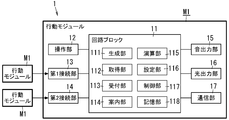
- FIG. 3 is a block diagram showing the configuration of the action module in the same action management system.
- FIG. 4A is a schematic perspective view showing the configuration of the action module of the same.
- FIG. 4B is a schematic perspective view showing an example in which a plurality of the same action modules are arranged.
- 5A to 5C are schematic views schematically showing how a schedule is generated when a plurality of action modules are arranged in the same action management method.
- 6A to 6C are schematic views schematically showing how an action log is generated in response to an operation of a target person on a plurality of action modules in the same action management method.
- FIG. 7 is a flowchart showing an example of the same behavior management method.
- FIG. 8 is a schematic view showing a screen of an information terminal using the behavior management method according to the first embodiment.
- the behavior management method is a method for managing the behavior of the target person X1.
- the behavior management method according to the present embodiment manages the behavior of the target person X1 in consideration of the time series by managing the behavior of the target person X1 using a schedule showing the order of a plurality of actions by the target person X1. Is possible.
- actions to be performed for various actions that the subject X1 should perform in daily life such as tidying up, studying, exercising, eating, bathing, changing clothes, brushing teeth and sleeping. It is possible to specify the order of.
- the behavior management method it is possible to manage the actions that the subject X1 should perform in daily life, including the order. For example, when multiple actions (meal and bathing) are ordered in the schedule, such as "meal” followed by "bathing", the subject X1 will be "meal” according to this schedule. Then, the action of "bathing” will be taken. In this way, by managing a plurality of actions in order in the form of a schedule, it is possible to expect the formation of habits for the subject X1.
- the behavior management method has a generation process and an acquisition process.
- the generation process is a process of generating the schedule D1 according to the order of the plurality of action modules M1.
- Each of the plurality of action modules M1 corresponds to the action of the target person X1.
- the schedule D1 represents the order of actions of the subject X1.
- the acquisition process is a process of acquiring the action log D2 regarding the execution status of the schedule D1 by the target person X1.
- the schedule D1 generated in the generation process is generated according to the order of the plurality of action modules M1 corresponding to the actions of the target person X1. Therefore, for example, even if the target person X1 sets the schedule D1 by himself / herself, the target person X1 can generate the schedule D1 relatively easily only by arranging a plurality of action modules M1. Moreover, the execution status of the schedule D1 by the target person X1 can be acquired in the form of the action log D2. Therefore, according to the behavior management method, there is an advantage that it is easy to evaluate the behavior actually performed by the target person with respect to the schedule D1 based on the behavior log D2.
- the "target person” referred to in the present disclosure is a person whose behavior is managed by a behavior management method, and a person of various age groups, genders, diseases, disabilities, etc. can be the target person X1. Further, the target person X1 may be a specific individual, an unspecified individual, or a group consisting of a plurality of people. In the present embodiment, as an example, a case where an infant whose cognitive function is developing is a subject X1 will be described.
- infant as used herein means a person aged 1 year or older and preschooler (preschooler).
- the child is the target person X1.
- a specific individual, a child living in the facility F1 is the target person X1 whose behavior is managed by the behavior management method.
- at least one of the father and the mother living in the facility F1 becomes the manager X2 who manages the behavior of the subject X1 by using the behavior management method.
- the mother is the manager X2.
- the "behavior” referred to in the present disclosure is an action that can be performed by the subject X1, and includes various actions such as tidying up, studying, exercising, eating, bathing, changing clothes, brushing teeth, and sleeping.
- the type of action managed by the action management method differs depending on the target person X1. For example, if the target person X1 is an infant, “playing with blocks”, “playing with toys”, “drawing” or “singing”. Behaviors for young children, such as “lessons,” are managed by behavior management methods. On the other hand, if the subject X1 is an adult (for example, a mother), behaviors for adults such as “cleaning", “washing”, or “cooking" are managed by the behavior management method.
- one action may be subdivided into two or more actions, and as an example, one action of "exercise” may be subdivided into two actions of "rhythm exercise” and “stretching”. .. Further, the start and end of one action may be defined as different actions. For example, for one action called “sleep”, there are two actions, “sleeping” which is the start and “wake up” which is the end. Behavior may be regulated.
- the "behavior module” referred to in the present disclosure means a unit of a function associated with the behavior of the subject X1 on a one-to-one basis, and may be either a tangible object or an intangible object. That is, the action module M1 may be a block of a tangible object such as a puzzle block or a building block (Building Blocks Construction Set), or an intangible block such as an icon displayed on the screen. In this embodiment, as an example, it is assumed that the action module M1 is a tangible object.
- the "arrangement order" referred to in the present disclosure means the order of a plurality of action modules M1 arranged on the premise that a plurality of action modules M1 are arranged. For example, when a plurality of action modules M1 are connected to each other so as to be arranged in a row, the order of the plurality of action modules M1 when one end side of this column is at the head is the arrangement of the plurality of action modules M1. It will be in order. Further, even when the plurality of action modules M1 are not connected to each other, the order of the plurality of action modules M1 is defined.
- the order of the plurality of action modules M1 when one end side of the virtual line is set as the head is plural. It becomes the order of the action module M1 of.
- execution status refers to which action the subject X1 is performing or which action the subject X1 has completed with respect to the plurality of actions specified in the schedule D1. It means the execution status by the target person X1 such as. For example, if the target person X1 is executing the first (first) action among a plurality of actions whose order is defined in the schedule D1, the execution status of the schedule D1 is that the first action is being executed. It turns out that.
- schedule D1 when the order of "cleaning up”, “meal”, “bathing”, and “toothpaste” is specified in schedule D1, if the subject X1 is executing "bathing", the schedule D1 The execution status is that the third action, "bathing", is being executed.
- the behavior management method according to this embodiment is realized by the behavior management system 1. That is, the behavior management system 1 according to the present embodiment is a system for realizing the behavior management method.
- the behavior management system 1 includes a generation unit 111 (see FIG. 3) and an acquisition unit 112 (see FIG. 3).
- the generation unit 111 generates a schedule D1 representing the order of actions of the target person X1.
- the acquisition unit 112 acquires the action log D2 regarding the execution status of the schedule D1 by the target person X1.
- the generation unit 111 generates the schedule D1 according to the order of the plurality of action modules M1 corresponding to the actions. That is, the generation process in the behavior management method is realized by the generation unit 111. Further, the acquisition process in the behavior management method is realized by the acquisition unit 112.
- the behavior management system 1 is composed of at least one behavior module M1.
- the action management system 1 is composed of a plurality of (here, five) action modules M11 to M15 that are combined with each other.
- each of the plurality of action modules M11 to M15 is also referred to as "action module M1".
- each action module M1 Functions of the generation unit 111, the acquisition unit 112, and the like in the action management system 1 are provided in each action module M1 as shown in FIG. Since each action module M1 can operate independently, the action management system 1 is configured by itself. On the other hand, as shown in FIG. 2, in a state where a plurality of action modules M1 are combined with each other, one action management system 1 is configured by these a plurality of action modules M1.
- the action module M1 of any one of the plurality of action modules M1 functions as a master device (Master Device). Then, among the plurality of action modules M1, the action module M1 other than the master unit functions as a slave unit (SlaveDevice). Which of the plurality of action modules M1 the action module M1 functions as the master unit is defined by the master unit setting condition.
- the other action module M1 in a state where the master unit does not exist in the plurality of action modules M1 combined with each other, the other action module M1 is first connected to the first connection unit 13 among the plurality of action modules M1. The action module M1 to which is connected is used as the master unit.
- the behavior management system 1 is configured to be communicable with each of the information terminals 21 and 22, the devices 31, 32, 33 and the cloud 4 (cloud computing). ing.
- the term "communicable” as used in the present disclosure means that signals can be exchanged directly or indirectly via a network 41 or a repeater by an appropriate communication method of wired communication or wireless communication. That is, the behavior management system 1 can send and receive signals to and from each other between the plurality of information terminals 21 and 22, the plurality of devices 31, 32, 33, and the cloud 4.
- each of the plurality of information terminals 21 and 22 is also referred to as "information terminal 2".
- each of the plurality of plurality of devices 31, 32, 33 is also referred to as “plurality of devices 3”.
- the information terminal 2 includes a user interface having a function of accepting human operations and a function of presenting information to humans. By communicating with the information terminal 2, the behavior management system 1 can accept human operations through the information terminal 2 and cause the information terminal 2 to present various information.
- the information terminal 2 has a touch panel display as a user interface.
- the information terminal 21 is a smartphone or tablet terminal owned by the administrator X2 (here, the mother), and the information terminal 22 is a monitor terminal installed in the facility F1. ..
- the device 3 is various devices (including appliances, equipment, devices and systems) installed in the facility F1 or used in the facility F1.
- the device 31 is a toothbrush (smart toothbrush) used by the subject X1
- the device 32 is a wash basin (smart wash basin)
- the device 33 is a camera device. Is.
- the behavior management system 1 in addition to the generation unit 111 and the acquisition unit 112, the behavior management system 1 includes a reception unit 113, a guide unit 114, a calculation unit 115, a setting unit 116, and a control unit. It further includes 117 and a storage unit 118.
- each action module M1 includes a circuit block 11, and the generation unit 111, the acquisition unit 112, the reception unit 113, the guide unit 114, the calculation unit 115, the setting unit 116, the control unit 117, and the storage unit 118 are , Is provided in the circuit block 11.
- each action module M1 has functions as a generation unit 111, an acquisition unit 112, a reception unit 113, a guide unit 114, a calculation unit 115, a setting unit 116, a control unit 117, and a storage unit 118. ing.
- the generation unit 111 generates the schedule D1 representing the order of actions of the target person X1. In addition, the generation unit 111 generates the schedule D1 according to the order of the plurality of action modules M1. In the present embodiment, the generation unit 111 stores the generated schedule D1 in the storage unit 118.
- the acquisition unit 112 acquires the action log D2 regarding the execution status of the schedule by the target person X1.
- the acquisition unit 112 stores the acquired action log D2 in the storage unit 118.
- the reception unit 113 embodies the reception process of the behavior management method.
- the reception process is a process of receiving an operation representing at least one of the start and end of the action from the target person X1. That is, the behavior management method according to the present embodiment further includes a reception process for receiving an operation representing at least one of the start and the end of the behavior from the target person X1.
- the reception unit 113 receives the operation of the target person X1 based on the operation signal output by the operation unit 12 described later.
- the guidance unit 114 embodies the guidance processing of the behavior management method.
- the guidance process is a process of presenting guidance information regarding the action to the target person X1 according to the schedule D1. That is, the behavior management method according to the present embodiment further includes a guidance process for presenting guidance information regarding the behavior to the target person X1 according to the schedule.
- the reception unit 113 presents the guidance information by the control unit 117.
- the calculation unit 115 embodies the calculation processing of the behavior management method.
- the calculation process is a process of generating calculation information based on the action log D2 by performing a calculation on the action log D2. That is, the action management method according to the present embodiment further includes a calculation process for generating calculation information based on the action log D2 by performing a calculation on the action log D2.
- the calculation unit 115 stores the generated calculation information in the storage unit 118.
- the setting unit 116 embodies the setting process of the behavior management method.
- the setting process is a process for setting a goal related to an action in association with the action module M1. That is, the behavior management method according to the present embodiment further includes a setting process for setting a goal related to the behavior in association with the behavior module M1.
- the setting unit 116 stores the generated target in the storage unit 118.
- the control unit 117 controls the device 3, the sound output unit 15 or the optical output unit 16 which will be described later.
- the control unit 117 controls the device 3, the sound output unit 15, and the optical output unit 16 for, for example, to present guidance information by the guidance unit 114.
- the storage unit 118 stores information necessary for the operation of the behavior management system 1.
- the storage unit 118 includes a rewritable non-volatile memory such as an EEPROM (Electrically Erasable Programmable Read-Only Memory).
- the storage unit 118 stores at least the schedule D1 generated by the generation unit 111. Further, the storage unit 118 stores the action identification information for identifying the action associated with the action module M1.
- the circuit block 11 mainly includes a computer system (including a server and cloud computing) having one or more processors and one or more memories.
- the processor realizes the function of the circuit block 11 by executing the program recorded in the memory.
- the program may be pre-recorded in memory, provided by being recorded on a non-temporary recording medium such as a memory card, or provided through a telecommunication line.
- the above program is a program for making one or more processors function as the circuit block 11.
- the functions such as the generation unit 111, the acquisition unit 112, the reception unit 113, the guide unit 114, the calculation unit 115, the setting unit 116, the control unit 117, and the storage unit 118 are performed by the action module M1 as the master unit. Only valid. That is, in a state where a plurality of action modules M1 are combined with each other, the above function in the circuit block 11 is basically valid only in the action module M1 as the master unit among the plurality of action modules M1 and is a slave unit. It becomes invalid in the action module M1 as.
- the functions required for the slave unit such as the function of the reception unit 113 that receives the operation signal from the operation unit 12 and the function of the control unit 117 that controls the sound output unit 15 or the optical output unit 16, are defined as the slave unit. It is also effective in the action module M1 of.
- Each of the plurality of action modules M11 to M15 is associated with the action of the target person X1.
- the action module M11 is associated with "cleaning up”
- the action module M12 is associated with “meal”
- the action module M14 is associated with "bathing”
- the action module M15 is associated with "toothpaste”.
- the action module M13 is a “blank” action module M1 that is not associated with any action, unlike the other action modules M1. That is, the storage unit 118 of each action module M1 stores the action identification information for identifying the corresponding action in this way.
- the storage unit 118 of the action module M11 stores action identification information for identifying an action called “cleanup”.
- each of the plurality of action modules M1 is a tangible object. Therefore, the order of the plurality of action modules M1 is determined by physically combining the plurality of action modules M1. That is, in this embodiment, a tangible object such as a puzzle block or building blocks is adopted as the action module M1. Therefore, the plurality of action modules M1 can be physically combined, and the order of the plurality of action modules M1 is determined by the physical combination. Therefore, it becomes relatively easy for the subject X1 composed of infants to handle the plurality of action modules M1.
- each action module M1 consists of individual pieces of puzzle blocks that can be combined with each other, as shown in FIGS. 4A and 4B.
- the "puzzle block” referred to here is a kind of block toy that can form one structure by connecting them to each other.
- each action module M1 includes a case 100 that constitutes its outer shell. As shown in FIG. 4A, the case 100 has a convex portion 101 on one end surface (right end surface in FIG. 4A) in one direction and a concave portion 102 on the other end surface (left end surface in FIG. 4A).
- the convex portion 101 of one action module M1 is inserted into the concave portion 102 of the other action module M1 to be fitted, so that the two action modules M1 are combined (connected). ..
- the plurality of action modules M1 can be connected to each other in a separable manner so as to be arranged in a line along one direction.
- the direction in which a plurality of connected action modules M1 are lined up is the left-right direction (horizontal direction).
- each action module M1 a mark (including characters, symbols, figures or patterns, or a combination thereof) representing the corresponding action is written on the front surface of the case 100 (see FIG. 2 and the like).
- the character string "cleanup” is written as a mark.
- the action module M12 corresponding to "meal” has the character string "rice”
- the action module M14 corresponding to "bathing” has the character string "bath”
- the action module M15 corresponding to "toothpaste”.
- the character string "toothpaste” is written in each.
- the target person X1 since the target person X1 is an infant, a hiragana character string that is easy for the target person X1 (infant) to understand is adopted as a mark according to the target person X1. However, such a mark is not provided in the "blank" action module M13. Further, in the present embodiment, the plurality of action modules M1 are colored in different colors, making it easy to distinguish the plurality of action modules M1.
- a mark indicating the corresponding action may be freely entered on the front surface of the case 100.
- the entry of the mark is realized, for example, by the administrator X2 or the like writing (drawing) directly on the front surface of the case 100 or coloring it.
- the mark may be written on the front surface of the case 100 by affixing the mark on the front surface of the case 100.
- a keyword that the administrator X2 usually uses in a conversation with the target person X1 for example, "manma" in the case of "meal" can be entered in front of the case 100.
- the action module M1 can be marked with characters, symbols, figures or patterns that are easy for the subject X1 to understand, or a combination thereof. According to the figure or the pattern, even the subject X1 consisting of an infant who cannot read the characters can recognize the action corresponding to the action module M1.
- each action module M1 is configured to be fixed to the wall surface of the facility F1 by an appropriate means such as a magnet or a suction cup. As a result, as shown in FIG. 1, the plurality of action modules M1 can be attached to the wall surface of the room in a state of being connected to each other.
- the schedule D1 representing the order of actions of the target person X1 is generated according to the order of the plurality of action modules M1.
- a plurality of action modules M1 can be connected to each other so as to be arranged in a line along the left-right direction. Therefore, in the generation process, the schedule D1 is generated according to the order of the plurality of action modules M1 connected to each other so as to be lined up in a row.
- "from left to right” in the left-right direction in which a plurality of combined action modules M1 are lined up corresponds to the flow of time (time series). That is, for example, as shown in FIG. 2, the action (cleanup) corresponding to the action module M11 located at the left end of the column composed of the plurality of action modules M11 to M15 is the first action in the schedule D1. Similarly, as shown in FIG. 2, the action (toothpaste) corresponding to the action module M15 located at the right end of the column composed of the plurality of action modules M11 to M15 is the last action in the schedule D1.
- each action module M1 includes an operation unit 12, a first connection unit 13, a second connection unit 14, a sound output unit 15, an optical output unit 16, and a communication unit, in addition to the circuit block 11. 17 is further provided.
- the circuit block 11, the sound output unit 15, the optical output unit 16, and the communication unit 17 are housed in the case 100.
- the "blank" action module M13 at least the operation unit 12, the sound output unit 15, the optical output unit 16, and the communication unit 17 are not provided.
- the operation unit 12 is operated by the target person X1.
- the operation unit 12 is arranged on the front surface of the case 100.
- the operation unit 12 is a momentary type push button switch.
- the operation unit 12 preferably has a shape and size that are easy for the target person X1 to operate (push).
- the first connection unit 13 is a terminal unit that is electrically connected to the second connection unit 14 of the other action module M1. In the circuit block 11, it is possible to detect whether or not the second connection portion 14 of the other action module M1 is connected to the first connection portion 13.
- the first connecting portion 13 is arranged on the tip surface of the convex portion 101 in the case 100.
- the second connection unit 14 is a terminal unit that is electrically connected to the first connection unit 13 of the other action module M1. In the circuit block 11, it is possible to detect whether or not the first connection portion 13 of the other action module M1 is connected to the second connection portion 14. In the present embodiment, as an example, the second connection portion 14 is arranged on the bottom surface of the recess 102 in the case 100.
- the sound output unit 15 is controlled by the control unit 117 and outputs various information as sound (including voice) to the target person X1.
- the sound output unit 15 includes a speaker and is housed in the case 100 so as to output sound from a through hole provided on one side surface of the case 100.
- the optical output unit 16 is controlled by the control unit 117 and outputs various information as light to the target person X1.
- the light output unit 16 includes an LED (Light Emitting Diode) and is housed in the case 100. That is, when the light output unit 16 emits light inside the case 100, the light is transmitted to at least a part of the case 100 and the light is output to the outside of the case 100.
- LED Light Emitting Diode
- the communication unit 17 is capable of two-way communication with each of the information terminal 2, the plurality of devices 3, and the cloud 4, for example, via a network.
- the communication unit 17 is set to a standard such as Wi-Fi (registered trademark), Bluetooth (registered trademark), ZigBee (registered trademark), or low power radio (specified low power radio) that does not require a license.
- Wi-Fi registered trademark
- Bluetooth registered trademark
- ZigBee registered trademark
- low power radio specified low power radio
- Adopt compliant wireless communication that uses radio waves as a communication medium.
- the action module M1 is preferably battery-powered. Therefore, in the present embodiment, the action module M1 has, for example, a storage battery and operates using the electric energy stored in the storage battery.
- the schedule D1 can be set for each day, and the behavior of the subject X1 in a part of the day (for example, the time before and after dinner) is defined. Assume. Further, here, it is assumed that the setting of the schedule D1, that is, the work of arranging the plurality of action modules M11 to M15 is performed by the infant who is the target person X1 by himself / herself.
- the first connection unit 13 is first among the plurality of action modules M1.
- the action module M1 to which the other action module M1 is connected is used as the master unit.
- the other action module M1 being connected to the first connection portion 13 first corresponds to the action of "bathing". Since it is an action module M14 to perform, the action module M14 serves as a master unit. That is, in the examples of FIGS. 5A to 5C, the action module M14 functions as a master unit, and the action modules M11, M12, M13, and M15 all function as slave units.
- the subject X1 combines an action module M14 corresponding to "bathing" and an action module M15 corresponding to "toothpaste".
- the subject X1 combines the two action modules M14 and M15 so that the action module M14 is located on the left side of the action module M15. That is, these two action modules M14 and M15 are connected by inserting and fitting the convex portion 101 of the action module M14 into the concave portion 102 of the action module M15.
- the first connection portion 13 of the action module M14 is electrically connected to the second connection portion 14 of the action module M15, so that each of the two action modules M14 and M15 has two action modules M14, The order of M15 can be detected.
- the two action modules M14 and M15 are arranged in the order of the action module M14 and the action module M15 from the left. Therefore, the action module M14 as the master unit generates the schedule D1 as shown in FIG. 5A in the generation unit 111 according to the order of the two action modules M14 and M15. That is, the schedule D1 generated in FIG. 5A represents the order of "bathing” and “toothpaste” for the two actions "bathing" and “toothpaste” corresponding to the two action modules M14 and M15. Therefore, in the state of FIG. 5A, a schedule D1 that defines the order of actions of the subject X1 is generated in order to execute the actions of "bathing" and "toothpaste" in this order.
- the subject X1 combines the action module M12 corresponding to the “meal” and the action module M13 of the “blank” with the action modules M14 and M15.
- the subject X1 combines four action modules M12 to M14 so that the action module M12 is located on the left side of the action module M14 via the action module M13. That is, by inserting the convex portion 101 of the action module M13 into the concave portion 102 of the action module M14 and fitting it, the three action modules M13 to M15 are first connected. Further, the convex portion 101 of the action module M12 is inserted into the concave portion 102 of the action module M13 to be fitted, so that the four action modules M13 to M15 are connected.
- the first connection portion 13 of the action module M13 is electrically connected to the second connection portion 14 of the action module M14, so that each of the two action modules M13 and M14 has two action modules M13, The order of M14 can be detected.
- the first connection portion 13 of the action module M12 is electrically connected to the second connection portion 14 of the action module M13, so that each of the two action modules M12 and M13 has two action modules M12, The order of M13 can be detected. Therefore, at least the action module M14 as the master unit can detect the order of the four action modules M12 to M14.
- the four action modules M12 to M15 are arranged in the order of action module M12, action module M13, action module M14, and action module M15 from the left. Therefore, the action module M14 as the master unit generates the schedule D1 as shown in FIG. 5B in the generation unit 111 according to the order of the four action modules M12 to M15.
- the generation unit 111 substantially follows the order of the three action modules M12, M14, and M15, as shown in FIG. 5B.
- Schedule D1 is generated. That is, the schedule D1 generated in FIG.
- the subject X1 combines the action modules M11 corresponding to "cleanup" with the action modules M12 to M15.
- the subject X1 combines five action modules M11 to M14 so that the action module M11 is located on the left side of the action module M12. That is, the five action modules M11 to M15 are connected by inserting and fitting the convex portion 101 of the action module M11 into the concave portion 102 of the action module M12.
- the first connection portion 13 of the action module M11 is electrically connected to the second connection portion 14 of the action module M12, so that each of the two action modules M11 and M12 has two action modules M11,
- the order of M12 can be detected. Therefore, at least the action module M14 as the master unit can detect the order of the five action modules M11 to M14.
- the five action modules M11 to M15 are arranged in the order of action module M11, action module M12, action module M13, action module M14, and action module M15 from the left. Therefore, the action module M14 as the master unit generates the schedule D1 as shown in FIG. 5C in the generation unit 111 according to the order of the five action modules M11 to M15.
- the generation unit 111 substantially follows the order of the four action modules M11, M12, M14, and M15 in FIG. 5C. Generate schedule D1 as shown. That is, the schedule D1 generated in FIG.
- 5C describes the actions of "cleaning up”, “meal”, “bathing”, and “toothpaste” corresponding to the four action modules M11, M12, M14, and M15.
- the order is “meal”, “bathing”, and “toothpaste”. Therefore, in the state of FIG. 5C, a schedule D1 that defines the order of actions of the subject X1 is generated in order to execute the actions of "cleaning up”, “meal”, “bathing”, and “toothpaste” in this order. Toothpaste.
- the generated schedule D1 is stored in the storage unit 118 at any time. That is, the schedule D1 in the storage unit 118 is updated at any time by the subject X1 proceeding with the work of arranging the plurality of action modules M1 from the state of FIG. 5A to the state of FIG. 5B and further to the state of FIG. 5C. ..
- each of the plurality of action modules M1 is a tangible object. Therefore, the order of the plurality of action modules M1 is determined by physically combining the plurality of action modules M1. Further, in the generation process, the schedule D1 is generated according to the order of the plurality of action modules M1 connected to each other so as to be lined up in a row.
- the schedule D1 is automatically generated according to the order of the plurality of action modules M1 by a simple operation in which the target person X1 arranges a plurality of action modules M1. It will be. Therefore, even when the subject X1 is an infant, the subject X1 can set (generate) the schedule D1 relatively easily while having fun with a playful feeling.
- the subject X1 fixes the plurality of action modules M1 in the combined state to, for example, the wall surface of the facility F1.
- the plurality of action modules M1 are attached to the wall surface of the room in a state of being connected to each other (see FIG. 1).
- the schedule D1 generated by the behavior management system 1 is transmitted to the information terminal 2 periodically, irregularly, or in response to a request from the information terminal 2.
- the schedule D1 can be confirmed (viewed) on the information terminal 21 such as a smartphone or tablet terminal owned by the administrator X2 (here, the mother) and the information terminal 22 such as a monitor terminal.
- the schedule D1 generated by the behavior management system 1 is also transmitted to the cloud 4 periodically, irregularly, or in response to a request from the cloud 4.
- the schedule D1 is also stored on the cloud 4.
- the schedule D1 generated by the behavior management method includes only the sequence information of the time information and the sequence information.
- the time information is information about at least one of the start time and the end time of the action.
- the order information is information indicating the order of actions. That is, the schedule D1 generated by the generation process represents only the order of the actions of the target person X1 according to the order of the plurality of action modules M1, and the timing (time) of the start and / or end of each action. ) Is not specified.
- the schedule D1 is a format that does not include the concept of "time” such as the timing of the start and / or end of the action, and therefore shows the subject X1 the concept of time for each action.
- the schedule D1 can be generated without this.
- the subject X1 can generate the schedule D1 simply by being aware of the sequence of a plurality of actions without being aware of the concept of time.
- the subject X1 can execute the action according to the schedule D1 without being conscious of the concept of time and merely being aware of the order of the plurality of actions.
- the target person X1 defines only the order of actions to be executed, and in addition to the relatively easy setting of the schedule D1, the schedule D1 determines the order of the actions of the target person X1. It is unlikely that you will excessively restrict your actions. As a result, the subject X1 can easily take an action according to the schedule D1.
- the schedule D1 as described above is generated every day.
- the subject X1 sets a schedule D1 for the next day before going to bed every day.
- the subject X1 sets the schedule D1 of the day after waking up every day.
- the action management method has a reception process for receiving an operation representing at least one of the start and end of the action from the target person X1.
- the target person X1 executes the schedule D1, that is, when executing any of the plurality of actions whose order is defined in the schedule D1
- the target person X1 operates the operation unit 12 of the action module M1 corresponding to the action.
- the subject X1 operates the operation unit 12.
- the action being executed is shown in a light shaded area (“meal” in FIG. 6B, etc.) in the action log D2
- the completed (completed) action is shown in a dark shaded area (“meal” in FIG. 6B). Clean up "etc.).
- the action module M11 corresponding to “cleaning up”. Operate the operation unit 12 of.
- the acquisition unit 112 acquires the action log D2 regarding the execution status of the schedule D1 by the target person X1. That is, in the example of FIG. 6A, since the operation unit 12 of the action module M11 is operated, it is possible to detect the start of "cleanup", which is an action corresponding to the action module M11. Therefore, in the state of FIG.
- the schedule D1 indicates that the first action "cleanup” of the schedule D1 representing the order of "cleanup”, “meal”, “bathing”, and “toothpaste” is being executed.
- the action log D2, which is shown as the execution status of, is acquired.
- the subject X1 operates the operation unit 12 of the action module M11 corresponding to "cleaning up” as shown in FIG. 6B.
- the acquisition unit 112 acquires the action log D2 regarding the execution status of the schedule D1 by the target person X1. That is, in the example of FIG. 6B, since the operation unit 12 of the action module M11 being executed is operated, it is possible to detect the end of "cleanup", which is an action corresponding to the action module M11.
- the subject X1 operates the operation unit 12 of the action module M12 corresponding to the "meal” as shown in FIG. 6C.
- the acquisition unit 112 acquires the action log D2 regarding the execution status of the schedule D1 by the target person X1. That is, in the example of FIG. 6C, since the operation unit 12 of the action module M12 being executed is operated, the end of the "meal" which is the action corresponding to the action module M12 can be detected.
- the action log D2 indicating that the first action "cleanup” and the second action "meal" have been completed is acquired as the execution status of the schedule D1.
- the acquired action log D2 is stored in the storage unit 118 at any time. That is, the action log D2 in the storage unit 118 is updated at any time by sequentially executing the actions according to the schedule D1 from the state of FIG. 6A to the state of FIG. 6B and further to the state of FIG. 6C.
- the action log D2 acquired by the action management system 1 is transmitted to the information terminal 2 periodically, irregularly, or in response to a request from the information terminal 2.
- the action log D2 can be confirmed (viewed) on the information terminal 21 such as a smartphone or tablet terminal owned by the administrator X2 (here, the mother) and the information terminal 22 such as a monitor terminal.
- the action log D2 generated by the action management system 1 is also transmitted to the cloud 4 periodically, irregularly, or in response to a request from the cloud 4.
- the action log D2 is also stored on the cloud 4.
- the action log D2 By accumulating this kind of action log D2 in the cloud 4, it is possible to develop the action log D2 for various purposes.
- the degree of concentration (enthusiasm) of the subject X1 regarding the "toy play” can be estimated from the start time and the end time of the action of the infant who is the subject X1 with the “toy play”. The results can be reflected in the development of educational toys and the like that the subject X1 is likely to be interested in.
- the cumulative time of "toothpaste" in the subject X1 is calculated from the start time and end time of the action of "toothpaste", the degree of consumption of consumables such as the device 31 (toothbrush) and toothpaste is estimated, and the consumables Can be reflected in management.
- the action log D2 includes timing information D21 regarding at least one timing of the start and end of the action. Specifically, when the operation unit 12 is operated and the reception unit 113 receives an operation signal indicating the start of an action from the operation unit 12, the acquisition unit 112 acquires the time at that time and sets this time as the action. It is included in the action log D2 as the timing information D21 indicating the start time of. Similarly, when the operation unit 12 is operated and the reception unit 113 receives an operation signal indicating the end of the action from the operation unit 12, the acquisition unit 112 acquires the time at that time and sets this time as the end of the action. It is included in the action log D2 as the timing information D21 representing the time.
- the action log D2 includes the timing information D21 indicating the start time of “cleanup” (18:00 as an example). Further, in the example of FIG. 6B, in the action log D2, in addition to the start time of "cleanup”, the end time of "cleanup” (18:10 as an example) and the start time of "meal” (18:10 as an example). ) Is included in the timing information D21. Further, in the example of FIG. 6C, the action log D2 represents the start time and end time of "cleanup", the start time of "meal”, and the end time of "meal” (18:45 as an example). Includes information D21.
- the action management method has a guidance process for presenting guidance information regarding the action being executed by the target person X1 to the target person X1 according to the schedule D1.
- the guidance information may be any information about the action being executed, and is output from, for example, the device 3, the sound output unit 15, the optical output unit 16, or the like.
- the guidance unit 114 causes the control unit 117 to provide guidance information regarding the action being executed. Start presenting. Then, when the reception unit 113 receives the operation signal indicating the end of the action from the operation unit 12, the guidance unit 114 ends the presentation of the guidance information regarding the action being executed. As a result, the guidance information regarding this action is presented to the target person X1 while the target person X1 is executing the action.
- the operation unit 12 of the action module M11 when the operation unit 12 of the action module M11 is operated, guidance information regarding the action being executed, that is, the action of "cleaning up” corresponding to the action module M11 is presented to the target person X1. Will be done.
- the guidance information regarding the action of "cleaning up” there is information output from the sound output unit 15 or the optical output unit 16 of the action module M11 corresponding to "cleaning up”.
- the sound output unit 15 outputs a sound for "cleaning up” (melody, beep sound, voice, etc.), and the light output unit 16 emits light, so that the guidance information is transmitted from the action module M11. It will be output.
- the operation unit 12 of the action module M12 by operating the operation unit 12 of the action module M12, guidance information regarding the action being executed, that is, the action of “meal” corresponding to the action module M12 is sent to the target person X1. Will be presented.
- the guidance information regarding the action of "meal” there is information output from the sound output unit 15 or the optical output unit 16 of the action module M12 corresponding to "meal”.
- the sound output unit 15 outputs a sound for "meal” (melody, beep sound, voice, etc.), and the light output unit 16 emits light, so that the guidance information is transmitted from the action module M12. It will be presented.
- the guidance information is not limited to the configuration output by the action module M1 itself, and may be output from the device 3.
- the guidance information regarding the action of "toothpaste” may include guidance information output from the device 31 made of a toothbrush used by the subject X1 or the device 32 made of a washbasin.
- a sound (melody, beep, voice, etc.) for "toothpaste” is output from the device 31 made of a toothbrush, and an image for supporting and supporting tooth brushing is displayed on the mirror of the device 32 made of a washbasin.
- Guidance information is presented by doing so.
- the guidance information is information that has the effect of attracting the interest of the target person X1 to the action being executed.
- Examples of such guidance information include information including voice or video of a character that the subject X1 likes.
- it is preferable that such guidance information is continuously presented during the execution of the action, not intermittently. This makes it easier for the subject X1 to maintain the motivation to engage in the action being executed, and as a result, the subject X1 can be encouraged to execute the schedule D1.
- the "presentation mode" referred to in the present disclosure includes a method of presenting guidance information and the content of guidance information itself. For example, it is possible to improve the execution efficiency of the action by the target person X1 by changing the presentation mode of the guidance information according to the elapsed time from the start of the action and / or the degree of concentration of the target person X1.
- the sound output from the sound output unit 15 may be changed after a certain period of time has passed from the start of the action (cleanup). , The light emission pattern (blinking cycle, etc.) of the light output unit 16 is changed.
- the presentation mode of the guidance information may be changed between the start time and the end time of the action.
- the target person X1 motivation for the action by outputting a voice that supports and supports the action, such as "Let's do our best to clean up today" from the sound output unit 15. ..
- the subject X1 a reward for the action by outputting a sound praising the action, such as "Great" from the sound output unit 15.
- the presentation mode of the guidance information may be changed according to the execution status of the past (executed) action instead of the execution status of the action currently being executed.
- the guidance information presented during the execution of the "meal” depends on the execution status such as the time required for the previous action "cleanup” and / or the degree of concentration of the target person X1.
- the presentation mode can be changed. As a specific example, if the "cleanup" is completed in less than 10 minutes, the light output unit 16 emits light in seven colors during the execution of the "meal”, and if the "cleanup” takes 10 minutes or more, the "meal” is displayed. The light output unit 16 is made to emit white light as guidance information to be presented during the execution of.
- the mode of presenting guidance information may be changed depending on the timing (time zone, day of the week, month, season, etc.) of the start (or end) of the action.
- the sound output unit 15 presents music having an awakening effect as guidance information
- when the time zone when the action is started is "night”.
- the sound output unit 15 presents music having a healing effect as guidance information.
- the day when the action is started is "Christmas”
- the light output unit 16 presents the light imitating the Christmas illumination as guidance information.
- the behavior management method according to the present embodiment includes additional functions as described below.
- the action management method can automatically acquire the start, end, execution status, etc. of the action without the operation of the target person X1. For example, by estimating the behavior of the target person X1 from the image captured by the device 33 including the camera device, the start, end, execution status, etc. of the behavior can be determined even if the target person X1 does not operate the operation unit 12. It becomes detectable. Similarly, even from the usage status of the device 3 used by the subject X1 to perform the action (here, "toothpaste"), such as the device 31 made of a toothbrush or the device 32 made of a washbasin, the action is started. It is possible to detect the end and execution status.
- the usage status of the device 3 used by the subject X1 to perform the action here, "toothpaste"
- the action log D2 includes the target person information regarding the status of the target person X1 who is executing the action.
- the "target person information" referred to in the present disclosure is information on the situation of the target person X1, for example, the degree of concentration and interest (interest) in the behavior of the target person X1, the place where the target person X1 executed the action, and Includes information such as the facial expression and mood of the subject X1 who is executing the action.
- the degree of concentration and interest (interest) in the behavior of the subject X1 and the facial expression and mood of the subject X1 performing the behavior can be estimated from, for example, an image taken by a device 33 including a camera device. Is.
- the action management method has a calculation process for generating calculation information based on the action log D2 by performing a calculation on the action log D2. That is, the calculation unit 115 can generate calculation information different from that of the action log D2 itself by performing some calculation on the action log D2.
- the average value in the monitoring period for example, one month
- the comparison value difference
- Calculation information is generated by calculating the value) and the like. From such calculation information, for example, it becomes easy to evaluate the degree of growth of the execution status of the schedule D1 by the target person X1.
- the calculation information includes at least statistical information generated based on the action log D2 for each of the plurality of target persons X1. That is, in the arithmetic processing, the action logs D2 of the plurality of target persons X1 are collected, and the statistical information obtained from the action logs D2 for the plurality of subjects is generated as the arithmetic information.
- the "statistical information" referred to here is information generated by performing arithmetic processing on a plurality of action logs D2 corresponding to each of a plurality of target persons X1. As an example, the statistical information is the mean value, median value, mode value, minimum value or maximum value, etc.
- the plurality of target persons X1 for which the statistical information is calculated among a large number of target persons X1 using the behavior management method, for example, a plurality of persons having a common item regarding age, gender, residential area, etc. It is preferable that the subject X1 is selected. From such statistical information, for example, the statistical status of a plurality of target subjects X1 can be grasped, so that it becomes easy to evaluate the degree of growth of the execution status of the schedule D1 by the target subjects X1.
- the statistical information includes comparative information representing the relative evaluation of a specific target person X1 with respect to a plurality of target persons X1. That is, in the arithmetic processing, when obtaining statistical information from a plurality of action logs D2 corresponding to a plurality of target persons X1, comparative information obtained by comparing a specific target person X1 with these plurality of target persons X1. Is generated as statistical information.
- the "comparison information" referred to here is information represented by comparing the action log D2 of a plurality of target persons X1 with the action log D2 of a specific target person X1.
- the comparison information includes a ranking (ranking) of a specific target person X1 among a plurality of target persons X1 and a plurality of target persons X1 with respect to the start (or end) time and required time of each action.
- the "specific target person X1" referred to here may or may not be included in a plurality of target persons X1 to be calculated for statistical information. From such comparison information, for example, it becomes easy to evaluate the degree of growth of the execution status of the schedule D1 by the specific target person X1 when compared with another target person X1.
- the calculation information (including statistical information and comparison information) obtained by the calculation process is transmitted to the information terminal 2 periodically, irregularly, or in response to a request from the information terminal 2.
- the calculation information can be confirmed (viewed) on the information terminal 21 such as a smartphone or tablet terminal owned by the administrator X2 (here, the mother) and the information terminal 22 such as a monitor terminal.
- the calculation information generated by the behavior management system 1 is also transmitted to the cloud 4 periodically, irregularly, or in response to a request from the cloud 4.
- the calculation information is also stored on the cloud 4.
- the calculation information (including statistical information and comparison information) is in a state of being associated with the target person information.
- the cloud 4 or the like As an example, statistical information (including comparison information) is generated for each degree of concentration on the behavior of the target person X1, and the statistical information is stored in a state associated with the target person information on the degree of concentration.
- statistical information and the like can be prepared for each situation (concentration level, etc.) of the target person X1, analysis of the correlation between the situation of the target person X1 and the action log D2, ranking by situation of the target person X1, etc. It becomes possible to obtain.
- the behavior management method further has a setting process for setting a goal related to the behavior in association with the behavior module M1. That is, by setting some target (target value) in association with the action module M1 in the setting unit 116, it is possible to set a target for each action defined in the schedule D1. As an example, in the setting process, a target time for the start (or end) time of each action or a target time for the required time of each action is set as a target for the action.
- a goal it is possible to give the subject X1 motivation for action and the like. For example, it is preferable to change the presentation mode of the guidance information depending on the degree of achievement of the goal, that is, whether or not the goal is achieved.
- the information terminal 2 enables various settings and operations related to the behavior management system 1.
- the setting of the target in the above-mentioned setting process and / or the setting of the presentation mode of the guidance information is composed of a smartphone or tablet terminal owned by the administrator X2 (here, the mother). This can be done on the information terminal 21.
- the action module M1 can be remotely controlled by the information terminal 21.
- information such as target person information may be input from the information terminal 2.
- the administrator X2 here, the mother
- the administrator X2 may manually input information such as the facial expression and mood of the target person X1 as the target person information and include it in the action log D2. it can.
- the action management method further includes an output process for outputting at least a part of the action log D2 and the calculation information to a specific terminal as output information.
- the "specific terminal” referred to here may be an information terminal 2 or a cloud 4, or may be another terminal.
- a terminal including a server and cloud computing
- the behavior management system 1 outputs the terminal.
- Output (send) information to a specific terminal.
- the behavior management system 1 transmits output information to the specific terminal on a regular basis, irregularly, or in response to a request from the specific terminal.
- the information (behavior log D2 or calculation information) obtained by the behavior management method can be reflected in, for example, the development of a product or the development of a service involving a third party.
- the privacy of the parties target person X1 and administrator X2
- the "anonymously processed information" referred to here is information that has been processed so that a specific individual cannot be identified from the personal information so that the personal information cannot be restored.
- the action management method further has a list process for displaying a list of information based on a plurality of action logs D2 acquired in the acquisition process for a plurality of target persons X1.
- the target person X1 is a plurality of people.
- the "information based on the action log D2" referred to in the present disclosure includes the action log D2 itself and information generated based on the action log D2, for example, calculation information (including statistical information and comparative information) and the like.
- the "list display” as used in the present disclosure includes a display mode in which a plurality of pieces of information can be listed by one display means, that is, a display mode described simply so that the entire contents of the plurality of information can be understood.
- a mode in which a plurality of information is displayed side by side on one screen a mode in which a plurality of information can be displayed by scrolling the screen, and a plurality of information. Includes a mode in which a link for accessing is displayed in one screen.
- the action management method list display process For example, suppose that the infant living in the facility F1 is a brother or the like, and the target person X1 is the eldest son, the second son, and the third son.
- the action log D2 of the eldest son, the action log D2 of the second son, and the action log D2 of the third son are displayed in a list.
- information based on the action log D2 for a plurality of persons can be displayed in a listable manner on one display means, for example, the information terminal 2.
- the schedule D1 and the execution status thereof for each of the plurality of target persons X1 can be confirmed simultaneously by the administrator X2 and the like.
- the plurality of target persons X1 to be the target of the list display processing are family members living in the same facility F1, for example, relatives (cousins, etc.) or friends living in different facilities F1. It may be such a relationship.
- FIG. 7 is a flowchart of the above-mentioned behavior management method.
- the target person X1 arranges a plurality of behavior modules M1 (S1).
- the schedule D1 is generated in the generation process according to the order of the plurality of action modules M1 (S2).
- the generated schedule D1 is stored in the storage unit 118.
- the presence or absence of the start of the action is determined by the operation of the operation unit 12 of the action module M1 (S3). If the operation indicating the start of the action is not received from the target person X1 (S3: No), the process S3 is repeated. On the other hand, when the operation indicating the start of the action is received from the target person X1 by the reception process (S3: Yes), the guidance process for presenting the guidance information regarding the started action to the target person X1 is executed (S4).
- the presence or absence of the end of the action is determined by the operation of the operation unit 12 of the action module M1 (S5). If the operation indicating the end of the action is not received from the target person X1 (S5: No), the process S4 is repeated. On the other hand, when the operation indicating the end of the action is received from the target person X1 by the reception process (S5: Yes), it is determined whether or not all the actions specified in the schedule D1 have been completed (S6). If all actions have not been completed (S6: No), the process returns to process S3. When all the actions are completed (S6: Yes), the action log D2 is acquired in the acquisition process (S7). The acquired action log D2 is stored in the storage unit 118.
- the flowchart of FIG. 7 is merely an example of the behavior management method, and the processing may be omitted or added as appropriate, or the order of the processing may be changed as appropriate.
- the first embodiment is only one of the various embodiments of the present disclosure.
- the first embodiment can be modified in various ways depending on the design and the like as long as the object of the present disclosure can be achieved.
- Each figure described in the present disclosure is a schematic view, and the ratio of the size and the thickness of each component in each figure does not necessarily reflect the actual dimensional ratio.
- the same function as the behavior management method according to the first embodiment may be embodied in a (computer) program, a non-temporary recording medium on which the program is recorded, or the like.
- the program according to one aspect is a program for causing one or more processors to execute the above-mentioned behavior management method.
- the behavior management system 1 in the present disclosure includes a computer system.
- the main configuration of a computer system is a processor and memory as hardware.
- the processor executes the program recorded in the memory of the computer system, the function as the behavior management system 1 in the present disclosure is realized.
- the program may be pre-recorded in the memory of the computer system, may be provided through a telecommunications line, and may be recorded on a non-temporary recording medium such as a memory card, optical disk, or hard disk drive that can be read by the computer system. May be provided.
- a processor in a computer system is composed of one or more electronic circuits including a semiconductor integrated circuit (IC) or a large scale integrated circuit (LSI).
- IC semiconductor integrated circuit
- LSI large scale integrated circuit
- the integrated circuit such as IC or LSI referred to here has a different name depending on the degree of integration, and includes an integrated circuit called a system LSI, a VLSI (Very Large Scale Integration), or a ULSI (Ultra Large Scale Integration). Further, an FPGA (Field-Programmable Gate Array) programmed after the LSI is manufactured, or a logical device capable of reconfiguring the junction relationship inside the LSI or reconfiguring the circuit partition inside the LSI should also be adopted as a processor. Can be done.
- a plurality of electronic circuits may be integrated on one chip, or may be distributed on a plurality of chips. The plurality of chips may be integrated in one device, or may be distributed in a plurality of devices.
- the computer system referred to here includes a microcontroller having one or more processors and one or more memories. Therefore, the microcontroller is also composed of one or more electronic circuits including a semiconductor integrated circuit or a large-scale integrated circuit.
- the behavior management system 1 it is not essential for the behavior management system 1 that at least a part of the functions of the behavior management system 1 are integrated in one housing, and the components of the behavior management system 1 are in a plurality of housings. It may be provided in a distributed manner.
- the generation unit 111 may be provided in a housing different from the acquisition unit 112.
- the functions of the generation unit 111, the acquisition unit 112, and the like may be provided in a device other than the action module M1, such as a server.
- at least a part of the functions of the behavior management system 1, for example, the functions of the generation unit 111 and the acquisition unit 112 may be realized by the cloud (cloud computing) or the like.
- At least a part of the functions distributed in a plurality of devices may be integrated in one housing.
- the fact that the target person X1 is an infant is not an essential configuration in the behavior management method, and the target person X1 may be a person other than the infant.
- various people such as those with cognitive impairment and elderly people with mild cognitive impairment (MCI: Mild Cognitive Impairment) with slightly reduced cognitive function can use behavior management methods. It becomes the target person X1 whose behavior is managed in.
- MCI Mild Cognitive Impairment
- the target person X1 is not limited to one person, and the target person X1 may be a plurality of people. For example, when there are a plurality of infants living in the facility F1 such as siblings, these multiple infants May be the subject X1.
- the order of actions of the plurality of target persons X1 can be collectively defined by one schedule D1.
- the behavior management method is not limited to use in housing F1, for example, the behavior management method is used in non-residential facilities such as nursery schools, kindergartens, schools, welfare facilities, hospitals, rehabilitation centers, offices or stores. May be good.
- the behavior management method is used in a nursery school, one or more children (infants) attending the nursery school are the target persons X1.
- the target persons X1 When a plurality of kindergarten children are the target persons X1, it is preferable to generate a schedule D1 for each target person X1 or a schedule D1 common to a plurality of target persons X1 in the generation process of the behavior management method. ..
- a master unit in a state where a plurality of action modules M1 are combined with each other, it is not essential that only one of the plurality of action modules M1 functions as a master unit.
- two or more action modules M1 may function as a master unit, or a master unit / slave unit may not be distinguished in the first place. That is, when the functions of the generation unit 111 and the acquisition unit 112 are provided in a device (server or the like) different from the action module M1, it is not necessary to distinguish between the master unit and the slave unit for the action module M1 in the first place. May be good.
- the plurality of action modules M1 have a common shape, but the present invention is not limited to this example, and the plurality of action modules M1 may adopt different shapes. Further, the plurality of action modules M1 are not limited to the configuration in which they are arranged in the horizontal direction (horizontal direction), and may be arranged in the vertical direction (vertical direction), for example. When a plurality of action modules M1 are arranged in the vertical direction, the plurality of action modules M1 are arranged by stacking like building blocks to form a tower-type structure. Further, the plurality of action modules M1 may be configured to form a three-dimensional structure by being three-dimensionally combined.
- a plurality of action modules M1 can be combined with each other.
- a plurality of action modules M1 may be simply arranged or stacked.
- two adjacent action modules M1 may be separated from each other in a state where the plurality of action modules M1 are arranged side by side.
- a plurality of action modules M1 can detect the order of the plurality of action modules M1 by communicating with each other by an appropriate means such as short-range wireless communication (NFC: Near Field Communication) or optical communication. It is possible to do.
- NFC Near Field Communication
- optical communication It is possible to do.
- the plurality of action modules M1 are colored in different colors, but the present invention is not limited to this configuration, and the plurality of action modules M1 may have the same color, and each of the corresponding action genres may be used. It may be colored in a different color.
- the action module M1 composed of block toys such as individual pieces of a puzzle block is illustrated, but the configuration is not limited to this.
- a stuffed animal type action module M1 having a circuit block 11 or the like built in the stuffed animal may be adopted.
- the action module M1 since it is preferable to adopt the action module M1 in a mode in which the subject X1 is likely to be interested in accordance with the subject X1, when the subject X1 is an infant, a toy that the infant is likely to be interested in is imitated. It is preferably the action module M1.
- the operation unit 12 is not limited to the momentary type push button switch, and may be, for example, a touch switch, a voice switch, a gesture switch (gesture sensor), or the like.
- each action module M1 can be fixed to the wall surface of the facility F1 by an appropriate means such as a magnet or a suction cup.
- each action module M1 may be used in a state where it is placed on a floor surface or a table instead of a wall surface.
- arranging a plurality of action modules M1 in order to generate the schedule D1 is not an essential configuration to be set.
- the target person X1 may set the schedule D1 together with the administrator X2 and the like, or a person other than the target person X1 (administrator X2 and the like) may set the schedule D1.
- the behavior management method according to the present embodiment is different from the behavior management method according to the first embodiment in that the behavior module M1 is an intangible object, as shown in FIG.
- the same configurations as those in the first embodiment are designated by a common reference numeral, and the description thereof will be omitted as appropriate.
- the behavior management method is used on a graphical user interface (GUI: Graphical User Interface) of a computer system. That is, the behavior management method includes a method of displaying the setting screen Im1 on the information terminal 2 whose main configuration is the computer system. Further, in the information terminal 2, one or more processors receive a human operation on the setting screen Im1 on the graphical user interface.
- GUI Graphical User Interface
- the setting screen Im1 is displayed on the information terminal 2 composed of a tablet terminal.
- the information terminal 2 has a touch panel display, and an object such as a button is operated by detecting an operation (tap, swipe, drag, etc.) of an object such as a button on each screen displayed on the display unit. Judge that it was.
- the "screen” referred to in the present disclosure is an image (including text, graph, icon, etc.) projected on the display unit of the information terminal 2.
- the schedule D1 is generated according to the order of the plurality of action modules M1. That is, in the first embodiment, the schedule D1 is generated by actually arranging a plurality of tangible action modules M1, whereas in the present embodiment, the schedule D1 is generated only by operating the information terminal 2. ..
- FIG. 8 shows a specific example of the setting screen Im1 displayed on the information terminal 2, and the alternate long and short dash line and the reference code indicating the area are shown only for the sake of explanation, and in reality, one of these points is shown.
- the chain line and the reference code are not displayed on the information terminal 2.
- the setting screen Im1 includes a selection area R1 and an assembly area R2.
- the target person X1 selects the action module M1 in the selection area R1 at the lower part of the setting screen Im1.
- One action module M1 and a cursor are displayed in the selection area R1, and the action module M1 can be switched by operating the cursor.
- the action module M11 corresponding to "cleanup" is selected in the selection area R1.
- the target person X1 drags the action module M11 selected in the selection area R1 to the assembly area R2.
- the finger of the subject X1 after dragging and the action module M11 are shown by an imaginary line (two-dot chain line).
- the subject X1 drags the action module M11 to the left side of the plurality of action modules M12 to M15 displayed in the assembly area R2.
- the five action modules M11 to M15 are arranged in the order of the action module M11, the action module M12, the action module M13, the action module M14, and the action module M15 from the left. Therefore, in the generation process, the schedule D1 is generated according to the order of the five action modules M11 to M15.
- the behavior management method includes a generation process and an acquisition process.
- the generation process is a process of generating a schedule (D1) according to the order of the plurality of action modules (M1).
- Each of the plurality of action modules (M1) corresponds to the action of the target person (X1).
- the schedule (D1) represents the order of actions of the subject (X1).
- the acquisition process is a process of acquiring an action log (D2) related to the execution status of the schedule (D1) by the target person (X1).
- the schedule (D1) generated in the generation process is generated according to the order of the plurality of action modules (M1) corresponding to the actions of the target person (X1). Therefore, for example, even if the target person (X1) sets the schedule (D1) by himself / herself, the target person (X1) can set the schedule (D1) relatively easily by arranging a plurality of action modules (M1). Can be generated. Moreover, the execution status of the schedule (D1) by the target person (X1) can be acquired in the form of an action log (D2). Therefore, according to the behavior management method, there is an advantage that it is easy to evaluate the behavior actually performed by the target person (X1) with respect to the schedule (D1) based on the behavior log (D2).
- the behavior management method further includes a reception process in the first aspect.
- the reception process is a process of receiving an operation representing at least one of the start and end of an action from the target person (X1).
- the target person (X1) when the target person (X1) performs an operation representing at least one of the start and end of the action, the target person (X1) becomes more aware of the schedule (D1), and the schedule (D1) becomes It leads to the formation of habits that follow.
- the action log (D2) includes timing information (D21) regarding at least one timing of the start and end of the action.
- the timing information (D21) can be used to grasp the timing representing at least one of the start and end of the action, and the detailed evaluation of the action of the target person (X1) becomes possible.
- the schedule (D1) includes time information regarding at least one of the start time and the end time of the action, and order information indicating the order of the actions. And, of which only the order information is included.
- the target person (X1) defines only the order of actions to be executed, and in addition to the relatively easy setting of the schedule (D1), the target person (D1) is the target. It is unlikely that the behavior of the person (X1) will be excessively restricted.
- each of the plurality of action modules (M1) is a tangible object. By physically combining a plurality of action modules (M1), the order of the plurality of action modules (M1) is determined.
- the behavior management method further includes guidance processing in any one of the first to fifth aspects.
- the guidance process is a process of presenting guidance information regarding an action to a target person (X1) according to a schedule (D1).
- the behavior management method is, in the sixth aspect, in the guidance process, the presentation mode of the guidance information is changed according to the execution status of the action by the target person (X1).
- the behavior management method in any one of the first to seventh aspects, schedules (in the generation process, according to the order of the plurality of action modules (M1) connected to each other so as to line up in a row). D1) is generated.
- the plurality of action modules (M1) since the plurality of action modules (M1) are connected to each other, the plurality of action modules (M1) can be treated as one structure, and the handling of the plurality of action modules (M1) is compared. It will be easier to target.
- the action log (D2) includes the target person information regarding the situation of the target person (X1) who is executing the action.
- the behavior management method further includes arithmetic processing in any one of the first to ninth aspects.
- the calculation process is a process of generating calculation information based on the action log (D2) by performing a calculation on the action log (D2).
- the calculation information includes statistical information generated based on the action log (D2) for each of at least a plurality of subjects (X1).
- the degree of growth of the execution status of the schedule (D1) by the target subjects (X1) is evaluated. It will be easier to do.
- the statistical information includes comparative information representing the relative evaluation of a specific target person (X1) to a plurality of target persons (X1).
- an output process for outputting at least a part of the action log (D2) and the calculation information to a specific terminal as output information is further has.
- At least a part of the action log (D2) and the calculation information can be used on the specific terminal side.
- the behavior management method further includes a setting process in any one of the first to thirteenth aspects.
- the setting process is a process for setting a goal related to an action in association with the action module (M1).
- the behavior management method has a plurality of target persons (X1) in any one of the first to the fourth aspects, and further has a list display process.
- the list display process is a process of displaying a list of information based on a plurality of action logs (D2) acquired in the acquisition process for a plurality of target persons (X1).
- the program according to the sixteenth aspect is a program for causing one or more processors to execute the behavior management method according to any one of the first to fifteenth aspects.
- the behavior management system (1) includes a generation unit (111) and an acquisition unit (112).
- the generation unit (111) generates a schedule (D1) representing the order of actions of the target person (X1).
- the acquisition unit (112) acquires an action log (D2) relating to the execution status of the schedule (D1) by the target person (X1).
- the generation unit (111) generates a schedule (D1) according to the order of the plurality of action modules (M1) corresponding to the actions.
- various configurations (including modified examples) of the behavior management method according to the first and second embodiments can be embodied in the program or the behavior management system (1).
- the configurations according to the second to fifteenth aspects are not essential configurations for the behavior management method and can be omitted as appropriate.
Landscapes
- Business, Economics & Management (AREA)
- Human Resources & Organizations (AREA)
- Engineering & Computer Science (AREA)
- Entrepreneurship & Innovation (AREA)
- Strategic Management (AREA)
- Economics (AREA)
- Development Economics (AREA)
- Educational Administration (AREA)
- Tourism & Hospitality (AREA)
- Marketing (AREA)
- Operations Research (AREA)
- Quality & Reliability (AREA)
- Physics & Mathematics (AREA)
- General Business, Economics & Management (AREA)
- General Physics & Mathematics (AREA)
- Theoretical Computer Science (AREA)
- Game Theory and Decision Science (AREA)
- Data Mining & Analysis (AREA)
- Management, Administration, Business Operations System, And Electronic Commerce (AREA)
Abstract
La présente invention concerne un procédé de gestion d'action, un programme et un système de gestion d'action, qui permettent d'évaluer facilement une action réellement effectuée par une personne sujet. Le procédé de gestion d'action a un processus de génération et un processus d'acquisition. Le processus de génération est un processus pour générer un calendrier (D1) en fonction d'un ordre de listage d'une pluralité de modules d'action (M1). La pluralité de modules d'action (M1) correspondent respectivement à des actions d'une personne sujet (X1). Le calendrier (D1) représente l'ordre des actions de la personne sujet (X1). Le processus d'acquisition est un processus pour acquérir un journal d'actions (D2) relatif à une condition d'exécution du calendrier (D1) par la personne sujet (X1).
Priority Applications (2)
| Application Number | Priority Date | Filing Date | Title |
|---|---|---|---|
| JP2021508091A JP7220389B2 (ja) | 2019-03-27 | 2020-01-09 | 行動管理方法、プログラム及び行動管理システム |
| US17/598,850 US20220198371A1 (en) | 2019-03-27 | 2020-01-09 | Action management method, program, and action management system |
Applications Claiming Priority (2)
| Application Number | Priority Date | Filing Date | Title |
|---|---|---|---|
| JP2019061931 | 2019-03-27 | ||
| JP2019-061931 | 2019-03-27 |
Publications (1)
| Publication Number | Publication Date |
|---|---|
| WO2020194997A1 true WO2020194997A1 (fr) | 2020-10-01 |
Family
ID=72610801
Family Applications (1)
| Application Number | Title | Priority Date | Filing Date |
|---|---|---|---|
| PCT/JP2020/000420 Ceased WO2020194997A1 (fr) | 2019-03-27 | 2020-01-09 | Procédé de gestion d'action, programme et système de gestion d'action |
Country Status (3)
| Country | Link |
|---|---|
| US (1) | US20220198371A1 (fr) |
| JP (1) | JP7220389B2 (fr) |
| WO (1) | WO2020194997A1 (fr) |
Cited By (1)
| Publication number | Priority date | Publication date | Assignee | Title |
|---|---|---|---|---|
| JP7179217B1 (ja) | 2022-08-05 | 2022-11-28 | social investment株式会社 | 発達確認装置、発達確認方法、及びプログラム |
Families Citing this family (1)
| Publication number | Priority date | Publication date | Assignee | Title |
|---|---|---|---|---|
| WO2022168256A1 (fr) * | 2021-02-05 | 2022-08-11 | パナソニックIpマネジメント株式会社 | Système et programme d'estimation d'action |
Citations (3)
| Publication number | Priority date | Publication date | Assignee | Title |
|---|---|---|---|---|
| JP2006252207A (ja) * | 2005-03-10 | 2006-09-21 | Ricoh Co Ltd | 行動履歴管理システム、行動履歴管理装置、表示アプリケーションプログラムおよびスケジュール管理プログラム |
| JP2012038263A (ja) * | 2010-08-11 | 2012-02-23 | Fuji Tourist Plaza Co Ltd | スケジュール作成システム |
| JP2012088945A (ja) * | 2010-10-20 | 2012-05-10 | Nec Casio Mobile Communications Ltd | 行動案内システム、行動案内方法およびプログラム |
Family Cites Families (5)
| Publication number | Priority date | Publication date | Assignee | Title |
|---|---|---|---|---|
| US20080270240A1 (en) * | 2007-04-30 | 2008-10-30 | Viva Chu | Systems and methods of managing tasks assigned to an individual |
| US9881515B2 (en) * | 2011-04-20 | 2018-01-30 | Sylvain Jean-Pierre Daniel Moreno | Cognitive training system and method |
| US20130196307A1 (en) * | 2012-01-31 | 2013-08-01 | Brighter Futures For Beautiful Minds | Visual organizer |
| US20150221056A1 (en) * | 2014-01-31 | 2015-08-06 | Pearson Education, Inc. | Adjustable and dynamically updated dynamic academic pace-chart engine |
| US20170092151A1 (en) * | 2015-09-24 | 2017-03-30 | Wei Xi | Second language instruction system and methods |
-
2020
- 2020-01-09 US US17/598,850 patent/US20220198371A1/en not_active Abandoned
- 2020-01-09 JP JP2021508091A patent/JP7220389B2/ja active Active
- 2020-01-09 WO PCT/JP2020/000420 patent/WO2020194997A1/fr not_active Ceased
Patent Citations (3)
| Publication number | Priority date | Publication date | Assignee | Title |
|---|---|---|---|---|
| JP2006252207A (ja) * | 2005-03-10 | 2006-09-21 | Ricoh Co Ltd | 行動履歴管理システム、行動履歴管理装置、表示アプリケーションプログラムおよびスケジュール管理プログラム |
| JP2012038263A (ja) * | 2010-08-11 | 2012-02-23 | Fuji Tourist Plaza Co Ltd | スケジュール作成システム |
| JP2012088945A (ja) * | 2010-10-20 | 2012-05-10 | Nec Casio Mobile Communications Ltd | 行動案内システム、行動案内方法およびプログラム |
Non-Patent Citations (1)
| Title |
|---|
| TAKUYA HAYAKAWA, AKIHIRO NISHIMURA, AKIRA KUBOTA, FUMIHIRO SATO, MASAKI MAEDA, YOICHIRO IKEGAMI: "12E-8 Mind-touchable Hand", PROCEEDINGS OF THE 19TH ANNUAL MEETING OF THE VIRTUAL REALITY SOCIETY OF JAPAN; SEPTEMBER 17-19, 2014, vol. 19, 19 September 2014 (2014-09-19), JP, pages 152 - 153, XP009523910 * |
Cited By (2)
| Publication number | Priority date | Publication date | Assignee | Title |
|---|---|---|---|---|
| JP7179217B1 (ja) | 2022-08-05 | 2022-11-28 | social investment株式会社 | 発達確認装置、発達確認方法、及びプログラム |
| JP2024022364A (ja) * | 2022-08-05 | 2024-02-16 | social investment株式会社 | 発達確認装置、発達確認方法、及びプログラム |
Also Published As
| Publication number | Publication date |
|---|---|
| JP7220389B2 (ja) | 2023-02-10 |
| US20220198371A1 (en) | 2022-06-23 |
| JPWO2020194997A1 (fr) | 2020-10-01 |
Similar Documents
| Publication | Publication Date | Title |
|---|---|---|
| Evans et al. | Art therapy with children on the autistic spectrum: Beyond words | |
| Buse et al. | Imagined bodies: Architects and their constructions of later life | |
| Oostenbroek et al. | Why the confusion around neonatal imitation? A review | |
| TW201802663A (zh) | 影像顯示裝置、話題選擇方法及程式 | |
| CN104769645A (zh) | 虚拟伴侣 | |
| JP7220389B2 (ja) | 行動管理方法、プログラム及び行動管理システム | |
| CN109545212A (zh) | 交互方法、智能设备及存储介质 | |
| Passler Bates et al. | SnuggleBot the companion: exploring in-home robot interaction strategies to support coping with loneliness | |
| Fewella | The behavioral smart furniture and its relevance to family emotional dynamics | |
| D'Olivo et al. | Designing tactful objects for sensitive settings: A case study on families dealing with childhood cancer | |
| ten Bhömer | Designing embodied smart textile services: The role of prototypes for project, community and stakeholders | |
| KR20170061059A (ko) | 웨어러블 디바이스 및 웨어러블 디바이스의 제어방법 | |
| WO1998041299A1 (fr) | Jeu electronique portable simulant la croissance d'un animal virtuel | |
| EP4058165B1 (fr) | Système de jeu interactif | |
| Dueker et al. | Infants' object category formation and use: Real-world context effects on category use in object processing | |
| Bengtsson | Security creating technology for elderly care | |
| Dadlani et al. | Similarity awareness: Using context sensing to support connectedness in intra-family communication | |
| Kim | Interactive textile design for multi-sensory environments | |
| Kozel | ‘Revealing Practices’ Heidegger's techne interpreted through performance in responsive systems | |
| Kashman et al. | The Sensory Connection: An OT and SLP Team Approach-Sensory and Communication Strategies That WORK! | |
| Ding | Development of interactive textile devices and their application | |
| Hatton | A Relational Approach to Dementia Care | |
| Feng | Rich Interaction for People with Dementia: Designing Interactive Systems with Rich Interaction for Enhancing Engagement of People with Dementia Living in Long-term Care Facilities | |
| Cottrell | Supporting Self-Regulation with Deformable Controllers | |
| Caraban et al. | SmartHolder: sensing and raising families' awareness of tooth brushing habits |
Legal Events
| Date | Code | Title | Description |
|---|---|---|---|
| 121 | Ep: the epo has been informed by wipo that ep was designated in this application |
Ref document number: 20777228 Country of ref document: EP Kind code of ref document: A1 |
|
| ENP | Entry into the national phase |
Ref document number: 2021508091 Country of ref document: JP Kind code of ref document: A |
|
| NENP | Non-entry into the national phase |
Ref country code: DE |
|
| 122 | Ep: pct application non-entry in european phase |
Ref document number: 20777228 Country of ref document: EP Kind code of ref document: A1 |