WO2020195828A1 - Complexe de résine renforcée de fibres et procédé de production d'un complexe de résine renforcée de fibres - Google Patents
Complexe de résine renforcée de fibres et procédé de production d'un complexe de résine renforcée de fibres Download PDFInfo
- Publication number
- WO2020195828A1 WO2020195828A1 PCT/JP2020/010531 JP2020010531W WO2020195828A1 WO 2020195828 A1 WO2020195828 A1 WO 2020195828A1 JP 2020010531 W JP2020010531 W JP 2020010531W WO 2020195828 A1 WO2020195828 A1 WO 2020195828A1
- Authority
- WO
- WIPO (PCT)
- Prior art keywords
- resin
- fiber
- fiber sheet
- base material
- foam
- Prior art date
- Legal status (The legal status is an assumption and is not a legal conclusion. Google has not performed a legal analysis and makes no representation as to the accuracy of the status listed.)
- Ceased
Links
Images
Classifications
-
- B—PERFORMING OPERATIONS; TRANSPORTING
- B29—WORKING OF PLASTICS; WORKING OF SUBSTANCES IN A PLASTIC STATE IN GENERAL
- B29C—SHAPING OR JOINING OF PLASTICS; SHAPING OF MATERIAL IN A PLASTIC STATE, NOT OTHERWISE PROVIDED FOR; AFTER-TREATMENT OF THE SHAPED PRODUCTS, e.g. REPAIRING
- B29C44/00—Shaping by internal pressure generated in the material, e.g. swelling or foaming ; Producing porous or cellular expanded plastics articles
- B29C44/34—Auxiliary operations
- B29C44/56—After-treatment of articles, e.g. for altering the shape
- B29C44/569—Shaping and joining components with different densities or hardness
-
- B—PERFORMING OPERATIONS; TRANSPORTING
- B29—WORKING OF PLASTICS; WORKING OF SUBSTANCES IN A PLASTIC STATE IN GENERAL
- B29C—SHAPING OR JOINING OF PLASTICS; SHAPING OF MATERIAL IN A PLASTIC STATE, NOT OTHERWISE PROVIDED FOR; AFTER-TREATMENT OF THE SHAPED PRODUCTS, e.g. REPAIRING
- B29C70/00—Shaping composites, i.e. plastics material comprising reinforcements, fillers or preformed parts, e.g. inserts
- B29C70/68—Shaping composites, i.e. plastics material comprising reinforcements, fillers or preformed parts, e.g. inserts by incorporating or moulding on preformed parts, e.g. inserts or layers, e.g. foam blocks
- B29C70/84—Shaping composites, i.e. plastics material comprising reinforcements, fillers or preformed parts, e.g. inserts by incorporating or moulding on preformed parts, e.g. inserts or layers, e.g. foam blocks by moulding material on preformed parts to be joined
-
- C—CHEMISTRY; METALLURGY
- C08—ORGANIC MACROMOLECULAR COMPOUNDS; THEIR PREPARATION OR CHEMICAL WORKING-UP; COMPOSITIONS BASED THEREON
- C08J—WORKING-UP; GENERAL PROCESSES OF COMPOUNDING; AFTER-TREATMENT NOT COVERED BY SUBCLASSES C08B, C08C, C08F, C08G or C08H
- C08J5/00—Manufacture of articles or shaped materials containing macromolecular substances
- C08J5/04—Reinforcing macromolecular compounds with loose or coherent fibrous material
- C08J5/0405—Reinforcing macromolecular compounds with loose or coherent fibrous material with inorganic fibres
- C08J5/042—Reinforcing macromolecular compounds with loose or coherent fibrous material with inorganic fibres with carbon fibres
-
- B—PERFORMING OPERATIONS; TRANSPORTING
- B29—WORKING OF PLASTICS; WORKING OF SUBSTANCES IN A PLASTIC STATE IN GENERAL
- B29C—SHAPING OR JOINING OF PLASTICS; SHAPING OF MATERIAL IN A PLASTIC STATE, NOT OTHERWISE PROVIDED FOR; AFTER-TREATMENT OF THE SHAPED PRODUCTS, e.g. REPAIRING
- B29C44/00—Shaping by internal pressure generated in the material, e.g. swelling or foaming ; Producing porous or cellular expanded plastics articles
- B29C44/02—Shaping by internal pressure generated in the material, e.g. swelling or foaming ; Producing porous or cellular expanded plastics articles for articles of definite length, i.e. discrete articles
- B29C44/12—Incorporating or moulding on preformed parts, e.g. inserts or reinforcements
-
- B—PERFORMING OPERATIONS; TRANSPORTING
- B29—WORKING OF PLASTICS; WORKING OF SUBSTANCES IN A PLASTIC STATE IN GENERAL
- B29C—SHAPING OR JOINING OF PLASTICS; SHAPING OF MATERIAL IN A PLASTIC STATE, NOT OTHERWISE PROVIDED FOR; AFTER-TREATMENT OF THE SHAPED PRODUCTS, e.g. REPAIRING
- B29C44/00—Shaping by internal pressure generated in the material, e.g. swelling or foaming ; Producing porous or cellular expanded plastics articles
- B29C44/02—Shaping by internal pressure generated in the material, e.g. swelling or foaming ; Producing porous or cellular expanded plastics articles for articles of definite length, i.e. discrete articles
- B29C44/12—Incorporating or moulding on preformed parts, e.g. inserts or reinforcements
- B29C44/1209—Incorporating or moulding on preformed parts, e.g. inserts or reinforcements by impregnating a preformed part, e.g. a porous lining
-
- B—PERFORMING OPERATIONS; TRANSPORTING
- B29—WORKING OF PLASTICS; WORKING OF SUBSTANCES IN A PLASTIC STATE IN GENERAL
- B29C—SHAPING OR JOINING OF PLASTICS; SHAPING OF MATERIAL IN A PLASTIC STATE, NOT OTHERWISE PROVIDED FOR; AFTER-TREATMENT OF THE SHAPED PRODUCTS, e.g. REPAIRING
- B29C44/00—Shaping by internal pressure generated in the material, e.g. swelling or foaming ; Producing porous or cellular expanded plastics articles
- B29C44/20—Shaping by internal pressure generated in the material, e.g. swelling or foaming ; Producing porous or cellular expanded plastics articles for articles of indefinite length
- B29C44/30—Expanding the moulding material between endless belts or rollers
-
- B—PERFORMING OPERATIONS; TRANSPORTING
- B29—WORKING OF PLASTICS; WORKING OF SUBSTANCES IN A PLASTIC STATE IN GENERAL
- B29C—SHAPING OR JOINING OF PLASTICS; SHAPING OF MATERIAL IN A PLASTIC STATE, NOT OTHERWISE PROVIDED FOR; AFTER-TREATMENT OF THE SHAPED PRODUCTS, e.g. REPAIRING
- B29C44/00—Shaping by internal pressure generated in the material, e.g. swelling or foaming ; Producing porous or cellular expanded plastics articles
- B29C44/20—Shaping by internal pressure generated in the material, e.g. swelling or foaming ; Producing porous or cellular expanded plastics articles for articles of indefinite length
- B29C44/32—Incorporating or moulding on preformed parts, e.g. linings, inserts or reinforcements
-
- B—PERFORMING OPERATIONS; TRANSPORTING
- B29—WORKING OF PLASTICS; WORKING OF SUBSTANCES IN A PLASTIC STATE IN GENERAL
- B29C—SHAPING OR JOINING OF PLASTICS; SHAPING OF MATERIAL IN A PLASTIC STATE, NOT OTHERWISE PROVIDED FOR; AFTER-TREATMENT OF THE SHAPED PRODUCTS, e.g. REPAIRING
- B29C44/00—Shaping by internal pressure generated in the material, e.g. swelling or foaming ; Producing porous or cellular expanded plastics articles
- B29C44/20—Shaping by internal pressure generated in the material, e.g. swelling or foaming ; Producing porous or cellular expanded plastics articles for articles of indefinite length
- B29C44/32—Incorporating or moulding on preformed parts, e.g. linings, inserts or reinforcements
- B29C44/321—Incorporating or moulding on preformed parts, e.g. linings, inserts or reinforcements the preformed part being a lining, e.g. a film or a support lining
-
- B—PERFORMING OPERATIONS; TRANSPORTING
- B29—WORKING OF PLASTICS; WORKING OF SUBSTANCES IN A PLASTIC STATE IN GENERAL
- B29C—SHAPING OR JOINING OF PLASTICS; SHAPING OF MATERIAL IN A PLASTIC STATE, NOT OTHERWISE PROVIDED FOR; AFTER-TREATMENT OF THE SHAPED PRODUCTS, e.g. REPAIRING
- B29C70/00—Shaping composites, i.e. plastics material comprising reinforcements, fillers or preformed parts, e.g. inserts
- B29C70/04—Shaping composites, i.e. plastics material comprising reinforcements, fillers or preformed parts, e.g. inserts comprising reinforcements only, e.g. self-reinforcing plastics
- B29C70/06—Fibrous reinforcements only
- B29C70/08—Fibrous reinforcements only comprising combinations of different forms of fibrous reinforcements incorporated in matrix material, forming one or more layers, and with or without non-reinforced layers
- B29C70/086—Fibrous reinforcements only comprising combinations of different forms of fibrous reinforcements incorporated in matrix material, forming one or more layers, and with or without non-reinforced layers and with one or more layers of pure plastics material, e.g. foam layers
-
- B—PERFORMING OPERATIONS; TRANSPORTING
- B29—WORKING OF PLASTICS; WORKING OF SUBSTANCES IN A PLASTIC STATE IN GENERAL
- B29C—SHAPING OR JOINING OF PLASTICS; SHAPING OF MATERIAL IN A PLASTIC STATE, NOT OTHERWISE PROVIDED FOR; AFTER-TREATMENT OF THE SHAPED PRODUCTS, e.g. REPAIRING
- B29C70/00—Shaping composites, i.e. plastics material comprising reinforcements, fillers or preformed parts, e.g. inserts
- B29C70/04—Shaping composites, i.e. plastics material comprising reinforcements, fillers or preformed parts, e.g. inserts comprising reinforcements only, e.g. self-reinforcing plastics
- B29C70/06—Fibrous reinforcements only
- B29C70/10—Fibrous reinforcements only characterised by the structure of fibrous reinforcements, e.g. hollow fibres
- B29C70/16—Fibrous reinforcements only characterised by the structure of fibrous reinforcements, e.g. hollow fibres using fibres of substantial or continuous length
- B29C70/20—Fibrous reinforcements only characterised by the structure of fibrous reinforcements, e.g. hollow fibres using fibres of substantial or continuous length oriented in a single direction, e.g. roofing or other parallel fibres
-
- B—PERFORMING OPERATIONS; TRANSPORTING
- B29—WORKING OF PLASTICS; WORKING OF SUBSTANCES IN A PLASTIC STATE IN GENERAL
- B29C—SHAPING OR JOINING OF PLASTICS; SHAPING OF MATERIAL IN A PLASTIC STATE, NOT OTHERWISE PROVIDED FOR; AFTER-TREATMENT OF THE SHAPED PRODUCTS, e.g. REPAIRING
- B29C70/00—Shaping composites, i.e. plastics material comprising reinforcements, fillers or preformed parts, e.g. inserts
- B29C70/04—Shaping composites, i.e. plastics material comprising reinforcements, fillers or preformed parts, e.g. inserts comprising reinforcements only, e.g. self-reinforcing plastics
- B29C70/28—Shaping operations therefor
- B29C70/40—Shaping or impregnating by compression not applied
- B29C70/50—Shaping or impregnating by compression not applied for producing articles of indefinite length, e.g. prepregs, sheet moulding compounds [SMC] or cross moulding compounds [XMC]
- B29C70/504—Shaping or impregnating by compression not applied for producing articles of indefinite length, e.g. prepregs, sheet moulding compounds [SMC] or cross moulding compounds [XMC] using rollers or pressure bands
-
- B—PERFORMING OPERATIONS; TRANSPORTING
- B29—WORKING OF PLASTICS; WORKING OF SUBSTANCES IN A PLASTIC STATE IN GENERAL
- B29C—SHAPING OR JOINING OF PLASTICS; SHAPING OF MATERIAL IN A PLASTIC STATE, NOT OTHERWISE PROVIDED FOR; AFTER-TREATMENT OF THE SHAPED PRODUCTS, e.g. REPAIRING
- B29C70/00—Shaping composites, i.e. plastics material comprising reinforcements, fillers or preformed parts, e.g. inserts
- B29C70/04—Shaping composites, i.e. plastics material comprising reinforcements, fillers or preformed parts, e.g. inserts comprising reinforcements only, e.g. self-reinforcing plastics
- B29C70/28—Shaping operations therefor
- B29C70/40—Shaping or impregnating by compression not applied
- B29C70/50—Shaping or impregnating by compression not applied for producing articles of indefinite length, e.g. prepregs, sheet moulding compounds [SMC] or cross moulding compounds [XMC]
- B29C70/504—Shaping or impregnating by compression not applied for producing articles of indefinite length, e.g. prepregs, sheet moulding compounds [SMC] or cross moulding compounds [XMC] using rollers or pressure bands
- B29C70/506—Shaping or impregnating by compression not applied for producing articles of indefinite length, e.g. prepregs, sheet moulding compounds [SMC] or cross moulding compounds [XMC] using rollers or pressure bands and impregnating by melting a solid material, e.g. sheet, powder, fibres
-
- B—PERFORMING OPERATIONS; TRANSPORTING
- B29—WORKING OF PLASTICS; WORKING OF SUBSTANCES IN A PLASTIC STATE IN GENERAL
- B29C—SHAPING OR JOINING OF PLASTICS; SHAPING OF MATERIAL IN A PLASTIC STATE, NOT OTHERWISE PROVIDED FOR; AFTER-TREATMENT OF THE SHAPED PRODUCTS, e.g. REPAIRING
- B29C70/00—Shaping composites, i.e. plastics material comprising reinforcements, fillers or preformed parts, e.g. inserts
- B29C70/68—Shaping composites, i.e. plastics material comprising reinforcements, fillers or preformed parts, e.g. inserts by incorporating or moulding on preformed parts, e.g. inserts or layers, e.g. foam blocks
- B29C70/78—Moulding material on one side only of the preformed part
-
- B—PERFORMING OPERATIONS; TRANSPORTING
- B32—LAYERED PRODUCTS
- B32B—LAYERED PRODUCTS, i.e. PRODUCTS BUILT-UP OF STRATA OF FLAT OR NON-FLAT, e.g. CELLULAR OR HONEYCOMB, FORM
- B32B5/00—Layered products characterised by the non- homogeneity or physical structure, i.e. comprising a fibrous, filamentary, particulate or foam layer; Layered products characterised by having a layer differing constitutionally or physically in different parts
- B32B5/22—Layered products characterised by the non- homogeneity or physical structure, i.e. comprising a fibrous, filamentary, particulate or foam layer; Layered products characterised by having a layer differing constitutionally or physically in different parts characterised by the presence of two or more layers which are next to each other and are fibrous, filamentary, formed of particles or foamed
- B32B5/24—Layered products characterised by the non- homogeneity or physical structure, i.e. comprising a fibrous, filamentary, particulate or foam layer; Layered products characterised by having a layer differing constitutionally or physically in different parts characterised by the presence of two or more layers which are next to each other and are fibrous, filamentary, formed of particles or foamed one layer being a fibrous or filamentary layer
-
- C—CHEMISTRY; METALLURGY
- C08—ORGANIC MACROMOLECULAR COMPOUNDS; THEIR PREPARATION OR CHEMICAL WORKING-UP; COMPOSITIONS BASED THEREON
- C08J—WORKING-UP; GENERAL PROCESSES OF COMPOUNDING; AFTER-TREATMENT NOT COVERED BY SUBCLASSES C08B, C08C, C08F, C08G or C08H
- C08J5/00—Manufacture of articles or shaped materials containing macromolecular substances
- C08J5/24—Impregnating materials with prepolymers which can be polymerised in situ, e.g. manufacture of prepregs
- C08J5/241—Impregnating materials with prepolymers which can be polymerised in situ, e.g. manufacture of prepregs using inorganic fibres
- C08J5/243—Impregnating materials with prepolymers which can be polymerised in situ, e.g. manufacture of prepregs using inorganic fibres using carbon fibres
-
- C—CHEMISTRY; METALLURGY
- C08—ORGANIC MACROMOLECULAR COMPOUNDS; THEIR PREPARATION OR CHEMICAL WORKING-UP; COMPOSITIONS BASED THEREON
- C08J—WORKING-UP; GENERAL PROCESSES OF COMPOUNDING; AFTER-TREATMENT NOT COVERED BY SUBCLASSES C08B, C08C, C08F, C08G or C08H
- C08J9/00—Working-up of macromolecular substances to porous or cellular articles or materials; After-treatment thereof
- C08J9/34—Chemical features in the manufacture of articles consisting of a foamed macromolecular core and a macromolecular surface layer having a higher density than the core
-
- C—CHEMISTRY; METALLURGY
- C08—ORGANIC MACROMOLECULAR COMPOUNDS; THEIR PREPARATION OR CHEMICAL WORKING-UP; COMPOSITIONS BASED THEREON
- C08J—WORKING-UP; GENERAL PROCESSES OF COMPOUNDING; AFTER-TREATMENT NOT COVERED BY SUBCLASSES C08B, C08C, C08F, C08G or C08H
- C08J9/00—Working-up of macromolecular substances to porous or cellular articles or materials; After-treatment thereof
- C08J9/36—After-treatment
- C08J9/40—Impregnation
- C08J9/42—Impregnation with macromolecular compounds
-
- B—PERFORMING OPERATIONS; TRANSPORTING
- B29—WORKING OF PLASTICS; WORKING OF SUBSTANCES IN A PLASTIC STATE IN GENERAL
- B29K—INDEXING SCHEME ASSOCIATED WITH SUBCLASSES B29B, B29C OR B29D, RELATING TO MOULDING MATERIALS OR TO MATERIALS FOR MOULDS, REINFORCEMENTS, FILLERS OR PREFORMED PARTS, e.g. INSERTS
- B29K2075/00—Use of PU, i.e. polyureas or polyurethanes or derivatives thereof, as moulding material
-
- B—PERFORMING OPERATIONS; TRANSPORTING
- B29—WORKING OF PLASTICS; WORKING OF SUBSTANCES IN A PLASTIC STATE IN GENERAL
- B29K—INDEXING SCHEME ASSOCIATED WITH SUBCLASSES B29B, B29C OR B29D, RELATING TO MOULDING MATERIALS OR TO MATERIALS FOR MOULDS, REINFORCEMENTS, FILLERS OR PREFORMED PARTS, e.g. INSERTS
- B29K2101/00—Use of unspecified macromolecular compounds as moulding material
- B29K2101/12—Thermoplastic materials
-
- B—PERFORMING OPERATIONS; TRANSPORTING
- B29—WORKING OF PLASTICS; WORKING OF SUBSTANCES IN A PLASTIC STATE IN GENERAL
- B29K—INDEXING SCHEME ASSOCIATED WITH SUBCLASSES B29B, B29C OR B29D, RELATING TO MOULDING MATERIALS OR TO MATERIALS FOR MOULDS, REINFORCEMENTS, FILLERS OR PREFORMED PARTS, e.g. INSERTS
- B29K2105/00—Condition, form or state of moulded material or of the material to be shaped
- B29K2105/04—Condition, form or state of moulded material or of the material to be shaped cellular or porous
-
- B—PERFORMING OPERATIONS; TRANSPORTING
- B29—WORKING OF PLASTICS; WORKING OF SUBSTANCES IN A PLASTIC STATE IN GENERAL
- B29K—INDEXING SCHEME ASSOCIATED WITH SUBCLASSES B29B, B29C OR B29D, RELATING TO MOULDING MATERIALS OR TO MATERIALS FOR MOULDS, REINFORCEMENTS, FILLERS OR PREFORMED PARTS, e.g. INSERTS
- B29K2105/00—Condition, form or state of moulded material or of the material to be shaped
- B29K2105/06—Condition, form or state of moulded material or of the material to be shaped containing reinforcements, fillers or inserts
- B29K2105/08—Condition, form or state of moulded material or of the material to be shaped containing reinforcements, fillers or inserts of continuous length, e.g. cords, rovings, mats, fabrics, strands or yarns
- B29K2105/0872—Prepregs
-
- B—PERFORMING OPERATIONS; TRANSPORTING
- B29—WORKING OF PLASTICS; WORKING OF SUBSTANCES IN A PLASTIC STATE IN GENERAL
- B29K—INDEXING SCHEME ASSOCIATED WITH SUBCLASSES B29B, B29C OR B29D, RELATING TO MOULDING MATERIALS OR TO MATERIALS FOR MOULDS, REINFORCEMENTS, FILLERS OR PREFORMED PARTS, e.g. INSERTS
- B29K2105/00—Condition, form or state of moulded material or of the material to be shaped
- B29K2105/06—Condition, form or state of moulded material or of the material to be shaped containing reinforcements, fillers or inserts
- B29K2105/08—Condition, form or state of moulded material or of the material to be shaped containing reinforcements, fillers or inserts of continuous length, e.g. cords, rovings, mats, fabrics, strands or yarns
- B29K2105/0872—Prepregs
- B29K2105/0881—Prepregs unidirectional
-
- B—PERFORMING OPERATIONS; TRANSPORTING
- B29—WORKING OF PLASTICS; WORKING OF SUBSTANCES IN A PLASTIC STATE IN GENERAL
- B29K—INDEXING SCHEME ASSOCIATED WITH SUBCLASSES B29B, B29C OR B29D, RELATING TO MOULDING MATERIALS OR TO MATERIALS FOR MOULDS, REINFORCEMENTS, FILLERS OR PREFORMED PARTS, e.g. INSERTS
- B29K2105/00—Condition, form or state of moulded material or of the material to be shaped
- B29K2105/06—Condition, form or state of moulded material or of the material to be shaped containing reinforcements, fillers or inserts
- B29K2105/08—Condition, form or state of moulded material or of the material to be shaped containing reinforcements, fillers or inserts of continuous length, e.g. cords, rovings, mats, fabrics, strands or yarns
- B29K2105/0872—Prepregs
- B29K2105/089—Prepregs fabric
-
- C—CHEMISTRY; METALLURGY
- C08—ORGANIC MACROMOLECULAR COMPOUNDS; THEIR PREPARATION OR CHEMICAL WORKING-UP; COMPOSITIONS BASED THEREON
- C08J—WORKING-UP; GENERAL PROCESSES OF COMPOUNDING; AFTER-TREATMENT NOT COVERED BY SUBCLASSES C08B, C08C, C08F, C08G or C08H
- C08J2205/00—Foams characterised by their properties
- C08J2205/04—Foams characterised by their properties characterised by the foam pores
- C08J2205/052—Closed cells, i.e. more than 50% of the pores are closed
-
- C—CHEMISTRY; METALLURGY
- C08—ORGANIC MACROMOLECULAR COMPOUNDS; THEIR PREPARATION OR CHEMICAL WORKING-UP; COMPOSITIONS BASED THEREON
- C08J—WORKING-UP; GENERAL PROCESSES OF COMPOUNDING; AFTER-TREATMENT NOT COVERED BY SUBCLASSES C08B, C08C, C08F, C08G or C08H
- C08J2205/00—Foams characterised by their properties
- C08J2205/10—Rigid foams
-
- C—CHEMISTRY; METALLURGY
- C08—ORGANIC MACROMOLECULAR COMPOUNDS; THEIR PREPARATION OR CHEMICAL WORKING-UP; COMPOSITIONS BASED THEREON
- C08J—WORKING-UP; GENERAL PROCESSES OF COMPOUNDING; AFTER-TREATMENT NOT COVERED BY SUBCLASSES C08B, C08C, C08F, C08G or C08H
- C08J2371/00—Characterised by the use of polyethers obtained by reactions forming an ether link in the main chain; Derivatives of such polymers
- C08J2371/08—Polyethers derived from hydroxy compounds or from their metallic derivatives
- C08J2371/10—Polyethers derived from hydroxy compounds or from their metallic derivatives from phenols
-
- C—CHEMISTRY; METALLURGY
- C08—ORGANIC MACROMOLECULAR COMPOUNDS; THEIR PREPARATION OR CHEMICAL WORKING-UP; COMPOSITIONS BASED THEREON
- C08J—WORKING-UP; GENERAL PROCESSES OF COMPOUNDING; AFTER-TREATMENT NOT COVERED BY SUBCLASSES C08B, C08C, C08F, C08G or C08H
- C08J2375/00—Characterised by the use of polyureas or polyurethanes; Derivatives of such polymers
- C08J2375/04—Polyurethanes
Definitions
- the present invention relates to a composite in which a fiber reinforced resin and a resin foam are integrated.
- Fiber reinforced plastic which is resin reinforced with carbon fiber or the like, is known as a lightweight material having high mechanical strength.
- FRP Fiber reinforced plastic
- a resin using a thermoplastic resin as the matrix resin may be particularly called a fiber reinforced thermoplastic resin (FRTP) to distinguish it from a resin using a thermosetting resin.
- a composite in which both are integrated is used for various purposes, with a fiber-reinforced resin having excellent strength as a skin and a lighter resin foam as a core material.
- a composite has a problem in the adhesiveness between the fiber reinforced resin and the resin foam, and there is a concern that the composite may peel off at the interface between the fiber reinforced resin and the resin foam.
- Patent Document 1 describes a prepreg in which a twill weave woven fabric made of carbon fibers or the like is impregnated with an uncured epoxy resin or a polyamide 6 resin which is a thermoplastic resin. A resin composite in which a foam sheet such as polyamide 6 is sandwiched between them and heat-bonded is described.
- Patent Document 2 describes a resin composite in which a foam sheet such as acrylic resin is sandwiched between prepregs obtained by impregnating a twill woven fabric or the like made of carbon fibers with an uncured epoxy resin and heat-bonded.
- Patent Document 3 describes a method for producing a fiber-reinforced resin sandwich panel by sandwiching a polypropylene foam between prepregs in which unidirectionally aligned carbon fibers are impregnated with an epoxy resin and heat-pressing them.
- a thermoplastic resin or a thermosetting resin can be used as the resin to be a matrix, and a thermosetting resin is preferably used.
- a thermosetting resin is used as the resin to be a matrix.
- the prepreg when a thermoplastic resin is used for the matrix of the fiber reinforced resin, the prepreg is hard and it is difficult to keep the prepreg in a deformed state, so that it is difficult to form a composite having a curved surface.
- the present invention has been made in consideration of the above, and an object of the present invention is to provide a fiber-reinforced resin composite having high peel strength between a fiber-reinforced resin and a resin foam.
- the fiber-reinforced resin composite of the present invention is a fiber-reinforced resin composite having a skin and a resin foam, and the resin foam is made of a foamed resin, and the skin is a fiber sheet and a thermoplastic matrix resin. It is characterized by containing the foamed resin continuously impregnated in the epidermis from the resin foam. With this configuration, the skin and the resin foam are strongly integrated, and high peel strength can be obtained between the skin and the resin foam.
- the fiber sheet is a sheet or woven fabric in which continuous fibers are aligned in one direction. This configuration facilitates the production of the fiber reinforced resin composite.
- the fiber sheet is made of carbon fiber. This configuration provides lighter weight and higher strength.
- the matrix resin is a resin selected from the group consisting of phenoxy resin, polyamide 6, polyamide 12, polypropylene, and polycarbonate.
- the foamed resin is a urethane resin
- the resin foam is a hard urethane foam.
- the other fiber-reinforced resin composite of the present invention is a fiber-reinforced resin composite in which a base material in which a fiber sheet made of continuous fibers is partially impregnated with a thermoplastic matrix resin and a resin foam made of a foamed resin are integrated.
- the base material in which the fiber sheet is partially impregnated with the thermoplastic matrix resin means that the matrix resin is not impregnated in the entire fiber sheet but leaves voids in the fiber sheet. With this configuration, the skin portion including the fiber sheet and the resin foam are strongly integrated, and high peel strength can be obtained between the skin portion and the resin foam.
- Yet another fiber-reinforced resin composite of the present invention is a fiber-reinforced composite in which a base material in which a thermoplastic matrix resin is fused to the surface of a fiber sheet made of continuous fibers and a resin foam made of a foamed resin are integrated. It is a resin composite.
- the base material obtained by fusing the thermoplastic matrix resin to the surface of the fiber sheet means that the matrix resin does not penetrate between the fibers constituting the fiber sheet and remains on the outer surface of the fiber sheet.
- the skin portion including the fiber sheet and the resin foam are strongly integrated, and high peel strength can be obtained between the skin portion and the resin foam.
- the method for producing a fiber-reinforced resin composite of the present invention includes a step of preparing a base material in which a fiber sheet is partially impregnated with a thermoplastic matrix resin, or a base material in which a thermoplastic matrix resin is fused to the surface of the fiber sheet.
- the base material and the resin foam are strongly integrated, and high peel strength can be obtained between the skin portion including the fiber sheet and the resin foam.
- the step of supplying the raw material composition is a step of arranging the base material on the cavity surface of the mold and charging the raw material composition into the cavity of the mold.
- the step of supplying the raw material composition is the raw material composition while supplying the base material along the first conveyor belt and / or the second conveyor belt of the double belt molding machine. This is a step of putting an object between the first conveyor belt and the second conveyor belt. As a result, a flat plate-shaped composite can be efficiently produced.
- any of the fiber-reinforced resin composites of the present invention there is no clear interface between the epidermis containing the fiber sheet and the resin foam, and the foamed resin continuously penetrates into the fiber sheet from the resin foam. ing. Due to the anchor effect of this foamed resin, the epidermis and the resin foam are strongly integrated, and high peel strength can be obtained between the epidermis and the resin foam.
- a base material in which the fiber sheet is partially impregnated with the thermoplastic matrix resin or a base material in which the thermoplastic matrix resin is fused to the surface of the fiber sheet is used.
- the foamed resin forms the resin foam and at the same time penetrates into the fiber sheet.
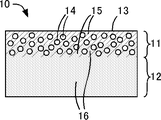
- the fiber-reinforced resin composite 10 of the present embodiment includes a skin 11 and a resin foam 12.
- the resin foam 12 is made of foamed resin 16.
- the thickness of the resin foam 12 may be determined according to the required performance, and is not particularly limited.
- the thickness of the resin foam 12 is typically 5 to 200 mm.
- the foamed resin 16 constituting the resin foam 12 for example, urethane resin, ABS resin, olefin resin, polyester resin, polystyrene resin, and acrylic resin can be used.
- the foamed resin 16 is preferably a urethane resin.
- the resin foam 12 is preferably a hard urethane foam having a closed cell structure. This is because the skin 11 having excellent hardness can be obtained.
- the closed cell ratio of the rigid urethane foam is preferably 80% or more, more preferably 90% or more.
- the foaming ratio of the resin foam 12 is preferably 25 times or more.
- the skin 11 is a fiber-reinforced resin containing a fiber sheet 14, a matrix resin 15 which is a thermoplastic resin, and a foamed resin 16.
- the skin 11 constitutes one surface 13 of the fiber reinforced resin composite 10.
- the foamed resin 16 is impregnated in a part or the whole including the vicinity of the interface between the skin 11 and the resin foam 12. When the foamed resin 16 is impregnated in the entire skin 11, the foamed resin may reach the surface 13.
- the foamed resin 16 is continuously impregnated in the fiber sheet 14 from the resin foam 12. In other words, the portion of the fiber sheet 14 impregnated with the foamed resin 16 and the resin foam 12 are integrally formed at the same time.
- the skin 11 may be formed on one side of the fiber reinforced resin composite 10 as shown in FIG. 1, or may be formed on both sides of the fiber reinforced resin composite 10.
- the thickness of the skin 11 may be determined according to the required performance, and is not particularly limited.
- the thickness of the skin 11 is the thickness of the portion where the matrix resin 15 is present.
- the thickness of the epidermis 11 is typically 0.05 to 1 mm.
- the fiber sheet 14 contained in the skin 11 is composed of, for example, carbon fibers, glass fibers, ceramic fibers such as alumina fibers, and metal fibers such as steel fibers.
- the fiber sheet 14 is preferably made of carbon fiber. This is because it is lighter and has higher strength.
- the fiber sheet 14 is preferably made of continuous fibers. This is because the strength of the epidermis 11 can be increased.
- the fiber sheet 14 may be a non-woven fabric, but is preferably a sheet or woven fabric in which continuous fibers are aligned in one direction.
- the foamed resin 16 is likely to impregnate the fiber sheet 14.
- the fiber sheet 14 is a sheet in which continuous fibers are aligned in one direction, a plurality of fiber sheets may be superposed so that the length directions of the fibers intersect.
- the matrix resin 15 of the skin 11 is a thermoplastic resin.
- a thermoplastic resin such as an olefin resin, a polyester resin, a polyamide resin, an acrylic resin, a phenoxy resin, a sulfide resin, a polycarbonate resin, or a polypropylene resin is used alone or in combination of two or more. Can be used.
- the matrix resin 15 is preferably a resin selected from the group consisting of phenoxy resin, polyamide 6, polyamide 12, polypropylene, and polycarbonate.
- the skin 11 is made of a fiber sheet 14, a matrix resin 15, and a foamed resin 16.
- the fibers of the fiber sheet 14 are filled with the matrix resin 15 and the foamed resin 16.
- the ratio of the fiber sheet 14 to the skin 11 is preferably 15 to 45% by volume, more preferably 20 to 40% by volume. is there.
- the thickness of the portion of the skin 11 in which the foamed resin 16 is impregnated into the fiber sheet 14 is the ratio of the foamed resin 16 to the resin components existing between the fibers, that is, , .
- the thickness of the portion where the foamed resin / (matrix resin + foamed resin) is 40% by volume or more can be defined.
- the penetration thickness of the foamed resin is preferably 0.1 mm or more or half or more of the thickness of the fiber sheet 14. This is because the larger the penetration thickness of the foamed resin, the higher the peel strength between the skin 11 and the resin foam 12.
- the penetration thickness of the foamed resin is preferably 1.0 mm or less. This is because even if the penetration thickness of the foamed resin is made thicker than this, the peel strength cannot be further improved.
- the composition ratio of the components in the skin 11 and the penetration thickness of the foamed resin 16 vary depending on the base material (semi-preg) used for manufacturing.
- the fiber-reinforced resin composite 10 of the present embodiment integrates a base material in which a fiber sheet 14 made of continuous fibers is partially impregnated with a thermoplastic matrix resin 15 and a resin foam 12 made of a foamed resin 16. Can be.
- the fiber-reinforced resin composite 10 is a combination of a base material obtained by fusing a thermoplastic matrix resin 15 on the surface of a fiber sheet 14 made of continuous fibers and a resin foam 12 made of a foamed resin 16. Can be. Details of the base material will be described later.
- the manufacturing method of the present embodiment includes a step of preparing a base material containing a fiber sheet 14 and a thermoplastic matrix resin 15, a step of supplying a raw material composition of a foamed resin 16 to one side of the base material, and a raw material composition. It consists of a foaming process.
- a base material in which the fiber sheet 14 is partially impregnated with the thermoplastic matrix resin 15 can be used as the base material containing the fiber sheet 14 and the thermoplastic matrix resin 15.
- the base material in which the fiber sheet is partially impregnated with the matrix resin means a base material in which the matrix resin 15 does not impregnate the entire fiber sheet 14 but exists in the fiber sheet 14 with voids left.
- Such a substrate is called a semi-preg, as opposed to a prepreg in which the fiber sheet is completely impregnated with the matrix resin.
- the base material in which the fiber sheet is partially impregnated with the matrix resin is hereinafter referred to as "partially impregnated semipreg".
- the partially impregnated semipreg can be produced by adhering the powder of the matrix resin 15 to one side or both sides of the fiber sheet 14, softening or melting it by heating, and partially impregnating the fiber sheet 14.
- the film of the matrix resin 15 may be attached to one or both sides of the fiber sheet 14 and softened or melted by heating to partially impregnate the fiber sheet.
- the matrix resin 15 is not impregnated into the entire fiber sheet 14, but is manufactured so as to leave voids in the fiber sheet 14.
- the foamed resin 16 can be impregnated into the fiber sheet 14 in the step of foaming the foamed resin 16 by the voids left between the fibers.
- the volume ratio of the fiber sheet 14 to the matrix resin 15 is preferably 40:60 to 60:40.
- a base material in which the thermoplastic matrix resin 15 is fused to the surfaces of one side or both sides of the fiber sheet 14 may be used.
- the base material in which the thermoplastic matrix resin is fused to the surface of the fiber sheet is a base material in which the matrix resin 15 does not penetrate between the fibers constituting the fiber sheet 14 and remains on the outer surface of the fiber sheet 14. Say. Therefore, the inside of the fiber sheet 14 is in a state where voids are completely left.
- a base material is also called a semipreg.
- the base material in which the matrix resin is fused to the surface of the fiber sheet is hereinafter referred to as "surface fusion semipreg".
- the surface fusion semipreg can be manufactured by the same method as the partially impregnated semipreg.
- the matrix resin 15 is softened at a lower temperature to the extent that it does not penetrate between the fibers constituting the fiber sheet 14 and fused to the surface of the fiber sheet 14.
- the volume ratio of the fiber sheet 14 to the matrix resin 15 is preferably 40:60 to 60:40.
- those having a matrix resin opening formed on the surface and having continuous voids penetrating the semi-pregs in the thickness direction are preferably used.
- the surface fusion semipreg when comparing the partially impregnated semipreg and the surface fusion semipreg, it is preferable to use the surface fusion semipreg. This is because there are many voids inside the fiber sheet 14, and the foamed resin 16 is easily impregnated into the fiber sheet 14 in the step of foaming the foamed resin 16.
- the fiber sheet 14 As the fiber sheet 14, as described above, it is preferable to use a sheet or woven fabric in which continuous fibers are aligned in one direction.
- a sheet in which continuous fibers are aligned in one direction is obtained by opening a bundle of continuous fibers in one direction.
- the fiber sheet 14 In the surface fusion semipreg using a sheet in which continuous fibers are aligned in one direction, the fiber sheet 14 is easily separated. Therefore, bridge fibers may be arranged on the surface of the fiber sheet 14 and in a direction crossing the fiber sheet 14. ..
- the same fiber as the fiber sheet 14 main body can be used.
- the density of the bridge fibers is preferably 25 to 150 fibers per 10 mm 2 of the fiber sheet 14 on average.
- a known raw material composition of the foamed resin 16 can be used.
- the foamed resin 16 is a urethane resin
- a mixed solution of isocyanate and polyol can be used as the raw material composition.
- This raw material composition is supplied to one side of the semipreg.
- the resin foam 12 is formed on the side to which the raw material composition of the semipreg is supplied, and the opposite side is the surface 13 of the fiber-reinforced resin composite 10 to be manufactured. Since the ratio of the matrix resin 15 to the fibers is high on the surface to which the powder of the matrix resin 15 is attached when the semipreg is manufactured, if that surface is the surface 13 of the fiber reinforced resin composite 10. , The surface 13 can be obtained more precisely.
- the foamed resin 16 impregnates the adjacent semi-preg fiber sheet 14 by the foaming pressure while forming the resin foam 12.
- the fibers of the fiber sheet 14 are filled with the matrix resin 15 and the foamed resin 16 to form a hard skin 11. Further, since the foamed resin 16 is continuously impregnated into the fiber sheet 14 from the resin foam 12, the skin 11 and the resin foam 12 are strongly integrated, and the peel strength between the skin 11 and the resin foam 12 is high. Is obtained.
- the matrix resin 15 When the softening temperature of the matrix resin 15 is sufficiently low, the matrix resin 15 is heated to a temperature higher than the softening temperature by an external heating means or, when foaming is an exothermic reaction, the reaction heat to soften or melt. The impregnation of the fiber sheet 14 further progresses. In that case, the fiber sheet 14 is completely impregnated with the matrix resin 15 on the surface portion of the semipreg opposite to the resin foam 12, and the surface 13 composed of only the fiber sheet 14 and the matrix resin 15 is obtained.
- the step of foaming the raw material composition is also a step of integrating the skin 11 of the fiber reinforced resin and the resin foam 12 to form the entire fiber reinforced resin composite 10. This step can be carried out by, for example, a molding method or a double belt molding method.
- the foamed resin 16 is foamed in the mold.
- the semipreg is fixed along the cavity surface of either the lower mold and the upper mold of the mold or both.
- the raw material composition of the foamed resin 16 is put into the cavity of the mold, and the mold is held at an appropriate temperature to foam the raw material composition.
- the fiber reinforced resin composite 10 having a curved surface can be manufactured by forming the cavity surface of the mold into a curved surface.
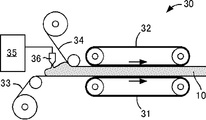
- the double belt type molding machine 30 includes a lower conveyor belt 31 and an upper conveyor belt 32, and face materials 33 and 34 are supplied along the respective conveyor belts. At this time, the semipreg is supplied as one or both of the face materials 33 and 34.
- the raw material composition is discharged from the raw material tank 35 through the mixing / stirring nozzle 36 onto the face material 33, and is charged between the lower conveyor belt 31 and the upper conveyor belt 32.
- the raw material composition foams while moving to the right in FIG. 2 according to the movement of the conveyor belts 31 and 32, is sandwiched between the conveyor belts 31 and 32, and is integrally formed with the face materials 33 and 34 into a composite. ..
- the flat plate-shaped fiber reinforced resin composite 10 can be efficiently manufactured.
- a semipreg having a thermoplastic resin as a matrix resin is used as a starting material. Since the voids are left in the fiber sheet 14 of the semipreg, the foamed resin 16 can be impregnated in the fiber sheet 14. Further, unlike the prepreg in which the fiber sheet is completely impregnated with the thermoplastic resin, the semi-preg has flexibility, so that it is easy to fix it along the curved surface of the mold in the molding method, and the fiber having a curved surface.
- the reinforced resin composite 10 can be easily manufactured.
- the fiber reinforced resin composite of Example 1 was prepared by the following method.
- a semi-preg powder of phenoxy resin (Nippon Steel Chemical & Materials Co., Ltd., YD-10, Tg: 84 ° C.) on both sides of a sheet (grain: 50 g / m 2 ) in which a unidirectional continuous fiber bundle of carbon fibers is opened.
- a surface-fused semipreg that was heated and fused was used.
- the ratio of the phenoxy resin the volume fraction was 50% when the total of the fiber sheet and the phenoxy resin was 100%.
- Urethane resin was used as the foamed resin.
- a semi-preg is set on the bottom surface of a lower mold of length 400 mm ⁇ width 400 mm ⁇ cavity thickness 50 mm, and isocyanate (Tosoh Corporation, MR-200) and polyol (Asahi Glass Co., Ltd., EL-450ED) are used as raw material compositions for foamed resin. : 50%, Sanyo Chemical Industries, Ltd., HS-209: 50%) were mixed and injected into the mold. The polyol was blended with a flame retardant, a foaming agent, a foam stabilizer and a catalyst. The lid (upper mold) was closed, the temperature of the mold was maintained at 40 ° C., foaming was performed for 10 minutes, and then the mold was removed.
- isocyanate Tosoh Corporation, MR-200
- polyol Asahi Glass Co., Ltd., EL-450ED
- the obtained resin foam was a hard urethane foam having a density of 43 kg / m 3 , a foaming ratio of 30 times, and a closed cell structure. From the above, the fiber reinforced resin composite of Example 1 was obtained. This fiber-reinforced resin composite has a flat plate shape, and a fiber sheet and a skin containing a phenoxy resin are integrated on one side of a hard urethane foam.
- the fiber reinforced resin composite of Comparative Example 1 was prepared by the following method.
- the semipreg used in Example 1 was heated to prepare a prepreg in which the fiber sheet was completely impregnated with the phenoxy resin.
- the fiber-reinforced resin composite of Comparative Example 1 was prepared in the same manner as in Example 1 thereafter.
- Both the fiber-reinforced resin composites of Example 1 and Comparative Example 1 had a surface that was hard and had high flexural rigidity. In the fiber-reinforced resin composite of Example 1, it was observed that the urethane resin passed through the fiber sheet and reached the surface.
- the peel strength between the epidermis and the resin foam was measured according to JIS K6854-1 with respect to the adhesive.
- Ten samples with a width of 25 mm were cut out from the fiber-reinforced resin composite, and a 90-degree peeling test was performed at a test speed of 100 mm / min.
- the results are shown in Table 1.
- the maximum convex point means the maximum value of the peeling force peak during the test
- the average convex point means the average value of the peaks
- the average means the average value of the peeling force during the test.
- Example 1 had a higher peel strength than Comparative Example 1.
- the fracture state in Example 1, the base material of the resin foam was destroyed in all 10 measurements, and in Comparative Example 1, it was peeled off at the interface between the epidermis and the resin foam in all 10 measurements.
- the fiber-reinforced resin composite of Example 2 was prepared by the following method. Using the same semipreg, foamed resin, and raw material composition as in Example 1, the semipreg was fixed to the cavity surfaces of the upper and lower molds formed on the curved surface, and the urethane resin was foamed by the same method as in Example 1. As a result, the fiber-reinforced resin composite of Example 2 was obtained, which was corrugated and had the fiber sheet and the skin containing the phenoxy resin integrated on both sides of the rigid urethane foam.
- Fiber reinforced plastic composite 11 Skin (fiber reinforced plastic) 12 Resin foam 13 Surface 14 Fiber sheet 15 Matrix resin 16 Foam resin 30 Conveyor belt type molding machine 31 Lower conveyor belt (first conveyor belt) 32 Upper conveyor belt (second conveyor belt) 33, 34 Face material 35 Raw material tank 36 Mixing / stirring nozzle
Landscapes
- Chemical & Material Sciences (AREA)
- Engineering & Computer Science (AREA)
- Composite Materials (AREA)
- Mechanical Engineering (AREA)
- Materials Engineering (AREA)
- Chemical Kinetics & Catalysis (AREA)
- Health & Medical Sciences (AREA)
- Medicinal Chemistry (AREA)
- Polymers & Plastics (AREA)
- Organic Chemistry (AREA)
- Textile Engineering (AREA)
- Inorganic Chemistry (AREA)
- Manufacturing & Machinery (AREA)
- Casting Or Compression Moulding Of Plastics Or The Like (AREA)
- Laminated Bodies (AREA)
Abstract
Priority Applications (4)
| Application Number | Priority Date | Filing Date | Title |
|---|---|---|---|
| CN202080020679.4A CN113573866A (zh) | 2019-03-27 | 2020-03-11 | 纤维强化树脂复合体及纤维强化树脂复合体的制造方法 |
| JP2021509000A JPWO2020195828A1 (fr) | 2019-03-27 | 2020-03-11 | |
| KR1020217020660A KR20210143158A (ko) | 2019-03-27 | 2020-03-11 | 섬유 강화 수지 복합체 및 섬유 강화 수지 복합체의 제조 방법 |
| US17/442,144 US20220168931A1 (en) | 2019-03-27 | 2020-03-11 | Fiber-reinforced resin composite and method for producing fiber-reinforced resin composite |
Applications Claiming Priority (2)
| Application Number | Priority Date | Filing Date | Title |
|---|---|---|---|
| JP2019061684 | 2019-03-27 | ||
| JP2019-061684 | 2019-03-27 |
Publications (1)
| Publication Number | Publication Date |
|---|---|
| WO2020195828A1 true WO2020195828A1 (fr) | 2020-10-01 |
Family
ID=72610572
Family Applications (1)
| Application Number | Title | Priority Date | Filing Date |
|---|---|---|---|
| PCT/JP2020/010531 Ceased WO2020195828A1 (fr) | 2019-03-27 | 2020-03-11 | Complexe de résine renforcée de fibres et procédé de production d'un complexe de résine renforcée de fibres |
Country Status (6)
| Country | Link |
|---|---|
| US (1) | US20220168931A1 (fr) |
| JP (1) | JPWO2020195828A1 (fr) |
| KR (1) | KR20210143158A (fr) |
| CN (1) | CN113573866A (fr) |
| TW (1) | TW202039650A (fr) |
| WO (1) | WO2020195828A1 (fr) |
Cited By (1)
| Publication number | Priority date | Publication date | Assignee | Title |
|---|---|---|---|---|
| JPWO2022102410A1 (fr) * | 2020-11-11 | 2022-05-19 |
Families Citing this family (2)
| Publication number | Priority date | Publication date | Assignee | Title |
|---|---|---|---|---|
| CN117681369A (zh) * | 2023-12-11 | 2024-03-12 | 浙江联洋新材料股份有限公司 | 一种纤维增强泡沫制备方法 |
| KR102859878B1 (ko) * | 2024-12-10 | 2025-09-30 | 김성곤 | 폴리올레핀수지가 함침된 폴리우레탄 폼 불연재 제조방법 |
Citations (11)
| Publication number | Priority date | Publication date | Assignee | Title |
|---|---|---|---|---|
| JPH06155599A (ja) * | 1992-11-26 | 1994-06-03 | Sumitomo Chem Co Ltd | 繊維強化樹脂製品およびその製造方法 |
| JP2010284986A (ja) * | 2009-06-09 | 2010-12-24 | Nagoya Oil Chem Co Ltd | 吸音性積層材および吸音性積層材成形物 |
| JP2011224873A (ja) * | 2010-04-20 | 2011-11-10 | Mitsubishi Plastics Inc | 繊維強化樹脂製サンドイッチ構造体 |
| JP2012076464A (ja) | 2004-03-29 | 2012-04-19 | Toray Ind Inc | 繊維強化樹脂製サンドイッチパネルの製造方法 |
| JP2013035247A (ja) * | 2011-08-10 | 2013-02-21 | Toyota Motor Corp | 繊維強化樹脂成形体及びそれを用いた車両用内装材 |
| WO2014010106A1 (fr) * | 2012-07-12 | 2014-01-16 | 株式会社イノアックコーポレーション | Matériau composite renforcé de fibres de carbone et procédé de fabrication associé |
| JP2014208418A (ja) | 2013-03-29 | 2014-11-06 | 積水化成品工業株式会社 | 繊維強化複合体及びその製造方法 |
| JP2015003445A (ja) * | 2013-06-20 | 2015-01-08 | 呉羽テック株式会社 | 自動車内装材用不織布及びその製造方法 |
| JP2016052645A (ja) | 2014-09-04 | 2016-04-14 | ニッタ株式会社 | フィルタ枠およびエアフィルタ |
| JP2018510796A (ja) * | 2015-03-16 | 2018-04-19 | ロジャーズ コーポレーション | ポリマー発泡体複合材の製造方法、それにより調製されたポリマー発泡体複合材、及びそれから調製された物品 |
| WO2018159597A1 (fr) * | 2017-02-28 | 2018-09-07 | 宇部エクシモ株式会社 | Article moulé en particules de mousse renforcé par des fibres et sa méthode de production |
Family Cites Families (2)
| Publication number | Priority date | Publication date | Assignee | Title |
|---|---|---|---|---|
| JPH0872119A (ja) * | 1994-06-30 | 1996-03-19 | Isuzu Motors Ltd | Frp積層体の製造方法 |
| SG11201601675RA (en) | 2013-09-06 | 2016-04-28 | Entegris Inc | Substrate containment with enhanced solid getter |
-
2020
- 2020-03-03 TW TW109106963A patent/TW202039650A/zh unknown
- 2020-03-11 US US17/442,144 patent/US20220168931A1/en not_active Abandoned
- 2020-03-11 KR KR1020217020660A patent/KR20210143158A/ko not_active Withdrawn
- 2020-03-11 CN CN202080020679.4A patent/CN113573866A/zh active Pending
- 2020-03-11 JP JP2021509000A patent/JPWO2020195828A1/ja active Pending
- 2020-03-11 WO PCT/JP2020/010531 patent/WO2020195828A1/fr not_active Ceased
Patent Citations (11)
| Publication number | Priority date | Publication date | Assignee | Title |
|---|---|---|---|---|
| JPH06155599A (ja) * | 1992-11-26 | 1994-06-03 | Sumitomo Chem Co Ltd | 繊維強化樹脂製品およびその製造方法 |
| JP2012076464A (ja) | 2004-03-29 | 2012-04-19 | Toray Ind Inc | 繊維強化樹脂製サンドイッチパネルの製造方法 |
| JP2010284986A (ja) * | 2009-06-09 | 2010-12-24 | Nagoya Oil Chem Co Ltd | 吸音性積層材および吸音性積層材成形物 |
| JP2011224873A (ja) * | 2010-04-20 | 2011-11-10 | Mitsubishi Plastics Inc | 繊維強化樹脂製サンドイッチ構造体 |
| JP2013035247A (ja) * | 2011-08-10 | 2013-02-21 | Toyota Motor Corp | 繊維強化樹脂成形体及びそれを用いた車両用内装材 |
| WO2014010106A1 (fr) * | 2012-07-12 | 2014-01-16 | 株式会社イノアックコーポレーション | Matériau composite renforcé de fibres de carbone et procédé de fabrication associé |
| JP2014208418A (ja) | 2013-03-29 | 2014-11-06 | 積水化成品工業株式会社 | 繊維強化複合体及びその製造方法 |
| JP2015003445A (ja) * | 2013-06-20 | 2015-01-08 | 呉羽テック株式会社 | 自動車内装材用不織布及びその製造方法 |
| JP2016052645A (ja) | 2014-09-04 | 2016-04-14 | ニッタ株式会社 | フィルタ枠およびエアフィルタ |
| JP2018510796A (ja) * | 2015-03-16 | 2018-04-19 | ロジャーズ コーポレーション | ポリマー発泡体複合材の製造方法、それにより調製されたポリマー発泡体複合材、及びそれから調製された物品 |
| WO2018159597A1 (fr) * | 2017-02-28 | 2018-09-07 | 宇部エクシモ株式会社 | Article moulé en particules de mousse renforcé par des fibres et sa méthode de production |
Cited By (2)
| Publication number | Priority date | Publication date | Assignee | Title |
|---|---|---|---|---|
| JPWO2022102410A1 (fr) * | 2020-11-11 | 2022-05-19 | ||
| EP4245498A4 (fr) * | 2020-11-11 | 2024-08-07 | Agc Inc. | Revêtement d'aile et son procédé de fabrication, et véhicule |
Also Published As
| Publication number | Publication date |
|---|---|
| CN113573866A (zh) | 2021-10-29 |
| JPWO2020195828A1 (fr) | 2020-10-01 |
| US20220168931A1 (en) | 2022-06-02 |
| KR20210143158A (ko) | 2021-11-26 |
| TW202039650A (zh) | 2020-11-01 |
Similar Documents
| Publication | Publication Date | Title |
|---|---|---|
| US5518796A (en) | Near-surface enhancement of honeycomb sandwich structures to improve durability using a foaming fiber-filled adhesive | |
| EP3152054B1 (fr) | Résine polymère à constituants multiples, procédés pour appliquer cette dernière et structure de stratifié composite comprenant cette dernière | |
| US9505177B2 (en) | Method for producing a metal composite | |
| CN107257820B (zh) | 纤维增强的各向异性泡沫体 | |
| EP3394157B1 (fr) | Structure renforcée en mousse et procédé de formation associé, et article | |
| US20210023830A1 (en) | High-strength low-heat release composites | |
| TWI697398B (zh) | 構造體之製造方法 | |
| US11833803B2 (en) | Fiber reinforced plastic molded body | |
| KR20200071072A (ko) | 섬유 강화 플라스틱 복합체의 제조 방법 | |
| US20220168931A1 (en) | Fiber-reinforced resin composite and method for producing fiber-reinforced resin composite | |
| US12030291B2 (en) | Fiber-reinforced composite material and sandwich structure | |
| CN107250228A (zh) | 由互相连接的片段组成的纤维增强泡沫材料 | |
| JP2021112849A (ja) | 積層体及び積層体の製造方法 | |
| JP5864324B2 (ja) | 繊維強化複合体の製造方法 | |
| WO2022209454A1 (fr) | Élément léger, plat, et procédé de fabrication s'y rapportant | |
| WO2022209455A1 (fr) | Élément léger plat et procédé pour la production de celui-ci | |
| US11926088B2 (en) | Prepreg, preform, fiber-reinforced composite material, and method for producing said prepreg, said preform or said fiber-reinforced composite material | |
| JP6914718B2 (ja) | 制振材 | |
| JP2021049692A (ja) | 繊維強化複合パネル | |
| JP2009012359A (ja) | 発泡体コアを有するfrp成形品の成形方法 | |
| JP2020163584A (ja) | サンドイッチ成形体の製造方法 | |
| JPH08276524A (ja) | 多孔質コアを有する複合成形品の製造方法 | |
| EP4067033A1 (fr) | Matériau composite renforcé par des fibres et structure sandwich | |
| WO2021200008A1 (fr) | Corps moulé en plastique renforcé par fibres | |
| JP2004338270A (ja) | 繊維強化樹脂複合材料の製造方法および繊維強化樹脂複合材料 |
Legal Events
| Date | Code | Title | Description |
|---|---|---|---|
| 121 | Ep: the epo has been informed by wipo that ep was designated in this application |
Ref document number: 20776748 Country of ref document: EP Kind code of ref document: A1 |
|
| ENP | Entry into the national phase |
Ref document number: 2021509000 Country of ref document: JP Kind code of ref document: A |
|
| NENP | Non-entry into the national phase |
Ref country code: DE |
|
| ENP | Entry into the national phase |
Ref document number: 2020776748 Country of ref document: EP Effective date: 20211027 |
|
| 122 | Ep: pct application non-entry in european phase |
Ref document number: 20776748 Country of ref document: EP Kind code of ref document: A1 |