WO2020196335A1 - 冷却構造体 - Google Patents
冷却構造体 Download PDFInfo
- Publication number
- WO2020196335A1 WO2020196335A1 PCT/JP2020/012487 JP2020012487W WO2020196335A1 WO 2020196335 A1 WO2020196335 A1 WO 2020196335A1 JP 2020012487 W JP2020012487 W JP 2020012487W WO 2020196335 A1 WO2020196335 A1 WO 2020196335A1
- Authority
- WO
- WIPO (PCT)
- Prior art keywords
- flow path
- forming member
- bus bar
- path forming
- cooling
- Prior art date
- Legal status (The legal status is an assumption and is not a legal conclusion. Google has not performed a legal analysis and makes no representation as to the accuracy of the status listed.)
- Ceased
Links
Images



Classifications
-
- H—ELECTRICITY
- H10—SEMICONDUCTOR DEVICES; ELECTRIC SOLID-STATE DEVICES NOT OTHERWISE PROVIDED FOR
- H10W—GENERIC PACKAGES, INTERCONNECTIONS, CONNECTORS OR OTHER CONSTRUCTIONAL DETAILS OF DEVICES COVERED BY CLASS H10
- H10W40/00—Arrangements for thermal protection or thermal control
- H10W40/20—Arrangements for cooling
- H10W40/25—Arrangements for cooling characterised by their materials
- H10W40/251—Organics
-
- H—ELECTRICITY
- H05—ELECTRIC TECHNIQUES NOT OTHERWISE PROVIDED FOR
- H05K—PRINTED CIRCUITS; CASINGS OR CONSTRUCTIONAL DETAILS OF ELECTRIC APPARATUS; MANUFACTURE OF ASSEMBLAGES OF ELECTRICAL COMPONENTS
- H05K7/00—Constructional details common to different types of electric apparatus
- H05K7/14—Mounting supporting structure in casing or on frame or rack
- H05K7/1422—Printed circuit boards receptacles, e.g. stacked structures, electronic circuit modules or box like frames
- H05K7/1427—Housings
- H05K7/1432—Housings specially adapted for power drive units or power converters
- H05K7/14329—Housings specially adapted for power drive units or power converters specially adapted for the configuration of power bus bars
-
- H—ELECTRICITY
- H05—ELECTRIC TECHNIQUES NOT OTHERWISE PROVIDED FOR
- H05K—PRINTED CIRCUITS; CASINGS OR CONSTRUCTIONAL DETAILS OF ELECTRIC APPARATUS; MANUFACTURE OF ASSEMBLAGES OF ELECTRICAL COMPONENTS
- H05K7/00—Constructional details common to different types of electric apparatus
- H05K7/20—Modifications to facilitate cooling, ventilating, or heating
- H05K7/2089—Modifications to facilitate cooling, ventilating, or heating for power electronics, e.g. for inverters for controlling motor
- H05K7/20927—Liquid coolant without phase change
-
- H—ELECTRICITY
- H10—SEMICONDUCTOR DEVICES; ELECTRIC SOLID-STATE DEVICES NOT OTHERWISE PROVIDED FOR
- H10W—GENERIC PACKAGES, INTERCONNECTIONS, CONNECTORS OR OTHER CONSTRUCTIONAL DETAILS OF DEVICES COVERED BY CLASS H10
- H10W40/00—Arrangements for thermal protection or thermal control
- H10W40/20—Arrangements for cooling
- H10W40/25—Arrangements for cooling characterised by their materials
- H10W40/258—Metallic materials
-
- H—ELECTRICITY
- H10—SEMICONDUCTOR DEVICES; ELECTRIC SOLID-STATE DEVICES NOT OTHERWISE PROVIDED FOR
- H10W—GENERIC PACKAGES, INTERCONNECTIONS, CONNECTORS OR OTHER CONSTRUCTIONAL DETAILS OF DEVICES COVERED BY CLASS H10
- H10W40/00—Arrangements for thermal protection or thermal control
- H10W40/40—Arrangements for thermal protection or thermal control involving heat exchange by flowing fluids
- H10W40/47—Arrangements for thermal protection or thermal control involving heat exchange by flowing fluids by flowing liquids, e.g. forced water cooling
-
- H—ELECTRICITY
- H10—SEMICONDUCTOR DEVICES; ELECTRIC SOLID-STATE DEVICES NOT OTHERWISE PROVIDED FOR
- H10W—GENERIC PACKAGES, INTERCONNECTIONS, CONNECTORS OR OTHER CONSTRUCTIONAL DETAILS OF DEVICES COVERED BY CLASS H10
- H10W40/00—Arrangements for thermal protection or thermal control
-
- H—ELECTRICITY
- H10—SEMICONDUCTOR DEVICES; ELECTRIC SOLID-STATE DEVICES NOT OTHERWISE PROVIDED FOR
- H10W—GENERIC PACKAGES, INTERCONNECTIONS, CONNECTORS OR OTHER CONSTRUCTIONAL DETAILS OF DEVICES COVERED BY CLASS H10
- H10W40/00—Arrangements for thermal protection or thermal control
- H10W40/60—Securing means for detachable heating or cooling arrangements, e.g. clamps
- H10W40/611—Bolts or screws
Definitions
- the present invention relates to a cooling structure.
- Vehicles equipped with a motor such as a hybrid vehicle and an electric vehicle, are equipped with a driving means for driving the motor.
- the drive means is composed of a power module including a plurality of power semiconductors such as an IGBT (Insulated Gate Bipolar Transistor), an electronic component such as a capacitor, and the like.
- IGBT Insulated Gate Bipolar Transistor
- an electronic component such as a capacitor, and the like.
- Patent Document 1 in addition to a structure in which a heat sink through which a refrigerant flows is provided directly under an electronic component such as a power semiconductor or a capacitor to cool the electronic component, the electronic component provided with a heat sink is electrically bonded. Further, a structure is conceivable in which a bus bar that receives heat from the electronic component is provided, and the electronic component is cooled by thermally joining the bus bar and a cooling structure provided with cooling fins or the like that come into contact with the refrigerant. In the latter structure described above, it is desired to ensure the insulating property between the bus bar and the resin flow path forming member that forms the flow path through which the refrigerant flows.
- One embodiment of the present invention has been made in view of the above-mentioned conventional circumstances, and an object of the present invention is to provide a cooling structure having excellent insulation between a bus bar and a flow path forming member.
- a resin-made flow path forming member that forms a flow path through which a cooling medium flows, and a plate-shaped heat diffusion portion that is embedded in the flow path forming member or joined to the flow path forming member.
- the outer wall surface of the flow path forming member and the bus bar are provided with one or a plurality of cooling fins extending from the heat diffusion portion into the flow path and a bus bar that transfers heat to the heat diffusion portion.
- a cooling structure in which there is a space between the two and the flow path forming member and the bus bar are not in contact with each other.
- the bus bar is provided with a nut body in contact with the heat diffusion portion and a bolt inserted into the nut body, and the bus bar is fixed by the nut body and the bolt according to ⁇ 1>.
- Cooling structure ⁇ 3> The cooling structure according to ⁇ 1> or ⁇ 2>, wherein the heat diffusion portion is made of metal and at least the surface of the cooling fin is made of resin.
- the minimum distance h 2 between the bus bar and the portion of the outer wall surface of the flow path forming member facing the bus bar is 0.2 mm or more, according to any one of ⁇ 1> to ⁇ 3>. Cooling structure.
- ⁇ 5> The cooling structure according to any one of ⁇ 1> to ⁇ 4>, wherein a cooled body connected to the bus bar is arranged.
- ⁇ 6> The cooling structure according to any one of ⁇ 1> to ⁇ 5>, wherein a metal layer is provided on at least a part of the outer wall of the flow path forming member.
- a cooled body to be connected to the bus bar is arranged, a metal layer is provided on at least a part of the outer wall of the flow path forming member, and the metal layer is in contact with at least a part of the cooled body.
- ⁇ 8> The cooling structure according to ⁇ 6> or ⁇ 7>, wherein the metal layer is a metal sprayed layer.
- FIG. 1 It is a figure which shows the cross section of the main part about one Embodiment of a cooling structure. It is a figure which shows an example of the region which provided the cooling fin 24 in a cooling structure 10. It is a figure which shows another example of the region provided with the cooling fin 24 in a cooling structure 10. It is a figure which shows the cross section of the main part about the modification 1 of the cooling structure. It is a figure which shows the cross section of the main part about the modification 2 of the cooling structure. It is a figure which shows the cross section of the main part about the modification 3 of the cooling structure. It is a figure which shows the evaluation result of the magnetic field shielding performance of a metal layer. It is a figure for demonstrating the evaluation method of a cooling performance.
- the cooling structure of the present disclosure has a plate-like shape in which a resin flow path forming member forming a flow path through which a refrigerant flows and a plate-like flow path forming member embedded in the flow path forming member or joined to the flow path forming member.
- a heat diffusion portion, one or a plurality of cooling fins extending from the heat diffusion portion into the flow path, and a bus bar that transfers heat to the heat diffusion portion are provided outside the flow path forming member.
- the cooling structure of the present disclosure has excellent insulation between the bus bar and the flow path forming member.
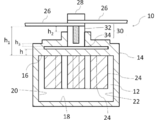
- the cooling structure 10 shown in FIG. 1 includes a resin flow path forming member 14 that forms a flow path 12 through which a refrigerant flows.
- the shape of the flow path may be a substantially rectangular cross section, a circular cross section, an elliptical shape, a polygon other than the rectangular cross section, or the like.
- the flow path 12 includes an upper inner wall 16 corresponding to one inner wall of a pair of facing inner walls, a lower inner wall 18 corresponding to the other inner wall, and a side inner wall 20 connecting the upper inner wall 16 and the lower inner wall 18. It is configured to be surrounded by a side inner wall 22.
- a plurality of cylindrical cooling fins 24 are extended in the flow path 12 from the plate-shaped heat diffusion portion 34.
- the heat diffusion portion 34 is made of metal and the cooling fin 24 is made of resin as in the flow path 12.
- the metal heat diffusion portion 34 has high thermal conductivity, heat is easily diffused in the surface direction, and the heat diffused in the surface direction is easily dissipated by the resin cooling fins 24 having excellent heat dissipation. ..
- a part of the cooling fins 24 is shown by an imaginary line.
- the bus bar 26, which is cooled by transferring heat to the heat diffusion portion 34, is fixed by the bolt 28 and the nut body 32. More specifically, the opening of the bus bar 26 is inserted into the threaded portion of the bolt 28, and a part of the bus bar 26 is sandwiched between the head of the bolt 28 and the nut body 32, so that the bus bar 26 becomes the bolt 28. And the nut body 32 are fixed.
- the nut 30 has a nut body 32 and a heat diffusion portion 34 provided on the side opposite to the side where the bolt 28 of the nut body 32 is inserted.
- the heat diffusion portion 34 is a rectangular plate-like object and is integrated with the nut body 32.
- the bus bar 26 is connected to an electronic component (not shown) such as a power semiconductor or a capacitor.
- the bus bar 26 is fixed by the bolt 28 and the nut body 32, and there is a space between the outer wall surface of the flow path forming member 14 and the bus bar 26, so that the flow path forming member 14 and the bus bar 26 are not in contact with each other. Therefore, the thickness of the flow path forming member 14 can be reduced as compared with the case where the outer wall surface and the bus bar 26 are in contact with each other, and the weight of the cooling structure 10 can be reduced.
- the entire heat diffusion portion 34 of the nut 30 and the side of the nut body 32 opposite to the side where the bolt 28 is inserted are embedded in the flow path forming member 14.
- the heat diffusion portion is not limited to the configuration embedded in the flow path forming member, and is joined to the flow path forming member, for example, to the outer wall of the flow path forming member without contacting the flow path. It may be a configuration.
- the heat diffusion portion may be joined to the flow path forming member by using the resin metal joining technique by laser roughening.
- the plurality of cooling fins 24 are all extended from the heat diffusion portion 34 into the flow path 12. As a result, the heat diffused in the surface direction by the heat diffusion unit 34 is easily dissipated by the cooling fins 24.
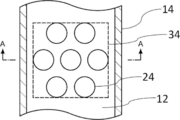
- FIG. 2 is a view of the region where the cooling fins 24 are provided in the cooling structure 10 of FIG. 1 as viewed from the insertion direction of the bolt 28.
- the description of the bus bar 26 and the like is omitted in FIG.
- the heat diffusion portion 34 is represented by a dotted line so that the positional relationship between the cooling fin 24 and the heat diffusion portion 34 can be easily understood.
- FIG. 1 is a cross-sectional view taken along the line AA shown in FIG. As shown in FIG. 2, the number of cooling fins 24 is seven, and the cooling fins 24 are provided within the range in which the heat diffusion portion 34 is arranged. Further, the main surface of the heat diffusion portion 34 faces the flow path 12.
- bus bar 26 when a current flows through the bus bar 26, the bus bar 26 itself generates heat due to resistance loss. Further, the bus bar 26 is connected to an electronic component (not shown), and heat generated from these electronic components is diffused through the bus bar 26 by energization. Therefore, the bus bar 26 tends to be in a high temperature state.
- the heat generated from the bus bar 26 itself and the heat diffused through the bus bar 26 are transferred to the portion integrated with the nut body of the heat diffusion unit 34 via the bolt 28 and the nut body 32. Since the heat diffusion unit 34 is a rectangular plate, the heat transferred to the heat diffusion unit 34 is diffused in the surface direction of the heat diffusion unit 34, and the heat can be diffused over a wide range.
- the heat diffusion portion 34 is arranged at the root portion of the cooling fin 24, and the heat diffused to the heat diffusion portion 34 reaches the root portion of the cooling fin 24 via the flow path forming member 14.
- the heat that has reached the root of the cooling fin 24 is transferred from the root of the cooling fin 24 toward the inside of the flow path 12 through the cooling fin 24.
- heat is transferred from the cooling fins 24 to the refrigerant by the refrigerant flowing through the flow path 12. In this way, the bus bar 26 and the objects to be cooled such as electronic components connected to the bus bar 26 are cooled.
- the cooling fins 24 do not reach from the upper inner wall 16 to the lower inner wall 18, and the tip of the cooling fins 24 is located in the flow path 12. From the viewpoint of increasing the amount of the refrigerant that comes into contact with the cooling fins 24 and increasing the cooling efficiency of the cooling structure 10, the tip portion of the cooling fins 24 may be in contact with the lower inner wall 18. Further, when the tip end portion of the cooling fin 24 is in contact with the lower inner wall 18, for example, when a load is applied from the upper inner wall 16 toward the lower inner wall 18 (or from the lower inner wall 18 toward the upper inner wall 16). In addition, it is possible to increase the strength of the cooling structure 10.
- the distance h 1 between the bus bar 26 and the inner wall surface of the flow path forming member 14 is preferably 10 mm to 50 mm from the viewpoint of insulating properties and cooling efficiency.
- the distance h 1 is the bus bar 26 closest to the nut body 32. It means the distance between the inner wall surface of the flow path forming member 14 and the portion facing the bus bar 26.
- the minimum distance h 2 between the bus bar 26 and the portion of the outer wall surface of the flow path forming member 14 facing the bus bar 26 is preferably 0.2 mm or more, preferably 0.5 mm, from the viewpoint of insulation. It is more preferably 1.0 mm or more, and further preferably 1.0 mm or more.
- the above-mentioned minimum distance h 2 is preferably 50 mm or less, more preferably 30 mm or less, still more preferably 10 mm or less, from the viewpoint of miniaturization of the cooling structure 10 and cooling efficiency of the bus bar 26. .. As shown in FIG.
- the minimum distance h 2 is the bus bar 26 closest to the nut body 32.
- the heat diffusion portion may be joined to the outer wall of the flow path forming member. Further, from the viewpoint of heat dissipation, it is preferable that the contact area between the bus bar and the bolt and nut main body is large.
- the shape of the portion of the bolt and nut that comes into contact with the bus bar is not particularly limited, and may be circular, elliptical, polygonal, or the like.
- the area (area ratio) of the observed portion of the cooling fins 24 in the area of the flow path 12 is preferably 30% or more, more preferably 70% or more, and further preferably 100%.
- the minimum distance h from the surface of the heat diffusion portion 34 on the flow path 12 side to the inner wall of the flow path forming member 14 is preferably 0.3 mm or more from the viewpoint of insulation, and is preferably from the viewpoint of moldability. Therefore, it is more preferably 0.5 mm or more, and further preferably 1.5 mm or more. Further, the above-mentioned minimum distance h is preferably 2.5 mm or less from the viewpoint of cooling efficiency.
- the minimum distance h 3 from the surface of the heat diffusion portion 34 on the bus bar 26 side to the outer wall of the flow path forming member 14 is preferably 0.5 mm or more, preferably 1.5 mm or more, from the viewpoint of moldability. Is more preferable, and from the viewpoint of improving the cooling efficiency, it is preferably 2.5 mm or less.
- the fact that the minimum distance h 3 is 0 mm means that at least a part of the surface of the heat diffusion portion 34 on the bus bar 26 side is not covered with the flow path forming member 14.
- (Area ratio B) is preferably 30% or more, and more preferably 70% or more, from the viewpoint of improving the cooling efficiency.
- the area ratio B described above is preferably 70% or less, and more preferably 30% or less, from the viewpoint of resistance in the flow path 12.
- the heat diffusion portion 34 is a rectangular plate-like object, but the heat diffusion portion 34 is not limited to a rectangle, and may be a circle, an ellipse, a polygon other than a rectangle, or the like.
- At least the surface of the cooling fin 24 may be made of resin, the entire cooling fin 24 may be made of resin, or the cooling fin 24 has a rod-shaped core material made of metal, and the surface of the core material is coated with resin. It may have been done. One end of the core material may be connected to the heat diffusion unit 34 from the viewpoint of improving the cooling efficiency.
- the tip of the cooling fin 24 has a flat shape orthogonal to the extending direction of the cooling fin 24, but the shape of the tip of the cooling fin 24 is not particularly limited and is hemispherical or conical. , Pyramid shape, etc.
- Examples of the object to be cooled include electronic components such as power semiconductors and capacitors connected to the bus bar 26.
- electronic components such as power semiconductors and capacitors connected to the bus bar 26.
- cooling fins may be provided at a position where the electronic component of the cooling structure is arranged.
- the number of cooling fins 24 extending from the heat diffusion unit 34 into the flow path 12 may be one or two or more.
- the cooling fins 24 may be arranged at a position away from the heat diffusion portion 34.
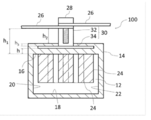
- Cooling structure 100 of the first modification, the bus bar 26, the distance h 2 between the portion facing the bus bar 26 in the outer wall surface of the flow path forming member 14, and the flow path formed from the surface of the bus bar 26 side of the thermal diffusion portion 34 It differs from the above-mentioned cooling structure 10 in that the distance h 3 to the outer wall of the member 14 is constant.
- the preferable range of the distance h 2 in FIG. 4 is the same as the minimum distance h 2 in FIG. 1 described above.
- a preferred range of 4 in distance h 3 from the viewpoint of insulating properties, it is preferably 0mm greater, from the viewpoint of moldability, more preferably 0.5mm or more, and 1.5mm or more Is more preferable, and from the viewpoint of cooling efficiency, it is preferably 2.5 mm or less.
- Cooling structure 200 of the second modification point distance h 3 to the outer wall of the flow path forming member 14 from the surface of the bus bar 26 side of the thermal diffusion portion 34 is 0 mm, i.e., the thermal diffusion unit 34 busbar 26 side It differs from the cooling structure 100 described above in that the surface is not covered with the flow path forming member 14. Such a cooling structure 200 is excellent in cooling efficiency.
- a metal layer is provided on at least a part of the outer wall of the flow path forming member, and preferably, a power semiconductor, a capacitor or the like as the cooled body is the outer wall of the flow path forming member.
- a metal layer is provided so that at least a portion of the object to be cooled is in contact. Since the metal layer is provided so that at least a part of the cooled body is in contact with the cooled body, the heat generated in the cooled body is transferred to the refrigerant flowing through the flow path through the metal layer, so that the cooled body is cooled. Can be cooled efficiently.
- FIG. 6 is a diagram showing a cross section of a main part of the modified example 3 of the cooling structure.
- FIG. 6 shows a cross section of the cooling structure 44 parallel to the flow direction of the refrigerant in the flow path 12. In FIG. 6, the description of the cooling fin is omitted.
- the power semiconductor 46 which is a cooled body, is in contact with the flow path forming member 14 via the metal layer 48 provided on the outer wall of the flow path forming member 14.
- a bus bar 26 is connected to the power semiconductor 46 to ensure continuity with other power semiconductors (not shown), other electronic components, and the like.
- Cooling fins are extended from the upper inner wall 16 to the lower inner wall 18 at a position where the flow path forming member 14 comes into contact with the power semiconductor 46. That is, the power semiconductor 46 is arranged at the root of the cooling fin (not shown).
- the heat generated from the power semiconductor 46 reaches the outer wall of the flow path forming member 14 via the metal layer 48, and the heat that reaches the root of the cooling fin (not shown) passes through the cooling fin from the root to the lower part of the cooling fin. Move towards the inner wall 18. At this time, heat is transferred from the cooling fins to the refrigerant by the refrigerant flowing through the flow path 12. Since the power semiconductor 46 comes into contact with the flow path forming member 14 via the metal layer 48, the heat generated from the power semiconductor 46 can be efficiently transferred to the cooling fins, and the cooling efficiency is improved.
- the metal layer 48 can shield a magnetic field in a low frequency region (particularly, a radio band) generated from the power semiconductor 46. Therefore, it is effective from the viewpoint of magnetic field shielding to provide the metal layer 48 on the outer wall of the flow path forming member 14.
- the metal layer 48 may be provided on at least a part of the outer wall of the flow path forming member 14. Since the metal layer 48 is conductive, it is not necessary to provide the metal layer 48 at a place where insulation is required. Further, a metal layer 48 may be formed on the outer wall of the flow path forming member 14, and the metal layer 48 at a location where insulation is required may be covered with a resin layer.
- the metal layer 48 is preferably provided on the outer wall of the flow path forming member 14 on the side opposite to the side on which the cooled body is arranged. Further, as shown in FIG. 6, when the metal layer 48 is provided on a part of the outer wall of the flow path forming member 14 on the side where the cooled body is arranged, the arrangement of the cooled body in the flow path forming member 14 is provided. A region 50 in which the metal layer 48 is not provided may exist on the outer wall on the side opposite to the side where the metal layer 48 is provided. Further, a region on which the metal layer 48 is not provided may exist on the outer wall on the side opposite to the location where the heat diffusion portion 34 is arranged in FIG.
- the method for producing the cooling structure of the present disclosure is not particularly limited, and is not particularly limited, and is an injection molding method, a die slide injection molding method, a blow molding method, a compression molding method, a transfer molding method, an extrusion molding method, a casting molding method, etc.
- the usual molding method of a resin molded product can be adopted.
- the die slide injection molding method is preferable because high position accuracy may be required for manufacturing the cooling structure 10. Further, the portion of the nut 30 embedded in the flow path forming member 14 may be separately manufactured by an insert molding method.
- the type of resin constituting the flow path forming member 14 and the cooling fin 24 is not particularly limited.
- the resin include polyethylene resin, polypropylene resin (PP), composite polypropylene resin (PPC), polyphenylene sulfide resin (PPS), polyphthalamide resin (PPA), and polybutylene terephthalate resin (PBT).
- Epoxy resin, phenol resin, polystyrene resin, polyethylene terephthalate resin, polyvinyl alcohol resin, vinyl chloride resin, ionomer resin, polyamide resin, acrylonitrile-butadiene-styrene copolymer resin (ABS) and polycarbonate resin Resin is mentioned.
- the resins constituting the flow path forming member 14 and the cooling fins 24 may be the same or different.
- the resin constituting the flow path forming member 14 and the cooling fin 24 may contain an inorganic filler.
- the inorganic filler include silica, alumina, zircon, magnesium oxide, calcium silicate, calcium carbonate, potassium titanate, silicon carbide, silicon nitride, boron nitride, beryllium and zirconia.
- examples of the inorganic filler having a flame-retardant effect include aluminum hydroxide and zinc borate.
- the inorganic filler contained in the resin constituting the flow path forming member 14 and the cooling fin 24 may be the same or different. Further, one of the resins constituting the flow path forming member 14 and the cooling fin 24 may contain an inorganic filler, and the other may not contain the inorganic filler.
- the metal constituting the heat diffusion unit 34 examples include metals such as aluminum, iron, copper, gold, silver, and stainless steel, and alloys. Further, the bolt 28 and the nut body 32 may also be made of the above-mentioned metal, and the metal constituting the heat diffusion portion 34 and the bolt 28 and the nut body 32 may be the same or different.
- the heat diffusion portion 34 has a mesh shape from the viewpoint of suppressing the load on the cooling structure 10 due to the difference in the coefficient of thermal expansion between the resin constituting the flow path forming member 14 and the cooling fin 24 and the metal constituting the heat diffusion portion 34. , Punching metal or the like.
- the metals constituting the heat diffusion unit 34 are aluminum, iron, copper, gold, silver and stainless steel from the viewpoint of the heat diffusion of the heat diffusion unit 34 in the surface direction and the heat dissipation of the cooling fin 24.
- the resin constituting the cooling fin 24 is at least one selected from the group consisting of polyphenylene sulfide resin, polyamide resin, polyphthalamide resin, polybutylene terephthalate resin, phenol resin and epoxy. It is preferably at least one selected from the group consisting of based resins.
- Preferred polyamide-based resins include nylon 6, nylon 66 and the like.
- the type of refrigerant flowing through the flow path is not particularly limited.
- the refrigerant include water, liquids such as organic solvents, and gases such as air.
- Water used as a refrigerant may contain components such as antifreeze.
- the components constituting the metal layer 48 are not particularly limited, and zinc, aluminum, zinc-aluminum alloy, carbon steel, stainless steel, nickel, nickel alloy, tin, copper, copper alloy, silver, silver alloy, gold, Examples include gold alloys and molybdenum. Among these, silver and copper are preferable from the viewpoint of enhancing the magnetic field shielding effect. On the other hand, silver and gold are preferable from the viewpoint of cooling efficiency of the object to be cooled.
- the method for forming the metal layer 48 is not particularly limited, and examples thereof include electrolytic plating, electroless plating, thin film deposition, sticking of a metal plate, and metal spraying.
- the metal layer 48 is preferably a metal sprayed layer formed by a metal spraying method from the viewpoint of formability, and zinc is preferable from the viewpoint of processability.
- the average thickness of the metal layer 48 is not particularly limited, and is preferably 1 ⁇ m to 2 mm.
- the average thickness of the metal layer 48 in contact with the power semiconductor 46, which is the object to be cooled is preferably 200 ⁇ m to 2 mm, more preferably 500 ⁇ m to 2 mm, from the viewpoint of cooling efficiency.
- the average thickness of the metal layer 48 provided on the outer wall of the flow path forming member 14 opposite to the side on which the cooled body is arranged is preferably 1 ⁇ m to 2 mm, preferably 200 ⁇ m to 2 mm from the viewpoint of magnetic field shielding. More preferably, it is 500 ⁇ m to 2 mm.
- the cooling structure 10 may be provided with a temperature sensor for measuring the temperature of the refrigerant, or may be provided with a temperature sensor downstream of the region in which the cooling fins 24 are extended in the flow path 12. Further, the amount of the refrigerant may be adjusted according to the temperature of the temperature sensor, or a control unit may be provided for adjusting the amount of the refrigerant according to the temperature of the temperature sensor.
- the cooling structure of the present disclosure is used for cooling a vehicle equipped with a motor such as a hybrid vehicle or an electric vehicle, such as a power module having a plurality of power semiconductors, electronic components such as capacitors, and a bus bar that electrically joins these electronic components. It is valid.
- a PPS resin plate having a length of 120 mm, a width of 120 mm, and a thickness of 5 mm was prepared and used as a test piece 1.
- a zinc layer having an average thickness of 200 ⁇ m was formed on one surface of the test piece 1 by a thermal spraying method. This was designated as test piece 2.
- an aluminum plate having a length of 120 mm, a width of 120 mm, and a thickness of 500 ⁇ m was used as the test piece 3.
- the magnetic field shielding performance of the test piece 1, the test piece 2, and the test piece 3 was evaluated by the magnetic field shielding effect evaluation device in the KEC method (500 Hz to 1 GHz) shown below. The obtained results are shown in FIG. As is clear from FIG. 7, according to the test piece 2 and the test piece 3, it can be seen that an excellent magnetic field shielding effect can be obtained as compared with the test piece 1.
- a water channel model 1 having an outer diameter of 30 mm in width ⁇ 15 mm in length, an inner diameter of 25 mm in width ⁇ 10 mm in length, and a length of 110 mm was formed.
- a zinc layer 48 having an average thickness of 200 ⁇ m was formed on the upper surface of an outer wall of 110 mm ⁇ 30 mm in the water channel model 1 by a thermal spraying method. This was designated as a waterway model 2.
- An iron block 52 having a size of 95 mm ⁇ 25 mm ⁇ 15 mm heated to 100 ° C. is shown in FIG.
- Cooling structure 12 Flow path 14
- Flow path forming member 16 Upper inner wall 18
- Lower inner wall 20 Side inner wall 22
- Cooling fin 26 Bus bar 28
- Bolt 30 Nut 32
- Nut body 34 Heat diffusion part 46
- Metal layer 50 Region 52
Landscapes
- Engineering & Computer Science (AREA)
- Microelectronics & Electronic Packaging (AREA)
- Physics & Mathematics (AREA)
- Thermal Sciences (AREA)
- Cooling Or The Like Of Semiconductors Or Solid State Devices (AREA)
- Cooling Or The Like Of Electrical Apparatus (AREA)
Abstract
Description
モータを駆動する際には、パワー半導体、キャパシタ等に大電流の流れることがある。この場合、スイッチング損失、抵抗損失等によって駆動手段が発熱するため、駆動手段を効率的に冷却する必要がある。
上述した後者の構造では、バスバーと、冷媒を流通させる流路を形成する樹脂製の流路形成部材との絶縁性を確保することが望まれる。
<1> 冷媒を流通させる流路を形成する樹脂製の流路形成部材と、前記流路形成部材に埋設された、又は、前記流路形成部材に接合された、板状の熱拡散部と、前記熱拡散部から前記流路内に延設された1つ又は複数の冷却フィンと、前記熱拡散部に伝熱するバスバーと、を備え、前記流路形成部材の外壁面と、前記バスバーとの間に空間があり、前記流路形成部材と前記バスバーとが接触していない冷却構造体。
<2> 前記熱拡散部と接触しているナット本体と、前記ナット本体に挿入されるボルトと、を備え、前記バスバーは、前記ナット本体と前記ボルトとで固定されている<1>に記載の冷却構造体。
<3> 前記熱拡散部は金属製であり、前記冷却フィンの少なくとも表面は樹脂製である<1>又は<2>に記載の冷却構造体。
<4> 前記バスバーと、前記流路形成部材の外壁面における前記バスバーと対面する部分との最小距離h2は、0.2mm以上である<1>~<3>のいずれか1つに記載の冷却構造体。
<5> 前記バスバーと接続する被冷却体が配置された<1>~<4>のいずれか1つに記載の冷却構造体。
<6> 前記流路形成部材の外壁の少なくとも一部に、金属層が設けられた<1>~<5>のいずれか1つに記載の冷却構造体。
<7> 前記バスバーと接続する被冷却体が配置され、前記流路形成部材の外壁の少なくとも一部に、金属層が設けられ、前記金属層は、前記被冷却体の少なくとも一部と接している<1>~<4>のいずれか1つに記載の冷却構造体。
<8> 前記金属層が、金属溶射層である<6>又は<7>に記載の冷却構造体。
本開示の冷却構造体は、冷媒を流通させる流路を形成する樹脂製の流路形成部材と、前記流路形成部材に埋設された、又は、前記流路形成部材に接合された、板状の熱拡散部と、前記熱拡散部から前記流路内に延設された1つ又は複数の冷却フィンと、前記熱拡散部に伝熱するバスバーと、を備え、前記流路形成部材の外壁面と、前記バスバーとの間に空間があり、前記流路形成部材と前記バスバーとが接触していない。本開示の冷却構造体は、バスバーと流路形成部材との絶縁性に優れる。
図1では、冷却フィン24の一部が想像線で示されている。
バスバー26は、パワー半導体、キャパシタ等の不図示の電子部品と接続されている。
図2に示すように、冷却フィン24は7本とされており、熱拡散部34の配置された範囲内に冷却フィン24が設けられている。また、熱拡散部34の主面は流路12と対向している。
なお、図1に示すように複数のバスバー26(図中では2つ)が、ボルト28とナット本体32とで固定されている場合、距離h1は、ナット本体32に最も近いバスバー26と、流路形成部材14の内壁面におけるバスバー26と対面する部分と、の距離を意味する。
なお、図1に示すように複数のバスバー26(図中では2つ)が、ボルト28とナット本体32とで固定されている場合、最小距離h2は、ナット本体32に最も近いバスバー26と、流路形成部材14の外壁面におけるバスバー26と対面する部分と、の最小距離を意味する。
例えば、図3に示すように、熱拡散部34から外れた位置に冷却フィン24が配置されていてもよい。
次に、前述の一実施形態の冷却構造体10の変形例1について、図4を用いて説明する。変形例1の冷却構造体100は、バスバー26と、流路形成部材14の外壁面におけるバスバー26と対面する部分との距離h2、及び熱拡散部34のバスバー26側の面から流路形成部材14の外壁までの距離h3がそれぞれ一定である点で、前述の冷却構造体10と異なる。図4中の距離h2の好ましい範囲は、前述の図1中の最小距離h2と同様である。
図4中の距離h3の好ましい範囲は、絶縁性の観点から、0mm超であることが好ましく、成形性の観点から、0.5mm以上であることがより好ましく、1.5mm以上であることがさらに好ましく、冷却効率の観点から、2.5mm以下であることが好ましい。
さらに、前述の一実施形態の冷却構造体10の変形例2について、図5を用いて説明する。変形例2の冷却構造体200は、熱拡散部34のバスバー26側の面から流路形成部材14の外壁までの距離h3が0mmである点、すなわち、熱拡散部34のバスバー26側の面が流路形成部材14で覆われていない点で、前述の冷却構造体100と異なる。
このような冷却構造体200は、冷却効率に優れる。
本開示の冷却構造体の変形例は、流路形成部材の外壁の少なくとも一部に金属層が設けられており、好ましくは、被冷却体であるパワー半導体、キャパシタ等が流路形成部材の外壁上に配置され、被冷却体の少なくとも一部が接触するように金属層が設けられている。被冷却体の少なくとも一部が接触するように金属層が設けられていることにより、被冷却体にて生じた熱が金属層を介して流路を流通する冷媒に移動するため、被冷却体を効率よく冷却することができる。
パワー半導体46から生じた熱は、金属層48を介して流路形成部材14の外壁に達し、さらに不図示の冷却フィンの根元部に到達した熱は、冷却フィンを通じて冷却フィンの根元部から下部内壁18に向けて移動する。このときに、流路12を流通する冷媒により冷却フィンから熱が冷媒に移動する。パワー半導体46が金属層48を介して流路形成部材14と接するため、パワー半導体46から生じた熱が、効率的に冷却フィンへ移動しやすくなり、冷却効率が向上する。
金属層48は、例えば、流路形成部材14における被冷却体の配置された側とは反対側の外壁に設けることが好ましい。また、図6に示すように、金属層48が流路形成部材14における被冷却体の配置された側の外壁の一部に設けられている場合、流路形成部材14における被冷却体の配置された側とは反対側の外壁には、金属層48の設けられていない領域50が存在してもよい。さらに、図6における熱拡散部34の配置された箇所とは反対側の外壁には、金属層48の設けられていない領域が存在してもよい。
また、ナット30の流路形成部材14に埋設されている箇所は、別途インサート成形法により製造してもよい。
流路形成部材14及び冷却フィン24を構成する樹脂に含まれる無機充填材は、同じであっても異なっていてもよい。また、流路形成部材14及び冷却フィン24を構成する樹脂の一方に無機充填材が含まれ、他方に無機充填材が含まれなくてもよい。
金属層48を形成する方法は特に限定されるものではなく、電解メッキ、無電解メッキ、蒸着、金属板の張り付け、金属溶射等が挙げられる。金属層48は、形成性の観点から、金属溶射法により形成された金属溶射層であることが好ましく、加工性の観点から亜鉛が好ましい。
縦120mm、横120mm、厚み5mmのPPS樹脂板を準備し、試験片1とした。
試験片1の一方の面に、溶射法により平均厚み200μmの亜鉛層を形成した。これを試験片2とした。
また、縦120mm、横120mm、厚み500μmのアルミニウム板を試験片3とした。
試験片1、試験片2及び試験片3について、磁界シールド性能を以下に示すKEC法(500Hzから1GHz)における磁界シールド効果評価用装置で評価した。
得られた結果を図7に示す。図7から明らかなように、試験片2及び試験片3によれば、試験片1に比較して優れた磁界シールド効果の得られることがわかる。
PPS樹脂を用いて、外径が横30mm×縦15mmで、内径が横25mm×縦10mmで、長さが110mmの断面矩形の水路モデル1を形成した。水路モデル1における110mm×30mmの外壁の上面に、溶射法により平均厚み200μmの亜鉛層48を形成した。これを水路モデル2とした。
水路モデル1の110mm×30mmの外壁及び水路モデル2の亜鉛層48を形成した面上に、各々、100℃に熱した95mm×25mm×15mmの大きさの鉄ブロック52を図8に示すようにして配置し、各水路モデル内に20℃の水を8L/分の流量で流通させた。
鉄ブロック52の配置直後から、図8に示すA~Dの計4箇所の温度変化を、株式会社KEYENCE製 高機能レコーダ GR-3500を用いて測定したところ、鉄ブロック52の配置から17分後の各測定箇所の温度は、下記表1に示すとおりであり、亜鉛層48は被冷却体の冷却に有効であることが明らかとなった。

本明細書に記載された全ての文献、特許出願、及び技術規格は、個々の文献、特許出願、及び技術規格が参照により取り込まれることが具体的かつ個々に記された場合と同程度に、本明細書中に参照により取り込まれる。
12 流路
14 流路形成部材
16 上部内壁
18 下部内壁
20 側部内壁
22 側部内壁
24 冷却フィン
26 バスバー
28 ボルト
30 ナット
32 ナット本体
34 熱拡散部
46 パワー半導体
48 金属層
50 領域
52 鉄ブロック
Claims (8)
- 冷媒を流通させる流路を形成する樹脂製の流路形成部材と、
前記流路形成部材に埋設された、又は、前記流路形成部材に接合された、板状の熱拡散部と、
前記熱拡散部から前記流路内に延設された1つ又は複数の冷却フィンと、
前記熱拡散部に伝熱するバスバーと、
を備え、
前記流路形成部材の外壁面と、前記バスバーとの間に空間があり、前記流路形成部材と前記バスバーとが接触していない冷却構造体。 - 前記熱拡散部と接触しているナット本体と、前記ナット本体に挿入されるボルトと、を備え、
前記バスバーは、前記ナット本体と前記ボルトとで固定されている請求項1に記載の冷却構造体。 - 前記熱拡散部は金属製であり、前記冷却フィンの少なくとも表面は樹脂製である請求項1又は請求項2に記載の冷却構造体。
- 前記バスバーと、前記流路形成部材の外壁面における前記バスバーと対面する部分との最小距離h2は、0.2mm以上である請求項1~請求項3のいずれか1項に記載の冷却構造体。
- 前記バスバーと接続する被冷却体が配置された請求項1~請求項4のいずれか1項に記載の冷却構造体。
- 前記流路形成部材の外壁の少なくとも一部に、金属層が設けられた請求項1~請求項5のいずれか1項に記載の冷却構造体。
- 前記バスバーと接続する被冷却体が配置され、前記流路形成部材の外壁の少なくとも一部に、金属層が設けられ、
前記金属層は、前記被冷却体の少なくとも一部と接している請求項1~請求項4のいずれか1項に記載の冷却構造体。 - 前記金属層が、金属溶射層である請求項6又は請求項7に記載の冷却構造体。
Priority Applications (2)
| Application Number | Priority Date | Filing Date | Title |
|---|---|---|---|
| EP20777960.4A EP3923320B1 (en) | 2019-03-22 | 2020-03-19 | Cooling structure |
| JP2021509347A JP7164023B2 (ja) | 2019-03-22 | 2020-03-19 | 冷却構造体 |
Applications Claiming Priority (2)
| Application Number | Priority Date | Filing Date | Title |
|---|---|---|---|
| JP2019-055696 | 2019-03-22 | ||
| JP2019055696 | 2019-03-22 |
Publications (1)
| Publication Number | Publication Date |
|---|---|
| WO2020196335A1 true WO2020196335A1 (ja) | 2020-10-01 |
Family
ID=72611934
Family Applications (1)
| Application Number | Title | Priority Date | Filing Date |
|---|---|---|---|
| PCT/JP2020/012487 Ceased WO2020196335A1 (ja) | 2019-03-22 | 2020-03-19 | 冷却構造体 |
Country Status (3)
| Country | Link |
|---|---|
| EP (1) | EP3923320B1 (ja) |
| JP (1) | JP7164023B2 (ja) |
| WO (1) | WO2020196335A1 (ja) |
Cited By (1)
| Publication number | Priority date | Publication date | Assignee | Title |
|---|---|---|---|---|
| JP2022178698A (ja) * | 2021-05-20 | 2022-12-02 | 昭和電工マテリアルズ株式会社 | 冷却構造体 |
Citations (6)
| Publication number | Priority date | Publication date | Assignee | Title |
|---|---|---|---|---|
| JPH08204068A (ja) * | 1995-01-20 | 1996-08-09 | Fuji Electric Co Ltd | モジュール構造の半導体装置 |
| JP2003003248A (ja) * | 2001-06-25 | 2003-01-08 | Sawaki Kogyo:Kk | 金属溶射層被覆シート |
| JP2012015240A (ja) * | 2010-06-30 | 2012-01-19 | Denso Corp | 半導体装置及びその製造方法 |
| WO2016080333A1 (ja) * | 2014-11-21 | 2016-05-26 | 株式会社村田製作所 | モジュール |
| JP2017161204A (ja) * | 2016-03-11 | 2017-09-14 | 富士通株式会社 | 冷却装置、冷却装置の製造方法、及び電子機器 |
| JP2019055696A (ja) | 2017-09-21 | 2019-04-11 | Joyson Safety Systems Japan株式会社 | エアバッグ及びエアバッグ装置 |
Family Cites Families (6)
| Publication number | Priority date | Publication date | Assignee | Title |
|---|---|---|---|---|
| JPH11346480A (ja) * | 1998-06-02 | 1999-12-14 | Hitachi Ltd | インバータ装置 |
| US7027304B2 (en) * | 2001-02-15 | 2006-04-11 | Integral Technologies, Inc. | Low cost thermal management device or heat sink manufactured from conductive loaded resin-based materials |
| JP2012009498A (ja) * | 2010-06-22 | 2012-01-12 | Fujitsu Ten Ltd | 発熱体の放熱構造と放熱構造を備えたオーディオアンプ |
| US9674984B2 (en) * | 2015-06-23 | 2017-06-06 | Cubic Corporation | Plastic chassis for liquid cooled electronic components |
| JP6548146B2 (ja) * | 2016-05-17 | 2019-07-24 | 株式会社オートネットワーク技術研究所 | 回路構成体 |
| JP2018166400A (ja) * | 2018-07-18 | 2018-10-25 | 三菱電機株式会社 | 電力変換装置 |
-
2020
- 2020-03-19 JP JP2021509347A patent/JP7164023B2/ja active Active
- 2020-03-19 WO PCT/JP2020/012487 patent/WO2020196335A1/ja not_active Ceased
- 2020-03-19 EP EP20777960.4A patent/EP3923320B1/en active Active
Patent Citations (6)
| Publication number | Priority date | Publication date | Assignee | Title |
|---|---|---|---|---|
| JPH08204068A (ja) * | 1995-01-20 | 1996-08-09 | Fuji Electric Co Ltd | モジュール構造の半導体装置 |
| JP2003003248A (ja) * | 2001-06-25 | 2003-01-08 | Sawaki Kogyo:Kk | 金属溶射層被覆シート |
| JP2012015240A (ja) * | 2010-06-30 | 2012-01-19 | Denso Corp | 半導体装置及びその製造方法 |
| WO2016080333A1 (ja) * | 2014-11-21 | 2016-05-26 | 株式会社村田製作所 | モジュール |
| JP2017161204A (ja) * | 2016-03-11 | 2017-09-14 | 富士通株式会社 | 冷却装置、冷却装置の製造方法、及び電子機器 |
| JP2019055696A (ja) | 2017-09-21 | 2019-04-11 | Joyson Safety Systems Japan株式会社 | エアバッグ及びエアバッグ装置 |
Non-Patent Citations (1)
| Title |
|---|
| See also references of EP3923320A4 |
Cited By (2)
| Publication number | Priority date | Publication date | Assignee | Title |
|---|---|---|---|---|
| JP2022178698A (ja) * | 2021-05-20 | 2022-12-02 | 昭和電工マテリアルズ株式会社 | 冷却構造体 |
| JP7619163B2 (ja) | 2021-05-20 | 2025-01-22 | 株式会社レゾナック | 冷却構造体 |
Also Published As
| Publication number | Publication date |
|---|---|
| JP7164023B2 (ja) | 2022-11-01 |
| EP3923320B1 (en) | 2025-05-28 |
| EP3923320A4 (en) | 2022-03-16 |
| EP3923320A1 (en) | 2021-12-15 |
| JPWO2020196335A1 (ja) | 2021-10-21 |
Similar Documents
| Publication | Publication Date | Title |
|---|---|---|
| CN105742252B (zh) | 一种功率模块及其制造方法 | |
| US9226430B2 (en) | Power semiconductor module | |
| CN101312183A (zh) | 半导体装置 | |
| US20160190032A1 (en) | Wiring board and semiconductor package including wiring board | |
| CN109313985B (zh) | 电极冷却的电容器组件 | |
| JP2013123014A (ja) | 半導体装置 | |
| CN109643695B (zh) | 导热绝缘体 | |
| US20220293490A1 (en) | Cooling system | |
| WO2020196335A1 (ja) | 冷却構造体 | |
| JP2012138475A (ja) | 半導体モジュールおよび半導体モジュールの製造方法 | |
| CN102859683B (zh) | 用于将发热构件冷却的冷却组件 | |
| WO2020196333A1 (ja) | 冷却構造体 | |
| JP7164018B2 (ja) | 冷却構造体 | |
| WO2020196331A1 (ja) | 冷却構造体 | |
| JP7164022B2 (ja) | 冷却構造体 | |
| JP2013016606A (ja) | パワーモジュールの冷却構造 | |
| WO2020196332A1 (ja) | 冷却構造体 | |
| CN117641833A (zh) | 中间电路总成 | |
| JP2008311253A (ja) | フィルムコンデンサ及びフィルムコンデンサユニット | |
| KR102722850B1 (ko) | 전력 모듈 | |
| WO2022163418A1 (ja) | 冷却構造体 | |
| CN120834097A (zh) | 半导体装置 | |
| JP2019212906A (ja) | 樹脂成形品 |
Legal Events
| Date | Code | Title | Description |
|---|---|---|---|
| 121 | Ep: the epo has been informed by wipo that ep was designated in this application |
Ref document number: 20777960 Country of ref document: EP Kind code of ref document: A1 |
|
| ENP | Entry into the national phase |
Ref document number: 2021509347 Country of ref document: JP Kind code of ref document: A |
|
| ENP | Entry into the national phase |
Ref document number: 2020777960 Country of ref document: EP Effective date: 20210908 |
|
| NENP | Non-entry into the national phase |
Ref country code: DE |
|
| WWG | Wipo information: grant in national office |
Ref document number: 2020777960 Country of ref document: EP |