WO2020203835A1 - Resine de chlorure de vinyle chloree - Google Patents
Resine de chlorure de vinyle chloree Download PDFInfo
- Publication number
- WO2020203835A1 WO2020203835A1 PCT/JP2020/014183 JP2020014183W WO2020203835A1 WO 2020203835 A1 WO2020203835 A1 WO 2020203835A1 JP 2020014183 W JP2020014183 W JP 2020014183W WO 2020203835 A1 WO2020203835 A1 WO 2020203835A1
- Authority
- WO
- WIPO (PCT)
- Prior art keywords
- component
- vinyl chloride
- ratio
- chlorinated vinyl
- chloride resin
- Prior art date
- Legal status (The legal status is an assumption and is not a legal conclusion. Google has not performed a legal analysis and makes no representation as to the accuracy of the status listed.)
- Ceased
Links
Images

Classifications
-
- C—CHEMISTRY; METALLURGY
- C08—ORGANIC MACROMOLECULAR COMPOUNDS; THEIR PREPARATION OR CHEMICAL WORKING-UP; COMPOSITIONS BASED THEREON
- C08F—MACROMOLECULAR COMPOUNDS OBTAINED BY REACTIONS ONLY INVOLVING CARBON-TO-CARBON UNSATURATED BONDS
- C08F8/00—Chemical modification by after-treatment
- C08F8/18—Introducing halogen atoms or halogen-containing groups
- C08F8/20—Halogenation
-
- C—CHEMISTRY; METALLURGY
- C08—ORGANIC MACROMOLECULAR COMPOUNDS; THEIR PREPARATION OR CHEMICAL WORKING-UP; COMPOSITIONS BASED THEREON
- C08L—COMPOSITIONS OF MACROMOLECULAR COMPOUNDS
- C08L27/00—Compositions of homopolymers or copolymers of compounds having one or more unsaturated aliphatic radicals, each having only one carbon-to-carbon double bond, and at least one being terminated by a halogen; Compositions of derivatives of such polymers
- C08L27/22—Compositions of homopolymers or copolymers of compounds having one or more unsaturated aliphatic radicals, each having only one carbon-to-carbon double bond, and at least one being terminated by a halogen; Compositions of derivatives of such polymers modified by chemical after-treatment
- C08L27/24—Compositions of homopolymers or copolymers of compounds having one or more unsaturated aliphatic radicals, each having only one carbon-to-carbon double bond, and at least one being terminated by a halogen; Compositions of derivatives of such polymers modified by chemical after-treatment halogenated
-
- C—CHEMISTRY; METALLURGY
- C08—ORGANIC MACROMOLECULAR COMPOUNDS; THEIR PREPARATION OR CHEMICAL WORKING-UP; COMPOSITIONS BASED THEREON
- C08K—Use of inorganic or non-macromolecular organic substances as compounding ingredients
- C08K7/00—Use of ingredients characterised by shape
- C08K7/02—Fibres or whiskers
- C08K7/04—Fibres or whiskers inorganic
- C08K7/14—Glass
-
- C—CHEMISTRY; METALLURGY
- C08—ORGANIC MACROMOLECULAR COMPOUNDS; THEIR PREPARATION OR CHEMICAL WORKING-UP; COMPOSITIONS BASED THEREON
- C08F—MACROMOLECULAR COMPOUNDS OBTAINED BY REACTIONS ONLY INVOLVING CARBON-TO-CARBON UNSATURATED BONDS
- C08F14/00—Homopolymers and copolymers of compounds having one or more unsaturated aliphatic radicals, each having only one carbon-to-carbon double bond, and at least one being terminated by a halogen
- C08F14/02—Monomers containing chlorine
-
- C—CHEMISTRY; METALLURGY
- C08—ORGANIC MACROMOLECULAR COMPOUNDS; THEIR PREPARATION OR CHEMICAL WORKING-UP; COMPOSITIONS BASED THEREON
- C08F—MACROMOLECULAR COMPOUNDS OBTAINED BY REACTIONS ONLY INVOLVING CARBON-TO-CARBON UNSATURATED BONDS
- C08F8/00—Chemical modification by after-treatment
- C08F8/18—Introducing halogen atoms or halogen-containing groups
- C08F8/20—Halogenation
- C08F8/22—Halogenation by reaction with free halogens
-
- C—CHEMISTRY; METALLURGY
- C08—ORGANIC MACROMOLECULAR COMPOUNDS; THEIR PREPARATION OR CHEMICAL WORKING-UP; COMPOSITIONS BASED THEREON
- C08J—WORKING-UP; GENERAL PROCESSES OF COMPOUNDING; AFTER-TREATMENT NOT COVERED BY SUBCLASSES C08B, C08C, C08F, C08G or C08H
- C08J5/00—Manufacture of articles or shaped materials containing macromolecular substances
- C08J5/04—Reinforcing macromolecular compounds with loose or coherent fibrous material
- C08J5/0405—Reinforcing macromolecular compounds with loose or coherent fibrous material with inorganic fibres
- C08J5/042—Reinforcing macromolecular compounds with loose or coherent fibrous material with inorganic fibres with carbon fibres
-
- C—CHEMISTRY; METALLURGY
- C08—ORGANIC MACROMOLECULAR COMPOUNDS; THEIR PREPARATION OR CHEMICAL WORKING-UP; COMPOSITIONS BASED THEREON
- C08J—WORKING-UP; GENERAL PROCESSES OF COMPOUNDING; AFTER-TREATMENT NOT COVERED BY SUBCLASSES C08B, C08C, C08F, C08G or C08H
- C08J5/00—Manufacture of articles or shaped materials containing macromolecular substances
- C08J5/04—Reinforcing macromolecular compounds with loose or coherent fibrous material
- C08J5/0405—Reinforcing macromolecular compounds with loose or coherent fibrous material with inorganic fibres
- C08J5/043—Reinforcing macromolecular compounds with loose or coherent fibrous material with inorganic fibres with glass fibres
-
- C—CHEMISTRY; METALLURGY
- C08—ORGANIC MACROMOLECULAR COMPOUNDS; THEIR PREPARATION OR CHEMICAL WORKING-UP; COMPOSITIONS BASED THEREON
- C08K—Use of inorganic or non-macromolecular organic substances as compounding ingredients
- C08K7/00—Use of ingredients characterised by shape
- C08K7/02—Fibres or whiskers
- C08K7/04—Fibres or whiskers inorganic
- C08K7/06—Elements
-
- C—CHEMISTRY; METALLURGY
- C09—DYES; PAINTS; POLISHES; NATURAL RESINS; ADHESIVES; COMPOSITIONS NOT OTHERWISE PROVIDED FOR; APPLICATIONS OF MATERIALS NOT OTHERWISE PROVIDED FOR
- C09D—COATING COMPOSITIONS, e.g. PAINTS, VARNISHES OR LACQUERS; FILLING PASTES; CHEMICAL PAINT OR INK REMOVERS; INKS; CORRECTING FLUIDS; WOODSTAINS; PASTES OR SOLIDS FOR COLOURING OR PRINTING; USE OF MATERIALS THEREFOR
- C09D127/00—Coating compositions based on homopolymers or copolymers of compounds having one or more unsaturated aliphatic radicals, each having only one carbon-to-carbon double bond, and at least one being terminated by a halogen; Coating compositions based on derivatives of such polymers
- C09D127/22—Coating compositions based on homopolymers or copolymers of compounds having one or more unsaturated aliphatic radicals, each having only one carbon-to-carbon double bond, and at least one being terminated by a halogen; Coating compositions based on derivatives of such polymers modified by chemical after-treatment
- C09D127/24—Coating compositions based on homopolymers or copolymers of compounds having one or more unsaturated aliphatic radicals, each having only one carbon-to-carbon double bond, and at least one being terminated by a halogen; Coating compositions based on derivatives of such polymers modified by chemical after-treatment halogenated
-
- C—CHEMISTRY; METALLURGY
- C08—ORGANIC MACROMOLECULAR COMPOUNDS; THEIR PREPARATION OR CHEMICAL WORKING-UP; COMPOSITIONS BASED THEREON
- C08J—WORKING-UP; GENERAL PROCESSES OF COMPOUNDING; AFTER-TREATMENT NOT COVERED BY SUBCLASSES C08B, C08C, C08F, C08G or C08H
- C08J2327/00—Characterised by the use of homopolymers or copolymers of compounds having one or more unsaturated aliphatic radicals, each having only one carbon-to-carbon double bond, and at least one being terminated by a halogen; Derivatives of such polymers
- C08J2327/22—Characterised by the use of homopolymers or copolymers of compounds having one or more unsaturated aliphatic radicals, each having only one carbon-to-carbon double bond, and at least one being terminated by a halogen; Derivatives of such polymers modified by chemical after-treatment
- C08J2327/24—Characterised by the use of homopolymers or copolymers of compounds having one or more unsaturated aliphatic radicals, each having only one carbon-to-carbon double bond, and at least one being terminated by a halogen; Derivatives of such polymers modified by chemical after-treatment halogenated
-
- C—CHEMISTRY; METALLURGY
- C08—ORGANIC MACROMOLECULAR COMPOUNDS; THEIR PREPARATION OR CHEMICAL WORKING-UP; COMPOSITIONS BASED THEREON
- C08L—COMPOSITIONS OF MACROMOLECULAR COMPOUNDS
- C08L2201/00—Properties
- C08L2201/08—Stabilised against heat, light or radiation or oxydation
-
- C—CHEMISTRY; METALLURGY
- C08—ORGANIC MACROMOLECULAR COMPOUNDS; THEIR PREPARATION OR CHEMICAL WORKING-UP; COMPOSITIONS BASED THEREON
- C08L—COMPOSITIONS OF MACROMOLECULAR COMPOUNDS
- C08L2203/00—Applications
- C08L2203/30—Applications used for thermoforming
-
- C—CHEMISTRY; METALLURGY
- C08—ORGANIC MACROMOLECULAR COMPOUNDS; THEIR PREPARATION OR CHEMICAL WORKING-UP; COMPOSITIONS BASED THEREON
- C08L—COMPOSITIONS OF MACROMOLECULAR COMPOUNDS
- C08L2205/00—Polymer mixtures characterised by other features
- C08L2205/02—Polymer mixtures characterised by other features containing two or more polymers of the same C08L -group
- C08L2205/025—Polymer mixtures characterised by other features containing two or more polymers of the same C08L -group containing two or more polymers of the same hierarchy C08L, and differing only in parameters such as density, comonomer content, molecular weight, structure
-
- C—CHEMISTRY; METALLURGY
- C08—ORGANIC MACROMOLECULAR COMPOUNDS; THEIR PREPARATION OR CHEMICAL WORKING-UP; COMPOSITIONS BASED THEREON
- C08L—COMPOSITIONS OF MACROMOLECULAR COMPOUNDS
- C08L2205/00—Polymer mixtures characterised by other features
- C08L2205/03—Polymer mixtures characterised by other features containing three or more polymers in a blend
Definitions
- the present invention relates to a chlorinated vinyl chloride resin which has a poor thermal decomposition property, is excellent in continuous productivity during molding, and can achieve both processability and unevenness prevention of molded products.
- Vinyl chloride resins are generally excellent in mechanical strength, weather resistance and chemical resistance. For this reason, vinyl chloride resins are processed into various molded products and are used in many fields.
- Patent Document 1 discloses a chlorinated vinyl chloride resin obtained by a specific production method, and such a resin has less initial coloration during heat molding and is excellent in thermal stability. Is disclosed.
- the chlorinated vinyl chloride resin as described in Patent Document 1 contains many CPVCs that are partially highly chlorinated, when this is molded, it is easily thermally decomposed and a large amount of hydrogen chloride gas is generated. Then, there is a problem that the surface of the mold is contaminated. Further, since the molded product thus obtained is discolored, there is a problem that the continuous productivity at the time of molding processing is inferior and the molding processability is inferior. Further, it is difficult to uniformly mix the highly chlorinated portion and the low chlorinated portion due to the difference in melt viscosity, and the shape of the obtained molded product is uneven, so that a uniform molded product cannot be obtained. There's a problem.
- the present invention has a poor thermal decomposition property, is excellent in continuous productivity during molding, and is capable of achieving both workability and unevenness prevention of molded products.
- An object of the present invention is to provide a based resin.
- the present invention uses a pulsed NMR was measured by Solid Echo method at 0.99 ° C., 1 H spin - A 0.99 ingredient free induction decay curve, the order of relaxation time of the least squares method of spin relaxation, B 0.99 component and obtained waveform separation into three curves derived from in three components of C 0.99 ingredients, component ratio of C 0.99 component [C 0.99 component / (a 0.99 component + B 0.99 component + C 0.99 component)] is less than 8.0% It is a chlorinated vinyl chloride resin.
- the present invention will be described in detail below.
- Chlorinated vinyl chloride resin of the present invention at 0.99 ° C. using a pulsed NMR was measured by Solid Echo method, 1 H spin - the free induction decay curve of spin relaxation, in order relaxation time is shorter by a least square method
- a Component ratio of C 150 component obtained by waveform-separating into three curves derived from three components of 150 component, B 150 component and C 150 component [C 150 component / (A 150 component + B 150 component + C 150 component)] Is less than 8.0%.
- the component ratio of the C 150 component is preferably 0.1% or more and 7.9% or less.
- the pulse NMR and detecting a response signal to the pulse, a method of obtaining of 1 H nuclear magnetic relaxation time of the sample, as a response to the pulse, the free induction decay curve is obtained.
- the obtained free induction decay curve is a superposition of the free induction decay curves of a plurality of components having different relaxation times, and by separating the waveforms using the least squares method, the relaxation time of each component having a different relaxation time can be obtained. Ingredients can be detected.
- a method of separating and analyzing into three components using such pulse NMR is known, and examples of the literature include JP-A-2018-2983.
- the component A 150 is a component having a short relaxation time in pulse NMR measurement, and means a component having low molecular motility and being hard.
- the C 150 component is a component having a long relaxation time in pulse NMR, and means a component having high molecular motility and a soft component.
- the B 150 component has a relaxation time between the A 150 component and the C 150 component, and the molecular motility is also between the A 150 component and the C 150 component.
- the chlorinated vinyl chloride resin of the present invention preferably has a component ratio of the above A 150 component [A 150 component / (A 150 component + B 150 component + C 150 component)] of 60.0% or more, preferably 70.0. % Or less is preferable.
- Chlorinated vinyl chloride resin of the present invention is preferably the component ratio of the B 0.99 Component [B 0.99 Component / (A 0.99 Component + B 0.99 Component + C 0.99 component)] is 20.0% or higher, 30.0 % Or less is preferable.
- Component ratio of the B 0.99 component to component ratio of the A 0.99 Component is to be preferably 0.2 or more, 0.5 or less preferable.
- Component ratio of the C 0.99 component to component ratio of the A 0.99 Component is to be preferably 0.001 or more and 0.2 or less preferable.
- the relaxation time of the A 150 component is usually less than 0.020 ms (hereinafter referred to as ms), and the relaxation time of the B 150 component is usually 0.020 ms or more and less than 0.090 ms, and the relaxation time of the C 150 component is usually less than 0.020 ms.
- the relaxation time of is usually 0.090 ms or more. It said A 0.99 ingredients relaxation time, more than 0.001 ms, preferably less than 0.020Ms.
- the relaxation time of the C 150 component is preferably 0.090 ms or more and 1.000 ms or less.
- a 0.99 Component ratio of the above B 0.99 Component relaxation time for relaxation time (B 0.99 Component relaxation time / A 0.99 ingredients relaxation time) is preferably 1 or more, is preferably 90 or less. It said A 0.99 ratio of component the C 0.99 ingredients relaxation time for relaxation time (C 0.99 ingredients relaxation time / A 0.99 ingredients relaxation time) is preferably at least 4.5, not more than 1,000 preferable.
- Chlorinated vinyl chloride resin of the present invention measured by the Solid Echo method at 100 ° C. using a pulsed NMR, 1 H spin - the free induction decay curve of spin relaxation, A 100 component relaxation time is in ascending order and B obtained waveform separation into two curves from two components 100 components, B 100 component ratio of components [B 100 component / (a 100 component + B 100 component)] is preferably less than 9.0% .. By setting the component ratio of the B 100 component to less than 9.0%, the molding processability and unevenness prevention property can be further improved.
- the component ratio of the B 100 component is preferably 0.1% or more, and more preferably 8.9% or less.
- the chlorinated vinyl chloride resin of the present invention preferably has a component ratio of the above A 100 component [A 100 component / (A 100 component + B 100 component)] of 91.0% or more, preferably 99.9% or less. It is preferable to have.
- the relaxation time of the A 100 component is usually less than 0.020 ms, and the relaxation time of the B 100 component is usually 0.020 ms or more.
- the A 100 component of the relaxation time is preferably at least 0.001 ms, preferably less than 0.020Ms.
- the B 100 components relaxation time is preferably at least 0.020Ms, is preferably less 1.000Ms.
- the A 100 component of the ratio of the B 100 components relaxation time for relaxation time (B 100 components relaxation time / A 100 component of the relaxation time) is preferably 1 or more, is preferably 1000 or less.
- the A 100 component of the relaxation time and the B 100 product of component component ratio of [A 100 component of relaxation time (ms) ⁇ B 100 Ingredient ratio (%)] is, 0.2 (ms ⁇ %) or less It is preferably 0.18 (ms ⁇ %) or less, more preferably 0.12 (ms ⁇ %) or less, and 0.005 (ms ⁇ %) or more. Is preferable.
- Chlorinated vinyl chloride resin of the present invention measured by the Solid Echo method at 30 ° C. using a pulsed NMR, 1 H spin - the free induction decay curve of spin relaxation, the relaxation time is short order A 30 components and B obtained waveform separation into two curves from two components of 30 components, it is preferable B 30 ingredient ratio of [B 30 component / (a 30 component + B 30 component)] is less than 2.0% .. With less than 2.0% of component ratio of the B 30 components, it is possible to further improve the moldability and preventing unevenness properties.
- Component ratio of the B 30 component is preferably 0.1% or more, more preferably at most 1.9%.
- Chlorinated vinyl chloride resin of the present invention is preferably the component ratio of the A 30 component [A 30 Component / (A 30 component + B 30 component)] is not less than 91.0%, 99.9% or less It is preferable to have.
- the A 30 components of relaxation time is usually less than 0.020Ms.
- the A 30 components of the relaxation time is preferably at least 0.001 ms, preferably less than 0.020Ms.
- the A 30 components relaxation time and the B 30 product of component ratio of components [A 30 components of relaxation time (ms) ⁇ B 30 Ingredient ratio (%)] is, 0.12 (ms /%) or less Is preferable.
- the horizontal axis is the measurement temperature and the vertical axis is the ratio of each component
- the one with a gentle slope of the linear approximation curve is the heat resistance. It is preferable because it has excellent decomposability.
- Component ratio of the A 100 component to component ratio of the A 0.99 Component is to be preferably 1.3 or more and 1.7 or less preferable.
- the B 100 component ratio of components for the component ratio of the C 0.99 component is preferably 0.01 or more and 90 or less.
- the ratio of the A 100 component of the relaxation time for relaxation time of the A 0.99 Component (A 100 component of relaxation time / A 0.99 ingredients relaxation time), it preferably 0.05 or more and 20 or less preferable.
- the ratio of the B 100 components relaxation time for relaxation time of the C 0.99 component (B 100 components relaxation time / C 0.99 ingredients relaxation time), it preferably 0.002 or more and 11 or less preferable.
- the chlorinated vinyl chloride resin of the present invention has the structural units (a) to (c) represented by the following formulas (a) to (c), and has the following structural units (a), (b) and (c).
- the ratio of the structural unit (a) is 5.0 mol% or more, the ratio of the structural unit (b) is 40.0 mol% or less, and the ratio of the structural unit (c) is 55.0 mol% with respect to the total number of moles.
- the following is preferable.
- Such a chlorinated vinyl chloride resin exhibits uniform gelling characteristics during melt-kneading, and a molded product with less unevenness on the surface can be obtained.
- the ratio of the constituent unit (a) to the total number of moles of the constituent units (a), (b) and (c) is 5.0 mol% or more. Is preferable, it is more preferably 30.0 mol% or more, further preferably 35.0 mol% or more, preferably 90.0 mol% or less, and 60.0 mol% or less. Is more preferable. Further, the ratio of the structural unit (b) is preferably 5.0 mol% or more with respect to the total number of moles of the structural units (a), (b) and (c), and 15.0 mol% or more.
- the ratio of the structural unit (c) is preferably 5.0 mol% or more, preferably 25.0 mol% or more, based on the total number of moles of the structural units (a), (b) and (c). It is more preferably 55.0 mol% or less, and more preferably 40.0 mol% or less.
- the molar ratios of the constituent units (a), (b) and (c) of the chlorinated vinyl chloride resin of the present invention reflect the site where chlorine is introduced when the vinyl chloride resin (PVC) is chlorinated. It was done.
- the PVC before chlorination is in a state where the constituent unit (a) is 100 mol% and the constituent units (b) and (c) are 0 mol%, but the constituent unit (a) decreases with chlorination.
- the building blocks (b) and (c) increase. At this time, if the number of unstable structural units (b) increases too much, or if the chlorinated and non-chlorinated parts are biased within the same particles of the chlorinated vinyl chloride resin, the chlorinated state becomes non-uniform.
- the molar ratios of the structural units (a), (b) and (c) of the chlorinated vinyl chloride resin of the present invention can be measured by molecular structure analysis using NMR. NMR analysis is performed by R. A. Komoroski, R.M. G. Parker, J.M. P. It can be carried out according to the method described in Shocker, Macromolecules, 1985, 18, 1257-1265.
- the ratio of the structural unit (b) and the ratio of the structural unit (c) satisfy the following relationship. 0.3 ⁇ [ratio of structural unit (b) / ratio of structural unit (c)] ⁇ 3.0
- the ratio of the structural unit (a) and the component ratio of the C 150 component satisfy the following relationship. 0.6 ⁇ [ratio of structural unit (a) / component ratio of C 150 components] ⁇ 900
- the more preferable lower limit of the above range is 0.7, and the more preferable upper limit is 10.
- the ratio of the structural unit (a) and the component ratio of the B 100 component satisfy the following relationship.
- a more preferable upper limit of the above range is 50.
- the chlorinated vinyl chloride resin of the present invention preferably has an added chlorinated amount of 1.0% by mass or more, and preferably 16.0% by mass or less.
- the amount of added chlorination is more preferably 3.2% by mass or more, further preferably 6.2% by mass or more, more preferably 15.2% by mass or less, and 12.2% by mass. It is more preferably% or less.
- the chlorine content of the vinyl chloride resin is usually 56.8% by mass, but the added chlorine content means the introduction ratio of chlorine to the vinyl chloride resin, and is described in JIS K 7229. It can be measured by the method.
- the added chlorinated amount and the component ratio of the C 150 component satisfy the following relationship. 0.4 ⁇ (additional chlorination amount / component ratio of C 150 components) ⁇ 152
- the more preferable lower limit of the above range is 0.5, and the more preferable upper limit is 10.
- the added chlorinated amount and the component ratio of the B 150 component satisfy the following relationship. 0.1 ⁇ (additional chlorination amount / component ratio of B 150 components) ⁇ 0.8
- the more preferable lower limit of the above range is 0.3, and the more preferable upper limit is 0.55.
- the added chlorinated amount and the ratio of the constituent unit (b) satisfy the following relationship. 0.25 ⁇ [Amount of added chlorinated / Ratio of structural unit (b)] ⁇ 0.60
- the added chlorinated amount and the ratio of the constituent unit (c) satisfy the following relationship. 0.20 ⁇ [Amount of added chlorinated / Ratio of structural unit (c)] ⁇ 0.40
- the degree of polymerization of the chlorinated vinyl chloride resin of the present invention is preferably 100 or more, more preferably 400 or more, further preferably 500 or more, preferably 2000 or less, and 1500 or less. Is more preferable. By setting the degree of polymerization within the above range, it is possible to achieve both fluidity during molding and strength of the molded product.
- the vinyl chloride resin is suspended in an aqueous medium to prepare a suspension, and chlorine is introduced into the reaction vessel.
- the component ratio of the C 150 component and the component ratio of the B 100 component are conditions such as pressure, temperature, chlorine concentration, hydrogen peroxide concentration, chlorine consumption rate, and stirring conditions for chlorinating the vinyl chloride resin. It can be adjusted by changing.
- reaction vessel for example, a commonly used vessel such as a stainless steel reaction vessel with a glass lining or a titanium reaction vessel can be used.
- the method for preparing a suspension by suspending the vinyl chloride resin in an aqueous medium is not particularly limited, and a cake-shaped PVC obtained by demonomerizing the polymerized PVC may be used or dried. May be suspended again in an aqueous medium. Further, a suspension in which substances unfavorable for the chlorination reaction are removed from the polymerization system may be used, but it is preferable to use a cake-like resin obtained by demonomerizing PVC after polymerization.
- aqueous medium for example, pure water subjected to ion exchange treatment can be used.
- the amount of the aqueous medium is not particularly limited, but is generally preferably 150 to 400 parts by mass with respect to 100 parts by mass of PVC.
- the chlorine introduced into the reaction vessel may be either liquid chlorine or gaseous chlorine. It is efficient to use liquid chlorine because a large amount of chlorine can be charged in a short time. Chlorine may be added during the reaction to regulate pressure or replenish chlorine. At this time, in addition to liquid chlorine, gaseous chlorine can be appropriately blown. It is preferable to use chlorine after purging 5 to 10% by mass of cylinder chlorine.
- the gauge pressure in the reaction vessel is not particularly limited, but the higher the chlorine pressure, the easier it is for chlorine to permeate the inside of the PVC particles, so a range of 0 to 2 MPa is preferable.
- the method of chlorinating PVC in the suspended state is not particularly limited, and examples thereof include a method of accelerating chlorination by exciting PVC binding and chlorine with thermal energy (hereinafter referred to as thermal chlorination). Be done.
- the heating method for chlorination by thermal energy is not particularly limited, and for example, heating by an external jacket method from the reactor wall is effective. In the method of chlorinating by heat, a more uniform chlorination reaction becomes possible, and a highly uniform CPVC can be obtained.
- the heating temperature in the thermal chlorination is preferably in the range of 40 to 120 ° C. If the temperature is too low, the chlorination rate will decrease. If the temperature is too high, a dehydrochloric reaction will occur in parallel with the chlorination reaction and the resulting CPVC will be colored.
- the heating temperature is more preferably in the range of 50 to 110 ° C.
- the heating method is not particularly limited, and for example, heating can be performed from the reaction vessel wall by an outer jacket method.
- the rate of chlorination can be improved.
- Hydrogen peroxide is preferably added in an amount of 5 to 500 ppm with respect to PVC every hour of the reaction time. If the amount added is too small, the effect of improving the rate of chlorination cannot be obtained. If the amount added is too large, the thermal stability of CPVC will decrease.
- the chlorination rate is improved, so that the heating temperature can be made relatively low. For example, it may be in the range of 65 to 110 ° C.
- chlorination after the time when it reaches 5% by mass before the final added chlorination amount is performed in a chlorine consumption rate of 0.010 to 0.015 kg / PVC-kg / 5 min, and further. It is preferable that the chlorine consumption rate is in the range of 0.005 to 0.010 kg / PVC-kg ⁇ 5 min after the time when it reaches 3% by mass before the final added chlorine amount.
- the chlorine consumption rate refers to the amount of chlorine consumed for 5 minutes per 1 kg of raw material PVC.
- the ratio of the vortex volume (unit: L) to the total mass (kg) of the raw material PVC and water (vortex volume / total mass of the raw material PVC and water) is 0. It is preferable that the conditions are .009 to 0.143 (L / kg).
- the above ratio is 0.009 (L / kg) or more, chlorine in the gas phase part in the reactor can be sufficiently taken into the liquid phase part, and the above ratio is 0.143 (L / kg) or less. In this case, chlorine taken into the liquid phase portion is less likely to be re-released to the gas phase portion, so that chlorine can be uniformly chlorinated.
- the vortex volume means the volume of the vortex generated at the gas-liquid interface during stirring.
- the vortex volume can be calculated using, for example, the thermal fluid / powder analysis software "R-FLOW" (manufactured by R-Flow Co., Ltd.). Specifically, it can be calculated based on the distance between the center of the stirring blade and the interface between the gas phase portion and the liquid phase portion during stirring.
- R-FLOW thermal fluid / powder analysis software
- the rotation speed of the stirring blade during stirring is preferably 10 to 500 rpm
- the capacity of the container is preferably 0.01 m 3 to 100 m 3 .
- the concentration of chlorine introduced into the reaction vessel is preferably 99.5% or more.
- a molded product can be produced by molding a molding resin composition containing the chlorinated vinyl chloride resin of the present invention.
- the molding resin composition containing the chlorinated vinyl chloride resin of the present invention is also one of the present inventions.
- the preferable lower limit is 65% by mass
- the more preferable lower limit is 70% by mass
- the preferable upper limit is 96% by mass
- the more preferable upper limit is 93. It is mass%.
- the molding resin composition of the present invention can be used as a stabilizer, a lubricant, a processing aid, an impact-resistant modifier, a heat-resistant improver, an antioxidant, an ultraviolet absorber, a light stabilizer, a filler, and heat, if necessary.
- Additives such as thermoplastic elastomers, pigments and reinforcing materials may be added.
- the stabilizer is not particularly limited, and examples thereof include a heat stabilizer and a heat stabilization aid.
- the heat stabilizer is not particularly limited, and examples thereof include an organotin stabilizer, a lead stabilizer, a calcium-zinc stabilizer; a barium-zinc stabilizer; and a barium-cadmium stabilizer.
- organic tin stabilizer examples include dibutyl tin mercapto, dioctyl tin mercapto, dimethyl tin mercapto, dibutyl tin mercapto, dibutyl tin malate, dibutyl tin malate polymer, dioctyl tin malate, dioctyl tin malate polymer, and dibutyl tin laurate. , Dibutyltin laurate polymer and the like.
- the lead-based stabilizer examples include lead stearate, dibasic lead phosphite, and tribasic lead sulfate. These may be used alone or in combination of two or more.
- the heat stabilizing aid is not particularly limited, and examples thereof include epoxidized soybean oil, phosphoric acid ester, polyol, hydrotalcite, and zeolite. These may be used alone or in combination of two or more.
- the lubricant examples include an internal lubricant and an external lubricant.
- the internal lubricant is used for the purpose of lowering the flow viscosity of the molten resin during molding and preventing frictional heat generation.
- the internal lubricant is not particularly limited, and examples thereof include butyl stearate, lauryl alcohol, stearyl alcohol, epoxy soybean oil, glycerin monostearate, stearic acid, and bisamide. These may be used alone or in combination of two or more.
- the external lubricant is used for the purpose of enhancing the sliding effect between the molten resin and the metal surface during molding.
- the external lubricant is not particularly limited, and examples thereof include paraffin wax, polyolefin wax, ester wax, and montanic acid wax. These may be used alone or in combination of two or more.
- the processing aid is not particularly limited, and examples thereof include acrylic processing aids such as alkylacrylate-alkylmethacrylate copolymers having a mass average molecular weight of 100,000 to 2,000,000.
- the acrylic processing aid is not particularly limited, and examples thereof include an n-butyl acrylate-methyl methacrylate copolymer and a 2-ethylhexyl acrylate-methyl methacrylate-butyl methacrylate copolymer. These may be used alone or in combination of two or more.
- the impact-resistant modifier is not particularly limited, and examples thereof include methyl methacrylate-butadiene-styrene copolymer (MBS), chlorinated polyethylene, and acrylic rubber.
- MFS methyl methacrylate-butadiene-styrene copolymer
- the heat resistance improving agent is not particularly limited, and examples thereof include ⁇ -methylstyrene-based resins and N-phenylmaleimide-based resins.
- the content of the impact-resistant modifier in the molding resin composition of the present invention has a preferable lower limit of 1% by mass, a more preferable lower limit of 2% by mass, a preferable upper limit of 30% by mass, and a more preferable upper limit of 15% by mass. is there. Within the above range, the strength of the obtained molded product can be sufficiently increased.
- the antioxidant is not particularly limited, and examples thereof include a phenolic antioxidant.
- the light stabilizer is not particularly limited, and examples thereof include a hindered amine-based light stabilizer and the like.
- the ultraviolet absorber is not particularly limited, and examples thereof include ultraviolet absorbers such as salicylic acid ester type, benzophenone type, benzotriazole type, and cyanoacrylate type.
- the filler is not particularly limited, and examples thereof include calcium carbonate and talc.
- the pigment is not particularly limited, and for example, organic pigments such as azo-based, phthalocyanine-based, slene-based, and dye lake-based; oxide-based, molybdenum chromate-based, sulfide / serene-based, ferrocyanine-based, and the like. Examples include inorganic pigments.
- the reinforcing material is not particularly limited, and examples thereof include a fiber-based reinforcing material and a non-fiber-based reinforcing material. Examples of the fiber-based reinforcing material include glass fiber, carbon fiber, aramid fiber, polyethylene terephthalate fiber, cellulose nanofiber (CNF), kenaf and the like. Examples of the non-fiber type reinforcing material include graphite and graphene.
- a molded product molded from the molding resin composition of the present invention is provided.
- Such a molded product is also one of the present inventions.
- the molded product may contain a reinforcing material such as glass fiber or carbon fiber.
- the molded product of the present invention can be molded into an arbitrary shape by a hot press or the like, and has excellent heat moldability.
- any conventionally known molding method may be adopted, and examples thereof include an extrusion molding method and an injection molding method.
- the molded product of the present invention has excellent thermal stability and is in a good appearance, it can be suitably used for applications such as building members, pipework equipment, and housing materials.
- the hydrogen tank is becoming smaller and lighter, and if the number of locations where the hydrogen tank is placed increases, it may not be possible to identify the part that may be in contact with the flame. .. Therefore, it is necessary to take measures against heating and ignition of the battery pack and the cover that covers the entire hydrogen tank.
- the molded product is a member for a transport aircraft and a battery device. It can be suitably used as a member for.
- Examples of the above-mentioned transport aircraft include automobiles such as gasoline vehicles, hybrid vehicles, electric vehicles and fuel cell vehicles, motorcycles such as gasoline bikes, hybrid bikes and electric bikes, bicycles such as electrically assisted bicycles, railway vehicles, ships and aircraft. Be done.
- examples of the members for the transport aircraft include mechanical members, interior members, exterior members, glass, light covers, and the like.
- Examples of the mechanical member include a cooling pipe, an airbag cover, an air duct, a heater unit, and the like.
- Examples of the interior members include ceilings, instrumental panels, console boxes, armrests, seatbelt buckles, switches, door trims, and the like.
- Examples of the exterior member include an emblem, a license plate housing, a bumper core material, an undercover, and the like.
- Battery devices include primary batteries such as nickel manganese batteries, lithium batteries, and air zinc batteries, secondary batteries such as nickel hydrogen batteries, lithium ion batteries, and lead storage batteries, silicon-based solar cells, dye-sensitized solar cells, and perovskite-type sun. Examples thereof include solar cells such as batteries, solid polymer fuel cells, alkaline fuel cells, phosphoric acid fuel cells, and fuel cells such as solid oxide fuel cells. Examples of the battery device member include a battery case, a water jacket for cooling the battery, a hydrogen tank cover, a connector, an insulating sheet and the like.
- the preferable lower limit of the developed area ratio (Sdr) of the interface is 0.0001, and the preferable upper limit is 0.003.
- the Sdr can be measured using, for example, a 3D shape measuring machine (VR-3100 manufactured by KEYENCE CORPORATION).
- the molded product of the present invention preferably has a surface roughness (Rmax) of 1.0 ⁇ m or less. Further, in the molded product of the present invention, it is preferable that the average (WcA) of the filter wave waviness center line on the outer surface is 5.0 ⁇ m or less. As a result, the molded product has less surface unevenness and less variation in wall thickness. In the present invention, in addition to the surface roughness, the average radius waviness center line is small, so that when used for a pipe or the like, friction with running water can be reduced and the flow velocity can be increased.
- the surface roughness (Rmax) can be measured by a method based on JIS B 0601, and the average wave swell centerline (WcA) can be measured by a method based on JIS B 0610.
- a chlorinated vinyl chloride resin which has a poor thermal decomposition property, is excellent in continuous productivity during molding processing, and can achieve both processability and unevenness prevention property of a molded product.
- Example 1 130 kg of ion-exchanged water and 50 kg of vinyl chloride resin having an average degree of polymerization of 1000 are put into a glass-lined reaction vessel having an internal volume of 300 L, and the mixture is stirred to disperse the vinyl chloride resin in water and suspended in water. The inside was heated to raise the temperature of the aqueous suspension to 100 ° C. Next, the inside of the reaction vessel is depressurized to remove oxygen (oxygen amount 100 ppm), and then the chlorine partial pressure becomes 0.40 MPa while stirring so that the volume of vortex generated at the gas-liquid interface is 8.2 L by stirring. As described above, chlorine (oxygen content 50 ppm) was introduced and thermal chlorination was started.
- the chlorination temperature was maintained at 100 ° C. and the chlorine partial pressure was maintained at 0.40 MPa, and after the amount of added chlorination reached 4.0% by mass, 200 ppm of hydrogen peroxide solution was peroxidized with respect to the vinyl chloride resin. Addition was started so that the amount of hydrogen peroxide was 15 ppm / Hr, and the average chlorine consumption rate was adjusted to 0.02 kg / PVC-kg ⁇ 5 min. Then, when the amount of added chlorination reached 10.4% by mass, the supply of hydrogen peroxide solution and chlorine gas was stopped, and chlorination was completed.
- chlorinated vinyl chloride resin slurry is neutralized with sodium hydroxide, washed with water, dehydrated, dried, and hot chlorine.
- a powdered chlorinated vinyl chloride resin (additional chlorination amount: 10.4% by mass) was obtained.
- Example 2 to 8 Chlorinated vinyl chloride-based as in Example 1 except that the average degree of polymerization of the raw material PVC, the reaction temperature, the vortex volume during stirring, the average chlorine consumption rate and the amount of added chlorination are as shown in Tables 1 and 2. A resin was obtained.
- Pulse NMR measurement The obtained powdered chlorinated vinyl chloride resin is placed in a glass sample tube having a diameter of 10 mm so as to fall within the measurement range of the pulse NMR apparatus (manufactured by BRUKER, product number 1824511, 10 mm diameter, It was introduced into a flat bottom (length 180 mm).
- the sample tube was installed in a pulse NMR device (“the minispec mq20” manufactured by BRUKER), and the temperature was gradually raised to 30 ° C. (holding for 10 minutes), 100 ° C. (holding for 30 minutes), and 150 ° C. (holding for 30 minutes). It was. 30 ° C., at 100 ° C.
- the free induction decay curve obtained at 150 ° C. was waveform-separated into three curves derived from the three components A 150 component, B 150 component and C 150 component. Waveform separation was performed by fitting using both the Gaussian type and the exponential type. The ratio of each component was determined from the curves derived from the three components obtained in each measurement. Using the analysis software "TD-NMRA (Version 4.3 Rev0.8)" manufactured by BRUKER, fitting the A 150 component and B 150 component in the Gaussian type and the C 150 component in the exponential type according to the product manual. It was.
- a component ratio of A 0.99 Component, B component ratio of B 0.99 Component, C is the component ratio of C 0.99 component
- T A is A 0.99 Component relaxation time
- T B is B 0.99 Component relaxation time
- T C denotes the relaxation time of the C 0.99 component.
- t is time.
- the A 150 component, the B 150 component, and the C 150 component are the components defined in the order of the shortest relaxation time in the pulse NMR measurement, and the individual relaxation time values are not particularly limited, but the normal relaxation time is The range of A 150 component is less than 0.020 ms, B 150 component is 0.020 ms or more and less than 0.090 ms, and C 150 component is 0.090 ms or more.
- component ratio of A A 30 component or A 100 component, B component ratio of B 30 component or B 100 components T A is A 30 component or A 100 component of relaxation time, T B is B 30 component or B shows the 100 component of the relaxation time.
- t is time.
- the A 30 component and the B 30 component, the A 100 component and the B 100 component are the components defined in the order of the shortest relaxation time in the pulse NMR measurement, and the individual relaxation time values are not particularly limited, but are usually used.
- the relaxation time is in the range of less than 0.020 ms for the A component and 0.020 ms or more for the B component.
- a polyethylene-based lubricant Hiwax 220MP manufactured by Mitsui Chemicals Co., Ltd.
- a fatty acid ester-based lubricant LOXIOL G-32 manufactured by Emery Oleo Chemicals Japan Co., Ltd.
- the obtained chlorinated vinyl chloride resin composition was supplied to a twin-screw non-directional conical extruder (manufactured by Nagata Seisakusho Co., Ltd., SLM-50) having a diameter of 50 mm, and the resin temperature was 205 ° C. and the back pressure was 120 to 140 kg / cm 2.
- the Sdr value of the surface of the obtained molded product was measured using a 3D shape measuring machine (VR-3100 manufactured by KEYENCE CORPORATION). Each Sdr value shown in Tables 1 and 2 is an average value for five measurement regions. Note that Sdr represents how much the surface area of the measurement area is increased with respect to the area of the measurement area, and Sdr of a completely flat surface is 0.
- a molded product having a low Sdr has excellent flatness, and when used as a pipe-shaped molded product such as a pipe, it has excellent quietness when running water.
- the obtained chlorinated vinyl chloride resin composition is supplied to a twin-screw non-directional conical extruder (manufactured by Nagata Seisakusho Co., Ltd., SLM-50) having a diameter of 50 mm, and the resin temperature is 205 ° C. and back pressure.
- a sheet-shaped molded product having a thickness of 2 mm and a width of 80 mm was produced at 120 to 140 kg / cm 2 and an extrusion rate of 38 kg / hr.
- the continuous productivity was evaluated by measuring the time from the start of molding to the occurrence of discoloration (discoloration) in the molded product obtained.
- the solution-impregnated glass fiber was molded into a size of 15 cm ⁇ 15 cm ⁇ thickness 2.5 mm, and THF was dried to prepare a resin-impregnated glass fiber sheet.
- the obtained sheet is sandwiched between Teflon (registered trademark) sheets and heat-pressed at 200 ° C. using a heat press machine at 200 ° C. at 0.2 MPa for 3 minutes and at 10 MPa for 3 minutes to obtain an evaluation sheet having a thickness of 2 mm.
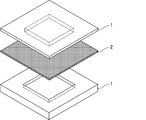
- the uneven mold shown in FIG. 1 (assuming an electronic cover) is preheated to 200 ° C. with a hot press machine, the evaluation sheet is sandwiched between the molds, and as shown in FIG. 2, 5 at 200 ° C. and 2 MPa. Hold for minutes.
- a chlorinated vinyl chloride resin which has a poor thermal decomposition property, is excellent in continuous productivity during molding processing, and can achieve both processability and unevenness prevention property of a molded product.
Landscapes
- Chemical & Material Sciences (AREA)
- Chemical Kinetics & Catalysis (AREA)
- Organic Chemistry (AREA)
- Health & Medical Sciences (AREA)
- Medicinal Chemistry (AREA)
- Polymers & Plastics (AREA)
- General Chemical & Material Sciences (AREA)
- Engineering & Computer Science (AREA)
- Materials Engineering (AREA)
- Inorganic Chemistry (AREA)
- Manufacturing & Machinery (AREA)
- Life Sciences & Earth Sciences (AREA)
- Wood Science & Technology (AREA)
- Addition Polymer Or Copolymer, Post-Treatments, Or Chemical Modifications (AREA)
- Compositions Of Macromolecular Compounds (AREA)
Abstract
Priority Applications (8)
| Application Number | Priority Date | Filing Date | Title |
|---|---|---|---|
| KR1020217028243A KR102465041B1 (ko) | 2019-03-29 | 2020-03-27 | 염소화 염화비닐계 수지 |
| US17/436,916 US12104051B2 (en) | 2019-03-29 | 2020-03-27 | Chlorinated vinyl chloride-based resin |
| KR1020227038568A KR20220152586A (ko) | 2019-03-29 | 2020-03-27 | 염소화 염화비닐계 수지 |
| EP20784315.2A EP3950731A4 (fr) | 2019-03-29 | 2020-03-27 | Resine de chlorure de vinyle chloree |
| CN202211718225.1A CN116162189A (zh) | 2019-03-29 | 2020-03-27 | 氯化聚氯乙烯系树脂 |
| CN202080025874.6A CN113728017B (zh) | 2019-03-29 | 2020-03-27 | 氯化聚氯乙烯系树脂 |
| JP2020528983A JP7050923B2 (ja) | 2019-03-29 | 2020-03-27 | 塩素化塩化ビニル系樹脂 |
| JP2022040413A JP2022069575A (ja) | 2019-03-29 | 2022-03-15 | 塩素化塩化ビニル系樹脂 |
Applications Claiming Priority (4)
| Application Number | Priority Date | Filing Date | Title |
|---|---|---|---|
| JP2019068511 | 2019-03-29 | ||
| JP2019-068511 | 2019-03-29 | ||
| JP2019204830 | 2019-11-12 | ||
| JP2019-204830 | 2019-11-12 |
Publications (1)
| Publication Number | Publication Date |
|---|---|
| WO2020203835A1 true WO2020203835A1 (fr) | 2020-10-08 |
Family
ID=72668178
Family Applications (1)
| Application Number | Title | Priority Date | Filing Date |
|---|---|---|---|
| PCT/JP2020/014183 Ceased WO2020203835A1 (fr) | 2019-03-29 | 2020-03-27 | Resine de chlorure de vinyle chloree |
Country Status (7)
| Country | Link |
|---|---|
| US (1) | US12104051B2 (fr) |
| EP (1) | EP3950731A4 (fr) |
| JP (2) | JP7050923B2 (fr) |
| KR (2) | KR20220152586A (fr) |
| CN (2) | CN116162189A (fr) |
| TW (1) | TWI837336B (fr) |
| WO (1) | WO2020203835A1 (fr) |
Cited By (6)
| Publication number | Priority date | Publication date | Assignee | Title |
|---|---|---|---|---|
| WO2021201048A1 (fr) * | 2020-03-31 | 2021-10-07 | 積水化学工業株式会社 | Résine chlorée à base de chlorure de vinyle |
| WO2021201042A1 (fr) * | 2020-03-31 | 2021-10-07 | 積水化学工業株式会社 | Résine chlorée de chlorure de vinyle |
| JPWO2022168961A1 (fr) * | 2021-02-05 | 2022-08-11 | ||
| WO2023182478A1 (fr) * | 2022-03-25 | 2023-09-28 | 積水化学工業株式会社 | Feuille renforcée par des fibres de verre |
| WO2024210002A1 (fr) * | 2023-04-06 | 2024-10-10 | 積水化学工業株式会社 | Résine de polyalcool de vinyle, rouleau de film, et résine d'acétal polyvinylique |
| WO2024210001A1 (fr) * | 2023-04-06 | 2024-10-10 | 積水化学工業株式会社 | Résine de polyalcool de vinyle, composition de résine, feuille crue de céramique, et condensateur céramique |
Families Citing this family (3)
| Publication number | Priority date | Publication date | Assignee | Title |
|---|---|---|---|---|
| WO2021065946A1 (fr) * | 2019-09-30 | 2021-04-08 | 積水化学工業株式会社 | Composition de résine de moulage et article moulé |
| CN114178710B (zh) * | 2020-08-24 | 2024-11-26 | 奥特斯(中国)有限公司 | 部件承载件及其制造方法 |
| CN116409781B (zh) * | 2023-03-21 | 2024-07-16 | 重庆科技大学 | 一种pvc催化裂解制取富氢气体和碳纳米管的工艺及装置 |
Citations (8)
| Publication number | Priority date | Publication date | Assignee | Title |
|---|---|---|---|---|
| JPS52148546A (en) * | 1976-06-04 | 1977-12-09 | Tokuyama Sekisui Ind Corp | Process for production of sintering body of chlorinated vinyl chloride resin |
| JPH08311286A (ja) * | 1995-05-17 | 1996-11-26 | Ciba Geigy Ag | 安定化された後塩素化ポリ塩化ビニル |
| JP2001261910A (ja) * | 2000-03-15 | 2001-09-26 | Sekisui Chem Co Ltd | 塩素化塩化ビニル樹脂組成物及びその成形品 |
| WO2014178362A1 (fr) | 2013-05-01 | 2014-11-06 | 株式会社カネカ | Appareil et procédé de production de résine de chlorure de vinyle chlorée |
| WO2015046454A1 (fr) * | 2013-09-27 | 2015-04-02 | 積水化学工業株式会社 | Composition de résine à mouler comprenant une résine à base de chlorure de vinyle chlorée, et article moulé obtenu à partir de celle-ci |
| WO2015046456A1 (fr) * | 2013-09-27 | 2015-04-02 | 積水化学工業株式会社 | Composition de résine pour moulage comprenant une résine à base de chlorure de vinyle chloré, et son article moulé |
| WO2016013638A1 (fr) * | 2014-07-24 | 2016-01-28 | 積水化学工業株式会社 | Composition de résine à utiliser en moulage |
| JP2018002983A (ja) | 2016-07-08 | 2018-01-11 | 旭化成株式会社 | ポリアセタール樹脂、及びその製造方法 |
Family Cites Families (9)
| Publication number | Priority date | Publication date | Assignee | Title |
|---|---|---|---|---|
| JPH01217008A (ja) * | 1988-02-26 | 1989-08-30 | Kanegafuchi Chem Ind Co Ltd | ポリ塩化ビニル系樹脂の光塩素化方法 |
| JPH111513A (ja) * | 1997-06-11 | 1999-01-06 | Tokuyama Sekisui Ind Corp | 塩素化塩化ビニル系樹脂の製造方法 |
| JP2000017128A (ja) * | 1998-07-06 | 2000-01-18 | Tokuyama Sekisui Ind Corp | 塩素化塩化ビニル系樹脂組成物 |
| JP2000186113A (ja) | 1998-08-24 | 2000-07-04 | Sekisui Chem Co Ltd | 耐熱塩化ビニル系樹脂成形品及び耐熱塩化ビニル系樹脂管 |
| US20100063247A1 (en) * | 2006-11-24 | 2010-03-11 | Sekisui Chemical Co., Ltd. | Chlorinated vinyl chloride-based resin and manufacturing method |
| US20100316904A1 (en) * | 2009-06-11 | 2010-12-16 | Gui Ping Zhang | Self flame-retardant lithium ion battery and case thereof made of plastic with helogens |
| WO2015152260A1 (fr) * | 2014-03-31 | 2015-10-08 | 積水化学工業株式会社 | Procédé de production de résine de chlorure de vinyle chlorée |
| KR102556417B1 (ko) * | 2017-01-25 | 2023-07-18 | 릴라이언스 인더스트리즈 리미티드 | 건식 염소화 폴리염화비닐의 제조 방법 |
| JP7016953B2 (ja) | 2019-03-29 | 2022-02-07 | 積水化学工業株式会社 | 塩素化塩化ビニル系樹脂 |
-
2020
- 2020-03-27 US US17/436,916 patent/US12104051B2/en active Active
- 2020-03-27 EP EP20784315.2A patent/EP3950731A4/fr not_active Withdrawn
- 2020-03-27 KR KR1020227038568A patent/KR20220152586A/ko not_active Ceased
- 2020-03-27 CN CN202211718225.1A patent/CN116162189A/zh active Pending
- 2020-03-27 CN CN202080025874.6A patent/CN113728017B/zh active Active
- 2020-03-27 KR KR1020217028243A patent/KR102465041B1/ko active Active
- 2020-03-27 TW TW109110682A patent/TWI837336B/zh active
- 2020-03-27 JP JP2020528983A patent/JP7050923B2/ja active Active
- 2020-03-27 WO PCT/JP2020/014183 patent/WO2020203835A1/fr not_active Ceased
-
2022
- 2022-03-15 JP JP2022040413A patent/JP2022069575A/ja active Pending
Patent Citations (8)
| Publication number | Priority date | Publication date | Assignee | Title |
|---|---|---|---|---|
| JPS52148546A (en) * | 1976-06-04 | 1977-12-09 | Tokuyama Sekisui Ind Corp | Process for production of sintering body of chlorinated vinyl chloride resin |
| JPH08311286A (ja) * | 1995-05-17 | 1996-11-26 | Ciba Geigy Ag | 安定化された後塩素化ポリ塩化ビニル |
| JP2001261910A (ja) * | 2000-03-15 | 2001-09-26 | Sekisui Chem Co Ltd | 塩素化塩化ビニル樹脂組成物及びその成形品 |
| WO2014178362A1 (fr) | 2013-05-01 | 2014-11-06 | 株式会社カネカ | Appareil et procédé de production de résine de chlorure de vinyle chlorée |
| WO2015046454A1 (fr) * | 2013-09-27 | 2015-04-02 | 積水化学工業株式会社 | Composition de résine à mouler comprenant une résine à base de chlorure de vinyle chlorée, et article moulé obtenu à partir de celle-ci |
| WO2015046456A1 (fr) * | 2013-09-27 | 2015-04-02 | 積水化学工業株式会社 | Composition de résine pour moulage comprenant une résine à base de chlorure de vinyle chloré, et son article moulé |
| WO2016013638A1 (fr) * | 2014-07-24 | 2016-01-28 | 積水化学工業株式会社 | Composition de résine à utiliser en moulage |
| JP2018002983A (ja) | 2016-07-08 | 2018-01-11 | 旭化成株式会社 | ポリアセタール樹脂、及びその製造方法 |
Non-Patent Citations (1)
| Title |
|---|
| R. A. KOMOROSKIR. G. PARKERJ. P. SHOCKER, MACROMOLECULES, vol. 18, 1985, pages 1257 - 1265 |
Cited By (14)
| Publication number | Priority date | Publication date | Assignee | Title |
|---|---|---|---|---|
| JP7155415B2 (ja) | 2020-03-31 | 2022-10-18 | 積水化学工業株式会社 | 塩素化塩化ビニル系樹脂 |
| US12252577B2 (en) | 2020-03-31 | 2025-03-18 | Sekisui Chemical Co., Ltd. | Chlorinated vinyl chloride resin |
| JPWO2021201048A1 (fr) * | 2020-03-31 | 2021-10-07 | ||
| JP7016992B1 (ja) * | 2020-03-31 | 2022-02-07 | 積水化学工業株式会社 | 塩素化塩化ビニル系樹脂 |
| WO2021201048A1 (fr) * | 2020-03-31 | 2021-10-07 | 積水化学工業株式会社 | Résine chlorée à base de chlorure de vinyle |
| US12264239B2 (en) | 2020-03-31 | 2025-04-01 | Sekisui Chemical Co., Ltd. | Chlorinated vinyl chloride-based resin |
| WO2021201042A1 (fr) * | 2020-03-31 | 2021-10-07 | 積水化学工業株式会社 | Résine chlorée de chlorure de vinyle |
| JPWO2022168961A1 (fr) * | 2021-02-05 | 2022-08-11 | ||
| CN116888017A (zh) * | 2021-02-05 | 2023-10-13 | 旭化成株式会社 | 气囊用多层复合体 |
| JP7470219B2 (ja) | 2021-02-05 | 2024-04-17 | 旭化成株式会社 | エアバッグ用多層複合体 |
| WO2022168961A1 (fr) * | 2021-02-05 | 2022-08-11 | 旭化成株式会社 | Composite multicouche pour coussin de sécurité gonflable |
| WO2023182478A1 (fr) * | 2022-03-25 | 2023-09-28 | 積水化学工業株式会社 | Feuille renforcée par des fibres de verre |
| WO2024210002A1 (fr) * | 2023-04-06 | 2024-10-10 | 積水化学工業株式会社 | Résine de polyalcool de vinyle, rouleau de film, et résine d'acétal polyvinylique |
| WO2024210001A1 (fr) * | 2023-04-06 | 2024-10-10 | 積水化学工業株式会社 | Résine de polyalcool de vinyle, composition de résine, feuille crue de céramique, et condensateur céramique |
Also Published As
| Publication number | Publication date |
|---|---|
| US20220153983A1 (en) | 2022-05-19 |
| TWI837336B (zh) | 2024-04-01 |
| JP2022069575A (ja) | 2022-05-11 |
| CN116162189A (zh) | 2023-05-26 |
| JP7050923B2 (ja) | 2022-04-08 |
| EP3950731A4 (fr) | 2022-12-21 |
| JPWO2020203835A1 (ja) | 2021-10-21 |
| CN113728017A (zh) | 2021-11-30 |
| TW202043363A (zh) | 2020-12-01 |
| EP3950731A1 (fr) | 2022-02-09 |
| KR20220152586A (ko) | 2022-11-16 |
| US12104051B2 (en) | 2024-10-01 |
| KR102465041B1 (ko) | 2022-11-09 |
| CN113728017B (zh) | 2023-01-10 |
| KR20210148099A (ko) | 2021-12-07 |
Similar Documents
| Publication | Publication Date | Title |
|---|---|---|
| JP7050923B2 (ja) | 塩素化塩化ビニル系樹脂 | |
| JP7016953B2 (ja) | 塩素化塩化ビニル系樹脂 | |
| JP7016992B1 (ja) | 塩素化塩化ビニル系樹脂 | |
| JP7155415B2 (ja) | 塩素化塩化ビニル系樹脂 | |
| JP7221382B2 (ja) | 塩素化塩化ビニル系樹脂 | |
| JP7221396B2 (ja) | 塩素化塩化ビニル系樹脂 |
Legal Events
| Date | Code | Title | Description |
|---|---|---|---|
| ENP | Entry into the national phase |
Ref document number: 2020528983 Country of ref document: JP Kind code of ref document: A |
|
| 121 | Ep: the epo has been informed by wipo that ep was designated in this application |
Ref document number: 20784315 Country of ref document: EP Kind code of ref document: A1 |
|
| ENP | Entry into the national phase |
Ref document number: 20217028243 Country of ref document: KR Kind code of ref document: A |
|
| NENP | Non-entry into the national phase |
Ref country code: DE |
|
| ENP | Entry into the national phase |
Ref document number: 2020784315 Country of ref document: EP Effective date: 20211029 |
|
| WWW | Wipo information: withdrawn in national office |
Ref document number: 2020784315 Country of ref document: EP |