WO2020203852A1 - Composition pour procédé de métallisation de motif de réserve - Google Patents
Composition pour procédé de métallisation de motif de réserve Download PDFInfo
- Publication number
- WO2020203852A1 WO2020203852A1 PCT/JP2020/014232 JP2020014232W WO2020203852A1 WO 2020203852 A1 WO2020203852 A1 WO 2020203852A1 JP 2020014232 W JP2020014232 W JP 2020014232W WO 2020203852 A1 WO2020203852 A1 WO 2020203852A1
- Authority
- WO
- WIPO (PCT)
- Prior art keywords
- group
- resist pattern
- resist
- composition
- hydrolyzable silane
- Prior art date
- Legal status (The legal status is an assumption and is not a legal conclusion. Google has not performed a legal analysis and makes no representation as to the accuracy of the status listed.)
- Ceased
Links
Images




Classifications
-
- G—PHYSICS
- G03—PHOTOGRAPHY; CINEMATOGRAPHY; ANALOGOUS TECHNIQUES USING WAVES OTHER THAN OPTICAL WAVES; ELECTROGRAPHY; HOLOGRAPHY
- G03F—PHOTOMECHANICAL PRODUCTION OF TEXTURED OR PATTERNED SURFACES, e.g. FOR PRINTING, FOR PROCESSING OF SEMICONDUCTOR DEVICES; MATERIALS THEREFOR; ORIGINALS THEREFOR; APPARATUS SPECIALLY ADAPTED THEREFOR
- G03F7/00—Photomechanical, e.g. photolithographic, production of textured or patterned surfaces, e.g. printing surfaces; Materials therefor, e.g. comprising photoresists; Apparatus specially adapted therefor
- G03F7/26—Processing photosensitive materials; Apparatus therefor
- G03F7/42—Stripping or agents therefor
- G03F7/422—Stripping or agents therefor using liquids only
- G03F7/425—Stripping or agents therefor using liquids only containing mineral alkaline compounds; containing organic basic compounds, e.g. quaternary ammonium compounds; containing heterocyclic basic compounds containing nitrogen
-
- G—PHYSICS
- G03—PHOTOGRAPHY; CINEMATOGRAPHY; ANALOGOUS TECHNIQUES USING WAVES OTHER THAN OPTICAL WAVES; ELECTROGRAPHY; HOLOGRAPHY
- G03F—PHOTOMECHANICAL PRODUCTION OF TEXTURED OR PATTERNED SURFACES, e.g. FOR PRINTING, FOR PROCESSING OF SEMICONDUCTOR DEVICES; MATERIALS THEREFOR; ORIGINALS THEREFOR; APPARATUS SPECIALLY ADAPTED THEREFOR
- G03F7/00—Photomechanical, e.g. photolithographic, production of textured or patterned surfaces, e.g. printing surfaces; Materials therefor, e.g. comprising photoresists; Apparatus specially adapted therefor
- G03F7/26—Processing photosensitive materials; Apparatus therefor
- G03F7/40—Treatment after imagewise removal, e.g. baking
- G03F7/405—Treatment with inorganic or organometallic reagents after imagewise removal
-
- G—PHYSICS
- G03—PHOTOGRAPHY; CINEMATOGRAPHY; ANALOGOUS TECHNIQUES USING WAVES OTHER THAN OPTICAL WAVES; ELECTROGRAPHY; HOLOGRAPHY
- G03F—PHOTOMECHANICAL PRODUCTION OF TEXTURED OR PATTERNED SURFACES, e.g. FOR PRINTING, FOR PROCESSING OF SEMICONDUCTOR DEVICES; MATERIALS THEREFOR; ORIGINALS THEREFOR; APPARATUS SPECIALLY ADAPTED THEREFOR
- G03F7/00—Photomechanical, e.g. photolithographic, production of textured or patterned surfaces, e.g. printing surfaces; Materials therefor, e.g. comprising photoresists; Apparatus specially adapted therefor
- G03F7/20—Exposure; Apparatus therefor
-
- G—PHYSICS
- G03—PHOTOGRAPHY; CINEMATOGRAPHY; ANALOGOUS TECHNIQUES USING WAVES OTHER THAN OPTICAL WAVES; ELECTROGRAPHY; HOLOGRAPHY
- G03F—PHOTOMECHANICAL PRODUCTION OF TEXTURED OR PATTERNED SURFACES, e.g. FOR PRINTING, FOR PROCESSING OF SEMICONDUCTOR DEVICES; MATERIALS THEREFOR; ORIGINALS THEREFOR; APPARATUS SPECIALLY ADAPTED THEREFOR
- G03F7/00—Photomechanical, e.g. photolithographic, production of textured or patterned surfaces, e.g. printing surfaces; Materials therefor, e.g. comprising photoresists; Apparatus specially adapted therefor
- G03F7/26—Processing photosensitive materials; Apparatus therefor
- G03F7/30—Imagewise removal using liquid means
Definitions
- the present invention relates to a composition for coating on a resist pattern in a developing process or on a resist pattern after development by a lithography process. Specifically, the composition is permeated into a resist, and the composition components are permeated.
- the present invention relates to a composition used in a metallization process for obtaining a resist pattern.
- the surface of the resist after exposure is developed with a developing solution, washed with a rinsing solution, the rinsing solution is replaced with a coating solution containing a polymer component, the resist pattern is coated with the polymer component, and then the resist is dry-etched.
- a method of forming a reverse pattern with the removed and replaced polymer component has been proposed. For example, a step of forming a resist film on a substrate, a step of selectively irradiating the resist film with energy rays in order to form a latent image on the resist film, and a resist from the resist film on which the latent image is formed.
- a step of volatilizing the solvent in the coating film material In order to form a coating film covering the resist film on the substrate, a step of volatilizing the solvent in the coating film material, exposing at least a part of the upper surface of the resist pattern, and a mask pattern composed of the coating film.
- a pattern forming method which comprises a step of retracting at least a part of the surface of the coating film and a step of processing the substrate by using the mask pattern (Patent).
- Document 1 A pattern forming method is disclosed, which comprises a step of retracting at least a part of the surface of the coating film and a step of processing the substrate by using the mask pattern.
- Patent Document 2 As an aqueous composition for coating on a photoresist pattern, a composition containing a water-soluble compound containing an amino group and a compound containing a carboxylic acid group has been proposed (Patent Document 2).
- Patent Document 1 has a possibility of causing pattern collapse when the resist is removed with a developing solution or a rinsing solution to form a resist pattern. Further, when the composition disclosed in Patent Document 2 is applied onto a resist pattern, a uniform coating may not be obtained in some cases.
- the present invention has been made in view of the above circumstances, and a composition capable of improving the collapse and roughness of the resist pattern and improving the etching resistance by metalizing the resist in the resist pattern, and
- An object of the present invention is to provide a method for metallizing a resist pattern using the composition.
- the present inventors have made metal oxides, hydrolyzable silane compounds and their hydrolyzed / hydrolyzed condensates, and acid compounds containing no carboxylic acid group.
- a resist pattern in which the above composition component is permeated into the resist can be obtained, and the composition component.
- the present invention has been completed by finding that the resist pattern permeated with the resist pattern can suppress pattern collapse and has improved etching resistance.
- Component (A) Metal oxide (a1), hydrolyzable silane compound (a2), hydrolyzate of the hydrolyzable silane compound (a3), and hydrolyzed condensate of the hydrolyzable silane compound (a4).
- a composition for a resist pattern metallization process which comprises a component (B): an acid compound containing no carboxylic acid group (-COOH), and a component (C): an aqueous solvent.
- the component (B) is a sulfonic acid group (-SO 3 H) containing acid compounds, to compositions according to the first aspect.
- the hydrolyzable silane compound (a2) is a hydrolyzable silane (i) containing an organic group containing an amino group and a hydrolyzable silane (ii) containing an organic group having an ionic functional group.
- the composition according to the first aspect or the second aspect which comprises at least one selected from the group consisting of.
- the hydrolyzable silane compound (a2) is selected from the group consisting of the hydrolyzable silane represented by the following formula (1) and the hydrolyzable silane represented by the formula (1-1).
- the composition according to the first aspect or the second aspect which comprises at least one kind.
- R 3 represents an organic group containing an amino group or an organic group having an ionic functional group, which is bonded to a silicon atom by a Si—C bond or a Si—N bond, and said. When a plurality of R 3s are present, the R 3 represents a group which may form a ring and be bonded to a Si atom.
- R 1 is an organic group having an alkyl group, an aryl group, an alkyl halide group, an aryl halide group, an alkenyl group, an epoxy group, an acryloyl group, a methacryloyl group, a mercapto group, or a cyano group, and Si—C.
- R 2 represents an alkoxy group, an acyloxy group, or a halogen group.
- a0 indicates an integer of 0 or 1
- b0 represents an integer of 1 to 3 and represents c0 represents an integer of 1 or 2.
- R 10 and R 20 represent a hydroxy group, an alkoxy group, an acyloxy group, or a halogen group, respectively.
- R 30 represents an organic group containing an amino group or an organic group having an ionic functional group, which is bonded to a silicon atom by a Si—C bond or a Si—N bond, and said. When a plurality of R 30s are present, the R 30 represents a group which may form a ring and be bonded to a Si atom.
- n0 represents an integer of 1 to 10.
- the metal oxide (a1) is an oxide of at least one metal selected from the group consisting of titanium, hafnium, zirconium, germanium, aluminum, indium, tin, tungsten and vanadium.
- the composition according to the section As a seventh aspect, the composition according to any one of the first to sixth aspects, further comprising a curing catalyst.
- the composition according to any one of the first to seventh aspects further comprising a surfactant.
- the composition according to any one of the first to eighth aspects further comprising a photoacid generator.
- a step of applying a resist solution on a substrate The process of exposing and developing a resist film, A step of applying the composition according to any one of the first to ninth aspects to the resist pattern during or after the development to form a coating film on the resist pattern, and heating the coating film.
- Including the step of forming a coating film after heating The present invention relates to a resist pattern metallization method for providing a resist pattern in which the above composition components are permeated into a resist.
- a step of applying a resist solution on a substrate The process of exposing and developing a resist film, A step of applying the composition according to any one of the first to ninth aspects to the resist pattern during or after the development to form a coating film in which the resist pattern is embedded. It includes a step of heating the coating film to form a coating film after heating and a step of removing the coating film after heating with water or a developing solution.
- the present invention relates to a resist pattern metallization method for providing a resist pattern in which the above composition components are permeated into a resist.
- the twelfth aspect includes a step of processing a substrate by a metallized resist pattern obtained by the method according to the tenth aspect or the eleventh aspect.
- the present invention relates to a method for manufacturing a semiconductor device.
- the composition for the resist pattern metallization process of the present invention By applying the composition for the resist pattern metallization process of the present invention to a resist pattern, it is possible to form a resist pattern in which the composition component has penetrated. As a result, it is possible to suppress shape deterioration such as peeling and collapse of the resist pattern, improve the roughness of the line width, and further provide a resist pattern with improved etching resistance. Further, according to the resist pattern metallizing method of the present invention, the resist pattern is coated and the space between the resist patterns is filled by contacting the composition with the resist surface and heat-treating it after mask exposure and during or after developing the resist. , The collapse of the resist pattern is prevented.
- a resist pattern in which the composition component is permeated into the resist can be obtained, and as a result, the resist pattern can be suppressed from collapsing and the etching resistance can be improved. Then, by using the resist pattern in which the composition component has penetrated as an etching mask, the pattern can be etched and transferred to the lower layer of the resist pattern.
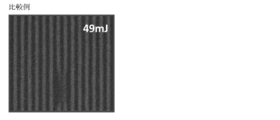
- FIG. 1 is a diagram showing an optical micrograph (magnification: 50K) of a Si-containing film in [4] evaluation of coatability, and FIG. 1 (a) was obtained using the composition of Example 4-2.
- the Si-containing film and FIG. 1 (b) show optical micrographs of the Si-containing film obtained by using the composition of Comparative Example 2, respectively.
- FIG. 2 is a diagram showing TOF-SIMS data of an EUV resist film to which the composition of Example 4-2 was applied in the [5] Si component penetration confirmation test into a resist.
- FIG. 1 is a diagram showing an optical micrograph (magnification: 50K) of a Si-containing film in [4] evaluation of coatability
- FIG. 1 (a) was obtained using the composition of Example 4-2.
- the Si-containing film and FIG. 1 (b) show optical micrographs of the Si-containing film obtained by using the composition of Comparative Example 2, respectively.
- FIG. 2 is a diagram showing TOF-SIMS data of an EUV resist film to which the
- FIG. 3 shows a scanning micrograph (magnification: 100K, upper part of the pattern,) of the resist pattern to which the composition of Example 4-1 was applied in [6] Preparation of resist pattern by ArF exposure and metalization of resist pattern (1). It is a figure which shows the pattern cross section).
- FIG. 4 is a diagram showing a scanning micrograph (magnification: 100 K, upper part of the pattern, pattern cross section) of the resist pattern of the comparative example in [6] preparation of the resist pattern by ArF exposure and metallization of the resist pattern (1).
- FIG. 5 is a scanning photomicrograph of a resist pattern and a transfer pattern to which the composition of Example 4-1 was applied after dry etching in [6] resist pattern preparation by ArF exposure and metalization of the resist pattern (1).
- FIG. 6 shows a scanning micrograph (magnification: 100K, upper part of the pattern,) of the resist pattern and the transfer pattern of the comparative example after dry etching in [6] resist pattern preparation by ArF exposure and metalization of the resist pattern (1). It is a figure which shows the pattern cross section).
- FIG. 7 is a diagram showing a scanning micrograph (magnification: 200 K, upper part of the pattern) of the resist pattern to which the composition of Example 4-1 was applied in [8] preparation of the resist pattern by EUV exposure and metallization of the resist pattern. Is.
- FIG. 6 shows a scanning micrograph (magnification: 100K, upper part of the pattern,) of the resist pattern and the transfer pattern of the comparative example after dry etching in [6] resist pattern preparation by ArF exposure and metalization of the resist pattern (1). It is a figure which shows the pattern cross section).
- FIG. 7 is a diagram showing a scanning micrograph (magnification: 200 K, upper part of the pattern) of the resist pattern to which the
- FIG. 8 is a diagram showing a scanning micrograph (magnification: 200 K, upper part of the pattern) of the resist pattern of the comparative example in [8] preparation of the resist pattern by EUV exposure and metallization of the resist pattern.
- FIG. 9 is a schematic view showing one aspect of the resist pattern metallization method of the present invention.
- FIG. 10 is a schematic view showing another aspect of the resist pattern metallization method of the present invention.
- composition for resist pattern metallization process containing the following components (A), (B), and (C), that is, component (A): metal oxide (a1), hydrolyzable silane. At least one selected from the group consisting of the compound (a2), the hydrolyzate of the hydrolyzable silane compound (a3), and the hydrolyzed condensate of the hydrolyzable silane compound (a4) (also referred to as polysiloxane). And (B) component: an acid compound containing no carboxylic acid group (-COOH), and component (C): an aqueous solvent.
- component (A) metal oxide (a1), hydrolyzable silane. At least one selected from the group consisting of the compound (a2), the hydrolyzate of the hydrolyzable silane compound (a3), and the hydrolyzed condensate of the hydrolyzable silane compound (a4) (also referred to as polysiloxane).
- the resist pattern metallization process composition of the present invention can be applied to a resist pattern to obtain a resist pattern in which the above composition components are permeated into the resist.
- "metallization” refers to the component in the composition, particularly the silane component or the metal component in the composition (that is, the component (A) contained in the composition: metal oxide (that is, the metal oxide) in the resist pattern. It refers to a process in which a1), a hydrolyzable silane compound (a2), a hydrolyzate of the hydrolyzable silane compound (a3), and a hydrolyzed condensate of the hydrolyzable silane compound (a4) permeate.
- the solid content concentration in the composition is, for example, 0.01 to 50% by mass, 0.01 to 20.0% by mass, or 0.01 to 10.0% by mass with respect to the total mass of the composition. can do.
- the solid content means a component other than the solvent contained in the composition.
- the component (A) in the solid content the metal oxide (a1), the hydrolyzable silane compound (a2), the hydrolyzate of the hydrolyzable silane compound (a3), and the hydrolyzable silane compound.
- the proportion of at least one selected from the group consisting of the hydrolyzate of the above (a4) can be 50 to 99.9% by mass, or 80 to 99.9% by mass.
- the concentration of the component (B) in the solid content: the acid compound containing no carboxylic acid group (-COOH) may be 0.1% by mass to 50% by mass, or 0.1% by mass to 20% by mass. it can.
- the component (A) metal oxide (a1), hydrolyzable silane compound (a2), hydrolyzate (a3) of the hydrolyzable silane compound, and hydrolyzed condensation of the hydrolyzable silane compound.
- At least one selected from the group consisting of the substance (a4)) can be contained in a ratio of 0.001 to 50.0 parts by mass with respect to 100 parts by mass of the composition of the present invention. That is, the concentration of the component (A) in the composition can be usually 0.001 to 50.0% by mass, preferably 0.001 to 20.0% by mass.
- the concentration of the component (B) (acid compound containing no carboxylic acid group (—COOH)) in the composition can be 0.0001 to 2.0% by mass.
- the component (A) is a metal oxide (a1), a hydrolyzable silane compound (a2), a hydrolyzate of the hydrolyzable silane compound (a3), and a hydrolyzed condensate of the hydrolyzable silane compound (a). It is at least one selected from the group consisting of a4) (also referred to as polysiloxane).
- the component (A1) the metal oxide (a1)
- the component (A2) the hydrolyzable silane compound (a2), the hydrolyzate of the hydrolyzable silane compound (a3)
- the hydrolyzed condensate (a4) of the hydrolyzable silane compound the case where the component (A1) is used alone, the case where the component (A2) is used alone, and the case where the component (A1) and the component (A2) are used alone. May be used together.
- Metal oxide (a1) for example, an oxide of at least one metal selected from the group consisting of titanium, hafnium, zirconium, germanium, aluminum, indium, tin, tungsten and vanadium can be selected.
- the above metal oxide can also be used as a partial metal oxide.
- the metal oxide or the partial metal oxide can be obtained as a hydrolysis condensate of the metal alkoxide, and the partial metal oxide may contain an alkoxide group.
- Hydrolyzable silane compound (a2), hydrolyzate of the hydrolyzable silane compound (a3), and hydrolyzate condensate of the hydrolyzable silane compound (a4) At least selected from the group consisting of the hydrolyzable silane compound (a2), the hydrolyzate of the hydrolyzable silane compound (a3), and the hydrolyzate condensate of the hydrolyzable silane compound (a4) as the component (A).
- hydrolyzate condensate (a4) obtained by hydrolyzing the hydrolyzable silane compound (a2) and condensing the obtained hydrolyzate (a3).
- hydrolyzed condensate (a4) if a partially hydrolyzate whose hydrolysis is not completely completed or an unreacted silane compound is mixed with the hydrolyzed condensate, use it in the form of the mixture. You can also.
- This hydrolyzed condensate (a4) is not only a polymer having a polysiloxane structure in which hydrolysis and condensation are completely completed, but also a polymer having a polysiloxane structure obtained by hydrolysis and condensation of a silane compound. However, it is a concept that includes those in which condensation is not partially completed and Si—OH groups remain.
- hydrolyzable silane compound (a2) at least one selected from the group consisting of hydrolyzable silanes represented by the above formulas (1) and (1-1) can be preferably used.
- the hydrolyzate (a3) of the hydrolyzable silane compound corresponds to the hydrolyzate of the hydrolyzable silane compound (a2).
- the hydrolyzate condensate (a4) of the hydrolyzable silane compound is a condensate of the hydrolyzate (a3) of the hydrolyzable silane compound (a2). Note that (a4) is also referred to as polysiloxane.
- R 3 is an organic group containing an amino group or an organic group having an ionic functional group, and is bonded to a silicon atom by a Si—C bond or a Si—N bond. It represents an object, and the case where R 3 there are a plurality, said R 3 represents a group which may be bonded to Si atoms to form a ring.
- R 1 is an organic group having an alkyl group, an aryl group, an alkyl halide group, an aryl halide group, an alkenyl group, an epoxy group, an acryloyl group, a methacryloyl group, a mercapto group, or a cyano group, and has a Si—C bond.
- R 2 represents an alkoxy group, an acyloxy group, or a halogen group.
- a0 indicates an integer of 0 or 1
- b0 indicates an integer of 1 to 3
- c0 indicates an integer of 1 or 2.
- R 10 and R 20 represent a hydroxyl group, an alkoxy group, an acyloxy group, or a halogen group, respectively.
- R 30 represents an organic group containing an amino group or an organic group having an ionic functional group, which is bonded to a silicon atom by a Si—C bond or a Si—N bond, and said. When a plurality of R 30s are present, the R 30 represents a group which may form a ring and be bonded to a Si atom.
- n0 represents an integer of 1 to 10, and for example, an integer of 1 to 5 or an integer of 1 can be mentioned.
- R 3 in the formula (1) or R 30 in the formula (1-1) examples include an organic group containing an amino group.
- the amino group a primary amino group, a secondary amino group, and a tertiary amino group can be used, and the molecule may have one amino group or a plurality of (2, 3) amino groups. it can. They can use aliphatic amino groups, aromatic amino groups and the like.
- an organic group having an ionic functional group can be mentioned.
- the ionic functional group include ammonium cation, carboxylic acid anion, sulfonic acid anion, nitrate anion, phosphate anion, sulfonium anion, alcoholate anion and the like.
- ammonium cations include primary ammonium, secondary ammonium, tertiary ammonium, and quaternary ammonium.
- the counter ion of the ionic functional group is chloride anion, fluoride anion, bromide anion, iodide anion, nitrate anion, sulfate anion, phosphate anion, formate anion, acetate anion, propionate anion, maleate anion, oxalic acid.
- malonic acid anion methylmalonic acid anion, succinate anion, malate anion, tartrate anion, phthalate anion, citric acid anion, glutarate anion, citric acid anion, lactate anion, salicylate anion, methanesulfonic acid anion, octane Acid anion, decanoate anion, octane sulfonic acid anion, decane sulfonic acid anion, dodecylbenzene sulfonic acid anion, phenol sulfonic acid anion, sulfosalicylic acid anion, camphor sulfonic acid anion, nonafluorobutane sulfonic acid anion, toluene sulfonic acid anion, cumene A sulfonic acid anion, a p-octylbenzene sulfonic acid anion, a p-decylbenzene s
- a silane having an anionic functional group, a polysiloxane having an anionic functional group, or a polysiloxane having an anionic functional group for forming an intramolecular salt may be used as a unit structure.
- the counterion of the ionic functional group include hydrogen cation, ammonium cation, sulfonium cation, iodonium cation, phosphonium cation, and oxonium cation.
- alkyl group examples include linear or branched alkyl groups having 1 to 10 carbon atoms, such as methyl group, ethyl group, n-propyl group, i-propyl group and n-butyl group.
- Cyclic alkyl groups can also be used, and examples thereof include cyclic alkyl groups having 3 to 10 carbon atoms. Specifically, cyclopropyl group, cyclobutyl group, 1-methyl-cyclopropyl group, and 2-methyl-cyclo Propyl group, cyclopentyl group, 1-methyl-cyclobutyl group, 2-methyl-cyclobutyl group, 3-methyl-cyclobutyl group, 1,2-dimethyl-cyclopropyl group, 2,3-dimethyl-cyclopropyl group, 1-ethyl -Cyclopropyl group, 2-ethyl-cyclopropyl group, cyclohexyl group, 1-methyl-cyclopentyl group, 2-methyl-cyclopentyl group, 3-methyl-cyclopentyl group, 1-ethyl-cyclobutyl group, 2-ethyl-cyclobutyl group , 3-Ethyl-cyclobutyl group, 1,2-dimethyl-cyclobuty
- aryl group described above examples include an aryl group having 6 to 20 carbon atoms. Specifically, phenyl group, o-methylphenyl group, m-methylphenyl group, p-methylphenyl group, o-chlorophenyl group, m-chlorphenyl group, p-chlorphenyl group, o-fluorophenyl group, p-mercaptophenyl group, o-methoxyphenyl group, p-methoxyphenyl group, p-aminophenyl group, p-cyanophenyl group, ⁇ -naphthyl group, ⁇ -naphthyl group, o-biphenylyl group, m-biphenylyl group, Examples thereof include p-biphenylyl group, 1-anthryl group, 2-anthryl group, 9-anthryl group, 1-phenyl group, 2-phenyl group, 3-phenyl group, 4-phen
- Examples of the above-mentioned alkyl halide group and aryl halide group include groups in which one or more hydrogen atoms of the above-mentioned alkyl group and aryl group are replaced with halogen atoms such as fluorine, chlorine, bromine, and iodine.
- alkenyl group described above examples include an alkenyl group having 2 to 10 carbon atoms. Specifically, ethenyl group, 1-propenyl group, 2-propenyl group, 1-methyl-1-ethenyl group, 1-butenyl group, 2-butenyl group, 3-butenyl group, 2-methyl-1-propenyl group, 2-Methyl-2-propenyl group, 1-ethylethenyl group, 1-methyl-1-propenyl group, 1-methyl-2-propenyl group, 1-pentenyl group, 2-pentenyl group, 3-pentenyl group, 4-pentenyl Group, 1-n-propylethenyl group, 1-methyl-1-butenyl group, 1-methyl-2-butenyl group, 1-methyl-3-butenyl group, 2-ethyl-2-propenyl group, 2-methyl -1-butenyl group, 2-methyl-2-butenyl group, 2-methyl-3-butenyl group, 3-methyl-1-buten
- Examples of the above-mentioned organic group having an epoxy group include glycidoxymethyl, glycidoxyethyl, glycidoxypropyl, glycidoxybutyl, epoxycyclohexyl group and the like.
- Examples of the above-mentioned organic group having an acryloyl group include acryloylmethyl, acryloylethyl, acryloylpropyl group and the like.
- Examples of the above-mentioned organic group having a methacryloyl group include methacryloylmethyl, methacryloylethyl, and methacryloylpropyl group.
- Examples of the above-mentioned organic group having a mercapto group include ethyl mercapto, butyl mercapto, hexyl mercapto, and octyl mercapto group.
- Examples of the above-mentioned organic group having a cyano group include cyanoethyl and a cyanopropyl group.
- alkoxy group in R 2 in the above formula (1) and R 10 and R 20 in the formula (1-1) for example, an alkoxy having a linear, branched, or cyclic alkyl moiety having 1 to 20 carbon atoms.
- the group is mentioned.
- Examples of the acyloxy group in R 2 in the above formula (1) and R 10 and R 20 in the formula (1-1) include an acyloxy group having 1 to 20 carbon atoms. Specifically, methylcarbonyloxy group, ethylcarbonyloxy group, n-propylcarbonyloxy group, i-propylcarbonyloxy group, n-butylcarbonyloxy group, i-butylcarbonyloxy group, s-butylcarbonyloxy group, t-Butylcarbonyloxy group, n-pentylcarbonyloxy group, 1-methyl-n-butylcarbonyloxy group, 2-methyl-n-butylcarbonyloxy group, 3-methyl-n-butylcarbonyloxy group, 1,1 -Dimethyl-n-propylcarbonyloxy group, 1,2-dimethyl-n-propylcarbonyloxy group, 2,2-dimethyl-n-propylcarbonyloxy group, 1-ethyl-n-
- Examples of the halogen group in R 2 in the above formula (1), R 10 and R 20 in the formula (1-1) and R 7 in the formula (3) include fluorine, chlorine, bromine and iodine. ..
- T represents a hydrolyzable group, for example, an alkoxy group, an acyloxy group, or a halogen group, and specific examples of these groups include the above-mentioned examples. it can. Alkoxy groups such as methoxy group and ethoxy group are particularly preferable as T.
- T represents a hydrolyzable group, for example, an alkoxy group, an acyloxy group, or a halogen group, and specific examples of these groups include the above-mentioned examples. .. Alkoxy groups such as methoxy group and ethoxy group are particularly preferable as T.
- X and Y in the following formula mean counterions of ionic functional groups, and specific examples thereof include anions and cations as counterions of the above-mentioned ionic functional groups.
- X ⁇ and Y + are shown as monovalent anions and monovalent cations, respectively, but when X ⁇ and Y + represent divalent ions in the above-mentioned examples of ions. Is a value obtained by multiplying the coefficient before the ion display by 1/2, and similarly, when indicating a trivalent ion, the coefficient of the ion display is a value multiplied by 1/3.
- the hydrolyzable silane compound (a2) in the composition of the present invention is at least selected from the group consisting of the hydrolyzable silane represented by the formula (1) and the hydrolyzable silane represented by the formula (1-1).
- Another hydrolyzable silane compound (b) can be used in combination with one type.
- a preferable specific example of the hydrolyzable silane compound (b) used in the present invention is a group consisting of a hydrolyzable silane represented by the following formula (2) and a hydrolyzable silane represented by the following formula (3). At least one selected from can be mentioned.
- R 4 is an organic group having an alkyl group, an aryl group, a halogenated alkyl group, halogenated aryl group, an alkenyl group, or an acryloyl group, a methacryloyl group, a mercapto group or a cyano group, and Represents a group bonded to a silicon atom by a Si—C bond.
- R 5 represents an alkoxy group, an acyloxy group, or a halogen group.
- a represents an integer of 0 to 3.
- R 6 represents an alkyl group.
- R 7 represents an alkoxy group, an acyloxy group, or a halogen group.
- Z represents an alkylene group or an arylene group.
- b represents an integer of 0 or 1
- c represents an integer of 0 or 1.
- the alkyl group for R 4 in the formula (2), an aryl group, a halogenated alkyl group, halogenated aryl group, an alkenyl group and an acryloyl group, a methacryloyl group, an alkyl in an organic radical and R 6 having a mercapto group, or a cyano group examples such groups may be the same as those described above for R 1.
- Specific examples of the alkoxy group, acyloxy group and halogen group in R 5 in the formula (2) and R 7 in the formula (3) are the same as those described above for R 2 .
- Examples of the alkylene group or arylene group in Z include the above-mentioned divalent organic group derived from the alkyl group or aryl group.
- alkylene group examples include, but are not limited to, a methylene group, an ethylene group, a triethylene group and the like.
- arylene group examples include, but are not limited to, a paraphenylene group, a metaphenylene group, an orthophenylene group, a biphenyl-4,4'-diyl group and the like.
- hydrolyzable silane compound (b) it is preferable to use the hydrolyzable silane represented by the formula (2).
- hydrolyzable silane compound (a2) the hydrolyzable silane represented by the formulas (1) and (1-1) and the hydrolyzable silane (b) (represented by the formulas (2) and (3)).
- hydrolyzable silane (b) Hydrolyzability contained in a ratio of 3:97 to 100 to 0, or 30:70 to 100: 0, or 50:50 to 100: 0, or 70:30 to 100: 0, or 97: 3 to 100: 0. Silane can be used.
- hydrolyzable silane represented by the formula (2) examples include tetramethoxysilane, tetrachlorosilane, tetraacetoxysilane, tetraethoxysilane, tetran-propoxysilane, tetraisopropoxysilane, and tetran-.
- hydrolyzable silane represented by the formula (3) examples include methylenebistrimethoxysilane, methylenebistrichlorosilane, methylenebistriacetoxysilane, ethylenebistriethoxysilane, ethylenebistrichlorosilane, ethylenebistriacetoxysilane, and propylenebistri.
- hydrolyzable silane compound (a2) may contain other hydrolyzable silanes other than the above examples as long as the effects of the present invention are not impaired.
- the composition comprises at least a hydrolyzed condensate (a4) of the hydrolyzable silane compound (a2).
- the composition may contain an uncondensed (partial) hydrolyzate or an unreacted silane compound together with the hydrolyzate (a4) which is the polysiloxane described above.
- the hydrolyzable condensate (a4) is selected from the group consisting of the hydrolyzable silane represented by the formula (1) and the hydrolyzable silane represented by the formula (1-1).
- the hydrolyzed condensate (also referred to as polysiloxane) (a4) of the hydrolyzable silane compound (a2) can have a weight average molecular weight of, for example, 500 to 1,000,000. From the viewpoint of suppressing the precipitation of the hydrolyzed condensate in the composition, the weight average molecular weight is preferably 500,000 or less, more preferably 250,000 or less, still more preferably 100,000 or less. The weight average molecular weight can be preferably 700 or more, more preferably 1,000 or more, from the viewpoint of achieving both storage stability and coatability.
- weight average molecular weights are the molecular weight obtained in terms of polystyrene by GPC analysis and the molecular weight obtained in terms of PEG / PEO by GFC (aqueous GPC) analysis.
- GPC analysis for example, a GPC apparatus (trade name: HLC-8220GPC, manufactured by Toso Co., Ltd.) and a GPC column (trade names: tetrahydrofuran KF803L, KF802, KF801, manufactured by Showa Denko KK) are used, the column temperature is set to 40 ° C., and elution Tetrahydrofuran is used as the liquid (eluting solvent), the flow rate (flow velocity) is 1.0 ml / min, and polystyrene (manufactured by Showa Denko KK) is used as the standard sample.
- a GFC device (trade name: RID-10A), a GFC column (trade name: Shodex SB-803HQ, manufactured by Showa Denko), a column temperature of 40 ° C., and an eluent are used.
- Water and 0.5M acetic acid / 0.5M sodium nitrate aqueous solution were used as the (eluting solvent), the flow rate (flow velocity) was 1.0 ml / min, and Pluran and PEG / PEO (manufactured by Showa Denko KK) were used as standard samples. Can be done.
- Hydrolyzed condensates preferably used in the present invention are exemplified below, but are not limited thereto.
- Formulas (2-1-4), formulas (2-2-4), and formulas (2-3-4) are exemplified as silsesquioxane (also called polysilsesquioxane) type polysiloxanes.
- the formula (2-1-4) represents a ladder-type silsesquioxane, and n represents 1 to 1000, or 1 to 200.
- Formula (2-2-4) represents a basket-type silsesquioxane.
- Formula (2-3-4) represents a random type silsesquioxane.
- R is an organic group containing an amino group or an organic group having an ionic functional group. In addition, it is a group bonded to a silicon atom by a Si—C bond or a Si—N bond, and the above-mentioned examples can be shown as examples of these groups.
- the hydrolyzate (a3) and the hydrolyzed condensate (a4) of the hydrolyzed silane compound (a2) can be obtained by hydrolyzing and condensing the hydrolyzable silane compound (a2).
- the hydrolyzable silane compound (a2) used in the present invention has an alkoxy group, an acyloxy group, and a halogen group that are directly bonded to a silicon atom, that is, an alkoxysilyl group, an acyloxysilyl group, and a halogenated group that are hydrolyzable groups. Contains a silyl group.
- hydrolysis and condensation of these hydrolyzable groups usually 0.5 to 100 mol, preferably 1 to 10 mol of water is used per 1 mol of the hydrolyzable group.
- a hydrolysis catalyst may be used for the purpose of promoting hydrolysis and condensation, or hydrolysis may be carried out without using the hydrolysis catalyst.
- a hydrolysis catalyst of usually 0.0001 to 10 mol, preferably 0.001 to 1 mol, can be used per mol of the hydrolyzable group.
- the reaction temperature for hydrolysis and condensation is usually in the range of room temperature or higher and the reflux temperature of an organic solvent that can be used for hydrolysis at normal pressure, for example, 20 to 110 ° C., or 20 to 80 ° C.
- the hydrolysis can be complete hydrolysis, i.e. all hydrolyzable groups may be converted to silanol groups, or partially hydrolyzed, i.e. leaving unreacted hydrolyzable groups.
- Good That is, after the hydrolysis and condensation reaction, an uncondensed hydrolyzate (complete hydrolyzate, partial hydrolyzate) or a monomer (hydrolyzable silane compound) may remain in the hydrolyzate condensate. ..
- the hydrolysis condensate is a polymer obtained by hydrolysis and condensation of a silane compound, but it is not partially condensed and Si—OH groups remain. It is a concept that includes what is.
- the hydrolysis catalyst that can be used for hydrolysis and condensation include metal chelate compounds, organic acids, inorganic acids, organic bases, and inorganic bases. Although examples are given below, these may be used alone or in combination of two or more.
- Metal chelate compounds as a hydrolysis catalyst include, for example, triethoxy mono (acetylacetonate) titanium, tri-n-propoxymono (acetylacetonate) titanium, tri-i-propoxymono (acetylacetonate) titanium, and tri.
- Organic acids as hydrolysis catalysts include, for example, acetic acid, propionic acid, butanoic acid, pentanoic acid, hexanoic acid, heptanoic acid, octanoic acid, nonanoic acid, decanoic acid, oxalic acid, maleic acid, methylmalonic acid, adipic acid, sebacin.
- Examples of the inorganic acid as a hydrolysis catalyst include, but are not limited to, hydrochloric acid, nitric acid, sulfuric acid, hydrofluoric acid, and phosphoric acid.
- Organic bases as hydrolysis catalysts include, for example, pyridine, pyrrol, piperazine, pyrrolidine, piperidine, picolin, trimethylamine, triethylamine, monoethanolamine, diethanolamine, dimethylmonoethanolamine, monomethyldiethanolamine, triethanolamine, diazabicyclooctane, diah.
- the inorganic base as the hydrolysis catalyst include, but are not limited to, ammonia, sodium hydroxide, potassium hydroxide, barium hydroxide, calcium hydroxide and the like.
- metal chelate compounds organic acids, and inorganic acids are preferable, and these may be used alone or in combination of two or more.
- the hydrolyzable silane compound (a2) (hydrolyzed selected from the group consisting of the hydrolyzable silane represented by the formula (1) and the hydrolyzable silane represented by the formula (1-1)).
- Degradable silane a hydrolyzable silane selected from the group consisting of a hydrolyzable silane represented by the formula (2) and a hydrolyzable silane represented by the formula (3), and further, if desired, other hydrolyzed water.
- the hydrolyzate (a3) of (degradable silane) is a hydrolyzed product of the hydrolyzable silane compound (a2) in the presence of an alkaline substance, particularly an organic base, and the hydrolyzate is further condensed.
- the alkaline substance is an alkaline catalyst added at the time of hydrolysis of the hydrolyzable silane, or an amino group existing in the molecule of the hydrolyzable silane itself.
- the alkaline substance is an amino group existing in the hydrolyzable silane molecule, the above-mentioned example of the hydrolyzable silane compound (a4) represented by the above formula (1) or the above formula (1-1).
- silanes containing an amino group in the side chain examples thereof include the inorganic base and the organic base described as the above-mentioned hydrolysis catalyst. Organic bases are particularly preferred.
- the hydrolyzate of hydrolyzable silane is preferably hydrolyzed in the presence of an alkaline substance.
- the above composition can further contain a hydrolyzable silane, a hydrolyzate obtained by hydrolyzing the hydrolyzable silane in the presence of an alkaline substance, or a mixture thereof.
- silsesquioxane obtained by hydrolyzing silane having three hydrolyzable groups can be used.
- This silsesquioxane is a hydrolyzed condensate (a4) obtained by hydrolyzing and condensing silane having three hydrolyzable groups in the presence of an acidic substance.
- the acidic substance used here the acidic catalyst in the above-mentioned hydrolysis catalyst can be used.
- the hydrolyzed condensate (a4) a random type, a ladder type, or a cage type silsesquioxane can be used.
- an organic solvent may be used as a solvent, and specific examples thereof include n-pentan, i-pentan, n-hexane, i-hexane, n-heptane, and i-heptane.
- Alibo hydrocarbon solvents such as 2,2,4-trimethylpentan, n-octane, i-octane, cyclohexane, methylcyclohexane; benzene, toluene, xylene, ethylbenzene, trimethylbenzene, methylethylbenzene, n-propylbenzene, i Aromatic hydrocarbon solvents such as -propylbenzene, diethylbenzene, i-butylbenzene, triethylbenzene, di-i-propylbenzene, n-amylnaphthalene, trimethylbenzene; methanol, ethanol, n-propanol, i-propanol, n -Butanol, i-butanol, sec-butanol, t-butanol, n-pentanol, i-pentanol, 2-
- Polyhydric alcohol solvents such as heptanediol-2,4,2-ethylhexanediol-1,3, diethylene glycol, dipropylene glycol, triethylene glycol, tripropylene glycol, glycerin; acetone, methyl ethyl ketone, methyl-n- Propyl ketone, methyl-n-butyl ketone, diethyl ketone, methyl-i-butyl ketone, methyl-n-pentyl ketone, ethyl-n-butyl ketone, methyl-n-hexyl ketone, di-i-butyl ketone , Trimethylnonanonone, cyclohexanone, methylcyclohexanone, 2,4-pentandione, acetonylacetone, diacetone alcohol, acetophenone, fenchone and other ketone solvents; ethyl ether, i
- Ether 2-ethylhexyl ether, ethylene oxide, 1,2-propylene oxide, dioxolane, 4-methyldioxolane, dioxane, dimethyldioxane, ethylene glycol monomethyl ether, ethylene glycol monoethyl ether, ethylene glycol diethyl ether, ethylene glycol mono-n- Butyl ether, ethylene glycol mono-n-hexyl ether, ethylene glycol monophenyl ether, ethylene glycol mono-2-ethyl butyl ether, ethylene glycol dibutyl ether, diethylene glycol monomethyl ether, diethylene glycol monoethyl ether, diethylene glycol diethyl ether, diethylene glycol mono-n-butyl ether , Diethylene glycol di-n-butyl ether, diethylene glycol mono-n-hexyl ether, ethoxytriglycol, tetraethylene glycol di-n-butyl
- the acid used for hydrolysis and condensation can be used as it is, or by diluting or concentrating the reaction solution and neutralizing it as necessary, or by treating it with an ion exchange resin.
- Hydrolysis catalysts such as bases can be removed.
- alcohol or water as a by-product, the hydrolysis catalyst used, or the like can be removed from the reaction solution by vacuum distillation or the like.
- the hydrolyzed condensate (a4) (polysiloxane) thus obtained is obtained in the form of a polysiloxane varnish dissolved in an organic solvent, which is used as it is for the resist pattern metallization process described later. It can be used as a composition.
- composition of the present invention contains an acid compound containing no carboxylic acid group as the component (B).
- the acid compound is preferably an acid compound containing a sulfonic acid group (-SO 3 H).
- methanesulfonic acid for example, methanesulfonic acid, octanesulfonic acid, decanesulfonic acid, dodecylbenzenesulfonic acid, phenolsulfonic acid, sulfosalicylic acid, camphorsulfonic acid, nonafluorobutanesulfonic acid, toluenesulfonic acid, cumenesulfonic acid, p-octylbenzenesulfonic acid. , P-decylbenzene sulfonic acid, 4-octyl 2-phenoxybenzene sulfonic acid, 4-carboxybenzene sulfonic acid and the like.
- the ratio of the component (B) to 100 parts by mass of the component (A) is preferably 0.5 to 15 parts by mass.
- composition of the present invention contains an aqueous solvent as the component (C).
- the aqueous solvent preferably contains water, and more preferably the aqueous solvent consists of a solvent containing 100% water, that is, water only. In this case, the presence of an organic solvent or the like contained in water as an impurity in a trace amount when water is intentionally used as a water-soluble solvent cannot be denied. Since the composition of the present invention is applied to a resist pattern, a solvent that may dissolve the resist pattern cannot be used. However, the composition of the present invention can contain a water-soluble organic solvent that can be mixed with an aqueous solvent and does not dissolve the resist pattern, for example, an alcohol solvent or an ether solvent.
- Examples of the solvent that does not dissolve such a resist pattern include alcohols such as methanol, ethanol, n-propanol, isopropyl alcohol, n-butanol, and isobutyl alcohol; glycols such as ethyl cellosolve, butyl cellosolve, ethylene glycol, and diethylene glycol; propylene glycol. Glycol ethers such as monomethyl ether; ethers such as tetrahydrofuran (THF) and the like can be mentioned, but are not limited thereto.
- One of these water-soluble organic solvents may be used alone, or two or more thereof may be mixed and used.
- the water-soluble organic solvent can also be used as a mixed solvent with water.
- the composition for the resist pattern metallization process of the present invention contains the above-mentioned components (A), (B) and (C).
- the composition can be produced by mixing the above-mentioned components (A) to (C) and, if desired, other components, the other components.
- a solution containing the component (A) for example, a hydrolyzed condensate (a4)
- a solution containing the component (A) may be prepared in advance, and this solution may be mixed with a solvent or other components.
- the mixing order is not particularly limited.
- the component (B) and the component (C) may be added to and mixed with a solution containing the component (A) (for example, a hydrolyzed condensate (a4)), and other components may be added to the mixture.
- a solution containing the component (A) for example, a hydrolyzed condensate (a4)
- a solution containing a component for example, a hydrolyzed condensate (a4), etc.
- a solvent and other components may be mixed at the same time. Further, it may be filtered using a filter on the order of submicrometer or the like in the middle of producing the above composition or after mixing all the components.
- composition for the resist pattern metallization process of the present invention contains the hydrolyzed condensate (a4) as the component (A), an inorganic acid or an organic acid is particularly important for stabilizing the hydrolyzed condensate contained therein.
- Alcohols, organic amines, photoacid generators, metal oxides, surfactants, or combinations thereof can be added. Even when the component (A) contains a component other than (a4), the following components may be contained as long as the effects of the present invention are not impaired.
- Examples of the inorganic acid include hydrochloric acid, nitric acid, sulfuric acid, phosphoric acid and the like.
- Examples of the organic acid include oxalic acid, malonic acid, methylmalonic acid, succinic acid, maleic acid, malic acid, tartaric acid, phthalic acid, citric acid, glutaric acid, lactic acid, salicylic acid and the like. Of these, oxalic acid and maleic acid are preferable.
- the amount added can be 0.5 to 15 parts by mass with respect to 100 parts by mass of the component (A).
- an acid containing a carboxylic acid group (-COOH) can be a factor of deteriorating the coatability of the composition of the present invention, it is originally preferable that the acid is not blended in the composition of the present invention.
- the alcohol is preferably one that easily scatters when heated after application, and examples thereof include methanol, ethanol, propanol, i-propanol, butanol and the like.
- the amount added can be 0.001 part by mass to 20 parts by mass with respect to 100 parts by mass of the composition of the present invention.
- organic amine examples include aminoethanol, methylaminoethanol, N, N, N', N'-tetramethylethylenediamine, N, N, N', N'-tetraethylethylenediamine, N, N, N', N'.
- photoacid generator examples include, but are not limited to, onium salt compounds, sulfonimide compounds, disulfonyldiazomethane compounds, and the like.
- the onium salt compound examples include diphenyliodonium hexafluorosulfonate, diphenyliodonium trifluoromethanesulfonate, diphenyliodonium nonafluoronormal butane sulfonate, diphenyliodonium perfluoronormal octane sulfonate, diphenyliodonium camphor sulfonate, and bis (4-tert-butyl).
- Iodonium salt compounds such as phenyl) iodonium camphor sulfonate and bis (4-tert-butylphenyl) iodonium trifluoromethane sulfonate, and triphenyl sulfonium hexafluoroantimonate, triphenyl sulfonium nonafluoronormal butane sulfonate, triphenyl sulfonium camphor sulfonate and tri Phenylsulfonium trifluoromethanesulfonate, triphenylsulfonium adamantancarboxylate trifluoroethane sulfonate, triphenyl sulfonium p-toluene sulfonate, triphenyl sulfonium methane sulfonate, triphenyl sulfonium phenol sulfonate, triphenyl sulfonium
- sulfoneimide compound examples include N- (trifluoromethanesulfonyloxy) succinimide, N- (nonafluoronormal butanesulfonyloxy) succinimide, N- (camphasulfonyloxy) succinimide and N- (trifluoromethanesulfonyloxy) naphthalimide. Etc., but are not limited to these.
- disulfonyldiazomethane compound examples include bis (trifluoromethylsulfonyl) diazomethane, bis (cyclohexylsulfonyl) diazomethane, bis (phenylsulfonyl) diazomethane, bis (p-toluenesulfonyl) diazomethane, and bis (2,4-dimethylbenzene).
- Sulfonyl) Diazomethane, methylsulfonyl-p-toluenesulfonyldiazomethane and the like can be mentioned, but are not limited thereto.
- the ratio is 0.01 to 30 parts by mass, 0.1 to 20 parts by mass, or 0.5 to 10 parts by mass with respect to 100 parts by mass of the component (A). It is a department.
- surfactant examples include nonionic surfactants, anionic surfactants, fluorine-based surfactants, cationic surfactants, silicon-based surfactants, and UV-curable surfactants.
- nonionic surfactants examples include nonionic surfactants, anionic surfactants, fluorine-based surfactants, cationic surfactants, silicon-based surfactants, and UV-curable surfactants.
- polyoxyethylene alkyl ethers such as polyoxyethylene lauryl ether, polyoxyethylene stearyl ether, polyoxyethylene cetyl ether, and polyoxyethylene oleyl ether, and poly such as polyoxyethylene octylphenyl ether and polyoxyethylene nonylphenyl ether.
- Polyoxyethylene sorbitan fatty acid esters such as esters, polyoxyethylene sorbitan monolaurate, polyoxyethylene sorbitan monopalmitate, polyoxyethylene sorbitan monostearate, polyoxyethylene sorbitan trioleate, and polyoxyethylene sorbitan tristearate.
- Nonionic surfactants such as; trade names Ftop EF301, EF303, EF352 (manufactured by Mitsubishi Material Denshi Kasei Co., Ltd. (formerly Tochem Products Co., Ltd.)), trade names Megafuck F171, F173, R-08, R -30, R-40, R-40N (manufactured by DIC Co., Ltd.), Florard FC430, FC431 (manufactured by Sumitomo 3M Co., Ltd.), trade name Asahi Guard AG710, Surflon S-382, SC101, SC102, SC103, SC104, Fluorine-based surfactants such as SC105 and SC106 (manufactured by Asahi Glass Co., Ltd.); and organosiloxane polymer-KP341 (manufactured by Shinetsu Chemical Industry Co., Ltd., trade name), BYK302, BYK307, BYK333, BYK341, BYK345, BYK34
- cationic surfactants such as distearyldimethylammonium chloride, benzalkonium chloride, benzethonium chloride, cetylpyridinium chloride, hexadecyltrimethylammonium bromide, decalinium chloride; octanate, decanoate, octane sulfonate, etc.
- Anionic surfactants such as decanoic acid sulfonate, palmitate, perfluorobutane sulfonate, dodecylbenzene sulfonate; BYK307, BYK333, BYK381, BYK-UV-3500, BYK-UV-3510, BYK- Examples thereof include UV curable surfactants such as UV-3530 (manufactured by BYK, trade name). These surfactants may be used alone or in combination of two or more. When a surfactant is used, the ratio is 0.0001 to 5 parts by mass, 0.001 to 5 parts by mass, or 0.01 to 5 parts by mass with respect to 100 parts by mass of the component (A). is there.
- the resist pattern metallization process composition of the present invention can form a resist pattern in which the composition component is permeated into the resist by contacting the resist pattern surface after mask exposure.
- a method of permeating the composition into the resist and metalizing the resist pattern by a metal component in the composition is also an object of the present invention.
- the present invention is directed to a resist pattern metallization method comprising the following steps [a1] to [d1], which provides a resist pattern in which the above composition component is permeated into a resist.
- [A1] Step of applying a resist solution on a substrate
- the composition for a resist pattern metallization process of the present invention is applied to a resist pattern during or after development.
- Step of forming a coating film on a resist pattern [d1]
- Examples of the substrate used in the step [a1] include a substrate used for manufacturing a semiconductor device, for example, a silicon wafer substrate, a silicon / silicon dioxide coated substrate, a silicon nitride substrate, a glass substrate, an ITO substrate, and a polyimide substrate. , And a low dielectric constant material (low-k material) coated substrate and the like.
- the resist used in the step [a1] is not particularly limited as long as it is sensitive to the light used for exposure. Both negative photoresists and positive photoresists can be used.
- a positive photoresist composed of novolak resin and 1,2-naphthoquinonediazide sulfonic acid ester a chemically amplified photoresist consisting of a binder having a group that decomposes with an acid to increase the alkali dissolution rate and a photoacid generator
- It has a chemically amplified photoresist consisting of a low molecular weight compound that decomposes with an acid to increase the alkali dissolution rate of the photoresist, an alkali-soluble binder, and a photoacid generator, and a group that decomposes with an acid to increase the alkali dissolution rate.
- photoresists composed of low molecular weight compounds and photoacid generators that are decomposed by a binder and an acid to increase the alkali dissolution rate of the photoresist.
- Specific examples available as products include, but are not limited to, the product name APEX-E manufactured by Chypre, the product name PAR710 manufactured by Sumitomo Chemical Co., Ltd., and the product name SEPR430 manufactured by Shin-Etsu Chemical Co., Ltd. ..
- Proc. SPIE Vol. 3999, 330-334 (2000)
- Proc. SPIE Vol. 3999,357-364
- Proc. SPIE Vol. Fluorine-containing atomic polymer-based photoresists as described in 3999,365-374 (2000) can be mentioned.
- a resist for electron beam lithography also referred to as an electron beam resist
- a resist for EUV lithography also referred to as EUV resist
- the electron beam resist either a negative type or a positive type can be used. Specific examples thereof include a chemically amplified resist composed of an acid generator and a binder having a group that decomposes with an acid to change the alkali dissolution rate, and an alkali-soluble binder, an acid generator and an acid decompose with an acid to change the alkali dissolution rate of the resist.
- a chemically amplified resist consisting of a low molecular weight compound that changes the alkali dissolution rate of the resist, a binder having a group that decomposes with an acid generator and an acid to change the alkali dissolution rate, and a low molecular weight compound that decomposes with an acid to change the alkali dissolution rate of the resist.
- a resist pattern can be formed in the same manner as when a photoresist is used with the irradiation source as an electron beam. Further, as the EUV resist, a methacrylate resin-based resist can be used.
- a resist (film) having a film thickness of, for example, 10 to 1000 nm can be obtained.
- the resist solution, the developing solution, and the coating materials shown below can be coated or coated by a spin coating method, a dip method, a spray method, or the like, but the spin coating method is particularly preferable.
- the method can include a step [a1-0] of forming a resist underlayer film on the substrate before the step [a1].
- This resist underlayer film has an antireflection function and an organic hard mask function.
- the step [a1-0] of forming the resist underlayer film on the substrate is performed, and then the step [a1] of applying the resist solution on the resist solution is performed. be able to.
- a resist underlayer film also referred to as an organic underlayer film
- a silicon hard mask is further formed on the resist underlayer film. It can be formed and a resist can be formed on it.
- the resist lower layer film used in the above step [a1-0] can be used for the purpose of preventing diffused reflection of the upper layer resist film during exposure and for improving the adhesion with the resist film, for example, acrylic.
- a based resin or a novolak based resin can be used.
- the resist underlayer film can be formed on the semiconductor substrate as a film having a film thickness of 1 to 1000 nm.
- the resist underlayer film used in the above step [a1-0] can be a hard mask using an organic resin, and in this case, a material having a high carbon content and a low hydrogen content is used. Examples thereof include polyvinylnaphthalene resin, carbazole novolak resin, phenol novolac resin, naphthol novolac resin and the like. These can be formed as a film having a film thickness of 5 to 1,000 nm on the semiconductor substrate.
- polysiloxane obtained by hydrolyzing hydrolyzable silane can be used as the silicon hard mask used in the above step [a1-0].
- tetraethoxysilane, methyltrimethoxysilane, and polysiloxane obtained by hydrolyzing phenyltriethoxysilane can be exemplified. These can be formed as a film having a film thickness of 5 to 200 nm on the resist underlayer film.
- step [b1] the resist film is exposed through a predetermined mask.
- a KrF excimer laser (wavelength 248 nm), an ArF excimer laser (wavelength 193 nm), EUV light (wavelength 13.5 nm), an electron beam, or the like can be used.
- post-exposure heating PEB: Post Exposure Bake
- Post-exposure heating is appropriately selected from a heating temperature of 70 ° C. to 150 ° C. and a heating time of 0.3 to 10 minutes.
- the developer includes an aqueous solution of alkali metal hydroxide such as potassium hydroxide and sodium hydroxide, an aqueous solution of tetramethylammonium hydroxide such as tetramethylammonium hydroxide, tetraethylammonium hydroxide and choline, and ethanolamine.
- alkaline aqueous solution such as an amine aqueous solution such as propylamine or ethylenediamine can be mentioned as an example.
- a surfactant or the like can be added to these developers.
- the development conditions are appropriately selected from a temperature of 5 to 50 ° C. and a time of 10 to 600 seconds.
- an organic solvent can be used as the developing solution.
- development is performed with a developer (solvent).
- a developer solvent
- the developing solution includes, for example, methyl acetate, butyl acetate, ethyl acetate, isopropyl acetate, amyl acetate, isoamyl acetate, ethyl methoxy acetate, ethyl ethoxyacetate, propylene glycol monomethyl ether acetate, ethylene glycol monoethyl.
- the composition of the present invention is applied to a resist pattern during or after development, preferably to a resist pattern after development, and a coating film is formed on the surface of the resist pattern.
- the coating film is formed so as to cover the resist pattern, that is, to cover the top, side walls, and bottom of the resist pattern.
- the thickness of the coating film is appropriately determined in consideration of the height and space width of the resist pattern, the film thickness reduction due to the evaporation of the solvent, and the thickness of the coating film after heating.
- the step [d1] is a step of heating the coating film to form a coating film after heating.
- the heating is preferably performed at a firing temperature of 80 to 200 ° C. for 0.5 to 5 minutes.
- the composition components of the present invention permeate into the resist pattern.
- a resist pattern in which the above composition components are permeated into the resist can be obtained, but at the same time, a coating film after heating is formed on the surface of the resist pattern.
- the thickness of the coating film after heating from the surface of the resist pattern cannot be unconditionally specified because it varies depending on the height of the resist pattern and the space width, but can be, for example, about 1 nm to 20 nm.
- the method in the present invention targets a resist pattern metallization method that includes the following steps [a2] to [e2] and provides a resist pattern in which the above composition component is permeated into a resist.
- the composition for a resist pattern metallization process of the present invention is applied to a resist pattern during or after development.
- Step of forming a coating film on the resist pattern [d2] Step of heating the coating film to form a coating film after heating [e2] Step of removing the coating film after heating with water or a developing solution
- a step [A2], [b2] and [d2] can be carried out in the same procedure as described in the above steps [a1] (including [a1-0]), [b1] and [d1], respectively.
- step [c2] the composition of the present invention is applied to a resist pattern during or after development, and a coating film is formed so that the resist pattern is buried at this time [c2].
- c1] It is different from the process. That is, the coating film is formed so that the thickness of the coating film from the bottom of the resist pattern exceeds 100% of the height of the pattern. At this time, the thickness of the coating film from the bottom of the resist pattern is appropriately determined in consideration of the conditions of the step [e2] (removal liquid used for removing the unnecessary coating film after heating and other conditions) and the like.
- the step [e2] is a step of removing the heated coating film obtained by heating in the step [d2] with water or a developing solution.
- the developer the same type of developer as the developer used in the previous step [b2] can be used.
- the water those used in this field such as ion-exchanged water and ultrapure water can be used.
- an unnecessary post-heating coating film can be removed to obtain a resist pattern in which the composition component of the present invention has penetrated.
- the coating film may be completely removed, or the coating film may remain on the surface of the resist pattern after heating.
- the thickness thereof includes the height and space width of the resist pattern and the conditions of step [e2] (removal liquid used for removing unnecessary coating film after heating and other conditions). Although it cannot be unconditionally specified because it differs depending on the type, it is usually 20 nm or less.
- the thickness of the coating film after heating from the surface of the resist pattern can be adjusted by changing the conditions of the step [e2]. Depending on the conditions of the step [e2], the coating film may be removed from the surface of the resist pattern after heating and cut off, and the resist pan itself may become thinner.
- the coating film that has undergone the heating step [d1] is formed. It may include a step of removing with water or a developer.
- water and the developing solution used here the same type of water and developing solution as the water and the developing solution used in the previous step [b1] can be used.
- FIG. 9 is a schematic diagram of an example of a resist pattern metallizing method including steps [a1] to [d1]
- FIG. 10 is a schematic diagram of an example of a resist pattern metallizing method including steps [a2] to [e2].
- Sub is the substrate
- UC is the underlayer film of the resist (carbon-containing layer (SOC), organic antireflection film (BARC), inorganic antireflection film (Si-HM), etc.)
- PR is the resist film. Shown.
- the present invention also covers a method for manufacturing a semiconductor device, which comprises a step of processing a substrate by a metallized resist pattern obtained through the above-mentioned [resist pattern metallization method]. If a resist underlayer film (carbon-containing layer (SOC), organic antireflection film (BARC), inorganic antireflection film (Si-HM), etc.) is formed between the substrate and the resist, the above Using the metallized resist pattern as a protective film, the layers (films) under it can be sequentially processed.
- a resist underlayer film carbon-containing layer (SOC), organic antireflection film (BARC), inorganic antireflection film (Si-HM), etc.
- Si-HM organic antireflection film
- the resist underlayer film is removed (patterned) using the metallized resist pattern (upper layer) as a protective film ([f1] and [f1] and [in FIGS. 9 and 10]. f2]). Removal of the underlayer of the resist is performed by dry etching, and tetrafluoromethane (CF 4 ), perfluorocyclobutane (C 4 F 8 ), perfluoropropane (C 3 F 8 ), trifluoromethane, carbon monoxide, argon, oxygen.
- CF 4 tetrafluoromethane
- C 4 F 8 perfluorocyclobutane
- C 3 F 8 perfluoropropane
- Nitrogen, sulfur hexafluoride, difluoromethane, nitrogen trifluoride, chlorine trifluoride, chlorine, trichloroborane, dichloroborane and other gases can be used.
- the removal of the resin-based lower layer film (organic lower layer film) is preferably performed by dry etching with an oxygen-based gas. This is because the metallized resist pattern according to the present invention is difficult to be removed by dry etching with an oxygen-based gas.
- a nitrogen-based gas may be mixed with the oxygen-based gas and used for dry etching. Further, when a silicon hard mask is provided, it is preferable to use a halogen-based gas.
- fluorine-based gas for example, tetrafluoromethane (CF 4 ), perfluorocyclobutane (C 4 F 8 ), perfluoropropane (C 3 F 8 ), trifluoromethane, difluoromethane (CH 2 F 2 ), etc.
- CF 4 tetrafluoromethane
- C 4 F 8 perfluorocyclobutane
- C 3 F 8 perfluoropropane
- trifluoromethane difluoromethane
- CH 2 F 2 difluoromethane
- the metallized resist pattern is used as a protective film, and when a resist underlayer film or the like is provided, the metallized resist pattern and the patterned resist underlayer film or the like are used as a protective film on the semiconductor substrate. Is processed.
- the processing of the semiconductor substrate is preferably performed by dry etching with a fluorine-based gas.
- the fluorine-based gas include tetrafluoromethane (CF 4 ), perfluorocyclobutane (C 4 F 8 ), perfluoropropane (C 3 F 8 ), trifluoromethane, and difluoromethane (CH 2 F 2 ). Can be mentioned.
- reaction solution is cooled to room temperature, 120.54 g of water is added to the reaction solution, ethanol, tetrahydrofuran and water which are reaction by-products are distilled off under reduced pressure, and the mixture is concentrated to obtain a hydrolyzed condensate (polysiloxane) aqueous solution. It was. Further, water was added, and the concentration was adjusted so that the solvent ratio of 100% water (solvent containing only water) was 20% by mass in terms of solid residue at 140 ° C. The obtained polymer corresponded to the formula (2-1-1).
- reaction solution was cooled to room temperature, 179.98 g of water was added to the reaction solution, methanol and water as reaction by-products were distilled off under reduced pressure, and the mixture was concentrated to obtain a hydrolyzed condensate (polysiloxane) aqueous solution. Further, water was added, and the concentration was adjusted so that the solvent ratio of 100% water (solvent containing only water) was 20% by mass in terms of solid residue at 140 ° C. The obtained polymer corresponded to the formula (2-4-1).
- reaction solution is cooled to room temperature, 179.98 g of water is added to the reaction solution, methanol, acetone, and water, which are reaction by-products, are distilled off under reduced pressure, and the mixture is concentrated to obtain a hydrolyzed condensate (polysiloxane) aqueous solution. It was. Further, water was added, and the concentration was adjusted so that the solvent ratio of 100% water (solvent containing only water) was 20% by mass in terms of solid residue at 140 ° C. The obtained polymer corresponded to the formula (2-9-2).
- reaction solution is cooled to room temperature, 91.16 g of water is added to the reaction solution, methanol, ethanol and water, which are reaction by-products, are distilled off under reduced pressure, and the mixture is concentrated to obtain a hydrolyzed condensate (polysiloxane) aqueous solution. It was. Further, water was added, and the concentration was adjusted so that the solvent ratio of 100% water (solvent containing only water) was 20% by mass in terms of solid residue at 140 ° C. The obtained polymer corresponded to the formula (2-10-2).
- composition The polysiloxane (polymer), additives, and solvent obtained in the above synthesis example are mixed at the ratios shown in Table 1 and filtered through a 0.1 ⁇ m fluororesin filter to obtain a polymer. Each containing coating solution was prepared. Each addition amount in Table 1 is shown by mass. The amount of the polymer (polysiloxane) added in Table 1 is not the amount of the polymer solution added, but the amount of the polymer itself added.
- NfA indicates nonafluorobutane sulfonic acid
- DBSA indicates dodecylbenzene sulfonic acid
- Ac indicates acetic acid.
- composition for forming an organic resist underlayer film Under nitrogen, in a 100 mL four-necked flask, carbazole (6.69 g, 0.040 mol, manufactured by Tokyo Chemical Industry Co., Ltd.), 9-fluorenone (7.28 g, 0). .040 mol, manufactured by Tokyo Chemical Industry Co., Ltd., paratoluenesulfonic acid monohydrate (0.76 g, 0.0040 mol, manufactured by Tokyo Chemical Industry Co., Ltd.) was added, and 1,4-dioxane (6.69 g, Kanto Chemical Co., Ltd. was charged and stirred, and the temperature was raised to 100 ° C. to dissolve and start polymerization.
- composition is filtered using a polyethylene microfilter having a pore size of 0.10 ⁇ m, and further filtered using a polyethylene microfilter having a pore size of 0.05 ⁇ m to form an organic resist underlayer film used in a lithography process using a multilayer film.
- a polyethylene microfilter having a pore size of 0.10 ⁇ m and further filtered using a polyethylene microfilter having a pore size of 0.05 ⁇ m to form an organic resist underlayer film used in a lithography process using a multilayer film.
- the composition component not permeated into the resist was removed to obtain an EUV resist film in which the composition component was permeated.
- the EUV resist film was subjected to TOF-SIMS evaluation, and it was confirmed whether or not the Si component was confirmed in the film.
- TOF-SIMS evaluation was performed directly on the EUV resist film. The results obtained are shown in Table 3. Further, the TOF-SIMS data of the EUV resist film to which the composition of Example 4-2 is applied is shown in FIG.
- the measurement conditions for TOF-SIMS are as follows. Primary Ion: Bi 3 ++ Sputter Ion: Cs Area (measurement area): 50 x 50 ⁇ m 2 Sputter Area: 250 x 250 ⁇ m 2 Polarity: Nega
- compositions (coating liquids) of Examples 1-1 to 6-1 were applied to this resist pattern (thickness: 5 nm), and the 2.38 mass% tetramethylammonium aqueous solution used for development was applied thereto.
- the composition of the example As a comparative example, water was applied to the resist pattern, and the 2.38 mass% tetramethylammonium aqueous solution used for development was replaced with water.
- the silicon substrate is spun at 1,500 rpm for 60 seconds to dry the solvent in the composition, and then heated at 100 ° C. for 60 seconds to form a coating film, which is formed from the side wall and the upper part of the resist pattern.
- the composition components were infiltrated.
- the pattern shape and line width roughness were confirmed and evaluated by observing the cross section of the pattern and observing the upper part of the pattern.
- those without large pattern peeling, undercut, and line bottom thickening (footing) are “good”, and those with undercut or footing are “defective (undercut)”. It was evaluated as “defective (footing)”.
- the line width roughness those having a line width of 3 sigma values of 6.0 nm or more were evaluated as “poor”, and those having a line width of less than 6.0 nm were evaluated as “good”. The results obtained are shown in Table 4.
- compositions (coating liquids) of Examples 1-2 to 6-2 were applied to this resist pattern (film thickness 120 nm), and the 2.38 mass% tetramethylammonium aqueous solution used for development was applied thereto.
- the composition of the example As a comparative example, water was applied to the resist pattern, and the 2.38 mass% tetramethylammonium aqueous solution used for development was replaced with water.
- the silicon substrate is spun at 1,500 rpm for 60 seconds to dry the solvent in the composition, and then heated at 100 ° C. for 60 seconds to form a coating film, which is formed from the side wall and the upper part of the resist pattern.
- the composition components were infiltrated.
- the 2.38 mass% tetramethylammonium aqueous solution was applied again to remove the composition component which had not penetrated into the resist pattern.
- the pattern shape and line width roughness were confirmed and evaluated by observing the cross section of the pattern and observing the upper part of the pattern.
- those that do not have large pattern peeling, undercut, or thickening (footing) at the bottom of the line are "good", and those that have undercut or footing are "defective (undercut)” or “defective (defective). Footing) ”and so on.
- Example 4-2 the line pattern size before dry etching changed from 62 nm to 72 nm. This means that the composition components are covered with a film thickness of 5 nm on both sides and the upper side of the resist line.
- the pattern shape was confirmed and evaluated by observing the cross section of the pattern and observing the upper part of the pattern.
- the one in which no large pattern peeling, undercut, or thickening (footing) at the bottom of the line occurred was evaluated as "good", and the unfavorable state in which the resist pattern was peeled and collapsed was evaluated as "falling”.
- the results obtained are shown in Table 6. Further, scanning electron micrographs (magnification: 200 K, upper part of the pattern) of the resist pattern to which the composition of Example 4-1 was applied and the resist pattern of Comparative Example were shown in FIGS. 7 (Example 4-1) and FIG. 8 (comparison). Example).
Landscapes
- Physics & Mathematics (AREA)
- General Physics & Mathematics (AREA)
- Chemical & Material Sciences (AREA)
- Inorganic Chemistry (AREA)
- Organic Chemistry (AREA)
- Materials For Photolithography (AREA)
- Photosensitive Polymer And Photoresist Processing (AREA)
- Compositions Of Macromolecular Compounds (AREA)
Abstract
Priority Applications (5)
| Application Number | Priority Date | Filing Date | Title |
|---|---|---|---|
| CN202080032980.7A CN113785243B (zh) | 2019-03-29 | 2020-03-27 | 抗蚀剂图案金属化工艺用组合物 |
| KR1020217032618A KR102786848B1 (ko) | 2019-03-29 | 2020-03-27 | 레지스트패턴 메탈화 프로세스용 조성물 |
| JP2021512051A JP7606162B2 (ja) | 2019-03-29 | 2020-03-27 | レジストパターンメタル化プロセス用組成物 |
| US17/599,900 US12372875B2 (en) | 2019-03-29 | 2020-03-27 | Composition for resist pattern metallization process |
| JP2024218198A JP2025028184A (ja) | 2019-03-29 | 2024-12-12 | レジストパターンメタル化プロセス用組成物 |
Applications Claiming Priority (2)
| Application Number | Priority Date | Filing Date | Title |
|---|---|---|---|
| JP2019-068030 | 2019-03-29 | ||
| JP2019068030 | 2019-03-29 |
Publications (1)
| Publication Number | Publication Date |
|---|---|
| WO2020203852A1 true WO2020203852A1 (fr) | 2020-10-08 |
Family
ID=72667688
Family Applications (1)
| Application Number | Title | Priority Date | Filing Date |
|---|---|---|---|
| PCT/JP2020/014232 Ceased WO2020203852A1 (fr) | 2019-03-29 | 2020-03-27 | Composition pour procédé de métallisation de motif de réserve |
Country Status (5)
| Country | Link |
|---|---|
| US (1) | US12372875B2 (fr) |
| JP (2) | JP7606162B2 (fr) |
| KR (1) | KR102786848B1 (fr) |
| CN (1) | CN113785243B (fr) |
| WO (1) | WO2020203852A1 (fr) |
Citations (4)
| Publication number | Priority date | Publication date | Assignee | Title |
|---|---|---|---|---|
| WO2009104552A1 (fr) * | 2008-02-18 | 2009-08-27 | 日産化学工業株式会社 | Composition filmogène de sous-couche de réserve contenant du silicium contenant un groupe amino cyclique |
| JP2013040993A (ja) * | 2011-08-11 | 2013-02-28 | Az Electronic Materials Ip Ltd | 酸化タングステン膜形成用組成物およびそれを用いた酸化タングステン膜の製造法 |
| WO2014021256A1 (fr) * | 2012-07-30 | 2014-02-06 | 日産化学工業株式会社 | Composition pour former un film de sous-couche pour un résist uve contenant du silicium et contenant du sulfonate d'onium |
| WO2015053194A1 (fr) * | 2013-10-07 | 2015-04-16 | 日産化学工業株式会社 | Composition filmogène à teneur en polyacide pour sous-couche de résist contenant un métal |
Family Cites Families (3)
| Publication number | Priority date | Publication date | Assignee | Title |
|---|---|---|---|---|
| JP4016009B2 (ja) | 2004-03-24 | 2007-12-05 | 株式会社東芝 | パターン形成方法及び半導体装置の製造方法 |
| US8852848B2 (en) | 2010-07-28 | 2014-10-07 | Z Electronic Materials USA Corp. | Composition for coating over a photoresist pattern |
| JPWO2016190261A1 (ja) * | 2015-05-25 | 2018-03-08 | 日産化学工業株式会社 | レジストパターン塗布用組成物 |
-
2020
- 2020-03-27 CN CN202080032980.7A patent/CN113785243B/zh active Active
- 2020-03-27 JP JP2021512051A patent/JP7606162B2/ja active Active
- 2020-03-27 KR KR1020217032618A patent/KR102786848B1/ko active Active
- 2020-03-27 WO PCT/JP2020/014232 patent/WO2020203852A1/fr not_active Ceased
- 2020-03-27 US US17/599,900 patent/US12372875B2/en active Active
-
2024
- 2024-12-12 JP JP2024218198A patent/JP2025028184A/ja active Pending
Patent Citations (4)
| Publication number | Priority date | Publication date | Assignee | Title |
|---|---|---|---|---|
| WO2009104552A1 (fr) * | 2008-02-18 | 2009-08-27 | 日産化学工業株式会社 | Composition filmogène de sous-couche de réserve contenant du silicium contenant un groupe amino cyclique |
| JP2013040993A (ja) * | 2011-08-11 | 2013-02-28 | Az Electronic Materials Ip Ltd | 酸化タングステン膜形成用組成物およびそれを用いた酸化タングステン膜の製造法 |
| WO2014021256A1 (fr) * | 2012-07-30 | 2014-02-06 | 日産化学工業株式会社 | Composition pour former un film de sous-couche pour un résist uve contenant du silicium et contenant du sulfonate d'onium |
| WO2015053194A1 (fr) * | 2013-10-07 | 2015-04-16 | 日産化学工業株式会社 | Composition filmogène à teneur en polyacide pour sous-couche de résist contenant un métal |
Also Published As
| Publication number | Publication date |
|---|---|
| KR102786848B1 (ko) | 2025-03-27 |
| US20220206395A1 (en) | 2022-06-30 |
| KR20210150407A (ko) | 2021-12-10 |
| JP7606162B2 (ja) | 2024-12-25 |
| JPWO2020203852A1 (fr) | 2020-10-08 |
| CN113785243B (zh) | 2025-05-02 |
| US12372875B2 (en) | 2025-07-29 |
| TW202041577A (zh) | 2020-11-16 |
| JP2025028184A (ja) | 2025-02-28 |
| CN113785243A (zh) | 2021-12-10 |
Similar Documents
| Publication | Publication Date | Title |
|---|---|---|
| JP7015012B2 (ja) | レジストパターン塗布用組成物 | |
| JP5534230B2 (ja) | アニオン基を有するシリコン含有レジスト下層膜形成組成物 | |
| JP6660023B2 (ja) | 湿式除去が可能なシリコン含有レジスト下層膜形成組成物 | |
| JP6902350B2 (ja) | 脂肪族多環構造含有有機基を有するシリコン含有レジスト下層膜形成組成物 | |
| KR102317541B1 (ko) | 폴리산을 포함하는 메탈함유 레지스트 하층막 형성조성물 | |
| TWI713461B (zh) | 具有鹵化磺醯基烷基之含有矽之光阻下層膜形成組成物 | |
| JP6882724B2 (ja) | フェニル基含有クロモファーを有するシラン化合物 | |
| JP6540971B2 (ja) | Socパターン上でのパターン反転のための被覆用組成物 | |
| TWI842671B (zh) | 具有羰基結構的含矽抗蝕下層膜形成組成物 | |
| JP6754098B2 (ja) | カーボネート骨格を有する加水分解性シランを含むリソグラフィー用レジスト下層膜形成組成物 | |
| JP6835062B2 (ja) | シリコン含有組成物を用いた半導体基板の平坦化方法 | |
| JP7157392B2 (ja) | アルカリ性現像液可溶性シリコン含有レジスト下層膜形成組成物 | |
| JPWO2017043635A1 (ja) | ビニル基又は(メタ)アクリロキシ基含有ポリシロキサンを含むレジストパターン塗布用組成物 | |
| KR102786848B1 (ko) | 레지스트패턴 메탈화 프로세스용 조성물 |
Legal Events
| Date | Code | Title | Description |
|---|---|---|---|
| 121 | Ep: the epo has been informed by wipo that ep was designated in this application |
Ref document number: 20785107 Country of ref document: EP Kind code of ref document: A1 |
|
| ENP | Entry into the national phase |
Ref document number: 2021512051 Country of ref document: JP Kind code of ref document: A |
|
| NENP | Non-entry into the national phase |
Ref country code: DE |
|
| 122 | Ep: pct application non-entry in european phase |
Ref document number: 20785107 Country of ref document: EP Kind code of ref document: A1 |
|
| WWG | Wipo information: grant in national office |
Ref document number: 202080032980.7 Country of ref document: CN |
|
| WWG | Wipo information: grant in national office |
Ref document number: 17599900 Country of ref document: US |