WO2020203896A1 - Nouvel acide nucléique artificiel, son procédé de fabrication, et utilisation associée - Google Patents
Nouvel acide nucléique artificiel, son procédé de fabrication, et utilisation associée Download PDFInfo
- Publication number
- WO2020203896A1 WO2020203896A1 PCT/JP2020/014332 JP2020014332W WO2020203896A1 WO 2020203896 A1 WO2020203896 A1 WO 2020203896A1 JP 2020014332 W JP2020014332 W JP 2020014332W WO 2020203896 A1 WO2020203896 A1 WO 2020203896A1
- Authority
- WO
- WIPO (PCT)
- Prior art keywords
- group
- substituent
- formula
- compound
- salt
- Prior art date
- Legal status (The legal status is an assumption and is not a legal conclusion. Google has not performed a legal analysis and makes no representation as to the accuracy of the status listed.)
- Ceased
Links
- 0 CC1(CO*)OC(*)C(*ON(C)**)C1OI Chemical compound CC1(CO*)OC(*)C(*ON(C)**)C1OI 0.000 description 6
Images



Classifications
-
- A—HUMAN NECESSITIES
- A61—MEDICAL OR VETERINARY SCIENCE; HYGIENE
- A61P—SPECIFIC THERAPEUTIC ACTIVITY OF CHEMICAL COMPOUNDS OR MEDICINAL PREPARATIONS
- A61P31/00—Antiinfectives, i.e. antibiotics, antiseptics, chemotherapeutics
-
- C—CHEMISTRY; METALLURGY
- C07—ORGANIC CHEMISTRY
- C07H—SUGARS; DERIVATIVES THEREOF; NUCLEOSIDES; NUCLEOTIDES; NUCLEIC ACIDS
- C07H19/00—Compounds containing a hetero ring sharing one ring hetero atom with a saccharide radical; Nucleosides; Mononucleotides; Anhydro-derivatives thereof
- C07H19/02—Compounds containing a hetero ring sharing one ring hetero atom with a saccharide radical; Nucleosides; Mononucleotides; Anhydro-derivatives thereof sharing nitrogen
- C07H19/04—Heterocyclic radicals containing only nitrogen atoms as ring hetero atom
- C07H19/06—Pyrimidine radicals
-
- A—HUMAN NECESSITIES
- A61—MEDICAL OR VETERINARY SCIENCE; HYGIENE
- A61P—SPECIFIC THERAPEUTIC ACTIVITY OF CHEMICAL COMPOUNDS OR MEDICINAL PREPARATIONS
- A61P31/00—Antiinfectives, i.e. antibiotics, antiseptics, chemotherapeutics
- A61P31/12—Antivirals
-
- A—HUMAN NECESSITIES
- A61—MEDICAL OR VETERINARY SCIENCE; HYGIENE
- A61P—SPECIFIC THERAPEUTIC ACTIVITY OF CHEMICAL COMPOUNDS OR MEDICINAL PREPARATIONS
- A61P35/00—Antineoplastic agents
-
- C—CHEMISTRY; METALLURGY
- C07—ORGANIC CHEMISTRY
- C07H—SUGARS; DERIVATIVES THEREOF; NUCLEOSIDES; NUCLEOTIDES; NUCLEIC ACIDS
- C07H1/00—Processes for the preparation of sugar derivatives
-
- C—CHEMISTRY; METALLURGY
- C07—ORGANIC CHEMISTRY
- C07H—SUGARS; DERIVATIVES THEREOF; NUCLEOSIDES; NUCLEOTIDES; NUCLEIC ACIDS
- C07H19/00—Compounds containing a hetero ring sharing one ring hetero atom with a saccharide radical; Nucleosides; Mononucleotides; Anhydro-derivatives thereof
- C07H19/02—Compounds containing a hetero ring sharing one ring hetero atom with a saccharide radical; Nucleosides; Mononucleotides; Anhydro-derivatives thereof sharing nitrogen
- C07H19/04—Heterocyclic radicals containing only nitrogen atoms as ring hetero atom
- C07H19/06—Pyrimidine radicals
- C07H19/067—Pyrimidine radicals with ribosyl as the saccharide radical
-
- C—CHEMISTRY; METALLURGY
- C07—ORGANIC CHEMISTRY
- C07H—SUGARS; DERIVATIVES THEREOF; NUCLEOSIDES; NUCLEOTIDES; NUCLEIC ACIDS
- C07H19/00—Compounds containing a hetero ring sharing one ring hetero atom with a saccharide radical; Nucleosides; Mononucleotides; Anhydro-derivatives thereof
- C07H19/02—Compounds containing a hetero ring sharing one ring hetero atom with a saccharide radical; Nucleosides; Mononucleotides; Anhydro-derivatives thereof sharing nitrogen
- C07H19/04—Heterocyclic radicals containing only nitrogen atoms as ring hetero atom
- C07H19/16—Purine radicals
-
- C—CHEMISTRY; METALLURGY
- C07—ORGANIC CHEMISTRY
- C07H—SUGARS; DERIVATIVES THEREOF; NUCLEOSIDES; NUCLEOTIDES; NUCLEIC ACIDS
- C07H19/00—Compounds containing a hetero ring sharing one ring hetero atom with a saccharide radical; Nucleosides; Mononucleotides; Anhydro-derivatives thereof
- C07H19/02—Compounds containing a hetero ring sharing one ring hetero atom with a saccharide radical; Nucleosides; Mononucleotides; Anhydro-derivatives thereof sharing nitrogen
- C07H19/04—Heterocyclic radicals containing only nitrogen atoms as ring hetero atom
- C07H19/16—Purine radicals
- C07H19/167—Purine radicals with ribosyl as the saccharide radical
-
- C—CHEMISTRY; METALLURGY
- C07—ORGANIC CHEMISTRY
- C07H—SUGARS; DERIVATIVES THEREOF; NUCLEOSIDES; NUCLEOTIDES; NUCLEIC ACIDS
- C07H21/00—Compounds containing two or more mononucleotide units having separate phosphate or polyphosphate groups linked by saccharide radicals of nucleoside groups, e.g. nucleic acids
-
- C—CHEMISTRY; METALLURGY
- C07—ORGANIC CHEMISTRY
- C07H—SUGARS; DERIVATIVES THEREOF; NUCLEOSIDES; NUCLEOTIDES; NUCLEIC ACIDS
- C07H21/00—Compounds containing two or more mononucleotide units having separate phosphate or polyphosphate groups linked by saccharide radicals of nucleoside groups, e.g. nucleic acids
- C07H21/02—Compounds containing two or more mononucleotide units having separate phosphate or polyphosphate groups linked by saccharide radicals of nucleoside groups, e.g. nucleic acids with ribosyl as saccharide radical
-
- C—CHEMISTRY; METALLURGY
- C12—BIOCHEMISTRY; BEER; SPIRITS; WINE; VINEGAR; MICROBIOLOGY; ENZYMOLOGY; MUTATION OR GENETIC ENGINEERING
- C12N—MICROORGANISMS OR ENZYMES; COMPOSITIONS THEREOF; PROPAGATING, PRESERVING, OR MAINTAINING MICROORGANISMS; MUTATION OR GENETIC ENGINEERING; CULTURE MEDIA
- C12N15/00—Mutation or genetic engineering; DNA or RNA concerning genetic engineering, vectors, e.g. plasmids, or their isolation, preparation or purification; Use of hosts therefor
- C12N15/09—Recombinant DNA-technology
- C12N15/11—DNA or RNA fragments; Modified forms thereof; Non-coding nucleic acids having a biological activity
- C12N15/111—General methods applicable to biologically active non-coding nucleic acids
-
- C—CHEMISTRY; METALLURGY
- C12—BIOCHEMISTRY; BEER; SPIRITS; WINE; VINEGAR; MICROBIOLOGY; ENZYMOLOGY; MUTATION OR GENETIC ENGINEERING
- C12Q—MEASURING OR TESTING PROCESSES INVOLVING ENZYMES, NUCLEIC ACIDS OR MICROORGANISMS; COMPOSITIONS OR TEST PAPERS THEREFOR; PROCESSES OF PREPARING SUCH COMPOSITIONS; CONDITION-RESPONSIVE CONTROL IN MICROBIOLOGICAL OR ENZYMOLOGICAL PROCESSES
- C12Q1/00—Measuring or testing processes involving enzymes, nucleic acids or microorganisms; Compositions therefor; Processes of preparing such compositions
- C12Q1/68—Measuring or testing processes involving enzymes, nucleic acids or microorganisms; Compositions therefor; Processes of preparing such compositions involving nucleic acids
- C12Q1/6844—Nucleic acid amplification reactions
-
- C—CHEMISTRY; METALLURGY
- C12—BIOCHEMISTRY; BEER; SPIRITS; WINE; VINEGAR; MICROBIOLOGY; ENZYMOLOGY; MUTATION OR GENETIC ENGINEERING
- C12N—MICROORGANISMS OR ENZYMES; COMPOSITIONS THEREOF; PROPAGATING, PRESERVING, OR MAINTAINING MICROORGANISMS; MUTATION OR GENETIC ENGINEERING; CULTURE MEDIA
- C12N2310/00—Structure or type of the nucleic acid
- C12N2310/10—Type of nucleic acid
- C12N2310/15—Nucleic acids forming more than 2 strands, e.g. TFOs
-
- C—CHEMISTRY; METALLURGY
- C12—BIOCHEMISTRY; BEER; SPIRITS; WINE; VINEGAR; MICROBIOLOGY; ENZYMOLOGY; MUTATION OR GENETIC ENGINEERING
- C12N—MICROORGANISMS OR ENZYMES; COMPOSITIONS THEREOF; PROPAGATING, PRESERVING, OR MAINTAINING MICROORGANISMS; MUTATION OR GENETIC ENGINEERING; CULTURE MEDIA
- C12N2310/00—Structure or type of the nucleic acid
- C12N2310/30—Chemical structure
- C12N2310/31—Chemical structure of the backbone
- C12N2310/318—Chemical structure of the backbone where the PO2 is completely replaced, e.g. MMI or formacetal
- C12N2310/3181—Peptide nucleic acid, PNA
-
- C—CHEMISTRY; METALLURGY
- C12—BIOCHEMISTRY; BEER; SPIRITS; WINE; VINEGAR; MICROBIOLOGY; ENZYMOLOGY; MUTATION OR GENETIC ENGINEERING
- C12N—MICROORGANISMS OR ENZYMES; COMPOSITIONS THEREOF; PROPAGATING, PRESERVING, OR MAINTAINING MICROORGANISMS; MUTATION OR GENETIC ENGINEERING; CULTURE MEDIA
- C12N2310/00—Structure or type of the nucleic acid
- C12N2310/30—Chemical structure
- C12N2310/32—Chemical structure of the sugar
- C12N2310/323—Chemical structure of the sugar modified ring structure
- C12N2310/3231—Chemical structure of the sugar modified ring structure having an additional ring, e.g. LNA, ENA
-
- C—CHEMISTRY; METALLURGY
- C12—BIOCHEMISTRY; BEER; SPIRITS; WINE; VINEGAR; MICROBIOLOGY; ENZYMOLOGY; MUTATION OR GENETIC ENGINEERING
- C12N—MICROORGANISMS OR ENZYMES; COMPOSITIONS THEREOF; PROPAGATING, PRESERVING, OR MAINTAINING MICROORGANISMS; MUTATION OR GENETIC ENGINEERING; CULTURE MEDIA
- C12N2310/00—Structure or type of the nucleic acid
- C12N2310/30—Chemical structure
- C12N2310/33—Chemical structure of the base
- C12N2310/334—Modified C
- C12N2310/3341—5-Methylcytosine
-
- Y—GENERAL TAGGING OF NEW TECHNOLOGICAL DEVELOPMENTS; GENERAL TAGGING OF CROSS-SECTIONAL TECHNOLOGIES SPANNING OVER SEVERAL SECTIONS OF THE IPC; TECHNICAL SUBJECTS COVERED BY FORMER USPC CROSS-REFERENCE ART COLLECTIONS [XRACs] AND DIGESTS
- Y02—TECHNOLOGIES OR APPLICATIONS FOR MITIGATION OR ADAPTATION AGAINST CLIMATE CHANGE
- Y02P—CLIMATE CHANGE MITIGATION TECHNOLOGIES IN THE PRODUCTION OR PROCESSING OF GOODS
- Y02P20/00—Technologies relating to chemical industry
- Y02P20/50—Improvements relating to the production of bulk chemicals
- Y02P20/55—Design of synthesis routes, e.g. reducing the use of auxiliary or protecting groups
Definitions
- the present invention relates to a novel artificial nucleic acid, a method for producing the same, a use thereof, and the like.
- Oligonucleotides are short sequences of natural DNA or natural RNA or artificial nucleic acids that regulate gene expression at the transcriptional and translational levels of various genes and test the sequence status of genes for specific diseases. It has been shown to be very useful for treatment and diagnosis. Methods for regulating gene expression and testing / diagnosing gene information can be broadly divided into two types depending on the target. The first is when the target target is single-strand RNA or single-stranded DNA such as messenger RNA (mRNA) or microRNA (miRNA), and the second is when the target target is double-stranded genomic DNA. is there.
- mRNA messenger RNA
- miRNA microRNA
- the translation process of the gene is inhibited by the antisense method in which the oligonucleotide complementarily binds to the single-strand RNA or single-stranded DNA to form a double strand. (Or genetic diagnosis) is possible. Also, when the oligonucleotide is a double-stranded RNA molecule, complementary binding of the oligonucleotide to the target mRNA causes degradation of the target mRNA by the "slicer" enzyme of the RISC complex (RNA interference method).
- the oligonucleotide is an endogenous microRNA that can bind to the 3'UTR region (3'untranslated region) of the target mRNA and inhibit the translation of the target mRNA by the effect of incomplete complementarity.
- Oligonucleotides can induce gene activation or increased transcription thereof, for example by complementarily binding to long antisense non-coding RNAs or by inhibiting complementary microRNAs, resulting in micro-microRNAs. It can also increase the translation of RNA target mRNAs (anti-microRNAs).
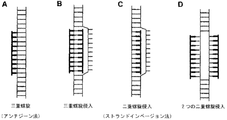
- FIG. 1 is a drawing corresponding to Figure 5 of Non-Patent Document 1, showing a mode of binding of an oligonucleotide to double-stranded genomic DNA.
- the above method can be classified into two types depending on the difference in the binding mode.
- One is an antigene method in which oligonucleotides bind to the "outside" of double-stranded genomic DNA through Hoogsteen or reverse Hoogsteen hydrogen bonds to form triple strands and regulate gene expression. (A in FIG. 1).
- the oligonucleotide partially breaks the double strand of the genomic DNA, and the oligonucleotide invades the strand (strand invasion) to form a single strand and forms a Watson-Crick type hydrogen bond. It is a strand invasion method that regulates gene expression by reformation (BD in FIG. 1).
- Oligonucleotides as functional materials used in methods for regulating gene expression and testing / diagnosing gene information have excellent sequence-specific binding affinity with target nucleic acids and strong resistance to degrading enzymes. And characteristics such as in-vivo safety are required. Natural materials such as DNA and RNA have poor resistance to degrading enzymes and have insufficient binding affinity, making them unsuitable as functional materials.
- peptide nucleic acids PNA
- cross-linked nucleic acids PMOs
- PMOs morpholino nucleic acids
- phosphorothioate-type nucleic acids in which one unbound oxygen atom in the phosphate diester portion of the nucleic acid is replaced with a sulfur atom.
- PS oligo and the like can be mentioned.
- Representative examples of the crosslinked structured nucleic acid include LNA (following structural formula 1), BNA NC (following structural formula 2), and ENA (following structural formula 3).
- An object of the present invention is to provide novel artificial nucleic acids useful for various genomic technologies, methods for producing them, uses, and the like.
- the present inventors have put an amino group which may have a substituent on the nitrogen atom of BNA NC represented by the structural formula 2 via a predetermined linker. It was found that the artificial nucleic acid bound to the single-stranded DNA has both highly selective and strong binding ability to single-stranded DNA and excellent degrading enzyme resistance. In addition, the present inventors have found that the artificial nucleic acid is useful for various genomic technologies such as the antisense method and the antigene method (including the strand invasion method). The present inventors have completed the present invention by further studying based on such findings.
- the present invention includes the following aspects. Item 1.
- R 1 and R 2 are the same or different, and may have a hydrogen atom, an alkyl group which may have a substituent, an alkenyl group which may have a substituent, and a cycloalkyl which may have a substituent.
- Item 2 It is a phosphinyl group, or a hydroxymercaptophosphinyl group which may have a substituent, or R 1 and R 2 are at the 3- to 5-positions of two adjacent oxygen atoms and flanose. Together with the carbon atom, it forms a ring that may have a substituent and R 3 is an amino group which may have a substituent).
- Item 2. The compound or salt thereof according to Item 1, wherein A 1 is a methylene group and A 2 is a single bond.
- Item 3. Item 2. The compound according to Item 1 or 2, or a salt thereof, wherein X is ⁇ C n H 2n ⁇ (in the formula, n is an integer of 1 to 10).
- R 3 is the following formula (A): (In the formula, R 3a and R 3b have the same or different hydrogen atom, an alkyl group which may have a substituent, an alkenyl group which may have a substituent, and a substituent.
- It may be a cycloalkyl group, a cycloalkenyl group which may have a substituent, an aryl group which may have a substituent, or a protective group of an amino group, or R 3a and R 3b are Together with the adjacent nitrogen atom, it forms a ring that may have a substituent) It is a group represented by, or the following formula (B): (In the formula, R 3c to R 3f are the same or different protecting groups of hydrogen atom, alkyl group, or amino group).
- Item 4. The compound according to any one of Items 1 to 3, or a salt thereof, which is a group represented by. Item 5.
- R 3a and R 3b are identical or different and are protective groups for hydrogen atoms, alkyl groups, aryl groups, aralkyl groups, or amino groups, or R 3a and R 3b are adjacent. It forms a 5- to 10-membered nitrogen-containing aliphatic heterocycle which may have an alkyl group as a substituent together with the nitrogen atom.
- R 3c to R 3f are the same or different protecting groups for hydrogen atoms or amino groups. Item 4 or a salt thereof. Item 6.
- R 1 and R 2 are the same or different, a hydrogen atom, an alkyl group which may have an alkoxy group as a substituent, an aryl group which may have an alkoxy group as a substituent, and an alkoxy group as a substituent.
- Aralkyl group alkylcarbonyl group, arylcarbonyl group, alkylsulfonyl group, arylsulfonyl group, formula: -Si (R 4 ) 3 (in the formula, each R 4 is the same or different, alkyl Group represented by (group or aryl group), formula: -P (R 5 ) (R 6 ) (in the formula, R 5 and R 6 are the same or different, hydroxyl group, mercapto group, amino group, A group represented by an alkoxy group, a haloalkoxy group, a cyanoalkoxy group, an alkylthio group, a haloalkylthio group, a cyanoalkylthio group, or an alkylamino group), a dihydroxyphosphinyl group, or a hydroxymercaptophosphinyl group.
- R 1 and R 2 form a 6-10-membered aliphatic heterocycle, which may have an alkyl group as a substituent, together with two adjacent oxygen atoms and carbon atoms at the 3-5 positions of furanose. are doing, Item 2.
- Base may have a substituent of 2,4-dioxo-1,2,3,4-tetrahydropyrimidine-1-yl group, and may have a substituent of 2-oxo-1,2.
- R 3c'to R 3f' are the same or different protecting groups for hydrogen atoms or amino groups, and Base, R 1 and R 2 are the same as described above].
- Item 9 A method for producing a compound represented by the formula (1) described in Item 1 or a salt thereof.
- R 3 is the following formula (B): (In the formula, R 3c to R 3f are the same or different protecting groups of hydrogen atom, alkyl group, or amino group).
- a method for producing a compound or a salt thereof, which is a group represented by comprising the step of guanidyl the compounds wherein R 3 is an amino group, methods. Item 12.
- Base is the following formula (1K') or (1Q'): (In the formula, Q 1 is a hydrogen atom or a substituent, and Q 2 and Q 3 are the same or different protecting groups of a hydrogen atom or an amino group (however, Q 2 and Q 3 are hydrogen atoms at the same time. is not)) A method for producing a compound represented by (1) or a salt thereof.
- the Base is the following formula (1R') or (1S'): (Wherein, Q 4 ⁇ Q 7 are the same or different, is a hydrogen atom or a protecting group of amino group) A method for producing a compound represented by (1) or a salt thereof.
- Base is the following formula (1O'): (In the formula, Q 1 is a hydrogen atom or a substituent)
- a method comprising the step of reacting with a compound represented by. Item 15.
- R 3 is an amino group which may have a substituent
- An oligonucleotide having a unit represented by or a salt thereof.
- Item 16 A method for detecting a target nucleic acid in a test sample.
- (I) A step of selectively amplifying a base sequence containing a target site of the target nucleic acid by a nucleic acid amplification method using a clamp nucleic acid, wherein the clamp nucleic acid is the oligonucleotide or a salt thereof according to Item 15.
- a method comprising a step and (II) detecting the amplified base sequence.
- Item 17 A composition for detecting a target nucleic acid in a test sample or selectively amplifying a base sequence containing a target site of the target nucleic acid in the test sample.
- composition comprises a primer and a probe, and at least one of the primer and the probe is the oligonucleotide according to Item 15 or a salt thereof.
- composition comprises a forward primer, a reverse primer and a probe, and at least one of the forward primer, the reverse primer and the probe is the oligonucleotide or salt thereof according to Item 15.
- composition comprises a clamp nucleic acid and a primer, and at least one of the clamp nucleic acid and the primer is the oligonucleotide according to Item 15 or a salt thereof.
- Composition Item 17A. Item 5.
- Item 2. The oligonucleotide or salt thereof, which is a composition for allowing oligonucletide to enter the target site of double-stranded DNA and has a base sequence complementary to the base sequence of the target site. Composition to be.
- Item 18A Item 5.
- oligonucleotide or salt thereof for invading oligonucleotide into the target site of double-stranded DNA, wherein the oligonucleotide or salt thereof complements the base sequence of the target site.
- Use having a typical base sequence.
- Item 2. The oligonucleotide or salt thereof according to Item 15, which is a method for stranding an oligonucleotide into a target site of isolated double-stranded DNA and having a base sequence complementary to the base sequence of the target site. And a method comprising the step of mixing the double-stranded DNA.
- Item 20 is a method for stranding an oligonucleotide into a target site of isolated double-stranded DNA and having a base sequence complementary to the base sequence of the target site.
- a method comprising the step of mixing the double-stranded DNA.
- the step is either (i) mixing the oligonucleotide or a salt thereof with the double-stranded DNA in the presence of a single-stranded DNA-binding protein, or (ii) the oligonucleotide or a salt thereof and the above.
- This is a step of mixing double-stranded DNA in the absence of a single-stranded DNA-binding protein.
- it further comprises a step of heating the mixture or a step of maintaining the mixture at 25-75 ° C.
- Item 19 The method according to item 19.
- Item 21 A pharmaceutical composition containing the compound according to any one of Items 1 to 8 or a salt thereof, or the oligonucleotide according to Item 15 or a salt thereof.
- FIG. 1 is a drawing corresponding to Figure 5 of Non-Patent Document 1, and shows a mode of binding of an oligonucleotide to double-stranded genomic DNA.
- FIG. 2 is a graph showing the relationship between the reaction time of digestive enzymes and the residual rate of undigested oligonucleotides.
- FIG. 3 is a graph showing the relationship between the number of PCR cycles and ⁇ Rn (fluorescence intensity).
- FIG. 4 is a diagram confirming that strand invasion occurs for PNA under the conditions described in Chem. Communi., 2009, 1225-1227.
- FIG. 5 is a diagram showing that strand invasion occurs for the oligonucleotide of the present invention under the conditions described in Chem. Communi., 2009, 1225-1227.
- FIG. 6 is a diagram showing that strand invasion occurs in a predetermined temperature condition for the oligonucleotide of the present invention.
- FIG. 7 is a diagram showing that strand invasion is inhibited by a difference of 1 base for the oligonucleotide of the present invention.
- FIG. 8 is a diagram showing that strand invasion occurs for the oligonucleotide of the present invention under a predetermined temperature condition.
- FIG. 9 is a diagram showing that strand invasion occurs in a predetermined temperature condition for the oligonucleotide of the present invention.
- FIG. 10 is a diagram showing that strand invasion is enhanced by using two or more kinds of oligonucleotides of the present invention.
- FIG. 11 is a diagram showing an example of a kit for detecting a target nucleic acid in the test sample of the present invention.
- alkyl group refers to a monovalent group obtained by removing one hydrogen atom from a linear or branched saturated hydrocarbon.
- the number of carbon atoms of the alkyl group is not particularly limited, but is, for example, 1 to 20, preferably 1 to 10, more preferably 1 to 6, and particularly preferably 1 to 4.
- alkyl groups include methyl group, ethyl group, propyl group (eg n-propyl group, i-propyl group), butyl group (eg n-butyl group, i-butyl group, s-butyl group, t).
- alkylene group refers to a divalent group obtained by removing two hydrogen atoms from a linear or branched-chain saturated hydrocarbon.
- the number of carbon atoms of the alkylene group is not particularly limited, but is, for example, 1 to 10, preferably 1 to 8, and more preferably 1 to 6.
- alkylene groups include C 1 alkylene group (eg methylene group), C 2 alkylene group (eg methyl methylene group, dimethylene group), C 3 alkylene group (eg trimethylene group, dimethyl methylene group), C 4 alkylene group (e.g., a tetramethylene group), C 5 alkylene group (e.g., a pentamethylene group), C 6 alkylene group (e.g., hexamethylene group).
- C 1 alkylene group eg methylene group
- C 2 alkylene group eg methyl methylene group, dimethylene group
- C 3 alkylene group eg trimethylene group, dimethyl methylene group
- C 4 alkylene group e.g., a tetramethylene group
- C 5 alkylene group e.g., a pentamethylene group
- C 6 alkylene group e.g., hexamethylene group
- alkenyl group refers to a monovalent group which is a linear or branched chain and is an unsaturated hydrocarbon containing a carbon-carbon double bond from which one hydrogen atom has been removed.
- the number of carbon atoms of the alkenyl group is not particularly limited, but is, for example, 2 to 20, preferably 2 to 10, and more preferably 2 to 6.
- alkenyl groups include ethenyl groups (ie, vinyl groups), propenyl groups (eg, 1-propenyl group, allyl group), butenyl groups, pentenyl groups, hexenyl groups, geranyl groups, farnesyl groups.
- alkynyl group refers to a monovalent group which is a linear or branched chain and is an unsaturated hydrocarbon containing a carbon-carbon triple bond minus one hydrogen atom.
- the number of carbon atoms of the alkynyl group is not particularly limited, but is, for example, 2 to 20, preferably 2 to 10, and more preferably 2 to 6.
- Examples of the alkynyl group include an ethynyl group, a propargyl group, and a 1-butynyl group.
- cycloalkyl group refers to a monovalent group derived from a saturated aliphatic hydrocarbon ring.
- the number of carbon atoms of the cycloalkyl group is not particularly limited, but is, for example, 3 to 20, preferably 5 to 12, and more preferably 5 to 10.
- examples of the cycloalkyl group include a cyclopropyl group, a cyclobutyl group, a cyclopentyl group, a cyclohexyl group, a cycloheptyl group, a cyclooctyl group, a norbornyl group, and an adamantyl group.
- cycloalkenyl group refers to a monovalent group derived from an unsaturated aliphatic hydrocarbon ring containing a carbon-carbon double bond.
- the number of carbon atoms of the cycloalkenyl group is not particularly limited, but is, for example, 3 to 20, preferably 5 to 12, and more preferably 5 to 10.
- Examples of the cycloalkenyl group include a cyclopropenyl group, a cyclobutenyl group, a cyclopentenyl group, a cyclohexenyl group, a norbornenyl group, and an adamantenyl group.
- aromatic hydrocarbon ring group refers to a monovalent group derived from the aromatic hydrocarbon ring, and is also referred to as an "aryl group".
- the number of constituent atoms of the aromatic hydrocarbon ring is not particularly limited, but is, for example, 6 to 20, preferably 6 to 14, more preferably 6 to 12, and particularly preferably 6 to 10.
- the aromatic hydrocarbon ring may be a monocyclic ring or a fused ring (eg, a two- or tricyclic fused ring).
- Examples of the aromatic hydrocarbon ring group include a phenyl group, an indenyl group, a naphthyl group, a fluorenyl group, a phenanthrenyl group, and an anthrasenyl group.
- heterocycle is used to include “aliphatic heterocycle” and “aromatic heterocycle”.
- aliphatic heterocycle refers to at least one heteroatom selected from the group consisting of a carbon atom, a nitrogen atom, an oxygen atom, a sulfur atom, a silicon atom, and the like as constituent atoms of the ring. It refers to an aliphatic ring containing.
- the number of constituent atoms of the aliphatic heterocycle is not particularly limited, but is, for example, 5 to 20, preferably 5 to 12, and more preferably 6 to 10.
- the number of heteroatoms among the constituent atoms of the aliphatic heterocycle is not particularly limited, but is, for example, 1 to 4.
- aliphatic heterocycles include oxygenated aliphatic heterocycles (eg, tetrahydrofuran, dioxolane, pyrane, tetrahydropyran, dioxane), sulfur-containing aliphatic heterocycles (eg tetrahydrothiophene, thiopyran, tetrahydrothiopyran).
- oxygenated aliphatic heterocycles eg, tetrahydrofuran, dioxolane, pyrane, tetrahydropyran, dioxane
- sulfur-containing aliphatic heterocycles eg tetrahydrothiophene, thiopyran, tetrahydrothiopyran.
- Nitrogen-aliphatic heterocycles eg pyrrolidine, piperidine, azepan
- nitrogen-containing and oxygen-aliphatic heterocycles eg morpholin
- nitrogen-containing and sulfur aliphatic heterocycles eg
- the "aromatic heterocycle” is an aromatic compound containing at least one heteroatom selected from a group consisting of a carbon atom and a nitrogen atom, an oxygen atom, a sulfur atom and the like as a constituent atom of the ring. Refers to a ring.
- the number of constituent atoms of the aromatic heterocycle is not particularly limited, but is, for example, 5 to 20, preferably 5 to 12, and more preferably 6 to 10.
- the number of heteroatoms among the constituent atoms of the aromatic heterocycle is not particularly limited, but is, for example, 1 to 4.
- the aromatic heterocycle may be a monocyclic ring or a fused ring (eg, a two- or tricyclic fused ring).
- aromatic heterocycles examples include oxygenated aromatic heterocycles (eg furan, benzofuran, isobenzofuran, chromene, benzopyran, xanthene), sulfur containing aromatic heterocycles (eg thiophene, thiantorene), nitrogen containing aromatics.
- oxygenated aromatic heterocycles eg furan, benzofuran, isobenzofuran, chromene, benzopyran, xanthene
- sulfur containing aromatic heterocycles eg thiophene, thiantorene
- Heterocycles eg, pyrrol, imidazole, pyrazole, triazole, pyridine, pyrazine, pyrimidine, pyridazine, indole, isoindole, indridin, purine, quinoline, isoquinoline, 1,8-naphthylidine, quinoxalin, quinazoline, cinnoline, phthalazine, pteridine , Carbazole, phenanthridine, acrydin, perimidine, phenazine), oxygen-containing and sulfur aromatic heterocycles (eg phenoxatiin), nitrogen-containing and oxygen aromatic heterocycles (eg oxazole, isooxazole, flazan, phenoxazine ), Nitrogen-containing and sulfur aromatic heterocycles (eg, thiazole, isothiazole, phenothiazine).
- thiazole isothiazole, phenothia
- heterocyclic group refers to a monovalent group obtained by removing one hydrogen atom from the heterocycle.
- “may have a substituent” or “may have a substituent” means that it does not have a substituent and that it has one hydrogen atom instead of an arbitrary hydrogen atom. It is used in the sense that it includes both a substituent or a case where it has two or more homologous or dissimilar substituents.
- the number of substituents is not particularly limited, but is, for example, 1 to 3, preferably 1 or 2.
- substituted means an atom or atomic group that replaces a hydrogen atom.
- Alkyl group alkenyl group, cycloalkyl group, cycloalkenyl group, aryl group, alkynyl group, acyl group, alkylsulfonyl group, arylsulfonyl group, cyano group, heterocyclic group, a combination of two or more of these (eg, haloalkyl group).
- “combination of two or more kinds” includes arbitrary combinations of groups exemplified as each substituent.
- Cy means that the number of carbon atoms of the subsequent group is x or more and y or less. x and y are positive integers and x ⁇ y.
- haloalkyl group refers to an alkyl group substituted with one or more homologous or dissimilar halogen atoms.
- a preferred example of a haloalkyl group is a C 1-6 haloalkyl group, a more preferred example is a C 1-4 haloalkyl group, and a more preferred example is a trifluoromethyl group, a trichloromethyl group, or 2, It is a 2,2-trifluoroethyl group.
- cyanoalkyl group refers to an alkyl group substituted with one or more cyano groups.
- a preferred example of the cyanoalkyl group is a C 1-6 cyanoalkyl group, a more preferred example is a C 1-4 cyanoalkyl group, and a more preferred example is a cyanomethyl group or a 2-cyanoethyl group. Be done.
- aralkyl group refers to an alkyl group substituted with one or more of the same or different aryl groups. Suitable examples of aralkyl groups are C 6-14 aryl C 1-4 alkyl groups, and more preferred examples are phenylmethyl groups (ie, benzyl groups), phenylethyl groups (ie, phenethyl groups), naphthylmethyl. A group, a naphthylethyl group, a triphenylmethyl group (ie, a trityl group), or a fluorenylmethyl group.
- alkoxy group refers to a group represented by the formula: -O-alkyl.
- a preferred example of an alkoxy group is a C 1-6 alkoxy group, and a more preferred example is a methoxy group, an ethoxy group, a propoxy group (eg, n-propoxy group, i-propoxy group), or a butoxy group (eg). : T-butoxy group).
- the haloalkoxy group and the cyanoalkoxy group refer to a group represented by the formula: —O-haloalkyl and a group represented by the formula: —O-cyanoalkyl, respectively.
- alkylthio group refers to a group represented by the formula: -S-alkyl.
- a preferred example of an alkylthio group is a C 1-6 alkylthio group, and a more preferred example is a methylthio group, an ethylthio group, a propylthio group (eg, n-propylthio group, i-propylthio group), or a butylthio group. ..
- the haloalkylthio group and the cyanoalkylthio group refer to a group represented by the formula: —S-haloalkyl and a group represented by the formula: —S-cyanoalkyl, respectively.
- alkylamino group refers to an amino group substituted with one or two homologous or dissimilar alkyl groups.
- Alkylamino groups include monoalkylamino groups and dialkylamino groups.
- a preferred example of a monoalkylamino group is a monoC 1-6 alkylamino group, and more preferred examples are a monomethylamino group, a monoethylamino group, a monopropylamino group (eg, mono (n-propyl) amino). Group, mono (i-propyl) amino group), or monobutylamino group.
- a preferred example of a dialkylamino group is a diC 1-6 alkylamino group, more preferred examples are a dimethylamino group, a diethylamino group, a dipropylamino group (eg, a di (n-propyl) amino group, a di (n-propyl) amino group, a dialkylamino group. (i-propyl) amino group) or dibutylamino group.
- phosphino group having a substituent means a group in which at least one hydrogen atom of the phosphino group (-PH 2 ) is substituted with another atom or atomic group.
- phosphino groups having a substituent include the formula: -P (R 5 ) (R 6 ) (in the formula, R 5 and R 6 are the same or different, hydroxyl group, mercapto group, amino group, alkoxy group. , A haloalkoxy group, a cyanoalkoxy group, an alkylthio group, a haloalkylthio group, a cyanoalkylthio group, or an alkylamino group).
- the latter group may have a substituent, the following formula: It may have a group represented by (hereinafter referred to as "diphosphate group”) and a substituent, the following formula: Includes a group represented by (hereinafter referred to as "triphosphate group”).
- hydroxyl group protecting group refers to a monovalent group that prevents a hydroxyl group from participating in a reaction in the synthesis of a compound or a salt thereof, or in the synthesis of an oligonucleotide or a salt thereof. .. Hydroxyl protecting groups include, but are limited to, groups that are stable under acidic or neutral conditions and can be cleaved by methods such as hydrogenation, hydrolysis, electrolysis, and photolysis. It's not something. Examples of hydroxyl protecting groups include acyl groups, which may have substituents, sulfonyl groups, which have substituents, and silyl groups, which have substituents.
- the hydrocarbon group represented by R may be a linear or branched hydrocarbon group (eg, alkyl group), a saturated or unsaturated hydrocarbon ring group (eg, cycloalkyl group, aryl group), these. (Example: aralkyl group) may be used.
- Acyl groups include alkylcarbonyl groups, arylcarbonyl groups, and aralkylcarbonyl groups.
- a preferred example of an alkylcarbonyl group is a (C 1-10 alkyl) carbonyl group, and more preferred examples are an acetyl group, a propionyl group, a butyryl group, an isobutyryl group, a pentanoyl group, a pivaloyl group, a valeryl group, an isovaleryl group. , Octanoyl group, nonanoyl group, or decanoyl group.
- a preferred example of an arylcarbonyl group is a (C 6-14 aryl) carbonyl group, and a more preferred example is a benzoyl group or a naphthoyl group (ie, an ⁇ -naphthoyl group, a ⁇ -naphthyl group).
- a preferred example of an aralkylcarbonyl group is a (C 6-14 aryl C 1-4 alkyl) carbonyl group, and a more preferred example is a benzylcarbonyl group.
- Examples of the acyl group in the "acyloxy group", “acylthio group", and "acylamino group” include the same groups as described above.
- the sulfonyl group having a substituent includes a sulfonyl group having an alkyl group which may have a substituent and a sulfonyl group having an aryl group which may have a substituent.
- a preferred example of a sulfonyl group having an alkyl group is a C 1-6 alkylsulfonyl group, and a more preferred example is a methanesulfonyl group or an ethanesulfonyl group.
- a preferred example of a sulfonyl group having an aryl group is a C6-14 arylsulfonyl group, and a more preferred example is a benzenesulfonyl group or a p-toluenesulfonyl group.
- sil group having a substituent means a silyl group in which at least one hydrogen atom of the silyl group (-SiH 3 ) is substituted with another atom or atomic group.
- a typical example of a "silyl group having a substituent” is represented by the formula: -Si (R 4 ) 3 (wherein each R 4 is the same or different, an alkyl group or an aryl group). It is a group.
- trialkylsilyl groups eg, tri-C 1-6 alkylsilyl groups such as trimethylsilyl group, triethylsilyl group, triisopropylsilyl group, t-butyldimethylsilyl group
- dialkylarylsilyl groups eg.
- di-C 1-6 alkyl C 6-14 aryl silyl group such as dimethyl phenyl silyl group
- alkyldiarylsilyl groups eg: t-butyl C 1-6 alkyl di C 6-14 aryl silyl group such as diphenyl silyl group
- Triarylsilyl groups eg, tri-C 6-14 arylsilyl groups such as triphenylsilyl groups.
- amino group protecting group refers to a monovalent group that prevents an amino group from participating in a reaction in the synthesis of a compound or a salt thereof, or in the synthesis of an oligonucleotide or a salt thereof. ..
- Protecting groups for amino groups include, but are limited to, groups that are stable under acidic or neutral conditions and can be cleaved by methods such as hydrogenation, hydrolysis, electrolysis, and photolysis. It's not something.
- protective groups for amino groups include acyl groups that may have substituents (eg, alkylcarbonyl groups that may have substituents, arylcarbonyl groups that may have substituents, substituents).
- Aralkylcarbonyl group which may have a group), N, N-dialkylformamidyl group which may have a substituent, alkoxycarbonyl group which may have a substituent, and a substituent. It includes an alkenyloxycarbonyl group which may be present, an aryloxycarbonyl group which may have a substituent, an aralkyloxycarbonyl group which may have a substituent, and a sulfonyl group which has a substituent.
- a preferred example of the N, N-dialkylform amidyl group is the N, N-di (C 1-6 alkyl) form amidyl group, and a more preferred example is the N, N-di (C 1-4 alkyl). It is a form amidyl group, and a more preferable example is an N, N-dimethylform amidil group or an N, N-diethylform amidil group.
- a preferred example of an alkoxycarbonyl group is a (C 1-6 alkoxy) carbonyl group, and a more preferred example is a methoxycarbonyl group, an ethoxycarbonyl group, a propoxycarbonyl group, or a butoxycarbonyl group (eg, t-butoxycarbonyl). Group).
- a preferred example of the alkenyloxycarbonyl group is the (C 2-9 alkenyloxy) carbonyl group, and a more preferred example is the allyloxycarbonyl group.
- a preferred example of an aryloxycarbonyl group is a (C 6-14 aryloxy) carbonyl group, and a more preferred example is a phenoxycarbonyl group or a naphthoxycarbonyl group.
- a preferred example of the aralkyloxycarbonyl group is the (C 6-14 aryl C 1-4 alkoxy) carbonyl group, and a more preferred example is the benzyloxycarbonyl group or fluorenylmethyloxycarbonyl group.
- hybridizing means that all or part of a given polynucleotide or oligonucleotide is hydrogen-bonded to all or part of another polynucleotide or oligonucleotide under stringent conditions. Forming a double chain.
- stringent condition may be any condition generally used by those skilled in the art when hybridizing a polynucleotide or an oligonucleotide. For example, when there is at least 50%, preferably at least 75%, more preferably at least 90% sequence identity between two polynucleotide molecules or oligonucleotide molecules, one polynucleotide molecule or oligonucleotide molecule is the other.
- Stringency in hybridization is known to be a function of temperature, salt concentration, nucleotide or oligonucleotide base length and GC content, and concentration of chaotropic agents contained in the hybridization buffer.
- stringent conditions for example, the conditions described in Sambrook, J. et al., 1998, Molecular Cloning: A Laboratory Manual (Volume 2), Cold Spring Harbor Laboratory Press, New York can be used.
- testing means examining a test substance such as nucleic acid in a sample for the purpose of diagnosis or research.
- Inspection sample means a sample to be inspected.
- the compound of the present invention or a salt thereof is a compound represented by the following formula (1) or a salt thereof: (In the formula, Base, A 1 , A 2 , X, R 1 , R 2 , and R 3 are the same as described above. The carbon atom of furanose is given a position number.)
- Compound (1) is “nucleotide” when R 1 or R 2 is a dihydroxyphosphinyl group which may have a substituent or a hydroxymercaptophosphinyl group which may have a substituent. When it is a group other than that, it is called “nucleoside”.
- a good example of Base is an aromatic heterocyclic group which may have a substituent.
- the aromatic heterocyclic group is preferably a nitrogen-containing aromatic heterocyclic group.
- the nitrogen-containing aromatic heterocyclic group is preferably a nitrogen-containing aromatic heterocyclic group having 6 to 10 members.
- the 6 to 10-membered nitrogen-containing aromatic heterocyclic group is preferably 2,4-dioxo-1,2,3,4-tetrahydropyrimidine-1-yl group or 2-oxo-1,2-dihydropyrimidine-. It is a 1-yl group, a purine-9-yl group, or a 6-oxo-1,6-dihydro-9H-purine-9-yl group.
- a preferred example of the substituent substituting for the aromatic heterocyclic group is at least one selected from the group consisting of an alkyl group, an acyl group, and an amino group optionally substituted with an amino protecting group.
- the number of the substituents is not particularly limited, but is, for example, 1 to 3. More preferred examples of Base have a timyl group which may have a substituent, a cytosynyl group which may have a substituent, an adenyl group which may have a substituent, or a substituent. It is a guanyl group that may be present.
- the substituent is preferably at least one selected from the group consisting of an alkyl group, an acyl group, and an N, N-dialkylform amidyl group, and more preferably a C 1-4 alkyl group, (C 1). -4 Alkyl) carbonyl group, (C 6-14 aryl) carbonyl group, or N, N-di (C 1-4 alkyl) formamidyl group.
- the number of the substituents is preferably 1 to 3.
- Base is: 2,4-Dioxo-5-methyl-1,2,3,4-tetrahydropyrimidine-1-yl group (eg, thymine-1-yl group), 2-Oxo-4-amino-1,2-dihydropyrimidine-1-yl group (ie, cytosine-1-yl group), 2-Oxo-4-acylamino-1,2-dihydropyrimidine-1-yl group (ie, N-acyl-cytosine-1-yl group), 2-Oxo-4-amino-5-methyl-1,2-dihydropyrimidine-1-yl group (ie, 5-methylcytosine-1-yl group), 2-Oxo-4-acylamino-5-methyl-1,2-dihydropyrimidine-1-yl group (ie, N-acyl-5-methylcytosine-1-yl group), 6-Amino-9H-purine-9-yl group (ie, adenine-9-yl group), 6-Acy
- Base The most suitable examples of Base are as follows: Thymine-1-yl group, 5-Methylcytosine-1-yl group, N-Acetyl-5-methylcytosine-1-yl group, N-isobutyryl-5-methylcytosine-1-yl group, N-benzoyl-5-methylcytosine-1-yl group, Adenine-9-yl group, N-Acetyl-Adenine-9-Il Group, N-isobutyryl-adenine-9-yl group, N-benzoyl-adenine-9-yl group, Guanine-9-yl group, N-acetyl-guanine-9-yl group, N-isobutyryl-guanine-9-yl group, It is a group selected from the group consisting of N-benzoyl-guanine-9-yl group and N- (N, N-dimethylformamidyl) -guanine-9-yl group.
- a 1 is a linear alkylene group (eg, methylene group, dimethylene group, trimethylene group, tetramethylene group).
- a good example of A 1 is a linear C 1-4 alkylene group.
- a more preferred example of A 1 is a linear C 1-2 alkylene group.
- the most preferred example of A 1 is a methylene group.
- a preferred example of A 2 is a single bond or linear C 1-2 alkylene group (eg, methylene group, dimethylene group).
- a more preferred example of A 2 is a single bond.
- R X alkylene radical
- R X alkylene radical
- R X alkylene radical
- R X are the same as defined above
- O O
- -S O
- k- in the formula, k is 0, 1, or 2
- a more preferred example of X is: Formula: A group represented by ⁇ C n H 2n ⁇ (in the formula, n is an integer of 1 to 10), Formula:-(CH 2 ) n1- (N ( RX1 )-(CH 2 ) n2 ) n3- (In the formula, RX1 is a hydrogen atom or C 1-4 alkyl group, and n1 is an integer of 2 to 10.
- each RX1 may be the same as or different from each other.
- Each n2 may be the same as or different from each other) Equation:-(CH 2 ) n4- (O- (CH 2 ) n5 ) n6- (in the equation, n4 is an integer of 2 to 10, n5 is an integer of 2 to 4, and n6 is an integer of 1 to 5.
- n5 may be the same as or different from each other), and the formula:-(CH 2 ) n7- (S-).
- n7 is an integer of 2 to 10
- n8 is an integer of 2 to 4
- n9 is an integer of 1 to 5
- n9 is an integer of 2 or more.
- each n8 is a group selected from the group consisting of groups represented by (which may be the same or different from each other).
- X is: Formula: A group represented by- (CH 2 ) n10- (in the formula, n10 is an integer of 1 to 6), Formula: -C 2 H 4 - (N (R X2) -C 2 H 4) n11 - ( wherein, R X2 is a hydrogen atom or a C 1-4 alkyl group, n11 is an integer from 1 to 5 , Each RX2 may be the same or different from each other when n11 is an integer greater than or equal to 2 ).
- n12 is an integer of 1 to 5
- n13 represents a group selected from the group consisting of groups represented by a is
- the substituent which can be arbitrarily substituted on the carbon atom of the alkylene group is preferably a halogen atom, a hydroxyl group, an alkoxy group, a mercapto group, an alkylthio group, an amino group, a monoalkylamino group, a dialkylamino group or an acyloxy group. It is an acylamino group and an acylthio group.
- the number of substituents depends on the number of carbon atoms of the alkylene group, but is, for example, an integer of 1 to 3, preferably 2 or 3.
- R 1 Hydrogen atom, Alkyl groups, which may have substituents, Aryl groups that may have substituents, Hydroxy group protecting group, Phosphino groups with substituents, It is a group selected from the group consisting of a dihydroxyphosphinyl group which may have a substituent and a hydroxymercaptophosphinyl group which may have a substituent.
- Optionally substituted alkyl group represented by R 1, preferably a halogen atom, may have at least one substituent selected from the group consisting of an alkoxy group and an aryl group, It is a good alkyl group, more preferably an alkyl group optionally substituted with an alkoxy group or an aralkyl group optionally substituted with an alkoxy group.
- the number of the substituents is preferably 1 to 3.
- the number of the substituents is preferably 1 to 3.
- the “hydroxyl group protecting group” represented by R 1 is preferably an alkylcarbonyl group, an arylcarbonyl group, an alkylsulfonyl group, an arylsulfonyl group, or a formula: ⁇ Si (R 4 ) 3 (in the formula, each R 4). Is the same or different group represented by (is an alkyl group or an aryl group).
- the "phosphino group having a substituent" represented by R 1 is preferably of the formula: -P (R 5 ) (R 6 ) (in the formula, R 5 and R 6 are the same or different, hydroxyl group, mercapto.
- a more preferred example of the group is: (In the formula, R 5a and R 5b are the same or different, a hydrogen atom or an alkyl group, and R 6a is a hydrogen atom, an alkyl group, a haloalkyl group, or a cyanoalkyl group). It is a phosphino group represented by.
- Substituent optionally dihydroxy phosphinyl group which may have a” represented by R 1 is preferably a dihydroxy phosphinyl group, diphosphate group, or triphosphate group, more preferably, dihydroxy It is a phosphinyl group. They may have a hydroxyl group protecting group as a substituent, or all or part of the existing hydroxyl groups may be substituted with a hydroxyl group protecting group.
- "Optionally substituted hydroxy mercapto phosphinyl group” represented by R 1 is preferably hydroxy mercapto phosphinyl group.
- R 1 are hydrogen atom, methyl group, ethyl group, propyl group, butyl group, allyl group, benzyl group, trityl group, methoxymethyl group, p-methoxybenzyl group, monomethoxytrityl group and dimethoxytrityl.
- a preferred example of R 2 is the same as a preferred example of R 1 .
- R 1 is a hydrogen atom or a dimethoxytrityl group (eg, 4,4'-dimethoxytrityl group) and R 2 is the following formula: (In the formula, R 5a and R 5b are the same or different, a hydrogen atom or an alkyl group, and R 6a is a hydrogen atom, an alkyl group, a haloalkyl group, or a cyanoalkyl group). It is a combination which is a phosphino group represented by.
- a preferred example of the ring may have a substituent. It is a good 6-10 member aliphatic heterocycle, and a good example of the substituent is an alkyl group.
- a more preferred example of the ring is: (In the formula, R 7 and R 8 are the same or different, hydrogen atoms or alkyl groups, and R 9 to R 12 are the same or different, alkyl groups.) It is an aliphatic heterocycle represented by any of.
- a more preferred example of the ring is: It is a ring represented by any of.
- R 3 is the following formula (A): (In the formula, R 3a and R 3b have the same or different hydrogen atom, an alkyl group which may have a substituent, an alkenyl group which may have a substituent, and a substituent. It may be a cycloalkyl group, a cycloalkenyl group which may have a substituent, an aryl group which may have a substituent, or a protective group of an amino group, or R 3a and R 3b are Together with the adjacent nitrogen atom, it forms a ring that may have a substituent) It is a group represented by.
- R 3a is preferably a protecting group for a hydrogen atom, an alkyl group, an aryl group, an aralkyl group, or an amino group, and more preferably a protecting group for a hydrogen atom, an alkyl group, or an amino group.
- the "protecting group for the amino group” represented by R 3a is preferably a (C 1-4 alkyl) carbonyl group or a (C 1-4 haloalkyl) carbonyl group, more preferably an acetyl group or a trifluoromethyl carbonyl group. is there.
- R 3b is the same as a preferred example of R 3a .
- Suitable examples of combinations of R 3a and R 3b are combined R 3a and R 3b are both hydrogen atom, R 3a is a hydrogen atom, the combination R 3b is acetyl group, or a trifluoromethyl carbonyl radical, R A combination in which both 3a and R 3b are methyl groups, or a combination in which both R 3a and R 3b are acetyl groups or trifluoromethylcarbonyl groups.
- a preferred example of the ring is a 5- to 10-membered nitrogen-containing aliphatic heterocycle which may have a substituent.
- a suitable example of the substituent is an alkyl group or an acyl group.
- R 15 is a hydrogen atom, a linear or branched C 1-4 alkyl group (eg, methyl group, ethyl group, propyl group, butyl group) or (linear or branched C 1).
- -4 Alkyl) carbonyl group eg, methylcarbonyl group, ethylcarbonyl group, propylcarbonyl group, butylcarbonyl group
- the most preferred example of the ring is a 4-methylpiperazin-1-yl group.
- R 3 is the following formula (B): (In the formula, R 3c to R 3f are the same or different protecting groups of hydrogen atom, alkyl group, or amino group). It is a group represented by.
- a good example of R 3c to R 3f is a hydrogen atom or amino protecting group.
- R 3c is preferably a hydrogen atom.
- R 3d is preferably an amino group-protecting group, more preferably an alkoxycarbonyl group, a haloalkoxycarbonyl group, or a cyanoalkoxycarbonyl group, and particularly preferably a (C 1-4 alkoxy) carbonyl group.
- R 3e is preferably an amino group-protecting group, more preferably an alkoxycarbonyl group, a haloalkoxycarbonyl group, or a cyanoalkoxycarbonyl group, and particularly preferably a (C 1-4 alkoxy) carbonyl group. It is a (C 1-4 haloalkoxy) carbonyl group or a (C 1-4 cyanoalkoxy) carbonyl group.
- R 3f is preferably a hydrogen atom.
- R 3 includes the following groups: It is a group selected from.
- a preferred example of compound (1) is any of the following compounds (1A)-(1C): [During the ceremony, R 3a'and R 3b'are identical or different protective groups for hydrogen atoms, alkyl groups, or amino groups.
- R 3c'to R 3f' are the same or different protecting groups for hydrogen atoms or amino groups, and Base, R 1 , R 2 and n are the same as above].
- a more preferred example of compound (1) is any of the following compounds (1D)-(1I): (In the formula, Base, R 1 , and R 2 are the same as described above).
- the salt may be a pharmaceutically acceptable salt and may not be a pharmaceutically acceptable salt.
- the salt may be an inorganic salt or an organic salt.
- the salts include alkali metal salts (eg sodium salt, potassium salt, lithium salt), alkaline earth metal salts (eg calcium salt, magnesium salt), and other metal salts (eg aluminum salt, iron salt).
- Step (I) is the compound (2A), the formula (3A): is reacted with L 1 -X-R compound represented by 3 is a step of obtaining compound (1).
- Compound (2A) can be obtained by known methods, such as those described in US Patent Application Publication No. 2007/1673887.
- examples of the leaving group represented by L 1 are halogen atom (eg chlorine atom, bromine atom, iodine atom), alkylsulfonyloxy group (eg mesiloxy group), haloalkylsulfonyloxy group (eg).
- Trifluoromethylsulfonyloxy group or arylsulfonyloxy group (eg, tosyloxy group).
- the amount of compound (3A) to be used is generally 1 to 10 mol, preferably 3 to 6 mol, relative to 1 mol of compound (2A).
- the reaction is preferably carried out in the presence of a solvent.
- the solvent include an ether solvent (eg, tetrahydrofuran), a nitrile solvent (eg, acetonitrile), an aromatic hydrocarbon solvent (eg, toluene, xylene), and a mixed solvent of two or more of these.
- aromatic hydrocarbon solvents are preferred, and at least one selected from the group consisting of toluene and xylene is more preferred.
- the reaction is preferably carried out in the presence of a base.
- bases are inorganic bases [eg, alkali metal carbonates (eg sodium carbonate, cesium carbonate), alkali metal hydrogen carbonates (eg sodium hydrogen carbonate), alkaline earth metal carbonates (eg).
- alkali metal hydroxides eg sodium hydroxide, potassium hydroxide
- alkaline earth metal hydroxides eg calcium hydroxide
- metal alkoxides eg sodium methoxydo, sodium ethoxydo
- Organic bases eg, tertiary amines (eg trialkylamines), cyclic amines (eg 4- (dimethylamino) pyridine, diazabicycloundecene (DBU), diazabicyclononen (DBN)
- tertiary amines are preferred, and tri-C 1-4 alkylamines are more preferred.
- the amount of the base used is generally 2 to 10 mol, preferably 5 to 8 mol, relative to 1 mol of compound (2A).
- the reaction temperature of the reaction is not particularly limited as long as the reaction proceeds, but is, for example, 30 to 150 ° C, preferably 50 to 120 ° C.
- the reaction time of the reaction is not particularly limited, but is, for example, 1 to 24 hours, preferably 1 to 12 hours.
- Step (IIa) is compound (2A), the formula (3A '): is reacted with the compound represented by L 2 -X-L 2, is a step of obtaining compound (2B).
- examples of the leaving group represented by L 2 is the same as L 1.
- the amount of compound (3A') used is generally 1 to 20 mol, preferably 1 to 5 mol, relative to 1 mol of compound (2A).
- the reaction can be carried out in the presence of a solvent and / or a base as in step (I).
- Step (IIb) the compound (2B), the formula (3B): is reacted with a compound represented by R 3 -H, a step of obtaining compound (1).
- the amount of compound (3B) used is generally 1 to 20 mol, preferably 1 to 5 mol, relative to 1 mol of compound (2B).
- the reaction can be carried out in the presence of a solvent and / or a base as in step (I).
- Step (IIc) the compound (2A), the formula (3A ''): L 3 is reacted with the compound represented by -X-OH, compound (2A 'to give compound).
- the amount of compound (3A'') used is generally 1 to 20 mol, preferably 1 to 5 mol, relative to 1 mol of compound (2A).
- the reaction can be carried out in the presence of a solvent and / or a base as in step (I).
- step (IId) is a step of converting the hydroxyl group of the compound (2A') into a leaving group L 2 to obtain the compound (2B).
- a typical example of step (IId) is the reaction of compound (2A') with a sulfonyl halide (eg, alkane sulfonic acid halide, haloalkane sulfonic acid halide, allene sulfonic acid halide).
- a sulfonyl halide eg, alkane sulfonic acid halide, haloalkane sulfonic acid halide, allene sulfonic acid halide.
- the amount of the sulfonyl halide used is generally 0.5 to 5 mol, preferably 1 to 2 mol, relative to 1 mol of compound (2A').
- the reaction can be carried out in the presence of a solvent and / or a base as in step (I).
- Step (IIIa) the compound (2B), wherein: M + N 3 - in is reacted with azide salt represented, is a step of obtaining compound (1 J).
- azide salts include sodium azide, potassium azide, and ammonium azide.
- the amount of the azide salt used is generally 1 to 5 mol, preferably 1 to 2 mol, relative to 1 mol of compound (2B).
- the reaction is preferably carried out in the presence of a solvent.
- solvents examples include nitrile solvents (eg acetonitrile), ether solvents (eg tetrahydrofuran), amide solvents (eg N, N-dimethylformamide, N, N-dimethylacetamide, N-methylpyrrolidone), Examples thereof include a mixed solvent of two or more of these. Of these, amide-based solvents are preferable, and N, N-dimethylformamide is more preferable.
- the reaction temperature of the reaction is not particularly limited as long as the reaction proceeds, but is, for example, 30 to 150 ° C, preferably 50 to 120 ° C.
- step (IIIb) compound (1J) is converted to the following formula (3C): This is a step of obtaining a compound (1 L) by hydrolysis after reacting with the compound represented by.
- R 3g to R 3i are preferably aryl groups, more preferably C 6-10 aryl groups.
- the amount of compound (3C) used is generally 1 to 10 mol, preferably 1 to 3 mol, relative to 1 mol of compound (1J).
- the reaction is preferably carried out in the presence of a solvent.
- the solvent examples include a nitrile solvent (eg, acetonitrile), an ether solvent (eg, cyclic ether such as tetrahydrofuran and dioxane), and a mixed solvent of two or more of these.
- ether solvents are preferred, cyclic ethers are more preferred, and at least one selected from tetrahydrofuran and dioxane is preferred.
- the reaction temperature of the reaction is not particularly limited as long as the reaction proceeds, but is, for example, 15 to 30 ° C.
- the step (IIIb) may be a step of reducing the compound (1J) with a reducing agent (eg, lithium aluminum hydride) to obtain the compound (1L).
- a reducing agent eg, lithium aluminum hydride
- the step (IIIc) is a step of protecting the amino group of the compound (1L) with a protecting group of the amino group to obtain the compound (1M).
- a method for protecting the amino group with a protecting group for the amino group a known or commonly used method can be adopted.
- the step of introducing a trifluoromethylcarbonyl group as a protecting group for the amino group of compound (1L) is a step of reacting compound (1L) with trifluoroacetic acid or a derivative thereof (eg, trifluoroacetic anhydride). ..
- the reaction is preferably carried out in the presence of a solvent.
- a good example of a solvent is a cyclic amine (eg, pyridine).
- step (IV) is a step of obtaining the compound (1L) in which R 3 is an amino group among the compounds (1).
- R 3 has the following formula: This is a step of reacting a compound represented by phthalimide residue with a hydrazine compound (eg, hydrazine monohydrate). The amount of the hydrazine compound, among the compounds (1), per mole of the compound wherein R 3 is phthalimido residue, usually 1 to 10 mol, preferably 1.1 to 3.5 mol. The reaction is preferably carried out in the presence of a solvent.
- the solvent examples include water, an alcohol solvent (eg, methanol, ethanol), and a mixed solvent of two or more of these. Of these, alcohol solvents are preferred.
- the step (IV) may be a step of hydrolyzing the compound in which R 3 is a phthalimide residue among the compound (1).
- the step (V) is a step of guanidineizing the compound (1L) and, if necessary, protecting the amino group with a protecting group to obtain the compound (1N). Guanizylation is usually carried out by reaction with a guanidylating agent.
- the guanidine agent include a nitrogen-based guanidine agent and a sulfur-based guanidine agent.
- nitrogen-based guanidine agents include compounds represented by the following formulas: (In the formula, L 4 is a leaving group, and R 3c to R 3e are the same as described above). Examples of the leaving group represented by L 4 are the same as L 1.
- the nitrogen-based guanizylating agent is preferably 1-amidinopyrazole hydrochloride, 1-carbamimidyl-1,2,4-triazole hydrochloride, 1- (Nt-butoxy-amidino) pyrazole, 1- (N). -Benzyloxy-amidino) pyrazole, 1- [N, N'-(di-t-butoxy) amidino] pyrazole, 1- [N, N'-(di-benzyloxy) amidino] pyrazole, 1, 2, 3 -Tris (t-butoxycarbonyl) guanidine, or Goodman reagent.
- Examples of the sulfur-based guanidine agent include compounds represented by the following formulas: (In the formula, R 3c to R 3e are the same as described above).
- the sulfur-based guanidylating agent is preferably N, N'-di-t-butoxy-S-methylisothiourea, or 1,3-di-t-butoxythiourea.
- the amount of the guanidine agent used is usually 0.5 to 10 mol, preferably 0.8 to 2.0 mol, based on 1 mol of the compound (1 L).
- the reaction of compound (1 L) with the guanidine agent is preferably carried out in the presence of a solvent.
- solvents examples include halogenated hydrocarbon solvents (eg dichloromethane), amide solvents (eg N, N-dimethylformamide, N, N-dimethylacetamide, N-methylpyrrolidone), and a mixture of two or more of these.
- halogenated hydrocarbon solvents eg dichloromethane
- amide solvents eg N, N-dimethylformamide, N, N-dimethylacetamide, N-methylpyrrolidone
- a solvent can be mentioned.
- amide-based solvents are preferable, and N, N-dimethylformamide is more preferable.
- the reaction temperature of the reaction is not particularly limited as long as the reaction proceeds, but is, for example, 15 to 30 ° C.
- the method for producing a compound in which R 3c to R 3e are hydrogen atoms or a salt thereof is described by formulating the compound (1L) by the following formula: (In the formula, L is a halogen atom, and R 3j and R 3k are the same or different alkyl groups.)
- 2-halo-4,6-dialkoxypyrimidine represented by the following formula (1L'):
- the method may include a step of obtaining the compound represented by, and a step of cleaving (or hydrolyzing) the pyrimidine ring of the compound (1L').
- this method refer to, for example, Tetrahedron Letters, 56, 2015, pp. 4990-4992.
- the method for producing a compound in which R 3c to R 3e are hydrogen atoms or a salt thereof may be a method including a step of reacting the compound (1L) with O-methylisourea. Good.
- a compound in which R 3c and R 3d are hydrogen atoms and R 3e is a benzyloxycarbonyl group or a salt thereof is prepared by formulating the compound (1L) by the following formula: (In the formula, M'is an alkali metal)
- the method may include a step of reacting with the compound represented by (eg, tri-C 1-4 alkylsilyl chloride such as trimethylsilyl chloride) and trialkylsilyl chloride.
- the compound represented by (eg, tri-C 1-4 alkylsilyl chloride such as trimethylsilyl chloride) and trialkylsilyl chloride eg, tri-C 1-4 alkylsilyl chloride
- the benzyloxycarbonyl group can be deprotected by a conventional method to obtain a compound in which R 3e is a hydrogen atom.
- the Base of compounds (1), (1J), (1L), (1M), (1N), (2A), (2A'), and (2B) can be converted, for example, by the following reaction scheme 2. It can.
- Q 1 is a hydrogen atom or a substituent
- Q 2 and Q 3 are the same or different protective groups of a hydrogen atom or an amino group (however, Q 2 and Q 3 are hydrogen atoms at the same time. not)
- Q 4 ⁇ Q 7 are the same or different, a hydrogen atom or a protecting group of amino group
- ring G is a nitrogen-containing heterocyclic ring of 5- or 6-membered
- a 1, a 2, R 1 and R 2 are the same as above
- Step (VI) "has a substituent" on Base in compounds (1), (1J), (1L), (1M), (1N), (2A), (2A'), and (2B). From 2,4-dioxo-1,2,3,4-tetrahydropyrimidine-1-yl group which may be present to "2-oxo-1,2-dihydropyrimidine-1-yl group which may have a substituent" It is a step of converting into an ill group, and includes steps (VIa) to steps (VIc).
- step (VIa) the compound (1O) in which Base is "2,4-dioxo-1,2,3,4-tetrahydropyrimidine-1-yl group which may have a substituent" is represented by the formula (1O).
- This is a step of reacting with a compound represented by 3D) and a phosphate halide to obtain a compound (1P).
- Q 1 is preferably a hydrogen atom or an alkyl group, more preferably a hydrogen atom or a C 1-4 alkyl group.
- Compound (3D) is preferably a 5-membered nitrogen-containing heterocyclic compound, more preferably triazole.
- the amount of compound (3D) used is generally 5 to 20 mol, preferably 7 to 9 mol, relative to 1 mol of compound (1O).
- the phosphate halide is preferably trichloride phosphate.
- the amount of the phosphoric acid halide used is usually 1 to 5 mol, preferably 1 to 3 mol, per 1 mol of the compound (1O).
- the reaction is preferably carried out in the presence of a solvent.
- the solvent include a nitrile solvent (eg, acetonitrile), an ether solvent (eg, tetrahydrofuran), a halogen solvent (eg, haloalkane), and a mixed solvent of two or more of these.
- a nitrile solvent eg, acetonitrile
- the reaction is preferably carried out in the presence of a base.
- bases are inorganic bases [eg, alkali metal carbonates (eg sodium carbonate, cesium carbonate), alkali metal hydrogen carbonates (eg sodium hydrogen carbonate), alkaline earth metal carbonates (eg).
- alkali metal hydroxides eg sodium hydroxide, potassium hydroxide
- alkaline earth metal hydroxides eg calcium hydroxide
- metal alkoxides eg sodium methoxydo, sodium ethoxydo
- Organic bases eg, tertiary amines (eg trialkylamines), cyclic amines (eg 4- (dimethylamino) pyridine, diazabicycloundecene (DBU), diazabicyclononen (DBN)
- tertiary amines are preferred, and tri-C 1-4 alkylamines are more preferred.
- the amount of the base used is generally 5 to 20 mol, preferably 10 to 15 mol, relative to 1 mol of compound (1O).
- the reaction temperature of the reaction is not particularly limited as long as the reaction proceeds, but is, for example, ⁇ 5 ° C. to 10 ° C.
- the reaction can also employ, for example, the method described in US Pat. No. 5,359,067.
- the step (VIb) is a step of reacting the compound (1P) with ammonia to obtain the compound (1K).
- the amount of ammonia used is generally 5 to 100 mol, preferably 20 to 50 mol, per 1 mol of compound (1P).
- the reaction is preferably carried out in the presence of a solvent.
- solvents include amide-based solvents (eg, N, N-dimethylformamide, N, N-dimethylacetamide, N-methylpyrrolidone), ether-based solvents (eg, cyclic ethers such as tetrahydrofuran and dioxane), and two of these. Examples thereof include the above mixed solvents.
- reaction temperature of the reaction is not particularly limited as long as the reaction proceeds, but is, for example, 15 to 30 ° C.
- the step (VIc) is a step of protecting the amino group of the compound (1K) with a protecting group to obtain the compound (1Q).
- a known method for example, US Patent Application Publication No. 2007/167387
- a conventional method can be adopted.
- Step (VII) "has a substituent" on Base in compounds (1), (1J), (1L), (1M), (1N), (2A), (2A'), and (2B). It is a step of converting from "2,4-dioxo-1,2,3,4-tetrahydropyrimidine-1-yl group" which may be present to "purine-9-yl group which may have a substituent". ..
- step (VII) specifically, the compound (1O) in which Base is "2,4-dioxo-1,2,3,4-tetrahydropyrimidine-1-yl group which may have a substituent".
- the amount of compound (3E) used is generally 1 to 5 mol, preferably 1 to 3 mol, relative to 1 mol of compound (1O).
- the reaction is preferably carried out in the presence of Lewis acid.
- Lewis acids include trimethylsilyl trifluoromethanesulfonate.
- the amount of Lewis acid used is generally 0.5 to 5 mol, preferably 1 to 3 mol, relative to 1 mol of compound (1O).
- the reaction is preferably carried out in the presence of a silylating agent.
- silylating agents include N, O-bis-trimethylsilylacetamide (BSA), N, O-bis-silyltrifluoroacetamide (BSTFA), hexamethyldisilazane (HMD), N, O-bis-terrary.
- the amount of the silylating agent used is generally 1 to 20 mol, preferably 3 to 8 mol, relative to 1 mol of compound (1O).
- the reaction temperature of the reaction is not particularly limited as long as the reaction proceeds, but is, for example, 30 to 150 ° C, preferably 50 to 120 ° C.
- the reaction can also employ, for example, the method described in US Patent Application Publication No. 2012/071646.
- Step (VIII) "has a substituent" on Base in compounds (1), (1J), (1L), (1M), (1N), (2A), (2A'), and (2B). From 2,4-dioxo-1,2,3,4-tetrahydropyrimidine-1-yl group which may be present to "6-oxo-1,6-dihydro-9H-purine which may have a substituent" -9-Il group "is a step of conversion.
- step (VIII) specifically, a compound in which Base is "2,4-dioxo-1,2,3,4-tetrahydropyrimidine-1-yl group which may have a substituent" is prepared. This is a step of reacting with a compound represented by the formula (3F) to obtain a compound (1S). The reaction can be carried out under the same conditions as in step (VII).
- the method for producing the compound (1) may further include a step of purifying the intermediate product and the final product by a conventional method, for example, concentration, recrystallization, silica gel column chromatography or the like.
- composition containing compound (1) contains the compound (1) described above.
- the composition may contain only one kind of the compound (1) or two or more kinds.
- Base is an adenine-9-yl group, an N-acetyl-adenine-9-yl group, an N-isobutyryl-adenine-9-yl group, or an N-benzoyl-adenine-9-yl group (1);
- Base is guanine-9-yl group, N-acetyl-guanine-9-yl group, N-isobutyryl-guanine-9-yl group, N-benzo
- the composition When the composition is in the form of a liquid, the composition usually contains a solvent.
- a solvent a known solvent can be used, preferably a halogenated hydrocarbon solvent (eg, dichloromethane), a nitrile solvent (eg, acetonitrile), an aromatic hydrocarbon solvent (eg, toluene, xylene), water. , TE buffer and the like. Of these, dichloromethane, toluene and acetonitrile are more preferable.
- the composition is usually contained in a container and provided to the user.
- the composition can be used in the synthesis of oligonucleotides or salts thereof described below.
- the composition can also be used as a pharmaceutical composition.
- the oligonucleotide of the present invention or a salt thereof has the following formula (4): (In the formula, Base, A 1 , A 2 , X, and R 3 are the same as above) It has a unit represented by.
- the unit is preferably the following formula (4a): (In the formula, A 3 is OH or SH, and Base, A 1 , A 2 , X, and R 3 are the same as above). It is a unit represented by.
- an oligonucleotide having a unit represented by the formula (4) or (4a) or a salt thereof will be referred to as "oligonucleotide (4)".
- the structure of each unit may be the same or different.
- the oligonucleotide (4) may contain other units in addition to the unit represented by the formula (4) or (4a). Examples of other units include the following equations (5) to (8): (In the formula, A 6 is an alkylene group which may have a single bond or a substituent, which may be the same or different, R a is a hydrogen atom or a hydroxyl group, and R b is a hydrogen atom, a substituent.
- Base is the same as described above.
- the other units are preferably the following formulas (5a) to (8a): (In the formula, A 7 to A 10 are the same or different, OH or SH, and Base and A 6 are the same as described above.)
- Other units include, for example, US Patent Application Publication No. 2003/105309, US Patent Application Publication No. 2017/044528, US Patent Application Publication No. 2006/166908, and US Patent Application Publication No. It may be a unit derived from the nucleotides described in 2012/208991, US Patent Application Publication No. 2015/266917, and US Patent Application Publication No. 2003/207841.
- the base sequence of the oligonucleotide (4) is not particularly limited as long as it is complementary to the base sequence (full length or a part thereof) of the target DNA or the target RNA.
- the length of the oligonucleotide (4) is not particularly limited and can be selected according to the length of the target base sequence.
- the lower limit of the length of the oligonucleotide (4) is, for example, 5 mer, preferably 10 mer, more preferably 15 mer
- the upper limit of the length of the oligonucleotide (4) is, for example, 200 mer, preferably 100 mer, more preferably 50 mer. More preferably, it is 30 mer.
- the length of the oligonucleotide (4) is, for example, 5 to 200 mer, preferably 5 to 50 mer, more preferably 10 to 40 mer, still more preferably 15 to 30 mer. The longer the oligonucleotide (4) is, the stronger the binding force to the target base sequence is.
- the ratio of the number of units represented by the formula (4) to the total number of nucleotide units is not particularly limited, and the purpose of use (primer, probe, clamp nucleic acid, medicine, etc.) is not particularly limited. ) Can be appropriately designed.
- Oligonucleotide (4) may be in the form of a salt. That is, at least one nucleotide unit among the nucleotide units constituting the oligonucleotide (4) may be in the form of a salt.
- the salt may be a pharmaceutically acceptable salt and may not be a pharmaceutically acceptable salt.
- the salt may be an inorganic salt or an organic salt. Examples of the salt include alkali metal salts, alkaline earth metal salts, other metal salts, ammonium salts, tetramethylammonium salts, amine salts, inorganic acid salts, and organic acids, as in the salt exemplified in compound (1). Examples include salts and amino acid salts.
- Oligonucleotide (4) may be modified with a labeling substance.
- the labeling substance is not particularly limited, but may be a substance known in the art as a labeling to be given to nucleic acids, such as a fluorescent substance, a hapten (for example, biotin, digoxigenin, DNP, etc.), a radioisotope, and the like.
- the oligonucleotide (4) can have a high double-strand forming ability not only for single-stranded RNA but also for single-stranded DNA, and is superior to conventional oligonucleotides in this respect. Oligonucleotide (4) can be suitably used as a probe for inspecting the base sequence of single-strand RNA or single-stranded DNA, or for detecting sequence with high selectivity.
- the oligonucleotide (4) is not easily degraded by nuclease and can exist in the living body for a long time after administration to the living body. Oligonucleotide (4) can, for example, form a duplex with sense RNA to inhibit transcription of mRNA of a causative in vivo component (protein). The oligonucleotide (4) can also inhibit the growth of the infected virus. Oligonucleotide (4) is useful as a drug for treating diseases by inhibiting the action of genes such as antitumor agents and antiviral agents.
- the oligonucleotide (4) has stable and excellent antisense or antigene or aptamer activity, or has excellent activity as a detection agent for a specific gene or a primer for initiating amplification.
- Oligonucleotide (4) is a DNA that targets various physiological and biologically active substances, pharmaceutical materials, functional materials for double-stranded oligonucleotides such as RNA interference method and decoy method, and single-stranded nucleic acids such as cDNA.
- Functional materials such as chips and molecular beacons, various antisense methods (including ribozymes and DNAzymes), functional materials for antigene methods and gene homologous recombination methods, combinations with fluorescent and luminescent substances It is useful as a material for high-sensitivity analysis of biotrace components and a development material for research reagents such as elucidation of gene function.
- Oligonucleotide (4) can be synthesized according to conventional methods, such as the phosphoramidite protocol.
- the method for producing oligonucleotide (4) is (I) The following formula (4A): (Wherein, R 2 'is an optionally substituted alkyl group, which may have a substituent alkenyl group which may have a substituent cycloalkyl group, have a substituent A cycloalkenyl group which may have a substituent, an aryl group which may have a substituent, a protective group of a hydroxyl group, a phosphino group which has a substituent, a dihydroxyphosphinyl group which may have a substituent, or It is a hydroxymercaptophosphinyl group which may have a substituent, and Base, A 1 , A 2 , X, and R 3 are the same as described above).
- R 1 has a hydrogen atom, an alkyl group which may have a substituent, an alkenyl group which may have a substituent, a cycloalkyl group which may have a substituent, and a substituent.
- Cycloalkenyl group which may have, aryl group which may have substituent, protection group of hydroxyl group, phosphino group which has substituent, dihydroxyphosphinyl group which may have substituent, or substitution It is a hydroxymercaptophosphinyl group which may have a group and R A and R B are the same or different, a hydrogen atom or an alkyl group, RC is a hydrogen atom, an alkyl group, a haloalkyl group, or a cyanoalkyl group.
- the method for producing the oligonucleotide (4) is such that, if necessary, intermediate products and final products are subjected to conventional methods such as concentration, recrystallization, silica gel column chromatography, gel filtration, ethanol precipitation, preparative HPLC and the like. Including the step of purifying by.
- composition containing oligonucleotide (4) contains the oligonucleotide (4) described above.
- the composition may contain only one kind of oligonucleotide (4) or two or more kinds.
- Examples of the form of the composition include liquid and solid.
- the composition usually contains a solvent.
- a known solvent can be used, preferably a halogenated hydrocarbon solvent (eg, dichloromethane), a nitrile solvent (eg, acetonitrile), an aromatic hydrocarbon solvent (eg, toluene, xylene), water.
- a solvent a known solvent can be used, preferably a halogenated hydrocarbon solvent (eg, dichloromethane), a nitrile solvent (eg, acetonitrile), an aromatic hydrocarbon solvent (eg, toluene, xylene), water.
- a solvent a known solvent can be used, preferably a halogenated hydrocarbon solvent (eg, dichlorome
- buffers are trishydroxymethylaminomethane (Tris buffer), trishydroxymethylaminomethane-hydrochloride (Tris-HCl buffer), trishydroxymethylaminomethane-EDTA (TE buffer), sodium phosphate, 2 -Morholinoetan sulfonic acid (MES), N- (2-acetamide) iminodiacetic acid (ADA), piperazin-1,4-bis (2-ethanesulfonic acid), N- (2-acetamide) -2-aminoethane Sulfonic acid (ACES), collagen hydrochloride, N, N-bis (2-hydroxyethyl) -2-aminoethanesulfonic acid (BES), N-tris (hydroxymethyl) methyl-2-methanesulfonic acid (TES), 2 -[4- (2-Hydroxyethyl) -1-piperaziny
- the composition may further contain a salt.
- the salt contains a metal chloride, and examples thereof include NaCl, MgCl 2 , and KCl.
- the composition may further contain additives and co-solvents. Examples thereof may include dimethyl sulfoxide (DMSO), glycerol, formamide, bovine serum albumin, ammonium sulfate, polyethylene glycol (PEG), gelatin, and nonionic surfactants. Examples of nonionic surfactants include Tween 20® and Triton X-100®.
- the composition may be, for example, one in which the oligonucleotide (4) is supported on a solid phase carrier.
- the solid phase carrier examples include an inorganic material and an organic material capable of supporting a biopolymer. Preferred include glass (eg, porous glass (CPG)), silica gel, resin (eg, crosslinked non-swellable polystyrene resin (HPS)). Of these, HPS and CPG are more preferred.
- the composition is usually contained in a container and provided to the user. The composition can be used for detection of a target nucleic acid, which will be described later, strand invasion, and the like. The composition can also be used as a pharmaceutical composition.
- the present invention includes a method of detecting a target nucleic acid in a test sample.
- This method (I) A step of selectively amplifying a base sequence (including a full-length base sequence of a target nucleic acid) containing a target site of the target nucleic acid by a nucleic acid amplification method using a clamp nucleic acid, wherein the clamp nucleic acid is an oligo. It includes a step of nucleotide (4) and (II) a step of detecting the amplified base sequence.
- the test sample is not particularly limited as long as it contains nucleic acid.
- the test sample is typically a sample taken from a living body.
- a sample obtained by pretreatment such as removal of impurities, extraction / purification of nucleic acid, and preamplification from a sample collected from a living body is used.
- blood, plasma, serum, pleural effusion, bronchial lavage fluid, bone marrow fluid, lymph fluid, urine, feces, intestinal lavage fluid, excised tissue and the like can be used. Further, a sample subjected to the above pretreatment can also be used for these.
- the method of the present invention can detect nucleic acid mutations with extremely high sensitivity, for example, a solid sample (eg, cancer) in which a sample is directly collected from a lesion site can be used, or a small amount of a sample to be inspected is included. It is also possible to use a non-liquid sample (eg blood).
- the test sample is preferably a solution containing the target nucleic acid.
- the cells may be solubilized by a known method.
- the target nucleic acid may be DNA or RNA, but is preferably DNA.
- the target nucleic acid can be a specific region on genomic DNA, such as a gene or a promoter region of a gene.
- the detection method of the present invention can be used to detect mutations, polymorphisms, etc. at a target site.
- the detection method of the present invention can be used to determine alleles. It is possible to detect what type of allele is contained in the test sample.
- the detection method of the present invention can also be used to detect methylation. By applying the detection method of the present invention after bisulfite treatment of the target nucleic acid, the presence or absence of methylated cytosine in the target nucleic acid can be detected.
- a gene containing a mutation (hereinafter referred to as a mutant gene) has a difference from the base sequence of a wild-type gene, that is, a mutation.
- the difference is due to one or more mutations selected from the group consisting of substitutions, insertions, deletions, inversions, duplications, and translocations, or combinations thereof.
- the difference may usually be related to the development and / or therapeutic susceptibility of a particular disease.
- the “onset” includes not only the actual onset of the disease but also the risk of onset.
- therapeutic sensitivity includes not only the response rate of treatment with drugs or the like, but also the strength of side effects.
- Examples of the above-mentioned diseases include, but are not limited to, cancer, myelodysplastic syndrome, and infectious diseases.
- a good example of the above disease is cancer.
- Suitable examples of the gene are ABL / BCR fusion gene, HER2 gene, EGFR gene, c-KIT gene, KRAS gene, BRAF gene, PIK3CA gene, FLT3 gene, MYC gene, MYCN gene, MET gene, BCL2 gene, or It is an EML4 / ALK fusion gene.
- Clamping nucleic acids usually clamp non-target nucleic acids (eg, wild-type genes) in a test sample more strongly than target nucleic acids (eg, mutant genes).
- the target nucleic acid can be selectively amplified by strongly binding the clamp nucleic acid to the non-target nucleic acid and inhibiting the amplification of the non-target nucleic acid.
- the amplification of the wild-type nucleic acid is inhibited by performing nucleic acid amplification in the presence of a clamp nucleic acid having a base sequence completely complementary to the wild-type gene sequence. Mutant nucleic acids are selectively amplified.
- the clamp nucleic acid when the target site of the target nucleic acid is the mutation site of the mutant gene and the base sequence containing the mutation site (target site of the target nucleic acid) is “sequence A”, the clamp nucleic acid is non-target. It is completely complementary to the base sequence corresponding to sequence A in the wild-type gene that is a nucleic acid.
- Oligonucleotide (4) has high sequence selectivity. Therefore, the clamp nucleic acid has an extremely weak binding ability to a base sequence that differs even by one base, and can specifically bind to a completely complementary base sequence.
- the oligonucleotide (4) has a high Tm value and forms a stable duplex. That is, the clamp nucleic acid specifically binds strongly to the non-target nucleic acid and exhibits high clamping ability.
- the length of the clamp nucleic acid is not particularly limited, but is, for example, 5 to 30 mer.
- the nucleic acid amplification method is not particularly limited as long as it can amplify the target site and selectively inhibit the amplification by binding the clamp nucleic acid.
- nucleic acid amplification methods include PCR methods (including hot-start PCR method, multiplex PCR method, nested PCR method, RT-PCR method, real-time PCR method, digital PCR method, etc.), NASBA method (US Pat. No. 5,130,238).
- TMA method see US Pat. No. 5,399,491)
- TRC method see US Patent Application Publication No. 2001/0053518)
- LAMP method see US Pat. No. 6410278
- ICAN method See US Patent Application Publication No. 2003/073081
- LCR method see European patent application No. 320328
- SDA method see US patent No. 5455166.
- a preferred example of the detection method is a method using a detection probe which is a single-stranded nucleic acid having a base sequence complementary to a base sequence containing a target site (for example, a mutation site of a mutant gene) of the target nucleic acid.
- Specific methods include, for example, the Southern hybridization method, the TaqMan TM probe method, and the cycling probe method.
- a good example of a detection probe is a hydrolysis probe labeled with a fluorescent group (reporter) at one end (usually the 5'end) and a quenching group at the other end (usually the 3'end).
- the fluorescent probe when the extension reaction by DNA polymerase proceeds in PCR, the fluorescent probe is hydrolyzed by its exonuclease activity, the reporter dye is released, and fluorescence is emitted. Nucleic acid can be quantified by monitoring this fluorescence intensity. Further, as a method for detecting the amplified target nucleic acid, a base sequence analysis method is exemplified. The target nucleic acid can be detected by analyzing the amplified base sequence of the target nucleic acid using a known sequencer (sequencer).
- the oligonucleotide (4) it is possible to detect the target nucleic acid in the test sample in a highly selective sequence.
- compositions and kits for detecting the target nucleic acid in the test sample or selectively amplifying the base sequence containing the target site of the target nucleic acid in the test sample are an oligonucleotide (4). )including.
- the oligonucleotide (4) is usually included in the kit in the form of a composition.
- oligonucleotide (4) can be used as a primer, probe, and / or clamp nucleic acid in target nucleic acid detection, as described above.
- the primer, probe, and / or clamp nucleic acid can be appropriately designed according to the base sequence of the target nucleic acid or the non-target nucleic acid.
- the test composition of one embodiment comprises a primer and a probe. At least one of these is an oligonucleotide (4).
- the primer and probe may be contained in the same container or may be contained in separate containers.
- FIG. 11 (A) is a schematic view of an example of a kit in which a primer and a probe, which are test compositions, are housed in the same container.
- the kit 11 includes an outer box 12, a container support provided in the outer box 12 having a recess formed on the surface, a container 13 mounted in the recess and containing a primer and a probe, and an attached document 14. Including.
- FIG. 11B is a schematic view of an example of a kit in which a primer and a probe, which are test compositions, are contained in separate containers.
- the kit 21 includes an outer box 22, a container support provided in the outer box 22 and having a first recess and a second recess formed on the surface thereof at intervals along the longitudinal direction, and a first recess.
- Another embodiment of the test composition comprises a forward primer, a reverse primer and a probe.
- FIG. 11 (A) a kit as shown in FIG. 11 (A)
- FIG. 11B a kit as shown in FIG. 11B
- FIG. 11C is a schematic diagram of an example of a kit in which the forward primer, the reverse primer, and the probe are all housed in separate containers.
- the kit 31 is mounted on the outer box 32, a container support provided in the outer box 32 and having first to third recesses formed on the surface thereof at intervals along the longitudinal direction, and the first recess.
- the test composition of yet another embodiment comprises a clamp nucleic acid and a primer. At least one of these is an oligonucleotide (4).
- This test composition can be a test composition for amplifying only the target nucleic acid.
- the clamp nucleic acid and primer may be contained in the same container (eg, kit as shown in FIG. 11 (A)) or in separate containers (eg, FIG. 11 (B)). Kit as shown in).
- Yet another embodiment of the test composition comprises a clamp nucleic acid, a primer and a probe.
- oligonucleotide (4) is an oligonucleotide (4).
- All three types of clamp nucleic acids, primers and probes may be contained in the same container (eg, a kit as shown in FIG. 11 (A)), or any two types may be contained in the same container. Alternatively (eg, a kit as shown in FIG. 11 (B)), all three types may be contained in separate containers (eg, a kit as shown in FIG. 11 (C)).
- the kit may include DNA polymerase, deoxynucleoside triphosphates (dNTPs), reaction buffers, salts, restriction enzymes and the like.
- the present invention includes the use of an oligonucleotide (4) for detecting a target nucleic acid in a test sample or selectively amplifying a base sequence containing a target site of the target nucleic acid in the test sample.
- the oligonucleotide (4) used here has, for example, the same characteristics as the oligonucleotide (4) contained in the test composition.
- composition for invading oligonucleotide into the target site of double-stranded DNA includes a composition for strand-entry of oligonucletide into a target site of double-stranded DNA (hereinafter, referred to as "composition for strand invasion").
- the composition for strand invasion contains an oligonucleotide (4) having a base sequence complementary to the base sequence of the target site.
- the composition for strand invasion may contain only one kind of oligonucleotide (4), or may contain two or more kinds. In one embodiment, the two or more oligonucleotides (4) all hybridize to one strand of double-stranded DNA.
- the two or more oligonucleotides (4) include an oligonucleotide that hybridizes to one strand of double-stranded DNA and an oligonucleotide that hybridizes to the other strand of double-stranded DNA. .. Strand invasion can be further enhanced by using two or more kinds of oligonucleotides (4).
- the composition for strand invasion may further contain a single-stranded DNA-binding protein.
- the oligonucleotide (4) of the present invention causes strand invasion even if it does not contain a single-stranded DNA-binding protein.
- the composition for strand invasion does not contain a single-stranded DNA-binding protein.
- the composition for strand invasion may contain at least one selected from water (or buffer) containing a buffer, a salt, an additive, and a co-solvent.
- water or buffer
- a buffer a salt
- an additive an additive
- a co-solvent a co-solvent for a buffer
- concentration of the oligonucleotide (4) can be appropriately adjusted by those skilled in the art in consideration of the sequence and nucleotide length of the oligonucleotide (4) and the target double-stranded DNA.
- the concentration of the target double-stranded DNA in the sample can be taken into consideration.
- the dynamics of the oligonucleotide (4) in vivo can be taken into consideration.
- the lower limit of the concentration of the oligonucleotide (4) in the composition for strand invasion is, for example, 50 nM, preferably 100 nM
- the upper limit of the concentration of the oligonucleotide (4) is, for example, 3000 nM, preferably 2500 nM, more preferably 2000 nM.
- the concentration of the oligonucleotide (4) is, for example, 50 to 2000 nM, preferably 100 to 1000 nM.
- Oligonucleotide (4) has high sequence selectivity. Therefore, the composition for strand invasion can specifically bind only to the base sequence of the target site having a complementary base sequence.
- the oligonucleotide (4) has a high Tm value and strongly binds to the base sequence of the target site to form a stable strand invasion. Furthermore, the oligonucleotide (4) is less likely to be degraded to nucleases.
- the oligonucleotide (4) can be suitably used in the composition for strand invasion.
- the present invention involves the use of oligonucleotides (4) for strand entry of oligonucletide into the target site of double-stranded DNA.
- the oligonucleotide (4) used here has, for example, the same characteristics as the oligonucleotide (4) contained in the composition for strand invasion.
- the present invention includes a method of invading an oligonucleotide into a target site of isolated double-stranded DNA (hereinafter, referred to as "strand invasion method").
- the strand invasion method includes a step of mixing the oligonucleotide (4) having a base sequence complementary to the base sequence of the target site of the double-stranded DNA and the double-stranded DNA.
- the mixing step is, in one embodiment, a step of mixing the oligonucleotide (4) and the double-stranded DNA in the presence of a single-stranded DNA-binding protein. This step may be performed in the presence of buffer and / or salt.
- the buffer and salt can be selected from, for example, those described in "Composition Containing Oligonucleotide (4)".
- the mixing step can also be performed in the absence of a single-stranded DNA-binding protein.
- the strand invasion method is a step of preparing a mixture by mixing the oligonucleotide (4) and the double-stranded DNA in the absence of the single-stranded DNA-binding protein in another embodiment, and the above-mentioned step. Includes the step of heating the mixture.
- the mixing step in the absence of the single-stranded DNA-binding protein may be performed in the presence of buffer and / or salt.
- the buffer and salt can be selected from, for example, those described in the composition for strand invasion.
- the heating temperature can be selected from, for example, a range exceeding 75 ° C.
- the lower limit of the heating temperature is preferably 80 ° C., more preferably 85 ° C., still more preferably 90 ° C.
- the upper limit of the heating temperature is preferably 100 ° C.
- the heating temperature is preferably 80 to 100 ° C, more preferably 85 to 100 ° C, and particularly preferably 90 to 100 ° C.
- the heating time is not particularly limited.
- the lower limit of the heating time is, for example, 7 minutes, preferably 8 minutes, more preferably 9 minutes, particularly preferably 10 minutes
- the upper limit of the heating time is, for example, 12 hours, preferably 6 hours, more preferably 3 hours. It is more preferably 1 hour, and particularly preferably 30 minutes.
- the heating temperature is, for example, 7 minutes to 12 hours, preferably 8 minutes to 6 hours, more preferably 9 minutes to 1 hour, and particularly preferably 10 minutes to 30 minutes.
- the method may further include the step of cooling the heated mixture.
- the lower limit of the ultimate cooling temperature is, for example, 30 ° C., preferably 35 ° C., more preferably 40 ° C., still more preferably 45 ° C.
- the upper limit of the ultimate cooling temperature is preferably 60 ° C.
- the cooling ultimate temperature is, for example, 30 to 60 ° C., preferably 40 to 60 ° C., and more preferably 45 to 60 ° C.
- the cooling rate is not particularly limited.
- the lower limit of the cooling rate is, for example, 1 ° C./min, preferably 2 ° C./min
- the upper limit of the cooling rate is, for example, 10 ° C./min, preferably 9 ° C./min, and more preferably 8 ° C./min.
- the cooling rate is, for example, 1 to 10 ° C./min, preferably 2 to 8 ° C./min.
- the strand invasion method is a step of mixing an oligonucleotide (4) and double-stranded DNA in the absence of a single-stranded DNA-binding protein to prepare a mixture, and the mixture. Includes a step of maintaining at 25-75 ° C.
- the mixing step in the absence of the single-stranded DNA-binding protein may be carried out in the presence of a buffer and / or a salt as described above.
- the buffer and salt can be selected from, for example, those described in the composition for strand invasion.
- the maintenance time is not particularly limited.
- the lower limit of the maintenance time is, for example, 2 hours, preferably 4 hours, more preferably 6 hours
- the upper limit of the maintenance time is, for example, 60 hours, preferably 48 hours, still more preferably 24 hours.
- the maintenance time is, for example, 2 to 60 hours, preferably 4 to 48 hours, and more preferably 6 to 24 hours.
- the pharmaceutical composition (or formulation) of the present invention comprises compound (1) or oligonucleotide (4).
- the pharmaceutical composition (or preparation) containing the compound (1) include small molecule drugs such as AZT (azidothymidine), which is a nucleic acid-based reverse transcriptase inhibitor (NRTI).
- AZT azidothymidine
- NRTI nucleic acid-based reverse transcriptase inhibitor
- the pharmaceutical composition (or preparation) containing the oligonucleotide (4) include medium-molecule or high-molecular-weight nucleic acid drugs such as antisense, siRNA (small interfering RNA), aptamer, decoy nucleic acid, and CpG oligo. ..
- compositions include liquid formulations (eg injections, eye drops, nasal drops, suspensions), solid formulations (eg tablets, granules, powders), semi-solid formulations (eg ointments, suppositories). , Or any other formulation known to those skilled in the art.
- Preferable examples of pharmaceutical compositions are parenteral preparations (eg, subcutaneous, intravenous, nasal, intrathecal, intraventricular, vitreous) formulations.
- Another suitable example of a pharmaceutical composition is a topical formulation.
- the pharmaceutical composition usually further comprises a pharmaceutically acceptable carrier or additive.
- Carriers include solid and liquid carriers.
- Examples of solid carriers include starch, lactose, calcium sulfate dihydrate, sucrose, talc, gelatin, agar, pectin, arabic gum, magnesium stearate, stearic acid.
- Examples of liquid carriers include water (including saline).
- Additives include stabilizers, and examples thereof include paraoxybenzoic acid esters such as methylparaben and propylparaben; alcohols such as benzyl alcohol; benzalconium chloride; phenols such as phenol and cresol). .. Oligonucleotide (4) has high sequence selectivity, high Tm value, and is not easily degraded by nuclease. Therefore, a pharmaceutical composition (or preparation) containing a compound (1) or an oligonucleotide (4) can act by capturing a target (eg, a target gene) in a highly selective sequence in the body.
- a target eg, a target gene
- Base is a timine-1-yl group
- a 1 is a methylene group
- a 2 is a single bond
- X is an n-propylene group
- R 1 is a DMTr
- R 2 is -P (N).
- Compound (1) (hereinafter referred to as “Compound AP-T-6”), which is (i-Pr) 2 ) (OC 2 H 4 CN) and R 3 is a trifluoromethylcarbonylamino group, has the following reaction. Synthesized according to the scheme.
- the aqueous layer was back-extracted with ethyl acetate.
- the organic layer obtained in the first fraction and the organic layer obtained by back extraction were combined, washed with saturated brine, dried over anhydrous sodium sulfate, and distilled off under reduced pressure.
- the reaction mixture was diluted with methylene chloride and water and fractionated into an organic layer and an aqueous layer, respectively.
- the aqueous layer was back-extracted with ethyl acetate.
- the organic layers were combined and dried over anhydrous sodium sulfate and distilled off under reduced pressure.
- the reaction solution was cooled, the reaction was stopped with saturated aqueous sodium hydrogen carbonate, and then diluted with ethyl acetate and water to fractionate the organic layer and the aqueous layer, respectively.
- the aqueous layer is back-extracted with ethyl acetate, and the organic layer obtained by the first fractionation and the organic layer obtained by the back-extraction are washed with saturated brine, and then the organic layers are combined and anhydrous sodium sulfate is used. It was dried and distilled under reduced pressure.
- the obtained intermediate was azeotropically dried with pyridine and dissolved in pyridine (30 mL) under a nitrogen stream.
- 4,4'-Dimethoxytrityl chloride (2.50 g, 7.40 mmol) was added, and the mixture was stirred at room temperature for 15 hours.
- the reaction solution was cooled, the reaction was stopped with cold water, and the mixture was diluted with ethyl acetate to fractionate the organic layer.
- the obtained organic layer was washed with saturated brine, dried over anhydrous sodium sulfate, and evaporated under reduced pressure.
- Base is an N-benzoyl-5-methylcytosine-1-yl group
- a 1 is a methylene group
- a 2 is a single bond
- X is an n-propylene group
- R 1 is a DMTr
- the obtained organic layer was washed with saturated brine, dried over anhydrous sodium sulfate, and distilled off under reduced pressure to obtain an intermediate.
- the obtained intermediate was dissolved in 1,4-dioxane (4.4 mL), 28% aqueous ammonia (1.1 mL) was added, and the mixture was stirred at room temperature for 1.5 hours.
- An intermediate was obtained by distilling off the obtained reaction solution under reduced pressure.
- the obtained intermediate is azeotropically dehydrated with toluene, then dissolved in methylene chloride (4.3 mL) under a nitrogen stream, and triethylamine (0.14 mL, 1.06 mmol) and benzoyl chloride (0.11 mL, 0.95 mmol) are added to ice.
- the obtained intermediate was azeotropically dried with pyridine and dissolved in pyridine (25 mL) under a nitrogen stream.
- 4,4'-Dimethoxytrityl chloride (1.21 g, 3.57 mmol) was added, and the mixture was stirred at room temperature for 15 hours.
- the reaction solution was cooled, the reaction was stopped with saturated aqueous sodium hydrogen carbonate, and then diluted with water and ethyl acetate to fractionate the organic layer.
- the obtained organic layer was washed with saturated brine, dried over anhydrous sodium sulfate, and evaporated under reduced pressure.
- Base is an N-benzoyl-adenin-9-yl group
- a 1 is a methylene group
- a 2 is a single bond
- X is an n-propylene group
- R 1 is a DMTr
- R 2 is.
- -P (N (i-Pr) 2 ) (OC 2 H 4 CN) and R 3 is a trifluoromethylcarbonylamino group (1) (hereinafter referred to as "Compound AP-A-3").
- Compound AP-A-3 was synthesized according to the following reaction scheme.
- the reaction mixture was cooled and the reaction was stopped with saturated aqueous sodium hydrogen carbonate, diluted with ethyl acetate and water, and the reaction mixture was filtered through Celite to recover the filtrate.
- the recovered filtrate was fractionated into an organic layer and an aqueous layer, respectively, and the obtained organic layer was washed with saturated brine, dried over anhydrous sodium sulfate, and distilled off under reduced pressure.
- the obtained intermediate was azeotropically dried with pyridine and dissolved in pyridine (40 mL) under a nitrogen stream.
- 4,4'-Dimethoxytrityl chloride (2.86 g, 8.44 mmol) was added, and the mixture was stirred at room temperature for 14 hours.
- the reaction solution was cooled, the reaction was stopped with saturated aqueous sodium hydrogen carbonate, and then diluted with water and ethyl acetate to fractionate the organic layer.
- the obtained organic layer was washed with saturated brine, dried over anhydrous sodium sulfate, and evaporated under reduced pressure.
- Base is an N-isobutyryl-guanine-9-yl group
- a 1 is a methylene group
- a 2 is a single bond
- X is an n-propylene group
- R 1 is a DMTr
- R 2 is.
- -P (N (i-Pr) 2 ) (OC 2 H 4 CN) and R 3 is a trifluoromethylcarbonylamino group (1) (hereinafter referred to as "Compound AP-G-2").
- Compound AP-G-2 was synthesized according to the following reaction scheme.
- the reaction mixture was cooled and the reaction was stopped with saturated aqueous sodium hydrogen carbonate, diluted with ethyl acetate and water, and the reaction mixture was filtered through Celite to recover the filtrate.
- the recovered filtrate was fractionated into an organic layer and an aqueous layer, respectively, and the obtained organic layer was washed with saturated brine, dried over anhydrous sodium sulfate, and distilled off under reduced pressure.
- the obtained intermediate is dissolved in tetrahydrofuran (150 mL), acetic acid (1.1 mL, 19.89 mmol) and tetra-n-butylammonium fluoride (1 M tetrahydrofuran solution, 27.8 mL, 27.8 mmol) are added in that order, and 30 at room temperature. Stir for minutes.
- the obtained intermediate was azeotropically dried with pyridine and dissolved in pyridine (120 mL) under a nitrogen stream.
- Base is a timine-1-yl group
- a 1 is a methylene group
- a 2 is a single bond
- X is an n-propylene group
- R 1 is a DMTr
- R 2 is -P (N).
- Compound (1) (hereinafter referred to as “Compound DT-3”), which is (i-Pr) 2 ) (OC 2 H 4 CN) and has R 3 as a dimethylamino group, was synthesized according to the following reaction scheme.
- Base is an N-benzoyl-5-methylcytosine-1-yl group
- a 1 is a methylene group
- a 2 is a single bond
- X is an n-propylene group
- R 1 is a DMTr
- Compound (1) in which R 2 is -P (N (i-Pr) 2 ) (OC 2 H 4 CN) and R 3 is a dimethylamino group (hereinafter referred to as "compound DC-3”) is It was synthesized according to the following reaction scheme.
- the obtained organic layer was washed with saturated brine and dried over anhydrous sodium sulfate. After removing anhydrous sodium sulfate by filtration, the filtrate was distilled off under reduced pressure to obtain a white solid (4.94 g). Subsequently, the obtained white solid was dissolved in 1,4-dioxane (60 mL), 28% aqueous ammonia (15 ml) was added, and stirring was continued for 1 hour and 30 minutes at room temperature.
- Base is an N-benzoyl-adenin-9-yl group
- a 1 is a methylene group
- a 2 is a single bond
- X is an n-propylene group
- R 1 is a DMTr
- R 2 is.
- the compound (1) (hereinafter referred to as “Compound DA-3”) which is ⁇ P (N (i—Pr) 2 ) (OC 2 H 4 CN) and R 3 is a dimethylamino group is described in the following reaction scheme. Synthesized according to.
- trimethylsilyl trifluoromethanesulfonate (0.620 mL, 3.43 mmol) was added dropwise, the mixture was heated to 100 ° C, and the mixture was stirred at 100 ° C for 1 hour and 20 minutes. Then, it was ice-cooled, saturated aqueous sodium hydrogen carbonate was added, and then diluted with water and ethyl acetate, and then filtered through Celite. The filtrate was extracted with ethyl acetate, and the obtained organic layer was washed with saturated brine and dried over anhydrous sodium sulfate.
- Base is an N-isobutyryl-guanine-9-yl group
- a 1 is a methylene group
- a 2 is a single bond
- X is an n-propylene group
- R 1 is a DMTr
- R 2 is a DMTr.
- Compound (1) which is -P (N (i-Pr) 2 ) (OC 2 H 4 CN) and R 3 is a dimethylamino group (hereinafter referred to as "Compound DG-3”), has the following reaction scheme. Synthesized according to.
- Base is a thymine-1-yl group
- a 1 is a methylene group
- a 2 is a single bond
- X is an n-hexylene group
- R 1 is a DMTr
- R 2 is -P (N).
- Compound (1) (hereinafter referred to as “Compound DH-3”), which is (i-Pr) 2 ) (OC 2 H 4 CN) and has R 3 as a dimethylamino group, was synthesized according to the following reaction scheme.
- the obtained organic layer was washed with saturated aqueous sodium hydrogen carbonate and saturated brine, dried over anhydrous sodium sulfate, and distilled off under reduced pressure.
- Base is a timine-1-yl group
- a 1 is a methylene group
- a 2 is a single bond
- X is an n-propylene group
- R 1 is a DMTr
- R 2 is -P (N).
- Compound (1) (hereinafter referred to as “compound Pip-T-3”) which is (i-Pr) 2 ) (OC 2 H 4 CN) and whose R 3 is a 4-methylpiperazin-1-yl group is , Synthesized according to the following reaction scheme.
- Chloride (1.179 g, 3.48 mmol) was added under ice-cooling, the ice bath was removed and the mixture was stirred overnight at room temperature. The next morning, the mixture was ice-cooled, 4,4'-dimethoxytrityl chloride (0.181 g, 0.534 mmol) was added, and the mixture was stirred at room temperature for 2 hours and 30 minutes.
- Base is a timine-1-yl group
- a 1 is a methylene group
- a 2 is a single bond
- X is an n-propylene group
- R 1 is a DMTr
- R 2 is -P (N).
- 4,4'-dimethoxytrityl chloride 4,4'-dimethoxytrityl chloride ( 1.00 g, 2.95 mmol) was added under ice-cooling, the ice bath was removed, and the mixture was stirred
- the oligonucleotide is a standard phosphoramidite protocol using the compounds (AP-T-6, DT-3, DH-3, Pip-T-3, Gua-T-3) obtained in the above synthesis example.
- the nucleic acid was synthesized by an automatic nucleic acid synthesizer (Expedite TM 8909 / manufactured by ABI).
- the resulting 5 kinds of oligonucleotides has a unit represented by the formula (4), X and R 3 are as follows.
- the purity of the synthesized oligonucleotide was confirmed by reverse phase HPLC [WakoPak TM WS-DNA column, 4.6 mm x 250 mm] [Conditions: 1 ml / 1 ml / in 0.1 M triethylammonium acetate buffer (pH 7.0). 8-16% acetonitrile gradient in minutes, column temperature 50 ° C., detection wavelength 254 nm]. The purity of all the synthesized oligonucleotides was 90% or more. In addition, the molecular weight of the synthesized oligonucleotide was determined by MALDI-TOF-MASS measurement.
- the calculated and measured values (measurement results) of the molecular weight are shown in the table below.
- oligonucleotides hereinafter referred to as Me in the table
- Me oligonucleotides
- N-Me N-Me
- 4'-BNA NC NH
- H in the table 4'-BNA NC
- Test Example 1 Measurement of melting temperature (Tm) of oligonucleotide (evaluation of double chain forming ability) A book synthesized by incorporating the compounds (AP-T-6, DT-3, DH-3, Pip-T-3, Gua-T3) obtained in the above synthesis example into a part of the sequence shown in SEQ ID NO: 5.
- oligonucleotides of the invention ((CH 2 ) 3 NH 2 , (CH 2 ) 3 NMe 2 , (CH 2 ) 6 NMe 2 , (CH 2 ) 3 Pip-Me, (CH 2 ) 3 Gua )
- Antisense strand and single-stranded DNA (5'-d (AGCAAAAAACGC) -3'; SEQ ID NO: 6) or single-stranded RNA (5'-r (AGCAAAAAACGC) -3'; SEQ ID NO: 7)
- Tm melting temperature
- LNA formula (6)
- 2', 4'-BNA NC N-Me
- sample solution (120 ⁇ l) having a final concentration of 100 mM sodium chloride, 10 mM sodium phosphate buffer (pH 7.2), 4 ⁇ M antisense strand, and 4 ⁇ M sense strand, respectively, and prepare a sample solution (120 ⁇ l) from 15 ° C to 110 ° C at 0.5 ° C / The temperature was raised in minutes, and the absorbance at 260 nm at 0.5 ° C. intervals was measured with a spectrophotometer (UV-1800 manufactured by Shimadzu Corporation). The Tm value was calculated from the obtained measured values by a differential method, and the average value of at least two independent measurement results was taken as the Tm value. The results are shown in the table below.
- the oligonucleotide (4) of the present invention is excellent in that the Tm value increases as the unit represented by the formula (4) or (4a) increases. It was revealed that it has the ability to form double chains. Therefore, the oligonucleotide (4) of the present invention is suitable for use in nucleic acid medicines and genetic diagnosis targeting DNA and RNA, which are required to have excellent double-strand forming ability.
- the oligonucleotide (4) of the present invention has excellent enzyme resistance as compared with the natural type and other non-natural type oligonucleotides.
- Oligonucleotide clamping ability 1) Preparation of oligonucleotide for measuring clamping ability
- the oligonucleotides shown in the table below were prepared in the same manner as in the synthesis example of the oligonucleotide.
- test sample A commercially available Human genomic DNA (Promega) was used as a wild-type gene sample of the KRAS gene, and DNA (DS Pharma) extracted from SW480 cultured cells was used as a G12V mutant gene sample.
- the amount of each DNA is determined by the UV spectrum of each sample and the Ct value obtained by real-time PCR using a forward primer (SEQ ID NO: 9), a reverse primer (SEQ ID NO: 10) and an amplification confirmation probe (SEQ ID NO: 11). It was.
- model test samples having mutant types of 10%, 1.0%, 0.1%, 0.01%, and 0% were prepared, and each model test sample was 50 ng each per experiment. Used in quantity.
- nucleic acid amplification operation and result test sample, nucleic acid amplification reagent, primer, amplification confirmation probe, and clamp nucleic acid mixture are used in a nucleic acid amplification device at (i) 50 ° C for 2 minutes and (ii) 95 ° C.
- the operation of (iii) 95 ° C. for 10 seconds, (iv) 57 ° C. for 60 seconds, and then (v) (iii) to (iv) were repeated 55 times for 20 seconds.
- the nucleic acid amplification process (up to 55 cycles) with each test sample and each clamp nucleic acid amplification confirmation probe was monitored.
- the nucleic acid amplification curve when 10 pmol of clamped nucleic acid is used is shown in FIG. 3-1.
- the Ct value data is shown in the table below.
- M indicates a mutant type and W indicates a wild type.
- the Ct value means the number of cycles when the PCR amplification product reaches a certain amount, and the ⁇ Ct value is the Ct value between the sample having 0% of the variant and each test sample. It means a difference.
- the oligonucleotide (4) of the present invention can be used as a short clamp nucleic acid, and even when a gene region such as cancer or virus in which mutations are concentrated in a short region of the gene is targeted. It became clear that it can be used as a clamp nucleic acid.
- the nucleic acid amplification curve when 1.0 pmol of clamped nucleic acid is used is shown in FIG. 3-2.
- the Ct value data is shown in the table below. Ct value data in real-time PCR used for clamp nucleic acids 1 and 2 (clamp nucleic acid usage: 1.0 pmol)
- Target double-stranded DNA [based on Chem. Commun., 2009, 1225-1227]
- the target double-stranded DNA is as follows. (DNA-1) 203 bp PCR product (SEQ ID NOs: 23 and 24) using pBR322 plasmid (commercially available) as a template.
- DNA-2) 203 bp PCR product using the artificial gene T1825G (commercially available) based on pBR322 plasmid as a template
- DNA-3) 203 bp PCR product using the artificial gene T1825C (commercially available) based on pBR322 plasmid as a template
- DNA-4 203 bp PCR product using the artificial gene T1825A (commercially available) based on pBR322 plasmid as a template
- the sequence of the target site of DNA-1 is the sequence shown in SEQ ID NOs: 15 and 16
- the sequence of the target site of DNA-2 is the sequence shown in SEQ ID NOs: 17 and 18, which of DNA-3.
- the sequence of the target site is the sequence shown in SEQ ID NOs: 19 and 20, and the sequence of the target site of DNA-4 is the sequence shown in SEQ ID NOs: 21 and 22.
Landscapes
- Chemical & Material Sciences (AREA)
- Health & Medical Sciences (AREA)
- Organic Chemistry (AREA)
- Life Sciences & Earth Sciences (AREA)
- Engineering & Computer Science (AREA)
- Molecular Biology (AREA)
- General Health & Medical Sciences (AREA)
- Genetics & Genomics (AREA)
- Biochemistry (AREA)
- Biotechnology (AREA)
- Zoology (AREA)
- Wood Science & Technology (AREA)
- Chemical Kinetics & Catalysis (AREA)
- Biomedical Technology (AREA)
- General Engineering & Computer Science (AREA)
- Bioinformatics & Cheminformatics (AREA)
- Medicinal Chemistry (AREA)
- Public Health (AREA)
- Veterinary Medicine (AREA)
- Animal Behavior & Ethology (AREA)
- Pharmacology & Pharmacy (AREA)
- Nuclear Medicine, Radiotherapy & Molecular Imaging (AREA)
- General Chemical & Material Sciences (AREA)
- Proteomics, Peptides & Aminoacids (AREA)
- Biophysics (AREA)
- Microbiology (AREA)
- Physics & Mathematics (AREA)
- Oncology (AREA)
- Communicable Diseases (AREA)
- Immunology (AREA)
- Analytical Chemistry (AREA)
- Virology (AREA)
- Plant Pathology (AREA)
- Saccharide Compounds (AREA)
- Pharmaceuticals Containing Other Organic And Inorganic Compounds (AREA)
- Measuring Or Testing Involving Enzymes Or Micro-Organisms (AREA)
- Medicines That Contain Protein Lipid Enzymes And Other Medicines (AREA)
Abstract
La présente invention traite le problème de la fourniture d'un nouvel acide nucléique artificiel, son procédé de production, et une utilisation associée. Le problème peut être résolu par un acide nucléique artificiel ayant un motif dérivé d'un composé représenté par la formule (1) ou d'un sel de celui-ci (dans la formule, la base représente un groupe cyclique hétérocyclique aromatique ayant facultativement un substituant ou un groupe cyclique hydrocarboné aromatique ayant facultativement un substituant, A1 représente un groupe alkylène à chaîne droite, A2 représente une liaison simple ou un groupe alkylène, X représente un groupe alkylène ayant facultativement un substituant, R1 et R2 sont identiques ou différents l'un de l'autre et représentent chacun un atome d'hydrogène, un groupe alkyle ayant facultativement un substituant, un groupe alcényle ayant facultativement un substituant, un groupe cycloalkyle ayant facultativement un substituant, un groupe cycloalcényle ayant facultativement un substituant, un groupe aryle ayant facultativement un substituant, un groupe protecteur d'un groupe hydroxyle, un groupe phosphino ayant un substituant, un groupe dihydroxyphosphinyle ayant facultativement un substituant, ou un groupe hydroxymercaptophosphinyle ayant facultativement un substituant, ou R1 et R2, conjointement avec deux atomes d'oxygène respectivement adjacents à ceux-ci et des atomes de carbone à des positions 3-5 d'un furanose, forment un cycle ayant facultativement un substituant, et R3 représente un groupe amino ayant facultativement un substituant).
Priority Applications (4)
| Application Number | Priority Date | Filing Date | Title |
|---|---|---|---|
| JP2021512077A JP7413362B2 (ja) | 2019-03-29 | 2020-03-27 | 新規人工核酸、その製造方法及び用途 |
| EP20782720.5A EP3967328A4 (fr) | 2019-03-29 | 2020-03-27 | Nouvel acide nucléique artificiel, son procédé de fabrication, et utilisation associée |
| CN202080023927.0A CN113646007B (zh) | 2019-03-29 | 2020-03-27 | 新人工核酸、其制造方法及用途 |
| US17/487,906 US12421272B2 (en) | 2019-03-29 | 2021-09-28 | Artificial nucleic acid, production method therefor, and use thereof |
Applications Claiming Priority (2)
| Application Number | Priority Date | Filing Date | Title |
|---|---|---|---|
| JP2019-067564 | 2019-03-29 | ||
| JP2019067564 | 2019-03-29 |
Related Child Applications (1)
| Application Number | Title | Priority Date | Filing Date |
|---|---|---|---|
| US17/487,906 Continuation-In-Part US12421272B2 (en) | 2019-03-29 | 2021-09-28 | Artificial nucleic acid, production method therefor, and use thereof |
Publications (1)
| Publication Number | Publication Date |
|---|---|
| WO2020203896A1 true WO2020203896A1 (fr) | 2020-10-08 |
Family
ID=72668886
Family Applications (1)
| Application Number | Title | Priority Date | Filing Date |
|---|---|---|---|
| PCT/JP2020/014332 Ceased WO2020203896A1 (fr) | 2019-03-29 | 2020-03-27 | Nouvel acide nucléique artificiel, son procédé de fabrication, et utilisation associée |
Country Status (5)
| Country | Link |
|---|---|
| US (1) | US12421272B2 (fr) |
| EP (1) | EP3967328A4 (fr) |
| JP (1) | JP7413362B2 (fr) |
| CN (1) | CN113646007B (fr) |
| WO (1) | WO2020203896A1 (fr) |
Cited By (1)
| Publication number | Priority date | Publication date | Assignee | Title |
|---|---|---|---|---|
| JPWO2022065413A1 (fr) * | 2020-09-25 | 2022-03-31 |
Families Citing this family (1)
| Publication number | Priority date | Publication date | Assignee | Title |
|---|---|---|---|---|
| EP4446434A4 (fr) * | 2021-12-10 | 2025-04-02 | Nitto Boseki Co., Ltd. | Procédé de détection d'une mutation dans une séquence de bases cible d'acide nucléique, procédé d'inhibition sélective de l'amplification d'acide nucléique, et kits pour la mise en oeuvre de celui-ci |
Citations (19)
| Publication number | Priority date | Publication date | Assignee | Title |
|---|---|---|---|---|
| EP0320328A1 (fr) | 1987-11-26 | 1989-06-14 | Océ Graphics France S.A. | Traceur ayant un plateau de support de feuille à profil angulaire |
| US5130238A (en) | 1988-06-24 | 1992-07-14 | Cangene Corporation | Enhanced nucleic acid amplification process |
| US5359067A (en) | 1991-11-23 | 1994-10-25 | Hoechst Aktiengesellschaft | Process for the preparation of 5-substituted cytosines and other 4,5-disubstituted pyrimidin-2(1H)-ones, and intermediates arising in the course of this |
| US5399491A (en) | 1989-07-11 | 1995-03-21 | Gen-Probe Incorporated | Nucleic acid sequence amplification methods |
| US5455166A (en) | 1991-01-31 | 1995-10-03 | Becton, Dickinson And Company | Strand displacement amplification |
| US20010053518A1 (en) | 1998-07-01 | 2001-12-20 | Takahiko Ishiguro | Method of assay of target nucleic acid |
| US6410278B1 (en) | 1998-11-09 | 2002-06-25 | Eiken Kagaku Kabushiki Kaisha | Process for synthesizing nucleic acid |
| US20030073081A1 (en) | 1999-03-19 | 2003-04-17 | Takara Shuzo Co., Ltd | Method for amplifying nucleic acid sequence |
| US20030105309A1 (en) | 1997-03-07 | 2003-06-05 | Takeshi Imanishi | Novel bicyclonucleoside and oligonucleotide analogue |
| US20030207841A1 (en) | 1999-02-12 | 2003-11-06 | Sankyo Company Limited | Novel nucleoside and oligonucleotide analogues |
| US20060166908A1 (en) | 2002-02-13 | 2006-07-27 | Takeshi Imanishi | Nucloeside analogues and oligonucleotide derivative comprising nucleotide analogue thereof |
| US20070167387A1 (en) | 2003-08-28 | 2007-07-19 | Takeshi Imanishi | Novel artificial nucleic acids of n-o bond crosslinkage type |
| US20120071646A1 (en) | 2009-03-31 | 2012-03-22 | Tadashi Umemoto | Process for producing nucleoside |
| US20120208991A1 (en) | 2009-10-29 | 2012-08-16 | Osaka University | Bridged artificial nucleoside and nucleotide |
| US20150240299A1 (en) | 2012-09-28 | 2015-08-27 | Bna Inc. | Bna clamp method |
| US20150266917A1 (en) | 2012-09-21 | 2015-09-24 | Osaka University | Oligonucleotide and artificial nucleoside having guanidine bridge |
| JP2016518826A (ja) * | 2013-03-15 | 2016-06-30 | ミラゲン セラピューティクス, インコーポレイテッド | 架橋二環式ヌクレオシド |
| US20170044528A1 (en) | 2014-02-18 | 2017-02-16 | Osaka University | Crosslinked nucleoside and nucleotide |
| WO2017047097A1 (fr) * | 2015-09-18 | 2017-03-23 | 国立大学法人 東京大学 | Inhibiteur de micro-arn s-tud structurellement amélioré |
Family Cites Families (1)
| Publication number | Priority date | Publication date | Assignee | Title |
|---|---|---|---|---|
| AU622426B2 (en) | 1987-12-11 | 1992-04-09 | Abbott Laboratories | Assay using template-dependent nucleic acid probe reorganization |
-
2020
- 2020-03-27 WO PCT/JP2020/014332 patent/WO2020203896A1/fr not_active Ceased
- 2020-03-27 JP JP2021512077A patent/JP7413362B2/ja active Active
- 2020-03-27 EP EP20782720.5A patent/EP3967328A4/fr active Pending
- 2020-03-27 CN CN202080023927.0A patent/CN113646007B/zh active Active
-
2021
- 2021-09-28 US US17/487,906 patent/US12421272B2/en active Active
Patent Citations (19)
| Publication number | Priority date | Publication date | Assignee | Title |
|---|---|---|---|---|
| EP0320328A1 (fr) | 1987-11-26 | 1989-06-14 | Océ Graphics France S.A. | Traceur ayant un plateau de support de feuille à profil angulaire |
| US5130238A (en) | 1988-06-24 | 1992-07-14 | Cangene Corporation | Enhanced nucleic acid amplification process |
| US5399491A (en) | 1989-07-11 | 1995-03-21 | Gen-Probe Incorporated | Nucleic acid sequence amplification methods |
| US5455166A (en) | 1991-01-31 | 1995-10-03 | Becton, Dickinson And Company | Strand displacement amplification |
| US5359067A (en) | 1991-11-23 | 1994-10-25 | Hoechst Aktiengesellschaft | Process for the preparation of 5-substituted cytosines and other 4,5-disubstituted pyrimidin-2(1H)-ones, and intermediates arising in the course of this |
| US20030105309A1 (en) | 1997-03-07 | 2003-06-05 | Takeshi Imanishi | Novel bicyclonucleoside and oligonucleotide analogue |
| US20010053518A1 (en) | 1998-07-01 | 2001-12-20 | Takahiko Ishiguro | Method of assay of target nucleic acid |
| US6410278B1 (en) | 1998-11-09 | 2002-06-25 | Eiken Kagaku Kabushiki Kaisha | Process for synthesizing nucleic acid |
| US20030207841A1 (en) | 1999-02-12 | 2003-11-06 | Sankyo Company Limited | Novel nucleoside and oligonucleotide analogues |
| US20030073081A1 (en) | 1999-03-19 | 2003-04-17 | Takara Shuzo Co., Ltd | Method for amplifying nucleic acid sequence |
| US20060166908A1 (en) | 2002-02-13 | 2006-07-27 | Takeshi Imanishi | Nucloeside analogues and oligonucleotide derivative comprising nucleotide analogue thereof |
| US20070167387A1 (en) | 2003-08-28 | 2007-07-19 | Takeshi Imanishi | Novel artificial nucleic acids of n-o bond crosslinkage type |
| US20120071646A1 (en) | 2009-03-31 | 2012-03-22 | Tadashi Umemoto | Process for producing nucleoside |
| US20120208991A1 (en) | 2009-10-29 | 2012-08-16 | Osaka University | Bridged artificial nucleoside and nucleotide |
| US20150266917A1 (en) | 2012-09-21 | 2015-09-24 | Osaka University | Oligonucleotide and artificial nucleoside having guanidine bridge |
| US20150240299A1 (en) | 2012-09-28 | 2015-08-27 | Bna Inc. | Bna clamp method |
| JP2016518826A (ja) * | 2013-03-15 | 2016-06-30 | ミラゲン セラピューティクス, インコーポレイテッド | 架橋二環式ヌクレオシド |
| US20170044528A1 (en) | 2014-02-18 | 2017-02-16 | Osaka University | Crosslinked nucleoside and nucleotide |
| WO2017047097A1 (fr) * | 2015-09-18 | 2017-03-23 | 国立大学法人 東京大学 | Inhibiteur de micro-arn s-tud structurellement amélioré |
Non-Patent Citations (8)
| Title |
|---|
| ACC. CHEM. RES., vol. 32, 1999, pages 624 - 630 |
| ANAL CHEM., vol. 85, no. 18, 2013, pages 1 - 17 |
| CHEM. COMMUN., 2009, pages 1225 - 12271 |
| J. ORG. CHEM., vol. 76, 2011, pages 6967 - 6971 |
| RAHMAN, S. M. ET AL.: "Design, Synthesis, and Properties of 2', 4'-BNANC: A Bridged Nucleic Acid Analogue", JOURNAL OF THE AMERICAN CHEMICAL SOCIETY, vol. 130, no. 14, 2008, pages 4886 - 4896, XP055031784, DOI: 10.1021/ja710342q * |
| SAMBROOK, J: "Molecular Cloning: A Laboratory Manual", 1998, COLD SPRING HARBOR LABORATORY PRESS |
| See also references of EP3967328A4 |
| TETRAHEDRON LETTERS, vol. 56, 2015, pages 4990 - 4992 |
Cited By (3)
| Publication number | Priority date | Publication date | Assignee | Title |
|---|---|---|---|---|
| JPWO2022065413A1 (fr) * | 2020-09-25 | 2022-03-31 | ||
| WO2022065413A1 (fr) * | 2020-09-25 | 2022-03-31 | 株式会社理研ジェネシス | Nouvel acide nucléique artificiel, son procédé de production et son utilisation |
| JP7725490B2 (ja) | 2020-09-25 | 2025-08-19 | 株式会社理研ジェネシス | 新規人工核酸、その製造方法及び用途 |
Also Published As
| Publication number | Publication date |
|---|---|
| US20220089634A1 (en) | 2022-03-24 |
| EP3967328A4 (fr) | 2022-12-28 |
| CN113646007A (zh) | 2021-11-12 |
| JP7413362B2 (ja) | 2024-01-15 |
| JPWO2020203896A1 (fr) | 2020-10-08 |
| CN113646007B (zh) | 2024-08-23 |
| US12421272B2 (en) | 2025-09-23 |
| EP3967328A1 (fr) | 2022-03-16 |
Similar Documents
| Publication | Publication Date | Title |
|---|---|---|
| CN113603739B (zh) | 一种加帽类似物及其应用 | |
| US10059986B2 (en) | Reversible terminator molecules and methods of their use | |
| CA2848049C (fr) | 5-methoxy-nucleotides a terminaison rapidement photoclivable non bloques en 3'oh et procedes de sequencage d'acide nucleique | |
| Obika et al. | 2′-O, 4′-C-Methylene bridged nucleic acid (2′, 4′-BNA): synthesis and triplex-forming properties | |
| US8912318B2 (en) | Nucleobase-functionalized conformationally restricted nucleotides and oligonucleotides for targeting nucleic acids | |
| JP2005514005A (ja) | 新規のlna組成物およびその使用 | |
| JP2005015395A (ja) | 新規ピリミドピリミジンヌクレオシドとその構造類縁体 | |
| JP7413362B2 (ja) | 新規人工核酸、その製造方法及び用途 | |
| JP7725490B2 (ja) | 新規人工核酸、その製造方法及び用途 | |
| Hari et al. | Selective recognition of CG interruption by 2′, 4′-BNA having 1-isoquinolone as a nucleobase in a pyrimidine motif triplex formation | |
| Gondela et al. | Versatile synthesis of 2′-amino-2′-deoxyuridine derivatives with a 2′-amino group carrying linkers possessing a reactive terminal functionality | |
| CA3099701A1 (fr) | Colorants phosphoramidite de sulforhodamine | |
| US11110114B2 (en) | Dinucleotides | |
| EP4458836A1 (fr) | Nouvel acide nucléique artificiel, son procédé de production et son utilisation | |
| Obika et al. | Recognition of T· A interruption by 2′, 4′-BNAs bearing heteroaromatic nucleobases through parallel motif triplex formation | |
| CN110759902B (zh) | Set8赖氨酸甲基转移酶抑制剂及其制备方法和用途 | |
| JP2021175736A (ja) | 光応答性デオキシリボヌクレオシド三リン酸 | |
| US11104700B2 (en) | Oligonucleotides | |
| CN118414346A (zh) | 新人工核酸、其制造方法和用途 | |
| Nakahara et al. | A 2-Amino-6-methylpyridin-5-yl Nucleobase for GC Base Pair Recognition in the Parallel Triplex DNA | |
| JP5017639B2 (ja) | ヌクレオシド誘導体 | |
| JP2025510506A (ja) | mRNAキャップ類似体及びその用途 | |
| AU2022400194A1 (en) | Method for producing polynucleotides | |
| NZ749533A (en) | Compounds and methods for modulating rna function |
Legal Events
| Date | Code | Title | Description |
|---|---|---|---|
| 121 | Ep: the epo has been informed by wipo that ep was designated in this application |
Ref document number: 20782720 Country of ref document: EP Kind code of ref document: A1 |
|
| ENP | Entry into the national phase |
Ref document number: 2021512077 Country of ref document: JP Kind code of ref document: A |
|
| NENP | Non-entry into the national phase |
Ref country code: DE |
|
| ENP | Entry into the national phase |
Ref document number: 2020782720 Country of ref document: EP Effective date: 20211029 |