WO2020204355A1 - Dispositif électronique et son procédé de commande - Google Patents
Dispositif électronique et son procédé de commande Download PDFInfo
- Publication number
- WO2020204355A1 WO2020204355A1 PCT/KR2020/002487 KR2020002487W WO2020204355A1 WO 2020204355 A1 WO2020204355 A1 WO 2020204355A1 KR 2020002487 W KR2020002487 W KR 2020002487W WO 2020204355 A1 WO2020204355 A1 WO 2020204355A1
- Authority
- WO
- WIPO (PCT)
- Prior art keywords
- electronic device
- section
- height
- data
- voxels
- Prior art date
- Legal status (The legal status is an assumption and is not a legal conclusion. Google has not performed a legal analysis and makes no representation as to the accuracy of the status listed.)
- Ceased
Links
Images



Classifications
-
- G—PHYSICS
- G05—CONTROLLING; REGULATING
- G05D—SYSTEMS FOR CONTROLLING OR REGULATING NON-ELECTRIC VARIABLES
- G05D1/00—Control of position, course, altitude or attitude of land, water, air or space vehicles, e.g. using automatic pilots
- G05D1/02—Control of position or course in two dimensions
- G05D1/021—Control of position or course in two dimensions specially adapted to land vehicles
- G05D1/0231—Control of position or course in two dimensions specially adapted to land vehicles using optical position detecting means
- G05D1/0246—Control of position or course in two dimensions specially adapted to land vehicles using optical position detecting means using a video camera in combination with image processing means
- G05D1/0248—Control of position or course in two dimensions specially adapted to land vehicles using optical position detecting means using a video camera in combination with image processing means in combination with a laser
-
- G—PHYSICS
- G05—CONTROLLING; REGULATING
- G05D—SYSTEMS FOR CONTROLLING OR REGULATING NON-ELECTRIC VARIABLES
- G05D1/00—Control of position, course, altitude or attitude of land, water, air or space vehicles, e.g. using automatic pilots
- G05D1/20—Control system inputs
- G05D1/24—Arrangements for determining position or orientation
- G05D1/243—Means capturing signals occurring naturally from the environment, e.g. ambient optical, acoustic, gravitational or magnetic signals
-
- B—PERFORMING OPERATIONS; TRANSPORTING
- B25—HAND TOOLS; PORTABLE POWER-DRIVEN TOOLS; MANIPULATORS
- B25J—MANIPULATORS; CHAMBERS PROVIDED WITH MANIPULATION DEVICES
- B25J5/00—Manipulators mounted on wheels or on carriages
-
- B—PERFORMING OPERATIONS; TRANSPORTING
- B25—HAND TOOLS; PORTABLE POWER-DRIVEN TOOLS; MANIPULATORS
- B25J—MANIPULATORS; CHAMBERS PROVIDED WITH MANIPULATION DEVICES
- B25J5/00—Manipulators mounted on wheels or on carriages
- B25J5/007—Manipulators mounted on wheels or on carriages mounted on wheels
-
- G—PHYSICS
- G05—CONTROLLING; REGULATING
- G05D—SYSTEMS FOR CONTROLLING OR REGULATING NON-ELECTRIC VARIABLES
- G05D1/00—Control of position, course, altitude or attitude of land, water, air or space vehicles, e.g. using automatic pilots
- G05D1/02—Control of position or course in two dimensions
- G05D1/021—Control of position or course in two dimensions specially adapted to land vehicles
- G05D1/0231—Control of position or course in two dimensions specially adapted to land vehicles using optical position detecting means
- G05D1/0238—Control of position or course in two dimensions specially adapted to land vehicles using optical position detecting means using obstacle or wall sensors
- G05D1/024—Control of position or course in two dimensions specially adapted to land vehicles using optical position detecting means using obstacle or wall sensors in combination with a laser
-
- G—PHYSICS
- G05—CONTROLLING; REGULATING
- G05D—SYSTEMS FOR CONTROLLING OR REGULATING NON-ELECTRIC VARIABLES
- G05D1/00—Control of position, course, altitude or attitude of land, water, air or space vehicles, e.g. using automatic pilots
- G05D1/02—Control of position or course in two dimensions
- G05D1/021—Control of position or course in two dimensions specially adapted to land vehicles
- G05D1/0231—Control of position or course in two dimensions specially adapted to land vehicles using optical position detecting means
- G05D1/0246—Control of position or course in two dimensions specially adapted to land vehicles using optical position detecting means using a video camera in combination with image processing means
- G05D1/0251—Control of position or course in two dimensions specially adapted to land vehicles using optical position detecting means using a video camera in combination with image processing means extracting 3D information from a plurality of images taken from different locations, e.g. stereo vision
-
- G—PHYSICS
- G05—CONTROLLING; REGULATING
- G05D—SYSTEMS FOR CONTROLLING OR REGULATING NON-ELECTRIC VARIABLES
- G05D1/00—Control of position, course, altitude or attitude of land, water, air or space vehicles, e.g. using automatic pilots
- G05D1/02—Control of position or course in two dimensions
- G05D1/021—Control of position or course in two dimensions specially adapted to land vehicles
- G05D1/0268—Control of position or course in two dimensions specially adapted to land vehicles using internal positioning means
- G05D1/0274—Control of position or course in two dimensions specially adapted to land vehicles using internal positioning means using mapping information stored in a memory device
-
- G—PHYSICS
- G06—COMPUTING OR CALCULATING; COUNTING
- G06V—IMAGE OR VIDEO RECOGNITION OR UNDERSTANDING
- G06V20/00—Scenes; Scene-specific elements
- G06V20/10—Terrestrial scenes
-
- G—PHYSICS
- G05—CONTROLLING; REGULATING
- G05D—SYSTEMS FOR CONTROLLING OR REGULATING NON-ELECTRIC VARIABLES
- G05D2111/00—Details of signals used for control of position, course, altitude or attitude of land, water, air or space vehicles
- G05D2111/10—Optical signals
-
- G—PHYSICS
- G05—CONTROLLING; REGULATING
- G05D—SYSTEMS FOR CONTROLLING OR REGULATING NON-ELECTRIC VARIABLES
- G05D2111/00—Details of signals used for control of position, course, altitude or attitude of land, water, air or space vehicles
- G05D2111/50—Internal signals, i.e. from sensors located in the vehicle, e.g. from compasses or angular sensors
Definitions
- the present invention relates to an electronic device and a control method thereof, and more particularly, to an electronic device for autonomously driving by recognizing an object based on data sensed through a 3D sensor, and a control method thereof.
- An electronic device such as a robot cleaner cleans the interior by autonomously driving based on a preset driving algorithm.
- the electronic device may determine whether there is an obstacle in the direction in which the electronic device travels through a sensor or the like provided in the electronic device to avoid or ascend the corresponding obstacle.
- an IR sensor or an ultrasonic sensor is used to detect whether there is an obstacle in the direction in which the electronic device travels.
- the sensing area detected through the IR sensor or the ultrasonic sensor is very limited, and the number of data detected through the sensor corresponds to the number of sensors.
- an electronic device is equipped with a 3D sensor to detect an obstacle located in the driving direction of the electronic device.
- the present disclosure has been devised to solve the above-described problem, and an object of the present disclosure is to optimize a plurality of data acquired through a 3D sensor in an electronic device such as a cleaning robot.
- an object of the present disclosure is to perform autonomous driving using a voxel map generated using optimized data in an electronic device.
- a method for controlling an electronic device to achieve the above object includes: acquiring a plurality of 3D data based on sensing information detected through a 3D sensor while the electronic device is traveling, and obtaining a plurality of 3D data. Determining at least one height section for an object in a direction in which the electronic device travels among a plurality of preset height sections, and controlling the driving of the electronic device based on the determined height section includes steps.
- the determining may include classifying the plurality of 3D data into at least one group based on the plurality of height sections, generating voxels corresponding to each of the classified groups, and including the generated voxels It may include the step of generating a voxel map.
- the determining may further include determining a height section for each of the plurality of voxels based on a representative value set for each of the plurality of voxels included in the voxel map.
- a section including 3D data of a predetermined threshold number or more among the plurality of height sections may be generated as voxels.
- a section including 3D data less than or equal to a predetermined threshold number among the plurality of height sections may not be generated by processing as noise.
- the plurality of height sections include a first section for determining that the object is not an object, a second section for determining whether the object can pass, a third section for avoiding the object, and a partial passage of the object. It may include at least one of a fourth section and a fifth section through which the entire object can pass.
- the controlling may include, if it is determined that the representative value of at least one voxel among the plurality of voxels is related to the first section, the electronic device is controlled to travel to the front, and at least one of the plurality of voxels When it is determined that the representative value of the voxel is related to the remaining sections other than the first section, the electronic device may control to avoid.
- the controlling step when it is determined that the height of the object is less than or equal to a critical height section among the plurality of height sections, information on the object is obtained based on the 3D data, and the driving around the object is completed. Thereafter, based on the information on the object, it is possible to control to start driving on the object.
- the 3D sensor may be a 3D Light Detection and Ranging (LIDAR) sensor.
- LIDAR 3D Light Detection and Ranging
- the electronic device when a 3D sensor and a plurality of 3D data are acquired through the 3D sensor while the electronic device is running, the electronic device may use the acquired 3D data.
- a processor configured to determine at least one height section for an object present in a direction in which the electronic device travels among a plurality of set height sections, and control the traveling of the electronic device based on the determined height section.
- the processor classifies the plurality of 3D data into at least one group based on the plurality of height sections, generates a voxel corresponding to each of the classified groups, and includes the generated voxels You can create a voxel map.
- the processor may determine a height section for each of the plurality of voxels based on representative values set for each of the plurality of voxels included in the voxel map.
- the processor may generate, as a voxel, a section including 3D data of a predetermined threshold number or more among the plurality of height sections.
- the processor may not generate voxels by processing a section including 3D data less than or equal to a predetermined threshold number among the plurality of height sections as noise.
- the plurality of height sections include a first section for determining that the object is not an object, a second section for determining whether the object can pass, a third section for avoiding the object, and a partial passage of the object. It may include at least one of a fourth section and a fifth section through which the entire object can pass.
- the processor controls the electronic device to travel to the front side, and the at least one voxel among the plurality of voxels is If it is determined that the representative value is related to the remaining sections other than the first section, the electronic device may be controlled to avoid.
- the processor when it is determined that the height of the object is less than a threshold height interval among the plurality of height intervals, the storage unit based on the 3D data It is possible to obtain information on the object from and control to start driving on the object based on the information on the object after driving around the object is completed.
- the 3D sensor may be a 3D Light Detection and Ranging (LIDAR) sensor.
- LIDAR 3D Light Detection and Ranging
- an electronic device such as a cleaning robot may optimize a plurality of data acquired through a 3D sensor and perform autonomous driving using a voxel map generated using the optimized data.
- FIG. 1 is a block diagram of an electronic device according to an embodiment of the present disclosure
- FIG. 2 is a detailed block diagram of an electronic device according to an embodiment of the present disclosure.
- FIG. 3 is a detailed block diagram of a processor according to an embodiment of the present disclosure.
- FIG. 4 is an exemplary diagram for generating a voxel map according to an embodiment of the present disclosure
- FIG. 5 is an exemplary diagram of determining a voxel map in an electronic device according to an embodiment of the present disclosure
- FIG. 6 is an exemplary diagram for determining whether an object is traveling in an electronic device according to an embodiment of the present disclosure
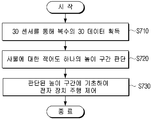
- FIG. 7 is a flowchart of a method for controlling an electronic device according to an embodiment of the present disclosure.
- FIG. 8 is a flowchart of a method of determining a height section for an object existing in a driving direction of the electronic device by using a plurality of 3D data in an electronic device according to an embodiment of the present disclosure.
- expressions such as “A or B,” “at least one of A or/and B,” or “one or more of A or/and B” may include all possible combinations of the items listed together.
- “A or B,” “at least one of A and B,” or “at least one of A or B” includes (1) at least one A, (2) at least one B, Or (3) it may refer to all cases including both at least one A and at least one B.
- Some component eg, a first component
- another component eg, a second component
- the certain component may be directly connected to the other component or may be connected through another component (eg, a third component).
- a component eg, a first component
- the component and the It may be understood that no other component (eg, a third component) exists between the different components.
- a processor configured (or configured) to perform A, B, and C means a dedicated processor (eg, an embedded processor) for performing the operation, or by executing one or more software programs stored in a memory device.
- a generic-purpose processor eg, a CPU or an application processor
- Electronic devices include, for example, smart phones, tablet PCs, mobile phones, video phones, e-book readers, desktop PCs, laptop PCs, netbook computers, workstations, servers, PDAs, and PMPs. It may include at least one of (portable multimedia player), MP3 player, medical device, camera, or wearable device.
- Wearable devices can be accessory types (e.g. watches, rings, bracelets, anklets, necklaces, glasses, contact lenses, or head-mounted-devices (HMD)), fabric or clothing integrals (e.g.
- the electronic device includes, for example, a television, a digital video disk (DVD) player, Audio, refrigerator, air conditioner, vacuum cleaner, oven, microwave, washing machine, air purifier, set-top box, home automation control panel, security control panel, media box (e.g. Samsung HomeSync TM , Apple TV TM , or Google TV TM ) , A game console (eg, Xbox TM , PlayStation TM ), an electronic dictionary, an electronic key, a camcorder, or an electronic frame.
- DVD digital video disk
- the electronic device includes various medical devices (e.g., various portable medical measuring devices (blood glucose meter, heart rate meter, blood pressure meter, or body temperature meter, etc.), magnetic resonance angiography (MRA), magnetic resonance imaging (MRI), CT (computed tomography), camera, or ultrasound), navigation device, global navigation satellite system (GNSS), event data recorder (EDR), flight data recorder (FDR), automobile infotainment device, electronic equipment for ships (E.g., navigation devices for ships, gyro compasses, etc.), avionics, security devices, vehicle head units, industrial or home robots, drones, ATMs in financial institutions, point of sale (POS) in stores. of sales), or IoT devices (eg, light bulbs, various sensors, sprinkler devices, fire alarms, temperature controllers, street lights, toasters, exercise equipment, hot water tanks, heaters, boilers, etc.).
- various medical devices e.g., various portable medical measuring devices (blood glucose meter, heart rate meter, blood pressure meter
- the term user may refer to a person using an electronic device or a device (eg, an artificial intelligence electronic device) using an electronic device.
- a device eg, an artificial intelligence electronic device
- FIG. 1 is a block diagram of an electronic device according to an embodiment of the present disclosure.
- the electronic device 100 is a device capable of autonomous driving.
- the electronic device 100 can be a robot cleaner that identifies surrounding terrain and sets a path, and autonomously travels through the set path to clean the surroundings. have.
- Such an electronic device 100 includes a 3D sensor 110 and a processor 120.
- the 3D sensor 110 is a sensor that acquires a plurality of 3D data by sensing the surrounding environment in the driving direction while the electronic device 100 is traveling.
- the 3D sensor 110 may be a 3D Lidar sensor.
- the 3D lidar sensor is a sensor for safely autonomous driving of electronic devices 100 such as vehicles and robot cleaners by recognizing the surrounding environment in 3D.
- This 3D lidar sensor continuously transmits millions of laser beams per second, The distance can be measured by measuring the time that millions of laser beams transmitted are reflected back to the 3D lidar sensor.
- the processor 120 exists in the direction in which the electronic device 100 is traveling among a plurality of preset height sections using the acquired 3D data. At least one height section for the object to be performed is determined.
- the processor 120 controls the driving of the electronic device 100 based on the determined height section of the object.
- the processor 120 classifies a plurality of 3D data obtained based on a plurality of preset height sections into at least one group. Thereafter, the processor 120 generates a voxel corresponding to each of the classified groups, and generates a voxel map including the generated voxels.
- the voxel map may be a map composed of voxels implemented in the form of a three-dimensional grid of a cube having a height corresponding to each of a plurality of preset height sections.
- a voxel map including such a plurality of voxels will be described in detail below.
- the processor 120 determines a height section for each of the plurality of voxels based on representative values set for each of the plurality of voxels included in the generated voxel map.
- the processor 120 generates, as a voxel, a section including 3D data of a predetermined threshold number or more among a plurality of height sections.
- the processor 120 does not generate voxels by processing a section including 3D data less than or equal to a predetermined threshold number among the plurality of height sections as noise.
- the plurality of height sections is a first section for determining that it is not an object, a second section for determining whether or not an object can pass, a third section for avoiding an object, a fourth section for which some objects can pass, and It may include at least one of the fifth section in which the entire passage is possible.
- the first to fifth sections may be set to a height corresponding to a user command.
- the plurality of height sections may be converted into different types of sensing information and used according to the driving purpose. Accordingly, a plurality of 3D data obtained by planning can be used as various types of virtual sensors.
- the processor 120 controls the electronic device 100 to travel to the front.
- the processor 120 controls the electronic device 100 to avoid and drive.
- the processor 120 determines that the height of the object avoided while driving is less than or equal to the critical height section among the plurality of height sections described above, the processor 120 determines the object from the storage unit 130 based on the 3D data acquired in relation to the object. Obtain information about Thereafter, after the driving around the object is completed, the processor 120 controls to start driving on the object based on information about the object acquired.
- the storage unit 130 stores information on at least one object.
- the information on the at least one object may include at least one of area information and drivable information on each object. Accordingly, as described above, the processor 120 acquires area information on the object based on 3D data on the object determined to be below the threshold height section.
- the processor 120 acquires information related to the area information from the storage unit 130 using the acquired area information, and starts driving on the object determined to be below the threshold height section based on the acquired information. I can.
- FIG. 2 is a detailed block diagram of an electronic device according to an embodiment of the present disclosure.
- the electronic device 100 includes not only the 3D sensor 110 and the processor 120 described above, but also a storage unit 130, an input unit 140, a communication unit 150, and an output unit, as disclosed in FIG. It may further include (160).
- the storage unit 130 may store information on at least one object.
- the information on the object may include at least one of area information on the object and driving information on the object.
- the storage unit 130 may store various operation programs for controlling the operation of the electronic device 100.
- the operating program may be a program that is read from the storage unit 130 and compiled to operate each component of the electronic device 100.
- a storage unit 130 is a ROM, RAM, or a memory card (eg, SD card, memory stick) that can be attached/removed to the electronic device 100, a nonvolatile memory, a volatile memory, a hard disk drive. It may be implemented with at least one of (HDD) or solid state drive (SSD).
- the input unit 140 receives a user command and transmits it to the processor 120.
- the input unit 140 may include a microphone 141, an operation unit 142, a touch input unit 143, and a user input unit 144.
- the microphone 141 may receive a user's voice command.
- the operation unit 142 may be implemented as a keypad including various function keys, numeric keys, special keys, character keys, and the like.
- the touch input unit 143 may be implemented as a touch pad having a rare structure with the display unit 162. In this case, the touch input unit 143 may receive a selection command for various application related icons displayed through the display unit 162.
- the user input unit 144 may receive an IR signal or an RF signal for controlling the operation of the electronic device 100 from a remote control device (not shown).
- the communication unit 150 performs data communication with a peripheral device (not shown) such as a smart TV, a smart phone, and a tablet PC, and an external server (not shown).
- a peripheral device such as a smart TV, a smart phone, and a tablet PC
- an external server not shown
- Such a communication unit 150 includes a short-range communication module 151, a wireless communication module 152 such as a wireless LAN module, a High-Definition Multimedia Interface (HDMI), a Universal Serial Bus (USB), and an Institute of Electrical and Electronics (IEEE). Engineers) may include a connector 153 including at least one of wired communication modules such as 1394.
- a wireless communication module 152 such as a wireless LAN module, a High-Definition Multimedia Interface (HDMI), a Universal Serial Bus (USB), and an Institute of Electrical and Electronics (IEEE). Engineers) may include a connector 153 including at least one of wired communication modules such as 1394.
- HDMI High-Definition Multimedia Interface
- USB Universal Serial Bus
- IEEE Institute of Electrical and Electronics
- Engineers may include a connector 153 including at least one of wired communication modules such as 1394.
- the short-range communication module 151 is a component that wirelessly performs short-range communication with the electronic device 100 and a nearby device located in a short distance.
- a short-range communication module 151 includes at least one of a Bluetooth module, an infrared data association (IrDA) module, a Near Field Communication (NFC) module, a WiFi module, and a Zigbee module. can do.
- the wireless communication module 152 is a module that performs communication by being connected to an external network through a relay device (not shown) according to a wireless communication protocol such as IEEE.
- the wireless communication module further includes a mobile communication module for performing communication by accessing a mobile communication network according to various mobile communication standards such as 3rd Generation (3G), 3rd Generation Partnership Project (3GPP), and Long Term Evolution (LTE). You may.
- 3G 3rd Generation
- 3GPP 3rd Generation Partnership Project
- LTE Long Term Evolution
- the communication unit 150 may be implemented by various short-range communication methods described above, and other communication technologies not mentioned in the present specification may be employed as necessary.
- the connector 153 is a component that provides an interface with various source devices such as USB 2.0, USB 3.0, HDMI, and IEEE 1394.
- Such a connector 153 receives various application data from an external server (not shown) through a wired cable connected to the connector 153 according to a control command of the processor 120 or a wired cable physically connected to the connector 153 Power can be input from the power source through.
- the processor 120 may control the communication unit 150 to transmit the acquired 3D data to an external server (not shown). Thereafter, the processor 120 may receive voxel map related information generated based on a plurality of 3D data from an external server (not shown) through the communication unit 150.
- the output unit 160 outputs at least one of image and audio related data.
- Such an output unit 160 may include a display unit 161 and an audio output unit 162.
- the display unit 161 may display various UI screens for controlling the operation of the electronic device 100 or may display information related to the operation state of the electronic device 100.
- the display unit 161 may be implemented as a liquid crystal display (LCD), an organic light emitting diode (OLED), or the like.
- LCD liquid crystal display
- OLED organic light emitting diode
- the audio output unit 162 may output information related to the operation state of the electronic device 100 in the form of an audible sound.
- the above-described processor 120 may be a processing device capable of controlling the overall operation of the electronic device 100 or controlling the overall operation of the electronic device 100.
- a processor 120 may be implemented as a single-chip system (System-on-a-chip or System on chip, SOC, SoC) by being combined with each of the aforementioned components.
- processor 120 that controls the autonomous driving of the electronic device 100 according to the present disclosure will be described in more detail.
- FIG. 3 is a detailed block diagram of a processor according to an embodiment of the present disclosure.
- the processor 120 includes a 3D data processing unit 310, a voxel map generation unit 320, a voxel map determination unit 330, and a driving unit 340.
- the 3D data processing unit 310 acquires a plurality of 3D data based on sensing information sensed from the 3D sensor 110. Specifically, the 3D data processing unit 310 acquires a plurality of 3D data including each of a plurality of 3D coordinate values based on sensing information detected by the 3D sensor 110.
- the voxel map generation unit 320 classifies a plurality of 3D data acquired through the 3D data processing unit 310 into at least one group based on a plurality of preset height sections, and generates voxels corresponding to each of the classified groups. Then, a voxel map including a plurality of generated voxels is generated.
- the voxel map generator 320 may generate a section including 3D data equal to or greater than a preset threshold number among the plurality of height sections as voxels, and process the section including 3D data less than the preset threshold number as noise. have.
- the present disclosure is not limited thereto, and the voxel map generation unit 320 generates a section including 3D data exceeding a preset threshold number among a plurality of height sections as voxels, and 3D data less than a preset threshold number.
- the section including the can be processed as noise.
- the voxel map generator 320 may generate a voxel map by using the generated voxels.
- the voxel map determination unit 330 determines a height section for each of the plurality of voxels based on a representative value set for each of the plurality of voxels included in the voxel map generated by the voxel map generation unit 320.
- the voxel map determination unit 330 is configured with respect to an object located in front of the electronic device 100. It can be judged that it is possible to ascend.
- the voxel map determination unit 330 determines that the representative value of at least one voxel included in the voxel map is related to the remaining sections other than the first section among the plurality of height sections, the voxel map determination unit 330 is located in the front of the electronic device 100. It can be judged that things should be avoided.
- the present disclosure is not limited thereto, and the voxel map determination unit 330 calculates an average value of z values among 3D coordinate values (x, y, z) of 3D data included in each of the plurality of voxels. It can be set as a representative value.
- a first voxel among a plurality of voxels may include three 3D data, and z values of each of the three 3D data may be 1.5, 1.8, and 1.2.
- the voxel map determination unit 330 may set an average value of 1.5 for z values of each of the three 3D data included in the first voxel as a representative value of the first voxel.
- the voxel map determination unit 330 determines the driving direction of the electronic device 100 based on the representative values set for each of the plurality of voxels, as described above. You can drive.
- the driving unit 340 controls the driving of the electronic device 100 based on the determination result of the voxel map determination unit 330.
- the driving unit 340 ascends the object located in front of the electronic device 100 Control to drive.
- the electronic device 100 may move by moving on an object located in the front.
- the driving unit 340 may avoid an object located in front of the electronic device 100 and drive. Control.
- the electronic device 100 may change the direction to the left or the right with respect to the object located in the front to drive.
- FIG. 4 is an exemplary diagram for generating a voxel map according to an embodiment of the present disclosure.
- the electronic device 100 when a plurality of 3D data is acquired based on the sensing information sensed through the 3D sensor 110, the electronic device 100 is configured based on a plurality of preset height sections. Classify a plurality of acquired 3D data into at least one group.
- the electronic device 100 generates voxels corresponding to each of the classified groups, and generates a voxel map 400 including the generated voxels.
- the voxel map may be a map composed of voxels implemented in the form of a three-dimensional grid of a hexahedron having a height corresponding to each of a plurality of preset height sections.
- each voxel may have a height corresponding to each of a plurality of preset height sections. Accordingly, the electronic device 100 converts at least one 3D data included in the first height section and the first width section among the plurality of 3D data into the first voxel 410 based on 3D coordinate values included in each of the plurality of 3D data. ).
- the electronic device 100 converts at least one 3D data included in the first height section and the second width section among the plurality of 3D data into a second voxel 420 based on 3D coordinate values included in each of the plurality of 3D data. ).
- the first height section may be a section in which the electronic device 100 moves by ascending to an object in front of the traveling direction.
- the electronic device 100 converts at least one 3D data included in the second height section and the first width section among the plurality of 3D data into a third voxel 430 based on 3D coordinate values included in each of the plurality of 3D data. ).
- the electronic device 100 converts at least one 3D data included in the second height section and the second width section among the plurality of 3D data into a fourth voxel 440 based on 3D coordinate values included in each of the plurality of 3D data. ).
- the second height section may be a section in which an object in front of the direction in which the electronic device 100 is traveling is avoided.
- the electronic device 100 processes at least one 3D data classified into the corresponding voxel group as noise. can do.
- the fifth voxel 450 including the third height section and the second width section may include 3D data less than or equal to a preset threshold number.
- the electronic device 100 may process 3D data included in the fifth voxel 450 as noise.
- the electronic device 100 transfers 3D data included in each of the plurality of voxels included in the voxel map 400 to each of the plurality of voxels. Set to the set representative value.
- the electronic device 100 includes 3D coordinates for each of a plurality of 3D data included in the first voxel 410 ′ among a plurality of voxels included in the voxel map 400 ′.
- the value is set as the first representative value set in the first voxel 410'.
- the electronic device 100 stores a 3D coordinate value for each of a plurality of 3D data included in the second voxel 420 ′ among a plurality of voxels included in the voxel map 400 ′ to the second voxel 420 ′. It is set as the set second representative value.
- the electronic device 100 stores a 3D coordinate value for each of a plurality of 3D data included in the third voxel 430 ′ among a plurality of voxels included in the voxel map 400 ′ to the first voxel 430 ′. Set as the set third representative value.
- the electronic device 100 stores a 3D coordinate value for each of the plurality of 3D data included in the fourth voxel 440 ′ among a plurality of voxels included in the voxel map 400 ′ to the fourth voxel 440 ′. It is set as the set 4th representative value.
- the electronic device 100 may optimize the amount of data by setting a plurality of 3D data included in the plurality of voxels as representative values set for each voxel.
- FIG. 5 is an exemplary diagram for determining a voxel map in an electronic device according to an embodiment of the present disclosure.
- FIG. 5A shows the height of an object located in the direction in which the electronic device 100 travels based on the generated voxel map
- FIG. 5B shows a plurality of voxels included in the generated voxel map. This is a voxel table indicating whether or not an object exists for each section.
- the first section 510 is a section in which an object located in the driving direction of the electronic device 100 can be ascended, and on the voxel table of FIG. 5 (b) May be excluded.
- the second section 520 is a section for determining whether or not an object located in the driving direction of the electronic device 100 is ascended, and when an object is detected in the second section 520 from the voxel map, ( In b), it can be displayed in the decision layer of the voxel table.
- the third section 530 is a section for avoiding an object located in the direction in which the electronic device 100 is traveling.
- the voxel is It can be displayed in the Obstacle Layer of the table.
- the fourth section 540 is a section in which an object is in the direction in which the electronic device 100 travels, but the rest of the section except for the 3D sensor 110 attached to the upper surface of the electronic device 100 can pass. In (b) of 5, it can be displayed on the Robot Upper Stuck Layer of the voxel table.
- the fifth section 550 has an object in the direction in which the electronic device 100 travels, but is a section through which the electronic device 100 can pass, and may be displayed on the Lidar Upper Stuck Layer of the voxel table in FIG. 5B. have.
- FIG. 5C is a final travel table for determining the driving of the electronic device 100 based on the voxel table shown in FIG. 5B.
- the robot of the voxel table It can be a map other than the Upper Stuck Layer.
- the electronic device 100 is included in the dotted box 560'.
- "#" may be displayed in the decision layer corresponding to the second section 520.
- the second section 520 is a section in which the electronic device 100 can either climb or avoid.
- the rug and the remote control may have a height included in the second section 520. Therefore, when the object is a rug, the electronic device 100 must travel by passing the rug, and when the object is a remote control, the electronic device 100 must avoid the remote control and travel.
- the electronic device 100 will perform the final driving included in the dotted box 560'.
- "1" is displayed in each of the decision layer corresponding to the second section 520 and the obstacle layer corresponding to the third section 530.
- the electronic device 100 determines whether to carry over or avoid the object related to the first voxel. You can run.
- the electronic device 100 determines that the representative value 570 of the second voxel among the plurality of voxels included in the voxel map is included in the third section 530, the voxel included in the dotted box 570' In the table, "#" is displayed in the decision layer and the obstacle layer corresponding to the second and third sections 520 and 530, respectively.
- the electronic device 100 is applied to the Obstacle Layer of the final driving table included in the dotted line box 570' based on "#" displayed in each of the Decision Layer and Obstacle Layer of the voxel table included in the dotted box 570'. "1" is displayed.
- the electronic device 100 may travel while avoiding the object related to the second voxel.
- "b” displayed in the voxel table of FIG. 5B is a section in which voxels including 3D data less than or less than a preset threshold number are located. Accordingly, the electronic device 100 may display “0” indicating that there is no object in the section corresponding to the section in which the voxel marked “b” is located in the final driving table.
- the electronic device 100 may perform driving by avoiding or ascending an object located in a driving direction based on the final driving table created through this embodiment.
- the electronic device 100 may determine whether to ascend or avoid an object related to the first voxel and drive through the following embodiments.
- FIG. 6 is an exemplary diagram for determining whether an object is driven by an electronic device according to an exemplary embodiment of the present disclosure.
- the electronic device 100 may autonomously drive and clean the interior of the building except for the first to third areas 610 to 630 based on the aforementioned final driving table.
- the first to third areas 610 to 630 are areas where the object is located.
- the object located in the first region 610 has a height included in the second section 520 described in FIG. 5.
- objects located in the second and third regions 620 and 630 each have a height included in the third section 530 described in FIG. 5.
- the electronic device 100 determines whether the object located in the area 610 can be ascended.
- the electronic device 100 measures the area of the object located in the first region 610 by using a representative value for each voxel representing the object located in the first region 610. Thereafter, the electronic device 100 compares the area information included in the previously stored information on the at least one object with the area of the object located in the first region 610 that is measured in advance to determine the object located in the first region 610. Judge.
- the electronic device 100 may move by passing the object located in the first region 610.
- FIG. 7 is a flowchart illustrating a method of controlling an electronic device according to an embodiment of the present disclosure.
- the electronic device 100 acquires a plurality of 3D data through a 3D sensor provided in the electronic device 100 (S710).
- the 3D sensor may be a 3D Lidar sensor in which an electronic device 100 such as a vehicle or a robot cleaner safely autonomously travels by recognizing the surrounding environment in 3D.
- a 3D lidar sensor can continuously transmit millions of laser beams per second, and measure the distance by measuring the time that the transmitted millions of laser beams are reflected and returned to the 3D lidar sensor.
- the electronic device 100 uses the acquired 3D data to determine the direction in which the electronic device 100 travels among a plurality of preset height sections. At least one height section for an existing object is determined (S720).
- the electronic device 100 controls the traveling of the electronic device 100 based on the determined height section of the object (S730).
- FIG. 8 is a flowchart of a method of determining a height section for an object existing in a driving direction of the electronic device by using a plurality of 3D data in an electronic device according to an embodiment of the present disclosure.
- the electronic device 100 classifies a plurality of 3D data obtained based on a plurality of preset height sections into at least one group (S810). Thereafter, the electronic device 100 generates voxels corresponding to each of the classified groups (S820).
- the electronic device 100 When voxels corresponding to each of the classified groups are generated, the electronic device 100 generates a voxel map including the generated voxels (S830).
- the voxel map may be a map composed of voxels implemented in the form of a three-dimensional grid of a hexahedron having a height corresponding to each of a plurality of preset height sections.
- the electronic device 100 determines a height section for each of the plurality of voxels based on representative values set for each of the plurality of voxels included in the voxel map (S840).
- the electronic device 100 may generate, as a voxel, a section including 3D data having a predetermined threshold number or more among a plurality of height sections. Further, the electronic device 100 may not generate voxels by processing a section including 3D data less than or equal to a predetermined threshold number among the plurality of height sections as noise.
- the plurality of height sections is a first section for determining that it is not an object, a second section for determining whether or not an object can pass, a third section for avoiding an object, a fourth section for which some objects can pass, and It may include at least one of the fifth section in which the entire passage is possible.
- step S730 when it is determined in step S730 that the representative value of at least one voxel among the plurality of voxels is related to the first section, the electronic device 100 controls the electronic device 100 to travel to the front.
- the electronic device 100 controls the electronic device 100 to avoid driving.
- the electronic device 100 determines that the height of the object avoided during driving is equal to or less than the threshold height interval among the plurality of height intervals, the electronic device 100 stores the storage unit based on 3D data acquired in relation to the object. Information about the object is obtained from Thereafter, after the driving around the object is completed, the electronic device 100 may control to start driving on the object based on information about the object acquired.
- Various embodiments of the present disclosure may be implemented as software including instructions stored in a machine-readable storage medium (eg, a computer).
- the device receives instructions stored from the storage medium.
- a device capable of making a call and operating according to the called command may include an electronic device (eg, the electronic device 100) according to the disclosed embodiments.
- the command When the command is executed by a processor, the processor directly, Alternatively, a function corresponding to the command may be performed using other components under the control of the processor, and the command may include a code generated or executed by a compiler or an interpreter.
- the method according to various embodiments disclosed in the present document may be provided by being included in a computer program product.
- Computer program products can be traded between sellers and buyers as commodities.
- the computer program product may be distributed online in the form of a device-readable storage medium (eg, compact disc read only memory (CD-ROM)) or through an application store (eg, Play StoreTM).
- CD-ROM compact disc read only memory
- application store eg, Play StoreTM
- at least some of the computer program products may be temporarily stored or temporarily generated in a storage medium such as a server of a manufacturer, a server of an application store, or a memory of a relay server.
- Each of the constituent elements may be composed of a singular or a plurality of entities, and some sub-elements among the aforementioned sub-elements are omitted, or other sub-elements are It may be further included in various embodiments.
- some constituent elements eg, a module or a program
Landscapes
- Engineering & Computer Science (AREA)
- Physics & Mathematics (AREA)
- Radar, Positioning & Navigation (AREA)
- General Physics & Mathematics (AREA)
- Automation & Control Theory (AREA)
- Remote Sensing (AREA)
- Aviation & Aerospace Engineering (AREA)
- Electromagnetism (AREA)
- Computer Vision & Pattern Recognition (AREA)
- Multimedia (AREA)
- Optics & Photonics (AREA)
- Mechanical Engineering (AREA)
- Robotics (AREA)
- Theoretical Computer Science (AREA)
- Control Of Position, Course, Altitude, Or Attitude Of Moving Bodies (AREA)
- Traffic Control Systems (AREA)
Abstract
La présente invention concerne un dispositif électronique et un procédé de commande associé. Le procédé de commande pour le dispositif électronique selon la présente invention comprend les étapes suivantes : l'acquisition d'une pluralité d'éléments de données 3D sur la base d'informations de détection détectées par l'intermédiaire d'un capteur 3D alors que le dispositif électronique effectue une excitation ; la détermination, à l'aide de la pluralité acquise d'éléments de données 3D, d'au moins une section de hauteur pour un objet existant dans la direction dans laquelle le dispositif électronique effectue une excitation, parmi une pluralité de sections de hauteur prédéfinies ; et la commande de l'excitation du dispositif électronique sur la base de la section de hauteur déterminée pour l'objet.
Priority Applications (1)
| Application Number | Priority Date | Filing Date | Title |
|---|---|---|---|
| US17/290,886 US20220004198A1 (en) | 2019-04-05 | 2020-02-20 | Electronic device and control method therefor |
Applications Claiming Priority (2)
| Application Number | Priority Date | Filing Date | Title |
|---|---|---|---|
| KR10-2019-0040407 | 2019-04-05 | ||
| KR1020190040407A KR102761443B1 (ko) | 2019-04-05 | 2019-04-05 | 전자 장치 및 그 제어 방법 |
Publications (1)
| Publication Number | Publication Date |
|---|---|
| WO2020204355A1 true WO2020204355A1 (fr) | 2020-10-08 |
Family
ID=72666387
Family Applications (1)
| Application Number | Title | Priority Date | Filing Date |
|---|---|---|---|
| PCT/KR2020/002487 Ceased WO2020204355A1 (fr) | 2019-04-05 | 2020-02-20 | Dispositif électronique et son procédé de commande |
Country Status (3)
| Country | Link |
|---|---|
| US (1) | US20220004198A1 (fr) |
| KR (1) | KR102761443B1 (fr) |
| WO (1) | WO2020204355A1 (fr) |
Families Citing this family (4)
| Publication number | Priority date | Publication date | Assignee | Title |
|---|---|---|---|---|
| KR20210130478A (ko) | 2020-04-22 | 2021-11-01 | 삼성전자주식회사 | 로봇 청소기 및 그 제어 방법 |
| US11977392B2 (en) * | 2020-05-11 | 2024-05-07 | Mobile Industrial Robots Inc. | Identifying elements in an environment |
| CN117008597A (zh) * | 2023-01-03 | 2023-11-07 | 北京石头创新科技有限公司 | 用于自移动机器人的避障方法及装置 |
| US12499619B2 (en) * | 2023-05-26 | 2025-12-16 | Kubota Corporation | Obstacle detection system and method |
Citations (5)
| Publication number | Priority date | Publication date | Assignee | Title |
|---|---|---|---|---|
| KR20160100149A (ko) * | 2015-02-13 | 2016-08-23 | 삼성전자주식회사 | 청소 로봇 및 그 제어방법 |
| US20160313741A1 (en) * | 2013-12-19 | 2016-10-27 | Aktiebolaget Electrolux | Prioritizing cleaning areas |
| KR20180087769A (ko) * | 2017-01-25 | 2018-08-02 | 엘지전자 주식회사 | 3차원 공간에서 기능 영역을 식별하는 방법 및 이를 구현하는 로봇 |
| KR101907883B1 (ko) * | 2017-05-10 | 2018-10-16 | 국방과학연구소 | 객체 검출 및 분류 방법 |
| US20180364717A1 (en) * | 2017-06-14 | 2018-12-20 | Zoox, Inc. | Voxel Based Ground Plane Estimation and Object Segmentation |
Family Cites Families (2)
| Publication number | Priority date | Publication date | Assignee | Title |
|---|---|---|---|---|
| KR101700764B1 (ko) * | 2011-06-29 | 2017-01-31 | 엘지전자 주식회사 | 자율 이동 방법 및 그 장치 |
| KR102326077B1 (ko) * | 2017-06-15 | 2021-11-12 | 엘지전자 주식회사 | 3차원 공간의 이동 객체를 식별하는 방법 및 이를 구현하는 로봇 |
-
2019
- 2019-04-05 KR KR1020190040407A patent/KR102761443B1/ko active Active
-
2020
- 2020-02-20 US US17/290,886 patent/US20220004198A1/en not_active Abandoned
- 2020-02-20 WO PCT/KR2020/002487 patent/WO2020204355A1/fr not_active Ceased
Patent Citations (5)
| Publication number | Priority date | Publication date | Assignee | Title |
|---|---|---|---|---|
| US20160313741A1 (en) * | 2013-12-19 | 2016-10-27 | Aktiebolaget Electrolux | Prioritizing cleaning areas |
| KR20160100149A (ko) * | 2015-02-13 | 2016-08-23 | 삼성전자주식회사 | 청소 로봇 및 그 제어방법 |
| KR20180087769A (ko) * | 2017-01-25 | 2018-08-02 | 엘지전자 주식회사 | 3차원 공간에서 기능 영역을 식별하는 방법 및 이를 구현하는 로봇 |
| KR101907883B1 (ko) * | 2017-05-10 | 2018-10-16 | 국방과학연구소 | 객체 검출 및 분류 방법 |
| US20180364717A1 (en) * | 2017-06-14 | 2018-12-20 | Zoox, Inc. | Voxel Based Ground Plane Estimation and Object Segmentation |
Also Published As
| Publication number | Publication date |
|---|---|
| US20220004198A1 (en) | 2022-01-06 |
| KR102761443B1 (ko) | 2025-02-05 |
| KR20200117772A (ko) | 2020-10-14 |
Similar Documents
| Publication | Publication Date | Title |
|---|---|---|
| WO2020204355A1 (fr) | Dispositif électronique et son procédé de commande | |
| AU2014297039B2 (en) | Auto-cleaning system, cleaning robot and method of controlling the cleaning robot | |
| WO2019098797A1 (fr) | Appareil et procédé de fourniture de rétroaction haptique par l'intermédiaire d'un dispositif portable | |
| WO2018009029A1 (fr) | Dispositif électronique et son procédé de fonctionnement | |
| WO2018043966A1 (fr) | Robot nettoyeur, dispositif terminal et procédé de commande associé | |
| WO2020055112A1 (fr) | Dispositif électronique, et procédé pour l'identification d'une position par un dispositif électronique | |
| WO2016137294A1 (fr) | Dispositif électronique et son procédé de commande | |
| WO2021221490A1 (fr) | Système et procédé de compréhension fiable d'interrogations d'images basée sur des caractéristiques contextuelles | |
| WO2018143509A1 (fr) | Robot mobile et son procédé de commande | |
| WO2017065535A1 (fr) | Dispositif électronique et son procédé de commande | |
| WO2023287103A1 (fr) | Dispositif électronique pour commander un robot de nettoyage, et son procédé de fonctionnement | |
| WO2022035054A1 (fr) | Robot et son procédé de commande | |
| WO2017150815A1 (fr) | Procédé de commande de luminosité d'affichage, dispositif électronique et support d'enregistrement lisible par ordinateur | |
| WO2019190171A1 (fr) | Dispositif électronique et procédé de commande associé | |
| WO2019172642A1 (fr) | Dispositif électronique et procédé pour mesurer la fréquence cardiaque | |
| WO2020130299A1 (fr) | Appareil électronique et procédé de commande de celui-ci | |
| WO2020096255A1 (fr) | Appareil électronique et son procédé de commande | |
| WO2022186598A1 (fr) | Robot nettoyeur et son procédé de commande | |
| WO2020209618A1 (fr) | Dispositif électronique et procédé de fourniture d'informations pour soulager le stress par ce dernier | |
| WO2021251652A1 (fr) | Appareil et procédé d'analyse vidéo | |
| WO2020166796A1 (fr) | Dispositif électronique et procédé de commande associé | |
| WO2022055117A1 (fr) | Dispositif électronique et son procédé de commande | |
| WO2022086161A1 (fr) | Robot et procédé de commande associé | |
| WO2021215668A1 (fr) | Dispositif robot et son procédé de commande | |
| WO2020171572A1 (fr) | Appareil électronique et procédé de commande de celui-ci |
Legal Events
| Date | Code | Title | Description |
|---|---|---|---|
| 121 | Ep: the epo has been informed by wipo that ep was designated in this application |
Ref document number: 20782855 Country of ref document: EP Kind code of ref document: A1 |
|
| NENP | Non-entry into the national phase |
Ref country code: DE |
|
| 122 | Ep: pct application non-entry in european phase |
Ref document number: 20782855 Country of ref document: EP Kind code of ref document: A1 |