WO2020213716A1 - 光学材料、光学材料用重合性組成物、硬化物、光学材料、プラスチックレンズ、光学材料の製造方法及び使用方法 - Google Patents
光学材料、光学材料用重合性組成物、硬化物、光学材料、プラスチックレンズ、光学材料の製造方法及び使用方法 Download PDFInfo
- Publication number
- WO2020213716A1 WO2020213716A1 PCT/JP2020/016889 JP2020016889W WO2020213716A1 WO 2020213716 A1 WO2020213716 A1 WO 2020213716A1 JP 2020016889 W JP2020016889 W JP 2020016889W WO 2020213716 A1 WO2020213716 A1 WO 2020213716A1
- Authority
- WO
- WIPO (PCT)
- Prior art keywords
- optical material
- group
- lens
- material according
- ppm
- Prior art date
- Legal status (The legal status is an assumption and is not a legal conclusion. Google has not performed a legal analysis and makes no representation as to the accuracy of the status listed.)
- Ceased
Links
Images


Classifications
-
- G—PHYSICS
- G02—OPTICS
- G02C—SPECTACLES; SUNGLASSES OR GOGGLES INSOFAR AS THEY HAVE THE SAME FEATURES AS SPECTACLES; CONTACT LENSES
- G02C7/00—Optical parts
- G02C7/10—Filters, e.g. for facilitating adaptation of the eyes to the dark; Sunglasses
- G02C7/104—Filters, e.g. for facilitating adaptation of the eyes to the dark; Sunglasses having spectral characteristics for purposes other than sun-protection
-
- C—CHEMISTRY; METALLURGY
- C08—ORGANIC MACROMOLECULAR COMPOUNDS; THEIR PREPARATION OR CHEMICAL WORKING-UP; COMPOSITIONS BASED THEREON
- C08G—MACROMOLECULAR COMPOUNDS OBTAINED OTHERWISE THAN BY REACTIONS ONLY INVOLVING UNSATURATED CARBON-TO-CARBON BONDS
- C08G18/00—Polymeric products of isocyanates or isothiocyanates
- C08G18/06—Polymeric products of isocyanates or isothiocyanates with compounds having active hydrogen
- C08G18/28—Polymeric products of isocyanates or isothiocyanates with compounds having active hydrogen characterised by the compounds used containing active hydrogen
- C08G18/30—Low-molecular-weight compounds
- C08G18/38—Low-molecular-weight compounds having heteroatoms other than oxygen
- C08G18/3855—Low-molecular-weight compounds having heteroatoms other than oxygen having sulfur
- C08G18/3876—Low-molecular-weight compounds having heteroatoms other than oxygen having sulfur containing mercapto groups
-
- C—CHEMISTRY; METALLURGY
- C08—ORGANIC MACROMOLECULAR COMPOUNDS; THEIR PREPARATION OR CHEMICAL WORKING-UP; COMPOSITIONS BASED THEREON
- C08G—MACROMOLECULAR COMPOUNDS OBTAINED OTHERWISE THAN BY REACTIONS ONLY INVOLVING UNSATURATED CARBON-TO-CARBON BONDS
- C08G18/00—Polymeric products of isocyanates or isothiocyanates
- C08G18/06—Polymeric products of isocyanates or isothiocyanates with compounds having active hydrogen
- C08G18/70—Polymeric products of isocyanates or isothiocyanates with compounds having active hydrogen characterised by the isocyanates or isothiocyanates used
- C08G18/72—Polyisocyanates or polyisothiocyanates
- C08G18/74—Polyisocyanates or polyisothiocyanates cyclic
- C08G18/75—Polyisocyanates or polyisothiocyanates cyclic cycloaliphatic
- C08G18/758—Polyisocyanates or polyisothiocyanates cyclic cycloaliphatic containing two or more cycloaliphatic rings
-
- C—CHEMISTRY; METALLURGY
- C08—ORGANIC MACROMOLECULAR COMPOUNDS; THEIR PREPARATION OR CHEMICAL WORKING-UP; COMPOSITIONS BASED THEREON
- C08K—Use of inorganic or non-macromolecular organic substances as compounding ingredients
- C08K5/00—Use of organic ingredients
- C08K5/0008—Organic ingredients according to more than one of the "one dot" groups of C08K5/01 - C08K5/59
- C08K5/0041—Optical brightening agents, organic pigments
-
- C—CHEMISTRY; METALLURGY
- C08—ORGANIC MACROMOLECULAR COMPOUNDS; THEIR PREPARATION OR CHEMICAL WORKING-UP; COMPOSITIONS BASED THEREON
- C08K—Use of inorganic or non-macromolecular organic substances as compounding ingredients
- C08K5/00—Use of organic ingredients
- C08K5/0091—Complexes with metal-heteroatom-bonds
-
- G—PHYSICS
- G02—OPTICS
- G02B—OPTICAL ELEMENTS, SYSTEMS OR APPARATUS
- G02B5/00—Optical elements other than lenses
- G02B5/20—Filters
- G02B5/22—Absorbing filters
-
- G—PHYSICS
- G02—OPTICS
- G02B—OPTICAL ELEMENTS, SYSTEMS OR APPARATUS
- G02B5/00—Optical elements other than lenses
- G02B5/20—Filters
- G02B5/22—Absorbing filters
- G02B5/223—Absorbing filters containing organic substances, e.g. dyes, inks or pigments
-
- G—PHYSICS
- G02—OPTICS
- G02C—SPECTACLES; SUNGLASSES OR GOGGLES INSOFAR AS THEY HAVE THE SAME FEATURES AS SPECTACLES; CONTACT LENSES
- G02C7/00—Optical parts
- G02C7/10—Filters, e.g. for facilitating adaptation of the eyes to the dark; Sunglasses
- G02C7/108—Colouring materials
Definitions
- the present disclosure relates to an optical material, a polymerizable composition for an optical material, a cured product, an optical material, a plastic lens, and a method for manufacturing and using the optical material.
- Plastic lenses are lighter than inorganic lenses, are hard to break, and can be dyed, so they are rapidly becoming widespread in optical materials such as spectacle lenses and camera lenses.
- a lens having improved visibility of an object or an image by suppressing the transmission of light having a specific wavelength and a spectacle lens having an effect on the eye have been developed.
- Patent Document 1 discloses an antiglare lens containing a porphyrin compound.
- Patent Document 2 discloses an spectacle lens containing a porphyrin compound, and describes that the lens has excellent contrast.
- Patent Document 3 discloses a lens containing a porphyrin compound having a specific transmittance curve. The document describes that the lens has excellent visibility of an object at night.
- Patent Document 1 Japanese Patent Application Laid-Open No. 2013-238634
- Patent Document 2 Japanese Patent Application Laid-Open No. 2011-237730
- Patent Document 3 International Publication No. 2015/0376227
- ipRGC intrinsicly photosensitive retinal ganglion cell
- ipRGC strongly reacts to blue component light in the wavelength range of 450 to 500 nm
- eyewear such as eyeglasses and sunglasses having a lens having a low transmittance of blue component light in the wavelength range of 450 to 500 nm. It is expected to be effective in preventing and reducing migraine in people.
- a lens having a low transmittance of blue component light in a wavelength range of 450 to 500 nm is yellowish in appearance, there is also a need for a lens having a natural hue for the user.
- migraine due to photosensitivity can be reduced by setting the transmittance of blue component light in the wavelength range of 450 to 500 nm within a predetermined range, and have completed the invention of the present disclosure. .. That is, the invention of the present disclosure can be shown below.
- the transmittance curve measured with a thickness of 2 mm satisfies the following characteristics (1) to (2), and the hue in the CIE1976 (L *, a *, b *) color space satisfies the following characteristics (3).
- Optical material (1) It has a maximum transmittance at a wavelength of 400 nm to 450 nm or 520 nm to 570 nm, and has a maximum transmittance at a wavelength of 400 nm to 450 nm and a transmittance at 520 nm to 570 nm of 50% or more.
- the hue in the CIE1976 (L *, a *, b *) color space is 2.5 or more and 5.5 or less for a *, and 5 or more and 25 or less for b *.
- X 1 to X 8 each independently have a hydrogen atom, a linear or branched alkyl group, an ethynyl group, an ethynyl group substituted with a linear or branched alkyl group, and a phenyl group. Represents an ethynyl group or an ethynyl group having a phenyl group substituted with a linear or branched alkyl group. However, no all X 1 ⁇ X 8 are hydrogen atoms.
- R 1 to R 4 independently represent a hydrogen atom or a linear or branched alkyl group
- M is a two hydrogen atom, a divalent metal atom, a trivalent substitution metal atom, or a tetravalent substitution.
- a polymerizable composition for an optical material which comprises.
- X 1 to X 8 each independently have a hydrogen atom, a linear or branched alkyl group, an ethynyl group, an ethynyl group substituted with a linear or branched alkyl group, and a phenyl group. Represents an ethynyl group or an ethynyl group having a phenyl group substituted with a linear or branched alkyl group. However, no all X 1 ⁇ X 8 are hydrogen atoms.
- R 1 to R 4 independently represent a hydrogen atom or a linear or branched alkyl group
- M is a two hydrogen atom, a divalent metal atom, a trivalent substitution metal atom, or a tetravalent substitution.
- the organic dye (C) contains at least one selected from the porphyrin compounds represented by the following formulas (1-1) and the following formula (1-2). Polymerizable composition for materials.
- the isocyanate compound (A) contains at least one selected from an aliphatic isocyanate compound, an alicyclic isocyanate compound, an aromatic isocyanate compound, a heterocyclic isocyanate compound, and an aromatic aliphatic isocyanate compound [8]. ] Or [9].
- the isocyanate compound (A) is xylene diisocyanate, phenylenedi isocyanate, tolylene diisocyanate, diphenylmethane diisocyanate, 2,5-bis (isocyanatomethyl) bicyclo- [2.2.1] -heptane, 2,6-.
- the polythiol compound is 5,7-dimercaptomethyl-1,11-dimercapto-3,6,9-trithiandecan, 4,7-dimercaptomethyl-1,11-dimercapto-3,6.
- the organic dye (C) is contained in any of [8] to [12], which is contained in 100 parts by mass of the polymerizable composition for an optical material in an amount of 0.0005 to 0.0050 parts by mass.
- a method for producing an optical material which comprises a step of casting and polymerizing the polymerizable composition for an optical material according to any one of [8] to [13].
- the transmittance of blue component light in the wavelength range of 450 to 500 nm is low, and migraine due to photosensitivity can be reduced.
- the transmittance curve of the plano lens obtained in Example 1 is shown.
- the transmittance curve of the plano lens obtained in Example 2 is shown.
- the numerical range represented by using "-" means a range including the numerical values before and after "-" as the lower limit value and the upper limit value.
- the amount of each component in the composition is the total amount of the plurality of substances present in the composition unless otherwise specified, when a plurality of substances corresponding to each component are present in the composition. means.
- the upper limit value or the lower limit value described in one numerical range may be replaced with the upper limit value or the lower limit value of another numerical range described stepwise. ..
- the upper limit value or the lower limit value of the numerical range may be replaced with the value shown in the examples.
- optical material of the present disclosure will be specifically described according to the embodiment.
- the transmittance curve measured at a thickness of 2 mm satisfies the following characteristics (1) to (2), and the optical material has a thickness of 2 mm in a CIE1976 (L *, a *, b *) color space.
- the hue satisfies the following characteristic (3).
- the transmittance of 520 nm to 570 nm is 50% or more, preferably 60% or more
- the transmittance is 50% or more, preferably 60% or more in all wavelength ranges of 520 nm to 570 nm.
- It has a minimum value of transmittance at a wavelength of 470 nm to 500 nm, and the minimum value is 40% or less, preferably 30% or less.
- the hue in the CIE1976 (L *, a *, b *) color space is 2.5 or more and 5.5 or less for a *, preferably 2.8 or more and 4.5 or less, and more preferably 3.0 or more.
- b * is 5 or more and 25 or less, preferably 13 or more and 22 or less, and more preferably 15 or more and 22 or less.
- the optical material of the present embodiment can reduce migraine when the transmittance curve and hue satisfy the above ranges.
- the optical material of the present embodiment preferably satisfies the following property (4).
- (4) YI (YellowIndex) is 25 or more and 45 or less, preferably 30 or more and 42 or less.
- the optical material of the present embodiment is also excellent in hue.
- the optical material of the present embodiment is not particularly limited in the components contained in the optical material as long as the above characteristics (1) to (3) and further the characteristics (4) can be satisfied, and can be used for the optical material. Ingredients can be used.
- the optical material of the present embodiment preferably contains, for example, an organic dye.
- Organic dye preferably contains, for example, at least one selected from the porphyrin compounds represented by the following general formula (1) from the viewpoint of the effect in the present disclosure.
- X 1 to X 8 independently have a hydrogen atom, a linear or branched alkyl group, an ethynyl group, an ethynyl group substituted with a linear or branched alkyl group, and an ethynyl having a phenyl group.
- no all X 1 ⁇ X 8 are hydrogen atoms.
- R 1 to R 4 independently represent a hydrogen atom or a linear or branched alkyl group
- M is a two hydrogen atom, a divalent metal atom, a trivalent substitution metal atom, or a tetravalent substitution.
- examples of the substituent of the substituted ethynyl group include an alkyl group and a substituted or unsubstituted phenyl group, respectively.
- X 1 to X 8 are preferably independently of a hydrogen atom, a linear or branched alkyl group having 1 to 12 carbon atoms, and a linear or branched alkyl group having 1 to 12 carbon atoms.
- no all X 1 ⁇ X 8 are hydrogen atoms.
- R 1 to R 4 are preferably independent hydrogen atoms or linear or branched alkyl groups having 1 to 8 carbon atoms.
- M is preferably Cu, Zn, Fe, Co, Ni, Pt, Pd, Mn, Mg, Mn (OH), Mn (OH) 2 , VO, or TiO.
- X 1 to X 8 are independently substituted with a hydrogen atom, a linear or branched alkyl group having 1 to 8 carbon atoms, or a linear or branched alkyl group having 1 to 8 carbon atoms. , Or an ethynyl group having a phenyl group substituted with a linear or branched alkyl group having 1 to 6 carbon atoms.
- M is more preferably Cu, Pt, Pd, Ni or VO, and more preferably Ni or Pd.
- X 1 to X 8 are linear or branched alkyl groups
- the linear or branched alkyl groups include methyl group, ethyl group, n-propyl group, isopropyl group, n-butyl group, isobutyl group and tert.
- n-pentyl group isopentyl group, neopentyl group, tert-pentyl group, 1,2-dimethylpropyl group, 1-methylbutyl group, 2-methylbutyl group, n-hexyl group, 2-methylpentyl group, 4 -Methylpentyl group, 4-methyl-2-pentyl group, 1,2-dimethylbutyl group, 2,3-dimethylbutyl group, 2-ethylbutyl group, n-heptyl group, 3-methylhexyl group, 5-methylhexyl Groups, 2,4-dimethylpentyl group, n-octyl group, tert-octyl group, 2-ethylhexyl group, 2-propylpentyl group, 2,5-dimethylhexyl group and the like.
- the substituted ethynyl groups include methyl group, ethyl group, n-propyl group, isopropyl group, n-butyl group, isobutyl group, tert-butyl group and n-pentyl group.
- R 1 to R 4 are linear or branched alkyl groups
- the linear or branched alkyl groups include methyl group, ethyl group, n-propyl group, isopropyl group, n-butyl group, isobutyl group and tert.
- n-pentyl group isopentyl group, neopentyl group, tert-pentyl group, 1,2-dimethylpropyl group, 1-methylbutyl group, 2-methylbutyl group, n-hexyl group, 2-methylpentyl group, 4 -Methylpentyl group, 4-methyl-2-pentyl group, 1,2-dimethylbutyl group, 2,3-dimethylbutyl group, 2-ethylbutyl group, n-heptyl group, 3-methylhexyl group, 5-methylhexyl Groups, 2,4-dimethylpentyl group, n-octyl group, tert-octyl group, 2-ethylhexyl group, 2-propylpentyl group, 2,5-dimethylhexyl group and the like.
- methyl group, ethyl group, n-propyl group, isopropyl group, n-butyl group, isobutyl group, tert-butyl group, n-pentyl group, isopentyl group, neopentyl group, 1,2-dimethylpropyl group , 1-Methylbutyl group, n-hexyl group, 1,2-dimethylbutyl group, 2-ethylbutyl group, n-heptyl group, n-octyl group, 2-ethylhexyl group are preferable, and methyl group, ethyl group, n-propyl group.
- n-octyl group is more preferable.
- Such a porphyrin-based compound used in the optical material of the present embodiment can satisfy the above-mentioned properties (1) to (3) and further properties (4), and can reduce migraine due to photosensitivity. ..
- the porphyrin-based compound used in the optical material of the present embodiment can be produced by referring to a method known per se. That is, the compounds represented by the general formula (1) are, for example, the compounds represented by the general formulas (a-1) to (a-4) and the compounds represented by the general formulas (b-1) to (b-).
- the compound represented by 4) is subjected to dehydration condensation reaction and oxidation (for example, 2,3-dichloro-5,6-dicyano) with an acid catalyst (for example, propionic acid, boron trifluoride ethyl ether complex, trifluoroacetic acid).
- an acid catalyst for example, propionic acid, boron trifluoride ethyl ether complex, trifluoroacetic acid.
- X 1 to X 8 and R 1 to R 4 have the same meanings as in the case of the general formula (1).
- the porphyrin-based compound represented by the general formula (1) actually represents one or a mixture of two or more isomers. In describing the structure of such a mixture composed of a plurality of isomers, for convenience, for convenience, for example, one structural formula represented by the general formula (1) is described.
- the porphyrin compound in the present disclosure has a maximum absorption peak in the wavelength range of 470 nm to 500 nm in the absorption spectrum measured at an optical path length of 10 mm in a concentration of 0.01 g / L chloroform solution from the viewpoint of the effect in the present disclosure.
- the porphyrin-based compound is preferably a compound represented by the following formula (1-1) or the following formula (1-2).
- the porphyrin-based compound can be a mixture composed of one or more isomers. Further, if desired, each isomer can be separated from the mixture, one of the isomers can be used, and a plurality of isomers having an arbitrary ratio can be used in combination.
- the porphyrin-based compound according to the present embodiment includes not only crystals but also amorphous compounds.
- the amount of the organic dye contained in the optical material is not particularly limited as long as it satisfies the above characteristics, but from the viewpoint of the effect in the present disclosure, the optical material of the present embodiment preferably contains 5 ppm to 50 ppm of the organic dye. Can be contained in an amount of 10 ppm to 25 ppm, more preferably 12 ppm to 22 ppm. In the present disclosure, "ppm" is based on mass.
- the optical material of the present embodiment can contain the porphyrin compound represented by the general formula (1) in an amount of 5 ppm to 50 ppm, preferably 10 ppm to 25 ppm, more preferably 12 ppm to 22 ppm.
- the optical material of the present embodiment has the characteristics (1) to (3) measured at a thickness of 2 mm, and more preferably the characteristics (4).
- the optical material of the present embodiment preferably contains at least one selected from the porphyrin compounds represented by the general formula (1) as the organic dye.
- the organic dye one kind of porphyrin compound may be used alone, or two or more kinds may be used in combination.
- the optical material of the present embodiment preferably further contains a color tone adjusting agent.
- a color tone adjusting agent a conventionally known color tone adjusting agent can be selected and used as long as the effects in the present disclosure can be obtained.
- the color tone adjusting agent include anthraquinone dyes, perinone dyes, monoazo dyes, diazo dyes, phthalocyanine dyes and the like, and one type or a combination of two or more types can be used.
- Solvent Blue 36 (1,4-bis (isopropylamino) anthracene-9,10-dione), Solvent Blue 63 (1- (methylamino) -4- (m-tolylamino) anthracene-9, 10-dione), Solvent Blue 94 (1-amino-2-bromo-4- (phenylamino) anthracene-9,10-dione), Solvent Blue 97 (1,4-bis ((2,6-diethyl-4)) -Methylphenyl) amino) anthracene-9,10-dione), Solvent Blue 104 (1,4-bis (mesitylamino) anthracene-9,10-dione), Solvent Violet 13 (1-hydroxy-4- (p-tolylamino)) ) Anthracene-9,10-dione), Solvent Violet 13 (1,5-bis (p-trillamino) anthracene-9,10-dione),
- perinone dyes examples include Solvent Orange 60 (12H-isoindro [2,1-a] perimidine-12-on), Solvent Orange 78, Solvent Orange 90, and Solvent Red 135 (8,9,10,11-tetrachloro-). 12H-isoindro [2,1-a] perimidine-12-one), Solvent Red 162, Solvent Red 179 (14H-benzo [4,5] isoquinolino [2,1-a] perimidine-14-one), etc. be able to.
- Examples of the monoazo dye include Solvent Red 195, Fast Orange R, Oil Red, Oil Yellow and the like.
- a diazo dye Chicago Sky Blue 6B (sodium 6,6'-((1E, 1'E)-(3,3'-dimethoxy- [1,1'-biphenyl] -4,4'-diyl)) Bis (diazen-2,1-diyl)) Bis (4-amino-5-hydroxynaphthalene-1,3-disulfonate)), Evans blue (Sodium 6,6'-((1E, 1'E)-((1E, 1'E)-( 3,3'-dimethyl- [1,1'-biphenyl] -4,4'-diyl) bis (diazen-2,1-diyl)) bis (4-amino-5-hydroxynaphthalene-1,3-diyl) Sulfonate)), Direct Blue 15 (Sodium 3,3'-((1E, 1'E)
- Solvent Blue 94 preferably, Solvent Blue 97, Solvent Blue 104, Solvent Violet 59, Solvent Red 195, Disperse Red 60, Solvent GreenPlen 28, Sol It is Blue 8514 or Last Red 8320, and more preferably Last Blue 8514 or Last Red 8320.
- Solvent Blue 94 preferably, Solvent Blue 94, Solvent Blue 97, Solvent Blue 104, Solvent Violet 59, Solvent Red 195, Disperse Red 60, Solvent GreenPlen 28, Sol It is Blue 8514 or Last Red 8320, and more preferably Last Blue 8514 or Last Red 8320.
- Solvent Blue 94 preferably, Solvent Blue 97, Solvent Blue 104, Solvent Violet 59, Solvent Red 195, Disperse Red 60, Solvent GreenPlen 28, Sol It is Blue 8514 or Last Red 8320, and more preferably Last Blue 8514 or Last Red 8320.
- the optical material of the present embodiment may contain an organic dye in the above amount and a color tone adjusting agent of 3 ppm or more and 20 ppm or less, preferably 5 ppm or more and 15 ppm or less. As a result, the optical material of the present embodiment is also excellent in hue.
- the optical material of the present embodiment preferably further contains a resin.
- the resin is not particularly limited as long as it can exhibit the effects in the present disclosure, and can be selected from known transparent resins that can be used as optical materials.
- the resin examples include poly (thio) urethane, poly (thio) urethane urea, polysulfide, polycarbonate, poly (meth) acrylate, polyolefin, and the like, and poly (thio) urethane or poly (thio) is preferable.
- Urethane urea At least one resin selected from these can be used.
- composition used for preparing the optical material will be described.
- a polymerizable composition used for preparing an optical material containing poly (thio) urethane or poly (thio) urethane urea as a resin will be described.
- the polymerizable composition for an optical material of the present embodiment is (A) Isocyanate compound and (B) At least one selected from the group consisting of a polythiol compound having two or more mercapto groups, a hydroxythiol compound having one or more mercapto groups and one or more hydroxyl groups, a polyol compound having two or more hydroxyl groups, and an amine compound.
- Seed active hydrogen compounds and (C) Includes an organic dye containing at least one selected from the porphyrin compounds represented by the general formula (1).
- the organic dye (C) the above-mentioned organic dye can be used.
- the amount of the organic dye (C) contained in the optical material is not particularly limited as long as it satisfies the above characteristics, but from the viewpoint of the effect in the present disclosure, the polymerizable composition for an optical material of the present embodiment may be used.
- the organic dye can be contained in an amount of 5 ppm to 50 ppm, preferably 10 ppm to 25 ppm, more preferably 12 ppm to 22 ppm.
- the polymerizable composition for an optical material of the present embodiment can contain the porphyrin compound represented by the general formula (1) in an amount of 5 ppm to 50 ppm, preferably 10 ppm to 25 ppm, more preferably 12 ppm to 22 ppm. ..
- the polymerizable composition for an optical material of the present embodiment further contains a color tone adjusting agent (D).
- a color tone adjusting agent D
- the above-mentioned color tone adjusting agent can be used.
- the polymerizable composition for an optical material of the present embodiment may contain an organic dye in the above amount and a color tone adjusting agent of 3 ppm or more and 20 ppm or less, preferably 5 ppm or more and 15 ppm or less.
- a color tone adjusting agent of 3 ppm or more and 20 ppm or less, preferably 5 ppm or more and 15 ppm or less.
- isocyanate compound (A) examples include an aliphatic isocyanate compound, an alicyclic isocyanate compound, an aromatic isocyanate compound, a heterocyclic isocyanate compound, and an aromatic aliphatic isocyanate compound, and one or a mixture of two or more thereof is used. .. These isocyanate compounds may include dimers, trimers and prepolymers. Examples of these isocyanate compounds include the compounds exemplified in WO2011 / 055540.
- the isocyanate compound (A) is xylene diisocyanate, phenylenedi isocyanate, tolylene diisocyanate, diphenylmethane diisocyanate, 2,5-bis (isocyanatomethyl) bicyclo- [2.2.
- the active hydrogen compound (B) is a polythiol compound having two or more mercapto groups, a hydroxythiol compound having one or more mercapto groups and one or more hydroxyl groups, a polyol compound having two or more hydroxyl groups, and an amine. At least one selected from the group consisting of compounds can be used. Examples of these active hydrides include the compounds exemplified in WO2016 / 125736.
- the active hydrogen compound (B) is preferably selected from the group consisting of a polythiol compound having two or more mercapto groups and a hydroxythiol compound having one or more mercapto groups and one or more hydroxyl groups from the viewpoint of the effect in the present disclosure. At least one, more preferably at least one selected from polythiol compounds having two or more mercapto groups.
- the polythiol compound is preferably 5,7-dimercaptomethyl-1,11-dimercapto-3,6,9-trithiandecan, 4,7-dimercaptomethyl-1,11-dimercapto-3,6,9. -Trithiane decane, 4,8-dimercaptomethyl-1,11-dimercapto-3,6,9-trithiandecan, 4-mercaptomethyl-1,8-dimercapto-3,6-dithiaoctane, pentaerythritol tetrakis ( 2-Mercaptoacetate), pentaerythritol tetrakis (3-mercaptopropionate), 2,5-bis (mercaptomethyl) -1,4-dithiane, bis (mercaptoethyl) sulfide, 1,1,3,3-tetrakis (Mercaptomethylthio) Propane, 4,6-bis (mercaptomethylthio) -1,3-dithiane,
- At least one species More preferably, 5,7-dimercaptomethyl-1,11-dimercapto-3,6,9-trithiaundecane, 4,7-dimercaptomethyl-1,11-dimercapto-3,6,9-trithiaundecane , 4,8-Dimercaptomethyl-1,11-Dimercapto-3,6,9-Trithiaundecane, 4-Mercaptomethyl-1,8-Dimercapto-3,6-dithiaoctane and pentaerythritol tetrakis (3-mercaptopro) It is at least one selected from the group consisting of pionates.
- the molar ratio of the active hydrogen group in the active hydrogen compound (B) to the isocyanato group in the isocyanate compound (A) is in the range of 0.8 to 1.2, preferably 0.85 to 1. It is in the range of 15, and more preferably in the range of 0.9 to 1.1.
- a resin suitably used as an optical material, particularly a plastic lens material for eyeglasses can be obtained.
- the additive examples include a polymerization catalyst, an internal mold release agent, an ultraviolet absorber, and the like.
- a polymerization catalyst when obtaining polyurethane and polythiourethane, may or may not be used.
- Examples of the internal mold release agent include acidic phosphoric acid esters.
- Examples of the acidic phosphoric acid ester include a phosphoric acid monoester and a phosphoric acid diester, which can be used alone or in combination of two or more.
- Examples of the ultraviolet absorber include benzophenone-based ultraviolet absorbers, triazine-based ultraviolet absorbers, benzotriazole-based ultraviolet absorbers, and the like, preferably 2- (2H-benzotriazole-2-yl) -4-tert-octylphenol. Examples thereof include benzotriazole-based ultraviolet absorbers such as 2- (5-chloro-2H-benzotriazole-2-yl) -4-methyl-6-tert-butylphenol. These UV absorbers can be used alone or in combination of two or more.
- the composition for an optical material can be obtained by mixing the above components by a predetermined method.
- each component in the composition is not particularly limited as long as each component can be mixed uniformly, and a known method can be used.
- a known method for example, there is a method of preparing a master batch containing a predetermined amount of additives and dispersing and dissolving the master batch in a solvent.
- a method of preparing a masterbatch by dispersing and dissolving an additive in a polyisocyanate compound for example, in the case of polyurethane resin, there is a method of preparing a masterbatch by dispersing and dissolving an additive in a polyisocyanate compound.
- a method of mixing and polymerizing a composition for an optical material containing an organic dye and a resin monomer for an optical material, or a composition for an optical material containing an organic dye and a resin for an optical material It can be done by a method of curing an object.
- the polymerizable composition for an optical material of the present embodiment can be polymerized to obtain a cured product, and a cured product having various shapes can be obtained depending on the shape of the mold.
- Examples of the polymerization method include conventionally known methods, and the conditions thereof are not particularly limited.
- the method for producing the cured product is not particularly limited, but a preferred production method includes cast polymerization.
- the polymerizable composition for an optical material is injected between molding molds held by a gasket, tape or the like.
- the polymerization conditions are not limited because the conditions differ depending on the types and amounts of the components (A) to (C), the components (D), the type and amount of the catalyst, the shape of the mold, and the like. It is carried out at a temperature of about -50 ° C to 150 ° C for 1 to 50 hours. In some cases, it is preferable to keep the temperature in the temperature range of 10 ° C. to 150 ° C. or gradually raise the temperature to cure in 1 hour to 25 hours.
- the cured product of the present embodiment may be subjected to a treatment such as annealing, if necessary.
- the treatment temperature is usually between 50 ° C. and 150 ° C., but is preferably 90 ° C. to 140 ° C., more preferably 100 ° C. to 130 ° C.
- the cured product obtained by heat-curing the polymerizable composition for an optical material can be used as an optical material, for example, and can form a part of the optical material.
- the cured product of the present embodiment is colorless and transparent, has an excellent appearance, and has an excellent effect of blocking blue component light in a wavelength range of 450 to 500 nm, and can reduce migraine.
- the cured product has excellent optical properties such as high refractive index and high Abbe number, and various physical properties such as heat resistance.
- the cured product has a desired shape, and a coat layer or other member formed as needed can be used. By providing, it can be used as various optical materials.
- the optical material of this embodiment contains a cured product.
- the optical material of the present embodiment includes a lens base material, a film layer, or a coating layer made of a cured product.
- the optical material include an optical material composed of a lens base material, an optical material composed of a lens base material and a film layer, an optical material composed of a lens base material and a coating layer, and a lens.
- examples thereof include an optical material composed of a base material, a film layer, and a coating layer.
- the optical material of the present embodiment includes an optical material composed of only a lens base material, an optical material having a film layer laminated on at least one surface of the lens base material, and at least one of the lens base materials.
- the optical material of the present embodiment has the above-mentioned characteristics (1) to (3) as a whole, and preferably further has the above-mentioned characteristics (4).
- a molded product (lens base material or optical film) is prepared using a composition for an optical material containing no organic dye, and then the molding is performed on a dispersion obtained by dispersing the organic dye in water or a solvent. The body is immersed to impregnate the molded body with an organic dye and dried.
- An optical material can be prepared using the molded product thus obtained.
- the optical material can be impregnated with the porphyrin-based compound represented by the general formula (1).
- a plastic spectacle lens including a lens base material and, if necessary, a film layer and a coating layer to be laminated can be immersed in a dispersion liquid containing an organic dye to impregnate the organic dye.
- the impregnation amount of the organic dye can be controlled to a desired impregnation amount by the concentration of the organic dye in the dispersion liquid, the temperature of the dispersion liquid, and the time for immersing the resin composition for an optical material. The higher the concentration, the higher the temperature, and the longer the immersion time, the higher the impregnation amount. If it is desired to precisely control the impregnation amount, the immersion is repeated a plurality of times under the condition that the impregnation amount is small. It is also possible to form an organic dye-containing coating layer on a plastic lens base material by using a coating material containing an organic dye.
- An optical material having such a configuration can be suitably used as a plastic spectacle lens.
- the present disclosure is not limited to the above-described embodiment, and various aspects can be taken as long as the effects of the present invention are not impaired.
- optical material satisfies the above-mentioned characteristics (1) to (3), and preferably further satisfies the above-mentioned characteristics (4), the above-described embodiment "porphyrin represented by the general formula (1)"
- An optical material can be obtained without using a "polymerizable composition for an optical material containing a system compound".
- a plastic lens which is a preferred embodiment of the optical material, will be described in detail.
- plastic lens examples include the following configurations. (1) Plastic lens provided with a lens base material obtained from the composition for optical material of the present embodiment (2) Surface of a lens base material (excluding the lens base material obtained from the composition for optical material of the present embodiment) A plastic lens provided with a lens substrate, a film or a coating layer obtained from the composition for optical material of the present embodiment on at least one surface of (3) on both sides of a film composed of the composition for optical material of the present embodiment. A plastic lens on which a lens base material (excluding the lens base material obtained from the composition for an optical material of the present embodiment) is laminated. In the present embodiment, these plastic lenses can be preferably used. .. Hereinafter, each embodiment will be described.
- the method for producing a plastic lens having a lens base material obtained from the composition for an optical material of the present embodiment is not particularly limited, but a preferred production method includes casting polymerization using a lens casting mold.
- the lens base material can be composed of polyurethane, polythiourethane, polyurethane urea, polythiourethane urea, polysulfide, poly (meth) acrylate, etc., and an organic dye and a monomer of these resins (resin monomer for optical material).
- the composition for an optical material of the present embodiment including and can be used.
- the composition for optical material is injected into the cavity of the molding mold held by a gasket or tape.
- defoaming treatment under reduced pressure, filtration treatment such as pressurization and reduced pressure, and the like, if necessary.
- the lens casting mold is heated by a predetermined temperature program in an oven or a heatable device such as water to cure and mold.
- the resin molded product may be subjected to a treatment such as annealing, if necessary.
- a chain extender in addition to the above-mentioned "arbitrary additive", a chain extender, a cross-linking agent, a light stabilizer, an antioxidant, as in a known molding method depending on the purpose.
- Oil-soluble dyes, fillers, adhesion improvers and the like may be added.
- the plastic lens in the present embodiment may have various coating layers on the lens base material obtained from the composition for optical materials of the present embodiment according to the purpose and application thereof.
- the coating layer can contain an organic dye.
- the coating layer containing the organic dye can be prepared by using a coating material (composition) containing the organic dye, or the dispersion obtained by dispersing the organic dye in water or a solvent after forming the coating layer. It can be prepared by immersing a plastic lens with a coating layer in a liquid and impregnating the coating layer with an organic dye.
- the plastic lens of the present embodiment is a lens group obtained from the optical material composition of the present embodiment on at least one surface of a lens base material other than the lens base material obtained from the optical material composition of the present embodiment. It comprises a material, film, or coating layer.
- the lens base material is not formed from the composition for an optical material of the present embodiment.
- a lens base material different from the lens base material obtained from the composition for an optical material of the present embodiment is manufactured, and then at least one of the lens base materials is manufactured.
- a method of laminating a lens base material, a film, or a sheet obtained from the composition for an optical material of the present embodiment on a surface (2-2) Cavity of a molding mold held by a gasket or tape as described later. Examples thereof include a method in which a film or sheet made of the composition for optical material of the present embodiment is arranged along one inner wall of the mold, and then the composition for optical material is injected into the cavity and cured. it can.
- the film or sheet made of the composition for optical material of the present embodiment used in the method (2-1) is not particularly limited, but pellets of the composition for optical material obtained by melt-kneading, impregnation, or the like are used.
- various known methods specifically, for example, injection molding method, deformed extrusion molding method, coating molding method for different types of molded products, T-die sheet or film molding method, inflation film molding method, press molding method and the like.
- the resulting film or sheet comprises polycarbonate, polyolefin or the like.
- the lens base material can be obtained from a known optical resin, and examples of the optical resin include (thio) urethane and polysulfide.
- a known method can be used as a method of bonding the film or sheet made of the composition for optical material of the present embodiment on the surface of the lens base material.
- the casting polymerization in the method (2-2) above can be carried out in the same manner as the method for the plastic lens in the first embodiment, and the composition used for the casting polymerization is a composition containing a resin monomer for an optical material. (Does not contain organic dye) can be mentioned.
- the plastic lens in the present embodiment may have various coating layers on a lens base material or a "film or layer” obtained from a composition for an optical material, depending on the purpose and application thereof. Similar to the plastic lens in Embodiment 1, the coating layer can contain an organic dye.
- a lens base material (excluding the lens base material obtained from the composition for the optical material of the present embodiment) is laminated on both sides of the film made of the composition for the optical material of the present embodiment. ing.
- a method for manufacturing a plastic lens in the present embodiment As a method for manufacturing a plastic lens in the present embodiment, (3-1) a method of manufacturing a lens base material and laminating it on both sides of a film or a sheet made of the composition for an optical material of the present embodiment, (3-2). ) In the cavity of the molding mold held by a gasket or tape, the film or sheet made of the composition for optical material of the present embodiment is arranged in a state separated from the inner wall of the mold, and then for the optical material in the cavity. Examples thereof include a method of injecting the composition and curing it.
- the film or sheet made of the composition for optical material of the present embodiment and the lens base material used in the method (3-1) are the same as the method of (2-1) of the plastic lens in the second embodiment.
- a known method can be used as a method of bonding the film or sheet made of the composition for optical material of the present embodiment on the surface of the lens base material.
- the method (3-2) described above can be specifically carried out as follows.
- a film or a sheet made of the composition for an optical material of the present embodiment is placed in a mold on the front side where both sides face each other. Install so that it is parallel to the inner surface.
- a composition (not containing an organic dye) containing a resin monomer for an optical material is injected into two gaps between the mold and the polarizing film by a predetermined injection means. To do.
- the lens casting mold is heated by a predetermined temperature program in an oven or a heatable device such as water to cure and mold.
- the resin molded product may be subjected to a treatment such as annealing, if necessary.
- the plastic lens in the present embodiment may have various coating layers on the lens base material according to its purpose and application. Similar to the plastic lens in Embodiment 1, the coating layer can contain an organic dye.
- a plastic spectacle lens can be obtained by using the plastic lens of the present embodiment. If necessary, a coating layer may be applied to one side or both sides.
- the coating layer include a primer layer, a hard coat layer, an antireflection layer, an antifogging coat layer, an antifouling layer, and a water repellent layer.
- Each of these coating layers can be used alone, or a plurality of coating layers can be used in multiple layers. When the coating layers are applied to both surfaces, the same coating layer may be applied to each surface, or different coating layers may be applied.
- Each of these coating layers is an organic dye used in the present embodiment, an infrared absorber for the purpose of protecting the eyes from infrared rays, a light stabilizer or antioxidant for the purpose of improving the weather resistance of the lens, and enhancing the fashionability of the lens.
- an infrared absorber for the purpose of protecting the eyes from infrared rays
- a light stabilizer or antioxidant for the purpose of improving the weather resistance of the lens, and enhancing the fashionability of the lens.
- dyes and pigments, photochromic dyes and photochromic pigments, antistatic agents, and other known additives for enhancing the performance of lenses may be used in combination.
- various leveling agents for the purpose of improving coatability may be used.
- the primer layer is usually formed between the hard coat layer and the lens, which will be described later.
- the primer layer is a coating layer for the purpose of improving the adhesion between the hard coat layer formed on the primer layer and the lens, and it is also possible to improve the impact resistance in some cases.
- Any material can be used for the primer layer as long as it has high adhesion to the obtained lens, but usually, a primer containing urethane resin, epoxy resin, polyester resin, melamine resin, and polyvinyl acetal as main components. Compositions and the like are used.
- the primer composition may use an appropriate solvent that does not affect the lens for the purpose of adjusting the viscosity of the composition. Of course, it may be used without a solvent.
- the primer layer can be formed by either a coating method or a dry method.
- the coating method the primer layer is formed by applying the primer composition to the lens by a known coating method such as spin coating or dip coating and then solidifying the lens.
- the dry method it is formed by a known dry method such as a CVD method or a vacuum vapor deposition method.
- the surface of the lens may be subjected to pretreatment such as alkali treatment, plasma treatment, and ultraviolet treatment, if necessary, for the purpose of improving adhesion.
- the hard coat layer is a coating layer for the purpose of imparting functions such as scratch resistance, abrasion resistance, moisture resistance, temperature water resistance, heat resistance, and weather resistance to the lens surface.
- the hard coat layer is generally composed of a curable organosilicon compound and Oxides of one or more elements selected from the group consisting of Si, Al, Sn, Sb, Ta, Ce, La, Fe, Zn, W, Zr, In and Ti, and Hard coat composition containing at least one of composite oxides of two or more elements selected from the group consisting of Si, Al, Sn, Sb, Ta, Ce, La, Fe, Zn, W, Zr, In and Ti. Things are used.
- the hard coat composition comprises amines, amino acids, metal acetylacetonate complexes, organic acid metal salts, perchloric acids, perchloric acid salts, acids, metal chlorides and polyfunctional epoxy compounds. It preferably comprises at least one selected from the group.
- a suitable solvent that does not affect the lens may be used for the hard coat composition, or a solvent-free solvent may be used.
- the hard coat layer is usually formed by applying a hard coat composition by a known coating method such as spin coating or dip coating and then curing it.
- a known coating method such as spin coating or dip coating
- the curing method include heat curing and a curing method by irradiation with energy rays such as ultraviolet rays and visible light.
- the refractive index of the hard coat layer is preferably in the range of ⁇ 0.1 in the difference in refractive index from the lens.
- the antireflection layer is usually formed on the hard coat layer as needed.
- inorganic layers inorganic oxides such as SiO 2 and TiO 2 are used, and vacuum deposition method, sputtering method, ion plating method, ion beam assist method, and CVD method are used. It is formed by a dry method such as.
- an organic system it is formed by a wet process using a composition containing an organosilicon compound and silica-based fine particles having internal cavities.
- the antireflection layer has a single layer and a multilayer, and when used as a single layer, the refractive index is preferably at least 0.1 or more lower than the refractive index of the hard coat layer.
- a multilayer antireflection film is preferable, and in that case, a low refractive index film and a high refractive index film are alternately laminated.
- the difference in refractive index between the low refractive index film and the high refractive index film is preferably 0.1 or more.
- Examples of the high-refractive index film include films of ZnO, TiO 2 , CeO 2 , Sb 2 O 5 , SnO 2 , ZrO 2 , Ta 2 O 5, and the like, and examples of the low-refractive index film include SiO 2 film. ..
- An antifogging layer, an antifouling layer, and a water repellent layer may be formed on the antireflection layer, if necessary.
- the method for forming the antifogging layer, the antifouling layer, and the water repellent layer is not particularly limited as long as it does not adversely affect the antireflection function, and the treatment method, treatment material, and the like are not particularly limited. Methods, antifouling treatment methods, water repellent treatment methods, materials can be used.
- a method of covering the surface with a surfactant for example, a method of adding a hydrophilic film to the surface to make it water-absorbent, and a method of covering the surface with fine irregularities to improve water absorption.
- a method of making water absorbable by utilizing photocatalytic activity a method of applying a super-water repellent treatment to prevent the adhesion of water droplets, and the like.
- a method of forming a water repellent treatment layer by vapor deposition or sputtering of a fluorine-containing silane compound or the like, or a method of dissolving a fluorine-containing silane compound in a solvent and then coating it to form a water repellent treatment layer a method of forming a water repellent treatment layer by vapor deposition or sputtering of a fluorine-containing silane compound or the like, or a method of dissolving a fluorine-containing silane compound in a solvent and then coating it to form a water repellent treatment layer. And so on.
- [6 items of headache impact test (6-item Headache Impact Test: HIT-6)] A group of 19 subjects with migraine symptoms was divided into a first group consisting of 9 subjects and a second group consisting of 10 subjects, and a wearing test was performed on each group. Was done. Specifically, nine subjects in the first group lived for one month without eyeglasses (stage 1), and then lived for one month wearing eyeglasses equipped with the lenses obtained in the examples (stage 2). ), Living for one month without eyeglasses (stage 3), and a placebo lens (a lens having the same color tone as the lens obtained in the example, and using light having a wavelength of 450 nm to 500 nm in the example.
- stage 4 I lived for a month wearing glasses equipped with lenses that do not cut more than the obtained lenses.
- each subject wears the glasses to be worn at each stage for 3 hours or more a day without limiting the wearing scene and the use according to the daily life of the subject. did.
- a lightweight and rimless frame was used in order to reduce extrinsic factors and stress caused by the subject wearing them (not shown).
- Each subject records the presence or absence of migraine and symptoms every day in all stages, answers the following 6 questionnaires after the completion of stage 1, stage 2, and stage 4, and totals the scores of each item. Calculated.
- the migraine symptom is considered to be in a negligible range and the migraine improvement effect is considered.
- the 10 subjects in the second group lived for 1 month without spectacles (stage a), then for 1 month with spectacles equipped with placebo lenses (stage b), and then for 1 month without spectacles. (Stage c), and lived for one month wearing glasses with the lenses obtained in the examples (Stage d).
- Stage a, stage b, and stage d the following six questionnaires were answered, and the total score of each item was calculated.
- the response results of each item were quantified according to the following criteria, and when the total score was 49 or less, the migraine symptoms were considered to be in a negligible range and the migraine improvement effect was considered.
- Example 1 0.35 parts by mass of dibutyltin (II) dichloride, 1 part by mass of ZelecUN manufactured by Stefan, 15 parts by mass of the ultraviolet absorber Tinuvin 329 manufactured by BASF Japan, 2,5-bis (isocyanatomethyl) bicyclo- [2. 2.1] -A mixture of heptane and 2,6-bis (isocyanatomethyl) bicyclo- [2.2.1] -heptane in an amount of 506 parts by mass, and the compound (1-1) obtained in Synthesis Example 1 was added.
- a mixed solution was prepared by charging 20 ppm, 8 ppm of Last Blue 8514 (manufactured by Arimoto Chemical Industry Co., Ltd.) and 5 ppm of Last Red 8320 (manufactured by Arimoto Chemical Industry Co., Ltd.). The mixed solution was stirred at 25 ° C. for 1 hour to completely dissolve. Then, 255 parts by mass of 4-mercaptomethyl-1,8-dimercapto-3,6-dithiaoctane and 239 parts by mass of pentaerythritol tetrakis (3-mercaptopropionate) were added to this mixture, and 25 parts by mass was added. The mixture was stirred at ° C. for 30 minutes to obtain a uniform solution.
- This solution was defoamed at 400 Pa for 1 hour, filtered through a 1 ⁇ m PTFE filter, and then injected into a 2C glass mold having a center thickness of 2 mm and a diameter of 80 mm.
- the temperature of this glass mold was raised from 25 ° C. to 120 ° C. over 16 hours. After cooling to room temperature, the lens was removed from the glass mold to obtain a plano lens. The obtained planau lens was further annealed at 120 ° C. for 2 hours.
- a urethane-based primer coat and a silicone-based hard coat are sequentially deposited on the surface of the planau lens by dip coating, and then SiO 2 and ZrO 2 are alternately laminated by a vacuum vapor deposition method to prevent reflection in a 5-layer structure.
- a film was formed, and in addition, a fluorine-based water-repellent film was formed on the outermost surface.
- the physical properties of the obtained plano lens were measured. The results are shown in Table-1.
- the transmittance data is shown in Table 3, and the transmittance curve is shown in FIG.
- Plano lenses based on this example were prepared, and eyeglasses equipped with the two planau lenses were prepared. Then, it was subjected to the above-mentioned wearing test by the subject, and evaluated by the headache impact test (HIT-6) in order to verify the improvement effect of migraine.
- the evaluation results are shown in Table-2.
- Example 2 0.35 parts by mass of dibutyltin (II) dichloride, 1 part by mass of ZelecUN manufactured by Stefan, 15 parts by mass of the ultraviolet absorber Tinuvin 329 manufactured by BASF Japan, 2,5-bis (isocyanatomethyl) bicyclo- [2. 2.1] -A mixture of heptane and 2,6-bis (isocyanatomethyl) bicyclo- [2.2.1] -heptane in an amount of 506 parts by mass, and the compound (1-1) obtained in Synthesis Example 1 was added.
- a mixed solution was prepared by charging 15 ppm, Last Blue 8514 (manufactured by Arimoto Chemical Industry Co., Ltd.) at 5 ppm, and Last Red 8320 (manufactured by Arimoto Chemical Industry Co., Ltd.) at 5 ppm.
- the mixed solution was stirred at 25 ° C. for 1 hour to completely dissolve.
- 255 parts by mass of 4-mercaptomethyl-1,8-dimercapto-3,6-dithiaoctane and 239 parts by mass of pentaerythritol tetrakis (3-mercaptopropionate) were added to this mixture, and 25 parts by mass was added.
- the mixture was stirred at ° C. for 30 minutes to obtain a uniform solution.
- This solution was defoamed at 400 Pa for 1 hour, filtered through a 1 ⁇ m PTFE filter, and then injected into a 2C glass mold having a center thickness of 2 mm and a diameter of 80 mm.
- the temperature of this glass mold was raised from 25 ° C. to 120 ° C. over 16 hours. After cooling to room temperature, the lens was removed from the glass mold to obtain a plano lens. The obtained planau lens was further annealed at 120 ° C. for 2 hours.
- a urethane-based primer coat and a silicone-based hard coat are sequentially deposited on the surface of the planau lens by dip coating, and then SiO 2 and ZrO 2 are alternately laminated by a vacuum vapor deposition method to prevent reflection in a 5-layer structure.
- a film was formed, and in addition, a fluorine-based water-repellent film was formed on the outermost surface.
- the physical properties of the obtained plano lens were measured. The results are shown in Table-1.
- the transmittance data is shown in Table 3, and the transmittance curve is shown in FIG.
- Plano lenses based on this example were prepared, and eyeglasses equipped with the two planau lenses were prepared. Then, it was subjected to the above-mentioned wearing test by the subject, and evaluated by the headache impact test (HIT-6) in order to verify the improvement effect of migraine.
- the evaluation results are shown in Table-2.
- a mixed solution was prepared by charging 506 parts by mass of a mixture of [2.1] -heptane and 2,6-bis (isocyanatomethyl) bicyclo- [2.2.1] -heptane. The mixed solution was stirred at 25 ° C. for 1 hour to completely dissolve.
- the lens was removed from the glass mold to obtain a plano lens.
- the obtained planau lens was further annealed at 120 ° C. for 2 hours.
- 1 part by mass of Dianix Blue FBL (manufactured by Dyster Japan) was added as a blue dye to 1 liter of water heated to 90 ° C., 40 parts by mass of benzyl alcohol and 1 part by mass of a surfactant were mixed as a carrier material to make it blue.
- a dye dispersion was prepared.
- the red dye dispersion is Sumikaron Red E-RPD (manufactured by Sumika Chemitex)
- the yellow dye dispersion is Dianix Yellow AC-E (manufactured by Dyster Japan)
- the brown dye dispersion is Dianix Yellow Brown AM-R (manufactured by Dyster Japan). Made from Dye Star Japan).
- a plano lens was immersed in each of the obtained dye dispersions of each color and dyed until the lens had the same luminosity factor and the same color tone as the lens produced in Example 1.
- a urethane-based primer coat and a silicone-based hard coat are sequentially formed on the surface of the dyed plano lens by dip coating, and then SiO 2 and ZrO 2 are alternately laminated by a vacuum vapor deposition method to form a five-layer structure.
- An antireflection film was formed, and a fluorine-based water-repellent film was formed on the outermost surface.
- the physical properties of the obtained plano lens were measured. The results are shown in Table-1.
- the transmittance data is shown in Table 3, and the transmittance curve is shown in FIG.
- Another dyed plano lens based on this comparative example was prepared, and spectacles equipped with the two planor lenses were prepared. Then, it was subjected to the above-mentioned wearing test by the subject, and evaluated by the headache impact test (HIT-6) in order to verify the improvement effect of migraine.
- the evaluation results are shown in Table-2.
- a plano lens was prepared in the same manner as in Comparative Example 1.
- 1 part by mass of Dianix Blue FBL (manufactured by Dyster Japan) was added as a blue dye to 1 liter of water heated to 90 ° C.
- 40 parts by mass of benzyl alcohol and 1 part by mass of a surfactant were mixed as a carrier material to make it blue.
- a dye dispersion was prepared.
- the red dye dispersion is Sumikaron Red E-RPD (manufactured by Sumika Chemitex)
- the yellow dye dispersion is Dianix Yellow AC-E (manufactured by Dyster Japan)
- the brown dye dispersion is Dianix Yellow Brown AM-R (manufactured by Dyster Japan).
- a plano lens was dipped in each of the obtained dye dispersions of each color and dyed until the lens had the same luminosity factor and the same color tone as the lens produced in Example 2.
- a urethane-based primer coat and a silicone-based hard coat are sequentially formed on the surface of the dyed plano lens by dip coating, and then SiO 2 and ZrO 2 are alternately laminated by a vacuum vapor deposition method to form a five-layer structure.
- An antireflection film was formed, and a fluorine-based water-repellent film was formed on the outermost surface.
- the physical properties of the obtained plano lens were measured. The results are shown in Table-1.
- the transmittance data is shown in Table 3, and the transmittance curve is shown in FIG.
- the total score (3) of 6 headache impact tests (HIT-6), which is 32% of all 19 subjects who wore the glasses of the example, shows that headaches are in daily life.
- the standard score which was judged to have little or no effect, was 49 or less, and the effect of improving migraine was confirmed.
- the total score (3) by the headache impact test (HIT-6) of 2 subjects (subjects No. 6 and 12), which is 11% of all 19 subjects who wore the spectacles of the example, was wearing spectacles. It was greatly improved compared to the total score (1) when it was not done.
Landscapes
- Chemical & Material Sciences (AREA)
- Health & Medical Sciences (AREA)
- Physics & Mathematics (AREA)
- Chemical Kinetics & Catalysis (AREA)
- Medicinal Chemistry (AREA)
- Polymers & Plastics (AREA)
- Organic Chemistry (AREA)
- Ophthalmology & Optometry (AREA)
- Optics & Photonics (AREA)
- General Physics & Mathematics (AREA)
- General Health & Medical Sciences (AREA)
- Spectroscopy & Molecular Physics (AREA)
- Eyeglasses (AREA)
- Polyurethanes Or Polyureas (AREA)
- Optical Filters (AREA)
- Compositions Of Macromolecular Compounds (AREA)
Abstract
本開示の光学材料は、厚み2mmで測定した透過率曲線が以下(1)~(2)の特性を満たし、かつCIE1976(L*,a*,b*)色空間における色相が以下(3)の特性を満たす。 (1)波長400nm~450nmまたは520nm~570nmに透過率の極大値を有し、且つ、波長400nm~450nmの透過率の最大値及び520nm~570nmの透過率が50%以上である。 (2)波長470nm~500nmに透過率の極小値を有し、その極小値が40%以下である。 (3)CIE1976(L*,a*,b*)色空間における色相が、a*が2.5以上5.5以下であり、b*が5以上25以下である。
Description
本開示は、光学材料、光学材料用重合性組成物、硬化物、光学材料、プラスチックレンズ、光学材料の製造方法及び使用方法に関する。
プラスチックレンズは、無機レンズに比べ軽量で割れ難く、染色が可能なため、眼鏡レンズ、カメラレンズ等の光学材料に急速に普及してきている。
近年では、特定波長の光の透過を抑制することにより、物体や映像の視認性等が改善されたレンズや、眼への影響を軽減する眼鏡レンズの開発が行われている。
近年では、特定波長の光の透過を抑制することにより、物体や映像の視認性等が改善されたレンズや、眼への影響を軽減する眼鏡レンズの開発が行われている。
特許文献1には、ポルフィリン化合物を含有する防眩性レンズが開示されている。特許文献2には、ポルフィリン化合物を含有する眼鏡レンズが開示されており、当該レンズはコントラスト性に優れると記載されている。
特許文献3には、特定の透過率曲線を備える、ポルフィリン化合物を含有するレンズが開示されている。当該文献には、当該レンズは、夜間における物体の視認性に優れると記載されている。
特許文献1:特開2013-238634号公報
特許文献2:特開2011-237730号公報
特許文献3:国際公開第2015/037627号
特許文献2:特開2011-237730号公報
特許文献3:国際公開第2015/037627号
近年、哺乳類の網膜上に、新たな光受容器である、内因性光感受性網膜神経節細胞(intrinsically photosensitive retinal ganglion cell: ipRGC)が発見され、ipRGCが概日リズムの光同調や瞳孔反射等に関与することが分かってきている。
また、片頭痛の症状のひとつとして、頭痛時に光を過敏に感じる光過敏の症状を有する場合が多いが、片頭痛の光過敏にipRGCが関与している可能性が示唆されている。
また、片頭痛の症状のひとつとして、頭痛時に光を過敏に感じる光過敏の症状を有する場合が多いが、片頭痛の光過敏にipRGCが関与している可能性が示唆されている。
ipRGCは、波長域450~500nmの青色成分光に強く反応することから、波長域450~500nmの青色成分光の透過率が低いレンズを有する眼鏡やサングラスなどのアイウェアを使用することで、使用者の片頭痛の予防・軽減の効果が期待されている。
さらに、波長域450~500nmの青色成分光の透過率が低いレンズは、外観上、黄色味を帯びることから、使用者にとって自然な色相のレンズに対するニーズもあった。
さらに、波長域450~500nmの青色成分光の透過率が低いレンズは、外観上、黄色味を帯びることから、使用者にとって自然な色相のレンズに対するニーズもあった。
本発明者らは鋭意検討の結果、波長域450~500nmの青色成分光の透過率を所定の範囲とすることにより、光過敏による片頭痛を軽減できることを見出し、本開示の発明を完成させた。
すなわち、本開示の発明は、以下に示すことができる。
すなわち、本開示の発明は、以下に示すことができる。
[1] 厚み2mmで測定した透過率曲線が以下(1)~(2)の特性を満たし、かつCIE1976(L*,a*,b*)色空間における色相が以下(3)の特性を満たす、光学材料;
(1)波長400nm~450nmまたは520nm~570nmに透過率の極大値を有し、且つ、波長400nm~450nmの透過率の最大値及び520nm~570nmの透過率が50%以上である。
(2)波長470nm~500nmに透過率の極小値を有し、その極小値が40%以下である。
(3)CIE1976(L*,a*,b*)色空間における色相が、a*が2.5以上5.5以下であり、b*が5以上25以下である。
[2] YIが30以上45以下である、[1]に記載の光学材料。
[3] 下記一般式(1)で表されるポルフィリン系化合物から選択された少なくとも1種を含む有機色素を5ppm~50ppm含む、[1]または[2]に記載の光学材料。
(1)波長400nm~450nmまたは520nm~570nmに透過率の極大値を有し、且つ、波長400nm~450nmの透過率の最大値及び520nm~570nmの透過率が50%以上である。
(2)波長470nm~500nmに透過率の極小値を有し、その極小値が40%以下である。
(3)CIE1976(L*,a*,b*)色空間における色相が、a*が2.5以上5.5以下であり、b*が5以上25以下である。
[2] YIが30以上45以下である、[1]に記載の光学材料。
[3] 下記一般式(1)で表されるポルフィリン系化合物から選択された少なくとも1種を含む有機色素を5ppm~50ppm含む、[1]または[2]に記載の光学材料。

[一般式(1)中、X1~X8はそれぞれ独立に、水素原子、直鎖もしくは分岐のアルキル基、エチニル基、直鎖もしくは分岐のアルキル基で置換されたエチニル基、フェニル基を有するエチニル基、または、直鎖もしくは分岐のアルキル基で置換されたフェニル基を有するエチニル基を表す。ただし、X1~X8のすべてが水素原子であることはない。R1~R4はそれぞれ独立に、水素原子、または、直鎖もしくは分岐のアルキル基を表し、Mは2個の水素原子、2価の金属原子、3価の置換金属原子、4価の置換金属原子、水酸化金属原子、または酸化金属原子を表す。]
[4] 前記有機色素は、下記式(1-1)及び下記式(1-2)で表されるポルフィリン系化合物から選択された少なくとも1種を含む、[3]に記載の光学材料。
[4] 前記有機色素は、下記式(1-1)及び下記式(1-2)で表されるポルフィリン系化合物から選択された少なくとも1種を含む、[3]に記載の光学材料。


[5] さらに色調調整剤を3ppm以上20ppm以下含む、[3]または[4]に記載の光学材料。
[6] ポリ(チオ)ウレタン、及びポリ(チオ)ウレタンウレアから選択される少なくとも1種を含む、[1]~[5]のいずれかに記載の光学材料。
[7] 片頭痛軽減用レンズとして用いられる[1]~[6]のいずれかに記載の光学材料。
[8] (A)イソシアネート化合物と、
(B)2以上のメルカプト基を有するポリチオール化合物、1以上のメルカプト基と1以上の水酸基を有するヒドロキシチオール化合物、2以上の水酸基を有するポリオール化合物、及びアミン化合物からなる群から選択される少なくとも1種の活性水素化合物と、
(C)下記一般式(1)で表されるポルフィリン系化合物から選択された少なくとも1種を含む有機色素5ppm~50ppmと、
を含む、光学材料用重合性組成物。
[6] ポリ(チオ)ウレタン、及びポリ(チオ)ウレタンウレアから選択される少なくとも1種を含む、[1]~[5]のいずれかに記載の光学材料。
[7] 片頭痛軽減用レンズとして用いられる[1]~[6]のいずれかに記載の光学材料。
[8] (A)イソシアネート化合物と、
(B)2以上のメルカプト基を有するポリチオール化合物、1以上のメルカプト基と1以上の水酸基を有するヒドロキシチオール化合物、2以上の水酸基を有するポリオール化合物、及びアミン化合物からなる群から選択される少なくとも1種の活性水素化合物と、
(C)下記一般式(1)で表されるポルフィリン系化合物から選択された少なくとも1種を含む有機色素5ppm~50ppmと、
を含む、光学材料用重合性組成物。

[一般式(1)中、X1~X8はそれぞれ独立に、水素原子、直鎖もしくは分岐のアルキル基、エチニル基、直鎖もしくは分岐のアルキル基で置換されたエチニル基、フェニル基を有するエチニル基、または、直鎖もしくは分岐のアルキル基で置換されたフェニル基を有するエチニル基を表す。ただし、X1~X8のすべてが水素原子であることはない。R1~R4はそれぞれ独立に、水素原子、または、直鎖もしくは分岐のアルキル基を表し、Mは2個の水素原子、2価の金属原子、3価の置換金属原子、4価の置換金属原子、水酸化金属原子、または酸化金属原子を表す。]
[9] 前記有機色素(C)は、下記式(1-1)及び下記式(1-2)で表されるポルフィリン系化合物から選択された少なくとも1種を含む、[8]に記載の光学材料用重合性組成物。
[9] 前記有機色素(C)は、下記式(1-1)及び下記式(1-2)で表されるポルフィリン系化合物から選択された少なくとも1種を含む、[8]に記載の光学材料用重合性組成物。


[10] 前記イソシアネート化合物(A)が、脂肪族イソシアネート化合物、脂環族イソシアネート化合物、芳香族イソシアネート化合物、複素環イソシアネート化合物、及び芳香脂肪族イソシアネート化合物から選択される少なくとも1種を含む、[8]または[9]に記載の光学材料用重合性組成物。
[11] 前記イソシアネート化合物(A)は、キシレンジイソシアネート、フェニレンジイソシアネート、トリレンジイソシアネート、ジフェニルメタンジイソシアネート、2,5-ビス(イソシアナトメチル)ビシクロ-[2.2.1]-ヘプタン、2,6-ビス(イソシアナトメチル)ビシクロ-[2.2.1]-ヘプタン、ヘキサメチレンジイソシアネート、ペンタメチレンジイソシアネート、ビス(イソシアナトメチル)シクロヘキサン、及びジシクロヘキシルメタンジイソシアネートからなる群から選択される少なくとも1種である、[10]に記載の光学材料用重合性組成物。
[12] 前記ポリチオール化合物は、5,7-ジメルカプトメチル-1,11-ジメルカプト-3,6,9-トリチアウンデカン、4,7-ジメルカプトメチル-1,11-ジメルカプト-3,6,9-トリチアウンデカン、4,8-ジメルカプトメチル-1,11-ジメルカプト-3,6,9-トリチアウンデカン、4-メルカプトメチル-1,8-ジメルカプト-3,6-ジチアオクタン、ペンタエリスリトールテトラキス(2-メルカプトアセテート)、ペンタエリスリトールテトラキス(3-メルカプトプロピオネート)、2,5-ビス(メルカプトメチル)-1,4-ジチアン、ビス(メルカプトエチル)スルフィド、1,1,3,3-テトラキス(メルカプトメチルチオ)プロパン、4,6-ビス(メルカプトメチルチオ)-1,3-ジチアン、2-(2,2-ビス(メルカプトメチルチオ)エチル)-1,3-ジチエタン、1,1,2,2-テトラキス(メルカプトメチルチオ)エタン、3-メルカプトメチル-1,5-ジメルカプト-2,4-ジチアペンタン、トリス(メルカプトメチルチオ)メタン、及びエチレングリコールビス(3-メルカプトプロピオネート)からなる群から選択される少なくとも1種である、[8]~[11]のいずれかに記載の光学材料用重合性組成物。
[13] 前記有機色素(C)は、当該光学材料用重合性組成物100質量部中に、0.0005~0.0050質量部含まれる、[8]~[12]のいずれかに記載の光学材料用重合性組成物。
[14] [8]~[13]のいずれかに記載の光学材料用重合性組成物の硬化物。
[15] [14]に記載の硬化物を含む光学材料。
[16] [14]に記載の硬化物を含むプラスチックレンズ。
[17] [8]~[13]のいずれかに記載の光学材料用重合性組成物を注型重合する工程を含む、光学材料の製造方法。
[18] [1]~[7]のいずれかに記載の光学材料の片頭痛軽減用レンズとしての使用方法。
[11] 前記イソシアネート化合物(A)は、キシレンジイソシアネート、フェニレンジイソシアネート、トリレンジイソシアネート、ジフェニルメタンジイソシアネート、2,5-ビス(イソシアナトメチル)ビシクロ-[2.2.1]-ヘプタン、2,6-ビス(イソシアナトメチル)ビシクロ-[2.2.1]-ヘプタン、ヘキサメチレンジイソシアネート、ペンタメチレンジイソシアネート、ビス(イソシアナトメチル)シクロヘキサン、及びジシクロヘキシルメタンジイソシアネートからなる群から選択される少なくとも1種である、[10]に記載の光学材料用重合性組成物。
[12] 前記ポリチオール化合物は、5,7-ジメルカプトメチル-1,11-ジメルカプト-3,6,9-トリチアウンデカン、4,7-ジメルカプトメチル-1,11-ジメルカプト-3,6,9-トリチアウンデカン、4,8-ジメルカプトメチル-1,11-ジメルカプト-3,6,9-トリチアウンデカン、4-メルカプトメチル-1,8-ジメルカプト-3,6-ジチアオクタン、ペンタエリスリトールテトラキス(2-メルカプトアセテート)、ペンタエリスリトールテトラキス(3-メルカプトプロピオネート)、2,5-ビス(メルカプトメチル)-1,4-ジチアン、ビス(メルカプトエチル)スルフィド、1,1,3,3-テトラキス(メルカプトメチルチオ)プロパン、4,6-ビス(メルカプトメチルチオ)-1,3-ジチアン、2-(2,2-ビス(メルカプトメチルチオ)エチル)-1,3-ジチエタン、1,1,2,2-テトラキス(メルカプトメチルチオ)エタン、3-メルカプトメチル-1,5-ジメルカプト-2,4-ジチアペンタン、トリス(メルカプトメチルチオ)メタン、及びエチレングリコールビス(3-メルカプトプロピオネート)からなる群から選択される少なくとも1種である、[8]~[11]のいずれかに記載の光学材料用重合性組成物。
[13] 前記有機色素(C)は、当該光学材料用重合性組成物100質量部中に、0.0005~0.0050質量部含まれる、[8]~[12]のいずれかに記載の光学材料用重合性組成物。
[14] [8]~[13]のいずれかに記載の光学材料用重合性組成物の硬化物。
[15] [14]に記載の硬化物を含む光学材料。
[16] [14]に記載の硬化物を含むプラスチックレンズ。
[17] [8]~[13]のいずれかに記載の光学材料用重合性組成物を注型重合する工程を含む、光学材料の製造方法。
[18] [1]~[7]のいずれかに記載の光学材料の片頭痛軽減用レンズとしての使用方法。
本開示の一実施形態によれば、波長域450~500nmの青色成分光の透過率が低く、光過敏による片頭痛を軽減することができる。
本開示において、「~」を用いて表される数値範囲は、「~」の前後に記載される数値を下限値及び上限値として含む範囲を意味する。
本開示において、組成物中の各成分の量は、組成物中に各成分に該当する物質が複数存在する場合は、特に断らない限り、組成物中に存在する当該複数の物質の合計量を意味する。
本開示中に段階的に記載されている数値範囲において、一つの数値範囲で記載された上限値又は下限値は、他の段階的な記載の数値範囲の上限値又は下限値に置き換えてもよい。また、本開示中に記載されている数値範囲において、その数値範囲の上限値又は下限値は、実施例に示されている値に置き換えてもよい。
本開示において、組成物中の各成分の量は、組成物中に各成分に該当する物質が複数存在する場合は、特に断らない限り、組成物中に存在する当該複数の物質の合計量を意味する。
本開示中に段階的に記載されている数値範囲において、一つの数値範囲で記載された上限値又は下限値は、他の段階的な記載の数値範囲の上限値又は下限値に置き換えてもよい。また、本開示中に記載されている数値範囲において、その数値範囲の上限値又は下限値は、実施例に示されている値に置き換えてもよい。
本開示の光学材料を実施の形態により具体的に説明する。
本実施形態の光学材料は、厚み2mmで測定した透過率曲線が以下(1)~(2)の特性を満たし、かつ厚み2mmで測定したCIE1976(L*,a*,b*)色空間における色相が以下(3)の特性を満たす。
(1)波長400nm~450nmまたは520nm~570nmに透過率の極大値を有し、且つ、波長400nm~450nmの透過率の最大値及び520nm~570nmの透過率が50%以上、好ましくは60%以上である。
なお、「520nm~570nmの透過率」とは、520nm~570nmの全ての波長域における個々の透過率を意味する。つまり、「520nm~570nmの透過率が50%以上、好ましくは60%以上である」とは、波長520nm~570nmの全ての波長域において、透過率が50%以上、好ましくは60%以上であることを意味する。
(2)波長470nm~500nmに透過率の極小値を有し、その極小値が40%以下、好ましくは30%以下である。
(3)CIE1976(L*,a*,b*)色空間における色相が、a*が2.5以上5.5以下、好ましくは2.8以上4.5以下、より好ましくは3.0以上4.5以下であり、b*が5以上25以下、好ましくは13以上22以下、より好ましくは15以上22以下である。
本実施形態の光学材料は、透過率曲線及び色相が上記範囲を満たすことにより、片頭痛を軽減することができる。
なお、「520nm~570nmの透過率」とは、520nm~570nmの全ての波長域における個々の透過率を意味する。つまり、「520nm~570nmの透過率が50%以上、好ましくは60%以上である」とは、波長520nm~570nmの全ての波長域において、透過率が50%以上、好ましくは60%以上であることを意味する。
(2)波長470nm~500nmに透過率の極小値を有し、その極小値が40%以下、好ましくは30%以下である。
(3)CIE1976(L*,a*,b*)色空間における色相が、a*が2.5以上5.5以下、好ましくは2.8以上4.5以下、より好ましくは3.0以上4.5以下であり、b*が5以上25以下、好ましくは13以上22以下、より好ましくは15以上22以下である。
本実施形態の光学材料は、透過率曲線及び色相が上記範囲を満たすことにより、片頭痛を軽減することができる。
さらに、本実施形態の光学材料は、以下(4)の特性を満たすことが好ましい。
(4)YI(YellowIndex)が25以上45以下、好ましくは30以上42以下である。
これにより、本実施形態の光学材料は、色相にも優れる。
(4)YI(YellowIndex)が25以上45以下、好ましくは30以上42以下である。
これにより、本実施形態の光学材料は、色相にも優れる。
本実施形態の光学材料は、上記特性(1)~(3)、さらに特性(4)を満たすことができれば光学材料に含まれる成分は特に限定されず、光学材料に用いることができる従来公知の成分を用いることができる。本実施形態の光学材料は、例えば、有機色素を含むことが好ましい。
[有機色素]
有機色素は、例えば、本開示における効果の観点から、下記一般式(1)で表されるポルフィリン系化合物から選択された少なくとも1種を含むことが好ましい。
有機色素は、例えば、本開示における効果の観点から、下記一般式(1)で表されるポルフィリン系化合物から選択された少なくとも1種を含むことが好ましい。

一般式(1)中、X1~X8はそれぞれ独立に、水素原子、直鎖もしくは分岐のアルキル基、エチニル基、直鎖もしくは分岐のアルキル基で置換されたエチニル基、フェニル基を有するエチニル基、または、直鎖もしくは分岐のアルキル基で置換されたフェニル基を有するエチニル基を表す。ただし、X1~X8のすべてが水素原子であることはない。R1~R4はそれぞれ独立に、水素原子、または、直鎖もしくは分岐のアルキル基を表し、Mは2個の水素原子、2価の金属原子、3価の置換金属原子、4価の置換金属原子、水酸化金属原子、または酸化金属原子を表す。
ここで、置換されたエチニル基の置換基としては、それぞれアルキル基、置換もしくは無置換のフェニル基が挙げられる。
一般式(1)においてX1~X8は、好ましくはそれぞれ独立に、水素原子、炭素数1~12の直鎖もしくは分岐のアルキル基、炭素数1~12の直鎖もしくは分岐のアルキル基で置換されたエチニル基、または、炭素数1~12の直鎖もしくは分岐のアルキル基で置換されたフェニル基を有するエチニル基、無置換のフェニル基を有するエチニル基である。ただし、X1~X8のすべてが水素原子であることはない。
一般式(1)においてX1~X8は、好ましくはそれぞれ独立に、水素原子、炭素数1~12の直鎖もしくは分岐のアルキル基、炭素数1~12の直鎖もしくは分岐のアルキル基で置換されたエチニル基、または、炭素数1~12の直鎖もしくは分岐のアルキル基で置換されたフェニル基を有するエチニル基、無置換のフェニル基を有するエチニル基である。ただし、X1~X8のすべてが水素原子であることはない。
R1~R4は、好ましくはそれぞれ独立に、水素原子、または、炭素数1~8の直鎖もしくは分岐のアルキル基である。
また、Mは好ましくは、Cu、Zn、Fe、Co、Ni、Pt、Pd、Mn、Mg、Mn(OH)、Mn(OH)2、VO、またはTiOである。
また、Mは好ましくは、Cu、Zn、Fe、Co、Ni、Pt、Pd、Mn、Mg、Mn(OH)、Mn(OH)2、VO、またはTiOである。
より好ましくは、X1~X8はそれぞれ独立に、水素原子、炭素数1~8の直鎖もしくは分岐のアルキル基、炭素数1~8の直鎖もしくは分岐のアルキル基で置換されたエチニル基、または、炭素数1~6の直鎖もしくは分岐のアルキル基で置換されたフェニル基を有するエチニル基である。
また、Mはさらに好ましくは、Cu、Pt、Pd、NiまたはVOであり、より好ましくはNi,またはPdである。
また、Mはさらに好ましくは、Cu、Pt、Pd、NiまたはVOであり、より好ましくはNi,またはPdである。
X1~X8の具体例について以下に説明する。
X1~X8が直鎖もしくは分岐のアルキル基である場合、直鎖もしくは分岐のアルキル基としては、メチル基、エチル基、n-プロピル基、イソプロピル基、n-ブチル基、イソブチル基、tert-ブチル基、n-ペンチル基、イソペンチル基、ネオペンチル基、tert-ペンチル基、1,2-ジメチルプロピル基、1-メチルブチル基、2-メチルブチル基、n-ヘキシル基、2-メチルペンチル基、4-メチルペンチル基、4-メチル-2-ペンチル基、1,2-ジメチルブチル基、2,3-ジメチルブチル基、2-エチルブチル基、n-ヘプチル基、3-メチルヘキシル基、5-メチルヘキシル基、2,4-ジメチルペンチル基、n-オクチル基、tert-オクチル基、2-エチルヘキシル基、2-プロピルペンチル基、2,5-ジメチルヘキシル基、などが挙げられる。
X1~X8が直鎖もしくは分岐のアルキル基である場合、直鎖もしくは分岐のアルキル基としては、メチル基、エチル基、n-プロピル基、イソプロピル基、n-ブチル基、イソブチル基、tert-ブチル基、n-ペンチル基、イソペンチル基、ネオペンチル基、tert-ペンチル基、1,2-ジメチルプロピル基、1-メチルブチル基、2-メチルブチル基、n-ヘキシル基、2-メチルペンチル基、4-メチルペンチル基、4-メチル-2-ペンチル基、1,2-ジメチルブチル基、2,3-ジメチルブチル基、2-エチルブチル基、n-ヘプチル基、3-メチルヘキシル基、5-メチルヘキシル基、2,4-ジメチルペンチル基、n-オクチル基、tert-オクチル基、2-エチルヘキシル基、2-プロピルペンチル基、2,5-ジメチルヘキシル基、などが挙げられる。
これらのうちでも、メチル基、エチル基、n-プロピル基、イソプロピル基、n-ブチル基、イソブチル基、tert-ブチル基、n-ペンチル基、イソペンチル基、ネオペンチル基、1,2-ジメチルプロピル基、1-メチルブチル基、n-ヘキシル基、1,2-ジメチルブチル基、2-エチルブチル基、n-ヘプチル基、n-オクチル基、または2-エチルヘキシル基が好ましく、メチル基、エチル基、n-プロピル基、イソプロピル基、n-ブチル基、イソブチル基、tert-ブチル基、n-ペンチル基、イソペンチル基、n-ヘキシル基、1,2-ジメチルブチル基、2-エチルブチル基、n-ヘプチル基、またはn-オクチル基がより好ましい。
X1~X8が置換エチニル基である場合、置換エチニル基としては、メチル基、エチル基、n-プロピル基、イソプロピル基、n-ブチル基、イソブチル基、tert-ブチル基、n-ペンチル基、イソペンチル基、ネオペンチル基、tert-ペンチル基、1,2-ジメチルプロピル基、1-メチルブチル基、2-メチルブチル基、n-ヘキシル基、2-メチルペンチル基、4-メチルペンチル基、4-メチル-2-ペンチル基、1,2-ジメチルブチル基、2,3-ジメチルブチル基、2-エチルブチル基、n-ヘプチル基、3-メチルヘキシル基、5-メチルヘキシル基、2,4-ジメチルペンチル基、n-オクチル基、tert-オクチル基、2-エチルヘキシル基、2-プロピルペンチル基、2,5-ジメチルヘキシル基、などの直鎖もしくは分岐のアルキル基を置換基として有するエチニル基;無置換のフェニル基を置換基として有するエチニル基;2-メチルフェニル基、4-メチルフェニル基、3-エチルフェニル基、4-n-プロピルフェニル基、4-n-ブチルフェニル基、4-イソブチルフェニル基、4-tert-ブチルフェニル基、4-n-ペンチルフェニル基、4-tert-ペンチルフェニル基、4-n-ヘキシルフェニル基、4-n-オクチルフェニル基、4-n-ノニルフェニル基などの直鎖もしくは分岐のアルキル基で置換されたフェニル基を置換基として有するエチニル基;などが挙げられる。
これらのうちでも、メチル基、エチル基、n-プロピル基、イソプロピル基、n-ブチル基、イソブチル基、tert-ブチル基、n-ペンチル基、イソペンチル基、n-ヘキシル基、1,2-ジメチルブチル基、2-エチルブチル基、n-ヘプチル基、n-オクチル基などの直鎖もしくは分岐のアルキル基を置換基として有するエチニル基;フェニル基を置換基として有するエチニル基;2-メチルフェニル基、4-メチルフェニル基、3-エチルフェニル基、4-n-プロピルフェニル基、4-n-ブチルフェニル基、4-イソブチルフェニル基、4-tert-ブチルフェニル基、4-n-ペンチルフェニル基、4-tert-ペンチルフェニル基などの直鎖もしくは分岐のアルキル基で置換されたフェニル基を置換基として有するエチニル基がより好ましい。
R1~R4が直鎖もしくは分岐のアルキル基である場合、直鎖もしくは分岐のアルキル基としては、メチル基、エチル基、n-プロピル基、イソプロピル基、n-ブチル基、イソブチル基、tert-ブチル基、n-ペンチル基、イソペンチル基、ネオペンチル基、tert-ペンチル基、1,2-ジメチルプロピル基、1-メチルブチル基、2-メチルブチル基、n-ヘキシル基、2-メチルペンチル基、4-メチルペンチル基、4-メチル-2-ペンチル基、1,2-ジメチルブチル基、2,3-ジメチルブチル基、2-エチルブチル基、n-ヘプチル基、3-メチルヘキシル基、5-メチルヘキシル基、2,4-ジメチルペンチル基、n-オクチル基、tert-オクチル基、2-エチルヘキシル基、2-プロピルペンチル基、2,5-ジメチルヘキシル基、などが挙げられる。
これらのうちでも、メチル基、エチル基、n-プロピル基、イソプロピル基、n-ブチル基、イソブチル基、tert-ブチル基、n-ペンチル基、イソペンチル基、ネオペンチル基、1,2-ジメチルプロピル基、1-メチルブチル基、n-ヘキシル基、1,2-ジメチルブチル基、2-エチルブチル基、n-ヘプチル基、n-オクチル基、2-エチルヘキシル基が好ましく、メチル基、エチル基、n-プロピル基、イソプロピル基、n-ブチル基、イソブチル基、tert-ブチル基、n-ペンチル基、イソペンチル基、n-ヘキシル基、1,2-ジメチルブチル基、2-エチルブチル基、n-ヘプチル基、またはn-オクチル基がより好ましい。
本実施形態の光学材料において用いられる、このようなポルフィリン系化合物は、上記特性(1)~(3)、さらに特性(4)を満たすことができ、光過敏による片頭痛を軽減することができる。
本実施形態の光学材料に用いられるポルフィリン系化合物は、それ自体公知の方法を参考にして製造することができる。すなわち、一般式(1)で表される化合物は、例えば、一般式(a-1)~一般式(a-4)で表される化合物と一般式(b-1)~一般式(b-4)で表される化合物とを、酸触媒(例えば、プロピオン酸、ボロントリフルオリド・エチルエーテル錯体、トリフルオロ酢酸)による脱水縮合反応及び酸化(例えば、2,3-ジクロロ-5,6-ジシアノ-1,4-ベンゾキノン)、いわゆるRothermunt反応により合成し、更に、所望により金属あるいは金属塩(例えば、アセチルアセトン錯体、金属の酢酸塩)を適当な溶媒中で反応させることにより製造することができる。
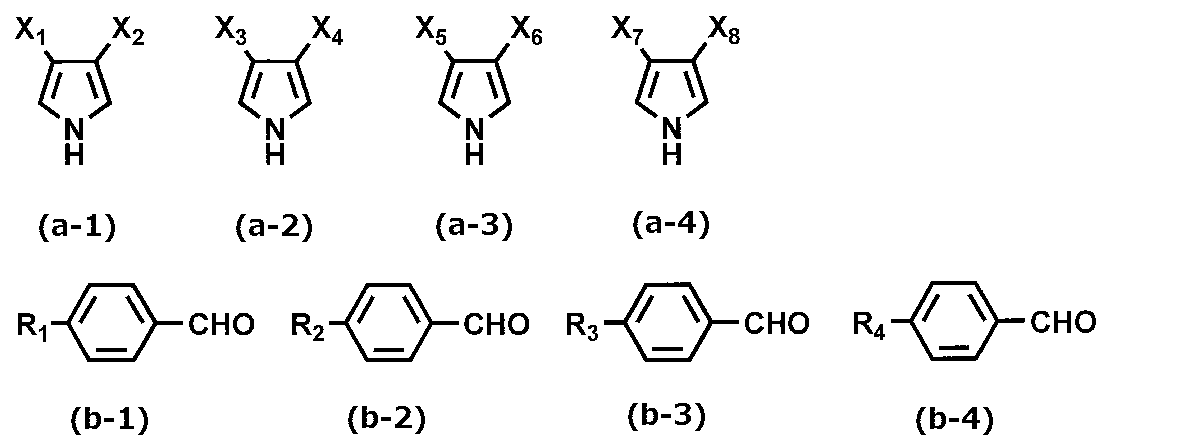
式中、X1~X8、及びR1~R4は一般式(1)の場合と同じ意味を表す。
なお、本明細書において、一般式(1)で表されるポルフィリン系化合物は、実際には、一種または二種以上の異性体から成る混合物を表している。このような複数の異性体から成る混合物の構造の記載に際しても、本明細書においては、便宜上、例えば、一般式(1)で表される一つの構造式を記載しているものである。
なお、本明細書において、一般式(1)で表されるポルフィリン系化合物は、実際には、一種または二種以上の異性体から成る混合物を表している。このような複数の異性体から成る混合物の構造の記載に際しても、本明細書においては、便宜上、例えば、一般式(1)で表される一つの構造式を記載しているものである。
本開示におけるポルフィリン系化合物は、本開示における効果の観点から、濃度0.01g/Lクロロホルム溶液の光路長10mmで測定した吸収スペクトルにおいて、波長470nm~500nmの範囲に極大吸収ピークを有する。
本実施形態において、ポルフィリン系化合物は、下記式(1-1)または下記式(1-2)で表される化合物であることが好ましい。これらの化合物を用いることにより、光過敏による片頭痛をより軽減することができる。
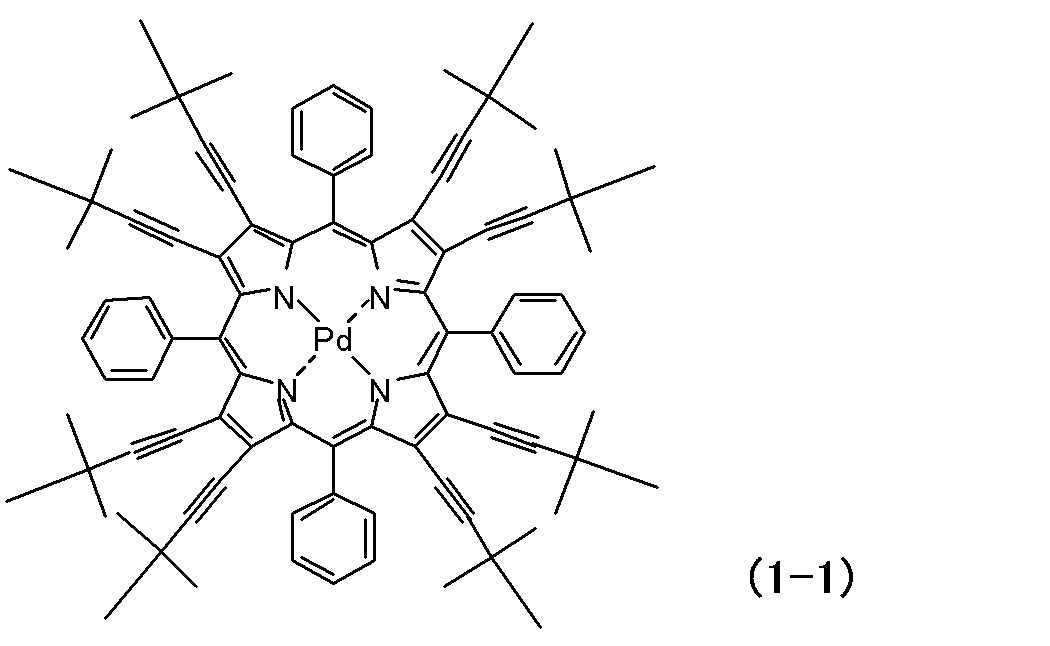

本実施形態の光学材料においては、ポルフィリン系化合物は、一種または二種以上の異性体から成る混合物を使用することができる。また、所望により、該混合物から各異性体を分離し、異性体の内の一種の化合物を用いることができ、さらには、任意の割合から成る複数の異性体を併用することができる。尚、本実施形態に係るポルフィリン系化合物とは、結晶は勿論であるが、無定型(アモルファス体)をも包含するものである。
光学材料中に含まれる有機色素の量は、上記の特性を満たす範囲であれば特に限定されないが、本開示における効果の観点から、本実施形態の光学材料は、有機色素を5ppm~50ppm、好ましくは10ppm~25ppm、より好ましくは12ppm~22ppmの量で含むことができる。
本開示において、「ppm」は質量基準である。
本開示において、「ppm」は質量基準である。
本実施形態の光学材料は、一般式(1)で表されるポルフィリン系化合物を、5ppm~50ppm、好ましくは10ppm~25ppm、より好ましくは12ppm~22ppmの量で含むことができる。
本実施形態の光学材料は、厚み2mmで測定された前記(1)~(3)の特性、さらに好ましくは(4)の特性を備える。本実施形態の光学材料は、有機色素として一般式(1)で表されるポルフィリン系化合物から選択された少なくとも1種を含むことが好ましい。
有機色素は、ポルフィリン系化合物を一種単独で使用してもよく、あるいは二種以上を併用してもよい。
有機色素は、ポルフィリン系化合物を一種単独で使用してもよく、あるいは二種以上を併用してもよい。
[色調調整剤]
本実施形態の光学材料は、さらに色調調整剤を含むことが好ましい。
色調調整剤としては、本開示における効果を奏することができれば従来公知の色調調整剤から選択して用いることができる。
色調調整剤としては、アントラキノン系染料、ペリノン系染料、モノアゾ系染料、ジアゾ系染料、及びフタロシアニン系染料等を挙げることができ、1種または2種以上を組み合わせて用いることができる。
本実施形態の光学材料は、さらに色調調整剤を含むことが好ましい。
色調調整剤としては、本開示における効果を奏することができれば従来公知の色調調整剤から選択して用いることができる。
色調調整剤としては、アントラキノン系染料、ペリノン系染料、モノアゾ系染料、ジアゾ系染料、及びフタロシアニン系染料等を挙げることができ、1種または2種以上を組み合わせて用いることができる。
アントラキノン系染料としては、Solvent Blue 36(1,4-ビス(イソプロピルアミノ)アントラセン-9,10-ジオン)、Solvent Blue 63(1-(メチルアミノ)-4-(m-トリルアミノ)アントラセン-9,10-ジオン)、Solvent Blue 94(1-アミノ-2-ブロモ-4-(フェニルアミノ)アントラセン-9,10-ジオン)、Solvent Blue 97(1,4-ビス((2,6-ジエチル-4-メチルフェニル)アミノ)アントラセン-9,10-ジオン)、Solvent Blue 104(1,4-ビス(メシチルアミノ) アントラセン-9,10-ジオン)、Solvent Violet 13(1-ヒドロキシ-4-(p-トリルアミノ)アントラセン-9,10-ジオン)、Solvent Violet 13(1,5-ビス(p-トリルアミノ)アントラセン-9,10-ジオン)、Solvent Red 52(3-メチル-6-(p-トリルアミノ)-3H-ナフト[1,2,3-de]キノリン-2,7-ジオン)、Solvent Red 168またはPlast Red 8320(1-(シクロヘキシルアミノ)アントラセン-9,10-ジオン)、Solvent Red 207(1,5-ビス(シクロヘキシルアミノ)アントラセン-9,10-ジオン)、Disperse Red 22(1-(フェニルアミノ)アントラセン-9,10-ジオン)、Disperse Red 60(1-アミノ-4-ヒドロキシ-2-フェノキシアントラセン-9,10-ジオン)、Solvent Violet 59(1,4-ジアミノ-2,3-ジフェニルアントラセン-9,10-ジオン)、Solvent Green 28(1,4-ビス((4-ブチルフェニル)アミノ)-5,8-ジヒドロキシアントラセン-9,10-ジオン)、Plast Blue 8514(1-ヒドロキシ-4-[(4-メチルフェニル)アミノ]-9,10-アントラセンジオン)等を挙げることができる。
ペリノン系染料としては、Solvent Orange 60(12H-イソインドロ[2,1-a]ペリミジン-12-オン)、Solvent Orange 78、Solvent Orange 90、Solvent Red 135(8,9,10,11-テトラクロロ-12H-イソインドロ[2,1-a] ペリミジン-12-オン)、Solvent Red 162、Solvent Red 179(14H-ベンゾ[4,5] イソキノリノ[2,1-a]ペリミジン-14-オン)等を挙げることができる。
モノアゾ系染料としては、Solvent Red 195、ファストオレンジR、オイルレッド、オイルエロー等を挙げることができる。
ジアゾ系染料としては、シカゴスカイブルー6B(ソディウム 6,6’-((1E,1’E)-(3,3’-ジメトキシ-[1,1’-ビフェニル]-4,4’-ジイル)ビス(ジアゼン-2,1-ジイル))ビス(4-アミノ-5-ヒドロキシナフタレン-1,3-ジスルホネート))、エバンスブルー(ソディウム 6,6’-((1E,1’E)-(3,3’-ジメチル-[1,1’-ビフェニル]-4,4’-ジイル)ビス(ジアゼン-2,1-ジイル))ビス(4-アミノ-5-ヒドロキシナフタレン-1,3-ジスルホネート))、ダイレクトブルー15(ソディウム 3,3’-((1E,1’E)-(3,3’-ジメトキシ-[1,1’-ビフェニル]-4,4’-ジイル)ビス(ジアゼン-2,1-ジイル))ビス(5-アミノ-4-ヒドロキシナフタレン-2,7-ジスルホネート))、トリパンブルー(ソディウム 3,3’-((1E,1’E)-(3,3’-ジメチル-[1,1’-ビフェニル]-4,4’-ジイル)ビス(ジアゼン-2,1-ジイル))ビス(5-アミノ-4-ヒドロキシナフタレン-2,7-ジスルホネート))、ベンゾプルプリン4B(ソディウム 3,3’-((1E,1’E)-(3,3’-ジメチル-[1,1’-ビフェニル]-4,4’-ジイル)ビス(ジアゼン-2,1-ジイル))ビス(4-アミノナフタレン-1-スルホネート))、コンゴーレッド(ソディウム 3,3’-((1E,1’E)-[1,1’-ビフェニル]-4,4’-ジイルビス(ジアゼン-2,1-ジイル))ビス(4-アミノナフタレン-1-スルホネート))等を挙げることができる。
フタロシアニン系染料としては、C.I.ダイレクトブルー86、C.I.ダイレクトブルー199等を挙げることができる。
ジアゾ系染料としては、シカゴスカイブルー6B(ソディウム 6,6’-((1E,1’E)-(3,3’-ジメトキシ-[1,1’-ビフェニル]-4,4’-ジイル)ビス(ジアゼン-2,1-ジイル))ビス(4-アミノ-5-ヒドロキシナフタレン-1,3-ジスルホネート))、エバンスブルー(ソディウム 6,6’-((1E,1’E)-(3,3’-ジメチル-[1,1’-ビフェニル]-4,4’-ジイル)ビス(ジアゼン-2,1-ジイル))ビス(4-アミノ-5-ヒドロキシナフタレン-1,3-ジスルホネート))、ダイレクトブルー15(ソディウム 3,3’-((1E,1’E)-(3,3’-ジメトキシ-[1,1’-ビフェニル]-4,4’-ジイル)ビス(ジアゼン-2,1-ジイル))ビス(5-アミノ-4-ヒドロキシナフタレン-2,7-ジスルホネート))、トリパンブルー(ソディウム 3,3’-((1E,1’E)-(3,3’-ジメチル-[1,1’-ビフェニル]-4,4’-ジイル)ビス(ジアゼン-2,1-ジイル))ビス(5-アミノ-4-ヒドロキシナフタレン-2,7-ジスルホネート))、ベンゾプルプリン4B(ソディウム 3,3’-((1E,1’E)-(3,3’-ジメチル-[1,1’-ビフェニル]-4,4’-ジイル)ビス(ジアゼン-2,1-ジイル))ビス(4-アミノナフタレン-1-スルホネート))、コンゴーレッド(ソディウム 3,3’-((1E,1’E)-[1,1’-ビフェニル]-4,4’-ジイルビス(ジアゼン-2,1-ジイル))ビス(4-アミノナフタレン-1-スルホネート))等を挙げることができる。
フタロシアニン系染料としては、C.I.ダイレクトブルー86、C.I.ダイレクトブルー199等を挙げることができる。
本実施形態においては、本開示における効果の観点から、好ましくは、Solvent Blue 94、Solvent Blue 97、Solvent Blue 104、Solvent Violet 59、Solvent Red 195、Disperse Red 60、Solvent Green 28、Solvent Orange 60、Plast Blue 8514、またはPlast Red 8320であり、さらに好ましくはPlast Blue 8514、またはPlast Red 8320である。これらは単独で使用しても2種以上組合せて使用してもよいが、2種以上組合せて用いることが好ましい。
本実施形態の光学材料は、有機色素を上記の量で含むとともに、色調調整剤を3ppm以上20ppm以下、好ましくは5ppm以上15ppm以下含むことができる。
これにより、本実施形態の光学材料は、色相にも優れる。
これにより、本実施形態の光学材料は、色相にも優れる。
[樹脂]
本実施形態の光学材料は、さらに、樹脂を含むことが好ましい。
樹脂としては、本開示における効果を発揮することができれば、特に限定されず、光学材料に用いることができる公知の透明樹脂から選択することができる。
本実施形態の光学材料は、さらに、樹脂を含むことが好ましい。
樹脂としては、本開示における効果を発揮することができれば、特に限定されず、光学材料に用いることができる公知の透明樹脂から選択することができる。
樹脂としては、例えば、ポリ(チオ)ウレタン、ポリ(チオ)ウレタンウレア、ポリスルフィド、ポリカーボネート、ポリ(メタ)アクリレート、ポリオレフィン等を挙げることができ、好ましくはポリ(チオ)ウレタン、またはポリ(チオ)ウレタンウレアである。樹脂はこれらから選択される少なくとも1種を用いることができる。
以下、光学材料の調製に用いられる組成物について説明する。本実施形態においては、樹脂としてポリ(チオ)ウレタンまたはポリ(チオ)ウレタンウレアを含む光学材料の調製に用いられる重合性組成物について説明する。
[光学材料用重合性組成物]
本実施形態の光学材料用重合性組成物は、
(A)イソシアネート化合物と、
(B)2以上のメルカプト基を有するポリチオール化合物、1以上のメルカプト基と1以上の水酸基を有するヒドロキシチオール化合物、2以上の水酸基を有するポリオール化合物、及びアミン化合物からなる群から選択される少なくとも1種の活性水素化合物と、
(C)一般式(1)で表されるポルフィリン系化合物から選択された少なくとも1種を含む有機色素と、を含む。
有機色素(C)としては上述の有機色素を用いることができる。
本実施形態の光学材料用重合性組成物は、
(A)イソシアネート化合物と、
(B)2以上のメルカプト基を有するポリチオール化合物、1以上のメルカプト基と1以上の水酸基を有するヒドロキシチオール化合物、2以上の水酸基を有するポリオール化合物、及びアミン化合物からなる群から選択される少なくとも1種の活性水素化合物と、
(C)一般式(1)で表されるポルフィリン系化合物から選択された少なくとも1種を含む有機色素と、を含む。
有機色素(C)としては上述の有機色素を用いることができる。
光学材料中に含まれる有機色素(C)の量は、上記の特性を満たす範囲であれば特に限定されないが、本開示における効果の観点から、本実施形態の光学材料用重合性組成物は、有機色素を5ppm~50ppm、好ましくは10ppm~25ppm、より好ましくは12ppm~22ppmの量で含むことができる。
本実施形態の光学材料用重合性組成物は、一般式(1)で表されるポルフィリン系化合物を、5ppm~50ppm、好ましくは10ppm~25ppm、より好ましくは12ppm~22ppmの量で含むことができる。
本実施形態の光学材料用重合性組成物は、さらに色調調整剤(D)を含むことが好ましい。色調調整剤(D)としては上述の色調調整剤を用いることができる。
本実施形態の光学材料用重合性組成物は、有機色素を上記の量で含むとともに、色調調整剤を3ppm以上20ppm以下、好ましくは5ppm以上15ppm以下含むことができる。
これにより、本実施形態の光学材料用重合性組成物は、片頭痛がより軽減されるとともに、色相にも優れた光学材料を得ることができる。
これにより、本実施形態の光学材料用重合性組成物は、片頭痛がより軽減されるとともに、色相にも優れた光学材料を得ることができる。
[イソシアネート化合物(A)]
イソシアネート化合物(A)としては、脂肪族イソシアネート化合物、脂環族イソシアネート化合物、芳香族イソシアネート化合物、複素環イソシアネート化合物、芳香脂肪族イソシアネート化合物等が挙げられ、1種または2種以上混合して用いられる。これらのイソシアネート化合物は、二量体、三量体、プレポリマーを含んでもよい。
これらのイソシアネート化合物としては、WO2011/055540号に例示された化合物を挙げることができる。
イソシアネート化合物(A)としては、脂肪族イソシアネート化合物、脂環族イソシアネート化合物、芳香族イソシアネート化合物、複素環イソシアネート化合物、芳香脂肪族イソシアネート化合物等が挙げられ、1種または2種以上混合して用いられる。これらのイソシアネート化合物は、二量体、三量体、プレポリマーを含んでもよい。
これらのイソシアネート化合物としては、WO2011/055540号に例示された化合物を挙げることができる。
本実施形態において、本開示における効果の観点から、イソシアネート化合物(A)が、キシレンジイソシアネート、フェニレンジイソシアネート、トリレンジイソシアネート、ジフェニルメタンジイソシアネート、2,5-ビス(イソシアナトメチル)ビシクロ-[2.2.1]-ヘプタン、2,6-ビス(イソシアナトメチル)ビシクロ-[2.2.1]-ヘプタン、ヘキサメチレンジイソシアネート、ペンタメチレンジイソシアネート、ビス(イソシアナトメチル)シクロヘキサン、及びジシクロヘキシルメタンジイソシアネートからなる群から選択される少なくとも一種を含むことが好ましく、キシレンジイソシアネート、トリレンジイソシアネート、2,5-ビス(イソシアナトメチル)ビシクロ-[2.2.1]-ヘプタン、2,6-ビス(イソシアナトメチル)ビシクロ-[2.2.1]-ヘプタン、ヘキサメチレンジイソシアネート、ペンタメチレンジイソシアネート、ビス(イソシアナトメチル)シクロヘキサン、及びジシクロヘキシルメタンジイソシアネートからなる群から選択される少なくとも一種を含むことがより好ましい。
(活性水素化合物(B))
本実施形態において、活性水素化合物(B)としては、2以上のメルカプト基を有するポリチオール化合物、1以上のメルカプト基と1以上の水酸基を有するヒドロキシチオール化合物、2以上の水酸基を有するポリオール化合物、アミン化合物からなる群から選択される少なくとも1種を用いることができる。
これらの活性水素化合としては、WO2016/125736号に例示された化合物を挙げることができる。
本実施形態において、活性水素化合物(B)としては、2以上のメルカプト基を有するポリチオール化合物、1以上のメルカプト基と1以上の水酸基を有するヒドロキシチオール化合物、2以上の水酸基を有するポリオール化合物、アミン化合物からなる群から選択される少なくとも1種を用いることができる。
これらの活性水素化合としては、WO2016/125736号に例示された化合物を挙げることができる。
活性水素化合物(B)は、本開示における効果の観点から、好ましくは2以上のメルカプト基を有するポリチオール化合物及び1以上のメルカプト基と1以上の水酸基を有するヒドロキシチオール化合物からなる群から選択される少なくとも一種であり、より好ましくは2以上のメルカプト基を有するポリチオール化合物から選択される少なくとも一種である。
ポリチオール化合物としては、好ましくは5,7-ジメルカプトメチル-1,11-ジメルカプト-3,6,9-トリチアウンデカン、4,7-ジメルカプトメチル-1,11-ジメルカプト-3,6,9-トリチアウンデカン、4,8-ジメルカプトメチル-1,11-ジメルカプト-3,6,9-トリチアウンデカン、4-メルカプトメチル-1,8-ジメルカプト-3,6-ジチアオクタン、ペンタエリスリトールテトラキス(2-メルカプトアセテート)、ペンタエリスリトールテトラキス(3-メルカプトプロピオネート)、2,5-ビス(メルカプトメチル)-1,4-ジチアン、ビス(メルカプトエチル)スルフィド、1,1,3,3-テトラキス(メルカプトメチルチオ)プロパン、4,6-ビス(メルカプトメチルチオ)-1,3-ジチアン、2-(2,2-ビス(メルカプトメチルチオ)エチル)-1,3-ジチエタン、1,1,2,2-テトラキス(メルカプトメチルチオ)エタン、3-メルカプトメチル-1,5-ジメルカプト-2,4-ジチアペンタン、トリス(メルカプトメチルチオ)メタン、及びエチレングリコールビス(3-メルカプトプロピオネート)からなる群から選択される少なくとも1種であり、
より好ましくは5,7-ジメルカプトメチル-1,11-ジメルカプト-3,6,9-トリチアウンデカン、4,7-ジメルカプトメチル-1,11-ジメルカプト-3,6,9-トリチアウンデカン、4,8-ジメルカプトメチル-1,11-ジメルカプト-3,6,9-トリチアウンデカン、4-メルカプトメチル-1,8-ジメルカプト-3,6-ジチアオクタン及びペンタエリスリトールテトラキス(3-メルカプトプロピオネート)からなる群から選択される少なくとも一種である。
より好ましくは5,7-ジメルカプトメチル-1,11-ジメルカプト-3,6,9-トリチアウンデカン、4,7-ジメルカプトメチル-1,11-ジメルカプト-3,6,9-トリチアウンデカン、4,8-ジメルカプトメチル-1,11-ジメルカプト-3,6,9-トリチアウンデカン、4-メルカプトメチル-1,8-ジメルカプト-3,6-ジチアオクタン及びペンタエリスリトールテトラキス(3-メルカプトプロピオネート)からなる群から選択される少なくとも一種である。
本実施形態において、イソシアネート化合物(A)におけるイソシアナト基に対する、活性水素化合物(B)における活性水素基のモル比率は0.8~1.2の範囲内であり、好ましくは0.85~1.15の範囲内であり、さらに好ましくは0.9~1.1の範囲内である。上記範囲内で、光学材料、特に眼鏡用プラスチックレンズ材料として好適に使用される樹脂を得ることができる。
任意の添加剤として、重合触媒、内部離型剤、紫外線吸収剤などを挙げることができる。本実施形態において、ポリウレタン及びポリチオウレタンを得る際には、重合触媒を用いても良いし、用いなくてもよい。
内部離型剤としては、酸性リン酸エステルが挙げられる。酸性リン酸エステルとしては、リン酸モノエステル、リン酸ジエステルを挙げることができ、それぞれ単独または2種類以上混合して使用することできる。
紫外線吸収剤としては、ベンゾフェノン系紫外線吸収剤、トリアジン系紫外線吸収剤、ベンゾトリアゾール系紫外線吸収剤などが挙げられ、好ましくは2-(2H-ベンゾトリアゾール-2-イル)-4-tert-オクチルフェノール、2-(5-クロロ-2H-ベンゾトリアゾール-2-イル)-4-メチル-6-tert-ブチルフェノールなどのベンゾトリアゾール系紫外線吸収剤が挙げられる。これらの紫外線吸収剤は単独でも2種以上を併用することもできる。
光学材料用組成物は、上記の成分を所定の方法で混合することにより得ることができる。
紫外線吸収剤としては、ベンゾフェノン系紫外線吸収剤、トリアジン系紫外線吸収剤、ベンゾトリアゾール系紫外線吸収剤などが挙げられ、好ましくは2-(2H-ベンゾトリアゾール-2-イル)-4-tert-オクチルフェノール、2-(5-クロロ-2H-ベンゾトリアゾール-2-イル)-4-メチル-6-tert-ブチルフェノールなどのベンゾトリアゾール系紫外線吸収剤が挙げられる。これらの紫外線吸収剤は単独でも2種以上を併用することもできる。
光学材料用組成物は、上記の成分を所定の方法で混合することにより得ることができる。
組成物中の各成分の混合順序や混合方法は、各成分を均一に混合することができれば特に限定されず、公知の方法で行うことができる。公知の方法としては、例えば、添加物を所定量含むマスターバッチを作製して、このマスターバッチを溶媒に分散・溶解させる方法などがある。例えばポリウレタン樹脂の場合、ポリイソシアネート化合物に添加剤を分散・溶解させてマスターバッチを作製する方法などがある。
有機色素を含む成形体を得るには、有機色素と光学材料用樹脂モノマーとを含む光学材料用組成物を混合し、重合させる方法や、有機色素と光学材料用樹脂とを含む光学材料用組成物を硬化させる方法により行うことができる。
<硬化物>
本実施形態の光学材料用重合性組成物は、重合することにより硬化物を得ることができ、モールドの形状により様々な形状の硬化物を得ることができる。重合方法は、従来公知の方法を挙げることができ、その条件も特に限定されない。
本実施形態の光学材料用重合性組成物は、重合することにより硬化物を得ることができ、モールドの形状により様々な形状の硬化物を得ることができる。重合方法は、従来公知の方法を挙げることができ、その条件も特に限定されない。
本実施形態において、硬化物の製造方法は、特に限定されないが、好ましい製造方法として注型重合が挙げられる。はじめに、ガスケットまたはテープ等で保持された成型モールド間に光学材料用重合性組成物を注入する。この時、得られる硬化物に要求される物性によっては、必要に応じて、減圧下での脱泡処理や加圧、減圧等の濾過処理等を行うことが好ましい場合が多い。
重合条件については、成分(A)~成分(C)、さらに成分(D)の種類と使用量、触媒の種類と使用量、モールドの形状等によって条件が異なるため限定されるものではないが、およそ、-50℃~150℃の温度で1時間~50時間かけて行われる。場合によっては、10℃~150℃の温度範囲で保持または徐々に昇温して、1時間~25時間で硬化させることが好ましい。
本実施形態の硬化物は、必要に応じて、アニール等の処理を行ってもよい。処理温度は通常50℃~150℃の間で行われるが、90℃~140℃で行うことが好ましく、100℃~130℃で行うことがより好ましい。
また、本実施形態において、光学材料用重合性組成物を加熱硬化させて得られる硬化物は、たとえば光学材料として使用することができ、光学材料の一部を構成することができる。本実施形態の硬化物は、無色透明で外観に優れ、波長域450~500nmの青色成分光の遮断効果に優れ片頭痛を軽減することができる。硬化物は、高屈折率、高アッベ数などの光学特性及び耐熱性などの諸物性に優れており、硬化物を所望の形状とし、必要に応じて形成されるコート層や他の部材等を備えることにより、様々な光学材料として用いることができる。
<光学材料>
本実施形態の光学材料は硬化物を含む。具体的には、本実施形態の光学材料は、硬化物からなるレンズ基材、フィルム層、またはコーティング層を含む。
本実施形態の光学材料は硬化物を含む。具体的には、本実施形態の光学材料は、硬化物からなるレンズ基材、フィルム層、またはコーティング層を含む。
光学材料の構成としては、代表的には、レンズ基材から構成される光学材料、レンズ基材とフィルム層から構成される光学材料、レンズ基材とコーティング層とから構成される光学材料、レンズ基材とフィルム層とコーティング層とから構成される光学材料が挙げられる。
本実施形態の光学材料として、具体的には、レンズ基材のみから構成される光学材料、レンズ基材の少なくとも一方の面にフィルム層が積層されてなる光学材料、レンズ基材の少なくとも一方の面にコーティング層が積層されてなる光学材料、レンズ基材の少なくとも一方の面にフィルム層とコーティング層とが積層されてなる光学材料、2つのレンズ基材でフィルム層が狭持されてなる光学材料等が挙げられる。
本実施形態の光学材料は、光学材料全体として、上記(1)~(3)の特性を有し、好ましくはさらに上記(4)の特性を有する。
本実施形態の光学材料は、光学材料全体として、上記(1)~(3)の特性を有し、好ましくはさらに上記(4)の特性を有する。
例えば、有機色素を含まない光学材料用組成物を用いて成形体(レンズ基材や光学フィルム)を調製し、次いで、有機色素を水または溶媒中に分散させて得られた分散液に当該成形体を浸漬して有機色素を成形体中に含浸させ、乾燥する。このようにして得られた、成形体を用いて光学材料を調製することができる。
また、光学材料を調製した後に、前記一般式(1)で表されるポルフィリン系化合物を該光学材料に含浸させることもできる。その他、レンズ基材と、必要に応じて積層されるフィルム層とコーティング層とを備えるプラスチック眼鏡レンズを、有機色素を含む分散液に浸漬して有機色素を含浸させることもできる。
有機色素の含浸量は、分散液中の有機色素の濃度と、分散液の温度、光学材料用樹脂組成物を浸漬させる時間により所望の含浸量に制御することができる。濃度を高く、温度を高く、浸漬時間を長くするほどに含浸量が増す。含浸量を精密に制御したい場合は、含浸量が少ない条件で、複数回浸漬を繰り返すことにより実施する。
また、有機色素を含むコーティング材料を用い、プラスチックレンズ基材上に有機色素含有コーティング層を形成することもできる。
また、有機色素を含むコーティング材料を用い、プラスチックレンズ基材上に有機色素含有コーティング層を形成することもできる。
このような構成を有する光学材料は、プラスチック眼鏡レンズとして好適に用いることができる。なお、本開示は前述の実施形態に限定されるものではなく、本願発明の効果を損なわない範囲で様々な態様を取り得ることができる。
例えば、光学材料が上記(1)~(3)の特性を満たし、好ましくはさらに上記(4)の特性を満たすことができれば、前述の実施形態の「前記一般式(1)で表されるポルフィリン系化合物を含む光学材料用重合性組成物」を用いることなく光学材料を得ることができる。
以下、光学材料の好ましい態様であるプラスチックレンズについて詳細に説明する。
以下、光学材料の好ましい態様であるプラスチックレンズについて詳細に説明する。
[プラスチックレンズ]
プラスチックレンズとしては、以下の構成を挙げることができる。
(1)本実施形態の光学材料用組成物から得られるレンズ基材を備えるプラスチックレンズ
(2)レンズ基材(ただし、本実施形態の光学材料用組成物から得られるレンズ基材を除く)表面の少なくとも一方の面上に、本実施形態の光学材料用組成物から得られるレンズ基材、フィルムまたはコーティング層を備えるプラスチックレンズ
(3)本実施形態の光学材料用組成物からなるフィルムの両面上に、レンズ基材(ただし、本実施形態の光学材料用組成物から得られるレンズ基材を除く)が積層されているプラスチックレンズ
本実施形態においては、これらのプラスチックレンズを好適に用いることができる。
以下、それぞれの実施形態について説明する。
プラスチックレンズとしては、以下の構成を挙げることができる。
(1)本実施形態の光学材料用組成物から得られるレンズ基材を備えるプラスチックレンズ
(2)レンズ基材(ただし、本実施形態の光学材料用組成物から得られるレンズ基材を除く)表面の少なくとも一方の面上に、本実施形態の光学材料用組成物から得られるレンズ基材、フィルムまたはコーティング層を備えるプラスチックレンズ
(3)本実施形態の光学材料用組成物からなるフィルムの両面上に、レンズ基材(ただし、本実施形態の光学材料用組成物から得られるレンズ基材を除く)が積層されているプラスチックレンズ
本実施形態においては、これらのプラスチックレンズを好適に用いることができる。
以下、それぞれの実施形態について説明する。
(実施形態1)
本実施形態の光学材料用組成物から得られるレンズ基材を備えるプラスチックレンズを製造する方法は、特に限定されないが、好ましい製造方法としてレンズ注型用鋳型を用いた注型重合が挙げられる。レンズ基材は、ポリウレタン、ポリチオウレタン、ポリウレタンウレア、ポリチオウレタンウレア、ポリスルフィド、ポリ(メタ)アクリレート等から構成することができ、有機色素と、これらの樹脂のモノマー(光学材料用樹脂モノマー)とを含む本実施形態の光学材料用組成物を用いることができる。
本実施形態の光学材料用組成物から得られるレンズ基材を備えるプラスチックレンズを製造する方法は、特に限定されないが、好ましい製造方法としてレンズ注型用鋳型を用いた注型重合が挙げられる。レンズ基材は、ポリウレタン、ポリチオウレタン、ポリウレタンウレア、ポリチオウレタンウレア、ポリスルフィド、ポリ(メタ)アクリレート等から構成することができ、有機色素と、これらの樹脂のモノマー(光学材料用樹脂モノマー)とを含む本実施形態の光学材料用組成物を用いることができる。
具体的には、ガスケットまたはテープ等で保持された成型モールドのキャビティ内に光学材料用組成物を注入する。この時、得られるプラスチックレンズに要求される物性によっては、必要に応じて、減圧下での脱泡処理や加圧、減圧等の濾過処理等を行うことが好ましい場合が多い。
そして、組成物が注入された後、レンズ注型用鋳型をオーブン中または水中等の加熱可能装置内で所定の温度プログラムにて加熱して硬化成型する。樹脂成形体は、必要に応じて、アニール等の処理を行ってもよい。
本実施形態において、樹脂を成形する際には、上記「任意の添加剤」に加えて、目的に応じて公知の成形法と同様に、鎖延長剤、架橋剤、光安定剤、酸化防止剤、油溶染料、充填剤、密着性向上剤などの種々の添加剤を加えてもよい。
また、本実施形態におけるプラスチックレンズは、その目的や用途に合わせて、本実施形態の光学材料用組成物から得られるレンズ基材上に種々のコーティング層を有していてもよい。コーティング層には有機色素を含むことができる。有機色素を含むコーティング層は、有機色素を含むコーティング材料(組成物)を用いて調製することができ、またはコーティング層を形成した後、有機色素を水または溶媒中に分散させて得られた分散液に、コーティング層付きプラスチックレンズを浸漬して有機色素をコーティング層中に含浸させることにより調製することができる。
(実施形態2)
本実施形態におけるプラスチックレンズは、本実施形態の光学材料用組成物から得られるレンズ基材以外のレンズ基材の少なくとも一方の面上に、本実施形態の光学材料用組成物から得られるレンズ基材、フィルム、またはコーティング層を備える。レンズ基材は、本実施形態の光学材料用組成物から形成されたものではない。
本実施形態におけるプラスチックレンズは、本実施形態の光学材料用組成物から得られるレンズ基材以外のレンズ基材の少なくとも一方の面上に、本実施形態の光学材料用組成物から得られるレンズ基材、フィルム、またはコーティング層を備える。レンズ基材は、本実施形態の光学材料用組成物から形成されたものではない。
本実施形態におけるプラスチックレンズの製造方法としては、(2-1)本実施形態の光学材料用組成物から得られるレンズ基材と異なるレンズ基材を製造し、次いで当該レンズ基材の少なくとも一方の面上に、本実施形態の光学材料用組成物から得られるレンズ基材、フィルム、またはシートを貼り合わせる方法、(2-2)後述のようなガスケットまたはテープ等で保持された成型モールドのキャビティ内において、本実施形態の光学材料用組成物からなるフィルムまたはシートをモールドの一方の内壁に沿って配置し、次いでキャビティ内に光学材料用組成物を注入し、硬化させる方法等を挙げることができる。
前記(2-1)の方法において用いられる、本実施形態の光学材料用組成物からなるフィルムまたはシートは、特に限定されないが、溶融混練や含浸等により得られた光学材料用組成物のペレットを、従来種々公知の方法、具体的には、例えば、射出成形法、異形押出成形法、異種成形体の被覆成形法、Tダイシートまたはフィルム成形法、インフレーションフィルム成形法、プレス成形法などの成形方法により得ることができる。得られるフィルムまたはシートは、ポリカーボネート、またはポリオレフィン等を含んでなる。
レンズ基材は、公知の光学用樹脂から得ることができ、光学用樹脂としては、(チオ)ウレタン、ポリスルフィド等を挙げることができる。
本実施形態の光学材料用組成物からなるフィルムまたはシートを、レンズ基材の面上に貼り合わせる方法は公知の方法を用いることができる。
レンズ基材は、公知の光学用樹脂から得ることができ、光学用樹脂としては、(チオ)ウレタン、ポリスルフィド等を挙げることができる。
本実施形態の光学材料用組成物からなるフィルムまたはシートを、レンズ基材の面上に貼り合わせる方法は公知の方法を用いることができる。
前記(2-2)の方法における注型重合は、実施形態:1におけるプラスチックレンズの方法と同様に行うことができ、注型重合に用いる組成物としては、光学材料用樹脂モノマーを含む組成物(有機色素を含まない)を挙げることができる。
また、本実施形態におけるプラスチックレンズは、その目的や用途に合わせて、光学材料用組成物から得られるレンズ基材上または「フィルムまたは層」上に種々のコーティング層を有していてもよい。実施形態:1におけるプラスチックレンズと同様に、コーティング層には有機色素を含むことができる。
(実施形態3)
本実施形態におけるプラスチックレンズは、本実施形態の光学材料用組成物からなるフィルムの両面上に、レンズ基材(本実施形態の光学材料用組成物から得られるレンズ基材を除く)が積層されている。
本実施形態におけるプラスチックレンズは、本実施形態の光学材料用組成物からなるフィルムの両面上に、レンズ基材(本実施形態の光学材料用組成物から得られるレンズ基材を除く)が積層されている。
本実施形態におけるプラスチックレンズの製造方法としては、(3-1)レンズ基材を製造し、本実施形態の光学材料用組成物からなるフィルムまたはシートの両面上に貼り合わせる方法、(3-2)ガスケットまたはテープ等で保持された成型モールドのキャビティ内において、本実施形態の光学材料用組成物からなるフィルムまたはシートを、モールドの内壁から離間した状態で配置し、次いでキャビティ内に光学材料用組成物を注入し、硬化させる方法等を挙げることができる。
前記(3-1)の方法において用いられる、本実施形態の光学材料用組成物からなるフィルムまたはシート、及びレンズ基材は、実施形態:2におけるプラスチックレンズの(2-1)の方法と同様のものを用いることができる。
本実施形態の光学材料用組成物からなるフィルムまたはシートを、レンズ基材の面上に貼り合わせる方法は公知の方法を用いることができる。
本実施形態の光学材料用組成物からなるフィルムまたはシートを、レンズ基材の面上に貼り合わせる方法は公知の方法を用いることができる。
前記(3-2)の方法は具体的に以下のように行うことができる。
実施形態:1におけるプラスチックレンズの製造方法で用いた、レンズ注型用鋳型の空間内に、本実施形態の光学材料用組成物からなるフィルムまたはシートを、この両面が、対向するフロント側のモールド内面と並行となるように設置する。
実施形態:1におけるプラスチックレンズの製造方法で用いた、レンズ注型用鋳型の空間内に、本実施形態の光学材料用組成物からなるフィルムまたはシートを、この両面が、対向するフロント側のモールド内面と並行となるように設置する。
次いで、レンズ注型用鋳型の空間内において、モールドと偏光フィルムとの間の2つの空隙部に、所定の注入手段により、光学材料用樹脂モノマーを含む組成物(有機色素を含まない)を注入する。
そして、組成物が注入された後、レンズ注型用鋳型をオーブン中または水中等の加熱可能装置内で所定の温度プログラムにて加熱して硬化成型する。樹脂成形体は、必要に応じて、アニール等の処理を行ってもよい。
また、本実施形態におけるプラスチックレンズは、その目的や用途に合わせて、レンズ基材上に種々のコーティング層を有していてもよい。実施形態:1におけるプラスチックレンズと同様に、コーティング層には有機色素を含むことができる。
[プラスチック眼鏡レンズ]
本実施形態のプラスチックレンズを用いて、プラスチック眼鏡レンズを得ることができる。なお、必要に応じて、片面又は両面にコーティング層を施して用いてもよい。
本実施形態のプラスチックレンズを用いて、プラスチック眼鏡レンズを得ることができる。なお、必要に応じて、片面又は両面にコーティング層を施して用いてもよい。
コーティング層として、具体的には、プライマー層、ハードコート層、反射防止層、防曇コート層、防汚染層、撥水層等が挙げられる。これらのコーティング層はそれぞれ単独で用いることも複数のコーティング層を多層化して使用することもできる。両面にコーティング層を施す場合、それぞれの面に同様なコーティング層を施しても、異なるコーティング層を施してもよい。
これらのコーティング層はそれぞれ、本実施形態において用いられる有機色素、赤外線から目を守る目的で赤外線吸収剤、レンズの耐候性を向上する目的で光安定剤や酸化防止剤、レンズのファッション性を高める目的で染料や顔料、さらにフォトクロミック染料やフォトクロミック顔料、帯電防止剤、その他、レンズの性能を高めるための公知の添加剤を併用してもよい。塗布によるコーティングを行う層に関しては塗布性の改善を目的とした各種レベリング剤を使用してもよい。
プライマー層は通常、後述するハードコート層とレンズとの間に形成される。プライマー層は、その上に形成するハードコート層とレンズとの密着性を向上させることを目的とするコーティング層であり、場合により耐衝撃性を向上させることも可能である。プライマー層には得られたレンズに対する密着性の高いものであればいかなる素材でも使用できるが、通常、ウレタン系樹脂、エポキシ系樹脂、ポリエステル系樹脂、メラミン系樹脂、ポリビニルアセタールを主成分とするプライマー組成物などが使用される。プライマー組成物は組成物の粘度を調整する目的でレンズに影響を及ぼさない適当な溶剤を用いてもよい。無論、無溶剤で使用してもよい。
プライマー層は塗布法、乾式法のいずれの方法によっても形成することができる。塗布法を用いる場合、プライマー組成物を、スピンコート、ディップコートなど公知の塗布方法でレンズに塗布した後、固化することによりプライマー層が形成される。乾式法で行う場合は、CVD法や真空蒸着法などの公知の乾式法で形成される。プライマー層を形成するに際し、密着性の向上を目的として、必要に応じてレンズの表面は、アルカリ処理、プラズマ処理、紫外線処理などの前処理を行っておいてもよい。
ハードコート層は、レンズ表面に耐擦傷性、耐摩耗性、耐湿性、耐温水性、耐熱性、耐候性等機能を与えることを目的としたコーティング層である。
ハードコート層は、レンズ表面に耐擦傷性、耐摩耗性、耐湿性、耐温水性、耐熱性、耐候性等機能を与えることを目的としたコーティング層である。
ハードコート層は、一般的には、硬化性を有する有機ケイ素化合物と、
Si,Al,Sn,Sb,Ta,Ce,La,Fe,Zn,W,Zr,In及びTiからなる群から選ばれる1種以上の元素の酸化物、及び、
Si,Al,Sn,Sb,Ta,Ce,La,Fe,Zn,W,Zr,In及びTiからなる群から選ばれる2種以上の元素の複合酸化物の少なくとも一方と、を含むハードコート組成物が使用される。
Si,Al,Sn,Sb,Ta,Ce,La,Fe,Zn,W,Zr,In及びTiからなる群から選ばれる1種以上の元素の酸化物、及び、
Si,Al,Sn,Sb,Ta,Ce,La,Fe,Zn,W,Zr,In及びTiからなる群から選ばれる2種以上の元素の複合酸化物の少なくとも一方と、を含むハードコート組成物が使用される。
ハードコート組成物には上記成分以外にアミン類、アミノ酸類、金属アセチルアセトネート錯体、有機酸金属塩、過塩素酸類、過塩素酸類の塩、酸類、金属塩化物及び多官能性エポキシ化合物からなる群から選択される少なくとも一種を含むことが好ましい。ハードコート組成物にはレンズに影響を及ぼさない適当な溶剤を用いてもよいし、無溶剤で用いてもよい。
ハードコート層は、通常、ハードコート組成物をスピンコート、ディップコートなど公知の塗布方法で塗布した後、硬化して形成される。硬化方法としては、熱硬化、紫外線や可視光線などのエネルギー線照射による硬化方法等が挙げられる。干渉縞の発生を抑制するため、ハードコート層の屈折率は、レンズとの屈折率の差が±0.1の範囲にあるのが好ましい。
反射防止層は、通常、必要に応じて前記ハードコート層の上に形成される。反射防止層には無機系及び有機系があり、無機系の場合、SiO2、TiO2等の無機酸化物を用い、真空蒸着法、スパッタリング法、イオンプレーティング法、イオンビ-ムアシスト法、CVD法などの乾式法により形成される。有機系の場合、有機ケイ素化合物と、内部空洞を有するシリカ系微粒子とを含む組成物を用い、湿式により形成される。
反射防止層は単層及び多層があり、単層で用いる場合はハードコート層の屈折率よりも屈折率が少なくとも0.1以上低くなることが好ましい。効果的に反射防止機能を発現するには多層膜反射防止膜とすることが好ましく、その場合、低屈折率膜と高屈折率膜とを交互に積層する。この場合も低屈折率膜と高屈折率膜との屈折率差は0.1以上であることが好ましい。高屈折率膜としては、ZnO、TiO2、CeO2、Sb2O5、SnO2、ZrO2、Ta2O5等の膜があり、低屈折率膜としては、SiO2膜等が挙げられる。
反射防止層の上には、必要に応じて防曇層、防汚染層、撥水層を形成させてもよい。防曇層、防汚染層、撥水層を形成する方法としては、反射防止機能に悪影響をもたらすものでなければ、その処理方法、処理材料等については特に限定されずに、公知の防曇処理方法、防汚染処理方法、撥水処理方法、材料を使用することができる。例えば、防曇処理方法、防汚染処理方法では、表面を界面活性剤で覆う方法、表面に親水性の膜を付加して吸水性にする方法、表面を微細な凹凸で覆い吸水性を高める方法、光触媒活性を利用して吸水性にする方法、超撥水性処理を施して水滴の付着を防ぐ方法などが挙げられる。また、撥水処理方法では、フッ素含有シラン化合物等を蒸着やスパッタによって撥水処理層を形成する方法や、フッ素含有シラン化合物を溶媒に溶解したあと、コーティングして撥水処理層を形成する方法等が挙げられる。
以上、一実施形態を参照して本開示を説明したが、本開示における効果を損なわない範囲で様々な構成を採用することができる。
以下に、実施例により本開示を更に詳細に説明するが、本開示はこれらに限定されるものではない。なお、本開示の実施例において用いた評価方法、材料は以下の通りである。
[L*,a*,b*の測定方法]
分光測色計(コニカミノルタ製CM-5)を用いて、2mm厚のプラノーレンズにおいて、CIE1976(L*,a*,b*)表色系におけるL*,a*,b*を測定した。
[YIの測定方法]
2mm厚のプラノーレンズをコニカミノルタ社製の分光測色計CM-5でYIを測定した。
分光測色計(コニカミノルタ製CM-5)を用いて、2mm厚のプラノーレンズにおいて、CIE1976(L*,a*,b*)表色系におけるL*,a*,b*を測定した。
[YIの測定方法]
2mm厚のプラノーレンズをコニカミノルタ社製の分光測色計CM-5でYIを測定した。
[視感透過率、及び波長480nmでの分光透過率の測定方法]
島津製作所製 島津分光光度計 UV-1800を用い、2mm厚のプラノーレンズにおける厚み方向の分光透過率を測定し、視感透過率を求めた。
島津製作所製 島津分光光度計 UV-1800を用い、2mm厚のプラノーレンズにおける厚み方向の分光透過率を測定し、視感透過率を求めた。
[6項目の頭痛インパクトテスト(6-item Headache Impact Test:HIT-6)]
全19名の片頭痛の症状を有する被験者の群を、9名の被験者からなる第1の群と、10名の被験者からなる第2の群とに分けて、各々の群に対して着用テストを行った。具体的には、第1の群の9名の被験者が、眼鏡なしで1ヶ月生活した後(ステージ1)、実施例で得られたレンズを備える眼鏡を着用して1ヶ月生活し(ステージ2)、更に眼鏡なしで1ヶ月生活し(ステージ3)、そして、プラセボレンズ(実施例で得られたレンズと同等の色調を有するレンズであって、波長450nm~500nmの波長の光を実施例で得られたレンズよりもカットしないレンズ)を備える眼鏡を着用して1ヶ月生活した(ステージ4)。ここで、被験者による着用テストの実施期間中は、各々の被験者は、各ステージにおいて着用すべき眼鏡を、被験者の日常生活に合わせて着用場面や用途を限定することなく、1日3時間以上着用した。また、いずれの眼鏡のフレームも、被験者が着用することによる外因・ストレスを低減するため、軽量かつリムの無いフレームを用いた(不図示)。
各々の被験者は、全ステージにおいて毎日片頭痛の有無や症状を記録し、ステージ1、ステージ2、ステージ4の終了後に6項目の以下のアンケートに回答し、各項目の点数を合計した合計点を算出した。合計点が49以下の場合には片頭痛の症状が無視できる範囲であるものとして片頭痛の改善効果があるとした。
第2の群の10名の被験者については、眼鏡なしで1ヶ月生活した後(ステージa)、プラセボレンズを備える眼鏡を着用して1ヶ月生活し(ステージb)、更に眼鏡なしで1ヶ月生活し(ステージc)、そして、実施例で得られたレンズを備える眼鏡を着用して1ヶ月生活した(ステージd)。ステージa、ステージb、ステージdの終了後に6項目の以下のアンケートに回答し、各項目の点数を合計した合計点を算出した。各項目の回答結果を以下の基準で数値化し、合計点が49以下の場合には片頭痛の症状が無視できる範囲であるものとして片頭痛の改善効果があるとした。
全19名の片頭痛の症状を有する被験者の群を、9名の被験者からなる第1の群と、10名の被験者からなる第2の群とに分けて、各々の群に対して着用テストを行った。具体的には、第1の群の9名の被験者が、眼鏡なしで1ヶ月生活した後(ステージ1)、実施例で得られたレンズを備える眼鏡を着用して1ヶ月生活し(ステージ2)、更に眼鏡なしで1ヶ月生活し(ステージ3)、そして、プラセボレンズ(実施例で得られたレンズと同等の色調を有するレンズであって、波長450nm~500nmの波長の光を実施例で得られたレンズよりもカットしないレンズ)を備える眼鏡を着用して1ヶ月生活した(ステージ4)。ここで、被験者による着用テストの実施期間中は、各々の被験者は、各ステージにおいて着用すべき眼鏡を、被験者の日常生活に合わせて着用場面や用途を限定することなく、1日3時間以上着用した。また、いずれの眼鏡のフレームも、被験者が着用することによる外因・ストレスを低減するため、軽量かつリムの無いフレームを用いた(不図示)。
各々の被験者は、全ステージにおいて毎日片頭痛の有無や症状を記録し、ステージ1、ステージ2、ステージ4の終了後に6項目の以下のアンケートに回答し、各項目の点数を合計した合計点を算出した。合計点が49以下の場合には片頭痛の症状が無視できる範囲であるものとして片頭痛の改善効果があるとした。
第2の群の10名の被験者については、眼鏡なしで1ヶ月生活した後(ステージa)、プラセボレンズを備える眼鏡を着用して1ヶ月生活し(ステージb)、更に眼鏡なしで1ヶ月生活し(ステージc)、そして、実施例で得られたレンズを備える眼鏡を着用して1ヶ月生活した(ステージd)。ステージa、ステージb、ステージdの終了後に6項目の以下のアンケートに回答し、各項目の点数を合計した合計点を算出した。各項目の回答結果を以下の基準で数値化し、合計点が49以下の場合には片頭痛の症状が無視できる範囲であるものとして片頭痛の改善効果があるとした。
(アンケート)
・項目1 頭が痛いとき、痛みがひどいことがどれくらいありますか?
6点:全くない、8点:ほとんどない、10点:時々ある、11点:しばしばある、13点:いつもそうだ
・項目2 頭痛のせいで、日常生活に支障が出ることがありますか?(例えば、家事、仕事、学校生活、人付き合いなど)
6点:全くない、8点:ほとんどない、10点:時々ある、11点:しばしばある、13点:いつもそうだ
・項目3 頭が痛いとき横になりたくなることがありますか?
6点:全くない、8点:ほとんどない、10点:時々ある、11点:しばしばある、13点:いつもそうだ
・項目4 この4週間に、頭痛のせいで疲れてしまって、仕事やいつもの活動ができないことがありましたか?
6点:全くなかった、8点:ほとんどなかった、10点:時々あった、11点:しばしばあった、13点:いつもそうだった
・項目5 この4週間に、頭痛のせいで、うんざりしたりいらいらしたりしたことがありましたか?
6点:全くなかった、8点:ほとんどなかった、10点:時々あった、11点:しばしばあった、13点:いつもそうだった
・項目6 この4週間に、頭痛のせいで、仕事や日常生活の場で集中できないことがありましたか?
6点:全くなかった、8点:ほとんどなかった、10点:時々あった、11点:しばしばあった、13点:いつもそうだった
・項目1 頭が痛いとき、痛みがひどいことがどれくらいありますか?
6点:全くない、8点:ほとんどない、10点:時々ある、11点:しばしばある、13点:いつもそうだ
・項目2 頭痛のせいで、日常生活に支障が出ることがありますか?(例えば、家事、仕事、学校生活、人付き合いなど)
6点:全くない、8点:ほとんどない、10点:時々ある、11点:しばしばある、13点:いつもそうだ
・項目3 頭が痛いとき横になりたくなることがありますか?
6点:全くない、8点:ほとんどない、10点:時々ある、11点:しばしばある、13点:いつもそうだ
・項目4 この4週間に、頭痛のせいで疲れてしまって、仕事やいつもの活動ができないことがありましたか?
6点:全くなかった、8点:ほとんどなかった、10点:時々あった、11点:しばしばあった、13点:いつもそうだった
・項目5 この4週間に、頭痛のせいで、うんざりしたりいらいらしたりしたことがありましたか?
6点:全くなかった、8点:ほとんどなかった、10点:時々あった、11点:しばしばあった、13点:いつもそうだった
・項目6 この4週間に、頭痛のせいで、仕事や日常生活の場で集中できないことがありましたか?
6点:全くなかった、8点:ほとんどなかった、10点:時々あった、11点:しばしばあった、13点:いつもそうだった
(合成例1)
下記構造式(3-a)で示される化合物30.0gを1,1,2-トリクロロエタン150g水60gに分散し、50℃~55℃で臭素58.7gと1,1,2-トリクロロエタン60gの溶液を滴下した。50℃~55℃にて3時間攪拌した後、室温まで冷却した。反応液に亜硫酸ナトリウム水溶液(亜硫酸ナトリウム4.2g、水21g)を添加し、室温で15分撹拌した。次いで、水酸化ナトリウム水溶液(水酸化ナトリウム16.2g、水162g)を添加し、室温で30分撹拌した。析出物を濾取、水洗し、メタノールにて洗浄、乾燥して下記構造式(3-b)で示される化合物45.6gを得た。
下記構造式(3-a)で示される化合物30.0gを1,1,2-トリクロロエタン150g水60gに分散し、50℃~55℃で臭素58.7gと1,1,2-トリクロロエタン60gの溶液を滴下した。50℃~55℃にて3時間攪拌した後、室温まで冷却した。反応液に亜硫酸ナトリウム水溶液(亜硫酸ナトリウム4.2g、水21g)を添加し、室温で15分撹拌した。次いで、水酸化ナトリウム水溶液(水酸化ナトリウム16.2g、水162g)を添加し、室温で30分撹拌した。析出物を濾取、水洗し、メタノールにて洗浄、乾燥して下記構造式(3-b)で示される化合物45.6gを得た。
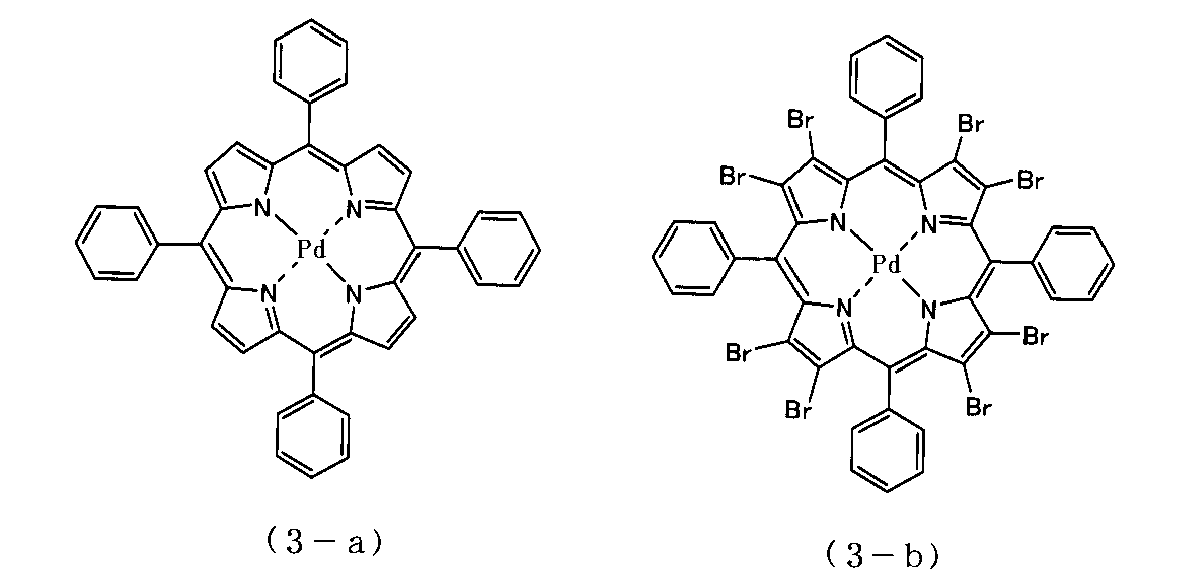
次に構造式(3-b)で示される化合物40.0g、よう化銅1.85g、ビス(トリフェニルホスフィン)パラジウム(II)ジクロリド3.16g、トリフェニルホスフィン1.55gをテトラヒドロフラン800mlに溶解し、トリエチルアミン54.91g、3,3-ジメチル-1-ブチン(純度96%)29.2gを加えた。窒素気流下室温で攪拌し、反応終了後、不溶物を濾過し、濾液を減圧濃縮した。濃縮残渣にメタノール500mlを加え、攪拌し、濾過した後、メタノールで洗浄、乾燥し、粗体を得た。粗体をシリカゲルカラムにより精製(展開溶剤:トルエン/ヘキサン=1:1vol.比)して、具体例化合物(1-1)28.6gを得た。

MS(m/e):1360(M+)
この化合物の吸収スペクトルを、島津製作所製 島津分光光度計 UV-1800を使用し、濃度0.01g/Lクロロホルム溶液の光路長10mmで測定したところ、479nmに吸収ピークがあった。また、当該ピークの半値幅は36nmであった。
この化合物の吸収スペクトルを、島津製作所製 島津分光光度計 UV-1800を使用し、濃度0.01g/Lクロロホルム溶液の光路長10mmで測定したところ、479nmに吸収ピークがあった。また、当該ピークの半値幅は36nmであった。
(合成例2)
下記構造式(2-a)で示される化合物15.0gをN,N-ジメチルホルムアミド150mlに溶解し、10℃~20℃で臭素31.8gを滴下した。室温にて4時間攪拌した後、氷水700gに排出し、水酸化ナトリウム水溶液で中和した。析出物を濾取、水洗し、メタノールにて洗浄、乾燥して、下記構造式(2-b)で示される化合物31gを得た。
下記構造式(2-a)で示される化合物15.0gをN,N-ジメチルホルムアミド150mlに溶解し、10℃~20℃で臭素31.8gを滴下した。室温にて4時間攪拌した後、氷水700gに排出し、水酸化ナトリウム水溶液で中和した。析出物を濾取、水洗し、メタノールにて洗浄、乾燥して、下記構造式(2-b)で示される化合物31gを得た。

次に構造式(2-b)で示される化合物26.1g、よう化銅1.34g、ビス(トリフェニルホスフィン)パラジウム(II)ジクロリド2.13g、トリフェニルホスフィン1.05gをテトラヒドロフラン525mlに溶解し、トリエチルアミン36.4g、3,3-ジメチル-1-ブチン(純度96%)21.16gを加えた。窒素気流下室温で攪拌し、反応終了後、不溶物を濾過し、濾液を減圧濃縮した。濃縮残渣に85%メタノール水500mlを加え、攪拌し、濾過した後、85%メタノール水で洗浄、乾燥し、粗体を得た。粗体をシリカゲルカラムにより精製(展開溶剤:トルエン/ヘキサン=6:4vol.比)して、具体例化合物(1-2)10.8gを得た。

MS(m/e):1312(M+)
この化合物の吸収スペクトルを、島津製作所製 島津分光光度計 UV-1800を使
用し、濃度0.01g/Lクロロホルム溶液の光路長10mmで測定したところ、479nmに吸収ピークがあった。また、当該ピークの半値幅は27nmであった。
この化合物の吸収スペクトルを、島津製作所製 島津分光光度計 UV-1800を使
用し、濃度0.01g/Lクロロホルム溶液の光路長10mmで測定したところ、479nmに吸収ピークがあった。また、当該ピークの半値幅は27nmであった。
[実施例1]
ジブチル錫(II)ジクロリドを0.35質量部、ステファン社製ZelecUNを1質量部、BASFジャパン社製紫外線吸収剤Tinuvin329を15質量部、2,5-ビス(イソシアナトメチル)ビシクロ-[2.2.1]-ヘプタンと2,6-ビス(イソシアナトメチル)ビシクロ-[2.2.1]-ヘプタンとの混合物を506質量部、合成例1で得られた化合物(1-1)を20ppm、Plast Blue 8514(有本化学工業社製)を8ppm、Plast Red 8320(有本化学工業社製)を5ppm仕込んで混合溶液を作製した。この混合溶液を25℃で1時間攪拌して完全に溶解させた。その後、この調合液に、4-メルカプトメチル-1,8-ジメルカプト-3,6-ジチアオクタンを255質量部とペンタエリスリトールテトラキス(3-メルカプトプロピオネート)を239質量部とを仕込み、これを25℃で30分攪拌し、均一溶液とした。この溶液を400Paにて1時間脱泡を行い、1μmPTFEフィルターにて濾過を行った後、中心厚2mm、直径80mmの2Cのプラノー用ガラスモールドに注入した。このガラスモールドを25℃から120℃まで、16時間かけて昇温した。室温まで冷却させて、ガラスモールドから外し、プラノーレンズを得た。得られたプラノーレンズを更に120℃で2時間アニールを行った。プラノーレンズの表面にはウレタン系のプライマーコート、シリコーン系のハードコートをディップコーティングにて順次成膜を行い、次いで真空蒸着法によりSiO2とZrO2を交互に積層し5層構成の反射防止膜を成膜し、加えて最表面にはフッ素系の撥水膜を成膜した。得られたプラノーレンズの物性を測定した。結果を表-1に示す。また、透過率データを表-3に示し、透過率曲線を図1に示す。
本実施例に基づくプラノーレンズを作製し、当該プラノーレンズ2枚を備える眼鏡を調製した。その後、上述の被験者による着用テストに供試し、片頭痛の改善効果を検証するため、頭痛インパクトテスト(HIT-6)にて評価を行った。評価結果を表-2に示す。
ジブチル錫(II)ジクロリドを0.35質量部、ステファン社製ZelecUNを1質量部、BASFジャパン社製紫外線吸収剤Tinuvin329を15質量部、2,5-ビス(イソシアナトメチル)ビシクロ-[2.2.1]-ヘプタンと2,6-ビス(イソシアナトメチル)ビシクロ-[2.2.1]-ヘプタンとの混合物を506質量部、合成例1で得られた化合物(1-1)を20ppm、Plast Blue 8514(有本化学工業社製)を8ppm、Plast Red 8320(有本化学工業社製)を5ppm仕込んで混合溶液を作製した。この混合溶液を25℃で1時間攪拌して完全に溶解させた。その後、この調合液に、4-メルカプトメチル-1,8-ジメルカプト-3,6-ジチアオクタンを255質量部とペンタエリスリトールテトラキス(3-メルカプトプロピオネート)を239質量部とを仕込み、これを25℃で30分攪拌し、均一溶液とした。この溶液を400Paにて1時間脱泡を行い、1μmPTFEフィルターにて濾過を行った後、中心厚2mm、直径80mmの2Cのプラノー用ガラスモールドに注入した。このガラスモールドを25℃から120℃まで、16時間かけて昇温した。室温まで冷却させて、ガラスモールドから外し、プラノーレンズを得た。得られたプラノーレンズを更に120℃で2時間アニールを行った。プラノーレンズの表面にはウレタン系のプライマーコート、シリコーン系のハードコートをディップコーティングにて順次成膜を行い、次いで真空蒸着法によりSiO2とZrO2を交互に積層し5層構成の反射防止膜を成膜し、加えて最表面にはフッ素系の撥水膜を成膜した。得られたプラノーレンズの物性を測定した。結果を表-1に示す。また、透過率データを表-3に示し、透過率曲線を図1に示す。
本実施例に基づくプラノーレンズを作製し、当該プラノーレンズ2枚を備える眼鏡を調製した。その後、上述の被験者による着用テストに供試し、片頭痛の改善効果を検証するため、頭痛インパクトテスト(HIT-6)にて評価を行った。評価結果を表-2に示す。
[実施例2]
ジブチル錫(II)ジクロリドを0.35質量部、ステファン社製ZelecUNを1質量部、BASFジャパン社製紫外線吸収剤Tinuvin329を15質量部、2,5-ビス(イソシアナトメチル)ビシクロ-[2.2.1]-ヘプタンと2,6-ビス(イソシアナトメチル)ビシクロ-[2.2.1]-ヘプタンとの混合物を506質量部、合成例1で得られた化合物(1-1)を15ppm、Plast Blue 8514(有本化学工業社製)を5ppm、Plast Red 8320(有本化学工業社製)を5ppm仕込んで混合溶液を作製した。この混合溶液を25℃で1時間攪拌して完全に溶解させた。その後、この調合液に、4-メルカプトメチル-1,8-ジメルカプト-3,6-ジチアオクタンを255質量部とペンタエリスリトールテトラキス(3-メルカプトプロピオネート)を239質量部とを仕込み、これを25℃で30分攪拌し、均一溶液とした。この溶液を400Paにて1時間脱泡を行い、1μmPTFEフィルターにて濾過を行った後、中心厚2mm、直径80mmの2Cのプラノー用ガラスモールドに注入した。このガラスモールドを25℃から120℃まで、16時間かけて昇温した。室温まで冷却させて、ガラスモールドから外し、プラノーレンズを得た。得られたプラノーレンズを更に120℃で2時間アニールを行った。プラノーレンズの表面にはウレタン系のプライマーコート、シリコーン系のハードコートをディップコーティングにて順次成膜を行い、次いで真空蒸着法によりSiO2とZrO2を交互に積層し5層構成の反射防止膜を成膜し、加えて最表面にはフッ素系の撥水膜を成膜した。得られたプラノーレンズの物性を測定した。結果を表-1に示す。また、透過率データを表-3に示し、透過率曲線を図2に示す。
本実施例に基づくプラノーレンズを作製し、当該プラノーレンズ2枚を備える眼鏡を調製した。その後、上述の被験者による着用テストに供試し、片頭痛の改善効果を検証するため、頭痛インパクトテスト(HIT-6)にて評価を行った。評価結果を表-2に示す。
ジブチル錫(II)ジクロリドを0.35質量部、ステファン社製ZelecUNを1質量部、BASFジャパン社製紫外線吸収剤Tinuvin329を15質量部、2,5-ビス(イソシアナトメチル)ビシクロ-[2.2.1]-ヘプタンと2,6-ビス(イソシアナトメチル)ビシクロ-[2.2.1]-ヘプタンとの混合物を506質量部、合成例1で得られた化合物(1-1)を15ppm、Plast Blue 8514(有本化学工業社製)を5ppm、Plast Red 8320(有本化学工業社製)を5ppm仕込んで混合溶液を作製した。この混合溶液を25℃で1時間攪拌して完全に溶解させた。その後、この調合液に、4-メルカプトメチル-1,8-ジメルカプト-3,6-ジチアオクタンを255質量部とペンタエリスリトールテトラキス(3-メルカプトプロピオネート)を239質量部とを仕込み、これを25℃で30分攪拌し、均一溶液とした。この溶液を400Paにて1時間脱泡を行い、1μmPTFEフィルターにて濾過を行った後、中心厚2mm、直径80mmの2Cのプラノー用ガラスモールドに注入した。このガラスモールドを25℃から120℃まで、16時間かけて昇温した。室温まで冷却させて、ガラスモールドから外し、プラノーレンズを得た。得られたプラノーレンズを更に120℃で2時間アニールを行った。プラノーレンズの表面にはウレタン系のプライマーコート、シリコーン系のハードコートをディップコーティングにて順次成膜を行い、次いで真空蒸着法によりSiO2とZrO2を交互に積層し5層構成の反射防止膜を成膜し、加えて最表面にはフッ素系の撥水膜を成膜した。得られたプラノーレンズの物性を測定した。結果を表-1に示す。また、透過率データを表-3に示し、透過率曲線を図2に示す。
本実施例に基づくプラノーレンズを作製し、当該プラノーレンズ2枚を備える眼鏡を調製した。その後、上述の被験者による着用テストに供試し、片頭痛の改善効果を検証するため、頭痛インパクトテスト(HIT-6)にて評価を行った。評価結果を表-2に示す。
[比較例1]
ジブチル錫(II)ジクロリドを0.35質量部、ステファン社製ZelecUNを1質量部、BASFジャパン社製紫外線吸収剤Tinuvin329を15質量部、2,5-ビス(イソシアナトメチル)ビシクロ-[2.2.1]-ヘプタンと2,6-ビス(イソシアナトメチル)ビシクロ-[2.2.1]-ヘプタンとの混合物を506質量部仕込んで混合溶液を作製した。この混合溶液を25℃で1時間攪拌して完全に溶解させた。その後、この調合液に、4-メルカプトメチル-1,8-ジメルカプト-3,6-ジチアオクタンを255質量部とペンタエリスリトールテトラキス(3-メルカプトプロピオネート)を239質量部とを仕込み、これを25℃で30分攪拌し、均一溶液とした。この溶液を400Paにて1時間脱泡を行い、1μmPTFEフィルターにて濾過を行った後、中心厚2mm、直径80mmの2Cのプラノー用ガラスモールドに注入した。このガラスモールドを25℃から120℃まで、16時間かけて昇温した。室温まで冷却させて、ガラスモールドから外し、プラノーレンズを得た。得られたプラノーレンズを更に120℃で2時間アニールを行った。
90℃に加熱した1リットルの水に青色染料としてDianix Blue FBL(ダイスタージャパン社製)1質量部を添加し、キャリアー材としてベンジルアルコールを40質量部、界面活性剤を1質量部混合し青色染料分散液を作製した。同様に赤色染料分散液をSumikaron Red E-RPD(住化ケミテックス社製)、黄色染料分散液をDianix Yellow AC-E(ダイスタージャパン社製)、茶色染料分散液をDianix Yellow Brown AM-R(ダイスタージャパン社製)よりそれぞれ作製した。得られた各色の染料分散液それぞれにプラノーレンズを浸漬し実施例1で作製したレンズと同等の視感度透過率、同等の色調となるまで染色した。
染色されたプラノーレンズの表面にはウレタン系のプライマーコート、シリコーン系のハードコートをディップコーティングにて順次成膜を行い、次いで真空蒸着法によりSiO2とZrO2を交互に積層し5層構成の反射防止膜を成膜し、加えて最表面にはフッ素系の撥水膜を成膜した。
得られたプラノーレンズの物性を測定した。結果を表-1に示す。また、透過率データを表-3に示し、透過率曲線を図1に示す。
本比較例に基づく染色されたプラノーレンズをもう一枚作製し、当該プラノーレンズ2枚を備える眼鏡を調製した。その後、上述の被験者による着用テストに供試し、片頭痛の改善効果を検証するため、頭痛インパクトテスト(HIT-6)にて評価を行った。評価結果を表-2に示す。
ジブチル錫(II)ジクロリドを0.35質量部、ステファン社製ZelecUNを1質量部、BASFジャパン社製紫外線吸収剤Tinuvin329を15質量部、2,5-ビス(イソシアナトメチル)ビシクロ-[2.2.1]-ヘプタンと2,6-ビス(イソシアナトメチル)ビシクロ-[2.2.1]-ヘプタンとの混合物を506質量部仕込んで混合溶液を作製した。この混合溶液を25℃で1時間攪拌して完全に溶解させた。その後、この調合液に、4-メルカプトメチル-1,8-ジメルカプト-3,6-ジチアオクタンを255質量部とペンタエリスリトールテトラキス(3-メルカプトプロピオネート)を239質量部とを仕込み、これを25℃で30分攪拌し、均一溶液とした。この溶液を400Paにて1時間脱泡を行い、1μmPTFEフィルターにて濾過を行った後、中心厚2mm、直径80mmの2Cのプラノー用ガラスモールドに注入した。このガラスモールドを25℃から120℃まで、16時間かけて昇温した。室温まで冷却させて、ガラスモールドから外し、プラノーレンズを得た。得られたプラノーレンズを更に120℃で2時間アニールを行った。
90℃に加熱した1リットルの水に青色染料としてDianix Blue FBL(ダイスタージャパン社製)1質量部を添加し、キャリアー材としてベンジルアルコールを40質量部、界面活性剤を1質量部混合し青色染料分散液を作製した。同様に赤色染料分散液をSumikaron Red E-RPD(住化ケミテックス社製)、黄色染料分散液をDianix Yellow AC-E(ダイスタージャパン社製)、茶色染料分散液をDianix Yellow Brown AM-R(ダイスタージャパン社製)よりそれぞれ作製した。得られた各色の染料分散液それぞれにプラノーレンズを浸漬し実施例1で作製したレンズと同等の視感度透過率、同等の色調となるまで染色した。
染色されたプラノーレンズの表面にはウレタン系のプライマーコート、シリコーン系のハードコートをディップコーティングにて順次成膜を行い、次いで真空蒸着法によりSiO2とZrO2を交互に積層し5層構成の反射防止膜を成膜し、加えて最表面にはフッ素系の撥水膜を成膜した。
得られたプラノーレンズの物性を測定した。結果を表-1に示す。また、透過率データを表-3に示し、透過率曲線を図1に示す。
本比較例に基づく染色されたプラノーレンズをもう一枚作製し、当該プラノーレンズ2枚を備える眼鏡を調製した。その後、上述の被験者による着用テストに供試し、片頭痛の改善効果を検証するため、頭痛インパクトテスト(HIT-6)にて評価を行った。評価結果を表-2に示す。
[比較例2]
比較例1と同様の方法でプラノーレンズを調製した。
90℃に加熱した1リットルの水に青色染料としてDianix Blue FBL(ダイスタージャパン社製)1質量部を添加し、キャリアー材としてベンジルアルコールを40質量部、界面活性剤を1質量部混合し青色染料分散液を作製した。同様に赤色染料分散液をSumikaron Red E-RPD(住化ケミテックス社製)、黄色染料分散液をDianix Yellow AC-E(ダイスタージャパン社製)、茶色染料分散液をDianix Yellow Brown AM-R(ダイスタージャパン社製)よりそれぞれ作製した。得られた各色の染料分散液それぞれにプラノーレンズを浸漬し実施例2で作製したレンズと同等の視感度透過率、同等の色調となるまで染色した。
染色されたプラノーレンズの表面にはウレタン系のプライマーコート、シリコーン系のハードコートをディップコーティングにて順次成膜を行い、次いで真空蒸着法によりSiO2とZrO2を交互に積層し5層構成の反射防止膜を成膜し、加えて最表面にはフッ素系の撥水膜を成膜した。
得られたプラノーレンズの物性を測定した。結果を表-1に示す。また、透過率データを表-3に示し、透過率曲線を図2に示す。
本比較例に基づく染色されたプラノーレンズをもう一枚作製し、当該プラノーレンズ2枚を備える眼鏡を調製した。その後、上述の被験者による着用テストに供試し、片頭痛の改善効果を検証するため、頭痛インパクトテスト(HIT-6)にて評価を行った。評価結果を表-2に示す。
比較例1と同様の方法でプラノーレンズを調製した。
90℃に加熱した1リットルの水に青色染料としてDianix Blue FBL(ダイスタージャパン社製)1質量部を添加し、キャリアー材としてベンジルアルコールを40質量部、界面活性剤を1質量部混合し青色染料分散液を作製した。同様に赤色染料分散液をSumikaron Red E-RPD(住化ケミテックス社製)、黄色染料分散液をDianix Yellow AC-E(ダイスタージャパン社製)、茶色染料分散液をDianix Yellow Brown AM-R(ダイスタージャパン社製)よりそれぞれ作製した。得られた各色の染料分散液それぞれにプラノーレンズを浸漬し実施例2で作製したレンズと同等の視感度透過率、同等の色調となるまで染色した。
染色されたプラノーレンズの表面にはウレタン系のプライマーコート、シリコーン系のハードコートをディップコーティングにて順次成膜を行い、次いで真空蒸着法によりSiO2とZrO2を交互に積層し5層構成の反射防止膜を成膜し、加えて最表面にはフッ素系の撥水膜を成膜した。
得られたプラノーレンズの物性を測定した。結果を表-1に示す。また、透過率データを表-3に示し、透過率曲線を図2に示す。
本比較例に基づく染色されたプラノーレンズをもう一枚作製し、当該プラノーレンズ2枚を備える眼鏡を調製した。その後、上述の被験者による着用テストに供試し、片頭痛の改善効果を検証するため、頭痛インパクトテスト(HIT-6)にて評価を行った。評価結果を表-2に示す。


表-2に示すように、実施例の眼鏡を着用した全被験者19名のうちの32%である6名の頭痛インパクトテスト(HIT-6)による合計点(3)が、頭痛が日常生活にほとんど、あるいはまったく影響を与えていないと判定される基準スコアである49以下となり、片頭痛の改善効果が認められた。
また、実施例の眼鏡を着用した全被験者19名のうちの11%である2名(被験者No.6及び12)の頭痛インパクトテスト(HIT-6)による合計点(3)が、眼鏡を着用しなかった場合の合計点(1)に比べて大きく改善した。具体的には、頭痛が日常生活にかなりの影響を与えている状態(基準スコア60以上)から、頭痛が日常生活にある程度の影響を与えている状態(基準スコア50~55)にまで改善し、一定の片頭痛の改善効果が認められた。
以上より、実施例の眼鏡を着用することで、全被験者19名のうちの43%である8名について一定以上の片頭痛の改善効果が認められた。
また、実施例の眼鏡を着用した全被験者19名のうちの11%である2名(被験者No.6及び12)の頭痛インパクトテスト(HIT-6)による合計点(3)が、眼鏡を着用しなかった場合の合計点(1)に比べて大きく改善した。具体的には、頭痛が日常生活にかなりの影響を与えている状態(基準スコア60以上)から、頭痛が日常生活にある程度の影響を与えている状態(基準スコア50~55)にまで改善し、一定の片頭痛の改善効果が認められた。
以上より、実施例の眼鏡を着用することで、全被験者19名のうちの43%である8名について一定以上の片頭痛の改善効果が認められた。
また、表-2中、被験者No1~19において、実施例の眼鏡を使用した場合、(3)-(1)の値の合計値は-54であり、平均値は-2.84であった。
つまり、実施例の眼鏡を使用した場合は、眼鏡なしの場合と比較して、スコアを平均2.84下げることができた。
一方、被験者No1~19において、比較例の眼鏡を使用した場合、(2)-(1)の値の合計値は-16であり、平均値は-0.84であった。
つまり、比較例の眼鏡を使用した場合は、眼鏡なしの場合と比較して、スコアを平均0.84しか下げることができなかった。
以上のことから、実施例の眼鏡は、比較例の眼鏡と比較して、光過敏による片頭痛をより軽減できることが示された。
つまり、実施例の眼鏡を使用した場合は、眼鏡なしの場合と比較して、スコアを平均2.84下げることができた。
一方、被験者No1~19において、比較例の眼鏡を使用した場合、(2)-(1)の値の合計値は-16であり、平均値は-0.84であった。
つまり、比較例の眼鏡を使用した場合は、眼鏡なしの場合と比較して、スコアを平均0.84しか下げることができなかった。
以上のことから、実施例の眼鏡は、比較例の眼鏡と比較して、光過敏による片頭痛をより軽減できることが示された。


2019年4月19日に出願された日本国特許出願2019-079855号の開示は、その全体が参照により本明細書に取り込まれる。
本明細書に記載された全ての文献、特許出願、及び技術規格は、個々の文献、特許出願、及び技術規格が参照により取り込まれることが具体的かつ個々に記された場合と同程度に、本明細書に参照により取り込まれる。
本明細書に記載された全ての文献、特許出願、及び技術規格は、個々の文献、特許出願、及び技術規格が参照により取り込まれることが具体的かつ個々に記された場合と同程度に、本明細書に参照により取り込まれる。
Claims (18)
- 厚み2mmで測定した透過率曲線が以下(1)~(2)の特性を満たし、かつCIE1976(L*,a*,b*)色空間における色相が以下(3)の特性を満たす、光学材料;
(1)波長400nm~450nmまたは520nm~570nmに透過率の極大値を有し、且つ、波長400nm~450nmの透過率の最大値及び520nm~570nmの透過率が50%以上である。
(2)波長470nm~500nmに透過率の極小値を有し、その極小値が40%以下である。
(3)CIE1976(L*,a*,b*)色空間における色相が、a*が2.5以上5.5以下であり、b*が5以上25以下である。 - YIが25以上45以下である、請求項1に記載の光学材料。
- 下記一般式(1)で表されるポルフィリン系化合物から選択された少なくとも1種を含む有機色素を5ppm~50ppm含む、請求項1または請求項2に記載の光学材料。

[一般式(1)中、X1~X8はそれぞれ独立に、水素原子、直鎖もしくは分岐のアルキル基、エチニル基、直鎖もしくは分岐のアルキル基で置換されたエチニル基、フェニル基を有するエチニル基、または、直鎖もしくは分岐のアルキル基で置換されたフェニル基を有するエチニル基を表す。ただし、X1~X8のすべてが水素原子であることはない。R1~R4はそれぞれ独立に、水素原子、または、直鎖もしくは分岐のアルキル基を表し、Mは2個の水素原子、2価の金属原子、3価の置換金属原子、4価の置換金属原子、水酸化金属原子、または酸化金属原子を表す。] - 前記有機色素は、下記式(1-1)及び下記式(1-2)で表されるポルフィリン系化合物から選択された少なくとも1種を含む、請求項3に記載の光学材料。


- さらに色調調整剤を3ppm以上20ppm以下含む、請求項3または4に記載の光学材料。
- ポリ(チオ)ウレタン、及びポリ(チオ)ウレタンウレアから選択される少なくとも1種を含む、請求項1~請求項5のいずれか一項に記載の光学材料。
- 片頭痛軽減用レンズとして用いられる請求項1~請求項6のいずれか一項に記載の光学材料。
- (A)イソシアネート化合物と、
(B)2以上のメルカプト基を有するポリチオール化合物、1以上のメルカプト基と1以上の水酸基を有するヒドロキシチオール化合物、2以上の水酸基を有するポリオール化合物、及びアミン化合物からなる群から選択される少なくとも1種の活性水素化合物と、
(C)下記一般式(1)で表されるポルフィリン系化合物から選択された少なくとも1種を含む有機色素5ppm~50ppmと、
を含む、光学材料用重合性組成物。

[一般式(1)中、X1~X8はそれぞれ独立に、水素原子、直鎖もしくは分岐のアルキル基、エチニル基、直鎖もしくは分岐のアルキル基で置換されたエチニル基、フェニル基を有するエチニル基、または、直鎖もしくは分岐のアルキル基で置換されたフェニル基を有するエチニル基を表す。ただし、X1~X8のすべてが水素原子であることはない。R1~R4はそれぞれ独立に、水素原子、または、直鎖もしくは分岐のアルキル基を表し、Mは2個の水素原子、2価の金属原子、3価の置換金属原子、4価の置換金属原子、水酸化金属原子、または酸化金属原子を表す。] - 前記有機色素(C)は、下記式(1-1)及び下記式(1-2)で表されるポルフィリン系化合物から選択された少なくとも1種を含む、請求項8に記載の光学材料用重合性組成物。


- 前記イソシアネート化合物(A)が、脂肪族イソシアネート化合物、脂環族イソシアネート化合物、芳香族イソシアネート化合物、複素環イソシアネート化合物、及び芳香脂肪族イソシアネート化合物から選択される少なくとも1種を含む、請求項8または請求項9に記載の光学材料用重合性組成物。
- 前記イソシアネート化合物(A)は、キシレンジイソシアネート、フェニレンジイソシアネート、トリレンジイソシアネート、ジフェニルメタンジイソシアネート、2,5-ビス(イソシアナトメチル)ビシクロ-[2.2.1]-ヘプタン、2,6-ビス(イソシアナトメチル)ビシクロ-[2.2.1]-ヘプタン、ヘキサメチレンジイソシアネート、ペンタメチレンジイソシアネート、ビス(イソシアナトメチル)シクロヘキサン、及びジシクロヘキシルメタンジイソシアネートからなる群から選択される少なくとも1種である、請求項10に記載の光学材料用重合性組成物。
- 前記ポリチオール化合物は、5,7-ジメルカプトメチル-1,11-ジメルカプト-3,6,9-トリチアウンデカン、4,7-ジメルカプトメチル-1,11-ジメルカプト-3,6,9-トリチアウンデカン、4,8-ジメルカプトメチル-1,11-ジメルカプト-3,6,9-トリチアウンデカン、4-メルカプトメチル-1,8-ジメルカプト-3,6-ジチアオクタン、ペンタエリスリトールテトラキス(2-メルカプトアセテート)、ペンタエリスリトールテトラキス(3-メルカプトプロピオネート)、2,5-ビス(メルカプトメチル)-1,4-ジチアン、ビス(メルカプトエチル)スルフィド、1,1,3,3-テトラキス(メルカプトメチルチオ)プロパン、4,6-ビス(メルカプトメチルチオ)-1,3-ジチアン、2-(2,2-ビス(メルカプトメチルチオ)エチル)-1,3-ジチエタン、1,1,2,2-テトラキス(メルカプトメチルチオ)エタン、3-メルカプトメチル-1,5-ジメルカプト-2,4-ジチアペンタン、トリス(メルカプトメチルチオ)メタン、及びエチレングリコールビス(3-メルカプトプロピオネート)からなる群から選択される少なくとも1種である、請求項8~請求項11のいずれか一項に記載の光学材料用重合性組成物。
- 前記有機色素(C)を、5ppm~50ppm含む、請求項8~請求項12のいずれか一項に記載の光学材料用重合性組成物。
- 請求項8~請求項13のいずれか一項に記載の光学材料用重合性組成物の硬化物。
- 請求項14に記載の硬化物を含む光学材料。
- 請求項14に記載の硬化物を含むプラスチックレンズ。
- 請求項8~請求項13のいずれか一項に記載の光学材料用重合性組成物を注型重合する工程を含む、光学材料の製造方法。
- 請求項1~請求項7のいずれか一項に記載の光学材料の片頭痛軽減用レンズとしての使用方法。
Priority Applications (5)
| Application Number | Priority Date | Filing Date | Title |
|---|---|---|---|
| US17/604,639 US12135472B2 (en) | 2019-04-19 | 2020-04-17 | Optical material, polymerizable composition for optical material, cured product, optical material, plastic lens, method of producing optical material, and method of using optical material |
| CN202080028553.1A CN113692550B (zh) | 2019-04-19 | 2020-04-17 | 光学材料、光学材料用聚合性组合物、固化物、塑料透镜、光学材料的应用方法 |
| JP2021514237A JP7270195B2 (ja) | 2019-04-19 | 2020-04-17 | 光学材料、光学材料用重合性組成物、硬化物、光学材料、プラスチックレンズ、光学材料の製造方法及び使用方法 |
| EP20791224.7A EP3958044B1 (en) | 2019-04-19 | 2020-04-17 | Optical material, polymerizable composition for optical material, cured product, optical material, plastic lens, method for manufacturing optical material, and method for using optical material |
| JP2023014252A JP7533900B2 (ja) | 2019-04-19 | 2023-02-01 | 光学材料、光学材料用重合性組成物、硬化物、光学材料、プラスチックレンズ、光学材料の製造方法及び使用方法 |
Applications Claiming Priority (2)
| Application Number | Priority Date | Filing Date | Title |
|---|---|---|---|
| JP2019-079855 | 2019-04-19 | ||
| JP2019079855 | 2019-04-19 |
Publications (1)
| Publication Number | Publication Date |
|---|---|
| WO2020213716A1 true WO2020213716A1 (ja) | 2020-10-22 |
Family
ID=72837331
Family Applications (1)
| Application Number | Title | Priority Date | Filing Date |
|---|---|---|---|
| PCT/JP2020/016889 Ceased WO2020213716A1 (ja) | 2019-04-19 | 2020-04-17 | 光学材料、光学材料用重合性組成物、硬化物、光学材料、プラスチックレンズ、光学材料の製造方法及び使用方法 |
Country Status (5)
| Country | Link |
|---|---|
| US (1) | US12135472B2 (ja) |
| EP (1) | EP3958044B1 (ja) |
| JP (2) | JP7270195B2 (ja) |
| CN (1) | CN113692550B (ja) |
| WO (1) | WO2020213716A1 (ja) |
Cited By (3)
| Publication number | Priority date | Publication date | Assignee | Title |
|---|---|---|---|---|
| JPWO2022209915A1 (ja) * | 2021-03-31 | 2022-10-06 | ||
| WO2022266350A1 (en) * | 2021-06-16 | 2022-12-22 | Oakley, Inc. | Eyewear with selective wavelength filtering |
| WO2025164551A1 (ja) * | 2024-01-31 | 2025-08-07 | 三井化学株式会社 | 光学材料、プラスチックレンズ、メガネ及び睡眠改善方法 |
Families Citing this family (1)
| Publication number | Priority date | Publication date | Assignee | Title |
|---|---|---|---|---|
| US20250306257A1 (en) * | 2022-05-20 | 2025-10-02 | 3M Innovative Properties Company | Optical Film and Optical Lens Including Same |
Citations (12)
| Publication number | Priority date | Publication date | Assignee | Title |
|---|---|---|---|---|
| JPS6324973B2 (ja) * | 1983-11-16 | 1988-05-23 | Tadao Shiraishi | |
| JP2008239592A (ja) * | 2007-03-29 | 2008-10-09 | Mitsui Chemicals Inc | ポルフィリン化合物およびディスプレイ用フィルター |
| WO2009101867A1 (ja) * | 2008-02-13 | 2009-08-20 | Mitsubishi Gas Chemical Company, Inc. | 樹脂用組成物およびそれを含む光学レンズ |
| WO2011055540A1 (ja) | 2009-11-06 | 2011-05-12 | 三井化学株式会社 | 光学材料用内部離型剤の製造方法、光学材料用内部離型剤およびそれを含む重合性組成物 |
| JP2011237730A (ja) | 2010-05-13 | 2011-11-24 | Yamamoto Chem Inc | 眼鏡レンズ |
| JP2013238634A (ja) | 2012-05-11 | 2013-11-28 | Ito Kogaku Kogyo Kk | 防眩光学要素 |
| WO2014011581A2 (en) * | 2012-07-10 | 2014-01-16 | Photokinetics, Inc. | Optimization of light filters and illuminants and products derived therefrom |
| WO2015037627A1 (ja) | 2013-09-10 | 2015-03-19 | 三井化学株式会社 | 光学材料およびその用途 |
| WO2016125736A1 (ja) | 2015-02-02 | 2016-08-11 | 三井化学株式会社 | 光学材料用重合性組成物、光学材料およびその用途 |
| JP2019502953A (ja) * | 2015-12-22 | 2019-01-31 | エシロール・アンテルナシオナル | 非視覚的生理作用を刺激する方法と眼科用エレメント |
| JP2019079855A (ja) | 2017-10-20 | 2019-05-23 | 日本電産サンキョー株式会社 | コイルユニット及びその製造方法、撮影用光学装置 |
| WO2019238648A1 (en) * | 2018-06-12 | 2019-12-19 | Essilor International | Color-balanced lenses exhibiting reduced blue light transmittance |
Family Cites Families (20)
| Publication number | Priority date | Publication date | Assignee | Title |
|---|---|---|---|---|
| JPH07306387A (ja) | 1994-05-12 | 1995-11-21 | Tokai Kogaku Kk | 遮光用レンズ |
| JP4210719B2 (ja) | 2001-09-14 | 2009-01-21 | スター・ジャパン株式会社 | 眼用レンズ |
| US7748845B2 (en) | 2002-08-28 | 2010-07-06 | Robert Casper | Method and device for preventing alterations in circadian rhythm |
| DE102008041869A1 (de) | 2008-09-08 | 2010-03-25 | Carl Zeiss Vision Gmbh | Brillenlinse mit farbneutraler Antireflexbeschichtung und Verfahren zu deren Herstellung |
| JP5650963B2 (ja) | 2010-09-13 | 2015-01-07 | タレックス光学工業株式会社 | 保護眼鏡用遮光レンズ |
| JP5807237B2 (ja) * | 2010-09-17 | 2015-11-10 | 東海光学株式会社 | 遮光眼鏡 |
| JP5322063B2 (ja) | 2010-12-09 | 2013-10-23 | 株式会社 サンルックス | プラスチック光学部材の着色方法およびこの方法により着色したプラスチック光学部材 |
| JP5626081B2 (ja) * | 2011-04-07 | 2014-11-19 | 三菱エンジニアリングプラスチックス株式会社 | 眼鏡レンズ用熱可塑性樹脂組成物及び眼鏡レンズ |
| CN102830506A (zh) | 2011-06-13 | 2012-12-19 | 潘冠涵 | 多效能眼疾保护镜片及其装配的成镜 |
| EP2602654B1 (en) * | 2011-12-08 | 2023-04-19 | Essilor International | Ophthalmic filter |
| US9778397B2 (en) | 2012-11-16 | 2017-10-03 | Mitsui Chemicals, Inc. | Polymerizable composition, optical material, and manufacturing method of the same |
| WO2014119042A1 (ja) * | 2013-02-04 | 2014-08-07 | 積水化成品工業株式会社 | 樹脂粒子及びその用途 |
| US20160282532A1 (en) | 2013-10-30 | 2016-09-29 | Tecport Optics, Inc. | Ophthalmic optical filters for prevention and reduction of photophobic effects and responses |
| WO2016014713A1 (en) | 2014-07-22 | 2016-01-28 | University Of Utah Research Foundation | Methods, systems, and apparatus for reducing the frequency and/or severity of photophobic responses or for modulating circadian cycles |
| EP3086164A1 (en) * | 2015-04-23 | 2016-10-26 | ESSILOR INTERNATIONAL (Compagnie Générale d'Optique) | A tinted optical article |
| BR112018001382A2 (ja) | 2015-08-06 | 2018-09-11 | Mitsui Chemicals, Inc. | The manufacturing method of the polymerization constituent for optical media, and the polymerization constituent for optical media |
| JP2017207626A (ja) * | 2016-05-18 | 2017-11-24 | 伊藤光学工業株式会社 | 光学要素 |
| US20180284486A1 (en) | 2017-03-28 | 2018-10-04 | James M. Gallas | Ophthalmic Lenses with Variable Optical Absorption Spectra Suitable for Converting the Optical Absorption Spectra of Prescription Lenses to One with an Exponential Dependence on the Wavelength over the Visible Spectrum |
| KR102674937B1 (ko) * | 2017-08-09 | 2024-06-12 | 유니버시티 오브 유타 리서치 파운데이션 | 광 과민 반응의 빈도 및/또는 심각도를 감소시키거나 하루 주기를 조정하기 위한 시스템 및 장치 |
| CN113692552B (zh) | 2019-04-19 | 2023-07-21 | 三井化学株式会社 | 光学材料 |
-
2020
- 2020-04-17 EP EP20791224.7A patent/EP3958044B1/en active Active
- 2020-04-17 JP JP2021514237A patent/JP7270195B2/ja active Active
- 2020-04-17 CN CN202080028553.1A patent/CN113692550B/zh active Active
- 2020-04-17 US US17/604,639 patent/US12135472B2/en active Active
- 2020-04-17 WO PCT/JP2020/016889 patent/WO2020213716A1/ja not_active Ceased
-
2023
- 2023-02-01 JP JP2023014252A patent/JP7533900B2/ja active Active
Patent Citations (12)
| Publication number | Priority date | Publication date | Assignee | Title |
|---|---|---|---|---|
| JPS6324973B2 (ja) * | 1983-11-16 | 1988-05-23 | Tadao Shiraishi | |
| JP2008239592A (ja) * | 2007-03-29 | 2008-10-09 | Mitsui Chemicals Inc | ポルフィリン化合物およびディスプレイ用フィルター |
| WO2009101867A1 (ja) * | 2008-02-13 | 2009-08-20 | Mitsubishi Gas Chemical Company, Inc. | 樹脂用組成物およびそれを含む光学レンズ |
| WO2011055540A1 (ja) | 2009-11-06 | 2011-05-12 | 三井化学株式会社 | 光学材料用内部離型剤の製造方法、光学材料用内部離型剤およびそれを含む重合性組成物 |
| JP2011237730A (ja) | 2010-05-13 | 2011-11-24 | Yamamoto Chem Inc | 眼鏡レンズ |
| JP2013238634A (ja) | 2012-05-11 | 2013-11-28 | Ito Kogaku Kogyo Kk | 防眩光学要素 |
| WO2014011581A2 (en) * | 2012-07-10 | 2014-01-16 | Photokinetics, Inc. | Optimization of light filters and illuminants and products derived therefrom |
| WO2015037627A1 (ja) | 2013-09-10 | 2015-03-19 | 三井化学株式会社 | 光学材料およびその用途 |
| WO2016125736A1 (ja) | 2015-02-02 | 2016-08-11 | 三井化学株式会社 | 光学材料用重合性組成物、光学材料およびその用途 |
| JP2019502953A (ja) * | 2015-12-22 | 2019-01-31 | エシロール・アンテルナシオナル | 非視覚的生理作用を刺激する方法と眼科用エレメント |
| JP2019079855A (ja) | 2017-10-20 | 2019-05-23 | 日本電産サンキョー株式会社 | コイルユニット及びその製造方法、撮影用光学装置 |
| WO2019238648A1 (en) * | 2018-06-12 | 2019-12-19 | Essilor International | Color-balanced lenses exhibiting reduced blue light transmittance |
Cited By (6)
| Publication number | Priority date | Publication date | Assignee | Title |
|---|---|---|---|---|
| JPWO2022209915A1 (ja) * | 2021-03-31 | 2022-10-06 | ||
| WO2022209915A1 (ja) * | 2021-03-31 | 2022-10-06 | 三井化学株式会社 | 光学要素、メガネレンズ、自律神経調整方法及び光学要素の評価方法 |
| US20240176164A1 (en) * | 2021-03-31 | 2024-05-30 | Mitsui Chemicals, Inc. | Optical element, eyeglass lens, autonomic nerve regulation method, and evaluation method for optical element |
| EP4318104A4 (en) * | 2021-03-31 | 2025-05-07 | Mitsui Chemicals, Inc. | OPTICAL ELEMENT, SPECTACLE LENS, AUTONOMOUS NEUROREGULATION METHOD AND ASSESSMENT METHOD FOR OPTICAL ELEMENT |
| WO2022266350A1 (en) * | 2021-06-16 | 2022-12-22 | Oakley, Inc. | Eyewear with selective wavelength filtering |
| WO2025164551A1 (ja) * | 2024-01-31 | 2025-08-07 | 三井化学株式会社 | 光学材料、プラスチックレンズ、メガネ及び睡眠改善方法 |
Also Published As
| Publication number | Publication date |
|---|---|
| US20220197063A1 (en) | 2022-06-23 |
| JP7533900B2 (ja) | 2024-08-14 |
| EP3958044A4 (en) | 2022-12-28 |
| JP2023062000A (ja) | 2023-05-02 |
| JP7270195B2 (ja) | 2023-05-10 |
| EP3958044B1 (en) | 2025-02-26 |
| EP3958044A1 (en) | 2022-02-23 |
| US12135472B2 (en) | 2024-11-05 |
| CN113692550B (zh) | 2023-11-03 |
| CN113692550A (zh) | 2021-11-23 |
| JPWO2020213716A1 (ja) | 2020-10-22 |
Similar Documents
| Publication | Publication Date | Title |
|---|---|---|
| JP7533900B2 (ja) | 光学材料、光学材料用重合性組成物、硬化物、光学材料、プラスチックレンズ、光学材料の製造方法及び使用方法 | |
| JP6324973B2 (ja) | 光学材料およびその用途 | |
| KR20160044510A (ko) | 광학 재료 및 그 용도 | |
| KR102703416B1 (ko) | 광학 재료 | |
| JP7535595B2 (ja) | 光学材料、レンズ及びアイウェア | |
| CN113692552B (zh) | 光学材料 | |
| JPWO2020203869A1 (ja) | 光学材料の製造方法、光学材料用重合性組成物 | |
| CN113711113B (zh) | 光学材料、光学材料用聚合性组合物、塑料透镜、护目镜、红外线传感器及红外线照相机 | |
| JP7254168B2 (ja) | 光学材料、光学材料用重合性組成物、プラスチックレンズ、アイウェア、赤外線センサー及び赤外線カメラ | |
| WO2022209915A1 (ja) | 光学要素、メガネレンズ、自律神経調整方法及び光学要素の評価方法 | |
| WO2025164551A1 (ja) | 光学材料、プラスチックレンズ、メガネ及び睡眠改善方法 | |
| CN119604785A (zh) | 光学材料及眼镜透镜 | |
| JP2025097772A (ja) | 光学材料、レンズ、メガネレンズの使用方法及び光学材料の製造方法 |
Legal Events
| Date | Code | Title | Description |
|---|---|---|---|
| 121 | Ep: the epo has been informed by wipo that ep was designated in this application |
Ref document number: 20791224 Country of ref document: EP Kind code of ref document: A1 |
|
| ENP | Entry into the national phase |
Ref document number: 2021514237 Country of ref document: JP Kind code of ref document: A |
|
| NENP | Non-entry into the national phase |
Ref country code: DE |
|
| WWE | Wipo information: entry into national phase |
Ref document number: 2020791224 Country of ref document: EP |