WO2020240976A1 - Dispositif de traitement d'informations d'intelligence artificielle et procédé de traitement d'informations d'intelligence artificielle - Google Patents
Dispositif de traitement d'informations d'intelligence artificielle et procédé de traitement d'informations d'intelligence artificielle Download PDFInfo
- Publication number
- WO2020240976A1 WO2020240976A1 PCT/JP2020/009957 JP2020009957W WO2020240976A1 WO 2020240976 A1 WO2020240976 A1 WO 2020240976A1 JP 2020009957 W JP2020009957 W JP 2020009957W WO 2020240976 A1 WO2020240976 A1 WO 2020240976A1
- Authority
- WO
- WIPO (PCT)
- Prior art keywords
- scene
- user
- information
- content
- artificial intelligence
- Prior art date
- Legal status (The legal status is an assumption and is not a legal conclusion. Google has not performed a legal analysis and makes no representation as to the accuracy of the status listed.)
- Ceased
Links
Images












Classifications
-
- H—ELECTRICITY
- H04—ELECTRIC COMMUNICATION TECHNIQUE
- H04N—PICTORIAL COMMUNICATION, e.g. TELEVISION
- H04N21/00—Selective content distribution, e.g. interactive television or video on demand [VOD]
- H04N21/40—Client devices specifically adapted for the reception of or interaction with content, e.g. set-top-box [STB]; Operations thereof
- H04N21/45—Management operations performed by the client for facilitating the reception of or the interaction with the content or administrating data related to the end-user or to the client device itself, e.g. learning user preferences for recommending movies, resolving scheduling conflicts
- H04N21/466—Learning process for intelligent management, e.g. learning user preferences for recommending movies
- H04N21/4662—Learning process for intelligent management, e.g. learning user preferences for recommending movies characterized by learning algorithms
- H04N21/4666—Learning process for intelligent management, e.g. learning user preferences for recommending movies characterized by learning algorithms using neural networks, e.g. processing the feedback provided by the user
-
- G—PHYSICS
- G06—COMPUTING OR CALCULATING; COUNTING
- G06F—ELECTRIC DIGITAL DATA PROCESSING
- G06F16/00—Information retrieval; Database structures therefor; File system structures therefor
- G06F16/70—Information retrieval; Database structures therefor; File system structures therefor of video data
- G06F16/78—Retrieval characterised by using metadata, e.g. metadata not derived from the content or metadata generated manually
-
- G—PHYSICS
- G06—COMPUTING OR CALCULATING; COUNTING
- G06N—COMPUTING ARRANGEMENTS BASED ON SPECIFIC COMPUTATIONAL MODELS
- G06N3/00—Computing arrangements based on biological models
- G06N3/02—Neural networks
- G06N3/04—Architecture, e.g. interconnection topology
- G06N3/044—Recurrent networks, e.g. Hopfield networks
- G06N3/0442—Recurrent networks, e.g. Hopfield networks characterised by memory or gating, e.g. long short-term memory [LSTM] or gated recurrent units [GRU]
-
- G—PHYSICS
- G06—COMPUTING OR CALCULATING; COUNTING
- G06N—COMPUTING ARRANGEMENTS BASED ON SPECIFIC COMPUTATIONAL MODELS
- G06N3/00—Computing arrangements based on biological models
- G06N3/02—Neural networks
- G06N3/04—Architecture, e.g. interconnection topology
- G06N3/0464—Convolutional networks [CNN, ConvNet]
-
- G—PHYSICS
- G06—COMPUTING OR CALCULATING; COUNTING
- G06N—COMPUTING ARRANGEMENTS BASED ON SPECIFIC COMPUTATIONAL MODELS
- G06N3/00—Computing arrangements based on biological models
- G06N3/02—Neural networks
- G06N3/08—Learning methods
- G06N3/09—Supervised learning
-
- G—PHYSICS
- G06—COMPUTING OR CALCULATING; COUNTING
- G06N—COMPUTING ARRANGEMENTS BASED ON SPECIFIC COMPUTATIONAL MODELS
- G06N3/00—Computing arrangements based on biological models
- G06N3/02—Neural networks
- G06N3/08—Learning methods
- G06N3/098—Distributed learning, e.g. federated learning
-
- H—ELECTRICITY
- H04—ELECTRIC COMMUNICATION TECHNIQUE
- H04N—PICTORIAL COMMUNICATION, e.g. TELEVISION
- H04N21/00—Selective content distribution, e.g. interactive television or video on demand [VOD]
- H04N21/40—Client devices specifically adapted for the reception of or interaction with content, e.g. set-top-box [STB]; Operations thereof
- H04N21/41—Structure of client; Structure of client peripherals
- H04N21/422—Input-only peripherals, i.e. input devices connected to specially adapted client devices, e.g. global positioning system [GPS]
- H04N21/42201—Input-only peripherals, i.e. input devices connected to specially adapted client devices, e.g. global positioning system [GPS] biosensors, e.g. heat sensor for presence detection, EEG sensors or any limb activity sensors worn by the user
-
- H—ELECTRICITY
- H04—ELECTRIC COMMUNICATION TECHNIQUE
- H04N—PICTORIAL COMMUNICATION, e.g. TELEVISION
- H04N21/00—Selective content distribution, e.g. interactive television or video on demand [VOD]
- H04N21/40—Client devices specifically adapted for the reception of or interaction with content, e.g. set-top-box [STB]; Operations thereof
- H04N21/41—Structure of client; Structure of client peripherals
- H04N21/422—Input-only peripherals, i.e. input devices connected to specially adapted client devices, e.g. global positioning system [GPS]
- H04N21/42202—Input-only peripherals, i.e. input devices connected to specially adapted client devices, e.g. global positioning system [GPS] environmental sensors, e.g. for detecting temperature, luminosity, pressure, earthquakes
-
- H—ELECTRICITY
- H04—ELECTRIC COMMUNICATION TECHNIQUE
- H04N—PICTORIAL COMMUNICATION, e.g. TELEVISION
- H04N21/00—Selective content distribution, e.g. interactive television or video on demand [VOD]
- H04N21/40—Client devices specifically adapted for the reception of or interaction with content, e.g. set-top-box [STB]; Operations thereof
- H04N21/41—Structure of client; Structure of client peripherals
- H04N21/422—Input-only peripherals, i.e. input devices connected to specially adapted client devices, e.g. global positioning system [GPS]
- H04N21/42203—Input-only peripherals, i.e. input devices connected to specially adapted client devices, e.g. global positioning system [GPS] sound input device, e.g. microphone
-
- H—ELECTRICITY
- H04—ELECTRIC COMMUNICATION TECHNIQUE
- H04N—PICTORIAL COMMUNICATION, e.g. TELEVISION
- H04N21/00—Selective content distribution, e.g. interactive television or video on demand [VOD]
- H04N21/40—Client devices specifically adapted for the reception of or interaction with content, e.g. set-top-box [STB]; Operations thereof
- H04N21/41—Structure of client; Structure of client peripherals
- H04N21/422—Input-only peripherals, i.e. input devices connected to specially adapted client devices, e.g. global positioning system [GPS]
- H04N21/4223—Cameras
-
- H—ELECTRICITY
- H04—ELECTRIC COMMUNICATION TECHNIQUE
- H04N—PICTORIAL COMMUNICATION, e.g. TELEVISION
- H04N21/00—Selective content distribution, e.g. interactive television or video on demand [VOD]
- H04N21/40—Client devices specifically adapted for the reception of or interaction with content, e.g. set-top-box [STB]; Operations thereof
- H04N21/43—Processing of content or additional data, e.g. demultiplexing additional data from a digital video stream; Elementary client operations, e.g. monitoring of home network or synchronising decoder's clock; Client middleware
- H04N21/44—Processing of video elementary streams, e.g. splicing a video clip retrieved from local storage with an incoming video stream or rendering scenes according to encoded video stream scene graphs
- H04N21/44008—Processing of video elementary streams, e.g. splicing a video clip retrieved from local storage with an incoming video stream or rendering scenes according to encoded video stream scene graphs involving operations for analysing video streams, e.g. detecting features or characteristics in the video stream
-
- H—ELECTRICITY
- H04—ELECTRIC COMMUNICATION TECHNIQUE
- H04N—PICTORIAL COMMUNICATION, e.g. TELEVISION
- H04N21/00—Selective content distribution, e.g. interactive television or video on demand [VOD]
- H04N21/40—Client devices specifically adapted for the reception of or interaction with content, e.g. set-top-box [STB]; Operations thereof
- H04N21/43—Processing of content or additional data, e.g. demultiplexing additional data from a digital video stream; Elementary client operations, e.g. monitoring of home network or synchronising decoder's clock; Client middleware
- H04N21/442—Monitoring of processes or resources, e.g. detecting the failure of a recording device, monitoring the downstream bandwidth, the number of times a movie has been viewed, the storage space available from the internal hard disk
- H04N21/44213—Monitoring of end-user related data
- H04N21/44218—Detecting physical presence or behaviour of the user, e.g. using sensors to detect if the user is leaving the room or changes his face expression during a TV programme
-
- H—ELECTRICITY
- H04—ELECTRIC COMMUNICATION TECHNIQUE
- H04N—PICTORIAL COMMUNICATION, e.g. TELEVISION
- H04N21/00—Selective content distribution, e.g. interactive television or video on demand [VOD]
- H04N21/40—Client devices specifically adapted for the reception of or interaction with content, e.g. set-top-box [STB]; Operations thereof
- H04N21/47—End-user applications
- H04N21/472—End-user interface for requesting content, additional data or services; End-user interface for interacting with content, e.g. for content reservation or setting reminders, for requesting event notification, for manipulating displayed content
- H04N21/4722—End-user interface for requesting content, additional data or services; End-user interface for interacting with content, e.g. for content reservation or setting reminders, for requesting event notification, for manipulating displayed content for requesting additional data associated with the content
-
- H—ELECTRICITY
- H04—ELECTRIC COMMUNICATION TECHNIQUE
- H04N—PICTORIAL COMMUNICATION, e.g. TELEVISION
- H04N21/00—Selective content distribution, e.g. interactive television or video on demand [VOD]
- H04N21/80—Generation or processing of content or additional data by content creator independently of the distribution process; Content per se
- H04N21/83—Generation or processing of protective or descriptive data associated with content; Content structuring
- H04N21/84—Generation or processing of descriptive data, e.g. content descriptors
- H04N21/8405—Generation or processing of descriptive data, e.g. content descriptors represented by keywords
-
- G—PHYSICS
- G06—COMPUTING OR CALCULATING; COUNTING
- G06N—COMPUTING ARRANGEMENTS BASED ON SPECIFIC COMPUTATIONAL MODELS
- G06N3/00—Computing arrangements based on biological models
- G06N3/02—Neural networks
- G06N3/04—Architecture, e.g. interconnection topology
- G06N3/044—Recurrent networks, e.g. Hopfield networks
-
- G—PHYSICS
- G06—COMPUTING OR CALCULATING; COUNTING
- G06N—COMPUTING ARRANGEMENTS BASED ON SPECIFIC COMPUTATIONAL MODELS
- G06N3/00—Computing arrangements based on biological models
- G06N3/02—Neural networks
- G06N3/04—Architecture, e.g. interconnection topology
- G06N3/045—Combinations of networks
-
- G—PHYSICS
- G06—COMPUTING OR CALCULATING; COUNTING
- G06N—COMPUTING ARRANGEMENTS BASED ON SPECIFIC COMPUTATIONAL MODELS
- G06N3/00—Computing arrangements based on biological models
- G06N3/02—Neural networks
- G06N3/08—Learning methods
- G06N3/084—Backpropagation, e.g. using gradient descent
Definitions
- the technology disclosed in this specification relates to an artificial intelligence information processing device and an artificial intelligence information processing method for processing information related to contents by artificial intelligence.
- IPTV Internet Protocol TV
- OTT Over-The-Top
- viewing quality which indicates the degree of attention of a viewer to video content, by combining a television receiver and a sensing technology (see, for example, Patent Document 1). thing).
- viewing quality There are various ways to use the viewing quality. For example, it is possible to evaluate the effectiveness of video content and advertisements based on the measurement result of viewer quality, and recommend other contents and products to viewers.
- An object of the technology disclosed in the present specification is to provide an artificial intelligence information processing device and an artificial intelligence information processing method for processing information associated with contents by artificial intelligence.
- the first aspect of the techniques disclosed herein is: A gaze estimation unit that estimates the gaze of the user viewing the content by artificial intelligence based on sensor information, Based on the estimation result of the gaze degree estimation unit, the acquisition unit that acquires the image of the scene that the user gazes at in the content and the information about the content.
- a scene information estimation unit that estimates information about the scene that the user is gazing at by artificial intelligence based on the video of the scene that the user is gazing at and information about the content. It is an artificial intelligence information processing device equipped with.
- the scene information estimation unit uses a neural network that has learned the correlation between the video of the scene, the information about the content, and the information about the scene as an estimation by artificial intelligence, and uses a neural network that learns the correlation with the scene that the user gazes at. Estimate some information.
- the gaze estimation unit uses a neural network that has learned the correlation between the sensor information and the gaze of the user as an estimation by artificial intelligence, and uses the sensor information about the user who is viewing the content. Estimate the degree of gaze that is correlated.
- the second aspect of the technology disclosed herein is: Input section for inputting sensor information about the user who is watching the content, A scene information estimation unit that estimates information that correlates with the scene that the user is gazing at, using a neural network that has learned the correlation between sensor information, content, and information about the scene that the user is gazing at.
- a scene information estimation unit that estimates information that correlates with the scene that the user is gazing at, using a neural network that has learned the correlation between sensor information, content, and information about the scene that the user is gazing at.
- It is an artificial intelligence information processing device equipped with.
- the third aspect of the technology disclosed herein is: A gaze estimation step that estimates the gaze of the user viewing the content by artificial intelligence based on sensor information, Based on the estimation result in the gaze degree estimation step, the acquisition step of acquiring the image of the scene that the user gazes at in the content and the information about the content, and the acquisition step.
- an artificial intelligence information processing device and an artificial intelligence information processing method that estimate metadata about a part of the content scene by artificial intelligence.
- FIG. 1 is a diagram showing a configuration example of a system for viewing video contents.
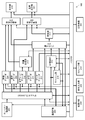
- FIG. 2 is a diagram showing a configuration example of the television receiving device 100.
- FIG. 3 is a diagram showing a configuration example of a sensor group 300 mounted on the television receiving device 100.
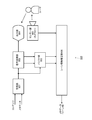
- FIG. 4 is a diagram showing a configuration example of the scene acquisition and scene information estimation system 400.
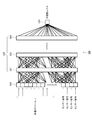
- FIG. 5 is a diagram showing a configuration example of the neural network 500 used in the gaze estimation unit 406.
- FIG. 6 is a diagram showing a configuration example of the neural network 600 used in the scene information estimation unit 408.
- FIG. 7 is a flowchart showing a processing procedure performed by the scene acquisition and scene information estimation system 400.
- FIG. 8 is a diagram showing a modified example of the scene acquisition and scene information estimation system 800.
- FIG. 9 is a diagram showing a configuration example of the neural network 900 used in the scene information estimation unit 806.
- FIG. 10 is a diagram showing a state in which a user who watches television is photographed with a camera.
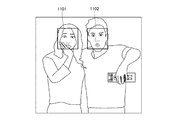
- FIG. 11 is a diagram showing a state of face recognition from an image taken by a camera.
- FIG. 12 is a diagram showing how the gaze scene is captured according to the estimation result of the gaze degree of the user.
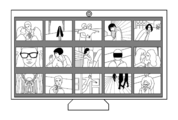
- FIG. 13 is a diagram showing a configuration example of a list screen of scenes watched by the user.
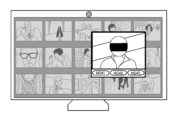
- FIG. 14 is a diagram illustrating the configuration of a screen that transitions after selecting a scene.
- FIG. 15 is a diagram showing a configuration example of a screen for presenting related contents.
- FIG. 10 is a diagram showing a state in which a user who watches television is photographed with a camera.
- FIG. 11 is a diagram showing a state of face recognition from an image taken by a camera.
- FIG. 12 is a diagram showing how the gaze scene is captured
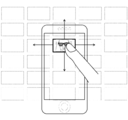
- FIG. 16 is a diagram showing how the scene watched by the user is fed back on the screen of the smartphone.
- FIG. 17 is a diagram showing an arrangement example of a plurality of scenes.
- FIG. 18 is a diagram showing an arrangement example of a plurality of scenes.
- FIG. 19 is a diagram showing an application example of the panel speaker technology.
- FIG. 20 is a diagram showing a configuration example of an artificial intelligence system 2000 using a cloud.
- FIG. 1 schematically shows a configuration example of a system for viewing video content.
- the television receiver 100 is equipped with a speaker that outputs a large-screen array of audio that displays video content.
- the television receiving device 100 has, for example, a built-in tuner that selects and receives broadcast signals, or is connected to a set-top box, and can use the broadcasting service provided by the television station.
- the broadcast signal may be either terrestrial or satellite.
- the television receiving device 100 can also use a broadcast-type video distribution service using a network such as IPTV or OTT. For this reason, the television receiver 100 is equipped with a network interface card and uses communication based on existing communication standards such as Ethernet (registered trademark) and Wi-Fi (registered trademark) via a router or an access point. It is interconnected to an external network such as the Internet.
- a network interface card uses communication based on existing communication standards such as Ethernet (registered trademark) and Wi-Fi (registered trademark) via a router or an access point. It is interconnected to an external network such as the Internet.
- a stream distribution server that distributes a video stream is installed on the Internet, and a broadcast-type video distribution service is provided to the television receiving device 100.
- innumerable servers that provide various services are installed on the Internet.
- An example of a server is a stream distribution server.
- the Web service can be used by activating the browser function and issuing, for example, an HTTP (Hyper Text Transfer Protocol) request to the stream distribution server.
- HTTP Hyper Text Transfer Protocol
- an artificial intelligence server (not shown) that provides the artificial intelligence function to the client on the Internet (or on the cloud).
- the function of artificial intelligence refers to a function in which functions generally exhibited by the human brain, such as learning, reasoning, data creation, and planning, are artificially realized by software or hardware.
- the artificial intelligence server is equipped with, for example, a neural network that performs deep learning (DL) using a model that imitates a human brain neural circuit.
- a neural network has a mechanism in which artificial neurons (nodes) that form a network by connecting synapses acquire the ability to solve problems while changing the strength of synaptic connections by learning. Neural networks can automatically infer solution rules for problems by repeating learning.
- the "artificial intelligence server” referred to in the present specification is not limited to a single server device, and may be in the form of a cloud that provides a cloud computing service, for example.
- FIG. 2 shows a configuration example of the television receiving device 100.
- the TV receiver 100 includes a main control unit 201, a bus 202, a storage unit 203, a communication interface (IF) unit 204, an expansion interface (IF) unit 205, a tuner / demodulation unit 206, and a demultiplexer (DEMUX). ) 207, video decoder 208, audio decoder 209, character super decoder 210, subtitle decoder 211, subtitle synthesis unit 212, data decoder 213, cache unit 214, application (AP) control unit 215, and so on. It includes a browser unit 216, a sound source unit 217, a video synthesis unit 218, a display unit 219, a voice synthesis unit 220, a voice output unit 221 and an operation input unit 222.
- IF communication interface
- IF expansion interface
- DEMUX demultiplexer
- the main control unit 201 is composed of, for example, a controller, a ROM (Read Only Memory) (provided that it includes a rewritable ROM such as an EEPROM (Electrically Erasable Program ROM)), and a RAM (Random Access Memory).
- the operation of the entire television receiving device 100 is comprehensively controlled according to the operation program.
- the controller is a CPU (Central Processing Unit), MPU (Micro Processing Unit), GPU (Graphics Processing Unit), GPGPU (General Purpose Graphic Processing Unit), etc.
- ROM is the basic operation of the operating system (OS), etc. It is a non-volatile memory in which the operation program is stored.
- the operation setting values necessary for the operation of the television receiving device 100 may be stored in the ROM.
- the RAM serves as a work area when the OS and other operating programs are executed.
- the bus 202 is a data communication path for transmitting / receiving data between the main control unit 201 and each unit in the television receiving device 100.
- the storage unit 203 is composed of a non-volatile storage device such as a flash ROM, an SSD (Solid State Drive), and an HDD (Hard Disk Drive).
- the storage unit 203 stores an operation program of the television receiving device 100, an operation setting value, personal information of a user who uses the television receiving device 100, and the like. It also stores operation programs downloaded via the Internet and various data created by the operation programs.
- the storage unit 203 can also store contents such as moving images, still images, and sounds acquired through broadcast waves and the Internet.
- the communication interface unit 204 is connected to the Internet via a router (described above) or the like, and transmits / receives data to / from each server device or other communication device on the Internet.
- the data stream of the program transmitted via the communication line shall be acquired.
- the router may be either a wired connection such as Ethernet (registered trademark) or a wireless connection such as Wi-Fi (registered trademark).
- the tuner / demodulation unit 206 receives broadcast waves such as terrestrial broadcasts or satellite broadcasts via an antenna (not shown), and is a channel of a service (broadcast station or the like) desired by the user under the control of the main control unit 201. Synchronize (select) to. Further, the tuner / demodulation unit 206 demodulates the received broadcast signal to acquire a broadcast data stream.
- the television receiving device 100 may be configured to include a plurality of tuners / demodulation units (that is, multiple tuners) for the purpose of simultaneously displaying a plurality of screens or recording a counterprogram.
- the demultiplexer 207 uses the video data stream, audio data stream, character super data stream, and subtitle data stream, which are real-time presentation elements, as the video decoder 208, audio decoder 209, and character super, respectively. It is distributed to the decoder 210 and the subtitle decoder 211.
- the data stream input to the demultiplexer 207 includes a broadcast data stream by a broadcast service and a distribution data stream by a distribution service such as IPTV or OTT.
- the former is input to the demultiplexer 207 after being selected and demodulated by the tuner / demodulation unit 206, and the latter is input to the demultiplexer 207 after being received by the communication interface unit 204.
- the demultiplexer 207 reproduces the multimedia application and the file data which is a component thereof, outputs the data to the application control unit 215, or temporarily stores the data in the cache unit 214.
- the video decoder 208 decodes the video stream input from the demultiplexer 207 and outputs the video information. Further, the audio decoder 209 decodes the audio stream input from the demultiplexer 207 and outputs audio information.
- a video stream and an audio stream encoded according to the MPEG2 System standard are multiplexed and transmitted or distributed.
- the video decoder 208 and the audio decoder 209 will perform decoding processing on the encoded video stream and the encoded video stream demultiplexed by the demultiplexer 207 according to the standardized decoding method, respectively.
- the television receiving device 100 may include a plurality of video decoders 208 and audio decoders 143.
- the character super decoder 210 decodes the character super data stream input from the demultiplexer 207 and outputs the character super information.
- the subtitle decoder 211 decodes the subtitle data stream input from the demultiplexer 207 and outputs the subtitle information.
- the subtitle composition unit 212 synthesizes the character super information output from the character super decoder 210 and the subtitle information output from the subtitle decoder 211 with the subtitle composition unit 212.
- the data decoder 213 decodes the data stream that is multiplexed with the video and audio in the MPEG-2 TS stream. For example, the data decoder 213 notifies the main control unit 201 of the result of decoding the general-purpose event message stored in the descriptor area of the PMT (Program Map Table), which is one of the PSI (Program Special Information) tables.
- PMT Program Map Table
- the application control unit 215 inputs the control information included in the broadcast data stream from the demultiplexer 207, or acquires the control information from the server device on the Internet via the communication interface unit 204, and interprets the control information.
- the browser unit 216 presents the multimedia application file acquired from the server device on the Internet via the cache unit 214 or the communication interface unit 204 and the file system data which is a component thereof according to the instruction of the application control unit 215.
- the multimedia application file referred to here is, for example, an HTML (HyperText Markup Language) document, a BML (Broadcast Markup Language) document, or the like.
- the browser unit 216 also acts on the sound source unit 217 to reproduce the voice information of the application.
- the video composition unit 218 inputs the video information output from the video decoder 208, the subtitle information output from the subtitle composition unit 212, and the application information output from the browser unit 216, and appropriately selects or superimposes the processing. Do.
- the video synthesis unit 218 includes a video RAM (not shown), and the display drive of the display unit 219 is performed based on the video information input to the video RAM. Further, the video composition unit 218 is based on the control of the main control unit 201, and if necessary, screen information such as an EPG (Electronic Program Guide) screen and graphics generated by an application executed by the main control unit 201. Superimposition processing is also performed.
- EPG Electronic Program Guide
- the display unit 219 is a display device including, for example, a liquid crystal display or an organic EL (Electro-Luminescence) display, and presents to the user video information selected or superimposed by the video synthesis unit 218. Further, as the display unit 219, a liquid crystal display device of a type in which a transmissive liquid crystal panel is divided into a plurality of display areas (blocks) and light is individually incident using a backlight for each display area may be used. Good (see, eg, Patent Document 2). This type of display device has an advantage that the amount of incident light is controlled for each display area to expand the dynamic range of the brightness of the displayed image.
- the voice synthesis unit 220 inputs the voice information output from the voice decoder 209 and the voice information of the application reproduced by the sound source unit 217, and performs processing such as selection or synthesis as appropriate.
- the voice output unit 221 includes audio output of program content and data broadcast content selected and received by the tuner / demodulator unit 206, and voice information processed by the voice synthesis unit 220 (including voice guidance or synthetic voice of a voice agent). Used for the output of.
- the audio output unit 221 is composed of an audio generating element such as a speaker.
- the audio output unit 221 may be a speaker array (multi-channel speaker or ultra-multi-channel speaker) in which a plurality of speakers are combined, and some or all the speakers are externally connected to the television receiver 100. May be good.
- a flat panel type speaker (see, for example, Patent Document 3) can be used for the audio output unit 221.
- a speaker array in which different types of speakers are combined can also be used as the audio output unit 221.
- the speaker array may include a speaker array that outputs sound by vibrating the display unit 219 by one or more vibrators (actuators) that generate vibration.
- the exciter (actuator) may be in a form that is retrofitted to the display unit 219.
- FIG. 19 shows an example of applying the panel speaker technology to a display.
- the display 1900 is supported by a stand 1902 on the back.
- a speaker unit 1901 is attached to the back surface of the display 1900.
- the exciter 1901-1 is arranged at the left end of the speaker unit 1901, and the exciter 1901-2 is arranged at the right end, forming a speaker array.
- the exciters 1901-1 and 1901-2 can vibrate the display 1901 based on the left and right audio signals to output acoustics.
- the stand 1902 may include a subwoofer that outputs low-pitched sound.
- the display 1900 corresponds to a display unit 219 using an organic EL element.
- the operation input unit 222 is an instruction input unit for the user to input an operation instruction to the television receiving device 100.
- the operation input unit 222 is composed of, for example, an operation key in which a remote controller receiving unit for receiving a command transmitted from a remote controller (not shown) and a button switch are arranged. Further, the operation input unit 222 may include a touch panel superimposed on the screen of the display unit 219. Further, the operation input unit 222 may include an external input device such as a keyboard connected to the expansion interface unit 205.
- the expansion interface unit 205 is a group of interfaces for expanding the functions of the television receiving device 100, and is composed of, for example, an analog video / audio interface, a USB (Universal Serial Bus) interface, a memory interface, and the like.
- the expansion interface unit 205 may include a digital interface including a DVI terminal, an HDMI (registered trademark) terminal, a DisplayPort (registered trademark) terminal, and the like.
- the expansion interface 205 is also used as an interface for capturing sensor signals of various sensors included in the sensor group (see the following and FIG. 3).
- the sensor shall include both a sensor installed inside the main body of the television receiving device 100 and a sensor externally connected to the television receiving device 100.
- the externally connected sensor also includes a sensor built in another CE (Consumer Electronics) device or an IoT (Internet of Things) device existing in the same space as the television receiving device 100.
- CE Consumer Electronics
- IoT Internet of Things
- the expansion interface 205 may be captured after the sensor signal is subjected to signal processing such as noise removal and further digitally converted, or may be captured as unprocessed RAW data (analog waveform signal).
- the sensing function television receiving device 100 is equipped with various sensors is to measure or estimate the degree of gaze (viewing quality) when the user views the video content displayed on the display unit 219.
- the degree of satisfaction with video content the higher the degree of attention to a specific scene. Therefore, the gaze level can be rephrased as the "satisfaction level” regarding the video content. That is, the "gaze” appearing in the present specification is synonymous with the expression “satisfaction” at the same time.
- the term “user” refers to a viewer who views (including when he / she plans to watch) the video content displayed on the display unit 219, unless otherwise specified. ..
- FIG. 3 shows a configuration example of the sensor group 300 installed in the television receiving device 100.
- the sensor group 300 includes a camera unit 310, a status sensor unit 320, an environment sensor unit 330, a device status sensor unit 340, and a user profile sensor unit 350.
- the camera unit 310 is provided with a camera 311 that captures a user viewing the video content displayed on the display unit 219, a camera 312 that captures the video content displayed on the display unit 219, and a television receiving device 100. Includes a camera 313 that captures the room (or installation environment) in which it is located.
- the camera 311 is installed near the center of the upper end edge of the screen of the display unit 219, for example, and preferably captures a user who is viewing video content. In this embodiment, the camera 311 is indispensable.
- the camera 312 is installed facing the screen of the display unit 219, for example, and captures the video content being viewed by the user. Alternatively, the user may wear goggles equipped with the camera 312. Further, it is assumed that the camera 312 has a function of recording (recording) the sound of the video content as well. However, the camera 312 is not indispensable when the television receiving device 100 is provided with a buffer (described later) that temporarily holds the output video stream or audio stream.
- the camera 313 is composed of, for example, an all-sky camera or a wide-angle camera, and photographs a room (or an installation environment) in which the television receiving device 100 is installed.
- the camera 313 may be, for example, a camera mounted on a camera table (head) that can be rotationally driven around each axis of roll, pitch, and yaw.
- the camera 310 is unnecessary when sufficient environmental data can be acquired by the environmental sensor 330 or when the environmental data itself is unnecessary.
- the status sensor unit 320 includes one or more sensors that acquire status information related to the user's status.
- state information includes, for example, the user's work state (whether or not video content is viewed), the user's action state (moving state such as stationary, walking, running, etc., eyelid opening / closing state, line-of-sight direction, pupil). (Large and small), mental state (impression, excitement, arousal, emotion, emotion, etc., such as whether the user is absorbed or concentrated in the video content), and further, the physiological state is intended to be acquired.
- the state sensor unit 320 collects a sweating sensor, a myoelectric potential sensor, an electrooculogram sensor, a brain wave sensor, an exhalation sensor, a gas sensor, an ion concentration sensor, an IMU (Internal Measurement Unit) that measures the user's behavior, and a user's speech. It may be provided with various sensors such as a voice sensor (microphone, etc.).
- the environment sensor unit 330 includes various sensors that measure information about the environment such as the room where the television receiving device 100 is installed. For example, temperature sensors, humidity sensors, light sensors, illuminance sensors, airflow sensors, odor sensors, electromagnetic wave sensors, geomagnetic sensors, GPS (Global Positioning System) sensors, voice sensors (microphones, etc.) that collect ambient sounds are environmental sensors. It is included in part 330.
- the device status sensor unit 340 includes one or more sensors that acquire the status inside the television receiving device 100.
- circuit components such as the video decoder 208 and the audio decoder 209 have a function of externally outputting the state of the input signal and the processing state of the input signal, so as to play a role of a sensor for detecting the state inside the device. You may. Further, the device status sensor unit 340 may detect the operation performed by the user on the television receiving device 100 or other device, or may save the user's past operation history.
- the user profile sensor unit 350 detects profile information about a user who views video content on the television receiving device 100.
- the user profile sensor unit 350 does not necessarily have to be composed of sensor elements.
- the user profile such as the age and gender of the user may be detected based on the user's face image taken by the camera 311 or the user's utterance collected by the voice sensor.
- the user profile acquired on the multifunctional information terminal carried by the user such as a smartphone may be acquired by the cooperation between the television receiving device 100 and the smartphone.
- the user profile sensor unit 350 does not need to detect even sensitive information so as to affect the privacy and confidentiality of the user. Further, it is not necessary to detect the profile of the same user each time the video content is viewed, and the user profile information once acquired may be saved in, for example, the EEPROM (described above) in the main control unit 201.
- a multifunctional information terminal carried by a user such as a smartphone may be utilized as a status sensor unit 320, an environment sensor unit 330, or a user profile sensor unit 350 by linking the television receiving device 100 and the smartphone.
- the user's data managed by applications such as sensor information acquired by the sensor built into the smartphone, healthcare function (pedometer, etc.), calendar or schedule book / memorandum, mail, and SNS (Social Network Service) It may be added to the state data and the environment data.
- the television receiver 100 can measure or estimate the gaze degree of the user's video content in combination with the sensing function as shown in FIG.
- There are various ways to use gaze For example, a proposal has been made for an information providing device that derives the user's tastes and interests based on the result of aggregating the attribute information of the content that the user has viewed and provides the user with viewing support information and value-added information. (See Patent Document 4).
- the attribute information of the content referred to here is, for example, the genre of the content, performers, keywords, etc.
- the attribute information can be extracted from the so-called metadata which is the information accompanying the video content.
- metadata which is the information accompanying the video content.
- there are various routes for obtaining metadata such as cases where metadata is superimposed on video content, cases where it is distributed as broadcast data accompanying the content of the main broadcast, and cases where it is obtained through a route different from the broadcast content. (For example, the case where the metadata of the broadcast content is acquired via the Internet) and so on.
- the attribute information of the content is often given to the entire content on the side of the creator or distributor of the content.
- Attribute information related to content that the user is interested in includes viewing support for the user (for example, automatic recording reservation and other content recommendation), feedback to content creators and distributors, content evaluation, and sales promotion of related products.
- viewing support for the user for example, automatic recording reservation and other content recommendation
- feedback to content creators and distributors for example, feedback to content creators and distributors
- content evaluation for example, sales promotion of related products.
- the attribute information related to the entire content is generally information that characterizes the entire content (attribute information included in the metadata of the content), and does not necessarily indicate the attribute information that characterizes each scene in the content. ..
- the information (attribute information or metadata) that characterizes each scene may be more interesting to the user who is interested in the scene than the information that characterizes the entire content.
- content creators, distributors, advertisement distributors, etc. provide viewing support, content evaluation, product recommendation, etc. based on the correlation between the measurement result of the user's gaze level for each scene in the content and the correlation that characterizes the entire content. If this is done, it may not be possible to accurately reflect the user's interests.
- a specific scene that the user gazes at is extracted from the video content, and metadata that is information about the specific scene (also referred to as a label when a neural network is used in artificial intelligence).
- metadata that is information about the specific scene (also referred to as a label when a neural network is used in artificial intelligence).
- the following is a proposal for a technology that infers and automatically outputs the above by artificial intelligence.
- FIG. 4 shows a configuration example of the scene acquisition and scene information estimation system 400.
- the illustrated system 400 is configured by using the components in the television receiving device 100 shown in FIG. 2 and an external device (such as a server device on the cloud) of the television receiving device 100, if necessary.
- an external device such as a server device on the cloud
- the receiving unit 401 receives the video content and the metadata associated with the video content.
- the video content includes broadcast content transmitted from a broadcasting station (such as a radio tower or a broadcasting satellite) and streaming content distributed from a stream distribution server such as an OTT service.
- the metadata received by the receiving unit 401 is the metadata given to the entire content by the creator or distributor of the content. Then, the receiving unit 401 separates (demultiplexes) the received signal into a video stream, an audio stream, and metadata, and outputs the received signal to the signal processing unit 402 and the buffer unit 403 in the subsequent stage.
- the receiving unit 401 is composed of, for example, a tuner / demodulation unit 206, a communication interface unit 204, and a demultiplexer 207 in the television receiving device 100.
- the signal processing unit 402 includes, for example, a video decoder 2080 and an audio decoder 209 in the television receiving device 100, decodes the video data stream and the audio data stream input from the receiving unit 401, and outputs the video information and the audio information, respectively. Output to 404. Further, the signal processing unit 402 may output the decoded video data stream and the audio data stream to the buffer unit 403.
- the output unit 404 includes, for example, a display unit 219 and an audio output unit 221 in the television receiving device 100, and displays and outputs video information on the screen and outputs audio information from a speaker or the like.
- the buffer unit 403 has a video buffer and an audio buffer, and temporarily holds the video information and the audio information decoded by the signal processing unit 402 for a certain period of time.
- the fixed period referred to here corresponds to, for example, the processing time required to acquire the scene to be watched by the user from the video content.
- the buffer unit 403 may be, for example, a RAM in the main control unit 201, or another buffer memory (not shown).
- the sensor unit 405 is basically composed of the sensor group 300 shown in FIG. However, only the camera 311 that shoots the user who is viewing the video content is indispensable, and other cameras, the state sensor 320, the environment sensor 330, and the like are optional.
- the scene acquisition and scene information estimation system 400 shown in FIG. 4 includes a buffer unit 403, it is possible to identify and record a scene of the video content being viewed by the user. Therefore, in order to specify the scene of the video content, the camera 312 for recording the display unit 219 of the television receiving device 100 from the outside of the television receiving device 100 is unnecessary.
- the sensor unit 405 outputs the user's face image taken by the camera 311 to the gaze estimation unit 406 while the user is viewing the video content output from the output unit 404. Further, the sensor unit 405 outputs the captured image of the camera 313, the user's state information sensed by the state sensor unit 320, the indoor environment information sensed by the environment sensor unit 330, and the like to the gaze estimation unit 406. It may be.
- the gaze estimation unit 406 estimates the gaze of the video content being viewed by the user by artificial intelligence based on the sensor signal output from the sensor unit 405.
- the gaze estimation unit 406 estimates the gaze of the user by artificial intelligence based on the recognition result of the user's face image taken by the camera 311.
- the gaze estimation unit 406 estimates and outputs the gaze of the user based on the image recognition result of the facial expression such as the user's pupil opening or the mouth opening wide.
- the gaze estimation unit 406 may also input a sensor signal other than the captured image of the camera 311 to estimate the gaze of the user by artificial intelligence.
- FIG. 5 shows a configuration example of the gaze degree estimation neural network 500 used by the gaze degree estimation unit 406.
- the gaze estimation neural network 500 includes an input layer 510 for inputting an image signal taken by the camera 311 and other sensor signals, an intermediate layer 520, and an output layer 530 for outputting the gaze of the user.
- the intermediate layer 520 is composed of a plurality of intermediate layers 521, 522, ...,
- the neural network 500 can perform deep learning.
- a recurrent neural network (RNN) structure including recursive coupling may be used in the intermediate layer 520.
- RNN recurrent neural network
- the input layer 510 includes a moving image stream (or a still image) taken by the camera 311 as an element of the input vector. Basically, it is assumed that the image signal captured by the camera 311 is input to the input layer 510 in the state of RAW data.
- CNN convolutional neural network
- the output layer is composed of an output node 530 that outputs the result of estimating the gaze degree from the image signal and the sensor signal as a gaze degree level represented by, for example, a continuous value (or a discrete value) of 0 to 100.
- a gaze degree level represented by, for example, a continuous value (or a discrete value) of 0 to 100.
- the output node 530 may output discrete values such as "gaze” or "not gaze”.
- the gaze estimation neural network 500 In the process of learning the gaze estimation neural network 500, a huge amount of combinations of the face image and other sensor signals and the user's gaze are input to the gaze estimation neural network 500 to be used as the face image and other sensor signals.
- the gaze estimation neural network 500 by updating the weight coefficient (inference coefficient) of each node of the intermediate layer 520 so that the coupling strength with the output node of the plausible gaze is increased, the user's face image (including other sensor signals) is included. In some cases) and the user's gaze level will be learned.
- the gaze estimation neural network 500 estimate of gaze
- the face image and other sensor information taken by the camera 311 are input to the trained gaze estimation neural network 500, the user's gaze is obtained. It is output with high accuracy.
- the gaze estimation neural network 500 as shown in FIG. 5 is realized in, for example, the main control unit 201. Therefore, the main control unit 201 may include a processor dedicated to the neural network.
- the gaze estimation neural network 500 may be provided in the cloud on the Internet, but in order to estimate the gaze degree in real time for the video content, the gaze estimation neural network 500 is arranged in the television receiving device 100. It is preferable to be done.
- a television receiver 100 incorporating a gaze estimation neural network 500 that has been learned using an expert teaching database is shipped.
- the gaze estimation neural network 500 may continuously perform learning by using an algorithm such as backpropagation (inverse error propagation).
- backpropagation inverse error propagation
- the learning results performed based on the data collected from a huge number of users on the cloud side on the Internet can be updated to the gaze estimation neural network 500 in the television receiver 100 installed in each home. This point will be described later.
- the scene acquisition unit 407 obtains metadata about the video stream and audio stream of the section determined by the gaze estimation unit 406 (or the section where the gaze level exceeds a predetermined value) and the entire content thereof. It is acquired from the buffer unit 403 and output to the scene information estimation unit 408.
- the video stream and audio stream acquired from the buffer unit 403 by the scene acquisition unit 407 based on the user's gaze level can be said to be the scene that the user was gazing at.
- the metadata about the entire content does not necessarily apply to some scenes in the content. This is because users may be very interested in features that are unique to a particular scene (for example, objects that appear only in a particular scene), although they do not make much sense for the content as a whole. ..
- the scene information estimation unit 408 obtains the video stream and the audio stream of the scene watched by the user and the metadata related to the entire content from the scene acquisition unit 407.
- artificial intelligence estimates what the (possibly) metadata (also called a label) that characterizes the scene that the user gazes at, and outputs the metadata as appropriate information for a specific scene rather than the entire content. It is configured to do.
- FIG. 6 shows a configuration example of the scene information estimation neural network 600 used by the scene information estimation unit 408.
- the scene information estimation neural network 600 is information that characterizes the video stream and audio stream of the scene that the user gazes at, the input layer 610 and the intermediate layer 620 that input the metadata of the entire content, respectively, and the scene that the user gazes at. It consists of an output layer 630 that outputs metadata.
- the intermediate layer 620 is composed of a plurality of intermediate layers 621, 622, ..., And that the neural network 600 can perform deep learning.
- the intermediate layer 620 may have an RNN structure including recursive coupling.
- the input layer 610 includes a video stream and an audio stream held in the buffer unit 403 after decoding as elements of the input vector. However, when the buffer unit 403 holds the video stream and the audio stream in the state of RAW data, the RAW data is input to the input layer 610 as it is.
- the input waveform signal for each window continuous in the time axis direction is included in the input vector element. There may be overlapping sections between the previous and next windows. Further, a frequency signal obtained by processing the waveform signal for each window by FFT (Fast Fourier Transform) may be used as an element of the input vector.
- FFT Fast Fourier Transform
- the input layer 610 inputs metadata that is information that characterizes the entire content.
- the metadata consists of text data such as a program name, a performer name, a summary of the program content, and a keyword.
- Input nodes corresponding to each text data are arranged in the input layer 610.
- CNN may be used for inputting an image signal or an audio signal to perform condensation processing of feature points.
- an output capable of inferring (plausible) metadata (also called a label), which is information that characterizes the scene that the user gazes at, is generated.
- the metadata for each scene includes the metadata of the entire original content such as the program name, performer name, program content summary, and keywords, as well as the things reflected in the scene (for example, the clothes that the performers are coming to). It is assumed that the metadata of the original content, such as the brand name of the decoration, the store name of the coffee paper cup held by the performer, the location), the song name of BGM, and the dialogue of the performer, are included. Will be done. An output node corresponding to each text data of these metadata will be arranged on the output layer 630. Then, the output node corresponding to the plausible metadata for the video stream and the audio stream of the scene input to the input layer 610 is ignited.
- the intermediate layer 620 composed of a plurality of layers is provided so that the connection strength with the output node of the plausible metadata for the video stream and the audio stream of the scene watched by the user is increased.
- the weighting coefficient (inference coefficient) of each node we will learn the correlation between the scene and the metadata.
- plausible metadata is output with high accuracy for the video stream and the audio stream of the scene that the user gazes at.
- the scene information estimation neural network 600 as shown in FIG. 6 is realized in, for example, the main control unit 201. Therefore, the main control unit 201 may include a processor dedicated to the neural network.
- the main control unit 201 may include a processor dedicated to the neural network.
- a television receiver 100 incorporating a scene information estimation neural network 600 that has been learned using an expert teaching database is shipped.
- the scene information estimation neural network 600 may perform learning by using an algorithm such as backpropagation (inverse error propagation). Further, the learning result performed based on the data collected from a huge number of users on the cloud side on the Internet can be updated to the scene information estimation neural network 600 in the television receiving device 100 installed in each home. The points will be described later.
- the scene information estimation neural network 600 may be provided in the cloud on the Internet.
- the user's gaze scene acquired by the scene acquisition unit 407 and the metadata as information characterizing the scene estimated for each scene output from the scene information estimation unit 408 (hereinafter, also referred to as "scene metadata") are , The final output of the scene acquisition and scene information estimation system 400.
- the content may be stored in the television receiving device 100 where the user has viewed the content, or may be uploaded to a server on the Internet.
- the upload destination server may be an artificial intelligence server on which the scene information estimation neural network 600 is constructed, or another server that aggregates metadata.
- the user's gaze scene and the metadata of the scene may be output to an information terminal such as a smartphone owned by the user.
- an application temporaryly referred to as a "companion application” linked with the scene acquisition and scene information estimation system 400 is started so that the user can view the scene and the metadata of the scene. You may.
- the metadata of the scene that the user has watched can be used for evaluation of video content viewed by a user and recommendation of other video content. It can also be used for marketing such as recommending products related to the scene to the user.
- FIG. 7 shows in the form of a flowchart a processing procedure for acquiring a scene from video content and outputting metadata that is information that characterizes the scene, which is carried out by the scene acquisition and scene information estimation system 400.
- the receiving unit 401 inputs metadata (or attribute data included in the metadata) that is information about the video content and the entire content (step S701).
- the video content includes broadcast content transmitted from a broadcasting station (such as a radio tower or a broadcasting satellite) and streaming content distributed from a stream distribution server such as an OTT service.
- the metadata received by the receiving unit 401 is the metadata given to the entire content by the creator or distributor of the content.
- step S702 the video stream and audio stream of the content input by the receiving unit 401 are processed by the signal processing unit 402 and output by the output unit 404, and the content and metadata are buffered.
- the gaze degree of the user while viewing the content presented by the output unit 404 is estimated by the gaze degree estimation unit 406 by artificial intelligence (step S703).
- the gaze estimation unit 406 basically measures the gaze of the user or estimates it by artificial intelligence based on the recognition result of the face image of the user taken by the camera 311.
- the gaze estimation unit 406 can also use sensor signals of sensors other than the captured image of the camera 311 to measure the gaze. Further, in the gaze estimation unit 406, in order to perform estimation by artificial intelligence, the gaze estimation neural network 500 (see FIG. 5) has learned the correlation between the face image and other sensor information and the user's gaze. That) is used.
- the scene acquisition unit 407 determines that the user has gazed at the gaze estimation unit 406 (Yes in step S70)
- the scene acquisition unit 407 buffers the video stream and the audio stream of the section gaze by the user as the scene that the user gazes at. While acquiring from the unit 403, the metadata of the entire content is acquired from the buffer unit 403 and output to the scene information estimation unit 408 (step S705).
- the scene information estimation unit 408 inputs the video stream and audio stream of the scene watched by the user and the metadata related to the entire content from the scene acquisition unit 407 to characterize the scene watched by the user (likely). Estimate what the metadata is by artificial intelligence (step S706).
- the scene information estimation unit 408 has a scene information estimation neural network 600 (see FIG. 6) that has learned the correlation between the scene watched by the user and the metadata plausible for the scene in order to perform estimation by artificial intelligence. That) is used.
- step S707 the scene that the user gazes at, the scene is characterized (probably), the metadata of the scene is output to a predetermined output destination (step S707), and this process is terminated.
- FIG. 8 shows a modified example of the scene acquisition and scene information estimation system 800.
- the illustrated system 800 is configured by using the components in the television receiving device 100 shown in FIG. 2 and an external device (such as a server device on the cloud) of the television receiving device 100, if necessary.
- an external device such as a server device on the cloud
- the receiving unit 801, the signal processing unit 802, the buffer unit 803, the output unit 804, and the sensor unit 805 are the same as those of the scene information estimation system 400 shown in FIG. 4, detailed description thereof will be omitted here.
- the scene information estimation unit 806 collectively realizes the processing performed by the gaze estimation unit 406, the scene acquisition unit 407, and the scene information estimation unit 408 in the scene information estimation system 400 shown in FIG. 4 with a single neural network. To do.
- FIG. 9 shows a configuration example of the scene information estimation neural network 900 used by the scene information estimation unit 806.
- the scene information estimation neural network 900 includes an input layer 910, an intermediate layer 920, and an output layer 930.
- the intermediate layer 920 is composed of a plurality of intermediate layers 921, 922, ...,
- the scene information estimation neural network 900 can perform deep learning (DL).
- DL deep learning
- a recurrent neural network (RNN) structure including recursive coupling may be used in the intermediate layer 920.
- the input layer 910 includes a node for inputting an image signal taken by the camera 311 and other sensor information, a video stream and an audio stream temporarily held in the buffer unit 803, and content metadata.
- the input layer 910 includes a moving image stream (or may be a still image) taken by the camera 311, a video stream and an audio stream of the content, and the like as elements of the input vector. Basically, it is assumed that the image signal and the audio signal are input to the input layer 910 in the state of RAW data.
- the input waveform signal for each window continuous in the time axis direction is used as an input vector to be input to each node of the input layer 910. There may be overlapping sections between the previous and next windows. Further, a frequency signal obtained by FFT processing the waveform signal for each window may be used as an input vector (same as above).
- the convolutional neural network CNN may be utilized for inputting an image signal or an audio signal to perform condensation processing of feature points.
- an input node corresponding to each text data is arranged in the input layer 910. Will be done.
- the output layer 930 generates an output that can estimate the scene that the user gazes at and the (possible) metadata (also called a label) that characterizes the scene.
- the metadata for each scene includes the metadata of the entire original content such as the program name, performer name, program content summary, and keywords, as well as the things reflected in the scene (for example, the clothes that the performers are coming to). It is assumed that the metadata of the original content, such as the brand name of the decoration, the store name of the coffee paper cup held by the performer, the location), the song name of BGM, and the dialogue of the performer, are included. Will be done. Therefore, an output node corresponding to each text data of these metadata is arranged in the output layer 930. Then, with respect to the video stream and the audio stream input to the input layer 910, the video stream and the audio stream of the scene with high gaze of the user and the output node corresponding to the metadata plausible for the scene are ignited. ..
- a plausible gaze scene and plausible metadata for the face image and other sensor signals, and the video stream and the audio stream that are input every moment.
- the weighting coefficient (inference coefficient) of each node of the intermediate layer 920 consisting of multiple layers so that the connection strength with the output node of is increased, the correlation between the scene and the metadata is learned. ..
- a plausible gaze scene and its scene are given to the face image and other sensor signals, and the video stream and the audio stream that are input every moment. Plausible metadata is output with high accuracy.
- the scene information estimation neural network 900 as shown in FIG. 9 is realized in, for example, the main control unit 201. Therefore, a processor dedicated to the neural network may be included in the main control unit 201 or in a processing circuit different from the main control unit 201.
- a television receiver 100 incorporating a scene information estimation neural network 900 that has been learned using an expert teaching database is shipped.
- the scene information estimation neural network 900 may perform learning by using an algorithm such as backpropagation (inverse error propagation). Further, the learning result performed based on the data collected from a huge number of users on the cloud side on the Internet can be updated to the scene information estimation neural network 900 in the television receiving device 100 installed in each home. The points will be described later.
- the scene information estimation neural network 900 may be provided in the cloud on the Internet.
- the plausible user's gaze scene identified by the scene information estimation unit 806 and the plausible metadata for that scene are the final outputs of the scene acquisition and scene information estimation system 800.
- the gaze estimation unit 406 recognizes the face from the image captured by the camera 311 and measures the gaze of the user.
- FIG. 11 shows how the face images 1101 and 1102 of the two users are recognized from the images taken by the camera 311.
- the gaze estimation unit 406 performs gaze estimation on at least one of the facial images 1101 and 1102.
- the gaze degree estimation neural network 500 shown in FIG. 5 may be used for estimating the gaze degree of the user's content by artificial intelligence.
- the gaze estimation neural network 500 may estimate the gaze of the user based on the sensor signals of other sensors in addition to the captured image of the camera 311.
- the buffer unit is in the section estimated to be gaze.
- the video stream and the audio stream held in the 403 are captured as the user's gaze scene.
- FIG. 12 illustrates a state in which a gaze scene is captured as the gaze degree of the user is measured.
- the user's gaze scene output by the scene acquisition and scene information estimation system 400 and the metadata that characterizes the scene are uploaded to a server on the Internet.
- the content recommendation server searches for similar or related content recommended for viewing to the user based on the user's gaze scene and the metadata of the scene, and provides the user with information on the recommended content.
- This type of content recommendation server may search for similar or related content from the user's gaze scene by using an algorithm such as CF (Collaborative Filtering) or CBF (Content Based Filtering).
- the content recommendation server may, as the artificial intelligence server described above, extract similar or related contents using a neural network that has learned the correlation between the metadata and the contents.
- the content recommendation server will search for similar or related content based on the metadata of a specific scene that the user has watched in the content, rather than the entire content. Become. For this reason, it is not related to the metadata related to the entire content such as the program name and performers, but small events that are reflected only in the scene that the user is watching (for example, clothes and sunglasses that the performers are coming to, etc. Content related to (brands of ornaments such as watches) can be recommended to users.
- FIG. 13 shows a configuration example of a screen that feeds back the scene that the user has watched in the past.
- a list of representative images of scenes that the user who has watched the video content on the television receiving device 100 has watched so far is displayed in a matrix.
- the "representative image" referred to here may be, for example, the first image of the scene cut out from the content, or may be an image captured by a predetermined algorithm or randomly from the scene.
- the display format on the screen is not limited to the matrix shape, and a virtually infinite length ring may be formed by one row in the horizontal direction or one row in the vertical direction.
- many scenes arranged at arbitrary positions in the three-dimensional space are displayed as a two-dimensional plane that is visually displayed when the three-dimensional space is viewed from a predetermined viewpoint so that the viewpoint can be changed. It may be configured.
- the user can select a representative image of the scene of interest from the list by using, for example, the cross key on the remote controller. Then, if one of the representative images is selected and, for example, the enter button on the remote controller is pressed, the selection of the scene is confirmed.
- the above remote control operation for selecting a specific scene from the list of representative images can also be voice-instructed from a microphone through a voice agent function such as an AI (Artificial Intelligence) speaker having an artificial intelligence function.
- the remote control operation may be performed by gestures. Gestures can be used on all parts of the body, including the head, not just the hands.
- a selection confirmation instruction may be given by a gesture using eyes such as a wink.
- wireless headphones equipped with a motion sensor and capable of detecting the movement of the head by the function of artificial intelligence may be used.
- a touch sensor may be used to give a selection confirmation instruction.
- FIG. 14 shows a configuration example of a screen that transitions after selecting a certain representative image.
- one representative image selected by the user from the list of representative images is enlarged and displayed, and the information estimated by the scene information estimation system 400 for the scene is displayed.
- Part or all of the metadata of the scene (MD # 1, MD # 2, ...) Is displayed.
- the representative image is displayed, the video stream and the audio stream of the section watched by the user may be reproduced and output instead of the still image.
- the user can recall the memory of the scene that was gazed in the past by viewing the representative image or the moving image of the gaze scene.
- the user can confirm the reason or grounds for watching the scene by looking at the metadata together with the representative image of the scene that he / she gazed at.
- the metadata is obtained through a remote control operation, a voice agent function, or the like. You can edit (modify, add, delete, etc.) and customize the metadata associated with your scene for personal use.
- FIG. 15 shows a configuration example of a screen that presents similar or related content that is recommended based on the metadata of the selected scene.
- the user's gaze scene is displayed along with the metadata of that scene.
- a list of similar or related contents is displayed on the right half of the screen.
- the list of similar or related content displays representative images and metadata for each similar or related content. The user can determine whether he or she wants to see each similar or related content based on the representative image or metadata. Then, when a similar or related content desired to be viewed is found, the user can instruct the playback of the content through a remote control operation, a voice agent function, or the like, and start viewing.
- the user can display the feedback of the gaze scene not only on the large screen of the television receiving device 100 but also on the small screen of the information terminal such as a smartphone.
- a companion application linked with the scene acquisition and scene information estimation system 400 may be started on the smartphone so that the scene watched by the user himself and the metadata of the scene can be viewed.
- FIG. 16 illustrates how the scene watched by the user is fed back on the screen of the smartphone.
- the screen of the smartphone is small, and it is not possible to display a list of representative images of a plurality of scenes as in the TV screen shown in FIG. Therefore, only the representative image of one scene is displayed on one screen.
- representative images of a plurality of scenes are virtually arranged in a carousel shape as shown in FIG. 17, or virtually arranged in a matrix shape as shown in FIG. 18, so that the user can use a smartphone.
- the transition to the representative image adjacent to the flick operation direction on the carousel or the matrix may be performed.
- the configuration of the feedback screen on the smartphone will be described.
- the video stream and the audio stream of the section watched by the user may be reproduced and output instead of the still image.
- a part or all of the metadata estimated by the scene information estimation system 400 for the scene is displayed below the representative image.
- the user has the effect of being able to recall the memory of the scene that was gazed in the past by viewing the representative image or the moving image of the gaze scene. Further, according to the scene information estimation system 400 disclosed in the present specification, the user confirms the reason or grounds for paying attention to the scene by viewing the metadata together with the representative image of the scene that he / she gazes at. It has the effect of being able to. Further, according to the scene information estimation system 400 disclosed in the present specification, when the user wants to change the metadata given to the scene, he / she can use the editing function of the smartphone using the touch panel. , Has the effect of being able to edit (change, add, delete, etc.) metadata.
- the scene information estimation system 400 by accumulating and learning scenes having a high degree of gaze of the user, the tendency of the video content having a high degree of gaze of the user, that is, "satisfaction" can be obtained. You can learn. Therefore, artificial intelligence has the effect of increasing the possibility of providing the user with highly “satisfied” video content through the learning function.
- the gaze estimation neural network 500, the scene information estimation neural network 600, and the scene information estimation neural have been used in the process of estimating the metadata about the scene that the user gazes at in the video content by artificial intelligence.
- the network 900 has been described.
- These neural networks are used as a function of artificial intelligence, and a TV receiving device 100 installed in each home can be directly operated by a user, or an operating environment such as a home in which the device is installed (hereinafter referred to as a home). , Also called "local environment").
- a home an operating environment such as a home in which the device is installed
- local environment Also called "local environment").
- One of the effects of operating neural networks in a local environment as a function of artificial intelligence is, for example, using algorithms such as backpropagation (inverse error propagation) for these neural networks and providing feedback from users. It is possible to easily realize learning as teacher data in real time.
- the feedback from the user is, for example, the user's evaluation of the user's gaze degree estimated by the gaze degree estimation neural network 500 or the metadata which is the information characterizing the scene estimated by the scene information estimation neural network 600 or 900.
- the user feedback may be as simple as OK (good) or NG (bad).
- User feedback is input to the television receiving device 100 via, for example, an operation input unit 222, a remote controller, a voice agent which is a form of artificial intelligence, a linked smartphone, and the like. Therefore, another aspect of the effect of operating a neural network in a local environment as a function of these artificial intelligences is that the neural network can be customized or personalized to a specific user by learning using user feedback. ..
- cloud a server device operating on the cloud
- data is collected from a huge number of users to perform artificial intelligence functions.
- One of the effects of updating a neural network that functions as artificial intelligence in the cloud is that it is possible to build a more accurate neural network by learning with a large amount of data.
- FIG. 20 schematically shows a configuration example of the artificial intelligence system 2000 using the cloud.
- the artificial intelligence system 2000 using the illustrated cloud includes a local environment 2010 and a cloud 2020.
- the local environment 2010 corresponds to the operating environment (home) in which the television receiving device 100 is installed, or the television receiving device 100 installed in the home. Although only one local environment 2010 is drawn in FIG. 20 for simplification, it is assumed that a huge number of local environments are actually connected to one cloud 2020. Further, in this embodiment, the operating environment such as a home where the TV receiving device 100 or the TV receiving device 100 operates is mainly illustrated as the local environment 2010, but the local environment 2010 is directly used by a user such as a smartphone or a wearable device. Any device that can be operated or an environment in which the device operates (including public facilities such as stations, bus stops, airports, shopping centers, and labor facilities such as factories and workplaces) may be used.
- the gaze estimation neural network 500 and the scene information estimation neural network 600, or the scene information estimation neural network 900 are arranged in the television receiving device 100 as artificial intelligence.
- These neural networks mounted in the television receiving device 100 and actually used are collectively referred to as an operational neural network 2011 here.
- the operational neural network 2011 assumes that learning has been performed in advance using an expert teaching database consisting of a huge amount of sample data.
- the cloud 2020 is equipped with an artificial intelligence server (described above) (consisting of one or more server devices) that provides an artificial intelligence function.
- the artificial intelligence server is provided with an operational neural network 2021 and an evaluation neural network 2022 that evaluates the operational neural network 2022.
- the operational neural network 2021 has the same configuration as the operational neural network 2011 arranged in the local environment 2010, and it is assumed that learning is performed in advance using an expert teaching database consisting of a huge amount of sample data. ..
- the evaluation neural network 2022 is a neural network used for evaluating the learning status of the operational neural network 2021.
- the operational neural network 2011 inputs sensor information such as an image taken by the camera 311 and a user profile, and outputs a gaze degree suitable for the user profile and metadata for each scene.
- the operational neural network 2011 is the scene information estimation neural network 600
- the video stream of the scene watched by the user and the metadata of the original content are input.
- the input to the operational neural network 2011 is simply referred to as an "input value”
- the output from the operational neural network 2012 is simply referred to as an "output value”.
- a user of the local environment 2010 evaluates the output value of the operational neural network 2011 and receives television via, for example, an operation input unit 222, a remote controller, a voice agent, or a linked smartphone.
- the evaluation result is fed back to the device 100.
- the user feedback is either OK (0) or NG (1).
- Feedback data consisting of a combination of input values and output values of the operational neural network 2011 and user feedback is transmitted from the local environment 2010 to the cloud 2020 to the cloud 2020.
- feedback data sent from a huge number of local environments is accumulated in the feedback database 2023.
- the feedback database 2023 stores a huge amount of feedback data that describes the correspondence between the input value and the output value of the operational neural network 2011 and the user.
- the cloud 2020 can own or use the expert teaching database 2024 consisting of a huge amount of sample data used for the pre-learning of the operational neural network 2011.
- the individual sample data is teacher data that describes the correspondence between the sensor information and the user profile and the output value of the operational neural network 2011 (or 2021).
- the input value (for example, the combination of the sensor information and the user profile) included in the feedback data is input to the operation neural network 2021. Further, the output value of the operational neural network 2021 and the input value included in the corresponding feedback data (for example, a combination of sensor information and user profile) are input to the evaluation neural network 2022, and the evaluation neural network 2022 provides user feedback. Output.
- the evaluation neural network 2022 is a network that learns the correspondence between the input value to the operational neural network 2021 and the user feedback for the output of the operational neural network 2021. Therefore, in the first step, the evaluation neural network 2022 inputs the output value of the operational neural network 2021 and the user feedback included in the corresponding feedback data, and outputs itself to the output value of the operational neural network 2021. The user feedback to be performed is learned to match the actual user feedback for the output value of the operational neural network 2021. As a result, the evaluation neural network 2022 is learned so as to output the same user feedback (OK or NG) as the actual user with respect to the output of the operational neural network 2021.
- the evaluation neural network 2022 is fixed, and this time the learning of the operational neural network 2021 is carried out.
- the feedback data is taken out from the feedback database 2023
- the input value included in the feedback data is input to the operational neural network 2021, and the output value of the operational neural network 2021 and the corresponding feedback are sent to the evaluation neural network 2022.
- the user feedback data included in the data is input, and the evaluation neural network 2022 outputs user feedback equal to that of the actual user.
- the operational neural network 2021 applies an evaluation function (for example, a loss function) to the output from the output layer of the neural network, and performs learning by using backpropagation so that the value is minimized.
- an evaluation function for example, a loss function
- the operational neural network 2021 learns so that the output of the evaluation neural network 2022 is OK (0) for all the input values.
- the operational neural network 2021 gives feedback to the user as OK for any input value (sensor information, user profile, etc.) Output value (gaze, metadata for the scene, etc.). Will be able to be output.
- the expert teaching database 2024 may be used for the teacher data. Further, learning may be performed using two or more teacher data such as user feedback and expert teaching database 2024. In this case, the loss function calculated for each teacher data may be weighted and added to learn the operational neural network 2021 so as to be the minimum.
- the accuracy of the operational neural network 2021 is improved by alternately performing the learning of the evaluation neural network 2022 as the first step and the learning of the operational neural network 2021 as the second step as described above. Then, by providing the inference coefficient in the operational neural network 2021 whose accuracy is improved by learning to the operational neural network 2011 in the local environment 2010, the user can also enjoy the operational neural network 2011 in which the learning is further advanced.
- the bitstream of the inference coefficient of the operational neural network 2011 may be compressed and downloaded from the cloud 2020 to the local environment. If the size of the bitstream is large even after compression, the inference coefficient may be divided for each layer or region, and the compressed bitstream may be downloaded in a plurality of times.
- the present specification has mainly described embodiments in which the technology disclosed in the present specification is applied to a television receiver, the gist of the technology disclosed in the present specification is not limited to this. Similarly, the technology disclosed in the present specification can be applied to various types of content playback devices that present various playback contents such as video and audio to users.
- the technology disclosed in this specification can also have the following configuration.
- a gaze estimation unit that estimates the gaze of the user viewing the content by artificial intelligence based on sensor information, Based on the estimation result of the gaze degree estimation unit, the acquisition unit that acquires the image of the scene that the user gazes at in the content and the information about the content.
- a scene information estimation unit that estimates information about the scene that the user is gazing at by artificial intelligence based on the video of the scene that the user is gazing at and information about the content.
- the scene information estimation unit uses a neural network that has learned the correlation between the image of the scene, the information about the content, and the information about the scene as an estimation by artificial intelligence, and uses the neural network to be watched by the user. Estimate correlated information, The artificial intelligence information processing device according to (1) above.
- the gaze estimation unit uses a neural network that learns the correlation between the sensor information and the gaze of the user as an estimation by artificial intelligence, and the sensor information about the user who is viewing the content. Estimate the degree of gaze that correlates with, The artificial intelligence information processing device according to any one of (1) and (2) above.
- the sensor information includes at least a captured image of the user viewing the content with a camera.
- the gaze estimation unit uses a neural network that has learned the correlation between the face recognition result and the user's gaze as an estimation by artificial intelligence, and the gaze estimation unit has a correlation with the face recognition result in the captured image. To estimate, The artificial intelligence information processing device according to (3) above.
- the content includes at least one of broadcast content and stream distribution content.
- the artificial intelligence information processing device according to any one of (1) to (4) above.
- the artificial intelligence information processing device according to any one of (1) to (6) above.
- An input unit for inputting sensor information about the user who is viewing the content A scene information estimation unit that estimates information that correlates with the scene that the user is gazing at, using a neural network that has learned the correlation between sensor information, content, and information about the scene that the user is gazing at.
- An artificial intelligence information processing device equipped with An input unit for inputting sensor information about the user who is viewing the content, A scene information estimation unit that estimates information that correlates with the scene that the user is gazing at, using a neural network that has learned the correlation between sensor information, content, and information about the scene that the user is gazing at.
- the sensor information includes at least a captured image taken by a camera of the user who is viewing the content.
- the scene information estimation unit uses a neural network that has learned the correlation between the face image, the content, and the information about the content to be watched by the user, and uses the neural network to learn the correlation with the scene to be watched by the user. To estimate, The artificial intelligence information processing device according to (8) above.
- a gaze estimation step that estimates the gaze of the user viewing the content by artificial intelligence based on the sensor information, and Based on the estimation result in the gaze degree estimation step, the acquisition step of acquiring the image of the scene that the user gazes at in the content and the information about the content, and the acquisition step.
- a scene information estimation step of estimating information about a scene that the user is gazing at by artificial intelligence based on an image of the scene that the user is gazing at and information about the content. Artificial intelligence information processing method with.
- Operation input unit 300 ... Sensor group, 310 ... Camera unit, 311-313 ... Camera 320 ... Status sensor unit, 330 ... Environmental sensor Unit 340 ... Equipment status sensor unit, 350 ... User profile sensor unit 400 ... Scene acquisition and scene information estimation system, 401 ... Receiver unit 402 ... Signal processing unit, 403 ... Buffer unit, 404 ... Output unit 405 ... Sensor unit, 406 ... Gaze estimation unit, 407 ... Scene acquisition unit 408 ... Scene information estimation unit 500 ... Gaze estimation neural network 510 ... Input layer, 520 ... Intermediate layer, 530 ... Output layer 600 ... Scene information estimation neural network 610 ... Input layer, 620 ... Intermediate layer, 630 ... Output layer 800 ...
- Scene acquisition and scene information estimation system 801 ... Receiver unit 802 ... Signal processing unit, 803 ... Buffer unit, 804 ... Output unit 805 ... Sensor unit, 806 ...
- Scene information estimation unit 900 ... Scene information estimation Neural network 910 ... Input layer, 920 ... Intermediate layer, 930 ... Output layer 1900 ... Display, 1901 ... Speaker unit 1902 ... Stand, 1901-1, 1902-2 ... Exciter 2000 ... Artificial intelligence using cloud System 2010 ... Local environment, 2011 ... Operational neural network 2020 ... Cloud, 2021 ... Operational neural network 2022 ... Evaluation neural network 2023 ... Feedback database 2024 ... Expert teaching database
Landscapes
- Engineering & Computer Science (AREA)
- Multimedia (AREA)
- Signal Processing (AREA)
- Databases & Information Systems (AREA)
- Theoretical Computer Science (AREA)
- Health & Medical Sciences (AREA)
- General Health & Medical Sciences (AREA)
- Physics & Mathematics (AREA)
- Artificial Intelligence (AREA)
- Evolutionary Computation (AREA)
- Life Sciences & Earth Sciences (AREA)
- General Engineering & Computer Science (AREA)
- General Physics & Mathematics (AREA)
- Data Mining & Analysis (AREA)
- Biomedical Technology (AREA)
- Biophysics (AREA)
- Social Psychology (AREA)
- Computing Systems (AREA)
- Molecular Biology (AREA)
- Mathematical Physics (AREA)
- Software Systems (AREA)
- Computational Linguistics (AREA)
- Computer Networks & Wireless Communication (AREA)
- Business, Economics & Management (AREA)
- Environmental & Geological Engineering (AREA)
- Neurosurgery (AREA)
- Chemical & Material Sciences (AREA)
- Biodiversity & Conservation Biology (AREA)
- Ecology (AREA)
- Emergency Management (AREA)
- Analytical Chemistry (AREA)
- Environmental Sciences (AREA)
- Remote Sensing (AREA)
- Library & Information Science (AREA)
- Human Computer Interaction (AREA)
- Two-Way Televisions, Distribution Of Moving Picture Or The Like (AREA)
- User Interface Of Digital Computer (AREA)
Abstract
La présente invention concerne un dispositif de traitement d'informations d'intelligence artificielle qui génère des informations relatives à des scènes par intelligence artificielle. Le dispositif de traitement d'informations d'intelligence artificielle comprend une unité d'estimation de degré de regard pour estimer le degré de regard d'un utilisateur visualisant un contenu par intelligence artificielle sur la base d'informations de capteur, une unité d'acquisition pour acquérir la vidéo d'une scène dans le contenu que l'utilisateur regarde et des informations concernant le contenu sur la base du résultat d'estimation de l'unité d'estimation de degré de regard et une unité d'estimation d'informations de scène pour estimer des informations relatives à la scène que l'utilisateur regarde à l'aide d'une intelligence artificielle sur la base de la vidéo de la scène que l'utilisateur regarde et d'informations concernant le contenu.
Priority Applications (4)
| Application Number | Priority Date | Filing Date | Title |
|---|---|---|---|
| DE112020002591.8T DE112020002591T5 (de) | 2019-05-27 | 2020-03-09 | Informationsverarbeitungsvorrichtung für künstliche Intelligenz und Informationsverarbeitungsverfahren für künstliche Intelligenz |
| CN202080037794.2A CN113853598B (zh) | 2019-05-27 | 2020-03-09 | 人工智能信息处理装置及人工智能信息处理方法 |
| JP2021522641A JP7605108B2 (ja) | 2019-05-27 | 2020-03-09 | 人工知能情報処理装置及び人工知能情報処理方法 |
| US17/610,476 US12184931B2 (en) | 2019-05-27 | 2020-03-09 | Artificial intelligence information processing device and artificial intelligence information processing method |
Applications Claiming Priority (2)
| Application Number | Priority Date | Filing Date | Title |
|---|---|---|---|
| JP2019098472 | 2019-05-27 | ||
| JP2019-098472 | 2019-05-27 |
Publications (1)
| Publication Number | Publication Date |
|---|---|
| WO2020240976A1 true WO2020240976A1 (fr) | 2020-12-03 |
Family
ID=73553325
Family Applications (1)
| Application Number | Title | Priority Date | Filing Date |
|---|---|---|---|
| PCT/JP2020/009957 Ceased WO2020240976A1 (fr) | 2019-05-27 | 2020-03-09 | Dispositif de traitement d'informations d'intelligence artificielle et procédé de traitement d'informations d'intelligence artificielle |
Country Status (5)
| Country | Link |
|---|---|
| US (1) | US12184931B2 (fr) |
| JP (1) | JP7605108B2 (fr) |
| CN (1) | CN113853598B (fr) |
| DE (1) | DE112020002591T5 (fr) |
| WO (1) | WO2020240976A1 (fr) |
Families Citing this family (2)
| Publication number | Priority date | Publication date | Assignee | Title |
|---|---|---|---|---|
| WO2022031261A1 (fr) * | 2020-08-03 | 2022-02-10 | Google Llc | Systèmes et procédés d'entraînement de modèles d'attention visuelle obtenus par apprentissage automatique |
| KR102437726B1 (ko) * | 2020-10-12 | 2022-08-26 | 세종대학교 산학협력단 | 스낵 컬처 컨텐츠 저장 방법 및 장치 |
Citations (3)
| Publication number | Priority date | Publication date | Assignee | Title |
|---|---|---|---|---|
| JP2005142975A (ja) * | 2003-11-10 | 2005-06-02 | Nippon Telegr & Teleph Corp <Ntt> | 視聴者反応情報収集システム及びその方法と、その視聴者反応情報収集システムで用いられるユーザ端末及び視聴者反応情報提供装置と、そのユーザ端末・視聴者反応情報提供装置の実現に用いられる視聴者反応情報作成用プログラム |
| JP2011239158A (ja) * | 2010-05-10 | 2011-11-24 | Nippon Hoso Kyokai <Nhk> | ユーザ反応推定装置、ユーザ反応推定方法およびユーザ反応推定プログラム |
| JP2018205819A (ja) * | 2017-05-30 | 2018-12-27 | 富士通株式会社 | 注視位置検出用コンピュータプログラム、注視位置検出装置及び注視位置検出方法 |
Family Cites Families (21)
| Publication number | Priority date | Publication date | Assignee | Title |
|---|---|---|---|---|
| JPS4840393B1 (fr) | 1968-09-04 | 1973-11-30 | ||
| US20070300258A1 (en) * | 2001-01-29 | 2007-12-27 | O'connor Daniel | Methods and systems for providing media assets over a network |
| CN1174337C (zh) * | 2002-10-17 | 2004-11-03 | 南开大学 | 识别人眼注视与否的方法和装置及其应用 |
| JP4645423B2 (ja) | 2005-11-22 | 2011-03-09 | ソニー株式会社 | テレビジョン装置 |
| JP4840393B2 (ja) | 2008-04-11 | 2011-12-21 | ソニー株式会社 | 表示制御装置および方法、並びにプログラム |
| JP4770868B2 (ja) | 2008-04-21 | 2011-09-14 | ソニー株式会社 | 情報提供装置及び情報提供方法、並びにコンピュータ・プログラム |
| US8493390B2 (en) * | 2010-12-08 | 2013-07-23 | Sony Computer Entertainment America, Inc. | Adaptive displays using gaze tracking |
| JP5772069B2 (ja) * | 2011-03-04 | 2015-09-02 | ソニー株式会社 | 情報処理装置、情報処理方法およびプログラム |
| US9552124B2 (en) * | 2012-04-27 | 2017-01-24 | Mobitv, Inc. | Character based search and discovery of media content |
| EP4080794A1 (fr) * | 2016-01-06 | 2022-10-26 | TVision Insights, Inc. | Systèmes et procédés pour évaluer un engagement de spectateur |
| US10306311B1 (en) * | 2016-03-24 | 2019-05-28 | Massachusetts Mutual Life Insurance Company | Intelligent and context aware reading systems |
| CN105828041A (zh) * | 2016-04-11 | 2016-08-03 | 上海大学 | 一种支持并行预处理的视频采集系统 |
| US10142686B2 (en) * | 2017-03-30 | 2018-11-27 | Rovi Guides, Inc. | System and methods for disambiguating an ambiguous entity in a search query based on the gaze of a user |
| US10621488B2 (en) * | 2017-04-16 | 2020-04-14 | Beseeq | Content management and delivery system |
| US10628501B2 (en) * | 2017-06-07 | 2020-04-21 | Centurylink Intellectual Property Llc | Scene aware searching |
| CN109688351B (zh) * | 2017-10-13 | 2020-12-15 | 华为技术有限公司 | 一种图像信号处理方法、装置及设备 |
| WO2020018513A1 (fr) * | 2018-07-16 | 2020-01-23 | Arris Enterprises Llc | Publicité sensible au regard |
| US11034357B2 (en) * | 2018-09-14 | 2021-06-15 | Honda Motor Co., Ltd. | Scene classification prediction |
| US20200273485A1 (en) * | 2019-02-22 | 2020-08-27 | Synaptics Incorporated | User engagement detection |
| US11589120B2 (en) * | 2019-02-22 | 2023-02-21 | Synaptics Incorporated | Deep content tagging |
| US10871823B1 (en) * | 2019-05-23 | 2020-12-22 | Facebook Technologies, Llc | Systems and methods for using scene understanding for calibrating eye tracking |
-
2020
- 2020-03-09 JP JP2021522641A patent/JP7605108B2/ja active Active
- 2020-03-09 DE DE112020002591.8T patent/DE112020002591T5/de active Pending
- 2020-03-09 CN CN202080037794.2A patent/CN113853598B/zh active Active
- 2020-03-09 WO PCT/JP2020/009957 patent/WO2020240976A1/fr not_active Ceased
- 2020-03-09 US US17/610,476 patent/US12184931B2/en active Active
Patent Citations (3)
| Publication number | Priority date | Publication date | Assignee | Title |
|---|---|---|---|---|
| JP2005142975A (ja) * | 2003-11-10 | 2005-06-02 | Nippon Telegr & Teleph Corp <Ntt> | 視聴者反応情報収集システム及びその方法と、その視聴者反応情報収集システムで用いられるユーザ端末及び視聴者反応情報提供装置と、そのユーザ端末・視聴者反応情報提供装置の実現に用いられる視聴者反応情報作成用プログラム |
| JP2011239158A (ja) * | 2010-05-10 | 2011-11-24 | Nippon Hoso Kyokai <Nhk> | ユーザ反応推定装置、ユーザ反応推定方法およびユーザ反応推定プログラム |
| JP2018205819A (ja) * | 2017-05-30 | 2018-12-27 | 富士通株式会社 | 注視位置検出用コンピュータプログラム、注視位置検出装置及び注視位置検出方法 |
Also Published As
| Publication number | Publication date |
|---|---|
| CN113853598B (zh) | 2025-12-30 |
| US12184931B2 (en) | 2024-12-31 |
| JPWO2020240976A1 (fr) | 2020-12-03 |
| US20220224980A1 (en) | 2022-07-14 |
| JP7605108B2 (ja) | 2024-12-24 |
| CN113853598A (zh) | 2021-12-28 |
| DE112020002591T5 (de) | 2022-03-31 |
Similar Documents
| Publication | Publication Date | Title |
|---|---|---|
| WO2021038980A1 (fr) | Dispositif de traitement d'informations, procédé de traitement d'informations, dispositif d'affichage équipé d'une fonction d'intelligence artificielle, et système de rendu équipé d'une fonction d'intelligence artificielle | |
| US10593167B2 (en) | Crowd-based haptics | |
| US7698238B2 (en) | Emotion controlled system for processing multimedia data | |
| US20190373322A1 (en) | Interactive Video Content Delivery | |
| US20160182955A1 (en) | Methods and systems for recommending media assets | |
| WO2015120413A1 (fr) | Systèmes et procédés d'imagerie en temps réel destinés à capturer des images instantanées d'utilisateurs regardant un événement dans un environnement résidentiel ou local | |
| JP2006012171A (ja) | 生体認識を用いたレビュー管理システム及び管理方法 | |
| EP4080907B1 (fr) | Dispositif de traitement d'informations | |
| US20030219708A1 (en) | Presentation synthesizer | |
| JP6246498B2 (ja) | 視聴者参加型テレビ番組放送方法及びシステム | |
| US20230031160A1 (en) | Information processing apparatus, information processing method, and computer program | |
| JP7605108B2 (ja) | 人工知能情報処理装置及び人工知能情報処理方法 | |
| WO2021053936A1 (fr) | Dispositif de traitement d'informations, procédé de traitement d'informations et dispositif d'affichage possédant une fonction d'intelligence artificielle | |
| WO2021009989A1 (fr) | Dispositif et procédé de traitement d'informations d'intelligence artificielle, et dispositif d'affichage doué d'une fonction d'intelligence artificielle | |
| US20240147001A1 (en) | Information processing device, information processing method, and artificial intelligence system | |
| JP2021197563A (ja) | 関連情報配信装置、プログラム、コンテンツ配信システム及びコンテンツ出力端末 | |
| WO2018083852A1 (fr) | Dispositif de commande et support d'enregistrement | |
| WO2026034583A1 (fr) | Dispositif de commande d'affichage, dispositif d'affichage, récepteur de télévision, système de commande d'affichage et programme | |
| HK1186325B (en) | Controlling a media program based on a media reaction | |
| HK1186325A (en) | Controlling a media program based on a media reaction | |
| HK1185427A (en) | Highlighting or augmenting a media program |
Legal Events
| Date | Code | Title | Description |
|---|---|---|---|
| 121 | Ep: the epo has been informed by wipo that ep was designated in this application |
Ref document number: 20814073 Country of ref document: EP Kind code of ref document: A1 |
|
| ENP | Entry into the national phase |
Ref document number: 2021522641 Country of ref document: JP Kind code of ref document: A |
|
| 122 | Ep: pct application non-entry in european phase |
Ref document number: 20814073 Country of ref document: EP Kind code of ref document: A1 |