WO2020246487A1 - Composés ayant une structure dispiro-dicétopipérazine - Google Patents
Composés ayant une structure dispiro-dicétopipérazine Download PDFInfo
- Publication number
- WO2020246487A1 WO2020246487A1 PCT/JP2020/021849 JP2020021849W WO2020246487A1 WO 2020246487 A1 WO2020246487 A1 WO 2020246487A1 JP 2020021849 W JP2020021849 W JP 2020021849W WO 2020246487 A1 WO2020246487 A1 WO 2020246487A1
- Authority
- WO
- WIPO (PCT)
- Prior art keywords
- group
- cancer
- mmol
- methyl
- chloro
- Prior art date
- Legal status (The legal status is an assumption and is not a legal conclusion. Google has not performed a legal analysis and makes no representation as to the accuracy of the status listed.)
- Ceased
Links
Images








Classifications
-
- A—HUMAN NECESSITIES
- A61—MEDICAL OR VETERINARY SCIENCE; HYGIENE
- A61K—PREPARATIONS FOR MEDICAL, DENTAL OR TOILETRY PURPOSES
- A61K31/00—Medicinal preparations containing organic active ingredients
- A61K31/33—Heterocyclic compounds
- A61K31/395—Heterocyclic compounds having nitrogen as a ring hetero atom, e.g. guanethidine or rifamycins
- A61K31/495—Heterocyclic compounds having nitrogen as a ring hetero atom, e.g. guanethidine or rifamycins having six-membered rings with two or more nitrogen atoms as the only ring heteroatoms, e.g. piperazine or tetrazines
- A61K31/499—Spiro-condensed pyrazines or piperazines
-
- A—HUMAN NECESSITIES
- A61—MEDICAL OR VETERINARY SCIENCE; HYGIENE
- A61K—PREPARATIONS FOR MEDICAL, DENTAL OR TOILETRY PURPOSES
- A61K31/00—Medicinal preparations containing organic active ingredients
- A61K31/33—Heterocyclic compounds
- A61K31/395—Heterocyclic compounds having nitrogen as a ring hetero atom, e.g. guanethidine or rifamycins
- A61K31/495—Heterocyclic compounds having nitrogen as a ring hetero atom, e.g. guanethidine or rifamycins having six-membered rings with two or more nitrogen atoms as the only ring heteroatoms, e.g. piperazine or tetrazines
- A61K31/50—Pyridazines; Hydrogenated pyridazines
- A61K31/502—Pyridazines; Hydrogenated pyridazines ortho- or peri-condensed with carbocyclic ring systems, e.g. cinnoline, phthalazine
-
- A—HUMAN NECESSITIES
- A61—MEDICAL OR VETERINARY SCIENCE; HYGIENE
- A61K—PREPARATIONS FOR MEDICAL, DENTAL OR TOILETRY PURPOSES
- A61K31/00—Medicinal preparations containing organic active ingredients
- A61K31/33—Heterocyclic compounds
- A61K31/395—Heterocyclic compounds having nitrogen as a ring hetero atom, e.g. guanethidine or rifamycins
- A61K31/495—Heterocyclic compounds having nitrogen as a ring hetero atom, e.g. guanethidine or rifamycins having six-membered rings with two or more nitrogen atoms as the only ring heteroatoms, e.g. piperazine or tetrazines
- A61K31/505—Pyrimidines; Hydrogenated pyrimidines, e.g. trimethoprim
- A61K31/506—Pyrimidines; Hydrogenated pyrimidines, e.g. trimethoprim not condensed and containing further heterocyclic rings
-
- A—HUMAN NECESSITIES
- A61—MEDICAL OR VETERINARY SCIENCE; HYGIENE
- A61K—PREPARATIONS FOR MEDICAL, DENTAL OR TOILETRY PURPOSES
- A61K31/00—Medicinal preparations containing organic active ingredients
- A61K31/33—Heterocyclic compounds
- A61K31/395—Heterocyclic compounds having nitrogen as a ring hetero atom, e.g. guanethidine or rifamycins
- A61K31/495—Heterocyclic compounds having nitrogen as a ring hetero atom, e.g. guanethidine or rifamycins having six-membered rings with two or more nitrogen atoms as the only ring heteroatoms, e.g. piperazine or tetrazines
- A61K31/505—Pyrimidines; Hydrogenated pyrimidines, e.g. trimethoprim
- A61K31/517—Pyrimidines; Hydrogenated pyrimidines, e.g. trimethoprim ortho- or peri-condensed with carbocyclic ring systems, e.g. quinazoline, perimidine
-
- A—HUMAN NECESSITIES
- A61—MEDICAL OR VETERINARY SCIENCE; HYGIENE
- A61K—PREPARATIONS FOR MEDICAL, DENTAL OR TOILETRY PURPOSES
- A61K31/00—Medicinal preparations containing organic active ingredients
- A61K31/33—Heterocyclic compounds
- A61K31/395—Heterocyclic compounds having nitrogen as a ring hetero atom, e.g. guanethidine or rifamycins
- A61K31/495—Heterocyclic compounds having nitrogen as a ring hetero atom, e.g. guanethidine or rifamycins having six-membered rings with two or more nitrogen atoms as the only ring heteroatoms, e.g. piperazine or tetrazines
- A61K31/505—Pyrimidines; Hydrogenated pyrimidines, e.g. trimethoprim
- A61K31/519—Pyrimidines; Hydrogenated pyrimidines, e.g. trimethoprim ortho- or peri-condensed with heterocyclic rings
-
- A—HUMAN NECESSITIES
- A61—MEDICAL OR VETERINARY SCIENCE; HYGIENE
- A61P—SPECIFIC THERAPEUTIC ACTIVITY OF CHEMICAL COMPOUNDS OR MEDICINAL PREPARATIONS
- A61P35/00—Antineoplastic agents
-
- A—HUMAN NECESSITIES
- A61—MEDICAL OR VETERINARY SCIENCE; HYGIENE
- A61P—SPECIFIC THERAPEUTIC ACTIVITY OF CHEMICAL COMPOUNDS OR MEDICINAL PREPARATIONS
- A61P35/00—Antineoplastic agents
- A61P35/02—Antineoplastic agents specific for leukemia
-
- C—CHEMISTRY; METALLURGY
- C07—ORGANIC CHEMISTRY
- C07D—HETEROCYCLIC COMPOUNDS
- C07D471/00—Heterocyclic compounds containing nitrogen atoms as the only ring hetero atoms in the condensed system, at least one ring being a six-membered ring with one nitrogen atom, not provided for by groups C07D451/00 - C07D463/00
- C07D471/02—Heterocyclic compounds containing nitrogen atoms as the only ring hetero atoms in the condensed system, at least one ring being a six-membered ring with one nitrogen atom, not provided for by groups C07D451/00 - C07D463/00 in which the condensed system contains two hetero rings
- C07D471/10—Spiro-condensed systems
-
- C—CHEMISTRY; METALLURGY
- C07—ORGANIC CHEMISTRY
- C07D—HETEROCYCLIC COMPOUNDS
- C07D487/00—Heterocyclic compounds containing nitrogen atoms as the only ring hetero atoms in the condensed system, not provided for by groups C07D451/00 - C07D477/00
- C07D487/02—Heterocyclic compounds containing nitrogen atoms as the only ring hetero atoms in the condensed system, not provided for by groups C07D451/00 - C07D477/00 in which the condensed system contains two hetero rings
- C07D487/10—Spiro-condensed systems
-
- C—CHEMISTRY; METALLURGY
- C07—ORGANIC CHEMISTRY
- C07D—HETEROCYCLIC COMPOUNDS
- C07D487/00—Heterocyclic compounds containing nitrogen atoms as the only ring hetero atoms in the condensed system, not provided for by groups C07D451/00 - C07D477/00
- C07D487/12—Heterocyclic compounds containing nitrogen atoms as the only ring hetero atoms in the condensed system, not provided for by groups C07D451/00 - C07D477/00 in which the condensed system contains three hetero rings
- C07D487/20—Spiro-condensed systems
-
- C—CHEMISTRY; METALLURGY
- C07—ORGANIC CHEMISTRY
- C07D—HETEROCYCLIC COMPOUNDS
- C07D495/00—Heterocyclic compounds containing in the condensed system at least one hetero ring having sulfur atoms as the only ring hetero atoms
- C07D495/12—Heterocyclic compounds containing in the condensed system at least one hetero ring having sulfur atoms as the only ring hetero atoms in which the condensed system contains three hetero rings
- C07D495/20—Spiro-condensed systems
-
- C—CHEMISTRY; METALLURGY
- C07—ORGANIC CHEMISTRY
- C07D—HETEROCYCLIC COMPOUNDS
- C07D519/00—Heterocyclic compounds containing more than one system of two or more relevant hetero rings condensed among themselves or condensed with a common carbocyclic ring system not provided for in groups C07D453/00 or C07D455/00
Definitions
- the present invention relates to a novel compound having a highly selective effect on cancer cells and useful as a drug, particularly an anticancer agent, or a pharmaceutically acceptable salt thereof.
- Non-Patent Document 1 Since the 1940s, many anticancer agents such as alkylating agents have been developed (Non-Patent Document 1). However, many of the anticancer drugs currently in use are cytotoxic and exert their effects on all proliferating cells, thus affecting both cancer cells and normal cells. This also applies to successful drugs such as irinotecan in colorectal cancer, taxanes in breast cancer, and carboplatin in ovarian and small cell lung cancer. Since cytotoxic substances such as anticancer agents have a selective anti-cell proliferative effect rather than selective anti-cancer properties, the selectivity between cancer cells and normal cells is moderate (Non-Patent Document). 2). Under these circumstances, the development of anticancer agents having high selectivity for cancer cells is required. In addition, to date, no anticancer agent using a compound having a dispirojiketopiperazine structure is known.
- the present inventors have synthesized compounds having various structures and searched for compounds showing a cell-killing effect selectively on cancer cells. As a result, they have found that a compound having a dispirojiketopiperazine structure has a strong and cancer cell-selective cytotoxic activity, and have completed the present invention.
- the present invention relates to the following (1) to (13).
- Z indicates one of the following (i) to (iii), (i) A 9- or 10-membered bicyclic aromatic heterocyclic group having 1 to 3 heteroatoms independently selected from the group consisting of oxygen, nitrogen, and sulfur atoms in the ring (9 or 10).
- the member bicyclic aromatic heterocyclic group may have one or two substituents independently selected from the following group A).
- (ii) A 6-membered aromatic heterocyclic group or a phenyl group having 1 to 3 nitrogen atoms in the ring (the 6-membered aromatic heterocyclic group and the phenyl group are independent of the following group B, respectively.
- R 1 is a 4- to 6-membered aliphatic heterocyclic group having 1 or 2 nitrogen atoms in the ring, a 6-membered aromatic heterocyclic group having 1 or 2 nitrogen atoms in the ring, nitrogen.
- R 1 is a 4- to 6-membered aliphatic heterocyclic group having 1 or 2 nitrogen atoms in the ring, a 6-membered aromatic heterocyclic group having 1 or 2 nitrogen atoms in the ring, nitrogen.
- the aliphatic heterocyclic group, the aromatic heterocyclic group, the bicyclic aromatic heterocycle, and the phenyl group may have 1 to 3 substituents independently selected from the following group C).
- n 1 and n 2 independently represent integers 1 to 3, respectively.
- n 3 and n 4 each independently represent an integer of 1 to 3.
- X indicates CR 2 R 3 , sulfur atom, oxygen atom, or NR 4
- R 2 and R 3 independently represent a hydrogen atom, a halogen atom, or an ethynyl group, or Together with the carbon atoms to which R 2 and R 3 bond, they form an aliphatic heterocycle that may have a 3- to 6-membered unsaturated bond with one or two nitrogen atoms in the ring.
- R 4 represents a hydrogen atom or a C 1- C 6 alkyl group.
- Y is 1 to 3 independently selected from the group consisting of a phenyl group, a 6-membered aromatic heterocyclic group having one or two nitrogen atoms in the ring, or a nitrogen atom, an oxygen atom and a sulfur atom.
- a 9- or 10-membered bicyclic aromatic heterocyclic group having a hetero atom in the ring (the phenyl group, the aromatic heterocyclic group, and the bicyclic aromatic heterocyclic group are independently selected from the following group D, respectively. It may have one or two substituents)]
- a compound represented by or a pharmaceutically acceptable salt thereof A compound represented by or a pharmaceutically acceptable salt thereof.
- Group A a halogen atom, hydroxy group, a nitro group, a vinyl group, an ethynyl group, a cyano group, 1 to 3 halogen atoms in the optionally substituted C 1 -C be the 6 alkyl group, one to three halogen atoms in optionally substituted C 1 -C 6 alkoxy group, one to three optionally substituted C 3 -C 6 cycloalkyl group with a halogen atom, C 3 -C 6 cycloalkoxy group, (C 1 -C 6 alkyl) amino group, di (C 1- C 6 alkyl) amino group, (C 1- C 6 alkyl) carbonyl group, (C 1- C 6 alkoxy) carbonyl group, azide group, and diazirin group.
- Group B Halogen atom, ethynyl group, C 1- C 6 alkyl group, C 1 to C 6 alkoxy group, and C 1 to C 6 alkoxy C 1 to C 6 alkyl group.
- Group C a halogen atom, a cyano group, ethynyl group, and C 1 -C 6 alkyl group.
- Group D C 1- C 6 alkyl group optionally substituted with 1 to 3 halogen atoms, C 1- C 6 alkoxy group optionally substituted with 1 to 3 halogen atoms, Ethynyl group, azide group, and diazirin group.
- Z is a 10-membered bicyclic aromatic heterocyclic group having one or two nitrogen atoms in the ring.
- the 10-membered bicyclic aromatic heterocyclic group may have one or two substituents independently selected from the following group E, respectively.
- Halogen atom, ethynyl group may be substituted with 1 to 3 halogen atoms C 1- C 6 Alkoxy group, may be substituted with 1 to 3 halogen atoms C 1- C 6 alkoxy groups, one to three optionally substituted C 3 -C 6 cycloalkyl group with a halogen atom, and C 3 -C 6 cycloalkoxy group.
- Z is a thienopyrimidinyl group, a quinolyl group, an isoquinolyl group, a quinazolyl group, a synnolyl group, a phthalazinyl group, a naphthyldinyl group, or a pyridopyrimidinyl group.
- Z is -CO-R 5 ,
- R 5 represents a phenyl group, a pyridyl group, or an azetidinyl group
- the phenyl group, pyridyl group, and azetidinyl group may have 1 to 3 substituents independently selected from the F group below.
- Group F Halogen atom and C 1- C 6 alkyl group.
- n 3 and n 4 are both 2.
- X is CF 2 , The compound according to any one of (1) to (4) or a pharmaceutically acceptable salt thereof.
- Y is a phenyl group or a pyridyl group
- Group G halogen atoms, one to three optionally substituted C 1 -C 6 alkyl group by a halogen atom, and 1 to 3 halogen atoms which may be substituted C 1 -C 6 alkoxy Group.
- Z may be substituted with a halogen atom, a C 1- C 6 alkyl group optionally substituted with 1 to 3 halogen atoms, and a C 1- C optionally substituted with 1 to 3 halogen atoms.
- An anticancer agent containing the compound according to any one of (1) to (10) or a pharmaceutically acceptable salt thereof as an active ingredient.
- Cancers include leukemia, malignant lymphoma, multiple myeloma, brain tumor, head and neck cancer, esophageal cancer, stomach cancer, worm drop cancer, colon cancer, anal cancer, bile sac cancer, bile duct cancer, Pancreatic cancer, gastrointestinal stromal tumor, lung cancer, liver cancer, mesenteric tumor, thyroid cancer, kidney cancer, prostate cancer, bladder cancer, neuroendocrine tumor, neuroblastoma, melanoma, breast cancer, uterus
- the anticancer agent according to (12) which is a body cancer, a cervical cancer, an ovarian cancer, a testicle cancer, an osteosarcoma, a soft sarcoma, a capos sarcoma, or a myoma.
- Another aspect of the present invention relates to the following (1A) to (61A).
- R 1 is a 4- to 6-membered aliphatic heterocyclic group having 1 or 2 nitrogen atoms in the ring, a 6-membered aromatic heterocyclic group having 1 or 2 nitrogen atoms in the ring, nitrogen.
- R 1 is a 4- to 6-membered aliphatic heterocyclic group having 1 or 2 nitrogen atoms in the ring, a 6-membered aromatic heterocyclic group having 1 or 2 nitrogen atoms in the ring, nitrogen.
- the aliphatic heterocyclic group, the aromatic heterocyclic group, the bicyclic aromatic heterocycle, and the phenyl group may have 1 to 3 substituents independently selected from the following group C).
- n 1 and n 2 independently represent integers 1 to 3, respectively.
- n 3 and n 4 each independently represent an integer of 1 to 3.
- X indicates CR 2 R 3 , sulfur atom, oxygen atom, or NR 4
- R 2 and R 3 independently represent a hydrogen atom, a halogen atom, or an ethynyl group, or Together with the carbon atoms to which R 2 and R 3 bond, they form an aliphatic heterocycle that may have a 3- to 6-membered unsaturated bond with one or two nitrogen atoms in the ring.
- R 4 represents a hydrogen atom or a C 1- C 6 alkyl group.
- Y is 1 to 3 independently selected from the group consisting of a phenyl group, a 6-membered aromatic heterocyclic group having one or two nitrogen atoms in the ring, or a nitrogen atom, an oxygen atom and a sulfur atom.
- a 9- or 10-membered bicyclic aromatic heterocyclic group having a hetero atom in the ring (the phenyl group, the aromatic heterocyclic group, and the bicyclic aromatic heterocyclic group are independently selected from the following group D, respectively. It may have one or two substituents)]
- a compound represented by or a pharmaceutically acceptable salt thereof A compound represented by or a pharmaceutically acceptable salt thereof.
- Group A a halogen atom, hydroxy group, a nitro group, a vinyl group, an ethynyl group, a cyano group, 1 to 3 halogen atoms in the optionally substituted C 1 -C be the 6 alkyl group, one to three halogen atoms in optionally substituted C 1 -C 6 alkoxy group, one to three optionally substituted C 3 -C 6 cycloalkyl group with a halogen atom, C 3 -C 6 cycloalkoxy group, (C 1 -C 6 alkyl) amino group, di (C 1- C 6 alkyl) amino group, (C 1- C 6 alkyl) carbonyl group, (C 1- C 6 alkoxy) carbonyl group, azide group, and diazirin group.
- Group B Halogen atom, ethynyl group, C 1- C 6 alkyl group, C 1 to C 6 alkoxy group, and C 1 to C 6 alkoxy C 1 to C 6 alkyl group.
- Group C a halogen atom, a cyano group, ethynyl group, and C 1 -C 6 alkyl group.
- Group D C 1- C 6 alkyl group optionally substituted with 1 to 3 halogen atoms, C 1- C 6 alkoxy group optionally substituted with 1 to 3 halogen atoms, Ethynyl group, azide group, and diazirin group.
- (2A) Z is a 10-membered bicyclic aromatic heterocyclic group having one or two nitrogen atoms in the ring.
- the 10-membered bicyclic aromatic heterocyclic group may have one or two substituents independently selected from the following group E, respectively.
- Halogen atom, ethynyl group may be substituted with 1 to 3 halogen atoms C 1- C 6 Alkoxy group, may be substituted with 1 to 3 halogen atoms C 1- C 6 alkoxy groups, one to three optionally substituted C 3 -C 6 cycloalkyl group with a halogen atom, and C 3 -C 6 cycloalkoxy group.
- (3A) Z is a thienopyrimidinyl group, a quinolyl group, an isoquinolyl group, a quinazolyl group, a synnolyl group, a phthalazinyl group, a naphthylidineyl group, or a pyridopyrimidinyl group.
- Z is -CO-R 5 , R 5 represents a phenyl group, a pyridyl group, or an azetidinyl group, The phenyl group, pyridyl group, and azetidinyl group may have 1 to 3 substituents independently selected from the F group below.
- Group F Halogen atom and C 1- C 6 alkyl group.
- Y is a phenyl group or a pyridyl group
- Group G halogen atoms, one to three optionally substituted C 1 -C 6 alkyl group by a halogen atom, and 1 to 3 halogen atoms which may be substituted C 1 -C 6 alkoxy Group.
- (8A) Z may be substituted with a halogen atom, 1 to 3 halogen atoms, C 1- C 6 alkyl group, and 1 to 3 halogen atoms, C 1 to C.
- a quinazolyl group having one or two substituents independently selected from the group consisting of 6 alkoxy groups. n 1 and n 2 are both 1, n 3 and n 4 are both 2, X is CF 2 A C 1- C 6 alkyl group in which Y may be substituted with a halogen atom, 1 to 3 halogen atoms, and a C 1 to C 6 alkoxy group in which Y may be substituted with 1 to 3 halogen atoms.
- a phenyl group having one or two substituents independently selected from the group consisting of The compound according to (1A) or a pharmaceutically acceptable salt thereof.
- Cancers include leukemia, malignant lymphoma, multiple myeloma, brain tumor, head and neck cancer, esophageal cancer, stomach cancer, worm drop cancer, colon cancer, anal cancer, bile sac cancer, bile duct cancer, Pancreatic cancer, gastrointestinal stromal tumor, lung cancer, liver cancer, mesenteric tumor, thyroid cancer, kidney cancer, prostate cancer, bladder cancer, neuroendocrine tumor, neuroblastoma, melanoma, breast cancer, uterus
- the anticancer agent according to (31A) which is a body cancer, a cervical cancer, an ovarian cancer, a testicle cancer, an osteosarcoma, a soft sarcoma, a Kaposi sarcoma, or a myoma.
- (33A) A method for treating cancer, which comprises administering the compound according to any one of (1A) to (29A), a pharmaceutically acceptable salt or crystal thereof.
- Cancers include leukemia, malignant lymphoma, multiple myeloma, brain tumor, head and neck cancer, esophageal cancer, stomach cancer, worm drop cancer, colon cancer, anal cancer, bile sac cancer, bile duct cancer, Pancreatic cancer, gastrointestinal stromal tumor, lung cancer, liver cancer, mesenteric tumor, thyroid cancer, kidney cancer, prostate cancer, bladder cancer, neuroendocrine tumor, neuroblastoma, melanoma, breast cancer, uterus 33A.
- the treatment method according to (33A) wherein the treatment method is body cancer, cervical cancer, ovarian cancer, testicular cancer, osteosarcoma, soft sarcoma, Kaposi sarcoma, or myoma.
- Cancers include leukemia, malignant lymphoma, multiple myeloma, brain tumor, head and neck cancer, esophageal cancer, stomach cancer, worm drop cancer, colon cancer, anal cancer, bile sac cancer, bile duct cancer, Pancreatic cancer, gastrointestinal stromal tumor, lung cancer, liver cancer, mesenteric tumor, thyroid cancer, kidney cancer, prostate cancer, bladder cancer, neuroendocrine tumor, neuroblastoma, melanoma, breast cancer, uterus
- the compound according to (35A), a pharmaceutically acceptable salt or crystal thereof which is a body cancer, a cervical cancer, an ovarian cancer, a testicle cancer, an osteosarcoma, a soft sarcoma, a Kaposi sarcoma, or a myoma.
- Cancers include leukemia, malignant lymphoma, multiple myeloma, brain tumor, head and neck cancer, esophageal cancer, stomach cancer, worm drop cancer, colon cancer, anal cancer, bile sac cancer, bile duct cancer, Pancreatic cancer, gastrointestinal stromal tumor, lung cancer, liver cancer, mesenteric tumor, thyroid cancer, kidney cancer, prostate cancer, bladder cancer, neuroendocrine tumor, neuroblastoma, melanoma, breast cancer, uterus
- the use according to (37A) which is body cancer, cervical cancer, ovarian cancer, testicular cancer, osteosarcoma, soft sarcoma, capos sarcoma, or myoma.
- Yet another embodiment of the present invention relates to the following (39A) to (62A).
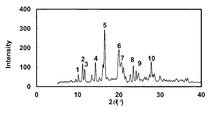
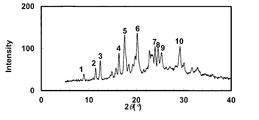
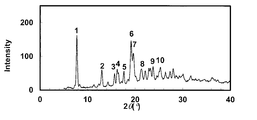
- the powder X-ray diffraction pattern of the crystal of Example 43 is shown.
- the vertical axis of the figure indicates the diffraction intensity as a relative line intensity, and the horizontal axis indicates the value of the diffraction angle 2 ⁇ .
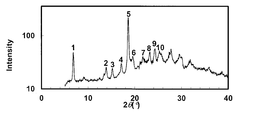
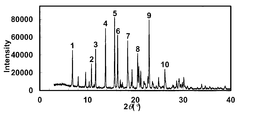
- the powder X-ray diffraction pattern of the crystal of Example 53 is shown.
- the vertical axis of the figure indicates the diffraction intensity as a relative line intensity, and the horizontal axis indicates the value of the diffraction angle 2 ⁇ .
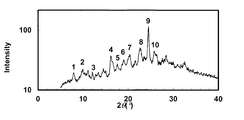
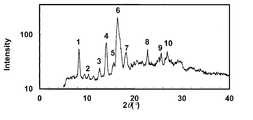
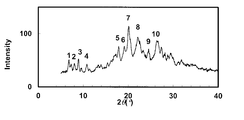
- the powder X-ray diffraction pattern of the crystal of Example 71 is shown.
- the vertical axis of the figure indicates the diffraction intensity as a relative line intensity, and the horizontal axis indicates the value of the diffraction angle 2 ⁇ .
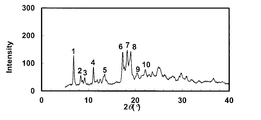
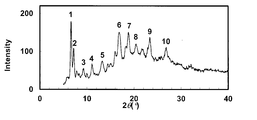
- the powder X-ray diffraction pattern of the crystal of Example 72 is shown.
- the vertical axis of the figure indicates the diffraction intensity as a relative line intensity, and the horizontal axis indicates the value of the diffraction angle 2 ⁇ .
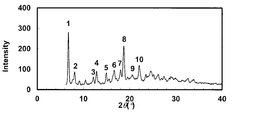
- the powder X-ray diffraction pattern of the crystal of Example 73 is shown.
- the vertical axis of the figure indicates the diffraction intensity as a relative line intensity, and the horizontal axis indicates the value of the diffraction angle 2 ⁇ .
- the powder X-ray diffraction pattern of the crystal of Example 74 is shown.
- the vertical axis of the figure indicates the diffraction intensity as a relative line intensity, and the horizontal axis indicates the value of the diffraction angle 2 ⁇ .
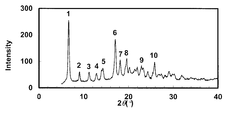
- the powder X-ray diffraction pattern of the crystal of Example 75 is shown.
- the vertical axis of the figure indicates the diffraction intensity as a relative line intensity, and the horizontal axis indicates the value of the diffraction angle 2 ⁇ .
- the powder X-ray diffraction pattern of the crystal of Example 76 is shown.
- the vertical axis of the figure indicates the diffraction intensity as a relative line intensity, and the horizontal axis indicates the value of the diffraction angle 2 ⁇ .
- the powder X-ray diffraction pattern of the crystal of Example 77 is shown.
- the vertical axis of the figure indicates the diffraction intensity as a relative line intensity, and the horizontal axis indicates the value of the diffraction angle 2 ⁇ .
- the powder X-ray diffraction pattern of the crystal of Example 78 is shown.
- the vertical axis of the figure indicates the diffraction intensity as a relative line intensity, and the horizontal axis indicates the value of the diffraction angle 2 ⁇ .
- Example 79 The powder X-ray diffraction pattern of the crystal is shown.
- the vertical axis of the figure indicates the diffraction intensity as a relative line intensity, and the horizontal axis indicates the value of the diffraction angle 2 ⁇ .
- the powder X-ray diffraction pattern of the crystal of Example 80 is shown.
- the vertical axis of the figure indicates the diffraction intensity as a relative line intensity, and the horizontal axis indicates the value of the diffraction angle 2 ⁇ .
- the powder X-ray diffraction pattern of the crystal of Example 81 is shown.
- the vertical axis of the figure indicates the diffraction intensity as a relative line intensity, and the horizontal axis indicates the value of the diffraction angle 2 ⁇ .
- Example 83 The powder X-ray diffraction pattern of the crystal is shown.
- the vertical axis of the figure indicates the diffraction intensity as a relative line intensity, and the horizontal axis indicates the value of the diffraction angle 2 ⁇ .
- the powder X-ray diffraction pattern of the crystal of Example 84 is shown.
- the vertical axis of the figure indicates the diffraction intensity as a relative line intensity, and the horizontal axis indicates the value of the diffraction angle 2 ⁇ .
- the powder X-ray diffraction pattern of the crystal of Example 85 is shown.
- the vertical axis of the figure indicates the diffraction intensity as a relative line intensity, and the horizontal axis indicates the value of the diffraction angle 2 ⁇ .
- the powder X-ray diffraction pattern of the crystal of Example 86 is shown.
- the vertical axis of the figure indicates the diffraction intensity as a relative line intensity, and the horizontal axis indicates the value of the diffraction angle 2 ⁇ .
- Example 87 The powder X-ray diffraction pattern of the crystal is shown.
- the vertical axis of the figure indicates the diffraction intensity as a relative line intensity, and the horizontal axis indicates the value of the diffraction angle 2 ⁇ .
- the powder X-ray diffraction pattern of the crystal of Example 88 is shown.
- the vertical axis of the figure indicates the diffraction intensity as a relative line intensity, and the horizontal axis indicates the value of the diffraction angle 2 ⁇ .
- the powder X-ray diffraction pattern of the crystal of Example 89 is shown.
- the vertical axis of the figure indicates the diffraction intensity as a relative line intensity, and the horizontal axis indicates the value of the diffraction angle 2 ⁇ .
- the powder X-ray diffraction pattern of the crystal of Example 90 is shown.
- the vertical axis of the figure indicates the diffraction intensity as a relative line intensity, and the horizontal axis indicates the value of the diffraction angle 2 ⁇ .
- the "halogen atom” includes, for example, a fluorine atom, a chlorine atom, a bromine atom, an iodine atom and the like.
- the "C 1 -C 3 alkyl group” is a linear or branched alkyl group having 1 to 3 carbon atoms, e.g., methyl, ethyl, propyl or isopropyl group and the like, can give.
- the "C 1 -C 6 alkyl group” is a linear or branched alkyl group having 1 to 6 carbon atoms, for example, a methyl group, an ethyl group, a propyl group, an isopropyl group, a butyl group , Isobutyl group, sec-butyl group, tert-butyl group, pentyl group, isopentyl group, 2-methylbutyl group, neopentyl group, 1-ethylpropyl group, hexyl group, isohexyl group, 4-methylpentyl group and the like. ..
- the "C 1 -C 3 alkoxy group” is the above-mentioned C 1 -C 3 alkyl group is bonded groups oxy group include a methoxy group, an ethoxy group, a propoxy group or isopropoxy group, etc. Can be given.
- the "C 1 -C 6 alkoxy group" said C 1 -C 6 alkyl group on the hydroxy group is a bond and the group include a methoxy group, an ethoxy group, a propoxy group, isopropoxy group, butoxy Examples thereof include a group, an isobutoxy group, a sec-butoxy group, a tert-butoxy group and the like.
- examples of the "C 3- C 6 cycloalkyl group” include a cyclopropyl group, a cyclobutyl group, a cyclopentyl group, a cyclohexyl group and the like.
- the "C 3- C 6 cycloalkoxy group” is a group in which the above-mentioned C 3- C 6 cycloalkyl group is bonded to a hydroxy group, for example, a cyclopropoxy group, a cyclobutoxy group, a cyclopentyloxy group, and the like. Alternatively, a cyclohexyloxy group or the like can be mentioned.
- (C 1 -C 6 alkyl) amino group is one of the C 1 -C 6 alkyl group is bonded group to the amino group, for example, methylamino group, ethylamino group, propyl
- the amino group for example, methylamino group, ethylamino group, propyl
- examples thereof include an amino group, an isopropylamino group, a butylamino group, an isobutylamino group, a sec-butylamino group, a tert-butylamino group and the like.
- the "di (C 1 -C 6 alkyl) amino group" is bonded group to the amino group, for example, dimethylamino group, Examples thereof include a diethylamino group, an ethylmethylamino group, a dipropylamino group, and a diisopropylamino group.
- (C 1 -C 6 alkyl) carbonyl group is the above-mentioned C 1 -C 6 alkyl group is bonded group to a carbonyl group, for example, methylcarbonyl group, ethylcarbonyl group, a propyl group , Isopropylcarbonyl group, butylcarbonyl group, isobutylcarbonyl group, sec-butylcarbonyl group, tert-butylcarbonyl group and the like.
- the "(C 1- C 6 alkoxy) carbonyl group” is a group in which the above C 1- C 6 alkoxy group is bonded to a carbonyl group, and is, for example, a methoxycarbonyl group, an ethoxycarbonyl group, or a propoxycarbonyl group. , Isopropoxycarbonyl group, butoxycarbonyl group, isobutoxycarbonyl group, sec-butoxycarbonyl group, tert-butoxycarbonyl group and the like.
- the "C 1 -C 6 alkoxy C 1 -C 6 alkyl group” is a group in the C 1 -C 6 alkyl group above C 1 -C 6 alkoxy group attached, for example, methoxymethyl Examples thereof include a group, a methoxyethyl group, an ethoxymethyl group, an ethoxyethyl group and the like.
- a 9- or 10-membered bicyclic aromatic heterocyclic group having 1 to 3 heteroatoms independently selected from the group consisting of an oxygen atom, a nitrogen atom, and a sulfur atom Is a 9 or 10-membered bicyclic aromatic containing 1 to 3 heteroatoms independently selected from the group consisting of oxygen, nitrogen, and sulfur atoms in addition to carbon atoms as ring constituent atoms. It is a group derived from a heterocycle.
- thienopyrimidinyl group thienopyrimidinyl group, quinolyl group, isoquinoline group, quinazolyl group, synnolyl group, phthalazinyl group, naphthyldinyl group, pyridopyrimidinyl group and the like can be mentioned.
- the "6-membered aromatic heterocyclic group having 1 or 2 nitrogen atoms in the ring” is a 6-membered aromatic heterocyclic group containing 1 or 2 nitrogen atoms in addition to the carbon atom as a constituent atom of the ring. It is a group derived from the aromatic heterocycle of.
- a pyridyl group, a pyridadinyl group, a pyrimidinyl group, a pyrazinyl group and the like can be mentioned.
- the "6-membered aromatic heterocyclic group having 1 to 3 nitrogen atoms in the ring” is a 6-membered aromatic heterocyclic group containing 1 to 3 nitrogen atoms in addition to the carbon atom as a constituent atom of the ring. It is a group derived from the aromatic heterocycle of.
- a pyridyl group, a pyridadinyl group, a pyrimidinyl group, a pyrazinyl group, a triazinyl group and the like can be mentioned.
- the "4- to 6-membered aliphatic heterocyclic group having 1 or 2 nitrogen atoms in the ring” includes 1 or 2 nitrogen atoms in addition to the carbon atom as a constituent atom of the ring. It is a group derived from a 4- to 6-membered aliphatic heterocycle. For example, azetidinyl group, piperidinyl group, pyrrolidinyl group, imidazolidinyl group, piperazinyl group and the like can be mentioned.
- an aliphatic heterocycle which may have a 3- to 6-membered unsaturated bond having 1 or 2 nitrogen atoms in the ring is defined as a constituent atom of the ring other than a carbon atom. It is a 3- to 6-membered aliphatic heterocycle containing 1 or 2 nitrogen atoms, and may have a double bond in the ring.
- an aziridine ring, a diazirine ring, an azetidine ring and the like can be mentioned.
- a suitable Z may have one or two substituents independently selected from the above group E, respectively, a thienopyrimidinyl group, a quinolyl group, an isoquinolyl group, a quinazolyl group, a synnolyl group, a phthalazinyl group, a naphthyldinyl group. , Or a pyridopyrimidinyl group.
- Another preferred embodiment of Z is any one of Z 1 to Z 10 below.
- W is a hydrogen atom, a halogen atom, a hydroxy group, a cyano group, a C 1- C 6 alkyl group, a C 1 to C 6 alkoxy group, a C 3 to C 6 cycloalkyl group, (C). It represents a 1- C 6 alkyl) amino group or a di (C 1- C 6 alkyl) amino group, and V is a halogen atom, a nitro group, a vinyl group, an ethynyl group, a cyano group, or 1 to 3 halogen atoms.
- C 1- C 6 alkyl group may be substituted 1 to 3 halogen atoms may be substituted C 1 to C 6 alkoxy group may be substituted 1 to 3 halogen atoms.
- C 3- C 6 cycloalkyl group, C 3- C 6 cycloalkoxy group, di (C 1- C 6 alkyl) amino group, (C 1- C 6 alkyl) carbonyl group, or (C 1- C 6 alkoxy) Indicates a carbonyl group.
- Suitable Y is 4-methoxyphenyl group, 3-chlorophenyl group, 3-fluoro-4-chlorophenyl group, 3-fluoro-4-trifluoromethoxyphenyl group, 3-fluoro-4-difluoromethoxyphenyl group, or It is a 3-fluoro-4-methoxyphenyl group.
- n 1 and n 2 are both 1.
- n 3 and n 4 is 2 both.
- a suitable X is CF 2 .
- Suitable combinations of Z, Y, n 1 , n 2 , n 3 , n 4 , and X are Z for Z 1 , Y for 3-fluoro-4-chlorophenyl group, and n 1 and n 2 for. Both indicate 1, n 3 and n 4 both indicate 2, and X is CF 2 .
- Another preferred embodiment of the present invention is the following general formula (III).
- R 7 represents a hydrogen atom or a C 1- C 3 alkoxy group.
- R 8 represents a C 1- C 3 alkyl group that may be substituted with one or two halogen atoms.
- R 9 represents a hydrogen atom or a halogen atom,
- R 10 represents a halogen atom, or a C- 1- C 3 alkoxy group optionally substituted with one or two halogen atoms.
- the "pharmaceutically acceptable salt” refers to a salt that does not have significant toxicity and can be used as a pharmaceutical composition.
- a compound having an acidic substituent can be made into a salt by reacting with a base.
- alkali metal salts such as sodium salts, potassium salts and lithium salts
- alkaline earth metal salts such as calcium salts and magnesium salts
- metal salts such as aluminum salts and iron salts
- inorganic salts such as ammonium salts
- Amine salts such as N, N'-dibenzylethylenediamine salt, chloropro
- a compound having a basic substituent can be made into a salt by reacting with an acid.
- hydrohalogenates such as hydrofluoride, hydrochloride, hydrobromide, hydroiodide
- inorganic acid salts such as nitrate, perchlorate, sulfate, phosphate
- benzenesulfonate ants such as p- toluenesulfonic acid salt - Rusuruhon salt
- glycine salt lysine salt , Arginine salt, ornithine salt, glutamate, asparaginate and other amino acid salts.
- the compound represented by the general formula (I) of the present invention or a pharmaceutically acceptable salt thereof can be left in the air or recrystallized to take up water molecules to form a hydrate. Such hydrates are also included in the present invention.
- the compound represented by the general formula (I) of the present invention or a pharmaceutically acceptable salt thereof absorbs a certain solvent and solvates by being left in a solvent or recrystallized. It may be a product, and such a solvate is also included in the present invention.
- a compound that changes to a compound represented by the general formula (I) or a compound that undergoes hydrolysis or the like due to gastric acid or the like and changes to a compound represented by the general formula (I) is a “pharmaceutically acceptable prodrug compound”. Is included in the present invention.
- the amino group when an amino group is present in the compound represented by the general formula (I), the amino group is acylated, alkylated, or phosphorylated (for example, the amino group is ecosanoidized).
- the compound represented by the general formula (I) has a hydroxy group
- the hydroxy group is acylated, alkylated, phosphorylated, and boro.
- Examples thereof include an oxidized compound (for example, a compound whose hydroxy group is acetylated, palmitoylated, propanoylated, pivaloylated, succinylated, fumarylated, alanylated, dimethylaminomethylcarbonylated, etc.).
- an oxidized compound for example, a compound whose hydroxy group is acetylated, palmitoylated, propanoylated, pivaloylated, succinylated, fumarylated, alanylated, dimethylaminomethylcarbonylated, etc.
- the compound represented by the general formula (I) has a carboxy group
- the compound in which the carboxy group is esterified or amidated for example, the carboxy group is ethyl esterified, phenyl esterified, or carboxy.
- the prodrug in the present invention can be produced from the compound represented by the general formula (I) by a known method.
- the prodrug in the present invention is a compound represented by the general formula (I) under physiological conditions, as described in Hirokawa Shoten, 1990, "Drug Development,” Vol. 7, Molecular Design, pp. 163 to 198. Some of them change to.
- the compound represented by the general formula (I) of the present invention or a pharmaceutically acceptable salt thereof includes all isomers (diastereoisomer, optical isomer, geometric isomer, rotational isomer, etc.). To.
- the compound represented by the general formula (I) of the present invention or a pharmaceutically acceptable salt thereof may contain an unnatural proportion of an atomic isotope in one or more of the atoms constituting such a compound.
- atomic isotopes include deuterium ( 2 H), tritium ( 3 H), iodine-125 ( 125 I) or carbon-14 ( 14 C).
- the compound can also be radiolabeled with a radioisotope such as tritium ( 3 H), iodine-125 ( 125 I) or carbon-14 ( 14 C). Radiolabeled compounds are useful as therapeutic or prophylactic agents, research reagents such as assay reagents, and diagnostic agents such as in vivo diagnostic imaging agents. All isotopic variants of the compounds of the invention, whether radioactive or not, shall be included within the scope of the invention.
- Another aspect of the present invention is a crystal of a compound represented by the general formula (I) or a pharmaceutically acceptable salt thereof.
- a crystal means a solid whose internal structure is three-dimensionally formed by regular repetition of constituent atoms and molecules, and is an amorphous solid or amorphous body having no such regular internal structure. Is distinguished from.
- the crystal includes a crystal of a compound represented by the general formula (I), a hydrate crystal of a compound represented by the general formula (I), and a solvate of the compound represented by the general formula (I).
- Crystals, pharmaceutically acceptable salt crystals of the compound represented by the general formula (I), hydrate crystals of the pharmaceutically acceptable salt of the compound represented by the general formula (I), and general formula Includes hydrated crystals of pharmaceutically acceptable salts of the compounds represented by I).
- the hydrate crystal of the present invention is, for example, 0.1, 0.2, 0.3, 0.4, 0.5, 0.6, 0.7, 0.8, 0.9, 1.0. , 1.1, 1.2, 1.3, 1.4, 1.5, 1.6, 1.7, 1.8, 1.9, 2.0, 2.1, 2.2, 2 .3, 2.4, 2.5, 2.6, 2.7, 2.8, 2.9, 3.0, 3.1, 3.2, 3.3, 3.4, 3.5 3.6, 3.7, 3.8, 3.9, 4.0, 4.1, 4.2, 4.3, 4.4, 4.5, 4.6, 4.7, 4 It can take the form of 8.8, 4.9 or 5.0 hydrates and may increase or decrease the hydrated water depending on the humidity.
- the fact that the compound represented by the general formula (I) and the pharmaceutically acceptable salt thereof are in crystalline form is observed by a polarizing microscope, powder X-ray crystal analysis, or single crystal X-ray diffraction. It can be confirmed by using the measurement. Furthermore, the type of the crystal can be specified by comparing the characteristics of the crystal with the data based on each index measured in advance. Therefore, according to a preferred embodiment of the present invention, it can be confirmed that the crystal according to the present invention is a crystal by using such a measuring means.
- Crystals of the present invention (hereinafter, "crystals of Example 43 of the present invention", “crystals of Example 53 of the present invention”, “crystals of Example 71 of the present invention", “crystals of Example 72 of the present invention”, “the present invention” “Crystal of Example 73 of the present invention”, “Crystal of Example 74 of the present invention", “Crystal of Example 75 of the present invention”, “Crystal of Example 76 of the present invention”, “Crystal of Example 77 of the present invention”, “Presentation "Crystal of Example 78 of the present invention", “Crystal of Example 79 of the present invention", “Crystal of Example 80 of the present invention", “Crystal of Example 81 of the present invention", “Crystal of Example 83 of the present invention”, “Presentation "Crystal of Example 84 of the present invention", “Crystal of Example 85 of the present invention", “Crystal of Example 86 of the present invention”, “Crystal of Example 87 of the present
- cancer refers to the entire malignant tumor.
- Cancer can be classified into “solid cancer” and "blood cancer”. Solid tumors can be classified into “epithelial cell carcinoma” and "non-epithelial cell carcinoma”.
- Epithelial cell cancer is a cancer that develops from epithelial cells and includes, for example, lung cancer, stomach cancer, liver cancer, kidney cancer, prostate cancer, pancreatic cancer, colon cancer, breast cancer, and ovarian cancer. Be done.
- Non-epithelial cell carcinoma is a cancer that develops from non-epithelial cells such as bone and muscle, and examples thereof include osteosarcoma, chondrosarcoma, and rhabdomyosarcoma.
- Hematological cancer is a cancer that develops from a hematopoietic organ and can be classified into, for example, malignant lymphoma, leukemia, multiple myeloma and the like.
- Malignant lymphoma can be classified into, for example, Hodgkin lymphoma and non-Hodgkin lymphoma.
- Non-hodgkin lymphoma includes, for example, mantle cell lymphoma (also called MCL), diffuse large B-cell lymphoma (also called DLBCL), and adult T-cell leukemia / lymphoma.
- MCL mantle cell lymphoma
- DLBCL diffuse large B-cell lymphoma
- adult T-cell leukemia / lymphoma a.
- ATLL Adhepatocyte leukemia / lymphoma
- peripheral T-cell lymphoma non-specific type
- NOS Peripheral T-cell lymphoma
- Leukemia includes, for example, acute myelogenous leukemia (also called AML), chronic myelogenous leukemia (also called CML), acute lymphoid leukemia (also called ALL), and acute lymphoid leukemia. It can be classified as chronic lymphoid leukemia (also called CLL).
- AML acute myelogenous leukemia
- CML chronic myelogenous leukemia
- ALL acute lymphoid leukemia
- CLL chronic lymphoid leukemia
- treat and its derivatives mean delay in remission, alleviation and / or exacerbation of clinical symptoms of cancer in patients who develop cancer.
- the compound represented by the general formula (I) of the present invention or a pharmaceutically acceptable salt thereof may be used in combination with other antitumor agents.
- antitumor agents for example, alkylating agents, antimetabolites, antitumor antibiotics, antitumor plant components, BRMs (biological responsiveness regulators), hormones, vitamins, antitumor antibodies, molecular targeted drugs, and other antitumor agents. And so on.
- examples of the alkylating agent include an alkylating agent such as nitrosourea, nitrosourea-N-oxide or chlorambutyl, an aziridine-based alkylating agent such as carbocon or thiotepa, and dibromoman.
- Epoxide-based alkylating agents such as nitor or dibromodarcitol
- nitrosourea-based alkylating agents such as carmustin, romustin, semstin, nimustin hydrochloride, streptozocin, chlorozotocin or lanimustin, busulfan, improsul tosylate Examples include fan or dacarbazine.
- antimetabolites examples include purine antimetabolites such as 6-mercaptopurine, 6-thioguanine or thioinosin, fluorouracil, tegafur, tegafur-uracil, carmofur, doxiflulysine, broxuridine, cytarabine or Examples thereof include pyrimidine antimetabolites such as enocitabine, and folic acid antimetabolites such as methotrexate or trimetrexate.
- purine antimetabolites such as 6-mercaptopurine, 6-thioguanine or thioinosin
- fluorouracil tegafur
- tegafur-uracil carmofur
- doxiflulysine broxuridine
- cytarabine examples thereof include pyrimidine antimetabolites such as enocitabine, and folic acid antimetabolites such as methotrexate or trimetrexate.
- Antitumor antibiotics include, for example, anthracycline antibiotics such as mitomycin C, bleomycin, pepromycin, daunorubicin, dactinomycin, doxorubicin, pirarubicin, THP-adriamycin, 4'-epidoxorubicin or epirubicin, chromomycin A3 or Actinomycin D and the like can be mentioned.
- anthracycline antibiotics such as mitomycin C, bleomycin, pepromycin, daunorubicin, dactinomycin, doxorubicin, pirarubicin, THP-adriamycin, 4'-epidoxorubicin or epirubicin, chromomycin A3 or Actinomycin D and the like can be mentioned.
- antitumor plant components include vinca alkaloids such as vindesine, vincristine or vinblastine, taxanes such as paclitaxel and docetaxel, and epipodophyllotoxins such as etoposide or teniposide.
- BRM examples include tumor necrosis factor, indomethacin, and the like.
- hormones include hydrocortisol, dexamethasone, methylprednisolone, prednisolone, plastolone, betamethasone, triamcinolone, oxymetholone, nandrolone, metenolone, phosfestolone, ethynylestradiol, chlormadinone or medroxyprogesterone.
- vitamins examples include vitamin C and vitamin A.
- Antitumor antibodies and molecular-targeted drugs include trastuzumab, rituximab, cetuximab, nimotuximab, denosumab, vemurafenib, infliximab, imatinib, gefitinib, elrotinib, sunitinib, lapatinib, sorafinib, lapatinib, sorafenib
- antitumor agents include, for example, cisplatin, carboplatin, oxaliplatin, tamoxyphene, camptothecin, ifosfamide, cyclophosphamide, melphalan, L-asparaginase, acekraton, cisophyllan, pipobroman, procarbazine, pipobroman, neo.
- examples thereof include cultinostatin, hydroxyurea, ubenimex, and crestin.
- the compound represented by the general formula (I) of the present invention or a pharmaceutically acceptable salt thereof can be administered in various forms.
- the administration form include oral administration with tablets, capsules, granules, emulsions, pills, powders, syrups (liquids), etc., or injections (intravenous, intramuscular, subcutaneous or intraperitoneal administration). Parenteral administration by infusion, suppository (rectal administration) and the like can be mentioned.
- These various preparations are usually used in the field of pharmaceutical formulation technology such as excipients, binders, disintegrants, lubricants, flavoring agents, solubilizing agents, suspending agents, coating agents, etc. It can be formulated with an adjunct that can be used.
- excipients such as lactose, sucrose, sodium chloride, glucose, urea, starch, calcium carbonate, kaolin, crystalline cellulosic acid, silicic acid; water, ethanol, etc.
- Excipients such as propanol, simple syrup, glucose solution, starch solution, gelatin solution, carboxymethyl cellulose, cellac, methyl cellulose, potassium phosphate, polyvinylpyrrolidone; dried starch, sodium alginate, agar powder, Disintegrants such as laminaran powder, sodium hydrogen carbonate, calcium carbonate, polyoxyethylene sorbitan fatty acid ester, sodium lauryl sulfate, stearic acid monoglyceride, starch, lactose; disintegrators such as sucrose, stear, cocoa butter, hydrogenated oil; Absorption enhancers such as quaternary ammonium salts and sodium lauryl sulfate; moisturizers such as glycerin and starch; adsorbents such as starch, lactose, kaolin, bentonite and colloidal silicic acid; purified talc, stearate, powder borate, polyethylene Abundant agents such as glycol can be used. Further
- excipients such as glucos, lactose, cacao butter, starch, hardened vegetable oil, kaolin, talc; binding of gum arabic powder, tragant powder, gelatin, etanol and the like.
- a disintegrant such as laminarin or agar can be used.
- liquid, emulsion or suspension When used as an injection, it can be used as a liquid, emulsion or suspension. These solutions, emulsions or suspensions are preferably sterilized and isotonic with blood.
- the solvent used for producing these liquids, emulsions or suspensions is not particularly limited as long as it can be used as a medical diluent, and is, for example, water, ethylene, propylene glycol, ethoxylated isostearyl alcohol. -L, polyoxylated isostearyl alcohol, polyoxyethylene sorbitan fatty acid esters and the like.
- a sufficient amount of salt, glucos or glycerin may be contained in the preparation to prepare an isotonic solution, and ordinary solubilizers, buffers, painkillers and the like may be contained. May include.
- the above-mentioned preparation may include a coloring agent, a preservative, a flavoring agent, a flavoring agent, a sweetening agent and the like, if necessary, and may further include other pharmaceutical products.
- the amount of the compound contained in the above preparation is not particularly limited and is appropriately selected in a wide range, but usually contains 0.5 to 70% by weight, preferably 1 to 30% by weight in the total composition.
- the amount used varies depending on the symptoms, age, etc. of the patient (warm-blooded animal, especially human), but in the case of oral administration, the upper limit is 2000 mg (preferably 100 mg) and the lower limit is 0.1 mg (preferably 100 mg) per day. It is desirable to administer 1 mg, more preferably 10 mg) to an adult 1 to 6 times a day depending on the symptoms.
- the compound of the present invention can be produced by various production methods, and the production methods shown below are examples, and the present invention should not be construed as being limited to these.
- the compound represented by the general formula (I) of the present invention or a pharmaceutically acceptable salt thereof is produced by utilizing various known production methods by utilizing the characteristics based on the basic skeleton or the type of substituent. be able to.
- Known methods include, for example, "ORGANIC FUNCTIONAL GROUP PREPARATIONS", 2nd Edition, ACADEMIC PRESS, INC. 1989, “Comprehensive Organic Transitions", VCH Publishing Inc. There is a method described in 1989 and the like.
- the functional group is protected with an appropriate protecting group at the stage of the raw material or the intermediate, or is replaced with a group that can be easily converted into the functional group. It may be effective in manufacturing technology.
- Examples of such a functional group include an amino group, a hydroxy group, a carboxy group and the like, and examples of these protecting groups include T.I. W. Greene and P.M. G. Wuts, "Greene's Protective Groups in Organic Synthesis", 4th Edition, John Wiley & Sons, Inc. There is a protecting group described in 2006.
- the protecting group or the group that can be easily converted to the functional group may be appropriately selected and used according to the respective reaction conditions of the production method for producing the compound.
- a desired compound can be obtained by introducing the group, carrying out the reaction, and then removing the protecting group or converting it to a desired group, if necessary.
- the prodrug of the compound can be produced by introducing a specific group at the stage of the raw material or the intermediate, or by carrying out a reaction using the obtained compound, similarly to the above-mentioned protecting group.
- the reaction for producing a prodrug can be carried out by applying a method known to those skilled in the art, such as conventional esterification, amidation, dehydration, hydrogenation and the like.
- the conversion of compound 2a to compound 1a is a suitable solvent that does not affect the reaction (eg, N, N-dimethylformamide, N, N-dimethylacetamide, tetrahydrofuran, dimethylsulfoxide, dichloromethane, 1,2-dichloroethane, chloroform, etc.
- a suitable base for example, triethylamine, diisopropylethylamine, 4-dimethylaminopyridine, N-methylmorpholin, pyridine, 2, as an organic base
- 1,2-dimethoxyethane, acetonitrile, etc. or a mixed solvent thereof. 6-Lutidine, diazabicyclo [5.4.0] undec-7-ene, etc.
- compound 2a and compound 3a are suitable condensing agents.
- Uronium hexafluorophosphate, 1- [bis (dimethylamino) methylene] -1H-1,2,3-triazolo [4,5-b] pyridinium 3-oxide hexafluorophosphate, 1,1' -It can be carried out by condensing with a carbonyl diimidazole or the like.
- the reaction can be carried out in the range from ⁇ 78 ° C. to the boiling point of the solvent used in the reaction, but is preferably 0 ° C. to 50 ° C. Further, 1-hydroxybenzotriazol, N-hydroxysuccinimide, 1-hydroxy-7-azabenzotriazol and the like may be added as a reaction accelerator, if necessary.
- suitable solvents that do not affect the reaction eg, N, N-dimethylformamide, N, N-dimethylacetamide, tetrahydrofuran, dimethyl sulfoxide, dichloromethane, 1,2-dichloroethane, chloroform, 1,2- In dimethoxyethane, acetonitrile, etc., or a mixed solvent thereof
- the carboxylic acid halide of compound 2a and compound 3a is used as an appropriate base (for example, as an organic base, triethylamine, diisopropylethylamine, 4-dimethylaminopyridine, N- Methylmorpholine, pyridine, 2,6-lutidine, diazabicyclo [5.4.0] undec-7-ene, etc.
- an inorganic base for example, potassium carbonate, sodium carbonate, sodium hydrogencarbonate, etc.
- the reaction can be carried out in the range from ⁇ 78 ° C. to the boiling point of the solvent used for the reaction, but it is preferably carried out from ⁇ 10 ° C. to around room temperature.
- Compound 2a which is a raw material for production, can be synthesized, for example, according to the method described in Reference Example.
- As the compound 3a as a production raw material a commercially available compound can be used, or can be synthesized, for example, according to the method described in Reference Example.
- the compound 1b shown below can be produced, for example, by the following method.
- X, Y, n 1 , n 2 , n 3 , and n 4 are synonymous with the definitions in the specification.
- R a represents a 4- to 6-membered aliphatic heterocyclic group having one or two nitrogen atoms in the ring
- W represents a halogen atom, a cyano group, an ethynyl group, or a C 1- C 6 alkyl group. Shown.
- the conversion of compound 2a to compound 1b is a suitable solvent that does not affect the reaction (eg, N-methyl-2-pyrrolidinone, N, N-dimethylformamide, N, N-dimethylacetamide, tetrahydrofuran, dimethyl sulfoxide, dichloromethane,
- a suitable base for example, triethylamine, N, N-diisopropylethylamine, 4-dimethylaminopyridine, N-methylmorpholine, pyridine, 2,6-lutidine as an organic base
- chloroform or the like or a mixed solvent thereof for example, triethylamine, N, N-diisopropylethylamine, 4-dimethylaminopyridine, N-methylmorpholine, pyridine, 2,6-lutidine as an organic base
- compound 2a and compound 4a are 1,1'-carbonyldi. It can be carried out by reacting with imidazole, bis carbonate (trichloromethyl) or the like. The reaction can be carried out in the range from ⁇ 78 ° C. to the boiling point of the solvent used in the reaction, but is preferably carried out at 0 ° C. to 100 ° C.
- Compound 4a can be obtained from, for example, Tokyo Chemical Industry Co., Ltd., Enamine Ltd. A compound commercially available from the above can be used.
- the compound 1c shown below can be produced, for example, by the following method.
- X, Y, Z, n 1 , n 2 , n 3 , and n 4 are synonymous with the definitions in the specification.
- Hal represents a halogen atom such as a chlorine atom, a bromine atom, or an iodine atom.
- the conversion of compound 2a to compound 1c is carried out in a suitable solvent that does not affect the reaction of compound 2a and compound 5a (eg, metall, ethanol, 2-propanol, etc., or a mixed solvent thereof).
- suitable bases eg triethylamine, N, N-diisopropylethylamine, 4-dimethylaminopyridine, N-methylmorpholine, pyridine, 2,6-lutidine, diazabicyclo [5.4.0] undec-7-ene, etc. It can be carried out by treating with an organic base (or an inorganic base such as potassium carbonate, sodium carbonate, sodium hydrogencarbonate, etc.).
- the reaction can be carried out in the range from ⁇ 30 ° C. to the boiling point of the solvent used for the reaction, but it is preferably carried out from room temperature to the boiling point of the solvent used for the reaction.
- a suitable base eg, triethylamine, N, etc.
- Organic bases such as N-diisopropylethylamine, 4-dimethylaminopyridine, N-methylmorpholine, pyridine, 2,6-lutidine, diazabicyclo [5.4.0] undec-7-ene, or potassium carbonate, sodium carbonate, It can also be carried out by treating compound 2a and compound 5a in a sealed tube or under microwave irradiation in the presence of an inorganic base such as sodium hydrogen carbonate.
- the reaction time in the sealed tube or under microwave irradiation is preferably 10 minutes to 72 hours, more preferably 30 minutes to 24 hours.
- the compound 5a for example, a compound commercially available from Tokyo Chemical Industry, Sigma-Aldrich, etc. can be used, or, for example, it can be synthesized according to the method described in the reference example.
- the compound produced by the above method can be isolated and purified by a known method, for example, extraction, precipitation, distillation, chromatography, fractional recrystallization, recrystallization and the like. Enantiomers are also present if the compound or intermediate of production has an asymmetric carbon. Each of these enantiomers can be isolated and purified by a conventional method such as fractional recrystallization (salt division) or column chromatography.
- the conditions for dividing the enantiomer from the racemate are, for example, "Enantiomers, Racemates and Resolution", J. Mol. Jacques, A. Collet and S. H. Wiley, John Wiley & Sons, Inc. , New York, 1981 can be referred to.
- the nuclear magnetic resonance (hereinafter, 1 H NMR: 400 MHz) spectrum is described with a chemical shift value of ⁇ value (ppm) using tetramethylsilane as a standard substance.
- the split pattern is indicated by s for the single line, d for the double line, t for the triple line, q for the quadruple line, m for the multiple line, and br for the broad line.
- the powder X-ray diffraction is performed using a Bruker D8 Discover, the X-ray generation conditions are 40 kV, 40 mA, the wavelength is 1.54 ⁇ (copper K ⁇ ray), the scanning speed is 10 ° / min, and the scanning range is 5 to.
- the measurement was performed under the conditions of 40 ° and a sampling width of 0.05 °.
- a glass sample holder was used as the sample holder.
- the X-ray generation conditions were set to 45 kV, 200 mA using Rigaku SmartLab, and the wavelength was 1.54 ⁇ (copper K ⁇ ray).
- the measurement was performed under the conditions of a scanning speed of 20 ° / min, a scanning range of 3 to 40 °, and a sampling width of 0.01 °.
- a non-reflective sample holder was used as the sample holder.
- CDCl 3 Deuterated chloroform
- CD 3 OD Deuterated methanol
- DMSO-d 6 Deuterated dimethyl sulfoxide.
- hexane means n-hexane unless otherwise specified.
- Step 1 4-Bromo-1-difluoromethyl-2-fluorobenzene Under a nitrogen atmosphere, 4-bromo-2-fluorobenzaldehyde (2.51 g, 12.4 mmol) was dissolved in dichloromethane (80 ml) at -15 ° C. Under cooling, bis (2-methoxyethyl) aminosulfa-trifluoride (5.31 ml, 24.7 mmol) was added. The reaction solution was stirred at room temperature for 15 hours, saturated aqueous sodium hydrogen carbonate was slowly added under ice-cooling, and after the foaming had subsided, the mixture was extracted with dichloromethane.
- Step 2 4-Difluoromethyl-3-fluorobenzaldehyde
- the compound (6.07 g, 27.0 mmol) obtained in the above step 1 was dissolved in N, N-dimethylformamide (120 ml), and sodium formate (2. 94 g, 43.2 mmol) and triphenylphosphine (708 mg, 2.70 mmol) were added, and after nitrogen substitution, degassing was performed using ultrasonic waves. After replacement with carbon monoxide, bis (triphenylphosphine) palladium (II) dichloride (1.89 g, 2.70 mmol) was added, the mixture was replaced with carbon monoxide again, and the mixture was stirred at 110 ° C. for 4 hours.
- Step 1 4-Difluoromethoxy-3-fluorobenzonitrile 3-Fluoro-4-hydroxybenzonitrile (6.20 g, 45.2 mmol) was added to N, N-dimethylformamide (62 ml) and water (6.2 ml). After dissolution, cesium carbonate (20.6 g, 63.2 mmol) and sodium chlorodifluoroacetate (15.9 g, 104 mmol) were added, and the mixture was stirred at 110 ° C. for 4.5 hours. After cooling to room temperature, toluene and water were added to perform a liquid separation operation. The organic layer was washed with water and saturated brine, and dried over anhydrous sodium sulfate.
- Step 2 tert-Butyl [(4-difluoromethoxy-3-fluorophenyl) methyl] carbamate
- the compound (7.87 g, 42.1 mmol) obtained in the above step 1 was dissolved in methanol (58 ml). Then, a solution of di-tert-butyl dicarbonate (20.2 g, 92.6 mmol) in metanol (19 ml) and nickel chloride hexahydrate (1.00 g, 4.21 mmol) were added and stirred. Sodium borohydride (9.60 g, 250 mmol) was added to the reaction solution in 4 portions under ice-cooling.
- Step 3 1- (4-difluoromethoxy-3-fluorophenyl) metanamine
- the compound (9.74 g, 33.4 mmol) obtained in the above step 2 is dissolved in 1,4-dioxane (11 ml) and ice-cooled.
- 4N hydrochloric acid / 1,4-dioxane solution 33 ml was added, and the mixture was stirred at room temperature for 1 hour.
- Diisopropyl ether (88 ml) was added to the reaction mixture, and the mixture was stirred for 30 minutes. The precipitated solid was collected by filtration and dried under reduced pressure.
- Step 2 4,4-Difluoro-1- ⁇ [(2,2,2-trichloroethoxy) carbonyl] amino ⁇ cyclohexane-1-carboxylic acid
- the compound (14.3 g, 69.9 mmol) obtained in the above step 1. ) was suspended in 8N aqueous sodium hydroxide solution (80 ml), heated to 120 ° C., and stirred for 18 hours. The reaction mixture was ice-cooled and neutralized by adding a 5N hydrochloric acid aqueous solution (128 ml) to obtain a suspension.
- Step 1 3-( ⁇ [tert-butyl (dimethyl) silyl] oxy ⁇ methyl) cyclopenta-2-ene-1-one cupric acetate (II) monohydrate (45.4 mg, 0.221 mmol), ( R)-(-)-5,5'-bis [di (3,5-di-tert-butyl-4-methoxyphenyl) phosphino] -4,4'-bi-1,3-benzodioxo-l (264 mg) , 0.221 mmol), a mixture of degassed and argon-substituted dehydrated toluene (25 ml) was stirred at room temperature for 2 hours under an argon atmosphere.
- Step 4 [( ⁇ [(1R) -3,3-difluorocyclopentyl] methoxy ⁇ methoxy) methyl] benzene
- dichloromethane 45 ml
- (Dichloromethane) sulfate trifluoride 50.5 ml, 347 mmol
- the reaction solution was cooled to ⁇ 78 ° C., and a saturated aqueous sodium hydrogen carbonate solution was slowly added dropwise to quench the reaction.
- Step 9 tert-Butyl [(1S) -3,3-difluoro-1- (hydroxymethyl) cyclopentyl] carbamate
- Potassium carbonate (3.41 g, 24.7 mmol) was added to a mixture of (40 ml), tetrahydrofuran (13 ml) and water (6.67 ml) at room temperature, and the mixture was stirred at the same temperature for 2.5 hours. It was allowed to stand in the freezer for 16 hours.
- the reaction mixture was filtered through Celite, the filtrate was concentrated, and the obtained residue was poured into water and extracted with ethyl acetate.
- the organic solvent was evaporated under reduced pressure and then washed twice with diethyl ether.
- the aqueous layer was adjusted to pH 2 to 3 with a 2N aqueous hydrochloric acid solution (6.69 ml), and the aqueous layer was extracted with ethyl acetate.
- the obtained organic layer was washed with saturated brine and dried over anhydrous sodium sulfate.
- the solvent was evaporated under reduced pressure to give the title compound (1.14 g, 4.30 mmol, 97%).
- Step 1 Benzyl 1-[(tert-butoxycarbonyl) amino] -4-oxocyclohexane-1-carboxylate 1-[(tert-butoxycarbonyl) amino] -4-oxocyclohexane-1-carboxylic acid ( In a solution of 10.0 g, 38.9 mmol) in dichloromethane (100 ml), ice-cooled, under a nitrogen stream, benzyl alcohol (5.20 ml, 50.6 mmol), 1-ethyl-3- (3-dimethylaminopropyl).
- Step 2 benzyl 6-[(tert-butoxycarbonyl) amino] -1,4-diazaspiro [2.5] octa-1-encarboxylate
- Hydroxylamine-O-sulphonic acid (5.05 g) was added to a .3 mmol) metalnol (225 ml) solution under ice-cooled, nitrogen stream, and a 2 mol / l ammonia-methanol solution (675 ml) and stirred for 2 hours.
- 44.7 mmol) of a methanol solution (45 ml) was added, and the mixture was stirred at room temperature for 16 hours.
- Step 3 6-[(tert-butoxycarbonyl) amino] -1,4-diazaspiro [2.5] octa-1-encarboxylic acid
- Lithium hydroxide monohydrate (1.40 g, 33.4 mmol) was added to a solution of tetrahydrofuran (80 ml), methanol (50 ml) and water (10 ml), and the mixture was stirred for 3 days.
- the reaction mixture was washed with diethyl ether, the aqueous layer was acidified with 1N aqueous hydrochloric acid solution, diluted with dichloromethane, and the organic layer was washed with 10% aqueous citric acid solution and water.
- the mixture was dried over anhydrous magnesium sulfate, and the solvent was evaporated under reduced pressure.
- the compound (36.5 g, 0.179 mol) obtained in step 1 of Reference Example C-1 was suspended in an 8N aqueous sodium hydroxide solution (200 ml, 1.60 mol), heated to 120 ° C., and stirred for 25 hours. ..
- the reaction mixture was ice-cooled and neutralized by adding a 5N hydrochloric acid aqueous solution (320 ml, 1.60 mol) to obtain a suspension.
- 1,4-Dioxane 500 ml was added to the obtained suspension, and 4N aqueous sodium hydroxide solution (44.8 ml, 0.179 mol) was added under ice-cooling.
- Step 1 1-Amino-4,4-difluorocyclohexane-1-carboxylic acid
- the compound (44.3 g, 0.217 mol) obtained in Step 1 of Reference Example C-1 was added to an 8N aqueous sodium hydroxide solution (271 ml). , 2.17 mol), heated to 120 ° C., and stirred for 28 hours.
- the reaction mixture was ice-cooled, neutralized by adding 5N aqueous hydrochloric acid solution (434 ml, 2.17 mol), and stirred for a while.
- the resulting solid was collected by filtration to give the title compound (30.8 g, 0.172 mol, 79%).
- Step 2 4,4-Difluoro-1- (2,2,2-trifluoroacetamide) cyclohexane-1-carboxylic acid
- the compound (15.0 g, 83.7 mmol) obtained in the above step 1 and potassium methoxyde. (6.46 g, 92.1 mmol) was suspended in methanol (20 ml) and stirred at 50 ° C. for 30 minutes. After allowing to cool to room temperature, ethyl trifluoroacetate (20.0 ml, 167 mmol) was added, and the mixture was stirred again at 50 ° C. for 6 hours. After allowing to cool to room temperature, the solvent was distilled off under reduced pressure.
- Step 1 1- (2,2,2-trifluoroacetamide) cycloheptane-1-carboxylic acid
- 1-aminocycloheptane carboxylic acid (1.00 g, 6.36 mmol) in trifluoroacetic acid (6 ml)
- trifluoroacetic anhydride (1.77 ml, 12.7 mmol) was added dropwise, the temperature was raised to room temperature, and the mixture was stirred for 18.5 hours.
- the solvent was evaporated under reduced pressure, water was added to the obtained residue, and the mixture was extracted with ethyl acetate. The organic layer was washed with saturated brine and dried over anhydrous sodium sulfate.
- Triethylamine (3.20 ml, 23.1 mmol) was added to a solution of the obtained residue in tetrahydrofuran (8 ml) at room temperature, and the mixture was stirred at 50 ° C. for 3 hours, allowed to stand at room temperature for 16 hours, and stirred at 50 ° C. for 4 hours.
- Di-tert-butyl dicarbonate (532 mg, 2.32 mmol) was added at 0 ° C., and the mixture was stirred at room temperature for 16 hours.
- the low-polarity-derived labeled compound (D-5-2) 94.0 mg, 0.214 mmol, quantification was performed.
- Target was obtained.
- reaction solvent was distilled off under reduced pressure, and the mixture was dried under reduced pressure.
- the residue was powdered with a spartel, tetrahydrofuran (50 ml) was added, triethylamine (10.0 ml, 69.3 mmol) was added under ice-cooling, and the mixture was stirred under a nitrogen stream at an outside temperature of 50 ° C. for 4 hours.
- di-tert-butyl dicarbonate (4.00 g, 18.3 mmol) was added, and the mixture was stirred at room temperature for 16 hours.
- the reaction mixture was diluted with dichloromethane and washed with 10% aqueous citric acid solution and water.
- Step 2 14-[(4-Methoxyphenyl) methyl] -1,2,7,11,14-pentaazatrispyro [2.2.2.4 9 . 26 . 2 3] Heputadeku 1-ene -8,15- dione hydrochloride compound obtained in the above Step 1 (712 mg, 1.47 mmol) in tetrahydrofuran (18 ml) was added under ice-cooling, 4 N hydrochloric acid / 1,4 -Dioxane solution (18 ml) was added and stirred at room temperature for 5 hours. Diethyl ether was added to the reaction mixture, and the mixture was stirred.
- Step 2 1- (tert-Butyloxycarbonyl) -3- ⁇ [(4-chloro-3-fluorophenyl) methyl] amino ⁇ azetidine-3-carboxylic acid
- the compound obtained in the above step 1 (36.3 g, 0.107 mol) was suspended in dimethyl sulfoxide (350 ml), and hydrogen peroxide solution (17.6 ml, 0.213 mol) was added.
- Potassium carbonate (44.5 g, 0.320 mol) was added under ice-cooling, and the mixture was stirred for 24 hours while raising the temperature to room temperature. Water was slowly added to the reaction mixture, the mixture was extracted with ethyl acetate, and washed with water and saturated brine.
- the solvent was distilled off under reduced pressure, the residue obtained by drying was suspended in etanol (600 ml), 8N aqueous potassium hydroxide solution (57.5 ml, 0.460 mol) was added, and the temperature was 80 ° C. for 16 hours. Stirred. After distilling off the solvent under reduced pressure, the mixture was diluted with water and neutralized by adding a 2N hydrochloric acid aqueous solution (230 ml, 0.460 mol) under ice-cooling. The resulting solid was collected by filtration to give the title compound (34.6 g, 96.4 mmol, 90%).
- the compound (17.1 g, 47.7 mmol) obtained in the above step 2 was placed in another flask and suspended in N, N-dimethylformamide (500 ml). Under ice-cooling, N, N-diisopropylethylamine (16.3 ml, 95.3 mmol) was added, and then a solution of the previously prepared acid chloride in N, N-dimethylformamide (100 ml) was added dropwise. After stirring at room temperature for 14 hours, 1,1'-carbonyldiimidazole (23.2 g, 143 mmol) was added under ice-cooling, and the mixture was stirred at room temperature for 10 minutes and at 80 ° C. for 8 hours.
- Step 4 5-[(4-Chloro-3-fluorophenyl) methyl] -10,10-difluoro-2,5,13-triazadispiro [3.2.5 7 . 2 4] tetradecane -6,14- compound obtained in dione hydrochloride above Step 3 (12.0 g, 23.9 mmol) was suspended in dichloromethane (250 ml), under ice-cooling, 4 N hydrochloric acid / 1,4 Dioxane solution (125 ml) was added and stirred for 14 hours. The solvent was evaporated under reduced pressure, diethyl ether was added, and the mixture was stirred for a while.
- Step 2 1- (tert-Butyloxycarbonyl) -3- ⁇ [(5-fluoro-6-methoxypyridin-3-yl) methyl] amino ⁇ azetidine-3-carboxylic acid
- step 2 790 mg (2.06 mmol) was dissolved in etanol (8 ml), a 2N aqueous sodium hydroxide solution (8 ml) was added, and the mixture was stirred at 50 ° C. for 1 hour. After the reaction solution was ice-cooled, a suspension was obtained by adding a 1N hydrochloric acid aqueous solution to neutralize the reaction solution.
- Step 3 tert-butyl 10,10-difluoro-5-[(5-fluoro-6-methoxypyridin-3-yl) methyl] -6,14-dioxo-2,5,13-triazadispiro [3.2] .5 7 . 2 4] tetradecane-2 carboxylate - the compound obtained in Preparative above step 2 (674 mg, 1.90 mmol) and the compound obtained in Reference Example C-5 (522mg, 1.90mmol) using a reference example The title compound (316 mg, 0.634 mmol, 33%) was obtained by carrying out the same operation as in Step 3 of D-9.
- Step 4 10,10-Difluoro-5-[(5-fluoro-6-methoxypyridin-3-yl) methyl] -2,5,13-triazadispiro [3.2.5 7 . 2 4] tetradecane -6,14- dione hydrochloride salt
- the compound obtained in Step 3 (313mg, 0.628mmol) using, by the same procedure as in Step 4 of Reference Example D-9, the title compound (270 mg, 0.205 mmol, 33%) was obtained.
- Step 2 1- (tert-butoxycarbonyl) -3- ⁇ [(3-fluoro-4-methoxyphenyl) methyl] amino ⁇ azetidine-3-carboxylic acid
- the compound obtained in the above step 1 (955 mg, 2.
- the title compound (937 mg, 2.64 mmol, quantitative) was obtained by carrying out the same operation as in Step 2 of Reference Example D-10 using 59 mmol).
- 1 H-NMR (DMSO-d 6 ) ⁇ : 7.27-7.21 (1H, m), 7.16-7.09 (2H, m), 4.09-3.92 (2H, m), 3.86-3.71 (5H, m), 3.68 ( 2H, s), 1.38 (9H, s).
- Step 4 tert-Butyl 10,10-difluoro-5-[(3-fluoro-4-methoxyphenyl) methyl] -6,14-dioxo-2,5,13-triazadispiro [3.2.5 7 . 2 4] tetradecane-2 carboxylate - DOO the compound obtained in Step 3 (755 mg, 1.07 mmol) acetic acid (5 ml), tetrahydrofuran (10ml) solution was added zinc powder (350 mg, 5.35 mmol) The mixture was stirred at room temperature for 5 hours. The reaction mixture was filtered through Celite, washed with tetrahydrofuran, and the solution was concentrated under reduced pressure.
- Step 5 10,10-Difluoro-5-[(3-fluoro-4-methoxyphenyl) methyl] -2,5,13-triazadispiro [3.2.5 7 . 2 4] tetradecane -6,14- dione hydrochloride compound obtained in the above Step 4 (414 mg, 0.833 mmol) using, by the same procedure as in Step 4 of Reference Example D-9, the title compound (346 mg, 0.798 mmol, 96%) was obtained.
- Step 2 5-[(4-Chloro-3-fluorophenyl) methyl] -2,5,14-triazadispiro [3.2.6 7 . 2 4] pentadecane-6,15-dione hydrochloride salt
- the compound obtained in Step 1 (182 mg, 0.379 mmol) using, by the same procedure as in Step 4 of Reference Example D-9, the title compound (138 mg, 0.332 mmol, 88%) was obtained.
- Step 2 5-[(4-Chloro-3-fluorophenyl) methyl] -10-thia-2,5,13-triazadispiro [3.2.5 7 . 2 4] tetradecane -6,14- dione hydrochloride salt
- Step 2 4-Etinyl-2,6-difluorobenzoic acid
- the compound (1.26 g, 4.71 mmol) obtained in the above step 1 was dissolved in methanol (50 ml), and potassium carbonate (846 mg, 846 mg,) was dissolved at room temperature.
- An aqueous solution (8 ml) of 6.12 mmol) was added, and the mixture was stirred for 2 hours. Water was added to the reaction mixture, and the metalnol was distilled off under reduced pressure. The obtained aqueous layer was washed with dichloromethane, and then cooled with ice to adjust to acidity by adding a 1N hydrochloric acid aqueous solution.
- Step 2 4- (1,1-Difluoroethyl) -2-nitrobenzonitrile
- the compound (14.9 g, 67.4 mmol) obtained in the above step 1 was dissolved in N-methyl-2-pyrrolidinone (55 ml).
- copper cyanide (12.3 g, 135 mmol) was added, and the mixture was heated and stirred at 160 ° C. for 18 hours.
- the reaction mixture was diluted with ethyl acetate, saturated aqueous ammonium chloride solution was added, and the mixture was stirred.
- the resulting insoluble material was filtered through Celite, extracted with ethyl acetate, and washed with water and saturated brine.
- Step 3 4- (1,1-Difluoroethyl) -2-nitrobenzamide Peroxidation of the compound (9.43 g, 44.5 mmol) obtained in the above step 2 in a solution of dimethyl sulfoxide (115 ml) while cooling. Hydrogen peroxide water (7.32 ml, 88.9 mmol) was added, and then potassium carbonate (18.4 g, 133 mmol) was added, and the mixture was stirred at room temperature for 18 hours. Water and saturated brine were added to the reaction mixture, the mixture was extracted with ethyl acetate, and the organic layer was washed with water and saturated brine.
- Step 5 7- (1,1-difluoroethyl) quinazoline-4 (3H) -one
- the compound (2.67 g, 13.3 mmol) obtained in the above step 4 form amidine acetate (4.17 g, 40.0 mmol) was dissolved in etanol (80 ml), and the mixture was heated under reflux for 5 hours. After cooling to room temperature, the solvent was distilled off under reduced pressure. Water was added to the obtained residue, and after ultrasonic treatment, the mixture was stirred at room temperature for a while. The solid was collected by filtration to give the title compound (2.59 g, 12.3 mmol, 93%).
- Step 6 4-Chloro-7- (1,1-difluoroethyl) quinazoline
- the compound (2.59 g, 12.3 mmol) obtained in the above step 5 was suspended in toluene (55 ml), and N , N-diisopropylethylamine (6.02 ml, 34.6 mmol) and phosphorus oxychloride (5.69 g, 37.0 mmol) were added, and the mixture was heated to 100 ° C. and stirred for 4 hours. After returning to room temperature, it was diluted with ethyl acetate.
- Step 2 Methyl 2-amino-4-[(propane-2-yl) oxy] benzoate
- the compound (457 mg, 1.67 mmol) obtained in the above step 1 and cesium carbonate (1.09 g, 3.34 mmol).
- 4,5-Bis (diphenylphosphino) -9,9-dimethylxanthene (96.7 mg, 0.167 mmol)
- palladium (II) acetate 37.5 mg, 0.167 mmol) 1,4-dioxane ( 7 ml)
- the suspension was degassed, benzophenone imine (421 ⁇ l, 2.51 mmol) was added, and the mixture was heated under reflux at 100 ° C. for 4 hours under a nitrogen atmosphere.
- Step 3 7-[(Propane-2-yl) oxy] quinazoline-4 (3H) -one
- a mixture of 2-methoxyethanol (4 ml) (00 mmol) was heated to reflux at 130 ° C. for 2 hours. After cooling to room temperature, a large amount of water was added, and the precipitated solid was collected by filtration to obtain the title compound (220 mg, 1.08 mmol, 81%).
- Step 1 Dimethyl sulfoxide of methyl 6-chloro-4-[(4-methoxybenzyl) amino] pyridine-3-carboxylate methyl 4,6-dichloronicotinate (4.00 g, 19.4 mmol) To the (40 ml) solution, 4-methoxybenzylamine (2.51 ml, 19.4 mmol) and triethylamine (5.38 ml, 38.8 mmol) were sequentially added, and the mixture was stirred at room temperature for 74 hours. The reaction mixture was diluted with ethyl acetate, water was added to separate the liquids, and the combined organic layer was washed with water and saturated brine, and dried over anhydrous sodium sulfate.
- Step 2 Methyl 4-amino-6-chloropyridin-3-carboxylate
- the compound (5.67 g, 18.5 mmol) obtained in the above step 1 was dissolved in trifluoroacetic acid (48 ml), and 60 The mixture was heated and stirred at ° C. for 12 hours and cooled to room temperature. Ethanol was added to the residue obtained by concentration under reduced pressure, and the mixture was concentrated again under reduced pressure. Ethanol was added to the obtained residue and washed with a slurry to remove the precipitated solid. The residue was washed with etanol and the filtrate was concentrated under reduced pressure.
- Step 3 7-Chloropyrido [4,5-d] Pyrimidine-4 (3H) -one
- the compound (1.20 g, 6.43 mmol) obtained in the above step 2 and formamidine acetate (1.34 g, 12.9 mmol) was suspended in 2-methoxyethanol (12 ml), and the mixture was heated under reflux at 130 ° C. for 5 hours. After cooling to room temperature, form amidine acetate (5.36 g, 51.4 mmol) was added, and the mixture was heated under reflux at 140 ° C. for 22.5 hours. After cooling to room temperature, most of the solvent was distilled off under reduced pressure. A large amount of water was added to remove the precipitated insoluble matter, and the mixture was washed with water and ethanol.
- Step 2 Methyl 2-amino-4-difluoromethoxybenzoate
- the compound (1.05 g, 3.72 mmol), cesium carbonate (2.42 g, 7.44 mmol), 4, 5 obtained in the above step 1.
- Benzophenone imine (1.01 g, 5.58 mmol) was added, and the mixture was heated under reflux at 100 ° C. under a nitrogen atmosphere for 4 hours and cooled to room temperature.
- Step 4 4-Chloro-7-difluoromethoxyquinazoline Using the compound (609 mg, 2.87 mmol) obtained in the above step 3, the same operation as in step 4 of Reference Example Q-4 was carried out to mark the title. Compound (618 mg, 2.68 mmol, 93%) was obtained.
- Step 1 Oxalyl chloride (2.29 ml, 26) in a dichloromethane (110 ml) suspension of methyl 4-diazoacetyl-2-nitrobenzoate 2-nitroterephthalate 1-methyl (5.00 g, 22.2 mmol). .6 mmol), N, N-dimethylformamide (0.4 ml) was added and stirred at room temperature for 2.5 hours, and oxalyl chloride (571 ⁇ l, 6.66 mmol) was further added and stirred at room temperature for 30 minutes under reduced pressure. Concentration gave acid chloride.
- Step 2 Methyl 4- (2-tert-butoxy-2-oxoethyl) -2-nitrobenzoate
- the compound (4.53 g, 18.2 mmol) obtained in the above step 1 and tert-butyl alcohol (50 ml).
- a solution of silver benzoate (1.25 g, 5.46 mmol) in triethylamine (8 ml) was added dropwise over 1 hour, and after further heating under reflux for 1 hour, the mixture was cooled to room temperature.
- the reaction mixture was filtered through Celite, washed with ethyl acetate, and the solution was concentrated under reduced pressure.
- Step 7 Methyl 2-amino-4- (2,2-difluoroethyl) benzoate 10% palladium in a solution of the compound (715 mg, 2.92 mmol) obtained in the above step 6 in etanol (29 ml). Carbon (71.5 mg) was added, and the mixture was heated and stirred at 60 ° C. for 1.5 hours under a hydrogen atmosphere, and cooled to room temperature. The reaction mixture was filtered through Celite, washed with ethyl acetate, and the solution was concentrated under reduced pressure. Dissolve in etanol (29 ml) again, add 10% palladium carbon (71.5 mg), heat and stir at 60 ° C.
- Step 8 7- (2,2-difluoroethyl) quinazoline-4 (3H) -one Using the compound (605 mg, 2.81 mmol) obtained in the above step 7, with step 3 of Reference Example Q-4. The title compound (489 mg, 2.33 mmol) was obtained by performing the same operation.
- Step 9 4-Chloro-7- (2,2-difluoroethyl) quinazoline Using the compound (405 mg, 1.93 mmol) obtained in the above step 8, the same operation as in step 4 of Reference Example Q-4. The title compound (404 mg, 1.77 mmol) was obtained.
- Step 1 7- (1,1-difluoroethyl) quinazoline-2,4 (1H, 3H) -dione
- the compound (7.72 g, 38.6 mmol) obtained in step 4 of Reference Example Q-1 was subjected to tetrahydrofuran. It was dissolved in (385 ml), 1,1'-carbonyldiimidazole (20.8 g, 116 mmol) was added, and the mixture was heated under reflux at 70 ° C. for 8 hours. The solvent was distilled off under reduced pressure, dichloromethane and a 1N hydrochloric acid aqueous solution were added to the obtained residue, and sonication was performed.
- Step 2 2,4-dichloro-7- (1,1-difluoroethyl) quinazoline
- the compound (1.39 g, 6.13 mmol) obtained in the above step 1 was suspended in toluene (55 ml) and cooled on ice.
- Phosphoryl oxychloride (3.80 g, 24.5 mmol) and N, N-diisopropylethylamine (3.15 ml, 18.4 mmol) were added, and the mixture was heated under reflux for 12 hours.
- the reaction mixture was allowed to warm to room temperature and then poured into ice-cooled saturated aqueous sodium hydrogen carbonate. It was extracted with ethyl acetate and washed with saturated brine.
- Step 1 7-Difluoromethoxyquinazoline-2,4 (1H, 3H) -dione
- the mixture (0.6 mmol) was heated and stirred at 180 ° C. for 6 hours and then cooled to 100 ° C. Water was added, the mixture was stirred at 100 ° C. for 5 minutes, cooled to room temperature, ethyl acetate was added, and then ultrasonically treated, and the precipitated solid was collected by filtration.
- Step 1 7-Chloro-2-cyclopropylquinazoline-4 (3H) -one 2-bromo-4-chlorobenzoic acid (1.00 g, 4.25 mmol), cyclopropanecarboxamidine hydrochloride (768 mg, 6) Cesium carbonate (2.77 g, 8.49 mmol) is added to a mixture of .37 mmol) N, N-dimethylformamide (20 ml), stirred at room temperature for 5 minutes, and then copper iodide (162 mg, 0.849 mmol) is added. The mixture was heated and stirred at 100 ° C. for 3.5 hours under a nitrogen atmosphere, and cooled to room temperature.
- Step 3 7- (2-Fluoroethyl) quinazoline-4 (3H) -one Using the compound (558 mg, 2.83 mmol) obtained in the above step 2, the same as in step 3 of Reference Example Q-2. By carrying out the operation, the title compound (383 mg, 1.92 mmol, 70%) was obtained.
- Step 1 7-Yodo-4-[(oxan-2-yl) oxy] quinazoline 7-iodoquinazoline-4 (3H) -one (3.71 g, 13.6 mmol) N, N-dimethyl 3,4-Dihydro-2H-pyran (4.98 ml, 54.6 mmol) and p-toluenesulfonic acid monohydrate (260 mg, 1.36 mmol) were added to a suspension of formamide (65 ml) for 18 hours at room temperature. Stirred. Water and saturated aqueous sodium hydrogen carbonate were added to the reaction mixture, and the mixture was extracted with ethyl acetate.
- Step 3 7-Ethenylquinazoline-4 (3H) -one
- the compound (200 mg, 0.780 mmol) obtained in the above step 2 was dissolved in methanol (5 ml) to monohydrate p-toluenesulfonic acid.
- the product (148 mg, 0.780 mmol) was added, and the mixture was heated and stirred at 50 ° C. for 6 hours. After cooling to room temperature, the mixture was concentrated under reduced pressure, and water, saturated aqueous sodium hydrogen carbonate, and ethyl acetate were added to the obtained residue to separate the solutions.
- the organic layer was washed with saturated brine and dried over anhydrous sodium sulfate.
- Step 1 Suspension of N, N-dimethylformamide (5 ml) of ethyl 4-ethoxy-2-nitrobenzene 4-hydroxy-2-nitrobenzoic acid (300 mg, 1.64 mmol) and potassium carbonate (679 mg, 4.91 mmol). Iodoethane (394 ⁇ l, 4.91 mmol) was added to the solution, and the mixture was stirred at room temperature for 19 hours. Water was added to the reaction mixture, the mixture was extracted with ethyl acetate, and washed with water and saturated brine. The mixture was dried over anhydrous sodium sulfate and the solvent was evaporated under reduced pressure to give the title compound (384 mg, 1.60 mmol, 98%).
- Step 2 Ethyl 2-amino-4-ethoxybenzoate To a solution of the compound (384 mg, 1.60 mmol) obtained in the above step 1 in etanol (16 ml), 10% palladium carbon (38 mg) was added. Then, the mixture was stirred at room temperature for 4 hours under a hydrogen atmosphere. The reaction mixture was filtered through Celite and washed with ethyl acetate. The filtrate was concentrated under reduced pressure to give the title compound (338 mg, 1.62 mmol, quantitative).
- Step 1 The title is given by performing the same operation as in Step 1 of Reference Example Q-15 using propyl2-nitro-4-propoxybenzoate 1-iodopropane (478 ⁇ l, 4.91 mmol). Compound (421 mg, 1.58 mmol, 96%) was obtained.
- Step 2 Propyl 2-amino-4-propoxybenzoate By performing the same operation as in Step 2 of Reference Example Q-15 using the compound (421 mg, 1.58 mmol) obtained in Step 1 above. , The title compound (371 mg, 1.56 mmol, 99%) was obtained.
- Step 2 Methyl 4-fluoromethoxy-2-nitrobenzoate
- dichloromethane (10 ml) The compound (516 mg, 2.01 mmol) obtained in the above step 1 was dissolved in dichloromethane (10 ml), and sulfyl chloride (244 ⁇ l, 3.01 mmol) was added. After stirring at room temperature for 1 hour, the reaction mixture was concentrated under reduced pressure. The obtained residue was dissolved in dichloromethane (10 ml), tetrabutylammonium fluoride 1 mol / L tetrahydrofuran solution (4.01 ml, 4.01 mmol) was added under ice-cooling, the temperature was raised to room temperature, and the mixture was stirred for 72 hours.
- Step 2 Methyl 2-amino-4- (2,2,2-trifluoroethoxy) benzoate The compound (561 mg, 2.01 mmol) obtained in the above step 1 and 10% palladium carbon (56.1 mg). Ethanol (20 ml) mixture was heated and stirred at 60 ° C. for 3 hours under a hydrogen atmosphere. After cooling to room temperature, the mixture was filtered through Celite and washed with ethyl acetate. The filtrate was concentrated under reduced pressure to give the title compound (473 mg, 1.90 mmol, 95%).
- Step 1 Step 2 of Reference Example Q-1 using 2-nitro-4-trifluoromethoxybenzonitrile 1-chloro-2-nitro-4-trifluoromethoxybenzene (3.00 g, 12.4 mmol).
- the title compound (1.16 g, 4.99 mmol, 40%) was obtained by carrying out the same operation as in the above.
- Step 2 2-Nitro-4-trifluoromethoxybenzamide Using the compound (1.19 g, 5.13 mmol) obtained in the above step 1, the same operation as in step 3 of Reference Example Q-1 is carried out. The title compound (540 mg, 2.16 mmol, 42%) was obtained.
- Step 3 2-Amino-4-trifluoromethoxybenzamide To a mixture of the compound (540 mg, 2.16 mmol) obtained in the above step 2 with etanol (11 ml) and water (11 ml), sodium hydrosulfite (4). .71 g, 21.6 mmol) was added, and the mixture was heated under reflux at 120 ° C. for 15 hours. After cooling to room temperature, most of the ethanol was distilled off under reduced pressure, water was added to the obtained residue, and the mixture was extracted with ethyl acetate. The organic layer was washed with water and saturated brine, and dried over anhydrous sodium sulfate.
- Step 1 7-Trimethylsilylethynylquinazoline-4 (3H) -on 7-iodo-1H-quinazoline-4-one (500 mg, 1.84 mmol), [1,1-bis (diphenylphosphino) ferrocene]
- Step 2 7-Trifluoromethylquinazoline-4 (3H) -one
- the formamide (16 ml) solution of the compound (1.73 g, 8.42 mmol) obtained in the above step 1 is heated and stirred at 180 ° C. for 4.5 hours. After that, it was cooled to room temperature. After adding water and stirring for a while, the mixture was extracted with ethyl acetate and washed with water and saturated brine. After drying over anhydrous sodium sulfate, the solvent was distilled off under reduced pressure. Recrystallization was performed using diethyl ether / hexane, and the precipitated crystals were collected by filtration to give the title compound (891 mg, 4.16 mmol, 49%).
- Step 1 Methyl 2-bromo-4-hydroxybenzoate 2-bromo-4-hydroxybenzoic acid (6.45 g, 29.7 mmol) in a metalnol (60 ml) mixture under ice-cooling, sulfuric acid (step 1). 3.19 ml (59.4 mmol) was added dropwise, and then the mixture was heated under reflux at 70 ° C. for 11.5 hours. After cooling to room temperature, the solvent was distilled off under reduced pressure. The obtained residue was separated with saturated brine and ethyl acetate, and the combined organic layer was dried over anhydrous sodium sulfate. The solvent was distilled off under reduced pressure to obtain the title compound (6.75 g, 29.1 mmol, 98%).
- Step 2 A suspension of methyl 2-bromo-4-ethenyloxybenzoate copper (II) acetate (3.14 g, 17.3 mmol) in dichloromethane (120 ml) is stirred at room temperature for 10 minutes, and then the above step.
- the compound obtained in 1 (4.00 g, 17.3 mmol), vinylboronic anhydride pyridine complex (2.79 g, 11.6 mmol) and pyridine (14.0 ml, 173 mmol) were added, and the mixture was stirred at room temperature for 66.5 hours. did.
- the reaction mixture was filtered through Celite, washed with dichloromethane, and the filtrate was concentrated under reduced pressure.
- Step 3 Methyl 2-bromo-4-cyclopropyloxybenzoate diethyl zinc (1.09 mol / L hexane solution) (19.1 ml, 20.8 mmol) in a dichloromethane (18 ml) solution under ice-cooling, tri. A solution of fluoroacetic acid (1.59 ml, 20.8 mmol) in dichloromethane (18 ml) was added dropwise, and the mixture was stirred at the same temperature for 20 minutes.
- Step 4 Methyl 2-amino-4-cyclopropyloxybenzoate Using the compound (2.25 g, 8.29 mmol) obtained in the above step 3, the same as in step 2 of Reference Example Q-2. By performing the operation, the title compound (1.51 g, 7.30 mmol, 88%) was obtained.
- Step 5 7-Cyclopropyloxyquinazoline-4 (3H) -one Using the compound (503 mg, 2.43 mmol) obtained in the above step 4, the same operation as in step 3 of Reference Example Q-2 is performed. As a result, the title compound (415 mg, 2.05 mmol) was obtained.
- Step 1 Step of Reference Example Q-12 using 7-bromo-4-[(oxan-2-yl) oxy] quinazoline 7-bromoquinazoline-4 (3H) -one (780 mg, 3.47 mmol).
- the title compound (1.05 g, 3.40 mmol, 98%) was obtained by performing the same operation as in 1.
- Step 2 4-[(Oxan-2-yl) oxy] quinazoline-7-carbaldehyde
- N, N-dimethylformamide (10 ml) N, N-dimethylformamide (10 ml).
- Sodium formate (183 mg, 2.69 mmol) and triphenylphosphine (44.1 mg, 0.168 mmol) were added, and after nitrogen substitution, degassing was performed using ultrasonic waves.
- bis (triphenylphosphine) palladium (II) dichloride 118 mg, 0.168 mmol was added, the mixture was replaced with carbon monoxide again, and the mixture was stirred at 110 ° C. for 4 hours.
- Step 3 7-Difluoromethyl-4-[(oxan-2-yl) oxy] quinazoline
- dichloromethane 5 ml
- Bis (2-methoxyethyl) aminosulfa-trifluoride 300 ⁇ l, 1.54 mmol was added under cooling to ⁇ 15 ° C.
- the reaction solution was stirred at 0 ° C. for 7 hours and at room temperature for 60 hours. Under ice-cooling, saturated aqueous sodium hydrogen carbonate was added slowly, and after the foaming had subsided, the mixture was extracted with dichloromethane.
- Step 4 7-Difluoromethylquinazoline-4 (3H) -one
- the compound (149 mg, 0.532 mmol) obtained in the above step 3 was dissolved in metall (3 ml) to monohydrate p-toluenesulfonic acid.
- the product (50.0 mg, 0.263 mmol) was added, and the mixture was stirred at room temperature for 1 hour.
- p-toluenesulfonic acid monohydrate (60.0 mg, 0.315 mmol) was added to the reaction solution, and the mixture was stirred at room temperature for 2 hours.
- Step 1 The compound (150 mg, 0.332 mmol) obtained in Reference Example D-1 was dissolved in dimethylformamide (5 ml), triethylamine (92.4 ⁇ l, 0.663 mmol) was added, and the mixture was stirred.
- Step 2 The compound obtained in the above step 1 was optically resolved under the following conditions.
- Column: Daicel CHIRALPAK IB 20mm IDx250mmL Elution solvent: Hexane: 2-Propanol 50: 50 (V / V) Flow velocity: 15.0 ml / min Temperature: 25 ° C The first peak (retention time: 9.7 minutes) was fractionated to obtain the title compound.
- Step 1 The compound obtained in Step 1 of Example 1-1 was optically resolved in the same manner as in Step 2 of Example 1-1, and the second peak (holding time: 12.9 minutes). Was separated to obtain the title compound.
- Example 1-1 Using the compound obtained in the reference example, the following compound was obtained by performing the same operation as in step 1 of Example 1-1.
- Example 6-1 and 6-2, 7-1, and 7-2 optical resolution was performed by the same operations as in Step 2 of Example 1-1 and Step 1 of Example 1-2. ..
- Example 30 4- ⁇ 5 - [(4-chloro-3-fluorophenyl) methyl] 10,10-difluoro -6,14- dioxo -2,5,13- Toriazajisupiro [3.2.5 7 .. 2 4] tetradecane-2-yl ⁇ -7-methoxyquinazoline-2-carbonitrile
- Example 18 The compound (80.0 mg, 0.134 mmol) obtained in Example 18 was suspended in methanol (1 ml), potassium methoxydo (37.5 mg, 0.534 mmol) was added, and the mixture was heated under reflux for 5 hours. After returning to room temperature, the mixture was adjusted to a slightly acidic range using a 1N hydrochloric acid aqueous solution, poured into a large amount of saturated aqueous sodium hydrogen carbonate solution, and extracted with ethyl acetate.
- Step 2 2- (7-Acetylquinazoline-4-yl) -5-[(4-chloro-3-fluorophenyl) methyl] -10,10-difluoro-2,5,13-triazadispiro [3.2] .5 7 . 2 4] tetradecane -6,14- dione Under a nitrogen atmosphere, and dissolved the compound obtained in the above Step 1 (35.4mg, 0.0617mmol) in dichloromethane (2 ml), under ice-cooling, des - Ma - Chin reagent (52.3 mg, 0.123 mmol) was added, and the mixture was stirred at 0 ° C. for 30 minutes and at room temperature for 15 hours.
- Step 2 5-[(4-Chloro-3-fluorophenyl) methyl] -10,10-difluoro-2- [7- (2-fluoropropane-2-yl) quinazoline-4-yl] -2, 5,13-Triazadispiro [3.2.5 7 . 2 4] tetradecane -6,14- dione the compound obtained in Step 1 (40.0mg, 0.0680mmol) was dissolved in dichloromethane (5 ml), under ice-cooling, (diethylamino) sulfur - trifluoride (11. 6 ⁇ l, 0.0884 mmol) was added, and the mixture was stirred at room temperature for 3 hours.
- Example 37 Using the compound (50.0 mg, 0.114 mmol) obtained in Reference Example D-9 and 1,6-dichlorophthalazine (35.0 mg, 0.176 mmol), the same operation as in Example 37 is carried out. The title compound (11.7 mg, 0.0207 mmol, 18%) was obtained.
- Example 43 Using the compound obtained in the reference example, the following compound was obtained by performing the same operation as in Example 43.
- Example 50 Using the compound obtained in Example 50, the same operation as in Example 33 was carried out to obtain the title compound.
- Example 49 Using the compound obtained in Example 49, the same operation as in Example 33 was carried out to obtain the title compound.
- Step 2 2- [7- (1,1-difluoroethyl) -2-methoxyquinazoline-4-yl] -5- ⁇ [4- (difluoromethoxy) -3-fluorophenyl] methyl ⁇ -10,10 -Difluoro-2,5,13-Triazadispiro [3.2.5 7 . 2 4] with the compound obtained in tetradecane -6,14- dione Step 1 above, by performing the same operation as in Example 33 to give the title compound.
- Example 55 Using the compound obtained in the reference example, the following compound was obtained by performing the same operation as in Example 55.
- Example 71 5-[(4-Chloro-3-fluorophenyl) methyl] -2- [7- (1,1-difluoroethyl) quinazoline-4-yl] -10,10-difluoro-2,5 , 13-Triazadispiro [3.2.5 7 . 2 4] tetradecane -6,14- dione hydrochloride
- Example compound obtained in 43 (40.0mg, 0.0673mmol) was dissolved in tetrahydrofuran (2 ml), hydrochloric acid (11.6Myueru, concentration 35%, 0. 135 mmol) was added and the mixture was stirred at room temperature for 20 minutes.
- Ethanol was added to the residue obtained by concentration under reduced pressure, and the mixture was sonicated and concentrated under reduced pressure. This operation was repeated 3 times, and the obtained solid was dried under reduced pressure to obtain crystals (33.5 mg) of the title compound. Elemental analysis and powder X-ray diffraction measurement were performed on the crystals of the obtained compound.
- the powder X-ray diffraction pattern is shown in FIG. 3, and Table 10 shows the diffraction angle (2 ⁇ ), the lattice spacing (d value), and the relative intensity in the powder X-ray diffraction spectrum.
- Example 72 5-[(4-Chloro-3-fluorophenyl) methyl] -2- [7- (difluoromethoxy) quinazoline-4-yl] -10,10-difluoro-2,5,13-triazadispiro [3.2.5 7 . 2 4] tetradecane -6,14- dione hydrochloride
- the compound (50.0 mg, 0.0839 mmol) obtained in Example 47 was dissolved in tetrahydrofuran (2 ml), a 4N hydrochloric acid / dioxane solution (45.0 ⁇ l, 0.180 mmol) was added, and the mixture was stirred at room temperature for 2 hours. ..
- Example 73 5-[(4-Chloro-3-fluorophenyl) methyl] -2- [7- (difluoromethoxy) -2-methoxyquinazoline-4-yl] -10,10-difluoro-2,5 , 13-Triazadispiro [3.2.5 7 . 2 4] tetradecane -6,14- compound obtained in dione hydrochloride
- Example 52 (40.0mg, 0.0639mmol) was dissolved in tetrahydrofuran (2 ml), hydrochloric acid (11.0Myueru, concentration 35%, 0. 128 mmol) was added and the mixture was stirred at room temperature for 1 hour.
- Example 74 5-[(4-Chloro-3-fluorophenyl) methyl] -2- [7- (1,1-difluoroethyl) quinazoline-4-yl] -10,10-difluoro-2,5 , 13-Triazadispiro [3.2.5 7 . 2 4] tetradecane -6,14- dione sulfate
- Example 43 The compound obtained in (40.0mg, 0.0673mmol) was dissolved in tetrahydrofuran (2 ml), sulfuric acid (3.60Myueru, concentration 64%, 0. 0673 mmol) was added, and the mixture was stirred at room temperature for 20 minutes.
- Example 75 5-[(4-Chloro-3-fluorophenyl) methyl] -2- [7- (difluoromethoxy) quinazoline-4-yl] -10,10-difluoro-2,5,13-triazadispiro [3.2.5 7 . 2 4] tetradecane -6,14- dione compound obtained in sulfate Example 47 (50.0mg, 0.0839mmol) was dissolved in tetrahydrofuran (2 ml), sulfuric acid (15.0Myueru, concentration 64%, 0. 139 mmol) was added and the mixture was stirred at room temperature for 2 hours.
- Example 76 5-[(4-Chloro-3-fluorophenyl) methyl] -2- [7- (difluoromethoxy) -2-methoxyquinazoline-4-yl] -10,10-difluoro-2,5 , 13-Triazadispiro [3.2.5 7 . 2 4] tetradecane -6,14- dione compound obtained in sulfate Example 52 (40.0mg, 0.0639mmol) was dissolved in tetrahydrofuran (2 ml), sulfuric acid (3.42Myueru, concentration 64%, 0. 0639 mmol) was added and the mixture was stirred at room temperature for 3.5 hours.
- Ethanol was added to the residue obtained by concentration under reduced pressure, and the mixture was sonicated and concentrated under reduced pressure. This operation was repeated 3 times, and the obtained solid was dried under reduced pressure to obtain crystals (26.1 mg) of the title compound. Elemental analysis and powder X-ray diffraction measurement were performed on the crystals of the obtained compound.
- the powder X-ray diffraction pattern is shown in FIG. 9, and Table 16 shows the diffraction angle (2 ⁇ ), the lattice spacing (d value), and the relative intensity in the powder X-ray diffraction spectrum.
- the precipitated solid was collected by filtration and dried at room temperature overnight to obtain crystals (105 mg) of the title compound. Elemental analysis and powder X-ray diffraction measurement were performed on the crystals of the obtained compound.
- the powder X-ray diffraction pattern is shown in FIG. 11, and Table 18 shows the diffraction angle (2 ⁇ ), the lattice spacing (d value), and the relative intensity in the powder X-ray diffraction spectrum.
- Example 80 5-[(4-Chloro-3-fluorophenyl) methyl] -2- [7- (difluoromethoxy) quinazoline-4-yl] -10,10-difluoro-2,5,13-triazadispiro [3.2.5 7 . 2 4] tetradecane -6,14- dione methanesulfonate
- Example 47 The compound obtained in (50.0mg, 0.0839mmol) was dissolved in tetrahydrofuran (2ml), 2mol / l methanesulfonic acid solution (45. (0 ⁇ l, 0.0900 mmol) was added, and the mixture was stirred at room temperature for 2 hours.
- the resulting solid was collected by filtration and washed with tetrahydrofuran. The operation of adding ethanol to the obtained solid and concentrating under reduced pressure was repeated three times. The obtained solid was dried under reduced pressure to obtain crystals (45.1 mg) of the title compound. Elemental analysis and powder X-ray diffraction measurement were performed on the crystals of the obtained compound.
- the powder X-ray diffraction pattern is shown in FIG. 12, and Table 19 shows the diffraction angle (2 ⁇ ), the lattice spacing (d value), and the relative intensity in the powder X-ray diffraction spectrum.
- Example 81 5-[(4-Chloro-3-fluorophenyl) methyl] -2- [7- (difluoromethoxy) -2-methoxyquinazoline-4-yl] -10,10-difluoro-2,5 , 13-Triazadispiro [3.2.5 7 . 2 4] tetradecane -6,14- dione methanesulfonate
- Example 52 compound obtained in (40.0mg, 0.0639mmol) was dissolved in tetrahydrofuran (1.5ml), 2mol / l methanesulfonic acid solution ( 32.0 ⁇ l, 0.0639 mmol) was added, and the mixture was stirred at room temperature for 20 minutes.
- the precipitated solid was collected by filtration, washed with tetrahydrofuran and dried under reduced pressure.
- the operation of adding ethanol to the obtained solid and concentrating under reduced pressure was performed three times.
- 2-Propanol was added to the obtained residue, and the mixture was sonicated and concentrated under reduced pressure. This operation was repeated 3 times, and the obtained solid was dried under reduced pressure to obtain crystals (39.7 mg) of the title compound.
- Elemental analysis and powder X-ray diffraction measurement were performed on the crystals of the obtained compound.
- the powder X-ray diffraction pattern is shown in FIG. 13, and the diffraction angle (2 ⁇ ), the lattice spacing (d value), and the relative intensity in the powder X-ray diffraction spectrum are shown in Table 20.
- Example 82 5-[(4-Chloro-3-fluorophenyl) methyl] -2- [7- (1,1-difluoroethyl) -2-methoxyquinazoline-4-yl] -10,10-difluoro -2,5,13-Triazadispiro [3.2.5 7 . 2 4] tetradecane -6,14- dione methanesulfonate
- Example 53 The compound obtained in (911 mg, 1.46 mmol) was dissolved in tetrahydrofuran (30ml), 2mol / l methanesulfonic acid solution (730 ⁇ l, 1. 46 mmol) was added and the mixture was stirred at room temperature for 2 hours.
- the precipitated solid was collected by filtration, washed with tetrahydrofuran and dried under reduced pressure. Ethanol was added to the obtained solid, sonicated, and concentrated under reduced pressure. This operation was repeated twice, 2-propanol was added to the obtained residue, sonicated, and concentrated under reduced pressure. 2-Propanol was added to the residue obtained by performing this operation twice, and the solid was ultrasonically treated. The precipitated solid was collected by filtration and dried under reduced pressure to obtain a non-crystalline solid (735 mg) of the title compound. ) Was obtained. Elemental analysis was performed on the obtained compound.
- Example 83 2- [7- (1,1-difluoroethyl) -2-methoxyquinazoline-4-yl] -5- [4- (difluoromethoxy) -3-fluorobenzyl] -10,10-difluoro -2,5,13-Triazadispiro [3.2.5 7 . 2 4] tetradecane -6,14- compound obtained in dione methanesulfonate
- Example 54 (1.03g, 1.58mmol) was dissolved in tetrahydrofuran (40ml), 2mol / l methanesulfonic acid solution (788 ⁇ l, 1.58 mmol) was added and the mixture was stirred at room temperature for 3 hours.
- Example 84 5-[(4-Chloro-3-fluorophenyl) methyl] -2- [7- (1,1-difluoroethyl) quinazoline-4-yl] -10,10-difluoro-2,5 , 13-Triazadispiro [3.2.5 7 . 2 4] tetradecane -6,14- dione ethanesulfonate embodiment the compound obtained in 43 (500 mg, 0.842 mmol) and ethanesulfonic acid (97.4 mg, 0.884 mmol) in 2% aqueous 2-propanol ( 10 ml) was added, and the mixture was stirred at 40 ° C. for about 15 hours.
- the precipitated solid was collected by filtration and dried at room temperature overnight to obtain crystals (575 mg) of the title compound. Elemental analysis and powder X-ray diffraction measurement were performed on the crystals of the obtained compound.
- the powder X-ray diffraction pattern is shown in FIG. 15, and the diffraction angle (2 ⁇ ), lattice plane spacing (d value), and relative intensity in the powder X-ray diffraction spectrum are shown in Table 22.
- Example 85 5-[(4-Chloro-3-fluorophenyl) methyl] -2- [7- (1,1-difluoroethyl) quinazoline-4-yl] -10,10-difluoro-2,5 , 13-Triazadispiro [3.2.5 7 . 2 4] tetradecane -6,14- compound obtained in dione ethanesulfonate monohydrate Example 43 (100mg, 0.169mmol) and 80% water-containing ethane sulfonic acid (19.5 mg, 0.177 mmol) Acetone (826 ⁇ l) was added and stirred at room temperature for about 24 hours.
- the precipitated solid was collected by filtration and dried at room temperature overnight to obtain crystals (114 mg) of the title compound. Elemental analysis and powder X-ray diffraction measurement were performed on the crystals of the obtained compound.
- the powder X-ray diffraction pattern is shown in FIG. 16, and Table 23 shows the diffraction angle (2 ⁇ ), the lattice spacing (d value), and the relative intensity in the powder X-ray diffraction spectrum.
- Ethanol was added to the residue obtained by concentration under reduced pressure, and the mixture was sonicated and concentrated under reduced pressure. This operation was repeated 3 times, and the obtained solid was dried under reduced pressure to obtain crystals (28.8 mg) of the title compound.
- the crystals of the obtained compound were subjected to powder X-ray diffraction measurement.
- the powder X-ray diffraction pattern is shown in FIG. 17, and the diffraction angle (2 ⁇ ), lattice plane spacing (d value), and relative intensity in the powder X-ray diffraction spectrum are shown in Table 24.
- Elemental analysis and powder X-ray diffraction measurement were performed on the crystals of the obtained compound.
- the powder X-ray diffraction pattern is shown in FIG. 18, and Table 25 shows the diffraction angle (2 ⁇ ), lattice plane spacing (d value), and relative intensity in the powder X-ray diffraction spectrum.
- Example 88 5-[(4-Chloro-3-fluorophenyl) methyl] -2- [7- (difluoromethoxy) -2-methoxyquinazoline-4-yl] -10,10-difluoro-2,5 , 13-Triazadispiro [3.2.5 7 . 2 4] tetradecane -6,14- dione p- toluenesulfonate embodiment the compound obtained in 52 (40.0mg, 0.0639mmol) was dissolved in tetrahydrofuran (1.5 ml), p- toluenesulfonic acid mono Hydrate (12.2 mg, 0.0639 mmol) was added and the mixture was stirred at room temperature for 20 hours.
- Example 90 5-[(4-Chloro-3-fluorophenyl) methyl] -2- [7- (1,1-difluoroethyl) quinazoline-4-yl] -10,10-difluoro-2,5 , 13-Triazadispiro [3.2.5 7 . 2 4] tetradecane -6,14- dione benzenesulfonate embodiment the compound obtained in 43 (100 mg, 0.169 mmol) and benzenesulfonic acid (28.1 mg, 0.178 mmol) in 80% water-containing 2-propanol ( 825 ⁇ L) was added, and the mixture was stirred at 40 ° C. for about 14 hours.
- the precipitated solid was collected by filtration and dried at room temperature overnight to obtain crystals (117 mg) of the title compound. Elemental analysis and powder X-ray diffraction measurement were performed on the crystals of the obtained compound.
- the powder X-ray diffraction pattern is shown in FIG. 21, and Table 28 shows the diffraction angle (2 ⁇ ), the lattice spacing (d value), and the relative intensity in the powder X-ray diffraction spectrum.
- DMEM / F12 (Thermo Fisher Scientific # 11330-032) medium containing bFGF (Peprotech # 100-18B), EGF (Peprotech # AF-100-15), B27 (Thermo Fisher Scientific # 12587-010) (hereinafter referred to as NS medium)
- NS medium bFGF (Peprotech # 100-18B), EGF (Peprotech # AF-100-15), B27 (Thermo Fisher Scientific # 12587-010) (hereinafter referred to as NS medium)
- the cells were suspended in 10 mL and centrifuged at 1000 rpm for 3 minutes at room temperature to remove the supernatant.
- the cells were suspended in 10 mL of NS medium and adjusted to a cell concentration of 1.78 x 10 5 cells / 1 mL (hereinafter referred to as solution A).
- solution B 40 mL of MethoCult H4100 (STEMCELL Technologies, # 04100) and 60 mL of NS medium were mixed (hereinafter referred to as solution B). Liquid A and liquid B were mixed at a ratio of 3: 5, 30 ⁇ L was dispensed into each well of a 384-well plate (Corning # 3827), and cultured at 37 ° C. under 5% CO 2 for 24 hours. Subsequently, the compound solution of the example diluted to a predetermined concentration with DMSO was added using a D300e digital dispenser (Tecan), and cultured at 37 ° C. under 5% CO 2 for 1 week.
- DMSO D300e digital dispenser
- the reaction was carried out using the CellTiter-Glo 3D Cell Viability Assay (Promega # G9682) according to the attached manual, and then the luminescence of each well was measured with a plater.
- the cell viability was calculated based on the following formula from the amount of light emitted from the compound-added group (T), the compound-free group (C), and the cell-free group (B).
- the concentration (IC50 value) that inhibits 50% inhibition of colony formation in SK-N-SH cells of the compound was calculated by semi-log plotting the cell viability and the compound concentration at each concentration. The results are shown in Table 29.
- Human neuroblastoma cell line SH-SY5Y European Collection of Authenticated Cell Cultures
- MEM / F12 medium Thermo Fisher Scientific # 11095 and # 11095
- fetal bovine serum 15% fetal bovine serum
- Human small cell lung cancer line NCI-H446 (American Type Culture Collection) is RMPI1640 medium (Thermo Fisher Scientific # 11875) containing fetal bovine serum with a final concentration of 10%
- Human retinal pigment epithelial cell line ARPE-19 (American Type) Culture Collection) was subcultured in DMEM / F12 medium (Thermo Fisher Scientific # 11330) containing 10% fetal bovine serum.
- DMEM / F12 medium Thermo Fisher Scientific # 11330
- SH-SY5Y cells Suspend the cells in the same medium, prepare SH-SY5Y cells at a cell concentration of 20000 cells / 1 mL, NCI-H446 cells at a cell concentration of 50000 cells / 1 mL, and ARPE-19 cells at a cell concentration of 10000 cells / 1 mL, and contain the compound. 40 ⁇ L was dispensed into each well of the plate (day 0). The cells were cultured at 37 ° C. under 5% CO 2 for 3 days.
- the concentration (GI50 value) that inhibits the growth of each cell of the compound by 50% was calculated by semi-logarithm plotting the cell growth rate and the compound concentration at each concentration. The results are shown in Table 29.
- Human Esophageal Cancer Cell Line TE10 (Biolithalized Cell Line, Institute of Physical and Chemical Research) is RPMI1640 Medium (Thermo Fisher Scientific # 11875) containing 10% bovine fetal serum
- Human Esophageal Cancer Cell TE14 (Biolithalized Cell Line) has a final concentration of 10% RPMI1640 medium containing bovine fetal serum (Thermo Fisher Scientific # 11875)
- human head and neck cancer cell line Detroit 562 American Type Culture Collection
- % EMEM medium containing bovine fetal serum (Fujifilm Wako Pure Drug # 051-07615), human head and neck cancer cell line HSC3 (Biolithalized Cell Line, Institute of Physical and Chemical Research) EMEM medium containing 10% bovine fetal serum (Final concentration 10%) Fujifilm Wako Pure Drug # 051-07615), human leukemia cell line AML193 (American Type Culture Collection) has a final concentration of 5% bovine fetal serum and ITS Liquid Media Supplement (SIGMA I3146) and a final concentration of 5 ng / mL human GM-CSF.
- SIGMA I3146 bovine fetal serum and ITS Liquid Media Supplement
- IMDM medium (Thermo Fisher Scientific # 12440) containing (Miltenyi Biotec # 130-095-372), human lung cancer cell line NCI-H1395 (American Type Culture Collection) is RPMI1640 medium containing 10% final concentration of bovine fetal serum (Fujifilm) Wako Pure Drug # 187-02705), Human Lung Cancer Cell Line NCI-H23 (American Type Culture Collection) is RPMI1640 Medium (Fujifilm Wako Pure Drug # 187-02705) containing 10% bovine fetal serum, human melanoma cells Strain A375 (American Type Culture Collection) is a DMEM medium (Fujifilm) containing 10% final concentration of bovine fetal serum.
- Human pancreatic cancer cell line BxPC-3 (American Type Culture Collection) is RPMI1640 medium containing 10% fetal bovine serum (Fujifilm Wako Pure Chemical Industries # 187-02705), human lung cancer
- the cell line LK-2 (Health Science Research Resources Bank) was subcultured in RPMI1640 medium (Thermo Fisher Scientific # 11875) containing a final concentration of 10% fetal bovine serum.
- Each cell line was exfoliated and collected by TrypLE Express (Thermo Fisher Scientific # 12605), and then centrifuged at 1000 rpm for 5 minutes at room temperature to remove the supernatant.
- each cell Suspend the cells in a similar medium, prepare each cell to a cell concentration of 20000 cells / 1 mL, dispense 100 ⁇ L into each well of a 96-well plate (Corning # 3904), 37 ° C, 5%. Incubated under CO 2 for 24 hours. Subsequently, 50 ⁇ L of the compound solution of the example diluted in each medium to a predetermined concentration was added to each well (day 1), and the cells were cultured at 37 ° C. under 5% CO 2 for 3 days.
- the concentration (GI50 value) that inhibits the growth of each cell of the compound by 50% was calculated by semi-logarithm plotting the cell growth rate and the compound concentration at each concentration. The results are shown in Table 30.
Landscapes
- Chemical & Material Sciences (AREA)
- Health & Medical Sciences (AREA)
- Organic Chemistry (AREA)
- General Health & Medical Sciences (AREA)
- Public Health (AREA)
- Veterinary Medicine (AREA)
- Medicinal Chemistry (AREA)
- Animal Behavior & Ethology (AREA)
- Life Sciences & Earth Sciences (AREA)
- Pharmacology & Pharmacy (AREA)
- Epidemiology (AREA)
- Nuclear Medicine, Radiotherapy & Molecular Imaging (AREA)
- Chemical Kinetics & Catalysis (AREA)
- General Chemical & Material Sciences (AREA)
- Oncology (AREA)
- Hematology (AREA)
- Pharmaceuticals Containing Other Organic And Inorganic Compounds (AREA)
Abstract
La présente invention concerne des agents anticancéreux qui ont une nouvelle structure et démontrent des effets hautement sélectifs sur des cellules cancéreuses. L'invention concerne des composés qui ont une structure de dispiro-dicétopipérazine qui est représentée par la formule générale (I), des sels pharmaceutiquement acceptables de tels composés, ou des compositions pharmaceutiques qui contiennent de tels composés. (Les X, Y, Z, n1, n2, n3, et n4 dans la formule (I) sont tels que définis dans la description).
Applications Claiming Priority (2)
| Application Number | Priority Date | Filing Date | Title |
|---|---|---|---|
| JP2019-104413 | 2019-06-04 | ||
| JP2019104413 | 2019-06-04 |
Publications (1)
| Publication Number | Publication Date |
|---|---|
| WO2020246487A1 true WO2020246487A1 (fr) | 2020-12-10 |
Family
ID=73653253
Family Applications (1)
| Application Number | Title | Priority Date | Filing Date |
|---|---|---|---|
| PCT/JP2020/021849 Ceased WO2020246487A1 (fr) | 2019-06-04 | 2020-06-03 | Composés ayant une structure dispiro-dicétopipérazine |
Country Status (2)
| Country | Link |
|---|---|
| TW (1) | TW202110844A (fr) |
| WO (1) | WO2020246487A1 (fr) |
Citations (6)
| Publication number | Priority date | Publication date | Assignee | Title |
|---|---|---|---|---|
| WO2002074770A1 (fr) * | 2001-03-19 | 2002-09-26 | Ono Pharmaceutical Co., Ltd. | Derives de triazaspiro[5.5]undecane et medicaments les contenant en tant que principe actif |
| JP2002348288A (ja) * | 2001-05-28 | 2002-12-04 | Ono Pharmaceut Co Ltd | スピロ複素環誘導体およびそれらを有効成分とする薬剤 |
| WO2004026873A1 (fr) * | 2002-09-18 | 2004-04-01 | Ono Pharmaceutical Co., Ltd. | Derives triazaspiro[5.5]undecanes et medicaments les contenant en tant que principe actif |
| WO2004035581A1 (fr) * | 2002-10-18 | 2004-04-29 | Ono Pharmaceutical Co., Ltd. | Composes de derives spiroheterocycliques et medicaments contenant lesdits composes comme principe actif |
| WO2006129679A1 (fr) * | 2005-05-31 | 2006-12-07 | Ono Pharmaceutical Co., Ltd. | Compose de spiropiperidine et son utilisation medicinale |
| WO2007117180A1 (fr) * | 2006-04-12 | 2007-10-18 | 'chemical Diversity Research Institute' Ltd. | Bibliothèques combinatoire et focalisée d'azahétérocycles, composition pharmaceutique et procédés de leur fabrication |
-
2020
- 2020-06-03 TW TW109118565A patent/TW202110844A/zh unknown
- 2020-06-03 WO PCT/JP2020/021849 patent/WO2020246487A1/fr not_active Ceased
Patent Citations (6)
| Publication number | Priority date | Publication date | Assignee | Title |
|---|---|---|---|---|
| WO2002074770A1 (fr) * | 2001-03-19 | 2002-09-26 | Ono Pharmaceutical Co., Ltd. | Derives de triazaspiro[5.5]undecane et medicaments les contenant en tant que principe actif |
| JP2002348288A (ja) * | 2001-05-28 | 2002-12-04 | Ono Pharmaceut Co Ltd | スピロ複素環誘導体およびそれらを有効成分とする薬剤 |
| WO2004026873A1 (fr) * | 2002-09-18 | 2004-04-01 | Ono Pharmaceutical Co., Ltd. | Derives triazaspiro[5.5]undecanes et medicaments les contenant en tant que principe actif |
| WO2004035581A1 (fr) * | 2002-10-18 | 2004-04-29 | Ono Pharmaceutical Co., Ltd. | Composes de derives spiroheterocycliques et medicaments contenant lesdits composes comme principe actif |
| WO2006129679A1 (fr) * | 2005-05-31 | 2006-12-07 | Ono Pharmaceutical Co., Ltd. | Compose de spiropiperidine et son utilisation medicinale |
| WO2007117180A1 (fr) * | 2006-04-12 | 2007-10-18 | 'chemical Diversity Research Institute' Ltd. | Bibliothèques combinatoire et focalisée d'azahétérocycles, composition pharmaceutique et procédés de leur fabrication |
Also Published As
| Publication number | Publication date |
|---|---|
| TW202110844A (zh) | 2021-03-16 |
Similar Documents
| Publication | Publication Date | Title |
|---|---|---|
| RU2679131C2 (ru) | Производное 1,3-бензодиоксола | |
| AU2023302139A1 (en) | Pyrido[4,3-d]pyrimidine compounds | |
| CN101432284B (zh) | 二氢吡唑并嘧啶酮衍生物 | |
| JP6154404B2 (ja) | オキサゾリジン−2−オン化合物およびpi3k阻害剤としてのその使用 | |
| WO2024218686A1 (fr) | Composés pyrido[4,3-d]pyrimidine | |
| JP2021525717A (ja) | 治療用化合物 | |
| JP2019163324A (ja) | Jak及びpi3k阻害剤併用によるb細胞悪性腫瘍の処置 | |
| JP7759877B2 (ja) | 治療用化合物 | |
| CN114401952A (zh) | 作为整合应激通路的调节剂的被取代的环烷基化合物 | |
| JP6437140B2 (ja) | ピロロピリミジン化合物による抗腫瘍効果増強剤 | |
| JP7134173B2 (ja) | Ep300/crebbp阻害剤 | |
| AU2013272701A2 (en) | Imidazo[1,2-b]pyridazine derivatives as kinase inhibitors | |
| KR20180043794A (ko) | 피라졸 피리미딘 유도체 및 이의 용도 | |
| EP3067356A1 (fr) | Dérivé de pyrrolopyrimidine | |
| RS62695B1 (sr) | Novi jak1 selektivni inhibitori i njihove upotrebe | |
| JP2022550353A (ja) | アザキノリン化合物およびその使用 | |
| TW202130634A (zh) | 化合物 | |
| KR20250004810A (ko) | 대환식 헤테로환 및 이의 용도 | |
| CN109689656B (zh) | 7-取代的1-芳基二氮杂萘-3-羧酰胺及其用途 | |
| JP2026511698A (ja) | PRMT5のMTA協同的阻害剤としての5-アミノ-6,8-ジヒドロ-1H-フロ[3,4-d]ピロロ[3,2-b]ピリジン-2-カルボキサミド誘導体 | |
| CA3116141C (fr) | Derive de cycloalcane-1,3-diamine | |
| CN117257809A (zh) | 环烯烃取代的杂芳环类化合物及其用途 | |
| AU2024289347A1 (en) | Nmt inhibitor, and preparation method therefor and use thereof | |
| WO2020246487A1 (fr) | Composés ayant une structure dispiro-dicétopipérazine | |
| RU2803284C1 (ru) | Производные бензимидазола |
Legal Events
| Date | Code | Title | Description |
|---|---|---|---|
| 121 | Ep: the epo has been informed by wipo that ep was designated in this application |
Ref document number: 20817761 Country of ref document: EP Kind code of ref document: A1 |
|
| NENP | Non-entry into the national phase |
Ref country code: DE |
|
| 122 | Ep: pct application non-entry in european phase |
Ref document number: 20817761 Country of ref document: EP Kind code of ref document: A1 |
|
| NENP | Non-entry into the national phase |
Ref country code: JP |