WO2020246555A1 - 粒子含有組成物 - Google Patents
粒子含有組成物 Download PDFInfo
- Publication number
- WO2020246555A1 WO2020246555A1 PCT/JP2020/022175 JP2020022175W WO2020246555A1 WO 2020246555 A1 WO2020246555 A1 WO 2020246555A1 JP 2020022175 W JP2020022175 W JP 2020022175W WO 2020246555 A1 WO2020246555 A1 WO 2020246555A1
- Authority
- WO
- WIPO (PCT)
- Prior art keywords
- particles
- particle
- less
- inorganic particles
- containing composition
- Prior art date
- Legal status (The legal status is an assumption and is not a legal conclusion. Google has not performed a legal analysis and makes no representation as to the accuracy of the status listed.)
- Ceased
Links
Images

Classifications
-
- C—CHEMISTRY; METALLURGY
- C01—INORGANIC CHEMISTRY
- C01B—NON-METALLIC ELEMENTS; COMPOUNDS THEREOF; METALLOIDS OR COMPOUNDS THEREOF NOT COVERED BY SUBCLASS C01C
- C01B33/00—Silicon; Compounds thereof
- C01B33/113—Silicon oxides; Hydrates thereof
- C01B33/12—Silica; Hydrates thereof, e.g. lepidoic silicic acid
- C01B33/18—Preparation of finely divided silica neither in sol nor in gel form; After-treatment thereof
-
- A—HUMAN NECESSITIES
- A61—MEDICAL OR VETERINARY SCIENCE; HYGIENE
- A61K—PREPARATIONS FOR MEDICAL, DENTAL OR TOILETRY PURPOSES
- A61K8/00—Cosmetics or similar toiletry preparations
- A61K8/02—Cosmetics or similar toiletry preparations characterised by special physical form
- A61K8/0241—Containing particulates characterized by their shape and/or structure
-
- A—HUMAN NECESSITIES
- A61—MEDICAL OR VETERINARY SCIENCE; HYGIENE
- A61K—PREPARATIONS FOR MEDICAL, DENTAL OR TOILETRY PURPOSES
- A61K8/00—Cosmetics or similar toiletry preparations
- A61K8/18—Cosmetics or similar toiletry preparations characterised by the composition
- A61K8/19—Cosmetics or similar toiletry preparations characterised by the composition containing inorganic ingredients
-
- A—HUMAN NECESSITIES
- A61—MEDICAL OR VETERINARY SCIENCE; HYGIENE
- A61K—PREPARATIONS FOR MEDICAL, DENTAL OR TOILETRY PURPOSES
- A61K8/00—Cosmetics or similar toiletry preparations
- A61K8/18—Cosmetics or similar toiletry preparations characterised by the composition
- A61K8/19—Cosmetics or similar toiletry preparations characterised by the composition containing inorganic ingredients
- A61K8/25—Silicon; Compounds thereof
-
- A—HUMAN NECESSITIES
- A61—MEDICAL OR VETERINARY SCIENCE; HYGIENE
- A61K—PREPARATIONS FOR MEDICAL, DENTAL OR TOILETRY PURPOSES
- A61K8/00—Cosmetics or similar toiletry preparations
- A61K8/18—Cosmetics or similar toiletry preparations characterised by the composition
- A61K8/72—Cosmetics or similar toiletry preparations characterised by the composition containing organic macromolecular compounds
-
- A—HUMAN NECESSITIES
- A61—MEDICAL OR VETERINARY SCIENCE; HYGIENE
- A61K—PREPARATIONS FOR MEDICAL, DENTAL OR TOILETRY PURPOSES
- A61K8/00—Cosmetics or similar toiletry preparations
- A61K8/18—Cosmetics or similar toiletry preparations characterised by the composition
- A61K8/72—Cosmetics or similar toiletry preparations characterised by the composition containing organic macromolecular compounds
- A61K8/81—Cosmetics or similar toiletry preparations characterised by the composition containing organic macromolecular compounds obtained by reactions involving only carbon-to-carbon unsaturated bonds
- A61K8/8105—Compositions of homopolymers or copolymers of unsaturated aliphatic hydrocarbons having only one carbon-to-carbon double bond; Compositions of derivatives of such polymers
- A61K8/8117—Homopolymers or copolymers of aromatic olefines, e.g. polystyrene; Compositions of derivatives of such polymers
-
- A—HUMAN NECESSITIES
- A61—MEDICAL OR VETERINARY SCIENCE; HYGIENE
- A61K—PREPARATIONS FOR MEDICAL, DENTAL OR TOILETRY PURPOSES
- A61K8/00—Cosmetics or similar toiletry preparations
- A61K8/18—Cosmetics or similar toiletry preparations characterised by the composition
- A61K8/72—Cosmetics or similar toiletry preparations characterised by the composition containing organic macromolecular compounds
- A61K8/81—Cosmetics or similar toiletry preparations characterised by the composition containing organic macromolecular compounds obtained by reactions involving only carbon-to-carbon unsaturated bonds
- A61K8/8141—Compositions of homopolymers or copolymers of compounds having one or more unsaturated aliphatic radicals, each having only one carbon-to-carbon double bond, and at least one being terminated by only one carboxyl radical, or of salts, anhydrides, esters, amides, imides or nitriles thereof; Compositions of derivatives of such polymers
- A61K8/8158—Homopolymers or copolymers of amides or imides, e.g. (meth) acrylamide; Compositions of derivatives of such polymers
-
- A—HUMAN NECESSITIES
- A61—MEDICAL OR VETERINARY SCIENCE; HYGIENE
- A61K—PREPARATIONS FOR MEDICAL, DENTAL OR TOILETRY PURPOSES
- A61K8/00—Cosmetics or similar toiletry preparations
- A61K8/18—Cosmetics or similar toiletry preparations characterised by the composition
- A61K8/72—Cosmetics or similar toiletry preparations characterised by the composition containing organic macromolecular compounds
- A61K8/81—Cosmetics or similar toiletry preparations characterised by the composition containing organic macromolecular compounds obtained by reactions involving only carbon-to-carbon unsaturated bonds
- A61K8/817—Compositions of homopolymers or copolymers of compounds having one or more unsaturated aliphatic radicals, each having only one carbon-to-carbon double bond, and at least one being terminated by a single or double bond to nitrogen or by a heterocyclic ring containing nitrogen; Compositions or derivatives of such polymers, e.g. vinylimidazol, vinylcaprolactame, allylamines (Polyquaternium 6)
- A61K8/8176—Homopolymers of N-vinyl-pyrrolidones. Compositions of derivatives of such polymers
-
- A—HUMAN NECESSITIES
- A61—MEDICAL OR VETERINARY SCIENCE; HYGIENE
- A61Q—SPECIFIC USE OF COSMETICS OR SIMILAR TOILETRY PREPARATIONS
- A61Q17/00—Barrier preparations; Preparations brought into direct contact with the skin for affording protection against external influences, e.g. sunlight, X-rays or other harmful rays, corrosive materials, bacteria or insect stings
-
- A—HUMAN NECESSITIES
- A61—MEDICAL OR VETERINARY SCIENCE; HYGIENE
- A61Q—SPECIFIC USE OF COSMETICS OR SIMILAR TOILETRY PREPARATIONS
- A61Q19/00—Preparations for care of the skin
-
- C—CHEMISTRY; METALLURGY
- C08—ORGANIC MACROMOLECULAR COMPOUNDS; THEIR PREPARATION OR CHEMICAL WORKING-UP; COMPOSITIONS BASED THEREON
- C08F—MACROMOLECULAR COMPOUNDS OBTAINED BY REACTIONS ONLY INVOLVING CARBON-TO-CARBON UNSATURATED BONDS
- C08F271/00—Macromolecular compounds obtained by polymerising monomers on to polymers of nitrogen-containing monomers as defined in group C08F26/00
- C08F271/02—Macromolecular compounds obtained by polymerising monomers on to polymers of nitrogen-containing monomers as defined in group C08F26/00 on to polymers of monomers containing heterocyclic nitrogen
-
- C—CHEMISTRY; METALLURGY
- C08—ORGANIC MACROMOLECULAR COMPOUNDS; THEIR PREPARATION OR CHEMICAL WORKING-UP; COMPOSITIONS BASED THEREON
- C08K—Use of inorganic or non-macromolecular organic substances as compounding ingredients
- C08K9/00—Use of pretreated ingredients
- C08K9/04—Ingredients treated with organic substances
-
- C—CHEMISTRY; METALLURGY
- C08—ORGANIC MACROMOLECULAR COMPOUNDS; THEIR PREPARATION OR CHEMICAL WORKING-UP; COMPOSITIONS BASED THEREON
- C08L—COMPOSITIONS OF MACROMOLECULAR COMPOUNDS
- C08L1/00—Compositions of cellulose, modified cellulose or cellulose derivatives
- C08L1/02—Cellulose; Modified cellulose
-
- C—CHEMISTRY; METALLURGY
- C08—ORGANIC MACROMOLECULAR COMPOUNDS; THEIR PREPARATION OR CHEMICAL WORKING-UP; COMPOSITIONS BASED THEREON
- C08L—COMPOSITIONS OF MACROMOLECULAR COMPOUNDS
- C08L101/00—Compositions of unspecified macromolecular compounds
-
- C—CHEMISTRY; METALLURGY
- C08—ORGANIC MACROMOLECULAR COMPOUNDS; THEIR PREPARATION OR CHEMICAL WORKING-UP; COMPOSITIONS BASED THEREON
- C08L—COMPOSITIONS OF MACROMOLECULAR COMPOUNDS
- C08L25/00—Compositions of, homopolymers or copolymers of compounds having one or more unsaturated aliphatic radicals, each having only one carbon-to-carbon double bond, and at least one being terminated by an aromatic carbocyclic ring; Compositions of derivatives of such polymers
- C08L25/02—Homopolymers or copolymers of hydrocarbons
- C08L25/04—Homopolymers or copolymers of styrene
- C08L25/06—Polystyrene
-
- C—CHEMISTRY; METALLURGY
- C08—ORGANIC MACROMOLECULAR COMPOUNDS; THEIR PREPARATION OR CHEMICAL WORKING-UP; COMPOSITIONS BASED THEREON
- C08L—COMPOSITIONS OF MACROMOLECULAR COMPOUNDS
- C08L33/00—Compositions of homopolymers or copolymers of compounds having one or more unsaturated aliphatic radicals, each having only one carbon-to-carbon double bond, and only one being terminated by only one carboxyl radical, or of salts, anhydrides, esters, amides, imides or nitriles thereof; Compositions of derivatives of such polymers
- C08L33/04—Homopolymers or copolymers of esters
- C08L33/06—Homopolymers or copolymers of esters of esters containing only carbon, hydrogen and oxygen, which oxygen atoms are present only as part of the carboxyl radical
- C08L33/062—Copolymers with monomers not covered by C08L33/06
- C08L33/064—Copolymers with monomers not covered by C08L33/06 containing anhydride, COOH or COOM groups, with M being metal or onium-cation
-
- C—CHEMISTRY; METALLURGY
- C08—ORGANIC MACROMOLECULAR COMPOUNDS; THEIR PREPARATION OR CHEMICAL WORKING-UP; COMPOSITIONS BASED THEREON
- C08L—COMPOSITIONS OF MACROMOLECULAR COMPOUNDS
- C08L33/00—Compositions of homopolymers or copolymers of compounds having one or more unsaturated aliphatic radicals, each having only one carbon-to-carbon double bond, and only one being terminated by only one carboxyl radical, or of salts, anhydrides, esters, amides, imides or nitriles thereof; Compositions of derivatives of such polymers
- C08L33/24—Homopolymers or copolymers of amides or imides
- C08L33/26—Homopolymers or copolymers of acrylamide or methacrylamide
-
- C—CHEMISTRY; METALLURGY
- C08—ORGANIC MACROMOLECULAR COMPOUNDS; THEIR PREPARATION OR CHEMICAL WORKING-UP; COMPOSITIONS BASED THEREON
- C08L—COMPOSITIONS OF MACROMOLECULAR COMPOUNDS
- C08L39/00—Compositions of homopolymers or copolymers of compounds having one or more unsaturated aliphatic radicals, each having only one carbon-to-carbon double bond, and at least one being terminated by a single or double bond to nitrogen or by a heterocyclic ring containing nitrogen; Compositions of derivatives of such polymers
- C08L39/04—Homopolymers or copolymers of monomers containing heterocyclic rings having nitrogen as ring member
- C08L39/06—Homopolymers or copolymers of N-vinyl-pyrrolidones
-
- C—CHEMISTRY; METALLURGY
- C08—ORGANIC MACROMOLECULAR COMPOUNDS; THEIR PREPARATION OR CHEMICAL WORKING-UP; COMPOSITIONS BASED THEREON
- C08L—COMPOSITIONS OF MACROMOLECULAR COMPOUNDS
- C08L51/00—Compositions of graft polymers in which the grafted component is obtained by reactions only involving carbon-to-carbon unsaturated bonds; Compositions of derivatives of such polymers
- C08L51/003—Compositions of graft polymers in which the grafted component is obtained by reactions only involving carbon-to-carbon unsaturated bonds; Compositions of derivatives of such polymers grafted on to macromolecular compounds obtained by reactions only involving unsaturated carbon-to-carbon bonds
-
- A—HUMAN NECESSITIES
- A61—MEDICAL OR VETERINARY SCIENCE; HYGIENE
- A61K—PREPARATIONS FOR MEDICAL, DENTAL OR TOILETRY PURPOSES
- A61K2800/00—Properties of cosmetic compositions or active ingredients thereof or formulation aids used therein and process related aspects
- A61K2800/40—Chemical, physico-chemical or functional or structural properties of particular ingredients
- A61K2800/41—Particular ingredients further characterized by their size
- A61K2800/412—Microsized, i.e. having sizes between 0.1 and 100 microns
-
- A—HUMAN NECESSITIES
- A61—MEDICAL OR VETERINARY SCIENCE; HYGIENE
- A61K—PREPARATIONS FOR MEDICAL, DENTAL OR TOILETRY PURPOSES
- A61K2800/00—Properties of cosmetic compositions or active ingredients thereof or formulation aids used therein and process related aspects
- A61K2800/40—Chemical, physico-chemical or functional or structural properties of particular ingredients
- A61K2800/41—Particular ingredients further characterized by their size
- A61K2800/413—Nanosized, i.e. having sizes below 100 nm
-
- A—HUMAN NECESSITIES
- A61—MEDICAL OR VETERINARY SCIENCE; HYGIENE
- A61K—PREPARATIONS FOR MEDICAL, DENTAL OR TOILETRY PURPOSES
- A61K2800/00—Properties of cosmetic compositions or active ingredients thereof or formulation aids used therein and process related aspects
- A61K2800/40—Chemical, physico-chemical or functional or structural properties of particular ingredients
- A61K2800/60—Particulates further characterized by their structure or composition
- A61K2800/61—Surface treated
- A61K2800/62—Coated
- A61K2800/624—Coated by macromolecular compounds
-
- A—HUMAN NECESSITIES
- A61—MEDICAL OR VETERINARY SCIENCE; HYGIENE
- A61Q—SPECIFIC USE OF COSMETICS OR SIMILAR TOILETRY PREPARATIONS
- A61Q1/00—Make-up preparations; Body powders; Preparations for removing make-up
- A61Q1/02—Preparations containing skin colorants, e.g. pigments
-
- C—CHEMISTRY; METALLURGY
- C08—ORGANIC MACROMOLECULAR COMPOUNDS; THEIR PREPARATION OR CHEMICAL WORKING-UP; COMPOSITIONS BASED THEREON
- C08K—Use of inorganic or non-macromolecular organic substances as compounding ingredients
- C08K2201/00—Specific properties of additives
- C08K2201/002—Physical properties
- C08K2201/005—Additives being defined by their particle size in general
Definitions
- the present invention relates to a particle-containing composition, a method for producing the particle-containing composition, and a method for suppressing adhesion of atmospheric harmful substances using the particle-containing composition.
- Patent Document 1 Japanese Patent Application Laid-Open No. 2012-250917
- a cosmetic containing a surface-coated powder obtained by coating the surface of powder particles of seeds or more with a specific copolymer, spherical particles having an average particle diameter of 25 to 35 ⁇ m of primary particles, and an oil agent. Is described.
- Patent Document 2 a specific amount of magnesium aluminometasilicate and a specific amount of ultraviolet rays are described as skin care cosmetics that protect the skin from external stimuli such as air pollutants. Skin care cosmetics containing protective agents are listed.
- the present invention is a particle-containing composition containing inorganic particles (A) and particles (B) other than the particles (A).
- the inorganic particles (A) are one or more selected from the following inorganic particles (A1) and inorganic particles (A2).
- Particles (B) has an average particle diameter D B is at 1 ⁇ m or more 50 ⁇ m or less, and a particle surface thereof is coated with a polymer (C) having a hydrogen bond acceptor binding or hydrogen bond acceptor functional group, Concerning particle-containing compositions.
- PM2.5 a particulate matter with a diameter of 2.5 ⁇ m or less, is composed of carbon components, sulfates, nitrates, ammonium salts, etc., and PM2.5 and yellow sand are inhaled. It is known to cause diseases of the circulatory system and respiratory system. It has also been pointed out that PM2.5, pollen, and yellow sand cause skin troubles by adhering to or penetrating into the skin. For example, there is an academic report by Shiraiwa et al.
- Patent Document 1 has an object of concealing unevenness of the skin, and the effect of suppressing adhesion is not sufficient.
- the technique of Patent Document 2 since the adsorption ability of magnesium aluminometasilicate adsorbs atmospheric harmful substances and suppresses the adhesion to the skin, the adhesion suppressing effect is not sufficient.
- the inorganic particles have a strong squeaky feeling in the form of powder, and may be inferior in feel after being applied to the skin.
- the present invention is a particle-containing composition, which has a high adhesion-suppressing effect on atmospheric harmful substances, is excellent in feel after application, and can maintain a high adhesion-suppressing effect and a good feel even after rubbing.
- the present invention relates to a method for producing a product and a method for suppressing adhesion of air harmful substances using the particle-containing composition.
- the present inventors are particle-containing compositions containing inorganic particles and particles other than the inorganic particles, and the inorganic particles are easily disintegrating inorganic having an average particle diameter and a surface roughness Ra in a predetermined range.
- Particles other than the inorganic particles which enhance the effect of suppressing the adhesion of harmful substances, while having an average particle size in a predetermined range and being coated with a polymer having a hydrogen bond-accepting bond or a hydrogen-bond-accepting functional group.
- a particle-containing composition Focusing on the fact that it is possible to improve the feel after coating on a solid surface without reducing the adhesion suppressing effect by containing the particles, it has a high adhesion suppressing effect on atmospheric harmful substances and gives a feel after coating.
- a particle-containing composition a method for producing the particle-containing composition, and a method for suppressing adhesion of air harmful substances using the particle-containing composition, which are excellent and can maintain a high adhesion suppressing effect and a good feel even after rubbing. I found that I could do it.
- the inorganic particles (A) are one or more selected from the following inorganic particles (A1) and inorganic particles (A2).
- Particles (B) has an average particle diameter D B is at 1 ⁇ m or more 50 ⁇ m or less, and a particle surface thereof is coated with a polymer (C) having a hydrogen bond acceptor binding or hydrogen bond acceptor functional group, Particle-containing composition.
- the inorganic particles [2] particles (B) having an average primary particle diameter d A2 of 3 nm or more and 50 nm or less are particles in which the surface of the particles (B') is coated with the polymer (C).
- Step 2 Mix the particles (B) obtained in Step 1 and the inorganic particles (A).
- Step of obtaining particle-containing composition [3] A method for suppressing adhesion of atmospheric harmful substances by applying the particle-containing composition according to the above [1] to a solid surface to suppress adhesion of atmospheric harmful substances to the solid surface. ..
- a particle-containing composition said particles, which has a high adhesion suppressing effect on atmospheric harmful substances, is excellent in feel after application, and can maintain a high adhesion suppressing effect and a good feel even after rubbing. It is possible to provide a method for producing a contained composition and a method for suppressing adhesion of air harmful substances using the particle-containing composition.
- the particle-containing composition of the present invention is a particle-containing composition containing inorganic particles (A) and particles (B) other than the particles (A), and the inorganic particles (A) are the following inorganic particles ( A1) and at least one selected from inorganic particles (A2), the particles (B) has an average particle diameter D B is not less 1 ⁇ m or 50 ⁇ m or less, and the surface is hydrogen-bond accepting property or hydrogen bonding acceptability thereof These are particles coated with a polymer (C) having a functional group.
- Inorganic particles having an average primary particle diameter d A2 of 3 nm or more and 50 nm or less refers to pollen such as cedar and hinoki; sulfur oxides, soot and dust, nitrogen oxides and the like.
- harmful air pollutants such as benzene, trichloroethylene, tetrachloroethylene, air pollutants such as particles containing volatile organic compounds (VOC); harmful substances floating in the air such as yellow sand (PM2) Includes .5).
- the particle-containing composition of the present invention has a high effect of suppressing adhesion to atmospheric harmful substances, particularly fine-grained atmospheric harmful substances, has an excellent feel after the composition is applied to a solid surface, and has a high adhesion even after rubbing. It can maintain a suppressive effect and a good feel. The reason is not clear, but it can be considered as follows.
- the inorganic particles (A) easily disintegrating inorganic particles (A1) having an average particle size and surface roughness Ra within a predetermined range, and an average particle size and an average primary particle.
- the particle-containing composition of the present invention comprises the inorganic particles (C) having an average particle size in a predetermined range and being coated with a polymer (C) having a hydrogen bond-accepting bond or a hydrogen-bond-accepting functional group.
- the feel after being applied to the solid surface can be improved without reducing the adhesion suppressing effect.
- the coating film on the solid surface formed from the particle-containing composition is scraped, it is present on the polar surface derived from the hydroxyl group on the surface of the inorganic particles (A) and the surface of the particles (B).
- the inorganic particles (A1) or inorganic particles (A2) disintegrated by scraping due to the hydrogen bond-accepting bond of the polymer (C) or the hydrogen-bonding interaction with the hydrogen bond-accepting functional group are on the surface of the particles (B). Adheres to and forms composite particles.
- the high adsorptivity of the polymer (C) to the solid surface suppresses the composite particles from falling off from the solid surface. Therefore, it is considered that a high adhesion suppressing effect and an effect of maintaining a good feel are exhibited even after rubbing.
- the inorganic particles (A) are one or more selected from the following inorganic particles (A1) and inorganic particles (A2) from the viewpoint of improving the adhesion suppressing effect and maintaining the excellent adhesion suppressing effect after scraping. is there.
- Inorganic particles (A1) Easy-disintegrating inorganic particles having an average particle diameter D A1 of 1 ⁇ m or more and 50 ⁇ m or less and a surface roughness Ra of 10 nm or more and 50 nm or less
- the inorganic particles (A) include silicon-containing compounds such as silicon dioxide (silica), silicon nitride, silicon carbide, aluminum silicate, magnesium silicate, and calcium silicate; titanium oxide, zinc oxide, and aluminum oxide.
- Metal oxides such as (alumina), magnesium oxide, calcium oxide, zirconium oxide, iron oxide, cerium oxide, chromium oxide; magnesium carbonate, calcium carbonate, barium sulfate, barium carbonate, magnesium hydrogen carbonate, calcium hydrogen carbonate, lithium carbonate,
- Metal salts such as calcium phosphate, titanium phosphate, silver chloride, silver bromide; metal hydroxides such as magnesium hydroxide, aluminum hydroxide, calcium hydroxide; titanium, iron, chromium, nickel, gold, silver, platinum, copper , Lead, zinc and other metals and their metal alloys; diamonds; boron nitride, boron carbide and other boron-containing compounds; titanium carbide, tantalum carbide, zirconium carbide and other metal carbides;
- the inorganic particles (A) are preferably silicon-containing compounds, metal oxides, metal salts, and metal nitrides from the viewpoint of improving the adhesion suppressing effect and maintaining the excellent adhesion suppressing effect after scraping.
- particles containing one or more selected from metal carbides more preferably particles containing one or more selected from silicon-containing compounds and metal oxides, and even more preferably silica, calcium silicate, titanium oxide.
- the inorganic particles (A) may be those that have not been surface-treated, or those that have been surface-treated.
- the content of the inorganic substance in the inorganic particles (A) is preferably 60% by mass or more, more preferably 70% by mass or more, and preferably 100% by mass or less.
- A2 and surface roughness Ra are the mass including the surface treatment agent, the coating amount (that is, the adhesion amount), the average particle size D A1 or D A2 , the average primary particle size d A1 or d A2 , and the surface roughness. It means Ra.
- the inorganic particles (A1) are easily disintegrating inorganic particles having an average particle diameter DA1 of 1 ⁇ m or more and 50 ⁇ m or less and a surface roughness Ra of 10 nm or more and 50 nm or less.
- the average particle size D A1 of the inorganic particles (A1) is 1 ⁇ m or more, preferably 1.5 ⁇ m or more, more preferably 2 ⁇ m or more, and 50 ⁇ m or less from the viewpoint of improving the feel after coating.
- the average particle size DA1 is preferably 1 to 40 ⁇ m, more preferably 1 to 30 ⁇ m, still more preferably 1 to 25 ⁇ m, still more preferably 1 to 20 ⁇ m, and further, from the same viewpoint as described above. It is preferably 1 to 15 ⁇ m, even more preferably 1 to 10 ⁇ m, even more preferably 1.5 to 10 ⁇ m, and even more preferably 2 to 10 ⁇ m.
- the average particle size D A1 is measured by the method described in Examples.
- the surface roughness Ra of the inorganic particles (A1) is 50 nm or less, preferably 40 nm or less, more preferably 35 nm or less, further preferably 30 nm or less, and 10 nm or more from the viewpoint of improving the adhesion suppressing effect. Yes, preferably 12 nm or more, more preferably 14 nm or more, still more preferably 15 nm or more. More specifically, the surface roughness Ra is preferably 10 to 40 nm, more preferably 10 to 35 nm, still more preferably 12 to 35 nm, still more preferably 14 to 35 nm, still more preferably, from the same viewpoint as described above. Is 15 to 35 nm, more preferably 15 to 30 nm.
- the surface roughness Ra is measured by the method described in Examples.
- the inorganic particles (A1) are preferably secondary particles, and the average secondary particle diameter thereof is preferably the above-mentioned average particle diameter D A1 .
- the average primary particle diameter d A1 of the inorganic particles (A1) is preferably 1 nm or more, more preferably 3 nm or more, still more preferably 5 nm or more, still more preferably. It is 7 nm or more, and preferably 30 nm or less, more preferably 20 nm or less, still more preferably 15 nm or less.
- the average primary particle diameter d A1 is measured by the method described in Examples.
- the surface roughness Ra correlates with average primary particle diameter d A1, by adjusting the average primary particle diameter d A1, the surface roughness Ra Can be controlled.
- the inorganic particles (A1) are easily disintegrating inorganic particles from the viewpoint of improving the effect of suppressing adhesion after rubbing and improving the feel.
- the "disintegration property” means the ease with which the inorganic particles disintegrate when the particles are rubbed under a predetermined load. Specifically, when the surface surface measuring machine Tribogear TYPE: 14 (manufactured by Shinto Kagaku Co., Ltd.) was rubbed 10 times by the method specified in the example, before and after the rubbing represented by the following formula (I).
- Particles having a particle size ratio of less than 50% are referred to as “easily disintegrating particles”, and particles having a particle size ratio of 50% or more represented by the following formula (I) are referred to as “non-disintegrating particles”.
- Particle size ratio before and after rubbing (%) (Average particle size after rubbing D A1 '/ Average particle size before rubbing D A1 ) x 100 (I)
- the inorganic particles (A1) are easily disintegrating inorganic particles, the inorganic particles (A1) disintegrate when the coating film formed on the solid surface is rubbed after the particle-containing composition is applied to the solid surface. And it is miniaturized. Then, by the hydrogen bond accepting bond of the polymer (C) existing on the polar surface of the finely divided inorganic particles (A1) and the surface of the particles (B) or the hydrogen bond interaction with the hydrogen bond accepting functional group. , The inorganic particles (A1) adhere to the surface of the particles (B) to form composite particles.
- the composite particles have particles (B) as core particles, and have a shape in which finely divided inorganic particles (A1) are adsorbed on the surface of the particles (B), and the inorganic particles (A1) have nano-sized irregularities. It is considered that it contributes to the formation of the surface and exerts the effect of suppressing adhesion after rubbing. Then, it is considered that the particles (B) constituting the composite particles have a predetermined average particle size, so that the effect of improving the feel after rubbing is exhibited. From this point of view, the particle size ratio, which is an index of disintegration, is preferably 45% or less, more preferably 35% or less, still more preferably 25% or less.
- the oil absorption of the inorganic particles (A1) is preferably 50 mL / 100 g or more, more preferably 100 mL / 100 g or more, further preferably 130 mL / 100 g or more, and preferably 700 mL / 100 g or less, more preferably 600 mL / 100 g. Below, it is more preferably 500 mL / 100 g or less.
- the oil absorption amount can be measured according to JIS K 5101-13-: 2004.
- the inorganic particles (A1) those prepared may be used, or commercially available products may be used.
- a known method can be used depending on the type of the inorganic substance constituting the particles (A1).
- the inorganic particles (A1) are particles containing silica (hereinafter, also referred to as "silica particles")
- they are prepared by a high heat method such as a flame hydrolysis method or an arc method; and a wet method such as a sedimentation method or a gel method. can do.
- the inorganic particles (A1) are secondary particles, they are preferably prepared by the gel method from the viewpoint of adjusting the primary particle diameter and improving the adhesion suppressing effect.
- the gel method can be carried out, for example, by emulsifying sodium silicate in a non-polar organic solvent containing a surfactant to obtain a W / O emulsion, and then gelling the mixture.
- the average particle size DA1 of the silica particles can be controlled by adjusting the W / O emulsion diameter.
- Gelation is preferably carried out in an acidic region by, for example, a neutralization reaction of a mineral acid such as sulfuric acid. As a result, the primary particles are agglutinated while the growth of the silica primary particles is suppressed, and the silica secondary particles can be formed.
- the surface roughness Ra is controlled by controlling the pore structure such as specific surface area, pore diameter, and pore volume by the aging step after gelation, and adjusting the primary particle diameter and the cohesiveness of the primary particles. And the disintegration property can be adjusted.
- examples of commercially available inorganic particles (A1) include silica particles such as Sunsphere H series (manufactured by AGC SI Tech Co., Ltd., trade name).
- the specific surface area of the silica particles is good from the viewpoint of improving the adhesion suppressing effect and improving the feel after coating, and the excellent adhesion suppressing effect and good after rubbing. From the viewpoint of retaining the feel, it is preferably 100 m 2 / g or more, more preferably 300 m 2 / g or more, further preferably 500 m 2 / g or more, and preferably 1,000 m 2 / g or less, more preferably 1,000 m 2 / g or less. It is 900 m 2 / g or less, more preferably 800 m 2 / g or less.
- the specific surface area is a BET specific surface area measured according to JIS Z 8830: 2013.
- the pore diameter of the silica particles is good from the viewpoint of improving the adhesion suppressing effect and improving the feel after coating, and the excellent adhesion suppressing effect and good after rubbing. From the viewpoint of maintaining a good feel, it is preferably 1 nm or more, more preferably 3 nm or more, further preferably 5 nm or more, and preferably 20 nm or less, more preferably 17 nm or less, still more preferably 15 nm or less.
- the pore volume of the silica particles is good from the viewpoint of improving the adhesion suppressing effect and improving the feel after coating, and the excellent adhesion suppressing effect and good after rubbing. From the viewpoint of maintaining a good feel, it is preferably 0.3 mL / g or more, more preferably 0.5 mL / g or more, still more preferably 0.7 mL / g or more, and preferably 3 mL / g or less, more preferably. Is 2.7 mL / g or less, more preferably 2.3 mL / g or less.
- the pore diameter and the pore volume can be measured by a gas adsorption method.
- the inorganic particles (A2) are inorganic particles having an average particle diameter D A2 of less than 1 ⁇ m and an average primary particle diameter d A2 of 3 nm or more and 50 nm or less.
- the average particle size D A2 of the inorganic particles (A2) is less than 1 ⁇ m, preferably 0.7 ⁇ m or less, more preferably 0.5 ⁇ m or less, still more preferably 0.3 ⁇ m or less.
- the average primary particle diameter d A2 of the inorganic particles (A2) is 3 nm or more, preferably 5 nm or more, more preferably 7 nm or more, still more preferably 10 nm or more, and from the viewpoint of improving the adhesion suppressing effect.
- the average primary particle diameter d A2 is preferably 3 to 40 nm, more preferably 3 to 30 nm, still more preferably 3 to 20 nm, still more preferably 5 to 20 nm from the same viewpoint as described above. , More preferably 7 to 20 nm, even more preferably 10 to 20 nm.
- the inorganic particles (A2) may be either primary particles or secondary particles.
- the average primary particle diameter d A2 is obtained from an observation image by a transmission electron microscope (TEM).
- the maximum minor axis means the minor axis having the maximum length among the minor diameters orthogonal to the major axis when the inorganic particles (A2) have a shape other than the plate shape.
- the thickness of 300 primary particles in the observation image observed under the same conditions as above is measured, and the average value thereof is calculated. It is required by doing.
- the average particle size D A2 and the average primary particle size d A2 are measured by the method described in the examples.
- the inorganic particles (A2) those prepared may be used, or commercially available products may be used.
- known methods such as a vapor phase method and a liquid phase method can be used depending on the type of the inorganic substance constituting the particles (A2). Of these, the vapor phase method is preferable.
- the inorganic particles (A2) are fine particles containing a silicon-containing compound such as silicon dioxide (silica); or a metal oxide such as aluminum oxide (alumina) or titanium oxide, silicon tetrachloride or a metal A method of hydrolyzing chloride vapor at a high temperature for synthesis; a method of using a metal powder as a raw material and evaporating and oxidizing it in a high-temperature flame to synthesize fine particles of silica or alumina.
- a silicon-containing compound such as silicon dioxide (silica); or a metal oxide such as aluminum oxide (alumina) or titanium oxide, silicon tetrachloride or a metal
- a method of hydrolyzing chloride vapor at a high temperature for synthesis a method of using a metal powder as a raw material and evaporating and oxidizing it in a high-temperature flame to synthesize fine particles of silica or alumina.
- the inorganic particles (A2) are fine particle silica containing silica (hereinafter, also referred to as "fine particle silica")
- fine particle silica a fine particle silica containing silica
- the average particle size can be adjusted by adjusting the temperature of the flame hydrolysis treatment, the oxygen-hydrogen supply ratio, the supply amount of silicon tetrachloride as a raw material, the residence time in the flame, the zone length, and the like.
- the flame hydrolysis treatment for example, the method described in Tokushu Sho 47-46274 can be mentioned.
- the specific surface area of the fine particle silica improves the adhesion suppressing effect and improves the feel after coating, and has an excellent adhesion suppressing effect and good after rubbing. From the viewpoint of retaining the feel, it is preferably 50 m 2 / g or more, more preferably 100 m 2 / g or more, further preferably 150 m 2 / g or more, and preferably 400 m 2 / g or less, more preferably 300 m 2 or less. It is / g or less, more preferably 250 m 2 / g or less.
- the specific surface area is a BET specific surface area measured according to JIS Z 8830: 2013.
- the fine particle silica may be hydrophilic fine particle silica or hydrophobic fine particle silica surface-treated with alkylsilane or the like.
- the surface treatment agent for hydrophobization include polydimethylsiloxane, methylchlorosilane, dimethyldichlorosilane, hexamethyldisilazane and the like.
- hydrophilic fine particle silica is preferable from the viewpoint of forming composite particles when scraped, improving the effect of suppressing adhesion, and improving the feel.
- the fine particle silica may contain an inorganic element other than Si such as Al, but the silica (SiO 2 ) content in the fine particle silica is preferably 90% by mass or more, more preferably 95% by mass or more, still more preferably 99. It is at least 100% by mass, and preferably 100% by mass or less.
- Examples of commercially available fine particle silica products include AEROSIL R972, 200, 300, etc. (all manufactured by Evonik Industries, Inc., trade name) and the like.
- the specific surface area of the fine particle metal oxides improves the adhesion suppressing effect and is applied to the skin.
- it is preferably 50 m 2 / g or more, more preferably 60 m 2 / g or more, still more preferable.
- the specific surface area is a BET specific surface area measured according to JIS Z 8830: 2013.
- the fine particle metal oxide is preferably surface-treated.
- the surface treatment is not particularly limited and may be either an organic substance or an inorganic substance, but from the viewpoint of stability, the surface treatment with an inorganic substance is preferable, and the surface treatment with silica, hydrous silica or the like is more preferable.
- the inorganic particles (A2) are fine particle titanium oxide
- the content of titanium oxide (TiO 2 ) in the fine particle titanium oxide is preferably 60% by mass or more, more preferably 70% by mass or more, and preferably 100. It is mass% or less.
- the zinc oxide (ZnO) content in the fine particle zinc oxide is preferably 60% by mass or more, more preferably 70% by mass or more, and preferably 100% by mass. % Or less.
- Commercially available fine particle metal oxides include fine particle titanium oxide such as STR-100W (manufactured by Sakai Chemical Industry Co., Ltd., trade name, hydrous silica-treated fine particle titanium oxide); FINEX-50W (manufactured by Sakai Chemical Industry Co., Ltd.), Examples thereof include fine particle zinc oxide (trade name, hydrous silica-treated fine particle zinc oxide) and the like.
- the content of the inorganic particles (A) in the particle-containing composition improves the adhesion suppressing effect and improves the feel after coating, and maintains the excellent adhesion suppressing effect and the good feel after rubbing. From the viewpoint, it is preferably 3% by mass or more, more preferably 5% by mass or more, further preferably 7% by mass or more, and preferably 97% by mass or less, more preferably 95% by mass or less, still more preferably 90% by mass. % Or less. More specifically, the content of the particles (A) in the particle-containing composition is preferably 3 to 97% by mass, more preferably 5 to 95% by mass, and further preferably 7 to 90% by mass.
- the content of the inorganic particles (A1) in the particle-containing composition improves the adhesion suppressing effect and improves the feel after coating, and maintains the excellent adhesion suppressing effect and the good feel after rubbing. From the viewpoint, it is preferably 5% by mass or more, more preferably 10% by mass or more, still more preferably 20% by mass or more, still more preferably 30% by mass or more, still more preferably 40% by mass or more, and preferably. It is 97% by mass or less, more preferably 95% by mass or less, still more preferably 90% by mass or less.
- the content of the particles (A1) in the particle-containing composition is preferably 5 to 97% by mass, more preferably 10 to 95% by mass, still more preferably 20 to 90% by mass, and even more preferably. Is 30 to 90% by mass, more preferably 40 to 90% by mass.
- the content of the inorganic particles (A2) in the particle-containing composition improves the adhesion suppressing effect and improves the feel after coating, and maintains the excellent adhesion suppressing effect and the good feel after rubbing. From the viewpoint, it is preferably 3% by mass or more, more preferably 5% by mass or more, still more preferably 7% by mass or more, and preferably 90% by mass or less, more preferably 70% by mass or less, still more preferably 50% by mass.
- the content of the particles (A2) in the particle-containing composition is preferably 3 to 90% by mass, more preferably 3 to 70% by mass, still more preferably 3 to 50% by mass, and even more preferably. Is 3 to 30% by mass, more preferably 5 to 30% by mass, and even more preferably 7 to 30% by mass.
- the particle-containing composition of the present invention contains particles (B) other than the inorganic particles (A) from the viewpoint of improving the feel after coating and maintaining the good feel after rubbing.
- Particles (B) has an average particle diameter D B is at 1 ⁇ m or more 50 ⁇ m or less, and a particle surface thereof is coated with a polymer (C) having a hydrogen bond acceptor binding or hydrogen bond acceptor functional group.
- the particles (B) are not particularly limited as long as they are coated with a hydrogen bond-acceptable bond or a polymer (C) having a hydrogen bond-accepting functional group, and one or more particles (B) selected from inorganic particles and organic particles. It is preferable that the surface of') is coated with the polymer (C).
- the particles (B') are inorganic particles
- examples of the inorganic substances constituting the inorganic particles include those similar to those mentioned in the above-mentioned inorganic particles (A). Among them, particles containing at least one selected from a silicon-containing compound and a metal oxide are preferable, particles containing a silicon-containing compound are more preferable, and silica particles are more preferable.
- the organic particles preferably contain one or more selected from natural polymers, semi-synthetic polymers and synthetic polymers. Specifically, polysaccharides such as cellulose, starch and chitosan and derivatives thereof; natural waxes such as carnauba wax, canderia wax, montan wax, paraffin wax and microcrystallin wax; polystyrene, poly (meth) acrylate and polyacetic acid. Addition polymerization polymers such as polyolefins such as vinyl, polyethylene and polypropylene; polyesters such as polyamide and polylactic acid, and condensation polymers such as polyurethane; polymer particles such as silicone powder can be mentioned.
- natural polymers such as cellulose, starch and chitosan and derivatives thereof
- natural waxes such as carnauba wax, canderia wax, montan wax, paraffin wax and microcrystallin wax
- polystyrene poly (meth) acrylate and polyacetic acid.
- Addition polymerization polymers such as poly
- the polymer particles may be polymer particles having a crosslinked structure or may not have a crosslinked structure.
- the particles (B') are preferably made of polystyrene, poly (meth) acrylate, polyamide, polylactic acid, silicone powder, silica, cellulose, cellulose derivative, starch, and starch derivative from the viewpoint of improving the feel after application.
- Particles containing one or more selected more preferably particles containing one or more selected from polystyrene, poly (meth) acrylate, cellulose, and cellulose derivatives, still more preferably from polystyrene and poly (meth) acrylate.
- (meth) acrylate means one or more selected from acrylate and methacrylate.
- polystyrene examples include homopolymers and copolymers of styrene-based monomers.
- the styrene-based monomer is preferably one or more selected from styrene, 2-methylstyrene, ⁇ -methylstyrene, vinyltoluene, and divinylbenzene, and more preferably selected from styrene, 2-methylstyrene, and ⁇ -methylstyrene.
- Examples of the poly (meth) acrylate include homopolymers and copolymers of (meth) acrylic monomers.
- Examples of the (meth) acrylic monomer include (meth) acrylic acid; (meth) acrylate having a hydrocarbon group derived from an aliphatic alcohol having 1 or more and 18 or less carbon atoms.
- As the (meth) acrylic monomer one kind may be used alone or two or more kinds may be used.
- (meth) acrylic acid means one or more selected from acrylic acid and methacrylic acid.
- the poly (meth) acrylate is a polyfunctional (meth) acrylate such as ethylene glycol di (meth) acrylate, propylene glycol di (meth) acrylate, and hexanediol di (meth) acrylate.
- Poly (meth) acrylate having a crosslinked structure obtained by further copolymerizing the acrylate may be used.
- poly (meth) acrylate examples include polymethyl methacrylate, acrylic acid / methyl acrylate copolymer, butyl acrylate / ethylene glycol dimethacrylate / sodium methacrylate copolymer, and lauryl methacrylate / ethylene glycol dimethacrylate / methacrylic. Examples thereof include sodium acid copolymers.
- cellulose derivative examples include hydroxycellulose, hydroxyalkylcellulose, carboxycellulose, carboxyalkylcellulose, alkylcellulose, hydroxyalkylalkylcellulose, cationized cellulose and the like.
- the polymer (C) has a hydrogen bond accepting bond or a hydrogen bond accepting functional group.
- the hydrogen bond accepting bond or hydrogen bond accepting functional group is a bond or functional group containing an atom having an unshared electron pair.
- Examples of the hydrogen bond-accepting bond include an amide bond, an ester bond, a urea bond, and a urethane bond.
- Examples of the hydrogen bond-accepting functional group include a hydroxy group, a carboxy group, an amino group, an amide group and the like.
- an amide bond or an amide group is preferable from the viewpoint of improving the feel after application, and from the viewpoint of maintaining an excellent adhesion suppressing effect and a good feel after rubbing.
- the "amide bond” means a bond in which a nitrogen atom is bonded to a carbonyl group.
- the polymer (C) a polymer having an amide bond or an amide group in the side chain is preferable, and a vinyl-based polymer obtained by addition polymerization of a vinyl monomer having an amide bond or an amide group is more preferable.
- the vinyl monomer include N-vinyl compounds such as N-vinylpyrrolidone, N-vinylacetamide, N-vinylformamide, and N-vinylcaprolactam; (meth) such as (meth) methacrylamide and N-alkyl (meth) acrylamide. Examples thereof include acrylamide-based monomers.
- poly (N-vinylpyrrolidone) and poly (meth) acrylamide are preferable, and poly (N-vinylpyrrolidone) is more preferable.
- (meth) acrylamide means one or more selected from acrylamide and methacrylamide.
- the poly (N-vinylpyrrolidone) is preferably one or more selected from N-vinylpyrrolidone homopolymers and copolymers of N-vinylpyrrolidone and other monomers.
- Examples of such poly (N-vinylpyrrolidone) include N-vinylpyrrolidone homopolymer; N-vinylpyrrolidone such as N-vinylpyrrolidone / vinyl acetate copolymer and N-vinylpyrrolidone / vinyl acetate / vinyl propionate copolymer. And other monomers.
- N-vinylpyrrolidone Commercially available products of poly (N-vinylpyrrolidone) include, for example, PVP K-25, K-30, and K-90 (all manufactured by Fujifilm Wako Pure Chemical Industries, Ltd., trade name); PVA-6450, Acorn. M (above, Osaka Organic Chemical Industries, Ltd., trade name); Corridon VA64 (trade name, vinylpyrrolidone / vinyl acetate copolymer, manufactured by BASF Japan Ltd.) and the like can be mentioned.
- Poly (meth) acrylamide is preferably one or more selected from N-vinylpyrrolidone homopolymers and copolymers of N-vinylpyrrolidone and other monomers.
- Such poly (meth) acrylamide includes a homopolymer of a (meth) acrylic monomer; a copolymer of a (meth) acrylic monomer with another monomer such as (meth) acrylate and (meth) acrylic acid, and a copolymer thereof.
- Examples include salt.
- Examples of the poly (meth) acrylamide include N-tert-butylacrylamide / N and N-dimethylacrylamide / N- [3- (dimethylamino) propyl] acrylamide / methoxypolyethylene glycol methacrylate copolymer described in JP-A-2005-162700. Coalescence and the like can be mentioned.
- the blending amount of the polymer (C) with respect to the particles (B) is preferably 3% by mass or more, more preferably 5% by mass or more, further preferably 7% by mass or more, and preferably 50% by mass or less, more preferably. Is 45% by mass or less, more preferably 40% by mass or less, still more preferably 35% by mass or less.
- the particles (B) can be obtained by the following step 1 using the particles (B') constituting the particles (B).
- the preferable inorganic particles and organic particles constituting the particles (B') are preferably the same as those of the particles (B) mentioned above.
- Step 1 A step of mixing the particles (B') and the polymer (C) to obtain the particles (B).
- the mixing in step 1 is preferably carried out in a dispersion medium.
- a dispersion medium For example, using water as a dispersion medium, an aqueous solution of the polymer (C) is added dropwise to an aqueous dispersion of particles (B'), followed by centrifugation to obtain a supernatant.
- Particles (B) can be obtained by removing the above-mentioned material, collecting the obtained sediment, and drying the mixture.
- the obtained sediment is preferably purified from the viewpoint of removing the unadsorbed polymer (C).
- the purification treatment can be carried out, for example, by the method described in Examples.
- particles (B') include particles described as "crosslinked (meth) acrylic acid ester-based resin particles" in JP-A-2006-8980, and poly (Gantzpearl series) such as Aika Kogyo Co., Ltd. Meta) acrylate particles; cellulose particles such as CELLULOBEADS D series (manufactured by Daito Kasei Kogyo Co., Ltd., trade name) can be mentioned.
- the blending amount of the polymer (C) with respect to the particles (B') is preferably 3% by mass or more, more preferably 5% by mass or more, still more preferably 7% by mass or more, and preferably 70% by mass or less. It is preferably 60% by mass or less, more preferably 55% by mass or less.
- Step 1' The particles (B) can also be obtained by a method including the following step 1'.
- Step 1' A step of obtaining particles (B) while polymerizing the monomers (b) constituting the particles (B) in the presence of the polymer (C).
- the dispersion polymerization method is preferable from the viewpoint of controlling the particle size, improving the effect of suppressing adhesion, and improving the feel when applied to the skin.
- a solution in which the monomer (b), the dispersion medium, the polymerization initiator, and the polymer (C) are dissolved as a dispersion stabilizer is used, and the polymerization is carried out in a uniform solution at the initial stage of polymerization, and eventually precipitates.
- the dispersion medium is not particularly limited as long as it dissolves the monomer (b), the polymerization initiator, and the polymer (C) as the dispersion stabilizer, and the obtained particles (B) are insoluble.
- ethanol or the like is used. Lower alcohols can be mentioned.
- the polymerization initiator one that can be dissolved in a dispersion medium is preferable, and an oil-soluble radical polymerization initiator such as dimethyl 2,2'-azobis (2-methylpropionate) is more preferable.
- the amount of the polymerization initiator used can be appropriately selected depending on the type and amount of the monomer (b), the type of the polymerization initiator, the polymerization temperature, etc., but is usually preferably 0.01 mass with respect to the total amount of the monomer (b). % Or more and 10% by mass or less, more preferably 0.1% by mass or more and 5% by mass or less.
- the concentration of the monomer (b) in the reaction system is not particularly limited, but is preferably 1% by mass or more and 60% by mass or less from the viewpoint of production efficiency and agglutination suppression.
- the polymerization temperature can be set depending on the type of the dispersion medium and the polymerization initiator, but is preferably 60 ° C. or higher and 100 ° C. or lower, and more preferably 70 ° C. or higher and 90 ° C. or lower.
- the polymerization time is preferably 1 hour or more and 30 hours or less, and more preferably 6 hours or more and 24 hours or less.
- the content of the particles (B) in the particle-containing composition is from the viewpoint of improving the adhesion suppressing effect and improving the feel after application, and the viewpoint of maintaining the excellent adhesion suppressing effect and the good feel after rubbing. Therefore, it is preferably 3% by mass or more, more preferably 5% by mass or more, further preferably 10% by mass or more, and preferably 97% by mass or less, more preferably 95% by mass or less, still more preferably 93% by mass. It is as follows. More specifically, the content of the particles (B) in the particle-containing composition is preferably 3 to 97% by mass, more preferably 5 to 95% by mass, and further preferably 10 to 93% by mass.
- the mass ratio of the particles (B) to the inorganic particles (A) [(B) / (A)] is from the viewpoint of improving the adhesion suppressing effect and improving the feel after coating, and scratching. From the viewpoint of maintaining an excellent adhesion suppressing effect and a good feel afterwards, it is preferably 0.04 or more, more preferably 0.08 or more, still more preferably 0.1 or more, and preferably 15 or less. It is preferably 13 or less, more preferably 11 or less. More specifically, the mass ratio [(B) / (A)] is preferably 0.04 to 15, more preferably 0.08 to 15, still more preferably 0.08 to 0.08 to the same viewpoint as described above. 13, more preferably 0.1 to 13, and even more preferably 0.1 to 11.
- the mass ratio of the particles (B) to the inorganic particles (A1) [(B) / (A1)] is from the viewpoint of improving the adhesion suppressing effect and improving the feel after coating, and excellent adhesion suppressing after rubbing. From the viewpoint of maintaining the effect and a good feel, it is preferably 0.04 or more, more preferably 0.08 or more, still more preferably 0.1 or more, and preferably 15 or less, more preferably 13 or less, further. It is preferably 10 or less, still more preferably 7 or less, even more preferably 5 or less, even more preferably 3 or less, and even more preferably 2 or less.
- the mass ratio [(B) / (A1)] is preferably 0.04 to 15, more preferably 0.08 to 15, still more preferably 0.1 to 0.1 from the same viewpoint as described above. 13, more preferably 0.1 to 10, even more preferably 0.1 to 7, even more preferably 0.1 to 5, still more preferably 0.1 to 3, still more preferably 0.1 to It is 2.
- the mass ratio of the particles (B) to the inorganic particles (A2) [(B) / (A2)] is from the viewpoint of improving the adhesion suppressing effect and improving the feel after coating, and excellent adhesion suppressing after rubbing.
- the mass ratio [(B) / (A2)] is preferably 0.04 to 15, more preferably 0.08 to 15, still more preferably 1 to 15, from the same viewpoint as described above. It is even more preferably 3 to 15, even more preferably 5 to 15, even more preferably 5 to 13, still more preferably 7 to 13, still more preferably 7 to 11, and even more preferably 9 to 11.
- the particle-containing composition of the present invention has a coating film having a surface roughness Ra of preferably 50 nm or less, more preferably 40 nm or less, which is formed by applying the composition to a solid surface. It is more preferably 35 nm or less, still more preferably 30 nm or less, and preferably 10 nm or more, more preferably 12 nm or more, still more preferably 14 nm or more, still more preferably 15 nm or more.
- the surface roughness Ra of the coating film is preferably 10 to 50 nm, more preferably 10 to 40 nm, still more preferably 10 to 35 nm, still more preferably 12 to, from the viewpoint of improving the adhesion suppressing effect.
- the surface roughness Ra of the coating film which is 35 nm, more preferably 14 to 35 nm, even more preferably 15 to 35 nm, and even more preferably 15 to 30 nm, is measured by the method described in Examples.
- the particle-containing composition of the present invention can be produced by a conventional method depending on the mode of use, and is produced by mixing inorganic particles (A), particles (B) and, if necessary, various additives by a known method. can do. Above all, from the viewpoint of improving the adhesion suppressing effect and improving the feel after application, and from the viewpoint of maintaining the excellent adhesion suppressing effect and the good feel after rubbing, the following steps 1 or 1'are described below. It is preferable to manufacture by a method including step 2, and from the viewpoint of ease of production, it is more preferable to manufacture by a method including the following step 2 after step 1.
- the mixing method is not particularly limited in the following step 2.
- Step 2 A step of mixing the particles (B) and the inorganic particles (A) to obtain a particle-containing composition.
- the particle-containing composition of the present invention can be used as it is without being diluted with a solvent or the like, but a solvent, an oil agent, and an additive generally used in cosmetics and the like are appropriately blended depending on the mode of use or purpose. Can also be used.
- the usage pattern of the particle-containing composition of the present invention is not particularly limited. Examples of the form of use include arbitrary forms such as mist, liquid, foam, paste, and cream, but it is preferably liquid, paste, or cream, and more preferably liquid.
- Additives can be blended within a range that does not impair the effects of the present invention.
- the additive include dyes, organic pigments, inorganic pigments, ultraviolet scattering agents, ultraviolet absorbers, fragrances, beauty ingredients, medicinal ingredients, pH adjusters, and viscosity adjusters other than the inorganic particles (A) and particles (B). , Moisturizers, antioxidants, bactericides, preservatives and the like. Each of these can be used alone or in combination of two or more.
- the particle-containing composition of the present invention has a high effect of suppressing adhesion to atmospheric harmful substances, has an excellent feel after application, and can maintain an excellent effect of suppressing adhesion after scraping and a good feel. Therefore, the target of adhesion suppression is a solid. It is preferable to use it as a surface harmful substance adhesion inhibitor. That is, it is preferable that the particle-containing composition is applied to the solid surface to suppress the adhesion of atmospheric harmful substances to the solid surface.
- the "solid surface” means the interface between a solid and the atmosphere.
- the solid may be either a biosolid or a non-biosolid. Examples of biosolids include human and animal skin, hair, and nails.
- Non-biological solids include glass, pottery, porcelain, aquarium, tile, ceramics, wood, metal; polyethylene, polypropylene, melamine resin, polyamide resin, ABS resin, synthetic resin such as FRP; natural fibers such as cotton, silk, and wool. ; Examples include synthetic fibers such as polyester, nylon and rayon.
- the shape of the solid surface is not particularly limited. The method for applying the particle-containing composition to the solid surface can be appropriately selected depending on the shape of the solid surface. When the particle-containing composition is liquid, foamy, paste-like, or cream-like, it can usually be applied as it is by coating, spraying, or the like.
- the composition is applied so that the surface roughness Ra of the coating film formed by applying the particle-containing composition on the solid surface is 50 nm or less as described above. Is preferable.
- the preferable range of the surface roughness Ra of the coating film in the method is also the same as the preferable range of the surface roughness Ra of the coating film described above.
- the amount of the particle-containing composition applied to the solid surface is preferably 0.005 mg / cm 2 or more, more preferably 0., as the amount of the inorganic particles (A) attached from the viewpoint of improving the adhesion suppressing effect. It is 01 mg / cm 2 or more, and from the viewpoint of appearance and feel, it is preferably 5 mg / cm 2 or less, more preferably 3 mg / cm 2 or less, still more preferably 1 mg / cm 2 or less, still more preferably 0.8 mg. / Cm 2 or less. More specifically, the coating amount of the particle-containing composition when coated on the solid surface is preferably the adhesion amount of the inorganic particles (A) from the viewpoint of improving the adhesion suppressing effect and from the viewpoint of appearance and feel. It is 0.005 to 5 mg / cm 2 , more preferably 0.01 to 3 mg / cm 2 , still more preferably 0.01 to 1 mg / cm 2 , and even more preferably 0.01 to 0.8 mg / cm 2 .
- the amount of the particle-containing composition applied to the solid surface is preferably 0.005 mg / cm 2 or more, more preferably 0., as the amount of the inorganic particles (A1) attached from the viewpoint of improving the adhesion suppressing effect.
- the coating amount of the particle-containing composition when coated on the solid surface is preferably the adhesion amount of the inorganic particles (A1) from the viewpoint of improving the adhesion suppressing effect and from the viewpoint of appearance and feel. It is 0.005 to 5 mg / cm 2 , more preferably 0.01 to 3 mg / cm 2 , still more preferably 0.03 to 1 mg / cm 2 , and even more preferably 0.03 to 0.8 mg / cm 2 .
- the amount of the particle-containing composition applied to the solid surface is preferably 0.005 mg / cm 2 or more, more preferably 0., as the amount of the inorganic particles (A2) attached from the viewpoint of improving the adhesion suppressing effect. It is 01 mg / cm 2 or more, and from the viewpoint of appearance and feel, it is preferably 5 mg / cm 2 or less, more preferably 3 mg / cm 2 or less, still more preferably 1 mg / cm 2 or less, still more preferably 0.8 mg. / Cm 2 or less. More specifically, the coating amount of the particle-containing composition when coated on the solid surface is preferably the adhesion amount of the inorganic particles (A2) from the viewpoint of improving the adhesion suppressing effect and from the viewpoint of appearance and feel.
- 0.005 to 5 mg / cm 2 more preferably 0.005 to 3 mg / cm 2 , still more preferably 0.01 to 3 mg / cm 2 , even more preferably 0.01 to 1 mg / cm 2 , even more preferably. It is 0.01 to 0.8 mg / cm 2 .
- the particle-containing composition of the present invention has a high effect of suppressing adhesion to atmospheric harmful substances, has an excellent feel after application, and can maintain an excellent effect of suppressing adhesion after rubbing and a good feel, and is therefore a target of adhesion suppression. It is preferably applied to the skin surface as a solid surface. That is, it is preferable that the particle-containing composition is applied to the skin and used as a method for suppressing the adhesion of atmospheric harmful substances to the skin. When applied to the skin, it can be used as a material for imparting an effect of suppressing the adhesion of atmospheric harmful substances to external preparations for skin, skin cosmetics, etc. Among them, it is preferably used for skin cosmetics.
- the particle-containing composition When the particle-containing composition is liquid, foamy, paste-like, or cream-like, it can be usually applied as it is by application, spraying, or the like.
- applying to the skin surface includes not only directly applying the particle-containing composition to the skin surface by hand or the like, but also adhering the particle-containing composition to the skin surface by spraying or the like.
- the amount of the particle-containing composition applied to the skin surface is preferably 0.005 mg / cm 2 or more, more preferably 0., as the amount of the inorganic particles (A) attached from the viewpoint of improving the effect of suppressing adhesion. It is 01 mg / cm 2 or more, and from the viewpoint of appearance and feel, it is preferably 5 mg / cm 2 or less, more preferably 3 mg / cm 2 or less, still more preferably 1 mg / cm 2 or less, still more preferably 0.8 mg. / Cm 2 or less. More specifically, the amount of the particle-containing composition applied to the skin surface is preferably the amount of the inorganic particles (A) attached from the viewpoint of improving the adhesion suppressing effect and from the viewpoint of appearance and feel. It is 0.005 to 5 mg / cm 2 , more preferably 0.01 to 3 mg / cm 2 , still more preferably 0.01 to 1 mg / cm 2 , and even more preferably 0.01 to 0.8 mg / cm 2 .
- the amount of the particle-containing composition applied to the skin surface is preferably 0.005 mg / cm 2 or more, more preferably 0., as the amount of the inorganic particles (A1) attached from the viewpoint of improving the effect of suppressing adhesion.
- the amount of the particle-containing composition applied to the skin surface is preferably the amount of the inorganic particles (A1) attached from the viewpoint of improving the adhesion suppressing effect and from the viewpoint of appearance and feel. It is 0.005 to 5 mg / cm 2 , more preferably 0.01 to 3 mg / cm 2 , still more preferably 0.03 to 1 mg / cm 2 , and even more preferably 0.03 to 0.8 mg / cm 2 .
- the amount of the particle-containing composition applied to the skin surface is preferably 0.005 mg / cm 2 or more, more preferably 0., as the amount of the inorganic particles (A2) attached from the viewpoint of improving the effect of suppressing adhesion. It is 01 mg / cm 2 or more, and from the viewpoint of appearance and feel, it is preferably 5 mg / cm 2 or less, more preferably 3 mg / cm 2 or less, still more preferably 1 mg / cm 2 or less, still more preferably 0.8 mg. / Cm 2 or less. More specifically, the amount of the particle-containing composition applied to the skin surface is preferably the amount of the inorganic particles (A2) attached from the viewpoint of improving the adhesion suppressing effect and from the viewpoint of appearance and feel.
- 0.005 to 5 mg / cm 2 more preferably 0.005 to 3 mg / cm 2 , still more preferably 0.01 to 3 mg / cm 2 , even more preferably 0.01 to 1 mg / cm 2 , even more preferably. It is 0.01 to 0.8 mg / cm 2 .
- the inorganic particles (A) are one or more selected from the following inorganic particles (A1) and inorganic particles (A2).
- Particles (B) has an average particle diameter D B is at 1 ⁇ m or more 50 ⁇ m or less, and a particle surface thereof is coated with a polymer (C) having a hydrogen bond acceptor binding or hydrogen bond acceptor functional group, Particle-containing composition.
- the inorganic particles (A) are the following inorganic particles (A1), and the inorganic particles (A1) are particles containing silica.
- Particles (B) has an average particle size D B of 1 ⁇ m or 50 ⁇ m or less, polystyrene, poly (meth) acrylate, cellulose, and the surface of poly (N- vinylpyrrolidone organic particles containing one or more selected from cellulose derivatives ) And poly (meth) acrylamide, which are particles coated with one or more polymers (C).
- Inorganic particles (A1) easily disintegrating inorganic particles having an average particle diameter D A1 of 1 ⁇ m or more and 50 ⁇ m or less and a surface roughness Ra of 10 nm or more and 50 nm or less ⁇ 3>
- Inorganic particles (A) and the particles (A) A particle-containing composition containing particles (B) other than the above.
- the inorganic particles (A) are the following inorganic particles (A1), and the inorganic particles (A1) are particles containing silica.
- Particles (B) has an average particle size D B of 1 ⁇ m or 50 ⁇ m or less, polystyrene, poly (meth) acrylate, cellulose, and the surface of poly (N- vinylpyrrolidone organic particles containing one or more selected from cellulose derivatives ) And poly (meth) acrylamide, which are particles coated with one or more polymers (C).
- Inorganic particles (A1) Easily disintegrating inorganic particles having an average particle diameter D A1 of 1 ⁇ m or more and 50 ⁇ m or less and a surface roughness Ra of 10 nm or more and 35 nm or less ⁇ 4>
- Inorganic particles (A) and the particles (A) A particle-containing composition containing particles (B) other than the above.
- the inorganic particles (A) are the following inorganic particles (A1), and the inorganic particles (A1) are particles containing silica.
- Particles (B) has an average particle size D B of 1 ⁇ m or 10 ⁇ m or less, polystyrene, poly (meth) acrylate, cellulose, and the surface of poly (N- vinylpyrrolidone organic particles containing one or more selected from cellulose derivatives ) And poly (meth) acrylamide, which are particles coated with one or more polymers (C).
- Inorganic particles (A1) easily disintegrating inorganic particles having an average particle diameter D A1 of 1 ⁇ m or more and 10 ⁇ m or less and a surface roughness Ra of 10 nm or more and 50 nm or less ⁇ 5>
- Inorganic particles (A) and the particles (A) A particle-containing composition containing particles (B) other than the above.
- the inorganic particles (A) are the following inorganic particles (A1), and the inorganic particles (A1) are particles containing silica.
- Particles (B) has an average particle size D B of 1 ⁇ m or 10 ⁇ m or less, polystyrene, poly (meth) acrylate, cellulose, and the surface of poly (N- vinylpyrrolidone organic particles containing one or more selected from cellulose derivatives ) And poly (meth) acrylamide, which are particles coated with one or more polymers (C).
- Inorganic particles (A1) Easy-disintegrating inorganic particles having an average particle diameter D A1 of 1 ⁇ m or more and 10 ⁇ m or less and a surface roughness Ra of 10 nm or more and 35 nm or less.
- ⁇ 6> The particle according to any one of ⁇ 1> to ⁇ 5>, wherein the mass ratio [(B) / (A1)] of the particle (B) to the inorganic particle (A1) is 0.1 or more and 13 or less. Containing composition.
- ⁇ 7> The particle according to any one of ⁇ 1> to ⁇ 5>, wherein the mass ratio [(B) / (A1)] of the particle (B) to the inorganic particle (A1) is 0.1 or more and 5 or less. Containing composition.
- ⁇ 8> The particle according to any one of ⁇ 1> to ⁇ 5>, wherein the mass ratio [(B) / (A1)] of the particle (B) to the inorganic particle (A1) is 0.1 or more and 3 or less. Containing composition.
- the inorganic particles (A) are the following inorganic particles (A1), and the inorganic particles (A1) are particles containing silica.
- Particles (B) has an average particle size D B of 1 ⁇ m or 10 ⁇ m or less, polystyrene, poly (meth) acrylate, cellulose, and the surface of poly (N- vinylpyrrolidone organic particles containing one or more selected from cellulose derivatives ) And poly (meth) acrylamide, which are particles coated with one or more polymers (C).
- the inorganic particles (A) are the following inorganic particles (A2), and the inorganic particles (A2) are particles containing silica.
- Particles (B) has an average particle size D B of 1 ⁇ m or 10 ⁇ m or less, polystyrene, poly (meth) acrylate, cellulose, and the surface of poly (N- vinylpyrrolidone organic particles containing one or more selected from cellulose derivatives ) And poly (meth) acrylamide, which are particles coated with one or more polymers (C).
- Inorganic particles (A2) Inorganic particles having an average particle diameter D A2 of less than 1 ⁇ m and an average primary particle diameter d A2 of 3 nm or more and 50 nm or less ⁇ 11> Inorganic particles (A) and particles other than the particles (A) A particle-containing composition containing particles (B).
- the inorganic particles (A) are the following inorganic particles (A2), and the inorganic particles (A2) are particles containing silica.
- Particles (B) has an average particle diameter D B is 1 ⁇ m or more 7 ⁇ m or less polystyrene, poly (meth) acrylate, cellulose, and an organic particles containing one or more selected from cellulose derivatives, and the surface thereof is poly (N -A particle-containing composition which is a particle coated with one or more polymers (C) selected from vinylpyrrolidone) and poly (meth) acrylamide.
- the inorganic particles (A) are the following inorganic particles (A2), and the inorganic particles (A2) are particles containing silica.
- Particles (B) has an average particle diameter D B is 1 ⁇ m or 10 ⁇ m or less polystyrene, poly (meth) acrylate, cellulose, and an organic particles containing one or more selected from cellulose derivatives, and the surface thereof is poly (N -A particle-containing composition which is a particle coated with one or more polymers (C) selected from vinylpyrrolidone) and poly (meth) acrylamide.
- Inorganic particles (A2) Inorganic particles having an average particle diameter D A2 of less than 1 ⁇ m and an average primary particle diameter d A2 of 3 nm or more and 20 nm or less ⁇ 13> Inorganic particles (A) and particles other than the particles (A) A particle-containing composition containing particles (B).
- the inorganic particles (A) are the following inorganic particles (A2), and the inorganic particles (A2) are particles containing silica.
- Particles (B) has an average particle size D B of 1 ⁇ m or more 7 ⁇ m or less, polystyrene, poly (meth) acrylate, cellulose, and the surface of poly (N- vinylpyrrolidone organic particles containing one or more selected from cellulose derivatives ) And poly (meth) acrylamide, which are particles coated with one or more polymers (C).
- Inorganic particles (A2) Inorganic particles having an average particle diameter D A2 of less than 1 ⁇ m and an average primary particle diameter d A2 of 3 nm or more and 20 nm or less.
- ⁇ 14> The particle-containing composition according to any one of ⁇ 10> to ⁇ 13>, wherein the mass ratio [(B) / (A2)] of the particles (B) to the inorganic particles (A2) is 5 or more and 15 or less.
- Stuff. ⁇ 15> The particle-containing composition according to any one of ⁇ 10> to ⁇ 13>, wherein the mass ratio [(B) / (A2)] of the particles (B) to the inorganic particles (A2) is 5 or more and 13 or less. Stuff.
- ⁇ 16> The particle-containing composition according to any one of ⁇ 10> to ⁇ 13>, wherein the mass ratio [(B) / (A2)] of the particles (B) to the inorganic particles (A2) is 7 or more and 13 or less. Stuff.
- the inorganic particles (A) are the following inorganic particles (A2), and the inorganic particles (A2) are particles containing silica.
- Particles (B) has an average particle size D B of 1 ⁇ m or more 7 ⁇ m or less, polystyrene, poly (meth) acrylate, cellulose, and the surface of poly (N- vinylpyrrolidone organic particles containing one or more selected from cellulose derivatives ) And poly (meth) acrylamide, which are particles coated with one or more polymers (C).
- Inorganic particles (A2) Inorganic particles having an average particle diameter D A2 of less than 1 ⁇ m and an average primary particle diameter d A2 of 3 nm or more and 20 nm or less.
- ⁇ 18> The particle-containing composition according to any one of ⁇ 1> to ⁇ 17>, which is used for skin cosmetics.
- the particle (B) is any of the above ⁇ 1> to ⁇ 18>, wherein the particle (B') is a particle in which the surface of the particle (B') is coated with the polymer (C) and includes the following steps 1 and 2.
- Step 1' In the presence of the polymer (C), the particles (B) are obtained while polymerizing the monomers (b) constituting the particles (B').
- Step 2 With the particles (B) obtained in the step 1. Step of mixing with inorganic particles (A) to obtain a particle-containing composition
- the particle-containing composition according to any one of ⁇ 1> to ⁇ 18> is applied to a solid surface at an adhesion amount of 0.005 mg / cm 2 or more and 5 mg / cm 2 or less of the inorganic particles (A).
- a method for suppressing the adhesion of atmospheric harmful substances to the solid surface ⁇ 22> The method for suppressing adhesion of air harmful substances according to ⁇ 21>, wherein the surface roughness Ra of the coating film formed by applying the particle-containing composition to a solid surface is 10 nm or more and 50 nm or less.
- the particle-containing composition according to any one of ⁇ 1> to ⁇ 18> is applied to the skin surface at an adhesion amount of 0.005 mg / cm 2 or more and 5 mg / cm 2 or less of the inorganic particles (A).
- a method for suppressing the adhesion of atmospheric harmful substances to the skin surface is 10 nm or more and 50 nm or less.
- ⁇ 25> The method for suppressing the adhesion of air harmful substances according to any one of ⁇ 21> to ⁇ 24> above, wherein the amount of the inorganic particles (A) adhered is 0.01 mg / cm 2 or more and 3 mg / cm 2 or less.
- the thickness of 300 primary particles in the image observed under the same method and observation magnification as above is measured, and the average value of the numbers is averaged.
- the primary particle size was used.
- the dispersion of the measurement sample was prepared by adding 95 g of ethanol as a solvent to 5 g of the measurement sample and ultrasonically dispersing it.
- Tribogear TYPE 14 (manufactured by Shinto Kagaku Co., Ltd.) (Vertical load: 360 g, moving distance: 50 mm, moving speed: 600 mm / min), artificial leather without any coating (Laforet S2923) ( Using a jig (3 cm ⁇ 3 cm) to which (3 cm ⁇ 10 cm) was attached, the surface coated with the particles of the measurement sample was rubbed back and forth 10 times. Next, the scratched surface of the measurement sample was observed using an electric field radiation scanning electron microscope (FE-SEM) (model: 4800 (5.0 kV), manufactured by Hitachi High-Tech Co., Ltd.) under the condition of an observation magnification of 15,000 times.
- FE-SEM electric field radiation scanning electron microscope
- the major axis and the minor axis were measured for each of the 30 particles in the observation image, and the average value of the major axis and the minor axis was taken as the particle diameter of each particle.
- the volume-based particle size was calculated from the particle size of 30 particles, and the average particle size after scraping was set to D A1 '.
- Particle size ratio before and after rubbing (%) (Average particle size after rubbing D A1 '/ Average particle size before rubbing D A1 ) x 100 (I)
- the inorganic particles (A) used in Examples and Comparative Examples are as follows.
- Silica particles A1-1 Trade name "Sunsphere H-32", manufactured by AGC SI Tech Co., Ltd., oil absorption 300 mL / 100 g, specific surface area 700 m 2 / g, pore diameter 10 nm, pore volume 2 mL / g
- Polymethacrylate Particle B'2 Polymethacrylate particles B'2 (particles of lauryl methacrylate / ethylene glycol dimethacrylate / sodium methacrylate copolymer) were synthesized according to Example 1 of JP-A-2006-8980.
- Example 1 (Step 1') In a 1 L separable flask, 14.4 g of polyvinylpyrrolidone (trade name "PVP K-30", manufactured by Fujifilm Wako Pure Chemical Industries, Ltd.) (hereinafter, also referred to as "PVP") as a polymer (C), monomer (b) As a styrene monomer (manufactured by Fujifilm Wako Pure Chemical Industries, Ltd.) 100.2 g, as a polymerization initiator V-601 (2,2'-azobis (2-methylpropionate), manufactured by Fujifilm Wako Pure Chemical Industries, Ltd.) , Trade name) 1.0 g, ethanol (first grade, manufactured by Fujifilm Wako Pure Chemical Industries, Ltd.) 684.9 g was added, and the mixture was stirred and dissolved.
- PVP K-30 polyvinylpyrrolidone
- V-601 2,2'-azobis (2-methylpropionate
- the obtained solution was heated to 80 ° C. in an oil bath while stirring with a mechanical stirrer (150 rpm) to carry out dispersion polymerization (polymerization time: 20 h).
- the obtained reaction solution was naturally cooled and then centrifuged (treatment conditions: 5,000 rpm, 15 min) by a centrifuge (trade name "CR21GIII", manufactured by Koki Holding Co., Ltd.). After removing the supernatant, ethanol (800 mL) was added to the obtained sediment, and the mixture was redispersed with an ultrasonic cleaner (trade name "UT-205", manufactured by Sharp Corporation) (15 min), and then the centrifuge.
- an ultrasonic cleaner trade name "UT-205", manufactured by Sharp Corporation
- Step 2 The PVP-coated polystyrene particles B1 and silica particles A1-1 obtained in step 1'are mixed using a stirrer at the mass ratio [(B) / (A)] shown in Table 1 to form a particle-containing composition. Ethanol dispersion liquid (blending amount of particle-containing composition: 5%) was obtained.
- Example 2 (Step 1) To a 300 mL plastic container, 10 g of the polymethacrylate particles B'2 obtained in Production Example 1 and 190 g of ethanol were added, and the mixture was stirred with a stirrer (600 rpm). 100 g of a polyvinylpyrrolidone (PVP K-30) ethanol solution (concentration 1%) as a polymer (C) was added dropwise to the obtained dispersion of polymethacrylate particles B'2 over 30 minutes, and stirring was continued for 1 hour after the addition. .. Then, a centrifuge (CR21GIII) was used to perform a centrifugation treatment (treatment conditions: 10,000 rpm, 15 min).
- PVP K-30 polyvinylpyrrolidone
- C a centrifuge
- Step 2 The PVP-coated polymethacrylate particles B2-1 and silica particles A1-1 obtained in step 1 are mixed using a stirrer at the mass ratio [(B) / (A)] shown in Table 1 to contain particles. An ethanol dispersion of the composition (blending amount of the particle-containing composition: 5%) was obtained.
- Example 3 In step 1 of Example 2, the same method was used except that cellulose particles B'3 (trade name "CELLULOBEADS D-5", manufactured by Daito Kasei Kogyo Co., Ltd.) were used instead of the polymethacrylate particles B'2.
- An ethanol dispersion of the particle-containing composition (blending amount of the particle-containing composition: 5%) was obtained.
- Example 2 ethanol of the particle-containing composition was prepared by the same method except that the blending amount and mass ratio [(B) / (A)] of the polymer (C) to the particles (B) were changed as shown in Table 1. A dispersion liquid (blending amount of particle-containing composition: 5%) was obtained.
- Example 6 In step 2 of Example 2, fine particle silica A2-1 was used instead of silica particles A1-1, and the mass ratio [(B) / (A)] was changed as shown in Table 1 by the same method. An ethanol dispersion of the particle-containing composition (blending amount of the particle-containing composition: 5%) was obtained.
- Comparative Example 1 The polymethacrylate particles B'2 obtained in Production Example 1 and silica particles A1-1 are mixed at the mass ratio [(B) / (A)] shown in Table 1 using a stirrer to form a particle-containing composition. An ethanol dispersion of the product (blending amount of particle-containing composition: 5%) was obtained.
- Comparative Example 2 An ethanol dispersion (blending amount of silica particles A1-1: 5%) using only silica particles A1-1 was obtained without using particles (B).
- the surface of the artificial leather coated with the particle-containing composition was exposed in the blowing environment of the air harmful substance for evaluation, the L * a * b * values were measured using a spectrocolorimeter, and the color difference ⁇ E before and after the exposure was as follows. It was measured by the method and the adhesion suppression was evaluated. The results are shown in Table 2.
- [Measurement of color difference ⁇ E] Using a spectral color difference meter (trade name "NF 777", manufactured by Nippon Denshoku Kogyo Co., Ltd.), the color L 1 * of the surface of artificial leather coated with the particle-containing composition before exposure to atmospheric harmful substances for evaluation . , A 1 * , b 1 * values were measured.
- the distance between the artificial leather coated surface of the support and the blower is set to 15 cm, and as shown in FIG. 1, the artificial leather coated surface is perpendicular to the blowing direction of the blower, and the center height of the blower blades and the artificial It was installed so that the center height of the leather was the same.
- the temperature inside the glove bag is 25 ° C
- the relative humidity is 57% RH
- the clogging removal brush from the net sieve (trade name "JNB-5", opening: for 106 ⁇ m or less, brush diameter 53 ⁇ m, manufactured by Tokyo Screen Co., Ltd.
- ⁇ E [(L 1 * -L 2 * ) 2 + (a 1 * -a 2 * ) 2 + (b 1 * -b 2 * ) 2 ] 0.5 (II)
- the color difference ⁇ E of the artificial leather coated with the particle-containing composition of the test sample is ⁇ Et
- the color difference ⁇ E of the artificial leather not coated with the particle-containing composition is ⁇ Es
- the ratio ( ⁇ Et / ⁇ Es) is less than 1.0, it has an effect of suppressing the adhesion of atmospheric harmful substances.
- Tribogear TYPE 14 (manufactured by Shinto Kagaku Co., Ltd.) (vertical load: 360 g, moving distance: 50 mm, moving speed: 600 mm / min), artificial leather (Laforet) to which no particle-containing composition is applied Using a jig (3 cm ⁇ 3 cm) to which S2923) (3 cm ⁇ 10 cm) was attached, the surface coated with the particle-containing composition of the test sample was rubbed back and forth 10 times. The scraped test sample was collected and the adhesion suppression was evaluated by the same method as described above. The results are shown in Table 2.
- the particle-containing compositions of Examples 1 to 6 have a high adhesion suppressing effect and an excellent feel as compared with the state in which nothing is applied as in Reference Example 1, and further, after rubbing. It can be seen that a high adhesion suppressing effect and a good feel can be maintained.
- Comparative Example 1 since the polymethacrylate particles B'2 are not coated with the polymer (C), it can be seen that the adhesion suppressing effect is not exhibited.
- Comparative Example 2 since the particles (B) are not contained and only the inorganic particles (A) are contained, it can be seen that although it has an adhesion suppressing effect, it is inferior in feel.
- the particle-containing composition of the present invention has a high adhesion-suppressing effect and an excellent feel, and can maintain a high adhesion-suppressing effect and a good feel even after rubbing. Therefore, it adheres to an atmospheric harmful substance used by being applied to a solid surface. It is particularly useful as an air toxic substance adhesion inhibitor having an inhibitory ability.
Landscapes
- Health & Medical Sciences (AREA)
- Life Sciences & Earth Sciences (AREA)
- Chemical & Material Sciences (AREA)
- Veterinary Medicine (AREA)
- Public Health (AREA)
- General Health & Medical Sciences (AREA)
- Animal Behavior & Ethology (AREA)
- Epidemiology (AREA)
- Birds (AREA)
- Organic Chemistry (AREA)
- Polymers & Plastics (AREA)
- Medicinal Chemistry (AREA)
- Chemical Kinetics & Catalysis (AREA)
- Inorganic Chemistry (AREA)
- Dermatology (AREA)
- Cosmetics (AREA)
- Compositions Of Macromolecular Compounds (AREA)
- Silicon Compounds (AREA)
Abstract
無機粒子(A)と該粒子(A)以外の粒子(B)とを含有する粒子含有組成物であって、無機粒子(A)が、平均粒子径DA1が1~50μmであり、かつ表面粗さRaが10~50nmである易崩壊性無機粒子(A1)、及び、平均粒子径DA2が1μm未満であり、かつ平均1次粒子径dA2が3~50nmである無機粒子(A2)から選ばれる1種以上であり、粒子(B)が、平均粒子径DBが1~50μmであり、かつその表面が水素結合受容性結合又は水素結合受容性官能基を有するポリマー(C)で被覆されてなる粒子である、粒子含有組成物、該粒子含有組成物の製造方法、及び該粒子含有組成物を用いる大気有害物質の付着抑制方法。
Description
本発明は、粒子含有組成物、該粒子含有組成物の製造方法、及び該粒子含有組成物を用いる大気有害物質の付着抑制方法に関する。
無機粒子は、多くの機能を発現するため、幅広い産業分野への応用の検討がされてきた。
例えば、無機粒子の光学的性質を利用して肌への凹凸を目立たなくする技術が知られている。特開2012-250917号(特許文献1)には、隠蔽性等を有する化粧料の提供を目的として、金属酸化物、金属水酸化物、及び/又はそれらを含む複合体から選択される少なくとも1種以上の粉体粒子の表面を、特定の共重合体で被覆してなる表面被覆処理粉体と、1次粒子の平均粒子径が25~35μmの球状粒子と、油剤とを配合する化粧料が記載されている。
また、無機多孔体の細孔の吸着能を利用した技術も知られている。例えば、国際公開2014/136993号(特許文献2)には、大気汚染物質等の外的刺激から肌を保護するスキンケア化粧料として、特定の量のメタケイ酸アルミン酸マグネシウムと、特定の量の紫外線防御剤とを含有するスキンケア化粧料が記載されている。
例えば、無機粒子の光学的性質を利用して肌への凹凸を目立たなくする技術が知られている。特開2012-250917号(特許文献1)には、隠蔽性等を有する化粧料の提供を目的として、金属酸化物、金属水酸化物、及び/又はそれらを含む複合体から選択される少なくとも1種以上の粉体粒子の表面を、特定の共重合体で被覆してなる表面被覆処理粉体と、1次粒子の平均粒子径が25~35μmの球状粒子と、油剤とを配合する化粧料が記載されている。
また、無機多孔体の細孔の吸着能を利用した技術も知られている。例えば、国際公開2014/136993号(特許文献2)には、大気汚染物質等の外的刺激から肌を保護するスキンケア化粧料として、特定の量のメタケイ酸アルミン酸マグネシウムと、特定の量の紫外線防御剤とを含有するスキンケア化粧料が記載されている。
本発明は、無機粒子(A)と該粒子(A)以外の粒子(B)とを含有する粒子含有組成物であって、
無機粒子(A)が、下記の無機粒子(A1)及び無機粒子(A2)から選ばれる1種以上であり、
粒子(B)が、平均粒子径DBが1μm以上50μm以下であり、かつその表面が水素結合受容性結合又は水素結合受容性官能基を有するポリマー(C)で被覆されてなる粒子である、粒子含有組成物に関する。
無機粒子(A1):平均粒子径DA1が1μm以上50μm以下であり、かつ表面粗さRaが10nm以上50nm以下である易崩壊性無機粒子
無機粒子(A2):平均粒子径DA2が1μm未満であり、かつ平均1次粒子径dA2が3nm以上50nm以下である無機粒子
無機粒子(A)が、下記の無機粒子(A1)及び無機粒子(A2)から選ばれる1種以上であり、
粒子(B)が、平均粒子径DBが1μm以上50μm以下であり、かつその表面が水素結合受容性結合又は水素結合受容性官能基を有するポリマー(C)で被覆されてなる粒子である、粒子含有組成物に関する。
無機粒子(A1):平均粒子径DA1が1μm以上50μm以下であり、かつ表面粗さRaが10nm以上50nm以下である易崩壊性無機粒子
無機粒子(A2):平均粒子径DA2が1μm未満であり、かつ平均1次粒子径dA2が3nm以上50nm以下である無機粒子
近年、スギ、ヒノキ等の花粉、ばい煙、粉じん等の大気汚染物質、黄砂などの大気中に浮遊する大気有害物質が、人体へ様々な健康被害をもたらすため問題となっている。大気有害物質の中でも、PM2.5と呼ばれる直径2.5μm以下の粒子状物質は、その成分が炭素成分、硫酸塩、硝酸塩、アンモニウム塩等から構成されており、PM2.5や黄砂は吸入により循環器系や呼吸器系の疾患を引き起こすことが知られている。また、PM2.5や花粉、黄砂は、皮膚に付着又は浸透することにより肌トラブルの原因となることが指摘されている。例えば、PM2.5が肌にダメージを与えることについて、Shiraiwaらによる学術報告がある(ネイチャー ケミストリー(Nature Chemistry) 3, 291-295 (2011))。そこで、大気有害物質曝露による健康被害を抑えるため、皮膚、毛髪、衣類等の身の回りの様々な固体表面への大気有害物質の付着を抑制することが求められている。
しかしながら、特許文献1の技術は、肌の凹凸の隠蔽性を課題とするものであり、付着抑制効果が十分でない。また、特許文献2の技術では、メタケイ酸アルミン酸マグネシウムの吸着能により大気有害物質を吸着して皮膚への付着を抑制するものであるため、付着抑制効果が十分でなかった。また、無機粒子は粉体の形態ではきしみ感が強く、とりわけ皮膚に塗布した後の感触に劣る場合がある。そのため固体表面に塗布した後の良好な感触が求められている。
さらに、特許文献2の技術では、手や衣服による擦過により皮膚上に付与された化粧料が皮膚表面から脱落するため、擦過後の付着抑制効果が低下し、感触も悪化するといった問題もあることが判明した。
本発明は、大気有害物質に対する高い付着抑制効果を有し、かつ塗布後の感触に優れ、さらに擦過後においても高い付着抑制効果と良好な感触を保持できる、粒子含有組成物、該粒子含有組成物の製造方法、及び該粒子含有組成物を用いる大気有害物質の付着抑制方法に関する。
しかしながら、特許文献1の技術は、肌の凹凸の隠蔽性を課題とするものであり、付着抑制効果が十分でない。また、特許文献2の技術では、メタケイ酸アルミン酸マグネシウムの吸着能により大気有害物質を吸着して皮膚への付着を抑制するものであるため、付着抑制効果が十分でなかった。また、無機粒子は粉体の形態ではきしみ感が強く、とりわけ皮膚に塗布した後の感触に劣る場合がある。そのため固体表面に塗布した後の良好な感触が求められている。
さらに、特許文献2の技術では、手や衣服による擦過により皮膚上に付与された化粧料が皮膚表面から脱落するため、擦過後の付着抑制効果が低下し、感触も悪化するといった問題もあることが判明した。
本発明は、大気有害物質に対する高い付着抑制効果を有し、かつ塗布後の感触に優れ、さらに擦過後においても高い付着抑制効果と良好な感触を保持できる、粒子含有組成物、該粒子含有組成物の製造方法、及び該粒子含有組成物を用いる大気有害物質の付着抑制方法に関する。
本発明者らは、無機粒子と該無機粒子以外の粒子とを含有する粒子含有組成物であって、該無機粒子が、平均粒子径及び表面粗さRaが所定の範囲である易崩壊性無機粒子(A1)、並びに、平均粒子径及び平均1次粒子径が所定の範囲である無機粒子(A2)から選ばれる1種以上であり、該粒子含有組成物を固体表面に塗布した際に大気有害物質の付着抑制効果を高め、一方で、平均粒子径が所定の範囲であり、かつ水素結合受容性結合又は水素結合受容性官能基を有するポリマーで被覆されてなる、該無機粒子以外の粒子を含有することにより、付着抑制効果を低減することなく固体表面へ塗布した後の感触を向上させることができることに着目し、大気有害物質に対する高い付着抑制効果を有し、かつ塗布後の感触に優れ、さらに擦過後においても高い付着抑制効果と良好な感触を保持できる、粒子含有組成物、該粒子含有組成物の製造方法、及び該粒子含有組成物を用いる大気有害物質の付着抑制方法を提供することができることを見出した。
すなわち、本発明は、次の[1]~[3]に関する。
[1]無機粒子(A)と該粒子(A)以外の粒子(B)とを含有する粒子含有組成物であって、
無機粒子(A)が、下記の無機粒子(A1)及び無機粒子(A2)から選ばれる1種以上であり、
粒子(B)が、平均粒子径DBが1μm以上50μm以下であり、かつその表面が水素結合受容性結合又は水素結合受容性官能基を有するポリマー(C)で被覆されてなる粒子である、粒子含有組成物。
無機粒子(A1):平均粒子径DA1が1μm以上50μm以下であり、かつ表面粗さRaが10nm以上50nm以下である易崩壊性無機粒子
無機粒子(A2):平均粒子径DA2が1μm未満であり、かつ平均1次粒子径dA2が3nm以上50nm以下である無機粒子
[2]粒子(B)が、粒子(B’)の表面をポリマー(C)で被覆した粒子であり、下記工程1及び工程2を含む、前記[1]に記載の粒子含有組成物の製造方法。
工程1:粒子(B’)とポリマー(C)とを混合して、粒子(B)を得る工程
工程2:工程1で得られた粒子(B)と無機粒子(A)とを混合して、粒子含有組成物を得る工程
[3]前記[1]に記載の粒子含有組成物を固体表面に塗布して、大気有害物質の固体表面への付着を抑制する、大気有害物質の付着抑制方法。
[1]無機粒子(A)と該粒子(A)以外の粒子(B)とを含有する粒子含有組成物であって、
無機粒子(A)が、下記の無機粒子(A1)及び無機粒子(A2)から選ばれる1種以上であり、
粒子(B)が、平均粒子径DBが1μm以上50μm以下であり、かつその表面が水素結合受容性結合又は水素結合受容性官能基を有するポリマー(C)で被覆されてなる粒子である、粒子含有組成物。
無機粒子(A1):平均粒子径DA1が1μm以上50μm以下であり、かつ表面粗さRaが10nm以上50nm以下である易崩壊性無機粒子
無機粒子(A2):平均粒子径DA2が1μm未満であり、かつ平均1次粒子径dA2が3nm以上50nm以下である無機粒子
[2]粒子(B)が、粒子(B’)の表面をポリマー(C)で被覆した粒子であり、下記工程1及び工程2を含む、前記[1]に記載の粒子含有組成物の製造方法。
工程1:粒子(B’)とポリマー(C)とを混合して、粒子(B)を得る工程
工程2:工程1で得られた粒子(B)と無機粒子(A)とを混合して、粒子含有組成物を得る工程
[3]前記[1]に記載の粒子含有組成物を固体表面に塗布して、大気有害物質の固体表面への付着を抑制する、大気有害物質の付着抑制方法。
本発明によれば、大気有害物質に対する高い付着抑制効果を有し、かつ塗布後の感触に優れ、さらに擦過後においても高い付着抑制効果と良好な感触を保持できる、粒子含有組成物、該粒子含有組成物の製造方法、及び該粒子含有組成物を用いる大気有害物質の付着抑制方法を提供することができる。
[粒子含有組成物]
本発明の粒子含有組成物は、無機粒子(A)と該粒子(A)以外の粒子(B)とを含有する粒子含有組成物であって、無機粒子(A)が、下記の無機粒子(A1)及び無機粒子(A2)から選ばれる1種以上であり、粒子(B)が、平均粒子径DBが1μm以上50μm以下であり、かつその表面が水素結合受容性結合又は水素結合受容性官能基を有するポリマー(C)で被覆されてなる粒子である。
無機粒子(A1):平均粒子径DA1が1μm以上50μm以下であり、かつ表面粗さRaが10nm以上50nm以下である易崩壊性無機粒子
無機粒子(A2):平均粒子径DA2が1μm未満であり、かつ平均1次粒子径dA2が3nm以上50nm以下である無機粒子
なお、本発明において「大気有害物質」とは、スギ、ヒノキ等の花粉;硫黄酸化物、ばいじん、窒素酸化物等のばい煙、粉じん、自動車排出ガス、ベンゼン、トリクロロエチレン、テトラクロロエチレン等の有害大気汚染物質、揮発性有機化合物(VOC)等を含む粒子などの大気汚染物質;黄砂などの大気中に浮遊する有害物質(PM2.5を含む)を意味する。
本発明の粒子含有組成物は、無機粒子(A)と該粒子(A)以外の粒子(B)とを含有する粒子含有組成物であって、無機粒子(A)が、下記の無機粒子(A1)及び無機粒子(A2)から選ばれる1種以上であり、粒子(B)が、平均粒子径DBが1μm以上50μm以下であり、かつその表面が水素結合受容性結合又は水素結合受容性官能基を有するポリマー(C)で被覆されてなる粒子である。
無機粒子(A1):平均粒子径DA1が1μm以上50μm以下であり、かつ表面粗さRaが10nm以上50nm以下である易崩壊性無機粒子
無機粒子(A2):平均粒子径DA2が1μm未満であり、かつ平均1次粒子径dA2が3nm以上50nm以下である無機粒子
なお、本発明において「大気有害物質」とは、スギ、ヒノキ等の花粉;硫黄酸化物、ばいじん、窒素酸化物等のばい煙、粉じん、自動車排出ガス、ベンゼン、トリクロロエチレン、テトラクロロエチレン等の有害大気汚染物質、揮発性有機化合物(VOC)等を含む粒子などの大気汚染物質;黄砂などの大気中に浮遊する有害物質(PM2.5を含む)を意味する。
本発明の粒子含有組成物は、大気有害物質、とりわけ微粒子状の大気有害物質に対する付着抑制効果が高く、該組成物を固体表面へ塗布した後の感触にも優れ、さらに擦過後においても高い付着抑制効果と良好な感触を保持できる。その理由は定かではないが、以下のように考えられる。
本発明の粒子含有組成物は、無機粒子(A)として、平均粒子径及び表面粗さRaが所定の範囲である易崩壊性の無機粒子(A1)、並びに、平均粒子径及び平均1次粒子径が所定の範囲である無機粒子(A2)から選ばれる1種以上の粒子を含有することにより、該組成物を固体表面に塗布した際に該固体表面に局所的なナノサイズの凹凸を形成する。そしてこのような表面に大気有害物質が接触すると、接触面積が小さくなり、大気有害物質の付着を効果的に抑制できると考えられる。さらに、本発明の粒子含有組成物は、平均粒子径が所定の範囲であり、かつ水素結合受容性結合又は水素結合受容性官能基を有するポリマー(C)で被覆されてなる、該無機粒子(A)以外の粒子(B)を含有することにより、付着抑制効果を低減することなく固体表面へ塗布した後の感触を向上させることができると考えられる。
そして、粒子含有組成物から形成された固体表面上の塗膜を擦過した場合にあっては、無機粒子(A)の表面の水酸基等に由来する極性表面と粒子(B)の表面に存在しているポリマー(C)の水素結合受容性結合又は水素結合受容性官能基との水素結合性相互作用により、擦過により崩壊した無機粒子(A1)又は無機粒子(A2)が粒子(B)の表面に付着し、複合粒子が形成される。この複合粒子は、無機粒子(A)の寄与によるナノサイズの凹凸の形成による付着抑制効果に加えて、ポリマー(C)の固体表面への高い吸着性により、固体表面からの脱落が抑制されるため、擦過後においても高い付着抑制効果と良好な感触を保持する効果を発現すると考えられる。
本発明の粒子含有組成物は、無機粒子(A)として、平均粒子径及び表面粗さRaが所定の範囲である易崩壊性の無機粒子(A1)、並びに、平均粒子径及び平均1次粒子径が所定の範囲である無機粒子(A2)から選ばれる1種以上の粒子を含有することにより、該組成物を固体表面に塗布した際に該固体表面に局所的なナノサイズの凹凸を形成する。そしてこのような表面に大気有害物質が接触すると、接触面積が小さくなり、大気有害物質の付着を効果的に抑制できると考えられる。さらに、本発明の粒子含有組成物は、平均粒子径が所定の範囲であり、かつ水素結合受容性結合又は水素結合受容性官能基を有するポリマー(C)で被覆されてなる、該無機粒子(A)以外の粒子(B)を含有することにより、付着抑制効果を低減することなく固体表面へ塗布した後の感触を向上させることができると考えられる。
そして、粒子含有組成物から形成された固体表面上の塗膜を擦過した場合にあっては、無機粒子(A)の表面の水酸基等に由来する極性表面と粒子(B)の表面に存在しているポリマー(C)の水素結合受容性結合又は水素結合受容性官能基との水素結合性相互作用により、擦過により崩壊した無機粒子(A1)又は無機粒子(A2)が粒子(B)の表面に付着し、複合粒子が形成される。この複合粒子は、無機粒子(A)の寄与によるナノサイズの凹凸の形成による付着抑制効果に加えて、ポリマー(C)の固体表面への高い吸着性により、固体表面からの脱落が抑制されるため、擦過後においても高い付着抑制効果と良好な感触を保持する効果を発現すると考えられる。
<無機粒子(A)>
無機粒子(A)は、付着抑制効果を向上させる観点、及び擦過後の優れた付着抑制効果を保持させる観点から、下記の無機粒子(A1)及び無機粒子(A2)から選ばれる1種以上である。
無機粒子(A1):平均粒子径DA1が1μm以上50μm以下であり、かつ表面粗さRaが10nm以上50nm以下である易崩壊性無機粒子
無機粒子(A2):平均粒子径DA2が1μm未満であり、かつ平均1次粒子径dA2が3nm以上50nm以下である無機粒子
無機粒子(A)は、付着抑制効果を向上させる観点、及び擦過後の優れた付着抑制効果を保持させる観点から、下記の無機粒子(A1)及び無機粒子(A2)から選ばれる1種以上である。
無機粒子(A1):平均粒子径DA1が1μm以上50μm以下であり、かつ表面粗さRaが10nm以上50nm以下である易崩壊性無機粒子
無機粒子(A2):平均粒子径DA2が1μm未満であり、かつ平均1次粒子径dA2が3nm以上50nm以下である無機粒子
無機粒子(A)としては、具体的には、二酸化ケイ素(シリカ)、窒化ケイ素、炭化ケイ素、ケイ酸アルミニウム、ケイ酸マグネシウム、ケイ酸カルシウム等のケイ素含有化合物;酸化チタン、酸化亜鉛、酸化アルミニウム(アルミナ)、酸化マグネシウム、酸化カルシウム、酸化ジルコニウム、酸化鉄、酸化セリウム、酸化クロム等の金属酸化物;炭酸マグネシウム、炭酸カルシウム、硫酸バリウム、炭酸バリウム、炭酸水素マグネシウム、炭酸水素カルシウム、炭酸リチウム、リン酸カルシウム、リン酸チタン、塩化銀、臭化銀等の金属塩;水酸化マグネシウム、水酸化アルミニウム、水酸化カルシウム等の金属水酸化物;チタン、鉄、クロム、ニッケル、金、銀、白金、銅、鉛、亜鉛等の金属及びこれらの金属合金;ダイアモンド;窒化ホウ素、炭化ホウ素等のホウ素含有化合物;炭化チタン、炭化タンタル、炭化ジルコニウム等の金属炭化物;窒化アルミニウム、窒化チタン等の金属窒化物;メタケイ酸アルミン酸マグネシウム(ケイ酸アルミン酸マグネシウム)等の混合物などから選ばれる1種以上の無機物を含む粒子が挙げられる。これらの無機粒子は1種を単独で又は2種以上を用いることができる。
無機粒子(A)は、これらの中でも、付着抑制効果を向上させる観点、及び擦過後の優れた付着抑制効果を保持させる観点から、好ましくはケイ素含有化合物、金属酸化物、金属塩、金属窒化物、及び金属炭化物から選ばれる1種以上を含む粒子であり、より好ましくは、ケイ素含有化合物及び金属酸化物から選ばれる1種以上を含む粒子であり、更に好ましくはシリカ、ケイ酸カルシウム、酸化チタン、酸化亜鉛、及びメタケイ酸アルミン酸マグネシウムから選ばれる1種以上を含む粒子であり、より更に好ましくはシリカ及びケイ酸カルシウムから選ばれる1種以上を含む粒子、より更に好ましくはシリカを含む粒子である。
無機粒子(A)は、表面処理が施されていないものであってもよく、表面処理が施されたものであってもよい。
無機粒子(A)中の前記無機物の含有量は、好ましくは60質量%以上、より好ましくは70質量%以上であり、そして、好ましくは100質量%以下である。
なお、無機粒子(A)がその表面を表面処理したものである場合、無機粒子(A)の質量、付着量、後述する平均粒子径DA1又はDA2、平均1次粒子径dA1又はdA2、及び表面粗さRaは、表面処理剤を含めての質量、塗布量(すなわち付着量)、平均粒子径DA1又はDA2、平均1次粒子径dA1又はdA2、及び表面粗さRaを意味する。
無機粒子(A)は、表面処理が施されていないものであってもよく、表面処理が施されたものであってもよい。
無機粒子(A)中の前記無機物の含有量は、好ましくは60質量%以上、より好ましくは70質量%以上であり、そして、好ましくは100質量%以下である。
なお、無機粒子(A)がその表面を表面処理したものである場合、無機粒子(A)の質量、付着量、後述する平均粒子径DA1又はDA2、平均1次粒子径dA1又はdA2、及び表面粗さRaは、表面処理剤を含めての質量、塗布量(すなわち付着量)、平均粒子径DA1又はDA2、平均1次粒子径dA1又はdA2、及び表面粗さRaを意味する。
〔無機粒子(A1)〕
無機粒子(A1)は、平均粒子径DA1が1μm以上50μm以下であり、かつ表面粗さRaが10nm以上50nm以下である易崩壊性無機粒子である。
無機粒子(A1)の平均粒子径DA1は、塗布後の感触を良いものとする観点から、1μm以上であり、好ましくは1.5μm以上、より好ましくは2μm以上であり、そして、50μm以下であり、好ましくは40μm以下、より好ましくは30μm以下、更に好ましくは25μm以下、より更に好ましくは20μm以下、より更に好ましくは15μm以下、より更に好ましくは10μm以下である。より具体的には、平均粒子径DA1は、前記と同様の観点から、好ましくは1~40μm、より好ましくは1~30μm、更に好ましくは1~25μm、より更に好ましくは1~20μm、より更に好ましくは1~15μm、より更に好ましくは1~10μm、より更に好ましくは1.5~10μm、より更に好ましくは2~10μmである。
前記平均粒子径DA1は、実施例に記載の方法により測定される。
無機粒子(A1)の表面粗さRaは、付着抑制効果を向上させる観点から、50nm以下であり、好ましくは40nm以下、より好ましくは35nm以下、更に好ましくは30nm以下であり、そして、10nm以上であり、好ましくは12nm以上、より好ましくは14nm以上、更に好ましくは15nm以上である。より具体的には、表面粗さRaは、前記と同様の観点から、好ましくは10~40nm、より好ましくは10~35nm、更に好ましくは12~35nm、より更に好ましくは14~35nm、より更に好ましくは15~35nm、より更に好ましくは15~30nmである
前記表面粗さRaは、実施例に記載の方法により測定される。
無機粒子(A1)は、平均粒子径DA1が1μm以上50μm以下であり、かつ表面粗さRaが10nm以上50nm以下である易崩壊性無機粒子である。
無機粒子(A1)の平均粒子径DA1は、塗布後の感触を良いものとする観点から、1μm以上であり、好ましくは1.5μm以上、より好ましくは2μm以上であり、そして、50μm以下であり、好ましくは40μm以下、より好ましくは30μm以下、更に好ましくは25μm以下、より更に好ましくは20μm以下、より更に好ましくは15μm以下、より更に好ましくは10μm以下である。より具体的には、平均粒子径DA1は、前記と同様の観点から、好ましくは1~40μm、より好ましくは1~30μm、更に好ましくは1~25μm、より更に好ましくは1~20μm、より更に好ましくは1~15μm、より更に好ましくは1~10μm、より更に好ましくは1.5~10μm、より更に好ましくは2~10μmである。
前記平均粒子径DA1は、実施例に記載の方法により測定される。
無機粒子(A1)の表面粗さRaは、付着抑制効果を向上させる観点から、50nm以下であり、好ましくは40nm以下、より好ましくは35nm以下、更に好ましくは30nm以下であり、そして、10nm以上であり、好ましくは12nm以上、より好ましくは14nm以上、更に好ましくは15nm以上である。より具体的には、表面粗さRaは、前記と同様の観点から、好ましくは10~40nm、より好ましくは10~35nm、更に好ましくは12~35nm、より更に好ましくは14~35nm、より更に好ましくは15~35nm、より更に好ましくは15~30nmである
前記表面粗さRaは、実施例に記載の方法により測定される。
無機粒子(A1)は2次粒子であることが好ましく、その平均2次粒子径が前述の平均粒子径DA1であることが好ましい。
無機粒子(A1)が2次粒子である場合、該無機粒子(A1)の平均1次粒子径dA1は、好ましくは1nm以上、より好ましくは3nm以上、更に好ましくは5nm以上、より更に好ましくは7nm以上であり、そして、好ましくは30nm以下、より好ましくは20nm以下、更に好ましくは15nm以下である。前記平均1次粒子径dA1は、実施例に記載の方法により測定される。
無機粒子(A1)が2次粒子である場合には、表面粗さRaが平均1次粒子径dA1に相関するため、平均1次粒子径dA1を調整することにより、表面粗さRaを制御することができる。
無機粒子(A1)が2次粒子である場合、該無機粒子(A1)の平均1次粒子径dA1は、好ましくは1nm以上、より好ましくは3nm以上、更に好ましくは5nm以上、より更に好ましくは7nm以上であり、そして、好ましくは30nm以下、より好ましくは20nm以下、更に好ましくは15nm以下である。前記平均1次粒子径dA1は、実施例に記載の方法により測定される。
無機粒子(A1)が2次粒子である場合には、表面粗さRaが平均1次粒子径dA1に相関するため、平均1次粒子径dA1を調整することにより、表面粗さRaを制御することができる。
無機粒子(A1)は、擦過後の付着抑制効果を向上させ、感触を良いものとする観点から、易崩壊性無機粒子である。
本発明において「崩壊性」とは、所定の荷重で負荷して擦過したときの、無機粒子の崩壊し易さを意味する。具体的には実施例に規定の方法により、表面性測定機トライボギア TYPE:14(新東科学(株)製)を用いて10回往復擦過した際、下記式(I)で表される擦過前後の粒子径比が50%未満である粒子を「易崩壊性粒子」とし、下記式(I)で表される粒子径比が50%以上である粒子を「非崩壊性粒子」とする。
擦過前後の粒子径比(%)=(擦過後の平均粒子径DA1’/擦過前の平均粒子径DA1)×100 (I)
本発明において「崩壊性」とは、所定の荷重で負荷して擦過したときの、無機粒子の崩壊し易さを意味する。具体的には実施例に規定の方法により、表面性測定機トライボギア TYPE:14(新東科学(株)製)を用いて10回往復擦過した際、下記式(I)で表される擦過前後の粒子径比が50%未満である粒子を「易崩壊性粒子」とし、下記式(I)で表される粒子径比が50%以上である粒子を「非崩壊性粒子」とする。
擦過前後の粒子径比(%)=(擦過後の平均粒子径DA1’/擦過前の平均粒子径DA1)×100 (I)
無機粒子(A1)は、易崩壊性無機粒子であることにより、粒子含有組成物を固体表面に塗布した後、固体表面上に形成された塗膜を擦過する際に無機粒子(A1)が崩壊し、微細化される。そして、微細化された無機粒子(A1)の極性表面と粒子(B)の表面に存在しているポリマー(C)の水素結合受容性結合又は水素結合受容性官能基との水素結合相互作用により、該無機粒子(A1)が粒子(B)の表面に付着し、複合粒子が形成する。該複合粒子は、粒子(B)をコア粒子とし、該粒子(B)の表面に微細化された無機粒子(A1)が吸着した形状を有し、該無機粒子(A1)がナノサイズの凹凸表面の形成に寄与し、擦過後の付着抑制効果を発現させると考えられる。そして、該複合粒子を構成する粒子(B)が所定の平均粒子径を有することに起因して擦過後の感触向上効果を発現させると考えられる。当該観点から、崩壊性の指標である前記粒子径比は、好ましくは45%以下、より好ましくは35%以下、更に好ましくは25%以下である。
無機粒子(A1)の吸油量は、好ましくは50mL/100g以上、より好ましくは100mL/100g以上、更に好ましくは130mL/100g以上であり、そして、好ましくは700mL/100g以下、より好ましくは600mL/100g以下、更に好ましくは500mL/100g以下である。吸油量は、JIS K 5101-13-2:2004に準じて測定することができる。
無機粒子(A1)は、調製したものを用いてもよいし、市販品を用いてもよい。
無機粒子(A1)を調製する場合は、該粒子(A1)を構成する無機物の種類に応じて公知の方法を用いることができる。例えば無機粒子(A1)がシリカを含む粒子(以下、「シリカ粒子」ともいう)である場合には、火炎加水分解法、アーク法等の高熱法;沈降法、ゲル法等の湿式法により調製することができる。中でも、無機粒子(A1)が2次粒子である場合、1次粒子径を調整し、付着抑制効果を向上させる観点から、ゲル法により調製することが好ましい。ゲル法は、例えば界面活性剤を含む非極性有機溶媒中でケイ酸ナトリウムを乳化してW/Oエマルジョンを得た後、ゲル化させて行うことができる。シリカ粒子の平均粒子径DA1は、W/Oエマルジョン径を調整することにより制御することができる。
ゲル化は、例えば硫酸等の鉱酸の中和反応により、酸性の領域で行うことが好ましい。これにより、シリカ1次粒子の成長を抑えた状態で1次粒子の凝集が起こり、シリカ2次粒子を形成することができる。
次いで、ゲル化後の熟成工程により、比表面積、細孔直径、細孔容積等の細孔構造を制御し、1次粒子径及び1次粒子の凝集性を調整することにより、表面粗さRa及び崩壊性を調整することができる。
無機粒子(A1)の市販品としてサンスフェアHシリーズ(AGCエスアイテック(株)製、商品名)等のシリカ粒子などが挙げられる。
無機粒子(A1)を調製する場合は、該粒子(A1)を構成する無機物の種類に応じて公知の方法を用いることができる。例えば無機粒子(A1)がシリカを含む粒子(以下、「シリカ粒子」ともいう)である場合には、火炎加水分解法、アーク法等の高熱法;沈降法、ゲル法等の湿式法により調製することができる。中でも、無機粒子(A1)が2次粒子である場合、1次粒子径を調整し、付着抑制効果を向上させる観点から、ゲル法により調製することが好ましい。ゲル法は、例えば界面活性剤を含む非極性有機溶媒中でケイ酸ナトリウムを乳化してW/Oエマルジョンを得た後、ゲル化させて行うことができる。シリカ粒子の平均粒子径DA1は、W/Oエマルジョン径を調整することにより制御することができる。
ゲル化は、例えば硫酸等の鉱酸の中和反応により、酸性の領域で行うことが好ましい。これにより、シリカ1次粒子の成長を抑えた状態で1次粒子の凝集が起こり、シリカ2次粒子を形成することができる。
次いで、ゲル化後の熟成工程により、比表面積、細孔直径、細孔容積等の細孔構造を制御し、1次粒子径及び1次粒子の凝集性を調整することにより、表面粗さRa及び崩壊性を調整することができる。
無機粒子(A1)の市販品としてサンスフェアHシリーズ(AGCエスアイテック(株)製、商品名)等のシリカ粒子などが挙げられる。
無機粒子(A1)がシリカ粒子である場合、該シリカ粒子の比表面積は、付着抑制効果を向上させ、塗布後の感触を良いものとする観点、及び擦過後の優れた付着抑制効果及び良好な感触を保持させる観点から、好ましくは100m2/g以上、より好ましくは300m2/g以上、更に好ましくは500m2/g以上であり、そして、好ましくは1,000m2/g以下、より好ましくは900m2/g以下、更に好ましくは800m2/g以下である。前記比表面積は、JIS Z 8830:2013に準じて測定されるBET比表面積である。
無機粒子(A1)がシリカ粒子である場合、該シリカ粒子の細孔直径は、付着抑制効果を向上させ、塗布後の感触を良いものとする観点、及び擦過後の優れた付着抑制効果及び良好な感触を保持させる観点から、好ましくは1nm以上、より好ましくは3nm以上、更に好ましくは5nm以上であり、そして、好ましくは20nm以下、より好ましくは17nm以下、更に好ましくは15nm以下である。
無機粒子(A1)がシリカ粒子である場合、該シリカ粒子の細孔容積は、付着抑制効果を向上させ、塗布後の感触を良いものとする観点、及び擦過後の優れた付着抑制効果及び良好な感触を保持させる観点から、好ましくは0.3mL/g以上、より好ましくは0.5mL/g以上、更に好ましくは0.7mL/g以上であり、そして、好ましくは3mL/g以下、より好ましくは2.7mL/g以下、更に好ましくは2.3mL/g以下である。
前記細孔直径及び前記細孔容積はガス吸着法によって測定することができる。
無機粒子(A1)がシリカ粒子である場合、該シリカ粒子の細孔直径は、付着抑制効果を向上させ、塗布後の感触を良いものとする観点、及び擦過後の優れた付着抑制効果及び良好な感触を保持させる観点から、好ましくは1nm以上、より好ましくは3nm以上、更に好ましくは5nm以上であり、そして、好ましくは20nm以下、より好ましくは17nm以下、更に好ましくは15nm以下である。
無機粒子(A1)がシリカ粒子である場合、該シリカ粒子の細孔容積は、付着抑制効果を向上させ、塗布後の感触を良いものとする観点、及び擦過後の優れた付着抑制効果及び良好な感触を保持させる観点から、好ましくは0.3mL/g以上、より好ましくは0.5mL/g以上、更に好ましくは0.7mL/g以上であり、そして、好ましくは3mL/g以下、より好ましくは2.7mL/g以下、更に好ましくは2.3mL/g以下である。
前記細孔直径及び前記細孔容積はガス吸着法によって測定することができる。
〔無機粒子(A2)〕
無機粒子(A2)は、平均粒子径DA2が1μm未満であり、かつ平均1次粒子径dA2が3nm以上50nm以下である無機粒子である。
無機粒子(A2)の平均粒子径DA2は、1μm未満であり、好ましくは0.7μm以下、より好ましくは0.5μm以下、更に好ましくは0.3μm以下である。
無機粒子(A2)の平均1次粒子径dA2は、付着抑制効果を向上させる観点から、3nm以上であり、好ましくは5nm以上、より好ましくは7nm以上、更に好ましくは10nm以上であり、そして、50nm以下であり、好ましくは40nm以下、より好ましくは30nm以下、更に好ましくは20nm以下である。より具体的には、前記平均1次粒子径dA2は、前記と同様の観点から、好ましくは3~40nm、より好ましくは3~30nm、更に好ましくは3~20nm、より更に好ましくは5~20nm、より更に好ましくは7~20nm、より更に好ましくは10~20nmである。
無機粒子(A2)は、1次粒子及び2次粒子のいずれであってもよい。
前記平均1次粒子径dA2は透過型電子顕微鏡(TEM)による観察画像から求められる。具体的にはTEMにより観察倍率50,000倍の条件にて観察し、観察画像中の300個の1次粒子の最大短径を測定し、その数平均値を算出することにより求められる。ここで、最大短径とは、無機粒子(A2)が板状以外の形状を有する場合には、長径と直交する短径のうち、最大長を有する短径を意味する。また、無機粒子(A2)が板状の形状を有する場合には、上記と同様の条件で観察される観察画像中の300個の1次粒子の厚さを測定し、その数平均値を算出することにより求められる。
前記平均粒子径DA2及び平均1次粒子径dA2は、具体的には、実施例に記載の方法により測定される。
無機粒子(A2)は、平均粒子径DA2が1μm未満であり、かつ平均1次粒子径dA2が3nm以上50nm以下である無機粒子である。
無機粒子(A2)の平均粒子径DA2は、1μm未満であり、好ましくは0.7μm以下、より好ましくは0.5μm以下、更に好ましくは0.3μm以下である。
無機粒子(A2)の平均1次粒子径dA2は、付着抑制効果を向上させる観点から、3nm以上であり、好ましくは5nm以上、より好ましくは7nm以上、更に好ましくは10nm以上であり、そして、50nm以下であり、好ましくは40nm以下、より好ましくは30nm以下、更に好ましくは20nm以下である。より具体的には、前記平均1次粒子径dA2は、前記と同様の観点から、好ましくは3~40nm、より好ましくは3~30nm、更に好ましくは3~20nm、より更に好ましくは5~20nm、より更に好ましくは7~20nm、より更に好ましくは10~20nmである。
無機粒子(A2)は、1次粒子及び2次粒子のいずれであってもよい。
前記平均1次粒子径dA2は透過型電子顕微鏡(TEM)による観察画像から求められる。具体的にはTEMにより観察倍率50,000倍の条件にて観察し、観察画像中の300個の1次粒子の最大短径を測定し、その数平均値を算出することにより求められる。ここで、最大短径とは、無機粒子(A2)が板状以外の形状を有する場合には、長径と直交する短径のうち、最大長を有する短径を意味する。また、無機粒子(A2)が板状の形状を有する場合には、上記と同様の条件で観察される観察画像中の300個の1次粒子の厚さを測定し、その数平均値を算出することにより求められる。
前記平均粒子径DA2及び平均1次粒子径dA2は、具体的には、実施例に記載の方法により測定される。
無機粒子(A2)は、調製したものを用いてもよいし、市販品を用いてもよい。
無機粒子(A2)を調製により得る場合には、該粒子(A2)を構成する無機物の種類に応じて、気相法、液相法等の公知の方法を用いることができる。中でも、気相法が好ましい。
気相法としては、例えば、無機粒子(A2)が二酸化ケイ素(シリカ)等のケイ素含有化合物;酸化アルミニウム(アルミナ)、酸化チタン等の金属酸化物を含む微粒子である場合、四塩化ケイ素や金属塩化物の蒸気を高温で加水分解して合成する方法;金属粉末を原料に用いて高温の火炎中で蒸発,酸化してシリカやアルミナの微粒子を合成する方法等が挙げられる。
無機粒子(A2)がシリカを含む微粒子シリカ(以下、「微粒子シリカ」ともいう)である場合には、無機粒子(A2)の平均粒子径を調整し、付着抑制効果を向上させる観点から、四塩化ケイ素を酸水素ガス火炎中で、二酸化ケイ素を形成する火炎加水分解法により調製することが好ましい。該火炎加水分解処理の温度、酸素水素供給比率、原料である四塩化ケイ素の供給量、火炎中での滞留時間、ゾーン長さ等を調整することにより、平均粒子径を調整することができる。火炎加水分解処理は、例えば、特公昭47-46274号に記載の方法が挙げられる。
無機粒子(A2)を調製により得る場合には、該粒子(A2)を構成する無機物の種類に応じて、気相法、液相法等の公知の方法を用いることができる。中でも、気相法が好ましい。
気相法としては、例えば、無機粒子(A2)が二酸化ケイ素(シリカ)等のケイ素含有化合物;酸化アルミニウム(アルミナ)、酸化チタン等の金属酸化物を含む微粒子である場合、四塩化ケイ素や金属塩化物の蒸気を高温で加水分解して合成する方法;金属粉末を原料に用いて高温の火炎中で蒸発,酸化してシリカやアルミナの微粒子を合成する方法等が挙げられる。
無機粒子(A2)がシリカを含む微粒子シリカ(以下、「微粒子シリカ」ともいう)である場合には、無機粒子(A2)の平均粒子径を調整し、付着抑制効果を向上させる観点から、四塩化ケイ素を酸水素ガス火炎中で、二酸化ケイ素を形成する火炎加水分解法により調製することが好ましい。該火炎加水分解処理の温度、酸素水素供給比率、原料である四塩化ケイ素の供給量、火炎中での滞留時間、ゾーン長さ等を調整することにより、平均粒子径を調整することができる。火炎加水分解処理は、例えば、特公昭47-46274号に記載の方法が挙げられる。
無機粒子(A2)が微粒子シリカである場合、該微粒子シリカの比表面積は、付着抑制効果を向上させ、塗布後の感触を良いものとする観点、及び擦過後の優れた付着抑制効果及び良好な感触を保持させる観点から、好ましくは50m2/g以上、より好ましくは100m2/g以上、更に好ましくは150m2/g以上であり、そして、好ましくは400m2/g以下、より好ましくは300m2/g以下、更に好ましくは250m2/g以下である。前記比表面積は、JIS Z 8830:2013に準じて測定されるBET比表面積である。
無機粒子(A2)として微粒子シリカは、親水性微粒子シリカであってもよく、アルキルシラン等で表面処理をした疎水性微粒子シリカであってもよい。疎水化のための表面処理剤としては、ポリジメチルシロキサン、メチルクロロシラン、ジメチルジクロロシラン、ヘキサメチルジシラザン等が挙げられる。中でも、擦過した際に複合粒子を形成し、付着抑制効果を向上させ、感触を良いものとする観点から、親水性微粒子シリカであることが好ましい。
微粒子シリカは、Al等のSi以外の無機元素を含んでもよいが、微粒子シリカ中のシリカ(SiO2)含有量は、好ましくは90質量%以上、より好ましくは95質量%以上、更に好ましくは99質量%以上であり、そして、好ましくは100質量%以下である。
微粒子シリカの市販品としては、AEROSIL R972、同200、同300等(以上、エボニック社製、商品名)等が挙げられる。
無機粒子(A2)として微粒子シリカは、親水性微粒子シリカであってもよく、アルキルシラン等で表面処理をした疎水性微粒子シリカであってもよい。疎水化のための表面処理剤としては、ポリジメチルシロキサン、メチルクロロシラン、ジメチルジクロロシラン、ヘキサメチルジシラザン等が挙げられる。中でも、擦過した際に複合粒子を形成し、付着抑制効果を向上させ、感触を良いものとする観点から、親水性微粒子シリカであることが好ましい。
微粒子シリカは、Al等のSi以外の無機元素を含んでもよいが、微粒子シリカ中のシリカ(SiO2)含有量は、好ましくは90質量%以上、より好ましくは95質量%以上、更に好ましくは99質量%以上であり、そして、好ましくは100質量%以下である。
微粒子シリカの市販品としては、AEROSIL R972、同200、同300等(以上、エボニック社製、商品名)等が挙げられる。
無機粒子(A2)が金属酸化物を含む微粒子金属酸化物(以下、「微粒子金属酸化物」ともいう)である場合、該微粒子金属酸化物の比表面積は、付着抑制効果を向上させ、皮膚に塗布した際の感触を良いものとする観点、及び擦過後の優れた付着抑制効果及び良好な感触を保持させる観点から、好ましくは50m2/g以上、より好ましくは60m2/g以上、更に好ましくは70m2/g以上であり、そして、好ましくは400m2/g以下、より好ましくは300m2/g以下、更に好ましくは150m2/g以下である。前記比表面積は、JIS Z 8830:2013に準じて測定されるBET比表面積である。
微粒子金属酸化物は、表面処理が施されていることが好ましい。表面処理は特に限定されず、有機物及び無機物いずれの表面処理であってもよいが、安定性の観点から、無機物での表面処理が好ましく、シリカ、含水シリカ等での表面処理がより好ましい。
無機粒子(A2)が微粒子酸化チタンである場合、微粒子酸化チタン中の酸化チタン(TiO2)含有量は、好ましくは60質量%以上、より好ましくは70質量%以上であり、そして、好ましくは100質量%以下である。
無機粒子(A2)が微粒子酸化亜鉛である場合、微粒子酸化亜鉛中の酸化亜鉛(ZnO)含有量は、好ましくは60質量%以上、より好ましくは70質量%以上であり、そして、好ましくは100質量%以下である。
微粒子金属酸化物の市販品としては、STR-100W(堺化学工業(株)製、商品名、含水シリカ処理微粒子酸化チタン)等の微粒子酸化チタン;FINEX-50W(堺化学工業(株)製、商品名、含水シリカ処理微粒子酸化亜鉛)等の微粒子酸化亜鉛などが挙げられる。
微粒子金属酸化物は、表面処理が施されていることが好ましい。表面処理は特に限定されず、有機物及び無機物いずれの表面処理であってもよいが、安定性の観点から、無機物での表面処理が好ましく、シリカ、含水シリカ等での表面処理がより好ましい。
無機粒子(A2)が微粒子酸化チタンである場合、微粒子酸化チタン中の酸化チタン(TiO2)含有量は、好ましくは60質量%以上、より好ましくは70質量%以上であり、そして、好ましくは100質量%以下である。
無機粒子(A2)が微粒子酸化亜鉛である場合、微粒子酸化亜鉛中の酸化亜鉛(ZnO)含有量は、好ましくは60質量%以上、より好ましくは70質量%以上であり、そして、好ましくは100質量%以下である。
微粒子金属酸化物の市販品としては、STR-100W(堺化学工業(株)製、商品名、含水シリカ処理微粒子酸化チタン)等の微粒子酸化チタン;FINEX-50W(堺化学工業(株)製、商品名、含水シリカ処理微粒子酸化亜鉛)等の微粒子酸化亜鉛などが挙げられる。
粒子含有組成物中の無機粒子(A)の含有量は、付着抑制効果を向上させ、塗布後の感触を良いものとする観点、及び擦過後の優れた付着抑制効果及び良好な感触を保持させる観点から、好ましくは3質量%以上、より好ましくは5質量%以上、更に好ましくは7質量%以上であり、そして、好ましくは97質量%以下、より好ましくは95質量%以下、更に好ましくは90質量%以下である。より具体的には、粒子含有組成物中の粒子(A)の含有量は、好ましくは3~97質量%、より好ましくは5~95質量%、更に好ましくは7~90質量%である。
粒子含有組成物中の無機粒子(A1)の含有量は、付着抑制効果を向上させ、塗布後の感触を良いものとする観点、及び擦過後の優れた付着抑制効果及び良好な感触を保持させる観点から、好ましくは5質量%以上、より好ましくは10質量%以上、更に好ましくは20質量%以上、より更に好ましくは30質量%以上、より更に好ましくは40質量%以上であり、そして、好ましくは97質量%以下、より好ましくは95質量%以下、更に好ましくは90質量%以下である。より具体的には、粒子含有組成物中の粒子(A1)の含有量は、好ましくは5~97質量%、より好ましくは10~95質量%、更に好ましくは20~90質量%、より更に好ましくは30~90質量%、より更に好ましくは40~90質量%である。
粒子含有組成物中の無機粒子(A2)の含有量は、付着抑制効果を向上させ、塗布後の感触を良いものとする観点、及び擦過後の優れた付着抑制効果及び良好な感触を保持させる観点から、好ましくは3質量%以上、より好ましくは5質量%以上、更に好ましくは7質量%以上であり、そして、好ましくは90質量%以下、より好ましくは70質量%以下、更に好ましくは50質量%以下、より更に好ましくは30質量%以下である。より具体的には、粒子含有組成物中の粒子(A2)の含有量は、好ましくは3~90質量%、より好ましくは3~70質量%、更に好ましくは3~50質量%、より更に好ましくは3~30質量%、より更に好ましくは5~30質量%、より更に好ましくは7~30質量%である。
粒子含有組成物中の無機粒子(A1)の含有量は、付着抑制効果を向上させ、塗布後の感触を良いものとする観点、及び擦過後の優れた付着抑制効果及び良好な感触を保持させる観点から、好ましくは5質量%以上、より好ましくは10質量%以上、更に好ましくは20質量%以上、より更に好ましくは30質量%以上、より更に好ましくは40質量%以上であり、そして、好ましくは97質量%以下、より好ましくは95質量%以下、更に好ましくは90質量%以下である。より具体的には、粒子含有組成物中の粒子(A1)の含有量は、好ましくは5~97質量%、より好ましくは10~95質量%、更に好ましくは20~90質量%、より更に好ましくは30~90質量%、より更に好ましくは40~90質量%である。
粒子含有組成物中の無機粒子(A2)の含有量は、付着抑制効果を向上させ、塗布後の感触を良いものとする観点、及び擦過後の優れた付着抑制効果及び良好な感触を保持させる観点から、好ましくは3質量%以上、より好ましくは5質量%以上、更に好ましくは7質量%以上であり、そして、好ましくは90質量%以下、より好ましくは70質量%以下、更に好ましくは50質量%以下、より更に好ましくは30質量%以下である。より具体的には、粒子含有組成物中の粒子(A2)の含有量は、好ましくは3~90質量%、より好ましくは3~70質量%、更に好ましくは3~50質量%、より更に好ましくは3~30質量%、より更に好ましくは5~30質量%、より更に好ましくは7~30質量%である。
<粒子(B)>
本発明の粒子含有組成物は、塗布後の感触を良いものとする観点、及び擦過後の良好な感触を保持させる観点から、無機粒子(A)以外の粒子(B)を含有する。粒子(B)は、平均粒子径DBが1μm以上50μm以下であり、かつその表面が水素結合受容性結合又は水素結合受容性官能基を有するポリマー(C)で被覆されてなる粒子である。
粒子(B)の平均粒子径DBは、前記と同様の観点から、好ましくは1.3μm以上、より好ましくは1.5μm以上であり、そして、好ましくは40μm以下、より好ましくは30μm以下、更に好ましくは25μm以下、より更に好ましくは20μm以下、より更に好ましくは15μm以下、より更に好ましくは10μm以下、より更に好ましくは7μm以下である。より具体的には、粒子(B)の平均粒子径DBは、好ましくは1~40μm、より好ましくは1~30μm、更に好ましくは1μm~25μm、より更に好ましくは1~20μm、より更に好ましくは1~15μm、より更に好ましくは1~10μm、より更に好ましくは1~7μm、より更に好ましくは1.3~7μm、より更に好ましくは1.5~7μmである。
本発明の粒子含有組成物は、塗布後の感触を良いものとする観点、及び擦過後の良好な感触を保持させる観点から、無機粒子(A)以外の粒子(B)を含有する。粒子(B)は、平均粒子径DBが1μm以上50μm以下であり、かつその表面が水素結合受容性結合又は水素結合受容性官能基を有するポリマー(C)で被覆されてなる粒子である。
粒子(B)の平均粒子径DBは、前記と同様の観点から、好ましくは1.3μm以上、より好ましくは1.5μm以上であり、そして、好ましくは40μm以下、より好ましくは30μm以下、更に好ましくは25μm以下、より更に好ましくは20μm以下、より更に好ましくは15μm以下、より更に好ましくは10μm以下、より更に好ましくは7μm以下である。より具体的には、粒子(B)の平均粒子径DBは、好ましくは1~40μm、より好ましくは1~30μm、更に好ましくは1μm~25μm、より更に好ましくは1~20μm、より更に好ましくは1~15μm、より更に好ましくは1~10μm、より更に好ましくは1~7μm、より更に好ましくは1.3~7μm、より更に好ましくは1.5~7μmである。
粒子(B)は、水素結合受容性結合又は水素結合受容性官能基を有するポリマー(C)で被覆されていれば特に制限はなく、無機粒子及び有機粒子から選ばれる1種以上の粒子(B’)の表面をポリマー(C)で被覆した粒子であることが好ましい。
粒子(B’)が無機粒子である場合、該無機粒子を構成する無機物としては、前述の無機粒子(A)で挙げられたものと同様のものが挙げられる。中でも、好ましくはケイ素含有化合物及び金属酸化物から選ばれる1種以上を含む粒子であり、より好ましくはケイ素含有化合物を含む粒子であり、更に好ましくはシリカ粒子である。
粒子(B’)が有機粒子である場合、該有機粒子は、好ましくは天然ポリマー、半合成ポリマー及び合成ポリマーから選ばれる1種以上を含むものである。具体的には、セルロース、デンプン、キトサン等の多糖及びこれらの誘導体;カルナバワックス、キャンデリアワックス、モンタンワックス、パラフィンワックス、マイクロクリスタリンワックス等の天然ワックス等;ポリスチレン、ポリ(メタ)アクリレート、ポリ酢酸ビニル、ポリエチレン、ポリプロピレン等のポリオレフィン等の付加重合系ポリマー;ポリアミド、ポリ乳酸等のポリエステル、ポリウレタン等の縮合系ポリマー;シリコーンパウダーなどのポリマー粒子が挙げられる。前記ポリマー粒子は、架橋構造を有するポリマー粒子でもよく、架橋構造を有しないポリマー粒子でもよい。
粒子(B’)は、塗布後の感触を良いものとする観点から、好ましくはポリスチレン、ポリ(メタ)アクリレート、ポリアミド、ポリ乳酸、シリコーンパウダー、シリカ、セルロース、セルロース誘導体、デンプン、及びデンプン誘導体から選ばれる1種以上を含む粒子であり、より好ましくはポリスチレン、ポリ(メタ)アクリレート、セルロース、及びセルロース誘導体から選ばれる1種以上を含む粒子であり、更に好ましくはポリスチレン及びポリ(メタ)アクリレートから選ばれる1種以上を含む粒子である。
本明細書において「(メタ)アクリレート」は、アクリレート及びメタクリレートから選ばれる1種以上を意味する。
粒子(B’)が無機粒子である場合、該無機粒子を構成する無機物としては、前述の無機粒子(A)で挙げられたものと同様のものが挙げられる。中でも、好ましくはケイ素含有化合物及び金属酸化物から選ばれる1種以上を含む粒子であり、より好ましくはケイ素含有化合物を含む粒子であり、更に好ましくはシリカ粒子である。
粒子(B’)が有機粒子である場合、該有機粒子は、好ましくは天然ポリマー、半合成ポリマー及び合成ポリマーから選ばれる1種以上を含むものである。具体的には、セルロース、デンプン、キトサン等の多糖及びこれらの誘導体;カルナバワックス、キャンデリアワックス、モンタンワックス、パラフィンワックス、マイクロクリスタリンワックス等の天然ワックス等;ポリスチレン、ポリ(メタ)アクリレート、ポリ酢酸ビニル、ポリエチレン、ポリプロピレン等のポリオレフィン等の付加重合系ポリマー;ポリアミド、ポリ乳酸等のポリエステル、ポリウレタン等の縮合系ポリマー;シリコーンパウダーなどのポリマー粒子が挙げられる。前記ポリマー粒子は、架橋構造を有するポリマー粒子でもよく、架橋構造を有しないポリマー粒子でもよい。
粒子(B’)は、塗布後の感触を良いものとする観点から、好ましくはポリスチレン、ポリ(メタ)アクリレート、ポリアミド、ポリ乳酸、シリコーンパウダー、シリカ、セルロース、セルロース誘導体、デンプン、及びデンプン誘導体から選ばれる1種以上を含む粒子であり、より好ましくはポリスチレン、ポリ(メタ)アクリレート、セルロース、及びセルロース誘導体から選ばれる1種以上を含む粒子であり、更に好ましくはポリスチレン及びポリ(メタ)アクリレートから選ばれる1種以上を含む粒子である。
本明細書において「(メタ)アクリレート」は、アクリレート及びメタクリレートから選ばれる1種以上を意味する。
前記ポリスチレンとしては、スチレン系モノマーの単独重合体又は共重合体が挙げられる。スチレン系モノマーとしては、好ましくはスチレン、2-メチルスチレン、α-メチルスチレン、ビニルトルエン、及びジビニルベンゼンから選ばれる1種以上、より好ましくはスチレン、2-メチルスチレン及びα-メチルスチレンから選ばれる1種以上、更に好ましくはスチレン及びα-メチルスチレンから選ばれる1種以上、より更に好ましくはスチレンである。
前記ポリ(メタ)アクリレートとしては、(メタ)アクリル系モノマーの単独重合体又は共重合体が挙げられる。(メタ)アクリル系モノマーとしては、(メタ)アクリル酸;炭素数1以上18以下の脂肪族アルコール由来の炭化水素基を有する(メタ)アクリレート等の(メタ)アクリレートが挙げられる。(メタ)アクリル系モノマーは1種を単独で又は2種以上を用いることができる。
本明細書において「(メタ)アクリル酸」は、アクリル酸及びメタクリル酸から選ばれる1種以上を意味する。
前記ポリ(メタ)アクリレートは、(メタ)アクリル酸及び(メタ)アクリレート以外に、エチレングリコールジ(メタ)アクリレート、プロピレングリコールジ(メタ)アクリレート、ヘキサンジオールジ(メタ)アクリレート等の多官能(メタ)アクリレートをさらに共重合させた架橋構造を有するポリ(メタ)アクリレートであってもよい。
前記ポリ(メタ)アクリレートとしては、具体的にはポリメチルメタクリレート、アクリル酸/メチルアクリレート共重合体、ブチルアクリレート/エチレングリコールジメタクリレート/メタクリル酸ナトリウム共重合体、ラウリルメタクリレート/エチレングリコールジメタクリレート/メタクリル酸ナトリウム共重合体等が挙げられる。
本明細書において「(メタ)アクリル酸」は、アクリル酸及びメタクリル酸から選ばれる1種以上を意味する。
前記ポリ(メタ)アクリレートは、(メタ)アクリル酸及び(メタ)アクリレート以外に、エチレングリコールジ(メタ)アクリレート、プロピレングリコールジ(メタ)アクリレート、ヘキサンジオールジ(メタ)アクリレート等の多官能(メタ)アクリレートをさらに共重合させた架橋構造を有するポリ(メタ)アクリレートであってもよい。
前記ポリ(メタ)アクリレートとしては、具体的にはポリメチルメタクリレート、アクリル酸/メチルアクリレート共重合体、ブチルアクリレート/エチレングリコールジメタクリレート/メタクリル酸ナトリウム共重合体、ラウリルメタクリレート/エチレングリコールジメタクリレート/メタクリル酸ナトリウム共重合体等が挙げられる。
前記セルロース誘導体としては、ヒドロキシセルロース、ヒドロキシアルキルセルロース、カルボキシセルロース、カルボキシアルキルセルロース、アルキルセルロース、ヒドロキシアルキルアルキルセルロース、カチオン化セルロース等が挙げられる。
〔ポリマー(C)〕
ポリマー(C)は、水素結合受容性結合又は水素結合受容性官能基を有する。該水素結合受容性結合又は水素結合受容性官能基は、非共有電子対を有する原子を含む結合又は官能基である。
水素結合受容性結合としては、アミド結合、エステル結合、ウレア結合、ウレタン結合等が挙げられる。
水素結合受容性官能基としては、ヒドロキシ基、カルボキシ基、アミノ基、アミド基等が挙げられる。
これらの中でも、塗布後の感触を良いものとする観点、及び擦過後の優れた付着抑制効果及び良好な感触を保持させる観点から、アミド結合又はアミド基が好ましい。本発明において、「アミド結合」とは、カルボニル基に窒素原子が結合した結合を意味する。
ポリマー(C)は、水素結合受容性結合又は水素結合受容性官能基を有する。該水素結合受容性結合又は水素結合受容性官能基は、非共有電子対を有する原子を含む結合又は官能基である。
水素結合受容性結合としては、アミド結合、エステル結合、ウレア結合、ウレタン結合等が挙げられる。
水素結合受容性官能基としては、ヒドロキシ基、カルボキシ基、アミノ基、アミド基等が挙げられる。
これらの中でも、塗布後の感触を良いものとする観点、及び擦過後の優れた付着抑制効果及び良好な感触を保持させる観点から、アミド結合又はアミド基が好ましい。本発明において、「アミド結合」とは、カルボニル基に窒素原子が結合した結合を意味する。
ポリマー(C)としては、アミド結合又はアミド基を側鎖に有するポリマーが好ましく、アミド結合又はアミド基を有するビニルモノマーの付加重合により得られるビニル系ポリマーがより好ましい。該ビニルモノマーとしては、N-ビニルピロリドン、N-ビニルアセトアミド、N-ビニルホルムアミド、N-ビニルカプロラクタム等のN-ビニル化合物;(メタ)メタクリルアミド、N-アルキル(メタ)アクリルアミド等の(メタ)アクリルアミド系モノマーなどが挙げられる。これらの中でも、好ましくはポリ(N-ビニルピロリドン)及びポリ(メタ)アクリルアミドから選ばれる1種以上であり、より好ましくはポリ(N-ビニルピロリドン)である。
本明細書において「(メタ)アクリルアミド」とは、アクリルアミド及びメタクリルアミドから選ばれる1種以上を意味する。
本明細書において「(メタ)アクリルアミド」とは、アクリルアミド及びメタクリルアミドから選ばれる1種以上を意味する。
ポリ(N-ビニルピロリドン)は、好ましくはN-ビニルピロリドン単独重合体及びN-ビニルピロリドンと他のモノマーとの共重合体から選ばれる1種以上である。かかるポリ(N-ビニルピロリドン)としては、N-ビニルピロリドン単独重合体;N-ビニルピロリドン/酢酸ビニル共重合体、N-ビニルピロリドン/酢酸ビニル/プロピオン酸ビニル共重合体等のN-ビニルピロリドンと他のモノマーとの共重合体が挙げられる。ポリ(N-ビニルピロリドン)の市販品としては、例えばPVP K-25、同K-30、同K-90(以上、富士フイルム和光純薬(株)製、商品名);PVA-6450、アコーンM(以上、大阪有機化学工業(株)、商品名);コリドン VA64(商品名、ビニルピロリドン/酢酸ビニル共重合体、BASFジャパン(株)製)等が挙げられる。
ポリ(メタ)アクリルアミドは、好ましくはN-ビニルピロリドン単独重合体及びN-ビニルピロリドンと他のモノマーとの共重合体から選ばれる1種以上である。かかるポリ(メタ)アクリルアミドとしては、(メタ)アクリル系モノマーの単独重合体;(メタ)アクリル系モノマーと、(メタ)アクリレート、(メタ)アクリル酸等の他のモノマーとの共重合体及びその塩が挙げられる。ポリ(メタ)アクリルアミドとしては、例えば特開2005-162700号記載のN-tert-ブチルアクリルアミド/N,N-ジメチルアクリルアミド/N-[3-(ジメチルアミノ)プロピル]アクリルアミド/メトキシポリエチレングリコールメタクリレート共重合体等が挙げられる。
ポリ(メタ)アクリルアミドは、好ましくはN-ビニルピロリドン単独重合体及びN-ビニルピロリドンと他のモノマーとの共重合体から選ばれる1種以上である。かかるポリ(メタ)アクリルアミドとしては、(メタ)アクリル系モノマーの単独重合体;(メタ)アクリル系モノマーと、(メタ)アクリレート、(メタ)アクリル酸等の他のモノマーとの共重合体及びその塩が挙げられる。ポリ(メタ)アクリルアミドとしては、例えば特開2005-162700号記載のN-tert-ブチルアクリルアミド/N,N-ジメチルアクリルアミド/N-[3-(ジメチルアミノ)プロピル]アクリルアミド/メトキシポリエチレングリコールメタクリレート共重合体等が挙げられる。
粒子(B)に対するポリマー(C)の配合量は、好ましくは3質量%以上、より好ましくは5質量%以上、更に好ましくは7質量%以上であり、そして、好ましくは50質量%以下、より好ましくは45質量%以下、更に好ましくは40質量%以下、より更に好ましくは35質量%以下である。
〔粒子(B)の製造〕
(工程1)
粒子(B)は、該粒子(B)を構成する粒子(B’)を用いて、下記工程1により得ることができる。粒子(B’)を構成する好ましい無機粒子及び有機粒子は、前述で挙げた粒子(B)と同様のものが好ましい。
工程1:粒子(B’)とポリマー(C)と混合して、粒子(B)を得る工程
(工程1)
粒子(B)は、該粒子(B)を構成する粒子(B’)を用いて、下記工程1により得ることができる。粒子(B’)を構成する好ましい無機粒子及び有機粒子は、前述で挙げた粒子(B)と同様のものが好ましい。
工程1:粒子(B’)とポリマー(C)と混合して、粒子(B)を得る工程
工程1における混合は分散媒中で行うことが好ましく、例えば水を分散媒として、粒子(B’)の水分散液に、ポリマー(C)の水溶液を滴下した後、遠心分離処理を行い、上澄みを取り除き、得られた沈降物を回収し、乾燥することにより粒子(B)を得ることができる。得られた沈降物は、未吸着のポリマー(C)を除去する観点から、精製処理を行うことが好ましい。精製処理は、例えば実施例に記載の方法により行うことができる。
粒子(B’)の市販品としては、特開2006-8980号に「架橋(メタ)アクリル酸エステル系樹脂粒子」として記載されている粒子、アイカ工業(株)のガンツパールシリーズ等のポリ(メタ)アクリレート粒子;CELLULOBEADS Dシリーズ(大東化成工業(株)製、商品名)等のセルロース粒子などが挙げられる。
粒子(B’)の市販品としては、特開2006-8980号に「架橋(メタ)アクリル酸エステル系樹脂粒子」として記載されている粒子、アイカ工業(株)のガンツパールシリーズ等のポリ(メタ)アクリレート粒子;CELLULOBEADS Dシリーズ(大東化成工業(株)製、商品名)等のセルロース粒子などが挙げられる。
粒子(B’)に対するポリマー(C)の配合量は、好ましくは3質量%以上、より好ましくは5質量%以上、更に好ましくは7質量%以上であり、そして、好ましくは70質量%以下、より好ましくは60質量%以下、更に好ましくは55質量%以下である。
(工程1’)
粒子(B)は、下記工程1’を含む方法により得ることもできる。
工程1’:ポリマー(C)の存在下、粒子(B)を構成するモノマー(b)を重合しながら、粒子(B)を得る工程。
粒子(B)は、下記工程1’を含む方法により得ることもできる。
工程1’:ポリマー(C)の存在下、粒子(B)を構成するモノマー(b)を重合しながら、粒子(B)を得る工程。
工程1’における重合方法としては、分散重合法、懸濁重合法、乳化重合法等の公知の重合法が挙げられる。中でも、粒子径を制御し、付着抑制効果を向上させ、皮膚に塗布した際の感触を良いものとする観点から、分散重合法が好ましい。
分散重合は、モノマー(b)、分散媒、重合開始剤、及び分散安定剤としてポリマー(C)を溶解した溶液を用いて、重合初期は均一な溶液中で重合を行い、やがて析出してくるポリマーによる粒子核が形成され、粒子核の成長を経て、最終的にポリマー(C)で被覆されてなる粒子(B)を得る。
分散媒としては、モノマー(b)、重合開始剤、及び分散安定剤としてのポリマー(C)を溶解し、得られる粒子(B)は溶解しないものであれば特に制限はなく、例えばエタノール等の低級アルコールが挙げられる。
重合開始剤としては、分散媒に溶解し得るものが好ましく、ジメチル2,2’-アゾビス(2-メチルプロピオネート)等の油溶性のラジカル重合開始剤がより好ましい。
重合開始剤の使用量は、モノマー(b)の種類及び量、重合開始剤の種類、重合温度等により適宜選択できるが、通常、モノマー(b)の総量に対して、好ましくは0.01質量%以上10質量%以下、より好ましくは0.1質量%以上5質量%以下である。
反応系内のモノマー(b)の濃度は特に限定されないが、生産効率と凝集物抑制の観点から、1質量%以上60質量%以下が好ましい。
重合温度は分散媒及び重合開始剤の種類により設定することができるが、好ましくは60℃以上100℃以下、より好ましくは70℃以上90℃以下である。
重合時間は、好ましくは1時間以上30時間以下、より好ましくは6時間以上24時間以下である。
分散重合は、モノマー(b)、分散媒、重合開始剤、及び分散安定剤としてポリマー(C)を溶解した溶液を用いて、重合初期は均一な溶液中で重合を行い、やがて析出してくるポリマーによる粒子核が形成され、粒子核の成長を経て、最終的にポリマー(C)で被覆されてなる粒子(B)を得る。
分散媒としては、モノマー(b)、重合開始剤、及び分散安定剤としてのポリマー(C)を溶解し、得られる粒子(B)は溶解しないものであれば特に制限はなく、例えばエタノール等の低級アルコールが挙げられる。
重合開始剤としては、分散媒に溶解し得るものが好ましく、ジメチル2,2’-アゾビス(2-メチルプロピオネート)等の油溶性のラジカル重合開始剤がより好ましい。
重合開始剤の使用量は、モノマー(b)の種類及び量、重合開始剤の種類、重合温度等により適宜選択できるが、通常、モノマー(b)の総量に対して、好ましくは0.01質量%以上10質量%以下、より好ましくは0.1質量%以上5質量%以下である。
反応系内のモノマー(b)の濃度は特に限定されないが、生産効率と凝集物抑制の観点から、1質量%以上60質量%以下が好ましい。
重合温度は分散媒及び重合開始剤の種類により設定することができるが、好ましくは60℃以上100℃以下、より好ましくは70℃以上90℃以下である。
重合時間は、好ましくは1時間以上30時間以下、より好ましくは6時間以上24時間以下である。
粒子含有組成物中の粒子(B)の含有量は、付着抑制効果を向上させ、塗布後の感触を良いものとする観点、及び擦過後の優れた付着抑制効果及び良好な感触を保持させる観点から、好ましくは3質量%以上、より好ましくは5質量%以上、更に好ましくは10質量%以上であり、そして、好ましくは97質量%以下、より好ましくは95質量%以下、更に好ましくは93質量%以下である。より具体的には、粒子含有組成物中の粒子(B)の含有量は、好ましくは3~97質量%、より好ましくは5~95質量%、更に好ましくは10~93質量%である。
粒子含有組成物において、無機粒子(A)に対する粒子(B)の質量比〔(B)/(A)〕は、付着抑制効果を向上させ、塗布後の感触を良いものとする観点、及び擦過後の優れた付着抑制効果及び良好な感触を保持させる観点から、好ましくは0.04以上、より好ましくは0.08以上、更に好ましくは0.1以上であり、そして、好ましくは15以下、より好ましくは13以下、更に好ましくは11以下である。より具体的には、質量比〔(B)/(A)〕は、前記と同様の観点から、好ましくは0.04~15、より好ましくは0.08~15、更に好ましくは0.08~13、より更に好ましくは0.1~13、より更に好ましくは0.1~11である。
無機粒子(A1)に対する粒子(B)の質量比〔(B)/(A1)〕は、付着抑制効果を向上させ、塗布後の感触を良いものとする観点、及び擦過後の優れた付着抑制効果及び良好な感触を保持させる観点から、好ましくは0.04以上、より好ましくは0.08以上、更に好ましくは0.1以上であり、そして、好ましくは15以下、より好ましくは13以下、更に好ましくは10以下、より更に好ましくは7以下、より更に好ましくは5以下、より更に好ましくは3以下、より更に好ましくは2以下である。より具体的には、質量比〔(B)/(A1)〕は、前記と同様の観点から、好ましくは0.04~15、より好ましくは0.08~15、更に好ましくは0.1~13、より更に好ましくは0.1~10、より更に好ましくは0.1~7、より更に好ましくは0.1~5、より更に好ましくは0.1~3、より更に好ましくは0.1~2である。
無機粒子(A2)に対する粒子(B)の質量比〔(B)/(A2)〕は、付着抑制効果を向上させ、塗布後の感触を良いものとする観点、及び擦過後の優れた付着抑制効果及び良好な感触を保持させる観点から、好ましくは0.04以上、より好ましくは0.08以上、更に好ましくは1以上、より更に好ましくは3以上、より更に好ましくは5以上、より更に好ましくは7以上、より更に好ましくは9以上であり、そして、好ましくは15以下、より好ましくは13以下、更に好ましくは11以下である。より具体的には、質量比〔(B)/(A2)〕は、前記と同様の観点から、好ましくは0.04~15、より好ましくは0.08~15、更に好ましくは1~15、より更に好ましくは3~15、より更に好ましくは5~15、より更に好ましくは5~13、より更に好ましくは7~13、より更に好ましくは7~11、より更に好ましくは9~11である。
無機粒子(A1)に対する粒子(B)の質量比〔(B)/(A1)〕は、付着抑制効果を向上させ、塗布後の感触を良いものとする観点、及び擦過後の優れた付着抑制効果及び良好な感触を保持させる観点から、好ましくは0.04以上、より好ましくは0.08以上、更に好ましくは0.1以上であり、そして、好ましくは15以下、より好ましくは13以下、更に好ましくは10以下、より更に好ましくは7以下、より更に好ましくは5以下、より更に好ましくは3以下、より更に好ましくは2以下である。より具体的には、質量比〔(B)/(A1)〕は、前記と同様の観点から、好ましくは0.04~15、より好ましくは0.08~15、更に好ましくは0.1~13、より更に好ましくは0.1~10、より更に好ましくは0.1~7、より更に好ましくは0.1~5、より更に好ましくは0.1~3、より更に好ましくは0.1~2である。
無機粒子(A2)に対する粒子(B)の質量比〔(B)/(A2)〕は、付着抑制効果を向上させ、塗布後の感触を良いものとする観点、及び擦過後の優れた付着抑制効果及び良好な感触を保持させる観点から、好ましくは0.04以上、より好ましくは0.08以上、更に好ましくは1以上、より更に好ましくは3以上、より更に好ましくは5以上、より更に好ましくは7以上、より更に好ましくは9以上であり、そして、好ましくは15以下、より好ましくは13以下、更に好ましくは11以下である。より具体的には、質量比〔(B)/(A2)〕は、前記と同様の観点から、好ましくは0.04~15、より好ましくは0.08~15、更に好ましくは1~15、より更に好ましくは3~15、より更に好ましくは5~15、より更に好ましくは5~13、より更に好ましくは7~13、より更に好ましくは7~11、より更に好ましくは9~11である。
本発明の粒子含有組成物は、付着抑制効果を向上させる観点から、該組成物を固体表面に塗布して形成される塗膜の表面粗さRaが、好ましくは50nm以下、より好ましくは40nm以下、更に好ましくは35nm以下、より更に好ましくは30nm以下であり、そして、好ましくは10nm以上、より好ましくは12nm以上、更に好ましくは14nm以上、より更に好ましくは15nm以上である。より具体的には、塗膜の表面粗さRaは、付着抑制効果を向上させる観点から、好ましくは10~50nm、より好ましくは10~40nm、更に好ましくは10~35nm、より更に好ましくは12~35nm、より更に好ましくは14~35nm、より更に好ましくは15~35nm、より更に好ましくは15~30nmである
前記塗膜の表面粗さRaは、実施例に記載の方法により測定される。
前記塗膜の表面粗さRaは、実施例に記載の方法により測定される。
[粒子含有組成物の製造方法]
本発明の粒子含有組成物は、使用形態に応じて常法により製造することができ、無機粒子(A)、粒子(B)及び必要に応じて各種添加剤を公知の方法で混合して製造することができる。中でも、付着抑制効果を向上させ、塗布後の感触を良いものとする観点、及び擦過後の優れた付着抑制効果及び良好な感触を保持させる観点から、前述の工程1又は工程1’の後に下記工程2を含む方法により製造することが好ましく、生産容易性の観点から、工程1の後に下記工程2を含む方法により製造することがより好ましい。下記工程2において混合方法に特に制限はない。
工程2:粒子(B)と無機粒子(A)とを混合して、粒子含有組成物を得る工程
本発明の粒子含有組成物は、使用形態に応じて常法により製造することができ、無機粒子(A)、粒子(B)及び必要に応じて各種添加剤を公知の方法で混合して製造することができる。中でも、付着抑制効果を向上させ、塗布後の感触を良いものとする観点、及び擦過後の優れた付着抑制効果及び良好な感触を保持させる観点から、前述の工程1又は工程1’の後に下記工程2を含む方法により製造することが好ましく、生産容易性の観点から、工程1の後に下記工程2を含む方法により製造することがより好ましい。下記工程2において混合方法に特に制限はない。
工程2:粒子(B)と無機粒子(A)とを混合して、粒子含有組成物を得る工程
本発明の粒子含有組成物は、溶剤等に希釈することなく、そのまま使用することができるが、使用形態又は目的に応じて、化粧品等に一般的に用いられる溶剤、油剤、添加剤を適宜配合して使用することもできる。
本発明の粒子含有組成物の使用形態に特に制限はない。使用形態としては、ミスト状、液状、泡状、ペースト状、クリーム状等の任意の形態が挙げられるが、液状、ペースト状又はクリーム状とすることが好ましく、液状とすることがより好ましい。
本発明の粒子含有組成物の使用形態に特に制限はない。使用形態としては、ミスト状、液状、泡状、ペースト状、クリーム状等の任意の形態が挙げられるが、液状、ペースト状又はクリーム状とすることが好ましく、液状とすることがより好ましい。
添加剤は、本発明の効果を阻害しない範囲で配合することができる。該添加剤としては、無機粒子(A)及び粒子(B)以外の、染料、有機顔料、無機顔料、紫外線散乱剤、紫外線吸収剤、香料、美容成分、薬効成分、pH調整剤、粘度調整剤、保湿剤、酸化防止剤、殺菌剤、防腐剤等が挙げられる。これらは、それぞれ1種を単独で又は2種以上を組み合わせて用いることができる。
[大気有害物質の付着抑制方法]
本発明の粒子含有組成物は、大気有害物質に対する付着抑制効果が高く、塗布後の感触に優れ、さらに擦過後の優れた付着抑制効果及び良好な感触を保持できるため、付着抑制の対象が固体表面である大気有害物質付着抑制剤として用いることが好ましい。
すなわち、前記粒子含有組成物は、該粒子含有組成物を固体表面に塗布して、大気有害物質の固体表面への付着を抑制することが好ましい。
本発明において「固体表面」とは固体と大気との界面を意味する。
前記固体としては、生物固体、非生物固体のいずれであってもよい。
生物固体としては、ヒトや動物の皮膚、毛髪、爪等が挙げられる。
非生物固体としては、ガラス、陶器、磁器、琺瑯、タイル、セラミックス、木材、金属;ポリエチレン、ポリプロピレン、メラミン樹脂、ポリアミド樹脂、ABS樹脂、FRP等の合成樹脂;木綿、絹、羊毛等の天然繊維;ポリエステル、ナイロン、レーヨン等の合成繊維などが挙げられる。
固体表面の形状は、特に制限はない。
前記粒子含有組成物の固体表面への塗布方法は、固体表面の形状に応じて適宜選択することができる。前記粒子含有組成物が、液状、泡状、ペースト状、クリーム状である場合は、通常そのまま塗布、噴霧等により施用することができる。
本発明の付着抑制方法においては、前記粒子含有組成物を固体表面上に塗布して形成される塗膜の表面粗さRaが前述に示すとおり、50nm以下となるように該組成物を塗布することが好ましい。該方法における塗膜の表面粗さRaの好ましい範囲も前述の塗膜の表面粗さRaの好ましい範囲のとおりである。
本発明の粒子含有組成物は、大気有害物質に対する付着抑制効果が高く、塗布後の感触に優れ、さらに擦過後の優れた付着抑制効果及び良好な感触を保持できるため、付着抑制の対象が固体表面である大気有害物質付着抑制剤として用いることが好ましい。
すなわち、前記粒子含有組成物は、該粒子含有組成物を固体表面に塗布して、大気有害物質の固体表面への付着を抑制することが好ましい。
本発明において「固体表面」とは固体と大気との界面を意味する。
前記固体としては、生物固体、非生物固体のいずれであってもよい。
生物固体としては、ヒトや動物の皮膚、毛髪、爪等が挙げられる。
非生物固体としては、ガラス、陶器、磁器、琺瑯、タイル、セラミックス、木材、金属;ポリエチレン、ポリプロピレン、メラミン樹脂、ポリアミド樹脂、ABS樹脂、FRP等の合成樹脂;木綿、絹、羊毛等の天然繊維;ポリエステル、ナイロン、レーヨン等の合成繊維などが挙げられる。
固体表面の形状は、特に制限はない。
前記粒子含有組成物の固体表面への塗布方法は、固体表面の形状に応じて適宜選択することができる。前記粒子含有組成物が、液状、泡状、ペースト状、クリーム状である場合は、通常そのまま塗布、噴霧等により施用することができる。
本発明の付着抑制方法においては、前記粒子含有組成物を固体表面上に塗布して形成される塗膜の表面粗さRaが前述に示すとおり、50nm以下となるように該組成物を塗布することが好ましい。該方法における塗膜の表面粗さRaの好ましい範囲も前述の塗膜の表面粗さRaの好ましい範囲のとおりである。
固体表面へ塗布する際の粒子含有組成物の塗布量は、付着抑制効果を向上させる観点から、無機粒子(A)の付着量として、好ましくは0.005mg/cm2以上、より好ましくは0.01mg/cm2以上であり、そして、外観及び感触の観点から、好ましくは5mg/cm2以下、より好ましくは3mg/cm2以下、更に好ましくは1mg/cm2以下、より更に好ましくは0.8mg/cm2以下である。より具体的には、固体表面へ塗布する際の粒子含有組成物の塗布量は、付着抑制効果を向上させる観点、並びに外観及び感触の観点から、無機粒子(A)の付着量として、好ましくは0.005~5mg/cm2、より好ましくは0.01~3mg/cm2、更に好ましくは0.01~1mg/cm2、より更に好ましくは0.01~0.8mg/cm2である。
固体表面へ塗布する際の粒子含有組成物の塗布量は、付着抑制効果を向上させる観点から、無機粒子(A1)の付着量として、好ましくは0.005mg/cm2以上、より好ましくは0.01mg/cm2以上、更に好ましくは0.03mg/cm2以上であり、そして、外観及び感触の観点から、好ましくは5mg/cm2以下、より好ましくは3mg/cm2以下、更に好ましくは1mg/cm2以下、より更に好ましくは0.8mg/cm2以下である。より具体的には、固体表面へ塗布する際の粒子含有組成物の塗布量は、付着抑制効果を向上させる観点、並びに外観及び感触の観点から、無機粒子(A1)の付着量として、好ましくは0.005~5mg/cm2、より好ましくは0.01~3mg/cm2、更に好ましくは0.03~1mg/cm2、より更に好ましくは0.03~0.8mg/cm2である。
固体表面へ塗布する際の粒子含有組成物の塗布量は、付着抑制効果を向上させる観点から、無機粒子(A2)の付着量として、好ましくは0.005mg/cm2以上、より好ましくは0.01mg/cm2以上であり、そして、外観及び感触の観点から、好ましくは5mg/cm2以下、より好ましくは3mg/cm2以下、更に好ましくは1mg/cm2以下、より更に好ましくは0.8mg/cm2以下である。より具体的には、固体表面へ塗布する際の粒子含有組成物の塗布量は、付着抑制効果を向上させる観点、並びに外観及び感触の観点から、無機粒子(A2)の付着量として、好ましくは0.005~5mg/cm2、より好ましくは0.005~3mg/cm2、更に好ましくは0.01~3mg/cm2、より更に好ましくは0.01~1mg/cm2、より更に好ましくは0.01~0.8mg/cm2である。
本発明の粒子含有組成物は、大気有害物質に対する付着抑制効果が高く、塗布後の感触に優れ、さらに擦過後の優れた付着抑制効果及び良好な感触を保持できるため、付着抑制の対象である固体表面として皮膚表面に塗布することが好ましい。すなわち、該粒子含有組成物は、皮膚に塗布して、大気有害物質の皮膚への付着を抑制する方法に用いることが好ましい。皮膚への塗布においては、皮膚外用剤、皮膚化粧料等への大気有害物質付着抑制効果を付与するための素材として使用することもでき、中でも、皮膚化粧料に用いられることが好ましい。
前記粒子含有組成物が、液状、泡状、ペースト状、クリーム状のものは、通常そのまま塗布、噴霧等により施用することができる。ここで、「皮膚表面に塗布する」とは、皮膚表面に手などで粒子含有組成物を直接塗布することだけでなく、噴霧等により粒子含有組成物を皮膚表面に付着させることを含む。
前記粒子含有組成物が、液状、泡状、ペースト状、クリーム状のものは、通常そのまま塗布、噴霧等により施用することができる。ここで、「皮膚表面に塗布する」とは、皮膚表面に手などで粒子含有組成物を直接塗布することだけでなく、噴霧等により粒子含有組成物を皮膚表面に付着させることを含む。
皮膚表面へ塗布する際の粒子含有組成物の塗布量は、付着抑制効果を向上させる観点から、無機粒子(A)の付着量として、好ましくは0.005mg/cm2以上、より好ましくは0.01mg/cm2以上であり、そして、外観及び感触の観点から、好ましくは5mg/cm2以下、より好ましくは3mg/cm2以下、更に好ましくは1mg/cm2以下、より更に好ましくは0.8mg/cm2以下である。より具体的には、皮膚表面へ塗布する際の粒子含有組成物の塗布量は、付着抑制効果を向上させる観点、並びに外観及び感触の観点から、無機粒子(A)の付着量として、好ましくは0.005~5mg/cm2、より好ましくは0.01~3mg/cm2、更に好ましくは0.01~1mg/cm2、より更に好ましくは0.01~0.8mg/cm2である。
皮膚表面へ塗布する際の粒子含有組成物の塗布量は、付着抑制効果を向上させる観点から、無機粒子(A1)の付着量として、好ましくは0.005mg/cm2以上、より好ましくは0.01mg/cm2以上、更に好ましくは0.03mg/cm2以上であり、そして、外観及び感触の観点から、好ましくは5mg/cm2以下、より好ましくは3mg/cm2以下、更に好ましくは1mg/cm2以下、より更に好ましくは0.8mg/cm2以下である。より具体的には、皮膚表面へ塗布する際の粒子含有組成物の塗布量は、付着抑制効果を向上させる観点、並びに外観及び感触の観点から、無機粒子(A1)の付着量として、好ましくは0.005~5mg/cm2、より好ましくは0.01~3mg/cm2、更に好ましくは0.03~1mg/cm2、より更に好ましくは0.03~0.8mg/cm2である。
皮膚表面へ塗布する際の粒子含有組成物の塗布量は、付着抑制効果を向上させる観点から、無機粒子(A2)の付着量として、好ましくは0.005mg/cm2以上、より好ましくは0.01mg/cm2以上であり、そして、外観及び感触の観点から、好ましくは5mg/cm2以下、より好ましくは3mg/cm2以下、更に好ましくは1mg/cm2以下、より更に好ましくは0.8mg/cm2以下である。より具体的には、皮膚表面へ塗布する際の粒子含有組成物の塗布量は、付着抑制効果を向上させる観点、並びに外観及び感触の観点から、無機粒子(A2)の付着量として、好ましくは0.005~5mg/cm2、より好ましくは0.005~3mg/cm2、更に好ましくは0.01~3mg/cm2、より更に好ましくは0.01~1mg/cm2、より更に好ましくは0.01~0.8mg/cm2である。
上述した実施形態に関し、本発明はさらに以下の実施態様を開示する。
<1> 無機粒子(A)と該粒子(A)以外の粒子(B)とを含有する粒子含有組成物であって、
無機粒子(A)が、下記の無機粒子(A1)及び無機粒子(A2)から選ばれる1種以上であり、
粒子(B)が、平均粒子径DBが1μm以上50μm以下であり、かつその表面が水素結合受容性結合又は水素結合受容性官能基を有するポリマー(C)で被覆されてなる粒子である、粒子含有組成物。
無機粒子(A1):平均粒子径DA1が1μm以上50μm以下であり、かつ表面粗さRaが10nm以上50nm以下である易崩壊性無機粒子
無機粒子(A2):平均粒子径DA2が1μm未満であり、かつ平均1次粒子径dA2が3nm以上50nm以下である無機粒子
<1> 無機粒子(A)と該粒子(A)以外の粒子(B)とを含有する粒子含有組成物であって、
無機粒子(A)が、下記の無機粒子(A1)及び無機粒子(A2)から選ばれる1種以上であり、
粒子(B)が、平均粒子径DBが1μm以上50μm以下であり、かつその表面が水素結合受容性結合又は水素結合受容性官能基を有するポリマー(C)で被覆されてなる粒子である、粒子含有組成物。
無機粒子(A1):平均粒子径DA1が1μm以上50μm以下であり、かつ表面粗さRaが10nm以上50nm以下である易崩壊性無機粒子
無機粒子(A2):平均粒子径DA2が1μm未満であり、かつ平均1次粒子径dA2が3nm以上50nm以下である無機粒子
<2> 無機粒子(A)と該粒子(A)以外の粒子(B)とを含有する粒子含有組成物であって、
無機粒子(A)が、下記の無機粒子(A1)であり、該無機粒子(A1)がシリカを含む粒子であり、
粒子(B)が、平均粒子径DBが1μm以上50μm以下の、ポリスチレン、ポリ(メタ)アクリレート、セルロース、及びセルロース誘導体から選ばれる1種以上を含む有機粒子の表面をポリ(N-ビニルピロリドン)及びポリ(メタ)アクリルアミドから選ばれる1種以上のポリマー(C)で被覆してなる粒子である、粒子含有組成物。
無機粒子(A1):平均粒子径DA1が1μm以上50μm以下であり、かつ表面粗さRaが10nm以上50nm以下である易崩壊性無機粒子
<3> 無機粒子(A)と該粒子(A)以外の粒子(B)とを含有する粒子含有組成物であって、
無機粒子(A)が、下記の無機粒子(A1)であり、該無機粒子(A1)がシリカを含む粒子であり、
粒子(B)が、平均粒子径DBが1μm以上50μm以下の、ポリスチレン、ポリ(メタ)アクリレート、セルロース、及びセルロース誘導体から選ばれる1種以上を含む有機粒子の表面をポリ(N-ビニルピロリドン)及びポリ(メタ)アクリルアミドから選ばれる1種以上のポリマー(C)で被覆してなる粒子である、粒子含有組成物。
無機粒子(A1):平均粒子径DA1が1μm以上50μm以下であり、かつ表面粗さRaが10nm以上35nm以下である易崩壊性無機粒子
<4> 無機粒子(A)と該粒子(A)以外の粒子(B)とを含有する粒子含有組成物であって、
無機粒子(A)が、下記の無機粒子(A1)であり、前記無機粒子(A1)がシリカを含む粒子であり、
粒子(B)が、平均粒子径DBが1μm以上10μm以下の、ポリスチレン、ポリ(メタ)アクリレート、セルロース、及びセルロース誘導体から選ばれる1種以上を含む有機粒子の表面をポリ(N-ビニルピロリドン)及びポリ(メタ)アクリルアミドから選ばれる1種以上のポリマー(C)で被覆してなる粒子である、粒子含有組成物。
無機粒子(A1):平均粒子径DA1が1μm以上10μm以下であり、かつ表面粗さRaが10nm以上50nm以下である易崩壊性無機粒子
<5> 無機粒子(A)と該粒子(A)以外の粒子(B)とを含有する粒子含有組成物であって、
無機粒子(A)が、下記の無機粒子(A1)であり、該無機粒子(A1)がシリカを含む粒子であり、
粒子(B)が、平均粒子径DBが1μm以上10μm以下の、ポリスチレン、ポリ(メタ)アクリレート、セルロース、及びセルロース誘導体から選ばれる1種以上を含む有機粒子の表面をポリ(N-ビニルピロリドン)及びポリ(メタ)アクリルアミドから選ばれる1種以上のポリマー(C)で被覆してなる粒子である、粒子含有組成物。
無機粒子(A1):平均粒子径DA1が1μm以上10μm以下であり、かつ表面粗さRaが10nm以上35nm以下である易崩壊性無機粒子
無機粒子(A)が、下記の無機粒子(A1)であり、該無機粒子(A1)がシリカを含む粒子であり、
粒子(B)が、平均粒子径DBが1μm以上50μm以下の、ポリスチレン、ポリ(メタ)アクリレート、セルロース、及びセルロース誘導体から選ばれる1種以上を含む有機粒子の表面をポリ(N-ビニルピロリドン)及びポリ(メタ)アクリルアミドから選ばれる1種以上のポリマー(C)で被覆してなる粒子である、粒子含有組成物。
無機粒子(A1):平均粒子径DA1が1μm以上50μm以下であり、かつ表面粗さRaが10nm以上50nm以下である易崩壊性無機粒子
<3> 無機粒子(A)と該粒子(A)以外の粒子(B)とを含有する粒子含有組成物であって、
無機粒子(A)が、下記の無機粒子(A1)であり、該無機粒子(A1)がシリカを含む粒子であり、
粒子(B)が、平均粒子径DBが1μm以上50μm以下の、ポリスチレン、ポリ(メタ)アクリレート、セルロース、及びセルロース誘導体から選ばれる1種以上を含む有機粒子の表面をポリ(N-ビニルピロリドン)及びポリ(メタ)アクリルアミドから選ばれる1種以上のポリマー(C)で被覆してなる粒子である、粒子含有組成物。
無機粒子(A1):平均粒子径DA1が1μm以上50μm以下であり、かつ表面粗さRaが10nm以上35nm以下である易崩壊性無機粒子
<4> 無機粒子(A)と該粒子(A)以外の粒子(B)とを含有する粒子含有組成物であって、
無機粒子(A)が、下記の無機粒子(A1)であり、前記無機粒子(A1)がシリカを含む粒子であり、
粒子(B)が、平均粒子径DBが1μm以上10μm以下の、ポリスチレン、ポリ(メタ)アクリレート、セルロース、及びセルロース誘導体から選ばれる1種以上を含む有機粒子の表面をポリ(N-ビニルピロリドン)及びポリ(メタ)アクリルアミドから選ばれる1種以上のポリマー(C)で被覆してなる粒子である、粒子含有組成物。
無機粒子(A1):平均粒子径DA1が1μm以上10μm以下であり、かつ表面粗さRaが10nm以上50nm以下である易崩壊性無機粒子
<5> 無機粒子(A)と該粒子(A)以外の粒子(B)とを含有する粒子含有組成物であって、
無機粒子(A)が、下記の無機粒子(A1)であり、該無機粒子(A1)がシリカを含む粒子であり、
粒子(B)が、平均粒子径DBが1μm以上10μm以下の、ポリスチレン、ポリ(メタ)アクリレート、セルロース、及びセルロース誘導体から選ばれる1種以上を含む有機粒子の表面をポリ(N-ビニルピロリドン)及びポリ(メタ)アクリルアミドから選ばれる1種以上のポリマー(C)で被覆してなる粒子である、粒子含有組成物。
無機粒子(A1):平均粒子径DA1が1μm以上10μm以下であり、かつ表面粗さRaが10nm以上35nm以下である易崩壊性無機粒子
<6> 無機粒子(A1)に対する粒子(B)の質量比〔(B)/(A1)〕が0.1以上13以下である、前記<1>~<5>のいずれかに記載の粒子含有組成物。
<7> 無機粒子(A1)に対する粒子(B)の質量比〔(B)/(A1)〕が0.1以上5以下である、前記<1>~<5>のいずれかに記載の粒子含有組成物。
<8> 無機粒子(A1)に対する粒子(B)の質量比〔(B)/(A1)〕が0.1以上3以下である、前記<1>~<5>のいずれかに記載の粒子含有組成物。
<7> 無機粒子(A1)に対する粒子(B)の質量比〔(B)/(A1)〕が0.1以上5以下である、前記<1>~<5>のいずれかに記載の粒子含有組成物。
<8> 無機粒子(A1)に対する粒子(B)の質量比〔(B)/(A1)〕が0.1以上3以下である、前記<1>~<5>のいずれかに記載の粒子含有組成物。
<9> 無機粒子(A)と該粒子(A)以外の粒子(B)とを含有する粒子含有組成物であって、
無機粒子(A)が、下記の無機粒子(A1)であり、該無機粒子(A1)がシリカを含む粒子であり、
粒子(B)が、平均粒子径DBが1μm以上10μm以下の、ポリスチレン、ポリ(メタ)アクリレート、セルロース、及びセルロース誘導体から選ばれる1種以上を含む有機粒子の表面をポリ(N-ビニルピロリドン)及びポリ(メタ)アクリルアミドから選ばれる1種以上のポリマー(C)で被覆してなる粒子であり、
無機粒子(A1)に対する粒子(B)の質量比〔(B)/(A1)〕が0.1以上3以下である、粒子含有組成物。
無機粒子(A1):平均粒子径DA1が1μm以上10μm以下であり、かつ表面粗さRaが10nm以上35nm以下である易崩壊性無機粒子
無機粒子(A)が、下記の無機粒子(A1)であり、該無機粒子(A1)がシリカを含む粒子であり、
粒子(B)が、平均粒子径DBが1μm以上10μm以下の、ポリスチレン、ポリ(メタ)アクリレート、セルロース、及びセルロース誘導体から選ばれる1種以上を含む有機粒子の表面をポリ(N-ビニルピロリドン)及びポリ(メタ)アクリルアミドから選ばれる1種以上のポリマー(C)で被覆してなる粒子であり、
無機粒子(A1)に対する粒子(B)の質量比〔(B)/(A1)〕が0.1以上3以下である、粒子含有組成物。
無機粒子(A1):平均粒子径DA1が1μm以上10μm以下であり、かつ表面粗さRaが10nm以上35nm以下である易崩壊性無機粒子
<10> 無機粒子(A)と該粒子(A)以外の粒子(B)とを含有する粒子含有組成物であって、
無機粒子(A)が、下記の無機粒子(A2)であり、該無機粒子(A2)がシリカを含む粒子であり、
粒子(B)が、平均粒子径DBが1μm以上10μm以下の、ポリスチレン、ポリ(メタ)アクリレート、セルロース、及びセルロース誘導体から選ばれる1種以上を含む有機粒子の表面をポリ(N-ビニルピロリドン)及びポリ(メタ)アクリルアミドから選ばれる1種以上のポリマー(C)で被覆してなる粒子である、粒子含有組成物。
無機粒子(A2):平均粒子径DA2が1μm未満であり、かつ平均1次粒子径dA2が3nm以上50nm以下である無機粒子
<11> 無機粒子(A)と該粒子(A)以外の粒子(B)とを含有する粒子含有組成物であって、
無機粒子(A)が、下記の無機粒子(A2)であり、該無機粒子(A2)がシリカを含む粒子であり、
粒子(B)が、平均粒子径DBが1μm以上7μm以下のポリスチレン、ポリ(メタ)アクリレート、セルロース、及びセルロース誘導体から選ばれる1種以上を含む有機粒子であり、かつその表面がポリ(N-ビニルピロリドン)及びポリ(メタ)アクリルアミドから選ばれる1種以上のポリマー(C)で被覆してなる粒子である、粒子含有組成物。
無機粒子(A2):平均粒子径DA2が1μm未満であり、かつ平均1次粒子径dA2が3nm以上50nm以下である無機粒子
<12> 無機粒子(A)と該粒子(A)以外の粒子(B)とを含有する粒子含有組成物であって、
無機粒子(A)が、下記の無機粒子(A2)であり、該無機粒子(A2)がシリカを含む粒子であり、
粒子(B)が、平均粒子径DBが1μm以上10μm以下のポリスチレン、ポリ(メタ)アクリレート、セルロース、及びセルロース誘導体から選ばれる1種以上を含む有機粒子であり、かつその表面がポリ(N-ビニルピロリドン)及びポリ(メタ)アクリルアミドから選ばれる1種以上のポリマー(C)で被覆してなる粒子である、粒子含有組成物。
無機粒子(A2):平均粒子径DA2が1μm未満であり、かつ平均1次粒子径dA2が3nm以上20nm以下である無機粒子
<13> 無機粒子(A)と該粒子(A)以外の粒子(B)とを含有する粒子含有組成物であって、
無機粒子(A)が、下記の無機粒子(A2)であり、該無機粒子(A2)がシリカを含む粒子であり、
粒子(B)が、平均粒子径DBが1μm以上7μm以下の、ポリスチレン、ポリ(メタ)アクリレート、セルロース、及びセルロース誘導体から選ばれる1種以上を含む有機粒子の表面をポリ(N-ビニルピロリドン)及びポリ(メタ)アクリルアミドから選ばれる1種以上のポリマー(C)で被覆してなる粒子である、粒子含有組成物。
無機粒子(A2):平均粒子径DA2が1μm未満であり、かつ平均1次粒子径dA2が3nm以上20nm以下である無機粒子
無機粒子(A)が、下記の無機粒子(A2)であり、該無機粒子(A2)がシリカを含む粒子であり、
粒子(B)が、平均粒子径DBが1μm以上10μm以下の、ポリスチレン、ポリ(メタ)アクリレート、セルロース、及びセルロース誘導体から選ばれる1種以上を含む有機粒子の表面をポリ(N-ビニルピロリドン)及びポリ(メタ)アクリルアミドから選ばれる1種以上のポリマー(C)で被覆してなる粒子である、粒子含有組成物。
無機粒子(A2):平均粒子径DA2が1μm未満であり、かつ平均1次粒子径dA2が3nm以上50nm以下である無機粒子
<11> 無機粒子(A)と該粒子(A)以外の粒子(B)とを含有する粒子含有組成物であって、
無機粒子(A)が、下記の無機粒子(A2)であり、該無機粒子(A2)がシリカを含む粒子であり、
粒子(B)が、平均粒子径DBが1μm以上7μm以下のポリスチレン、ポリ(メタ)アクリレート、セルロース、及びセルロース誘導体から選ばれる1種以上を含む有機粒子であり、かつその表面がポリ(N-ビニルピロリドン)及びポリ(メタ)アクリルアミドから選ばれる1種以上のポリマー(C)で被覆してなる粒子である、粒子含有組成物。
無機粒子(A2):平均粒子径DA2が1μm未満であり、かつ平均1次粒子径dA2が3nm以上50nm以下である無機粒子
<12> 無機粒子(A)と該粒子(A)以外の粒子(B)とを含有する粒子含有組成物であって、
無機粒子(A)が、下記の無機粒子(A2)であり、該無機粒子(A2)がシリカを含む粒子であり、
粒子(B)が、平均粒子径DBが1μm以上10μm以下のポリスチレン、ポリ(メタ)アクリレート、セルロース、及びセルロース誘導体から選ばれる1種以上を含む有機粒子であり、かつその表面がポリ(N-ビニルピロリドン)及びポリ(メタ)アクリルアミドから選ばれる1種以上のポリマー(C)で被覆してなる粒子である、粒子含有組成物。
無機粒子(A2):平均粒子径DA2が1μm未満であり、かつ平均1次粒子径dA2が3nm以上20nm以下である無機粒子
<13> 無機粒子(A)と該粒子(A)以外の粒子(B)とを含有する粒子含有組成物であって、
無機粒子(A)が、下記の無機粒子(A2)であり、該無機粒子(A2)がシリカを含む粒子であり、
粒子(B)が、平均粒子径DBが1μm以上7μm以下の、ポリスチレン、ポリ(メタ)アクリレート、セルロース、及びセルロース誘導体から選ばれる1種以上を含む有機粒子の表面をポリ(N-ビニルピロリドン)及びポリ(メタ)アクリルアミドから選ばれる1種以上のポリマー(C)で被覆してなる粒子である、粒子含有組成物。
無機粒子(A2):平均粒子径DA2が1μm未満であり、かつ平均1次粒子径dA2が3nm以上20nm以下である無機粒子
<14> 無機粒子(A2)に対する粒子(B)の質量比〔(B)/(A2)〕が5以上15以下である、前記<10>~<13>のいずれかに記載の粒子含有組成物。
<15> 無機粒子(A2)に対する粒子(B)の質量比〔(B)/(A2)〕が5以上13以下である、前記<10>~<13>のいずれかに記載の粒子含有組成物。
<16> 無機粒子(A2)に対する粒子(B)の質量比〔(B)/(A2)〕が7以上13以下である、前記<10>~<13>のいずれかに記載の粒子含有組成物。
<15> 無機粒子(A2)に対する粒子(B)の質量比〔(B)/(A2)〕が5以上13以下である、前記<10>~<13>のいずれかに記載の粒子含有組成物。
<16> 無機粒子(A2)に対する粒子(B)の質量比〔(B)/(A2)〕が7以上13以下である、前記<10>~<13>のいずれかに記載の粒子含有組成物。
<17> 無機粒子(A)と該粒子(A)以外の粒子(B)とを含有する粒子含有組成物であって、
無機粒子(A)が、下記の無機粒子(A2)であり、該無機粒子(A2)はシリカを含む粒子であり、
粒子(B)が、平均粒子径DBが1μm以上7μm以下の、ポリスチレン、ポリ(メタ)アクリレート、セルロース、及びセルロース誘導体から選ばれる1種以上を含む有機粒子の表面をポリ(N-ビニルピロリドン)及びポリ(メタ)アクリルアミドから選ばれる1種以上のポリマー(C)で被覆してなる粒子であり、
無機粒子(A2)に対する粒子(B)の質量比〔(B)/(A2)〕が7以上13以下である、粒子含有組成物。
無機粒子(A2):平均粒子径DA2が1μm未満であり、かつ平均1次粒子径dA2が3nm以上20nm以下である無機粒子
無機粒子(A)が、下記の無機粒子(A2)であり、該無機粒子(A2)はシリカを含む粒子であり、
粒子(B)が、平均粒子径DBが1μm以上7μm以下の、ポリスチレン、ポリ(メタ)アクリレート、セルロース、及びセルロース誘導体から選ばれる1種以上を含む有機粒子の表面をポリ(N-ビニルピロリドン)及びポリ(メタ)アクリルアミドから選ばれる1種以上のポリマー(C)で被覆してなる粒子であり、
無機粒子(A2)に対する粒子(B)の質量比〔(B)/(A2)〕が7以上13以下である、粒子含有組成物。
無機粒子(A2):平均粒子径DA2が1μm未満であり、かつ平均1次粒子径dA2が3nm以上20nm以下である無機粒子
<18> 皮膚化粧料に用いられる、前記<1>~<17>のいずれかに記載の粒子含有組成物。
<19> 粒子(B)が、粒子(B’)の表面をポリマー(C)で被覆した粒子であり、下記工程1及び工程2を含む、前記<1>~<18>のいずれかに記載の粒子含有組成物の製造方法。
工程1:粒子(B’)とポリマー(C)とを混合して、粒子(B)を得る工程
工程2:工程1で得られた粒子(B)と無機粒子(A)とを混合して、粒子含有組成物を得る工程
<20> 粒子(B)が、粒子(B’)の表面をポリマー(C)で被覆した粒子であり、下記工程1’及び工程2を含む、前記<1>~<18>のいずれかに記載の粒子含有組成物の製造方法。
工程1’:ポリマー(C)の存在下、粒子(B’)を構成するモノマー(b)を重合しながら、粒子(B)を得る工程
工程2:工程1で得られた粒子(B)と無機粒子(A)とを混合して、粒子含有組成物を得る工程
工程1:粒子(B’)とポリマー(C)とを混合して、粒子(B)を得る工程
工程2:工程1で得られた粒子(B)と無機粒子(A)とを混合して、粒子含有組成物を得る工程
<20> 粒子(B)が、粒子(B’)の表面をポリマー(C)で被覆した粒子であり、下記工程1’及び工程2を含む、前記<1>~<18>のいずれかに記載の粒子含有組成物の製造方法。
工程1’:ポリマー(C)の存在下、粒子(B’)を構成するモノマー(b)を重合しながら、粒子(B)を得る工程
工程2:工程1で得られた粒子(B)と無機粒子(A)とを混合して、粒子含有組成物を得る工程
<21> 前記<1>~<18>のいずれかに記載の粒子含有組成物を、無機粒子(A)の付着量として0.005mg/cm2以上5mg/cm2以下で固体表面に塗布して、大気有害物質の固体表面への付着を抑制する、大気有害物質の付着抑制方法。
<22> 前記粒子含有組成物を固体表面に塗布して形成される塗膜の表面粗さRaが10nm以上50nm以下である、前記<21>に記載の大気有害物質の付着抑制方法。
<23> 前記<1>~<18>のいずれかに記載の粒子含有組成物を、無機粒子(A)の付着量として0.005mg/cm2以上5mg/cm2以下で皮膚表面に塗布して、大気有害物質の皮膚表面への付着を抑制する、大気有害物質の付着抑制方法。
<24> 前記粒子含有組成物を皮膚表面に塗布して形成される塗膜の表面粗さRaが10nm以上50nm以下である、前記<23>に記載の大気有害物質の付着抑制方法。
<25> 無機粒子(A)の付着量が0.01mg/cm2以上3mg/cm2以下である、前記<21>~<24>のいずれかに記載の大気有害物質の付着抑制方法。
<22> 前記粒子含有組成物を固体表面に塗布して形成される塗膜の表面粗さRaが10nm以上50nm以下である、前記<21>に記載の大気有害物質の付着抑制方法。
<23> 前記<1>~<18>のいずれかに記載の粒子含有組成物を、無機粒子(A)の付着量として0.005mg/cm2以上5mg/cm2以下で皮膚表面に塗布して、大気有害物質の皮膚表面への付着を抑制する、大気有害物質の付着抑制方法。
<24> 前記粒子含有組成物を皮膚表面に塗布して形成される塗膜の表面粗さRaが10nm以上50nm以下である、前記<23>に記載の大気有害物質の付着抑制方法。
<25> 無機粒子(A)の付着量が0.01mg/cm2以上3mg/cm2以下である、前記<21>~<24>のいずれかに記載の大気有害物質の付着抑制方法。
以下の実施例及び比較例において、「%」は特記しない限り「質量%」である。
各種の物性の測定は、以下の方法で行った。
各種の物性の測定は、以下の方法で行った。
(1)平均粒子径DA1、DA2及びDBの測定
レーザー回折/散乱式粒子径分布測定装置(商品名「LA-920」、(株)堀場製作所製)を用い、イオン交換水を分散媒として測定した。有機粒子の測定においては相対屈折率を1.10とし、無機粒子の測定においては相対屈折率を1.09とした。測定は、フローセルを使用し、循環速度:15、超音波照射:なし、分布形態:標準、粒子径基準:体積の測定条件にて行った。
レーザー回折/散乱式粒子径分布測定装置(商品名「LA-920」、(株)堀場製作所製)を用い、イオン交換水を分散媒として測定した。有機粒子の測定においては相対屈折率を1.10とし、無機粒子の測定においては相対屈折率を1.09とした。測定は、フローセルを使用し、循環速度:15、超音波照射:なし、分布形態:標準、粒子径基準:体積の測定条件にて行った。
(2)平均1次粒子径dA1及びdA2の測定
測定試料が板状以外の形状を有する場合には、予め調製した測定試料の分散液を透過型電子顕微鏡(TEM)(商品名「JEM1400Plus」、日本電子(株)製)の試料台に載せて、風乾させた後、TEMにより観察倍率50,000倍の条件で観察した画像中の300個の1次粒子の最大短径を測定し、その数平均値をそれぞれの平均1次粒子径とした。ここで、最大短径とは、長径と直交する短径のうち、最大長を有する短径を意味する。
測定試料が板状の形状を有する場合には、上記と同様の方法及び観察倍率の条件で観察した画像中の300個の1次粒子の厚さを測定し、その数平均値をそれぞれの平均1次粒子径とした。
なお、測定試料の分散液は、測定試料5gに溶媒としてエタノール95gを加えて超音波分散して調製した。
測定試料が板状以外の形状を有する場合には、予め調製した測定試料の分散液を透過型電子顕微鏡(TEM)(商品名「JEM1400Plus」、日本電子(株)製)の試料台に載せて、風乾させた後、TEMにより観察倍率50,000倍の条件で観察した画像中の300個の1次粒子の最大短径を測定し、その数平均値をそれぞれの平均1次粒子径とした。ここで、最大短径とは、長径と直交する短径のうち、最大長を有する短径を意味する。
測定試料が板状の形状を有する場合には、上記と同様の方法及び観察倍率の条件で観察した画像中の300個の1次粒子の厚さを測定し、その数平均値をそれぞれの平均1次粒子径とした。
なお、測定試料の分散液は、測定試料5gに溶媒としてエタノール95gを加えて超音波分散して調製した。
(3)粒子の表面粗さRaの測定
各粒子の分散液(分散媒:エタノール、固形分濃度:5%)を人工皮革(商品名「ラフォーレS2923」、(株)オカモト新和製)上に2.0mg/cm2(粒子の付着量:0.1mg/cm2)となるように均一に20秒で塗布し、常温で24時間乾燥させて各測定サンプルを得た。次いで、測定サンプルの粒子が塗布された表面を、走査型プローブ顕微鏡システム(走査型プローブ顕微鏡ユニット:AFM5100N、走査型プローブステーション:AFM5000II)((株)日立ハイテク製)を用いて、測定条件(カンチレバー:SI-DF20P2、PMモード、走査範囲:20μm×20μm、補正:二次曲線)にて測定される500nmの線粗さRaを表面粗さRaとした。
各粒子の分散液(分散媒:エタノール、固形分濃度:5%)を人工皮革(商品名「ラフォーレS2923」、(株)オカモト新和製)上に2.0mg/cm2(粒子の付着量:0.1mg/cm2)となるように均一に20秒で塗布し、常温で24時間乾燥させて各測定サンプルを得た。次いで、測定サンプルの粒子が塗布された表面を、走査型プローブ顕微鏡システム(走査型プローブ顕微鏡ユニット:AFM5100N、走査型プローブステーション:AFM5000II)((株)日立ハイテク製)を用いて、測定条件(カンチレバー:SI-DF20P2、PMモード、走査範囲:20μm×20μm、補正:二次曲線)にて測定される500nmの線粗さRaを表面粗さRaとした。
(4)崩壊性の確認
各粒子の分散液(分散媒:エタノール、固形分濃度:5%)0.04gを人工皮革(ラフォーレS2923)(5cm×4cm)に均一に20秒で塗り広げ(粒子の付着量:0.1mg/cm2)、常温で24時間乾燥させて各測定サンプルを得た。表面性測定機トライボギア TYPE:14(新東科学(株)製)(垂直荷重:360g、移動距離:50mm、移動速度:600mm/min)により、何も塗布されていない人工皮革(ラフォーレS2923)(3cm×10cm)を貼り付けた治具(3cm×3cm)を用いて、測定サンプルの粒子が塗布された表面を10回往復擦過した。次いで、電界放射形走査電子顕微鏡(FE-SEM)(型式:4800(5.0kV)、(株)日立ハイテク製)を用いて測定サンプルの擦過した表面を観察倍率15,000倍の条件で観察し、観察画像中の30個の粒子についてそれぞれ長径及び短径を測定し、長径と短径の平均値を各粒子の粒子径とした。粒子30個の粒子径から体積基準の粒子径を算出し、擦過後の平均粒子径DA1’とした。
擦過後の平均粒子径DA1’と前記(1)で測定される擦過前の平均粒子径DA1を用いて、下記式(I)で表される粒子径比が50%未満である粒子を「易崩壊性粒子」とした。
擦過前後の粒子径比(%)=(擦過後の平均粒子径DA1’/擦過前の平均粒子径DA1)×100 (I)
各粒子の分散液(分散媒:エタノール、固形分濃度:5%)0.04gを人工皮革(ラフォーレS2923)(5cm×4cm)に均一に20秒で塗り広げ(粒子の付着量:0.1mg/cm2)、常温で24時間乾燥させて各測定サンプルを得た。表面性測定機トライボギア TYPE:14(新東科学(株)製)(垂直荷重:360g、移動距離:50mm、移動速度:600mm/min)により、何も塗布されていない人工皮革(ラフォーレS2923)(3cm×10cm)を貼り付けた治具(3cm×3cm)を用いて、測定サンプルの粒子が塗布された表面を10回往復擦過した。次いで、電界放射形走査電子顕微鏡(FE-SEM)(型式:4800(5.0kV)、(株)日立ハイテク製)を用いて測定サンプルの擦過した表面を観察倍率15,000倍の条件で観察し、観察画像中の30個の粒子についてそれぞれ長径及び短径を測定し、長径と短径の平均値を各粒子の粒子径とした。粒子30個の粒子径から体積基準の粒子径を算出し、擦過後の平均粒子径DA1’とした。
擦過後の平均粒子径DA1’と前記(1)で測定される擦過前の平均粒子径DA1を用いて、下記式(I)で表される粒子径比が50%未満である粒子を「易崩壊性粒子」とした。
擦過前後の粒子径比(%)=(擦過後の平均粒子径DA1’/擦過前の平均粒子径DA1)×100 (I)
(5)粒子含有組成物塗膜の表面粗さRaの測定
各粒子含有組成物の分散液(分散媒:エタノール、固形分濃度:5%)を人工皮革(ラフォーレS2923)上に2.0mg/cm2(粒子含有組成物の付着量:0.1mg/cm2)となるように均一に20秒で塗布し、常温で24時間乾燥させて各測定サンプルを得た。次いで、測定サンプルの粒子含有組成物が塗布された表面を、走査型プローブ顕微鏡システム(走査型プローブ顕微鏡ユニット:AFM5100N、走査型プローブステーション:AFM5000II)((株)日立ハイテク製)を用いて、測定条件(カンチレバー:SI-DF20P2、PMモード、走査範囲:20μm×20μm、補正:二次曲線)にて測定される500nmの線粗さRaを表面粗さRaとした。
各粒子含有組成物の分散液(分散媒:エタノール、固形分濃度:5%)を人工皮革(ラフォーレS2923)上に2.0mg/cm2(粒子含有組成物の付着量:0.1mg/cm2)となるように均一に20秒で塗布し、常温で24時間乾燥させて各測定サンプルを得た。次いで、測定サンプルの粒子含有組成物が塗布された表面を、走査型プローブ顕微鏡システム(走査型プローブ顕微鏡ユニット:AFM5100N、走査型プローブステーション:AFM5000II)((株)日立ハイテク製)を用いて、測定条件(カンチレバー:SI-DF20P2、PMモード、走査範囲:20μm×20μm、補正:二次曲線)にて測定される500nmの線粗さRaを表面粗さRaとした。
実施例及び比較例で用いた無機粒子(A)は以下のとおりである。
無機粒子(A)の平均粒子径DA、平均1次粒子径dA、表面粗さRa及び粒子の崩壊性は表1に示す。
〔無機粒子(A1)〕
シリカ粒子A1-1:商品名「サンスフェアH-32」、AGCエスアイテック(株)製、吸油量300mL/100g、比表面積700m2/g、細孔直径10nm、細孔容積2mL/g
〔無機粒子(A2)〕
微粒子シリカA2-1:商品名「AEROSIL 200」、日本アエロジル(株)
製、比表面積200±25m2/g
無機粒子(A)の平均粒子径DA、平均1次粒子径dA、表面粗さRa及び粒子の崩壊性は表1に示す。
〔無機粒子(A1)〕
シリカ粒子A1-1:商品名「サンスフェアH-32」、AGCエスアイテック(株)製、吸油量300mL/100g、比表面積700m2/g、細孔直径10nm、細孔容積2mL/g
〔無機粒子(A2)〕
微粒子シリカA2-1:商品名「AEROSIL 200」、日本アエロジル(株)
製、比表面積200±25m2/g
製造例1(ポリメタクリレート粒子B’2)
特開2006-8980号公報の実施例1に従って、ポリメタクリレート粒子B’2(ラウリルメタクリレート/エチレングリコールジメタクリレート/メタクリル酸ナトリウム共重合体の粒子)を合成した。
特開2006-8980号公報の実施例1に従って、ポリメタクリレート粒子B’2(ラウリルメタクリレート/エチレングリコールジメタクリレート/メタクリル酸ナトリウム共重合体の粒子)を合成した。
実施例1
(工程1’)
1Lセパラブルフラスコに、ポリマー(C)としてポリビニルピロリドン(商品名「PVP K-30」、富士フイルム和光純薬(株)製)(以下、「PVP」ともいう)14.4g、モノマー(b)としてスチレンモノマー(富士フイルム和光純薬(株)製)100.2g、重合開始剤としてV-601(2,2’-アゾビス(2-メチルプロピオネート)、富士フイルム和光純薬(株)製、商品名)1.0g、エタノール(一級、富士フイルム和光純薬(株)製)684.9gを加え、撹拌し溶解させた。得られた溶解液をメカニカルスターラー(150rpm)により撹拌しながら、オイルバスで80℃まで加熱し、分散重合(重合時間:20h)を行った。得られた反応液は自然冷却した後、遠心分離機(商品名「CR21GIII」、工機ホールディング(株)製)により遠心分離処理(処理条件:5,000rpm、15min)を行った。上澄みを取り除き、得られた沈降物にエタノール(800mL)を加え、超音波洗浄機(商品名「UT-205」、シャープ(株)製)(15min)で再分散させた後、前記遠心分離機を用いて遠心分離処理(処理条件:5,000rpm、15min)し、上澄みを取り除き、沈降物を得る精製処理を行った。この精製処理を合計3回繰り返した後、乾燥して白色のPVP被覆ポリスチレン粒子B1を得た。
(工程2)
工程1’で得られたPVP被覆ポリスチレン粒子B1とシリカ粒子A1-1とを、表1に示す質量比〔(B)/(A)〕にてスターラーを用いて混合して、粒子含有組成物のエタノール分散液(粒子含有組成物の配合量:5%)を得た。
(工程1’)
1Lセパラブルフラスコに、ポリマー(C)としてポリビニルピロリドン(商品名「PVP K-30」、富士フイルム和光純薬(株)製)(以下、「PVP」ともいう)14.4g、モノマー(b)としてスチレンモノマー(富士フイルム和光純薬(株)製)100.2g、重合開始剤としてV-601(2,2’-アゾビス(2-メチルプロピオネート)、富士フイルム和光純薬(株)製、商品名)1.0g、エタノール(一級、富士フイルム和光純薬(株)製)684.9gを加え、撹拌し溶解させた。得られた溶解液をメカニカルスターラー(150rpm)により撹拌しながら、オイルバスで80℃まで加熱し、分散重合(重合時間:20h)を行った。得られた反応液は自然冷却した後、遠心分離機(商品名「CR21GIII」、工機ホールディング(株)製)により遠心分離処理(処理条件:5,000rpm、15min)を行った。上澄みを取り除き、得られた沈降物にエタノール(800mL)を加え、超音波洗浄機(商品名「UT-205」、シャープ(株)製)(15min)で再分散させた後、前記遠心分離機を用いて遠心分離処理(処理条件:5,000rpm、15min)し、上澄みを取り除き、沈降物を得る精製処理を行った。この精製処理を合計3回繰り返した後、乾燥して白色のPVP被覆ポリスチレン粒子B1を得た。
(工程2)
工程1’で得られたPVP被覆ポリスチレン粒子B1とシリカ粒子A1-1とを、表1に示す質量比〔(B)/(A)〕にてスターラーを用いて混合して、粒子含有組成物のエタノール分散液(粒子含有組成物の配合量:5%)を得た。
実施例2
(工程1)
300mLプラスチック容器に、製造例1で得られたポリメタクリレート粒子B’2を10g、エタノールを190g加え、スターラー(600rpm)にて撹拌した。得られたポリメタクリレート粒子B’2の分散液にポリマー(C)としてポリビニルピロリドン(PVP K-30)エタノール溶液(濃度1%)100gを30分かけて滴下し、滴下後1時間撹拌を継続した。その後、遠心分離機(CR21GIII)により遠心分離処理(処理条件:10,000rpm、15min)を行った。上澄みを取り除き、得られた沈降物にエタノール(200mL)を加え、超音波洗浄機(UT-205)(15min)で再分散させた後、前記遠心分離機を用いて遠心分離処理(1,000rpm、15min)を行い、沈降物を得る精製処理を行った。この精製処理を合計3回繰り返した後、未吸着のポリマー(C)を除去し、乾燥して、PVP被覆ポリメタクリレート粒子B2-1を得た。
(工程2)
工程1で得られたPVP被覆ポリメタクリレート粒子B2-1とシリカ粒子A1-1とを、表1に示す質量比〔(B)/(A)〕にてスターラーを用いて混合して、粒子含有組成物のエタノール分散液(粒子含有組成物の配合量:5%)を得た。
(工程1)
300mLプラスチック容器に、製造例1で得られたポリメタクリレート粒子B’2を10g、エタノールを190g加え、スターラー(600rpm)にて撹拌した。得られたポリメタクリレート粒子B’2の分散液にポリマー(C)としてポリビニルピロリドン(PVP K-30)エタノール溶液(濃度1%)100gを30分かけて滴下し、滴下後1時間撹拌を継続した。その後、遠心分離機(CR21GIII)により遠心分離処理(処理条件:10,000rpm、15min)を行った。上澄みを取り除き、得られた沈降物にエタノール(200mL)を加え、超音波洗浄機(UT-205)(15min)で再分散させた後、前記遠心分離機を用いて遠心分離処理(1,000rpm、15min)を行い、沈降物を得る精製処理を行った。この精製処理を合計3回繰り返した後、未吸着のポリマー(C)を除去し、乾燥して、PVP被覆ポリメタクリレート粒子B2-1を得た。
(工程2)
工程1で得られたPVP被覆ポリメタクリレート粒子B2-1とシリカ粒子A1-1とを、表1に示す質量比〔(B)/(A)〕にてスターラーを用いて混合して、粒子含有組成物のエタノール分散液(粒子含有組成物の配合量:5%)を得た。
実施例3
実施例2の工程1において、ポリメタクリレート粒子B’2に代えてセルロース粒子B’3(商品名「CELLULOBEADS D-5」、大東化成工業(株)製)を用いた以外は同様の方法により、粒子含有組成物のエタノール分散液(粒子含有組成物の配合量:5%)を得た。
実施例2の工程1において、ポリメタクリレート粒子B’2に代えてセルロース粒子B’3(商品名「CELLULOBEADS D-5」、大東化成工業(株)製)を用いた以外は同様の方法により、粒子含有組成物のエタノール分散液(粒子含有組成物の配合量:5%)を得た。
実施例4,5
実施例2において、粒子(B)に対するポリマー(C)の配合量及び質量比〔(B)/(A)〕を表1に示すとおり変更した以外は同様の方法により、粒子含有組成物のエタノール分散液(粒子含有組成物の配合量:5%)を得た。
実施例2において、粒子(B)に対するポリマー(C)の配合量及び質量比〔(B)/(A)〕を表1に示すとおり変更した以外は同様の方法により、粒子含有組成物のエタノール分散液(粒子含有組成物の配合量:5%)を得た。
実施例6
実施例2の工程2において、シリカ粒子A1-1に代えて微粒子シリカA2-1を用い、質量比〔(B)/(A)〕を表1に示すとおり変更した以外は同様の方法により、粒子含有組成物のエタノール分散液(粒子含有組成物の配合量:5%)を得た。
実施例2の工程2において、シリカ粒子A1-1に代えて微粒子シリカA2-1を用い、質量比〔(B)/(A)〕を表1に示すとおり変更した以外は同様の方法により、粒子含有組成物のエタノール分散液(粒子含有組成物の配合量:5%)を得た。
比較例1
製造例1で得られたポリメタクリレート粒子B’2とシリカ粒子A1-1とを、表1に示す質量比〔(B)/(A)〕にてスターラーを用いて混合して、粒子含有組成物のエタノール分散液(粒子含有組成物の配合量:5%)を得た。
製造例1で得られたポリメタクリレート粒子B’2とシリカ粒子A1-1とを、表1に示す質量比〔(B)/(A)〕にてスターラーを用いて混合して、粒子含有組成物のエタノール分散液(粒子含有組成物の配合量:5%)を得た。
比較例2
粒子(B)を用いずに、シリカ粒子A1-1のみを用いたエタノール分散液(シリカ粒子A1-1の配合量:5%)を得た。
粒子(B)を用いずに、シリカ粒子A1-1のみを用いたエタノール分散液(シリカ粒子A1-1の配合量:5%)を得た。
〔評価〕
実施例及び比較例で得られたエタノール分散液を用いて以下に示す方法により評価した。また、参考例1として何も塗布していない皮膚又は皮膚の代替として人工皮革を同様の方法により評価した。
<付着抑制の評価>
前記粒子含有組成物のエタノール分散液(比較例2の場合にはシリカ粒子A1-1のみを用いたエタノール分散液)を、皮膚の代替として白色人工皮革(ラフォーレS2923)に固形分量で0.1mg/cm2となる量にて塗布し、室温で24時間乾燥させた。
評価用大気有害物質の送風環境中に粒子含有組成物が塗布された人工皮革表面を曝露し、分光色差計を用いてL*a*b*値を測定し、曝露前後の色差ΔEを以下の方法により測定し、付着抑制を評価した。結果を表2に示す。
〔色差ΔEの測定〕
分光色差計(商品名「NF 777」、日本電色工業(株)製)を用い、評価用大気有害物質を曝露する前の粒子含有組成物が塗布された人工皮革表面の色のL1 *、a1 *、b1 *値を測定した。
別途、グローブバッグ(品番:3-118-01、アズワン(株)製)内に、送風機(商品名「シルキーウィンド9ZF002RH02」、サイズ:129×106×83mm、リズム時計工業(株)製)、網ふるい(Test sieves試験用ふるい JIS Z 8801、枠寸法:φ100×45H、目開き:106μm、東京スクリーン(株)製)を固定した。網ふるいの設置高さは17cmとした。
試験サンプルの粒子含有組成物が塗布された人工皮革(5cm×4cm)を該人工皮革の下端の高さが11cmの位置となるように支持体に貼り付けた。該支持体の人工皮革の塗布表面と送風機との間の距離を15cmとし、図1に示すとおり、送風機の送風方向に対して人工皮革の塗布表面が垂直に、送風機の羽根の中心高さと人工皮革の中心高さが同じになるように設置した。
グローブバッグ内の温度を25℃、相対湿度を57%RHとし、網ふるいから目詰まり除去ブラシ(商品名「JNB-5」、目開き:106μm以下用、ブラシ径53μm、東京スクリーン(株)製)を用いて、表2に示す評価用大気有害物質0.05gを分級しながら、送風目盛りを1に設定した送風機の吹き出し口の前に1分間落下させ、評価用大気有害物質の送風環境中に粒子含有組成物が塗布された人工皮革表面を曝露した。
次いで、上記分光色差計を用いて曝露した人工皮革表面の色差測定を行い、曝露後のL2 *、a2 *、b2 *値を測定し、下記式(II)より色差ΔE値を求めた。
ΔE=[(L1 *-L2 *)2+(a1 *-a2 *)2+(b1 *-b2 *)2]0.5 (II)
試験サンプルの粒子含有組成物を塗布した人工皮革の色差ΔEをΔEtとし、粒子含有組成物を塗布していない人工皮革の色差ΔEをΔEsとし、ΔEsに対するΔEtの比(ΔEt/ΔEs)(N=3)から付着抑制効果を評価した。比(ΔEt/ΔEs)が1.0未満であれば、大気有害物質の付着抑制効果を有する。比(ΔEt/ΔEs)が小さいほど付着抑制効果に優れる。
なお、表2に示す評価用大気有害物質は、以下のとおりである。
黒鉛粉末:商品名「J-CPB」、平均粒径:5.5μm、日本黒鉛工業(株)製
実施例及び比較例で得られたエタノール分散液を用いて以下に示す方法により評価した。また、参考例1として何も塗布していない皮膚又は皮膚の代替として人工皮革を同様の方法により評価した。
<付着抑制の評価>
前記粒子含有組成物のエタノール分散液(比較例2の場合にはシリカ粒子A1-1のみを用いたエタノール分散液)を、皮膚の代替として白色人工皮革(ラフォーレS2923)に固形分量で0.1mg/cm2となる量にて塗布し、室温で24時間乾燥させた。
評価用大気有害物質の送風環境中に粒子含有組成物が塗布された人工皮革表面を曝露し、分光色差計を用いてL*a*b*値を測定し、曝露前後の色差ΔEを以下の方法により測定し、付着抑制を評価した。結果を表2に示す。
〔色差ΔEの測定〕
分光色差計(商品名「NF 777」、日本電色工業(株)製)を用い、評価用大気有害物質を曝露する前の粒子含有組成物が塗布された人工皮革表面の色のL1 *、a1 *、b1 *値を測定した。
別途、グローブバッグ(品番:3-118-01、アズワン(株)製)内に、送風機(商品名「シルキーウィンド9ZF002RH02」、サイズ:129×106×83mm、リズム時計工業(株)製)、網ふるい(Test sieves試験用ふるい JIS Z 8801、枠寸法:φ100×45H、目開き:106μm、東京スクリーン(株)製)を固定した。網ふるいの設置高さは17cmとした。
試験サンプルの粒子含有組成物が塗布された人工皮革(5cm×4cm)を該人工皮革の下端の高さが11cmの位置となるように支持体に貼り付けた。該支持体の人工皮革の塗布表面と送風機との間の距離を15cmとし、図1に示すとおり、送風機の送風方向に対して人工皮革の塗布表面が垂直に、送風機の羽根の中心高さと人工皮革の中心高さが同じになるように設置した。
グローブバッグ内の温度を25℃、相対湿度を57%RHとし、網ふるいから目詰まり除去ブラシ(商品名「JNB-5」、目開き:106μm以下用、ブラシ径53μm、東京スクリーン(株)製)を用いて、表2に示す評価用大気有害物質0.05gを分級しながら、送風目盛りを1に設定した送風機の吹き出し口の前に1分間落下させ、評価用大気有害物質の送風環境中に粒子含有組成物が塗布された人工皮革表面を曝露した。
次いで、上記分光色差計を用いて曝露した人工皮革表面の色差測定を行い、曝露後のL2 *、a2 *、b2 *値を測定し、下記式(II)より色差ΔE値を求めた。
ΔE=[(L1 *-L2 *)2+(a1 *-a2 *)2+(b1 *-b2 *)2]0.5 (II)
試験サンプルの粒子含有組成物を塗布した人工皮革の色差ΔEをΔEtとし、粒子含有組成物を塗布していない人工皮革の色差ΔEをΔEsとし、ΔEsに対するΔEtの比(ΔEt/ΔEs)(N=3)から付着抑制効果を評価した。比(ΔEt/ΔEs)が1.0未満であれば、大気有害物質の付着抑制効果を有する。比(ΔEt/ΔEs)が小さいほど付着抑制効果に優れる。
なお、表2に示す評価用大気有害物質は、以下のとおりである。
黒鉛粉末:商品名「J-CPB」、平均粒径:5.5μm、日本黒鉛工業(株)製
<感触(さらさら感)の評価>
専門パネラー4名が、前腕内側部へ直径3cm円状に各粒子含有組成物のエタノール分散液(粒子含有組成物の配合量:5%)0.02mLを塗布し、25℃、57%RHの条件下で20秒かけて均一に塗り延ばした。各パネラーが、エタノール乾燥後の感触(さらさら感)を下記基準により5回の官能評価を行い、4名の平均スコアを求めた。結果を表2に示す。
5:とてもさらさらとした感触がある。
4:さらさらとした感触がある。
3:どちらでもない。
2:きしむ感触がある。
1:とてもきしむ感触がある。
専門パネラー4名が、前腕内側部へ直径3cm円状に各粒子含有組成物のエタノール分散液(粒子含有組成物の配合量:5%)0.02mLを塗布し、25℃、57%RHの条件下で20秒かけて均一に塗り延ばした。各パネラーが、エタノール乾燥後の感触(さらさら感)を下記基準により5回の官能評価を行い、4名の平均スコアを求めた。結果を表2に示す。
5:とてもさらさらとした感触がある。
4:さらさらとした感触がある。
3:どちらでもない。
2:きしむ感触がある。
1:とてもきしむ感触がある。
さらに、実施例で得られた粒子含有組成物のエタノール分散液を用いて擦過後の付着抑制及び感触を以下に示す方法により評価を行った。
なお、比較例1及び2は上記により評価した付着抑制効果及び感触向上効果のいずれかが低いため、以下の擦過後の付着抑制の評価は行わなかった。結果を表2に示す。
<擦過後の付着抑制の評価>
前記粒子含有組成物のエタノール分散液(粒子含有組成物の配合量:5%)0.04gを、人工皮革(ラフォーレS2923)(5cm×4cm)に均一に20秒で塗り広げ、常温で24時間乾燥させて、試験サンプルとして粒子含有組成物を塗布した人工皮革を得た。表面性測定機トライボギア TYPE:14(新東科学(株)製)(垂直荷重:360g、移動距離:50mm、移動速度:600mm/分)により、粒子含有組成物が塗布されていない人工皮革(ラフォーレS2923)(3cm×10cm)を貼り付けた治具(3cm×3cm)を用いて、試験サンプルの粒子含有組成物が塗布された表面を10回往復擦過した。
擦過した試験サンプルを回収し、前述と同様の方法で付着抑制の評価を実施した。結果を表2に示す。
なお、比較例1及び2は上記により評価した付着抑制効果及び感触向上効果のいずれかが低いため、以下の擦過後の付着抑制の評価は行わなかった。結果を表2に示す。
<擦過後の付着抑制の評価>
前記粒子含有組成物のエタノール分散液(粒子含有組成物の配合量:5%)0.04gを、人工皮革(ラフォーレS2923)(5cm×4cm)に均一に20秒で塗り広げ、常温で24時間乾燥させて、試験サンプルとして粒子含有組成物を塗布した人工皮革を得た。表面性測定機トライボギア TYPE:14(新東科学(株)製)(垂直荷重:360g、移動距離:50mm、移動速度:600mm/分)により、粒子含有組成物が塗布されていない人工皮革(ラフォーレS2923)(3cm×10cm)を貼り付けた治具(3cm×3cm)を用いて、試験サンプルの粒子含有組成物が塗布された表面を10回往復擦過した。
擦過した試験サンプルを回収し、前述と同様の方法で付着抑制の評価を実施した。結果を表2に示す。
<擦過後の感触の評価>
専門パネラー4名が、前腕内側部へ直径3cm円状に各粒子含有組成物のエタノール分散液(粒子含有組成物の配合量:5%)0.02mLを塗布し、25℃、57%RHの条件下で20秒かけて均一に塗り延ばした。各パネラーが、エタノール乾燥後、塗布した箇所を手で10回擦過した後の感触(さらさら感)を下記基準により5回の官能評価を行い、4名の平均スコアを求めた。結果を表2に示す。
5:とてもさらさらとした感触がある。
4:さらさらとした感触がある。
3:どちらでもない。
2:きしむ感触がある。
1:とてもきしむ感触がある。
専門パネラー4名が、前腕内側部へ直径3cm円状に各粒子含有組成物のエタノール分散液(粒子含有組成物の配合量:5%)0.02mLを塗布し、25℃、57%RHの条件下で20秒かけて均一に塗り延ばした。各パネラーが、エタノール乾燥後、塗布した箇所を手で10回擦過した後の感触(さらさら感)を下記基準により5回の官能評価を行い、4名の平均スコアを求めた。結果を表2に示す。
5:とてもさらさらとした感触がある。
4:さらさらとした感触がある。
3:どちらでもない。
2:きしむ感触がある。
1:とてもきしむ感触がある。
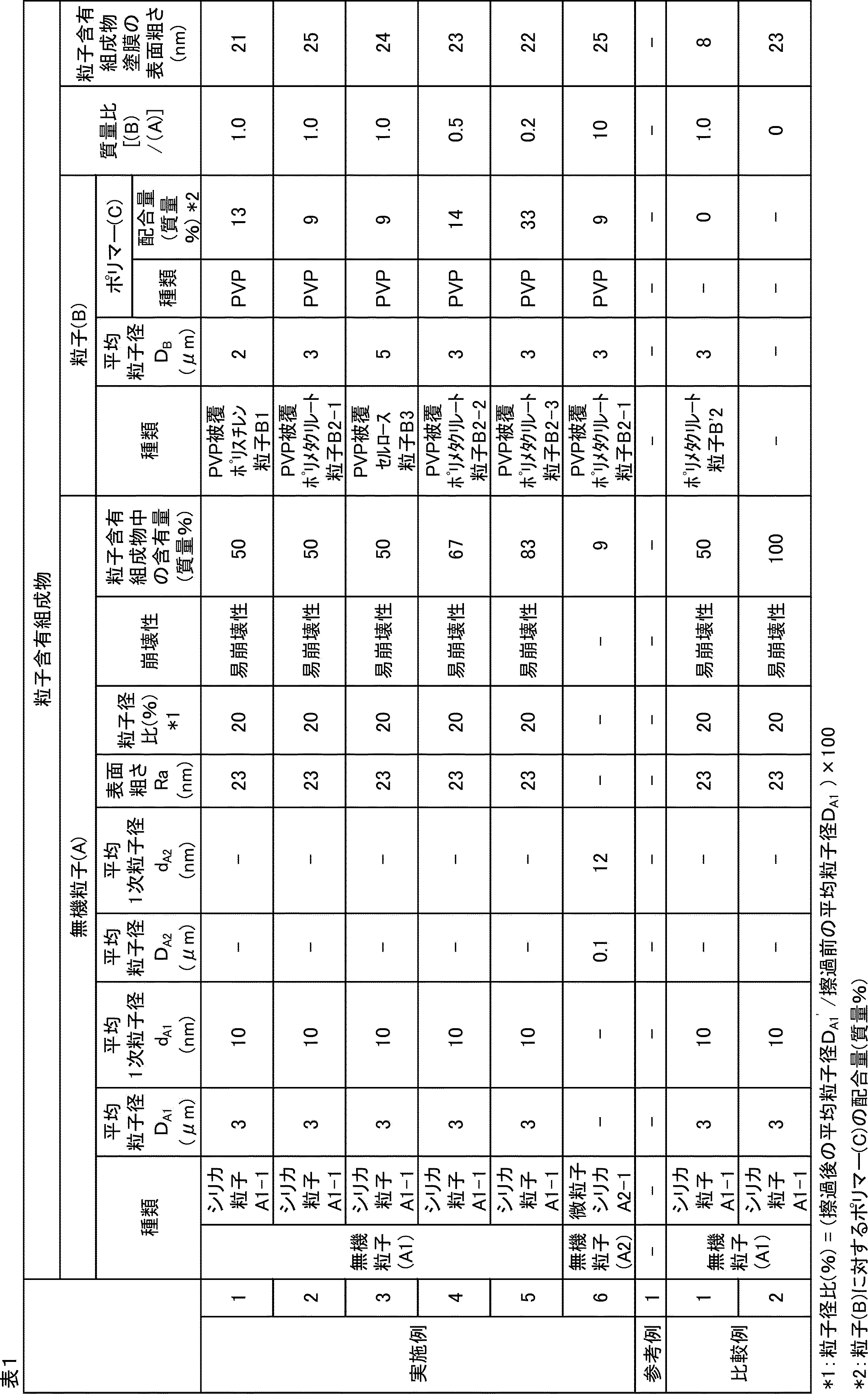

表2から、実施例1~6の粒子含有組成物は、参考例1のように何も塗布していない状態と比べて、高い付着抑制効果を有し、かつ感触にも優れ、さらに擦過後においても高い付着抑制効果と良好な感触を保持できることが分かる。
一方、比較例1は、ポリメタクリレート粒子B’2がポリマー(C)で被覆されていないため、付着抑制効果を発現していないことが分かる。
比較例2は、粒子(B)を含まず無機粒子(A)のみを含有するため、付着抑制効果は有するものの、感触に劣ることが分かる。
一方、比較例1は、ポリメタクリレート粒子B’2がポリマー(C)で被覆されていないため、付着抑制効果を発現していないことが分かる。
比較例2は、粒子(B)を含まず無機粒子(A)のみを含有するため、付着抑制効果は有するものの、感触に劣ることが分かる。
本発明の粒子含有組成物は、付着抑制効果が高く、感触にも優れ、さらに擦過後においても高い付着抑制効果と良好な感触を保持できるため、固体表面へ塗布して用いる大気有害物質に対する付着抑制能を有する大気有害物質付着抑制剤として特に有用である。
1:評価対象のサンプル
2:支持体
3:網ふるい
4:評価用大気有害物質
5:送風機
2:支持体
3:網ふるい
4:評価用大気有害物質
5:送風機
Claims (13)
- 無機粒子(A)と該粒子(A)以外の粒子(B)とを含有する粒子含有組成物であって、
無機粒子(A)が、下記の無機粒子(A1)及び無機粒子(A2)から選ばれる1種以上であり、
粒子(B)が、平均粒子径DBが1μm以上50μm以下であり、かつその表面が水素結合受容性結合又は水素結合受容性官能基を有するポリマー(C)で被覆されてなる粒子である、粒子含有組成物。
無機粒子(A1):平均粒子径DA1が1μm以上50μm以下であり、かつ表面粗さRaが10nm以上50nm以下である易崩壊性無機粒子
無機粒子(A2):平均粒子径DA2が1μm未満であり、かつ平均1次粒子径dA2が3nm以上50nm以下である無機粒子 - 無機粒子(A)が、ケイ素含有化合物、金属酸化物、金属塩、金属窒化物、及び金属炭化物から選ばれる1種以上を含む粒子である、請求項1に記載の粒子含有組成物。
- 粒子(B)が、天然ポリマー、半合成ポリマー及び合成ポリマーから選ばれる1種以上を含む有機粒子の表面をポリマー(C)で被覆した粒子である、請求項1又は2に記載の粒子含有組成物。
- 無機粒子(A)に対する粒子(B)の質量比〔(B)/(A)〕が0.08以上15以下である、請求項1~3のいずれかに記載の粒子含有組成物。
- ポリマー(C)の水素結合受容性結合又は水素結合受容性官能基がアミド結合又はアミド基である、請求項1~4のいずれかに記載の粒子含有組成物。
- ポリマー(C)が、ポリ(N-ビニルピロリドン)及びポリ(メタ)アクリルアミドから選ばれる1種以上である、請求項1~5のいずれかに記載の粒子含有組成物。
- 前記粒子含有組成物を固体表面に塗布して形成される塗膜の表面粗さRaが50nm以下である、請求項1~6のいずれかに記載の粒子含有組成物。
- 皮膚化粧料に用いられる、請求項1~7のいずれかに記載の粒子含有組成物。
- 粒子(B)が、粒子(B’)の表面をポリマー(C)で被覆した粒子であり、下記工程1及び工程2を含む、請求項1~8のいずれかに記載の粒子含有組成物の製造方法。
工程1:粒子(B’)とポリマー(C)とを混合して、粒子(B)を得る工程
工程2:工程1で得られた粒子(B)と無機粒子(A)とを混合して、粒子含有組成物を得る工程 - 請求項1~8のいずれかに記載の粒子含有組成物を固体表面に塗布して、大気有害物質の固体表面への付着を抑制する、大気有害物質の付着抑制方法。
- 前記粒子含有組成物を固体表面に塗布して形成される塗膜の表面粗さRaが50nm以下である、請求項10に記載の大気有害物質の付着抑制方法。
- 前記固体表面が皮膚表面である、請求項10又は11に記載の大気有害物質の付着抑制方法。
- 前記粒子含有組成物を、無機粒子(A)の付着量として0.005mg/cm2以上5mg/cm2以下で固体表面に塗布する、請求項10~12のいずれかに記載の大気有害物質の付着抑制方法。
Priority Applications (4)
| Application Number | Priority Date | Filing Date | Title |
|---|---|---|---|
| US17/616,511 US20220202662A1 (en) | 2019-06-06 | 2020-06-04 | Particle-containing composition |
| CN202080041394.9A CN113966363A (zh) | 2019-06-06 | 2020-06-04 | 含有粒子的组合物 |
| KR1020217039861A KR102410693B1 (ko) | 2019-06-06 | 2020-06-04 | 입자 함유 조성물 |
| EP20818342.6A EP3981381B1 (en) | 2019-06-06 | 2020-06-04 | Particle-containing composition |
Applications Claiming Priority (2)
| Application Number | Priority Date | Filing Date | Title |
|---|---|---|---|
| JP2019106324 | 2019-06-06 | ||
| JP2019-106324 | 2019-06-06 |
Publications (1)
| Publication Number | Publication Date |
|---|---|
| WO2020246555A1 true WO2020246555A1 (ja) | 2020-12-10 |
Family
ID=73653279
Family Applications (1)
| Application Number | Title | Priority Date | Filing Date |
|---|---|---|---|
| PCT/JP2020/022175 Ceased WO2020246555A1 (ja) | 2019-06-06 | 2020-06-04 | 粒子含有組成物 |
Country Status (7)
| Country | Link |
|---|---|
| US (1) | US20220202662A1 (ja) |
| EP (1) | EP3981381B1 (ja) |
| JP (1) | JP7042302B2 (ja) |
| KR (1) | KR102410693B1 (ja) |
| CN (1) | CN113966363A (ja) |
| TW (1) | TWI901589B (ja) |
| WO (1) | WO2020246555A1 (ja) |
Cited By (2)
| Publication number | Priority date | Publication date | Assignee | Title |
|---|---|---|---|---|
| CN114672242A (zh) * | 2022-04-01 | 2022-06-28 | 华南理工大学 | 抑制水合物成核和粘附的超疏水超亲油涂料及其制备方法与应用 |
| WO2024135573A1 (ja) * | 2022-12-23 | 2024-06-27 | 日信化学工業株式会社 | 複合粒子、複合粒子の製造方法、及び化粧料 |
Citations (9)
| Publication number | Priority date | Publication date | Assignee | Title |
|---|---|---|---|---|
| JPH0474627A (ja) | 1990-07-17 | 1992-03-10 | Sumitomo Heavy Ind Ltd | 成形品良否判別装置 |
| JPH07289021A (ja) | 1994-04-28 | 1995-11-07 | Sumitomo Chem Co Ltd | 種子の発芽開始時期の均一化方法およびその利用 |
| JP2005162700A (ja) | 2003-12-04 | 2005-06-23 | Kao Corp | 毛髪用還元性水性組成物 |
| JP2005336056A (ja) * | 2004-05-24 | 2005-12-08 | Shiseido Co Ltd | 花粉吸着防止剤 |
| JP2006008980A (ja) | 2004-05-28 | 2006-01-12 | Kao Corp | 樹脂粒子 |
| WO2008123284A1 (ja) * | 2007-03-30 | 2008-10-16 | Kose Corporation | 造粒シリカ粒子、複合粉体およびこれらの製造方法並びにこれらを含有する化粧料 |
| JP2013107887A (ja) * | 2011-11-21 | 2013-06-06 | Kao Corp | 油中水型乳化化粧料及びスキンケア方法 |
| WO2014136993A2 (ja) | 2014-04-24 | 2014-09-12 | 株式会社 資生堂 | スキンケア化粧料 |
| JP2018535970A (ja) * | 2015-11-02 | 2018-12-06 | ルブリゾル アドバンスド マテリアルズ, インコーポレイテッド | 汚染作用から皮膚を保護するための組成物およびその施用 |
Family Cites Families (14)
| Publication number | Priority date | Publication date | Assignee | Title |
|---|---|---|---|---|
| US4205997A (en) * | 1976-01-29 | 1980-06-03 | Merck Patent Gesellschaft Mit Beschrankter Haftung | Powdery pearlescent pigment compositions |
| FR2703587B1 (fr) * | 1993-04-06 | 1995-06-16 | Oreal | Composition cosmetique coloree. |
| US5922359A (en) * | 1998-02-17 | 1999-07-13 | Youssefyeh; Rena T. | Skin treatment compositions comprising unoxidized nerve tissue |
| WO2005034862A2 (en) * | 2003-10-03 | 2005-04-21 | The Procter & Gamble Company | Topical composition |
| US20050074473A1 (en) * | 2003-10-07 | 2005-04-07 | Cabot Corporation | Soft-focus cosmetic composition comprising fumed alumina |
| JP5137352B2 (ja) * | 2006-07-28 | 2013-02-06 | 旭化成イーマテリアルズ株式会社 | 水系汚染防止用組成物および塗装物 |
| EP2097487B1 (en) * | 2007-01-05 | 2013-02-20 | Basf Se | Co-milling organic pigments with fumed silica |
| JP2009051831A (ja) * | 2007-08-01 | 2009-03-12 | Kao Corp | 紫外線遮蔽性無機粒子分散体 |
| CN101181184B (zh) * | 2007-11-30 | 2010-10-27 | 华南理工大学 | 一种化妆品用多功效复合微球及其制备方法 |
| JP5631530B2 (ja) * | 2007-12-07 | 2014-11-26 | 日揮触媒化成株式会社 | 表面平滑性を備えた多孔質シリカ系粒子、その製造方法および該多孔質シリカ系粒子を配合してなる化粧料 |
| US9056053B2 (en) * | 2008-01-08 | 2015-06-16 | Avon Products, Inc | Nanoparticle compositions providing enhanced color for cosmetic formulations |
| JP5727323B2 (ja) * | 2011-03-17 | 2015-06-03 | 積水化成品工業株式会社 | 有機無機複合粒子、その製造方法、およびその用途 |
| JP5815288B2 (ja) * | 2011-05-31 | 2015-11-17 | 株式会社コーセー | 化粧料 |
| BR112019015800B1 (pt) * | 2017-02-17 | 2022-11-22 | Imertech Sas | Uso de um mineral particulado como agente antipoluição |
-
2020
- 2020-06-04 JP JP2020097986A patent/JP7042302B2/ja active Active
- 2020-06-04 WO PCT/JP2020/022175 patent/WO2020246555A1/ja not_active Ceased
- 2020-06-04 US US17/616,511 patent/US20220202662A1/en not_active Abandoned
- 2020-06-04 CN CN202080041394.9A patent/CN113966363A/zh active Pending
- 2020-06-04 KR KR1020217039861A patent/KR102410693B1/ko active Active
- 2020-06-04 EP EP20818342.6A patent/EP3981381B1/en active Active
- 2020-06-05 TW TW109118936A patent/TWI901589B/zh active
Patent Citations (10)
| Publication number | Priority date | Publication date | Assignee | Title |
|---|---|---|---|---|
| JPH0474627A (ja) | 1990-07-17 | 1992-03-10 | Sumitomo Heavy Ind Ltd | 成形品良否判別装置 |
| JPH07289021A (ja) | 1994-04-28 | 1995-11-07 | Sumitomo Chem Co Ltd | 種子の発芽開始時期の均一化方法およびその利用 |
| JP2005162700A (ja) | 2003-12-04 | 2005-06-23 | Kao Corp | 毛髪用還元性水性組成物 |
| JP2005336056A (ja) * | 2004-05-24 | 2005-12-08 | Shiseido Co Ltd | 花粉吸着防止剤 |
| JP2006008980A (ja) | 2004-05-28 | 2006-01-12 | Kao Corp | 樹脂粒子 |
| WO2008123284A1 (ja) * | 2007-03-30 | 2008-10-16 | Kose Corporation | 造粒シリカ粒子、複合粉体およびこれらの製造方法並びにこれらを含有する化粧料 |
| JP2013107887A (ja) * | 2011-11-21 | 2013-06-06 | Kao Corp | 油中水型乳化化粧料及びスキンケア方法 |
| WO2014136993A2 (ja) | 2014-04-24 | 2014-09-12 | 株式会社 資生堂 | スキンケア化粧料 |
| JP2017105825A (ja) * | 2014-04-24 | 2017-06-15 | 株式会社 資生堂 | スキンケア化粧料 |
| JP2018535970A (ja) * | 2015-11-02 | 2018-12-06 | ルブリゾル アドバンスド マテリアルズ, インコーポレイテッド | 汚染作用から皮膚を保護するための組成物およびその施用 |
Non-Patent Citations (2)
| Title |
|---|
| See also references of EP3981381A4 |
| SHIRAIWA, NATURE CHEMISTRY, vol. 3, 2011, pages 291 - 295 |
Cited By (4)
| Publication number | Priority date | Publication date | Assignee | Title |
|---|---|---|---|---|
| CN114672242A (zh) * | 2022-04-01 | 2022-06-28 | 华南理工大学 | 抑制水合物成核和粘附的超疏水超亲油涂料及其制备方法与应用 |
| CN114672242B (zh) * | 2022-04-01 | 2022-11-18 | 华南理工大学 | 抑制水合物成核和粘附的超疏水超亲油涂料及其制备方法与应用 |
| WO2024135573A1 (ja) * | 2022-12-23 | 2024-06-27 | 日信化学工業株式会社 | 複合粒子、複合粒子の製造方法、及び化粧料 |
| JP2024090453A (ja) * | 2022-12-23 | 2024-07-04 | 日信化学工業株式会社 | 複合粒子、複合粒子の製造方法、及び化粧料 |
Also Published As
| Publication number | Publication date |
|---|---|
| TWI901589B (zh) | 2025-10-21 |
| CN113966363A (zh) | 2022-01-21 |
| EP3981381A4 (en) | 2023-06-28 |
| EP3981381A1 (en) | 2022-04-13 |
| KR20210152587A (ko) | 2021-12-15 |
| TW202112342A (zh) | 2021-04-01 |
| KR102410693B1 (ko) | 2022-06-23 |
| JP7042302B2 (ja) | 2022-03-25 |
| JP2020200314A (ja) | 2020-12-17 |
| US20220202662A1 (en) | 2022-06-30 |
| EP3981381B1 (en) | 2024-11-06 |
Similar Documents
| Publication | Publication Date | Title |
|---|---|---|
| JP6214387B2 (ja) | 油中水型乳化化粧料 | |
| JP7042302B2 (ja) | 粒子含有組成物 | |
| WO2012029643A1 (ja) | 複合粒子、その製造方法およびその用途 | |
| JP5344398B2 (ja) | 樹脂粒子、複合粒子の製造方法及び化粧料 | |
| JP6130203B2 (ja) | 皮膚化粧料 | |
| JP6718277B2 (ja) | 多孔質シリカ系粒子、その製造方法及び洗浄用化粧料 | |
| JP2023160950A (ja) | 大気有害物質付着抑制剤 | |
| KR101843207B1 (ko) | 원하는 정도의 은폐력을 갖는 막을 형성하기 위한 조성물 및 이의 제조 및 사용 방법 | |
| US20120015013A1 (en) | Matrix containing metal oxide particles and use of same in cosmetic compositions | |
| JP2020200250A (ja) | 大気有害物質付着抑制剤 | |
| JP2021169421A (ja) | 複合粒子及びその製造方法 | |
| WO2023234072A1 (ja) | セルロース-シロキサン複合粒子、その製造方法、及び、化粧料 | |
| JP2018172406A (ja) | 隠蔽膜を形成するための組成物並びにそれを製造及び使用する方法 | |
| CN113905713B (zh) | 大气有害物质的附着抑制方法 | |
| JP4777872B2 (ja) | 化粧料 | |
| WO2022124347A1 (ja) | 表面修飾されてなる、金属がドープされた多孔質シリカ | |
| JP2024165522A (ja) | 複合粒子の製造方法 | |
| WO2024135573A1 (ja) | 複合粒子、複合粒子の製造方法、及び化粧料 | |
| JP2001072524A (ja) | 皮膚外用剤 |
Legal Events
| Date | Code | Title | Description |
|---|---|---|---|
| 121 | Ep: the epo has been informed by wipo that ep was designated in this application |
Ref document number: 20818342 Country of ref document: EP Kind code of ref document: A1 |
|
| ENP | Entry into the national phase |
Ref document number: 20217039861 Country of ref document: KR Kind code of ref document: A |
|
| NENP | Non-entry into the national phase |
Ref country code: DE |
|
| WWE | Wipo information: entry into national phase |
Ref document number: 2020818342 Country of ref document: EP |