WO2020250855A1 - 環状ペプチド、細胞足場材、細胞分離材、及び、培地 - Google Patents
環状ペプチド、細胞足場材、細胞分離材、及び、培地 Download PDFInfo
- Publication number
- WO2020250855A1 WO2020250855A1 PCT/JP2020/022559 JP2020022559W WO2020250855A1 WO 2020250855 A1 WO2020250855 A1 WO 2020250855A1 JP 2020022559 W JP2020022559 W JP 2020022559W WO 2020250855 A1 WO2020250855 A1 WO 2020250855A1
- Authority
- WO
- WIPO (PCT)
- Prior art keywords
- amino acid
- amino
- acetyl
- group
- acid residue
- Prior art date
- Legal status (The legal status is an assumption and is not a legal conclusion. Google has not performed a legal analysis and makes no representation as to the accuracy of the status listed.)
- Ceased
Links
Classifications
-
- C—CHEMISTRY; METALLURGY
- C07—ORGANIC CHEMISTRY
- C07K—PEPTIDES
- C07K7/00—Peptides having 5 to 20 amino acids in a fully defined sequence; Derivatives thereof
- C07K7/04—Linear peptides containing only normal peptide links
- C07K7/08—Linear peptides containing only normal peptide links having 12 to 20 amino acids
-
- C—CHEMISTRY; METALLURGY
- C07—ORGANIC CHEMISTRY
- C07K—PEPTIDES
- C07K7/00—Peptides having 5 to 20 amino acids in a fully defined sequence; Derivatives thereof
- C07K7/04—Linear peptides containing only normal peptide links
- C07K7/06—Linear peptides containing only normal peptide links having 5 to 11 amino acids
-
- C—CHEMISTRY; METALLURGY
- C12—BIOCHEMISTRY; BEER; SPIRITS; WINE; VINEGAR; MICROBIOLOGY; ENZYMOLOGY; MUTATION OR GENETIC ENGINEERING
- C12M—APPARATUS FOR ENZYMOLOGY OR MICROBIOLOGY; APPARATUS FOR CULTURING MICROORGANISMS FOR PRODUCING BIOMASS, FOR GROWING CELLS OR FOR OBTAINING FERMENTATION OR METABOLIC PRODUCTS, i.e. BIOREACTORS OR FERMENTERS
- C12M25/00—Means for supporting, enclosing or fixing the microorganisms, e.g. immunocoatings
- C12M25/14—Scaffolds; Matrices
-
- C—CHEMISTRY; METALLURGY
- C12—BIOCHEMISTRY; BEER; SPIRITS; WINE; VINEGAR; MICROBIOLOGY; ENZYMOLOGY; MUTATION OR GENETIC ENGINEERING
- C12M—APPARATUS FOR ENZYMOLOGY OR MICROBIOLOGY; APPARATUS FOR CULTURING MICROORGANISMS FOR PRODUCING BIOMASS, FOR GROWING CELLS OR FOR OBTAINING FERMENTATION OR METABOLIC PRODUCTS, i.e. BIOREACTORS OR FERMENTERS
- C12M47/00—Means for after-treatment of the produced biomass or of the fermentation or metabolic products, e.g. storage of biomass
- C12M47/02—Separating microorganisms from the culture medium; Concentration of biomass
-
- C—CHEMISTRY; METALLURGY
- C12—BIOCHEMISTRY; BEER; SPIRITS; WINE; VINEGAR; MICROBIOLOGY; ENZYMOLOGY; MUTATION OR GENETIC ENGINEERING
- C12N—MICROORGANISMS OR ENZYMES; COMPOSITIONS THEREOF; PROPAGATING, PRESERVING, OR MAINTAINING MICROORGANISMS; MUTATION OR GENETIC ENGINEERING; CULTURE MEDIA
- C12N5/00—Undifferentiated human, animal or plant cells, e.g. cell lines; Tissues; Cultivation or maintenance thereof; Culture media therefor
- C12N5/0018—Culture media for cell or tissue culture
Definitions
- the present disclosure relates to cyclic peptides, cell scaffolding materials, cell separating materials, and media.
- Integrin is a cell adhesion molecule and is a heterodimer protein consisting of two subunits, ⁇ chain and ⁇ chain. Integrins play an important role not only in cell adhesion but also in cell extension, cell migration, cell proliferation, tissue formation, cancer metastasis, tissue repair, blood coagulation, and the like.
- Japanese Patent Application Laid-Open No. 2005-507376 discloses a cyclic peptide that binds to an integrin and is cyclized by a disulfide bond.
- Other cyclic peptides having an affinity for integrin are known.
- Japanese Patent Application Laid-Open No. 6-509551 describes a cyclic peptide obtained by cyclizing Tyr-Arg-Gly-Asp as a platelet aggregation inhibitor.
- Bioconjugate Chem, 1995, 6, p. 269-277 also describes techniques for cyclizing peptides and / or binding to carrier proteins or glass coverslips using (bromoacetyl) diaminopropionic acid. ..
- the problem to be solved by one embodiment of the present disclosure is a cyclic peptide having excellent integrin binding property and molecular stability, for example, alkali resistance, and a cell scaffolding material, a cell separating material and a cell separating material containing the cyclic peptide.
- a cell scaffolding material for example, alkali resistance
- the means for solving the above problems include the following aspects. ⁇ 1> A cyclic peptide having an amino acid sequence represented by the following formula (1).
- X a and X b and X c and X d each independently represent amino acid residues crosslinked via a thioether bond.
- X 1 to X 5 independently represent amino acid residues.
- R represents an arginine residue
- G represents a glycine residue
- D represents an aspartic acid residue
- m1 to m5 each independently represent an integer of 0 or more.
- the total number of amino acid residues of X a , X b , X c and X d , and the amino acid residues represented by X 1 , X 3 and X 4 and RGD is 7 to 16.
- X 3> The cyclic peptide according to ⁇ 2>, wherein the immobilized functional group is an amino group or a thiol group.
- the amino acid having an immobilized functional group in the side chain is at least one selected from the group consisting of L-lysine, D-lysine, L-cysteine, D-cysteine, L-homocysteine and D-homocysteine.
- cyclic peptide according to ⁇ 2> or ⁇ 3> which is a species amino acid.
- Either one of X c and X d in the above formula (1) is (2S) -2-amino-3-[(2-acetyl) amino] propanoic acid, (2R) -2-amino-3.
- ⁇ 1> to ⁇ 4> which are amino acid residues derived from the amino acids to be produced, and the other is an amino acid residue derived from L-homocysteine, D-homocysteine, L-peniciramine, or D-peniciramine.
- the cyclic peptide according to any one of the above. ⁇ 6> Any of ⁇ 1> to ⁇ 5>, wherein X b in the above formula (1) is an amino acid residue derived from L-homocysteine, D-homocysteine, L-penicillamine, or D-penicillamine.
- the cyclic peptide according to one. ⁇ 7> The cyclic peptide according to any one of ⁇ 1> to ⁇ 6>, wherein the amino acid sequence represented by the above formula (1) is the amino acid sequence represented by the following formula (2).
- X a and X b and X c and X d each independently represent an amino acid residue crosslinked via a thioether bond
- X 1 and X 2 independently represent an amino acid residue.
- R represents an arginine residue
- G represents a glycine residue
- D represents an aspartic acid residue
- m1 and m2 each independently represent an integer of 1 or more.
- the total number of amino acid residues of X a , X b , X c and X d , and the amino acid residue represented by X 1 and RGD is 7 to 14.
- Either one of X c and X d in the above formula (2) is (2S) -2-amino-3-[(2-acetyl) amino] propanoic acid, (2R) -2-amino-3. -[(2-Acetyl) amino] propanoic acid, (2S) -2-amino-4-[(2-acetyl) amino] butanoic acid, (2R) -2-amino-4-[(2-acetyl) amino ] Selected from the group consisting of butanoic acid, N- ⁇ -acetyl-L-ornithin, N- ⁇ -acetyl-D-ornithine, N- ⁇ -acetyl-L-lysine, and N- ⁇ -acetyl-D-lysine.
- X b in the above formula (2) is an amino acid residue derived from L-homocysteine, D-homocysteine, L-penicillamine, or D-penicillamine.
- Cyclic peptide. ⁇ 10> X a in the above formula (2) is an amino acid residue represented by the following structural (r), the cyclic peptide of any one of ⁇ 7> to ⁇ 9>.
- R r represents a hydrogen atom or a monovalent organic group
- L1 represents an integer of 0 or more and 10 or less
- nr1 represents an integer of 0 or more
- * represents a binding site with an adjacent amino acid residue. Represented, ** represents the bonding site with the sulfur atom in the thioether bond.
- X b in the above formula (2) is an amino acid residue derived from L-homocysteine, D-homocysteine, L-penicillamine, or D-penicillamine, and X a is (2S) -2.
- X a is an amino acid residue derived from an arbitrary amino acid in which an acetyl group is bonded to ⁇ carbon
- X b is an amino acid residue derived from homocysteine
- X c is an amino acid residue derived from homocysteine.
- Is a group X d is an amino acid residue derived from N- ⁇ -acetyl-ornithin or an amino acid residue derived from N- ⁇ -acetyl-lysine, and (X 1 ) m1 is F as a whole?
- X a is an amino acid residue derived from an amino acid having an acetyl group bonded to ⁇ carbon
- X b is an amino acid residue derived from homocysteine
- X c is N- ⁇ -acetyl-ornithine.
- X d is an amino acid residue derived from homocysteine
- (X 1 ) m 1 is F as a whole, ⁇
- ⁇ 13> A cell scaffold material containing the cyclic peptide according to any one of ⁇ 1> to ⁇ 12> and a base material.
- ⁇ 14> The cyclic peptide according to any one of ⁇ 1> to ⁇ 12>, a retaining material, and the like. Including cell separator.
- ⁇ 15> A medium containing the cyclic peptide according to any one of ⁇ 1> to ⁇ 12> and a culture component.
- a cyclic peptide having excellent integrin binding property and molecular stability for example, alkali resistance
- a cell scaffolding material, a cell separating material and a medium containing the cyclic peptide are provided.
- the numerical range indicated by using "-" in the present disclosure means a range including the numerical values before and after "-" as the minimum value and the maximum value, respectively.
- the upper limit value or the lower limit value described in a certain numerical range may be replaced with the upper limit value or the lower limit value of another numerical range described stepwise.
- the upper limit value or the lower limit value described in a certain numerical range may be replaced with the value shown in the examples.
- the amount of each component means the total amount of a plurality of kinds of substances when a plurality of kinds of substances corresponding to each component are present, unless otherwise specified.
- the term "process" includes not only an independent process but also a process that cannot be clearly distinguished from other processes as long as the intended purpose of the process is achieved.
- the cyclic peptide according to the present disclosure has an amino acid sequence represented by the following formula (1) (hereinafter, also referred to as "specific amino acid sequence").
- X a and X b and X c and X d each independently represent amino acid residues linked via a thioether bond, and X 1 to X 5 independently represent amino acid residues.
- Represents a group R represents an arginine residue, G represents a glycine residue, D represents an aspartic acid residue, and m1 to m5 each independently represent an integer of 0 or more.
- the total number of amino acid residues represented by X a , X b , X c and X d , and X 1 , X 3 and X 4 is 7 to 16.
- a cyclic peptide having integrin-binding property (hereinafter, also referred to as an integrin-binding cyclic peptide) has an ability to bind to integrin in the cell plasma membrane on the cell surface.
- Integrin is one of the cell adhesion molecules, and the integrin-binding cyclic peptide binds to the integrin on the cell surface. Therefore, the integrin-binding cyclic peptide is a scaffolding material for cell culture and cell separation for cell separation. It is a useful molecule because it can be used as a material, various cell culture media, and the like.
- cyclic peptides may have higher binding and specificity for cell adhesion molecules such as integrins as compared to linear peptides
- the molecular stability of cyclic peptides is higher than that of linear peptides. Tends to be low.
- cyclic peptides tend to have low alkali resistance; acid resistance; resistance to active rays such as X-rays and ⁇ -rays.
- the integrin-binding cyclic peptide was also degraded during long-term use or repeated use due to its low molecular stability, and the desired effect could not be obtained for a long period of time.
- cyclic peptides do not always have higher binding properties than linear peptides, and the integrin binding property changes depending on the amino acid sequence of the cyclic peptide, so that both molecular stability and integrin binding properties of cyclic peptides It was not easy to obtain an excellent integrin-binding cyclic peptide.
- a cyclic peptide having a specific amino acid sequence and a specific structure is excellent in both molecular stability and integrin binding property.
- the reason is not clear, but it is presumed as follows.
- the cyclic peptide having a specific structure according to the present disclosure contains two cyclic sites (hereinafter, also referred to as “cyclic segments”) in which amino acid residues are crosslinked by a thioether bond at a specific site in the amino acid sequence.
- the cyclic peptide according to the present disclosure is, for example, molecularly stable with respect to alkali resistance. It is presumed that it is excellent in and also excellent in integrin binding. The details of the cyclic peptide according to the present disclosure will be described below.
- amino acids are referred to as, in principle, the International Union of Pure and Applied Chemistry and the International Union of Biochemistry and Molecular Biology. It is expressed using the names, abbreviations, etc. adopted in the Communication on Biochemical Nomenclature (JCBN)).
- amino acid residue is represented by using the abbreviation of the amino acid from which the amino acid residue is derived.
- the amino acid sequence of a peptide or protein (also referred to as "primary structure”) represents the amino acid residues arranged in a row from the N-terminal to the C-terminal from the left end to the right end.
- a number indicating the number of the amino acid residue from the N-terminal side is added to the right side of the abbreviation of the amino acid residue. May be expressed as.
- the second ricin from the N-terminal may be represented as Lys2.
- L-form and D-form amino acids are represented using their names and isomers having an enantiomeric relationship, that is, L-form and D-form are present, the distinction between L-form and D-form is explicitly shown. Except for the case, in principle, it may be L-form or D-form.
- "isoleucine” shall represent “L-isoleucine” or "D-isoleucine”, and the same applies to amino acid residues.
- amino acids are represented using their abbreviations (three-letter abbreviations or one-letter abbreviations) and there are isomers related to enantiomers, that is, L-form and D-form, the L-form is also present.
- L-form In principle, it may be either L-form or D-form, unless the distinction between and D-form is explicitly indicated.
- “Lys” shall represent “L-lysine” or “D-lysine”, and the same applies to amino acid residues.
- L-form and D-form can be independently selected for each amino acid and each amino acid residue.
- all RGD sequences existing in the cyclic segment are L-form amino acid residues.
- the amino acid residues existing in the cyclic peptide are all L-form amino acid residues or all D-form amino acid residues, L-form amino acid residues and D-form. Both of the amino acid residues of may be present.
- amino acids are represented using their names and there are isomers related to diastereomers, they are not included in the amino acids specified by their names.
- Diastereomers are treated as different types of amino acids with the prefix "aro". For example, "threonine” does not include “allotreonine”. The same applies to amino acid residues.
- Table 1 shows the names and abbreviations of amino acids (one-letter abbreviations and three-letter abbreviations) for which one-letter abbreviations and three-letter abbreviations are officially recognized.
- amino acid residue contained in the cyclic peptide according to the present disclosure is not limited to the amino acid residue derived from the amino acids listed in Table 1 above, and may be an amino acid residue derived from an abnormal amino acid. Examples of abnormal amino acids are given in Table 2 below, but the abnormal amino acids are not limited thereto.
- Any amino acid residue contained in the cyclic peptide according to the present disclosure may be chemically modified.
- the chemical modification on the amino acid residue is not particularly limited as long as it is a chemical modification usually performed on the amino acid residue.
- Examples of chemical modifications to amino acid residues include N-acetylation, N-formylation, or N-acyllation, PEG (polyethylene glycol) formation of amino groups present in amino acid residues, and in amino acid residues. Examples thereof include amidation and PEGylation of the carboxy group present in.
- the N-terminal amino group residue is not particularly limited, and N-acetylation, It may have undergone N-terminal modification such as N-formylation, N-acylation, PEGylation, or may remain an amino group.
- the C-terminal carboxy group is not particularly limited, and amidation, PEGylation, etc. It may have undergone the C-terminal modification of, or it may remain as a carboxy group.
- the cyclic peptide according to the present disclosure has a specific amino acid sequence, and X a and X b and X c and X d each independently represent an amino acid residue linked via a thioether bond, and X 1 to X. 5 independently represents an amino acid residue.
- the cyclic peptide according to the present disclosure has a specific amino acid sequence, and X c and X d and X a and X b each independently represent an amino acid residue linked via a thioether bond.
- "-S-" in the formula (1) represents that X c and X d and X a and X b were crosslinked via a thioether bond.
- the amino acid residue X c and the amino acid residue X d , and the amino acid residue X a and the amino acid residue X b described later are each cross-linked by a thioether bond.
- the details are not clear, it is presumed that the molecular stability is superior to that of a cyclic peptide having an amino acid residue cross-linked by a disulfide bond because it is structurally irreversible as compared with a disulfide bond. ..
- the amino acid before the formation of the thioether bond is not particularly limited, but for example, one of X c and X d is an amino acid derived from an amino acid having a thiol group, and the other is an organic group having a halogen atom. Examples include combinations of amino acids derived from protected amino acids.
- the amino acid before the formation of the thioether bond is not particularly limited, but for example, one of X a and X b is an amino acid derived from an amino acid having a thiol group, and the other has a halogen atom. Examples include combinations of amino acids derived from amino acids protected by organic groups. Preferable examples of the organic group having a halogen atom include a haloacetyl group.
- the "main chain” in a cyclic peptide refers to a peptide chain having a relatively long stem among the chain portions in the cyclic peptide.
- side chain is meant a chain that binds to the backbone of a cyclic peptide.
- the main chain of an amino acid or amino acid residue corresponds to the "main chain” of a cyclic peptide
- the side chain of an amino acid or amino acid residue is a side chain that binds to the main chain of a cyclic peptide.
- amino acid residues derived from amino acids having a thiol group that can be taken by X a to X d before the formation of a thioether bond will be described.
- amino acid residues derived from amino acids having a thiol group are preferably an amino acid having a thiol group on the side chain from the viewpoint of reactivity. It is preferable that the main chain of the amino acid does not contain a thiol group.
- the amino acid residue having a thiol group on the side chain is not particularly limited, but an amino acid residue represented by the following structure (t-1) or (t-2) is preferably used.
- nt-1 and nt-2 represent an integer of 0 or more.
- the nt-1 or nt-2 carbon atoms in the side chain and the ⁇ -carbon atom are -NH 2 , -SH, -COOH, an alkyl group having 1 to 10 carbon atoms, and 6 to 14 carbon atoms. It may be substituted with at least one substituent selected from the group consisting of aryl groups of.
- the alkyl group having 1 to 10 carbon atoms may be either linear or branched.
- alkyl group having 1 to 10 carbon atoms examples include a methyl group, an ethyl group, an n-propyl group, an isopropyl group, an n-butyl group, an isobutyl group, a t-butyl group and the like.
- the aryl group having 6 to 14 carbon atoms may be a monocyclic ring or a condensed ring.
- Examples of the aryl group having 6 to 14 carbon atoms include a phenyl group, a naphthyl group, an anthranyl group, a phenanthrene group and the like.
- nt-1 and nt-2 are preferably an integer of 0 to 10, more preferably an integer of 0 to 6, and an integer of 1 to 4 because of the ease of forming a thioether bond. Is more preferable.
- amino acids having a thiol group on the side chain are derived from cysteine, peniciramine, homocysteine (amino acid derived from 2-amino-4-mercaptobutanoic acid), and 2-amino-5-mercaptopentanoic acid.
- Amino acids and the like can be mentioned.
- the amino acid having a thiol group on the side chain may be an amino acid derived from L-homocysteine, D-homocysteine, L-penicillamine, or D-penicillamine from the viewpoint of binding stability. preferable.
- either X c or X d before thioether bond formation is an amino acid residue derived from an amino acid having a thiol group, and is on the side chain. It is more preferably an amino acid residue derived from an amino acid having a thiol group, and more preferably an amino acid residue derived from L-homocysteine, D-homocysteine, L-penicillamine, or D-penicillamine. L-homocysteine or D-homocysteine is more preferable because it is less likely to cause chemistry.
- X a is an amino acid residue derived from an amino acid protected by an organic group having a halogen atom
- X b is an amino acid derived from an amino acid having a thiol group from the viewpoint of bond stability and molecular stability. It is preferably a residue, more preferably an amino acid residue derived from an amino acid having a thiol group on the side chain, to L-homocysteine, D-homocysteine, L-penicillamine, or D-penicillamine. L-homocysteine or D-homocysteine is more preferable because it is preferably an amino acid residue derived from it and is less likely to cause racemization.
- ⁇ of ⁇ -amino acid before thioether binding It may be a thioether bond in which an amino group bonded to carbon or a modified amino group and a thiol group are bonded, and a side chain of an amino acid residue derived from an ⁇ -amino acid before the thioether bond and a thiol before the thioether bond. It may be a thioether bond to which a group is bonded.
- the bond between the amino group and the thiol group can be carried out via a haloacetyl group or the like arranged on the amino group.
- the ⁇ -amino acid before thioether binding It may be a thioether bond in which a carboxy group or a modified carboxy group moiety bonded to ⁇ carbon and a thiol group before thioether bond are bonded, and a side chain of an amino acid residue derived from ⁇ -amino acid before thioether bond. It may be a thioether bond in which a moiety and a thiol group before the thioether bond are bonded.
- amino acid residues derived from amino acids protected by organic groups having halogen atoms As an amino acid residue derived from an amino acid protected by an organic group having a halogen atom, an amino acid in which an organic group having a halogen atom is bonded to an amino group bonded to the ⁇ carbon of the amino acid, or a halogen atom in a side chain of the amino acid. It is preferably an amino acid residue derived from an amino acid having an organic group.
- the organic group having a halogen atom is not particularly limited as long as it is usually used as a protecting group for amino acids, and for example, a haloacetyl group and the like are preferable.
- the halogen atom is desorbed and the sulfur atom is bonded instead, so that a thioether bond is formed and the above amino acid residue is formed.
- Examples of amino acids in which an organic group having a halogen atom is bonded to an amino group bonded to the ⁇ carbon of an amino acid include any amino acid in which a haloalkanoyl group is bonded to an amino group on the ⁇ carbon.
- the haloalkanoyl group is, for example, a haloacetyl group.
- the halogen atom in the haloalkanoyl group is, for example, a fluorine atom, a chlorine atom, a bromine atom, or an iodine atom.
- the amino acid to be bonded to the organic group having a halogen atom may be an L-amino acid or a D-amino acid, and examples thereof include isoleucine, lysine, aspartic acid, glutamic acid, tyrosine, leucine, threonine, and valine.
- the amino acid in which an organic group having a halogen atom is bonded to an amino group bonded to the ⁇ carbon of the amino acid may be an L-amino acid or a D-amino acid, N- ⁇ -chloroacetyl-isoleucine, N- ⁇ -chloro.
- Acetyl-lysine N- ⁇ -chloroacetyl-aspartic acid, N- ⁇ -chloroacetyl-glutamic acid, N- ⁇ -chloroacetyl-tyrosine, N- ⁇ -chloroacetyl-leucine, N- ⁇ -chloroacetyl-threonine, Examples thereof include N- ⁇ -chloroacetyl-valine.
- the amino acid residue protected by an organic group having a halogen atom in the side chain is an amino acid having an organic group having a halogen atom at the end of the side chain of the amino acid residue from the viewpoint of easiness of forming a thioether bond. Is preferable.
- Amino acid residues having such an aspect preferably include amino acid residues represented by the following structures (p-1) or (p-2).
- halogen represents a halogen atom
- L1 represents an integer of 0 or more and 10 or less
- np1 and np2 each independently represent an integer of 0 or more
- * represents an adjacent amino acid residue.
- Each of np1 and np2 preferably represents an integer of 0 to 6, more preferably an integer of 0 to 4, and even more preferably an integer of 1 to 3.
- the halogen is bonded to the left end (the terminal on the alkyl side when L1 is 1 or more).
- the halogen atom include a fluorine atom, a chlorine atom, a bromine atom, an iodine atom and the like.
- a bromine atom or a chlorine atom is preferable, and a chlorine atom is more preferable, from the viewpoint of reactivity, ease of formation of a thioether bond, and safety.
- the np1 or np2 carbon atom in the side chain and the carbon atom at the ⁇ -position are composed of an alkyl group having 1 to 10 carbon atoms and an aryl group having 6 to 14 carbon atoms. It may be substituted with at least one substituent selected from the group.
- L1 is preferably an integer of 0 to 10, more preferably an integer of 1 to 6, and even more preferably an integer of 1 to 3.
- Specific examples of the alkyl group having 1 to 10 carbon atoms and the aryl group having 6 to 14 carbon atoms include the alkyl group having 1 to 10 carbon atoms and carbon in the above structures (t-1) and (t-2). Similar to the aryl groups of numbers 6-14.
- the amino acid residue before the thioether bond is selected from the viewpoint of easiness of forming a thioether bond. It is preferably an amino acid residue having an organic group having a halogen atom in the ⁇ -amino group, and more preferably an amino acid residue represented by the following structure (r-1).
- R r represents a hydrogen atom or a monovalent organic group
- halogen represents a halogen atom
- L1 represents an integer of 0 or more and 10 or less
- nr1 represents an integer of 0 or more
- * is adjacent. Represents the binding site with the amino acid residue.
- L and L1 are synonymous with L and L1 in the structures (p-1) and (p-2), and so are preferred embodiments.
- nr1 has the same meaning as np1 and np2 in the structures (p-1) and (p-2), and so does the preferred embodiment.
- the monovalent organic group in R r is not particularly limited, and examples thereof include an aliphatic hydrocarbon group that can be taken as a side chain of an amino acid.
- Examples of the monovalent organic group that can be taken as the side chain of the amino acid include the monovalent organic group that is the side chain of the amino acid shown in Table 1 or Table 2.
- the aliphatic hydrocarbon group is composed of at least one substituent selected from the group consisting of -NH 2 , -SH, -COOH, an alkyl group having 1 to 10 carbon atoms, and an aryl group having 6 to 14 carbon atoms. It may be replaced.
- the alkyl group having 1 to 10 carbon atoms may be either linear or branched. Examples of the alkyl group having 1 to 10 carbon atoms include a methyl group, an ethyl group, an n-propyl group, an isopropyl group, an n-butyl group, an isobutyl group, a t-butyl group and the like. Further, the aryl group having 6 to 14 carbon atoms may be a monocyclic ring or a condensed ring. Examples of the aryl group having 6 to 14 carbon atoms include a phenyl group, a naphthyl group, an anthranyl group, a phenanthrene group and the like.
- amino acid residue X a When the amino acid residue X a is located at the N-terminal of the specific amino acid sequence (when m5 of X 5 is 0) and is an amino acid residue derived from ⁇ -amino acid, it is designated as the amino acid residue X a. Is preferably an amino acid residue derived from the amino acid represented by the following structure (r).
- R r represents a hydrogen atom or a monovalent organic group
- L1 represents an integer of 0 or more and 10 or less
- nr1 represents an integer of 0 or more
- * represents a binding site with an adjacent amino acid residue.
- ** represent the bonding site with the sulfur atom in the thioether bond.
- R r, L and nr1 is synonymous with structure (r-1 in) R r, L and nr1, preferable embodiments thereof are also the same.
- an amino acid residue derived from an amino acid protected by an organic group having a halogen atom before the thioether bond is not particularly limited, but is 2-amino-3-[(2-haloacetyl) amino].
- Amino acid residues derived from acids, N- ⁇ -haloacetylhomolicin and the like can be mentioned.
- halogen atom in haloacetyl in these amino acid residues include a fluorine atom, a chlorine atom, a bromine atom, an iodine atom and the like, and among them, a chlorine atom is preferable.
- Amino acid residues derived from amino acids protected by an organic group having a halogen atom before the thioether bond include amino acids derived from amino acids having a chloroacetyl group in the side chain from the viewpoint of bond stability and molecular stability. It is preferably a residue, preferably (2S) -2-amino-3-[(2-chloroacetyl) amino] propanoic acid, (2R) -2-amino-3-[(2-chloroacetyl) amino] propane.
- (2R) -2-amino-4-[(2-chloroacetyl) amino] butanoic acid N- ⁇ - Chloroacetyl-L-ornithin, N- ⁇ -chloroacetyl-D-ornithin, N- ⁇ -chloroacetyl-L-lysine, N- ⁇ -chloroacetyl-D-lysine, N- ⁇ -chloroacetyl-L-homolicin , N- ⁇ -chloroacetyl-D-homolicin
- X c or X d is an amino acid residue derived from an amino acid protected by an organic group having a halogen atom, and a chlorine atom is used. It is more preferably an amino acid residue having an organic group having an organic group on the side chain, further preferably an amino acid residue having a chloroacetyl group on the side chain, and (2S) -2-amino-3-[().
- X b is an amino acid residue derived from an amino acid having a thiol group
- X a is a halogen atom on the amino group bonded to the ⁇ carbon of the amino acid from the viewpoint of bond stability and molecular stability. It is preferable that the amino acid residue is derived from an amino acid to which an organic group having is bonded, or the amino acid residue is derived from an amino acid protected by an organic group having a halogen atom, and chlorine is added to the amino group bonded to the ⁇ carbon of the amino acid.
- it is an amino acid residue derived from an amino acid to which an organic group having an atom is bonded, or an amino acid residue having an organic group having a chlorine atom on a side chain, and an amino group in which a chloroacetyl group is bonded to ⁇ carbon. It is more preferably an amino acid residue on the upper or side chain, N- ⁇ -chloroacetyl-isoleucine, N- ⁇ -chloroacetyl-lysine, N- ⁇ -chloroacetyl-aspartic acid, N- ⁇ -chloro.
- amino acid selected from the group consisting of acetyl-glutamic acid, N- ⁇ -chloroacetyl-tyrosine, N- ⁇ -chloroacetyl-leucine, N- ⁇ -chloroacetyl-threonine, and N- ⁇ -chloroacetyl-valine.
- amino acid residues X a to X d after thioether bond formation At amino acid residue X a ⁇ X d after thioether bond formation, after the thioether bond is formed, the structure of the amino acid residues derived from the protected amino acid with an organic group attached to the sulfur atom, the following structure ( Examples thereof include a structure represented by q-1) or (q-2).
- L and L1 are synonymous with L and L1 in the structures (p-1) and (p-2), and so are preferred embodiments.
- xq1 and xq1 are synonymous with np1 and np2 in the structures (p-1) and (p-2), and so are preferred embodiments.
- amino acid residues derived from amino acids protected by organic groups attached to sulfur atoms after thioether bonds have been formed are 2-amino-3- [acetylamino] propanoic acid, 2-.
- Examples thereof include amino acid residues derived from amino-4- [acetylamino] butanoic acid, N- ⁇ -acetylornithine, N- ⁇ -acetyllysine, N- ⁇ -acetylhomolicin and the like.
- N- ⁇ -acetyl-isoleucine and N- ⁇ -acetyl can be formed.
- N- ⁇ -acetyl-isoleucine and N- ⁇ -acetyl can be formed.
- -Ricin, N- ⁇ -acetyl-aspartic acid, N- ⁇ -acetyl-glutamic acid, N- ⁇ -acetyl-tyrosine, N- ⁇ -acetyl-leucine, N- ⁇ -acetyl-threonine, N- ⁇ -acetyl- Amino acid residues derived from valine and the like can also be mentioned.
- the acetyl group portion of these amino acid residues is attached to the sulfur atom of the thioether bond. If, of the two amino acid residues involved in the thioether bond, the amino acid residue that does not supply the sulfur atom of the thioether bond is replaced by an alkanoyl group such as an acetyl group, the thioether bond is not specified unless otherwise specified.
- the sulfur atom of is bonded to the alkanoyl group, and it can be said that the alkanoyl group (for example, acetyl group) is an S-linked alkanoyl group (for example, S-acetyl group).
- the notation of "S-bond" in such an S-bonded alkanoyl group is omitted, and it is simply described as an alkanoyl group (for example, an acetyl group).
- amino acid residue having a thiol group after the thioether bond is formed on the side chain
- amino acid residue having a thiol group after the thioether bond is formed on the side chain
- cysteine residues are cysteine residues, peniciramine residues, homocysteine residues (residues derived from 2-amino-4-mercaptobutanoic acid), or 2-amino-.
- examples include amino acid residues derived from 5-mercaptopentanoic acid.
- Amino acid residues derived from amino acids protected by organic groups bonded to sulfur atoms are the amino acid residues X on the N-terminal side in the cyclic segment, respectively. It may be a or X c , or it may be an amino acid residue X b or X d on the C-terminal side in the cyclic segment, respectively.
- the amino acid residue having a thiol group such as the amino acid residue of (t-1) or (t-2) is the amino acid residue X a or X c on the N-terminal side of the cyclic segment. It may be the amino acid residue X b or X d on the C-terminal side of the cyclic segment.
- the amino acid residue represented by the structural formula (p-1) or (p-2) is an amino acid residue having a structure selected from the amino acid residues represented by the following structures (a) to (h). There may be.
- * is a bond with an adjacent amino acid residue
- ** is a bond with the sulfur atom of the amino acid residue of the other party of the thioether bond.
- the amino acid residue X c and the amino acid residue can be obtained from the viewpoint of obtaining good molecular stability. It is preferable to design so that the ⁇ carbon of the other amino acid residue of the group Xd and the cysteine residue are separated by five or more atoms.
- the electron configuration of the thioether bond is stabilized by increasing the carbon chain length from the sulfur atom of the amino acid residue of the thioether bond partner to the main chain of the cyclic peptide. It is presumed that higher binding stability will be obtained.
- one of the amino acid residue X a and the amino acid residue X b is a cysteine residue, and the other is an amino acid residue in which the sulfur atom of the thioether bond is bonded to the amino acid side chain via an organic group. The same is true.
- the total number of carbon atoms on the side chain having a thiol group in the amino acid residue derived from the amino acid having a thiol group among the amino acid residue X a and the amino acid residue X b is preferably 1 to 10, more preferably 1 to 6, further preferably 1 to 4, and particularly preferably 2 to 4.
- the total number of carbon atoms on the side chain having a thiol group is the total number of carbon atoms in the side chain having a thiol group.
- the total number of carbon atoms on the side chain having a thiol group does not include the number of carbon atoms contained in the main chain.
- the total number of carbon atoms on the thiol-bearing side chain at the cysteine residue is 1, and the total number of carbon atoms on the thiol-bearing side chain at the homocysteine residue is 2.
- the total number of carbon atoms on the side chain in the indicated peniciramine residue is 3.
- * in the penicillamine residue shown below indicates a binding site with an adjacent amino acid residue.
- the amino acid residue having a thiol group has a chain length between the main chain of the cyclic peptide and the sulfur atom in the side chain having a thiol group having 1 to 10 carbon atoms. It is preferably 1 to 6, more preferably 1 to 4, and particularly preferably 1 to 3.
- the chain length between the main chain of the cyclic peptide and the sulfur atom in the side chain having a thiol group is counted so as to minimize the number of atoms in the side chain connecting the main chain and the thiol group in the cyclic peptide. It is a value, and the carbon atom contained in the main chain is not included in the number of chain lengths.
- the amino acid residue having a thiol group is the penicillamine residue shown below
- the chain length between the main chain of the cyclic peptide and the sulfur atom in the side chain having a thiol group is 1.
- * in the penicillamine residue shown below indicates a binding site with an adjacent amino acid residue.
- the chain length between the main chain of the cyclic peptide and the sulfur atom in the side chain having a thiol group is It is preferably 1 to 10, more preferably 1 to 6, further preferably 1 to 4, and particularly preferably 1 to 3.
- Chain length between the ⁇ carbon of the amino acid residue X a and the amino acid residue X b that do not supply the sulfur atom of the thioether bond and the sulfur atom of the amino acid residue that supplies the sulfur atom of the thioether bond is preferably separated by 4 or more atoms, more preferably separated by 4 to 9 atoms, and separated by 4 to 8 atoms, from the viewpoint of obtaining higher molecular stability. It is even more preferable that they are separated. However, this does not apply when Xa is an amino acid residue in which the sulfur atom of the thioether bond is bonded to the amino group on the ⁇ -carbon via the organic group.
- the chain length between them is preferably separated by 4 or more atoms, more preferably separated by 4 to 9 atoms, and separated by 4 to 8 atoms. Is more preferable.
- * is the binding site with the adjacent amino acid residue.
- the chain length of the ⁇ carbon and the sulfur atom of the cysteine residue is one nitrogen atom and three carbon atoms. Since it is separated by atoms, it has four atoms.
- the number of atoms (chain length) that separates the ⁇ carbon of the amino acid residue of the thioether bond partner and the sulfur atom of the cysteine residue is the number of atoms on the chain connecting the ⁇ atom and the sulfur atom. This means that atoms that do not participate in the above chain, such as hydrogen atoms that are bonded to the atoms on the chain, are not counted.
- the method for forming a thioether bond in the amino acid residue X c, the amino acid residue X d, the amino acid residue X a, and the amino acid residue X b before the formation of the thioether bond is not particularly limited, and the thioether bond is formed in the peptide.
- Known methods to be used can be mentioned.
- As a thioether bond for example, an amino acid residue having a thiol group and an amino acid residue protected by an organic group having a halogen atom are reacted under neutral or alkaline conditions (pH 7 to pH 9).
- a thioether bond can be formed by bonding the sulfur amino acid in the thiol group to the organic group with the formation of hydrogen halide.
- a protecting group such as a haloacetyl group is preferably mentioned.
- an amino acid residue having a thiol group on the side chain and an amino acid residue in which an organic group having a halogen atom is bonded to an amino group bonded to the ⁇ carbon of the amino acid or an organic group having a halogen are placed on the side chain.
- a method for forming a thioether bond by reacting a thiol group with an organic group having a halogen with an amino acid residue having, for example, a linear peptide before cyclization is neutralized or basic A method of forming a thioether bond by reacting in a buffer solution can be mentioned.
- a method in which an aqueous solution containing a linear peptide is slowly added dropwise to a Tris-HCl (pH 8.5) buffer solution and allowed to stand is preferably mentioned.
- a thioether bond an oligomer in which a plurality of acyclic peptides are linked by an intermolecular bond may be formed in addition to the cyclic peptide depending on the reaction conditions.
- the method for forming the thioether bond preferably includes a purification step from the viewpoint of improving the yield of the cyclic peptide. Examples of the method for purifying the cyclic peptide include known purification methods. As a method for purifying the cyclic peptide, a method for purifying the peptide after the cyclization reaction by reverse phase high performance liquid chromatography or the like is preferable.
- X 1 ⁇ X 5 each independently represent an amino acid residue, it is m1 ⁇ m5 each independently represents an integer of 0 or more.
- the number m1 to m5 of the amino acid residues X 1 to X 5 is the total amino acid residue of the amino acid residues represented by X a , X b , X c and X d , and X 1 , X 3 and X 4 and RGD.
- the radix is not particularly limited as long as it is in the range of 7 to 16.
- the amino acid residue is not particularly limited as long as the cyclic peptide can be formed, and is selected from the group consisting of the amino acids shown in Table 1 (excluding B, Z and X) and the amino acids shown in Table 2. It is preferably an amino acid residue derived from an amino acid, and more preferably an amino acid residue derived from an amino acid selected from the group consisting of the amino acids (excluding B, Z and X) shown in Table 1. In addition, if present, it may be an amino acid residue derived from the enantiomer or diastereomer of these amino acids.
- X 1 to X 5 may form a thioether bond between any two amino acid residues selected from the group consisting of X 1 to X 5 .
- the combination of amino acid residues capable of forming a thioether bond is an amino acid residue derived from an amino acid having a thiol group, and the other is an amino acid residue derived from an amino acid protected by an organic group having a halogen atom.
- Amino acid residues derived from amino acids having a thiol group and amino acid residues derived from amino acids protected by an organic group having a halogen atom are amino acid residues derived from amino acids having an all group in amino acid residues Xa to Xd . It is synonymous with an amino acid residue derived from an amino acid protected by an organic group having a group and a halogen atom, and the preferred embodiment is also the same.
- the amino acid residue may be, for example, an amino acid residue having a carboxy group in the side chain, an amino acid residue having a hydroxy group in the side chain, or the like.
- Amino acid residues having a carboxy group in the side chain include, for example, L-aspartic acid residue, D-aspartic acid residue, L-glutamic acid residue, D-glutamic acid residue, L-homoglutamic acid residue, and D. -Homoglutamic acid residues and the like can be mentioned.
- amino acid residue having a hydroxy group in the side chain examples include L-serine residue, D-serine residue, L-homoserine residue, D-homosine residue, L-tyrosine residue, and D-tyrosine residue.
- Examples include groups, L-threonine residues, D-threonine residues, L-threonine residues, D-threonine residues and the like.
- the amino acid residue may be, for example, a hydrophobic amino acid residue.
- hydrophobic amino acid residue include amino acid residues such as valine, methionine, tryptophan, proline, leucine, phenylalanine, isoleucine, alanine, and glycine.
- the amino acid residue represented by X 1 is preferably at least one of an amino acid residue derived from a hydrophobic amino acid and an amino acid residue having a ring structure from the viewpoint of integrin binding, and tyrosine and phenylalanine. , 3-Iodotyrosine, naphthylalanine, homotyrosine, proline, or isoleucine-derived amino acid residue is more preferable, and phenylalanine or tyrosine-derived amino acid residue is particularly preferable.
- the number m1 of amino acid residues represented by X 1 is an integer of 0 or more, preferably 1 or more and 6 or less, more preferably 1 or more and 3 or less, and 1 or 2 from the viewpoint of cost. Is preferable.
- the amino acid residues represented by X 3 and X 4 are not particularly limited, but from the viewpoint of integrin binding, amino acid residues of proline, threonine, or asparagine, serine, homoserine, valine, or alanine can be used. It is preferable to have.
- the number m3 and m4 of amino acid residues represented by X 3 and X 4 are each independently an integer of 0 or more. From the viewpoint of cost, m3 and m4 are each independently preferably 0 or more and 2 or less, more preferably 0 or more and 1 or less, and further preferably both m3 and m4 are 0. If the number m3 and m4 of amino acid residues represented by X 3 and X 4 is 2 or more, X 3 and X 4 may be the same amino acid residues with each other, a different amino acid residues May be good.
- Amino acid residues represented by X 2 and X 5 are each independently an integer of 0 or more. From the viewpoint of cost, m5 is preferably 0. From the viewpoint of molecular stability and the ease of forming a covalent bond by reacting with a functional group on a base material or a retaining material described later, m2 is preferably 1 or more, preferably 1 or more and 6 or less. More preferably, it is 1 or more and 4 or less. If m5 is 0, the amino acid residue represented by X a may be an amino group or modified amino group. When the number m2 of amino acid residues represented by X 2 is 2 or more, X 2 may be the same amino acid residues or different amino acid residues, but X 2 may be mutual. It is preferably the same amino acid residue.
- Amino acids with immobilized functional groups in the side chain are immobilized functional groups on the side chains because of their molecular stability and the ease with which they can react with functional groups on the substrate or retaining material described below to form covalent bonds. It is preferable to include an amino acid residue having (hereinafter, also simply referred to as “amino acid residue having an immobilized functional group”).
- immobilized functional group refers to a functional group capable of forming a covalent bond by reacting with a functional group on a base material or a retaining material described later.
- immobilized functional group examples include an amino group, a carboxy group, a hydroxy group, a thiol group, an aldehyde group (formyl group), a carbamoyl group, an azide group, an alkynyl group and the like.
- the immobilized functional group in the amino acid having the immobilized functional group is preferably selected from the group consisting of an amino group, a thiol group, and an aldehyde group from the viewpoint of reactivity with the functional group on the base material or the retaining material. Is at least one group, more preferably at least one group selected from the group consisting of an amino group and a thiol group.
- the amino group When the amino group is used as the immobilized functional group, the amino group can be bonded to the carboxy group on the base material or the retaining material via an amide bond, and the cyclic peptide according to the present disclosure can be bonded to the base material or the holding material. Can be easily fixed on top.
- the thiol group When the thiol group is used as the immobilized functional group, the thiol group can be bonded to the epoxy group on the base material or the retaining material via a covalent bond, and the cyclic peptide according to the present disclosure can be bonded to the base material or the holding material. It can be easily fixed on the material.
- amino acid residues having an amino group in the side chain examples include L-lysine residues and D-lysine residues.
- amino acid residue having a thiol group in the side chain examples include an L-cysteine residue and a D-cysteine residue. Since the amino acid residue having an amino group in the side chain and the amino acid residue having a thiol group in the side chain can be introduced at a relatively low cost, the production cost of the cyclic peptide according to the present disclosure can be suppressed. Therefore, the use of the above amino acid residues is preferable from an economical point of view.
- the amino acid having an immobilized functional group in the side chain includes a group consisting of L-lysine, D-lysine, L-cysteine, D-cysteine, L-homocysteine and D-homocysteine from the viewpoint of molecular stability. It is preferably at least one amino acid selected from, and more preferably at least one amino acid selected from the group consisting of L-lysine and D-lysine.
- At least one of X 5 (N-terminal of cyclic peptide) and X 2 (C-terminal of cyclic peptide) has a lysine residue as an amino acid residue having an immobilized functional group from the viewpoint of immobilization with a substrate or the like. It is preferable to include a lysine residue as an amino acid residue in which X 2 has an immobilized functional group. From the viewpoint of immobilization with a substrate or the like, at least one of X 5 (N-terminal of cyclic peptide) and X 2 (C-terminal of cyclic peptide) has a lysine residue as an amino acid residue having an immobilized functional group. It is preferable to include one or more consecutively, more preferably 2 to 10 consecutively contained, and further preferably 2 to 5 consecutively contained.
- X 5 N-terminal of cyclic peptide
- X 2 C-terminal of cyclic peptide
- X 5 and X 2 may be composed only of amino acid residues having continuous immobilized functional groups (preferably lysine residues), but are fixed. It may contain an amino acid residue other than the amino acid residue having a chemical functional group. Amino acid residues other than amino acid residues having an immobilized functional group include 1 to 20, 1 to 10, 1 to 5, or 1 to 3, alanine residue, ⁇ -alanine residue, and glutamic acid residue. It may be an amino acid residue selected from a group, an aspartic acid residue, and a glycine residue. Further, a lysine residue may be further sandwiched between X a or X b and an amino acid residue other than the amino acid residue having the immobilized functional group.
- the combination of the immobilized functional group of the cyclic peptide according to the present disclosure and the functional group on the base material or the retaining material is not particularly limited, but is limited to a combination of an amino group and a carboxy group, and an amino group and an aldehyde group.
- Combination with, combination of amino group and epoxy group, combination of hydroxy group and epoxy group, combination of carboxy group and hydroxy group, combination of thiol group and epoxy group, combination of azide group and alkynyl group, etc. Can be mentioned.
- the cyclic peptide according to the present disclosure is immobilized on the base material or the holding material by reacting the immobilized functional group of the cyclic peptide according to the present disclosure with the functional group on the base material or the holding material to form a covalent bond. Will be done. It is sufficient that at least a part of the immobilized functional groups of the cyclic peptide according to the present disclosure react with the functional groups on the base material or the retaining material to form a covalent bond, and all the immobilized functional groups are the base material or It does not have to react with the functional groups on the retainer.
- RGD sequence The specific amino acid sequence contained in the cyclic peptide according to the present disclosure has an RGD sequence, and the RGD sequence is arranged between X c and X d , which are amino acid residues cross-linked by a thioether bond. , Excellent integrin binding and molecular stability.
- the "RGD sequence” includes three amino acid residues of "R (arginine)", “G (glycine)", and “D (aspartic acid)" from the N-terminal side to the C-terminal side. Shows the sequence. Since the "RGD sequence" is involved in cell adhesion, the cyclic peptide according to the present disclosure can enhance the binding property to a cell adhesion molecule such as integrin by having the "RGD sequence".
- the number of "RGD sequences" may be 2 or more, but is preferably 1.
- the RGD sequence is located between the amino acid residue X c and the amino acid residue X d from the viewpoint of integrin binding.
- the position of the RGD sequence may be a position adjacent to the amino acid residue X c and the amino acid residue X d , or may be a position not adjacent to the amino acid residue X d with the amino acid residue X c. Good. From the viewpoint of integrin binding, when counting the amino acid residue to the C-terminal side X 5 at the N-terminal as the first amino acid residue at a particular amino acid sequence, corresponding to 3-5 amino acid residues Is preferable.
- the total number of amino acid residues of X a , X b , X c and X d , and the amino acid residues represented by X 1 , X 3 and X 4 and RGD is 7 to 16.
- the total number of amino acid residues X a , X b , X c and X d , and the total number of amino acid residues represented by X 1 , X 3 and X 4 and RGD that is, the most cross-linked with a thioether bond in the cross-linked peptide.
- amino acid residues located between amino acid residues (X a) in the N-terminal to amino acid residue (X b) in the most C-terminal (hereinafter, both "amino acid residues of the outermost annular segment"
- the intramolecular strain of the cyclic peptide does not become too large, the higher-order structure such as ⁇ -helix is stabilized, and the integrin binding property is excellent.
- the number of amino acid residues in the outermost cyclic segment is preferably 7 to 14, and more preferably 7 to 13.
- the number of amino acid residues between amino acid residues (X d ) is preferably 5 to 14, and is preferably 5 to 10. More preferably, it is more preferably 5 to 8.
- the total number of amino acid residues contained in the amino acid sequence of the cyclic peptide according to the present disclosure is not particularly limited and may be 7 to 50 amino acid residues or 7 to 30 amino acid residues. It may be an 8 to 20 amino acid residue or a 9 to 15 amino acid residue. The shorter the total length of the cyclic peptide, the lower the risk of antigenicity and the easier the peptide synthesis.
- amino acid sequence represented by formula (2) The amino acid sequence (specific amino acid sequence) represented by the above formula (1) contained in the cyclic peptide according to the present disclosure is an amino acid sequence represented by the following formula (2) from the viewpoint of integrin binding property and molecular stability. Is preferable.
- X a and X b and X c and X d each independently represent an amino acid residue crosslinked via a thioether bond
- X 1 and X 2 independently represent an amino acid residue.
- the group represents a group
- R represents arginine
- G represents glycine
- D represents aspartic acid
- m1 and m2 each independently represent an integer of 1 or more.
- the total number of amino acid residues of RGD and the amino acid residues represented by X a , X b , X c and X d and X 1 is 7 to 14.
- X a , X b , X c , X d , X 1 , X 2 , m 1 and m 2 are X a , X b , X c , X d , X 1 in the above formula (1).
- m1 and m2 dove synonymous, preferable embodiments thereof are also the same.
- either X c or X d in the formula (2) is (2S) -2-amino-3-[(2-acetyl) amino] propanoic acid, (2R).
- amino acid residues derived from homocysteine, D-homocysteine, L-penicillamine, or D-penicillamine more preferably amino acid residues derived from L-homocysteine or D-homocysteine. ..
- X b in the formula (2) is an amino acid residue derived from L-homocysteine, D-homocysteine, L-peniciramine, or D-peniciramine
- X a is (2S) -2-amino-3-[(2-acetyl) amino] propanoic acid, (2R) -2-amino-3-[(2-acetyl) amino] propanoic acid, (2S) -2.
- R r represents a hydrogen atom or a monovalent organic group
- L1 represents an integer of 0 or more and 10 or less
- nr1 represents an integer of 0 or more
- * represents a binding site with an adjacent amino acid residue.
- ** represent the bonding site with the sulfur atom in the thioether bond.
- R r, L and nr1 is synonymous with structure (r-1 in) R r, L and nr1, preferable embodiments thereof are also the same.
- either X c or X d in the formula (2) is (2S) -2-amino-3-[(2-acetyl) amino] propanoic acid, (2R). ) -2-Amino-3-[(2-acetyl) amino] propanoic acid, (2S) -2-amino-4-[(2-acetyl) amino] butanoic acid, (2R) -2-amino-4- [(2-Amino) amino] butanoic acid, N- ⁇ -acetyl-L-ornithin, N- ⁇ -acetyl-D-ornithine, N- ⁇ -acetyl-L-lysine, N- ⁇ -acetyl-D-lysine , N- ⁇ -acetyl-L-homolicin, and N- ⁇ -acetyl-D-homolicin, which is an amino acid residue derived from an amino acid having an acetyl group in the
- Xb in formula (2) is L-homocysteine, D-homocysteine, L-peniciramine.
- X a is an amino acid residue represented by the above structure (r) (more preferably, (2S) -2-amino-3-[(2-2-).
- the total number of amino acid residues of the amino acid residues represented by X a , X b , X c and X d and X 1 and RGD is 7-14. From the viewpoint that the intramolecular strain of the cyclic peptide does not become too large, the higher-order structure such as ⁇ -helix is stabilized, and the integrin binding property is excellent, it is represented by X a , X b , X c and X d , and X 1 .
- the total number of amino acid residues of the amino acid residues to be added and RGD is more preferably 7 to 13, and more preferably 8 to 10. From the above viewpoint, the total number of amino acid residues of the amino acid residues represented by X c and X d and RGD is preferably 5.
- each amino acid residue may be an L-amino acid residue or a D-amino acid residue.
- X a is preferably the N-terminal amino acid residue of the cyclic peptide, in which case X a is isoleucine, lysine, aspartic acid, glutamic acid, tyrosine, leucine, threonine, or an acetyl group bonded to the ⁇ carbon. It may be an amino acid residue derived from valine.
- amino acid residues derived from aspartic acid in which an acetyl group is bonded to ⁇ carbon and amino acid residues derived from glutamic acid in which an acetyl group is bonded to ⁇ carbon are preferable, and glutamic acid residues in which an acetyl group is bonded to ⁇ carbon are more preferable.
- X b may be an amino acid residue derived from cysteine, an amino acid residue derived from penicillamine, or an amino acid residue derived from homocysteine. Of these, amino acid residues derived from homocysteine are preferable.
- the amino acid residues that do not supply the sulfur atom of the thioether bond are 2-amino-3-[(2-acetyl) amino] propanoic acid and 2-amino-4-[(2-amino-4-[(2-)). It may be an amino acid residue derived from acetyl) amino] butanoic acid, N- ⁇ -acetyl-ornithine, N- ⁇ -acetyl-lysine, or N- ⁇ -acetyl-homolicin.
- amino acid residues derived from N- ⁇ -acetyl-ornithine and amino acid residues derived from N- ⁇ -acetyl-lysine are preferable, and amino acid residues derived from N- ⁇ -acetyl-lysine are more preferable.
- amino acid residue that supplies the sulfur atom of the thioether bond is an amino acid residue derived from cysteine, an amino acid residue derived from peniciramine, or an amino acid residue derived from homocysteine. It may be. Of these, amino acid residues derived from homocysteine are preferable.
- (X 1 ) m1 preferably represents F as a whole, or FX g .
- X g represents an arbitrary amino acid residue, and examples thereof include alanine and arginine.
- (X 2 ) m2 preferably contains K having 3 or more consecutive residues. The upper limit of the number of repetitions of K is not particularly limited, but may be 10, 6, or 4, for example.
- (X 2 ) m2 may represent, for example, A, K, KKK, AKKK, etc. as a whole.
- X a is an amino acid residue derived from any amino acid with an acetyl group attached to the ⁇ carbon
- X b is an amino acid residue derived from homocysteine
- X c is a homocysteine.
- X d is an amino acid residue derived from N- ⁇ -acetyl-ornithine or an amino acid residue derived from N- ⁇ -acetyl-lysine
- (X 1 ) m 1 is the whole. Is F.
- X a is isoleucine bound acetyl group in ⁇ carbon, lysine, aspartic acid, glutamic acid, tyrosine, leucine, threonine, or an amino acid residue derived from a valine are preferred.
- (X 2 ) m2 may be A, K, KKK, or AKKK as a whole.
- X a is an amino acid residue derived from any amino acid with an acetyl group attached to ⁇ carbon
- X b is an amino acid residue derived from homocysteine
- X c is N-.
- X d is an amino acid residue derived from homocysteine
- (X 1 ) m 1 is the whole. Is F.
- X a is isoleucine bound acetyl group in ⁇ carbon, lysine, aspartic acid, glutamic acid, tyrosine, leucine, threonine, or an amino acid residue derived from a valine are preferred.
- (X 2 ) m2 may be A, K, KKK, or AKKK as a whole.
- cyclic peptide according to the present disclosure may be a cyclic peptide having a structure in which an additional amino acid is added to the N-terminal of the cyclic peptide of the above formula (2).
- the structure of such a cyclic peptide can be represented by the following formula (3).
- X 5 and m5 have the same meanings as X 5 and m5 in the formula (1), preferred embodiments are also the same.
- Xa is not an amino acid residue in which the sulfur atom of the thioether bond is bonded to the amino group on the ⁇ -carbon via the organic group.
- examples of the combination of X a and X b and preferable examples include examples of the combination of X c and X d in the description of the formula (2) and amino acid residues mentioned as preferable examples.
- Which of X a and X b is the amino acid residue supplying the sulfur atom of the thioether bond is not particularly limited, but may be, for example, X a .
- (X 5 ) m5 may be A, K, KKK, or AKKK as a whole.
- the cyclic peptide according to the present disclosure has a dissociation constant of 200 nM (M; mol / L) or less measured by the methods described in "(2) Fixation of cyclic peptide" and "(3) Evaluation of integrin binding property" in Examples. It is more preferably 100 nM or less, and even more preferably 50 nM or less. The closer the dissociation constant is to 0 nM, the more preferable, but from a practical point of view, for example, 0.1 nM or 0.5 nM may be used as the lower limit value that can be combined with the above upper limit value.
- the cyclic peptide according to the present disclosure preferably has a residual rate of 30% or more, more preferably 50% or more, as measured by the method described in "(4) Evaluation of molecular stability" in Examples. It is preferably 70% or more, and more preferably 70% or more. The closer the residual rate is to 100%, the more preferable it is. Therefore, 100% may be used as the upper limit value that can be combined with the above lower limit value.
- the integrin in the present disclosure is not particularly limited as long as it is an integrin that recognizes the RGD sequence.
- the binding property is evaluated using integrin ⁇ v ⁇ 5, but the integrin is not limited to this, and the cyclic peptide according to the present disclosure may bind to the integrin that recognizes the RGD sequence of ⁇ V ⁇ 3. it can.
- the molecular stability of the cyclic peptide according to the present disclosure is measured using the alkali resistance as an index, but the molecular stability of the cyclic peptide according to the present disclosure is resistance to stimuli other than alkali, for example, X-ray resistance, ⁇ .
- a carrier for affinity chromatography using the cyclic peptide according to the present disclosure as an affinity ligand is used for cell purification, integrin binding property is maintained even after repeated washing with alkali, and cells are maintained. The separation cost can be reduced.
- Cyclic peptides 1 to 47 shown in Tables 3-1 and 3-2 are all amino acid residues in which all amino acid residues do not have L-amino acid residues or optical isomers such as glycine.
- Hcy represents a homocysteine residue
- Dab acetyl
- Dap acetyl
- Orn represents an N- ⁇ -acetyl-ornithine residue
- K represents an N- ⁇ -acetyl-lysine residue.
- One of the hydrogen atoms on the methyl group in the acetyl group in the amino acid residue containing these acetyl groups is replaced with the bond to the sulfur atom in the amino acid residue to which the thioether bond is bonded, and the thioether bond is formed.
- a bridge is formed. Further, in the column of amino acid residues in the crosslinked portion, the acetyl group is omitted.
- amino acid residues shown in parentheses and the amino acid residues shown in bold typeface indicate crosslinked amino acid residues due to thioether bonds.
- amino acid residues described in the oblique body represent one of the combinations of amino acid residues cross-linked by the thioether bond, and the amino acid residues described in the non-oblique body in bold are due to the thioether bond. It represents one of the combinations of crosslinked amino acid residues.
- alpha-NH 2 amino acid residues, via a chloroacetyl group means that a thioether bond is formed with the amino acid residue to be bound.
- the amino acid residue Xa is "K”: lysine, and lysine is not NH 2 on the side chain, but " ⁇ -NH 2 " is an amino acid to which it binds via a chloroacetyl group. It is shown that a thioether bond is formed with the residue.
- cyclic peptides 3, 11, 14-18, 20, 22-30, 35, 38-40, and 42-47 are preferable, and cyclic peptides 11, 22, 25-30, 35, 38-40, and 42. ⁇ 47 is preferred, and cyclic peptides 29 and 30 are even more preferred.
- the sequence variation may be applied by considering the entire cyclic peptide as a reference sequence. Therefore, an amino acid group in which an amino acid residue is added, deleted or substituted to any one of the amino acid sequences of SEQ ID NO: 1 to SEQ ID NO: 47 can be used as long as the requirements of the cyclic peptide according to the present disclosure are satisfied. .. However, the RGD region in the cyclic segment must not be modified.
- the total number of amino acid residues added, deleted or substituted shall be 1 to 10. Is preferable, 1 to 5 is more preferable, 1 to 3 is more preferable, and 1 or 2 is particularly preferable.
- the cyclic peptide according to the present disclosure preferably has 70% or more sequence identity with any one of the amino acid sequences of SEQ ID NO: 1 to SEQ ID NO: 47, and more preferably 80% or more. , 90% or more sequence identity is more preferred.
- the range of the amino acid sequence having 70% or more sequence identity with the amino acid sequence of SEQ ID NO: 1 includes the amino acid sequence of SEQ ID NO: 1 itself.
- sequence identity of two amino acid sequences is determined as follows.
- (I) Aligning two amino acid sequences For example, alignment algorithms and / or programs such as FASTA and BLAST that can be used by default can be used to align between two sequences.
- (Ii) Calculation of sequence identity Based on the obtained alignment, the sequence identity is calculated by the following equation. Sequence identity [%] (number of matching positions / number of all positions) x 100 [%] The total number of positions is the length of the alignment, and the number of matching positions is the number of positions where the amino acid types match.
- the cell scaffold material according to the present disclosure includes a cyclic peptide according to the present disclosure and a base material. Since cells are supported by an extracellular matrix in vivo, cells can be cultured better by using the cyclic peptide according to the present disclosure as a cell scaffold material that reproduces the same state. ..
- the base material for cell culture include biodegradable polyesters such as polylactic acid, polyglycolic acid and polycaprolactone, glycoproteins such as collagen or its heat-denatured gelatin and fibronectin, or hyaluronic acid, chitin and alginic acid. Examples thereof include a matrix composed of polysaccharides such as.
- the cyclic peptide according to the present disclosure can be bound to the base material.
- the cyclic peptide according to the present disclosure has an amino group of a lysine residue as an immobilized functional group
- the cyclic peptide is used as a substrate by reacting the amino group with a carboxy group on the substrate to form an amide bond. Can be fixed to.
- a cell scaffold material in which the cyclic peptide according to the present disclosure is bound to the surface of a substrate can be obtained.
- the amount of the cyclic peptide according to the present disclosure is not particularly limited, but may be 0.01% by mass to 100% by mass, or 0.1% by mass to 50% by mass, based on the total mass of the base material. May be good.
- the cell scaffold material according to the present disclosure can be applied on any culture tool such as a petri dish, a flask, a plate (for example, a polystyrene well plate), a culture bag, a hollow fiber membrane, and beads. Since the cell scaffold material according to the present disclosure contains the cyclic peptide according to the present disclosure, it has good binding property to integrin, and cells can adhere well to the cell scaffold material.
- the cell to be cultured is not particularly limited as long as it is a cell of an organism expressing integrin, but it may be any animal cell, any vertebrate animal cell, or any mammal cell. It may be a human cell, or it may be a non-human mammal cell.
- Examples of cells include embryonic stem (ES) cells, induced pluripotent stem (iPS) cells, perinatal stem cells, sheep water-derived stem cells (AFSC), mesenchymal stem cells of any origin (MSC), any Examples thereof include histologically differentiated progenitor cells or adult cells, mature cells, normal cells, affected cells, tumor cells and the like. More specific examples include liver cells, parenchymal cells, stellate cells, endothelial cells, hepatocytes, bile duct cells, bile tree cells, pancreatic cells and the like. Examples of these cells are the same for the cell separating material and the medium described later.
- the cell separating material according to the present disclosure includes a cyclic peptide according to the present disclosure and a retaining material. Since the cell separating material according to the present disclosure contains the cyclic peptide according to the present disclosure, it can bind to the integrin on the cell surface and capture cells. Therefore, by using the cell separating material according to the present disclosure, for example, as affinity chromatography, cells can be efficiently separated from the cell suspension.
- the cyclic peptide according to the present disclosure can be bound to the holding material by reacting the immobilized functional group in the cyclic peptide according to the present disclosure with the functional group in the holding material.
- the cyclic peptide according to the present disclosure has an amino group of a lysine residue as an immobilized functional group
- the cyclic peptide is held by reacting the amino group with a carboxy group on the retaining material to form an amide bond. Can be fixed to.
- the retaining material is not particularly limited, and is, for example, polysaccharides such as agarose, dextran, starch, cellulose, purulan, chitin, chitosan, cellulose triacetate, cellulose diacetate and derivatives thereof, and polyacrylamide and polymethacrylicamide. , Polyacrylate, polymethacrylate, polyalkylvinyl ether, and a material selected from vinyl-based polymers such as polyvinyl alcohol. These materials may form a crosslinked structure. Crosslinked structures tend to improve mechanical strength.
- the holding material is preferably made of one or more of the above materials. Further, the holding material is preferably porous, more preferably a porous membrane or porous particles, and further preferably porous particles.
- a cell separating material in which the cyclic peptide according to the present disclosure is immobilized on a water-insoluble retaining material can also be used for affinity chromatography.
- the water-insoluble retaining material include polysaccharides such as crystalline cellulose, crosslinked cellulose, crosslinked agarose, crosslinked dextran, and crosslinked purulane, acrylate-based polymers, organic retainers such as styrene-based polymers, and glass.
- examples thereof include beads, an inorganic holding material such as silica gel, and a composite holding material such as organic-organic and organic-inorganic obtained by a combination thereof.
- a polysaccharide or an acrylate-based polymer is more preferable from the viewpoint of alkali resistance, and a polysaccharide such as agarose or cellulose is further preferable.
- Commercially available products that can be used as water-insoluble preservatives include, for example, Cellufine GCL2000 (manufactured by JNC) (CELLUFINE is a registered trademark) and Cellfine MAX (JNC), which are porous cellulose gels.
- TOYOPEARL are registered trademarks
- TOYOPEARL AF-Carboxy-650 Toyopearl Co., Ltd.
- TOYOPEARL GigaCap CM-650 Toyopearl Co., Ltd.
- agarose type Sepharose CL4B manufactured by GE Healthcare
- SEPHAROSE is a registered trademark
- Eupergit C250L manufactured by Sigma Aldrich
- EUPERGIT is a registered trademark
- the water-insoluble retaining material used in the present disclosure preferably has a large surface area and is preferably porous having a large number of pores of an appropriate size in view of the purpose and method of use of the adsorbent material.
- the form of the holding material is not particularly limited, but any form such as a bead shape, a fibrous shape, a film shape, a hollow thread shape, or the like is possible, and any shape can be selected.
- Examples of the method for immobilizing the cyclic peptide according to the present disclosure on a water-insoluble retaining material include, but are not limited to, an immobilization method using an amino group of a lysine residue as described above.
- the method generally adopted when immobilizing a protein or polypeptide on a holding material can be adopted.
- the retaining material is reacted with cyanide bromide, epichlorohydrin, diglycidyl ether, tosilyl lolide, tresil chloride, hydrazine, etc. to activate the retaining material or introduce a reactive functional group on the surface of the retaining material.
- aqueous solvent aqueous dispersion medium
- organic solvent organic dispersion medium
- HEPES 4- (2-hydroxyethyl) -1-piperazineethanesulfonic acid
- acetate buffer solution acetate buffer solution
- phosphate buffer solution citric acid
- examples thereof include a buffer solution and a Tris-hydrochloric acid buffer solution.
- the organic solvent is not particularly limited, but a polar organic solvent is preferable, and DMSO (dimethyl sulfoxide; dimethyl sulfoxide) and DMF (N, N-dimethylformamide; N, N-dimethyl) are particularly preferable.
- Formamide) or alcohol is preferable, for example, methanol, ethanol, IPA (isopropyl alcohol; isopropyl alcohol), TFE (2,2,2-trifluoroethanol; 2,2,2-trifluoroethanol), and HFIP (1). , 1,1,3,3,3-hexafluoro-2-propanol; 1,1,1,3,3,3-hexafluoro-2-propanol) and the like.
- the pH condition for immobilizing the cyclic peptide according to the present disclosure is not particularly limited, and may be any of acidic, neutral, and alkaline, and may be appropriately set according to the solvent (dispersion medium) used, for example. it can.
- a base such as DBU (diazabicycloundecene) or TEA (triethylamine) may be added to DMSO (dimethyl sulfoxide) or alcohol.
- the density of the cyclic peptide according to the present disclosure is not particularly limited, but 0.1 mmol / filler 1 L to 1,000 mmol / filler 1 L is preferable, and 0.1 mmol is preferable. / Filler 1L to 100 mmol / Filler 1L is more preferable, and 0.5 mmol / Filler 1L to 20 mmol / Filler 1L is further preferable.
- the density of the cyclic peptide is within the above range, the amount of the cyclic peptide used according to the present disclosure and the cell separation performance are well-balanced, and cells can be separated efficiently at a lower cost.
- the cell separated by the cell separating material according to the present disclosure is not particularly limited as long as it is a cell of an organism expressing integrin, but may be any animal cell or any vertebrate animal cell. It may be any mammalian cell, a human cell, or a non-human mammalian cell.
- the medium according to the present disclosure contains the cyclic peptide according to the present disclosure and the culture component.
- the cyclic peptide according to the present disclosure is contained in the medium according to the present disclosure, binding of the integrin of the cells cultured in the medium to the cyclic peptide occurs, and cell survival through suppression of apoptosis by signal transduction from the integrin. Effects such as a rate increase can be obtained.
- the culture component refers to a medium component for culturing cells.
- the cell to be cultured is not particularly limited as long as it is a cell of an organism expressing integrin, but may be any animal cell, any vertebrate cell, or any cell.
- the medium containing the culture components may be appropriately selected according to the type of cells to be cultured.
- DMEM Dulbecco modified Eagle's medium
- MEM Eagle's minimum essential medium
- F12 Ham
- RPMI1640 MCDB
- the culture component a medium such as the above-mentioned medium may be used as it has a standard composition (for example, as it is on the market), or the composition may be appropriately changed according to the cell type and cell conditions. Good. Therefore, the culture component is not limited to the one having a known composition, and one or two or more components may be added, removed, increased or decreased.
- the amino acid contained in the culture component is not particularly limited, and examples thereof include known amino acids contained in the culture component.
- the vitamins contained in the culture component are not particularly limited, and for example, calcium D-pantothenate, choline chloride, folic acid, isoinositol, niacinamide, riboflavin, thiamine, pyridoxine, biotin, lipoic acid, vitamin B12, adenine, etc. Examples include thimidine.
- the electrolyte contained in the culture component is not particularly limited, and examples thereof include known electrolytes contained in the culture component.
- the electrolytes include CaCl 2 , KCl, sulfonyl 4 , NaCl, NaH 2 PO 4 , NaHCO 3 , Fe (NO 3 ) 3 , FeSO 4 , CuSO 4 , MnSO 4 , Na 2 SiO 3 , (NH 4 ). 6 Mo 7 O 24 , NaVO 3 , NiCl 2 , ZnSO 4 and the like can be mentioned.
- the culture component may contain sugars such as D-glucose, pH indicators such as sodium pyruvate and phenol red, putrescine, and antibiotics.
- the culture component may or may not contain serum.
- the content of serum in the medium according to the present disclosure is preferably 0% by volume or more and 30% by volume or less, more preferably 0% by volume or more and 10% by volume or less, and 0% by volume or more and 5% by volume or less. It is more preferably 0% by volume or more and 2% by volume or less.
- the content of the cyclic peptide according to the present disclosure in the medium according to the present disclosure is not particularly limited, but is, for example, 0.01 ng / mL to 10 mg / mL, and 0.1 ng / mL to 1 mg / mL. There may be.
- the medium according to the present disclosure unlike the case of the cell scaffolding material and the cell separating material, it is not particularly necessary to immobilize the cyclic peptide.
- a cyclic peptide having excellent integrin binding property and molecular stability for example, alkali resistance
- a cell scaffolding material, a cell separating material and a medium containing the cyclic peptide are provided. be able to.
- M means "mol / L”.
- 0.2 M EDC (1- (3-Dimethylaminopropyl) -3-ethylcarbodiimide; 1- (3-dimethylaminopropyl) -3-ethylcarbodiimide) and 0.04 M NHS (N-Hydroxysuccinimide; N-hydroxy) 70 ⁇ L of a mixed aqueous solution of (imide succinate) was added. Then, 300 ⁇ L of the sample solution of each of the above cyclic peptides diluted to 0.2 g / L with HEPES buffer was supplied to the sensor chip, then blocked with an ethanolamine solution and washed with an aqueous sodium hydroxide solution. And fixed.
- immobilized sensor chip A the sample solution to be supplied to the sensor chip was 5000 ⁇ L instead of 300 ⁇ L.
- 70 ⁇ L of 0.2 M EDC and 0.04 M NHS mixed aqueous solution was added, and then blocking treatment and washing treatment were performed.
- the obtained immobilized sensor chip is hereinafter referred to as "immobilized sensor chip A”.
- the above-mentioned measurement process consisting of adding integrin for 10 minutes, running a running buffer for 30 minutes, performing measurement with Biacore 3000, and performing regeneration treatment with 0.5 M EDTA aqueous solution is further carried out for 100 nM humans.
- Dissociation constant between cyclic peptide and human integrin ⁇ v ⁇ 5 from the difference between the measured value by Biacore 3000 in the channel where the cyclic peptide was fixed and the value measured by Biacore 3000 in the flow path where the cyclic peptide was not fixed when human integrin ⁇ v ⁇ 5 at each concentration was flowed. was calculated, and the integrin binding property was evaluated according to the following evaluation criteria.
- Evaluation criteria A, B or C are preferable. The evaluation results are shown in Table 5-1 and Table 5-2.
- A The dissociation constant is 50 nM or less.
- B The dissociation constant exceeds 50 nM and is 100 nM or less.
- C The dissociation constant exceeds 100 nM and is 200 nM or less.
- D The dissociation constant exceeds 200 nM.
- the molecular stability of the cyclic peptide was evaluated by analyzing an alkali-treated cyclic peptide aqueous solution by LC / MS (Liquid Chromatography Mass Spectroscopy). Alkaline treatment was performed by the following method. A 500 ⁇ M cyclic peptide aqueous solution was prepared, an equivalent amount of 1 M sodium hydroxide aqueous solution was added to the aqueous solution, and the mixture was incubated at 15 ° C. for 20 minutes to obtain an alkali-treated cyclic peptide aqueous solution.
- the cyclic peptide residual ratio was calculated by setting the total area of all peaks of the cyclic peptide before alkali treatment in LC / MS to 100% and determining the ratio of the total area of all peaks in LC / MS of the aqueous alkali-treated cyclic peptide solution.
- the molecular stability was evaluated according to the following evaluation criteria. Evaluation criteria A, B or C are preferable. The evaluation results are shown in Table 5-1 and Table 5-2.
- A The residual rate of the cyclic peptide is 70% or more.
- B The residual rate of the cyclic peptide is 50% or more and less than 70%.
- C The residual rate of the cyclic peptide is 30% or more and less than 50%.
- D The residual rate of the cyclic peptide is less than 30%.
- LC / MS used for the evaluation of molecular stability was set to the following conditions.
- ⁇ LC equipment Prominence series (pump, column oven, autosampler, detector) (manufactured by Shimadzu Corporation)
- MS detector LC / MS2010EV (manufactured by Shimadzu Corporation)
- Cold Cadenza CD-C18, inner diameter 2.0 mm x length 250 mm, particle diameter 3 ⁇ m (manufactured by Intact Co., Ltd.)
- Eluent A Contains 10 mM ammonium formate as a solute, and the solvent is a solution of 100% water (pH 3).
- the cyclic peptide according to the present disclosure is superior in molecular stability to the cyclic peptide of the comparative example.
- the value of the residual rate of the cyclic peptide was 50% or more (evaluation B or more), whereas in all the comparative examples, the value of the residual rate of the cyclic peptide was 25% or less as an actual value. Met. From the above, it can be seen that the cyclic peptide according to the present disclosure is excellent in both integrin binding property and molecular stability.
- the cell scaffold material according to the present disclosure was prepared using the cyclic peptide obtained above, and an iPS cell culture experiment was conducted using this cell scaffold material.
- CMD coating well Add 9.5 g of distilled water to 0.5 g of sodium carboxymethyl dextran (manufactured by Meito Sangyo Co., Ltd., trade name: "CMD", molecular weight: 1 million, hereinafter also referred to as "CMD"), and stir well. It was dissolved to prepare a 5% by weight CMD solution. Next, 1 mL of distilled water was added to 383.4 mg of 1-ethyl-3- (3-dimethylaminopropyl) carbodiimide hydrochloride (hereinafter, also referred to as "EDC”) (manufactured by Nacalai Tesque, Inc.) to prepare an EDC solution. did.
- EDC 1-ethyl-3- (3-dimethylaminopropyl) carbodiimide hydrochloride
- N-hydroxysuccinic acid imide hereinafter, also referred to as "NHS" (manufactured by Fujifilm Wako Pure Chemical Industries, Ltd.) to prepare an NHS solution.
- NHS N-hydroxysuccinic acid imide
- 0.05 mL of the EDC solution and 0.05 mL of the NHS solution were added to 10 g of the CMD solution prepared above and stirred, and the obtained CMD-containing coating solution was immediately surface-treated in one well of the polystyrene plate described above. 1 mL each was added dropwise. After allowing the polystyrene plate to stand at room temperature for 1 hour, the wells were thoroughly washed with distilled water to remove the CMD-containing coating liquid to prepare CMD-coated wells.
- a cyclic peptide solution was prepared by adding 1 mL of HBS-N buffer (manufactured by GE Healthcare Japan Co., Ltd.) to 11: 0.2 mg of the cyclic peptide. Then, 1 mL of distilled water was added to 76.7 mg of EDC to prepare an EDC solution. Then, 1 mL of distilled water was added to 11.5 mg of NHS to prepare an NHS solution. Next, 1 mL of distilled water was added to 1 mL of ethanolamine (manufactured by BIO RAD, trade name: "ProteOn ethanolamine HCL”) to prepare an ethanolamine solution.
- HBS-N buffer manufactured by GE Healthcare Japan Co., Ltd.
- a well having a cell scaffold material (hereinafter, also referred to as “ligand coating well”) was obtained.
- mTeSR1 cell dissociation reagent
- the number of cells was measured using a viable cell autoanalyzer (manufactured by Beckman Coulter, product name: Vi-Cell XR), and it was determined whether or not the cells had proliferated. From the above results, it was confirmed that iPS cells proliferated in the cell scaffold material using the peptide of Example 11. From this, it is shown that the cyclic peptide according to the present disclosure has an excellent integrin binding property and therefore has a function as a cell scaffold material.
Landscapes
- Chemical & Material Sciences (AREA)
- Life Sciences & Earth Sciences (AREA)
- Health & Medical Sciences (AREA)
- Organic Chemistry (AREA)
- Engineering & Computer Science (AREA)
- Zoology (AREA)
- Wood Science & Technology (AREA)
- Bioinformatics & Cheminformatics (AREA)
- Genetics & Genomics (AREA)
- Biotechnology (AREA)
- Biochemistry (AREA)
- General Health & Medical Sciences (AREA)
- Biomedical Technology (AREA)
- General Engineering & Computer Science (AREA)
- Microbiology (AREA)
- Sustainable Development (AREA)
- Biophysics (AREA)
- Medicinal Chemistry (AREA)
- Proteomics, Peptides & Aminoacids (AREA)
- Molecular Biology (AREA)
- Immunology (AREA)
- Cell Biology (AREA)
- Peptides Or Proteins (AREA)
- Micro-Organisms Or Cultivation Processes Thereof (AREA)
Abstract
環状ペプチドは下記式(1)で表されるアミノ酸配列を有する。式中、Xa及びXb並びにXc及びXdは、それぞれ独立に、チオエーテル結合を介して架橋されたアミノ酸残基を表し、X1~X5は、それぞれ独立に、アミノ酸残基を表し、Rはアルギニン残基を表し、Gはグリシン残基を表し、Dはアスパラギン酸残基を表し、m1~m5は、それぞれ独立に、0以上の整数を表す。ただし、Xa、Xb、Xc及びXd並びに、X1、X3及びX4で表されるアミノ酸残基の合計数は、7~16である。
Description
本開示は、環状ペプチド、細胞足場材、細胞分離材、及び、培地に関する。
インテグリンは細胞接着分子であり、α鎖とβ鎖の2つのサブユニットからなるヘテロダイマーのタンパク質である。インテグリンは、細胞接着だけでなく、細胞伸展、細胞移動、細胞増殖、組織形成、がんの転移、組織修復、血液凝固などにも関与する重要な役割を果たしている。
従来の環状ペプチドとしては、特表2005-507376号公報及び特表平6-509551号公報並びにBioconjugate Chem, 1995, 6, p. 269-277に記載のものが知られている。特表2005-507376号公報は、インテグリンに結合する、ジスルフィド結合により環状化した環状ペプチドを開示している。インテグリンに対する親和性を有する環状ペプチドは他にも知られており、例えば、特表平6-509551号公報は血小板凝集阻害剤として、Tyr-Arg-Gly-Aspを環状化させた環状ペプチドをGp IIbIIIaに対する高い特異性を有する血小板凝集阻害剤として記載している。また、Bioconjugate Chem, 1995, 6, p. 269-277は、(ブロモアセチル)ジアミノプロピオン酸を用いてペプチドの環化及び/又はキャリアタンパク質若しくはガラスカバースリップへの結合を行う技術を記載している。
本開示の一実施形態が解決しようとする課題は、インテグリン結合性に優れ、かつ、分子安定性、例えばアルカリ耐性に優れた環状ペプチド、並びに、上記環状ペプチドを含む細胞足場材、細胞分離材及び培地を提供することである。
上記課題を解決するための手段には、以下の態様が含まれる。
<1> 下記式(1)で表されるアミノ酸配列を有する、環状ペプチド。
<1> 下記式(1)で表されるアミノ酸配列を有する、環状ペプチド。

式(1)中、Xa及びXb並びにXc及びXdは、それぞれ独立に、チオエーテル結合を介して架橋されたアミノ酸残基を表し、
X1~X5は、それぞれ独立に、アミノ酸残基を表し、
Rはアルギニン残基を表し、Gはグリシン残基を表し、Dはアスパラギン酸残基を表し、m1~m5は、それぞれ独立に、0以上の整数を表す。ただし、Xa、Xb、Xc及びXd並びに、X1、X3及びX4で表されるアミノ酸残基とRGDとの合計アミノ酸残基数は、7~16である。
X1~X5は、それぞれ独立に、アミノ酸残基を表し、
Rはアルギニン残基を表し、Gはグリシン残基を表し、Dはアスパラギン酸残基を表し、m1~m5は、それぞれ独立に、0以上の整数を表す。ただし、Xa、Xb、Xc及びXd並びに、X1、X3及びX4で表されるアミノ酸残基とRGDとの合計アミノ酸残基数は、7~16である。
<2> 上記式(1)におけるX2及びX5が、側鎖に固定化官能基を有するアミノ酸に由来するアミノ酸残基を含む、<1>に記載の環状ペプチド。
<3> 上記固定化官能基が、アミノ基、又は、チオール基である、<2>に記載の環状ペプチド。
<4> 上記側鎖に固定化官能基を有するアミノ酸が、L-リシン、D-リシン、L-システイン、D-システイン、L-ホモシステインおよびD-ホモシステインからなる群から選択される少なくとも1種のアミノ酸である、<2>又は<3>に記載の環状ペプチド。
<5> 上記式(1)におけるXc及びXdのいずれか一方が、(2S)-2-アミノ-3-[(2-アセチル)アミノ]プロパン酸、(2R)-2-アミノ-3-[(2-アセチル)アミノ]プロパン酸、(2S)-2-アミノ-4-[(2-アセチル)アミノ]ブタン酸、(2R)-2-アミノ-4-[(2-アセチル)アミノ]ブタン酸、N-δ-アセチル-L-オルニチン、N-δ-アセチル-D-オルニチン、N-ε-アセチル-L-リシン、及び、N-ε-アセチル-D-リシンからなる群から選択されるアミノ酸に由来するアミノ酸残基であり、他方が、L-ホモシステイン、D-ホモシステイン、L-ペニシラミン、又は、D-ペニシラミンに由来するアミノ酸残基である、<1>~<4>のいずれか1つに記載の環状ペプチド。
<6> 上記式(1)におけるXbが、L-ホモシステイン、D-ホモシステイン、L-ペニシラミン、又は、D-ペニシラミンに由来するアミノ酸残基である、<1>~<5>のいずれか1つに記載の環状ペプチド。
<7>上記式(1)で表されるアミノ酸配列が、下記式(2)で表されるアミノ酸配列である、<1>~<6>のいずれか1つに記載の環状ペプチド。
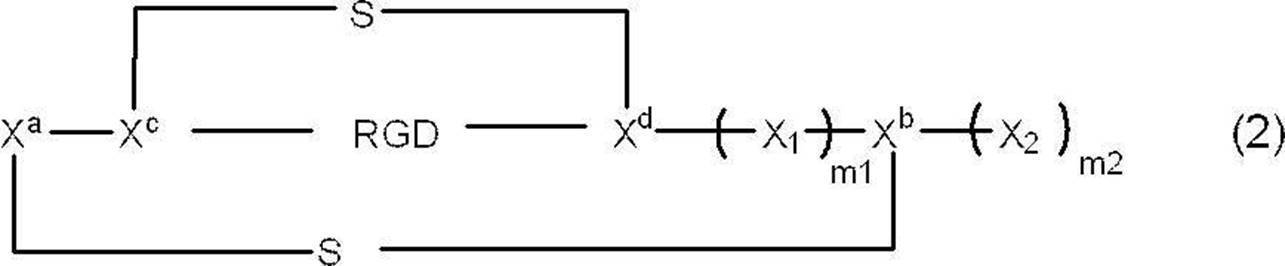
式(2)中、Xa及びXb並びにXc及びXdは、それぞれ独立に、チオエーテル結合を介して架橋されたアミノ酸残基を表し、X1及びX2は、それぞれ独立に、アミノ酸残基を表し、Rはアルギニン残基を表し、Gはグリシン残基を表し、Dはアスパラギン酸残基を表し、m1及びm2は、それぞれ独立に、1以上の整数を表す。ただし、Xa、Xb、Xc及びXd並びに、X1で表されるアミノ酸残基とRGDとの合計アミノ酸残基数は、7~14である。
<8> 上記式(2)におけるXc及びXdのいずれか一方が、(2S)-2-アミノ-3-[(2-アセチル)アミノ]プロパン酸、(2R)-2-アミノ-3-[(2-アセチル)アミノ]プロパン酸、(2S)-2-アミノ-4-[(2-アセチル)アミノ]ブタン酸、(2R)-2-アミノ-4-[(2-アセチル)アミノ]ブタン酸、N-δ-アセチル-L-オルニチン、N-δ-アセチル-D-オルニチン、N-ε-アセチル-L-リシン、及び、N-ε-アセチル-D-リシンからなる群から選択される側鎖にアセチル基を有するアミノ酸に由来するアミノ酸残基であり、他方が、L-ホモシステイン、D-ホモシステイン、L-ペニシラミン、又は、D-ペニシラミンに由来するアミノ酸残基である、<7>に記載の環状ペプチド。
<9> 上記式(2)におけるXbが、L-ホモシステイン、D-ホモシステイン、L-ペニシラミン、又は、D-ペニシラミンに由来するアミノ酸残基である、<7>又は<8>に記載の環状ペプチド。
<10> 上記式(2)におけるXaが、下記構造(r)で表されるアミノ酸残基である、<7>~<9>のいずれか1つに記載の環状ペプチド。
<9> 上記式(2)におけるXbが、L-ホモシステイン、D-ホモシステイン、L-ペニシラミン、又は、D-ペニシラミンに由来するアミノ酸残基である、<7>又は<8>に記載の環状ペプチド。
<10> 上記式(2)におけるXaが、下記構造(r)で表されるアミノ酸残基である、<7>~<9>のいずれか1つに記載の環状ペプチド。
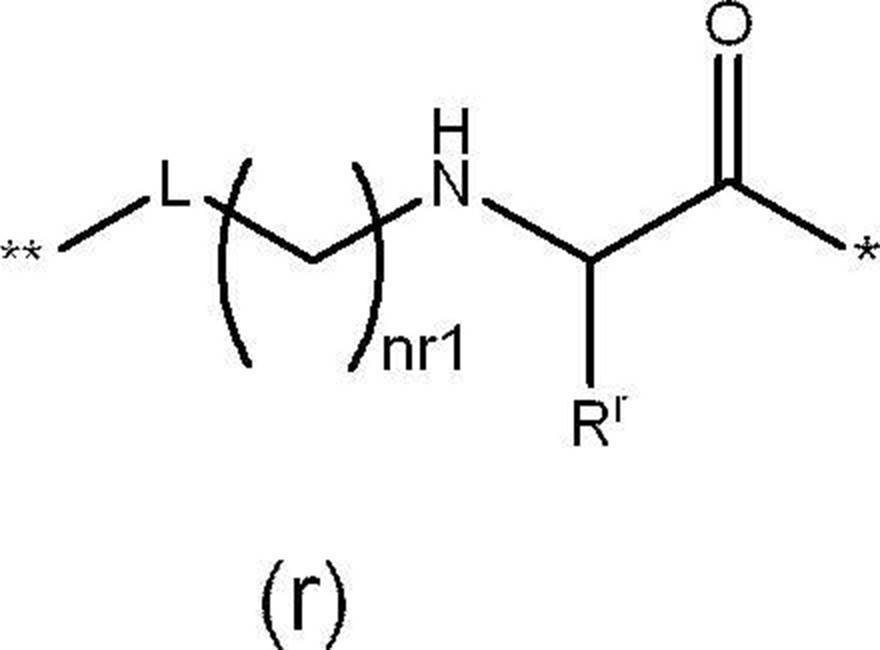
構造式(r)中、Rrは水素原子又は1価の有機基を表し、Lは、-(CH2)L1-C(=O)-、又は、-(CH2)L1-C(=O)-NH-で表される2価の連結基を表し、L1は0以上10以下の整数を表し、nr1は、0以上の整数を表し、*は隣接するアミノ酸残基との結合部位を表し、**はチオエーテル結合における硫黄原子との結合部位を表す。
<11> 上記式(2)におけるXbが、L-ホモシステイン、D-ホモシステイン、L-ペニシラミン、又は、D-ペニシラミンに由来するアミノ酸残基であり、Xaが、(2S)-2-アミノ-3-[(2-アセチル)アミノ]プロパン酸、(2R)-2-アミノ-3-[(2-アセチル)アミノ]プロパン酸、(2S)-2-アミノ-4-[(2-アセチル)アミノ]ブタン酸、(2R)-2-アミノ-4-[(2-アセチル)アミノ]ブタン酸、N-δ-アセチル-L-オルニチン、N-δ-アセチル-D-オルニチン、N-ε-アセチル-L-リシン、N-ε-アセチル-D-リシン、及び、(2S,3S)-2-[(アセチル)アミノ]-3-メチル-ペンタン酸からなる群から選択されるアミノ酸に由来するアミノ酸残基である、<7>~<10>のいずれか1つに記載の環状ペプチド。
<12> Xaはα炭素にアセチル基が結合した任意のアミノ酸に由来するアミノ酸残基であり、Xbはホモシステインに由来するアミノ酸残基であり、Xcはホモシステインに由来するアミノ酸残基であり、XdはN-δ-アセチル-オルニチンに由来するアミノ酸残基又はN-ε-アセチル-リシンに由来するアミノ酸残基であり、(X1)m1は、全体でFであるか、又は
Xaはα炭素にアセチル基が結合した任意のアミノ酸に由来するアミノ酸残基であり、Xbはホモシステインに由来するアミノ酸残基であり、XcはN-δ-アセチル-オルニチンに由来するアミノ酸残基又はN-ε-アセチル-リシンに由来するアミノ酸残基であり、Xdはホモシステインに由来するアミノ酸残基であり、(X1)m1は、全体でFである、<1>~<11>のいずれか1つに記載の環状ペプチド。
<13> <1>~<12>のいずれか1つに記載の環状ペプチドと、基材と、を含む、細胞足場材。
<14> <1>~<12>のいずれか1つに記載の環状ペプチドと、保持材と、
を含む、細胞分離材。
<15> <1>~<12>のいずれか1つに記載の環状ペプチドと、培養成分と、を含む、培地。
本発明の実施形態によれば、インテグリン結合性に優れ、かつ、分子安定性、例えばアルカリ耐性に優れた環状ペプチド、並びに上記環状ペプチドを含む細胞足場材、細胞分離材及び培地が提供される。
以下において、本開示の内容について詳細に説明する。以下に記載する構成要件の説明は、本開示の代表的な実施態様に基づいてなされることがあるが、本開示はそのような実施態様に限定されるものではない。
本開示において「~」を用いて示された数値範囲は、「~」の前後に記載される数値をそれぞれ最小値及び最大値として含む範囲を意味する。
本開示に段階的に記載されている数値範囲において、ある数値範囲で記載された上限値又は下限値は、他の段階的な記載の数値範囲の上限値又は下限値に置き換えてもよい。また、本開示に記載されている数値範囲において、ある数値範囲で記載された上限値又は下限値は、実施例に示されている値に置き換えてもよい。
本開示において、2以上の好ましい態様の組み合わせは、より好ましい態様である。
本開示において、各成分の量は、各成分に該当する物質が複数種存在する場合には、特に断らない限り、複数種の物質の合計量を意味する。
本開示において、「工程」との語は、独立した工程だけではなく、工程の所期の目的が達成される限りは、他の工程と明確に区別できない工程をも含む。
(環状ペプチド)
本開示に係る環状ペプチドは、下記式(1)で表されるアミノ酸配列(以下、「特定アミノ酸配列」ともいう。)を有する。
本開示に係る環状ペプチドは、下記式(1)で表されるアミノ酸配列(以下、「特定アミノ酸配列」ともいう。)を有する。

式(1)中、Xa及びXb並びにXc及びXdは、それぞれ独立に、チオエーテル結合を介して結合されたアミノ酸残基を表し、X1~X5は、それぞれ独立に、アミノ酸残基を表し、Rはアルギニン残基を表し、Gはグリシン残基を表し、Dはアスパラギン酸残基を表し、m1~m5は、それぞれ独立に、0以上の整数を表す。ただし、Xa、Xb、Xc及びXd並びに、X1、X3及びX4で表されるアミノ酸残基の合計数は、7~16である。
インテグリン結合性を有する環状ペプチド(以下、インテグリン結合性環状ペプチド」ともいう。)は、細胞表面の細胞形質膜にあるインテグリンに対する結合能を有する。インテグリンは細胞接着分子の1つであり、インテグリン結合性環状ペプチドと細胞表面のインテグリンとは結合するため、インテグリン結合性環状ペプチドは、細胞培養のための足場材、細胞を分離するための細胞分離材、各種細胞培養培地等に用いること等が可能であり、有用な分子である。しかし、環状ペプチドは、直鎖ペプチドと比較して、例えば、インテグリン等の細胞接着分子に対して高い結合性及び特異性を有する場合がある一方、環状ペプチドの分子安定性は直鎖ペプチドよりも低い傾向がある。
また、例えば、環状ペプチドは、アルカリ耐性;酸耐性;X線、γ線などの活性光線に対する耐性などが低い傾向がある。インテグリン結合性環状ペプチドも、分子安定性が低いために、長期間の使用又は繰り返しの使用の間に分解し、所望の効果を長期間にわたって得ることができなかった。さらに、環状ペプチドは、直鎖ペプチドよりも常に高い結合性を有するわけではなく、環状ペプチドが有するアミノ酸配列によって、インテグリン結合性が変化するため、環状ペプチドにおいて分子安定性とインテグリン結合性との両方が優れるインテグリン結合性環状ペプチドを得ることは容易ではなかった。
また、例えば、環状ペプチドは、アルカリ耐性;酸耐性;X線、γ線などの活性光線に対する耐性などが低い傾向がある。インテグリン結合性環状ペプチドも、分子安定性が低いために、長期間の使用又は繰り返しの使用の間に分解し、所望の効果を長期間にわたって得ることができなかった。さらに、環状ペプチドは、直鎖ペプチドよりも常に高い結合性を有するわけではなく、環状ペプチドが有するアミノ酸配列によって、インテグリン結合性が変化するため、環状ペプチドにおいて分子安定性とインテグリン結合性との両方が優れるインテグリン結合性環状ペプチドを得ることは容易ではなかった。
そこで、発明者が鋭意検討した結果、特定のアミノ酸配列を有し、かつ、特定の構造を有する環状ペプチドは、分子安定性及びインテグリン結合性の両方に優れることを見出した。その理由は明らかではないが以下のように推測される。
本開示に係る特定構造の環状ペプチドは、アミノ酸配列中の特定の部位において、アミノ酸残基がチオエーテル結合により架橋された環状部位(以下、「環状セグメント」とも称する場合がある。)を2つ含み、かつ、Xa、Xb、Xc及びXd並びに、X1、X3及びX4で表されるアミノ酸残基及びRGDの合計アミノ酸残基数が7~14となるようにすることで、RGD配列を2つの環状部位によって保持、すなわち、2つの環状部位がRGD配列を入れ子状に保持されている。また、特表2005-507376号公報等に記載された環状ペプチドが有するジスルフィド結合は、準共有結合であるので、培地等に含まれる還元剤等により、容易にジスルフィド結合が切断されてしまうため、十分な分子安定性が得られないことに対して、共有結合であるチオエーテル結合は、ジスルフィド結合よりも安定性により優れているので、本開示に係る環状ペプチドは、例えば、耐アルカリ性に対する分子安定性に優れ、かつ、インテグリン結合性にも優れると推定される。
以下、本開示に係る環状ペプチドの詳細について説明する。
<アミノ酸、及び、アミノ酸残基>
本開示において、アミノ酸は、原則として、国際純正・応用化学連合と国際生化学・分子生物学連合による共同命名委員会(INTERNATIONAL UNION OF PURE AND APPLIED CHEMISTRY and INTERNATIONAL UNION OF BIOCHEMISTRY AND MOLECULAR BIOLOGY IUPAC-IUB Joint Commission on Biochemical Nomenclature (JCBN))で採用された名称、略号等を用いて表す。また、アミノ酸残基は、そのアミノ酸残基が由来するアミノ酸の略号を用いて表す。
本開示において、アミノ酸は、原則として、国際純正・応用化学連合と国際生化学・分子生物学連合による共同命名委員会(INTERNATIONAL UNION OF PURE AND APPLIED CHEMISTRY and INTERNATIONAL UNION OF BIOCHEMISTRY AND MOLECULAR BIOLOGY IUPAC-IUB Joint Commission on Biochemical Nomenclature (JCBN))で採用された名称、略号等を用いて表す。また、アミノ酸残基は、そのアミノ酸残基が由来するアミノ酸の略号を用いて表す。
本開示において、特に明示しない限り、ペプチドまたはタンパク質のアミノ酸配列(「1次構造」ともいう。)は、左端から右端にかけてN末端からC末端となるようにアミノ酸残基を1列に並べて表す。ペプチドまたはタンパク質のアミノ酸配列中のアミノ酸残基を位置も含めて特定する場合には、アミノ酸残基の略号の右側にN末端側からの何番目のアミノ酸残基であるかを示す数字を付して表す場合がある。例えば、N末端から2番目のリシンをLys2と表す場合がある。
また、アミノ酸をその名称を用いて表した場合であって、エナンチオマーの関係にある異性体、すなわち、L体およびD体が存在するときは、L体およびD体の別を明示的に示した場合を除いて、原則として、L体であってもD体であっても構わない。例えば、「イソロイシン」は「L-イソロイシン」又は「D-イソロイシン」を表すものとし、アミノ酸残基についても同様である。同様に、アミノ酸をその略号(3文字略号または1文字略号)を用いて表した場合であって、エナンチオマーの関係にある異性体、すなわち、L体およびD体が存在する場合についても、L体およびD体の別を明示的に示した場合を除いて、原則として、L体であってもD体であっても構わない。例えば、「Lys」はいずれも「L-リシン」又は「D-リシン」を表すものとし、アミノ酸残基についても同様である。また、各アミノ酸、各アミノ酸残基について、それぞれ独立にL体とD体とを選択することができる。ただし、環状セグメント中に存在するRGD配列については、全てL体のアミノ酸残基とする。上記RGD配列以外については、環状ペプチド中に存在するアミノ酸残基は全てL体のアミノ酸残基であっても、全てD体のアミノ酸残基であっても、L体のアミノ酸残基とD体のアミノ酸残基の両方が存在していてもよい。
また、アミノ酸をその名称を用いて表した場合であって、ジアステレオマーの関係にある異性体が存在する場合は、その名称により特定されるアミノ酸には含まれないものとする。ジアステレオマーは接頭辞「アロ」を用いて異なる種類のアミノ酸として扱う。例えば、「トレオニン」は「アロトレオニン」を含まないものとする。アミノ酸残基についても同様である。
1文字略号および3文字略号が公式に認められたアミノ酸の名称および略号(1文字略号、3文字略号)を表1に示す。

本開示に係る環状ペプチドに含まれるアミノ酸残基は、上記表1に挙げるアミノ酸に由来するアミノ酸残基に限定されず、異常アミノ酸に由来するアミノ酸残基であってもよい。異常アミノ酸の例を以下の表2に挙げるが、異常アミノ酸はこれらに限定されるものではない。
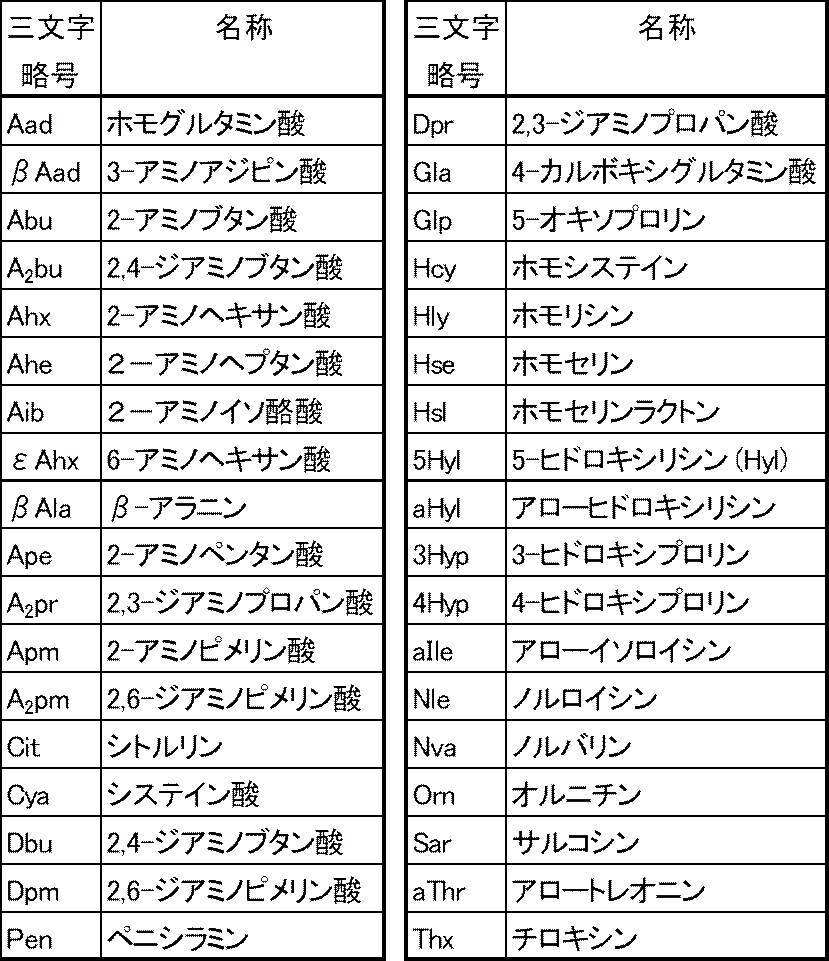
本開示に係る環状ペプチドに含まれる任意のアミノ酸残基は、化学修飾を受けていてもよい。アミノ酸残基に対する化学修飾は、通常、アミノ酸残基に対して行われる化学修飾であれば特に制限はない。アミノ酸残基に対する化学修飾の例としては、アミノ酸残基中に存在するアミノ基に対するN-アセチル化、N-ホルミル化、又は、N-アシル化、PEG(ポリエチレングリコール)化及び、アミノ酸残基中に存在するカルボキシ基に対するアミド化、PEG化等が挙げられる。
特定アミノ酸配列において、式(1)中のX5又はXaが、環状ペプチドのN末端のアミノ基である場合、N末端のアミノ基残基としては、特に制限はなく、N-アセチル化、N-ホルミル化、N-アシル化、PEG化等のN末端修飾を受けていても、アミノ基のままであってもよい。
また、特定アミノ酸配列において、式(1)中のX2及びXbが、環状ペプチドのC末端のカルボキシ基である場合、C末端のカルボキシ基は、特に制限はなく、アミド化、PEG化等のC末端修飾を受けていてもよいし、カルボキシ基のままであってもよい。
また、特定アミノ酸配列において、式(1)中のX2及びXbが、環状ペプチドのC末端のカルボキシ基である場合、C末端のカルボキシ基は、特に制限はなく、アミド化、PEG化等のC末端修飾を受けていてもよいし、カルボキシ基のままであってもよい。
本開示に係る環状ペプチドは、特定アミノ酸配列を有し、Xa及びXb並びにXc及びXdは、それぞれ独立に、チオエーテル結合を介して結合されたアミノ酸残基を表し、X1~X5は、それぞれ独立に、アミノ酸残基を表す。
<<アミノ酸残基Xa~Xd>>
本開示に係る環状ペプチドは、特定アミノ酸配列を有し、Xc及びXd並びにXa及びXbは、それぞれ独立に、チオエーテル結合を介して結合されたアミノ酸残基を表す。
なお、式(1)中の「-S-」は、Xc及びXd並びにXa及びXbがチオエーテル結合を介して架橋されたことを表す。
本開示に係る環状ペプチドに含まれる特定アミノ酸配列において、アミノ酸残基Xc及びアミノ酸残基Xd、並びに、後述するアミノ酸残基Xa及びアミノ酸残基Xbは、それぞれチオエーテル結合で架橋されているので、その詳細は明らかではないが、ジスルフィド結合に比べて、構造的に不可逆であるため、ジスルフィド結合により架橋されたアミノ酸残基を有する環状ペプチドよりも、分子安定性に優れると推察される。
チオエーテル結合形成前のアミノ酸としては、特に制限はないが、例えば、Xc及びXdのいずれか一方が、チオール基を有するアミノ酸に由来するアミノ酸であり、他方が、ハロゲン原子を有する有機基で保護されたアミノ酸に由来するアミノ酸である組み合わせが挙げられる。
同様に、チオエーテル結合形成前のアミノ酸としては、特に制限はないが、例えば、Xa及びXbのいずれか一方が、チオール基を有するアミノ酸に由来するアミノ酸であり、他方が、ハロゲン原子を有する有機基で保護されたアミノ酸に由来するアミノ酸である組み合わせが挙げられる。
上記ハロゲン原子を有する有機基としては、ハロアセチル基等が好適に挙げられる。
本開示において環状ペプチドにおける「主鎖」とは、環状ペプチド中の鎖状部分のうち相対的に最も長く幹となるペプチド鎖を指す。「側鎖」とは、環状ペプチドの主鎖に結合する鎖を意味する。
アミノ酸又はアミノ酸残基における主鎖は、環状ペプチドにおける「主鎖」に相当し、アミノ酸又はアミノ酸残基における側鎖は、環状ペプチドの主鎖に結合する側鎖となる。
以下、チオエーテル結合形成前のXa~Xdが取り得るチオール基を有するアミノ酸に由来するアミノ酸残基について説明する。
アミノ酸又はアミノ酸残基における主鎖は、環状ペプチドにおける「主鎖」に相当し、アミノ酸又はアミノ酸残基における側鎖は、環状ペプチドの主鎖に結合する側鎖となる。
以下、チオエーテル結合形成前のXa~Xdが取り得るチオール基を有するアミノ酸に由来するアミノ酸残基について説明する。
〔チオール基を有するアミノ酸に由来するアミノ酸残基〕
チオール基を有するアミノ酸としては、反応性の観点から、側鎖上にチオール基を有するアミノ酸であることが好ましい。アミノ酸の主鎖にはチオール基が含まないことが好ましい。
チオール基を側鎖上に有するアミノ酸残基としては、特に制限はないが、下記構造(t-1)又は(t-2)で表されるアミノ酸残基が好適に挙げられる。
チオール基を有するアミノ酸としては、反応性の観点から、側鎖上にチオール基を有するアミノ酸であることが好ましい。アミノ酸の主鎖にはチオール基が含まないことが好ましい。
チオール基を側鎖上に有するアミノ酸残基としては、特に制限はないが、下記構造(t-1)又は(t-2)で表されるアミノ酸残基が好適に挙げられる。
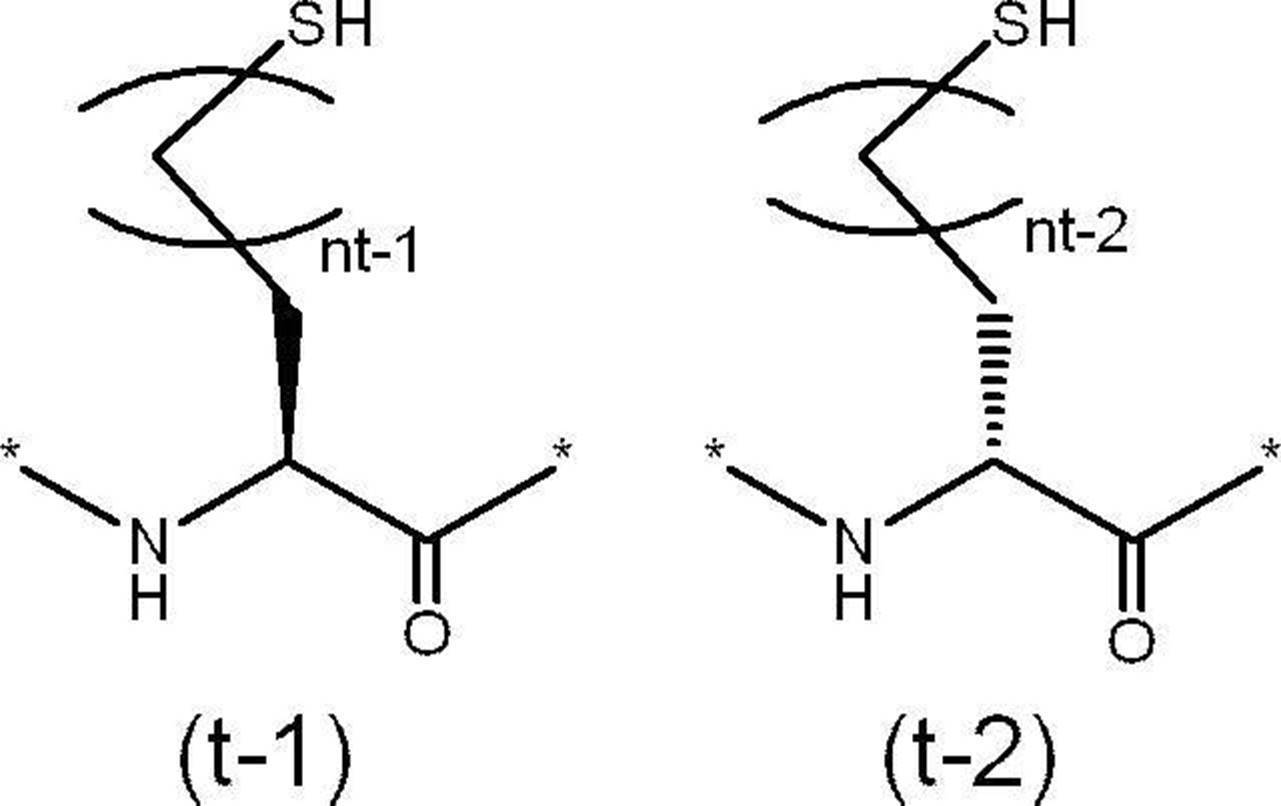
構造(t-1)及び(t-2)中、*は隣接するアミノ酸残基との結合部位を表し、nt-1及びnt-2は、0以上の整数を表す。
側鎖におけるnt-1又はnt-2個の炭素原子、及び、β位の炭素原子は、-NH2、-SH、-COOH、炭素数1~10のアルキル基、及び、炭素数6~14のアリール基からなる群から選択される少なくとも1種の置換基によって置換されていてもよい。
炭素数1~10のアルキル基としては、直鎖状、分岐鎖状のいずれであってもよい。炭素数1~10のアルキル基としては、例えば、メチル基、エチル基、n-プロピル基、イソプロピル基、n-ブチル基、イソブチル基、t-ブチル基等が挙げられる。
また、炭素数6~14のアリール基としては、単環又は縮合環であってもよい。炭素数6~14のアリール基としては、例えば、フェニル基、ナフチル基、アントラニル基、フェナントレン基等が挙げられる。
nt-1及びnt-2は、チオエーテル結合の形成のし易さから、0~10の整数であることが好ましく、0~6の整数であることがより好ましく、1~4の整数であることが更に好ましい。
チオール基を側鎖上に有するアミノ酸のより具体的な例としては、システイン、ペニシラミン、ホモシステイン(2-アミノ-4-メルカプトブタン酸由来のアミノ酸)、2-アミノ-5-メルカプトペンタン酸に由来するアミノ酸等が挙げられる。
これらの中でも、チオール基を側鎖上に有するアミノ酸としては、結合安定性の観点から、L-ホモシステイン、D-ホモシステイン、L-ペニシラミン、又は、D-ペニシラミンに由来するアミノ酸であることが好ましい。
これらの中でも、チオール基を側鎖上に有するアミノ酸としては、結合安定性の観点から、L-ホモシステイン、D-ホモシステイン、L-ペニシラミン、又は、D-ペニシラミンに由来するアミノ酸であることが好ましい。
結合安定性、及び、分子安定性の観点から、チオエーテル結合形成前のXc及びXdのいずれか一方が、チオール基を有するアミノ酸に由来するアミノ酸残基であることが好ましく、側鎖上にチオール基を有するアミノ酸に由来するアミノ酸残基であることがより好ましく、L-ホモシステイン、D-ホモシステイン、L-ペニシラミン、又は、D-ペニシラミンに由来するアミノ酸残基であることが好ましく、ラセミ化を起こしにくい点から、L-ホモシステイン、又は、D-ホモシステインは、更に好ましい。
Xaがハロゲン原子を有する有機基で保護されたアミノ酸に由来するアミノ酸残基である場合、結合安定性、及び、分子安定性の観点から、Xbが、チオール基を有するアミノ酸に由来するアミノ酸残基であることが好ましく、側鎖上にチオール基を有するアミノ酸に由来するアミノ酸残基であることがより好ましく、L-ホモシステイン、D-ホモシステイン、L-ペニシラミン、又は、D-ペニシラミンに由来するアミノ酸残基であることが好ましく、ラセミ化を起こしにくい点から、L-ホモシステイン、又は、D-ホモシステインは更に好ましい。
また、アミノ酸残基Xa及びXbのいずれか一方、並びに、Xc及びXdのいずれか一方が、α-アミノ酸に由来するアミノ酸残基である場合、チオエーテル結合前のα-アミノ酸のα炭素に結合しているアミノ基又は修飾アミノ基とチオール基とが結合されたチオエーテル結合であってもよく、チオエーテル結合前のα-アミノ酸に由来するアミノ酸残基の側鎖とチオエーテル結合前のチオール基とが結合されたチオエーテル結合であってもよい。この場合、アミノ基とチオール基との間の結合は、アミノ基上に配置されたハロアセチル基等を介して行うことができる。
同様に、アミノ酸残基Xa及びXbのいずれか一方、並びに、Xc及びXdのいずれか一方が、α-アミノ酸に由来するアミノ酸残基である場合、チオエーテル結合前のα-アミノ酸のα炭素に結合しているカルボキシ基又は修飾カルボキシ基部分とチオエーテル結合前のチオール基とが結合されたチオエーテル結合であってもよく、チオエーテル結合前のα-アミノ酸に由来するアミノ酸残基の側鎖部分とチオエーテル結合前のチオール基とが結合されたチオエーテル結合であってもよい。
同様に、アミノ酸残基Xa及びXbのいずれか一方、並びに、Xc及びXdのいずれか一方が、α-アミノ酸に由来するアミノ酸残基である場合、チオエーテル結合前のα-アミノ酸のα炭素に結合しているカルボキシ基又は修飾カルボキシ基部分とチオエーテル結合前のチオール基とが結合されたチオエーテル結合であってもよく、チオエーテル結合前のα-アミノ酸に由来するアミノ酸残基の側鎖部分とチオエーテル結合前のチオール基とが結合されたチオエーテル結合であってもよい。
〔ハロゲン原子を有する有機基で保護されたアミノ酸に由来するアミノ酸残基〕
ハロゲン原子を有する有機基で保護されたアミノ酸に由来するアミノ酸残基としては、アミノ酸のα炭素に結合したアミノ基にハロゲン原子を有する有機基が結合したアミノ酸、又はアミノ酸の側鎖にハロゲン原子を有する有機基を有するアミノ酸に由来するアミノ酸残基であることが好ましい。ハロゲン原子を有する有機基としては、通常アミノ酸の保護基として用いられるものであれば特に制限はなく、例えば、ハロアセチル基等が好適に挙げられる。例えば、ハロゲン原子が脱離して代わりに硫黄原子が結合することで、チオエーテル結合が形成され、上記アミノ酸残基が形成される。
ハロゲン原子を有する有機基で保護されたアミノ酸に由来するアミノ酸残基としては、アミノ酸のα炭素に結合したアミノ基にハロゲン原子を有する有機基が結合したアミノ酸、又はアミノ酸の側鎖にハロゲン原子を有する有機基を有するアミノ酸に由来するアミノ酸残基であることが好ましい。ハロゲン原子を有する有機基としては、通常アミノ酸の保護基として用いられるものであれば特に制限はなく、例えば、ハロアセチル基等が好適に挙げられる。例えば、ハロゲン原子が脱離して代わりに硫黄原子が結合することで、チオエーテル結合が形成され、上記アミノ酸残基が形成される。
アミノ酸のα炭素に結合したアミノ基にハロゲン原子を有する有機基が結合したアミノ酸としては、α炭素上のアミノ基にハロアルカノイル基が結合した任意のアミノ酸が挙げられる。ハロアルカノイル基は、例えば、ハロアセチル基である。ハロアルカノイル基中のハロゲン原子は、例えば、フッ素原子、塩素原子、臭素原子、又はヨウ素原子である。ハロゲン原子を有する有機基の結合対象となるアミノ酸としては、L-アミノ酸でもD-アミノ酸でもよく、イソロイシン、リシン、アスパラギン酸、グルタミン酸、チロシン、ロイシン、トレオニン、バリン等が挙げられる。アミノ酸のα炭素に結合したアミノ基にハロゲン原子を有する有機基が結合したアミノ酸としては、L-アミノ酸でもD-アミノ酸であってもよい、N-α-クロロアセチル-イソロイシン、N-α-クロロアセチル-リシン、N-α-クロロアセチル-アスパラギン酸、N-α-クロロアセチル-グルタミン酸、N-α-クロロアセチル-チロシン、N-α-クロロアセチル-ロイシン、N-α-クロロアセチル-トレオニン、N-α-クロロアセチル-バリン等が挙げられる。
上記側鎖にハロゲン原子を有する有機基で保護されたアミノ酸残基としては、チオエーテル結合の形成しやすさの観点から、アミノ酸残基の側鎖末端にハロゲン原子を有する有機基を有するアミノ酸であることが好ましい。このような態様を有するアミノ酸残基としては、下記構造(p-1)又は(p-2)で表されるアミノ酸残基が好適に挙げられる。

構造(p-1)及び(p-2)中、halogenは、ハロゲン原子を表し、Lは、-(CH2)L1-C(=O)-、又は、-(CH2)L1-C(=O)-NH-で表される2価の連結基を表し、L1は0以上10以下の整数を表し、np1及びnp2は、それぞれ独立に0以上の整数を表し、*は隣接するアミノ酸残基との結合部位を表す。np1及びnp2は、それぞれ、0~6の整数を表すことが好ましく、0~4の整数を表すことがより好ましく、1~3の整数を表すことがさらに好ましい。また、Lにおいて、ハロゲンは左側の末端(L1が1以上の場合はアルキル側の末端)に結合している。
ハロゲン原子としては、例えば、フッ素原子、塩素原子、臭素原子、ヨウ素原子等が挙げられる。これらの中でも、反応性及びチオエーテル結合の形成のし易さと安全性の観点から、臭素原子又は塩素原子であることが好ましく、塩素原子であることがより好ましい。
np1及びnp2が1以上である場合、側鎖におけるnp1又はnp2個の炭素原子、及び、β位の炭素原子は、炭素数1~10のアルキル基、及び、炭素数6~14のアリール基からなる群から選択される少なくとも1種の置換基によって置換されていてもよい。
L1は、0~10の整数であることが好ましく、1~6の整数であることがより好ましく、1~3の整数であることが更に好ましい。
炭素数1~10のアルキル基、及び、炭素数6~14のアリール基の具体例は、上記構造(t-1)及び(t-2)における炭素数1~10のアルキル基、及び、炭素数6~14のアリール基と同様である。
ハロゲン原子を有する有機基で保護されたアミノ酸に由来するアミノ酸残基が、環状ペプチドのN末端に位置する場合、チオエーテル結合の形成しやすさの観点から、チオエーテル結合前のアミノ酸残基としては、α-アミノ基にハロゲン原子を有する有機基を有するアミノ酸残基であることが好ましく、下記構造(r-1)で表されるアミノ酸残基がより好ましい。
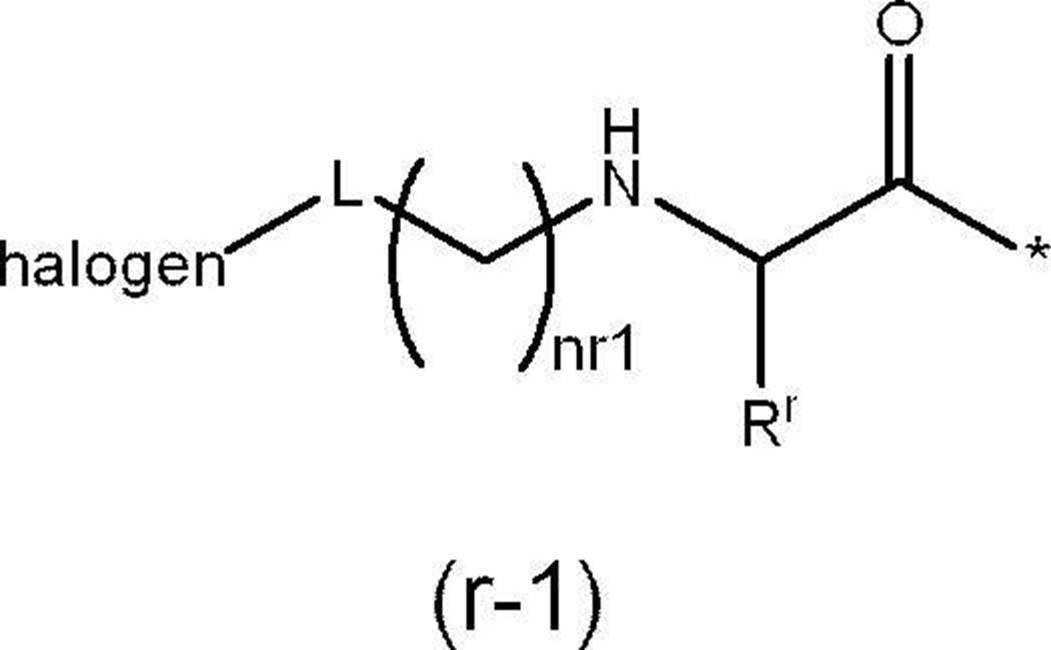
構造(r-1)中、Rrは水素原子又は1価の有機基を表し、halogenは、ハロゲン原子を表し、Lは、-(CH2)L1-C(=O)-、又は、-(CH2)L1-C(=O)-NH-で表される2価の連結基を表し、L1は0以上10以下の整数を表し、nr1は、0以上の整数を表し、*は隣接するアミノ酸残基との結合部位を表す。
L及びL1は、構造(p-1)及び(p-2)中のL及びL1と同義であり、好ましい態様も同様である。nr1は、構造(p-1)及び(p-2)中のnp1及びnp2と同義であり、好ましい態様も同様である。
Rrにおける1価の有機基としては、特に制限はなく、アミノ酸の側鎖として取り得る脂肪族炭化水素基が挙げられる。アミノ酸の側鎖として取り得る1価の有機基としては、表1又は表2に記載のアミノ酸の側鎖である1価の有機基が挙げられる。
脂肪族炭化水素基は、-NH2、-SH、-COOH、炭素数1~10のアルキル基、及び、炭素数6~14のアリール基からなる群から選択される少なくとも1種の置換基によって置換されていてもよい。
炭素数1~10のアルキル基としては、直鎖状、分岐鎖状のいずれであってもよい。炭素数1~10のアルキル基としては、例えば、メチル基、エチル基、n-プロピル基、イソプロピル基、n-ブチル基、イソブチル基、t-ブチル基等が挙げられる。
また、炭素数6~14のアリール基としては、単環又は縮合環であってもよい。炭素数6~14のアリール基としては、例えば、フェニル基、ナフチル基、アントラニル基、フェナントレン基等が挙げられる。
アミノ酸残基Xaが、例えば、特定アミノ酸配列のN末端に位置(X5のm5が0の場合)し、かつ、α-アミノ酸に由来するアミノ酸残基である場合、アミノ酸残基Xaとしては、下記構造(r)で表されるアミノ酸に由来するアミノ酸残基であることが好ましい。
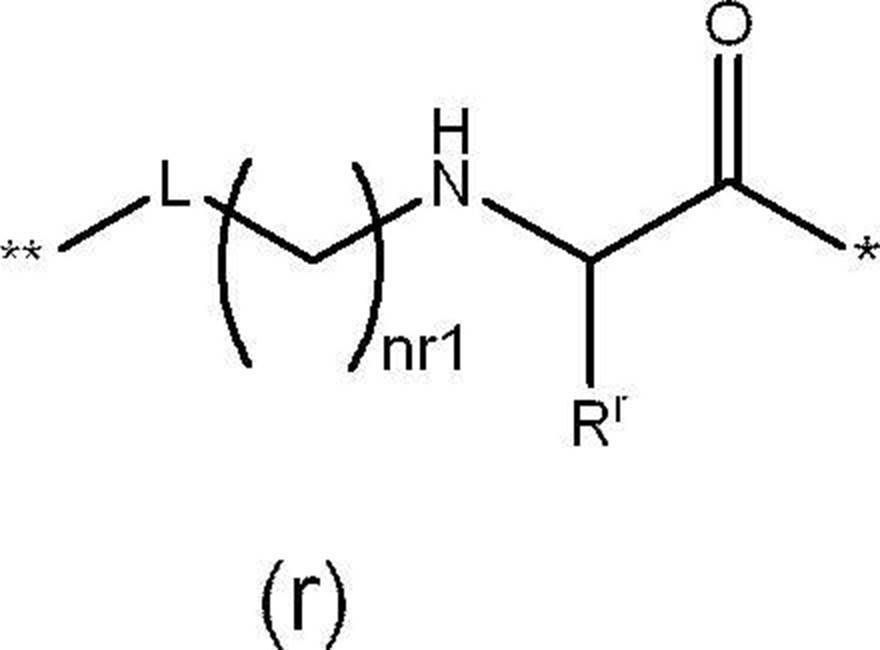
構造(r)中、Rrは水素原子又は1価の有機基を表し、Lは、-(CH2)L1-C(=O)-、又は、-(CH2)L1-C(=O)-NH-で表される2価の連結基を表し、L1は0以上10以下の整数を表し、nr1は、0以上の整数を表し、*は隣接するアミノ酸残基との結合部位を表し、**はチオエーテル結合における硫黄原子との結合部位を表す。
Rr、L及びnr1は、構造(r-1における)Rr、L及びnr1と同義であり、好ましい態様も同様である。
Rr、L及びnr1は、構造(r-1における)Rr、L及びnr1と同義であり、好ましい態様も同様である。
チオエーテル結合前のハロゲン原子を有する有機基で保護されたアミノ酸に由来するアミノ酸残基のより具体的な例としては、特に制限はされないが、2-アミノ-3-[(2-ハロアセチル)アミノ]プロパン酸、2-アミノ-4-[(2-ハロアセチル)アミノ]ブタン酸、N-δ-ハロアセチルオルニチン、N-ε-ハロアセチルリシン、2-[(ハロアセチル)アミノ]-3-メチル-ペンタン酸、N-ζ-ハロアセチルホモリシン等に由来するアミノ酸残基が挙げられる。
これらのアミノ酸残基中のハロアセチルにおけるハロゲン原子としては、フッ素原子、塩素原子、臭素原子、ヨウ素原子等が挙げられ、中でも塩素原子が好ましい。
これらのアミノ酸残基中のハロアセチルにおけるハロゲン原子としては、フッ素原子、塩素原子、臭素原子、ヨウ素原子等が挙げられ、中でも塩素原子が好ましい。
チオエーテル結合前のハロゲン原子を有する有機基で保護されたアミノ酸に由来するアミノ酸残基としては、結合安定性、及び、分子安定性の観点から、側鎖にクロロアセチル基を有するアミノ酸に由来するアミノ酸残基であることが好ましく、(2S)-2-アミノ-3-[(2-クロロアセチル)アミノ]プロパン酸、(2R)-2-アミノ-3-[(2-クロロアセチル)アミノ]プロパン酸、(2S)-2-アミノ-4-[(2-クロロアセチル)アミノ]ブタン酸、(2R)-2-アミノ-4-[(2-クロロアセチル)アミノ]ブタン酸、N-δ-クロロアセチル-L-オルニチン、N-δ-クロロアセチル-D-オルニチン、N-ε-クロロアセチル-L-リシン、N-ε-クロロアセチル-D-リシン、N-ζ-クロロアセチル-L-ホモリシン、N-ζ-クロロアセチル-D-ホモリシン、及び、(2S,3S)-2-[(クロロアセチル)アミノ]-3-メチル-ペンタン酸からなる群から選択されるアミノ酸残基であることがより好ましい。ただし、Xaについては、N-α-クロロアセチル-イソロイシン、N-α-クロロアセチル-リシン、N-α-クロロアセチル-アスパラギン酸、N-α-クロロアセチル-グルタミン酸、N-α-クロロアセチル-チロシン、N-α-クロロアセチル-ロイシン、N-α-クロロアセチル-トレオニン、N-α-クロロアセチル-バリン等の、アミノ酸のα炭素に結合したアミノ基にハロゲン原子を有する有機基が結合したアミノ酸に由来するアミノ酸残基であることも好ましい。
結合安定性、及び、分子安定性の観点から、Xc及びXdのいずれか一方が、ハロゲン原子を有する有機基で保護されたアミノ酸に由来するアミノ酸残基であることが好ましく、塩素原子を有する有機基を側鎖上に有するアミノ酸残基であることがより好ましく、クロロアセチル基を側鎖上に有するアミノ酸残基であることが更に好ましく、(2S)-2-アミノ-3-[(2-クロロアセチル)アミノ]プロパン酸、(2R)-2-アミノ-3-[(2-クロロアセチル)アミノ]プロパン酸、(2S)-2-アミノ-4-[(2-クロロアセチル)アミノ]ブタン酸、(2R)-2-アミノ-4-[(2-クロロアセチル)アミノ]ブタン酸、N-δ-クロロアセチル-L-オルニチン、N-δ-クロロアセチル-D-オルニチン、N-ε-クロロアセチル-L-リシン、及び、N-ε-クロロアセチル-D-リシン、N-ζ-クロロアセチル-L-ホモリシン、及びN-ζ-クロロアセチル-D-ホモリシン、からなる群から選択されるアミノ酸に由来するアミノ酸残基であることが特に好ましい。
アミノ酸残基Xbがチオール基を有するアミノ酸に由来するアミノ酸残基である場合、結合安定性、及び、分子安定性の観点から、Xaは、アミノ酸のα炭素に結合したアミノ基にハロゲン原子を有する有機基が結合したアミノ酸に由来するアミノ酸残基、又はハロゲン原子を有する有機基で保護されたアミノ酸に由来するアミノ酸残基であることが好ましく、アミノ酸のα炭素に結合したアミノ基に塩素原子を有する有機基が結合したアミノ酸に由来するアミノ酸残基、又は塩素原子を有する有機基を側鎖上に有するアミノ酸残基であることがより好ましく、クロロアセチル基をα炭素に結合したアミノ基上又は側鎖上に有するアミノ酸残基であることが更に好ましく、N-α-クロロアセチル-イソロイシン、N-α-クロロアセチル-リシン、N-α-クロロアセチル-アスパラギン酸、N-α-クロロアセチル-グルタミン酸、N-α-クロロアセチル-チロシン、N-α-クロロアセチル-ロイシン、N-α-クロロアセチル-トレオニン、及びN-α-クロロアセチル-バリンからなる群から選択されるアミノ酸に由来するアミノ酸残基、又は(2S)-2-アミノ-3-[(2-クロロアセチル)アミノ]プロパン酸、(2R)-2-アミノ-3-[(2-クロロアセチル)アミノ]プロパン酸、(2S)-2-アミノ-4-[(2-クロロアセチル)アミノ]ブタン酸、(2R)-2-アミノ-4-[(2-クロロアセチル)アミノ]ブタン酸、N-δ-クロロアセチル-L-オルニチン、N-δ-クロロアセチル-D-オルニチン、N-ε-クロロアセチル-L-リシン、N-ε-クロロアセチル-D-リシン、N-ζ-クロロアセチル-L-ホモリシン、N-ζ-クロロアセチル-D-ホモリシン、及び、(2S,3S)-2-[(クロロアセチル)アミノ]-3-メチル-ペンタン酸からなる群から選択されるアミノ酸に由来するアミノ酸残基であることがより好ましい。
〔チオエーテル結合形成後のアミノ酸残基Xa~Xd〕
チオエーテル結合形成後のアミノ酸残基Xa~Xdにおいて、チオエーテル結合が形成された後の、硫黄原子に結合した有機基で保護されたアミノ酸に由来するアミノ酸残基の構造としては、下記構造(q-1)又は(q-2)で表される構造が挙げられる。
チオエーテル結合形成後のアミノ酸残基Xa~Xdにおいて、チオエーテル結合が形成された後の、硫黄原子に結合した有機基で保護されたアミノ酸に由来するアミノ酸残基の構造としては、下記構造(q-1)又は(q-2)で表される構造が挙げられる。
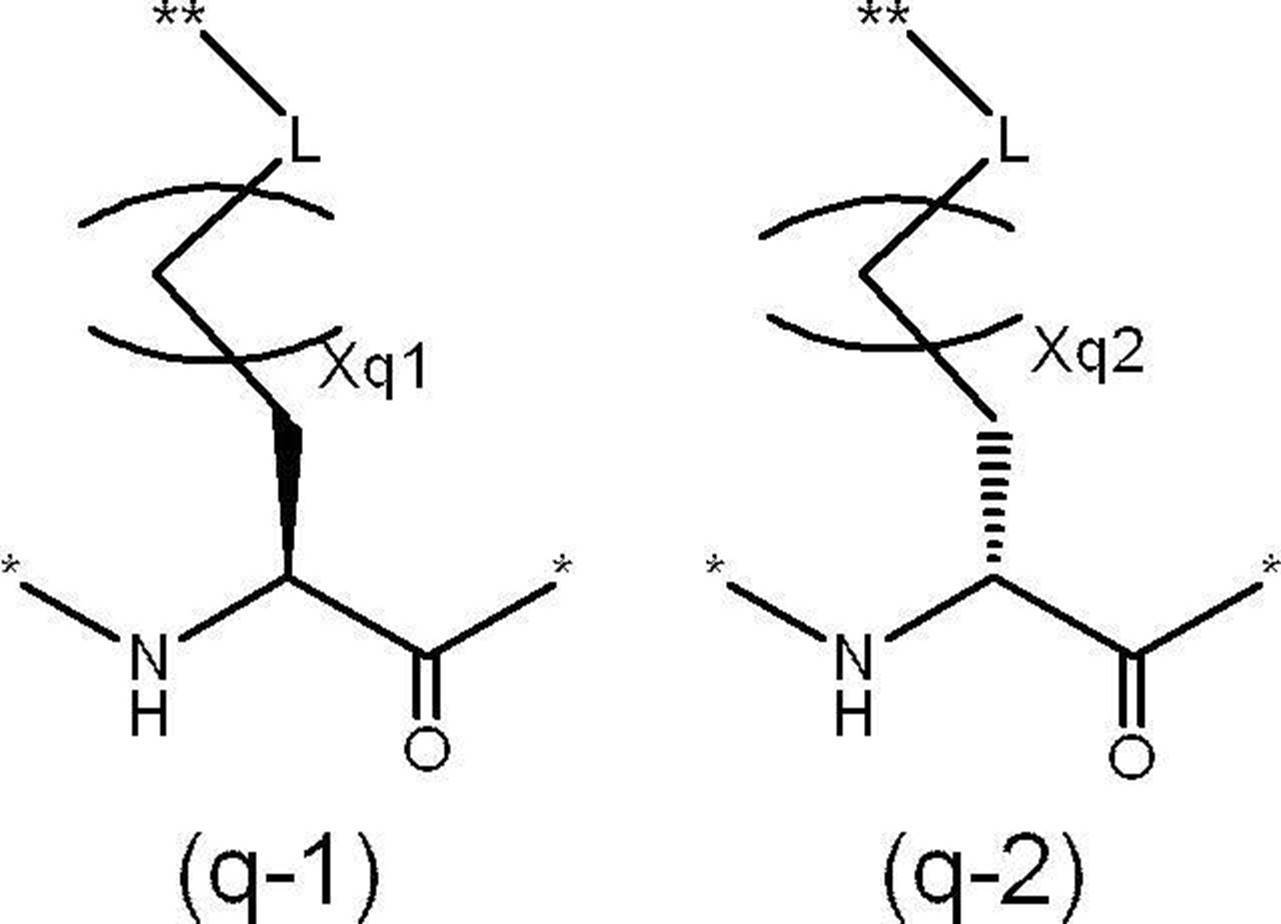
構造(q-1)及び(q-2)中、*は隣接するアミノ酸残基との結合であり、**はチオエーテル結合の相手方のアミノ酸残基の硫黄原子との結合であり、xq1及びxq1はそれぞれ独立に0以上の整数であり、Lは、それぞれ独立に、-(CH2)L1-C(=O)-、又は、-(CH2)L1-C(=O)-NH-で表される2価の連結基を表し、L1は0以上10以下の整数を表す。
L及びL1は、構造(p-1)及び(p-2)中のL及びL1と同義であり、好ましい態様も同様である。xq1及びxq1は、構造(p-1)及び(p-2)中のnp1及びnp2と同義であり、好ましい態様も同様である。
L及びL1は、構造(p-1)及び(p-2)中のL及びL1と同義であり、好ましい態様も同様である。xq1及びxq1は、構造(p-1)及び(p-2)中のnp1及びnp2と同義であり、好ましい態様も同様である。
チオエーテル結合が形成された後の硫黄原子に結合した有機基で保護されたアミノ酸に由来するアミノ酸残基のより具体的な例としては、2-アミノ-3-[アセチルアミノ]プロパン酸、2-アミノ-4-[アセチルアミノ]ブタン酸、N-δ-アセチルオルニチン、又は、N-ε-アセチルリシン、N-ζ-アセチルホモリシンなどに由来するアミノ酸残基が挙げられる。
ただし、Xaについては、アミノ酸のα炭素に結合したアミノ基にハロゲン原子を有する有機基が結合したアミノ酸からチオエーテル結合を形成させることもできるため、N-α-アセチル-イソロイシン、N-α-アセチル-リシン、N-α-アセチル-アスパラギン酸、N-α-アセチル-グルタミン酸、N-α-アセチル-チロシン、N-α-アセチル-ロイシン、N-α-アセチル-トレオニン、N-α-アセチル-バリンなどに由来するアミノ酸残基も挙げられる。これらのアミノ酸残基のアセチル基部分がチオエーテル結合の硫黄原子に結合している。
なお、チオエーテル結合に関与する2つのアミノ酸残基のうち、チオエーテル結合の硫黄原子を供給しない方のアミノ酸残基がアセチル基等のアルカノイル基により置換されている場合、特に断りの無い限りはチオエーテル結合の硫黄原子は上記アルカノイル基に結合しており、上記アルカノイル基(例えばアセチル基)はS-結合アルカノイル基(例えばS-アセチル基)であるとも言える。ただし、本開示においては、特に断りの無い限り、このようなS-結合アルカノイル基における「S-結合」の表記は省略し、単にアルカノイル基(例えばアセチル基)として表記している。
チオエーテル結合形成後のアミノ酸残基Xa~Xdのうち、チオエーテル結合形成後のアミノ酸残基Xa~Xdにおいて、チオエーテル結合が形成された後のチオール基を側鎖上に有するアミノ酸残基の構造としては、下記構造(t-1)又は(t-2)で表されるアミノ酸残基の構造が挙げられる。
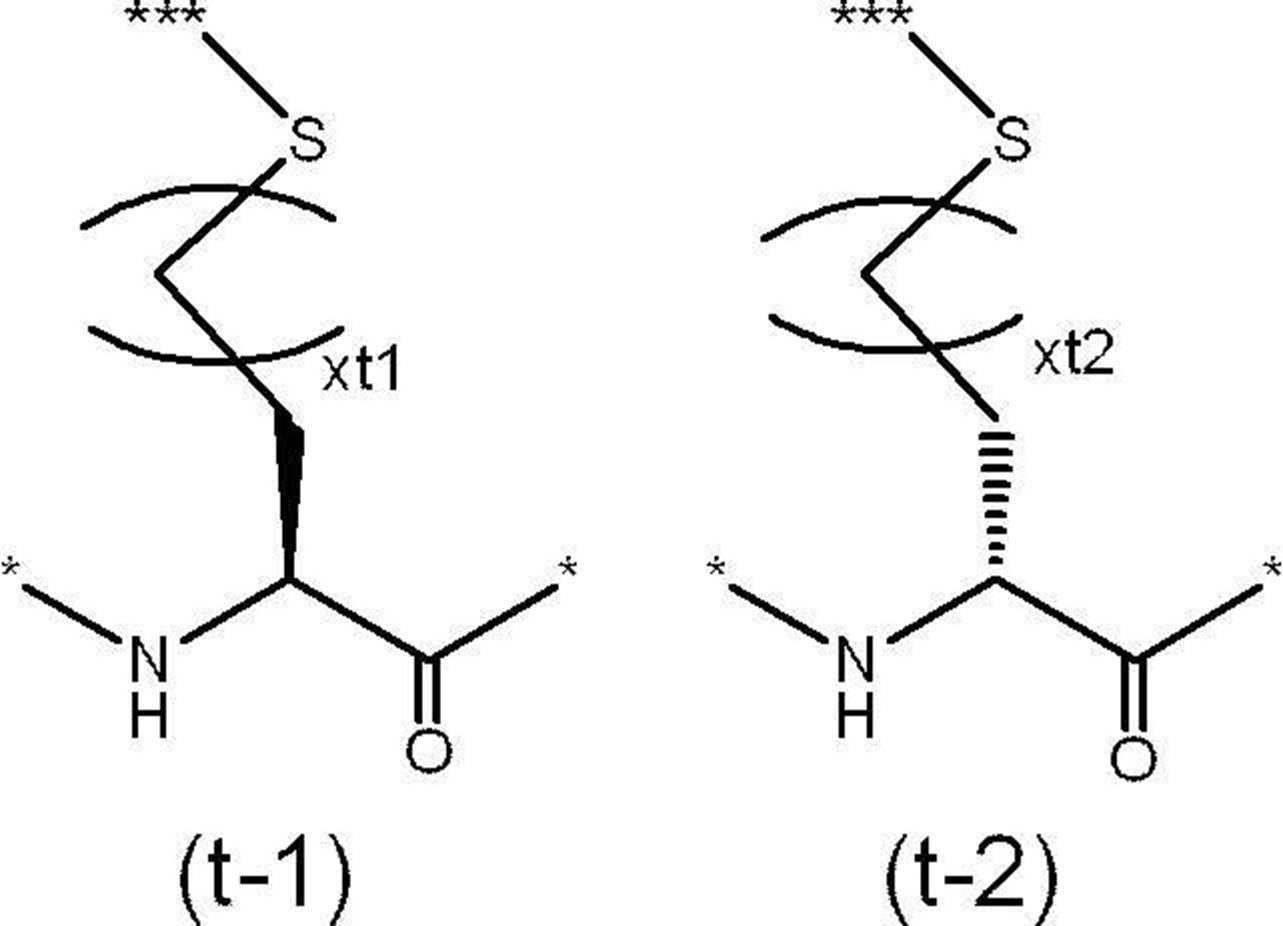
構造(t-1)及び(t-2)中、*は隣接するアミノ酸残基との結合であり、***はチオエーテル結合の相手方のアミノ酸残基の炭素原子との結合であり、xt1及びxt2は、それぞれ独立に0以上の整数である。
xt1及びxt2は、構造(p-1)及び(p-2)中のnp1及びnp2と同義であり、好ましい態様も同様である。
xt1及びxt2は、構造(p-1)及び(p-2)中のnp1及びnp2と同義であり、好ましい態様も同様である。
チオエーテル結合が形成された後のより具体的な例としては、システイン残基、ペニシラミン残基、ホモシステイン残基(2-アミノ-4-メルカプトブタン酸由来の残基)、又は、2-アミノ-5-メルカプトペンタン酸由来のアミノ酸残基が挙げられる。
構造(q-1)又は(q-2)のアミノ酸残基等の硫黄原子に結合した有機基で保護されたアミノ酸に由来するアミノ酸残基は、環状セグメントにおけるそれぞれN末端側のアミノ酸残基Xa又はXcであってもよいし、環状セグメントにおけるそれぞれC末端側のアミノ酸残基Xb又はXdであってもよい。これに対応して、(t-1)又は(t-2)のアミノ酸残基等のチオール基を有するアミノ酸残基は、環状セグメントのN末端側のアミノ酸残基Xa又はXcであってもよいし、環状セグメントのC末端側のアミノ酸残基Xb又はXdであってもよい。
上記構造式(p-1)又は(p-2)で表されるアミノ酸残基は、下記構造(a)~(h)で表されるアミノ酸残基から選択される構造を有するアミノ酸残基であってもよい。
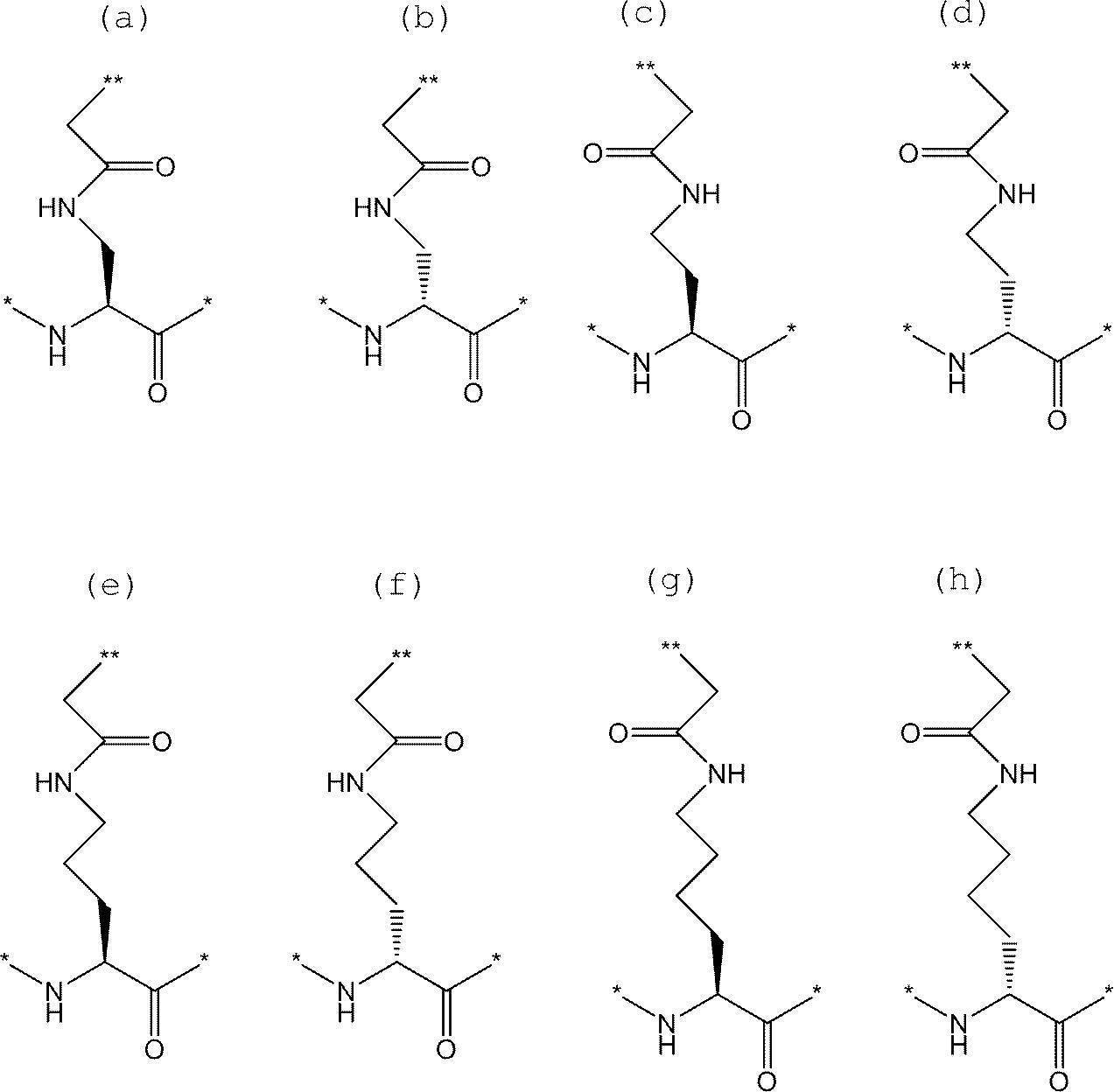
ここで、式中、*は隣接するアミノ酸残基との結合であり、**はチオエーテル結合の相手方のアミノ酸残基の硫黄原子との結合である。
分子安定性の観点から、アミノ酸残基Xc及びアミノ酸残基Xdのいずれか一方が、システイン残基であるとき、良好な分子安定性が得られる観点から、アミノ酸残基Xcとアミノ酸残基Xdのうち他方のアミノ酸残基のα炭素と、システイン残基とは、5個以上の原子により隔てられているように設計することが好ましい。上記良好な分子安定性が得られる理由は明らかでは無いが、チオエーテル結合の相手方のアミノ酸残基の硫黄原子から環状ペプチド主鎖までの炭素鎖長を長くすることにより、チオエーテル結合の電子配置が安定化され、より高い結合安定性が得られると推定される。アミノ酸残基Xa及びアミノ酸残基Xbのいずれか一方が、システイン残基であり、他方が、チオエーテル結合の硫黄原子が有機基を介してアミノ酸側鎖に結合したアミノ酸残基である場合も同様である。
より高い分子安定性を得る観点からは、アミノ酸残基Xaとアミノ酸残基Xbのうち、チオール基を有するアミノ酸に由来するアミノ酸残基において、チオール基を有する側鎖上の炭素原子の合計数は、1~10であることが好ましく、1~6であることがより好ましく、1~4であることが更に好ましく、2~4であることが特に好ましい。
チオール基を有するアミノ酸に由来するアミノ酸残基において、チオール基を有する側鎖上の炭素原子の合計数とは、チオール基を有する側鎖における炭素原子の合計数である。ただし、上記チオール基を有する側鎖上の炭素原子の合計数に、主鎖に含まれる炭素数は含まれない。
例えば、システイン残基におけるチオール基を有する側鎖上の炭素原子の合計数は、1であり、ホモシステイン残基におけるチオール基を有する側鎖上の炭素原子の合計数は2であり、下記に示すペニシラミン残基における側鎖上の炭素原子の合計数は、3である。 なお、下記に示すペニシラミン残基における*は隣接するアミノ酸残基との結合部位を示す。
チオール基を有するアミノ酸に由来するアミノ酸残基において、チオール基を有する側鎖上の炭素原子の合計数とは、チオール基を有する側鎖における炭素原子の合計数である。ただし、上記チオール基を有する側鎖上の炭素原子の合計数に、主鎖に含まれる炭素数は含まれない。
例えば、システイン残基におけるチオール基を有する側鎖上の炭素原子の合計数は、1であり、ホモシステイン残基におけるチオール基を有する側鎖上の炭素原子の合計数は2であり、下記に示すペニシラミン残基における側鎖上の炭素原子の合計数は、3である。 なお、下記に示すペニシラミン残基における*は隣接するアミノ酸残基との結合部位を示す。
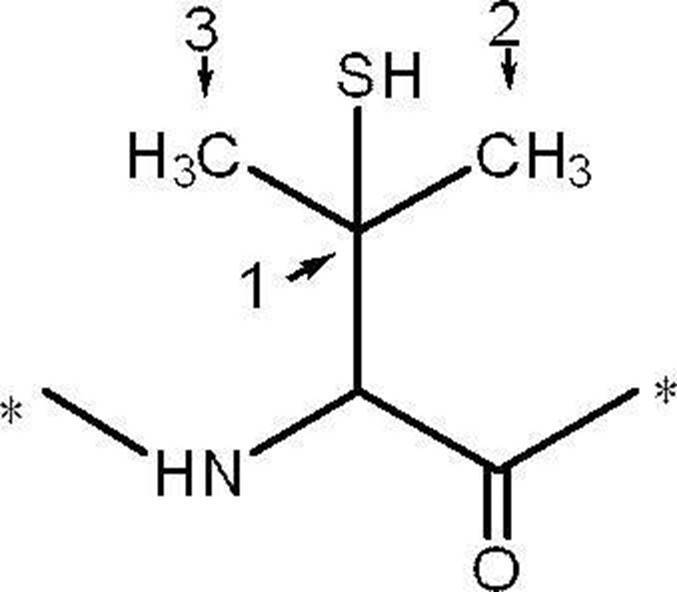
また、インテグリン結合性の観点からは、チオール基を有するアミノ酸残基は、環状ペプチドの主鎖とチオール基を有する側鎖における硫黄原子との間の鎖長が、炭素原子数1~10であることが好ましく、1~6であることがより好ましく、1~4であることが更に好ましく、1~3であることが特に好ましい。
環状ペプチドの主鎖とチオール基を有する側鎖における硫黄原子との間の鎖長とは、環状ペプチドにおける主鎖と、チオール基とを結ぶ側鎖の原子数を、最小となるように数えた値であり、主鎖に含まれる炭素原子は鎖長の数には含まれない。
例えば、チオール基を有するアミノ酸残基が下記に示すペニシラミン残基である場合、環状ペプチドの主鎖とチオール基を有する側鎖における硫黄原子との間の鎖長は、1である。なお、下記に示すペニシラミン残基における*は隣接するアミノ酸残基との結合部位を示す。
環状ペプチドの主鎖とチオール基を有する側鎖における硫黄原子との間の鎖長とは、環状ペプチドにおける主鎖と、チオール基とを結ぶ側鎖の原子数を、最小となるように数えた値であり、主鎖に含まれる炭素原子は鎖長の数には含まれない。
例えば、チオール基を有するアミノ酸残基が下記に示すペニシラミン残基である場合、環状ペプチドの主鎖とチオール基を有する側鎖における硫黄原子との間の鎖長は、1である。なお、下記に示すペニシラミン残基における*は隣接するアミノ酸残基との結合部位を示す。
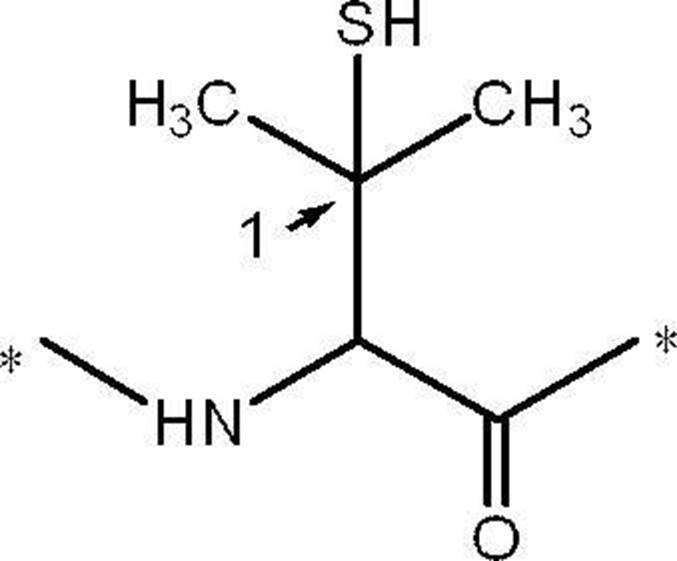
インテグリン結合性の観点からは、例えば、チオール基を有するα-アミノ酸に由来するアミノ酸残基である場合、環状ペプチドの主鎖とチオール基を有する側鎖における硫黄原子との間の鎖長としては、1~10であることが好ましく、1~6であることがより好ましく、1~4であることが更に好ましく、1~3であることが特に好ましい。
アミノ酸残基Xaとアミノ酸残基Xbのうちチオエーテル結合の硫黄原子を供給しないアミノ酸残基のα炭素と、チオエーテル結合の硫黄原子を供給するアミノ酸残基の硫黄原子と、の間の鎖長は、より高い分子安定性を得る観点から、4個以上の原子により隔てられていることが好ましく、4個~9個の原子によって隔てられていることがより好ましく、4~8個の原子によって隔てられていることが更に好ましい。ただし、Xaが、チオエーテル結合の硫黄原子が有機基を介してα-炭素上のアミノ基に結合しているアミノ酸残基である場合はこの限りでない。
同様の観点から、アミノ酸残基Xc及びアミノ酸残基Xdのうちチオエーテル結合の硫黄原子を供給しないアミノ酸残基のα炭素と、チオエーテル結合の硫黄原子を供給するアミノ酸残基の硫黄原子と、の間の鎖長は、4個以上の原子により隔てられていることが好ましく、4個~9個の原子によって隔てられていることがより好ましく、4~8個の原子によって隔てられていることが更に好ましい。
チオエーテル結合の硫黄原子を供給しないアミノ酸残基のα炭素と、チオエーテル結合の硫黄原子を供給するアミノ酸残基の硫黄原子と、の間の鎖長が、4個以上の原子により隔てられている例として、上記(a)のアミノ酸残基と、L-システイン残基とが結合している場合を以下に例示するが、本開示はこれに限定されることはない。

ここで、式中、*は隣接するアミノ酸残基との結合部位である。(a)のアミノ酸残基と、L-システイン残基とが結合している場合には、α炭素と、システイン残基の硫黄原子との鎖長は、1個の窒素原子及び3個の炭素原子により隔てられているため、原子数は4個である。このように、チオエーテル結合の相手方のアミノ酸残基のα炭素と、システイン残基の硫黄原子とを隔てる原子の数(鎖長)は、α原子と硫黄原子とを連結する鎖上の原子数を意味し、鎖上の原子に結合している水素原子等の上記鎖に参加していない原子はカウントしない。
<<チオエーテル結合の形成方法>>
チオエーテル結合形成前のアミノ酸残基Xc及びアミノ酸残基Xd及びアミノ酸残基Xa及びアミノ酸残基Xbにおいて、チオエーテル結合を形成させる方法としては、特に限定されず、ペプチドにおいてチオエーテル結合を形成される公知の方法が挙げられる。
チオエーテル結合としては、例えば、チオール基を有するアミノ酸残基と、ハロゲン原子を有する有機基で保護されたアミノ酸残基とを中性、又は、アルカリ条件下(pH7~pH9)で反応させることで、ハロゲン化水素の生成を伴いながらチオール基における硫黄原子が有機基に結合することで、チオエーテル結合を形成することができる。
上記ハロゲン原子を有する有機基としては、ハロアセチル基等の保護基が好適に挙げられる。
また、例えば、チオール基を側鎖上に有するアミノ酸残基と、アミノ酸のα炭素に結合したアミノ基にハロゲン原子を有する有機基が結合したアミノ酸残基又はハロゲンを有する有機基を側鎖上に有するアミノ酸残基との間で、チオール基とハロゲンを有する有機基とを反応させてチオエーテル結合を形成する方法としては、例えば、環状化前の線状のペプチドを中性、又は、塩基性の緩衝液中で反応させることによりチオエーテル結合を形成する方法が挙げられる。
より具体的には、線状ペプチドを含む水溶液をTris-HCl(pH 8.5)緩衝液にゆっくりと滴下して静置する方法が好適に挙げられる。チオエーテル結合を形成する環化反応では、反応条件によっては環状ペプチド以外に、複数の非環状ペプチドが分子間結合により連結したオリゴマーが形成される場合がある。チオエーテル結合を形成させる方法は、環状ペプチドの収率を向上させる点から、精製する工程を含むことが好ましい。環状ペプチドの精製方法としては、公知の精製方法が挙げられる。環状ペプチドの精製方法は、上記環化反応後のペプチドを逆相高速液体クロマトグラフィー等により精製する方法が好ましい。
より具体的には、線状ペプチドを含む水溶液をTris-HCl(pH 8.5)緩衝液にゆっくりと滴下して静置する方法が好適に挙げられる。チオエーテル結合を形成する環化反応では、反応条件によっては環状ペプチド以外に、複数の非環状ペプチドが分子間結合により連結したオリゴマーが形成される場合がある。チオエーテル結合を形成させる方法は、環状ペプチドの収率を向上させる点から、精製する工程を含むことが好ましい。環状ペプチドの精製方法としては、公知の精製方法が挙げられる。環状ペプチドの精製方法は、上記環化反応後のペプチドを逆相高速液体クロマトグラフィー等により精製する方法が好ましい。
<<アミノ酸残基X1~X5>>
特定アミノ酸配列において、X1~X5は、それぞれ独立に、アミノ酸残基を表し、m1~m5は、それぞれ独立に、0以上の整数を表す。
アミノ酸残基X1~X5の数m1~m5は、Xa、Xb、Xc及びXd並びに、X1、X3及びX4で表されるアミノ酸残基とRGDとの合計アミノ酸残基数は、7~16となる範囲であれば特に制限はされない。
アミノ酸残基としては、環状ペプチドの形成が可能であれば特に制限はされず、上記表1に示されるアミノ酸(B、ZおよびXを除く。)及び表2に示すアミノ酸からなる群から選択されるアミノ酸に由来するアミノ酸残基であることが好ましく、表1に示すアミノ酸(B、ZおよびXを除く。)からなる群から選択されるアミノ酸に由来するアミノ酸残基であることがより好ましい。
また、存在する場合には、これらのアミノ酸のエナンチオマーまたはジアステレオマーに由来するアミノ酸残基であってもよい。
特定アミノ酸配列において、X1~X5は、X1~X5からなる群から選ばれる任意の2つのアミノ酸残基同士が、チオエーテル結合を形成していてもよい。
チオエーテル結合を形成可能なアミノ酸残基の組み合わせとしては、チオール基を有するアミノ酸に由来するアミノ酸残基であり、他方が、ハロゲン原子を有する有機基で保護されたアミノ酸に由来するアミノ酸残基である組み合わせが挙げられる。
チオール基を有するアミノ酸に由来するアミノ酸残基及びハロゲン原子を有する有機基で保護されたアミノ酸に由来するアミノ酸残基は、アミノ酸残基Xa~Xdにおけるオール基を有するアミノ酸に由来するアミノ酸残基及びハロゲン原子を有する有機基で保護されたアミノ酸に由来するアミノ酸残基と同義であり、好ましい態様も同様である。
チオエーテル結合を形成可能なアミノ酸残基の組み合わせとしては、チオール基を有するアミノ酸に由来するアミノ酸残基であり、他方が、ハロゲン原子を有する有機基で保護されたアミノ酸に由来するアミノ酸残基である組み合わせが挙げられる。
チオール基を有するアミノ酸に由来するアミノ酸残基及びハロゲン原子を有する有機基で保護されたアミノ酸に由来するアミノ酸残基は、アミノ酸残基Xa~Xdにおけるオール基を有するアミノ酸に由来するアミノ酸残基及びハロゲン原子を有する有機基で保護されたアミノ酸に由来するアミノ酸残基と同義であり、好ましい態様も同様である。
上記アミノ酸残基は、例えば、側鎖にカルボキシ基を有するアミノ酸残基、側鎖にヒドロキシ基を有するアミノ酸残基等であってもよい。
側鎖にカルボキシ基を有するアミノ酸残基としては、例えば、L-アスパラギン酸残基、D-アスパラギン酸残基、L-グルタミン酸残基、D-グルタミン酸残基、L-ホモグルタミン酸残基、およびD-ホモグルタミン酸残基等が挙げられる。
側鎖にカルボキシ基を有するアミノ酸残基としては、例えば、L-アスパラギン酸残基、D-アスパラギン酸残基、L-グルタミン酸残基、D-グルタミン酸残基、L-ホモグルタミン酸残基、およびD-ホモグルタミン酸残基等が挙げられる。
上記側鎖にヒドロキシ基を有するアミノ酸残基としては、例えば、L-セリン残基、D-セリン残基、L-ホモセリン残基、D-ホモセリン残基、L-チロシン残基、D-チロシン残基、L-トレオニン残基、D-トレオニン残基、L-アロトレオニン残基、およびD-アロトレオニン残基等が挙げられる。
上記アミノ酸残基としては、例えば、疎水性のアミノ酸残基であってもよい。
疎水性のアミノ酸残基としては、例えば、バリン、メチオニン、トリプトファン、プロライン、ロイシン、フェニルアラニン、イソロイシン、アラニン、グリシン等のアミノ酸残基が挙げられる。
疎水性のアミノ酸残基としては、例えば、バリン、メチオニン、トリプトファン、プロライン、ロイシン、フェニルアラニン、イソロイシン、アラニン、グリシン等のアミノ酸残基が挙げられる。
<<X1で表されるアミノ酸残基>>
X1で表されるアミノ酸残基としては、インテグリン結合性の観点から、疎水性アミノ酸に由来するアミノ酸残基、及び、環構造を有するアミノ酸残基の少なくとも一方であることが好ましく、チロシン、フェニルアラニン、3-ヨードチロシン、ナフチルアラニン、ホモチロシン、プロリン、又は、イソロイシンに由来するアミノ酸残基であることが更に好ましく、フェニルアラニン又はチロシンに由来するアミノ酸残基であることが特に好ましい。
X1で表されるアミノ酸残基としては、インテグリン結合性の観点から、疎水性アミノ酸に由来するアミノ酸残基、及び、環構造を有するアミノ酸残基の少なくとも一方であることが好ましく、チロシン、フェニルアラニン、3-ヨードチロシン、ナフチルアラニン、ホモチロシン、プロリン、又は、イソロイシンに由来するアミノ酸残基であることが更に好ましく、フェニルアラニン又はチロシンに由来するアミノ酸残基であることが特に好ましい。
X1で表されるアミノ酸残基の数m1は、0以上の整数であり、コストの観点から、1以上6以下であることが好ましく、1以上3以下であることがより好ましく、1又は2であることが好ましい。
<<X3及びX4で表されるアミノ酸残基の数m3及びm4>>
X3及びX4で表されるアミノ酸残基としては、特に制限はないが、インテグリン結合性の観点から、プロリン、トレオニン、又は、アスパラギン、セリン、ホモセリン、バリン、又は、アラニンのアミノ酸残基であることが好ましい。
また、X3及びX4で表されるアミノ酸残基の数m3及びm4は、それぞれ独立に、0以上の整数である。コストの観点から、m3及びm4は、それぞれ独立に、0以上2以下であることが好ましく、0以上1以下であることがより好ましく、m3及びm4の両方が0であることが更に好ましい。
X3及びX4で表されるアミノ酸残基の数m3及びm4が2以上である場合は、X3及びX4は互いに同一のアミノ酸残基であってもよく、異なるアミノ酸残基であってもよい。
<<X2及びX5で表されるアミノ酸残基>>
X2及びX5で表されるアミノ酸残基の数m2及びm5は、それぞれ独立に、0以上の整数である。コストの観点から、m5は0であることが好ましい。分子安定性及び後述する基材又は保持材上の官能基と反応して共有結合を形成のしやすさから、m2は、1以上であることが好ましく、1以上6以下であることが好ましく、1以上4以下であることがより好ましい。
m5は0である場合、Xaで表されるアミノ酸残基は、アミノ基又は修飾アミノ基であってもよい。
X2で表されるアミノ酸残基の数m2が2以上である場合は、X2は互いに同一のアミノ酸残基であってもよく、異なるアミノ酸残基であってもよいが、X2は互いに同一のアミノ酸残基であることが好ましい。
<<側鎖に固定化官能基を有するアミノ酸>>
X5及びX2で表されるアミノ酸残基は、分子安定性及び後述する基材又は保持材上の官能基と反応して共有結合を形成のしやすさから、側鎖に固定化官能基を有するアミノ酸残基(以下、単に「固定化官能基を有するアミノ酸残基」ともいう。)を含むことが好ましい。
上記「固定化官能基」とは、後述する基材又は保持材上の官能基と反応して共有結合を形成することができる官能基をいう。
固定化官能基としては、例えば、アミノ基、カルボキシ基、ヒドロキシ基、チオール基、アルデヒド基(ホルミル基)、カルバモイル基、アジド基、アルキニル基等が挙げられる。
X5及びX2で表されるアミノ酸残基は、分子安定性及び後述する基材又は保持材上の官能基と反応して共有結合を形成のしやすさから、側鎖に固定化官能基を有するアミノ酸残基(以下、単に「固定化官能基を有するアミノ酸残基」ともいう。)を含むことが好ましい。
上記「固定化官能基」とは、後述する基材又は保持材上の官能基と反応して共有結合を形成することができる官能基をいう。
固定化官能基としては、例えば、アミノ基、カルボキシ基、ヒドロキシ基、チオール基、アルデヒド基(ホルミル基)、カルバモイル基、アジド基、アルキニル基等が挙げられる。
上記固定化官能基を有するアミノ酸における固定化官能基としては、基材又は保持材上の官能基との反応性の観点から、好ましくはアミノ基、チオール基、及び、アルデヒド基からなる群から選択される少なくとも1つの基であり、より好ましくはアミノ基、及び、チオール基からなる群から選択される少なくとも1つ基である。
アミノ基を固定化官能基として用いた場合、アミノ基は、アミド結合を介して、基材又は保持材上のカルボキシ基と結合することができ、本開示に係る環状ペプチドを基材又は保持材上に容易に固定することができる。
また、チオール基を固定化官能基として用いた場合、チオール基は、共有結合を介して基材又は保持材上のエポキシ基と結合することができ、本開示に係る環状ペプチドを基材又は保持材上に容易に固定することができる。
また、チオール基を固定化官能基として用いた場合、チオール基は、共有結合を介して基材又は保持材上のエポキシ基と結合することができ、本開示に係る環状ペプチドを基材又は保持材上に容易に固定することができる。
側鎖にアミノ基を有するアミノ酸残基としては、L-リシン残基、D-リシン残基等が挙げられる。側鎖にチオール基を有するアミノ酸残基としては、L-システイン残基、D-システイン残基等が挙げられる。側鎖にアミノ基を有するアミノ酸残基及び側鎖にチオール基を有するアミノ酸残基は、比較的安価に導入することができるため、本開示に係る環状ペプチドの製造コストを抑えることができる。このため、上記のアミノ酸残基の使用は、経済的な観点から好ましい。
すなわち、側鎖に固定化官能基を有するアミノ酸としては、分子安定性の観点から、L-リシン、D-リシン、L-システイン、D-システイン、L-ホモシステイン及びD-ホモシステインからなる群から選択される少なくとも1種のアミノ酸であることが好ましく、L-リシン及びD-リシンからなる群より選ばれる少なくとも1種のアミノ酸であることがより好ましい。
X5(環状ペプチドのN末端)及びX2(環状ペプチドのC末端)のうち少なくとも一方が、基材等との固定化の観点から、固定化官能基を有するアミノ酸残基としてリシン残基を含むことが好ましく、X2が固定化官能基を有するアミノ酸残基としてリシン残基を含むことがより好ましい。
基材等との固定化の観点から、X5(環状ペプチドのN末端)及びX2(環状ペプチドのC末端)のうち少なくとも一方が、固定化官能基を有するアミノ酸残基としてリシン残基を1つ以上連続して含むことが好ましく、2~10個連続して含むことがより好ましく、2~5個連続して含むことが更に好ましい。
基材等との固定化の観点から、X5(環状ペプチドのN末端)及びX2(環状ペプチドのC末端)のうち少なくとも一方が、固定化官能基を有するアミノ酸残基としてリシン残基を1つ以上連続して含むことが好ましく、2~10個連続して含むことがより好ましく、2~5個連続して含むことが更に好ましい。
X5(環状ペプチドのN末端)及びX2(環状ペプチドのC末端)は、連続する固定化官能基を有するアミノ酸残基(好ましくはリシン残基)のみで構成されていてもよいが、固定化官能基を有するアミノ酸残基以外のアミノ酸残基を含んでいてもよい。
固定化官能基を有するアミノ酸残基以外のアミノ酸残基としては、1~20個、1~10個、1~5個、又は1~3個の、アラニン残基、βアラニン残基、グルタミン酸残基、アスパラギン酸残基、及びグリシン残基から選ばれるアミノ酸残基等であってもよい。
また、上記固定化官能基を有するアミノ酸残基以外のアミノ酸残基とXa又はXbとの間にリシン残基が更に挟まれていてもよい。
固定化官能基を有するアミノ酸残基以外のアミノ酸残基としては、1~20個、1~10個、1~5個、又は1~3個の、アラニン残基、βアラニン残基、グルタミン酸残基、アスパラギン酸残基、及びグリシン残基から選ばれるアミノ酸残基等であってもよい。
また、上記固定化官能基を有するアミノ酸残基以外のアミノ酸残基とXa又はXbとの間にリシン残基が更に挟まれていてもよい。
本開示に係る環状ペプチドが有する固定化官能基と、基材又は保持材上の官能基と、の組合せとしては、特に制限はないが、アミノ基とカルボキシ基との組み合わせ、アミノ基とアルデヒド基との組み合わせ、アミノ基とエポキシ基との組み合わせ、ヒドロキシ基とエポキシ基との組み合わせ、カルボキシ基とヒドロキシ基との組み合わせ、チオール基とエポキシ基との組み合わせ、アジド基とアルキニル基との組み合わせ等が挙げられる。
本開示に係る環状ペプチドが有する固定化官能基と基材又は保持材上の官能基とが反応して共有結合を形成することにより、本開示に係る環状ペプチドが基材又は保持材に固定化される。
なお、本開示に係る環状ペプチドが有する固定化官能基の少なくとも一部が基材又は保持材上の官能基と反応して共有結合を形成すればよく、すべての固定化官能基が基材又は保持材上の官能基と反応しなくてもよい。
本開示に係る環状ペプチドが有する固定化官能基と基材又は保持材上の官能基とが反応して共有結合を形成することにより、本開示に係る環状ペプチドが基材又は保持材に固定化される。
なお、本開示に係る環状ペプチドが有する固定化官能基の少なくとも一部が基材又は保持材上の官能基と反応して共有結合を形成すればよく、すべての固定化官能基が基材又は保持材上の官能基と反応しなくてもよい。
<<RGD配列>>
本開示に係る環状ペプチドに含まれる特定アミノ酸配列は、RGD配列を有し、かつ、チオエーテル結合によって架橋されたアミノ酸残基であるXc及びXdの間にRGD配列が配置されていることにより、インテグリン結合性及び分子安定性に優れる。
本開示において、「RGD配列」とは、N末端側からC末端側にかけて「R(アルギニン)」、「G(グリシン)」、及び「D(アスパラギン酸)」の3つのアミノ酸残基が存在する配列を示す。「RGD配列」は、細胞接着に関与することから、本開示に係る環状ペプチドは、「RGD配列」を有することで、特にインテグリン等の細胞接着分子に対する結合性を高めることができる。
本開示に係る環状ペプチドに含まれる特定アミノ酸配列は、RGD配列を有し、かつ、チオエーテル結合によって架橋されたアミノ酸残基であるXc及びXdの間にRGD配列が配置されていることにより、インテグリン結合性及び分子安定性に優れる。
本開示において、「RGD配列」とは、N末端側からC末端側にかけて「R(アルギニン)」、「G(グリシン)」、及び「D(アスパラギン酸)」の3つのアミノ酸残基が存在する配列を示す。「RGD配列」は、細胞接着に関与することから、本開示に係る環状ペプチドは、「RGD配列」を有することで、特にインテグリン等の細胞接着分子に対する結合性を高めることができる。
本開示に係る環状ペプチドに含まれる特定アミノ酸配列において、「RGD配列」の数は、2以上であってもよいが、1であることが好ましい。
RGD配列は、インテグリン結合性の観点から、アミノ酸残基Xc及びアミノ酸残基Xdの間に位置する。RGD配列の位置としては、アミノ酸残基Xc及びアミノ酸残基Xdと隣接した位置であってもよいし、アミノ酸残基Xcともアミノ酸残基Xdと隣接していない位置であってもよい。
インテグリン結合性の観点から、特定アミノ酸配列におけるN末端にあるX5を1番目のアミノ酸残基としてC末端側へとアミノ酸残基をカウントしたときに、3~5番目のアミノ酸残基に相当することが好ましい。
インテグリン結合性の観点から、特定アミノ酸配列におけるN末端にあるX5を1番目のアミノ酸残基としてC末端側へとアミノ酸残基をカウントしたときに、3~5番目のアミノ酸残基に相当することが好ましい。
Xa、Xb、Xc及びXd並びに、X1、X3及びX4で表されるアミノ酸残基とRGDとの合計アミノ酸残基数は、7~16である。Xa、Xb、Xc及びXd並びに、X1、X3及びX4で表されるアミノ酸残基とRGDとの合計アミノ酸残基数、すなわち、架橋ペプチドにおいてチオエーテル結合で架橋された最もN末端側にあるアミノ酸残基(Xa)から最もC末端側にあるアミノ酸残基(Xb)までの間にあるアミノ酸残基数(以下、「最外環状セグメントのアミノ酸残基数」ともいう。)が、7~16であると、環状ペプチドの分子内ひずみが大きくなり過ぎず、α-ヘリックス等の高次構造が安定化し、かつ、インテグリン結合性に優れる。
上記観点から、最外環状セグメントのアミノ酸残基数としては、7~14であることが好ましく、7~13であることがより好ましい。
また、Xc及びXd並びに、X3及びX4で表されるアミノ酸残基とRGDとの合計アミノ酸残基数、すなわち、架橋ペプチドにおいてチオエーテル結合で架橋されたアミノ酸残基(Xc)からアミノ酸残基(Xd)までの間にあるアミノ酸残基数(以下、「最内環状セグメントのアミノ酸残基数」ともいう。)は、5~14であることが好ましく、5~10であることがより好ましく、5~8であることが更に好ましい。
上記観点から、最外環状セグメントのアミノ酸残基数としては、7~14であることが好ましく、7~13であることがより好ましい。
また、Xc及びXd並びに、X3及びX4で表されるアミノ酸残基とRGDとの合計アミノ酸残基数、すなわち、架橋ペプチドにおいてチオエーテル結合で架橋されたアミノ酸残基(Xc)からアミノ酸残基(Xd)までの間にあるアミノ酸残基数(以下、「最内環状セグメントのアミノ酸残基数」ともいう。)は、5~14であることが好ましく、5~10であることがより好ましく、5~8であることが更に好ましい。
本開示に係る環状ペプチドが有するアミノ酸配列に含まれるアミノ酸残基の合計数は、特に制限はなく、7~50アミノ酸残基であってもよく、7~30アミノ酸残基であってもよく、8~20アミノ酸残基であってもよく、9~15アミノ酸残基であってもよい。環状ペプチドの全長が短い方が抗原性のリスクが少なく、ペプチド合成が容易である。
<<式(2)で表されるアミノ酸配列>>
本開示に係る環状ペプチドが有する上記式(1)で表されるアミノ酸配列(特定アミノ酸配列)は、インテグリン結合性及び分子安定性の観点から、下記式(2)で表されるアミノ酸配列であることが好ましい。
本開示に係る環状ペプチドが有する上記式(1)で表されるアミノ酸配列(特定アミノ酸配列)は、インテグリン結合性及び分子安定性の観点から、下記式(2)で表されるアミノ酸配列であることが好ましい。
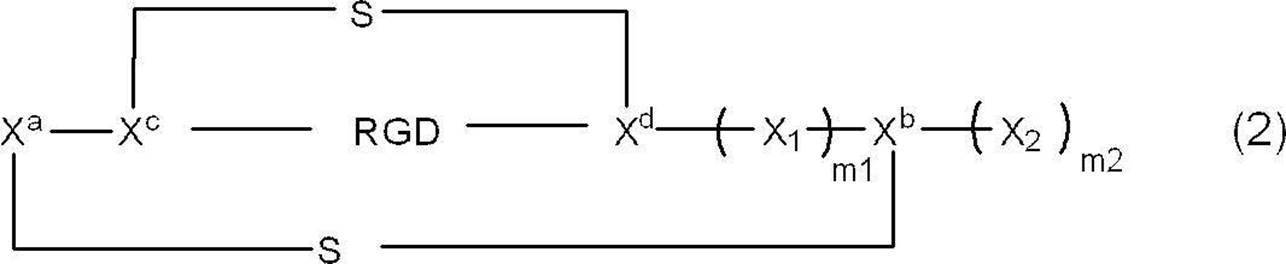
式(2)中、Xa及びXb並びにXc及びXdは、それぞれ独立に、チオエーテル結合を介して架橋されたアミノ酸残基を表し、X1及びX2は、それぞれ独立に、アミノ酸残基を表し、Rはアルギニンを表し、Gはグリシンを表し、Dはアスパラギン酸を表し、m1及びm2は、それぞれ独立に、1以上の整数を表す。ただし、Xa、Xb、Xc及びXd並びにX1で表されるアミノ酸残基とRGDとの合計アミノ酸残基数は、7~14である。
式(2)中、Xa、Xb、Xc、Xd、X1、X2、m1及びm2は、上記式(1)中のXa、Xb、Xc、Xd、X1、X2、m1及びm2はと同義であり、好ましい態様も同様である。
結合安定性及び分子安定性の観点から、式(2)におけるXc及びXdのいずれか一方が、(2S)-2-アミノ-3-[(2-アセチル)アミノ]プロパン酸、(2R)-2-アミノ-3-[(2-アセチル)アミノ]プロパン酸、(2S)-2-アミノ-4-[(2-アセチル)アミノ]ブタン酸、(2R)-2-アミノ-4-[(2-アセチル)アミノ]ブタン酸、N-δ-アセチル-L-オルニチン、N-δ-アセチル-D-オルニチン、N-ε-アセチル-L-リシン、N-ε-アセチル-D-リシン、N-ζ-アセチル-L-ホモリシン、及び、N-ζ-アセチル-D-ホモリシンからなる群から選択される側鎖にアセチル基を有するアミノ酸に由来するアミノ酸残基であり、他方が、L-ホモシステイン、D-ホモシステイン、L-ペニシラミン、又は、D-ペニシラミンに由来するアミノ酸残基であることが好ましく、L-ホモシステイン、又は、D-ホモシステインに由来するアミノ酸残基が更に好ましい。
結合安定性及び分子安定性の観点から、式(2)中におけるXbが、L-ホモシステイン、D-ホモシステイン、L-ペニシラミン、又は、D-ペニシラミンに由来するアミノ酸残基であり、Xaが、(2S)-2-アミノ-3-[(2-アセチル)アミノ]プロパン酸、(2R)-2-アミノ-3-[(2-アセチル)アミノ]プロパン酸、(2S)-2-アミノ-4-[(2-アセチル)アミノ]ブタン酸、(2R)-2-アミノ-4-[(2-アセチル)アミノ]ブタン酸、N-δ-アセチル-L-オルニチン、N-δ-アセチル-D-オルニチン、N-ε-アセチル-L-リシン、N-ε-アセチル-D-リシン、N-ζ-アセチル-L-ホモリシン、N-ζ-アセチル-D-ホモリシン、及び、(2S,3S)-2-[(アセチル)アミノ]-3-メチル-ペンタン酸からなる群から選択されるアミノ酸に由来するアミノ酸残基であることが好ましい。
式(2)中、アミノ酸残基Xaとしては、結合安定性及び分子安定性の観点から、下記構造(r)で表されるアミノ酸残基であることが好ましい。

構造(r)中、Rrは水素原子又は1価の有機基を表し、Lは、-(CH2)L1-C(=O)-、又は、-(CH2)L1-C(=O)-NH-で表される2価の連結基を表し、L1は0以上10以下の整数を表し、nr1は、0以上の整数を表し、*は隣接するアミノ酸残基との結合部位を表し、**はチオエーテル結合における硫黄原子との結合部位を表す。
Rr、L及びnr1は、構造(r-1における)Rr、L及びnr1と同義であり、好ましい態様も同様である。
Rr、L及びnr1は、構造(r-1における)Rr、L及びnr1と同義であり、好ましい態様も同様である。
結合安定性及び分子安定性の観点から、式(2)におけるXc及びXdのいずれか一方が、(2S)-2-アミノ-3-[(2-アセチル)アミノ]プロパン酸、(2R)-2-アミノ-3-[(2-アセチル)アミノ]プロパン酸、(2S)-2-アミノ-4-[(2-アセチル)アミノ]ブタン酸、(2R)-2-アミノ-4-[(2-アセチル)アミノ]ブタン酸、N-δ-アセチル-L-オルニチン、N-δ-アセチル-D-オルニチン、N-ε-アセチル-L-リシン、N-ε-アセチル-D-リシン、N-ζ-アセチル-L-ホモリシン、及び、N-ζ-アセチル-D-ホモリシンからなる群から選択される側鎖にアセチル基を有するアミノ酸に由来するアミノ酸残基であり、他方が、L-ホモシステイン、D-ホモシステイン、L-ペニシラミン、又は、D-ペニシラミンに由来するアミノ酸残基であり、式(2)中におけるXbが、L-ホモシステイン、D-ホモシステイン、L-ペニシラミン、又は、D-ペニシラミンに由来するアミノ酸残基であり、Xaが、上記構造(r)で表されるアミノ酸残基(より好ましくは、(2S)-2-アミノ-3-[(2-アセチル)アミノ]プロパン酸、(2R)-2-アミノ-3-[(2-アセチル)アミノ]プロパン酸、(2S)-2-アミノ-4-[(2-アセチル)アミノ]ブタン酸、(2R)-2-アミノ-4-[(2-アセチル)アミノ]ブタン酸、N-δ-アセチル-L-オルニチン、N-δ-アセチル-D-オルニチン、N-ε-アセチル-L-リシン、N-ε-アセチル-D-リシン、N-ζ-アセチル-L-ホモリシン、N-ζ-アセチル-D-ホモリシン及び、(2S,3S)-2-[(アセチル)アミノ]-3-メチル-ペンタン酸からなる群から選択されるアミノ酸に由来するアミノ酸残基)であることが好ましい。
Xa、Xb、Xc及びXd並びにX1で表されるアミノ酸残基とRGDとの合計アミノ酸残基数は、7~14である。環状ペプチドの分子内ひずみが大きくなり過ぎず、α-ヘリックス等の高次構造が安定化し、かつ、インテグリン結合性に優れる観点から、Xa、Xb、Xc及びXd並びにX1で表されるアミノ酸残基とRGDとの合計アミノ酸残基数は、7~13であることがより好ましく、8~10であることがより好ましい。
また、上記観点から、Xc及びXdで表されるアミノ酸残基とRGDとの合計アミノ酸残基数は、5であることが好ましい。
また、上記観点から、Xc及びXdで表されるアミノ酸残基とRGDとの合計アミノ酸残基数は、5であることが好ましい。
式(2)においては以下のような実施形態もまた好ましい。ここで、各アミノ酸残基はL-アミノ酸残基であってもD-アミノ酸残基であってもよい。
すなわち、Xaは、環状ペプチドのN末端アミノ酸残基であることが好ましく、この場合、Xaはα炭素にアセチル基が結合したイソロイシン、リシン、アスパラギン酸、グルタミン酸、チロシン、ロイシン、トレオニン、又はバリンに由来するアミノ酸残基であってもよい。中でもα炭素にアセチル基が結合したアスパラギン酸に由来するアミノ酸残基及びα炭素にアセチル基が結合したグルタミン酸に由来するアミノ酸残基が好ましく、α炭素にアセチル基が結合したグルタミン酸残基がより好ましい。
Xbは、システインに由来するアミノ酸残基、ペニシラミンに由来するアミノ酸残基、又はホモシステインに由来するアミノ酸残基であってもよい。中でもホモシステインに由来するアミノ酸残基が好ましい。
Xc及びXdのうち、チオエーテル結合の硫黄原子を供給しない方のアミノ酸残基は、2-アミノ-3-[(2-アセチル)アミノ]プロパン酸、2-アミノ-4-[(2-アセチル)アミノ]ブタン酸、N-δ-アセチル-オルニチン、N-ε-アセチル-リシン、又はN-ζ-アセチル-ホモリシンに由来するアミノ酸残基であってもよい。中でもN-δ-アセチル-オルニチンに由来するアミノ酸残基及びN-ε-アセチル-リシンに由来するアミノ酸残基が好ましく、N-ε-アセチル-リシンに由来するアミノ酸残基がより好ましい。
Xc及びXdのうち、チオエーテル結合の硫黄原子を供給している方のアミノ酸残基は、システインに由来するアミノ酸残基、ペニシラミンに由来するアミノ酸残基、又はホモシステインに由来するアミノ酸残基であってもよい。中でもホモシステインに由来するアミノ酸残基が好ましい。
Xc及びXdのうち、チオエーテル結合の硫黄原子を供給している方のアミノ酸残基は、システインに由来するアミノ酸残基、ペニシラミンに由来するアミノ酸残基、又はホモシステインに由来するアミノ酸残基であってもよい。中でもホモシステインに由来するアミノ酸残基が好ましい。
(X1)m1は、全体でFを表すか、あるいはFXgを表すことが好ましい。ここでXgは任意の一アミノ酸残基を表すが、その例としてはアラニン、アルギニンが挙げられる。
(X2)m2は、3残基以上連続するKを含むことが好ましい。Kの繰り返し数の上限は特に制限されないが、例えば10、6、又は4であってもよい。(X2)m2は、全体で、例えばA、K、KKK、AKKK等を表していてもよい。
(X2)m2は、3残基以上連続するKを含むことが好ましい。Kの繰り返し数の上限は特に制限されないが、例えば10、6、又は4であってもよい。(X2)m2は、全体で、例えばA、K、KKK、AKKK等を表していてもよい。
一つの好ましい実施形態においては、Xaはα炭素にアセチル基が結合した任意のアミノ酸に由来するアミノ酸残基であり、Xbはホモシステインに由来するアミノ酸残基であり、Xcはホモシステインに由来するアミノ酸残基であり、XdはN-δ-アセチル-オルニチンに由来するアミノ酸残基又はN-ε-アセチル-リシンに由来するアミノ酸残基であり、(X1)m1は、全体でFである。この場合、Xaはα炭素にアセチル基が結合したイソロイシン、リシン、アスパラギン酸、グルタミン酸、チロシン、ロイシン、トレオニン、又はバリンに由来するアミノ酸残基であることが好ましい。また、(X2)m2は、全体でA、K、KKK、又はAKKKであってもよい。
別の好ましい実施形態においては、Xaはα炭素にアセチル基が結合した任意のアミノ酸に由来するアミノ酸残基であり、Xbはホモシステインに由来するアミノ酸残基であり、XcはN-δ-アセチル-オルニチンに由来するアミノ酸残基又はN-ε-アセチル-リシンに由来するアミノ酸残基であり、Xdはホモシステインに由来するアミノ酸残基であり、(X1)m1は、全体でFである。この場合、Xaはα炭素にアセチル基が結合したイソロイシン、リシン、アスパラギン酸、グルタミン酸、チロシン、ロイシン、トレオニン、又はバリンに由来するアミノ酸残基であることが好ましい。また、(X2)m2は、全体でA、K、KKK、又はAKKKであってもよい。
さらに、本開示に係る環状ペプチドは、上記式(2)の環状ペプチドのN末端に追加のアミノ酸を加えた構造の環状ペプチドであってもよい。このような環状ペプチドの構造は以下の式(3)で表すことができる。

ここで、式(3)におけるXa、Xb、Xc、Xd、X1、X2、m1及びm2は、上記式(2)中のXa、Xb、Xc、Xd、X1、X2、m1及びm2と同義であり、好ましい態様も同様である。また、X5及びm5は、上記式(1)中のX5及びm5と同義であり、好ましい態様も同様である。
ただし、式(3)の環状ペプチドにおいては、Xaはチオエーテル結合の硫黄原子が有機基を介してα-炭素上のアミノ基に結合しているアミノ酸残基ではない。このため、Xa及びXbの組み合わせの例及び好ましい例としては、式(2)の説明においてXc及びXdの組み合わせの例及び好ましい例として挙げたアミノ酸残基が挙げられる。XaとXbのうちどちらがチオエーテル結合の硫黄原子を供給しているアミノ酸残基であるかは特に制限されないが、例えばXaの方であってもよい。
(X5)m5は、全体でA、K、KKK、又はAKKKであってもよい。
ただし、式(3)の環状ペプチドにおいては、Xaはチオエーテル結合の硫黄原子が有機基を介してα-炭素上のアミノ基に結合しているアミノ酸残基ではない。このため、Xa及びXbの組み合わせの例及び好ましい例としては、式(2)の説明においてXc及びXdの組み合わせの例及び好ましい例として挙げたアミノ酸残基が挙げられる。XaとXbのうちどちらがチオエーテル結合の硫黄原子を供給しているアミノ酸残基であるかは特に制限されないが、例えばXaの方であってもよい。
(X5)m5は、全体でA、K、KKK、又はAKKKであってもよい。
本開示に係る環状ペプチドは、実施例における「(2)環状ペプチドの固定」及び「(3)インテグリン結合性の評価」に記載の方法で測定した解離定数が200nM(M;mol/L)以下であることが好ましく、100nM以下であることがより好ましく、50nM以下であることがさらに好ましい。解離定数は0nMに近ければ近いほど好ましいが、実際上の観点から、上記上限値と組み合わせることができる下限値として、例えば、0.1nM、あるいは0.5nMを用いてもよい。また、本開示に係る環状ペプチドは、実施例における「(4)分子安定性の評価」に記載の方法で測定した残存率が30%以上であることが好ましく、50%以上であることがより好ましく、70%以上であることがさらに好ましい。残存率は100%に近ければ近いほど好ましく、このため上記下限値と組み合わせることができる上限値として100%を用いてもよい。
本開示におけるインテグリンは、RGD配列を認識するインテグリンであれば特に限定されない。後述の実施例においてはインテグリンαvβ5を用いて結合性の評価を行っているが、インテグリンはこれに限定されず、本開示に係る環状ペプチドは、αVβ3のRGD配列を認識するインテグリンに結合することができる。
また、本開示に係る環状ペプチドの分子安定性は、耐アルカリ性を指標にして測定しているが、本開示に係る環状ペプチドの分子安定性はアルカリ以外の刺激に対する耐性、例えばX線耐性、γ線耐性、紫外線耐性、耐熱性、耐薬品性においても同様に発揮される。例えば、耐アルカリ性に優れることで、本開示に係る環状ペプチドをアフィニティリガンドとして用いるアフィニティクロマトグラフィー用担体を細胞精製に使用した際に、アルカリによる洗浄を繰り返し行ってもインテグリン結合性が維持され、細胞分離コストを低減することができる。
本開示に係る環状ペプチドの例を以下の表3-1及び表3-2に記載する。表3-1及び表3-2に記載の環状ペプチド1~47は、いずれも、全てのアミノ酸残基がL-アミノ酸残基又はグリシン等光学異性体を有しないアミノ酸残基である。表中、Hcyはホモシステイン残基を表し、Dab(acetyl)は、2-アミノ-4-アセチルアミノ-ブタン酸残基を表し、Dap(acetyl)は、2-アミノ-3-アセチルアミノ-プロパン酸残基を表し、Orn(acetyl)は、N-δ-アセチル-オルニチン残基を表し、K(acetyl)は、N-ε-アセチル-リシン残基を表す。
これらのアセチル基を含有するアミノ酸残基におけるアセチル基中のメチル基上の水素原子のうち1つが、チオエーテル結合の結合相手となるアミノ酸残基における硫黄原子への結合に置換して、チオエーテル結合による架橋が形成されている。また、架橋部アミノ酸残基の欄においては、アセチル基は省略して記載している。
これらのアセチル基を含有するアミノ酸残基におけるアセチル基中のメチル基上の水素原子のうち1つが、チオエーテル結合の結合相手となるアミノ酸残基における硫黄原子への結合に置換して、チオエーテル結合による架橋が形成されている。また、架橋部アミノ酸残基の欄においては、アセチル基は省略して記載している。
表3-1及び表3-2中、括弧内に記載されたアミノ酸残基及び太字の字体で記載されたアミノ酸残基は、チオエーテル結合による架橋されたアミノ酸残基を示す。また、斜体で記載されたアミノ酸残基同士が、チオエーテル結合による架橋されたアミノ酸残基の組み合わせの1つを表し、斜体ではない太字の事体で記載されたアミノ酸残基同士が、チオエーテル結合による架橋されたアミノ酸残基の組み合わせの1つを表している。
例えば、環状ペプチド1において、斜体の「Dap」と斜体の「Hcy」とがチオエーテル結合による架橋されたアミノ酸残基を表し、太字の字体「I」と太字の字体「Hcy」とがチオエーテル結合による架橋されたアミノ酸残基を表している。
例えば、環状ペプチド1において、斜体の「Dap」と斜体の「Hcy」とがチオエーテル結合による架橋されたアミノ酸残基を表し、太字の字体「I」と太字の字体「Hcy」とがチオエーテル結合による架橋されたアミノ酸残基を表している。
表3-1及び表3-2中のXaの欄における「α-NH2」は、アミノ酸残基のα-NH2が、クロロアセチル基を介して(ただし、チオエーテル結合形成後はクロロ基は存在しない)結合相手となるアミノ酸残基とチオエーテル結合を形成していることを意味する。
例えば、環状ペプチド21において、アミノ酸残基Xaは「K」:リシンであり、リシンは側鎖上のNH2ではなく、「α-NH2」がクロロアセチル基を介して結合相手となるアミノ酸残基とチオエーテル結合を形成していることを示す。
例えば、環状ペプチド21において、アミノ酸残基Xaは「K」:リシンであり、リシンは側鎖上のNH2ではなく、「α-NH2」がクロロアセチル基を介して結合相手となるアミノ酸残基とチオエーテル結合を形成していることを示す。
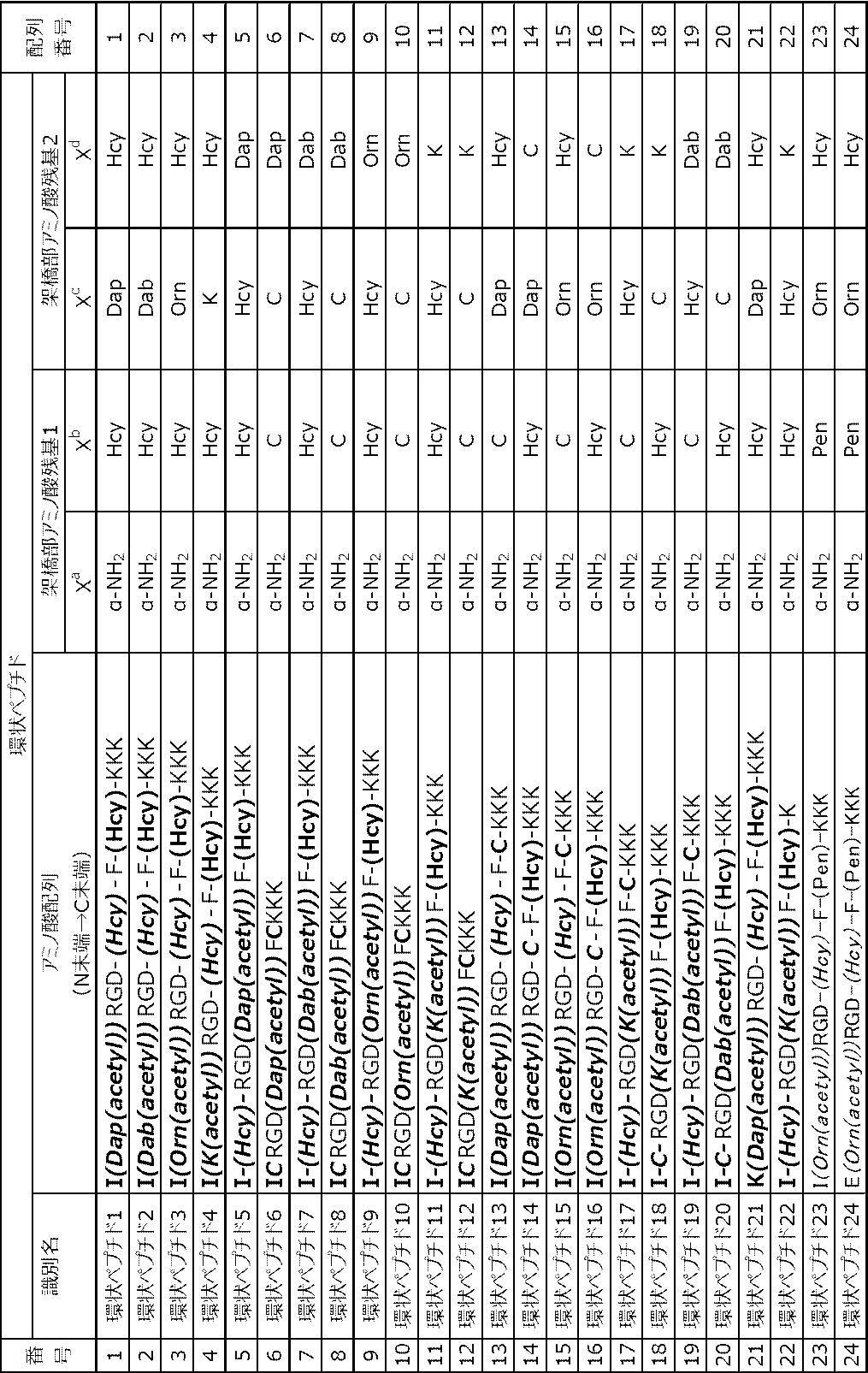
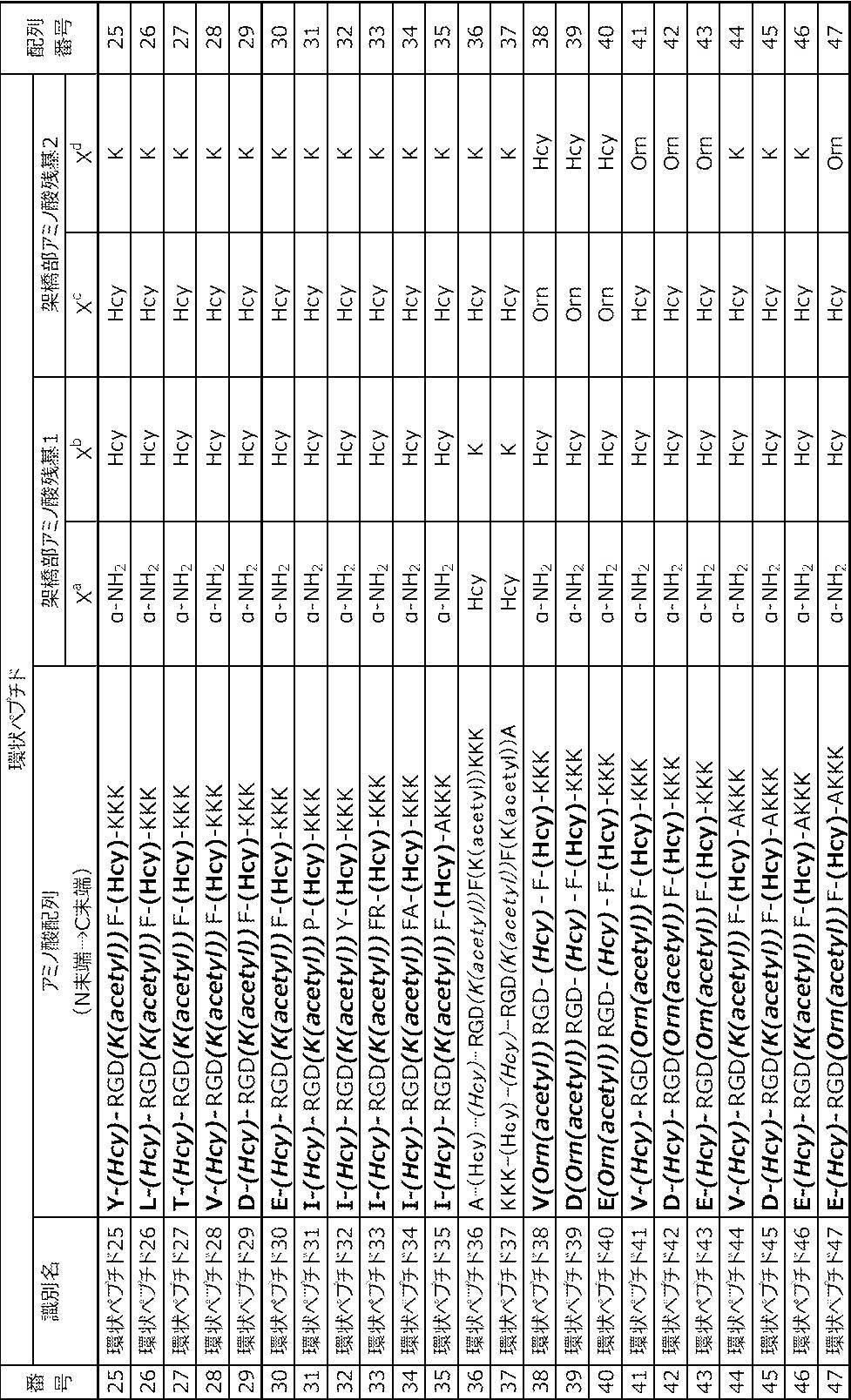
これらの中でも、環状ペプチド3、11、14~18、20、22~30、35、38~40、及び42~47が好ましく、環状ペプチド11、22、25~30、35、38~40及び42~47が好ましく、環状ペプチド29及び30がいっそう好ましい。
配列のバリエーションは、環状ペプチド全体を基準配列と考えて適用してもよい。このため、配列番号1~配列番号47のうちいずれか1つのアミノ酸配列に対してアミノ酸残基を付加、欠失又は置換したアミノ酸基も本開示に係る環状ペプチドの要件を満たす限り使用可能である。ただし、環状セグメントの中のRGD領域は改変してはならない。配列番号1~配列番号47のうちいずれか1つのアミノ酸配列にアミノ酸残基の付加、欠失又は置換を行う場合、付加、欠失又は置換したアミノ酸残基の総数は、1~10であることが好ましく、1~5であることがより好ましく、1~3であることが更に好ましく、1又は2であることが特に好ましい。
本開示に係る環状ペプチドは、配列番号1~配列番号47のうちいずれか1つのアミノ酸配列と70%以上の配列同一性を有することが好ましく、80%以上の配列同一性を有することがより好ましく、90%以上の配列同一性を有することがさらに好ましい。なお、例えば配列番号1のアミノ酸配列と70%以上の配列同一性を有するアミノ酸配列の範囲には、配列番号1のアミノ酸配列自身も含まれる。
本開示において、2つのアミノ酸配列の配列同一性は、次のようにして求める。
(i)2つのアミノ酸配列のアラインメントを行う
たとえば初期設定で使用することができるFASTA、BLAST等のアラインメントアルゴリズム及び/又はプログラムを使用して、2つの配列間のアラインメントを行うことができる。
(ii)配列同一性を計算する
得られたアラインメントに基づいて、次式により配列同一性を計算する。
配列同一性[%]=(一致ポジション数/全ポジション数)×100[%]
全ポジション数はアラインメントの長さであり、一致ポジション数はアミノ酸の種類が一致するポジションの数である。
(i)2つのアミノ酸配列のアラインメントを行う
たとえば初期設定で使用することができるFASTA、BLAST等のアラインメントアルゴリズム及び/又はプログラムを使用して、2つの配列間のアラインメントを行うことができる。
(ii)配列同一性を計算する
得られたアラインメントに基づいて、次式により配列同一性を計算する。
配列同一性[%]=(一致ポジション数/全ポジション数)×100[%]
全ポジション数はアラインメントの長さであり、一致ポジション数はアミノ酸の種類が一致するポジションの数である。
(iii)配列同一性の計算例
例えば、次のアミノ酸配列を考える。
配列A・・・AYHRGELVWE
配列B・・・SAWHGELVW
これを、上記した条件の下でアラインメントすると、次のようになる。ここで、配列A、B間でアミノ酸(残基)の種類が一致する箇所には、見やすくするため、記号「|」を付けている。また、「-」は対応するアミノ酸が無い箇所を示す。
配列A -AYHRGELVWE
| | |||||
配列B SAWH-GELVW-
この例では、全ポジション数は11であり、一致ポジション数は7であるから、上記式に従って算出した配列同一性は、7/11×100=63.6%である。
例えば、次のアミノ酸配列を考える。
配列A・・・AYHRGELVWE
配列B・・・SAWHGELVW
これを、上記した条件の下でアラインメントすると、次のようになる。ここで、配列A、B間でアミノ酸(残基)の種類が一致する箇所には、見やすくするため、記号「|」を付けている。また、「-」は対応するアミノ酸が無い箇所を示す。
配列A -AYHRGELVWE
| | |||||
配列B SAWH-GELVW-
この例では、全ポジション数は11であり、一致ポジション数は7であるから、上記式に従って算出した配列同一性は、7/11×100=63.6%である。
(細胞足場材)
本開示に係る細胞足場材は、本開示に係る環状ペプチドと、基材と、を含む。
細胞は生体内においては細胞外マトリックスによって支持されていることから、同様の状態を再現する細胞足場材として、本開示に係る環状ペプチドを使用することにより、細胞をより良好に培養することができる。
細胞培養のための上記基材としては、ポリ乳酸、ポリグリコール酸、ポリカプロラクトン等の生分解性ポリエステル類、コラーゲン若しくはその熱変性体のゼラチン、フィブロネクチン等の糖タンパク質、又はヒアルロン酸、キチン、アルギン酸等の多糖類により構成されたマトリクスが挙げられる。例えば、本開示に係る環状ペプチド中の固定化官能基を、基材中の官能基と反応させることにより、本開示に係る環状ペプチドを基材に結合させることができる。例えば、本開示に係る環状ペプチドが固定化官能基としてリシン残基のアミノ基を有する場合、アミノ基を基材上のカルボキシ基と反応させてアミド結合を形成することにより、環状ペプチドを基材に固定できる。このような手法を用いることにより、本開示に係る環状ペプチドが基材の表面に結合した細胞足場材を得ることができる。 本開示に係る環状ペプチドの量は特に限定はされないが、基材の全質量に対して0.01質量%~100質量%であってもよく、0.1質量%~50質量%であってもよい。
本開示に係る細胞足場材は、シャーレ、フラスコ、プレート(例えば、ポリスチレンウェルプレート)、培養バッグ、中空糸膜、ビーズ等の任意の培養ツール上に付与することができる。
本開示に係る細胞足場材は本開示に係る環状ペプチドを含むため、インテグリンへの良好な結合性を有し、細胞は細胞足場材に良好に接着することができる。
培養対象となる細胞としては、インテグリンを発現する生物の細胞であれば特に限定されないが、任意の動物細胞であってもよいし、任意の脊椎動物細胞であってもよいし、任意のほ乳類細胞であってもよいし、ヒトの細胞であってもよいし、ヒト以外のほ乳類の細胞であってもよい。
細胞の例としては、胚性幹(ES)細胞、人工多能性幹(iPS)細胞、周産期幹細胞、羊水由来幹細胞(AFSC)、任意の起源の間葉系幹細胞(MSC)、任意の組織型の、分化方向決定済みの前駆細胞又は成人細胞、成熟細胞、正常細胞、罹患細胞、腫瘍細胞等が挙げられる。より具体的な例としては、肝臓細胞、実質細胞、星細胞、内皮細胞、肝細胞、胆管細胞、胆樹細胞、膵臓細胞等が挙げられる。これらの細胞の例示は、後述する細胞分離材及び培地についても同様である。
(細胞分離材)
本開示に係る細胞分離材は、本開示に係る環状ペプチドと、保持材と、を含む。本開示に係る細胞分離材は、本開示に係る環状ペプチドを含むため、細胞表面のインテグリンと結合し、細胞を捕捉することができる。このため、本開示に係る細胞分離材を、例えば、アフィニティークロマトグラフィーとして用いることにより、細胞懸濁液から細胞を効率よく分離することができる。
例えば、本開示に係る環状ペプチド中の固定化官能基を、保持材中の官能基と反応させることにより、本開示に係る環状ペプチドを保持材に結合させることができる。例えば、本開示に係る環状ペプチドが固定化官能基としてリシン残基のアミノ基を有する場合、アミノ基を保持材上のカルボキシ基と反応させてアミド結合を形成することにより、環状ペプチドを保持材に固定できる。
保持材は、特に制限はなく、例えば、アガロース、デキストラン、デンプン、セルロース、プルラン、キチン、キトサン、三酢酸セルロース、及び、二酢酸セルロース等の多糖類及びその誘導体、並びに、ポリアクリルアミド、ポリメタクリルアミド、ポリアクリレート、ポリメタクリレート、ポリアルキルビニルエーテル、及び、ポリビニルアルコール等のビニル系重合体等から選ばれる材料により構成されていてもよい。
これらの材料は架橋構造を形成していてもよい。架橋構造は、機械的強度を向上させる傾向にある。
保持材は、上記の材料のうち1種類又は2種類以上の材料からなることが好ましい。
また、保持材は好ましくは多孔質であり、より好ましくは多孔質膜又は多孔質粒子であり、更に好ましくは多孔質粒子である。
これらの材料は架橋構造を形成していてもよい。架橋構造は、機械的強度を向上させる傾向にある。
保持材は、上記の材料のうち1種類又は2種類以上の材料からなることが好ましい。
また、保持材は好ましくは多孔質であり、より好ましくは多孔質膜又は多孔質粒子であり、更に好ましくは多孔質粒子である。
本開示に係る環状ペプチドを水不溶性の保持材に固定化した細胞分離材をアフィニティクロマトグラフィーに用いることもできる。
水不溶性の保持材としては、例えば、結晶性セルロース、架橋セルロース、架橋アガロース、架橋デキストラン、及び、架橋プルラン等の多糖類、アクリレート系重合体、及び、スチレン系重合体等の有機保持材、ガラスビーズ、及び、シリカゲル等の無機保持材、さらにはこれらの組合せによって得られる、有機-有機、有機-無機等の複合保持材等が挙げられる。
水不溶性保持材としては、アルカリ耐性の観点から、多糖類又はアクリレート系重合体がより好ましく、アガロース又はセルロース等の多糖類がさらに好ましい。
水不溶性保持材として用いることができる市販品としては、例えば、多孔質セルロースゲルであるセルファイン(Cellufine) GCL2000(JNC社製)(CELLUFINEは登録商標)、セルファインMAX(Cellfine MAX)(JNC社製)、アリルデキストランとメチレンビスアクリルアミドとを共有結合で架橋したセファクリル(Sephacryl) S-1000 SF(GEヘルスケア社製)(SEPHACRYLは登録商標)、アクリレート系の保持材であるトヨパール(TOYOPEARL)(東ソー(株)製)(トヨパール及びTOYOPEARLは登録商標)、トヨパール(TOYOPEARL) AF-Carboxy-650 (東ソー(株)製)、トヨパール(TOYOPEARL) GigaCap CM-650 (東ソー(株)製)、アガロース系の架橋保持材であるセファロース(Sepharose) CL4B(GEヘルスケア社製)(SEPHAROSEは登録商標)、及び、エポキシ基で活性化されたポリメタクリルアミドであるオイパーギット(Eupergit) C250L(シグマアルドリッチ社製)(EUPERGITは登録商標)等が挙げられる。
ただし、本開示における水不溶性保持材は、これらの保持材又は活性化保持材にのみ限定されるものではない。また、本開示に用いる水不溶性保持材は、本吸着材料の使用目的及び方法からみて、表面積が大きいことが好ましく、適当な大きさの細孔を多数有する多孔質であることが好ましい。保持材の形態としては、特に限定されるものではないが、ビーズ状、繊維状、膜状、及び、中空糸状等、いずれも可能であり、任意の形態を選ぶことができる。
本開示に係る環状ペプチドを水不溶性保持材に固定化する方法としては、上記のとおりリシン残基のアミノ基を用いた固定化方法が挙げられるが、これに限定されるものではない。
一般的にタンパク質又はポリペプチドを保持材に固定化する場合に採用される方法を採用することができる。例えば、保持材を臭化シアン、エピクロロヒドリン、ジグリシジルエーテル、トシルクロライド、トレシルクロライド、及び、ヒドラジン等と反応させて保持材を活性化又は保持材表面に反応性官能基を導入し、本開示に係る環状ペプチドと反応、固定化する方法、又は、保持材と本開示に係る環状ペプチドが存在する系にカルボジイミドのような縮合試薬、又はグリセルアルデヒドのように分子中に複数の官能基を持つ試薬を加えて縮合、架橋することによる固定化が挙げられる。
一般的にタンパク質又はポリペプチドを保持材に固定化する場合に採用される方法を採用することができる。例えば、保持材を臭化シアン、エピクロロヒドリン、ジグリシジルエーテル、トシルクロライド、トレシルクロライド、及び、ヒドラジン等と反応させて保持材を活性化又は保持材表面に反応性官能基を導入し、本開示に係る環状ペプチドと反応、固定化する方法、又は、保持材と本開示に係る環状ペプチドが存在する系にカルボジイミドのような縮合試薬、又はグリセルアルデヒドのように分子中に複数の官能基を持つ試薬を加えて縮合、架橋することによる固定化が挙げられる。
本開示に係る環状ペプチドを保持材に固定化する際には、本開示に係る環状ペプチドを水系溶媒(水系分散媒)又は有機系溶媒(有機系分散媒)に溶解(分散)することが好ましい。
水系溶媒(水系分散媒)としては、特に限定されるものではないが、例えば、HEPES(4-(2-hydroxyethyl)-1-piperazineethanesulfonic acid)緩衝液、酢酸緩衝液、リン酸緩衝液、クエン酸緩衝液、トリス-塩酸緩衝液等を挙げることができる。
有機系溶媒(有機系分散媒)は、特に限定されるものではないが、極性有機溶媒が好ましく、特に、DMSO(dimethyl sulfoxide;ジメチルスルホキシド)、DMF(N,N-dimethylformamide;N,N-ジメチルホルムアミド)、又は、アルコールが好ましく、例えば、メタノール、エタノール、IPA(isopropyl alcohol;イソプロピルアルコール)、TFE(2,2,2-trifluoroethanol;2,2,2-トリフルオロエタノール)、及び、HFIP(1,1,1,3,3,3-hexafluoro-2-propanol;1,1,1,3,3,3-ヘキサフルオロ-2-プロパノール)等が挙げられる。
本開示に係る環状ペプチドを固定化する際のpH条件は特に限定されず、酸性、中性、及び、アルカリ性のいずれでもよく、例えば、使用する溶媒(分散媒)に合わせて適宜設定することができる。
例えば、アルカリ性にする場合は、DBU(diazabicycloundecene;ジアザビシクロウンデセン)やTEA(triethylamine;トリエチルアミン)等の塩基をDMSO(dimethyl sulfoxide;ジメチルスルホキシド)やアルコールに添加してもよい。
上記細胞分離材をアフィニティクロマトグラフィー用充填剤とする場合の本開示に係る環状ペプチドの密度は特に限定されないが、0.1mmol/充填剤1L~1,000mmol/充填剤1Lが好ましく、0.1mmol/充填剤1L~100mmol/充填剤1Lがより好ましく、0.5mmol/充填剤1L~20mmol/充填剤1Lが更に好ましい。環状ペプチドの密度が上記範囲内であると、本開示に係る環状ペプチドの使用量と細胞分離性能のバランスがよく、より低コストで、効率よく細胞を分離することができる。
本開示に係る細胞分離材により分離される細胞は、インテグリンを発現する生物の細胞であれば特に限定されないが、任意の動物細胞であってもよく、任意の脊椎動物細胞であってもよく、任意のほ乳類細胞であってもよく、ヒトの細胞であってもヒト以外のほ乳類の細胞であってもよい。
(培地)
本開示に係る培地は、本開示に係る環状ペプチドと、培養成分と、を含む。
本開示に係る培地中に本開示に係る環状ペプチドが含まれることにより、培地中で培養される細胞のインテグリンと環状ペプチドとの結合が生じ、インテグリンからのシグナル伝達によりアポトーシス抑制を介した細胞生存率上昇などの効果が得られる。
上記培養成分とは、細胞を培養するための培地成分を指す。また、培養対象となる細胞としては、インテグリンを発現する生物の細胞であれば特に限定されないが、任意の動物細胞であってもよいし、任意の脊椎動物細胞であってもよいし、任意のほ乳類細胞であってもよいし、ヒトの細胞であってもよいしヒト以外のほ乳類の細胞であってもよい。
培養成分を含む培地としては、培養する細胞の種類に応じて適宜選択すればよく、例えば、DMEM(ダルベッコ改変イーグル培地)、MEM(イーグル最小必須培地)、F12、Ham、RPMI1640、MCDB(MCDB102、104、107、131、153、199など)、L15、SkBM(登録商標)、RITC80-7、MesenPro(ライフテクノロジーズ)などを挙げることができる。
培養成分として、上記培地等の培地を、標準的な組成のまま(例えば、市販されたままの状態で)用いてもよいし、細胞種や細胞条件に応じてその組成を適宜変更してもよい。 従って、培養成分は、公知の組成のものに限定されず、1又は2以上の成分が追加、除去、増量若しくは減量されたものでもよい。
培養成分に含まれるアミノ酸としては、特に限定されず、培養成分に含まれる公知のアミノ酸が挙げられる。例えば、L-アルギニン、L-シスチン、L-グルタミン、グリシン、L-ヒスチジン、L-イソロイシン、L-ロイシン、L-リシン、L-メチオニン、L-フェニルアラニン、L-セリン、L-トレオニン、L-トリプトファン、L-チロシン、L-バリン等が挙げられる。
培養成分に含まれるビタミン類としては、特に限定されず、例えば、D-パントテン酸カルシウム、塩化コリン、葉酸、イソイノシトール、ナイアシンアミド、リボフラビン、チアミン、ピリドキシン、ビオチン、リポ酸、ビタミンB12、アデニン、チミジンなどが挙げられる。
培養成分に含まれる電解質としては、特に限定されず、培養成分に含まれる公知の電解質が挙げられる。上記電解質としては、例えば、CaCl2、KCl、MgSO4、NaCl、NaH2PO4、NaHCO3、Fe(NO3)3、FeSO4、CuSO4、MnSO4、Na2SiO3、(NH4)6Mo7O24、NaVO3、NiCl2、ZnSO4などが挙げられる。
培養成分は、これらの成分のほか、D-グルコース等の糖類、ピルビン酸ナトリウム、フェノールレッド等のpH指示薬、プトレシン、抗生物質などを含んでいてもよい。
培養成分は、これらの成分のほか、D-グルコース等の糖類、ピルビン酸ナトリウム、フェノールレッド等のpH指示薬、プトレシン、抗生物質などを含んでいてもよい。
培養成分は、血清を含んでいてもよいし、血清を含まなくてもよい。本開示に係る培地における血清の含有量は、0体積%以上30体積%以下であることが好ましく、0体積%以上10体積%以下であることがより好ましく、0体積%以上5体積%以下であることが更に好ましく、0体積%以上2体積%以下であることが特に好ましい。
本開示に係る培地中における本開示に係る環状ペプチドの含有量は、特に限定されるものではないが、例えば0.01ng/mL~10mg/mLであり、0.1ng/mL~1mg/mLであってもよい。本開示に係る培地中においては、細胞足場材、細胞分離材の場合とは異なり、環状ペプチドを固定化する必要は特に無い。
以上説明したとおり、本開示によれば、インテグリン結合性に優れ、かつ、分子安定性、例えばアルカリ耐性に優れた環状ペプチド、並びに上記環状ペプチドを含む細胞足場材、細胞分離材及び培地を提供することができる。
本開示に係る実施態様を以下の実施例によりさらに具体的に説明するが、実施形態はこれらに限定されるものではない。
なお、実施例において「M」とは、「mol/L」を意味する。
なお、実施例において「M」とは、「mol/L」を意味する。
(1)環状ペプチドの合成
表3-1及び表3-2に記載の環状ペプチド1~47、及び、下記表4に記載の環状ペプチド48及び49を、それぞれ、全自動ペプチド合成装置(型番:PSSM-8、(株)島津製作所製)を用いて合成した。なお、実施例において作製した環状ペプチドに含まれるアミノ酸残基について光学異性体が存在する場合、アミノ酸残基はいずれもL体である。
例えば、実施例で作製したペプチド中におけるDの表記は、L-アスパラギン酸残基を表す。
表3-1及び表3-2に記載の環状ペプチド1~47、及び、下記表4に記載の環状ペプチド48及び49を、それぞれ、全自動ペプチド合成装置(型番:PSSM-8、(株)島津製作所製)を用いて合成した。なお、実施例において作製した環状ペプチドに含まれるアミノ酸残基について光学異性体が存在する場合、アミノ酸残基はいずれもL体である。
例えば、実施例で作製したペプチド中におけるDの表記は、L-アスパラギン酸残基を表す。

表4中、環状ペプチド48において、斜体の「C」と「C」とはジスルフィド結合によって架橋されたアミノ酸残基を示し、太字の字体の「K」と「C」とは、チオエーテル結合により架橋されたアミノ酸残基を示す。また、環状ペプチド49において、斜体及び太字の字体の「C」は、それぞれ、ジスルフィド結合により架橋されたアミノ酸残基を示す。
(2)環状ペプチドの固定
表面プラズモン共鳴装置(製品名:Biacore3000、GEヘルスケア社製)に市販のCM5センサーチップ(カルボキシメチルデキストラン導入タイプ、GEヘルスケア社製)をセットし、SPR(surface plasmon resonance;表面プラズモン共鳴)用HEPES(4-(2-hydroxyethyl)-1-piperazineethanesulfonic acid;ヘペス)緩衝液(20mM:HEPES-HCl、150mM:NaCl、pH7.4)を10μL/minの流速で安定させ、0.2 MのEDC(1-(3-Dimethylaminopropyl)-3-ethylcarbodiimide;1-(3-ジメチルアミノプロピル)-3-エチルカルボジイミド)と0.04 MのNHS(N-Hydroxysuccinimide;N-ヒドロキシコハク酸イミド)混合水溶液を70μL添加した。その後、HEPES緩衝液にて0.2g/Lに希釈した上記の各環状ペプチドの試料液300μLをセンサーチップに供給し、その後、エタノールアミン溶液によってブロッキング処理を施し、水酸化ナトリウム水溶液にて洗浄して、固定化を行った。ただし、固定化官能基としてのアミノ基を有するリシン残基数が1である環状ペプチド22についてのみ、センサーチップに供給する際の試料液を300μLではなく、5000μLとした。同様に、同センサーチップの別流路に試料を固定化せず、0.2MのEDCと0.04MのNHS混合水溶液を70μL添加した後、ブロッキング処理と洗浄処理を行った。得られた固定化センサーチップを、以下「固定化センサーチップA」という。
表面プラズモン共鳴装置(製品名:Biacore3000、GEヘルスケア社製)に市販のCM5センサーチップ(カルボキシメチルデキストラン導入タイプ、GEヘルスケア社製)をセットし、SPR(surface plasmon resonance;表面プラズモン共鳴)用HEPES(4-(2-hydroxyethyl)-1-piperazineethanesulfonic acid;ヘペス)緩衝液(20mM:HEPES-HCl、150mM:NaCl、pH7.4)を10μL/minの流速で安定させ、0.2 MのEDC(1-(3-Dimethylaminopropyl)-3-ethylcarbodiimide;1-(3-ジメチルアミノプロピル)-3-エチルカルボジイミド)と0.04 MのNHS(N-Hydroxysuccinimide;N-ヒドロキシコハク酸イミド)混合水溶液を70μL添加した。その後、HEPES緩衝液にて0.2g/Lに希釈した上記の各環状ペプチドの試料液300μLをセンサーチップに供給し、その後、エタノールアミン溶液によってブロッキング処理を施し、水酸化ナトリウム水溶液にて洗浄して、固定化を行った。ただし、固定化官能基としてのアミノ基を有するリシン残基数が1である環状ペプチド22についてのみ、センサーチップに供給する際の試料液を300μLではなく、5000μLとした。同様に、同センサーチップの別流路に試料を固定化せず、0.2MのEDCと0.04MのNHS混合水溶液を70μL添加した後、ブロッキング処理と洗浄処理を行った。得られた固定化センサーチップを、以下「固定化センサーチップA」という。
(3)インテグリン結合性の評価
上記(1)で作製した固体化センサーチップAの各流路に、25℃にて、5mMとなるように塩化マグネシウムを加えたHEPES緩衝液を用いて30nMに希釈したヒトインテグリンαvβ5を10分間添加した後、同緩衝液(塩化マグネシウム入り)をランニングバッファーとして30分間流し、Biacore3000による測定を行った。その後、0.5MのEDTA水溶液を10分間各流路に流すことにより、ヒトインテグリンαvβ5を除去する再生処理を行った。上記の、インテグリンを10分間添加すること、ランニングバッファーを30分間流すこと、Biacore3000により測定を行うこと、及び0.5MのEDTA水溶液により再生処理を行うことからなる測定処理を、さらに、100nMのヒトインテグリンαvβ5、300nMのヒトインテグリンαvβ5、及び1000nMのヒトインテグリンαvβ5についても同様にして行った。各濃度のヒトインテグリンαvβ5を流した際における環状ペプチド固定済みの流路におけるBiacore3000による測定値と環状ペプチド未固定の流路におけるBiacore3000による測定値の差分から、環状ペプチドとヒトインテグリンαvβ5との解離定数を算出し、下記の評価基準に従ってインテグリン結合性について評価した。評価基準A、B又はCであることが好ましい。評価結果を表5-1及び表5-2に示す。
評価基準A、B及びCである環状ペプチドを用いることにより、環状ペプチドとインテグリンとの特異的結合が可能になり、より効率的な細胞制御が可能となる。
(解離定数の評価基準)
A・・・解離定数が50nM以下である。
B・・・解離定数が50nMを超え、100nM以下である。
C・・・解離定数が100nMを超え、200nM以下である。
D・・・解離定数が200nMを超える。
A・・・解離定数が50nM以下である。
B・・・解離定数が50nMを超え、100nM以下である。
C・・・解離定数が100nMを超え、200nM以下である。
D・・・解離定数が200nMを超える。
(4)分子安定性の評価
環状ペプチドの分子安定性は、アルカリ処理した環状ペプチド水溶液をLC/MS(Liquid Chromatography Mass Spectroscopy;液体クロマトグラフィー質量分析法)により分析することで評価した。
アルカリ処理は次の方法で行った。500μMの環状ペプチド水溶液を調製し、この水溶液に当量の1M水酸化ナトリウム水溶液を加え、15℃にて20分インキュベートすることでアルカリ処理環状ペプチド水溶液を得た。アルカリ処理前の環状ペプチドのLC/MSにおける全ピークの総面積を100%とし、アルカリ処理環状ペプチド水溶液のLC/MSにおける全ピークの総面積の割合を求めることにより、環状ペプチド残存率を算出し、以下の評価基準に従って分子安定性を評価した。評価基準A、B又はCであることが好ましい。
評価結果を表5-1及び表5-2に示す。
評価基準A、B及びCである環状ペプチドを用いることにより、環状ペプチドを長期間又は繰り返し用いても細胞と特異的に結合することが出来、長期間又は繰り返しのプロセスに用いた場合でも細胞を制御することが可能となり、コストをより低減することができる。
(環状ペプチド残存率の評価基準)
A・・・環状ペプチドの残存率が70%以上である。
B・・・環状ペプチドの残存率が50%以上70%未満である。
C・・・環状ペプチドの残存率が30%以上50%未満である。
D・・・環状ペプチドの残存率が30%未満である。
A・・・環状ペプチドの残存率が70%以上である。
B・・・環状ペプチドの残存率が50%以上70%未満である。
C・・・環状ペプチドの残存率が30%以上50%未満である。
D・・・環状ペプチドの残存率が30%未満である。
なお分子安定性の評価に用いたLC/MSは以下の条件とした。
・LC装置:Prominenceシリーズ(ポンプ、カラムオーブン、オートサンプラー、検出器)((株)島津製作所製)
・MS検出器:LC/MS2010EV((株)島津製作所製)
・カラム: Cadenza CD-C18、内径2.0mm×長さ250mm、粒子径3μm(インタクト(株)製)
・溶離液A:10mM ギ酸アンモニウムを溶質として含み、溶媒は水100%の溶液(pH3)
・溶離液B:10mM ギ酸アンモニウムを溶質として含み、溶媒はアセトニトリル/水=90/10の溶液(pH3)
・流速:0.2 mL/min
・注入量:4μL
・グラジエント:0-30%:溶離液B(0-30分)、100%:溶離液B(30-40分)、0%:溶離液B(40-60分) (Bは溶離液Bを表す)
・カラム温度:45℃
・イオン化法:ESI(Electrospray Ionization;エレクトロスプレーイオン化)ポジティブ、ESIネガティブ


表5-1及び表5-2に記載の結果から、本開示に係る環状ペプチドは、比較例の環状ペプチドに比べ、分子安定性に優れることが分かる。全ての実施例において、環状ペプチドの残存率の値は50%以上(評価B以上)であったのに対し、全ての比較例において環状ペプチドの残存率の値は実際の値としては25%以下であった。以上より、本開示に係る環状ペプチドは、インテグリン結合性及び分子安定性の両方に優れることが分かる。
次に上記で得られた環状ペプチドを用いて、本開示に係る細胞足場材を作製し、この細胞足場材を用いてiPS細胞培養実験を行った。
(ポリスチレンプレートの表面処理)
プラズマ処理装置((株)魁半導体社製:SCB-106)を用いて、アンモニアガス中でガス圧力10Pa、出力700W、処理時間5分の条件で、ポリスチレン製6ウェルプレート(コーニング社製)の表面処理を実施した。
プラズマ処理装置((株)魁半導体社製:SCB-106)を用いて、アンモニアガス中でガス圧力10Pa、出力700W、処理時間5分の条件で、ポリスチレン製6ウェルプレート(コーニング社製)の表面処理を実施した。
(CMDコーティングウェルの作製)
カルボキシメチルデキストランナトリウム(名糖産業(株)製、商品名:「CMD」、分子量:100万、以下「CMD」ともいう。)0.5gに蒸留水9.5gを加えて攪拌し、十分に溶解させ、5質量%のCMD溶液を調製した。
次いで、1-エチル-3-(3-ジメチルアミノプロピル)カルボジイミド塩酸塩(以下、「EDC」ともいう。)(ナカライテスク(株)製)383.4mgに蒸留水1mLを加えてEDC溶液を調製した。次いで、N-ヒドロキシこはく酸イミド(以下、「NHS」ともいう。)(富士フイルム和光純薬(株)製)57.5mgに蒸留水1mLを加えてNHS溶液を調製した。
次いで、上記で調製したCMD溶液10gに、EDC溶液0.05mL、NHS溶液0.05mLを加えて攪拌して、得られたCMD含有コーティング液をすぐに上記で表面処理したポリスチレンプレートの1つのウェルに1mLずつ滴下した。ポリスチレンプレートを室温で1時間静置した後、蒸留水でウェルを充分に洗浄してCMD含有コーティング液を除去し、CMDコーティングウェルを作製した。
(リガンドコーティングウェルの作製)
環状ペプチド11:0.2mgにHBS-Nバッファー(GEヘルスケアジャパン(株)製)1mLを加えて環状ペプチド溶液を調製した。次いで、EDC76.7mgに蒸留水1mLを加えてEDC溶液を調製した。次いで、NHS:11.5mgに蒸留水1mLを加えてNHS溶液を調製した。次いで、エタノールアミン(BIO RAD社製、商品名:「ProteOn エタノールアミン HCL」)1mLに蒸留水1mLを加えてエタノールアミン溶液を調製した。
次いで、上記で調製したEDC溶液:0.5mLに、NHS溶液0.5mLを加えて攪拌し、得られた混合液をすぐに上記CMDコーティングウェルに1mL滴下した。ポリスチレンプレートを7分間静置した後、蒸留水でウェルを充分に洗浄して、混合液を除去した。さらに、環状ペプチド溶液15:1mLをウェルに滴下し、60分間静置した後、蒸留水でウェルを充分に洗浄して環状ペプチド溶液を除去した。さらに、エタノールアミン溶液1mLをウェルに滴下し、7分間静置した後、蒸留水でウェルを充分に洗浄してエタノールアミン溶液を除去し、環状ペプチド11が基材としてのCMD上に固定された細胞足場材を有するウェル(以下、「リガンドコーティングウェル」ともいう。)を得た。
(γ線滅菌処理)
上記で作製したリガンドコーティングウェルを滅菌バッグに密閉し、ラジエ工業(株)製の照射施設1号機にて線量25kGyの条件でγ線滅菌処理を実施した。
これにより、「γ線照射済み細胞足場材A」を作製した。
上記で作製したリガンドコーティングウェルを滅菌バッグに密閉し、ラジエ工業(株)製の照射施設1号機にて線量25kGyの条件でγ線滅菌処理を実施した。
これにより、「γ線照射済み細胞足場材A」を作製した。
-ペプチドのiPS細胞培養性能の評価-
iPS細胞はFujifilm Cellular Dynamics社によって樹立された01434クローンを使用した。γ線照射済み細胞足場材Aを表面に有した培養ポリスチレンプレートに、iPS細胞をsplit rate =1:6で播種し、フィーダーフリーのES及びiPS細胞培養用培地m(Stem Cell Technologies社製、製品名:mTeSR1)中で3日間培養したのち、細胞解離試薬(Thermo Fisher社、製品名:TrypLE Select)を用いた処理にてiPS細胞を単細胞剥離して回収した。得られた細胞懸濁液から、生死細胞オートアナライザー(ベックマンコールター社製、製品名:Vi-Cell XR)を用いて細胞数を計測し、細胞が増殖したか否かを判定した。
上記結果から実施例11のペプチドを用いた細胞足場材は、iPS細胞が増殖したことが確認された。これより、本開示に係る環状ペプチドがインテグリン結合性に優れるので、細胞足場材として機能を有することを示している。
2019年6月11日に出願された日本国特許出願2019-108953の開示は、その全体が参照により本明細書に取り込まれる。
本明細書に記載された全ての文献、特許出願、および技術規格は、個々の文献、特許出願、および技術規格が参照により取り込まれることが具体的かつ個々に記された場合と同程度に、本明細書中に参照により取り込まれる。
本明細書に記載された全ての文献、特許出願、および技術規格は、個々の文献、特許出願、および技術規格が参照により取り込まれることが具体的かつ個々に記された場合と同程度に、本明細書中に参照により取り込まれる。
Claims (15)
- 下記式(1)で表されるアミノ酸配列を有する、環状ペプチド。

式(1)中、Xa及びXb並びにXc及びXdは、それぞれ独立に、チオエーテル結合を介して架橋されたアミノ酸残基を表し、
X1~X5は、それぞれ独立に、アミノ酸残基を表し、
Rはアルギニン残基を表し、Gはグリシン残基を表し、Dはアスパラギン酸残基を表し、
m1~m5は、それぞれ独立に、0以上の整数を表す。ただし、Xa、Xb、Xc及びXd並びに、X1、X3及びX4で表されるアミノ酸残基とRGDとの合計アミノ酸残基数は、7~16である。 - 前記式(1)におけるX2及びX5が、側鎖に固定化官能基を有するアミノ酸に由来するアミノ酸残基を含む、請求項1に記載の環状ペプチド。
- 前記固定化官能基が、アミノ基、又は、チオール基である、請求項2に記載の環状ペプチド。
- 前記側鎖に固定化官能基を有するアミノ酸が、L-リシン、D-リシン、L-システイン、D-システイン、L-ホモシステインおよびD-ホモシステインからなる群から選択される少なくとも1種のアミノ酸である、請求項2又は請求項3に記載の環状ペプチド。
- 前記式(1)におけるXc及びXdのいずれか一方が、(2S)-2-アミノ-3-[(2-アセチル)アミノ]プロパン酸、(2R)-2-アミノ-3-[(2-アセチル)アミノ]プロパン酸、(2S)-2-アミノ-4-[(2-アセチル)アミノ]ブタン酸、(2R)-2-アミノ-4-[(2-アセチル)アミノ]ブタン酸、N-δ-アセチル-L-オルニチン、N-δ-アセチル-D-オルニチン、N-ε-アセチル-L-リシン、及び、N-ε-アセチル-D-リシンからなる群から選択されるアミノ酸に由来するアミノ酸残基であり、他方が、L-ホモシステイン、D-ホモシステイン、L-ペニシラミン、又は、D-ペニシラミンに由来するアミノ酸残基である、請求項1~請求項4のいずれか1項に記載の環状ペプチド。
- 前記式(1)におけるXbが、L-ホモシステイン、D-ホモシステイン、L-ペニシラミン、又は、D-ペニシラミンに由来するアミノ酸残基である、請求項1~請求項5のいずれか1項に記載の環状ペプチド。
- 前記式(1)で表されるアミノ酸配列が、下記式(2)で表されるアミノ酸配列である、請求項1~請求項6のいずれか1項に記載の環状ペプチド。
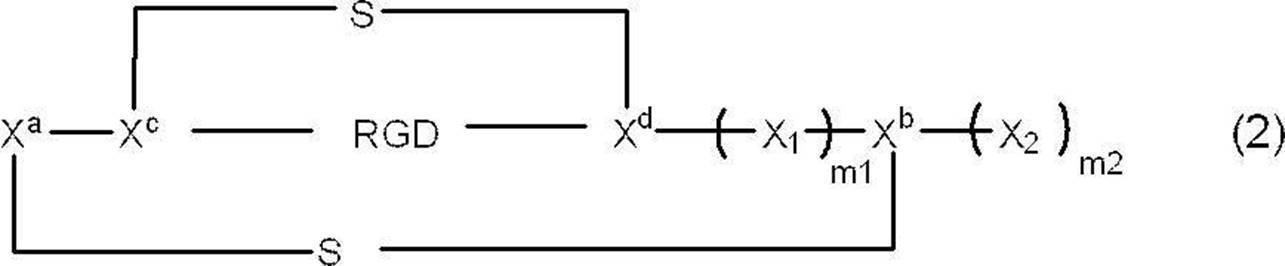
式(2)中、Xa及びXb並びにXc及びXdは、それぞれ独立に、チオエーテル結合を介して架橋されたアミノ酸残基を表し、
X1及びX2は、それぞれ独立に、アミノ酸残基を表し、
Rはアルギニン残基を表し、Gはグリシン残基を表し、Dはアスパラギン酸残基を表し、m1及びm2は、それぞれ独立に、1以上の整数を表す。ただし、Xa、Xb、Xc及びXd並びに、X1で表されるアミノ酸残基とRGDとの合計アミノ酸残基数は、7~14である。 - 前記式(2)におけるXc及びXdのいずれか一方が、(2S)-2-アミノ-3-[(2-アセチル)アミノ]プロパン酸、(2R)-2-アミノ-3-[(2-アセチル)アミノ]プロパン酸、(2S)-2-アミノ-4-[(2-アセチル)アミノ]ブタン酸、(2R)-2-アミノ-4-[(2-アセチル)アミノ]ブタン酸、N-δ-アセチル-L-オルニチン、N-δ-アセチル-D-オルニチン、N-ε-アセチル-L-リシン、及び、N-ε-アセチル-D-リシンからなる群から選択される側鎖にアセチル基を有するアミノ酸に由来するアミノ酸残基であり、他方が、L-ホモシステイン、D-ホモシステイン、L-ペニシラミン、又は、D-ペニシラミンに由来するアミノ酸残基である、請求項7に記載の環状ペプチド。
- 前記式(2)におけるXbが、L-ホモシステイン、D-ホモシステイン、L-ペニシラミン、又は、D-ペニシラミンに由来するアミノ酸残基である、請求項7又は請求項8に記載の環状ペプチド。
- 前記式(2)におけるXaが、下記構造(r)で表されるアミノ酸残基である、請求項7~請求項9のいずれか1項に記載の環状ペプチド。
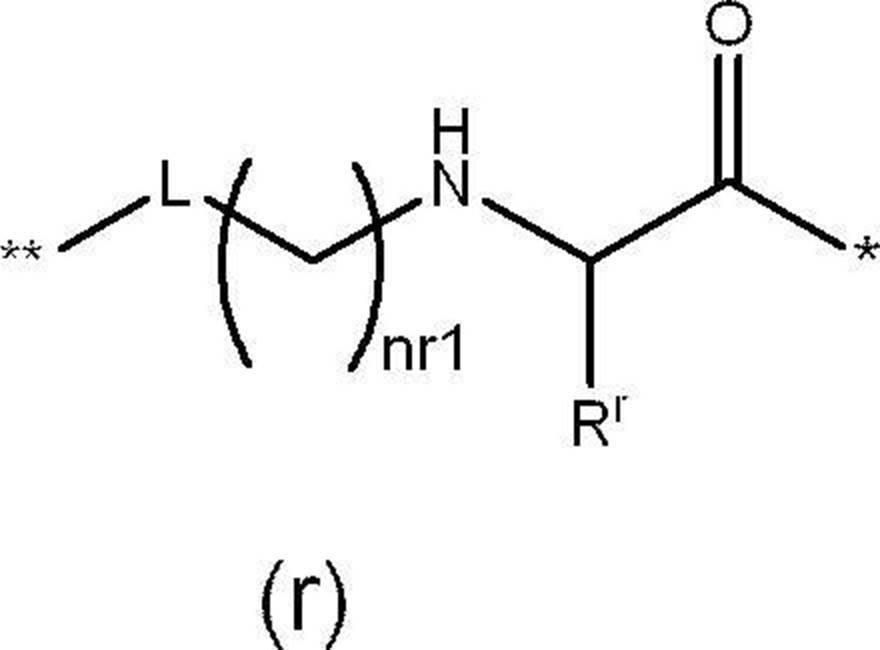
構造式(r)中、Rrは水素原子又は1価の有機基を表し、Lは、-(CH2)L1-C(=O)-、又は、-(CH2)L1-C(=O)-NH-で表される2価の連結基を表し、L1は0以上10以下の整数を表し、nr1は、0以上の整数を表し、*は隣接するアミノ酸残基との結合部位を表し、**はチオエーテル結合における硫黄原子との結合部位を表す。 - 前記式(2)におけるXbが、L-ホモシステイン、D-ホモシステイン、L-ペニシラミン、又は、D-ペニシラミンに由来するアミノ酸残基であり、Xaが、(2S)-2-アミノ-3-[(2-アセチル)アミノ]プロパン酸、(2R)-2-アミノ-3-[(2-アセチル)アミノ]プロパン酸、(2S)-2-アミノ-4-[(2-アセチル)アミノ]ブタン酸、(2R)-2-アミノ-4-[(2-アセチル)アミノ]ブタン酸、N-δ-アセチル-L-オルニチン、N-δ-アセチル-D-オルニチン、N-ε-アセチル-L-リシン、N-ε-アセチル-D-リシン、及び、(2S,3S)-2-[(アセチル)アミノ]-3-メチル-ペンタン酸からなる群から選択されるアミノ酸に由来するアミノ酸残基である、請求項7~請求項10のいずれか1項に記載の環状ペプチド。
- Xaはα炭素にアセチル基が結合した任意のアミノ酸に由来するアミノ酸残基であり、Xbはホモシステインに由来するアミノ酸残基であり、Xcはホモシステインに由来するアミノ酸残基であり、XdはN-δ-アセチル-オルニチンに由来するアミノ酸残基又はN-ε-アセチル-リシンに由来するアミノ酸残基であり、(X1)m1は、全体でFであるか、又は
Xaはα炭素にアセチル基が結合した任意のアミノ酸に由来するアミノ酸残基であり、Xbはホモシステインに由来するアミノ酸残基であり、XcはN-δ-アセチル-オルニチンに由来するアミノ酸残基又はN-ε-アセチル-リシンに由来するアミノ酸残基であり、Xdはホモシステインに由来するアミノ酸残基であり、(X1)m1は、全体でFである、請求項1~11のいずれか1項に記載の環状ペプチド。 - 請求項1~請求項12のいずれか1項に記載の環状ペプチドと、
基材と、
を含む、細胞足場材。 - 請求項1~請求項12のいずれか1項に記載の環状ペプチドと、
保持材と、
を含む、細胞分離材。 - 請求項1~請求項12のいずれか1項に記載の環状ペプチドと、
培養成分と、
を含む、培地。
Priority Applications (4)
| Application Number | Priority Date | Filing Date | Title |
|---|---|---|---|
| EP20823384.1A EP3967703B1 (en) | 2019-06-11 | 2020-06-08 | Cyclic peptide, cell scaffold material, cell separation material and culture medium |
| JP2021526080A JP7230197B2 (ja) | 2019-06-11 | 2020-06-08 | 環状ペプチド、細胞足場材、細胞分離材、及び、培地 |
| CN202080042692.XA CN113993880A (zh) | 2019-06-11 | 2020-06-08 | 环肽、细胞支架材料、细胞分离材料及培养基 |
| US17/643,527 US12624067B2 (en) | 2019-06-11 | 2021-12-09 | Cyclic peptide, cell scaffold material, cell separating material, and medium |
Applications Claiming Priority (2)
| Application Number | Priority Date | Filing Date | Title |
|---|---|---|---|
| JP2019-108953 | 2019-06-11 | ||
| JP2019108953 | 2019-06-11 |
Related Child Applications (1)
| Application Number | Title | Priority Date | Filing Date |
|---|---|---|---|
| US17/643,527 Continuation US12624067B2 (en) | 2019-06-11 | 2021-12-09 | Cyclic peptide, cell scaffold material, cell separating material, and medium |
Publications (1)
| Publication Number | Publication Date |
|---|---|
| WO2020250855A1 true WO2020250855A1 (ja) | 2020-12-17 |
Family
ID=73781117
Family Applications (1)
| Application Number | Title | Priority Date | Filing Date |
|---|---|---|---|
| PCT/JP2020/022559 Ceased WO2020250855A1 (ja) | 2019-06-11 | 2020-06-08 | 環状ペプチド、細胞足場材、細胞分離材、及び、培地 |
Country Status (5)
| Country | Link |
|---|---|
| US (1) | US12624067B2 (ja) |
| EP (1) | EP3967703B1 (ja) |
| JP (1) | JP7230197B2 (ja) |
| CN (1) | CN113993880A (ja) |
| WO (1) | WO2020250855A1 (ja) |
Cited By (1)
| Publication number | Priority date | Publication date | Assignee | Title |
|---|---|---|---|---|
| WO2026009924A1 (ja) * | 2024-07-03 | 2026-01-08 | 中外製薬株式会社 | ペプチド化合物に含まれるオリゴマーの分析方法 |
Families Citing this family (2)
| Publication number | Priority date | Publication date | Assignee | Title |
|---|---|---|---|---|
| WO2020250854A1 (ja) * | 2019-06-11 | 2020-12-17 | 富士フイルム株式会社 | 環状ペプチド、細胞足場材、細胞分離材、及び培地 |
| WO2023215909A2 (en) * | 2022-05-05 | 2023-11-09 | Purdue Research Foundation | Functionalized molecular layers and scaffolds, and methods of preparation and use thereof |
Citations (6)
| Publication number | Priority date | Publication date | Assignee | Title |
|---|---|---|---|---|
| JPH06509551A (ja) | 1991-04-05 | 1994-10-27 | ジェネンテク,インコーポレイテッド | Gp II↓bIII↓aに対する高い特異性を有する血小板凝集阻害剤 |
| JPH10503205A (ja) * | 1994-07-21 | 1998-03-24 | マリンクロッド・メディカル・インコーポレイテッド | ジスルフィド結合含有生物活性ペプチドの安定類似体 |
| JP2005507376A (ja) | 2001-07-10 | 2005-03-17 | アメルシャム ヘルス アクスイェ セルスカプ | ペプチドベースの化合物 |
| JP2007505145A (ja) * | 2003-09-10 | 2007-03-08 | キングズ カレッジ ロンドン | ニューロンの成長を調節する化合物およびそれらの使用 |
| JP2017095443A (ja) * | 2015-10-23 | 2017-06-01 | 富士フイルム株式会社 | 環状ペプチド、アフィニティクロマトグラフィー担体、標識化抗体、抗体薬物複合体、および医薬製剤 |
| JP2019108953A (ja) | 2017-12-20 | 2019-07-04 | 藤倉コンポジット株式会社 | バルブ装置及びバルブシート |
Family Cites Families (1)
| Publication number | Priority date | Publication date | Assignee | Title |
|---|---|---|---|---|
| LT3105328T (lt) * | 2014-02-11 | 2020-07-10 | The Regents Of The University Of Colorado, A Body Corporate | Daugiakomponentis genomo konstravimas, sudarantis sąlygas crispr |
-
2020
- 2020-06-08 EP EP20823384.1A patent/EP3967703B1/en active Active
- 2020-06-08 WO PCT/JP2020/022559 patent/WO2020250855A1/ja not_active Ceased
- 2020-06-08 JP JP2021526080A patent/JP7230197B2/ja active Active
- 2020-06-08 CN CN202080042692.XA patent/CN113993880A/zh active Pending
-
2021
- 2021-12-09 US US17/643,527 patent/US12624067B2/en active Active
Patent Citations (6)
| Publication number | Priority date | Publication date | Assignee | Title |
|---|---|---|---|---|
| JPH06509551A (ja) | 1991-04-05 | 1994-10-27 | ジェネンテク,インコーポレイテッド | Gp II↓bIII↓aに対する高い特異性を有する血小板凝集阻害剤 |
| JPH10503205A (ja) * | 1994-07-21 | 1998-03-24 | マリンクロッド・メディカル・インコーポレイテッド | ジスルフィド結合含有生物活性ペプチドの安定類似体 |
| JP2005507376A (ja) | 2001-07-10 | 2005-03-17 | アメルシャム ヘルス アクスイェ セルスカプ | ペプチドベースの化合物 |
| JP2007505145A (ja) * | 2003-09-10 | 2007-03-08 | キングズ カレッジ ロンドン | ニューロンの成長を調節する化合物およびそれらの使用 |
| JP2017095443A (ja) * | 2015-10-23 | 2017-06-01 | 富士フイルム株式会社 | 環状ペプチド、アフィニティクロマトグラフィー担体、標識化抗体、抗体薬物複合体、および医薬製剤 |
| JP2019108953A (ja) | 2017-12-20 | 2019-07-04 | 藤倉コンポジット株式会社 | バルブ装置及びバルブシート |
Non-Patent Citations (2)
| Title |
|---|
| BARKER, P. L. ET AL.: "Cyclic RGD peptide analogues as antiplatelet antithrombotics", J. MED. CHEM., vol. 35, 1992, pages 2040 - 2048, XP002046959, ISSN: 0022-2623, DOI: 10.1021/jm00089a014 * |
| BIOCONJUGATE CHEM, vol. 6, 1995, pages 269 - 277 |
Cited By (1)
| Publication number | Priority date | Publication date | Assignee | Title |
|---|---|---|---|---|
| WO2026009924A1 (ja) * | 2024-07-03 | 2026-01-08 | 中外製薬株式会社 | ペプチド化合物に含まれるオリゴマーの分析方法 |
Also Published As
| Publication number | Publication date |
|---|---|
| JPWO2020250855A1 (ja) | 2020-12-17 |
| EP3967703A4 (en) | 2022-07-06 |
| EP3967703B1 (en) | 2023-07-26 |
| CN113993880A (zh) | 2022-01-28 |
| JP7230197B2 (ja) | 2023-02-28 |
| EP3967703A1 (en) | 2022-03-16 |
| US12624067B2 (en) | 2026-05-12 |
| US20220098240A1 (en) | 2022-03-31 |
Similar Documents
| Publication | Publication Date | Title |
|---|---|---|
| US12624067B2 (en) | Cyclic peptide, cell scaffold material, cell separating material, and medium | |
| Liu et al. | Biomimetic hydrogels for chondrogenic differentiation of human mesenchymal stem cells to neocartilage | |
| CN108137651A (zh) | 环肽、亲和层析载体、标记抗体、抗体药物复合物及药物制剂 | |
| JP2009040782A (ja) | 新規なポリペプチドおよびその製造方法 | |
| CN109790202A (zh) | 环肽、亲和层析载体、标记抗体、抗体药物复合体及药物制剂 | |
| JP2011030453A (ja) | 細胞の生産方法 | |
| US20260008818A1 (en) | Cyclic peptide or salt thereof, and uses thereof | |
| WO2012133610A1 (ja) | 細胞接着性タンパク質 | |
| JP7220782B2 (ja) | 環状ペプチド、細胞足場材、細胞分離材、及び培地 | |
| JP6906547B2 (ja) | ミックスモードアフィニティクロマトグラフィー用担体 | |
| JP6024101B2 (ja) | 血液凝固因子又は細胞接着因子に対する吸着剤及び精製方法 | |
| WO2013002311A1 (ja) | 幹細胞培養用基材及びそれを用いた培養方法 | |
| US20260008817A1 (en) | Cyclic peptide or salt thereof, and uses thereof | |
| US20260008815A1 (en) | Cyclic peptide or salt thereof, and uses thereof | |
| ES2355744T3 (es) | Ligadura extendida de cadena lateral. | |
| JPH04213308A (ja) | プロペンアミド誘導体とアニオン性単量体との共重合物およびその用途 | |
| JPH04213312A (ja) | プロペンアミド誘導体とカチオン性単量体との共重合物およびその用途 | |
| JPH051712B2 (ja) |
Legal Events
| Date | Code | Title | Description |
|---|---|---|---|
| 121 | Ep: the epo has been informed by wipo that ep was designated in this application |
Ref document number: 20823384 Country of ref document: EP Kind code of ref document: A1 |
|
| ENP | Entry into the national phase |
Ref document number: 2021526080 Country of ref document: JP Kind code of ref document: A |
|
| NENP | Non-entry into the national phase |
Ref country code: DE |
|
| ENP | Entry into the national phase |
Ref document number: 2020823384 Country of ref document: EP Effective date: 20211210 |