WO2020251236A1 - Procédé, dispositif et programme de récupération de données d'image à l'aide d'un algorithme d'apprentissage profond - Google Patents
Procédé, dispositif et programme de récupération de données d'image à l'aide d'un algorithme d'apprentissage profond Download PDFInfo
- Publication number
- WO2020251236A1 WO2020251236A1 PCT/KR2020/007439 KR2020007439W WO2020251236A1 WO 2020251236 A1 WO2020251236 A1 WO 2020251236A1 KR 2020007439 W KR2020007439 W KR 2020007439W WO 2020251236 A1 WO2020251236 A1 WO 2020251236A1
- Authority
- WO
- WIPO (PCT)
- Prior art keywords
- appearance
- image data
- individual
- characteristic
- server
- Prior art date
- Legal status (The legal status is an assumption and is not a legal conclusion. Google has not performed a legal analysis and makes no representation as to the accuracy of the status listed.)
- Ceased
Links
Images




Classifications
-
- G—PHYSICS
- G06—COMPUTING OR CALCULATING; COUNTING
- G06F—ELECTRIC DIGITAL DATA PROCESSING
- G06F16/00—Information retrieval; Database structures therefor; File system structures therefor
- G06F16/50—Information retrieval; Database structures therefor; File system structures therefor of still image data
- G06F16/58—Retrieval characterised by using metadata, e.g. metadata not derived from the content or metadata generated manually
- G06F16/583—Retrieval characterised by using metadata, e.g. metadata not derived from the content or metadata generated manually using metadata automatically derived from the content
- G06F16/5838—Retrieval characterised by using metadata, e.g. metadata not derived from the content or metadata generated manually using metadata automatically derived from the content using colour
-
- G—PHYSICS
- G06—COMPUTING OR CALCULATING; COUNTING
- G06F—ELECTRIC DIGITAL DATA PROCESSING
- G06F16/00—Information retrieval; Database structures therefor; File system structures therefor
- G06F16/50—Information retrieval; Database structures therefor; File system structures therefor of still image data
- G06F16/55—Clustering; Classification
-
- G—PHYSICS
- G06—COMPUTING OR CALCULATING; COUNTING
- G06F—ELECTRIC DIGITAL DATA PROCESSING
- G06F16/00—Information retrieval; Database structures therefor; File system structures therefor
- G06F16/50—Information retrieval; Database structures therefor; File system structures therefor of still image data
- G06F16/58—Retrieval characterised by using metadata, e.g. metadata not derived from the content or metadata generated manually
- G06F16/583—Retrieval characterised by using metadata, e.g. metadata not derived from the content or metadata generated manually using metadata automatically derived from the content
-
- G—PHYSICS
- G06—COMPUTING OR CALCULATING; COUNTING
- G06F—ELECTRIC DIGITAL DATA PROCESSING
- G06F16/00—Information retrieval; Database structures therefor; File system structures therefor
- G06F16/50—Information retrieval; Database structures therefor; File system structures therefor of still image data
- G06F16/58—Retrieval characterised by using metadata, e.g. metadata not derived from the content or metadata generated manually
- G06F16/583—Retrieval characterised by using metadata, e.g. metadata not derived from the content or metadata generated manually using metadata automatically derived from the content
- G06F16/5854—Retrieval characterised by using metadata, e.g. metadata not derived from the content or metadata generated manually using metadata automatically derived from the content using shape and object relationship
-
- G—PHYSICS
- G06—COMPUTING OR CALCULATING; COUNTING
- G06N—COMPUTING ARRANGEMENTS BASED ON SPECIFIC COMPUTATIONAL MODELS
- G06N20/00—Machine learning
-
- G—PHYSICS
- G06—COMPUTING OR CALCULATING; COUNTING
- G06N—COMPUTING ARRANGEMENTS BASED ON SPECIFIC COMPUTATIONAL MODELS
- G06N3/00—Computing arrangements based on biological models
- G06N3/02—Neural networks
- G06N3/04—Architecture, e.g. interconnection topology
- G06N3/0464—Convolutional networks [CNN, ConvNet]
-
- G—PHYSICS
- G06—COMPUTING OR CALCULATING; COUNTING
- G06N—COMPUTING ARRANGEMENTS BASED ON SPECIFIC COMPUTATIONAL MODELS
- G06N3/00—Computing arrangements based on biological models
- G06N3/02—Neural networks
- G06N3/08—Learning methods
-
- G—PHYSICS
- G06—COMPUTING OR CALCULATING; COUNTING
- G06N—COMPUTING ARRANGEMENTS BASED ON SPECIFIC COMPUTATIONAL MODELS
- G06N3/00—Computing arrangements based on biological models
- G06N3/02—Neural networks
- G06N3/08—Learning methods
- G06N3/082—Learning methods modifying the architecture, e.g. adding, deleting or silencing nodes or connections
-
- G—PHYSICS
- G06—COMPUTING OR CALCULATING; COUNTING
- G06N—COMPUTING ARRANGEMENTS BASED ON SPECIFIC COMPUTATIONAL MODELS
- G06N3/00—Computing arrangements based on biological models
- G06N3/02—Neural networks
- G06N3/08—Learning methods
- G06N3/09—Supervised learning
Definitions
- the present invention relates to an image data search method, apparatus, and program using a deep learning algorithm.
- CBIR Content-based Image Retrieval
- Text-based Image Retrieval is a method of searching for images corresponding to text by querying text.
- the visual content of the image is represented by a manually tagged text descriptor, and is used to perform image search in a database management system. That is, in the existing image or video search method, a search is performed based on information directly tagged by a user. There is a problem that the search result is inaccurate when the user incorrectly tags the keyword in the video.
- there may be differences in keywords defined for each user there is a problem that the results provided according to the keywords selected by the user searching for images are different.
- the present invention for solving the above-described problem is to provide an image data search method, apparatus, and program using a deep learning algorithm that accurately extracts image data desired by a user based on abstract terms representing the appearance of a specific object. .
- the present invention provides an image data retrieval method, apparatus, and program using a deep learning algorithm that can be transformed with a minimum amount of additional training data in a situation where the external characteristic recognition model needs to be modified such as a change in the definition of an abstract term. I want to provide.
- the server inputs the image data into an appearance characteristic recognition model, and individual appearance characteristics for a plurality of appearance classification criteria are calculated. Calculating, and generating appearance description data by combining a plurality of individual appearance characteristics calculated for the image data by the server, wherein the appearance classification standard is a specific classification standard for describing the appearance of a specific object. , It may include a plurality of individual appearance characteristics expressing various appearance characteristics within the same classification criteria of the object.
- the appearance characteristic recognition model includes a plurality of individual characteristic recognition modules for determining different appearance classification criteria, and the individual characteristic recognition module calculates individual appearance characteristics included in a specific appearance classification standard, and the individual appearance classification criteria
- the step of calculating the characteristic may include inputting the image data to each individual characteristic recognition module in the external characteristic recognition model to calculate a plurality of individual external characteristics of the image data.
- the step of generating the outline description data includes extracting a code value corresponding to each of the plurality of individual appearance characteristics, and combining the plurality of code values to generate outline description data in the form of a code string.
- the server inputs the image data to the object type recognition model, further comprising the step of calculating the object type information, the step of calculating the individual appearance characteristics, the calculated Characterized in that, by inputting the image data into a specialized external characteristic recognition model corresponding to the object type information, a plurality of individual external characteristics are calculated, and the specialized external characteristic recognition model is preset to be applied according to the specific object type information.
- It may be an appearance characteristic recognition model including individual characteristic recognition modules of a plurality of appearance classification criteria.
- the server when it is not possible to calculate individual appearance characteristics with respect to the external appearance classification criteria of the specialized external characteristic recognition model, the server re-enters the image data into the object type recognition model to calculate object type information different from the previous one. It may further include.
- the server may further include calculating an abstract characteristic based on the calculated plurality of individual appearance characteristics, and the appearance description data may further include the abstract characteristic calculated for the image data.
- a score for each of a plurality of abstract characteristics is set for each individual appearance characteristic, and each abstract characteristic is determined by the server based on the plurality of individual appearance characteristics calculated for the image data. It could be summing up scores for features.
- the method may further include extracting image data corresponding to a combination of appearance classification criteria matched with an abstract characteristic corresponding to the search keyword from a matching algorithm.
- the step of generating the appearance description data includes generating the appearance description data by combining the input individual appearance characteristics and the calculated individual appearance characteristics.
- the input individual appearance characteristics are obtained for the unlearned appearance classification criteria from an image provider client or an expert client that provided the image data, and the calculated individual appearance characteristics are calculated by inputting the image data to the individual characteristic recognition module. It may have been.
- the server acquires individual appearance characteristics of the new appearance classification standard for the training image data, and constructs a new learning data set, and the server performs the new learning data set. It may further include the step of training a new individual feature recognition module based on and adding it to the external feature recognition model.
- the step of adding detailed information for the new appearance classification criteria by inputting the image data from which the external appearance description data has been obtained by the individual characteristic recognition module already established in the server to the new individual characteristic recognition module, and the server to each abstract characteristic may further include updating the matching algorithm by matching individual appearance characteristics of the new appearance classification criteria.
- the server may further include setting a personalized abstract characteristic based on the external description data of the selected image data.
- the server obtains the reference image data from the user client, the reference image data is a reference image data acquisition step, the reference image data, which is a reference for searching for images including those having similar appearance characteristics among the same object.
- the server By inputting into an external appearance characteristic recognition model, calculating individual appearance characteristics for a plurality of appearance classification criteria, a server generating appearance description data by combining a plurality of individual appearance characteristics with respect to the reference image data, and the server It may further include the step of extracting the image data including the outline description data identical to the reference image data.
- An image data search server apparatus for solving the above-described problems includes one or more computers and executes the aforementioned image data search method.
- the image data search program according to another embodiment of the present invention for solving the above-described problems is combined with a computer that is hardware to execute the aforementioned image data search method, and is stored in a medium.
- image data corresponding to the corresponding abstract characteristic is retrieved. It can be automatically extracted and provided.
- each input image without additional learning is obtained when new input image data is acquired (for example, when new products are continuously added to the shopping mall page).
- Appearance description data for the data can be created so that it can be searched based on abstract characteristics.
- the external feature recognition model needs to be retrained or additionally learned. For example, if the definition of the external characteristics of an abstract term is different, only individual external characteristic combinations (i.e., external description information) matched to the abstract term (i.e., abstract characteristic) are modified without the need to perform new learning, Search can be made according to the changed definition. That is, even if the definition of the abstract feature is different, it is not necessary to additionally learn the individual feature recognition module. In addition, for example, when a new appearance classification criterion is added for a specific object, only a new individual characteristic recognition module needs to be learned, and the existing individual characteristic recognition module can be used as it is.
- the present invention by calculating the object type information of specific image data and inputting the image data to a corresponding specialized appearance characteristic recognition model, the combination of the appearance classification criteria applied according to the type information is changed to be more efficient. Individual appearance characteristics can be acquired.
- FIG. 1 is a flowchart of an image data search method according to an embodiment of the present invention.
- FIG. 2 is a block diagram of an external feature recognition model according to an embodiment of the present invention.
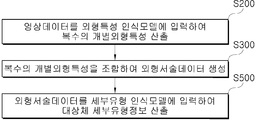
- 3 to 5 are flowcharts of a method for searching image data further including a step of calculating object type information according to an embodiment of the present invention.
- FIG. 6 is an exemplary diagram for explaining a code system according to an embodiment of the present invention.
- FIG. 7 is a flowchart of an image data search method further including an abstract feature calculation step according to an embodiment of the present invention.
- FIG. 8 is a block diagram of an abstract feature recognition model according to an embodiment of the present invention.
- FIG. 9 is an exemplary view for explaining setting of a first individual emotional characteristic score for an individual external characteristic according to an embodiment of the present invention.
- FIG. 10 is a flowchart of an image data search method further including the step of extracting image data corresponding to a search keyword according to an embodiment of the present invention.
- FIG. 11 is a flowchart of an image data search method further including the step of setting a personalized abstract characteristic according to an embodiment of the present invention.
- FIG. 12 is a flowchart of an image data search method further including training a new individual characteristic recognition module according to an embodiment of the present invention.
- FIG. 13 is a flowchart of an image data search method using reference image data according to an embodiment of the present invention.
- FIG. 14 is a flowchart of a method of constructing a data set for learning an external feature recognition model according to an embodiment of the present invention.
- 15 is a block diagram of an image data search server apparatus according to an embodiment of the present invention.
- a'computer' includes all various devices capable of performing arithmetic processing and providing results to a user.
- computers are not only desktop PCs and notebooks, but also smart phones, tablet PCs, cellular phones, PCS phones, and synchronous/asynchronous systems.
- a mobile terminal of the International Mobile Telecommunication-2000 (IMT-2000), a Palm Personal Computer (PC), a personal digital assistant (PDA), and the like may also be applicable.
- a head mounted display (HMD) device includes a computing function
- the HMD device may be a computer.
- the computer may correspond to a server that receives a request from a client and performs information processing.
- subject means an article of a specific classification or category.
- the object may be clothes.
- 'image data' means a two-dimensional or three-dimensional static or dynamic image including a specific object. That is,'image data' may be static image data that is one frame, or dynamic image data (ie, moving image data) in which a plurality of frames are consecutive.
- the'appearance classification standard' refers to a classification standard of an appearance expression necessary for describing the appearance of a specific object or for annotation. That is, the'appearance classification standard' is a specific classification standard for describing the appearance of a specific object, and includes a plurality of individual appearance characteristics expressing various external characteristics within the same classification standard of the object.
- the appearance classification standard is a classification standard for the appearance of clothing, and may correspond to a pattern, color, fit, length, and the like. That is, when the appearance classification standard for a specific object increases, the external shape of a specific article belonging to the object can be described in detail.
- 'individual appearance characteristics' refers to various characteristics included in a specific appearance classification standard. For example, if the appearance classification criterion is color, the individual appearance characteristics mean various individual colors.
- the'abstract characteristic' means an abstract characteristic given to a specific object.
- the'abstract characteristic' may be an emotional characteristic of a specific object (for example, in the case of clothing, an emotional or fashionable expression such as vintage).
- 'abstract characteristic' may mean a shape change or an action when the image data is a moving picture.
- FIG. 1 is a flowchart of an image data search method according to an embodiment of the present invention.
- the server inputs image data into an appearance characteristic recognition model, and calculates individual appearance characteristics for a plurality of appearance classification criteria (S200). And a step (S300) of generating, by the server, appearance description data by combining a plurality of individual appearance characteristics calculated for the image data.
- S200 appearance characteristic recognition model
- S300 step of generating, by the server, appearance description data by combining a plurality of individual appearance characteristics calculated for the image data.
- the server inputs the image data into the appearance characteristic recognition model, and calculates individual appearance characteristics for a plurality of appearance classification criteria (S200).
- Image data means a two-dimensional or three-dimensional static or dynamic image including a specific object. That is, the image data may be static image data, which is one frame, or dynamic image data (ie, moving image data) in which a plurality of frames are consecutive.
- the appearance classification standard refers to the classification standard of appearance expression necessary for describing the appearance of a specific object or for annotation. That is, the'appearance classification criterion' is a specific classification criterion for describing the appearance of a specific object, and includes a plurality of individual appearance characteristics expressing various appearance characteristics within the same classification criterion of the object.
- the appearance classification standard is a classification standard for the appearance of the clothing, and may correspond to a pattern, color, fit, length, and the like. That is, when the appearance classification standard for a specific object increases, the external shape of a specific article belonging to the object can be described in detail.
- Individual appearance characteristics refer to various characteristics included in a specific appearance classification standard. For example, if the appearance classification criterion is color, the individual appearance characteristics mean various individual colors.
- FIG. 2 is a block diagram of an external feature recognition model according to an embodiment of the present invention.
- the appearance characteristic recognition model 200 includes a plurality of individual characteristic recognition modules 210 for determining different appearance classification criteria. That is, the external characteristic recognition model 200 may include a plurality of individual characteristic recognition modules 210 specialized for recognizing each appearance classification criterion. As the number of the external classification criteria of a specific object increases, the server may include a plurality of individual characteristic recognition modules in the external characteristic recognition model.
- each individual characteristic recognition module 210 may be trained through a deep learning learning model by matching individual external characteristics of a specific external classification criterion with respect to a plurality of training image data. That is, the individual characteristic recognition module 210 is constructed with a specific deep learning algorithm, and may be learned by matching a specific one of a plurality of appearance classification criteria with image data for learning.
- Deep learning is a machine learning technique that enables computing systems to perform human-like actions.
- AI artificial intelligence
- ANN artificial neural network
- the artificial neural network may refer to a computer science architecture modeling a biological brain.
- nodes corresponding to neurons in the brain are connected to each other and collectively operate to process input data.
- Examples of various types of artificial neural networks include, but are not limited to, a deep neural network (DNN), a convolutional neural network (CNN), a recurrent neural network (RNN), and the like.
- DNN deep neural network
- CNN convolutional neural network
- RNN recurrent neural network
- step S200 may be to input image data to each of the plurality of individual feature recognition modules 210 in the external feature recognition model 200 to calculate a plurality of individual external features for the image data.
- the server may acquire all of the individual appearance characteristics of each appearance classification criterion for the input image data.
- the server generates appearance description data by combining a plurality of individual appearance characteristics calculated for the image data (S300). That is, if the external shape classification criteria for a specific object are divided in detail, the external shape description data can specifically describe the external shape of the object through various individual external characteristics.
- the individual appearance characteristics for a plurality of appearance classification criteria (neck shape, sleeve, top length, color and pattern) calculated in step S200 are'Round Neckline',
- the outline description data for the image data is "round neck, It can be produced as "short sleeves, crop top, bright red, polka dots”.
- 3 to 5 are flowcharts of a method for searching image data further including a step of calculating object type information according to an embodiment of the present invention.
- the image data search method further includes a step (S100) of calculating first object type information by inputting image data into an object type recognition model before step S200. can do.
- First object type information is calculated by inputting image data into the object type recognition model 100 (S100). That is, object type information, which is a specific classification or category of an object included in the image data, is calculated.
- the object type recognition model 100 may be trained through machine learning or deep learning learning models.
- the object type information may be calculated based on a preset object type classification.
- the upper type classification is set to clothing, accessories, shoes, interior, etc.
- the subtype classification for clothing among the upper types is'Shirt & Blouse','Jacket','Coat','Pants','Skirt'
- the object type recognition model may calculate object type information from among seven subtypes for clothing.
- step S100 not only one object type information but also a plurality of object type information may be calculated. That is, when it is difficult to calculate one specific object type information with respect to the input image data, a plurality of types of information with high probability may be calculated.
- step S100 may be to obtain a first probability that an object of specific image data corresponds to each specific type information, and calculate type information whose first probability is greater than or equal to a threshold value.
- the recognition model may calculate'shirt & blouse' as object type information.
- the object type recognition model may calculate the plurality of type information as candidate type information.
- the threshold value is 0.4
- the first probability corresponding to the'shirt & blouse' is 0.5
- the'jacket' is 0.4
- the'coat' is 0.1
- 'shirt & blouse' and'jacket' are candidates. It can be calculated as type information. The setting of the final type information for the candidate type information will be described later.
- the step of calculating a plurality of individual appearance characteristics may include calculating a plurality of individual appearance characteristics by inputting image data into a specialized appearance characteristic recognition model corresponding to the calculated object type information. have.
- the specialized external characteristic recognition model includes individual characteristic recognition modules of a plurality of external appearance classification criteria set in advance to be applied according to specific object type information. That is, the type of the external classification criteria applied may be determined according to the object type information calculated for specific image data.
- a specialized external characteristic recognition in which a combination of different external classification criteria (i.e., a combination of individual characteristic recognition modules) is set according to specific object type information (object 1, object 2, object 3).
- object 1, object 2, object 3 specific object type information
- a model may be created, and individual appearance characteristics may be calculated by inputting specific image data to each of a plurality of individual characteristic recognition modules in a specialized external characteristic recognition model corresponding to the calculated object type information.
- the combination of individual feature recognition modules in the specialized external feature recognition model of different object type information may be the same.
- the specialized external characteristic recognition model of the'pants' type information includes individual characteristic recognition modules of'waist','bottom length' and'color'
- the specialized external characteristic recognition model that is, a combination of applied external classification criteria
- each specialized external characteristic recognition model for a plurality of object type information may share and use a general-purpose individual characteristic recognition module.
- the general-purpose individual characteristic recognition module means an individual characteristic recognition module for the general-purpose appearance classification criteria that can be applied irrespective of the object type.
- external classification standards such as'color','pattern', and'texture' can be applied regardless of the type of object (individual appearance characteristics are calculated). May correspond to.
- the image data may be respectively input to all of the specialized appearance characteristic recognition models corresponding to each of the candidate type information.
- the final type information setting performed based on this will be described later.
- the image data is inputted into each of the'jacket'-specialized appearance characteristic recognition model and the'pants'-specialized appearance characteristic recognition model. Individual appearance characteristics can be calculated.
- the server when it is not possible to calculate individual appearance characteristics with respect to the appearance classification criteria of the specialized appearance characteristic recognition model, the server converts the image data into an object type recognition model.
- the step of calculating second object type information (S400) by re-entering to may be further included.
- the second object type information may be different from the previously calculated first object type information.
- the combination of the external classification criteria applied according to the object type information calculated as described above may be different. If an error occurs more than a certain ratio for the specialized external characteristic recognition model of the calculated type information (e.g. For example, when the number of individual characteristic recognition modules that cannot calculate individual appearance characteristics is equal to or greater than a predetermined threshold), the server determines that the object type information calculation is incorrect, and the image data is re-entered into the object type recognition model to create a new type. It is to regenerate the information.
- a certain ratio for the specialized external characteristic recognition model of the calculated type information e.g. For example, when the number of individual characteristic recognition modules that cannot calculate individual appearance characteristics is equal to or greater than a predetermined threshold
- the server determines that the object type information calculation is incorrect, and the image data is re-entered into the object type recognition model to create a new type. It is to regenerate the information.
- step S100 for image data related to'pants' the server incorrectly calculates the object type information as'jacket', and in step S220, a'jacket'-specific appearance characteristic recognition model (for example,'neck shape ( neckline)','sleeve length','top length' and'color' individual feature recognition module). If it is not possible to calculate the individual appearance characteristics for the length of the sleeve or top, the server determines that the object type information is incorrectly calculated, and the image data is re-entered into the object type recognition model to provide new type information (e.g.,'pants). ') can be recalculated.
- a'jacket'-specific appearance characteristic recognition model for example,'neck shape ( neckline)','sleeve length','top length' and'color' individual feature recognition module.
- step S100 when a plurality of candidate type information is calculated in step S100 and image data is input to each individual characteristic recognition module of a specialized external characteristic recognition model corresponding to each of the candidate type information, the individual external characteristic Candidate type information with the least external classification criteria that cannot be calculated can be set as the final type information.
- candidate type information having a high recognition rate (the number of individual feature recognition modules that cannot calculate individual appearance features is small) can be set as the final type information.
- candidate type information of'jacket' and'pants' is calculated in step S100, and in step S220, the image data is converted into a'jacket'-specific appearance characteristic recognition model and'pants'
- the recognition rate of each specialized external characteristic recognition model will be higher in the'jacket' than in the'pants' unless there are special circumstances (the number of individual characteristic recognition modules that cannot calculate individual external characteristics Because it will be more in the'pants' specialized external feature recognition model),'jacket' can be set as the final type information.
- the server inputs outline description data of the image data into a detailed type recognition model, and calculates object detailed type information (S500). It may further include.
- the detailed object type information may be a sub-concept of the object type information calculated in step S100.
- the detailed type information may be'skinny pants','slacks pants','exhaust pants', and the like.
- the detailed type recognition model 400 may be a model that calculates detailed object type information of the input image data when external description data (object type information, individual appearance characteristics) generated for specific image data is input.
- the detailed type recognition model may be trained through machine learning or deep learning learning models.
- the detailed type recognition model may be to calculate detailed type information for an individual appearance characteristic combination of the input appearance description data as one or more detailed type information is matched to each of the one or more individual appearance characteristic combinations. .
- detailed type information (a2 as a sub-concept when the subject type information is A, b1 as a sub-concept when the subject type information is B) is matched with respect to a specific combination of appearance characteristics (a, b, c).
- the external description data may further include object detailed type information. That is, in an embodiment, a code value corresponding to the calculated detailed type information may be extracted and added to the existing appearance description data.
- step S300 may be to generate appearance description data by combining object type information calculated for the image data and a plurality of individual appearance characteristics. That is, external description data may be generated by further including object type information as well as a plurality of individual external characteristics.
- step S300 includes extracting object type information for image data and code values corresponding to each of a plurality of individual appearance characteristics, and combining the extracted plurality of code values. It may include the step of generating outline description data in the form of a code string. That is, as the server codes the individual appearance characteristics, the appearance description data can be generated as a code string, and through this, the processing of the appearance description data can be efficiently performed.
- the code values corresponding to object type information (shirt & blouse) and a plurality of individual appearance characteristics (round neck, short sleeves, crop top, bright red, polka dots) are respectively'Zb01','Bb01', and'Bg03.
- the outline description data for the image data may be generated as "Bb01, Bg03, Bi01, Id00, Oa01, Zb01" by combining the code values.
- the structure of the code system of the outline description data according to an embodiment of the present invention may be variously constructed according to each object type classification standard, an appearance classification standard, and an abstract characteristic classification standard.
- a code system may be constructed as shown in FIG. 6.
- capital letters may mean information on an upper category. That is, a code corresponding to the object type information may include Z, a code corresponding to an abstract characteristic may include A, and codes corresponding to a plurality of appearance classification criteria may include B to Y.
- the codes corresponding to the plurality of appearance classification criteria (B to Y), universal appearance classification standards (E, I, O, U) that can be applied irrespective of the object type, and specialized appearance classification standards applied to a specific object type ( B, C, D, etc.), and the code of the specialized external classification criteria may correspond to the above-described higher type codes (Za, Zb, Zc, etc.).
- a plurality of specialized appearance classification criteria for'fashion (clothing)' includes B, and lowercase letters (a ⁇ y) are assigned according to each appearance classification standard, and individual appearance characteristics for the corresponding appearance classification standard Depending on the number (00 to 99) may be assigned.
- Ba stands for'Top Silhouette'
- Bb stands for'Neckline'
- Bi stands for'Pants Silhouette'
- Bb01 stands for'Round Neckline'.
- Bb02 are'V Neckline' and may be code values corresponding to individual appearance characteristics for the Bb appearance classification standard. Examples of code values corresponding to abstract characteristics will be described later.
- the image data search method may further include calculating an abstract characteristic based on a plurality of individual appearance characteristics calculated by the server (S600).
- step S600 may be that the server inputs the outline description data of the image data into the abstract feature recognition model 300 to calculate the abstract feature.
- the abstract feature recognition model 300 may be trained through machine learning or deep learning learning models.
- the present invention by calculating the abstract characteristics based on the appearance description data (object type information and individual appearance characteristics) calculated from the image data, not the image data itself such as images, efficient processing of data and objective abstract characteristics Calculation is possible.
- the calculated abstract characteristic is added to the previously generated external description data It may further include the step of updating the description data.
- the abstract characteristic may include a first emotional characteristic.
- the first emotional characteristic is an emotional characteristic perceived based on an external shape of a specific object, and includes a plurality of first individual emotional characteristics that are specific emotional characteristics.
- the definition and number of each of the first individual emotional characteristics included in the first emotional characteristic may be set by the server, and may be added or changed.
- the first emotional characteristic which is an emotional characteristic with respect to the external appearance of an object, may be defined differently according to the times or regions, and is thus to be variously changed according to the period or region.
- each of the first individual emotional characteristics may be set to be'cute','soft','modern', etc.
- each first individual emotional characteristic It may be set to further include contrasted first individual emotional characteristics such as'Elegant','Wild', and'Classic'.
- the first individual emotional characteristic of the present invention is not limited thereto and may be variously set.
- the abstract feature recognition model 300 includes a first emotional feature recognition model 310 that receives individual external features and calculates a first emotional feature.
- the first emotional characteristic recognition model as points for each of the plurality of first individual emotional characteristics are set for each individual external characteristic, each of the first individual emotional characteristics set in the input plurality of individual external characteristics. It may be to calculate the first emotional characteristic by summing the scores for.
- a score for each of the first individual emotional characteristics may be set for each of a plurality of individual appearance characteristics included in each appearance classification criterion.
- each score is indicated as 0 or 1, but the score is not limited thereto and may be set in various ways, such as a number between 0 and 1 or a negative number.
- a score table in which a score for each individual emotional characteristic is set for each individual appearance characteristic may generate not only one score table but also a plurality of different score tables.
- a score table may be different for each country or region, or a personalized score table for each user may be generated, and the score table may be freely changed by the server.
- the first emotional characteristic may be calculated by summing each of the first individual emotional characteristic scores.
- the summed score for each of the first individual emotional characteristics is'cute: 1' ,'Elegant: 2','Smooth: 0','Rough: 1','Modern: 0','Classic: 1', and the first emotional characteristic can be calculated based on this.
- the first emotional characteristic may be calculated including a ratio of each first individual emotional characteristic score to the total score. For example, in the case of the above example, since the total score is 5, the first emotional characteristic is "cute: 0.2, elegant: 0.4, soft: 0, rough: 0.2, modern Classic: 0, Classic: 0.2" can be calculated.
- the first emotional characteristic may be calculated including each first individual emotional characteristic score.
- the first emotional characteristic is "cute: 1, elegant: 2, soft: 0, rough: 1, modern: 0, classic: 1, so as to include each first individual emotional characteristic score. Can be calculated as ".
- the first emotional characteristic may be to calculate only the first individual emotional characteristic in which each first individual emotional characteristic score is equal to or greater than a preset threshold. For example, in the above-described example, when the threshold value is 2 (or a ratio of 0.4), only the first individual emotional characteristic of'elegant' may be calculated as the first emotional characteristic.
- the calculation of the first emotional characteristic is not limited to the above-described example and may be calculated in various ways.
- the code value corresponding to the first emotional characteristic may include information on a score summed for each of the first individual emotional characteristics.
- the first emotional characteristic is calculated as "cute: 0.2, elegant: 0.4, soft: 0, rough: 0.2, modern: 0, classic: 0.2", and each of the first individual emotional characteristics If the code value corresponding to "cute: Aa, elegant: Ac, soft: Ad, rough: Af, modern: Ai, classic: Ap", the external description data in the form of a code string for the first emotional characteristic is It can be produced as "Aa20, Ac40, Ad00, Af20, Ai00, Ap20".
- the external description data of the image data is a combination of "Aa20, Ac40, Ad00, Af20, Ai00, Ap20" , Bb02, Oa02".
- the code system of the present invention is not limited thereto and can be constructed in various ways.
- the abstract characteristic may include a second emotional characteristic.
- the second emotional characteristic is an emotional characteristic perceived based on information given to a product of a specific object, and may include a second individual emotional characteristic, which is various emotional characteristics felt for different types of product information.
- the second individual emotional characteristic of'cheap' and'expensive' felt for product information of'price' may include.
- the abstract feature recognition model 300 includes a second emotional feature recognition model 320 that receives product information on an object of image data and calculates a second emotional feature. I can.
- the second emotional characteristic recognition model 320 may include a plurality of second individual emotional characteristic recognition modules that determine emotional characteristics for different product information.
- the second individual emotional characteristic recognition module calculates each second individual emotional characteristic for specific product information of an object of the image data.
- the second emotional characteristic may be calculated by considering various information such as individual appearance characteristics, object type information, or user information as well as product information.
- FIG. 10 is a flowchart of an image data search method further including the step of extracting image data corresponding to a search keyword according to an embodiment of the present invention.
- the step of receiving a search keyword from a user client by a server (S700), and image data including external description data corresponding to the search keyword by the server It may further include a step of extracting (S720).
- the server when a user inputs a specific search keyword to search for image data, the server extracts object type information, individual appearance characteristics or abstract characteristics corresponding to the search keyword, and extracts type information, individual appearance characteristics, or abstract characteristics.
- Image data including characteristic appearance description data may be provided to the user as a search result.
- the user's individual appearance characteristic, the first individual emotional characteristic, or the preference information for each of the second individual emotional characteristic may be further considered and extracted.
- the search result may be different depending on the user who inputs the search keyword.
- step S720 extracts a combination of appearance classification criteria matched with the abstract characteristic corresponding to the input search keyword from the matching algorithm, and , It may be to extract image data corresponding to the extracted appearance classification criteria combination. That is, when a user wants to search for desired image data based on a search keyword that is one of the abstract characteristics of a specific object or a search keyword that is similar to the abstract characteristic, the server uses the abstract characteristic corresponding to the search keyword in the matching algorithm. It is possible to extract a combination of the appearance classification criteria matched to and extract image data having a corresponding combination of appearance classification criteria in the appearance description data.
- a plurality of individual appearance characteristics may be matched to each abstract characteristic in the matching algorithm.
- the server may not match the specific external classification standard with the corresponding abstract characteristic. For example, in the case of defining abstract feature X, if the external classification criterion 1 does not need to be considered (i.e., objects to which all the individual external features of the external classification criterion 1 are applied can be included in the abstract feature X), the server Appearance classification criterion 1 may not match abstract feature X.
- the server may match a plurality of individual appearance characteristics of the appearance classification criterion 2 with the abstract characteristic X.
- the matching algorithm may be set by the server receiving setting data matching a combination of abstract characteristics and appearance classification criteria from an expert client.
- the definition of abstract characteristics may be changed or different due to factors such as regional differences, changes in the times, and establishment of new definitions.
- abstract characteristics representing specific fashion trends or emotional characteristics may change according to the change of the times, and may be defined differently according to regions around the world (for example, '
- the abstract characteristic (ie, emotional characteristic) of'vintage' can be defined as having a different appearance in the past and the present.) Therefore, the server can add or change the matching relationship between the combination of abstract characteristics and individual appearance characteristics in the matching algorithm. have.
- the server may receive a combination of appearance classification criteria for the current abstract characteristic from an expert client.
- the server may set the combination of the abstract characteristic before the change and the appearance classification criteria as the definition of the corresponding abstract characteristic at a specific point in the past. Through this, the server can accumulate definition or description information of specific abstract characteristics according to the change of the times.
- the server may receive and store a combination of external classification criteria for each region from an expert client).
- FIG. 11 is a flowchart of an image data search method further including the step of setting a personalized abstract characteristic according to an embodiment of the present invention.
- a server receives a request to provide additional image data from a user client, at least one individual external characteristic is sequentially provided. If at least one of the additional image data is selected by the user in step S740 and the step S760 of setting, by the server, a personalized abstract characteristic based on the outline description data of the selected image data.
- the server when performing a search based on a search keyword, the server expands the search range and provides additional image data to the user client while changing at least one external classification criterion from the description information of the abstract characteristic corresponding to the search keyword to another individual external characteristic. can do. Thereafter, the server may receive one or more desired image images from the expanded search range from the user. Thereafter, the server may personalize a search keyword or abstract characteristic input by the user based on the selected image image. For example, since the external definition of the general abstract characteristic and the external definition of the abstract characteristic that the user is thinking may be different, the server thinks based on the external description data of the video image selected by the user in the expanded search result. Descriptive information or appearance definition (that is, personalized abstract characteristic description information) is set. Through this, if the user searches for the same search keyword or abstract characteristic in the future, the server does not search based on the description information of the general abstract characteristic, but performs a search based on the description information of the personalized abstract characteristic. Can provide the desired image first.
- the server further comprises providing an abstract characteristic suitable for extracting the selected image data to a user client.
- Can include the server informs that the external definition that the user knows about a specific abstract characteristic is different from the commonly used appearance definition, and extracts and provides the abstract characteristic (or search keyword) that matches the external appearance definition that the actual user thinks. can do. Through this, it is possible for the user to recognize a search keyword for obtaining a desired search result when re-searching later.
- FIG. 12 is a flowchart of an image data search method further including training a new individual characteristic recognition module according to an embodiment of the present invention.
- the server acquires individual appearance characteristics of the new appearance classification criterion for training image data, The step of constructing the data set (S800) and the server training a new individual feature recognition module based on the new learning data set, and adding it to the external feature recognition model (S820).
- the server does not change the existing individual characteristic recognition module, and It is possible to change the external characteristic recognition model to suit the situation in which a new external classification standard has been added by additionally constructing only the individual characteristic recognition module for each.
- the server acquires individual appearance characteristics of the new appearance classification criterion for the training image data, and constructs a new training data set (S800).
- the server uses a new appearance classification standard for each learning image data from an expert client. Individual appearance characteristics of can be input.
- the server acquires new image data for training the individual characteristic recognition module for the new appearance classification criteria, and receives each individual appearance characteristic of the new appearance classification criteria for this to construct a new learning data set.
- the server trains a new individual characteristic recognition module based on the new learning data set, and adds it to the external characteristic recognition model (S820). Through this, the server can add a new individual characteristic recognition module along with a plurality of existing individual characteristic recognition modules to the existing external shape characteristic recognition models.
- the image data from which the appearance description data is obtained by the individual characteristic recognition module in which the server is already established is input into a new individual characteristic recognition module to determine individual appearance characteristics for the new appearance classification criteria. It may further include the step of adding. That is, the server may perform a process of updating the appearance description data of the previously acquired input image data to reflect the new appearance classification criteria. To this end, the server may perform a process of calculating individual appearance characteristics by inserting all image data into a new individual characteristic recognition module.
- the server may further include updating the abstract characteristic recognition model by adding individual appearance characteristics of the new appearance classification standard to the abstract characteristic recognition model.
- the server may further include updating the matching algorithm by matching individual appearance characteristics of the new appearance classification criterion with each abstract characteristic in the matching algorithm.
- the server classifies each abstract characteristic in the matching algorithm to provide an optimal search result by reflecting the new appearance classification criteria.
- Individual appearance characteristics of the standard can be linked.
- FIG. 13 is a flowchart of an image data search method using reference image data according to an embodiment of the present invention.
- the server receives reference image data from a user client (S900), and the server inputs the reference image data into an appearance characteristic recognition model, Calculating individual appearance characteristics for a plurality of appearance classification criteria (S920), a step of generating appearance description data by combining a plurality of individual appearance characteristics with respect to the reference image data by the server (S940), and the server performing the reference image data It may further include a step (S960) of extracting image data including the same or similar appearance description data.
- the server when a user does not search based on a keyword corresponding to an abstract characteristic, but performs a search based on a specific object image (i.e., reference image data) possessed by the user, the server provides the external description data for the reference image data. May be generated, and image data including the same or similar appearance description data may be extracted and provided to a user client.
- a specific object image i.e., reference image data
- the server receives reference image data from a user client (S900). That is, the server receives reference image data stored in a user client or searched online by a user.
- the server inputs the received reference image data into the appearance characteristic recognition model to calculate individual appearance characteristics included in each appearance classification criterion (S920). That is, the server acquires a plurality of individual external characteristics for describing the external characteristics of the reference image data as text information through each individual characteristic recognition module.
- the server generates appearance description data by combining a plurality of individual appearance characteristics with respect to the reference image data (S940).
- the server extracts the image data including the same outline description data as the reference image data.
- the server may search for and provide input image data having the same outline description data as the reference image data.
- the server when searching for image data to a range similar to that of the reference image data, the server extends from a low importance to a similar range among a plurality of appearance classification criteria included in the appearance description data of the reference image data, and expands one Image data including the above outline description data may be extracted.
- the server may include an importance ranking for multiple appearance classification criteria of a specific object (for example, the higher the importance ranking, the more the search range is maintained at a fixed value when the search range is expanded to a similar range), and a specific appearance classification The degree of similarity between individual appearance characteristics within the criteria can be included.
- FIG. 14 is a flowchart of a method of constructing a data set for learning an external feature recognition model according to an embodiment of the present invention.
- a method of constructing a data set for learning an external feature recognition model according to an embodiment of the present invention will be described with reference to FIG. 14.
- the server acquires a plurality of training image data (S1100), and the server provides a plurality of training image data to an expert client.
- Providing a step (S1200) the server receiving individual appearance characteristics for a plurality of appearance classification criteria of each training image data from the expert client (S1300), each learning based on the plurality of individual appearance characteristics received by the server It includes the step (S1400) of creating a data set for learning by generating external description data for the image data.
- S1400 the step of creating a data set for learning by generating external description data for the image data.
- the server acquires a plurality of training image data (S1100).
- the image data for training refers to image data for learning an external feature recognition model.
- the image data for training may be image data of an object including a design article.
- the appearance classification standard and a plurality of individual appearance characteristics for each appearance classification standard may be set by the server. That is, the server may set an external appearance classification criterion, which is a criterion for determining the appearance characteristics of image data, and an individual appearance characteristic, which is a type of feature to label the learning image data for each appearance classification criterion.
- an external appearance classification criterion which is a criterion for determining the appearance characteristics of image data
- an individual appearance characteristic which is a type of feature to label the learning image data for each appearance classification criterion.
- the server may receive a plurality of appearance classification criteria for analyzing the appearance of a specific object and a plurality of individual appearance characteristics within each appearance classification standard from an expert client for external appearance analysis of a specific object.
- the server receives and sets an appropriate appearance classification standard and individual appearance characteristics included therein from the client of a designer who is a clothing expert, and sets it according to each appearance classification standard.
- An external characteristic recognition model 200 for clothing including the individual characteristic recognition module 210 and a plurality of individual characteristic recognition modules 210 may be constructed.
- acquiring the training image data includes the server acquiring the training image data from the image provider client.
- the image provider client is a client of a person who uploads the image to the shopping mall, and the image of the sale product may be image data for learning.
- the server provides a plurality of training image data to the expert client (S1200).
- Expert client means an expert client who is in charge of each appearance classification standard and classifies it.
- the acquisition of individual appearance characteristics according to a specific appearance classification criterion of a plurality of training image data may be performed by the same expert.
- the acquisition of individual appearance characteristics of a plurality of training image data for the “color” appearance classification criterion may be performed by an expert in charge of “color”. Since the judgment of some external classification criteria may be somewhat subjective, the same expert determines specific external classification criteria for a plurality of training image data, thereby constructing a training dataset of unified criteria to more accurately learn the appearance characteristic recognition model. can do.
- the external appearance classification standard may include a specialized external classification standard applied only to a specific type of object and a universal external classification standard applied to all types of objects.
- an appearance classification standard such as'color' or'texture' is a general-purpose appearance classification standard because it can be applied to all objects (calculate individual appearance characteristics) regardless of the object type.
- the'neck shape' appearance classification standard is a specialized appearance classification standard for'tops' because it can only be applied to the object of the type of'tops among clothing'.
- step S1200 may be to provide all the training image data acquired by the server to all expert clients. That is, all the learning image data acquired irrespective of the object type may be provided to an expert client in charge of a specific appearance classification standard.
- an expert client in charge of specialized appearance classification criteria that is not applied to a specific object type may provide the information to the server.
- Skirt' is provided to a client of an expert in charge of'Neckline' appearance classification standards, "The applicable appearance classification standards cannot be applied.
- Information about "(individual appearance characteristics cannot be determined)" can be provided to the server.
- the server is in charge of the universal appearance classification standard to classify the expert's client All the acquired image data for learning may be provided, but only the image data for learning of an object of a type to which the corresponding specialized external classification standard is applied may be provided to the client of the expert who classifies by in charge of the specialized external classification standard.
- the server may acquire object type information of the training image data.
- the object type information may be obtained by the server from a type classification expert client or through a separate object type recognition model. That is, the type classification criterion for classifying the type of the object may be a classification criterion that belongs to a sub-concept of the appearance classification criterion, or alternatively, it may be a separate classification criterion that is independent of the appearance classification criterion.
- the acquired object type information may be in the form of a code string corresponding thereto.
- a code string corresponding to "fashion (clothing)” among object types may be “Zb”
- a code sequence corresponding to "shirt” as a lower type of “fashion (clothing)” may be "Zb01”.
- step S1200 the server is in charge of general-purpose appearance classification standards and provides all the acquired image data for learning to the clients of experts who classify them, but the specialized external classification standards are applied to the clients of experts who classify by taking the specialized appearance classification standards. It may be to provide only image data for learning of an object of.
- the expert client in charge of specialized appearance classification criteria is provided to the expert client for learning by minimizing unnecessary data provision by providing only the image data for learning of the type of object to which the corresponding specialized appearance classification criteria can be applied. It can improve the efficiency of data set construction.
- all the learning image data acquired by the server may be provided to the expert client in charge of'color'.
- 'Neckline' is a specialized appearance classification standard that is applied only to objects of the'top' type, so the server only uses the'top' type of training image data based on the acquired type information, so the expert in charge of'neckline' By providing it to a client, it is possible to improve the efficiency of building a training dataset by reducing unnecessary provision of video data for training.
- the method may further include setting a combination of a plurality of individual feature recognition modules belonging to a specialized external feature recognition model for a specific type of object. That is, for a specific type of object, the server may set a combination of a general-purpose external classification standard, a specialized external classification standard for a corresponding type, and a combination of an individual characteristic recognition module corresponding thereto, as shown in FIG. 2.
- the server receives the individual appearance characteristics for the appearance classification criteria of each learning image data from the expert client (S1300).
- the server receives individual appearance characteristics of the training image data for the corresponding appearance classification criteria from an expert client in charge of a specific appearance classification standard. For example, if the server provides specific training video data for a top to a plurality of expert clients, the'clothing' individual appearance characteristics from the'object type' expert client, and the'shirt' from the'clothing type' expert client Individual appearance characteristics, and individual appearance characteristics of'sleeveless' can be input from the expert client in charge of'sleeve length'.
- the server may receive a code value corresponding to an individual appearance characteristic for an appearance classification criterion from the expert client. This will be described later.
- the server may receive detailed individual appearance characteristics of the learning image data for the detailed appearance classification criteria from the expert client in charge of the detailed appearance classification criteria.
- the detailed appearance classification standard means the lowest appearance classification standard belonging to each appearance classification standard. For example, in the case of'clothing (object type)-shirt (clothing type)-sleeveless (sleeve length),''sleeve length' is a detailed appearance classification standard, and'sleeveless' may be a detailed individual appearance characteristic.
- the lower appearance classification standard is a relatively lower appearance classification standard in relation to the upper appearance classification standard.
- the relationship between the appearance classification criteria may be set or changed by the server.
- one or more lower appearance classification standards may exist for one upper appearance classification standard.
- the detailed individual appearance characteristics may include individual appearance characteristic information for one or more higher appearance classification criteria for the detailed individual appearance characteristics.
- individual appearance characteristic information for a higher appearance classification criterion included in a specific detailed individual appearance characteristic may be set and stored by the server.
- 'sleeveless' which is a detailed individual appearance characteristic
- the detailed appearance classification standard may be changed as a lower appearance classification standard of the detailed appearance classification standard is added.
- the appearance classification standard including the detailed appearance classification standard may be freely set and changed by the server as described above.
- the server may provide training image data only to a plurality of detailed external classification standard specialist clients excluding the upper external appearance classification standard to receive individual appearance characteristics. In this case, by providing training image data to a minimum number of expert clients, there is an effect of increasing the efficiency of building a training dataset.
- the server generates appearance description data for each learning image data based on a plurality of individual appearance characteristics received from a plurality of expert clients for each learning image data, and constructs a learning dataset (S1400).
- the server receives a plurality of individual appearance characteristics for specific learning image data from an expert client, and extracts and combines code values corresponding to the individual appearance characteristics to generate appearance description data in the form of a code string. have.
- the server may receive code values corresponding to a plurality of individual appearance characteristics for specific training image data from an expert client, and combine the plurality of code values to generate appearance description data in the form of a code string. .
- the code value corresponding to the lower individual appearance characteristic may include upper individual appearance characteristic information for one or more upper appearance classification criteria of the lower appearance classification criteria to which the lower individual appearance characteristic belongs.
- "B” may include information on "clothing", which is an individual appearance characteristic of the upper appearance classification criterion (object type).
- the server constructs a training dataset based on a plurality of training image data provided to an expert client and external description data for the training image data.
- the constructed training dataset can be used for learning of one or more external feature recognition models (ie, one or more individual feature recognition modules).
- the external feature recognition model may be trained using a plurality of training image data included in a training dataset and one or more individual external features extracted from the corresponding outline description data. That is, by training the individual characteristic recognition module 210 for a specific appearance classification criterion using the constructed training data set, the external characteristic recognition model 200 including a plurality of individual characteristic recognition modules can be learned.
- the server may perform a process of training each individual feature recognition module as follows.
- the server performs training by matching the training image data with the individual appearance characteristics of a specific appearance classification criterion labeled for the training image data. That is, when the server trains the individual characteristic recognition module for the A appearance classification criteria, it extracts only the individual appearance characteristics of the A appearance classification criteria matched with the plurality of training image data and each training image data from the constructed training dataset. Input in the deep learning learning model. Through this, the server trains and builds each individual characteristic recognition module capable of recognizing individual appearance characteristics of each appearance classification criterion.
- step S800 is performed by the server among a plurality of training image data included in the training data set.
- Individual appearance characteristics may be obtained by providing only the learning image data including code values corresponding to the individual appearance characteristics of the upper appearance classification criteria to a client of an expert who is in charge of and classifying the added new appearance classification criteria.
- the added new appearance classification standard is'Shoulder', which is the lower appearance classification standard for top (clothing type), which is the upper individual appearance characteristic of the upper appearance classification standard, and the object of the'top' type
- a specialized external classification standard applicable only to an external description including'Zb01 ⁇ Zb03', which is a code value corresponding to the upper individual external characteristic,'top' among a plurality of training image data included in the previously constructed learning dataset It is possible to minimize unnecessary data provision by extracting image data for learning with data and providing only this to the expert client in charge of'shoulder shape'.
- the object type information calculation step (S100) and the individual appearance characteristic calculation step (S200) are performed for each frame in the moving image data.
- the external description data generation step (S300) may be generated by sequentially listing object type information and a plurality of individual appearance characteristics for each frame.
- An image data search server apparatus includes one or more computers and performs the aforementioned image data search method.
- 15 is a block diagram of an image data search server apparatus according to an embodiment of the present invention.
- the image data search server apparatus 10 includes an appearance characteristic recognition model 200, an appearance description data generation unit 600, and a database 800, as described above. Perform an image data search method.
- the server device 10 includes an object type recognition model 100, an abstract characteristic recognition model 300, a detailed type recognition model 400, a style recognition model 500, or a recommended image data generation unit 700. It may further include one or more of.
- image data search method may be implemented as a program (or application) and stored in a medium in order to be executed by being combined with a computer that is hardware.
- the above-described program includes C, C++, JAVA, machine language, etc. that can be read by the computer's processor (CPU) through the computer's device interface in order for the computer to read the program and execute the methods implemented as programs
- It may include a code (Code) coded in the computer language of.
- code may include a functional code related to a function defining necessary functions for executing the methods, and a control code related to an execution procedure necessary for the processor of the computer to execute the functions according to a predetermined procedure. can do.
- code may further include additional information required for the processor of the computer to execute the functions or code related to a memory reference to which location (address address) of the internal or external memory of the computer should be referenced. have.
- the code may use the communication module of the computer It may further include a communication related code for how to communicate with the server 10 or the like, and what information or media to transmit and receive during communication.
- the stored medium is not a medium that stores data for a short moment, such as a register, cache, memory, etc., but a medium that stores data semi-permanently and can be read by a device.
- examples of the storage medium include, but are not limited to, ROM, RAM, CD-ROM, magnetic tape, floppy disk, optical data storage device, and the like. That is, the program may be stored in various recording media on various servers 10 to which the computer can access, or on various recording media on the computer of the user.
- the medium may be distributed over a computer system connected through a network, and computer-readable codes may be stored in a distributed manner.
Landscapes
- Engineering & Computer Science (AREA)
- Theoretical Computer Science (AREA)
- Physics & Mathematics (AREA)
- General Engineering & Computer Science (AREA)
- Data Mining & Analysis (AREA)
- General Physics & Mathematics (AREA)
- Library & Information Science (AREA)
- Software Systems (AREA)
- Databases & Information Systems (AREA)
- Artificial Intelligence (AREA)
- Evolutionary Computation (AREA)
- Mathematical Physics (AREA)
- Computing Systems (AREA)
- Biophysics (AREA)
- Molecular Biology (AREA)
- General Health & Medical Sciences (AREA)
- Computational Linguistics (AREA)
- Biomedical Technology (AREA)
- Life Sciences & Earth Sciences (AREA)
- Health & Medical Sciences (AREA)
- Computer Vision & Pattern Recognition (AREA)
- Medical Informatics (AREA)
- Image Analysis (AREA)
- Information Retrieval, Db Structures And Fs Structures Therefor (AREA)
- Processing Or Creating Images (AREA)
Abstract
L'invention concerne un procédé, un dispositif et un programme de récupération de données d'image à l'aide d'un algorithme d'apprentissage profond. Le procédé de récupération de données d'image selon un mode de réalisation de la présente invention peut comprendre les étapes suivantes : un serveur calcule des caractéristiques d'apparence individuelle pour une pluralité de critères de classification d'apparence en entrant des données d'image dans un modèle de reconnaissance de caractéristiques d'apparence ; et le serveur génère des données de description d'apparence en combinant la pluralité de caractéristiques d'apparence individuelles calculées par rapport aux données d'image, les critères de classification d'apparence étant des critères de classification spécifiques pour décrire l'apparence d'un objet spécifique et comprenant la pluralité de caractéristiques d'apparence individuelles exprimant diverses caractéristiques d'apparence de l'objet dans les mêmes critères de classification.
Priority Applications (2)
| Application Number | Priority Date | Filing Date | Title |
|---|---|---|---|
| EP20822980.7A EP3982277A4 (fr) | 2019-06-10 | 2020-06-09 | Procédé, dispositif et programme de récupération de données d'image à l'aide d'un algorithme d'apprentissage profond |
| US17/546,709 US20220100792A1 (en) | 2019-06-10 | 2021-12-09 | Method, device, and program for retrieving image data by using deep learning algorithm |
Applications Claiming Priority (8)
| Application Number | Priority Date | Filing Date | Title |
|---|---|---|---|
| KR1020190067794A KR102119246B1 (ko) | 2019-06-10 | 2019-06-10 | 딥러닝 알고리즘을 이용한 영상데이터 검색방법, 장치 및 프로그램 |
| KR10-2019-0067795 | 2019-06-10 | ||
| KR10-2019-0067794 | 2019-06-10 | ||
| KR20190067795 | 2019-06-10 | ||
| KR10-2020-0009164 | 2020-01-23 | ||
| KR1020200009164A KR20200141373A (ko) | 2019-06-10 | 2020-01-23 | 외형인식모델 학습용 데이터셋 구축 방법, 장치 및 프로그램 |
| KR1020200012942A KR102227896B1 (ko) | 2019-06-10 | 2020-02-04 | 영상데이터의 외형서술데이터 획득 방법, 장치 및 프로그램 |
| KR10-2020-0012942 | 2020-02-04 |
Related Child Applications (1)
| Application Number | Title | Priority Date | Filing Date |
|---|---|---|---|
| US17/546,709 Continuation US20220100792A1 (en) | 2019-06-10 | 2021-12-09 | Method, device, and program for retrieving image data by using deep learning algorithm |
Publications (1)
| Publication Number | Publication Date |
|---|---|
| WO2020251236A1 true WO2020251236A1 (fr) | 2020-12-17 |
Family
ID=73782204
Family Applications (1)
| Application Number | Title | Priority Date | Filing Date |
|---|---|---|---|
| PCT/KR2020/007439 Ceased WO2020251236A1 (fr) | 2019-06-10 | 2020-06-09 | Procédé, dispositif et programme de récupération de données d'image à l'aide d'un algorithme d'apprentissage profond |
Country Status (3)
| Country | Link |
|---|---|
| US (1) | US20220100792A1 (fr) |
| EP (1) | EP3982277A4 (fr) |
| WO (1) | WO2020251236A1 (fr) |
Families Citing this family (1)
| Publication number | Priority date | Publication date | Assignee | Title |
|---|---|---|---|---|
| KR101862359B1 (ko) | 2017-12-28 | 2018-06-29 | (주)휴톰 | 수술 시뮬레이션 정보 생성방법 및 프로그램 |
Citations (5)
| Publication number | Priority date | Publication date | Assignee | Title |
|---|---|---|---|---|
| JPH1183461A (ja) * | 1997-09-09 | 1999-03-26 | Mitsubishi Electric Corp | 物品種別認識システム |
| KR20110123006A (ko) * | 2010-05-06 | 2011-11-14 | 윤진호 | 취향 요소에 기초한 상품 추천 방법과 추천된 상품들을 표시하는 방법 및 이들을 이용한 상품 추천 시스템 |
| KR20120078837A (ko) * | 2011-01-03 | 2012-07-11 | 김건민 | 코디네이션시스템을 이용한 상품 판매 및 경영관리시스템 |
| CN108268539A (zh) * | 2016-12-31 | 2018-07-10 | 上海交通大学 | 基于文本分析的视频匹配系统 |
| KR102119246B1 (ko) * | 2019-06-10 | 2020-06-04 | (주)사맛디 | 딥러닝 알고리즘을 이용한 영상데이터 검색방법, 장치 및 프로그램 |
Family Cites Families (4)
| Publication number | Priority date | Publication date | Assignee | Title |
|---|---|---|---|---|
| US9892133B1 (en) * | 2015-02-13 | 2018-02-13 | Amazon Technologies, Inc. | Verifying item attributes using artificial intelligence |
| US20160364419A1 (en) * | 2015-06-10 | 2016-12-15 | Blackbird Technologies, Inc. | Image and text data hierarchical classifiers |
| US11301718B2 (en) * | 2018-12-28 | 2022-04-12 | Vizit Labs, Inc. | Systems, methods, and storage media for training a machine learning model |
| US11531885B2 (en) * | 2019-10-21 | 2022-12-20 | Salesforce, Inc. | Training data generation for visual search model training |
-
2020
- 2020-06-09 WO PCT/KR2020/007439 patent/WO2020251236A1/fr not_active Ceased
- 2020-06-09 EP EP20822980.7A patent/EP3982277A4/fr not_active Withdrawn
-
2021
- 2021-12-09 US US17/546,709 patent/US20220100792A1/en not_active Abandoned
Patent Citations (5)
| Publication number | Priority date | Publication date | Assignee | Title |
|---|---|---|---|---|
| JPH1183461A (ja) * | 1997-09-09 | 1999-03-26 | Mitsubishi Electric Corp | 物品種別認識システム |
| KR20110123006A (ko) * | 2010-05-06 | 2011-11-14 | 윤진호 | 취향 요소에 기초한 상품 추천 방법과 추천된 상품들을 표시하는 방법 및 이들을 이용한 상품 추천 시스템 |
| KR20120078837A (ko) * | 2011-01-03 | 2012-07-11 | 김건민 | 코디네이션시스템을 이용한 상품 판매 및 경영관리시스템 |
| CN108268539A (zh) * | 2016-12-31 | 2018-07-10 | 上海交通大学 | 基于文本分析的视频匹配系统 |
| KR102119246B1 (ko) * | 2019-06-10 | 2020-06-04 | (주)사맛디 | 딥러닝 알고리즘을 이용한 영상데이터 검색방법, 장치 및 프로그램 |
Non-Patent Citations (2)
| Title |
|---|
| "OMNIOUS TAGGER", 22 May 2019 (2019-05-22), XP054981344, Retrieved from the Internet <URL:https://www.youtube.com/watch?v=bbhjsKRy34o> [retrieved on 20200915] * |
| See also references of EP3982277A4 * |
Also Published As
| Publication number | Publication date |
|---|---|
| EP3982277A4 (fr) | 2023-03-15 |
| US20220100792A1 (en) | 2022-03-31 |
| EP3982277A1 (fr) | 2022-04-13 |
Similar Documents
| Publication | Publication Date | Title |
|---|---|---|
| WO2021132927A1 (fr) | Dispositif informatique et procédé de classification de catégorie de données | |
| WO2020159232A1 (fr) | Procédé, appareil, dispositif électronique et support d'informations lisible par ordinateur permettant de rechercher une image | |
| KR102227896B1 (ko) | 영상데이터의 외형서술데이터 획득 방법, 장치 및 프로그램 | |
| WO2010120101A2 (fr) | Procede de recommandation de mots-cles mettant en oeuvre un modele spatial de vecteurs inverse et appareil correspondant | |
| WO2012134180A2 (fr) | Procédé de classification des émotions pour analyser des émotions inhérentes dans une phrase et procédé de classement des émotions pour des phrases multiples à l'aide des informations de contexte | |
| WO2022060066A1 (fr) | Dispositif électronique, système et procédé de recherche de contenu | |
| WO2020168606A1 (fr) | Procédé, appareil et dispositif d'optimisation de vidéo publicitaire, et support d'informations lisible par ordinateur | |
| WO2020222623A2 (fr) | Système et procédé pour construire automatiquement un contenu destiné à des ventes stratégiques | |
| WO2021006482A1 (fr) | Appareil et procédé de génération d'image | |
| WO2023132657A1 (fr) | Dispositif, procédé et programme pour fournir un service de prédiction de tendance de produit | |
| WO2021071240A1 (fr) | Procédé, appareil et programme informatique pour recommander un produit de mode | |
| WO2018097439A1 (fr) | Dispositif électronique destiné à la réalisation d'une traduction par le partage d'un contexte d'émission de parole et son procédé de fonctionnement | |
| WO2020171567A1 (fr) | Procédé permettant de reconnaître un objet et dispositif électronique le prenant en charge | |
| WO2022025340A1 (fr) | Système de construction de placard virtuel et de création d'une combinaison coordonnée, et procédé associé | |
| WO2021215758A1 (fr) | Procédé de publicité pour article recommandé, appareil et programme informatique | |
| WO2023018084A1 (fr) | Procédé et système de capture et de traitement automatiques d'une image d'un utilisateur | |
| EP3707678A1 (fr) | Procédé et dispositif de traitement d'image | |
| WO2019190142A1 (fr) | Procédé et dispositif de traitement d'image | |
| KR102524049B1 (ko) | 대상체 특성 정보에 기반한 사용자 코디 추천 장치 및 방법 | |
| WO2020060012A1 (fr) | Plateforme mise en œuvre par ordinateur pour fournir des contenus à un dispositif de réalité augmentée, et procédé associé | |
| WO2021071238A1 (fr) | Procédé de recommandation de produit de mode, dispositif et programme informatique | |
| KR20200141387A (ko) | 딥러닝 알고리즘을 이용한 영상데이터 검색방법, 장치 및 프로그램 | |
| WO2024080704A1 (fr) | Procédé de sortie de page | |
| US20220100792A1 (en) | Method, device, and program for retrieving image data by using deep learning algorithm | |
| WO2024019279A1 (fr) | Dispositif d'affichage pour fournir une réponse à une question basée sur une image et son procédé de commande |
Legal Events
| Date | Code | Title | Description |
|---|---|---|---|
| 121 | Ep: the epo has been informed by wipo that ep was designated in this application |
Ref document number: 20822980 Country of ref document: EP Kind code of ref document: A1 |
|
| NENP | Non-entry into the national phase |
Ref country code: DE |
|
| ENP | Entry into the national phase |
Ref document number: 2020822980 Country of ref document: EP Effective date: 20220110 |