WO2020262489A1 - 人工毛皮、及びその製造方法 - Google Patents
人工毛皮、及びその製造方法 Download PDFInfo
- Publication number
- WO2020262489A1 WO2020262489A1 PCT/JP2020/024902 JP2020024902W WO2020262489A1 WO 2020262489 A1 WO2020262489 A1 WO 2020262489A1 JP 2020024902 W JP2020024902 W JP 2020024902W WO 2020262489 A1 WO2020262489 A1 WO 2020262489A1
- Authority
- WO
- WIPO (PCT)
- Prior art keywords
- amino acid
- seq
- group
- protein
- modified
- Prior art date
- Legal status (The legal status is an assumption and is not a legal conclusion. Google has not performed a legal analysis and makes no representation as to the accuracy of the status listed.)
- Ceased
Links
Images





Classifications
-
- D—TEXTILES; PAPER
- D04—BRAIDING; LACE-MAKING; KNITTING; TRIMMINGS; NON-WOVEN FABRICS
- D04B—KNITTING
- D04B1/00—Weft knitting processes for the production of fabrics or articles not dependent on the use of particular machines; Fabrics or articles defined by such processes
- D04B1/02—Pile fabrics or articles having similar surface features
- D04B1/04—Pile fabrics or articles having similar surface features characterised by thread material
-
- D—TEXTILES; PAPER
- D01—NATURAL OR MAN-MADE THREADS OR FIBRES; SPINNING
- D01F—CHEMICAL FEATURES IN THE MANUFACTURE OF ARTIFICIAL FILAMENTS, THREADS, FIBRES, BRISTLES OR RIBBONS; APPARATUS SPECIALLY ADAPTED FOR THE MANUFACTURE OF CARBON FILAMENTS
- D01F4/00—Monocomponent artificial filaments or the like of proteins; Manufacture thereof
- D01F4/02—Monocomponent artificial filaments or the like of proteins; Manufacture thereof from fibroin
-
- C—CHEMISTRY; METALLURGY
- C07—ORGANIC CHEMISTRY
- C07K—PEPTIDES
- C07K14/00—Peptides having more than 20 amino acids; Gastrins; Somatostatins; Melanotropins; Derivatives thereof
- C07K14/435—Peptides having more than 20 amino acids; Gastrins; Somatostatins; Melanotropins; Derivatives thereof from animals; from humans
- C07K14/43504—Peptides having more than 20 amino acids; Gastrins; Somatostatins; Melanotropins; Derivatives thereof from animals; from humans from invertebrates
- C07K14/43513—Peptides having more than 20 amino acids; Gastrins; Somatostatins; Melanotropins; Derivatives thereof from animals; from humans from invertebrates from arachnidae
- C07K14/43518—Peptides having more than 20 amino acids; Gastrins; Somatostatins; Melanotropins; Derivatives thereof from animals; from humans from invertebrates from arachnidae from spiders
-
- C—CHEMISTRY; METALLURGY
- C12—BIOCHEMISTRY; BEER; SPIRITS; WINE; VINEGAR; MICROBIOLOGY; ENZYMOLOGY; MUTATION OR GENETIC ENGINEERING
- C12N—MICROORGANISMS OR ENZYMES; COMPOSITIONS THEREOF; PROPAGATING, PRESERVING, OR MAINTAINING MICROORGANISMS; MUTATION OR GENETIC ENGINEERING; CULTURE MEDIA
- C12N1/00—Microorganisms; Compositions thereof; Processes of propagating, maintaining or preserving microorganisms or compositions thereof; Processes of preparing or isolating a composition containing a microorganism; Culture media therefor
- C12N1/20—Bacteria; Culture media therefor
-
- C—CHEMISTRY; METALLURGY
- C12—BIOCHEMISTRY; BEER; SPIRITS; WINE; VINEGAR; MICROBIOLOGY; ENZYMOLOGY; MUTATION OR GENETIC ENGINEERING
- C12N—MICROORGANISMS OR ENZYMES; COMPOSITIONS THEREOF; PROPAGATING, PRESERVING, OR MAINTAINING MICROORGANISMS; MUTATION OR GENETIC ENGINEERING; CULTURE MEDIA
- C12N15/00—Mutation or genetic engineering; DNA or RNA concerning genetic engineering, vectors, e.g. plasmids, or their isolation, preparation or purification; Use of hosts therefor
- C12N15/09—Recombinant DNA-technology
- C12N15/63—Introduction of foreign genetic material using vectors; Vectors; Use of hosts therefor; Regulation of expression
- C12N15/70—Vectors or expression systems specially adapted for E. coli
-
- C—CHEMISTRY; METALLURGY
- C12—BIOCHEMISTRY; BEER; SPIRITS; WINE; VINEGAR; MICROBIOLOGY; ENZYMOLOGY; MUTATION OR GENETIC ENGINEERING
- C12P—FERMENTATION OR ENZYME-USING PROCESSES TO SYNTHESISE A DESIRED CHEMICAL COMPOUND OR COMPOSITION OR TO SEPARATE OPTICAL ISOMERS FROM A RACEMIC MIXTURE
- C12P21/00—Preparation of peptides or proteins
- C12P21/02—Preparation of peptides or proteins having a known sequence of two or more amino acids, e.g. glutathione
-
- D—TEXTILES; PAPER
- D03—WEAVING
- D03D—WOVEN FABRICS; METHODS OF WEAVING; LOOMS
- D03D15/00—Woven fabrics characterised by the material, structure or properties of the fibres, filaments, yarns, threads or other warp or weft elements used
- D03D15/20—Woven fabrics characterised by the material, structure or properties of the fibres, filaments, yarns, threads or other warp or weft elements used characterised by the material of the fibres or filaments constituting the yarns or threads
- D03D15/233—Woven fabrics characterised by the material, structure or properties of the fibres, filaments, yarns, threads or other warp or weft elements used characterised by the material of the fibres or filaments constituting the yarns or threads protein-based, e.g. wool or silk
-
- D—TEXTILES; PAPER
- D03—WEAVING
- D03D—WOVEN FABRICS; METHODS OF WEAVING; LOOMS
- D03D15/00—Woven fabrics characterised by the material, structure or properties of the fibres, filaments, yarns, threads or other warp or weft elements used
- D03D15/40—Woven fabrics characterised by the material, structure or properties of the fibres, filaments, yarns, threads or other warp or weft elements used characterised by the structure of the yarns or threads
- D03D15/47—Woven fabrics characterised by the material, structure or properties of the fibres, filaments, yarns, threads or other warp or weft elements used characterised by the structure of the yarns or threads multicomponent, e.g. blended yarns or threads
-
- D—TEXTILES; PAPER
- D03—WEAVING
- D03D—WOVEN FABRICS; METHODS OF WEAVING; LOOMS
- D03D27/00—Woven pile fabrics
- D03D27/02—Woven pile fabrics wherein the pile is formed by warp or weft
-
- D—TEXTILES; PAPER
- D04—BRAIDING; LACE-MAKING; KNITTING; TRIMMINGS; NON-WOVEN FABRICS
- D04B—KNITTING
- D04B1/00—Weft knitting processes for the production of fabrics or articles not dependent on the use of particular machines; Fabrics or articles defined by such processes
- D04B1/02—Pile fabrics or articles having similar surface features
- D04B1/025—Pile fabrics or articles having similar surface features incorporating loose fibres, e.g. high-pile fabrics or artificial fur
-
- D—TEXTILES; PAPER
- D04—BRAIDING; LACE-MAKING; KNITTING; TRIMMINGS; NON-WOVEN FABRICS
- D04B—KNITTING
- D04B1/00—Weft knitting processes for the production of fabrics or articles not dependent on the use of particular machines; Fabrics or articles defined by such processes
- D04B1/10—Patterned fabrics or articles
- D04B1/12—Patterned fabrics or articles characterised by thread material
-
- D—TEXTILES; PAPER
- D06—TREATMENT OF TEXTILES OR THE LIKE; LAUNDERING; FLEXIBLE MATERIALS NOT OTHERWISE PROVIDED FOR
- D06C—FINISHING, DRESSING, TENTERING OR STRETCHING TEXTILE FABRICS
- D06C13/00—Shearing, clipping or cropping surfaces of textile fabrics; Pile cutting; Trimming seamed edges
-
- D—TEXTILES; PAPER
- D06—TREATMENT OF TEXTILES OR THE LIKE; LAUNDERING; FLEXIBLE MATERIALS NOT OTHERWISE PROVIDED FOR
- D06C—FINISHING, DRESSING, TENTERING OR STRETCHING TEXTILE FABRICS
- D06C13/00—Shearing, clipping or cropping surfaces of textile fabrics; Pile cutting; Trimming seamed edges
- D06C13/08—Cutting pile loops
-
- D—TEXTILES; PAPER
- D06—TREATMENT OF TEXTILES OR THE LIKE; LAUNDERING; FLEXIBLE MATERIALS NOT OTHERWISE PROVIDED FOR
- D06N—WALL, FLOOR, OR LIKE COVERING MATERIALS, e.g. LINOLEUM, OILCLOTH, ARTIFICIAL LEATHER, ROOFING FELT, CONSISTING OF A FIBROUS WEB COATED WITH A LAYER OF MACROMOLECULAR MATERIAL; FLEXIBLE SHEET MATERIAL NOT OTHERWISE PROVIDED FOR
- D06N3/00—Artificial leather, oilcloth or other material obtained by covering fibrous webs with macromolecular material, e.g. resins, rubber or derivatives thereof
- D06N3/12—Artificial leather, oilcloth or other material obtained by covering fibrous webs with macromolecular material, e.g. resins, rubber or derivatives thereof with macromolecular compounds obtained otherwise than by reactions only involving carbon-to-carbon unsaturated bonds, e.g. gelatine proteins
- D06N3/125—Artificial leather, oilcloth or other material obtained by covering fibrous webs with macromolecular material, e.g. resins, rubber or derivatives thereof with macromolecular compounds obtained otherwise than by reactions only involving carbon-to-carbon unsaturated bonds, e.g. gelatine proteins with polyamides
-
- A—HUMAN NECESSITIES
- A47—FURNITURE; DOMESTIC ARTICLES OR APPLIANCES; COFFEE MILLS; SPICE MILLS; SUCTION CLEANERS IN GENERAL
- A47G—HOUSEHOLD OR TABLE EQUIPMENT
- A47G27/00—Floor fabrics; Fastenings therefor
- A47G27/02—Carpets; Stair runners; Bedside rugs; Foot mats
- A47G27/0243—Features of decorative rugs or carpets
- A47G27/0262—Fur rugs
-
- C—CHEMISTRY; METALLURGY
- C12—BIOCHEMISTRY; BEER; SPIRITS; WINE; VINEGAR; MICROBIOLOGY; ENZYMOLOGY; MUTATION OR GENETIC ENGINEERING
- C12N—MICROORGANISMS OR ENZYMES; COMPOSITIONS THEREOF; PROPAGATING, PRESERVING, OR MAINTAINING MICROORGANISMS; MUTATION OR GENETIC ENGINEERING; CULTURE MEDIA
- C12N2800/00—Nucleic acids vectors
- C12N2800/10—Plasmid DNA
- C12N2800/101—Plasmid DNA for bacteria
-
- D—TEXTILES; PAPER
- D06—TREATMENT OF TEXTILES OR THE LIKE; LAUNDERING; FLEXIBLE MATERIALS NOT OTHERWISE PROVIDED FOR
- D06N—WALL, FLOOR, OR LIKE COVERING MATERIALS, e.g. LINOLEUM, OILCLOTH, ARTIFICIAL LEATHER, ROOFING FELT, CONSISTING OF A FIBROUS WEB COATED WITH A LAYER OF MACROMOLECULAR MATERIAL; FLEXIBLE SHEET MATERIAL NOT OTHERWISE PROVIDED FOR
- D06N2201/00—Chemical constitution of the fibres, threads or yarns
- D06N2201/06—Animal fibres, e.g. hair, wool, silk
-
- D—TEXTILES; PAPER
- D10—INDEXING SCHEME ASSOCIATED WITH SUBLASSES OF SECTION D, RELATING TO TEXTILES
- D10B—INDEXING SCHEME ASSOCIATED WITH SUBLASSES OF SECTION D, RELATING TO TEXTILES
- D10B2211/00—Protein-based fibres, e.g. animal fibres
- D10B2211/20—Protein-derived artificial fibres
- D10B2211/22—Fibroin
-
- D—TEXTILES; PAPER
- D10—INDEXING SCHEME ASSOCIATED WITH SUBLASSES OF SECTION D, RELATING TO TEXTILES
- D10B—INDEXING SCHEME ASSOCIATED WITH SUBLASSES OF SECTION D, RELATING TO TEXTILES
- D10B2401/00—Physical properties
- D10B2401/02—Moisture-responsive characteristics
- D10B2401/022—Moisture-responsive characteristics hydrophylic
-
- D—TEXTILES; PAPER
- D10—INDEXING SCHEME ASSOCIATED WITH SUBLASSES OF SECTION D, RELATING TO TEXTILES
- D10B—INDEXING SCHEME ASSOCIATED WITH SUBLASSES OF SECTION D, RELATING TO TEXTILES
- D10B2501/00—Wearing apparel
- D10B2501/04—Outerwear; Protective garments
- D10B2501/044—Fur garments; Garments of fur substitutes
Definitions
- the present invention relates to artificial fur and a method for producing the same.
- artificial fur has been used as an alternative to natural fur.
- the artificial fur is constructed by using synthetic fibers such as acrylic fibers, for example, as described in Patent Document 1.
- the conventional artificial fur is composed of synthetic fibers, it has poor hygroscopicity, and since it is derived from petroleum, it is inevitable that the production energy becomes large.
- the artificial fur made of acrylic fiber which is often used for artificial fur, has a problem that not only has a large environmental load but also is vulnerable to moisture and water, and the fiber is particularly elongated by washing or the like.
- the present invention has been made in the background of the above circumstances, and the first object thereof is to provide an artificial fur having sufficient hygroscopicity and reduced energy required for production. That, and to provide a method for producing the same.
- a second object of the present invention is to provide an artificial fur having sufficient hygroscopicity, reducing the energy required for production, and suppressing dimensional changes due to contact with water as much as possible. To do.
- a third object of the present invention is to provide an artificial fur having excellent functionality such as water resistance.
- a fourth object of the present invention is to provide an artificial fur having excellent water resistance.
- a fifth object of the present invention is to provide a method capable of advantageously producing artificial fur having sufficient hygroscopicity and reduced energy required for production.
- a sixth object of the present invention is an advantage of artificial fur having sufficient hygroscopicity, reducing energy required for production, and suppressing dimensional change due to contact with water as much as possible. Is to provide a method that can be manufactured.
- the present invention for solving the first problem relates to, for example, the following inventions.
- the present invention for solving the second problem relates to, for example, the following inventions.
- the present invention for solving the third problem relates to, for example, the following inventions.
- [3-5] Contains protein crosslinks
- the protein cross-linked product has a polypeptide skeleton, a first residue which is a residue of a first reactant having two or more first reactive groups capable of reacting with a protein to form a bond, and the above.
- Each has a plurality of second residues, which are residues of the second reactant having one second reactive group capable of reacting with the first reactive group to form a bond.
- At least one of the first residues crosslinks the polypeptide backbone.
- At least one of the first residues is bound to the polypeptide backbone at one end and to the second residue at the other end. Described artificial fur.
- the present invention for solving the fourth problem relates to, for example, the following inventions.
- the present invention for solving the fifth problem relates to, for example, the following invention.
- the present invention for solving the sixth problem relates to, for example, the following inventions.
- An artificial fur that comprises a step of obtaining a pile dough in which piles are projected on one or both sides of the dough using shrink-proof protein fibers, and a step of cutting the loop of the pile to form a cut pile. Production method.
- a method for producing artificial fur which comprises a process.
- the first invention it is possible to provide an artificial fur having sufficient hygroscopicity and reduced energy required for production.
- the second invention it is possible to provide an artificial fur having sufficient hygroscopicity, reducing the energy required for production, and suppressing dimensional changes due to contact with water as much as possible. ..
- the third invention it is possible to provide an artificial fur having excellent functionality such as water resistance.
- the fifth invention it is possible to provide a method capable of advantageously producing artificial fur having sufficient hygroscopicity and reduced energy required for production.
- the sixth invention it is possible to advantageously produce an artificial fur having sufficient hygroscopicity, reducing the energy required for production, and suppressing dimensional changes due to contact with water as much as possible.
- a method can be provided.
- the artificial fur according to the first embodiment according to the first invention contains artificial protein fibers.
- Artificial protein fiber is a fiber spun from protein as a main raw material.
- proteins include natural proteins and recombinant proteins (artificial proteins).
- the recombinant protein include any protein that can be produced on an industrial scale, and examples thereof include proteins that can be used for industrial purposes, proteins that can be used for medical purposes, and structural proteins.
- Specific examples of proteins that can be used for industrial or medical purposes include enzymes, regulatory proteins, receptors, peptide hormones, cytokines, membrane or transport proteins, antigens used for vaccination, vaccines, antigen-binding proteins, immunostimulatory proteins, etc. Examples include allergens, full-length antibodies or antibody fragments or derivatives.
- modified fibroin is preferable, and modified spider silk fibroin is more preferable, because it is excellent in heat retention, hygroscopic heat generation and / or flame retardancy.
- modified fibroin preferably modified spider silk fibroin
- the artificial fur according to the present embodiment can be further imparted with heat retention, hygroscopic heat generation and / or flame retardant properties, and the artificial fur can be further imparted. The value as is higher.
- the fibers obtained by spinning structural protein, modified fibroin and modified spider silk fibroin are referred to as artificial structural protein fiber, modified fibroin fiber and modified spider silk fibroin fiber, respectively.
- the modified fibroin according to the present embodiment has a domain sequence represented by the formula 1: [(A) n motif-REP] m or the formula 2: [(A) n motif-REP] m- (A) n motif. It is a protein contained.
- the modified fibroin may further have an amino acid sequence (N-terminal sequence and C-terminal sequence) added to either or both of the N-terminal side and the C-terminal side of the domain sequence.
- the N-terminal sequence and the C-terminal sequence are not limited to this, but are typically regions that do not have the repetition of the amino acid motif characteristic of fibroin, and consist of about 100 residues of amino acids.
- modified fibroin means artificially produced fibroin (artificial fibroin).
- the modified fibroin may be a fibroin whose domain sequence is different from the amino acid sequence of naturally occurring fibroin, or may be fibroin having the same amino acid sequence as naturally occurring fibroin.
- “Naturally derived fibroin” as used herein is also represented by the formula 1: [(A) n motif-REP] m or the formula 2: [(A) n motif-REP] m- (A) n motif. It is a protein containing the domain sequence to be used.
- modified fibroin may be one in which the amino acid sequence of naturally-derived fibroin is used as it is, or one in which the amino acid sequence is modified based on the amino acid sequence of naturally-derived fibroin (for example, cloned naturally-derived). It may be an amino acid sequence modified by modifying the gene sequence of fibroin, or an artificially designed and synthesized product that does not depend on naturally occurring fibroin (for example, a nucleic acid encoding the designed amino acid sequence). It may have a desired amino acid sequence by chemical synthesis).
- domain sequence refers to a fibroin-specific crystalline region (typically corresponding to the (A) n motif of an amino acid sequence) and an amorphous region (typically to the REP of an amino acid sequence).
- An amino acid sequence that produces (corresponding.)) which is represented by the formula 1: [(A) n motif-REP] m or the formula 2: [(A) n motif-REP] m- (A) n motif.
- the (A) n motif shows an amino acid sequence mainly composed of alanine residues, and the number of amino acid residues is 2 to 27.
- the number of amino acid residues of the n motif may be an integer of 2 to 20, 4 to 27, 4 to 20, 8 to 20, 10 to 20, 4 to 16, 8 to 16, or 10 to 16. .
- the ratio of the number of alanine residues to the total number of amino acid residues in the n motif may be 40% or more, 60% or more, 70% or more, 80% or more, 83% or more, 85% or more, It may be 86% or more, 90% or more, 95% or more, or 100% (meaning that it is composed only of alanine residues).
- a plurality of (A) n motifs present in the domain sequence may be composed of at least seven alanine residues only.
- REP shows an amino acid sequence consisting of 2-200 amino acid residues.
- REP may be an amino acid sequence composed of 10 to 200 amino acid residues.
- m represents an integer of 2 to 300 and may be an integer of 10 to 300.
- a plurality of (A) n motifs may have the same amino acid sequence or different amino acid sequences.
- the plurality of REPs may have the same amino acid sequence or different amino acid sequences.
- the modified fibroin according to the present embodiment is, for example, an amino acid sequence corresponding to substitution, deletion, insertion and / or addition of one or more amino acid residues to the cloned naturally occurring fibroin gene sequence. It can be obtained by modifying. Substitution, deletion, insertion and / or addition of amino acid residues can be carried out by methods well known to those skilled in the art such as partial specific mutagenesis methods. Specifically, Nucleic Acid Res. It can be carried out according to the method described in the literature such as 10, 6487 (1982), Methods in Enzymology, 100, 448 (1983).
- Naturally-derived fibroin is a protein containing a domain sequence represented by the formula 1: [(A) n motif-REP] m or the formula 2: [(A) n motif-REP] m- (A) n motif. Yes, specifically, for example, fibroin produced by insects or arachnids.
- fibroins produced by insects include Bombyx mori, Bombyx mandarina, Antheraea yamamai, Anteraea perni, silkworm, silkworm, silkworm, silkworm, silkworm, silkworm, silkworm, silkworm, silkworm, silkworm, silkworm, silkworm, silkworm, silkworm, silkworm, silkworm, silkworm, silkworm, silkworm, silkworm, silkworm, silkworm, silkworm, silkworm, silkworm, silkworm, silkworm, silkworm, silkworm, silkworm, silkworm, silkworm, silkworm, silkworm, silkworm, silkworm, silkworm, silkworm, silkworm, silkworm, silkworm, silkworm, silkworm, silkworm, silkworm, silkworm, silkworm, silkworm, silkworm, silkworm, silkworm, silkworm, silkworm, silkworm, silkworm, silkworm, silkworm, silkworm, silkworm, silkworm, silkworm, silkworm, silkworm, silkworm, silkworm, silkworm, silkworm, silkworm, silkworm, silkworm, silkworm, silk
- Silkworm Silk proteins produced by silkworms such as cynthia, caligura japonica, antheraea mylitta, and antheraea assama, and hornet larvae, hornet larvae, hornet larvae, hornets, hornets, hornets, hornets, hornets, hornets..
- insect-produced fibroin include, for example, the silkworm fibroin L chain (GenBank accession number M76430 (nucleic acid sequence) and AAA27840.1 (amino acid sequence)).
- fibroin produced by arachnids include spider silk proteins produced by spiders belonging to the order Araneae. More specifically, spiders belonging to the genus Araneus, such as spiders, spiders, spiders, spiders, spiders, spiders, spiders, spiders, spiders, spiders, spiders, spiders, spiders, spiders, spiders, spiders, spiders, spiders, spiders, spiders, spiders, spiders, spiders, spiders, spiders, spiders, spiders, spiders, spiders, spiders, spiders, spiders, spiders, spiders, spiders, spiders, spiders, spiders, spiders, spiders, spiders, spiders, spiders, spiders, spiders, spiders, spiders, spiders, spiders, spiders, spiders, spiders, spiders, spiders, spiders, spiders, spiders, spiders, spiders, spiders, spiders, spiders, spiders, spiders, spiders, spiders, spiders, spiders, spiders
- Spiders belonging to the genus Pronus such as spiders, spiders belonging to the genus Trinofundamashi, such as Torinofundamashi and Otorinofundamashi, spiders belonging to the genus Cyrtarachne, spiders, spiders, spiders, spiders, etc.
- Spiders belonging to the genus Ordgarius such as spiders, spiders, spiders, spiders, spiders, spiders, spiders, spiders, spiders, spiders, spiders, spiders, spiders, spiders, spiders, spiders, spiders, spiders, spiders, spiders, spiders, spiders, spiders, spiders, spiders, spiders, spiders, spiders, spiders, spiders, spiders, spiders, spiders, spiders, spiders, spiders, spiders, spiders, spiders, spiders, spiders, spiders, spiders, spiders, spiders, spiders, spiders, spiders, spiders, spiders, spiders, spiders, spiders, spiders, spiders, spiders, spiders, spiders, spiders, spiders, spiders, spiders, spiders, spiders, spiders, spiders, spiders, spiders, spiders, spiders, spiders, spiders, spiders, spiders, spiders, spiders, spiders, spiders, spiders, spiders
- Spider silk proteins produced by spiders belonging to the genus Cyclosa such as spiders, spiders, spiders, spiders, spiders, spiders, spiders, spiders, spiders, spiders, spiders, spiders, spiders, spiders, spiders, spiders, spiders, spiders, spiders, spiders, spiders, spiders, spiders, spiders, spiders, spiders, spiders, spiders, spiders, spiders, spiders, spiders, spiders, spiders, spiders, spiders, spiders, spiders, spiders, spiders, spiders, spiders, spiders, spiders, spiders, spiders, spiders, spiders.
- Spiders belonging to the genus Tetragnatha such as Ashidaka spider and Urokoa shinagagumo, spiders belonging to the genus White spider (genus Leucage), spiders belonging to the genus Leucage, spiders belonging to the genus Leucage, spiders belonging to the genus Leucage Spiders belonging to the genus Azumi (Menosira genus) such as spiders and spiders, spiders belonging to the genus Dyschiriognatha such as Himea shinagamo, spiders belonging to the genus Dyschiriognatha, spiders, spiders, sea urchins, spiders, spiders, spiders, spiders, spiders, spiders, spiders, spiders, spiders, spiders, spiders, spiders, spiders, spiders, spiders, spiders, spiders, spiders, spiders, spiders, spiders, spiders, spiders, spiders, spiders, spiders, spiders, spiders
- spider silk proteins include traction thread proteins such as MaSp (MaSp1 and MaSp2) and ADF (ADF3 and ADF4), MiSp (MiSp1 and MiSp2), AcSp, PySp, Flag and the like.
- spider silk proteins produced by spiders include, for example, fibroin-3 (aff-3) [derived from Araneus diadematus] (GenBank accession numbers AAC47010 (amino acid sequence), U47855 (base sequence)). fibroin-4 (aff-4) [derived from Araneus diadematus] (GenBank accession numbers AAC47011 (amino acid sequence), U47856 (base sequence)), dragline silk protein spiderin 1 [Derived from Nephila protein] (GenBank accession number AAC04504 (amino acid sequence), U37520 (base sequence)), major amplifier spidroin 1 [derived from Latrodictus hesperus] (GenBank accession number ABR68856 (amino acid sequence)) , Dragline silk protein spidroin 2 [Nephila From clavata] (GenBank accession number AAL32472 (amino acid sequence), AF441245 (base sequence)), major amplifier spidro
- NCBI Fibroin whose sequence information is registered in GenBank can be mentioned.
- sequence information registered in NCBI GenBank among the sequences containing INV as DIVISION, spidroin, complete, fibroin, "silk and protein", or “silk and protein” are described as keywords in DEFINITION. It can be confirmed by extracting a sequence, a character string of a specific protein from CDS, and a sequence in which a specific character string is described in TISSUE TYPE from SOURCE.
- the modified fibroin according to the present embodiment may be modified silk fibroin (modified amino acid sequence of silk protein produced by spiders), or modified spider silk fibroin (spider silk protein produced by spiders). It may be a modified amino acid sequence).
- modified fibroin examples include modified fibroin (first modified fibroin) derived from the large spitting tube bookmark thread protein produced in the large bottle-shaped gland of spiders, and a domain sequence with a reduced content of glycine residues.
- modified fibroin (sixth modified fibroin) having a reduced domain sequence.
- Examples of the first modified fibroin include proteins containing a domain sequence represented by the formula 1: [(A) n motif-REP] m .
- the number of amino acid residues of the (A) n motif is preferably an integer of 3 to 20, more preferably an integer of 4 to 20, even more preferably an integer of 8 to 20, and an integer of 10 to 20. Is even more preferable, an integer of 4 to 16 is even more preferable, an integer of 8 to 16 is particularly preferable, and an integer of 10 to 16 is most preferable.
- the number of amino acid residues constituting REP in the formula 1 is preferably 10 to 200 residues, more preferably 10 to 150 residues, and 20 to 100 residues.
- the total number of residues of glycine residue, serine residue and alanine residue contained in the amino acid sequence represented by the formula 1: [(A) n motif-REP] m is the amino acid residue. It is preferably 40% or more, more preferably 60% or more, and even more preferably 70% or more with respect to the total number.
- the first modified fibroin contains the unit of the amino acid sequence represented by the formula 1: [(A) n motif-REP] m , and the C-terminal sequence is the amino acid sequence shown in any of SEQ ID NOs: 1 to 3 or It may be a polypeptide having an amino acid sequence having 90% or more homology with the amino acid sequence shown in any of SEQ ID NOs: 1 to 3.
- the amino acid sequence shown in SEQ ID NO: 1 is the same as the amino acid sequence consisting of 50 residues at the C-terminal of the amino acid sequence of ADF3 (GI: 1263287, NCBI), and the amino acid sequence shown in SEQ ID NO: 2 is It is the same as the amino acid sequence in which 20 residues were removed from the C end of the amino acid sequence shown in No. 1, and the amino acid sequence shown in SEQ ID NO: 3 was obtained by removing 29 residues from the C end of the amino acid sequence shown in SEQ ID NO: 1. It has the same amino acid sequence.
- the amino acid sequence shown in (1-i) SEQ ID NO: 4 (recombinant spider silk product ADF3 KaiLargeNRSH1), or the amino acid sequence shown in (1-ii) SEQ ID NO: 4 and 90
- the sequence identity is preferably 95% or more.
- the amino acid sequence shown by SEQ ID NO: 4 is the first to the amino acid sequence of ADF3 in which the amino acid sequence (SEQ ID NO: 5) consisting of the start codon, His10 tag and HRV3C protease (Human rhinovirus 3C protease) recognition site is added to the N-terminal.
- the 13th repeat region was increased to approximately double, and the translation was mutated to terminate at the 1154th amino acid residue.
- the C-terminal amino acid sequence of the amino acid sequence shown in SEQ ID NO: 4 is the same as the amino acid sequence shown in SEQ ID NO: 3.
- the modified fibroin of (1-i) may consist of the amino acid sequence shown in SEQ ID NO: 4.
- the second modified fibroin has an amino acid sequence whose domain sequence has a reduced content of glycine residues as compared to naturally occurring fibroin. It can be said that the second modified fibroin has an amino acid sequence corresponding to at least one or more glycine residues in REP replaced with another amino acid residue as compared with naturally occurring fibroin. ..
- the second modified fibroin has a domain sequence of GGX and GPGXX in REP as compared with naturally occurring fibroin (where G is a glycine residue, P is a proline residue, and X is an amino acid residue other than glycine.
- G is a glycine residue
- P is a proline residue
- X is an amino acid residue other than glycine.
- at least one motif sequence selected from at least one or a plurality of glycine residues in the motif sequence have an amino acid sequence corresponding to being replaced with another amino acid residue. You may.
- the ratio of the motif sequence in which the above-mentioned glycine residue is replaced with another amino acid residue may be 10% or more of the total motif sequence.
- the second modified fibroin contains a domain sequence represented by the formula 1: [(A) n motif-REP] m , and is located closest to the C-terminal side of the domain sequence (A) from the n motif to the domain sequence.
- the total number of amino acid residues in the amino acid sequence consisting of XGX (where X indicates amino acid residues other than glycine) contained in all REPs in the sequence excluding the sequence up to the C-terminal of is z, and the above domain sequence.
- the number of alanine residues with respect to the total number of amino acid residues in the n motif may be 83% or more, preferably 86% or more, more preferably 90% or more, and 95% or more. It is even more preferably 100% (meaning that it is composed only of alanine residues).
- the second modified fibroin is preferably one in which the content ratio of the amino acid sequence consisting of XGX is increased by substituting one glycine residue of the GGX motif with another amino acid residue.
- the content ratio of the amino acid sequence consisting of GGX in the domain sequence of the second modified fibroin is preferably 30% or less, more preferably 20% or less, further preferably 10% or less, 6 % Or less is even more preferable, 4% or less is even more preferable, and 2% or less is particularly preferable.
- the content ratio of the amino acid sequence consisting of GGX in the domain sequence can be calculated by the same method as the method for calculating the content ratio (z / w) of the amino acid sequence consisting of XGX below.
- fibroin modified fibroin or naturally-derived fibroin
- domain sequence represented by the formula 1: [(A) n motif-REP] m it is located most on the C-terminal side from the domain sequence (A) n.
- the amino acid sequence consisting of XGX is extracted from all REPs contained in the sequence excluding the sequence from the motif to the C-terminal of the domain sequence.
- z / w (%) can be calculated by dividing z by w.
- z / w is preferably 50.9% or more, more preferably 56.1% or more, further preferably 58.7% or more, and 70% or more. Is even more preferable, and 80% or more is even more preferable.
- the upper limit of z / w is not particularly limited, but may be, for example, 95% or less.
- the second modified fibroin is, for example, modified from the cloned naturally occurring fibroin gene sequence by substituting at least a part of the base sequence encoding the glycine residue to encode another amino acid residue.
- one glycine residue in the GGX motif and the GPGXX motif may be selected as the glycine residue to be modified, or may be replaced so that z / w is 50.9% or more. It can also be obtained, for example, by designing an amino acid sequence satisfying the above embodiment from the amino acid sequence of naturally occurring fibroin and chemically synthesizing a nucleic acid encoding the designed amino acid sequence.
- one or more amino acid residues are further substituted or deleted.
- Insertion and / or modification of the amino acid sequence corresponding to the addition may be performed.
- the other amino acid residue described above is not particularly limited as long as it is an amino acid residue other than the glycine residue, but is a valine (V) residue, a leucine (L) residue, an isoleucine (I) residue, and methionine ( Hydrophobic amino acid residues such as M) residue, proline (P) residue, phenylalanine (F) residue and tryptophan (W) residue, glutamine (Q) residue, asparagine (N) residue, serine (S) ) Residues, hydrophilic amino acid residues such as lysine (K) residue and glutamate (E) residue are preferred, valine (V) residue, leucine (L) residue, isoleucine (I) residue, phenylalanine ( F) residues and glutamine (Q) residues are more preferred, and glutamine (Q) residues are even more preferred.
- SEQ ID NO: 6 (Met-PRT380), SEQ ID NO: 7 (Met-PRT410), SEQ ID NO: 8 (Met-PRT525) or SEQ ID NO: 9 (Met) - contains an amino acid sequence represented by PRT799) or (2-ii) an amino acid sequence having 90% or more sequence identity with the amino acid sequence represented by SEQ ID NO: 6, SEQ ID NO: 7, SEQ ID NO: 8 or SEQ ID NO: 9.
- Modified fibroin can be mentioned.
- the modified fibroin of (2-i) will be described.
- the amino acid sequence shown in SEQ ID NO: 6 is obtained by substituting GQX for all GGX in the REP of the amino acid sequence shown in SEQ ID NO: 10 (Met-PRT313) corresponding to naturally occurring fibroin.
- the amino acid sequence shown by SEQ ID NO: 7 is such that every two (A) n motifs are deleted from the N-terminal side to the C-terminal side from the amino acid sequence shown in SEQ ID NO: 6, and further before the C-terminal sequence.
- One [(A) n motif-REP] is inserted in.
- amino acid sequence shown in SEQ ID NO: 8 two alanine residues are inserted on the C-terminal side of each (A) n motif of the amino acid sequence shown in SEQ ID NO: 7, and some glutamine (Q) residues are further added. It is substituted with a serine (S) residue and a part of the amino acid on the C-terminal side is deleted so as to have substantially the same molecular weight as that of SEQ ID NO: 7.
- the amino acid sequence shown in SEQ ID NO: 9 is a region of 20 domain sequences existing in the amino acid sequence shown in SEQ ID NO: 7 (however, several amino acid residues on the C-terminal side of the region are substituted). A predetermined hinge sequence and His tag sequence are added to the C-terminal of the sequence obtained by repeating the above four times.
- the value of z / w in the amino acid sequence shown in SEQ ID NO: 10 (corresponding to naturally occurring fibroin) is 46.8%.
- the z / w values in the amino acid sequence shown in SEQ ID NO: 6, the amino acid sequence shown in SEQ ID NO: 7, the amino acid sequence shown in SEQ ID NO: 8, and the amino acid sequence shown in SEQ ID NO: 9 are 58.7%, respectively. It is 70.1%, 66.1% and 70.0%.
- x / y in the jagged ratio (described later) of 1: 1.8 to 11.3 of the amino acid sequences shown by SEQ ID NO: 10, SEQ ID NO: 6, SEQ ID NO: 7, SEQ ID NO: 8 and SEQ ID NO: 9 is They are 15.0%, 15.0%, 93.4%, 92.7% and 89.8%, respectively.
- the modified fibroin of (2-i) may consist of the amino acid sequence represented by SEQ ID NO: 6, SEQ ID NO: 7, SEQ ID NO: 8 or SEQ ID NO: 9.
- the modified fibroin of (2-ii) contains an amino acid sequence having 90% or more sequence identity with the amino acid sequence represented by SEQ ID NO: 6, SEQ ID NO: 7, SEQ ID NO: 8 or SEQ ID NO: 9.
- the modified fibroin of (2-ii) is also a protein containing a domain sequence represented by the formula 1: [(A) n motif-REP] m .
- the sequence identity is preferably 95% or more.
- the modified fibroin of (2-ii) has 90% or more sequence identity with the amino acid sequence set forth in SEQ ID NO: 6, SEQ ID NO: 7, SEQ ID NO: 8 or SEQ ID NO: 9, and is contained in REP.
- X indicates an amino acid residue other than glycine.
- the second modified fibroin may contain a tag sequence at either or both of the N-terminus and the C-terminus. This enables isolation, immobilization, detection, visualization and the like of modified fibroin.
- tag sequence examples include affinity tags that utilize specific affinity (binding, affinity) with other molecules.
- affinity tag is a histidine tag (His tag).
- His tag is a short peptide in which about 4 to 10 histidine residues are lined up, and has the property of specifically binding to metal ions such as nickel. Therefore, isolation of modified fibroin by metal chelating chromatography (chromatography) is performed. Can be used for.
- Specific examples of the tag sequence include the amino acid sequence shown in SEQ ID NO: 11 (amino acid sequence including His tag sequence and hinge sequence).
- tag sequences such as glutathione-S-transferase (GST) that specifically binds to glutathione and maltose-binding protein (MBP) that specifically binds to maltose can also be used.
- GST glutathione-S-transferase
- MBP maltose-binding protein
- an "epitope tag” utilizing an antigen-antibody reaction can also be used.
- an antigenic peptide (epitope) as a tag sequence
- an antibody against the epitope can be bound.
- the epitope tag include HA (peptide sequence of hemagglutinin of influenza virus) tag, myc tag, FLAG tag and the like.
- a tag sequence in which the tag sequence can be separated by a specific protease can also be used.
- the modified fibroin from which the tag sequence has been separated can also be recovered.
- the modified fibroin containing the tag sequence the amino acids represented by (2-iii) SEQ ID NO: 12 (PRT380), SEQ ID NO: 13 (PRT410), SEQ ID NO: 14 (PRT525) or SEQ ID NO: 15 (PRT799).
- Examples thereof include a modified fibroin containing a sequence or an amino acid sequence having 90% or more sequence identity with the amino acid sequence set forth in (2-iv) SEQ ID NO: 12, SEQ ID NO: 13, SEQ ID NO: 14 or SEQ ID NO: 15. ..
- amino acid sequences represented by SEQ ID NO: 16 (PRT313), SEQ ID NO: 12, SEQ ID NO: 13, SEQ ID NO: 14 and SEQ ID NO: 15 are represented by SEQ ID NO: 10, SEQ ID NO: 6, SEQ ID NO: 7, SEQ ID NO: 8 and SEQ ID NO: 9, respectively.
- the amino acid sequence shown by SEQ ID NO: 11 (including His tag sequence and hinge sequence) is added to the N-terminal of the indicated amino acid sequence.
- the modified fibroin of (2-iii) may consist of the amino acid sequence set forth in SEQ ID NO: 12, SEQ ID NO: 13, SEQ ID NO: 14 or SEQ ID NO: 15.
- the modified fibroin of (2-iv) comprises an amino acid sequence having 90% or more sequence identity with the amino acid sequence set forth in SEQ ID NO: 12, SEQ ID NO: 13, SEQ ID NO: 14 or SEQ ID NO: 15.
- the modified fibroin of (2-iv) is also a protein containing the domain sequence represented by the formula 1: [(A) n motif-REP] m .
- the sequence identity is preferably 95% or more.
- the modified fibroin of (2-iv) has 90% or more sequence identity with the amino acid sequence set forth in SEQ ID NO: 12, SEQ ID NO: 13, SEQ ID NO: 14 or SEQ ID NO: 15 and is contained in REP.
- X indicates an amino acid residue other than glycine.
- the second modified fibroin may contain a secretory signal for releasing the protein produced in the recombinant protein production system to the outside of the host.
- the sequence of the secretory signal can be appropriately set according to the type of host.
- the third modified fibroin has an amino acid sequence whose domain sequence has a reduced content of (A) n motif as compared with naturally occurring fibroin. It can be said that the domain sequence of the third modified fibroin has an amino acid sequence corresponding to the deletion of at least one or more (A) n motifs as compared with naturally occurring fibroin.
- the third modified fibroin may have an amino acid sequence corresponding to a 10-40% deletion of the (A) n motif from naturally occurring fibroin.
- the third modification fibroin its domain sequence, compared to the naturally occurring fibroin, at least from the N-terminal side toward the C-terminal one to three (A) n motif every one (A) n motif It may have an amino acid sequence corresponding to the deletion of.
- the third modified fibroin has a domain sequence of at least two consecutive (A) n- motif deletions and one (A) from the N-terminal side to the C-terminal side as compared to naturally occurring fibroin. ) It may have an amino acid sequence corresponding to the deletion of the n- motif being repeated in this order.
- the third modified fibroin may have an amino acid sequence whose domain sequence corresponds to the deletion of (A) n motif at least every other two from the N-terminal side to the C-terminal side. ..
- the third modified fibroin contains a domain sequence represented by the formula 1: [(A) n motif-REP] m , and two adjacent [(A) n motifs from the N-terminal side to the C-terminal side.
- -REP The number of amino acid residues in the REP of the unit is sequentially compared, and when the number of amino acid residues in the REP having a small number of amino acid residues is 1, the ratio of the number of amino acid residues in the other REP is 1.8 to When x is the maximum value of the sum of the number of amino acid residues of two adjacent [(A) n motif-REP] units, which is 11.3, and y is the total number of amino acid residues in the domain sequence.
- the number of alanine residues with respect to the total number of amino acid residues in the n motif may be 83% or more, preferably 86% or more, more preferably 90% or more, and 95% or more. It is even more preferably 100% (meaning that it is composed only of alanine residues).
- FIG. 1 shows a domain sequence obtained by removing the N-terminal sequence and the C-terminal sequence from the modified fibroin. From the N-terminal side (left side), the domain sequence consists of (A) n motif-first REP (50 amino acid residues)-(A) n motif-second REP (100 amino acid residues)-(A) n. Motif-Third REP (10 amino acid residues)-(A) n Motif-Fourth REP (20 amino acid residues)-(A) n Motif-Fifth REP (30 amino acid residues)-(A) It has an arrangement called n motifs.
- Two adjacent [(A) n motif-REP] units are sequentially selected from the N-terminal side to the C-terminal side so as not to overlap. At this time, there may be a [(A) n motif-REP] unit that is not selected.
- pattern 1 (comparison between the first REP and the second REP and comparison between the third REP and the fourth REP)
- pattern 2 (comparison between the first REP and the second REP, and a comparison).
- 4th REP and 5th REP comparison Pattern 3 (2nd REP and 3rd REP comparison, and 4th REP and 5th REP comparison
- Pattern 4 (1st REP and (Comparison of the second REP) is shown. There are other selection methods.
- the number of amino acid residues in each REP in two adjacent [(A) n motif-REP] units selected is compared.
- the comparison is performed by obtaining the ratio of the number of amino acid residues of the other when the one with the smaller number of amino acid residues is set to 1.
- each pattern add up the total number of amino acid residues of the two adjacent [(A) n motif-REP] units shown by the solid line (not only REP, but also the number of amino acid residues of (A) n motif. is there.). Then, the total values added are compared, and the total value of the pattern in which the total value is maximized (maximum value of the total value) is defined as x. In the example shown in FIG. 1, the total value of pattern 1 is the maximum.
- x / y (%) can be calculated by dividing x by the total number of amino acid residues y in the domain sequence.
- x / y is preferably 50% or more, more preferably 60% or more, further preferably 65% or more, still more preferably 70% or more. It is preferably 75% or more, even more preferably 80% or more, and particularly preferably 80% or more.
- the upper limit of x / y is not particularly limited and may be, for example, 100% or less.
- x / y is preferably 89.6% or more, and when the jagged ratio is 1: 1.8 to 3.4, x.
- / Y is preferably 77.1% or more, and when the jagged ratio is 1: 1.9 to 8.4, x / y is preferably 75.9% or more, and the jagged ratio is 1. In the case of 1.9 to 4.1, x / y is preferably 64.2% or more.
- the third modified fibroin is a modified fibroin in which at least 7 of the (A) n motifs present in the domain sequence are composed of only alanine residues
- the x / y is 46.4% or more. Is more preferable, 50% or more is more preferable, 55% or more is further preferable, 60% or more is further more preferable, 70% or more is even more preferable, and 80% or more. It is particularly preferable to have.
- the upper limit of x / y is not particularly limited and may be 100% or less.
- the horizontal axis of FIG. 3 indicates x / y (%), and the vertical axis indicates frequency.
- x / y in naturally-derived fibroin is less than 64.2% (the highest is 64.14%).
- the third modified fibroin deletes one or more of the sequences encoding the (A) n motif from the cloned naturally occurring fibroin gene sequence so that x / y is 64.2% or more.
- an amino acid sequence corresponding to the deletion of one or more (A) n motifs so that x / y is 64.2% or more is designed and designed from the amino acid sequence of naturally occurring fibroin. It can also be obtained by chemically synthesizing a nucleic acid encoding the amino acid sequence.
- amino acid residues are further substituted, deleted, inserted and / or added.
- the amino acid sequence corresponding to the above may be modified.
- 3-i) SEQ ID NO: 17 (Met-PRT399), SEQ ID NO: 7 (Met-PRT410), SEQ ID NO: 8 (Met-PRT525) or SEQ ID NO: 9 (Met) contains an amino acid sequence represented by PRT799) or an amino acid sequence having 90% or more sequence identity with the amino acid sequence represented by (3-ii) SEQ ID NO: 17, SEQ ID NO: 7, SEQ ID NO: 8 or SEQ ID NO: 9.
- Modified fibroin can be mentioned.
- the modified fibroin of (3-i) will be described.
- the amino acid sequence shown by SEQ ID NO: 17 is from the amino acid sequence shown by SEQ ID NO: 10 (Met-PRT313) corresponding to naturally occurring fibroin, every other (A) n from the N-terminal side to the C-terminal side.
- the motif is deleted, and one [(A) n motif-REP] is inserted in front of the C-terminal sequence.
- the amino acid sequence set forth in SEQ ID NO: 7, SEQ ID NO: 8 or SEQ ID NO: 9 is as described in the second modified fibroin.
- the value of x / y in the jagged ratio of 1: 1.8 to 11.3 of the amino acid sequence shown in SEQ ID NO: 10 is 15.0%.
- the value of x / y in the amino acid sequence shown in SEQ ID NO: 17 and the amino acid sequence shown in SEQ ID NO: 7 is 93.4%.
- the value of x / y in the amino acid sequence shown in SEQ ID NO: 8 is 92.7%.
- the value of x / y in the amino acid sequence shown in SEQ ID NO: 9 is 89.8%.
- the modified fibroin of (3-i) may consist of the amino acid sequence represented by SEQ ID NO: 17, SEQ ID NO: 7, SEQ ID NO: 8 or SEQ ID NO: 9.
- the modified fibroin of (3-ii) contains an amino acid sequence having 90% or more sequence identity with the amino acid sequence represented by SEQ ID NO: 17, SEQ ID NO: 7, SEQ ID NO: 8 or SEQ ID NO: 9.
- the modified fibroin of (3-ii) is also a protein containing a domain sequence represented by the formula 1: [(A) n motif-REP] m .
- the sequence identity is preferably 95% or more.
- the modified fibroin of (3-ii) has 90% or more sequence identity with the amino acid sequence represented by SEQ ID NO: 17, SEQ ID NO: 7, SEQ ID NO: 8 or SEQ ID NO: 9, and is N-terminal to C-terminal.
- the number of amino acid residues of REP of two adjacent [(A) n motif-REP] units is sequentially compared and the number of amino acid residues of REP having a small number of amino acid residues is 1, the other
- x / y is preferably 64.2% or more.
- the third modified fibroin may contain the tag sequence described above at either or both of the N-terminus and the C-terminus.
- modified fibroin containing the tag sequence the amino acids represented by (3-iii) SEQ ID NO: 18 (PRT399), SEQ ID NO: 13 (PRT410), SEQ ID NO: 14 (PRT525) or SEQ ID NO: 15 (PRT799).
- modified fibroins comprising a sequence or an amino acid sequence having 90% or more sequence identity with the amino acid sequence set forth in (3-iv) SEQ ID NO: 18, SEQ ID NO: 13, SEQ ID NO: 14 or SEQ ID NO: 15. ..
- amino acid sequences shown in SEQ ID NO: 18, SEQ ID NO: 13, SEQ ID NO: 14 and SEQ ID NO: 15 are the N-terminals of the amino acid sequences shown in SEQ ID NO: 17, SEQ ID NO: 7, SEQ ID NO: 8 and SEQ ID NO: 9, respectively.
- the amino acid sequence represented by (including His tag sequence and hinge sequence) is added.
- the modified fibroin of (3-iii) may consist of the amino acid sequence set forth in SEQ ID NO: 18, SEQ ID NO: 13, SEQ ID NO: 14 or SEQ ID NO: 15.
- the modified fibroin of (3-iv) comprises an amino acid sequence having 90% or more sequence identity with the amino acid sequence set forth in SEQ ID NO: 18, SEQ ID NO: 13, SEQ ID NO: 14 or SEQ ID NO: 15.
- the modified fibroin of (3-iv) is also a protein containing the domain sequence represented by the formula 1: [(A) n motif-REP] m .
- the sequence identity is preferably 95% or more.
- the modified fibroin of (3-iv) has 90% or more sequence identity with the amino acid sequence represented by SEQ ID NO: 18, SEQ ID NO: 13, SEQ ID NO: 14 or SEQ ID NO: 15, and is N-terminal to C-terminal.
- the number of amino acid residues of REP of two adjacent [(A) n motif-REP] units is sequentially compared and the number of amino acid residues of REP having a small number of amino acid residues is 1, the other
- the maximum value of the total value of the sum of the number of amino acid residues of two adjacent [(A) n motif-REP] units in which the ratio of the number of amino acid residues of REP is 1.8 to 11.3 is x.
- x / y is preferably 64.2% or more.
- the third modified fibroin may contain a secretory signal for releasing the protein produced in the recombinant protein production system to the outside of the host.
- the sequence of the secretory signal can be appropriately set according to the type of host.
- the fourth modified fibroin has an amino acid sequence whose domain sequence has a reduced content of (A) n motifs and a reduced content of glycine residues as compared with naturally occurring fibroin.
- the domain sequence of the fourth modified fibroin lacked at least one or more (A) n motifs as compared to naturally occurring fibroin, plus at least one or more glycine residues in the REP. It can be said that it has an amino acid sequence corresponding to being substituted with another amino acid residue. That is, the fourth modified fibroin is a modified fibroin having the characteristics of the above-mentioned second modified fibroin and the third modified fibroin. Specific aspects and the like are as described in the second modified fibroin and the third modified fibroin.
- the fourth modified fibroin (4-i) SEQ ID NO: 7 (Met-PRT410), SEQ ID NO: 8 (Met-PRT525), SEQ ID NO: 9 (Met-PRT799), SEQ ID NO: 13 (PRT410) ), The amino acid sequence represented by SEQ ID NO: 14 (PRT525) or SEQ ID NO: 15 (PRT799), or (4-ii) SEQ ID NO: 7, SEQ ID NO: 8, SEQ ID NO: 9, SEQ ID NO: 13, SEQ ID NO: 14 or SEQ ID NO: 15
- modified fibroins containing an amino acid sequence having 90% or more sequence identity with the amino acid sequence represented by Specific embodiments of the modified fibroin comprising the amino acid sequence set forth in SEQ ID NO: 7, SEQ ID NO: 8, SEQ ID NO: 9, SEQ ID NO: 13, SEQ ID NO: 14 or SEQ ID NO: 15 are as described above.
- the fifth modified fibroin had its domain sequence replaced by one or more amino acid residues in the REP compared to naturally occurring fibroin, and / or REP. It may have an amino acid sequence containing a region having a large hydrophobic index locally, which corresponds to the insertion of one or a plurality of amino acid residues having a large hydrophobic index.
- the region having a locally large hydrophobicity index is preferably composed of consecutive 2 to 4 amino acid residues.
- the amino acid residue having a large hydrophobicity index is an amino acid selected from isoleucine (I), valine (V), leucine (L), phenylalanine (F), cysteine (C), methionine (M) and alanine (A). It is more preferably a residue.
- one or more amino acid residues in REP were replaced with amino acid residues having a higher hydrophobicity index as compared with naturally occurring fibroin, and / or one or more amino acid residues in REP.
- one or more amino acid residues were substituted, deleted, inserted and / or added as compared with naturally occurring fibroin.
- the fifth modified fibroin leaves one or more hydrophilic amino acid residues (for example, amino acid residues having a negative hydrophobicity index) in the REP from the cloned naturally occurring fibroin gene sequence. It can be obtained by substituting for a group (eg, an amino acid residue with a positive hydrophobicity index) and / or inserting one or more hydrophobic amino acid residues in the REP. Also, for example, one or more hydrophilic amino acid residues in REP have been replaced with hydrophobic amino acid residues from the amino acid sequence of naturally occurring fibroin, and / or one or more hydrophobic amino acid residues in REP.
- an amino acid sequence corresponding to the insertion of and chemically synthesizing a nucleic acid encoding the designed amino acid sequence In each case, one or more hydrophilic amino acid residues in the REP were replaced with hydrophobic amino acid residues from the amino acid sequence of naturally occurring fibroin, and / or one or more hydrophobic amino acids in the REP.
- the amino acid sequence corresponding to the substitution, deletion, insertion and / or addition of one or more amino acid residues may be further modified.
- the fifth modified fibroin contains a domain sequence represented by the formula 1: [(A) n motif-REP] m , from the (A) n motif located closest to the C-terminal side to the C-terminal of the above domain sequence.
- the total number of amino acid residues contained in the region where the average value of the hydrophobicity index of consecutive 4 amino acid residues is 2.6 or more is defined as p.
- hydrophobicity index of amino acid residues For the hydrophobicity index of amino acid residues, a known index (Hydropathy) index: Kyte J, & Dolottle R (1982) "A single method for displaying the hydropathic karacter of a protein", J. Mol. Mol. Biol. , 157, pp. 105-132) is used. Specifically, the hydrophobicity index of each amino acid (hydropathy index, hereinafter also referred to as “HI”) is as shown in Table 1 below.
- sequence A [(A) n motif-REP] m.
- sequence A the sequence obtained by removing the sequence from the (A) n motif located closest to the C-terminal side to the C-terminal of the domain sequence from the domain sequence represented by the formula 1: [(A) n motif-REP] m.
- sequence A the average value of the hydrophobicity index of four consecutive amino acid residues is calculated for all REPs contained in the sequence A.
- the average value of the hydrophobicity index is obtained by dividing the total HI of each amino acid residue contained in four consecutive amino acid residues by 4 (the number of amino acid residues).
- the average value of the hydrophobicity index is obtained for all consecutive 4 amino acid residues (each amino acid residue is used to calculate the average value 1 to 4 times).
- a region in which the average value of the hydrophobicity index of consecutive four amino acid residues is 2.6 or more is specified. Even if a certain amino acid residue corresponds to a plurality of "consecutive four amino acid residues having an average value of 2.6 or more of the hydrophobicity index", it should be included as one amino acid residue in the region. become.
- the total number of amino acid residues contained in the region is p.
- the total number of amino acid residues contained in sequence A is q.
- the average value of the hydrophobicity index of 4 consecutive amino acid residues is 2.
- p / q is preferably 6.2% or more, more preferably 7% or more, further preferably 10% or more, and more preferably 20% or more. Even more preferably, it is even more preferably 30% or more.
- the upper limit of p / q is not particularly limited, but may be, for example, 45% or less.
- the fifth modified fibroin is, for example, one or more hydrophilic amino acid residues (eg, a hydrophobic index) in the REP so that the amino acid sequence of the cloned naturally occurring fibroin satisfies the above p / q condition.
- Amino acid residue with a negative value is replaced with a hydrophobic amino acid residue (for example, an amino acid residue with a positive hydrophobicity index), and / or one or more hydrophobic amino acid residues are inserted in the REP.
- a hydrophobic amino acid residue for example, an amino acid residue with a positive hydrophobicity index
- an amino acid sequence satisfying the above p / q condition from the amino acid sequence of naturally occurring fibroin and chemically synthesizing a nucleic acid encoding the designed amino acid sequence.
- one or more amino acid residues in the REP were replaced with amino acid residues with a higher hydrophobicity index and / or one or more in the REP compared to naturally occurring fibroin.
- the modification corresponding to the substitution, deletion, insertion and / or addition of one or more amino acid residues may be performed. ..
- the amino acid residue having a large hydrophobicity index is not particularly limited, but isoleucine (I), valine (V), leucine (L), phenylalanine (F), cysteine (C), methionine (M) and alanine (A). ) Is preferable, and valine (V), leucine (L) and isoleucine (I) are more preferable.
- the fifth modified fibroin (5-i) the amino acid sequence set forth in SEQ ID NO: 19 (Met-PRT720), SEQ ID NO: 20 (Met-PRT665) or SEQ ID NO: 21 (Met-PRT666).
- a modified fibroin containing (5-ii) an amino acid sequence having 90% or more sequence identity with the amino acid sequence set forth in SEQ ID NO: 19, SEQ ID NO: 20 or SEQ ID NO: 21 can be mentioned.
- the modified fibroin of (5-i) will be described.
- the amino acid sequence shown by SEQ ID NO: 19 consists of 3 amino acid residues every other REP, except for the domain sequence of the terminal on the C-terminal side, with respect to the amino acid sequence shown by SEQ ID NO: 7 (Met-PRT410).
- the amino acid sequence (VLI) is inserted at two places, a part of the glutamine (Q) residue is replaced with a serine (S) residue, and a part of the amino acid on the C-terminal side is deleted.
- the amino acid sequence shown by SEQ ID NO: 20 is the amino acid sequence shown by SEQ ID NO: 8 (Met-PRT525) with one amino acid sequence (VLI) consisting of 3 amino acid residues inserted every other REP. is there.
- the amino acid sequence shown in SEQ ID NO: 21 is the amino acid sequence shown in SEQ ID NO: 8 with two amino acid sequences (VLI) consisting of three amino acid residues inserted every other REP.
- the modified fibroin of (5-i) may consist of the amino acid sequence represented by SEQ ID NO: 19, SEQ ID NO: 20 or SEQ ID NO: 21.
- the modified fibroin of (5-ii) comprises an amino acid sequence having 90% or more sequence identity with the amino acid sequence set forth in SEQ ID NO: 19, SEQ ID NO: 20 or SEQ ID NO: 21.
- the modified fibroin of (5-ii) is also a protein containing a domain sequence represented by the formula 1: [(A) n motif-REP] m .
- the sequence identity is preferably 95% or more.
- the modified fibroin of (5-ii) has 90% or more sequence identity with the amino acid sequence represented by SEQ ID NO: 19, SEQ ID NO: 20 or SEQ ID NO: 21, and is located most on the C-terminal side (A) n.
- P / q is preferably 6.2% or more.
- the fifth modified fibroin may contain a tag sequence at either or both of the N-terminus and the C-terminus.
- modified fibroin containing a tag sequence the amino acid sequence set forth in (5-iii) SEQ ID NO: 22 (PRT720), SEQ ID NO: 23 (PRT665) or SEQ ID NO: 24 (PRT666), or (5-iv).
- a modified fibroin containing an amino acid sequence having 90% or more sequence identity with the amino acid sequence set forth in SEQ ID NO: 22, SEQ ID NO: 23 or SEQ ID NO: 24 can be mentioned.
- amino acid sequences shown in SEQ ID NO: 22, SEQ ID NO: 23 and SEQ ID NO: 24 are the amino acid sequences shown in SEQ ID NO: 11 (His tag) at the N-terminal of the amino acid sequences shown in SEQ ID NO: 19, SEQ ID NO: 20 and SEQ ID NO: 21, respectively. (Including array and hinge array) is added.
- the modified fibroin of (5-iii) may consist of the amino acid sequence set forth in SEQ ID NO: 22, SEQ ID NO: 23 or SEQ ID NO: 24.
- the modified fibroin of (5-iv) comprises an amino acid sequence having 90% or more sequence identity with the amino acid sequence set forth in SEQ ID NO: 22, SEQ ID NO: 23 or SEQ ID NO: 24.
- the modified fibroin of (5-iv) is also a protein containing the domain sequence represented by the formula 1: [(A) n motif-REP] m .
- the sequence identity is preferably 95% or more.
- the modified fibroin of (5-iv) has 90% or more sequence identity with the amino acid sequence represented by SEQ ID NO: 22, SEQ ID NO: 23 or SEQ ID NO: 24, and is located most on the C-terminal side (A) n.
- P / q is preferably 6.2% or more.
- the fifth modified fibroin may contain a secretory signal for releasing the protein produced in the recombinant protein production system to the outside of the host.
- the sequence of the secretory signal can be appropriately set according to the type of host.
- the sixth modified fibroin has an amino acid sequence with a reduced content of glutamine residues as compared to naturally occurring fibroin.
- the sixth modified fibroin preferably contains at least one motif selected from the GGX motif and the GPGXX motif in the amino acid sequence of REP.
- the content of the GPGXXX motif is usually 1% or more, may be 5% or more, and is preferably 10% or more.
- the upper limit of the GPGXX motif content is not particularly limited and may be 50% or less, or 30% or less.
- GPGXX motif content is a value calculated by the following method.
- Formula 1 [(A) n motif-REP] m
- formula 2 [(A) n motif-REP] m-
- A) fibroin containing a domain sequence represented by n motif (modified fibroin or naturally derived)
- fibroin the number of GPGXX motifs contained in the region in all REPs included in the sequence excluding the sequence from the (A) n motif located closest to the C-terminal side to the C-terminal of the domain sequence from the domain sequence.
- s be the number obtained by multiplying the total number by 3 (that is, corresponding to the total number of G and P in the GPGXX motif), and the sequence from the (A) n motif located closest to the C-terminal side to the C-terminal of the domain sequence is taken from the domain sequence.
- the GPGXX motif content is calculated as s / t, where t is the total number of amino acid residues in all REPs excluding (A) n motifs.
- the sequence obtained by excluding the sequence from the (A) n motif located on the most C-terminal side to the C-terminal of the domain sequence from the domain sequence is targeted at "the most C-terminal side".
- the sequence from (A) n motif to the C end of the domain sequence located in (A) may include a sequence having a low correlation with the sequence characteristic of fibroin, and m is small. In this case (that is, when the domain sequence is short), it affects the calculation result of the GPGXX motif content, and this effect is eliminated.
- FIG. 5 is a schematic diagram showing the domain sequence of modified fibroin.
- the sixth modified fibroin has a glutamine residue content of preferably 9% or less, more preferably 7% or less, further preferably 4% or less, and particularly preferably 0%. ..
- the "glutamine residue content” is a value calculated by the following method.
- Formula 1 [(A) n motif-REP] m
- formula 2 [(A) n motif-REP] m- (A) fibroin containing a domain sequence represented by n motif (modified fibroin or naturally derived fibroin) In fibroin), all the sequences from the (A) n motif located closest to the C-terminal side to the C-terminal of the domain sequence are excluded from the domain sequence (the sequence corresponding to "region A" in FIG. 5).
- the total number of glutamine residues contained in the region is u, and the sequence from the (A) n motif located most on the C-terminal side to the C-terminal of the domain sequence is removed from the domain sequence, and (A) n.
- the glutamine residue content is calculated as u / t, where t is the total number of amino acid residues in all REPs excluding the motif.
- the reason why "the sequence from the (A) n motif located on the most C-terminal side to the C-terminal of the domain sequence is excluded from the domain sequence" is the above-mentioned reason. The same is true.
- the sixth modified fibroin corresponds to its domain sequence lacking one or more glutamine residues in the REP or substituting for other amino acid residues as compared to naturally occurring fibroin. It may have an amino acid sequence.
- the "other amino acid residue” may be an amino acid residue other than the glutamine residue, but is preferably an amino acid residue having a larger hydrophobicity index than the glutamine residue.
- the hydrophobicity index of amino acid residues is as shown in Table 1.
- amino acid residues having a larger hydrophobicity index than glutamine residues include isoleucine (I), valine (V), leucine (L), phenylalanine (F), cysteine (C), and methionine (M). ) Amino acid residues selected from alanine (A), glutamine (G), threonine (T), serine (S), tryptophan (W), tyrosine (Y), proline (P) and histidine (H). it can.
- amino acid residues selected from isoleucine (I), valine (V), leucine (L), phenylalanine (F), cysteine (C), methionine (M) and alanine (A) are more preferable.
- Isoleucine (I), valine (V), leucine (L) and phenylalanine (F) are more preferably amino acid residues.
- the sixth modified fibroin has a REP hydrophobicity of -0.8 or more, more preferably -0.7 or more, further preferably 0 or more, and 0.3 or more. Is even more preferable, and 0.4 or more is particularly preferable.
- the upper limit of the hydrophobicity of REP is not particularly limited and may be 1.0 or less, or 0.7 or less.
- the "hydrophobicity of REP” is a value calculated by the following method.
- Formula 1 [(A) n motif-REP] m
- Formula 2 [(A) n motif-REP] m-
- all the sequences from the (A) n motif located closest to the C-terminal side to the C-terminal of the domain sequence are excluded from the domain sequence (the sequence corresponding to "region A” in FIG. 5).
- the sum of the hydrophobicity indexes of each amino acid residue in the region is v, and the sequence from the (A) n motif located most on the C-terminal side to the C-terminal of the domain sequence is removed from the domain sequence, and further ( A) The hydrophobicity of REP is calculated as v / t, where t is the total number of amino acid residues of all REPs excluding the n motif.
- the reason for targeting is the above-mentioned reason. The same is true.
- the sixth modified fibroin had its domain sequence deleted of one or more glutamine residues in REP as compared to naturally occurring fibroin, and / or one or more glutamine residues in REP.
- modification corresponding to the substitution of one or more amino acid residues there may be further modification of the amino acid sequence corresponding to the substitution, deletion, insertion and / or addition of one or more amino acid residues. ..
- the sixth modified fibroin deletes one or more glutamine residues in REP from the cloned naturally occurring fibroin gene sequence and / or removes one or more glutamine residues in REP. It can be obtained by substituting with the amino acid residue of. Also, for example, one or more glutamine residues in REP were deleted from the amino acid sequence of naturally occurring fibroin, and / or one or more glutamine residues in REP were replaced with other amino acid residues. It can also be obtained by designing an amino acid sequence corresponding to this and chemically synthesizing a nucleic acid encoding the designed amino acid sequence.
- SEQ ID NO: 25 (Met-PRT888), SEQ ID NO: 26 (Met-PRT965), SEQ ID NO: 27 (Met-PRT889), SEQ ID NO: 28 (Met) -PRT916), SEQ ID NO: 29 (Met-PRT918), SEQ ID NO: 30 (Met-PRT699), SEQ ID NO: 31 (Met-PRT698), SEQ ID NO: 32 (Met-PRT966), SEQ ID NO: 41 (Met-PRT917) or SEQ ID NO: Modified fibroin containing the amino acid sequence represented by No.
- the modified fibroin of (6-i) will be described.
- the amino acid sequence shown in SEQ ID NO: 25 is obtained by substituting VL for all QQs in the amino acid sequence (Met-PRT410) shown in SEQ ID NO: 7.
- the amino acid sequence shown in SEQ ID NO: 26 is one in which all QQs in the amino acid sequence shown in SEQ ID NO: 7 are replaced with TS, and the remaining Qs are replaced with A.
- the amino acid sequence shown in SEQ ID NO: 27 is one in which all QQs in the amino acid sequence shown in SEQ ID NO: 7 are replaced with VL, and the remaining Qs are replaced with I.
- the amino acid sequence shown in SEQ ID NO: 28 is one in which all QQs in the amino acid sequence shown in SEQ ID NO: 7 are replaced with VI, and the remaining Qs are replaced with L.
- the amino acid sequence shown in SEQ ID NO: 29 is one in which all QQs in the amino acid sequence shown in SEQ ID NO: 7 are replaced with VF, and the remaining Qs are replaced with I.
- the amino acid sequence shown in SEQ ID NO: 30 is obtained by substituting VL for all QQs in the amino acid sequence (Met-PRT525) shown in SEQ ID NO: 8.
- the amino acid sequence shown in SEQ ID NO: 31 is one in which all QQs in the amino acid sequence shown in SEQ ID NO: 8 are replaced with VL, and the remaining Qs are replaced with I.
- amino acid sequences shown in SEQ ID NO: 25, SEQ ID NO: 26, SEQ ID NO: 27, SEQ ID NO: 28, SEQ ID NO: 29, SEQ ID NO: 30, SEQ ID NO: 31, SEQ ID NO: 32, SEQ ID NO: 41 and SEQ ID NO: 42 are all residual glutamine.
- the group content is 9% or less (Table 2).
- the modified fibroin of (6-i) has SEQ ID NO: 25, SEQ ID NO: 26, SEQ ID NO: 27, SEQ ID NO: 28, SEQ ID NO: 29, SEQ ID NO: 30, SEQ ID NO: 31, SEQ ID NO: 32, SEQ ID NO: 41 or SEQ ID NO: 42. It may consist of the indicated amino acid sequence.
- the modified fibroins of (6-ii) are in SEQ ID NO: 25, SEQ ID NO: 26, SEQ ID NO: 27, SEQ ID NO: 28, SEQ ID NO: 29, SEQ ID NO: 30, SEQ ID NO: 31, SEQ ID NO: 32, SEQ ID NO: 41 or SEQ ID NO: 42. It contains an amino acid sequence having 90% or more sequence identity with the indicated amino acid sequence.
- the modified fibroin of (6-ii) is also a domain represented by the formula 1: [(A) n motif-REP] m or the formula 2: [(A) n motif-REP] m- (A) n motif. It is a protein containing a sequence. The sequence identity is preferably 95% or more.
- the modified fibroin of (6-ii) preferably has a glutamine residue content of 9% or less. Further, the modified fibroin of (6-ii) preferably has a GPGXX motif content of 10% or more.
- the sixth modified fibroin may contain a tag sequence at either or both of the N-terminus and the C-terminus. This enables isolation, immobilization, detection, visualization and the like of modified fibroin.
- modified fibroin containing the tag sequence (6-iii) SEQ ID NO: 33 (PRT888), SEQ ID NO: 34 (PRT965), SEQ ID NO: 35 (PRT889), SEQ ID NO: 36 (PRT916), SEQ ID NO: 37 (PRT918), Modified fibroin containing the amino acid sequence set forth in SEQ ID NO: 38 (PRT699), SEQ ID NO: 39 (PRT698), SEQ ID NO: 40 (PRT966), SEQ ID NO: 43 (PRT917) or SEQ ID NO: 44 (PRT1028), or (PRT1028).
- amino acid sequences shown by SEQ ID NO: 33, SEQ ID NO: 34, SEQ ID NO: 35, SEQ ID NO: 36, SEQ ID NO: 37, SEQ ID NO: 38, SEQ ID NO: 39, SEQ ID NO: 40, SEQ ID NO: 43 and SEQ ID NO: 44 are, respectively, SEQ ID NO: 25. , SEQ ID NO: 26, SEQ ID NO: 27, SEQ ID NO: 28, SEQ ID NO: 29, SEQ ID NO: 30, SEQ ID NO: 31, SEQ ID NO: 32, SEQ ID NO: 41 and SEQ ID NO: 42 shown by SEQ ID NO: 11 at the N-terminal of the amino acid sequence.
- the amino acid sequence (including the His tag sequence and the hinge sequence) is added.
- SEQ ID NO: 40, SEQ ID NO: 43 and SEQ ID NO: 44 all have a glutamine residue content of 9% or less (Table 3).
- the modified fibroins of (6-iii) are in SEQ ID NO: 33, SEQ ID NO: 34, SEQ ID NO: 35, SEQ ID NO: 36, SEQ ID NO: 37, SEQ ID NO: 38, SEQ ID NO: 39, SEQ ID NO: 40, SEQ ID NO: 43 or SEQ ID NO: 44. It may consist of the indicated amino acid sequence.
- the modified fibroins of (6-iv) are in SEQ ID NO: 33, SEQ ID NO: 34, SEQ ID NO: 35, SEQ ID NO: 36, SEQ ID NO: 37, SEQ ID NO: 38, SEQ ID NO: 39, SEQ ID NO: 40, SEQ ID NO: 43 or SEQ ID NO: 44. It contains an amino acid sequence having 90% or more sequence identity with the indicated amino acid sequence.
- the modified fibroin of (6-iv) is also a domain represented by the formula 1: [(A) n motif-REP] m or the formula 2: [(A) n motif-REP] m- (A) n motif. It is a protein containing a sequence. The sequence identity is preferably 95% or more.
- the modified fibroin of (6-iv) preferably has a glutamine residue content of 9% or less. Further, the modified fibroin of (6-iv) preferably has a GPGXX motif content of 10% or more.
- the sixth modified fibroin may contain a secretory signal for releasing the protein produced in the recombinant protein production system to the outside of the host.
- the sequence of the secretory signal can be appropriately set according to the type of host.
- the modified fibroin is at least two or more of the characteristics of the first modified fibroin, the second modified fibroin, the third modified fibroin, the fourth modified fibroin, the fifth modified fibroin, and the sixth modified fibroin. It may be a modified fibroin that also has the characteristics of.
- the modified fibroin may be hydrophilic modified fibroin or hydrophobic modified fibroin.
- hydrophilic modified fibroin is a value obtained by obtaining the total hydrophobicity index (HI) of all amino acid residues constituting the modified fibroin, and then dividing the total by the total number of amino acid residues. It is a modified fibroin having (average HI) of 0 or less.
- the hydrophobicity index is as shown in Table 1.
- the "hydrophobic modified fibroin” is a modified fibroin having an average HI of more than 0. Hydrophilic modified fibroin is particularly excellent in flame retardancy. Hydrophobic modified fibroin is particularly excellent in hygroscopic heat generation and heat retention.
- hydrophilic modified fibroin examples include the amino acid sequence shown in SEQ ID NO: 4, SEQ ID NO: 6, SEQ ID NO: 7, amino acid sequence shown in SEQ ID NO: 8 or SEQ ID NO: 9, SEQ ID NO: 13, SEQ ID NO: 11, and SEQ ID NO: 14. Or the amino acid sequence represented by SEQ ID NO: 15, SEQ ID NO: 18, SEQ ID NO: 7, amino acid sequence represented by SEQ ID NO: 8 or SEQ ID NO: 9, amino acid represented by SEQ ID NO: 17, SEQ ID NO: 11, SEQ ID NO: 14 or SEQ ID NO: 15.
- modified fibroins comprising the amino acid sequence set forth in the sequence, SEQ ID NO: 19, SEQ ID NO: 20 or SEQ ID NO: 21.
- hydrophobic modified fibroin examples include the amino acid sequence represented by SEQ ID NO: 27, SEQ ID NO: 28, SEQ ID NO: 29, SEQ ID NO: 30, SEQ ID NO: 31, SEQ ID NO: 32, SEQ ID NO: 33 or SEQ ID NO: 43, SEQ ID NO: 35, Examples thereof include modified fibroins containing the amino acid sequences set forth in SEQ ID NO: 37, SEQ ID NO: 38, SEQ ID NO: 39, SEQ ID NO: 40, SEQ ID NO: 41 or SEQ ID NO: 44.
- the modified fibroin according to the present embodiment can be produced by a conventional method using a nucleic acid encoding the modified fibroin.
- the nucleic acid encoding the modified fibroin may be chemically synthesized based on the base sequence information, or may be synthesized by using a PCR method or the like.
- the artificial protein fiber can be obtained, for example, by dissolving the protein in a soluble solvent to prepare a dope solution, and spinning by a known spinning method such as wet spinning, dry spinning, dry wet spinning, or melt spinning.
- a solvent capable of dissolving the protein include dimethyl sulfoxide (DMSO), N, N-dimethylformamide (DMF), formic acid, hexafluoroisopropanol (HFIP) and the like.
- An inorganic salt may be added to the solvent as a dissolution accelerator.
- the artificial fur according to the present embodiment may contain fibers other than artificial protein fibers as long as the effects according to the present invention are not impaired.
- Other fibers include, for example, synthetic fibers such as nylon, polyamide, polyester, polyacrylonitrile, polyolefin, polyvinyl alcohol, polyethylene terephthalate, polytetrafluoroethylene and acrylic resin, recycled fibers such as cupra, rayon and lyocell, cotton and hemp. Examples include natural fibers such as cotton, silk, wool and cashimia.
- the artificial fur according to the present embodiment may further contain components other than fibers.
- other components include colorants, smoothing agents, antioxidants, ultraviolet absorbers, dyes, fillers, cross-linking agents, matting agents, leveling agents and the like.
- the artificial fur according to the present embodiment may have a maximum heat absorption and heat generation degree of more than 0.025 ° C./g, which is determined according to the following formula A.
- Maximum heat absorption and heat generation ⁇ (Maximum value of sample temperature when the sample is placed in a low humidity environment until the sample temperature reaches equilibrium and then moved to a high humidity environment)-(Sample, sample Sample temperature when moving to a high humidity environment after being placed in a low humidity environment until the temperature reaches equilibrium) ⁇ (° C) / sample weight (g)
- the low humidity environment means an environment having a temperature of 20 ° C. and a relative humidity of 40%
- the high humidity environment means an environment having a temperature of 20 ° C. and a relative humidity of 90%.
- the artificial fur according to the present embodiment has a maximum heat absorption and heat generation rate of 0.026 ° C./g or higher, 0.027 ° C./g or higher, or 0.028 ° C./g or higher. It may be 0.029 ° C / g or higher, 0.030 ° C / g or higher, 0.031 ° C / g or higher, or 0.035 ° C / g or higher. It may be present, and may be 0.040 ° C./g or higher.
- the upper limit of the maximum heat absorption and heat generation is not particularly limited, but is usually 0.060 ° C./g or less.
- the artificial fur according to the present embodiment has a critical oxygen index (LOI) value of 18.0 or more, 20.0 or more, 22.0 or more, and 24.0. It may be more than or equal to 26.0 or more, may be 28.0 or more, may be 29.0 or more, and may be 30.0 or more.
- LOI value is a value measured in accordance with the test method for powdery or low melting point synthetic resin on May 31, 1995, Fire and Disaster Management Agency Dangerous Goods Regulation Division Chief Fire Danger No. 50.
- the artificial fur according to the present embodiment may have a heat retention index of more than 0.18 determined according to the following formula B.
- Heat retention index heat retention rate (%) / sample basis weight (g / m 2 )
- the heat retention rate means the heat retention rate measured by the dry contact method using a Thermolab type II testing machine (under windward of 30 cm / sec), and is measured by the method described in Examples described later. Is the value to be.
- the heat retention index of the artificial fur according to the present embodiment may be 0.20 or more, 0.22 or more, 0.24 or more, 0.26 or more, and 0. It may be .28 or more, 0.30 or more, and 0.32 or more.
- the upper limit of the heat retention index is not particularly limited, but may be, for example, 0.60 or less, or 0.40 or less.
- the artificial hair uses, for example, the above-mentioned fibers (fibers containing artificial protein fibers) to obtain a pile fabric in which a large number of piles are projected on one side or both sides of the fabric (pile fabric manufacturing process). ), The process of cutting (shaving) the loop of the pile to form the cut pile (cutting hair), and the process of combing into the cut pile (cutting hair) if necessary (combing process). And / or can be obtained by a method including a step (washing step) of washing the woven fabric on which the cut pile (cut hair) is formed.
- the pile fabric manufacturing step can be carried out according to, for example, a method such as pile weaving or pile knitting used in the production of known pile fabrics such as pile fabrics and pile knitting.
- the pile may be formed of warp threads (warp pile weave) or weft threads (weft pile weave).
- the size of the pile (loop) can be appropriately set according to the use of the artificial fur, and may be, for example, 5 mm or more and 50 mm or less.
- the hair shearing step can be carried out, for example, according to a method commonly used in the production of cut piles.
- the fiber used for producing the artificial leather according to the present embodiment may contain artificial protein fiber, and the form as a thread is not particularly limited. That is, for example, it may be a yarn obtained by bundling filaments, a twisted yarn obtained by twisting a bundle of such yarns, or a spun yarn using staples.
- the spun yarn may be any yarn that has undergone spinning, and may be twisted yarn or the like.
- the threads are manufactured according to known techniques. For example, in spun yarn, a step of spinning a fiber raw material according to a conventional method to obtain a fiber (spinning step), a step of crimping the obtained fiber as needed (crimping step), and a step of cutting the fiber to staple (short fiber). ), Water treatment if necessary (water treatment process), opening and / or defibrating staples as needed (opening process), spinning staples (spinning process) It can be obtained by a method including a spinning process).
- the spinning process can be carried out according to a conventional method.
- the spinning method may be any of wet spinning, dry spinning, dry wet spinning, melt spinning and the like.
- the crimping step may be carried out as needed.
- a mechanical crimping method such as a pushing method or a method of contacting staples with an aqueous medium to crimp (hereinafter referred to as "water crimping"). There is).
- the aqueous medium is a liquid or gas (steam) medium containing water (including water vapor).
- the aqueous medium may be water or a mixed solution of water and a hydrophilic solvent.
- a hydrophilic solvent for example, a volatile solvent such as ethanol and methanol or a vapor thereof can be used.
- the aqueous medium may be a mixed liquid of water and a volatile solvent such as ethanol or methanol, and is preferably water or a mixed liquid of water and ethanol.
- the ratio of water to the volatile solvent or its vapor is not particularly limited, and for example, the water: volatile solvent or its vapor may have a mass ratio of 10:90 to 90:10.
- the proportion of water is preferably 30% by mass or more, and may be 40% by mass or 50% by mass or more.
- the aqueous medium is preferably a liquid or gas at 10 to 230 ° C. containing water (including water vapor).
- the temperature of the aqueous medium may be 10 ° C. or higher, 25 ° C. or higher, 40 ° C. or higher, 60 ° C. or higher, or 100 ° C. or higher, and may be 230 ° C. or lower, 120 ° C. or lower, or 100 ° C. or lower.
- the time of contact with the aqueous medium is not particularly limited, but may be 30 seconds or longer, may be 1 minute or longer, or 2 minutes or longer, and is preferably 10 minutes or shorter from the viewpoint of productivity.
- the contact with the aqueous medium may be carried out under normal pressure or under reduced pressure (for example, vacuum).
- Examples of the method of contacting with the aqueous medium include a method of immersing the staples in the aqueous medium, a method of spraying steam of the aqueous medium on the staples, a method of exposing the staples to an environment filled with steam of the aqueous medium, and the like.
- the aqueous medium is steam
- contact of the aqueous medium with the staples can be done using a common steam set device.
- Specific examples of the steam set device include a product name: FMSA type steam setter (manufactured by Fukushin Kogyo Co., Ltd.) and a product name: EPS-400 (manufactured by Tsujii Dyeing Machinery Co., Ltd.).
- the method of crimping the staples with steam of an aqueous medium while accommodating the staples in a predetermined accommodation chamber, steam of the aqueous medium is introduced into the accommodation chamber, and the temperature of the accommodation chamber is set to the above-mentioned predetermined temperature (for example,). , 100 ° C to 230 ° C), and steam is brought into contact with the staples.
- predetermined temperature for example, 100 ° C to 230 ° C
- the staples may be brought into contact with the aqueous medium and then further dried.
- the drying method is not particularly limited, and the drying may be natural drying, or may be dried with hot air or a hot roller.
- the drying temperature is not particularly limited, and may be, for example, 20 to 150 ° C., preferably 40 to 120 ° C., and more preferably 60 to 100 ° C.
- the cutting step can be performed using any device capable of cutting the fibers.
- a device include a tabletop fiber cutting machine (s / NO.IT-16201-NP-300).
- the length of the staple is not particularly limited, but may be, for example, 20 mm or more, 20 to 140 mm, 70 to 140 mm, or 20 to 70 mm.
- the water treatment step may be carried out as needed, and can be carried out, for example, in the same manner as water crimping.
- the fiber-spreading step may be carried out as needed, and can be carried out, for example, by opening or defibrating the staples with a hair-opening machine (opener), a breaker (breaker), or the like.
- a hair-opening machine opener
- breaker breaker
- the spinning step can be carried out by a known spinning method.
- the spinning method include cotton spinning, worsted and spinning methods.
- the equipment used for these spinning methods is not particularly limited, and commonly used equipment can be used.
- the spun yarn may be a single yarn or a blended yarn such as a twin yarn (for example, a blended yarn of an artificial protein fiber and the other fibers described above).
- the artificial fur according to the second embodiment according to the second invention contains shrink-proof protein fibers.
- Protein fiber is a fiber spun from protein as the main raw material.
- the protein fiber can be obtained, for example, by dissolving the protein in a soluble solvent to prepare a dope solution, and spinning by a known spinning method such as wet spinning, dry spinning, dry wet spinning, or melt spinning.
- the solvent capable of dissolving the protein include dimethyl sulfoxide (DMSO), N, N-dimethylformamide (DMF), formic acid, hexafluoroisopropanol (HFIP) and the like.
- An inorganic salt may be added to the solvent as a dissolution accelerator.
- FIG. 6 is an explanatory diagram schematically showing an example of a spinning device for producing protein fibers.
- the spinning device 1000 shown in FIG. 6 is an example of a spinning device for dry / wet spinning, and includes an extrusion device 101, an undrawn yarn manufacturing device 102, a moist heat drawing device 103, and a drying device 104.
- the doping solution 106 stored in the storage tank 107 is pushed out from the base 109 by the gear pump 108.
- the dope solution may be filled into a cylinder and extruded from a nozzle using a syringe pump.
- the extruded doping liquid 106 is supplied into the coagulating liquid 111 of the coagulating liquid tank 120 through the air gap 119, the solvent is removed, the protein is coagulated, and a fibrous coagulated body is formed.
- the fibrous solidified body is supplied into the hot water 112 in the stretching bath 121 and stretched.
- the draw ratio is determined by the speed ratio between the supply nip roller 113 and the take-up nip roller 114. Then, the stretched fibrous coagulant is supplied to the drying device 104 and dried in the yarn path 122 to obtain the protein fiber 136 as the winding body 105.
- 118a to 118g are thread guides.
- shrink-proof treatment examples of the method for shrink-proofing protein fibers include a method in which protein fibers are irreversibly contracted by contacting them with water after spinning and before contact with water (water shrinkage method), and proteins after spinning and before contact with water. Examples thereof include a method of heating the fibers and relaxing the heated protein fibers to irreversibly contract them (dry heat contraction method). Both the water shrinkage method and the dry heat shrinkage method may be performed on the protein fibers before weaving the artificial fur, or after weaving the artificial fur (before cutting the loop of the pile, or cutting). It may be carried out after the above.
- the irreversible contraction of protein fibers is considered to occur, for example, for the following reasons. That is, one reason is considered to be due to the secondary or tertiary structure of the protein fiber, and another reason is that the residual stress is generated in the protein fiber having the residual stress due to stretching in the manufacturing process, for example. It is thought to be caused by relaxation.
- the water shrinkage method includes a step (shrinkage step) of irreversibly shrinking protein fibers after spinning and before contacting with water by bringing them into contact with water.
- the protein fibers shrink due to contact with water regardless of an external force.
- the water to be brought into contact may be water in either a liquid state or a gas state.
- the method of bringing the protein fiber into contact with water is also not particularly limited, and for example, a method of immersing the protein fiber in water, a method of spraying the protein fiber with water at room temperature or in a heated steam state, or a protein fiber.
- the method of immersing the protein fiber in water is preferable because the shrinkage time can be effectively shortened and the processing equipment can be simplified.
- Specific examples of the method for immersing the protein fiber in water include a method in which the protein fiber (or artificial fur) is put into a container containing water having a predetermined temperature and brought into contact with water. There is.
- the temperature of the water in contact with the protein fibers is not particularly limited, but is preferably below the boiling point, for example. At such a temperature, handleability, workability in the shrinkage process, and the like are improved.
- the upper limit of the temperature of water is preferably 90 ° C. or lower, more preferably 80 ° C. or lower.
- the lower limit of the temperature of water is preferably 10 ° C. or higher, more preferably 40 ° C. or higher, and even more preferably 70 ° C. or higher.
- the temperature of the water in contact with the protein fibers can be adjusted according to the fibers constituting the protein fibers. Further, the temperature of the water may be constant while the water is brought into contact with the protein fiber, or the temperature of the water may be changed to a predetermined temperature.
- the time for contacting the protein fiber with water is not particularly limited, and may be, for example, 1 minute or more.
- the time may be 10 minutes or more, 20 minutes or more, or 30 minutes or more.
- the upper limit of the time is not particularly limited, but from the viewpoint of shortening the manufacturing process time and eliminating the risk of hydrolysis of protein fibers, for example, it may be 120 minutes or less, 90 minutes. It may be less than a minute or less than 60 minutes.
- the water shrinkage method may further include a step of contacting the protein fiber with water and then drying (drying step) following the shrinkage step.
- the drying method in the drying step is not particularly limited, and for example, natural drying may be used, or forced drying may be performed using a drying facility.
- the drying temperature is not limited as long as it is lower than the temperature at which the protein is thermally damaged, but is generally a temperature in the range of 20 to 150 ° C. and 40 to 120 ° C.
- the temperature is preferably in the range of ° C., and more preferably in the range of 60 to 100 ° C. Within such a temperature range, protein fibers can be dried more quickly and efficiently without causing thermal damage to the protein.
- the drying time is appropriately selected according to the drying temperature and the like, and for example, a time during which the influence of overdrying of the protein fiber on the quality and physical properties of the braided body can be eliminated is adopted.
- the dry heat shrinkage method is a step of heating protein fibers after spinning and before contacting with water (heating step) and a step of relaxing the heated protein fibers and irreversibly shrinking them (relaxation shrinkage step). And.
- the heating temperature is preferably equal to or higher than the softening temperature of the protein used for the protein fiber.
- the protein softening temperature in the present specification is a temperature at which shrinkage of protein fibers due to stress relaxation is started. Heat relaxation shrinkage above the softening temperature of the protein causes the fiber to shrink to a extent that it cannot be obtained simply by removing the water in the fiber, and as a result, the resulting protein fiber shrinks due to contact with water, that is, Dimensional change is sufficiently suppressed.
- the heating temperature is preferably 80 ° C. or higher, more preferably 180 ° C. to 280 ° C., further preferably 200 ° C. to 240 ° C., and even more preferably 220 ° C. to 240 ° C.
- the heating time in the heating step is preferably 60 seconds or less, more preferably 30 seconds or less, still more preferably 5 seconds or less, from the viewpoint of fiber elongation after the heat treatment. It is considered that the length of this heating time does not significantly affect the stress.
- the relaxation ratio is preferably more than 1 time, more preferably 1.4 times or more, still more preferably 1.7 times or more, and particularly preferably 2 times or more.
- the relaxation ratio is grasped as, for example, the ratio of the delivery speed to the winding speed of the protein fiber.
- the protein fibers are shrink-proofed by carrying out the shrink-proofing treatment described above, so that the dimensional change due to contact with water is suppressed. Therefore, the protein fibers (and proteins) used in the artificial fur may inherently undergo (significant) dimensional changes upon contact with water.
- protein fibers may have a shrinkage rate of 2% or more when wet.
- the shrinkage rate when wet may be 4% or more, 6% or more, 8% or more, 10% or more, or 15% or more. , 20% or more, 25% or more, 30% or more.
- the upper limit of the shrinkage rate when wet is usually 80% or less.
- the protein fiber may have a shrinkage rate of more than 7% when dried.
- the shrinkage rate at the time of drying may be 15% or more, 25% or more, 32% or more, 40% or more, or 48% or more. , 56% or more, 64% or more, 72% or more.
- the upper limit of the shrinkage rate during drying is usually 80% or less.
- the protein that is the raw material of the protein fiber is not particularly limited, and any protein can be used.
- proteins include natural proteins and recombinant proteins (artificial proteins).
- the recombinant protein include any protein that can be produced on an industrial scale, and examples thereof include proteins that can be used for industrial purposes, proteins that can be used for medical purposes, and structural proteins.
- Specific examples of proteins that can be used for industrial or medical purposes include enzymes, regulatory proteins, receptors, peptide hormones, cytokines, membrane or transport proteins, antigens used for vaccination, vaccines, antigen-binding proteins, immunostimulatory proteins, etc. Examples include allergens, full-length antibodies or antibody fragments or derivatives.
- modified fibroin is preferable, and modified spider silk fibroin is more preferable, because it is excellent in heat retention, hygroscopic heat generation and / or flame retardancy.
- modified fibroin preferably modified spider silk fibroin
- the artificial fur according to the present embodiment can be further imparted with heat retention, hygroscopic heat generation and / or flame retardant properties, and the artificial fur can be further imparted. The value as is higher.
- modified fibroin used for the artificial fur according to the present embodiment (second embodiment)
- the same modified fibroin used for the artificial fur according to the first embodiment described above can be used.
- the artificial fur according to the present embodiment may contain fibers other than protein fibers as long as the effects according to the present invention are not impaired.
- Examples of other fibers include fibers similar to the fibers that can be contained in the artificial fur according to the first embodiment described above.
- the artificial fur according to the present embodiment may further contain components other than fibers.
- Examples of the other component include the same components that can be contained as other components in the artificial fur according to the first embodiment described above.
- the artificial fur according to the present embodiment has the same maximum hygroscopic heat generation degree, critical oxygen index (LOI) value, and heat retention index as those of the artificial fur according to the first embodiment. Good. ,
- the artificial hair uses the above-mentioned fibers (fibers containing protein fibers) to obtain a pile fabric in which piles are projected on one side or both sides of the fabric (pile fabric manufacturing process) and a pile fabric.
- the form of the fiber used in the pile dough manufacturing process is not particularly limited as long as it contains protein fiber. That is, for example, it may be a twisted yarn obtained by twisting a bundle of filaments or a spun yarn made of staples.
- the production method includes a step of shrink-proofing protein fibers (shrink-proofing step).
- the protein fibers may be shrink-proofed before being bundled, twisted, spun (filament state, or staple state), or after being bundled or twisted. It may be shrink-proofed after it has been spun or spun.
- a process of obtaining a pile fabric in which piles are woven and projected on one side or both sides of the fabric using shrink-proof protein fibers (pile fabric manufacturing process) and a step of cutting a pile loop are cut.
- a step of forming a cut pile (a hair shearing step) is provided. If necessary, a combing step and / or a washing step may be further provided.
- the manufacturing method uses fibers containing protein fibers, for example, a step of obtaining a pile fabric having pile protrusions on one side or both sides of the fabric by pile weaving or pile knitting (pile fabric production).
- a step) a step of cutting the loop of the pile to form a cut pile (a hair shearing step), and a step of shrink-proofing the pile fabric (shrink-proofing step) are provided.
- a combing step and / or a washing step may be further provided.
- the shrinkage-proofing step may be carried out before the hair-shearing step or after the hair-shearing step.
- the mode described in the shrink-proof treatment can be applied.
- the pile fabric manufacturing step and the hair shearing step for example, the same steps as the pile fabric manufacturing step and the hair shearing step adopted in the production of the artificial leather according to the first embodiment described above are adopted. be able to.
- the spun yarn may be any yarn that has undergone spinning, and may be twisted yarn or the like.
- spun yarn for example, a step of spinning a fiber raw material according to a conventional method to obtain a fiber (spinning step), a step of crimping the obtained fiber as needed (crimping step), and a step of cutting the fiber to staple (short fiber). ) (Cut step), if necessary, a step of opening and / or defibrating the staples (opening step), and a step of spinning the staples (spinning step).
- the spinning process can be carried out according to a conventional method.
- the spinning method may be any of wet spinning, dry spinning, dry wet spinning, melt spinning and the like.
- the crimping step may be carried out as needed, and can be carried out by, for example, a mechanical crimping method such as a pushing method.
- the cutting step, the opening step, and the spinning step also employ, for example, the same steps as the cutting step, the opening step, and the spinning step, which are adopted in the production of the artificial leather according to the first embodiment described above. Will be done.
- the length of the staples obtained by the cutting step is not particularly limited, but may be, for example, 20 mm or more, 20 to 140 mm, 70 to 140 mm, or 20 to 70 mm.
- the artificial fur according to the third embodiment according to the third invention contains fibers and is further endowed with functionality.
- Examples of the fibers contained in the artificial leather according to the present embodiment include synthetic fibers such as nylon, polyamide, polyester, polyacrylonitrile, polyolefin, polyvinyl alcohol, polyethylene terephthalate, polytetrafluoroethylene and acrylic resin, and cupra. , Recycled fibers such as rayon and lyocell, natural fibers such as cotton, linen, silk, wool and cashmere, artificial fibers such as protein fibers, and composite fibers thereof can be used.
- synthetic fibers such as nylon, polyamide, polyester, polyacrylonitrile, polyolefin, polyvinyl alcohol, polyethylene terephthalate, polytetrafluoroethylene and acrylic resin, and cupra.
- Recycled fibers such as rayon and lyocell
- natural fibers such as cotton, linen, silk, wool and cashmere
- artificial fibers such as protein fibers
- composite fibers thereof can be used.
- the fiber preferably contains modified fibroin, and more preferably contains modified spider silk fibroin.
- modified fibroin preferably modified spider silk fibroin
- the modified fibroin may be contained in the artificial fur as a modified fibroin fiber (protein fiber) or a composite fiber of the modified fibroin fiber and other fibers.
- the modified fibroin preferably contained in the fiber for giving the artificial fur according to the present embodiment (third embodiment) is the same as the modified fibroin used for the artificial fur according to the first and second embodiments described above. Can be used.
- a functional imparting substance for example, a predetermined protein crosslinked product and a modified hydroxyl group-containing polymer in the second method and the third method described later
- the functionally imparted fiber may be imparted (for example, the fiber containing the modified fibroin in the first method described later, and the second method described below, and Functionality may be imparted by including a predetermined protein crosslinked product, a fiber containing a modified hydroxyl group-containing polymer) in the third method.
- Examples of the method for imparting functionality to the artificial fur include a method in which the artificial fur contains a modified fibroin (first method), a method in which the artificial fur contains a predetermined protein crosslinked product (second method), and an artificial fur. Examples thereof include a method (third method) in which a modified hydroxyl group-containing polymer in which a functional functional group is bonded to a hydroxyl group-containing polymer is contained in fur.
- first method for example, by using a fiber (protein fiber or composite fiber) containing modified fibroin as a raw material, an artificial fur having added functionality can be obtained.
- Fibers containing modified fibroin can be obtained by spinning a raw material containing modified fibroin according to a conventional method.
- the fiber contains modified fibroin, it is possible to impart heat retention, hygroscopic heat generation and / or flame retardant functionality to the fiber, and thus the artificial fur according to the present embodiment has heat retention, hygroscopic heat generation and /.
- flame-retardant functionality can be imparted.
- modified fibroin modified spider silk fibroin is preferable because it is superior in these functions.
- the modified fibroin is as described above.
- the predetermined protein cross-linked product in the second method is a residue of the first reactant having two or more first reactive groups capable of reacting with the polypeptide to form a bond with the polypeptide skeleton.
- One residue and a second residue which is a residue of a second reactant having one second reactive group capable of reacting with the first reactive group to form a bond, respectively.
- artificial fur with added functionality can be obtained by using a fiber containing a predetermined protein crosslinked body as a raw material.
- a fiber containing a predetermined protein crosslinked product can be obtained, for example, by spinning a raw material containing the predetermined protein crosslinked product according to a conventional method.
- a fiber containing a predetermined protein crosslinked product is also obtained from a protein fibril or a composite fibril (precursor) by spinning a raw material containing a protein according to a conventional method, and then with respect to the fibril (precursor).
- the first reactant and the second reactant can be reacted to crosslink the protein in the fibril to produce a predetermined protein crosslinked product.
- an artificial fur having added functionality can be obtained by using a mixture of ordinary fibers and a predetermined protein crosslinked product as a raw material.
- a molded product precursor containing a protein and a first reactant having two or more first reactive groups capable of reacting with the protein to form a bond are used.
- the present invention comprises a second step of reacting to obtain a molded product.
- the "molded product" in the method includes, for example, a predetermined protein crosslinked product itself (the molded product precursor is the protein itself), or a protein fiber or a composite fiber containing a protein (the molded product precursor is a protein fibril or a protein). Composite fibrils including) are included.
- the first step is a step of reacting the protein-containing molded product precursor with the first reactant.
- the first reactant is a polyfunctional reactant having two or more first reactive groups capable of reacting with the protein to form a bond, and in the first step, the protein is crosslinked by the first reactant. May be done.
- the protein has at least one reactive functional group from the group consisting of an amide group, a hydroxyl group, a phenolic hydroxyl group, an amino group, a carboxyl group, a thiol group, a serenol group, an imidazolyl group, an indolyl group and a guanidino group.
- the first reactive group contained in the first reactant may be a group capable of reacting with the reactive functional group to form a bond.
- an electrophilic group is preferable.
- the first reactive group is an electrophilic group, a bond can be easily formed by an addition reaction with the reactive functional group of the protein.
- Examples of the first reactive group which is an electrophilic group include the following formulas (A-1), (A-2), (A-3), (A-4), (A-5) or ( The group represented by A-6) is preferable.
- the wavy line in each equation indicates the bond of each group.
- X 1 represents an oxygen atom (O) or a sulfur atom (S).
- O oxygen atom
- S sulfur atom
- X 2 represents a leaving group.
- the leaving group is not particularly limited as long as it is a group capable of a nucleophilic substitution reaction by a reactive functional group of a protein.
- the leaving group include a halogen atom (fluorine atom (F), chlorine atom (Cl), bromine atom (Br), iodine atom (I)), sulfonic acid ester group (-OSO 2 R 1 ), and carboxylic acid.
- Examples thereof include an ester group (-OCOR 2 ) and a quaternary ammonium group (-NR 3 3 ).
- R 1 may be, for example, a fluorine atom, an alkyl group, an aryl group, an alkyl halide group or an aryl halide group.
- R 2 may be, for example, an alkyl group, an aryl group, an alkyl halide group or an aryl halide group.
- R 3 may be, for example, an alkyl group, an aryl group, an alkyl halide group or an aryl halide group.
- R 1 , R 2 and R 3 may have a substituent. Examples of the substituent include an alkyl group, an alkenyl group, an aryl group, a halogen atom and the like.
- R 1 include a fluorine atom, an alkyl group (particularly a methyl group, an ethyl group, a benzyl group and an allyl group), a perfluorooloalkyl group (particularly a trifluoromethyl group and a pentafluoroethyl group), and an aryl group (particularly).
- Phenyl group, trill group, naphthyl group, fluorophenyl group) and the like are more preferable.
- R 2 include alkyl groups (particularly methyl group, ethyl group, benzyl group, allyl group), perfluorooloalkyl groups (particularly trifluoromethyl group and pentafluoroethyl group), and aryl groups (particularly phenyl group). Trill group, naphthyl group, fluorophenyl group) and the like are more preferable.
- an alkyl group (particularly, a methyl group, an ethyl group, a benzyl group, an allyl group), an aryl group (especially phenyl group, a tolyl group, a naphthyl group, a fluorophenyl group) are more preferable.
- R 4 may be, for example, a hydrogen atom, an alkyl group, an aryl group, an alkyl halide group or an aryl halide group, an arylsulfonyl group, an alkylsulfonyl group, an acyl group, or a carbamate group.
- R 5 represents an electron attracting group.
- Examples of the electron-attracting group include a carbonyl group, a cyano group, an aryl group, an alkenyl group, an alkynyl group and the like.
- Two R 5 may be the same or different from each other.
- R 4 and R 5 may have a substituent.
- Examples of the substituent include an alkyl group, an alkenyl group, an aryl group, a halogen atom and the like.
- the X 3 more preferably an oxygen atom.
- the R 4 an arylsulfonyl group, an alkylsulfonyl group, an acyl group, such as a carbamate group is more preferable.
- X 4 represents an oxygen atom (O) or a sulfur atom (S)
- Y 1 is a halogen atom, a hydroxyl group, a group represented by -R 6 , and represented by -OR 6.
- R 6 may be, for example, an alkyl group, an aryl group, an alkyl halide group or an aryl halide group.
- R 6 may have a substituent. Examples of the substituent include an alkyl group, an alkenyl group, an aryl group, a halogen atom and the like.
- an oxygen atom is more preferable.
- Y 1 a halogen atom, a group represented by ⁇ OR 6 or a group represented by ⁇ OCOR 6 and the like are more preferable.
- R 6 an alkyl group, an aryl group and the like are more preferable.
- X 5 represents an oxygen atom (O) or a sulfur atom (S)
- Y 2 represents a group represented by an oxygen atom (O), a sulfur atom (S) or NR 7 .
- R 7 may be, for example, an alkylsulfonyl group, an arylsulfonyl group, an acyl group, a carbamate group, an alkyl group, an aryl group, an alkyl halide group or an aryl halide group.
- R 7 may have a substituent. Examples of the substituent include an alkyl group, an alkenyl group, an aryl group, a halogen atom and the like.
- an oxygen atom is more preferable.
- Y 2 an oxygen atom is more preferable.
- R 7 an alkylsulfonyl group, an arylsulfonyl group, an acyl group, a carbamate group and the like are more preferable.
- the first reactant may be a compound having two or more first reactive groups.
- the number of the first reactive groups contained in the first reactant is not particularly limited, and may be, for example, 2 to 10000, preferably 2 to 1000.
- the first step may be carried out, for example, by bringing the first reaction solution containing the first reactant and the molded product precursor into contact with each other and heating them.
- the first reaction solution may be solvent-free and may further contain a solvent.
- the solvent of the first reaction solution is not particularly limited as long as it can dissolve the first reactant and does not inhibit the reaction between the reactive functional group of the protein and the first reactive group. Just do it.
- the solvent of the first reaction solution may be, for example, N, N-dimethylacetamide, N, N-dimethylformamide, N-methylpyrrolidone, benzene, toluene, etc.
- Xylene, mesityrene, tetrahydrofuran, dimethyl sulfoxide, ethyl acetate, butyl acetate, propylene glycol monomethyl ether acetate and the like can be preferably used.
- reaction conditions in the first step are not particularly limited, and may be any conditions as long as the reactive functional group of the protein reacts with the first reactive group.
- the first step it is preferable that at least a part of the first reactant crosslinks the protein and at least a part of the first reactive group remains in the intermediate. That is, in the first step, it is preferable to obtain an intermediate containing a protein cross-linked by the first reactant and having the first reactive group.
- the first reactant when the first reactant is a compound having two first reactive groups, some of the first reactants crosslink the protein (ie, both of the first reactive groups are with the protein). (Reaction) may be done. Also, the other part of the first reactive group may react with the protein on only one of the first reactive groups, at which time the other first reactive group is unreacted. It may remain in the intermediate.
- the first reactant when the first reactant is a compound having three or more first reactive groups, some of the first reactants crosslink the protein with all the first reactive groups (ie,). , All of the first reactive groups may react with the protein), and in some other parts of the first reactant, some first reactive groups react with the protein and some others The first reactive group of is unreacted and may remain in the intermediate.
- the reaction in the first step can also be said to be a reaction in which the reaction agent forms a crosslinked structure or a side chain having the first reactive group starting from the reactive functional group of the protein.
- the amount of crosslinked structure and side chains can be adjusted by the amount of the first reactant used in the reaction. By reducing the amount of the first reactant used, there is a tendency for fewer side chains and more crosslinked structures to be formed, and by increasing the amount of the first reactant used, there are fewer crosslinked structures and sides. Many chains tend to be formed.
- the crosslinked structure and the amount of side chains can be adjusted, for example, by having the second reactant as a part of the first reactive group contained in the first reactant prior to carrying out the first step. It can also be realized by performing a pre-step of reacting the second reactive group. By appropriately adjusting the amount of the second reactant used in the previous step with respect to the first reactant, the first reactivity remaining without reacting with the second reactive group in the previous step. You can control the number of groups. Thereby, in the first step, the amount of binding of the first reactive group to the protein can be easily adjusted, and as a result, the crosslinked structure of the protein and the amount of side chains can be easily controlled. Will be able to.
- a part of the first reactant and a part of the second reactant are reacted before the first step, and the first reaction possessed by the first reactant is carried out.
- a pre-step of reacting a part of the sex group with a part of the second reactive group contained in the second reactant may be further provided.
- the water resistance of the molded product for example, the property of suppressing the amount of shrinkage due to contact with moisture, the property of suppressing the amount of shrinkage during drying after contact with moisture, etc.
- the machine Target strength, heat resistance, etc. tend to be improved
- the functionality imparted to the molded product for example, the texture described later
- the crosslinked structure and the proportion of side chains may be appropriately adjusted according to the desired properties.
- the first step an intermediate containing a reactant of the protein and the first reactant is obtained.
- the protein is crosslinked by the first reactant and the unreacted first reactive group may remain. That is, the above-mentioned reactant contains a polypeptide skeleton derived from a protein, a cross-linked portion that crosslinks the polypeptide skeleton, and a side chain portion that binds to the polypeptide skeleton and has a first reactive group at the end. You can do it.
- the second step is a step of reacting the intermediate obtained in the first step with the second reactant.
- the second reactant has one second reactive group capable of reacting with the first reactive group to form a bond.
- the second step can also be said to be a step of reacting the first reactive group remaining in the intermediate with the second reactant.
- the second reactive group contained in the second reactant is not particularly limited, and may be appropriately changed depending on the type of the first reactive group.
- the first reactive group is an electrophilic group
- the second reactive group is preferably a nucleophilic group.
- Examples of the second reactive group that is a nucleophilic group include a hydroxyl group, a thiol group, an amino group, and a group represented by the following formula (B-1).
- X 6 represents an oxygen atom (O) or a sulfur atom (S).
- Examples of the group represented by the formula (B-1) include a group represented by the following formula (B-1-1).
- Y 3 represents a monovalent group.
- Y 3 is, for example, an alkyl group, an alkenyl group, an alkynyl group, an aryl group, an alkoxy group, an alkyl sulfide, aryl sulfide group, monosubstituted amino group may be a 2-substituted amino group, preferably an alkyl group, an aryl A group, an alkoxy group, and a monosubstituted amino group.
- Y 3 may have a substituent. Examples of the substituent include an alkyl group, an alkenyl group, an aryl group, a halogen atom and the like.
- the second reactant may be a compound having one second reactive group and is inactive in the reaction of the second step (reaction between the first reactive group and the second reactive group). It may further have a functional group. According to such a second reactant, the functional group can be easily introduced into the molded product starting from the unreacted first reactive group in the intermediate.
- the functional group is not particularly limited, and may be a group that directly imparts functionality to the molded product, or may be a group that imparts further reactivity with a reactant to the molded product.
- Examples of the functional group include a hydrocarbon group such as an alkyl group, an alkenyl group and an alkynyl group; a group having a ring structure such as an aryl group and a heterocyclic group; and a reactive group protected by a protective group (hydroxy group and amino).
- a hydrocarbon group such as an alkyl group, an alkenyl group and an alkynyl group
- a group having a ring structure such as an aryl group and a heterocyclic group
- a reactive group protected by a protective group hydroxy group and amino
- the texture of the molded product is improved. Therefore, for example, when the molded product is fibrous, a material having an excellent texture and a good texture can be obtained by using a second reactant having an alkyl group as a functional group.
- the second step may be carried out, for example, by bringing the second reaction solution containing the second reactant and the intermediate into contact with each other and heating them.
- the second reaction solution may be solvent-free and may further contain a solvent.
- the solvent of the second reaction solution is not particularly limited as long as it can dissolve the second reactant and does not inhibit the reaction between the first reactive group and the second reactive group. Just do it.
- the solvent of the second reaction solution is, for example, N, N-dimethylacetamide, N, N-.
- Dimethylformamide, N-methylpyrrolidone, benzene, toluene, xylene, mesitylene, tetrahydrofuran, dimethyl sulfoxide, ethyl acetate, butyl acetate, propylene glycol monomethyl ether acetate and the like can be preferably used.
- the amount of the second reactant used is not particularly limited.
- the amount of the second reactant used may be, for example, greater than the amount of the first reactive group in the intermediate.
- the second step a part or all of the first reactive group in the intermediate reacts with the second reactive group and is consumed. It is desirable that the first reactive group does not remain in the molded product as much as possible. For this reason, in the second method, it is preferable that all of the first reactive groups are consumed by the reaction with the second reactive group or other side reactions.
- a molded product containing a protein crosslinked product can be obtained.
- the first residue shows the remaining structure of the first reactant excluding the first reactive group.
- the second residue shows the remaining structure obtained by removing the second reactive group from the second reactant.
- the polypeptide skeleton and the first residue are bonds formed by the reaction of the reactive functional group and the first reactive group of the protein (for example, the reactive functional group is an amino group and the first reactive group is. In the case of an isocyanate group, it is bonded by a urea bond). Further, the first residue and the second residue are bonds formed by the reaction of the first reactive group and the second reactive group (for example, the first reactive group is an isocyanate group and the second residue is the first. When the second reactive group is a hydroxyl group, it is bonded by a urethane bond).
- the protein is crosslinked by the first reactant to obtain a molded product having excellent water resistance, mechanical strength, heat resistance and the like.
- a functional group can be imparted by a second reactant starting from the first reactive group remaining in the intermediate, so that a molded product having various functions can be easily obtained. Can be done.
- the modified hydroxyl group-containing polymer in the third method is a polymer in which a functional functional group is bonded to the hydroxyl group-containing polymer.
- the modified hydroxyl group-containing polymer can be obtained, for example, by reacting the hydroxyl group-containing polymer with a reactant having a functional functional group.
- the hydroxyl group-containing polymer can be used without particular limitation as long as it is a polymer compound having a hydroxyl group.
- Specific examples of the hydroxyl group-containing polymer include polysaccharides such as starch, glycogen, cellulose, chitin, agarose, hyaluronic acid, chondroitin sulfate, pectin and carrageenan, and synthetic polymers such as polyvinyl alcohol (PVA) and phenol resin.
- PVA polyvinyl alcohol
- polysaccharides are preferable from the viewpoint of having biodegradability.
- starch is preferable from the viewpoint of having high biodegradability and high solubility.
- the functional functional group is a functional group having characteristics (for example, hydrophobicity, hydrophilicity) corresponding to the functionality to be imparted (for example, water resistance, hydrophilicity, lipophilicity, oil resistance), and the functionality to be imparted. It can be appropriately selected according to the above.
- the functional functional groups include, for example, an alkyl group such as a methyl group, an ethyl group, an n-propyl group and an isopropyl group, an aromatic group such as a phenyl group and a naphthyl group, and an acetyl group.
- Hydrophobic functional groups such as acyl groups such as propanoyl groups and benzoyl groups can be used.
- the reactant having a functional functional group is a compound having a functional functional group and further having a binding functional group capable of binding to a hydroxyl group-containing polymer.
- the binding functional group may be a functional group that can be bonded to the hydroxyl group-containing polymer by a hydrogen bond or a covalent bond, but is preferably a functional group that can be bonded to the hydroxyl group-containing polymer by a covalent bond, and is contained in the hydroxyl group-containing polymer. It is more preferable that the functional group can be covalently bonded to the hydroxyl group of the above.
- isocyanate and anhydrous acetic acid having a functional functional group are preferable because they can be covalently bonded to the hydroxyl group in the hydroxyl group-containing polymer, and any functional functional group is further preferable. Is more preferable because it can be introduced into an isocyanate having a functional functional group.
- an artificial fur having added functionality can be obtained by using a fiber containing a modified hydroxyl group-containing polymer as a raw material.
- the fiber containing the modified hydroxyl group-containing polymer can be obtained, for example, by spinning a raw material mixed with the modified hydroxyl group-containing polymer according to a conventional method.
- an artificial fur having added functionality can be obtained by using a mixture of ordinary fibers and a modified hydroxyl group-containing polymer as a raw material.
- the content of the modified hydroxyl group-containing polymer contained in the raw material is not particularly limited and may be appropriately set according to the functionality to be imparted.
- the content of the modified hydroxyl group-containing polymer may be, for example, 0.001 to 70% by mass, 0.01 to 65% by mass, or 0.1 to 60% by mass based on the total amount of artificial fur. It may be.
- the modified hydroxyl group-containing polymer is preferably hydrogen-bonded to the fiber. This further improves functionality.
- the hydrogen bond may be, for example, a functional group in a modified hydroxyl group-containing polymer (for example, a hydroxyl group, a functional group, a functional group in a binding functional group, etc.) and a functional group in a fiber (for example,).
- a functional group in a modified hydroxyl group-containing polymer for example, a hydroxyl group, a functional group, a functional group in a binding functional group, etc.
- a functional group in a fiber for example,
- it may be an amino group, a carboxyl group, etc.
- the artificial fur may further contain a hydroxyl group-containing polymer.
- the hydroxyl group-containing polymer is preferably a polymer of the same type as the hydroxyl group-containing polymer that is the raw material of the modified hydroxyl group-containing polymer.
- the content of the hydroxyl group-containing polymer may be 50% by mass or more, and 60% by mass or more, based on 100% by mass of the total amount of the modified hydroxyl group-containing polymer and the hydroxyl group-containing polymer. It may be 70% by mass or more, or 80% by mass or more. The upper limit may be 90% by mass or less.
- the artificial fur obtained by the second method or the third method described above may or may not contain modified fibroin.
- the artificial fur according to the present embodiment may further contain components other than fibers.
- Other components include the above-mentioned predetermined protein cross-linked product, modified hydroxyl group-containing polymer, for example, a colorant, a smoothing agent, an antioxidant, an ultraviolet absorber, a dye, a filler, a cross-linking agent, and a matting agent. Examples include leveling agents.
- the fiber containing the modified fibroin when used, the above-mentioned maximum hygroscopic heat generation and the critical oxygen are the same as those of the artificial fur according to the first embodiment. It may have an index (LOI) value and a heat retention index. ,
- the artificial fur according to the present embodiment can be produced, for example, by using the above-mentioned fibers (fibers containing artificial protein fibers) by the above-mentioned method similar to the above-mentioned artificial fur according to the first embodiment. it can.
- the artificial fur according to the fourth embodiment according to the fourth invention contains fibers and a water resistant substance.
- Examples of the fibers contained in the artificial leather according to the present embodiment include synthetic fibers such as nylon, polyamide, polyester, polyacrylonitrile, polyolefin, polyvinyl alcohol, polyethylene terephthalate, polytetrafluoroethylene and acrylic resin, and cupra. , Recycled fibers such as rayon and lyocell, natural fibers such as cotton, linen, silk, wool and cashmere, artificial fibers such as protein fibers, and composite fibers thereof can be used.
- synthetic fibers such as nylon, polyamide, polyester, polyacrylonitrile, polyolefin, polyvinyl alcohol, polyethylene terephthalate, polytetrafluoroethylene and acrylic resin, and cupra.
- Recycled fibers such as rayon and lyocell
- natural fibers such as cotton, linen, silk, wool and cashmere
- artificial fibers such as protein fibers
- composite fibers thereof can be used.
- the fiber preferably contains modified fibroin, and more preferably contains modified spider silk fibroin.
- modified fibroin preferably modified spider silk fibroin
- the modified fibroin may be contained in the artificial fur as a modified fibroin fiber (protein fiber) or a composite fiber of the modified fibroin fiber and other fibers.
- modified fibroin preferably contained in the fiber for giving the artificial fur according to the present embodiment (fourth embodiment)
- the same modified fibroin used for the artificial fur according to the first to third embodiments described above is used. Can be.
- the protein fiber can be obtained, for example, by dissolving the protein in a soluble solvent to prepare a dope solution, and spinning by a known spinning method such as wet spinning, dry spinning, dry wet spinning, or melt spinning.
- a solvent capable of dissolving the protein include dimethyl sulfoxide (DMSO), N, N-dimethylformamide (DMF), formic acid, hexafluoroisopropanol (HFIP) and the like.
- An inorganic salt may be added to the solvent as a dissolution accelerator.
- the protein fiber containing the modified fibroin may contain a protein other than the modified fibroin.
- the other proteins are not particularly limited, and any protein can be used.
- the water resistant substance is a substance that can improve the water resistance of artificial fur.
- the artificial fur contains a water-resistant substance, for example, the water repellency of the artificial fur is improved, the shrinkage of the artificial fur at the time of contact with water is suppressed, and the waterproof property of the artificial fur is further enhanced. It will improve.
- the artificial fur may contain one type of water resistance imparting substance alone, or may contain two or more types.
- the water resistance imparting substance examples include hydrophobic polymers such as fluorine-based polymers and silicone-based polymers, and modified hydroxyl group-containing polymers in which a hydrophobic functional group is bonded to a hydroxyl group-containing polymer.
- a polyfunctional reactant having two or more first reactive groups capable of reacting with the protein to form a bond (first).
- reactant one or more first reactive groups capable of reacting with a protein to form a bond
- a protein binder such as a reactant having a functional group
- the fluorine-based polymer is not particularly limited as long as it is a polymer containing fluorine.
- the fluorine-based polymer may be, for example, a polymer obtained by polymerizing an olefin containing fluorine.
- Examples of the fluoropolymer include polytetrafluoroethylene, polytrifluoroethylene, polychlorotrifluoroethylene, polyfluorovinyl, polyvinylidene fluoride, polyperfluoroalkyl vinyl ether, polyperfluoropropylene, and polytetrafluoroethylene-perfluoro.
- the fluoropolymer may be a copolymer (including a random copolymer, a block copolymer or an alternating copolymer) obtained by polymerizing two or more kinds of monomers constituting the exemplified polymer.
- the silicone-based polymer is not particularly limited as long as it is a polymer having a polysiloxane structure in the main chain.
- the silicone-based polymer includes, for example, a homopolymer or a copolymer (random copolymer, block copolymer or alternate copolymer) obtained by polymerizing one or more monomers having a siloxane structural unit. ) May be.
- a copolymer random copolymer, block obtained by polymerizing one or more monomers having a siloxane structural unit and one or more monomers having no siloxane structural unit. It may be a copolymer or an alternating copolymer.
- the modified hydroxyl group-containing polymer is a polymer in which a hydrophobic functional group is bonded to the hydroxyl group-containing polymer.
- the modified hydroxyl group-containing polymer can be obtained, for example, by reacting the hydroxyl group-containing polymer with a reactant having a hydrophobic functional group.
- the hydroxyl group-containing polymer can be used without particular limitation as long as it is a polymer compound having a hydroxyl group.
- Specific examples of the hydroxyl group-containing polymer include polysaccharides such as starch, glycogen, cellulose, chitin, agarose, hyaluronic acid, chondroitin sulfate, pectin and carrageenan, and synthetic polymers such as polyvinyl alcohol (PVA) and phenol resin.
- PVA polyvinyl alcohol
- phenol resin phenol resin.
- a polysaccharide is preferable from the viewpoint of having biodegradability.
- starch is preferable from the viewpoint of having high biodegradability and high solubility.
- the reactant having a hydrophobic functional group is a compound having a hydrophobic functional group and further having a binding functional group capable of binding to a hydroxyl group-containing polymer.
- the binding functional group may be a functional group that can be bonded to the hydroxyl group-containing polymer by a hydrogen bond or a covalent bond, but is preferably a functional group that can be bonded to the hydroxyl group-containing polymer by a covalent bond, and is contained in the hydroxyl group-containing polymer. It is more preferable that the functional group can be covalently bonded to the hydroxyl group of the above.
- hydrophobic functional group examples include alkyl groups such as methyl group, ethyl group, n-propyl group and isopropyl group, aromatic groups such as phenyl group and naphthyl group, and acyls such as acetyl group, propanoyl group and benzoyl group.
- the group is mentioned.
- -C ( O) -R: R is a hydrophobic functional group), epoxides, aziridines, alkyl halides and the like.
- the content of the above-mentioned hydrophobic polymer in the artificial fur according to the present embodiment may be 0.001 to 70% by mass or 0.01 to 65% by mass based on the total amount of the artificial fur. It may be 0.1 to 60% by mass, may be 1 to 50% by mass, may be 1 to 40% by mass, may be 1 to 30% by mass, and may be 1 to 20% by mass. It may be 1 to 10% by mass, and may be 1 to 5% by mass.
- the protein binder examples include a polyfunctional reactant having two or more first reactive groups capable of reacting with a protein to form a bond (first reactant), and a protein binder capable of forming a bond by reacting with a protein.
- first reactant examples include one or more first reactive groups and a reactant having a functional group (functional reactant).
- the first reactant is at least one type of reactivity from the group consisting of an amide group, a hydroxyl group, a phenolic hydroxyl group, an amino group, a carboxyl group, a thiol group, a selenol group, an imidazolyl group, an indolyl group and a guanidino group contained in a protein. It has a first reactive group capable of reacting with a functional group to form a bond.
- the first reactive group is represented by, for example, the following formulas (A-1), (A-2), (A-3), (A-4), (A-5) or (A-6).
- the groups to be used are mentioned.
- the wavy line in each equation indicates the bond of each group.
- X 1 represents an oxygen atom (O) or a sulfur atom (S).
- X 2 represents a leaving group.
- X 3 is an oxygen atom (O), sulfur atom (S), - NR 4 -, a group represented by or, -C (R 5) 2 .
- R 4 may be, for example, a hydrogen atom, an alkyl group, an aryl group, an alkyl halide group or an aryl halide group, an arylsulfonyl group, an alkylsulfonyl group, an acyl group, or a carbamate group.
- R 5 represents an electron attracting group.
- X 4 represents an oxygen atom (O) or a sulfur atom (S)
- Y 1 is a halogen atom, a hydroxyl group, a group represented by -R 6 , and represented by -OR 6.
- R 6 may be, for example, an alkyl group, an aryl group, an alkyl halide group or an aryl halide group.
- X 5 represents an oxygen atom (O) or a sulfur atom (S)
- Y 2 represents a group represented by an oxygen atom (O), a sulfur atom (S) or NR 7 .
- R 7 may be, for example, an alkylsulfonyl group, an arylsulfonyl group, an acyl group, a carbamate group, an alkyl group, an aryl group, an alkyl halide group or an aryl halide group.
- the functional reactants are a first reactant, a second reactive group (one) capable of reacting with the first reactive group to form a bond, and a reactant having a functional group (second). It can be obtained by reacting with (reactive agent).
- Examples of the second reactive group include a hydroxyl group, a thiol group, an amino group, and a group represented by the following formula (B-1).
- X 6 represents an oxygen atom (O) or a sulfur atom (S).
- Examples of the functional group include a hydrocarbon group such as an alkyl group, an alkenyl group and an alkynyl group; a group having a ring structure such as an aryl group and a heterocyclic group; and a reactive group protected by a protective group (hydroxy group and amino).
- a hydrocarbon group such as an alkyl group, an alkenyl group and an alkynyl group
- a group having a ring structure such as an aryl group and a heterocyclic group
- a reactive group protected by a protective group hydroxy group and amino
- first reactant examples include hexanediisoanate (HDI).
- second reactant examples include butanol (BuOH).
- the water resistance-imparting substance is preferably a fluorine-based polymer or a silicone-based polymer from the viewpoint of improving the water repellency of the artificial fur and suppressing shrinkage at the time of contact with water.
- a fiber containing the water resistance-imparting substance for example, a fiber mixed with the water resistance-imparting substance, a fiber to which the water resistance-imparting substance is bound
- a method for producing an artificial fur according to the law (method according to the first embodiment), a method for mixing an artificial fur produced with a fiber containing no water resistant substance (related to the second embodiment).
- Method) a method of binding a water resistance-imparting substance to an artificial fur made of a fiber that does not contain a water resistance-imparting substance (method according to a third embodiment).
- the artificial fur and the water resistant substance do not necessarily have to be bonded.
- the method according to the third embodiment includes a step (bonding step) of binding the water resistant substance to the artificial fur.
- the binding step is carried out by, for example, contacting the artificial fur with a water resistant substance by means such as coating or dipping, heating or plasma irradiation as necessary, and binding the artificial fur and the water resistant substance. be able to.
- the water resistance-imparting substance is, for example, a hydrophobic polymer such as a silicon-based polymer and a fluorine-based polymer
- the bonding step involves contacting the artificial fur with, for example, the water resistance-imparting substance or the precursor (monomer) of the water-resistant substance.
- the precursor (monomer) of the water-resistant substance is used, the precursor (monomer) of the water-resistant substance is polymerized by irradiation with plasma, and the water-resistant substance (silicon polymer and fluorine-based polymer) is polymerized. Etc., a hydrophobic polymer) is formed, so that an artificial fur containing a water-resistant substance can be obtained.
- the method according to the third embodiment may be applied not only to the artificial fur but also to the pile fabric before the hair shearing step.
- the plasma to be irradiated may be appropriately set according to the type of artificial fur (fiber to be used) and the water resistant substance (or its precursor).
- the flow rate of the discharge gas may be, for example, in the range of 0.1 L / min or more and 10 L / min or less.
- the plasma density of the generated plasma may be, for example, in the range of 1 ⁇ 10 13 cm -3 or more and 1 ⁇ 10 15 cm -3 or less.
- the discharge gas may be, for example, a rare gas such as helium, neon, or argon, oxygen, nitrogen, or the like. Atmosphere can also be used as the discharge gas.
- Plasma irradiation can be carried out using a known plasma irradiation device.
- a plasma irradiation device for example, a plasma processing device manufactured by Europlasma can be used.
- the artificial fur according to the present embodiment may further contain components other than fibers and water resistant substances.
- components other than fibers and water resistant substances include colorants, smoothing agents, antioxidants, ultraviolet absorbers, dyes, fillers, cross-linking agents, matting agents, leveling agents and the like.
- the fiber containing the modified fibroin when used, the above-mentioned maximum hygroscopic heat generation and the critical oxygen are the same as those of the artificial fur according to the first embodiment. It may have an index (LOI) value and a heat retention index. ,
- the artificial fur according to the present embodiment can be produced, for example, by using the above-mentioned fibers (fibers containing artificial protein fibers) by the above-mentioned method similar to the above-mentioned artificial fur according to the first embodiment. it can.
- the artificial fur according to the present embodiment (1st to 4th embodiments) is used for applications in which known artificial fur (artificial fur using synthetic fibers, etc.) is used (for example, clothing, ornaments such as bags, carpets, etc.). It can be used for any of the stuffed animals, etc.).
- nucleic acid was cloned into a cloning vector (pUC118). Then, the nucleic acid was cut out by restriction enzyme treatment with NdeI and EcoRI, and then recombinant into the protein expression vector pET-22b (+) to obtain an expression vector.
- Escherichia coli BLR (DE3) was transformed with the obtained expression vector.
- the transformed E. coli was cultured in 2 mL of LB medium containing ampicillin for 15 hours.
- the culture solution was added to 100 mL of seed culture medium (Table 4) containing ampicillin so that OD 600 was 0.005.
- the temperature of the culture solution was kept at 30 ° C., and flask culture was carried out until the OD 600 reached 5, (about 15 hours) to obtain a seed culture solution.
- the seed culture solution was added to a jar fermenter to which 500 mL of the production medium (Table 5) was added so that the OD 600 was 0.05.
- the temperature of the culture solution was maintained at 37 ° C., and the cells were cultured at a constant pH of 6.9.
- the dissolved oxygen concentration in the culture solution was maintained at 20% of the dissolved oxygen saturation concentration.
- the feed solution (glucose 455 g / 1 L, Yeast Extract 120 g / 1 L) was added at a rate of 1 mL / min.
- the temperature of the culture solution was maintained at 37 ° C., and the cells were cultured at a constant pH of 6.9. Further, the dissolved oxygen concentration in the culture solution was maintained at 20% of the dissolved oxygen saturation concentration, and the culture was carried out for 20 hours. Then, 1 M of isopropyl- ⁇ -thiogalactopyranoside (IPTG) was added to the culture solution to a final concentration of 1 mM to induce the expression of modified fibroin.
- IPTG isopropyl- ⁇ -thiogalactopyranoside
- the washed precipitate was suspended in 8M guanidine buffer (8M guanidine hydrochloride, 10 mM sodium dihydrogen phosphate, 20 mM NaCl, 1 mM Tris-HCl, pH 7.0) to a concentration of 100 mg / mL and at 60 ° C. Stir with a stirrer for 30 minutes to dissolve. After dissolution, dialysis was performed with water using a dialysis tube (cellulose tube 36/32 manufactured by Sanko Pure Chemical Industries, Ltd.).
- Modified fibroin (PRT399, PRT380, PRT410, PRT918, PRT966 and PRT799) was obtained by recovering the white agglutinating protein obtained after dialysis by centrifugation, removing water with a lyophilizer, and recovering the lyophilized powder. It was.
- PRT918 and PRT966 are hydrophobic modified fibroins having an average HI greater than 0.
- PRT410, PRT399, and PRT799 are hydrophilic modified fibroins having an average HI of 0 or less.
- the obtained modified fibroin solution was used as a dope solution (spinning stock solution), and spun and stretched modified spider silk fibroin fibers were produced by dry-wet spinning using a spinning device according to the spinning device 1000 shown in FIG.
- the spinning device used was a second undrawn yarn manufacturing device (a second undrawn yarn manufacturing device) between the undrawn yarn manufacturing device 102 (first bath) and the moist heat drawing device 103 (third bath). It is provided with a second bath).
- the conditions for dry-wet spinning are as follows. Extruded nozzle diameter: 0.2 mm Coagulation bath temperature: 2 to 15 ° C Total draw ratio: 1 to 4 times Drying temperature: 60 ° C
- each modified fibroin fiber (fiber after spinning and before contact with water) is brought into a wet state by contacting with water (contact step), and then dried (drying step) by carrying out a shrinking step to carry out a wet state.
- the shrinkage rate of the modified fibroin fiber obtained from the above and the shrinkage rate of the modified fibroin fiber dried after being moistened were determined.
- ⁇ Contact step> From each wound of the modified fibroin fiber, a plurality of modified fibroin fibers for testing having a length of 30 cm were cut out. The plurality of modified fibroin fibers were bundled to obtain a modified fibroin fiber bundle having a fineness of 150 denier. A 0.8 g lead weight was attached to each modified fibroin fiber bundle, and in that state, each modified fibroin fiber bundle was immersed in water at the temperatures shown in Tables 6 to 9 for 10 minutes. Then, the length of each modified fibroin fiber bundle was measured in water. The measurement was carried out with a 0.8 g lead weight attached to the modified fibroin fiber bundle in order to eliminate the crimp of the modified fibroin fiber bundle.
- the shrinkage rate (shrinkage rate when wet) of the modified fibroin fiber in a wet state was calculated according to the following formula V.
- L0 indicates the length (30 cm) of the modified fibroin fiber bundle before immersion in water
- Lw indicates the length of the modified fibroin fiber bundle that has been immersed in water and moistened.
- Shrinkage rate when wet (%) ⁇ 1- (Lw / L0) ⁇ ⁇ 100 ... (Equation V)
- ⁇ Drying step> After the contact step, the modified fibroin fiber bundle was removed from the water. The removed modified fibroin fiber bundle was dried at room temperature for 2 hours with a 0.8 g lead weight attached. After drying, the length of each modified fibroin fiber bundle was measured. Next, the shrinkage rate (shrinkage rate at the time of drying) of the modified fibroin fiber that had been moistened and then dried was calculated according to the following formula VI.
- L0 indicates the length of the modified fibroin fiber bundle (30 cm) before immersion in water
- the modified fibroin fiber had a high shrinkage rate when wet and a shrinkage rate when dry.
- the modified fibroin fiber that has undergone the above-mentioned shrinkage evaluation has a sufficiently reduced shrinkage rate when it is brought into contact with water again. It is considered that the above-mentioned shrinkage step relaxed the residual stress due to stretching and the like during spinning.
- the obtained modified fibroin solution was used as a doping solution (spinning stock solution), and dry-wet spinning was performed using a spinning device according to the spinning device 1000 shown in FIG. 6 to obtain modified fibroin fibers.
- the conditions for dry-wet spinning are as follows. Coagulant (methanol) temperature: 5-10 ° C Stretching ratio: 6 times Drying temperature: 80 ° C
- the obtained modified fibroin fiber was used for heat relaxation shrinkage treatment.
- the modified fibroin fiber was passed over the drying hot plate while being in contact with the drying hot plate heated to a predetermined temperature.
- the delivery speed was increased relative to the winding speed, and the modified fibroin fiber was relaxed.
- a dry relaxation treatment was performed by shrinking the slack with heat.
- the value obtained by dividing the delivery speed by the take-up speed was taken as the relaxation ratio.
- the relaxation ratio was adjusted so that the slack of the modified fibroin fiber caused by excessive delivery had the limit contraction ratio (maximum contraction ratio) offset by the relaxation.
- the relaxation ratio was adjusted by adjusting at least one of the roller on the sending side and the roller on the winding side.
- the water shrinkage evaluation was carried out by the following procedure.
- the fiber (test piece) after the heat relaxation / contraction treatment was cut into 300 mm and immersed in water at 40 ° C. for 10 minutes without a load. Immediately after that, the length of the test piece (length when wet) was measured, and the test piece was dried at room temperature for 2 hours. Then, the length of the test piece (fiber length after drying) was measured, and the water shrinkage rate was measured.
- Test Example 3-1 The relationship between the heating temperature and the relaxation ratio was confirmed.
- the test was carried out in all of Test Examples 3-1-1 to 3-1-7, in which the length before immersion in water was set to 300 mm and other conditions were changed. Specifically, the test was conducted by changing the heating temperature, the relaxation ratio, and the staying time. Table 10 shows the temperature and relaxation conditions and the measurement results of the shrinkage rate. As shown in Table 10, the higher the heating temperature and the higher the relaxation ratio, the lower the water shrinkage rate. As shown in the results of Test Examples 3-1-3 to 3-1-5, a water shrinkage rate of 4% or less was obtained by heating at 220 ° C. or higher. In Example 5 in which the heating temperature was 280 ° C., coloring was observed in the fibers. As a result of this test, the optimum heating temperature was considered to be 240 ° C.
- Test Example 3-2 Next, the relationship between the relaxation ratio and the water shrinkage rate was confirmed.
- the length before immersion in water was set to 300 mm, the heating temperature was set to 240 ° C, and the staying time was 1 minute (60 sec). ), And the test was conducted by changing other conditions. Specifically, the test was conducted by changing the relaxation ratio (delivery speed).
- Table 11 shows the measurement results of the relaxation conditions and the contraction rate. As shown in Table 11, the water shrinkage rate decreased as the relaxation ratio increased. As shown in the results of Test Examples 3-2-3 to 3-2-5, a water shrinkage rate of 16% or less can be obtained by setting the relaxation ratio to 1.4 to 2.0 times. It was.
- Test Example 3-3 The relationship between various heating temperatures, heating times, and relaxation ratios and the water shrinkage rate was confirmed.
- the test was performed with the length before immersion in water set to 300 mm and other conditions changed. Specifically, the test was conducted by changing the heating temperature, the heating time (stay time), and the relaxation ratio (delivery speed / winding speed). Table 12 shows the temperature and relaxation conditions and the measurement results of the shrinkage rate.
- Test Example 3-3-10 the test piece was only immersed in water and dried, but not relaxed or heated.
- a water shrinkage rate of less than 15% was obtained by setting the heating temperature to 200 ° C. or higher. By setting the heating temperature to 220 ° C. or higher, a low water shrinkage rate of 4% or less was obtained.
- the staying time required for contraction was 5 seconds, and even if the staying time was extended, the contraction rate did not change so much.
- the knitted fabric obtained above was marked with a square mark with a side length of 1 cm in each of the wale direction and the course direction. Then, the knitted fabric was immersed in water at 20 ° C. for 10 minutes. The knitted fabric after being immersed in water was dried to prevent shrinkage.
- the dimensional change rate (%) of the knitted fabric subjected to the shrink-proof treatment was calculated according to the following formula for each of the wale direction and the course direction.
- L0f indicates the length of one side described on the knitted ground before contact with water
- Lwf indicates the length of one side of the square described on the knitted ground subjected to the shrink-proof treatment.
- Test Example 4-3 A knitted fabric was obtained in the same manner as in Test Example 4-1 except that polyethylene terephthalate (PET) fiber was used instead of the modified fibroin fiber.
- PET polyethylene terephthalate
- the obtained knitted fabric was subjected to shrink-proof treatment under the same conditions as in Test Example 4-1.
- the dimensional change rate, the increase rate of the number of loops, the increase rate of the knitting density, and the burst strength were determined. The results are shown in Table 13.
- Test Example 4-4 Polyethylene terephthalate (PET) fibers were used instead of the modified fibroin fibers, and a knitted fabric was obtained in the same manner as in Test Example 4-1 except that the knitting method was changed from circular knitting to plain knitting.
- the obtained knitted fabric was subjected to shrink-proof treatment under the same conditions as in Test Example 4-1.
- the dimensional change rate, the increase rate of the number of loops, the increase rate of the knitting density and the burst strength were determined. The results are shown in Table 13.
- the four types of woven fabrics obtained above were each immersed in water at 40 ° C. for 10 minutes and then dried to obtain a shrink-proof treatment. Then, the density of the woven fabric of Test Example 4-5 to Test Example 4-8 was examined. The results are shown in Table 14 below.
- the weaving density is shown in the form of warp density multiplied by weft density. For example, the weaving density “26 ⁇ 26” means a warp density 26 (books / in) and a weft density 26 (books / in).
- Test Examples 4-9 to 4-12 were subjected to shrink-proof treatment in the same manner as above. Then, the density of the woven fabric of Test Example 4-9 to Test Example 4-12 was examined. The results are also shown in Table 14 below.
- Test Example 5 Production and evaluation of protein fibers with added functionality
- Test Example 5-1 ⁇ Preparation of undiluted spinning solution (doping solution)> 200 mg of starch (manufactured by Wako Pure Chemical Industries, Ltd.) is dissolved in 11400 mg of solvent (dimethyl sulfoxide (DMSO) containing 4% by weight of LiCl), and then 400 mg of phenylisocyanate (manufactured by Tokyo Chemical Industry Co., Ltd.) is added thereto. Then, the reaction was carried out by stirring at 90 ° C. for 4 hours.
- solvent dimethyl sulfoxide (DMSO) containing 4% by weight of LiCl
- modified starch modified hydroxyl group-containing polymer
- the modified starch had a modification rate (ratio of hydroxyl groups converted to functional functional groups) determined from the charging ratio of 100%.
- the modified fibroin (PRT799) powder obtained above was added to the reaction solution, and the mixture was stirred and dissolved at 90 ° C. for 12 hours to obtain a transparent spinning stock solution.
- the content of the modified starch in the spinning stock solution is 17% by mass based on the total content of the modified starch and the starch.
- the prepared spinning stock solution is filtered at 60 ° C. with a metal filter having an opening of 5 ⁇ m, then allowed to stand in a 30 mL stainless syringe to defoam, and then nitrogen gas is used from a solid nozzle having a needle diameter of 0.2 mm. It was discharged into a mass% methanol coagulation bath. The discharge temperature was 60 ° C. and the discharge pressure was 0.3 MPa. After coagulation, the obtained raw yarn was wound at a winding speed of 3.00 m / min and air-dried to obtain protein fibers (modified fibroin fibers).
- Water shrinkage test> The obtained protein fiber was cut to a length of about 10 cm, and the length (cm) of the thread before immersion in water was measured. The yarn was then immersed in a water bath at 40 ° C. for 1 minute. Then, the yarn was taken out from the water bath, vacuum dried at room temperature for 15 minutes, and then the length of the dried yarn was measured.
- modified PVA modified hydroxyl group-containing polymer
- the modified PVA had a modification rate (ratio of hydroxyl groups converted into functional functional groups) determined from the charging ratio of 100%.
- modified fibroin (PRT799) powder obtained above was added to the reaction solution, and the mixture was stirred and dissolved at 90 ° C. for 12 hours to obtain a transparent spinning stock solution.
- the content of modified PVA in the spinning stock solution is 17% by mass based on the total content of modified PVA and PVA.
- modified PVA modified hydroxyl group-containing polymer
- the modified PVA had a modification rate (ratio of hydroxyl groups converted to functional functional groups) determined from the charging ratio of 50%.
- modified fibroin (PRT799) powder obtained above was added to the reaction solution, and the mixture was stirred and dissolved at 90 ° C. for 12 hours to obtain a transparent spinning stock solution.
- the content of modified PVA in the spinning stock solution is 17% by mass based on the total content of modified PVA and PVA.
- Test Example 3-1 refers to Test Example 5-1
- Test Example 3-2 refers to Test Example 5-2
- Test Example 3-3 refers to Test Example 5-3
- 3-4 is Test Example 5-4
- Test Example 3-5 is Test Example 5-5
- Test Example 3-6 is Test Example 5-6
- Test Example 3-7 is Test Example 5 -7 are shown respectively.
- Protein fibers are prepared using a spinning stock solution containing a modified hydroxyl group-containing polymer (modified starch or modified PVA) to which a hydrophobic functional group (phenyl group or acetyl group) is bonded as a functional functional group and a protein (modified fibroin).
- a spinning stock solution containing only protein was used (Test Example 5-6 (Table 15).
- Test Example 5-6 Table 15
- water A protein fiber having reduced shrinkage and water resistance was obtained.
- a braided body having functionality water resistance
- Dry-wet spinning was performed using the doping solution obtained as described above and a known dry-wet spinning apparatus to obtain a monofilament made of spider silk fibroin.
- dry-wet spinning was performed under the following conditions. Coagulant (methanol) temperature: 5-10 ° C Stretching ratio: 6 times Drying temperature: 80 ° C
- a spun yarn is produced by a known method using the modified spider yarn fibroin fiber obtained as described above, and a 5 cm square by weft knitting using a spun yarn made of this modified spider yarn fibroin fiber and a known knitting machine. Knitted fabric (knitted body) was knitted. The count of the spun yarn made of the modified spider yarn fibroin fiber was 58.1 Nm, and the gauge number of the knitting machine was 18.
- Test Example 6-1 The knitted fabric (5 cm square knitted fabric) obtained in Production Example 1 was immersed in 20 mL of hexanediisoanate (HDI). Next, the knitted fabric impregnated with HDI was sandwiched between aluminum foils and heated at 130 ° C. for 30 minutes. After heating, the braided body was taken out, immersed in 20 mL of butanol (BuOH), and reacted at 100 ° C. for 240 minutes. The test sample after the reaction was washed with THF to obtain a knitted fabric having added functionality (water resistance imparting substance (first reactant and second reactant) was bound).
- HDI hexanediisoanate
- Test Example 6-2 The knitted fabric obtained in Production Example 1 was evaluated as the knitted fabric of Test Example 6-2.
- Test Example 6-3 The knitted fabric obtained in Production Example 1 was immersed in 20 mL of hexanediisoanate (HDI, first reactant). Next, the knitted fabric impregnated with HDI was sandwiched between aluminum foils and heated at 130 ° C. for 30 minutes. Then, the braided body was washed with THF to obtain a braided body of Test Example 6-3 to which only the first reactant was bound.
- HDI hexanediisoanate
- ⁇ Texture evaluation> The texture of the knitted body was evaluated on a three-point scale. Based on the texture of the knitted fabric of Test Example 6-2 (B), the knitted fabric having a better texture was evaluated as A, and the knitted fabric having a rough texture and inferior texture was evaluated as C. The results are shown in Table 16.
- Test Example 7-1 The woven fabric of Test Example 7-1 that was not subjected to plasma treatment had a score of 0, whereas the woven fabrics of Test Example 7-2 and Test Example 7-3 that had been subjected to plasma treatment both had a score of 4. , Water resistance (water repellency) was imparted.
- Table 17, Table 18, and Table 19 Test Example 2-1 is the above Test Example 7-1, Test Example 2-2 is the above Test Example 7-2, and Test Example 2-3 is the above test. Examples 7-3 are shown respectively.
- the tactile sensation was judged according to the following criteria. The results are shown in Table 18.
- the woven fabrics of Test Example 7-2 and Test Example 7-3 subjected to the plasma treatment were both suppressed in the deterioration of the tactile sensation as compared with the woven fabrics of Test Example 7-1 not subjected to the plasma treatment.
- Score 5 As good as the original.
- Score 4 Good, but slightly inferior to the original.
- Score 3 Not bad, but a little stiff.
- Score 2 Bad and stiff, but bendable.
- Score 1 Very bad, stiff and inflexible.
- the shrinkage rate was calculated according to the following formula.
- the "average value of the lengths of each side” is a value obtained by dividing the total length of each side of the quadrangle formed by the marked four points by four.
- Shrinkage rate (%) ⁇ 1- (average value of the length of each side (mm) / 30 mm) ⁇ x 100
- the results are shown in Table 19. Both the woven fabrics of Test Example 2-2 and Test Example 7-3 subjected to the plasma treatment had a smaller shrinkage rate than the woven fabrics of Test Example 7-1 not subjected to the plasma treatment.
- the obtained modified fibroin fiber was cut to prepare a modified fibroin staple.
- the prepared modified fibroin staple was opened and spun with a known spinning device to obtain a spun yarn.
- the obtained spun yarn was knitted using a WHOLEGARMENT flat knitting machine (MACH2XS, manufactured by Shima Seiki) to obtain a knitted fabric.
- the cleaning step, the drying step, the water immersion step, and the drying step were repeated for 5 cycles in this order on the test piece that had undergone the pretreatment.
- a washing machine manufactured by Panasonic Corporation (NA-VG1100L) is used, and a detergent manufactured by Lion Corporation (Top Clear Liquid) is used to wash the test piece for 5 minutes and then rinse. Was performed twice, and then dehydration was performed for 1 minute.
- the drying step the test piece was dried at room temperature for 30 minutes at a set pressure of ⁇ 0.1 MPa using a vacuum constant temperature dryer (VOS-310C, manufactured by Tokyo Rika Kikai Co., Ltd.).
- VOS-310C vacuum constant temperature dryer
- the test piece was immersed in water at 40 ° C. for 10 minutes. At the end of each cycle, the tactile sensation was sensory-evaluated and the distance between the marked four points was measured to evaluate the contraction rate according to the same criteria as in Test Example 7.
- Table 21 shows the sensory evaluation results of the tactile sensation. Note that "at the start” is the evaluation result after the preliminary treatment and before the cycle is started.
- the knitted fabric of Test Example 8-2 (Table 21, Test Example 2-2) subjected to plasma treatment is the knitted fabric of Test Example 8-1 (Test Example 2-1 in Table 21) not subjected to plasma treatment. The decrease in tactile sensation was suppressed as compared with the fabric.
- the evaluation results of the shrinkage rate are shown in Table 22.
- the knitted fabric of Test Example 8-2 (Table 22, Test Example 2-2) subjected to plasma treatment is the knitted fabric of Test Example 8-1 (Test Example 2-1 in Table 22) not subjected to plasma treatment.
- the shrinkage rate was smaller than that of the dough.
- modified starch modified hydroxyl group-containing polymer
- the modified starch had a modification rate (ratio of hydroxyl groups converted to functional functional groups) determined from the charging ratio of 100%.
- modified starch After cooling the reaction solution to room temperature, 300 mg of a freeze-dried powder of modified fibroin (PRT799) was added to the reaction solution, and the mixture was stirred and dissolved at 90 ° C. for 12 hours to obtain a transparent spinning solution (dope solution).
- the content of modified starch in the spinning solution is 17% by mass based on the total content of modified starch and starch.
- ⁇ Test Example 9-2> (1) Preparation of Spinning Solution (Dope Solution) After dissolving 253 mg of starch (manufactured by Wako Pure Chemical Industries, Ltd.) in 7600 mg of solvent (dimethyl sulfoxide (DMSO) containing 4 wt% LiCl), acetic anhydride was added thereto. (Manufactured by Wako Pure Chemical Industries, Ltd.) 147 mg was added, and the mixture was reacted by stirring at 90 ° C. for 4 hours. As a result, the hydroxyl group of starch and acetic anhydride reacted to obtain modified starch (modified hydroxyl group-containing polymer) to which an acetyl group (functional functional group) was bonded. The modified starch had a modification rate (ratio of hydroxyl groups converted to functional functional groups) determined from the charging ratio of 100%.
- DMSO dimethyl sulfoxide
- modified starch After cooling the reaction solution to room temperature, 2000 mg of a freeze-dried powder of modified fibroin (PRT799) was added to the reaction solution, and the mixture was stirred and dissolved at 90 ° C. for 12 hours to obtain a transparent spinning solution (dope solution).
- the content of modified starch in the spinning solution is 17% by mass based on the total content of modified starch and starch.
- modified starch After cooling the reaction solution to room temperature, 2000 mg of a freeze-dried powder of modified fibroin (PRT799) was added to the reaction solution, and the mixture was stirred and dissolved at 90 ° C. for 12 hours to obtain a transparent spinning solution (dope solution).
- the content of modified starch in the spinning solution is 17% by mass based on the total content of modified starch and starch.
- ⁇ Test Example 9-4> (1) Preparation of Spinning Solution (Dope Solution) After dissolving 128 mg of polyvinyl alcohol (PVA) (manufactured by Wako Pure Chemical Industries, Ltd.) in 7600 mg of solvent (dimethyl sulfoxide (DMSO) containing 4 wt% LiCl), To this, 272 mg of phenyl isocyanate (manufactured by Tokyo Chemical Industry Co., Ltd.) was added, and the mixture was reacted by stirring at 90 ° C. for 4 hours.
- PVA polyvinyl alcohol
- solvent dimethyl sulfoxide
- phenyl isocyanate manufactured by Tokyo Chemical Industry Co., Ltd.
- modified PVA modified hydroxyl group-containing polymer
- the modified PVA had a modification rate (ratio of hydroxyl groups converted into functional functional groups) determined from the charging ratio of 100%.
- modified PVA modified hydroxyl group-containing polymer
- the modified PVA had a modification rate (ratio of hydroxyl groups converted to functional functional groups) determined from the charging ratio of 50%.
- ⁇ Test Example 9-6> Preparation of Spinning Solution (Dope Solution) 1200 mg of lyophilized powder of modified fibroin (PRT799) was added to a solvent (dimethyl sulfoxide (DMSO) containing 4 wt% LiCl) and dissolved by stirring at 90 ° C. for 12 hours. A transparent spinning solution (dope solution) was obtained.
- DMSO dimethyl sulfoxide
- ⁇ Test Example 9-7> (1) Preparation of spinning solution (dope solution) 3000 mg of freeze-dried powder of modified fibroin (PRT799) and 600 mg of starch (manufactured by Wako Pure Chemical Industries, Ltd.) were used as a solvent (dimethyl sulfoxide (DMSO) containing 4% by weight of LiCl). Was added to the mixture and stirred at 90 ° C. for 12 hours to dissolve the mixture to obtain a transparent spinning solution (dope solution).
- DMSO dimethyl sulfoxide
- Fibers containing modified fibroin and a water-resistant substance had a reduced shrinkage rate as compared with fibers containing no water-resistant substance.
- the prepared spinning stock solution is filtered at 90 ° C. with a metal filter having an opening of 5 ⁇ m, then allowed to stand in a 30 mL stainless syringe to defoam, and then 100% by mass methanol solidified from a solid nozzle having a needle diameter of 0.2 mm. It was discharged into the bathtub. The discharge temperature was 90 ° C. After solidification, the obtained raw yarn was wound up and air-dried to obtain modified fibroin fibers.
- a knitted fabric for evaluation was produced by circular knitting using a circular knitting machine.
- the knitted fabric had a thickness of 180 denier and a gauge of 18. 20 g was cut out from the obtained knitted fabric to prepare a test piece.
- the flammability test was based on the Fire and Disaster Management Agency Dangerous Goods Regulation Division Chief Fire Danger No. 50, the test method for powdered or low melting point synthetic resins on May 31, 1995. The test was carried out under the conditions of a temperature of 22 ° C., a relative humidity of 45% and an atmospheric pressure of 1021 hPa. Table 24 shows the measurement results (oxygen concentration (%), combustion rate (%), converted combustion rate (%)).
- the critical oxygen index (LOI) value of the modified fibroin (PRT799) fiber was 27.2. Generally, if the LOI value is 26 or more, it is considered to be flame-retardant. It can be seen that the modified fibroin fiber is excellent in flame retardancy.
- the prepared spinning stock solution is filtered at 60 ° C. with a metal filter having an opening of 5 ⁇ m, then allowed to stand in a 30 mL stainless syringe to defoam, and then 100% by mass methanol solidified from a solid nozzle having a needle diameter of 0.2 mm. It was discharged into the bathtub. The discharge temperature was 60 ° C. After solidification, the obtained raw yarn was wound up and air-dried to obtain modified fibroin fibers.
- the knitted fabric using the modified fibroin (PRT918) fiber had a thickness of 1/30 N (hair count single yarn) and a gauge number of 18.
- the knitted fabric using the modified fibroin (PRT799) fiber had a thickness of 1/30 N (hair count single yarn) and a gauge number of 16.
- the thickness and the number of gauges of the knitted fabric using the other fibers were adjusted so as to have substantially the same coverage factor as the knitted fabric using the PRT918 fiber and the PRT799 fiber. Specifically, it is as follows.
- test piece Two knitted fabrics cut into 10 cm ⁇ 10 cm were put together, and the four sides were sewn together to form a test piece (sample).
- the test piece is left in a low humidity environment (temperature 20 ⁇ 2 ° C., relative humidity 40 ⁇ 5%) for 4 hours or more, and then transferred to a high humidity environment (temperature 20 ⁇ 2 ° C., relative humidity 90 ⁇ 5%).
- the temperature was measured at 1-minute intervals for 30 minutes using a temperature sensor attached to the center of the inside.
- FIG. 8 is a graph showing an example of the results of the hygroscopic heat generation test.
- the horizontal axis of the graph is 0 when the sample is moved from the low humidity environment to the high humidity environment, and indicates the leaving time (minutes) in the high humidity environment.
- the vertical axis of the graph shows the temperature (sample temperature) measured by the temperature sensor.
- the point indicated by M corresponds to the maximum value of the sample temperature.
- Table 25 shows the calculation results of the maximum heat absorption and heat generation.
- modified fibroin fibers PRT918 fiber and PRT799 fiber
- the prepared spinning stock solution is filtered at 60 ° C. with a metal filter having an opening of 5 ⁇ m, then allowed to stand in a 30 mL stainless syringe to defoam, and then 100% by mass methanol solidified from a solid nozzle having a needle diameter of 0.2 mm. It was discharged into the bathtub. The discharge temperature was 60 ° C. After solidification, the obtained raw yarn was wound up and air-dried to obtain modified fibroin fibers.
- the knitted fabric using the modified fibroin (PRT966) fiber had a count: 30 Nm, a number of twists: 1, a gauge number: 18 GG, and a basis weight: 90.1 g / m 2 .
- the knitted fabric using the modified fibroin (PRT799) fiber had a count of 30 Nm, a number of twists of 1, a gauge number of GG: 16, and a basis weight of 111.0 g / m 2 .
- the thickness and the number of gauges of the knitted fabric using the other fibers were adjusted so as to have substantially the same cover factor as the knitted fabric using the PRT966 fiber and the PRT799 fiber.
- Wool count 30 Nm
- number of twists: 2 number of gauges: 14 GG, basis weight: 242.6 g / m 2
- Silk count 60 Nm
- number of twists: 2 number of gauges: 14 GG, basis weight: 225.2 g / m 2
- Polyester count 60 Nm, number of twists: 1, number of gauges: 14 GG, basis weight: 184.7 g / m 2
- the heat retention was evaluated by using a KES-F7 Thermolab II testing machine manufactured by Kato Tech Co., Ltd. and using a dry contact method (a method assuming direct contact between the skin and clothes in a dry state).
- a test piece was used as a test piece (sample).
- the test piece was set on a hot plate set at a constant temperature (30 ° C.), and the amount of heat (a) dissipated through the test piece was determined under the condition of a wind speed of 30 cm / sec in the wind tunnel.
- the amount of heat (b) dissipated under the same conditions as described above was determined without setting the test piece, and the heat retention rate (%) was calculated according to the following formula.
- Heat retention rate (%) (1-a / b) x 100
- Heat retention index heat retention rate (%) / sample basis weight (g / m 2 )
- modified fibroin fibers PRT966 fiber and PRT799 fiber
- spun yarn was obtained according to a conventional method. Then, using the obtained spun yarn, a pile knitted fabric having piles protruding from one side was obtained by pile knitting. Then, after cutting the loop of the pile, combing was performed. As a result, an artificial fur made of modified fibroin fiber was obtained. The photographs of the obtained artificial fur are shown in FIGS. 9 and 10.
Landscapes
- Life Sciences & Earth Sciences (AREA)
- Engineering & Computer Science (AREA)
- Health & Medical Sciences (AREA)
- Chemical & Material Sciences (AREA)
- Organic Chemistry (AREA)
- Textile Engineering (AREA)
- Genetics & Genomics (AREA)
- Zoology (AREA)
- Wood Science & Technology (AREA)
- Biotechnology (AREA)
- Bioinformatics & Cheminformatics (AREA)
- General Health & Medical Sciences (AREA)
- Biochemistry (AREA)
- General Engineering & Computer Science (AREA)
- Molecular Biology (AREA)
- Proteomics, Peptides & Aminoacids (AREA)
- Microbiology (AREA)
- Chemical Kinetics & Catalysis (AREA)
- Insects & Arthropods (AREA)
- Biomedical Technology (AREA)
- Medicinal Chemistry (AREA)
- Tropical Medicine & Parasitology (AREA)
- Biophysics (AREA)
- General Chemical & Material Sciences (AREA)
- Toxicology (AREA)
- Gastroenterology & Hepatology (AREA)
- Plant Pathology (AREA)
- Physics & Mathematics (AREA)
- Virology (AREA)
- Dispersion Chemistry (AREA)
- Peptides Or Proteins (AREA)
Abstract
Description
人工タンパク質繊維を含む、人工毛皮。
上記人工タンパク質繊維が、人工構造タンパク質繊維を含有する、[1-1]に記載の人工毛皮。
上記人工構造タンパク質繊維が、改変フィブロイン繊維を含有する、[1-2]に記載の人工毛皮。
上記改変フィブロイン繊維が、改変クモ糸フィブロイン繊維を含有する、[1-3]に記載の人工毛皮。
限界酸素指数(LOI)値が、26.0以上である、[1-1]~[1-4]のいずれかに記載の人工毛皮。
下記式Aに従って求められる最高吸湿発熱度が0.025℃/g超である、[1-1]~[1-5]のいずれかに記載の人工毛皮。
式A:最高吸湿発熱度={(試料を、試料温度が平衡に達するまで低湿度環境下に置いた後、高湿度環境下に移したときの試料温度の最高値)-(試料を、試料温度が平衡に達するまで低湿度環境下に置いた後、高湿度環境下に移すときの試料温度)}(℃)/試料重量(g)
[式A中、低湿度環境は、温度20℃及び相対湿度40%の環境を意味し、高湿度環境は、温度20℃及び相対湿度90%の環境を意味する。]
上記最高吸湿発熱度が0.031℃/g以上である、[1-6]に記載の人工毛皮。
下記式Bに従って求められる保温性指数が0.18超である、[1-1]~[1-7]のいずれかに記載の人工毛皮。
式B:保温性指数=保温率(%)/試料の目付け(g/m2)
[式B中、保温率(%)は、ドライコンタクト法(温度30℃、風速30cm/秒)で測定された保温率を意味し、(1-a/b)×100で算出される。aは、試験片を介して放散された熱量を示し、bは、試験片を介さないで放散された熱量を示す。]
[1-9]
上記保温性指数が0.22以上である、[1-8]に記載の人工毛皮。
防縮されたタンパク質繊維を含む、人工毛皮。
上記タンパク質繊維は、下記式Iで定義される湿潤時収縮率が2%以上である、[2-1]に記載の人工毛皮。
湿潤時収縮率={1-(水に接触させて湿潤状態にしたタンパク質繊維の長さ/紡糸後、水と接触する前のタンパク質繊維の長さ)}×100(%) …(式I)
上記タンパク質繊維は、下記式IIで定義される乾燥時収縮率が7%超である、[2-1]又は[2-2]に記載の人工毛皮。
乾燥時収縮率={1-(乾燥状態にしたタンパク質繊維の長さ/紡糸後、水と接触する前のタンパク質繊維の長さ)}×100(%) …(式II)
上記タンパク質繊維が、改変フィブロインを含む、[2-1]~[2-3]のいずれかに記載の人工毛皮。
上記改変フィブロインが、改変クモ糸フィブロインである、[2-4]に記載の人工毛皮。
限界酸素指数(LOI)値が、26.0以上である、[2-1]~[2-5]のいずれかに記載の人工毛皮。
下記式Aに従って求められる最高吸湿発熱度が0.025℃/g超である、[2-1]~[2-6]のいずれかに記載の人工毛皮。
式A:最高吸湿発熱度={(試料を、試料温度が平衡に達するまで低湿度環境下に置いた後、高湿度環境下に移したときの試料温度の最高値)-(試料を、試料温度が平衡に達するまで低湿度環境下に置いた後、高湿度環境下に移すときの試料温度)}(℃)/試料重量(g)
[式A中、低湿度環境は、温度20℃及び相対湿度40%の環境を意味し、高湿度環境は、温度20℃及び相対湿度90%の環境を意味する。]
上記最高吸湿発熱度が0.031℃/g以上である、[2-7]に記載の人工毛皮。
下記式Bに従って求められる保温性指数が0.18超である、[2-1]~[2-8]のいずれかに記載の人工毛皮。
式B:保温性指数=保温率(%)/試料の目付け(g/m2)
[式B中、保温率(%)は、ドライコンタクト法(温度30℃、風速30cm/秒)で測定された保温率を意味し、(1-a/b)×100で算出される。aは、試験片を介して放散された熱量を示し、bは、試験片を介さないで放散された熱量を示す。]
[2-10]
上記保温性指数が0.22以上である、[2-9]に記載の人工毛皮。
繊維を含み、かつ機能性が付与された、人工毛皮。
上記繊維が、タンパク質繊維を含む、[3-1]に記載の人工毛皮。
上記タンパク質繊維が、改変フィブロインを含む、[3-2]に記載の人工毛皮。
上記改変フィブロインが、改変クモ糸フィブロインである、[3-3]に記載の人工毛皮。
タンパク質架橋体を含み、
上記タンパク質架橋体が、ポリペプチド骨格と、タンパク質と反応して結合を形成可能な第一の反応性基を2つ以上有する第一の反応剤の残基である第一の残基と、上記第一の反応性基と反応して結合を形成可能な第二の反応性基を1つ有する第二の反応剤の残基である第二の残基と、をそれぞれ複数有し、
上記第一の残基の少なくとも一つが、上記ポリペプチド骨格を架橋しており、
上記第一の残基の少なくとも一つが、一端でポリペプチド骨格と結合し、他端で上記第
二の残基と結合している、[3-1]~[3-4]のいずれかに記載の人工毛皮。
ヒドロキシル基含有ポリマーに機能性官能基が結合した修飾ヒドロキシル基含有ポリマーを含む、[3-1]~[3-5]のいずれかに記載の人工毛皮。
限界酸素指数(LOI)値が、26.0以上である、[3-1]~[3-6]のいずれかに記載の人工毛皮。
下記式Aに従って求められる最高吸湿発熱度が0.025℃/g超である、[3-1]~[3-7]のいずれかに記載の人工毛皮。
式A:最高吸湿発熱度={(試料を、試料温度が平衡に達するまで低湿度環境下に置いた後、高湿度環境下に移したときの試料温度の最高値)-(試料を、試料温度が平衡に達するまで低湿度環境下に置いた後、高湿度環境下に移すときの試料温度)}(℃)/試料重量(g)
[式A中、低湿度環境は、温度20℃及び相対湿度40%の環境を意味し、高湿度環境は、温度20℃及び相対湿度90%の環境を意味する。]
上記最高吸湿発熱度が0.031℃/g以上である、[3-8]に記載の人工毛皮。
下記式Bに従って求められる保温性指数が0.18超である、[3-1]~[3-9]のいずれかに記載の人工毛皮。
式B:保温性指数=保温率(%)/試料の目付け(g/m2)
[式B中、保温率(%)は、ドライコンタクト法(温度30℃、風速30cm/秒)で測定された保温率を意味し、(1-a/b)×100で算出される。aは、試験片を介して放散された熱量を示し、bは、試験片を介さないで放散された熱量を示す。]
[3-11]
上記保温性指数が0.22以上である、[3-10]に記載の人工毛皮。
繊維及び耐水性付与物質を含む、人工毛皮。
前記繊維が、タンパク質繊維を含む、[4-1]に記載の人工毛皮。
前記タンパク質繊維が、改変フィブロインを含む、[4-2]に記載の人工毛皮。
前記改変フィブロインが、改変クモ糸フィブロインである、[4-3]に記載の人工毛皮。
前記改変フィブロインと前記耐水性付与物質が共有結合している、[4-2]~[4-4]のいずれかに記載の人工毛皮。
前記耐水性付与物質が、シリコーン系ポリマー及びフッ素系ポリマーから選ばれる少なくとも1種である、[4-1]~[4-5]のいずれかに記載の人工毛皮。
限界酸素指数(LOI)値が、26.0以上である、[4-1]~[4-6]のいずれかに記載の人工毛皮。
下記式Aに従って求められる最高吸湿発熱度が0.025℃/g超である、[4-1]~[4-7]のいずれかに記載の人工毛皮。
式A:最高吸湿発熱度={(試料を、試料温度が平衡に達するまで低湿度環境下に置いた後、高湿度環境下に移したときの試料温度の最高値)-(試料を、試料温度が平衡に達するまで低湿度環境下に置いた後、高湿度環境下に移すときの試料温度)}(℃)/試料重量(g)
[式A中、低湿度環境は、温度20℃及び相対湿度40%の環境を意味し、高湿度環境は、温度20℃及び相対湿度90%の環境を意味する。]
上記最高吸湿発熱度が0.031℃/g以上である、[4-8]に記載の人工毛皮。
下記式Bに従って求められる保温性指数が0.18超である、[4-1]~[4-9]のいずれかに記載の人工毛皮。
式B:保温性指数=保温率(%)/試料の目付け(g/m2)
[式B中、保温率(%)は、ドライコンタクト法(温度30℃、風速30cm/秒)で測定された保温率を意味し、(1-a/b)×100で算出される。aは、試験片を介して放散された熱量を示し、bは、試験片を介さないで放散された熱量を示す。]
[4-11]
上記保温性指数が0.22以上である、[4-10]に記載の人工毛皮。
人工タンパク質繊維を含む繊維を使用し、生地の片面又は両面にパイルが突設されたパイル生地を得る工程と、上記パイルのループを切断し、カットパイルを形成する工程と、を備える、人工毛皮の製造方法。
防縮されたタンパク質繊維を使用し、生地の片面又は両面にパイルが突設されたパイル生地を得る工程と、上記パイルのループを切断し、カットパイルを形成する工程と、を備える、人工毛皮の製造方法。
タンパク質繊維を含む繊維を使用し、生地の片面又は両面にパイルが突設されたパイル生地を得る工程と、 上記パイルのループを切断し、カットパイルを形成する工程と、 上記パイル生地を防縮する工程と、を備える、人工毛皮の製造方法。
第1の発明に従う第1の実施形態に係る人工毛皮は、人工タンパク質繊維を含む。
cynthia)、栗虫(Caligura japonica)、チュッサー蚕(Antheraea mylitta)、ムガ蚕(Antheraea assama)等のカイコが産生する絹タンパク質、及びスズメバチ(Vespa simillima xanthoptera)の幼虫が吐出するホーネットシルクタンパク質が挙げられる。
1[Nephila clavipes由来](GenBankアクセッション番号AAC04504(アミノ酸配列)、U37520(塩基配列))、major ampullate spidroin 1[Latrodectus hesperus由来](GenBankアクセッション番号ABR68856(アミノ酸配列)、EF595246(塩基配列))、dragline silk protein spidroin 2[Nephila
clavata由来](GenBankアクセッション番号AAL32472(アミノ酸配列)、AF441245(塩基配列))、major ampullate spidroin 1[Euprosthenops australis由来](GenBankアクセッション番号CAJ00428(アミノ酸配列)、AJ973155(塩基配列))、及びmajor ampullate spidroin 2[Euprosthenops australis](GenBankアクセッション番号CAM32249.1(アミノ酸配列)、AM490169(塩基配列))、minor ampullate silk protein 1[Nephila clavipes](GenBankアクセッション番号AAC14589.1(アミノ酸配列))、minor ampullate silk protein 2[Nephila clavipes](GenBankアクセッション番号AAC14591.1(アミノ酸配列))、minor ampullate spidroin-likeprotein[Nephilengys cruentata](GenBankアクセッション番号ABR37278.1(アミノ酸配列)等が挙げられる。
GenBankに配列情報が登録されているフィブロインを挙げることができる。例えば、NCBI GenBankに登録されている配列情報のうちDIVISIONとしてINVを含む配列の中から、DEFINITIONにspidroin、ampullate、fibroin、「silk及びpolypeptide」、又は「silk及びprotein」がキーワードとして記載されている配列、CDSから特定のproductの文字列、SOURCEからTISSUE TYPEに特定の文字列の記載された配列を抽出することにより確認することができる。
GenBankにアミノ酸配列情報が登録されているフィブロインを例示した方法により確認したところ、663種類のフィブロイン(このうち、クモ類由来のフィブロインは415種類)が抽出された。抽出された全てのフィブロインのうち、式1:[(A)nモチーフ-REP]mで表されるドメイン配列で構成される天然由来のフィブロインのアミノ酸配列から、上述の算出方法により、x/yを算出した。ギザ比率が1:1.9~4.1の場合の結果を図3に示す。
index:Kyte J,&Doolittle R(1982)“A simple methodfor displaying the hydropathic character of a protein”,J.Mol.Biol.,157,pp.105-132)を使用する。具体的には、各アミノ酸の疎水性指標(ハイドロパシー・インデックス、以下「HI」とも記す。)は、下記表1に示すとおりである。

式1:[(A)nモチーフ-REP]m、又は式2:[(A)nモチーフ-REP]m-(A)nモチーフで表されるドメイン配列を含むフィブロイン(改変フィブロイン又は天然由来のフィブロイン)において、最もC末端側に位置する(A)nモチーフからドメイン配列のC末端までの配列をドメイン配列から除いた配列に含まれる全てのREPにおいて、その領域に含まれるGPGXXモチーフの個数の総数を3倍した数(即ち、GPGXXモチーフ中のG及びPの総数に相当)をsとし、最もC末端側に位置する(A)nモチーフからドメイン配列のC末端までの配列をドメイン配列から除き、更に(A)nモチーフを除いた全REPのアミノ酸残基の総数をtとしたときに、GPGXXモチーフ含有率はs/tとして算出される。
式1:[(A)nモチーフ-REP]m、又は式2:[(A)nモチーフ-REP]m-(A)nモチーフで表されるドメイン配列を含むフィブロイン(改変フィブロイン又は天然由来のフィブロイン)において、最もC末端側に位置する(A)nモチーフからドメイン配列のC末端までの配列をドメイン配列から除いた配列(図5の「領域A」に相当する配列。)に含まれる全てのREPにおいて、その領域に含まれるグルタミン残基の総数をuとし、最もC末端側に位置する(A)nモチーフからドメイン配列のC末端までの配列をドメイン配列から除き、更に(A)nモチーフを除いた全REPのアミノ酸残基の総数をtとしたときに、グルタミン残基含有率はu/tとして算出される。グルタミン残基含有率の算出において、「最もC末端側に位置する(A)nモチーフからドメイン配列のC末端までの配列をドメイン配列から除いた配列」を対象としている理由は、上述した理由と同様である。
式1:[(A)nモチーフ-REP]m、又は式2:[(A)nモチーフ-REP]m-(A)nモチーフで表されるドメイン配列を含むフィブロイン(改変フィブロイン又は天然由来のフィブロイン)において、最もC末端側に位置する(A)nモチーフからドメイン配列のC末端までの配列をドメイン配列から除いた配列(図5の「領域A」に相当する配列。)に含まれる全てのREPにおいて、その領域の各アミノ酸残基の疎水性指標の総和をvとし、最もC末端側に位置する(A)nモチーフからドメイン配列のC末端までの配列をドメイン配列から除き、更に(A)nモチーフを除いた全REPのアミノ酸残基の総数をtとしたときに、REPの疎水性度はv/tとして算出される。REPの疎水性度の算出において、「最もC末端側に位置する(A)nモチーフからドメイン配列のC末端までの配列をドメイン配列から除いた配列」を対象としている理由は、上述した理由と同様である。
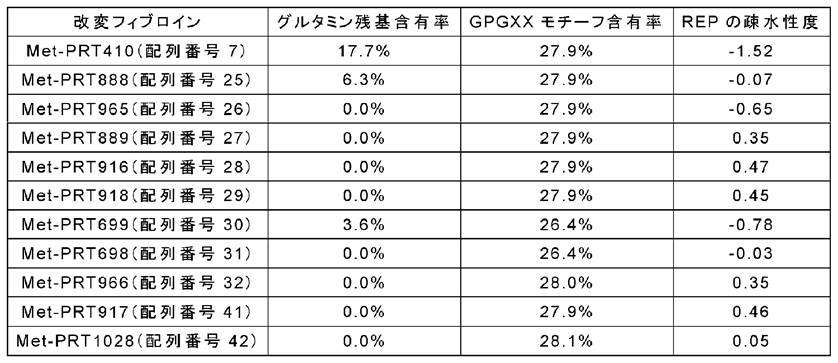

本実施形態に係る人工毛皮は、本発明による効果を損なわない範囲で、人工タンパク質繊維以外の他の繊維を含んでいてもよい。他の繊維としては、例えば、ナイロン、ポリアミド、ポリエステル、ポリアクリロニトリル、ポリオレフィン、ポリビニルアルコール、ポリエチレンテレフタレート、ポリテトラフルオロエチレン及びアクリル樹脂等の合成繊維、キュプラ、レーヨン及びリヨセル等の再生繊維、木綿、麻綿、シルク、ウール及びカシミア等の天然繊維が挙げられる。
式A:最高吸湿発熱度={(試料を、試料温度が平衡に達するまで低湿度環境下に置いた後、高湿度環境下に移したときの試料温度の最高値)-(試料を、試料温度が平衡に達するまで低湿度環境下に置いた後、高湿度環境下に移すときの試料温度)}(℃)/試料重量(g)
なお、式A中、低湿度環境は、温度20℃及び相対湿度40%の環境を意味し、高湿度環境は、温度20℃及び相対湿度90%の環境を意味する。
消防危50号平成7年5月31日の粉粒状又は融点の低い合成樹脂の試験方法に準拠して測定される値である。
式B:保温性指数=保温率(%)/試料の目付け(g/m2)
ここで、本明細書において、保温率は、サーモラボII型試験機(30cm/秒の有風下)を用いたドライコンタクト法で測定した保温率を意味し、後述する実施例に記載の方法により測定される値である。
本実施形態に係る人工毛皮は、例えば、上述した繊維(人工タンパク質繊維を含む繊維)を使用し、生地の片面又は両面に多数のパイルが突設されたパイル生地を得る工程(パイル生地製造工程)と、パイルのループを切断(剪毛)し、カットパイル(切毛)を形成する工程(剪毛工程)と、必要に応じて、カットパイル(切毛)に櫛入れする工程(櫛入工程)及び/又はカットパイル(切毛)を形成した織物を洗浄する工程(洗浄工程)を備える方法により得ることができる。
第2の発明に従う第2の実施形態に係る人工毛皮は、防縮されたタンパク質繊維を含む。
タンパク質繊維を防縮する方法としては、例えば、紡糸後、水と接触する前のタンパク質繊維を水と接触させて不可逆的に収縮させる方法(水収縮法)、紡糸後、水と接触する前のタンパク質繊維を加熱し、加熱された状態にあるタンパク質繊維を弛緩して不可逆的に収縮させる方法(乾熱収縮法)等を例示できる。水収縮法及び乾熱収縮法のいずれも、人工毛皮を編織する前のタンパク質繊維に対して実施してもよく、編織した後に人工毛皮(パイルのループを切断する前であってもよく、切断した後であってもよい。)に対して実施してもよい。
定の温度になるように変動させてもよい。
ンパク質繊維の過乾燥による編織体の品質及び物性等への影響が排除されうる時間が採用される。
第2の実施形態に係る人工毛皮は、上述した防縮処理の実施によりタンパク質繊維が防縮されることで、水との接触による寸法変化が抑制されている。したがって、人工毛皮に使用するタンパク質繊維(及びタンパク質)は、本来水との接触により(著しい)寸法変化を生じるものであってもよい。
湿潤時収縮率={1-(水に接触させて湿潤状態にしたタンパク質繊維の長さ/紡糸後、水と接触する前のタンパク質繊維の長さ)}×100(%) …(式I)
乾燥時収縮率={1-(乾燥状態にしたタンパク質繊維の長さ/紡糸後、水と接触する前のタンパク質繊維の長さ)}×100(%) …(式II)
及び/又は難燃性の性質を更に付与することができ、人工毛皮としての価値がより高くなる。
本実施形態に係る人工毛皮は、本発明による効果を損なわない範囲で、タンパク質繊維以外の他の繊維を含んでいてもよい。他の繊維としては、前述した第1の実施形態に係る人工毛皮に含有可能な繊維と同様な繊維が挙げられる。
本実施形態に係る人工毛皮は、上述した繊維(タンパク質繊維を含む繊維)を使用し、生地の片面又は両面にパイルが突設されたパイル生地を得る工程(パイル生地製造工程)と、パイルのループを切断(剪毛)し、カットパイル(切毛)を形成する工程(剪毛工程)と、防縮する工程(防縮工程)と、必要に応じて、カットパイル(切毛)に櫛入れする工程(櫛入工程)及び/又はカットパイル(切毛)を形成した織物を洗浄する工程(洗浄工程)とを備える方法により得ることができる。なお、パイル生地製造工程で用いられる繊維は、タンパク質繊維を含んでいれば、その形態が特に限定されない。すなわち、例えば、フィラメントの束を撚り合わせた撚糸であっても、ステープルからなる紡績糸であってもよい。
及び/又は洗浄工程を更に備えていてもよい。
ことができる。
第3の発明に従う第3の実施形態に係る人工毛皮は、繊維を含んでおり、かつ更に機能性が付与されたものである。
てもよい。
第1の方法では、例えば、改変フィブロインを含有する繊維(タンパク質繊維又は複合繊維)を原料として使用することで、機能性が付与された人工毛皮を得ることができる。改変フィブロインを含有する繊維は、改変フィブロインを含む原料を常法に従い紡糸することで得ることができる。繊維が改変フィブロインを含むことによって、繊維に保温性、吸湿発熱性及び/又は難燃性の機能性を付与することができ、ひいては本実施形態に係る人工毛皮に保温性、吸湿発熱性及び/又は難燃性の機能性を付与することができる。改変フィブロインとしては、これらの機能性により優れることから、改変クモ糸フィブロインが好ましい。改変フィブロインについては上述した通りである。
第2の方法における所定のタンパク質架橋体とは、ポリペプチド骨格と、タンパク質と反応して結合を形成可能な第一の反応性基を2つ以上有する第一の反応剤の残基である第一の残基と、第一の反応性基と反応して結合を形成可能な第二の反応性基を1つ有する第二の反応剤の残基である第二の残基と、をそれぞれ複数有し、第一の残基の少なくとも一つが、ポリペプチド骨格を架橋しており、第一の残基の少なくとも一つが、一端でポリペプチド骨格と結合し、他端で第二の残基と結合しているものである。

であってよい。R3は、例えば、アルキル基、アリール基、ハロゲン化アルキル基又はハロゲン化アリール基であってよい。R1、R2及びR3は置換基を有していてもよい。当該置換基としては、例えば、アルキル基、アルケニル基、アリール基、ハロゲン原子等が挙げられる。
ロエチル基)、アリール基(特に、フェニル基、トリル基、ナフチル基、フルオロフェニル基)等がより好ましい。R3としては、アルキル基(特に、メチル基、エチル基、ベンジル基、アリル基)、アリール基(特に、フェニル基、トリル基、ナフチル基、フルオロフェニル基)等がより好ましい。
できる。


第3の方法における修飾ヒドロキシル基含有ポリマーは、ヒドロキシル基含有ポリマーに機能性官能基が結合したポリマーである。修飾ヒドロキシル基含有ポリマーは、例えば、ヒドロキシル基含有ポリマーと、機能性官能基を有する反応剤とを反応させることで得ることができる。
本実施形態に係る人工毛皮は、例えば、上述した繊維(人工タンパク質繊維を含む繊維)を使用して、前述した第1の実施形態に係る人工毛皮と同様な、上述した方法で製造することができる。
第4の発明に従う第4の実施形態に係る人工毛皮は、繊維及び耐水性付与物質を含む。
耐水性付与物質は、人工毛皮の耐水性を向上させ得る物質である。人工毛皮が耐水性付与物質を含むことにより、例えば、人工毛皮の撥水性が向上する、人工毛皮の水接触時の収縮が抑制される等の効果が発揮され、人工毛皮の防水性がより一層向上することになる。人工毛皮は、耐水性付与物質を1種単独で含有していてもよく、2種以上を含有していてもよい。

基、ハロゲン化アルキル基又はハロゲン化アリール基であってよい。式(A-6)中、X5は酸素原子(O)又は硫黄原子(S)を示し、Y2は酸素原子(O)、硫黄原子(S)又はNR7で表される基を示す。R7は例えば、アルキルスルホニル基、アリールスルホニル基、アシル基、カーバメート基、アルキル基、アリール基、ハロゲン化アルキル基又はハロゲン化アリール基であってよい。

とができる。
本実施形態に係る人工毛皮は、繊維及び耐水性付与物質以外の他の成分を更に含んでいてもよい。他の成分としては、例えば、着色剤、平滑剤、酸化防止剤、紫外線吸収剤、染料、充填剤、架橋剤、艶消し剤、レベリング剤等が挙げられる。
本実施形態に係る人工毛皮は、例えば、上述した繊維(人工タンパク質繊維を含む繊維)を使用して、前述した第1の実施形態に係る人工毛皮と同様な、上述した方法で製造することができる。
本実施形態(第1~4の実施形態)係る人工毛皮は、公知の人工毛皮(合成繊維を用いた人工毛皮等)が使用される用途(例えば、衣料品及びバック等の装飾品、カーペット、ぬいぐるみ等)のいずれにも用いられ得る。
配列番号18で示されるアミノ酸配列を有する改変クモ糸フィブロイン(PRT399)、配列番号12で示されるアミノ酸配列を有する改変クモ糸フィブロイン(PRT380)、配列番号13で示されるアミノ酸配列を有する改変クモ糸フィブロイン(PRT410)、配列番号37で示されるアミノ酸配列を有する改変フィブロイン(PRT918)、配列番号40で示されるアミノ酸配列を有する改変フィブロイン(PRT966)、及び配列番号15で示されるアミノ酸配列を有する改変フィブロイン(PRT799)を設計した。設計した改変フィブロインをコードする核酸を合成した。当該核酸には、5’末端にNdeIサイト、終止コドン下流にEcoRIサイトを付加した。この核酸をクローニングベクター(pUC118)にクローニングした。その後、同核酸をNdeI及びEcoRIで制限酵素処理して切り出した後、タンパク質発現ベクターpET-22b(+)に組換えて発現ベクターを得た。


Tris-HCl buffer(pH7.4)で洗浄した。洗浄後の菌体を約1mMのPMSFを含む20mM Tris-HCl緩衝液(pH7.4)に懸濁させ、高圧ホモジナイザー(GEA Niro Soavi社製)で細胞を破砕した。破砕した細胞を遠心分離し、沈殿物を得た。得られた沈殿物を、高純度になるまで20mM Tris-HCl緩衝液(pH7.4)で洗浄した。洗浄後の沈殿物を100mg/mLの濃度になるように8M グアニジン緩衝液(8M グアニジン塩酸塩、10mM リン酸二水素ナトリウム、20mM NaCl、1mM Tris-HCl、pH7.0)で懸濁し、60℃で30分間、スターラーで撹拌し、溶解させた。溶解後、透析チューブ(三光純薬株式会社製のセルロースチューブ36/32)を用いて水で透析を行った。透析後に得られた白色の凝集タンパク質を遠心分離により回収し、凍結乾燥機で水分を除き、凍結乾燥粉末を回収することにより、改変フィブロイン(PRT399、PRT380、PRT410、PRT918、PRT966及びPRT799)を得た。
4.0質量%になるようにLiClを溶解させたジメチルスルホキシド(DMSO)を溶媒として用意し、そこに改変フィブロイン(PRT399、PRT380、PRT410又はPRT799)の凍結乾燥粉末を、濃度18質量%又は24質量%となるよう添加し、シェーカーを使用して3時間溶解させた。その後、不溶物と泡を取り除き、改変フィブロイン溶液を得た。
押出しノズル直径:0.2mm
凝固浴温度:2~15℃
総延伸倍率:1~4倍
乾燥温度:60℃
得られた改変フィブロイン繊維(製造例1~19)について、収縮率を評価した。すなわち、各改変フィブロイン繊維(紡糸後、水と接触する前の繊維)に対して、水に接触させて湿潤状態にし(接触ステップ)、その後乾燥させる(乾燥ステップ)収縮工程を実施し、湿潤状態にした改変フィブロイン繊維の収縮率、並びに湿潤状態にした後、乾燥させた改変フィブロイン繊維の収縮率を求めた。
各改変フィブロイン繊維の巻回物から、それぞれ、長さ30cmの複数本の試験用の改変フィブロイン繊維を切り出した。それら複数本の改変フィブロイン繊維を束ねて、繊度150デニールの改変フィブロイン繊維束を得た。各改変フィブロイン繊維束に0.8gの鉛錘を取り付け、その状態で各改変フィブロイン繊維束を表6~9に示す温度の水に10分間浸漬した。その後、水中で各改変フィブロイン繊維束の長さを測定した。測定は、改変フィブロイン繊維束の縮れを無くすために、改変フィブロイン繊維束に0.8gの鉛錘を取り付けたまま実施した。次いで、湿潤状態にした改変フィブロイン繊維の収縮率(湿潤時収縮率)を、下記式Vに従って算出した。式V中、L0は水に浸漬する前の改変フィブロイン繊維束の長さ(30cm)を示し、Lwは水に浸漬して湿潤状態にした改変フィブロイン繊維束の長さを示す。
湿潤時収縮率(%)={1-(Lw/L0)}×100 …(式V)
接触ステップの後、改変フィブロイン繊維束を水中から取り出した。取り出した改変フィブロイン繊維束を、0.8gの鉛錘を取り付けたまま、室温で2時間おいて乾燥させた。乾燥後、各改変フィブロイン繊維束の長さを測定した。次いで、湿潤状態にした後、乾燥させた改変フィブロイン繊維の収縮率(乾燥時収縮率)を、下記式VIに従って算出した。式VI中、L0は水に浸漬する前の改変フィブロイン繊維束の長さ(30cm)を示し、Lwdは水に浸漬して湿潤状態にした後、乾燥させた改変フィブロイン繊維束の長さを示す。
乾燥時収縮率(%)={1-(Lwd/L0)}×100(%) …(式VI)
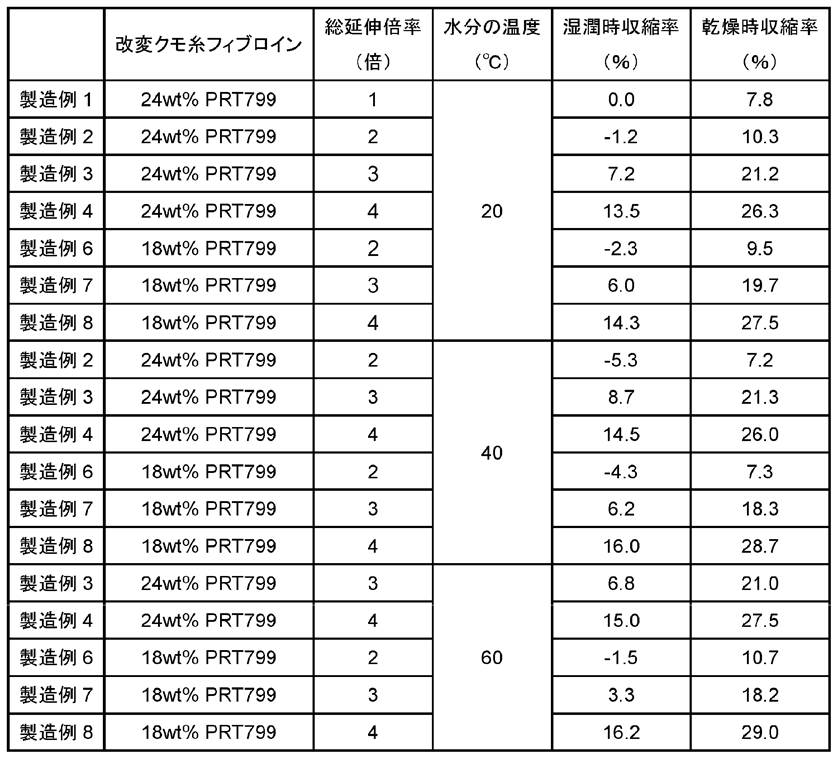


ギ酸に、改変フィブロイン(PRT799)を濃度24質量%となるよう添加し、室温撹拌にて1時間溶解させた。その後、不溶物と泡を取り除き、改変フィブロイン溶液を得た。
凝固液(メタノール)の温度:5~10℃
延伸倍率:6倍
乾燥温度:80℃
れか一方を調整することにより行った。
水収縮率=(1-乾燥後の繊維長さ/浸漬前の繊維長さ)×100・・・(1)
加熱温度と弛緩倍率の関係を確認した。この試験例3-1では、試験例3-1-1~試験例3-1-7のすべてにおいて、水浸漬前長さを300mmとすると共に、他の条件を変化させて試験を行った。具体的には、加熱温度、弛緩倍率、及び滞在時間を変化させて試験を行った。温度条件及び弛緩条件と、収縮率の測定結果とを表10に示す。表10に示されるように、加熱温度が高くなるほど、また、弛緩倍率が高くなるほど、水収縮率が低減した。試験例3-1-3~試験例3-1-5の結果に示されるように、220℃以上の加熱で、4%以下の水収縮率が得られた。なお、加熱温度280℃とした実施例5では、繊維に着色が見られた。この試験の結果、最適な加熱温度は240℃であると考えられた。

次に、弛緩倍率と水収縮率の関係を確認した。この試験例3-2では、試験例3-2-1~試験例3-2-6のすべてにおいて、水浸漬前長さを300mmとし、加熱温度を240℃とし、滞在時間を1分(60sec)とすると共に、他の条件を変化させて試験を行った。具体的には、弛緩倍率(送出し速度)を変化させて試験を行った。弛緩条件と収縮率の測定結果を表11に示す。表11に示されるように、弛緩倍率の上昇に伴って、水収縮率が低減した。試験例3-2-3~試験例3-2-5の結果に示されるように、弛緩倍率を1.4倍~2.0倍とすることで、16%以下の水収縮率が得られた。

各種の加熱温度、加熱時間、及び弛緩倍率と、水収縮率との関係を確認した。この試験例3-3では、試験例3-3-1~試験例3-3-10のすべてにおいて、水浸漬前長さを300mmとすると共に、他の条件を変化させて試験を行った。具体的には、加熱温度、加熱時間(滞在時間)、及び弛緩倍率(送出し速度/巻取り速度)を変化させて試験を行った。温度条件及び弛緩条件と、収縮率の測定結果とを表12に示す。試験例3-3-10では、試験片の水への浸漬及び乾燥のみを行っており、弛緩及び加熱は行っていない。試験例3-3-4~試験例3-3-9の結果に示されるように、加熱温度を200℃以
上とすることで、15%未満の水収縮率が得られた。加熱温度を220℃以上とすることで、4%以下の低い水収縮率が得られた。収縮に必要な滞在時間は、5secで十分であり、滞在時間を伸ばしても、収縮率はさほど変化しなかった。

[編地の製造、防縮処理及び評価]
(試験例4-1)
紡糸工程での総延伸倍率を4.55倍とした以外、試験例2と同様にして得た改変フィブロイン繊維を用いて、無縫製編機により丸編みにて編地を編成した。ここで、改変フィブロイン繊維の番手は58.1Nmであり、無縫製編機のゲージ数は18であった。
防縮処理を施した編地の寸法変化率(%)を、ウェール方向、コース方向それぞれについて、下記式に従って算出した。式中、L0fは水と接触させる前の編地上に記載した1辺の長さを示し、Lwfは防縮処理を施した編地上に記載された正方形の1辺の長さを示す。結果を表13に示す。
式:寸法変化率={(Lwf/L0f)-1}×100(%)
上記で得られた編地及び防縮処理を施した編地について、ウェール方向、コース方向のそれぞれの方向における1cmあたりのループ個数を数え、ループ個数の増加率を下記式に従って算出した。式中、N0は水と接触させる前の編地のループ個数を示し、Nwは防縮処理を施した編地のループ個数を示す。結果を表13に示す。
式:ループ個数の増加率={(Nw/N0)-1}×100(%)
上記で得られた編地及び防縮処理を施した編地について1cm2あたりのループ個数を数え、編み密度の増加率を下記式に従って算出した。式中、M0は水と接触させる前の編地の編み密度を示し、Mwは防縮処理を施した編地の編み密度を示す。結果を表13に示す。
式:編み密度の増加率={(Mw/M0)-1}×100(%)
上記で得られた編地及び防縮処理を施した編地についてJIS L 1096 B法に則して破裂強さを測定し、破裂強さの増加率を下記式に従って算出した。式中、R0は水と接触させる前の編地の破裂強さを示し、Rwは防縮処理を施した編地の破裂強さを示す。結果を表13に示す。
式:破裂強さの増加率={(Rw/R0)-1}×100(%)
改変フィブロイン繊維に代えて、天然の絹フィブロイン繊維(天然の絹糸)を用い、無縫製編機により横編みにて編地を編成した。ここで、天然絹フィブロイン繊維は、番手が29Nmの糸を2本束ねたものを用いた。また、無縫製編機のゲージ数は18であった。得られた編地を用いて、試験例4-1と同様にして防縮処理を施した。得られた編地及び防縮処理を施した編地について、寸法変化率、ループ個数の増加率、及び編み密度の増加率を求めた。結果を表13に示す。
改変フィブロイン繊維に代えてポリエチレンテレフタレート(PET)繊維を使用した以外は試験例4-1と同様にして編地を得た。得られた編地について、試験例4-1と同様の条件で防縮処理を施した。得られた編地及び防縮処理を施した編地について、寸法変化率、ループ個数の増加率、編み密度の増加率、及び破裂強さを求めた。結果を表13に示す。
改変フィブロイン繊維に代えてポリエチレンテレフタレート(PET)繊維を使用し、編成方法を丸編みから平編みに変更した以外は試験例4-1と同様にして編地を得た。得られた編地について、試験例4-1と同様の条件で防縮処理を施した。得られた編地及び防縮処理を施した編地について、寸法変化率、ループ個数の増加率、編み密度の増加率及び破裂強さを求めた。結果を表13に示す。
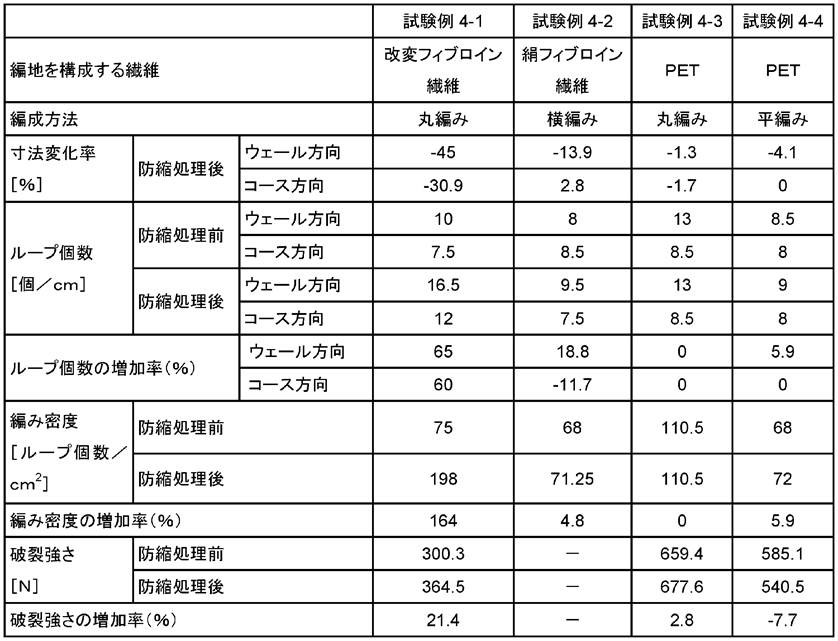
改変フィブロイン繊維からなる撚糸を用い、レピア織機(Evergreen Automatic Sampling Loom:CCI製)により平織にて、下記表14に示すような互いに異なる織り密度を有する4種類の織物を織成した(試験例4-5~試験例4-8)。ここで、改変フィブロイン繊維からなる撚糸の繊度は190dであり、撚数は450T/mであった。

(試験例5-1)
<紡糸原液(ドープ液)の調製>
デンプン(和光純薬工業株式会社製)200mgを11400mgの溶媒(4重量%のLiClを含むジメチルスルホキシド(DMSO))に溶解させた後、これにフェニルイソシアネート(東京化成工業株式会社製)400mgを添加し、90℃で4時間撹拌して反応させた。これにより、デンプンのヒドロキシル基とフェニルイソシアネートのイソシアネート基とが反応して、フェニル基(機能性官能基)が、ウレタン結合を介して結合した修飾デンプン(修飾ヒドロキシル基含有ポリマー)を得た。修飾デンプンは、仕込み比から求めた修飾率(ヒドロキシル基が機能性官能基に変換された割合)が100%であった。
調製した紡糸原液を60℃にて目開き5μmの金属フィルターで濾過し、次いで30mLのステンレスシリンジ内で静置し、脱泡させた後に、ニードル径0.2mmのソリッドノズルから窒素ガスを用い100質量%メタノール凝固浴槽中へ吐出させた。吐出温度は60℃であり、吐出圧は0.3MPaであった。凝固後、得られた原糸を巻き取り速度3.00m/分で巻き取り、自然乾燥させてタンパク質繊維(改変フィブロイン繊維)を得た。
得られたタンパク質繊維を長さ約10cmに切断し、水への浸漬前の糸の長さ(cm)を測定した。次いで、糸を40℃の水浴に1分間浸漬した。その後、糸を水浴から取り出して、15分間室温で真空乾燥させた後、乾燥後の糸の長さを測定した。タンパク質繊維の水収縮率を以下の式に従って算出した。
水収縮率(%)={(浸漬前の長さ/浸漬・乾燥後の長さ)-1}×100
<紡糸原液(ドープ液)の調製>
デンプン(和光純薬工業株式会社製)253mgを7600mgの溶媒(4重量%のLiClを含むジメチルスルホキシド(DMSO))に溶解させた後、これに無水酢酸(和光純薬工業株式会社製)147mgを添加し、90℃で4時間撹拌して反応させた。これにより、デンプンのヒドロキシル基と無水酢酸とが反応して、アセチル基(機能性官能基)が結合した修飾デンプン(修飾ヒドロキシル基含有ポリマー)を得た。修飾デンプンは、仕込み比から求めた修飾率(ヒドロキシル基が機能性官能基に変換された割合)が100%であった。
調製した紡糸原液を使用して、試験例5-1と同様の手順でタンパク質繊維の製造、及び水収縮試験を実施した。
<紡糸原液(ドープ液)の調製>
デンプン(和光純薬工業株式会社製)215mgを7600mgの溶媒(4重量%のLiClを含むジメチルスルホキシド(DMSO))に溶解させた後、これに無水酢酸(和光純薬工業株式会社製)185mgを添加し、90℃で4時間撹拌して反応させた。これにより、デンプンのヒドロキシル基と無水酢酸とが反応して、アセチル基(機能性官能基)が結合した修飾デンプン(修飾ヒドロキシル基含有ポリマー)を得た。修飾デンプンは、仕込み比から求めた修飾率(ヒドロキシル基が機能性官能基に変換された割合)が50%であった。
調製した紡糸原液を使用して、試験例5-1と同様の手順でタンパク質繊維の製造、及び水収縮試験を実施した。
<紡糸原液(ドープ液)の調製>
ポリビニルアルコール(PVA)(和光純薬工業株式会社製)128mgを7600mgの溶媒(4重量%のLiClを含むジメチルスルホキシド(DMSO))に溶解させた後、これにフェニルイソシアネート(東京化成工業株式会社製)272mgを添加し、90℃で4時間撹拌して反応させた。これにより、PVAのヒドロキシル基とフェニルイソシアネートとが反応して、フェニル基(機能性官能基)が、ウレタン結合を介して結合した修飾PVA(修飾ヒドロキシル基含有ポリマー)を得た。修飾PVAは、仕込み比から求めた修飾率(ヒドロキシル基が機能性官能基に変換された割合)が100%であった。
調製した紡糸原液を使用して、試験例5-1と同様の手順でタンパク質繊維の製造、及び水収縮試験を実施した。
<紡糸原液(ドープ液)の調製>
ポリビニルアルコール(PVA)(和光純薬工業株式会社製)193mgを7600mgの溶媒(4重量%のLiClを含むジメチルスルホキシド(DMSO))に溶解させた後、これにフェニルイソシアネート(東京化成工業株式会社製)207mgを添加し、90℃で4時間撹拌して反応させた。これにより、PVAのヒドロキシル基とフェニルイソシアネートとが反応して、フェニル基(機能性官能基)が、ウレタン結合を介して結合した修飾PVA(修飾ヒドロキシル基含有ポリマー)を得た。修飾PVAは、仕込み比から求めた修飾率(ヒドロキシル基が機能性官能基に変換された割合)が50%であった。
調製した紡糸原液を使用して、試験例5-1と同様の手順でタンパク質繊維の製造、及び水収縮試験を実施した。
<紡糸原液(ドープ液)の調製>
上記で得た改変フィブロイン(PRT799)の粉末1200mgを溶媒(4重量%のLiClを含むジメチルスルホキシド(DMSO))に添加し、90℃で12時間撹拌して溶解させ、透明な紡糸原液を得た。
調製した紡糸原液を使用して、試験例5-1と同様の手順でタンパク質繊維の製造、及び水収縮試験を実施した。
<紡糸原液(ドープ液)の調製>
上記で得た改変フィブロイン(PRT799)の粉末3000mg、及びデンプン(和光純薬工業株式会社製)600mgを溶媒(4重量%のLiClを含むジメチルスルホキシド(DMSO))に添加し、90℃で12時間撹拌して溶解させ、透明な紡糸原液を得た。
調製した紡糸原液を使用して、試験例5-1と同様の手順でタンパク質繊維の製造、及び水収縮試験を実施した。
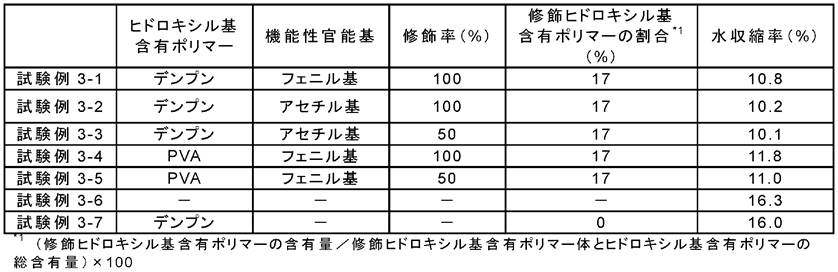
(製造例1)
ジメチルスルホキシド(DMSO)に、上述のクモ糸フィブロイン(PRT799)を濃度24質量%となるよう添加した後、溶解促進剤としてLiClを濃度4.0質量%となるように添加した。その後、シェーカーを使用して、クモ糸フィブロインを3時間かけて溶解させ、DMSO溶液を得た。得られたDMSO溶液中のゴミと泡を取り除き、ドープ液とした。ドープ液の溶液粘度は90℃において5000cP(センチポアズ)であった。
凝固液(メタノール)の温度:5~10℃
延伸倍率:6倍
乾燥温度:80℃
製造例1で得た編織体(5cm角の編地)を、ヘキサンジイソアネート(HDI)20mL中に浸漬した。次いで、HDIが含浸した編織体をアルミホイルに挟み、130℃で30分加熱した。加熱後、編織体を取り出し、ブタノール(BuOH)20mL中に浸漬し、100℃で240分反応させた。反応後の試験サンプルをTHFで洗浄し、機能性が付与された(耐水性付与物質(第一の反応剤及び第二の反応剤)が結合した)編織体を得た。
製造例1で得た編織体を、試験例6-2の編織体として評価した。
製造例1で得た編織体を、ヘキサンジイソアネート(HDI,第一の反応剤)20mL中に浸漬した。次いで、HDIが含浸した編織体をアルミホイルに挟み、130℃で30分加熱した。その後、編織体をTHFで洗浄して、第一の反応剤のみが結合した、試験例6-3の編織体を得た。
編織体に鉛筆で3cm角の正方形を描き、評価サンプルとした。評価サンプルをPanasonic製洗濯機(Na-VG1100L)の洗濯モード「お家クリーニング」で洗濯した。次いで、同じ洗濯機で15分脱水し、120分自然乾燥させた。洗濯前後の正方形の縦横の長さをそれぞれ測定し、縦向及び横方向の収縮率を求めた。同じ試験を3回行い、3回の平均値を評価結果とした。結果を表16に示す。なお、表16中、試験例4-1は上記試験例6-1を、試験例4-2は上記試験例6-2を、試験例4-3は上記試験例6-3を、それぞれ示す。
編織体の肌触りを三段階で評価した。試験例6-2の編織体の肌触りを基準(B)とし、それより風合いに優れる編織体をA、肌触りが荒く風合いに劣る編織体をCとして評価した。結果を表16に示す。

(1)紡糸液(ドープ液)の調製
4質量%になるように塩化リチウムを溶解したDMSOを溶媒として用い、上記で製造した改変フィブロイン(PRT799)の凍結乾燥粉末を、濃度24質量%となるように溶媒に添加した。90℃のアルミブロックヒーターで1時間溶解させた後、不溶物と泡を取り除き、紡糸液(ドープ液)とした。
得られた改変フィブロイン繊維から諸撚糸を作製した。作製した諸撚糸を平織りして織生地を得た。
得られた織生地にフッ素系コーティング用モノマーを塗布し、プラズマ処理装置(Europlasma社製)を用いてプラズマ処理を施した。プラズマ処理により、フッ素系コーティング用モノマーが重合したフッ素系ポリマー(耐水性付与物質)が共有結合した織生地を得た。フッ素系コーティング用モノマーとして、Nanofics110(試験例7-2)及びNanofics120(試験例7-3)(いずれもEuroplasma社製)を使用した。
プラズマ処理を施した試験例7-2及び試験例7-3の織生地、並びにプラズマ処理を施していない織生地(試験例7-1)について、撥水度試験(スプレー試験)を実施した。撥水度試験(スプレー試験)は、ISO4920:2012に準じて実施した。以下に示す6段階(スコア0~5)の評価基準に従い、目視で判定を実施した。
スコア5:表面に湿潤及び水滴の付着がない。
スコア4:表面に湿潤しないが,水滴の付着がある。
スコア3:表面に小さな湿潤がある。
スコア2:湿潤が広がり,いくつかは互いに接続している。
スコア1:水が当たった部分に完全な湿潤を示す。
スコア0:表面全体に湿潤を示す。

試験例7-1~試験例7-3の織生地から、一辺5cmの正方形状の試験片をそれぞれ切り出した。試験片の一方の表面に、鉛筆で一辺30mmの正方形の頂点(4点)をマークした。各試験片を40℃の水に10分間浸漬した後、次いで室温で真空乾燥させる工程を5サイクル繰り返した。真空乾燥は、真空定温乾燥機(VOS-310C,東京理化器械(株)製)を用いて、設定圧力-0.1MPaで30分間行った。また、各サイクル終了時に、触感を官能評価すると共に、マークした4点間の距離を測定して収縮率を評価した。
評点5:オリジナルと同様に良好である。
評点4:良好であるが、オリジナルと比べて若干劣る。
評点3:悪くはないが、やや堅い。
評点2:悪く、かつ堅いが、曲げられる。
評点1:とても悪く、堅く、かつ曲げられない。

収縮率(%)={1-(各辺の長さの平均値(mm)/30mm)}×100
結果を表19に示す。プラズマ処理を施した試験例2-2及び試験例7-3の織生地はいずれもプラズマ処理を施していない試験例7-1の織生地と比べて収縮率が小さかった。

(1)紡糸液(ドープ液)の調製
4質量%になるように塩化リチウムを溶解したDMSOを溶媒として用い、上記で製造した改変フィブロイン(PRT918)の凍結乾燥粉末を、濃度24質量%となるように溶媒に添加した。90℃のアルミブロックヒーターで1時間溶解させた後、不溶物と泡を取り除き、紡糸液(ドープ液)とした。
紡糸液をリザーブタンクに充填し、0.1又は0.2mm径のモノホールノズルからギアポンプを用い100質量%メタノール凝固浴槽中へ吐出させた。吐出量は0.01~0.08mL/分に調整した。凝固後、100質量%メタノール洗浄浴槽で洗浄及び延伸を行った。洗浄及び延伸後、乾熱板を用いて乾燥させ、得られた原糸(改変フィブロイン繊維)を巻き取った。
得られた改変フィブロイン繊維を裁断して改変フィブロインステープルを作製した。作製した改変フィブロインステープルを開繊開毛した後、公知の紡績装置により紡績し、紡績糸を得た。得られた紡績糸を、ホールガーメント横編機(MACH2XS,島精機製)を使用して編み、編生地を得た。
得られた編生地にフッ素系コーティング用モノマーを塗布し、プラズマ処理装置(Europlasma社製)を用いてプラズマ処理を施した。プラズマ処理により、フッ素系コーティング用モノマーが重合したフッ素系ポリマー(耐水性付与物質)が共有結合した編生地を得た(試験例3-2)。フッ素系コーティング用モノマーとして、Nanofics120(Europlasma社製)を使用した。
プラズマ処理を施した試験例8-2の編生地、及びプラズマ処理を施していない編生地(試験例8-1)について、試験例7と同様の方法で、撥水度試験(スプレー試験)を実施した。結果を表20に示す。プラズマ処理を施していない試験例8-1の編生地はスコア0であったのに対し、プラズマ処理を施した試験例8-2の編生地はスコア5であり、耐水性(撥水性)が付与されていた。なお、以下、表20及び表21、表22中、試験例3-1は上記試験例8-1を、試験例3-2は上記試験例8-2を、それぞれ示す。

試験例8-1及び試験例8-2の編生地から、一辺5cmの正方形状の試験片をそれぞれ切り出した。試験片の一方の表面に、鉛筆で一辺30mmの正方形の頂点(4点)をマークした。予備処理として、各試験片を40℃の水に10分間浸漬した後、次いで室温で真空乾燥させる工程を5サイクル繰り返した。真空乾燥は、真空定温乾燥機(VOS-310C,東京理化器械(株)製)を用いて、設定圧力-0.1MPaで30分間行った。


<試験例9-1>
(1)紡糸液(ドープ液)の調製
デンプン(和光純薬工業株式会社製)200mgを11400mgの溶媒(4重量%のLiClを含むジメチルスルホキシド(DMSO))に溶解させた後、これにフェニルイソシアネート(東京化成工業株式会社製)400mgを添加し、90℃で4時間撹拌して反応させた。これにより、デンプンのヒドロキシル基とフェニルイソシアネートのイソシアネート基とが反応して、フェニル基(機能性官能基)が、ウレタン結合を介して結合した修飾デンプン(修飾ヒドロキシル基含有ポリマー)を得た。修飾デンプンは、仕込み比から求めた修飾率(ヒドロキシル基が機能性官能基に変換された割合)が100%であった。
調製した紡糸液を60℃にて目開き5μmの金属フィルターで濾過し、次いで30mLのステンレスシリンジ内で静置し、脱泡させた後に、ニードル径0.2mmのソリッドノズルから窒素ガスを用い100質量%メタノール凝固浴槽中へ吐出させた。吐出温度は60℃であり、吐出圧は0.3MPaであった。凝固後、得られた原糸を巻き取り速度3.00m/分で巻き取り、自然乾燥させて、改変フィブロインと耐水性付与物質(修飾デンプン)を含む繊維を得た。
得られた繊維を長さ約10cmに切断し、水への浸漬前の糸の長さ(cm)を測定した。次いで、糸を40℃の水浴に1分間浸漬した。その後、糸を水浴から取り出して、15分間室温で真空乾燥させた後、乾燥後の糸の長さを測定した。繊維の収縮率を以下の式に従って算出した。結果を表23に示す。
収縮率(%)={(浸漬前の長さ/浸漬・乾燥後の長さ)-1}×100
なお、表23中、試験例5-1は試験例9-1を、また、試験例5-2は後述する試験例9-2を、試験例5-3は後述する試験例9-3を、試験例5-4は後述する試験例9-4を、試験例5-5は後述する試験例9-5を、試験例5-6は後述する試験例9-6を、試験例5-7は後述する試験例9-7を、それぞれ示す。
(1)紡糸液(ドープ液)の調製
デンプン(和光純薬工業株式会社製)253mgを7600mgの溶媒(4重量%のLiClを含むジメチルスルホキシド(DMSO))に溶解させた後、これに無水酢酸(和光純薬工業株式会社製)147mgを添加し、90℃で4時間撹拌して反応させた。これにより、デンプンのヒドロキシル基と無水酢酸とが反応して、アセチル基(機能性官能基)が結合した修飾デンプン(修飾ヒドロキシル基含有ポリマー)を得た。修飾デンプンは、仕込み比から求めた修飾率(ヒドロキシル基が機能性官能基に変換された割合)が100%であった。
調製した紡糸液を使用して、試験例9-1と同様の手順で改変フィブロインと耐水性付与物質(修飾デンプン)を含む繊維を得た。
得られた繊維について、試験例9-1と同様の手順で収縮性評価を実施した。結果を表23に示す。
(1)紡糸液(ドープ液)の調製
デンプン(和光純薬工業株式会社製)215mgを7600mgの溶媒(4重量%のLiClを含むジメチルスルホキシド(DMSO))に溶解させた後、これに無水酢酸(和光純薬工業株式会社製)185mgを添加し、90℃で4時間撹拌して反応させた。これにより、デンプンのヒドロキシル基と無水酢酸とが反応して、アセチル基(機能性官能基)が結合した修飾デンプン(修飾ヒドロキシル基含有ポリマー)を得た。修飾デンプンは、仕込み比から求めた修飾率(ヒドロキシル基が機能性官能基に変換された割合)が50%であった。
調製した紡糸液を使用して、試験例5-1と同様の手順で改変フィブロインと耐水性付与物質(修飾デンプン)を含む繊維を得た。
得られた繊維について、試験例9-1と同様の手順で収縮性評価を実施した。結果を表23に示す。
(1)紡糸液(ドープ液)の調製
ポリビニルアルコール(PVA)(和光純薬工業株式会社製)128mgを7600mgの溶媒(4重量%のLiClを含むジメチルスルホキシド(DMSO))に溶解させた後、これにフェニルイソシアネート(東京化成工業株式会社製)272mgを添加し、90℃で4時間撹拌して反応させた。これにより、PVAのヒドロキシル基とフェニルイソシアネートとが反応して、フェニル基(機能性官能基)が、ウレタン結合を介して結合した修飾PVA(修飾ヒドロキシル基含有ポリマー)を得た。修飾PVAは、仕込み比から求めた修飾率(ヒドロキシル基が機能性官能基に変換された割合)が100%であった。
調製した紡糸液を使用して、試験例9-1と同様の手順で改変フィブロインと耐水性付与物質(修飾PVA)を含む繊維を得た。
得られた繊維について、試験例9-1と同様の手順で収縮性評価を実施した。結果を表23に示す。
(1)紡糸液(ドープ液)の調製
ポリビニルアルコール(PVA)(和光純薬工業株式会社製)193mgを7600mgの溶媒(4重量%のLiClを含むジメチルスルホキシド(DMSO))に溶解させた後、これにフェニルイソシアネート(東京化成工業株式会社製)207mgを添加し、90℃で4時間撹拌して反応させた。これにより、PVAのヒドロキシル基とフェニルイソシアネートとが反応して、フェニル基(機能性官能基)が、ウレタン結合を介して結合した修飾PVA(修飾ヒドロキシル基含有ポリマー)を得た。修飾PVAは、仕込み比から求めた修飾率(ヒドロキシル基が機能性官能基に変換された割合)が50%であった。
調製した紡糸液を使用して、試験例9-1と同様の手順で改変フィブロインと耐水性付与物質(修飾PVA)を含む繊維を得た。
得られた繊維について、試験例9-1と同様の手順で収縮性評価を実施した。結果を表23に示す。
(1)紡糸液(ドープ液)の調製
改変フィブロイン(PRT799)の凍結乾燥粉末1200mgを溶媒(4重量%のLiClを含むジメチルスルホキシド(DMSO))に添加し、90℃で12時間撹拌して溶解させ、透明な紡糸液(ドープ液)を得た。
調製した紡糸液を使用して、試験例9-1と同様の手順で繊維を得た。
得られた繊維について、試験例9-1と同様の手順で収縮性評価を実施した。結果を表23に示す。
(1)紡糸液(ドープ液)の調製
改変フィブロイン(PRT799)の凍結乾燥粉末3000mg、及びデンプン(和光純薬工業株式会社製)600mgを溶媒(4重量%のLiClを含むジメチルスルホキシド(DMSO))に添加し、90℃で12時間撹拌して溶解させ、透明な紡糸液(ドープ液)を得た。
調製した紡糸液を使用して、試験例9-1と同様の手順で繊維を得た。
得られた繊維について、試験例9-1と同様の手順で収縮性評価を実施した。結果を表23に示す。

4.0質量%になるようにLiClを溶解させたジメチルスルホキシド(DMSO)を溶媒として用意し、そこに改変フィブロイン(PRT799)の凍結乾燥粉末を、濃度24質量%となるよう添加し、シェーカーを使用して3時間溶解させた。その後、不溶物と泡を取り除き、改変フィブロイン溶液(紡糸原液)を得た。
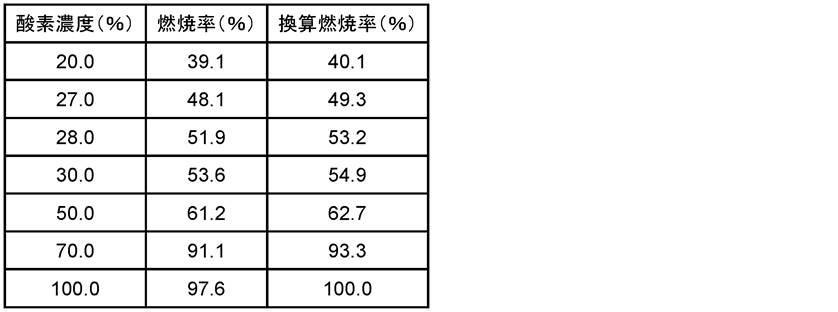
4.0質量%になるようにLiClを溶解させたジメチルスルホキシド(DMSO)を溶媒として用意し、そこに改変フィブロインの凍結乾燥粉末を、濃度24質量%となるよう添加し、シェーカーを使用して3時間溶解させた。その後、不溶物と泡を取り除き、改変フィブロイン溶液(紡糸原液)を得た。
ウール 太さ:2/30N(双糸)、ゲージ数:14
コットン 太さ:2/34N(双糸)、ゲージ数:14
テンセル 太さ:2/30N(双糸)、ゲージ数:15
レーヨン 太さ:1/38N(単糸)、ゲージ数:14
ポリエステル 太さ:1/60N(単糸)、ゲージ数:14
式A:最高吸湿発熱度={(試料を、試料温度が平衡に達するまで低湿度環境下に置いた後、高湿度環境下に移したときの試料温度の最高値)-(試料を、試料温度が平衡に達するまで低湿度環境下に置いた後、高湿度環境下に移すときの試料温度)}(℃)/試料重量(g)

4.0質量%になるようにLiClを溶解させたジメチルスルホキシド(DMSO)を溶媒として用意し、そこに改変フィブロインの凍結乾燥粉末を、濃度24質量%となるよう添加し、シェーカーを使用して3時間溶解させた。その後、不溶物と泡を取り除き、改変フィブロイン溶液(紡糸原液)を得た。
ウール 番手:30Nm、撚り本数:2、ゲージ数:14GG、目付け:242.6g/m2
シルク 番手:60Nm、撚り本数:2、ゲージ数:14GG、目付け:225.2g/m2
綿 番手:34Nm、撚り本数:2、ゲージ数:14GG、目付け:194.1g/m2
レーヨン 番手:38Nm、撚り本数:1、ゲージ数:14GG、目付け:181.8g/m2
ポリエステル 番手:60Nm、撚り本数:1、ゲージ数:14GG、目付け:184.7g/m2
保温率(%)=(1-a/b)×100
式B:保温性指数=保温率(%)/試料の目付け(g/m2)

改変フィブロイン(PRT966)の凍結乾燥粉末を、ギ酸に濃度30質量%となるよう添加し、撹拌羽付き溶解槽を使用して1.5時間溶解させた。その後、不溶物と泡を取り除き、改変フィブロイン溶液(紡糸原液)を得た。得られた改変クモ糸フィブロイン溶液をドープ液(紡糸原液)とし、公知の乾湿式紡糸装置を用いた乾湿式紡糸によって改変クモ糸フィブロイン繊維(フィラメント)を製造した。次いで、公知の捲縮装置を用いて、得られた改変フィブロイン繊維に対して機械捲縮を行った後、110~150mmの長さにカットしてステープルを得た。得られたステープルを用い、常法に従って紡績糸を得た。その後、得られた紡績糸を用いて、パイル編みにより、片面にパイルが突設したパイル編地を得た。その後、パイルのループを切断した後、櫛入れを行った。これにより、改変フィブロイン繊維からなる人工毛皮を得た。得られた人工毛皮の写真を図9及び図10に示した。
Claims (24)
- 人工タンパク質繊維を含む、人工毛皮。
- 前記人工タンパク質繊維が、人工構造タンパク質繊維を含有する、請求項1に記載の人工毛皮。
- 前記人工構造タンパク質繊維が、改変フィブロイン繊維を含有する、請求項2に記載の人工毛皮。
- 前記改変フィブロイン繊維が、改変クモ糸フィブロイン繊維を含有する、請求項3に記載の人工毛皮。
- 防縮されたタンパク質繊維を含む、人工毛皮。
- 前記タンパク質繊維は、下記式Iで定義される湿潤時収縮率が2%以上である、請求項6に記載の人工毛皮。
湿潤時収縮率={1-(水に接触させて湿潤状態にしたタンパク質繊維の長さ/紡糸後、水と接触する前のタンパク質繊維の長さ)}×100(%) …(式I) - 前記タンパク質繊維は、下記式IIで定義される乾燥時収縮率が7%超である、請求項5又は6に記載の人工毛皮。
乾燥時収縮率={1-(乾燥状態にしたタンパク質繊維の長さ/紡糸後、水と接触する前のタンパク質繊維の長さ)}×100(%) …(式II) - 前記タンパク質繊維が、改変フィブロインを含む、請求項5~7のいずれか一項に記載の人工毛皮。
- 前記改変フィブロインが、改変クモ糸フィブロインである、請求項8に記載の人工毛皮
- 繊維を含み、かつ機能性が付与された、人工毛皮。
- タンパク質架橋体を含み、
前記タンパク質架橋体が、ポリペプチド骨格と、タンパク質と反応して結合を形成可能な第一の反応性基を2つ以上有する第一の反応剤の残基である第一の残基と、前記第一の反応性基と反応して結合を形成可能な第二の反応性基を1つ有する第二の反応剤の残基である第二の残基と、をそれぞれ複数有し、
前記第一の残基の少なくとも一つが、前記ポリペプチド骨格を架橋しており、
前記第一の残基の少なくとも一つが、一端でポリペプチド骨格と結合し、他端で前記第二の残基と結合している、請求項10に記載の人工毛皮。 - ヒドロキシル基含有ポリマーに機能性官能基が結合した修飾ヒドロキシル基含有ポリマーを含む、請求項10又は11に記載の人工毛皮。
- 繊維及び耐水性付与物質を含む、人工毛皮。
- 前記改変フィブロインと前記耐水性付与物質が共有結合している、請求項13に記載の人工毛皮。
- 前記耐水性付与物質が、シリコーン系ポリマー及びフッ素系ポリマーから選ばれる少なくとも1種である、請求項13又は14に記載の人工毛皮。
- 前記繊維が、タンパク質繊維を含む、請求項10~15のいずれか一項に記載の人工毛皮。
- 前記タンパク質繊維が、改変フィブロインを含む、請求項16に記載の人工毛皮。
- 前記改変フィブロインが、改変クモ糸フィブロインである、請求項17に記載の人工毛皮
- 限界酸素指数(LOI)値が、26.0以上である、請求項1~18のいずれか一項に記載の人工毛皮。
- 下記式Aに従って求められる最高吸湿発熱度が0.025℃/g超である、請求項1~19のいずれか一項に記載の人工毛皮。
式A:最高吸湿発熱度={(試料を、試料温度が平衡に達するまで低湿度環境下に置いた後、高湿度環境下に移したときの試料温度の最高値)-(試料を、試料温度が平衡に達するまで低湿度環境下に置いた後、高湿度環境下に移すときの試料温度)}(℃)/試料重量(g)
[式A中、低湿度環境は、温度20℃及び相対湿度40%の環境を意味し、高湿度環境は、温度20℃及び相対湿度90%の環境を意味する。] - 下記式Bに従って求められる保温性指数が0.18超である、請求項1~20のいずれか一項に記載の人工毛皮。
式B:保温性指数=保温率(%)/試料の目付け(g/m2)
[式B中、保温率(%)は、ドライコンタクト法(温度30℃、風速30cm/秒)で測定された保温率を意味し、(1-a/b)×100で算出される。aは、試験片を介して放散された熱量を示し、bは、試験片を介さないで放散された熱量を示す。] - 人工タンパク質繊維を含む繊維を使用し、生地の片面又は両面にパイルが突設されたパイル生地を得る工程と、
前記パイルのループを切断し、カットパイルを形成する工程と、を備える、人工毛皮の製造方法。 - 防縮されたタンパク質繊維を使用し、生地の片面又は両面にパイルが突設されたパイル生地を得る工程と、
前記パイルのループを切断し、カットパイルを形成する工程と、を備える、人工毛皮の製造方法。 - タンパク質繊維を含む繊維を使用し、生地の片面又は両面にパイルが突設されたパイル生地を得る工程と、
前記パイルのループを切断し、カットパイルを形成する工程と、
前記パイル生地を防縮する工程と、を備える、人工毛皮の製造方法。
Priority Applications (6)
| Application Number | Priority Date | Filing Date | Title |
|---|---|---|---|
| CA3142596A CA3142596A1 (en) | 2019-06-28 | 2020-06-24 | Artificial fur and method for manufacturing same |
| EP20832455.8A EP3992340A4 (en) | 2019-06-28 | 2020-06-24 | Artificial fur and method for manufacturing same |
| CN202080046551.5A CN114127349A (zh) | 2019-06-28 | 2020-06-24 | 人造毛皮及其制造方法 |
| JP2021527705A JP7634275B2 (ja) | 2019-06-28 | 2020-06-24 | 人工毛皮、及びその製造方法 |
| US17/622,272 US20220251150A1 (en) | 2019-06-28 | 2020-06-24 | Artificial Fur and Method for Manufacturing Same |
| CN202511213001.9A CN121023728A (zh) | 2019-06-28 | 2020-06-24 | 人造毛皮及其制造方法 |
Applications Claiming Priority (8)
| Application Number | Priority Date | Filing Date | Title |
|---|---|---|---|
| JP2019-122469 | 2019-06-28 | ||
| JP2019122504 | 2019-06-28 | ||
| JP2019122469 | 2019-06-28 | ||
| JP2019-122471 | 2019-06-28 | ||
| JP2019122471 | 2019-06-28 | ||
| JP2019122110 | 2019-06-28 | ||
| JP2019-122110 | 2019-06-28 | ||
| JP2019-122504 | 2019-06-28 |
Publications (1)
| Publication Number | Publication Date |
|---|---|
| WO2020262489A1 true WO2020262489A1 (ja) | 2020-12-30 |
Family
ID=74061258
Family Applications (1)
| Application Number | Title | Priority Date | Filing Date |
|---|---|---|---|
| PCT/JP2020/024902 Ceased WO2020262489A1 (ja) | 2019-06-28 | 2020-06-24 | 人工毛皮、及びその製造方法 |
Country Status (6)
| Country | Link |
|---|---|
| US (1) | US20220251150A1 (ja) |
| EP (1) | EP3992340A4 (ja) |
| JP (1) | JP7634275B2 (ja) |
| CN (2) | CN114127349A (ja) |
| CA (1) | CA3142596A1 (ja) |
| WO (1) | WO2020262489A1 (ja) |
Citations (10)
| Publication number | Priority date | Publication date | Assignee | Title |
|---|---|---|---|---|
| JPS5865036A (ja) * | 1981-10-12 | 1983-04-18 | カネボウ株式会社 | 毛皮様製品の製造方法 |
| JPS636133A (ja) | 1986-06-23 | 1988-01-12 | カネボウ株式会社 | 人工毛皮 |
| JPS63282379A (ja) * | 1987-05-12 | 1988-11-18 | カネボウ株式会社 | 立毛製品及びその製造方法 |
| WO2017159565A1 (ja) * | 2016-03-14 | 2017-09-21 | 株式会社カネカ | 再生コラーゲン繊維の製造方法 |
| WO2018087239A1 (en) | 2016-11-11 | 2018-05-17 | Amsilk Gmbh | Use of a shrinkable biopolymer fiber as sensor |
| WO2018164020A1 (ja) * | 2017-03-10 | 2018-09-13 | Spiber株式会社 | タンパク質繊維の製造方法及び製造装置 |
| JP2019122110A (ja) | 2017-12-28 | 2019-07-22 | 株式会社ダイヘン | 非接触給電装置及び非接触給電方法 |
| JP2019122469A (ja) | 2018-01-12 | 2019-07-25 | Toto株式会社 | 水回り機器 |
| JP2019122471A (ja) | 2018-01-12 | 2019-07-25 | オムロン株式会社 | 血圧測定装置 |
| JP2019122504A (ja) | 2018-01-15 | 2019-07-25 | 大王製紙株式会社 | 脇用汗取りパッド |
Family Cites Families (12)
| Publication number | Priority date | Publication date | Assignee | Title |
|---|---|---|---|---|
| US2408026A (en) * | 1942-01-23 | 1946-09-24 | Nat Dairy Prod Corp | Process for treating synthetically shaped protein base materials |
| CA2324949A1 (en) * | 1998-03-24 | 1999-09-30 | Avantgarb, Llc | Modified textile and other materials and methods for their preparation |
| WO2003020916A2 (en) * | 2001-08-29 | 2003-03-13 | University Of Wyoming | Spider silk protein encoding nucleic acids, polypeptides, antibodies and method of use thereof |
| CN102532295B (zh) * | 2004-07-22 | 2014-10-15 | Am丝绸有限责任公司 | 重组蜘蛛丝蛋白 |
| EP3281950B1 (en) * | 2011-11-02 | 2020-02-12 | Spiber Inc. | Polypeptide solution, artificial polypeptide fiber production method and polypeptide purification method using same |
| CN103696071A (zh) * | 2012-09-27 | 2014-04-02 | 天津天纺投资控股有限公司抵羊纺织分公司 | 一种人造毛皮用纱的加工工艺 |
| EA035551B1 (ru) * | 2014-12-02 | 2020-07-06 | Силк Терапьютикс, Инк. | Изделие |
| CN104762718A (zh) * | 2015-03-26 | 2015-07-08 | 苏州威尔德工贸有限公司 | 一种含牛奶钢的弹性麂皮绒面料 |
| AU2016294611B2 (en) * | 2015-07-14 | 2022-08-11 | Evolved By Nature, Inc. | Silk performance apparel and products and methods of preparing the same |
| AU2017257938A1 (en) * | 2016-04-28 | 2018-08-23 | Kojima Industries Corporation | Modified fibroin |
| RU2018135566A (ru) * | 2016-04-28 | 2020-05-28 | Спайбер Инк. | Модифицированный фиброин |
| JP6337252B1 (ja) * | 2017-03-10 | 2018-06-06 | Spiber株式会社 | 高収縮人造フィブロイン繊維及びその製造方法、並びに人造フィブロイン繊維の収縮方法 |
-
2020
- 2020-06-24 CN CN202080046551.5A patent/CN114127349A/zh active Pending
- 2020-06-24 US US17/622,272 patent/US20220251150A1/en active Pending
- 2020-06-24 WO PCT/JP2020/024902 patent/WO2020262489A1/ja not_active Ceased
- 2020-06-24 CN CN202511213001.9A patent/CN121023728A/zh active Pending
- 2020-06-24 CA CA3142596A patent/CA3142596A1/en active Pending
- 2020-06-24 JP JP2021527705A patent/JP7634275B2/ja active Active
- 2020-06-24 EP EP20832455.8A patent/EP3992340A4/en active Pending
Patent Citations (10)
| Publication number | Priority date | Publication date | Assignee | Title |
|---|---|---|---|---|
| JPS5865036A (ja) * | 1981-10-12 | 1983-04-18 | カネボウ株式会社 | 毛皮様製品の製造方法 |
| JPS636133A (ja) | 1986-06-23 | 1988-01-12 | カネボウ株式会社 | 人工毛皮 |
| JPS63282379A (ja) * | 1987-05-12 | 1988-11-18 | カネボウ株式会社 | 立毛製品及びその製造方法 |
| WO2017159565A1 (ja) * | 2016-03-14 | 2017-09-21 | 株式会社カネカ | 再生コラーゲン繊維の製造方法 |
| WO2018087239A1 (en) | 2016-11-11 | 2018-05-17 | Amsilk Gmbh | Use of a shrinkable biopolymer fiber as sensor |
| WO2018164020A1 (ja) * | 2017-03-10 | 2018-09-13 | Spiber株式会社 | タンパク質繊維の製造方法及び製造装置 |
| JP2019122110A (ja) | 2017-12-28 | 2019-07-22 | 株式会社ダイヘン | 非接触給電装置及び非接触給電方法 |
| JP2019122469A (ja) | 2018-01-12 | 2019-07-25 | Toto株式会社 | 水回り機器 |
| JP2019122471A (ja) | 2018-01-12 | 2019-07-25 | オムロン株式会社 | 血圧測定装置 |
| JP2019122504A (ja) | 2018-01-15 | 2019-07-25 | 大王製紙株式会社 | 脇用汗取りパッド |
Non-Patent Citations (6)
| Title |
|---|
| "GenBank", Database accession no. ABR37278.1 |
| KYTE JDOOLITTLE R: "A simple method for displaying the hydropathic character of a protein", J. MOL. BIOL., vol. 157, 1982, pages 105 - 132, XP024014365, DOI: 10.1016/0022-2836(82)90515-0 |
| METHODS IN ENZYMOLOGY, vol. 100, 1983, pages 448 |
| NUCLEIC ACID RES, vol. 10, 1982, pages 6487 |
| QMONOS: "Synthetic spider silk", TRANSMATERIAL, 1 January 2017 (2017-01-01), pages 1 - 6, XP093235301, Retrieved from the Internet <URL:https://transmaterial.net> |
| See also references of EP3992340A4 |
Also Published As
| Publication number | Publication date |
|---|---|
| JPWO2020262489A1 (ja) | 2020-12-30 |
| CN121023728A (zh) | 2025-11-28 |
| CA3142596A1 (en) | 2020-12-30 |
| US20220251150A1 (en) | 2022-08-11 |
| JP7634275B2 (ja) | 2025-02-21 |
| EP3992340A4 (en) | 2024-01-10 |
| EP3992340A1 (en) | 2022-05-04 |
| CN114127349A (zh) | 2022-03-01 |
Similar Documents
| Publication | Publication Date | Title |
|---|---|---|
| WO2018164234A1 (ja) | タンパク質繊維の製造方法、及びタンパク質繊維の防縮方法 | |
| JPWO2019194146A1 (ja) | 成形体及びその製造方法 | |
| JP7330468B2 (ja) | 混紡糸並びにその編織体及びその編織体の製造方法 | |
| JPWO2019194249A1 (ja) | ドープ液、改変フィブロイン繊維及びその製造方法 | |
| WO2020262602A1 (ja) | 合成皮革及びその製造方法、並びに合成皮革用接着剤 | |
| JP2021080168A (ja) | フィブロイン組成物、フィブロイン溶液、及びフィブロイン繊維の製造方法 | |
| JP2021008683A (ja) | 合成皮革及びその製造方法 | |
| WO2019194224A1 (ja) | 改変フィブロイン成形体の塑性変形体の寸法回復方法 | |
| JP7634275B2 (ja) | 人工毛皮、及びその製造方法 | |
| JP2021054819A (ja) | 人工構造タンパク質繊維及びその製造方法 | |
| WO2020175702A1 (ja) | 防水透湿性生地、及びその製造方法 | |
| RU2831197C2 (ru) | Искусственный мех и способ его изготовления | |
| WO2024090523A1 (ja) | 嵩高混紡糸及びその製造方法 | |
| JPWO2020067547A1 (ja) | 改変フィブロイン繊維 | |
| JP2021008685A (ja) | 合成皮革及びその製造方法 | |
| JP2021008678A (ja) | 合成皮革及びその製造方法 | |
| JP2021147426A (ja) | タンパク質成形体及びその製造方法 | |
| JP2021008681A (ja) | 人工タンパク質繊維綿 | |
| JP2021008680A (ja) | 人工タンパク質繊維綿 | |
| JP2021008684A (ja) | 合成皮革及びその製造方法 | |
| JP2021031811A (ja) | 染色された生地の製造方法及び生地の染色方法、並びに染色された混紡糸の製造方法及び混紡糸の染色方法 | |
| JP2021008679A (ja) | 合成皮革、及びその製造方法 | |
| JP2022160015A (ja) | 合成皮革用接着剤、並びに合成皮革及びその製造方法 | |
| WO2019194246A1 (ja) | 複合繊維及びその製造方法 | |
| JP7626456B2 (ja) | 生地、立体形状付生地及びその製造方法 |
Legal Events
| Date | Code | Title | Description |
|---|---|---|---|
| 121 | Ep: the epo has been informed by wipo that ep was designated in this application |
Ref document number: 20832455 Country of ref document: EP Kind code of ref document: A1 |
|
| ENP | Entry into the national phase |
Ref document number: 2021527705 Country of ref document: JP Kind code of ref document: A |
|
| ENP | Entry into the national phase |
Ref document number: 3142596 Country of ref document: CA |
|
| NENP | Non-entry into the national phase |
Ref country code: DE |
|
| ENP | Entry into the national phase |
Ref document number: 2020832455 Country of ref document: EP Effective date: 20220128 |