WO2021006179A1 - 吸水性樹脂粒子の製造方法及び単量体水溶液 - Google Patents
吸水性樹脂粒子の製造方法及び単量体水溶液 Download PDFInfo
- Publication number
- WO2021006179A1 WO2021006179A1 PCT/JP2020/026051 JP2020026051W WO2021006179A1 WO 2021006179 A1 WO2021006179 A1 WO 2021006179A1 JP 2020026051 W JP2020026051 W JP 2020026051W WO 2021006179 A1 WO2021006179 A1 WO 2021006179A1
- Authority
- WO
- WIPO (PCT)
- Prior art keywords
- water
- monomer
- aqueous solution
- ppm
- absorbent resin
- Prior art date
- Legal status (The legal status is an assumption and is not a legal conclusion. Google has not performed a legal analysis and makes no representation as to the accuracy of the status listed.)
- Ceased
Links
Classifications
-
- B—PERFORMING OPERATIONS; TRANSPORTING
- B01—PHYSICAL OR CHEMICAL PROCESSES OR APPARATUS IN GENERAL
- B01J—CHEMICAL OR PHYSICAL PROCESSES, e.g. CATALYSIS OR COLLOID CHEMISTRY; THEIR RELEVANT APPARATUS
- B01J20/00—Solid sorbent compositions or filter aid compositions; Sorbents for chromatography; Processes for preparing, regenerating or reactivating thereof
- B01J20/30—Processes for preparing, regenerating, or reactivating
- B01J20/32—Impregnating or coating ; Solid sorbent compositions obtained from processes involving impregnating or coating
- B01J20/3231—Impregnating or coating ; Solid sorbent compositions obtained from processes involving impregnating or coating characterised by the coating or impregnating layer
- B01J20/3242—Layers with a functional group, e.g. an affinity material, a ligand, a reactant or a complexing group
- B01J20/3268—Macromolecular compounds
- B01J20/328—Polymers on the carrier being further modified
- B01J20/3282—Crosslinked polymers
-
- C—CHEMISTRY; METALLURGY
- C08—ORGANIC MACROMOLECULAR COMPOUNDS; THEIR PREPARATION OR CHEMICAL WORKING-UP; COMPOSITIONS BASED THEREON
- C08F—MACROMOLECULAR COMPOUNDS OBTAINED BY REACTIONS ONLY INVOLVING CARBON-TO-CARBON UNSATURATED BONDS
- C08F292/00—Macromolecular compounds obtained by polymerising monomers on to inorganic materials
-
- C—CHEMISTRY; METALLURGY
- C08—ORGANIC MACROMOLECULAR COMPOUNDS; THEIR PREPARATION OR CHEMICAL WORKING-UP; COMPOSITIONS BASED THEREON
- C08F—MACROMOLECULAR COMPOUNDS OBTAINED BY REACTIONS ONLY INVOLVING CARBON-TO-CARBON UNSATURATED BONDS
- C08F4/00—Polymerisation catalysts
- C08F4/40—Redox systems
-
- B—PERFORMING OPERATIONS; TRANSPORTING
- B01—PHYSICAL OR CHEMICAL PROCESSES OR APPARATUS IN GENERAL
- B01J—CHEMICAL OR PHYSICAL PROCESSES, e.g. CATALYSIS OR COLLOID CHEMISTRY; THEIR RELEVANT APPARATUS
- B01J20/00—Solid sorbent compositions or filter aid compositions; Sorbents for chromatography; Processes for preparing, regenerating or reactivating thereof
- B01J20/02—Solid sorbent compositions or filter aid compositions; Sorbents for chromatography; Processes for preparing, regenerating or reactivating thereof comprising inorganic material
- B01J20/10—Solid sorbent compositions or filter aid compositions; Sorbents for chromatography; Processes for preparing, regenerating or reactivating thereof comprising inorganic material comprising silica or silicate
- B01J20/103—Solid sorbent compositions or filter aid compositions; Sorbents for chromatography; Processes for preparing, regenerating or reactivating thereof comprising inorganic material comprising silica or silicate comprising silica
-
- B—PERFORMING OPERATIONS; TRANSPORTING
- B01—PHYSICAL OR CHEMICAL PROCESSES OR APPARATUS IN GENERAL
- B01J—CHEMICAL OR PHYSICAL PROCESSES, e.g. CATALYSIS OR COLLOID CHEMISTRY; THEIR RELEVANT APPARATUS
- B01J20/00—Solid sorbent compositions or filter aid compositions; Sorbents for chromatography; Processes for preparing, regenerating or reactivating thereof
- B01J20/22—Solid sorbent compositions or filter aid compositions; Sorbents for chromatography; Processes for preparing, regenerating or reactivating thereof comprising organic material
- B01J20/26—Synthetic macromolecular compounds
- B01J20/265—Synthetic macromolecular compounds modified or post-treated polymers
- B01J20/267—Cross-linked polymers
-
- B—PERFORMING OPERATIONS; TRANSPORTING
- B01—PHYSICAL OR CHEMICAL PROCESSES OR APPARATUS IN GENERAL
- B01J—CHEMICAL OR PHYSICAL PROCESSES, e.g. CATALYSIS OR COLLOID CHEMISTRY; THEIR RELEVANT APPARATUS
- B01J20/00—Solid sorbent compositions or filter aid compositions; Sorbents for chromatography; Processes for preparing, regenerating or reactivating thereof
- B01J20/28—Solid sorbent compositions or filter aid compositions; Sorbents for chromatography; Processes for preparing, regenerating or reactivating thereof characterised by their form or physical properties
- B01J20/28014—Solid sorbent compositions or filter aid compositions; Sorbents for chromatography; Processes for preparing, regenerating or reactivating thereof characterised by their form or physical properties characterised by their form
- B01J20/28016—Particle form
-
- C—CHEMISTRY; METALLURGY
- C08—ORGANIC MACROMOLECULAR COMPOUNDS; THEIR PREPARATION OR CHEMICAL WORKING-UP; COMPOSITIONS BASED THEREON
- C08F—MACROMOLECULAR COMPOUNDS OBTAINED BY REACTIONS ONLY INVOLVING CARBON-TO-CARBON UNSATURATED BONDS
- C08F2/00—Processes of polymerisation
- C08F2/04—Polymerisation in solution
- C08F2/10—Aqueous solvent
-
- C—CHEMISTRY; METALLURGY
- C08—ORGANIC MACROMOLECULAR COMPOUNDS; THEIR PREPARATION OR CHEMICAL WORKING-UP; COMPOSITIONS BASED THEREON
- C08F—MACROMOLECULAR COMPOUNDS OBTAINED BY REACTIONS ONLY INVOLVING CARBON-TO-CARBON UNSATURATED BONDS
- C08F2/00—Processes of polymerisation
- C08F2/44—Polymerisation in the presence of compounding ingredients, e.g. plasticisers, dyestuffs, fillers
-
- C—CHEMISTRY; METALLURGY
- C08—ORGANIC MACROMOLECULAR COMPOUNDS; THEIR PREPARATION OR CHEMICAL WORKING-UP; COMPOSITIONS BASED THEREON
- C08F—MACROMOLECULAR COMPOUNDS OBTAINED BY REACTIONS ONLY INVOLVING CARBON-TO-CARBON UNSATURATED BONDS
- C08F20/00—Homopolymers and copolymers of compounds having one or more unsaturated aliphatic radicals, each having only one carbon-to-carbon double bond, and only one being terminated by only one carboxyl radical or a salt, anhydride, ester, amide, imide or nitrile thereof
- C08F20/02—Monocarboxylic acids having less than ten carbon atoms, Derivatives thereof
- C08F20/04—Acids, Metal salts or ammonium salts thereof
- C08F20/06—Acrylic acid; Methacrylic acid; Metal salts or ammonium salts thereof
-
- C—CHEMISTRY; METALLURGY
- C08—ORGANIC MACROMOLECULAR COMPOUNDS; THEIR PREPARATION OR CHEMICAL WORKING-UP; COMPOSITIONS BASED THEREON
- C08F—MACROMOLECULAR COMPOUNDS OBTAINED BY REACTIONS ONLY INVOLVING CARBON-TO-CARBON UNSATURATED BONDS
- C08F220/00—Copolymers of compounds having one or more unsaturated aliphatic radicals, each having only one carbon-to-carbon double bond, and only one being terminated by only one carboxyl radical or a salt, anhydride ester, amide, imide or nitrile thereof
- C08F220/02—Monocarboxylic acids having less than ten carbon atoms; Derivatives thereof
- C08F220/04—Acids; Metal salts or ammonium salts thereof
- C08F220/06—Acrylic acid; Methacrylic acid; Metal salts or ammonium salts thereof
-
- C—CHEMISTRY; METALLURGY
- C08—ORGANIC MACROMOLECULAR COMPOUNDS; THEIR PREPARATION OR CHEMICAL WORKING-UP; COMPOSITIONS BASED THEREON
- C08F—MACROMOLECULAR COMPOUNDS OBTAINED BY REACTIONS ONLY INVOLVING CARBON-TO-CARBON UNSATURATED BONDS
- C08F8/00—Chemical modification by after-treatment
- C08F8/14—Esterification
-
- C—CHEMISTRY; METALLURGY
- C08—ORGANIC MACROMOLECULAR COMPOUNDS; THEIR PREPARATION OR CHEMICAL WORKING-UP; COMPOSITIONS BASED THEREON
- C08J—WORKING-UP; GENERAL PROCESSES OF COMPOUNDING; AFTER-TREATMENT NOT COVERED BY SUBCLASSES C08B, C08C, C08F, C08G or C08H
- C08J3/00—Processes of treating or compounding macromolecular substances
- C08J3/02—Making solutions, dispersions, lattices or gels by other methods than by solution, emulsion or suspension polymerisation techniques
- C08J3/03—Making solutions, dispersions, lattices or gels by other methods than by solution, emulsion or suspension polymerisation techniques in aqueous media
- C08J3/075—Macromolecular gels
-
- C—CHEMISTRY; METALLURGY
- C08—ORGANIC MACROMOLECULAR COMPOUNDS; THEIR PREPARATION OR CHEMICAL WORKING-UP; COMPOSITIONS BASED THEREON
- C08J—WORKING-UP; GENERAL PROCESSES OF COMPOUNDING; AFTER-TREATMENT NOT COVERED BY SUBCLASSES C08B, C08C, C08F, C08G or C08H
- C08J3/00—Processes of treating or compounding macromolecular substances
- C08J3/12—Powdering or granulating
-
- C—CHEMISTRY; METALLURGY
- C08—ORGANIC MACROMOLECULAR COMPOUNDS; THEIR PREPARATION OR CHEMICAL WORKING-UP; COMPOSITIONS BASED THEREON
- C08K—Use of inorganic or non-macromolecular organic substances as compounding ingredients
- C08K3/00—Use of inorganic substances as compounding ingredients
- C08K3/34—Silicon-containing compounds
- C08K3/36—Silica
-
- C—CHEMISTRY; METALLURGY
- C08—ORGANIC MACROMOLECULAR COMPOUNDS; THEIR PREPARATION OR CHEMICAL WORKING-UP; COMPOSITIONS BASED THEREON
- C08J—WORKING-UP; GENERAL PROCESSES OF COMPOUNDING; AFTER-TREATMENT NOT COVERED BY SUBCLASSES C08B, C08C, C08F, C08G or C08H
- C08J2333/00—Characterised by the use of homopolymers or copolymers of compounds having one or more unsaturated aliphatic radicals, each having only one carbon-to-carbon double bond, and only one being terminated by only one carboxyl radical, or of salts, anhydrides, esters, amides, imides, or nitriles thereof; Derivatives of such polymers
- C08J2333/02—Homopolymers or copolymers of acids; Metal or ammonium salts thereof
-
- C—CHEMISTRY; METALLURGY
- C08—ORGANIC MACROMOLECULAR COMPOUNDS; THEIR PREPARATION OR CHEMICAL WORKING-UP; COMPOSITIONS BASED THEREON
- C08J—WORKING-UP; GENERAL PROCESSES OF COMPOUNDING; AFTER-TREATMENT NOT COVERED BY SUBCLASSES C08B, C08C, C08F, C08G or C08H
- C08J2351/00—Characterised by the use of graft polymers in which the grafted component is obtained by reactions only involving carbon-to-carbon unsaturated bonds; Derivatives of such polymers
- C08J2351/02—Characterised by the use of graft polymers in which the grafted component is obtained by reactions only involving carbon-to-carbon unsaturated bonds; Derivatives of such polymers grafted on to polysaccharides
Definitions
- the present invention relates to a method for producing water-absorbent resin particles and a monomer aqueous solution.
- Water-absorbent resin particles are widely used in the fields of sanitary materials such as disposable diapers and sanitary products, agricultural and horticultural materials such as water retention agents and soil conditioners, and industrial materials such as water stop agents and dew condensation inhibitors.
- sanitary materials such as disposable diapers and sanitary products
- agricultural and horticultural materials such as water retention agents and soil conditioners
- industrial materials such as water stop agents and dew condensation inhibitors.
- water-absorbent resin particles water-absorbent resin particles containing a polymer having a crosslinked structure (crosslinked polymer) obtained by polymerizing an ethylenically unsaturated monomer are mainly used.
- an ethylenically unsaturated monomer is polymerized by an aqueous solution polymerization method to prepare a hydrogel polymer which is a hydrogel of a massive crosslinked polymer, and then coarsely crushed, dried, and dried.
- a method of pulverizing to obtain water-absorbent resin particles is known (for example, Patent Document 1).
- the recovery rate after coarse crushing is based on the total amount of the hydrogel polymer charged. Is less than 100%.
- An object of the present invention is to provide a production method capable of obtaining water-absorbent resin particles having an excellent yield at the time of coarse crushing and a reduced residual monomer.
- One aspect of the present invention is to prepare a monomer aqueous solution containing an ethylenically unsaturated monomer and silica, and to polymerize the ethylenically unsaturated monomer in the monomer aqueous solution by an aqueous solution polymerization method.
- the present invention relates to a method for producing water-absorbent resin particles, which comprises obtaining a hydrogel-like polymer and coarsely crushing the hydrogel-like polymer.
- the silica concentration in the monomer aqueous solution is 0.02 to 4.0 ppm.
- the ethylenically unsaturated monomer contains at least one of acrylic acid and a salt thereof.
- Adjusting the monomer aqueous solution may include adjusting the silica concentration of water for adjusting the monomer aqueous solution.
- Another aspect of the present invention relates to an aqueous monomer solution containing an ethylenically unsaturated monomer and silica and having a silica concentration of 0.02 to 4.0 ppm.
- the ethylenically unsaturated monomer contains at least one of acrylic acid and a salt thereof.
- the above-mentioned monomer aqueous solution may be used for producing water-absorbent resin particles.
- Water-soluble means that it exhibits a solubility in water of 5% by mass or more at 25 ° C.
- the materials exemplified in the present specification may be used alone or in combination of two or more.
- the content of each component in the composition means the total amount of the plurality of substances present in the composition when a plurality of substances corresponding to each component are present in the composition, unless otherwise specified.
- Saline refers to a 0.9% by mass sodium chloride aqueous solution.
- the method for producing the water-absorbent resin particles according to the present embodiment is to prepare a monomer aqueous solution containing an ethylenically unsaturated monomer and silica, and to prepare the ethylenically unsaturated monomer in the monomer aqueous solution. Is polymerized by an aqueous solution polymerization method to obtain a hydrogel polymer, and the hydrogel polymer is coarsely crushed.
- the aqueous monomer solution used in the production method according to the present embodiment can be prepared, for example, by adding an ethylenically unsaturated monomer and other materials used as necessary to water.
- the monomer aqueous solution in the present specification refers to a state in which it can be directly subjected to subsequent polymerization without the need for further addition or removal of water, materials, or the like.
- the raw material water for the water for preparing the monomer aqueous solution (hereinafter, also referred to as "monomer aqueous solution water")
- ordinary industrial water for example, water obtained from a river or lake, ground water, or the like is used. Can be done.
- water for the monomer aqueous solution water obtained by subjecting the raw material water to a pretreatment, distillation, membrane separation treatment, deionization treatment or the like, which will be described later, can be used as needed. A plurality of these processes may be combined.
- the main turbidity can be removed by pretreatment.
- pretreatment include sand filtration treatment, agglutination reaction treatment with chemicals, pressure flotation separation treatment and the like.
- filter medium in the sand filtration treatment for example, natural sand, anthracite, garnet, ceramic sand, activated carbon, manganese sand and the like can be used.
- the membrane separation treatment By the membrane separation treatment, fine impurities in water can be further removed.
- the membrane separation treatment is performed using a separation membrane having pores.
- the separation membrane include a microfiltration membrane (MF membrane), an ultrafiltration membrane (UF membrane), a reverse osmosis membrane (RO membrane), and the like.
- MF membrane microfiltration membrane
- UF membrane ultrafiltration membrane
- RO membrane reverse osmosis membrane
- the separation membrane it is preferable to use an ultrafiltration membrane or a reverse osmosis membrane.
- one type may be used alone, or two or more types may be used in combination.
- Examples of the separation membrane filtration method include centrifugal filtration, pressure filtration, and cross-flow filtration.
- the shape of the filtration membrane can be appropriately selected, and for example, a hollow fiber type, a spiral type, a tubular type, a flat membrane type and the like can be used.
- the material of the filter membrane is not particularly limited, and for example, an organic membrane such as polyethylene, polyvinylidene fluoride, ethylene tetrafluoride, polypropylene, cellulose acetate, polyacrylonitrile, polyamide, polysulfone, polyethersulfone, silica, alumina, etc. Inorganic films such as zirconia and titania can be used.
- the microfiltration membrane may have a pore diameter of, for example, about 0.01 to 10 ⁇ m.
- the material of the microfiltration membrane may be, for example, a polymer membrane or a ceramic membrane.
- the filtration method may be a total filtration method in which water flows perpendicularly to the filtration surface.
- the ultrafiltration membrane may have a pore size of, for example, about 0.001 to 0.1 ⁇ m, and preferably has a pore size of 0.02 to 0.1 ⁇ m.
- the molecular weight cut-off of the ultrafiltration membrane may be, for example, 1000 to 500,000, 2000 to 200,000, or 5000 to 100,000.
- the ultrafiltration membrane can separate substances finer than the microfiltration membrane. When an ultrafiltration membrane is used, for example, a cross-flow method in which the ultrafiltration membrane flows parallel to the filtration surface is used.
- a reverse osmosis membrane is a separation membrane that utilizes the reverse osmosis phenomenon.
- Reverse osmosis membranes generally have pores of a few nanometers or less.
- the material of the reverse osmosis membrane include cellulose acetate, aromatic polyamide, polyvinyl alcohol, polysulfone, and polyethersulfone.
- As the reverse osmosis membrane for example, a hollow fiber membrane type, a spiral membrane type, or a flat membrane disc type can be used.
- the reverse osmosis membrane may be, for example, a high-pressure reverse osmosis membrane, a low-pressure reverse osmosis membrane, an ultra-low-pressure type osmosis membrane, or the like.
- Impurities in water can be further removed by deionization treatment.
- the deionization treatment is preferably performed after the above-mentioned pretreatment.
- the deionization treatment can be performed using, for example, an ion exchange resin, an ion exchange membrane, or the like.
- an ion exchange resin for example, by passing water through an H-type cation exchange resin and an OH-type anion exchange resin, the cations in the water are replaced with hydrogen ions and the anions are replaced with hydroxide ions. be able to.
- the deionization treatment can be performed by, for example, an apparatus provided with a tower filled with an ion exchange resin.
- the tower filled with the ion exchange resin may be, for example, a mixed tower type in which a cation exchange resin and an anion exchange resin are mixed and filled in one tower, or a multi-bed tower filled in different towers. It may be.
- the multi-bed tower system the two-bed three-tower system may be used. In the case of the two-floor three-tower system, it is composed of an H tower, a decarboxylation tower, and an OH tower.
- the ion exchange resin for example, a resin in which a functional group is introduced into a parent polymer to have an ion exchange function can be used.
- the cation exchange resin include a strong acid cation exchange resin having a strong acid group such as a sulfonic acid group, a weak acid cation exchange resin having a weak acid group such as a carboxy group, and the like.
- the anion exchange resin include a strong basic anion exchange resin having a strong base such as a quaternary ammonium group and a weak basic anion exchange resin having a weak base such as a primary to secondary amino group. ..
- One type of ion exchange resin may be used alone, or two or more types may be used in combination.
- Impurities in water can be removed by distillation. Distillation can be carried out by a known method, for example, by heating water to cool and condense vaporized steam.
- the silica concentration in the monomer aqueous solution is 0.02 to 4.0 ppm.
- the silica concentration in the monomer aqueous solution is 0.02 ppm or more, the yield when the obtained massive hydrogel polymer is roughly crushed can be improved. Further, when the silica concentration in the monomer aqueous solution is 4.0 ppm or less, the residual monomer content in the finally obtained water-absorbent resin particles can be reduced. The reason why these effects are obtained is not clear, but the present inventor speculates as follows.
- the present invention is not limited to the above-mentioned mechanism.
- the silica concentration in the monomer aqueous solution may be 0.05 ppm or more, 0.08 ppm or more, 0.10 ppm or more, or 0.12 ppm or more.
- the silica concentration in the aqueous monomer solution may be 3.5 ppm or less, 3.0 ppm or less, 2.5 ppm or less, 2.0 ppm or less, 1.5 ppm or less, 1.0 ppm or less, or 0.8 ppm or less. ..
- the mass ratio of silica to the monomer in the aqueous monomer solution is, for example, 0.025 ppm or more, 0.03 ppm or more, 0.04 ppm or more, 0.05 ppm or more, 0.1 ppm or more, 0.15 ppm or more, 0. It may be 2 ppm or more, 0.3 ppm or more, 0.4 ppm or more, 0.5 ppm or more, or 0.6 ppm or more.
- the mass ratio of silica to the monomer in the monomer aqueous solution is, for example, 20 ppm or less, 15 ppm or less, 10 ppm or less, 5 ppm or less, 3 ppm or less, 2.5 ppm or less, 2 ppm or less, 1.5 ppm or less, or 1.1 ppm. It may be:
- Silica may be natural or synthetic, and may be crystalline or amorphous, regardless of the type.
- the synthetic amorphous silica may be wet silica or dry silica.
- the silica may be in the form of colloidal silica.
- the colloidal silica may be, for example, a colloidal solution in which amorphous monodisperse spherical silicon dioxide particles are dispersed in water.
- the particle size of silica may be, for example, 0.01 to 50 ⁇ m.
- the particle size of the silica particles in colloidal silica may be, for example, 0.01 to 0.3 ⁇ m.
- the particle size of the synthetic amorphous silica may be, for example, 0.1 to 50 ⁇ m.
- the average particle size and particle size distribution of silica can be measured by, for example, measuring the particle size (average of the longest diameter and the shortest diameter) of individual particles from a high-magnification image of 10,000 times or more with a transmission electron microscope. It is carried out by a method of measuring particles to obtain an average value or a method of using a laser diffraction type particle size distribution measuring device. When a commercially available product is used, the catalog value can be used instead.
- the silica concentration in the monomer aqueous solution can be calculated from the silicon concentration in the aqueous solution measured by the ICP-AES method.
- silica is added to the monomer aqueous solution to adjust the silica concentration
- the silica concentration in the aqueous solution before the addition of silica is determined in advance, and the silica concentration in the final monomer aqueous solution is based on the amount of added silica. May be calculated.
- the silicon concentration derived from the silicon-containing compound is not included in the silica concentration in the present embodiment.
- the silica concentration in the monomer aqueous solution As for the silica concentration in the monomer aqueous solution, the silica concentration in the monomer aqueous solution water alone before adding a material such as an ethylenically unsaturated monomer is measured in advance, and known silica is added as needed. It is preferable to calculate from the total amount with the amount.
- the silica concentration of the monomer aqueous solution water may be adjusted.
- the adjustment of the silica concentration in the aqueous monomer aqueous solution may be, for example, reducing or increasing the silica concentration in the aqueous monomer aqueous solution.
- the silica concentration in the aqueous monomer aqueous solution can be reduced by, for example, the above-mentioned pretreatment, distillation, membrane separation treatment, deionization treatment and the like.
- the silica concentration in the aqueous monomer aqueous solution can be increased, for example, by adding silica.
- the addition of silica may be carried out with respect to water for a monomer aqueous solution, or may be carried out with water after adding at least a part of the necessary materials to the water for a monomer aqueous solution.
- the monomer aqueous solution contains an ethylenically unsaturated monomer.
- the ethylenically unsaturated monomer is preferably water-soluble, and is, for example, an ⁇ , ⁇ -unsaturated carboxylic acid such as (meth) acrylic acid, maleic acid, maleic anhydride, fumaric acid, and a carboxylic acid such as a salt thereof.
- Monomer; Nonionic monomer such as (meth) acrylamide, N, N-dimethyl (meth) acrylamide, 2-hydroxyethyl (meth) acrylate, N-methylol (meth) acrylamide, polyethylene glycol mono (meth) acrylate, etc.
- Amino group-containing unsaturated monomers such as N, N-diethylaminoethyl (meth) acrylate, N, N-diethylaminopropyl (meth) acrylate, diethylaminopropyl (meth) acrylamide and quaternized products thereof; Vinyl sulfone Examples thereof include sulfonic acid-based monomers such as acid, styrene sulfonic acid, 2- (meth) acrylamide-2-methylpropanesulfonic acid, 2- (meth) acryloylethanesulfonic acid and salts thereof.
- One of these ethylenically unsaturated monomers may be used alone, or two or more thereof may be used in combination.
- the ethylenically unsaturated monomer is preferably at least one selected from the group consisting of (meth) acrylic acid and salts thereof, (meth) acrylamide, and N, N-dimethylacrylamide. Specifically, the ethylenically unsaturated monomer is preferably at least one selected from (meth) acrylic acid and salts thereof. Further, (meth) acrylic acid and a salt thereof may be copolymerized with another ethylenically unsaturated monomer.
- 70 to 100 mol% of the above (meth) acrylic acid and a salt thereof are preferably used, more preferably 80 to 100 mol%, and 90 to 90 to 100 mol% of the total amount of the ethylenically unsaturated monomer. It is more preferable to use 100 mol%.
- the ethylenically unsaturated monomer preferably contains at least one of acrylic acid and a salt thereof.
- the acid group is neutralized in advance as necessary.
- Those neutralized by the agent can be used.
- alkaline neutralizer include alkali metal salts such as sodium hydroxide, sodium carbonate, sodium hydrogencarbonate, potassium hydroxide and potassium carbonate; ammonia and the like. These alkaline neutralizers may be used in the form of an aqueous solution in order to simplify the neutralization operation.
- One type of alkaline neutralizer may be used alone, or two or more types may be used in combination.
- the acid group may be neutralized before the polymerization of the ethylenically unsaturated monomer as a raw material, or during or after the polymerization.
- the degree of neutralization of the ethylenically unsaturated monomer by the alkaline neutralizer enhances the water absorption performance by increasing the osmotic pressure of the obtained water-absorbent resin particles, and is safe due to the presence of the excess alkaline neutralizer. From the viewpoint of preventing problems such as, usually, it is preferably 10 to 100 mol%, more preferably 30 to 90 mol%, further preferably 40 to 85 mol%, and 50. It is even more preferably ⁇ 80 mol%.
- the degree of neutralization is the degree of neutralization for all the acid groups of the ethylenically unsaturated monomer.
- the concentration of the ethylenically unsaturated monomer in the aqueous monomer solution is usually 20% by mass or more and the saturation concentration or less, preferably 25 to 70% by mass, and more preferably 30 to 50% by mass.
- the monomer aqueous solution may contain a polymerization initiator.
- the polymerization of the monomer contained in the aqueous monomer solution is started by adding a polymerization initiator to the aqueous monomer solution and, if necessary, heating, irradiating with light or the like.
- the polymerization initiator include a photopolymerization initiator and a radical polymerization initiator, and among them, a water-soluble radical polymerization initiator is preferably used.
- the polymerization initiator may be, for example, an azo compound, a peroxide or the like.
- Examples of the azo compound include 2,2'-azobis [2- (N-phenylamidino) propane] dihydrochloride and 2,2'-azobis ⁇ 2- [N- (4-chlorophenyl) amidino] propane ⁇ .
- 2,2'-azobis (2-amidinopropane) dihydrochloride 2,2'-azobis ⁇ 2- [1- (2-hydroxy) Ethyl) -2-imidazolin-2-yl] propane ⁇ dihydrochloride and 2,2'-azobis [N- (2-carboxyethyl) -2-methylpropion amidine] tetrahydrate are preferred.
- One of these azo compounds may be used alone, or two or more thereof may be used in combination.
- peroxide examples include persulfates such as potassium persulfate, ammonium persulfate, and sodium persulfate; methyl ethyl ketone peroxide, methyl isobutyl ketone peroxide, di-t-butyl peroxide, t-butyl cumyl peroxide, t. -Organic peroxides such as butylperoxyacetate, t-butylperoxyisobutyrate, t-butylperoxypivalate; peroxides such as hydrogen peroxide can be mentioned.
- persulfates such as potassium persulfate, ammonium persulfate, and sodium persulfate
- methyl ethyl ketone peroxide methyl isobutyl ketone peroxide
- di-t-butyl peroxide di-t-butyl peroxide
- t-butyl cumyl peroxide t.
- potassium persulfate, ammonium persulfate, sodium persulfate, and hydrogen peroxide are preferably used from the viewpoint of obtaining water-absorbent resin particles having good water absorption performance, and potassium persulfate and persulfate are used. It is more preferable to use ammonium sulfate and sodium persulfate.
- One of these peroxides may be used alone, or two or more thereof may be used in combination.
- a redox polymerization initiator can also be used as a redox polymerization initiator by using a polymerization initiator and a reducing agent in combination.
- the reducing agent include sodium sulfite, sodium hydrogen sulfite, ferrous sulfate, L-ascorbic acid and the like.
- the total amount of the polymerization initiator used is 0.005 to 1 mol with respect to 100 mol of the ethylenically unsaturated monomer used for the polymerization from the viewpoint of avoiding a rapid polymerization reaction and shortening the polymerization reaction time. Is preferable, 0.01 to 0.5 mol is more preferable, 0.0125 to 0.1 mol is further preferable, and 0.015 to 0.05 mol is even more preferable.
- the monomer aqueous solution preferably contains an internal cross-linking agent.
- the obtained cross-linked polymer can have cross-linking by the internal cross-linking agent in addition to self-cross-linking by the polymerization reaction as its internal cross-linking structure.
- the internal cross-linking agent for example, a compound having two or more polymerizable unsaturated groups is used, and preferably, a compound having two polymerizable unsaturated groups is used.
- di or tri (meth) acrylic acid esters of polyols such as (poly) ethylene glycol, (poly) propylene glycol, trimethylpropane, glycerin polyoxyethylene glycol, polyoxypropylene glycol, and (poly) glycerin; Unsaturated polyesters obtained by reacting the above polyol with unsaturated acids such as maleic acid and fumaric acid; bisacrylamides such as N, N'-methylenebis (meth) acrylamide; polyepoxide and (meth) acrylic acid.
- Di or tri (meth) acrylic acid esters obtained by reaction carbamil di (meth) acrylate obtained by reacting polyisocyanate such as tolylene diisocyanate or hexamethylene diisocyanate with hydroxyethyl (meth) acrylate.
- Esters allylated starch; allylated cellulose; diallyl phthalate; N, N', N "-triallyl isocyanurate; divinylbenzene and the like.
- a compound having two or more reactive functional groups can be used as an internal cross-linking agent.
- glycidyl group-containing compounds such as (poly) ethylene glycol diglycidyl ether, (poly) propylene glycol diglycidyl ether, and (poly) glycerin diglycidyl ether; (poly) ethylene glycol, (poly) propylene glycol, (poly).
- examples thereof include glycerin, pentaerythritol, ethylenediamine, polyethyleneimine, and glycidyl (meth) acrylate.
- (poly) ethylene glycol diglycidyl ether, (poly) propylene glycol diglycidyl ether, and (poly) glycerin diglycidyl ether are preferable from the viewpoint of excellent reactivity at low temperature.
- These internal cross-linking agents may be used alone or in combination of two or more.
- the amount used is 0.0001 mol with respect to 100 mol of the ethylenically unsaturated monomer in order to sufficiently enhance the water absorption performance such as the water absorption capacity of the obtained water-absorbent resin particles.
- the above is preferable, 0.001 mol or more is more preferable, 0.003 mol or more is further preferable, and 0.01 mol or more is further preferable.
- the addition of the internal cross-linking agent insolubilizes the cross-linked polymer and brings about a suitable water absorption capacity, but an increase in the amount of the internal cross-linking agent added leads to a decrease in the water absorption capacity of the obtained water-absorbent resin particles.
- the amount of the agent is preferably, for example, 0.50 mol or less, more preferably 0.25 mol or less, still more preferably 0.05 mol or less, based on 100 mol of the ethylenically unsaturated monomer. is there.
- the monomer aqueous solution may contain additives such as a chain transfer agent and a thickener, if necessary.
- a chain transfer agent include thiols, thiol acids, secondary alcohols, hypophosphorous acid, phosphorous acid and the like.
- the thickener include carboxymethyl cellulose, hydroxyethyl cellulose, hydroxypropyl cellulose, methyl cellulose, polyethylene glycol, polyacrylic acid, neutralized polyacrylic acid, polyacrylamide and the like. One of these may be used alone, or two or more thereof may be used in combination.
- a water-soluble organic solvent other than water may be appropriately added to the monomer aqueous solution.
- the ethylenically unsaturated monomer in the monomer aqueous solution is polymerized by the aqueous solution polymerization method.
- the polymerization method include a static polymerization method in which the monomer aqueous solution is polymerized without stirring (for example, a static state), a stirring polymerization method in which the monomer aqueous solution is polymerized while being stirred in the reaction apparatus, and the like. It's okay. It is preferable to obtain a hydrogel-like polymer by aqueous solution static polymerization, which is a static polymerization method. In the static polymerization method, when the polymerization is completed, a single block-shaped hydrogel-like polymer occupying substantially the same volume as the monomer aqueous solution existing in the reaction vessel can be obtained.
- the form of production may be batch, semi-continuous, continuous, etc.
- a polymerization reaction in aqueous solution static continuous polymerization, can be carried out while continuously supplying a monomer aqueous solution to a continuous polymerization apparatus to obtain a continuous (for example, strip-shaped) hydrogel.
- the polymerization temperature varies depending on the polymerization initiator used, but from the viewpoint of increasing the productivity by rapidly advancing the polymerization and shortening the polymerization time, and more easily removing the heat of polymerization to carry out the reaction smoothly. It is preferably 0 to 130 ° C, more preferably 10 to 110 ° C.
- the polymerization time is appropriately set according to the type and amount of the polymerization initiator used, the reaction temperature, and the like, but is preferably 1 to 200 minutes, more preferably 5 to 100 minutes.
- the water content of the massive hydrogel polymer obtained by polymerizing the ethylenically unsaturated monomer is preferably 30 to 80% by mass, more preferably 40 to 75% by mass from the viewpoint of easy implementation of the coarse grinding step. It is preferable, and 50 to 70% by mass is more preferable.
- the water content is adjusted by operations such as the water content of the monomer aqueous solution, drying after polymerization, and humidification.
- the water content of the hydrogel polymer is the content of water in the total mass of the hydrogel polymer in% by mass.
- the method for producing water-absorbent resin particles according to the present embodiment includes a step of coarsely crushing a hydrogel polymer. By coarse crushing, a hydrogel crushed product is obtained.
- the hydrogel crushed material may be in the form of particles, or may have an elongated shape in which particles are connected.
- the size of the minimum side of the hydrogel crushed product may be, for example, about 0.1 to 15 mm, preferably about 1.0 to 10 mm.
- the size of the maximum side of the hydrogel crushed material may be about 0.1 to 200 mm, preferably about 1.0 to 150 mm.
- a kneader for example, a pressurized kneader, a double-armed kneader, etc.
- a meat chopper for example, a pressurized kneader, a double-armed kneader, etc.
- a cutter mill for example, a pharma mill, or the like
- a double-armed kneader, a meat chopper, and a cutter mill are more preferable.
- the coarse crushing device may be of the same type as the crushing device for dried gel products described later.
- the hydrogel polymer When the hydrogel polymer is roughly crushed, the hydrogel polymer may be pre-cut to an appropriate size (for example, about 5 cm square) before being put into the crusher.
- the method for producing the water-absorbent resin particles according to the present embodiment preferably includes a step of drying the hydrogel crushed product.
- the drying method may be a general method such as natural drying, heat drying, spray drying, freeze drying and the like.
- the drying may be performed under normal pressure or reduced pressure, for example, and may be performed under an air flow such as nitrogen in order to improve the drying efficiency.
- a plurality of methods may be used in combination.
- the drying temperature is preferably 70 to 250 ° C, more preferably 80 to 200 ° C.
- the drying step is carried out until the water content of the crude gel is 20% by mass or less, preferably 10% by mass or less, and more preferably 5% by mass or less.
- the method for producing water-absorbent resin particles according to the present embodiment may include a step of further pulverizing the dried gel product.
- a gel pulverized product is obtained by pulverizing the gel dried product.
- a known crusher can be used for crushing the dried gel, for example, a roller mill (roll mill), a stamp mill, a jet mill, a high-speed rotary crusher (hammer mill, pin mill, rotor beater mill, etc.), container drive. Mold mills (rotary mills, vibration mills, planetary mills, etc.) can be used.
- a high speed rotary grinder is used.
- the crusher may have an opening on the outlet side, such as a perforated plate, a screen, or a grid, for controlling the maximum particle size of the crushed particles.
- the shape of the opening may be polygonal, circular, etc., and the maximum diameter of the opening may be 0.1 to 5 mm, preferably 0.3 to 3.0 mm, more preferably 0.5 to 1.5 mm. preferable.
- the method for producing water-absorbent resin particles according to the present embodiment may include a step of classifying the pulverized gel product.
- Classification refers to an operation of dividing a certain particle group into two or more particle groups having different particle size distributions according to the particle size. Further, a plurality of classification steps may be performed, such as crushing the classified particles again and repeating the crushing step and the classification step, or the classification step may be performed after the surface cross-linking step described later.
- a known classification method can be used for the classification of the pulverized gel product, for example, screen classification, wind power classification, etc., and screen classification is preferable.
- the screen classification include a vibrating sieve, a rotary shifter, a cylindrical stirring sieve, a blower shifter, and a low-tap type shaker.
- Screen classification is a method of classifying particles on a screen into particles that pass through the mesh of the screen and particles that do not pass through by vibrating the screen.
- Wind power classification is a method of classifying particles using the flow of air.
- the particle size of the gel pulverized product can be adjusted by classifying using a sieve having a predetermined opening. Further, the particle size may be adjusted to a predetermined range by adjusting the mixing ratio of the classified gel pulverized product. The particle size adjustment may be performed on the finally obtained water-absorbent resin particles.
- the particle size of 90% or more of the total weight of the pulverized gel product or the finally obtained water-absorbent resin particles is preferably 850 ⁇ m or less, more preferably 700 ⁇ m or less, and further preferably 600 ⁇ m or less. preferable.
- the particle diameter means the particle diameter measured by the sieving method.
- the pulverized gel or the water-absorbent resin particles preferably have a medium particle diameter of 100 to 800 ⁇ m, more preferably 150 to 700 ⁇ m, further preferably 200 to 600 ⁇ m, and 250 to 500 ⁇ m. Is even more preferable.
- the medium particle size can be measured by the following method. From the top, JIS standard sieves have a mesh size of 600 ⁇ m, a mesh size of 500 ⁇ m, a mesh size of 425 ⁇ m, a mesh size of 300 ⁇ m, a mesh size of 250 ⁇ m, a mesh size of 180 ⁇ m, a mesh size of 150 ⁇ m, and a sieve. , Combine in the order of the saucer.
- the method for producing water-absorbent resin particles according to this embodiment preferably includes a surface cross-linking step after the pulverization step.
- the surface cross-linking can be carried out, for example, by adding a cross-linking agent (surface cross-linking agent) for performing the surface cross-linking to the cross-linked polymer and reacting it.
- the surface cross-linking agent may be added at any time after the pulverization step, and can be added to the gel pulverized product before or after the classification step, or before or after the drying step. Of these, it is preferable to carry out the gel pulverized product whose particle size has been adjusted after the drying step and after the classification step.
- the cross-linking density in the vicinity of the surface of the cross-linked polymer is increased, so that the water absorption performance of the obtained water-absorbent resin particles can be improved.
- the surface cross-linking agent can be added, for example, by adding a surface cross-linking agent solution or by spraying the surface cross-linking agent solution. From the viewpoint of uniformly dispersing the surface cross-linking agent, it is preferable to dissolve the surface cross-linking agent in a solvent such as water and / or alcohol and add it as a surface cross-linking agent solution. Further, the surface cross-linking step may be carried out once or divided into a plurality of times of two or more times.
- the surface cross-linking agent may contain, for example, two or more functional groups (reactive functional groups) having reactivity with a functional group derived from an ethylenically unsaturated monomer.
- the surface cross-linking agent include polyols such as ethylene glycol, propylene glycol, 1,4-butanediol, trimethylolpropane, glycerin, polyoxyethylene glycol, polyoxypropylene glycol, and polyglycerin; (poly) ethylene glycol di Polyglycidyl compounds such as glycidyl ether, (poly) glycerin diglycidyl ether, (poly) glycerin triglycidyl ether, (poly) propylene glycol polyglycidyl ether, (poly) glycerol polyglycidyl ether; epichlorohydrin, epibromhydrin, ⁇ - Haloepoxy compounds such as methylepicrolhydrin;
- polyglycidyls such as (poly) ethylene glycol diglycidyl ether, (poly) glycerin diglycidyl ether, (poly) glycerin triglycidyl ether, (poly) propylene glycol polyglycidyl ether, and (poly) glycerol polyglycidyl ether.
- Compounds and / or polyols such as ethylene glycol, propylene glycol, 1,4-butanediol, trimethylolpropane, polyoxyethylene glycol and polyoxypropylene glycol are preferable, and polyglycidyl compounds are more preferable.
- One of these surface cross-linking agents may be used alone, or two or more thereof may be used in combination.
- a polyglycidyl compound and polyols may be used in combination.
- the amount of the surface cross-linking agent added is preferably 0, with respect to 100 mol of the total amount of the ethylenically unsaturated monomer usually used for the polymerization, from the viewpoint of appropriately increasing the cross-linking density near the surface of the water-absorbent resin particles. It is 0001 to 1 mol, more preferably 0.001 to 0.5 mol.
- the surface cross-linking step is preferably carried out in the presence of water in the range of 1 to 200 parts by mass with respect to 100 parts by mass of the ethylenically unsaturated monomer.
- the water content can be adjusted by appropriately using a water-soluble organic solvent such as water and / or alcohol.
- a water-soluble organic solvent such as water and / or alcohol.
- the treatment temperature of the surface cross-linking agent is appropriately set according to the surface cross-linking agent used, and may be 20 to 250 ° C., and the treatment time is preferably 1 to 200 minutes, more preferably 5 to 100 minutes.
- Surface cross-linking may be performed only once or at multiple timings.
- the surface cross-linking may be carried out after the pulverization step or before the pulverization in addition to the execution after the pulverization step.
- the water-absorbent resin particles according to the present embodiment may be composed of only the crosslinked polymer, and for example, a gel stabilizer and a metal chelating agent (ethylenediaminetetraacetic acid and a salt thereof, diethylenetriamine-5 acetic acid and a salt thereof, for example, diethylenetriamine). 5 Sodium acetate, etc.), fluidity improver (lubricant), and other additional components can be further included. Additional components may be placed inside, on the surface, or both of the particles of the crosslinked polymer.
- the water-absorbent resin particles may contain a plurality of inorganic particles arranged on the surface of the crosslinked polymer.
- the inorganic particles may be silica particles such as amorphous silica.
- the content of the inorganic particles may be in the following range based on the total mass of the crosslinked polymer.
- the content of the inorganic particles may be 0.05% by mass or more, 0.1% by mass or more, 0.15% by mass or more, or 0.2% by mass or more.
- the content of the inorganic particles may be 5.0% by mass or less, 3.0% by mass or less, 1.0% by mass or less, 0.5% by mass or less, or 0.3% by mass or less.
- the average particle size of the inorganic particles may be 0.1 to 50 ⁇ m, 0.5 to 30 ⁇ m, or 1 to 20 ⁇ m.
- the average particle size can be measured by the pore electric resistance method or the laser diffraction / scattering method depending on the characteristics of the particles.
- the water-absorbent resin particles obtained by the production method according to the present embodiment include, for example, sanitary materials such as disposable diapers and sanitary products, agricultural and horticultural materials such as water retention agents and soil conditioners, and industrial materials such as water stop agents and dew condensation inhibitors. It can be used in such fields.
- Example 1 Preparation of water for monomeric aqueous solution
- Raw material water sica concentration 8.7 ppm
- DM-24L filter medium: anthracite, filtered sand
- UF hollow yarn ultrafiltration
- It was passed through a cross-flow type membrane filter having a membrane module (FT50-AC-FUC1583, manufactured by Daisen Membrane Systems), and then ion exchange treatment with H + and OH ⁇ ion exchange resins was performed.
- the obtained UF membrane-treated ion-exchanged water (silica concentration 0.15 ppm) was used for producing water-absorbent resin particles.
- the hydrogel crushed product was dried with hot air at 180 ° C. for 30 minutes to obtain a gel-dried product.
- a small crusher Wood Blender WB-1
- the recovered water-absorbent resin particles were about 10 g.
- Example 2 The UF membrane-treated ion-exchanged water used in Example 1 was further passed through a pure water production apparatus RFD343HA manufactured by ADVANTEC to further perform distillation treatment and ion exchange treatment to obtain distilled-treated ion-exchanged water.
- the silica concentration of the distilled ion-exchanged water was less than 0.02 ppm.
- Amorphous silica (Oriental Silicas Corporation, Toxile NP-S) was added to the distilled ion-exchanged water so as to have a silica concentration of 1.5 ppm to obtain water having a silica concentration of 1.5 ppm.
- a monomer aqueous solution was prepared in the same manner as in Example 1 except that water having a silica concentration of 1.5 ppm was used instead of the UF membrane-treated ion-exchanged water.
- the silica concentration of the monomer aqueous solution was 0.63 ppm.
- the same treatment as in Example 1 was carried out using the monomer aqueous solution to obtain water-absorbent resin particles.
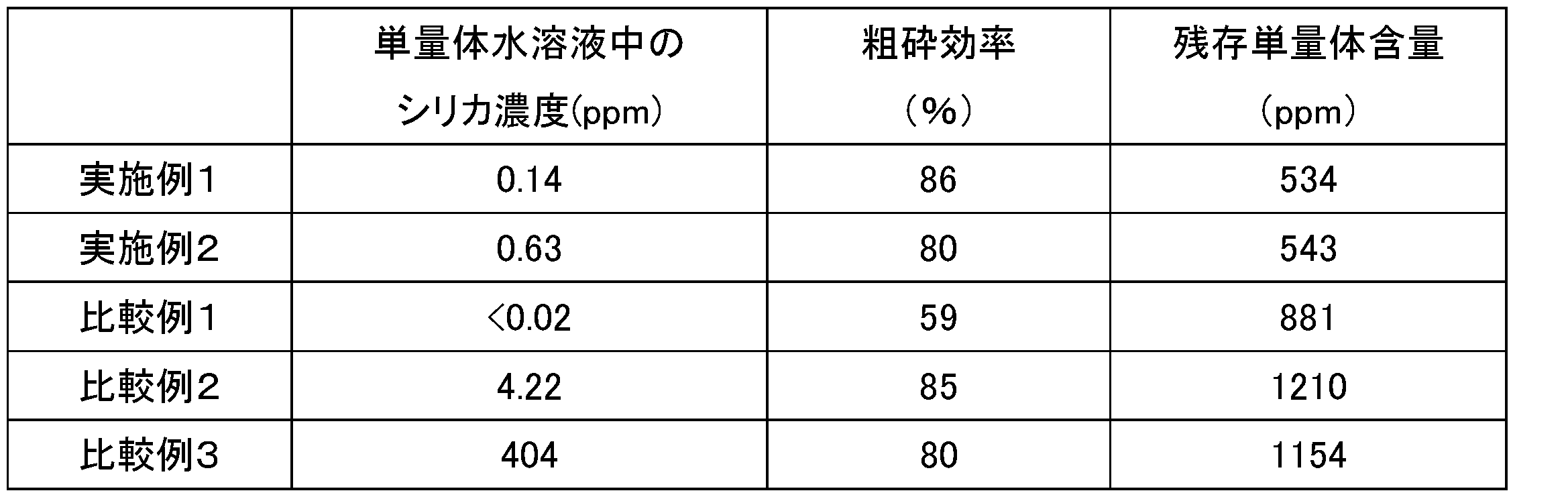
- the coarse crushing step the amount of the hydrogel-like polymer charged into the meat chopper was 431 g, and the amount of the hydrogel coarse crushed product discharged and recovered was 346 g. The coarse crushing efficiency was 80%.
- Example 1 By passing the UF membrane-treated ion-exchanged water used in Example 1 through the pure water production apparatus RFD343HA manufactured by ADVANTEC, further distillation treatment and ion exchange treatment were carried out to obtain distillation-treated ion-exchanged water.
- the silica concentration of the distilled ion-exchanged water was less than 0.02 ppm.
- a monomer aqueous solution was prepared in the same manner as in Example 1 except that distillation-treated ion-exchanged water was used instead of UF membrane-treated ion-exchanged water.
- the silica concentration of the monomer aqueous solution was less than 0.02 ppm.
- the same treatment as in Example 1 was carried out using the monomer aqueous solution to obtain water-absorbent resin particles.
- the coarse crushing step the amount of the hydrogel-like polymer charged into the meat chopper was 409 g, and the amount of the hydrogel coarse crushed product discharged and recovered was 242 g. The coarse crushing efficiency was 59%.
- Comparative Example 2 Amorphous silica (Oriental Silicas Corporation, Toxile NP-S) was added to the distilled ion-exchanged water used in Comparative Example 1 so as to have a silica concentration of 10 ppm to prepare water having a silica concentration of 10 ppm.
- a monomer aqueous solution was prepared in the same manner as in Example 1 except that water having a silica concentration of 10 ppm was used instead of the UF membrane-treated ion-exchanged water.
- the silica concentration of the monomer aqueous solution was 4.22 ppm.
- the same treatment as in Example 1 was carried out using the monomer aqueous solution to obtain water-absorbent resin particles.
- the coarse crushing step the amount of the hydrogel-like polymer charged into the meat chopper was 422 g, and the amount of the hydrogel coarse crushed product discharged and recovered was 359 g. The coarse crushing efficiency was 85%.
- Comparative Example 3 Amorphous silica (Oriental Silicas Corporation, Toxile NP-S) was added to the distilled ion-exchanged water used in Comparative Example 1 so as to have a silica concentration of 1000 ppm to prepare water having a silica concentration of 1000 ppm.
- a monomer aqueous solution was prepared in the same manner as in Example 1 except that water having a silica concentration of 1000 ppm was used instead of the UF membrane-treated ion-exchanged water.
- the silica concentration of the monomer aqueous solution was 404 ppm.
- the same treatment as in Example 1 was carried out using the monomer aqueous solution to obtain water-absorbent resin particles.
- the coarse crushing step the amount of the hydrogel-like polymer charged into the meat chopper was 416 g, and the amount of the hydrogel coarse crushed product discharged and recovered was 332 g. The coarse crushing efficiency was 80%.
- the silica concentration in the various waters used was measured by measuring the Si concentration by the following method, and converting the measured Si concentration into the SiO 2 concentration.
- the Si concentration in the liquid was measured by the ICP-AES method using an IRIS Advantage type manufactured by Nippon Jarrel Ash.
- the Si concentration was calculated using a calibration curve prepared using a silicon standard solution (1000 ppm) manufactured by Fuji Film Wako Pure Chemical Industries, Ltd. The measured conditions are shown below.
- the residual monomer content in the obtained water-absorbent resin particles was measured by the following method. The measurement was performed in an environment of 25 ⁇ 2 ° C. and a humidity of 50 ⁇ 10%. Put 500 g of saline in a 500 mL beaker and rotate it at 600 rpm using a stirrer (stirrer stand: model M-16GM manufactured by Koike Precision Instruments Co., Ltd., stirrer tip: diameter 0.7 cm, length 3 cm, no rotating ring). It was. 2.0 g of water-absorbent resin particles were added to the stirring beaker, and the mixture was stirred for 60 minutes.
- the contents of the beaker were filtered through a JIS standard sieve having a mesh size of 75 ⁇ m and a filter paper (filter paper No. 5C manufactured by ADVANTEC), and separated into a water-absorbing gel and a filtrate (extract).
- the content of the monomer dissolved in the obtained filtrate was measured by high performance liquid chromatography.
- the residual monomer to be measured here is acrylic acid and its alkali metal salt.
- the measured value was converted into a value per mass of water-absorbent resin particles and used as the residual monomer content (ppm). The results are shown in Table 1.
- the coarse crushing efficiency was higher than in the comparative examples, and the content of the residual monomer in the obtained water-absorbent resin particles was suppressed to be low.
Landscapes
- Chemical & Material Sciences (AREA)
- Chemical Kinetics & Catalysis (AREA)
- Organic Chemistry (AREA)
- Medicinal Chemistry (AREA)
- Polymers & Plastics (AREA)
- Health & Medical Sciences (AREA)
- Analytical Chemistry (AREA)
- Inorganic Chemistry (AREA)
- Engineering & Computer Science (AREA)
- Materials Engineering (AREA)
- Dispersion Chemistry (AREA)
- General Chemical & Material Sciences (AREA)
- Solid-Sorbent Or Filter-Aiding Compositions (AREA)
- Processes Of Treating Macromolecular Substances (AREA)
- Compositions Of Macromolecular Compounds (AREA)
- Polymerisation Methods In General (AREA)
- Absorbent Articles And Supports Therefor (AREA)
- Addition Polymer Or Copolymer, Post-Treatments, Or Chemical Modifications (AREA)
Abstract
Description
本実施形態に係る製造方法において用いられる単量体水溶液は、例えば、水に、エチレン性不飽和単量体及びその他必要に応じて用いる材料を添加することにより調製することができる。本明細書における単量体水溶液とは、更なる水や材料等の添加又は除去を必要とすることなくそのままその後の重合に供することができる状態のものを指す。
単量体水溶液には、必要に応じて、連鎖移動剤、増粘剤等の添加剤が含まれていてもよい。連鎖移動剤としては、例えば、チオール類、チオール酸類、第2級アルコール類、次亜リン酸、亜リン酸等が挙げられる。増粘剤としては、カルボキシメチルセルロース、ヒドロキシエチルセルロース、ヒドロキシプロピルセルロース、メチルセルロース、ポリエチレングリコール、ポリアクリル酸、ポリアクリル酸中和物、ポリアクリルアミド等が挙げられる。これらは1種を単独で使用してもよく、2種以上を併用してもよい。単量体水溶液には、適宜、水以外の水溶性有機溶媒等が配合されていてもよい。
上述のとおり調製した単量体水溶液を用いて、水溶液重合法により、単量体水溶液中のエチレン性不飽和単量体を重合させる。重合方式としては、例えば、単量体水溶液を撹拌しない状態(例えば、静置状態)で重合する静置重合方式、反応装置内で単量体水溶液を攪拌しながら重合する撹拌重合方式等であってよい。静置重合方式である水溶液静置重合により含水ゲル状重合体を得ることが好ましい。静置重合方式では、重合完了時、反応容器中に存在した単量体水溶液と略同じ体積を占める単一のブロック状の含水ゲル状重合体が得られる。
エチレン性不飽和単量体を重合して得られる塊状の含水ゲル状重合体の含水率は、粗砕工程が実施しやすいという観点から30~80質量%が好ましく、40~75質量%がより好ましく、50~70質量%が更に好ましい。含水率は、単量体水溶液の水分量、重合後の乾燥、加湿等の操作により調整される。なお、含水ゲル状重合体の含水率とは、含水ゲル状重合体の総質量に占める水の含量を質量%で表したものである。
本実施形態に係る吸水性樹脂粒子の製造方法は、含水ゲル状重合体を粗砕する工程を含む。粗砕により、含水ゲル粗砕物が得られる。含水ゲル粗砕物は、粒子状であってよく、粒子が連なった細長い形状であってもよい。含水ゲル粗砕物の最小辺のサイズは、例えば、0.1~15mm程度であってよく、1.0~10mm程度であることが好ましい。含水ゲル粗砕物の最大辺のサイズは、0.1~200mm程度であってよく、1.0~150mm程度であることが好ましい。
本実施形態に係る吸水性樹脂粒子の製造方法は、含水ゲル粗砕物を乾燥する工程を含むことが好ましい。含水ゲル粗砕物中の水を含む溶媒を加熱及び/又は送風により除去することで、含水ゲル粗砕物を乾燥し、ゲル乾燥物を得ることができる。乾燥の方法は、自然乾燥、加熱乾燥、噴霧乾燥、凍結乾燥等の一般的方法であってよい。乾燥は、例えば常圧下又は減圧下であってよく、乾燥効率を高めるために窒素等の気流下等で行ってもよい。乾燥は、複数の方法を組み合わせて用いてもよい。乾燥が常圧で行われる場合の乾燥温度は、好ましくは70~250℃であり、より好ましくは80~200℃である。乾燥工程はゲル粗砕物の含水率が20質量%以下、好ましくは10質量%以下、より好ましくは5質量%以下になるまで行う。
本実施形態に係る吸水性樹脂粒子の製造方法は、ゲル乾燥物を更に粉砕する工程を含んでもよい。ゲル乾燥物の粉砕により、ゲル粉砕物が得られる。ゲル乾燥物の粉砕は、公知の粉砕機を使用することができ、例えば、ローラーミル(ロールミル)、スタンプミル、ジェットミル、高速回転粉砕機(ハンマーミル、ピンミル、ロータビータミル等)、容器駆動型ミル(回転ミル、振動ミル、遊星ミル等)等が使用できる。好ましくは、高速回転粉砕機が使用される。粉砕機は、出口側に多孔板やスクリーン、グリッド等の、粉砕粒子の最大粒径を制御する開口部を有していてもよい。開口部の形状は多角形、円形等であってよく、開口部の最大径は0.1~5mmであってよく、0.3~3.0mmが好ましく、0.5~1.5mmがより好ましい。
本実施形態に係る吸水性樹脂粒子の製造方法は、ゲル粉砕物を分級する工程を含んでもよい。分級とは、ある粒子群を、粒径に応じて、2つ又はそれ以上の数の、粒度分布の異なる粒子群に分ける操作のことをいう。また、分級後の粒子を再度粉砕して、粉砕工程と分級工程とを繰り返すなど、複数の分級工程を行ってもよく、後述する表面架橋工程後に分級工程を行ってもよい。
本実施形態に係る吸水性樹脂粒子の製造方法は、粉砕工程後に、表面架橋工程を含むことが好ましい。表面架橋は、例えば、表面架橋を行うための架橋剤(表面架橋剤)を架橋重合体に対して添加して反応させることにより行うことができる。表面架橋剤の添加は、粉砕工程後のいずれかの時期に行えばよく、分級工程の前若しくは後、又は乾燥工程の前若しくは後のゲル粉砕物に対して行うことができる。なかでも、乾燥工程以降かつ分級工程後の粒度調整されたゲル粉砕物に対して行うことが好ましい。表面架橋剤を添加し表面架橋処理を行うことにより、架橋重合体の表面近傍の架橋密度が高まるため、得られる吸水性樹脂粒子の吸水性能を高めることができる。
(単量体水溶液用水の調製)
河川より取得した原料水(シリカ濃度8.7ppm)を栗田工業社製二層ろ過器DM-24L(ろ材:アンスラサイト、ろ過砂)に通した後、酢酸セルロース製中空糸限外ろ過(UF)膜モジュール(FT50-AC-FUC1583、ダイセン・メンブレン・システムズ社製)を有するクロスフロー方式の膜ろ過機に通し、更にその後、H+及びOH-のイオン交換樹脂によるイオン交換処理を行った。得られたUF膜処理イオン交換水(シリカ濃度0.15ppm)を吸水性樹脂粒子の製造に用いた。
2Lのセパラブルフラスコに162.8g(2.26モル)の100%アクリル酸を入れた。セパラブルフラスコ内を撹拌しながらUF膜処理イオン交換水140.5gを加えた後、氷浴下で141.2gの48質量%水酸化ナトリウムを滴下することにより、単量体濃度45質量%のアクリル酸部分中和液を調製した。
上記の0.5質量%L-アスコルビン酸水溶液を滴下後、直ちに重合が開始した。重合開始後、単量体水溶液で重合反応が進行すると単量体水溶液の粘度が増加し、撹拌子が停止した。重合開始から15分後、得られた含水ゲル状重合体を容器に入れたまま75℃の水浴に浸し、20分間熟成させた。得られた含水ゲル状重合体の厚みは約13mmであった。
熟成後の含水ゲル状重合体全量を容器から取り出し、5cm間隔の格子状に切れ目を入れて裁断した。裁断した含水ゲル状重合体の全量を喜連ローヤル社製ミートチョッパー12VR-750SDXに順次投入し、粗砕した。ミートチョッパーの出口に位置するプレートの穴の径は6.4mmとした。粗砕は、ミートチョッパーのプレートから、粗砕されたゲル(含水ゲル粗砕物)が出てこなくなるまで行った。このとき、ミートチョッパーに投入した含水ゲル状重合体量は410gであり、排出され回収できた含水ゲル粗砕物は353gであった。粗砕効率は以下の式から算出した。粗砕工程の収率は86%であった。
粗砕効率(%)=[得られた含水ゲル粗砕物重量/粗砕前含水ゲル状重合体重量]×100
実施例1で用いたUF膜処理イオン交換水を、更にADVANTEC社製純水製造装置RFD343HAに通すことにより、更に蒸留処理及びイオン交換処理を施し、蒸留処理イオン交換水を得た。蒸留処理イオン交換水のシリカ濃度は0.02ppm未満であった。蒸留処理イオン交換水に、非晶質シリカ(オリエンタルシリカズコーポレーション、トクシールNP-S)をシリカ濃度1.5ppmとなるように加え、シリカ濃度1.5ppm水を得た。
実施例1で用いたUF膜処理イオン交換水をADVANTEC社製純水製造装置RFD343HAに通すことにより、更に蒸留処理及びイオン交換処理を施し、蒸留処理イオン交換水を得た。蒸留処理イオン交換水のシリカ濃度0.02ppm未満であった。
比較例1で用いた蒸留処理イオン交換水に、非晶質シリカ(オリエンタルシリカズコーポレーション、トクシールNP-S)をシリカ濃度10ppmとなるように加え、シリカ濃度10ppm水を調製した。
比較例1で用いた蒸留処理イオン交換水に、非晶質シリカ(オリエンタルシリカズコーポレーション、トクシールNP-S)をシリカ濃度1000ppmとなるように加え、シリカ濃度1000ppm水を調製した。
用いた各種水におけるシリカ濃度の測定は、下記方法によりSi濃度を測定し、測定されたSi濃度からSiO2濃度に換算して求めた。液中のSi濃度は、日本ジャーレルアッシュ製IRIS Advantage型を使用してICP-AES法で測定した。Si濃度は、富士フィルム和光純薬株式会社製ケイ素標準液(1000ppm)を用いて作製した検量線を用いて算出した。測定した条件を以下に示す。
分析条件 :高周波出力 1350W
測定波長 251.6nm
補助ガス流量 0.5L/min
ネブライザーガス圧 26psi
センターチューブ内径 2mm
ポンプ回転数 130rpm
積分時間 15秒
測定回数 3回
前処理工程 :希釈無し(サンプル直接導入)
得られた吸水性樹脂粒子における残存単量体含量を以下の方法により測定した。測定は25±2℃、湿度50±10%の環境下で行った。
500mL容のビーカーに生理食塩水500gを入れ、スターラー(スターラー台:小池精密機器製作所製モデルM-16GM、スターラーチップ:直径0.7cm、長さ3cm、回転リング無し)を用いて600rpmで回転させた。撹拌しているビーカーに吸水性樹脂粒子2.0gを添加して60分間撹拌した。上記ビーカーの内容物を、目開き75μmのJIS標準篩及びろ紙(ADVANTEC社製、濾紙No.5C)によりろ過して、吸水ゲルとろ液と(抽出液)に分離した。得られたろ液中に溶解している単量体含量を、高速液体クロマトグラフィーにより測定した。ここで測定対象とした残存単量体は、アクリル酸及びそのアルカリ金属塩である。測定値を、吸水性樹脂粒子質量当たりの値に換算して残存単量体含量(ppm)とした。結果を表1に示す。
Claims (6)
- エチレン性不飽和単量体及びシリカを含む単量体水溶液を調製することと、
前記単量体水溶液中の前記エチレン性不飽和単量体を水溶液重合法により重合して、含水ゲル状重合体を得ることと、
前記含水ゲル状重合体を粗砕することとを含み、
前記単量体水溶液中のシリカ濃度が0.02~4.0ppmである、吸水性樹脂粒子の製造方法。 - 前記エチレン性不飽和単量体が、アクリル酸及びその塩の少なくとも一方を含む、請求項1に記載の製造方法。
- 前記単量体水溶液を調整することが、前記単量体水溶液を調製するための水のシリカ濃度を調整することを含む、請求項1又は2に記載の製造方法。
- エチレン性不飽和単量体及びシリカを含み、シリカ濃度が0.02~4.0ppmである、単量体水溶液。
- 前記エチレン性不飽和単量体が、アクリル酸及びその塩の少なくとも一方を含む、請求項4に記載の単量体水溶液。
- 吸水性樹脂粒子製造用である、請求項4又は5に記載の単量体水溶液。
Priority Applications (5)
| Application Number | Priority Date | Filing Date | Title |
|---|---|---|---|
| CN202080049070.XA CN114080405B (zh) | 2019-07-05 | 2020-07-02 | 吸水性树脂颗粒的制造方法及单体水溶液 |
| US17/597,274 US12427503B2 (en) | 2019-07-05 | 2020-07-02 | Method for producing water absorbent resin particles and aqueous monomer solution |
| KR1020227002055A KR102792052B1 (ko) | 2019-07-05 | 2020-07-02 | 흡수성 수지 입자의 제조 방법 및 단량체 수용액 |
| EP20837605.3A EP3995519A4 (en) | 2019-07-05 | 2020-07-02 | PROCESS FOR PREPARING WATER-ABSORBENT RESIN PARTICLES AND AQUEOUS MONOMER SOLUTION |
| JP2021530659A JP7471295B2 (ja) | 2019-07-05 | 2020-07-02 | 吸水性樹脂粒子の製造方法及び単量体水溶液 |
Applications Claiming Priority (2)
| Application Number | Priority Date | Filing Date | Title |
|---|---|---|---|
| JP2019126346 | 2019-07-05 | ||
| JP2019-126346 | 2019-07-05 |
Publications (1)
| Publication Number | Publication Date |
|---|---|
| WO2021006179A1 true WO2021006179A1 (ja) | 2021-01-14 |
Family
ID=74115295
Family Applications (1)
| Application Number | Title | Priority Date | Filing Date |
|---|---|---|---|
| PCT/JP2020/026051 Ceased WO2021006179A1 (ja) | 2019-07-05 | 2020-07-02 | 吸水性樹脂粒子の製造方法及び単量体水溶液 |
Country Status (6)
| Country | Link |
|---|---|
| US (1) | US12427503B2 (ja) |
| EP (1) | EP3995519A4 (ja) |
| JP (1) | JP7471295B2 (ja) |
| KR (1) | KR102792052B1 (ja) |
| CN (1) | CN114080405B (ja) |
| WO (1) | WO2021006179A1 (ja) |
Citations (3)
| Publication number | Priority date | Publication date | Assignee | Title |
|---|---|---|---|---|
| JPH01318021A (ja) * | 1988-06-17 | 1989-12-22 | Kazuo Saotome | 吸水性樹脂成形物の製造方法 |
| JPH03115313A (ja) * | 1989-09-28 | 1991-05-16 | Kazuo Saotome | 吸水性樹脂の製造方法 |
| JPH09309916A (ja) | 1988-07-04 | 1997-12-02 | Nippon Shokubai Co Ltd | 吸水性樹脂の製造方法 |
Family Cites Families (12)
| Publication number | Priority date | Publication date | Assignee | Title |
|---|---|---|---|---|
| NL7016594A (ja) * | 1969-11-24 | 1971-05-26 | ||
| JPH07119246B2 (ja) * | 1989-06-29 | 1995-12-20 | 東亞合成株式会社 | 吸水性樹脂の製造方法 |
| EP0467073B1 (en) | 1990-07-17 | 1995-04-12 | Sanyo Chemical Industries Ltd. | Process for producing water-absorbing resins |
| JP2001089527A (ja) | 1999-07-22 | 2001-04-03 | Nippon Shokubai Co Ltd | 吸水性樹脂、その製造方法およびその用途 |
| JP4090646B2 (ja) * | 1999-10-04 | 2008-05-28 | オルガノ株式会社 | 純水製造装置及び方法 |
| DE602004009484T2 (de) * | 2003-01-27 | 2008-07-24 | Nippon Shokubai Co. Ltd. | Verfahren zur Herstellung von einem wasserabsorbierenden Formkörper |
| JP2006089402A (ja) * | 2004-09-22 | 2006-04-06 | Nomura Micro Sci Co Ltd | 殺菌剤及び殺菌剤を用いた純水及び超純水の製造方法 |
| CN101410177B (zh) * | 2006-03-27 | 2012-06-27 | 株式会社日本触媒 | 吸水剂、使用所述吸水剂的吸水芯片以及制备吸水剂的方法 |
| EP2010316B1 (en) * | 2006-03-27 | 2021-10-13 | Nippon Shokubai Co.,Ltd. | Water absorbing agent and water absorbent core using the agent |
| CN104582833A (zh) * | 2012-08-30 | 2015-04-29 | 株式会社日本触媒 | 颗粒状吸水剂及其制造方法 |
| EP3412710B1 (en) | 2016-12-23 | 2021-11-10 | LG Chem, Ltd. | Method for producing porous superabsorbent polymer |
| KR102112833B1 (ko) * | 2016-12-26 | 2020-05-19 | 주식회사 엘지화학 | 다공성 고흡수성 수지의 제조 방법 |
-
2020
- 2020-07-02 WO PCT/JP2020/026051 patent/WO2021006179A1/ja not_active Ceased
- 2020-07-02 KR KR1020227002055A patent/KR102792052B1/ko active Active
- 2020-07-02 JP JP2021530659A patent/JP7471295B2/ja active Active
- 2020-07-02 EP EP20837605.3A patent/EP3995519A4/en active Pending
- 2020-07-02 CN CN202080049070.XA patent/CN114080405B/zh active Active
- 2020-07-02 US US17/597,274 patent/US12427503B2/en active Active
Patent Citations (3)
| Publication number | Priority date | Publication date | Assignee | Title |
|---|---|---|---|---|
| JPH01318021A (ja) * | 1988-06-17 | 1989-12-22 | Kazuo Saotome | 吸水性樹脂成形物の製造方法 |
| JPH09309916A (ja) | 1988-07-04 | 1997-12-02 | Nippon Shokubai Co Ltd | 吸水性樹脂の製造方法 |
| JPH03115313A (ja) * | 1989-09-28 | 1991-05-16 | Kazuo Saotome | 吸水性樹脂の製造方法 |
Non-Patent Citations (1)
| Title |
|---|
| See also references of EP3995519A4 |
Also Published As
| Publication number | Publication date |
|---|---|
| EP3995519A1 (en) | 2022-05-11 |
| CN114080405A (zh) | 2022-02-22 |
| JP7471295B2 (ja) | 2024-04-19 |
| KR20220031898A (ko) | 2022-03-14 |
| KR102792052B1 (ko) | 2025-04-04 |
| US12427503B2 (en) | 2025-09-30 |
| US20220314198A1 (en) | 2022-10-06 |
| EP3995519A4 (en) | 2023-08-09 |
| JPWO2021006179A1 (ja) | 2021-01-14 |
| CN114080405B (zh) | 2023-04-28 |
Similar Documents
| Publication | Publication Date | Title |
|---|---|---|
| JP5889349B2 (ja) | ポリアクリル酸系吸水性樹脂粉末及びその製造方法 | |
| JP6312680B2 (ja) | 吸水性ポリマー粒子の製造方法 | |
| US9102804B2 (en) | Production method for water-absorbing resin powder | |
| JP5996651B2 (ja) | ポリアクリル酸(塩)系吸水性樹脂の製造方法 | |
| KR102562511B1 (ko) | 킬레이트제를 포함하는 흡수성 수지의 제조 방법 | |
| EP2527391B1 (en) | Method for producing water absorbent resin | |
| JPWO2011136301A1 (ja) | ポリアクリル酸(塩)系吸水性樹脂粉末の製造方法 | |
| CN108026282A (zh) | 用于制备超吸收性聚合物的方法 | |
| KR20150091363A (ko) | 폴리아크릴산(염)계 흡수성 수지 및 그의 제조 방법 | |
| CA2953888A1 (en) | Process for producing water-absorbent resin | |
| CN108026284A (zh) | 超吸收性聚合物及其生产方法 | |
| US11332558B2 (en) | Water-absorbent resin, and soil | |
| JP6548333B2 (ja) | 水溶性塩を含む高吸水性樹脂およびその製造方法 | |
| CN115209987B (zh) | 吸收体、吸水剂及吸水剂的制造方法 | |
| KR20150113129A (ko) | 물 흡수성 폴리머 입자로부터의 잔류 모노머의 제거 방법 | |
| JPWO2020122201A1 (ja) | 吸収体及び吸収性物品 | |
| JP7471295B2 (ja) | 吸水性樹脂粒子の製造方法及び単量体水溶液 | |
| KR101367361B1 (ko) | 고흡수성 수지 제조용 중합 반응기 및 고흡수성 수지의 제조 방법 | |
| CN108026195B (zh) | 用于制备超吸收性聚合物的方法 | |
| JP4198266B2 (ja) | 吸水性樹脂の製造方法 | |
| CN113423769B (zh) | 超吸收性聚合物组合物及其制备方法 | |
| WO2021006180A1 (ja) | 吸水性樹脂粒子の製造方法 | |
| US12558670B2 (en) | Super absorbent polymer | |
| US20250339843A1 (en) | Super Absorbent Polymer | |
| JP2019147082A (ja) | ドロー液及び造水システム |
Legal Events
| Date | Code | Title | Description |
|---|---|---|---|
| 121 | Ep: the epo has been informed by wipo that ep was designated in this application |
Ref document number: 20837605 Country of ref document: EP Kind code of ref document: A1 |
|
| ENP | Entry into the national phase |
Ref document number: 2021530659 Country of ref document: JP Kind code of ref document: A |
|
| ENP | Entry into the national phase |
Ref document number: 20227002055 Country of ref document: KR Kind code of ref document: A |
|
| ENP | Entry into the national phase |
Ref document number: 2020837605 Country of ref document: EP Effective date: 20220207 |
|
| WWG | Wipo information: grant in national office |
Ref document number: 202247004209 Country of ref document: IN |
|
| WWG | Wipo information: grant in national office |
Ref document number: 17597274 Country of ref document: US |