WO2021006205A1 - 低カフェインコーヒー濃縮液 - Google Patents
低カフェインコーヒー濃縮液 Download PDFInfo
- Publication number
- WO2021006205A1 WO2021006205A1 PCT/JP2020/026185 JP2020026185W WO2021006205A1 WO 2021006205 A1 WO2021006205 A1 WO 2021006205A1 JP 2020026185 W JP2020026185 W JP 2020026185W WO 2021006205 A1 WO2021006205 A1 WO 2021006205A1
- Authority
- WO
- WIPO (PCT)
- Prior art keywords
- coffee
- caffeine
- concentration
- acetic acid
- concentrate
- Prior art date
- Legal status (The legal status is an assumption and is not a legal conclusion. Google has not performed a legal analysis and makes no representation as to the accuracy of the status listed.)
- Ceased
Links
Images
Classifications
-
- A—HUMAN NECESSITIES
- A23—FOODS OR FOODSTUFFS; TREATMENT THEREOF, NOT COVERED BY OTHER CLASSES
- A23F—COFFEE; TEA; THEIR SUBSTITUTES; MANUFACTURE, PREPARATION, OR INFUSION THEREOF
- A23F5/00—Coffee; Coffee substitutes; Preparations thereof
- A23F5/24—Extraction of coffee; Coffee extracts; Making instant coffee
-
- A—HUMAN NECESSITIES
- A23—FOODS OR FOODSTUFFS; TREATMENT THEREOF, NOT COVERED BY OTHER CLASSES
- A23F—COFFEE; TEA; THEIR SUBSTITUTES; MANUFACTURE, PREPARATION, OR INFUSION THEREOF
- A23F5/00—Coffee; Coffee substitutes; Preparations thereof
- A23F5/20—Reducing or removing alkaloid content; Preparations produced thereby; Extracts or infusions thereof
-
- A—HUMAN NECESSITIES
- A23—FOODS OR FOODSTUFFS; TREATMENT THEREOF, NOT COVERED BY OTHER CLASSES
- A23F—COFFEE; TEA; THEIR SUBSTITUTES; MANUFACTURE, PREPARATION, OR INFUSION THEREOF
- A23F5/00—Coffee; Coffee substitutes; Preparations thereof
- A23F5/46—Coffee flavour; Coffee oil; Flavouring of coffee or coffee extract
Definitions
- the present invention relates to a coffee concentrate, and more particularly to a low caffeine coffee concentrate for diluting with milk to make a cafe latte.
- cafe latte is a drink that originated in Italy and is a mixture of espresso and milk.
- American-style cafe bars have become widespread, and cafe latte has become a popular beverage in Japan.
- various coffee concentrates for cafe latte have been developed, which can easily make a cafe latte with a luxurious taste like a shop at home (for example, Non-Patent Documents 1 and 2).
- caffeine contained in coffee may stimulate the central nervous system and the heart, and may stimulate the digestive organs such as the stomach and intestines, and people who are highly sensitive to these stimuli and are highly health-conscious. It tends to be repelled by humans. Therefore, caffeine-less coffee with reduced or removed caffeine has been developed and is commercially available.
- caffeine is one of the main taste components of coffee, and if it is reduced or removed, there is a problem that the richness and bitterness peculiar to coffee are diminished and the flavor is impaired. Therefore, various methods for improving the flavor of decaffeinated coffee have been proposed. Examples of the method for improving the flavor of decaffeinated coffee include a method of adding theanine to decaffeinated coffee (Patent Document 1), a method of adding ethyl isovalerate to decaffeinated coffee (Patent Document 2), and the like.
- a method of adding decaffeinated coffee with potassium sulfate and / or potassium lactate (Patent Document 3), and a method of adding neutral amino acids such as valine, leucine, and isoleucine to the decaffeinated coffee (Patent Document 3). 4), a method of blending a quercetin glycoside into low-caffeine coffee (Patent Document 5), and the like.
- the coffee concentrate for making cafe latte is diluted with milk and used for drinking, the flavor is not diluted even when mixed with milk, and the strength (richness) peculiar to coffee and It is important that the bitterness is felt.
- coffee concentrates with reduced caffeine content have a low content of caffeine, which is a taste component, so when diluted with milk, the deep richness that is the original flavor of coffee and the uniqueness of coffee that can be felt in the back mouth.
- the bitterness of coffee also referred to as the bitterness of the back mouth in this specification
- the bitterness of coffee also referred to as the bitterness of the back mouth in this specification
- the present invention prepares a beverage capable of tasting a full-fledged latte flavor, in which the original flavor of coffee, particularly the deep richness and bitterness of the back mouth, is not impaired while the caffeine content is reduced. It is intended to provide a low caffeine coffee concentrate for use.
- the present inventors enhance the taste of coffee even when diluted with milk.
- the present invention was completed by finding that the original flavor of coffee, such as deep richness and bitterness in the back mouth, is not impaired, and that the full-fledged flavor of caffeine is produced.
- the present invention is not limited to this, but relates to the following.
- the concentration ratio [(B) / (A)] of caffeine (A) and acetic acid (B) is 0.7 to 25.
- (Iv) Includes coffee flavor.
- the low caffeine coffee concentrate according to [1] which contains caffeine (A) having a concentration of 0.5 to 6 mg / 100 g in the beverage produced by dilution.
- the low caffeine coffee concentrate according to [1] or [2] which comprises a coffee extract and has a coffee solid content concentration of 5 to 12% by weight.
- [11] A method for producing a low-caffeine coffee concentrate for drinking a beverage produced by diluting it at a dilution ratio of 3 to 6 times.
- Caffeine (A) is blended at a concentration such that the concentration of caffeine in the beverage produced by the dilution is 0.1 to 10 mg / 100 g.
- Acetic acid (B) is blended at a concentration such that the acetic acid concentration in the beverage produced by the dilution is 1 mg / 100 g or more.
- a production method comprising the step of blending coffee flavors.
- the coffee concentrate having a reduced caffeine content of the present invention By using the coffee concentrate having a reduced caffeine content of the present invention, it is possible to prepare a beverage capable of enjoying the full-fledged flavor of cafe latte even though the caffeine is reduced.
- the low-caffeine coffee concentrate of the present invention can easily prepare a cafe latte with a full-fledged flavor while reducing the caffeine content by simply mixing it with milk, and is also excellent in convenience. ..
- the low caffeine coffee concentrate of the present invention can be produced by adjusting the caffeine content and the acetic acid content within a specific range, it does not require special equipment and is simple and inexpensive. It is also advantageous in that it can be provided.
- FIG. 1 is a diagram summarizing the results of Experiment 4 and Experiment 5.
- the term "coffee concentrate” refers to a liquid having a coffee flavor for drinking a beverage produced by diluting it (hereinafter, may be simply referred to as a beverage after dilution).
- the liquid having a coffee flavor means a liquid having an aroma pronounced of coffee, and specifically, a liquid containing a coffee flavor. The coffee flavor will be described later.
- the "low caffeine coffee concentrate” means a coffee concentrate in which caffeine is reduced or removed, and specifically, a liquid having a coffee flavor for being diluted and used for drinking.
- the caffeine concentration in the beverage after dilution is 0.1 to 10 mg / 100 g and contains caffeine.
- the dilution ratio for diluting the low caffeine coffee concentrate of the present invention may be appropriately set according to the taste of the drinker, but is preferably 3 to 6 times based on the volume ratio.
- a 3-fold dilution ratio based on a volume ratio means adding 2 volumes of a dilution medium to 1 volume of a low caffeine coffee concentrate.
- the dilution ratio is based on the volume ratio.
- the caffeine content and the acetic acid content are adjusted to a specific range, so that the coffee tastes even in a beverage produced by diluting the low caffeine coffee concentrate.
- the low caffeine coffee concentrate of the present invention needs to have a caffeine concentration of at least 0.1 mg / 100 g in the beverage after dilution, and is 0.1 from the viewpoint of reducing caffeine. It is preferably in the range of ⁇ 10 mg / 100 g.
- the low caffeine coffee concentrate of the present invention contains caffeine at a concentration such that the caffeine concentration in the beverage after dilution is 0.3 to 8 mg / 100 g. It is more preferable that caffeine is contained at a concentration such that the caffeine concentration in the diluted beverage is 0.5 to 6 mg / 100 g, and the caffeine concentration in the diluted beverage is 0.8 to 3 mg / 100 g. It is particularly preferred to include caffeine in a concentration.
- the low caffeine coffee concentrate of the present invention has a caffeine concentration (caffeine concentration / coffee solid content concentration) of 2 ⁇ 10 -3 or less with respect to the coffee solid content concentration contained therein. It is preferable, and it is more preferably 4 ⁇ 10 -4 or less. The coffee solid content concentration will be described later.
- the content of caffeine contained in the low caffeine coffee concentrate of the present invention can be calculated by multiplying the content of caffeine in the diluted beverage by the dilution ratio. For example, when the dilution ratio of the coffee concentrate is 4 times, "a coffee concentrate containing caffeine having a concentration of caffeine in a beverage after dilution of 0.1 to 10 mg / 100 g" is defined as 0. It means a coffee concentrate containing 4 to 40 mg / 100 g of caffeine. Based on this, the low caffeine coffee concentrate of the present invention for drinking a beverage produced by diluting it at a dilution ratio of 3 to 6 times should contain 0.3 to 60 mg / 100 g of caffeine. It is preferable to contain 0.9 to 48 mg / 100 g of caffeine, more preferably 1.5 to 36 mg / 100 g of caffeine, and 2.4 to 18 mg / 100 g of caffeine. More preferred.
- the caffeine content in the coffee concentrate and the caffeine content in the diluted beverage can be measured by a known method using high performance liquid chromatography (HPLC) or the like.
- the method for adjusting the caffeine content to a desired amount is not particularly limited.
- a coffee extract obtained from coffee beans from which caffeine has been removed or reduced may be used, or caffeine may be used from the coffee extract. It may be removed or reduced.
- the method for removing or reducing caffeine include a method for removing caffeine from refined green coffee beans, a method for using coffee beans from which caffeine has been removed by breeding technology and gene recombination technology, and coffee raw.
- a solvent such as organic solvent, water, or supercritical fluidized carbon dioxide to selectively remove caffeine, or adsorbing and removing caffeine from coffee extract using activated charcoal or ion exchange resin.
- caffeine removal methods or caffeine reduction methods may be used alone or in combination.
- the caffeine content can be increased in order to adjust the caffeine content in the low caffeine coffee concentrate to a desired amount, and in such a case, a caffeine that is acceptable for food and drink.
- Caffeine preparations can be added.
- the low caffeine coffee concentrate of the present invention enhances the coffee taste even in a beverage produced by diluting the low caffeine coffee concentrate by adjusting the caffeine content and the acetic acid content within a specific range. It is characterized by having a deep richness and a bitter taste in the back mouth that are equal to or higher than the flavor of a beverage produced by diluting a coffee concentrate in which caffeine is not reduced.
- acetic acid specifically has the effect of enhancing the taste of caffeine.
- the content of acetic acid in the coffee concentrate of the present invention is such that the concentration of acetic acid in the diluted beverage is 1 mg / 100 g or more, preferably 2 mg / 100 g or more, more preferably 3 mg / 100 g or more, still more preferably 6 mg / 100 g or more. Adjust so that
- Acetic acid is a volatile acid, and it is known that a pungent acid odor adversely affects the flavor.
- acetic acid is reduced from coffee beans for the purpose of improving flavor.
- a predetermined amount of acetic acid is contained in a concentrated solution of low caffeine coffee in which caffeine has been reduced. If the content of acetic acid is too low, the desired effect of enhancing the taste of caffeine may not be obtained.
- the taste-enhancing effect of caffeine increases depending on the concentration of acetic acid.
- the concentration of acetic acid in the diluted beverage is higher than 25 mg / 100 g, not only the taste enhancing effect reaches a plateau, but also the odor of acetic acid may inhibit the desired effect.
- the upper limit of the acetic acid content in the coffee concentrate of the present invention is preferably contained at a concentration of 25 mg / 100 g or less, and preferably at a concentration of 20 mg / 100 g or less with respect to the diluted beverage. More preferably, it is contained in a concentration of 18 mg / 100 g or less.
- the content of acetic acid contained in the low caffeine coffee concentrate of the present invention can be calculated by multiplying the acetic acid content in the diluted beverage by the dilution ratio in the same manner as the content of caffeine.
- a coffee concentrate containing acetic acid having a concentration of acetic acid in a beverage after dilution of 1 mg / 100 g or more means a coffee concentrate having a concentration of 4 mg / 100 g or more when the dilution ratio of the coffee concentrate is 4 times. It means a coffee concentrate containing acetic acid.
- the low caffeine coffee concentrate of the present invention for drinking a beverage produced by diluting it at a dilution ratio of 3 to 6 times preferably contains 3 mg / 100 g or more of acetic acid, and is preferably 6 mg. It is preferable to contain / 100 g or more of acetic acid, more preferably 9 mg / 100 g or more of acetic acid, and even more preferably 18 mg / 100 g or more of acetic acid. Further, the low caffeine coffee concentrate of the present invention for drinking a beverage produced by diluting it at a dilution ratio of 3 to 6 times preferably contains 150 mg / 100 g or less of acetic acid, and is preferably 120 mg / 100 g or less. It preferably contains acetic acid, more preferably 108 mg / 100 g or less of acetic acid.
- the acetic acid content in the coffee concentrate and the acetic acid content in the diluted beverage can be measured by a method using high performance liquid chromatography (HPLC), which is a general method for analyzing organic acids.
- HPLC high performance liquid chromatography
- the concentration ratio [(B) / (A)] of caffeine (A) and acetic acid (B) is also important in the low caffeine coffee concentrate of the present invention.
- [(B) / (A)] is 0.7 to 25, preferably 1 to 20, more preferably 3 to 15, and particularly preferably 5 to 15.
- [(B) / (A)] is 0.7 to 25, It is preferable to adjust to 1 to 20, 3 to 15, or 5 to 15.
- the acetic acid used in the low caffeine coffee concentrate of the present invention may be any acetic acid as long as it can be added to foods and drinks, or a salt of acetic acid.
- a crude extract, an extract or a refined product from a natural product containing an acetic acid component may be blended into a coffee concentrate.
- the low caffeine coffee concentrate of the present invention contains coffee flavors.
- the coffee flavor used in the present invention includes coffee flavor as a food additive that can be added to beverages, and an extract of roasted coffee beans containing a coffee aroma component (also referred to as "coffee extract" in the present specification. ) Is also included.
- a low caffeine coffee concentrate containing a coffee flavor and a coffee extract in a coffee flavor is an example of a preferred embodiment of the present invention.
- the present inventors have found that a predetermined amount of acetic acid can enhance the nutty aroma as well as the deep richness of coffee and the bitterness of the back mouth. Therefore, when the coffee flavor in the low caffeine coffee concentrate of the present invention contains a coffee flavor, it is preferable that the coffee flavor contains a nut-like aroma component.
- the nut-like aroma component include pyrazines such as 2-ethyl-3,5-dimethylpyrazine, 2,3-diethyl-5-methylpyrazine, and 2,3,5-trimethylpyrazine.
- 2,3,5-trimethylpyrazine has a roasted nut-like aroma and is suitable because the effect of the present invention can be remarkably perceived.
- the coffee flavor used in the present invention is not particularly limited, and commercially available coffee flavors can be freely used as appropriate.
- a term related to coffee there are cases where the fragrance of roasted and crushed coffee is used as a fragrance, the scent of extracted coffee liquor is used as an aroma, and the scent of coffee liquor in the mouth is used as a flavor.
- the coffee flavor shall also include the flavor of coffee fragrance and coffee aroma.
- the blending amount of the coffee flavor can be appropriately set in consideration of the titer of the flavor to be used, the dilution ratio of the coffee concentrate, and the like. However, it is usually about 0.01 to 5.0% by weight, preferably about 0.03 to 4.0% by weight, more preferably about 0.05 to 3.0% by weight, still more preferable, with respect to the coffee concentrate. Is about 0.1 to 1.5% by weight.
- the coffee flavor in the low caffeine coffee concentrate of the present invention may include a coffee extract.
- the coffee extract referred to in the present specification refers to a solution obtained by extracting roasted and crushed coffee beans with water, warm water, or the like, and is a coffee extract obtained by concentrating the coffee extract or a dried solid state of the coffee extract. It also includes a solution prepared by adjusting the amount of dried coffee to an appropriate amount with water or warm water.
- Coffee bean varieties include Arabica varieties and Robusta varieties.
- One type of coffee beans may be used, or a plurality of types may be blended and used.
- These raw beans roasted with a coffee roaster can be used as a raw material for coffee extract.
- green coffee beans can be roasted by putting them into a rotating drum and heating the rotating drum from below with a gas burner or the like while rotating and stirring the coffee beans.
- the degree of roasting of such coffee beans is about 14 to 30 as an L value.
- the low caffeine coffee concentrate of the present invention is used for preparing a cafe latte, it is preferable to have a taste imagining espresso. Since coffee beans have a stronger bitterness and richness as they are roasted deeper, deep roasted beans (L value of about 14 to 22, preferably about 15 to 20) are usually used for espresso.
- the roasted coffee beans used as a raw material for the coffee extract used in the low caffeine coffee concentrate of the present invention it is preferable to use deep roasted beans.
- the L value is an index indicating the degree of roasting of coffee, and is a value obtained by measuring the brightness of the crushed coffee beans with a color difference meter (black is represented by 0 and white is represented by 100).
- the method of extracting the coffee extract from roasted coffee beans For example, water or warm water (0 to 200 ° C) is added from crushed roasted coffee beans that have been roughly ground, medium-ground, or finely ground. A method of extracting by using for 10 seconds to 30 minutes can be mentioned.
- the extraction method a known method such as a drip type, a siphon type, a boiling type, a jet type, or a continuous column type can be appropriately selected.
- the column type for example, coffee beans may be stored in a column type extractor, and water or hot water may be supplied into the extractor. In this case, multi-step extraction is also possible.
- the multi-stage extraction refers to an extraction method using a device in which a plurality of independent extraction towers are connected in series by piping.
- an extract having a high coffee solid content concentration equivalent to that of the concentrate can be obtained without going through a concentration step, and thus it is a suitable extraction method from the viewpoint of flavor.
- the liquid containing the above coffee flavor is used as the coffee concentrate (hereinafter, also referred to as coffee concentrate base) which is the base of the low caffeine coffee concentrate of the present invention, and the caffeine concentration and acetic acid concentration in the coffee concentrate base are used.
- the concentration ratio [(B) / (A)] of caffeine (A) and acetic acid (B) can be adjusted within a predetermined range to obtain the low caffeine coffee concentrate of the present invention.
- the above coffee extract is used as it is as a coffee concentrate base, and the caffeine concentration, acetic acid concentration, and concentration ratio of caffeine (A) and acetic acid (B) in the coffee concentrate base [(B) / (A)]. May be adjusted to a predetermined range to prepare the low caffeine coffee concentrate of the present invention.
- the above coffee extract is used as it is as a coffee concentrate base, and the caffeine concentration, acetic acid concentration, and concentration ratio of caffeine (A) and acetic acid (B) in the coffee concentrate base [(B) / (A)]. May be adjusted to a predetermined range, and if necessary, coffee fragrance may be added to prepare the low caffeine coffee concentrate of the present invention.
- the coffee solid content concentration in the coffee extract is preferably 5 to 12% by weight.
- the coffee extract contains low caffeine so that the coffee solid content concentration in the low caffeine coffee concentrate is 5 to 12% by weight. It is preferably contained in the coffee concentrate.
- a coffee extract having a coffee solid content concentration of 5 to 12% by weight is used as it is as a coffee concentrate base, or is appropriately diluted and used to concentrate low caffeine coffee having a coffee solid content concentration of 5 to 12% by weight. It can also be a liquid.
- the coffee solid content is, for example, in the case of the coffee solid content in the coffee extract, the soluble solid content in the coffee extract is determined from the refractometer reading for sugar (Brix) at 20 ° C. It refers to the weight (g).
- a sugar refractometer (Atago RX-5000, etc.) was used to measure the sugar refractometer reading (Brix) of the coffee extract, and the amount of coffee extract (g) used for the measurement was measured. ) Is multiplied to calculate the weight (g) of the coffee solid content.
- the coffee solid content concentration in the present specification means a concentration (% by weight) based on the weight (g) of the coffee solid content obtained above.
- the coffee solid content concentration (% by weight) in the coffee extract can be obtained by calculating the percentage of the weight of the coffee solid content obtained above with respect to the weight of the coffee extract.
- the coffee solid content concentration in the low caffeine coffee concentrate of the present invention can be determined.
- the Brix value may be used as the coffee solid content concentration in the coffee extract or concentrate of the present invention.
- the concentration of coffee solids in the low caffeine coffee concentrate of the present invention is 5% by weight or more (preferably 6% by weight or more), when it is used with milk at a dilution ratio of, for example, 3 to 6 times.
- the original taste of coffee is easily felt, and when the above-mentioned predetermined amount of acetic acid is contained, the deep richness and bitterness of coffee can be further enhanced.
- the upper limit of the coffee solid content concentration in the low caffeine coffee concentrate of the present invention is preferably 12% by weight, more preferably 11% by weight, and 10% by weight. Is particularly preferable.
- the pH of the low caffeine coffee concentrate of the present invention is preferably 5.0 to 7.0, more preferably 5.0 to 6.0, and 5 It is more preferably .3 to 6.0.
- a general pH adjusting agent such as sodium hydrogen carbonate or sodium hydroxide can be used.
- sweeteners saccharide, isomerized sugar, glucose, fructose, lactose, malt sugar, aspartame, acesulfame K, sucralose, stevia, etc.
- antioxidants L-
- sweeteners sucrose, isomerized sugar, glucose, fructose, lactose, malt sugar, aspartame, acesulfame K, sucralose, stevia, etc.
- antioxidants L-
- emulsifier sucralose fatty acid ester, sorbitanic acid ester, polyglycerin fatty acid ester, etc.
- acidulant fragrance, etc.
- dilution medium As the dilution medium for diluting the low caffeine coffee concentrate of the present invention, any liquid that is acceptable for food and drink may be used, but milk is preferably used.
- the low caffeine coffee concentrate of the present invention by adjusting the caffeine content and the acetic acid content within a predetermined range, the coffee taste is enhanced and the caffeine is reduced even in the beverage produced by diluting with a dilution medium. It is characterized by providing a deep richness and bitterness in the back mouth that are equal to or higher than the flavor of beverages produced by diluting undecaffeinated coffee concentrate. Therefore, the low caffeine coffee concentrate of the present invention prepares a beverage that feels the rich richness of coffee and the firm bitterness (particularly the bitterness of the back mouth) that is comparable to milk even when mixed with plenty of milk. can do. As described above, the low caffeine coffee concentrate of the present invention is suitably used as a concentrate for diluting with milk.
- milk refers to a white liquid in which proteins and fats are present as fine colloidal particles that dilute the flavor of coffee as it is, and in addition to animal milk such as milk, It shall contain vegetable milk such as soy milk, almond milk, rice milk and coconut milk.
- the present invention provides a full-fledged cafe latte flavor in which the original flavor of coffee, especially the deep richness and bitterness of the back mouth, is not impaired while the caffeine content is reduced. It also relates to a method of producing a low caffeine coffee concentrate for preparing a beverage capable of producing.
- the present invention is a method for producing a low-caffeine coffee concentrate for drinking a beverage produced by diluting it at a dilution ratio of 3 to 6 times.
- Caffeine (A) is blended at a concentration such that the concentration of caffeine in the beverage produced by the dilution is 0.1 to 10 mg / 100 g.
- Acetic acid (B) is blended at a concentration such that the acetic acid concentration in the beverage produced by the dilution is 1 mg / 100 g or more.
- the present invention relates to a manufacturing method including a step of blending coffee flavor.
- the amount of each component in the beverage was measured by the following method.
- the caffeine concentration was quantified by diluting each sample 10-fold with mobile phase A (w / w), filtering with a membrane filter (Cellulose Acetate 0.45 ⁇ m manufactured by ADVANTEC), and injecting into HPLC.
- the measurement conditions for HPLC are as follows.
- a low caffeine coffee concentrate sample was prepared.
- Caffeine extract manufactured by Shiratori Pharmaceutical Co., Ltd.
- a commercially available coffee fragrance containing pyrazines are added to ion-exchanged water, and the final concentration in the low caffeine coffee concentrate is the concentration shown in the "Concentration" row in Table 1.
- a low caffeine coffee concentrate having various acetic acid concentrations shown in the "Concentrate” row of Table 1 by further adding various amounts of powdered acetic acid (manufactured by Nippon Synthetic Chemical Co., Ltd.). was prepared.
- sodium hydrogen carbonate was used to adjust the pH to 5.0 to 5.5.
- This cafe latte-style beverage was subjected to a sensory evaluation by five trained specialist panels.
- a sample without acetic acid (Sample 1-1) as a control
- each panel discusses the richness of coffee (the strength of coffee can be felt firmly), the bitterness (the bitterness of coffee can be felt firmly), and the aroma (the aroma of coffee can be felt firmly).
- the panel of 3 to 4 people had a flavor similar to cafe latte compared to the control.
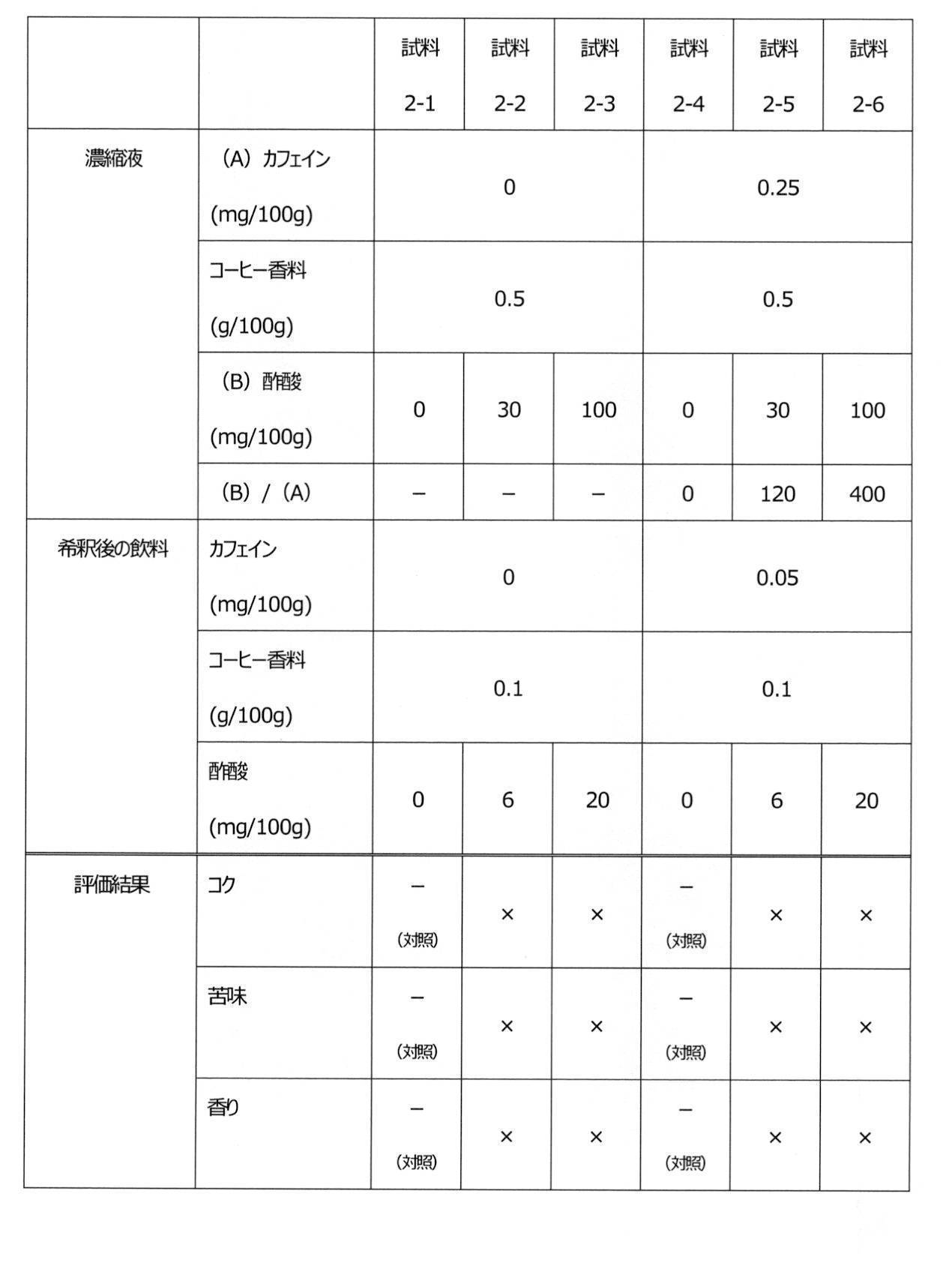
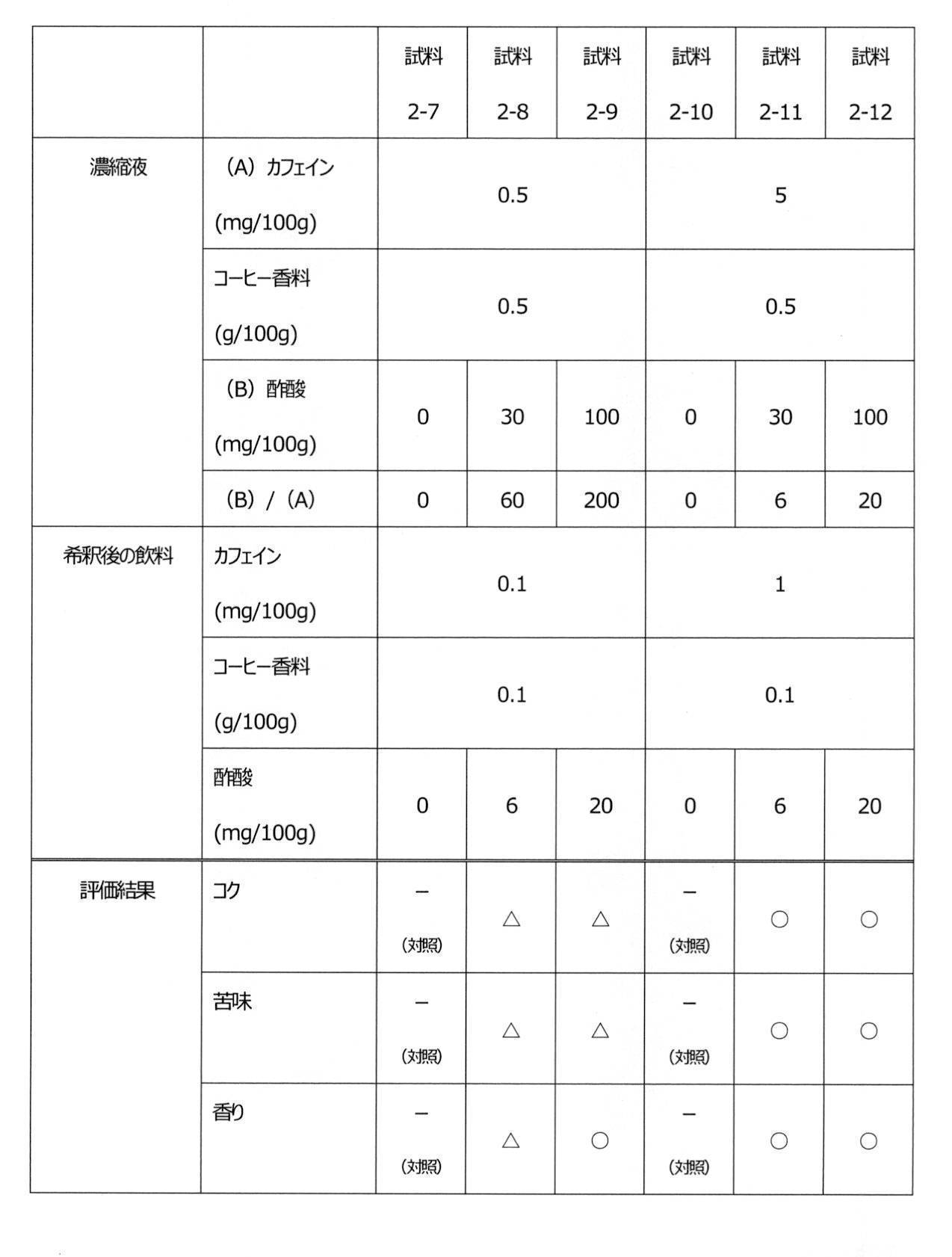
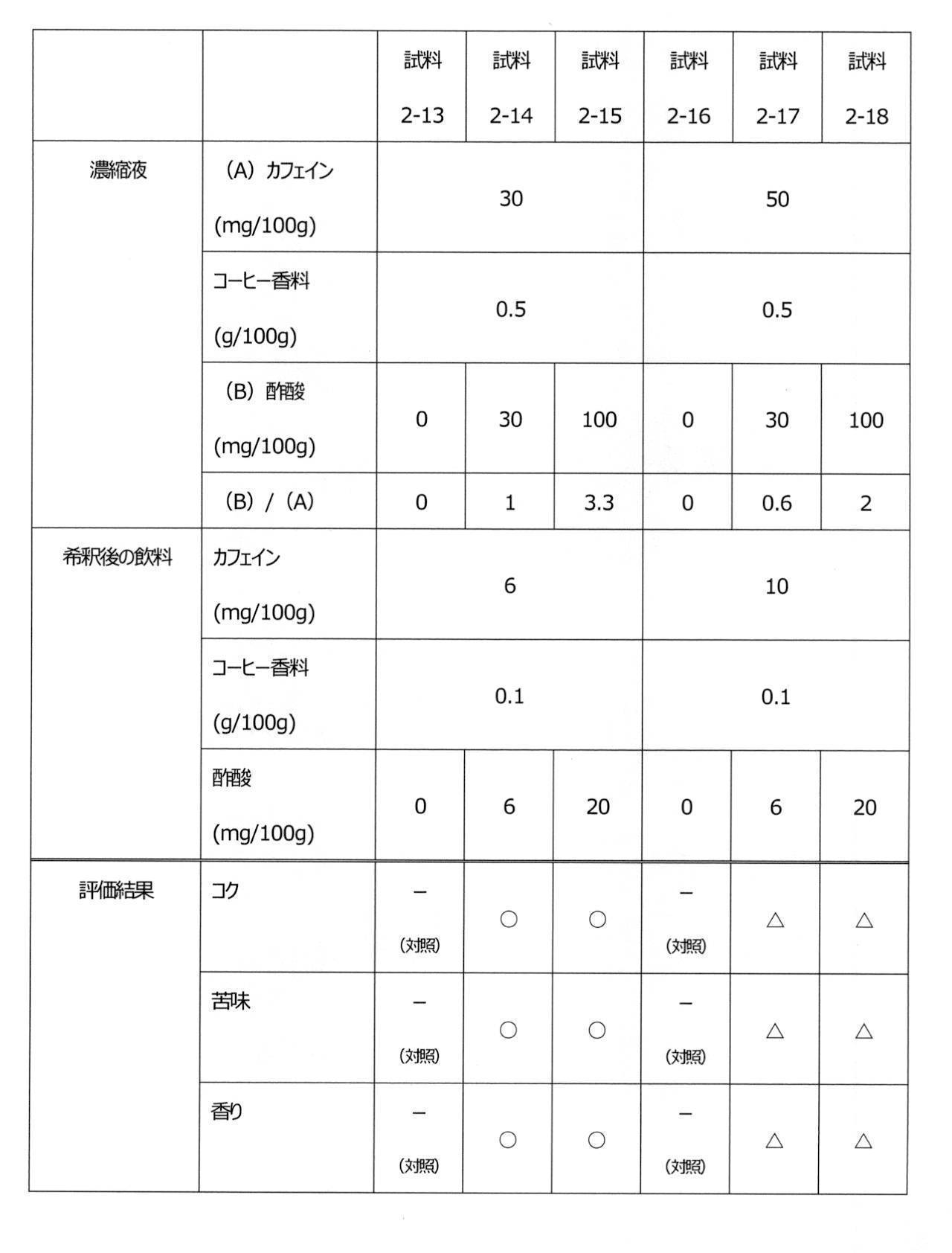
- a coffee concentrate was prepared in the same manner as in Experiment 1 except that caffeine was prescribed so as to have the concentration shown in the "Concentration" row of Tables 2-1 to 2-4. These coffee concentrates were diluted 5-fold with milk, and acetic acid-free samples (Samples 2-1, 2-4, 2-7, 2-10, 2-13, 2-16, etc. were added for each caffeine concentration. Using 2-19 and 2-22) as controls, sensory evaluation was performed in the same manner as in Experiment 1.
- Example 3 The effect of pH on the caffeine taste enhancing effect of acetic acid was investigated. Phosphoric acid and sodium hydrogen carbonate were appropriately added to Sample 1-5 (pH 5.5) of Experiment 1 to prepare a low caffeine coffee concentrate having a pH of 4.0 to 7.5. A control product without acetic acid was prepared at each pH, and the low caffeine coffee concentrate and the control product were diluted 5-fold with milk in the same manner as in Experiment 1 for sensory evaluation.
- a low caffeine coffee extract was prepared. Specifically, using commercially available roasted coffee beans (L value ⁇ 18) in which caffeine has been reduced by the supercritical carbon dioxide extraction method, the same steam treatment as the method described in Example 3 of Retable 2005/011396 is used. To obtain low caffeine steam-treated coffee roasted beans. The roasted beans are crushed into medium grinds, packed in a multi-stage column extractor, and hot water is added for multi-stage extraction. The extract has a Brix (that is, coffee solid content concentration in the extract) of 12%. A coffee extract was obtained. This coffee extract was diluted with water to obtain a coffee extract having a coffee solid content concentration of 5%. These coffee extracts having a coffee solid content concentration of 5% were used as a coffee concentrate base to prepare a low caffeine coffee concentrate having a coffee solid content concentration of 5%.
- the coffee extract having a coffee solid content concentration of 5%, the acetic acid used in Experiment 1, and the coffee fragrance containing pyrazines (fragrance different from Experiment 1) are formulated as shown in Table 3-1.
- Coffee concentrates (Samples 4-1 to 4-7) were prepared.
- As a control low caffeine control coffee having the same caffeine concentration and coffee fragrance concentration by adding 9 mg / 100 g of caffeine and 0.3 g / 100 g of the above coffee fragrance to ion-exchanged water and not containing the coffee extract.
- a concentrate was prepared.
- Example 5 The coffee extract having a coffee solid content concentration of 12% prepared in Experiment 4 was used, and an appropriate amount of water was mixed thereto to obtain a coffee extract having a coffee solid content concentration of 2%, 9%, and 12%. These coffee extracts with coffee solids concentrations of 2%, 9%, and 12% are used as coffee concentrate bases to prepare low caffeine coffee concentrates with coffee solids concentrations of 2%, 9%, and 12%, respectively. did. Specifically, coffee fragrances and various concentrations of acetic acid are added to these coffee extracts having different coffee solid content concentrations in the same manner as in Experiment 4 so as to have the formulations shown in Tables 4-1 and 4-2. A low caffeine coffee concentrate having different coffee solid content concentrations and different acetic acid concentrations was obtained, diluted 4-fold with milk, and sensory evaluation was carried out in the same manner as in Experiment 1.
- FIG. 1 shows a diagram summarizing the results of Experiment 4 and Experiment 5.
- the ⁇ mark is a beverage that the specialty panel evaluated as having a particularly rich and bitter taste of coffee, leaving a lingering finish of coffee even after drinking, and a pleasant coffee in the mouth for a long time. It was evaluated as a cafe latte-style beverage that leaves a rich and bitter taste.
Landscapes
- Life Sciences & Earth Sciences (AREA)
- Chemical & Material Sciences (AREA)
- Engineering & Computer Science (AREA)
- Food Science & Technology (AREA)
- Polymers & Plastics (AREA)
- Tea And Coffee (AREA)
Abstract
カフェイン含有量が低減されていながら、コーヒー本来の香味、特に深いコクと後口の苦味が損なわれていない、本格的なカフェ・ラテの香味を味わうことができる飲料を調製するための低カフェインコーヒー濃縮液を提供する。 カフェイン含有量を低減したコーヒー濃縮液において、カフェインファン有料と酢酸含有量とを特定の範囲に調整することにより、コーヒーの呈味が増強され、コーヒー本来の香味が損なわれることなく、本格的なカフェ・ラテの香味が奏される。
Description
本発明はコーヒー濃縮液に関し、特に、ミルクで希釈してカフェ・ラテを作るための低カフェインコーヒー濃縮液に関する。
カフェ・ラテは、エスプレッソ(espresso)と牛乳とを混ぜたイタリア発祥の飲み物である。近年、アメリカ式のカフェバーが浸透し、日本でもカフェ・ラテが嗜好飲料として定着している。そして、お店のような贅沢な味わいのカフェ・ラテを家庭で手軽に作ることができる、カフェ・ラテ用のコーヒー濃縮液が種々開発されている(たとえば非特許文献1、2)。
ところで、コーヒーに含まれるカフェインは、中枢神経系統や心臓を刺激したり、胃や腸などの消化器官を刺激したりすることがあり、これらの刺激への感受性が強い人や健康志向の高い人からは忌避される傾向がある。そこで、カフェインを低減又は除去したカフェインレスコーヒーが開発され、市販されている。
しかし、カフェインはコーヒーの主要な呈味成分の一つであり、これを低減又は除去してしまうとコーヒー特有のコクや苦味が薄れてしまい、風味が損なわれてしまうという問題がある。そこで、カフェインレスコーヒーの風味を改善する方法が種々提案されている。カフェインレスコーヒーの風味を改善する方法としては、たとえば、カフェインレスコーヒーにテアニンを添加する方法(特許文献1)、カフェインレスコーヒーにイソ吉草酸エチルを含有させる方法(特許文献2)、カフェインレスコーヒーに硫酸カリウム及び/又は乳酸カリウムを含有させる方法(特許文献3)、脱カフェイン処理されているコーヒー分に、バリン、ロイシン、イソロイシンなどの中性アミノ酸を添加する方法(特許文献4)、低カフェインコーヒーにケルセチン配糖体を配合する方法(特許文献5)等が挙げられる。
サントリー食品インターナショナル、ニュースリリース、"「ボス ホームエスプレッソ ラテミックス」新発売"、[online]、2016/2/15、[2019年6月28日検索]、インターネット<URL:https://www.suntory.co.jp/softdrink/news/pr/article/SBF0395.html>
日本コカ・コーラ、ニュースリリース、"「ジョージア ヨーロピアン 猿田彦珈琲監修のコーヒーベース」4月9日(月)から全国で発売 "、[online]、2018/4/2、[2019年6月28日検索]、インターネット<URL:https://www.cocacola.co.jp/press-center/news-20180402-11>
カフェ・ラテを作るためのコーヒー濃縮液は、ミルクで希釈して飲用に供されるものであるため、ミルクと混ぜても香味が希薄化されることなく、コーヒー特有の濃さ(コク)や苦味が感じられることが重要である。特に、カフェイン含有量を低減したコーヒー濃縮液は、呈味成分であるカフェインの含有量が少ないため、ミルクで希釈すると、コーヒー本来の香味である深いコクや、後口に感じられるコーヒー独特の苦味(本明細書において、後口の苦味とも表記する)が損なわれやすいという問題がある。
本発明は、カフェイン含有量が低減されていながら、コーヒー本来の香味、特に深いコクと後口の苦味が損なわれていない、本格的なカフェ・ラテの香味を味わうことができる飲料を調製するための、低カフェインコーヒー濃縮液を提供することを目的とする。
本発明者らは、カフェイン含有量を低減したコーヒー濃縮液において、カフェイン含有量と酢酸含有量とを特定の範囲に調整することにより、ミルクで希釈した場合でも、コーヒーの呈味が増強され、深いコクや後口の苦味といったコーヒー本来の香味が損なわれることなく、本格的なカフェ・ラテの香味が奏されることを見出し、本発明を完成するに至った。本発明は、これに限定されるものではないが、以下に関する。
[1]
3~6倍の希釈倍率で希釈して生じる飲料を飲用に供するための低カフェインコーヒー濃縮液であって、以下(i)~(iv)を満たす低カフェインコーヒー濃縮液;
(i)前記希釈して生じる飲料中のカフェイン濃度が0.1~10mg/100gとなる濃度のカフェイン(A)を含み、
(ii)前記希釈して生じる飲料中の酢酸濃度が1mg/100g以上となる濃度の酢酸(B)を含み、
(iii)カフェイン(A)と酢酸(B)の濃度比[(B)/(A)]が0.7~25であり、
(iv)コーヒーフレーバーを含む。
[2]
前記希釈して生じる飲料中のカフェイン濃度が0.5~6mg/100gとなる濃度のカフェイン(A)を含む、[1]に記載の低カフェインコーヒー濃縮液。
[3]
コーヒー抽出物を含む、[1]又は[2]に記載の低カフェインコーヒー濃縮液であって、コーヒー固形分の濃度が5~12重量%である、低カフェインコーヒー濃縮液。
[4]
コーヒー固形分の濃度が6~11重量%である、[3]に記載の低カフェインコーヒー濃縮液。
[5]
コーヒー抽出物及びコーヒー香料を含む、[3]又は[4]に記載の低カフェインコーヒー濃縮液。
[6]
コーヒー固形分濃度に対するカフェイン濃度(カフェイン濃度/コーヒー固形分濃度)が2×10-3以下である、[3]~[5]のいずれかに記載の低カフェインコーヒー濃縮液。
[7]
コーヒー固形分濃度に対するカフェイン濃度(カフェイン濃度/コーヒー固形分濃度)が4×10-4以下である、[6]に記載の低カフェインコーヒー濃縮液。
[8]
pHが5.0~7.0である、[1]~[7]のいずれかに記載の低カフェインコーヒー濃縮液。
[9]
pHが5.3~6.0である、[8]に記載の低カフェインコーヒー濃縮液。
[10]
ミルクで希釈するための、[1]~[9]のいずれかに記載の低カフェインコーヒー濃縮液。
[11]
3~6倍の希釈倍率で希釈して生じる飲料を飲用に供するための低カフェインコーヒー濃縮液の製造方法であって、
(i)前記希釈して生じる飲料中のカフェイン濃度が0.1~10mg/100gとなるような濃度でカフェイン(A)を配合し、
(ii)前記希釈して生じる飲料中の酢酸濃度が1mg/100g以上となる濃度で酢酸(B)を配合し、
(iii)カフェイン(A)と酢酸(B)の濃度比[(B)/(A)]を0.7~25に調整し、
(iv)コーヒーフレーバーを配合する
工程を含む、製造方法。
[1]
3~6倍の希釈倍率で希釈して生じる飲料を飲用に供するための低カフェインコーヒー濃縮液であって、以下(i)~(iv)を満たす低カフェインコーヒー濃縮液;
(i)前記希釈して生じる飲料中のカフェイン濃度が0.1~10mg/100gとなる濃度のカフェイン(A)を含み、
(ii)前記希釈して生じる飲料中の酢酸濃度が1mg/100g以上となる濃度の酢酸(B)を含み、
(iii)カフェイン(A)と酢酸(B)の濃度比[(B)/(A)]が0.7~25であり、
(iv)コーヒーフレーバーを含む。
[2]
前記希釈して生じる飲料中のカフェイン濃度が0.5~6mg/100gとなる濃度のカフェイン(A)を含む、[1]に記載の低カフェインコーヒー濃縮液。
[3]
コーヒー抽出物を含む、[1]又は[2]に記載の低カフェインコーヒー濃縮液であって、コーヒー固形分の濃度が5~12重量%である、低カフェインコーヒー濃縮液。
[4]
コーヒー固形分の濃度が6~11重量%である、[3]に記載の低カフェインコーヒー濃縮液。
[5]
コーヒー抽出物及びコーヒー香料を含む、[3]又は[4]に記載の低カフェインコーヒー濃縮液。
[6]
コーヒー固形分濃度に対するカフェイン濃度(カフェイン濃度/コーヒー固形分濃度)が2×10-3以下である、[3]~[5]のいずれかに記載の低カフェインコーヒー濃縮液。
[7]
コーヒー固形分濃度に対するカフェイン濃度(カフェイン濃度/コーヒー固形分濃度)が4×10-4以下である、[6]に記載の低カフェインコーヒー濃縮液。
[8]
pHが5.0~7.0である、[1]~[7]のいずれかに記載の低カフェインコーヒー濃縮液。
[9]
pHが5.3~6.0である、[8]に記載の低カフェインコーヒー濃縮液。
[10]
ミルクで希釈するための、[1]~[9]のいずれかに記載の低カフェインコーヒー濃縮液。
[11]
3~6倍の希釈倍率で希釈して生じる飲料を飲用に供するための低カフェインコーヒー濃縮液の製造方法であって、
(i)前記希釈して生じる飲料中のカフェイン濃度が0.1~10mg/100gとなるような濃度でカフェイン(A)を配合し、
(ii)前記希釈して生じる飲料中の酢酸濃度が1mg/100g以上となる濃度で酢酸(B)を配合し、
(iii)カフェイン(A)と酢酸(B)の濃度比[(B)/(A)]を0.7~25に調整し、
(iv)コーヒーフレーバーを配合する
工程を含む、製造方法。
本発明のカフェイン含有量を低減したコーヒー濃縮液を用いることにより、カフェインが低減されているにもかかわらず本格的なカフェ・ラテの香味を味わうことができる飲料を調製することができる。本発明の低カフェインコーヒー濃縮液は、ミルクと混ぜるだけで、カフェイン含有量を低減しつつ本格的な香味を有するカフェ・ラテを手軽に調製することができ、利便性にも優れている。さらに、本発明の低カフェインコーヒー濃縮液は、カフェイン含有量と酢酸含有量とを特定の範囲に調整することで製造できるものであるため、特殊な設備を必要とせず、簡便かつ安価に提供することができるという点においても有利である。
(コーヒー濃縮液及び低カフェインコーヒー濃縮液)
本明細書において、「コーヒー濃縮液」とは、これを希釈して生じる飲料(以後、単に希釈後飲料と表記することがある)を飲用に供するための、コーヒー風味を有する液体をいう。ここで、コーヒー風味を有する液体とは、コーヒーを連想させる香気を有する液体を意味し、具体的にはコーヒーフレーバーを含有する液体を意味する。コーヒーフレーバーについては後述する。
本明細書において、「コーヒー濃縮液」とは、これを希釈して生じる飲料(以後、単に希釈後飲料と表記することがある)を飲用に供するための、コーヒー風味を有する液体をいう。ここで、コーヒー風味を有する液体とは、コーヒーを連想させる香気を有する液体を意味し、具体的にはコーヒーフレーバーを含有する液体を意味する。コーヒーフレーバーについては後述する。
また、本明細書において、「低カフェインコーヒー濃縮液」とは、カフェインが低減又は除去されたコーヒー濃縮液をいい、具体的には、希釈して飲用に供するためのコーヒー風味を有する液体であって、希釈後飲料中のカフェイン濃度が0.1~10mg/100gとなる濃度のカフェインを含むものをいう。
本発明の低カフェインコーヒー濃縮液を希釈するための希釈倍率は、飲用者の嗜好に合わせて適宜設定してよいが、体積比に基づいて3~6倍とするのが好ましい。具体的には、たとえば体積比に基づいて3倍の希釈倍率とは、1体積の低カフェインコーヒー濃縮液に対して2体積の希釈媒体を加えることをいう。本明細書において、希釈倍率は体積比に基づくものとする。
本発明は、低カフェインコーヒー濃縮液において、カフェイン含有量と酢酸含有量とを特定の範囲に調整することにより、前記低カフェインコーヒー濃縮液を希釈して生じる飲料においてもコーヒーの呈味が増強されるという発見に基づくものである。酢酸によるコーヒー呈味の増強作用については後述するが、これは少量含まれるカフェインの呈味を強化するものである。したがって、本発明の低カフェインコーヒー濃縮液は、希釈後飲料中のカフェイン濃度が少なくとも0.1mg/100gとなるものであることが必要であり、カフェインを低減する観点からは0.1~10mg/100gとなるものであることが好ましい。本発明の効果をさらに大きく得る目的のためには、本発明の低カフェインコーヒー濃縮液は、希釈後飲料中のカフェイン濃度が0.3~8mg/100gとなる濃度でカフェインを含むことが好ましく、希釈後飲料中のカフェイン濃度が0.5~6mg/100gとなる濃度でカフェインを含むことがより好ましく、希釈後飲料中のカフェイン濃度が0.8~3mg/100gとなる濃度でカフェインを含むことが特に好ましい。また、別の観点からは、本発明の低カフェインコーヒー濃縮液は、これに含まれるコーヒー固形分濃度に対するカフェイン濃度(カフェイン濃度/コーヒー固形分濃度)が2×10-3以下であることが好ましく、4×10-4以下であることがさらに好ましい。コーヒー固形分濃度については後述する。
本発明の低カフェインコーヒー濃縮液に含まれるカフェインの含有量は、上記希釈後飲料中のカフェイン含有量に希釈倍率を乗ずることによって算出できる。たとえば、コーヒー濃縮液の希釈倍率が4倍である場合、「希釈後飲料中のカフェイン濃度が0.1~10mg/100gとなる濃度のカフェインを含む、コーヒー濃縮液」とは、0.4~40mg/100gのカフェインを含むコーヒー濃縮液を意味する。このことに基づくと、3~6倍の希釈倍率で希釈して生じる飲料を飲用に供するための、本発明の低カフェインコーヒー濃縮液は、0.3~60mg/100gのカフェインを含むことが好ましく、0.9~48mg/100gのカフェインを含むことが好ましく、1.5~36mg/100gのカフェインを含むことがより好ましく、2.4~18mg/100gのカフェインを含むことがさらに好ましい。
コーヒー濃縮液中のカフェイン含有量や、希釈後飲料中のカフェイン含有量は、公知の高速液体クロマトグラフィー(HPLC)を用いた方法等によって測定することができる。
本発明の低カフェインコーヒー濃縮液において、カフェイン含有量を所望の量に調整する方法は特に制限されない。コーヒー濃縮液中のカフェイン含有量を低減する目的のためには、カフェインが除去又は低減されたコーヒー豆を原料として得られるコーヒー抽出液を用いてもよいし、コーヒー抽出液からカフェインを除去又は低減してもよい。カフェインを除去又は低減する方法としては、たとえば、精製後のコーヒー生豆からカフェインを除去する方法や、育種技術及び遺伝子組換え技術などによりカフェインを除去したコーヒー豆を用いる方法、コーヒー生豆を有機溶剤、水、超臨界流体化した二酸化炭素などの溶媒に浸してカフェインを選択的に除去する方法、活性炭及びイオン交換樹脂などによりコーヒー抽出液からカフェインを吸着除去する方法などが挙げられる。これらのカフェイン除去法又はカフェイン低減法は単独で使用してもよいし、組み合わせて使用してもよい。
一方で、低カフェインコーヒー濃縮液中のカフェイン含有量を所望の量に調整するために、カフェイン含有量を増加させることもでき、そのような場合には、飲食品上許容されるカフェイン製剤を添加することができる。
(酢酸)
本発明の低カフェインコーヒー濃縮液は、カフェイン含有量と酢酸含有量とを特定の範囲に調整することにより、前記低カフェインコーヒー濃縮液を希釈して生じる飲料においてもコーヒー呈味が増強され、カフェインが低減されていないコーヒー濃縮液を希釈して生じる飲料の香味と同等もしくはそれ以上の深いコクや後口の苦味を有することを特徴とする。酸味成分の中でも、特異的に酢酸がカフェインの呈味増強作用を有する。
本発明の低カフェインコーヒー濃縮液は、カフェイン含有量と酢酸含有量とを特定の範囲に調整することにより、前記低カフェインコーヒー濃縮液を希釈して生じる飲料においてもコーヒー呈味が増強され、カフェインが低減されていないコーヒー濃縮液を希釈して生じる飲料の香味と同等もしくはそれ以上の深いコクや後口の苦味を有することを特徴とする。酸味成分の中でも、特異的に酢酸がカフェインの呈味増強作用を有する。
本発明のコーヒー濃縮液における酢酸の含有量は、希釈後飲料中の酢酸濃度が1mg/100g以上、好ましくは2mg/100g以上、より好ましくは3mg/100g以上、さらに好ましくは6mg/100g以上の濃度となるように調整する。
酢酸は、揮発性酸であり、刺激的な酸臭が香味に悪影響を及ぼすことが知られており、カフェインが低減処理されていない飲料においては、風味向上を目的としてコーヒー豆から酢酸を低減する処理を行うことが提案されている(例えば、特開2011-97832号公報、特再公表2005-11396号)。本発明では、カフェインが低減処理された低カフェインコーヒーの濃縮液に、酢酸を所定量含有させるものである。酢酸の含有量が少な過ぎると、目的とするカフェイン呈味の増強作用が得られないことがある。
カフェインの呈味増強作用は、酢酸の濃度に依存して大きくなる。しかし、希釈後飲料中の酢酸の濃度が25mg/100gより多いと、呈味増強効果は頭打ちとなるばかりでなく、酢酸の臭味が所望の効果を阻害することがある。これより、本発明のコーヒー濃縮液における酢酸の含有量の上限値は、希釈後の飲料に対して25mg/100g以下となる濃度で含むことが好ましく、20mg/100g以下となる濃度で含むことがより好ましく、18mg/100g以下となる濃度で含むことがより好ましい。
本発明の低カフェインコーヒー濃縮液に含まれる酢酸の含有量は、カフェインの含有量と同様に、希釈後飲料中の酢酸含有量に希釈倍率を乗ずることによって算出できる。たとえば、「希釈後飲料中の酢酸濃度が1mg/100g以上となる濃度の酢酸を含む、コーヒー濃縮液」とは、コーヒー濃縮液の希釈倍率が4倍である場合、4mg/100g以上の濃度の酢酸を含むコーヒー濃縮液を意味する。このことに基づくと、3~6倍の希釈倍率で希釈して生じる飲料を飲用に供するための、本発明の低カフェインコーヒー濃縮液は、3mg/100g以上の酢酸を含むことが好ましく、6mg/100g以上の酢酸を含むことが好ましく、9mg/100g以上の酢酸を含むことがより好ましく、18mg/100g以上の酢酸を含むことがさらに好ましい。また、3~6倍の希釈倍率で希釈して生じる飲料を飲用に供するための、本発明の低カフェインコーヒー濃縮液は、150mg/100g以下の酢酸を含むことが好ましく、120mg/100g以下の酢酸を含むことが好ましく、108mg/100g以下の酢酸を含むことがより好ましい。
コーヒー濃縮液中の酢酸含有量や、希釈後飲料中の酢酸含有量は、一般的な有機酸の分析方法である高速液体クロマトグラフィー(HPLC)を用いた方法等によって測定することができる。
所望の効果を得るためには、本発明の低カフェインコーヒー濃縮液においては、カフェイン(A)と酢酸(B)との濃度比[(B)/(A)]も重要である。具体的には、[(B)/(A)]が0.7~25であり、好ましくは1~20、より好ましくは3~15、特に好ましくは5~15である。特に、希釈後飲料中のカフェイン濃度が0.5~6mg/100gとなる濃度でカフェインを含む低カフェインコーヒー濃縮液において、[(B)/(A)]を0.7~25、1~20、3~15、または5~15に調整することが好ましい。
本発明の低カフェインコーヒー濃縮液に用いる酢酸としては、飲食品に添加可能な酢酸であればいずれの酢酸であってもよく、酢酸の塩であってもよい。また、酢酸成分を含む天然物からの粗抽出物、抽出物又は精製品をコーヒー濃縮液へ配合してもよい。
(コーヒーフレーバー)
本発明の低カフェインコーヒー濃縮液は、コーヒーフレーバーを含む。本発明に用いるコーヒーフレーバーとしては、飲料に添加可能な食品添加物としてのコーヒー香料の他、コーヒーの香気成分を含む焙煎コーヒー豆の抽出物(本明細書中、「コーヒー抽出液」とも表記する)も含まれる。コーヒーフレーバーにおいてコーヒー香料及びコーヒー抽出液を含む低カフェインコーヒー濃縮液は、本発明の好適な態様の一例である。
本発明の低カフェインコーヒー濃縮液は、コーヒーフレーバーを含む。本発明に用いるコーヒーフレーバーとしては、飲料に添加可能な食品添加物としてのコーヒー香料の他、コーヒーの香気成分を含む焙煎コーヒー豆の抽出物(本明細書中、「コーヒー抽出液」とも表記する)も含まれる。コーヒーフレーバーにおいてコーヒー香料及びコーヒー抽出液を含む低カフェインコーヒー濃縮液は、本発明の好適な態様の一例である。
本発明者らは、所定量の酢酸によって、コーヒーの深いコクや後口の苦味とともに、ナッツ様の香気が増強できることを見出している。したがって、本発明の低カフェインコーヒー濃縮液中のコーヒーフレーバーがコーヒー香料を含む場合、コーヒー香料には、ナッツ様の香気成分が含まれることが好ましい。ナッツ様の香気成分としては、2-エチル-3,5-ジメチルピラジン、2,3-ジエチル-5-メチルピラジン、2,3,5-トリメチルピラジンなどのピラジン類が例示できる。特に、2,3,5-トリメチルピラジンはローストナッツ様の香気を有し、本発明の効果を顕著に知覚できることから好適である 。
本発明に用いるコーヒー香料としては、特に制限されず、市販のものを適宜自由に使用することができる。当業者は、コーヒーに関する用語として、焙煎・粉砕したコーヒーの香りをフレグランス、抽出したコーヒー液の香りをアロマ、コーヒー液を口に含んだときの香りをフレーバーと使い分けている場合もあるが、本明細書においてコーヒー香料とは、コーヒーフレグランス及びコーヒーアロマの香りの香料も含むものとする。
本発明の低カフェインコーヒー濃縮液中にコーヒー香料を配合する場合、コーヒー香料の配合量は、使用する香料の力価やコーヒー濃縮液の希釈倍率等を考慮して、適宜設定することができるが、通常、コーヒー濃縮液に対して、0.01~5.0重量%程度、好ましくは0.03~4.0重量程度、より好ましくは0.05~3.0重量%程度、さらに好ましくは0.1~1.5重量%程度である。
本発明の低カフェインコーヒー濃縮液中のコーヒーフレーバーは、コーヒー抽出液を含むものであってもよい。本明細書でいうコーヒー抽出液とは、焙煎、粉砕されたコーヒー豆を水や温水などを用いて抽出した溶液をいい、コーヒー抽出液を濃縮したコーヒーエキス、コーヒー抽出液を乾燥した固形状の乾燥物を水や温水などで適量に調整した溶液も含まれる。
コーヒー抽出液に用いられるコーヒー豆の種類は、特に限定されないが、例えばブルーマウンテン、ハイマウンテン、ジャマイカ、クリスタルマウンテン、グァテマラアンテイグア、コロンビアスプレモ、モカハラー、モカマタリ、キリマンジャロ、トラジャ、カロシ、ガヨマウンテン、マンデリン、ブラジル、ハワイコナ等が挙げられる。コーヒー豆種としては、アラビカ種、ロブスタ種などがある。コーヒー豆は1種でもよいし、複数種をブレンドして用いてもよい。
これらの生豆をコーヒーロースターにより焙煎したものをコーヒー抽出液の原料とすることができる。例えば、コーヒー生豆を回転ドラムの内部に投入し、この回転ドラムを回転攪拌しながら、下方からガスバーナー等で加熱することで焙煎できる。かかるコーヒー豆の焙煎の程度は、L値として14~30程度の焙煎である。本発明の低カフェインコーヒー濃縮液は、カフェ・ラテの調製に用いられるものであることから、エスプレッソをイメージする味わいとすることが好ましい。コーヒー豆は深く煎るほど苦味・コクが強くなることから、エスプレッソには、通常、深煎りの焙煎豆(L値として14~22程度、好ましくは15~20程度)が用いられる。本発明の低カフェインコーヒー濃縮液に用いるコーヒー抽出液の原料となる焙煎コーヒー豆としても、深煎りの焙煎豆を用いることが好ましい。ここで、L値とはコーヒーの焙煎の程度を表す指標で、コーヒー焙煎豆の粉砕物の明度を色差計で測定した値である(黒を0、白を100で表す)。
焙煎コーヒー豆からのコーヒー抽出液の抽出方法についても何ら制限はなく、例えば焙煎コーヒー豆を粗挽き、中挽き、細挽きなどに粉砕した粉砕物から水や温水(0~200℃)を用いて10秒~30分間抽出する方法が挙げられる。抽出方法は、ドリップ式、サイフォン式、ボイリング式、ジェット式、連続カラム式等の公知の方法を適宜選択することができるなどがある。カラム式の場合には、例えば、カラム型抽出機内にコーヒー豆を収容し、抽出機内に水や温水を供給すればよい。この場合、多段階抽出することもできる。ここで、多段階抽出とは、複数の独立した抽出塔を配管で直列につないだ装置を用いた抽出方法をいう。多段階抽出を用いると、濃縮工程を経ずに、濃縮液と同等の高いコーヒー固形分濃度を有する抽出液が得られるので、香味の観点から好適な抽出方法である。
上記コーヒーフレーバーを含む液体を、本発明の低カフェインコーヒー濃縮液のベースとなるコーヒー濃縮液(以後、コーヒー濃縮液ベースとも表記する)として用い、コーヒー濃縮液ベース中のカフェイン濃度、酢酸濃度、カフェイン(A)と酢酸(B)の濃度比[(B)/(A)]を所定の範囲に調整して、本発明の低カフェインコーヒー濃縮液とすることもできる。
たとえば、上記コーヒー抽出液をそのままコーヒー濃縮液ベースとして用い、コーヒー濃縮液ベース中のカフェイン濃度、酢酸濃度、カフェイン(A)と酢酸(B)の濃度比[(B)/(A)]を所定の範囲に調整して、本発明の低カフェインコーヒー濃縮液を調製してもよい。
また、上記コーヒー抽出液をそのままコーヒー濃縮液ベースとして用い、コーヒー濃縮液ベース中のカフェイン濃度、酢酸濃度、カフェイン(A)と酢酸(B)の濃度比[(B)/(A)]を所定の範囲に調整して、さらに必要に応じてコーヒー香料を添加して、本発明の低カフェインコーヒー濃縮液を調製してもよい。
本発明の低カフェインコーヒー濃縮液がコーヒー抽出液を含む場合、コーヒー抽出液中のコーヒー固形分濃度は、5~12重量%とすることが好ましい。そして、本発明の低カフェインコーヒー濃縮液がコーヒー抽出液を含む場合、コーヒー抽出液は、低カフェインコーヒー濃縮液中のコーヒー固形分濃度が5~12重量%となるように、低カフェインコーヒー濃縮液中に含まれることが好ましい。5~12重量%のコーヒー固形分濃度を有するコーヒー抽出液をそのままコーヒー濃縮液ベースとして用いて、あるいは適宜希釈して用いて、5~12重量%のコーヒー固形分濃度を有する低カフェインコーヒー濃縮液とすることもできる。
ここで、本明細書において、コーヒー固形分とは、たとえば上記コーヒー抽出液におけるコーヒー固形分の場合、コーヒー抽出液における可溶性固形分量を、20℃における糖用屈折計示度(Brix)より求めた重量(g)をいう。具体的には、糖用屈折計(アタゴRX-5000等)を用いて、コーヒー抽出液の糖用屈折計示度(Brix)を測定し、これに、測定に使用したコーヒー抽出液量(g)を乗ずることによって、コーヒー固形分の重量(g)を算出する。また、本明細書におけるコーヒー固形分濃度とは、上記で求められたコーヒー固形分の重量(g)に基づく濃度(重量%)をいう。具体的には、コーヒー抽出液の重量に対する、上記で求められたコーヒー固形分の重量の百分率を算出することにより、コーヒー抽出液におけるコーヒー固形分濃度(重量%)を求めることができる。同様にして、本発明の低カフェインコーヒー濃縮液におけるコーヒー固形分濃度を求めることができる。なお、上記Brix値を、本発明のコーヒー抽出液又は濃縮液におけるコーヒー固形分濃度としてもよい。
本発明の低カフェインコーヒー濃縮液におけるコーヒー固形分の濃度が5重量%以上(好ましくは6重量%以上)であると、ミルクを用いて、たとえば3~6倍の希釈倍率で使用した場合にも、コーヒー本来の味わいが感じられやすく、上記所定量の酢酸を含有させた場合に、より一層コーヒー本来の深いコクや苦味を増強することができる。また、香味の観点から、本発明の低カフェインコーヒー濃縮液におけるコーヒー固形分の濃度の上限は12重量%であることが好ましく、11重量%であることがより好ましく、10重量%であることが特に好ましい。
(その他成分)
本発明の効果の顕著さから、本発明の低カフェインコーヒー濃縮液のpHは、5.0~7.0であることが好ましく、5.0~6.0であることがより好ましく、5.3~6.0であることがさらに好ましい。pH調整には、炭酸水素ナトリウム、水酸化ナトリウムなどの一般的なpH調整剤を用いることができる。
本発明の効果の顕著さから、本発明の低カフェインコーヒー濃縮液のpHは、5.0~7.0であることが好ましく、5.0~6.0であることがより好ましく、5.3~6.0であることがさらに好ましい。pH調整には、炭酸水素ナトリウム、水酸化ナトリウムなどの一般的なpH調整剤を用いることができる。
上記成分の他、本発明の効果を損なわない限りで、甘味料(ショ糖、異性化糖、ブドウ糖、果糖、乳糖、麦芽糖、アスパルテーム、アセスルファムK、スクラロース、ステビアなど)、酸化防止剤(L-アスコルビン酸ナトリウムなど)、乳化剤(ショ糖脂肪酸エステル、ソルビタン酸エステル、ポリグリセリン脂肪酸エステルなど)、酸味料、香料等を適宜配合することができる。
(希釈媒体)
本発明の低カフェインコーヒー濃縮液を希釈するための希釈媒体としては、飲食品上許容できる液体であればいずれを用いてもよいが、ミルクを用いることが好ましい。
本発明の低カフェインコーヒー濃縮液を希釈するための希釈媒体としては、飲食品上許容できる液体であればいずれを用いてもよいが、ミルクを用いることが好ましい。
本発明の低カフェインコーヒー濃縮液は、カフェイン含有量と酢酸含有量を所定範囲内に調整することにより、希釈媒体で希釈して生じる飲料においてもコーヒー呈味が増強され、カフェインが低減されていないコーヒー濃縮液を希釈して生じる飲料の香味と同等もしくはそれ以上の深いコクや後口の苦味をもたらすことを特徴とする。そのため、本発明の低カフェインコーヒー濃縮液は、たっぷりのミルクで混ぜた場合にも、ミルクに負けないコーヒーの豊かなコクとしっかりとした苦味(特に、後口の苦味)を感じる飲料を調製することができる。このように、本発明の低カフェインコーヒー濃縮液は、ミルクで希釈するための濃縮液として好適に使用される。ここで、本明細書でいうミルクとは、そのままではコーヒーの香味を希薄化させる、タンパク質や脂肪が微細なコロイド粒子となって存在する白色の液体をいい、牛乳などの動物性ミルクの他、豆乳やアーモンドミルク、ライスミルク、ココナッツミルクなどの植物性ミルクが含まれるものとする。
(低カフェインコーヒー濃縮液の製造方法)
本発明は、別の観点からは、カフェイン含有量が低減されていながら、コーヒー本来の香味、特に深いコクと後口の苦味が損なわれていない、本格的なカフェ・ラテの香味を味わうことができる飲料を調製するための、低カフェインコーヒー濃縮液を製造する方法にも関する。
本発明は、別の観点からは、カフェイン含有量が低減されていながら、コーヒー本来の香味、特に深いコクと後口の苦味が損なわれていない、本格的なカフェ・ラテの香味を味わうことができる飲料を調製するための、低カフェインコーヒー濃縮液を製造する方法にも関する。
具体的には、本発明は、3~6倍の希釈倍率で希釈して生じる飲料を飲用に供するための低カフェインコーヒー濃縮液の製造方法であって、
(i)前記希釈して生じる飲料中のカフェイン濃度が0.1~10mg/100gとなるような濃度でカフェイン(A)を配合し、
(ii)前記希釈して生じる飲料中の酢酸濃度が1mg/100g以上となる濃度で酢酸(B)を配合し、
(iii)カフェイン(A)と酢酸(B)の濃度比[(B)/(A)]を0.7~25に調整し、
(iv)コーヒーフレーバーを配合する
工程を含む、製造方法に関する。
(i)前記希釈して生じる飲料中のカフェイン濃度が0.1~10mg/100gとなるような濃度でカフェイン(A)を配合し、
(ii)前記希釈して生じる飲料中の酢酸濃度が1mg/100g以上となる濃度で酢酸(B)を配合し、
(iii)カフェイン(A)と酢酸(B)の濃度比[(B)/(A)]を0.7~25に調整し、
(iv)コーヒーフレーバーを配合する
工程を含む、製造方法に関する。
以下、実験例を示して本発明の詳細を具体的に説明するが、本発明はこれに限定されるものではない。また、本明細書において、特に記載しない限り、数値範囲はその端点を含むものとして記載される。
本実施例中、飲料中の各成分量は以下の方法により測定した。
<カフェイン濃度の測定>
カフェイン濃度は、各サンプルを移動相Aで10倍希釈(w/w)した後、メンブランフィルター(ADVANTEC製 Cellulose Acetate 0.45μm)で濾過し、HPLCに注入して定量した。HPLCの測定条件は以下の通りである。
・カラム:TSK-gel ODS-80TsQA(4.6mmφx150mm、東ソー株式会社)
・移動相:A:水:トリフルオロ酢酸=1000:0.5
B:アセトニトリル:トリフルオロ酢酸=1000:0.5
・流速:1.0ml/min
・カラム温度:40℃
・グラディエント条件;分析開始から5分後まではA液100%保持、
5分から10分まででB液7.5%、
10分から20分まででB液10.5%、
20分から32分までB液10.5%保持、
32分から45分まででB液26.3%、
45分から46分まででB液75.0%、
46分から51分までB液75.0%保持、
51分から52分まででB液0%、
52分から58分までB液0%保持。
・注入量:5.0μl
・検出波長:280nm
・リテンションタイム:19.3分
・標準物質:カフェイン(無水)(ナカライテスク株式会社)
カフェイン濃度は、各サンプルを移動相Aで10倍希釈(w/w)した後、メンブランフィルター(ADVANTEC製 Cellulose Acetate 0.45μm)で濾過し、HPLCに注入して定量した。HPLCの測定条件は以下の通りである。
・カラム:TSK-gel ODS-80TsQA(4.6mmφx150mm、東ソー株式会社)
・移動相:A:水:トリフルオロ酢酸=1000:0.5
B:アセトニトリル:トリフルオロ酢酸=1000:0.5
・流速:1.0ml/min
・カラム温度:40℃
・グラディエント条件;分析開始から5分後まではA液100%保持、
5分から10分まででB液7.5%、
10分から20分まででB液10.5%、
20分から32分までB液10.5%保持、
32分から45分まででB液26.3%、
45分から46分まででB液75.0%、
46分から51分までB液75.0%保持、
51分から52分まででB液0%、
52分から58分までB液0%保持。
・注入量:5.0μl
・検出波長:280nm
・リテンションタイム:19.3分
・標準物質:カフェイン(無水)(ナカライテスク株式会社)
<酢酸濃度の測定>
各サンプル飲料と0.5%過塩素酸を混合し、イオン交換水にてメスアップして希釈後、メンブランフィルター(ADVANTEC製 Cellulose Acetate 0.45μm)で濾過し、HPLCに注入して定量した。HPLCの測定条件は以下の通りである。
・機種:LC-20AD(株式会社島津製作所)
・検出器:電気伝導度計 CDD-10AVP(株式会社島津製作所)
・カラム:Shim-pack SCR-102H×2 φ8mm×300mm(日立化成工業株式会社)
・移動相:5mmol/Lp-トルエンスルホン酸水溶液
・反応液:p-トルエンスルホン酸を水で希釈してp-トルエンスルホン酸濃度を5mmol/lとした水溶液であって、20mmol/lのBis-Tris及び0.1mmol/lのEDTAを含む水溶液
・流量:移動相0.8ml/min、反応液0.8ml/min
・カラム温度:45℃
・注入量:10μl
各サンプル飲料と0.5%過塩素酸を混合し、イオン交換水にてメスアップして希釈後、メンブランフィルター(ADVANTEC製 Cellulose Acetate 0.45μm)で濾過し、HPLCに注入して定量した。HPLCの測定条件は以下の通りである。
・機種:LC-20AD(株式会社島津製作所)
・検出器:電気伝導度計 CDD-10AVP(株式会社島津製作所)
・カラム:Shim-pack SCR-102H×2 φ8mm×300mm(日立化成工業株式会社)
・移動相:5mmol/Lp-トルエンスルホン酸水溶液
・反応液:p-トルエンスルホン酸を水で希釈してp-トルエンスルホン酸濃度を5mmol/lとした水溶液であって、20mmol/lのBis-Tris及び0.1mmol/lのEDTAを含む水溶液
・流量:移動相0.8ml/min、反応液0.8ml/min
・カラム温度:45℃
・注入量:10μl
[実験1]
低カフェインコーヒー濃縮液を牛乳で希釈して生じる飲料において、酢酸濃度とコク、苦味及び香りの強さの関係を調べた。
低カフェインコーヒー濃縮液を牛乳で希釈して生じる飲料において、酢酸濃度とコク、苦味及び香りの強さの関係を調べた。
まず、低カフェインコーヒー濃縮液サンプルを調製した。イオン交換水に、カフェイン抽出物(白鳥製薬社製)とピラジン類を含む市販のコーヒー香料とを、低カフェインコーヒー濃縮液中の最終濃度が表1の「濃縮液」の行に示す濃度となるように配合し、さらに、種々の量の粉末酢酸(日本合成化学社製)を添加して、表1の「濃縮液」の行に示す種々の酢酸濃度を有する低カフェインコーヒー濃縮液を調製した。pHが5.0を下回る場合は、炭酸水素ナトリウムを用いてpH5.0~5.5となるように調整した。この酢酸濃度の異なる低カフェインコーヒー濃縮液を、牛乳で5倍に希釈(コーヒー風味液:牛乳=1:4)し、カフェイン濃度:2mg/100g、コーヒー固形分濃度:0%カフェ・ラテ風飲料を得た。
このカフェ・ラテ風飲料について、トレーニングされた専門パネル5名により官能評価を実施した。評価は、酢酸無添加の試料(試料1-1)を対照として、カフェ・ラテ、すなわちエスプレッソと牛乳を混ぜた飲料の味わいに近づいたか否かを評価した。具体的には、コーヒーのコク(コーヒーの濃さがしっかりと感じられること)、苦味(コーヒーの苦味がしっかりと感じられること)、香り(コーヒーの香りがしっかりと感じられること)について各パネルが個別に評価し、5名のパネル全員が対照と比べてカフェ・ラテに似た風味であると評価した場合を○、3~4名のパネルが対照と比べてカフェ・ラテに似た風味であると評価した場合を△、2名以下のパネルが対照と比べてカフェ・ラテに似た風味であると評価した場合(パネル全員が対照と変わらないと評価した場合を含む)を×とした。
結果を表1に示す。5倍希釈という多量の牛乳で希釈して生じたカフェ・ラテ風味飲料中に、酢酸が1mg/100g以上の濃度で含まれる場合に、牛乳独特のまろやかさのあるとろっとした口あたりに加えて、コーヒーの呈味(コク、苦味)と香り(特にナッツ様の香気)が酢酸の濃度に依存して増強され、カフェ・ラテに似た風味となった。

[実験2]
コーヒー濃縮液を牛乳で希釈した場合におけるカフェイン濃度と酢酸濃度との関係を調べた。
コーヒー濃縮液を牛乳で希釈した場合におけるカフェイン濃度と酢酸濃度との関係を調べた。
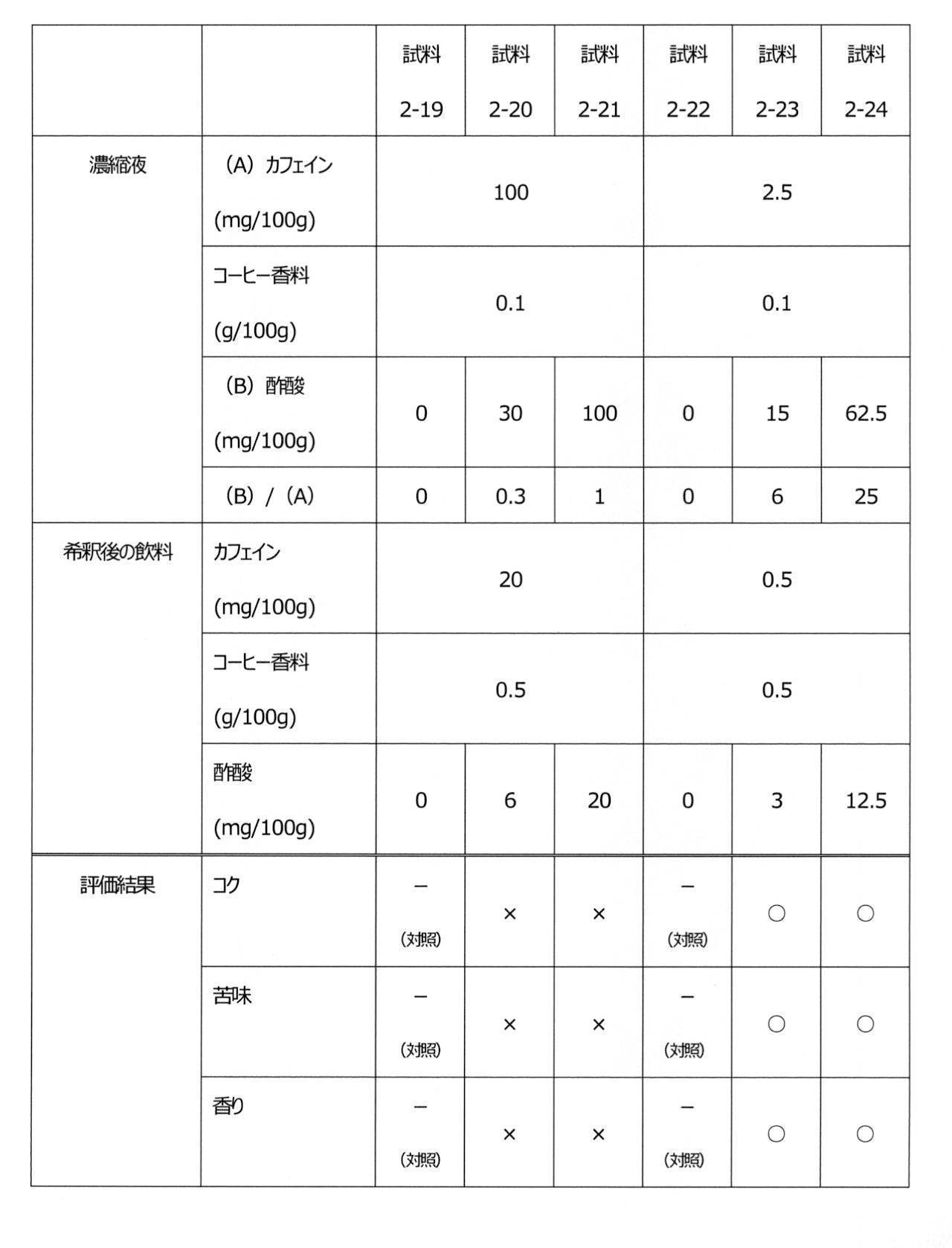
表2-1~2-4の「濃縮液」の行に示す濃度となるようにカフェインを処方する以外は、実験1と同様にしてコーヒー濃縮液を調製した。これらのコーヒー濃縮液を牛乳で5倍に希釈し、カフェイン濃度ごとに酢酸無添加の試料(試料2-1、2-4、2-7、2-10、2-13、2-16、2-19、2-22)を対照として、実験1と同様に官能評価を実施した。
結果を表2に示す。希釈により生じた飲料中のカフェイン濃度が0.1mg/100g未満の場合(試料2-2、2-3、2-5、2-6)、酢酸によるコーヒーの呈味や香りの増強作用は確認できなかった。一方、希釈により生じた飲料中のカフェイン濃度が10mg/100gを超える濃度でカフェインが含まれている場合(試料2-20、2-21)、酢酸を添加しなくても十分なコーヒー風味を有するため、酢酸によるコーヒーの呈味や香りの増強作用が確認できなかった。これより、本願発明の効果を奏するには、希釈後の飲料に対して0.1~10mg/100gとなる濃度のカフェインが必要であることが判明した。
[実験3]
酢酸のカフェイン呈味増強作用に対するpHの影響を調べた。実験1の試料1-5(pH5.5)に、リン酸及び炭酸水素ナトリウムを適宜添加し、pH4.0~7.5の低カフェインコーヒー濃縮液とした。それぞれのpHにおいて酢酸無添加の対照品を調製し、低カフェインコーヒー濃縮液と対照品について、実験1と同様に牛乳で5倍に希釈して官能評価を行った。
酢酸のカフェイン呈味増強作用に対するpHの影響を調べた。実験1の試料1-5(pH5.5)に、リン酸及び炭酸水素ナトリウムを適宜添加し、pH4.0~7.5の低カフェインコーヒー濃縮液とした。それぞれのpHにおいて酢酸無添加の対照品を調製し、低カフェインコーヒー濃縮液と対照品について、実験1と同様に牛乳で5倍に希釈して官能評価を行った。
低カフェインコーヒー濃縮液のpHが5.0を下回る場合、低カフェインコーヒー濃縮液を牛乳と混ぜた場合に凝集沈殿を発生した。凝集により、コーヒーの味や香りが知覚しにくくなったのか、酢酸を添加してもカフェイン呈味増強効果を顕著に感じることができなかった。一方、低カフェインコーヒー濃縮液のpHが7.0を超える場合、飲料全体の味がぼやけており、コーヒーの味もミルクの味も知覚しにくく、酢酸を加えた場合でも、パネルのうちの数名は、コーヒー感が向上していると答えたが、低カフェインコーヒー濃縮液のpHが5.0~6.0であるもの、またはpHが5.3~6.0であるものにおけるような顕著な効果はないと答えた。
[実験4]
コーヒー抽出液及びコーヒー香料を配合して調製した低カフェインコーヒー濃縮液を牛乳で希釈した場合における、酢酸濃度とコク、苦味及び香りの強さとの関係を調べた。
コーヒー抽出液及びコーヒー香料を配合して調製した低カフェインコーヒー濃縮液を牛乳で希釈した場合における、酢酸濃度とコク、苦味及び香りの強さとの関係を調べた。
まず、低カフェインのコーヒー抽出液を調製した。具体的には、超臨界二酸化炭素抽出法でカフェインが低減された市販の焙煎コーヒー豆(L値≒18)を用い、再表2005/011396の実施例3に記載の方法と同じ水蒸気処理を行って、低カフェインの水蒸気処理コーヒー焙煎豆を得た。この焙煎豆を中挽きに粉砕して多段階のカラム式抽出装置に詰め、熱水を加えて多段階抽出を行い、抽出液のBrix(すなわち抽出液におけるコーヒー固形分濃度)が12%のコーヒー抽出液を得た。このコーヒー抽出液を水で希釈してコーヒー固形分濃度が5%のコーヒー抽出液とした。これらコーヒー固形分濃度が5%のコーヒー抽出液をコーヒー濃縮液ベースとして使用し、コーヒー固形分濃度が5%の低カフェインコーヒー濃縮液を調製した。
具体的には、このコーヒー固形分濃度が5%のコーヒー抽出液と、実験1で用いた酢酸と、ピラジン類を含むコーヒー香料(実験1と異なる香料)とを、表3-1に示す処方で配合し、炭酸水素ナトリウムを用いてpHが5.3~pH6.0となるように調整して、表3-1の『濃縮液』の行に示す各成分の含有量を有する低カフェインコーヒー濃縮液(試料4-1~4-7)を調製した。また、対照として、イオン交換水に、カフェイン9mg/100gと上記コーヒー香料0.3g/100gを添加して、コーヒー抽出液を含まず、カフェイン濃度及びコーヒー香料濃度が同じ低カフェイン対照コーヒー濃縮液を調製した。このようにして調製した酢酸濃度の異なる低カフェインコーヒー濃縮液及び低カフェイン対照コーヒー濃縮液を、牛乳で4倍に希釈(コーヒー濃縮液:牛乳=1:3)し、カフェ・ラテ風飲料を得た。
また、コーヒー固形分濃度が5%のコーヒー抽出液に実験1で用いたカフェイン20mg/100gを添加し、上記コーヒー香料を添加して、表3-2の『濃縮液』の行に示す各成分の含有量を有する高カフェインコーヒー濃縮液(試料4-8~4-10)を調製した。また、対照として、コーヒー抽出液を含まず、カフェイン濃度及びコーヒー香料濃度が同じ高カフェイン対照コーヒー濃縮液を調製した。このようにして調製した酢酸濃度の異なる高カフェインコーヒー濃縮液及び高カフェイン対照コーヒー濃縮液を、牛乳で4倍に希釈(コーヒー濃縮液:牛乳=1:3)し、カフェ・ラテ風飲料を得た。
これらのカフェ・ラテ風飲料について、カフェイン濃度及びコーヒー香料濃度が同じ対照飲料と比べた官能評価を、実験1と同様にして実施した。
結果を表3-1及び表3-2に示す。希釈により生じた飲料中のカフェイン濃度が1~10mg/100gの範囲内(2.3mg/100mg)となる低濃度のカフェインを含む低カフェインコーヒー濃縮液では、希釈により生じた飲料中の酢酸(B)の濃度が1mg/100g以上となる濃度の酢酸(B)を含み、かつカフェイン(A)と酢酸(B)の濃度比[(B)/(A)]が0.7~11となるように調整することにより、コーヒーの濃さや苦味がしっかりと感じられ、エスプレッソのような芳醇なコーヒーを想起できるカフェ・ラテとなった。表2の結果と合わせると、カフェイン(A)と酢酸(B)の濃度比[(B)/(A)]は、0.7~25の範囲とすることが好ましいことが示された。


[実験5]
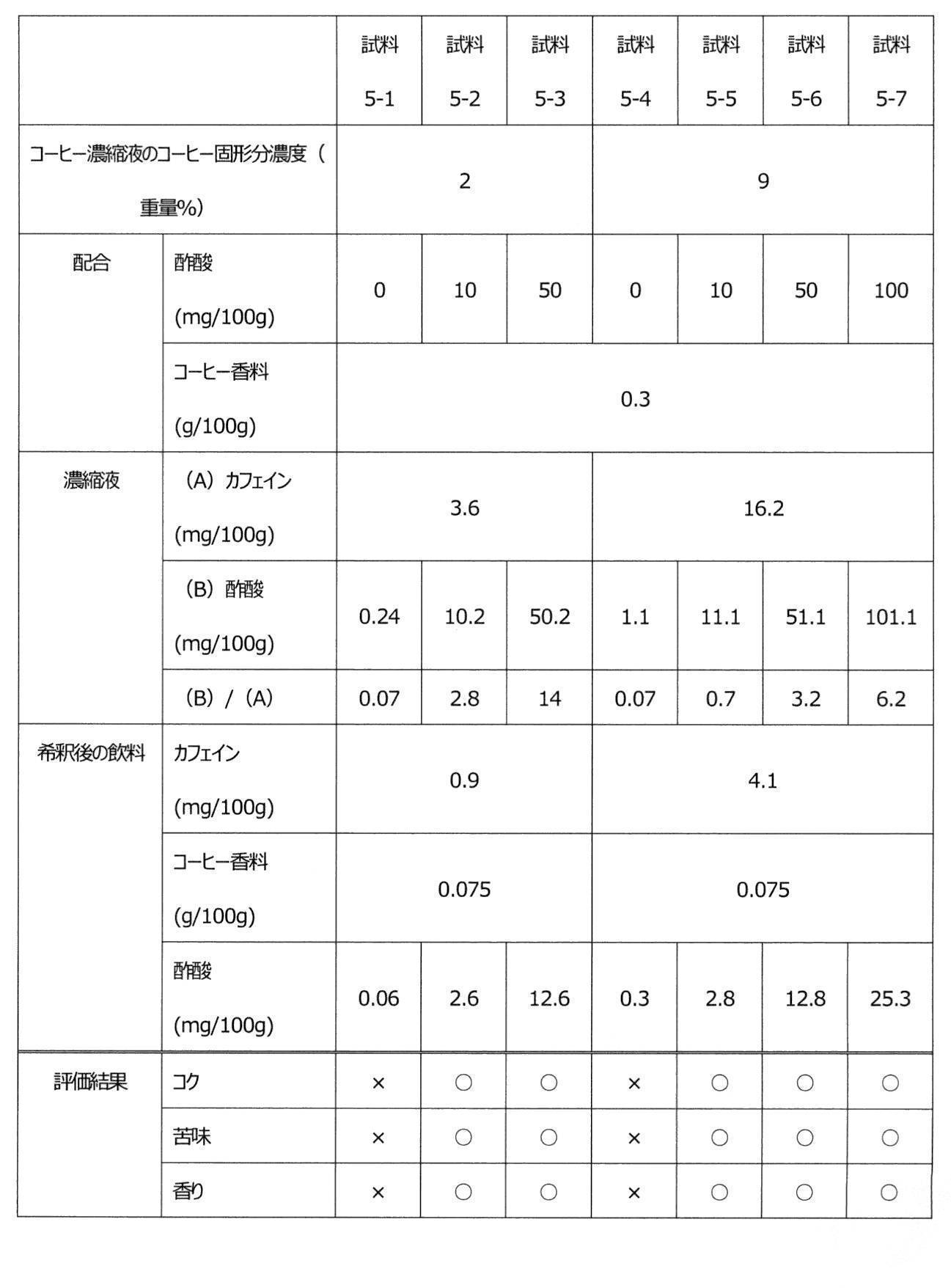
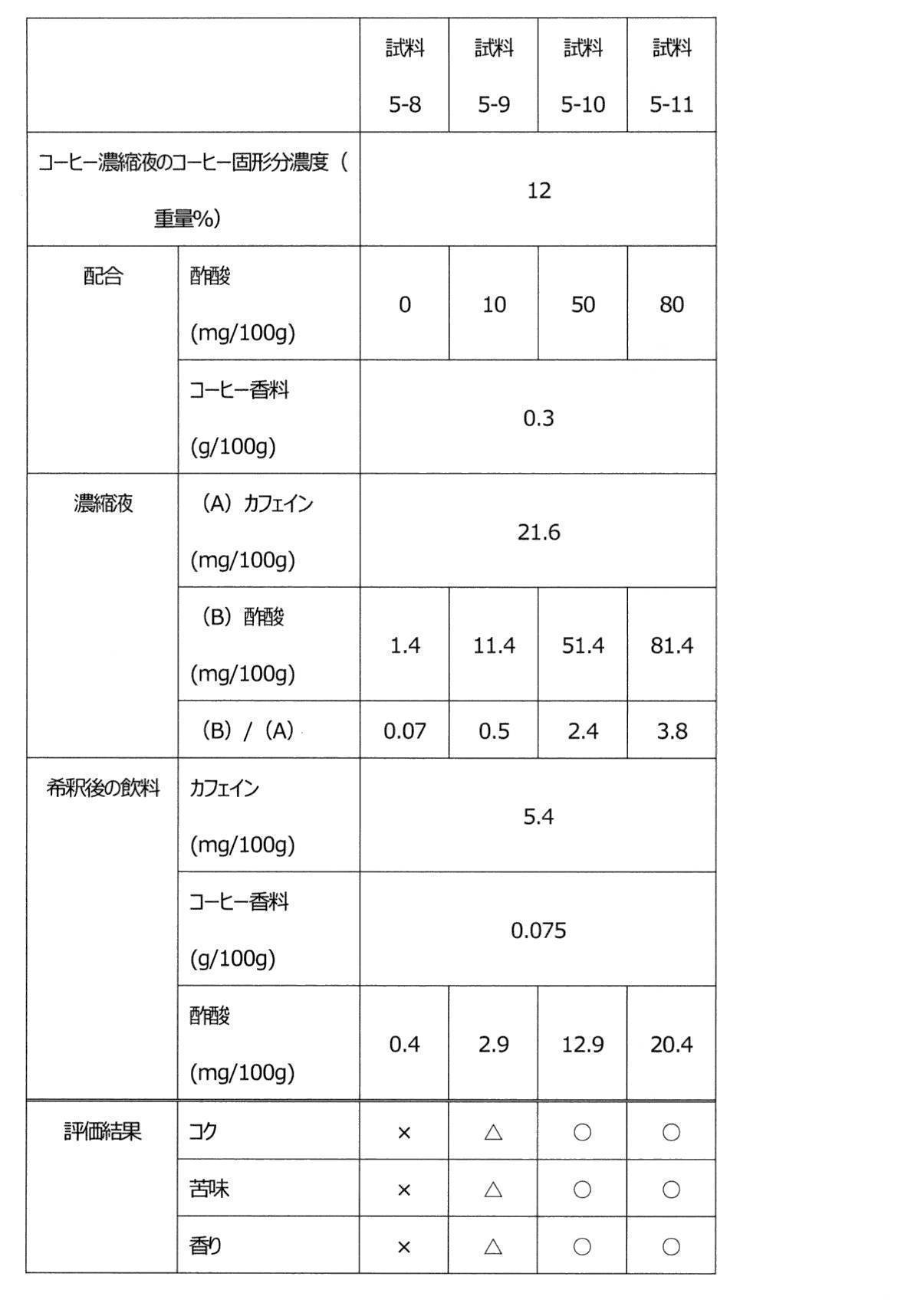
実験4で調製したコーヒー固形分濃度が12%のコーヒー抽出液を用い、これに適量の水を混合してコーヒー固形分濃度が2%、9%、12%のコーヒー抽出液とした。これらコーヒー固形分濃度が2%、9%、12%のコーヒー抽出液をコーヒー濃縮液ベースとして使用し、コーヒー固形分濃度が2%、9%、12%の低カフェインコーヒー濃縮液をそれぞれ調製した。具体的には、これら異なるコーヒー固形分濃度のコーヒー抽出液に対し、表4-1及び4-2の処方となるように、実験4と同様にしてコーヒー香料及び種々の濃度の酢酸を配合して、異なるコーヒー固形分濃度及び異なる酢酸濃度を有する低カフェインコーヒー濃縮液を得、牛乳で4倍に希釈して、実験1と同様に官能評価を行った。
実験4で調製したコーヒー固形分濃度が12%のコーヒー抽出液を用い、これに適量の水を混合してコーヒー固形分濃度が2%、9%、12%のコーヒー抽出液とした。これらコーヒー固形分濃度が2%、9%、12%のコーヒー抽出液をコーヒー濃縮液ベースとして使用し、コーヒー固形分濃度が2%、9%、12%の低カフェインコーヒー濃縮液をそれぞれ調製した。具体的には、これら異なるコーヒー固形分濃度のコーヒー抽出液に対し、表4-1及び4-2の処方となるように、実験4と同様にしてコーヒー香料及び種々の濃度の酢酸を配合して、異なるコーヒー固形分濃度及び異なる酢酸濃度を有する低カフェインコーヒー濃縮液を得、牛乳で4倍に希釈して、実験1と同様に官能評価を行った。
結果を表4-1及び4-2に示す。コーヒー抽出物由来のカフェインを含有する飲料であっても、希釈後の飲料に対して1~10mg/100gとなるような低濃度のカフェインを含むコーヒー濃縮液では、希釈後飲料における酢酸の含有量が1mg/100g以上となる濃度の酢酸(B)を含み、かつカフェイン(A)と酢酸(B)の濃度比[(B)/(A)]が0.7~25の範囲、特に3~15の範囲となるようにすることにより、コーヒーの濃さや苦味がしっかりと感じられ、エスプレッソのような芳醇なコーヒーを想起できるカフェ・ラテとなった。
図1に、実験4及び実験5の結果をまとめた図を示す。図中、●印は専門パネルが特にコーヒーのコクや苦味が感じられると評価した飲料であり、飲みほした後のアフターテイストにまでコーヒーの余韻を残し、長い時間口の中に、心地良いコーヒーのコクと苦味を残してくれるカフェ・ラテ風飲料であると評価した。
Claims (5)
- 3~6倍の希釈倍率で希釈して生じる飲料を飲用に供するための低カフェインコーヒー濃縮液であって、以下(i)~(iv)を満たす低カフェインコーヒー濃縮液;
(i)前記希釈して生じる飲料中のカフェイン濃度が0.1~10mg/100gとなる濃度のカフェイン(A)を含み、
(ii)前記希釈して生じる飲料中の酢酸濃度が1mg/100g以上となる濃度の酢酸(B)を含み、
(iii)カフェイン(A)と酢酸(B)の濃度比[(B)/(A)]が0.7~25であり、
(iv)コーヒーフレーバーを含む。 - コーヒー抽出物を含む、請求項1に記載の低カフェインコーヒー濃縮液であって、コーヒー固形分の濃度が5~12重量%である、低カフェインコーヒー濃縮液。
- pHが5.0~7.0である、請求項1又は2に記載の低カフェインコーヒー濃縮液。
- ミルクで希釈するための、請求項1~3のいずれかに記載の低カフェインコーヒー濃縮液。
- 3~6倍の希釈倍率で希釈して生じる飲料を飲用に供するための低カフェインコーヒー濃縮液の製造方法であって、
(i)前記希釈して生じる飲料中のカフェイン濃度が0.1~10mg/100gとなるような濃度でカフェイン(A)を配合し、
(ii)前記希釈して生じる飲料中の酢酸濃度が1mg/100g以上となる濃度で酢酸(B)を配合し、
(iii)カフェイン(A)と酢酸(B)の濃度比[(B)/(A)]を0.7~25に調整し、
(iv)コーヒーフレーバーを配合する
工程を含む、製造方法。
Priority Applications (5)
| Application Number | Priority Date | Filing Date | Title |
|---|---|---|---|
| US17/625,239 US20220248703A1 (en) | 2019-07-08 | 2020-07-03 | Low-caffeine coffee concentrate |
| CN202080049405.8A CN114126413B (zh) | 2019-07-08 | 2020-07-03 | 低咖啡因咖啡浓缩液 |
| AU2020309373A AU2020309373B2 (en) | 2019-07-08 | 2020-07-03 | Low-caffeine coffee concentrate |
| ES20837125T ES2982748T3 (es) | 2019-07-08 | 2020-07-03 | Concentrado de café bajo en cafeína |
| EP20837125.2A EP3997984B1 (en) | 2019-07-08 | 2020-07-03 | Low-caffeine coffee concentrate |
Applications Claiming Priority (2)
| Application Number | Priority Date | Filing Date | Title |
|---|---|---|---|
| JP2019126775A JP6706372B1 (ja) | 2019-07-08 | 2019-07-08 | 低カフェインコーヒー濃縮液 |
| JP2019-126775 | 2019-07-08 |
Publications (1)
| Publication Number | Publication Date |
|---|---|
| WO2021006205A1 true WO2021006205A1 (ja) | 2021-01-14 |
Family
ID=70858111
Family Applications (1)
| Application Number | Title | Priority Date | Filing Date |
|---|---|---|---|
| PCT/JP2020/026185 Ceased WO2021006205A1 (ja) | 2019-07-08 | 2020-07-03 | 低カフェインコーヒー濃縮液 |
Country Status (8)
| Country | Link |
|---|---|
| US (1) | US20220248703A1 (ja) |
| EP (1) | EP3997984B1 (ja) |
| JP (1) | JP6706372B1 (ja) |
| CN (1) | CN114126413B (ja) |
| AU (1) | AU2020309373B2 (ja) |
| ES (1) | ES2982748T3 (ja) |
| TW (1) | TW202114529A (ja) |
| WO (1) | WO2021006205A1 (ja) |
Citations (9)
| Publication number | Priority date | Publication date | Assignee | Title |
|---|---|---|---|---|
| JP2004105003A (ja) | 2002-09-13 | 2004-04-08 | Yakult Honsha Co Ltd | カフェインレスコーヒー組成物又はリラックス効果付与組成物。 |
| WO2005011396A1 (ja) | 2003-07-31 | 2005-02-10 | Suntory Limited | コーヒー焙煎豆の処理方法および水蒸気処理コーヒー焙煎豆 |
| JP2009254307A (ja) | 2008-04-18 | 2009-11-05 | Gold-Pak Kk | コーヒー製品 |
| JP2011097832A (ja) | 2009-11-04 | 2011-05-19 | T Hasegawa Co Ltd | 焙煎植物原料水性エキスの酢酸低減方法 |
| WO2011108631A1 (ja) | 2010-03-03 | 2011-09-09 | サントリーホールディングス株式会社 | カフェインレスコーヒー |
| JP2015050959A (ja) | 2013-09-06 | 2015-03-19 | 三栄源エフ・エフ・アイ株式会社 | カフェインレス嗜好性飲料、カフェイン風味付与剤、及びカフェインレス嗜好性飲料にカフェイン風味を付与する方法 |
| JP2015096056A (ja) * | 2013-10-07 | 2015-05-21 | アサヒ飲料株式会社 | コーヒー飲料 |
| JP2015142565A (ja) * | 2013-12-27 | 2015-08-06 | 花王株式会社 | ソリュブルコーヒー |
| JP2017143831A (ja) | 2016-02-17 | 2017-08-24 | サントリー食品インターナショナル株式会社 | 低カフェインコーヒー飲料 |
Family Cites Families (29)
| Publication number | Priority date | Publication date | Assignee | Title |
|---|---|---|---|---|
| US3164474A (en) * | 1961-03-03 | 1965-01-05 | Tenco A Division Of The Coca C | Method of making coffee extract |
| US4976983A (en) * | 1989-05-08 | 1990-12-11 | Kraft General Foods, Inc. | Coffee product with reduced malic acid content |
| US6054162A (en) * | 1997-02-05 | 2000-04-25 | Kraft Foods, Inc. | Stabilization of liquid coffee by treatment with alkali |
| EP1201135A1 (en) * | 2000-10-31 | 2002-05-02 | Societe Des Produits Nestle S.A. | Soluble black coffee |
| US20020155209A1 (en) * | 2001-02-13 | 2002-10-24 | The Procter & Gamble Co. | Flavored coffee compositions and method of making |
| EP1359813B1 (en) * | 2001-02-15 | 2008-04-02 | The Procter & Gamble Company | Coffee compositions with enhanced flavor characteristics and method of making |
| PL1716758T3 (pl) * | 2004-01-30 | 2010-03-31 | Kao Corp | Kompozycja kawy do picia |
| US20080286388A1 (en) * | 2004-10-22 | 2008-11-20 | Shin-Jen Shiao | Pharmaceutical Composition and Non Dependence Coffee Comprising Edible Carboxylic Acid and/or Its Acid Salts and Coffeine |
| JP4807563B2 (ja) * | 2005-12-06 | 2011-11-02 | 株式会社 伊藤園 | 容器詰め飲料及びその製造方法 |
| KR101463639B1 (ko) * | 2007-05-08 | 2014-12-04 | 카오카부시키가이샤 | 환원 음료용 농축 조성물 |
| US8277864B2 (en) * | 2009-06-10 | 2012-10-02 | Kraft Foods Global Brands Llc | Liquid coffee concentrates and methods of making thereof |
| CN102858184A (zh) * | 2010-03-30 | 2013-01-02 | 花王株式会社 | 煎焙咖啡豆 |
| EP2382868A1 (en) * | 2010-04-30 | 2011-11-02 | Tchibo GmbH | Healthy coffee and method of its production |
| RU2583292C2 (ru) * | 2010-11-24 | 2016-05-10 | Као Корпорейшн | Способ производства экстракта из обжаренных зерен кофе |
| ES2542777T3 (es) * | 2011-01-12 | 2015-08-11 | Albert Daxer | Bebida |
| US8974849B2 (en) * | 2011-10-13 | 2015-03-10 | Aly Gamay | Concentrated shelf stable liquid coffee |
| JP5357312B1 (ja) * | 2012-08-14 | 2013-12-04 | サントリー食品インターナショナル株式会社 | コーヒー飲料 |
| EP2730178B1 (de) * | 2012-11-12 | 2020-08-26 | Symrise AG | Zubereitungen zur oralen Aufnahme |
| JP5534268B1 (ja) * | 2013-01-31 | 2014-06-25 | 株式会社 伊藤園 | コーヒー飲料組成物及びこれを含有するコーヒー飲料、並びに容器詰コーヒー飲料の製造方法及び容器詰コーヒー飲料の呈味改善方法。 |
| US20140272068A1 (en) * | 2013-03-14 | 2014-09-18 | Indra Prakash | Beverages containing rare sugars |
| WO2014150967A1 (en) * | 2013-03-15 | 2014-09-25 | Altria Client Services Inc. | Oral energy products including encapsulated caffeine |
| WO2015093522A1 (ja) * | 2013-12-18 | 2015-06-25 | 花王株式会社 | コーヒー濃縮組成物 |
| RU2721951C2 (ru) * | 2014-12-02 | 2020-05-25 | Као Корпорейшн | Обжаренные кофейные зерна |
| JP2016106606A (ja) * | 2014-12-10 | 2016-06-20 | アサヒ飲料株式会社 | コーヒー含有飲料 |
| WO2017069183A1 (ja) * | 2015-10-21 | 2017-04-27 | 三栄源エフ・エフ・アイ株式会社 | 乳成分含有コーヒー飲料 |
| US10327460B2 (en) * | 2015-12-07 | 2019-06-25 | J & H Natural Products LLC | Stable low acid beverage concentrate |
| CN105613895B (zh) * | 2015-12-29 | 2021-08-10 | 苏州金猫咖啡有限公司 | 一种低咖啡因速溶咖啡及其制备方法 |
| JP2017163864A (ja) * | 2016-03-14 | 2017-09-21 | サントリー食品インターナショナル株式会社 | 容器詰め濃縮コーヒー飲料 |
| JP6771411B2 (ja) * | 2017-03-15 | 2020-10-21 | サントリーホールディングス株式会社 | 容器詰め濃縮コーヒー飲料 |
-
2019
- 2019-07-08 JP JP2019126775A patent/JP6706372B1/ja active Active
-
2020
- 2020-07-03 AU AU2020309373A patent/AU2020309373B2/en active Active
- 2020-07-03 US US17/625,239 patent/US20220248703A1/en not_active Abandoned
- 2020-07-03 EP EP20837125.2A patent/EP3997984B1/en active Active
- 2020-07-03 WO PCT/JP2020/026185 patent/WO2021006205A1/ja not_active Ceased
- 2020-07-03 CN CN202080049405.8A patent/CN114126413B/zh active Active
- 2020-07-03 ES ES20837125T patent/ES2982748T3/es active Active
- 2020-07-06 TW TW109122727A patent/TW202114529A/zh unknown
Patent Citations (9)
| Publication number | Priority date | Publication date | Assignee | Title |
|---|---|---|---|---|
| JP2004105003A (ja) | 2002-09-13 | 2004-04-08 | Yakult Honsha Co Ltd | カフェインレスコーヒー組成物又はリラックス効果付与組成物。 |
| WO2005011396A1 (ja) | 2003-07-31 | 2005-02-10 | Suntory Limited | コーヒー焙煎豆の処理方法および水蒸気処理コーヒー焙煎豆 |
| JP2009254307A (ja) | 2008-04-18 | 2009-11-05 | Gold-Pak Kk | コーヒー製品 |
| JP2011097832A (ja) | 2009-11-04 | 2011-05-19 | T Hasegawa Co Ltd | 焙煎植物原料水性エキスの酢酸低減方法 |
| WO2011108631A1 (ja) | 2010-03-03 | 2011-09-09 | サントリーホールディングス株式会社 | カフェインレスコーヒー |
| JP2015050959A (ja) | 2013-09-06 | 2015-03-19 | 三栄源エフ・エフ・アイ株式会社 | カフェインレス嗜好性飲料、カフェイン風味付与剤、及びカフェインレス嗜好性飲料にカフェイン風味を付与する方法 |
| JP2015096056A (ja) * | 2013-10-07 | 2015-05-21 | アサヒ飲料株式会社 | コーヒー飲料 |
| JP2015142565A (ja) * | 2013-12-27 | 2015-08-06 | 花王株式会社 | ソリュブルコーヒー |
| JP2017143831A (ja) | 2016-02-17 | 2017-08-24 | サントリー食品インターナショナル株式会社 | 低カフェインコーヒー飲料 |
Non-Patent Citations (4)
| Title |
|---|
| RODRIGUES, C. I. ET AL.: "Application of solid- phase extraction to brewed coffee caffeine and organic acid determination by UV/HPLC", JOURNAL OF FOOD COMPOSITION AND ANALYSIS, vol. 20, 2007, pages 440 - 448, XP022029984, ISSN: 0889-1575, DOI: 10.1016/j.jfca.2006.08.005 * |
| See also references of EP3997984A4 |
| SUNTORY BEVERAGE & FOOD LIMITED: "BOSS Home Espresso Latte Mix", NEWS RELEASE, 15 February 2016 (2016-02-15), Retrieved from the Internet <URL:https://www.suntory.co.jp/softdrink/news/pr/article/SBF0395.htmL> |
| THE COCA-COLA COMPANY: "Georgia European coffee base supervised by Sarutahiko Coffee to be launched nationwide on April 9 (Monday", NEWS RELEASE, 2 April 2018 (2018-04-02), Retrieved from the Internet <URL:https://www.cocacola.co.jp/press-center/news-20180402-11> |
Also Published As
| Publication number | Publication date |
|---|---|
| AU2020309373B2 (en) | 2025-11-20 |
| EP3997984A1 (en) | 2022-05-18 |
| US20220248703A1 (en) | 2022-08-11 |
| JP6706372B1 (ja) | 2020-06-03 |
| EP3997984A4 (en) | 2023-07-26 |
| ES2982748T3 (es) | 2024-10-17 |
| CN114126413B (zh) | 2024-06-14 |
| CN114126413A (zh) | 2022-03-01 |
| TW202114529A (zh) | 2021-04-16 |
| AU2020309373A1 (en) | 2022-02-24 |
| JP2021010337A (ja) | 2021-02-04 |
| EP3997984B1 (en) | 2024-05-08 |
Similar Documents
| Publication | Publication Date | Title |
|---|---|---|
| CN105636451B (zh) | 制备咖啡饮料粉末的方法 | |
| RU2685864C2 (ru) | Композиции забеливателей и их применение | |
| US20110212240A1 (en) | Processes for isolating bitter quinides for use in food and beverage products | |
| CN102711505A (zh) | 制备生咖啡提取物的方法 | |
| WO2017030187A1 (ja) | インスタント発酵茶飲料用組成物及びその製造方法 | |
| JP2007082460A (ja) | コーヒー様飲食用組成物、及びコーヒー様飲食用組成物の製造方法 | |
| JP7604788B2 (ja) | 焙煎コーヒー豆の製造方法 | |
| JP3782079B2 (ja) | コーヒー飲料の製造方法 | |
| WO2014027482A1 (ja) | コーヒー飲料 | |
| KR101454668B1 (ko) | 스티밍 처리 커피 추출액과 저온 추출 커피 추출액을 포함하는 커피 음료 조성물 및 그 제조 방법 | |
| JP6706372B1 (ja) | 低カフェインコーヒー濃縮液 | |
| JP2019180299A (ja) | コーヒー飲料、コーヒー飲料のまろやかさの向上方法 | |
| KR20060092044A (ko) | 3,7-디메틸옥타-1,6-디엔-3-올에 의해 제공되는 향미 강화커피 | |
| CN112806459A (zh) | 一种咖啡饮品及其制备方法 | |
| HK40068649B (zh) | 低咖啡因咖啡浓缩液 | |
| HK40068649A (en) | Low-caffeine coffee concentrate | |
| JP7574888B1 (ja) | コーヒー飲料及びインスタントコーヒー飲料用組成物 | |
| JP6627005B1 (ja) | 容器詰コーヒー飲料 | |
| KR20240061820A (ko) | 백국균 및 황국균으로 발효된 커피 생두 추출액을 이용한 디카페인 발효 커피 생두의 제조방법 | |
| JP2024062565A (ja) | コーヒー飲料及びインスタントコーヒー飲料用組成物 | |
| HK1117347B (en) | Processes for isolating bitter compounds for use in food and beverage products | |
| JP2006304606A (ja) | コーヒー液の製造方法 |
Legal Events
| Date | Code | Title | Description |
|---|---|---|---|
| 121 | Ep: the epo has been informed by wipo that ep was designated in this application |
Ref document number: 20837125 Country of ref document: EP Kind code of ref document: A1 |
|
| ENP | Entry into the national phase |
Ref document number: 2020837125 Country of ref document: EP Effective date: 20220208 |
|
| ENP | Entry into the national phase |
Ref document number: 2020309373 Country of ref document: AU Date of ref document: 20200703 Kind code of ref document: A |