WO2021006238A1 - 非水系電解液、及び非水系電解液二次電池 - Google Patents
非水系電解液、及び非水系電解液二次電池 Download PDFInfo
- Publication number
- WO2021006238A1 WO2021006238A1 PCT/JP2020/026377 JP2020026377W WO2021006238A1 WO 2021006238 A1 WO2021006238 A1 WO 2021006238A1 JP 2020026377 W JP2020026377 W JP 2020026377W WO 2021006238 A1 WO2021006238 A1 WO 2021006238A1
- Authority
- WO
- WIPO (PCT)
- Prior art keywords
- group
- carbon atoms
- general formula
- aqueous electrolyte
- groups
- Prior art date
- Legal status (The legal status is an assumption and is not a legal conclusion. Google has not performed a legal analysis and makes no representation as to the accuracy of the status listed.)
- Ceased
Links
Classifications
-
- H—ELECTRICITY
- H01—ELECTRIC ELEMENTS
- H01M—PROCESSES OR MEANS, e.g. BATTERIES, FOR THE DIRECT CONVERSION OF CHEMICAL ENERGY INTO ELECTRICAL ENERGY
- H01M10/00—Secondary cells; Manufacture thereof
- H01M10/05—Accumulators with non-aqueous electrolyte
- H01M10/056—Accumulators with non-aqueous electrolyte characterised by the materials used as electrolytes, e.g. mixed inorganic/organic electrolytes
- H01M10/0564—Accumulators with non-aqueous electrolyte characterised by the materials used as electrolytes, e.g. mixed inorganic/organic electrolytes the electrolyte being constituted of organic materials only
- H01M10/0566—Liquid materials
- H01M10/0567—Liquid materials characterised by the additives
-
- C—CHEMISTRY; METALLURGY
- C07—ORGANIC CHEMISTRY
- C07F—ACYCLIC, CARBOCYCLIC OR HETEROCYCLIC COMPOUNDS CONTAINING ELEMENTS OTHER THAN CARBON, HYDROGEN, HALOGEN, OXYGEN, NITROGEN, SULFUR, SELENIUM OR TELLURIUM
- C07F9/00—Compounds containing elements of Groups 5 or 15 of the Periodic Table
- C07F9/02—Phosphorus compounds
- C07F9/28—Phosphorus compounds with one or more P—C bonds
- C07F9/30—Phosphinic acids [R2P(=O)(OH)]; Thiophosphinic acids ; [R2P(=X1)(X2H) (X1, X2 are each independently O, S or Se)]
- C07F9/32—Esters thereof
- C07F9/3205—Esters thereof the acid moiety containing a substituent or a structure which is considered as characteristic
- C07F9/3211—Esters of acyclic saturated acids which can have further substituents on alkyl
-
- H—ELECTRICITY
- H01—ELECTRIC ELEMENTS
- H01M—PROCESSES OR MEANS, e.g. BATTERIES, FOR THE DIRECT CONVERSION OF CHEMICAL ENERGY INTO ELECTRICAL ENERGY
- H01M10/00—Secondary cells; Manufacture thereof
- H01M10/05—Accumulators with non-aqueous electrolyte
- H01M10/052—Li-accumulators
-
- H—ELECTRICITY
- H01—ELECTRIC ELEMENTS
- H01M—PROCESSES OR MEANS, e.g. BATTERIES, FOR THE DIRECT CONVERSION OF CHEMICAL ENERGY INTO ELECTRICAL ENERGY
- H01M10/00—Secondary cells; Manufacture thereof
- H01M10/05—Accumulators with non-aqueous electrolyte
- H01M10/052—Li-accumulators
- H01M10/0525—Rocking-chair batteries, i.e. batteries with lithium insertion or intercalation in both electrodes; Lithium-ion batteries
-
- H—ELECTRICITY
- H01—ELECTRIC ELEMENTS
- H01M—PROCESSES OR MEANS, e.g. BATTERIES, FOR THE DIRECT CONVERSION OF CHEMICAL ENERGY INTO ELECTRICAL ENERGY
- H01M10/00—Secondary cells; Manufacture thereof
- H01M10/05—Accumulators with non-aqueous electrolyte
- H01M10/054—Accumulators with insertion or intercalation of metals other than lithium, e.g. with magnesium or aluminium
-
- H—ELECTRICITY
- H01—ELECTRIC ELEMENTS
- H01M—PROCESSES OR MEANS, e.g. BATTERIES, FOR THE DIRECT CONVERSION OF CHEMICAL ENERGY INTO ELECTRICAL ENERGY
- H01M10/00—Secondary cells; Manufacture thereof
- H01M10/05—Accumulators with non-aqueous electrolyte
- H01M10/056—Accumulators with non-aqueous electrolyte characterised by the materials used as electrolytes, e.g. mixed inorganic/organic electrolytes
- H01M10/0564—Accumulators with non-aqueous electrolyte characterised by the materials used as electrolytes, e.g. mixed inorganic/organic electrolytes the electrolyte being constituted of organic materials only
- H01M10/0566—Liquid materials
- H01M10/0568—Liquid materials characterised by the solutes
-
- H—ELECTRICITY
- H01—ELECTRIC ELEMENTS
- H01M—PROCESSES OR MEANS, e.g. BATTERIES, FOR THE DIRECT CONVERSION OF CHEMICAL ENERGY INTO ELECTRICAL ENERGY
- H01M10/00—Secondary cells; Manufacture thereof
- H01M10/05—Accumulators with non-aqueous electrolyte
- H01M10/056—Accumulators with non-aqueous electrolyte characterised by the materials used as electrolytes, e.g. mixed inorganic/organic electrolytes
- H01M10/0564—Accumulators with non-aqueous electrolyte characterised by the materials used as electrolytes, e.g. mixed inorganic/organic electrolytes the electrolyte being constituted of organic materials only
- H01M10/0566—Liquid materials
- H01M10/0569—Liquid materials characterised by the solvents
-
- H—ELECTRICITY
- H01—ELECTRIC ELEMENTS
- H01M—PROCESSES OR MEANS, e.g. BATTERIES, FOR THE DIRECT CONVERSION OF CHEMICAL ENERGY INTO ELECTRICAL ENERGY
- H01M2300/00—Electrolytes
- H01M2300/0017—Non-aqueous electrolytes
- H01M2300/0025—Organic electrolyte
-
- H—ELECTRICITY
- H01—ELECTRIC ELEMENTS
- H01M—PROCESSES OR MEANS, e.g. BATTERIES, FOR THE DIRECT CONVERSION OF CHEMICAL ENERGY INTO ELECTRICAL ENERGY
- H01M2300/00—Electrolytes
- H01M2300/0017—Non-aqueous electrolytes
- H01M2300/0025—Organic electrolyte
- H01M2300/0028—Organic electrolyte characterised by the solvent
-
- H—ELECTRICITY
- H01—ELECTRIC ELEMENTS
- H01M—PROCESSES OR MEANS, e.g. BATTERIES, FOR THE DIRECT CONVERSION OF CHEMICAL ENERGY INTO ELECTRICAL ENERGY
- H01M2300/00—Electrolytes
- H01M2300/0088—Composites
- H01M2300/0091—Composites in the form of mixtures
-
- Y—GENERAL TAGGING OF NEW TECHNOLOGICAL DEVELOPMENTS; GENERAL TAGGING OF CROSS-SECTIONAL TECHNOLOGIES SPANNING OVER SEVERAL SECTIONS OF THE IPC; TECHNICAL SUBJECTS COVERED BY FORMER USPC CROSS-REFERENCE ART COLLECTIONS [XRACs] AND DIGESTS
- Y02—TECHNOLOGIES OR APPLICATIONS FOR MITIGATION OR ADAPTATION AGAINST CLIMATE CHANGE
- Y02E—REDUCTION OF GREENHOUSE GAS [GHG] EMISSIONS, RELATED TO ENERGY GENERATION, TRANSMISSION OR DISTRIBUTION
- Y02E60/00—Enabling technologies; Technologies with a potential or indirect contribution to GHG emissions mitigation
- Y02E60/10—Energy storage using batteries
Definitions
- the present invention relates to a non-aqueous electrolyte solution and a non-aqueous electrolyte secondary battery provided with the non-aqueous electrolyte solution.
- Non-aqueous electrolytes are no exception, and various additives form a solid electrolyte interface (SEI) at the interface between the electrode and the electrolyte, and the electrolyte decomposes on the surface of the active positive electrode and negative electrode. It has been proposed to suppress.
- SEI solid electrolyte interface
- Patent Document 1 states that when used in a power storage device such as a non-aqueous electrolyte secondary battery, it is cyclic in order to improve the battery characteristics in terms of long-term cycle characteristics, resistance characteristics, and initial resistance characteristics. It is disclosed that a compound in which a sulfone group is bonded to a phosphinyloxy group is contained in an electrolytic solution as an additive.
- Patent Document 1 exhibits an effect of improving battery characteristics in terms of cycle characteristics, resistance characteristics, and initial resistance characteristics at 25 ° C. when used in a power storage device such as a non-aqueous electrolytic solution secondary battery.
- a power storage device such as a non-aqueous electrolytic solution secondary battery.
- an object of the present invention is to provide a non-aqueous electrolyte solution capable of further improving high-temperature storage characteristics and low-temperature characteristics, and a non-aqueous electrolyte secondary battery provided with the non-aqueous electrolyte solution.
- a first additive which is a compound in which a cyclic sulfone group is bonded to a phosphinyloxy group.
- the present invention has been found that the high temperature storage characteristics and the low temperature characteristics can be further improved when the electrolytic solution is used in a non-aqueous electrolyte secondary battery by containing a predetermined second additive.
- the present invention (I) The first additive represented by the following general formula [1], (II) Compounds represented by the following general formulas [2] to [5], difluoro (oxalate) borate, bis (oxalate) borate, tetrafluoro (oxalate) phosphate, difluorobis (oxalate) phosphorus. At least one second additive selected from the group consisting of acid salts, tris (oxalate) phosphates, difluorophosphates, and fluorosulfonates. (III) Non-aqueous organic solvent and (IV) Solute, It is a non-aqueous electrolyte solution characterized by containing.
- R a and R b are independently an alkyl group having 1 to 8 carbon atoms which may be substituted with a fluorine atom and a halogen atom, and an alkenyl having 2 to 6 carbon atoms which may be substituted with a halogen atom, respectively.
- R 1 and R 2 are independently a fluorine atom, a straight chain having 1 to 10 carbon atoms, a branched alkyl group having 3 to 10 carbon atoms, and a linear or linear group having 1 to 10 carbon atoms.
- alkoxy groups with 3 to 10 carbon atoms alkenyl groups with 2 to 10 carbon atoms, alkenyloxy groups with 2 to 10 carbon atoms, alkynyl groups with 2 to 10 carbon atoms, carbon atoms Alkinyloxy group with 2 to 10 carbon atoms, cycloalkyl group with 3 to 10 carbon atoms, cycloalkoxy group with 3 to 10 carbon atoms, cycloalkenyl group with 3 to 10 carbon atoms, carbon atom number It is an organic group selected from 3 to 10 cycloalkenyloxy groups, aryl groups having 6 to 10 carbon atoms, and aryloxy groups having 6 to 10 carbon atoms, and fluorine atoms and oxygen are included in the organic groups.
- Atoms or unsaturated bonds can also be present, provided that at least one of R 1 and R 2 is a fluorine atom.
- M m + is an alkali metal cation, an alkaline earth metal cation, or an onium cation, and m represents an integer equal to the valence of the cation in question.
- R 3 to R 6 are independently a fluorine atom, a straight chain having 1 to 10 carbon atoms, a branched alkyl group having 3 to 10 carbon atoms, and a linear or linear group having 1 to 10 carbon atoms.
- alkoxy groups with 3 to 10 carbon atoms alkenyl groups with 2 to 10 carbon atoms, alkenyloxy groups with 2 to 10 carbon atoms, alkynyl groups with 2 to 10 carbon atoms, carbon atoms Alkinyloxy group with 2 to 10 carbon atoms, cycloalkyl group with 3 to 10 carbon atoms, cycloalkoxy group with 3 to 10 carbon atoms, cycloalkenyl group with 3 to 10 carbon atoms, carbon atom number It is an organic group selected from 3 to 10 cycloalkenyloxy groups, an aryl group having 6 to 10 carbon atoms, and an aryloxy group having 6 to 10 carbon atoms, and fluorine atoms and oxygen are included in the organic groups. Atoms, cyano groups or unsaturated bonds can also be present, provided that at least one of R 3 to R 6 is a fluorine atom and M m + and m are the same as those in the general formula [2].
- R 7 to R 9 are independently a fluorine atom, a straight chain having 1 to 10 carbon atoms, a branched alkyl group having 3 to 10 carbon atoms, and a linear or linear group having 1 to 10 carbon atoms.
- alkoxy groups with 3 to 10 carbon atoms alkenyl groups with 2 to 10 carbon atoms, alkenyloxy groups with 2 to 10 carbon atoms, alkynyl groups with 2 to 10 carbon atoms, carbon atoms Alkinyloxy group with 2 to 10 carbon atoms, cycloalkyl group with 3 to 10 carbon atoms, cycloalkoxy group with 3 to 10 carbon atoms, cycloalkenyl group with 3 to 10 carbon atoms, carbon atom number It is an organic group selected from 3 to 10 cycloalkenyloxy groups, an aryl group having 6 to 10 carbon atoms, and an aryloxy group having 6 to 10 carbon atoms, and fluorine atoms and oxygen are included in the organic groups. Atoms or unsaturated bonds can also be present, provided that at least one of R 7 to R 9 is a fluorine atom and M m + and m are the same as those in the general formula [2]. ]
- R 10 is a group each independently having a carbon-carbon unsaturated bond.
- R 11 is independently substituted with a fluorine atom, a linear alkyl group having 1 to 10 carbon atoms which may be substituted with a fluorine atom, or a branched alkyl group having 3 to 10 carbon atoms, and a fluorine atom. It may be a linear alkoxy group having 1 to 10 carbon atoms or a branched alkoxy group having 3 to 10 carbon atoms, and a is an integer of 2 to 4. ]
- the mechanism of action for improving battery characteristics according to the present invention is not clear, it is important to use the first additive and the second additive in combination.
- the decomposition products of the first additive and the second additive combine to form SEI, and the composite film with excellent cation permeability such as lithium ion and sodium ion provides high temperature storage characteristics. It is presumed that the low temperature characteristics will be further improved.
- R a and R b may be independently substituted with an alkoxy group having 1 to 3 carbon atoms or a halogen atom, which may be substituted with a fluorine atom or a halogen atom, respectively.
- A is a hydrogen atom or a fluorine atom.
- R 1 is a fluorine atom
- R 2 is an alkyl group, an alkenyl group, an alkynyl group, an alkoxy group, an alkenyloxy group, or an alkynyloxy group having 6 or less carbon atoms which may contain a fluorine atom.
- R 1 is a fluorine atom
- R 2 is methyl group, methoxy group, ethyl group, ethoxy group, n-propyl group, n-propoxy group, isopropyl group, isopropoxy group, vinyl group, allyl group, allyloxy group, ethynyl group, 2-propynyl group, 2-Propyloxy group, phenyl group, phenyloxy group, trifluoromethyl group, trifluoromethoxy group, 2,2-difluoroethyl group, 2,2-difluoroethyloxy group, 2,2,2-trifluoroethyl group , 2,2,2-trifluoroethyloxy group, 2,2,3,3-tetrafluoropropyl group, 2,2,3,3-tetrafluoropropyloxy group, 1,1,1,3,3 It is preferably a group selected from a 3-hexafluoroisopropyl
- At least one of R 3 to R 6 is a fluorine atom
- At least one of R 3 to R 6 is a group selected from an alkyl group, an alkenyl group, an alkynyl group, an alkoxy group, an alkenyloxy group, and an alkynyloxy group having 6 or less carbon atoms which may contain a fluorine atom. It is preferable to have.
- At least one of R 3 to R 6 is a fluorine atom
- At least one of R 3 to R 6 is a methyl group, a methoxy group, an ethyl group, an ethoxy group, an n-propyl group, an n-propoxy group, an isopropyl group, an isopropoxy group, a vinyl group, an allyl group, an allyloxy group, or an ethynyl group.
- At least one of R 7 to R 9 is a fluorine atom
- At least one of R 7 to R 9 is a group selected from an alkyl group, an alkenyl group, an alkynyl group, an alkoxy group, an alkenyloxy group, and an alkynyloxy group having 6 or less carbon atoms which may contain a fluorine atom. It is preferable to have.
- At least one of R 7 to R 9 is a fluorine atom
- At least one of R 7 to R 9 is a methyl group, a methoxy group, an ethyl group, an ethoxy group, an n-propyl group, an n-propoxy group, an isopropyl group, an isopropoxy group, a vinyl group, an allyl group, an allyloxy group, or an ethynyl group.
- M m + is selected from the group consisting of lithium ion, sodium ion, potassium ion and tetraalkylammonium ion.
- R 10 is a group independently selected from the group consisting of a vinyl group, an allyl group, a 1-propenyl group, a 2-propenyl group, an ethynyl group, and a 2-propynyl group. Is preferable.
- R 11 independently represents a fluorine atom, a methyl group, an ethyl group, an n-propyl group, an isopropyl group, a 2,2,2-trifluoroethyl group, 2,2.
- 3,3-Tetrafluoropropyl group 1,1,1-trifluoroisopropyl group, 1,1,1,3,3,3-hexafluoroisopropyl group, 2,2,2-trifluoroethoxy group, 2, 2,3,3-tetrafluoropropoxy group, 2,2,3,3,3-pentafluoropropoxy group, 1,1,1-trifluoroisopropoxy group, and 1,1,1,3,3,3 -It is preferable that the group is selected from the group consisting of hexafluoroisopropoxy groups.
- a is more preferably 3 or 4, and a is particularly preferably 4.
- difluoro (oxalate) borate bis (oxalate) borate, tetrafluoro (oxalate) phosphate, difluorobis (oxalat) phosphate, tris (oxalat) phosphate, difluorophosphate
- the salt and the counter cation of the fluorosulfonate are preferably groups selected from the group consisting of lithium ions, sodium ions, potassium ions, and tetraalkylammonium ions.
- the content of (I) is preferably 0.01 to 10.0% by mass, more preferably 0.05 to 5.0% by mass, based on the total amount of (I) to (IV). It is preferably 0.5 to 2.0% by mass, and particularly preferably 0.5 to 2.0% by mass.
- the content of (II) is preferably 0.005 to 12.0% by mass, more preferably 0.05 to 10.0% by mass, based on the total amount of (I) to (IV). It is preferably 0.1 to 5.0% by mass, and particularly preferably 0.1 to 5.0% by mass.
- the (IV) is, LiPF 6, LiBF 4, LiSbF 6, LiAsF 6, LiClO 4, LiCF 3 SO 3, LiC 4 F 9 SO 3, LiAlO 2, LiAlCl 4, LiCl, LiI, NaPF 6, NaBF 4, NaSbF It is preferably at least one selected from the group consisting of 6 , NaAsF 6 , NaClO 4 , NaCF 3 SO 3 , NaC 4 F 9 SO 3 , NaAlO 2 , NaAlCl 4 , NaCl, and Na I.
- (III) is at least one selected from the group consisting of cyclic carbonate, chain carbonate, cyclic ester, chain ester, cyclic ether, chain ether, sulfone compound, sulfoxide compound, and ionic liquid. .. It is more preferable that the cyclic carbonate is contained, and it is particularly preferable that one or more selected from ethylene carbonate, propylene carbonate, fluoroethylene carbonate, vinylene carbonate, and vinyl ethylene carbonate are contained.
- the non-aqueous electrolyte solution further includes vinylene carbonate, an oligomer of vinylene carbonate (having a number average molecular weight in terms of polystyrene of 170 to 5000), vinylethylene carbonate, fluoroethylene carbonate, 1,6-diisocyanatohexane, and ethynylethylene carbonate.
- the present invention is a non-aqueous electrolyte secondary battery including at least a positive electrode, a negative electrode, and the above-mentioned non-aqueous electrolyte.
- non-aqueous electrolyte solution capable of further improving high-temperature storage characteristics and low-temperature characteristics
- a non-aqueous electrolyte secondary battery provided with the non-aqueous electrolyte solution.
- Non-aqueous electrolyte solution The non-aqueous electrolyte solution of the present invention is (I) the first additive represented by the above general formula [1], and (II) the compound represented by the above general formulas [2] to [5]. , Difluoro (oxalate) borate, bis (oxalate) borate, tetrafluoro (oxalat) phosphate, difluorobis (oxalat) phosphate, tris (oxalat) phosphate, difluorophosphate, and fluoro It contains at least one second additive selected from the group consisting of sulfonates, (III) a non-aqueous organic solvent, and (IV) a solute.
- "may be substituted with a halogen atom” means that at least one hydrogen atom of an alkyl group or the like as Ra or R b may be substituted with a halogen atom. To do.
- Examples of the alkyl group having 1 to 8 carbon atoms which may be substituted with a halogen atom in Ra and R b of the above general formula [1] include a methyl group, an ethyl group, an n-propyl group and an isopropyl group. , N-Butyl group, Isobutyl group, tert-butyl group, Trifluoromethyl group, Trifluoroethyl group and the like. Of these, a methyl group is preferable.
- Examples of the alkenyl group having 2 to 6 carbon atoms which may be substituted with a halogen atom in Ra and R b of the above general formula [1] include a vinyl group, an allyl group, an isopropenyl group and 1-butenyl. Examples thereof include a group, a 2-butenyl group, a 3-butenyl group, an isobutenyl group, and a 1,1-difluoro-1-propenyl group. Of these, an allyl group which may be substituted with a halogen atom is preferable.
- Examples of the alkynyl group having 2 to 6 carbon atoms which may be substituted with a halogen atom in Ra and R b of the above general formula [1] include 1-propynyl group, 2-propynyl group and 1-butynyl group. Examples include a group, a 2-butynyl group, a 3-butynyl group and the like. Of these, a 2-propynyl group which may be substituted with a halogen atom is preferable.
- Examples of the aryl group having 6 to 10 carbon atoms which may be substituted with a halogen atom in Ra and R b of the above general formula [1] include a phenyl group, a tosyl group, a xsilyl group, a naphthyl group and a tri. Fluorophenyl group, pentafluorophenyl group and the like can be mentioned.
- Examples of the alkoxy group having 1 to 8 carbon atoms which may be substituted with a halogen atom in Ra and R b of the above general formula [1] include a methoxy group, an ethoxy group, an n-propoxy group and an isopropoxy. Examples thereof include a group, an n-butoxy group, an isobutoxy group, a tert-butoxy group, a trifluoromethoxy group, a trifluoroethoxy group and the like. Of these, an alkoxy group having 1 to 3 carbon atoms is preferable, and a methoxy group is particularly preferable.
- Examples of the alkenyloxy group having 2 to 6 carbon atoms which may be substituted with a halogen atom in Ra and R b of the above general formula [1] include an allyloxy group and a 1-methyl-2-propenyloxy group. , 2-Methyl-2-propenyloxy group, 2-butenyloxy group, 3-butenyloxy group, propenyloxy group and the like. Of these, an alkenyloxy group or an allyloxy group having 2 to 4 carbon atoms is preferable.
- Examples of the alkynyloxy group having 2 to 6 carbon atoms which may be substituted with a halogen atom in Ra and Rb of the above general formula [1] include 2-propynyloxy group and 1-methyl-2-. Examples thereof include a propynyloxy group, a 2-methyl-2-propynyloxy group, a 2-butynyloxy group, and a 3-butynyloxy group. Of these, an alkynyloxy group or a 2-propynyloxy group having 2 to 4 carbon atoms is preferable.
- Examples of the aryloxy group having 6 to 10 carbon atoms which may be substituted with a halogen atom in Ra and R b of the above general formula [1] include a phenoxy group, a 2-methylphenoxy group and a 3-methyl group. Examples thereof include a phenoxy group, a 4-methylphenoxy group, a 2-ethylphenoxy group, a 3-ethylphenoxy group, a 4-ethylphenoxy group, a 2-methoxyphenoxy group, a 3-methoxyphenoxy group, a 4-methoxyphenoxy group and the like. Of these, a phenoxy group which may be substituted with a halogen atom is preferable.
- halogen atom of R a and R b of the above general formula [1]
- a fluorine atom is preferable from the viewpoint of battery resistance.
- examples of the "halogen atom" represented by A in the above general formula [1] include a fluorine atom, a bromine atom, and an iodine atom. Of these, a fluorine atom is preferable from the viewpoint of lowering the battery resistance.
- the compound represented by the general formula [1] can be obtained by using an available raw material and combining ordinary reactions.
- "3-dimethylphosphinyloxytetrahydrothiophene-1,1-dioxide" in which R a and R b of the above general formula [1] are both methyl groups and A is a hydrogen atom is 3-hydroxy. It is obtained by reacting sulfolane with dimethylphosphinic acid chloride as described in Examples of Patent Document 1.
- 3-Dimethylphosphinyloxytetrahydrothiophene-1,1-dioxide can be specifically produced as follows. Pyridine is placed in a flask and 3-hydroxysulfolane is added under an ice bath.
- dimethylphosphinyl chloride is added dropwise under an ice bath, the temperature is raised to 60 ° C., and the reaction solution is stirred for 12 hours while maintaining the same temperature. Then, water is added, and the precipitate is filtered and then washed by repulp washing with methyl tert-butyl ether (MTBE). By drying the obtained crystals, 3-dimethylphosphinyloxytetrahydrothiophene-1,1-dioxide can be produced.
- MTBE methyl tert-butyl ether
- Examples of the compound represented by the above general formula [1] include 3- (difluorophosphinyloxy) tetrahydrothiophene-1,1-dioxide and 3-dimethylphosphinyloxytetrahydrothiophene-1,1-di.
- the preferable content of the above (I) with respect to the total amount of the above (I) to (IV) is 0.01% by mass at the lower limit and 10.0% by mass at the upper limit.
- the content is more preferably 0.05 to 5.0% by mass, and particularly preferably 0.5 to 2.0% by mass.
- (II) Second Additive It is considered that the second additive partially decomposes at the interface between the positive electrode and the electrolytic solution and the interface between the negative electrode and the electrolytic solution to form a relatively thin film. It is presumed that the combined use of the first additive and the second additive forms the composite film having excellent cation permeability such as lithium ions and sodium ions, and as a result, the high temperature storage characteristics and the low temperature characteristics are improved. Will be done.
- Fluorine atoms, oxygen atoms or unsaturated bonds can also be present in the organic groups represented by R 1 and R 2 .
- the presence of a fluorine atom in an organic group means that at least one of the hydrogen atoms of the organic group is replaced with a fluorine atom.
- the presence of an oxygen atom in an organic group means that an oxygen atom is contained between at least one carbon-carbon bond of the organic group.
- the presence of an unsaturated bond in an organic group means that at least one carbon-carbon bond possessed by the organic group is an unsaturated bond.
- the linear alkyl group having 1 to 10 carbon atoms or the branched alkyl group having 3 to 10 carbon atoms represented by R 1 or R 2 includes a methyl group and an ethyl group.
- a methyl group, a trifluoromethyl group, a 2,2,2-trifluoroethyl group and a 1,1,2,2,2-pentafluoroethyl group are preferable.
- Examples of the linear alkoxy group having 1 to 10 carbon atoms or the branched alkoxy group having 3 to 10 carbon atoms include a methoxy group, an ethoxy group, an n-propoxy group, an isopropoxy group, an n-butoxy group, and an isobutoxy group.
- methoxy group 2,2-difluoroethoxy group, 2,2,2-trifluoroethoxy group, 2,2,3,3-tetrafluoropropoxy group, 1,1,1,3,3,3-hexa Fluoroisopropoxy groups are preferred.
- alkenyl group having 2 to 10 carbon atoms examples include a vinyl group, an allyl group, a 1-propenyl group, an isopropenyl group, a 2-butenyl group, a 1,3-butadienyl group and the like. Of these, a vinyl group is preferable.
- alkenyloxy group having 2 to 10 carbon atoms examples include a vinyloxy group, an allyloxy group, a 1-propenyloxy group, an isopropenyloxy group, a 2-butenyloxy group, a 1,3-butadienyloxy group and the like. .. Of these, the allyloxy group is preferable.
- alkynyl group having 2 to 10 carbon atoms examples include an ethynyl group, a 2-propynyl group, and a 1,1-dimethyl-2-propynyl group.
- alkynyloxy group having 2 to 10 carbon atoms examples include an ethynyloxy group, a 2-propynyloxy group, and a 1,1-dimethyl-2-propynyloxy group. Of these, 2-propynyloxy groups are preferred.
- Examples of the cycloalkyl group having 3 to 10 carbon atoms include a cyclopentyl group and a cyclohexyl group.
- Examples of the cycloalkoxy group having 3 to 10 carbon atoms include a cyclopentyloxy group and a cyclohexyloxy group.
- Examples of the cycloalkenyl group having 3 to 10 carbon atoms include a cyclopentenyl group and a cyclohexenyl group.
- Examples of the cycloalkenyloxy group having 3 to 10 carbon atoms include a cyclopentenyloxy group and a cyclohexenyloxy group.
- Examples of the aryl group having 6 to 10 carbon atoms include a phenyl group, a 2-fluorophenyl group, a pentafluorophenyl group, a tolyl group, and a xsilyl group. Of these, a phenyl group, a 2-fluorophenyl group, and a pentafluorophenyl group are preferable.
- Examples of the aryloxy group having 6 to 10 carbon atoms include a phenyloxy group, a 2-fluorophenyloxy group, a pentafluorophenyloxy group, a triloxy group, and a xsilyloxy group. Of these, a phenyloxy group is preferable.
- the compound represented by the above general formula [2] for example, the following compound No. 2-1 to No. 2-17 and the like can be mentioned.
- the compound represented by the general formula [2] used in the present invention is not limited by the following examples.
- R 1 is a fluorine atom and R 2 is a group other than the fluorine atom
- the group other than the fluorine atom may contain a fluorine atom and has 6 carbon atoms. It is preferably a group selected from the following hydrocarbon groups. When the number of carbon atoms of the hydrocarbon group is more than 6, the internal resistance when a film is formed on the electrode tends to be relatively large.
- the above internal resistance tends to be smaller, which is preferable, and in particular, a methyl group, an ethyl group, an n-propyl group, a vinyl group, an allyl group, an ethynyl group, a 2-propynyl group, and a phenyl group.
- the compound represented by the above general formula [2] is preferably highly purified by a general purification operation.
- the content of Cl (chlorine) in the compound as a raw material before being dissolved in the electrolytic solution is preferably 5000 mass ppm or less, more preferably 1000 mass ppm or less, still more preferably 100 mass ppm or less. is there. It is not preferable to use a salt having an imide anion in which Cl (chlorine) remains at a high concentration because it tends to corrode the battery member.
- the content of the free acid in the compound as a raw material before being dissolved in the electrolytic solution is preferably 5000 mass ppm or less, more preferably 1000 mass ppm or less, still more preferably 100 mass ppm or less. .. It is not preferable to use a salt having an imide anion in which a free acid remains in a high concentration because it tends to corrode the battery member.
- the free acid refers to an acid component present in the solution, and examples thereof include hydrofluoric acid (HF), sulfuric acid, and fluorosulfonic acid.
- a purification operation can be carried out in order to obtain high purity of the compound represented by the general formula [2] or to bring the chlorine or free acid content within the above range.
- the purification operation is not particularly limited as long as it is a general operation in organic synthesis, and specific examples thereof include washing, separation, concentration, distillation, recrystallization, activated carbon treatment, column chromatography and the like.
- the compound represented by the above general formula [2] can be produced by various methods.
- the production method is not limited, but can be obtained by, for example, the following method.
- a corresponding sulfonylamide H 2 NSO 2 R 1
- R 2 SO 2 X corresponding sulfonyl halide
- X is a halogen atom
- Fluorine atoms, oxygen atoms, cyano groups or unsaturated bonds can also be present in the organic groups represented by R 3 to R 6 .
- the presence of a cyano group in an organic group means that at least one of the hydrogen atoms of the organic group is replaced with a cyano group.
- the linear alkyl group having 1 to 10 carbon atoms or the branched alkyl group having 3 to 10 carbon atoms represented by R 3 to R 6 includes a methyl group and an ethyl group.
- Examples of the linear alkoxy group having 1 to 10 carbon atoms or the branched alkoxy group having 3 to 10 carbon atoms include a methoxy group, an ethoxy group, an n-propoxy group, an isopropoxy group, an n-butoxy group, and an isobutoxy group.
- Examples thereof include a 3-hexafluoroisopropoxy group and a 2-cyanoethoxy group.
- a methoxy group, a 2,2-difluoroethoxy group, a 2,2,2-trifluoroethoxy group, a 1,1,1,3,3,3-hexafluoroisopropoxy group and a 2-cyanoethoxy group are preferable.
- alkenyl group having 2 to 10 carbon atoms examples include a vinyl group, an allyl group, a 1-propenyl group, an isopropenyl group, a 2-butenyl group, a 1,3-butadienyl group and the like.
- alkenyloxy group having 2 to 10 carbon atoms examples include a vinyloxy group, an allyloxy group, a 1-propenyloxy group, an isopropenyloxy group, a 2-butenyloxy group, a 1,3-butadienyloxy group and the like. .. Of these, the allyloxy group is preferable.
- alkynyl group having 2 to 10 carbon atoms examples include an ethynyl group, a 2-propynyl group, and a 1,1-dimethyl-2-propynyl group.
- alkynyloxy group having 2 to 10 carbon atoms examples include an ethynyloxy group, a 2-propynyloxy group, and a 1,1-dimethyl-2-propynyloxy group. Of these, 2-propynyloxy groups are preferred.
- Examples of the cycloalkyl group having 3 to 10 carbon atoms include a cyclopentyl group and a cyclohexyl group.
- Examples of the cycloalkoxy group having 3 to 10 carbon atoms include a cyclopentyloxy group and a cyclohexyloxy group.
- Examples of the cycloalkenyl group having 3 to 10 carbon atoms include a cyclopentenyl group and a cyclohexenyl group.
- Examples of the cycloalkenyloxy group having 3 to 10 carbon atoms include a cyclopentenyloxy group and a cyclohexenyloxy group.
- Examples of the aryl group having 6 to 10 carbon atoms include a phenyl group, a 2-fluorophenyl group, a pentafluorophenyl group, a tolyl group, and a xsilyl group.
- Examples of the aryloxy group having 6 to 10 carbon atoms include a phenyloxy group, a 2-fluorophenyloxy group, a pentafluorophenyloxy group, a triloxy group, and a xsilyloxy group. Of these, a phenyloxy group is preferable.
- At least one of R 3 to R 6 is a fluorine atom, and at least one of R 3 to R 6 is selected from hydrocarbon groups having 6 or less carbon atoms which may contain a fluorine atom. It is preferable that the group is used. When the number of carbon atoms of the hydrocarbon group is more than 6, the internal resistance when a film is formed on the electrode tends to be relatively large.
- the above internal resistance tends to be smaller, which is preferable, and in particular, a methyl group, an ethyl group, an n-propyl group, a vinyl group, an allyl group, an ethynyl group, a 2-propynyl group, and a phenyl group.
- the compound represented by the above general formula [3] is preferably highly purified by a general purification operation.
- the content of Cl (chlorine) in the compound as a raw material before being dissolved in the electrolytic solution is preferably 5000 mass ppm or less, more preferably 1000 mass ppm or less, still more preferably 100 mass ppm or less. is there. It is not preferable to use a salt having an imide anion in which Cl (chlorine) remains at a high concentration because it tends to corrode the battery member.
- the content of the free acid in the compound as a raw material before being dissolved in the electrolytic solution is preferably 5000 mass ppm or less, more preferably 1000 mass ppm or less, still more preferably 100 mass ppm or less. .. It is not preferable to use a salt having an imide anion in which a free acid remains in a high concentration because it tends to corrode the battery member.
- a purification operation can be carried out in order to make the compound represented by the general formula [3] highly pure, or to bring the chlorine or free acid content within the above range.
- the purification operation is not particularly limited as long as it is a general operation in organic synthesis, and specific examples thereof include washing, separation, concentration, distillation, activated carbon treatment, column chromatography and the like.
- the compound represented by the above general formula [3] can be produced by various methods.
- the production method is not limited, but can be obtained by, for example, the following method.
- a salt having an imide anion in which the fluorine atom site of the salt having the corresponding imide anion is a halogen atom other than the fluorine atom is used in the above method.
- a method of fluorination reaction after obtaining in When a part of R 3 to R 6 contains an alkoxy group, a method in which R 3 to R 6 obtain an imide anion which is a halogen atom and then react with the corresponding alcohol in the presence of an inorganic base or an organic base.
- Fluorine atoms, oxygen atoms or unsaturated bonds can also be present in the organic groups represented by R 7 to R 9 .
- the linear alkyl group having 1 to 10 carbon atoms or the branched alkyl group having 3 to 10 carbon atoms represented by R 7 to R 9 includes a methyl group.
- Examples of the linear alkoxy group having 1 to 10 carbon atoms or the branched alkoxy group having 3 to 10 carbon atoms include a methoxy group, an ethoxy group, an n-propoxy group, an isopropoxy group, an n-butoxy group, and an isobutoxy group.
- a methoxy group, an ethoxy group, a 2,2,2-trifluoroethoxy group and a 1,1,1,3,3,3-hexafluoroisopropoxy group are preferable.
- alkenyl group having 2 to 10 carbon atoms examples include a vinyl group, an allyl group, a 1-propenyl group, an isopropenyl group, a 2-butenyl group, a 1,3-butadienyl group and the like. Of these, a vinyl group is preferable.
- alkenyloxy group having 2 to 10 carbon atoms examples include a vinyloxy group, an allyloxy group, a 1-propenyloxy group, an isopropenyloxy group, a 2-butenyloxy group, a 1,3-butadienyloxy group and the like. .. Of these, the allyloxy group is preferable.
- alkynyl group having 2 to 10 carbon atoms examples include an ethynyl group, a 2-propynyl group, and a 1,1 dimethyl-2-propynyl group.
- alkynyloxy group having 2 to 10 carbon atoms examples include an ethynyloxy group, a 2-propynyloxy group, and a 1,1 dimethyl-2-propynyloxy group. Of these, 2-propynyloxy groups are preferred.
- Examples of the cycloalkyl group having 3 to 10 carbon atoms include a cyclopentyl group and a cyclohexyl group.
- Examples of the cycloalkoxy group having 3 to 10 carbon atoms include a cyclopentyloxy group and a cyclohexyloxy group.
- Examples of the cycloalkenyl group having 3 to 10 carbon atoms include a cyclopentenyl group and a cyclohexenyl group.
- Examples of the cycloalkenyloxy group having 3 to 10 carbon atoms include a cyclopentenyloxy group and a cyclohexenyloxy group.
- Examples of the aryl group having 6 to 10 carbon atoms include a phenyl group, a 2-fluorophenyl group, a pentafluorophenyl group, a tolyl group, and a xsilyl group.
- Examples of the aryloxy group having 6 to 10 carbon atoms include a phenyloxy group, a 2-fluorophenyloxy group, a pentafluorophenyloxy group, a triloxy group, and a xsilyloxy group. Of these, a phenyloxy group and a triloxy group are preferable.
- At least one of R 7 to R 9 is a fluorine atom, and at least one of R 7 to R 9 is selected from hydrocarbon groups having 6 or less carbon atoms which may contain a fluorine atom. It is preferable that the group is used. When the number of carbon atoms of the hydrocarbon group is more than 6, the internal resistance when a film is formed on the electrode tends to be relatively large.
- the above internal resistance tends to be smaller, which is preferable, and in particular, a methyl group, an ethyl group, an n-propyl group, a vinyl group, an allyl group, an ethynyl group, a 2-propynyl group, and a phenyl group.
- the compound No. 4-1 to No. Among 4-18 compound No. 4-1 and No. 4-2, No. 4-3, No. 4-5, No. 4-6, No. 4-7, No. 4-10, No. 4-11, No. 4-15, No. 4-17 and No. 4-18 is more preferable from the viewpoint of suppressing an increase in internal resistance, and compound No. 4-1 and No. 4-2, No. 4-5, No. 4-6, No. 4-7, No. 4-15 and No. 4-18 is particularly preferable.
- the compound represented by the above general formula [4] is preferably highly purified by a general purification operation.
- the content of Cl (chlorine) in the compound as a raw material before being dissolved in the electrolytic solution is preferably 5000 mass ppm or less, more preferably 1000 mass ppm or less, still more preferably 100 mass ppm or less. is there. It is not preferable to use a salt having an imide anion in which Cl (chlorine) remains at a high concentration because it tends to corrode the battery member.
- the content of the free acid in the compound as a raw material before being dissolved in the electrolytic solution is preferably 5000 mass ppm or less, more preferably 1000 mass ppm or less, still more preferably 100 mass ppm or less. .. It is not preferable to use a salt having an imide anion in which a free acid remains in a high concentration because it tends to corrode the battery member.
- a purification operation can be carried out in order to obtain high purity of the compound represented by the general formula [4] or to bring the chlorine or free acid content within the above range.
- the purification operation is not particularly limited as long as it is a general operation in organic synthesis, and specific examples thereof include washing, separation, concentration, distillation, activated carbon treatment, column chromatography and the like.
- the compound represented by the above general formula [4] can be produced by various methods.
- the production method is not limited, but can be obtained by, for example, any of the following methods.
- a method of reacting a corresponding phosphate amide (H 2 NP ( O) R 7 R 8 ) with a corresponding sulfonyl halide (R 9 SO 2 X; X is a halogen atom) in the presence of an organic or inorganic base.
- a method of reacting the corresponding sulfonylamide (H 2 NSO 2 R 9 ) with the corresponding phosphoryl halide (R 7 R 8 P ( O) X; X is a halogen atom) in the presence of an organic or inorganic base.
- M m + is preferably selected from the group consisting of lithium ion, sodium ion, potassium ion, and tetraalkylammonium ion, and lithium ion or sodium ion is more preferable. , Lithium ion is particularly preferable.
- the group having a carbon-carbon unsaturated bond represented by R 10 includes a vinyl group, an aryl group, a 1-propenyl group, a 2-propenyl group, an isopropenyl group, and a 2-butenyl group. , 1,3-Butadienyl group and other alkenyl groups having 2 to 8 carbon atoms, or alkenyloxy groups, ethynyl groups, 2-propynyl groups, 1,1-dimethyl-2-propynyl groups and the like derived from these groups.
- alkynyl group having 2 to 8 carbon atoms or an alkynyloxy group derived from these groups an aryl group having 6 to 12 carbon atoms such as a phenyl group, a trill group, or a xsilyl group, or an aryloxy derived from these groups.
- the group is mentioned.
- the above group may have a fluorine atom and an oxygen atom.
- having a fluorine atom means that a hydrogen atom bonded to a carbon atom has been replaced with a fluorine atom
- having an oxygen atom means that an oxygen atom exists as an ether bond between carbon-carbon bonds. means.
- a group containing a carbon-carbon unsaturated bond having 6 or less carbon atoms is preferable.
- the number of carbon atoms is more than 6, the internal resistance when a film is formed on the electrode tends to be relatively large.
- a group containing a carbon-carbon unsaturated bond having 6 or less carbon atoms is preferable because the above-mentioned internal resistance tends to be smaller.
- a vinyl group, an allyl group, a 1-propenyl group, and the like A group selected from the group consisting of a 2-propenyl group, an ethynyl group, and a 2-propynyl group is preferable, and a vinyl group is particularly preferable.
- the alkyl group represented by R 11 includes a methyl group, an ethyl group, an n-propyl group, an isopropyl group, an n-butyl group, a sec-butyl group, an isobutyl group and tert-. Examples thereof include alkyl groups having 1 to 10 carbon atoms such as butyl groups and pentyl groups. Further, the above group may have a fluorine atom and an oxygen atom. Examples of the group having an oxygen atom include an alkoxy group derived from the above alkyl group.
- a group selected from an alkyl group and an alkoxy group tends to have a smaller resistance when a film is formed on the electrode, and as a result, it is preferable from the viewpoint of output characteristics.
- a group selected from the group consisting of a propoxy group, a 1,1,1-trifluoroisopropoxy group, and a 1,1,1,3,3,3-hexafluoroisopropoxy group forms a coating on the electrode. It is preferable because a non-aqueous electrolyte battery having better high temperature
- the number of groups having a carbon-carbon unsaturated bond represented by a in the general formula [5] is 2 to 4 in order to form a film on the electrode and thus to achieve the object of the present invention. It needs to be an integer, and 3 or 4 is preferable because it is easy to improve the high temperature cycle characteristic and the high temperature storage characteristic, and 4 is particularly preferable. Details are unknown, but it is thought that it is easier to form a stronger film.
- the silane compound used in the present invention is not limited by the following examples.
- the compound represented by the above general formula [5] is preferably highly purified by a general purification operation.
- the content of Cl (chlorine) in the compound as a raw material before being dissolved in the electrolytic solution is preferably 5000 mass ppm or less, more preferably 1000 mass ppm or less, still more preferably 100 mass ppm or less. is there. It is not preferable to use a salt having an imide anion in which Cl (chlorine) remains at a high concentration because it tends to corrode the battery member.
- the content of the free acid in the compound as a raw material before being dissolved in the electrolytic solution is preferably 5000 mass ppm or less, more preferably 1000 mass ppm or less, still more preferably 100 mass ppm or less. .. It is not preferable to use a salt having an imide anion in which a free acid remains in a high concentration because it tends to corrode the battery member.
- a purification operation can be carried out in order to obtain high purity of the compound represented by the general formula [5] or to bring the chlorine or free acid content within the above range.
- the purification operation is not particularly limited as long as it is a general operation in organic synthesis, and specific examples thereof include washing, separation, concentration, distillation, activated carbon treatment, column chromatography and the like.
- the compound represented by the above general formula [5] is, for example, JP-A-10-139784, Journal of Organic Chemistry (1957), 22, 1200-2., Or Chemicke Zvesti (1964), 18, 21-7.
- a silicon compound having a silanol group or a hydrolyzable group is reacted with a carbon-carbon unsaturated bond-containing organometallic reagent, and the silanol group or the hydrolyzable group in the silicon compound is carbon-carbon. It can be produced by a method of producing a carbon-carbon unsaturated bond-containing silicon compound by substituting with an unsaturated bond group.
- difluoro (oxalate) borate bis (oxalate) borate, tetrafluoro (oxalat) phosphate, difluorobis (oxalat) phosphate, tris (oxalat) phosphate and the like
- Difluorophosphate fluorosulfonate
- These compounds can also be used in combination with the first additive to improve high temperature storage characteristics and low temperature characteristics.
- the preferable lower limit is 0.005% by mass or more, preferably 0.05% by mass or more, and more preferably 0.1% by mass with respect to the total amount of (I) to (IV).
- % Or more and a suitable upper limit is 12.0% by mass or less, preferably 10.0% by mass or less, and more preferably 5.0% by mass or less.
- the content of (II) is preferably in the range not exceeding 12.0% by mass, and one type may be used alone, or two or more types may be mixed in any combination and ratio according to the application. You may use it.
- Non-aqueous organic solvent (III)
- the type of non-aqueous organic solvent is not particularly limited, and any non-aqueous organic solvent can be used. Specific examples include propylene carbonate (hereinafter, may be referred to as "PC”), ethylene carbonate (hereinafter, may be referred to as “EC”), cyclic carbonate such as butylene carbonate, and diethyl carbonate (hereinafter, "”.
- Chain carbonates such as “DEC”), dimethyl carbonate (hereinafter sometimes referred to as “DMC”), ethyl methyl carbonate (hereinafter sometimes referred to as “EMC”), ⁇ - Cyclic esters such as butyrolactone and ⁇ -valerolactone, chain esters such as methyl acetate, methyl propionate, ethyl propionate (hereinafter, may be referred to as “EP”), tetrahydrofuran, 2-methyl tetrahydrofuran, dioxane and the like.
- DEC dimethyl carbonate
- EMC ethyl methyl carbonate
- EP ⁇ - Cyclic esters
- chain esters such as methyl acetate, methyl propionate, ethyl propionate (hereinafter, may be referred to as “EP”), tetrahydrofuran, 2-methyl tetrahydrofuran, dioxane and the like.
- non-aqueous organic solvent used in the present invention one type may be used alone, or two or more types may be used in any combination and ratio according to the intended use.
- propylene carbonate ethylene carbonate, diethyl carbonate, dimethyl carbonate, ethyl methyl carbonate, propion Methyl acid acid and ethyl propionate are preferable.
- cyclic carbonates having a high dielectric constant and one or more types of chain carbonates or chain esters having a low liquid viscosity as the non-aqueous organic solvent because the ionic conductivity of the electrolytic solution increases. .. Specifically, those containing the following combinations are more preferable.
- LiPF 6 is contained as the above (IV).
- the other (IV) components include LiBF 4 , LiSbF 6 , LiAsF 6 , LiClO 4 , LiCF 3 SO 3 , and LiC 4 F. 9 It is preferable to use at least one selected from the group consisting of SO 3 , LiAlO 2 , LiAlCl 4 , LiCl, and LiI.
- NaPF 6 is contained as the above (IV).
- the other (IV) components include NaBF 4 , NaSbF 6 , NaAsF 6 , NaClO 4 , NaCF 3 SO 3 , and NaC 4 F 9 SO 3. , NaAlO 2 , NaAlCl 4 , NaCl, and NaI, it is preferable to use at least one selected from the group.
- the concentration of the (IV) solute is not particularly limited, but the preferable lower limit of the concentration of the solute in the non-aqueous electrolytic solution is 0.5 mol / L or more, preferably 0.7 mol / L or more, and more preferably 0. It is 9 mol / L or more, and the preferable upper limit is 2.5 mol / L or less, preferably 2.0 mol / L or less, and more preferably 1.5 mol / L or less.
- the liquid temperature at which the solute is dissolved in a non-aqueous organic solvent is not particularly limited, but is preferably ⁇ 20 to 80 ° C., more preferably 0 to 60 ° C.
- Additives or Components The above is a description of the basic configuration of the non-aqueous electrolyte solution of the present invention, but it is generally used for the non-aqueous electrolyte solution of the present invention as long as the gist of the present invention is not impaired. Additives may be added in any ratio.
- VC vinylene carbonate
- FEC fluoroethylene carbonate
- carboxylates such as lithium acrylate, sodium acrylate, lithium methacrylate and sodium methacrylate
- sulfates such as lithium methyl sulfate, sodium methyl sulfate, lithium ethyl sulfate and sodium methyl sulfate may be added. ..
- non-aqueous electrolyte solution that is pseudo-solidified with a gelling agent or a crosslinked polymer, as in the case of being used in a non-aqueous electrolyte secondary battery called a lithium polymer battery.
- non-aqueous electrolyte solution of the present invention is represented by a plurality of types of (IV) solutes (lithium salt, sodium salt) and the above (II) general formulas [2] to [4], depending on the required characteristics.
- Salts with imide anions lithium salt, sodium salt
- difluoro (oxalate) borate bis (oxalate) borate
- tetrafluoro (oxalat) phosphate difluorobis (oxalat) phosphate
- tris Oxalato) phosphate, difluorophosphate
- fluorosulfonate all lithium salt and sodium salt
- the LiPF 6 when containing four lithium salts, the LiPF 6 is used as the first solute, the second solute, LiBF 4, LiSbF 6, LiAsF 6, LiClO 4 , LiCF 3 SO 3 , LiC 4 F 9 SO 3 , LiAlO 2 , LiAlCl 4 , LiCl, LiI, etc. are used as one type, and the imide anion represented by the general formulas [2] to [4] is used as the second additive.
- Lithium salt having, difluoro (oxalate) lithium borate (hereinafter, may be referred to as “LiBF 2 (C 2 O 4 )”), bis (oxalate) lithium borate (hereinafter, “LiB (C 2 O 4 )”) ) 2 ”), lithium tetrafluoro (oxalate) phosphate (hereinafter sometimes referred to as“ LiPF 4 (C 2 O 4 ) ”), lithium difluorobis (oxalate) (hereinafter referred to as” , “LiPF 2 (C 2 O 4 ) 2 "), Lithium tris (oxalat) phosphate (hereinafter sometimes referred to as “LiP (C 2 O 4 ) 3 "), difluorophosphate Use two types from lithium phosphate (hereinafter, sometimes referred to as “LiPO 2 F 2 ”) and lithium fluorosulfonate (hereinafter, sometimes referred to as "LiSO 3 F”), or the
- LiPF 6 is used as the solute, and lithium salts having imide anions represented by the above general formulas [2] to [4], LiBF 2 (C 2 O 4 ), LiB (C 2 O 4 ) 2 , LiPF 4 (C 2). It is conceivable to use three types from O 4 ), LiPF 2 (C 2 O 4 ) 2 , LiP (C 2 O 4 ) 3 , LiPO 2 F 2 , and LiSO 3 F.
- LiPF 6 Compound No. 2-1 Li salt, compound No. Combination of 2-6 Li salt and LiPF 2 (C 2 O 4 ) 2
- LiPF 6 LiBF 4
- Compound No. Combination of 2-1 Li salt and LiPO 2 F 2 (3)
- LiPF 6 Compound No. 2-1 Li salt, compound No. Combination of 3-1 Li salt and LiPO 2 F 2
- LiPF 6 Compound No. A combination of Li salt of 3-1 and LiPF 2 (C 2 O 4 ) 2 and LiPO 2 F 2
- (5) LiPF 6 Compound No.
- the total number of the alkali metal salts may be 5 or more.
- LiPF 6 is used as the first solute, and one of the second solutes is used, and the imide anions represented by the general formulas [2] to [4] are used.
- Lithium salt LiBF 2 (C 2 O 4 ), LiB (C 2 O 4 ) 2 , LiPF 4 (C 2 O 4 ), LiPF 2 (C 2 O 4 ) 2 , LiP (C 2 O 4 ) 3 , Use 3 types from LiPO 2 F 2 and LiSO 3 F, Alternatively, LiPF 6 is used as the first solute, and a lithium salt having an imide anion represented by the above general formulas [2] to [4], LiBF 2 (C 2 O 4 ), LiB (C 2 O 4 ) 2 , It is conceivable to use four types from LiPF 4 (C 2 O 4 ), LiPF 2 (C 2 O 4 ) 2 , LiP (C 2 O 4 ) 3 , LiPO 2 F 2 , and LiSO 3 F.
- LiPF 6 Compound No. 2-1 Li salt, compound No. Combination of 2-6 Li salts, LiPF 4 (C 2 O 4 ), and LiPF 2 (C 2 O 4 ) 2
- LiPF 6 LiBF 4
- LiPF 6 Compound No. A combination of 2-1 Li salt, LiB (C 2 O 4 ) 2 , and LiPO 2 F 2
- LiPF 6 Compound No. A combination of 2-1 Li salt, LiBF 2 (C 2 O 4 ), LiPO 2 F 2 , and LiSO 3 F
- (4) LiPF 6 Compound No. 2-1 Li salt, compound No.
- LiPF 6 Compound No. A combination of 3-1 Li salt, LiPF 4 (C 2 O 4 ), LiPF 2 (C 2 O 4 ) 2 , and LiPO 2 F 2 , (6) LiPF 6 , Compound No. 3-1 Li salt, compound No. A combination of 3-4 Li salts, LiPF 4 (C 2 O 4 ), and LiPF 2 (C 2 O 4 ) 2 , (7) LiPF 6 , Compound No. 3-1 Li salt, compound No. A combination of 4-1 Li salt, LiPF 2 (C 2 O 4 ) 2 , and LiSO 3 F, (8) LiPF 6 , Compound No.
- LiPF 6 Compound No. 4-1 Li salt, compound No. A combination of 4-5 Li salts, LiBF 2 (C 2 O 4 ), and LiPO 2 F 2 , (10) LiPF 6 , Compound No. A combination of 4-6 Li salts, LiB (C 2 O 4 ) 2 , LiPO 2 F 2 , and LiSO 3 F, It is preferable to contain 5 kinds of lithium salts as described above because the effect of suppressing gas generation at high temperature is greater.
- the above combination is an example, and of course, a combination other than the above may be used. Further, if necessary, lithium salts other than these (the above additives) may be further added in combination.
- the non-aqueous electrolyte secondary battery of the present invention is characterized by using the above-mentioned non-aqueous electrolyte secondary battery of the present invention, and other constituent members are those used in general non-aqueous electrolyte secondary batteries. Is used.
- the non-aqueous electrolyte secondary battery includes (a) the above-mentioned non-aqueous electrolyte, (b) a positive electrode, (c) a negative electrode, and (d) a separator as described below. It may be a secondary battery.
- the positive electrode preferably contains at least one oxide and / or polyanion compound as the positive electrode active material.
- the positive electrode active material constituting the positive electrode is not particularly limited as long as it is various materials capable of charging and discharging.
- the positive electrode active material constituting the positive electrode is not particularly limited as long as it is various materials capable of charging and discharging.
- a lithium transition metal composite oxide containing at least one metal of nickel, manganese, and cobalt and having a layered structure
- B a lithium manganese composite oxide having a spinel structure
- C lithium-containing olivine-type phosphates
- D lithium excess layered transition metal oxides having a layered rock salt-type structure containing at least one kind.
- lithium transition metal composite oxide containing at least one metal of nickel, manganese and cobalt and having a layered structure examples include lithium-cobalt composite oxide, lithium-nickel composite oxide, and lithium-nickel composite oxide. Examples thereof include cobalt composite oxides, lithium-nickel-cobalt-aluminum composite oxides, lithium-cobalt-manganese composite oxides, lithium-nickel-manganese composite oxides, and lithium-nickel-manganese-cobalt composite oxides.
- transition metal atoms that are the main constituents of these lithium transition metal composite oxides are Al, Ti, V, Cr, Fe, Cu, Zn, Mg, Ga, Zr, Si, B, Ba, Y, Sn. Those substituted with other elements such as may be used.
- lithium-cobalt composite oxide and the lithium-nickel composite oxide include lithium cobalt oxide (LiCo 0.98 Mg 0.01 Zr 0.01 O) to which different elements such as LiCoO 2 , LiNiO 2 and Mg, Zr, Al and Ti are added. 2 , LiCo 0.98 Mg 0.01 Al 0.01 O 2 , LiCo 0.975 Mg 0.01 Zr 0.005 Al 0.01 O 2 etc.), lithium cobalt oxide with a rare earth compound adhered to the surface described in WO2014 / 034043 may be used. .. Further, as described in JP-A-2002-151707, a part of the particle surface of the LiCoO 2 particle powder coated with aluminum oxide may be used.
- the lithium-nickel-cobalt composite oxide and the lithium-nickel-cobalt-aluminum composite oxide are represented by the general formula (6).
- M 1 is at least one element selected from the group consisting of Al, Fe, Mg, Zr, Ti and B
- a is 0.9 ⁇ a ⁇ 1.2
- b is 0.9 ⁇ a ⁇ 1.2
- b ⁇
- c satisfy the conditions of 0.01 ⁇ b ⁇ 0.3 and 0 ⁇ c ⁇ 0.1.
- LiNi 0.8 Co 0.2 O 2 LiNi 0.85 Co 0.10 Al 0.05 O 2 , LiNi 0.87 Co 0.10 Al 0.03 O 2 , LiNi 0.90 Co 0.07 Al 0.03 O 2 , LiNi 0.6 Co 0.3 Al 0.1 O 2. Be done.
- lithium-cobalt-manganese composite oxide and the lithium-nickel-manganese composite oxide include LiCo 0.5 Mn 0.5 O 2 and LiNi 0.5 Mn 0.5 O 2 .
- lithium-nickel-manganese-cobalt composite oxide examples include a lithium-containing composite oxide represented by the general formula (7).
- M 2 is at least one element selected from the group consisting of Al, Fe, Mg, Zr, Ti, B and Sn, and d is 0.9 ⁇ d ⁇ 1.2.
- the lithium-nickel-manganese-cobalt composite oxide preferably contains manganese in the range shown in the general formula (7) in order to improve the structural stability and the safety at high temperature in the lithium secondary battery.
- those further containing cobalt in the range represented by the general formula (7) are more preferable.
- Lithium-manganese composite oxide having a spinel structure positive electrode active material
- Examples of the lithium manganese composite oxide having a spinel structure include a spinel-type lithium manganese composite oxide represented by the general formula (8).
- M 3 is at least one metal element selected from the group consisting of Ni, Co, Fe, Mg, Cr, Cu, Al and Ti
- j is 1.05 ⁇ j ⁇ 1. 15 and k is 0 ⁇ k ⁇ 0.20.
- Specific examples thereof include LiMn 2 O 4 , LiMn 1.95 Al 0.05 O 4 , Limn 1.9 Al 0.1 O 4 , Limn 1.9 Ni 0.1 O 4 , LiMn 1.5 Ni 0.5 O 4, and the like.
- LiFe 1-n M 4 n PO 4 9
- M 4 is at least one selected from Co, Ni, Mn, Cu, Zn, Nb, Mg, Al, Ti, W, Zr and Cd
- n is 0 ⁇ n ⁇ 1. Is.
- LiFePO 4 , LiCoPO 4 , LiNiPO 4 , LiMnPO 4 and the like can be mentioned, and among them, LiFePO 4 and / or LiMnPO 4 are preferable.
- Lithium excess layered transition metal oxide positive electrode active material
- Examples of the lithium excess layered transition metal oxide having a layered rock salt type structure include those represented by the general formula (10). xLiM 5 O 2 ⁇ (1-x) Li 2 M 6 O 3 (10) Wherein (10), x is a number satisfying the 0 ⁇ x ⁇ 1, M 5 is at least one or more metal elements mean oxidation number is 3 +, M 6, the average oxidation number 4 is at least one metal element is +.
- M 5 is one kind of metal element preferably selected from trivalent Mn, Ni, Co, Fe, V and Cr, but is an equal amount of divalent and tetravalent metal. The average oxidation number may be trivalent.
- M 6 is preferably one or more metal elements selected from Mn, Zr and Ti. Specifically, 0.5 [LiNi 0.5 Mn 0.5 O 2 ] / 0.5 [Li 2 MnO 3 ], 0.5 [LiNi 1/3 Co 1/3 Mn 1/3 O 2 ] / 0.5 [Li 2 MnO 3 ], 0.5 [LiNi 0.375 Co 0.25 Mn 0.375 O 2 ] ⁇ 0.5 [Li 2 MnO 3 ], 0.5 [LiNi 0.375 Co 0.125 Fe 0.125 Mn 0.375 O 2 ] ⁇ 0.5 Examples thereof include [Li 2 MnO 3 ], 0.45 [LiNi 0.375 Co 0.25 Mn 0.375 O 2 ], 0.10 [Li 2 TiO 3 ], 0.45 [Li 2 MnO 3 ] and the like.
- the positive electrode active material (D) represented by the general formula (10) is known to exhibit a high capacity at a high voltage charge of 4.4 V (Li standard) or higher (for example, US Pat. No. 7,135). , 252).
- These positive electrode active materials can be prepared according to, for example, the production methods described in JP-A-2008-270201, WO2013 / 118661, JP-A-2013-030284, and the like.
- the positive electrode active material may contain at least one selected from the above (A) to (D) as a main component, but other materials include, for example, FeS 2 , TiS 2 , and V 2 O.
- transition element chalcogenides such as 5 , MoO 3 , and MoS 2
- conductive polymers such as polyacetylene, polyparaphenylene, polyaniline, and polypyrrole, activated carbon, polymers that generate radicals, and carbon materials.
- the positive electrode has a positive electrode current collector.
- the positive electrode current collector for example, aluminum, stainless steel, nickel, titanium, alloys thereof, or the like can be used.
- a positive electrode active material layer is formed on at least one surface of the positive electrode current collector.
- the positive electrode active material layer is composed of, for example, the above-mentioned positive electrode active material, a binder, and, if necessary, a conductive agent.
- binder examples include polytetrafluoroethylene, polyvinylidene fluoride, styrene butadiene rubber (SBR) resin and the like.
- a carbon material such as acetylene black, ketjen black, carbon fiber, or graphite (granular graphite or flake graphite) can be used.
- acetylene black or Ketjen black having low crystallinity.
- the negative electrode preferably contains at least one type of negative electrode active material.
- the negative electrode active material constituting the negative electrode can be dope / dedope of lithium ions.
- the negative electrode active material constituting the negative electrode can be dope / dedope of lithium ions.
- E a carbon material having a d-value of the lattice plane (002 surface) of 0.340 nm or less in X-ray diffraction
- F carbon having a d-value of the lattice surface (002 surface) of more than 0.340 nm in X-ray diffraction.
- examples thereof include an alloy with lithium and one containing at least one selected from (I) lithium titanium oxide.
- One of these negative electrode active materials can be used alone, and two or more of them can be used in combination. Further, lithium metal, metal nitride, tin compound, conductive polymer and the like may be used.
- Negative electrode active material (E) A carbon material having a d value of 0.340 nm or less on the lattice plane (002 plane) in X-ray diffraction) Negative electrode active material (E)
- Examples of carbon materials having a d-value of the lattice plane (002 plane) of 0.340 nm or less in X-ray diffraction include pyrolytic carbons, cokes (for example, pitch coke, needle coke, petroleum coke, etc.), graphites, and the like. Examples thereof include an organic polymer compound calcined product (for example, a phenol resin, a furan resin, etc. calcined at an appropriate temperature and carbonized), carbon fibers, activated carbon, and the like, and these may be graphitized.
- the carbon material has a (002) plane spacing (d002) of 0.340 nm or less as measured by an X-ray diffraction method, and among them, graphite having a true density of 1.70 g / cm 3 or more, or graphite thereof.
- d002 plane spacing
- a highly crystalline carbon material having similar properties is preferable.
- Negative electrode active material (F) Carbon material in which the d value of the lattice plane (002 plane) in X-ray diffraction exceeds 0.340 nm)
- Negative electrode active material (F) Amorphous carbon is an example of a carbon material in which the d value of the lattice plane (002 plane) in X-ray diffraction exceeds 0.340 nm, and the stacking order is almost changed even when heat-treated at a high temperature of 2000 ° C. or higher. It is a carbon material that does not.
- non-graphitized carbon hard carbon
- mesocarbon microbeads MCMB
- mesophase bitch carbon fiber MCF
- Negative electrode active material examples include silicon oxide, tin oxide and the like, which can dope and de-dope lithium ions.
- SiO x and the like having a structure in which ultrafine particles of Si are dispersed in SiO 2 .
- this material is used as the negative electrode active material, charging and discharging are performed smoothly because Si that reacts with Li is ultrafine particles, while the SiO x particles themselves having the above structure have a small surface area, so that the negative electrode active material layer.
- the paintability of the composition (paste) for forming the negative electrode mixture and the adhesiveness of the negative electrode mixture layer to the current collector are also good. Since SiO x has a large volume change with charge and discharge, the capacity can be increased and good charge / discharge cycle characteristics can be achieved by using SiO x and the graphite of the negative electrode active material (E) in a specific ratio in combination with the negative electrode active material. Can be compatible with.
- Negative electrode active material ((H) One or more metals selected from Si, Sn and Al, alloys containing these metals, or alloys of these metals or alloys with lithium)
- Negative electrode active material Examples of the metal selected from Si, Sn and Al, an alloy containing these metals, or an alloy of these metals or alloys with lithium include metals such as silicon, tin and aluminum, silicon alloys, tin alloys and aluminum. Examples thereof include alloys, and materials in which these metals and alloys are alloyed with lithium during charge and discharge can also be used. As preferred specific examples of these, metal simple substances such as silicon (Si) and tin (Sn) described in WO2004 / 100293A and Japanese Patent Application Laid-Open No.
- the metal alloy for example, powdery ones.
- the metal alloy a compound containing the metal, an alloy containing tin (Sn) and cobalt (Co) in the metal, and the like.
- Sn tin
- Co cobalt
- the metal is used for an electrode, it is preferable because it can develop a high charge capacity and the volume expansion / contraction due to charging / discharging is relatively small. Further, these metals are known to exhibit a high charging capacity because they are alloyed with Li during charging when they are used as the negative electrode of a lithium ion secondary battery, which is also preferable.
- a negative electrode active material formed of silicon pillars having a submicron diameter a negative electrode active material made of fibers composed of silicon, and the like described in publications such as WO2004 / 042851 and WO2007 / 083155 are used. You may.
- Negative electrode active material examples include lithium titanate having a spinel structure and lithium titanate having a rams delite structure.
- lithium titanate having a spinel structure examples include Li 4 + ⁇ Ti 5 O 12 ( ⁇ changes within the range of 0 ⁇ ⁇ ⁇ 3 depending on the charge / discharge reaction).
- Li 2 + ⁇ Ti 3 O 7 ⁇ changes within the range of 0 ⁇ ⁇ ⁇ 3 due to the charge / discharge reaction
- negative electrode active materials can be prepared according to, for example, the production methods described in JP-A-2007-018883, JP-A-2009-176752, and the like.
- the cation in the non-aqueous electrolyte solution is mainly sodium
- hard carbon oxides such as TiO 2 , V 2 O 5 , and Mo O 3 are used as the negative electrode active material. ..
- sodium-containing transition metal composite oxides such as NaFeO 2 , NaCrO 2 , NanoNiO 2 , NamnO 2 and NaCoO 2 are used as positive electrode active materials.
- a mixture of a plurality of transition metals such as Fe, Cr, Ni, Ti, Mn, and Co of these sodium-containing transition metal composite oxides for example, NaNi 0.5 Ti 0.3 Mn 0.2 O 2 ), and their sodium-containing transition metal composites.
- transition metal of the oxide is replaced with a metal other than other transition metals, phosphoric acid compounds of transition metals such as Na 2 FeP 2 O 7 , NaCo 3 (PO 4 ) 2 P 2 O 7 , TiS 2.
- Sulfurized metals such as FeS 2
- conductive polymers such as polyacetylene, polyparaphenylene, polyaniline, and polypyrrole, activated charcoal, polymers that generate radicals, carbon materials, and the like are used.
- the negative electrode has a negative electrode current collector.
- the negative electrode current collector for example, copper, aluminum, stainless steel, nickel, titanium, alloys thereof, or the like can be used.
- a negative electrode active material layer is formed on at least one surface of the negative electrode current collector.
- the negative electrode active material layer is composed of, for example, the above-mentioned negative electrode active material, a binder, and, if necessary, a conductive agent.
- binder examples include polytetrafluoroethylene, polyvinylidene fluoride, styrene butadiene rubber (SBR) resin and the like.
- a carbon material such as acetylene black, ketjen black, carbon fiber, or graphite (granular graphite or flake graphite) can be used.
- the electrode is obtained, for example, by dispersing and kneading an active material, a binder, and a conductive agent, if necessary, in a solvent such as N-methyl-2-pyrrolidone (NMP) or water in a predetermined blending amount. It can be obtained by applying the paste to a current collector and drying it to form an active material layer. It is preferable that the obtained electrode is compressed by a method such as a roll press to adjust the electrode to an appropriate density.
- NMP N-methyl-2-pyrrolidone
- the above-mentioned non-aqueous electrolyte secondary battery includes (d) a separator.
- a separator for preventing contact between the positive electrode (a) and the negative electrode (c)
- polyolefins such as polypropylene and polyethylene
- non-woven fabrics and porous sheets made of cellulose, paper, glass fiber and the like are used. These films are preferably microporous so that the electrolytic solution can penetrate and ions can easily permeate.
- the polyolefin separator examples include a film such as a microporous polymer film such as a porous polyolefin film that electrically insulates the positive electrode and the negative electrode and allows lithium ions to permeate.
- a film such as a microporous polymer film such as a porous polyolefin film that electrically insulates the positive electrode and the negative electrode and allows lithium ions to permeate.
- the porous polyolefin film for example, the porous polyethylene film may be used alone, or the porous polyethylene film and the porous polypropylene film may be laminated and used as a multilayer film. Further, a film obtained by combining a porous polyethylene film and a polypropylene film can be mentioned.
- the non-aqueous electrolyte secondary battery for example, a coin-shaped, cylindrical, square-shaped metal can, or a laminated exterior body can be used.
- the metal can material include nickel-plated iron steel plate, stainless steel plate, nickel-plated stainless steel plate, aluminum or an alloy thereof, nickel, titanium and the like.
- the laminated exterior body for example, an aluminum laminated film, a SUS laminated film, a silica-coated polypropylene, a laminated film such as polyethylene, or the like can be used.
- the configuration of the non-aqueous electrolyte secondary battery according to the present embodiment is not particularly limited, but for example, an electrode element in which a positive electrode and a negative electrode are arranged to face each other and a non-aqueous electrolyte solution are included in an exterior body. It can be configured as such.
- the shape of the non-aqueous electrolyte secondary battery is not particularly limited, but an electrochemical device having a shape such as a coin shape, a cylinder shape, a square shape, or an aluminum laminated sheet type can be assembled from each of the above elements.
- Electrolyte No. 1-similar to electrolyte No. 1-1, except that all of the counter cations are lithium) are dissolved so as to have a concentration relative to the total amount of (I) to (IV) shown in Table 1.
- 2-No. 1-27 was prepared.
- the concentration is 1.0 mol / L (relative to the total amount of (I) to (IV)) with respect to the total amount of 3 -(Difluorophosphinyloxy) tetrahydrothiophene-1,1-dioxide to a concentration of 0.5% by mass based on the total amount of (I) to (IV), and (II) second addition.
- the lithium salt of compound No. 3-1 represented by the above general formula [3] is dissolved so as to have a concentration of 1.5% by mass based on the total amount of (I) to (IV), and electrolyzed. Liquid No. 2-1 was prepared. Table 3 shows the preparation conditions for electrolyte No. 2-1.
- Electrolyte Nos. 2-2 to No. 2-11 were prepared in the same manner as in electrolyte No. 2-1 except that the compounds having A, Ra and R b shown in the above were used respectively.
- Comparative electrolytes No.2-1 to No.2-11 (Comparative electrolytes No.2-1 to No.2-11) (II) No second additive was added, and (I) as the first additive, 3- (difluorophosphinyloxy) tetrahydrothiophene-1,1-dioxide represented by the above general formula [1]. Instead, comparative electrolytes No. 2-1 to No. 2-11 were prepared in the same manner as electrolyte No. 2-1 except that the compounds having A, Ra and R b shown in Table 3 were used respectively. did.
- Comparative electrolytes No.3-1 to No.3-9 The compounds shown in Tables 4 to 6 (all the countercations of the compounds of the general formulas [2] to [4] are lithium) are shown in Tables 4 to 6 as the second additive (II) without adding the first additive. Comparative electrolytes No. 3-1 to No. 3-9 were prepared in the same manner as the electrolyte No. 3-1 except that they were dissolved to the concentrations described in 4 to 6.
- Comparative electrolytic solution No. 3-10 was prepared in the same manner as electrolytic solution No. 3-35 except that the second additive was not added.
- This paste was applied onto an aluminum foil and dried to obtain a positive electrode body for testing. Further, PVDF of 10% by mass as a binder was mixed with 90% by mass of graphite powder, and NMP was further added to form a slurry. This slurry was applied onto a copper foil and dried at 120 ° C. for 12 hours to prepare a test negative electrode body. Then, the electrolytic solution was impregnated into the polyethylene separator to assemble a 50 mAh cell having an aluminum laminated exterior.
- the battery was charged again at a current density of 0.33 mA / cm 2 to 4.3 V, and then stored at an environmental temperature of 80 ° C. for 3 days. After that, it was discharged to 3.0 V at a current density of 0.33 mA / cm 2 at an ambient temperature of 25 ° C., and charged to a charge upper limit voltage of 4.3 V by a constant current constant voltage method at a current density of 0.33 mA / cm 2 . .. Further, the discharge capacity when discharged at a constant current with a current density of 0.33 mA / cm 2 up to a discharge end voltage of 3.0 V was comparatively evaluated.
- Non-aqueous electrolyte No. 1-1 to 1-15 and 1-21 to 1-27 Comparative Non-aqueous Electrolyte No.
- the results of 1-1 to 1-16 and 1-22 to 1-28 were compared. More specifically, the comparative non-aqueous electrolyte solution No. Based on Comparative Example 1-1 using 1-1, the capacity retention rate in the low temperature output characteristic is 100, the absolute value of the discharge capacity in the high temperature storage characteristic is 100, and the results of each of the other Examples and Comparative Examples are shown. Expressed as a relative value. The results are shown in Tables 7-8.
- Non-aqueous electrolyte No. 1-16 to 1-20 Comparative Non-aqueous Electrolyte No.
- the results from 1-17 to 1-21 were compared. More specifically, the comparative non-aqueous electrolyte solution No. Based on Comparative Example 1-1 using 1-1, the capacity retention rate in the low temperature input characteristics is 100, the absolute value of the discharge capacity in the high temperature storage characteristics is 100, and the results of each of the other Examples and Comparative Examples are shown. Expressed as a relative value. The results are shown in Table 9.
- (I) the first addition represented by the above general formula [1] is compared with (I) the corresponding comparative example (for example, Comparative Example 1-2) which does not contain the first additive.
- Example 1-1 the low temperature output characteristic and the high temperature storage characteristic are further improved. Therefore, it is particularly preferable that both R 1 and R 2 of the general formula [2] are fluorine atoms.
- Example 1-5 Compared with Examples 1-6 to 1-8, in Example 1-5, the low temperature output characteristic and the high temperature storage characteristic are improved in a well-balanced manner. Therefore, it is particularly preferable that all of R 3 to R 6 of the general formula [3] are fluorine atoms.
- R 7 to R 9 of the general formula [4] are all fluorine atoms, or R 7 to R 8 are all fluorine atoms and R 9 is a trifluoromethyl group.
- Example 1-18 the low temperature input characteristic and the high temperature storage characteristic are further improved. Therefore, in the general formula [5], a is 4, and R 10 is selected from the group consisting of a vinyl group, an allyl group, a 1-propenyl group, a 2-propenyl group, an ethynyl group, and a 2-propynyl group. The group is preferable, and the vinyl group is particularly preferable.
- the results of 2-1 to 2-11 were compared. More specifically, as the second additive (II), the compounds represented by the above general formulas [2] to [5], difluoro (oxalate) borate, bis (oxalate) borate, tetrafluoro (oxalate) ) Comparative examples to which at least one selected from the group consisting of phosphate, difluorobis (oxalate) phosphate, tris (oxalate) phosphate, difluorophosphate, and fluorosulfonate was not added.
- the absolute value of the capacity retention rate in the low temperature output characteristic was 100
- the absolute value of the discharge capacity in the high temperature storage characteristic was 100
- the results of each example were expressed as relative values. The results are shown in Table 10.
- Non-aqueous electrolyte No. 3-1 to 3-34, and comparative non-aqueous electrolyte No. The results of 3-1 to 3-9 were compared. More specifically, based on each of the comparative examples in which (I) the first additive was not added, the capacity retention rate in the low temperature output characteristic was 100, and the absolute value of the discharge capacity in the high temperature storage characteristic was 100. The results of the example are shown as relative values. The results are shown in Tables 11-12.
- Non-aqueous electrolyte No. 3-35 to 3-53, and Comparative Non-aqueous Electrolyte No. The results of 3-10 were compared. More specifically, (II) based on Comparative Example 3-10 to which the second additive was not added, the capacity retention rate in the low temperature output characteristic was 100, and the absolute value of the discharge capacity in the high temperature storage characteristic was 100.
- the results of each example are represented by relative values. The results are shown in Table 13.
- Corresponding Example (eg, Example 3) comprising at least one selected from the group consisting of acid salts, difluorobis (oxalate) phosphates, tris (oxalate) phosphates, difluorophosphates, and fluorosulfonates.
- the content of the first additive (I) is preferably 0.01 to 10.0% by mass, preferably 0.05 to 5.0% by mass, based on the total amount of (I) to (IV). More preferably.
- the content of the above (I) is preferably 0.5 to 2.0% by mass with respect to the total amount of the above (I) to (IV).
- the first additive represented by the general formula [1] and (1) are compared with the comparative example (for example, Comparative Example 3-10) which does not contain the second additive.
- Examples containing the second additive showed the results of further improving the low temperature output characteristics and the high temperature storage characteristics. That is, the content of (II) is preferably 0.005 to 12.0% by mass, more preferably 0.05 to 10.0% by mass, based on the total amount of (I) to (IV). It is preferably 0.1 to 5.0% by mass, and particularly preferably 0.1 to 5.0% by mass.
- Electrolytic solution No.4-2 to No.4-25 As the second additive, instead of the sodium salt of compound No. 2-1 represented by the above general formula [2], the compounds shown in Table 14 (compounds of general formulas [2] to [4] Electrolyte No. 4-Similar to Electrolyte No. 4-1 except that all cations are sodium) are dissolved so as to have concentrations relative to the total amount of (I) to (IV) shown in Table 14. 2 to No. 4-25 were prepared.
- test cell was prepared as follows. 90% by mass of NaNi 0.5 Ti 0.3 Mn 0.2 O 2 powder was mixed with 5% by mass of PVDF as a positive electrode binder and 5% by mass of acetylene black as a conductive material, and NMP was further added to form a paste. This paste was applied onto an aluminum foil and dried to obtain a positive electrode body for testing.
- the upper limit voltage for charging is 4.1 V and the lower limit voltage for discharge is 1.5 V.
- the constant current constant voltage method is used to charge and discharge 10 times with a current density of 0.33 mA / cm 2. went. Let the 10th discharge capacity be the discharge capacity A. After that, under an ambient temperature of -15 ° C, the battery is charged with a constant current constant voltage method up to a charging upper limit voltage of 4.1 V with a current density of 0.33 mA / cm 2 , and then a current density of 9.5 mA up to a discharge end voltage of 1.5 V. Discharged at a constant current of / cm 2 . The discharge capacity at this time was defined as the discharge capacity B, and the value obtained from "(discharge capacity B / discharge capacity A) x 100" was defined as the high output capacity retention rate (%), and the low temperature output characteristics of the cell were evaluated.
- the battery was charged again at a current density of 0.33 mA / cm 2 to 4.1 V, and then stored at an environmental temperature of 80 ° C. for 3 days. After that, it was discharged to 1.5 V at a current density of 0.33 mA / cm 2 at an ambient temperature of 25 ° C., and charged to a charge upper limit voltage of 4.1 V by a constant current constant voltage method at a current density of 0.33 mA / cm 2 . .. Further, the discharge capacity when discharged at a constant current with a current density of 0.33 mA / cm 2 up to a discharge end voltage of 1.5 V was comparatively evaluated.
- Non-aqueous electrolyte No. The results of 4-1 to 4-13 and 4-19 to 4-25, comparative non-aqueous electrolyte Nos. 4-1 to 4-14 and 4-20 to 4-26 were compared. More specifically, the comparative non-aqueous electrolyte solution No. Based on Comparative Example 4-1 using 4-1 with the capacity retention rate in the low temperature output characteristics as 100 and the absolute value of the discharge capacity in the high temperature storage characteristics as 100, the results of each of the other Examples and Comparative Examples are shown. Expressed as a relative value. The results are shown in Tables 16-17.
- Non-aqueous electrolyte No. The results of 4-14 to 4-18 and comparative non-aqueous electrolyte Nos. 4-15 to 4-19 were compared. More specifically, the comparative non-aqueous electrolyte solution No. Based on Comparative Example 4-1 using 4-1 with the capacity retention rate in the low temperature input characteristics as 100 and the absolute value of the discharge capacity in the high temperature storage characteristics as 100, the results of each of the other Examples and Comparative Examples are shown. Expressed as a relative value. The results are shown in Table 18.
- Example 4-1 Compared with Examples 4-2 to 4-4, in Example 4-1 the low temperature output characteristic and the high temperature storage characteristic are improved in a well-balanced manner. Therefore, it is particularly preferable that both R 1 and R 2 of the general formula [2] are fluorine atoms.
- Example 4-5 Compared with Example 4-6, in Example 4-5, the low temperature output characteristic and the high temperature storage characteristic are improved in a well-balanced manner. Therefore, it is particularly preferable that all of R 3 to R 6 of the general formula [3] are fluorine atoms.
- R 7 to R 9 of the general formula [4] are all fluorine atoms, or R 7 to R 8 are all fluorine atoms and R 9 is a trifluoromethyl group.
- Example 4-16 the low temperature input characteristic and the high temperature storage characteristic are further improved. Therefore, in the general formula [5], a is 4, and R 10 is selected from the group consisting of a vinyl group, an allyl group, a 1-propenyl group, a 2-propenyl group, an ethynyl group, and a 2-propynyl group. The group is preferable, and the vinyl group is particularly preferable.
Landscapes
- Chemical & Material Sciences (AREA)
- Engineering & Computer Science (AREA)
- Manufacturing & Machinery (AREA)
- General Chemical & Material Sciences (AREA)
- Electrochemistry (AREA)
- Chemical Kinetics & Catalysis (AREA)
- Inorganic Chemistry (AREA)
- Physics & Mathematics (AREA)
- General Physics & Mathematics (AREA)
- Condensed Matter Physics & Semiconductors (AREA)
- Materials Engineering (AREA)
- Organic Chemistry (AREA)
- Health & Medical Sciences (AREA)
- Life Sciences & Earth Sciences (AREA)
- Biochemistry (AREA)
- General Health & Medical Sciences (AREA)
- Molecular Biology (AREA)
- Secondary Cells (AREA)
Abstract
Description
(I)下記一般式[1]で表される第1添加剤、
(II)下記一般式[2]~[5]で表される化合物、ジフルオロ(オキサラト)ホウ酸塩、ビス(オキサラト)ホウ酸塩、テトラフルオロ(オキサラト)リン酸塩、ジフルオロビス(オキサラト)リン酸塩、トリス(オキサラト)リン酸塩、ジフルオロリン酸塩、及びフルオロスルホン酸塩からなる群より選ばれる少なくとも1種の第2添加剤、
(III)非水有機溶媒、及び、
(IV)溶質、
を含むことを特徴とする非水系電解液で関するものである。

[式[1]中、
Ra及びRbは、それぞれ独立に、フッ素原子、ハロゲン原子で置換されていてもよい炭素原子数1~8のアルキル基、ハロゲン原子で置換されていてもよい炭素原子数2~6のアルケニル基、ハロゲン原子で置換されていてもよい炭素原子数2~6のアルキニル基、ハロゲン原子で置換されていてもよい炭素原子数6~10のアリール基、ハロゲン原子で置換されていてもよい炭素原子数1~8のアルコキシ基、ハロゲン原子で置換されていてもよい炭素原子数2~6のアルケニルオキシ基、ハロゲン原子で置換されていてもよい炭素原子数2~6のアルキニルオキシ基、又はハロゲン原子で置換されていてもよい炭素原子数6~10のアリールオキシ基を示し、そして
Aは、水素原子又はハロゲン原子を示す。

[式[2]中、
R1及びR2は、それぞれ独立に、フッ素原子、炭素原子数が1~10の直鎖あるいは炭素原子数が3~10の分岐状のアルキル基、炭素原子数が1~10の直鎖あるいは炭素原子数が3~10の分岐状のアルコキシ基、炭素原子数が2~10のアルケニル基、炭素原子数が2~10のアルケニルオキシ基、炭素原子数が2~10のアルキニル基、炭素原子数が2~10のアルキニルオキシ基、炭素原子数が3~10のシクロアルキル基、炭素原子数が3~10のシクロアルコキシ基、炭素原子数が3~10のシクロアルケニル基、炭素原子数が3~10のシクロアルケニルオキシ基、炭素原子数が6~10のアリール基、及び、炭素原子数が6~10のアリールオキシ基から選ばれる有機基であり、その有機基中にフッ素原子、酸素原子又は不飽和結合が存在することもでき、但し、R1及びR2の少なくとも1つは、フッ素原子であり、
Mm+は、アルカリ金属カチオン、アルカリ土類金属カチオン、又はオニウムカチオンであり、そして
mは、該当するカチオンの価数と同数の整数を表す。]

[式[3]中、
R3~R6は、それぞれ独立に、フッ素原子、炭素原子数が1~10の直鎖あるいは炭素原子数が3~10の分岐状のアルキル基、炭素原子数が1~10の直鎖あるいは炭素原子数が3~10の分岐状のアルコキシ基、炭素原子数が2~10のアルケニル基、炭素原子数が2~10のアルケニルオキシ基、炭素原子数が2~10のアルキニル基、炭素原子数が2~10のアルキニルオキシ基、炭素原子数が3~10のシクロアルキル基、炭素原子数が3~10のシクロアルコキシ基、炭素原子数が3~10のシクロアルケニル基、炭素原子数が3~10のシクロアルケニルオキシ基、炭素原子数が6~10のアリール基、及び、炭素原子数が6~10のアリールオキシ基から選ばれる有機基であり、その有機基中にフッ素原子、酸素原子、シアノ基又は不飽和結合が存在することもでき、但し、R3~R6の少なくとも1つは、フッ素原子であり、そして、
Mm+及びmは、一般式[2]と同様である。]

[式[4]中、
R7~R9は、それぞれ独立に、フッ素原子、炭素原子数が1~10の直鎖あるいは炭素原子数が3~10の分岐状のアルキル基、炭素原子数が1~10の直鎖あるいは炭素原子数が3~10の分岐状のアルコキシ基、炭素原子数が2~10のアルケニル基、炭素原子数が2~10のアルケニルオキシ基、炭素原子数が2~10のアルキニル基、炭素原子数が2~10のアルキニルオキシ基、炭素原子数が3~10のシクロアルキル基、炭素原子数が3~10のシクロアルコキシ基、炭素原子数が3~10のシクロアルケニル基、炭素原子数が3~10のシクロアルケニルオキシ基、炭素原子数が6~10のアリール基、及び、炭素原子数が6~10のアリールオキシ基から選ばれる有機基であり、その有機基中にフッ素原子、酸素原子又は不飽和結合が存在することもでき、但し、R7~R9の少なくとも1つは、フッ素原子であり、そして、
Mm+及びmは、一般式[2]と同様である。]

[式[5]中、
R10は、それぞれ独立に、炭素-炭素不飽和結合を有する基であり、
R11は、それぞれ独立に、フッ素原子、フッ素原子で置換されていてもよい炭素原子数が1~10の直鎖又は炭素原子数が3~10の分岐状のアルキル基、及びフッ素原子で置換されていてもよい炭素原子数が1~10の直鎖又は炭素原子数が3~10の分岐状のアルコキシ基であり、そして、
aは、2~4の整数である。]
併用添加することで、第1添加剤と第2添加剤との分解生成物が複合してSEIを形成し、リチウムイオンやナトリウムイオン等のカチオン透過性に優れる前記複合被膜により、高温貯蔵特性や低温特性がより改善される、と推察される。
R1が、フッ素原子であり、
R2が、フッ素原子を含んでいてもよい炭素原子数6以下の、アルキル基、アルケニル基、アルキニル基、アルコキシ基、アルケニルオキシ基、又はアルキニルオキシ基であることが好ましい。
R1が、フッ素原子であり、
R2が、メチル基、メトキシ基、エチル基、エトキシ基、n-プロピル基、n-プロポキシ基、イソプロピル基、イソプロポキシ基、ビニル基、アリル基、アリルオキシ基、エチニル基、2-プロピニル基、2-プロピニルオキシ基、フェニル基、フェニルオキシ基、トリフルオロメチル基、トリフルオロメトキシ基、2,2-ジフルオロエチル基、2,2-ジフルオロエチルオキシ基、2,2,2-トリフルオロエチル基、2,2,2-トリフルオロエチルオキシ基、2,2,3,3-テトラフルオロプロピル基、2,2,3,3-テトラフルオロプロピルオキシ基、1,1,1,3,3,3-ヘキサフルオロイソプロピル基、及び1,1,1,3,3,3-ヘキサフルオロイソプロピルオキシ基から選ばれる基であることが好ましい。
R3~R6の少なくとも1つが、フッ素原子であり、
R3~R6の少なくとも1つが、フッ素原子を含んでいてもよい炭素原子数6以下の、アルキル基、アルケニル基、アルキニル基、アルコキシ基、アルケニルオキシ基、及びアルキニルオキシ基から選ばれる基であることが好ましい。
R3~R6の少なくとも1つが、フッ素原子であり、
R3~R6の少なくとも1つが、メチル基、メトキシ基、エチル基、エトキシ基、n-プロピル基、n-プロポキシ基、イソプロピル基、イソプロポキシ基、ビニル基、アリル基、アリルオキシ基、エチニル基、2-プロピニル基、2-プロピニルオキシ基、フェニル基、フェニルオキシ基、トリフルオロメチル基、トリフルオロメトキシ基、2,2-ジフルオロエチル基、2,2-ジフルオロエチルオキシ基、2,2,2-トリフルオロエチル基、2,2,2-トリフルオロエチルオキシ基、2,2,3,3-テトラフルオロプロピル基、2,2,3,3-テトラフルオロプロピルオキシ基、1,1,1,3,3,3-ヘキサフルオロイソプロピル基、及び1,1,1,3,3,3-ヘキサフルオロイソプロピルオキシ基から選ばれる基であることが好ましい。
R7~R9の少なくとも1つがフッ素原子であり、
R7~R9の少なくとも1つが、フッ素原子を含んでいてもよい炭素原子数6以下の、アルキル基、アルケニル基、アルキニル基、アルコキシ基、アルケニルオキシ基、及びアルキニルオキシ基から選ばれる基であることが好ましい。
R7~R9の少なくとも1つが、フッ素原子であり、
R7~R9の少なくとも1つが、メチル基、メトキシ基、エチル基、エトキシ基、n-プロピル基、n-プロポキシ基、イソプロピル基、イソプロポキシ基、ビニル基、アリル基、アリルオキシ基、エチニル基、2-プロピニル基、2-プロピニルオキシ基、フェニル基、フェニルオキシ基、トリフルオロメチル基、トリフルオロメトキシ基、2,2-ジフルオロエチル基、2,2-ジフルオロエチルオキシ基、2,2,2-トリフルオロエチル基、2,2,2-トリフルオロエチルオキシ基、2,2,3,3-テトラフルオロプロピル基、2,2,3,3-テトラフルオロプロピルオキシ基、1,1,1,3,3,3-ヘキサフルオロイソプロピル基、及び1,1,1,3,3,3-ヘキサフルオロイソプロピルオキシ基から選ばれる基であることが好ましい。
上記一般式[5]において、R10が、それぞれ独立に、ビニル基、アリル基、1-プロペニル基、2-プロペニル基、エチニル基、及び2-プロピニル基からなる群から選択される基であることが好ましい。
本発明の非水系電解液は、(I)上記一般式[1]で表される第1添加剤、(II)上記一般式[2]~[5]で表される化合物、ジフルオロ(オキサラト)ホウ酸塩、ビス(オキサラト)ホウ酸塩、テトラフルオロ(オキサラト)リン酸塩、ジフルオロビス(オキサラト)リン酸塩、トリス(オキサラト)リン酸塩、ジフルオロリン酸塩、及びフルオロスルホン酸塩からなる群から選ばれる少なくとも1種の第2添加剤、(III)非水有機溶媒、及び、(IV)溶質を含む。
上記一般式[1]で示される化合物は、正極と電解液との界面、及び負極と電解液との界面において一部分解し、被膜を形成すると考えられる。この被膜は、非水有機溶媒や溶質と活物質との間の直接の接触を抑制して非水有機溶媒や溶質の分解を防ぎ、電池性能の劣化を抑制すると推測される。
例えば、上記一般式[1]のRa及びRbがいずれもメチル基で、Aが水素原子である「3-ジメチルホスフィニルオキシテトラヒドロチオフェン-1,1-ジオキサイド」は、3-ヒドロキシスルホランにジメチルホスフィン酸クロリドを、特許文献1の実施例に記載のように反応させることで得られる。
3-ジメチルホスフィニルオキシテトラヒドロチオフェン-1,1-ジオキサイドは、具体的に、下記のように製造することができる。
ピリジンをフラスコに入れ、氷浴下、3-ヒドロキシスルホランを添加する。次いで、氷浴下で、ジメチルホスフィニルクロリドを滴下し、60℃に昇温後、同温度に維持しながら反応液を12時間攪拌する。その後、水を添加し、析出物をろ過後、メチル tert-ブチルエーテル(MTBE)を用いたリパルプ洗浄により洗浄する。得られた結晶を乾燥することにより3-ジメチルホスフィニルオキシテトラヒドロチオフェン-1,1-ジオキサイドを製造することができる。
中でも、より初期抵抗を抑制する観点から、3-(ジフルオロホスフィニルオキシ)テトラヒドロチオフェン-1,1-ジオキサイド、3-ジメチルホスフィニルオキシテトラヒドロチオフェン-1,1-ジオキサイド、3-ジフェニルホスフィニルオキシテトラヒドロチオフェン-1,1-ジオキサイド、3-ジメトキシホスフィニルオキシテトラヒドロチオフェン-1,1-ジオキサイド、3-ビス-アリルオキシホスフィニルオキシテトラヒドロチオフェン-1,1-ジオキサイド、3-ジフェノキシホスフィニルオキシテトラヒドロチオフェン-1,1-ジオキサイド、3-ジメトキシホスフィニルオキシ-4-フルオロテトラヒドロチオフェン-1,1-ジオキサイド、3-ビス-アリルオキシ-4-フルオロホスフィニルオキシテトラヒドロチオフェン-1,1-ジオキサイド、及び3-ジプロパルギルホスフィニルオキシテトラヒドロチオフェン-1,1-ジオキサイドからなる群より選ばれる少なくとも1種の化合物を含むことが好ましい。
第2添加剤は、正極と電解液との界面、及び負極と電解液との界面において一部分解し、比較的薄い被膜を形成すると考えられる。第1添加剤と第2添加剤を併用することで、リチウムイオンやナトリウムイオン等のカチオン透過性に優れる前記複合被膜が形成され、結果として、高温貯蔵特性や低温特性が改善されるものと推測される。
上記一般式[2]において、R1及びR2の少なくとも1つはフッ素原子であることが重要である。理由は定かではないが、少なくとも1つはフッ素原子である場合、該電解液を用いた電池の内部抵抗を抑制する効果が大きい。
「有機基中に酸素原子が存在する」とは、有機基が有する少なくとも1つの炭素-炭素結合間に、酸素原子が含まれることを意味する。
「有機基中に不飽和結合が存在する」とは、有機基が有する少なくとも1つの炭素-炭素結合が、不飽和結合であることを意味する。

この精製操作として、有機合成における一般的な操作であれば良く特に制限されないが、具体的には、洗浄、分離、濃縮、蒸留、再結晶、活性炭処理、カラムクロマトグラフィー等を挙げることができる。
対応するスルホニルアミド(H2NSO2R1)と、対応するスルホニルハライド(R2SO2X;Xは、ハロゲン原子)を有機塩基又は無機塩基の存在下で反応させる方法。
特表2004-522681号公報で示されるように、対応するイミドアニオンを有する塩のフッ素原子の部位がフッ素原子以外のハロゲン原子であるイミドアニオンを有する塩を上記方法で得た後、フッ素化反応する方法。
上記一般式[3]において、R3~R6の少なくとも1つはフッ素原子であることが重要である。理由は定かではないが、少なくとも1つはフッ素原子ある場合、該電解液を用いた電池の内部抵抗を抑制する効果が大きい。

この精製操作として、有機合成における一般的な操作であれば良く特に制限されないが、具体的には、洗浄、分離、濃縮、蒸留、活性炭処理、カラムクロマトグラフィー等を挙げることができる。
対応するリン酸アミド(H2NP(=O)R3R4)と、対応するホスホリルハライド(R5R6P(=O)X;Xは、ハロゲン原子)を有機塩基又は無機塩基の存在下で反応させる方法。
Z.anorg.allg.chem.,621,894-900,1995年で示されるように、対応するイミドアニオンを有する塩のフッ素原子の部位がフッ素原子以外のハロゲン原子であるイミドアニオンを有する塩を上記方法で得た後、フッ素化反応する方法。
R3~R6の一部がアルコキシ基を含む場合には、R3~R6がハロゲン原子であるイミドアニオンを得た後、対応するアルコールと無機塩基又は有機塩基存在下で反応させる方法。
上記一般式[4]において、R7~R9の少なくとも1つはフッ素原子であることが重要である。理由は定かではないが、少なくとも1つはフッ素原子ある場合、該電解液を用いた電池の内部抵抗を抑制する効果が大きい。

この精製操作として、有機合成における一般的な操作であれば良く特に制限されないが、具体的には、洗浄、分離、濃縮、蒸留、活性炭処理、カラムクロマトグラフィー等を挙げることができる。
対応するリン酸アミド(H2NP(=O)R7R8)と、対応するスルホニルハライド(R9SO2X;Xはハロゲン原子)を有機塩基又は無機塩基の存在下で反応させる方法。
対応するスルホニルアミド(H2NSO2R9)と対応するホスホリルハライド(R7R8P(=O)X;Xは、ハロゲン原子)を有機塩基又は無機塩基の存在下で反応させる方法。
中国特許出願公開第101654229号明細書又は中国特許出願公開第102617414号明細書で示されるように、対応する化合物のフッ素原子の部位がフッ素原子以外のハロゲン原子である化合物を上記方法で得た後、フッ素化反応する方法。
上記一般式[5]において、R10で表される炭素-炭素不飽和結合を有する基としては、ビニル基、アリル基、1-プロペニル基、2-プロペニル基、イソプロペニル基、2-ブテニル基、1,3-ブタジエニル基等の炭素原子数2~8のアルケニル基又はこれらの基から誘導されるアルケニルオキシ基、エチニル基、2-プロピニル基、1,1-ジメチル-2-プロピニル基等の炭素原子数2~8のアルキニル基又はこれらの基から誘導されるアルキニルオキシ基、フェニル基、トリル基、キシリル基等の炭素原子数6~12のアリール基又はこれらの基から誘導されるアリールオキシ基が挙げられる。また、上記の基はフッ素原子及び酸素原子を有していても良い。なお、フッ素原子を有するとは、炭素原子に結合する水素原子がフッ素原子に置き換わったことを意味し、酸素原子を有するとは、炭素-炭素結合間に酸素原子がエーテル結合として存在することを意味する。
それらの中でも、炭素原子数が6以下の炭素-炭素不飽和結合を含有する基が好ましい。上記炭素原子数が6より多いと、電極上に被膜を形成した際の内部抵抗が比較的大きい傾向がある。炭素原子数が6以下の炭素-炭素不飽和結合を含有する基であると、上記の内部抵抗がより小さい傾向があるため好ましく、具体的には、ビニル基、アリル基、1-プロペニル基、2-プロペニル基、エチニル基、及び2-プロピニル基からなる群から選択される基が好ましく、ビニル基であることが特に好ましい。
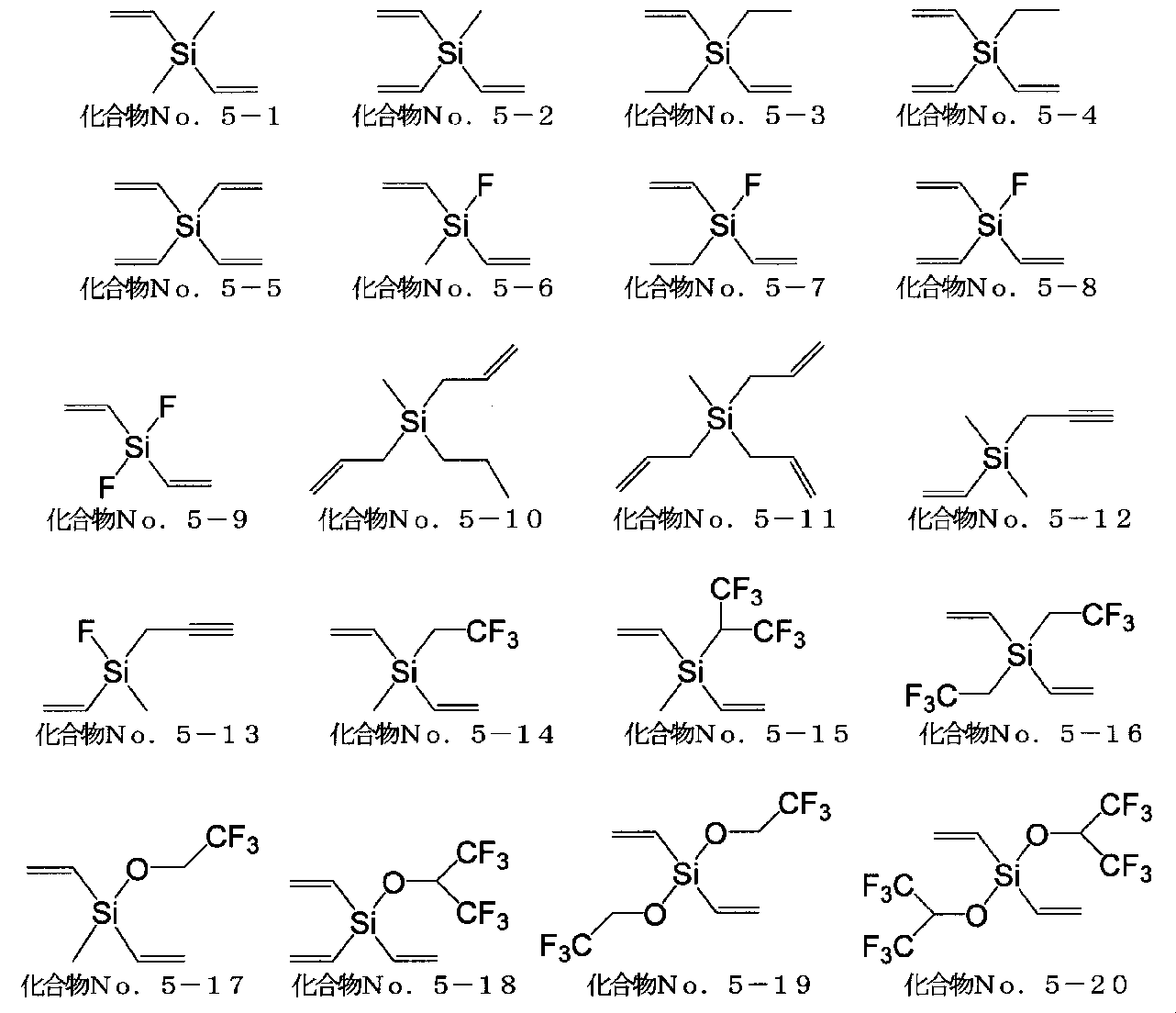
この精製操作として、有機合成における一般的な操作であれば良く特に制限されないが、具体的には、洗浄、分離、濃縮、蒸留、活性炭処理、カラムクロマトグラフィー等を挙げることができる。
上記含有量が0.005質量%以上であると、電池特性を向上させる効果が得られ易くなる傾向がある。上記含有量が12.0質量%以下であると、電解液の粘度増大による、低温時の特性低下が起こり難い。
上記(II)の含有量は、12.0質量%を超えない範囲であれば好ましく、一種類を単独で用いても良く、二種類以上を用途に合わせて任意の組み合わせ、比率で混合して用いても良い。
(III)非水有機溶媒の種類は、特に限定されず、任意の非水有機溶媒を用いることができる。具体例としては、プロピレンカーボネート(以下、「PC」と記載する場合がある)、エチレンカーボネート(以下、「EC」と記載する場合がある)、ブチレンカーボネート等の環状カーボネート、ジエチルカーボネート(以下、「DEC」と記載する場合がある)、ジメチルカーボネート(以下、「DMC」と記載する場合がある)、エチルメチルカーボネート(以下、「EMC」と記載する場合がある)等の鎖状カーボネート、γ―ブチロラクトン、γ―バレロラクトン等の環状エステル、酢酸メチル、プロピオン酸メチル、プロピオン酸エチル(以下、「EP」と記載する場合がある)等の鎖状エステル、テトラヒドロフラン、2-メチルテトラヒドロフラン、ジオキサン等の環状エーテル、ジメトキシエタン、ジエチルエーテル等の鎖状エーテル、ジメチルスルホキシド、スルホラン等のスルホン化合物やスルホキシド化合物等が挙げられる。また、イオン液体等も挙げることができる。また、本発明に用いる非水有機溶媒は、一種類を単独で用いても良く、二種類以上を用途に合わせて任意の組み合わせ、比率で混合して用いても良い。これらの中ではその酸化還元に対する電気化学的な安定性と熱や上記溶質との反応に関わる化学的安定性の観点から、特にプロピレンカーボネート、エチレンカーボネート、ジエチルカーボネート、ジメチルカーボネート、エチルメチルカーボネート、プロピオン酸メチル、プロピオン酸エチルが好ましい。
(2)ECとDECの組合せ、
(3)ECとDMCとEMCの組合せ、
(4)ECとDECとEMCの組合せ、
(5)ECとEMCとEPの組合せ、
(6)PCとDECの組合せ、
(7)PCとEMCの組合せ、
(8)PCとEPの組合せ、
(9)PCとDMCとEMCの組合せ、
(10)PCとDECとEMCの組合せ、
(11)PCとDECとEPの組合せ、
(12)PCとECとEMCの組合せ、
(13)PCとECとDMCとEMCの組合せ、
(14)PCとECとDECとEMCの組合せ、
(15)PCとECとEMCとEPの組合せ
本発明の非水系電解液の溶質の具体例としては、リチウム電池及びリチウムイオン電池の場合には、LiPF6、LiBF4、LiSbF6、LiAsF6、LiClO4、LiCF3SO3、LiC4F9SO3、LiAlO2、LiAlCl4、LiCl、LiI、LiC(CF3SO2)3、LiPF3(C3F7)3、LiB(CF3)4、LiBF3(C2F5)などに代表される電解質塩が挙げられ、ナトリウムイオン電池の場合には、NaPF6、NaBF4、NaSbF6、NaAsF6、NaClO4、NaCF3SO3、NaC4F9SO3、NaAlO2、NaAlCl4、NaCl、NaI、NaC(CF3SO2)3、NaPF3(C3F7)3、NaB(CF3)4、NaBF3(C2F5)などに代表される電解質塩が挙げられる。これらの溶質は、一種類を単独で用いても良く、二種類以上を用途に合わせて任意の組み合わせ、比率で混合して用いても良い。中でも、電池としてのエネルギー密度、出力特性、寿命等から考えると、リチウム電池及びリチウムイオン電池の場合には、上記(IV)として、少なくともLiPF6を含有することが好ましい。また、LiPF6と、それ以外の(IV)成分とを併用する場合、当該それ以外の(IV)成分としては、LiBF4、LiSbF6、LiAsF6、LiClO4、LiCF3SO3、LiC4F9SO3、LiAlO2、LiAlCl4、LiCl、及びLiIからなる群から選ばれる少なくとも1つを用いることが好ましい。
以上が本発明の非水系電解液の基本的な構成についての説明であるが、本発明の要旨を損なわない限りにおいて、本発明の非水系電解液に一般的に用いられる添加剤を任意の比率で添加しても良い。
(1)LiPF6、化合物No.2-1のLi塩、化合物No.2-6のLi塩、及びLiPF2(C2O4)2の組み合わせ、
(2)LiPF6、LiBF4、化合物No.2-1のLi塩、及びLiPO2F2の組み合わせ、
(3)LiPF6、化合物No.2-1のLi塩、化合物No.3-1のLi塩、及びLiPO2F2の組み合わせ、
(4)LiPF6、化合物No.3-1のLi塩、LiPF2(C2O4)2、及びLiPO2F2の組み合わせ、
(5)LiPF6、化合物No.3-1のLi塩、LiB(C2O4)2、及びLiPO2F2の組み合わせ、
(6)LiPF6、化合物No.4-1のLi塩、LiPF2(C2O4)2、及びLiPO2F2の組み合わせ、
のように4種のリチウム塩を含有すると、低温時の内部抵抗の上昇を抑制する効果が、より大きいので好ましい。上記の組み合わせは一例であって、当然ながら上記以外の組み合わせであってもよい。また、必要に応じてそれら以外の上記添加剤を 更に併用添加してもよい。
例えば、上記(I)及び(IV)成分として、第1の溶質としてLiPF6を用い、さらに上記第2の溶質から1種用い、上記一般式[2]~[4]で示されるイミドアニオンを有するリチウム塩、LiBF2(C2O4)、LiB(C2O4)2、LiPF4(C2O4)、LiPF2(C2O4)2、LiP(C2O4)3、LiPO2F2、LiSO3Fから3種用いること、
又は、第1の溶質としてLiPF6を用い、上記一般式[2]~[4]で示されるイミドアニオンを有するリチウム塩、LiBF2(C2O4)、LiB(C2O4)2、LiPF4(C2O4)、LiPF2(C2O4)2、LiP(C2O4)3、LiPO2F2、及びLiSO3Fから4種用いることが考えられる。
(1)LiPF6、化合物No.2-1のLi塩、化合物No.2-6のLi塩、LiPF4(C2O4)、及びLiPF2(C2O4)2との組み合わせ、
(2)LiPF6、LiBF4、化合物No.2-1のLi塩、LiB(C2O4)2、及びLiPO2F2の組み合わせ、
(3)LiPF6、化合物No.2-1のLi塩、LiBF2(C2O4)、LiPO2F2、及びLiSO3Fの組み合わせ、
(4)LiPF6、化合物No.2-1のLi塩、化合物No.3-1のLi塩、LiB(C2O4)2、及びLiPO2F2の組み合わせ、
(5)LiPF6、化合物No.3-1のLi塩、LiPF4(C2O4)、LiPF2(C2O4)2、及びLiPO2F2の組み合わせ、
(6)LiPF6、化合物No.3-1のLi塩、化合物No.3-4のLi塩、LiPF4(C2O4)、及びLiPF2(C2O4)2の組み合わせ、
(7)LiPF6、化合物No.3-1のLi塩、化合物No.4-1のLi塩、LiPF2(C2O4)2、及びLiSO3Fの組み合わせ、
(8)LiPF6、化合物No.4-1のLi塩、LiPF4(C2O4)、LiPF2(C2O4)2、及びLiPO2F2の組み合わせ、
(9)LiPF6、化合物No.4-1のLi塩、化合物No.4-5のLi塩、LiBF2(C2O4)、及びLiPO2F2の組み合わせ、
(10)LiPF6、化合物No.4-6のLi塩、LiB(C2O4)2、LiPO2F2、及びLiSO3Fの組み合わせ、
のように5種のリチウム塩を含有すると、高温時のガス発生の抑制効果が、より大きいので好ましい。上記の組み合わせは一例であって、当然ながら上記以外の組み合わせであってもよい。また、必要に応じてそれら以外のリチウム塩(上記添加剤)を 更に併用添加してもよい。
次に、本発明の非水系電解液二次電池の構成について説明する。本発明の非水系電解液二次電池は、上記の本発明の非水系電解液を用いることが特徴であり、その他の構成部材には一般の非水系電解液二次電池に使用されているものが用いられる。
(イ)正極は、少なくとも1種の酸化物及び/又はポリアニオン化合物を正極活物質として含むことが好ましい。
非水系電解液中のカチオンがリチウム主体となるリチウムイオン二次電池の場合、(イ)正極を構成する正極活物質は、充放電が可能な種々の材料であれば特に限定されるものでないが、例えば、(A)ニッケル、マンガン、コバルトの少なくとも1種以上の金属を含有し、かつ層状構造を有するリチウム遷移金属複合酸化物、(B)スピネル構造を有するリチウムマンガン複合酸化物、(C)リチウム含有オリビン型リン酸塩、及び(D)層状岩塩型構造を有するリチウム過剰層状遷移金属酸化物から少なくとも1種を含有するものが挙げられる。
正極活物質(A)
ニッケル、マンガン及びコバルトの少なくとも1種以上の金属を含有し、かつ層状構造を有するリチウム遷移金属複合酸化物としては、例えば、リチウム・コバルト複合酸化物、リチウム・ニッケル複合酸化物、リチウム・ニッケル・コバルト複合酸化物、リチウム・ニッケル・コバルト・アルミニウム複合酸化物、リチウム・コバルト・マンガン複合酸化物、リチウム・ニッケル・マンガン複合酸化物、リチウム・ニッケル・マンガン・コバルト複合酸化物等が挙げられる。また、これらリチウム遷移金属複合酸化物の主体となる遷移金属原子の一部を、Al、Ti、V、Cr、Fe、Cu、Zn、Mg、Ga、Zr、Si、B、Ba、Y、Sn等の他の元素で置換したものを用いても良い。
LiaNi1-b-cCobM1 cO2 (6)
式(6)中、M1は、Al、Fe、Mg、Zr、Ti及びBからなる群より選ばれる少なくとも1つの元素であり、aは、0.9≦a≦1.2であり、b及びcは、0.01≦b≦0.3、及び0≦c≦0.1の条件を満たす。
これらは、例えば、特開2009-137834号公報等に記載される製造方法等に準じて調製することができる。具体的には、LiNi0.8Co0.2O2、LiNi0.85Co0.10Al0.05O2、LiNi0.87Co0.10Al0.03O2、LiNi0.90Co0.07Al0.03O2、LiNi0.6Co0.3Al0.1O2等が挙げられる。
LidNieMnfCogM2 hO2 (7)
式(7)中、M2は、Al、Fe、Mg、Zr、Ti、B及びSnからなる群より選ばれる少なくとも1つの元素であり、dは、0.9≦d≦1.2であり、e、f、g及びhは、e+f+g+h=1、0≦e≦0.9、0≦f≦0.5、0≦g≦0.5、及びh≧0の条件を満たす。
具体的には、例えば、4.3V以上に充放電領域を有する、Li[Ni1/3Mn1/3Co1/3]O2、Li[Ni0.45Mn0.35Co0.2]O2、Li[Ni0.5Mn0.3Co0.2]O2、Li[Ni0.6Mn0.2Co0.2]O2、Li[Ni0.8Mn0.1Co0.1]O2、Li[Ni0.49Mn0.3Co0.2Zr0.01]O2、Li[Ni0.49Mn0.3Co0.2Mg0.01]O2、Li[Ni0.8Mn0.1Co0.1]O2等が挙げられる。
正極活物質(B)
スピネル構造を有するリチウムマンガン複合酸化物としては、例えば、一般式(8)で示されるスピネル型リチウムマンガン複合酸化物が挙げられる。
Lij(Mn2-kM3 k)O4 (8)
式(8)中、M3は、Ni、Co、Fe、Mg、Cr、Cu、Al及びTiからなる群より選ばれる少なくとも1つの金属元素であり、jは、1.05≦j≦1.15であり、kは、0≦k≦0.20である。
具体的には、例えば、LiMn2O4、LiMn1.95Al0.05O4、LiMn1.9Al0.1O4、LiMn1.9Ni0.1O4、LiMn1.5Ni0.5O4等が挙げられる。
正極活物質(C)
リチウム含有オリビン型リン酸塩としては、例えば一般式(9)で示されるものが挙げられる。
LiFe1-nM4 nPO4 (9)
式(9)中、M4は、Co、Ni、Mn、Cu、Zn、Nb、Mg、Al、Ti、W、Zr及びCdから選ばれる少なくとも1つであり、nは、0≦n≦1である。
具体的には、例えば、LiFePO4、LiCoPO4、LiNiPO4、LiMnPO4等が挙げられ、中でもLiFePO4及び/又はLiMnPO4が好ましい。
正極活物質(D)
層状岩塩型構造を有するリチウム過剰層状遷移金属酸化物としては、例えば、一般式(10)で示されるものが挙げられる。
xLiM5O2・(1-x)Li2M6O3 (10)
式(10)中、xは、0<x<1を満たす数であり、M5は、平均酸化数が3+である少なくとも1種以上の金属元素であり、M6は、平均酸化数が4+である少なくとも1種の金属元素である。式(10)中、M5は、好ましくは3価のMn、Ni、Co、Fe、V及びCrから選ばれてなる1種の金属元素であるが、2価と4価の等量の金属で平均酸化数を3価にしてもよい。
また、式(10)中、M6は、好ましくは、Mn、Zr及びTiから選ばれてなる1種以上の金属元素である。具体的には、0.5[LiNi0.5Mn0.5O2]・0.5[Li2MnO3]、0.5[LiNi1/3Co1/3Mn1/3O2]・0.5[Li2MnO3]、0.5[LiNi0.375Co0.25Mn0.375O2]・0.5[Li2MnO3]、0.5[LiNi0.375Co0.125Fe0.125Mn0.375O2]・0.5[Li2MnO3]、0.45[LiNi0.375Co0.25Mn0.375O2]・0.10[Li2TiO3]・0.45[Li2MnO3]等が挙げられる。
この一般式(10)で表される正極活物質(D)は、4.4V(Li基準)以上の高電圧充電で高容量を発現することが知られている(例えば、米国特許7,135,252号明細書)。
これら正極活物質は、例えば特開2008-270201号公報、WO2013/118661号公報、特開2013-030284号公報等に記載される製造方法等に準じて調製することができる。
正極活物質としては、上記(A)~(D)から選ばれる少なくとも1つを主成分として含有すればよいが、それ以外に含まれるものとしては、例えば、FeS2、TiS2、V2O5、MoO3、MoS2等の遷移元素カルコゲナイド、あるいはポリアセチレン、ポリパラフェニレン、ポリアニリン、及びポリピロール等の導電性高分子、活性炭、ラジカルを発生するポリマー、カーボン材料等が挙げられる。
(イ)正極は、正極集電体を有する。正極集電体としては、例えば、アルミニウム、ステンレス鋼、ニッケル、チタン又はこれらの合金等を用いることができる。
(イ)正極は、例えば、正極集電体の少なくとも一方の面に正極活物質層が形成される。正極活物質層は、例えば、前述の正極活物質と、結着剤と、必要に応じて導電剤とにより構成される。
(ウ)負極は、少なくとも1種の負極活物質を含むことが好ましい。
非水系電解液中のカチオンがリチウム主体となるリチウムイオン二次電池の場合、(ウ)負極を構成する負極活物質としては、リチウムイオンのド-プ・脱ド-プが可能なものであり、例えば(E)X線回折における格子面(002面)のd値が0.340nm以下の炭素材料、(F)X線回折における格子面(002面)のd値が0.340nmを超える炭素材料、(G)Si、Sn及びAlから選ばれる1種以上の金属の酸化物、(H)Si、Sn及びAlから選ばれる1種以上の金属若しくはこれら金属を含む合金又はこれら金属若しくは合金とリチウムとの合金、及び(I)リチウムチタン酸化物から選ばれる少なくとも1種を含有するものが挙げられる。これら負極活物質は、1種を単独で用いることができ、2種以上を組合せて用いることもできる。また、リチウム金属、金属窒化物、スズ化合物、導電性高分子等を用いてもよい。
負極活物質(E)
X線回折における格子面(002面)のd値が0.340nm以下の炭素材料としては、例えば、熱分解炭素類、コークス類(例えば、ピッチコークス、ニードルコークス、石油コークス等)、グラファイト類、有機高分子化合物焼成体(例えば、フェノール樹脂、フラン樹脂等を適当な温度で焼成し炭素化したもの)、炭素繊維、活性炭等が挙げられ、これらは黒鉛化したものでもよい。当該炭素材料は、X線回折法で測定した(002)面の面間隔(d002)が0.340nm以下のものであり、中でも、その真密度が1.70g/cm3以上である黒鉛又はそれに近い性質を有する高結晶性炭素材料が好ましい。
負極活物質(F)
X線回折における格子面(002面)のd値が0.340nmを超える炭素材料としては、非晶質炭素が挙げられ、これは、2000℃以上の高温で熱処理してもほとんど積層秩序が変化しない炭素材料である。例えば、難黒鉛化炭素(ハードカーボン)、1500℃以下で焼成したメソカーボンマイクロビーズ(MCMB)、メソフェーズビッチカーボンファイバー(MCF)等が例示される。株式会社クレハ製のカーボトロン(登録商標)P等は、その代表的な事例である。
負極活物質(G)
Si、Sn及びAlから選ばれる1種以上の金属の酸化物としては、リチウムイオンのド-プ・脱ド-プが可能な、例えば、酸化シリコン、酸化スズ等が挙げられる。
Siの超微粒子がSiO2中に分散した構造を持つSiOx等がある。この材料を負極活物質として用いると、Liと反応するSiが超微粒子であるために充放電がスムーズに行われる一方で、前記構造を有するSiOx粒子自体は表面積が小さいため、負極活物質層を形成するための組成物(ペースト)とした際の塗料性や負極合剤層の集電体に対する接着性も良好である。
なお、SiOxは充放電に伴う体積変化が大きいため、SiOxと上述負極活物質(E)の黒鉛とを特定比率で負極活物質に併用することで高容量化と良好な充放電サイクル特性とを両立することができる。
負極活物質(H)
Si、Sn及びAlから選ばれる1種以上の金属若しくはこれら金属を含む合金又はこれら金属若しくは合金とリチウムとの合金としては、例えば、シリコン、スズ、アルミニウム等の金属、シリコン合金、スズ合金、アルミニウム合金等が挙げられ、これらの金属や合金が、充放電に伴いリチウムと合金化した材料も使用できる。
これらの好ましい具体例としては、WO2004/100293号公報や、特開2008-016424号等に記載される、例えば、ケイ素(Si)、スズ(Sn)等の金属単体(例えば、粉末状のもの)、該金属合金、該金属を含有する化合物、該金属にスズ(Sn)とコバルト(Co)とを含む合金等が挙げられる。当該金属を電極に使用した場合、高い充電容量を発現することができ、かつ、充放電に伴う体積の膨張・収縮が比較的少ないことから好ましい。また、これらの金属は、これをリチウムイオン二次電池の負極に用いた場合に、充電時にLiと合金化するため、高い充電容量を発現することが知られており、この点でも好ましい。
更に、例えば、WO2004/042851号、WO2007/083155号等の公報に記載される、サブミクロン直径のシリコンのピラーから形成された負極活物質、シリコンで構成される繊維からなる負極活物質等を用いてもよい。
負極活物質(I)
リチウムチタン酸化物としては、例えば、スピネル構造を有するチタン酸リチウム、ラムスデライト構造を有するチタン酸リチウム等を挙げることができる。
スピネル構造を有するチタン酸リチウムとしては、例えば、Li4+αTi5O12(αは充放電反応により0≦α≦3の範囲内で変化する)を挙げることができる。また、ラムスデライト構造を有するチタン酸リチウムとしては、例えば、Li2+βTi3O7(βは充放電反応により0≦β≦3の範囲内で変化する)を挙げることができる。これら負極活物質は、例えば特開2007-018883号公報、特開2009-176752号公報等に記載される製造方法等に準じて調製することができる。
一方、非水系電解液中のカチオンがナトリウム主体となるナトリウムイオン二次電池の場合、負極活物質として、例えば、ハードカーボンやTiO2、V2O5、MoO3等の酸化物等が用いられる。例えば、非水系電解液中のカチオンがナトリウム主体となるナトリウムイオン二次電池の場合、正極活物質としてNaFeO2、NaCrO2、NaNiO2、NaMnO2、NaCoO2等のナトリウム含有遷移金属複合酸化物、それらのナトリウム含有遷移金属複合酸化物のFe、Cr、Ni、Ti、Mn、Co等の遷移金属が複数混合したもの(例えば、NaNi0.5Ti0.3Mn0.2O2)、それらのナトリウム含有遷移金属複合酸化物の遷移金属の一部が他の遷移金属以外の金属に置換されたもの、Na2FeP2O7、NaCo3(PO4)2P2O7等の遷移金属のリン酸化合物、TiS2、FeS2等の硫化物、あるいはポリアセチレン、ポリパラフェニレン、ポリアニリン、及びポリピロール等の導電性高分子、活性炭、ラジカルを発生するポリマー、カーボン材料等が使用される。
(ウ)負極は、負極集電体を有する。負極集電体としては、例えば、銅、アルミニウム、ステンレス鋼、ニッケル、チタン又はこれらの合金等を用いることができる。
(ウ)負極は、例えば、負極集電体の少なくとも一方の面に負極活物質層が形成される。負極活物質層は、例えば、前述の負極活物質と、結着剤と、必要に応じて導電剤とにより構成される。
電極は、例えば、活物質と、結着剤と、必要に応じて導電剤とを所定の配合量でN-メチル-2-ピロリドン(NMP)や水等の溶媒中に分散混練し、得られたペーストを集電体に塗布、乾燥して活物質層を形成することで得ることができる。得られた電極は、ロールプレス等の方法により圧縮して、適当な密度の電極に調節することが好ましい。
上記の非水系電解液二次電池は、(エ)セパレータを備える。(イ)正極と(ウ)負極の接触を防ぐためのセパレータとしては、ポリプロピレン、ポリエチレン等のポリオレフィンや、セルロース、紙、又はガラス繊維等で作られた不織布や多孔質シートが使用される。これらのフィルムは、電解液がしみ込んでイオンが透過し易いように、微多孔化されているものが好ましい。
非水系電解液二次電池を構成するにあたり、非水系電解液二次電池の外装体としては、例えば、コイン型、円筒型、角型等の金属缶や、ラミネート外装体を用いることができる。金属缶材料としては、例えば、ニッケルメッキを施した鉄鋼板、ステンレス鋼板、ニッケルメッキを施したステンレス鋼板、アルミニウム又はその合金、ニッケル、チタン等が挙げられる。
(電解液の調製)
(比較電解液No.1-1)
(III)非水有機溶媒として、エチレンカーボネート、ジメチルカーボネート及びエチルメチルカーボネートの体積比2.5:4:3.5の混合溶媒を用い、該溶媒中に、(IV)溶質としてLiPF6を、非水電解液の総量に対して((I)、(III)、及び(IV)の総量に対して)1.0mol/Lの濃度となるように、(I)第1添加剤として上記一般式[1]で表される3-(ジフルオロホスフィニルオキシ)テトラヒドロチオフェン-1,1-ジオキサイドを、非水有機溶媒と溶質と当該化合物との総量に対して((I)、(III)、及び(IV)の総量に対して)1.0質量%の濃度となるように溶解し、非水電解液電池用の比較電解液No.1-1を調製した。比較電解液No.1-1の調製条件を表1に示す。以降、全ての表中「-」は未添加を表す。
(III)非水有機溶媒として、エチレンカーボネート、ジメチルカーボネート及びエチルメチルカーボネートの体積比2.5:4:3.5の混合溶媒を用い、該溶媒中に、(IV)溶質としてLiPF6を、非水電解液の総量に対して((I)~(IV)の総量に対して)1.0mol/Lの濃度となるように、(I)第1添加剤として上記一般式[1]で表される3-(ジフルオロホスフィニルオキシ)テトラヒドロチオフェン-1,1-ジオキサイド、及び(II)第2添加剤として上記一般式[2]で表される化合物No.2-1のリチウム塩を、それぞれ表1に記載の(I)~(IV)の総量に対する濃度となるように溶解し、電解液No.1-1を調製した。
(II)第2添加剤として、上記一般式[2]で表される化合物No.2-1のリチウム塩の代わりに、表1に示す化合物(一般式[2]~[4]の化合物の対カチオンは全てリチウム)を、それぞれ表1に記載の(I)~(IV)の総量に対する濃度となるよう溶解すること以外は、電解液No.1-1と同様に電解液No.1-2~No.1-27を調製した。
(I)第1添加剤を添加せず、(II)第2添加剤として、上記一般式[2]で表される化合物No.2-1のリチウム塩の代わりに、表2に示す化合物(一般式[2]~[4]の化合物の対カチオンは全てリチウム)を、それぞれ表2に記載の(I)~(IV)の総量に対する濃度となるよう溶解すること以外は、電解液No.1-1と同様に比較電解液No.1-2~No.1-28を調製した。
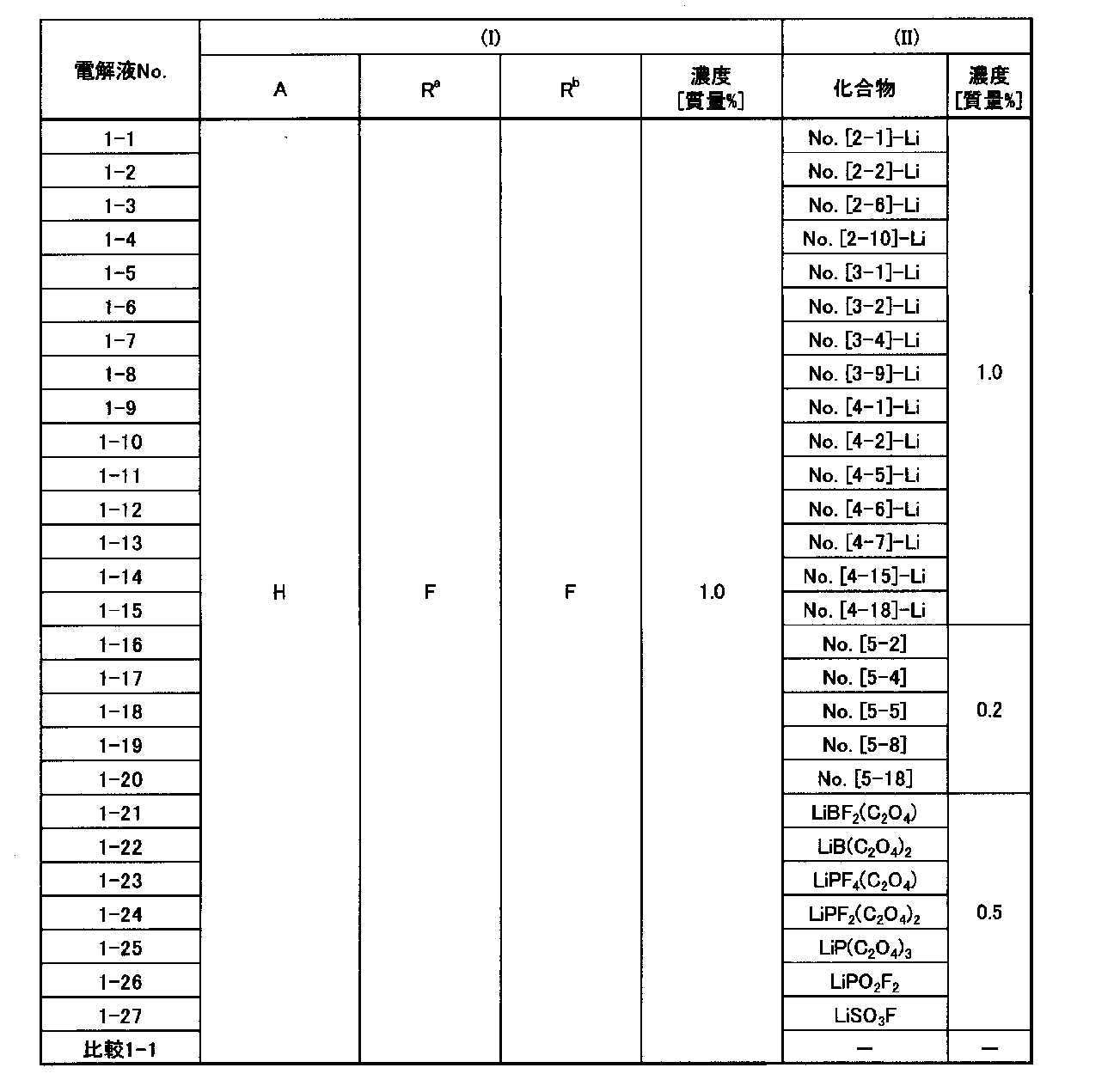

(III)非水有機溶媒として、エチレンカーボネート、ジメチルカーボネート及びエチルメチルカーボネートの体積比2:4:4の混合溶媒を用い、該溶媒中に、(IV)溶質としてLiPF6を、非水電解液の総量に対して((I)~(IV)の総量に対して)1.0mol/Lの濃度となるように、(I)第1添加剤として上記一般式[1]で表される3-(ジフルオロホスフィニルオキシ)テトラヒドロチオフェン-1,1-ジオキサイドを、(I)~(IV)の総量に対して0.5質量%の濃度となるように、及び(II)第2添加剤として上記一般式[3]で表される化合物No.3-1のリチウム塩を、(I)~(IV)の総量に対して1.5質量%の濃度となるように溶解し、電解液No.2-1を調製した。電解液No.2-1の調製条件を表3に示す。
(I)第1添加剤として、上記一般式[1]で表される3-(ジフルオロホスフィニルオキシ)テトラヒドロチオフェン-1,1-ジオキサイドの代わりに、一般式[1]において表3に示すA、Ra及びRbを有する化合物をそれぞれ用いること以外は、電解液No.2-1と同様に電解液No.2-2~No.2-11を調製した。
(II)第2添加剤を添加せず、(I)第1添加剤として、上記一般式[1]で表される3-(ジフルオロホスフィニルオキシ)テトラヒドロチオフェン-1,1-ジオキサイドの代わりに、表3に示すA、Ra及びRbを有する化合物をそれぞれ用いること以外は、電解液No.2-1と同様に比較電解液No. 2-1~No.2-11を調製した。

(III)非水有機溶媒として、プロピレンカーボネート、エチレンカーボネート、ジメチルカーボネート、及びエチルメチルカーボネートの体積比1:2:4:3の混合溶媒を用い、該溶媒中に、(IV)溶質としてLiPF6を、非水電解液の総量に対して((I)~(IV)の総量に対して)1.0mol/Lの濃度となるように、(I)第1添加剤として上記一般式[1]で表される3-(ジフルオロホスフィニルオキシ)テトラヒドロチオフェン-1,1-ジオキサイドを、(I)~(IV)の総量に対して、0.05質量%の濃度となるように溶解し、及び(II)第2添加剤として上記一般式[2]で表される化合物No.2-1のリチウム塩を、(I)~(IV)の総量に対して2.5質量%の濃度となるように溶解し、その他の添加剤又は成分として、ビニレンカーボネートを、電解液の総量に対して1.0質量%の濃度となるように溶解し、電解液No.3-1を調製した。電解液No.3-1の調製条件を表4に示す。
(I)第1添加剤として、上記一般式[1]で表される3-(ジフルオロホスフィニルオキシ)テトラヒドロチオフェン-1,1-ジオキサイドを表4に記載の濃度となるように溶解し、(II)第2添加剤として、上記一般式[2]で表される化合物No.2-1のリチウム塩を、それぞれ表4に記載の濃度となるように溶解したこと以外は、電解液No.3-1と同様に電解液No.3-2~No.3-6を調製した。
(I)第1添加剤として、上記一般式[1]で表される3-(ジフルオロホスフィニルオキシ)テトラヒドロチオフェン-1,1-ジオキサイドを表4~6に記載の濃度となるように溶解し、(II)第2添加剤として、上記一般式[2]で表される化合物No.2-1のリチウム塩の代わりに、表4~6に示す化合物(一般式[2]~[4]の化合物の対カチオンは全てリチウム)を、それぞれ表4~6に記載の濃度となるように溶解したこと以外は、電解液No.3-1と同様に電解液No.3-7~No.3-53を調製した。
(I)第1添加剤を添加せず、(II)第2添加剤として、表4~6示す化合物(一般式[2]~[4]の化合物の対カチオンは全てリチウム)を、それぞれ表4~6に記載の濃度となるように溶解したこと以外は、電解液No.3-1と同様に比較電解液No.3-1~No.3-9を調製した。
(II)第2添加剤を添加しないこと以外は、電解液No.3-35と同様に比較電解液No.3-10を調製した。

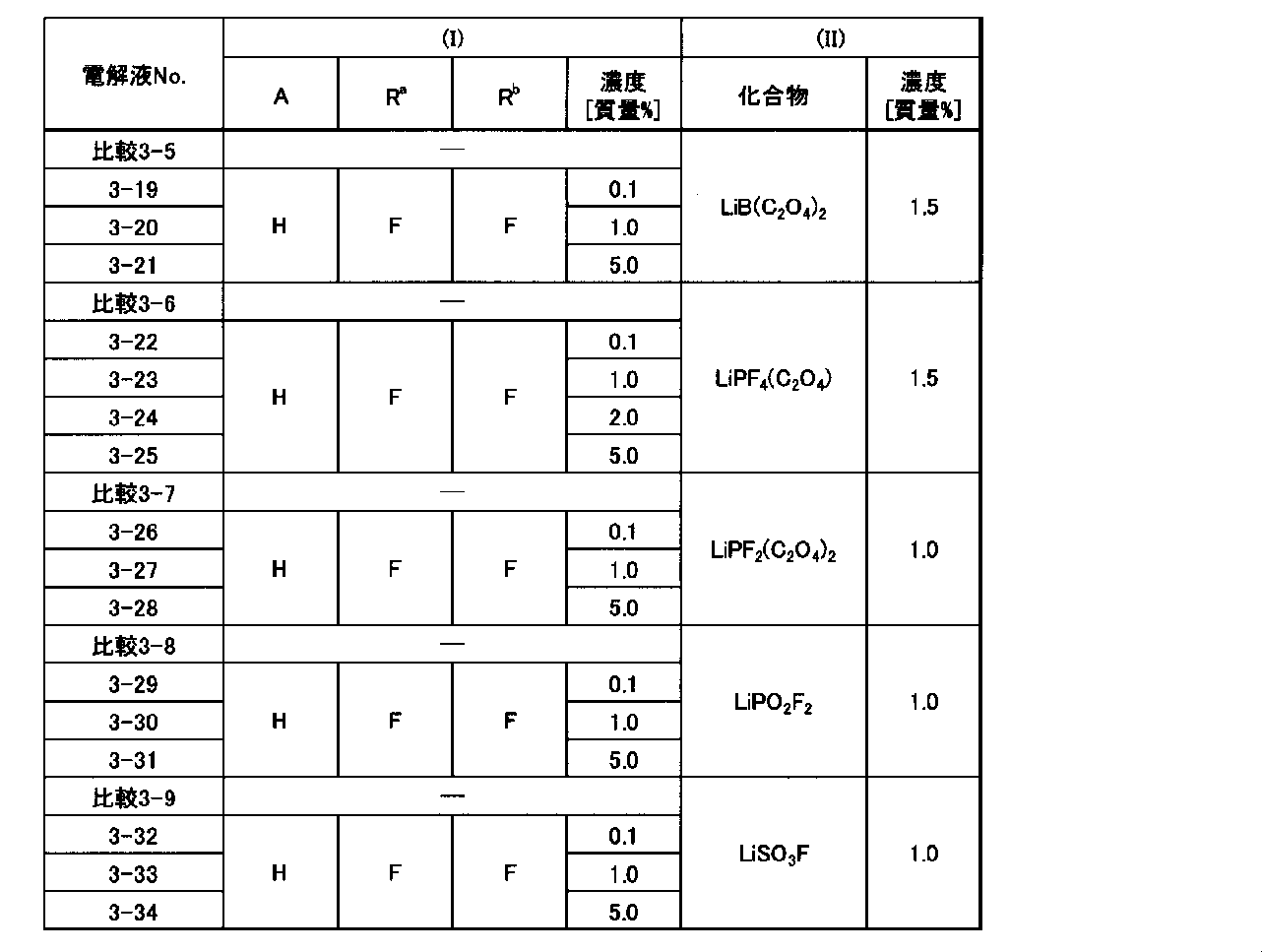

上記電解液を用いてLiNi0.6Co0.2Mn0.2O2を正極材料、黒鉛を負極材料としてセルを作製し、実際に電池の高温貯蔵特性と低温特性を評価した。試験用セルは以下のように作製した。
LiNi0.6Co0.2Mn0.2O2粉末90質量%にバインダーとして5質量%のポリフッ化ビニリデン(以降「PVDF」と記載する)、導電材としてアセチレンブラックを5質量%混合し、さらにN-メチルピロリドン(以降「NMP」と記載する)を添加し、ペースト状にした。このペーストをアルミニウム箔上に塗布して、乾燥させることにより、試験用正極体とした。
また、黒鉛粉末90質量%に、バインダーとして10質量%のPVDFを混合し、さらにNMPを添加し、スラリー状にした。このスラリーを銅箔上に塗布して、120℃で12時間乾燥させることにより、試験用負極体とした。
そして、ポリエチレン製セパレータに電解液を浸み込ませてアルミラミネート外装の50mAhセルを組み立てた。
上記のセルを用いて、25℃の環境温度下、充電上限電圧4.3Vまで放電下限電圧は3.0Vまで定電流定電圧法で、電流密度0.33mA/cm2で充放電を10回行った。10回目の放電容量を放電容量Aとする。この後、-15℃の環境温度下、充電上限電圧4.3Vまで定電流定電圧法で、電流密度0.33mA/cm2で充電した後、放電終止電圧3.0Vまで電流密度9.5mA/cm2の定電流で放電した。このときの放電容量を放電容量Bとし、「(放電容量B/放電容量A)×100」から求めた値を高出力容量維持率(%)とし、セルの低温出力特性を評価した。
上記のセルを用いて、25℃の環境温度下、充電上限電圧4.3Vまで放電下限電圧は3.0Vまで定電流定電圧法で、電流密度0.33mA/cm2で充放電を10回行った。10回目の充電容量を充電容量Aとする。この後、-15℃の環境温度下、充電上限電圧4.3Vまで定電流法で、電流密度9.0mA/cm2で充電した。このときの充電容量を充電容量Bとし、「(充電容量B/充電容量A)×100」から求めた値を高入力容量維持率(%)とし、セルの低温入力特性を評価した。
上記の充放電後、再度、電流密度0.33mA/cm2で4.3Vまで充電した後に、80℃の環境温度で3日間保存した。その後、25℃の環境温度で電流密度0.33mA/cm2で、3.0Vまで放電し、充電上限電圧4.3Vまで定電流定電圧法で、電流密度0.33mA/cm2で充電した。さらに、放電終止電圧3.0Vまで電流密度0.33mA/cm2の定電流で放電したときの放電容量を比較評価した。

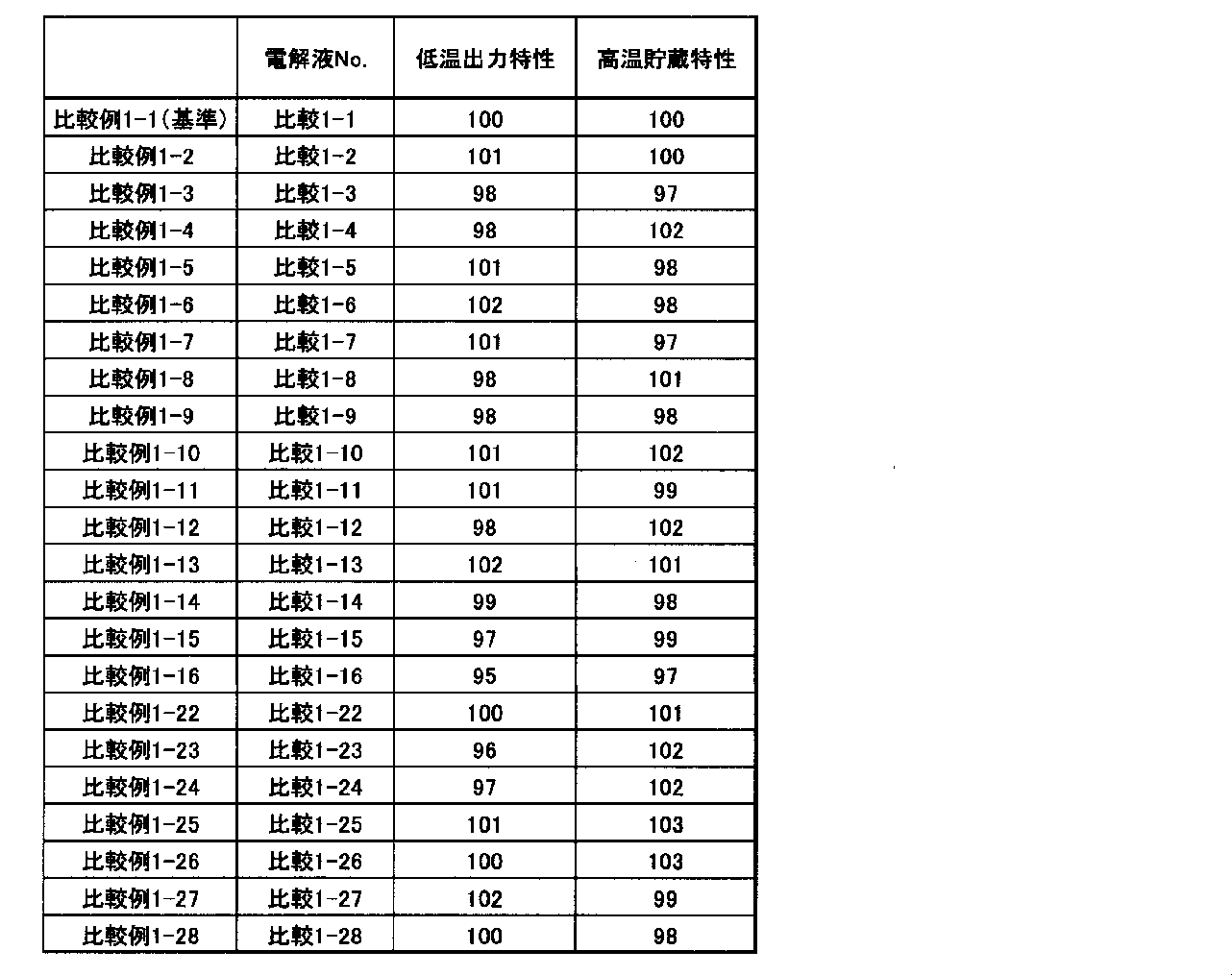

実施例1-2~1-4に比べ、実施例1-1では、低温出力特性及び高温貯蔵特性がより向上している。従って、前記一般式[2]の、R1及びR2が、いずれもフッ素原子であることが特に好ましい。


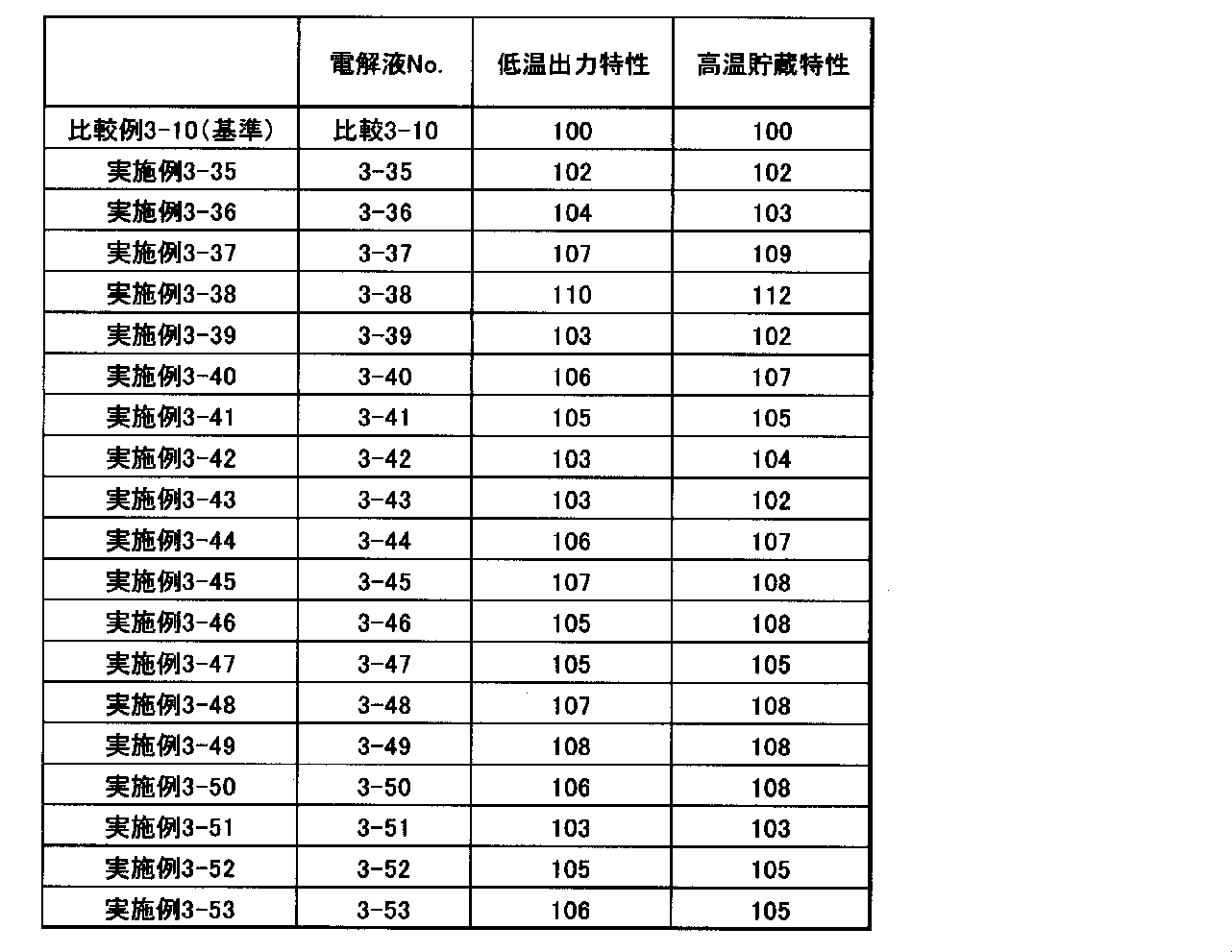
すなわち、(I)~(IV)の総量に対する、(I)第1添加剤の含有量が、0.01~10.0質量%であることが好ましく、0.05~5.0質量%であることがより好ましい。
すなわち、(I)~(IV)の総量に対する、(II)の含有量が、0.005~12.0質量%であることが好ましく、0.05~10.0質量%であることがより好ましく、0.1~5.0質量%であることが特に好ましい。
(電解液の調製)
(比較電解液No.4-1)
(III)非水有機溶媒として、プロピレンカーボネート、エチレンカーボネート、ジメチルカーボネート、及びエチルメチルカーボネートの体積比2:1:4:3の混合溶媒を用い、該溶媒中に、(IV)溶質としてNaPF6を、非水電解液の総量に対して((I)、(III)、及び(IV)の総量に対して)1.15mol/Lの濃度となるように、(I)第1添加剤として上記一般式[1]で表される3-(ジフルオロホスフィニルオキシ)テトラヒドロチオフェン-1,1-ジオキサイドを、非水溶媒と溶質と当該化合物との総量に対して((I)、(III)、及び(IV)の総量に対して)、1.0質量%の濃度となるように溶解し、非水電解液電池用の比較電解液No.4-1を調製した。比較電解液No.4-1の調製条件を表14に示す。
(III)非水有機溶媒として、プロピレンカーボネート、エチレンカーボネート、ジメチルカーボネート、及びエチルメチルカーボネートの体積比2:1:4:3の混合溶媒を用い、該溶媒中に、(IV)溶質としてNaPF6を、非水電解液の総量に対して((I)~(IV)の総量に対して)1.15mol/Lの濃度となるように、(I)第1添加剤として上記一般式[1]で表される3-(ジフルオロホスフィニルオキシ)テトラヒドロチオフェン-1,1-ジオキサイド、及び(II)第2添加剤として上記一般式[2]で表される化合物No.2-1のナトリウム塩を、それぞれ表14に記載の(I)~(IV)の総量に対する濃度となるように溶解し、電解液No.4-1を調製した。
(II)第2添加剤として、上記一般式[2]で表される化合物No.2-1のナトリウム塩の代わりに、表14に示す化合物(一般式[2]~[4]の化合物の対カチオンは全てナトリウム)を、それぞれ表14に記載の(I)~(IV)の総量に対する濃度となるよう溶解すること以外は、電解液No.4-1と同様に電解液No.4-2~No.4-25を調製した。
(I)第1添加剤を添加せず、(II)第2添加剤として、上記一般式[2]で表される化合物No.2-1のナトリウム塩の代わりに、表15に示す化合物(一般式[2]~[4]の化合物の対カチオンは全てナトリウム)を、それぞれ表15に記載の濃度となるよう溶解すること以外は、電解液No.4-1と同様に比較電解液No.4-2~No.4-26を調製した。


上記電解液を用いて、NaNi0.5Ti0.3Mn0.2O2を正極材料として、また、ハードカーボンを負極材料として、セルを作製し、実際に電池の高温貯蔵特性と低温特性を評価した。試験用セルは以下のように作製した。
NaNi0.5Ti0.3Mn0.2O2粉末90質量%に正極バインダーとして5質量%のPVDF、導電材としてアセチレンブラックを5質量%混合し、さらにNMPを添加し、ペースト状にした。このペーストをアルミニウム箔上に塗布して、乾燥させることにより試験用正極体とした。
また、ハードカーボン粉末90質量%に、負極バインダーとして10質量%のPVDFを混合し、さらにNMPを添加し、スラリー状にした。このスラリーをアルミニウム箔上に塗布して、乾燥させることにより試験用負極体とした。
そして、ポリエチレン製セパレータに電解液を浸み込ませてアルミラミネート外装の50mAhセルを組み立てた。
上記のセルを用いて、25℃の環境温度下、充電上限電圧4.1Vまで放電下限電圧は1.5Vまで定電流定電圧法で、電流密度0.33mA/cm2で充放電を10回行った。10回目の放電容量を放電容量Aとする。この後、-15℃の環境温度下、充電上限電圧4.1Vまで定電流定電圧法で、電流密度0.33mA/cm2で充電した後、放電終止電圧1.5Vまで電流密度9.5mA/cm2の定電流で放電した。このときの放電容量を放電容量Bとし、「(放電容量B/放電容量A)×100」から求めた値を高出力容量維持率(%)とし、セルの低温出力特性を評価した。
上記のセルを用いて、25℃の環境温度下、充電上限電圧4.1Vまで放電下限電圧は1.5Vまで定電流定電圧法で、電流密度0.33mA/cm2で充放電を10回行った。10回目の充電容量を充電容量Aとする。この後、-15℃の環境温度下、充電上限電圧4.1Vまで定電流法で、電流密度9.0mA/cm2で充電した。このときの充電容量を充電容量Bとし、「(充電容量B/充電容量A)×100」から求めた値を高入力容量維持率(%)とし、セルの低温入力特性を評価した。
上記の充放電後、再度、電流密度0.33mA/cm2で4.1Vまで充電した後に、80℃の環境温度で3日間保存した。その後、25℃の環境温度で電流密度0.33mA/cm2で、1.5Vまで放電し、充電上限電圧4.1Vまで定電流定電圧法で、電流密度0.33mA/cm2で充電した。さらに、放電終止電圧1.5Vまで電流密度0.33mA/cm2の定電流で放電したときの放電容量を比較評価した。

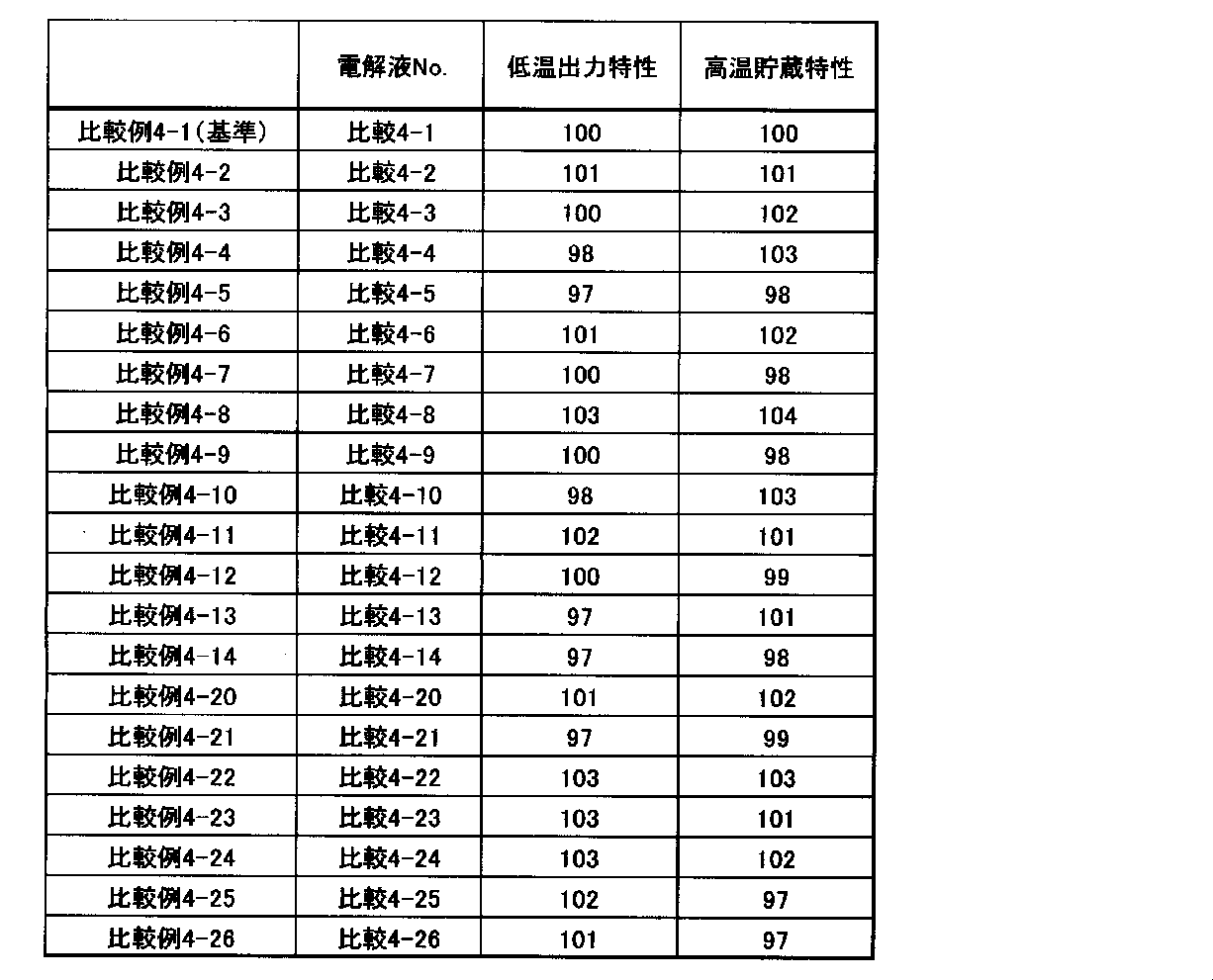

Claims (23)
- (I)下記一般式[1]で表される第1添加剤、
(II)下記一般式[2]~[5]で表される化合物、ジフルオロ(オキサラト)ホウ酸塩、ビス(オキサラト)ホウ酸塩、テトラフルオロ(オキサラト)リン酸塩、ジフルオロビス(オキサラト)リン酸塩、トリス(オキサラト)リン酸塩、ジフルオロリン酸塩、及びフルオロスルホン酸塩からなる群より選ばれる少なくとも1種の、第2添加剤、
(III)非水有機溶媒、及び
(IV)溶質、
を含む、非水系電解液。

[式[1]中、
Ra及びRbは、それぞれ独立に、フッ素原子、ハロゲン原子で置換されていてもよい炭素原子数1~8のアルキル基、ハロゲン原子で置換されていてもよい炭素原子数2~6のアルケニル基、ハロゲン原子で置換されていてもよい炭素原子数2~6のアルキニル基、ハロゲン原子で置換されていてもよい炭素原子数6~10のアリール基、ハロゲン原子で置換されていてもよい炭素原子数1~8のアルコキシ基、ハロゲン原子で置換されていてもよい炭素原子数2~6のアルケニルオキシ基、ハロゲン原子で置換されていてもよい炭素原子数2~6のアルキニルオキシ基、又はハロゲン原子で置換されていてもよい炭素原子数6~10のアリールオキシ基を示し、そして
Aは、水素原子又はハロゲン原子を示す。]

[式[2]中、
R1及びR2は、それぞれ独立に、フッ素原子、炭素原子数が1~10の直鎖あるいは炭素原子数が3~10の分岐状のアルキル基、炭素原子数が1~10の直鎖あるいは炭素原子数が3~10の分岐状のアルコキシ基、炭素原子数が2~10のアルケニル基、炭素原子数が2~10のアルケニルオキシ基、炭素原子数が2~10のアルキニル基、炭素原子数が2~10のアルキニルオキシ基、炭素原子数が3~10のシクロアルキル基、炭素原子数が3~10のシクロアルコキシ基、炭素原子数が3~10のシクロアルケニル基、炭素原子数が3~10のシクロアルケニルオキシ基、炭素原子数が6~10のアリール基、及び、炭素原子数が6~10のアリールオキシ基から選ばれる有機基であり、その有機基中にフッ素原子、酸素原子又は不飽和結合が存在することもでき、但し、R1及びR2の少なくとも1つは、フッ素原子であり、
Mm+は、アルカリ金属カチオン、アルカリ土類金属カチオン、又はオニウムカチオンであり、そして
mは、該当するカチオンの価数と同数の整数を表す。]

[式[3]中、
R3~R6は、それぞれ独立に、フッ素原子、炭素原子数が1~10の直鎖あるいは炭素原子数が3~10の分岐状のアルキル基、炭素原子数が1~10の直鎖あるいは炭素原子数が3~10の分岐状のアルコキシ基、炭素原子数が2~10のアルケニル基、炭素原子数が2~10のアルケニルオキシ基、炭素原子数が2~10のアルキニル基、炭素原子数が2~10のアルキニルオキシ基、炭素原子数が3~10のシクロアルキル基、炭素原子数が3~10のシクロアルコキシ基、炭素原子数が3~10のシクロアルケニル基、炭素原子数が3~10のシクロアルケニルオキシ基、炭素原子数が6~10のアリール基、及び、炭素原子数が6~10のアリールオキシ基から選ばれる有機基であり、その有機基中にフッ素原子、酸素原子、シアノ基又は不飽和結合が存在することもでき、但し、R3~R6の少なくとも1つは、フッ素原子であり、そして
Mm+、mは、一般式[2]と同様である。]

[式[4]中、
R7~R9は、それぞれ独立に、フッ素原子、炭素原子数が1~10の直鎖あるいは炭素原子数が3~10の分岐状のアルキル基、炭素原子数が1~10の直鎖あるいは炭素原子数が3~10の分岐状のアルコキシ基、炭素原子数が2~10のアルケニル基、炭素原子数が2~10のアルケニルオキシ基、炭素原子数が2~10のアルキニル基、炭素原子数が2~10のアルキニルオキシ基、炭素原子数が3~10のシクロアルキル基、炭素原子数が3~10のシクロアルコキシ基、炭素原子数が3~10のシクロアルケニル基、炭素原子数が3~10のシクロアルケニルオキシ基、炭素原子数が6~10のアリール基、及び、炭素原子数が6~10のアリールオキシ基から選ばれる有機基であり、その有機基中にフッ素原子、酸素原子又は不飽和結合が存在することもでき、但し、R7~R9の少なくとも1つは、フッ素原子であり、そして
Mm+、mは、一般式[2]と同様である。]

[式[5]中、
R10は、それぞれ独立に、炭素-炭素不飽和結合を有する基であり、R11は、それぞれ独立に、フッ素原子、フッ素原子で置換されていてもよい炭素原子数が1~10の直鎖又は炭素原子数が3~10の分岐状のアルキル基、及びフッ素原子で置換されていてもよい炭素原子数が1~10の直鎖又は炭素原子数が3~10の分岐状のアルコキシ基であり、そして
aは、2~4の整数である。] - 前記一般式[1]において、Ra及びRbが、それぞれ独立に、フッ素原子、ハロゲン原子で置換されていてもよい炭素原子数1~3のアルコキシ基、ハロゲン原子で置換されていてもよい炭素原子数2~4のアルケニルオキシ基、ハロゲン原子で置換されていてもよい炭素原子数2~4のアルキニルオキシ基、又はハロゲン原子で置換されていてもよい炭素原子数6~10のアリールオキシ基である、請求項1に記載の非水系電解液。
- 前記一般式[1]において、Aが、水素原子又はフッ素原子である、請求項1又は2に記載の非水系電解液。
- 前記一般式[2]において、R1及びR2が、いずれもフッ素原子である、請求項1~3のいずれかに記載の非水系電解液。
- 前記一般式[2]において、
R1が、フッ素原子であり、
R2が、フッ素原子を含んでいてもよい炭素原子数6以下の、アルキル基、アルケニル基、アルキニル基、アルコキシ基、アルケニルオキシ基、又はアルキニルオキシ基である、請求項1~3のいずれかに記載の非水系電解液。 - 前記一般式[2]において、
R1が、フッ素原子であり、
R2が、メチル基、メトキシ基、エチル基、エトキシ基、n-プロピル基、n-プロポキシ基、イソプロピル基、イソプロポキシ基、ビニル基、アリル基、アリルオキシ基、エチニル基、2-プロピニル基、2-プロピニルオキシ基、フェニル基、フェニルオキシ基、トリフルオロメチル基、トリフルオロメトキシ基、2,2-ジフルオロエチル基、2,2-ジフルオロエチルオキシ基、2,2,2-トリフルオロエチル基、2,2,2-トリフルオロエチルオキシ基、2,2,3,3-テトラフルオロプロピル基、2,2,3,3-テトラフルオロプロピルオキシ基、1,1,1,3,3,3-ヘキサフルオロイソプロピル基、及び1,1,1,3,3,3-ヘキサフルオロイソプロピルオキシ基から選ばれる基である、請求項1~3及び5のいずれかに記載の非水系電解液。 - 前記一般式[3]において、R3~R6が、いずれもフッ素原子である、請求項1~3のいずれかに記載の非水系電解液。
- 前記一般式[3]において、
R3~R6の少なくとも1つが、フッ素原子であり、
R3~R6の少なくとも1つが、フッ素原子を含んでいてもよい炭素原子数6以下の、アルキル基、アルケニル基、アルキニル基、アルコキシ基、アルケニルオキシ基、及びアルキニルオキシ基から選ばれる基である、請求項1~3のいずれかに記載の非水系電解液。 - 前記一般式[3]において、
R3~R6の少なくとも1つが、フッ素原子であり、
R3~R6の少なくとも1つが、メチル基、メトキシ基、エチル基、エトキシ基、n-プロピル基、n-プロポキシ基、イソプロピル基、イソプロポキシ基、ビニル基、アリル基、アリルオキシ基、エチニル基、2-プロピニル基、2-プロピニルオキシ基、フェニル基、フェニルオキシ基、トリフルオロメチル基、トリフルオロメトキシ基、2,2-ジフルオロエチル基、2,2-ジフルオロエチルオキシ基、2,2,2-トリフルオロエチル基、2,2,2-トリフルオロエチルオキシ基、2,2,3,3-テトラフルオロプロピル基、2,2,3,3-テトラフルオロプロピルオキシ基、1,1,1,3,3,3-ヘキサフルオロイソプロピル基、及び1,1,1,3,3,3-ヘキサフルオロイソプロピルオキシ基から選ばれる基である、請求項1~3及び8のいずれかに記載の非水系電解液。 - 前記一般式[4]において、R7~R9が、いずれもフッ素原子である、請求項1~3のいずれかに記載の非水系電解液。
- 前記一般式[4]において、
R7~R9の少なくとも1つが、フッ素原子であり、
R7~R9の少なくとも1つが、フッ素原子を含んでいてもよい炭素原子数6以下の、アルキル基、アルケニル基、アルキニル基、アルコキシ基、アルケニルオキシ基、及びアルキニルオキシ基から選ばれる基である、請求項1~3のいずれかに記載の非水系電解液。 - 前記一般式[4]において、
R7~R9の少なくとも1つが、フッ素原子であり、
R7~R9の少なくとも1つが、メチル基、メトキシ基、エチル基、エトキシ基、n-プロピル基、n-プロポキシ基、イソプロピル基、イソプロポキシ基、ビニル基、アリル基、アリルオキシ基、エチニル基、2-プロピニル基、2-プロピニルオキシ基、フェニル基、フェニルオキシ基、トリフルオロメチル基、トリフルオロメトキシ基、2,2-ジフルオロエチル基、2,2-ジフルオロエチルオキシ基、2,2,2-トリフルオロエチル基、2,2,2-トリフルオロエチルオキシ基、2,2,3,3-テトラフルオロプロピル基、2,2,3,3-テトラフルオロプロピルオキシ基、1,1,1,3,3,3-ヘキサフルオロイソプロピル基、及び1,1,1,3,3,3-ヘキサフルオロイソプロピルオキシ基から選ばれる基である、請求項1~3及び11のいずれかに記載の非水系電解液。 - 前記一般式[2]~[4]において、
Mm+が、リチウムイオン、ナトリウムイオン、カリウムイオン、及びテトラアルキルアンモニウムイオンからなる群から選ばれる、請求項1~12のいずれかに記載の非水系電解液。 - 前記一般式[5]のR10が、それぞれ独立に、ビニル基、アリル基、1-プロペニル基、2-プロペニル基、エチニル基、及び2-プロピニル基からなる群から選択される基である、請求項1~3のいずれかに記載の非水系電解液。
- 前記一般式[5]のR11が、それぞれ独立に、フッ素原子、メチル基、エチル基、n-プロピル基、イソプロピル基、2,2,2-トリフルオロエチル基、2,2,3,3-テトラフルオロプロピル基、1,1,1-トリフルオロイソプロピル基、1,1,1,3,3,3-ヘキサフルオロイソプロピル基、2,2,2-トリフルオロエトキシ基、2,2,3,3-テトラフルオロプロポキシ基、2,2,3,3,3-ペンタフルオロプロポキシ基、1,1,1-トリフルオロイソプロポキシ基、及び1,1,1,3,3,3-ヘキサフルオロイソプロポキシ基からなる群から選択される基である、請求項1~3及び14のいずれかに記載の非水系電解液。
- 前記一般式[5]のaが、3又は4である、請求項1~3、14及び15のいずれかに記載の非水系電解液。
- 前記一般式[5]のaが、4である、請求項1~3及び14のいずれかに記載の非水系電解液。
- 前記(I)~(IV)の総量に対する、前記(I)の含有量が、0.01~10.0質量%である、請求項1~17のいずれかに記載の非水系電解液。
- 前記(I)~(IV)の総量に対する、前記(II)の含有量が、0.005~12.0質量%である、請求項1~18のいずれかに記載の非水系電解液。
- 前記(IV)が、LiPF6、LiBF4、LiSbF6、LiAsF6、LiClO4、LiCF3SO3、LiC4F9SO3、LiAlO2、LiAlCl4、LiCl、LiI、NaPF6、NaBF4、NaSbF6、NaAsF6、NaClO4、NaCF3SO3、NaC4F9SO3、NaAlO2、NaAlCl4、NaCl、及びNaIからなる群から選ばれる少なくとも1つである、請求項1~19のいずれかに記載の非水系電解液。
- 前記(III)が、環状カーボネート、鎖状カーボネート、環状エステル、鎖状エステル、環状エーテル、鎖状エーテル、スルホン化合物、スルホキシド化合物、及びイオン液体からなる群から選ばれる少なくとも1つである、請求項1~20のいずれかに記載の非水系電解液。
- 更に、ビニレンカーボネート、ビニレンカーボネートのオリゴマー(ポリスチレン換算の数平均分子量が170~5000)、ビニルエチレンカーボネート、フルオロエチレンカーボネート、1,6-ジイソシアナトヘキサン、エチニルエチレンカーボネート、trans-ジフルオロエチレンカーボネート、プロパンサルトン、プロペンサルトン、1,3,2-ジオキサチオラン-2,2-ジオキシド、4-プロピル-1,3,2-ジオキサチオラン-2,2-ジオキシド、メチレンメタンジスルホネート、1,2-エタンジスルホン酸無水物、メタンスルホニルフルオリド、トリス(トリメチルシリル)ボレート、スクシノニトリル、(エトキシ)ペンタフルオロシクロトリホスファゼン、リチウムテトラフルオロ(マロナト)ホスフェート、テトラフルオロ(ピコリナト)ホスフェート、1,3-ジメチル-1,3-ジビニル-1,3-ジ(1,1,1,3,3,3-ヘキサフルオロイソプロピル)ジシロキサン、t-ブチルベンゼン、t-アミルベンゼン、フルオロベンゼン、及びシクロヘキシルベンゼンからなる群から選ばれる少なくとも1つの添加剤を含有する、請求項1~21のいずれかに記載の非水系電解液。
- 少なくとも正極と、負極と、請求項1~22のいずれかに記載の非水系電解液とを備えた、非水系電解液二次電池。
Priority Applications (5)
| Application Number | Priority Date | Filing Date | Title |
|---|---|---|---|
| KR1020227001115A KR20220032556A (ko) | 2019-07-09 | 2020-07-06 | 비수계 전해액, 및 비수계 전해액 이차 전지 |
| CN202080049548.9A CN114128006A (zh) | 2019-07-09 | 2020-07-06 | 非水系电解液、和非水系电解液二次电池 |
| EP20837815.8A EP3993120A4 (en) | 2019-07-09 | 2020-07-06 | NON-AQUEOUS ELECTROLYTE AND NON-AQUEOUS ELECTROLYTE SECONDARY BATTERY |
| US17/625,219 US20220278368A1 (en) | 2019-07-09 | 2020-07-06 | Nonaqueous electrolyte solution and nonaqueous electrolyte solution secondary battery |
| JP2021530685A JP7645446B2 (ja) | 2019-07-09 | 2020-07-06 | 非水系電解液、及び非水系電解液二次電池 |
Applications Claiming Priority (2)
| Application Number | Priority Date | Filing Date | Title |
|---|---|---|---|
| JP2019-127549 | 2019-07-09 | ||
| JP2019127549 | 2019-07-09 |
Publications (1)
| Publication Number | Publication Date |
|---|---|
| WO2021006238A1 true WO2021006238A1 (ja) | 2021-01-14 |
Family
ID=74113778
Family Applications (1)
| Application Number | Title | Priority Date | Filing Date |
|---|---|---|---|
| PCT/JP2020/026377 Ceased WO2021006238A1 (ja) | 2019-07-09 | 2020-07-06 | 非水系電解液、及び非水系電解液二次電池 |
Country Status (6)
| Country | Link |
|---|---|
| US (1) | US20220278368A1 (ja) |
| EP (1) | EP3993120A4 (ja) |
| JP (1) | JP7645446B2 (ja) |
| KR (1) | KR20220032556A (ja) |
| CN (1) | CN114128006A (ja) |
| WO (1) | WO2021006238A1 (ja) |
Cited By (5)
| Publication number | Priority date | Publication date | Assignee | Title |
|---|---|---|---|---|
| WO2022239813A1 (ja) * | 2021-05-13 | 2022-11-17 | セントラル硝子株式会社 | 非水ナトリウムイオン電池用電解液、非水ナトリウムイオン電池、及び非水ナトリウムイオン電池の製造方法 |
| WO2023054128A1 (ja) * | 2021-09-30 | 2023-04-06 | セントラル硝子株式会社 | 非水電解液、非水電解液電池、化合物及び非水電解液用添加剤 |
| WO2024101452A1 (ja) * | 2022-11-11 | 2024-05-16 | セントラル硝子株式会社 | 非水ナトリウムイオン電池用電解液、非水ナトリウムイオン電池、及び非水ナトリウムイオン電池の製造方法 |
| US12322756B2 (en) | 2021-12-29 | 2025-06-03 | Hyundai Motor Company | Electrolyte solution for lithium secondary battery and lithium secondary battery including same |
| JP2025531407A (ja) * | 2023-01-16 | 2025-09-19 | 香港時代新能源科技有限公司 | 非水電解液及びこの電解液を含むナトリウムイオン電池と電力消費装置 |
Families Citing this family (6)
| Publication number | Priority date | Publication date | Assignee | Title |
|---|---|---|---|---|
| KR20220129390A (ko) * | 2021-03-16 | 2022-09-23 | 삼성에스디아이 주식회사 | 신규 화합물, 이를 포함하는 첨가제, 전해질 및 리튬 이차전지 |
| CN115133159A (zh) * | 2022-09-01 | 2022-09-30 | 河南师范大学 | 一种功能性水系锌离子电池电解液及其制备方法和应用 |
| KR20240071838A (ko) * | 2022-11-16 | 2024-05-23 | 삼성에스디아이 주식회사 | 리튬이차전지용 전해질 및 이를 포함하는 리튬이차전지 |
| CN116779969B (zh) * | 2023-07-13 | 2024-01-23 | 华南师范大学 | 钠离子电池电解液、钠离子电池和提高钠离子电池性能的方法 |
| CN116960467B (zh) * | 2023-09-15 | 2024-02-20 | 宁德时代新能源科技股份有限公司 | 电池单体、电池和用电装置 |
| CN118712489B (zh) * | 2024-07-10 | 2025-10-03 | 广汽埃安新能源汽车股份有限公司 | 一种锂离子电池电解液、锂离子电池以及用电设备 |
Citations (20)
| Publication number | Priority date | Publication date | Assignee | Title |
|---|---|---|---|---|
| JPH10139784A (ja) | 1996-11-06 | 1998-05-26 | Kanegafuchi Chem Ind Co Ltd | ビニルシリル基含有ケイ素化合物の製造方法 |
| JP2002151077A (ja) | 2000-11-14 | 2002-05-24 | Toda Kogyo Corp | 非水電解質二次電池用正極活物質及びその製造法 |
| JP2002319430A (ja) * | 2001-04-23 | 2002-10-31 | Japan Storage Battery Co Ltd | 非水電解質二次電池 |
| WO2004042851A2 (en) | 2002-11-05 | 2004-05-21 | Imperial College Innovations Limited | Structured silicon anode |
| JP2004522681A (ja) | 2000-12-29 | 2004-07-29 | ハイドロ−ケベック | ハロスルホニル基、又はジハロホスホニル基を含む化合物をフッ素化するための方法 |
| WO2004100293A1 (ja) | 2003-05-09 | 2004-11-18 | Sony Corporation | 負極活物質及びその製造方法、これを用いた非水電解質二次電池 |
| US7135252B2 (en) | 2000-06-22 | 2006-11-14 | Uchicago Argonne Llc | Lithium metal oxide electrodes for lithium cells and batteries |
| JP2007018883A (ja) | 2005-07-07 | 2007-01-25 | Toshiba Corp | 負極活物質、非水電解質電池及び電池パック |
| WO2007083155A1 (en) | 2006-01-23 | 2007-07-26 | Nexeon Ltd | A method of fabricating fibres composed of silicon or a silicon-based material and their use in lithium rechargeable batteries |
| JP2008016424A (ja) | 2006-06-05 | 2008-01-24 | Sony Corp | 電解質およびこれを用いた電池、並びに電解質の製造方法 |
| JP2008270201A (ja) | 2007-03-27 | 2008-11-06 | Univ Kanagawa | リチウムイオン電池用正極材料 |
| JP2009137834A (ja) | 2007-11-12 | 2009-06-25 | Toda Kogyo Corp | 非水電解液二次電池用Li−Ni系複合酸化物粒子粉末及びその製造方法、並びに非水電解質二次電池 |
| CN101654229A (zh) | 2009-09-04 | 2010-02-24 | 华中科技大学 | 一种制备含氟磺酰(磷酰)亚胺及其碱金属盐的方法 |
| CN102617414A (zh) | 2012-03-02 | 2012-08-01 | 苏州氟特电池材料有限公司 | 含氯磺酰/磷酰亚胺碱金属盐和含氟磺酰/磷酰亚胺碱金属盐的制备方法 |
| JP2013030284A (ja) | 2011-07-26 | 2013-02-07 | Mitsubishi Chemicals Corp | 非水系電解液電池 |
| WO2013118661A1 (ja) | 2012-02-06 | 2013-08-15 | 日本電気株式会社 | リチウムイオン電池およびその製造方法 |
| WO2014034043A1 (ja) | 2012-08-27 | 2014-03-06 | 三洋電機株式会社 | 非水電解質二次電池 |
| WO2017043576A1 (ja) * | 2015-09-09 | 2017-03-16 | 住友精化株式会社 | 非水電解液用添加剤、非水電解液、及び、蓄電デバイス |
| WO2018016195A1 (ja) | 2016-07-19 | 2018-01-25 | 住友精化株式会社 | 非水電解液用添加剤、非水電解液、及び、蓄電デバイス |
| WO2019117101A1 (ja) * | 2017-12-12 | 2019-06-20 | セントラル硝子株式会社 | 非水電解液電池用電解液及びそれを用いた非水電解液電池 |
Family Cites Families (3)
| Publication number | Priority date | Publication date | Assignee | Title |
|---|---|---|---|---|
| JP6665396B2 (ja) * | 2015-02-19 | 2020-03-13 | セントラル硝子株式会社 | 非水電解液電池用電解液、及びこれを用いた非水電解液電池 |
| WO2019111983A1 (ja) * | 2017-12-06 | 2019-06-13 | セントラル硝子株式会社 | 非水電解液電池用電解液及びそれを用いた非水電解液電池 |
| JP7168851B2 (ja) * | 2017-12-06 | 2022-11-10 | セントラル硝子株式会社 | 非水電解液電池用電解液及びそれを用いた非水電解液電池 |
-
2020
- 2020-07-06 CN CN202080049548.9A patent/CN114128006A/zh active Pending
- 2020-07-06 EP EP20837815.8A patent/EP3993120A4/en active Pending
- 2020-07-06 US US17/625,219 patent/US20220278368A1/en not_active Abandoned
- 2020-07-06 KR KR1020227001115A patent/KR20220032556A/ko active Pending
- 2020-07-06 WO PCT/JP2020/026377 patent/WO2021006238A1/ja not_active Ceased
- 2020-07-06 JP JP2021530685A patent/JP7645446B2/ja active Active
Patent Citations (21)
| Publication number | Priority date | Publication date | Assignee | Title |
|---|---|---|---|---|
| JPH10139784A (ja) | 1996-11-06 | 1998-05-26 | Kanegafuchi Chem Ind Co Ltd | ビニルシリル基含有ケイ素化合物の製造方法 |
| US7135252B2 (en) | 2000-06-22 | 2006-11-14 | Uchicago Argonne Llc | Lithium metal oxide electrodes for lithium cells and batteries |
| JP2002151077A (ja) | 2000-11-14 | 2002-05-24 | Toda Kogyo Corp | 非水電解質二次電池用正極活物質及びその製造法 |
| JP2004522681A (ja) | 2000-12-29 | 2004-07-29 | ハイドロ−ケベック | ハロスルホニル基、又はジハロホスホニル基を含む化合物をフッ素化するための方法 |
| JP2002319430A (ja) * | 2001-04-23 | 2002-10-31 | Japan Storage Battery Co Ltd | 非水電解質二次電池 |
| WO2004042851A2 (en) | 2002-11-05 | 2004-05-21 | Imperial College Innovations Limited | Structured silicon anode |
| WO2004100293A1 (ja) | 2003-05-09 | 2004-11-18 | Sony Corporation | 負極活物質及びその製造方法、これを用いた非水電解質二次電池 |
| JP2009176752A (ja) | 2005-07-07 | 2009-08-06 | Toshiba Corp | 負極活物質及びその製造方法、非水電解質電池及び電池パック |
| JP2007018883A (ja) | 2005-07-07 | 2007-01-25 | Toshiba Corp | 負極活物質、非水電解質電池及び電池パック |
| WO2007083155A1 (en) | 2006-01-23 | 2007-07-26 | Nexeon Ltd | A method of fabricating fibres composed of silicon or a silicon-based material and their use in lithium rechargeable batteries |
| JP2008016424A (ja) | 2006-06-05 | 2008-01-24 | Sony Corp | 電解質およびこれを用いた電池、並びに電解質の製造方法 |
| JP2008270201A (ja) | 2007-03-27 | 2008-11-06 | Univ Kanagawa | リチウムイオン電池用正極材料 |
| JP2009137834A (ja) | 2007-11-12 | 2009-06-25 | Toda Kogyo Corp | 非水電解液二次電池用Li−Ni系複合酸化物粒子粉末及びその製造方法、並びに非水電解質二次電池 |
| CN101654229A (zh) | 2009-09-04 | 2010-02-24 | 华中科技大学 | 一种制备含氟磺酰(磷酰)亚胺及其碱金属盐的方法 |
| JP2013030284A (ja) | 2011-07-26 | 2013-02-07 | Mitsubishi Chemicals Corp | 非水系電解液電池 |
| WO2013118661A1 (ja) | 2012-02-06 | 2013-08-15 | 日本電気株式会社 | リチウムイオン電池およびその製造方法 |
| CN102617414A (zh) | 2012-03-02 | 2012-08-01 | 苏州氟特电池材料有限公司 | 含氯磺酰/磷酰亚胺碱金属盐和含氟磺酰/磷酰亚胺碱金属盐的制备方法 |
| WO2014034043A1 (ja) | 2012-08-27 | 2014-03-06 | 三洋電機株式会社 | 非水電解質二次電池 |
| WO2017043576A1 (ja) * | 2015-09-09 | 2017-03-16 | 住友精化株式会社 | 非水電解液用添加剤、非水電解液、及び、蓄電デバイス |
| WO2018016195A1 (ja) | 2016-07-19 | 2018-01-25 | 住友精化株式会社 | 非水電解液用添加剤、非水電解液、及び、蓄電デバイス |
| WO2019117101A1 (ja) * | 2017-12-12 | 2019-06-20 | セントラル硝子株式会社 | 非水電解液電池用電解液及びそれを用いた非水電解液電池 |
Non-Patent Citations (4)
| Title |
|---|
| CHEMICKE ZVESTI, vol. 18, 1964, pages 21 - 7 |
| JOURNAL OF ORGANIC CHEMISTRY, vol. 22, 1957, pages 1200 - 2 |
| See also references of EP3993120A4 |
| Z.ANORG.ALLG.CHEM., vol. 621, 1995, pages 894 - 900 |
Cited By (6)
| Publication number | Priority date | Publication date | Assignee | Title |
|---|---|---|---|---|
| WO2022239813A1 (ja) * | 2021-05-13 | 2022-11-17 | セントラル硝子株式会社 | 非水ナトリウムイオン電池用電解液、非水ナトリウムイオン電池、及び非水ナトリウムイオン電池の製造方法 |
| JPWO2022239813A1 (ja) * | 2021-05-13 | 2022-11-17 | ||
| WO2023054128A1 (ja) * | 2021-09-30 | 2023-04-06 | セントラル硝子株式会社 | 非水電解液、非水電解液電池、化合物及び非水電解液用添加剤 |
| US12322756B2 (en) | 2021-12-29 | 2025-06-03 | Hyundai Motor Company | Electrolyte solution for lithium secondary battery and lithium secondary battery including same |
| WO2024101452A1 (ja) * | 2022-11-11 | 2024-05-16 | セントラル硝子株式会社 | 非水ナトリウムイオン電池用電解液、非水ナトリウムイオン電池、及び非水ナトリウムイオン電池の製造方法 |
| JP2025531407A (ja) * | 2023-01-16 | 2025-09-19 | 香港時代新能源科技有限公司 | 非水電解液及びこの電解液を含むナトリウムイオン電池と電力消費装置 |
Also Published As
| Publication number | Publication date |
|---|---|
| JPWO2021006238A1 (ja) | 2021-01-14 |
| JP7645446B2 (ja) | 2025-03-14 |
| CN114128006A (zh) | 2022-03-01 |
| EP3993120A1 (en) | 2022-05-04 |
| EP3993120A4 (en) | 2024-05-29 |
| KR20220032556A (ko) | 2022-03-15 |
| US20220278368A1 (en) | 2022-09-01 |
Similar Documents
| Publication | Publication Date | Title |
|---|---|---|
| JP6996070B2 (ja) | 非水電解液電池用電解液、及びこれを用いた非水電解液電池 | |
| JP7376804B2 (ja) | 非水系電解液、及び非水系電解液二次電池 | |
| JP7645446B2 (ja) | 非水系電解液、及び非水系電解液二次電池 | |
| CN111527636B (zh) | 非水电解液电池用电解液和使用其的非水电解液电池 | |
| JP7172015B2 (ja) | 非水電解液用添加剤、非水電解液電池用電解液、及び非水電解液電池 | |
| JP7223221B2 (ja) | 非水電解液用添加剤、非水電解液、及び非水電解液電池 | |
| CN113906530B (zh) | 非水电解液和非水电解液电池 | |
| JP2021057100A (ja) | 非水電解液電池用電解液、及びこれを用いた非水電解液電池 | |
| JP2020087690A (ja) | 非水電解液電池用電解液及びそれを用いた非水電解液電池 | |
| JP7427861B2 (ja) | 非水系電解液及びそれを用いた非水系電解液二次電池 | |
| EP4322264A1 (en) | Non-aqueous electrolyte and non-aqueous electrolyte secondary battery using same |
Legal Events
| Date | Code | Title | Description |
|---|---|---|---|
| 121 | Ep: the epo has been informed by wipo that ep was designated in this application |
Ref document number: 20837815 Country of ref document: EP Kind code of ref document: A1 |
|
| ENP | Entry into the national phase |
Ref document number: 2021530685 Country of ref document: JP Kind code of ref document: A |
|
| ENP | Entry into the national phase |
Ref document number: 2020837815 Country of ref document: EP Effective date: 20220128 |
|
| WWW | Wipo information: withdrawn in national office |
Ref document number: 1020227001115 Country of ref document: KR |