WO2021006310A1 - シリカ被覆窒化ホウ素粒子の製造方法、シリカ被覆窒化ホウ素粒子 - Google Patents
シリカ被覆窒化ホウ素粒子の製造方法、シリカ被覆窒化ホウ素粒子 Download PDFInfo
- Publication number
- WO2021006310A1 WO2021006310A1 PCT/JP2020/026814 JP2020026814W WO2021006310A1 WO 2021006310 A1 WO2021006310 A1 WO 2021006310A1 JP 2020026814 W JP2020026814 W JP 2020026814W WO 2021006310 A1 WO2021006310 A1 WO 2021006310A1
- Authority
- WO
- WIPO (PCT)
- Prior art keywords
- boron nitride
- nitride particles
- silica
- coated
- coated boron
- Prior art date
- Legal status (The legal status is an assumption and is not a legal conclusion. Google has not performed a legal analysis and makes no representation as to the accuracy of the status listed.)
- Ceased
Links
Images

Classifications
-
- C—CHEMISTRY; METALLURGY
- C08—ORGANIC MACROMOLECULAR COMPOUNDS; THEIR PREPARATION OR CHEMICAL WORKING-UP; COMPOSITIONS BASED THEREON
- C08K—Use of inorganic or non-macromolecular organic substances as compounding ingredients
- C08K3/00—Use of inorganic substances as compounding ingredients
- C08K3/34—Silicon-containing compounds
- C08K3/36—Silica
-
- C—CHEMISTRY; METALLURGY
- C01—INORGANIC CHEMISTRY
- C01B—NON-METALLIC ELEMENTS; COMPOUNDS THEREOF; METALLOIDS OR COMPOUNDS THEREOF NOT COVERED BY SUBCLASS C01C
- C01B21/00—Nitrogen; Compounds thereof
- C01B21/06—Binary compounds of nitrogen with metals, with silicon, or with boron, or with carbon, i.e. nitrides; Compounds of nitrogen with more than one metal, silicon or boron
- C01B21/064—Binary compounds of nitrogen with metals, with silicon, or with boron, or with carbon, i.e. nitrides; Compounds of nitrogen with more than one metal, silicon or boron with boron
- C01B21/0648—After-treatment, e.g. grinding, purification
-
- C—CHEMISTRY; METALLURGY
- C08—ORGANIC MACROMOLECULAR COMPOUNDS; THEIR PREPARATION OR CHEMICAL WORKING-UP; COMPOSITIONS BASED THEREON
- C08K—Use of inorganic or non-macromolecular organic substances as compounding ingredients
- C08K3/00—Use of inorganic substances as compounding ingredients
- C08K3/38—Boron-containing compounds
-
- C—CHEMISTRY; METALLURGY
- C08—ORGANIC MACROMOLECULAR COMPOUNDS; THEIR PREPARATION OR CHEMICAL WORKING-UP; COMPOSITIONS BASED THEREON
- C08K—Use of inorganic or non-macromolecular organic substances as compounding ingredients
- C08K9/00—Use of pretreated ingredients
- C08K9/04—Ingredients treated with organic substances
- C08K9/06—Ingredients treated with organic substances with silicon-containing compounds
-
- C—CHEMISTRY; METALLURGY
- C08—ORGANIC MACROMOLECULAR COMPOUNDS; THEIR PREPARATION OR CHEMICAL WORKING-UP; COMPOSITIONS BASED THEREON
- C08K—Use of inorganic or non-macromolecular organic substances as compounding ingredients
- C08K9/00—Use of pretreated ingredients
- C08K9/10—Encapsulated ingredients
-
- C—CHEMISTRY; METALLURGY
- C08—ORGANIC MACROMOLECULAR COMPOUNDS; THEIR PREPARATION OR CHEMICAL WORKING-UP; COMPOSITIONS BASED THEREON
- C08L—COMPOSITIONS OF MACROMOLECULAR COMPOUNDS
- C08L63/00—Compositions of epoxy resins; Compositions of derivatives of epoxy resins
-
- C—CHEMISTRY; METALLURGY
- C01—INORGANIC CHEMISTRY
- C01P—INDEXING SCHEME RELATING TO STRUCTURAL AND PHYSICAL ASPECTS OF SOLID INORGANIC COMPOUNDS
- C01P2006/00—Physical properties of inorganic compounds
- C01P2006/12—Surface area
-
- C—CHEMISTRY; METALLURGY
- C08—ORGANIC MACROMOLECULAR COMPOUNDS; THEIR PREPARATION OR CHEMICAL WORKING-UP; COMPOSITIONS BASED THEREON
- C08K—Use of inorganic or non-macromolecular organic substances as compounding ingredients
- C08K3/00—Use of inorganic substances as compounding ingredients
- C08K3/38—Boron-containing compounds
- C08K2003/382—Boron-containing compounds and nitrogen
- C08K2003/385—Binary compounds of nitrogen with boron
Definitions
- the present invention relates to silica-coated boron nitride particles and a method for producing the same, and a method for producing a heat-dissipating resin composition containing silica-coated boron nitride particles.
- Boron nitride has high thermal conductivity and excellent electrical insulation.
- boron nitride which has a hexagonal structure, has a layered structure similar to graphite, and is relatively easy to synthesize, and has thermal conductivity, electrical insulation, low dielectric constant, solid lubricity, and chemical stability. It has the feature of being excellent in heat resistance. Therefore, boron nitride is promising as a filler for resin compositions used in products such as heat-dissipating sheets, thermally conductive insulating sheets, and encapsulants for electronic components.
- boron nitride causes hydrolysis by reacting with water and is denatured into boron oxide having low thermal conductivity. Boron nitride also generates corrosive ammonia during hydrolysis.
- Examples of the technique for improving the moisture resistance of boron nitride include a method of aggregating primary particles of hexagonal boron nitride to form secondary agglomerated particles (see, for example, Patent Document 1), an amino group or a mercapto group.
- a method of surface treatment with a silane coupling agent see, for example, Patent Document 2
- a method of surface treatment with a silane coupling agent having a vinyl group and assembling without orientation see, for example, Patent Document 3
- silane coupling silane coupling.
- Patent Document 4 A method of treating mechanochemicals together with a coupling agent such as an agent (see, for example, Patent Document 4) or a method of overlapping and aggregating the (0001) planes of the primary particles of hexagonal boron nitride treated with the coupling agent (for example,).
- Patent Document 5 A method of treating mechanochemicals together with a coupling agent such as an agent
- Patent Document 6 A method of overlapping and aggregating the (0001) planes of the primary particles of hexagonal boron nitride treated with the coupling agent (for example,).
- Patent Document 6 It has also been proposed to modify the surface of the boron nitride particles with a cyclic silicone compound to improve the hydrophobicity
- JP-A-2016-127046 Japanese Patent No. 4070345 Japanese Unexamined Patent Publication No. 2012-56818 JP-A-2015-71730 Japanese Unexamined Patent Publication No. 2018-30752 Japanese Patent No. 5074012
- the boron nitride powder in the above-mentioned conventional technique is agglutinated or forms a coating layer, a surface modification layer, or the like formed by a coupling agent in order to improve moisture resistance.
- a coating layer As a result, some improvement in moisture resistance is observed, but it is not yet at a sufficient level, and conversely, the coating used as a means for improving moisture resistance lowers the original thermal conductivity of boron nitride, or the nitrided boron nitride.
- boron powder When boron powder is blended into various materials as a filler, it often causes a decrease in adhesiveness.
- Patent Document 6 is a technique for developing various chemical modifications starting from active hydrogen derived from cyclic silicone, and is fired as in the treatment method according to the present invention as described later to be an ultrathin film.
- the purpose and point of view are completely different from those that form a simple layer, and although some improvement in moisture resistance is seen, the coating on the surface reduces the original thermal conductivity of boron nitride. ..
- the present invention has been made to solve the above-mentioned problems, and silica capable of producing silica-coated boron nitride particles having improved moisture resistance and adhesiveness while maintaining high thermal conductivity of boron nitride particles. It is an object of the present invention to provide a method for producing coated boron nitride particles, a method for producing a heat-dissipating resin composition containing silica-coated boron nitride particles, and silica-coated boron nitride particles.
- the present invention has the following configuration.
- a method for producing silica-coated boron nitride particles comprising a boron nitride particle and a silica coating covering the surface of the boron nitride particle, wherein the surface of the boron nitride particle has a structure represented by the following formula (1).
- the silica-coated boron nitride particles include a first step of covering with an organic silicone compound containing the above, and a second step of heating the boron nitride particles covered with the organic silicone compound at a temperature of 500 ° C. or higher and 1000 ° C. or lower.
- R is an alkyl group having 4 or less carbon atoms.
- the organic silicone compound containing the structure represented by the formula (1) contains at least one of the compound represented by the following formula (2) and the compound represented by the following formula (3) [1] to [4].
- the method for producing silica-coated boron nitride particles according to any one of the above. (In formula (2), R1 and R2 are independently hydrogen atoms or methyl groups, at least one of R1 and R2 is a hydrogen atom, and m is an integer of 0 to 10.) (In equation (3), n is an integer of 3 to 6).
- the step of producing the silica-coated boron nitride particles by the method for producing silica-coated boron nitride particles according to any one of [1] to [6], and the silica-coated boron nitride particles and the resin are mixed.
- a method for producing a heat-dissipating resin composition which comprises a mixing step.
- a method for producing silica-coated boron nitride particles capable of producing silica-coated boron nitride particles having high thermal conductivity and improved moisture resistance and adhesiveness, and the silica-coated boron nitride particles are contained.
- a method for producing a heat-dissipating resin composition and silica-coated boron nitride particles can be provided.
- the method for producing silica-coated boron nitride particles of the present invention is for producing silica-coated boron nitride particles having a boron nitride particle and a silica coating covering the surface of the boron nitride particle.
- the method for producing silica-coated boron nitride particles of the present invention includes a first step of covering the surface of the boron nitride particles with an organic silicone compound containing a structure represented by the following formula (1), and a method of covering the surface with the organic silicone compound.
- a second step of heating the boron nitride particles at a temperature of 500 ° C. or higher and 1000 ° C. or lower is provided, and the silica-coated boron nitride particles are characterized by having a carbon atom content of 1000 mass ppm or less.
- R is an alkyl group having 4 or less carbon atoms.
- FIG. 1 is a flowchart showing a method for producing silica-coated boron nitride particles of the present invention.
- boron nitride particles used as a raw material.
- the method for producing boron nitride particles is not particularly limited. For example, a method of reacting molten anhydrous boric acid with nitrogen or ammonia with a calcium phosphate catalyst, boric acid or alkali borate, and an organic nitrogen compound such as urea, guanidine, or melamine at a high temperature.
- boron nitride As boron nitride (BN), various crystal structures such as hexagonal boron nitride, cubic boron nitride, and rhombohedral boron nitride are known, but in the present invention, any of them can be used. it can. Among these boron nitrides, hexagonal boron nitride is particularly preferable because it has excellent thermal conductivity and withstand voltage, is easily available on an industrial scale, and is inexpensive.
- boron nitride particles aggregates of boron nitride fine particles (primary particles) or particles obtained by sintering the aggregates into granules can also be used.
- sintered granules made from high-purity boron nitride fine particles having a cumulative volume of d50 of about 0.1 to 20 ⁇ m can be suitably used as boron nitride particles.
- the spray-drying method is generally used as the granulation method, but the method is not limited to this, and for example, crushed and classified sintered molded products are also industrially used.
- the high-purity boron nitride fine particles are particles having a low oxygen content and a small amount of metal impurities.
- high-purity boron nitride having an oxygen content of 1% by mass or less and a total metal impurity content of 1000% by mass or less is contained in the silica-coated boron nitride particles. It is suitable for obtaining higher thermal conductivity.
- Boron nitride particles can be used alone or in combination.
- the above-mentioned oxygen content can be measured with an inorganic analyzer attached to an infrared detector for oxygen detection.
- the oxygen content can be measured by using an oxygen / nitrogen / hydrogen analyzer (ONH836: manufactured by LECO Japan GK).
- the total content of metal atoms contained in the boron nitride particles can be measured by an ICP (Inductively Coupled Plasma) mass spectrometer or the like. Specifically, the total content of metal atoms can be measured by using an ICP mass spectrometer (ICPMS-2030: manufactured by Shimadzu Corporation).
- ICPMS-2030 manufactured by Shimadzu Corporation.
- d50 of the cumulative volume of particles indicates the particle size in which the integrated value of the cumulative volume is 50% with respect to a certain particle size distribution.
- the cumulative volume d50 is obtained from the particle size distribution by the laser diffraction / scattering method.
- the cumulative volume d50 is a laser diffraction / scattering particle size distribution measuring device (Microtrack MT3300EX2: manufactured by Microtrack Bell Co., Ltd.). ) Can be used for measurement.
- the shape of the boron nitride particles used in the present invention is not particularly limited, and for example, the particle shape of the primary particles of boron nitride is not particularly limited, but is, for example, scaly, flat, granular, or spherical. , Amorphous (crushed), spherical, elliptical, fibrous, whisker and the like, and scaly is preferable.
- the silica-coated boron nitride particles are dispersed and contained in the heat-dissipating resin composition as a filler for the heat-dissipating material
- the boron nitride particles of the same type having the same shape and structure (Single) alone may be used, but it can also be used in the form of a mixture of boron nitride particles in which two or more different types of boron nitride particles having different shapes and structures are mixed in various ratios.
- the silica-coated boron nitride particles are dispersed and contained in the heat-dissipating resin composition, the larger the volume ratio (filling amount) of the boron nitride particles constituting the silica-coated boron nitride particles to the heat-dissipating resin composition, the larger the volume ratio (filling amount) of the silica-coated boron nitride particles. , The thermal conductivity of the heat-dissipating resin composition is increased.
- the shape of the boron nitride particles is preferably close to a spherical shape in which the viscosity of the heat-dissipating resin composition does not increase due to the addition of the silica-coated boron nitride particles.
- the average aspect ratio (index of particle shape) of the boron nitride particles is preferably in the range of 0.8 or more and 1.0 or less, more preferably in the range of 0.85 or more and 1.0 or less, and further preferably 0. The range is 0.9 or more and 1.0 or less.
- the average aspect ratio of the boron nitride particles is the ratio (D1 / D2) obtained by measuring the minor axis (D1) and the major axis (D2) of 100 arbitrarily extracted electron micrographs. It is the arithmetic mean value of.
- the minor axis (D1) is the minimum length sandwiched between two parallel lines in the electron micrograph image of the boron nitride particles, and the major axis (D2) is 2 in the electron micrograph image. It is the maximum length sandwiched between parallel lines of a book.
- the cumulative volume d50 of the boron nitride particles used in the present invention is preferably 0.1 ⁇ m or more and 200 ⁇ m or less, more preferably 0.2 ⁇ m or more and 100 ⁇ m or less, and further preferably 0.5 ⁇ m or more and 50 ⁇ m or less. ..
- the cumulative volume d50 of the boron nitride particles is within the above range, it is the minimum even when a heat-dissipating resin composition containing silica-coated boron nitride particles is used as the heat-dissipating material for mounting the power system electronic components. It is possible to supply a heat-dissipating material having a thin thickness, and the moisture resistance of the boron nitride particles is further improved, probably because the coating easily covers the surface of the boron nitride particles uniformly.
- thermal conductivity is also obtained when relatively fine boron nitride particles having a cumulative volume of d50 of 50 ⁇ m or less are used. The effect on is small.
- the boron nitride particles are subjected to surface treatment using, for example, a silane coupling agent before or after silica coating with an organic silicone compound described later. It may be what is done.
- a silane coupling agent before or after silica coating with an organic silicone compound described later. It may be what is done.
- the silica-coated boron nitride particles can be applied to various resins. It can be used in combination from the viewpoint of dispersibility in the resin when the heat-dissipating resin composition is prepared by addition, or from the viewpoint of cohesiveness when forming agglomerates of boron nitride particles (primary particles).
- silane coupling agent one having an alkyl group, an aryl group, an amino group, an epoxy group, an isocyanato group, an alkoxy group and a mercapto group can be used.
- the above-mentioned coupling agent is not particularly limited, but for example, 1,6-bis (trimethoxysilyl) hexane, tris- (trimethoxysilylpropyl) isocyanurate, bis (triethoxysilylpropyl). It is also possible to use a silane coupling agent having a crosslinked structure such as tetrasulfide or hexamethyldisilazane.
- the silane coupling agent having the above-mentioned crosslinked structure can also be obtained by reacting between organic functional groups and crosslinking.
- the combination of organic functional groups in this case is not limited to the following, but for example, amino group-epoxy group, epoxy group-isocyanato group, amino group-isocyanato group, amino group-sulfo group, amino group-halogen, mercapto group.
- -A combination of organic functional groups of a coupling agent such as an isocyanato group can be mentioned.
- the organic silicone compound used as a raw material for the silica coating constituting the silica-coated boron nitride particles is any organic silicone compound containing the structure represented by the above formula (1). It can be used without particular limitation regardless of the linear, cyclic or branched form.
- the structure represented by the formula (1) is a hydrogen siloxane unit in which hydrogen is directly bonded to a silicon atom.
- the organic silicone compound used as a raw material is, for example, an oligoma or a polymer containing a structure represented by the formula (1).
- organic silicone compound for example, a compound represented by the following formula (2) and a compound represented by the following formula (3) are suitable.
- R1 and R2 are independently hydrogen atoms or methyl groups, at least one of R1 and R2 is a hydrogen atom, and m is an integer of 0 to 10.
- n is an integer of 3 to 6).
- the cyclic hydrogen siloxane oligomer having n of 4 in the above formula (3) is excellent in that a uniform film can be formed on the surface of the boron nitride particles.
- the mass average molecular weight of the organic silicone compound containing the structure represented by the formula (1) is preferably 100 or more and 2000 or less, more preferably 150 or more and 1000 or less, and further preferably 180 or more and 500 or less. It is presumed that by using an organic silicone compound having a mass average molecular weight in this range and containing the structure represented by the formula (1), it is easy to form a thin and uniform film on the surface of the boron nitride particles.
- m is preferably 0 to 6, more preferably 0 to 3, and most preferably 1.
- the mass average molecular weight is a polystyrene-equivalent mass average molecular weight using gel permeation chromatography (GPC), and specifically, a column (SHODEX (registered trademark) LF-804: Showa Denko KK). Can be measured in combination with a differential refractometer detector (SHODEX (registered trademark) RI-71S: manufactured by Showa Denko KK).
- GPC gel permeation chromatography
- SHODEX registered trademark
- RI-71S manufactured by Showa Denko KK
- the surface of the boron nitride particles is covered with an organic silicone compound containing the structure represented by the above formula (1).
- the method is not particularly limited as long as the surface of the boron nitride particles can be covered with the organic silicone compound containing the structure represented by the above formula (1).
- a dry mixing method is used in which an organic silicone compound is added by spraying or the like while stirring the raw material boron nitride particles using a general powder mixing device, and the mixture is coated by dry mixing. Can be mentioned.
- a ribbon blender having a mixing blade, a screw type blender, a closed rotary kiln, a magnet coupling, such as a Henschel mixer (registered trademark), a container rotating type V type blender, and a double cone type blender are used.
- Examples thereof include stirring with a stirrer in a closed container.
- the temperature condition in this case is not particularly limited depending on the boiling point and vapor pressure of the silicone compound containing the structure represented by the formula (1), but the preferable temperature is 10 ° C. or higher and 200 ° C. or lower, more preferably 20 ° C.
- the temperature is 150 ° C. or lower, more preferably 40 ° C. or higher and 100 ° C. or lower.
- a vapor of an organic silicone compound containing the structure represented by the formula (1) alone or a mixed gas with an inert gas such as nitrogen gas is adhered or vaporized on the surface of the stationary boron nitride particles.
- a vapor phase adsorption method can also be used.
- the temperature condition in this case is not particularly limited depending on the boiling point and vapor pressure of the silicone compound containing the structure represented by the formula (1), but the preferable temperature is 10 ° C. or higher and 200 ° C. or lower, more preferably 20 ° C.
- the temperature is °C or more and 150 °C or less, and more preferably 40 °C or more and 90 °C or less.
- the temperature condition is 10 ° C.
- the organic silicone compound containing the structure represented by the formula (1) can be efficiently adhered to the surface of the boron nitride particles. Further, if necessary, the inside of the system can be pressurized or depressurized.
- a device that is closed and can easily replace the gas in the system is preferable, and for example, a glass container, a desiccator, a CVD device, or the like can be used.
- the processing container intermittently on the vibrator it is more efficient to move the position even in places where the powders are in contact with each other and are shaded, or for powders far from the upper air layer. Can be processed well.
- a ribbon blender with mixing blades such as a screw type blender, a closed rotary kiln, a magnet cup, etc., such as a Henschel mixer, a container rotating type V blender, and a double cone type blender illustrated as a powder mixing device in the explanation of the dry mixing method.
- the vapor phase treatment can also be performed by allowing the vaporized organic silicone compound to exist in the atmosphere of equipment such as a closed container using a ring or a multi-stage band dryer to which a belt conveyor is applied.
- the amount of the organic silicone compound containing the structure represented by the formula (1) used in the first step is not particularly limited. However, organic silicone compounds are expensive and there is a reasonable upper limit reference value. Finally, the silicon atomic mass (mass ppm) on the surface of the silica-coated boron nitride particles derived from the organic silicone compound containing the structure represented by the formula (1) is the BET specific surface area (m 2 ) of the boron nitride particles before silica coating.
- the value divided by / g), that is, the silicon atomic mass ( ⁇ g) per 1 m 2 of the surface area of the boron nitride particles is 50 or more and 500 or less ( ⁇ g / m 2 ), more preferably 60 or more and 400 or less ( ⁇ g / g).
- m 2) become possible, still more preferably of 70 or more 300 ( ⁇ g / m 2) or less.
- silica-coated boron nitride particles having particularly excellent thermal conductivity and moisture resistance can be obtained.
- the specific surface area obtained by the BET method can be measured by the nitrogen adsorption BET 1-point method by the gas flow method.
- a Macsorb HM model-1210 manufactured by Mountech can be used as the evaluation device.
- ⁇ Second step> the boron nitride particles covered with the organic silicone compound obtained in the first step are heated at a temperature of 500 ° C. or higher and 1000 ° C. or lower. As a result, a silica film can be formed on the surface of the boron nitride particles.
- the boron nitride particles covered with the organic silicone compound obtained in the first step can be heated at a temperature of 500 ° C. or higher and 1000 ° C. or lower, that is, the organic silicone obtained in the first step
- a general heating furnace can be used as long as the boron nitride particles covered with the compound can be maintained in a temperature range of 500 ° C. or higher and 1000 ° C. or lower.
- the organic silicone compounds containing the structure represented by the formula (1) covering the surface of the boron nitride particles in the initial stage of the heat treatment undergo a dehydrogenation reaction between the organic silicone compounds or the surface of the boron nitride particles. It is considered that the coating is further strengthened by binding to the hydroxyl group of.
- the organic group (alkyl group having 4 or less carbon atoms) of the organic silicone compound is decomposed and volatilized. Therefore, the silica coating formed has a low carbon atom content, and thus the carbon atom content of the silica-coated boron nitride particles is also low.
- silica-coated boron nitride particles having a carbon atom content of 1000 mass ppm or less can be obtained.
- the content of carbon atoms of the silica-coated boron nitride particles is 1000 mass ppm or less, the moisture resistance is good, and the unevenly distributed carbon particles do not easily affect the insulating property.
- the carbon atom content of the silica-coated boron nitride particles is preferably 700 mass ppm or less, and more preferably 500 mass ppm or less.
- the silica coating means that it is coated with a thin film containing silica (SiO 2 ) as a main component.
- silica SiO 2
- ToF-SIMS Time of Flight Sequence Ion Mass Spectrometry: Flight Time Secondary Ion Mass Spectrometry
- TOF.SIMS5 Time of Flight Sequence Ion Mass Spectrometry: Flight Time Secondary Ion Mass Spectrometry
- the composite segment analyzed by this ToF-SIMS analysis can also be defined as a partial detection when boron nitride is silica-ized.
- silica is the main component.
- the carbon atom content can be measured with a carbon / sulfur analyzer that uses a non-dispersed infrared absorption method using a tubular electric furnace method. Specifically, it can be measured by using a carbon / sulfur analyzer (Carbon Analyzer EMIA-821: manufactured by HORIBA, Ltd.).
- the heating temperature (heat treatment temperature) in the second step is 500 ° C. or higher and 1000 ° C. or lower.
- a silica film having good moisture resistance and thermal conductivity is formed. Specifically, when heated at 500 ° C. or higher, the silica film becomes dense and it becomes difficult for water to permeate, so that the moisture resistance becomes good. Further, when heated at 1000 ° C. or lower, the thermal conductivity becomes good. Further, when the heating temperature is 500 ° C. or higher and 1000 ° C. or lower, a silica film is uniformly formed on the surface of the boron nitride particles. Further, when the heating temperature is 500 ° C.
- the silica film has excellent insulating properties, and when the heating temperature is 1000 ° C. or lower, it is effective in terms of energy cost.
- the heating temperature is more preferably 550 ° C. or higher, still more preferably 600 ° C. or higher.
- the upper limit is preferably 950 ° C. or lower, more preferably 900 ° C. or lower. If it is an inert atmosphere or a reducing gas atmosphere, there is no problem if the temperature is 1000 ° C. or lower.
- the heating time is preferably 30 minutes or more and 20 hours or less, more preferably 45 minutes or more and 10 hours or less, and further preferably 1 hour or more and 8 hours or less. If the heat treatment time is 30 minutes or more, there is no residual decomposition product of the organic group (alkyl group having 4 or less carbon atoms) of the organic silicone compound, and a silica film having a very low carbon atom content is formed on the surface of the boron nitride particles. It is preferable in that it can be obtained. Further, it is preferable that the heating time is 20 hours or less because silica-coated boron nitride particles can be produced efficiently.
- the atmosphere of the heat treatment in the second step may be an atmosphere containing oxygen gas, for example, an atmosphere (in the air), an inert atmosphere such as nitrogen, or a reducing gas atmosphere such as nitrogen containing 2% hydrogen. May be good.
- the silica-coated boron nitride particles may be partially fused to each other. In that case, by crushing this, silica-coated boron nitride particles without sticking or agglomeration can be obtained.
- the apparatus used for crushing is not particularly limited, but a general crusher such as a roller mill, a hammer mill, a jet mill, or a ball mill can be used.
- the first step and the second step may be further performed in order. That is, the steps of sequentially performing the first step and the second step may be repeatedly executed.
- the coating method by the vapor phase adsorption method forms a uniform and thin silica film as compared with the coating method performed by the liquid treatment. It is possible. Therefore, even if the steps of sequentially performing the first step and the second step are repeated a plurality of times, for example, about 2 to 5 times, the good thermal conductivity of the boron nitride particles can be exhibited.
- the moisture resistance a positive correlation is observed between the number of steps in which the first step and the second step are performed in order and the moisture resistance. Therefore, the number of steps in which the first step and the second step are sequentially performed can be freely selected according to the level of moisture resistance required in the actual application.
- the silica-coated boron nitride particles obtained by the method for producing silica-coated boron nitride particles of the present invention maintain the original high thermal conductivity of the boron nitride particles and are also excellent in moisture resistance. It can be widely applied as a filler for heat-dissipating materials used in fields.
- silica-coated boron nitride particles of the present invention that is, the silica-coated boron nitride particles comprising the boron nitride particles and the silica coating covering the surface of the boron nitride particles.
- Silica-coated boron nitride particles having a carbon atom content of 1000 mass ppm or less can be obtained.
- Such silica-coated boron nitride particles of the present invention maintain high thermal conductivity of the boron nitride particles and are excellent in moisture resistance, as shown in Examples described later.
- the silica-coated boron nitride particles of the present invention are placed in a hydrochloric acid aqueous solution adjusted to pH 4 and treated at 85 ° C. for 2 hours (that is, the silica-coated boron nitride particles are placed in a hydrochloric acid aqueous solution adjusted to pH 4 at 85 ° C. for 2 hours.
- the concentration of ammonia extracted in the aqueous hydrochloric acid solution can be 20 mg / L or less, and the moisture resistance is extremely excellent. Since the hydrolysis reaction is promoted in an acidic solution as compared with that in air, an accelerated test of moisture resistance can be performed by exposing the particles to an aqueous hydrochloric acid solution adjusted to pH 4. Therefore, the moisture resistance of the silica-coated boron nitride particles can be evaluated by using an aqueous hydrochloric acid solution having a pH of 4, and if the concentration of the ammonia is 20 mg / L or less, it can be said that the moisture resistance is good. In addition, chemical resistance can be compared by using an aqueous hydrochloric acid solution having a pH of 4.
- the concentration of the extracted ammonia is preferably 10 mg / L or less, more preferably 6 mg / L or less.
- the silica-coated boron nitride particles may contain carbon atoms. In many cases, for example, 50 mass ppm or more, and further 60 mass ppm or more may be contained. However, as described above, if it is 1000 mass ppm or less, the moisture resistance is excellent.
- ICP inductively coupled plasma
- the silicon atom mass ( ⁇ g / m 2 ) per 1 m 2 of the surface area of the boron nitride particles is the coating obtained by subtracting only the silicon atom content of the raw material boron nitride particles from the total silicon atom content of the silica-coated boron nitride particles. It is calculated by dividing the value of the content of silicon atoms derived from the layer (mass ppm) by the value of the BET specific surface area (m 2 / g) of the boron nitride particles as the raw material.
- the value is preferably 50 or more and 500 or less ( ⁇ g / m 2 ), more preferably 60 or more and 400 or less ( ⁇ g / m 2 ), and further preferably 70 or more and 300 ( ⁇ g / m 2 ) or less. is there. Sufficient moisture resistance can be obtained by setting it to 50 ( ⁇ g / m 2 ) or more, and sufficient thermal conductivity can be obtained by setting it to 500 ( ⁇ g / m 2 ) or less.
- a heat-dissipating resin composition can be produced by using the silica-coated boron nitride particles of the present invention. That is, the method for producing the heat-dissipating resin composition of the present invention includes a mixing step of mixing the silica-coated boron nitride particles produced by the method for producing silica-coated boron nitride particles and the resin.
- the silica-coated boron nitride particles produced by the method for producing silica-coated boron nitride particles maintain high thermal conductivity of the boron nitride particles and improve moisture resistance. Therefore, the method for producing a heat-dissipating resin composition of the present invention.
- the heat-dissipating resin composition obtained in the above is excellent in moisture resistance and thermal conductivity.
- the silica-coated boron nitride particles produced by the above method for producing silica-coated boron nitride particles are mixed with the resin.
- the resin to be mixed in the mixing step is not particularly limited, but a thermosetting resin, a thermoplastic resin, or a mixture of a thermosetting resin and a thermoplastic resin means that the obtained heat-dissipating resin composition has excellent heat resistance.
- a thermosetting resin include silicone resin, epoxy resin, phenol resin, bismaleimide resin, cyanate resin, urethane resin, (meth) acrylic resin, vinyl ester resin, unsaturated polyester resin, and polyvinyl alcohol acetal resin. Can be used alone or in combination of two or more. Further, a mixture of a thermosetting resin and a curing agent or a curing accelerator may be used.
- an epoxy resin is preferable in terms of good heat resistance, adhesiveness, and electrical characteristics after curing, and a silicone resin is preferable in applications where soft adhesion is important.
- the silicone resin includes addition reaction curing type silicone resin, condensation reaction curing type silicone resin, organic peroxide curing type silicone resin, and the like, and can be used alone or in combination of two or more types having different viscosities. ..
- the silicone resin is an addition-reaction-curable liquid that does not generate by-products that can be a causative substance such as bubbles.
- a silicone resin is mentioned.
- a silicone resin is obtained by reacting an organopolysiloxane having an alkenyl group, which is a base polymer, with an organopolysiloxane having a Si—H group, which is a cross-linking agent, at room temperature or by heating in the presence of a curing agent.
- the organopolysiloxane as the base polymer include those having a vinyl group, an allyl group, a propenyl group, a hexenyl group and the like as an alkenyl group.
- the vinyl group is preferable as the organopolysiloxane.
- the curing catalyst for example, a platinum metal-based curing catalyst can be used, and in order to achieve the desired hardness of the cured resin product, the addition amount can be adjusted and used.
- epoxy resin examples include bifunctional glucidyl ether type epoxy resins such as bisphenol A type epoxy resin, bisphenol F type epoxy resin, bisphenol S type epoxy resin, hydrogenated bisphenol A type epoxy resin, and biphenyl type epoxy resin, and hexahydrophthalic acid.
- bifunctional glucidyl ether type epoxy resins such as bisphenol A type epoxy resin, bisphenol F type epoxy resin, bisphenol S type epoxy resin, hydrogenated bisphenol A type epoxy resin, and biphenyl type epoxy resin, and hexahydrophthalic acid.
- Glucidyl ester-type epoxy resins such as glycidyl ester and dimer acid glycidyl ester, linear aliphatic epoxy resins such as epoxidized polybutadiene and epoxidized soybean oil, heterocyclic epoxy resins such as triglycidyl isocyanurate, N, N, N', N'-tetraglycidyl-4,4'-diaminodiphenylmethane, N, N, N', N'-tetraglycidyl-1,3-benzenedi (methaneamine), 4- (glycidyloxy) -N, N-di Glucidylamine type epoxy resin such as glycidylaniline, 3- (glycidyloxy) -N, N-diglycidylaniline, phenol novolac type epoxy resin, cresol novolac type epoxy resin, biphenyl aralkyl type epoxy resin, naphthalene aralkyl type epoxy
- a curing agent and a curing accelerator may be blended.
- the curing agent include alicyclic acid anhydrides such as methyltetrahydrophthalic anhydride, methylhexahydrophthalic anhydride and hymic anhydride, aliphatic acid anhydrides such as dodecenylhydride succinic acid, phthalic anhydride and trianhydride.
- Aromatic acid anhydrides such as merit acid, bisphenols such as bisphenol A, bisphenol F, and bisphenol S, phenols such as phenol / formaldehyde resin, phenol / aralkyl resin, naphthol / aralkyl resin, and phenol-dicyclopentadiene copolymer resin.
- phenols such as phenol / formaldehyde resin, phenol / aralkyl resin, naphthol / aralkyl resin, and phenol-dicyclopentadiene copolymer resin.
- examples thereof include resins, organic dihydrazides such as dicyandiamide and dihydrazide adipate
- examples of the curing catalyst include tris (dimethylaminomethyl) phenol, dimethylbenzylamine, 1,8-diazabicyclo (5,4,0) undecene and the like.
- examples include amines such as derivatives, imidazoles such as 2-methylimidazo
- fillers such as alumina, silica, aluminum nitride, and zinc oxide may be used in combination.
- the fillers other than the silica-coated boron nitride particles and the silica-coated boron nitride particles may be mixed in an amount that gives a desired heat-dissipating resin composition.
- the total content of the fillers other than the silica-coated boron nitride particles and the silica-coated boron nitride particles in the obtained heat-dissipating resin composition is preferably 50% by volume or more and 95% by volume or less, more preferably 60% by volume or more and 90% by volume. % Or less, more preferably 70% by volume or more and 90% by volume or less.
- the content of the silica-coated boron nitride particles in the obtained heat-dissipating resin composition is 30% by volume or more and 100% by volume or less of the total content of the fillers other than the silica-coated boron nitride particles and the silica-coated boron nitride particles. It is preferable, more preferably 40% by volume or more and 100% by volume or less, and further preferably 50% by volume or more and 100% by volume or less. When the total content is 30% by volume or more, good heat dissipation can be exhibited.
- flexibility-imparting agents such as silicone, urethane acrylate, butyral resin, acrylic rubber, dye-based rubber and copolymers thereof, silane-based coupling agents, titanium-based coupling agents, and inorganic materials. Ion supplements, pigments, dyes, diluents, solvents and the like can be added as appropriate.
- the mixing method in the mixing step is not particularly limited, and for example, silica-coated boron nitride particles, resins, and other additives are collectively or divided into a raker, planetary mixer, rotation / revolution mixer, kneader, roll mill, and the like. Examples thereof include a method of mixing, melting, and kneading by heating alone or appropriately combining the dispersion / melting devices of the above, if necessary.
- the obtained heat-dissipating resin composition can be molded into a sheet and reacted as necessary to obtain a heat-dissipating sheet.
- the heat-dissipating resin composition and heat-dissipating sheet described above can be suitably used for adhesive applications such as semiconductor power devices and power modules.
- thermoforming the heat-dissipating sheet As a method for manufacturing the heat-dissipating sheet, a method of molding the heat-dissipating resin composition by sandwiching both sides with a base film by a compression press or the like, a bar coater, screen printing, or a blade coater for molding the heat-dissipating resin composition on the base film. , A method of applying using a device such as a die coater or a comma coater. Further, the heat radiating sheet after molding / coating can be added with a step of removing the solvent, a B-stage by heating or the like, and a treatment step of complete curing. As described above, various forms of heat radiating sheets can be obtained by the process, and it is possible to widely correspond to the target application fields and usage methods.
- a solvent can be used to improve workability.
- the solvent is not particularly limited, but is not particularly limited, but is limited to a ketone solvent such as acetone, methyl ethyl ketone, methyl isobutyl ketone, cyclopentanone, cyclohexanone, ether solvent 1,4-dioxane, tetrahydrofuran, diglyme, and glycol ether solvent methyl.
- a high molecular weight component can be added to the heat-dissipating resin composition in order to obtain sheet formability.
- phenoxy resin polyimide resin, polyamide resin, polycarbodiimide resin, cyanate ester resin, (meth) acrylic resin, polyester resin, polyethylene resin, polyether sulfone resin, polyetherimide resin, polyvinyl acetal resin, urethane resin, acrylic rubber.
- phenoxy resin, polyimide resin, (meth) acrylic resin, acrylic rubber, cyanate ester resin, polycarbodiimide resin and the like are preferable from the viewpoint of excellent heat resistance and film forming property, and phenoxy resin and polyimide resin are preferable.
- (Meta) acrylic resin and acrylic rubber are more preferable. They can be used alone or as a mixture of two or more kinds, a copolymer.
- the molecular weight of the high molecular weight component is preferably 10,000 mass average molecular weight or more and 100,000 mass average molecular weight or less, and more preferably 20,000 mass average molecular weight 50,000 mass average molecular weight or less.
- a good sheet shape with good handleability can be maintained by adding a mass average molecular weight component in the range as described above.
- the amount of the high molecular weight component added is not particularly limited, but in order to maintain the sheet properties, it is preferably 0.1% by mass or more and 20% by mass or less with respect to the heat-dissipating resin composition, and more preferably 1. It is in the range of mass% or more and 15% by mass or less, more preferably 2% by mass or more and 10% by mass or less. In addition, when the addition amount is 0.1% by mass or more and 20% by mass or less, the handleability is good and a good sheet or film can be formed.
- the base film used in the production of the heat radiating sheet is not particularly limited as long as it can withstand the process conditions such as heating and drying during the production, and is not particularly limited, for example, polyethylene terephthalate (PET) and polybutylene terephthalate (PBT). Examples thereof include a film made of polyester having an aromatic ring, a polypropylene film, a polyimide film, a polyetherimide film and the like.
- the above-mentioned film may be a multilayer film in which two or more types are combined, or may have a surface treated with a mold release agent such as silicone.
- the thickness of the base film is preferably 10 ⁇ m or more and 100 ⁇ m or less.
- the thickness of the heat radiating sheet formed on the base film is preferably 20 ⁇ m or more and 500 ⁇ m or less, and more preferably 50 ⁇ m or more and 200 ⁇ m or less.
- the thickness of the heat radiating sheet is 20 ⁇ m or more, a heat radiating sheet having a uniform composition can be obtained, and when the thickness is 500 ⁇ m or less, good heat radiating property can be obtained.
- the silicon atom content of the silica-coated boron nitride particles was measured by the following procedure. (1) A 30 cc volume of platinum crucible was placed in a 50 cc volume of Teflon (registered trademark) container. (2) 10 cc of a solution prepared by mixing 98% by mass of sulfuric acid (super-special grade, manufactured by Wako Pure Chemical Industries, Ltd.) and ion-exchanged water in a platinum crucible at a ratio of 2: 1 (volume ratio), and a sample (silica-coated boron nitride particles) 0. 5 g and was added.
- the Teflon (registered trademark) container was placed in a stainless steel pressure-resistant container and maintained at 230 ° C. for 15 hours to dissolve the charged sample.
- the silicon content of the raw material boron nitride can also be measured in the same manner.
- the specific surface area of the boron nitride particles determined by the BET method was measured using a Macsorb HM model-1210 manufactured by Mountech. Incidentally, as an adsorption gas, using a He70 vol% and N 2 30 vol% of the gas mixture.
- Silicon atomic mass per 1 m 2 surface area of boron nitride particles Value of silicon atom content derived from the coating layer (mass ppm: ⁇ g / g) obtained by subtracting the silicon atom content of the raw material boron nitride particles from the total silicon atom content of the silica-coated boron nitride particles obtained as described above. Is divided by the value of the BET specific surface area (m 2 / g) of the boron nitride particles as the raw material obtained above to calculate the silicon atomic mass ( ⁇ g / m 2 ) per 1 m 2 of the surface area of the boron nitride particles. did. The calculated silicon atomic mass per 1 m 2 of the surface area of the boron nitride particles is described in the “Silicon atomic mass per surface area” column of the table.
- the moisture resistance of the silica-coated boron nitride particles was determined by putting 17 g of a hydrochloric acid aqueous solution adjusted to pH 4 and 3 g of silica-coated boron nitride particles into a 50 ml sample tube, sealing the mixture, and then using a shaking-type constant temperature bath at 85 ° C. and 80 rpm. The mixture was shaken under the condition of 2 hours, allowed to stand, cooled to room temperature (25 ° C.), and the ammonia concentration in the supernatant was measured using LAQUA manufactured by Horiba Seisakusho Co., Ltd. under the temperature condition of 25 ° C.
- IB-3 manufactured by Eiko Co., Ltd.
- Hot disk heat dissipation physical property measuring device TPS 2500 (hereinafter referred to as “hot disk”) manufactured by Kyoto Denshi Kogyo Co., Ltd. The measurement was performed. For the specific heat capacity, the value calculated by the resin and the filler volume fraction used was used. The central part of the measurement terminal is sandwiched between two pellets and fixed. After inputting the output power of 0.3 W, the measurement time of 5 s, and the calculated specific heat capacity, the measurement was carried out to obtain the thermal conductivity.
- a 90 ° peel strength test was performed at / min to determine the peel strength (kN / mm).
- the basic measurement method was performed in accordance with the peeling strength of the JIS C 6481: 1996 stretched laminated board test method for printed wiring boards.
- boron nitride filler (boron nitride particles).
- boron nitride particles to be used those which had been pre-surface-treated with a silane coupling agent and those which had been made into silica-coated boron nitride particles and then post-added with a silane coupling agent were separately prepared.
- silane coupling agent to be used an epoxy-based silane coupling agent (KBM-403 manufactured by Shin-Etsu Chemical Co., Ltd.) is used when preparing a composition with an epoxy resin, and an alkylalkoxysilane (Dow / Toray) is used when preparing a composition with a silicone resin.
- the treatment was carried out using Z-6210 Silane manufactured by Co., Ltd.
- a silane coupling agent 0.5 part by mass was added to 100 parts by mass of the filler to be treated, and stirring was performed at 2000 rpm for 30 seconds with a rotation revolution mixer. This was emptied into a tray and heated at 120 ° C. for 30 minutes to obtain a pre-surface treatment filler. Further, in the case of the integral blend method in which the silane coupling agent is added to the resin in advance, each silane coupling agent is added to the resin in an amount of 0.5 part by mass with respect to 100 parts by mass of the filler when the resin composition is prepared. The amount was added in advance.
- the first step is to use a vacuum desiccator, which is made of acrylic resin with a plate thickness of 20 mm, has internal dimensions of 260 mm ⁇ 260 mm ⁇ 100 mm, and has a structure divided into upper and lower stages by a partition having through holes. The surface was coated. About 30 g of boron nitride particles A were uniformly spread on a stainless steel tray and allowed to stand on the upper stage of a vacuum desiccator.
- Example 2 surface coating of boron nitride particles was carried out in the same manner as in Example except that the heat treatment time in an oven at 80 ° C. was 30 minutes to obtain silica-coated boron nitride particles.
- Example 1 the surface treatment with the organic silicone compound-A was carried out by the liquid addition method instead of the vapor phase method.
- the taken-out contents were transferred to an alumina crucible and calcined under the same conditions as in Example 1 to obtain silica-coated boron nitride particles.
- Example 3 The silica-coated boron nitride particles obtained in Example 1 were surface-treated with a silane coupling agent by the above-mentioned method to obtain silica-coated boron nitride particles added after the silane coupling agent.
- Example 4 The boron nitride particles A used as the raw material of Example 1 were replaced with the boron nitride particles A which had been pre-surface-treated with a silane coupling agent by the above method, and were produced in the same manner as in Example 1.
- Example 5 It was produced in the same manner as in Example 1 except that the boron nitride particles A used as the raw material of Example 1 were replaced with boron nitride particles B.
- Example 6 It was produced in the same manner as in Example 1 except that the boron nitride particles A used as the raw material of Example 1 were replaced with the boron nitride particles C.
- Example 7 It was produced in the same manner as in Example 1 except that the boron nitride particles A used as the raw material of Example 1 were replaced with the boron nitride particles D.
- Example 8 In Example 1, the surface coating of the boron nitride particles was performed in the same manner as in Example 1 except that the heat treatment conditions at 650 ° C. and 1.5 hours in the second step were changed to the conditions at 800 ° C. for 3 hours. , Silica-coated boron nitride particles were obtained.
- Example 6 the surface of the boron nitride particles was coated in the same manner as in Example 1 except that the heat treatment temperature in the second step was changed from 600 ° C. to 800 ° C. to obtain silica-coated boron nitride particles.
- Comparative Example 2 The boron nitride particles A used as the raw material in Example 1 were not surface-treated, and when the sheet for evaluating the composition characteristics was prepared, the sheet was prepared using an epoxy resin to which a predetermined amount of silane coupling agent was added (integral). Blend method), used for measurement of various characteristics of Comparative Example 2.
- Example 10 uses particles similar to the silica-coated boron nitride particles of Example 1
- Example 11 uses particles similar to the silica-coated boron nitride particles added after the silane coupling agent of Example 3 in Comparative Example 7.
- Comparative Example 8 uses particles similar to the silica-coated untreated boron nitride particles post-added with the silane coupling agent of Comparative Example 2.
- a resin mixture blended so as to have a ratio of 10: 30% by mass dissolved in 1-methoxy-2-propanol (solvent) and 2-ethyl-4-methylimidazole as a curing agent (2E4MZ: Shikoku Kasei Kogyo Co., Ltd.) (Manufactured by the company) was blended so as to have parts by mass shown in Tables 1 and 2, and a resin sheet was obtained by the following procedure.
- the curing agent was blended so as to be 0.3 parts by mass with respect to 100 parts by mass of the resin component (epoxy resin).
- the required masses of the filler (silica-coated boron nitride particles of Examples 1 to 9 and the boron nitride particles of Comparative Examples 1 to 6), the resin component, the high molecular weight component, and the curing agent corresponding to the desired filling amount are calculated. Then, the particles were weighed in the order marked, and the mixture was manually stirred. Then, a solvent for diluting to a concentration capable of sheet coating was added dropwise, and then the mixture was stirred at 2000 rpm for 30 sec five times with a self-revolving mixer. Stirring was performed using Shinky's Awatori Rentaro. At this time, the stirring was performed while checking the state of the composition after each stirring.
- the composition thus obtained was made into a sheet.
- a 35 ⁇ m copper foil electrolyzed on one side was used as the coating base material.
- the electrolytic surface was used as the coated surface.
- the resin composition layer was formed by coating with a coater so as to have a film thickness of 400 ⁇ m, and dried at 50 ° C. for 20 minutes and in vacuum at 50 ° C. for 20 minutes. Two of the sheets were stacked so that the resin composition layers were in contact with each other and passed through a roll, and the sheet pressure was adjusted so that the film thickness of the resin sheet was 200 ⁇ m. Then, the resin composition layer was cured by heat pressing at 120 ° C. for 30 minutes to prepare an epoxy resin sheet.
- the required masses of the fillers (silica-coated boron nitride particles of Examples 10 to 11 and the boron nitride particles of Comparative Examples 7 to 8) corresponding to the desired filling amount and the resin components were calculated and weighed in the marked order. .. Since the silicone resin is a two-component curing type, the solution containing no curing catalyst and the filler were first stirred, and then the solution containing the catalyst was added. After stirring manually, stirring at 2000 rpm for 30 seconds was performed 5 times with a revolution mixer. Stirring was performed using Shinky's Awatori Rentaro. Stirring was performed while cooling the composition in between so that the curing would not start due to the frictional heat generated during stirring.
- the obtained composition was cured and molded by the following procedure.
- a PET base material and a copper foil coated with a mold release agent were prepared on a steel plate, and a mold also coated with a mold release agent was placed on the copper foil.
- the composition is filled in a mold, sandwiched between a copper foil, a PET base material, and a steel plate, pressed so that a pressure of 8 tons is applied in this state, and cured at 120 ° C. for 30 minutes to cure the silicone composition.
- Pellets (silicone resin sheet) were obtained.
- Examples 1, 3 to 7, 10 and 11 using the silica-coated boron nitride particles obtained by the method for producing silica-coated boron nitride particles of the present invention were not subjected to the silica-coating treatment, respectively. It can be seen that, as compared with Comparative Examples 1 to 8, the high thermal conductivity of the boron nitride particles can be maintained, and the moisture resistance and adhesiveness of the boron nitride particles can be significantly improved. Further, Examples 8 and 9 in which the heat treatment conditions in the second step are made higher and / or longer than those in Examples 1 and 6 are comparable to those of Examples 1 and 6 in terms of thermal conductivity and adhesiveness.
Landscapes
- Chemical & Material Sciences (AREA)
- Organic Chemistry (AREA)
- Health & Medical Sciences (AREA)
- Chemical Kinetics & Catalysis (AREA)
- Medicinal Chemistry (AREA)
- Polymers & Plastics (AREA)
- Inorganic Chemistry (AREA)
- Compositions Of Macromolecular Compounds (AREA)
Abstract
窒化ホウ素粒子の高い熱伝導性を維持し、耐湿性、接着性が向上したシリカ被覆窒化ホウ素粒子を製造することができるシリカ被覆窒化ホウ素粒子の製造方法、シリカ被覆窒化ホウ素粒子を含有する放熱性樹脂組成物の製造方法およびシリカ被覆窒化ホウ素粒子を提供する。 窒化ホウ素粒子と、窒化ホウ素粒子の表面を覆うシリカ被膜とを備えるシリカ被覆窒化ホウ素粒子の製造方法であって、窒化ホウ素粒子の表面を、特定構造を含む有機シリコーン化合物により覆う第1工程と、有機シリコーン化合物により覆われた窒化ホウ素粒子を500℃以上1000℃以下の温度で加熱する第2工程により、強固・均質・超薄膜のシリカ被覆窒化ホウ素粒子を得ることができる。
Description
本発明は、シリカ被覆窒化ホウ素粒子およびその製造方法並びにシリカ被覆窒化ホウ素粒子を含有する放熱性樹脂組成物の製造方法に関する。
窒化ホウ素は、熱伝導性が高く、優れた電気絶縁性を備えている。特に六方晶構造を有する窒化ホウ素は、黒鉛と同様に層状構造を有しており、合成が比較的容易でかつ熱伝導性、電気絶縁性、低誘電率、固体潤滑性、化学的安定性、耐熱性に優れるという特徴を有する。そのため、窒化ホウ素は、放熱シート、熱伝導性絶縁シート、および電子部品の封止材などの製品に使用される樹脂組成物の充填剤として有望である。しかしながら、窒化ホウ素は、水分との反応で加水分解を引き起こし、熱伝導性の低い酸化ホウ素に変性する。また、窒化ホウ素は、加水分解の際に腐食性を持つアンモニアも発生する。
窒化ホウ素の加水分解は、大気中の水分によっても進行する。そのため、窒化ホウ素を添加した製品は、高温、高湿の条件下において、耐湿性、熱伝導性の低下を引き起こすだけでなく、窒化ホウ素の加水分解によって発生したアンモニアによる腐食を招くなど、性能の劣化が懸念される。
窒化ホウ素の耐湿性の向上を図る技術としては、例えば、六方晶窒化ホウ素の一次粒子を凝集させて二次凝集粒子を形成する方法(例えば、特許文献1参照)、アミノ基またはメルカプト基を有するシランカップリング剤で表面処理する方法(例えば、特許文献2参照)、ビニル基を有するシランカップリング剤で表面処理し、配向させずに集合させる方法(例えば、特許文献3参照)、シランカップリング剤等のカップリング剤と共にメカノケミカルに処理する方法(例えば、特許文献4参照)やカップリング剤で処理した六方晶窒化ホウ素の一次粒子の(0001)面同士を重ねて凝集させる方法(例えば、特許文献5参照)などが、それぞれ提案されている。また、環状シリコーン化合物を用いて窒化ホウ素粒子の表面を修飾し、疎水性の改善を図ることも提案されている(特許文献6)。
しかしながら、従来技術には、以下のような課題がある。
上述した従来技術における窒化ホウ素粉末は、耐湿性の向上を図るため、凝集化を図ったり、カップリング剤で形成する被覆層、表面修飾層などを形成している。その結果、ある程度の耐湿性の改善は認められるが、まだ十分なレベルではなく、逆に耐湿の向上を図る手段として用いた被膜が、本来の窒化ホウ素の熱伝導性を低下させたり、当該窒化ホウ素粉末がフィラーとして各種材料に配合された場合における接着性の低下を招く場合が多い。さらに、フィラーとして各種材料に高い充填率で配合することも困難になるという課題がある。
なお、特許文献6に記載の方法は、環状シリコーン由来の活性水素を起点として、種々の化学修飾に展開させる技術であり、後述するような本発明に係る処理方法におけるように焼成して超薄膜な層を形成するものとはその趣旨および着眼点が全く異なるものであり、ある程度の耐湿性の改善はみられるものの、表面における被覆が本来の窒化ホウ素の熱伝導性を低下させるものであった。
上述した従来技術における窒化ホウ素粉末は、耐湿性の向上を図るため、凝集化を図ったり、カップリング剤で形成する被覆層、表面修飾層などを形成している。その結果、ある程度の耐湿性の改善は認められるが、まだ十分なレベルではなく、逆に耐湿の向上を図る手段として用いた被膜が、本来の窒化ホウ素の熱伝導性を低下させたり、当該窒化ホウ素粉末がフィラーとして各種材料に配合された場合における接着性の低下を招く場合が多い。さらに、フィラーとして各種材料に高い充填率で配合することも困難になるという課題がある。
なお、特許文献6に記載の方法は、環状シリコーン由来の活性水素を起点として、種々の化学修飾に展開させる技術であり、後述するような本発明に係る処理方法におけるように焼成して超薄膜な層を形成するものとはその趣旨および着眼点が全く異なるものであり、ある程度の耐湿性の改善はみられるものの、表面における被覆が本来の窒化ホウ素の熱伝導性を低下させるものであった。
本発明は、上述した課題を解決するためになされたものであり、窒化ホウ素粒子の高い熱伝導性を維持し、耐湿性、接着性が向上したシリカ被覆窒化ホウ素粒子を製造することができるシリカ被覆窒化ホウ素粒子の製造方法、シリカ被覆窒化ホウ素粒子を含有する放熱性樹脂組成物の製造方法およびシリカ被覆窒化ホウ素粒子を提供することを目的とする。
本発明者らが鋭意検討した結果、特定の有機シリコーン化合物を用いて特定の方法により窒化ホウ素粒子を被覆することで、上記課題を解決できることを見出し、本発明を完成するに至った。すなわち、本発明は、以下の構成を有するものである。
[1] 窒化ホウ素粒子と、前記窒化ホウ素粒子の表面を覆うシリカ被膜とを備えるシリカ被覆窒化ホウ素粒子の製造方法であって、前記窒化ホウ素粒子の表面を、下記式(1)で示される構造を含む有機シリコーン化合物により覆う第1工程と、前記有機シリコーン化合物により覆われた前記窒化ホウ素粒子を500℃以上1000℃以下の温度で加熱する第2工程と、を備え、前記シリカ被覆窒化ホウ素粒子は、炭素原子の含有量が1000質量ppm以下であるシリカ被覆窒化ホウ素粒子の製造方法。

(式(1)中、Rは炭素数が4以下のアルキル基である。)
[2] シリカ被覆窒化ホウ素粒子表面のケイ素原子質量(質量ppm)をシリカ被覆前の窒化ホウ素粒子のBET比表面積(m2/g)で割った値、即ち、窒化ホウ素粒子の表面積1m2当たりのケイ素原子質量(μg)が50以上500以下(μg/m2)である[1]に記載のシリカ被覆窒化ホウ素粒子の製造方法。
[3] 前記第1工程が、乾式混合法または気相吸着法によって行われる[1]または[2]に記載のシリカ被覆窒化ホウ素粒子の製造方法。
[4] 前記第1工程が、酸素ガスを含まない雰囲気下で行われる[1]~[3]のいずれか1つに記載のシリカ被覆窒化ホウ素粒子の製造方法。
[5] 前記式(1)で示される構造を含む有機シリコーン化合物が、下記式(2)で示される化合物および下記式(3)で示される化合物の少なくとも一方を含む[1]~[4]のいずれか1つに記載のシリカ被覆窒化ホウ素粒子の製造方法。

(式(2)中、R1およびR2は、それぞれ独立に、水素原子またはメチル基であり、R1およびR2の少なくとも一方は水素原子であり、mは0~10の整数である。)

(式(3)中、nは3~6の整数である。)
[6] 前記第1工程は、10℃以上200℃以下の温度条件下で行われる[1]~[5]のいずれか1つに記載のシリカ被覆窒化ホウ素粒子の製造方法。
[7] [1]~[6]のいずれか1つに記載のシリカ被覆窒化ホウ素粒子の製造方法によって前記シリカ被覆窒化ホウ素粒子を製造する工程と、当該シリカ被覆窒化ホウ素粒子と樹脂とを混合する混合工程を備える放熱性樹脂組成物の製造方法。
[8] 窒化ホウ素粒子と前記窒化ホウ素粒子の表面を覆うシリカ被膜とを備えるシリカ被覆窒化ホウ素粒子であって、炭素原子の含有量が1000質量ppm以下であるシリカ被覆窒化ホウ素粒子。
[9] シリカ被覆窒化ホウ素粒子表面のケイ素原子質量(質量ppm)をシリカ被覆前の窒化ホウ素粒子のBET比表面積(m2/g)で割った値、即ち、窒化ホウ素粒子の表面積1m2当たりのケイ素原子質量(μg)が50以上500以下(μg/m2)である[8]に記載のシリカ被覆窒化ホウ素粒子。
本発明によれば、高い熱伝導性を維持し、耐湿性、接着性が向上したシリカ被覆窒化ホウ素粒子を製造することができるシリカ被覆窒化ホウ素粒子の製造方法およびシリカ被覆窒化ホウ素粒子を含有する放熱性樹脂組成物の製造方法並びにシリカ被覆窒化ホウ素粒子を提供することができる。
以下、本発明について、詳細に説明する。
<<シリカ被覆窒化ホウ素粒子の製造方法>>
本発明のシリカ被覆窒化ホウ素粒子の製造方法は、窒化ホウ素粒子と、この窒化ホウ素粒子の表面を覆うシリカ被膜とを備えるシリカ被覆窒化ホウ素粒子を製造するものである。
そして、本発明のシリカ被覆窒化ホウ素粒子の製造方法は、窒化ホウ素粒子の表面を、下記式(1)で示される構造を含む有機シリコーン化合物により覆う第1工程と、有機シリコーン化合物により覆われた窒化ホウ素粒子を500℃以上1000℃以下の温度で加熱する第2工程とを備え、シリカ被覆窒化ホウ素粒子は、炭素原子の含有量が1000質量ppm以下であることを特徴とする。

(式(1)中、Rは炭素数が4以下のアルキル基である。)
本発明のシリカ被覆窒化ホウ素粒子の製造方法は、窒化ホウ素粒子と、この窒化ホウ素粒子の表面を覆うシリカ被膜とを備えるシリカ被覆窒化ホウ素粒子を製造するものである。
そして、本発明のシリカ被覆窒化ホウ素粒子の製造方法は、窒化ホウ素粒子の表面を、下記式(1)で示される構造を含む有機シリコーン化合物により覆う第1工程と、有機シリコーン化合物により覆われた窒化ホウ素粒子を500℃以上1000℃以下の温度で加熱する第2工程とを備え、シリカ被覆窒化ホウ素粒子は、炭素原子の含有量が1000質量ppm以下であることを特徴とする。
このような本発明のシリカ被覆窒化ホウ素粒子の製造方法について、図1を参照しながら詳細に説明する。図1は、本発明のシリカ被覆窒化ホウ素粒子の製造方法を示すフローチャートである。
[窒化ホウ素粒子]
本発明のシリカ被覆窒化ホウ素粒子の製造方法において、原料として用いられる窒化ホウ素粒子は、市販品など公知のものを使用することができる。窒化ホウ素粒子の製法は、特に制限がなく、例えば、融解無水ホウ酸と窒素あるいはアンモニアをリン酸カルシウム触媒で反応させる方法、ホウ酸やホウ化アルカリと、尿素、グアニジン、メラミンなどの有機窒素化合物を高温の窒素-アンモニア雰囲気中で反応させる方法、融解ホウ酸ナトリウムと塩化アンモニウムをアンモニア雰囲気中で反応させる方法、三塩化ホウ素とアンモニアを高温で反応させる方法などが知られているが、そのいずれによって得られたものであってもよい。また、窒化ホウ素(BN)には、六方晶窒化ホウ素、立方晶窒化ホウ素、菱面体晶窒化ホウ素等いろいろな結晶構造のものが知られているが、本発明においては、いずれをも用いることができる。これら窒化ホウ素の中で特に、熱伝導性及び耐電圧性に優れ、また工業的規模で入手し易く安価であることから、六方晶窒化ホウ素が好ましい。
本発明のシリカ被覆窒化ホウ素粒子の製造方法において、原料として用いられる窒化ホウ素粒子は、市販品など公知のものを使用することができる。窒化ホウ素粒子の製法は、特に制限がなく、例えば、融解無水ホウ酸と窒素あるいはアンモニアをリン酸カルシウム触媒で反応させる方法、ホウ酸やホウ化アルカリと、尿素、グアニジン、メラミンなどの有機窒素化合物を高温の窒素-アンモニア雰囲気中で反応させる方法、融解ホウ酸ナトリウムと塩化アンモニウムをアンモニア雰囲気中で反応させる方法、三塩化ホウ素とアンモニアを高温で反応させる方法などが知られているが、そのいずれによって得られたものであってもよい。また、窒化ホウ素(BN)には、六方晶窒化ホウ素、立方晶窒化ホウ素、菱面体晶窒化ホウ素等いろいろな結晶構造のものが知られているが、本発明においては、いずれをも用いることができる。これら窒化ホウ素の中で特に、熱伝導性及び耐電圧性に優れ、また工業的規模で入手し易く安価であることから、六方晶窒化ホウ素が好ましい。
また、窒化ホウ素粒子として、窒化ホウ素微粒子(一次粒子)の凝集体や、凝集体を焼結により顆粒状にした粒子を用いることもできる。特に、体積累計のd50が0.1~20μm程度の高純度窒化ホウ素微粒子を原料とした焼結顆粒は、窒化ホウ素粒子として好適に用いることができる。造粒の手法としては、スプレードライ法が一般的ではあるが、何らこれに限定されるわけではなく、例えば、焼結成型品の破砕・分級したものも工業的に用いられている。
ここで、高純度窒化ホウ素微粒子とは、酸素の含有量が低く、金属不純物も少ない粒子のことである。具体的には、例えば、酸素の含有量が1質量%以下であり、金属不純物の総含有量が1000質量ppm以下である高純度窒化ホウ素が、シリカ被覆窒化ホウ素粒子に含まれる窒化ホウ素粒子のより高い熱伝導性を得るためには好適である。
窒化ホウ素粒子は、単独または組み合わせて使用することができる。
なお、上述した酸素の含有量は、酸素検出用赤外線検出器を付帯する、無機分析装置などで測定できる。具体的には、酸素の含有量は、酸素・窒素・水素分析装置(ONH836:LECOジャパン合同会社製)を使用することにより、測定することができる。
また、窒化ホウ素粒子に含まれるの金属原子の総含有量は、ICP(Inductively Coupled Plasma)質量分析装置などで測定できる。具体的には、金属原子の総含有量は、ICP質量分析計(ICPMS-2030:株式会社島津製作所製)を使用することにより、測定することができる。
なお、本明細書において、粒子の体積累計のd50とは、ある粒度分布に対して体積累計の積算値が50%となる粒径を示している。体積累計のd50は、レーザー回折散乱法による粒度分布から求められ、具体的には、体積累計のd50は、レーザー回折・散乱式粒子径分布測定装置(マイクロトラックMT3300EX2:マイクロトラック・ベル株式会社製)を使用することにより、測定することができる。
本発明で用いられる窒化ホウ素粒子の形状は、特に限定されるものではなく、例えば、窒化ホウ素の一次粒子の粒子形状としては、特に限定されないが、例えば、鱗片状、偏平状、顆粒状、球状、無定形(破砕状)、球形、楕円状、繊維状、ウィスカー状などが挙げられ、中でも鱗片状が好ましい。また、シリカ被覆窒化ホウ素粒子を、放熱材料用のフィラーとして放熱性樹脂組成物中に分散させて含有させる場合は、窒化ホウ素粒子としては、同一の形状、構造を有する同じ種類の窒化ホウ素粒子(単一物)のみを用いてもよいが、異なる形状、構造を持つ2種類以上の異種の窒化ホウ素粒子を種々の割合で混合した窒化ホウ素粒子の混合物の形で用いることもできる。
シリカ被覆窒化ホウ素粒子を、放熱性樹脂組成物中に分散させて含有させる場合は、放熱性樹脂組成物に対する、シリカ被覆窒化ホウ素粒子を構成する窒化ホウ素粒子の体積比(充填量)が大きいほど、放熱性樹脂組成物の熱伝導率が高くなる。したがって、窒化ホウ素粒子の形状は、シリカ被覆窒化ホウ素粒子の添加による放熱性樹脂組成物の粘度上昇の少ない球形に近いことが好ましい。
窒化ホウ素粒子の平均アスペクト比(粒子形状の指標)は、0.8以上1.0以下の範囲が好ましく、より好ましくは、0.85以上1.0以下の範囲であり、さらに好ましくは、0.9以上1.0以下の範囲である。ここで、窒化ホウ素粒子の平均アスペクト比とは、任意に抽出した粒子100個の電子顕微鏡写真像について、それぞれ短径(D1)と長径(D2)とを測定し、その比(D1/D2)の相加平均値である。なお、短径(D1)とは、窒化ホウ素粒子の電子顕微鏡写真像について、2本の平行線で挟まれた最小の長さであり、長径(D2)とは、電子顕微鏡写真像について、2本の平行線で挟まれた最大の長さである。
本発明で用いる窒化ホウ素粒子の体積累計のd50は、好ましくは0.1μm以上200μm以下であり、より好ましくは0.2μm以上100μm以下であり、さらに好ましくは0.5μm以上50μm以下の範囲である。
窒化ホウ素粒子の体積累計のd50が、上述した範囲内であると、電力系電子部品を搭載する放熱材料に、シリカ被覆窒化ホウ素粒子を含有させた放熱性樹脂組成物を用いる場合でも、最小の厚みの薄い放熱材料の供給が可能になるとともに、被膜が窒化ホウ素粒子の表面を均一に被覆しやすいためか、窒化ホウ素粒子の耐湿性がより向上する。
なお、本発明のシリカ被覆窒化ホウ素粒子の製造方法は、厚みの薄いシリカの被覆層を形成できるためか、体積累計のd50が50μm以下の比較的細かい窒化ホウ素粒子を用いた場合も熱伝導性に与える影響は小さい。
さらに、特に限定されるわけではないが、窒化ホウ素粒子としては、後述する有機シリコーン化合物を用いたシリカ被覆を行う前、またはシリカ被覆後に、例えば、シランカップリング剤等を用いた表面処理を施されるものであってもよい。シランカップリング剤での処理を施すことによる、本発明に係るシリカ被覆と、熱伝導率向上や接着性向上における相乗効果は特に見られないものの、例えば、シリカ被覆窒化ホウ素粒子を各種の樹脂に添加して放熱性樹脂組成物を調製する場合における、樹脂に対する分散性や、あるいは窒化ホウ素粒子(一次粒子)の凝集体を形成する場合における凝集性の観点から併用し得るものである。
上述のシランカップリング剤としては、アルキル基、アリール基、アミノ基、エポキシ基、イソシアナト基、アルコキシ基、メルカプト基を有するものを用いることができる。また、上述のカップリング剤として、特に限定されるものではないが、例えば、1,6-ビス(トリメトキシシリル)ヘキサン、トリス-(トリメトキシシリルプロピル)イソシアヌレート、ビス(トリエトキシシリルプロピル)テトラスルフィド、ヘキサメチルジシラザン等の架橋構造を有するシランカップリング剤を用いることも可能である。
また、上述の架橋構造を有するシランカップリング剤は、有機官能基間で反応させ、架橋することによっても得られる。この場合の有機官能基の組み合わせとしては、以下に限定されないが、例えば、アミノ基-エポキシ基、エポキシ基-イソシアナト基、アミノ基-イソシアナト基、アミノ基-スルホ基、アミノ基-ハロゲン、メルカプト基-イソシアナト基等のカップリング剤の有機官能基の組み合わせが挙げられる。
上述した各種のカップリング剤は1種単独で用いてもよいし、2種以上を組み合わせても用いてもよい。
[被覆に用いる有機シリコーン化合物]
本発明のシリカ被覆窒化ホウ素粒子の製造方法において、シリカ被覆窒化ホウ素粒子を構成するシリカ被膜の原料として用いられる有機シリコーン化合物は、上記式(1)で示される構造を含む有機シリコーン化合物であれば、直鎖状、環状または分岐鎖状の形態にかかわらず、特に制限なく使用できる。式(1)で表される構造は、ケイ素原子に直接水素が結合した、ハイドロジェンシロキサン単位である。
本発明のシリカ被覆窒化ホウ素粒子の製造方法において、シリカ被覆窒化ホウ素粒子を構成するシリカ被膜の原料として用いられる有機シリコーン化合物は、上記式(1)で示される構造を含む有機シリコーン化合物であれば、直鎖状、環状または分岐鎖状の形態にかかわらず、特に制限なく使用できる。式(1)で表される構造は、ケイ素原子に直接水素が結合した、ハイドロジェンシロキサン単位である。
上記式(1)において、炭素数が4以下のアルキル基であるRとしては、メチル基、エチル基、プロピル基、t-ブチル基などが好ましく、特に好ましいのはメチル基である。本発明のシリカ被覆窒化ホウ素粒子の製造方法において、原料として用いられる有機シリコーン化合物は、例えば、式(1)で示される構造を含むオリゴマまたはポリマーである。
有機シリコーン化合物として、例えば、下記式(2)で示される化合物および下記式(3)で示される化合物が好適である。

(式(2)中、R1およびR2は、それぞれ独立に、水素原子またはメチル基であり、R1およびR2の少なくとも一方は水素原子であり、mは0~10の整数である。)
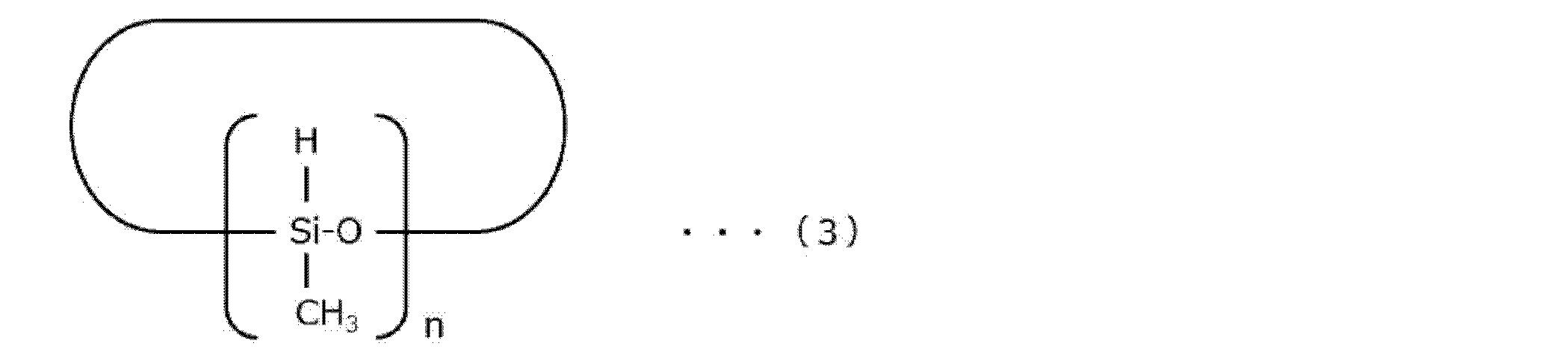
(式(3)中、nは3~6の整数である。)
特に、上記式(3)においてnが4の環状ハイドロジェンシロキサンオリゴマーが、窒化ホウ素粒子表面に均一な被膜を形成できる点で優れている。式(1)で示す構造を含む有機シリコーン化合物の質量平均分子量は、好ましくは100以上2000以下であり、より好ましくは150以上1000以下であり、さらに好ましくは180以上500以下の範囲である。この範囲の質量平均分子量の、式(1)で示す構造を含む有機シリコーン化合物を用いることで、窒化ホウ素粒子表面に薄くて均一な被膜を形成しやすいと推測される。なお、式(2)において、mは望ましくは0から6、より望ましくは0から3、最も望ましくは1である。
本明細書において、質量平均分子量は、ゲルパーミエーションクロマトグラフィー(GPC)を用いたポリスチレン換算質量平均分子量であり、具体的には、カラム(ショウデックス (登録商標)LF-804:昭和電工株式会社製)と示差屈折率検出器(ショウデックス(登録商標) RI-71S:昭和電工株式会社製)との組み合わせで測定することができる。
<第1工程>
第1工程では、上記窒化ホウ素粒子の表面を、上記式(1)で示される構造を含む有機シリコーン化合物により覆う。
第1工程では、上記窒化ホウ素粒子の表面を、上記式(1)で示される構造を含む有機シリコーン化合物により覆うことができれば、特に方法は限定されない。第1工程の方法としては、一般的な粉体混合装置を用いて、原料の窒化ホウ素粒子を攪拌しながら有機シリコーン化合物を噴霧などで添加して、乾式混合することで被覆する乾式混合法などが挙げられる。粉体混合装置としては、例えば、ヘンシェルミキサー(登録商標)、容器回転型のV型ブレンダー、ダブルコーン型ブレンダーなど、混合羽根を有するリボンブレンダー、スクリュー型ブレンダー、密閉型ロータリーキルン、マグネットカップリングを用いた密閉容器の攪拌子による攪拌などが挙げられる。この場合における温度条件は、式(1)で示される構造を含むシリコーン化合物の沸点、蒸気圧にもより、特に限定されないが、好ましい温度は10℃以上200℃以下であり、より好ましくは20℃以上150℃以下であり、さらに好ましくは40℃以上100℃以下の範囲である。
第1工程では、上記窒化ホウ素粒子の表面を、上記式(1)で示される構造を含む有機シリコーン化合物により覆う。
第1工程では、上記窒化ホウ素粒子の表面を、上記式(1)で示される構造を含む有機シリコーン化合物により覆うことができれば、特に方法は限定されない。第1工程の方法としては、一般的な粉体混合装置を用いて、原料の窒化ホウ素粒子を攪拌しながら有機シリコーン化合物を噴霧などで添加して、乾式混合することで被覆する乾式混合法などが挙げられる。粉体混合装置としては、例えば、ヘンシェルミキサー(登録商標)、容器回転型のV型ブレンダー、ダブルコーン型ブレンダーなど、混合羽根を有するリボンブレンダー、スクリュー型ブレンダー、密閉型ロータリーキルン、マグネットカップリングを用いた密閉容器の攪拌子による攪拌などが挙げられる。この場合における温度条件は、式(1)で示される構造を含むシリコーン化合物の沸点、蒸気圧にもより、特に限定されないが、好ましい温度は10℃以上200℃以下であり、より好ましくは20℃以上150℃以下であり、さらに好ましくは40℃以上100℃以下の範囲である。
また第1工程の方法として、式(1)で示される構造を含む有機シリコーン化合物の蒸気単独もしくは窒素ガスなどの不活性ガスとの混合ガスを、静置した窒化ホウ素粒子表面に付着または蒸着させる気相吸着法を用いることもできる。この場合の温度条件としては、式(1)で示される構造を含むシリコーン化合物の沸点、蒸気圧にもより、特に限定されないが、好ましい温度は10℃以上200℃以下であり、より好ましくは20℃以上150℃以下であり、さらに好ましくは40℃以上90℃以下の範囲である。温度条件として10℃以上200℃以下であれば、式(1)で示される構造を含む有機シリコーン化合物を窒化ホウ素粒子表面に効率的に付着させることができる。さらに必要な場合には、系内を加圧あるいは減圧させることもできる。この場合に使用できる装置としては、密閉系、かつ、系内の気体を容易に置換できる装置が好ましく、例えば、ガラス容器、デシケーター、CVD装置などを使用できる。窒化ホウ素粒子を攪拌せずに有機シリコーン化合物で被覆する場合の処理時間は、長めに取る必要がある。しかしながら、処理容器を間歇的にバイブレーター上に置くことで、粉体同士が接触して陰になっている場所や、上の空気層部から遠い粉体に対しても、位置を動かすことにより効率よく処理できる。
また、乾式混合法の説明の部分に粉体混合装置として例示したヘンシェルミキサー、容器回転型のVブレンダー、ダブルコーン型ブレンダーなど、混合羽根を有するリボンブレンダー、スクリュー型ブレンダー、密閉型ロータリーキルン、マグネットカップリングを用いた密閉容器やベルトコンベヤーを応用した多段式バンドドライヤーなどの設備の雰囲気に、気化させた有機シリコーン化合物を存在させることによっても気相法処理させることができる。
式(1)で示される構造を含む有機シリコーン化合物の第1工程での使用量は、特に限定されない。しかし、有機シリコーン化合物は高価であり、合理的な上限参考値は存在する。最終的に、式(1)で示される構造を含む有機シリコーン化合物由来の、前記シリカ被覆窒化ホウ素粒子表面のケイ素原子質量(質量ppm)をシリカ被覆前の窒化ホウ素粒子のBET比表面積(m2/g)で割った値、即ち、窒化ホウ素粒子の表面積1m2当たりのケイ素原子質量(μg)が50以上500以下(μg/m2)となること、より好ましくは60以上400以下(μg/m2)となること、さらに好ましくは70以上300(μg/m2)以下となることが望ましい。上記範囲内であれば、熱伝導性と耐湿性の両方に特に優れたシリカ被覆窒化ホウ素粒子が得られるものとなる。
なお、BET法から求める比表面積は、ガス流動法による窒素吸着BET1点法から測定することができる。評価装置としては、Mountech社製Macsorb HM model-1210を用いることができる。
<第2工程>
第2工程では、第1工程で得られた有機シリコーン化合物により覆われた窒化ホウ素粒子を、500℃以上1000℃以下の温度で加熱する。これにより、窒化ホウ素粒子表面にシリカ被膜を形成することができる。
第2工程では、第1工程で得られた有機シリコーン化合物により覆われた窒化ホウ素粒子を、500℃以上1000℃以下の温度で加熱することができれば、すなわち、第1工程で得られた有機シリコーン化合物により覆われた窒化ホウ素粒子を、500℃以上1000℃以下の温度範囲に保持できるものであれば、一般の加熱炉を使用することができる。
第2工程では、第1工程で得られた有機シリコーン化合物により覆われた窒化ホウ素粒子を、500℃以上1000℃以下の温度で加熱する。これにより、窒化ホウ素粒子表面にシリカ被膜を形成することができる。
第2工程では、第1工程で得られた有機シリコーン化合物により覆われた窒化ホウ素粒子を、500℃以上1000℃以下の温度で加熱することができれば、すなわち、第1工程で得られた有機シリコーン化合物により覆われた窒化ホウ素粒子を、500℃以上1000℃以下の温度範囲に保持できるものであれば、一般の加熱炉を使用することができる。
第2工程の熱処理では、熱処理の初期段階で窒化ホウ素粒子表面を被覆している式(1)で示される構造を含む有機シリコーン化合物が脱水素反応により、有機シリコーン化合物同士、または窒化ホウ素粒子表面の水酸基などと結合し、被覆がさらに強固になると考えられる。そして、熱処理の終期では、有機シリコーン化合物の有機基(炭素数4以下のアルキル基)が分解して揮散する。したがって、形成されるシリカ被膜は炭素原子の含有量が少なくなり、ひいては、シリカ被覆窒化ホウ素粒子の炭素原子の含有量も少なくなる。よって炭素原子の含有量が1000質量ppm以下のシリカ被覆窒化ホウ素粒子を得ることができる。シリカ被覆窒化ホウ素粒子の炭素原子の含有量が1000質量ppm以下であれば、耐湿性が良好であり、また、偏在した炭素粒子が絶縁性などへ影響を与えにくい。シリカ被覆窒化ホウ素粒子の炭素原子の含有量は、好ましくは700質量ppm以下であり、より好ましくは500質量ppm以下である。
なお、シリカ被覆とは、シリカ(SiO2)を主成分とする薄膜でコートされていることを意味する。ただし、コートされたシリカと窒化ホウ素粒子との界面には、複数の無機複合物が存在する可能性があるので、ToF-SIMS(Time of Flight Secondary Ion Mass Spectrometry:飛行時間二次イオン質量分析、ION-TOF社、TOF.SIMS5)で分析した場合には、二次イオン同士の再結合やイオン化の際の分解なども重なり、BSiO4イオン、SiNOイオンなどのセグメントが副成分として同時に検出される場合もある。このToF-SIMS分析で分析される複合セグメントも、窒化ホウ素をシリカ化した場合の部分検出物と定義することができる。目安としては、シリカの2次電子量が、その他のフラクションより多い状態であれば、シリカが主成分であると見なすことができる。
さらに精度を上げてシリカの純度を確認する実験として、窒化ホウ素多結晶基板上に同様の方法でシリカ被膜を形成させた試料表面を、光電子分光測定装置(XPS:X-ray Photoelectron Spectroscopy、アルバック・ファイ社、Quantera II)で測定し、検出されるSi由来の光電子の運動エネルギーがシリカの標準ピーク103.7eVとほぼ一致することから、ほとんどがSiO2構造になっていると推測される。なお、加熱温度によっては、有機成分が残るケースもありうる。本発明の効果を損なわない範囲であれば、有機シロキサン成分が混在することは十分ありうる。
炭素原子の含有量は、管状電気炉方式による非分散赤外吸収法を用いた炭素・硫黄分析装置などで測定できる。具体的には、炭素・硫黄分析装置(Carbon Anlyzer EMIA-821:株式会社堀場製作所製)を使用することにより測定することができる。
第2工程の加熱温度(熱処理温度)は、500℃以上1000℃以下である。この温度範囲で行うことで、耐湿性および熱伝導性の良好なシリカ被膜が形成される。具体的には、500℃以上で加熱すると、シリカ被膜が緻密化し水分を透過し難くなるためか、耐湿性が良好になる。また、1000℃以下で加熱すると熱伝導性が良好になる。また、加熱温度が、500℃以上1000℃以下であれば窒化ホウ素粒子の表面に均一にシリカ被膜が形成される。また、加熱温度が500℃以上であれば、シリカ被膜は絶縁性に優れたものになり、1000℃以下であれば、エネルギーコスト的にも有効である。加熱温度は、より好ましくは550℃以上であり、さらに好ましくは600℃以上である。また、空気など酸化雰囲気の場合は、上限は950℃以下が好ましく、さらに好ましくは900℃以下が好ましい。不活性雰囲気、もしくは還元性ガス雰囲気であれば、1000℃以下であれば問題ない。
加熱時間としては、30分以上20時間以下が好ましく、より好ましくは45分以上10時間以下であり、さらに好ましくは1時間以上8時間以下の範囲である。熱処理時間は、30分以上であれば有機シリコーン化合物の有機基(炭素数4以下のアルキル基)の分解物の残存がなく、窒化ホウ素粒子表面に炭素原子の含有量の非常に少ないシリカ被膜が得られる点で好ましい。また、加熱時間を20時間以下とすることが、シリカ被覆窒化ホウ素粒子を生産効率よく製造することができる点で好ましい。
第2工程の熱処理の雰囲気は、酸素ガスを含む雰囲気下、例えば大気中(空気中)で行ってもよいし、窒素などの不活性雰囲気、水素2%入り窒素など還元性ガス雰囲気であってもよい。
第2工程の熱処理後に、シリカ被覆窒化ホウ素粒子同士が、部分的に融着することがある。その場合には、これを解砕することで、固着・凝集のないシリカ被覆窒化ホウ素粒子を得ることができる。なお、解砕に使用する装置は、特に限定されるものではないが、ローラーミル、ハンマーミル、ジェットミル、ボールミルなどの一般的な粉砕機を使用することができる。
また、第2工程終了後に、さらに、第1工程および第2工程を順に行ってもよい。すなわち、第1工程および第2工程を順に行う工程を、繰り返し実行してもよい。
第1工程において気相吸着法により窒化ホウ素粒子の表面を有機シリコーン化合物により覆う場合、気相吸着法による被覆方法は、液体処理で行う被覆方法と比較して、均一で薄いシリカ被膜を形成することが可能である。したがって、第1工程および第2工程を順に行う工程を複数回、例えば2~5回程度繰り返しても、窒化ホウ素粒子の良好な熱伝導率を発揮させることができる。
一方、耐湿性に関しては、第1工程および第2工程を順に行う工程の回数と耐湿性との間には、正の相関が認められる。したがって、実際の用途で求められる耐湿性のレベルに応じて、第1工程および第2工程を順に行う工程の回数を自由に選択することができる。
上記本発明のシリカ被覆窒化ホウ素粒子の製造方法で得られた、シリカ被覆窒化ホウ素粒子は、窒化ホウ素粒子本来の高熱伝導性を維持し、かつ、耐湿性にも優れているため、電気・電子分野などで使用される放熱材料用途のフィラーとして広く適用できる。
<<シリカ被覆窒化ホウ素粒子>>
上記本発明のシリカ被覆窒化ホウ素粒子の製造方法によって、本発明のシリカ被覆窒化ホウ素粒子、すなわち、窒化ホウ素粒子と窒化ホウ素粒子の表面を覆うシリカ被膜とを備えるシリカ被覆窒化ホウ素粒子であって、炭素原子の含有量が1000質量ppm以下であるシリカ被覆窒化ホウ素粒子を得ることができる。
上記本発明のシリカ被覆窒化ホウ素粒子の製造方法によって、本発明のシリカ被覆窒化ホウ素粒子、すなわち、窒化ホウ素粒子と窒化ホウ素粒子の表面を覆うシリカ被膜とを備えるシリカ被覆窒化ホウ素粒子であって、炭素原子の含有量が1000質量ppm以下であるシリカ被覆窒化ホウ素粒子を得ることができる。
このような本発明のシリカ被覆窒化ホウ素粒子は、後述する実施例に示すように、窒化ホウ素粒子の高い熱伝導性を維持し、耐湿性に優れる。
例えば、本発明のシリカ被覆窒化ホウ素粒子は、pH4に調整した塩酸水溶液に投入し、85℃で2時間の処理(すなわち、シリカ被覆窒化ホウ素粒子を、pH4に調整した塩酸水溶液に85℃で2時間浸漬)したとき、塩酸水溶液中に抽出されたアンモニアの濃度が20mg/L以下とすることができ、極めて耐湿性に優れる。なお、酸性溶液中では加水分解反応が空気中よりも促進されるため、粒子をpH4に調整した塩酸水溶液に晒すことで、耐湿性の加速試験ができる。したがって、pH4の塩酸水溶液を用いることで、シリカ被覆窒化ホウ素粒子の耐湿性を評価することができ、上記アンモニアの濃度が20mg/L以下であれば、耐湿性が良いと言える。また、pH4の塩酸水溶液を用いることで合わせて耐薬品性の比較もできる。
例えば、本発明のシリカ被覆窒化ホウ素粒子は、pH4に調整した塩酸水溶液に投入し、85℃で2時間の処理(すなわち、シリカ被覆窒化ホウ素粒子を、pH4に調整した塩酸水溶液に85℃で2時間浸漬)したとき、塩酸水溶液中に抽出されたアンモニアの濃度が20mg/L以下とすることができ、極めて耐湿性に優れる。なお、酸性溶液中では加水分解反応が空気中よりも促進されるため、粒子をpH4に調整した塩酸水溶液に晒すことで、耐湿性の加速試験ができる。したがって、pH4の塩酸水溶液を用いることで、シリカ被覆窒化ホウ素粒子の耐湿性を評価することができ、上記アンモニアの濃度が20mg/L以下であれば、耐湿性が良いと言える。また、pH4の塩酸水溶液を用いることで合わせて耐薬品性の比較もできる。
上記抽出されたアンモニアの濃度は、10mg/L以下であることが好ましく、6mg/L以下であることがより好ましい。
耐湿性の観点から、炭素原子の含有量は低いほど好ましい。ここで、上記本発明のシリカ被覆窒化ホウ素粒子の製造方法では原料として式(1)で示される構造を有する有機シリコーン化合物を用いているため、シリカ被覆窒化ホウ素粒子は炭素原子を含有する場合が多く、例えば50質量ppm以上、さらには60質量ppm以上含む場合がある。しかしながら、上記のとおり1000質量ppm以下であれば耐湿性が優れる。
ケイ素原子の含有量は、誘導結合プラズマ(ICP)発光分光分析装置を用いて定量できる。具体的には、試料を炭酸ナトリウムとホウ酸とともに白金るつぼで加熱溶融させた後、濃硫酸/蒸留水=1/1(質量比)の硫酸に溶解させて測定に用いた。
また、窒化ホウ素粒子の表面積1m2当たりのケイ素原子質量(μg/m2)は、シリカ被覆窒化ホウ素粒子の全ケイ素原子含有量から原料である窒化ホウ素粒子のケイ素原子含有量のみを差し引いた被覆層由来のケイ素原子の含有量の値(質量ppm)を、原料である窒化ホウ素粒子のBET比表面積(m2/g)の値により割って算出される。その値は、50以上500以下(μg/m2)であることが好ましく、より好ましくは60以上400以下(μg/m2)であり、さらに好ましくは70以上300(μg/m2)以下である。50(μg/m2)以上にすることで十分な耐湿性が得られ、500(μg/m2)以下とすることで十分な熱伝導性が得られる。
<<放熱性樹脂組成物の製造方法>>
上記本発明のシリカ被覆窒化ホウ素粒子を用いて、放熱性樹脂組成物を製造することができる。すなわち、本発明の放熱性樹脂組成物の製造方法は、上記シリカ被覆窒化ホウ素粒子の製造方法によって製造されたシリカ被覆窒化ホウ素粒子と、樹脂とを混合する混合工程を備える。
上記本発明のシリカ被覆窒化ホウ素粒子を用いて、放熱性樹脂組成物を製造することができる。すなわち、本発明の放熱性樹脂組成物の製造方法は、上記シリカ被覆窒化ホウ素粒子の製造方法によって製造されたシリカ被覆窒化ホウ素粒子と、樹脂とを混合する混合工程を備える。
上記シリカ被覆窒化ホウ素粒子の製造方法によって製造されたシリカ被覆窒化ホウ素粒子は、窒化ホウ素粒子の高い熱伝導性を維持し、耐湿性が向上するため、本発明の放熱性樹脂組成物の製造方法で得られる放熱性樹脂組成物は、耐湿性および熱伝導性に優れる。
混合工程では、上記シリカ被覆窒化ホウ素粒子の製造方法によって製造されたシリカ被覆窒化ホウ素粒子と、樹脂とを混合する。
混合工程で混合する樹脂は、特に限定されないが、熱硬化性樹脂、熱可塑性樹脂または熱硬化性樹脂と熱可塑性樹脂の混合物であることが、得られる放熱性樹脂組成物が耐熱性に優れる点で好ましい。熱硬化性樹脂としては、例えば、シリコーン樹脂、エポキシ樹脂、フェノール樹脂、ビスマレイミド樹脂、シアネート樹脂、ウレタン樹脂、(メタ)アクリル系樹脂、ビニルエステル樹脂、不飽和ポリエステル樹脂、ポリビニールアルコールアセタール樹脂などが挙げられ、単独または二種類以上を混ぜ合わせて使用することができる。さらに、熱硬化性樹脂に硬化剤や、硬化促進剤を加えた混合物を使用してもよい。特に、硬化後の耐熱性、接着性、電気特性の良い点でエポキシ樹脂が好ましく、柔軟密着性を重視する用途ではシリコーン樹脂が好ましい。
なお、シリコーン樹脂には、付加反応硬化型シリコーン樹脂、縮合反応硬化型シリコーン樹脂、有機過酸化物硬化型シリコーン樹脂などがあり、単独または粘度の異なる2種類以上を組み合わせても使用することができる。特に、得られる放熱性樹脂組成物が柔軟密着性を重視する用途において使用される場合には、シリコーン樹脂として、例えば、気泡などの原因物質となり得る副生成物の生成がない付加反応硬化型液状シリコーン樹脂が挙げられ、ベースポリマーであるアルケニル基を有するオルガノポリシロキサンと架橋剤であるSi-H基を有するオルガノポリシロキサンとを硬化剤の存在下で、常温または加熱により反応させることでシリコーン樹脂硬化物を得ることができる。なお、ベースポリマーであるオルガノポリシロキサンの具体例としては、例えば、アルケニル基として、ビニル基、アリル基、プロペニル基、ヘキセニル基などを有するものがある。特に、ビニル基は、オルガノポリシロキサンとして好ましい。また、硬化触媒は、例えば、白金金属系の硬化触媒を用いることができ、目的とする樹脂硬化物の硬さを実現するため、添加量を調整して使用することもできる。
エポキシ樹脂としては、ビスフェノールA型エポキシ樹脂、ビスフェノールF型エポキシ樹脂、ビスフェノールS型エポキシ樹脂、水添ビスフェノールA型エポキシ樹脂、ビフェニル型エポキシ樹脂などの2官能グルシジルエーテル型エポキシ樹脂、ヘキサヒドロフタル酸グリシジルエステル、ダイマー酸グリシジルエステルなどのグルシジルエステル型エポキシ樹脂、エポキシ化ポリブタジエン、およびエポキシ化大豆油などの線状脂肪族エポキシ樹脂、トリグリシジルイソシアヌレートなどの複素環型エポキシ樹脂、N,N,N’,N’-テトラグリシジル-4,4’-ジアミノジフェニルメタン、N,N,N’,N’-テトラグリシジル-1,3-ベンゼンジ(メタンアミン)、4-(グリシジロキシ)-N,N-ジグリシジルアニリン、3-(グリシジロキシ)-N,N-ジグリシジルアニリンなどのグルシジルアミン型エポキシ樹脂、フェノールノボラック型エポキシ樹脂、クレゾールノボラック型エポキシ樹脂、ビフェニルアラルキル型エポキシ樹脂、ナフタレンアラルキル型エポキシ樹脂、4官能ナフタレン型エポキシ樹脂、トリフェニルメタン型エポキシ樹脂などの多官能グリシジルエーテル型エポキシ樹脂などが挙げられる。上述したエポキシ樹脂は、単独でまたは二種類以上を混合して使用することができる。
上述したエポキシ樹脂を使用した場合には、硬化剤、硬化促進剤を配合していてもよい。硬化剤としては、例えば、メチルテトラヒドロ無水フタル酸、メチルヘキサヒドロ無水フタル酸および無水ハイミック酸などの脂環式酸無水物、ドデセニル無水コハク酸などの脂肪族酸無水物、無水フタル酸および無水トリメリット酸などの芳香族酸無水物、ビスフェノールA、ビスフェノールF、ビスフェノールSなどのビスフェノール類、フェノール・ホルムアルデヒド樹脂、フェノール・アラルキル樹脂、ナフトール・アラルキル樹脂、フェノール-ジシクロペンタジエン共重合体樹脂などのフェノール樹脂類、ジシアンジアミドおよびアジピン酸ジヒドラジドなどの有機ジヒドラジドが挙げられ、硬化触媒としては、例えば、トリス(ジメチルアミノメチル)フェノール、ジメチルベンジルアミン、1,8-ジアザビシクロ(5,4,0)ウンデセンおよびその誘導体などのアミン類、2-メチルイミダゾール、2-エチル-4-メチルイミダゾールおよび2-フェニルイミダゾールなどのイミダゾール類およびその誘導体が挙げられる。これらは、単独または二種類以上を組み合わせて用いることができる。
混合工程では、上記シリカ被覆窒化ホウ素粒子以外に通常使用されるアルミナ、シリカ、窒化アルミニウム、酸化亜鉛などのフィラーを併用してもよい。
混合工程において、上記シリカ被覆窒化ホウ素粒子や上記シリカ被覆窒化ホウ素粒子以外のフィラーは、所望の放熱性樹脂組成物になる量を混合すればよい。
得られる放熱性樹脂組成物における上記シリカ被覆窒化ホウ素粒子および上記シリカ被覆窒化ホウ素粒子以外のフィラーの総含有量は、50体積%以上95体積%以下が好ましく、より好ましくは60体積%以上90体積%以下であり、さらに好ましくは70体積%以上90体積%以下の範囲である。総含有量が、50体積%以上であれば良好な放熱性を発揮でき、95体積%以下であれば放熱性樹脂組成物の使用時に良好な作業性が得られる。
得られる放熱性樹脂組成物における上記シリカ被覆窒化ホウ素粒子および上記シリカ被覆窒化ホウ素粒子以外のフィラーの総含有量は、50体積%以上95体積%以下が好ましく、より好ましくは60体積%以上90体積%以下であり、さらに好ましくは70体積%以上90体積%以下の範囲である。総含有量が、50体積%以上であれば良好な放熱性を発揮でき、95体積%以下であれば放熱性樹脂組成物の使用時に良好な作業性が得られる。
また、得られる放熱性樹脂組成物におけるシリカ被覆窒化ホウ素粒子の含有量は、上記シリカ被覆窒化ホウ素粒子および上記シリカ被覆窒化ホウ素粒子以外のフィラーの総含有量の30体積%以上100体積%以下が好ましく、より好ましくは40体積%以上100体積%以下であり、さらに好ましくは50体積%以上100体積%以下の範囲である。総含有量は、30体積%以上で良好な放熱性を発揮できる。
混合工程では、さらに、必要に応じてシリコーン、ウレタンアクリレート、ブチラール樹脂、アクリルゴム、ジエン系ゴムおよびその共重合体などの可撓性付与剤、シラン系カップリング剤、チタン系カップリング剤、無機イオン補足剤、顔料、染料、希釈剤、溶剤などを適宜添加することができる。
混合工程における混合方法は、特に限定されず、例えばシリカ被覆窒化ホウ素粒子、樹脂、その他添加剤などを、一括または分割して、らいかい器、プラネタリーミキサー、自転・公転ミキサー、ニーダー、ロールミルなどの分散・溶解装置を単独または適宜組み合わせ、必要に応じて加熱して混合、溶解、混練する方法が挙げられる。
また、得られた放熱性樹脂組成物は、シート状に成形、必要に応じて反応させて、放熱シートとすることもできる。上述した放熱性樹脂組成物および放熱シートは、半導体パワーデバイス、パワーモジュールなどの接着用途などに好適に使用することができる。
放熱シートの製造方法としては、基材フィルムで両面を挟む形で放熱性樹脂組成物を圧縮プレスなどで成形する方法、基材フィルム上に放熱性樹脂組成物をバーコーター、スクリーン印刷、ブレードコーター、ダイコーター、コンマコーターなどの装置を用いて塗布する方法などが挙げられる。さらに、成形・塗布後の放熱シートは、溶剤を除去する工程、加熱などによるBステージ化、完全硬化などの処理工程を追加することもできる。上述したように、工程により様々な形態の放熱シートを得ることができ、対象となる用途分野、使用方法に広く対応することが可能となる。
放熱性樹脂組成物を基材フィルム上に塗布または形成する際に、作業性をよくするために溶剤を用いることができる。溶剤としては、特に限定するものではないが、ケトン系溶剤のアセトン、メチルエチルケトン、メチルイソブチルケトン、シクロペンタノン、シクロヘキサノン、エーテル系溶剤の1,4-ジオキサン、テトラヒドロフラン、ジグライム、グリコールエーテル系溶剤のメチルセロソルブ、エチルセロソルブ、プロピレングリコールモノメチルエーテル、プロピレングリコールモノエチルエーテル、プロピレングリコールモノブチルエーテル、プロピレングリコールモノメチルエーテルアセテート、プロピレングリコールモノエチルエーテルアセテート、ジエチレングリコールメチルエチルエーテル、その他ベンジルアルコール、N-メチルピロリドン、γ-ブチロラクトン、酢酸エチル、N,N-ジメチルホルムアミドなどを単独あるいは二種類以上混合して使用することができる。
放熱性樹脂組成物をシート状に形成するためには、シート形状を保持するシート形成性が必要になる。シート形成性を得るために、放熱性樹脂組成物に、高分子量成分を添加することができる。例えば、フェノキシ樹脂、ポリイミド樹脂、ポリアミド樹脂、ポリカルボジイミド樹脂、シアネートエステル樹脂、(メタ)アクリル樹脂、ポリエステル樹脂、ポリエチレン樹脂、ポリエーテルスルホン樹脂、ポリエーテルイミド樹脂、ポリビニルアセタール樹脂、ウレタン樹脂、アクリルゴム等が挙げられ、その中でも、耐熱性およびフィルム形成性に優れる観点から、フェノキシ樹脂、ポリイミド樹脂、(メタ)アクリル樹脂、アクリルゴム、シアネートエステル樹脂、ポリカルボジイミド樹脂などが好ましく、フェノキシ樹脂、ポリイミド樹脂、(メタ)アクリル樹脂、アクリルゴムがより好ましい。それらは、単独または二種類以上の混合物、共重合体として使用することができる。
高分子量成分の分子量は、10000質量平均分子量以上100000の質量平均分子量以下が好ましく、さらに好ましくは20000質量平均分子量50000質量平均分子量以下の範囲である。
なお、取扱い性のよい良好なシート形状は、上述したような範囲の質量平均分子量成分を添加することで、保持することができる。
高分子量成分の添加量は、特に限定されないが、シート性状を保持するためには、放熱性樹脂組成物に対し、0.1質量%以上20質量%以下であることが好ましく、より好ましくは1質量%以上15質量%以下であり、さらに好ましくは2質量%以上10質量%以下の範囲である。なお、0.1質量%以上20質量%以下の添加量で、取り扱い性もよく、良好なシート、膜の形成が図られる。
放熱シートの製造時に使用する基材フィルムは、製造時の加熱、乾燥などの工程条件に耐えるものであれば、特に限定するものではなく、例えば、ポリエチレンテレフタレート(PET)、ポリブチレンテレフタレート(PBT)などの芳香環を有するポリエステルからなるフィルム、ポリプロピレンフィルム、ポリイミドフィルム、ポリエーテルイミドフィルムなどが挙げられる。上述したフィルムは、二種類以上を組み合わせた多層フィルムであってもよく、表面がシリコーン系などの離型剤処理されたものであってもよい。なお、基材フィルムの厚さは、10μm以上100μm以下が好ましい。
基材フィルム上に形成された放熱シートの厚さは、20μm以上500μm以下が好ましく、さらに好ましくは50μm以上200μm以下である。放熱シートの厚さは、20μm以上では均一な組成の放熱シートを得ることができ、500μm以下では良好な放熱性を得ることができる。
以下、実施例および比較例を挙げて本発明を具体的に説明するが、本発明の範囲はこれらの実施例により何ら限定されるものではない。
[シリカ被覆窒化ホウ素粒子の炭素原子の含有量の測定]
シリカ被覆窒化ホウ素粒子の炭素原子の含有量は、管状電気炉方式による非分散赤外吸収法を用いた炭素・硫黄分析装置(Carbon Anlyzer EMIA-821:株式会社堀場製作所製)により測定した。
シリカ被覆窒化ホウ素粒子の炭素原子の含有量は、管状電気炉方式による非分散赤外吸収法を用いた炭素・硫黄分析装置(Carbon Anlyzer EMIA-821:株式会社堀場製作所製)により測定した。
[シリカ被覆窒化ホウ素粒子のケイ素原子の含有量の測定]
シリカ被覆窒化ホウ素粒子のケイ素原子の含有量は、以下の手順で測定した。
(1)50cc容のテフロン(登録商標)製容器に、30cc容の白金坩堝を入れた。
(2)白金坩堝に98質量%の硫酸(超特級、和光純薬製)とイオン交換水とを2:1(体積比)で混合した溶液10ccと、サンプル(シリカ被覆窒化ホウ素粒子)0.5gとを投入した。
(3)テフロン(登録商標)容器ごとステンレス鋼製の耐圧容器に入れ、230℃で15時間維持し、投入したサンプルを溶解させた。
(4)(1)で混合した溶液を取り出し、ICP(島津製作所製、ICPS-7510)を用いて測定したケイ素原子の濃度から、シリカ被覆窒化ホウ素粒子1gあたりのケイ素
原子の含有量(μg)を算出し、得られた値を質量ppmで表した。
なお、原料窒化ホウ素のケイ素含有量も同様にして測定することができる。
シリカ被覆窒化ホウ素粒子のケイ素原子の含有量は、以下の手順で測定した。
(1)50cc容のテフロン(登録商標)製容器に、30cc容の白金坩堝を入れた。
(2)白金坩堝に98質量%の硫酸(超特級、和光純薬製)とイオン交換水とを2:1(体積比)で混合した溶液10ccと、サンプル(シリカ被覆窒化ホウ素粒子)0.5gとを投入した。
(3)テフロン(登録商標)容器ごとステンレス鋼製の耐圧容器に入れ、230℃で15時間維持し、投入したサンプルを溶解させた。
(4)(1)で混合した溶液を取り出し、ICP(島津製作所製、ICPS-7510)を用いて測定したケイ素原子の濃度から、シリカ被覆窒化ホウ素粒子1gあたりのケイ素
原子の含有量(μg)を算出し、得られた値を質量ppmで表した。
なお、原料窒化ホウ素のケイ素含有量も同様にして測定することができる。
[窒化ホウ素粒子のBET法から求めた比表面積の測定]
窒化ホウ素粒子のBET法から求めた比表面積は、Mountech社製Macsorb HM model-1210を用いて測定した。なお、吸着ガスとして、He70体積%とN230体積%の混合ガスを用いた。
窒化ホウ素粒子のBET法から求めた比表面積は、Mountech社製Macsorb HM model-1210を用いて測定した。なお、吸着ガスとして、He70体積%とN230体積%の混合ガスを用いた。
[窒化ホウ素粒子の表面積1m2当たりのケイ素原子質量]
上記により得られたシリカ被覆窒化ホウ素粒子の全ケイ素原子含有量から原料である窒化ホウ素粒子のケイ素原子含有量を差し引いた被覆層由来のケイ素原子の含有量の値(質量ppm:μg/g)を、上記により得られた、原料である窒化ホウ素粒子のBET比表面積(m2/g)の値により割って、窒化ホウ素粒子の表面積1m2当たりのケイ素原子質量(μg/m2)を算出した。算出した窒化ホウ素粒子の表面積1m2当たりのケイ素原子質量を、表の「表面積当たりのケイ素原子質量」欄に記載する。
上記により得られたシリカ被覆窒化ホウ素粒子の全ケイ素原子含有量から原料である窒化ホウ素粒子のケイ素原子含有量を差し引いた被覆層由来のケイ素原子の含有量の値(質量ppm:μg/g)を、上記により得られた、原料である窒化ホウ素粒子のBET比表面積(m2/g)の値により割って、窒化ホウ素粒子の表面積1m2当たりのケイ素原子質量(μg/m2)を算出した。算出した窒化ホウ素粒子の表面積1m2当たりのケイ素原子質量を、表の「表面積当たりのケイ素原子質量」欄に記載する。
[シリカ被覆窒化ホウ素粒子の耐湿性の評価]
シリカ被覆窒化ホウ素粒子の耐湿性は、50mlのサンプル管にpH4に調整した塩酸水溶液を17gとシリカ被覆窒化ホウ素粒子3gとを投入して密封した後、振とう式恒温槽で85℃、80rpm、2時間の条件で振とうし、静置後、室温(25℃)まで冷却し、上澄み液中のアンモニア濃度を、25℃の温度条件で株式会社堀場製作所製 LAQUAを用いて測定した。
シリカ被覆窒化ホウ素粒子の耐湿性は、50mlのサンプル管にpH4に調整した塩酸水溶液を17gとシリカ被覆窒化ホウ素粒子3gとを投入して密封した後、振とう式恒温槽で85℃、80rpm、2時間の条件で振とうし、静置後、室温(25℃)まで冷却し、上澄み液中のアンモニア濃度を、25℃の温度条件で株式会社堀場製作所製 LAQUAを用いて測定した。
[樹脂シート(放熱シート)の熱伝導率の測定]
(1)レーザーフラッシュ法を用いたエポキシ樹脂シートの熱伝導率の測定
25℃にて、レーザーフラッシュ法熱拡散率測定装置(LFA447 NanoFlash:NETZSCH社製)により樹脂シートの熱拡散率を測定した。
(1)レーザーフラッシュ法を用いたエポキシ樹脂シートの熱伝導率の測定
25℃にて、レーザーフラッシュ法熱拡散率測定装置(LFA447 NanoFlash:NETZSCH社製)により樹脂シートの熱拡散率を測定した。
熱拡散率測定用のサンプルは、樹脂シートを10mm×10mmのサイズに切り出し厚みを測定した後に、アルキメデス法により10mm角のサンプルの比重を測定した。比熱は樹脂と使用したフィラーの体積分率により計算される値を使用した。
同装置で得られるのは熱拡散率であるため、
熱伝導率=熱拡散率×比重(密度)×比熱
の計算式を用いて熱伝導率を得た。
測定に供する樹脂シートは、イオンコーター(IB-3:株式会社エイコー製)を用いて両面に金コーティングを施した後、さらに両面をグラファイトコーティングしたものを使用した。
同装置で得られるのは熱拡散率であるため、
熱伝導率=熱拡散率×比重(密度)×比熱
の計算式を用いて熱伝導率を得た。
測定に供する樹脂シートは、イオンコーター(IB-3:株式会社エイコー製)を用いて両面に金コーティングを施した後、さらに両面をグラファイトコーティングしたものを使用した。
(2) ホットディスク法を用いたシリコーン樹脂硬化物の熱伝導率測定
後述する方法で作製したペレットを用い、京都電子工業株式会社製のホットディスク放熱物性測定装置 TPS 2500(以下、ホットディスク)にて測定を行った。
比熱容量は樹脂と使用したフィラー体積分率により計算される値を使用した。
測定端子の中心部をペレット二点で挟み込み固定する。出力電力0.3W、測定時間5s、計算した比熱容量を入力の上、測定を実施し、熱伝導率を得た。
後述する方法で作製したペレットを用い、京都電子工業株式会社製のホットディスク放熱物性測定装置 TPS 2500(以下、ホットディスク)にて測定を行った。
比熱容量は樹脂と使用したフィラー体積分率により計算される値を使用した。
測定端子の中心部をペレット二点で挟み込み固定する。出力電力0.3W、測定時間5s、計算した比熱容量を入力の上、測定を実施し、熱伝導率を得た。
[接着性(90°ピール強度)試験の測定]
接着性は株式会社イマダ製のデジタルフォースゲージ/計測スタンド ZTS-5Nを用い、90°ピール強度にて評価した。
試験用のサンプルの作製は、後述するエポキシ樹脂シートの作製法に準じた。両面を厚み35μmの銅箔の処理面側へ接着・硬化し、幅1.5cmの短冊形に加工した。そのうちの片面だけを適当な厚みの板に両面テープで固定して測定に使用した。固定面と反対側の面の銅箔を短冊幅1.5cmのうち中央1cmを残して両端を剥離し、残した1cm幅の銅箔を使用し、所定の治具を使用して剥離速度200mm/分で90°ピール強度試験を行って剥離強度(kN/mm)を求めた。
基本的な測定法はJIS C 6481:1996プリント配線板用張積層板試験方法の内、引きはがし強さに準拠して行った。
接着性は株式会社イマダ製のデジタルフォースゲージ/計測スタンド ZTS-5Nを用い、90°ピール強度にて評価した。
試験用のサンプルの作製は、後述するエポキシ樹脂シートの作製法に準じた。両面を厚み35μmの銅箔の処理面側へ接着・硬化し、幅1.5cmの短冊形に加工した。そのうちの片面だけを適当な厚みの板に両面テープで固定して測定に使用した。固定面と反対側の面の銅箔を短冊幅1.5cmのうち中央1cmを残して両端を剥離し、残した1cm幅の銅箔を使用し、所定の治具を使用して剥離速度200mm/分で90°ピール強度試験を行って剥離強度(kN/mm)を求めた。
基本的な測定法はJIS C 6481:1996プリント配線板用張積層板試験方法の内、引きはがし強さに準拠して行った。
[粒子の作製]
(窒化ホウ素フィラー)
窒化ホウ素フィラー(窒化ホウ素粒子)としては、以下のものを使用した。
A:鱗片状ホウ素、ショウビーエヌ(登録商標)UHP-2 (昭和電工株式会社製)、体積基準メディアン径(d50) 11μm、ケイ素含有量 143質量ppm
B:鱗片状ホウ素、ショウビーエヌ(登録商標)UHP-1K (昭和電工株式会社製)、体積基準メディアン径(d50) 8μm、ケイ素含有量 232質量ppm
C:鱗片状ホウ素、ショウビーエヌ(登録商標)UHP-S2 (昭和電工株式会社製)、体積基準メディアン径(d50) 0.5μm、ケイ素含有量 557質量ppm
D:凝集状ホウ素、ショウビーエヌ(登録商標)UHP-G1H (昭和電工株式会社製)、体積基準メディアン径(d50) 15μm、ケイ素含有量 251質量ppm
(窒化ホウ素フィラー)
窒化ホウ素フィラー(窒化ホウ素粒子)としては、以下のものを使用した。
A:鱗片状ホウ素、ショウビーエヌ(登録商標)UHP-2 (昭和電工株式会社製)、体積基準メディアン径(d50) 11μm、ケイ素含有量 143質量ppm
B:鱗片状ホウ素、ショウビーエヌ(登録商標)UHP-1K (昭和電工株式会社製)、体積基準メディアン径(d50) 8μm、ケイ素含有量 232質量ppm
C:鱗片状ホウ素、ショウビーエヌ(登録商標)UHP-S2 (昭和電工株式会社製)、体積基準メディアン径(d50) 0.5μm、ケイ素含有量 557質量ppm
D:凝集状ホウ素、ショウビーエヌ(登録商標)UHP-G1H (昭和電工株式会社製)、体積基準メディアン径(d50) 15μm、ケイ素含有量 251質量ppm
(シランカップリング剤による表面処理)
使用する窒化ホウ素粒子として、シランカップリング剤により事前表面処理を行ったもの、またシリカ被覆窒化ホウ素粒子とした後にシランカップリング剤により後添加処理を行ったものを別途調製した。使用するシランカップリング剤としては、エポキシ系樹脂との組成物作製時にはエポキシ系シランカップリング剤(信越化学社製 KBM-403)を、シリコーン樹脂との組成物作製時にはアルキルアルコキシシラン(ダウ・東レ株式会社製 Z-6210Silane)を用いて処理を行った。
処理方法は、処理を行うフィラー100質量部に対し、シランカップリング剤0.5質量部を添加し、自公転ミキサーにて2000rpmで、30secの攪拌を行った。これをトレイに空けて120℃30分の加熱を行い、事前表面処理フィラーを得た。また、シランカップリング剤を予め樹脂に添加しておくインテグラルブレンド法の場合、樹脂組成物作製時にそれぞれのシランカップリング剤を樹脂中にフィラー100質量部に対して0.5質量部となる量を予め添加した。
使用する窒化ホウ素粒子として、シランカップリング剤により事前表面処理を行ったもの、またシリカ被覆窒化ホウ素粒子とした後にシランカップリング剤により後添加処理を行ったものを別途調製した。使用するシランカップリング剤としては、エポキシ系樹脂との組成物作製時にはエポキシ系シランカップリング剤(信越化学社製 KBM-403)を、シリコーン樹脂との組成物作製時にはアルキルアルコキシシラン(ダウ・東レ株式会社製 Z-6210Silane)を用いて処理を行った。
処理方法は、処理を行うフィラー100質量部に対し、シランカップリング剤0.5質量部を添加し、自公転ミキサーにて2000rpmで、30secの攪拌を行った。これをトレイに空けて120℃30分の加熱を行い、事前表面処理フィラーを得た。また、シランカップリング剤を予め樹脂に添加しておくインテグラルブレンド法の場合、樹脂組成物作製時にそれぞれのシランカップリング剤を樹脂中にフィラー100質量部に対して0.5質量部となる量を予め添加した。
(シリカ被覆窒化ホウ素粒子の製造)
(実施例1)
第1工程は、板厚20mmのアクリル樹脂製で内寸法が260mm×260mm×100mmであり、貫通孔を有する仕切りで上下二段に分けられた構造の真空デシケーターを使用して、窒化ホウ素粒子の表面被覆を行った。真空デシケーターの上段に、窒化ホウ素粒子A 約30gをステンレストレーに均一に広げて静置した。次に、真空デシケーターの下段には、式(3)においてn=4である有機シリコーン化合物-A(環状メチルハイドロジェンシロキサン4量体:東京化成工業社製)を10g、ガラス製シャーレに入れて静置した。その後、真空デシケーターを閉じ、80℃のオーブンで30時間の加熱を行った。なお、反応により発生する水素ガスは、真空デシケーターに付随する開放弁から逃がすなどの安全対策を取って操作を行った。第1工程を終了した後、デシケーターから取り出したサンプルをアルミナ製のるつぼに入れ、大気中で、サンプルを650℃、1.5時間の条件で第2工程の熱処理を行うことでシリカ被覆窒化ホウ素粒子を得た。
(実施例1)
第1工程は、板厚20mmのアクリル樹脂製で内寸法が260mm×260mm×100mmであり、貫通孔を有する仕切りで上下二段に分けられた構造の真空デシケーターを使用して、窒化ホウ素粒子の表面被覆を行った。真空デシケーターの上段に、窒化ホウ素粒子A 約30gをステンレストレーに均一に広げて静置した。次に、真空デシケーターの下段には、式(3)においてn=4である有機シリコーン化合物-A(環状メチルハイドロジェンシロキサン4量体:東京化成工業社製)を10g、ガラス製シャーレに入れて静置した。その後、真空デシケーターを閉じ、80℃のオーブンで30時間の加熱を行った。なお、反応により発生する水素ガスは、真空デシケーターに付随する開放弁から逃がすなどの安全対策を取って操作を行った。第1工程を終了した後、デシケーターから取り出したサンプルをアルミナ製のるつぼに入れ、大気中で、サンプルを650℃、1.5時間の条件で第2工程の熱処理を行うことでシリカ被覆窒化ホウ素粒子を得た。
(実施例2)
実施例1において、80℃のオーブンでの加熱処理時間を30分とする以外は実施例と同様にして、窒化ホウ素粒子の表面被覆を行って、シリカ被覆窒化ホウ素粒子を得た。
実施例1において、80℃のオーブンでの加熱処理時間を30分とする以外は実施例と同様にして、窒化ホウ素粒子の表面被覆を行って、シリカ被覆窒化ホウ素粒子を得た。
(参考例1)
実施例1において、有機シリコーン化合物-Aによる表面処理を、気相法ではなく液添加法で実施した。自公転ミキサー(あわとり練太郎ARE-310)用の150ml容の樹脂製容器に、窒化ホウ素粒子A 30gと有機シリコーン化合物-A 2.5gを加えたのち、自公転ミキサー2000rpmで1分混合させた後、薬さじで混合し、さらに2000rpmで1分混合した。取り出した内容物を、アルミナ製のるつぼに移し、実施例1と同条件で焼成してシリカ被覆窒化ホウ素粒子を得た。
実施例1において、有機シリコーン化合物-Aによる表面処理を、気相法ではなく液添加法で実施した。自公転ミキサー(あわとり練太郎ARE-310)用の150ml容の樹脂製容器に、窒化ホウ素粒子A 30gと有機シリコーン化合物-A 2.5gを加えたのち、自公転ミキサー2000rpmで1分混合させた後、薬さじで混合し、さらに2000rpmで1分混合した。取り出した内容物を、アルミナ製のるつぼに移し、実施例1と同条件で焼成してシリカ被覆窒化ホウ素粒子を得た。
(実施例3)
実施例1により得られたシリカ被覆窒化ホウ素粒子に対して、上記した手法によりシランカップリング剤による表面処理を行って、シランカップリング剤後添加のシリカ被覆窒化ホウ素粒子を得た。
実施例1により得られたシリカ被覆窒化ホウ素粒子に対して、上記した手法によりシランカップリング剤による表面処理を行って、シランカップリング剤後添加のシリカ被覆窒化ホウ素粒子を得た。
(実施例4)
実施例1の原料に用いた窒化ホウ素粒子Aを、上記した手法によりシランカップリング剤による事前表面処理を行った窒化ホウ素粒子Aに置換えた以外は、実施例1と同様に作製した。
実施例1の原料に用いた窒化ホウ素粒子Aを、上記した手法によりシランカップリング剤による事前表面処理を行った窒化ホウ素粒子Aに置換えた以外は、実施例1と同様に作製した。
(実施例5)
実施例1の原料に用いた窒化ホウ素粒子Aを、窒化ホウ素粒子Bに置換えた以外は、実施例1と同様に作製した。
実施例1の原料に用いた窒化ホウ素粒子Aを、窒化ホウ素粒子Bに置換えた以外は、実施例1と同様に作製した。
(実施例6)
実施例1の原料に用いた窒化ホウ素粒子Aを、窒化ホウ素粒子Cに置換えた以外は、実施例1と同様に作製した。
実施例1の原料に用いた窒化ホウ素粒子Aを、窒化ホウ素粒子Cに置換えた以外は、実施例1と同様に作製した。
(実施例7)
実施例1の原料に用いた窒化ホウ素粒子Aを、窒化ホウ素粒子Dに置換えた以外は、実施例1と同様に作製した。
実施例1の原料に用いた窒化ホウ素粒子Aを、窒化ホウ素粒子Dに置換えた以外は、実施例1と同様に作製した。
(実施例8)
実施例1において、第2工程での650℃、1.5時間の熱処理条件を800℃で3時間の条件に変更した以外は実施例1と同様にして、窒化ホウ素粒子の表面被覆を行って、シリカ被覆窒化ホウ素粒子を得た。
実施例1において、第2工程での650℃、1.5時間の熱処理条件を800℃で3時間の条件に変更した以外は実施例1と同様にして、窒化ホウ素粒子の表面被覆を行って、シリカ被覆窒化ホウ素粒子を得た。
(実施例9)
実施例6において、第2工程での熱処理温度を600℃から800℃に変更した以外は実施例1と同様にして、窒化ホウ素粒子の表面被覆を行って、シリカ被覆窒化ホウ素粒子を得た。
実施例6において、第2工程での熱処理温度を600℃から800℃に変更した以外は実施例1と同様にして、窒化ホウ素粒子の表面被覆を行って、シリカ被覆窒化ホウ素粒子を得た。
(比較例1)
実施例1に原料として用いた窒化ホウ素粒子Aであり、実施例1の全ての工程を経ていない未処理品を、比較例1の粒子とした。
実施例1に原料として用いた窒化ホウ素粒子Aであり、実施例1の全ての工程を経ていない未処理品を、比較例1の粒子とした。
(比較例2)
実施例1に原料として用いた窒化ホウ素粒子Aに表面処理をしないまま、組成物特性評価用のシート作製時に、所定量のシランカップリング剤を添加したエポキシ樹脂を用いてシート作製し(インテグラルブレンド法)、比較例2の諸特性の測定に用いた。
実施例1に原料として用いた窒化ホウ素粒子Aに表面処理をしないまま、組成物特性評価用のシート作製時に、所定量のシランカップリング剤を添加したエポキシ樹脂を用いてシート作製し(インテグラルブレンド法)、比較例2の諸特性の測定に用いた。
(比較例3)
実施例1に原料として用いた窒化ホウ素粒子Aに対し、所定の処方でシランカップリング処理したものを、比較例3の粒子とした。
実施例1に原料として用いた窒化ホウ素粒子Aに対し、所定の処方でシランカップリング処理したものを、比較例3の粒子とした。
(比較例4)
実施例5に原料として用いた窒化ホウ素粒子Bであり、実施例5の全ての工程を経ていない未処理品を、比較例4の粒子とした。
実施例5に原料として用いた窒化ホウ素粒子Bであり、実施例5の全ての工程を経ていない未処理品を、比較例4の粒子とした。
(比較例5)
実施例6に原料として用いた窒化ホウ素粒子Cであり、実施例6の全ての工程を経ていない未処理品を、比較例5の粒子とした。
実施例6に原料として用いた窒化ホウ素粒子Cであり、実施例6の全ての工程を経ていない未処理品を、比較例5の粒子とした。
(比較例6)
実施例7に原料として用いた窒化ホウ素粒子Dであり、実施例6の全ての工程を経ていない未処理品を、比較例6の粒子とした。
実施例7に原料として用いた窒化ホウ素粒子Dであり、実施例6の全ての工程を経ていない未処理品を、比較例6の粒子とした。
(実施例10~11および比較例7~8)
実施例10は、実施例1のシリカ被覆窒化ホウ素粒子と同様な粒子を、実施例11は、実施例3のシランカップリング剤後添加のシリカ被覆窒化ホウ素粒子と同様な粒子を、比較例7は、比較例1の未処理窒化ホウ素粒子と同様な粒子を、および比較例8は、比較例2のシランカップリング剤を後添加処理したシリカ被覆未処理窒化ホウ素粒子と同様な粒子を、シリコーン樹脂を用いた組成物を調製する上でそれぞれ用意した。
実施例10は、実施例1のシリカ被覆窒化ホウ素粒子と同様な粒子を、実施例11は、実施例3のシランカップリング剤後添加のシリカ被覆窒化ホウ素粒子と同様な粒子を、比較例7は、比較例1の未処理窒化ホウ素粒子と同様な粒子を、および比較例8は、比較例2のシランカップリング剤を後添加処理したシリカ被覆未処理窒化ホウ素粒子と同様な粒子を、シリコーン樹脂を用いた組成物を調製する上でそれぞれ用意した。
[エポキシ系樹脂を用いた組成物作製及びそれを用いたエポキシ樹脂シートの製造]
実施例1~9のシリカ被覆窒化ホウ素粒子および比較例1~6の窒化ホウ素粒子のそれぞれに対し、樹脂成分としてのエポキシ当量189のビスフェノールA型エポキシ樹脂(YD128:日鉄ケミカル&マテリアル株式会社)および高分子量成分としてのポリスチレン換算質量平均分子量40000のビスフェノールA型フェノキシ樹脂(YP-50S:日鉄ケミカル&マテリアル株式会社製)を、該ビスフェノールA型エポキシ樹脂と該フェノキシ樹脂との質量比が90:10となるように配合した樹脂混合物を、1-メトキシ-2-プロパノール(溶剤)に30質量%溶解したものと、硬化剤としての2-エチル-4-メチルイミダゾール(2E4MZ:四国化成工業株式会社製)とを、表1及び表2に記載の質量部になるように配合し、以下の手順で樹脂シートを得た。なお、硬化剤は、樹脂成分(エポキシ樹脂)100質量部に対して0.3質量部となるように、配合した。
具体的には、希望充填量に相当するフィラー(実施例1~9のシリカ被覆窒化ホウ素粒子および比較例1~6の窒化ホウ素粒子)、樹脂成分、高分子量成分、硬化剤の必要質量を計算し、標記した順に計量し、手動にて攪拌したのち、シート塗工が可能な濃度まで希釈するための溶媒を滴下後、自公転ミキサーにて2000rpm30secの攪拌を5回おこなった。攪拌は、シンキー製泡とり練太郎を用いて行った。なお、この際は毎回の攪拌後に組成物の状態を確かめながら攪拌を行った。こうして得られた組成物をシート化した。片面に電解処理を施した35μm銅箔を塗工基材として用いた。なお、この際電解面を塗工面として用いた。コーターを用いて膜厚が400μmとなるように塗布して樹脂組成物層を形成し、50℃で20分、真空で50℃で20分乾燥した。前記シートを樹脂組成物層同士が接するように2枚重ねてロールに通し、樹脂シートの膜厚が200μmとなるようにシート圧を調整した。その後、120℃で30分間熱プレスし、樹脂組成物層を硬化させ、エポキシ樹脂シートを作製した。
実施例1~9のシリカ被覆窒化ホウ素粒子および比較例1~6の窒化ホウ素粒子のそれぞれに対し、樹脂成分としてのエポキシ当量189のビスフェノールA型エポキシ樹脂(YD128:日鉄ケミカル&マテリアル株式会社)および高分子量成分としてのポリスチレン換算質量平均分子量40000のビスフェノールA型フェノキシ樹脂(YP-50S:日鉄ケミカル&マテリアル株式会社製)を、該ビスフェノールA型エポキシ樹脂と該フェノキシ樹脂との質量比が90:10となるように配合した樹脂混合物を、1-メトキシ-2-プロパノール(溶剤)に30質量%溶解したものと、硬化剤としての2-エチル-4-メチルイミダゾール(2E4MZ:四国化成工業株式会社製)とを、表1及び表2に記載の質量部になるように配合し、以下の手順で樹脂シートを得た。なお、硬化剤は、樹脂成分(エポキシ樹脂)100質量部に対して0.3質量部となるように、配合した。
具体的には、希望充填量に相当するフィラー(実施例1~9のシリカ被覆窒化ホウ素粒子および比較例1~6の窒化ホウ素粒子)、樹脂成分、高分子量成分、硬化剤の必要質量を計算し、標記した順に計量し、手動にて攪拌したのち、シート塗工が可能な濃度まで希釈するための溶媒を滴下後、自公転ミキサーにて2000rpm30secの攪拌を5回おこなった。攪拌は、シンキー製泡とり練太郎を用いて行った。なお、この際は毎回の攪拌後に組成物の状態を確かめながら攪拌を行った。こうして得られた組成物をシート化した。片面に電解処理を施した35μm銅箔を塗工基材として用いた。なお、この際電解面を塗工面として用いた。コーターを用いて膜厚が400μmとなるように塗布して樹脂組成物層を形成し、50℃で20分、真空で50℃で20分乾燥した。前記シートを樹脂組成物層同士が接するように2枚重ねてロールに通し、樹脂シートの膜厚が200μmとなるようにシート圧を調整した。その後、120℃で30分間熱プレスし、樹脂組成物層を硬化させ、エポキシ樹脂シートを作製した。
[シリコーン樹脂を用いた組成物作製及びそれを用いたペレットの製造]
実施例10~11のシリカ被覆窒化ホウ素粒子および比較例7~8の窒化ホウ素粒子のそれぞれに対し、樹脂成分としての液状二液熱硬化性シリコーン樹脂(商品名「KE-109E A/B」、信越化学工業株式会社製)を、表2に記載の質量部になるように配合し、以下の手順で樹脂ペレットを得た。
具体的には、希望充填量に相当するフィラー(実施例10~11のシリカ被覆窒化ホウ素粒子および比較例7~8の窒化ホウ素粒子)、樹脂成分の必要質量を計算し、標記した順に計量した。なお、シリコーン樹脂は2液硬化型であるため、硬化触媒が入っていない液とフィラーを先に攪拌し、その後触媒を含む液を添加した。手動にて攪拌した後、自公転ミキサーにて2000rpm30secの攪拌を5回おこなった。攪拌は、シンキー製泡とり練太郎を用いて行った。攪拌時に発生する摩擦熱により硬化が開始してしまわないよう、合間に組成物を冷却しながら攪拌を行った。
次に得られた組成物の硬化成形を以下の手順により行った。鋼板上にPET基材、離型剤を塗布した銅箔を用意し、その上に同じく離型剤を塗布した金型を配置した。金型内に組成物を充填し、銅箔、PET基材、鋼板にて挟み込み、この状態で8tonの圧力がかかるようにプレスし、120℃30分の硬化処理を行い、シリコーン組成物の硬化ペレット(シリコーン樹脂シート)を得た。
実施例10~11のシリカ被覆窒化ホウ素粒子および比較例7~8の窒化ホウ素粒子のそれぞれに対し、樹脂成分としての液状二液熱硬化性シリコーン樹脂(商品名「KE-109E A/B」、信越化学工業株式会社製)を、表2に記載の質量部になるように配合し、以下の手順で樹脂ペレットを得た。
具体的には、希望充填量に相当するフィラー(実施例10~11のシリカ被覆窒化ホウ素粒子および比較例7~8の窒化ホウ素粒子)、樹脂成分の必要質量を計算し、標記した順に計量した。なお、シリコーン樹脂は2液硬化型であるため、硬化触媒が入っていない液とフィラーを先に攪拌し、その後触媒を含む液を添加した。手動にて攪拌した後、自公転ミキサーにて2000rpm30secの攪拌を5回おこなった。攪拌は、シンキー製泡とり練太郎を用いて行った。攪拌時に発生する摩擦熱により硬化が開始してしまわないよう、合間に組成物を冷却しながら攪拌を行った。
次に得られた組成物の硬化成形を以下の手順により行った。鋼板上にPET基材、離型剤を塗布した銅箔を用意し、その上に同じく離型剤を塗布した金型を配置した。金型内に組成物を充填し、銅箔、PET基材、鋼板にて挟み込み、この状態で8tonの圧力がかかるようにプレスし、120℃30分の硬化処理を行い、シリコーン組成物の硬化ペレット(シリコーン樹脂シート)を得た。
用いた窒化ホウ素粒子、および、実施例および比較例で得られたシリカ被覆窒化ホウ素粒子について、[窒化ホウ素粒子のBET法から求めた比表面積の測定]、[シリカ被覆窒化ホウ素粒子の炭素原子の含有量の測定]、及びそこから計算した[窒化ホウ素粒子の表面積1m2当たりのケイ素原子質量]、[粒子の耐湿性の評価]、[接着性(90°ピール強度)試験の測定]および[樹脂シート(放熱シート)の熱伝導率の測定]の結果を、表2に示す。
これらの結果から、本発明のシリカ被覆窒化ホウ素粒子の製造方法により得られたシリカ被覆窒化ホウ素粒子を用いた実施例1、3~7、10および11は、それぞれ、シリカ被覆処理を行わなかった比較例1~8と比較して、窒化ホウ素粒子の高い熱伝導性を維持し、かつ、窒化ホウ素粒子の耐湿性、接着性を各段に向上できることが分かる。さらに、実施例1、6より第2工程での熱処理条件を高温化および/又は長時間化した実施例8、9は、実施例1,6と熱伝導性、接着性においては遜色ないものである一方、耐湿性においてさらに良好な結果が得られた。また、実施例1~2および参考例1を対比すると、表面積当たりのケイ素原子質量が所定範囲内にあれば、耐湿性、剥離強度および熱伝導率に関していずれもある程度満足のいく結果が得られるが、その量が少なくなると耐湿性が低下し、一方その量が多くなると熱伝導度が低下する傾向がみられた。なお、特に、シランカップリング処理を行っていない実施例1、5、6、7、8、9、10においては、熱伝導性のみならず、接着性においても良好な値を示した。
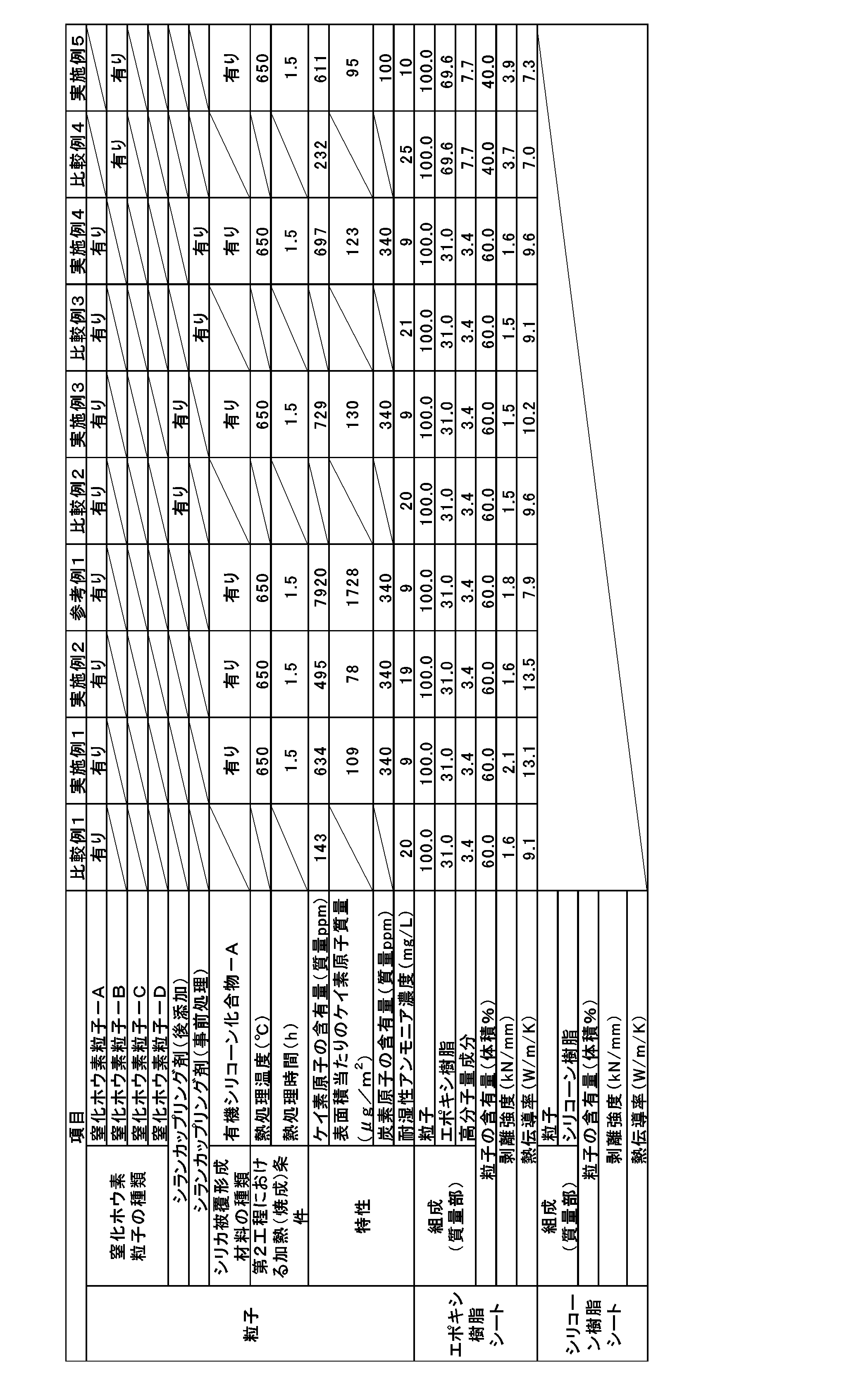
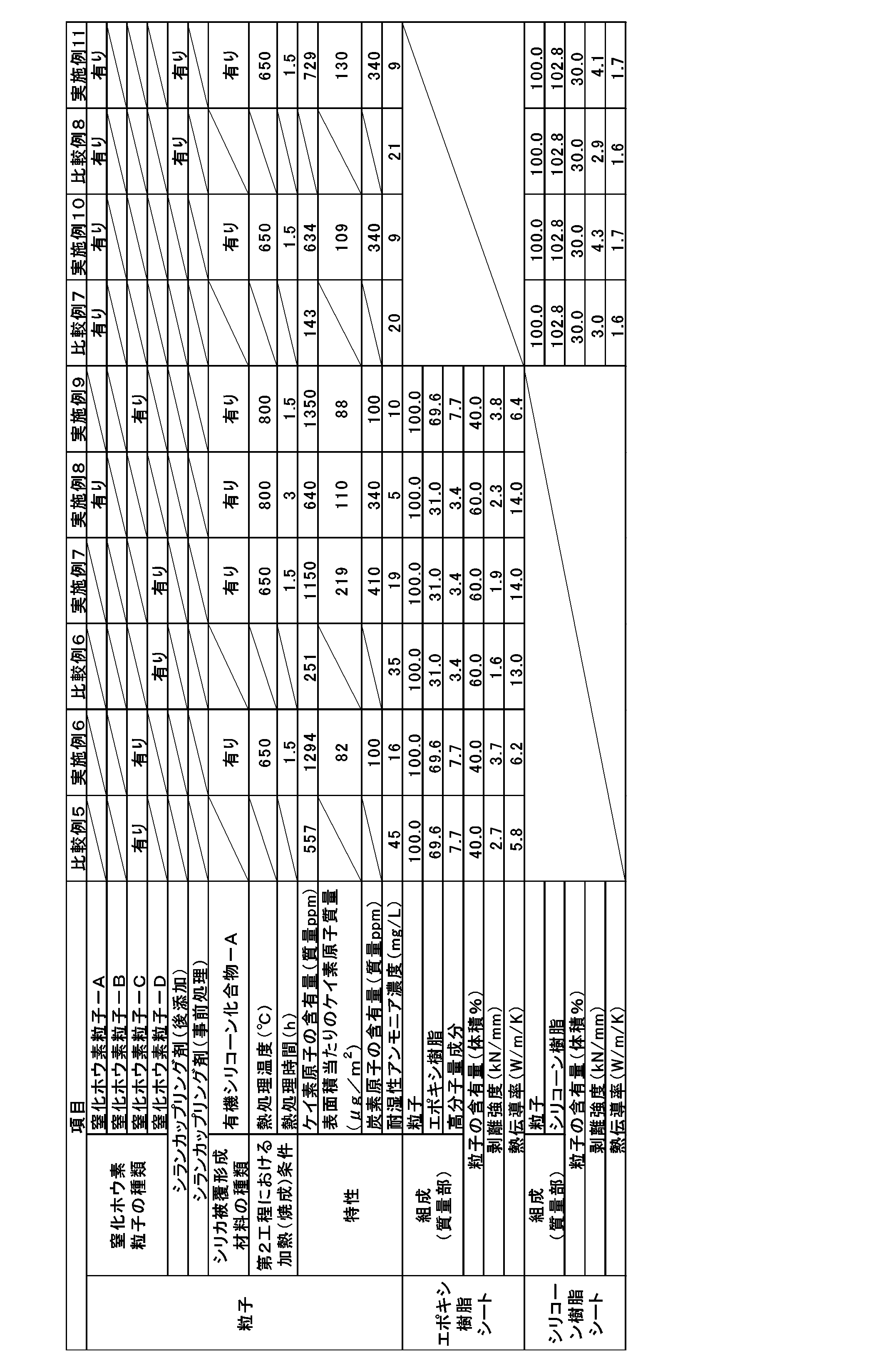
Claims (9)
- 窒化ホウ素粒子と、前記窒化ホウ素粒子の表面を覆うシリカ被膜とを備えるシリカ被覆窒化ホウ素粒子の製造方法であって、
前記窒化ホウ素粒子の表面を、下記式(1)で示される構造を含む有機シリコーン化合物により覆う第1工程と、
前記有機シリコーン化合物により覆われた前記窒化ホウ素粒子を500℃以上1000℃以下の温度で加熱する第2工程と、を備え、
前記シリカ被覆窒化ホウ素粒子は、炭素原子の含有量が1000質量ppm以下であるシリカ被覆窒化ホウ素粒子の製造方法。

- シリカ被覆窒化ホウ素粒子表面のケイ素原子質量(質量ppm)をシリカ被覆前の窒化ホウ素粒子のBET比表面積(m2/g)で割った値、即ち、窒化ホウ素粒子の表面積1m2当たりのケイ素原子質量(μg)が50以上500以下(μg/m2)である請求項1に記載のシリカ被覆窒化ホウ素粒子の製造方法。
- 前記第1工程が、乾式混合法または気相吸着法によって行われる請求項1または2に記載のシリカ被覆窒化ホウ素粒子の製造方法。
- 前記第1工程が、酸素ガスを含まない雰囲気下で行われる請求項1~3のいずれか1項に記載のシリカ被覆窒化ホウ素粒子の製造方法。
- 前記式(1)で示される構造を含む有機シリコーン化合物が、下記式(2)で示される化合物および下記式(3)で示される化合物の少なくとも一方を含む請求項1~4のいずれか1項に記載のシリカ被覆窒化ホウ素粒子の製造方法。

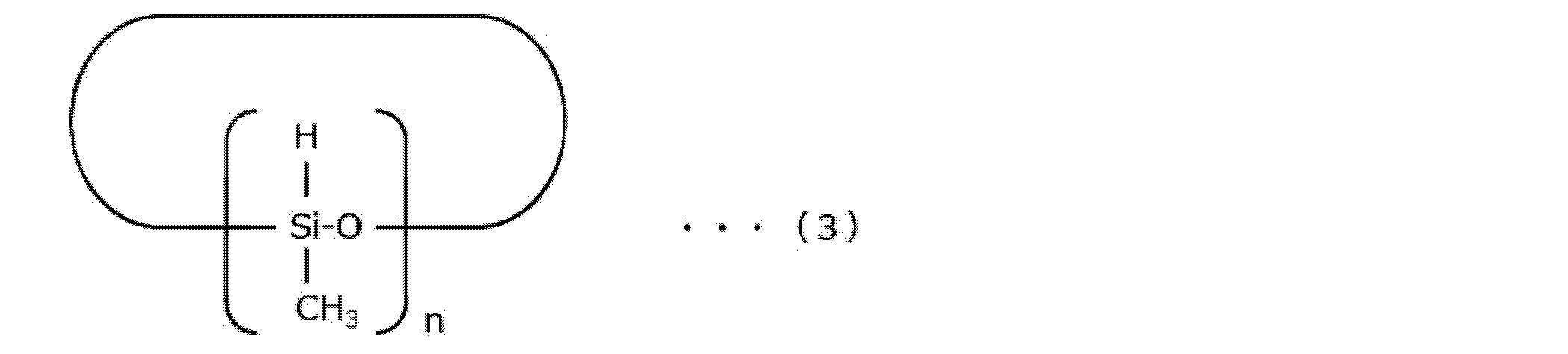
- 前記第1工程は、10℃以上200℃以下の温度条件下で行われる請求項1~5のいずれか1項に記載のシリカ被覆窒化ホウ素粒子の製造方法。
- 請求項1~6のいずれか1項に記載のシリカ被覆窒化ホウ素粒子の製造方法によって前記シリカ被覆窒化ホウ素粒子を製造する工程と、当該シリカ被覆窒化ホウ素粒子と樹脂とを混合する混合工程を備える放熱性樹脂組成物の製造方法。
- 窒化ホウ素粒子と前記窒化ホウ素粒子の表面を覆うシリカ被膜とを備えるシリカ被覆窒化ホウ素粒子であって、
炭素原子の含有量が1000質量ppm以下であるシリカ被覆窒化ホウ素粒子。 - シリカ被覆窒化ホウ素粒子表面のケイ素原子質量(質量ppm)をシリカ被覆前の窒化ホウ素粒子のBET比表面積(m2/g)で割った値、即ち窒化ホウ素粒子の表面積1m2当たりのケイ素原子質量(μg)が50以上500以下(μg/m2)である請求項8に記載のシリカ被覆窒化ホウ素粒子。
Priority Applications (4)
| Application Number | Priority Date | Filing Date | Title |
|---|---|---|---|
| US17/601,459 US20220195141A1 (en) | 2019-07-11 | 2020-07-09 | Method for producing silica-coated boron nitride particles and silica-coated boron nitride particles |
| JP2021530726A JP7582190B2 (ja) | 2019-07-11 | 2020-07-09 | シリカ被覆窒化ホウ素粒子の製造方法、シリカ被覆窒化ホウ素粒子 |
| EP20837249.0A EP3932859A4 (en) | 2019-07-11 | 2020-07-09 | PROCESS FOR PRODUCTION OF SILICA-COATED BORONITRIDE PARTICLES AND SILICA-COATED BORONITRIDE PARTICLES |
| CN202080016869.9A CN113498422A (zh) | 2019-07-11 | 2020-07-09 | 被覆二氧化硅的氮化硼粒子的制造方法、被覆二氧化硅的氮化硼粒子 |
Applications Claiming Priority (2)
| Application Number | Priority Date | Filing Date | Title |
|---|---|---|---|
| JP2019-129353 | 2019-07-11 | ||
| JP2019129353 | 2019-07-11 |
Publications (1)
| Publication Number | Publication Date |
|---|---|
| WO2021006310A1 true WO2021006310A1 (ja) | 2021-01-14 |
Family
ID=74114884
Family Applications (1)
| Application Number | Title | Priority Date | Filing Date |
|---|---|---|---|
| PCT/JP2020/026814 Ceased WO2021006310A1 (ja) | 2019-07-11 | 2020-07-09 | シリカ被覆窒化ホウ素粒子の製造方法、シリカ被覆窒化ホウ素粒子 |
Country Status (6)
| Country | Link |
|---|---|
| US (1) | US20220195141A1 (ja) |
| EP (1) | EP3932859A4 (ja) |
| JP (1) | JP7582190B2 (ja) |
| CN (1) | CN113498422A (ja) |
| TW (1) | TWI734552B (ja) |
| WO (1) | WO2021006310A1 (ja) |
Cited By (6)
| Publication number | Priority date | Publication date | Assignee | Title |
|---|---|---|---|---|
| CN115093608A (zh) * | 2022-05-19 | 2022-09-23 | 厦门大学 | 一种核壳结构氮化硼材料的制备方法及其应用 |
| JP2023004420A (ja) * | 2021-06-25 | 2023-01-17 | 河合石灰工業株式会社 | 熱伝導性複合粒子及びその製造方法 |
| WO2023026615A1 (ja) * | 2021-08-27 | 2023-03-02 | 昭和電工株式会社 | 熱伝導性組成物 |
| WO2023068024A1 (ja) * | 2021-10-20 | 2023-04-27 | 株式会社有沢製作所 | 熱硬化性樹脂組成物、放熱シート、放熱板、放熱シートの製造方法、及び放熱板の製造方法 |
| JPWO2025070435A1 (ja) * | 2023-09-26 | 2025-04-03 | ||
| WO2025142156A1 (ja) * | 2023-12-28 | 2025-07-03 | デンカ株式会社 | アンモニア発生剤、及びアンモニア発生剤の製造方法 |
Families Citing this family (5)
| Publication number | Priority date | Publication date | Assignee | Title |
|---|---|---|---|---|
| CN112961469B (zh) * | 2021-04-08 | 2023-03-31 | 厦门稀土材料研究所 | 一种环氧树脂基高导热绝缘材料及其制备方法 |
| CN114990473B (zh) * | 2022-04-22 | 2023-08-01 | 江西省航宇电子材料有限公司 | 不锈钢基表面处理方法、覆铜板及制备方法 |
| CN116216660B (zh) * | 2022-12-28 | 2025-03-25 | 广东金戈新材料股份有限公司 | 一种硅包覆六方氮化硼的制备方法 |
| CN116082858B (zh) * | 2022-12-29 | 2024-11-22 | 雅安百图高新材料股份有限公司 | 一种氮化硼改性方法及产品和应用 |
| CN116622126A (zh) * | 2023-06-08 | 2023-08-22 | 安徽皖维高新材料股份有限公司 | 一种阻燃导热聚乙烯醇复合材料及其制备方法 |
Citations (10)
| Publication number | Priority date | Publication date | Assignee | Title |
|---|---|---|---|---|
| JP4070345B2 (ja) | 1999-02-15 | 2008-04-02 | 信越化学工業株式会社 | 熱伝導性窒化ほう素微粉末、該微粉末を含有する熱伝導性シリコーン組成物、及び絶縁放熱シート |
| JP2008094701A (ja) * | 2006-10-08 | 2008-04-24 | Momentive Performance Materials Inc | 機能強化型窒化ホウ素組成物及びそれで作った組成物 |
| JP2012056818A (ja) | 2010-09-10 | 2012-03-22 | Denki Kagaku Kogyo Kk | 六方晶窒化ホウ素粉末及びそれを用いた高熱伝導性、高耐湿性放熱シート |
| JP2015071730A (ja) | 2013-10-04 | 2015-04-16 | 株式会社トクヤマ | 表面修飾粒子 |
| JP2016127046A (ja) | 2014-12-26 | 2016-07-11 | 住友ベークライト株式会社 | 造粒粉、放熱用樹脂組成物、放熱シート、半導体装置、および放熱部材 |
| JP2016141808A (ja) * | 2015-01-29 | 2016-08-08 | エルジー イノテック カンパニー リミテッド | 無機充填剤、これを含む樹脂組成物及びこれを利用した放熱基板 |
| JP2016146464A (ja) * | 2015-02-02 | 2016-08-12 | Tdk株式会社 | 軟磁性金属圧粉磁心、及び、リアクトル |
| US20160304346A1 (en) * | 2014-08-11 | 2016-10-20 | Hohai University | Method for preparing high-density hexagonal boron nitride ceramic material |
| JP2018030752A (ja) | 2016-08-24 | 2018-03-01 | 三菱瓦斯化学株式会社 | 窒化ホウ素粒子凝集体、その製造方法、組成物及び樹脂シート |
| CN109880372A (zh) * | 2019-01-17 | 2019-06-14 | 华南理工大学 | 一种利用二氧化硅包覆氮化硼制得的导热硅橡胶及其制备方法与应用 |
Family Cites Families (4)
| Publication number | Priority date | Publication date | Assignee | Title |
|---|---|---|---|---|
| US20060121068A1 (en) * | 1999-08-31 | 2006-06-08 | General Electric Company | Boron nitride particles of spherical geometry and process for making thereof |
| JP4088768B2 (ja) * | 2002-08-27 | 2008-05-21 | 東洋アルミニウム株式会社 | 窒化アルミニウム系粉末 |
| US20160325994A1 (en) * | 2014-01-06 | 2016-11-10 | Momentive Performance Materials Inc. | High aspect boron nitride, methods, and composition containing the same |
| WO2017012119A1 (en) * | 2015-07-23 | 2017-01-26 | Dow Global Technologies Llc | Thermally conductive core-shell structured particles |
-
2020
- 2020-07-09 US US17/601,459 patent/US20220195141A1/en not_active Abandoned
- 2020-07-09 EP EP20837249.0A patent/EP3932859A4/en not_active Withdrawn
- 2020-07-09 JP JP2021530726A patent/JP7582190B2/ja active Active
- 2020-07-09 CN CN202080016869.9A patent/CN113498422A/zh active Pending
- 2020-07-09 WO PCT/JP2020/026814 patent/WO2021006310A1/ja not_active Ceased
- 2020-07-10 TW TW109123391A patent/TWI734552B/zh not_active IP Right Cessation
Patent Citations (11)
| Publication number | Priority date | Publication date | Assignee | Title |
|---|---|---|---|---|
| JP4070345B2 (ja) | 1999-02-15 | 2008-04-02 | 信越化学工業株式会社 | 熱伝導性窒化ほう素微粉末、該微粉末を含有する熱伝導性シリコーン組成物、及び絶縁放熱シート |
| JP2008094701A (ja) * | 2006-10-08 | 2008-04-24 | Momentive Performance Materials Inc | 機能強化型窒化ホウ素組成物及びそれで作った組成物 |
| JP5074012B2 (ja) | 2006-10-08 | 2012-11-14 | モーメンティブ・パフォーマンス・マテリアルズ・インク | 機能強化型窒化ホウ素組成物及びそれで作った組成物 |
| JP2012056818A (ja) | 2010-09-10 | 2012-03-22 | Denki Kagaku Kogyo Kk | 六方晶窒化ホウ素粉末及びそれを用いた高熱伝導性、高耐湿性放熱シート |
| JP2015071730A (ja) | 2013-10-04 | 2015-04-16 | 株式会社トクヤマ | 表面修飾粒子 |
| US20160304346A1 (en) * | 2014-08-11 | 2016-10-20 | Hohai University | Method for preparing high-density hexagonal boron nitride ceramic material |
| JP2016127046A (ja) | 2014-12-26 | 2016-07-11 | 住友ベークライト株式会社 | 造粒粉、放熱用樹脂組成物、放熱シート、半導体装置、および放熱部材 |
| JP2016141808A (ja) * | 2015-01-29 | 2016-08-08 | エルジー イノテック カンパニー リミテッド | 無機充填剤、これを含む樹脂組成物及びこれを利用した放熱基板 |
| JP2016146464A (ja) * | 2015-02-02 | 2016-08-12 | Tdk株式会社 | 軟磁性金属圧粉磁心、及び、リアクトル |
| JP2018030752A (ja) | 2016-08-24 | 2018-03-01 | 三菱瓦斯化学株式会社 | 窒化ホウ素粒子凝集体、その製造方法、組成物及び樹脂シート |
| CN109880372A (zh) * | 2019-01-17 | 2019-06-14 | 华南理工大学 | 一种利用二氧化硅包覆氮化硼制得的导热硅橡胶及其制备方法与应用 |
Non-Patent Citations (2)
| Title |
|---|
| FERGUSON J. D., WEIMER A. W., GEORGE S. M.: "Atomic Layer Deposition of SiO2 Films on BN Particles Using Sequential Surface Reactions", CHEMISTRY OF MATERIALS, vol. 12, no. 11, 2000, pages 3472 - 3480, XP055783346, DOI: 10.1021/cm000313t * |
| See also references of EP3932859A4 |
Cited By (11)
| Publication number | Priority date | Publication date | Assignee | Title |
|---|---|---|---|---|
| JP2023004420A (ja) * | 2021-06-25 | 2023-01-17 | 河合石灰工業株式会社 | 熱伝導性複合粒子及びその製造方法 |
| JP7680737B2 (ja) | 2021-06-25 | 2025-05-21 | 河合石灰工業株式会社 | 熱伝導性複合粒子及びその製造方法 |
| WO2023026615A1 (ja) * | 2021-08-27 | 2023-03-02 | 昭和電工株式会社 | 熱伝導性組成物 |
| JP7287580B1 (ja) * | 2021-08-27 | 2023-06-06 | 株式会社レゾナック | 熱伝導性組成物 |
| WO2023068024A1 (ja) * | 2021-10-20 | 2023-04-27 | 株式会社有沢製作所 | 熱硬化性樹脂組成物、放熱シート、放熱板、放熱シートの製造方法、及び放熱板の製造方法 |
| CN115093608A (zh) * | 2022-05-19 | 2022-09-23 | 厦门大学 | 一种核壳结构氮化硼材料的制备方法及其应用 |
| CN115093608B (zh) * | 2022-05-19 | 2023-03-31 | 厦门大学 | 一种核壳结构氮化硼材料的制备方法及其应用 |
| JPWO2025070435A1 (ja) * | 2023-09-26 | 2025-04-03 | ||
| WO2025070435A1 (ja) * | 2023-09-26 | 2025-04-03 | 株式会社レゾナック | シラノール基を有する有機ケイ素含有化合物被覆窒化物フィラーの製造方法及びシラノール基を有する有機ケイ素含有化合物被覆シリカ被覆窒化物フィラーの製造方法 |
| JP7772282B2 (ja) | 2023-09-26 | 2025-11-18 | 株式会社レゾナック | シラノール基を有する有機ケイ素含有化合物被覆窒化物フィラーの製造方法及びシラノール基を有する有機ケイ素含有化合物被覆シリカ被覆窒化物フィラーの製造方法 |
| WO2025142156A1 (ja) * | 2023-12-28 | 2025-07-03 | デンカ株式会社 | アンモニア発生剤、及びアンモニア発生剤の製造方法 |
Also Published As
| Publication number | Publication date |
|---|---|
| US20220195141A1 (en) | 2022-06-23 |
| CN113498422A (zh) | 2021-10-12 |
| JP7582190B2 (ja) | 2024-11-13 |
| TWI734552B (zh) | 2021-07-21 |
| JPWO2021006310A1 (ja) | 2021-01-14 |
| EP3932859A1 (en) | 2022-01-05 |
| EP3932859A4 (en) | 2023-01-04 |
| TW202112653A (zh) | 2021-04-01 |
Similar Documents
| Publication | Publication Date | Title |
|---|---|---|
| JP7582190B2 (ja) | シリカ被覆窒化ホウ素粒子の製造方法、シリカ被覆窒化ホウ素粒子 | |
| JP6687818B1 (ja) | 珪素含有酸化物被覆窒化アルミニウム粒子の製造方法および珪素含有酸化物被覆窒化アルミニウム粒子 | |
| JP7434818B2 (ja) | 珪素含有酸化物被覆窒化アルミニウム粒子の製造方法および放熱性樹脂組成物の製造方法 | |
| JP7632570B2 (ja) | グリース | |
| JP7524889B2 (ja) | 珪素含有酸化物被覆窒化アルミニウム粒子の製造方法及び樹脂組成物の製造方法 | |
| WO2025013812A1 (ja) | 珪素含有酸化物被覆窒化アルミニウム粒子の製造方法、及び珪素含有酸化物被覆窒化アルミニウム粒子 | |
| WO2024127697A1 (ja) | 珪素含有酸化物被覆窒化アルミニウム粒子の製造方法 |
Legal Events
| Date | Code | Title | Description |
|---|---|---|---|
| 121 | Ep: the epo has been informed by wipo that ep was designated in this application |
Ref document number: 20837249 Country of ref document: EP Kind code of ref document: A1 |
|
| ENP | Entry into the national phase |
Ref document number: 2021530726 Country of ref document: JP Kind code of ref document: A |
|
| ENP | Entry into the national phase |
Ref document number: 2020837249 Country of ref document: EP Effective date: 20210928 |