WO2023068024A1 - 熱硬化性樹脂組成物、放熱シート、放熱板、放熱シートの製造方法、及び放熱板の製造方法 - Google Patents
熱硬化性樹脂組成物、放熱シート、放熱板、放熱シートの製造方法、及び放熱板の製造方法 Download PDFInfo
- Publication number
- WO2023068024A1 WO2023068024A1 PCT/JP2022/036896 JP2022036896W WO2023068024A1 WO 2023068024 A1 WO2023068024 A1 WO 2023068024A1 JP 2022036896 W JP2022036896 W JP 2022036896W WO 2023068024 A1 WO2023068024 A1 WO 2023068024A1
- Authority
- WO
- WIPO (PCT)
- Prior art keywords
- resin composition
- thermosetting resin
- heat dissipation
- boron nitride
- filler
- Prior art date
- Legal status (The legal status is an assumption and is not a legal conclusion. Google has not performed a legal analysis and makes no representation as to the accuracy of the status listed.)
- Ceased
Links
Classifications
-
- C—CHEMISTRY; METALLURGY
- C08—ORGANIC MACROMOLECULAR COMPOUNDS; THEIR PREPARATION OR CHEMICAL WORKING-UP; COMPOSITIONS BASED THEREON
- C08G—MACROMOLECULAR COMPOUNDS OBTAINED OTHERWISE THAN BY REACTIONS ONLY INVOLVING UNSATURATED CARBON-TO-CARBON BONDS
- C08G59/00—Polycondensates containing more than one epoxy group per molecule; Macromolecules obtained by polymerising compounds containing more than one epoxy group per molecule using curing agents or catalysts which react with the epoxy groups
-
- C—CHEMISTRY; METALLURGY
- C08—ORGANIC MACROMOLECULAR COMPOUNDS; THEIR PREPARATION OR CHEMICAL WORKING-UP; COMPOSITIONS BASED THEREON
- C08K—Use of inorganic or non-macromolecular organic substances as compounding ingredients
- C08K3/00—Use of inorganic substances as compounding ingredients
- C08K3/01—Use of inorganic substances as compounding ingredients characterized by their specific function
- C08K3/013—Fillers, pigments or reinforcing additives
-
- C—CHEMISTRY; METALLURGY
- C08—ORGANIC MACROMOLECULAR COMPOUNDS; THEIR PREPARATION OR CHEMICAL WORKING-UP; COMPOSITIONS BASED THEREON
- C08K—Use of inorganic or non-macromolecular organic substances as compounding ingredients
- C08K3/00—Use of inorganic substances as compounding ingredients
- C08K3/38—Boron-containing compounds
-
- C—CHEMISTRY; METALLURGY
- C08—ORGANIC MACROMOLECULAR COMPOUNDS; THEIR PREPARATION OR CHEMICAL WORKING-UP; COMPOSITIONS BASED THEREON
- C08K—Use of inorganic or non-macromolecular organic substances as compounding ingredients
- C08K7/00—Use of ingredients characterised by shape
-
- C—CHEMISTRY; METALLURGY
- C08—ORGANIC MACROMOLECULAR COMPOUNDS; THEIR PREPARATION OR CHEMICAL WORKING-UP; COMPOSITIONS BASED THEREON
- C08L—COMPOSITIONS OF MACROMOLECULAR COMPOUNDS
- C08L33/00—Compositions of homopolymers or copolymers of compounds having one or more unsaturated aliphatic radicals, each having only one carbon-to-carbon double bond, and only one being terminated by only one carboxyl radical, or of salts, anhydrides, esters, amides, imides or nitriles thereof; Compositions of derivatives of such polymers
- C08L33/04—Homopolymers or copolymers of esters
-
- C—CHEMISTRY; METALLURGY
- C08—ORGANIC MACROMOLECULAR COMPOUNDS; THEIR PREPARATION OR CHEMICAL WORKING-UP; COMPOSITIONS BASED THEREON
- C08L—COMPOSITIONS OF MACROMOLECULAR COMPOUNDS
- C08L63/00—Compositions of epoxy resins; Compositions of derivatives of epoxy resins
-
- H—ELECTRICITY
- H10—SEMICONDUCTOR DEVICES; ELECTRIC SOLID-STATE DEVICES NOT OTHERWISE PROVIDED FOR
- H10W—GENERIC PACKAGES, INTERCONNECTIONS, CONNECTORS OR OTHER CONSTRUCTIONAL DETAILS OF DEVICES COVERED BY CLASS H10
- H10W40/00—Arrangements for thermal protection or thermal control
- H10W40/20—Arrangements for cooling
- H10W40/25—Arrangements for cooling characterised by their materials
Definitions
- the present invention relates to a thermosetting resin composition, a heat dissipation sheet, a heat dissipation plate, a method for manufacturing a heat dissipation sheet, and a method for manufacturing a heat dissipation plate.
- the board on which the electronic components are installed is provided with a metal radiator plate with high thermal conductivity via a heat dissipating sheet having insulating properties.
- Patent Literature 1 and Patent Literature 2 disclose a thermally conductive sheet having insulating properties and a thermally conductive resin composition that constitutes the thermally conductive sheet.
- the heat dissipation sheets described in Patent Documents 1 and 2 are excellent in heat dissipation, dielectric breakdown is likely to occur when a high voltage is applied. For this reason, it is difficult to use such a heat dissipation sheet as a heat dissipation sheet having long-term withstand voltage characteristics for use with power semiconductors mounted on electric vehicles, for example.
- the long-term withstand voltage characteristic means a characteristic that dielectric breakdown is unlikely to occur even if a constant voltage is applied for a long period of time. Evaluation of this characteristic is performed, for example, under conditions of 150° C., 1 kV, and 10 years.
- the present invention has been made in view of the above circumstances, and includes a heat dissipation sheet and a heat dissipation plate that are excellent in heat dissipation and long-term withstand voltage characteristics, a thermosetting resin composition that constitutes them, a method for producing a heat dissipation sheet, and a heat dissipation plate.
- the object is to provide a manufacturing method.
- thermosetting resin composition according to the present invention comprises an epoxy resin, a curing agent, an acrylic copolymer having a functional group in a side chain, boron nitride, and a filler, wherein the boron nitride
- the average particle diameter (D50) of the filler is 7.0 ⁇ m or more and 60 ⁇ m or less
- the average particle diameter (D50) of the filler is 0.5 ⁇ m or more and 5.0 ⁇ m or less
- the volume ratio of the boron nitride is the heat It is 55% by volume or more and 70% by volume or less with respect to 100% by volume of the curable resin composition
- the volume ratio of the filler is 0.3% by volume or more with respect to 100% by volume of the thermosetting resin composition. It is 0% by volume or less.
- the filler is at least one selected from the group consisting of silica, alumina, boron nitride, magnesium oxide, aluminum hydroxide, magnesium hydroxide, zinc oxide, silicon nitride, silicon carbide, gallium nitride, and talc. may be composed of
- the shape of the filler may be spherical.
- the boron nitride may be composed of at least one selected from the group consisting of scale-shaped boron nitride and aggregated boron nitride in which a plurality of boron nitrides are aggregated.
- the functional group may have at least one functional group selected from the group consisting of a carboxyl group, a hydroxyl group, and an epoxy group.
- the heat dissipation sheet according to the present invention is composed of a resin layer, and the resin layer is composed of the thermosetting resin composition according to any one of [1] to [5].
- the cured state of the resin layer may be a semi-cured state.
- a heat sink according to the present invention includes a metal plate and a resin layer composed of the thermosetting resin composition according to any one of [1] to [5], A resin layer is laminated on at least one surface of the metal plate.
- the cured state of the resin layer may be a semi-cured state.
- a method for producing a heat-dissipating sheet according to the present invention comprises: a resin composition preparation step of preparing the thermosetting resin composition according to any one of [1] to [5]; It includes a coating step of coating a thermosetting resin composition and a heating step of heating the film coated with the thermosetting resin composition.
- a method for manufacturing a heat sink according to the present invention comprises: a resin composition preparation step of preparing the thermosetting resin composition according to any one of [1] to [5]; It includes a coating step of coating the thermosetting resin composition and a heating step of heating the metal plate coated with the thermosetting resin composition.
- thermosetting resin composition that constitutes them
- a method for producing a heat dissipation sheet a method for producing a heat dissipation plate.
- thermosetting resin composition The thermosetting resin composition of the embodiment is preferably used mainly as a resin composition that constitutes a heat dissipation sheet and a heat dissipation plate.
- thermosetting resin composition of the embodiment contains an epoxy resin, a curing agent, an acrylic copolymer having a functional group on its side chain, boron nitride, and a filler.
- the epoxy resin contained in the thermosetting resin composition of the embodiment has two or more epoxy groups in one molecule and an epoxy equivalent of 100 g/eq or more and 1000 g/eq, from the viewpoint of enhancing long-term withstand voltage characteristics after curing. It is preferably eq or less, and more preferably 150 g/eq or more and 300 g/eq or less.
- epoxy resins include bisphenol A type epoxy resin, bisphenol F type epoxy resin, bisphenol S type epoxy resin, novolac type epoxy resin, amine type epoxy resin, biphenyl type epoxy resin, alicyclic epoxy resin, phenol novolac type epoxy resin, Resins, cresol novolak-type epoxy resins, naphthalene ring-containing epoxy resins, dicyclopentadiene-type epoxy resins, and the like.
- epoxy resins include polyfunctional epoxy resins such as novolac epoxy resins, phenol novolac epoxy resins, and cresol novolac epoxy resins, alicyclic epoxy resins, and bisphenols.
- Type A epoxy resins are preferred. It is preferable to use two or more epoxy resins.
- the epoxy resin may be dissolved in an organic solvent in advance in order to facilitate mixing with other materials contained in the thermosetting resin composition.
- the content of the epoxy resin is preferably 14 parts by weight or more and 23 parts by weight or less with respect to 100 parts by weight of the thermosetting resin composition, from the viewpoint of improving the long-term withstand voltage characteristics after curing and the viewpoint of increasing the thermal conductivity. 14 parts by weight or more and 21 parts by weight or less is more preferable.
- the parts by weight used in the embodiment means, for example, the weight of only the resin excluding volatile components such as organic solvents contained in the resin.
- the curing agent cures the epoxy resin.
- Curing agents include, for example, diaminodiphenylmethane (DDM), diaminodiphenylsulfone (DDS), diaminodiphenyl ether (DDE), hexamethylenediamine, dicyandiamide, phenol novolac type epoxy resins, and the like.
- the curing agent is preferably dicyandiamide, preferably diaminodiphenylsulfone, from the viewpoint of ease of control of the curing reaction.
- two or more curing agents may be used in combination.
- the content of the curing agent is preferably 5 parts by weight or more and 40 parts by weight or less with respect to 100 parts by weight of the epoxy resin, from the viewpoint of improving long-term withstand voltage characteristics after curing and improving heat resistance.
- the equivalent weight of the curing agent is 0.3 equivalent or more and 0.8 equivalent or less with respect to 1 equivalent of the epoxy group contained in the epoxy resin. 3 equivalents or more and 0.6 equivalents or less are preferable.
- acrylic copolymer having functional groups in side chains examples include acrylic acid ester copolymers having functional groups in side chains, and (meth)acrylic acid ester copolymers having functional groups in side chains. .
- the acrylic ester copolymer having a functional group on the side chain and the (meth)acrylic ester copolymer having a functional group on the side chain may be composed of a single monomer, or may be composed of two or more kinds. may be composed of a monomer of Examples of monomers constituting these copolymers include acrylic acid ester monomers, carboxyl group-containing monomers, anhydrides of carboxyl group-containing monomers, amide group-containing monomers, aromatic vinyl monomers, monomers, cyano group-containing monomers, and the like.
- acrylate monomers include alkyl acrylates such as methyl acrylate, ethyl acrylate, n-butyl acrylate, and 2-ethylhexyl acrylate; methyl (meth) acrylate, (meth) ) Ethyl acrylate, (meth) acrylate-n-butyl, (meth) acrylic acid alkyl esters such as 2-ethylhexyl (meth) acrylate; acrylate hydroxyalkyl esters such as hydroxyethyl acrylate; ) hydroxyalkyl (meth)acrylates such as hydroxyethyl acrylate; N,N-dimethylaminoalkyl acrylates such as N,N-dimethylaminomethyl acrylate; N,N-dimethylaminomethyl (meth)acrylates, etc. epoxy group-containing acrylic acid esters such as glycidyl acrylate; and epoxy group-containing (meth)acrylic acid
- carboxyl group-containing monomers examples include acrylic acid, (meth)acrylic acid, fumaric acid, maleic acid, and maleic anhydride.
- anhydrides of carboxyl group-containing monomers include anhydrides of acrylic acid, (meth)acrylic acid, fumaric acid, maleic acid, and maleic anhydride.
- amide group-containing monomers examples include acrylamide.
- aromatic vinyl monomers examples include styrene and methylstyrene.
- cyano group-containing monomers examples include acrylonitrile.
- the weight average molecular weight of the acrylic ester copolymer having a functional group on the side chain and the (meth)acrylic ester copolymer having a functional group on the side chain is 100,000 or more and 400,000 or less from the viewpoint of workability. It is preferably 150,000 or more and 300,000 or less.
- the weight average molecular weight is a molecular weight measured by gel permeation chromatography (GPC) using standard polystyrene having an average molecular weight of about 500 to about 1,000,000.
- the content of the acrylic copolymer having a functional group in its side chain is 10 parts by weight or more and 40 parts by weight or less with respect to 100 parts by weight of the epoxy resin, from the viewpoint of enhancing long-term withstand voltage characteristics after curing. More than 30 parts by weight and less than 30 parts by weight are preferable.
- the acrylic copolymer having functional groups in side chains has at least one functional group selected from the group consisting of carboxyl groups, hydroxyl groups, and epoxy groups.
- the functional group is preferably a carboxyl group from the viewpoint of enhancing long-term withstand voltage characteristics after curing.
- the acrylic copolymer having functional groups on side chains may have two or more functional groups.
- the acid value is 3 KOHmg/g or more and 20 KOHmg/g or less, preferably 10 KOHmg/g or more and 20 KOHmg/g or less, from the viewpoint of enhancing long-term withstand voltage characteristics after curing.
- the acid value is measured by a titration method with a 0.1N potassium hydroxide aqueous solution.
- acrylic copolymers having functional groups in side chains include, for example, Noxtite (manufactured by Nippon Oil Seal Co., Ltd.), Nipol (registered trademark, manufactured by Nippon Zeon Co., Ltd.), Vamac (registered trademark, DuPont). Co., Ltd.), Leocoat (manufactured by Toray Coatex Co., Ltd.), Paraclon (registered trademark, manufactured by Shin-Nakamura Chemical Co., Ltd.), and the like.
- the average particle size (D50) of boron nitride (BN) is 7.0 ⁇ m or more and 60 ⁇ m or less.
- the average particle size (D50) of the scale-shaped boron nitride is preferably 7.0 ⁇ m or more and 15 ⁇ m or less from the viewpoint of improving dispersibility.
- the average particle size (D50) of aggregated boron nitride is preferably 10 ⁇ m or more and 40 ⁇ m or less from the viewpoint of improving dispersibility.
- the average particle size (D50) refers to the particle size when the particles with the smallest particle size are counted in the volume-based particle size distribution, and the cumulative total reaches 50% of the total volume. Particle size is measured by a dynamic light scattering method. Average particle size (D50) is also called median size.
- the volume ratio of boron nitride is 55% by volume or more and 70% by volume or less with respect to 100% by volume of the thermosetting resin composition, from the viewpoint of increasing thermal conductivity and maintaining a high dielectric breakdown voltage. It is preferably vol % or more and 65 vol % or less.
- Boron nitride is at least one selected from the group consisting of scale-shaped boron nitride and aggregated boron nitride in which a plurality of boron nitrides are aggregated, from the viewpoint of increasing thermal conductivity and maintaining a high dielectric breakdown voltage. It preferably consists of seeds. Boron nitride is preferably agglomerated boron nitride from the viewpoint of having excellent thermal conductivity. Boron nitride may be composed of two or more boron nitrides.
- the average particle diameter (D50) of the filler is 0.5 ⁇ m or more and 5.0 ⁇ m or less, preferably 0.5 ⁇ m or more and 3.0 ⁇ m or less, from the viewpoint of maintaining a high dielectric breakdown voltage.
- the volume ratio of the filler is preferably 0.3% by volume or more and 2.0% by volume or less with respect to 100% by volume of the thermosetting resin composition, and 0.5 volume % or more and 1.5 volume % or less.
- the filler has insulating properties and is at least one selected from the group consisting of silica, alumina, boron nitride, magnesium oxide, aluminum hydroxide, magnesium hydroxide, zinc oxide, silicon nitride, silicon carbide, gallium nitride, and talc. consists of
- the filler is preferably silica having a low dielectric constant from the viewpoint of enhancing long-term withstand voltage characteristics after curing.
- the filler may be composed of two or more fillers.
- the filler has a spherical shape. As a result, when a voltage is applied to the thermosetting resin composition after curing, concentration of an electric field on the filler is suppressed, and dielectric breakdown is less likely to occur in the thermosetting resin composition after curing.
- thermosetting resin composition of the embodiment may further contain other additives.
- Other additives include 2-methylimidazole, 2-undecylimidazole, 1,2-dimethylimidazole, 2-ethyl-4-methylimidazole, N-benzyl-2-methylimidazole, 2-undecylimidazole, etc.
- Imidazole-based curing accelerators Lewis acid complex-based curing accelerators such as boron trifluoride monoethylamine and boron trifluoride diethylamine; A coupling agent etc. are mentioned.
- thermosetting resin composition of the embodiment is obtained by mixing the above materials.
- An organic solvent may be added when preparing the thermosetting resin composition of the embodiment.
- a heat dissipation sheet composed of the thermosetting resin composition of the embodiment will be described.
- the heat dissipation sheet of the embodiment is composed of a resin layer.
- the resin layer is composed of the thermosetting resin composition of the embodiment.
- the thickness of the heat dissipation sheet of the embodiment is 100 ⁇ m or more and 500 ⁇ m or less.
- thermosetting resin composition is prepared by adding predetermined amounts of an epoxy resin, a curing agent, an acrylic copolymer having a functional group on a side chain, boron nitride, a filler, and an organic solvent to a container.
- a coating device is used to apply the thermosetting resin composition to the film (coating step).
- the film coated with the thermosetting resin composition is heated to cure the thermosetting resin composition to a semi-cured state (heating step).
- a heat-dissipating sheet is obtained in which a resin layer composed of a thermosetting resin composition is formed on the film.
- the heating conditions are from 100° C.
- thermosetting resin composition a state in which the curing reaction of the thermosetting resin composition has progressed halfway.
- semi-cured state is also called B stage.
- the thickness of the film used when producing the heat dissipation sheet of the embodiment is 25 ⁇ m or more and 100 ⁇ m or less.
- the thickness of the film is determined according to the thickness of the resin layer.
- film materials include polyethylene, polypropylene, polyimide, polyamide, polyethylene naphthalate, and polyethylene terephthalate.
- Treatment agents for release treatment include, for example, silicone-based treatment agents and fluorine-based treatment agents.
- the heat dissipation sheet may have a configuration in which resin layers are provided on both sides of the film.
- resin layers examples include polyimide, polyamide, polyethylene naphthalate, and the like.
- the heat dissipation sheet may be a prepreg in which a base material such as a woven fabric or nonwoven fabric is impregnated with the thermosetting resin composition of the embodiment.
- prepreg refers to a composite material in which a substrate such as a woven fabric or nonwoven fabric is impregnated with a resin composition.
- the cured state of the resin composition is B stage.
- a prepreg is produced, for example, by the following procedure.
- a non-woven fabric made of glass fibers or a fabric made by weaving glass yarns and a thermosetting resin composition are prepared.
- a nonwoven or woven fabric is impregnated with a thermosetting resin composition.
- the nonwoven fabric or fabric impregnated with the thermosetting resin composition is heated until the curing state of the thermosetting resin composition reaches the B stage. After that, it is cooled to obtain a prepreg.
- thermosetting resin composition of the embodiment The heat-dissipating sheet composed of the thermosetting resin composition of the embodiment has been described above. Next, a radiator plate using the thermosetting resin composition of the embodiment will be described.
- the radiator plate of the embodiment includes a metal plate and a resin layer made of the thermosetting resin composition of the embodiment.
- the resin layer is laminated on at least one surface of the metal plate.
- the thickness of the resin layer should be 60 ⁇ m or more and 400 ⁇ m or less, and 120 ⁇ m or more and 200 ⁇ m or less, from the viewpoint of maintaining the heat dissipation property of the heat dissipation plate and from the viewpoint of maintaining the insulation between the metal plate constituting the heat dissipation plate and the substrate. is preferred.
- the metal plate is preferably made of a metal with high thermal conductivity.
- Metals with high thermal conductivity include, for example, copper, aluminum, stainless steel, and the like. Among these, copper and aluminum are preferred because of their excellent workability and high thermal conductivity.
- the thickness of the metal plate is 9 ⁇ m or more and 500 ⁇ m or less, preferably 12 ⁇ m or more and 120 ⁇ m or less.
- a heat sink may be used instead of the metal plate.
- the heat sink is provided with a plurality of fins on one side of the base plate.
- the base plate is composed of a metal plate.
- the thickness of the base plate is 0.3 mm or more and 50 mm or less.
- a fin consists of a plate or a bar.
- the height of the fins is 1 mm or more and 100 mm or less.
- the plate-shaped fins have a thickness of 0.2 mm or more and 9 mm or less, and are thinner than the base plate. Also, the size of the plate-like fins is smaller than that of the base plate.
- the rod-shaped fins have, for example, a square or circular cross section in a direction orthogonal to the longitudinal direction of the fins.
- a heat sink with a resin layer has a resin layer laminated on the surface opposite to the surface on which the fins are provided.
- the entire surface of the fins may be covered with the thermosetting resin composition of the embodiment, or only part of the surface of the fins may be covered with the thermosetting resin composition of the embodiment. good.
- the heat sink of the embodiment is produced, for example, by the following procedure.
- a copper foil is prepared as the metal plate.
- predetermined amounts of an epoxy resin, a curing agent, an acrylic copolymer having a functional group on a side chain, boron nitride, a filler, and an organic solvent are added to a container to form a thermosetting resin composition.
- the thermosetting resin composition is applied to the prepared copper foil using a coating device (coating step).
- the copper foil coated with the thermosetting resin composition is heated until the cured state of the thermosetting resin composition reaches the B stage (heating step).
- a heat sink is obtained in which a resin layer composed of a thermosetting resin composition is formed on one side of the copper foil.
- the heating conditions are from 100° C. to 250° C. and from 5 seconds to 30 minutes. The heating conditions can be adjusted according to the thickness of the applied resin composition.
- Examples of the organic solvent used for producing the heat dissipation sheet of the embodiment and the heat dissipation plate of the embodiment include alcohols such as methanol and ethanol; glycols such as ethylene glycol and propylene glycol; ethylene glycol monomethyl ether; Glycol monoalkyl ethers such as ethylene glycol monoethyl ether; Glycol dialkyl ethers such as ethylene glycol dimethyl ether and ethylene glycol diethyl ether; Alkyl esters such as methyl acetate, ethyl acetate, propyl acetate and methyl acetoacetate; Acetone, methyl ethyl ketone, methyl Ketones such as isobutyl ketone and cyclohexanone; Aromatic hydrocarbons such as benzene, toluene, xylene and ethylbenzene; Aliphatic hydrocarbons such as hexane, cyclohexane and o
- a known coater can be used as a coating device used when manufacturing the heat-dissipating sheet of the embodiment and the heat-dissipating plate of the embodiment.
- Examples of the coater include a die coater and a comma coater.
- the radiator plate using the thermosetting resin composition of the embodiment has been described above.
- boron nitride (1) DF-10N: aggregated boron nitride, average particle size (D50) 15 ⁇ m, manufactured by Tokuyama Corporation, (2) HP-40MF100: aggregated boron nitride, average particle size (D50) 40 ⁇ m, manufactured by Mizushima Ferroalloy Co., Ltd., (3) S-03: Scale-shaped boron nitride, average particle size (D50) 7 ⁇ m, manufactured by Tokuyama.
- S0-C2 spherical silica, average particle size (D50) 0.5 ⁇ m, manufactured by Admatechs
- YC100C-LHH spherical silica, average particle size (D50) 0.1 ⁇ m, manufactured by Admatechs
- S0-C5 spherical silica, average particle size (D50) 1.5 ⁇ m, manufactured by Admatechs
- FB-3SDC spherical silica, average particle size (D50) 3.0 ⁇ m, manufactured by Denka
- FB-7SDC spherical silica, average particle size (D50) 5.0 ⁇ m, manufactured by Denka
- FB-105FD spherical silica, average particle size (D50) 11.0 ⁇ m, manufactured by Denka
- AO-502 spherical alumina, average particle size (D50) 0.2 ⁇ m, manufactured by Admatechs
- thermosetting resin that will be a resin layer is applied to the release treated surface of a 50 ⁇ m thick release PET (polyethylene terephthalate) film (manufactured by Unitika, TR). The composition was applied to a thickness of 180 ⁇ m after drying. Next, the thermosetting resin composition was heated at 120° C. for 10 minutes until it reached a semi-cured state (B stage). After cooling, a heat-dissipating sheet was obtained.
- the rolled copper foil was etched into a circular shape with a diameter of 20 mm, washed with water, and dried to obtain a sample for measurement.
- the rolled copper foil was laminated on the heat dissipation sheet so that the rough surface of the rolled copper foil was in contact with the heat dissipation sheet.
- the evaluation criteria were as follows. Excellent: Insulation retention time is 100 hours or more, Good: Insulation retention time is 50 hours or more and less than 100 hours, Poor: Insulation retention time is less than 50 hours.
- a measurement sample that can secure an insulation retention time of 100 hours or more under the above test conditions has long-term withstand voltage characteristics sufficient to maintain insulation under the conditions of 150° C., 1 kV, and 10 years.
- thermosetting resin composition was applied so as to Next, the thermosetting resin composition was heated at 120° C. for 10 minutes until it reached a semi-cured state (B stage). After cooling, a heat-dissipating sheet composed of a resin layer was obtained. A total of two heat dissipation sheets were produced in the same manner.
- thermo diffusion coefficient ( ⁇ ) The thermal diffusion coefficient ( ⁇ ) is measured by using the laser flash method, irradiating one side of the measurement sample with pulsed light to heat it, and changing the temperature on the other side. was measured. The measurement was performed at 25° C. using LFA447 manufactured by NETZSCH. The analysis method adopted the half-time method.
- the evaluation criteria were as follows. Good: 6 W / (m K) or more, Poor: less than 6 W/(m ⁇ K).
- Measurement sample The measurement sample prepared in ⁇ Long-term withstand voltage characteristics> was used.
- Example 1 90 parts by weight of JER152 and 10 parts by weight of JER828 were added to the container to make the total weight part of the epoxy resin 100 parts by weight. To this, 26.85 parts by weight of Seika Cure S, 0.3 parts by weight of BF3-MEA, 15 parts by weight of 1HY-2002M, 338.0 parts by weight of DF-10N (100% by volume of thermosetting resin composition 55% by weight of the thermosetting resin composition), 1.8 parts by weight of S0-C2 (0.4% by weight with respect to 100% by weight of the thermosetting resin composition), and 200 parts by weight of methyl ethyl ketone as an organic solvent. After that, they were stirred at room temperature to obtain a thermosetting resin composition.
- thermosetting resin composition was obtained by changing the type and content of each component in the same manner as in Example 1.
- the unit of content in the table indicates "parts by weight" unless otherwise specified.
- Table 1 shows the evaluation results of the long-term withstand voltage characteristics, thermal conductivity, and dielectric breakdown voltage of the heat dissipation sheet when the volume ratio (% by volume) of the filler in the thermosetting resin composition is changed. . As shown in Examples 1 to 5, the long-term withstand voltage characteristics showed good evaluation results when the volume ratio (% by volume) of the filler was 0.3% by volume or more and 2.0% by volume or less. . In addition, good evaluation results were obtained for thermal conductivity and dielectric breakdown voltage.
- Table 2 shows the evaluation results of the long-term withstand voltage characteristics, thermal conductivity, and dielectric breakdown voltage of the heat dissipation sheet when the type of boron nitride and the amount of filler are changed. As shown in Examples 6 to 8, regardless of the type of boron nitride, the long-term withstand voltage characteristics showed good evaluation results due to the inclusion of a filler in the thermosetting resin composition. . In addition, good evaluation results were obtained for thermal conductivity and dielectric breakdown voltage.
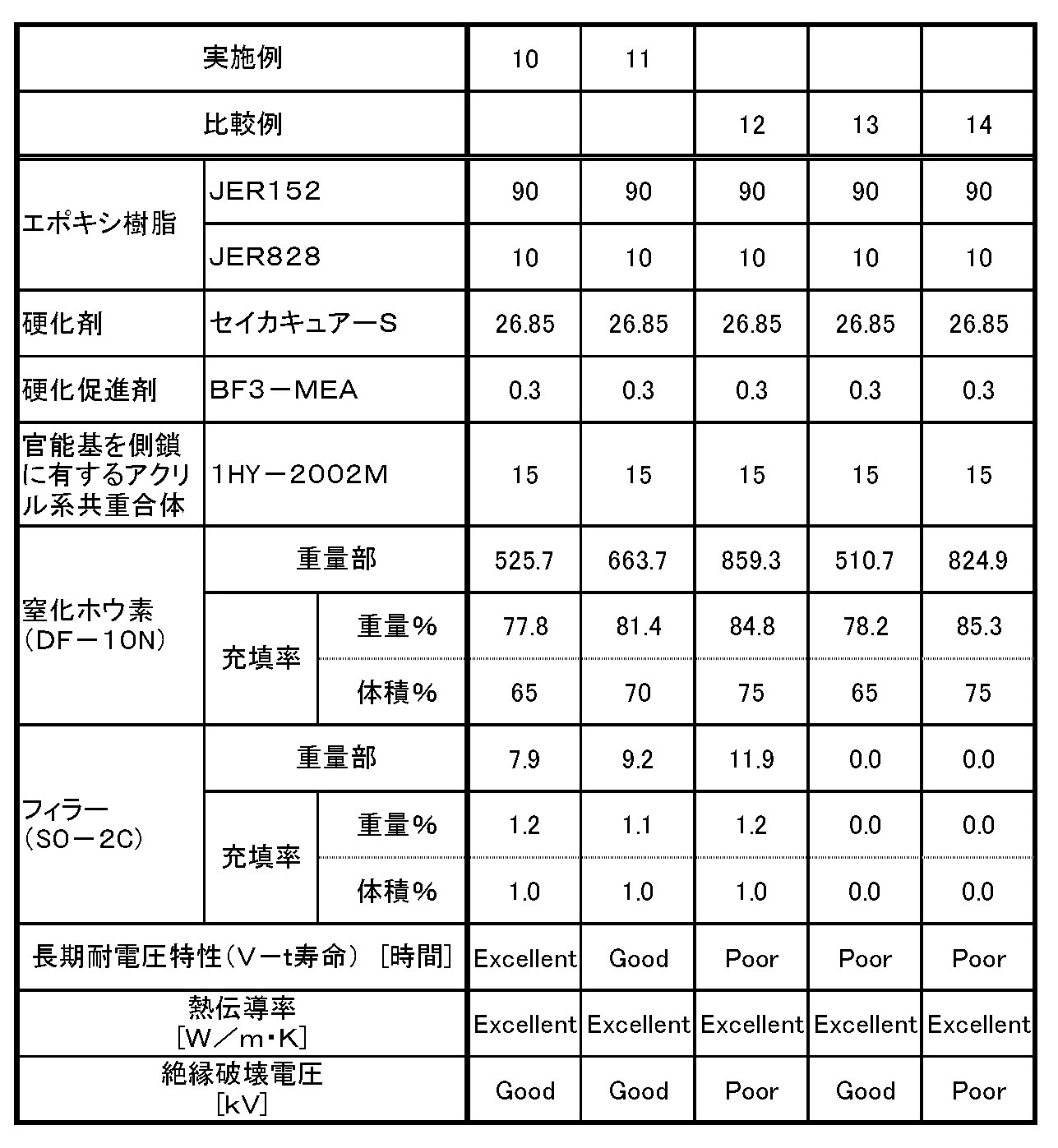
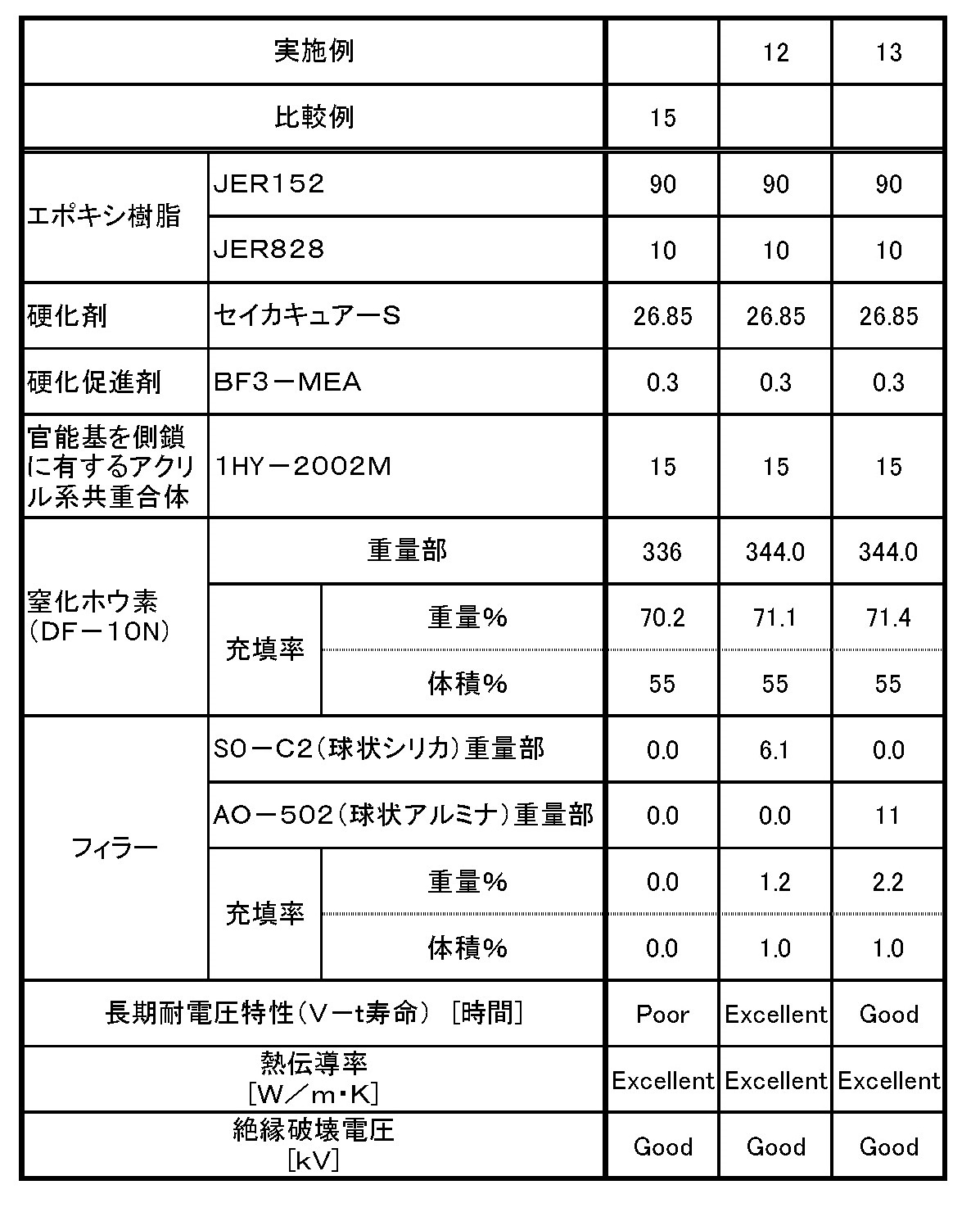
- Tables 3A and 3B show the evaluation results of long-term withstand voltage characteristics, thermal conductivity, and dielectric breakdown voltage of the heat dissipation sheet when the amount of boron nitride and the amount of filler are changed.
- the long-term withstand voltage characteristics are such that the volume ratio (% by volume) of boron nitride is 55% by volume or more and 70% by volume or less, and the thermosetting resin composition contains a filler.
- Good evaluation results were obtained by In addition, good evaluation results were obtained for thermal conductivity and dielectric breakdown voltage.
- Table 4 shows the evaluation results of the long-term withstand voltage characteristics, thermal conductivity, and dielectric breakdown voltage of the heat dissipation sheet when the shape of the filler is spherical. As shown in Examples 12 and 13, the long-term withstand voltage characteristics showed good evaluation results due to the spherical filler contained in the thermosetting resin composition. In addition, good evaluation results were obtained for thermal conductivity and dielectric breakdown voltage.
- Table 5 shows the evaluation results of the long-term withstand voltage characteristics, thermal conductivity, and dielectric breakdown voltage of the heat dissipation sheet when the average particle size (D50) of the filler is changed.
- the long-term withstand voltage characteristics were improved by the average particle diameter (D50) of the filler contained in the thermosetting resin composition being 0.5 ⁇ m or more and 5.0 ⁇ m or less.
- a good evaluation result was shown.
- good evaluation results were obtained for thermal conductivity and dielectric breakdown voltage.
- Table 6 shows the long-term withstand voltage characteristics, thermal conductivity, and dielectric breakdown voltage of the heat dissipation sheet, depending on the presence or absence of the epoxy resin, the presence or absence of the curing accelerator, and the difference in the functional group of the acrylic copolymer. Evaluation results are shown. Moreover, Table 6 shows the evaluation results of long-term withstand voltage characteristics, thermal conductivity, and dielectric breakdown voltage of heat dissipation sheets when nano BN (boron nitride) is used as a filler.
- nano BN boron nitride
- Example 18 regardless of the presence or absence of the curing accelerator, the long-term withstand voltage characteristics showed good evaluation results. In addition, good evaluation results were obtained for thermal conductivity and dielectric breakdown voltage.
- Example 19 the use of nano-BN (boron nitride) as a filler also showed good long-term withstand voltage characteristics. In addition, good evaluation results were obtained for thermal conductivity and dielectric breakdown voltage.
- nano-BN boron nitride
- Example 1 and Comparative Example 18 in Table 1 are compared, the long-term withstand voltage characteristics and thermal conductivity of Example 1 are evaluated as good by including an epoxy resin in the thermosetting resin composition. showed the results. Also, the dielectric breakdown voltage showed good evaluation results.
- the heat dissipation sheets of Examples 1 to 21 were excellent in long-term withstand voltage characteristics, thermal conductivity, and dielectric breakdown voltage.
- the heat dissipation sheet and heat dissipation plate composed of the thermosetting resin composition of the embodiment are excellent in heat dissipation and long-term withstand voltage characteristics.
Landscapes
- Chemical & Material Sciences (AREA)
- Health & Medical Sciences (AREA)
- Chemical Kinetics & Catalysis (AREA)
- Medicinal Chemistry (AREA)
- Polymers & Plastics (AREA)
- Organic Chemistry (AREA)
- Compositions Of Macromolecular Compounds (AREA)
Abstract
Description
[1]本発明に係る熱硬化性樹脂組成物は、エポキシ樹脂と、硬化剤と、官能基を側鎖に有するアクリル系共重合体と、窒化ホウ素と、フィラーと、を含み、前記窒化ホウ素の平均粒子径(D50)は、7.0μm以上60μm以下であり、前記フィラーの平均粒子径(D50)は、0.5μm以上5.0μm以下であり、前記窒化ホウ素の体積割合は、前記熱硬化性樹脂組成物100体積%に対して55体積%以上70体積%以下であり、前記フィラーの体積割合は、前記熱硬化性樹脂組成物100体積%に対して0.3体積%以上2.0体積%以下である。
実施形態の熱硬化性樹脂組成物は、主に、放熱シート及び放熱板を構成する樹脂組成物として好適に用いられる。
実施形態の熱硬化性樹脂組成物に含まれるエポキシ樹脂は、硬化後の長期耐電圧特性を高める観点から、一分子中にエポキシ基を2つ以上有し、エポキシ当量が100g/eq以上1000g/eq以下であることが好ましく、150g/eq以上300g/eq以下であることがより好ましい。
硬化剤は、エポキシ樹脂を硬化させる。硬化剤としては、例えば、ジアミノジフェニルメタン(DDM)、ジアミノジフェニルスルフォン(DDS)、ジアミノジフェニルエーテル(DDE)、ヘキサメチレンジアミン、ジシアンジアミド、フェノールノボラック型エポキシ樹脂等が挙げられる。硬化剤は、硬化反応の制御のし易さの観点から、ジシアンジアミドが好ましく、ジアミノジフェニルスルフォンが好ましい。また、硬化剤は、2種以上の硬化剤を併用してもよい。
官能基を側鎖に有するアクリル系共重合体としては、官能基を側鎖に有するアクリル酸エステル共重合体、及び、官能基を側鎖に有する(メタ)アクリル酸エステル共重合体が挙げられる。
窒化ホウ素(BN)の平均粒子径(D50)は、7.0μm以上60μm以下である。鱗片形状を有する窒化ホウ素の平均粒子径(D50)は、分散性を良好にする観点から、7.0μm以上15μm以下であることが好ましい。凝集窒化ホウ素の平均粒子径(D50)は、分散性を良好にする観点から、10μm以上40μm以下であることが好ましい。
フィラーの平均粒子径(D50)は、高い絶縁破壊電圧を維持する観点から、0.5μm以上5.0μm以下であり、0.5μm以上3.0μm以下であることが好ましい。
実施形態の熱硬化性樹脂組成物は、他の添加剤を更に含有してもよい。他の添加剤としては、2-メチルイミダゾール、2-ウンデシルイミダゾール、1,2-ジメチルイミダゾール、2-エチル-4-メチルイミダゾール、N-ベンジル-2-メチルイミダゾール、2-ウンデシルイミダゾール等のイミダゾール系硬化促進剤;三フッ化ホウ素モノエチルアミン、三フッ化ホウ素ジエチルアミン等のルイス酸錯体系硬化促進剤;ポリアミン、メラミン樹脂等の硬化促進剤、分散剤、軟化剤、熱老化防止剤、シランカップリング剤等が挙げられる。
実施形態の放熱シートは、樹脂層から構成される。樹脂層は実施形態の熱硬化性樹脂組成物から構成される。
実施形態の放熱板は、金属板と、実施形態の熱硬化性樹脂組成物から構成される樹脂層と、を備える。樹脂層は金属板の少なくとも一方の面に積層されている。
以上、実施形態の熱硬化性樹脂組成物を用いた放熱板について説明した。
(エポキシ樹脂)
(1)JER152:多官能エポキシ樹脂、エポキシ当量177g/eq、三菱ケミカル社製、
(2)JER828:ビスフェノールA型エポキシ樹脂、エポキシ当量190g/eq、三菱ケミカル社製。
セイカキュアーS:ジアミノジフェニルスルフォン、アミン価62g/eq、和歌山精化社製。
BF3-MEA:三フッ化ホウ素モノエチルアミン、ステラケミファ社製。
(1)1HY-2002M:カルボキシル基を側鎖に有するアクリル系共重合体、重量平均分子量約28万、酸価20KOHmg/g、大成ファインケミカル社製、
(2)SG-600TEA:水酸基を側鎖に有するアクリル系共重合体、重量平均分子量約120万、水酸基価5KOHmg/g、ナガセケムテックス社製、
(3)SG-P3:エポキシ基を側鎖に有するアクリル系共重合体、重量平均分子量約120万、エポキシ価0.21eq/kg、ナガセケムテックス社製。
(1)DF-10N:凝集窒化ホウ素、平均粒子径(D50)15μm、トクヤマ社製、
(2)HP-40MF100:凝集窒化ホウ素、平均粒子径(D50)40μm、水島合金鉄社製、
(3)S-03:鱗片形状を有する窒化ホウ素、平均粒子径(D50)7μm、トクヤマ社製。
(1)S0-C2:球状シリカ、平均粒子径(D50)0.5μm、アドマテックス社製、
(2)YC100C-LHH:球状シリカ、平均粒子径(D50)0.1μm、アドマテックス社製、
(3)S0-C5:球状シリカ、平均粒子径(D50)1.5μm、アドマテックス社製、
(4)FB-3SDC:球状シリカ、平均粒子径(D50)3.0μm、デンカ社製、
(5)FB-7SDC:球状シリカ、平均粒子径(D50)5.0μm、デンカ社製、
(6)FB-105FD:球状シリカ、平均粒子径(D50)11.0μm、デンカ社製、
(7)AO-502:球状アルミナ、平均粒子径(D50)0.2μm、アドマテックス社製、
(8)ナノBN:球状窒化ホウ素、平均粒子径(D50)0.5μm、デンカ社製。
(1)サンプルの作製手順
(1-1)放熱シートの作製
厚さ50μmの離型PET(ポリエチレンテレフタレート)フィルム(ユニチカ社製、TR)の離型処理面に、樹脂層となる熱硬化性樹脂組成物を、乾燥後の厚さが180μmとなるように塗布した。次に、120℃、10分の条件で半硬化状態(Bステージ)になるまで熱硬化性樹脂組成物を加熱した。冷却後、放熱シートを得た。
(1-1)で作製した放熱シートから離型PETフィルムを剥がし、厚さ35μmの圧延銅箔(JX日鉱日石金属社製、BHY)と厚さ1mmのアルミ板(昭和電工社製、A1100)との間に放熱シートが積層されるように貼り合わせ、185℃、10MPa、180分の条件で加熱加圧した。その後、160℃のオーブンで5時間加熱し、室温まで冷却した。次に直径20mmの円形状となるように圧延銅箔をエッチングし、水洗し、乾燥させて測定用サンプルを得た。なお、圧延銅箔の粗面が放熱シートと接するように、放熱シートに圧延銅箔を積層した。
(1-2)で作製した測定用サンプルを150℃の油中に浸漬した状態で、DC10kVの電圧をアルミ板と圧延銅箔との間に印加し、印加してから絶縁破壊が生じるまでの時間を測定した。1サンプルにつき4回試験を行い、最も短い時間を絶縁保持時間とした。
Excellent:絶縁保持時間が100時間以上、
Good:絶縁保持時間が50時間以上、100時間未満、
Poor:絶縁保持時間が50時間未満。
上記試験条件で100時間以上の絶縁保持時間を確保できた測定用サンプルは、150℃、1kV、10年の条件で絶縁を維持するだけの長期耐電圧特性を有する。
(1)サンプルの作製手順
(1-1)放熱シートの作製
厚さ50μmの離型PET(ポリエチレンテレフタレート)フィルム(ユニチカ社製、TR)の離型処理面に、乾燥後の厚さが180μmとなるように熱硬化性樹脂組成物を塗布した。次に、120℃、10分の条件で半硬化状態(Bステージ)になるまで熱硬化性樹脂組成物を加熱した。冷却後、樹脂層から構成される放熱シートを得た。同様の方法で放熱シートを計2枚作製した。
(1-1)で作製した2枚の放熱シートについて、互いの樹脂層が接触するように積層し、185℃、10MPa、180分の条件で加熱加圧した。その後、離型PETフィルムを剥がし測定用サンプルを得た。
熱伝導率は、測定用サンプルの熱拡散係数(α)、比熱(Cp)、密度(ρ)をそれぞれ測定し、下記式に代入することで算出した。
熱伝導率[W/(m・K)]=α[mm2/s]×Cp[J/kg・K]×ρ[g/cm3]
α[mm2/s]:熱拡散係数
Cp[J/g・K]:比熱
ρ[g/cm3]:密度
熱拡散係数(α)は、レーザーフラッシュ法を採用し、測定用サンプルの一方の面にパルス光を照射して加熱し、他面の温度変化を測定した。測定は、NETZSCH社製、LFA447を用いて、25℃の条件下で行った。解析方法はハーフタイム法を採用した。
比熱Cp(J/g・K)は、示差走査熱量測定法(DSC法)により測定した。比熱測定は、TAインスツルメント社製の装置(装置名Q200)を用い、昇温速度10℃/min、温度範囲-30℃~50℃の条件下で行った。測定で得られたデータを基に、JIS K7123に準じた方法で比熱を算出した。
密度(ρ)は、島津製作所社製、AUX220、SMK-401を用いて、液浸法を利用して測定した。
Good:6W/(m・K)以上、
Poor:6W/(m・K)未満。
(1)測定用サンプル
<長期耐電圧特性>で作製した測定用サンプルを使用した。
測定用サンプルを、25℃の油中に浸漬した状態で、1kV/0.5secの間隔で電圧を上げていき、絶縁破壊が生じたときの電圧を測定した。試験は5回行い、その平均値を算出した。
評価基準は以下の通りとした。
Good:電圧が9kV以上、
Poor:電圧が9kV未満。
容器に、JER152を90重量部、JER828を10重量部加え、エポキシ樹脂の合計重量部を100重量部とした。これに、セイカキュアーSを26.85重量部、BF3-MEAを0.3重量部、1HY-2002Mを15重量部、DF-10Nを338.0重量部(熱硬化性樹脂組成物100体積%に対して55体積%)、S0-C2を1.8重量部(熱硬化性樹脂組成物100重量%に対して0.4重量%)、有機溶剤としてメチルエチルケトンを200重量部加えた。その後、これらを室温で撹拌し熱硬化性樹脂組成物を得た。
表1~表6に示すように、各成分の種類及び含有量を変えて実施例1と同様の方法により調製し、熱硬化性樹脂組成物を得た。表中の含有量の単位は特に明記がない限りは「重量部」を示す。




Claims (11)
- エポキシ樹脂と、硬化剤と、官能基を側鎖に有するアクリル系共重合体と、窒化ホウ素と、フィラーと、を含む熱硬化性樹脂組成物であって、
前記窒化ホウ素の平均粒子径(D50)は、7.0μm以上60μm以下であり、
前記フィラーの平均粒子径(D50)は、0.5μm以上5.0μm以下であり、
前記窒化ホウ素の体積割合は、前記熱硬化性樹脂組成物100体積%に対して55体積%以上70体積%以下であり、
前記フィラーの体積割合は、前記熱硬化性樹脂組成物100体積%に対して0.3体積%以上2.0体積%以下である、熱硬化性樹脂組成物。 - 前記フィラーは、シリカ、アルミナ、窒化ホウ素、酸化マグネシウム、水酸化アルミニウム、水酸化マグネシウム、酸化亜鉛、窒化ケイ素、炭化ケイ素、窒化ガリウム、及びタルクからなる群から選ばれる少なくとも1種から構成される、請求項1に記載の熱硬化性樹脂組成物。
- 前記フィラーの形状は、球状である、請求項1又は2に記載の熱硬化性樹脂組成物。
- 前記窒化ホウ素は、鱗片形状を有する窒化ホウ素、及び複数の窒化ホウ素が凝集している凝集窒化ホウ素からなる群から選ばれる少なくとも1種から構成される、請求項1から3のいずれか1項に記載の熱硬化性樹脂組成物。
- 前記官能基は、カルボキシル基、水酸基、及びエポキシ基からなる群から選ばれる少なくとも1種の官能基を有する、請求項1から4のいずれか1項に記載の熱硬化性樹脂組成物。
- 樹脂層から構成され、前記樹脂層は請求項1から5のいずれか1項に記載の熱硬化性樹脂組成物から構成されている、放熱シート。
- 前記樹脂層の硬化状態は、半硬化状態である、請求項6に記載の放熱シート。
- 金属板と、請求項1から5のいずれか1項に記載の熱硬化性樹脂組成物から構成される樹脂層と、を備え、前記樹脂層は前記金属板の少なくとも一方の面に積層されている、放熱板。
- 前記樹脂層の硬化状態は、半硬化状態である、請求項8に記載の放熱板。
- 請求項1から5のいずれか1項に記載の熱硬化性樹脂組成物を調製する樹脂組成物調製工程と、
フィルムに前記熱硬化性樹脂組成物を塗布する塗布工程と、
前記熱硬化性樹脂組成物が塗布された前記フィルムを加熱する加熱工程と、を含む、放熱シートの製造方法。 - 請求項1から5のいずれか1項に記載の熱硬化性樹脂組成物を調製する樹脂組成物調製工程と、
金属板に前記熱硬化性樹脂組成物を塗布する塗布工程と、
前記熱硬化性樹脂組成物が塗布された前記金属板を加熱する加熱工程と、を含む、放熱板の製造方法。
Priority Applications (2)
| Application Number | Priority Date | Filing Date | Title |
|---|---|---|---|
| CN202280067517.5A CN118103447A (zh) | 2021-10-20 | 2022-10-03 | 热固性树脂组合物、散热片、散热板、散热片的制造方法及散热板的制造方法 |
| JP2023554407A JPWO2023068024A1 (ja) | 2021-10-20 | 2022-10-03 |
Applications Claiming Priority (2)
| Application Number | Priority Date | Filing Date | Title |
|---|---|---|---|
| JP2021-171904 | 2021-10-20 | ||
| JP2021171904 | 2021-10-20 |
Publications (1)
| Publication Number | Publication Date |
|---|---|
| WO2023068024A1 true WO2023068024A1 (ja) | 2023-04-27 |
Family
ID=86058085
Family Applications (1)
| Application Number | Title | Priority Date | Filing Date |
|---|---|---|---|
| PCT/JP2022/036896 Ceased WO2023068024A1 (ja) | 2021-10-20 | 2022-10-03 | 熱硬化性樹脂組成物、放熱シート、放熱板、放熱シートの製造方法、及び放熱板の製造方法 |
Country Status (4)
| Country | Link |
|---|---|
| JP (1) | JPWO2023068024A1 (ja) |
| CN (1) | CN118103447A (ja) |
| TW (1) | TWI905461B (ja) |
| WO (1) | WO2023068024A1 (ja) |
Cited By (4)
| Publication number | Priority date | Publication date | Assignee | Title |
|---|---|---|---|---|
| JP2024045039A (ja) * | 2022-09-20 | 2024-04-02 | 住友ベークライト株式会社 | 樹脂シート |
| JPWO2024214487A1 (ja) * | 2023-04-14 | 2024-10-17 | ||
| WO2024257369A1 (ja) * | 2023-06-15 | 2024-12-19 | 住友ベークライト株式会社 | 樹脂シート |
| JP7860530B2 (ja) | 2022-09-20 | 2026-05-18 | 住友ベークライト株式会社 | 樹脂シート |
Citations (9)
| Publication number | Priority date | Publication date | Assignee | Title |
|---|---|---|---|---|
| JP2012212727A (ja) * | 2011-03-30 | 2012-11-01 | Nitto Denko Corp | 熱伝導性シートの製造方法および熱伝導性シート |
| JP2013234313A (ja) * | 2011-11-02 | 2013-11-21 | Hitachi Chemical Co Ltd | エポキシ樹脂組成物、その半硬化体および硬化体、並びにそれを用いた樹脂シート、プリプレグ、積層板、金属基板、プリント配線板、およびパワー半導体装置 |
| WO2018124126A1 (ja) * | 2016-12-28 | 2018-07-05 | 昭和電工株式会社 | 六方晶窒化ホウ素粉末、その製造方法、樹脂組成物及び樹脂シート |
| US20180230290A1 (en) * | 2017-02-10 | 2018-08-16 | E I Du Pont De Nemours And Company | Thermally conductive polymer composition |
| JP2018188628A (ja) * | 2017-04-28 | 2018-11-29 | 積水化学工業株式会社 | 熱硬化性材料 |
| JP2019043804A (ja) * | 2017-08-31 | 2019-03-22 | 株式会社豊田中央研究所 | 熱伝導性フィラー、熱伝導性複合材料、及び熱伝導性フィラーの製造方法 |
| JP2020105411A (ja) * | 2018-12-28 | 2020-07-09 | 東洋インキScホールディングス株式会社 | 熱伝導性絶縁接着シート、及び該シートの製造方法 |
| JP2020105412A (ja) * | 2018-12-28 | 2020-07-09 | 東洋インキScホールディングス株式会社 | 熱伝導性絶縁接着シート、及び該シートの製造方法 |
| WO2021006310A1 (ja) * | 2019-07-11 | 2021-01-14 | 昭和電工株式会社 | シリカ被覆窒化ホウ素粒子の製造方法、シリカ被覆窒化ホウ素粒子 |
Family Cites Families (2)
| Publication number | Priority date | Publication date | Assignee | Title |
|---|---|---|---|---|
| SG11202006826WA (en) * | 2018-01-30 | 2020-08-28 | Hitachi Chemical Co Ltd | Adhesive composition, filmy adhesive, adhesive sheet, and production method for semiconductor device |
| JP7079378B2 (ja) * | 2019-03-28 | 2022-06-01 | デンカ株式会社 | 窒化ホウ素粉末及びその製造方法、並びに、複合材及び放熱部材 |
-
2022
- 2022-10-03 WO PCT/JP2022/036896 patent/WO2023068024A1/ja not_active Ceased
- 2022-10-03 JP JP2023554407A patent/JPWO2023068024A1/ja active Pending
- 2022-10-03 CN CN202280067517.5A patent/CN118103447A/zh active Pending
- 2022-10-12 TW TW111138672A patent/TWI905461B/zh active
Patent Citations (9)
| Publication number | Priority date | Publication date | Assignee | Title |
|---|---|---|---|---|
| JP2012212727A (ja) * | 2011-03-30 | 2012-11-01 | Nitto Denko Corp | 熱伝導性シートの製造方法および熱伝導性シート |
| JP2013234313A (ja) * | 2011-11-02 | 2013-11-21 | Hitachi Chemical Co Ltd | エポキシ樹脂組成物、その半硬化体および硬化体、並びにそれを用いた樹脂シート、プリプレグ、積層板、金属基板、プリント配線板、およびパワー半導体装置 |
| WO2018124126A1 (ja) * | 2016-12-28 | 2018-07-05 | 昭和電工株式会社 | 六方晶窒化ホウ素粉末、その製造方法、樹脂組成物及び樹脂シート |
| US20180230290A1 (en) * | 2017-02-10 | 2018-08-16 | E I Du Pont De Nemours And Company | Thermally conductive polymer composition |
| JP2018188628A (ja) * | 2017-04-28 | 2018-11-29 | 積水化学工業株式会社 | 熱硬化性材料 |
| JP2019043804A (ja) * | 2017-08-31 | 2019-03-22 | 株式会社豊田中央研究所 | 熱伝導性フィラー、熱伝導性複合材料、及び熱伝導性フィラーの製造方法 |
| JP2020105411A (ja) * | 2018-12-28 | 2020-07-09 | 東洋インキScホールディングス株式会社 | 熱伝導性絶縁接着シート、及び該シートの製造方法 |
| JP2020105412A (ja) * | 2018-12-28 | 2020-07-09 | 東洋インキScホールディングス株式会社 | 熱伝導性絶縁接着シート、及び該シートの製造方法 |
| WO2021006310A1 (ja) * | 2019-07-11 | 2021-01-14 | 昭和電工株式会社 | シリカ被覆窒化ホウ素粒子の製造方法、シリカ被覆窒化ホウ素粒子 |
Cited By (6)
| Publication number | Priority date | Publication date | Assignee | Title |
|---|---|---|---|---|
| JP2024045039A (ja) * | 2022-09-20 | 2024-04-02 | 住友ベークライト株式会社 | 樹脂シート |
| JP7860530B2 (ja) | 2022-09-20 | 2026-05-18 | 住友ベークライト株式会社 | 樹脂シート |
| JPWO2024214487A1 (ja) * | 2023-04-14 | 2024-10-17 | ||
| WO2024214487A1 (ja) * | 2023-04-14 | 2024-10-17 | 株式会社有沢製作所 | 熱硬化性樹脂組成物、樹脂シート、放熱板、樹脂シートの製造方法、及び放熱板の製造方法 |
| JP7716593B2 (ja) | 2023-04-14 | 2025-07-31 | 株式会社有沢製作所 | 熱硬化性樹脂組成物、樹脂シート、放熱板、樹脂シートの製造方法、及び放熱板の製造方法 |
| WO2024257369A1 (ja) * | 2023-06-15 | 2024-12-19 | 住友ベークライト株式会社 | 樹脂シート |
Also Published As
| Publication number | Publication date |
|---|---|
| TW202319433A (zh) | 2023-05-16 |
| JPWO2023068024A1 (ja) | 2023-04-27 |
| TWI905461B (zh) | 2025-11-21 |
| CN118103447A (zh) | 2024-05-28 |
Similar Documents
| Publication | Publication Date | Title |
|---|---|---|
| TWI526311B (zh) | 多層樹脂薄片及其製造方法,多層樹脂薄片硬化物之製造方法及高熱傳導樹脂薄片層合體及其製造方法 | |
| JP4922108B2 (ja) | 絶縁シート及び積層構造体 | |
| JP2013176979A (ja) | 熱伝導性シート | |
| TW201118128A (en) | Resin composition, resin sheet, and cured resin and method of producing the same | |
| JP2010044998A (ja) | 絶縁シート及び積層構造体 | |
| CN103748673B (zh) | 叠层体及功率半导体模块用部件的制造方法 | |
| CN106103531A (zh) | 树脂组合物、树脂片、树脂片固化物、树脂片层叠体、树脂片层叠体固化物及其制造方法、半导体装置以及led装置 | |
| JP7188070B2 (ja) | 放熱絶縁シートおよび該シート硬化物を絶縁層とする積層構造体 | |
| JP2009144072A (ja) | 絶縁シート及び積層構造体 | |
| CN102925089A (zh) | 一种可挠性导热树脂及其制成的半固化片和金属基覆铜板 | |
| CN112771123B (zh) | 树脂组合物、树脂固化物及复合成形体 | |
| TWI905461B (zh) | 熱硬化性樹脂組成物、散熱片、散熱板、散熱片的製造方法以及散熱板的製造方法 | |
| JP6778991B2 (ja) | 軟磁性熱硬化性フィルムおよび軟磁性フィルム | |
| JP2013098217A (ja) | パワー半導体モジュール用部品の製造方法 | |
| JP6235733B2 (ja) | 積層体 | |
| JP2020063438A (ja) | 樹脂組成物、樹脂硬化物および複合成形体 | |
| WO2023182470A1 (ja) | 熱硬化性樹脂組成物、熱伝導性樹脂シート、放熱積層体、放熱性回路基板、半導体装置およびパワーモジュール | |
| JP2013201338A (ja) | パワー半導体モジュール用部品の製造方法 | |
| JP5114597B1 (ja) | 積層体及び切断積層体 | |
| JP7716593B2 (ja) | 熱硬化性樹脂組成物、樹脂シート、放熱板、樹脂シートの製造方法、及び放熱板の製造方法 | |
| JP2026001459A (ja) | 熱硬化性樹脂組成物、樹脂シート、放熱板、樹脂シートの製造方法、及び放熱板の製造方法 | |
| JP2023145355A (ja) | 熱硬化性樹脂組成物、熱硬化性樹脂シート、絶縁シート及び半導体装置 | |
| JP2023145370A (ja) | 熱硬化性樹脂組成物、熱硬化性樹脂シート、絶縁シート及び半導体装置 | |
| WO2025197972A1 (ja) | 熱硬化性組成物、熱硬化性シートの製造方法、熱伝導性シート、放熱積層体、放熱性回路基板及びパワー半導体装置 | |
| JP2023102284A (ja) | 熱伝導性樹脂組成物、熱伝導性樹脂シート、放熱積層体、放熱性回路基板、半導体装置およびパワーモジュール |
Legal Events
| Date | Code | Title | Description |
|---|---|---|---|
| 121 | Ep: the epo has been informed by wipo that ep was designated in this application |
Ref document number: 22883331 Country of ref document: EP Kind code of ref document: A1 |
|
| WWE | Wipo information: entry into national phase |
Ref document number: 202280067517.5 Country of ref document: CN |
|
| ENP | Entry into the national phase |
Ref document number: 2023554407 Country of ref document: JP Kind code of ref document: A |
|
| NENP | Non-entry into the national phase |
Ref country code: DE |
|
| 122 | Ep: pct application non-entry in european phase |
Ref document number: 22883331 Country of ref document: EP Kind code of ref document: A1 |