WO2021020778A1 - 올레핀 중합 촉매용 전이금속 화합물, 이를 포함하는 올레핀 중합 촉매 및 이를 이용하여 중합된 폴리올레핀 - Google Patents
올레핀 중합 촉매용 전이금속 화합물, 이를 포함하는 올레핀 중합 촉매 및 이를 이용하여 중합된 폴리올레핀 Download PDFInfo
- Publication number
- WO2021020778A1 WO2021020778A1 PCT/KR2020/009414 KR2020009414W WO2021020778A1 WO 2021020778 A1 WO2021020778 A1 WO 2021020778A1 KR 2020009414 W KR2020009414 W KR 2020009414W WO 2021020778 A1 WO2021020778 A1 WO 2021020778A1
- Authority
- WO
- WIPO (PCT)
- Prior art keywords
- formula
- substituted
- unsubstituted
- aluminum
- boron
- Prior art date
- Legal status (The legal status is an assumption and is not a legal conclusion. Google has not performed a legal analysis and makes no representation as to the accuracy of the status listed.)
- Ceased
Links
- 0 CC(C)(C1CC(CC(C*)=C)CC1)C1c(ccc(I)c2)c2-c2cc(C)ccc12 Chemical compound CC(C)(C1CC(CC(C*)=C)CC1)C1c(ccc(I)c2)c2-c2cc(C)ccc12 0.000 description 7
Classifications
-
- C—CHEMISTRY; METALLURGY
- C08—ORGANIC MACROMOLECULAR COMPOUNDS; THEIR PREPARATION OR CHEMICAL WORKING-UP; COMPOSITIONS BASED THEREON
- C08F—MACROMOLECULAR COMPOUNDS OBTAINED BY REACTIONS ONLY INVOLVING CARBON-TO-CARBON UNSATURATED BONDS
- C08F10/00—Homopolymers and copolymers of unsaturated aliphatic hydrocarbons having only one carbon-to-carbon double bond
-
- C—CHEMISTRY; METALLURGY
- C08—ORGANIC MACROMOLECULAR COMPOUNDS; THEIR PREPARATION OR CHEMICAL WORKING-UP; COMPOSITIONS BASED THEREON
- C08F—MACROMOLECULAR COMPOUNDS OBTAINED BY REACTIONS ONLY INVOLVING CARBON-TO-CARBON UNSATURATED BONDS
- C08F10/00—Homopolymers and copolymers of unsaturated aliphatic hydrocarbons having only one carbon-to-carbon double bond
- C08F10/02—Ethene
-
- C—CHEMISTRY; METALLURGY
- C08—ORGANIC MACROMOLECULAR COMPOUNDS; THEIR PREPARATION OR CHEMICAL WORKING-UP; COMPOSITIONS BASED THEREON
- C08F—MACROMOLECULAR COMPOUNDS OBTAINED BY REACTIONS ONLY INVOLVING CARBON-TO-CARBON UNSATURATED BONDS
- C08F4/00—Polymerisation catalysts
- C08F4/42—Metals; Metal hydrides; Metallo-organic compounds; Use thereof as catalyst precursors
- C08F4/44—Metals; Metal hydrides; Metallo-organic compounds; Use thereof as catalyst precursors selected from light metals, zinc, cadmium, mercury, copper, silver, gold, boron, gallium, indium, thallium, rare earths or actinides
- C08F4/60—Metals; Metal hydrides; Metallo-organic compounds; Use thereof as catalyst precursors selected from light metals, zinc, cadmium, mercury, copper, silver, gold, boron, gallium, indium, thallium, rare earths or actinides together with refractory metals, iron group metals, platinum group metals, manganese, rhenium technetium or compounds thereof
- C08F4/62—Refractory metals or compounds thereof
- C08F4/64—Titanium, zirconium, hafnium or compounds thereof
- C08F4/659—Component covered by group C08F4/64 containing a transition metal-carbon bond
- C08F4/6592—Component covered by group C08F4/64 containing a transition metal-carbon bond containing at least one cyclopentadienyl ring, condensed or not, e.g. an indenyl or a fluorenyl ring
- C08F4/65922—Component covered by group C08F4/64 containing a transition metal-carbon bond containing at least one cyclopentadienyl ring, condensed or not, e.g. an indenyl or a fluorenyl ring containing at least two cyclopentadienyl rings, fused or not
- C08F4/65927—Component covered by group C08F4/64 containing a transition metal-carbon bond containing at least one cyclopentadienyl ring, condensed or not, e.g. an indenyl or a fluorenyl ring containing at least two cyclopentadienyl rings, fused or not two cyclopentadienyl rings being mutually bridged
-
- C—CHEMISTRY; METALLURGY
- C07—ORGANIC CHEMISTRY
- C07F—ACYCLIC, CARBOCYCLIC OR HETEROCYCLIC COMPOUNDS CONTAINING ELEMENTS OTHER THAN CARBON, HYDROGEN, HALOGEN, OXYGEN, NITROGEN, SULFUR, SELENIUM OR TELLURIUM
- C07F17/00—Metallocenes
-
- C—CHEMISTRY; METALLURGY
- C08—ORGANIC MACROMOLECULAR COMPOUNDS; THEIR PREPARATION OR CHEMICAL WORKING-UP; COMPOSITIONS BASED THEREON
- C08F—MACROMOLECULAR COMPOUNDS OBTAINED BY REACTIONS ONLY INVOLVING CARBON-TO-CARBON UNSATURATED BONDS
- C08F110/00—Homopolymers of unsaturated aliphatic hydrocarbons having only one carbon-to-carbon double bond
- C08F110/02—Ethene
-
- C—CHEMISTRY; METALLURGY
- C08—ORGANIC MACROMOLECULAR COMPOUNDS; THEIR PREPARATION OR CHEMICAL WORKING-UP; COMPOSITIONS BASED THEREON
- C08F—MACROMOLECULAR COMPOUNDS OBTAINED BY REACTIONS ONLY INVOLVING CARBON-TO-CARBON UNSATURATED BONDS
- C08F210/00—Copolymers of unsaturated aliphatic hydrocarbons having only one carbon-to-carbon double bond
- C08F210/02—Ethene
-
- C—CHEMISTRY; METALLURGY
- C08—ORGANIC MACROMOLECULAR COMPOUNDS; THEIR PREPARATION OR CHEMICAL WORKING-UP; COMPOSITIONS BASED THEREON
- C08F—MACROMOLECULAR COMPOUNDS OBTAINED BY REACTIONS ONLY INVOLVING CARBON-TO-CARBON UNSATURATED BONDS
- C08F210/00—Copolymers of unsaturated aliphatic hydrocarbons having only one carbon-to-carbon double bond
- C08F210/14—Monomers containing five or more carbon atoms
-
- C—CHEMISTRY; METALLURGY
- C08—ORGANIC MACROMOLECULAR COMPOUNDS; THEIR PREPARATION OR CHEMICAL WORKING-UP; COMPOSITIONS BASED THEREON
- C08F—MACROMOLECULAR COMPOUNDS OBTAINED BY REACTIONS ONLY INVOLVING CARBON-TO-CARBON UNSATURATED BONDS
- C08F210/00—Copolymers of unsaturated aliphatic hydrocarbons having only one carbon-to-carbon double bond
- C08F210/16—Copolymers of ethene with alpha-alkenes, e.g. EP rubbers
-
- C—CHEMISTRY; METALLURGY
- C08—ORGANIC MACROMOLECULAR COMPOUNDS; THEIR PREPARATION OR CHEMICAL WORKING-UP; COMPOSITIONS BASED THEREON
- C08F—MACROMOLECULAR COMPOUNDS OBTAINED BY REACTIONS ONLY INVOLVING CARBON-TO-CARBON UNSATURATED BONDS
- C08F4/00—Polymerisation catalysts
- C08F4/42—Metals; Metal hydrides; Metallo-organic compounds; Use thereof as catalyst precursors
- C08F4/44—Metals; Metal hydrides; Metallo-organic compounds; Use thereof as catalyst precursors selected from light metals, zinc, cadmium, mercury, copper, silver, gold, boron, gallium, indium, thallium, rare earths or actinides
- C08F4/60—Metals; Metal hydrides; Metallo-organic compounds; Use thereof as catalyst precursors selected from light metals, zinc, cadmium, mercury, copper, silver, gold, boron, gallium, indium, thallium, rare earths or actinides together with refractory metals, iron group metals, platinum group metals, manganese, rhenium technetium or compounds thereof
- C08F4/62—Refractory metals or compounds thereof
- C08F4/64—Titanium, zirconium, hafnium or compounds thereof
- C08F4/646—Catalysts comprising at least two different metals, in metallic form or as compounds thereof, in addition to the component covered by group C08F4/64
- C08F4/6465—Catalysts comprising at least two different metals, in metallic form or as compounds thereof, in addition to the component covered by group C08F4/64 containing silicium
-
- C—CHEMISTRY; METALLURGY
- C08—ORGANIC MACROMOLECULAR COMPOUNDS; THEIR PREPARATION OR CHEMICAL WORKING-UP; COMPOSITIONS BASED THEREON
- C08F—MACROMOLECULAR COMPOUNDS OBTAINED BY REACTIONS ONLY INVOLVING CARBON-TO-CARBON UNSATURATED BONDS
- C08F4/00—Polymerisation catalysts
- C08F4/42—Metals; Metal hydrides; Metallo-organic compounds; Use thereof as catalyst precursors
- C08F4/44—Metals; Metal hydrides; Metallo-organic compounds; Use thereof as catalyst precursors selected from light metals, zinc, cadmium, mercury, copper, silver, gold, boron, gallium, indium, thallium, rare earths or actinides
- C08F4/60—Metals; Metal hydrides; Metallo-organic compounds; Use thereof as catalyst precursors selected from light metals, zinc, cadmium, mercury, copper, silver, gold, boron, gallium, indium, thallium, rare earths or actinides together with refractory metals, iron group metals, platinum group metals, manganese, rhenium technetium or compounds thereof
- C08F4/62—Refractory metals or compounds thereof
- C08F4/64—Titanium, zirconium, hafnium or compounds thereof
- C08F4/659—Component covered by group C08F4/64 containing a transition metal-carbon bond
- C08F4/65908—Component covered by group C08F4/64 containing a transition metal-carbon bond in combination with an ionising compound other than alumoxane, e.g. (C6F5)4B-X+
-
- C—CHEMISTRY; METALLURGY
- C08—ORGANIC MACROMOLECULAR COMPOUNDS; THEIR PREPARATION OR CHEMICAL WORKING-UP; COMPOSITIONS BASED THEREON
- C08F—MACROMOLECULAR COMPOUNDS OBTAINED BY REACTIONS ONLY INVOLVING CARBON-TO-CARBON UNSATURATED BONDS
- C08F4/00—Polymerisation catalysts
- C08F4/42—Metals; Metal hydrides; Metallo-organic compounds; Use thereof as catalyst precursors
- C08F4/44—Metals; Metal hydrides; Metallo-organic compounds; Use thereof as catalyst precursors selected from light metals, zinc, cadmium, mercury, copper, silver, gold, boron, gallium, indium, thallium, rare earths or actinides
- C08F4/60—Metals; Metal hydrides; Metallo-organic compounds; Use thereof as catalyst precursors selected from light metals, zinc, cadmium, mercury, copper, silver, gold, boron, gallium, indium, thallium, rare earths or actinides together with refractory metals, iron group metals, platinum group metals, manganese, rhenium technetium or compounds thereof
- C08F4/62—Refractory metals or compounds thereof
- C08F4/64—Titanium, zirconium, hafnium or compounds thereof
- C08F4/659—Component covered by group C08F4/64 containing a transition metal-carbon bond
- C08F4/65912—Component covered by group C08F4/64 containing a transition metal-carbon bond in combination with an organoaluminium compound
-
- C—CHEMISTRY; METALLURGY
- C08—ORGANIC MACROMOLECULAR COMPOUNDS; THEIR PREPARATION OR CHEMICAL WORKING-UP; COMPOSITIONS BASED THEREON
- C08F—MACROMOLECULAR COMPOUNDS OBTAINED BY REACTIONS ONLY INVOLVING CARBON-TO-CARBON UNSATURATED BONDS
- C08F4/00—Polymerisation catalysts
- C08F4/42—Metals; Metal hydrides; Metallo-organic compounds; Use thereof as catalyst precursors
- C08F4/44—Metals; Metal hydrides; Metallo-organic compounds; Use thereof as catalyst precursors selected from light metals, zinc, cadmium, mercury, copper, silver, gold, boron, gallium, indium, thallium, rare earths or actinides
- C08F4/60—Metals; Metal hydrides; Metallo-organic compounds; Use thereof as catalyst precursors selected from light metals, zinc, cadmium, mercury, copper, silver, gold, boron, gallium, indium, thallium, rare earths or actinides together with refractory metals, iron group metals, platinum group metals, manganese, rhenium technetium or compounds thereof
- C08F4/62—Refractory metals or compounds thereof
- C08F4/64—Titanium, zirconium, hafnium or compounds thereof
- C08F4/659—Component covered by group C08F4/64 containing a transition metal-carbon bond
- C08F4/65916—Component covered by group C08F4/64 containing a transition metal-carbon bond supported on a carrier, e.g. silica, MgCl2, polymer
-
- C—CHEMISTRY; METALLURGY
- C08—ORGANIC MACROMOLECULAR COMPOUNDS; THEIR PREPARATION OR CHEMICAL WORKING-UP; COMPOSITIONS BASED THEREON
- C08F—MACROMOLECULAR COMPOUNDS OBTAINED BY REACTIONS ONLY INVOLVING CARBON-TO-CARBON UNSATURATED BONDS
- C08F2420/00—Metallocene catalysts
- C08F2420/07—Heteroatom-substituted Cp, i.e. Cp or analog where at least one of the substituent of the Cp or analog ring is or contains a heteroatom
-
- C—CHEMISTRY; METALLURGY
- C08—ORGANIC MACROMOLECULAR COMPOUNDS; THEIR PREPARATION OR CHEMICAL WORKING-UP; COMPOSITIONS BASED THEREON
- C08F—MACROMOLECULAR COMPOUNDS OBTAINED BY REACTIONS ONLY INVOLVING CARBON-TO-CARBON UNSATURATED BONDS
- C08F2420/00—Metallocene catalysts
- C08F2420/09—Cyclic bridge, i.e. Cp or analog where the bridging unit linking the two Cps or analogs is part of a cyclic group
Definitions
- the present invention relates to a transition metal compound for an olefin polymerization catalyst, a catalyst for olefin polymerization including the same, and a polyolefin polymerized using the same.
- the present invention is a transition metal compound for an olefin polymerization catalyst in which an allyltrimethylsilane substituent is introduced into the skeleton of a carbon bridged cyclopentadienyl fluorenyl, a catalyst for olefin polymerization including the same, and using the same It relates to a polymerized polyolefin.
- Metallocene catalyst one of the catalysts used to polymerize olefins, is coordination of ligands such as cyclopentadienyl, indenyl, and cycloheptadienyl to transition metal or transition metal halide As a bonded compound, it has a sandwich structure in its basic form.
- Ziegler-Natta catalyst another catalyst used to polymerize olefins, is dispersed on a solid surface in which the metal component as the active point is inert, so the properties of the active point are not uniform, whereas the metallocene catalyst has a certain structure. It is known as a single-site catalyst with all active sites having the same polymerization properties because it is a single compound with. Polymers polymerized with such a metallocene catalyst have a narrow molecular weight distribution, uniform distribution of comonomers, and higher copolymerization activity than Ziegler-Natta catalysts.
- a transition metal compound represented by Formula 1 below is provided.
- n is an integer of 1 to 20
- M is titanium (Ti), zirconium (Zr) or hafnium (Hf),
- Q is independently halogen, C 1-20 alkyl, C 2-20 alkenyl, C 2-20 alkynyl, C 6-20 aryl, C 1-20 alkyl C 6-20 aryl, C 6-20 aryl C 1-20 alkyl, C 1-20 alkylamido, C 6-20 arylamido or C 1-20 alkylidene,
- R 1 To R 3 and R 4 To R 11 are each independently hydrogen, substituted or unsubstituted C 1-20 alkyl, substituted or unsubstituted C 2-20 alkenyl, substituted or unsubstituted C 6-20 aryl, substituted or unsubstituted C 1 -20 alkyl C 6-20 aryl, substituted or unsubstituted C 6-20 aryl C 1-20 alkyl, substituted or unsubstituted C 1-20 heteroalkyl, substituted or unsubstituted C 3-20 heteroaryl, substituted Or unsubstituted C 1-20 alkylamido, substituted or unsubstituted C 6-20 arylamido, substituted or unsubstituted C 1-20 alkylidene, or substituted or unsubstituted C 1-20 silyl, , R 1 To R 3 and R 4 To R 11 are each independently linked to an adjacent group to form a substituted or unsubstituted saturated or unsaturated C
- R 12 and R 13 are each independently substituted or unsubstituted C 1-20 alkyl, substituted or unsubstituted C 2-20 alkenyl, substituted or unsubstituted C 6-20 aryl, substituted or unsubstituted C 1 -20 alkyl C 6-20 aryl, substituted or unsubstituted C 6-20 aryl C 1-20 alkyl, substituted or unsubstituted C 1-20 heteroalkyl, substituted or unsubstituted C 3-20 heteroaryl, substituted Or unsubstituted C 1-20 alkylamido, substituted or unsubstituted C 6-20 arylamido, substituted or unsubstituted C 1-20 alkylidene, or substituted or unsubstituted C 1-20 silyl, , R 12 and R 13 may be linked to each other to form a substituted or unsubstituted saturated or unsaturated C 2-20 ring,
- R 14 to R 16 are each independently substituted or unsubstituted C 1-20 alkyl, substituted or unsubstituted C 2-20 alkenyl, substituted or unsubstituted C 6-20 aryl, substituted or unsubstituted C 1-20 Alkyl C 6-20 aryl, substituted or unsubstituted C 6-20 aryl C 1-20 alkyl, substituted or unsubstituted C 1-20 heteroalkyl, substituted or unsubstituted C 3-20 heteroaryl, substituted or unsubstituted A substituted C 1-20 alkylamido, a substituted or unsubstituted C 6-20 arylamido, a substituted or unsubstituted C 1-20 alkylidene, or a substituted or unsubstituted C 1-20 silyl.
- n is 1 or 2
- M is zirconium or hafnium
- Q is each halogen or substituted or unsubstituted C 1-20 alkyl
- R 1 To R 3 are each hydrogen
- R 4 To R 11 are each hydrogen or a substituted or unsubstituted C 1-20 alkyl
- R 12 and R 13 are each substituted or unsubstituted C 1-20 alkyl or a substituted or unsubstituted C 6-20 aryl or R 12 And R 13 may be linked to each other to form a substituted or unsubstituted C 2-20 ring
- R 14 To R 16 are each substituted or unsubstituted C 1-20 alkyl or substituted or unsubstituted C 6-20 aryl.
- the compound represented by Formula 1 above may be any one of the compounds represented by Formulas 1-1 to 1-36 below.
- M is zirconium or hafnium
- Q is each halogen or substituted or unsubstituted C 1-20 alkyl
- Me is a methyl group
- Ph is a phenyl group.
- the compound represented by Formula 1 above may be any one of the compounds represented by Formulas 1-37 to 1-39 below.
- the above transition metal compound and there is provided a catalyst for olefin polymerization comprising a cocatalyst compound.
- the cocatalyst compound may be at least one selected from the group consisting of a compound represented by Formula 2 below, a compound represented by Formula 3, and a compound represented by Formula 4.
- n is an integer of 2 or more
- R a is a halogen atom, a C 1-20 hydrocarbon group or a C 1-20 hydrocarbon group substituted with a halogen
- D is aluminum (Al) or boron (B), and R b , R c and R d are each independently a halogen atom, a C 1-20 hydrocarbon group, a C 1-20 hydrocarbon group substituted with a halogen Or a C 1-20 alkoxy group,
- L is a neutral or cationic Lewis base
- [LH] + and [L] + are Bronsted acid
- Z is a group 13 element
- A is each independently substituted or unsubstituted C 6 -20 aryl group or a substituted or unsubstituted C 1-20 alkyl group.
- the compound represented by Formula 2 above is at least one selected from the group consisting of methylaluminoxane, ethylaluminoxane, isobutylaluminoxane, and butylaluminoxane.
- the compound represented by Chemical Formula 3 is trimethyl aluminum, triethyl aluminum, triisobutyl aluminum, tripropyl aluminum, tributyl aluminum, dimethyl chloro aluminum, triisopropyl aluminum, tri- s -butyl aluminum, tricyclopentyl aluminum, Tripentyl aluminum, triisopentyl aluminum, trihexyl aluminum, trioctyl aluminum, ethyl dimethyl aluminum, methyl diethyl aluminum, triphenyl aluminum, tri- p -tolyl aluminum, dimethyl aluminum methoxide, dimethyl aluminum ethoxide, trimethyl boron , At least one selected from the group consisting of triethyl boron, triisobutyl boron, tripropyl boron and tributyl boron.
- the compound represented by Formula 4 above is triethylammonium tetraphenylborone, tributylammonium tetraphenylborone, trimethylammonium tetraphenylborone, tripropylammonium tetraphenylborone, trimethylammoniumtetra ( p -tolyl) Boron, trimethylammonium tetra ( o , p -dimethylphenyl) boron, tributylammonium tetra ( p -trifluoromethylphenyl) boron, trimethylammonium tetra ( p -trifluoromethylphenyl) boron, tributylammonium tetra Pentafluorophenyl boron, N,N-diethylanilinium tetraphenyl boron, N,N-diethylanilinium tetrapentafluorophenyl boro
- the catalyst for olefin polymerization further includes a carrier supporting a transition metal compound.
- the carrier may support both the transition metal compound and the cocatalyst compound.
- the carrier may include at least one selected from the group consisting of silica, alumina, and magnesia.
- the amount of the transition metal compound supported on the carrier is 0.001 to 1 mmole based on 1 g of the carrier, and the amount of the cocatalyst compound supported on the carrier is 2 to 15 mmole based on 1 g of the carrier.
- a polyolefin obtained by polymerization of an olefin-based monomer in the presence of the catalyst for olefin polymerization.
- the olefinic monomer is C 2-20 alpha-olefin, C 1-20 diolefin, C 3-20 cycloolefin, and C 3-20 cyclodiolefin. It may be at least one selected from the group consisting of.
- the polyolefin may be obtained by copolymerizing ethylene and 1-hexene.
- the transition metal compound for an olefin polymerization catalyst and a metallocene catalyst for olefin polymerization including the same have a specific three-dimensional structure, so that the physical properties of the polymer can be controlled.
- a transition metal compound represented by Formula 1 below is provided.
- n is an integer of 1 to 20, preferably an integer of 1 to 10, more preferably an integer of 1 to 5. Specifically, n may be 1 or 2.
- M is titanium (Ti), zirconium (Zr) or hafnium (Hf). Specifically, M may be zirconium or hafnium.
- Q is independently halogen, C 1-20 alkyl, C 2-20 alkenyl, C 2-20 alkynyl, C 6-20 aryl, C 1-20 alkyl C 6-20 aryl, C 6-20 aryl C 1-20 alkyl, C 1-20 alkylamido, C 6-20 arylamido or C 1-20 alkylidene.
- each Q may be halogen or a substituted or unsubstituted C 1-20 alkyl. More specifically, each Q may be chlorine.
- R 1 To R 3 and R 4 To R 11 are each independently hydrogen, substituted or unsubstituted C 1-20 alkyl, substituted or unsubstituted C 2-20 alkenyl, substituted or unsubstituted C 6-20 aryl, substituted or unsubstituted C 1 -20 alkyl C 6-20 aryl, substituted or unsubstituted C 6-20 aryl C 1-20 alkyl, substituted or unsubstituted C 1-20 heteroalkyl, substituted or unsubstituted C 3-20 heteroaryl, substituted Or unsubstituted C 1-20 alkylamido, substituted or unsubstituted C 6-20 arylamido, substituted or unsubstituted C 1-20 alkylidene, or substituted or unsubstituted C 1-20 silyl.
- R 1 To R 3 are each hydrogen, and R 4 Each of to R 11 may be hydrogen or a substituted or unsubstituted C 1-20 alkyl. Also, R 1 To R 3 and R 4 Each of R 11 may be independently connected to an adjacent group to form a substituted or unsubstituted saturated or unsaturated C 4-20 ring.
- R 12 and R 13 are each independently substituted or unsubstituted C 1-20 alkyl, substituted or unsubstituted C 2-20 alkenyl, substituted or unsubstituted C 6-20 aryl, substituted or unsubstituted C 1 -20 alkyl C 6-20 aryl, substituted or unsubstituted C 6-20 aryl C 1-20 alkyl, substituted or unsubstituted C 1-20 heteroalkyl, substituted or unsubstituted C 3-20 heteroaryl, substituted Or unsubstituted C 1-20 alkylamido, substituted or unsubstituted C 6-20 arylamido, substituted or unsubstituted C 1-20 alkylidene, or substituted or unsubstituted C 1-20 silyl, , R 12 and R 13 may be linked to each other to form a substituted or unsubstituted saturated or unsaturated C 2-20 ring.
- R 12 and R 13 are each substituted or unsubstituted C 1-20 alkyl or substituted or unsubstituted C 6-20 aryl, or R 12 and R 13 are connected to each other to form a substituted or unsubstituted C 2-20 Can form a ring. More specifically, R 12 and R 13 may each be methyl or phenyl, or R 12 and R 13 may be linked to each other to form a C 3-4 ring.
- R 14 to R 16 are each independently substituted or unsubstituted C 1-20 alkyl, substituted or unsubstituted C 2-20 alkenyl, substituted or unsubstituted C 6-20 aryl, substituted or unsubstituted C 1-20 Alkyl C 6-20 aryl, substituted or unsubstituted C 6-20 aryl C 1-20 alkyl, substituted or unsubstituted C 1-20 heteroalkyl, substituted or unsubstituted C 3-20 heteroaryl, substituted or unsubstituted A substituted C 1-20 alkylamido, a substituted or unsubstituted C 6-20 arylamido, a substituted or unsubstituted C 1-20 alkylidene, or a substituted or unsubstituted C 1-20 silyl.
- R 14 Each of to R 16 may be a substituted or unsubstituted C 1-20 alkyl or a substituted or unsubstituted C 6-20 aryl. More specifically, R 14 To R 16 may each be methyl or phenyl.
- the compound represented by Formula 1 may be any one of the compounds represented by Formulas 1-1 to 1-36 below.
- M is zirconium or hafnium
- Q is each halogen or substituted or unsubstituted C 1-20 alkyl, preferably chlorine or butyl group
- Me is methyl group
- Ph is It is a phenyl group.
- the compound represented by Formula 1 may be any one of the compounds represented by Formulas 1-37 to 1-39 below.
- a transition metal compound represented by Formula 1 below a transition metal compound represented by Formula 1 below; And there is provided a catalyst for olefin polymerization comprising a cocatalyst compound.
- n, M, Q, R 1 To R 16 are as described in the transition metal compound section above.
- the compound represented by Formula 1 may be any one of the compounds represented by Formulas 1-1 to 1-36 below.
- the compound represented by Formula 1 may be any one of the compounds represented by Formulas 1-37 to 1-39 below.
- the cocatalyst compound may include one or more of a compound represented by Formula 2 below, a compound represented by Formula 3, and a compound represented by Formula 4.
- n is an integer of 2 or more
- R a may be a halogen atom, a C 1-20 hydrocarbon, or a C 1-20 hydrocarbon substituted with a halogen.
- R a may be methyl, ethyl, n -butyl or isobutyl.
- D is aluminum (Al) or boron (B), and R b , R c and R d are each independently a halogen atom, a C 1-20 hydrocarbon group, a C 1-20 hydrocarbon group substituted with a halogen Or a C 1-20 alkoxy group.
- R b , R c and R d may each independently be methyl or isobutyl
- D is boron (B)
- R b , R c and R d are Each may be pentafluorophenyl.
- L is a neutral or cationic Lewis base
- [LH] + and [L] + are Bronsted acid
- Z is a group 13 element
- A is each independently substituted or unsubstituted C 6 -20 aryl group or a substituted or unsubstituted C 1-20 alkyl group.
- [LH] + may be a dimethylanilinium cation dimethyl
- [Z (A) 4] - is [B (C 6 F 5) 4] - may be a
- [L] + is [(C 6 H 5 ) 3 C] + can be.
- examples of the compound represented by Chemical Formula 2 above include methylaluminoxane, ethylaluminoxane, isobutylaluminoxane, butylaluminoxane, and the like, and methylaluminoxane is preferred, but is not limited thereto.
- Examples of the compound represented by Formula 3 above include trimethyl aluminum, triethyl aluminum, triisobutyl aluminum, tripropyl aluminum, tributyl aluminum, dimethyl chloro aluminum, triisopropyl aluminum, tri- s -butyl aluminum, tricyclopentyl aluminum , Tripentyl aluminum, triisopentyl aluminum, trihexyl aluminum, trioctyl aluminum, ethyl dimethyl aluminum, methyl diethyl aluminum, triphenyl aluminum, tri- p -tolyl aluminum, dimethyl aluminum methoxide, dimethyl aluminum ethoxide, trimethyl Boron, triethyl boron, triisobutyl boron, tripropyl boron, tributyl boron, and the like. Trimethyl aluminum, triethyl aluminum and triisobutyl aluminum are preferred, but are not limited thereto.
- Examples of the compound represented by Formula 4 above include triethylammonium tetraphenylboron, tributylammonium tetraphenylboron, trimethylammonium tetraphenylboron, tripropylammonium tetraphenylboron, trimethylammonium tetra( p -tolyl) Boron, trimethylammonium tetra ( o , p -dimethylphenyl) boron, tributylammonium tetra ( p -trifluoromethylphenyl) boron, trimethylammonium tetra ( p -trifluoromethylphenyl) boron, tributylammonium tetra Pentafluorophenyl boron, N,N-diethylanilinium tetraphenyl boron, N,N-diethylanilinium tetrapentafluoropheny
- the catalyst for olefin polymerization may further include a carrier supporting a transition metal compound.
- the carrier may support both the transition metal compound and the cocatalyst compound.
- the carrier may include a material containing a hydroxy group on the surface, and preferably, a material having a highly reactive hydroxy group and a siloxane group, which is dried to remove moisture from the surface, may be used.
- the carrier may include at least one selected from the group consisting of silica, alumina, and magnesia.
- silica, silica-alumina, and silica-magnesia dried at high temperature may be used as a carrier, and these are usually oxides such as Na 2 O, K 2 CO 3 , BaSO 4 , and Mg(NO 3 ) 2 , Carbonate, sulfate, and nitrate components.
- they may contain carbon, zeolite, magnesium chloride and the like.
- the carrier is not limited thereto, and it is not particularly limited as long as it can support the transition metal compound and the cocatalyst compound.
- a physical adsorption method or a chemical adsorption method may be used as a method of supporting a transition metal compound and/or a cocatalyst compound that can be used in a catalyst for olefin polymerization.
- the physical adsorption method is a method in which a solution in which a transition metal compound is dissolved is in contact with a carrier and then dried, a solution in which a transition metal compound and a cocatalyst compound are dissolved in contact with a carrier and then dried, or a transition metal compound This dissolved solution is brought into contact with a carrier and then dried to prepare a carrier carrying a transition metal compound.
- a solution in which the cocatalyst compound is dissolved is brought into contact with the carrier and dried to prepare a carrier carrying the cocatalyst compound. After that, it may be a method of mixing them.
- the chemical adsorption method is a method of first supporting a cocatalyst compound on the surface of a carrier and then supporting a transition metal compound on the cocatalyst compound, or a functional group on the surface of the carrier (e.g., in the case of silica, a hydroxy group (-OH )) and the catalyst compound may be covalently bonded.
- the amount of the transition metal compound supported on the carrier may be 0.001 to 1 mmole based on 1 g of the carrier.
- the ratio between the transition metal compound and the carrier satisfies the above range, it exhibits appropriate supported catalytic activity, which is advantageous in terms of maintaining the activity of the catalyst and economical efficiency.
- the amount of the cocatalyst compound supported on the carrier may be 2 to 15 mmole based on 1 g of the carrier. If the ratio of the cocatalyst compound and the carrier satisfies the above range, it is advantageous in terms of maintaining the activity of the catalyst and economic efficiency.
- One or two or more carriers may be used.
- both a transition metal compound and a cocatalyst compound may be supported on one carrier, or a transition metal compound and a cocatalyst compound may be supported on two or more carriers, respectively.
- only one of the transition metal compound and the cocatalyst compound may be supported on the carrier.
- An olefin-based polymer may be prepared by polymerizing an olefin-based monomer in the presence of a catalyst for olefin polymerization according to an embodiment of the present invention.
- the olefin-based polymer may be a homopolymer of an olefin-based monomer or a copolymer of an olefin-based monomer and a comonomer.
- the olefinic monomer is composed of C 2-20 alpha-olefin, C 1-20 diolefin, C 3-20 cycloolefin, and C 3-20 cyclodiolefin. It is at least one selected from the group.
- the olefinic monomer is ethylene, propylene, 1-butene, 1-pentene, 4-methyl-1-pentene, 1-hexene, 1-heptene, 1-octene, 1-decene, 1-undecene, 1 -It may be dodecene, 1-tetradecene, 1-hexadecene, and the like, and the olefin-based polymer may be a homopolymer including only one olefinic monomer or a copolymer including two or more olefinic monomers exemplified above.
- the olefin-based polymer may be a copolymer of ethylene and C 3-20 alpha-olefin, and a copolymer of ethylene and 1-hexene is preferred, but is not limited thereto.
- the content of ethylene is preferably 55 to 99.9% by weight, more preferably 90 to 99.9% by weight.
- the content of the alpha-olefin comonomer is preferably 0.1 to 45% by weight, more preferably 0.1 to 10% by weight.
- the olefin-based polymer according to a specific embodiment of the present invention may be polymerized by polymerization reactions such as free radical, cationic, coordination, condensation, and addition. However, it is not limited to these.
- the olefin-based polymer may be prepared by gas phase polymerization, solution polymerization, slurry polymerization, or the like.
- a solvent that can be used include C 5-12 aliphatic hydrocarbon solvents such as pentane, hexane, heptane, nonane, decane and isomers thereof; Aromatic hydrocarbon solvents such as toluene and benzene; Hydrocarbon solvents substituted with chlorine atoms such as dichloromethane and chlorobenzene; And mixtures thereof, and the like, but are not limited thereto.
- Potassium carbonate (K 2 CO 3 ) (18.6 g, in a solution of 2-(trimethylsilylmethyl)allyl acetate) (25 g, 173 mmole) in methanol (220 ml) 173 mmole) was dissolved in distilled water (22 ml) and an aqueous solution was slowly added thereto. After the addition was completed, it was stirred at room temperature for 4 hours. After stirring, distilled water was added thereto to terminate the reaction. After the organic layer was extracted using diethyl ether, water remaining as magnesium sulfate (MgSO 4 ) was removed. All solvents were removed under vacuum to obtain 17.4 g (90%) of a pale off-white oily compound.
- Lithium bromide (48.82 g, 562 mmole) was added to a solution obtained by diluting 2-(trimethylsilylmethyl) methanesulfonate (25 g, 112 mmole) in tetrahydrofuran (THF) (400 mL) at room temperature. After slowly adding at, the mixture was stirred at 70° C. for 4 hours. After terminating the reaction by adding distilled water at 0°C, the organic layer was separated by extraction with diethyl ether. After removing water remaining as sodium sulfate, all solvents were removed under vacuum to obtain 18 g (78%) of a yellow oil compound.
- THF tetrahydrofuran
- Zirconium tetrachloride (ZrCl 4 ) (92 mg, 0.39 mmole) was slowly added to the reaction solution at -30°C, and the temperature was slowly raised to room temperature, followed by stirring for 12 hours.
- the solvent of the reaction solution was dried under vacuum, dissolved in toluene, and filtered. The filtrate was dried under vacuum to obtain 150 mg (48%) of a red solid compound.
- Hafnium tetrachloride (HfCl 4 ) (61 mg, 0.189 mmole) was slowly added to the reaction solution at -30°C, and the temperature was gradually raised to room temperature, followed by stirring for 12 hours.
- the solvent of the reaction solution was dried under vacuum, dissolved in toluene, and filtered. The filtrate was dried under vacuum to obtain 90 mg (54%) of a yellow solid compound.
- Diphenylmethylidene [(2,7-di-t-butylfluorenyl) ⁇ (2-trimethylsilylmethylallyl)cyclopentadienyl ⁇ ] dilithium 70 mg, 0.11 mmole was added to toluene (1.5 ml).
- Zirconium tetrachloride 25 mg, 0.11 mmole was slowly added to the diluted solution at -30°C, and the temperature was gradually raised to room temperature, followed by stirring for 12 hours. After filtering the reaction solution. It dried under vacuum to give 55 mg (62%) of an orange solid compound.
- MAO methylaluminoxane
- Olefin polymerization was performed in the same manner as in Example 1, except that compound 1-39 was used as the transition metal compound.
- the amounts of the catalyst and 1-hexene used are shown in Table 1 below.
- a resin having high activity and excellent physical properties can be prepared, and a transition metal compound for an olefin polymerization catalyst having a novel structure and a metallocene catalyst for olefin polymerization including the same can be provided. have.
Landscapes
- Chemical & Material Sciences (AREA)
- Organic Chemistry (AREA)
- Health & Medical Sciences (AREA)
- Chemical Kinetics & Catalysis (AREA)
- Medicinal Chemistry (AREA)
- Polymers & Plastics (AREA)
- Engineering & Computer Science (AREA)
- Materials Engineering (AREA)
- Crystallography & Structural Chemistry (AREA)
- Transition And Organic Metals Composition Catalysts For Addition Polymerization (AREA)
Abstract
Description


Claims (15)
- 아래 화학식 1로 표시되는 전이금속 화합물:[화학식 1]
 위 화학식 1에서, n은 1~20의 정수이고,M은 티타늄(Ti), 지르코늄(Zr) 또는 하프늄(Hf)이며,Q는 각각 독립적으로 할로겐, C 1-20 알킬, C 2-20 알케닐, C 2-20 알키닐, C 6-20 아릴, C 1-20 알킬 C 6-20 아릴, C 6-20 아릴 C 1-20 알킬, C 1-20 알킬아미도, C 6-20 아릴아미도 또는 C 1-20 알킬리덴이고,R 1 내지 R 3와 R 4 내지 R 11은 각각 독립적으로 수소, 치환 또는 비치환된 C 1-20 알킬, 치환 또는 비치환된 C 2-20 알케닐, 치환 또는 비치환된 C 6-20 아릴, 치환 또는 비치환된 C 1-20 알킬 C 6-20 아릴, 치환 또는 비치환된 C 6-20 아릴 C 1-20 알킬, 치환 또는 비치환된 C 1-20 헤테로알킬, 치환 또는 비치환된 C 3-20 헤테로아릴, 치환 또는 비치환된 C 1-20 알킬아미도, 치환 또는 비치환된 C 6-20 아릴아미도, 치환 또는 비치환된 C 1-20 알킬리덴, 또는 치환 또는 비치환된 C 1-20 실릴이되, R 1 내지 R 3와 R 4 내지 R 11은 각각 독립적으로 인접한 기가 연결되어 치환 또는 비치환된 포화 또는 불포화 C 4-20 고리를 형성할 수 있고,R 12와 R 13은 각각 독립적으로 치환 또는 비치환된 C 1-20 알킬, 치환 또는 비치환된 C 2-20 알케닐, 치환 또는 비치환된 C 6-20 아릴, 치환 또는 비치환된 C 1-20 알킬 C 6-20 아릴, 치환 또는 비치환된 C 6-20 아릴 C 1-20 알킬, 치환 또는 비치환된 C 1-20 헤테로알킬, 치환 또는 비치환된 C 3-20 헤테로아릴, 치환 또는 비치환된 C 1-20 알킬아미도, 치환 또는 비치환된 C 6-20 아릴아미도, 치환 또는 비치환된 C 1-20 알킬리덴, 또는 치환 또는 비치환된 C 1-20 실릴이되, R 12와 R 13은 서로 연결되어 치환 또는 비치환된 포화 또는 불포화 C 2-20 고리를 형성할 수 있고,R 14 내지 R 16은 각각 독립적으로 치환 또는 비치환된 C 1-20 알킬, 치환 또는 비치환된 C 2-20 알케닐, 치환 또는 비치환된 C 6-20 아릴, 치환 또는 비치환된 C 1-20 알킬 C 6-20 아릴, 치환 또는 비치환된 C 6-20 아릴 C 1-20 알킬, 치환 또는 비치환된 C 1-20 헤테로알킬, 치환 또는 비치환된 C 3-20 헤테로아릴, 치환 또는 비치환된 C 1-20 알킬아미도, 치환 또는 비치환된 C 6-20 아릴아미도, 치환 또는 비치환된 C 1-20 알킬리덴, 또는 치환 또는 비치환된 C 1-20 실릴이다.
 - 제1항에 있어서, 위 화학식 1에서, n이 1 또는 2이고, M이 지르코늄 또는 하프늄이고, Q가 각각 할로겐 또는 치환 또는 비치환된 C 1-20 알킬이며, R 1 내지 R 3이 각각 수소이고, R 4 내지 R 11은 각각 수소 또는 치환 또는 비치환된 C 1-20 알킬이며, R 12와 R 13이 각각 치환 또는 비치환된 C 1-20 알킬 또는 치환 또는 비치환된 C 6-20 아릴이거나 R 12와 R 13이 서로 연결되어 치환 또는 비치환된 C 2-20 고리를 형성할 수 있고, R 14 내지 R 16은 각각 치환 또는 비치환된 C 1-20 알킬 또는 치환 또는 비치환된 C 6-20 아릴인 전이금속 화합물.
- 제1항에 있어서, 위 화학식 1로 표시되는 화합물이 아래 화학식 1-1 내지 1-36으로 표시되는 화합물 중 어느 하나인 전이금속 화합물:[화학식 1-1] [화학식 1-2]

 [화학식 1-3] [화학식 1-4]
 [화학식 1-5] [화학식 1-6]
 [화학식 1-7] [화학식 1-8]
 [화학식 1-9] [화학식 1-10]
 [화학식 1-11] [화학식 1-12]
 [화학식 1-13] [화학식 1-14]
 [화학식 1-15] [화학식 1-16]
 [화학식 1-17] [화학식 1-18]
 [화학식 1-19] [화학식 1-20]
 [화학식 1-21] [화학식 1-22]
 [화학식 1-23] [화학식 1-24]
 [화학식 1-25] [화학식 1-26]
 [화학식 1-27] [화학식 1-28]
 [화학식 1-29] [화학식 1-30]
 [화학식 1-31] [화학식 1-32]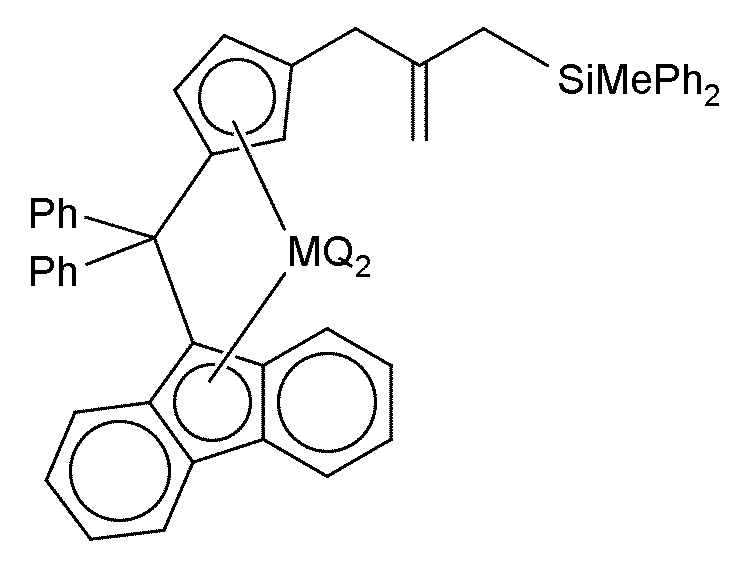
 [화학식 1-33] [화학식 1-34]
 [화학식 1-35] [화학식 1-36]
 위 화학식 1-1 내지 1-36에서, M이 지르코늄 또는 하프늄이고, Q가 각각 할로겐 또는 치환 또는 비치환된 C 1-20 알킬이고, Me가 메틸기이고, Ph가 페닐기이다.
 - 제1항에 있어서, 위 화학식 1로 표시되는 화합물이 아래 화학식 1-37 내지 1-39로 표시되는 화합물 중 어느 하나인 전이금속 화합물:[화학식 1-37] [화학식 1-38]

 [화학식 1-39].
- 제1항 내지 제4항 중 어느 한 항의 전이금속 화합물; 및 조촉매 화합물을 포함하는 올레핀 중합용 촉매.
- 제5항에 있어서, 조촉매 화합물이 아래 화학식 2로 표현되는 화합물, 화학식 3으로 표현되는 화합물 및 화학식 4로 표현되는 화합물로 구성되는 군으로부터 선택되는 하나 이상인 올레핀 중합용 촉매:[화학식 2]
 [화학식 3]
 [화학식 4][L-H] +[Z(A) 4] - 또는 [L] +[Z(A) 4] -위 화학식 2에서, n은 2 이상의 정수이고, R a는 할로겐 원자, C 1-20 탄화수소기 또는 할로겐으로 치환된 C 1-20 탄화수소기이고,위 화학식 3에서, D는 알루미늄(Al) 또는 보론(B)이고, R b, R c 및 R d는 각각 독립적으로 할로겐 원자, C 1-20 탄화수소기, 할로겐으로 치환된 C 1-20 탄화수소기 또는 C 1-20 알콕시기이며,위 화학식 4에서, L은 중성 또는 양이온성 루이스 염기이고, [L-H] + 및 [L] +는 브뢴스테드 산이며, Z는 13족 원소이고, A는 각각 독립적으로 치환 또는 비치환된 C 6-20 아릴기이거나 치환 또는 비치환된 C 1-20 알킬기이다.
 - 제6항에 있어서, 화학식 2로 표시되는 화합물이 메틸알루미녹산, 에틸알루미녹산, 이소부틸알루미녹산 및 부틸알루미녹산으로 구성되는 군으로부터 선택되는 적어도 하나인 올레핀 중합용 촉매.
- 제6항에 있어서, 화학식 3으로 표시되는 화합물이 트리메틸알루미늄, 트리에틸알루미늄, 트리이소부틸알루미늄, 트리프로필알루미늄, 트리부틸알루미늄, 디메틸클로로알루미늄, 트리이소프로필알루미늄, 트리- s-부틸알루미늄, 트리사이클로펜틸알루미늄, 트리펜틸알루미늄, 트리이소펜틸알루미늄, 트리헥실알루미늄, 트리옥틸알루미늄, 에틸디메틸알루미늄, 메틸디에틸알루미늄, 트리페닐알루미늄, 트리- p-톨릴알루미늄, 디메틸알루미늄메톡시드, 디메틸알루미늄에톡시드, 트리메틸보론, 트리에틸보론, 트리이소부틸보론, 트리프로필보론 및 트리부틸보론으로 구성되는 군으로부터 선택되는 적어도 하나인 올레핀 중합용 촉매.
- 제6항에 있어서, 화학식 4로 표시되는 화합물이 트리에틸암모니움테트라페닐보론, 트리부틸암모니움테트라페닐보론, 트리메틸암모니움테트라페닐보론, 트리프로필암모니움테트라페닐보론, 트리메틸암모니움테트라( p-톨릴)보론, 트리메틸암모니움테트라( o, p-디메틸페닐)보론, 트리부틸암모니움테트라( p-트리플로로메틸페닐)보론, 트리메틸암모니움테트라( p-트리플로로메틸페닐)보론, 트리부틸암모니움테트라펜타플로로페닐보론, N,N-디에틸아닐리니움테트라페닐보론, N,N-디에틸아닐리니움테트라펜타플로로페닐보론, 디에틸암모니움테트라펜타플로로페닐보론, 트리페닐포스포늄테트라페닐보론, 트리메틸포스포늄테트라페닐보론, 트리에틸암모니움테트라페닐알루미늄, 트리부틸암모니움테트라페닐알루미늄, 트리메틸암모니움테트라페닐알루미늄, 트리프로필암모니움테트라페닐알루미늄, 트리메틸암모니움테트라( p-톨릴)알루미늄, 트리프로필암모니움테트라( p-톨릴)알루미늄, 트리에틸암모니움테트라( o, p-디메틸페닐)알루미늄, 트리부틸암모니움테트라( p-트리플로로메틸페닐)알루미늄, 트리메틸암모니움테트라( p-트리플로로메틸페닐)알루미늄, 트리부틸암모니움테트라펜타플로로페닐알루미늄, N,N-디에틸아닐리니움테트라페닐알루미늄, N,N-디에틸아닐리니움테트라펜타플로로페닐알루미늄, 디에틸암모니움테트라펜타테트라페닐알루미늄, 트리페닐포스포늄테트라페닐알루미늄, 트리메틸포스포늄테트라페닐알루미늄, 트리프로필암모니움테트라( p-톨릴)보론, 트리에틸암모니움테트라( o, p-디메틸페닐)보론, 트리부틸암모니움테트라( p-트리플로로메틸페닐)보론, 트리페닐카보니움테트라( p-트리플로로메틸페닐)보론 및 리페닐카보니움테트라펜타플로로페닐보론으로 구성되는 군으로부터 선택되는 적어도 하나인 올레핀 중합용 촉매.
- 제5항에 있어서, 전이금속 화합물, 조촉매 화합물 또는 이 둘 모두를 담지하는 담체를 더 포함하는 올레핀 중합용 촉매.
- 제10항에 있어서, 담체가 실리카, 알루미나 및 마그네시아로 구성되는 군으로부터 선택되는 적어도 하나를 포함하는 올레핀 중합용 촉매.
- 제10항에 있어서, 담체에 담지되는 전이금속 화합물의 양이 담체 1 g을 기준으로 0.001~1 mmole이며, 담체에 담지되는 조촉매 화합물의 양이 담체 1 g을 기준으로 2~15 mmole인 올레핀 중합용 촉매.
- 제5항의 올레핀 중합용 촉매의 존재 하에서 올레핀계 단량체가 중합되어 얻어지는 폴리올레핀.
- 제13항에 있어서, 올레핀계 단량체가 C 2-20 알파-올레핀(α-olefin), C 1-20 디올레핀(diolefin), C 3-20 사이클로올레핀(cycloolefin) 및 C 3-20 사이클로디올레핀(cyclodiolefin)으로 구성되는 군으로부터 선택되는 적어도 하나인 폴리올레핀.
- 제14항에 있어서, 에틸렌과 1-헥센이 공중합되어 얻어지는 폴리올레핀.
Priority Applications (4)
| Application Number | Priority Date | Filing Date | Title |
|---|---|---|---|
| CN202080055116.9A CN114206951B (zh) | 2019-07-30 | 2020-07-17 | 用于烯烃聚合催化剂的过渡金属化合物、含其的烯烃聚合催化剂及用该催化剂聚合的聚烯烃 |
| US17/627,826 US12258433B2 (en) | 2019-07-30 | 2020-07-17 | Transition metal compound for a catalyst for olefin polymerization, catalyst for olefin polymerization comprising the same, and polyolefin prepared using the same |
| EP20847967.5A EP4006044A4 (en) | 2019-07-30 | 2020-07-17 | TRANSITION METAL COMPOUND FOR OLEFIN POLYMERIZATION CATALYST, OLEFIN POLYMERIZATION CATALYST WITH IT AND POLYMERIZED POLYOLEFIN WITH IT |
| JP2022505474A JP7255014B6 (ja) | 2019-07-30 | 2020-07-17 | オレフィン重合触媒用遷移金属化合物、これを含むオレフィン重合用触媒およびそれを用いて重合されたポリオレフィン |
Applications Claiming Priority (2)
| Application Number | Priority Date | Filing Date | Title |
|---|---|---|---|
| KR1020190092126A KR102565858B1 (ko) | 2019-07-30 | 2019-07-30 | 올레핀 중합 촉매용 전이금속 화합물, 이를 포함하는 올레핀 중합 촉매 및 이를 이용하여 중합된 폴리올레핀 |
| KR10-2019-0092126 | 2019-07-30 |
Publications (1)
| Publication Number | Publication Date |
|---|---|
| WO2021020778A1 true WO2021020778A1 (ko) | 2021-02-04 |
Family
ID=74230738
Family Applications (1)
| Application Number | Title | Priority Date | Filing Date |
|---|---|---|---|
| PCT/KR2020/009414 Ceased WO2021020778A1 (ko) | 2019-07-30 | 2020-07-17 | 올레핀 중합 촉매용 전이금속 화합물, 이를 포함하는 올레핀 중합 촉매 및 이를 이용하여 중합된 폴리올레핀 |
Country Status (6)
| Country | Link |
|---|---|
| US (1) | US12258433B2 (ko) |
| EP (1) | EP4006044A4 (ko) |
| JP (1) | JP7255014B6 (ko) |
| KR (1) | KR102565858B1 (ko) |
| CN (1) | CN114206951B (ko) |
| WO (1) | WO2021020778A1 (ko) |
Cited By (1)
| Publication number | Priority date | Publication date | Assignee | Title |
|---|---|---|---|---|
| WO2023191519A1 (ko) * | 2022-04-01 | 2023-10-05 | 한화솔루션 주식회사 | 올레핀 중합 촉매용 전이금속 화합물, 이를 포함하는 올레핀 중합 촉매 및 이를 이용하여 중합된 폴리올레핀 |
Families Citing this family (2)
| Publication number | Priority date | Publication date | Assignee | Title |
|---|---|---|---|---|
| KR102687445B1 (ko) * | 2020-03-17 | 2024-07-23 | 한화솔루션 주식회사 | 전이금속 화합물의 제조방법 |
| KR102873879B1 (ko) * | 2023-09-22 | 2025-10-28 | 에쓰대시오일 주식회사 | 폴리올레핀 중합용 신규 메탈로센 촉매 및 그의 제조방법 |
Citations (5)
| Publication number | Priority date | Publication date | Assignee | Title |
|---|---|---|---|---|
| US5747405A (en) * | 1992-09-04 | 1998-05-05 | Bp Chemicals Limited | Catalyst compositions and process for preparing polyolefins |
| US5856547A (en) * | 1997-01-08 | 1999-01-05 | Phillips Petroleum Company | Organo omega-alkenyl cyclopentacarbyl silane compounds |
| US6313239B1 (en) * | 1996-03-05 | 2001-11-06 | Bayer Corporation | Olefin polymerization with group 4 metal-containing organosilicon dendrimers |
| US20040152591A1 (en) * | 2002-10-25 | 2004-08-05 | Guo-Xin Jin | Polymerized metallocene catalyst composition |
| US20050288462A1 (en) * | 2004-06-25 | 2005-12-29 | Jensen Michael D | Polymerization catalysts for producing polymers with low levels of long chain branching |
Family Cites Families (11)
| Publication number | Priority date | Publication date | Assignee | Title |
|---|---|---|---|---|
| US6329541B1 (en) * | 1997-01-08 | 2001-12-11 | Phillips Petroleum Company | Organo omega-alkenyl cyclopentacarbyl silane-bridged metallocene compounds |
| US5886202A (en) * | 1997-01-08 | 1999-03-23 | Jung; Michael | Bridged fluorenyl/indenyl metallocenes and the use thereof |
| JPH10298216A (ja) * | 1997-04-25 | 1998-11-10 | Mitsui Chem Inc | オレフィン重合用触媒およびオレフィンの重合方法 |
| TW448155B (en) * | 1999-03-29 | 2001-08-01 | Dev Center Biotechnology | Method for producing amide compounds and quinazolin derivatives |
| JP4479177B2 (ja) * | 2002-08-02 | 2010-06-09 | チッソ株式会社 | メタロセン化合物、それを含む触媒を用いたオレフィン重合体の製造方法、および該製造方法により製造されたオレフィン重合体 |
| EP1737893A1 (en) * | 2004-04-23 | 2007-01-03 | ExxonMobil Chemical Patents Inc. | Phosphorus bridged metallocene compounds for olefin polymerization |
| JP5396773B2 (ja) * | 2008-08-11 | 2014-01-22 | 東ソー株式会社 | オレフィン重合用触媒およびオレフィン重合体の製造方法 |
| US8383754B2 (en) * | 2010-04-19 | 2013-02-26 | Chevron Phillips Chemical Company Lp | Catalyst compositions for producing high Mz/Mw polyolefins |
| US8932975B2 (en) | 2010-09-07 | 2015-01-13 | Chevron Phillips Chemical Company Lp | Catalyst systems and methods of making and using same |
| US8865846B2 (en) | 2012-09-25 | 2014-10-21 | Chevron Phillips Chemical Company Lp | Metallocene and half sandwich dual catalyst systems for producing broad molecular weight distribution polymers |
| KR102219407B1 (ko) | 2018-11-20 | 2021-02-23 | 한화솔루션 주식회사 | 올레핀 중합 촉매용 전이금속 화합물 및 이를 포함하는 올레핀 중합 촉매 |
-
2019
- 2019-07-30 KR KR1020190092126A patent/KR102565858B1/ko active Active
-
2020
- 2020-07-17 WO PCT/KR2020/009414 patent/WO2021020778A1/ko not_active Ceased
- 2020-07-17 CN CN202080055116.9A patent/CN114206951B/zh active Active
- 2020-07-17 EP EP20847967.5A patent/EP4006044A4/en active Pending
- 2020-07-17 JP JP2022505474A patent/JP7255014B6/ja active Active
- 2020-07-17 US US17/627,826 patent/US12258433B2/en active Active
Patent Citations (5)
| Publication number | Priority date | Publication date | Assignee | Title |
|---|---|---|---|---|
| US5747405A (en) * | 1992-09-04 | 1998-05-05 | Bp Chemicals Limited | Catalyst compositions and process for preparing polyolefins |
| US6313239B1 (en) * | 1996-03-05 | 2001-11-06 | Bayer Corporation | Olefin polymerization with group 4 metal-containing organosilicon dendrimers |
| US5856547A (en) * | 1997-01-08 | 1999-01-05 | Phillips Petroleum Company | Organo omega-alkenyl cyclopentacarbyl silane compounds |
| US20040152591A1 (en) * | 2002-10-25 | 2004-08-05 | Guo-Xin Jin | Polymerized metallocene catalyst composition |
| US20050288462A1 (en) * | 2004-06-25 | 2005-12-29 | Jensen Michael D | Polymerization catalysts for producing polymers with low levels of long chain branching |
Non-Patent Citations (1)
| Title |
|---|
| See also references of EP4006044A4 * |
Cited By (1)
| Publication number | Priority date | Publication date | Assignee | Title |
|---|---|---|---|---|
| WO2023191519A1 (ko) * | 2022-04-01 | 2023-10-05 | 한화솔루션 주식회사 | 올레핀 중합 촉매용 전이금속 화합물, 이를 포함하는 올레핀 중합 촉매 및 이를 이용하여 중합된 폴리올레핀 |
Also Published As
| Publication number | Publication date |
|---|---|
| EP4006044A1 (en) | 2022-06-01 |
| US12258433B2 (en) | 2025-03-25 |
| EP4006044A4 (en) | 2023-08-16 |
| CN114206951B (zh) | 2023-04-14 |
| KR102565858B1 (ko) | 2023-08-11 |
| KR20210014277A (ko) | 2021-02-09 |
| JP7255014B6 (ja) | 2024-02-13 |
| JP2022543753A (ja) | 2022-10-14 |
| JP7255014B2 (ja) | 2023-04-10 |
| CN114206951A (zh) | 2022-03-18 |
| US20220275115A1 (en) | 2022-09-01 |
Similar Documents
| Publication | Publication Date | Title |
|---|---|---|
| WO2020204480A1 (ko) | 혼성 촉매 조성물, 이를 포함하는 촉매 및 이들의 제조방법 | |
| WO2012169811A2 (en) | NEW CYCLOPENTA[B]FLUORENYL TRANSITION METAL COMPOUND, CATALYST COMPOSITION CONTAINING THE SAME, AND METHOD OF PREPARING ETHYLENE HOMOPOLYMER OR COPOLYMER OF ETHYLENE AND α-OLEFIN USING THE SAME | |
| WO2017188602A1 (ko) | 혼성 담지 메탈로센 촉매 및 이를 이용한 가공성이 우수한 폴리올레핀 수지 | |
| WO2020105922A1 (ko) | 올레핀 중합 촉매용 전이금속 화합물 및 이를 포함하는 올레핀 중합 촉매 | |
| EP2545084A2 (en) | Supported metallocene catalyst, method for preparing the same and method for preparing polyolefin using the same | |
| WO2015046930A1 (ko) | 촉매 조성물 및 이를 포함하는 중합체의 제조방법 | |
| WO2023106779A1 (ko) | 혼성 촉매 조성물을 포함하는 올레핀 중합용 촉매 및 이를 이용하여 제조된 올레핀계 중합체 | |
| WO2021020778A1 (ko) | 올레핀 중합 촉매용 전이금속 화합물, 이를 포함하는 올레핀 중합 촉매 및 이를 이용하여 중합된 폴리올레핀 | |
| WO2017099491A1 (ko) | 올레핀계 중합체 | |
| WO2017010648A1 (ko) | 메탈로센 화합물 및 이의 제조방법 | |
| WO2019038605A1 (en) | NEW TRANSITION METAL COMPOUND, CATALYST COMPOSITION CONTAINING THE SAME, AND PROCESS FOR PREPARING HOMOPOLYMER OR ETHYLENE COPOLYMER AND ALPHA-OLEFIN USING THE SAME | |
| WO2020101373A1 (ko) | 프로필렌 중합용 담지촉매 및 이를 이용하는 폴리프로필렌 수지의 제조방법 | |
| WO2023191519A1 (ko) | 올레핀 중합 촉매용 전이금속 화합물, 이를 포함하는 올레핀 중합 촉매 및 이를 이용하여 중합된 폴리올레핀 | |
| WO2018106028A1 (ko) | 올레핀 중합 촉매용 전이금속 화합물, 이를 포함하는 올레핀 중합 촉매 및 이를 이용하여 중합된 폴리올레핀 | |
| WO2021172818A1 (ko) | 혼성 촉매 조성물, 이를 포함하는 촉매 및 이들의 제조방법 | |
| WO2022039418A1 (ko) | 혼성 전이금속 화합물을 포함하는 촉매, 이를 이용하여 제조된 올레핀계 중합체 및 이들의 제조방법 | |
| WO2021075788A1 (ko) | 올레핀 중합용 혼성 촉매의 제조방법, 올레핀 중합용 혼성 촉매 및 올레핀계 중합체 | |
| WO2021241927A1 (ko) | 혼성 촉매 조성물, 이를 포함하는 촉매 및 이들의 제조방법 | |
| WO2023096297A1 (ko) | 가공성이 우수한 올레핀계 중합체 및 그 제조방법 | |
| WO2021107508A1 (ko) | 올레핀계 중합체 필름 및 그 제조방법 | |
| WO2020122371A1 (ko) | 폴리올레핀 및 이의 제조 방법 | |
| WO2017111553A1 (ko) | 신규한 전이금속 화합물을 포함하는 촉매 조성물 | |
| WO2018122693A1 (ko) | 신규한 시클로펜타[B]티오펜일 전이금속 화합물, 이를 포함하는 전이금속 촉매 조성물, 및 이를 이용한 에틸렌 단독중합체 또는 에틸렌과 α-올레핀의 공중합체의 제조방법 | |
| WO2022114635A1 (ko) | 전이금속 화합물, 이를 포함하는 촉매 및 이들의 제조방법 | |
| WO2018106029A1 (ko) | 올레핀 중합 촉매용 전이금속 화합물, 이를 포함하는 올레핀 중합 촉매 및 이를 이용하여 중합된 폴리올레핀 |
Legal Events
| Date | Code | Title | Description |
|---|---|---|---|
| 121 | Ep: the epo has been informed by wipo that ep was designated in this application |
Ref document number: 20847967 Country of ref document: EP Kind code of ref document: A1 |
|
| ENP | Entry into the national phase |
Ref document number: 2022505474 Country of ref document: JP Kind code of ref document: A |
|
| NENP | Non-entry into the national phase |
Ref country code: DE |
|
| ENP | Entry into the national phase |
Ref document number: 2020847967 Country of ref document: EP Effective date: 20220228 |
|
| WWG | Wipo information: grant in national office |
Ref document number: 17627826 Country of ref document: US |