WO2021024933A1 - 疎水変性セルロース繊維を含有する乳化組成物 - Google Patents
疎水変性セルロース繊維を含有する乳化組成物 Download PDFInfo
- Publication number
- WO2021024933A1 WO2021024933A1 PCT/JP2020/029412 JP2020029412W WO2021024933A1 WO 2021024933 A1 WO2021024933 A1 WO 2021024933A1 JP 2020029412 W JP2020029412 W JP 2020029412W WO 2021024933 A1 WO2021024933 A1 WO 2021024933A1
- Authority
- WO
- WIPO (PCT)
- Prior art keywords
- group
- cellulose fiber
- emulsified composition
- modified cellulose
- component
- Prior art date
- Legal status (The legal status is an assumption and is not a legal conclusion. Google has not performed a legal analysis and makes no representation as to the accuracy of the status listed.)
- Ceased
Links
Images

Classifications
-
- C—CHEMISTRY; METALLURGY
- C09—DYES; PAINTS; POLISHES; NATURAL RESINS; ADHESIVES; COMPOSITIONS NOT OTHERWISE PROVIDED FOR; APPLICATIONS OF MATERIALS NOT OTHERWISE PROVIDED FOR
- C09D—COATING COMPOSITIONS, e.g. PAINTS, VARNISHES OR LACQUERS; FILLING PASTES; CHEMICAL PAINT OR INK REMOVERS; INKS; CORRECTING FLUIDS; WOODSTAINS; PASTES OR SOLIDS FOR COLOURING OR PRINTING; USE OF MATERIALS THEREFOR
- C09D5/00—Coating compositions, e.g. paints, varnishes or lacquers, characterised by their physical nature or the effects produced; Filling pastes
- C09D5/16—Antifouling paints; Underwater paints
- C09D5/1681—Antifouling coatings characterised by surface structure, e.g. for roughness effect giving superhydrophobic coatings or Lotus effect
-
- C—CHEMISTRY; METALLURGY
- C08—ORGANIC MACROMOLECULAR COMPOUNDS; THEIR PREPARATION OR CHEMICAL WORKING-UP; COMPOSITIONS BASED THEREON
- C08J—WORKING-UP; GENERAL PROCESSES OF COMPOUNDING; AFTER-TREATMENT NOT COVERED BY SUBCLASSES C08B, C08C, C08F, C08G or C08H
- C08J3/00—Processes of treating or compounding macromolecular substances
- C08J3/02—Making solutions, dispersions, lattices or gels by other methods than by solution, emulsion or suspension polymerisation techniques
- C08J3/03—Making solutions, dispersions, lattices or gels by other methods than by solution, emulsion or suspension polymerisation techniques in aqueous media
- C08J3/05—Making solutions, dispersions, lattices or gels by other methods than by solution, emulsion or suspension polymerisation techniques in aqueous media from solid polymers
-
- A—HUMAN NECESSITIES
- A61—MEDICAL OR VETERINARY SCIENCE; HYGIENE
- A61K—PREPARATIONS FOR MEDICAL, DENTAL OR TOILETRY PURPOSES
- A61K8/00—Cosmetics or similar toiletry preparations
- A61K8/02—Cosmetics or similar toiletry preparations characterised by special physical form
- A61K8/04—Dispersions; Emulsions
- A61K8/06—Emulsions
-
- A—HUMAN NECESSITIES
- A61—MEDICAL OR VETERINARY SCIENCE; HYGIENE
- A61K—PREPARATIONS FOR MEDICAL, DENTAL OR TOILETRY PURPOSES
- A61K8/00—Cosmetics or similar toiletry preparations
- A61K8/18—Cosmetics or similar toiletry preparations characterised by the composition
- A61K8/30—Cosmetics or similar toiletry preparations characterised by the composition containing organic compounds
- A61K8/33—Cosmetics or similar toiletry preparations characterised by the composition containing organic compounds containing oxygen
- A61K8/37—Esters of carboxylic acids
-
- A—HUMAN NECESSITIES
- A61—MEDICAL OR VETERINARY SCIENCE; HYGIENE
- A61K—PREPARATIONS FOR MEDICAL, DENTAL OR TOILETRY PURPOSES
- A61K8/00—Cosmetics or similar toiletry preparations
- A61K8/18—Cosmetics or similar toiletry preparations characterised by the composition
- A61K8/30—Cosmetics or similar toiletry preparations characterised by the composition containing organic compounds
- A61K8/69—Cosmetics or similar toiletry preparations characterised by the composition containing organic compounds containing fluorine
-
- A—HUMAN NECESSITIES
- A61—MEDICAL OR VETERINARY SCIENCE; HYGIENE
- A61K—PREPARATIONS FOR MEDICAL, DENTAL OR TOILETRY PURPOSES
- A61K8/00—Cosmetics or similar toiletry preparations
- A61K8/18—Cosmetics or similar toiletry preparations characterised by the composition
- A61K8/72—Cosmetics or similar toiletry preparations characterised by the composition containing organic macromolecular compounds
- A61K8/73—Polysaccharides
- A61K8/731—Cellulose; Quaternized cellulose derivatives
-
- A—HUMAN NECESSITIES
- A61—MEDICAL OR VETERINARY SCIENCE; HYGIENE
- A61K—PREPARATIONS FOR MEDICAL, DENTAL OR TOILETRY PURPOSES
- A61K8/00—Cosmetics or similar toiletry preparations
- A61K8/18—Cosmetics or similar toiletry preparations characterised by the composition
- A61K8/72—Cosmetics or similar toiletry preparations characterised by the composition containing organic macromolecular compounds
- A61K8/84—Cosmetics or similar toiletry preparations characterised by the composition containing organic macromolecular compounds obtained by reactions otherwise than those involving only carbon-carbon unsaturated bonds
- A61K8/89—Polysiloxanes
- A61K8/891—Polysiloxanes saturated, e.g. dimethicone, phenyl trimethicone, C24-C28 methicone or stearyl dimethicone
-
- C—CHEMISTRY; METALLURGY
- C08—ORGANIC MACROMOLECULAR COMPOUNDS; THEIR PREPARATION OR CHEMICAL WORKING-UP; COMPOSITIONS BASED THEREON
- C08B—POLYSACCHARIDES; DERIVATIVES THEREOF
- C08B15/00—Preparation of other cellulose derivatives or modified cellulose, e.g. complexes
- C08B15/02—Oxycellulose; Hydrocellulose; Cellulosehydrate, e.g. microcrystalline cellulose
- C08B15/04—Carboxycellulose, e.g. prepared by oxidation with nitrogen dioxide
-
- C—CHEMISTRY; METALLURGY
- C08—ORGANIC MACROMOLECULAR COMPOUNDS; THEIR PREPARATION OR CHEMICAL WORKING-UP; COMPOSITIONS BASED THEREON
- C08B—POLYSACCHARIDES; DERIVATIVES THEREOF
- C08B15/00—Preparation of other cellulose derivatives or modified cellulose, e.g. complexes
- C08B15/05—Derivatives containing elements other than carbon, hydrogen, oxygen, halogens or sulfur
-
- C—CHEMISTRY; METALLURGY
- C08—ORGANIC MACROMOLECULAR COMPOUNDS; THEIR PREPARATION OR CHEMICAL WORKING-UP; COMPOSITIONS BASED THEREON
- C08J—WORKING-UP; GENERAL PROCESSES OF COMPOUNDING; AFTER-TREATMENT NOT COVERED BY SUBCLASSES C08B, C08C, C08F, C08G or C08H
- C08J5/00—Manufacture of articles or shaped materials containing macromolecular substances
- C08J5/18—Manufacture of films or sheets
-
- C—CHEMISTRY; METALLURGY
- C08—ORGANIC MACROMOLECULAR COMPOUNDS; THEIR PREPARATION OR CHEMICAL WORKING-UP; COMPOSITIONS BASED THEREON
- C08J—WORKING-UP; GENERAL PROCESSES OF COMPOUNDING; AFTER-TREATMENT NOT COVERED BY SUBCLASSES C08B, C08C, C08F, C08G or C08H
- C08J7/00—Chemical treatment or coating of shaped articles made of macromolecular substances
- C08J7/04—Coating
- C08J7/0427—Coating with only one layer of a composition containing a polymer binder
-
- C—CHEMISTRY; METALLURGY
- C08—ORGANIC MACROMOLECULAR COMPOUNDS; THEIR PREPARATION OR CHEMICAL WORKING-UP; COMPOSITIONS BASED THEREON
- C08L—COMPOSITIONS OF MACROMOLECULAR COMPOUNDS
- C08L1/00—Compositions of cellulose, modified cellulose or cellulose derivatives
- C08L1/02—Cellulose; Modified cellulose
- C08L1/04—Oxycellulose; Hydrocellulose, e.g. microcrystalline cellulose
-
- C—CHEMISTRY; METALLURGY
- C08—ORGANIC MACROMOLECULAR COMPOUNDS; THEIR PREPARATION OR CHEMICAL WORKING-UP; COMPOSITIONS BASED THEREON
- C08L—COMPOSITIONS OF MACROMOLECULAR COMPOUNDS
- C08L1/00—Compositions of cellulose, modified cellulose or cellulose derivatives
- C08L1/08—Cellulose derivatives
-
- C—CHEMISTRY; METALLURGY
- C08—ORGANIC MACROMOLECULAR COMPOUNDS; THEIR PREPARATION OR CHEMICAL WORKING-UP; COMPOSITIONS BASED THEREON
- C08L—COMPOSITIONS OF MACROMOLECULAR COMPOUNDS
- C08L83/00—Compositions of macromolecular compounds obtained by reactions forming in the main chain of the macromolecule a linkage containing silicon with or without sulfur, nitrogen, oxygen or carbon only; Compositions of derivatives of such polymers
- C08L83/10—Block- or graft-copolymers containing polysiloxane sequences
- C08L83/12—Block- or graft-copolymers containing polysiloxane sequences containing polyether sequences
-
- C—CHEMISTRY; METALLURGY
- C09—DYES; PAINTS; POLISHES; NATURAL RESINS; ADHESIVES; COMPOSITIONS NOT OTHERWISE PROVIDED FOR; APPLICATIONS OF MATERIALS NOT OTHERWISE PROVIDED FOR
- C09D—COATING COMPOSITIONS, e.g. PAINTS, VARNISHES OR LACQUERS; FILLING PASTES; CHEMICAL PAINT OR INK REMOVERS; INKS; CORRECTING FLUIDS; WOODSTAINS; PASTES OR SOLIDS FOR COLOURING OR PRINTING; USE OF MATERIALS THEREFOR
- C09D101/00—Coating compositions based on cellulose, modified cellulose, or cellulose derivatives
- C09D101/02—Cellulose; Modified cellulose
-
- C—CHEMISTRY; METALLURGY
- C09—DYES; PAINTS; POLISHES; NATURAL RESINS; ADHESIVES; COMPOSITIONS NOT OTHERWISE PROVIDED FOR; APPLICATIONS OF MATERIALS NOT OTHERWISE PROVIDED FOR
- C09D—COATING COMPOSITIONS, e.g. PAINTS, VARNISHES OR LACQUERS; FILLING PASTES; CHEMICAL PAINT OR INK REMOVERS; INKS; CORRECTING FLUIDS; WOODSTAINS; PASTES OR SOLIDS FOR COLOURING OR PRINTING; USE OF MATERIALS THEREFOR
- C09D183/00—Coating compositions based on macromolecular compounds obtained by reactions forming in the main chain of the macromolecule a linkage containing silicon, with or without sulfur, nitrogen, oxygen, or carbon only; Coating compositions based on derivatives of such polymers
- C09D183/04—Polysiloxanes
- C09D183/08—Polysiloxanes containing silicon bound to organic groups containing atoms other than carbon, hydrogen, and oxygen
-
- C—CHEMISTRY; METALLURGY
- C09—DYES; PAINTS; POLISHES; NATURAL RESINS; ADHESIVES; COMPOSITIONS NOT OTHERWISE PROVIDED FOR; APPLICATIONS OF MATERIALS NOT OTHERWISE PROVIDED FOR
- C09D—COATING COMPOSITIONS, e.g. PAINTS, VARNISHES OR LACQUERS; FILLING PASTES; CHEMICAL PAINT OR INK REMOVERS; INKS; CORRECTING FLUIDS; WOODSTAINS; PASTES OR SOLIDS FOR COLOURING OR PRINTING; USE OF MATERIALS THEREFOR
- C09D5/00—Coating compositions, e.g. paints, varnishes or lacquers, characterised by their physical nature or the effects produced; Filling pastes
- C09D5/02—Emulsion paints including aerosols
-
- C—CHEMISTRY; METALLURGY
- C09—DYES; PAINTS; POLISHES; NATURAL RESINS; ADHESIVES; COMPOSITIONS NOT OTHERWISE PROVIDED FOR; APPLICATIONS OF MATERIALS NOT OTHERWISE PROVIDED FOR
- C09D—COATING COMPOSITIONS, e.g. PAINTS, VARNISHES OR LACQUERS; FILLING PASTES; CHEMICAL PAINT OR INK REMOVERS; INKS; CORRECTING FLUIDS; WOODSTAINS; PASTES OR SOLIDS FOR COLOURING OR PRINTING; USE OF MATERIALS THEREFOR
- C09D5/00—Coating compositions, e.g. paints, varnishes or lacquers, characterised by their physical nature or the effects produced; Filling pastes
- C09D5/16—Antifouling paints; Underwater paints
- C09D5/1606—Antifouling paints; Underwater paints characterised by the anti-fouling agent
- C09D5/1637—Macromolecular compounds
-
- C—CHEMISTRY; METALLURGY
- C09—DYES; PAINTS; POLISHES; NATURAL RESINS; ADHESIVES; COMPOSITIONS NOT OTHERWISE PROVIDED FOR; APPLICATIONS OF MATERIALS NOT OTHERWISE PROVIDED FOR
- C09K—MATERIALS FOR MISCELLANEOUS APPLICATIONS, NOT PROVIDED FOR ELSEWHERE
- C09K3/00—Materials not provided for elsewhere
- C09K3/18—Materials not provided for elsewhere for application to surfaces to minimize adherence of ice, mist or water thereto; Thawing or antifreeze materials for application to surfaces
-
- C—CHEMISTRY; METALLURGY
- C08—ORGANIC MACROMOLECULAR COMPOUNDS; THEIR PREPARATION OR CHEMICAL WORKING-UP; COMPOSITIONS BASED THEREON
- C08G—MACROMOLECULAR COMPOUNDS OBTAINED OTHERWISE THAN BY REACTIONS ONLY INVOLVING UNSATURATED CARBON-TO-CARBON BONDS
- C08G77/00—Macromolecular compounds obtained by reactions forming a linkage containing silicon with or without sulfur, nitrogen, oxygen or carbon in the main chain of the macromolecule
- C08G77/04—Polysiloxanes
- C08G77/22—Polysiloxanes containing silicon bound to organic groups containing atoms other than carbon, hydrogen and oxygen
- C08G77/26—Polysiloxanes containing silicon bound to organic groups containing atoms other than carbon, hydrogen and oxygen nitrogen-containing groups
-
- C—CHEMISTRY; METALLURGY
- C08—ORGANIC MACROMOLECULAR COMPOUNDS; THEIR PREPARATION OR CHEMICAL WORKING-UP; COMPOSITIONS BASED THEREON
- C08J—WORKING-UP; GENERAL PROCESSES OF COMPOUNDING; AFTER-TREATMENT NOT COVERED BY SUBCLASSES C08B, C08C, C08F, C08G or C08H
- C08J2301/00—Characterised by the use of cellulose, modified cellulose or cellulose derivatives
- C08J2301/08—Cellulose derivatives
-
- C—CHEMISTRY; METALLURGY
- C08—ORGANIC MACROMOLECULAR COMPOUNDS; THEIR PREPARATION OR CHEMICAL WORKING-UP; COMPOSITIONS BASED THEREON
- C08J—WORKING-UP; GENERAL PROCESSES OF COMPOUNDING; AFTER-TREATMENT NOT COVERED BY SUBCLASSES C08B, C08C, C08F, C08G or C08H
- C08J2483/00—Characterised by the use of macromolecular compounds obtained by reactions forming in the main chain of the macromolecule a linkage containing silicon with or without sulfur, nitrogen, oxygen, or carbon only; Derivatives of such polymers
- C08J2483/04—Polysiloxanes
- C08J2483/08—Polysiloxanes containing silicon bound to organic groups containing atoms other than carbon, hydrogen, and oxygen
-
- C—CHEMISTRY; METALLURGY
- C08—ORGANIC MACROMOLECULAR COMPOUNDS; THEIR PREPARATION OR CHEMICAL WORKING-UP; COMPOSITIONS BASED THEREON
- C08J—WORKING-UP; GENERAL PROCESSES OF COMPOUNDING; AFTER-TREATMENT NOT COVERED BY SUBCLASSES C08B, C08C, C08F, C08G or C08H
- C08J2483/00—Characterised by the use of macromolecular compounds obtained by reactions forming in the main chain of the macromolecule a linkage containing silicon with or without sulfur, nitrogen, oxygen, or carbon only; Derivatives of such polymers
- C08J2483/10—Block- or graft-copolymers containing polysiloxane sequences
- C08J2483/12—Block- or graft-copolymers containing polysiloxane sequences containing polyether sequences
Definitions
- the present invention relates to an emulsified composition containing hydrophobically modified cellulose fibers.
- Patent Document 1 discloses a film having a hydrophobically modified cellulose fiber in which a modifying group is bonded to one or more selected from an anionic group and a hydroxyl group of the cellulose fiber and an oil having an SP value of 10 or less. There is.
- Patent Document 2 states that by binding monoamine having an organic value of 300 or less as a salt to anion-modified cellulose fine fibers, it is excellent in shape retention, dispersion stability and salt resistance. It is described that a viscous aqueous composition having excellent emulsion stability can be produced.
- the present invention relates to the following [1] to [8].
- An emulsified composition containing the following components (A) to (C).
- a method for producing a film containing a hydrophobically modified cellulose fiber which comprises a step of drying the emulsified composition according to the above [1] or [2].
- a dry film obtained by drying the emulsified composition according to the above [1] or [2].
- a coating film obtained by applying the emulsified composition according to the above [1] or [2] and then drying it.
- A Hydrocarbon-modified cellulose fiber in which a silicone-based compound is bonded to the cellulose fiber
- Hydrocarbon-based compound having a cationic group and having a total carbon number of 16 to 40 is ionized in the anionic group of the anion-modified cellulose fiber.
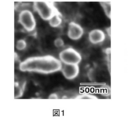
- FIG. 1 is a photomicrograph (25,000 times) of the emulsified composition produced in Example 1 by Cryo-SEM.
- FIG. 2 is a graph showing the particle size distribution of the emulsified droplets of the emulsified composition produced in Example 1.
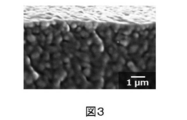
- FIG. 3 is a micrograph (8000 times) of the dried film of the emulsified composition produced in Example 1 by SEM.
- the film having the hydrophobically modified cellulose fiber and the oil described in Patent Document 1 is produced by dispersing the hydrophobically modified cellulose fiber in the solvent and evaporating the solvent from the state where the oil is dissolved.
- Such a membrane exhibits a certain level of synovial property, but further durability is required.
- Patent Document 2 has an object of obtaining a viscous water-based composition having excellent emulsion stability, and does not form a film.
- the present invention relates to providing an aqueous emulsified composition and a membrane for producing a membrane having synovial properties having excellent water resistance or durability.
- aqueous emulsified composition provided by the present invention, it is possible to produce a film having excellent water resistance or a film having synovial property having excellent durability.
- an emulsified composition containing a hydrophobically modified cellulose fiber in which a silicone-based compound or a specific hydrocarbon-based compound is bonded to the cellulose fiber, and an organic compound liquid at 25 ° C. and 1 atm Surprisingly, it was found that a film having excellent water resistance or durability and exhibiting a slippery property could be produced by applying the above-mentioned compound on a substrate and drying it, and completed the present invention. Although the mechanism by which such an effect is exhibited is not clear, in the emulsified composition, the hydrophobically modified cellulose fibers form a network in a liquid organic compound at 25 ° C. and 1 atm, and the network is crosslinked with drying. It is presumed that this is due to film formation.
- the emulsification composition of the present invention contains the following components (A) to (C).
- the component (A) is one or more hydrophobically modified cellulose fibers selected from the group consisting of the following (a) and (b).
- (b) Hydrocarbon-based compound having a cationic group and having a total carbon number of 16 to 40 is ionized in the anionic group of the anion-modified cellulose fiber. Hydrocarbon-modified cellulose fibers that are bonded
- the hydrophobically modified cellulose fiber in the present specification is a cellulose-based compound in which a silicone-based compound is bonded to the cellulose fiber, or a hydrocarbon-based compound having a cationic group in the anionic group of the anionic modified cellulose fiber and having a total carbon number of 16 to 40. Is bonded via an ionic bond.
- the hydrophobically modified cellulose fiber preferably has a cellulose type I crystal structure due to the fact that natural cellulose is used as a raw material thereof.
- the crystallinity of the hydrophobically modified cellulose fiber is preferably 10% or more, more preferably 15% or more, still more preferably 20% or more, from the viewpoint of developing strength at the time of film formation. Further, from the viewpoint of raw material availability, it is preferably 90% or less, more preferably 85% or less, further preferably 80% or less, still more preferably 75% or less.
- Cellulose type I crystallinity is measured by the method described in Examples below.
- the average fiber diameter of the hydrophobically modified cellulose fiber is preferably 0.1 nm or more, more preferably 1.0 nm or more, still more preferably 2.0 nm or more from the viewpoint of handleability, and from the viewpoint of strength at the time of film formation. Therefore, it is preferably 200 nm or less, more preferably 100 nm or less, and further preferably 50 nm or less.
- the average fiber diameter of the hydrophobically modified cellulose fiber is measured by the method described in Examples described later.
- One preferred embodiment of the hydrophobically modified cellulose fiber of the component (a), that is, the hydrophobically modified cellulose fiber in which a silicone compound is bonded to the cellulose fiber has a structure represented by the following general formula (T-Ce).
- R 1 is a modifying group
- R is an independently hydrogen atom or modifying group.
- R 1 and R may be the same or different, and at least one of the plurality of R 1 and R is a modifying group.
- M is an integer of 20 or more and 3,000 or less.
- the modifying group in the hydrophobically modified cellulose fiber formed by binding the silicone-based compound to the cellulose fiber is a group derived from the silicone-based compound, and the structure of the modifying group (that is, R 1 and R in the above formula (T-Ce)) is It depends on the structure of the silicone compound used.
- the mode of bonding of the modifying group to the cellulose fiber is preferably a covalent bond or an ionic bond. An ionic bond is preferable from the viewpoint of ease of production, and a covalent bond is preferable from the viewpoint of the stability of the formed membrane.
- a compound for introducing a modifying group such as a silicone-based compound and a hydrocarbon-based compound having a total carbon number of 16 to 40 having a cationic group, may be referred to as a "modifying compound" in the present specification. is there.
- Examples of the bonding site of the modifying group in the cellulose fiber include a hydroxy group, an aldehyde group, and a functional group introduced by chemically modifying the cellulose fiber.
- the functional group introduced by the chemical modification is preferably an anionic group, more preferably a carboxy group.
- an anion-modified cellulose fiber is preferable, and a carboxy group-containing cellulose fiber is more preferable, from the viewpoint of easy preparation and mild reaction conditions.
- the bond mode is a covalent bond, and examples thereof include an ether bond, an ester bond, and a carbonate bond.
- the bond mode is an ionic bond or a covalent bond.
- the bond mode is an ionic bond
- the modifying compound having a cationic group is bonded via electrostatic interaction, and when the bond mode is a covalent bond, an ester bond, an amide bond, etc. are formed. It refers to a state of being bonded via an ester bond, an amide bond, a carbonate bond, a urethane bond, or the like with respect to the carboxy group of a carboxy group-containing cellulose fiber.
- the modifying compound is (.
- the structure is as follows, and the modifying group is "-[alkyl silicone skeleton]".
- the structure of the modifying group depends on the structure of the modifying compound used.
- C * means a carbon atom at the 6-position of a cellulose constituent unit.
- a hydrocarbon compound having a cationic group and having a total carbon number of 16 to 40 is bonded to the hydrophobically modified cellulose fiber of the component (b), that is, the anionic group of the anionic modified cellulose fiber via an ionic bond.
- the modifying group of the hydrophobically modified cellulose fiber is derived from a hydrocarbon compound having a cationic group and having a total carbon number of 16 to 40.
- the bonding mode of the modifying group to the anionic group of the anion-modified cellulose fiber is an ionic bond
- the hydrophobically modified cellulose fiber of the component (b) has a cationic group possessed by the modifying group in the anionic group on the surface of the cellulose fiber.
- a group derived from a hydrocarbon compound having a total carbon number of 16 to 40 and having a group derived from a silicone compound and a cationic group is referred to as a “modifying group”.
- the binding amount (mmol / g) and introduction rate (mol%) of the modifying group in the hydrophobically modified cellulose fiber are the amount and ratio of the modifying group introduced into the hydrophobically modified cellulose fiber. Specifically, it is measured by the method described in Examples described later.
- the binding amount and introduction rate of the modifying group can be adjusted by the addition amount, type, reaction temperature, reaction time, solvent and the like of the modifying compound.
- the amount of the modifying group bonded to the hydrophobically modified cellulose fiber is preferably 0.1 mmol / g or more, more preferably 0.2 mmol / g or more, still more preferably 0.2 mmol / g or more, from the viewpoint of obtaining a film having improved water resistance and synovial property. It is 0.5 mmol / g or more. From the viewpoint of reactivity, it is preferably 3 mmol / g or less, more preferably 2.5 mmol / g or less, and further preferably 2 mmol / g or less.
- the introduction rate of the modifying group in the hydrophobically modified cellulose fiber is preferably 10 mol% or more, more preferably 20 mol% or more, still more preferably 40 mol, from the viewpoint of obtaining a film having improved water resistance and synovial property.
- the hydrophobically modified cellulose fiber of the component (A) is, for example, (1) a step of introducing an anionic group into the raw material cellulosic fiber to obtain an anion-modified cellulose fiber, and (2) a silicone-based compound added to the anion-modified cellulose fiber. And / or a method including a step of binding a hydrocarbon compound having a total carbon number of 16 to 40 having a cationic group to obtain a hydrophobically modified cellulosic fiber.
- Step (2) Ingredient (A-1) Anion-modified cellulose fiber, Component (A-2) One or more compounds selected from the group consisting of amino-modified silicone and hydrocarbon compounds having a total carbon number of 16 to 40 having a cationic group Component (B) Water and Component (C) Examples thereof include a step of mixing a liquid organic compound at 25 ° C. and 1 atm.
- Such an embodiment is the same as the step in the method for producing an emulsified composition of the present invention described later, that is, the step of mixing the component (A-1), the component (A-2), the component (B) and the component (C). is there.
- the hydrophobically modified cellulose fiber and the emulsified composition of the present invention can be produced in the same step, so that it can be said to be a more preferable production method.
- Step of Obtaining Anion-Modified Cellulose Fiber In the anion-modified cellulose fiber used in the present invention, at least one or more anionic groups are introduced by subjecting the raw material cellulose fiber to an oxidation treatment or an anionic group addition treatment. It can be obtained by anion modification.
- the cellulose fiber to be anion-modified that is, the hydrophobic-modified cellulose fiber or the cellulose fiber as a raw material of the anion-modified cellulose fiber is preferably a natural cellulose fiber from an environmental point of view, and for example, coniferous pulp, broadleaf pulp and the like. Wood pulp; cotton pulp such as cotton linter and cotton lint; non-wood pulp such as straw pulp and bagas pulp; bacterial cellulose and the like, and one of these may be used alone or in combination of two or more. it can.
- the average fiber diameter of the raw material cellulose fiber is not particularly limited, but is preferably 1 ⁇ m or more, and preferably 300 ⁇ m or less, from the viewpoint of handleability and cost.
- the average fiber length of the raw material cellulose fiber is not particularly limited, but is preferably 100 ⁇ m or more, and preferably 5,000 ⁇ m or less from the viewpoint of availability and cost.
- the average fiber diameter and average fiber length of the raw material cellulose fibers can be measured according to the methods described in Examples described later. From the viewpoint of dispersibility, it is preferable to use cellulose fibers having an average fiber length of 1 ⁇ m or more and 1,000 ⁇ m or less obtained by shortening the raw material cellulose fibers by alkali hydrolysis treatment or acid hydrolysis treatment. ..
- anionic group to be introduced examples include a carboxy group, a sulfonic acid group or a phosphoric acid group.
- a carboxy group as an anionic group into a cellulose fiber for example, a method of oxidizing a hydroxy group of cellulose to a carboxy group or a method of converting a hydroxy group of cellulose into a hydroxy group Examples thereof include a method of reacting at least one selected from the group consisting of a compound having a carboxy group, an acid anhydride of a compound having a carboxy group, and a derivative thereof.
- the method for oxidizing the hydroxy group of the cellulose is not particularly limited, and for example, sodium hypochlorite or the like using 2,2,6,6-tetramethyl-1-piperidin-N-oxyl (TEMPO) as a catalyst.
- TEMPO 2,2,6,6-tetramethyl-1-piperidin-N-oxyl
- a method of reacting a bromide such as an oxidizing agent and sodium bromide to perform an oxidation treatment can be applied. More specifically, a known method, for example, the method described in JP2011-140632A can be referred to.
- a preferred embodiment of the anion-modified cellulose fiber in the present invention is a cellulose fiber in which the C6 position of the cellulose constituent unit is a carboxy group.
- such cellulose fibers may be referred to as "oxidized cellulose fibers”.
- Oxidized cellulose fibers are preferable because they are easier to prepare than other anion-modified cellulose fibers. Therefore, one of the preferred embodiments of the hydrophobically modified cellulose fiber in the present invention is a hydrophobically modified cellulose fiber in which an amino-modified silicone is bonded to the carboxy group-containing cellulose fiber.
- Examples thereof include a method of adding an aqueous solution of an acid or a phosphoric acid derivative.
- these methods generally, after mixing or adding a powder or aqueous solution of phosphoric acid or a phosphoric acid derivative, dehydration treatment, heat treatment and the like are performed.
- Anion-modified cellulose fiber (component (A-1))
- the anionic group contained in the anion-modified cellulose fiber thus obtained include a carboxy group, a sulfonic acid group and a phosphoric acid group.
- the anionic group is preferably a carboxy group from the viewpoint of efficiency of introducing a modifying group into the cellulose fiber.
- the ion (counter ion) paired with the anionic group in the anion-modified cellulose fiber include metal ions such as sodium ion, potassium ion, calcium ion and aluminum ion generated in the presence of an alkali during production, and these metals. Examples thereof include protons generated by substituting an ion with an acid.
- the anionic group content in the anion-modified cellulose fiber is preferably 0.1 mmol / g or more, more preferably 0.4 mmol / g or more, still more preferably 0.6 mmol / g, from the viewpoint of introducing a modifying group.
- the above is more preferably 0.8 mmol / g or more.
- it is preferably 3 mmol / g or less, more preferably 2 mmol / g or less, and further preferably 1.8 mmol / g or less.
- the "anionic group content” means the total amount of anionic groups in the cellulose constituting the cellulose fiber, and is specifically measured by the method described in Examples described later.
- the average fiber diameter of the anion-modified cellulose fiber is preferably 0.1 nm or more, more preferably 1.0 nm or more, still more preferably 2.0 nm or more from the viewpoint of handleability, and from the viewpoint of strength at the time of film formation. Therefore, it is preferably 200 nm or less, more preferably 100 nm or less, and further preferably 50 nm or less.
- the average fiber diameter of the anion-modified cellulose fibers is measured by the method described in Examples described later.
- the hydrophobic modified cellulose fiber of the component (A) is a hydrocarbon type having 16 or more and 40 or less carbon atoms in total having an amino-modified cellulose fiber and a cationic group in the above-mentioned anion-modified cellulose fiber. It can be produced by binding one or more compounds selected from the group consisting of compounds. As such a production method, a known method, for example, the method described in JP-A-2015-143336 can be used.
- Silicone-based compound used as the modifying compound in the present invention can be prepared by using a commercially available product or by a known method. Only one type of silicone compound may be used, or two or more types may be used.
- silicone-based compound used as the modifying compound in the present invention examples include amino-modified silicone, epoxy-modified silicone, carboxy-modified silicone, carbinol-modified silicone, and hydrogen-modified silicone, and the position of the reactive group is on the side of the silicone compound. It may be a chain or an end. Among these, amino-modified silicone is preferable from the viewpoint of ease of modification.
- Amino-modified silicone is a silicone-based compound having an amino group.
- the amino-modified silicone those having a kinematic viscosity at 25 ° C. of 10 mm 2 / s or more and 20,000 mm 2 / s or less are preferable. Further, amino-modified silicone having an amino equivalent of 400 g / mol or more and 16,000 g / mol or less is preferable.
- the kinematic viscosity at 25 ° C. can be determined by an Ostwald type viscometer, and is more preferably 20 mm 2 / s or more, further preferably 50 mm 2 / s or more from the viewpoint of synovial fluid property, and more preferably from the viewpoint of handleability. It is preferably 10,000 mm 2 / s or less, and more preferably 5,000 mm 2 / s or less.
- the amino equivalent is preferably 400 g / mol or more, more preferably 600 g / mol or more, still more preferably 800 g / mol or more from the viewpoint of synovial property, and it is easy to bind to the anion-modified cellulose fiber. From the viewpoint, it is preferably 16,000 g / mol or less, more preferably 14,000 g / mol or less, and further preferably 12,000 g / mol or less.
- the mass average molecular weight is a value obtained by gel permeation chromatography using polystyrene as a standard substance, and the number of nitrogen atoms can be obtained by an elemental analysis method.
- amino-modified silicone examples include a compound represented by the general formula (a1).
- R 1a represents a group selected from an alkyl group having 1 to 3 carbon atoms, a hydroxy group, an alkoxy group having 1 to 3 carbon atoms or a hydrogen atom, and is preferably a methyl group or a hydroxy group from the viewpoint of slipperiness. It is a group.
- R 2a is a group selected from an alkyl group having 1 to 3 carbon atoms, a hydroxy group or a hydrogen atom, and is preferably a methyl group or a hydroxy group from the same viewpoint.
- B represents a side chain having at least one amino group
- R 3a represents an alkyl group having 1 to 3 carbon atoms or a hydrogen atom.
- x and y indicate the average degree of polymerization, respectively, and are selected so that the kinematic viscosity and amino equivalent of the compound at 25 ° C. are within the above ranges.
- R 1a , R 2a , and R 3a may be the same or different, and a plurality of R 2a may be the same or different.
- x is preferably a number of 10 or more to 10,000 or less, more preferably a number of 20 or more and 5,000 or less, and further preferably 30 or more and 3,000.
- the numbers are as follows.
- y is preferably a number of 1 or more and 1,000 or less, more preferably a number of 1 or more and 500 or less, and further preferably a number of 1 or more and 200 or less.
- the mass average molecular weight of the compound of the general formula (a1) is preferably 2,000 or more and 1,000,000 or less, more preferably 5,000 or more and 100,000 or less, and further preferably 8,000 or more and 50,000 or less. is there.
- examples of the side chain B having an amino group include the following. -C 3 H 6 -NH 2 -C 3 H 6 -NH-C 2 H 4- NH 2 -C 3 H 6 -NH- [C 2 H 4- NH] e- C 2 H 4- NH 2 -C 3 H 6 -NH (CH 3 ) -C 3 H 6 -NH-C 2 H 4- NH (CH 3 ) -C 3 H 6 -NH- [C 2 H 4- NH] f -C 2 H 4- NH (CH 3 ) -C 3 H 6 -N (CH 3 ) 2 -C 3 H 6- N (CH 3 ) -C 2 H 4- N (CH 3 ) 2 -C 3 H 6- N (CH 3 )-[C 2 H 4- N (CH 3 )] g -C 2 H 4- N (CH 3 ) 2 -C 3 H 6 -NH-cyclo-C 5 H 11 (Here, e, f, and g
- the amino-modified silicone used in the present invention is, for example, a hydrolyzate obtained by hydrolyzing an organoalkoxysilane represented by the general formula (a2) with excess water, and dimethylcyclopolysiloxane in sodium hydroxide. It can be produced by heating to 80 to 110 ° C. for an equilibrium reaction using such a basic catalyst, and neutralizing the basic catalyst with an acid when the reaction mixture reaches a desired viscosity. (See Japanese Patent Application Laid-Open No. 53-98499). H 2 N (CH 2 ) 2 NH (CH 2 ) 3 Si (CH 3 ) (OCH 3 ) 2 (a2)
- the amino-modified silicone from the viewpoint of obtaining a film having high water resistance, preferably, a monoamino-modified silicone having one amino group in one side chain B and amino in one of the side chains B.
- a monoamino-modified silicone having one amino group in one side chain B and amino in one of the side chains B preferably, a monoamino-modified silicone having one amino group in one side chain B and amino in one of the side chains B.
- One or more selected from the group consisting of diamino-modified silicones having two groups more preferably a compound in which the side chain B having an amino group is represented by -C 3 H 6- NH 2 [hereinafter, (a1-). 1) Component] and a compound whose side chain B having an amino group is represented by -C 3 H 6- NH-C 2 H 4- NH 2 [hereinafter referred to as (a1-2) component].
- TSF4703 kinematic viscosity: 1000, amino equivalent: 1600
- TSF4708 kinematic viscosity: 1000, amino equivalent: 2800
- SS-3551 kinematic viscosity: 1000, amino equivalent: 1700
- SF8457C kinematic viscosity: 1200, amino equivalent: 1800
- SF8417 kinematic viscosity: 1200, amino equivalent: 1700 manufactured by Dow Corning Silicone Co., Ltd.
- SF8452C (Dynamic Viscosity: 600, Amino Equivalent: 6400), BY16-209 (Dynamic Viscosity: 500, Amino Equivalent: 1800), BY16-892 (Dynamic Viscosity: 1500, Amino Equivalent: 2000), BY16-898 (Dynamic Viscosity: 2000) : 2000, Amino Equivalent: 2900), FZ-3760 (Dynamic Viscosity: 220, Amino Equivalent: 1600), BY16-213 (Dynamic Viscosity: 55, Amino Equivalent: 2700), KF-8002 manufactured by Shinetsu Chemical Industry Co., Ltd.
- BY16-213 (kinematic viscosity: 55, amino equivalent: 2700) and BY16-853U (kinematic viscosity: 14, amino equivalent: 450) are more preferable.
- the components (a1-2) include SF8417 (kinematic viscosity: 1200, amino equivalent: 1700), BY16-209 (kinematic viscosity: 500, amino equivalent: 1800), FZ-3760 (kinematic viscosity: 220, amino equivalent: 1600). ), SF8452C (kinematic viscosity: 600, amino equivalent: 6400), KF-8002 (kinematic viscosity: 1100, amino equivalent: 1700), SS-3551 (kinematic viscosity: 1000, amino equivalent: 1700) are more preferable.
- the silicone compound may have a substituent.
- substituents include a methoxy group, an ethoxy group, a propoxy group, an isopropoxy group, a butoxy group, an isobutoxy group, a sec-butoxy group, a tert-butoxy group, a pentyloxy group, an isopentyloxy group, a hexyloxy group and the like.
- Aalkoxy group having 1 to 6 carbon atoms methoxycarbonyl group, ethoxycarbonyl group, propoxycarbonyl group, isopropoxycarbonyl group, butoxycarbonyl group, isobutoxycarbonyl group, sec-butoxycarbonyl group, tert-butoxycarbonyl group, pentyloxycarbonyl group
- An alkoxy-carbonyl group having 1 to 6 carbon atoms in an alkoxy group such as a group or isopentyloxycarbonyl group; a halogen atom such as a fluorine atom, a chlorine atom, a bromine atom or an iodine atom; a 1 carbon atom such as an acetyl group or a propionyl group.
- Examples thereof include an acyl group of up to 6; an aralkyl group; an aralkyloxy group; an alkylamino group having 1 to 6 carbon atoms; and a dialkylamino group having 1 to 6 carbon atoms of the alkyl group.
- Hydrocarbon-based compound having a total carbon number of 16 or more having a cationic group is one for each cationic group.
- the above hydrocarbon groups are bonded.
- the total number of carbon atoms of the hydrocarbon compound having a cationic group is 16 or more, more preferably 18 or more, and preferably 40 or less from the viewpoint of handleability, from the viewpoint of obtaining a film having high water resistance. Yes, more preferably 30 or less, still more preferably 26 or less.
- the hydrocarbon group having a cationic group when the cationic group is a primary amine, a secondary amine, a tertiary amine, a quaternary ammonium, a phosphonium, etc., the hydrocarbon group is covalently bonded to a nitrogen atom or a phosphorus atom. It is a compound directly bound via.
- the cationic group is amidine, guanidine, or the like, it is a compound bonded to at least one of the nitrogen atom or carbon atom of the functional group via a covalent bond.
- the cationic group is imidazolium, pyridinium, imidazoline or the like, it is a compound in which at least one or more hydrocarbon groups are bonded to any position of the ring structure via a covalent bond.
- the hydrocarbon compound having a cationic group is more preferably one that does not contain an oxyalkylene group.
- hydrocarbon group examples include a chain saturated hydrocarbon group, a chain unsaturated hydrocarbon group, a cyclic saturated hydrocarbon group, and an aromatic hydrocarbon group.
- the number of carbon atoms of the hydrocarbon group is preferably 1 or more, more preferably 2 or more, further preferably 3 or more, and from the same viewpoint, preferably 40 or less. It is preferably 30 or less, and more preferably 24 or less.
- the number of carbon atoms in a hydrocarbon group means the number of carbon atoms in one hydrocarbon group unless otherwise specified.
- chain saturated hydrocarbon group examples include, for example, a methyl group, an ethyl group, a propyl group, an isopropyl group, a butyl group, a sec-butyl group, a tert-butyl group, an isobutyl group, a pentyl group, and a tert-pentyl group.
- Examples thereof include isopentyl group, hexyl group, isohexyl group, heptyl group, octyl group, 2-ethylhexyl group, nonyl group, decyl group, dodecyl group, tridecyl group, tetradecyl group, octadecyl group, docosyl group and octacosanyl group.
- chain unsaturated hydrocarbon group examples include an ethenyl group, a propenyl group, a butenyl group, an isobutenyl group, an isoprenyl group, a pentenyl group, a hexenyl group, a heptenyl group, an octenyl group, a nonenyl group, a decenyl group and a dodecenyl group.
- Tridecenyl group tetradecenyl group, octadecenyl group.
- cyclic saturated hydrocarbon group examples include, for example, cyclopropyl group, cyclobutyl group, cyclopentyl group, cyclohexyl group, cycloheptyl group, cyclooctyl group, cyclononyl group, cyclodecyl group, cyclododecyl group, cyclotridecyl group, Examples thereof include a cyclotetradecyl group and a cyclooctadecyl group.
- aromatic hydrocarbon group for example, it is selected from the group consisting of an aryl group and an aralkyl group.
- the aromatic ring itself may be substituted or unsubstituted.
- aryl group examples include a phenyl group, a naphthyl group, an anthryl group, a phenanthryl group, a biphenyl group, a triphenyl group, a terphenyl group, and a group in which these groups are substituted with a substituent described later.
- aralkyl group examples include a benzyl group, a phenethyl group, a phenylpropyl group, a phenylpentyl group, a phenylhexyl group, a phenylheptyl group, a phenyloctyl group, and a group in which the aromatic group of these groups is further substituted with a substituent. And so on.
- some hydrogen atoms may be further substituted.
- substituents include a fluorine atom, a chlorine atom, a bromine atom, an iodine atom, a hydroxy group, a methoxy group, an ethoxy group, a carboxy group, an aldehyde group, a ketone group, a thiol group and the like.
- the hydrocarbon-based compound having a cationic group is preferably a hydrocarbon-based compound having an amino group such as a primary amine, a secondary amine, a tertiary amine, or a quaternary ammonium (in the present specification, "hydrocarbon-based compound". It is called "amine").
- hydrocarbon-based amines include hexadecylamine, stearylamine, oleylamine, dioctylamine, didecylamine, didodecylamine, trihexylamine, trioctylamine, tetrabutylammonium salt, tetrahexylammonium salt, and dimethyldioctylammonium. Salts, dimethyl didecyl ammonium salts, trimethyl hexadecyl ammonium salts and the like are preferable.
- micrometer-scale cellulose By refining cellulose at any stage of the method for producing hydrophobically modified cellulose fibers, micrometer-scale cellulose can be miniaturized to nanometer scale. Since the strength at the time of film formation is improved by reducing the average fiber diameter to the nanometer size, it is preferable to further carry out the miniaturization treatment step.
- a known disperser is preferably used as the device used in the miniaturization process.
- a breaker, a beater, a low pressure homogenizer, a high pressure homogenizer, a grinder, a cutter mill, a ball mill, a jet mill, a short shaft extruder, a twin shaft extruder, an ultrasonic stirrer, a household juicer mixer and the like can be used.
- the solid content of the reactant fibers in the micronization treatment is preferably 50% by mass or less.
- the component (B) in the present invention is water.
- the component (B) has a role as a solvent in the production of the hydrophobically modified cellulose fiber and as one of the constituent components of the emulsified composition of the present invention.
- the component (C) in the present invention is an organic compound that is liquid at 25 ° C. and 1 atm.
- the component (C) may be a solvent for producing the hydrophobically modified cellulose fiber.
- the solubility of the organic compound liquid at 25 ° C. and 1 atm in water is preferably 10 g or less, more preferably 1 g or less, per 100 g of water at 25 ° C.
- the molecular weight of the component (C) is preferably 100,000 or less, more preferably 50,000 or less, still more preferably 10,000 or less, from the viewpoint of obtaining a film having improved water resistance and synovial fluid resistance, and the same as above. From the viewpoint of the above, it is preferably 100 or more, more preferably 200 or more.
- the component (C) in the present invention include oil agents, organic solvents, polymerizable monomers, prepolymers and the like.
- the component (C) in the present invention is preferably an oil agent, and the oil agent is, for example, alcohol, ester oil, hydrocarbon oil, silicone oil, or ether from the viewpoint of obtaining a film having improved water resistance and slipperiness.
- the oil agent is, for example, alcohol, ester oil, hydrocarbon oil, silicone oil, or ether from the viewpoint of obtaining a film having improved water resistance and slipperiness.
- ester oil examples include monoester oil, diester oil, and triester oil. Specific examples thereof include isopropyl myristate, octyldodecyl myristate, myristyl myristate, 2-hexyldecyl myristate, isopropyl palmitate, and tri-2. Examples thereof include aliphatic or aromatic monocarboxylic acids or dicarboxylic acid esters having 2 to 18 carbon atoms such as glycerin ethylhexanoate and glycerin triisostearate.
- silicone oil examples include dimethylpolysiloxane, methylpolysiloxane, methylphenylpolysiloxane, octamethylcyclotetrasiloxane, and decamethylcyclopentasiloxane.
- fats and oils include vegetable oils such as soybean oil, coconut oil, linseed oil, cottonseed oil, rapeseed oil, and castor oil, and animal oils.
- the compound of the component (C) preferably has an SP value of 10 or less, more preferably 9.5 or less, still more preferably 9.0 or less, and even more, from the viewpoint of obtaining a film having improved water resistance and synovial fluid resistance. It is preferably 8.5 or less, and from the same viewpoint, it is preferably 6.0 or more, more preferably 6.5 or more.
- the SP value in the present specification indicates a solubility parameter (unit: (cal / cm 3 ) 1/2 ) calculated by the Polymer method.
- a solubility parameter unit: (cal / cm 3 ) 1/2
- oil agent having an SP value of 10 or less used in the present invention examples include oleic acid (SP value: 9.2), D-lymonen (SP value: 9.4), and PEG400 (SP value: 9.4).
- the emulsified composition of the present invention may contain the polyether-modified silicone compound of the component (D).
- the component (D) By blending the component (D) into the emulsification composition, a film having improved water resistance and synovial fluid resistance can be obtained, and the durability of the obtained film can be further improved.
- the component (D) include a compound having a methyl silicone chain as a main chain and a side chain composed of a polyoxyethylene group, and specific examples thereof include a compound represented by the following general formula.
- R 1 is a methylene group, an ethylene group or a trimethylene group
- R 2 is an alkyl group having 1 to 4 carbon atoms
- m is an integer of 0 to 50
- n is an integer of 1 to 10
- p is.
- Integers from 1 to 50 and q indicate integers from 0 to 50, respectively.
- q R 2 , (C 2 H 4) O) p and (C 3 H 6 O) q may be random or block.
- the HLB value of the polyether-modified silicone compound is preferably within a specific range from the viewpoint of the durability of the film obtained by drying the emulsion composition, and specifically, preferably 1 or more, more preferably 5 or more. It is more preferably 10 or more, preferably 18 or less, and more preferably 16 or less.
- the HLB value obtained by the weighted average of them may be within the above range.
- the kinematic viscosity of the polyether-modified silicone compound at 25 ° C. is preferably within a specific range from the viewpoint of the durability of the film obtained by drying the emulsified composition, and specifically, preferably 1 mm 2 / s or more. , More preferably 5 mm 2 / s or more, preferably 1000 mm 2 / s or less, more preferably 500 mm 2 / s or less, still more preferably 200 mm 2 / s or less.
- Polyester-modified silicone compounds that can be preferably used as the component (D) are commercially available, and commercially available products include “KF-615A”, “KF-640", and “KF-642” manufactured by Shin-Etsu Chemical Co., Ltd. "KF-643”, “KF-644”, “KF-351A”, “KF-354L”, “KF-355A”, “KF-6011”, “KF-6012”, “KF-6015”, “KF” Examples thereof include “-6016”, “KF-6017”, “KF-6020”, “KF-6043” (all are trade names), and "KF” from the viewpoint of the durability of the film obtained by drying the emulsified composition.
- KF-642 "KF-643”, “KF-351A”, “KF-354L”, “KF-355A” and the like can be preferably used.
- Commercially available products having a structure that does not correspond to the above general formula for example, “KF-6028” and “KF-6038” manufactured by Shin-Etsu Chemical Co., Ltd. (both are trade names)
- the emulsified composition of the present invention may further contain a polymer compound.
- a polymer compound is preferably one or more selected from the group consisting of the following polymer compound (X) and polymer compound (Y), and the polymer compound (X). ) Is more preferable.
- Polymer compound (Y) A methacrylic or acrylic polymer having an ester group or an amide group in the side chain.
- the mass average molecular weight of the polymer compound is preferably 1,000 or more from the viewpoint of obtaining a film having high water resistance, and preferably 500,000 or less from the same viewpoint.
- Polymer compound (X) examples of the polymer compound (X) having an ester group in the main chain include dicarboxylic acids such as adipic acid, sebacic acid, dodecanedioic acid, phthalic acid, isophthalic acid, terephthalic acid, succinic acid, and alkenyl succinic acid, and ethylene glycol. , A condensate with a diol such as propylene glycol or butanediol, or a condensate of a compound having both a hydroxy group and a carboxyl group in one molecule such as succinic acid and lactic acid.
- dicarboxylic acids such as adipic acid, sebacic acid, dodecanedioic acid, phthalic acid, isophthalic acid, terephthalic acid, succinic acid, and alkenyl succinic acid, and ethylene glycol.
- a condensate with a diol such as propylene glycol or but
- Examples of the polymer compound (X) having an amide group in the main chain include dicarboxylic acids such as adipic acid, sebacic acid, dodecanedioic acid, phthalic acid, isophthalic acid, terephthalic acid, succinic acid, and alkenyl succinic acid, and ethylenediamine.
- Examples thereof include a condensate with a diamine such as an aliphatic diamine such as hexamethylenediamine and propylenediamine.
- the polymer compound (X) having a urethane group in the main chain is a polymer of a diisocyanate such as triresin diisocyanate, diphenyl isocyanate, xylylene diisocyanate or hexamethylene diisocyanate and a diol such as ethylene glycol, propylene glycol or butanediol. And so on.
- a diisocyanate such as triresin diisocyanate, diphenyl isocyanate, xylylene diisocyanate or hexamethylene diisocyanate
- a diol such as ethylene glycol, propylene glycol or butanediol. And so on.
- polymer compound (X) having an amino group in the main chain examples include polymers of alkylimines such as ethyleneimine, propyleneimine, butyleneimine, dimethylethyleneimine, pentyleneimine, and hexyleneimine.
- Examples of the polymer compound (X) having an ether group in the main chain include polymers of alkylene oxides such as ethylene oxide, propylene oxide and butylene oxide, and polymers of formaldehyde.
- Examples of the polymer compound (X) having a carbonate group in the main chain include 2,2-bis (4-hydroxyphenyl) propane, 2,2-bis (4-hydroxyphenyl) butane, and 1,1-bis (4-hydroxyphenyl). Examples thereof include a condensate of a polyol such as hydroxyphenyl) cyclohexane and phosgene.
- Polymer compound (Y) examples of the polymer compound (Y), that is, a methacrylic or acrylic polymer having an ester group or an amide group in the side chain, include polymethyl (meth) acrylate, polyethyl (meth) acrylate, and polybutyl (meth) acrylate.
- Poly (meth) acrylamide such as polyalkyl (meth) acrylate, poly (meth) acrylamide, poly N-methyl (meth) acrylamide, poly N, N-dimethyl (meth) acrylamide, poly N-phenyl (meth) acrylamide, etc. Can be mentioned.
- the emulsified composition of the present invention includes plasticizers, crystal nucleating agents, fillers (inorganic fillers, organic fillers), hydrolysis inhibitors, flame retardants, antioxidants, hydrocarbon waxes and the like.
- Anionic surfactants such as lubricants, UV absorbers, antistatic agents, antifogging agents, light stabilizers, pigments, antifungal agents, antibacterial agents, foaming agents, surfactants; starches, polysaccharides such as alginic acid; Natural proteins such as gelatin, glue, casein; inorganic compounds such as tannin, zeolite, ceramics, metal powder; fragrances; flow conditioners; leveling agents; conductive agents; ultraviolet dispersants; deodorants, etc. It can be contained within a range that does not impair the effect. Similarly, it is also possible to add other polymer materials or other compositions as long as the effects of the present invention are not impaired.
- the emulsified composition of the present invention is an emulsified composition containing the above-mentioned component (A), component (B) and component (C) as essential components.
- the emulsification in the present invention is to apply a mechanical force in a state where water and a liquid organic compound are mixed at 25 ° C. and 1 atm to make the other droplet finely dispersed in one liquid.
- Either an o / w type emulsion or a w / o type emulsion may be used, but an o / w type emulsion is preferable.
- the content of the component (A) in the emulsifying composition or at the time of mixing is preferably 0.02% by mass or more, more preferably 0.05% by mass or more, still more preferably 0.1% by mass from the viewpoint of emulsifying power. On the other hand, from the viewpoint of handleability, it is preferably 15% by mass or less, more preferably 10% by mass or less, and further preferably 5% by mass or less.
- the content of the component (B) in the emulsified composition or at the time of mixing is preferably 10% by mass or more, more preferably 20% by mass or more, still more preferably 30% by mass or more from the viewpoint of maintaining the emulsified state. From the viewpoint of the effective amount, it is preferably 98% by mass or less.
- the content of the component (C) in the emulsified composition or at the time of mixing is preferably 0.1% by mass or more, more preferably 0.5% by mass or more, still more preferably 1% by mass from the viewpoint of maintaining the emulsified state.
- it is preferably 70% by mass or less, more preferably 60% by mass or less, and further preferably 50% by mass or less.
- the mass ratio (A / C) of the component (A) to the component (C) in the emulsified composition or at the time of mixing is preferably 0.0001 or more from the viewpoint of obtaining a film having improved water resistance and synovial property. , More preferably 0.001 or more, further preferably 0.004 or more, still more preferably 0.01 or more, still more preferably 0.04 or more, and from the viewpoint of film forming property, preferably 20 or less, more preferably. It is 10 or less, more preferably 5 or less, still more preferably 3 or less, still more preferably 2 or less.
- it is preferably 0.0001 or more and 20 or less, more preferably 0.001 or more and 10 or less, still more preferably 0.004 or more and 5 or less, still more preferably 0.01 or more and 3 or less, still more preferably 0.04. It is 2 or less.
- the content of the component (D) in the emulsified composition or at the time of mixing is preferably 0.01% by mass or more, more preferably 0.05% by mass from the viewpoint of film durability.
- the content of the polymer compound in the emulsified composition is preferably 0.1% by mass or more, more preferably 0.1% by mass or more, from the viewpoint of film durability. It is 0.5% by mass or more, and on the other hand, from the viewpoint of suppressing an increase in the viscosity of the composition, it is preferably 20% by mass or less, more preferably 10% by mass or less, and further preferably 5% by mass or less.
- the viscosity of the emulsified composition is not particularly limited, but from the viewpoint of handling, the viscosity at 25 ° C. is preferably 0.5 mPa ⁇ s or more, more preferably 0.8 mPa ⁇ s or more, still more preferably 1 mPa ⁇ s or more. From the same viewpoint, it is preferably 30 Pa ⁇ s or less, more preferably 20 Pa ⁇ s or less, and further preferably 10 Pa ⁇ s or less.
- the viscosity is measured by a B-type viscometer after stirring for 1 minute under the conditions of 25 ° C. and a rotation speed of 60 rpm using an appropriate rotor suitable for the viscosity range of each sample.
- the average particle size of the emulsified droplets in the emulsified composition is preferably 10 nm or more, more preferably 50 nm or more, still more preferably 50 nm or more, from the viewpoint of improving water resistance, slipperiness and durability thereof in the measurement by SEM observation described later. It is 100 nm or more, and from the same viewpoint, it is preferably 2000 nm or less, more preferably 1000 nm or less, further preferably 700 nm or less, further preferably 500 nm or less, preferably 10 nm or more and 2000 nm or less, and more preferably 50 nm or more and 1000 nm or less. More preferably, it is 100 nm or more and 500 nm or less.
- the method for producing an emulsified composition of the present invention includes a step of mixing the above-mentioned components (A), component (B), component (C) and the like.
- a liquid organic compound may be mixed with the aqueous dispersion of the hydrophobically modified cellulose fiber at 25 ° C. and 1 atm, or the organic compound dispersion of the hydrophobically modified cellulose fiber may be mixed with water.
- a production method including a step of mixing the component (A-1), the component (A-2), the component (B), and the component (C) can be mentioned.
- the step of obtaining the hydrophobically modified cellulose fiber and the step of obtaining the emulsified composition can be achieved in one step, which is more preferable.
- the mixing order of such methods For example, the component (A-1), the component (A-2), and the component (B) may be mixed and then mixed with the component (C), and the component (A-1) and the component (A-2) may be mixed. And the component (C) may be mixed and then mixed with the component (B).
- a production method including a step of mixing the component (A-1) and the component (A-2) in the presence of the component (B) and the component (C) is preferable. Therefore, a preferred embodiment of the emulsified composition of the present invention contains a component (A-1), a component (A-2), a component (B), and a component (C). In that case, the content of the component (A) is the total content of the component (A-1) and the component (A-2).
- the component (D) When the component (D) is blended, the component (D) may be mixed with these raw materials, or the component (D) may be added to the emulsified composition obtained by using these raw materials.
- emulsification occurs and an emulsified composition is obtained.
- mixing processes include magnetic stirrers, mechanical stirrers, homomixers, vacuum emulsifiers, low-pressure homogenizers, high-pressure homogenizers, grinders, cutter mills, ball mills, jet mills, short-axis extruders, twin-screw extruders, ultrasonic stirrs, etc.
- a household juicer mixer or the like can be used.
- the mixing process may be performed by combining two or more types of operations.
- the temperature and time at the time of mixing each component are not particularly limited, and are preferably in the temperature range of 5 to 50 ° C., preferably in the range of 1 minute to 3 hours.
- the preferable range of the content of each component at the time of mixing is the same as the preferable range of the content of each component in the emulsified composition of the present invention described above.
- the upper and lower limits of the preferable content of the component (A) are set as the upper and lower limits of the total amount of both components. It is preferably a value.
- the component (from the viewpoint of slipperiness and durability thereof with respect to the anionic group of the component (A-1)) A-2) is preferably 0.1 equivalent or more, more preferably 0.3 equivalent or more, still more preferably 0.5 equivalent or more, and on the other hand, from the viewpoint of stability of the emulsified composition, preferably 3 equivalent or less. , More preferably 2 equivalents or less, still more preferably 1.5 equivalents or less.
- the film-forming property is preferably 0.1 or more, more preferably 0.3 or more, still more preferably 0.5 or more.
- the number of moles of anionic groups in the anion-modified cellulose fiber may be obtained by multiplying the amount (g) of the anionic-modified cellulose fiber used by the anionic group content (mmol / g), and the number of moles of amino groups in the amino-modified silicone fiber is ,
- the amount (g) of the amino-modified silicone used may be divided by the amino equivalent (g / mol).
- the mass ratio (A-2 / C) of the component (A-2) to the component (C) is preferably 0 from the viewpoint of obtaining a film having improved water resistance, synovial fluid resistance and durability thereof. It is 0001 or more, more preferably 0.001 or more, further preferably 0.004 or more, further preferably 0.01 or more, further preferably 0.04 or more, and preferably 20 or less from the viewpoint of film forming property. It is preferably 10 or less, more preferably 5 or less, still more preferably 3 or less, still more preferably 2 or less.
- it is preferably 0.0001 or more and 20 or less, more preferably 0.001 or more and 10 or less, still more preferably 0.004 or more and 5 or less, still more preferably 0.01 or more and 3 or less, still more preferably 0.04. It is 2 or less.
- the method for producing a film containing hydrophobically modified cellulose fiber of the present invention was obtained by the method for producing the emulsified composition of the present invention or the method for producing the emulsified composition of the present invention. The step of drying the emulsified composition is included.
- the emulsified composition is applied to a solid surface made of a substrate such as glass, resin, metal, ceramics, concrete, wood, stone, fiber, or the like, skin, hair, or the like.
- a coating method include, but are not limited to, a method of coating using an applicator, a bar coder, a spin coater, etc., brush coating, hand coating, spraying, dip coating, and the like.
- the thickness of the coating film of the emulsified composition on the substrate is preferably 10 ⁇ m or more, more preferably 20 ⁇ m or more, still more preferably 30 ⁇ m or more from the viewpoint of film durability, and preferably 2000 ⁇ m from the viewpoint of coatability. Below, it is more preferably 1500 ⁇ m or less.
- the coating film of the emulsified composition can be dried to obtain a coating film.
- the drying conditions may be under reduced pressure or normal pressure, and the temperature range is preferably 15 ° C. or higher and 75 ° C. or lower.
- the time for drying is preferably 1 hour or more and 24 hours or less.
- Dry film of emulsified composition The dried film of the emulsified composition of the present invention obtained by the above-mentioned production method is described in the literature (super water-repellent, super oil-repellent, slippery surface technology / publisher: Hiroshi Motoki / publisher : Science & Technology Co., Ltd./Published January 28, 2016) It is preferable to show the surface property of the lubricant.
- the synovial fluid surface property can be measured by, for example, the method described in the "sliding angle measurement test" of the examples described later. The smaller the value of the sliding angle, the higher the synovial property of the membrane.
- the durability of the membrane is further improved by containing the above-mentioned polyether-modified silicone compound in the membrane of the present invention.
- the thickness of the film of the present invention is not particularly limited, and is preferably 1 ⁇ m or more, more preferably 3 ⁇ m or more, still more preferably 5 ⁇ m or more from the viewpoint of film durability, and preferably 2000 ⁇ m or less from the viewpoint of economy. It is more preferably 1200 ⁇ m or less, further preferably 500 ⁇ m or less, still more preferably 200 ⁇ m or less.
- the film thickness can be set to a desired value by setting the coating film thickness with a coating tool such as an applicator or adjusting the ratio of the medium. The thickness of the film can be measured according to the method described in Examples described later.
- the arithmetic mean roughness of the film immediately after production is preferably 0.3 ⁇ m or more, more preferably 0.5 ⁇ m or more, still more preferably 0.8 ⁇ m or more from the viewpoint of cost effectiveness.
- it is preferably 40 ⁇ m or less, more preferably 35 ⁇ m or less, and further preferably 30 ⁇ m or less.
- the arithmetic mean roughness of the film can be measured according to the method described in Examples described later.
- the film of the present invention preferably has high durability.
- the durability of the membrane can be evaluated, for example, by the degree of increase in the arithmetic mean roughness of the membrane after contact with water for a certain period of time or the presence or absence of synovial fluid. Specifically, the arithmetic mean roughness of the membrane after dropping for 5 minutes is less than twice the roughness before dropping according to the test method specified in the "synovial durability test" in the examples described later. If the membrane after dropping for 5 minutes retains synovial properties, it can be evaluated that the membrane has high durability.
- the amount of the hydrophobically modified cellulose fiber in the membrane of the present invention is preferably 1% by mass or more, more preferably 10% by mass or more from the viewpoint of the durability of the membrane, and preferably from the viewpoint of the slipperiness of the membrane. It is 65% by mass or less, more preferably 36% by mass or less, still more preferably 16% by mass or less.
- the amount of hydrophobically modified cellulose fibers in the membrane can be determined in consideration of the amount of volatile components (for example, water or some oils) in the emulsified composition.
- the range of preferable amounts of the component (C) and the component (D) in the membrane of the present invention also corresponds to the range of their preferable amounts in the emulsified composition.
- the film of the present invention may contain an optional component that does not impair the effects of the present invention.
- the content of these optional components in the membrane is preferably 0.1% by mass or more, more preferably 0.2% by mass or more, still more preferably 0.5% by mass or more, preferably 20% by mass or less, and more. It is preferably 15% by mass or less, more preferably 10% by mass or less.
- the solid surface can be modified to the synovial fluid surface.
- the film of the present invention not only has excellent slipperiness, but also has excellent durability of the film itself, so that the effect can be maintained for a long period of time. Therefore, as a packaging material for various uses, for example, daily necessities, cosmetics, home appliances, etc. Interior materials for packaging containers such as packs and trays, lunch lids, food containers, industrial trays and transportation pipes used for transporting and protecting industrial parts, roofs, building walls, ship bottoms, electric wires, etc. Can be suitably used as a coating material for.
- an antifouling film that suppresses the adhesion of dust and the like a snow-proof film that suppresses the adhesion of snow and ice, and a biofouling suppression film that suppresses the adhesion of aquatic organisms.
- the emulsified composition of the present invention is useful as a biofouling inhibitor, an antifouling agent, and a snowproofing agent.
- a method for suppressing biofouling and antifouling It can be used as a method and a snow protection method.
- the membrane of the present invention can be obtained by drying the emulsified composition of the present invention, for example.
- A One or more hydrophobically modified cellulose fibers selected from the group consisting of the following components (a) and (b),
- A Hydrocarbon-modified cellulose fiber in which a silicone-based compound is bonded to the cellulose fiber
- Hydrocarbon-based compound having a cationic group and having a total carbon number of 16 to 40 is ionized in the anionic group of the anion-modified cellulose fiber.
- C organic compounds liquid at 25 ° C. and 1 atm. Is a film having a particulate structure.
- the cellulose fibers forming the emulsified particles form a networked particulate structure by removing the water of the emulsified composition by drying. Further, it is presumed that the durability is improved by containing at least a part of the component (C) in the particulate structure.
- the maximum length of the particles is preferably 10 to 2000 nm, more preferably 50 to 1000 nm, from the viewpoint of improving water resistance, synovial fluid resistance and its durability by SEM observation.
- the maximum length means the maximum length, width, and height, assuming that the particles are contained in the smallest rectangular parallelepiped.
- the preferable numerical range and mode of each component of the membrane are the same as the preferable numerical range and mode in the above-mentioned emulsified composition.
- the present invention further describes an emulsified composition, a method for producing an emulsified composition, a method for producing a film, a dry film, a coating film, a biofouling inhibitor, an antifouling agent, a snowproofing agent and a film.
- An emulsified composition containing the following components (A) to (C).
- the hydrophobically modified cellulose fiber preferably has a cellulose type I crystal structure, and the crystallinity of the hydrophobically modified cellulose fiber is preferably 10% or more and 90% or less, more preferably 15% or more and 85% or less, further preferably.
- the average fiber diameter of the hydrophobically modified cellulose fiber is preferably 0.1 nm or more and 200 nm or less, more preferably 1.0 nm or more and 100 nm or less, and further preferably 2.0 nm or more and 50 nm or less. 2> The emulsified composition.
- the anionic group content in the anion-modified cellulose fiber is preferably 0.1 mmol / g or more and 3 mmol / g or less, more preferably 0.4 mmol / g or more and 2 mmol / g or less, and further preferably 0.6 mmol / g.
- the average fiber diameter of the anion-modified cellulose fiber is preferably 0.1 nm or more and 200 nm or less, more preferably 1.0 nm or more and 100 nm or less, and further preferably 2.0 nm or more and 50 nm or less.
- the solubility of the component (C) in water is preferably 10 g or less, more preferably 1 g or less, per 100 g of water at 25 ° C., according to any one of ⁇ 1> to ⁇ 5>.
- Emulsifying composition is preferably 10 g or less, more preferably 1 g or less, per 100 g of water at 25 ° C.
- the molecular weight of the component (C) is preferably 100 or more and 100,000 or less, more preferably 200 or more and 50,000 or less, and further preferably 200 or more and 10,000 or less.
- the component (C) contains an oil agent, preferably the component (C) is an oil agent, and the oil agent includes alcohol, ester oil, hydrocarbon oil, silicone oil, ether oil, oil and fat, fluorine-based inert liquid and One or more selected from the group consisting of fatty acids is preferable, and one or more selected from the group consisting of ester oils, silicone oils, ether oils, fats and oils, and fluorine-based inert liquids are more preferable, silicone oils, SL oils, and The emulsified composition according to any one of ⁇ 1> to ⁇ 8>, wherein one or more selected from the group consisting of ether oil is more preferable, and silicone oil and / or SEL oil is further preferable.
- the oil agent includes alcohol, ester oil, hydrocarbon oil, silicone oil, ether oil, oil and fat, fluorine-based inert liquid and One or more selected from the group consisting of fatty acids is preferable, and one or more selected from the group consisting of ester oils, silicone oils
- the SP value of the component (C) is preferably 6.0 or more and 10 or less, more preferably 6.5 or more and 9.5 or less, still more preferably 6.5 or more and 9.0 or less, still more preferably 6.
- the silicone-based compound in the component (a) is preferably an amino-modified silicone, an epoxy-modified silicone, a carboxy-modified silicone, a carbinol-modified silicone, or a hydrogen-modified silicone, and more preferably an amino-modified silicone.
- the total number of carbon atoms of the hydrocarbon compound having a cationic group in the component (b) is preferably 16 or more and 40 or less, more preferably 18 or more and 40 or less, still more preferably 18 or more and 30 or less, still more preferably.
- the content of the component (A) in the emulsified composition or at the time of mixing is preferably 0.02% by mass or more and 15% by mass or less, more preferably 0.05% by mass or more and 10% by mass or less, still more preferably.
- the content of the component (B) in the emulsified composition or at the time of mixing is preferably 10% by mass or more and 98% by mass or less, more preferably 20% by mass or more and 98% by mass or less, and further preferably 30% by mass or more.
- the content of the component (C) in the emulsified composition or at the time of mixing is preferably 0.1% by mass or more and 70% by mass or less, more preferably 0.5% by mass or more and 60% by mass or less, still more preferably.
- the mass ratio (A / C) of the component (A) to the component (C) is preferably 0.0001 or more and 20 or less, more preferably 0.001 or more and 10 or less, still more preferably 0.004 or more and 5
- the component (D) contains a polyether-modified silicone compound, and the content of the component (D) is preferably 0.01% by mass or more and 5% by mass or less, more preferably 0.05% by mass or more and 2% by mass.
- % Or less more preferably 0.1% by mass or more and 1% by mass or less, the emulsified composition according to any one of ⁇ 1> to ⁇ 17>.
- the contents of the components (A) to (D) in the emulsified composition or at the time of mixing are preferably 0.02% by mass or more and 15% by mass or less, preferably 10% by mass or more and 98% by mass or less, respectively.
- the average particle size of the emulsified droplets in the emulsified composition is preferably 10 nm or more and 2000 nm or less, more preferably 50 nm or more and 1000 nm or less, still more preferably 100 nm or more and 700 nm or less, still more preferably 100 nm or more and 500 nm or less.
- Ingredient (A-1) Anion-modified cellulose fiber, Component (A-2) One or more compounds selected from the group consisting of amino-modified silicone and hydrocarbon compounds having a total carbon number of 16 to 40 having a cationic group.
- the component (A-2) is preferably 0.1 equivalent or more and 3 equivalents or less, more preferably 0.3 equivalent or more and 2 equivalents or less, still more preferably.
- the emulsified composition according to ⁇ 22> above which is 0.5 equivalents or more and 1.5 equivalents or less.
- ⁇ 24> ([total number of moles of component (A-2)] / [number of moles of anionic group of component (A-1)]) is preferably 0.1 or more and 3 or less, more preferably 0.3.
- the mass ratio (A-2 / C) is preferably 0.0001 or more and 20 or less, more preferably 0.001 or more and 10 or less, still more preferably 0.004 or more and 5 or less, still more preferably 0.01 or more.
- the emulsified composition according to any one of ⁇ 22> to ⁇ 24> which is 3 or less, more preferably 0.04 or more and 2 or less.
- Ingredient (A-1) Anion-modified cellulose fiber, Component (A-2) One or more compounds selected from the group consisting of amino-modified silicone and hydrocarbon compounds having a total carbon number of 16 to 40 having a cationic group.
- the method for producing an emulsified composition according to any one of ⁇ 1> to ⁇ 25> which comprises a step of mixing the component (B) water and the component (C) a liquid organic compound at 25 ° C. and 1 atm.
- the component (A-2) is preferably 0.1 equivalent or more and 3 equivalents or less, more preferably 0.3 equivalent or more and 2 equivalents or less, still more preferably.
- ⁇ 28> ([total number of moles of component (A-2)] / [number of moles of anionic group of component (A-1)]) is preferably 0.1 or more and 3 or less, more preferably 0.3.
- the mass ratio (A-2 / C) is preferably 0.0001 or more and 20 or less, more preferably 0.001 or more and 10 or less, still more preferably 0.004 or more and 5 or less, still more preferably 0.01 or more. 3.
- ⁇ 30> A method for producing a film containing a hydrophobically modified cellulose fiber, which comprises a step of drying the emulsified composition according to any one of ⁇ 1> to ⁇ 25>.
- ⁇ 31> A dry film obtained by drying the emulsified composition according to any one of ⁇ 1> to ⁇ 25>.
- ⁇ 32> A coating film obtained by applying the emulsified composition according to any one of ⁇ 1> to ⁇ 25> and then drying it.
- ⁇ 33> The above-mentioned ⁇ 31>, preferably used as an antifouling film for suppressing the adhesion of dust, a snow-proof film for suppressing the adhesion of snow and ice, or a biofouling suppression film for suppressing the adhesion of aquatic organisms.
- ⁇ 34> The dry film according to ⁇ 31>, wherein the thickness of the film is preferably 1 ⁇ m or more and 2000 ⁇ m or less, more preferably 3 ⁇ m or more and 1200 ⁇ m or less, further preferably 5 ⁇ m or more and 500 ⁇ m or less, and further preferably 5 ⁇ m or more and 200 ⁇ m or less.
- the arithmetic mean roughness of the film immediately after production is preferably 0.3 ⁇ m or more and 40 ⁇ m or less, more preferably 0.5 ⁇ m or more and 35 ⁇ m or less, and further preferably 0.8 ⁇ m or more and 30 ⁇ m or less.
- ⁇ 36> A biofouling inhibitor, an antifouling agent or a snowproof agent containing the emulsified composition according to any one of ⁇ 1> to ⁇ 25>.
- a biofouling suppression method, an antifouling method, or a snow prevention method which comprises a step of applying the emulsification composition according to any one of ⁇ 1> to ⁇ 25> to a solid surface.
- A Hydrocarbon-modified cellulose fiber in which a silicone-based compound is bonded to the cellulose fiber
- Hydrocarbon-based compound having a cationic group and having a total carbon number of 16 to 40 is ionized in the anionic group of the anion-modified cellulose fiber.
- ⁇ 40> The film according to ⁇ 39>, which is used as an antifouling film that suppresses the adhesion of dust, a snow-proof film that suppresses the adhesion of snow and ice, or a biofouling suppression film that suppresses the adhesion of aquatic organisms.
- ⁇ 41> The film according to ⁇ 39> or ⁇ 40>, which is obtained by drying the emulsified composition according to any one of ⁇ 1> to ⁇ 25>.
- Average fiber diameter, average fiber length, average aspect ratio of anion-modified cellulose fibers and hydrophobic-modified cellulose fibers Water is added to the cellulose fibers to be measured to prepare a dispersion having a content of 0.0001% by mass.
- Atomic force microscope (AFM) Digital instrument, Nanoscope II Tappingmode AFM; probe is Nanosensors, Point Probe (Point Probe), which is obtained by dropping the dispersion on mica (mica) and drying it as an observation sample.
- NCH the fiber height (difference in height between the presence and absence of fibers) of the cellulose fibers in the observation sample is measured.
- the average fiber diameter is calculated from the fiber heights thereof.
- the average fiber length is calculated from the distance in the fiber direction.
- the average aspect ratio is calculated from the average fiber length / average fiber diameter.
- the height analyzed in the image by AFM can be regarded as the fiber diameter.
- the carboxy group content of the cellulose oxide fiber to be measured is measured by the above-mentioned method for measuring the anionic group content.
- 100 g of an aqueous dispersion of cellulose oxide fibers to be measured (solid content: 1.0% by mass), 100 g of acetate buffer (pH 4.8), 2-methyl-2-butene. 0.33 g and 0.45 g of sodium chlorite are added and stirred at 25 ° C. for 16 hours to oxidize the aldehyde group remaining on the cellulose oxide fiber.
- Aldehyde group content (mmol / g) (Carboxylic group content of oxidized cellulose fiber)-(Carboxylic group content of oxidized cellulose fiber to be measured) ... Equation 1
- Solid content in dispersion Measure using a halogen moisture meter (manufactured by Shimadzu Corporation; trade name "MOC-120H”). Measurement is performed every 30 seconds at a constant temperature of 150 ° C. for 1 g of the sample, and the value at which the mass loss is 0.1% or less of the initial amount of the sample is defined as the solid content.
- the crystal structure of the hydrophobically modified cellulose fiber is confirmed by measuring under the following conditions using an X-ray diffractometer (MiniFlexII manufactured by Rigaku Corporation).
- the measurement sample is prepared by compressing it into pellets having an area of 320 mm 2 ⁇ thickness of 1 mm. Further, the crystallinity of the cellulose type I crystal structure is calculated by calculating the obtained X-ray diffraction intensity based on the following formula A.
- Observation of emulsified composition by Cryo-SEM Observation of the emulsified composition by Cryo-SEM is performed using a field emission scanning electron microscope Scios Dual Beam manufactured by FEI. Observation is performed while gradually sublimating water from the frozen emulsified composition. Observation is performed at an acceleration voltage of 2 kV and a magnification of 25,000 times.
- the particle size of the emulsified droplet is measured by the laser diffraction method using LA-960 manufactured by HORIBA, Ltd. Measurement conditions: Water is added to the measurement cell, and the volumetric particle size distribution and volume median particle size (D 50 ) are measured at a concentration that makes the absorbance within an appropriate range.
- the relative refractive index is 1.20, the temperature is 25 ° C., the circulation pump is ON, the circulation speed is 5, and the stirring speed is 5.
- Preparation Example 2 (Production of Micronized Anion-Modified Cellulose Fiber) Deionized water was added to the anion-modified cellulose fiber finally obtained in Preparation Example 1 to prepare 100 g of a suspension (solid content content: 2.0% by mass). A 0.5 M aqueous sodium hydroxide solution was added thereto to adjust the pH to 8, and then deionized water was added to bring the total amount to 200 g. This suspension was subjected to a micronization treatment at 150 MPa three times using a high-pressure homogenizer (manufactured by Yoshida Machinery Co., Ltd., trade name: NanoVita L-ES), and a miniaturized anion-modified cellulose fiber dispersion liquid (solid content content 1. 0% by mass) was obtained. The counter ion of the carboxy group contained in this refined anion-modified cellulose fiber was a sodium ion. This refined anion-modified cellulose fiber is abbreviated as "TCNF (Na type)".
- Preparation Example 3 (Production of refined anion-modified cellulose fiber obtained by reducing an aldehyde group) 182 g of the finely divided anion-modified cellulose fiber dispersion (solid content: 1.0% by mass) obtained in Preparation Example 2 was weighed, and deionized water was added to make a total of 400 g. To this, 1.2 mL of a 0.1 M aqueous sodium hydroxide solution and 120 mg of sodium borohydride were added, and the mixture was stirred at 25 ° C. for 4 hours. Next, 9 mL of 1M hydrochloric acid was added for protonation.
- the finely divided anion-modified cellulose fiber dispersion (solid content content 0. 9% by mass) was obtained.
- the carboxy group content of the obtained cellulose fiber was 1.50 mmol / g, and the aldehyde group content was 0.02 mmol / g.
- the carboxy group of the micronized anion-modified cellulose fiber is a free acid type (COOH), and is abbreviated as "TCNF (H type)".
- the average fiber diameter of the finely divided anion-modified cellulose fibers was 3.3 nm, and the average fiber length was 600 nm.
- Example 1 [Preparation of hydrophobically modified cellulose fiber and emulsified composition]
- Example 1 In a beaker, 66.7 g (solid content: 0.9% by mass) of the finely divided anion-modified cellulose fiber dispersion obtained in Preparation Example 3, 12.0 g of silicone oil, and 1.53 g of amino-modified silicone (anion-modified). (Equivalent to 1 equivalent to the carboxy group of the cellulose fiber) was mixed, and deionized water was added thereto to make a total of 100 g.
- This solution is stirred with a mechanical stirrer for 5 minutes and then treated with a high-pressure homogenizer (manufactured by Yoshida Kikai Co., Ltd., trade name: NanoVita L-ES) at 150 MPa for 10 passes to ionize the anion-modified cellulose fibers with amino-modified silicone.
- a high-pressure homogenizer manufactured by Yoshida Kikai Co., Ltd., trade name: NanoVita L-ES
- FIG. 1 shows a micrograph (25,000 times) of the emulsified composition produced in Example 1 by Cryo-SEM. Furthermore, from the measurement by the laser diffraction method, it was found that the average particle size of the emulsified composition was 300 nm.
- FIG. 2 shows a graph showing the particle size distribution of the emulsified droplets of the emulsified composition obtained by the laser diffraction method.
- Example 2 An emulsified composition containing a hydrophobically modified cellulose fiber in which an amino-modified silicone fiber was bonded via an ionic bond to an anion-modified cellulose fiber was obtained in the same manner as in Example 1 except that the amount of silicone oil was 1.2 g. ..
- Example 3 An emulsified composition containing a hydrophobically modified cellulose fiber in which an amino-modified cellulose fiber is linked via an ionic bond to an anion-modified cellulose fiber in the same manner as in Example 1 except that silicone oil 2 is used instead of the silicone oil 1.
- Example 4 An emulsified composition containing a hydrophobically modified cellulose fiber in which an amino-modified silicone fiber is linked via an ionic bond to an anion-modified cellulose fiber in the same manner as in Example 1 except that isopropyl myristate was used instead of the silicone oil. Obtained.
- Example 5 Amino-modified cellulose was linked to the anion-modified cellulose fiber via an ionic bond in the same manner as in Example 1 except that amino-modified silicone 2 was used in place of amino-modified cellulose 1 in an amount corresponding to the same equivalent amount. An emulsified composition containing hydrophobically modified cellulose fibers was obtained.
- Example 6 Amino-modified cellulose was added to the anion-modified cellulose fiber in the same manner as in Example 1 except that the amount of amino-modified cellulose was 0.77 g (corresponding to 0.5 equivalent with respect to the carboxy group of the anion-modified cellulose fiber). An emulsified composition containing hydrophobically modified cellulose fibers bonded via ionic bonds was obtained.
- Example 7 In a beaker, the finely divided anion-modified cellulose fiber dispersion obtained in Preparation Example 3 (22.2 g (solid content: 0.9% by mass)), the silicone oil 140.0 g, and the amino-modified silicone 1 0.51 g (anion). (Equivalent to 1 equivalent to the carboxy group of the modified cellulose fiber) was mixed, and deionized water was added thereto to make a total of 100 g.
- the same treatment as in Example 1 was carried out to obtain an emulsified composition containing a hydrophobically modified cellulose fiber in which an amino-modified cellulose fiber was linked via an ionic bond to the anion-modified cellulose fiber.
- Example 8 100 g of the emulsified composition obtained in Example 1 was weighed into a beaker, 0.2 g of a polyether-modified silicone was added thereto, and the mixture was stirred at 25 ° C. for 30 minutes to obtain an emulsified composition.
- Example 9 66.7 g (solid content: 0.9% by mass) of the finely divided anion-modified cellulose fiber dispersion obtained in Preparation Example 3 and 1.53 g of amino-modified silicone 1 were mixed in a beaker, and deionized water was added thereto. The total weight was 88 g. After stirring this solution with a mechanical stirrer for 5 minutes, the anion-modified cellulose fiber is ionized with amino-modified silicone by treating it with a high-pressure homogenizer (manufactured by Yoshida Machinery Co., Ltd., trade name: NanoVita L-ES) at 150 MPa for 5 passes. An aqueous dispersion of hydrophobically modified cellulose fibers linked via a bond was obtained.
- a high-pressure homogenizer manufactured by Yoshida Machinery Co., Ltd., trade name: NanoVita L-ES
- An emulsified composition was obtained by adding 12.0 g of silicone oil to the obtained aqueous dispersion and treating it with a high-pressure homogenizer (manufactured by Yoshida Machinery Co., Ltd., trade name: NanoVita L-ES) at 150 MPa for 5 passes.
- a high-pressure homogenizer manufactured by Yoshida Machinery Co., Ltd., trade name: NanoVita L-ES
- Example 10 An emulsified composition containing a hydrophobically modified cellulose fiber in which an amino-modified silicone fiber was bonded via an ionic bond to an anion-modified cellulose fiber was obtained in the same manner as in Example 1 except that the amount of silicone oil was 0.6 g. ..
- Example 11 In a beaker, 8.9 g (solid content: 0.9% by mass) of the finely divided anion-modified cellulose fiber dispersion obtained in Preparation Example 3, 140.0 g of the silicone oil, and 10.20 g of the amino-modified silicone (anion). (Equivalent to 1 equivalent to the carboxy group of the modified cellulose fiber) was mixed, and deionized water was added thereto to make a total of 100 g.
- the same treatment as in Example 1 was carried out to obtain an emulsified composition containing a hydrophobically modified cellulose fiber in which an amino-modified cellulose fiber was linked via an ionic bond to the anion-modified cellulose fiber.
- Example 12 Oleylamine is linked to the anion-modified cellulose fiber via an ionic bond in the same manner as in Example 1 except that oleylamine (manufactured by Wako Pure Chemical Industries, Ltd.) is used in place of the amino-modified cellulose 1 in an amount corresponding to the same equivalent amount.
- An emulsified composition containing the hydrophobically modified cellulose fiber was obtained. Further, 10.2 g of polyether-modified silicone was added, and the mixture was stirred at 25 ° C. for 30 minutes to obtain an emulsified composition.
- Example 13 4- (4,6-dimethoxy-1,3,5-triazine-2-yl) -4-methylmorpholinium chloride (Fuji Film Wako Pure Chemical Industries, Ltd.) with respect to 20 g of the emulsified composition obtained in Example 1. 200 mg (manufactured by the company) was added, and the mixture was stirred at room temperature (25 ° C.) for 24 hours. Next, this solution is placed in a dialysis membrane (Spectra Pore, MWCO: 10 kDa) and purified by dialyzing against deionized water at room temperature (25 ° C.) for 48 hours, and the amino-modified silicone is amide. An emulsified composition containing hydrophobically modified cellulose fibers bonded via binding was obtained.
- a dialysis membrane Spectra Pore, MWCO: 10 kDa
- Comparative Example 1 60.0 g (solid content: 1.0% by mass) of the finely divided anion-modified cellulose fiber dispersion obtained in Preparation Example 2 and 12.0 g of the silicone oil 1 were mixed in a beaker, and deionized water was added thereto. The total weight was 100 g.
- This solution is stirred with a mechanical stirrer for 5 minutes and then treated with a high-pressure homogenizer (manufactured by Yoshida Machinery Co., Ltd., trade name: NanoVita L-ES) at 150 MPa for 10 passes to obtain an emulsified composition containing anion-modified cellulose fibers. It was.
- a high-pressure homogenizer manufactured by Yoshida Machinery Co., Ltd., trade name: NanoVita L-ES
- Comparative Example 2 66.6 g (solid content content: 0.9% by mass) of the finely divided anion-modified cellulose fiber dispersion obtained in Preparation Example 3 and 12.0 g of the silicone oil 1 were mixed in a beaker, and deionized water was added thereto. The total weight was 100 g.
- This solution is stirred with a mechanical stirrer for 5 minutes and then treated with a high-pressure homogenizer (manufactured by Yoshida Machinery Co., Ltd., trade name: NanoVita L-ES) at 150 MPa for 10 passes to obtain an emulsified composition containing anion-modified cellulose fibers. It was.
- a high-pressure homogenizer manufactured by Yoshida Machinery Co., Ltd., trade name: NanoVita L-ES
- Comparative Example 3 Emulsification containing hydrophobically modified cellulose fibers in which polyetheramines are linked via ionic bonds to anion-modified cellulose fibers in the same manner as in Example 1 except that polyetheramine 1 is used instead of amino-modified silicone 1. The composition was obtained.
- Octylamine was linked to the anion-modified cellulose fiber via an ionic bond in the same manner as in Example 1 except that octylamine (manufactured by Fuji Film Wako Pure Chemical Industries, Ltd.) was used instead of amino-modified silicone 1.
- An emulsified composition containing hydrophobically modified cellulose fibers was obtained.
- Comparative Example 5 Hydrophobic modification in which triethylamine is linked to anionic-modified cellulose fibers via an ionic bond in the same manner as in Example 1 except that triethylamine (manufactured by Fuji Film Wako Pure Chemical Industries, Ltd.) is used instead of amino-modified silicone 1. An emulsified composition containing cellulose fibers was obtained.
- Comparative Example 6 The micronized anion-modified cellulose fiber dispersion obtained in Preparation Example 3 was repeatedly washed with isopropyl alcohol and subjected to solvent substitution. The mixture was diluted with isopropyl alcohol until the solid content became 0.5% by mass, and 100 g of this dispersion was weighed in a beaker. Next, 0.51 g of amino-modified silicone (corresponding to 0.4 equivalent to the carboxy group of the micronized anion-modified cellulose fiber) was mixed with this dispersion, and the solution was stirred with a mechanical stirrer for 5 minutes, and then the solution was stirred.
- amino-modified silicone corresponding to 0.4 equivalent to the carboxy group of the micronized anion-modified cellulose fiber
- Isopropyl a hydrophobically modified cellulose fiber in which an amino-modified cellulose fiber is linked to an anion-modified cellulose fiber via an ionic bond by subjecting it to a 5-pass treatment at 150 MPa with a high-pressure homogenizer (manufactured by Yoshida Machinery Co., Ltd., trade name: NanoVita L-ES).
- a high-pressure homogenizer manufactured by Yoshida Machinery Co., Ltd., trade name: NanoVita L-ES.
- An alcohol dispersion was obtained. Further, 10.0 g of squalane was added to this dispersion, and the mixture was stirred at 25 ° C. for 30 minutes to prepare a coating liquid.
- This coating liquid was not an emulsified composition as in the above-mentioned Examples and Comparative Examples, and squalane was dissolved in isopropyl alcohol, and the hydrophobically modified cellulose fibers were dispersed in isopropyl alcohol.
- Example 1 comparing Example 1 and Example 9, the mixing of cellulosic fibers and silicone-based compounds in the presence of both liquid organic compounds and water at 25 ° C. and 1 atm, that is, the presence of both components. It has been shown that producing a hydrophobically modified cellulose fiber underneath provides a more stable emulsified composition.
- the thickness of the film after drying was measured using a laser microscope (manufactured by KEYENCE, VK-9710) under the following measurement conditions.
- the measurement conditions were an objective lens: 10 times, a light intensity: 3%, a brightness: 1548, and a Z pitch: 0.5 ⁇ m.
- a part of the film is scraped off with a metal spartel, the sample with the glass substrate exposed is measured, the height of the glass substrate and the height of the part with the film are measured using the built-in image processing software, and the difference between them.
- the thickness of the film was determined by taking.
- Example 1 in which the degree of introduction of the silicone group as a modifying group was high was superior in synovial fluid property.
- the composition of Example 1 the composition of Example 2, and the composition of Example 7, the more organic compounds that are liquid at 25 ° C. and 1 atm with respect to the hydrophobically modified cellulose fibers, that is, the smaller the ratio of A / C. The more the synovial property tended to decrease.
- the film obtained by drying the emulsified compositions of Examples 1 and 8 has less roughness of the film after continuous dropping of water than the film obtained by drying the coating liquid of Comparative Example 6. It was found that the durability of the membrane was excellent because it maintained synovial properties. Furthermore, it was found that the film obtained by drying the emulsified composition further containing the polyether-modified silicone compound of Example 8 was more durable.
- Example 14 An emulsified composition containing a hydrophobically modified cellulose fiber in which amino-modified silicone 1 was bonded via an ionic bond to an anion-modified cellulose fiber was obtained in the same manner as in Example 1 except that the amount of silicone oil 1 was 6 g. ..
- Example 15 100 g of the emulsified composition obtained in Example 14 was weighed into a beaker, 0.2 g of a polyether-modified silicone was added thereto, and the mixture was stirred at 25 ° C. for 30 minutes to obtain an emulsified composition.
- Example 16 An emulsified composition containing a hydrophobically modified cellulose fiber in which an amino-modified cellulose fiber 1 is linked via an ionic bond to an anion-modified cellulose fiber in the same manner as in Example 14 except that silicone oil 2 is used instead of the silicone oil 1.
- Test Example 1 ⁇ Field aquatic biofouling test> 1.5 mL of the emulsified composition prepared in Examples 14 to 16 was applied onto a SUS304 substrate (L50 mm ⁇ W50 mm ⁇ T3 mm) and dried at 1 atm, 25 ° C. and humidity of about 40% RH for 24 hours to prepare a film. ..
- An untreated SUS304 substrate having an L50 mm ⁇ W50 mm ⁇ T3 mm was used as Comparative Example 7.
- Each of the above-mentioned substrates was connected by a chain and installed in seawater near Shimotsu Port in Wakayama Prefecture so as to have a depth of 2 m from the water surface at low tide, and an immersion test in seawater was conducted for 3 months. After 1 month and 3 months of immersion, the degree of adhesion of crustaceans and algae to the substrate was visually evaluated.
- the evaluation criteria are as follows. The smaller the value, the higher the effect of suppressing the adhesion of aquatic organisms.
- a state in which the adhesion of aquatic organisms is 2 area% or less of the substrate surface.
- 2 A state in which aquatic organisms are attached to more than 2 area% and 10 area% or less on the substrate surface.
- 3 A state in which aquatic organisms are attached to more than 10 area% and 20 area% or less of the substrate surface.
- 4 A state in which aquatic organisms are attached to more than 20 area% and 30 area% or less of the substrate surface.
- 5 A state in which aquatic organisms are attached to more than 30 area% and 50 area% or less of the substrate surface.
- 6 A state in which aquatic organisms are attached to more than 50 area% and 80 area% or less of the substrate surface.
- 7 A state in which aquatic organisms are attached to more than 80% of the surface of the substrate.
- Test Example 2 ⁇ Aquatic organism removal test>
- the low pressure means a weak pressure enough to be sprayed from a washing bottle. The smaller the number, the easier it is to remove aquatic organisms.
- the film formed by using the emulsified composition of the present invention has an effect of suppressing the adhesion of aquatic organisms itself and also has good removability of the attached aquatic organisms.
- the film formed by using the emulsified composition of Example 15 was excellent in the effect of suppressing the adhesion of aquatic organisms and the removability, and the effect could be maintained for a long period of 3 months.
- Example 17 Example 1 and Example 1 except that silicone oil 3 was used instead of silicone oil 1 and 1.91 g of amino-modified silicone 1 (corresponding to 1.25 equivalents with respect to the carboxy group of the anion-modified cellulose fiber) was used. An emulsified composition was obtained in the same manner.
- Example 18 100 g of the emulsified composition obtained in Example 17 was weighed in a beaker, 10.2 g of polyether-modified silicone was added thereto, and the mixture was stirred at 25 ° C. for 30 minutes to obtain an emulsified composition.
- Example 19 An emulsified composition was obtained in the same manner as in Example 18 except that the amount of silicone oil was 4.0 g.
- Example 20 An emulsified composition was obtained in the same manner as in Example 18 except that the silicone oil 1 was used instead of the silicone oil 3.
- Example 21 An emulsified composition was obtained in the same manner as in Example 18 except that the silicone oil 4 was used instead of the silicone oil 3.
- Comparative Examples 8-9 In Comparative Example 8, the glass substrate itself was used. In Comparative Example 9, a commercially available snow-proof paint "Kansai Paint Raku Snow Paint” was spread on the same glass substrate as that used in Example 1 with a brush, and dried at 1 atm, 25 ° C., and a humidity of about 40% RH for 24 hours. It was. The paint thickness was 20 ⁇ m.
- Test example ⁇ Icebreaker slipperiness evaluation test> The substrates of Examples 17 to 21 and Comparative Examples 8 to 9 were fixed to a 45 ° inclined table with double-sided tape (Scotch ultra-strong double-sided tape super versatile width 12 mm, manufactured by 3M). Next, in a room having a temperature of 2 ° C., crushed ice was dropped on the surface of each substrate with an electric ice scraper (DTY19, manufactured by Doshisha Co., Ltd.), and the ice-sliding property was evaluated according to the following criteria. The higher the value, the higher the gliding property. The specific gravity of the crushed ice was 0.49 g / cm 3 .
- the film obtained by drying the emulsified composition of the present invention is less likely to retain water droplets than a glass substrate alone (Comparative Example 8) or a commercially available snow-proof paint (Comparative Example 9), and ice and snow slide off. It turned out to be easy. Therefore, it was found that the film obtained by drying the emulsified composition of the present invention exhibits excellent performance as an antifouling film or a snowproof film. Surprisingly, since snow and ice slipped off even under low temperature conditions such as 1 to 2 ° C., it can be seen that the snow-proof film of the present invention has high usefulness.
- the emulsified composition of the present invention can form a synovial film, it can be used in fields such as coating on various surfaces, for example, ships and bridges, and cosmetics.
Landscapes
- Chemical & Material Sciences (AREA)
- Health & Medical Sciences (AREA)
- Life Sciences & Earth Sciences (AREA)
- Organic Chemistry (AREA)
- Engineering & Computer Science (AREA)
- Chemical Kinetics & Catalysis (AREA)
- Polymers & Plastics (AREA)
- Medicinal Chemistry (AREA)
- Materials Engineering (AREA)
- Wood Science & Technology (AREA)
- General Health & Medical Sciences (AREA)
- Veterinary Medicine (AREA)
- Public Health (AREA)
- Birds (AREA)
- Epidemiology (AREA)
- Animal Behavior & Ethology (AREA)
- Dispersion Chemistry (AREA)
- Biochemistry (AREA)
- Manufacturing & Machinery (AREA)
- Emergency Medicine (AREA)
- Combustion & Propulsion (AREA)
- Crystallography & Structural Chemistry (AREA)
- Compositions Of Macromolecular Compounds (AREA)
- Treatments For Attaching Organic Compounds To Fibrous Goods (AREA)
- Polysaccharides And Polysaccharide Derivatives (AREA)
- Emulsifying, Dispersing, Foam-Producing Or Wetting Agents (AREA)
- Paints Or Removers (AREA)
- Cosmetics (AREA)
Abstract
Description
例えば、特許文献1には、セルロース繊維のアニオン性基及び水酸基から選ばれる1種以上に修飾基が結合されてなる疎水変性セルロース繊維とSP値が10以下の油とを有する膜が開示されている。
一方、乳化組成物としては、特許文献2には、アニオン変性セルロース微細繊維に、有機性値が300以下のモノアミンを塩として結合させることで、保形性、分散安定性、耐塩性に優れるとともに、乳化安定性に優れた粘性水系組成物を製造できることが記されている。
〔1〕 以下の成分(A)~(C)を含有する乳化組成物。
(A)下記成分(a)及び成分(b)からなる群より選択される一種以上の疎水変性セルロース繊維
(a)セルロース繊維にシリコーン系化合物が結合してなる疎水変性セルロース繊維
(b)アニオン変性セルロース繊維のアニオン性基に、カチオン性基を有する合計炭素数16以上40以下の炭化水素系化合物がイオン結合を介して結合してなる疎水変性セルロース繊維
(B)水
(C)25℃1気圧で液体の有機化合物
〔2〕 さらに成分(D)ポリエーテル変性シリコーン化合物を含む、前記〔1〕に記載の乳化組成物。
〔3〕 成分(A-1)アニオン変性セルロース繊維、
成分(A-2)アミノ変性シリコーン、及びカチオン性基を有する合計炭素数16以上40以下の炭化水素系化合物からなる群より選択される一種以上の化合物、
成分(B)水、並びに
成分(C)25℃1気圧で液体の有機化合物
を混合する工程を含む、前記〔1〕又は〔2〕に記載の乳化組成物の製造方法。
〔4〕 前記〔1〕又は〔2〕に記載の乳化組成物を乾燥させる工程を含む、疎水変性セルロース繊維を含有する膜の製造方法。
〔5〕 前記〔1〕又は〔2〕に記載の乳化組成物を乾燥して得られる乾燥膜。
〔6〕 前記〔1〕又は〔2〕に記載の乳化組成物を塗布後、乾燥して得られる塗工膜。
〔7〕 前記〔1〕又は〔2〕に記載の乳化組成物を含有する、生物付着抑制剤、防汚剤又は防雪剤。
〔8〕 (A)下記成分(a)及び成分(b)からなる群より選択される一種以上の疎水変性セルロース繊維、
(a)セルロース繊維にシリコーン系化合物が結合してなる疎水変性セルロース繊維
(b)アニオン変性セルロース繊維のアニオン性基に、カチオン性基を有する合計炭素数16以上40以下の炭化水素系化合物がイオン結合を介して結合してなる疎水変性セルロース繊維、及び
(C)25℃1気圧で液体の有機化合物
を含有し、粒子状構造を有する膜。
かかる効果が発現するメカニズムは定かではないが、乳化組成物中で、前記疎水変性セルロース繊維が、25℃1気圧で液体の有機化合物中でネットワークを形成し、乾燥に伴って前記ネットワークが架橋して膜化するためだと推測される。
本発明の乳化組成物は、以下の成分(A)~(C)を含有する。
<成分(A)>
成分(A)は、下記(a)及び(b)からなる群より選択される一種以上の疎水変性セルロース繊維である。
(a)セルロース繊維にシリコーン系化合物が結合してなる疎水変性セルロース繊維
(b)アニオン変性セルロース繊維のアニオン性基に、カチオン性基を有する合計炭素数16以上40以下の炭化水素系化合物がイオン結合してなる、疎水変性セルロース繊維
疎水変性セルロース繊維は、その原料として天然セルロースを使用していることに起因して、セルロースI型結晶構造を有することが好ましい。疎水変性セルロース繊維の結晶化度は、成膜時の強度発現の観点から、好ましくは10%以上であり、より好ましくは15%以上であり、更に好ましくは20%以上である。また、原料入手性の観点から、好ましくは90%以下であり、より好ましくは85%以下であり、更に好ましくは80%以下であり、更に好ましくは75%以下である。セルロースI型結晶化度は、後述の実施例に記載の方法によって測定される。
疎水変性セルロース繊維の平均繊維径としては、取扱い性の観点から、好ましくは0.1nm以上、より好ましくは1.0nm以上、更に好ましくは2.0nm以上であり、成膜した時の強度の観点から、好ましくは200nm以下、より好ましくは100nm以下、更に好ましくは50nm以下である。疎水変性セルロース繊維の平均繊維径は、後述の実施例に記載の方法によって測定される。
成分(a)の疎水変性セルロース繊維、即ち、セルロース繊維にシリコーン系化合物が結合してなる疎水変性セルロース繊維の一つの好ましい態様は、下記一般式(T-Ce)で示される構造を有する。
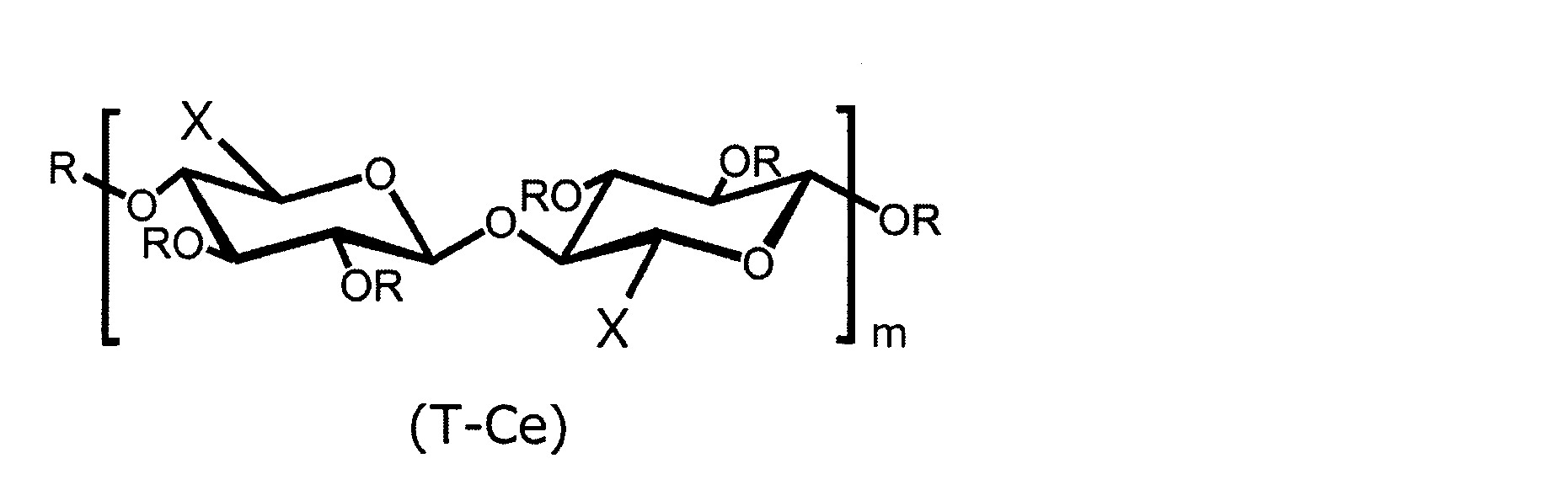
以下、シリコーン系化合物に由来する基とカチオン性基を有する合計炭素数16以上40以下の炭化水素系化合物に由来する基を含めて「修飾基」と称する。
成分(A)の疎水変性セルロース繊維は、例えば、(1)原料のセルロース繊維にアニオン性基を導入してアニオン変性セルロース繊維を得る工程、及び(2)該アニオン変性セルロース繊維に、シリコーン系化合物及び/又はカチオン性基を有する合計炭素数16以上40以下の炭化水素系化合物を結合させて、疎水変性セルロース繊維を得る工程、を含む方法が挙げられる。
成分(A-1)アニオン変性セルロース繊維、
成分(A-2)アミノ変性シリコーン、及びカチオン性基を有する合計炭素数16以上40以下の炭化水素系化合物からなる群より選択される一種以上の化合物
成分(B)水、並びに
成分(C)25℃1気圧で液体の有機化合物
を混合する工程が挙げられる。かかる態様は、後述の本発明の乳化組成物の製造方法における工程、即ち、成分(A-1)、成分(A-2)、成分(B)及び成分(C)を混合する工程と同一である。かかる態様によれば、疎水変性セルロース繊維と本発明の乳化組成物とを同一の工程で製造できるため、より好ましい製造方法ということができる。
本発明で用いられるアニオン変性セルロース繊維は、原料のセルロース繊維に酸化処理又はアニオン性基の付加処理を施して、少なくとも1つ以上のアニオン性基を導入してアニオン変性させることによって得ることができる。
セルロース繊維にカルボキシ基を導入する方法としては、例えばセルロースのヒドロキシ基を酸化してカルボキシ基に変換する方法や、セルロースのヒドロキシ基にカルボキシ基を有する化合物、カルボキシ基を有する化合物の酸無水物及びそれらの誘導体からなる群から選ばれる少なくとも1種を反応させる方法が挙げられる。
セルロース繊維にアニオン性基としてスルホン酸基を導入する方法としては、セルロース繊維に硫酸を添加し加熱する方法等が挙げられる。
セルロース繊維にアニオン性基としてリン酸基を導入する方法としては、乾燥状態又は湿潤状態のセルロース繊維に、リン酸又はリン酸誘導体の粉末や水溶液を混合する方法や、セルロース繊維の分散液にリン酸又はリン酸誘導体の水溶液を添加する方法等が挙げられる。これらの方法を採用した場合、一般的に、リン酸又はリン酸誘導体の粉末や水溶液を混合または添加した後に、脱水処理及び加熱処理等を行う。
このようにして得られるアニオン変性セルロース繊維中に含まれるアニオン性基は、例えばカルボキシ基、スルホン酸基及びリン酸基等が挙げられる。前記アニオン性基は、セルロース繊維への修飾基の導入効率の観点から、カルボキシ基であることが好ましい。アニオン変性セルロース繊維におけるアニオン性基の対となるイオン(カウンターイオン)としては、例えば、製造時のアルカリ存在下で生じるナトリウムイオン、カリウムイオン、カルシウムイオン及びアルミニウムイオン等の金属イオンや、これらの金属イオンを酸で置換して生じるプロトン等が挙げられる。
成分(A)の疎水変性セルロース繊維は、前記したアニオン変性セルロース繊維に、アミノ変性シリコーン、及びカチオン性基を有する合計炭素数16以上40以下の炭化水素系化合物からなる群より選択される一種以上の化合物を結合させることにより製造することができる。かかる製造方法としては、公知の方法、例えば特開2015-143336号公報に記載の方法を用いることができる。
本発明において修飾用化合物として用いられるシリコーン系化合物は、市販品を用いるか、公知の方法に従って調製することができる。シリコーン化合物は1種のみを用いてもよいし、2種以上を用いてもよい。
アミノ変性シリコーンとは、アミノ基を有するシリコーン系化合物である。アミノ変性シリコーンとしては、25℃での動粘度が10mm2/s以上20,000mm2/s以下のものが好ましい。さらに、アミノ当量が400g/mol以上16,000g/mol以下のアミノ変性シリコーンが好ましいものとして挙げられる。
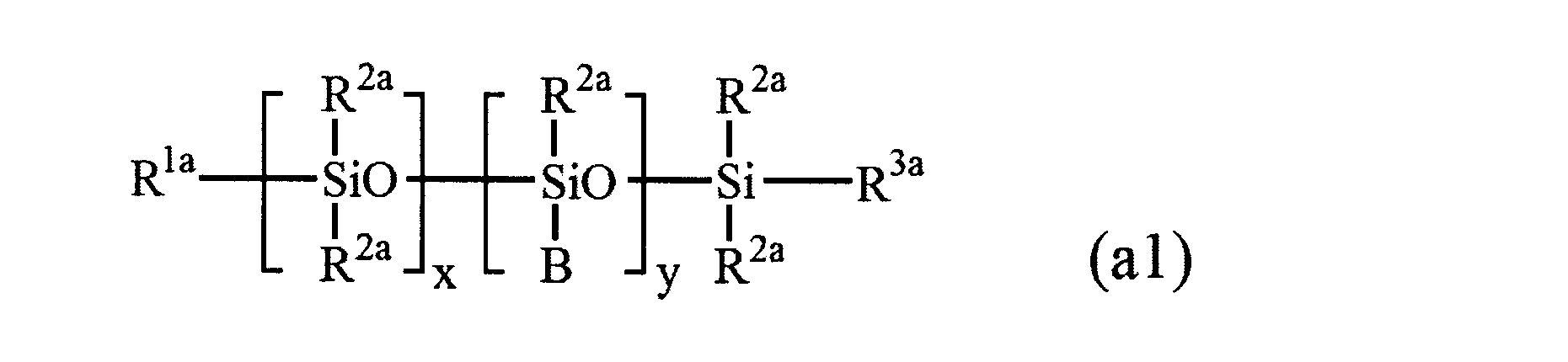
-C3H6-NH2
-C3H6-NH-C2H4-NH2
-C3H6-NH-[C2H4-NH]e-C2H4-NH2
-C3H6-NH(CH3)
-C3H6-NH-C2H4-NH(CH3)
-C3H6-NH-[C2H4-NH]f-C2H4-NH(CH3)
-C3H6-N(CH3)2
-C3H6-N(CH3)-C2H4-N(CH3)2
-C3H6-N(CH3)-[C2H4-N(CH3)]g-C2H4-N(CH3)2
-C3H6-NH-cyclo-C5H11
(ここで、e、f、gは、それぞれ1~30の数である。)
H2N(CH2)2NH(CH2)3Si(CH3)(OCH3)2 (a2)
本発明における、カチオン性基を有する合計炭素数16以上の炭化水素系化合物とは、一つのカチオン性基に対して一つ以上の炭化水素基が結合したものである。カチオン性基を有する炭化水素系化合物の合計炭素数は、高い耐水性を有する膜を得る観点から、16以上であり、さらに好ましくは18以上であり、ハンドリング性の観点から、好ましくは40以下であり、より好ましくは30以下であり、更に好ましくは26以下である。
カチオン性基を有する炭化水素系化合物は、オキシアルキレン基を含まないものがより好ましい。
前記炭化水素系化合物における炭化水素基としては、例えば、鎖式飽和炭化水素基、鎖式不飽和炭化水素基、環式飽和炭化水素基、及び芳香族炭化水素基が挙げられる。炭化水素基の炭素数は、入手性の観点から、好ましくは1以上であり、より好ましくは2以上であり、更に好ましくは3以上であり、同様の観点から、好ましくは40以下であり、より好ましくは30以下であり、更に好ましくは24以下である。なお、炭化水素基の炭素数とは、別に規定の無い限り、一つの炭化水素基における炭素数のことを意味する。
疎水変性セルロース繊維の製造方法のいずれかの段階においてセルロースを微細化することにより、マイクロメータースケールのセルロースをナノメータースケールに微細化することができる。平均繊維径をナノメートルサイズにまで小さくすることによって、成膜時の強度が向上するため、微細化処理工程をさらに実施することが好ましい。
本発明における成分(B)は水である。成分(B)は、疎水変性セルロース繊維の製造の際の溶媒として、及び本発明の乳化組成物の構成成分の一つとしての役割を有する。
本発明における成分(C)は25℃1気圧で液体の有機化合物である。成分(C)は疎水変性セルロース繊維の製造の際の溶媒であってもよい。
25℃1気圧で液体の有機化合物の水への溶解度は、25℃の水100gあたり、10g以下が好ましく、1g以下が更に好ましい。
成分(C)の分子量は、耐水性及び滑液性を向上させた膜を得る観点から、好ましくは100,000以下、より好ましくは50,000以下、更に好ましくは10,000以下であり、同上の観点から、好ましくは100以上、より好ましくは200以上である。
油脂としては、例えば、大豆油、ヤシ油、アマニ油、綿実油、ナタネ油、ヒマシ油などの植物油や動物油等が挙げられる。
本発明の乳化組成物は、成分(D)のポリエーテル変性シリコーン化合物を含んでいてもよい。かかる成分(D)を乳化組成物に配合することによって、耐水性及び滑液性を向上させた膜を得ることができ、さらに得られる膜の耐久性を向上させることができる。成分(D)の一例としては、メチルシリコーン鎖を主鎖とし、ポリオキシエチレン基からなる側鎖をもつ化合物が挙げられ、具体的には、下記一般式で示される化合物が挙げられる。
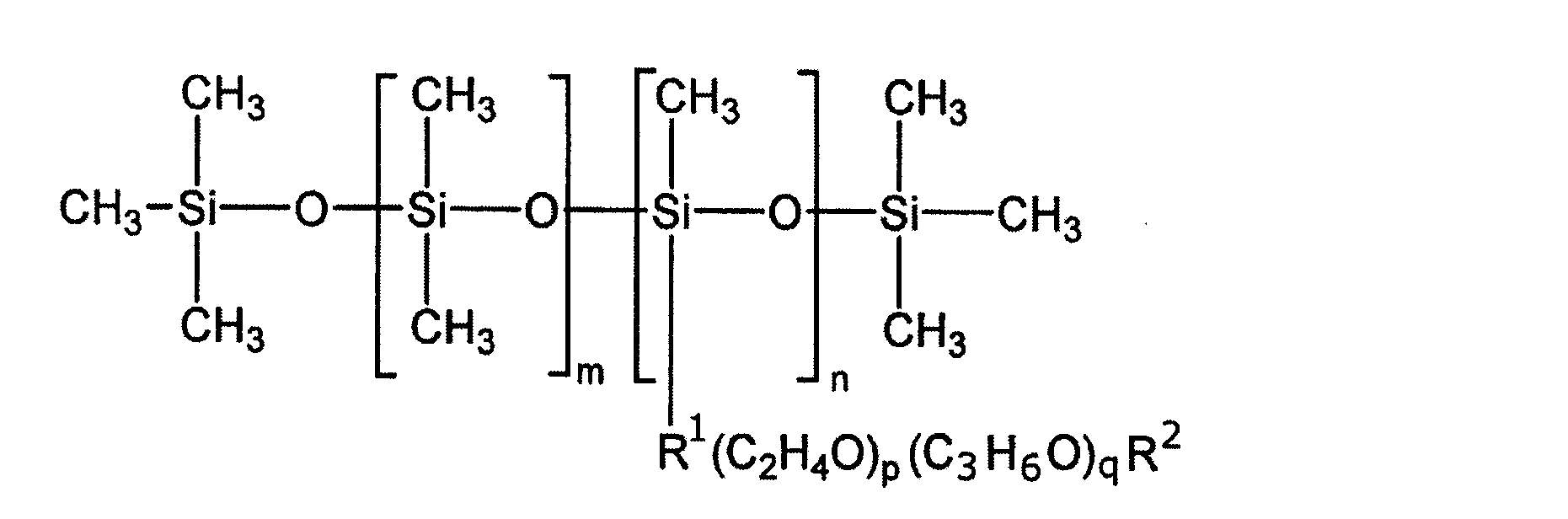
HLB値=20×親水基部の分子量の総和/分子量
本発明の乳化組成物は、更に高分子化合物を含んでいてもよい。
かかる高分子化合物は、高い耐水性を有する膜を得る観点から、下記の高分子化合物(X)及び高分子化合物(Y)からなる群より選択される1種以上が好ましく、高分子化合物(X)がより好ましい。
高分子化合物(X):主鎖にエステル基、アミド基、ウレタン基、アミノ基、エーテル基又はカーボネート基を有する高分子化合物(但し、成分(A-1)及び成分(D)のいずれかに該当する高分子化合物は、高分子化合物(X)として扱わない。)
高分子化合物(Y):側鎖にエステル基若しくはアミド基を有するメタクリル系又はアクリル系高分子
主鎖にエステル基を有する高分子化合物(X)としては、アジピン酸、セバシン酸、ドデカン二酸、フタル酸、イソフタル酸、テレフタル酸、コハク酸、及びアルケニルコハク酸等のジカルボン酸と、エチレングリコール、プロピレングリコール、ブタンジオール等のジオールとの縮合物等、あるいは、グルコール酸、乳酸などの一分子内にヒドロキシ基とカルボキシル基の両方を有する化合物の縮合物が挙げられる。
高分子化合物(Y)、即ち、側鎖にエステル基若しくはアミド基を有するメタクリル系又はアクリル系高分子としては、例えば、ポリメチル(メタ)アクリレート、ポリエチル(メタ)アクリレート、ポリブチル(メタ)アクリレート等のポリアルキル(メタ)アクリレート、ポリ(メタ)アクリルアミド、ポリN-メチル(メタ)アクリルアミド、ポリN,N-ジメチル(メタ)アクリルアミド、ポリN-フェニル(メタ)アクリルアミド等のポリ(メタ)アクリルアミド等が挙げられる。
本発明の乳化組成物は、前記成分以外に、可塑剤、結晶核剤、充填剤(無機充填剤、有機充填剤)、加水分解抑制剤、難燃剤、酸化防止剤、炭化水素系ワックス類やアニオン型界面活性剤である滑剤、紫外線吸収剤、帯電防止剤、防曇剤、光安定剤、顔料、防カビ剤、抗菌剤、発泡剤、界面活性剤;でんぷん類、アルギン酸等の多糖類;ゼラチン、ニカワ、カゼイン等の天然たんぱく質;タンニン、ゼオライト、セラミックス、金属粉末等の無機化合物;香料;流動調整剤;レべリング剤;導電剤;紫外線分散剤;消臭剤等を、本発明の効果を損なわない範囲で含有することができる。また同様に、本発明の効果を阻害しない範囲内で他の高分子材料や他の組成物を添加することも可能である。
本発明の乳化組成物は、前記の成分(A)、成分(B)及び成分(C)を必須成分として含む、乳化状態の組成物である。本発明における乳化は、水と、25℃1気圧で液体の有機化合物を混合した状態で機械力をかけ、一方の液中に他方の液滴が微細に分散した状態とすることである。o/w型エマルション、w/o型エマルションのどちらでもよいが好ましくはo/w型エマルションである。
本発明の乳化組成物の製造方法は、前述の成分(A)、成分(B)、成分(C)等を混合する工程を有するものである。ここで、疎水変性セルロース繊維の水分散液に25℃1気圧で液体の有機化合物を混合してもよく、あるいは、疎水変性セルロース繊維の該有機化合物分散液と水とを混合してもよい。
好ましくは、成分(A-1)と成分(A-2)とを、成分(B)及び成分(C)の存在下で混合する工程を含む製造方法が好ましい。
従って、本発明の乳化組成物の好ましい一態様は、成分(A-1)、成分(A-2)、成分(B)、及び成分(C)を含有するものである。その場合、成分(A)の含有量は、成分(A-1)と成分(A-2)との合計含有量である。
本発明の、疎水変性セルロース繊維を含有する膜の製造方法は、前記本発明の乳化組成物又は前記本発明の乳化組成物の製造方法によって得られた乳化組成物を乾燥させる工程を含む。
前記の製造方法によって得られる本発明の乳化組成物の乾燥膜は、文献(超撥水・超撥油・滑液性表面の技術/発行者:元木浩/発行所:サイエンス&テクノロジー株式会社/2016年1月28日発行)に示される滑液表面性を示すことが好ましい。
本発明の膜における成分(C)や成分(D)の好ましい量の範囲についても、乳化組成物におけるそれらの好ましい量の範囲に対応する。
(A)下記成分(a)及び成分(b)からなる群より選択される一種以上の疎水変性セルロース繊維、
(a)セルロース繊維にシリコーン系化合物が結合してなる疎水変性セルロース繊維
(b)アニオン変性セルロース繊維のアニオン性基に、カチオン性基を有する合計炭素数16以上40以下の炭化水素系化合物がイオン結合を介して結合してなる疎水変性セルロース繊維、及び
(C)25℃1気圧で液体の有機化合物、
を含有し、粒子状構造を有する膜である。
(A)下記成分(a)及び成分(b)からなる群より選択される一種以上の疎水変性セルロース繊維
(a)セルロース繊維にシリコーン系化合物が結合してなる疎水変性セルロース繊維
(b)アニオン変性セルロース繊維のアニオン性基に、カチオン性基を有する合計炭素数16以上40以下の炭化水素系化合物がイオン結合を介して結合してなる疎水変性セルロース繊維
(B)水
(C)25℃1気圧で液体の有機化合物
<3> 疎水変性セルロース繊維の平均繊維径は、好ましくは0.1nm以上200nm以下、より好ましくは1.0nm以上100nm以下、更に好ましくは2.0nm以上50nm以下である、前記<1>又は<2>に記載の乳化組成物。
<4> アニオン変性セルロース繊維におけるアニオン性基含有量は、好ましくは0.1mmol/g以上3mmol/g以下、より好ましくは0.4mmol/g以上2mmol/g以下、更に好ましくは0.6mmol/g以上1.8mmol/g以下、更に好ましくは0.8mmol/g以上1.8mmol/g以下である、前記<1>~<3>のいずれか一つに記載の乳化組成物。
<5> アニオン変性セルロース繊維の平均繊維径は、好ましくは0.1nm以上200nm以下、より好ましくは1.0nm以上100nm以下、更に好ましくは2.0nm以上50nm以下である、前記<1>~<4>のいずれか一つに記載の乳化組成物。
<6> 成分(C)の水への溶解度は、25℃の水100gあたり、好ましくは10g以下、より好ましくは1g以下である、前記<1>~<5>のいずれか一つに記載の乳化組成物。
<7> 成分(C)の分子量は、好ましくは100以上100,000以下、より好ましくは200以上50,000以下、更に好ましくは200以上10,000以下である、前記<1>~<6>のいずれか一つに記載の乳化組成物。
<8> 成分(C)は、油剤、有機溶剤、重合性モノマー及びプレポリマーからなる群より選択される一種以上を含む、前記<1>~<7>のいずれか一つに記載の乳化組成物。
<9> 成分(C)が油剤を含み、好ましくは成分(C)が油剤であり、油剤としては、アルコール、エステル油、炭化水素油、シリコーン油、エーテル油、油脂、フッ素系不活性液体及び脂肪酸からなる群より選択される一種以上が好ましく、エステル油、シリコーン油、エーテル油、油脂、及びフッ素系不活性液体からなる群より選択される一種以上がより好ましく、シリコーン油、エスエル油、及びエーテル油からなる群より選択される一種以上が更に好ましく、シリコーン油及び/又はエスエル油が更に好ましい、前記<1>~<8>のいずれか一つに記載の乳化組成物。
<10> 成分(C)のSP値は、好ましくは6.0以上10以下、より好ましくは6.5以上9.5以下、更に好ましくは6.5以上9.0以下、更に好ましくは6.5以上8.5以下である、前記<1>~<9>のいずれか一つに記載の乳化組成物。
<12> 成分(b)における、カチオン性基を有する炭化水素系化合物の合計炭素数が、好ましくは16以上40以下、より好ましくは18以上40以下、更に好ましくは18以上30以下、更に好ましくは18以上26以下である、前記<1>~<11>のいずれか一つに記載の乳化組成物。
<13> 成分(b)における、カチオン性基を有する炭化水素系化合物が、好ましくは1級アミン、2級アミン、3級アミン及び4級アンモニウムである、前記<1>~<12>のいずれか一つに記載の乳化組成物。
<14> 乳化組成物中又は混合時の成分(A)の含有量は、好ましくは0.02質量%以上15質量%以下、より好ましくは0.05質量%以上10質量%以下、更に好ましくは0.1質量%以上5質量%以下である、前記<1>~<13>のいずれか一つに記載の乳化組成物。
<15> 乳化組成物中又は混合時の成分(B)の含有量は、好ましくは10質量%以上98質量%以下、より好ましくは20質量%以上98質量%以下、更に好ましくは30質量%以上98質量%以下である、前記<1>~<14>のいずれか一つに記載の乳化組成物。
<16> 乳化組成物中又は混合時の成分(C)の含有量は、好ましくは0.1質量%以上70質量%以下、より好ましくは0.5質量%以上60質量%以下、更に好ましくは1質量%以上50質量%以下である、前記<1>~<15>のいずれか一つに記載の乳化組成物。
<17> 成分(A)と成分(C)との質量比(A/C)が、好ましくは0.0001以上20以下、より好ましくは0.001以上10以下、更に好ましくは0.004以上5以下、更に好ましくは0.01以上3以下、更に好ましくは0.04以上2以下である、前記<1>~<16>のいずれか一つに記載の乳化組成物。
<18> さらに成分(D)ポリエーテル変性シリコーン化合物を含み、該成分(D)の含有量が、好ましくは0.01質量%以上5質量%以下、より好ましくは0.05質量%以上2質量%以下、更に好ましくは0.1質量%以上1質量%以下である、前記<1>~<17>のいずれか一つに記載の乳化組成物。
<19> 乳化組成物中又は混合時の成分(A)~成分(D)の含有量が、それぞれ、好ましくは0.02質量%以上15質量%以下、好ましくは10質量%以上98質量%以下、好ましくは0.1質量%以上70質量%以下、及び好ましくは0.01質量%以上5質量%以下である、前記<1>~<18>のいずれか一つに記載の乳化組成物。
<20> 乳化組成物の25℃における粘度は、好ましくは0.5mPa・s以上30Pa・s以下、より好ましくは0.8mPa・s以上20Pa・s以下、更に好ましくは1mPa・s以上10Pa・s以下である、前記<1>~<19>のいずれか一つに記載の乳化組成物。
<21> 乳化組成物における乳化滴の平均粒子径は、好ましくは10nm以上2000nm以下、より好ましくは50nm以上1000nm以下、更に好ましくは100nm以上700nm以下、更に好ましくは100nm以上500nm以下である、前記<1>~<20>のいずれか一つに記載の乳化組成物。
成分(A-2)アミノ変性シリコーン、及びカチオン性基を有する合計炭素数16以上40以下の炭化水素系化合物からなる群より選択される一種以上の化合物、
成分(B)水、並びに
成分(C)25℃1気圧で液体の有機化合物
を含有する、前記<1>~<21>のいずれか一つに記載の乳化組成物。
<23> 成分(A-1)のアニオン性基に対して、成分(A-2)が好ましくは0.1当量以上3当量以下、より好ましくは0.3当量以上2当量以下、更に好ましくは0.5当量以上1.5当量以下である、前記<22>に記載の乳化組成物。
<24> ([成分(A-2)の合計モル数]/[成分(A-1)のアニオン性基のモル数])が、好ましくは0.1以上3以下、より好ましくは0.3以上2以下、更に好ましくは0.5以上1.5以下である、前記<22>又は<23>に記載の乳化組成物。
<25> 質量比(A-2/C)は、好ましくは0.0001以上20以下、より好ましくは0.001以上10以下、更に好ましくは0.004以上5以下、更に好ましくは0.01以上3以下、更に好ましくは0.04以上2以下である、前記<22>~<24>のいずれか一つに記載の乳化組成物。
<26> 成分(A-1)アニオン変性セルロース繊維、
成分(A-2)アミノ変性シリコーン、及びカチオン性基を有する合計炭素数16以上40以下の炭化水素系化合物からなる群より選択される一種以上の化合物、
成分(B)水、並びに
成分(C)25℃1気圧で液体の有機化合物
を混合する工程を含む、前記<1>~<25>のいずれか一つに記載の乳化組成物の製造方法。
<27> 成分(A-1)のアニオン性基に対して、成分(A-2)が好ましくは0.1当量以上3当量以下、より好ましくは0.3当量以上2当量以下、更に好ましくは0.5当量以上1.5当量以下である、前記<26>に記載の乳化組成物の製造方法。
<28> ([成分(A-2)の合計モル数]/[成分(A-1)のアニオン性基のモル数])が、好ましくは0.1以上3以下、より好ましくは0.3以上2以下、更に好ましくは0.5以上1.5以下である、前記<26>又は<27>に記載の乳化組成物の製造方法。
<29> 質量比(A-2/C)は、好ましくは0.0001以上20以下、より好ましくは0.001以上10以下、更に好ましくは0.004以上5以下、更に好ましくは0.01以上3以下、更に好ましくは0.04以上2以下である、前記<26>~<28>のいずれか一つに記載の乳化組成物の製造方法。
<31> 前記<1>~<25>のいずれか一つに記載の乳化組成物を乾燥して得られる乾燥膜。
<32> 前記<1>~<25>のいずれか一つに記載の乳化組成物を塗布後、乾燥して得られる塗工膜。
<33> 好ましくは、粉塵の付着を抑制する防汚膜、雪や氷の付着を抑制する防雪膜、又は水性生物の付着を抑制する生物付着抑制膜として用いられる、前記<31>に記載の乾燥膜又は前記<32>に記載の塗工膜。
<34> 膜の厚みは、好ましくは1μm以上2000μm以下、より好ましくは3μm以上1200μm以下、更に好ましくは5μm以上500μm以下、更に好ましくは5μm以上200μm以下である、前記<31>に記載の乾燥膜、前記<32>に記載の塗工膜、又は前記<33>に記載の膜。
<35> 製造直後の膜の算術平均粗さが、好ましくは0.3μm以上40μm以下、より好ましくは0.5μm以上35μm以下、更に好ましくは0.8μm以上30μm以下である、前記<31>に記載の乾燥膜、前記<32>に記載の塗工膜、又は前記<33>若しくは<34>に記載の膜。
<36> 前記<1>~<25>のいずれか一つに記載の乳化組成物を含有する、生物付着抑制剤、防汚剤又は防雪剤。
<37> 前記<1>~<25>のいずれか一つに記載の乳化組成物を固体表面に塗布する工程を有する、生物付着抑制方法、防汚方法、又は防雪方法。
<38> 前記<1>~<25>のいずれか一つに記載の乳化組成物の生物付着抑制剤、防汚剤又は防雪剤としての使用。
<39> (A)下記成分(a)及び成分(b)からなる群より選択される一種以上の疎水変性セルロース繊維、
(a)セルロース繊維にシリコーン系化合物が結合してなる疎水変性セルロース繊維
(b)アニオン変性セルロース繊維のアニオン性基に、カチオン性基を有する合計炭素数16以上40以下の炭化水素系化合物がイオン結合を介して結合してなる疎水変性セルロース繊維、及び
(C)25℃1気圧で液体の有機化合物
を含有し、粒子状構造を有する膜。
<40> 粉塵の付着を抑制する防汚膜、雪や氷の付着を抑制する防雪膜、又は水性生物の付着を抑制する生物付着抑制膜として用いられる、前記<39>に記載の膜。
<41> 前記<1>~<25>のいずれか一つに記載の乳化組成物を乾燥させて得られる、前記<39>又は<40>に記載の膜。
測定対象のセルロース繊維に水を加えて、その含有量が0.0001質量%の分散液を調製する。該分散液をマイカ(雲母)上に滴下して乾燥したものを観察試料として、原子間力顕微鏡(AFM)(Digital instrument社製、Nanoscope II Tappingmode AFM;プローブはナノセンサーズ社製、Point Probe(NCH)を使用)を用いて、該観察試料中のセルロース繊維の繊維高さ(繊維のあるところとないところの高さの差)を測定する。その際、該セルロース繊維が確認できる顕微鏡画像において、セルロース繊維を100本以上抽出し、それらの繊維高さから平均繊維径を算出する。繊維方向の距離より、平均繊維長を算出する。平均アスペクト比は平均繊維長/平均繊維径より算出する。AFMによる画像で分析される高さを繊維径とみなすことができる。
測定対象のセルロース繊維に脱イオン水を加えて、その含有量が0.01質量%の分散液を調製する。該分散液を湿式分散タイプ画像解析粒度分布計(ジャスコインターナショナル社製、商品名:IF-3200)を用いて、フロントレンズ:2倍、テレセントリックズームレンズ:1倍、画像分解能:0.835μm/ピクセル、シリンジ内径:6515μm、スペーサー厚み:500μm、画像認識モード:ゴースト、閾値:8、分析サンプル量:1mL、サンプリング:15%の条件で測定する。セルロース繊維を100本以上測定し、それらの平均ISO繊維径を平均繊維径をとして、平均ISO繊維長を平均繊維長として算出する。
乾燥質量0.5gの測定対象のセルロース繊維を100mLビーカーにとり、脱イオン水又はメタノール/水=2/1の混合溶媒を加えて全体で55mLとし、ここに0.01M塩化ナトリウム水溶液5mLを加えて分散液を調製する。測定対象のセルロース繊維が十分に分散するまで該分散液を攪拌する。この分散液に0.1M塩酸を加えてpHを2.5~3に調整し、自動滴定装置(東亜ディーケーケー社製、商品名「AUT-701」)を用い、0.05M水酸化ナトリウム水溶液を、待ち時間60秒の条件で該分散液に滴下し、1分ごとの電導度及びpHの値を測定する。pH11程度になるまで測定を続け、電導度曲線を得る。この電導度曲線から、水酸化ナトリウム滴定量を求め、次式により、測定対象のセルロース繊維のアニオン性基含有量を算出する。
アニオン性基含有量(mmol/g)=[水酸化ナトリウム滴定量×水酸化ナトリウム水溶液濃度(0.05M)]/[測定対象のセルロース繊維の質量(0.5g)]
測定対象の酸化セルロース繊維のカルボキシ基含有量を、上記アニオン性基含有量の測定方法によって測定する。
一方、これとは別に、ビーカーに、測定対象の酸化セルロース繊維の水分散液100g(固形分含有量1.0質量%)、酢酸緩衝液(pH4.8)100g、2-メチル-2-ブテン0.33g、亜塩素酸ナトリウム0.45gを加え25℃で16時間撹拌して、酸化セルロース繊維に残存するアルデヒド基の酸化処理を行う。反応終了後、脱イオン水にて洗浄を行い、アルデヒド基を酸化処理したセルロース繊維を得る。反応液を凍結乾燥処理し、得られた乾燥品のカルボキシ基含有量を上記アニオン性基含有量の測定方法で測定し、「酸化処理した酸化セルロース繊維のカルボキシ基含有量」を算出する。続いて、式1にて測定対象の酸化セルロース繊維のアルデヒド基含有量を算出する。
ハロゲン水分計(島津製作所社製;商品名「MOC-120H」)を用いて測定する。サンプル1gに対して150℃恒温で30秒ごとの測定を行い、質量減少がサンプルの初期量の0.1%以下となった値を固形分含有量とする。
疎水変性セルロース繊維の結晶構造は、X線回折計(リガク社製、MiniFlexII)を用いて以下の条件で測定することにより確認する。
測定条件は、X線源:Cu/Kα-radiation、管電圧:30kv、管電流:15mA、測定範囲:回折角2θ=5~45°、X線のスキャンスピード:10°/minとする。測定用サンプルは面積320mm2×厚さ1mmのペレットに圧縮して作製する。また、セルロースI型結晶構造の結晶化度は得られたX線回折強度を、以下の式Aに基づいて算出する。
セルロースI型結晶化度(%)=[(I22.6-I18.5)/I22.6]×100
〔式中、I22.6は、X線回折における格子面(002面)(回折角2θ=22.6°)の回折強度、I18.5は、アモルファス部(回折角2θ=18.5°)の回折強度を示す〕
したがって、上記式Aで得られる結晶化度が35%以下の場合には、以下の式Bに基づいて算出した値を結晶化度として用いることができる。
セルロースI型結晶化度(%)=[Ac/(Ac+Aa)]×100
〔式中、Acは、X線回折における格子面(002面)(回折角2θ=22.6°)、(011面)(回折角2θ=15.1°)および(0-11面)(回折角2θ=16.2°)のピーク面積の総和、Aaは,アモルファス部(回折角2θ=18.5°)のピーク面積を示し、各ピーク面積は得られたX線回折チャートをガウス関数でフィッティングすることで求める〕
疎水変性セルロース繊維におけるセルロース繊維(換算量)は、以下の方法によって測定する。
(1)添加される「修飾用化合物」が1種類の場合
セルロース繊維量(換算量)を下記式Cによって算出する。
<式C>
セルロース繊維量(換算量)(g)=疎水変性セルロース繊維の質量(g)/〔1+修飾用化合物の分子量(g/mol)×修飾基の結合量(mmol/g)×0.001〕
(2)添加される「修飾用化合物」が2種類以上の場合
各化合物のモル比率(即ち、添加される化合物の合計モル量を1とした時のモル比率)を考慮して、セルロース繊維量(換算量)を算出する。
B型粘度計(東機産業TVB-10)No.1ローターを用いて、25℃、回転速度60RPM、1分後の粘度を測定する。
Cryo-SEMによる乳化組成物の観察は、FEI社製電界放射型走査電子顕微鏡Scios DualBeamを用いて行う。凍結した乳化組成物から水分を徐々に昇華させながら観察を行う。加速電圧2kV、倍率25000倍にて観察を行う。
レーザー回折法による乳化滴の粒径測定は、堀場製作所製LA-960を用いて行う。
測定条件:測定用セルに水を加え、吸光度が適正範囲になる濃度で体積粒度分布及び体積中位粒径(D50)を測定する。なお、相対屈折率1.20、温度25℃、循環ポンプON、循環速度5、撹拌速度5とする。
調製例1
針葉樹の漂白クラフトパルプ(ウエストフレザー社製、商品名:ヒントン)を原料の天然セルロース繊維として用いた。TEMPOとしては、市販品(ALDRICH社製、Free radical、98質量%)を用いた。次亜塩素酸ナトリウム、臭化ナトリウム及び水酸化ナトリウムとしては市販品を用いた。
調製例1で最終的に得られたアニオン変性セルロース繊維に脱イオン水を添加して懸濁液(固形分含有量2.0質量%)100gを調製した。これに0.5M水酸化ナトリウム水溶液を添加してpH=8に調整後、脱イオン水を加えて合計200gとした。この懸濁液に、高圧ホモジナイザー(吉田機械社製、商品名:ナノヴェイタL-ES)を用いて150MPaで微細化処理を3回行い、微細化アニオン変性セルロース繊維分散液(固形分含有量1.0質量%)を得た。この微細化アニオン変性セルロース繊維が有するカルボキシ基のカウンターイオンはナトリウムイオンであった。この微細化アニオン変性セルロース繊維を「TCNF(Na型)」と略記する。
調製例2で得られた微細化アニオン変性セルロース繊維分散液(固形分含有量1.0質量%)182gをはかり取り、脱イオン水を加えて合計400gとした。そこに0.1M水酸化ナトリウム水溶液1.2mL、水素化ホウ素ナトリウム120mgを加え、25℃で4時間撹拌した。次に、1M塩酸9mLを加えてプロトン化を行った。反応終了後ろ過し、得られたケークを脱イオン水で6回洗浄して塩および塩酸を除去し、アルデヒド基が還元処理された、微細化アニオン変性セルロース繊維分散液(固形分含有量0.9質量%)を得た。得られたセルロース繊維のカルボキシ基含有量は1.50mmol/g、アルデヒド基含有量は0.02mmol/gであった。この微細化アニオン変性セルロース繊維が有するカルボキシ基は遊離酸型(COOH)となっており、「TCNF(H型)」と略記する。この微細化アニオン変性セルロース繊維の平均繊維径は3.3nm、平均繊維長は600nmであった。
実施例1
ビーカーに、調製例3で得られた微細化アニオン変性セルロース繊維分散液66.7g(固形分含有量0.9質量%)、シリコーンオイル1 12.0g、アミノ変性シリコーン1 1.53g(アニオン変性セルロース繊維のカルボキシ基に対して1当量に相当)を混合し、そこに脱イオン水を加えて合計100gとした。この溶液をメカニカルスターラーで5分間撹拌した後、高圧ホモジナイザー(吉田機械社製、商品名:ナノヴェイタL-ES)にて150MPaで10パス処理させることで、アニオン変性セルロース繊維に、アミノ変性シリコーンがイオン結合を介して連結した疎水変性セルロース繊維を含む乳化組成物を得た。得られた組成物は白濁液であって、光学顕微鏡、及びCryo-SEMによる観察によって水中に油滴が分散している様子が観察されたため、乳化組成物であると判断した。図1として、実施例1において製造された乳化組成物の、Cryo-SEMによる顕微鏡写真(25000倍)を示す。さらに、レーザー回折法による測定から、該乳化組成物の平均粒子径が300nmであることが分かった。図2として、レーザー回折法によって得られた該乳化組成物の乳化滴の粒径分布を示すグラフを示す。
シリコーンオイルの量を1.2gとしたこと以外は実施例1と同様にして、アニオン変性セルロース繊維に、アミノ変性シリコーンがイオン結合を介して結合した疎水変性セルロース繊維を含む乳化組成物を得た。
シリコーンオイル1の代わりにシリコーンオイル2を用いたこと以外は、実施例1と同様にして、アニオン変性セルロース繊維に、アミノ変性シリコーンがイオン結合を介して連結した疎水変性セルロース繊維を含む乳化組成物を得た。
シリコーンオイルの代わりにミリスチン酸イソプロピルを用いたこと以外は、実施例1と同様にして、アニオン変性セルロース繊維に、アミノ変性シリコーンがイオン結合を介して連結した疎水変性セルロース繊維を含む乳化組成物を得た。
アミノ変性シリコーン1の代わりにアミノ変性シリコーン2を同じ当量に相当する量、用いたこと以外は、実施例1と同様にして、アニオン変性セルロース繊維に、アミノ変性シリコーンがイオン結合を介して連結した疎水変性セルロース繊維を含む乳化組成物を得た。
アミノ変性シリコーンの量を0.77g(アニオン変性セルロース繊維のカルボキシ基に対して0.5当量に相当)としたこと以外は実施例1と同様にして、アニオン変性セルロース繊維に、アミノ変性シリコーンがイオン結合を介して結合した疎水変性セルロース繊維を含む乳化組成物を得た。
ビーカーに調製例3で得られた微細化アニオン変性セルロース繊維分散液22.2g(固形分含有量0.9質量%)、前記シリコーンオイル1 40.0g、前記アミノ変性シリコーン1 0.51g(アニオン変性セルロース繊維のカルボキシ基に対して1当量に相当)を混合し、そこに脱イオン水を加えて合計100gとした。以下実施例1と同様に処理して、アニオン変性セルロース繊維に、アミノ変性シリコーンがイオン結合を介して連結した疎水変性セルロース繊維を含む乳化組成物を得た。
ビーカーに実施例1で得られた乳化組成物100gをはかり取り、そこにポリエーテル変性シリコーン1 0.2gを添加し、25℃で30分撹拌し、乳化組成物を得た。
ビーカーに調製例3で得られた微細化アニオン変性セルロース繊維分散液66.7g(固形分含有量0.9質量%)、アミノ変性シリコーン1 1.53gを混合し、そこに脱イオン水を加えて合計88gとした。この溶液をメカニカルスターラーで5分間撹拌した後、高圧ホモジナイザー(吉田機械社製、商品名:ナノヴェイタL-ES)にて150MPaで5パス処理させることで、アニオン変性セルロース繊維に、アミノ変性シリコーンがイオン結合を介して連結した疎水変性セルロース繊維の水分散液を得た。得られた水分散液にシリコーンオイル1 12.0gを加え、高圧ホモジナイザー(吉田機械社製、商品名:ナノヴェイタL-ES)にて150MPaで5パス処理させることで乳化組成物を得た。
シリコーンオイルの量を0.6gとしたこと以外は実施例1と同様にして、アニオン変性セルロース繊維に、アミノ変性シリコーンがイオン結合を介して結合した疎水変性セルロース繊維を含む乳化組成物を得た。
ビーカーに調製例3で得られた微細化アニオン変性セルロース繊維分散液8.9g(固形分含有量0.9質量%)、前記シリコーンオイル1 40.0g、前記アミノ変性シリコーン1 0.20g(アニオン変性セルロース繊維のカルボキシ基に対して1当量に相当)を混合し、そこに脱イオン水を加えて合計100gとした。以下実施例1と同様に処理して、アニオン変性セルロース繊維に、アミノ変性シリコーンがイオン結合を介して連結した疎水変性セルロース繊維を含む乳化組成物を得た。
アミノ変性シリコーン1の代わりにオレイルアミン(和光純薬製)を同じ当量に相当する量、用いたこと以外は、実施例1と同様にして、アニオン変性セルロース繊維に、オレイルアミンがイオン結合を介して連結した疎水変性セルロース繊維を含む乳化組成物を得た。さらに、ポリエーテル変性シリコーン1 0.2gを添加し、25℃で30分撹拌し、乳化組成物を得た。
実施例1で得られた乳化組成物20gに対し、4-(4,6-ジメトキシ-1,3,5-トリアジン-2-イル)-4-メチルモルホリニウムクロリド(富士フィルム和光純薬株式会社製)200mgを加え、室温(25℃)で24時間撹拌した。次にこの溶液を透析膜(スペクトラ社製、スペクトラ・ポア、MWCO:10kDa)に入れ、室温(25℃)下、脱イオン水に対して48時間透析することで精製し、アミノ変性シリコーンがアミド結合を介して結合した疎水変性セルロース繊維を含む乳化組成物を得た。
ビーカーに調製例2で得られた微細化アニオン変性セルロース繊維分散液60.0g(固形分含有量1.0質量%)、前記シリコーンオイル1 12.0gを混合し、そこに脱イオン水を加えて合計100gとした。この溶液をメカニカルスターラーで5分間撹拌した後、高圧ホモジナイザー(吉田機械社製、商品名:ナノヴェイタL-ES)にて150MPaで10パス処理させることで、アニオン変性セルロース繊維を含む乳化組成物を得た。
ビーカーに調製例3で得られた微細化アニオン変性セルロース繊維分散液66.6g(固形分含有量0.9質量%)、前記シリコーンオイル1 12.0gを混合し、そこに脱イオン水を加えて合計100gとした。この溶液をメカニカルスターラーで5分間撹拌した後、高圧ホモジナイザー(吉田機械社製、商品名:ナノヴェイタL-ES)にて150MPaで10パス処理させることで、アニオン変性セルロース繊維を含む乳化組成物を得た。
アミノ変性シリコーン1の代わりにポリエーテルアミン1を用いたこと以外は、実施例1と同様にして、アニオン変性セルロース繊維に、ポリエーテルアミンがイオン結合を介して連結した疎水変性セルロース繊維を含む乳化組成物を得た。
アミノ変性シリコーン1の代わりにオクチルアミン(富士フィルム和光純薬株式会社製)を用いたこと以外は、実施例1と同様にして、アニオン変性セルロース繊維に、オクチルアミンがイオン結合を介して連結した疎水変性セルロース繊維を含む乳化組成物を得た。
アミノ変性シリコーン1の代わりにトリエチルアミン(富士フィルム和光純薬株式会社製)を用いたこと以外は、実施例1と同様にして、アニオン変性セルロース繊維に、トリエチルアミンがイオン結合を介して連結した疎水変性セルロース繊維を含む乳化組成物を得た。
調製例3で得られた微細化アニオン変性セルロース繊維分散液をイソプロピルアルコールで繰り返し洗浄し、溶媒置換を行った。固形分含有量が0.5質量%となるまでイソプロピルアルコールで希釈し、この分散液100gをビーカーにはかり取った。次に、この分散液にアミノ変性シリコーン1 0.51g(微細化アニオン変性セルロース繊維のカルボキシ基に対して0.4当量に相当)を混合し、この溶液をメカニカルスターラーで5分間撹拌した後、高圧ホモジナイザー(吉田機械社製、商品名:ナノヴェイタL-ES)にて150MPaで5パス処理させることで、アニオン変性セルロース繊維に、アミノ変性シリコーンがイオン結合を介して連結した疎水変性セルロース繊維のイソプロピルアルコール分散液を得た。
さらにこの分散液にスクアラン10.0gを加え、25℃で30分撹拌し、塗工液とした。この塗工液は、前述の実施例及び比較例の様な乳化組成物ではなく、スクアランはイソプロピルアルコール中に溶解し、疎水変性セルロース繊維はイソプロピルアルコール中に分散した状態であった。
[修飾用化合物]
アミノ変性シリコーン1:ダウ・東レ株式会社製「SS-3551」、動粘度:1,000、アミノ当量:1,700
アミノ変性シリコーン2:ダウ・東レ株式会社製「SF-8452C」、動粘度:600、アミノ当量:6,400
オレイルアミン:富士フィルム和光純薬株式会社製、アミノ当量:267.5、合計炭素数:18
ポリエーテルアミン1:ハンツマン社製「M-2070」、アミノ当量:2,000
[成分(C)]
シリコーンオイル1:信越化学工業株式会社製「KF-96-10cs」、SP値:7.3
ミリスチン酸イソプロピル:富士フィルム和光純薬株式会社製、SP値:8.5
シリコーンオイル2:信越化学工業株式会社製「KF-96H-1万cs」、SP値:7.3
シリコーンオイル3:信越化学工業株式会社製「KF-96-100cs」、SP値:7.3
シリコーンオイル4:信越化学工業株式会社製「KF-96-3000cs」、SP値:7.3
スクアラン:富士フィルム和光純薬株式会社製、SP値:7.9
[成分(D)]
ポリエーテル変性シリコーン1:信越化学工業株式会社製「KF-640」、HLB:14
実施例1~13、比較例1~6で作製した乳化組成物をそれぞれ30mLガラスバイアルにはかり取り、25℃で1週間放置した。実施例9を除くすべてのサンプルにおいて、クリーミングや合一は観測されず、高い乳化安定性を示した。一方で実施例9のサンプルは、作製の2日後からクリーミングが観測された。このことから、実施例9の乳化組成物よりも、実施例1~8、10~13の乳化組成物の方が乳化系の経時安定性に優れていることが分かった。
実施例1~13、比較例1~2、4、5及び6で作製した乳化組成物、及び比較例3で作製した塗工液を、それぞれ別々のガラス基板(MATSUNAMI社製:Micro Slide Glass S2112)上に2mL塗布し、スライドガラス全域に塗り広げた。次いで、1気圧、25℃、湿度約40%RHで24時間乾燥させて膜を作製した。下記の測定方法によって実施例1の膜の厚みを測定したところ90μmであった。
また、実施例1で得られた乳化組成物を用いて製造された乾燥膜の断面を、下記に記載の方法により、SEMを用いて観察した。その結果、該乾燥膜が粒子状構造からなることが分かった。図3として、該乾燥膜の断面のSEMによる顕微鏡写真(8000倍)を示す。
乾燥後の膜の厚みは、レーザー顕微鏡(キーエンス社製、VK-9710)を用いて以下の測定条件で測定した。測定条件は、対物レンズ:10倍、光量:3%、明るさ:1548、Zピッチ:0.5μmとした。膜の一部を金属製のスパーテルで削り取り、ガラス基板を露出させたサンプルを測定し、内蔵の画像処理ソフトを用いてガラス基板の高さと膜のある部分の高さを計測し、それらの差をとることで膜の厚みを求めた。
乾燥膜を液体窒素で凍結させ、ナイフで切断して断面を露出させた。試料を室温(25℃)に戻したのち、オスミウム蒸着処理を施し、FEI社製電界放射型走査電子顕微鏡Scios DualBeamを用いてその断面を観察した。加速電圧5kV、倍率8000倍にて観察を行った。
上記のようにして作製された実施例1、8及び比較例6の乾燥膜の表面の算術平均粗さを測定した。膜の算術平均粗さは、レーザー顕微鏡(キーエンス社製、VK-9710)を用いて以下の測定条件で測定した。測定条件は、対物レンズ:10倍、光量:3%、明るさ:1548、Zピッチ:0.5μmとする。算術平均粗さは、内蔵の画像処理ソフトを用いて5点測定し、その平均値を用いた。
上記のようにして作製された実施例1~13、比較例1~6の乾燥膜を準備した。乾燥膜の表面に浮き出た油をふき取った後、水で満たした300mLビーカーにガラス板ごと浸漬し、5分後と30分後の乾燥膜の膨潤度を以下の式Eによって算出した。なお、乾燥膜が崩壊し水中に分散した場合には、膨潤度の代わりに「崩壊」と記した。結果を下記表に示す。
膨潤度[%]=〔{〔浸漬後の質量〕-〔塗布前のガラス板の質量〕}÷{〔浸漬前の質量〕-〔塗布前のガラス板の質量〕}-1〕×100
浸漬後の質量:ガラス基板と該基板上に形成された乾燥膜を所定時間浸漬した後のガラス基板の質量
浸漬前の質量:ガラス基板と該基板上に形成された乾燥膜を水に浸漬する前のガラス基板の質量
上記のようにして作製された実施例1~13、比較例1~6の乾燥膜を水平の状態に設置し、各膜に対して、全自動接触角計(協和界面科学社製、FAMAS)を用い、23℃にて、8μLの水滴(23℃)を滴下し、1秒静置した。次いで、1°/sの速さで膜表面を85°まで傾け、液滴が滑り始める角度を測定した。測定結果を下記の表に示した。ただし、85°まで傾けても液滴が滑り落ちなかった場合には、水滴滑落角は、「85以上」と記した。水滴滑落角の値が小さいほど、その膜の滑液性が高いことを示す。
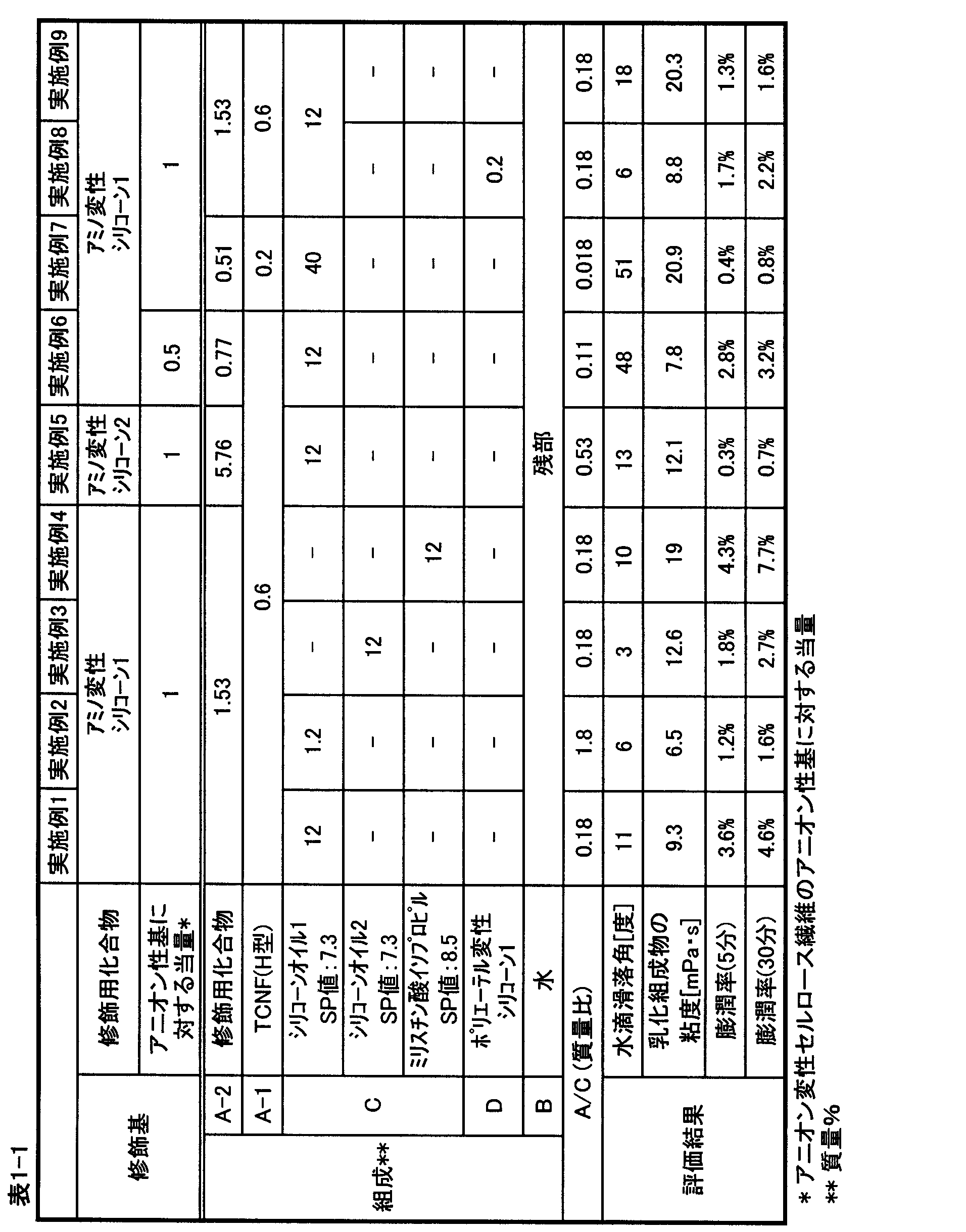
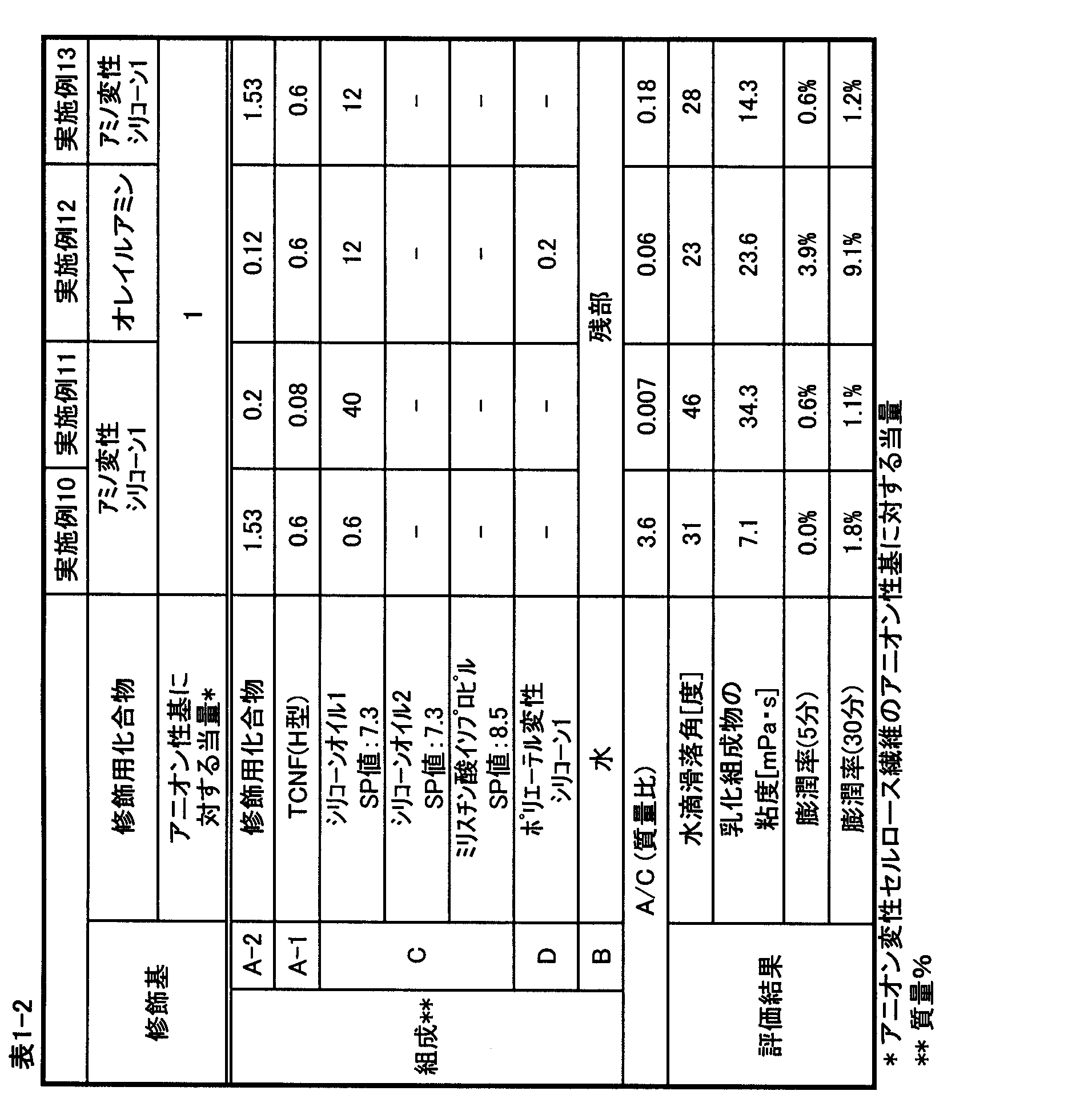
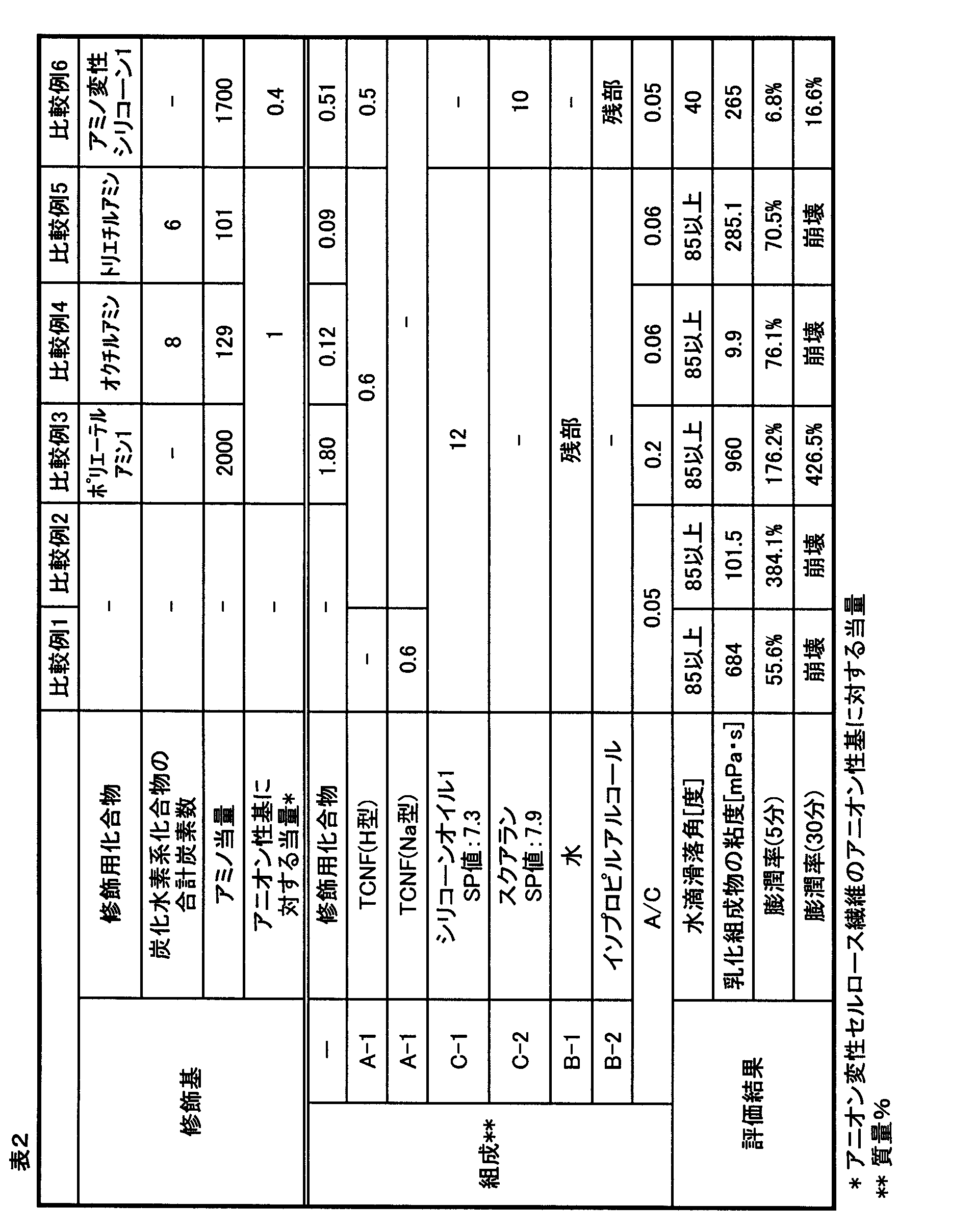
本発明に記載の乳化組成物を乾燥させることによって得られた膜は滑液性を示すことがわかった。実施例1の組成と実施例6の組成とを考慮すると、修飾基であるシリコーン基の導入の程度が高い実施例1の方が滑液性に優れることが分かった。実施例1の組成、実施例2の組成及び実施例7の組成を考慮すると、疎水変性セルロース繊維に対して25℃1気圧で液体の有機化合物が多いほど、即ち、A/Cの比率が小さいほど、滑液性が低下する傾向が見られた。
実施例1、8、及び比較例6にて製造された膜の耐久性を調べるため、前述の〔乾燥膜の作製〕において作製された、これらの膜が成膜された基板を水平に保持し、基板に対して40cmの高さから、流量50mL/秒で水を連続滴下した。滴下前、5分間滴下後、20分間滴下後の3点において、膜の算術平均粗さ及び滑液性を測定した。膜の算術平均粗さについては前述の方法で測定した。滑液性については、基板を水平方向に対して15°の角度に保持し、10μLの水滴を乗せ、水滴が滑り落ちた場合は滑液性あり、滑り落ちなかった場合は滑液性なしと判定した。
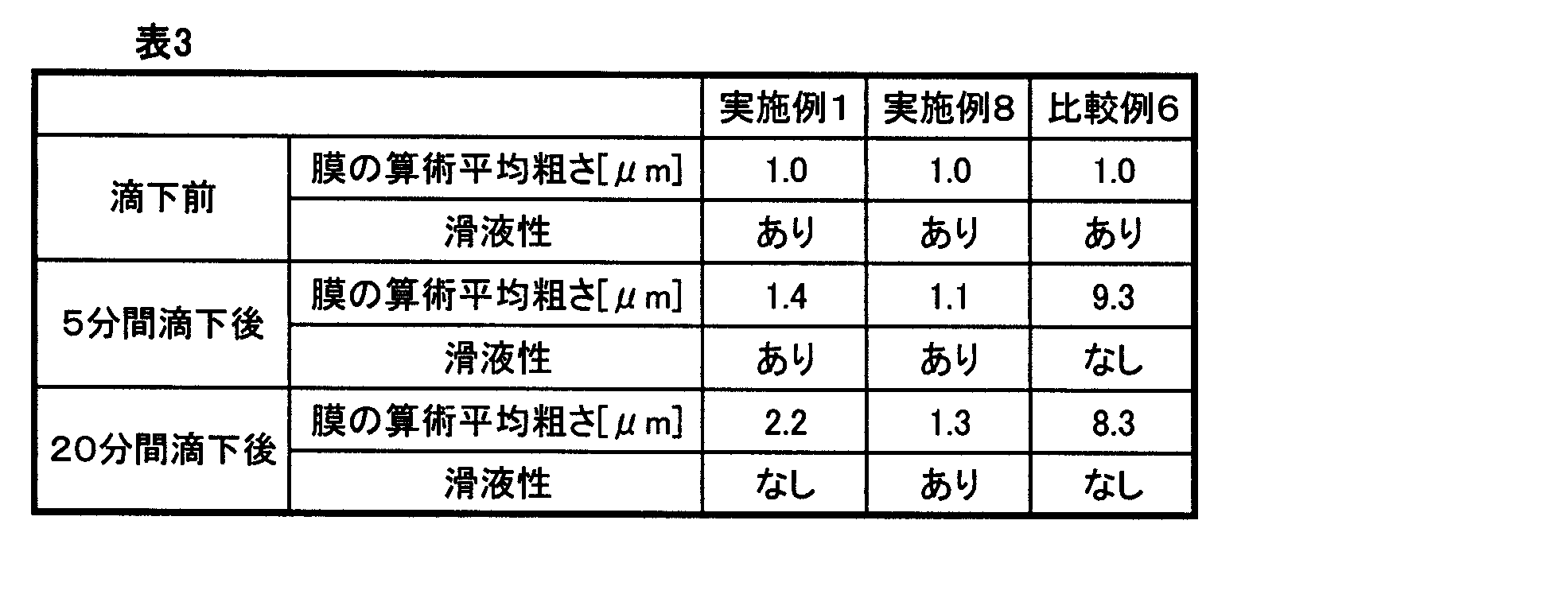
実施例1及び8の乳化組成物の乾燥によって得られた膜は、比較例6の塗工液の乾燥によって得られた膜と比べて、水を連続滴下した後の膜の荒れが抑制され、滑液性を持続しているため、膜の耐久性に優れることが分かった。さらに、実施例8の、ポリエーテル変性シリコーン化合物をさらに含む乳化組成物の乾燥によって得られた膜は、より耐久性に優れることがわかった。
シリコーンオイル1の量を6gとしたこと以外は実施例1と同様にして、アニオン変性セルロース繊維に、アミノ変性シリコーン1がイオン結合を介して結合した疎水変性セルロース繊維を含む乳化組成物を得た。
ビーカーに実施例14で得られた乳化組成物100gをはかり取り、そこにポリエーテル変性シリコーン1 0.2gを添加し、25℃で30分撹拌して、乳化組成物を得た。
シリコーンオイル1の代わりにシリコーンオイル2を用いたこと以外は実施例14と同様にして、アニオン変性セルロース繊維に、アミノ変性シリコーン1がイオン結合を介して連結した疎水変性セルロース繊維を含む乳化組成物を得た。
実施例14~16で作製した乳化組成物をSUS304基板(L50mm×W50mm×T3mm)上に1.5mL塗布し、1気圧、25℃、湿度約40%RHで24時間乾燥させて膜を作製した。なお、L50mm×W50mm×T3mmの未処理のSUS304基板を比較例7とした。
上述の各基板を鎖で繋ぎ、干潮時に水面から2mの深さになるように和歌山県下津港付近の海水中に設置し、3ヶ月間海水中での浸漬試験を行った。
浸漬1ヶ月後と3ヶ月後に、基板への甲殻動物類と藻類の付着度合いを目視によって評価した。評価基準は次の通りである。数値が小さいほど、水生生物の付着抑制効果が高いことを示す。
2:基板表面の2面積%超10面積%以下に水生生物が付着している状態。
3:基板表面の10面積%超20面積%以下に水生生物が付着している状態。
4:基板表面の20面積%超30面積%以下に水生生物が付着している状態。
5:基板表面の30面積%超50面積%以下に水生生物が付着している状態。
6:基板表面の50面積%超80面積%以下に水生生物が付着している状態。
7:基板表面の80面積%超に水生生物が付着している状態。
上記試験例1において、浸漬1ヶ月後と3ヶ月後に基板上に付着した水生生物の除去性を以下の基準で評価した。なおここで低圧とは、洗瓶から吹き付けるほどの弱い圧力を示す。数値が小さいほど、水生生物が容易に除去できることを示す。
2:水洗+こする作業が必要。
3:工具の使用が必要(1回削る作業で除去)。
4:工具で複数回削る作業が必要、あるいは除去不可。
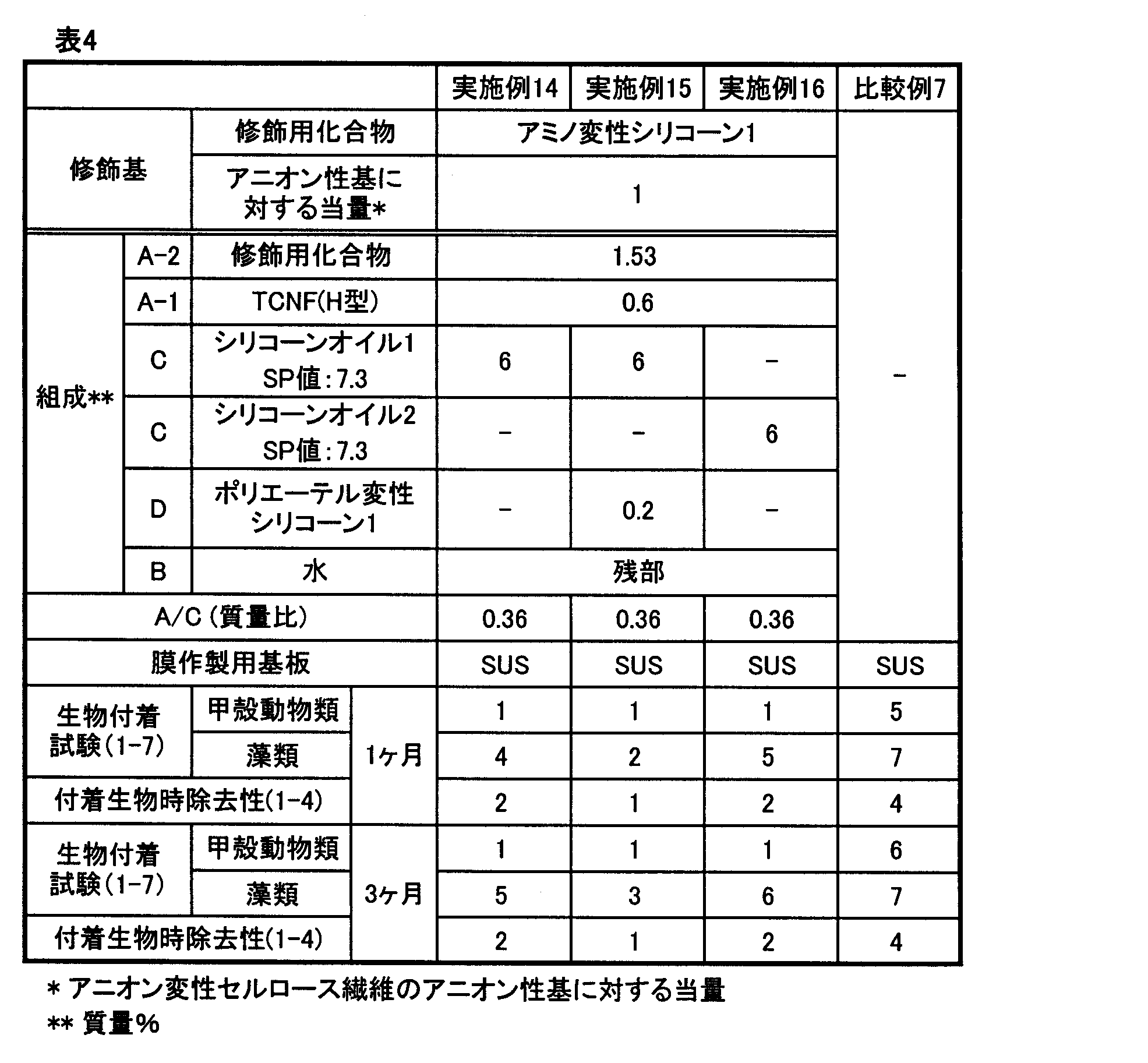
シリコーンオイル1の代わりにシリコーンオイル3を用い、アミノ変性シリコーン1を、1.91g(アニオン変性セルロース繊維のカルボキシ基に対して1.25当量に相当)用いたことを除いて、実施例1と同様にして乳化組成物を得た。
実施例17で得られた乳化組成物100gをビーカーにはかり取り、そこにポリエーテル変性シリコーン1 0.2gを添加し、25℃で30分撹拌し、乳化組成物を得た。
シリコーンオイルの量を4.0gとしたこと以外は実施例18と同様にして、乳化組成物を得た
シリコーンオイル3の代わりにシリコーンオイル1を用いたこと以外は実施例18と同様にして、乳化組成物を得た。
シリコーンオイル3の代わりにシリコーンオイル4を用いたこと以外は、実施例18と同様にして、乳化組成物を得た。
実施例17~21で作製した乳化組成物をそれぞれ別々のガラス基板(10cm×10cm×厚み5mm)上に2.4mL塗布し、ガラス基板全域に塗り広げた。次いで、1気圧、25℃、湿度約40%RHで24時間乾燥させて膜を作製した。下記の測定方法によって実施例17の膜の厚みを測定したところ20μmであった。
比較例8は、ガラス基板そのものを用いた。
比較例9は、市販防雪塗料「関西ペイント製ラク雪塗料」を実施例1で用いたものと同じガラス基板に刷毛で塗り広げ、1気圧、25℃、湿度約40%RHで24時間乾燥させた。塗料厚みは20μmであった。
実施例17~21、比較例8~9の各基板を45°の傾斜台に両面テープ(Scotch超強力両面テープ スーパー多用途 幅12mm、3M社製)で固定した。次いで気温2℃の部屋の中で、電動氷かき器(DTY19、株式会社ドウシシャ製)にて各基板表面に砕氷を降らせ、滑氷性を以下の基準で評価した。数値が高いほど、高い滑氷性を示す。なお、砕氷の比重は0.49g/cm3であった。
4:氷の8割以上、9割未満が滑り落ちた。
3:氷の5割以上、8割未満が滑り落ちた。
2:氷の2割以上、5割未満が滑り落ちた。
1:氷の2割未満が滑り落ちた。
株式会社MTS雪氷研究所の低温試験室(1℃)において、滑雪性評価を行った。
実施例17~21、比較例8~9の各基板の裏に1cm×2cm×t2mmのステンレス片を両面テープ(Scotch超強力両面テープ スーパー多用途 幅12mm、3M社製)で貼り付け、磁石が備え付けられた固定台に基板が90°になるように設置した。次いで、基板正面から風速5m/sで30分間人工雪を吹き付け、滑雪性を以下の基準で評価した。数値が高いほど、高い滑雪性を示す。なお、人工雪の比重は0.29g/cm3であった。
4:15分以内に滑雪。
3:20分以内に滑雪。
2:30分以内に滑雪。
1:30分の試験時間内に滑雪しなかった。
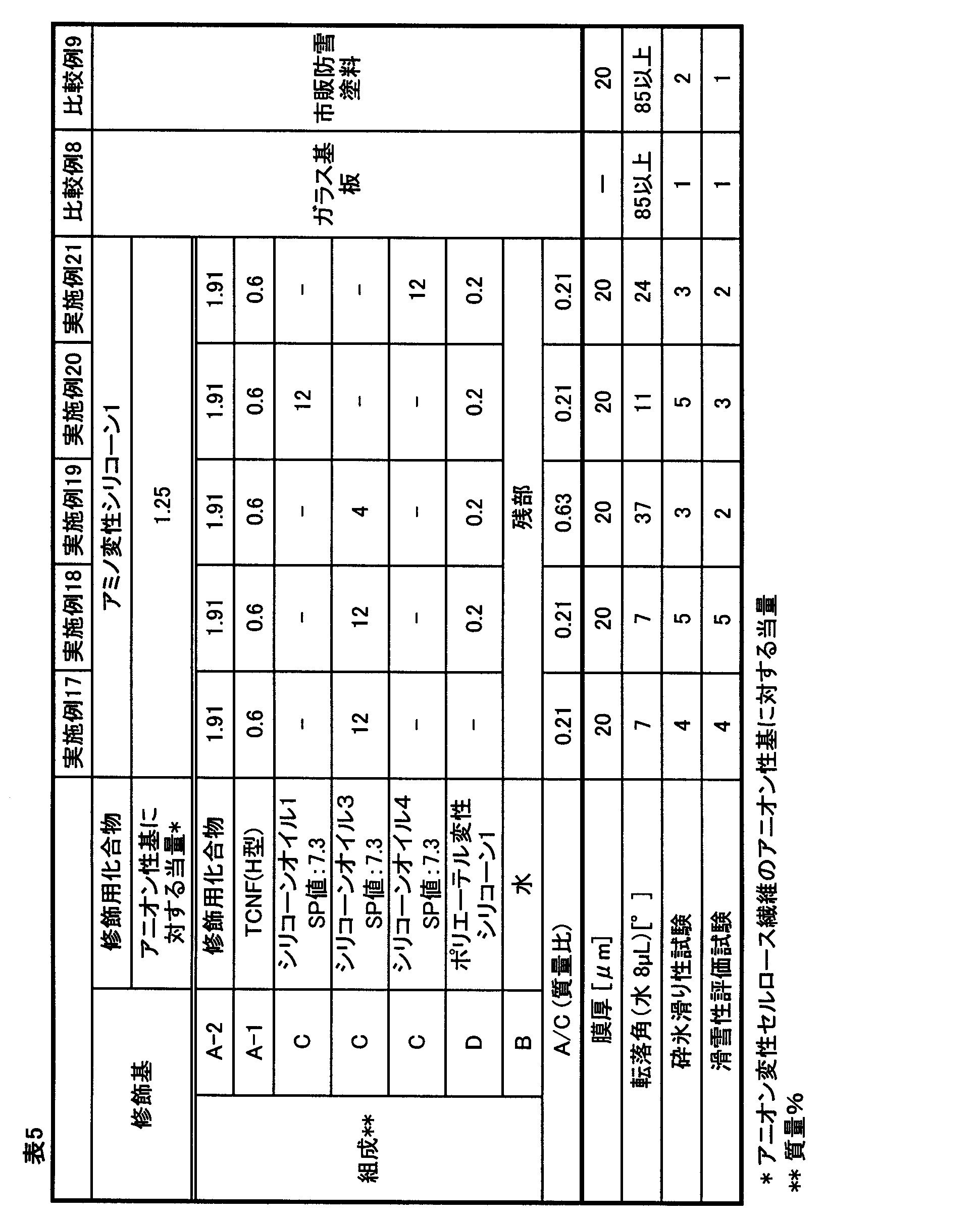
Claims (17)
- 以下の成分(A)~(C)を含有する乳化組成物。
(A)下記成分(a)及び成分(b)からなる群より選択される一種以上の疎水変性セルロース繊維
(a)セルロース繊維にシリコーン系化合物が結合してなる疎水変性セルロース繊維
(b)アニオン変性セルロース繊維のアニオン性基に、カチオン性基を有する合計炭素数16以上40以下の炭化水素系化合物がイオン結合を介して結合してなる疎水変性セルロース繊維
(B)水
(C)25℃1気圧で液体の有機化合物 - 成分(C)が油剤を含む、請求項1に記載の乳化組成物。
- 成分(a)が、アニオン変性セルロース繊維にシリコーン系化合物が結合してなる疎水変性セルロース繊維である、請求項1又は2に記載の乳化組成物。
- 成分(a)が、カルボキシ基含有セルロース繊維のカルボキシ基に、アミノ変性シリコーンがイオン結合又はアミド結合を介して結合してなる疎水変性セルロース繊維である、請求項1~3のいずれか1項に記載の乳化組成物。
- 成分(b)が、カルボキシ基含有セルロース繊維のカルボキシ基に、アミノ基を有する合計炭素数16以上40以下の炭化水素系化合物がイオン結合を介して結合してなる疎水変性セルロース繊維である、請求項1~4のいずれか1項に記載の乳化組成物。
- 成分(C)が、エステル油、シリコーン油、エーテル油、油脂、及びフッ素系不活性液体からなる群より選択される一種以上を含む、請求項1~5のいずれか1項に記載の乳化組成物。
- 成分(A)と成分(C)との質量比(A/C)が0.0001以上20以下である、請求項1~6のいずれか1項に記載の乳化組成物。
- さらに成分(D)ポリエーテル変性シリコーン化合物を含む、請求項1~7のいずれか1項に記載の乳化組成物。
- 成分(A-1)アニオン変性セルロース繊維、
成分(A-2)アミノ変性シリコーン、及びカチオン性基を有する合計炭素数16以上40以下の炭化水素系化合物からなる群より選択される一種以上の化合物、
成分(B)水、並びに
成分(C)25℃1気圧で液体の有機化合物
を含有する、請求項1~8のいずれか1項に記載の乳化組成物。 - 成分(A-1)アニオン変性セルロース繊維、
成分(A-2)アミノ変性シリコーン、及びカチオン性基を有する合計炭素数16以上40以下の炭化水素系化合物からなる群より選択される一種以上の化合物、
成分(B)水、並びに
成分(C)25℃1気圧で液体の有機化合物
を混合する工程を含む、請求項9に記載の乳化組成物の製造方法。 - 請求項1~9のいずれか1項に記載の乳化組成物を乾燥させる工程を含む、疎水変性セルロース繊維を含有する膜の製造方法。
- 請求項1~9のいずれか1項に記載の乳化組成物を乾燥して得られる乾燥膜。
- 請求項1~9のいずれか1項に記載の乳化組成物を塗布後、乾燥して得られる塗工膜。
- 請求項1~9のいずれか1項に記載の乳化組成物を含有する、生物付着抑制剤。
- 請求項1~9のいずれか1項に記載の乳化組成物を含有する、防汚剤。
- 請求項1~9のいずれか1項に記載の乳化組成物を含有する、防雪剤。
- (A)下記成分(a)及び成分(b)からなる群より選択される一種以上の疎水変性セルロース繊維、
(a)セルロース繊維にシリコーン系化合物が結合してなる疎水変性セルロース繊維
(b)アニオン変性セルロース繊維のアニオン性基に、カチオン性基を有する合計炭素数16以上40以下の炭化水素系化合物がイオン結合を介して結合してなる疎水変性セルロース繊維、及び
(C)25℃1気圧で液体の有機化合物
を含有し、粒子状構造を有する膜。
Priority Applications (4)
| Application Number | Priority Date | Filing Date | Title |
|---|---|---|---|
| US17/630,565 US12473406B2 (en) | 2019-08-02 | 2020-07-31 | Emulsification composition containing hydrophobic-modified cellulose fibers |
| EP20849147.2A EP4008750A4 (en) | 2019-08-02 | 2020-07-31 | Emulsification composition containing hydrophobic-modified cellulose fibers |
| CN202080055718.4A CN114206994B (zh) | 2019-08-02 | 2020-07-31 | 含有疏水改性纤维素纤维的乳化组合物 |
| KR1020227006000A KR102910119B1 (ko) | 2019-08-02 | 2020-07-31 | 소수 변성 셀룰로오스 섬유를 함유하는 유화 조성물 |
Applications Claiming Priority (4)
| Application Number | Priority Date | Filing Date | Title |
|---|---|---|---|
| JP2019-143212 | 2019-08-02 | ||
| JP2019143212 | 2019-08-02 | ||
| JP2019225605 | 2019-12-13 | ||
| JP2019-225605 | 2019-12-13 |
Publications (1)
| Publication Number | Publication Date |
|---|---|
| WO2021024933A1 true WO2021024933A1 (ja) | 2021-02-11 |
Family
ID=74503873
Family Applications (1)
| Application Number | Title | Priority Date | Filing Date |
|---|---|---|---|
| PCT/JP2020/029412 Ceased WO2021024933A1 (ja) | 2019-08-02 | 2020-07-31 | 疎水変性セルロース繊維を含有する乳化組成物 |
Country Status (6)
| Country | Link |
|---|---|
| US (1) | US12473406B2 (ja) |
| EP (1) | EP4008750A4 (ja) |
| JP (1) | JP7583547B2 (ja) |
| KR (1) | KR102910119B1 (ja) |
| CN (1) | CN114206994B (ja) |
| WO (1) | WO2021024933A1 (ja) |
Cited By (1)
| Publication number | Priority date | Publication date | Assignee | Title |
|---|---|---|---|---|
| JP2023095399A (ja) * | 2021-12-24 | 2023-07-06 | 花王株式会社 | 積層体及び積層体を備えた船舶 |
Families Citing this family (10)
| Publication number | Priority date | Publication date | Assignee | Title |
|---|---|---|---|---|
| JP7846521B2 (ja) * | 2020-12-16 | 2026-04-15 | 花王株式会社 | 防氷・防雪用乳化組成物 |
| JP7732798B2 (ja) * | 2021-08-05 | 2025-09-02 | 花王株式会社 | アニオン変性セルロース繊維 |
| JP2023094520A (ja) * | 2021-12-23 | 2023-07-05 | 花王株式会社 | 乳化組成物 |
| JP7773364B2 (ja) * | 2021-12-24 | 2025-11-19 | 花王株式会社 | 積層体の形成方法 |
| JP2023097425A (ja) * | 2021-12-27 | 2023-07-07 | 花王株式会社 | 乳化組成物 |
| JP7776329B2 (ja) * | 2021-12-28 | 2025-11-26 | 花王株式会社 | 乳化組成物 |
| JP7721459B2 (ja) | 2022-02-22 | 2025-08-12 | 信越化学工業株式会社 | 疎水性セルロースナノファイバー、該疎水性セルロースナノファイバー分散液、及び化粧料 |
| JP2024067274A (ja) * | 2022-11-04 | 2024-05-17 | 花王株式会社 | 乳化組成物 |
| JP2025088036A (ja) * | 2023-11-30 | 2025-06-11 | 第一工業製薬株式会社 | 難燃性材料及び難燃性シート |
| CN120966175B (zh) * | 2025-10-17 | 2026-01-02 | 杭州海维特化工科技有限公司 | 一种多元素协同阻燃的水性复合乳液及其制备方法和应用 |
Citations (7)
| Publication number | Priority date | Publication date | Assignee | Title |
|---|---|---|---|---|
| JPS5398499A (en) | 1977-02-02 | 1978-08-28 | Dow Corning | Treating of synthetic fiber |
| JP2011140632A (ja) | 2009-12-11 | 2011-07-21 | Kao Corp | 複合材料 |
| JP2012126786A (ja) | 2010-12-14 | 2012-07-05 | Dai Ichi Kogyo Seiyaku Co Ltd | 粘性水系組成物およびその製法、並びにそれに用いるセルロース繊維 |
| JP2015143336A (ja) | 2013-12-26 | 2015-08-06 | 花王株式会社 | 微細セルロース繊維複合体 |
| JP2017014116A (ja) * | 2015-06-26 | 2017-01-19 | 花王株式会社 | 皮膚化粧料 |
| JP2018044095A (ja) * | 2016-09-16 | 2018-03-22 | 第一工業製薬株式会社 | 潤滑剤組成物 |
| WO2018164135A1 (ja) | 2017-03-07 | 2018-09-13 | 花王株式会社 | 疎水変性セルロース繊維及び油を有する膜 |
Family Cites Families (3)
| Publication number | Priority date | Publication date | Assignee | Title |
|---|---|---|---|---|
| JP6216574B2 (ja) * | 2013-08-29 | 2017-10-18 | 王子ホールディングス株式会社 | 微細セルロース繊維を含む乳化剤、乳化組成物及び乳化方法 |
| JP6615506B2 (ja) | 2015-06-26 | 2019-12-04 | 花王株式会社 | 皮膚化粧料 |
| CN109568153B (zh) * | 2017-09-29 | 2024-05-24 | 株式会社资生堂 | 水包油型乳化组合物及其制备方法和制品 |
-
2020
- 2020-07-31 CN CN202080055718.4A patent/CN114206994B/zh active Active
- 2020-07-31 EP EP20849147.2A patent/EP4008750A4/en active Pending
- 2020-07-31 US US17/630,565 patent/US12473406B2/en active Active
- 2020-07-31 KR KR1020227006000A patent/KR102910119B1/ko active Active
- 2020-07-31 WO PCT/JP2020/029412 patent/WO2021024933A1/ja not_active Ceased
- 2020-07-31 JP JP2020130111A patent/JP7583547B2/ja active Active
Patent Citations (7)
| Publication number | Priority date | Publication date | Assignee | Title |
|---|---|---|---|---|
| JPS5398499A (en) | 1977-02-02 | 1978-08-28 | Dow Corning | Treating of synthetic fiber |
| JP2011140632A (ja) | 2009-12-11 | 2011-07-21 | Kao Corp | 複合材料 |
| JP2012126786A (ja) | 2010-12-14 | 2012-07-05 | Dai Ichi Kogyo Seiyaku Co Ltd | 粘性水系組成物およびその製法、並びにそれに用いるセルロース繊維 |
| JP2015143336A (ja) | 2013-12-26 | 2015-08-06 | 花王株式会社 | 微細セルロース繊維複合体 |
| JP2017014116A (ja) * | 2015-06-26 | 2017-01-19 | 花王株式会社 | 皮膚化粧料 |
| JP2018044095A (ja) * | 2016-09-16 | 2018-03-22 | 第一工業製薬株式会社 | 潤滑剤組成物 |
| WO2018164135A1 (ja) | 2017-03-07 | 2018-09-13 | 花王株式会社 | 疎水変性セルロース繊維及び油を有する膜 |
Non-Patent Citations (5)
| Title |
|---|
| "Chouhassui Chouhatsuu Katsueki-sei Hyomen-no Gijutsu", 28 January 2016, SCIENCE & TECHNOLOGY K.K. |
| "Mokushitsu Kagaku Jikken Manyuaru", pages: 199 - 200 |
| "Polymer Handbook", 1989, A WILEY-INTERSCIENCE PUBLICATION |
| "SP Chi Kiso-Ouyo to Keisan Hoho", 2005, JOHOKIKO CO., LTD. |
| See also references of EP4008750A4 |
Cited By (2)
| Publication number | Priority date | Publication date | Assignee | Title |
|---|---|---|---|---|
| JP2023095399A (ja) * | 2021-12-24 | 2023-07-06 | 花王株式会社 | 積層体及び積層体を備えた船舶 |
| JP7810549B2 (ja) | 2021-12-24 | 2026-02-03 | 花王株式会社 | 積層体及び積層体を備えた船舶 |
Also Published As
| Publication number | Publication date |
|---|---|
| KR102910119B1 (ko) | 2026-01-08 |
| EP4008750A4 (en) | 2023-08-09 |
| EP4008750A1 (en) | 2022-06-08 |
| JP2021095557A (ja) | 2021-06-24 |
| US20220259385A1 (en) | 2022-08-18 |
| CN114206994B (zh) | 2024-09-24 |
| US12473406B2 (en) | 2025-11-18 |
| JP7583547B2 (ja) | 2024-11-14 |
| KR20220043150A (ko) | 2022-04-05 |
| CN114206994A (zh) | 2022-03-18 |
Similar Documents
| Publication | Publication Date | Title |
|---|---|---|
| JP7583547B2 (ja) | 疎水変性セルロース繊維を含有する乳化組成物 | |
| EP3594301B1 (en) | Film comprising hydrophobized cellulose fibers and oil | |
| JP7274508B2 (ja) | オルガノポリシロキサンを含む消泡配合物 | |
| JP2026063258A (ja) | 硬質表面処理剤 | |
| JP2026063257A (ja) | コーティング剤 | |
| JP7341000B2 (ja) | 水生生物付着抑制剤 | |
| JP7773364B2 (ja) | 積層体の形成方法 | |
| JP7123707B2 (ja) | 疎水変性セルロース繊維及び有機媒体を有する膜 | |
| JP7842577B2 (ja) | 乳化組成物の製造方法 | |
| JP7846521B2 (ja) | 防氷・防雪用乳化組成物 | |
| JP2024142577A (ja) | 乳化組成物 | |
| JP7842576B2 (ja) | 乳化組成物 | |
| JP2022117974A (ja) | 乳化組成物の製造方法 | |
| JP7372087B2 (ja) | 流動抵抗低減剤 | |
| JP7810549B2 (ja) | 積層体及び積層体を備えた船舶 | |
| JP7776329B2 (ja) | 乳化組成物 | |
| WO2025225676A1 (ja) | 湿潤粉体付着抑制剤 | |
| JP2024113425A (ja) | 乳化組成物 | |
| JP2024067274A (ja) | 乳化組成物 | |
| JP2023097425A (ja) | 乳化組成物 | |
| JP2026060316A (ja) | 滑液表面膜の滑液表面性回復方法 | |
| JP2026015129A (ja) | 組成物 | |
| JP7021944B2 (ja) | 積層体及びその製造方法 | |
| JP2023094520A (ja) | 乳化組成物 |
Legal Events
| Date | Code | Title | Description |
|---|---|---|---|
| 121 | Ep: the epo has been informed by wipo that ep was designated in this application |
Ref document number: 20849147 Country of ref document: EP Kind code of ref document: A1 |
|
| NENP | Non-entry into the national phase |
Ref country code: DE |
|
| ENP | Entry into the national phase |
Ref document number: 20227006000 Country of ref document: KR Kind code of ref document: A |
|
| ENP | Entry into the national phase |
Ref document number: 2020849147 Country of ref document: EP Effective date: 20220302 |
|
| WWG | Wipo information: grant in national office |
Ref document number: 17630565 Country of ref document: US |