WO2021029338A1 - Boisson ayant des propriétés de rétention de mousse et procédé pour améliorer les propriétés de rétention de mousse d'une boisson - Google Patents
Boisson ayant des propriétés de rétention de mousse et procédé pour améliorer les propriétés de rétention de mousse d'une boisson Download PDFInfo
- Publication number
- WO2021029338A1 WO2021029338A1 PCT/JP2020/030303 JP2020030303W WO2021029338A1 WO 2021029338 A1 WO2021029338 A1 WO 2021029338A1 JP 2020030303 W JP2020030303 W JP 2020030303W WO 2021029338 A1 WO2021029338 A1 WO 2021029338A1
- Authority
- WO
- WIPO (PCT)
- Prior art keywords
- ppm
- beverage
- rebaudioside
- present
- glycoside
- Prior art date
- Legal status (The legal status is an assumption and is not a legal conclusion. Google has not performed a legal analysis and makes no representation as to the accuracy of the status listed.)
- Ceased
Links
Images



Classifications
-
- A—HUMAN NECESSITIES
- A23—FOODS OR FOODSTUFFS; TREATMENT THEREOF, NOT COVERED BY OTHER CLASSES
- A23L—FOODS, FOODSTUFFS OR NON-ALCOHOLIC BEVERAGES, NOT OTHERWISE PROVIDED FOR; PREPARATION OR TREATMENT THEREOF
- A23L2/00—Non-alcoholic beverages; Dry compositions or concentrates therefor; Preparation or treatment thereof
- A23L2/52—Adding ingredients
-
- A—HUMAN NECESSITIES
- A23—FOODS OR FOODSTUFFS; TREATMENT THEREOF, NOT COVERED BY OTHER CLASSES
- A23L—FOODS, FOODSTUFFS OR NON-ALCOHOLIC BEVERAGES, NOT OTHERWISE PROVIDED FOR; PREPARATION OR TREATMENT THEREOF
- A23L2/00—Non-alcoholic beverages; Dry compositions or concentrates therefor; Preparation or treatment thereof
- A23L2/38—Other non-alcoholic beverages
-
- A—HUMAN NECESSITIES
- A23—FOODS OR FOODSTUFFS; TREATMENT THEREOF, NOT COVERED BY OTHER CLASSES
- A23L—FOODS, FOODSTUFFS OR NON-ALCOHOLIC BEVERAGES, NOT OTHERWISE PROVIDED FOR; PREPARATION OR TREATMENT THEREOF
- A23L2/00—Non-alcoholic beverages; Dry compositions or concentrates therefor; Preparation or treatment thereof
- A23L2/40—Effervescence-generating compositions
-
- A—HUMAN NECESSITIES
- A23—FOODS OR FOODSTUFFS; TREATMENT THEREOF, NOT COVERED BY OTHER CLASSES
- A23L—FOODS, FOODSTUFFS OR NON-ALCOHOLIC BEVERAGES, NOT OTHERWISE PROVIDED FOR; PREPARATION OR TREATMENT THEREOF
- A23L2/00—Non-alcoholic beverages; Dry compositions or concentrates therefor; Preparation or treatment thereof
- A23L2/52—Adding ingredients
- A23L2/54—Mixing with gases
-
- A—HUMAN NECESSITIES
- A23—FOODS OR FOODSTUFFS; TREATMENT THEREOF, NOT COVERED BY OTHER CLASSES
- A23L—FOODS, FOODSTUFFS OR NON-ALCOHOLIC BEVERAGES, NOT OTHERWISE PROVIDED FOR; PREPARATION OR TREATMENT THEREOF
- A23L2/00—Non-alcoholic beverages; Dry compositions or concentrates therefor; Preparation or treatment thereof
- A23L2/52—Adding ingredients
- A23L2/60—Sweeteners
-
- A—HUMAN NECESSITIES
- A23—FOODS OR FOODSTUFFS; TREATMENT THEREOF, NOT COVERED BY OTHER CLASSES
- A23L—FOODS, FOODSTUFFS OR NON-ALCOHOLIC BEVERAGES, NOT OTHERWISE PROVIDED FOR; PREPARATION OR TREATMENT THEREOF
- A23L2/00—Non-alcoholic beverages; Dry compositions or concentrates therefor; Preparation or treatment thereof
- A23L2/70—Clarifying or fining of non-alcoholic beverages; Removing unwanted matter
- A23L2/72—Clarifying or fining of non-alcoholic beverages; Removing unwanted matter by filtration
-
- A—HUMAN NECESSITIES
- A23—FOODS OR FOODSTUFFS; TREATMENT THEREOF, NOT COVERED BY OTHER CLASSES
- A23L—FOODS, FOODSTUFFS OR NON-ALCOHOLIC BEVERAGES, NOT OTHERWISE PROVIDED FOR; PREPARATION OR TREATMENT THEREOF
- A23L2/00—Non-alcoholic beverages; Dry compositions or concentrates therefor; Preparation or treatment thereof
- A23L2/70—Clarifying or fining of non-alcoholic beverages; Removing unwanted matter
- A23L2/78—Clarifying or fining of non-alcoholic beverages; Removing unwanted matter by ion-exchange
-
- A—HUMAN NECESSITIES
- A23—FOODS OR FOODSTUFFS; TREATMENT THEREOF, NOT COVERED BY OTHER CLASSES
- A23L—FOODS, FOODSTUFFS OR NON-ALCOHOLIC BEVERAGES, NOT OTHERWISE PROVIDED FOR; PREPARATION OR TREATMENT THEREOF
- A23L27/00—Spices; Flavouring agents or condiments; Artificial sweetening agents; Table salts; Dietetic salt substitutes; Preparation or treatment thereof
- A23L27/30—Artificial sweetening agents
- A23L27/33—Artificial sweetening agents containing sugars or derivatives
- A23L27/36—Terpene glycosides
-
- A—HUMAN NECESSITIES
- A23—FOODS OR FOODSTUFFS; TREATMENT THEREOF, NOT COVERED BY OTHER CLASSES
- A23L—FOODS, FOODSTUFFS OR NON-ALCOHOLIC BEVERAGES, NOT OTHERWISE PROVIDED FOR; PREPARATION OR TREATMENT THEREOF
- A23L27/00—Spices; Flavouring agents or condiments; Artificial sweetening agents; Table salts; Dietetic salt substitutes; Preparation or treatment thereof
- A23L27/86—Addition of bitterness inhibitors
-
- A—HUMAN NECESSITIES
- A23—FOODS OR FOODSTUFFS; TREATMENT THEREOF, NOT COVERED BY OTHER CLASSES
- A23L—FOODS, FOODSTUFFS OR NON-ALCOHOLIC BEVERAGES, NOT OTHERWISE PROVIDED FOR; PREPARATION OR TREATMENT THEREOF
- A23L29/00—Foods or foodstuffs containing additives; Preparation or treatment thereof
- A23L29/03—Organic compounds
-
- A—HUMAN NECESSITIES
- A23—FOODS OR FOODSTUFFS; TREATMENT THEREOF, NOT COVERED BY OTHER CLASSES
- A23V—INDEXING SCHEME RELATING TO FOODS, FOODSTUFFS OR NON-ALCOHOLIC BEVERAGES AND LACTIC OR PROPIONIC ACID BACTERIA USED IN FOODSTUFFS OR FOOD PREPARATION
- A23V2002/00—Food compositions, function of food ingredients or processes for food or foodstuffs
-
- A—HUMAN NECESSITIES
- A23—FOODS OR FOODSTUFFS; TREATMENT THEREOF, NOT COVERED BY OTHER CLASSES
- A23V—INDEXING SCHEME RELATING TO FOODS, FOODSTUFFS OR NON-ALCOHOLIC BEVERAGES AND LACTIC OR PROPIONIC ACID BACTERIA USED IN FOODSTUFFS OR FOOD PREPARATION
- A23V2250/00—Food ingredients
- A23V2250/24—Non-sugar sweeteners
- A23V2250/262—Stevioside
-
- A—HUMAN NECESSITIES
- A23—FOODS OR FOODSTUFFS; TREATMENT THEREOF, NOT COVERED BY OTHER CLASSES
- A23V—INDEXING SCHEME RELATING TO FOODS, FOODSTUFFS OR NON-ALCOHOLIC BEVERAGES AND LACTIC OR PROPIONIC ACID BACTERIA USED IN FOODSTUFFS OR FOOD PREPARATION
- A23V2300/00—Processes
- A23V2300/04—Aeration
Definitions
- the present invention relates to beverages having foam retention and methods for improving foam retention in beverages.
- Beverages with foam retention are preferred by a wide range of consumers.
- beverages with foam retention currently on the market, but most of them are carbonated beverages, and the drinker is visually visually affected by foaming when the container is opened or poured into a container such as a cup. It has characteristics such as entertaining and giving the drinker a refreshing feeling through the throat.
- Patent Document 1 reports a bubble-like beverage containing a predetermined amount of saponin and a thickener having a gelation temperature of 50 ° C. or lower.
- Patent Document 2 reports a beverage foam quality improver containing a decomposition product of rice bran protein and a beverage containing the same.
- the present inventors unexpectedly retain the foam of the beverage by containing a predetermined amount of rebaudioside D (hereinafter, also referred to as “Reb.D”) and a steviol glycoside having a specific structure in the beverage. I learned that I can improve my sexuality.
- the present invention is based on the above findings.
- the present invention includes the following aspects of the invention.
- Rebaudioside D and the following equation (1): (During the ceremony, R 1 represents Xyl (1-2) Glc1- and R 2 represents Glc (1-2) [Glc (1-3)] Glc1-. Glc stands for glucose and Xyl stands for xylose)
- a beverage in which the content of the compound of formula (1) or a salt or hydrate thereof is 0.5 to 95% by mass with respect to the total content.
- the compound of formula (1) is the following formula (3): The beverage according to any one of [1] to [6], which is a compound represented by.
- the present invention it is possible to provide a beverage having foam retention and a method for improving foam retention in the beverage.
- the beverage of one aspect of the present invention is described in Reb. It can provide a longer foam retention time than beverages containing only D as a sweetener.
- the beverage of another aspect of the present invention is described in Rev. It is possible to reduce the sweetness aftertaste as compared with a beverage containing only D as a sweetener.
- FIG. 1A is a schematic view of the instrument used in the foam retention test.
- FIG. 1B is a photograph showing a standard for determining the timing at which bubbles disappear in a bubble retention test. It is a graph which shows the foam retention time and the foaming amount in various glycoside A ratios.
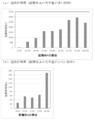
- FIG. 2 (a) shows the foam retention time when the ratio of glycoside A to the refined Reb.D product was 0.0% and 25.0 to 100.0%, and FIG. 2 (b) shows the refined product of Reb.D.
- the ratio of glycoside A to the ratio of glycoside A is 0.0 to 20.0%, indicating a foam retention time.
- It is a graph which shows the sweetness post-subtraction evaluation result at various glycoside A ratios.
- rebaudioside In this specification, “rebaudioside”, “Reb” and “Reb.” Have the same meaning, and all of them mean “rebaudioside”. Similarly, as used herein, “dulcoside” means “dulcoside.”
- ppm means “mass ppm” unless otherwise specified. Moreover, since the specific gravity of a normal beverage is 1, “mass ppm” can be equated with “mg / L”. Further, in the present specification, “room temperature” means “about 25 ° C.”. In the present specification, the wording "about” means that the subject exists in the range of ⁇ 10% of the numerical value following "about”.
- Glycoside A a steviol glycoside having a specific structure (hereinafter, also referred to as “glycoside A”) in a predetermined amount, a beverage having unexpected foam retention was obtained.
- Glycoside A has the following formula (1): (During the ceremony, R 1 represents Xyl (1-2) Glc1- and R 2 represents Glc (1-2) [Glc (1-3)] Glc1-. Glc stands for glucose and Xyl stands for xylose) It is a compound represented by (1) or a salt or hydrate thereof. The glucose molecule and xylose molecule in the sugar chain are also referred to as glucopyranosyl and xylopyranosyl, respectively.
- the beverage of one aspect of the present invention is described in Rev. It contains D and glycoside A, the total content of rebaudioside D and glycoside A is 30 to 600 ppm, and the content of glycoside A is 0 on a mass basis with respect to the total content. It is a beverage that is 5 to 95%.
- the rebaudioside D contained in the beverage of the present invention has a structure in which five sugars are added to the diterpene skeleton, and is specifically represented by the following chemical formula.
- Reb. D has a very high sweetness (about 300 times that of sugar) and is generally widely distributed in Reb. It is superior to A in terms of aftertaste and the like.
- Reb. Used in the beverage of the present invention. D is not particularly limited, but may be a plant-derived product, a chemical compound, or a biosynthetic product.
- Rev. It may be isolated and purified from a plant containing a large amount of D, but it may also be obtained by chemical synthesis or biosynthesis.
- Rev. Used in the beverage of the present invention. D does not have to be 100% pure and may be a mixture with other steviol glycosides.
- Reb. D is a purified Stevia extract from Rev. Steviol glycosides other than D may also be contained in the purified product.
- Reb. D is Reb. It may be obtained by decomposing M.
- commercially available Reb. D refined product may be used.
- glycoside A As described above, the glycoside A contained in the beverage of the present invention is the compound represented by the formula (1) or a salt or hydrate thereof.
- glycoside A is a steviol glycoside having a sugar chain containing 3 molecules of glucose at the 13th position of steviol and 1 molecule of glucose and 1 molecule of xylose at the 19th position.
- Glc represents glucose
- Xyl represents xylose.
- Glc may be ⁇ -glucose or ⁇ -glucose
- Xyl may be ⁇ -xylose or ⁇ -xylose.
- Glc may be ⁇ -glucose and ⁇ -glucose
- Xyl may be ⁇ -xylose and ⁇ -xylose.
- Glc1- indicates that the carbon atom at the 1-position of glucose is glycosidic bonded to steviol
- Glc (1-3) -Glc1- is the 3-position of glucose indicated by “Glc1-”. It is shown that the carbon atom at the 1st position of glucose is glycosidic bonded to the carbon atom.
- Xyl (1-2) -Glc1- indicates that the carbon atom at the 1-position of xylose is glycosidic bonded to the carbon atom at the 2-position of glucose indicated by "Glc1-”.
- the glycoside A includes, for example, a glycoside having a structure represented by the formula (2), the formula (2)', the formula (3) and the formula (3)'.
- glucose is ⁇ -glucosidic bonded to the carboxyl group at the 19-position of steviol
- xylose is ⁇ 1-2 bonded to the glucose, which is represented by the formula (2)'.
- glucose is ⁇ -glucosidic bonded to the carboxyl group at the 19-position of steviol
- xylose is ⁇ 1-2 bonded to the glucose.
- Formulas (3) and (3)' show structures in which the conformations of glycosides A of formulas (2) and (2)' are further specified, respectively.
- Glycoside A also includes isomers such as ⁇ - and ⁇ -forms as described above. Therefore, the glycoside of the present invention may be ⁇ -form only, ⁇ -form only, or a mixture of ⁇ -form and ⁇ -form.
- the glycoside of the present invention preferably has a ⁇ -form ratio of 80% or more, more preferably 90% or more, further preferably 95% or more, and preferably 99% or more. Especially preferable.
- the ⁇ -form and ⁇ -form are isolated by using known methods such as high performance liquid chromatography (HPLC) and ultra-high performance liquid chromatography (Ultra (High) Performance Liquid chromatography: UPLC). -Can be purified.
- Glycoside A may be a derivative, salt, or hydrate thereof as well as the compound represented by the formula (1).
- the term "derivative" refers to a compound formed by structural changes in a small portion of the compound, for example, a compound in which a part of a hydroxy group is substituted with another substituent. means. Therefore, as a derivative of the compound represented by the formula (1), a part of the hydroxy group contained in the compound is composed of hydrogen, halogen, alkyl group, alkenyl group, alkynyl group, aryl group, amino group, cyano group and the like. Includes compounds substituted with selected substituents.
- salt of the compound of formula (1) means a physiologically acceptable salt of the compound of formula (1), such as a sodium salt.
- hydrate of the compound of the formula (1) means a compound in which a water molecule is added to the compound of the formula (1).
- the glycoside A used in the beverage of the present invention is not particularly limited, but may be a plant-derived product, a chemical compound, or a biosynthetic product. For example, it may be isolated and purified from a plant containing glycoside A, but it may also be obtained by chemical synthesis or biosynthesis.
- the compound of the formula (3) can be synthesized from a generally available known steviol glycoside according to the following scheme 1. As shown in Scheme 1, in the synthesis of the compound of the formula (3), the skeleton of the compound of the formula (3) can be obtained by condensing the intermediate and the disaccharide hemiacetal compound by the Mitsunobu reaction.
- an intermediate is obtained by alkaline hydrolysis of the ester bond at the 19-position of steviol of rebaudioside A, which is a known natural product, and then protecting the hydroxy group of the sugar chain with an acetyl (Ac) group. Be done.
- a disaccharide skeleton is formed by a condensation reaction between an appropriately protected glucose acceptor and a xylose donor, and the protecting group at the reducing end is deprotected to deprotect the disaccharide hemiacetals. Can be obtained.
- the reaction can proceed with high yield and complete ⁇ -selectivity.
- the compound of formula (3) can be obtained by deprotecting the protecting group from the reaction product of the disaccharide hemiacetal compound and the above intermediate.
- disaccharide hemiacetal form can be synthesized, for example, according to Scheme 2 below.
- Scheme 2 in the synthesis of disaccharide hemiacetals, 1.1 equivalents of xylose donor was added to the glucose acceptor and dissolved in dichloromethane with molecular sieves 4 ⁇ to give boron trifluoride diethyl ether complex -20. Add at ° C and stir at ⁇ 20 ° C for 1 hour.
- Glycoside A has a higher sweetness than sugar (sucrose), and can affect the sweetness even if it is contained in a small amount in foods and drinks.
- glycoside A for example, the compound of formula (3), has a higher degree of sweetness than sugar, has less aftertaste of sweetness and bitterness, and bitterness is another component including sugar. Less than.
- the beverage of the present invention is not limited to effervescent beverages such as carbonated beverages, and may be, for example, coffee beverages, tea beverages, sports drinks, flavored water or fruit juice beverages.
- the beverage of the invention is a sparkling beverage.
- the "foaming beverage” is a beverage in which bubbles are generated from the beverage.
- bubbles generated in a beverage may be referred to as “bubbles”
- bubbles formed on the liquid surface of the beverage may be referred to as "foam”.
- “having foam retention” means that foam is generated and maintained
- improved of foam retention means improvement so that foam is maintained for a longer period of time. Means to do.
- An example of a sparkling beverage is a carbonated beverage.
- the carbonated beverage is a beverage containing carbon dioxide gas, and such carbon dioxide gas includes carbon dioxide gas separately injected into the beverage, carbon dioxide gas generated by fermentation of a part of the raw material, and the like.
- the carbonated beverage is not particularly limited, and examples thereof include soft drinks, non-alcoholic beverages, and alcoholic beverages. Specific examples thereof include, but are not limited to, sparkling beverages, cola, diet cola, ginger ale, cider, fruit juice flavored carbonated beverages, and carbonated water to which fruit juice flavor is imparted.
- Reb. Containing D and glycoside A is defined as Reb. Not limited to the case where D and glycoside A are added to the beverage as a mixture, Reb. It also includes the case where D and glycoside A are added to the beverage separately. That is, Reb.
- a sweetening substance extracted from a Stevia plant a sweetening substance extracted from a Stevia plant.
- a sweet substance containing both D and glycoside A is added to a beverage, or when Rev. Examples thereof include a case where a sweetness composition obtained by mixing purified products of D and glycoside A is added to a beverage, and a case where the purified products are separately added to a beverage.
- the total content of D and glycoside A is 30-600 ppm. When the total content is in this range, the foam retention of the beverage of the present invention is improved.
- the total content of D and glycoside A is 40-600 ppm, 50-600 ppm, 70-600 ppm, 80-600 ppm, 90-600 ppm, 100-600 ppm, 110-590 ppm, 120-580 ppm, 130-570 ppm, 140- 560ppm, 150-550ppm, 160-540ppm, 170-530ppm, 180-520ppm, 190-510ppm, 200-500ppm, 210-490ppm, 220-480ppm, 230-470ppm, 240-460ppm, 250-450ppm, 260-440ppm, 270-430ppm, 280-420ppm, 290-410ppm, 300-400ppm, 300-350ppm, 300-600ppm, 310
- Rev. D and glycoside A have a natural sweetness close to that of sucrose (sucrose), and if it is within the above range, it is possible to impart a preferable sweetness to the beverage while providing a foam retention effect.
- sucrose sucrose
- Reb. It can provide a longer foam retention time than beverages containing only D as a sweetener.
- Rev. in the beverage The total content of D and glycoside A may be calculated from the amount of the raw material added, or may be measured using a known analytical method such as liquid chromatography.
- the content of D is 10 to 300 ppm.
- the content of D is 20 to 300 ppm, 30 to 300 ppm, 40 to 300 ppm, 50 to 300 ppm, 60 to 290 ppm, 70 to 280 ppm, 80 to 270 ppm, 90 to 260 ppm, 100 to 250 ppm, 110 to 240 ppm, 120 to 230 ppm, It may be 130 to 220 ppm, 140 to 210 ppm, 150 to 200 ppm, 50 to 250 ppm, 100 to 250 ppm, 100 to 300 ppm, 150 to 300 ppm or 200 to 300 ppm, preferably 20 to 250 ppm.
- Rev. D has a natural sweetness close to that of sucrose (sucrose), and within the above range, it is possible to impart a preferable sweetness to the beverage while providing a foam retention effect. Rev. in the beverage.
- the content of D may be calculated from the amount of the raw material added, or may be measured by using a known analytical method such as liquid chromatography.
- the content of glycoside A (compound of formula (1) or salt or hydrate thereof) in the beverage according to one aspect of the present invention is 1 to 400 ppm.
- the content of glycoside A in the beverage is 2 to 400 ppm, 5 to 400 ppm, 10 to 400 ppm, 15 to 400 ppm, 20 to 400 ppm, 40 to 400 ppm, 1 to 200 ppm, 1 to 1.
- 150ppm 1-100ppm, 1-50ppm, 5-200ppm, 5-150ppm, 5-100ppm, 5-50ppm, 10-200ppm, 10-150ppm, 10-100ppm, 10-50ppm, 50-400ppm, 100-400ppm, 150-400ppm, 200-400ppm, 250-400ppm, 300-400ppm, 50-350ppm, 100-350ppm, 150-350ppm, 200-350ppm, 250-350ppm, 300-350ppm, 50-300ppm, 100-300ppm, 150- It may be 300 ppm, 200 to 300 ppm, 250 to 300 ppm, 50 to 250 ppm, 100 to 250 ppm, 150 to 250 ppm, or 200 to 250 ppm.
- glycoside A has a natural sweetness close to that of sucrose (sucrose), if it is within the above range, it is possible to impart a preferable sweetness to the beverage while providing a foam retention effect.
- the content of glycoside A is preferably in the range of 1 to 100 ppm from the viewpoint of improving sweetness aftertaste, and from the viewpoint of improving foam retention, glycoside A
- the content of is preferably in the range of 50 to 400 ppm.
- the content of glycoside A in the beverage may be calculated from the amount of the raw material added, or may be measured by using a known analytical method such as liquid chromatography.
- the content of the compound of formula (1) or its salt or hydrate is relative to the total content of rebaudioside D and the compound of formula (1) or its salt or hydrate in the beverage. It is 0.5 to 95% on a mass basis. That is, when the proportion of glycoside A is in this range, the foam retention of the beverage of the present invention is improved. In another aspect of the invention, the proportion of glycoside A is 1.0-95%, 1.5-95%, 2.0-95%, 2.5-95%, 3.0-95%.
- the proportion of glycoside A is preferably in the range of 0.5 to 25% from the viewpoint of improving sweetness aftertaste, and from the viewpoint of improving foam retention, sugar is distributed.
- the proportion of body A is preferably in the range of 25% to 95%.
- Rev. D is the widely used Reb. There is less sweetness aftertaste than A, but sweetness aftertaste is still felt for sucrose. Beverages of one aspect of the invention are such Reb. It is possible to reduce the sweetness aftertaste as compared with a beverage containing only D as a sweetener.
- the pH of the beverage of the present invention is not particularly limited, but may be 2.5 to 6.0. If the pH is 2.5 or more, the acidity is not too strong for a beverage, and if the pH is 6.0 or less, a refreshing aftertaste is maintained.
- the pH of the beverage of another aspect of the present invention is 2.5-4.0. By setting the pH in this range, it is possible to suppress the generation of microorganisms and the like during storage and provide a refreshing taste.
- the pH of the beverage is 3.0 to 4.5, 2.6 to 3.9, 2.7 to 3.8, 2.8 to 3.7, 2.9 to 2.9. It may be 3.6 or 3.0 to 3.5. In the case of a beverage having a pH exceeding 4.0, microbial deterioration during storage can be suppressed by carrying out a filling / sealing step in a sterile environment.
- Beverages according to one aspect of the present invention are described in Rev. It may contain steviol glycosides other than D and M.
- Other steviol glycosides are not particularly limited, but in one embodiment of the present invention, the beverage of the present invention is rebaudioside A (Reb.A), rebaudioside B (Reb.B), rebaudioside.
- the content of A is 0 to 100 ppm, 1 to 100 ppm, 1 to 60 ppm, 1 to 50 ppm, 1 to 40 ppm, 1 to 30 ppm, 1 to 20 ppm, 1 to 10 ppm or 1 to 5 ppm.
- the content of B is 0 to 300 ppm, 1 to 300 ppm, 1 to 200 ppm, 1 to 150 ppm, 1 to 100 ppm, 1 to 80 ppm, 1 to 50 ppm, 1 to 30 ppm or 1 to 10 ppm.
- the content of C is 0 to 300 ppm, 1 to 300 ppm, 1 to 200 ppm, 1 to 150 ppm, 1 to 100 ppm, 1 to 80 ppm, 1 to 50 ppm, 1 to 30 ppm or 1 to 10 ppm.
- the content of E is 0 to 300 ppm, 1 to 300 ppm, 1 to 200 ppm, 1 to 150 ppm, 1 to 100 ppm, 1 to 80 ppm, 1 to 50 ppm or 1 to 30 ppm.
- the content of F is 0 to 300 ppm, 1 to 300 ppm, 1 to 200 ppm, 1 to 150 ppm, 1 to 100 ppm, 1 to 80 ppm, 1 to 50 ppm or 1 to 30 ppm.
- the content of G is 0 to 300 ppm, 1 to 300 ppm, 1 to 200 ppm, 1 to 150 ppm, 1 to 100 ppm, 1 to 80 ppm, 1 to 50 ppm or 1 to 30 ppm.
- the content of I is 0 to 300 ppm, 1 to 300 ppm, 1 to 200 ppm, 1 to 150 ppm, 1 to 100 ppm, 1 to 80 ppm, 1 to 50 ppm, or 1 to 30 ppm.
- the content of J is 0 to 300 ppm, 1 to 300 ppm, 1 to 200 ppm, 1 to 150 ppm, 1 to 100 ppm, 1 to 80 ppm, 1 to 50 ppm or 1 to 30 ppm.
- the content of K is 0 to 300 ppm, 1 to 300 ppm, 1 to 200 ppm, 1 to 150 ppm, 1 to 100 ppm, 1 to 80 ppm, 1 to 50 ppm or 1 to 30 ppm.
- the content of M is 0 to 300 ppm, 1 to 300 ppm, 1 to 200 ppm, 1 to 150 ppm, 1 to 100 ppm, 1 to 80 ppm, 1 to 50 ppm, or 1 to 30 ppm.
- the content of N is 0 to 300 ppm, 1 to 300 ppm, 1 to 200 ppm, 1 to 150 ppm, 1 to 100 ppm, 1 to 80 ppm, 1 to 50 ppm, or 1 to 30 ppm.
- the content of O is 0 to 300 ppm, 1 to 300 ppm, 1 to 200 ppm, 1 to 150 ppm, 1 to 100 ppm, 1 to 80 ppm, 1 to 50 ppm or 1 to 30 ppm.
- the content of Q is 0 to 300 ppm, 1 to 300 ppm, 1 to 200 ppm, 1 to 150 ppm, 1 to 100 ppm, 1 to 80 ppm, 1 to 50 ppm, or 1 to 30 ppm.
- the content of R is 0 to 300 ppm, 1 to 300 ppm, 1 to 200 ppm, 1 to 150 ppm, 1 to 100 ppm, 1 to 80 ppm, 1 to 50 ppm, or 1 to 30 ppm.
- the content of zulcoside A is 0 to 300 ppm, 1 to 300 ppm, 1 to 200 ppm, 1 to 150 ppm, 1 to 100 ppm, 1 to 80 ppm, 1 to 50 ppm or 1 to 30 ppm.
- the content of rubusoside is 0 to 300 ppm, 1 to 300 ppm, 1 to 200 ppm, 1 to 150 ppm, 1 to 100 ppm, 1 to 80 ppm, 1 to 50 ppm or 1 to 30 ppm.
- the content of steviol monoside is 0 to 300 ppm, 1 to 300 ppm, 1 to 200 ppm, 1 to 150 ppm, 1 to 100 ppm, 1 to 80 ppm, 1 to 50 ppm or 1 to 30 ppm.
- the content of steviol bioside is 0 to 300 ppm, 1 to 300 ppm, 1 to 200 ppm, 1 to 150 ppm, 1 to 100 ppm, 1 to 80 ppm, 1 to 50 ppm or 1 to 30 ppm.
- the content of stevioside is 0 to 300 ppm, 1 to 300 ppm, 1 to 200 ppm, 1 to 150 ppm, 1 to 100 ppm, 1 to 80 ppm, 1 to 50 ppm or 1 to 30 ppm.
- the beverage of the present invention may contain a sweetener other than the steviol glycoside.
- sweeteners are not particularly limited, but include, for example, sucrose, fructose-glucose liquid sugar, erythritol, mogroside V, corn syrup, aspartame (also referred to as L-phenylalanine compound), sucralose, acesulfame potassium, saccharin and xylitol. It may further contain one or more sweeteners selected from the group.
- natural sweeteners are preferably used, and fructose-glucose liquid sugar, sucrose, and corn syrup are particularly preferably used from the viewpoint of imparting refreshingness, ease of drinking, natural taste, and appropriate richness.
- These sweeteners have a Brix equivalent of 5.0 or less, 4.5 or less, 4.0 or less, 3.5 or less, 3.0 or less, 2.5 or less, 2.0 or less in a beverage. It may be contained in an amount corresponding to 1.5 or less, 1.0 or less, or 0.5 or less, and the lower limit value may be 0.1 or more.
- the gas pressure is not particularly limited, but may be 2.2 kgf / cm 2 to 5.0 kgf / cm 2 .
- the gas pressure of the foamable beverage 2.2kgf / cm 2 ⁇ 4.5kgf / cm 2, 2.2kgf / cm 2 ⁇ 4.0kgf / cm 2, 2.2kgf / cm 2 ⁇ 3.5kgf / cm 2, 2.2kgf / cm 2 ⁇ 3.3kgf / cm 2, 2.2kgf / cm 2 ⁇ 3.2kgf / cm 2, 2.3kgf / cm 2 ⁇ 4.0kgf / cm 2, 2.3kgf / cm 2 ⁇ 3.5kgf / cm 2, 2.3kgf / cm 2 ⁇ 3.2kgf / cm 2, 3.0kgf / cm 2 ⁇ 4.0kgf / cm 2, 3.0kgf / cm 2 ⁇ 3 It is .5 kgf / cm 2 .
- the gas content in the effervescent beverage can be defined by the gas pressure.
- gas pressure refers to carbon dioxide gas in a beverage after the temperature of the effervescent beverage in the container is set to 20 ° C. and then the air in the headspace is once opened to the atmosphere (snift).
- the gas pressure of. Therefore, the beverage of the present invention can be packaged.
- a container of any form and material can be used, and for example, a container such as a glass bottle, a can, a barrel, or a PET bottle may be used.
- the gas pressure of a sparkling beverage is measured using the method.
- the Brix equivalent to sucrose in the beverage of the present invention is not particularly limited, but is preferably 1 to 15, more preferably 3 to 14, still more preferably 5 to 13, and particularly preferably 7 to 11.
- Brix can be calculated from the sweetness of each sweetener such as steviol glycoside with respect to sucrose and the content of each sweetener.
- each sweetener such as steviol glycoside
- M has a sweetness of about 300 times. Therefore, the amount of steviol glycoside corresponding to Brix1 is determined by Rev. A, Rev. D and Rev. It can be calculated as about 33.3 ppm for M.
- Brix can be calculated for other steviol glycosides and sweeteners other than steviol glycosides.
- acesulfame potassium is about 200 times sweeter than sucrose
- sucralose is about 600 times sweeter
- aspartame is about 180 times sweeter.
- the relative ratio of the sweetness of various sweeteners to the sweetness 1 of sucrose can be obtained from a known sugar sweetness conversion table (for example, page 11 of Beverage Japan's "Beverage Terminology Dictionary"). However, for sweeteners whose sweetness values are described in a numerical range or whose values differ depending on the literature, the relative ratio of sweetness to sweetness 1 of sucrose is determined by a sensory test.
- a sample in which sugar is added to pure water from Brix 3.0 to 5.0 in 0.5 increments is prepared, and the sample is equivalent to an aqueous solution of a sweetener having a predetermined concentration.
- a method of selecting a sugar-added sample having a sweetness intensity can be mentioned.
- the beverage of the present invention may contain alcohol.
- the alcoholic beverage is a beverage containing alcohol, and the alcohol here means ethyl alcohol (ethanol) unless otherwise specified.
- the alcoholic beverage according to the present invention is not particularly limited as long as it contains alcohol.
- Alcohol content such as beer, low-malt beer, chu-hi and cocktails is 0.05-40v / v%, 1.0-10v / v%, 2.0-9.0v / v% or 3.0-8. It may be a beverage of 0 v / v%, or a beverage having an alcohol content of less than 0.05 v / v%, such as non-alcoholic beer, chu-hi taste beverage and soft drink.
- the beverage of the present invention preferably has an alcohol content of less than 0.05 v / v%, more preferably 0.00 v / v%.
- the alcohol content is expressed as a volume / volume-based percentage (v / v%).
- the alcohol content of the beverage can be measured by any known method, for example, by a vibrating densitometer.
- the flavor of the beverage of the present invention is not particularly limited and can be adjusted to various flavors.
- the beverage of the present invention may be an orange flavor, a lemon flavor, a lime flavor, a grape flavor, a ginger ale flavor, a cassis flavor, a green tea flavor, an oolong tea flavor, a black tea flavor, a coffee flavor or a cola flavored beverage.
- the flavor of the beverage of the present invention is an ingredient approved as a food additive such as fruit juice, acidulant, fragrance, plant extract, dairy product, and other flavors, or even if it is not approved, it has a long history of eating. Yes, it can be adjusted by adding ingredients that are generally recognized as safe.
- the beverage of the invention is not a beer-taste beverage.
- the beverage of the present invention may further contain one or more selected from the group consisting of caramel, cinnamaldehyde, phosphoric acid, vanilla and caffeine.
- caffeine includes refined products that can be used as food additives (refined products with a caffeine content of 98.5% or more), crude products that can be used as foods (caffeine content of 50 to 98.5%), and others.
- Caffeine-containing plant extracts or concentrates thereof.
- the caffeine content of the beverage can be 1-200 ppm.
- Caffeine may be quantified by any method. For example, the beverage is filtered through a membrane filter (ADVANTEC cellulose acetate membrane 0.45 ⁇ m) and the sample is subjected to high performance liquid chromatography (HPLC). It can be carried out.
- the beverage of the present invention can contain cinnamaldehyde.
- the beverage can contain cinnamaldehyde in a specific range of amounts.
- the content of cinnamaldehyde in the beverage of the present invention can be 0.5 to 50 ppm, preferably 0.5 to 32 ppm, 1.0 to 20 ppm.
- Cinnamaldehyde can be quantified by, for example, a method using gas chromatography, mass spectrometer or the like.
- the beverage of the present invention can contain caramel (or caramel color).
- caramel a known caramel color suitable for food can be used.
- a product obtained by heat-treating an edible carbohydrate typified by sugar or glucose a product obtained by adding an acid or an alkali to a heat-treated edible carbohydrate, or the like can be used.
- the sugar contained in fruit juice or vegetable juice can be caramelized and used.
- the sugar can be caramelized by heat treatment, treatment with acid or alkali, or the like.
- the beverage of the present invention can contain a caramel color in a specific range of content.
- the beverage of the invention is substantially free of caramel (or caramel color).
- caramel or caramel color
- substantially not containing caramel coloring of the beverage can be suppressed.
- substantially caramel-free includes the case where a small amount of caramel that does not affect the color of the beverage is contained as an impurity.
- the beverage of the present invention has stable foam.
- the foam generated when the beverage of the present invention is poured into a container is maintained for a longer period of time than a general beverage.
- the foam retention of the beverage can be evaluated as follows. (1) Reb. A predetermined amount of D and glycoside A is added to prepare an aqueous solution, and the aqueous solution (150 mL) is placed in a glass bottle and stoppered. (2) Leave the glass bottle containing the aqueous solution in the refrigerator (4 ° C) for 3 hours or more. (3) After taking out the glass bottle from the refrigerator and opening the bottle, cover the opening side of the glass bottle with a measuring cylinder as shown in FIG. 1 (a).
- the glass bottle and the graduated cylinder may be fixed with curing tape or the like.
- the measurement is started with the time when all the aqueous solutions contained in the glass bottle move to the measuring cylinder side as the measurement start time of the bubble retention time.
- the "predetermined state” can be appropriately determined based on the size of the instrument used for the measurement, and for example, as shown in FIG. 1 (b), about three rows of bubbles are formed around the inner wall of the graduated cylinder.
- the state may be a "predetermined state”.
- the foam retention time of the beverage of the present invention is preferably 20 seconds or more when measured by the above method.
- the foam retention time of the beverage is 20 seconds to 3000 seconds, preferably 100 to 3000 seconds, and more preferably 500 to 3000 seconds.
- the beverage of the present invention may be prepared as a packaged beverage in a state of being heat sterilized and packed in a container.
- the container is not particularly limited, and examples thereof include PET bottles, aluminum cans, steel cans, paper packs, chilled cups, and bottles.
- the type of heat sterilization is not particularly limited, and can be performed by using ordinary methods such as UHT sterilization and retort sterilization.
- the temperature of the heat sterilization step is not particularly limited, but is, for example, 65 to 130 ° C., preferably 85 to 120 ° C. for 10 to 40 minutes. However, if a sterilization value equivalent to the above conditions can be obtained, there is no problem in sterilization at an appropriate temperature for several seconds, for example, 5 to 30 seconds.
- the energy (total energy amount) of the beverage of the present invention is not particularly limited, but is 0 to 50 Kcal / 100 ml, 0 to 45 Kcal / 100 ml, 0 to 40 Kcal / 100 ml, 0 to 35 Kcal / 100 ml, 0 to 30 Kcal / 100 ml, 0 to.
- the method for producing the beverage of the present invention is not particularly limited, and the beverage can be produced by a normal method for producing a beverage.
- a syrup in which the components contained in the beverage of the present invention are concentrated may be prepared, and effervescent or non-effervescent drinking water may be added to adjust the concentration to a predetermined value, or non-effervescent drinking water is added.
- a sparkling beverage may be prepared later by supplying carbon dioxide gas.
- the beverage of the present invention may be prepared by directly adding a predetermined component to the beverage without preparing the syrup as described above.
- the present invention provides, as a second aspect, a method for improving foam retention in beverages.
- the method for improving foam retention in the beverage of the present invention is the rebaudioside D and the following formula (1):
- R 1 represents Xyl (1-2) Glc1- and R 2 represents Glc (1-2) [Glc (1-3)] Glc1-.
- Glc stands for glucose and Xyl stands for xylose
- “adding rebaudioside D and a compound represented by the formula (1) or a salt or hydrate thereof to a beverage” means to the beverage that Reb.
- Reb. D and glycoside A are contained, and the method of containing a predetermined amount of the sweetening substance is not particularly limited. Therefore, Reb. D and glycoside A may be pre-blended as raw materials at the time of manufacturing the beverage, may be added separately after the beverage is manufactured, or may be generated from the blended raw materials by decomposition or the like.
- the method for improving foam retention of the present invention may include other steps in addition to the above steps.
- the total content of rebaudioside D and the compound of formula (1) or a salt or hydrate thereof in a beverage is 30 to 600 ppm
- the compound of formula (1) or a salt thereof or a salt thereof or It may include a step of adjusting the content of the hydrate to 0.5 to 95% on a mass basis with respect to the total content.
- the total contents of D and glycoside A are 40 to 600 ppm, 50 to 600 ppm, 70 to 600 ppm, 80 to 600 ppm, 90 to 600 ppm, 100 to 600 ppm, 110 to 590 ppm, 120 to 580 ppm, 130 to 570 ppm, 140 to.
- Reb. To improve the foam retention of the beverage of the present invention.
- the combination of D and glycoside A totals 30 to 600 ppm, 40 to 600 ppm, 50 to 600 ppm, 70 to 600 ppm, 80 to 600 ppm, 90 to 600 ppm, 100 to 600 ppm, 110 to 590 ppm, 120 to the beverage.
- the contents and ratios of D and glycoside A, the flavor, gas pressure, pH, etc. of the beverage may be the same as those in "1. Beverage having foam retention".
- the foam retention time improved by the use of a sweet substance selected from the group consisting of D and glycoside A and a combination thereof is measured by the method described in "1. Beverage having foam retention". It is preferably 20 seconds or more.
- Foam Retention Improver provides a foam retention improver as a fourth aspect.
- the term "foam retention improving agent” refers to a substance that improves the foam retention of a beverage when added to the beverage.
- the foam-retaining agent of the present invention preferably improves the foam-retaining property of the beverage itself when added to the beverage, without the consumer recognizing the taste of the foam-retaining agent itself. it can.
- the foam retention improving agent of the present invention is described in Rev. Includes a combination of D and the compound represented by the formula (1) or a salt or hydrate thereof. Further, as in "1. Beverage having foam retention", the foam retention improving agent of the present invention can be used in Reb. It may contain a steviol glycoside other than D and the compound represented by the formula (1) or a salt or hydrate thereof, or a sweetener other than the steviol glycoside.
- the amount of the compound represented by D and the formula (1) or a salt or hydrate thereof is not particularly limited, but is 30 to 100% by weight, 40 to 99% by weight, 50 based on the total weight of the foam retention improving agent. It may be ⁇ 98% by weight, 60-97% by weight, 70-96% by weight or 80-95% by weight.
- the foam retention improving agent of the present invention is substantially described in Reb. It may consist only of D and glycoside A. In the present specification, "substantially composed of Reb.D and glycoside A only" means Reb.
- impurities such as other steviol glycosides inevitably contained in the process of preparing D and glycoside A (purification of stevia extract, biosynthesis, etc.) may be included.
- impurities such as other steviol glycosides inevitably contained in the process of preparing D and glycoside A (purification of stevia extract, biosynthesis, etc.) may be included.
- impurities such as other steviol glycosides inevitably contained in the process of preparing D and glycoside A (purification of stevia extract, biosynthesis, etc.) may be included.
- impurities such as other steviol glycosides inevitably contained in the process of preparing D and glycoside A (purification of stevia extract, biosynthesis, etc.) may be included.
- 5% by weight or less 4% by weight or less, 3% by weight or less, 2% by weight or less, 1.5% by weight or less, 1.0% by weight or less, or 0% by weight, based on the total weight of the foam retention improver.
- the content of the compound of formula (1) or a salt or hydrate (glycoside A) thereof in the foam retention improving agent according to one aspect of the present invention is the rebaudioside D in the beverage and the formula (1). It may be 0.5 to 95% on a mass basis with respect to the total content of the compound or a salt or hydrate thereof. In another aspect of the invention, the proportion of glycoside A is 1.0-95%, 1.5-95%, 2.0-95%, 2.5-95%, 3.0-95%.
- Example A Various Rev. D: Evaluation of foam retention in the ratio of glycoside A
- glycoside A and Rev. The aqueous solutions of Examples 1 to 13 shown in Table 1 were prepared by changing the ratio with D. The following raw materials were used. Reb. In Table 1. The contents of the D refined product and the glycoside A were calculated from the addition amounts, respectively. The same applies to the table below.
- D Refined product / glycoside A A compound of formula (3) prepared by the method described in Scheme 1 of the present specification.
- FIG. 2 (a) shows a contrast with an example (25% or more) in which the ratio of glycoside A to the refined Reb.D product is high
- FIG. 2 (b) shows the ratio of glycoside A to the refined Reb.D product.
- the contrast of the low example (20% or less) is shown. From these results, it can be seen that the foam retention time is extended when the ratio of glycoside A to the refined Reb.D product is 0.5% or more.
- Example B Evaluation of foam retention at various total contents Reb.
- the aqueous solutions of Examples 14 to 18 shown in Table 2 were prepared in the same manner as in Example A. The same raw material as in Example A was used, and the same evaluation method as in Example A was used. The results are shown in Table 2.
- Example C Evaluation of foam retention in carbonated beverages Foam retention was also evaluated in carbonated beverages. When evaluating foam retention, use a 500 mL graduated cylinder ((SIBATA) height: 36 cm, diameter: 55 mm) instead of a 300 mL graduated cylinder, and use carbonated water (5 kgf / cm 2 ) instead of ion-exchanged water. The evaluation was carried out in the same manner as in Example A, except that the aqueous solution was prepared in a bottle. The results are shown in Table 3.
- Example D Examination of the effect of glycoside A on sweetness trailing up
- glycosides A and Rev. Samples (Examples 21 to 26) shown in Table 5 in which the ratio with the D refined product was changed were prepared.
- the concentration dependence of glycoside A was confirmed in advance, it was found that the sweetness of glycoside A changed depending on the concentration. Therefore, the sweetness values shown in Table 4 were used for each concentration in Examples 21 to 26. The sweetness of the sample was adjusted.
- Reb. Since it is known that D has a proportional relationship between the concentration and the equivalent amount of sweetness in the following experimental concentration range (J. Agric. Food Chem. 2012, 60, 6782-6793), in this example, Reb.
- the sweetness of the D refined product was set to 318.
- a person (1 person) who was trained in sweetener sensory confirmed that the sucrose-equivalent Brix of each sample was about the same.
- the content of glycoside A is Reb.
- a particularly strong effect of improving sweetness after-effect was observed when the total content of D and glycoside A was 20% or less.
Landscapes
- Life Sciences & Earth Sciences (AREA)
- Health & Medical Sciences (AREA)
- Nutrition Science (AREA)
- Chemical & Material Sciences (AREA)
- Engineering & Computer Science (AREA)
- Food Science & Technology (AREA)
- Polymers & Plastics (AREA)
- Proteomics, Peptides & Aminoacids (AREA)
- Saccharide Compounds (AREA)
- Non-Alcoholic Beverages (AREA)
- Road Paving Machines (AREA)
- Control Of Combustion (AREA)
Abstract
Priority Applications (11)
| Application Number | Priority Date | Filing Date | Title |
|---|---|---|---|
| CN202080056026.1A CN114206128A (zh) | 2019-08-09 | 2020-08-07 | 具有泡保持性的饮料及改善饮料的泡保持性的方法 |
| JP2021539258A JP7053963B2 (ja) | 2019-08-09 | 2020-08-07 | 泡保持性を有する飲料および飲料における泡保持性を改善する方法 |
| CA3148054A CA3148054A1 (fr) | 2019-08-09 | 2020-08-07 | Boisson ayant des proprietes de retention de mousse et procede pour ameliorer les proprietes de retention de mousse d'une boisson |
| KR1020227007115A KR20220044312A (ko) | 2019-08-09 | 2020-08-07 | 거품 유지성을 갖는 음료 및 음료에 있어서의 거품 유지성을 개선하는 방법 |
| BR112022001746A BR112022001746A2 (pt) | 2019-08-09 | 2020-08-07 | Bebida, e, método para melhorar a retenção de espuma |
| EP20853301.8A EP4011214A4 (fr) | 2019-08-09 | 2020-08-07 | Boisson ayant des propriétés de rétention de mousse et procédé pour améliorer les propriétés de rétention de mousse d'une boisson |
| MYPI2022000618A MY207685A (en) | 2019-08-09 | 2020-08-07 | Beverage having foam retentivity and method for improving foam retentivity of beverage |
| US17/632,551 US12302932B2 (en) | 2019-08-09 | 2020-08-07 | Beverage having foam retentivity and method for improving foam retentivity of beverage |
| MX2022001479A MX2022001479A (es) | 2019-08-09 | 2020-08-07 | Bebida con retencion de espuma y metodo para mejorar la retencion de espuma en dicha bebida. |
| PH1/2022/550317A PH12022550317A1 (en) | 2019-08-09 | 2020-08-07 | Beverage having foam retentivity and method for improving foam retentivity of beverage |
| AU2020330801A AU2020330801B2 (en) | 2019-08-09 | 2020-08-07 | Beverage having foam retentivity and method for improving foam retentivity of beverage |
Applications Claiming Priority (2)
| Application Number | Priority Date | Filing Date | Title |
|---|---|---|---|
| JP2019-148020 | 2019-08-09 | ||
| JP2019148020 | 2019-08-09 |
Publications (1)
| Publication Number | Publication Date |
|---|---|
| WO2021029338A1 true WO2021029338A1 (fr) | 2021-02-18 |
Family
ID=74569707
Family Applications (1)
| Application Number | Title | Priority Date | Filing Date |
|---|---|---|---|
| PCT/JP2020/030303 Ceased WO2021029338A1 (fr) | 2019-08-09 | 2020-08-07 | Boisson ayant des propriétés de rétention de mousse et procédé pour améliorer les propriétés de rétention de mousse d'une boisson |
Country Status (14)
| Country | Link |
|---|---|
| US (1) | US12302932B2 (fr) |
| EP (1) | EP4011214A4 (fr) |
| JP (1) | JP7053963B2 (fr) |
| KR (1) | KR20220044312A (fr) |
| CN (1) | CN114206128A (fr) |
| AR (1) | AR119622A1 (fr) |
| AU (1) | AU2020330801B2 (fr) |
| BR (1) | BR112022001746A2 (fr) |
| CA (1) | CA3148054A1 (fr) |
| CL (1) | CL2022000280A1 (fr) |
| MX (1) | MX2022001479A (fr) |
| MY (1) | MY207685A (fr) |
| PH (1) | PH12022550317A1 (fr) |
| WO (1) | WO2021029338A1 (fr) |
Citations (9)
| Publication number | Priority date | Publication date | Assignee | Title |
|---|---|---|---|---|
| WO2017171000A1 (fr) * | 2016-03-31 | 2017-10-05 | サントリーホールディングス株式会社 | Boisson gazeuse contenant du caramel et un glycoside de stéviol |
| JP2017216931A (ja) | 2016-06-07 | 2017-12-14 | 奥野製薬工業株式会社 | 飲料用泡品質改良剤およびその製造方法 |
| JP2018501235A (ja) * | 2014-12-17 | 2018-01-18 | カーギル・インコーポレイテッド | 経口摂取又は経口使用のためのステビオールグリコシド化合物、組成物、及びステビオールグリコシド溶解度を増強するための方法 |
| WO2018090020A1 (fr) * | 2016-11-14 | 2018-05-17 | Purecircle Usa Inc. | Molécules dérivées de la stevia, procédés d'obtention de telles molécules, et leurs utilisations |
| WO2018102648A1 (fr) * | 2016-12-01 | 2018-06-07 | Purecircle Usa Inc. | Plante stévia et utilisations de celle-ci |
| WO2018181515A1 (fr) | 2017-03-31 | 2018-10-04 | サントリーホールディングス株式会社 | Nouveau glycoside de stéviol et son procédé de production, et composition d'édulcorant contenant celui-ci |
| JP2019013216A (ja) | 2017-07-07 | 2019-01-31 | Fvジャパン株式会社 | 起泡性飲料 |
| JP2019148020A (ja) | 2018-02-26 | 2019-09-05 | 丸紅株式会社 | 靴下 |
| US20190289890A1 (en) * | 2015-07-10 | 2019-09-26 | Epc Natural Products Co., Ltd. | Compositions of steviol glycosides and/or multiglycosylated derivatives thereof |
Family Cites Families (16)
| Publication number | Priority date | Publication date | Assignee | Title |
|---|---|---|---|---|
| JP3436317B2 (ja) | 1993-11-24 | 2003-08-11 | 大日本インキ化学工業株式会社 | ステビア甘味料の製造方法 |
| US20130071521A1 (en) * | 2007-03-14 | 2013-03-21 | Pepsico, Inc. | Rebaudioside d sweeteners and food products sweetened with rebaudioside d |
| US10570164B2 (en) | 2013-03-15 | 2020-02-25 | The Coca-Cola Company | Steviol glycosides, their compositions and their purification |
| PL3017708T3 (pl) * | 2014-10-24 | 2018-11-30 | Red Bull Gmbh | Kompozycja słodząca |
| AU2016264732A1 (en) * | 2015-05-20 | 2017-11-30 | Cargill, Incorporated | Glycoside compositions |
| US10517321B2 (en) | 2015-07-10 | 2019-12-31 | Sweet Green Fields USA LLC | Compositions of steviol multiglycosylated derivatives and stevia components |
| US10085472B2 (en) | 2016-08-29 | 2018-10-02 | Pepsico, Inc. | Compositions comprising rebaudioside J |
| AU2017388706B2 (en) | 2016-12-27 | 2022-04-21 | Suntory Holdings Limited | Novel steviol glycoside, method for producing same, and sweetener composition containing same |
| US11284576B2 (en) | 2016-12-27 | 2022-03-29 | Suntory Holdings Limited | High rebaudioside C-content stevia plant |
| EP3813546A4 (fr) * | 2018-05-08 | 2023-05-10 | EPC Natural Products Co., Ltd. | Compositions de glycosides de stéviol et/ou de dérivés multiglycosylés de ceux-ci |
| WO2019237044A1 (fr) | 2018-06-08 | 2019-12-12 | Purecircle Usa Inc. | Glycosides de stéviol de haute pureté |
| AU2019417673B2 (en) | 2018-12-28 | 2025-08-28 | Suntory Holdings Limited | Effervescent beverage having foam retention properties and method for improving foam retention properties of effervescent beverage |
| US12378590B2 (en) | 2019-02-15 | 2025-08-05 | Purecircle Usa Inc. | High-purity steviol glycosides |
| KR20220038435A (ko) | 2019-07-31 | 2022-03-28 | 산토리 홀딩스 가부시키가이샤 | 신규 스테비올 배당체 및 그 제조 방법, 및 그것을 포함하는 감미료 조성물 |
| WO2021020517A1 (fr) | 2019-07-31 | 2021-02-04 | サントリーホールディングス株式会社 | Corps végétal contenant un nouveau glycoside de stéviol |
| JP2024508795A (ja) * | 2021-03-01 | 2024-02-28 | カーギル インコーポレイテッド | キシロシル化ステビオールグリコシド及び酵素的産生方法 |
-
2020
- 2020-08-07 KR KR1020227007115A patent/KR20220044312A/ko not_active Withdrawn
- 2020-08-07 JP JP2021539258A patent/JP7053963B2/ja active Active
- 2020-08-07 CA CA3148054A patent/CA3148054A1/fr active Pending
- 2020-08-07 PH PH1/2022/550317A patent/PH12022550317A1/en unknown
- 2020-08-07 CN CN202080056026.1A patent/CN114206128A/zh active Pending
- 2020-08-07 EP EP20853301.8A patent/EP4011214A4/fr active Pending
- 2020-08-07 WO PCT/JP2020/030303 patent/WO2021029338A1/fr not_active Ceased
- 2020-08-07 AR ARP200102259A patent/AR119622A1/es unknown
- 2020-08-07 AU AU2020330801A patent/AU2020330801B2/en active Active
- 2020-08-07 US US17/632,551 patent/US12302932B2/en active Active
- 2020-08-07 MX MX2022001479A patent/MX2022001479A/es unknown
- 2020-08-07 BR BR112022001746A patent/BR112022001746A2/pt unknown
- 2020-08-07 MY MYPI2022000618A patent/MY207685A/en unknown
-
2022
- 2022-02-03 CL CL2022000280A patent/CL2022000280A1/es unknown
Patent Citations (9)
| Publication number | Priority date | Publication date | Assignee | Title |
|---|---|---|---|---|
| JP2018501235A (ja) * | 2014-12-17 | 2018-01-18 | カーギル・インコーポレイテッド | 経口摂取又は経口使用のためのステビオールグリコシド化合物、組成物、及びステビオールグリコシド溶解度を増強するための方法 |
| US20190289890A1 (en) * | 2015-07-10 | 2019-09-26 | Epc Natural Products Co., Ltd. | Compositions of steviol glycosides and/or multiglycosylated derivatives thereof |
| WO2017171000A1 (fr) * | 2016-03-31 | 2017-10-05 | サントリーホールディングス株式会社 | Boisson gazeuse contenant du caramel et un glycoside de stéviol |
| JP2017216931A (ja) | 2016-06-07 | 2017-12-14 | 奥野製薬工業株式会社 | 飲料用泡品質改良剤およびその製造方法 |
| WO2018090020A1 (fr) * | 2016-11-14 | 2018-05-17 | Purecircle Usa Inc. | Molécules dérivées de la stevia, procédés d'obtention de telles molécules, et leurs utilisations |
| WO2018102648A1 (fr) * | 2016-12-01 | 2018-06-07 | Purecircle Usa Inc. | Plante stévia et utilisations de celle-ci |
| WO2018181515A1 (fr) | 2017-03-31 | 2018-10-04 | サントリーホールディングス株式会社 | Nouveau glycoside de stéviol et son procédé de production, et composition d'édulcorant contenant celui-ci |
| JP2019013216A (ja) | 2017-07-07 | 2019-01-31 | Fvジャパン株式会社 | 起泡性飲料 |
| JP2019148020A (ja) | 2018-02-26 | 2019-09-05 | 丸紅株式会社 | 靴下 |
Non-Patent Citations (3)
| Title |
|---|
| J. AGRIC. FOOD CHEM., vol. 60, 2012, pages 6782 - 6793 |
| See also references of EP4011214A4 |
| WILMER, H. PERERA ET AL.: "Rebaudiosides T and U, minor C-19 xylopyranosyl and arabinopyranosyl steviol glycosicle derivatives from Stevia rebaudiana(Bertoni)Bertoni", PHYTOCHEMISTRY, vol. 135, 2017, pages 106 - 114, XP029898124 * |
Also Published As
| Publication number | Publication date |
|---|---|
| AU2020330801A1 (en) | 2022-03-03 |
| AR119622A1 (es) | 2021-12-29 |
| US12302932B2 (en) | 2025-05-20 |
| MX2022001479A (es) | 2022-03-02 |
| CL2022000280A1 (es) | 2022-10-21 |
| MY207685A (en) | 2025-03-12 |
| CA3148054A1 (fr) | 2021-02-18 |
| PH12022550317A1 (en) | 2023-02-13 |
| JPWO2021029338A1 (fr) | 2021-02-18 |
| CN114206128A (zh) | 2022-03-18 |
| EP4011214A4 (fr) | 2023-09-06 |
| JP7053963B2 (ja) | 2022-04-12 |
| KR20220044312A (ko) | 2022-04-07 |
| AU2020330801B2 (en) | 2026-02-12 |
| US20220312798A1 (en) | 2022-10-06 |
| EP4011214A1 (fr) | 2022-06-15 |
| BR112022001746A2 (pt) | 2022-03-22 |
Similar Documents
| Publication | Publication Date | Title |
|---|---|---|
| AU2019391594B2 (en) | Effervescent beverage in which quality of taste resulting from sugars and sweeteners is improved | |
| JP7649831B2 (ja) | 泡保持性を有する発泡性飲料および発泡性飲料における泡保持性を改善する方法 | |
| JP2019531088A (ja) | レバウディオサイドjを含む組成物 | |
| US20220386654A1 (en) | Sparkling beverage having effervescence retainability and method for improving effervescence retainability of sparkling beverage | |
| AU2019270688B2 (en) | Sparkling beverage having effervescence retainability and method for improving effervescence retainability of sparkling beverage | |
| JP7725357B2 (ja) | 容器詰め炭酸アルコール飲料 | |
| JP7053963B2 (ja) | 泡保持性を有する飲料および飲料における泡保持性を改善する方法 | |
| JP7787223B2 (ja) | 炭酸アルコール飲料及び炭酸アルコール飲料の飲み味及び香味を改善する方法 | |
| EP4268611A1 (fr) | Procédé de production d'une solution de glycosides de stéviol | |
| US20250092341A1 (en) | Beverage containing steviol glycosides | |
| JPWO2019168082A1 (ja) | 高溶解性レバウディオサイドd |
Legal Events
| Date | Code | Title | Description |
|---|---|---|---|
| 121 | Ep: the epo has been informed by wipo that ep was designated in this application |
Ref document number: 20853301 Country of ref document: EP Kind code of ref document: A1 |
|
| ENP | Entry into the national phase |
Ref document number: 2021539258 Country of ref document: JP Kind code of ref document: A |
|
| ENP | Entry into the national phase |
Ref document number: 3148054 Country of ref document: CA |
|
| REG | Reference to national code |
Ref country code: BR Ref legal event code: B01A Ref document number: 112022001746 Country of ref document: BR |
|
| NENP | Non-entry into the national phase |
Ref country code: DE |
|
| ENP | Entry into the national phase |
Ref document number: 20227007115 Country of ref document: KR Kind code of ref document: A |
|
| ENP | Entry into the national phase |
Ref document number: 2020330801 Country of ref document: AU Date of ref document: 20200807 Kind code of ref document: A |
|
| ENP | Entry into the national phase |
Ref document number: 2020853301 Country of ref document: EP Effective date: 20220309 |
|
| ENP | Entry into the national phase |
Ref document number: 112022001746 Country of ref document: BR Kind code of ref document: A2 Effective date: 20220131 |
|
| WWG | Wipo information: grant in national office |
Ref document number: 17632551 Country of ref document: US |