WO2021039986A1 - Régulateur de floraison - Google Patents
Régulateur de floraison Download PDFInfo
- Publication number
- WO2021039986A1 WO2021039986A1 PCT/JP2020/032665 JP2020032665W WO2021039986A1 WO 2021039986 A1 WO2021039986 A1 WO 2021039986A1 JP 2020032665 W JP2020032665 W JP 2020032665W WO 2021039986 A1 WO2021039986 A1 WO 2021039986A1
- Authority
- WO
- WIPO (PCT)
- Prior art keywords
- group
- salt
- groups
- flowering
- nitrophenol
- Prior art date
- Legal status (The legal status is an assumption and is not a legal conclusion. Google has not performed a legal analysis and makes no representation as to the accuracy of the status listed.)
- Ceased
Links
Images
Classifications
-
- A—HUMAN NECESSITIES
- A01—AGRICULTURE; FORESTRY; ANIMAL HUSBANDRY; HUNTING; TRAPPING; FISHING
- A01G—HORTICULTURE; CULTIVATION OF VEGETABLES, FLOWERS, RICE, FRUIT, VINES, HOPS OR SEAWEED; FORESTRY; WATERING
- A01G7/00—Botany in general
- A01G7/06—Treatment of growing trees or plants, e.g. for preventing decay of wood, for tingeing flowers or wood, for prolonging the life of plants
-
- A—HUMAN NECESSITIES
- A01—AGRICULTURE; FORESTRY; ANIMAL HUSBANDRY; HUNTING; TRAPPING; FISHING
- A01N—PRESERVATION OF BODIES OF HUMANS OR ANIMALS OR PLANTS OR PARTS THEREOF; BIOCIDES, e.g. AS DISINFECTANTS, AS PESTICIDES OR AS HERBICIDES; PEST REPELLANTS OR ATTRACTANTS; PLANT GROWTH REGULATORS
- A01N33/00—Biocides, pest repellants or attractants, or plant growth regulators containing organic nitrogen compounds
- A01N33/16—Biocides, pest repellants or attractants, or plant growth regulators containing organic nitrogen compounds containing nitrogen-to-oxygen bonds
- A01N33/18—Nitro compounds
- A01N33/20—Nitro compounds containing oxygen or sulfur attached to the carbon skeleton containing the nitro group
- A01N33/22—Nitro compounds containing oxygen or sulfur attached to the carbon skeleton containing the nitro group having at least one oxygen or sulfur atom and at least one nitro group directly attached to the same aromatic ring system
Definitions
- the present invention relates to a flowering regulator.
- stage since the degree of flowering (stage) varies depending on the climatic conditions of the cultivation environment represented by sunshine and temperature, it is difficult to secure a satisfactory flowering stage (flowering stage) on a specific date.
- the need for technology is increasing.
- adjusting the flowering time of the flowers is a necessary technique for ensuring fruiting after flowering and the quality of edible parts.
- Patent Documents 1 and 2 For that purpose, for example, development of special equipment, agricultural materials, etc. is underway (Patent Documents 1 and 2).
- Patent Documents 1 and 2 In order to actually introduce these into the cultivation scene, it is difficult because it is necessary to repair the entire equipment such as re-covering the outer wall of the vinyl house.
- the flowering time can inevitably fluctuate because the influence of climatic factors in the cultivation scene is actually large.
- Patent Documents 3 and 4 a means for promoting flowering using a low molecular weight compound.
- Patent Documents 3 and 4 since these compounds have optical activity or a complicated chemical structure, the manufacturing process is complicated, and therefore the manufacturing cost is high.
- An object of the present invention is to provide a novel flowering regulator which can be obtained by a simpler manufacturing method, is inexpensive, and exhibits excellent effects.
- the present invention relates to a flowering regulator containing the following nitrophenol compound or a salt thereof.
- Item 1. A flowering regulator containing a nitrophenol compound or a salt thereof.
- Item 1-1 A flowering regulator containing a phenolic compound having one or more nitro groups or a salt thereof.
- Item 2. Item 2. The flowering regulator according to Item 1, wherein the nitrophenol compound or a salt thereof is a compound having one or more nitro groups and one or more hydroxyl groups or a salt thereof.
- Item 3. Item 2.
- the nitrophenol compound or a salt thereof has the following general formula (1): (Wherein, R represents a hydrogen atom, a halogen atom, a hydroxyl group, C 1 ⁇ 6 alkyl group, C 1 ⁇ 6 haloalkyl group, C 1 ⁇ 6 alkoxy group, C 1 ⁇ 6 haloalkoxy group, C 2 ⁇ 6 alkenyl group , C 2 ⁇ 6 haloalkenyl group, C 2 ⁇ 6 alkenyloxy group, C 2 ⁇ 6 haloalkenyloxy group, C 2 ⁇ 6 alkynyl group, C 2 ⁇ 6 haloalkynyl group, C 2 ⁇ 6 alkynyloxy group, or C Shows 2 to 6 haloalkyn
- Item 8 The flowering regulator according to any one of Items 1 to 3, which is a nitrophenol compound represented by (1) or a salt thereof. Item 5.
- the nitrophenol compound or a salt thereof has the following general formula (2): (In the formula, R 1 , R 2 , R 3 , R 4 , and R 5 are the same or different, hydrogen atom, halogen atom, hydroxyl group, nitro group, C 1 to 6 alkyl group, C 1 to 6 haloalkyl.
- R 1 , R 2 , R 3 , R 4 , and R 5 groups represents a nitro group.
- Item 6 wherein R 1, R 2, R 3 , R 4, and R 5 groups are the same or different, it is a hydrogen atom, a hydroxyl group, a nitro group, C 1 ⁇ 6 alkyl group, or C 1 ⁇ 6 alkoxy group, term 5.
- the flowering regulator according to 5. Item 7.
- Item 8. A method for controlling flowering which comprises a step of treating a plant or its rhizosphere with a flowering regulator containing a nitrophenol compound or a salt thereof. Item 8-1.
- a method for controlling flowering which comprises a step of treating a plant or its rhizosphere with a flowering regulator containing a phenol compound having one or more nitro groups or a salt thereof.
- Item 9 How to use a nitrophenol compound or a salt thereof to regulate flowering.
- Item 9-1 A method of using a phenolic compound having one or more nitro groups or a salt thereof for regulating flowering.
- the flowering rate of a plant can be adjusted by using a flowering regulator containing a nitrophenol compound or a salt thereof.
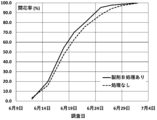
- FIG. 1 is a diagram showing the results of evaluating the effect of treatment with Preparation B on the flowering rate of Rebecca.
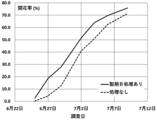
- FIG. 2 is a diagram showing the results of evaluating the effect of treatment with preparation B on the flowering rate of Donna.
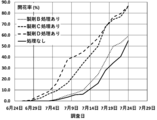
- FIG. 3 is a diagram showing the results of evaluating the effect of treatment with preparation B, preparation C, and preparation D on the flowering rate of Donna.
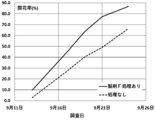
- FIG. 4 is a diagram showing the results of evaluating the effect of treatment with Preparation F on the flowering rate of Electra.
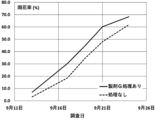
- FIG. 5 is a diagram showing the results of evaluating the effect of treatment with preparation G on the flowering rate of Oliver.
- the flowering regulator of the present invention (sometimes simply referred to as "flowering regulator”) contains a nitrophenol compound or a salt thereof.
- the flowering regulator of the present invention includes a flowering agent, a flowering regulator, a flowering regulator, a flowering promoter, a flowering rate enhancer, a bud regulator, a bud agent, a bud regulator, a bud regulator, and a rupture. It can also be rephrased as a bud promoter, a bud speed improving agent, and the like.
- the nitrophenol compound refers to a compound having one or more nitro groups and one or more hydroxyl groups (OH groups).
- the nitrophenol compound can have 1 or more and 5 or less nitro groups and 1 or more and 5 or less hydroxyl groups (OH groups).
- the nitrophenol compound includes a phenol compound having one nitro group and a phenol compound having two or more nitro groups. Further, some of these phenol compounds have one hydroxyl group and some have two or more hydroxyl groups.
- the nitrophenol compound used in the present invention is an aromatic ring compound having one or more nitro groups and one or more hydroxyl groups (OH groups).
- the nitrophenol compounds in the present specification include aromatic ring compounds having one nitro group and one hydroxyl group, aromatic ring compounds having one nitro group and two or more hydroxyl groups, two or more nitro groups and one. Any of an aromatic ring compound having one hydroxyl group and an aromatic ring compound having two or more nitro groups and two or more hydroxyl groups is included.
- the aromatic ring constituting the nitrophenol compound is not particularly limited, and examples thereof include a benzene ring, a naphthalene ring, and an anthracene ring.
- the nitrophenol compound may further have a substituent other than the above-mentioned nitro group and hydroxyl group.
- the substituent is not particularly limited, and is, for example, a halogen atom, a C1 to 6 alkyl group, a C1 to 6 haloalkyl group, a C1 to 6 alkoxy group, a C1 to 6 haloalkoxy group, and a C2 to 6 alkenyl group.
- the nitrophenol compound in the present specification may form a salt. That is, the flowering regulator of the present invention may be a salt of a nitrophenol compound as well as a nitrophenol compound.
- the salt is not particularly limited as long as it does not inhibit the flowering regulating action, and may be an inorganic salt or an organic salt.
- an alkali metal salt such as a sodium salt, a potassium salt, or a lithium salt
- Alkaline earth metal salts such as calcium salts
- Group 2 elemental salts such as magnesium salts
- Metal salts such as aluminum salt, iron salt, zinc salt, copper salt, nickel salt, cobalt salt
- Amine salts such as ammonium salt, glucosamine salt, ethylenediamine salt, guanidine salt, diethylamine salt, triethylamine salt, diethanolamine salt, tetramethylammonium salt, tris (hydroxymethyl) aminomethane salt
- Inorganic acid salts such as hydrochlorides, nitrates, perchlorates, sulfates, phosphates
- Organic acid salts such as acetate, apple salt, fumarate, succinate, citrate, tartarate, maleate; Am
- OH groups are described in the general formulas (1), (1a), (2), (2a), (2b) and (2c), and the general formula (1) ), (1a), (2), (2a), (2b) and (2c) are represented by structural formulas in which "OH” in the general formula is replaced with "OM".
- the M is an alkali metal ion such as sodium ion or potassium ion; an alkaline earth metal ion such as calcium ion; a group 2 element ion such as magnesium ion; an inorganic cation such as ammonium ion; ethylaminium ion or the like.
- Organic ammonium ion Indicates an organic cation such as an oxonium ion such as a trimethyloxonium ion.
- a phenol compound having one hydroxyl group is preferable.
- the aromatic ring constituting the nitrophenol compound is preferably a benzene ring.
- examples of the nitrophenol compound having an aromatic ring as a benzene ring include the following general formula (1):
- R represents a hydrogen atom, a halogen atom, a hydroxyl group, C 1 ⁇ 6 alkyl group, C 1 ⁇ 6 haloalkyl group, C 1 ⁇ 6 alkoxy group, C 1 ⁇ 6 haloalkoxy group, C 2 ⁇ 6 alkenyl group , C 2 ⁇ 6 haloalkenyl group, C 2 ⁇ 6 alkenyloxy group, C 2 ⁇ 6 haloalkenyloxy group, C 2 ⁇ 6 alkynyl group, C 2 ⁇ 6 haloalkynyl group, C 2 ⁇ 6 alkynyloxy group, or C Shows 2 to 6 haloalkynyloxy groups.
- x represents an integer from 1 to 5.
- y represents an integer from 0 to 4.
- the 2 to 4 R groups may be the same or different, respectively.
- Examples thereof include a nitrophenol compound represented by (1) or a salt thereof.
- a phenol compound having one nitro group is preferable.
- the nitrophenol compound has the following general formula (1a):
- R represents a hydrogen atom, a halogen atom, a hydroxyl group, C 1 ⁇ 6 alkyl group, C 1 ⁇ 6 haloalkyl group, C 1 ⁇ 6 alkoxy group, C 1 ⁇ 6 haloalkoxy group, C 2 ⁇ 6 alkenyl group , C 2 ⁇ 6 haloalkenyl group, C 2 ⁇ 6 alkenyloxy group, C 2 ⁇ 6 haloalkenyloxy group, C 2 ⁇ 6 alkynyl group, C 2 ⁇ 6 haloalkynyl group, C 2 ⁇ 6 alkynyloxy group, or C Shows 2 to 6 haloalkynyloxy groups.
- y represents an integer from 0 to 4. When y is an integer of 2 to 4, the 2 to 4 R groups may be the same or different, respectively.
- the nitrophenol compound represented by or a salt thereof is preferable.
- R 1 , R 2 , R 3 , R 4 , and R 5 are the same or different, hydrogen atom, halogen atom, hydroxyl group, nitro group, C 1 to 6 alkyl group, C 1 to 6 haloalkyl.
- R 1 , R 2 , R 3 , R 4 , and R 5 groups represents a nitro group. It can also be described as a nitrophenol compound represented by or a salt thereof.
- R 2 , R 3 , R 4 and R 5 groups are the same or different, hydrogen atom, halogen atom, hydroxyl group, nitro group, C 1 to 6 alkyl group, C 1 to 6 haloalkyl group, C.
- R 1 , R 3 , R 4 and R 5 groups are the same or different, hydrogen atom, halogen atom, hydroxyl group, nitro group, C 1 to 6 alkyl group, C 1 to 6 haloalkyl group, C.
- R 1 , R 2 , R 4 and R 5 groups are the same or different, hydrogen atom, halogen atom, hydroxyl group, nitro group, C 1 to 6 alkyl group, C 1 to 6 haloalkyl group, C.
- the halogen atom is not particularly limited, and examples thereof include a fluorine atom, a chlorine atom, a bromine atom, and an iodine atom.
- the C 1 to 6 alkyl groups are not particularly limited, and are, for example, methyl group, ethyl group, n-propyl group, isopropyl group, n-butyl group, isobutyl group, s-butyl group, t-butyl group, n-.
- Examples thereof include linear or branched alkyl groups having 1 to 6 carbon atoms such as a pentyl group, an isopentyl group, a neopentyl group, an n-hexyl group and an isohexyl group.
- n- means normal
- s- means secondary
- t- means tertiary.
- the C 1 to 6 haloalkyl groups are not particularly limited, and are, for example, a fluoromethyl group, a chloromethyl group, a bromomethyl group, an iodomethyl group, a difluoromethyl group, a trifluoromethyl group, a 1-fluoroethyl group, and a 2-fluoroethyl group.
- the C1 to 6 alkoxy groups are not particularly limited, and for example, a methoxy group, an ethoxy group, an n-propoxy group, an isopropoxy group, an n-butoxy group, an isobutoxy group, an s-butoxy group, a t-butoxy group, n.
- Examples thereof include linear or branched alkoxy groups having 1 to 6 carbon atoms such as a pentyloxy group, an isopentyloxy group, a neopentyloxy group, an n-hexyloxy group and an isohexyloxy group.
- the C 1 to 6 haloalkoxy groups are not particularly limited, and are, for example, fluoromethoxy group, chloromethoxy group, bromomethoxy group, iodomethoxy group, difluoromethoxy group, trifluoromethoxy group, 1-fluoroethoxy group, 2-.
- the C2 to 6 alkenyl group is not particularly limited, and for example, a vinyl group, a 1-propenyl group, an allyl group, an isopropenyl group, a 1-butenyl group, a 2-butenyl group, a 3-butenyl group, and a 1-methyl- Examples thereof include a linear or branched alkenyl group having 2 to 6 carbon atoms such as a 2-propenyl group and a 1,3-butadienyl group.
- the C2 to 6 haloalkenyl group is not particularly limited, and is, for example, a linear or branched chain alkenyl group having 2 to 6 carbon atoms having at least one double bond at an arbitrary position and having 1 to 1 to 6 haloalkenyl groups.
- Examples thereof include an alkenyl group substituted with 13 halogen atoms, preferably 1 to 7 halogen atoms.
- Such C 2 ⁇ 6 haloalkenyl group for example, 2,2-dichlorovinyl group, 2,2-dibromo-vinyl group, 3-chloro-2-propenyl group, 3,3-difluoro-2-allyl, 3,3-Dichloro-2-allyl group, 4-chloro-2-butenyl group, 4,4,4-trifluoro-2-butenyl group, 4,4,4-trichloro-3-butenyl group, 5-chloro Examples thereof include a -3-pentenyl group and a 6-fluoro-2-hexenyl group.
- the C2 to 6 alkenyloxy groups are not particularly limited, and are, for example, vinyloxy group, 1-propenyloxy group, allyloxy group, isopropenyloxy group, 1-butenyloxy group, 2-butenyloxy group, 3-butenyloxy group, 1 Examples thereof include linear or branched alkenyloxy groups having 2 to 6 carbon atoms such as -methyl-2-propenyloxy group and 1,3-butadienyloxy group.
- the C2 to 6 haloalkenyloxy group is not particularly limited, and is, for example, a linear or branched chain alkenyl group having 2 to 6 carbon atoms having at least one double bond at an arbitrary position and 1 Examples thereof include alkenyl groups substituted with ⁇ 13, preferably 1-7 halogen atoms. Examples of such C2 to 6 haloalkenyloxy groups include 2,2-dichlorovinyloxy group, 2,2-dibromovinyloxy group, 3-chloro-2-propenyloxy group, and 3,3-difluoro-2.
- Examples of the C2 to 6 alkynyl group include carbons such as ethynyl group, 1-propynyl group, 2-propynyl group, 1-methyl-2-propynyl group, 1-butynyl group, 2-butynyl group and 3-butynyl group. Examples thereof include linear or branched alkynyl groups of numbers 2 to 6.
- the C2 to 6 haloalkynyl group is not particularly limited, and is, for example, a linear or branched chain alkynyl group having 2 to 6 carbon atoms having at least one triple bond at an arbitrary position and having 1 to 13 carbon atoms. Examples thereof include alkynyl groups substituted with 1 to 7 halogen atoms. Examples of such C2 to 6 haloalkynyl groups include 3,3,3-trifluoropropynyl group, 3,3-difluoropropynyl group, 3,3,3-trifluorobutynyl group, 4,4,4. -Trifluoro-2-butynyl group, 3,3-difluoro-butynyl group and the like can be mentioned.
- the C2 to 6 alkynyloxy group is not particularly limited, and for example, ethynyloxy group, 1-propynyloxy group, 2-propynyloxy group, 1-methyl-2-propynyloxy group, 1-butynyloxy group, 2- Examples thereof include linear or branched alkynyloxy groups having 2 to 6 carbon atoms such as butynyloxy groups and 3-butynyloxy groups.
- the C2 to 6 haloalkynyloxy group is not particularly limited, and is, for example, a linear or branched alkynyloxy group having 2 to 6 carbon atoms having at least one triple bond at an arbitrary position and 1 Examples thereof include alkynyloxy groups substituted with ⁇ 13, preferably 1-7 halogen atoms.
- C2 to 6 haloalkynyloxy groups examples include 3,3,3-trifluoropropynyloxy group, 3,3-difluoropropynyloxy group, 3,3,3-trifluorobutynyloxy group, 4 , 4,4-Trifluoro-2-butynyloxy group, 3,3-difluoro-butynyloxy group and the like.
- R is preferably a hydrogen atom, a halogen atom, a C 1 to 6 alkyl group or a C 1 to 6 alkoxy group.
- a hydrogen atom or a methoxy group is more preferable.
- x is usually an integer of 1 to 5, preferably an integer of 1 to 3, more preferably an integer of 1 to 2, and particularly preferably 1. preferable.
- y is usually an integer of 0 to 4, preferably an integer of 0 to 3, and more preferably an integer of 0 to 2. , 0 to 1 are particularly preferred.
- R 1 is preferably a hydrogen atom, a halogen atom, a nitro group, a C 1 to 6 alkyl group or a C 1 to 6 alkoxy group.
- a hydrogen atom, a nitro group, or a methoxy group is more preferable.
- R 2 is preferably a hydrogen atom, a halogen atom, a nitro group, a C 1 to 6 alkyl group or a C 1 to 6 alkoxy group.
- a hydrogen atom, a nitro group, or a methoxy group is more preferable.
- R 3 is preferably a hydrogen atom, a halogen atom, a nitro group, a C 1 to 6 alkyl group or a C 1 to 6 alkoxy group.
- a hydrogen atom, a nitro group, or a methoxy group is more preferable.
- R 4 is preferably a hydrogen atom, a halogen atom, a nitro group, a C 1 to 6 alkyl group or a C 1 to 6 alkoxy group.
- a hydrogen atom, a nitro group, or a methoxy group is more preferable.
- R 5 is preferably a hydrogen atom, a halogen atom, a nitro group, a C 1 to 6 alkyl group or a C 1 to 6 alkoxy group.
- a hydrogen atom, a nitro group, or a methoxy group is more preferable.
- R 1 is a nitro group
- R 2 is a hydrogen atom, a nitro group, or a methoxy group
- R 3 is a hydrogen atom, a nitro group, or a methoxy group
- R 4 is a hydrogen atom, a nitro group, or a methoxy group
- R 5, a hydrogen atom, a nitro group, or a nitrophenol compound represented by methoxy groups, or salts thereof
- R 1 is a hydrogen atom, a nitro group, or a methoxy group
- R 2 is a nitro group
- R 3 is a hydrogen atom, a nitro group, or a methoxy group
- R 4 is a hydrogen atom, a nitro group, or a methoxy group
- R 5 is a nitrophenol compound represented by a hydrogen atom, a nitro group, or a methoxy group or a salt thereof
- R 1 is a hydrogen atom, a nitro group, or a me
- a more preferable compound is R 1 is a nitro group, R 2 is a hydrogen atom or a methoxy group, R 3 is a hydrogen atom or a methoxy group, R 4 is a hydrogen atom or a methoxy group, and R 5, nitrophenol compound represented by hydrogen atom, or a methoxy group; R 1 is a hydrogen atom or a methoxy group, R 2 is a nitro group, R 3 is a hydrogen atom or a methoxy group, R 4 is a hydrogen atom or a methoxy group, and R 5 is a nitrophenol compound represented by a hydrogen atom or a methoxy group or a salt thereof; and R 1 is a hydrogen atom or a methoxy group.
- R 2 is a hydrogen atom or a methoxy group
- R 3 is a nitro group
- examples thereof include a nitrophenol compound in which R 4 is a hydrogen atom or a methoxy group
- R 5 is a hydrogen atom or a methoxy group, or a salt thereof.
- R 2 is preferably a hydrogen atom, a halogen atom, a C 1 to 6 alkyl group or a C 1 to 6 alkoxy group, and the hydrogen atom, Alternatively, a methoxy group is more preferable.
- R 3 is preferably a hydrogen atom, a halogen atom, a C 1 to 6 alkyl group or a C 1 to 6 alkoxy group, and the hydrogen atom, Alternatively, a methoxy group is more preferable.
- R 4 is preferably a hydrogen atom, a halogen atom, a C 1 to 6 alkyl group or a C 1 to 6 alkoxy group, and the hydrogen atom, Alternatively, a methoxy group is more preferable.
- R 5 is preferably a hydrogen atom, a halogen atom, a C 1 to 6 alkyl group or a C 1 to 6 alkoxy group, and the hydrogen atom, Alternatively, a methoxy group is more preferable.
- R 2, R 3, R 4, and R 5 are the same or different, a hydrogen atom, C 1 ⁇ 6 alkyl group or a C 1 ⁇ 6 Alkoxy groups are preferred, and the same or different, hydrogen atoms or methoxy groups are more preferred.
- R 1 is preferably a hydrogen atom, a halogen atom, a C 1 to 6 alkyl group or a C 1 to 6 alkoxy group, and the hydrogen atom, Alternatively, a methoxy group is more preferable.
- R 3 is preferably a hydrogen atom, a halogen atom, a C 1 to 6 alkyl group or a C 1 to 6 alkoxy group, and the hydrogen atom, Alternatively, a methoxy group is more preferable.
- R 4 is preferably a hydrogen atom, a halogen atom, a C 1 to 6 alkyl group or a C 1 to 6 alkoxy group, and the hydrogen atom, Alternatively, a methoxy group is more preferable.
- R 5 is preferably a hydrogen atom, a halogen atom, a C 1 to 6 alkyl group or a C 1 to 6 alkoxy group, and the hydrogen atom, Alternatively, a methoxy group is more preferable.
- R 1 , R 3 , R 4 and R 5 are the same or different, and are the same or different, hydrogen atom, C 1 to 6 alkyl group or C 1 to C. 6 Alkoxy groups are preferred, and the same or different, hydrogen atoms or methoxy groups are more preferred.
- R 1 is preferably a hydrogen atom, a halogen atom, a C 1 to 6 alkyl group or a C 1 to 6 alkoxy group, and the hydrogen atom, Alternatively, a methoxy group is more preferable.
- R 2 is preferably a hydrogen atom, a halogen atom, a C 1 to 6 alkyl group or a C 1 to 6 alkoxy group, and the hydrogen atom, Alternatively, a methoxy group is more preferable.
- R 4 is preferably a hydrogen atom, a halogen atom, a C 1 to 6 alkyl group or a C 1 to 6 alkoxy group, and the hydrogen atom, Alternatively, a methoxy group is more preferable.
- R 5 is preferably a hydrogen atom, a halogen atom, a C 1 to 6 alkyl group or a C 1 to 6 alkoxy group, and the hydrogen atom, Alternatively, a methoxy group is more preferable.
- R 1 , R 2 , R 4 and R 5 are the same or different, and are the same or different, hydrogen atom, C 1 to 6 alkyl group or C 1 to C. 6 Alkoxy groups are preferred, and the same or different, hydrogen atoms or methoxy groups are more preferred.
- nitrophenol compounds such as 4-nitrophenol, 4-nitrophenol sodium salt, 3-nitrophenol, 3-nitrophenol sodium salt, 2-nitrophenol, 2-nitrophenol sodium salt and the like.
- a salt thereof; a guaiacol (also known as guaiacol) compound such as 5-nitroguayacol, 5-nitroguaiacol sodium salt, 4-nitroguayacol, 4-nitroguaiacol sodium salt or the like, or a salt thereof is particularly preferable.
- the flowering regulator of the present invention may contain one or more of the above nitrophenol compounds or salts thereof.
- nitrophenol compounds or salts thereof a compound produced by a known production method or a commercially available product can be used.
- the known production method include the production method described in JP-A-10-67716.
- Commercially available products include, for example, 4-nitrophenol or a salt thereof (0.003 to 3%), 2-nitrophenol or a salt thereof (0.002 to 2%), and 5-nitroguanacol or a salt thereof (0.003 to 2%). It is also possible to use a nitrophenol composition containing 2 or 3 types of nitrophenol compounds such as an aqueous solution containing 0.001 to 1%) or a salt thereof.
- the flowering promoter of the present invention comprises at least two nitrophenols or salts thereof selected from the group consisting of 4-nitrophenol or a salt thereof, 2-nitrophenol or a salt thereof, and 5-nitroguayacol or a salt thereof.
- a combination of 4-nitrophenol or a salt thereof and 2-nitrophenol or a salt thereof; a combination of 4-nitrophenol or a salt thereof and 5-nitroguayacol or a salt thereof; 2-nitrophenol or The salt may contain 5-nitroguanacol or a combination thereof; and the like.
- the content of 4-nitrophenol or a salt thereof is 100 parts by mass of 2-nitrophenol or a salt thereof. On the other hand, it is usually 0.5 to 25,000 parts by mass, preferably 5 to 2500 parts by mass, and more preferably 50 to 250 parts by mass.
- the flowering promoter of the present invention contains 4-nitrophenol or a salt thereof, and 5-nitroguaiacol or a salt thereof
- the content of 4-nitrophenol or a salt thereof is 5-nitroguaiacol or a salt thereof 100. It is usually 2 to 40,000 parts by mass, preferably 20 to 4000 parts by mass, and more preferably 200 to 400 parts by mass with respect to parts by mass.
- the flowering promoter of the present invention contains 2-nitrophenol or a salt thereof, and 5-nitroguaiacol or a salt thereof
- the content of 2-nitrophenol or a salt thereof is 5-nitroguaiacol or a salt thereof 100. It is usually 1 to 30,000 parts by mass, preferably 10 to 3,000 parts by mass, and more preferably 100 to 300 parts by mass with respect to parts by mass.
- the flowering promoter of the present invention comprises at least three types of nitrophenol or a salt thereof selected from the group consisting of 4-nitrophenol or a salt thereof, 2-nitrophenol or a salt thereof, and 5-nitroguaiacol or a salt thereof.
- 4-nitrophenol or a salt thereof is usually blended in an amount of 2 to 40,000 parts by mass, preferably 20 to 4000 parts by mass, and more preferably 200 to 400 parts by mass with respect to 100 parts by mass of 5-nitroguaiacol or a salt thereof.
- 2-nitrophenol or a salt thereof is usually added in an amount of 1 to 30,000 parts by mass, preferably 10 to 3,000 parts by mass, and more preferably 100 to 300 parts by mass with respect to 100 parts by mass.
- the concentration of the nitrophenol compound or a salt thereof is usually 0.003 to 1800 mg / L, preferably 0.03 to 180 mg / L, and more preferably 0.3 to 18 mg / L. Is. Further, when two or more kinds of nitrophenol compounds or salts thereof are contained in the treatment of the flowering regulator of the present invention, the respective concentrations and ratios can be appropriately set.
- the flowering regulator of the present invention may contain only a nitrophenol compound or a salt thereof without adding other ingredients, but is usually a solid carrier, a liquid carrier, or a gaseous carrier (propellant). Can be mixed.
- a surfactant, a spreading agent, and other formulation aids are added to the flowering regulator of the present invention as necessary, and an oil, an emulsion, a wettable powder, and the like are added according to a usual formulation method. It can be formulated and used as a flowable agent, granule, powder, aerosol, fuming agent and the like.
- the preparations using the flowering regulator of the present invention include other flowering regulators, insecticides, nematode insecticides, acaricides, fungicides, herbicides, dwarfing agents, microbial pesticides, as required.
- Plant growth regulators, synergists, soil conditioners, fertilizers and the like can be mixed or not mixed at the same time.
- flowering regulators are not particularly limited as long as they can regulate the time to flowering by acting on plants, for example, auxins, indoleacetic acid, gibberellin, cytokinin, abscisic acid, ethylene, ethefone. , Brassinosteroids, florigen, salicylic acid, jasmonic acid and other plant hormones.
- the content of the nitrophenol compound or a salt thereof in the flowering regulator of the present invention or a preparation thereof is usually 0.00001 to 95% by mass, preferably 0.0001 to 50% by mass, and more preferably 0.001 to 0.001 to 50% by mass. It is 10% by mass.
- Examples of the solid carrier used in the formulation include clays (kaolin clay, diatomaceous earth, synthetic silicon hydroxide-containing silicon hydroxide, bentonite, fubasami clay, acidic white clay, etc.), talc, ceramics, and other inorganic minerals (selite, quartz, etc.). Examples thereof include fine powders or granules such as sulfur, activated charcoal, calcium carbonate, hydrated silica, etc.), chemical fertilizers (sulfur, phosphorus, silica, urea, salt, etc.).
- liquid carrier examples include water, alcohols (methanol, ethanol, etc.), ketones (acetone, methyl ethyl ketone, etc.), aromatic hydrocarbons (benzene, toluene, xylene, ethylbenzene, methylnaphthalene, etc.), aliphatic hydrocarbons.
- Classes (hexane, cyclohexane, kerosene, light oil, etc.), esters (ethyl acetate, butyl acetate, etc.), nitriles (acetone, isobutyronitrile, etc.), ethers (diisopropyl ether, dioxane, etc.), acid amides (N) , N-Dimethylformamide, N, N-dimethylacetamide, etc.), halogenated hydrocarbons (dioxide, trichloroethane, carbon tetrachloride, etc.), dimethylsulfoxide, soybean oil, vegetable oil such as cottonseed oil, and the like.
- gaseous carrier examples include butane gas, LPG (liquefied petroleum gas), dimethyl ether, carbon dioxide gas and the like.
- auxiliary agent for preparation examples include a surfactant, a spreading agent, a fixing agent, a dispersant, a stabilizer and the like.
- surfactant examples include sorbitan fatty acid ester, polyoxyethylene sorbitan fatty acid ester, sucrose fatty acid ester, polyoxyethylene fatty acid ester, polyoxyethylene resin acid ester, polyoxyethylene fatty acid diester, polyoxyethylene alkyl ether, and poly.
- the above-mentioned surfactant can be used.
- fixing agent and / or dispersant examples include casein, gelatin, polysaccharide (starch powder, gum arabic, cellulose derivative, alginic acid, etc.), lignin derivative, bentonite, saccharide, synthetic water-soluble polymer (polyvinyl alcohol, polyvinylpyrrolidone, etc.). , Polyacrylic acids, etc.).
- Stabilizers include, for example, PAP (isopropyl acid phosphate), BHT (2,6-di-tert-butyl-4-methylphenol), BHA (2-tert-butyl-4-methoxyphenol and 3-tert- Butyl-4-methoxyphenol mixture), vegetable oils, mineral oils, fatty acids or esters thereof and the like.
- the flowering regulator of the present invention and the preparations using these can be used as they are or diluted with water or the like.
- the application rate and application concentration of the flowering regulator of the present invention are all different depending on the type of preparation, application time, application place, application method, type of pest, degree of damage, etc., and are limited to the above range. Can be increased or decreased without.
- the flowering regulator of the present invention contains a nitrophenol compound or a salt thereof and is used.
- a method for preparing the flowering regulator of the present invention or a preparation thereof for example, a nitrophenol compound or a salt thereof
- a method in which a composition containing the above and other components separately is prepared, and these two or more kinds of components are sequentially or simultaneously blended and used at the time of application can be mentioned.
- it is preferably a method of simultaneously blending and using these two or more kinds of components at the time of application.
- the blending ratio of the nitrophenol compound or a salt thereof and other components can be appropriately set.
- the flowering control method of the present invention is characterized by having a step of treating a plant or its rhizosphere with a flowering regulator containing a nitrophenol compound or a salt thereof.
- the treatment can be rephrased as adhesion.
- the flowering control method of the present invention includes the following embodiments (treatment method or adhesion method).
- treatment method or adhesion method A method of spraying a flowering regulator containing a nitrophenol compound or a salt thereof on leaves, stems, fruits, etc., or applying it to the rhizosphere of a plant.
- the embodiment of (1) or (2) above may be continuously implemented in either one, or may be changed to another method in the middle.
- the method of treating (adhering) the flowering control agent to the plant or its rhizosphere is not particularly limited, and for example, the flowering control agent obtained by diluting the active ingredient in a water-soluble medium. May be applied directly to the trunk or the like using a brush or the like, or may be sprayed or sprayed using a spray or the like.
- the amount of the flowering regulator treated on the plant is not particularly limited as long as the flowering regulating effect can be obtained, and the type or concentration of the active ingredient of the flowering regulator, the treatment method, the adhesion method, and the plant. It can be appropriately determined in consideration of the age or type of the tree.
- the plants to which the flowering regulator of the present invention can be used are not particularly limited, and for example, gerbera, rose, carnation, lily, orchid, gypsophila, tulip, kiku, solidaster, alstroemeria, hydrangea, delphinium, statice, stock, sweet pea, etc.
- Flowers such as freesia, tulip, dalia, gypsophila, gladiolus; Chinese cabbage, cabbage, spinach, lettuce, Japanese mustard spinach, garland chrysanthemum, broccoli, onions, green onions and other leafy vegetables; Fruit vegetables such as cucumber, tomato, eggplant, pepper, strawberry, pumpkin, watermelon, melon, oriental melon; Root vegetables such as potatoes, lotus roots, turnips, garlic, radishes, burdock roots, carrots; Examples include fruit trees such as apples, citrus fruits, pears, grapes, peaches, cherries, plums, and bananas.
- Example 1 An example of the preparation is shown below.
- Formulation A Undiluted solution of nitrophenol aqueous solution 4-nitrophenol sodium salt (manufactured by Asahi Chemical Industry Co., Ltd.) 9 g, 2-nitrophenol sodium salt (manufactured by Asahi Chemical Industry Co., Ltd.) 6 g, and 5-nitroguayacol sodium salt (manufactured by Asahi Chemical Industry Co., Ltd.) 3 g (manufactured by Co., Ltd.) was dissolved in 1 L of ultrapure water to prepare an aqueous solvent. This water solvent is hereinafter referred to as "formulation A".
- Formulation B Nitrophenol solution for foliar spray (water solvent) Part 1 Tap water was added to 10 mL of Formulation A and 1 mL of Tween® 80 (manufactured by Tokyo Chemical Industry Co., Ltd.) as a spreading agent to make 10 L, which was used as a water solvent for foliar spraying.
- This water solvent is hereinafter referred to as "formulation B”.
- Formulation C Nitrophenol solution for foliar spray (water solvent) Part 2 Tap water was added to 3.33 mL of Formulation A and 1 mL of Tween® 80 (manufactured by Tokyo Chemical Industry Co., Ltd.) as a spreading agent to make 10 L, which was used as a water solvent for foliar spraying.
- formulation C Nitrophenol solution for foliar spraying (water solvent) Part 3 Tap water was added to 1 mL of Formulation A and 1 mL of Tween® 80 (manufactured by Tokyo Chemical Industry Co., Ltd.) as a spreading agent to make 10 L, which was used as a water solvent for foliar spraying.
- This water solvent is hereinafter referred to as "formulation D”.
- formulation B was uniformly sprayed on the entire crop body three times on June 7, 15, and 21 for 6 planters of each variety.
- the number of flowers was counted on June 12, 15, 18, 20, 22, 25, 27, 29, and July 2 for Rebecca, and 6 for Donna.
- the number of flowers was counted on the 25th, 27th, 29th, 2nd, 4th, 6th, and 9th of July.
- the flowering rate of each strain is calculated, and the average value of the flowering rate of each strain is calculated by chemical treatment.
- the effect on flowering rate was evaluated.
- the flowering rate (%) of Rebecca is shown in Table 1 below (Transition of Rebecca flowering rate) and FIG.
- the flowering rate (%) of Donna is shown in Table 2 below (Transition of Donna flowering rate) and FIG.
- ⁇ Test Example 2> For the test, a cultivar Donna of spray mum (scientific name: Chrysanthemum morifolia) was used. Six pot seedlings purchased from Toyokoen Co., Ltd. on April 24, 2019 were planted in one planter (14L) on April 25, and north and south at House No. 4 in the Cultivation Research Center of OAT Agrio Co., Ltd. A total of eight planters were lined up in one row. Next, using tank mixes A and B, which are compound fertilizers manufactured by OAT Agrio Co., Ltd., the dilution ratio was set so that the EC value was 0.5 dS / m, and 1 L of fertilizer solution was applied per planter twice a day. did.
- tank mixes A and B which are compound fertilizers manufactured by OAT Agrio Co., Ltd.
- the untreated plot where nothing was sprayed and the preparations B, C, and D were uniformly applied to the entire crop body 5 times on June 24, July 2, 8, 16 and 25. It was sprayed on.
- the number of flowers bloomed on June 26th, 28th, July 1st, 3rd, 5th, 8th, 10th, 12th, 16th, 18th, 20th, 22nd, and 24th. was counted.
- the number of flowers and the number of buds were counted on the 29th, and these were added up to obtain the total number of buds.
- Example 2 An example of the preparation is shown below.
- Formulation E Undiluted solution of nitrophenol aqueous solution Part 2 4-Nitrophenol potassium salt (manufactured by Asahi Kagaku Kogyo Co., Ltd.) 0.990 mg, 2-nitrophenol potassium salt (manufactured by Asahi Kagaku Kogyo Co., Ltd.) 0.660 mg, and 5-nitroguayacol sodium salt (manufactured by Asahi Kagaku Kogyo Co., Ltd.) ) 0.325 mg was dissolved in 100 mL of ultrapure water to prepare an aqueous solvent. This water solvent is hereinafter referred to as "formulation E".
- Formulation F Nitrophenol solution for foliar spraying (water solvent) Part 4 Tap water was added to 10 mL of Formulation E and 1 mL of Tween® 80 (manufactured by Tokyo Chemical Industry Co., Ltd.) as a spreading agent to make 10 L, which was used as a water solvent for foliar spraying.
- This water solvent is hereinafter referred to as "formulation F”.
- Formulation G Nitrophenol solution for foliar spraying (water solvent) Part 5 Tap water was added to 3.33 mL of Formulation E and 1 mL of Tween® 80 (manufactured by Tokyo Chemical Industry Co., Ltd.) as a spreading agent to make 10 L, which was used as a water solvent for foliar spraying.
- This water solvent is hereinafter referred to as "formulation G”.
- a light-shielding curtain with a 75% light-shielding rate was installed above the test plot.
- Electra was sprayed evenly on the above-ground part three times on September 3, 10 and 17, and Oliver was sprayed evenly on September 3, 17 and twice.
- Formulation G was sprayed in the same manner.
- the number of flowering surveys was conducted on September 13, 17, 19, 21, and 24. As for the survey of the number of buds, on September 24, after the final survey was completed, the side buds and those below the top were excluded and counted to obtain the total number of buds.
Landscapes
- Life Sciences & Earth Sciences (AREA)
- Environmental Sciences (AREA)
- Engineering & Computer Science (AREA)
- Biodiversity & Conservation Biology (AREA)
- Ecology (AREA)
- Forests & Forestry (AREA)
- Wood Science & Technology (AREA)
- Agronomy & Crop Science (AREA)
- Botany (AREA)
- Pest Control & Pesticides (AREA)
- Plant Pathology (AREA)
- Health & Medical Sciences (AREA)
- Dentistry (AREA)
- General Health & Medical Sciences (AREA)
- Zoology (AREA)
- Organic Low-Molecular-Weight Compounds And Preparation Thereof (AREA)
Abstract
L'objectif de la présente invention est de réaliser un nouveau régulateur de floraison. La présente invention concerne un régulateur de floraison contenant un composé nitrophénol ou un sel de celui-ci, un procédé de régulation de floraison caractérisé en ce qu'il comprend l'étape consistant à soumettre une plante ou sa rhizosphère à un régulateur de floraison contenant un composé nitrophénol ou un sel de celui-ci, un procédé d'utilisation d'un composé nitrophénol ou d'un sel de celui-ci dans le but de réguler la floraison, et analogue.
Priority Applications (1)
| Application Number | Priority Date | Filing Date | Title |
|---|---|---|---|
| JP2021543060A JPWO2021039986A1 (fr) | 2019-08-30 | 2020-08-28 |
Applications Claiming Priority (2)
| Application Number | Priority Date | Filing Date | Title |
|---|---|---|---|
| JP2019-159143 | 2019-08-30 | ||
| JP2019159143 | 2019-08-30 |
Publications (1)
| Publication Number | Publication Date |
|---|---|
| WO2021039986A1 true WO2021039986A1 (fr) | 2021-03-04 |
Family
ID=74685946
Family Applications (1)
| Application Number | Title | Priority Date | Filing Date |
|---|---|---|---|
| PCT/JP2020/032665 Ceased WO2021039986A1 (fr) | 2019-08-30 | 2020-08-28 | Régulateur de floraison |
Country Status (2)
| Country | Link |
|---|---|
| JP (1) | JPWO2021039986A1 (fr) |
| WO (1) | WO2021039986A1 (fr) |
Citations (9)
| Publication number | Priority date | Publication date | Assignee | Title |
|---|---|---|---|---|
| JPH04283502A (ja) * | 1991-03-13 | 1992-10-08 | Mitsui Petrochem Ind Ltd | 切花の鮮度保持剤 |
| CN101638338A (zh) * | 2008-07-29 | 2010-02-03 | 冯建材 | 磁力多肽化肥增效添加剂及其使用方法 |
| CN103548839A (zh) * | 2013-10-23 | 2014-02-05 | 贵州沿河乌江生物科技发展有限公司 | 一种兰科植物生长调节剂 |
| CN104126597A (zh) * | 2014-07-24 | 2014-11-05 | 桂林桂开生物科技股份有限公司 | 促进均衡生长的植物生长促进剂及其制备方法 |
| CN105330435A (zh) * | 2015-11-26 | 2016-02-17 | 阜阳市金湖丰农业科技有限公司 | 一种促进葡萄开花坐果的肥料 |
| CN106278762A (zh) * | 2016-07-25 | 2017-01-04 | 左邦庆 | 大丽花复合肥 |
| CN106689129A (zh) * | 2016-11-14 | 2017-05-24 | 中国农业科学院蔬菜花卉研究所 | 一种促进黄瓜在亚适宜温光环境中生长的调节剂 |
| CN106748320A (zh) * | 2017-02-28 | 2017-05-31 | 广西南宁益土生物科技有限责任公司 | 一种促进砂糖桔开花结实的水溶肥 |
| CN108991008A (zh) * | 2018-08-26 | 2018-12-14 | 郭烽燕 | 一种高效蔬菜调节液 |
-
2020
- 2020-08-28 WO PCT/JP2020/032665 patent/WO2021039986A1/fr not_active Ceased
- 2020-08-28 JP JP2021543060A patent/JPWO2021039986A1/ja active Pending
Patent Citations (9)
| Publication number | Priority date | Publication date | Assignee | Title |
|---|---|---|---|---|
| JPH04283502A (ja) * | 1991-03-13 | 1992-10-08 | Mitsui Petrochem Ind Ltd | 切花の鮮度保持剤 |
| CN101638338A (zh) * | 2008-07-29 | 2010-02-03 | 冯建材 | 磁力多肽化肥增效添加剂及其使用方法 |
| CN103548839A (zh) * | 2013-10-23 | 2014-02-05 | 贵州沿河乌江生物科技发展有限公司 | 一种兰科植物生长调节剂 |
| CN104126597A (zh) * | 2014-07-24 | 2014-11-05 | 桂林桂开生物科技股份有限公司 | 促进均衡生长的植物生长促进剂及其制备方法 |
| CN105330435A (zh) * | 2015-11-26 | 2016-02-17 | 阜阳市金湖丰农业科技有限公司 | 一种促进葡萄开花坐果的肥料 |
| CN106278762A (zh) * | 2016-07-25 | 2017-01-04 | 左邦庆 | 大丽花复合肥 |
| CN106689129A (zh) * | 2016-11-14 | 2017-05-24 | 中国农业科学院蔬菜花卉研究所 | 一种促进黄瓜在亚适宜温光环境中生长的调节剂 |
| CN106748320A (zh) * | 2017-02-28 | 2017-05-31 | 广西南宁益土生物科技有限责任公司 | 一种促进砂糖桔开花结实的水溶肥 |
| CN108991008A (zh) * | 2018-08-26 | 2018-12-14 | 郭烽燕 | 一种高效蔬菜调节液 |
Non-Patent Citations (1)
| Title |
|---|
| THE PEST ICICLE MANUAL, 2006, pages 756 - 758 * |
Also Published As
| Publication number | Publication date |
|---|---|
| JPWO2021039986A1 (fr) | 2021-03-04 |
Similar Documents
| Publication | Publication Date | Title |
|---|---|---|
| KR102660327B1 (ko) | 식물 성장 조절인자(들) 및 극성 및/또는 반-극성 유기 용매(들)의 비-수성 용액 | |
| JP5450096B2 (ja) | 植物健康組成物 | |
| HU230715B1 (hu) | Szubsztituált tién-3-il-szulfonilamino-(tio)karbonil-triazolin(ti)on-származékot és mezotriont tartalmazó herbicid készítmények | |
| JP5235137B2 (ja) | 成長及び/又は生産量を改善するためのプロリンの使用 | |
| WO2020149373A1 (fr) | Agent de régulation de la croissance des plantes | |
| US4764201A (en) | Plant growth regulation | |
| SK284549B6 (sk) | Fungicídny dvoj- alebo trojzložkový prostriedok na báze metalaxylu, spôsob kontroly a prevencie napadnutia hubami triedy Oomycetes | |
| CN110049676B (zh) | 用于植物处理化学品的佐剂组合物 | |
| WO2016035685A1 (fr) | Inducteur de formation de racines adventives et promoteur de croissance du système racinaire | |
| EP0982989B1 (fr) | Procede permettant d'inhiber l'elongation de la tige des plantes bulbeuses | |
| JP2025105689A (ja) | ジャスモン酸類を用いた蒸散抑制剤 | |
| WO2021039986A1 (fr) | Régulateur de floraison | |
| JP6856842B1 (ja) | ラテックス産生植物用処理剤 | |
| US4902815A (en) | Plant growth regulant | |
| EP0220514B1 (fr) | Composition pour augmenter la quantité et la qualité des fruits et des fleurs des plantes | |
| CN103563946B (zh) | 杀真菌组合物及其应用 | |
| JP7102039B2 (ja) | ニトロフェノール化合物又はその塩を含有する果実の尻腐れ抑制剤 | |
| EP3592148A1 (fr) | Utilisation d'acide bêta-cyclocitrique ou d'un de ses sels pour améliorer la tolérance des plantes à la sécheresse | |
| US4857103A (en) | Influencing the development of crops with 7-chloroquinoline-8-carboxylic acids | |
| JP7730131B2 (ja) | 蒸散抑制成分による植物の重金属蓄積抑制方法 | |
| TW202023385A (zh) | 用於植物健康的延長及連續釋放組成物及使用方法 | |
| WO2020209232A1 (fr) | Agent d'amélioration d'absorption de métal | |
| WO2025072234A1 (fr) | Solution de régulateur de croissance de plantes à faible volatilité et à haute concentration | |
| CN107593711B (zh) | 一种杀菌组合物 | |
| JP2006225304A (ja) | トマト糖脂質による農園芸用抗カビ剤 |
Legal Events
| Date | Code | Title | Description |
|---|---|---|---|
| 121 | Ep: the epo has been informed by wipo that ep was designated in this application |
Ref document number: 20858323 Country of ref document: EP Kind code of ref document: A1 |
|
| ENP | Entry into the national phase |
Ref document number: 2021543060 Country of ref document: JP Kind code of ref document: A |
|
| NENP | Non-entry into the national phase |
Ref country code: DE |
|
| 122 | Ep: pct application non-entry in european phase |
Ref document number: 20858323 Country of ref document: EP Kind code of ref document: A1 |