WO2021049455A1 - 含フッ素化合物の製造方法及び共重合体の製造方法 - Google Patents
含フッ素化合物の製造方法及び共重合体の製造方法 Download PDFInfo
- Publication number
- WO2021049455A1 WO2021049455A1 PCT/JP2020/033767 JP2020033767W WO2021049455A1 WO 2021049455 A1 WO2021049455 A1 WO 2021049455A1 JP 2020033767 W JP2020033767 W JP 2020033767W WO 2021049455 A1 WO2021049455 A1 WO 2021049455A1
- Authority
- WO
- WIPO (PCT)
- Prior art keywords
- compound
- group
- atom
- formula
- fluorine
- Prior art date
- Legal status (The legal status is an assumption and is not a legal conclusion. Google has not performed a legal analysis and makes no representation as to the accuracy of the status listed.)
- Ceased
Links
Classifications
-
- C—CHEMISTRY; METALLURGY
- C08—ORGANIC MACROMOLECULAR COMPOUNDS; THEIR PREPARATION OR CHEMICAL WORKING-UP; COMPOSITIONS BASED THEREON
- C08F—MACROMOLECULAR COMPOUNDS OBTAINED BY REACTIONS ONLY INVOLVING CARBON-TO-CARBON UNSATURATED BONDS
- C08F14/00—Homopolymers and copolymers of compounds having one or more unsaturated aliphatic radicals, each having only one carbon-to-carbon double bond, and at least one being terminated by a halogen
-
- C—CHEMISTRY; METALLURGY
- C07—ORGANIC CHEMISTRY
- C07C—ACYCLIC OR CARBOCYCLIC COMPOUNDS
- C07C17/00—Preparation of halogenated hydrocarbons
- C07C17/26—Preparation of halogenated hydrocarbons by reactions involving an increase in the number of carbon atoms in the skeleton
- C07C17/272—Preparation of halogenated hydrocarbons by reactions involving an increase in the number of carbon atoms in the skeleton by addition reactions
- C07C17/278—Preparation of halogenated hydrocarbons by reactions involving an increase in the number of carbon atoms in the skeleton by addition reactions of only halogenated hydrocarbons
-
- C—CHEMISTRY; METALLURGY
- C08—ORGANIC MACROMOLECULAR COMPOUNDS; THEIR PREPARATION OR CHEMICAL WORKING-UP; COMPOSITIONS BASED THEREON
- C08F—MACROMOLECULAR COMPOUNDS OBTAINED BY REACTIONS ONLY INVOLVING CARBON-TO-CARBON UNSATURATED BONDS
- C08F293/00—Macromolecular compounds obtained by polymerisation on to a macromolecule having groups capable of inducing the formation of new polymer chains bound exclusively at one or both ends of the starting macromolecule
- C08F293/005—Macromolecular compounds obtained by polymerisation on to a macromolecule having groups capable of inducing the formation of new polymer chains bound exclusively at one or both ends of the starting macromolecule using free radical "living" or "controlled" polymerisation, e.g. using a complexing agent
-
- C—CHEMISTRY; METALLURGY
- C08—ORGANIC MACROMOLECULAR COMPOUNDS; THEIR PREPARATION OR CHEMICAL WORKING-UP; COMPOSITIONS BASED THEREON
- C08F—MACROMOLECULAR COMPOUNDS OBTAINED BY REACTIONS ONLY INVOLVING CARBON-TO-CARBON UNSATURATED BONDS
- C08F114/00—Homopolymers of compounds having one or more unsaturated aliphatic radicals, each having only one carbon-to-carbon double bond, and at least one being terminated by a halogen
- C08F114/02—Monomers containing chlorine
- C08F114/04—Monomers containing two carbon atoms
- C08F114/06—Vinyl chloride
-
- C—CHEMISTRY; METALLURGY
- C08—ORGANIC MACROMOLECULAR COMPOUNDS; THEIR PREPARATION OR CHEMICAL WORKING-UP; COMPOSITIONS BASED THEREON
- C08F—MACROMOLECULAR COMPOUNDS OBTAINED BY REACTIONS ONLY INVOLVING CARBON-TO-CARBON UNSATURATED BONDS
- C08F114/00—Homopolymers of compounds having one or more unsaturated aliphatic radicals, each having only one carbon-to-carbon double bond, and at least one being terminated by a halogen
- C08F114/18—Monomers containing fluorine
- C08F114/26—Tetrafluoroethene
-
- C—CHEMISTRY; METALLURGY
- C08—ORGANIC MACROMOLECULAR COMPOUNDS; THEIR PREPARATION OR CHEMICAL WORKING-UP; COMPOSITIONS BASED THEREON
- C08F—MACROMOLECULAR COMPOUNDS OBTAINED BY REACTIONS ONLY INVOLVING CARBON-TO-CARBON UNSATURATED BONDS
- C08F14/00—Homopolymers and copolymers of compounds having one or more unsaturated aliphatic radicals, each having only one carbon-to-carbon double bond, and at least one being terminated by a halogen
- C08F14/18—Monomers containing fluorine
-
- C—CHEMISTRY; METALLURGY
- C08—ORGANIC MACROMOLECULAR COMPOUNDS; THEIR PREPARATION OR CHEMICAL WORKING-UP; COMPOSITIONS BASED THEREON
- C08F—MACROMOLECULAR COMPOUNDS OBTAINED BY REACTIONS ONLY INVOLVING CARBON-TO-CARBON UNSATURATED BONDS
- C08F14/00—Homopolymers and copolymers of compounds having one or more unsaturated aliphatic radicals, each having only one carbon-to-carbon double bond, and at least one being terminated by a halogen
- C08F14/18—Monomers containing fluorine
- C08F14/185—Monomers containing fluorine not covered by the groups C08F14/20 - C08F14/28
-
- C—CHEMISTRY; METALLURGY
- C08—ORGANIC MACROMOLECULAR COMPOUNDS; THEIR PREPARATION OR CHEMICAL WORKING-UP; COMPOSITIONS BASED THEREON
- C08F—MACROMOLECULAR COMPOUNDS OBTAINED BY REACTIONS ONLY INVOLVING CARBON-TO-CARBON UNSATURATED BONDS
- C08F14/00—Homopolymers and copolymers of compounds having one or more unsaturated aliphatic radicals, each having only one carbon-to-carbon double bond, and at least one being terminated by a halogen
- C08F14/18—Monomers containing fluorine
- C08F14/24—Trifluorochloroethene
-
- C—CHEMISTRY; METALLURGY
- C08—ORGANIC MACROMOLECULAR COMPOUNDS; THEIR PREPARATION OR CHEMICAL WORKING-UP; COMPOSITIONS BASED THEREON
- C08F—MACROMOLECULAR COMPOUNDS OBTAINED BY REACTIONS ONLY INVOLVING CARBON-TO-CARBON UNSATURATED BONDS
- C08F14/00—Homopolymers and copolymers of compounds having one or more unsaturated aliphatic radicals, each having only one carbon-to-carbon double bond, and at least one being terminated by a halogen
- C08F14/18—Monomers containing fluorine
- C08F14/26—Tetrafluoroethene
-
- C—CHEMISTRY; METALLURGY
- C08—ORGANIC MACROMOLECULAR COMPOUNDS; THEIR PREPARATION OR CHEMICAL WORKING-UP; COMPOSITIONS BASED THEREON
- C08F—MACROMOLECULAR COMPOUNDS OBTAINED BY REACTIONS ONLY INVOLVING CARBON-TO-CARBON UNSATURATED BONDS
- C08F2/00—Processes of polymerisation
- C08F2/02—Polymerisation in bulk
-
- C—CHEMISTRY; METALLURGY
- C08—ORGANIC MACROMOLECULAR COMPOUNDS; THEIR PREPARATION OR CHEMICAL WORKING-UP; COMPOSITIONS BASED THEREON
- C08F—MACROMOLECULAR COMPOUNDS OBTAINED BY REACTIONS ONLY INVOLVING CARBON-TO-CARBON UNSATURATED BONDS
- C08F214/00—Copolymers of compounds having one or more unsaturated aliphatic radicals, each having only one carbon-to-carbon double bond, and at least one being terminated by a halogen
- C08F214/18—Monomers containing fluorine
- C08F214/26—Tetrafluoroethene
- C08F214/262—Tetrafluoroethene with fluorinated vinyl ethers
-
- C—CHEMISTRY; METALLURGY
- C08—ORGANIC MACROMOLECULAR COMPOUNDS; THEIR PREPARATION OR CHEMICAL WORKING-UP; COMPOSITIONS BASED THEREON
- C08F—MACROMOLECULAR COMPOUNDS OBTAINED BY REACTIONS ONLY INVOLVING CARBON-TO-CARBON UNSATURATED BONDS
- C08F220/00—Copolymers of compounds having one or more unsaturated aliphatic radicals, each having only one carbon-to-carbon double bond, and only one being terminated by only one carboxyl radical or a salt, anhydride ester, amide, imide or nitrile thereof
- C08F220/02—Monocarboxylic acids having less than ten carbon atoms; Derivatives thereof
- C08F220/10—Esters
- C08F220/12—Esters of monohydric alcohols or phenols
- C08F220/16—Esters of monohydric alcohols or phenols of phenols or of alcohols containing two or more carbon atoms
- C08F220/18—Esters of monohydric alcohols or phenols of phenols or of alcohols containing two or more carbon atoms with acrylic or methacrylic acids
- C08F220/1804—C4-(meth)acrylate, e.g. butyl (meth)acrylate, isobutyl (meth)acrylate or tert-butyl (meth)acrylate
-
- C—CHEMISTRY; METALLURGY
- C08—ORGANIC MACROMOLECULAR COMPOUNDS; THEIR PREPARATION OR CHEMICAL WORKING-UP; COMPOSITIONS BASED THEREON
- C08F—MACROMOLECULAR COMPOUNDS OBTAINED BY REACTIONS ONLY INVOLVING CARBON-TO-CARBON UNSATURATED BONDS
- C08F226/00—Copolymers of compounds having one or more unsaturated aliphatic radicals, each having only one carbon-to-carbon double bond, and at least one being terminated by a single or double bond to nitrogen or by a heterocyclic ring containing nitrogen
- C08F226/06—Copolymers of compounds having one or more unsaturated aliphatic radicals, each having only one carbon-to-carbon double bond, and at least one being terminated by a single or double bond to nitrogen or by a heterocyclic ring containing nitrogen by a heterocyclic ring containing nitrogen
-
- C—CHEMISTRY; METALLURGY
- C08—ORGANIC MACROMOLECULAR COMPOUNDS; THEIR PREPARATION OR CHEMICAL WORKING-UP; COMPOSITIONS BASED THEREON
- C08F—MACROMOLECULAR COMPOUNDS OBTAINED BY REACTIONS ONLY INVOLVING CARBON-TO-CARBON UNSATURATED BONDS
- C08F297/00—Macromolecular compounds obtained by successively polymerising different monomer systems using a catalyst of the ionic or coordination type without deactivating the intermediate polymer
- C08F297/02—Macromolecular compounds obtained by successively polymerising different monomer systems using a catalyst of the ionic or coordination type without deactivating the intermediate polymer using a catalyst of the anionic type
Definitions
- the present invention relates to a method for producing a fluorine-containing compound by an insertion reaction of an olefin into a CI bond in an organic iodine compound. It also relates to a method for producing a copolymer using the insertion reaction.
- the radical polymerization reaction is widely used industrially because it has excellent monomer versatility and can be easily carried out even in a polar medium such as water.
- An organic iodine compound is used as a chain transfer agent or polymerization initiator to introduce a CI bond at the end of the resulting polymer.
- a haloolefin polymer having iodine introduced at the terminal can be synthesized.
- This elastomer is a low-reactive solvent, heat medium, medical and agricultural chemical intermediate, fire extinguishing agent, surfactant, surface treatment agent, low friction sliding material, release material, resin molding additive, chemical resistant grease, low refractive index. It is used as a raw material for rate materials, low dielectric constant materials, heat-resistant elastomers, thermoplastic elastomers, flame-retardant materials, chemical-resistant ionomers, and photoresist materials. Further, by using the obtained haloolefin polymer as a macro chain transfer agent or a macro polymerization initiator, it is possible to copolymerize different monomers.
- a haloolefin polymer When a haloolefin polymer is used as an intermediate for medical and agricultural chemicals, a very high-purity haloolefin polymer with few by-products is required. Further, while the fluorine-containing compound is a useful compound, the production and use of compounds called PFOS and PFOA having a specific carbon chain length are restricted from the viewpoint of bioaccumulation. Therefore, it is required to produce only a desired compound having no specific carbon chain with high purity.
- an organic iodine compound is used as a chain transfer agent
- an azo compound or a peroxide is used as a radical generator, but not only a polymer having iodine introduced at the terminal but also a terminal derived from the radical generator is introduced. By-products are produced.
- the reactivity of azo compounds and peroxides is very high, there is a risk that the reaction will run out of control due to unintended heating.
- Patent Document 1 proposes using copper as a catalyst and copper iodide as a co-catalyst in order to synthesize a polyfluoroolefin having iodine introduced at the terminal at a low temperature using a fluorine-containing organic iodine compound. Has been done. However, in order to use the product in the fields of electronics and life science, it was necessary to highly remove the component of copper, which is a heavy metal.
- Non-Patent Document 1 by using amine and light such as fluorescent lamp, UV lamp, and sunlight for perfluoroalkyl iodide, under mild conditions without using optical redox catalyst or high temperature heat. It is disclosed that the radical reaction proceeds. Further, Non-Patent Document 2 discloses that the radical reaction proceeds under similarly mild conditions by using an amino heterocyclic compound and visible light.
- One embodiment of the present invention has been made in view of these circumstances, and is a novel invention capable of controlling the reaction in a radical reaction of an olefin such as a haloolefin to obtain a desired compound or polymer with high purity. It is an object of the present invention to provide a flexible manufacturing method.
- the present inventors have found that the olefin insertion reaction proceeds very gently in the presence of a specific fluorine-containing organic iodine compound and a specific ionic catalyst. Further, when a specific haloolefin is used as the olefin, the insertion reaction is repeated, and it has been found that a desired haloolefin polymer can be obtained with high purity, and the present invention has been completed.
- the present invention relates to the following ⁇ 1> to ⁇ 16>.
- ⁇ 1> By the insertion reaction of the compound represented by the following formula (20) with respect to the compound (10) having a partial structure represented by the following formula (1) in the presence of an ionic catalyst composed of an anion and a counter cation.
- the anion is a monovalent anion containing at least one element selected from the group consisting of iodine, nitrogen and sulfur.
- a method for producing compound (30), wherein the counter cation is a cation containing at least one element of nitrogen and phosphorus, an alkali metal ion, or a proton.
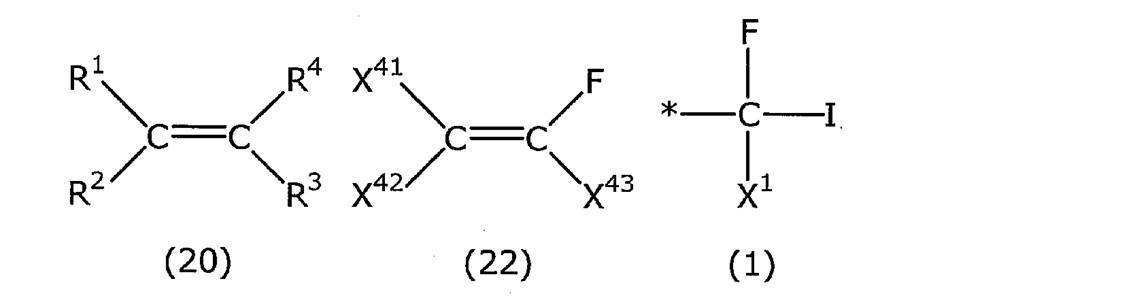
- X 1 and R 1 to R 4 have 1 to 20 carbon atoms which may independently have a hydrogen atom, a fluorine atom, a chlorine atom, or a substituent. Represents an organic group.
- X 11 to X 13 independently represent a hydrogen atom, a fluorine atom, a chlorine atom, or -CX 15 X 16 X 17 , and X 15 to X 17 independently represent a hydrogen atom and a fluorine atom. Represents an atom or chlorine atom.
- X 14 represents a fluorine atom or chlorine atom.
- the compound represented by the formula (20) is vinyl fluoride, vinylidene fluoride, trifluoroethylene, chlorotrifluoroethylene, tetrafluoroethylene, hexafluoropropylene, 2,3,3,3-tetrafluoro.
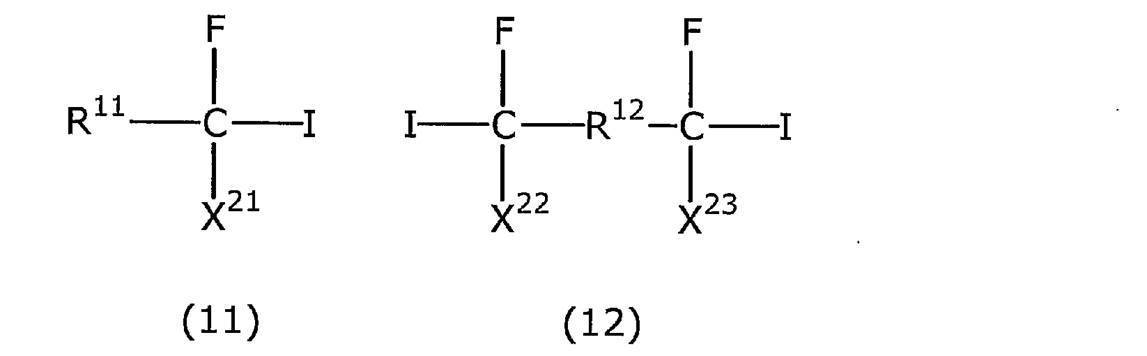
- ⁇ 4> The compound according to any one of ⁇ 1> to ⁇ 3>, wherein the compound (10) is a compound represented by the following formula (11) or a compound represented by the following formula (12). Production method.
- R 11 represents a perfluoroalkyl group having 1 to 4 carbon atoms.
- R 12 represents a perfluoroalkylene group having 1 to 4 carbon atoms.
- X 21 to X 23 are independent hydrogen atoms and fluorine atoms, respectively. , Chlorine atom, or -CX 24 X 25 X 26 , and X 24 to X 26 independently represent hydrogen atom, fluorine atom or chlorine atom.
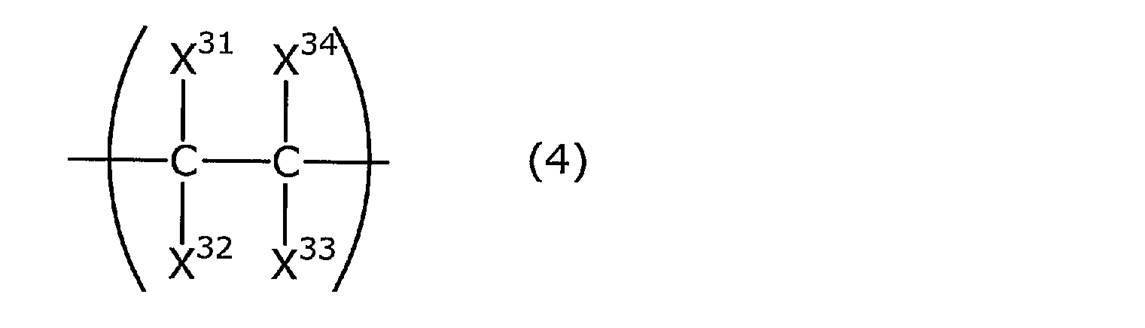
- ⁇ 5> The production method according to any one of ⁇ 1> to ⁇ 3>, wherein the compound (10) is a compound containing a plurality of units represented by the following formula (4).
- X 31 to X 34 independently represent a hydrogen atom, a fluorine atom, a chlorine atom, or -CX 35 X 36 X 37 , and X 35 to X 37 independently represent a hydrogen atom and a fluorine atom. Represents an atom or a chlorine atom.
- ⁇ 6> The production method according to ⁇ 5>, wherein the fluorine content of the compound (10) is 50% by mass or more.
- the compound represented by the formula (20) is vinylidene fluoride, trifluoroethylene, chlorotrifluoroethylene, tetrafluoroethylene, hexafluoropropylene, 2,3,3,3-tetrafluoropropylene or 1, 2-dichloro-1,2-difluoroethylene,
- ⁇ 8> The production method according to any one of ⁇ 1> to ⁇ 7>, wherein the obtained compound (30) is a polymer and the polydispersity of the polymer is 2.0 or less.
- the ionic catalyst comprises a monovalent anion containing at least one element selected from the group consisting of iodine, nitrogen and sulfur, and a counter cation, wherein the counter cation is at least one of nitrogen and phosphorus.
- a method for producing a copolymer which is a cation containing an element, an alkali metal ion, or a proton.
- X 1 and R 1 to R 4 are organic having 1 to 20 carbon atoms which may independently have a hydrogen atom, a fluorine atom, a chlorine atom, or a substituent. Representing a group.
- X 41 to X 43 independently represent a hydrogen atom, a fluorine atom, a chlorine atom, or -CX 45 X 46 X 47 , and X 45 to X 47 independently represent a hydrogen atom and a fluorine atom. Represents an atom or a chlorine atom.
- ⁇ 10> The production method according to ⁇ 9>, wherein the copolymerization is a block copolymerization.
- ⁇ 11> The production method according to ⁇ 9>, wherein the copolymerization is a random copolymerization.
- ⁇ 12> The production method according to ⁇ 9>, wherein the copolymerization is an alternating copolymerization.
- ⁇ 13> The production method according to any one of ⁇ 9> to ⁇ 12>, wherein the monovalent anion of the ionic catalyst is an iodine anion.
- ⁇ 14> The production method according to any one of ⁇ 9> to ⁇ 13>, wherein the ionic catalyst is tetraphenylphosphonium iodide.
- At least one of the compounds represented by the formula (20) is ethylene, propylene, isobutylene, alkyl vinyl ether, perfluoro (alkyl vinyl ether), triallyl isocyanurate, 1,4-divinyl octafluorobutane, 1,
- ⁇ 16> The production method according to any one of ⁇ 9> to ⁇ 15>, wherein the obtained copolymer has a polydispersity of 2.0 or less.
- the olefin insertion reaction proceeds very gently with respect to a specific fluorine-containing organic iodine compound in the presence of a specific ionic catalyst.
- a specific haloolefin is used as the olefin, the insertion reaction is repeated to obtain a polymerization reaction, and the radical polymerization reaction can be controlled.
- the obtained polymer can be imparted with desired properties such as flame retardancy and chemical resistance. Further, it is generally said that when a haloolefin is used as a raw material, the molecular weight distribution of the polymer is unlikely to be narrowed.
- the reaction can be controlled so as to have a desired number of subunits, and a polymer having a narrow molecular weight distribution can be obtained.
- the number of carbon atoms means the total number of carbon atoms contained in a certain group, and when the group does not have a substituent, it represents the number of carbon atoms forming the skeleton of the group, and the group represents a substituent. If it has, it represents the total number of carbon atoms forming the skeleton of the group plus the number of carbon atoms in the substituent.
- the aryl group means a monovalent group corresponding to a residue obtained by removing one hydrogen atom bonded to any one of the carbon atoms forming an aromatic ring in an aromatic compound, and is a carbocyclic compound.
- the arylene group means a divalent group corresponding to a residue from which one hydrogen atom bonded to any one of the carbon atoms of the aryl group has been removed.
- the reactive carbon-carbon double bond means a carbon-carbon double bond that can react in various ways as an olefin, and does not include an aromatic double bond.
- acrylic acid is a general term for acrylic acid and methacrylic acid.
- acrylate is a general term for acrylate and methacrylate.
- (Meta) acrylamide is a general term for acrylamide and methacrylamide.
- An organic group is a group having at least one carbon atom.
- the present invention in the presence of a specific ionic catalyst, a compound represented by the following formula (20) (compound (compound (20)) as opposed to a compound (10) having a partial structure represented by the following formula (1). 20))
- the present invention relates to a method for producing a compound (30) having a partial structure represented by the following formula (3) by the insertion reaction.
- the ionic catalyst comprises a monovalent anion and a countercation, and the monovalent anion contains at least one element selected from the group consisting of iodine, nitrogen and sulfur.
- the counter cation is a cation containing at least one element of nitrogen and phosphorus, an alkali metal ion, or a proton.
- * represents a bond.
- X 1 and R 1 to R 4 represent an organic group having 1 to 20 carbon atoms which may independently have a hydrogen atom, a fluorine atom, a chlorine atom, or a substituent.
- the compound (20) When the compound (20) is reacted with the compound (10) in the presence of a specific ionic catalyst, the compound (10) is subjected to the ionic catalyst represented by B ⁇ A + as shown in the following scheme.
- the CI bond in the partial structure (1) is broken to generate a carbon radical.
- a carbon radical having an unpaired electron in the terminal carbon reacts with a compound (20) having a reactive carbon-carbon double bond.
- the bond with the ionic catalyst is a reversible reaction, and the partial structure (3) is formed by recombination with respect to the carbon radical after the reaction with the compound (20).
- the compound (30) having That is, an insertion reaction of compound (20) with respect to compound (10) occurs.
- the counter cation is limited to a cation containing at least one element from the group consisting of nitrogen and phosphorus, an alkali metal ion or a proton.
- the compound (10) functions as a radical generator, and examples of the compound conventionally used as a radical generator include an azo compound and a peroxide.
- examples of the compound conventionally used as a radical generator include an azo compound and a peroxide.
- the portion corresponding to the partial structure (1) of the compound (10) has a structure of ⁇ CH 2 I, whether or not it functions as a radical generator varies depending on the structure of the compound (20).
- compound (10) has a partial structure (1), that is, a structure in which a fluorine atom is directly bonded to a carbon atom, such as -CFX 1 I, iodine is easily released to form the structure of compound (20). Regardless, it will function as a radical generator.
- the insertion reaction of the compound (20) proceeds without applying light or heat, and eventually the polymerization reaction proceeds.
- the amount of compound (20) inserted can be controlled by the reaction time due to the mildness of the reaction. That is, by selecting an appropriate reaction time, the compound (30) having a desired structure can be obtained with high purity. Further, when the compound (30) is a polymer obtained by repeating the insertion reaction of the compound (20) two or more times, the compound (30) having a narrow molecular weight distribution can be obtained.
- the ionic catalyst consists of a monovalent anion and its counter cation.
- the monovalent anion contains at least one element selected from the group consisting of iodine, nitrogen and sulfur.
- As the counter cation it is necessary to select a cation in which the ionic bond is not too strong, and it is a cation containing at least one element of nitrogen and phosphorus, an alkali metal ion or a proton.
- examples of the iodine-containing anion include iodide ion (I ⁇ ) and triiodide ion (I 3 ⁇ ).
- anions such as azide ion (N 3 -), cyanide ion (CN -), cyanate anion (OCN -), thiocyanate ion (SCN -) and the like.
- N 3 - azide ion
- CN - cyanide ion
- OCN - cyanate anion
- SCN - thiocyanate ion
- an iodine anion is preferable, and an iodide ion is more preferable, from the viewpoint of interaction with the iodine atom of the partial structure (1).
- examples of the nitrogen-containing cation include a quaternary ammonium cation such as tetrabutylammonium ((C 4 H 9 ) 4 N + ), and examples of the phosphorus-containing cation include tetra.
- Quaternary phosphonium cations such as phenylphosphonium ((C 6 H 5 ) 4 P +) can be mentioned.
- alkali metal ion include lithium ion, sodium ion, potassium ion, rubidium ion, and cesium ion.
- a phosphorus-containing cation or an alkali metal ion is preferable from the viewpoint of heat resistance
- a quaternary phosphonium cation is more preferable
- tetraphenylphosphonium is further preferable from the viewpoint of reactivity.
- tetraphenylphosphonium iodide tetrabutylammonium iodide, cesium iodide, lithium iodide and the like are preferable, and tetraphenylphosphonium iodide is more preferable.
- Compound (10) is a fluorine-containing organic iodine compound having a partial structure represented by the following formula (1).
- * represents a bond
- X 1 represents a hydrogen atom, a fluorine atom, a chlorine atom, or an organic group having 1 to 20 carbon atoms which may have a substituent.
- the substituent of the organic group include a fluorine atom, a chlorine atom, a hydroxy group, an alkoxy group, an amino group, a carboxylic acid group, a sulfonic acid group, a 1,3,5-triazintrione skeleton, an alkyl group and an alkoxyalkyl group.
- the alkyl group, alkoxyalkyl group and alkoxy group as the substituent of the organic group may be substituted with a fluorine atom, a chlorine atom or the like.
- the compound (10) may have the above-mentioned partial structure (1), and the structure of the entire compound is not limited at all. That is, the bond represented by * is not limited to an organic group such as a hydrocarbon group, and may be bonded to various functional groups such as a hydroxyl group and an amino group, a halogeno group (halogen atom) and a hydrogen atom. .. Further, the organic group may contain a hetero atom, and its valence and molecular weight are not particularly limited. As the organic group having 1 to 20 carbon atoms which may have a substituent represented by X 1 , a hydrocarbon group having 1 to 20 carbon atoms which may have a substituent is preferable, and the substituent may be used.
- a fluorine-containing hydrocarbon group having 1 to 20 carbon atoms which may be possessed is more preferable, and a fluorine-containing alkyl group having 1 to 20 carbon atoms is further preferable.
- the organic group having 1 to 20 carbon atoms which may have a substituent represented by X 1 preferably has 1 to 10 carbon atoms, and more preferably 1 to 6 carbon atoms.
- X 1 is a fluorine-containing hydrocarbon group having 1 to 20 carbon atoms which may have a substituent
- the fluorine atom content is preferably 50 mol% or more, more preferably 75 mol% or more, and 100. More preferably, mol% (perfluorohydrocarbon group).
- the fluorine atom content is the ratio at which the hydrogen atom contained in the hydrocarbon group is replaced with the fluorine atom.
- X 1 an organic group having 1 to 20 carbon atoms which may have a fluorine atom, a chlorine atom, or a substituent is preferable, and a fluorine atom, a chlorine atom, or a fluorine-containing alkyl group having 1 to 10 carbon atoms is preferable. More preferred.
- X 1 may represent ⁇ CX 2 X 3 X 4
- X 2 to X 4 may be independent groups representing a hydrogen atom, a fluorine atom or a chlorine atom.
- the compound (10) When the bond destination of the bond represented by * is an alkyl group or a halogen atom or a hydrogen atom which may have a substituent, the compound (10) has a monoiodo-containing fluorine having one partial structure (1). It becomes an organic compound. Further, when the bond destination of the bond represented by * is a divalent bond group such as an alkylene group or an ether bond which may have a substituent, the compound (10) has a partial structure (1). ) Is a diiodo-containing organic compound having two).
- the bond destination of the bond represented by * is a partial structure of a polymer such as an unsulfided fluoroepolymer, or 2 such as an alkylene group or an ether bond which may have a substituent.
- the compound (10) becomes a polyiodide-containing fluorine-containing organic compound having a large number of the partial structures (1).
- the polysiloxane may be silicone or a product produced by the condensation reaction of the silane coupling agent.
- the monoiodo-containing fluorine-containing organic compound generally has a structure represented by the following formula.
- R 10 is preferably an alkyl group, an aryl group, an arylalkyl group, or a hydrogen atom, a fluorine atom or a chlorine atom which may have a substituent.
- X 20 represents a hydrogen atom, a fluorine atom, a chlorine atom, or -CX 2 X 3 X 4 , and X 2 to X 4 independently represent a hydrogen atom, a fluorine atom, or a chlorine atom.
- the alkyl group which may have a substituent is preferably a linear, branched or cyclic alkyl group having 1 to 7 carbon atoms which may have a substituent.
- Alkyl groups having 1 to 7 carbon atoms include methyl group, ethyl group, n-propyl group, isopropyl group, n-butyl group, sec-butyl group, tert-butyl group, n-pentyl group and n-hexyl group. Cyclohexyl group, n-heptyl group and the like can be mentioned.
- a linear or branched alkyl group having 1 to 4 carbon atoms is more preferable, and a methyl group and an ethyl group are further preferable.
- Examples of the substituted alkyl group having 1 to 7 carbon atoms include an alkyl group having a substituent such as a fluorine atom, a chlorine atom, an alkoxy group, and a fluoroalkoxy group at an arbitrary position.
- an alkyl group having 2 to 15 fluorine atoms is more preferable
- a perfluoroalkyl group is more preferable from the viewpoint of suppressing the hydrogen atom abstraction reaction by radicals
- a perfluoroalkyl group having 1 to 6 carbon atoms is even more preferable.
- a perfluoroalkyl group having 1 to 4 carbon atoms is particularly preferable from the viewpoint of reducing bioaccumulation. That is, when R 10 is a substituted alkyl group, the compound (10) is particularly preferably a compound represented by the following formula (11).
- R 11 represents a perfluoroalkyl group having 1 to 4 carbon atoms
- X 21 represents a hydrogen atom, a fluorine atom, a chlorine atom, or -CX 24 X 25 X 26
- X 24 to X 26 are independent of each other. Then, it represents a hydrogen atom, a fluorine atom or a chlorine atom.
- X 21 is preferably a fluorine atom, a chlorine atom or -CX 24 X 25 X 26 (X 24 to X 26 independently represent a fluorine atom or a chlorine atom).
- X 21 is more preferably a fluorine atom or a trifluoromethyl group.
- the aryl group is preferably an aryl group having 3 to 12 carbon atoms or a heteroaryl group having 3 to 12 carbon atoms, and specifically, a phenyl group, a naphthyl group, a pyridyl group, a pyrrole group or a frill group. , Thienyl groups are more preferred.
- the arylalkyl group is preferably an arylalkyl group having 4 to 15 carbon atoms or a heteroarylalkyl group having 4 to 15 carbon atoms, and specifically, a benzyl group, a 2-pyridylmethyl group, or 3-. A pyridylmethyl group and a 4-pyridylmethyl group are more preferable.
- the monoiodo-containing fluorine-containing organic compound include difluoroiodomethane, trifluoroiodomethane, chlorodifluoroiodomethane, 1,1-difluoroethyl iodide, 1,1-difluoro-n-propyl iodide, 1, 1-difluoro-n-butyl iodide, 1,1-difluoro-isobutyl iodide, 1,1-difluoro-n-pentyl iodide, sec-butyl difluoromethylene iodide, tert-butyl difluoromethylene iodide, 1,1- Difluoro-n-hexyl iodide, 1,1-difluoro-n-heptyl iodide, 1,1-difluoro-n-octyl iodide, cyclohex
- CF 3 (CF 2 ) 3 I (n-nonafluorobutyl iodide) is preferable because it is easily available.
- monoiodo-containing fluorine-containing organic compounds from the viewpoint of easy extraction of iodine atoms, C 2 F 5 I, CF 3 CF 2 CF 2 I, (CF 3 ) 2 CFI, CF 3 (CF 2 ) 3 I , (CF 3 ) 2 CFCF 2 I, CF 3 (CF 2 ) 4 I and the like are preferable.
- the diiodot-containing fluorine-containing organic compound generally has a structure represented by the following formula.
- R 10 ' is an alkylene group which may have a substituent, an arylene group, an arylenealkylene group or alkylene arylenealkylene group.
- R 10 ' is a single bond preferred.
- X 20 independently represents a hydrogen atom, a fluorine atom, a chlorine atom, or -CX 2 X 3 X 4
- X 2 to X 4 independently represent a hydrogen atom, a fluorine atom, or a chlorine atom.
- R 10 ' as the alkylene group which may have a substituent, a linear, branched chain, or cyclic alkylene group having 1 to 6 carbon atoms which may have a substituent is preferable. ..
- the alkylene group having 1 to 6 carbon atoms include methylene group, ethylene group, n-propylene group, isopropylene group, n-butylene group, isobutylene group, n-pentylene group, n-hexylene group and 1,4-cyclohexylene.
- the group etc. can be mentioned.
- a linear or branched alkylene group having 1 to 4 carbon atoms is more preferable, and an ethylene group is further preferable.
- Examples of the substituted alkylene group having 1 to 6 carbon atoms include an alkylene group having a substituent such as a fluorine atom, a chlorine atom, an alkoxy group, and a fluoroalkoxy group at an arbitrary position.
- an alkylene group having 2 to 12 fluorine atoms is more preferable, a perfluoroalkylene group is more preferable from the viewpoint of suppressing a hydrogen atom abstraction reaction by a radical, and a perfluoroalkylene group having 1 to 4 carbon atoms is even more preferable.
- a perfluoroalkylene group having 2 to 4 carbon atoms is particularly preferable. That is, the compound (10), when R 10 'is a perfluoroalkylene group having 1 to 4 carbon atoms, a compound represented by the following formula (12).
- R 12 represents a perfluoroalkylene group having 1 to 4 carbon atoms.
- X 22 and X 23 independently represent a hydrogen atom, a fluorine atom, a chlorine atom, or -CX 24 X 25 X 26 , and X 24 to X 26 independently represent a hydrogen atom, a fluorine atom, or a chlorine atom. Represents.
- arylene group an arylene group having 3 to 12 carbon atoms and a heteroarylene group having 3 to 12 carbon atoms are preferable.
- arylene alkylene group an arylene alkylene group having 4 to 15 carbon atoms and a heteroarylene alkylene group having 4 to 15 carbon atoms are preferable.
- a benzylene group, a 2-pyridylene methylene group, a 3-pyridylene methylene group, and a 4-pyridylene methylene group are more preferable.
- alkylene arylene alkylene group an alkylene arylene alkylene group having 5 to 18 carbon atoms and an alkylene heteroarylene alkylene group having 5 to 18 carbon atoms are preferable.
- 1,2-dimethylenephenylene group, 1,3-dimethylenephenylene group, 1,4-dimethylenephenylene group, 2,2'-dimethylene biphenylylene group, 2,4-dimethylenepyryl More preferably, a dilen group, a 2,5-dimethylenepyridylene group, a 2,6-dimethylenepyridylene group and a 1,5-dimethylfurandiyl group.
- diiodo-containing fluorine-containing organic compound examples include 1,2-diiodottetrafluoroethane, 1,4-diiodo-octafluorobutane, and 1,6-diiodo-dodecafluorohexane.
- 1,4-diiodo-octafluorobutane is preferable from the viewpoint of a low volatile liquid that is easy to handle.
- the method for producing the diiodot-containing fluorine-containing organic compound is not particularly limited, and can be obtained by a conventionally known method.
- the bond destination of the bond represented by * in the partial structure (1) is a partial structure of a fluorine-containing polymer such as an unvulcanized fluoroelastomer or polysiloxane. This is the case of the partial structure of.
- the bond destination of the bond represented by * in the partial structure (1) is a partial structure of polysiloxane, it may have a substituent via a divalent bond group such as an alkylene group or an ether bond.
- the case where the partial structure (1) is bonded to polysiloxane may be mentioned.
- the polysiloxane may be silicone or a product produced by the condensation reaction of the silane coupling agent.
- the compound (10) may be a compound containing a plurality of units represented by the following formula (4).
- the fluorine content of the compound (10) is preferably 50% by mass or more, preferably 60% by mass from the viewpoint of heat resistance and flame retardancy. % Or more is more preferable.
- the compound (20) can be inserted as many as the number of the partial structures (1) of the compound (10), but the compound (20) is not partially inserted. It may remain.
- the polyiodide-containing fluorine-containing organic compound can be produced by a conventionally known method.
- X 31 to X 34 independently represent a hydrogen atom, a fluorine atom, a chlorine atom, or -CX 35 X 36 X 37 , and X 35 to X 37 independently represent a hydrogen atom and a fluorine atom. Represents an atom or a chlorine atom.
- the compound (10) is subjected to an insertion reaction of a compound represented by the following formula (20).
- R 1 to R 4 each independently represent a hydrogen atom, a fluorine atom, a chlorine atom, or an organic group having 1 to 20 carbon atoms which may have a substituent.
- the insertion reaction of at least one molecule with respect to compound (10) proceeds.
- the organic group having 1 to 20 carbon atoms which may have a substituent in R 1 to R 4 preferably has 1 to 12 carbon atoms. Further, the organic group may be linear, branched or cyclic, and may contain an unsaturated bond. Further, a hetero atom may be contained as a substituent, and a hetero atom may be contained in the substituent main chain.
- Examples of the organic group include an alkyl group, an aryl group, a heteroaryl group, an aryloxy group, a heteroaryloxy group, an alkoxy group, an arylalkyl group, a heteroarylalkyl group, an arylalkoxy group, a heteroarylalkoxy group and a carboxy group. , Alkoxycarbonyl group, carbamoyl group, acylamino group, acyloxy group, cyano group and the like.
- the hydrocarbon group may be linear, branched or cyclic, and may contain an unsaturated bond.
- the acyl group of the acylamino group or the acyloxy group include a group obtained by removing a hydroxy group from a carboxylic acid or a sulfonic acid.
- Examples of the organic group which may have a substituent include a substituted alkyl group, a substituted alkoxy group, a substituted alkoxycarbonyl group, an N-substituted carbamoyl group and the like.
- the number of substituents may be one or two or more.
- Examples of the substituent of the substituted alkyl group include a fluorine atom, a chlorine atom, a hydroxy group, an alkoxy group, an amino group, a carboxylic acid group, a sulfonic acid group, and a 1,3,5-triazintrione skeleton.
- Examples of the substituent of the substituted alkoxy group include a fluorine atom, a hydroxy group, an amino group and the like.
- Examples of the substituent of the substituted alkoxycarbonyl group include a fluorine atom, a hydroxy group, an amino group and the like.
- Examples of the substituent of the N-substituted carbamoyl group include an alkyl group and an alkoxyalkyl group.
- compound (20) in addition to the above, in compound (20), R 1 and R 2 , R 2 and R 3 , R 3 and R 4 , or R 4 and R 1 are combined to form a ring. You may be doing it. That is, compound (20) also includes maleic anhydride, itaconic anhydride and the like. Further, the compound (20) also includes a compound having a plurality of reactive carbon-carbon double bonds. That is, compound (20) also includes diallyl compounds such as diallylamine and triallyl isocyanurate, and triallyl compounds.
- compound (20) consists of a group consisting of at least two of R 1 to R 4 consisting of a hydrogen atom, a fluorine atom, a chlorine atom and a methyl group. It is preferable to be selected.
- Examples of the compound (20) include methyl (meth) acrylate, ethyl (meth) acrylate, propyl (meth) acrylate, butyl (meth) acrylate, octyl (meth) acrylate, and lauryl (meth) acrylate. Etc.
- (meth) acrylic acid ester monomer cycloalkyl group-containing unsaturated monomer such as (meth) cyclohexyl acrylate, methyl cyclohexyl (meth) acrylate, isobornyl (meth) acrylate, cyclododecyl (meth) acrylate; Meta) Carboxy group-containing unsaturated monomers such as acrylic acid, maleic acid, fumaric acid, itaconic acid, citraconic acid, crotonic acid, maleic anhydride, itaconic anhydride; N, N-dimethylaminopropyl (meth) acrylamide, N, Tertiary amine-containing unsaturated monomers such as N-dimethylaminoethyl (meth) acrylamide, 2- (dimethylamino) ethyl (meth) acrylate, N, N-dimethylaminopropyl (meth) acrylate; N-2-hydroxy-3 -
- Epoxy group-containing unsaturated monomer styrene, ⁇ -methylstyrene, 4-methylstyrene, 2-methylstyrene, 3-methylstyrene, 4-methoxystyrene, 2-hydroxymethylstyrene, 2-chlorostyrene, 4-chlorostyrene, 2,4-Dichlorostyrene, 1-vinylnaphthalene, divinylbenzene, 4- (chloromethyl) styrene, 2- (chloromethyl) styrene, 3- (chloromethyl) styrene, 4-styrene sulfonic acid or an alkali metal salt thereof ( Styrene-based monomers such as sodium salt, potassium salt, etc.); Heterocycle-containing unsaturated monomers such as 2-vinylthiophene and N-methyl-2-vinylpyrrole; Vinylamides such as N-vinylformamide and N-vinylacetamide; Triallyl
- R 1 to R 4 are independently hydrogen atoms, fluorine atoms, chlorine atoms, or -CX 15 X 16 X 17 (X 15 to X 17 are independent hydrogen atoms, respectively. It represents an atom, a fluorine atom or a chlorine atom)), which is preferable from the viewpoint of the reactivity of the insertion reaction. Above all, it is more preferable that at least one of R 1 to R 4 is a fluorine atom or a chlorine atom. That is, the compound (20) is more preferably a compound represented by the following formula (21).
- X 11 to X 13 independently represent a hydrogen atom, a fluorine atom, a chlorine atom, or -CX 15 X 16 X 17 , and X 15 to X 17 independently represent a hydrogen atom and a fluorine atom, respectively. Or represents a chlorine atom.
- X 14 represents a fluorine atom or a chlorine atom.
- compound (21) when only one of X 11 to X 13 is -CX 15 X 16 X 17 , compound (21) has a propylene structure.
- the fluorine atom or the chlorine atom is X 14
- X 12 Is more preferably ⁇ CX 15 X 16 X 17.
- each of X 11 to X 13 is independently a hydrogen atom, a fluorine atom or a chlorine atom.
- X 14 is preferably a fluorine atom.
- Preferred specific examples of the above compound (21) are vinyl fluoride, vinylidene fluoride, trifluoroethylene, chlorotrifluoroethylene, tetrafluoroethylene, hexafluoropropylene, 2,3,3,3-tetrafluoro.
- Examples thereof include propylene, vinylidene chloride, vinyl chloride, 1-chloro-1-fluoroethylene, 1,2-dichloro-1,2-difluoroethylene and the like.
- the compound in which X 14 is a fluorine atom is represented by the following formula (22).
- X 41 to X 43 independently represent a hydrogen atom, a fluorine atom, a chlorine atom, or -CX 45 X 46 X 47
- X 45 to X 47 independently represent a hydrogen atom and a fluorine atom, respectively.
- Or represents a chlorine atom.
- the compound (22) includes vinylidene fluoride, trifluoroethylene, chlorotrifluoroethylene, tetrafluoroethylene, hexafluoropropylene, 2, 3, 3, 3 from the viewpoint of polymerization reactivity when obtaining a polymer described later.
- -Tetrafluoropropylene and 1,2-dichloro-1,2-difluoroethylene are more preferable.
- R 3 and R 4 are X 1 and F (in no particular order) of the partial structure (1), respectively, that is, in the partial structure (3).
- the structure is such that a fluorine atom and an organic group having 1 to 20 carbon atoms which may have a hydrogen atom, a fluorine atom, a chlorine atom, or a substituent are bonded to the terminal carbon atom, the compound (30).
- the insertion reaction of the second molecule of compound (20) proceeds. That is, it can be rephrased that a polymerization reaction occurs.
- compound (20) is vinylidene fluoride (1,1-difluoroethylene), and only one of R 1 and R 2 and R 3 and R 4 is X 1 and F (in no particular order). In some cases, if the locations corresponding to R 3 and R 4 are X 1 and F (in no particular order), the polymerization reaction proceeds. On the other hand, when the locations corresponding to R 1 and R 2 are X 1 and F (in no particular order), the insertion reaction does not proceed any further and the polymerization reaction is stopped. Further, when the compound (20) is 1,2-difluoroethylene and all of R 1 and R 2 and R 3 and R 4 are X 1 and F (in no particular order), the polymerization reaction proceeds.
- the insertion reaction that is, the radical polymerization reaction proceeds very gently, so that the polymerization reaction can be stopped at a desired molecular weight. That is, a high-purity polymer having a narrow molecular weight distribution can be obtained. Since the above polymerization reaction has a slow reaction rate, it is preferably used when producing a high-purity oligomer. However, since the polymerization reaction proceeds as the reaction time is lengthened, it does not exclude the use of the production method according to the present invention when producing a high molecular weight polymer.
- the compound (20) may be used alone or in combination of two or more.
- the preferable compound (20) as a monomer is, for example, vinylidene fluoride, trifluoroethylene, chlorotrifluoroethylene, tetrafluoroethylene, hexafluoropropylene, 2, Examples thereof include 3,3,3-tetrafluoropropylene and 1,2-dichloro-1,2-difluoroethylene.
- the plurality of compounds (20) may be mixed or sequentially used.
- random copolymerization and alternate copolymerization can be considered.
- block copolymerization can be considered.
- radical generation which is a compound different from compound (10)
- Agents hereinafter, may be referred to as “other radical generators”.
- the molecular weight distribution of the obtained polymer is wider than that of the polymerization reaction using only the compound (10), but the molecular weight distribution is extremely narrow as compared with the conventional radical polymerization. It becomes a thing.
- radical generators can be used without particular limitation as long as they are azo compounds or peroxides used in ordinary radical polymerization.
- azo compound examples include 2,2'-azobis (isobutyronitrile) (AIBN), 2,2'-azobis (2-methylbutyronitrile) (AMBN), and 2,2'-azobis (2,).
- 4-Dimethylvaleronitrile) ADVN
- 1,1'-azobis (1-cyclohexanecarbonitrile) ACBN
- dimethyl-2,2'-azobisisobutyrate MAIB
- 4,4'-azobis 4-Cyanovaleric acid) (ACVA)
- 1,1'-azobis (1-acetoxy-1-phenylethane 2,2'-azobis (2-methylbutylamide
- 2,2'-azobis (4-) Methoxy-2,4-dimethylvaleronitrile 2,2'-azobis (2-methylamidinopropane) dihydrochloride
- azo compounds are preferably selected as appropriate according to the reaction conditions.
- ADVN 2,2'-azobis (2,4-dimethylvaleronitrile)
- Etc 2,2'-azobis (4-methoxy-2,4-dimethylvaleronitrile)
- 1,1'-azobis (1-cyclohexanecarbonitrile) ACBN
- 2-cyano-2-propylazoformamide 2,2'-azobis (N-butyl-2) -Methylpropionamide)
- 2,2'-azobis N-cyclohexyl-2-methylpropionamide
- 2,2'-azobis 2,4,4-trimethylpentane
- 2,2'-azobis [2- Methyl-N- (2-hydroxyethyl) propionamide] and the like are preferably used.
- the compound (30) is obtained by the insertion reaction of the compound (20) with the compound (10) in the presence of a specific ionic catalyst.
- the ratio of the other radical generator to 1 mol of the compound (10) is usually 0.01 to 100 mol, preferably 0.1 mol. As described above, preferably 10 mol or less, more preferably 1 mol or less is used.
- the amount to be used is usually 0.01 mol of the diiodo-containing fluorine-containing organic compound with respect to 1 mol of the monoiodo-containing fluorine-containing organic compound.
- preferably 0.05 mol or more, more preferably 0.1 mol or more, and 100 mol or less, preferably 10 mol or less, more preferably 5 mol or less are used.
- the method for performing the above insertion reaction is as follows.
- the ionic catalyst, compound (20) and compound (10) are mixed in a container replaced with an inert gas or in a vacuum-depressurized container.
- an inert gas include nitrogen, argon and helium. Among these, nitrogen or argon is preferable, and nitrogen is more preferable.
- the above insertion reaction can be carried out without a solvent, but it can also be carried out using an organic solvent (including an ionic liquid) or an aqueous solvent usually used in general radical polymerization.
- organic solvent examples include benzene, toluene, N, N-dimethylformamide (DMF), dimethyl sulfoxide (DMSO), acetone, 2-butanone (methylethylketone), dioxane, hexafluoroisopropaol, chloroform, carbon tetrachloride, and the like.
- Tetrahydrofuran THF
- ethyl acetate 1H-perfluorohexane
- 1H, 1H, 1H, 2H, 2H-perfluorooctane trifluoromethylbenzene (benzotrifluoride)
- 1,3-bis (trifluoromethyl) benzene 1, Examples thereof include 4-bis (trifluoromethyl) benzene.
- N-methyl-N-methoxymethylpyrrolidium tetrafluoroborate N-methyl-N-ethoxymethyltetrafluoroborate, 1-methyl-3-methylimidazolium tetrafluoroborate, 1-methyl-3-methylimidazolium Ionic liquids such as hexafluorophosphate and 1-methyl-3-methylimidazolium chloride can also be used.
- aqueous solvent examples include water, methanol, ethanol, isopropanol, n-butanol, ethyl cellosolve, butyl cellosolve, 1-methoxy-2-propanol, diacetone alcohol and the like.
- the amount of the solvent used may be adjusted as appropriate.
- 0.01 to 50 L of the solvent can be used with respect to 1000 g of the obtained compound (30). It can be preferably used in an amount of 0.05 L or more, more preferably 0.1 L or more, preferably 10 L or less, and more preferably 5 L or less.
- the reaction temperature and reaction time may be appropriately adjusted according to the molecular weight of the obtained compound (30) and the molecular weight distribution of the compound (30) when it is a polymer, but are usually 5 to 250 ° C. Stir for 100 hours.
- the mixture is stirred at 100 to 200 ° C. for 10 to 30 hours.
- stirring is usually performed at normal pressure, but pressurization or depressurization may be performed.
- the solvent used and the residual monomer are removed under reduced pressure by a conventional method to take out the target compound (30), or reprecipitation treatment is performed using a solvent in which the target compound (30) is insoluble.
- the target product (compound (30)) is isolated.
- the reaction treatment can be carried out by any treatment method as long as the target product is not hindered.
- compound (30) When compound (30) is a high molecular weight polymer, its molecular weight can be adjusted by the reaction time, the type and amount of the ionic catalyst, and the amount of compound (10) which is an organic iodine compound.
- a polymer having an average molecular weight (Mn) of 100 to 1,000,000 can be obtained. In particular, it is suitable for obtaining a polymer having a number average molecular weight (Mn) of 300 to 50,000. In this case, it is preferable to use another radical generator in combination.
- the number average molecular weight (Mn) and the weight average molecular weight (Mw) in the present specification are determined by SEC (Size Exclusion Chromatography) measurement, and polystyrene is used as a standard material for molecular weight conversion.
- the degree of polydispersity, which is an index of the molecular weight distribution, is a value obtained by Mw / Mn.
- the compound (30) is a single molecule insert or a double molecule insert of the compound (20), which is useful as an intermediate for medicines and agricultural chemicals
- a radical generator which is a compound different from the compound (10) is used in combination. It is preferable not to do so.
- the molecular weight of compound (30) can be adjusted by the reaction time, the type and amount of the ionic catalyst, and the amount of compound (10), as in the case of the high molecular weight polymer. In this case, it is suitable to obtain an insert with a high selectivity.
- 1 mol of compound (20) is used.
- Compound (10) is used in an amount of 0.1 to 100 mol, preferably 1 to 20 mol.
- the degree of polydispersity ⁇ PD Mw (weight average molecular weight) / Mn (number average molecular weight) ⁇ when compound (30) is a polymer is, for example, 2.0 or less even when other radical generators are used in combination. Can be controlled with. It is also possible to obtain a polymer having a very narrow molecular weight distribution, preferably 1.5 or less, more preferably 1.4 or less.
- the lower limit of the degree of polydispersity is 1.0 from the definition.
- compound (30) is a single molecule insert or a double molecule insert of compound (20), which is useful as an intermediate for medicines and pesticides, use only compound (10) without using other radical generators in combination. Therefore, the selectivity can be controlled to 90% or more.
- the terminal group of the obtained compound (30) is a highly reactive iodine atom derived from the organic iodine compound (compound (10)). Therefore, by using the ionic catalyst and the compound (10) which is an organic iodine compound in the insertion reaction and the radical polymerization reaction, the terminal group is converted into another functional group as compared with the polymer obtained by the conventional radical polymerization. It becomes easy.
- the obtained compound (30) can also be used as a macro radical polymerization initiator (macro initiator) or a macro radical chain transfer agent. Therefore, the copolymerization reaction described below can also be carried out using the insertion reaction.
- the second embodiment of the present invention comprises two reactions relating to a method for producing a copolymer by copolymerization using two or more kinds of compounds represented by the following formula (20) (compound (20)).
- the first reaction at least one of the compound (20) is a compound represented by the following formula (22) (compound (22)), which is represented by the following formula (1) in the presence of an ionic catalyst.
- This is a reaction in which the compound (22) is inserted into the compound (10) having a partial structure to be subjected to. By such an insertion reaction, a compound having a partial structure represented by the following formula (5) is produced.
- the second reaction is a reaction in which the compound (20) is inserted into the CI bond using a radical generator (another radical generator) which is a compound different from the compound (10). is there.
- a compound having a partial structure represented by the following formula (6) is produced.
- the ionic catalyst is composed of a monovalent anion and a counter cation, and the monovalent anion is a monovalent anion containing at least one element selected from the group consisting of iodine, nitrogen and sulfur.
- the counter cation is a cation containing at least one element of nitrogen and phosphorus, an alkali metal ion, or a proton.
- the compound exemplified in [Ionic catalyst] of the above ⁇ insertion reaction> can be preferably used.
- R 1 to R 4 each independently represent a hydrogen atom, a fluorine atom, a chlorine atom, or an organic group having 1 to 20 carbon atoms which may have a substituent.
- X 41 to X 43 independently represent a hydrogen atom, a fluorine atom, a chlorine atom, or -CX 45 X 46 X 47 , and X 45 to X 47 independently represent a hydrogen atom, a fluorine atom, or a chlorine atom.
- X 1 represents a hydrogen atom, a fluorine atom, a chlorine atom, or an organic group having 1 to 20 carbon atoms which may have a substituent.
- the insertion reaction of compound (22) with respect to compound (10) is as described in the above ⁇ insertion reaction>, and the insertion reaction of compound (22) occurs with respect to the CI bond in the partial structure (1). .. Further, when R 3 and R 4 in the partial structure (6) are X 1 and F (in no particular order), the insertion reaction of the compound (22) also occurs for the CI bond in the partial structure (6). Occur. A preferred embodiment of such an insertion reaction is the same as that described in the above ⁇ insertion reaction>.
- the insertion reaction of compound (20) into the CI bond using another radical generator is for either the CI bond in the partial structure (5) or the CI bond in the partial structure (6). But it can happen.
- the compound (20) the compound exemplified in [Compound (20)] of the above ⁇ insertion reaction> can be preferably used.
- the compound (20) used here does not exclude the compound (22) at all.
- Preferred (meth) acrylic acid ester monomers include methyl (meth) acrylate, ethyl (meth) acrylate, propyl (meth) acrylate or butyl (meth) acrylate. More preferably, it is methyl (meth) acrylate or butyl (meth) acrylate.
- Preferred styrene-based monomers include styrene, ⁇ -methylstyrene, 2-methylstyrene, 4-methylstyrene, 4-methoxystyrene, 4-chlorostyrene, 4- (chloromethyl) styrene, divinylbenzene, and 4-styrenesulfonic acid.
- an alkali metal salt thereof sodium salt, potassium salt
- it is styrene, 4-methoxystyrene, 4-chlorostyrene or 4- (chloromethyl) styrene.
- Preferred alkyl vinyl ethers include methyl vinyl ether and ethyl vinyl ether.
- Preferred perfluoro (alkyl vinyl ether) includes perfluoro (methyl vinyl ether), perfluoro (ethyl vinyl ether), and perfluoro (n-propyl vinyl ether).
- ethylene, propylene, isobutylene, alkyl vinyl ether, perfluoro (alkyl vinyl ether), triallyl isocyanurate, 1,4-divinyl octafluorobutane, 1,6-divinyl dodecafluorohexane, styrene, or butyl acrylate is further added. preferable.
- radical generators Other radical generators can be used without particular limitation as long as they are azo compounds or peroxides used in ordinary radical polymerization. Specifically, the same compounds as those described in (Other radical generators) in the above ⁇ insertion reaction> can be used.
- the compound (20) is subjected to a reaction of inserting the compound (22) into the compound (10) in the presence of a specific ionic catalyst, and another radical generator is used.
- the present invention relates to a method for producing a copolymer by copolymerizing two or more kinds of compounds (20), including a reaction of inserting into a CI bond.
- a copolymer is produced by repeating each of these two insertion reactions two or more times. Further, it is classified into the following block copolymerization, alternate copolymerization, and random copolymerization forms according to the repetition method.
- the degree of polydispersity of the copolymer can be controlled to 2.0 or less regardless of how the two insertion reactions are repeated when synthesizing the copolymer.
- Block copolymers can be mentioned as one form of copolymerization.
- AB diblock copolymers such as tetrafluoroethylene-butyl acrylate and the like can be used.
- BAB triblock copolymers such as butyl acrylate-tetrafluoroethylene-butyl acrylate and the like can be obtained.
- the method for producing a block copolymer is as follows.
- a tetrafluoroethylene-butyl acrylate copolymer is produced as the AB diblock copolymer, it is as follows. Similar to the method described in [Method for producing compound (30)] described above, first, tetrafluoroethylene, an ionic catalyst, and a monoiodoide-containing organic compound as compound (10) are mixed and the insertion reaction is repeated. Polymerize to produce polytetrafluoroethylene. Subsequently, butyl acrylate can be mixed to obtain a tetrafluoroethylene-butyl acrylate copolymer. Other radical generators may be mixed with tetrafluoroethylene or the like or with butyl acrylate.
- a method of using a diiodo-containing fluorine-containing organic compound instead of a monoiodo-containing fluorine-containing organic compound can be mentioned in the above-mentioned method for producing an AB diblock copolymer. ..
- the same conditions as those described in the above ⁇ insertion reaction> can be used.
- the reaction for producing each block (corresponding to A block) and then the next block (corresponding to B block) may be started as it is, or the reaction may be terminated once. Then, after purification, the reaction of the next block may be started. Isolation of the block copolymer can be carried out by a usual method.
- the molecular weight of the polymer obtained by block copolymerization can be adjusted by the reaction time and the amount of the partial structure (1).
- a polymer having a number average molecular weight of 1,000 to 2,000,000 can be obtained.
- it is suitable for obtaining a polymer having a number average molecular weight of 2,000 to 100,000.
- the degree of polydispersity of the polymer obtained by block copolymerization ⁇ PD Mw (weight average molecular weight) / Mn (number average molecular weight) ⁇ can be controlled to, for example, 2.0 or less. Furthermore, it is also possible to obtain a polymer having a very narrow molecular weight distribution of 1.5 or less, and even 1.4 or less.
- the lower limit of the degree of polydispersity is 1.0 from the definition.
- Random copolymerization, alternating copolymerization examples include random copolymerization and alternate copolymerization, in which the insertion reaction of compound (22) using a specific ionic catalyst and compound (10) and the compound using another radical generator ( By performing the insertion reaction of 20) at the same time, a random copolymer or an alternating copolymer can be obtained.
- Whether the obtained copolymer becomes a random copolymer or an alternating copolymer depends on the monomer reactivity ratio (type) and the relative amount of the monomers (compound (22) and compound (20)). Determined by.
- the compound (20) is preferably perfluoro (methyl vinyl ether), perfluoro (ethyl vinyl ether), or perfluoro (n-propyl vinyl ether). Further, as the compound (22), tetrafluoroethylene is preferable.
- examples of the combination of the compound (20) and the compound (22) include ethylene-tetrafluoroethylene, propylene-tetrafluoroethylene, alkyl vinyl ether-chlorotrifluoroethylene and the like.
- the molecular weight of the polymer obtained by random copolymerization can be adjusted by the reaction time and the amount of the partial structure (1), and for example, a polymer having a number average molecular weight of 500 to 1,000,000 can be obtained. In particular, it is suitable for obtaining a polymer having a number average molecular weight of 1,000 to 50,000.
- the degree of polydispersity of the polymer obtained by random copolymerization ⁇ PD Mw (weight average molecular weight) / Mn (number average molecular weight) ⁇ is controlled, for example, to be 2.0 or less. It is also possible to obtain a polymer having a very narrow molecular weight distribution, preferably 1.5 or less, more preferably 1.4 or less.
- the lower limit of the degree of polydispersity is 1.0 from the definition.
- the molecular weight of the polymer obtained by alternating copolymerization can be adjusted by the reaction time and the amount of the partial structure (1), and for example, a polymer having a number average molecular weight of 500 to 1,000,000 can be obtained. In particular, it is suitable for obtaining a polymer having a number average molecular weight of 1,000 to 50,000.
- the degree of polydispersity of the polymer obtained by alternating copolymerization ⁇ PD Mw (weight average molecular weight) / Mn (number average molecular weight) ⁇ is controlled, for example, to be 2.0 or less. It is also possible to obtain a polymer having a very narrow molecular weight distribution, preferably 1.5 or less, more preferably 1.4 or less.
- the lower limit of the degree of polydispersity is 1.0 from the definition.
- Example 1 0.40 g (0.87 mmol) of tetraphenylphosphonium iodide and 30 g (87 mmol) of n-nonafluorobutyl iodide in a stainless steel autoclave with a stirrer having an internal volume of 30 mL in a nitrogen-substituted glove box. was prepared. After press-fitting 1.0 g (10 mmol) of tetrafluoroethylene, stirring was started while raising the internal temperature to 160 ° C. When stirring was performed at 200 rpm (200 rpm) for 1 hour while maintaining the internal temperature, the internal pressure decreased from 1.1 MPa (gauge pressure) to 1.0 MPa. After cooling with ethylene glycol at ⁇ 20 ° C. in which the autoclave was circulated, unreacted tetrafluoroethylene was purged.
- the resulting polymer solution was measured by gas chromatography, n- conversion of nonafluorobutyl iodide is 1%, C 6 F 13 I selectivity of was 99 mol%.
- the calculated polydispersity (Mw / Mn) of the fluorine-containing polymer is 1.1 or less, and this radical polymerization shows the characteristics of living radical polymerization.
- Example 2 0.40 g (0.87 mmol) of tetraphenylphosphonium iodide and 30 g (87 mmol) of n-nonafluorobutyl iodide in a stainless steel autoclave with a stirrer having an internal volume of 30 mL in a nitrogen-substituted glove box. was prepared. After press-fitting 0.6 g (10 mmol) of chloroethylene, stirring was started while raising the internal temperature to 160 ° C. When stirring was performed at 200 rpm for 1 hour while maintaining the internal temperature, the internal pressure decreased from 0.9 MPa to 0.8 MPa. After cooling with ethylene glycol at ⁇ 20 ° C. in which the autoclave was circulated, unreacted chloroethylene was purged.
- Example 3 In a nitrogen-substituted glove box, 0.27 g (0.57 mmol) of tetraphenylphosphonium iodide and 0.06 g (0.11 mmol) of 1,4 in a stainless steel autoclave with an internal volume of 30 mL. -Diode-octafluorobutane, 1.3 g (4.8 mmol) of perfluoro (n-propyl vinyl ether), 25 g of 1H-perfluorohexane were charged. After press-fitting 1.0 g (10 mmol) of tetrafluoroethylene, stirring was started while raising the internal temperature to 140 ° C.
- the obtained polymer solution was vacuum dried to obtain a solid.
- the solid was added to 20 mL of methanol and stirred for 1 hour, after which the solid was collected by filtration.
- 0.26 g of a solid was obtained, confirming the production of a high molecular weight substance.
- Example 4 In a nitrogen-substituted glove box, 0.47 g (1.0 mmol) of tetraphenylphosphonium iodide and 0.07 g (0.2 mmol) of n-nona in a stainless steel autoclave with an internal volume of 30 mL. Fluorobutyl iodide, 0.02 g (0.2 mmol) of calcium carbonate, and 20 g of benzotrifluoride were charged. After press-fitting 1.2 g (10 mmol) of chlorotrifluoroethylene, stirring was started while raising the internal temperature to 140 ° C. When stirring was performed at 200 rpm for 7 hours while maintaining the internal temperature, the internal pressure decreased from 0.5 MPa to 0.4 MPa. After cooling the autoclave with circulating water at 25 ° C., unreacted chlorotrifluoroethylene was purged.
- the obtained polymer solution was vacuum dried to obtain a solid.
- the solid was added to 20 mL of methanol and stirred for 1 hour, after which the solid was collected by filtration.
- the obtained solid was vacuum dried to obtain 0.13 g of a liquid.
- the calculated polydispersity (Mw / Mn) of the fluorine-containing polymer is 1.2, and this radical polymerization shows the characteristics of living radical polymerization.
- Example 5 0.23 g (0.50 mmol) of tetraphenylphosphonium iodide, 0.1 g of weight obtained in Example 4 in a stainless steel autoclave with a stirrer having an internal volume of 30 mL in a nitrogen-substituted glove box. Combined, 0.64 g (5.0 mmol) of n-butyl acrylate and 20 g of benzotrifluoride were charged. Stirring was started while raising the internal temperature to 140 ° C. Stirring was performed at 200 rpm for 5 hours while maintaining the internal temperature. The autoclave was cooled with circulating water at 25 ° C.
- the obtained polymer solution was vacuum dried to obtain a solid.
- the solid was added to 50 mL of benzotrifluoride and stirred for 10 minutes, and the solid was filtered off.
- the obtained filtrate was vacuum dried to obtain 0.4 g of a solid.
- the calculated polydispersity (Mw / Mn) of the fluorine-containing polymer is 1.4, and this radical polymerization shows the characteristics of living radical polymerization.
- Example 6 0.47 g (1.0 mmol) of tetraphenylphosphonium iodide and 0.07 g (0.2 mmol) of n-nona in a stainless steel autoclave with a stirrer having an internal volume of 30 mL in a nitrogen-substituted glove box. Fluorobutyl iodide, 1.3 g (10 mmol) of n-butyl acrylate, 0.02 g (0.2 mmol) of calcium carbonate, and 20 g of benzotrifluoride were charged. After press-fitting 1.2 g (10 mmol) of chlorotrifluoroethylene, stirring was started while raising the internal temperature to 140 ° C.
- the obtained polymer solution was vacuum dried to obtain a solid.
- the solid was added to 20 mL of methanol and stirred for 1 hour, after which the solid was collected by filtration.
- the obtained solid was vacuum dried to obtain 0.4 g of a solid.
- the calculated polydispersity (Mw / Mn) of the fluorine-containing polymer was 1.7.
- Example 7 0.40 g (0.87 mmol) of tetraphenylphosphonium iodide and 30 g (87 mmol) of n-nonafluorobutyl iodide in a stainless steel autoclave with a stirrer having an internal volume of 30 mL in a nitrogen-substituted glove box. , 0.82 g (3.3 mmol) of triallyl isocyanurate and 25 g of 1H-perfluorohexane were charged. Stirring was started while raising the internal temperature to 140 ° C. Stirring was performed at 200 rpm for 5 hours while maintaining the internal temperature. The autoclave was cooled with circulating water at 25 ° C.
- the obtained polymer solution was not gelled, suggesting that the polymerization reaction was highly controlled.
- the polymer solution was vacuum dried to give a solid.
- the solid was added to 50 mL of 1H-perfluorohexane and stirred for 10 minutes, and the solid was filtered off.
- the obtained filtrate was vacuum dried to obtain 2.4 g of a solid.
- 1 H-NMR and 19 F-NMR of the obtained solid were measured, the molar ratio of n-nonafluorobutyl group to triallyl isocyanurate in the fluorine-containing copolymer was calculated to be 63:37.
- Example 8 In a nitrogen-substituted glove box, 0.32 g (0.87 mmol) of tetrabutylammonium iodide and 30 g (87 mmol) of n-nonafluorobutyl iodide in a stainless steel autoclave with an internal volume of 30 mL. was prepared. After press-fitting 1.0 g (10 mmol) of tetrafluoroethylene, stirring was started while raising the internal temperature to 140 ° C. When stirring was performed at 200 rpm for 4 hours while maintaining the internal temperature, the internal pressure decreased from 0.8 MPa (gauge pressure) to 0.7 MPa. After cooling with ethylene glycol at ⁇ 20 ° C. in which the autoclave was circulated, unreacted tetrafluoroethylene was purged.
- the resulting polymer solution was measured by gas chromatography, n- conversion of nonafluorobutyl iodide is 1%, C 6 F 13 I selectivity of was 99 mol%.
- the calculated polydispersity (Mw / Mn) of the fluorine-containing polymer is 1.1 or less, and this radical polymerization shows the characteristics of living radical polymerization.
- Example 9 In a nitrogen-substituted glove box, 0.58 g (4.3 mmol) of lithium iodide and 30 g (87 mmol) of n-nonafluorobutyl iodide were placed in a stainless steel autoclave with an internal volume of 30 mL. That's right. After press-fitting 1.0 g (10 mmol) of tetrafluoroethylene, stirring was started while raising the internal temperature to 160 ° C. When stirring was performed at 200 rpm for 3 hours while maintaining the internal temperature, the internal pressure decreased from 0.8 MPa (gauge pressure) to 0.7 MPa. After cooling with ethylene glycol at ⁇ 20 ° C. in which the autoclave was circulated, unreacted tetrafluoroethylene was purged.
- the resulting polymer solution was measured by gas chromatography, n- conversion of nonafluorobutyl iodide is 1%, C 6 F 13 I selectivity of was 99 mol%.
- the calculated polydispersity (Mw / Mn) of the fluorine-containing polymer is 1.1 or less, and this radical polymerization shows the characteristics of living radical polymerization.
- Example 10 In a nitrogen-substituted glove box, 0.26 g (0.87 mmol) of tetrabutylammonium thiocyanate and 30 g (87 mmol) of n-nonafluorobutyl iodine in a stainless steel autoclave with a stirrer having an internal volume of 30 mL. I prepared the do. After press-fitting 1.0 g (10 mmol) of tetrafluoroethylene, stirring was started while raising the internal temperature to 140 ° C. When stirring was performed at 200 rpm for 7 hours while maintaining the internal temperature, the internal pressure decreased from 0.8 MPa (gauge pressure) to 0.7 MPa. After cooling with ethylene glycol at ⁇ 20 ° C. in which the autoclave was circulated, unreacted tetrafluoroethylene was purged.
- 0.8 MPa gauge pressure
- the resulting polymer solution was measured by gas chromatography, n- conversion of nonafluorobutyl iodide is 1%, C 6 F 13 I selectivity of was 99 mol%.
- the calculated polydispersity (Mw / Mn) of the fluorine-containing polymer is 1.1 or less, and this radical polymerization shows the characteristics of living radical polymerization.
- Example 11 In a nitrogen-substituted glove box, 0.25 g (0.87 mmol) of tetrabutylammonium cyanate and 30 g (87 mmol) of n-nonafluorobutyl iodide in a stainless steel autoclave with an internal volume of 30 mL. was prepared. After press-fitting 1.0 g (10 mmol) of tetrafluoroethylene, stirring was started while raising the internal temperature to 140 ° C. When stirring was performed at 200 rpm for 8 hours while maintaining the internal temperature, the internal pressure decreased from 0.8 MPa (gauge pressure) to 0.7 MPa. After cooling with ethylene glycol at ⁇ 20 ° C. in which the autoclave was circulated, unreacted tetrafluoroethylene was purged.
- the resulting polymer solution was measured by gas chromatography, n- conversion of nonafluorobutyl iodide is 1%, C 6 F 13 I selectivity of was 99 mol%.
- the calculated polydispersity (Mw / Mn) of the fluorine-containing polymer is 1.1 or less, and this radical polymerization shows the characteristics of living radical polymerization.
- a polymer of a fluorine-containing compound can be obtained with very high purity with almost no by-products. Therefore, it is possible to produce only a desired compound without causing a by-product of a compound whose production or use is restricted, and it is excellent in environmental conservation and biosafety. It is also suitable for the production of medical and agrochemical intermediates that require extremely high purity. Furthermore, it is possible to produce a polymer having a very narrow molecular weight distribution as compared with the conventional one, and it can be used in a wide variety of fields such as a sealant, a coating agent, a dispersant, and a viscosity modifier.
Landscapes
- Chemical & Material Sciences (AREA)
- Organic Chemistry (AREA)
- Chemical Kinetics & Catalysis (AREA)
- Health & Medical Sciences (AREA)
- Medicinal Chemistry (AREA)
- Polymers & Plastics (AREA)
- Inorganic Chemistry (AREA)
- Addition Polymer Or Copolymer, Post-Treatments, Or Chemical Modifications (AREA)
- Low-Molecular Organic Synthesis Reactions Using Catalysts (AREA)
- Organic Low-Molecular-Weight Compounds And Preparation Thereof (AREA)
- Graft Or Block Polymers (AREA)
Abstract
Description
また、得られたハロオレフィン重合体をマクロ連鎖移動剤またはマクロ重合開始剤として利用することで、異なるモノマーを共重合させることも可能となる。
<1> アニオンと対カチオンとからなるイオン性触媒の存在下、下記式(1)で表される部分構造を有する化合物(10)に対する、下記式(20)で表される化合物の挿入反応により、下記式(3)で表される部分構造を有する化合物(30)を製造する方法であって、
前記アニオンが、ヨウ素、窒素及び硫黄からなる群より選ばれる少なくとも一種の元素を含む1価のアニオンであり、
前記対カチオンが、窒素及びリンの少なくともいずれか一種の元素を含むカチオン、アルカリ金属イオン、又はプロトンである、化合物(30)の製造方法。


<4> 前記化合物(10)が、下記式(11)で表される化合物、又は下記式(12)で表される化合物である、前記<1>~<3>のいずれか1に記載の製造方法。
<7> 前記式(20)で表される化合物が、フッ化ビニリデン、トリフルオロエチレン、クロロトリフルオロエチレン、テトラフルオロエチレン、ヘキサフルオロプロピレン、2,3,3,3-テトラフルオロプロピレン又は1,2-ジクロロ-1,2-ジフルオロエチレンであり、
前記化合物(10)に対する、前記式(20)で表される化合物の前記挿入反応を2回以上行う、前記<1>~<6>のいずれか1に記載の製造方法。
<8> 得られる前記化合物(30)が重合体であり、前記重合体の多分散度が2.0以下である、前記<1>~<7>のいずれか1に記載の製造方法。
前記式(20)で表される化合物のうち少なくとも一種が下記式(22)で表される化合物であり、イオン性触媒の存在下、下記式(1)で表される部分構造を有する化合物(10)に対し、前記式(22)で表される化合物を挿入する反応と、
前記化合物(10)とは異なる化合物であるラジカル発生剤を用いて、前記式(20)で表される化合物を、C-I結合に対して挿入する反応と、を含み、
前記イオン性触媒は、ヨウ素、窒素及び硫黄からなる群より選ばれる少なくとも一種の元素を含む1価のアニオンと、対カチオンと、からなり、前記対カチオンが、窒素及びリンの少なくともいずれか一種の元素を含むカチオン、アルカリ金属イオン、又はプロトンである、共重合体の製造方法。
<11> 前記共重合がランダム共重合である、前記<9>に記載の製造方法。
<12> 前記共重合が交互共重合である、前記<9>に記載の製造方法。
<13> 前記イオン性触媒の前記1価のアニオンがヨウ素アニオンである、前記<9>~<12>のいずれか1に記載の製造方法。
<14> 前記イオン性触媒がテトラフェニルホスホニウムヨージドである、前記<9>~<13>のいずれか1に記載の製造方法。
<15> 前記式(20)で表される化合物のうち少なくとも一種が、エチレン、プロピレン、イソブチレン、アルキルビニルエーテル、ペルフルオロ(アルキルビニルエーテル)、トリアリルイソシアヌレート、1,4-ジビニルオクタフルオロブタン、1,6-ジビニルドデカフルオロヘキサン、スチレン、又はアクリル酸ブチルである、前記<9>~<14>のいずれか1に記載の製造方法。
<16> 得られる前記共重合体の多分散度が2.0以下である、前記<9>~<15>のいずれか1に記載の製造方法。
また、一般にハロオレフィンを原料として用いる場合は、重合体の分子量分布が狭くなりにくいとされている。しかしながら、本発明の一実施形態によれば、所望するサブユニットの数となるように反応を制御することができ、分子量分布の狭い重合体を得ることができる。
なお、本明細書において、「式(X)で表される化合物」のことを、単に「化合物(X)」と称する場合がある。また、「式(Y)で表される部分構造」のことを、単に「部分構造(Y)」と称する場合がある。
アリール基とは、芳香族化合物において芳香環を形成する炭素原子の内いずれか1つの炭素原子に結合した1つの水素原子を取り去った残基に相当する一価の基を意味し、炭素環化合物から誘導されるホモアリール基と、ヘテロ環化合物から誘導されるヘテロアリール基とを合わせた総称で用いる。
アリーレン基とは、アリール基の炭素原子のうちいずれか1つの炭素原子に結合した1つの水素原子を取り去った残基に相当する二価の基を意味する。
反応性炭素-炭素二重結合とは、オレフィンとして各種反応しうる炭素-炭素二重結合を意味し、芳香族性の二重結合は含まない。
(メタ)アクリル酸とは、アクリル酸及びメタクリル酸の総称である。(メタ)アクリレートとは、アクリレート及びメタクリレートの総称である。(メタ)アクリルアミドとは、アクリルアミド及びメタクリルアミドの総称である。
有機基とは、少なくとも1個の炭素原子を有する基である。
本発明の第一実施形態は、特定のイオン性触媒の存在下、下記式(1)で表される部分構造を有する化合物(10)に対する、下記式(20)で表される化合物(化合物(20))の挿入反応により、下記式(3)で表される部分構造を有する化合物(30)を製造する方法に関する。
前記イオン性触媒は、1価のアニオンと対カチオンとからなり、前記1価のアニオンは、ヨウ素、窒素及び硫黄からなる群より選ばれる少なくとも一種の元素を含む。また、前記対カチオンは、窒素及びリンの少なくともいずれか一種の元素を含むカチオン、アルカリ金属イオン、又はプロトンである
式中、*は結合手を表す。X1及びR1~R4は、それぞれ独立して水素原子、フッ素原子、塩素原子、又は置換基を有していてもよい炭素数1~20の有機基を表す。

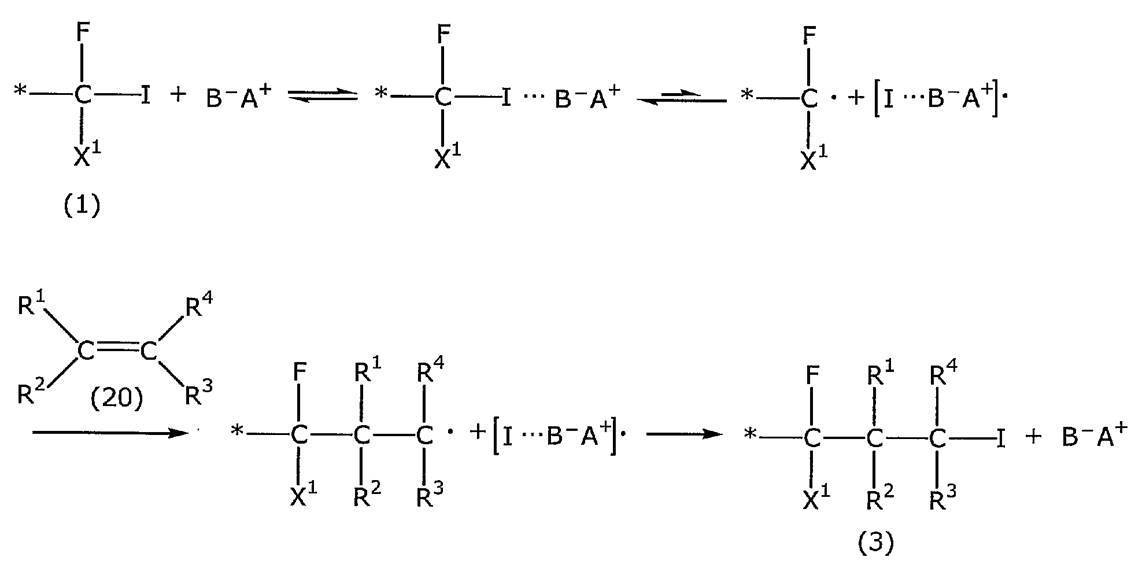
これに対し、本発明では、化合物(10)を用いることにより、ラジカル発生剤として機能しつつ、当該反応が非常に穏やかに進むことから、反応を制御できることを見出したものである。
イオン性触媒は1価のアニオンとその対カチオンとからなる。1価のアニオンは、ヨウ素、窒素及び硫黄からなる群より選ばれる少なくとも1種の元素を含む。対カチオンは、イオン結合が強くなりすぎないカチオンを選択する必要があり、窒素及びリンの少なくともいずれか1種の元素を含むカチオン、アルカリ金属イオンまたはプロトンである。
1価のアニオンのうち、ヨウ素を含むアニオン(以下、ヨウ素アニオンと称することがある。)としては、例えば、ヨウ化物イオン(I-)、三ヨウ化物イオン(I3 -)が挙げられる。他のアニオンとしては、例えば、アジ化物イオン(N3 -)、シアン化物イオン(CN-)、シアネートアニオン(OCN-)、チオシアン酸イオン(SCN-)が挙げられる。
中でも、部分構造(1)のヨウ素原子との相互作用の点から、ヨウ素アニオンが好ましく、ヨウ化物イオンがより好ましい。
アルカリ金属イオンとしては、例えば、リチウムイオン、ナトリウムイオン、カリウムイオン、ルビジウムイオン、セシウムイオンが挙げられる。
中でも、耐熱性の点から、リンを含むカチオンまたはアルカリ金属イオンが好ましく、反応性の点から、第四級ホスホニウムカチオンがより好ましく、テトラフェニルホスホニウムがさらに好ましい。
化合物(10)は下記式(1)で表される部分構造を有する含フッ素有機ヨウ素化合物である。
式中、*は結合手を表し、X1は水素原子、フッ素原子、塩素原子、又は置換基を有していてもよい炭素数1~20の有機基を表す。
当該有機基の置換基としては、フッ素原子、塩素原子、ヒドロキシ基、アルコキシ基、アミノ基、カルボン酸基、スルホン酸基、1,3,5-トリアジントリオン骨格、アルキル基、アルコキシアルキル基等を挙げることができる。当該有機基の置換基としてのアルキル基、アルコキシアルキル基及びアルコキシ基は、フッ素原子、塩素原子等で置換されていてもよい。

X1で表される置換基を有していてもよい炭素数1~20の有機基としては、置換基を有していてもよい炭素数1~20の炭化水素基が好ましく、置換基を有していてもよい炭素数1~20の含フッ素炭化水素基がより好ましく、炭素数1~20の含フッ素アルキル基がさらに好ましい。
X1で表される置換基を有していてもよい炭素数1~20の有機基の炭素数は、1~10が好ましく、1~6がより好ましい。
X1が置換基を有していてもよい炭素数1~20の含フッ素炭化水素基である場合、そのフッ素原子含有率は、50モル%以上が好ましく、75モル%以上がより好ましく、100モル%(ペルフルオロ炭化水素基)がさらに好ましい。ただし、フッ素原子含有率とは、炭化水素基に含まれる水素原子がフッ素原子に置換されている割合である。
X1としては、フッ素原子、塩素原子、又は置換基を有していてもよい炭素数1~20の有機基が好ましく、フッ素原子、塩素原子、又は炭素数1~10の含フッ素アルキル基がより好ましい。
また、X1は、-CX2X3X4を表し、X2~X4はそれぞれ独立して、水素原子、フッ素原子又は塩素原子を表す基であってもよい。
*で表される結合手の結合先が、置換基を有していてもよいアルキル基又はハロゲン原子若しくは水素原子である場合、化合物(10)は部分構造(1)を一つ有するモノヨード含フッ素有機化合物となる。また、*で表される結合手の結合先が、置換基を有していてもよいアルキレン基やエーテル結合のように2価結合基となる場合には、化合物(10)は部分構造(1)を二つ有するジヨード含フッ素有機化合物となる。さらに、*で表される結合手の結合先が、未加硫フルオロエラストマーのような高分子の部分構造である場合や、置換基を有していてもよいアルキレン基やエーテル結合のような2価結合基を介して部分構造(1)がポリシロキサンと結合している場合には、化合物(10)は部分構造(1)を多数有するポリヨージド含フッ素有機化合物となる。ここでポリシロキサンは、シリコーンであっても、シランカップリング剤の縮合反応により生じる生成物であってもよい。
化合物(10)のうち、モノヨード含フッ素有機化合物は、一般的に下記式で表される構造を有する。式中、R10は置換基を有していてもよいアルキル基、アリール基、アリールアルキル基、又は水素原子、フッ素原子若しくは塩素原子が好ましい。X20は水素原子、フッ素原子、塩素原子、又は-CX2X3X4を表し、X2~X4はそれぞれ独立して、水素原子、フッ素原子又は塩素原子を表す。

炭素数1~7のアルキル基としては、メチル基、エチル基、n-プロピル基、イソプロピル基、n-ブチル基、sec-ブチル基、tert-ブチル基、n-ペンチル基、n-ヘキシル基、シクロヘキシル基、n-ヘプチル基等が挙げられる。これらの中でも、炭素数1~4の直鎖状又は分岐鎖状のアルキル基がより好ましく、メチル基、エチル基がさらに好ましい。
すなわち、R10が置換アルキル基である場合には、化合物(10)は下記式(11)で表される化合物が特に好ましい。
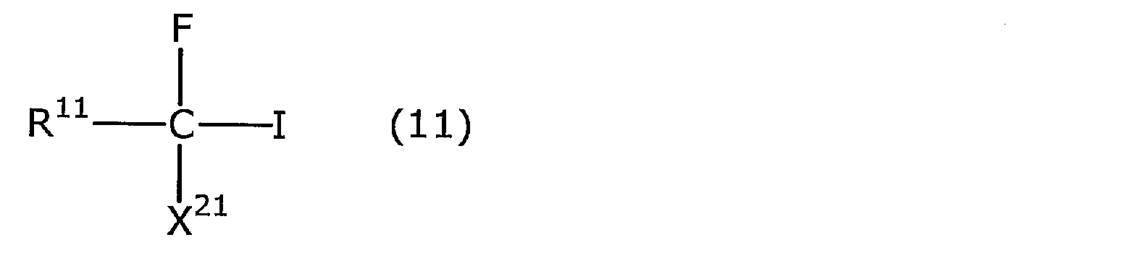
ヨウ素原子の引き抜かれやすさの観点から、X21はフッ素原子、塩素原子又は-CX24X25X26(X24~X26はそれぞれ独立して、フッ素原子又は塩素原子を表す。)が好ましく、ヨウ素原子の引き抜かれやすさ及び生じたラジカルの反応性の観点から、X21はフッ素原子又はトリフルオロメチル基がより好ましい。
R10のうち、アリールアルキル基としては、炭素数4~15のアリールアルキル基、炭素数4~15のヘテロアリールアルキル基が好ましく、具体的には、ベンジル基、2-ピリジルメチル基、3-ピリジルメチル基、4-ピリジルメチル基がより好ましい。
これらの中でも、入手が容易なことから、CF3(CF2)3I(n-ノナフルオロブチルヨージド)が好ましい。
また、モノヨード含フッ素有機化合物としては、ヨウ素原子の引き抜かれやすさの観点から、C2F5I、CF3CF2CF2I、(CF3)2CFI、CF3(CF2)3I、(CF3)2CFCF2I、CF3(CF2)4I等が好ましい。
化合物(10)のうち、ジヨード含フッ素有機化合物は、一般的に下記式で表される構造を有する。式中、R10’は置換基を有していてもよいアルキレン基、アリーレン基、アリーレンアルキレン基又はアルキレンアリーレンアルキレン基が好ましい。R10’が単結合である場合も好ましい。X20はそれぞれ独立して、水素原子、フッ素原子、塩素原子、又は-CX2X3X4を表し、X2~X4はそれぞれ独立して、水素原子、フッ素原子又は塩素原子を表す。

炭素数1~6のアルキレン基としては、メチレン基、エチレン基、n-プロピレン基、イソプロピレン基、n-ブチレン基、イソブチレン基、n-ペンチレン基、n-ヘキシレン基、1,4-シクロヘキシレン基等が挙げられる。これらの中でも、炭素数1~4の直鎖状又は分岐鎖状のアルキレン基がより好ましく、エチレン基がさらに好ましい。
すなわち、化合物(10)は、R10’が炭素数1~4のペルフルオロアルキレン基である場合、下記式(12)で表される化合物となる。
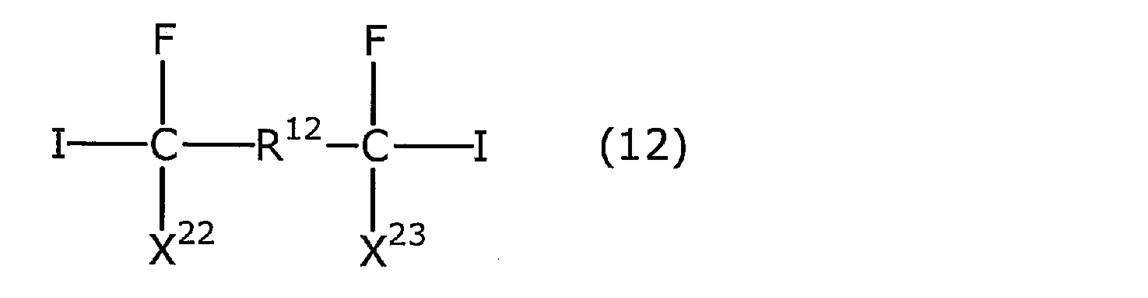
R10’のうち、アリーレンアルキレン基としては、炭素数4~15のアリーレンアルキレン基、炭素数4~15のヘテロアリーレンアルキレン基が好ましい。具体的には、ベンジレン基、2-ピリジレンメチレン基、3-ピリジレンメチレン基、4-ピリジレンメチレン基がより好ましい。
これらの中でも、扱いやすい低揮発性液体の点から好ましくは1,4-ジヨード-オクタフルオロブタンである。
化合物(10)のうち、ポリヨージド含フッ素有機化合物は、部分構造(1)における*で表される結合手の結合先が、未加硫フルオロエラストマーなどの含フッ素高分子の部分構造や、ポリシロキサンの部分構造である場合である。部分構造(1)における*で表される結合手の結合先がポリシロキサンの部分構造である場合、置換基を有していてもよいアルキレン基やエーテル結合のような2価結合基を介して部分構造(1)がポリシロキサンと結合している場合が挙げられる。ポリシロキサンは、シリコーンであっても、シランカップリング剤の縮合反応により生じる生成物であってもよい。
化合物(10)が下記式(4)で表される単位を複数含む場合において、化合物(10)のフッ素含量は50質量%以上であることが耐熱性と難燃性の点から好ましく、60質量%以上がより好ましい。
このように、ポリヨージド含フッ素有機化合物の場合には、化合物(10)が有する部分構造(1)の数の分だけ、化合物(20)を挿入することができるが、部分的に挿入されずに残る場合もある。
ポリヨージド含フッ素有機化合物は、従来公知の方法により製造することができる。
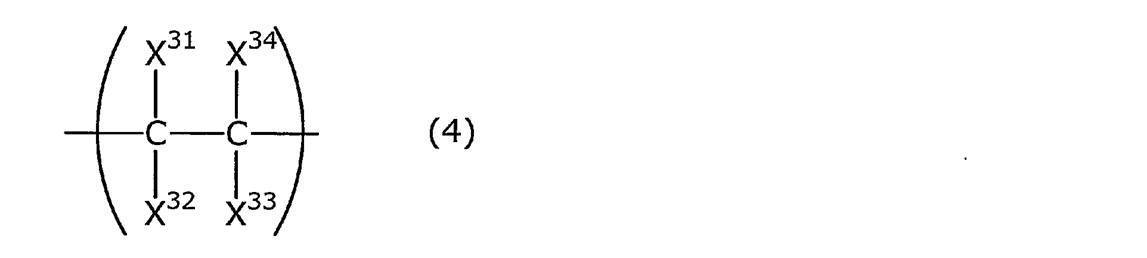
本発明の第一実施形態では、前記化合物(10)に対して、下記式(20)で表される化合物の挿入反応を行う。式中、R1~R4はそれぞれ独立して水素原子、フッ素原子、塩素原子、又は置換基を有していてもよい炭素数1~20の有機基を表す。
化合物(20)はR1~R4が上記で示したいずれかであれば、化合物(10)に対して、少なくとも1分子の挿入反応が進行する。

アルキル基、アリール基、ヘテロアリール基、アリールオキシ基、ヘテロアリールオキシ基、アルコキシ基、アリールアルキル基、ヘテロアリールアルキル基、アリールアルコキシ基、またはヘテロアリールアルコキシ基といったヘテロ原子を有していてもよい炭化水素基は、直鎖状、分岐鎖状又は環状のいずれでもよく、また、不飽和結合を含んでいてもよい。
アシルアミノ基またはアシルオキシ基のアシル基としては、カルボン酸またはスルホン酸からヒドロキシ基を除いた基が挙げられる。
置換アルキル基の置換基としては、フッ素原子、塩素原子、ヒドロキシ基、アルコキシ基、アミノ基、カルボン酸基、スルホン酸基、1,3,5-トリアジントリオン骨格等を挙げることができる。
置換アルコキシ基の置換基としては、フッ素原子、ヒドロキシ基、アミノ基等を挙げることができる。
置換アルコキシカルボニル基の置換基としては、フッ素原子、ヒドロキシ基、アミノ基等を挙げることができる。
N-置換カルバモイル基の置換基としては、アルキル基、アルコキシアルキル基等を挙げることができる。
さらに、化合物(20)には、反応性炭素-炭素二重結合を複数有する化合物も含まれる。すなわち、化合物(20)にはジアリルアミン、トリアリルイソシアヌレート等のジアリル化合物やトリアリル化合物も含まれる。
すなわち、化合物(20)は下記式(21)で表される化合物であることがより好ましい。式中、X11~X13はそれぞれ独立して、水素原子、フッ素原子、塩素原子、又は-CX15X16X17を表し、X15~X17はそれぞれ独立して、水素原子、フッ素原子又は塩素原子を表す。X14は、フッ素原子又は塩素原子を表す。
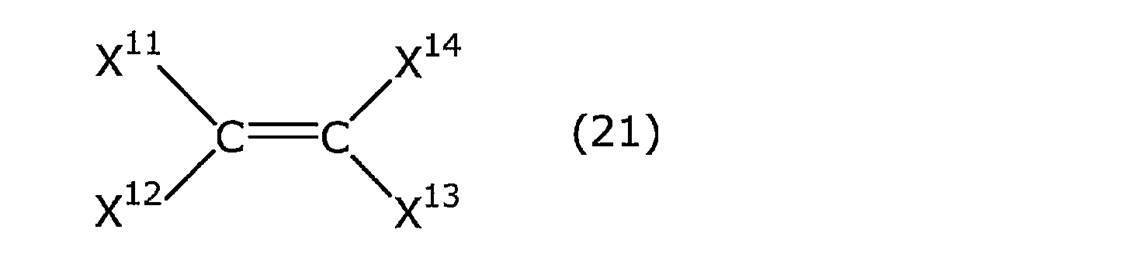
また、X11~X13はいずれも、それぞれ独立して、水素原子、フッ素原子又は塩素原子であることも好ましい。X14は、フッ素原子が好ましい。
また、

化合物(10)に対する化合物(20)の挿入反応により、下記式(3)で表される部分構造を有する化合物(30)が得られる。部分構造(3)におけるR1~R4は、挿入させた化合物(20)のR1~R4にそれぞれ対応する。

ただし、化合物(20)として実際にフッ化ビニリデンを用いた場合、挿入反応における遷移状態の安定性から、R3及びR4に該当する箇所がX1及びF(順不同)となって挿入反応が優先的に進行し、重合反応は進行する。同様のことが2,3,3,3-テトラフルオロプロピレンにも言える。このように、R1及びR2と、R3及びR4の一方のみがX1及びF(順不同)である化合物の挿入反応に際し、どちらの向きで挿入反応が進行しやすいかは、有機電子論によって判断することができる。
上記重合反応は反応速度が遅いために、高純度なオリゴマーを製造する場合に好適に用いられる。ただし、反応時間を長くすれば重合反応は進むことから、高分子量のポリマーを製造する場合に本発明に係る製造方法を用いることを何ら排除するものではない。
挿入反応を2回以上繰り返して重合反応を行う場合、モノマーとなる好ましい化合物(20)としては、例えば、フッ化ビニリデン、トリフルオロエチレン、クロロトリフルオロエチレン、テトラフルオロエチレン、ヘキサフルオロプロピレン、2,3,3,3-テトラフルオロプロピレン、1,2-ジクロロ-1,2-ジフルオロエチレンが挙げられる。
化合物(10)に対する化合物(20)の挿入反応を2回以上繰り返し、化合物(30)として重合体を得る場合において、重合速度の促進を目的として、化合物(10)とは異なる化合物であるラジカル発生剤(以下、「他のラジカル発生剤」と称することがある。)を併用してもよい。
この場合、反応が速く進む分、得られる重合体の分子量分布は化合物(10)のみを用いた重合反応の場合と比べると広くなるものの、従来のラジカル重合に比べると、当該分子量分布は極めて狭いものとなる。
例えば、低温重合(40℃以下)の場合は、2,2’-アゾビス(2,4-ジメチルバレロニトリル)(ADVN)、2,2’-アゾビス(4-メトキシ-2,4-ジメチルバレロニトリル)等を用いることが好ましい。中温重合(40~80℃)の場合は、2,2’-アゾビス(イソブチロニトリル)(AIBN)、2,2’-アゾビス(2-メチルブチロニトリル)(AMBN)、ジメチル-2,2’-アゾビスイソブチレート(MAIB)、1,1’-アゾビス(1-アセトキシ-1-フェニルエタン)、4,4’-アゾビス(4-シアノバレリアン酸)(ACVA)、2,2’-アゾビス(2-メチルブチルアミド)、2,2’-アゾビス(2-メチルアミジノプロパン)二塩酸塩、2,2’-アゾビス[2-(2-イミダゾリン-2-イル)プロパン]等を用いることが好ましい。高温重合(80℃以上)の場合は、1,1’-アゾビス(1-シクロヘキサンカルボニトリル)(ACHN)、2-シアノ-2-プロピルアゾホルムアミド、2,2’-アゾビス(N-ブチル-2-メチルプロピオンアミド)、2,2’-アゾビス(N-シクロヘキシル-2-メチルプロピオンアミド)、2,2’-アゾビス(2,4,4-トリメチルペンタン)、2,2’-アゾビス[2-メチル-N-(2-ヒドロキシエチル)プロピオンアミド]等を用いることが好ましい。
第一実施形態では、上述したように、特定のイオン性触媒の存在下、前記化合物(10)に対する前記化合物(20)の挿入反応により化合物(30)を得る。
不活性ガスで置換した容器又は真空減圧した容器内で、イオン性触媒、化合物(20)及び化合物(10)を混合する。なお、化合物(10)を2種以上用いる場合には、そのうちの少なくとも1種を上記で混合する。
不活性ガスとしては、窒素、アルゴン、ヘリウムを挙げることができる。これらの中でも、窒素又はアルゴンが好ましく、窒素がより好ましい。
また、N-メチル-N-メトキシメチルピロリジウムテトラフルオロボレート、N-メチル-N-エトキシメチルテトラフルオロボレート、1-メチル-3-メチルイミダゾリウムテトラフルオロボレート、1-メチル-3-メチルイミダゾリウムヘキサフルオロフォスフェート、1-メチル-3-メチルイミダゾリウムクロライド等のイオン液体を用いることもできる。
本明細書における数平均分子量(Mn)及び重量平均分子量(Mw)は、SEC(Size Exclusion Chromatography;サイズ排除クロマトグラフィー)測定により求めたものであり、分子量換算用の標準物質としてポリスチレンを用いる。また分子量分布の指標である多分散度はMw/Mnにより求められる値である。
上記挿入反応を1回または2回行う場合、すなわち、化合物(30)として化合物(20)の一分子挿入体または二分子挿入体を得る場合には、通常、化合物(20)1molに対して、化合物(10)を0.1~100mol、好ましくは1~20mol使用する。
従って、イオン性触媒と有機ヨウ素化合物である化合物(10)を挿入反応、ひいてはラジカル重合反応に用いることにより、従来のラジカル重合で得られる重合体よりも、末端基を他の官能基へ変換することが容易となる。これらにより、得られる化合物(30)は、マクロラジカル重合開始剤(マクロイニシエーター)又はマクロラジカル連鎖移動剤としても用いることができる。そのため、当該挿入反応を用いて、次に記載する共重合反応を行うこともできる。
本発明の第二実施形態は、下記式(20)で表される化合物(化合物(20))を二種以上用いた共重合により共重合体を製造する方法に関し、2つの反応を含むものである。
一つ目の反応は、前記化合物(20)のうち少なくとも一種が下記式(22)で表される化合物(化合物(22))であり、イオン性触媒の存在下、下記式(1)で表される部分構造を有する化合物(10)に対し、前記化合物(22)を挿入する反応である。かかる挿入反応により、下記式(5)で表される部分構造を有する化合物が製造される。
二つ目の反応は、前記化合物(10)とは異なる化合物であるラジカル発生剤(他のラジカル発生剤)を用いて、前記化合物(20)を、C-I結合に対して挿入する反応である。かかる挿入反応により、下記式(6)で表される部分構造を有する化合物が製造される。
なお、前記イオン性触媒は、1価のアニオンと対カチオンとからなり、前記1価のアニオンは、ヨウ素、窒素及び硫黄からなる群より選ばれる少なくとも一種の元素を含む1価のアニオンである。前記対カチオンは、窒素及びリンの少なくともいずれか一種の元素を含むカチオン、アルカリ金属イオン、又はプロトンである。
前記イオン性触媒は、上記<挿入反応>の[イオン性触媒]に例示した化合物を好ましく用いることができる。
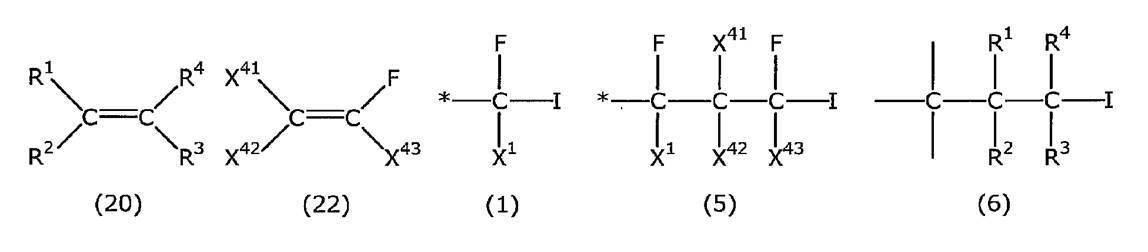
かかる挿入反応における好ましい態様は、上記<挿入反応>に記載したものと同様である。
化合物(20)は、上記<挿入反応>の[化合物(20)]に例示した化合物を好ましく用いることができる。なお、ここで用いられる化合物(20)として、前記化合物(22)を何ら排除するものではない。
好ましいペルフルオロ(アルキルビニルエーテル)としては、ペルフルオロ(メチルビニルエーテル)、ペルフルオロ(エチルビニルエーテル)、ペルフルオロ(n-プロピルビニルエーテル)が挙げられる。
他のラジカル発生剤は、通常のラジカル重合で使用するアゾ化合物や過酸化物であれば特に制限なく使用することができる。具体的には、上記<挿入反応>における(他のラジカル発生剤)に記載したものと同様の化合物を使用することができる。
本発明の第二実施形態は、特定のイオン性触媒の存在下、化合物(10)に対し、化合物(22)を挿入する反応と、他のラジカル発生剤を用いて、化合物(20)を、C-I結合に対して挿入する反応とを含み、二種以上の化合物(20)の共重合により共重合体を製造する方法に関する。かかる2つの挿入反応を各々2回以上繰り返すことにより、共重合体が製造される。また、その繰り返し方により、以下に示すブロック共重合、交互共重合又はランダム共重合の形態に分類される。
本発明の第二実施形態によれば、共重合体を合成する際のかかる2つの挿入反応の繰り返し方によらず、共重合体の多分散度を2.0以下に制御することができる。
共重合の一形態としてブロック共重合が挙げられるが、特定のイオン性触媒と化合物(10)を用いることにより、例えば、テトラフルオロエチレン-アクリル酸ブチル等のA-Bジブロック共重合体や、アクリル酸ブチル-テトラフルオロエチレン-アクリル酸ブチル等のB-A-Bトリブロック共重合体等を得ることができる。
ブロック共重合体を得るに際し、他のラジカル発生剤を用いた挿入反応に用いる化合物(20)としては、トリアリルイソシアヌレート、1,4-ジビニルオクタフルオロブタン、1,6-ジビニルドデカフルオロヘキサン、アクリル酸ブチルが好ましい。
A-Bジブロック共重合体として、例えば、テトラフルオロエチレン-アクリル酸ブチル共重合体を製造する場合は次のとおりである。先述した[化合物(30)の製造方法]に記載した方法と同様に、まず、テトラフルオロエチレン、イオン性触媒、及び化合物(10)としてモノヨード含フッ素有機化合物を混合して挿入反応を繰り返すことで重合し、ポリテトラフルオロエチレンを製造する。続いてアクリル酸ブチルを混合して、テトラフルオロエチレン-アクリル酸ブチル共重合体を得ることができる。他のラジカル発生剤は、テトラフルオロエチレン等と一緒に混合しても、アクリル酸ブチルと一緒に混合してもよい。
その他の重合に係る条件は、上記<挿入反応>に記載したものと同様の条件を用いることができる。
共重合の一形態としてランダム共重合及び交互共重合が挙げられるが、特定のイオン性触媒と化合物(10)を用いた化合物(22)の挿入反応と、他のラジカル発生剤を用いた化合物(20)の挿入反応とを、同時に行うことで、ランダム共重合体又は交互共重合体を得ることができる。
窒素置換されたグローブボックス内で、内容積が30mLの撹拌機付きステンレス鋼製オートクレーブに、0.40g(0.87mmol)のテトラフェニルホスホニウムヨージド、30g(87mmol)のn-ノナフルオロブチルヨージドを仕込んだ。
1.0g(10mmol)のテトラフルオロエチレンを圧入したのち、内温を160℃まで昇温させながら撹拌を開始した。内温を保持したまま200rpm(毎分200回転)で撹拌を1時間行ったところ、内圧は1.1MPa(ゲージ圧)から1.0MPaまで減少した。
オートクレーブを循環させた-20℃のエチレングリコールで冷却した後、未反応のテトラフルオロエチレンをパージした。
算出される含フッ素重合体の多分散度(Mw/Mn)は1.1以下であり、このラジカル重合はリビングラジカル重合の特徴を示す。
窒素置換されたグローブボックス内で、内容積が30mLの撹拌機付きステンレス鋼製オートクレーブに、0.40g(0.87mmol)のテトラフェニルホスホニウムヨージド、30g(87mmol)のn-ノナフルオロブチルヨージドを仕込んだ。
0.6g(10mmol)のクロロエチレンを圧入したのち、内温を160℃まで昇温させながら撹拌を開始した。内温を保持したまま200rpmで撹拌を1時間行ったところ、内圧は0.9MPaから0.8MPaまで減少した。
オートクレーブを循環させた-20℃のエチレングリコールで冷却した後、未反応のクロロエチレンをパージした。
算出される含フッ素重合体の多分散度(Mw/Mn)は1.1以下であり、このラジカル重合はリビングラジカル重合の特徴を示す。
窒素置換されたグローブボックス内で、内容積が30mLの撹拌機付きステンレス鋼製オートクレーブに、0.27g(0.57mmol)のテトラフェニルホスホニウムヨージド、0.06g(0.11mmol)の1,4-ジヨード-オクタフルオロブタン、1.3g(4.8mmol)のペルフルオロ(n-プロピルビニルエーテル)、25gの1H-ペルフルオロヘキサンを仕込んだ。
1.0g(10mmol)のテトラフルオロエチレンを圧入したのち、内温を140℃まで昇温させながら撹拌を開始した。内温を保持したまま200rpmで撹拌を10時間行ったところ、内圧は2.2MPaから2.0MPaまで減少した。
オートクレーブを循環させた-20℃のエチレングリコールで冷却した後、未反応のテトラフルオロエチレンをパージした。
窒素置換されたグローブボックス内で、内容積が30mLの撹拌機付きステンレス鋼製オートクレーブに、0.47g(1.0mmol)のテトラフェニルホスホニウムヨージド、0.07g(0.2mmol)のn-ノナフルオロブチルヨージド、0.02g(0.2mmol)の炭酸カルシウム、20gのベンゾトリフルオリドを仕込んだ。
1.2g(10mmol)のクロロトリフルオロエチレンを圧入したのち、内温を140℃まで昇温させながら撹拌を開始した。内温を保持したまま200rpmで撹拌を7時間行ったところ、内圧は0.5MPaから0.4MPaまで減少した。
オートクレーブを循環させた25℃の水で冷却した後、未反応のクロロトリフルオロエチレンをパージした。
得られた液体をサイズ排除クロマトグラフィーで測定したところ、Mn=1,650、Mw=1,950であった。
算出される含フッ素重合体の多分散度(Mw/Mn)は1.2であり、このラジカル重合はリビングラジカル重合の特徴を示す。
窒素置換されたグローブボックス内で、内容積が30mLの撹拌機付きステンレス鋼製オートクレーブに、0.23g(0.50mmol)のテトラフェニルホスホニウムヨージド、0.1gの実施例4で得られた重合体、0.64g(5.0mmol)のn-ブチルアクリレート、20gのベンゾトリフルオリドを仕込んだ。
内温を140℃まで昇温させながら撹拌を開始した。内温を保持したまま200rpmで撹拌を5時間行った。
オートクレーブを循環させた25℃の水で冷却した。
得られた固体をサイズ排除クロマトグラフィーで測定したところ、Mn=5,500、Mw=7,450であった。
算出される含フッ素重合体の多分散度(Mw/Mn)は1.4であり、このラジカル重合はリビングラジカル重合の特徴を示す。
サイズ排除クロマトグラフィーおよびNMRの結果から、ブロック共重合体の製造が確認された。
窒素置換されたグローブボックス内で、内容積が30mLの撹拌機付きステンレス鋼製オートクレーブに、0.47g(1.0mmol)のテトラフェニルホスホニウムヨージド、0.07g(0.2mmol)のn-ノナフルオロブチルヨージド、1.3g(10mmol)のn-ブチルアクリレート、0.02g(0.2mmol)の炭酸カルシウム、20gのベンゾトリフルオリドを仕込んだ。
1.2g(10mmol)のクロロトリフルオロエチレンを圧入したのち、内温を140℃まで昇温させながら撹拌を開始した。内温を保持したまま200rpmで撹拌を7時間行ったところ、内圧は0.5MPaから0.4MPaまで減少した。
オートクレーブを循環させた25℃の水で冷却した後、未反応のクロロトリフルオロエチレンをパージした。
得られた固体をサイズ排除クロマトグラフィーで測定したところ、Mn=5,900、Mw=10,050であった。
算出される含フッ素重合体の多分散度(Mw/Mn)は1.7であった。
窒素置換されたグローブボックス内で、内容積が30mLの撹拌機付きステンレス鋼製オートクレーブに、0.40g(0.87mmol)のテトラフェニルホスホニウムヨージド、30g(87mmol)のn-ノナフルオロブチルヨージド、0.82g(3.3mmol)のトリアリルイソシアヌレート、25gの1H-パーフルオロヘキサンを仕込んだ。
内温を140℃まで昇温させながら撹拌を開始した。内温を保持したまま200rpmで撹拌を5時間行った。
オートクレーブを循環させた25℃の水で冷却した。
得られた固体の1H-NMRおよび19F-NMRを測定したところ、含フッ素共重合体中のn-ノナフルオロブチル基とトリアリルイソシアヌレートのモル比率は63:37と算出された。
窒素置換されたグローブボックス内で、内容積が30mLの撹拌機付きステンレス鋼製オートクレーブに、0.32g(0.87mmol)のテトラブチルアンモニウムヨージド、30g(87mmol)のn-ノナフルオロブチルヨージドを仕込んだ。
1.0g(10mmol)のテトラフルオロエチレンを圧入したのち、内温を140℃まで昇温させながら撹拌を開始した。内温を保持したまま200rpmで撹拌を4時間行ったところ、内圧は0.8MPa(ゲージ圧)から0.7MPaまで減少した。
オートクレーブを循環させた-20℃のエチレングリコールで冷却した後、未反応のテトラフルオロエチレンをパージした。
算出される含フッ素重合体の多分散度(Mw/Mn)は1.1以下であり、このラジカル重合はリビングラジカル重合の特徴を示す。
窒素置換されたグローブボックス内で、内容積が30mLの撹拌機付きステンレス鋼製オートクレーブに、0.58g(4.3mmol)のヨウ化リチウム、30g(87mmol)のn-ノナフルオロブチルヨージドを仕込んだ。
1.0g(10mmol)のテトラフルオロエチレンを圧入したのち、内温を160℃まで昇温させながら撹拌を開始した。内温を保持したまま200rpmで撹拌を3時間行ったところ、内圧は0.8MPa(ゲージ圧)から0.7MPaまで減少した。
オートクレーブを循環させた-20℃のエチレングリコールで冷却した後、未反応のテトラフルオロエチレンをパージした。
算出される含フッ素重合体の多分散度(Mw/Mn)は1.1以下であり、このラジカル重合はリビングラジカル重合の特徴を示す。
窒素置換されたグローブボックス内で、内容積が30mLの撹拌機付きステンレス鋼製オートクレーブに、0.26g(0.87mmol)のテトラブチルアンモニウムチオシアナート、30g(87mmol)のn-ノナフルオロブチルヨージドを仕込んだ。
1.0g(10mmol)のテトラフルオロエチレンを圧入したのち、内温を140℃まで昇温させながら撹拌を開始した。内温を保持したまま200rpmで撹拌を7時間行ったところ、内圧は0.8MPa(ゲージ圧)から0.7MPaまで減少した。
オートクレーブを循環させた-20℃のエチレングリコールで冷却した後、未反応のテトラフルオロエチレンをパージした。
算出される含フッ素重合体の多分散度(Mw/Mn)は1.1以下であり、このラジカル重合はリビングラジカル重合の特徴を示す。
窒素置換されたグローブボックス内で、内容積が30mLの撹拌機付きステンレス鋼製オートクレーブに、0.25g(0.87mmol)のテトラブチルアンモニウムシアナート、30g(87mmol)のn-ノナフルオロブチルヨージドを仕込んだ。
1.0g(10mmol)のテトラフルオロエチレンを圧入したのち、内温を140℃まで昇温させながら撹拌を開始した。内温を保持したまま200rpmで撹拌を8時間行ったところ、内圧は0.8MPa(ゲージ圧)から0.7MPaまで減少した。
オートクレーブを循環させた-20℃のエチレングリコールで冷却した後、未反応のテトラフルオロエチレンをパージした。
算出される含フッ素重合体の多分散度(Mw/Mn)は1.1以下であり、このラジカル重合はリビングラジカル重合の特徴を示す。
また、本明細書に記載された全ての文献、特許出願、及び技術規格は、個々の文献、特許出願、および技術規格が参照により取り込まれることが具体的かつ個々に記された場合と同程度に、本明細書中に参照により取り込まれる。
Claims (16)
- アニオンと対カチオンとからなるイオン性触媒の存在下、下記式(1)で表される部分構造を有する化合物(10)に対する、下記式(20)で表される化合物の挿入反応により、下記式(3)で表される部分構造を有する化合物(30)を製造する方法であって、
前記アニオンが、ヨウ素、窒素及び硫黄からなる群より選ばれる少なくとも一種の元素を含む1価のアニオンであり、
前記対カチオンが、窒素及びリンの少なくともいずれか一種の元素を含むカチオン、アルカリ金属イオン、又はプロトンである、化合物(30)の製造方法。

(式中、*は結合手を表す。X1及びR1~R4はそれぞれ独立して水素原子、フッ素原子、塩素原子、又は置換基を有していてもよい炭素数1~20の有機基を表す。) - 前記式(20)で表される化合物が、下記式(21)で表される化合物である、請求項1に記載の製造方法。

(式中、X11~X13はそれぞれ独立して、水素原子、フッ素原子、塩素原子、又は-CX15X16X17を表し、X15~X17はそれぞれ独立して、水素原子、フッ素原子又は塩素原子を表す。X14は、フッ素原子又は塩素原子を表す。) - 前記式(20)で表される化合物が、フッ化ビニル、フッ化ビニリデン、トリフルオロエチレン、クロロトリフルオロエチレン、テトラフルオロエチレン、ヘキサフルオロプロピレン、2,3,3,3-テトラフルオロプロピレン、塩化ビニリデン、塩化ビニル、1-クロロ-1-フルオロエチレン、又は1,2-ジクロロ-1,2-ジフルオロエチレンである、請求項1又は2に記載の製造方法。
- 前記化合物(10)が、下記式(11)で表される化合物、又は下記式(12)で表される化合物である、請求項1~3のいずれか1項に記載の製造方法。

(式中、R11は炭素数1~4のペルフルオロアルキル基を表す。R12は炭素数1~4のペルフルオロアルキレン基を表す。X21~X23はそれぞれ独立して、水素原子、フッ素原子、塩素原子、又は-CX24X25X26を表し、X24~X26はそれぞれ独立して、水素原子、フッ素原子又は塩素原子を表す。) - 前記化合物(10)が、下記式(4)で表される単位を複数含む化合物である、請求項1~3のいずれか1項に記載の製造方法。

(式中、X31~X34はそれぞれ独立して、水素原子、フッ素原子、塩素原子、又は-CX35X36X37を表し、X35~X37はそれぞれ独立して、水素原子、フッ素原子又は塩素原子を表す。) - 前記化合物(10)のフッ素含量が50質量%以上である、請求項5に記載の製造方法。
- 前記式(20)で表される化合物が、フッ化ビニリデン、トリフルオロエチレン、クロロトリフルオロエチレン、テトラフルオロエチレン、ヘキサフルオロプロピレン、2,3,3,3-テトラフルオロプロピレン又は1,2-ジクロロ-1,2-ジフルオロエチレンであり、
前記化合物(10)に対する、前記式(20)で表される化合物の前記挿入反応を2回以上行う、請求項1~6のいずれか1項に記載の製造方法。 - 得られる前記化合物(30)が重合体であり、前記重合体の多分散度が2.0以下である、請求項1~7のいずれか1項に記載の製造方法。
- 下記式(20)で表される化合物を二種以上用いた共重合による共重合体の製造方法であって、
前記式(20)で表される化合物のうち少なくとも一種が下記式(22)で表される化合物であり、イオン性触媒の存在下、下記式(1)で表される部分構造を有する化合物(10)に対し、前記式(22)で表される化合物を挿入する反応と、
前記化合物(10)とは異なる化合物であるラジカル発生剤を用いて、前記式(20)で表される化合物を、C-I結合に対して挿入する反応と、を含み、
前記イオン性触媒は、ヨウ素、窒素及び硫黄からなる群より選ばれる少なくとも一種の元素を含む1価のアニオンと、対カチオンと、からなり、前記対カチオンが、窒素及びリンの少なくともいずれか一種の元素を含むカチオン、アルカリ金属イオン、又はプロトンである、共重合体の製造方法。

(式中、*は結合手を表す。X1及びR1~R4はそれぞれ独立して水素原子、フッ素原子、塩素原子、又は置換基を有していてもよい炭素数1~20の有機基を表す。X41~X43はそれぞれ独立して、水素原子、フッ素原子、塩素原子、又は-CX45X46X47を表し、X45~X47はそれぞれ独立して、水素原子、フッ素原子又は塩素原子を表す。) - 前記共重合がブロック共重合である、請求項9に記載の製造方法。
- 前記共重合がランダム共重合である、請求項9に記載の製造方法。
- 前記共重合が交互共重合である、請求項9に記載の製造方法。
- 前記式(20)で表される化合物のうち少なくとも一種が、エチレン、プロピレン、イソブチレン、アルキルビニルエーテル、ペルフルオロ(アルキルビニルエーテル)、トリアリルイソシアヌレート、1,4-ジビニルオクタフルオロブタン、1,6-ジビニルドデカフルオロヘキサン、スチレン、又はアクリル酸ブチルである、請求項9~12のいずれか1項に記載の製造方法。
- 得られる前記共重合体の多分散度が2.0以下である、請求項9~13のいずれか1項に記載の製造方法。
- 前記イオン性触媒の前記1価のアニオンがヨウ素アニオンである、請求項1~14のいずれか1項に記載の製造方法。
- 前記イオン性触媒がテトラフェニルホスホニウムヨージドである、請求項1~15のいずれか1項に記載の製造方法。
Priority Applications (4)
| Application Number | Priority Date | Filing Date | Title |
|---|---|---|---|
| CN202080063941.3A CN114402001B (zh) | 2019-09-12 | 2020-09-07 | 含氟化合物的制造方法和共聚物的制造方法 |
| EP20863046.7A EP4029848B1 (en) | 2019-09-12 | 2020-09-07 | Method for producing fluorine-containing compound and method for producing copolymer |
| JP2021545522A JP7511106B2 (ja) | 2019-09-12 | 2020-09-07 | 含フッ素化合物の製造方法及び共重合体の製造方法 |
| US17/654,095 US12545759B2 (en) | 2019-09-12 | 2022-03-09 | Method of producing fluorine-containing compound and method of producing copolymer |
Applications Claiming Priority (2)
| Application Number | Priority Date | Filing Date | Title |
|---|---|---|---|
| JP2019-166182 | 2019-09-12 | ||
| JP2019166182 | 2019-09-12 |
Related Child Applications (1)
| Application Number | Title | Priority Date | Filing Date |
|---|---|---|---|
| US17/654,095 Continuation US12545759B2 (en) | 2019-09-12 | 2022-03-09 | Method of producing fluorine-containing compound and method of producing copolymer |
Publications (1)
| Publication Number | Publication Date |
|---|---|
| WO2021049455A1 true WO2021049455A1 (ja) | 2021-03-18 |
Family
ID=74866606
Family Applications (1)
| Application Number | Title | Priority Date | Filing Date |
|---|---|---|---|
| PCT/JP2020/033767 Ceased WO2021049455A1 (ja) | 2019-09-12 | 2020-09-07 | 含フッ素化合物の製造方法及び共重合体の製造方法 |
Country Status (5)
| Country | Link |
|---|---|
| US (1) | US12545759B2 (ja) |
| EP (1) | EP4029848B1 (ja) |
| JP (1) | JP7511106B2 (ja) |
| CN (1) | CN114402001B (ja) |
| WO (1) | WO2021049455A1 (ja) |
Cited By (3)
| Publication number | Priority date | Publication date | Assignee | Title |
|---|---|---|---|---|
| KR20230111159A (ko) * | 2022-01-17 | 2023-07-25 | 주식회사 엘지화학 | 화합물, 이의 제조 방법, 상기 화합물로부터 유래되는 단분자, 올리고머 및 중합체 |
| KR20230111160A (ko) * | 2022-01-17 | 2023-07-25 | 주식회사 엘지화학 | 화합물, 이의 제조 방법, 상기 화합물로부터 유래되는 단분자 및 올리고머 |
| WO2025142678A1 (ja) * | 2023-12-25 | 2025-07-03 | 東亞合成株式会社 | ビニル系重合体及びその製造方法 |
Families Citing this family (2)
| Publication number | Priority date | Publication date | Assignee | Title |
|---|---|---|---|---|
| CN117209644A (zh) * | 2023-08-28 | 2023-12-12 | 福建海德福新材料有限公司 | 一种可熔性聚四氟乙烯的制备方法 |
| CN119320471B (zh) * | 2024-11-15 | 2025-12-12 | 内蒙古氟源科技有限公司 | 一种可熔性聚四氟乙烯的绿色制备工艺 |
Citations (3)
| Publication number | Priority date | Publication date | Assignee | Title |
|---|---|---|---|---|
| CN101434511A (zh) | 2008-12-17 | 2009-05-20 | 上海三爱富新材料股份有限公司 | 中等链长多氟烷基乙基碘化物的合成方法 |
| JP2016504446A (ja) * | 2012-12-14 | 2016-02-12 | スリーエム イノベイティブ プロパティズ カンパニー | 部分フッ素化化合物 |
| JP2019166182A (ja) | 2018-03-26 | 2019-10-03 | 株式会社三共 | 遊技機 |
Family Cites Families (5)
| Publication number | Priority date | Publication date | Assignee | Title |
|---|---|---|---|---|
| US3956000A (en) * | 1972-07-21 | 1976-05-11 | Hoechst Aktiengesellschaft | Fluorocarbon waxes and process for producing them |
| JPS584728B2 (ja) * | 1976-06-30 | 1983-01-27 | ダイキン工業株式会社 | 含フツ素系多元セグメント化ポリマ−の製法 |
| WO2008083201A1 (en) * | 2006-12-29 | 2008-07-10 | 3M Innovative Properties Company | Process for preparing long-chain polymethylene halide telomers |
| US9127111B2 (en) * | 2009-07-16 | 2015-09-08 | Daikin Industries, Ltd. | Process for production of fluorine-containing block copolymer |
| WO2013027419A1 (ja) * | 2011-08-25 | 2013-02-28 | 国立大学法人京都大学 | リビングラジカル重合触媒および重合方法 |
-
2020
- 2020-09-07 EP EP20863046.7A patent/EP4029848B1/en active Active
- 2020-09-07 CN CN202080063941.3A patent/CN114402001B/zh active Active
- 2020-09-07 WO PCT/JP2020/033767 patent/WO2021049455A1/ja not_active Ceased
- 2020-09-07 JP JP2021545522A patent/JP7511106B2/ja active Active
-
2022
- 2022-03-09 US US17/654,095 patent/US12545759B2/en active Active
Patent Citations (3)
| Publication number | Priority date | Publication date | Assignee | Title |
|---|---|---|---|---|
| CN101434511A (zh) | 2008-12-17 | 2009-05-20 | 上海三爱富新材料股份有限公司 | 中等链长多氟烷基乙基碘化物的合成方法 |
| JP2016504446A (ja) * | 2012-12-14 | 2016-02-12 | スリーエム イノベイティブ プロパティズ カンパニー | 部分フッ素化化合物 |
| JP2019166182A (ja) | 2018-03-26 | 2019-10-03 | 株式会社三共 | 遊技機 |
Non-Patent Citations (5)
| Title |
|---|
| BRACE, NEAL O.: "Syntheses with F-Alkyl Radicals from F-Alkyl Iodides: Amine and Amine Salt Induced Addition to Alkenes", J. ORG. CHEM., vol. 44, no. 2, 1979, pages 212 - 217, XP055806163, ISSN: 0022-3263 * |
| DAMIAN E. YERIEN ET AL., RSC ADVANCES, vol. 7, 2017, pages 266 - 274 |
| See also references of EP4029848A4 |
| XU TIANCHI, YIN HONGNAN, LI XIAOHONG, ZHANG LIFEN, CHENG ZHENPING, ZHU XIULIN: "Step Transfer-Addition and Radical-Termination (START) Polymerization of alpha, omega-Unconjugated Dienes under Irradiation of Blue LED Light", MACROMOL. RAPID COMMUN., vol. 38, no. 13, 2017, pages 1600587, XP055806160, ISSN: 1022-1336 * |
| YAXIN WANG ET AL., ORGANIC LETTERS, vol. 19, 2017, pages 1442 - 1445 |
Cited By (5)
| Publication number | Priority date | Publication date | Assignee | Title |
|---|---|---|---|---|
| KR20230111159A (ko) * | 2022-01-17 | 2023-07-25 | 주식회사 엘지화학 | 화합물, 이의 제조 방법, 상기 화합물로부터 유래되는 단분자, 올리고머 및 중합체 |
| KR20230111160A (ko) * | 2022-01-17 | 2023-07-25 | 주식회사 엘지화학 | 화합물, 이의 제조 방법, 상기 화합물로부터 유래되는 단분자 및 올리고머 |
| KR102729499B1 (ko) | 2022-01-17 | 2024-11-13 | 주식회사 엘지화학 | 화합물, 이의 제조 방법, 상기 화합물로부터 유래되는 단분자, 올리고머 및 중합체 |
| KR102768889B1 (ko) | 2022-01-17 | 2025-02-18 | 주식회사 엘지화학 | 화합물, 이의 제조 방법, 상기 화합물로부터 유래되는 단분자 및 올리고머 |
| WO2025142678A1 (ja) * | 2023-12-25 | 2025-07-03 | 東亞合成株式会社 | ビニル系重合体及びその製造方法 |
Also Published As
| Publication number | Publication date |
|---|---|
| US12545759B2 (en) | 2026-02-10 |
| CN114402001B (zh) | 2023-10-27 |
| CN114402001A (zh) | 2022-04-26 |
| US20220195099A1 (en) | 2022-06-23 |
| EP4029848A1 (en) | 2022-07-20 |
| JPWO2021049455A1 (ja) | 2021-03-18 |
| EP4029848B1 (en) | 2025-07-09 |
| JP7511106B2 (ja) | 2024-07-05 |
| EP4029848A4 (en) | 2023-09-27 |
Similar Documents
| Publication | Publication Date | Title |
|---|---|---|
| JP7511106B2 (ja) | 含フッ素化合物の製造方法及び共重合体の製造方法 | |
| US9708419B2 (en) | Controlled free-radical copolymerization of trifluoroethylene | |
| JP7613457B2 (ja) | ヨウ素含有化合物の製造方法及び重合体 | |
| CN110418806A (zh) | 聚合物的制造方法 | |
| US20230312771A1 (en) | Tellurium-containing compound, polymer, and method for producing polymer | |
| JP6550908B2 (ja) | アルケニルエーテル系重合体の製造方法 | |
| JP2018534407A5 (ja) | ||
| JP2025061300A (ja) | フッ素含有重合体及びその製造方法 | |
| CN116171287B (zh) | 含碘化合物的制造方法和含碘化合物 | |
| CN104262217B (zh) | 三硫代碳酸-二(五氟苄基)酯及其制备方法和应用 | |
| JP2013181130A (ja) | 反応基を有する両親媒性のカチオン性高分子組成物 | |
| WO2025204124A1 (ja) | ポリマーの製造方法 | |
| JP4885741B2 (ja) | 官能性フルオロポリマーおよびその製法 | |
| EP4053166B1 (en) | Method for making telechelic fluoride-based polymers | |
| WO2025220574A1 (ja) | テルル含有化合物及びポリマーの製造方法 | |
| WO2025100256A1 (ja) | テルル含有化合物及びポリマーの製造方法 | |
| JP2008088067A (ja) | グリセリンモノメタクリレートの製造方法 |
Legal Events
| Date | Code | Title | Description |
|---|---|---|---|
| 121 | Ep: the epo has been informed by wipo that ep was designated in this application |
Ref document number: 20863046 Country of ref document: EP Kind code of ref document: A1 |
|
| ENP | Entry into the national phase |
Ref document number: 2021545522 Country of ref document: JP Kind code of ref document: A |
|
| NENP | Non-entry into the national phase |
Ref country code: DE |
|
| ENP | Entry into the national phase |
Ref document number: 2020863046 Country of ref document: EP Effective date: 20220412 |
|
| WWG | Wipo information: grant in national office |
Ref document number: 2020863046 Country of ref document: EP |