WO2021059879A1 - 画像記録方法 - Google Patents
画像記録方法 Download PDFInfo
- Publication number
- WO2021059879A1 WO2021059879A1 PCT/JP2020/032947 JP2020032947W WO2021059879A1 WO 2021059879 A1 WO2021059879 A1 WO 2021059879A1 JP 2020032947 W JP2020032947 W JP 2020032947W WO 2021059879 A1 WO2021059879 A1 WO 2021059879A1
- Authority
- WO
- WIPO (PCT)
- Prior art keywords
- ink composition
- ink
- recording method
- film
- image recording
- Prior art date
- Legal status (The legal status is an assumption and is not a legal conclusion. Google has not performed a legal analysis and makes no representation as to the accuracy of the status listed.)
- Ceased
Links
Classifications
-
- C—CHEMISTRY; METALLURGY
- C09—DYES; PAINTS; POLISHES; NATURAL RESINS; ADHESIVES; COMPOSITIONS NOT OTHERWISE PROVIDED FOR; APPLICATIONS OF MATERIALS NOT OTHERWISE PROVIDED FOR
- C09D—COATING COMPOSITIONS, e.g. PAINTS, VARNISHES OR LACQUERS; FILLING PASTES; CHEMICAL PAINT OR INK REMOVERS; INKS; CORRECTING FLUIDS; WOODSTAINS; PASTES OR SOLIDS FOR COLOURING OR PRINTING; USE OF MATERIALS THEREFOR
- C09D11/00—Inks
- C09D11/02—Printing inks
- C09D11/10—Printing inks based on artificial resins
- C09D11/101—Inks specially adapted for printing processes involving curing by wave energy or particle radiation, e.g. with UV-curing following the printing
-
- C—CHEMISTRY; METALLURGY
- C09—DYES; PAINTS; POLISHES; NATURAL RESINS; ADHESIVES; COMPOSITIONS NOT OTHERWISE PROVIDED FOR; APPLICATIONS OF MATERIALS NOT OTHERWISE PROVIDED FOR
- C09D—COATING COMPOSITIONS, e.g. PAINTS, VARNISHES OR LACQUERS; FILLING PASTES; CHEMICAL PAINT OR INK REMOVERS; INKS; CORRECTING FLUIDS; WOODSTAINS; PASTES OR SOLIDS FOR COLOURING OR PRINTING; USE OF MATERIALS THEREFOR
- C09D11/00—Inks
- C09D11/30—Inkjet printing inks
- C09D11/38—Inkjet printing inks characterised by non-macromolecular additives other than solvents, pigments or dyes
-
- B—PERFORMING OPERATIONS; TRANSPORTING
- B41—PRINTING; LINING MACHINES; TYPEWRITERS; STAMPS
- B41J—TYPEWRITERS; SELECTIVE PRINTING MECHANISMS, i.e. MECHANISMS PRINTING OTHERWISE THAN FROM A FORME; CORRECTION OF TYPOGRAPHICAL ERRORS
- B41J2/00—Typewriters or selective printing mechanisms characterised by the printing or marking process for which they are designed
- B41J2/005—Typewriters or selective printing mechanisms characterised by the printing or marking process for which they are designed characterised by bringing liquid or particles selectively into contact with a printing material
- B41J2/01—Ink jet
-
- B—PERFORMING OPERATIONS; TRANSPORTING
- B41—PRINTING; LINING MACHINES; TYPEWRITERS; STAMPS
- B41M—PRINTING, DUPLICATING, MARKING, OR COPYING PROCESSES; COLOUR PRINTING
- B41M5/00—Duplicating or marking methods; Sheet materials for use therein
-
- B—PERFORMING OPERATIONS; TRANSPORTING
- B41—PRINTING; LINING MACHINES; TYPEWRITERS; STAMPS
- B41M—PRINTING, DUPLICATING, MARKING, OR COPYING PROCESSES; COLOUR PRINTING
- B41M5/00—Duplicating or marking methods; Sheet materials for use therein
- B41M5/0023—Digital printing methods characterised by the inks used
-
- C—CHEMISTRY; METALLURGY
- C08—ORGANIC MACROMOLECULAR COMPOUNDS; THEIR PREPARATION OR CHEMICAL WORKING-UP; COMPOSITIONS BASED THEREON
- C08F—MACROMOLECULAR COMPOUNDS OBTAINED BY REACTIONS ONLY INVOLVING CARBON-TO-CARBON UNSATURATED BONDS
- C08F2/00—Processes of polymerisation
-
- C—CHEMISTRY; METALLURGY
- C08—ORGANIC MACROMOLECULAR COMPOUNDS; THEIR PREPARATION OR CHEMICAL WORKING-UP; COMPOSITIONS BASED THEREON
- C08F—MACROMOLECULAR COMPOUNDS OBTAINED BY REACTIONS ONLY INVOLVING CARBON-TO-CARBON UNSATURATED BONDS
- C08F220/00—Copolymers of compounds having one or more unsaturated aliphatic radicals, each having only one carbon-to-carbon double bond, and only one being terminated by only one carboxyl radical or a salt, anhydride ester, amide, imide or nitrile thereof
- C08F220/02—Monocarboxylic acids having less than ten carbon atoms; Derivatives thereof
- C08F220/10—Esters
-
- C—CHEMISTRY; METALLURGY
- C08—ORGANIC MACROMOLECULAR COMPOUNDS; THEIR PREPARATION OR CHEMICAL WORKING-UP; COMPOSITIONS BASED THEREON
- C08J—WORKING-UP; GENERAL PROCESSES OF COMPOUNDING; AFTER-TREATMENT NOT COVERED BY SUBCLASSES C08B, C08C, C08F, C08G or C08H
- C08J7/00—Chemical treatment or coating of shaped articles made of macromolecular substances
-
- C—CHEMISTRY; METALLURGY
- C09—DYES; PAINTS; POLISHES; NATURAL RESINS; ADHESIVES; COMPOSITIONS NOT OTHERWISE PROVIDED FOR; APPLICATIONS OF MATERIALS NOT OTHERWISE PROVIDED FOR
- C09D—COATING COMPOSITIONS, e.g. PAINTS, VARNISHES OR LACQUERS; FILLING PASTES; CHEMICAL PAINT OR INK REMOVERS; INKS; CORRECTING FLUIDS; WOODSTAINS; PASTES OR SOLIDS FOR COLOURING OR PRINTING; USE OF MATERIALS THEREFOR
- C09D11/00—Inks
- C09D11/02—Printing inks
- C09D11/03—Printing inks characterised by features other than the chemical nature of the binder
- C09D11/033—Printing inks characterised by features other than the chemical nature of the binder characterised by the solvent
-
- C—CHEMISTRY; METALLURGY
- C09—DYES; PAINTS; POLISHES; NATURAL RESINS; ADHESIVES; COMPOSITIONS NOT OTHERWISE PROVIDED FOR; APPLICATIONS OF MATERIALS NOT OTHERWISE PROVIDED FOR
- C09D—COATING COMPOSITIONS, e.g. PAINTS, VARNISHES OR LACQUERS; FILLING PASTES; CHEMICAL PAINT OR INK REMOVERS; INKS; CORRECTING FLUIDS; WOODSTAINS; PASTES OR SOLIDS FOR COLOURING OR PRINTING; USE OF MATERIALS THEREFOR
- C09D11/00—Inks
- C09D11/02—Printing inks
- C09D11/10—Printing inks based on artificial resins
- C09D11/106—Printing inks based on artificial resins containing macromolecular compounds obtained by reactions only involving carbon-to-carbon unsaturated bonds
- C09D11/107—Printing inks based on artificial resins containing macromolecular compounds obtained by reactions only involving carbon-to-carbon unsaturated bonds from unsaturated acids or derivatives thereof
-
- C—CHEMISTRY; METALLURGY
- C09—DYES; PAINTS; POLISHES; NATURAL RESINS; ADHESIVES; COMPOSITIONS NOT OTHERWISE PROVIDED FOR; APPLICATIONS OF MATERIALS NOT OTHERWISE PROVIDED FOR
- C09D—COATING COMPOSITIONS, e.g. PAINTS, VARNISHES OR LACQUERS; FILLING PASTES; CHEMICAL PAINT OR INK REMOVERS; INKS; CORRECTING FLUIDS; WOODSTAINS; PASTES OR SOLIDS FOR COLOURING OR PRINTING; USE OF MATERIALS THEREFOR
- C09D11/00—Inks
- C09D11/30—Inkjet printing inks
- C09D11/36—Inkjet printing inks based on non-aqueous solvents
-
- C—CHEMISTRY; METALLURGY
- C09—DYES; PAINTS; POLISHES; NATURAL RESINS; ADHESIVES; COMPOSITIONS NOT OTHERWISE PROVIDED FOR; APPLICATIONS OF MATERIALS NOT OTHERWISE PROVIDED FOR
- C09D—COATING COMPOSITIONS, e.g. PAINTS, VARNISHES OR LACQUERS; FILLING PASTES; CHEMICAL PAINT OR INK REMOVERS; INKS; CORRECTING FLUIDS; WOODSTAINS; PASTES OR SOLIDS FOR COLOURING OR PRINTING; USE OF MATERIALS THEREFOR
- C09D11/00—Inks
- C09D11/30—Inkjet printing inks
- C09D11/40—Ink-sets specially adapted for multi-colour inkjet printing
-
- C—CHEMISTRY; METALLURGY
- C09—DYES; PAINTS; POLISHES; NATURAL RESINS; ADHESIVES; COMPOSITIONS NOT OTHERWISE PROVIDED FOR; APPLICATIONS OF MATERIALS NOT OTHERWISE PROVIDED FOR
- C09K—MATERIALS FOR MISCELLANEOUS APPLICATIONS, NOT PROVIDED FOR ELSEWHERE
- C09K19/00—Liquid crystal materials
- C09K19/04—Liquid crystal materials characterised by the chemical structure of the liquid crystal components, e.g. by a specific unit
- C09K19/38—Polymers
- C09K19/3833—Polymers with mesogenic groups in the side chain
- C09K19/3842—Polyvinyl derivatives
- C09K19/3852—Poly(meth)acrylate derivatives
- C09K19/3861—Poly(meth)acrylate derivatives containing condensed ring systems
-
- C—CHEMISTRY; METALLURGY
- C09—DYES; PAINTS; POLISHES; NATURAL RESINS; ADHESIVES; COMPOSITIONS NOT OTHERWISE PROVIDED FOR; APPLICATIONS OF MATERIALS NOT OTHERWISE PROVIDED FOR
- C09K—MATERIALS FOR MISCELLANEOUS APPLICATIONS, NOT PROVIDED FOR ELSEWHERE
- C09K19/00—Liquid crystal materials
- C09K19/52—Liquid crystal materials characterised by components which are not liquid crystals, e.g. additives with special physical aspect: solvents, solid particles
- C09K19/54—Additives having no specific mesophase characterised by their chemical composition
- C09K19/542—Macromolecular compounds
-
- C—CHEMISTRY; METALLURGY
- C09—DYES; PAINTS; POLISHES; NATURAL RESINS; ADHESIVES; COMPOSITIONS NOT OTHERWISE PROVIDED FOR; APPLICATIONS OF MATERIALS NOT OTHERWISE PROVIDED FOR
- C09K—MATERIALS FOR MISCELLANEOUS APPLICATIONS, NOT PROVIDED FOR ELSEWHERE
- C09K19/00—Liquid crystal materials
- C09K19/52—Liquid crystal materials characterised by components which are not liquid crystals, e.g. additives with special physical aspect: solvents, solid particles
- C09K19/58—Dopants or charge transfer agents
- C09K19/586—Optically active dopants; chiral dopants
-
- B—PERFORMING OPERATIONS; TRANSPORTING
- B41—PRINTING; LINING MACHINES; TYPEWRITERS; STAMPS
- B41M—PRINTING, DUPLICATING, MARKING, OR COPYING PROCESSES; COLOUR PRINTING
- B41M7/00—After-treatment of prints, e.g. heating, irradiating, setting of the ink, protection of the printed stock
-
- B—PERFORMING OPERATIONS; TRANSPORTING
- B41—PRINTING; LINING MACHINES; TYPEWRITERS; STAMPS
- B41M—PRINTING, DUPLICATING, MARKING, OR COPYING PROCESSES; COLOUR PRINTING
- B41M7/00—After-treatment of prints, e.g. heating, irradiating, setting of the ink, protection of the printed stock
- B41M7/0072—After-treatment of prints, e.g. heating, irradiating, setting of the ink, protection of the printed stock using mechanical wave energy, e.g. ultrasonics; using magnetic or electric fields, e.g. electric discharge, plasma
-
- C—CHEMISTRY; METALLURGY
- C09—DYES; PAINTS; POLISHES; NATURAL RESINS; ADHESIVES; COMPOSITIONS NOT OTHERWISE PROVIDED FOR; APPLICATIONS OF MATERIALS NOT OTHERWISE PROVIDED FOR
- C09K—MATERIALS FOR MISCELLANEOUS APPLICATIONS, NOT PROVIDED FOR ELSEWHERE
- C09K19/00—Liquid crystal materials
- C09K19/04—Liquid crystal materials characterised by the chemical structure of the liquid crystal components, e.g. by a specific unit
- C09K2019/0444—Liquid crystal materials characterised by the chemical structure of the liquid crystal components, e.g. by a specific unit characterized by a linking chain between rings or ring systems, a bridging chain between extensive mesogenic moieties or an end chain group
- C09K2019/0448—Liquid crystal materials characterised by the chemical structure of the liquid crystal components, e.g. by a specific unit characterized by a linking chain between rings or ring systems, a bridging chain between extensive mesogenic moieties or an end chain group the end chain group being a polymerizable end group, e.g. -Sp-P or acrylate
-
- C—CHEMISTRY; METALLURGY
- C09—DYES; PAINTS; POLISHES; NATURAL RESINS; ADHESIVES; COMPOSITIONS NOT OTHERWISE PROVIDED FOR; APPLICATIONS OF MATERIALS NOT OTHERWISE PROVIDED FOR
- C09K—MATERIALS FOR MISCELLANEOUS APPLICATIONS, NOT PROVIDED FOR ELSEWHERE
- C09K19/00—Liquid crystal materials
- C09K19/52—Liquid crystal materials characterised by components which are not liquid crystals, e.g. additives with special physical aspect: solvents, solid particles
- C09K2019/528—Surfactants
Definitions
- This disclosure relates to an image recording method.
- a cholesteric liquid crystal produced by adding a chiral agent to a liquid crystal compound has a peculiar light reflectivity, and has a characteristic that the color tone changes depending on the viewing angle.
- an ink containing a liquid crystal compound it is possible to record a special image that cannot be seen in other image recording materials, so that it can be expected to be applied to special decorations for articles such as packaging materials and security printing.
- a wide range of color expressions can be expected by superimposing ink images. Further, by recording the ink image by the inkjet recording method, more complicated image expression can be expected.
- a liquid crystal composition containing a polymerizable liquid crystal compound is applied to and applied to the surface of a layer obtained by curing the liquid crystal composition.
- a method for producing a film, which comprises curing a liquid crystal composition is disclosed. Further, in International Publication No.
- a method for producing an optical film including a step of applying a coating liquid on a lower layer and irradiating with ultraviolet rays is disclosed.
- International Publication No. 2017/007007 a film containing at least three layers obtained by curing a polymerizable composition, in which three layers fixed a cholesteric liquid crystal phase having a central wavelength of selective reflection in the red light wavelength region.
- a film which is a layer in which a cholesteric liquid crystal phase having a central wavelength of selective reflection is fixed in a green light wavelength region, and a layer in which a cholesteric liquid crystal phase having a central wavelength of selective reflection is fixed in a blue light wavelength region. ..
- the present disclosure has been made in view of such circumstances, and according to the present disclosure, an image recording method capable of suppressing the occurrence of cissing in image recording using an inkjet recording method is provided.
- a first ink composition containing a polymerizable liquid crystal compound, a chiral compound, a polymerization initiator and an organic solvent and a second ink composition containing a polymerizable liquid crystal compound, a chiral compound, a polymerization initiator and an organic solvent.
- the step of forming the first ink film, the step of applying the second ink composition on the first ink film by the inkjet recording method, and the step of applying the second ink composition on the first ink film are active.
- An image recording method including a step of irradiating energy rays to form a second ink film, and a hexadecane contact angle on the first ink film of 45 ° or less.
- the second ink further includes a step of applying the ink composition by an inkjet recording method and a step of irradiating the third ink composition applied on the second ink film with active energy rays to form a third ink film.
- ⁇ 3> The image recording method according to ⁇ 1> or ⁇ 2>, wherein the hexadecane contact angle on the first ink film is 3 ° to 25 °.
- the cured film of the first ink composition is subjected to a liquefaction treatment.
- the first ink composition further contains a fluorine-based surfactant, and the content of the fluorine-based surfactant is 0.005% by mass to 0.02% by mass with respect to the total amount of the first ink composition.
- the first ink composition further contains a silicone-based surfactant, and the content of the silicone-based surfactant is 0.005% by mass to 0.3% by mass with respect to the total amount of the first ink composition.
- the image recording method according to any one of ⁇ 1> to ⁇ 6>, which is%.
- the first ink composition further contains a hydrocarbon-based surfactant, and the content of the hydrocarbon-based surfactant is 0.005% by mass to 0.% by mass with respect to the total amount of the first ink composition.
- the image recording method according to any one of ⁇ 1> to ⁇ 6>, which is 3% by mass.
- ⁇ 11> The image recording method according to any one of ⁇ 1> to ⁇ 10>, wherein the first ink composition and the second ink composition have different contents of chiral compounds.
- ⁇ 12> The image recording method according to any one of ⁇ 1> to ⁇ 11>, wherein the first ink composition and the second ink composition each contain two or more kinds of polymerizable liquid crystal compounds different from each other.
- ⁇ 13> The image recording method according to any one of ⁇ 1> to ⁇ 12>, wherein the base material is a light-absorbing base material.
- ⁇ 14> The image recording method according to ⁇ 13>, wherein the visible light absorption rate of the base material in visible light is 50% or more.
- ⁇ 15> Any of ⁇ 1> to ⁇ 14>, wherein the first ink composition and the second ink composition each contain 30% by mass or more of an organic solvent having a boiling point of 80 ° C. to 300 ° C. with respect to the total amount of the organic solvent.
- the image recording method according to one.
- an image recording method capable of suppressing the occurrence of cissing in image recording using an inkjet recording method.
- the numerical range indicated by using "-" in the present specification means a range including the numerical values before and after "-" as the minimum value and the maximum value, respectively.
- the upper limit value or the lower limit value described in a certain numerical range may be replaced with the upper limit value or the lower limit value of another numerical range described stepwise.
- the upper limit value or the lower limit value described in a certain numerical range may be replaced with the value shown in the examples.
- the amount of each component in the composition is the total amount of the plurality of substances present in the composition unless otherwise specified, when a plurality of substances corresponding to each component are present in the composition. Means. In the present specification, a combination of two or more preferred embodiments is a more preferred embodiment. In the present specification, the term "process" is included in this term as long as the intended purpose of the process is achieved, not only in an independent process but also in the case where it cannot be clearly distinguished from other processes. Is done.
- the image recording method of the present disclosure includes a first ink composition containing a polymerizable liquid crystal compound, a chiral compound, a polymerization initiator and an organic solvent, and a second ink containing a polymerizable liquid crystal compound, a chiral compound, a polymerization initiator and an organic solvent.
- the hexadecane contact angle on the first ink film is 45 ° or less, which includes a step of irradiating the ink composition with active energy rays to form a second ink film.
- the hexadecane contact angle on the first ink film is 45 ° or less, the affinity between the first ink film and the second ink composition is improved, and cissing occurs. Is suppressed.
- the hexadecane contact angle is measured at 25 ° C. by dropping hexadecane onto the measurement region and using a contact angle meter.
- the hexadecane contact angle is measured using, for example, a contact angle meter (product name "Drop master 500", manufactured by Kyowa Interface Science Co., Ltd.).
- the image recording method of the present disclosure includes a first ink composition containing a polymerizable liquid crystal compound, a chiral compound, a polymerization initiator and an organic solvent, and a second ink containing a polymerizable liquid crystal compound, a chiral compound, a polymerization initiator and an organic solvent. It includes a step of preparing a composition and at least two ink compositions having the same (hereinafter, referred to as an ink preparation step). That is, both the first ink composition and the second ink composition contain a polymerizable liquid crystal compound, a chiral compound, a polymerization initiator and an organic solvent.
- the first ink composition and the second ink composition may be the same or different.
- first ink composition and the second ink composition are the same means that the types and contents of the components contained in the first ink composition and the components contained in the second ink composition are the same.
- the difference between the first ink composition and the second ink composition is that at least one of the types and contents of the components contained in the first ink composition and the components contained in the second ink composition are different. Means.
- the first ink composition contains, for example, a first polymerizable liquid crystal compound, a first chiral compound, a first polymerization initiator, and a first organic solvent.
- the second ink composition also contains, for example, a second polymerizable liquid crystal compound, a second chiral compound, a second polymerization initiator and a second organic solvent.
- the first polymerizable liquid crystal compound and the second polymerizable liquid crystal compound may be the same or different.
- the first chiral compound and the second chiral compound may be the same or different.
- the first polymerization initiator and the second polymerization initiator may be the same or different.
- the first organic solvent and the second organic solvent may be the same or different.
- first polymerizable liquid crystal compound and the second polymerizable liquid crystal compound will be simply described as “polymerizable liquid crystal compounds”.
- the first chiral compound and the second chiral compound will be described simply as “chiral compounds”.
- the first polymerization initiator and the second polymerization initiator will be described simply as “polymerization initiators”.
- the first organic solvent and the second organic solvent will be described simply as “organic solvents”.
- the first ink composition and the second ink composition may be prepared, and another ink composition (for example, the third ink composition) may be prepared.
- the other ink compositions may be the same as or different from the first ink composition or the second ink composition.
- the other ink composition may be an ink composition containing a polymerizable liquid crystal compound, a chiral compound, a polymerization initiator and an organic solvent, or may be an ink composition containing a component different from these components. Good.
- the third ink composition contains a polymerizable liquid crystal compound, a chiral compound, a polymerization initiator and an organic solvent
- the third ink composition is, for example, a third polymerizable liquid crystal compound, a third chiral compound, a third.
- the third polymerizable liquid crystal compound may be the same as or different from either the first polymerizable liquid crystal compound or the second polymerizable liquid crystal compound.
- the third chiral compound may be the same as or different from either the first chiral compound or the second chiral compound.
- the third polymerization initiator may be the same as or different from either the first polymerization initiator and the second polymerization initiator.
- the third organic solvent may be the same as or different from either the first organic solvent and the second organic solvent.
- the polymerizable liquid crystal compound is a liquid crystal compound having a polymerizable group.
- the liquid crystal compound may be a rod-shaped liquid crystal compound or a disk-shaped liquid crystal compound, but is preferably a rod-shaped liquid crystal compound.
- Examples of the rod-shaped liquid crystal compound include a rod-shaped nematic liquid crystal compound.
- Examples of the rod-shaped nematic liquid crystal compound include azomethine compound, azoxy compound, cyanobiphenyl compound, cyanophenyl ester compound, benzoic acid ester, cyclohexanecarboxylic acid phenyl ester, cyanophenylcyclohexane compound, cyano-substituted phenylpyrimidine compound, alkoxy-substituted phenylpyrimidine compound, and phenyl.
- a dioxane compound, a trans compound or an alkenylcyclohexylbenzonitrile compound is preferably used.
- As the rod-shaped liquid crystal compound not only a low molecular weight liquid crystal compound but also a high molecular weight liquid crystal compound can be used.
- the polymerizable liquid crystal compound is obtained by introducing a polymerizable group into the liquid crystal compound.
- the polymerizable group include a polymerizable unsaturated group, an epoxy group and an aziridinyl group.
- the polymerizable group is preferably a polymerizable unsaturated group, and particularly preferably an ethylenically unsaturated group.
- the number of polymerizable groups contained in the polymerizable liquid crystal compound is preferably 1 to 6, and more preferably 1 to 3. From the viewpoint of the durability of the obtained image, it is more preferable that the polymerizable liquid crystal compound has two polymerizable groups in the molecule.
- Examples of the polymerizable liquid crystal compound include Makromol. Chem. , 190, 2255 (1989), Advanced Materials 5, 107 (1993), US Pat. No. 4,683,327, US Pat. No. 5,622,648, US Pat. No. 5,770,107, International Publication No. 95/22586, International Publication No. 95/24455, International Publication No. 97/00600, International Publication No. 98/23580, International Publication No. 98/52905, Japanese Patent Application Laid-Open No. 1-272551, Japanese Patent Application Laid-Open No. 6- Examples thereof include the compounds described in JP-A-16616, JP-A-7-110469, JP-A-11-80081 and JP-A-2001-328973.
- polymerizable liquid crystal compound examples include the following compounds (1) to (17).
- the polymerizable liquid crystal compound is not limited to the following examples.
- X 1 independently represents an integer of 2 to 5.
- Examples of the polymerizable liquid crystal compound other than those exemplified above include cyclic organopolysiloxane compounds as disclosed in Japanese Patent Application Laid-Open No. 57-165480.
- the ink composition may contain only one type of polymerizable liquid crystal compound, or may contain two or more types of polymerizable liquid crystal compounds.
- the first ink composition and the second ink composition each contain two or more kinds of polymerizable liquid crystal compounds different from each other.
- the color reproducibility can be further improved.
- the content of the polymerizable liquid crystal compound is preferably 1% by mass to 70% by mass, more preferably 5% by mass to 60% by mass, and 20% by mass to 45% by mass with respect to the total amount of the ink composition. % Is particularly preferable.
- the type of the polymerizable liquid crystal compound and the content of the polymerizable liquid crystal compound is different from each other in the first ink composition and the second ink composition. ..
- the pitch of the spiral structure when the polymerizable liquid crystal compound becomes a cholesteric liquid crystal differs, and the wavelength of the light selectively reflected differs.
- Chiral compound hereinafter, the chiral compound contained in the ink composition will be described. Chiral compounds are also called optically active compounds.
- the chiral compound has a function of inducing a helical structure of a polymerizable liquid crystal compound. The twisting direction or pitch of the induced spiral structure differs depending on the type of chiral compound.
- the chiral compound is not particularly limited, and is described in a known compound (for example, Liquid Crystal Device Handbook, Chapter 3, Section 4-3, Chiral Agent for TN, STN, p. 199, Japan Society for the Promotion of Science 142, 1989). The description) can be used, and examples thereof include isosorbide derivatives and isomannide derivatives.
- the chiral compound generally contains an asymmetric carbon atom, but may be a compound that does not contain an asymmetric carbon atom as long as it has chirality.
- Examples of the chiral compound include an axial asymmetric compound having a binaphthyl structure, a spiral asymmetric compound having a helicene structure, and a surface asymmetric compound having a cyclophane structure.
- the chiral compound may have a polymerizable group.
- the polymer having a structural unit derived from the polymerizable liquid crystal compound and a structural unit derived from the chiral compound by the polymerization reaction between the chiral compound and the polymerizable liquid crystal compound It is formed.
- the polymerizable group is preferably a group of the same type as the polymerizable group of the polymerizable liquid crystal compound.
- the polymerizable group of the chiral compound is preferably a polymerizable unsaturated group, an epoxy group or an aziridinyl group, more preferably a polymerizable unsaturated group, and particularly preferably an ethylenically unsaturated group. ..
- the chiral compound itself may be a liquid crystal compound.
- chiral compounds include the following compounds.
- the chiral compounds that can be used in the ink composition are not limited to the following examples.
- "Me” in the compound means a methyl group.
- X independently represents an integer of 2 to 5.
- the content of the chiral compound is preferably 1 part by mass to 15 parts by mass and 3 parts by mass to 10 parts by mass with respect to 100 parts by mass of the content of the polymerizable liquid crystal compound in the ink composition. More preferred.
- the first ink composition and the second ink composition have different contents of chiral compounds.
- the pitch of the spiral structure when the polymerizable liquid crystal compound becomes a cholesteric liquid crystal differs, and the wavelength of the light selectively reflected differs.
- ink films having different hues can be obtained. Increasing the content of the chiral compound tends to shift the reflected wavelength to the short wavelength side, and decreasing the content of the chiral compound tends to shift the reflected wavelength to the long wavelength side.
- Polymerization initiator a photopolymerization initiator is preferable, and it is more preferable that the polymerization initiator has a function of generating radicals by irradiation with ultraviolet rays.
- the photopolymerization initiator examples include an alkylphenone-based photopolymerization initiator, an acylphosphine oxide-based photopolymerization initiator, an intramolecular hydrogen abstraction type photopolymerization initiator, an oxime ester-based photopolymerization initiator, and a cationic photopolymerization initiator. Agents are mentioned. Among them, the photopolymerization initiator is preferably an acylphosphine oxide-based photopolymerization initiator, and specifically, (2,4,6-trimethylbenzoyl) diphenylphosphine oxide or bis (2,4,6-trimethylbenzoyl). Phosphine oxide is preferred.
- the content of the polymerization initiator is preferably 0.1 part by mass to 20 parts by mass, and 0.5 part by mass to 12 parts by mass, based on 100 parts by mass of the content of the polymerizable liquid crystal compound in the ink composition. Is more preferable.
- organic solvent hereinafter, the organic solvent contained in the ink composition will be described.
- the type of the organic solvent is not particularly limited, and can be appropriately selected depending on the intended purpose.
- organic solvent examples include ketone solvents, alkyl halide solvents, amide solvents, sulfoxide solvents, heterocyclic compounds, hydrocarbon solvents, ester solvents and ether solvents.
- the content of the organic solvent is preferably 20% by mass to 80% by mass, preferably 40% by mass to 75% by mass, and 50% by mass to 70% by mass with respect to the total amount of the ink composition. Is even more preferable.
- the ink composition preferably contains 30% by mass or more of an organic solvent having a boiling point of 80 ° C. to 300 ° C., more preferably 50% by mass or more, and further preferably 50% by mass or more, based on the total amount of the organic solvent. Is 70% by mass or more.
- the boiling point range of the organic solvent is more preferably 100 ° C. to 280 ° C., and even more preferably 130 ° C. to 250 ° C.
- the upper limit of the content of the organic solvent having a boiling point of 100 ° C. to 300 ° C. with respect to the total amount of the organic solvent is not particularly limited, and is, for example, 100% by mass. It is particularly preferable that all the organic solvents contained in the ink composition are organic solvents having a boiling point of 80 ° C. to 300 ° C.
- Examples of the organic solvent having a boiling point of 80 ° C. to 300 ° C Ethylene glycol (boiling point: 198 ° C), propylene glycol (boiling point: 188 ° C), 1,2-butanediol (boiling point: 194 ° C), 2,3-butanediol (boiling point: 183 ° C), 2-methyl-1, 3-Propanediol (boiling point: 124 ° C), 2-methyl-2,4-pentanediol (boiling point: 198 ° C), 1,2,6-hexanetriol (boiling point: 178 ° C), 1,2,3-butane Triol (boiling point: 175 ° C), 1,2,4-butanetriol (boiling point: 170 ° C), diethylene glycol (boiling point: 244 ° C), dipropylene glycol (boiling point: 231 °
- polyhydric alcohol alkyl ether Polyhydric alcohol aryl ethers such as ethylene glycol phenyl ether (boiling point: 237 ° C.), propylene glycol phenyl ether (boiling point: 243 ° C.), ethylene glycol monobenzyl ether (boiling point: 256 ° C.); ⁇ -caprolactum (boiling point: 137 ° C), N-methylformamide (boiling point: 199 ° C), N, N-dimethylformamide (boiling point: 153 ° C), N-methyl-2-pyrrolidone (boiling point: 204 ° C), 2- Nitrogen-containing compounds such as pyrrolidone (boiling point: 245 ° C.), 1,3-dimethylimidazolidinone (boiling point: 220 ° C.), N-methylpyrrolidinone (boiling point: 202 ° C.); Este
- the organic solvent is preferably diethylene glycol diethyl ether, ethylene glycol monomethyl ether, 3-methoxybutyl acetate, or ⁇ -butyrolactone from the viewpoint of storage stability and ejection property.
- the ink composition may further contain a surfactant.
- a surfactant in the first ink composition in order to make the hexadecane contact angle on the first ink film 45 ° or less.
- the polymerizable liquid crystal compound is horizontally oriented on the air interface side when the ink composition is cured, and the spiral axis direction is controlled to be more uniform.
- a surfactant a compound capable of functioning as an orientation control agent having a cholesteric structure of planar orientation stably or rapidly is preferable.
- the surfactant include hydrocarbon-based surfactants, silicone-based surfactants, and fluorine-based surfactants.
- the ink composition may contain only one type of surfactant, or may contain two or more types of surfactant.
- the first ink composition further contains a fluorine-based surfactant.
- the content of the fluorine-based surfactant is 0.005% by mass to 0.02% by mass with respect to the total amount of the first ink composition. It is preferably 0.005% by mass to 0.01% by mass, and more preferably 0.005% by mass to 0.01% by mass.
- fluorine-based surfactants include, for example, Megafuck F-171, F-172, F-173, F-176, F-177, F-141, F-142, F-143, F-144. , F-437, F-475, F-477, F-479, F-482, F-551-A, F-552, F-554, F-555-A, F-556, F-557, F -558, F-559, F-560, F-561, F-565, F-563, F-568, F-575, F-780, EXP, MFS-330, R-41, R-41-LM , R-01, R-40, R-40-LM, RS-43, TF-1956, RS-90, R-94, RS-72-K, DS-21 (above, manufactured by DIC); Florard FC430 , FC431, FC171 (all manufactured by Sumitomo 3M); Surflon S-382, SC-101, SC-103, SC-104, SC
- the fluorine-based surfactant may be a polymer of a fluorine-containing vinyl ether compound having a fluorinated alkyl group or a fluorinated alkylene ether group and a hydrophilic vinyl ether compound.
- the fluorine-based surfactant may be a block polymer.
- the fluorine-based surfactant is a (meth) acrylate having two or more (preferably five or more) alkylene oxide chains (preferably ethylene oxide chains or propylene oxide chains) and a structural unit derived from a (meth) acrylate compound having a fluorine atom. It may be a fluoropolymer containing a structural unit derived from a compound.
- the fluorine-based surfactant may be a crosslinked fluorine-based surfactant having a crosslinkable group.
- the crosslinkable group include a polymerizable unsaturated group, an epoxy group and an aziridinyl group.
- the polymerizable group is preferably a polymerizable unsaturated group, and particularly preferably an ethylenically unsaturated group.
- the first ink composition further contains a silicone-based surfactant.
- the content of the silicone-based surfactant is preferably 0.005% by mass to 0.3% by mass, preferably 0.005% by mass to 0.015% by mass, based on the total amount of the first ink composition. More preferably.
- silicone-based surfactant examples include a linear polymer composed of a siloxane bond and a modified polysiloxane having an organic group introduced into a side chain or a terminal.
- silicone-based surfactants include DOWNSIL 8032 ADDITIVE, Torre Silicone DC3PA, Torre Silicone SH7PA, Torre Silicone DC11PA, Torre Silicone SH21PA, Torre Silicone SH28PA, Torre Silicone SH29PA, Torre Silicone SH30PA, Torre Silicone SH8400 (above, Toray).
- the silicone-based surfactant may be a cross-linked silicone-based surfactant having a crosslinkable group.
- the crosslinkable group include a polymerizable unsaturated group, an epoxy group and an aziridinyl group.
- the polymerizable group is preferably a polymerizable unsaturated group, and particularly preferably an ethylenically unsaturated group.
- the first ink composition further contains a hydrocarbon-based surfactant.
- the content of the hydrocarbon-based surfactant is preferably 0.005% by mass to 0.3% by mass, preferably 0.005% by mass to 0.015% by mass, based on the total amount of the first ink composition. Is more preferable.
- the hydrocarbon-based surfactant is in the above range, the affinity between the first ink film and the second ink composition is improved, and the generation of repellent is suppressed.
- Hydrocarbon-based surfactants include, for example, polyoxyethylene alkyl ethers, fatty acid sorbitan esters, alkyl polyglucosides, fatty acid diethanolamides, alkyl monoglyceryl ethers, ethylene oxide adducts of acetylene diol, and ethylene oxide and propylene. Block polymers with oxides can be mentioned.
- the hydrocarbon-based surfactant may be a crosslinked hydrocarbon-based surfactant having a crosslinkable group.
- the crosslinkable group include a polymerizable unsaturated group, an epoxy group and an aziridinyl group.
- the polymerizable group is preferably a polymerizable unsaturated group, and particularly preferably an ethylenically unsaturated group.
- crosslinked hydrocarbon-based surfactants examples include BYK-UV3535 (manufactured by Big Chemie Japan).
- the first ink composition contains a surfactant having a crosslinkable group (crosslinkable surfactant). Is preferable.
- crosslinkable surfactant When the surfactant has a crosslinkable group, the surfactant itself polymerizes, so that the exudation (migration) of the surfactant is suppressed.
- the exudation of the surfactant contained in the first ink composition is suppressed, the addition of the surfactant to the second ink composition applied on the first ink film is suppressed, and the second ink film is suppressed.
- the upper hexadecane contact angle does not become too large. As a result, when the third ink composition is applied onto the second ink film, the generation of repellent is suppressed.
- crosslinked surfactant examples include a crosslinked fluorine-based surfactant, a crosslinked silicone-based surfactant, and a crosslinked hydrocarbon-based surfactant.
- the ink composition can contain additives usually contained in inkjet inks, if necessary, within a range that does not impair the effects of the present disclosure.
- Examples of the additive include a cross-linking agent and a non-polymerizable polymer.
- the viscosity of the ink composition is not particularly limited, but when ejected by the inkjet recording method, it is preferably 30 mPa ⁇ s or less, more preferably 0.5 mPa ⁇ s or more, from the viewpoint of ejection stability. It is 20 mPa ⁇ s, more preferably 3 mPa ⁇ s to 15 mPa ⁇ s.
- the viscosity of the ink composition is measured under the condition of 25 ° C. using a rotary viscometer, for example, the product name "VISCOMETER TV-22" manufactured by Toki Sangyo Co., Ltd.
- the surface tension of the ink composition is not particularly limited, but is preferably 25 mN / m or more, more preferably 25 mN / m to 60 mN / m, and further preferably 25 mN / m to 45 mN / m. m.
- the surface tension of the ink composition can be adjusted, for example, by the type and content of the surfactant contained in the ink composition.
- the surface tension of the ink composition is measured by a plate method using a surface tension meter, for example, the product name "Fully Automatic Surface Tension Meter CBVP-Z" manufactured by Kyowa Interface Science Co., Ltd., under the condition of 25 ° C. Is.
- the image recording method of the present disclosure includes a step of applying a first ink composition onto a substrate by an inkjet recording method (hereinafter, referred to as a “first ink applying step”).
- a generally known method can be used, for example, a charge control method for ejecting an ink composition using an electrostatic attraction force, and a drop-on-demand method (pressure pulse method) using the vibration pressure of a piezo element.
- a charge control method for ejecting an ink composition using an electrostatic attraction force and a drop-on-demand method (pressure pulse method) using the vibration pressure of a piezo element.
- Method an acoustic inkjet method in which an electric signal is converted into an acoustic beam and the ink composition is irradiated to eject the ink composition using radiation pressure, and an acoustic inkjet method in which the ink composition is heated to form bubbles and the generated pressure is applied. Examples include the thermal inkjet method to be used.
- the image recording method using an inkjet recording device includes a shuttle scan method (also referred to as a "serial head method") in which an image is recorded using a short serial head, and a recording element corresponding to the entire width direction of the recording medium.
- a single-pass method also referred to as a "line head method” in which an image is recorded using a line head in which is arranged.
- the shuttle scan method images are recorded while scanning the serial head in the width direction of the recording medium.
- the single-pass method the image can be recorded on the entire surface of the recording medium by scanning the recording medium in the direction orthogonal to the arrangement direction of the recording elements.
- the single-pass method does not require a transport system such as a carriage that scans the serial head. Further, in the single-pass method, the movement of the carriage and complicated scanning control with the recording medium are not required, and only the recording medium moves, so that the recording speed can be increased as compared with the shuttle scan method. Further, the recording medium may be conveyed by either a roll-to-roll method or a single-wafer method.
- the amount of the first ink composition ejected from the inkjet head is preferably 2 pL (picolitre) to 80 pL, and more preferably 10 pL to 40 pL from the viewpoint of suppressing the generation of cissing.
- the amount of droplets dropped means the volume of ink ejected from one nozzle at one time by the inkjet recording method.
- the amount of the first ink composition applied may be appropriately adjusted , preferably 1 g / m 2 to 50 g / m 2 , and more preferably 5 g / m 2 to 30 g / m 2 .
- the resolution of the first ink composition in ejection is preferably 100 dpi (dot per inch) ⁇ 100 dpi to 2400 dpi ⁇ 2400 dpi, and more preferably 200 dpi ⁇ 200 dpi to 1200 dpi ⁇ 1200 dpi.
- dpi means the number of dots per 25.4 mm.
- the base material In the first ink applying step, it is preferable to heat the base material when applying the first ink composition onto the base material. By heating the base material, it is possible to promote the fixing of the first ink composition to the base material.
- the heating means is not particularly limited, and examples thereof include a heat drum, warm air, an infrared lamp, an oven, a heat plate, and a hot plate.
- the heating temperature is preferably 200 ° C. or lower, more preferably 40 ° C. to 100 ° C., and even more preferably 45 ° C. to 80 ° C.
- the first ink composition is one of two types of ink compositions containing a polymerizable liquid crystal compound, a chiral compound, a polymerization initiator and an organic solvent prepared in the ink preparation step.
- the type of base material is not particularly limited, and any base material can be selected.
- the base material may be any of an ink-absorbing base material, an ink-low-absorbing base material, and an ink-non-absorbent base material.
- Examples of the base material include paper, leather, cloth, plastic, metal, and glass.
- Examples of plastics include polyethylene terephthalate, polyvinyl chloride, polyvinylidene chloride, polyvinyl alcohol, vinyl acetate, polystyrene, ABS (acrylic nitrile-butadiene-styrene copolymer), polyethylene, polypropylene, polyisobutylene, polyamide, polyacetal, and the like.
- Methacrylic resin acrylic resin, polycarbonate, fluororesin, cellulose acetate, chlorinated polyether, phenol resin, urea resin, melamine resin, furan resin, xylene resin, epoxy resin, polyester, diallyl phthalate, methylpentene, ethylene vinyl acetate, polyurethane , Polyester elastomer, and polyimide.
- Suitable base materials for the ink-absorbing base material include base materials having an image receiving layer such as pictolic proof. Further, the image receiving layer can be provided by coating or printing, and the type of the image receiving layer is not particularly limited. Further, the base material may be a base material on which a color image has already been printed or a base material provided with a thin-film deposition layer.
- the base material is preferably a light-absorbing base material from the viewpoint of obtaining an image having excellent color reproducibility.
- Specific examples of the base material include a resin base material containing a color pigment such as cyanide, magenta, and yellow, and paper coated with a resin.
- the light-absorbing base material is preferably a base material having a visible light absorption rate of 50% or more from the light incident direction of the base material.
- a black substrate is preferably used because it has good light absorption and the quality of the formed image is further improved.
- the base material may be subjected to a liquefaction treatment or a rubbing treatment. In particular, it is preferable to perform a rubbing treatment on the base material from the viewpoint of improving the color development property.
- the black base material examples include a resin base material containing a black pigment, a resin-coated paper base material, or a base material obtained by subjecting a metal base material to a black treatment such as anodizing. Further, a molded product selected from any resin and metal may be used as a base material. When the molded product is used as a base material, the surface of the base material can be decorated by the image recording method of the present disclosure.
- the visible light absorption rate of the base material can be measured by a spectroscopic altimeter V570 (manufactured by JASCO Corporation).
- the visible light absorption rate of 50% or more means that the light absorption rate is 50% or more in all the regions having a wavelength of 380 nm to 780 nm.
- the base material for the purpose of improving the acceptability of the first ink composition and imparting solvent resistance when a base material having low solvent resistance is used, for example, a cured product of a polyfunctional (meth) acrylate or a pigment.
- An image layer containing the above, an image receiving layer for receiving an ink solvent, an alignment film material, various polymer materials, various metal materials, and the like may be formed.
- the orientation of the liquid crystal compound becomes good when the crystallinity of the base material is high and when the surface energy of the base material is high. Therefore, when a base material that is not suitable for the orientation of the liquid crystal compound is used, it is preferable to provide a base layer.
- a known organic material or inorganic material may be used as the alignment film material.
- the base layer may be a highly crystalline polymer layer, a cured film layer formed by UV ink or the like.
- the alignment film may be either an organic alignment film or an inorganic alignment film.
- the alignment film include an organic polymer film such as polyvinyl alcohol and polyimide, and a metal thin film.
- the polymer constituting the alignment film is preferably a polymer having high crystallinity or a polymer having high surface energy.
- Preferred polymers include, for example, polyvinyl alcohol, polymethylmethacrylate, polyethylene terephthalate, and soluble polyimide.
- the organic polymer film may be an ink layer formed by a UV curable inkjet ink. As the UV curable inkjet ink, known inks can be used.
- the UV curable inkjet ink may or may not contain a pigment.
- the base layer can be formed by applying the composition for forming the base layer to the base material.
- the method of applying the composition for forming the base layer to the base material is not particularly limited, and any method can be selected.
- a method of applying the composition for forming a base layer to a base material inkjet recording, offset printing, gravure printing, flexographic printing, screen printing; a coating method using a bar coater, a die coater, a slit coater, or a spray, and a vapor deposition method. Can be mentioned.
- the composition for forming the base layer is uniformly applied to the base material, and for the purpose of improving the adhesion to the base material, the base material is subjected to. It is preferable to carry out a liquefaction treatment.
- the base layer for example, a method in which a composition for forming a base layer containing a polyfunctional (meth) acrylate, a solvent and a polymerization initiator is applied onto a base material and irradiated with active energy rays to cure the base layer.
- the base layer may be one layer, or a plurality of layers may be laminated.
- you may perform a parent liquefaction treatment on the base layer. Further, a rubbing treatment may be performed on the base layer.
- the base layer may be an ink layer on which a color image is recorded.
- the image of the present disclosure is directly on an ink layer on which a cyan image, a magenta image, a yellow image, a black image, a white image, or a metallic color image formed by using an active energy ray-curable inkjet ink is recorded. Images can be recorded using the recording method.
- the base layer is an ink layer on which a black image having a high black density is recorded, the readability of the image recorded by the image recording method of the present disclosure is improved.
- first ink film forming step a step of irradiating the first ink composition applied on the substrate with active energy rays to form a first ink film.
- the polymerizable liquid crystal compound contained in the first ink composition is polymerized and cured by irradiation with active energy rays. Curing forms a first ink film on the substrate.
- active energy ray include ultraviolet rays, visible rays and electron beams, and among them, ultraviolet rays (hereinafter, also referred to as “UV”) are preferable.
- the peak wavelength of ultraviolet rays is preferably 200 nm to 405 nm, more preferably 220 nm to 390 nm, and even more preferably 220 nm to 380 nm.
- Exposure of ultraviolet rays it is more preferable is preferably 20mJ / cm 2 ⁇ 5J / cm 2, is 100mJ / cm 2 ⁇ 1,500mJ / cm 2.
- the irradiation time is preferably 0.01 seconds to 120 seconds, more preferably 0.1 seconds to 90 seconds.
- the irradiation conditions and the basic irradiation method the irradiation conditions and the irradiation method disclosed in Japanese Patent Application Laid-Open No. 60-132767 can be applied.
- a method in which light sources are provided on both sides of the head unit including an ink ejection device and the head unit and the light source are scanned by a so-called shuttle method, or a method in which a separate light source without driving is used is preferable.
- Mercury lamps, gas lasers and solid-state lasers are mainly used as light sources for irradiating ultraviolet rays, and mercury lamps, metal halide lamps and ultraviolet fluorescent lamps are widely known.
- replacement with a GaN (gallium nitride) -based semiconductor ultraviolet light emitting device is extremely useful industrially and environmentally.
- UV-LEDs (light emitting diodes) and UV-LDs (laser diodes) are small in size, have a long life, are highly efficient, and are low in cost, and are expected as light sources for irradiating ultraviolet rays.
- the light source for ultraviolet irradiation is preferably a metal halide lamp, a high-pressure mercury lamp, a medium-pressure mercury lamp, a low-pressure mercury lamp, or a UV-LED.
- the thickness of the cured film of the first ink composition formed on the base material is not particularly limited, but is, for example, 0.5 ⁇ m to 20 ⁇ m.
- the cured film of the first ink composition may be subjected to a liquefaction treatment.
- this step by subjecting the cured film of the first ink composition to a liquefaction treatment, it is possible to obtain an image in which the generation of cissing is suppressed.
- the liquefaction treatment is not particularly limited as long as it is a treatment capable of increasing the affinity between the first ink film and the second ink composition, but is a treatment for reducing the hexadecane contact angle by at least 5 °. Is preferable. That is, in this step, the hexadecane contact angle of the cured film of the first ink composition after the liquefaction treatment is reduced by at least 5 ° with respect to the hexadecane contact angle of the cured film of the first ink composition before the liquefaction treatment. As described above, it is preferable to perform a liquefaction treatment on the cured film of the first ink composition. Further, in the liquefaction treatment, the reduction of the hexadecane contact angle is more preferably at least 10 °, further preferably at least 20 °.
- the parent liquefaction treatment is preferably at least one selected from the group consisting of corona treatment, plasma treatment, and ultraviolet ozone treatment, and more preferably corona treatment.
- the corona treatment is preferably performed with a discharge amount of 50 W ⁇ min / m 2 or more.
- the amount of discharge is more preferably 70 W ⁇ min / m 2 to 500 W ⁇ min / m 2 , and even more preferably 80 W ⁇ min / m 2 to 350 W ⁇ min / m 2 .
- Discharge amount P (W) / ⁇ L (m) x v (m / min) ⁇ P (W): Discharge power L (m): Discharge electrode length v (m / min): Processing speed
- the first ink film is formed by irradiating the first ink composition applied on the base material with active energy rays. Further, in the case of performing the parent liquefaction treatment, the first ink film is formed by irradiating the first ink composition applied on the substrate with active energy rays and then performing the parent liquefaction treatment.
- the hexadecane contact angle on the first ink film is 45 ° or less. When the hexadecane contact angle on the first ink film is 45 ° or less, the affinity between the first ink film and the second ink composition is improved, and the occurrence of cissing is suppressed.
- the hexadecane contact angle on the first ink film is preferably 3 ° to 40 °, more preferably 3 ° to 25 °. It is preferably 10 ° to 25 °, more preferably 10 ° to 25 °.
- the image recording method of the present disclosure includes a step of applying the second ink composition on the first ink film that has been subjected to the liquefaction treatment by an inkjet recording method (hereinafter, referred to as "second ink application step").
- the method of applying the second ink composition by the inkjet recording method is the same as the method of applying the first ink composition by the inkjet recording method.
- the second ink composition is an ink composition different from the first ink composition among two kinds of ink compositions containing a polymerizable liquid crystal compound, a chiral compound, a polymerization initiator and an organic solvent prepared in the ink preparation step. Is.
- the second ink applying step it is preferable to heat the base material on which the first ink film is formed when applying the second ink composition.
- the second ink composition can be promoted to be fixed on the base material on which the first ink film is formed.
- the heating means is not particularly limited, and examples thereof include a heat drum, warm air, an infrared lamp, an oven, a heat plate, and a hot plate.
- the heating temperature is preferably 200 ° C. or lower, more preferably 40 ° C. to 100 ° C., and even more preferably 45 ° C. to 80 ° C.
- the image recording method of the present disclosure is a step of irradiating the second ink composition applied on the first ink film with active energy rays to form a second ink film (hereinafter, referred to as "second ink film forming step"). )including.
- the polymerizable liquid crystal compound contained in the second ink composition is polymerized and cured by irradiation with active energy rays.
- active energy rays include ultraviolet rays, visible rays and electron beams, and among them, ultraviolet rays are preferable.
- the method of irradiating the second ink composition with the active energy rays is the same as the method of irradiating the first ink composition with the active energy rays.
- the cured film of the second ink composition may be subjected to a liquefaction treatment.
- the second ink film is formed by irradiating the second ink composition applied on the base material with active energy rays. Further, when the parent liquefaction treatment is performed, a second ink film is formed by irradiating the second ink composition applied on the substrate with active energy rays and then performing the parent liquefaction treatment.
- the image recording method of the present disclosure may include other steps other than the above steps.
- the image recording method of the present disclosure preferably includes a first heating step of heating the first ink composition after the first ink applying step and before the step of irradiating the first active energy ray.
- a second heating step of heating the second ink composition after the second ink applying step and before the step of irradiating the second active energy ray.
- the heating means is not particularly limited, and examples thereof include a heat drum, warm air, an infrared lamp, an oven, a heat plate, and a hot plate.
- the heating temperature is preferably 50 ° C. to 200 ° C., more preferably 60 ° C. to 150 ° C., and even more preferably 70 ° C. to 120 ° C.
- the heating time is not particularly limited, and is, for example, 1 minute to 10 minutes.
- a third ink composition different from the first ink composition and the second ink composition is prepared in the ink preparation step, and the third ink composition is applied on the second ink film. It is preferable to further include a step of applying the ink to the ink jet by an inkjet recording method and a step of irradiating the third ink composition applied onto the second ink film with active energy rays to form the third ink film.
- the third ink composition contains, for example, a third polymerizable liquid crystal compound, a third chiral compound, a third polymerization initiator and a third organic solvent. Further, the hexadecane contact angle on the second ink film is preferably 45 ° or less.
- the hexadecane contact angle on the second ink film is 45 ° or less, the affinity between the second ink film and the third ink composition is improved, and the occurrence of cissing is suppressed.
- the hexadecane contact angle on the second ink film is preferably 3 ° to 40 °, more preferably 3 ° to 25 °. It is preferably 10 ° to 25 °, more preferably 10 ° to 25 °.
- the first ink composition may be directly applied onto the base material, and after forming a base layer such as an ink film on the base material, the first ink is applied on the base layer.
- the composition may be added.
- the step of applying the ink composition and the step of irradiating the active energy rays may be repeated after the second ink film forming step. Further, when the ink film is repeatedly formed, the cured film of each ink composition may be appropriately liquefied.
- the preferred embodiment of the liquefaction treatment is as described above.
- the combination of the base layer and the ink film formed on the base material includes, for example, a combination of a first ink film and a second ink film, and a first ink film and a second ink.
- examples thereof include a combination of a film and a third ink film, and a combination of a base layer, a first ink film, a second ink film, and a third ink film.
- Applications of the image recording material obtained by the image recording method of the present disclosure include decoration of various products.
- the decoration may be performed directly on the product, or a decorative film may be produced and the decorative film may be attached to the product. It is also preferable to decorate the image recorded by the inkjet recording method or the like by recording the image by the image recording method of the present disclosure.
- Materials to be decorated include glass, various plastics, plastic films, metals, leather, paper, and cloth.
- Interior decoration Interior or exterior walls of various containers, jewelry, clock face, decoration for various furniture
- Exterior of indoor and outdoor signs such as signs, cross curtains, hanging curtains
- Exterior of various home appliances Electronic watches, personal computers, mobile phones Exterior of telephones, etc .
- Decoration on display surface In-vehicle resin products, solar panels, bags such as synthetic leather, suitcases, polymer paper, ID cards, credit cards and other cards, gift cards, cosmetics and other plastics
- Example 1 [Preparation of ink composition] (Ink Composition Gm1) The components shown below were mixed in a container kept at 25 ° C. to prepare an ink composition Gm1. The viscosity (25 ° C.) of the ink composition Gm1 was 11 mPa ⁇ s.
- Compounds (10) to (12) are rod-shaped liquid crystal compounds.
- the structures of compound (10), compound (11), compound (12) and chiral compound A are as follows.
- the ink composition Gm1 was selected.
- the ink formed an ink film having a reflection wavelength of 550 nm.
- the reflection spectrum was not obtained. That is, the ink composition Gm1 was an ink forming a right-polarized green ink film.
- the other ink compositions were also measured by the same method as the ink composition Gm1 unless otherwise specified.
- ink composition Rm1 Except for changing the content of chiral compound A in the ink composition Gm1 from 5.23 parts by mass to 4.78 parts by mass and the content of diethylene glycol diethyl ether from 164.21 parts by mass to 163.06 parts by mass.
- the ink composition Rm1 was prepared in the same manner as the ink composition Gm1.
- the viscosity (25 ° C.) of the ink composition Rm1 was 11 mPa ⁇ s.
- the ink composition Rm1 was an ink that forms a right-polarized red ink film that reflects right-handed circularly polarized light having a selective reflection wavelength of 650 nm.
- ink composition Bm1 Except for changing the content of chiral compound A in the ink composition Gm1 from 5.23 parts by mass to 6.30 parts by mass and the content of diethylene glycol diethyl ether from 164.21 parts by mass to 165.88 parts by mass.
- the ink composition Bm1 was prepared in the same manner as the ink composition Gm1.
- the viscosity (25 ° C.) of the ink composition Bm1 was 11 mPa ⁇ s.
- the ink composition Bm1 was an ink forming a right-polarized blue ink film that reflects right-handed circularly polarized light having a selective reflection wavelength of 450 nm.
- the cured film of the ink composition Bm1 was subjected to corona treatment once under the condition of an output of 100 W and 4 m / min using a corona treatment machine (product name "Corona Oscillator TEC4AX", manufactured by Kasuga Electric Works Ltd.). 1 Ink film was obtained. After the corona treatment, image recording, heat treatment, and ultraviolet irradiation were performed using the ink composition Gm1 in the same manner as in the formation of the first ink film. In the image recording, a solid image was recorded on the first ink film. As a result, a second ink film, which is a cured film of the ink composition Gm1, was formed on the first ink film.
- Example 2 Image samples were obtained in the same manner as in Example 1 except that the conditions for corona treatment in Example 1 were changed to the following conditions.
- a corona processing machine product name “Corona Oscillator TEC4AX”, manufactured by Kasuga Electric Works Ltd.
- the corona was once under the condition of an output of 60 W and 4 m / min. Processed.
- Comparative example 1 In Comparative Example 1, the cured film of the ink composition Bm1 was not subjected to corona treatment, and the first ink film which was the cured film of the ink composition Bm1 was obtained by the same method as in Example 1. Image samples were obtained.
- Table 1 shows the conditions (discharge amount) of the corona treatment in Examples 1 and 2.
- discharge amount discharge amount of the corona treatment in Examples 1 and 2.
- Comparative Example 1 since the corona treatment was not performed, "-" was described in the column of the amount of discharge. Further, the hexadecane contact angle on the first ink film is described.
- the amount of discharge was calculated by the following formula.
- the discharge electrode length of the corona processing machine used in the examples was 0.23 m.
- the hexadecane contact angle was measured at two points using a contact angle meter (product name "Drop master 500", manufactured by Kyowa Interface Science Co., Ltd.), and the average value was calculated.
- Discharge amount P (W) / ⁇ L (m) x v (m / min) ⁇ P (W): Discharge power
- the first ink composition containing a polymerizable liquid crystal compound, a chiral compound, a polymerization initiator and an organic solvent, and a polymerizable liquid crystal compound, a chiral compound, a polymerization initiator and an organic solvent.
- the hexadecane contact angle on the first ink film is 45 ° or less, including a step of irradiating the applied second ink composition with active energy rays to form a second ink film, and cissing is generated. It was found that a suppressed image could be obtained.
- Example 1 since the cured film of the first ink composition is subjected to corona treatment at a discharge amount of 70 W ⁇ min / m 2 or more, it is possible to obtain an image in which the generation of cissing is further suppressed. I found that I could do it.
- the second ink film obtained in Example 1 is subjected to corona treatment under the same conditions as in Example 1, and after the corona treatment, image recording, heat treatment and ultraviolet irradiation are performed using the ink composition Rm1.
- image recording, heat treatment and ultraviolet irradiation are performed using the ink composition Rm1.
- Example 101 [Preparation of ink composition] (Ink Composition Gm101) The components shown below were mixed in a container kept at 25 ° C. to prepare an ink composition Gm101.
- the viscosity (25 ° C.) of the ink composition Gm101 was 11 mPa ⁇ s. -Diethylene glycol diethyl ether: 61.975% by mass -Mixture of polymerizable liquid crystal compound B: 34% by mass -Polymerization initiator: Bis (2,4,6-trimethylbenzoyl) phenylphosphine oxide (product name "Omnirad 819, manufactured by IGM Resins BV”) ... 2.0% by mass ⁇ Chiral compound A ⁇ ⁇ ⁇ 2.0% by mass ⁇ Fluorine-based surfactant (product name “Futergent 208G”, manufactured by Neos) ⁇ ⁇ ⁇ 0.025% by mass
- the mixture B of the polymerizable liquid crystal compound is composed of 50% by mass of the compound (10) and 50% by mass of the compound (12).
- the ink composition Gm101 was selected. It was an ink that formed an ink film having a reflection wavelength of 500 nm. Moreover, when the polarization characteristic was measured using the left circular polarizing plate, the reflection spectrum was not obtained. That is, the ink composition Gm101 was an ink that forms a right-polarized green ink film. The other ink compositions were also measured by the same method as the ink composition Gm101 unless otherwise specified.
- the content of the chiral compound A in the ink composition Gm101 was changed from 2.0% by mass to 1.5% by mass, and the content of the mixture B of the polymerizable liquid crystal compound was changed from 34% by mass to 34.5% by mass. Except for this, the ink composition Rm101 was prepared in the same manner as the ink composition Gm101.
- the viscosity (25 ° C.) of the ink composition Rm101 was 11 mPa ⁇ s.
- the ink composition Rm101 was an ink that forms a right-polarized red ink film that reflects right-handed circularly polarized light having a selective reflection wavelength of 620 nm.
- the content of the chiral compound A in the ink composition Gm101 was changed from 2.0% by mass to 2.2% by mass, and the content of the mixture B of the polymerizable liquid crystal compound was changed from 34% by mass to 33.8% by mass. Except for this, the ink composition Bm101 was prepared in the same manner as the ink composition Gm1.
- the viscosity (25 ° C.) of the ink composition Bm101 was 11 mPa ⁇ s.
- the ink composition Bm101 was an ink that forms a right-polarized blue ink film that reflects right-handed circularly polarized light having a selective reflection wavelength of 445 nm.
- Example 1 [Recording ink images] Image recording, heat treatment, and ultraviolet irradiation were performed in the same manner as in Example 1 except that the ink composition Bm101 was used as the first ink composition, and a cured film of the ink composition Bm101 was formed on the substrate. Formed. The cured film of the ink composition Bm101 was subjected to corona treatment in the same manner as in Example 1 to obtain a first ink film. In the image recording, a solid image was recorded. Using the ink composition Gm101 as the second ink composition on the first ink film, image recording, heat treatment, and ultraviolet irradiation are performed in the same manner as in Example 1 to form a cured film of the ink composition Gm101. did.
- the cured film of the ink composition Gm101 was subjected to corona treatment under the same conditions as the corona treatment of the cured film of the ink composition Bm101 to obtain a second ink film.
- a solid image and a line-and-space image having a width of 0.5 points (pt) were recorded.
- image recording, heat treatment, and ultraviolet irradiation are performed in the same manner as in Example 1, to obtain a cured film of the ink composition Rm101.
- a third ink film was formed.
- a solid image and a line-and-space image having a width of 0.5 points (pt) were recorded.
- Example 102 to 105 The first ink film, the second ink film, and the third ink film were formed in the same manner as in Example 101 except that the conditions for the corona treatment in Example 101 were changed to the following conditions.
- Example 102 a corona processing machine (product name “Corona Oscillator TEC4AX”, manufactured by Kasuga Electric Works Ltd.) was used for the cured film of the first ink composition and the cured film of the second ink composition, and the output was 60 W. Corona treatment was performed once under the condition of 4 m / min.
- Example 103 a corona processing machine (product name “Corona Oscillator TEC4AX”, manufactured by Kasuga Electric Works Ltd.) was used for the cured film of the first ink composition and the cured film of the second ink composition, and the output was 40 W. Corona treatment was performed once under the condition of 4 m / min.
- Example 104 a corona processing machine (product name “Corona Oscillator TEC4AX”, manufactured by Kasuga Electric Works Ltd.) was used for the cured film of the first ink composition and the cured film of the second ink composition, and the output was 100 W. Corona treatment was performed 3 times under the condition of 4 m / min.
- Example 105 a corona processing machine (product name “Corona Oscillator TEC4AX”, manufactured by Kasuga Electric Works Ltd.) was used for the cured film of the first ink composition and the cured film of the second ink composition, and the output was 100 W. Corona treatment was performed 5 times under the condition of 4 m / min.
- Example 106 The content of the surfactant contained in the first ink composition, the second ink composition, and the third ink composition was changed to the content shown in Table 2, and the active energy ray was added to the first ink composition.
- Two ink films and a third ink film were formed.
- the content of the mixture B of the polymerizable liquid crystal compound was decreased as the content of the surfactant was increased as compared with Example 101.
- the content of the surfactant was adjusted by adjusting the content of the mixture B of the polymerizable liquid crystal compound.
- Example 107-115, Comparative Example 102, and Comparative Example 103 The first ink film and the second ink film were formed in the same manner as in Example 106, except that the type and content of the surfactant contained in the first ink composition were changed to the types and contents shown in Table 2. An ink film and a third ink film were formed.
- the surfactants used in Examples 107 to 115, Comparative Example 102, and Comparative Example 103 are as follows. Hydrocarbon-based surfactant: Product name "BYK-399", manufactured by Big Chemie Japan Co., Ltd.
- Cross-linked hydrocarbon-based surfactant Product name "BYK-UV3535", manufactured by Big Chemie Japan Co., Ltd.
- Cross-linked silicone-based surfactant Product name "BYK-UV3505", manufactured by Big Chemie Japan Co., Ltd.
- Example 116 The first ink film, the second ink film, and the third ink film were formed in the same manner as in Example 106 except that the first ink composition did not contain a surfactant.
- Comparative Example 101 In Comparative Example 101, except that the first ink composition was irradiated with the active energy rays and then the corona treatment was not performed, and the second ink composition was irradiated with the active energy rays and then the corona treatment was not performed.
- the first ink film, the second ink film, and the third ink film were formed in the same manner as in Example 101.
- Two-layer evaluation and three-layer evaluation were performed for repellent and bleeding.
- the two-layer evaluation was performed using an image sample in which a cured film of the second ink composition was formed on the first ink film.
- the two-layer evaluation for repellent was performed using an image sample in which both the first layer and the second layer were solid images.
- the two-layer evaluation for bleeding was performed using an image sample in which the first layer was a solid image and the second layer was a line-and-space image.
- the three-layer evaluation was performed using an image sample in which the first ink film, the second ink film, and the third ink film were formed in this order.
- the three-layer evaluation for repellent was performed using an image sample in which the first layer, the second layer, and the third layer were all solid images.
- the three-layer evaluation regarding bleeding was performed using an image sample in which the first and second layers were solid images and the third layer was a line-and-space image.
- a to C are levels at which there is no problem in practical use.
- B The area where repellent is confirmed is more than 1% and 5% or less of the entire solid image.
- C The area where repellent is confirmed is more than 5% and 40% or less of the entire solid image.
- D The area where repellent is confirmed is more than 40% of the entire solid image.
- a to C are levels at which there is no problem in practical use.
- D The area where wet crushing of the 0.5pt space portion is confirmed is more than 40% of the entire line-and-space image.
- Table 2 shows the conditions (discharge amount) of the corona treatment in Examples 101 to 105. Since the corona treatment was not performed in Examples 106 to 116 and Comparative Examples 101 to 103, “ ⁇ ” was described in the discharge amount column. Further, the hexadecane contact angles on the first ink film and the second ink film are described. The amount of discharge and the hexadecane contact angle were measured by the same method as in Example 1.
- the first ink composition containing the polymerizable liquid crystal compound, the chiral compound, the polymerization initiator and the organic solvent, and the polymerizable liquid crystal compound, the chiral compound, the polymerization initiator and the organic solvent.
- the hexadecane contact angle on the first ink film is 45 ° or less, including the steps of irradiating the applied second ink composition with active energy rays to form the second ink film, and the second layer and the third ink film. It was found that in any case of the layers, it is possible to obtain an image in which the occurrence of repellent is suppressed.
- Example 109 the hexadecane contact angle on the first ink film was 3 ° or more, and bleeding in the two layers was suppressed as compared with Example 116.
- Example 109 the hexadecane contact angle on the first ink film was 25 ° or less, and it was found that repelling in the second layer was suppressed as compared with Example 112.
- Example 101 since the cured film of the first ink composition is subjected to corona treatment at a discharge amount of 70 W ⁇ min / m 2 or more, there are two layers as compared with Examples 102 and 103. It was found that the occurrence of repellent was suppressed. Similarly, in Example 101, since the cured film of the second ink composition is subjected to corona treatment at a discharge amount of 70 W ⁇ min / m 2 or more, it is compared with Examples 102 and 103. It was found that the occurrence of repellent in the third layer was suppressed.
- Example 101 since the cured film of the first ink composition is subjected to corona treatment at a discharge amount of 500 W ⁇ min / m 2 or less, bleeding occurs in the two layers as compared with Example 105. It turned out to be suppressed. Similarly, in Example 101, since the cured film of the second ink composition was subjected to corona treatment at a discharge amount of 500 W ⁇ min / m 2 or less, bleeding in three layers was performed as compared with Example 105. Was found to be suppressed
- Example 109 since the first ink composition contained a crosslinked surfactant, the generation of repellent in the three layers was suppressed as compared with Example 111.
- Example 201 to 216> [Preparation of ink composition] (Ink Composition Gm201) The components shown below were mixed in a container kept at 25 ° C. to prepare an ink composition Gm201.
- the viscosity (25 ° C.) of the ink composition Gm201 was 11 mPa ⁇ s.
- the ink composition Gm201 was an ink that forms a right-polarized green ink film that reflects right-handed circularly polarized light having a selective reflection wavelength of 530 nm.
- the content of the chiral compound A in the ink composition Gm201 was increased from 1.866% by mass to 1.614% by mass, and the content of the mixture of the polymerizable liquid crystal compounds was increased from 35.658% by mass to 35.900% by mass.
- the ink composition Rm201 was prepared in the same manner as the ink composition Gm201 except that the content of the agent was changed from 1.426% by mass to 1.436% by mass.
- the viscosity (25 ° C.) of the ink composition Rm201 was 11 mPa ⁇ s.
- the ink composition Rm201 was an ink that forms a right-polarized red ink film that reflects right-handed circularly polarized light having a selective reflection wavelength of 610 nm.
- the content of the chiral compound A in the ink composition Gm201 was increased from 1.866% by mass to 2.225% by mass, and the content of the mixture of the polymerizable liquid crystal compounds was increased from 35.658% by mass to 35.312% by mass.
- the ink composition Bm1 was prepared in the same manner as the ink composition Gm1 except that the content of the agent was changed from 1.426% by mass to 1.413% by mass.
- the viscosity (25 ° C.) of the ink composition Bm1 was 11 mPa ⁇ s.
- the ink composition Bm1 was an ink forming a right-polarized blue ink film that reflects right-handed circularly polarized light having a selective reflection wavelength of 450 nm.
- Example 201 instead of the ink compositions Gm101, Rm101, and Bm101, the ink compositions Gm201, Rm201, and Bm201 were used, and image recording was performed under the same conditions as in Example 101, and the same evaluation was performed.
- Examples 202 to 216 similarly to Examples 102 to 116, the conditions of corona treatment, the type and amount of the surfactant were changed with respect to Example 201. As a result, it was found that the same results as in Examples 101 to 116 can be obtained in Examples 201 to 216.
Landscapes
- Chemical & Material Sciences (AREA)
- Organic Chemistry (AREA)
- Engineering & Computer Science (AREA)
- Materials Engineering (AREA)
- Wood Science & Technology (AREA)
- Life Sciences & Earth Sciences (AREA)
- Chemical Kinetics & Catalysis (AREA)
- Crystallography & Structural Chemistry (AREA)
- Health & Medical Sciences (AREA)
- Medicinal Chemistry (AREA)
- Polymers & Plastics (AREA)
- General Chemical & Material Sciences (AREA)
- Ink Jet Recording Methods And Recording Media Thereof (AREA)
- Inks, Pencil-Leads, Or Crayons (AREA)
- Ink Jet (AREA)
Abstract
Description
<1>重合性液晶化合物、キラル化合物、重合開始剤及び有機溶剤を含む第1インク組成物と、重合性液晶化合物、キラル化合物、重合開始剤及び有機溶剤を含む第2インク組成物と、を有する少なくとも2つのインク組成物を準備する工程と、基材上に第1インク組成物をインクジェット記録方式により付与する工程と、基材上に付与された第1インク組成物に活性エネルギー線を照射し、第1インク膜を形成する工程と、第1インク膜上に、第2インク組成物をインクジェット記録方式により付与する工程と、第1インク膜上に付与された第2インク組成物に活性エネルギー線を照射し、第2インク膜を形成する工程と、を含み、第1インク膜上のヘキサデカン接触角は、45°以下である画像記録方法。
<2>少なくとも2つのインク組成物を準備する工程では、重合性液晶化合物、キラル化合物、重合開始剤及び有機溶剤を含む第3インク組成物をさらに準備し、第2インク膜上に、第3インク組成物をインクジェット記録方式により付与する工程と、第2インク膜上に付与された第3インク組成物に活性エネルギー線を照射し、第3インク膜を形成する工程をさらに含み、第2インク膜上のヘキサデカン接触角は、45°以下である、<1>に記載の画像記録方法。
<3>第1インク膜上のヘキサデカン接触角は、3°~25°である、<1>又は<2>に記載の画像記録方法。
<4>第1インク膜を形成する工程は、基材上に付与された第1インク組成物に活性エネルギー線を照射した後に、第1インク組成物の硬化膜に対して親液化処理を施し、第1インク膜を形成する工程である、<1>~<3>のいずれか1つに記載の画像記録方法。
<5>親液化処理は、コロナ処理、プラズマ処理及び紫外線オゾン処理からなる群より選択される少なくとも1種である、<4>に記載の画像記録方法。
<6>コロナ処理は、放電量70W・min/m2~500W・min/m2で行われる、<5>に記載の画像記録方法。
<7>第1インク組成物は、さらにフッ素系界面活性剤を含み、フッ素系界面活性剤の含有量は、第1インク組成物の全量に対して、0.005質量%~0.02質量%である、<1>~<6>のいずれか1つに記載の画像記録方法。
<8>第1インク組成物は、さらにシリコーン系界面活性剤を含み、シリコーン系界面活性剤の含有量は、第1インク組成物の全量に対して、0.005質量%~0.3質量%である、<1>~<6>のいずれか1つに記載の画像記録方法。
<9>第1インク組成物は、さらに炭化水素系界面活性剤を含み、炭化水素系界面活性剤の含有量は、第1インク組成物の全量に対して、0.005質量%~0.3質量%である、<1>~<6>のいずれか1つに記載の画像記録方法。
<10>第1インク組成物は、さらに界面活性剤を含み、界面活性剤は、架橋性基を有する界面活性剤である、<1>~<6>のいずれか1つに記載の画像記録方法。
<11>第1インク組成物と第2インク組成物とは、キラル化合物の含有量が互いに異なる、<1>~<10>のいずれか1つに記載の画像記録方法。
<12>第1インク組成物及び第2インク組成物はそれぞれ、互いに異なる2種以上の重合性液晶化合物を含む、<1>~<11>のいずれか1つに記載の画像記録方法。
<13>基材が光吸収性の基材である、<1>~<12>のいずれか1つに記載の画像記録方法。
<14>基材の可視光における可視光吸収率が、50%以上である<13>に記載の画像記録方法。
<15>第1インク組成物及び第2インク組成物はそれぞれ、有機溶剤の全量に対して、沸点80℃~300℃の有機溶剤を30質量%以上含む、<1>~<14>のいずれか1つに記載の画像記録方法。
本明細書に段階的に記載されている数値範囲において、ある数値範囲で記載された上限値又は下限値は、他の段階的な記載の数値範囲の上限値又は下限値に置き換えてもよい。また、本明細書に記載されている数値範囲において、ある数値範囲で記載された上限値又は下限値は、実施例に示されている値に置き換えてもよい。
本明細書において、2以上の好ましい態様の組み合わせは、より好ましい態様である。
本明細書において、「工程」という語は、独立した工程だけでなく、他の工程と明確に区別できない場合であっても、その工程の所期の目的が達成されれば、本用語に含まれる。
本開示の画像記録方法は、重合性液晶化合物、キラル化合物、重合開始剤及び有機溶剤を含む第1インク組成物と、重合性液晶化合物、キラル化合物、重合開始剤及び有機溶剤を含む第2インク組成物と、を有する少なくとも2つのインク組成物を準備する工程と、基材上に第1インク組成物をインクジェット記録方式により付与する工程と、基材上に付与された第1インク組成物に活性エネルギー線を照射し、第1インク膜を形成する工程と、第1インク膜上に、第2インク組成物をインクジェット記録方式により付与する工程と、第1インク膜上に付与された第2インク組成物に活性エネルギー線を照射し、第2インク膜を形成する工程と、を含み、第1インク膜上のヘキサデカン接触角は、45°以下である。
本開示の画像記録方法は、重合性液晶化合物、キラル化合物、重合開始剤及び有機溶剤を含む第1インク組成物と、重合性液晶化合物、キラル化合物、重合開始剤及び有機溶剤を含む第2インク組成物と、を有する少なくとも2つのインク組成物を準備する工程(以下、インク準備工程」という)を含む。すなわち、第1インク組成物及び第2インク組成物はいずれも、重合性液晶化合物、キラル化合物、重合開始剤及び有機溶剤を含む。第1インク組成物と第2インク組成物とは、同じであっても異なっていてもよい。第1インク組成物と第2インク組成物とが同じであるとは、第1インク組成物に含まれる成分と、第2インク組成物に含まれる成分において、種類及び含有量が同じであることを意味する。第1インク組成物と第2インク組成物とが異なるとは、第1インク組成物に含まれる成分と、第2インク組成物に含まれる成分において、種類及び含有量のうち少なくとも1つが異なることを意味する。
以下、インク組成物に含まれる重合性液晶化合物について説明する。
本開示において、重合性液晶化合物とは、重合性基を有する液晶化合物のことである。
液晶化合物は、棒状液晶化合物であっても、円盤状液晶化合物であってもよいが、棒状液晶化合物であることが好ましい。


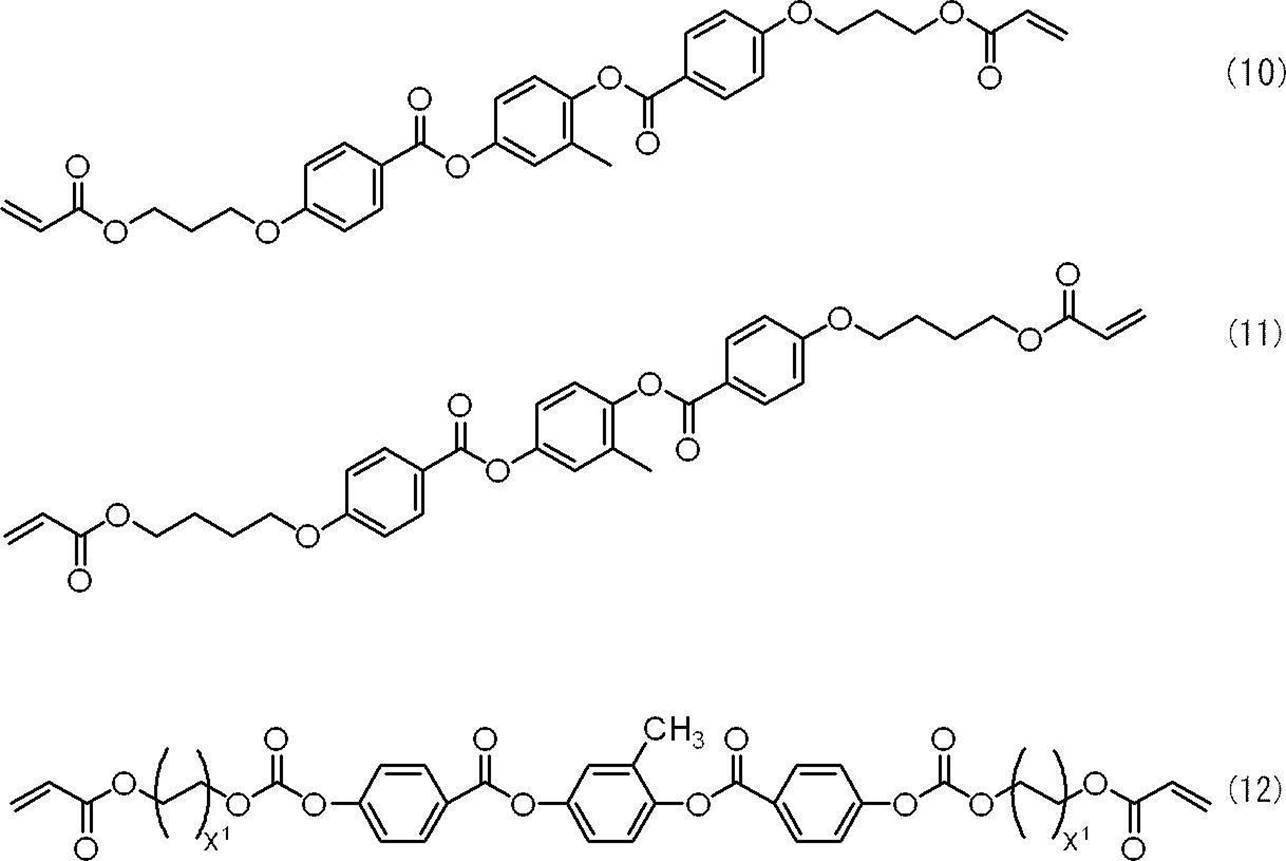
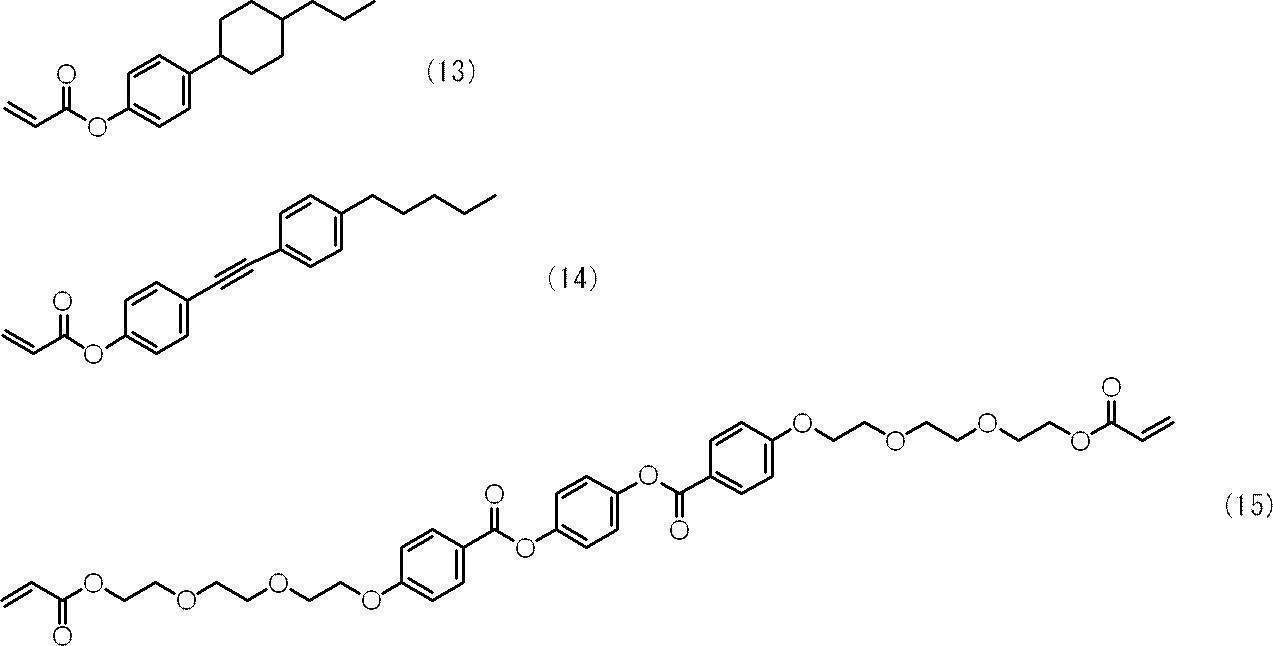
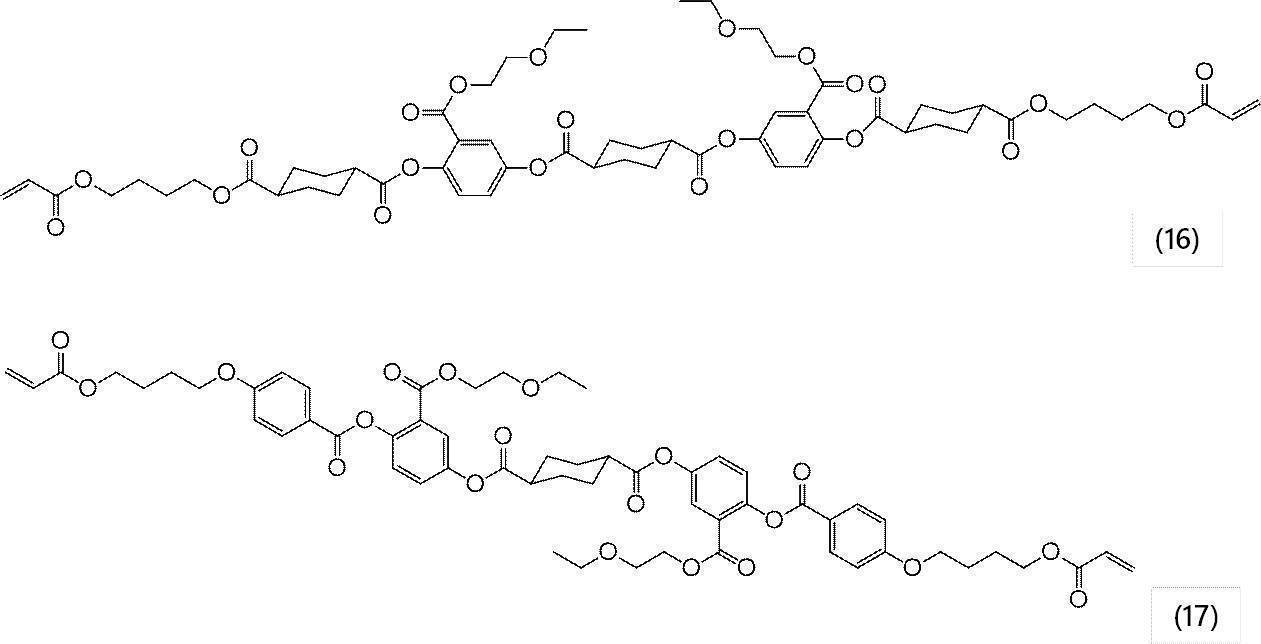
以下、インク組成物に含まれるキラル化合物について説明する。
キラル化合物は光学活性化合物ともいう。キラル化合物は、重合性液晶化合物の螺旋構造を誘起する機能を有する。キラル化合物の種類によって、誘起する螺旋構造のねじれ方向又はピッチが異なる。
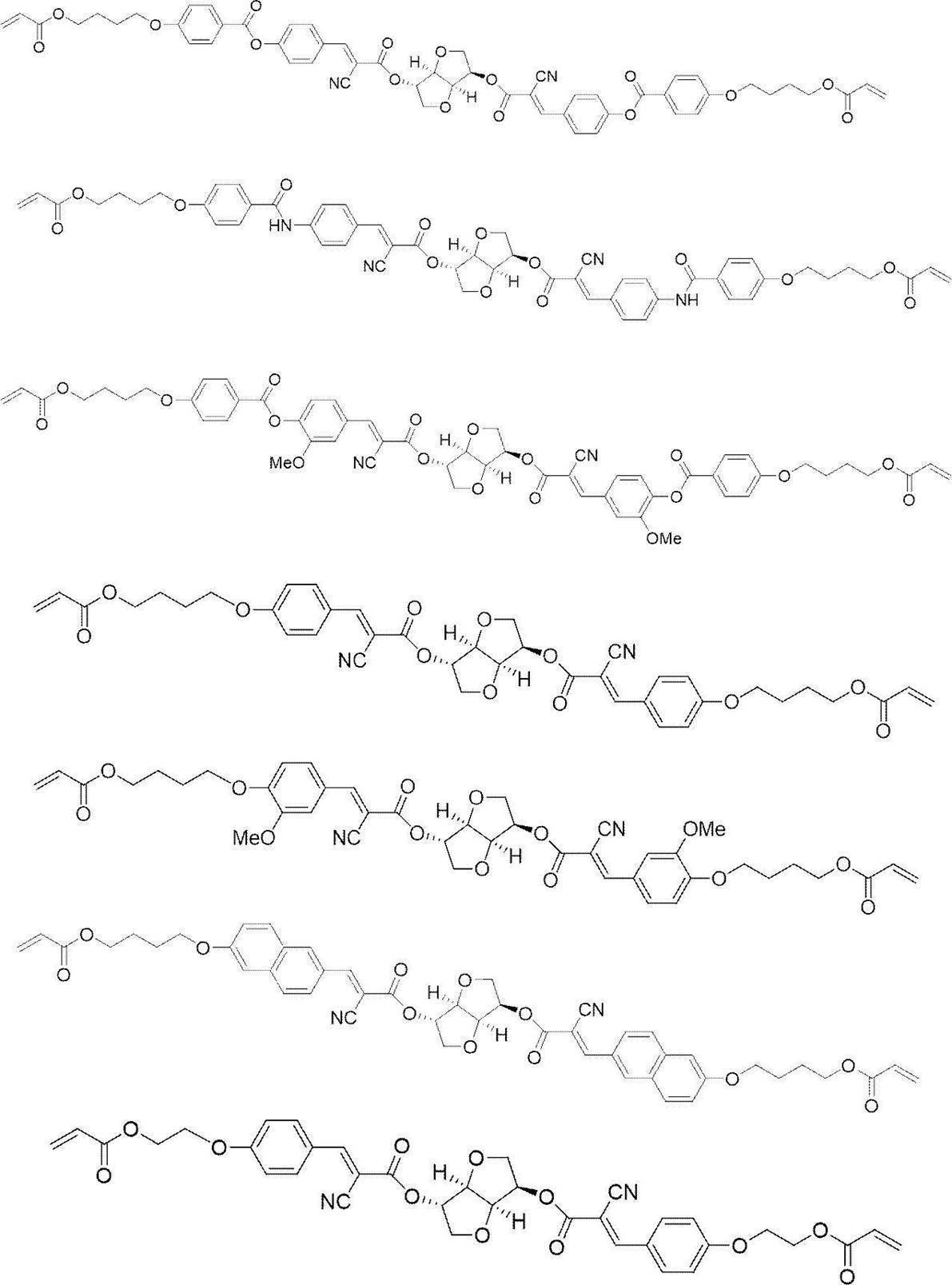
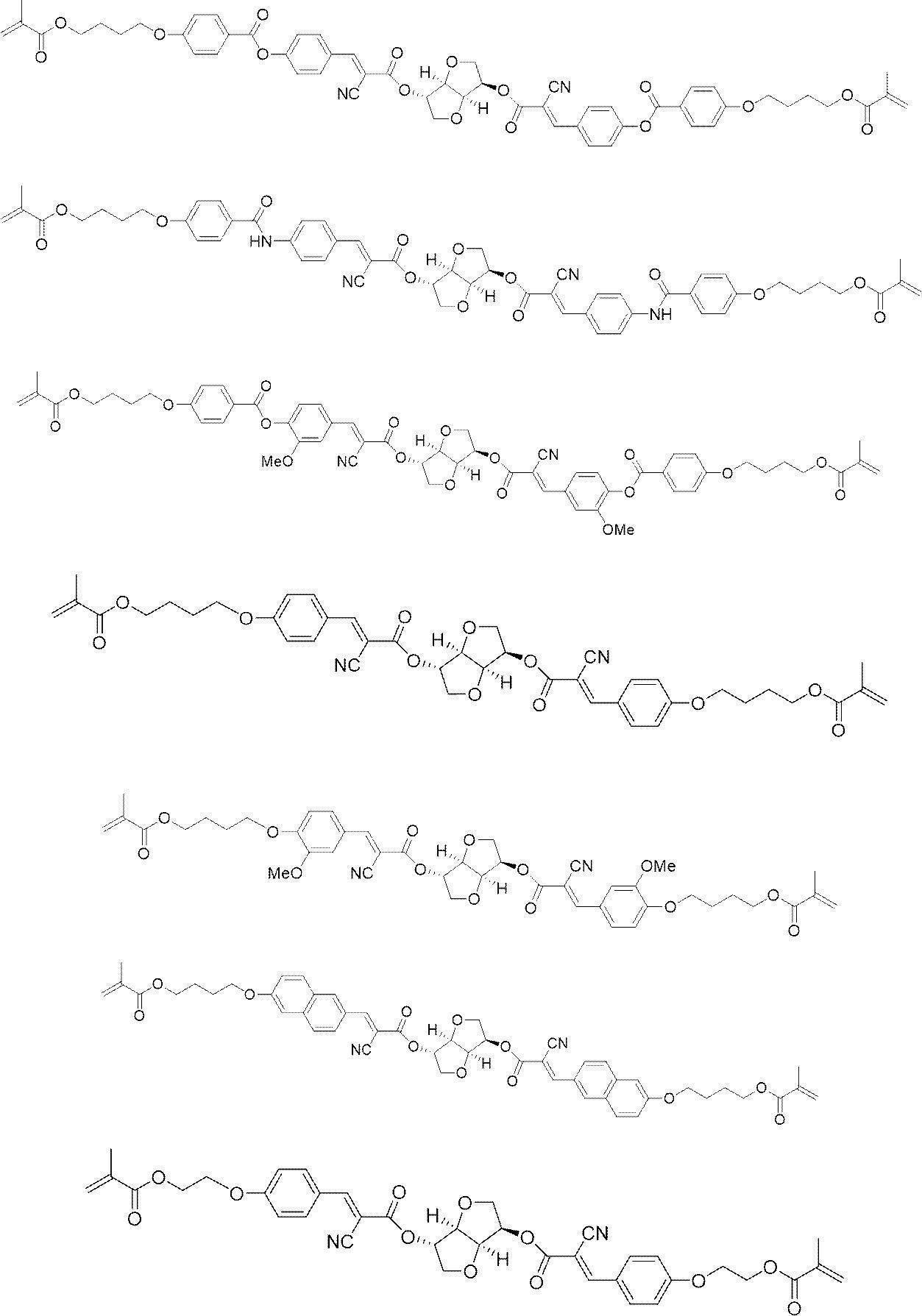
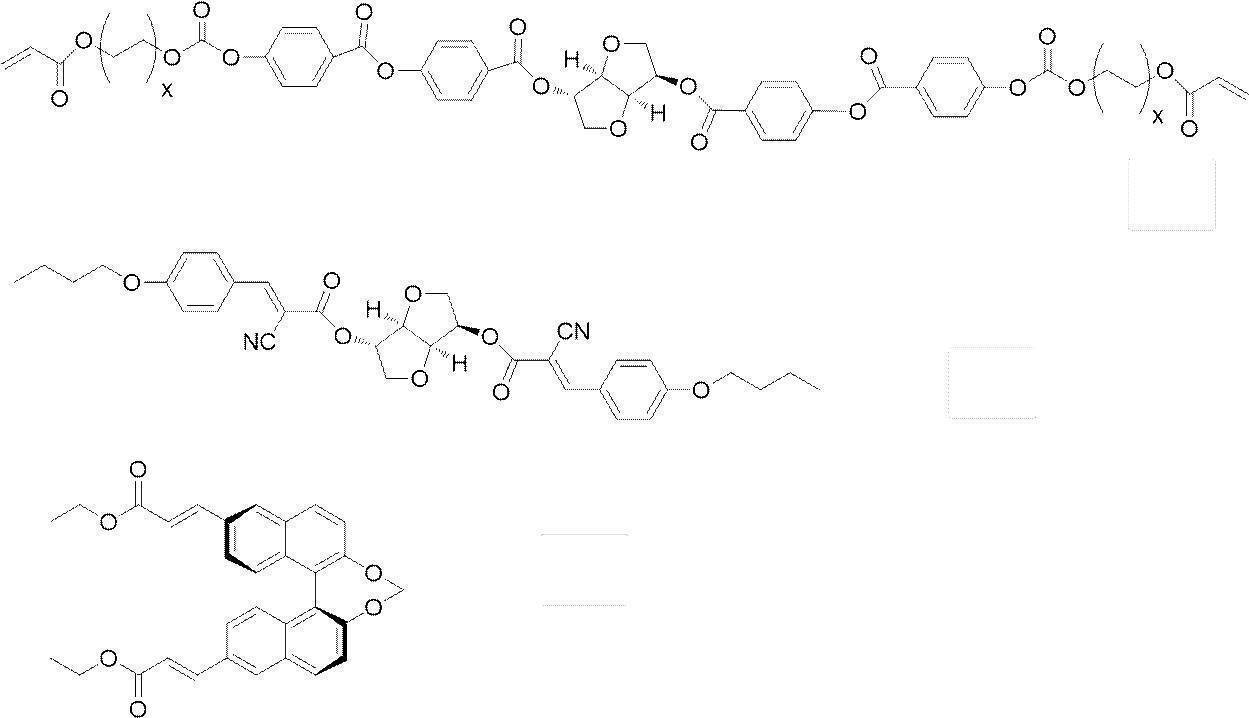
以下、インク組成物に含まれる重合開始剤について説明する。
重合開始剤としては、光重合開始剤が好ましく、紫外線の照射によってラジカルを生成する機能を有することがより好ましい。
以下、インク組成物に含まれる有機溶剤について説明する。
有機溶剤の種類は特に限定されず、目的に応じて適宜選択することができる。
エチレングリコール(沸点:198℃)、プロピレングリコール(沸点:188℃)、1,2-ブタンジオール(沸点:194℃)、2,3-ブタンジオール(沸点:183℃)、2-メチル-1,3-プロパンジオール(沸点:124℃)、2-メチル-2,4-ペンタンジオール(沸点:198℃)、1,2,6-ヘキサントリオール(沸点:178℃)、1,2,3-ブタントリオール(沸点:175℃)、1,2,4-ブタントリオール(沸点:170℃)、ジエチレングリコール(沸点:244℃)、ジプロピレングリコール(沸点:231℃)、1,3-プロパンジオール(沸点:214℃)、1,3-ブタンジオール(沸点:208℃)、1,4-ブタンジオール(沸点:230℃)、1,2-ペンタンジオール(沸点:206℃)、2,4-ペンタンジオール(沸点:201℃)、2-メチル-1,3-ブタンジオール(沸点:203℃)、3-メチル-1,3-ブタンジオール(沸点:203℃)、1,5-ペンタンジオール(沸点:242℃)、2,2-ジメチル-1,3-プロパンジオール(沸点:208℃)、1,2-ヘキサンジオール(沸点:223℃)、1,6-ヘキサンジオール(沸点:250℃)、2,5-ヘキサンジオール(沸点:217℃)、2-エチル-1,3-ヘキサンジオール(沸点:243℃)、トリエチレングリコール(沸点:287℃)、トリプロピレングリコール(沸点:273℃)、グリセリン(沸点:290℃)等の多価アルコール;
エチレングリコールジメチルエーテル(沸点:85℃)、エチレングリコールモノメチルエーテル(沸点:124℃)、エチレングリコールモノエチルエーテル(沸点:135℃)、エチレングリコール-n-プロピルエーテル(沸点:150℃)、エチレングリコールモノブチルエーテル(沸点:171℃)、プロピレングリコールモノエチルエーテル(沸点:133℃)、プロピレングリコール-n-ブチルエーテル(沸点:171℃)、プロピレングリコール-t-ブチルエーテル(沸点:153℃)、テトラエチレングリコールモノメチルエーテル(沸点:159℃)、ジエチレングリコールメチルエーテル(沸点:194℃)、ジエチレングリコールジエチルエーテル(沸点:162℃)、ジエチレングリコール-n-ブチルエーテル(沸点:171℃)、ジプロピレングリコールモノメチルエーテル(沸点:188℃)、ジエチレングリコールモノエチルエーテル(沸点:202℃)、ジエチレングリコールモノブチルエーテル(沸点:230℃)、トリエチレングリコールメチルエーテル(沸点:249℃)、ジプロピレングリコール-n-プロピルエーテル(沸点:213℃)、トリプロピレングリコールメチルエーテル(沸点:243℃)、トリエチレングリコールエチルエーテル(沸点:256℃)、ジエチレングリコール-n-ヘキシルエーテル(沸点:259℃)、トリプロピレングリコール-n-プロピルエーテル(沸点:261℃)等の多価アルコールアルキルエーテル;
エチレングリコールフェニルエーテル(沸点:237℃)、プロピレングリコールフェニルエーテル(沸点:243℃)、エチレングリコールモノベンジルエーテル(沸点:256℃)等の多価アルコールアリールエーテル;
ε-カプロラクタム(沸点:137℃)、N-メチルホルムアミド(沸点:199℃)、N,N-ジメチルホルムアミド(沸点:153℃)、N-メチル-2-ピロリドン(沸点:204℃)、2-ピロリドン(沸点:245℃)、1,3-ジメチルイミダゾリジノン(沸点:220℃)、N-メチルピロリジノン(沸点:202℃)等の含窒素化合物;
プロピレングリコールモノメチルエーテルアセテート(沸点:146℃)、酢酸3-メトキシブチル(沸点:172℃)等のエステル化合物;及び
ダイアセトンアルコール(沸点:169℃)、γ-ブチロラクトン(沸点:204℃)等のケトン化合物が挙げられる。中でも、保存安定性及び吐出性の観点から、有機溶剤は、ジエチレングリコールジエチルエーテル、エチレングリコールモノメチルエーテル、酢酸3-メトキシブチル、又はγ-ブチロラクトンが好ましい。
インク組成物は、さらに界面活性剤を含有してもよい。特に、第1インク膜上のヘキサデカン接触角を、45°以下とするために、第1インク組成物に界面活性剤を含有させることが好ましい。
インク組成物は、インクジェットインクに通常含まれる添加剤を、必要に応じ、本開示の効果を損なわない範囲で含有することができる。
本開示において、インク組成物の粘度は特に限定されないが、インクジェット記録方式で吐出する場合には、吐出安定性の観点から30mPa・s以下であることが好ましく、より好ましくは0.5mPa・s~20mPa・s、さらに好ましくは3mPa・s~15mPa・sである。なお、インク組成物の粘度は回転式粘度計、例えば、東機産業社製の製品名「VISCOMETER TV-22」を用いて25℃の条件下で測定されるものである。
本開示の画像記録方法は、基材上に第1インク組成物をインクジェット記録方式により付与する工程(以下、「第1インク付与工程」という)を含む。
本開示の画像記録方法は、基材上に付与された第1インク組成物に活性エネルギー線を照射し、第1インク膜を形成する工程(以下、「第1インク膜形成工程」という)を含む。
放電量=P(W)/{L(m)×v(m/min)}
P(W):放電電力
L(m):放電電極長
v(m/min):処理速度
本開示の画像記録方法は、親液化処理が施された第1インク膜上に、第2インク組成物をインクジェット記録方式により付与する工程(以下、「第2インク付与工程」という)を含む。インクジェット記録方式により第2インク組成物を付与する方法は、インクジェット記録方式により第1インク組成物を付与する方法と同様である。
本開示の画像記録方法は、第1インク膜上に付与された第2インク組成物に活性エネルギー線を照射し、第2インク膜を形成する工程(以下、「第2インク膜形成工程」という)を含む。
本開示の画像記録方法は、上記工程以外のその他の工程を含んでいてもよい。
本開示の画像記録方法は、第1インク付与工程の後、第1活性エネルギー線を照射する工程の前に、第1インク組成物を加熱する第1加熱工程を含むことが好ましい。同様に、第2インク付与工程の後、第2活性エネルギー線を照射する工程の前に、第2インク組成物を加熱する第2加熱工程を含むことが好ましい。加熱工程を行うことにより、重合性液晶化合物が形成する螺旋構造の螺旋軸方向が均一になるよう制御することができる。
本開示の画像記録方法によって得られる画像記録物の用途としては、さまざまな製品への加飾が挙げられる。加飾は、製品に対して直接行ってもよく、加飾フィルムを作製して、加飾フィルムを製品に貼り付けてもよい。また、インクジェット記録方式等で記録された画像の上に、本開示の画像記録方法によって画像を記録することにより加飾することも好ましい。加飾対象となる素材としては、ガラス、各種プラスチック、プラスチックフィルム、金属、皮革、紙、及び布が挙げられる。室内装飾;各種容器の内壁又は外壁、宝飾品、時計文字盤、各種の家具への装飾;看板、横断幕、懸垂幕等の屋内外サインの外装;各種の家電の外装;電子ウォッチ、パソコン、携帯電話等の外装;ディスプレイ面への加飾;車載用の樹脂製品、ソーラーパネル、合成皮革等のカバン、スーツケース、ポリマー紙幣、IDカード、クレジットカード等のカード類、ギフトカード、化粧品等のプラスチックボトル、酒類等のガラスボトル、眼鏡、プラスチックフィルムがラミネートされたパッケージ用の紙基材、プラスチック包装材料への加飾が挙げられる。
[インク組成物の調製]
(インク組成物Gm1)
下記に示す成分を、25℃に保温された容器中で混合し、インク組成物Gm1を調製した。インク組成物Gm1の粘度(25℃)は、11mPa・sであった。
・ジエチレングリコールジエチルエーテル ・・・164.21質量部
・重合性液晶化合物の混合物A ・・・ 100.0質量部
・重合開始剤:ビス(2,4,6-トリメチルベンゾイル)フェニルホスフィンオキシド
(製品名「Omnirad 819、IGM Resins B.V.社製」) ・・・4.0質量部
・キラル化合物A ・・・5.23質量部
・フッ素系界面活性剤(製品名「フタージェント208G」、ネオス社製) ・・・0.07質量部
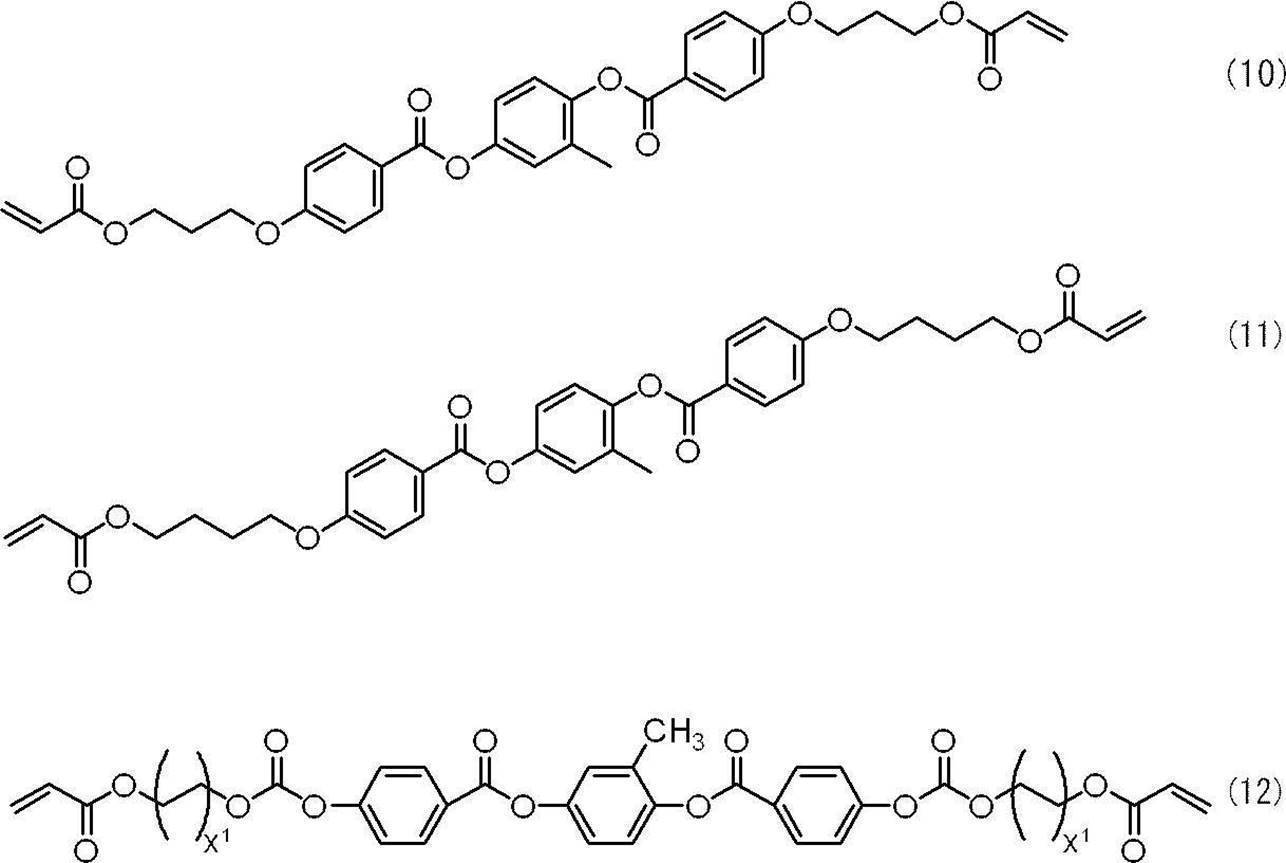

インク組成物Gm1におけるキラル化合物Aの含有量を5.23質量部から4.78質量部に、ジエチレングリコールジエチルエーテルの含有量を164.21質量部から163.06質量部に変更したこと以外は、インク組成物Gm1と同様の方法でインク組成物Rm1を調製した。インク組成物Rm1の粘度(25℃)は、11mPa・sであった。インク組成物Rm1は、選択反射波長が650nmの右円偏光を反射する右偏光赤色のインク膜を形成するインクであった。
インク組成物Gm1におけるキラル化合物Aの含有量を5.23質量部から6.30質量部に、ジエチレングリコールジエチルエーテルの含有量を164.21質量部から165.88質量部に変更したこと以外は、インク組成物Gm1と同様の方法でインク組成物Bm1を調製した。インク組成物Bm1の粘度(25℃)は、11mPa・sであった。インク組成物Bm1は、選択反射波長が450nmの右円偏光を反射する右偏光青色のインク膜を形成するインクであった。
基材としてPETシート(製品名「ビューフルUV TP-188」、KIMOTO社製)を用い、インク組成物Bm1を用いて、インクジェットプリンタ(製品名「UJF3042HG」、MIMAKI社製)でインク画像を記録した。画像解像度720dpi×600dpiで、ベタ画像を記録した。画像記録中、プラテン上にホットプレートを設置した。ホットプレートの温度は50℃に設定した。画像記録終了後、ベタ画像が形成された基材を80℃に設定されたオーブンで5分間保存し、メタルハライド光源で500mJ/cm2の紫外線を照射した。これにより、インク組成物Bm1の硬化膜が形成された。
実施例1におけるコロナ処理の条件を、下記の条件に変更したこと以外は、実施例1と同様の方法で、画像サンプルを得た。
実施例2では、インク組成物Bm1の硬化膜に対して、コロナ処理機(製品名「コロナ発振機TEC4AX」、春日電機社製)を用い、出力60W、4m/分の条件で1回、コロナ処理を施した。
比較例1では、インク組成物Bm1の硬化膜に対してコロナ処理を施さず、インク組成物Bm1の硬化膜である第1インク膜を得たこと以外は、実施例1と同様の方法で、画像サンプルを得た。
(ハジキ)
上記画像サンプルを用いて、目視でハジキの度合いを観察した。評価基準は以下のとおりである。A及びBは、実用上問題ないレベルである。
A:ハジキが全く確認されない。
B:ハジキが一部確認される。
C:ハジキが全体的に確認される。
放電量=P(W)/{L(m)×v(m/min)}
P(W):放電電力
L(m):放電電極長
v(m/min):処理速度

[インク組成物の調製]
(インク組成物Gm101)
下記に示す成分を、25℃に保温された容器中で混合し、インク組成物Gm101を調製した。インク組成物Gm101の粘度(25℃)は、11mPa・sであった。
・ジエチレングリコールジエチルエーテル ・・・61.975質量%
・重合性液晶化合物の混合物B ・・・34質量%
・重合開始剤:ビス(2,4,6-トリメチルベンゾイル)フェニルホスフィンオキシド
(製品名「Omnirad 819、IGM Resins B.V.社製」) ・・・2.0質量%
・キラル化合物A ・・・2.0質量%
・フッ素系界面活性剤(製品名「フタージェント208G」、ネオス社製) ・・・0.025質量%
インク組成物Gm101におけるキラル化合物Aの含有量を2.0質量%から1.5質量%に、重合性液晶化合物の混合物Bの含有量を34質量%から34.5質量%に、に変更したこと以外は、インク組成物Gm101と同様の方法でインク組成物Rm101を調製した。インク組成物Rm101の粘度(25℃)は、11mPa・sであった。インク組成物Rm101は、選択反射波長が620nmの右円偏光を反射する右偏光赤色のインク膜を形成するインクであった。
インク組成物Gm101におけるキラル化合物Aの含有量を2.0質量%から2.2質量%に、重合性液晶化合物の混合物Bの含有量を34質量%から33.8質量%に、に変更したこと以外は、インク組成物Gm1と同様の方法でインク組成物Bm101を調製した。インク組成物Bm101の粘度(25℃)は、11mPa・sであった。インク組成物Bm101は、選択反射波長が445nmの右円偏光を反射する右偏光青色のインク膜を形成するインクであった。
第1インク組成物としてインク組成物Bm101を用いたこと以外は、実施例1と同様の方法で画像記録、加熱処理、及び紫外線照射を行い、基材上に、インク組成物Bm101の硬化膜を形成した。インク組成物Bm101の硬化膜に対して、実施例1と同様の方法でコロナ処理を施し、第1インク膜を得た。なお、画像記録では、ベタ画像を記録した。
第1インク膜上に、第2インク組成物としてインク組成物Gm101を用いて、実施例1と同様の方法で画像記録、加熱処理、及び紫外線照射を行い、インク組成物Gm101の硬化膜を形成した。インク組成物Gm101の硬化膜に対して、インク組成物Bm101の硬化膜に対するコロナ処理と同様の条件で、コロナ処理を施し、第2インク膜を得た。なお、画像記録では、ベタ画像と、幅0.5ポイント(pt)のラインアンドスペース画像を記録した。
第2インク膜上に、第3インク組成物としてインク組成物Rm101を用いて、実施例1と同様の方法で画像記録、加熱処理、及び紫外線照射を行い、インク組成物Rm101の硬化膜である第3インク膜を形成した。なお、画像記録では、ベタ画像と、幅0.5ポイント(pt)のラインアンドスペース画像を記録した。
また、第1インク組成物を付与する前に、基材上にあらかじめ下地層形成用組成物(製品名「LH-100クリア」、MIMAKI社製)を用いて下地層を形成した場合にも、実施例101と同様に、第1インク膜、第2インク膜、及び第3インク膜が形成された。
実施例101におけるコロナ処理の条件を、下記の条件に変更したこと以外は、実施例101と同様の方法で、第1インク膜、第2インク膜、及び第3インク膜を形成した。
第1インク組成物、第2インク組成物、及び第3インク組成物に含まれる界面活性剤の含有量を表2に記載の含有量に変更したこと、第1インク組成物に活性エネルギー線を照射した後にコロナ処理を行わなかったこと、及び第2インク組成物に活性エネルギー線を照射した後にコロナ処理を行わなかったこと以外は、実施例101と同様の方法で、第1インク膜、第2インク膜、及び第3インク膜を形成した。なお、実施例106では、実施例101に対して、界面活性剤の含有量を増加させたことに伴い、重合性液晶化合物の混合物Bの含有量を減少させた。以下の実施例においても、界面活性剤の含有量の調整に関しては、重合性液晶化合物の混合物Bの含有量を調整することにより行った。
第1インク組成物に含まれる界面活性剤の種類及び含有量を、表2に記載の種類及び含有量に変更したこと以外は、実施例106と同様の方法で、第1インク膜、第2インク膜、及び第3インク膜を形成した。
実施例107~実施例115、比較例102、及び比較例103で用いた界面活性剤は以下のとおりである。
炭化水素系界面活性剤・・・製品名「BYK-399」、ビックケミー・ジャパン株式会社製
架橋型炭化水素系界面活性剤・・・製品名「BYK-UV3535」、ビックケミー・ジャパン社製)
架橋型シリコーン系界面活性剤・・・製品名「BYK-UV3505」、ビックケミー・ジャパン社製
第1インク組成物に界面活性剤を含有させなかったこと以外は、実施例106と同様の方法で、第1インク膜、第2インク膜、及び第3インク膜を形成した。
比較例101では、第1インク組成物に活性エネルギー線を照射した後にコロナ処理を行わなかったこと、及び第2インク組成物に活性エネルギー線を照射した後にコロナ処理を行わなかったこと以外は、実施例101と同様の方法で、第1インク膜、第2インク膜、及び第3インク膜を形成した。
ハジキと滲みに関して、2層評価と3層評価を行った。2層評価は、第1インク膜上に、第2インク組成物の硬化膜が形成された画像サンプルを用いて行った。ハジキに関する2層評価は、1層目、2層目ともにベタ画像である画像サンプルを用いて行った。滲みに関する2層評価は、1層目がベタ画像、2層目がラインアンドスペース画像である画像サンプルを用いて行った。3層評価は、第1インク膜、第2インク膜、及び第3インク膜がこの順に形成された画像サンプルを用いて行った。ハジキに関する3層評価は、1層目、2層目、3層目ともにベタ画像である画像サンプルを用いて行った。滲みに関する3層評価は、1層目及び2層目がベタ画像、3層目がラインアンドスペース画像である画像サンプルを用いて行った。
上記画像サンプルを用いて、目視でハジキの度合いを観察した。評価基準は以下のとおりである。A~Cは、実用上問題ないレベルである。
A:ハジキが全く確認されないか、又は、ハジキが確認される面積が、ベタ画像全体の1%以下である。
B:ハジキが確認される面積が、ベタ画像全体の1%超5%以下である。
C:ハジキが確認される面積が、ベタ画像全体の5%超40%以下である。
D:ハジキが確認される面積が、ベタ画像全体の40%超である。
上記画像サンプルを用いて、目視でハジキの度合いを観察した。評価基準は以下のとおりである。A~Cは、実用上問題ないレベルである。
A:0.5ptスペース部分の濡れ潰れが全く確認されないか、又は、0.5ptスペース部分の濡れ潰れが確認される面積が、ラインア
ンドスペース画像全体の1%以下である。
B:0.5ptスペース部分の濡れ潰れが確認される面積が、ラインアンドスペース画像全体の1%超5%以下である。
C:0.5ptスペース部分の濡れ潰れが確認される面積が、ラインアンドスペース画像全体の5%超40%以下である。
D:0.5ptスペース部分の濡れ潰れが確認される面積が、ラインアンドスペース画像全体の40%超である。
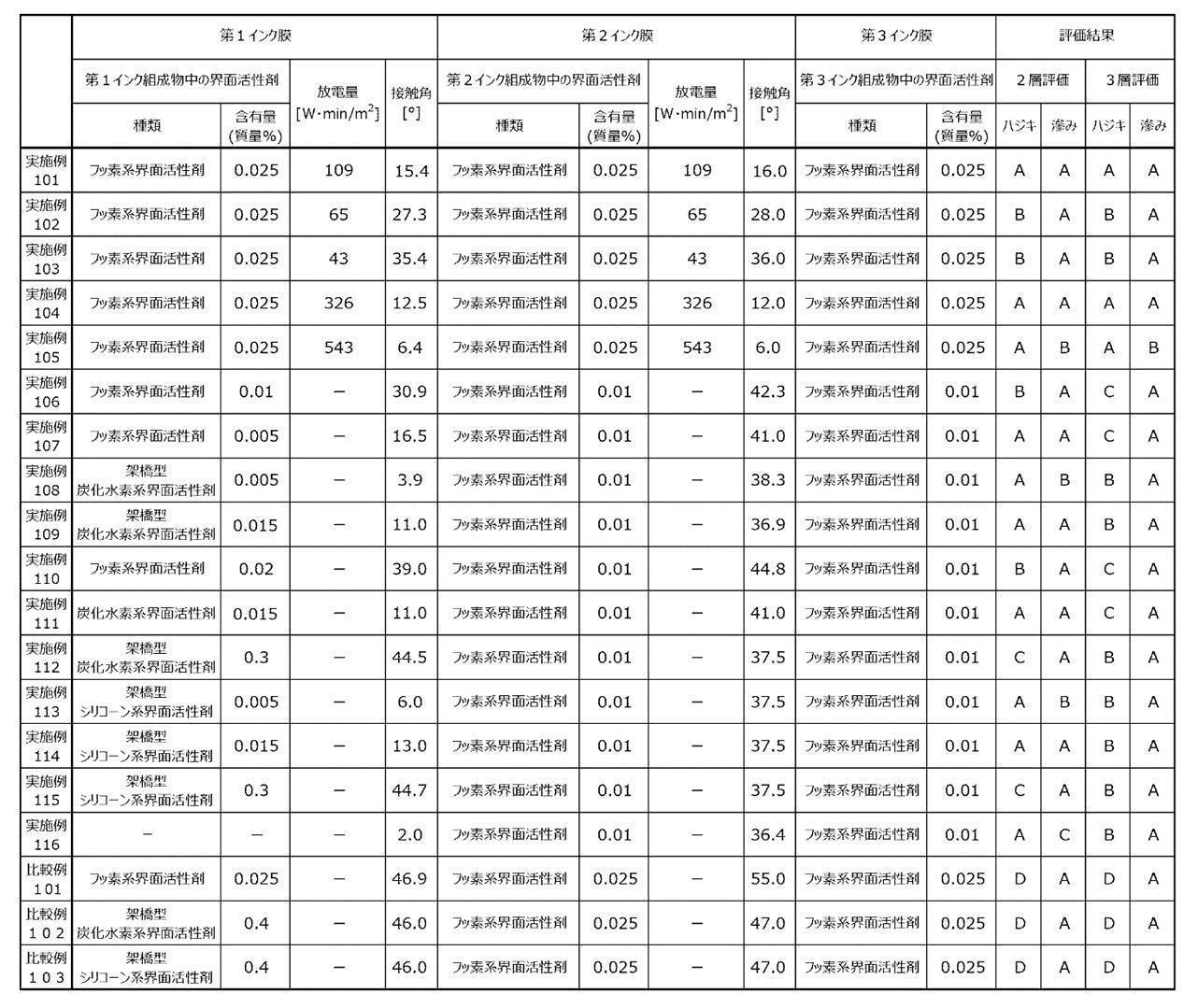
[インク組成物の調製]
(インク組成物Gm201)
下記に示す成分を、25℃に保温された容器中で混合し、インク組成物Gm201を調製した。
・ジエチレングリコールジエチルエーテル ・・・61.025質量%
・重合性液晶化合物の混合物A ・・・35.658質量%
・重合開始剤:ビス(2,4,6-トリメチルベンゾイル)フェニルホスフィンオキシド
(製品名「Omnirad 819、IGM Resins B.V.社製」) ・・・1.426質量%
・キラル化合物A ・・・1.866質量%
・フッ素系界面活性剤(製品名「フタージェント208G」、ネオス社製) ・・・0.025質量%
インク組成物Gm201におけるキラル化合物Aの含有量を1.866質量%から1.614質量%に、重合性液晶化合物の混合物の含有量を35.658質量%から35.900質量%に、重合開始剤の含有量を1.426質量%から1.436質量%に変更したこと以外は、インク組成物Gm201と同様の方法でインク組成物Rm201を調製した。インク組成物Rm201の粘度(25℃)は、11mPa・sであった。インク組成物Rm201は、選択反射波長が610nmの右円偏光を反射する右偏光赤色のインク膜を形成するインクであった。
インク組成物Gm201におけるキラル化合物Aの含有量を1.866質量%から2.225質量%に、重合性液晶化合物の混合物の含有量を35.658質量%から35.312質量%に、重合開始剤の含有量を1.426質量%から1.413質量%に変更したこと以外は、インク組成物Gm1と同様の方法でインク組成物Bm1を調製した。インク組成物Bm1の粘度(25℃)は、11mPa・sであった。インク組成物Bm1は、選択反射波長が450nmの右円偏光を反射する右偏光青色のインク膜を形成するインクであった。
Claims (15)
- 重合性液晶化合物、キラル化合物、重合開始剤及び有機溶剤を含む第1インク組成物と、重合性液晶化合物、キラル化合物、重合開始剤及び有機溶剤を含む第2インク組成物と、を有する少なくとも2つのインク組成物を準備する工程と、
基材上に前記第1インク組成物をインクジェット記録方式により付与する工程と、
前記基材上に付与された前記第1インク組成物に活性エネルギー線を照射し、第1インク膜を形成する工程と、
前記第1インク膜上に、前記第2インク組成物をインクジェット記録方式により付与する工程と、
前記第1インク膜上に付与された前記第2インク組成物に活性エネルギー線を照射し、第2インク膜を形成する工程と、を含み、
前記第1インク膜上のヘキサデカン接触角は、45°以下である画像記録方法。 - 前記少なくとも2つのインク組成物を準備する工程では、重合性液晶化合物、キラル化合物、重合開始剤及び有機溶剤を含む第3インク組成物をさらに準備し、
前記第2インク膜上に、前記第3インク組成物をインクジェット記録方式により付与する工程と、
前記第2インク膜上に付与された前記第3インク組成物に活性エネルギー線を照射し、第3インク膜を形成する工程をさらに含み、
前記第2インク膜上のヘキサデカン接触角は、45°以下である、請求項1に記載の画像記録方法。 - 前記第1インク膜上のヘキサデカン接触角は、3°~25°である、請求項1又は請求項2に記載の画像記録方法。
- 前記第1インク膜を形成する工程は、
前記基材上に付与された前記第1インク組成物に活性エネルギー線を照射した後に、前記第1インク組成物の硬化膜に対して親液化処理を施し、前記第1インク膜を形成する工程である、請求項1~請求項3のいずれか1項に記載の画像記録方法。 - 前記親液化処理は、コロナ処理、プラズマ処理及び紫外線オゾン処理からなる群より選択される少なくとも1種である、請求項4に記載の画像記録方法。
- 前記コロナ処理は、放電量70W・min/m2~500W・min/m2で行われる、請求項5に記載の画像記録方法。
- 前記第1インク組成物は、さらにフッ素系界面活性剤を含み、前記フッ素系界面活性剤の含有量は、前記第1インク組成物の全量に対して、0.005質量%~0.02質量%である、請求項1~請求項6のいずれか1項に記載の画像記録方法。
- 前記第1インク組成物は、さらにシリコーン系界面活性剤を含み、前記シリコーン系界面活性剤の含有量は、前記第1インク組成物の全量に対して、0.005質量%~0.3質量%である、請求項1~請求項6のいずれか1項に記載の画像記録方法。
- 前記第1インク組成物は、さらに炭化水素系界面活性剤を含み、前記炭化水素系界面活性剤の含有量は、前記第1インク組成物の全量に対して、0.005質量%~0.3質量%である、請求項1~請求項6のいずれか1項に記載の画像記録方法。
- 前記第1インク組成物は、さらに界面活性剤を含み、
前記界面活性剤は、架橋性基を有する界面活性剤である、請求項1~請求項6のいずれか1項に記載の画像記録方法。 - 前記第1インク組成物と前記第2インク組成物とは、キラル化合物の含有量が互いに異なる、請求項1~請求項10のいずれか1項に記載の画像記録方法。
- 前記第1インク組成物及び前記第2インク組成物はそれぞれ、互いに異なる2種以上の重合性液晶化合物を含む、請求項1~請求項11のいずれか1項に記載の画像記録方法。
- 前記基材が光吸収性の基材である、請求項1~請求項12のいずれか1項に記載の画像記録方法。
- 前記基材の可視光における可視光吸収率が、50%以上である、請求項13に記載の画像記録方法。
- 前記第1インク組成物及び前記第2インク組成物はそれぞれ、有機溶剤の全量に対して、沸点80℃~300℃の有機溶剤を30質量%以上含む、請求項1~請求項14のいずれか1項に記載の画像記録方法。
Priority Applications (4)
| Application Number | Priority Date | Filing Date | Title |
|---|---|---|---|
| EP20868792.1A EP4036131B1 (en) | 2019-09-27 | 2020-08-31 | Image recording method |
| JP2021548719A JP7185067B2 (ja) | 2019-09-27 | 2020-08-31 | 画像記録方法 |
| CN202080064285.9A CN114375261B (zh) | 2019-09-27 | 2020-08-31 | 图像记录方法 |
| US17/673,730 US20220169880A1 (en) | 2019-09-27 | 2022-02-16 | Image recording method |
Applications Claiming Priority (2)
| Application Number | Priority Date | Filing Date | Title |
|---|---|---|---|
| JP2019-177119 | 2019-09-27 | ||
| JP2019177119 | 2019-09-27 |
Related Child Applications (1)
| Application Number | Title | Priority Date | Filing Date |
|---|---|---|---|
| US17/673,730 Continuation US20220169880A1 (en) | 2019-09-27 | 2022-02-16 | Image recording method |
Publications (1)
| Publication Number | Publication Date |
|---|---|
| WO2021059879A1 true WO2021059879A1 (ja) | 2021-04-01 |
Family
ID=75165736
Family Applications (1)
| Application Number | Title | Priority Date | Filing Date |
|---|---|---|---|
| PCT/JP2020/032947 Ceased WO2021059879A1 (ja) | 2019-09-27 | 2020-08-31 | 画像記録方法 |
Country Status (5)
| Country | Link |
|---|---|
| US (1) | US20220169880A1 (ja) |
| EP (1) | EP4036131B1 (ja) |
| JP (1) | JP7185067B2 (ja) |
| CN (1) | CN114375261B (ja) |
| WO (1) | WO2021059879A1 (ja) |
Cited By (3)
| Publication number | Priority date | Publication date | Assignee | Title |
|---|---|---|---|---|
| WO2023017846A1 (ja) | 2021-08-13 | 2023-02-16 | 富士フイルム株式会社 | カラーマネージメント装置、カラーマネージメント方法及びプログラム |
| US12305044B2 (en) * | 2021-11-12 | 2025-05-20 | Fujifilm Corporation | Image recorded material and image recording method |
| WO2025197563A1 (ja) * | 2024-03-22 | 2025-09-25 | 富士フイルム株式会社 | インクジェットインク、画像記録物の製造方法、及び、画像記録物 |
Families Citing this family (1)
| Publication number | Priority date | Publication date | Assignee | Title |
|---|---|---|---|---|
| CN119422086A (zh) * | 2022-06-21 | 2025-02-11 | 富士胶片株式会社 | 图像记录物及图像记录物的制造方法、以及装饰成型体 |
Citations (24)
| Publication number | Priority date | Publication date | Assignee | Title |
|---|---|---|---|---|
| JPS57165480A (en) | 1981-03-16 | 1982-10-12 | Consortium Elektrochem Ind | Composition having liquid crystal phase and manufacture |
| JPS60132767A (ja) | 1983-12-21 | 1985-07-15 | Seikosha Co Ltd | インクジエツトプリンタ |
| US4683327A (en) | 1985-06-24 | 1987-07-28 | Celanese Corporation | Anisotropic heat-curable acrylic terminated monomers |
| JPH01272551A (ja) | 1988-04-22 | 1989-10-31 | Dainippon Printing Co Ltd | 重合性2官能アクリレートモノマー |
| JPH0616616A (ja) | 1992-07-03 | 1994-01-25 | Canon Inc | 反応性液晶性化合物、高分子液晶化合物、液晶組成物および液晶素子 |
| JPH07110469A (ja) | 1993-08-16 | 1995-04-25 | Dainippon Ink & Chem Inc | 液晶表示素子及びその製造方法 |
| WO1995022586A1 (de) | 1994-02-19 | 1995-08-24 | Basf Aktiengesellschaft | Neue polymerisierbare flüssigkristalline verbindungen |
| WO1995024455A1 (de) | 1994-03-11 | 1995-09-14 | Basf Aktiengesellschaft | Neue polymerisierbare flüssigkristalline verbindungen |
| WO1997000600A2 (de) | 1995-09-01 | 1997-01-09 | Basf Aktiengesellschaft | Polymerisierbare flüssigkristalline verbindungen |
| US5622648A (en) | 1993-10-15 | 1997-04-22 | Merck Patent Gesellschaft Mit Beschrankter Haftung | Reactive liquid crystal compounds |
| WO1998023580A1 (de) | 1996-11-27 | 1998-06-04 | Basf Aktiengesellschaft | Polymerisierbare oligomesogene |
| US5770107A (en) | 1995-10-05 | 1998-06-23 | Merck Patent Gesellschaft Mit Beschrankter Haftung | Reactive liquid crystalline compound |
| WO1998052905A1 (en) | 1997-05-22 | 1998-11-26 | Rolic Ag | New polymerisable liquid crystalline compounds |
| JPH1180081A (ja) | 1997-09-05 | 1999-03-23 | Dainippon Ink & Chem Inc | 液晶性(メタ)アクリレート化合物と組成物及びこれを用いた光学異方体 |
| JP2001328973A (ja) | 2000-03-13 | 2001-11-27 | Fuji Photo Film Co Ltd | 重合性液晶化合物および光学異方性素子 |
| WO2011010500A1 (ja) * | 2009-07-21 | 2011-01-27 | 東レ株式会社 | 造水システム |
| JP2011191582A (ja) * | 2010-03-16 | 2011-09-29 | Fujifilm Corp | 積層膜の製造方法、積層膜、及び遮熱部材 |
| JP2013513000A (ja) * | 2009-12-08 | 2013-04-18 | シクパ ホールディング エスアー | キラル液晶ポリマーをベースにしたマーキング |
| JP2013512800A (ja) * | 2009-12-08 | 2013-04-18 | シクパ ホールディング エスアー | キラル液晶ポリマーマーキング |
| JP2013113913A (ja) * | 2011-11-25 | 2013-06-10 | Fujifilm Corp | フィルムおよびその製造方法 |
| WO2017007007A1 (ja) | 2015-07-09 | 2017-01-12 | 富士フイルム株式会社 | 重合性化合物を含む重合性組成物、フィルム、投映像表示用ハーフミラー、および重合性化合物 |
| WO2017010560A1 (ja) | 2015-07-16 | 2017-01-19 | 富士フイルム株式会社 | 液晶組成物、フィルム、投映像表示用ハーフミラー、およびフィルムの製造方法 |
| WO2017057316A1 (ja) | 2015-09-30 | 2017-04-06 | 富士フイルム株式会社 | 光学フィルム、輝度向上フィルム、輝度向上フィルム付きバックライトユニット及び液晶表示装置 |
| JP2019177119A (ja) | 2018-03-30 | 2019-10-17 | 株式会社三洋物産 | 遊技機 |
Family Cites Families (13)
| Publication number | Priority date | Publication date | Assignee | Title |
|---|---|---|---|---|
| CN100397580C (zh) * | 2002-09-30 | 2008-06-25 | 精工爱普生株式会社 | 膜图案的形成方法、薄膜制造装置、导电膜布线 |
| DE602006015324D1 (de) * | 2006-10-11 | 2010-08-19 | Agfa Graphics Nv | Pigmentierte nicht wässrige Tinte für Tintenstrahldrucker |
| EP2116900A4 (en) * | 2007-03-01 | 2012-06-27 | Asahi Glass Co Ltd | PROCESSED SUBSTRATES WITH WATER-REPELLENT AREAS IN PATTERNS, MANUFACTURING PROCESS THEREFOR AND PROCESS FOR PRODUCING MEMBERS WITH PATTERNS PRODUCED FROM FUNCTIONAL MATERIALS |
| JP2009084395A (ja) * | 2007-09-28 | 2009-04-23 | Mitsubishi Chemicals Corp | 重合体、組成物、硬化物および光記録媒体 |
| ES2400839T3 (es) * | 2007-10-24 | 2013-04-12 | Agfa Graphics Nv | Tinta de inyección blanca mejorada para la estabilidad de la dispersión |
| US20120211083A1 (en) * | 2009-10-29 | 2012-08-23 | Takahiro Seike | Method for manufacturing organic thin film solar cell module |
| US9416289B2 (en) * | 2011-01-26 | 2016-08-16 | Konica Minolta, Inc. | Active-energy-ray-curable inkjet ink composition, active-energy-ray-curable inkjet ink, and inkjet recording method |
| JP5318132B2 (ja) * | 2011-03-01 | 2013-10-16 | 富士フイルム株式会社 | 赤外光反射フィルムおよびその製造方法。 |
| JP6357947B2 (ja) * | 2014-07-25 | 2018-07-18 | 大日本印刷株式会社 | 多層基材及び画像表示装置 |
| JP7036507B2 (ja) * | 2015-12-22 | 2022-03-15 | スリーエム イノベイティブ プロパティズ カンパニー | アクリルポリビニルアセタールグラフィックフィルム |
| US20200199452A1 (en) * | 2017-06-09 | 2020-06-25 | Dic Corporation | Polymerizable liquid crystal composition, optical film including the same, and method for producing optical film |
| US10543677B2 (en) * | 2017-07-14 | 2020-01-28 | Canon Kabushiki Kaisha | Transfer member for transfer-type inkjet recording, inkjet recording method and inkjet recording apparatus |
| JP7023984B2 (ja) * | 2017-12-22 | 2022-02-22 | 富士フイルム株式会社 | 成膜方法 |
-
2020
- 2020-08-31 CN CN202080064285.9A patent/CN114375261B/zh active Active
- 2020-08-31 EP EP20868792.1A patent/EP4036131B1/en active Active
- 2020-08-31 WO PCT/JP2020/032947 patent/WO2021059879A1/ja not_active Ceased
- 2020-08-31 JP JP2021548719A patent/JP7185067B2/ja active Active
-
2022
- 2022-02-16 US US17/673,730 patent/US20220169880A1/en not_active Abandoned
Patent Citations (24)
| Publication number | Priority date | Publication date | Assignee | Title |
|---|---|---|---|---|
| JPS57165480A (en) | 1981-03-16 | 1982-10-12 | Consortium Elektrochem Ind | Composition having liquid crystal phase and manufacture |
| JPS60132767A (ja) | 1983-12-21 | 1985-07-15 | Seikosha Co Ltd | インクジエツトプリンタ |
| US4683327A (en) | 1985-06-24 | 1987-07-28 | Celanese Corporation | Anisotropic heat-curable acrylic terminated monomers |
| JPH01272551A (ja) | 1988-04-22 | 1989-10-31 | Dainippon Printing Co Ltd | 重合性2官能アクリレートモノマー |
| JPH0616616A (ja) | 1992-07-03 | 1994-01-25 | Canon Inc | 反応性液晶性化合物、高分子液晶化合物、液晶組成物および液晶素子 |
| JPH07110469A (ja) | 1993-08-16 | 1995-04-25 | Dainippon Ink & Chem Inc | 液晶表示素子及びその製造方法 |
| US5622648A (en) | 1993-10-15 | 1997-04-22 | Merck Patent Gesellschaft Mit Beschrankter Haftung | Reactive liquid crystal compounds |
| WO1995022586A1 (de) | 1994-02-19 | 1995-08-24 | Basf Aktiengesellschaft | Neue polymerisierbare flüssigkristalline verbindungen |
| WO1995024455A1 (de) | 1994-03-11 | 1995-09-14 | Basf Aktiengesellschaft | Neue polymerisierbare flüssigkristalline verbindungen |
| WO1997000600A2 (de) | 1995-09-01 | 1997-01-09 | Basf Aktiengesellschaft | Polymerisierbare flüssigkristalline verbindungen |
| US5770107A (en) | 1995-10-05 | 1998-06-23 | Merck Patent Gesellschaft Mit Beschrankter Haftung | Reactive liquid crystalline compound |
| WO1998023580A1 (de) | 1996-11-27 | 1998-06-04 | Basf Aktiengesellschaft | Polymerisierbare oligomesogene |
| WO1998052905A1 (en) | 1997-05-22 | 1998-11-26 | Rolic Ag | New polymerisable liquid crystalline compounds |
| JPH1180081A (ja) | 1997-09-05 | 1999-03-23 | Dainippon Ink & Chem Inc | 液晶性(メタ)アクリレート化合物と組成物及びこれを用いた光学異方体 |
| JP2001328973A (ja) | 2000-03-13 | 2001-11-27 | Fuji Photo Film Co Ltd | 重合性液晶化合物および光学異方性素子 |
| WO2011010500A1 (ja) * | 2009-07-21 | 2011-01-27 | 東レ株式会社 | 造水システム |
| JP2013513000A (ja) * | 2009-12-08 | 2013-04-18 | シクパ ホールディング エスアー | キラル液晶ポリマーをベースにしたマーキング |
| JP2013512800A (ja) * | 2009-12-08 | 2013-04-18 | シクパ ホールディング エスアー | キラル液晶ポリマーマーキング |
| JP2011191582A (ja) * | 2010-03-16 | 2011-09-29 | Fujifilm Corp | 積層膜の製造方法、積層膜、及び遮熱部材 |
| JP2013113913A (ja) * | 2011-11-25 | 2013-06-10 | Fujifilm Corp | フィルムおよびその製造方法 |
| WO2017007007A1 (ja) | 2015-07-09 | 2017-01-12 | 富士フイルム株式会社 | 重合性化合物を含む重合性組成物、フィルム、投映像表示用ハーフミラー、および重合性化合物 |
| WO2017010560A1 (ja) | 2015-07-16 | 2017-01-19 | 富士フイルム株式会社 | 液晶組成物、フィルム、投映像表示用ハーフミラー、およびフィルムの製造方法 |
| WO2017057316A1 (ja) | 2015-09-30 | 2017-04-06 | 富士フイルム株式会社 | 光学フィルム、輝度向上フィルム、輝度向上フィルム付きバックライトユニット及び液晶表示装置 |
| JP2019177119A (ja) | 2018-03-30 | 2019-10-17 | 株式会社三洋物産 | 遊技機 |
Non-Patent Citations (3)
| Title |
|---|
| "Liquid Crystal Device Handbook", CHIRAL AGENT FOR TN AND STN, vol. 3, pages 199 |
| ADVANCED MATERIALS, vol. 5, 1993, pages 107 |
| MAKROMOL. CHEM., vol. 190, 1989, pages 2255 |
Cited By (3)
| Publication number | Priority date | Publication date | Assignee | Title |
|---|---|---|---|---|
| WO2023017846A1 (ja) | 2021-08-13 | 2023-02-16 | 富士フイルム株式会社 | カラーマネージメント装置、カラーマネージメント方法及びプログラム |
| US12305044B2 (en) * | 2021-11-12 | 2025-05-20 | Fujifilm Corporation | Image recorded material and image recording method |
| WO2025197563A1 (ja) * | 2024-03-22 | 2025-09-25 | 富士フイルム株式会社 | インクジェットインク、画像記録物の製造方法、及び、画像記録物 |
Also Published As
| Publication number | Publication date |
|---|---|
| JPWO2021059879A1 (ja) | 2021-04-01 |
| JP7185067B2 (ja) | 2022-12-06 |
| EP4036131B1 (en) | 2023-08-02 |
| EP4036131A4 (en) | 2022-12-07 |
| CN114375261A (zh) | 2022-04-19 |
| EP4036131A1 (en) | 2022-08-03 |
| CN114375261B (zh) | 2023-03-28 |
| US20220169880A1 (en) | 2022-06-02 |
Similar Documents
| Publication | Publication Date | Title |
|---|---|---|
| JP7185067B2 (ja) | 画像記録方法 | |
| US9416289B2 (en) | Active-energy-ray-curable inkjet ink composition, active-energy-ray-curable inkjet ink, and inkjet recording method | |
| US8426012B2 (en) | Chiral liquid crystal polymer marking | |
| WO2016158209A1 (ja) | 硬化膜形成方法、インクジェット画像記録方法、及び、印刷物 | |
| JP6671485B2 (ja) | 光重合開始剤、重合性組成物、インクジェット記録方法、並びに、アシルホスフィンオキシド化合物 | |
| US10597478B2 (en) | Composition for preparing optical functional layer, optical film, and liquid crystal display device | |
| WO2015151833A1 (ja) | 光硬化性組成物、及びそれを含有する光硬化性インクジェットインク、光硬化性組成物を用いた記録方法、並びに光硬化性インクジェットインクを用いた記録方法 | |
| JP2013513001A (ja) | 改質されたキラル液晶ポリマーをベースにしたマーキング | |
| WO2018061581A1 (ja) | インクジェット用液体組成物、及び、インクジェット記録方法 | |
| JP6832961B2 (ja) | ラミネート印刷物の製造方法、及び、ラミネート印刷物 | |
| EP3778248A1 (en) | Image forming method | |
| JP2020100041A (ja) | すりガラス調の装飾シートを製造するための装飾シート製造方法 | |
| US9422449B2 (en) | Varnish composition transferable by inkjet suitable for sublimable or thermal-transfer ink | |
| JP7282873B2 (ja) | インクジェット記録用インクセット及び画像記録方法 | |
| WO2023248719A1 (ja) | 画像記録物及び画像記録物の製造方法、並びに、加飾成形体 | |
| EP2841509B1 (fr) | Composition de vernis à viscosité faible pour substrat imprimé par jet d'encre | |
| JP7794762B2 (ja) | 画像記録方法及びインクジェット記録物 | |
| JP7309895B2 (ja) | インクジェット記録用インク組成物及び画像記録方法 | |
| US12305044B2 (en) | Image recorded material and image recording method | |
| Caiger et al. | Oxygen inhibition effects in UV-curing inkjet inks | |
| WO2025197563A1 (ja) | インクジェットインク、画像記録物の製造方法、及び、画像記録物 | |
| CN118202401A (zh) | 图像记录物及图像记录方法 | |
| JP2019163382A (ja) | インク組成物、液体吐出装置用インク組成物、像形成装置、及び像形成方法 | |
| JP2010083944A (ja) | カチオン性紫外線硬化型インクジェット用インクセット及びそれを用いたインクジェット画像形成方法 |
Legal Events
| Date | Code | Title | Description |
|---|---|---|---|
| 121 | Ep: the epo has been informed by wipo that ep was designated in this application |
Ref document number: 20868792 Country of ref document: EP Kind code of ref document: A1 |
|
| ENP | Entry into the national phase |
Ref document number: 2021548719 Country of ref document: JP Kind code of ref document: A |
|
| NENP | Non-entry into the national phase |
Ref country code: DE |
|
| WWE | Wipo information: entry into national phase |
Ref document number: 2020868792 Country of ref document: EP |
|
| ENP | Entry into the national phase |
Ref document number: 2020868792 Country of ref document: EP Effective date: 20220428 |