WO2021069478A1 - Procédé de traitement d'un sol pollué par des hydrocarbures, notamment des hydrocarbures aromatiques polycycliques - Google Patents
Procédé de traitement d'un sol pollué par des hydrocarbures, notamment des hydrocarbures aromatiques polycycliques Download PDFInfo
- Publication number
- WO2021069478A1 WO2021069478A1 PCT/EP2020/078078 EP2020078078W WO2021069478A1 WO 2021069478 A1 WO2021069478 A1 WO 2021069478A1 EP 2020078078 W EP2020078078 W EP 2020078078W WO 2021069478 A1 WO2021069478 A1 WO 2021069478A1
- Authority
- WO
- WIPO (PCT)
- Prior art keywords
- soil
- activated carbon
- hydrocarbons
- cement
- hydraulic binder
- Prior art date
- Legal status (The legal status is an assumption and is not a legal conclusion. Google has not performed a legal analysis and makes no representation as to the accuracy of the status listed.)
- Ceased
Links
Classifications
-
- B—PERFORMING OPERATIONS; TRANSPORTING
- B09—DISPOSAL OF SOLID WASTE; RECLAMATION OF CONTAMINATED SOIL
- B09C—RECLAMATION OF CONTAMINATED SOIL
- B09C1/00—Reclamation of contaminated soil
- B09C1/08—Reclamation of contaminated soil chemically
-
- C—CHEMISTRY; METALLURGY
- C04—CEMENTS; CONCRETE; ARTIFICIAL STONE; CERAMICS; REFRACTORIES
- C04B—LIME, MAGNESIA; SLAG; CEMENTS; COMPOSITIONS THEREOF, e.g. MORTARS, CONCRETE OR LIKE BUILDING MATERIALS; ARTIFICIAL STONE; CERAMICS; REFRACTORIES; TREATMENT OF NATURAL STONE
- C04B14/00—Use of inorganic materials as fillers, e.g. pigments, for mortars, concrete or artificial stone; Treatment of inorganic materials specially adapted to enhance their filling properties in mortars, concrete or artificial stone
- C04B14/02—Granular materials, e.g. microballoons
- C04B14/022—Carbon
-
- C—CHEMISTRY; METALLURGY
- C04—CEMENTS; CONCRETE; ARTIFICIAL STONE; CERAMICS; REFRACTORIES
- C04B—LIME, MAGNESIA; SLAG; CEMENTS; COMPOSITIONS THEREOF, e.g. MORTARS, CONCRETE OR LIKE BUILDING MATERIALS; ARTIFICIAL STONE; CERAMICS; REFRACTORIES; TREATMENT OF NATURAL STONE
- C04B28/00—Compositions of mortars, concrete or artificial stone, containing inorganic binders or the reaction product of an inorganic and an organic binder, e.g. polycarboxylate cements
- C04B28/02—Compositions of mortars, concrete or artificial stone, containing inorganic binders or the reaction product of an inorganic and an organic binder, e.g. polycarboxylate cements containing hydraulic cements other than calcium sulfates
-
- C—CHEMISTRY; METALLURGY
- C04—CEMENTS; CONCRETE; ARTIFICIAL STONE; CERAMICS; REFRACTORIES
- C04B—LIME, MAGNESIA; SLAG; CEMENTS; COMPOSITIONS THEREOF, e.g. MORTARS, CONCRETE OR LIKE BUILDING MATERIALS; ARTIFICIAL STONE; CERAMICS; REFRACTORIES; TREATMENT OF NATURAL STONE
- C04B28/00—Compositions of mortars, concrete or artificial stone, containing inorganic binders or the reaction product of an inorganic and an organic binder, e.g. polycarboxylate cements
- C04B28/02—Compositions of mortars, concrete or artificial stone, containing inorganic binders or the reaction product of an inorganic and an organic binder, e.g. polycarboxylate cements containing hydraulic cements other than calcium sulfates
- C04B28/04—Portland cements
-
- C—CHEMISTRY; METALLURGY
- C04—CEMENTS; CONCRETE; ARTIFICIAL STONE; CERAMICS; REFRACTORIES
- C04B—LIME, MAGNESIA; SLAG; CEMENTS; COMPOSITIONS THEREOF, e.g. MORTARS, CONCRETE OR LIKE BUILDING MATERIALS; ARTIFICIAL STONE; CERAMICS; REFRACTORIES; TREATMENT OF NATURAL STONE
- C04B28/00—Compositions of mortars, concrete or artificial stone, containing inorganic binders or the reaction product of an inorganic and an organic binder, e.g. polycarboxylate cements
- C04B28/02—Compositions of mortars, concrete or artificial stone, containing inorganic binders or the reaction product of an inorganic and an organic binder, e.g. polycarboxylate cements containing hydraulic cements other than calcium sulfates
- C04B28/06—Aluminous cements
-
- C—CHEMISTRY; METALLURGY
- C04—CEMENTS; CONCRETE; ARTIFICIAL STONE; CERAMICS; REFRACTORIES
- C04B—LIME, MAGNESIA; SLAG; CEMENTS; COMPOSITIONS THEREOF, e.g. MORTARS, CONCRETE OR LIKE BUILDING MATERIALS; ARTIFICIAL STONE; CERAMICS; REFRACTORIES; TREATMENT OF NATURAL STONE
- C04B28/00—Compositions of mortars, concrete or artificial stone, containing inorganic binders or the reaction product of an inorganic and an organic binder, e.g. polycarboxylate cements
- C04B28/02—Compositions of mortars, concrete or artificial stone, containing inorganic binders or the reaction product of an inorganic and an organic binder, e.g. polycarboxylate cements containing hydraulic cements other than calcium sulfates
- C04B28/06—Aluminous cements
- C04B28/065—Calcium aluminosulfate cements, e.g. cements hydrating into ettringite
-
- C—CHEMISTRY; METALLURGY
- C04—CEMENTS; CONCRETE; ARTIFICIAL STONE; CERAMICS; REFRACTORIES
- C04B—LIME, MAGNESIA; SLAG; CEMENTS; COMPOSITIONS THEREOF, e.g. MORTARS, CONCRETE OR LIKE BUILDING MATERIALS; ARTIFICIAL STONE; CERAMICS; REFRACTORIES; TREATMENT OF NATURAL STONE
- C04B28/00—Compositions of mortars, concrete or artificial stone, containing inorganic binders or the reaction product of an inorganic and an organic binder, e.g. polycarboxylate cements
- C04B28/02—Compositions of mortars, concrete or artificial stone, containing inorganic binders or the reaction product of an inorganic and an organic binder, e.g. polycarboxylate cements containing hydraulic cements other than calcium sulfates
- C04B28/08—Slag cements
-
- C—CHEMISTRY; METALLURGY
- C04—CEMENTS; CONCRETE; ARTIFICIAL STONE; CERAMICS; REFRACTORIES
- C04B—LIME, MAGNESIA; SLAG; CEMENTS; COMPOSITIONS THEREOF, e.g. MORTARS, CONCRETE OR LIKE BUILDING MATERIALS; ARTIFICIAL STONE; CERAMICS; REFRACTORIES; TREATMENT OF NATURAL STONE
- C04B2111/00—Mortars, concrete or artificial stone or mixtures to prepare them, characterised by specific function, property or use
- C04B2111/00474—Uses not provided for elsewhere in C04B2111/00
- C04B2111/00767—Uses not provided for elsewhere in C04B2111/00 for waste stabilisation purposes
-
- Y—GENERAL TAGGING OF NEW TECHNOLOGICAL DEVELOPMENTS; GENERAL TAGGING OF CROSS-SECTIONAL TECHNOLOGIES SPANNING OVER SEVERAL SECTIONS OF THE IPC; TECHNICAL SUBJECTS COVERED BY FORMER USPC CROSS-REFERENCE ART COLLECTIONS [XRACs] AND DIGESTS
- Y02—TECHNOLOGIES OR APPLICATIONS FOR MITIGATION OR ADAPTATION AGAINST CLIMATE CHANGE
- Y02W—CLIMATE CHANGE MITIGATION TECHNOLOGIES RELATED TO WASTEWATER TREATMENT OR WASTE MANAGEMENT
- Y02W30/00—Technologies for solid waste management
- Y02W30/50—Reuse, recycling or recovery technologies
- Y02W30/91—Use of waste materials as fillers for mortars or concrete
Definitions
- the present invention relates to a method for treating soil polluted with hydrocarbons, in particular polycyclic aromatic hydrocarbons, characterized in that it comprises at least one step of mixing the soil with activated carbon and hydraulic binder, as well as the product capable of to be obtained by said process.
- the present invention also relates to a composition for treating soil polluted with hydrocarbons comprising activated carbon and hydraulic binder, and the use of said composition for the treatment of soil polluted with hydrocarbons.
- Soil pollution is generally the result of mining, oil or other industrial activities such as steel, coking, chemicals.
- the inventory of polluted soils and the characterization of pollutants highlight their contamination by pollutants such as heavy metals, sulphates, halogenated solvents and hydrocarbons.
- Soil decontamination is a growing demand and comes with major challenges in terms of public health and environmental protection.
- Lowering the hazard class can also make it possible to reuse the soils treated in this way, for example in road sub-layers or in embankments.
- the builder is required to treat the excavated soil before dumping it.
- Hydraulic binders are already used for the treatment of contaminated waste or soil.
- Anionic pollutants such as sulphates, or heavy metals, present in contaminated soil, can be trapped during the hydration process of a hydraulic binder mixed with the soil to be treated and with water.
- These elements can be trapped in hydrates of the CSH (hydrated calcium silicate) or sulfoaluminous type of the ettringite or calcium monosulfoaluminate type. Some elements can also be stabilized in the form of hydroxides.
- the Vicat company describes the use of a composition comprising a sulphoaluminous clinker for the treatment of soils polluted with sulphates.
- the composition of the sulfoaluminous clinker has been optimized so that it does not release (or less) chromium than a standard sulfoaluminous clinker during the treatment of the ground.
- anionic pollutants such as sulfates or heavy metals present in the contaminated soil are trapped during the hydration process of a hydraulic binder mixed with the soil to be treated and with water.
- These elements can be trapped in hydrates of the C-S-H type (hydrated calcium silicate) or sulfoaluminous type of ettringite or calcium monosulfoaluminates. Some elements can also be stabilized in the form of hydroxides.
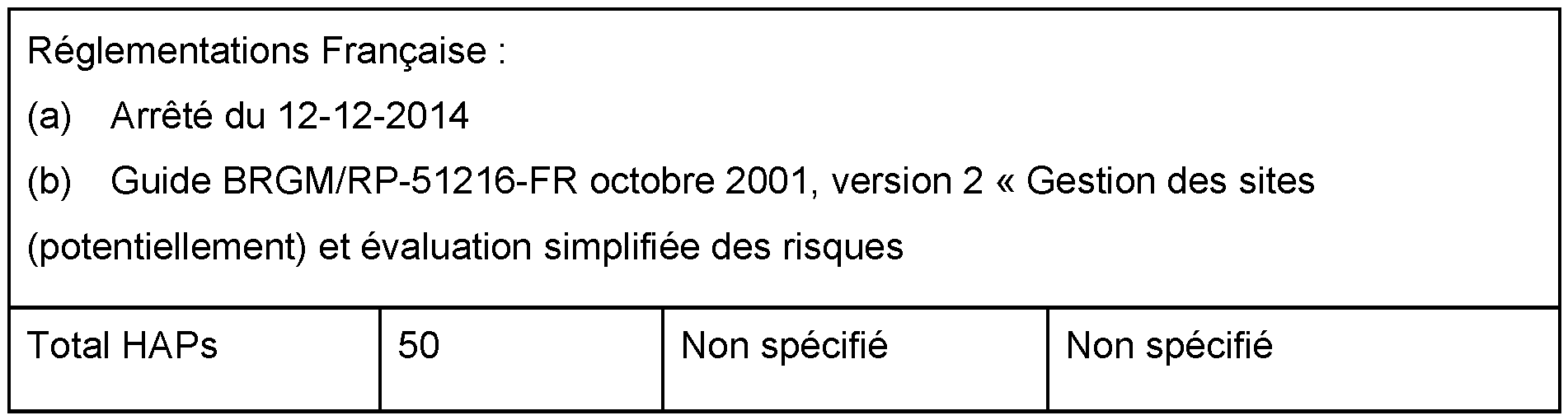
- Soils can also be polluted with hydrocarbons, in particular polycyclic aromatic hydrocarbons.
- PAHs polycyclic aromatic hydrocarbons
- VCI Immun Report Value soil for sensitive use: Residential with cultivation of a vegetable garden
- VCI Immun Assessment Value ground for non-sensitive use: industrial (or commercial), with outdoor work (examples: construction work, etc.), for half of the exhibition, and industrial with an activity of office type for the other half of the exposure time
- the aim of the invention is to provide a method for treating soil polluted by hydrocarbons, in particular polycyclic aromatic hydrocarbons, said method being efficient, economical, easy to implement on the soil excavation site (ie not requiring the transfer of the soil to another place) or to the landfill site, and allowing the hydrocarbon content of said soils to be significantly lowered.
- Another aim of the invention is to provide a composition exhibiting good reactivity when it is mixed with polluted soil with soil polluted with hydrocarbons, which makes it possible to limit the costs of depollution.
- the first aspect of the invention is a process for treating soil polluted with hydrocarbons, in particular polycyclic aromatic hydrocarbons, characterized in that it comprises at least one stage of mixing the soil with, by weight of soil:
- hydraulic binder from 0.1 to 10%, preferably from 0.25 to 5%, of hydraulic binder, the total content of activated carbon and of hydraulic binder being in particular between 0.5 and 15%, advantageously between 1 and 12% , preferably between 1 and 7%, and more preferably between 2 and 5%.
- the hydraulic binder / activated carbon mass ratio is preferably between 0.2 and 9, preferably between 0.5 and 9, more preferably between 1 and 4.
- the mass ratio can thus be between 1 and 9, preferably between 0.5 and 4, or else between 0.2 and 4, advantageously between 0.2 and 3, advantageously still between 0.2 and 1.
- a process for treating a soil polluted with hydrocarbons is a process which makes it possible to lower the hydrocarbon hazard class of said soil, by converting the hydrocarbons into a less mobile, less toxic form.
- the treatment process advantageously makes it possible to trap the hydrocarbons chemically and / or physically within a solid material comprising in particular soil and a hardened hydraulic binder.
- the term “soil” denotes a more or less friable material consisting mainly of earth and / or sand in all possible proportions.
- the sol contains from 3 to 50%, preferably 3 to 40%, preferably 3 to 35%, preferably 3 to 20%, more preferably 3 to 15% by weight of water.
- the dry matter and water content by weight of a soil is typically measured by the gravimetric method, in accordance with standard NF ISO 11465 (A) of August 1994.
- hydrocarbon denotes one or more organic compound (s) consisting of carbon and hydrogen atoms, of the crude formula CnHm where n and m are two liquid natural integers or solids at room temperature.
- Hydrocarbons can be of any nature and from any origin. These hydrocarbons can, for example, come from the activity of factories such as refining plants or coking plants, or from pipeline leaks, maritime accidents in the transport of oil, land accidents in the transport of fuels.
- PAH polycyclic aromatic hydrocarbons
- hydrocarbons consisting of several benzene rings arranged in particular in a linear, angular or clumped manner.
- PAHs are made up exclusively of carbon and hydrogen although oxygen, sulfur and / or nitrogen can substitute for carbon in at least one benzene ring to form heterocyclic aromatic substances, commonly grouped with PAHs.
- PAHs are well known as soil pollutants: Naphthalene (NAF), Acenaphthene (ACE), Acenaphthylene (ACY), fluorene (FLE), Anthracene (ANT), Phenanthrene (FEN), Fluorantbèue (FLA), Pyrene (PYR) , Beuzo [a] authracene (BaA), Chrysene (CRY), Beuzo [b] fluoranthene (BbF), Benzo [k] fluoranthene (Bkf), Dibenzo [ah] anthracene (dBA), Benzo [a] pyrene (BaP) , Benzol [g, hi] perylene (GHI), lnconvergeno [1.2.3] pyrene (IdP).
- the expression “soil polluted with hydrocarbons” denotes a soil comprising more than 50 mg / kg of hydrocarbons.
- the linear hydrocarbon dosages of C10-C40 typically comply with standard NF EN ISO 16703 (A) of August 2011 and those relating to PAHs typically comply with standard NF ISO 18287 (A) of August 2006.
- activate carbon denotes a material consisting essentially of carbonaceous material with a porous structure, preferably microporous and / or mesoporous, exhibiting a high higher specific surface area, typically greater than 100 m 2 / g, 250 m 2. / g, or else 400 m 2 / g.
- the activated carbon used for the implementation of the present invention can be of any origin, and can in particular be grafted with additional chemical functions and / or heat treated.
- the activated carbons obtained by slow pyrolysis of wood are however preferably excluded from the scope of the invention.
- the activated carbon used advantageously has a specific surface area greater than or equal to 500 m 2 / g, and is preferably between 450 and 1500 m 2 / g.
- the specific surface is measured by the technique based on Brunauer, Emmett and Teller (BET) theory in accordance with ISO 9277: 2010 of September 2010.
- BET Brunauer, Emmett and Teller
- the activated carbon used may be in the form of a powder preferably having a D50 of between 5 and 100 ⁇ m, more preferably between 10 and 40 ⁇ m.
- the bulk density of the activated carbon useful in the invention is between 400 and 600 kg / m 3 .
- the ash content of the activated carbon useful in the invention is between 10 and 20% by total weight of carbon. active.
- a hydraulic binder is a binder which is formed and hardens by chemical reaction with water.
- the formulas of the oxides commonly encountered in the field of hydraulic binders are also abbreviated with a single letter, as follows: C represents CaO, A represents Al 2 O 3 , F represents Fe 2 C> 3 , S represents S1O 2 , $ represents SO 3 , M represents MgO, and T represents T1O 2 .
- the use of a hydraulic binder in the treatment process of the present invention is advantageous in particular in that during the treatment, the hydraulic binder absorbs water and then hardens, thus forming a matrix in which is embedded activated carbon which itself contains the adsorbed hydrocarbons.
- the use of a hydraulic binder makes it possible to encapsulate the activated carbon and to totally or partially prevent the release of hydrocarbons by the activated carbon during the storage of the treated soil.
- this hardening helps to consolidate the mixture and immobilize the activated carbon.
- the mixture can easily be handled and transported (especially by land) without the activated carbon having adsorbed the hydrocarbons being able to fly away and in turn become a source of pollution.
- the hydraulic binder is a common cement as defined in standard NF EN 197-1 of April 2012, preferably a cement type CEM I, CEM II, CEM III, CEM IV or CEM V as defined in standard NF EN 197-1 of April 2012.
- the binder used is a CEM I cement
- CEM I cement - 0.1 to 10%, preferably 0.25 to 5%, of CEM I cement, the total content of activated carbon and CEMI I cement being in particular between 0.5 and 15%, advantageously between 1 and 12%, preferably between 1 and 7%, and more preferably between 2 and 5%.
- the hydraulic binder is a cement of CEM III A, B or C type, that is to say a so-called blast furnace cement obtained by mixing a Portland clinker with 30 to 90% by weight, of preferably 36 to 95% by weight of blast furnace slag.
- the blast furnace slag fixes the hydrocarbons with latent reactivity and therefore greater stability over time.
- the soil is mixed with, by weight of soil:
- the preferred CEM III cement is CEM III A or CEM III B.
- the hydraulic binder is a sulfoaluminate cement. It is well known in the field of hydraulic binders that there are different types of sulfoaluminate cements distinguished according to their composition in terms of phases. mineralogical. An alitic sulfo-aluminous cement simultaneously contains ye'elimite and alite (C3S), but without belite. Ye'elimitic sulfoaluminate cement consists of a mixture of ye'elimite (about 15-50% by weight), calcium sulfosilicate or sulfopurrite and anhydrite, but does not contain alite.
- a belitic sulfoaluminous cement predominantly contains the ye'elimite and belite phases and do not contain or an alite content less than or equal to 5% by mass, or having no alite.
- the hydraulic binder of the invention can be a sulfoaluminous clinker comprising more than 50% by mass of Yeelimite phase, from 5 to 10% by mass of belite phase, and from 1 to 5%.
- a sulfoaluminous clinker comprising 5 to 60% by mass of calcium sulfoaluminate optionally doped with iron, 0 to 25% by mass of calcium aluminoferrite and 20 to 70% by mass of belite phase, such as that developed by the company CIMENTS FRAN ⁇ AIS and described in French patent application FR2990363.
- the soil is mixed with, by weight of soil:
- sulfo-aluminous clinker from 0.1 to 10%, preferably from 0.25 to 5%, of sulfo-aluminous clinker, the total content of activated carbon and of sulfo-aluminous clinker being in particular between 0.5 and 15%, advantageously between 1 and 12%, preferably between 1 and 7%, and more preferably between 2 and 5%.
- the hydraulic binder is a calcium aluminate cement such as those defined in standard NF EN 14647 of December 2006.
- the main constituent of a calcium aluminate cement is monocalcium aluminate (CaO Al 2 O 3 ). Its other constituents are calcium aluminoferrites, dicalcium silicate and calcium silicoaluminate.
- the aluminous cement is an aluminous cement from the TERNAL® range marketed by the company IMERYS ALUMINATES.
- the binder used is a calcium aluminate cement
- the soil is mixed with, by weight of soil:
- the binder is advantageously chosen from a CEM I cement as defined in standard NF EN 197-1 of April 2012, a CEM III A, B or C cement comprising between 30% and 90% by weight of blast furnace slag ground, a sulfoaluminate cement or a calcium aluminate cement.
- the hydraulic binder and the activated carbon are added simultaneously to the soil, optionally in the form of a composition as defined in the third aspect of the invention.
- the treatment method according to the invention comprises at least the following successive steps: a) providing the soil; b) concomitantly adding the hydraulic binder and the activated carbon to the soil, optionally in the form of a composition as defined in the third subject of the invention; c) knead the mixture from step b); d) optionally, a hardening step.
- the activated carbon and the hydraulic binder are added separately to the soil, a mixing step optionally being able to be inserted between the two addition steps.
- the activated carbon is preferably added first.
- the treatment method according to the invention comprises at least the following successive steps: a) providing the soil; b) separately adding the activated carbon and the hydraulic binder to the soil, a mixing step optionally being able to be inserted between these two additions, the activated carbon preferably being added first; c) knead the mixture from step b); d) optionally, a hardening step.
- the soil is treated using only the activated carbon and the hydraulic binder, and possibly water.
- the implementation of the process of the invention advantageously does not require the use of other curing products, whether they are solid or liquid, organic or inorganic.
- the implementation of the mixing and hardening steps are detailed below.
- the mixing action consists in mixing the soil, the activated carbon and the hydraulic binder by rotation in a container which preferably contains a mixing screw, for example an Archimedean screw, or at least a pale one.
- a mixing screw for example an Archimedean screw, or at least a pale one.
- Any type of mixer can be used, in particular an industrial mixer, in particular a mixer operating continuously or discontinuously.
- the mixer can be open or closed. Mixing can for example be carried out using a concrete mixer (e.g. concrete mixer) fixed or mobile (e.g. mixer truck).
- the mixing step can last between 1 minute and 2 hours, for example between 1 minute and 30 minutes, or between 30 and 2 hours, depending on the volume of mixture to be mixed.
- a standing time can optionally be observed at the end of a mixing step.
- the method of the invention can also include a step of adding water so as to adjust the water content of the soil to be treated before the mixing step. This addition can also be made during the mixing step.
- the water content of the soil can be adjusted so that the soil entering the mixing step contains 3 to 50%, preferably 3 to 40%, preferably 3 to 35%, of preferably 3 to 20%, more preferably 3 to 15% by weight of water.
- the method of the invention preferably comprises a step of hardening the kneaded mixture of hydraulic binder, activated carbon and soil.
- This hardening phase can for example last from 15 minutes to 30 days, depending on the volume mixed, and does not require any particular intervention, such as for example the addition of a curing product.
- This hardening phase can take place at a temperature between 0 and 40 ° C. Very advantageously, this hardening step can take place on the same site where the mixing took place or else after transporting the mixed mixture to a storage site.
- the treated soil contains at most 10 to 4000 mg of hydrocarbons, in particular of PAH, per kg of dry soil for example at most 3000 mg, preferably 2000 mg / kg, more preferably 1000 mg / kg of hydrocarbons per kg of treated soil.
- the total PAH content of the polluted soil at the end of the process of the invention is preferably between 50 and 2000 mg / kg of dry soil, preferably less than 1000 mg / kg, 750 mg / kg , 500 mg / kg dry soil.
- the invention relates to a product capable of being obtained at the end of the process of the invention, characterized in that it comprises soil, a hardened hydraulic binder and activated carbon as defined above. above.
- the invention relates to a composition for the treatment of soil polluted by hydrocarbons, in particular polycyclic aromatic hydrocarbons, comprising, in% by weight:
- the composition advantageously comprises between 70 and 80%, preferably between 70 and 75% by weight of hydraulic binder and / or between 20 and 30%, preferably between 25 and 30% by weight of activated carbon.
- composition can also advantageously comprise between 10 and 30%, preferably between 20 and 30%, more preferably between 25 and 30% by weight of hydraulic binder and / or between 50 and 80%, preferably between 70 and 80%, preferably between 70 and 75% by weight of activated carbon.
- said composition comprises a Portland cement as defined in standard NF EN 197-1 of April 2012, a CEM III cement, preferably a CEM III A, B or C cement comprising between 30% and 90%. % by weight of ground blast furnace slag, a sulfoaluminate cement or a calcium aluminate cement, preferably a CEM III type slag cement comprising between 340% and 90% by weight of blast furnace slag crushed.
- the invention relates to the use of the soil treatment composition as defined in the third aspect of the invention for the treatment of a soil polluted by hydrocarbons, in particular polycyclic aromatic hydrocarbons.
- the water and soil matter content was determined according to the method described in standard NF ISO 11465 (A) of August 1994.
- the expression soil dry matter is abbreviated "DM”.
- PAHs polycyclic aromatic hydrocarbons
- the BET specific surface of the various powders is measured as follows. A sample of powder with a mass of 0.3 g to 0.75 g is taken for a BET surface estimated at more than 15 m 2 / g. A 9 cm 3 cell is used. We weigh the entire measuring cell (cell + glass rod). Then the sample is added to the cell. The whole is weighed (cell + glass rod + sample). The measuring cell is placed on a degassing station and the sample is degassed. The pressure to be reached is 25 to 30 mTorr. The time to reach this pressure depends on the nature of the sample, the quantity of material and the number of cells installed on the degassing station. The degassing step makes it possible to rid the surface of the sample of any adsorption (H2O, CO, CO2, etc.). The mass of the sample is obtained by subtracting the mass of the cell from the mass of the cell + degassed sample.
- the sample is then analyzed after it has been placed on the measuring station.
- the analyzer is the Tristar II 3020, marketed by the company Micromeritics.
- the measurement is based on the adsorption of nitrogen by the sample at a given temperature, here the temperature of liquid nitrogen is -196 ° C.
- the device measures the pressure of the reference cell in which the adsorbate is at its saturated vapor pressure and that of the sample cell into which known volumes of adsorbate are injected.
- the curve resulting from these measurements is the adsorption isotherm. In the measurement process, knowledge of the dead volume of the cell is necessary: a measurement of this volume is therefore carried out with helium before the analysis.
- the mass of the sample calculated previously is entered as a parameter.
- the BET surface is determined by the software by linear regression from the experimental curve.
- the three samples below are measured regularly to serve as a reference for the device:
- PAH Polycyclic aromatic hydrocarbons
- Mixing phase 1 Mix at slow speed for 1 minute then stop stirring Introduce the mineral absorbent (hydraulic binder + adsorbent)
- Mixing phase 2 Mixing phase 3:
- Example 2 Treatment of soils polluted by charcoal (not in accordance with the invention)
- WA and BIOCHAR The results collated in the table below show that the treatment of soils polluted by activated charcoals WA and BIOCHAR is not effective.
- the measurements also show that the use of these materials increases the total PAH content.
- WA and BIOCHAR charcoals are obtained by a slow pyrolysis process of wood, called by suffocation. This method of combustion is not complete and there are residual hydrocarbons found in the treated soil. This type of charcoal is not suitable for the present invention.
- Example 3 Treatment of soil polluted with an aluminous hydraulic binder
- Example 4 Treatment of soil polluted with a Portland mineral binder of CEM I type
- Example 5 Treatment of soils polluted with a Portland mineral binder with CEM III type blast furnace slag The results presented in the table below show that the combination of a CEM III A type cement makes it possible to significantly reduce the content.
- PAH in the polluted soil the final levels, in the case of the contaminated soil SN1 are all less than 400 mg / kg of dry matter of the soil. The best performances measured correspond to a 43% reduction in the total PAH content, with an activated carbon dosage of 2% and CEM III A LM of 2%.
- Example 6 Treatment of a slightly polluted soil with a Portland mineral binder with CEM III type blast furnace slag
- the results collated in the table below show that the association of a Portland cement of the CEM III A type with an activated carbon is effective for treating soils slightly contaminated by PAHs.
Landscapes
- Chemical & Material Sciences (AREA)
- Engineering & Computer Science (AREA)
- Ceramic Engineering (AREA)
- Structural Engineering (AREA)
- Materials Engineering (AREA)
- Organic Chemistry (AREA)
- Inorganic Chemistry (AREA)
- Chemical Kinetics & Catalysis (AREA)
- Life Sciences & Earth Sciences (AREA)
- Soil Sciences (AREA)
- Environmental & Geological Engineering (AREA)
- Civil Engineering (AREA)
- Processing Of Solid Wastes (AREA)
- Solid-Sorbent Or Filter-Aiding Compositions (AREA)
Abstract
Description



Claims
Priority Applications (3)
| Application Number | Priority Date | Filing Date | Title |
|---|---|---|---|
| EP20781590.3A EP4041466A1 (fr) | 2019-10-07 | 2020-10-07 | Procédé de traitement d'un sol pollué par des hydrocarbures, notamment des hydrocarbures aromatiques polycycliques |
| US17/763,040 US20220410232A1 (en) | 2019-10-07 | 2020-10-07 | Method for treating soil contaminated with hydrocarbons, in particular with polycyclic aromatic hydrocarbons |
| CA3156862A CA3156862A1 (fr) | 2019-10-07 | 2020-10-07 | Procede de traitement d'un sol pollue par des hydrocarbures, notamment des hydrocarbures aromatiques polycycliques |
Applications Claiming Priority (2)
| Application Number | Priority Date | Filing Date | Title |
|---|---|---|---|
| FRFR1911106 | 2019-10-07 | ||
| FR1911106A FR3101557B1 (fr) | 2019-10-07 | 2019-10-07 | Procédé de traitement d’un sol pollué par des hydrocarbures, notamment des hydrocarbures aromatiques polycycliques |
Publications (1)
| Publication Number | Publication Date |
|---|---|
| WO2021069478A1 true WO2021069478A1 (fr) | 2021-04-15 |
Family
ID=69572077
Family Applications (1)
| Application Number | Title | Priority Date | Filing Date |
|---|---|---|---|
| PCT/EP2020/078078 Ceased WO2021069478A1 (fr) | 2019-10-07 | 2020-10-07 | Procédé de traitement d'un sol pollué par des hydrocarbures, notamment des hydrocarbures aromatiques polycycliques |
Country Status (5)
| Country | Link |
|---|---|
| US (1) | US20220410232A1 (fr) |
| EP (1) | EP4041466A1 (fr) |
| CA (1) | CA3156862A1 (fr) |
| FR (1) | FR3101557B1 (fr) |
| WO (1) | WO2021069478A1 (fr) |
Citations (9)
| Publication number | Priority date | Publication date | Assignee | Title |
|---|---|---|---|---|
| US4230568A (en) * | 1977-10-19 | 1980-10-28 | Stablex A.G. | Treatment of hazardous waste |
| EP0562969A1 (fr) * | 1992-03-27 | 1993-09-29 | Compagnie Du Sol | Composition pour la réalisation d'une barrière anti-pollution polyvalente et procédé pour réaliser une telle barrière |
| EP0619278A2 (fr) * | 1993-04-06 | 1994-10-12 | Compagnie Du Sol | Procédé de stabilisation et de solidification de déchets polluants, produits obtenus par ce procédé, et produits pour le mettre en oeuvre |
| US5536898A (en) * | 1994-10-27 | 1996-07-16 | Environmental Technologies Alternatives, Inc. | Composition and method for immobilizing organic compounds in hazardous wastes and soils |
| US20070240620A1 (en) * | 2006-04-12 | 2007-10-18 | Ramme Bruce W | Electrically conductive concrete and controlled low strength materials having spent carbon sorbent |
| FR2990363A1 (fr) | 2012-05-14 | 2013-11-15 | Francais Ciments | Procede de traitement de sols pollues, au moyen d'un liant hydraulique a base de clinker sulfo-alumineux et son utilisation pour la stabilisation de sols pollues |
| CN106269836A (zh) * | 2016-08-10 | 2017-01-04 | 中国环境科学研究院 | 有机污染土壤的固化稳定化方法及其在土壤修复中的应用 |
| CN107267151A (zh) * | 2017-07-27 | 2017-10-20 | 蒋奇晋 | 一种土壤调理剂及其制备方法 |
| FR3077998A1 (fr) | 2018-02-20 | 2019-08-23 | Vicat | Utilisation d’une composition a base de liant hydraulique dans le cadre d’un procede d’inertage de sol pollue |
Family Cites Families (5)
| Publication number | Priority date | Publication date | Assignee | Title |
|---|---|---|---|---|
| US6635796B2 (en) * | 1990-03-16 | 2003-10-21 | Sevenson Environmental Services, Inc. | Reduction of leachability and solubility of radionuclides and radioactive substances in contaminated soils and materials |
| US5700107A (en) * | 1995-07-25 | 1997-12-23 | Habour Remediation And Transfer Inc. (Hr&T) | Method of soil remediation |
| JP2003164846A (ja) * | 2001-12-04 | 2003-06-10 | Dainichiseika Color & Chem Mfg Co Ltd | 汚染土壌の浄化用土壌処理剤 |
| CN1323976C (zh) * | 2005-11-30 | 2007-07-04 | 南阳天意保温耐火材料有限公司 | 果壳型膨胀珍珠岩保温骨料及其制备方法 |
| US10583472B2 (en) * | 2016-05-19 | 2020-03-10 | Remediation Products, Inc. | Bioremediation composition with a time release material for removing hydrocarbons from contaminated environments |
-
2019
- 2019-10-07 FR FR1911106A patent/FR3101557B1/fr active Active
-
2020
- 2020-10-07 WO PCT/EP2020/078078 patent/WO2021069478A1/fr not_active Ceased
- 2020-10-07 US US17/763,040 patent/US20220410232A1/en active Pending
- 2020-10-07 EP EP20781590.3A patent/EP4041466A1/fr active Pending
- 2020-10-07 CA CA3156862A patent/CA3156862A1/fr active Pending
Patent Citations (9)
| Publication number | Priority date | Publication date | Assignee | Title |
|---|---|---|---|---|
| US4230568A (en) * | 1977-10-19 | 1980-10-28 | Stablex A.G. | Treatment of hazardous waste |
| EP0562969A1 (fr) * | 1992-03-27 | 1993-09-29 | Compagnie Du Sol | Composition pour la réalisation d'une barrière anti-pollution polyvalente et procédé pour réaliser une telle barrière |
| EP0619278A2 (fr) * | 1993-04-06 | 1994-10-12 | Compagnie Du Sol | Procédé de stabilisation et de solidification de déchets polluants, produits obtenus par ce procédé, et produits pour le mettre en oeuvre |
| US5536898A (en) * | 1994-10-27 | 1996-07-16 | Environmental Technologies Alternatives, Inc. | Composition and method for immobilizing organic compounds in hazardous wastes and soils |
| US20070240620A1 (en) * | 2006-04-12 | 2007-10-18 | Ramme Bruce W | Electrically conductive concrete and controlled low strength materials having spent carbon sorbent |
| FR2990363A1 (fr) | 2012-05-14 | 2013-11-15 | Francais Ciments | Procede de traitement de sols pollues, au moyen d'un liant hydraulique a base de clinker sulfo-alumineux et son utilisation pour la stabilisation de sols pollues |
| CN106269836A (zh) * | 2016-08-10 | 2017-01-04 | 中国环境科学研究院 | 有机污染土壤的固化稳定化方法及其在土壤修复中的应用 |
| CN107267151A (zh) * | 2017-07-27 | 2017-10-20 | 蒋奇晋 | 一种土壤调理剂及其制备方法 |
| FR3077998A1 (fr) | 2018-02-20 | 2019-08-23 | Vicat | Utilisation d’une composition a base de liant hydraulique dans le cadre d’un procede d’inertage de sol pollue |
Also Published As
| Publication number | Publication date |
|---|---|
| US20220410232A1 (en) | 2022-12-29 |
| CA3156862A1 (fr) | 2021-04-15 |
| FR3101557A1 (fr) | 2021-04-09 |
| FR3101557B1 (fr) | 2023-12-22 |
| EP4041466A1 (fr) | 2022-08-17 |
Similar Documents
| Publication | Publication Date | Title |
|---|---|---|
| Yu et al. | The leachability of heavy metals in hardened fly ash cement and cement-solidified fly ash | |
| Cheah et al. | The implementation of wood waste ash as a partial cement replacement material in the production of structural grade concrete and mortar: An overview | |
| Collivignarelli et al. | Reuse of municipal solid wastes incineration fly ashes in concrete mixtures | |
| CN101839488B (zh) | 一种可燃固体废物回转窑气化焚烧方法 | |
| Li et al. | Investigation of sulfur forms and transformation during the co-combustion of sewage sludge and coal using X-ray photoelectron spectroscopy | |
| CN109054847B (zh) | 一种铅污染土壤修复药剂及该药剂的工程应用方法 | |
| WO2010066811A1 (fr) | Matériau pour le piégeage d'hydrogène, procédé de préparation et utilisations. | |
| WO2014009613A1 (fr) | Procede pour stabiliser et solidifier un dechet urbain et/ou industriel et/ou marin | |
| Weng et al. | Chitosan composite alkali-activated geopolymer for solidification/stabilization of copper and chromium contaminated mudflat sediment | |
| Fan et al. | Solidification of municipal solid waste incineration fly ash with alkali-activated technology | |
| Ofori-Boadu et al. | Physiochemical characterization of agricultural waste biochars for partial cement replacement | |
| CN101700524B (zh) | 固定剂及重金属污染土壤修复植物的安全处置的方法 | |
| CN103664015B (zh) | 一种利用水泥生产工艺分类处置有机污染土壤的方法 | |
| EP2850042B1 (fr) | Procede de traitement de sols pollues, au moyen d'un liant hydraulique a base de clinker sulfo-alumineux et son utilisation pour la stabilisation de sols pollues | |
| WO2021069478A1 (fr) | Procédé de traitement d'un sol pollué par des hydrocarbures, notamment des hydrocarbures aromatiques polycycliques | |
| WO2023281220A1 (fr) | Composition cimentaire comprenant du biochar carbonaté | |
| Cieślik et al. | Comprehensive stabilization of all streams of solid residues formed during sewage sludge thermal treatment–Case study | |
| FR3077998A1 (fr) | Utilisation d’une composition a base de liant hydraulique dans le cadre d’un procede d’inertage de sol pollue | |
| Fujikawa et al. | Evaluation of carbonated incineration bottom ash using exhaust gas and CO2 discharged from waste incineration facilities as ground material | |
| Jagwani et al. | Expansive soil stabilization by cinder of coconut husk | |
| CN105885999B (zh) | 一种污泥能源化改性调整剂 | |
| Liu et al. | Evaluation of endocrine disruption and dioxin-like effects of organic extracts from sewage sludge in autumn in Beijing, China | |
| RU2387689C1 (ru) | Состав для инертизации отходов бурения | |
| Badreddine et al. | Assessment of the PCDD/F fate from MSWI residue used in road construction in France | |
| Šerović et al. | Utilization of solidified industrial hazardous waste in construction: A case study |
Legal Events
| Date | Code | Title | Description |
|---|---|---|---|
| 121 | Ep: the epo has been informed by wipo that ep was designated in this application |
Ref document number: 20781590 Country of ref document: EP Kind code of ref document: A1 |
|
| ENP | Entry into the national phase |
Ref document number: 3156862 Country of ref document: CA |
|
| NENP | Non-entry into the national phase |
Ref country code: DE |
|
| ENP | Entry into the national phase |
Ref document number: 2020781590 Country of ref document: EP Effective date: 20220509 |
|
| WWW | Wipo information: withdrawn in national office |
Ref document number: 2022112301 Country of ref document: RU |