WO2021070864A1 - 容器詰飲料及びその製造方法 - Google Patents
容器詰飲料及びその製造方法 Download PDFInfo
- Publication number
- WO2021070864A1 WO2021070864A1 PCT/JP2020/038002 JP2020038002W WO2021070864A1 WO 2021070864 A1 WO2021070864 A1 WO 2021070864A1 JP 2020038002 W JP2020038002 W JP 2020038002W WO 2021070864 A1 WO2021070864 A1 WO 2021070864A1
- Authority
- WO
- WIPO (PCT)
- Prior art keywords
- hydrophobic
- packaged beverage
- aqueous solution
- beverage
- liquid
- Prior art date
- Legal status (The legal status is an assumption and is not a legal conclusion. Google has not performed a legal analysis and makes no representation as to the accuracy of the status listed.)
- Ceased
Links
Classifications
-
- A—HUMAN NECESSITIES
- A23—FOODS OR FOODSTUFFS; TREATMENT THEREOF, NOT COVERED BY OTHER CLASSES
- A23L—FOODS, FOODSTUFFS OR NON-ALCOHOLIC BEVERAGES, NOT OTHERWISE PROVIDED FOR; PREPARATION OR TREATMENT THEREOF
- A23L2/00—Non-alcoholic beverages; Dry compositions or concentrates therefor; Preparation or treatment thereof
- A23L2/52—Adding ingredients
- A23L2/54—Mixing with gases
-
- A—HUMAN NECESSITIES
- A23—FOODS OR FOODSTUFFS; TREATMENT THEREOF, NOT COVERED BY OTHER CLASSES
- A23L—FOODS, FOODSTUFFS OR NON-ALCOHOLIC BEVERAGES, NOT OTHERWISE PROVIDED FOR; PREPARATION OR TREATMENT THEREOF
- A23L2/00—Non-alcoholic beverages; Dry compositions or concentrates therefor; Preparation or treatment thereof
- A23L2/02—Non-alcoholic beverages; Dry compositions or concentrates therefor; Preparation or treatment thereof containing fruit or vegetable juices
-
- A—HUMAN NECESSITIES
- A23—FOODS OR FOODSTUFFS; TREATMENT THEREOF, NOT COVERED BY OTHER CLASSES
- A23L—FOODS, FOODSTUFFS OR NON-ALCOHOLIC BEVERAGES, NOT OTHERWISE PROVIDED FOR; PREPARATION OR TREATMENT THEREOF
- A23L2/00—Non-alcoholic beverages; Dry compositions or concentrates therefor; Preparation or treatment thereof
- A23L2/52—Adding ingredients
- A23L2/56—Flavouring or bittering agents
-
- A—HUMAN NECESSITIES
- A23—FOODS OR FOODSTUFFS; TREATMENT THEREOF, NOT COVERED BY OTHER CLASSES
- A23L—FOODS, FOODSTUFFS OR NON-ALCOHOLIC BEVERAGES, NOT OTHERWISE PROVIDED FOR; PREPARATION OR TREATMENT THEREOF
- A23L27/00—Spices; Flavouring agents or condiments; Artificial sweetening agents; Table salts; Dietetic salt substitutes; Preparation or treatment thereof
- A23L27/10—Natural spices, flavouring agents or condiments; Extracts thereof
- A23L27/12—Natural spices, flavouring agents or condiments; Extracts thereof from fruit, e.g. essential oils
- A23L27/13—Natural spices, flavouring agents or condiments; Extracts thereof from fruit, e.g. essential oils from citrus fruits
-
- B—PERFORMING OPERATIONS; TRANSPORTING
- B65—CONVEYING; PACKING; STORING; HANDLING THIN OR FILAMENTARY MATERIAL
- B65B—MACHINES, APPARATUS OR DEVICES FOR, OR METHODS OF, PACKAGING ARTICLES OR MATERIALS; UNPACKING
- B65B3/00—Packaging plastic material, semiliquids, liquids or mixed solids and liquids, in individual containers or receptacles, e.g. bags, sacks, boxes, cartons, cans, or jars
-
- B—PERFORMING OPERATIONS; TRANSPORTING
- B65—CONVEYING; PACKING; STORING; HANDLING THIN OR FILAMENTARY MATERIAL
- B65B—MACHINES, APPARATUS OR DEVICES FOR, OR METHODS OF, PACKAGING ARTICLES OR MATERIALS; UNPACKING
- B65B51/00—Devices for, or methods of, sealing or securing package folds or closures; Devices for gathering or twisting wrappers, or necks of bags
-
- B—PERFORMING OPERATIONS; TRANSPORTING
- B65—CONVEYING; PACKING; STORING; HANDLING THIN OR FILAMENTARY MATERIAL
- B65D—CONTAINERS FOR STORAGE OR TRANSPORT OF ARTICLES OR MATERIALS, e.g. BAGS, BARRELS, BOTTLES, BOXES, CANS, CARTONS, CRATES, DRUMS, JARS, TANKS, HOPPERS, FORWARDING CONTAINERS; ACCESSORIES, CLOSURES, OR FITTINGS THEREFOR; PACKAGING ELEMENTS; PACKAGES
- B65D85/00—Containers, packaging elements or packages, specially adapted for particular articles or materials
- B65D85/70—Containers, packaging elements or packages, specially adapted for particular articles or materials for materials not otherwise provided for
- B65D85/72—Containers, packaging elements or packages, specially adapted for particular articles or materials for materials not otherwise provided for for edible or potable liquids, semiliquids, or plastic or pasty materials
-
- C—CHEMISTRY; METALLURGY
- C12—BIOCHEMISTRY; BEER; SPIRITS; WINE; VINEGAR; MICROBIOLOGY; ENZYMOLOGY; MUTATION OR GENETIC ENGINEERING
- C12G—WINE; PREPARATION THEREOF; ALCOHOLIC BEVERAGES; PREPARATION OF ALCOHOLIC BEVERAGES NOT PROVIDED FOR IN SUBCLASSES C12C OR C12H
- C12G3/00—Preparation of other alcoholic beverages
- C12G3/04—Preparation of other alcoholic beverages by mixing, e.g. for preparation of liqueurs
- C12G3/06—Preparation of other alcoholic beverages by mixing, e.g. for preparation of liqueurs with flavouring ingredients
Definitions
- the present invention relates to a packaged beverage in which soft drinks, alcoholic beverages, etc. are enclosed in a container such as a can, a bottle, or a PET bottle, and a method for producing the same.
- the scent felt from food is roughly divided into two types: the scent that is directly sniffed from the nose (orthonasal aroma) and the scent that comes out of the throat to the nose when swallowed in the mouth (retronasal aroma). It is believed that retronasal aroma contributes particularly to the "deliciousness” of food. Orthonasal aroma, on the other hand, reminds us of "deliciousness” before eating food. That is, both orthonasal aromas and retronasal aromas are important for food.
- the aroma of the fruits is an element that affects palatability. ..
- most of the aroma components derived from fruits are highly volatile and are easily lost over time even when added to beverages. For this reason, various improvements have been made in fruit-flavored beverages so that a stronger fruity aroma can be felt when drinking.
- Patent Document 1 discloses a method for enhancing the pericarp feeling caused by the pericarp component contained in the fruit juice by adding bornyl acetate to the alcoholic beverage containing the fruit juice so as to have a specific concentration range.
- Patent Document 3 describes a method capable of enhancing the feeling of fruit juice by adding gentio-oligosaccharide to a beverage containing a high-sweetness sweetener and having low fruit juice or no fruit juice.
- An object of the present invention is to provide a packaged beverage in which the aroma of the hydrophobic aroma component that is felt when the container is opened or consumed is enhanced, and a method for producing the packaged beverage.
- the present inventor does not dissolve or disperse the hydrophobic aroma component in the liquid which is the main body of the beverage, but allows the hydrophobic aroma component to exist in a state of being separated from the liquid.
- the present invention has been completed by finding that the aroma felt at the time of opening and drinking is enhanced.
- the packaged beverage and the method for producing the packaged beverage according to the present invention are as follows [1] to [20].
- [1] A packaged beverage containing an edible aqueous solution and hydrophobic droplets containing a hydrophobic aroma component, and the aqueous solution and the hydrophobic droplets are separated from each other. ..
- [2] The packaged beverage according to [1], wherein the hydrophobic droplets are present on the liquid surface of the aqueous solution.
- the hydrophobic aroma component is a hydrophobic substance having a boiling point of 260 ° C. or higher.
- the container body is filled with the aqueous solution and then filled with a hydrophobic liquid composition containing a hydrophobic aroma component, or the container body is filled with the hydrophobic liquid composition and then filled with the aqueous solution.
- a method for producing a packaged beverage in which the container body is sealed [18] A method for producing a packaged beverage in which an edible aqueous solution and hydrophobic droplets containing a hydrophobic aroma component are separated. A solution obtained by mixing a hydrophobic liquid composition containing a hydrophobic aroma component with an edible aqueous solution is filled in a container body, the container body is sealed, and then the edible aqueous solution is used in the container.
- the packaged beverage according to the present invention is a packaged beverage containing a hydrophobic aroma component, and has a strong aroma due to the hydrophobic aroma component that is felt when the container is opened or swallowed, and is excellent in palatability. Further, according to the method for producing a packaged beverage according to the present invention, it is possible to produce a packaged beverage having an enhanced aroma that is perceived when the container is opened or consumed.
- aroma components contained in beverages such as soft drinks and alcoholic beverages are dissolved or dispersed in the beverages. If the aroma components are unevenly distributed in the beverage, it becomes difficult to produce the product uniformly. For this reason, for example, many flavors used in beverages for the purpose of enhancing aroma, supplementing aroma, correcting flavor, etc. are treated so that aroma components can be easily dissolved or dispersed in water.
- the beverage contains hydrophobic substances such as fats and oils, it is considered that the separation of the hydrophobic substances is not preferable in terms of quality, and it is generally emulsified with an emulsifier or the like or adsorbed on fruit pulp. Is the target. Further, if the hydrophobic substance is separated in the manufacturing process of the beverage, it becomes difficult to uniformly package the beverage.
- the packaged beverage according to the present invention contains an edible aqueous solution (hereinafter, may be referred to as “base liquid”) which is the main body of the beverage and hydrophobic droplets containing a hydrophobic aroma component.
- base liquid an edible aqueous solution
- hydrophobic droplets containing a hydrophobic aroma component.
- the aqueous solution and the hydrophobic droplets are separated from each other.
- the number of hydrophobic droplets in the beverage may be one or may be plural.
- the hydrophobic aroma component that exists in a state of being separated from the base liquid is more likely to be perceived as a scent than the hydrophobic aroma component that is dissolved or dispersed in the base liquid.
- the hydrophobic aroma component volatilized from the hydrophobic droplet causes the orthonasal aroma of the beverage, especially the ortho when the container is opened. Nasal aroma is enhanced.
- the hydrophobic droplets are present inside the base liquid, the duration of the retronasal aroma during drinking can be extended. It is presumed that this is because some of the hydrophobic aroma components contained in the hydrophobic droplets are retained in the oral cavity even after drinking.
- the hydrophobic aroma component used in the present invention is not particularly limited as long as it is a hydrophobic substance among substances that make humans feel "odor".
- the hydrophobic substance is a substance that forms an interface without being compatible with each other, at least in part, when dropped in water at 25 ° C. That is, the hydrophobic substance does not need to be completely insoluble in water, and includes a substance that is partially soluble in water. In the present invention, it can be appropriately selected and used from the hydrophobic aroma components generally contained in foods and drinks in consideration of the desired flavor characteristics.
- hydrophobic aroma component used in the present invention a volatile substance that easily volatilizes at normal temperature and pressure is preferable because it is easier for humans to perceive as a scent.
- hydrophobic aroma component that easily volatilizes at normal temperature and pressure include a hydrophobic aroma component having a boiling point of 260 ° C. or lower.
- the hydrophobic aroma component used in the present invention can be appropriately selected according to the flavor of the target beverage, but since it is widely used in beverages, it constitutes the characteristic aroma of a specific plant. It is preferably a component (characteristic scent component), and more preferably a characteristic scent component of fruits and herbs (scented herbs).
- Characteristic scent component of a specific plant is not limited to the scent component contained in the plant as long as it is a component that constitutes the characteristic scent of the plant and the scent that can be recognized by humans. It also contains aroma components that are not contained in the plant.
- the hydrophobic aroma components used in the present invention include citrus fruits such as lemon, lime, yuzu, shikuwasa, sudachi, kabosu, grapefruit, orange, Iyokan, Wenshu mandarin orange, summer mandarin orange, Yasaku, and Hinata summer; Soft fruits such as grapes, apples, pears, pears, citrus; tropical fruits such as bananas, pineapples, mangoes, passion fruits; peppermint, sage, thyme, lemongrass, cinnamon, rosemary, chamomile, lavender, rose hips, pepper , Herbs such as vanilla; and other characteristic scent components are preferred.
- the characteristic scent components of lemon include citral, nerol, geraniol, neryl acetate, geranyl acetate, etc., and citral accounts for more than half of the oxygen-containing compounds contained in the essential oil derived from lemon.
- the characteristic aroma component of grapefruit include octanal, decanal, and nootkatone
- examples of the characteristic aroma component of yuzu include linalool, thymol, yuzunon (registered trademark), and methyl N-methylanthranilate.
- Examples of the characteristic aroma component of orange include octanal, decanal, linalool, geranyl acetate, and sinensal.
- Examples of fruits and herbs other than citrus fruits include ⁇ -undecalactone as a characteristic aroma component of peach.
- Examples of the characteristic aroma component of grapes include methyl anthranilate and the like.
- Characteristics of menthol Examples of the scent component include menthol and the like.
- Characteristics of vanilla Examples of the aroma component include vanillin and the like.
- the hydrophobic droplets formed on the packaged beverage according to the present invention consist of a hydrophobic liquid composition containing a hydrophobic aroma component.
- the hydrophobic aroma component contained in the hydrophobic liquid composition may be only one kind or two or more kinds. Further, it may be a chemically synthesized product, or may be extracted and purified from a natural product such as an animal or plant.
- the hydrophobic liquid composition forming the hydrophobic droplets may be a composition consisting of only the hydrophobic aroma component, or may contain a hydrophobic substance other than the hydrophobic aroma component.
- the hydrophobic substance include fats and oils, a hydrophobic substance extracted from an organic solvent extract from a natural product together with a hydrophobic aroma component, and the like.
- the content of the hydrophobic aroma component in the entire liquid composition is preferably 15% by mass or more, more preferably 30% by mass or more, still more preferably 50% by mass or more, because a more sufficient fragrance enhancing effect can be obtained. 80% by mass or more is even more preferable.
- the hydrophobic liquid composition may contain a non-volatile component having a relatively high boiling point. Since the hydrophobic aroma component contained therein is rapidly volatilized and easily recognized as a scent, and a more sufficient scent enhancing effect can be obtained, 80% by mass or more of the components of the hydrophobic liquid composition , It is preferable that the component has a boiling point of 260 ° C. or lower.
- the hydrophobic aroma component contained in the plant is abundantly contained in the essential oil extracted from the plant. Therefore, the hydrophobic liquid composition constituting the hydrophobic droplet may contain an essential oil or a processed product thereof.
- the processed product of the essential oil include a concentrate of the essential oil and a product obtained by removing some components from the essential oil.
- Essential oils are distilled from plants by conventional methods such as steam distillation and hydrothermal distillation (direct distillation) from plant flowers, buds, fruits (pericarp, pulp), branches and leaves, rhizomes, bark, trunks, resins, etc. can do.
- the processing of the essential oil can be carried out by a conventional method such as a distillation method, a crystallization method, or a chemical treatment method.
- Essential oils are generally lighter than water and are hydrophobic liquid compositions containing terpenes as the main component.
- Terpenes consist of terpene hydrocarbons and terpenoids.
- Terpenoids are oxygen-containing derivatives such as alcohols, aldehydes, ketones and esters derived from terpene hydrocarbons.
- a packaged beverage having a good citrus aroma can be produced.
- Characteristics of citrus fruits Since the aroma component is contained in a large amount in the pericarp among the fruits, it is particularly preferable to use the essential oil extracted from the pericarp.
- the essential oil component obtained from citrus fruits is terpene hydrocarbon, and the main component is D-limonene, but its contribution to aroma is low.
- Important components that characterize the scent of citrus fruits are oxygen-containing compounds (terpenoids) such as aldehydes, alcohols, and esters that are present in essential oils in a few percent. Therefore, as flavors added to foods and drinks, terpeneless oils and folded oils in which terpene hydrocarbons such as D-limonene are removed and the content ratio of oxygen-containing compounds (terpenoids) such as citral are increased are widely used. It is used.
- the hydrophobic liquid composition constituting the hydrophobic droplets can contain terpeneless oil, folded oil and the like.
- the content ratio of terpenoids to the whole terpenes in the hydrophobic liquid composition constituting the hydrophobic droplets is preferably 10 to 40% by mass because a more natural packaged beverage having a strong citrus aroma can be produced. , 15 to 40% by mass, more preferably 20 to 40% by mass, and even more preferably 20 to 30% by mass.
- the content ratio of the terpene hydrocarbon to the whole terpenes in the hydrophobic liquid composition is preferably 90% by mass or less, more preferably 85% by mass or less.
- the content of D-limonene in the hydrophobic liquid composition with respect to the entire terpenes is preferably 40 to 60% by mass, more preferably 50 to 60% by mass.
- the content of D-limonene with respect to the terpene hydrocarbon in the hydrophobic liquid composition is preferably 50 to 80% by mass, more preferably 60 to 75% by mass.
- the hydrophobic liquid composition may contain other components other than the hydrophobic aroma component as long as the effects of the present invention are not impaired.
- the other components include oil-soluble solvents, substances that suppress deterioration of hydrophobic aroma components, and the like.
- the hydrophobic liquid composition may contain an oil-soluble fragrance in which a hydrophobic aroma component is dissolved in a liquid hydrophobic solvent such as a liquid oil.
- both the essential oil or its processed product and the oil-soluble fragrance may be contained in the hydrophobic liquid composition.
- the hydrophobic droplets formed from the hydrophobic liquid composition are located on the liquid surface of the base liquid of the packaged beverage.
- the opening of the container exists on the liquid surface (top surface) side of the base liquid filled in the container body. That is, the hydrophobic droplets having a density lower than that of the base liquid float on the liquid surface of the base liquid closest to the container opening, and the hydrophobic droplets volatilized from the hydrophobic droplets are in the space near the container opening. Contains aroma components. Therefore, the orthonasal aroma when the container is opened can be strongly felt.
- the density of the hydrophobic liquid composition may be greater than or equal to the density of the base liquid.
- the hydrophobic droplets formed from the hydrophobic liquid composition may be located on the liquid surface of the base liquid, or may be located in the liquid of the base liquid.
- the amount of the hydrophobic liquid composition added to the base liquid can be appropriately determined so that the amount of the hydrophobic aroma component is suitable for the desired strength and balance of the flavor.
- the hydrophobic aroma component is contained as hydrophobic droplets separated from the base liquid, the content of the hydrophobic aroma component in the beverage is about the same, and the entire beverage has the same content. Compared with the conventional packaged beverage in which the hydrophobic aroma component is uniformly present, the aroma of the hydrophobic aroma component is felt more strongly.
- the content of the hydrophobic liquid composition with respect to the total amount of the beverage is preferably 0.1 g / L or more, more preferably 0.2 g / L or more.
- a sufficient scent enhancing effect can be expected.
- the amount of the hydrophobic liquid composition is too large, it becomes oily, which is not very preferable as a beverage.
- the content of the hydrophobic liquid composition with respect to the total amount of the beverage is preferably 1.0 g / L or less, more preferably 0.8 g / L or less, so that the beverage can be maintained with a pleasant taste. , Aroma enhancing effect can be obtained.
- the hydrophobic droplets containing the hydrophobic aroma component are contained in a state of being separated from the base liquid, which has the effect of suppressing the feeling of alcohol. ..
- the reason for this effect is not clear, but it is because the hydrophobic droplets containing the hydrophobic aroma component prolong the duration of the retronasal aroma, which masks the alcoholic sensation felt during drinking. Inferred.
- This effect of suppressing the feeling of alcohol is particularly strong when the hydrophobic aroma component contained in the hydrophobic droplets is the characteristic aroma of citrus fruits.
- the hydrophobic droplets are contained in a state of being separated from the base liquid depending on the type of the hydrophobic aroma component contained in the hydrophobic droplets.
- the feeling of carbonation may be enhanced.
- the hydrophobic aroma component that can obtain the effect of enhancing the carbonic acid feeling by being contained in the hydrophobic droplets include the aroma component of the characteristic aroma of lemon, lime, and grapefruit.
- the base liquid of the packaged beverage according to the present invention is an edible aqueous solution that is the main body of the beverage.
- various beverages including water can be used as they are.
- the base liquid may be a non-alcoholic beverage or an alcoholic beverage. Further, it may be a non-sparkling beverage that does not contain carbon dioxide gas, or may be a sparkling beverage that contains carbon dioxide gas. Further, the beverage may be produced through a fermentation step, or may be a beverage produced without undergoing a fermentation step.
- the base liquid of the packaged beverage according to the present invention may contain solids such as fruit pulp and jelly as long as it is in a fluid state as a whole. Further, it may contain water as a component, and may be water, alcoholic beverages, or fruit juice itself.
- the base liquid can be produced, for example, by mixing raw material water with other components and press-fitting carbon dioxide gas as needed.
- the other components include alcoholic beverages, carbonated water, fruits, vegetables, herbs, sugars, flavors, other food materials, food additives, and the like, and these are appropriately selected and used.
- the base liquid may contain water as a whole, and instead of using the raw material water as a raw material, a liquid containing water such as carbonated water, alcoholic beverages, and fruit juice may be used, and other components may be mixed with the liquid.
- Alcoholic beverages to be contained in the base liquid include alcohol for raw materials; distilled liquors such as vodka, whiskey, brandy, shochu, lamb liquor, spirits, and gin; brewed liquors such as wine, seedle, beer, and sake; Examples include mixed liquor.
- the liquor contained in the base liquid may be one type or two or more types.
- the packaged beverage according to the present invention uses a liquid that is a mixture of alcoholic beverages and food materials as the base liquid, the beverage is liqueured under the Japanese Liquor Tax Law (enforced on April 1, 1991). It is classified as (extract content is more than twice) or spirits (extract content is less than twice).
- the alcohol content (volume concentration of ethanol) of the base liquid is not particularly limited, and is appropriately determined according to the target product quality.
- the alcohol content of the base liquid can be adjusted so that the alcohol content of the base liquid is preferably 1% by volume or more, more preferably 2% by volume or more, and further preferably 3% by volume or more.
- the hydrophobic aroma component contained in the hydrophobic droplet is an aroma component that is easily dissolved in alcohol and the alcohol concentration of the base liquid is high, a part of the hydrophobic aroma component in the hydrophobic droplet is the base liquid. May dissolve in. Therefore, the alcohol content of the base liquid is preferably such that the base liquid and the hydrophobic droplets can be separated and the balance of flavor is not disturbed.
- the alcohol content of the base liquid can be adjusted so that the alcohol content is preferably 15% by volume or less, more preferably 10% by volume or less, and even more preferably 8% by volume or less.
- the hydrophobic droplet containing the hydrophobic aroma component remains in the beverage in a state of being separated from the base liquid. It is preferable to mix a sufficient amount of the hydrophobic liquid composition with the loss added in advance with the base liquid. Specifically, the concentration of the hydrophobic aroma component with respect to the entire beverage after mixing the hydrophobic liquid composition with the base liquid, that is, ([contained in the base liquid before mixing the hydrophobic liquid composition.
- the fruits, vegetables, and herbs contained in the base liquid are not particularly limited, and fruits and the like generally used in beverages can be appropriately selected and used.
- fruits and herbs those listed as fruits and herbs derived from the hydrophobic aroma component can be used.
- vegetables tomatoes, carrots, spinach, cabbage, Brussels sprouts, broccoli, cauliflower, celery, lettuce, parsley, cressons, kale, soybeans, beets, red peppers, pumpkins, Japanese mustard spinach and the like can be used.
- the number of fruits, vegetables and herbs contained in the base liquid may be one or more.
- the base liquid may contain shredded fruits or the like as it is, or may be added as a raw material from squeezed juice such as fruit juice or vegetable juice.
- Fruit juice is defined in the Japanese Agricultural Standards for Fruit Beverages in Japan and in the Codex Standards (CODEX STAN 247-2005) for fruit juices and nectars internationally.
- CODEX STAN 247-2005 Codex Standards
- fruit juice clarified by removing a part of insoluble solids may be used.
- Fruit extract and vegetable extract may be added as raw materials to the base liquid.
- the hydrophobic aroma component contained in the hydrophobic droplet is a characteristic aroma component of a fruit or herb
- the base liquid contains fruit juice or an extract of the same kind of fruit as the hydrophobic aroma component. Is preferable.
- Fruit extract and vegetable extract are obtained by extracting the components contained in fruits and vegetables from shredded fruits and vegetables using water and alcohol. These extracts are produced, for example, by a method of hot water extraction, a method of eluting fruit components using liquefied gas, and then vaporizing the liquefied gas to separate and recover the fruit components.
- Sugar is a general term for monosaccharides and disaccharides, and includes sugar (sucrose, sucrose), glucose (glucose), fructose (fructose), and isomerized sugar.
- sugar sucrose, sucrose
- glucose glucose
- fructose fructose
- isomerized sugar By containing these sugars in the base liquid, it is possible to impart sweetness, body feeling, etc. to the beverage.
- the saccharide contained in the base liquid may be one kind or two or more kinds.
- the base liquid can contain flavorings and other food materials.
- other food materials include dietary fiber, yeast extract, protein or a decomposition product thereof.
- water-soluble dietary fiber is widely used to impart body feeling and other functionality to beverages.
- Water-soluble dietary fiber means carbohydrates that are soluble in water and are indigestible or difficult to digest by human digestive enzymes.
- Examples of the water-soluble dietary fiber include soybean dietary fiber, polydextrose, indigestible dextrin, galactomannan, inulin, guar gum decomposition product, pectin, gum arabic and the like. Only one kind of these water-soluble dietary fibers may be used, or two or more kinds may be used in combination.
- an article that can be used based on national laws and regulations can be used, and the range is not particularly limited.
- coloring agents, fragrances, sweeteners, acidulants, emulsifiers, etc. for the purpose of improving the palatability of foods, such as preservatives and antioxidants for maintaining the quality of foods, are necessary for the manufacture or processing of foods.
- Various pH adjusters, antifoaming agents, foaming agents, etc., and nutritional enhancers used for supplementing and strengthening nutritional components can be contained as needed.
- Colorants are food additives that improve the color tone of foods, and are roughly classified into chemically synthesized colorants and natural colorants. According to the Food Sanitation Law of Japan, designated additives, existing additives, general foods and drinks Classified as an additive. As a colorant, a caramel color that colors foods brown is often used. As a secondary effect of the caramel color, it is possible to impart a roasted feeling, richness, etc. to the beverage.
- Flavors are used to add or enhance aroma to foods.
- Food flavors include natural flavors extracted from natural products and synthetic flavors chemically synthesized. Natural flavors are defined by the Food Sanitation Law of Japan as “additives obtained from animals and plants or mixtures thereof and used for the purpose of flavoring foods", and the names of animals and plants that can be used are examples of "natural flavors”. It is described in “List of basic substances”.
- most of the synthetic flavors are compounds obtained by chemically synthesizing the same components as those existing in foods, and are specified in "Appendix 1 of the Food Sanitation Law Enforcement Regulations".
- the form of the fragrance product includes a water-soluble fragrance, an oil-soluble fragrance, an emulsified fragrance, and a powder fragrance.
- the water-soluble fragrance is obtained by extracting and dissolving the fragrance base with a water-containing solvent such as hydroalcohol or propylene glycol.
- the oil-soluble fragrance is a fragrance base dissolved in vegetable oil or the like.
- the emulsified fragrance is a fine particle state obtained by emulsifying the fragrance base with water using an emulsifier or a stabilizer. It is also called a cloudy because it gives a turbidity to the beverage.
- the powdered flavoring is obtained by emulsifying the flavoring base together with excipients such as dextrin, natural gum, sugar, and starch, and then spray-drying to powder or attaching the flavoring base to lactose or the like.
- excipients such as dextrin, natural gum, sugar, and starch
- spray-drying to powder or attaching the flavoring base to lactose or the like.
- Water-soluble flavors and emulsified flavors are usually used for beverages.
- the base liquid may contain a perfume such as a fruit of the same type as the hydrophobic aroma component. preferable.
- Sweeteners are used for the purpose of sweetening foods, but the above-mentioned sugars and some low-sweetness substances (water candy, erythritol, maltitol, lactitol, etc.) are classified into foods and added to foods. It is not classified as a thing.
- Low-sweetness substances classified as food additives include L-arabinose, D-xylose, trehalose, D-sorbitol, xylitol, and mannitol
- high-sweetness substances include aspartame, neotheme, acesulfame potassium, and saccharins.
- sweeteners are classified into designated additives, existing additives, and general food and drink additives.
- Acidulants are used to add acidity to foods and to enhance acidity.
- Acidulants include organic acids such as citric acid and lactic acid and their salts, and inorganic acids such as phosphoric acid and carbon dioxide.
- organic acids such as citric acid and lactic acid and their salts
- inorganic acids such as phosphoric acid and carbon dioxide.
- the substances that can be collectively labeled as acidulants are malic acid, citric acid, trisodium citrate, gluconodeltalactone, gluconic acid, potassium gluconate, sodium gluconate, and succinic acid.
- the acidulant used in the beverage is selected according to the flavor of the beverage.
- citrus-flavored beverages contain a large amount of citric acid and citrate
- grape-flavored beverages contain a large amount of tartaric acid and tartrate
- apple-flavored beverages contain a large amount of malic acid and malate. Is often selected.
- the pH of the beverage may be adjusted according to the purpose such as controlling microorganisms and suppressing deterioration of aroma components.
- the lower the pH of a beverage the more difficult it is for microorganisms to grow.
- the acidity becomes too strong.
- some aroma components tend to deteriorate when the pH is lowered.
- the pH of the base liquid is preferably 2.0 or more, more preferably 2.5 or more, still more preferably 3.0 or more, from the viewpoint of the strength of acidity suitable for beverages and the suppression of deterioration of aroma components.
- the pH of the base liquid is preferably 5.0 or less, more preferably 4.0 or less, still more preferably 4 when it does not contain alcohol.
- it is less than .0 and contains alcohol, it is preferably 6.5 or less, more preferably 5.0 or less.
- the pH of the base liquid is preferably 3.0 or higher. It is more preferable to set the pH to 5 or more, the growth of microorganisms can be sufficiently suppressed, and it is easy to achieve a preferable acidity as a lemon flavor. Therefore, the pH is preferably 3.0 to 4.0, and 3.5 to 3 It is particularly preferable to set it to 0.7.
- Emulsifiers are used in foods for the purpose of emulsification, dispersion, permeation, washing, foaming, defoaming, mold release, etc., but in beverages, they are often used for the purpose of dispersing (emulsifying) oil in the liquid. .. For example, it is used to uniformly disperse hydrophobic components in water and suppress separation of fats and oils derived from raw materials.
- the above-mentioned food materials and food additives are examples, and those contained in the packaged beverage according to the present invention are not limited to these.
- the type and content of the food material and food additive to be used may be appropriately selected and adjusted according to the purpose.
- the base liquid is prepared by uniformly mixing all the raw materials. If the raw material contains a hydrophobic component, emulsify it with an appropriate emulsifier or the like to make it uniform. Further, even when the base liquid contains insoluble solids such as fruit pulp, it is sufficiently stirred so that it becomes uniform.
- the emulsification treatment and the stirring treatment can be performed using a homogenizer or a stirring device widely used in the production of beverages.
- the base liquid contains a hydrophobic aroma component
- the uniformity of the base liquid can be more easily and stably maintained than when these are contained. It is preferable that the base liquid is uniform because the hydrophobic droplets can be separated from the base liquid more stably.
- carbon dioxide gas may be press-fitted into the base liquid to make a carbonated beverage.
- the gas volume at this time may be appropriately determined according to the purpose, but is limited by the pressure resistance of the container and the manufacturing conditions. For example, when heat sterilization is performed in the manufacturing process, the pressure inside the container during heating needs to be equal to or lower than the pressure resistance of the container, so that the gas volume is limited as compared with the case where heat sterilization is not performed.
- carbon dioxide Since carbon dioxide has a bacteriostatic effect, if the carbon dioxide pressure in the container is 98 kPa or more at 20 ° C and the beverage does not contain plant or animal tissue components such as fruit juice, fruits, and milk, it is sterilized by heating. Is unnecessary, and the gas volume can be increased.
- the insoluble matter removing treatment is not particularly limited, and can be carried out by a method usually used in the art such as a filtration method and a centrifugation method.
- the insoluble matter is preferably removed by filtration, and more preferably removed by diatomaceous earth filtration.
- the packaged beverage according to the present invention can be obtained.
- the container that can be used is not particularly limited, and a two-piece beverage can, a three-piece beverage can, a bottle can, a flexible container, a glass bottle, or the like can be used.
- a container made by molding a flexible resin such as PE (polyethylene), PP (polypropylene), EVOH (ethylene / vinyl alcohol copolymer), PET (polyethylene terephthalate) into a bottle shape or the like is used.
- PE polyethylene
- PP polypropylene
- EVOH ethylene / vinyl alcohol copolymer
- PET polyethylene terephthalate
- the flexible container may be made of a single-layer resin or a multi-layer resin.
- the packaged beverage according to the present invention is an effervescent beverage
- a container having high pressure resistance is used.
- the manufacturer's guaranteed pressure resistance of aluminum (alloy) two-piece beverage cans and aluminum (alloy) bottle cans currently on the market is as high as 686 kPa, and considering the actual pressure resistance, it is approximately 3 when heat sterilization is required. .2 gas volume or less, about 3.8 gas volume or less when heat sterilization is not required.
- hydrophobic substances such as hydrophobic aroma components dissolve or deteriorate the resin. For this reason, when a flexible container or a container in which resin is used as a part of the container is used, the hydrophobic substance contained in the hydrophobic droplets in the beverage affects the dissolution and deterioration. It is preferable to use a resin that does not receive the resistance.
- the sealing compound used for two-piece beverage cans and three-piece beverage cans contains resin as a main component, and the liner of the cap of the bottle can also contains resin.
- D-limonene For example, most of the essential oil components obtained from citrus fruits are D-limonene, and in order to impart a natural citrus aroma to beverages, it is necessary to add D-limonene to some extent in the hydrophobic substance.
- D-limonene may dissolve a sealing compound or cap liner containing styrene-butadiene rubber as a main component. Therefore, as a container for enclosing a beverage containing hydrophobic droplets containing D-lymonen, a container in which a resin having high D-lymonen resistance is used, for example, fluororubber, nitrile rubber (NBR), or chain low.
- a container using density polyethylene (L-LDPE) or the like is preferable.
- Examples of such a container include a two-piece beverage can or a three-piece beverage can using a sealing compound containing fluorine rubber, nitrile rubber (NBR) or the like as a main component, and a bottle can using L-LDPE as a cap liner.
- a sealing compound containing fluorine rubber, nitrile rubber (NBR) or the like as a main component
- NBR nitrile rubber
- the packaged beverage according to the present invention contains a hydrophobic aroma component in a state of being encapsulated in hydrophobic droplets separated into a base liquid. Hydrophobic droplets can be confirmed by observing the beverage under a microscope. Further, when the density of the hydrophobic droplets is lower than that of the base liquid, the hydrophobic droplets are floating on the liquid surface of the beverage and may be visually confirmed.
- hydrophobic droplets are present in a limited region in the beverage. Due to the accumulation of hydrophobic droplets, the hydrophobic aroma components contained therein are felt more strongly when the container is opened or when the container is consumed, and a more excellent aroma enhancing effect can be obtained.
- the concentration of the hydrophobic aroma component contained in the hydrophobic droplet is clearly higher on the liquid surface side than in other regions.
- the concentration of the hydrophobic aroma component in the uppermost (liquid level side) 1/10 fraction for example, in the case of a 400 mL beverage, 40 mL fraction from the liquid surface
- the concentration of the hydrophobic aroma component in the uppermost (liquid level side) 1/10 fraction for example, in the case of a 400 mL beverage, 40 mL fraction from the liquid surface
- the concentration of various aroma components of each beverage can be quantified by, for example, GC-MS (gas chromatograph mass spectrometry).
- the packaged beverage according to the present invention can be produced in the same manner as a general packaged beverage, except that the hydrophobic liquid composition is mixed with the base liquid so as to form hydrophobic droplets.
- base liquid intermediate liquid the unfinished liquid as the base liquid of the target beverage
- base liquid intermediate liquid examples include those that do not contain a part of the raw material and those that contain components that are removed in a subsequent step.
- a packaged beverage product is manufactured through a syrup preparation step for preparing a concentrated syrup, a dilution step for mixing the concentrated syrup with water, a filling step for filling the beverage into a container, and the like.
- a gas introduction step of press-fitting carbon dioxide gas is provided between the dilution step and the filling step, if necessary.
- the concentrated syrup and its diluted solution correspond to the base liquid intermediate solution, and the liquid obtained by introducing carbon dioxide gas into the diluted solution of the concentrated syrup is the base liquid.
- the base liquid corresponds to.
- the hydrophobic liquid composition is mixed with the base liquid intermediate liquid or the base liquid at any time after the syrup preparation step until the container is filled and sealed. At the time of finally opening for drinking, at least a part of the hydrophobic liquid composition added as a raw material may be present as hydrophobic droplets separated from the base liquid.
- the base liquid and the hydrophobic liquid composition are prepared separately. Even when the juice obtained from the same kind of fruit is used as the base liquid and the hydrophobic aroma component obtained from the fruit is used in the hydrophobic liquid composition, it is not necessary to prepare the juice and the hydrophobic aroma component from the same fruit. By preparing juice and hydrophobic substances from different fruits, respectively, it is advantageous for industrial mass production.
- the container body is filled with the base liquid, and then the hydrophobic liquid composition is added and filled.
- the hydrophobic liquid composition can be present as hydrophobic droplets separated from the base liquid, and then the container body is covered.
- the packaged beverage according to the present invention can be produced.
- the entire amount of the hydrophobic liquid composition may be added at one time, or may be added in a plurality of times. Further, the hydrophobic liquid composition may be added to the container body from one injection port, or may be added to the container body little by little from injection ports installed at a plurality of places.
- the area of the opening before the container body is sealed is the liquid of the base liquid filled in the container body. It is preferably smaller than the surface area, more preferably 70% or less of the liquid surface area of the base liquid, further preferably 50% or less, and even more preferably 30% or less.
- the hydrophobic liquid composition is added to the liquid surface of the base liquid when the hydrophobic liquid composition is added. Can be prevented from bouncing back and flowing out of the container.
- Examples of the container in which the area of the opening of the container body before being sealed is relatively small include bottle-shaped containers such as bottle cans, flexible containers, and glass bottles.
- the packaged beverage according to the present invention can also be produced by filling the container body with the hydrophobic liquid composition, then filling the base liquid, and then sealing the container body with a lid.
- the hydrophobic liquid composition By filling the hydrophobic liquid composition first, regardless of the size of the area of the opening before the container body is sealed, the hydrophobic liquid composition rebounds to the outside of the container when it is added to the container body. Can be prevented from leaking.
- a solution in which the hydrophobic liquid composition is dispersed in the base liquid may be prepared in advance, and the solution may be filled in the container body.
- the packaged beverage according to the present invention can also be produced by covering and sealing the filled container body and then forming hydrophobic droplets separated from the base liquid in the container.
- the solution in which the hydrophobic liquid composition is dispersed in the base liquid may be prepared by mixing and dispersing the hydrophobic liquid composition in the base liquid, or mixing the hydrophobic liquid composition in the base liquid intermediate solution. It may be dispersed and the remaining raw materials may be further mixed with the obtained dispersion liquid to prepare.
- the alcohol content of the concentrated syrup may be as high as 20% by mass or more. Therefore, when the base liquid contains alcohol, it is preferable to mix and disperse the hydrophobic liquid composition in the base liquid obtained by diluting the concentrated syrup with water.
- the base liquid containing water as the main component and the hydrophobic liquid composition are very difficult to get used to. Therefore, when mixing the base liquid and the hydrophobic liquid composition, the hydrophobic liquid composition can be obtained for a certain period of time after the mixing treatment by appropriately selecting and using a dispersant or an emulsifier or adjusting the stirring strength. Is dispersed in the base liquid, but can then be separated from the base liquid to form hydrophobic droplets.
- the dispersion obtained by mixing the base liquid and the hydrophobic liquid composition is preferably at least 24 hours or more, more preferably 24 to 240 hours after the mixing treatment until it is filled in the container body after the mixing treatment.
- the hydrophobic liquid composition is dispersed in the base liquid until a lapse of 24 to 120 hours, more preferably 48 to 120 hours, after which hydrophobic droplets are formed.
- Separation of the hydrophobic liquid composition from the dispersion liquid in which the hydrophobic liquid composition is dispersed in the base liquid is not only allowed to stand for a certain period of time or more, but also changes in temperature, addition of salt, centrifugal force and shearing force are applied. , Voltage application, addition of acid or base, addition of demulsifier, etc. can also be performed.
- the base liquid and the hydrophobic liquid composition may be separated by heating in the heat sterilization step.
- the separation treatment for separating the hydrophobic liquid composition from the base liquid is carried out preferably after 24 to 240 hours, more preferably 48 to 120 hours after the hydrophobic liquid composition is dispersed in the base liquid.
- the dispersion liquid in which the hydrophobic liquid composition is dispersed in the base liquid does not necessarily have to be uniform, and when the dispersion liquid is filled in a plurality of container bodies in equal amounts, the base liquid and the hydrophobic liquid composition are prepared. It suffices to disperse to such an extent that the content of is approximately constant ( ⁇ 20% by mass).
- the hydrophobic liquid composition can be separated from the dispersion liquid in which the hydrophobic liquid composition is dispersed in an aqueous medium even by adding alcohol.
- a base liquid intermediate liquid before mixing the liquor as a raw material is prepared, and the hydrophobic liquid composition is mixed and dispersed in the base liquid intermediate liquid.
- alcoholic beverages are added into the container body. The added liquor makes the dispersed state unstable, and the hydrophobic liquid composition is separated to form hydrophobic droplets. Then, by sealing the container body, the packaged beverage according to the present invention can be produced.
- the base liquid intermediate liquid in which the hydrophobic liquid composition is dispersed may be mixed with all the raw materials other than liquor, some raw materials other than liquor are also before mixing, and the remaining raw materials are also contained in the container together with the liquor. It may be added to the body to prepare a base liquid of the desired formulation.
- the finally obtained packaged beverage contains the dispersant or emulsifier.
- the processes related to manufacturing other than the above are not particularly limited.
- the empty-sized portion of the packaged beverage contains an inert gas such as nitrogen or carbon dioxide. It is preferable to fill with.
- the Food Sanitation Law stipulates that sterilization or sterilization is required when beverages contain plant or animal tissue components.
- the beverage is usually sealed in a container and then sterilized by heating.
- heat sterilization treatment is performed as necessary in the manufacturing process of the packaged beverage.
- the heat sterilization treatment may be performed before filling the container or after filling the container.
- a sterilization method a conventional method such as UHT (ultra-high temperature) sterilization treatment, pastorizer sterilization treatment, and retort sterilization treatment can be performed.
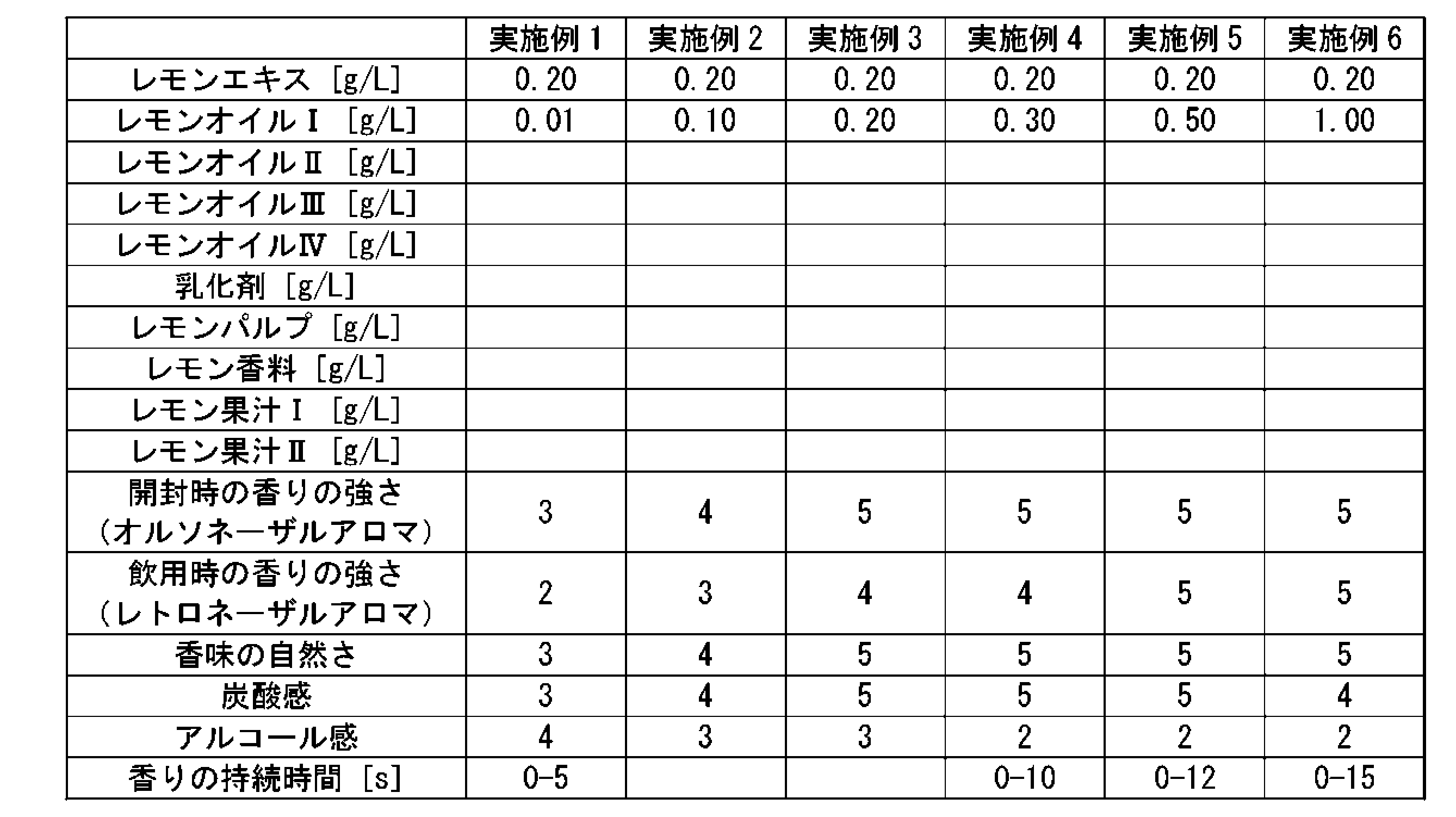
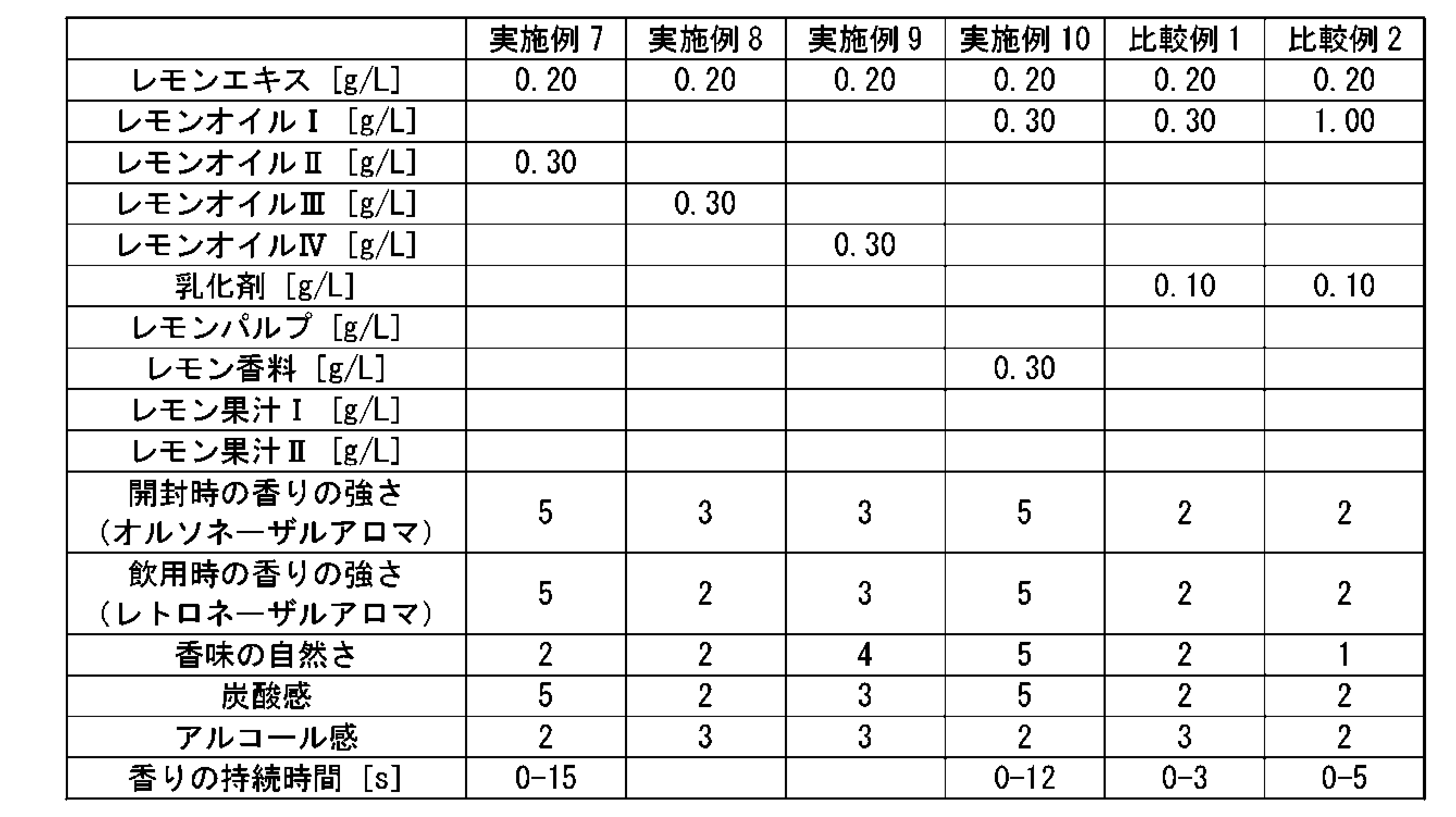
- Examples 1 to 10 A packaged beverage containing a hydrophobic aroma component extracted from lemon peel by various methods was produced in a sparkling alcoholic beverage, and the effect of the hydrophobic aroma component on the aroma of the beverage was investigated.
- raw material alcohol ethanol concentration: 95.3% by volume
- sucrose sucrose is 2.1% by mass
- anhydrous citric acid is 0.3% by mass
- sodium citrate 0.2% by mass.
- Water, and lemon extract ethanol concentration: 38.0% by volume
- emulsifier lecithin
- lemon pulp lemon fragrance
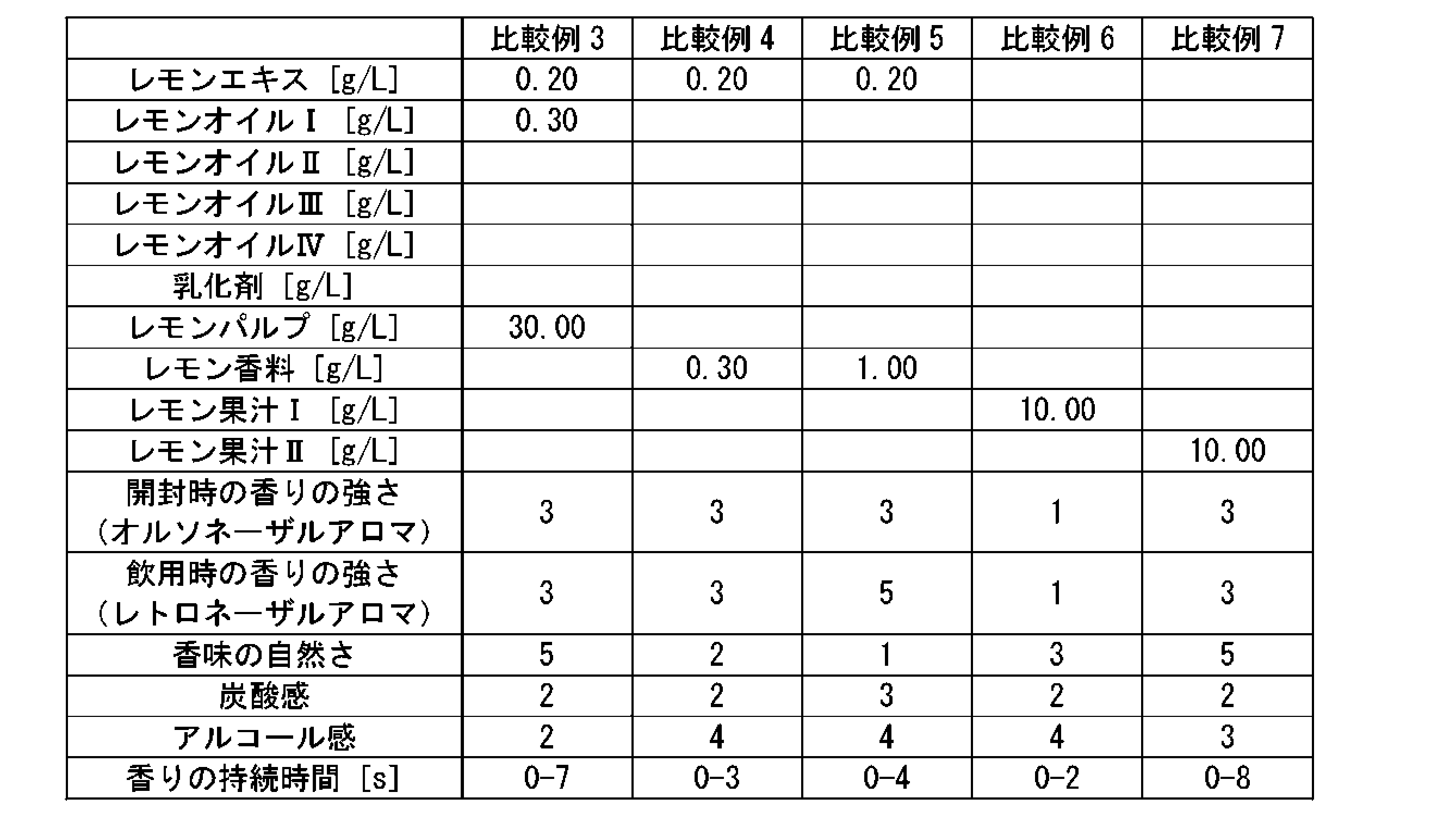
- lemon juice I, lemon juice II from Table 1 to A base liquid was prepared by mixing so as to have the amount described in 3.
- Lemon oil I, lemon oil II, lemon oil III, and lemon oil IV are further mixed with the prepared base liquid in the amounts shown in Tables 1 to 3, and Examples 1 to 10 and Comparative Examples 1 to 1 are further mixed. Each of the 7 beverages was obtained.
- carbon dioxide gas was press-fitted to set the gas volume to 3.0 GV (capacity / capacity). These were sealed in aluminum (alloy) two-piece beverage cans to prepare packaged beverages.
- Lemon oil I is a hydrophobic composition (single oil) extracted from the peel of lemon and a hydrophobic composition (fall) in which a part of the terpene hydrocarbon of this single oil is removed to increase the content ratio of terpenoids. It was a hydrophobic liquid composition mixed with (did oil). Among the terpenes contained in lemon oil I, the content of terpene hydrocarbons was 84.0% by mass, and further, the content of D-limonene among terpene hydrocarbons was 68.2% by mass.
- Lemon oil II was a folded oil in which a part of terpene hydrocarbons was removed from a single oil extracted from the peel of lemon to increase the content ratio of terpenoids.
- the content of terpene hydrocarbons was 23.7% by mass, and further, the content of D-limonene among the terpene hydrocarbons was 10.5% by mass.
- Lemon oil III was a hydrophobic liquid composition in which medium-chain fatty acid oil and lemon oil II were mixed at a weight ratio of 75:15.
- Lemon oil IV was a single oil extracted from the peel of lemon. Among the terpenes contained in Lemon Oil IV, the content of terpene hydrocarbons was 94.3% by mass, and the content of D-limonene among the terpene hydrocarbons was 66.4% by mass.
- Lemon juice I was squeezed only from the flesh of raw lemon fruit, and lemon juice II was squeezed from the flesh and skin.
- Example 7 containing lemon oil II with an increased terpenoid content had both orthonasal and retronasal aromas, similar to Example 4 containing the same amount of lemon oil I.
- Example 4 containing the same amount of lemon oil I. was enhanced, but the naturalness of the aroma was reduced and the duration of the aroma was longer.
- the effect of enhancing the feeling of carbonic acid and the effect of lowering the feeling of alcohol were similar to those of lemon oil I.
- the retronasal aroma was further enhanced and the duration of the aroma was slightly longer.
- Example 8 The beverage of Example 8 to which lemon oil III having a high content of medium-chain fatty acid oil unrelated to the scent of lemon was added had a weaker fragrance-enhancing effect than the beverage to which lemon oil I or lemon oil II was added, and was carbonated. No sensation-enhancing effect was observed.
- the beverage of Example 9 to which the single oil itself, lemon oil IV, is added the content ratio of the terpenoid, which is the main component of the aroma, is small, so that the aroma enhancing effect is weak and the carbonic acid feeling enhancing effect is also as in the case of lemon oil III. Although not observed, the naturalness of the scent was good.
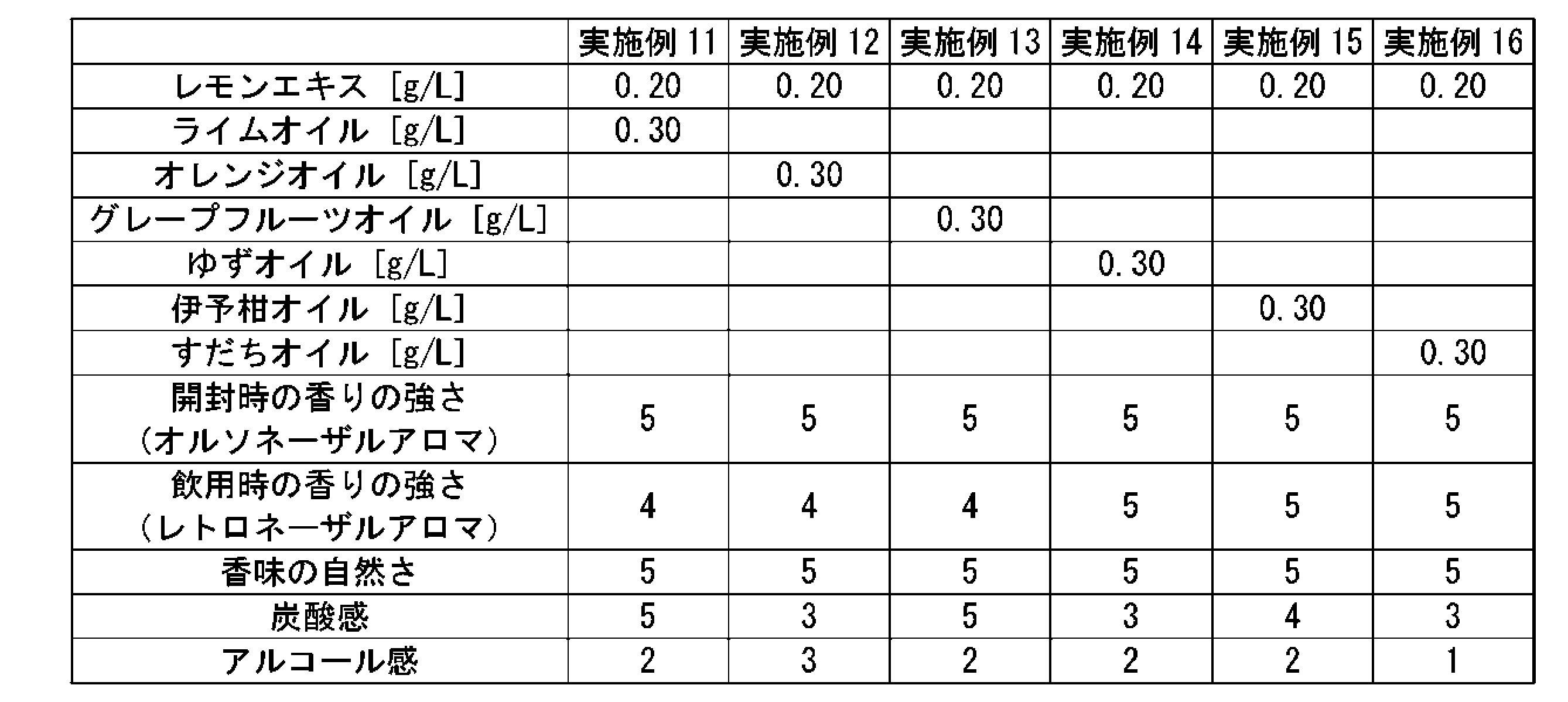
- Citrus oils other than lemon were added separately from the base liquid of the beverage, and the effect on the aroma was investigated.
- the citrus oil used was a hydrophobic composition (single oil) extracted from the citrus peel and a hydrophobic composition in which a part of the terpene hydrocarbon of this single oil was removed to increase the content ratio of terpenoids. It was a hydrophobic liquid composition mixed with a substance (folded oil).
- a packaged beverage was produced and sensory evaluated in the same manner as in Example 1 except that each oil was used instead of lemon oil I. Oil droplets could be confirmed on the surface of each beverage. The results are shown in Table 4.
- both the orthonasal aroma and the retronasal aroma were enhanced in all the beverages as in Example 4.
- the alcoholic sensation was lower than that of the beverage of Example 1 (score 4), and the alcoholic sensation was lowered by containing the citrus oil in a state separated from the base liquid.
- the feeling of carbonation differs depending on the type of citrus, and the effect of enhancing the feeling of carbonation was confirmed in lime oil and grapefruit oil as in lemon oil, but not in other citrus oils.
- Production Examples 1 to 4 and Comparative Production Example 1 are produced by changing the production method of a packaged beverage having the same composition as that of the packaged beverage of Example 4.
- the inner diameter of the can body of the aluminum (alloy) two-piece beverage can used was 65.9 mm (area of the liquid surface of the base liquid: 3.4 ⁇ 10 -3 m 2 ), and the inner diameter of the opening was 54.
- the size was 9 mm (opening area: 2.4 ⁇ 10 -3 m 2 ), and when lemon oil I was dropped, it bounced off the liquid surface, and a small amount of the beverage flowed out of the container.
- the produced packaged beverage was held in the container at an angle of 45 ° C. for 24 hours so that the beverage was in contact with the can lid, and then the state of the sealing compound was visually confirmed. As a result, the sealing compound was eluted. It was confirmed that
- the inner diameter of the barrel of the aluminum (alloy) bottle can used was 65.9 mm (area of the liquid surface of the base liquid: 3.4 ⁇ 10 -3 m 2 ), and the inner diameter of the opening was 35.4 mm (35.4 mm). The area of the opening: 1.0 ⁇ 10 -3 m 2 ), and when the lemon oil I was dropped, the beverage did not flow out of the container.
- the manufactured packaged beverage was held in a container at an angle of 30 ° C. for 24 hours so that the beverage was in contact with the screw cap, and then the condition of the liner was visually confirmed. No changes such as peeling were confirmed. Further, after holding for 2 weeks, the state of the liner was visually confirmed again, but no change in the liner material was confirmed.
- the two bottled beverages produced were allowed to stand for 24 hours and then opened and compared, the amount of lemon oil floating in the base liquid was higher in the second filled than in the first filled. In terms of sensuality, the second one was filled with more orthonasal aroma.
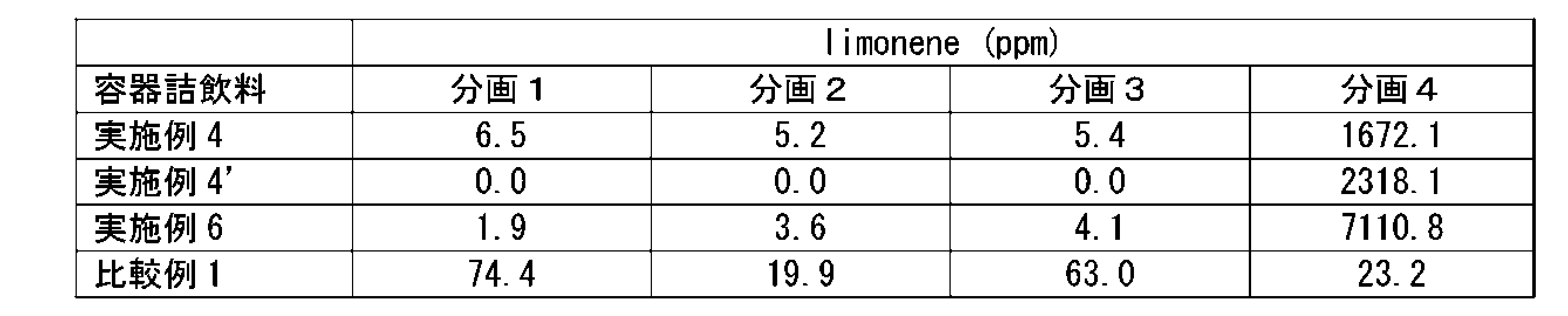
- each of the packaged beverages (bottle cans 400 mL) of Example 4, Example 6, and Comparative Example 1 is opened, the entire amount is poured into a cylindrical separatory funnel, and then until the oil floats on the liquid surface. It was allowed to stand for 30 minutes. About 15 minutes after standing, the oil surfaced on the liquid surface.
- Example 4' a packaged beverage having the same composition as in Example 4 except that lemon oil I was not added was produced, and this was designated as Example 4'.
- the whole amount of the packaged beverage of Example 4' was poured into the cylindrical separatory funnel, and then the same amount of lemon oil I as the lemon oil I added to the beverage in Example 4 was added from the top surface of the cylindrical separatory funnel. After that, it was allowed to stand for 30 minutes.
- the first 30 mL is fractionated as fraction 1
- the next 93.3 mL is discarded
- the next 30 mL is fractionated as fraction 2
- 93.3 mL of the above was discarded
- the next 30 mL was fractionated as fraction 3
- the next 93.3 mL was discarded
- the last 30 mL was fractionated as fraction 4.
- a cock cleaning solution (10 mL of ethanol) was also added to fraction 4 in order to include oil adhering to the cock of the cylindrical separatory funnel.
- the content of D-limonene was measured for these four fractions.
- the measurement sample of each fraction was subjected to liquid-liquid extraction with hexane after adding hexyl acetate as an internal standard substance, and this was subjected to GC / MS.
- the D-limonene of each fraction was analyzed by the following method. 30 g of the sample was weighed into a 50 mL centrifuge tube, 100 ⁇ L of an ethanol solution of hexyl acetate, 6 g of sodium chloride and 10 mL of hexane were added thereto, and the sample was sealed and extracted by wrist action at 200 rpm for 20 minutes.
- the concentration of the ethanol solution of hexyl acetate to be added is 0.25 g / L for a sample having a limonene content of 10 mg / L or less, and 2.5 g / L or 1000 mg for a sample exceeding 10 mg / L and 1000 mg / L or less.
- GC / MS conditions GC / MS device: HP7890A / 5975C (manufactured by Agilent Technologies)
- Capillary column DB-5MS (60m x 0.25mm x 0.25 ⁇ m, manufactured by Agilent Technologies)
- Carrier gas Helium flow rate: 1 mL / min
- Injection port temperature 250 ° C
- Injection mode Splitless mode Temperature program: Hold at 40 ° C for 5 minutes ⁇ Heat up to 160 ° C at 5 ° C / min ⁇ Heat up to 240 ° C at 10 ° C / min ⁇ Hold at 240 ° C for 10 minutes
- the limonene concentration of 0.0 ppm indicates that it was below the detection limit.
- the limonene concentration of 0.0 ppm indicates that it was below the detection limit.
Landscapes
- Chemical & Material Sciences (AREA)
- Engineering & Computer Science (AREA)
- Life Sciences & Earth Sciences (AREA)
- Health & Medical Sciences (AREA)
- Organic Chemistry (AREA)
- Polymers & Plastics (AREA)
- Food Science & Technology (AREA)
- Nutrition Science (AREA)
- Mechanical Engineering (AREA)
- Wood Science & Technology (AREA)
- Genetics & Genomics (AREA)
- Zoology (AREA)
- General Health & Medical Sciences (AREA)
- General Engineering & Computer Science (AREA)
- Bioinformatics & Cheminformatics (AREA)
- Biochemistry (AREA)
- Oil, Petroleum & Natural Gas (AREA)
- Non-Alcoholic Beverages (AREA)
- Alcoholic Beverages (AREA)
- Packging For Living Organisms, Food Or Medicinal Products That Are Sensitive To Environmental Conditiond (AREA)
- Tea And Coffee (AREA)
Abstract
Description
[1]可食性の水溶液と、疎水性香気成分を含有している疎水性液滴とを含有し、前記水溶液と前記疎水性液滴とが分離していることを特徴とする、容器詰飲料。
[2] 前記疎水性液滴が、前記水溶液の液面に存在する、前記[1]の容器詰飲料。[3] 前記疎水性香気成分が、沸点が260℃以上である疎水性物質である、前記[1]又は[2]の容器詰飲料。
[4] 前記疎水性液滴の密度が、前記水溶液の密度より小さい、前記[1]~[3]のいずれかの容器詰飲料。
[5] 前記疎水性香気成分が、果実の香気成分である、前記[1]~[4]のいずれかの容器詰飲料。
[6] 前記疎水性液滴が、植物から抽出された疎水性物質を含有する、前記[1]~[5]のいずれかの容器詰飲料。
[7] 前記植物から抽出された疎水性物質が、精油である、前記[6]の容器詰飲料。[8] 前記植物が柑橘類である、前記[6]又は[7]の容器詰飲料。
[9] 前記疎水性液滴が、テルペン類を含有する、前記[1]~[8]のいずれかの容器詰飲料。
[10] 前記テルペン類が、D-リモネンを含有する、前記[9]の容器詰飲料。
[11] 前記テルペン類中のテルペン炭化水素の割合が80質量%以上である、前記[9]又は[10]の容器詰飲料。
[12] 前記水溶液が、アルコールを含有する、前記[1]~[11]のいずれかの容器詰飲料。
[13] 前記水溶液が、炭酸ガスを含有する、前記[1]~[12]のいずれかの容器詰飲料。
[14] 前記水溶液が、果汁又は果実を含有する、前記[1]~[13]のいずれかの容器詰飲料。
[15] 前記水溶液が、乳化剤と疎水性香気成分を含有する、前記[1]~[14]のいずれかの容器詰飲料。
[16] ボトル缶、可撓性容器、又はガラス瓶に充填されている飲料である、前記[1]~[15]のいずれかの容器詰飲料。
[17] 可食性の水溶液と疎水性香気成分を含有する疎水性液滴とが分離している容器詰飲料を製造する方法であって、
容器本体に、前記水溶液を充填した後、疎水性香気成分を含有する疎水性液状組成物を充填する、又は、前記疎水性液状組成物を充填した後、前記水溶液を充填し、
その後、前記容器本体を密封する、容器詰飲料の製造方法。
[18] 可食性の水溶液と疎水性香気成分を含有する疎水性液滴とが分離している容器詰飲料を製造する方法であって、
可食性の水溶液に疎水性香気成分を含有する疎水性液状組成物を混合した溶液を、容器本体に充填した後、前記容器本体を密封し、その後、前記容器内において、前記可食性の水溶液から分離した疎水性液滴を形成させる、容器詰飲料の製造方法。
[19] 前記容器本体の密封される前の開口部の面積が、前記容器本体に充填された前記可食性の水溶液の液面の面積の70%以下である、前記[17]又は[18]の容器詰飲料の製造方法。
[20] 前記容器が、ボトル缶、可撓性容器、又はガラス瓶である、前記[19]の容器詰飲料の製造方法。
また、本発明に係る容器詰飲料の製造方法により、容器の開封時や喫飲時に感じられる香りが強化された容器詰飲料が製造できる。
本発明において用いられる疎水性香気成分は、ヒトに「におい」を感じさせる物質のうち、疎水性のものであれば、特に限定されるものではない。なお、疎水性の物質とは、25℃の水に滴下した場合に、少なくとも一部は相溶せずに界面を形成する物質である。すなわち、疎水性の物質は、水に完全に不溶であることまでは必要とせず、一部が水に溶解する物質も含まれる。本発明においては、一般的に飲食品に含まれる疎水性香気成分の中から、目的の香味特質を考慮して適宜選択して用いることができる。
本発明に係る容器詰飲料に形成されている疎水性液滴は、疎水性香気成分を含有する疎水性液状組成物からなる。当該疎水性液状組成物に含まれている疎水性香気成分は、1種類のみであってもよく、2種類以上であってもよい。また、化学合成品であってもよく、動植物等の天然物から抽出・精製されたものであってもよい。
本発明に係る容器詰飲料のベース液体は、飲料の本体となる可食性の水溶液である。当該ベース液体としては、水を含む各種の飲料をそのまま使用することができる。当該ベース液体としては、ノンアルコール飲料であってもよく、アルコール飲料であってもよい。また、炭酸ガスを含有していない非発泡性飲料であってもよく、炭酸ガスを含有する発泡性飲料であってもよい。また、発酵工程を経て製造される飲料であってもよく、発酵工程を経ずに製造される飲料であってもよい。
ベース液体と疎水性液状組成物とを容器に封入する、すなわち、充填して密閉することにより、本発明に係る容器詰飲料が得られる。使用できる容器に特に制限はなく、ツーピース飲料缶、スリーピース飲料缶、ボトル缶、可撓性容器、ガラス瓶などを用いることができる。可撓性容器としては、PE(ポリエチレン)、PP(ポリプロピレン)、EVOH(エチレン・ビニルアルコール共重合体)、PET(ポリエチレンテレフタレート)等の可撓性樹脂をボトル形状等に成形してなる容器が挙げられる。可撓性容器は、単層樹脂からなるものであってもよく、多層樹脂からなるものであってもよい。
本発明に係る容器詰飲料は、疎水性香気成分を、ベース液体に分離した疎水性液滴に内包した状態で含有する。疎水性液滴は、飲料を顕微鏡で観察することで確認できる。また、疎水性液滴の密度がベース液体よりも小さい場合には、疎水性液滴は、飲料の液面に浮いているため、目視で確認できる場合もある。
本発明に係る容器詰飲料は、疎水性液状組成物を、疎水性液滴が形成されるようにベース液体に混合する以外は、一般的な容器詰飲料と同様にして製造することができる。
発泡性アルコール飲料に、レモンの果皮から抽出された疎水性香気成分を各種方法で含有させた容器詰飲料を製造し、飲料の香りに対する疎水性香気成分の影響を調べた。
「香味の自然さ」は、5段階(評点1:不自然である、評点2:やや不自然である、評点3:普通、評点4:自然である、評点5:とても自然である)で評価した。
「香りの持続時間」は、飲用した時点からレモンの香りが消失したと認識した時点までの経過時間(秒)を調べた。
レモン以外の柑橘類のオイルを飲料のベース液体と分離した状態で添加し、香りに対する影響を調べた。
使用された柑橘類のオイルは、柑橘類の果皮から抽出された疎水性組成物(シングルオイル)と、このシングルオイルのテルペン炭化水素の一部を除去してテルペノイドの含有比を増大させた疎水性組成物(フォールディッドオイル)とを混合した疎水性液状組成物であった。
まず、実施例4と同様にしてベース液体700mLを調製した。次に、ベース液体を、2個のアルミニウム(合金)製ツーピース飲料缶の缶胴に350mLずつ充填した。続いて、液面にレモンオイルIを同量ずつ滴下し、それぞれレモンオイルがベース液体と分離し、浮いている飲料とした。その後、スチレン・ブタジエンゴムを主成分とするシーリングコンパウンドが塗布された缶蓋(ステイオンタブ蓋)を缶胴に巻き締めすることで、ツーピース飲料缶に封入した容器詰飲料を製造した。
まず、実施例4と同様にしてベース液体800mLを調製した。次に、ベース液体を、2個のアルミニウム(合金)製ボトル缶の缶胴に400mLずつ充填した。続いて、液面にレモンオイルIを同量ずつ滴下し、それぞれレモンオイルがベース液体と分離し、浮いている飲料とした。その後、長鎖状低密度ポリエチレンを主成分とするライナーが設けられたスクリュー式キャップで蓋をすることで、ボトル缶に封入した容器詰飲料を製造した。
まず、2個のアルミニウム(合金)製ボトル缶の缶胴内に、レモンオイルIを同量ずつ滴下した。次に、実施例4と同様にしてベース液体800mLを調製し、レモンオイルIを滴下したボトル缶の缶胴に400mLずつ充填した。続いて、当該缶胴を、長鎖状低密度ポリエチレンを主成分とするライナーが設けられたスクリュー式キャップで蓋をすることで、ボトル缶に封入した容器詰飲料を製造した。
まず、実施例4と同様にしてベース液体800mLを調製した。次いで、このベース液体にレモンオイルIを添加し、ホモミキサーを用いてベース液体中にレモンオイルIを分散させて分散液を得た。得られた分散液は、充填するために用いられる吐出口が底部に設けられた容器に入れられた後、2個のアルミニウム(合金)製ボトル缶の缶胴に400mLずつ充填された。続いて、当該缶胴を、長鎖状低密度ポリエチレンを主成分とするライナーが設けられたスクリュー式キャップで蓋をすることで、飲料をボトル缶に封入した容器詰飲料を製造した。
まず、実施例4と同様にしてベース液体800mLを調製した。次いで、このベース液体にレモンオイルIを添加し、ホモミキサーを用いてベース液体中にレモンオイルIを分散させて分散液を得た。得られた分散液は、充填するために用いられる吐出口が底部に設けられた容器に入れられた。ホモミキサー処理終了時から1時間経過後、分散液中の少なくとも一部のレモンオイルIはベース液体と分離し、ベース液体の液面に浮いていた。この状態で、当該分散液は、2個のアルミニウム(合金)製ボトル缶の缶胴に400mLずつ充填された。続いて、当該缶胴を、長鎖状低密度ポリエチレンを主成分とするライナーが設けられたスクリュー式キャップで蓋をすることで、飲料をボトル缶に封入した容器詰飲料を製造した。
実施例4、実施例6の容器詰飲料において、レモンオイルが液面に浮かんでいること、比較例1の容器詰飲料ではレモンオイルが液中に分散しており、液面には浮かんでいないことを、確認するため、各容器詰飲料について、高さごとに4領域に分画し、各分画のD-リモネンの濃度を調べた。
試料30gを50mL容遠沈管に量り取り、これに酢酸ヘキシルのエタノール溶液100μL、塩化ナトリウム6g、ヘキサン10mLを添加して密栓し、リストアクションで200rpm、20分間の条件で抽出した。ただし、添加する酢酸ヘキシルのエタノール溶液の濃度は、リモネン含量10mg/L以下の試料に対し0.25g/L、10mg/Lを超えて1000mg/L以下の試料に対し2.5g/L、1000mg/Lを超える試料に対し25g/Lとした。これを遠心機で3000rpm、10分間の条件で分離させ、ヘキサン層を無水硫酸2.00gが入った10mL容試験管に採取し、30分間静置して脱水させた。2.5g/Lの酢酸ヘキシルのエタノール溶液を用いたものは10倍に希釈し、25g/Lのそれを添加したものは100倍に希釈し、下記条件のGC/MS分析に供した。
GC/MS装置:HP7890A/5975C(アジレント・テクノロジー社製)
キャピラリカラム:DB-5MS(60m×0.25mm×0.25μm、アジレント・テクノロジー社製)
キャリアガス:ヘリウム
流量:1mL/分
注入口温度:250℃
注入モード:スプリットレスモード
温度プログラム:40℃で5分間保持→160℃まで5℃/分で昇温→240℃まで10℃/分で昇温→240℃で10分間保持

Claims (20)
- 可食性の水溶液と、疎水性香気成分を含有している疎水性液滴とを含有し、前記水溶液と前記疎水性液滴とが分離していることを特徴とする、容器詰飲料。
- 前記疎水性液滴が、前記水溶液の液面に存在する、請求項1に記載の容器詰飲料。
- 前記疎水性香気成分が、沸点が260℃以上である疎水性物質である、請求項1又は2に記載の容器詰飲料。
- 前記疎水性液滴の密度が、前記水溶液の密度より小さい、請求項1~3のいずれか一項に記載の容器詰飲料。
- 前記疎水性香気成分が、果実の香気成分である、請求項1~4のいずれか一項に記載の容器詰飲料。
- 前記疎水性液滴が、植物から抽出された疎水性物質を含有する、請求項1~5のいずれか一項に記載の容器詰飲料。
- 前記植物から抽出された疎水性物質が、精油である、請求項6に記載の容器詰飲料。
- 前記植物が柑橘類である、請求項6又は7に記載の容器詰飲料。
- 前記疎水性液滴が、テルペン類を含有する、請求項1~8のいずれか一項に記載の容器詰飲料。
- 前記テルペン類が、D-リモネンを含有する、請求項9に記載の容器詰飲料。
- 前記テルペン類中のテルペン炭化水素の割合が80質量%以上である、請求項9又は10に記載の容器詰飲料。
- 前記水溶液が、アルコールを含有する、請求項1~11のいずれか一項に記載の容器詰飲料。
- 前記水溶液が、炭酸ガスを含有する、請求項1~12のいずれか一項に記載の容器詰飲料。
- 前記水溶液が、果汁又は果実を含有する、請求項1~13のいずれか一項に記載の容器詰飲料。
- 前記水溶液が、乳化剤と疎水性香気成分を含有する、請求項1~14のいずれか一項に記載の容器詰飲料。
- ボトル缶、可撓性容器、又はガラス瓶に充填されている飲料である、請求項1~15のいずれか一項に記載の容器詰飲料。
- 可食性の水溶液と疎水性香気成分を含有する疎水性液滴とが分離している容器詰飲料を製造する方法であって、
容器本体に、前記水溶液を充填した後、疎水性香気成分を含有する疎水性液状組成物を充填する、又は、前記疎水性液状組成物を充填した後、前記水溶液を充填し、
その後、前記容器本体を密封する、容器詰飲料の製造方法。 - 可食性の水溶液と疎水性香気成分を含有する疎水性液滴とが分離している容器詰飲料を製造する方法であって、
可食性の水溶液に疎水性香気成分を含有する疎水性液状組成物を混合した溶液を、容器本体に充填した後、前記容器本体を密封し、その後、前記容器内において、前記可食性の水溶液から分離した疎水性液滴を形成させる、容器詰飲料の製造方法。 - 前記容器本体の密封される前の開口部の面積が、前記容器本体に充填された前記可食性の水溶液の液面の面積の70%以下である、請求項17又は18に記載の容器詰飲料の製造方法。
- 前記容器が、ボトル缶、可撓性容器、又はガラス瓶である、請求項19に記載の容器詰飲料の製造方法。
Priority Applications (5)
| Application Number | Priority Date | Filing Date | Title |
|---|---|---|---|
| AU2020364691A AU2020364691B2 (en) | 2019-10-09 | 2020-10-07 | Packaged beverage and method for producing same |
| US17/766,891 US20240101938A1 (en) | 2019-10-09 | 2020-10-07 | Packaged beverage and method for producing same |
| NZ787019A NZ787019B2 (en) | 2020-10-07 | Packaged beverage and method for producing same | |
| EP20875282.4A EP4042872A4 (en) | 2019-10-09 | 2020-10-07 | Packaged beverage and manufacturing method thereof |
| CN202080070515.2A CN114761530B (zh) | 2019-10-09 | 2020-10-07 | 容器包装饮料以及其制造方法 |
Applications Claiming Priority (4)
| Application Number | Priority Date | Filing Date | Title |
|---|---|---|---|
| JP2019186275 | 2019-10-09 | ||
| JP2019-186275 | 2019-10-09 | ||
| JP2020084002A JP6847288B1 (ja) | 2019-10-09 | 2020-05-12 | 容器詰飲料及びその製造方法 |
| JP2020-084002 | 2020-05-12 |
Publications (1)
| Publication Number | Publication Date |
|---|---|
| WO2021070864A1 true WO2021070864A1 (ja) | 2021-04-15 |
Family
ID=74879224
Family Applications (1)
| Application Number | Title | Priority Date | Filing Date |
|---|---|---|---|
| PCT/JP2020/038002 Ceased WO2021070864A1 (ja) | 2019-10-09 | 2020-10-07 | 容器詰飲料及びその製造方法 |
Country Status (6)
| Country | Link |
|---|---|
| US (1) | US20240101938A1 (ja) |
| EP (1) | EP4042872A4 (ja) |
| JP (5) | JP6847288B1 (ja) |
| CN (1) | CN114761530B (ja) |
| AU (1) | AU2020364691B2 (ja) |
| WO (1) | WO2021070864A1 (ja) |
Families Citing this family (7)
| Publication number | Priority date | Publication date | Assignee | Title |
|---|---|---|---|---|
| JP2023031068A (ja) * | 2021-08-24 | 2023-03-08 | アサヒビール株式会社 | 加温容器詰めアルコール飲料及びその製造方法 |
| JP2023129893A (ja) * | 2022-03-07 | 2023-09-20 | アサヒビール株式会社 | 缶詰飲料 |
| JP7852300B2 (ja) * | 2022-03-07 | 2026-04-28 | 東洋製罐株式会社 | 金属蓋用密封材組成物及びこれから成る塗膜を有する金属蓋 |
| JP2023158795A (ja) * | 2022-04-19 | 2023-10-31 | アサヒビール株式会社 | 容器詰飲料、容器詰飲料の製造方法及び飲料のボディ感の増強方法 |
| JP2024031447A (ja) * | 2022-08-26 | 2024-03-07 | アサヒ飲料株式会社 | 柑橘風味飲料および柑橘風味飲料の香味向上方法 |
| JP7313531B1 (ja) * | 2022-12-26 | 2023-07-24 | アサヒビール株式会社 | 柑橘風味飲料および柑橘風味飲料の香味向上方法 |
| JP7457785B1 (ja) | 2022-12-26 | 2024-03-28 | アサヒビール株式会社 | 柑橘風味飲料および柑橘風味飲料の製造方法 |
Citations (13)
| Publication number | Priority date | Publication date | Assignee | Title |
|---|---|---|---|---|
| JP2005124567A (ja) * | 2003-10-01 | 2005-05-19 | Asahi Breweries Ltd | アルコール炭酸飲料の製造方法、及び、風味強化果汁の製造方法 |
| JP2010041935A (ja) | 2008-08-11 | 2010-02-25 | Ogawa & Co Ltd | 柑橘類由来の呈味改善剤 |
| JP2010279293A (ja) * | 2009-06-04 | 2010-12-16 | Asahi Breweries Ltd | オイル香料を含有するアルコール飲料の製造方法 |
| JP2011206030A (ja) | 2010-03-31 | 2011-10-20 | Calpis Co Ltd | 味質改良および果汁感付与剤 |
| WO2011148761A1 (ja) * | 2010-05-27 | 2011-12-01 | サントリーホールディングス株式会社 | 精油含有飲料 |
| JP2013183638A (ja) * | 2012-03-05 | 2013-09-19 | Nisshin Oillio Group Ltd | 液体の保温方法 |
| JP2015112033A (ja) * | 2013-12-09 | 2015-06-22 | ザ コカ・コーラ カンパニーThe Coca‐Cola Company | コーヒー飲料とその製造方法 |
| JP2017018015A (ja) * | 2015-07-08 | 2017-01-26 | アサヒ飲料株式会社 | 濃縮飲料および濃縮飲料の品質改善方法 |
| JP2017131134A (ja) | 2016-01-26 | 2017-08-03 | 麒麟麦酒株式会社 | 柑橘の果皮感が増強されたアルコール飲料およびその製造方法 |
| JP6251440B1 (ja) * | 2016-09-07 | 2017-12-20 | 恭弘 梶浦 | 飲料用オリーブオイル組成物、オリーブオイル飲料及びそれらの製造方法 |
| JP6383070B1 (ja) * | 2017-08-29 | 2018-08-29 | アサヒ飲料株式会社 | コーヒー飲料の製造方法 |
| JP2019041763A (ja) * | 2018-08-24 | 2019-03-22 | アサヒ飲料株式会社 | コーヒー飲料 |
| JP2019170298A (ja) * | 2018-03-29 | 2019-10-10 | アサヒ飲料株式会社 | 飲料及び飲料の製造方法並びに飲料中の精油の分散安定性の向上方法 |
Family Cites Families (22)
| Publication number | Priority date | Publication date | Assignee | Title |
|---|---|---|---|---|
| US189764A (en) * | 1877-04-17 | Improvement in flavoring aerated beverages | ||
| US2367269A (en) * | 1942-04-23 | 1945-01-16 | Grayslake Gelatin Co | Citrus oil flavoring materials |
| US3347681A (en) * | 1962-08-27 | 1967-10-17 | Ventura Processors | Process for preparing a lemon flavoring oil composition |
| JP3057133B2 (ja) * | 1993-10-13 | 2000-06-26 | 長谷川香料株式会社 | 水溶性粉末香料 |
| JPH09132680A (ja) * | 1995-11-07 | 1997-05-20 | Shibasaki Seisakusho:Kk | キャップライナー材用組成物およびキャップ成形品 |
| US20030228393A1 (en) * | 2002-05-31 | 2003-12-11 | Zhao Iris Ginron | Multi-phase food & beverage |
| JPH11157568A (ja) * | 1997-11-27 | 1999-06-15 | Tosoh Corp | キャップライナー材用組成物及びキャップ |
| JP2004091742A (ja) * | 2002-09-03 | 2004-03-25 | Sanei Gen Ffi Inc | キーライム香料およびキーライム香料含有食品 |
| JP4214311B2 (ja) * | 2004-04-05 | 2009-01-28 | 株式会社日本化学研究所 | 缶蓋用シーリングコンパウンド |
| JP5013512B2 (ja) * | 2006-10-31 | 2012-08-29 | アサヒビール株式会社 | 精油の分散安定化方法および飲料の製造方法 |
| JP5198803B2 (ja) * | 2007-06-15 | 2013-05-15 | ダブリュー・アール・グレイス・アンド・カンパニー−コネチカット | 缶の密封方法 |
| JP5177143B2 (ja) * | 2007-07-31 | 2013-04-03 | 不二製油株式会社 | 固定化リパーゼおよびその製造方法 |
| JP2012200190A (ja) * | 2011-03-25 | 2012-10-22 | Fuji Oil Co Ltd | 清澄性の高い水溶性大豆多糖類及びそれを用いた乳化組成物 |
| CN104159455B (zh) * | 2012-03-09 | 2017-03-08 | 卡夫食品集团品牌有限责任公司 | 含有1,3‑丙二醇的食物和饮料产品以及使用1,3‑丙二醇在食物和饮料产品中抑制苦味和增强甜味的方法 |
| CN104172326A (zh) * | 2013-05-28 | 2014-12-03 | 洛阳尚品生物工程有限公司 | 牡丹果汁饮料及其制作方法 |
| JP6101166B2 (ja) * | 2013-07-08 | 2017-03-22 | サントリー食品インターナショナル株式会社 | 後味が改善された高甘味度甘味料を含有する高果汁飲料 |
| JP6251556B2 (ja) * | 2013-12-04 | 2017-12-20 | 株式会社日本化学研究所 | 缶蓋用シーリングコンパウンド |
| US20160374388A1 (en) * | 2015-06-03 | 2016-12-29 | Andrew Jon Thomson | Terpene profile replication blends and their applications |
| JP6300780B2 (ja) * | 2015-12-24 | 2018-03-28 | 高砂香料工業株式会社 | アルコール飲料用乳化香料組成物 |
| CN105724989A (zh) * | 2016-02-24 | 2016-07-06 | 牟国友 | 一种含柑橘片的饮料及其制备方法 |
| JP6921719B2 (ja) * | 2017-11-17 | 2021-08-18 | 日本クロージャー株式会社 | キャップライナー用組成物 |
| JP7407541B2 (ja) * | 2019-08-29 | 2024-01-04 | パナソニックホームズ株式会社 | 電気錠システム、電気錠の制御方法、建物、及び、電気錠 |
-
2020
- 2020-05-12 JP JP2020084002A patent/JP6847288B1/ja active Active
- 2020-10-07 WO PCT/JP2020/038002 patent/WO2021070864A1/ja not_active Ceased
- 2020-10-07 US US17/766,891 patent/US20240101938A1/en not_active Abandoned
- 2020-10-07 AU AU2020364691A patent/AU2020364691B2/en active Active
- 2020-10-07 CN CN202080070515.2A patent/CN114761530B/zh active Active
- 2020-10-07 EP EP20875282.4A patent/EP4042872A4/en active Pending
-
2021
- 2021-03-01 JP JP2021032029A patent/JP7025576B2/ja active Active
- 2021-03-01 JP JP2021032030A patent/JP6953644B2/ja active Active
- 2021-03-01 JP JP2021032031A patent/JP7027590B2/ja active Active
-
2022
- 2022-02-15 JP JP2022021297A patent/JP7606994B2/ja active Active
Patent Citations (13)
| Publication number | Priority date | Publication date | Assignee | Title |
|---|---|---|---|---|
| JP2005124567A (ja) * | 2003-10-01 | 2005-05-19 | Asahi Breweries Ltd | アルコール炭酸飲料の製造方法、及び、風味強化果汁の製造方法 |
| JP2010041935A (ja) | 2008-08-11 | 2010-02-25 | Ogawa & Co Ltd | 柑橘類由来の呈味改善剤 |
| JP2010279293A (ja) * | 2009-06-04 | 2010-12-16 | Asahi Breweries Ltd | オイル香料を含有するアルコール飲料の製造方法 |
| JP2011206030A (ja) | 2010-03-31 | 2011-10-20 | Calpis Co Ltd | 味質改良および果汁感付与剤 |
| WO2011148761A1 (ja) * | 2010-05-27 | 2011-12-01 | サントリーホールディングス株式会社 | 精油含有飲料 |
| JP2013183638A (ja) * | 2012-03-05 | 2013-09-19 | Nisshin Oillio Group Ltd | 液体の保温方法 |
| JP2015112033A (ja) * | 2013-12-09 | 2015-06-22 | ザ コカ・コーラ カンパニーThe Coca‐Cola Company | コーヒー飲料とその製造方法 |
| JP2017018015A (ja) * | 2015-07-08 | 2017-01-26 | アサヒ飲料株式会社 | 濃縮飲料および濃縮飲料の品質改善方法 |
| JP2017131134A (ja) | 2016-01-26 | 2017-08-03 | 麒麟麦酒株式会社 | 柑橘の果皮感が増強されたアルコール飲料およびその製造方法 |
| JP6251440B1 (ja) * | 2016-09-07 | 2017-12-20 | 恭弘 梶浦 | 飲料用オリーブオイル組成物、オリーブオイル飲料及びそれらの製造方法 |
| JP6383070B1 (ja) * | 2017-08-29 | 2018-08-29 | アサヒ飲料株式会社 | コーヒー飲料の製造方法 |
| JP2019170298A (ja) * | 2018-03-29 | 2019-10-10 | アサヒ飲料株式会社 | 飲料及び飲料の製造方法並びに飲料中の精油の分散安定性の向上方法 |
| JP2019041763A (ja) * | 2018-08-24 | 2019-03-22 | アサヒ飲料株式会社 | コーヒー飲料 |
Non-Patent Citations (1)
| Title |
|---|
| See also references of EP4042872A4 |
Also Published As
| Publication number | Publication date |
|---|---|
| JP2021097688A (ja) | 2021-07-01 |
| JP2021058180A (ja) | 2021-04-15 |
| CN114761530B (zh) | 2024-11-01 |
| NZ787019A (en) | 2023-11-24 |
| CN114761530A (zh) | 2022-07-15 |
| JP2021087450A (ja) | 2021-06-10 |
| JP7027590B2 (ja) | 2022-03-01 |
| AU2020364691B2 (en) | 2025-01-23 |
| JP2022059641A (ja) | 2022-04-13 |
| EP4042872A4 (en) | 2023-10-04 |
| JP6953644B2 (ja) | 2021-10-27 |
| JP6847288B1 (ja) | 2021-03-24 |
| US20240101938A1 (en) | 2024-03-28 |
| EP4042872A1 (en) | 2022-08-17 |
| JP2021078520A (ja) | 2021-05-27 |
| JP7025576B2 (ja) | 2022-02-24 |
| AU2020364691A1 (en) | 2022-04-28 |
| JP7606994B2 (ja) | 2024-12-26 |
Similar Documents
| Publication | Publication Date | Title |
|---|---|---|
| JP6953644B2 (ja) | 容器詰飲料及びその製造方法 | |
| JP6262170B2 (ja) | 柑橘香味増強剤 | |
| JP6792251B1 (ja) | 酢酸含有飲食品 | |
| JP6262171B2 (ja) | 果実香味増強剤 | |
| JP6198906B1 (ja) | グレープフルーツ果実様飲料及びその製造方法 | |
| JP6991841B2 (ja) | リモネンを含有する柑橘系アルコール飲料 | |
| JP6952153B2 (ja) | 容器詰飲料 | |
| TW202142125A (zh) | 碳酸飲料 | |
| JP7007415B2 (ja) | 容器詰飲料及び容器詰飲料の嗜好性改善方法 | |
| JP6855167B2 (ja) | 柑橘の果皮感が増強されたアルコール飲料およびその製造方法 | |
| JP6959385B2 (ja) | 容器詰飲料の製造方法 | |
| JP2025036744A (ja) | 柑橘風味アルコール飲料 | |
| JP7329357B2 (ja) | 柑橘果実様飲料 | |
| JP2014158492A (ja) | アルコール感が付与された非アルコール飲料およびその製造方法 | |
| WO2025005261A1 (ja) | 組成物、原料酒及び飲料 | |
| JP2005013167A (ja) | 発泡感付与剤およびそれを含有する香料組成物、炭酸飲料 | |
| JP7534113B2 (ja) | 飲料用濃縮原液及び飲料の製造方法 | |
| JP7548719B2 (ja) | 容器詰飲料の製造方法 | |
| JP2023158795A (ja) | 容器詰飲料、容器詰飲料の製造方法及び飲料のボディ感の増強方法 | |
| Matthews | Beverage flavourings and their applications | |
| Taylor | Other beverage ingredients | |
| JP2017029025A (ja) | 粉末酒および粉末酒の味質改善方法 | |
| JP2023034086A (ja) | 容器詰アルコール飲料 | |
| JP2023054272A (ja) | 果実香の成分を含有しているアルコール飲料 |
Legal Events
| Date | Code | Title | Description |
|---|---|---|---|
| 121 | Ep: the epo has been informed by wipo that ep was designated in this application |
Ref document number: 20875282 Country of ref document: EP Kind code of ref document: A1 |
|
| WWE | Wipo information: entry into national phase |
Ref document number: 17766891 Country of ref document: US |
|
| NENP | Non-entry into the national phase |
Ref country code: DE |
|
| ENP | Entry into the national phase |
Ref document number: 2020364691 Country of ref document: AU Date of ref document: 20201007 Kind code of ref document: A |
|
| ENP | Entry into the national phase |
Ref document number: 2020875282 Country of ref document: EP Effective date: 20220509 |