WO2021085389A1 - 2,6-ジオキソ-3,6-ジヒドロピリミジン化合物並びに農園芸用殺菌剤、殺線虫剤、および医療用・動物用抗真菌剤 - Google Patents
2,6-ジオキソ-3,6-ジヒドロピリミジン化合物並びに農園芸用殺菌剤、殺線虫剤、および医療用・動物用抗真菌剤 Download PDFInfo
- Publication number
- WO2021085389A1 WO2021085389A1 PCT/JP2020/040135 JP2020040135W WO2021085389A1 WO 2021085389 A1 WO2021085389 A1 WO 2021085389A1 JP 2020040135 W JP2020040135 W JP 2020040135W WO 2021085389 A1 WO2021085389 A1 WO 2021085389A1
- Authority
- WO
- WIPO (PCT)
- Prior art keywords
- group
- substituted
- unsubstituted
- groups
- represented
- Prior art date
- Legal status (The legal status is an assumption and is not a legal conclusion. Google has not performed a legal analysis and makes no representation as to the accuracy of the status listed.)
- Ceased
Links
- 0 *C(C(N1*)=O)=C(*)N(*)C1=O Chemical compound *C(C(N1*)=O)=C(*)N(*)C1=O 0.000 description 3
- KGHIZEGJWKOZOI-SWBCXOLSSA-N CC(C)C(N[C@@H](C)CN(C(C(/C(/C)=N/OC(C)C)=CN1CC(c(cccc2)c2OC(F)(F)F)O)=O)C1=O)=O Chemical compound CC(C)C(N[C@@H](C)CN(C(C(/C(/C)=N/OC(C)C)=CN1CC(c(cccc2)c2OC(F)(F)F)O)=O)C1=O)=O KGHIZEGJWKOZOI-SWBCXOLSSA-N 0.000 description 1
- BSQDNZAMCZVGFC-DZZODMLCSA-N CC(C)C(N[C@@H](C)CN(C(C(/C(/C)=N/OC(C)C)=CN1CC(c2ccccc2OC(F)(F)F)=O)=O)C1=O)=O Chemical compound CC(C)C(N[C@@H](C)CN(C(C(/C(/C)=N/OC(C)C)=CN1CC(c2ccccc2OC(F)(F)F)=O)=O)C1=O)=O BSQDNZAMCZVGFC-DZZODMLCSA-N 0.000 description 1
Classifications
-
- A—HUMAN NECESSITIES
- A01—AGRICULTURE; FORESTRY; ANIMAL HUSBANDRY; HUNTING; TRAPPING; FISHING
- A01N—PRESERVATION OF BODIES OF HUMANS OR ANIMALS OR PLANTS OR PARTS THEREOF; BIOCIDES, e.g. AS DISINFECTANTS, AS PESTICIDES OR AS HERBICIDES; PEST REPELLANTS OR ATTRACTANTS; PLANT GROWTH REGULATORS
- A01N43/00—Biocides, pest repellants or attractants, or plant growth regulators containing heterocyclic compounds
- A01N43/48—Biocides, pest repellants or attractants, or plant growth regulators containing heterocyclic compounds having rings with two nitrogen atoms as the only ring hetero atoms
- A01N43/54—1,3-Diazines; Hydrogenated 1,3-diazines
-
- A—HUMAN NECESSITIES
- A01—AGRICULTURE; FORESTRY; ANIMAL HUSBANDRY; HUNTING; TRAPPING; FISHING
- A01N—PRESERVATION OF BODIES OF HUMANS OR ANIMALS OR PLANTS OR PARTS THEREOF; BIOCIDES, e.g. AS DISINFECTANTS, AS PESTICIDES OR AS HERBICIDES; PEST REPELLANTS OR ATTRACTANTS; PLANT GROWTH REGULATORS
- A01N43/00—Biocides, pest repellants or attractants, or plant growth regulators containing heterocyclic compounds
- A01N43/48—Biocides, pest repellants or attractants, or plant growth regulators containing heterocyclic compounds having rings with two nitrogen atoms as the only ring hetero atoms
- A01N43/56—1,2-Diazoles; Hydrogenated 1,2-diazoles
-
- A—HUMAN NECESSITIES
- A01—AGRICULTURE; FORESTRY; ANIMAL HUSBANDRY; HUNTING; TRAPPING; FISHING
- A01N—PRESERVATION OF BODIES OF HUMANS OR ANIMALS OR PLANTS OR PARTS THEREOF; BIOCIDES, e.g. AS DISINFECTANTS, AS PESTICIDES OR AS HERBICIDES; PEST REPELLANTS OR ATTRACTANTS; PLANT GROWTH REGULATORS
- A01N43/00—Biocides, pest repellants or attractants, or plant growth regulators containing heterocyclic compounds
- A01N43/48—Biocides, pest repellants or attractants, or plant growth regulators containing heterocyclic compounds having rings with two nitrogen atoms as the only ring hetero atoms
- A01N43/58—1,2-Diazines; Hydrogenated 1,2-diazines
-
- A—HUMAN NECESSITIES
- A01—AGRICULTURE; FORESTRY; ANIMAL HUSBANDRY; HUNTING; TRAPPING; FISHING
- A01N—PRESERVATION OF BODIES OF HUMANS OR ANIMALS OR PLANTS OR PARTS THEREOF; BIOCIDES, e.g. AS DISINFECTANTS, AS PESTICIDES OR AS HERBICIDES; PEST REPELLANTS OR ATTRACTANTS; PLANT GROWTH REGULATORS
- A01N43/00—Biocides, pest repellants or attractants, or plant growth regulators containing heterocyclic compounds
- A01N43/48—Biocides, pest repellants or attractants, or plant growth regulators containing heterocyclic compounds having rings with two nitrogen atoms as the only ring hetero atoms
- A01N43/60—1,4-Diazines; Hydrogenated 1,4-diazines
-
- A—HUMAN NECESSITIES
- A01—AGRICULTURE; FORESTRY; ANIMAL HUSBANDRY; HUNTING; TRAPPING; FISHING
- A01N—PRESERVATION OF BODIES OF HUMANS OR ANIMALS OR PLANTS OR PARTS THEREOF; BIOCIDES, e.g. AS DISINFECTANTS, AS PESTICIDES OR AS HERBICIDES; PEST REPELLANTS OR ATTRACTANTS; PLANT GROWTH REGULATORS
- A01N43/00—Biocides, pest repellants or attractants, or plant growth regulators containing heterocyclic compounds
- A01N43/64—Biocides, pest repellants or attractants, or plant growth regulators containing heterocyclic compounds having rings with three nitrogen atoms as the only ring hetero atoms
- A01N43/647—Triazoles; Hydrogenated triazoles
-
- A—HUMAN NECESSITIES
- A01—AGRICULTURE; FORESTRY; ANIMAL HUSBANDRY; HUNTING; TRAPPING; FISHING
- A01N—PRESERVATION OF BODIES OF HUMANS OR ANIMALS OR PLANTS OR PARTS THEREOF; BIOCIDES, e.g. AS DISINFECTANTS, AS PESTICIDES OR AS HERBICIDES; PEST REPELLANTS OR ATTRACTANTS; PLANT GROWTH REGULATORS
- A01N43/00—Biocides, pest repellants or attractants, or plant growth regulators containing heterocyclic compounds
- A01N43/64—Biocides, pest repellants or attractants, or plant growth regulators containing heterocyclic compounds having rings with three nitrogen atoms as the only ring hetero atoms
- A01N43/647—Triazoles; Hydrogenated triazoles
- A01N43/653—1,2,4-Triazoles; Hydrogenated 1,2,4-triazoles
-
- A—HUMAN NECESSITIES
- A01—AGRICULTURE; FORESTRY; ANIMAL HUSBANDRY; HUNTING; TRAPPING; FISHING
- A01N—PRESERVATION OF BODIES OF HUMANS OR ANIMALS OR PLANTS OR PARTS THEREOF; BIOCIDES, e.g. AS DISINFECTANTS, AS PESTICIDES OR AS HERBICIDES; PEST REPELLANTS OR ATTRACTANTS; PLANT GROWTH REGULATORS
- A01N43/00—Biocides, pest repellants or attractants, or plant growth regulators containing heterocyclic compounds
- A01N43/64—Biocides, pest repellants or attractants, or plant growth regulators containing heterocyclic compounds having rings with three nitrogen atoms as the only ring hetero atoms
- A01N43/707—1,2,3- or 1,2,4-triazines; Hydrogenated 1,2,3- or 1,2,4-triazines
-
- A—HUMAN NECESSITIES
- A01—AGRICULTURE; FORESTRY; ANIMAL HUSBANDRY; HUNTING; TRAPPING; FISHING
- A01N—PRESERVATION OF BODIES OF HUMANS OR ANIMALS OR PLANTS OR PARTS THEREOF; BIOCIDES, e.g. AS DISINFECTANTS, AS PESTICIDES OR AS HERBICIDES; PEST REPELLANTS OR ATTRACTANTS; PLANT GROWTH REGULATORS
- A01N43/00—Biocides, pest repellants or attractants, or plant growth regulators containing heterocyclic compounds
- A01N43/72—Biocides, pest repellants or attractants, or plant growth regulators containing heterocyclic compounds having rings with nitrogen atoms and oxygen or sulfur atoms as ring hetero atoms
- A01N43/74—Biocides, pest repellants or attractants, or plant growth regulators containing heterocyclic compounds having rings with nitrogen atoms and oxygen or sulfur atoms as ring hetero atoms five-membered rings with one nitrogen atom and either one oxygen atom or one sulfur atom in positions 1,3
- A01N43/78—1,3-Thiazoles; Hydrogenated 1,3-thiazoles
-
- A—HUMAN NECESSITIES
- A01—AGRICULTURE; FORESTRY; ANIMAL HUSBANDRY; HUNTING; TRAPPING; FISHING
- A01N—PRESERVATION OF BODIES OF HUMANS OR ANIMALS OR PLANTS OR PARTS THEREOF; BIOCIDES, e.g. AS DISINFECTANTS, AS PESTICIDES OR AS HERBICIDES; PEST REPELLANTS OR ATTRACTANTS; PLANT GROWTH REGULATORS
- A01N43/00—Biocides, pest repellants or attractants, or plant growth regulators containing heterocyclic compounds
- A01N43/72—Biocides, pest repellants or attractants, or plant growth regulators containing heterocyclic compounds having rings with nitrogen atoms and oxygen or sulfur atoms as ring hetero atoms
- A01N43/82—Biocides, pest repellants or attractants, or plant growth regulators containing heterocyclic compounds having rings with nitrogen atoms and oxygen or sulfur atoms as ring hetero atoms five-membered rings with three ring hetero atoms
-
- A—HUMAN NECESSITIES
- A01—AGRICULTURE; FORESTRY; ANIMAL HUSBANDRY; HUNTING; TRAPPING; FISHING
- A01N—PRESERVATION OF BODIES OF HUMANS OR ANIMALS OR PLANTS OR PARTS THEREOF; BIOCIDES, e.g. AS DISINFECTANTS, AS PESTICIDES OR AS HERBICIDES; PEST REPELLANTS OR ATTRACTANTS; PLANT GROWTH REGULATORS
- A01N43/00—Biocides, pest repellants or attractants, or plant growth regulators containing heterocyclic compounds
- A01N43/72—Biocides, pest repellants or attractants, or plant growth regulators containing heterocyclic compounds having rings with nitrogen atoms and oxygen or sulfur atoms as ring hetero atoms
- A01N43/84—Biocides, pest repellants or attractants, or plant growth regulators containing heterocyclic compounds having rings with nitrogen atoms and oxygen or sulfur atoms as ring hetero atoms six-membered rings with one nitrogen atom and either one oxygen atom or one sulfur atom in positions 1,4
-
- A—HUMAN NECESSITIES
- A01—AGRICULTURE; FORESTRY; ANIMAL HUSBANDRY; HUNTING; TRAPPING; FISHING
- A01N—PRESERVATION OF BODIES OF HUMANS OR ANIMALS OR PLANTS OR PARTS THEREOF; BIOCIDES, e.g. AS DISINFECTANTS, AS PESTICIDES OR AS HERBICIDES; PEST REPELLANTS OR ATTRACTANTS; PLANT GROWTH REGULATORS
- A01N47/00—Biocides, pest repellants or attractants, or plant growth regulators containing organic compounds containing a carbon atom not being member of a ring and having no bond to a carbon or hydrogen atom, e.g. derivatives of carbonic acid
- A01N47/08—Biocides, pest repellants or attractants, or plant growth regulators containing organic compounds containing a carbon atom not being member of a ring and having no bond to a carbon or hydrogen atom, e.g. derivatives of carbonic acid the carbon atom having one or more single bonds to nitrogen atoms
- A01N47/10—Carbamic acid derivatives, i.e. containing the group —O—CO—N<; Thio analogues thereof
- A01N47/12—Carbamic acid derivatives, i.e. containing the group —O—CO—N<; Thio analogues thereof containing a —O—CO—N< group, or a thio analogue thereof, neither directly attached to a ring nor the nitrogen atom being a member of a heterocyclic ring
-
- A—HUMAN NECESSITIES
- A01—AGRICULTURE; FORESTRY; ANIMAL HUSBANDRY; HUNTING; TRAPPING; FISHING
- A01N—PRESERVATION OF BODIES OF HUMANS OR ANIMALS OR PLANTS OR PARTS THEREOF; BIOCIDES, e.g. AS DISINFECTANTS, AS PESTICIDES OR AS HERBICIDES; PEST REPELLANTS OR ATTRACTANTS; PLANT GROWTH REGULATORS
- A01N47/00—Biocides, pest repellants or attractants, or plant growth regulators containing organic compounds containing a carbon atom not being member of a ring and having no bond to a carbon or hydrogen atom, e.g. derivatives of carbonic acid
- A01N47/08—Biocides, pest repellants or attractants, or plant growth regulators containing organic compounds containing a carbon atom not being member of a ring and having no bond to a carbon or hydrogen atom, e.g. derivatives of carbonic acid the carbon atom having one or more single bonds to nitrogen atoms
- A01N47/28—Ureas or thioureas containing the groups >N—CO—N< or >N—CS—N<
-
- A—HUMAN NECESSITIES
- A01—AGRICULTURE; FORESTRY; ANIMAL HUSBANDRY; HUNTING; TRAPPING; FISHING
- A01N—PRESERVATION OF BODIES OF HUMANS OR ANIMALS OR PLANTS OR PARTS THEREOF; BIOCIDES, e.g. AS DISINFECTANTS, AS PESTICIDES OR AS HERBICIDES; PEST REPELLANTS OR ATTRACTANTS; PLANT GROWTH REGULATORS
- A01N47/00—Biocides, pest repellants or attractants, or plant growth regulators containing organic compounds containing a carbon atom not being member of a ring and having no bond to a carbon or hydrogen atom, e.g. derivatives of carbonic acid
- A01N47/08—Biocides, pest repellants or attractants, or plant growth regulators containing organic compounds containing a carbon atom not being member of a ring and having no bond to a carbon or hydrogen atom, e.g. derivatives of carbonic acid the carbon atom having one or more single bonds to nitrogen atoms
- A01N47/28—Ureas or thioureas containing the groups >N—CO—N< or >N—CS—N<
- A01N47/34—Ureas or thioureas containing the groups >N—CO—N< or >N—CS—N< containing the groups, e.g. biuret; Thio analogues thereof; Urea-aldehyde condensation products
-
- A—HUMAN NECESSITIES
- A01—AGRICULTURE; FORESTRY; ANIMAL HUSBANDRY; HUNTING; TRAPPING; FISHING
- A01N—PRESERVATION OF BODIES OF HUMANS OR ANIMALS OR PLANTS OR PARTS THEREOF; BIOCIDES, e.g. AS DISINFECTANTS, AS PESTICIDES OR AS HERBICIDES; PEST REPELLANTS OR ATTRACTANTS; PLANT GROWTH REGULATORS
- A01N47/00—Biocides, pest repellants or attractants, or plant growth regulators containing organic compounds containing a carbon atom not being member of a ring and having no bond to a carbon or hydrogen atom, e.g. derivatives of carbonic acid
- A01N47/08—Biocides, pest repellants or attractants, or plant growth regulators containing organic compounds containing a carbon atom not being member of a ring and having no bond to a carbon or hydrogen atom, e.g. derivatives of carbonic acid the carbon atom having one or more single bonds to nitrogen atoms
- A01N47/28—Ureas or thioureas containing the groups >N—CO—N< or >N—CS—N<
- A01N47/38—Ureas or thioureas containing the groups >N—CO—N< or >N—CS—N< containing the group >N—CO—N< where at least one nitrogen atom is part of a heterocyclic ring; Thio analogues thereof
-
- A—HUMAN NECESSITIES
- A01—AGRICULTURE; FORESTRY; ANIMAL HUSBANDRY; HUNTING; TRAPPING; FISHING
- A01N—PRESERVATION OF BODIES OF HUMANS OR ANIMALS OR PLANTS OR PARTS THEREOF; BIOCIDES, e.g. AS DISINFECTANTS, AS PESTICIDES OR AS HERBICIDES; PEST REPELLANTS OR ATTRACTANTS; PLANT GROWTH REGULATORS
- A01N55/00—Biocides, pest repellants or attractants, or plant growth regulators, containing organic compounds containing elements other than carbon, hydrogen, halogen, oxygen, nitrogen and sulfur
-
- A—HUMAN NECESSITIES
- A01—AGRICULTURE; FORESTRY; ANIMAL HUSBANDRY; HUNTING; TRAPPING; FISHING
- A01P—BIOCIDAL, PEST REPELLANT, PEST ATTRACTANT OR PLANT GROWTH REGULATORY ACTIVITY OF CHEMICAL COMPOUNDS OR PREPARATIONS
- A01P3/00—Fungicides
-
- A—HUMAN NECESSITIES
- A61—MEDICAL OR VETERINARY SCIENCE; HYGIENE
- A61K—PREPARATIONS FOR MEDICAL, DENTAL OR TOILETRY PURPOSES
- A61K31/00—Medicinal preparations containing organic active ingredients
- A61K31/33—Heterocyclic compounds
- A61K31/395—Heterocyclic compounds having nitrogen as a ring hetero atom, e.g. guanethidine or rifamycins
- A61K31/495—Heterocyclic compounds having nitrogen as a ring hetero atom, e.g. guanethidine or rifamycins having six-membered rings with two or more nitrogen atoms as the only ring heteroatoms, e.g. piperazine or tetrazines
- A61K31/505—Pyrimidines; Hydrogenated pyrimidines, e.g. trimethoprim
-
- A—HUMAN NECESSITIES
- A61—MEDICAL OR VETERINARY SCIENCE; HYGIENE
- A61K—PREPARATIONS FOR MEDICAL, DENTAL OR TOILETRY PURPOSES
- A61K31/00—Medicinal preparations containing organic active ingredients
- A61K31/33—Heterocyclic compounds
- A61K31/395—Heterocyclic compounds having nitrogen as a ring hetero atom, e.g. guanethidine or rifamycins
- A61K31/495—Heterocyclic compounds having nitrogen as a ring hetero atom, e.g. guanethidine or rifamycins having six-membered rings with two or more nitrogen atoms as the only ring heteroatoms, e.g. piperazine or tetrazines
- A61K31/505—Pyrimidines; Hydrogenated pyrimidines, e.g. trimethoprim
- A61K31/506—Pyrimidines; Hydrogenated pyrimidines, e.g. trimethoprim not condensed and containing further heterocyclic rings
-
- A—HUMAN NECESSITIES
- A61—MEDICAL OR VETERINARY SCIENCE; HYGIENE
- A61K—PREPARATIONS FOR MEDICAL, DENTAL OR TOILETRY PURPOSES
- A61K31/00—Medicinal preparations containing organic active ingredients
- A61K31/33—Heterocyclic compounds
- A61K31/395—Heterocyclic compounds having nitrogen as a ring hetero atom, e.g. guanethidine or rifamycins
- A61K31/495—Heterocyclic compounds having nitrogen as a ring hetero atom, e.g. guanethidine or rifamycins having six-membered rings with two or more nitrogen atoms as the only ring heteroatoms, e.g. piperazine or tetrazines
- A61K31/505—Pyrimidines; Hydrogenated pyrimidines, e.g. trimethoprim
- A61K31/513—Pyrimidines; Hydrogenated pyrimidines, e.g. trimethoprim having oxo groups directly attached to the heterocyclic ring, e.g. cytosine
-
- A—HUMAN NECESSITIES
- A61—MEDICAL OR VETERINARY SCIENCE; HYGIENE
- A61K—PREPARATIONS FOR MEDICAL, DENTAL OR TOILETRY PURPOSES
- A61K31/00—Medicinal preparations containing organic active ingredients
- A61K31/33—Heterocyclic compounds
- A61K31/395—Heterocyclic compounds having nitrogen as a ring hetero atom, e.g. guanethidine or rifamycins
- A61K31/535—Heterocyclic compounds having nitrogen as a ring hetero atom, e.g. guanethidine or rifamycins having six-membered rings with at least one nitrogen and one oxygen as the ring hetero atoms, e.g. 1,2-oxazines
- A61K31/5375—1,4-Oxazines, e.g. morpholine
- A61K31/5377—1,4-Oxazines, e.g. morpholine not condensed and containing further heterocyclic rings, e.g. timolol
-
- A—HUMAN NECESSITIES
- A61—MEDICAL OR VETERINARY SCIENCE; HYGIENE
- A61K—PREPARATIONS FOR MEDICAL, DENTAL OR TOILETRY PURPOSES
- A61K31/00—Medicinal preparations containing organic active ingredients
- A61K31/33—Heterocyclic compounds
- A61K31/395—Heterocyclic compounds having nitrogen as a ring hetero atom, e.g. guanethidine or rifamycins
- A61K31/54—Heterocyclic compounds having nitrogen as a ring hetero atom, e.g. guanethidine or rifamycins having six-membered rings with at least one nitrogen and one sulfur as the ring hetero atoms, e.g. sulthiame
- A61K31/541—Non-condensed thiazines containing further heterocyclic rings
-
- A—HUMAN NECESSITIES
- A61—MEDICAL OR VETERINARY SCIENCE; HYGIENE
- A61K—PREPARATIONS FOR MEDICAL, DENTAL OR TOILETRY PURPOSES
- A61K31/00—Medicinal preparations containing organic active ingredients
- A61K31/695—Silicon compounds
-
- A—HUMAN NECESSITIES
- A61—MEDICAL OR VETERINARY SCIENCE; HYGIENE
- A61P—SPECIFIC THERAPEUTIC ACTIVITY OF CHEMICAL COMPOUNDS OR MEDICINAL PREPARATIONS
- A61P31/00—Antiinfectives, i.e. antibiotics, antiseptics, chemotherapeutics
- A61P31/10—Antimycotics
-
- C—CHEMISTRY; METALLURGY
- C07—ORGANIC CHEMISTRY
- C07D—HETEROCYCLIC COMPOUNDS
- C07D239/00—Heterocyclic compounds containing 1,3-diazine or hydrogenated 1,3-diazine rings
- C07D239/02—Heterocyclic compounds containing 1,3-diazine or hydrogenated 1,3-diazine rings not condensed with other rings
- C07D239/24—Heterocyclic compounds containing 1,3-diazine or hydrogenated 1,3-diazine rings not condensed with other rings having three or more double bonds between ring members or between ring members and non-ring members
- C07D239/28—Heterocyclic compounds containing 1,3-diazine or hydrogenated 1,3-diazine rings not condensed with other rings having three or more double bonds between ring members or between ring members and non-ring members with hetero atoms or with carbon atoms having three bonds to hetero atoms with at the most one bond to halogen, directly attached to ring carbon atoms
- C07D239/46—Two or more oxygen, sulphur or nitrogen atoms
- C07D239/52—Two oxygen atoms
- C07D239/54—Two oxygen atoms as doubly bound oxygen atoms or as unsubstituted hydroxy radicals
-
- C—CHEMISTRY; METALLURGY
- C07—ORGANIC CHEMISTRY
- C07D—HETEROCYCLIC COMPOUNDS
- C07D239/00—Heterocyclic compounds containing 1,3-diazine or hydrogenated 1,3-diazine rings
- C07D239/02—Heterocyclic compounds containing 1,3-diazine or hydrogenated 1,3-diazine rings not condensed with other rings
- C07D239/24—Heterocyclic compounds containing 1,3-diazine or hydrogenated 1,3-diazine rings not condensed with other rings having three or more double bonds between ring members or between ring members and non-ring members
- C07D239/28—Heterocyclic compounds containing 1,3-diazine or hydrogenated 1,3-diazine rings not condensed with other rings having three or more double bonds between ring members or between ring members and non-ring members with hetero atoms or with carbon atoms having three bonds to hetero atoms with at the most one bond to halogen, directly attached to ring carbon atoms
- C07D239/46—Two or more oxygen, sulphur or nitrogen atoms
- C07D239/52—Two oxygen atoms
- C07D239/54—Two oxygen atoms as doubly bound oxygen atoms or as unsubstituted hydroxy radicals
- C07D239/545—Two oxygen atoms as doubly bound oxygen atoms or as unsubstituted hydroxy radicals with other hetero atoms or with carbon atoms having three bonds to hetero atoms with at the most one bond to halogen, directly attached to ring carbon atoms
-
- C—CHEMISTRY; METALLURGY
- C07—ORGANIC CHEMISTRY
- C07D—HETEROCYCLIC COMPOUNDS
- C07D239/00—Heterocyclic compounds containing 1,3-diazine or hydrogenated 1,3-diazine rings
- C07D239/02—Heterocyclic compounds containing 1,3-diazine or hydrogenated 1,3-diazine rings not condensed with other rings
- C07D239/24—Heterocyclic compounds containing 1,3-diazine or hydrogenated 1,3-diazine rings not condensed with other rings having three or more double bonds between ring members or between ring members and non-ring members
- C07D239/28—Heterocyclic compounds containing 1,3-diazine or hydrogenated 1,3-diazine rings not condensed with other rings having three or more double bonds between ring members or between ring members and non-ring members with hetero atoms or with carbon atoms having three bonds to hetero atoms with at the most one bond to halogen, directly attached to ring carbon atoms
- C07D239/46—Two or more oxygen, sulphur or nitrogen atoms
- C07D239/52—Two oxygen atoms
- C07D239/54—Two oxygen atoms as doubly bound oxygen atoms or as unsubstituted hydroxy radicals
- C07D239/545—Two oxygen atoms as doubly bound oxygen atoms or as unsubstituted hydroxy radicals with other hetero atoms or with carbon atoms having three bonds to hetero atoms with at the most one bond to halogen, directly attached to ring carbon atoms
- C07D239/553—Two oxygen atoms as doubly bound oxygen atoms or as unsubstituted hydroxy radicals with other hetero atoms or with carbon atoms having three bonds to hetero atoms with at the most one bond to halogen, directly attached to ring carbon atoms with halogen atoms or nitro radicals directly attached to ring carbon atoms, e.g. fluorouracil
-
- C—CHEMISTRY; METALLURGY
- C07—ORGANIC CHEMISTRY
- C07D—HETEROCYCLIC COMPOUNDS
- C07D253/00—Heterocyclic compounds containing six-membered rings having three nitrogen atoms as the only ring hetero atoms, not provided for by group C07D251/00
- C07D253/02—Heterocyclic compounds containing six-membered rings having three nitrogen atoms as the only ring hetero atoms, not provided for by group C07D251/00 not condensed with other rings
- C07D253/06—1,2,4-Triazines
- C07D253/065—1,2,4-Triazines having three double bonds between ring members or between ring members and non-ring members
- C07D253/07—1,2,4-Triazines having three double bonds between ring members or between ring members and non-ring members with hetero atoms, or with carbon atoms having three bonds to hetero atoms with at the most one bond to halogen, e.g. ester or nitrile radicals, directly attached to ring carbon atoms
- C07D253/075—Two hetero atoms, in positions 3 and 5
-
- C—CHEMISTRY; METALLURGY
- C07—ORGANIC CHEMISTRY
- C07D—HETEROCYCLIC COMPOUNDS
- C07D401/00—Heterocyclic compounds containing two or more hetero rings, having nitrogen atoms as the only ring hetero atoms, at least one ring being a six-membered ring with only one nitrogen atom
- C07D401/02—Heterocyclic compounds containing two or more hetero rings, having nitrogen atoms as the only ring hetero atoms, at least one ring being a six-membered ring with only one nitrogen atom containing two hetero rings
- C07D401/06—Heterocyclic compounds containing two or more hetero rings, having nitrogen atoms as the only ring hetero atoms, at least one ring being a six-membered ring with only one nitrogen atom containing two hetero rings linked by a carbon chain containing only aliphatic carbon atoms
-
- C—CHEMISTRY; METALLURGY
- C07—ORGANIC CHEMISTRY
- C07D—HETEROCYCLIC COMPOUNDS
- C07D401/00—Heterocyclic compounds containing two or more hetero rings, having nitrogen atoms as the only ring hetero atoms, at least one ring being a six-membered ring with only one nitrogen atom
- C07D401/02—Heterocyclic compounds containing two or more hetero rings, having nitrogen atoms as the only ring hetero atoms, at least one ring being a six-membered ring with only one nitrogen atom containing two hetero rings
- C07D401/12—Heterocyclic compounds containing two or more hetero rings, having nitrogen atoms as the only ring hetero atoms, at least one ring being a six-membered ring with only one nitrogen atom containing two hetero rings linked by a chain containing hetero atoms as chain links
-
- C—CHEMISTRY; METALLURGY
- C07—ORGANIC CHEMISTRY
- C07D—HETEROCYCLIC COMPOUNDS
- C07D403/00—Heterocyclic compounds containing two or more hetero rings, having nitrogen atoms as the only ring hetero atoms, not provided for by group C07D401/00
- C07D403/02—Heterocyclic compounds containing two or more hetero rings, having nitrogen atoms as the only ring hetero atoms, not provided for by group C07D401/00 containing two hetero rings
- C07D403/04—Heterocyclic compounds containing two or more hetero rings, having nitrogen atoms as the only ring hetero atoms, not provided for by group C07D401/00 containing two hetero rings directly linked by a ring-member-to-ring-member bond
-
- C—CHEMISTRY; METALLURGY
- C07—ORGANIC CHEMISTRY
- C07D—HETEROCYCLIC COMPOUNDS
- C07D403/00—Heterocyclic compounds containing two or more hetero rings, having nitrogen atoms as the only ring hetero atoms, not provided for by group C07D401/00
- C07D403/02—Heterocyclic compounds containing two or more hetero rings, having nitrogen atoms as the only ring hetero atoms, not provided for by group C07D401/00 containing two hetero rings
- C07D403/06—Heterocyclic compounds containing two or more hetero rings, having nitrogen atoms as the only ring hetero atoms, not provided for by group C07D401/00 containing two hetero rings linked by a carbon chain containing only aliphatic carbon atoms
-
- C—CHEMISTRY; METALLURGY
- C07—ORGANIC CHEMISTRY
- C07D—HETEROCYCLIC COMPOUNDS
- C07D403/00—Heterocyclic compounds containing two or more hetero rings, having nitrogen atoms as the only ring hetero atoms, not provided for by group C07D401/00
- C07D403/02—Heterocyclic compounds containing two or more hetero rings, having nitrogen atoms as the only ring hetero atoms, not provided for by group C07D401/00 containing two hetero rings
- C07D403/10—Heterocyclic compounds containing two or more hetero rings, having nitrogen atoms as the only ring hetero atoms, not provided for by group C07D401/00 containing two hetero rings linked by a carbon chain containing aromatic rings
-
- C—CHEMISTRY; METALLURGY
- C07—ORGANIC CHEMISTRY
- C07D—HETEROCYCLIC COMPOUNDS
- C07D403/00—Heterocyclic compounds containing two or more hetero rings, having nitrogen atoms as the only ring hetero atoms, not provided for by group C07D401/00
- C07D403/02—Heterocyclic compounds containing two or more hetero rings, having nitrogen atoms as the only ring hetero atoms, not provided for by group C07D401/00 containing two hetero rings
- C07D403/12—Heterocyclic compounds containing two or more hetero rings, having nitrogen atoms as the only ring hetero atoms, not provided for by group C07D401/00 containing two hetero rings linked by a chain containing hetero atoms as chain links
-
- C—CHEMISTRY; METALLURGY
- C07—ORGANIC CHEMISTRY
- C07D—HETEROCYCLIC COMPOUNDS
- C07D405/00—Heterocyclic compounds containing both one or more hetero rings having oxygen atoms as the only ring hetero atoms, and one or more rings having nitrogen as the only ring hetero atom
- C07D405/02—Heterocyclic compounds containing both one or more hetero rings having oxygen atoms as the only ring hetero atoms, and one or more rings having nitrogen as the only ring hetero atom containing two hetero rings
- C07D405/12—Heterocyclic compounds containing both one or more hetero rings having oxygen atoms as the only ring hetero atoms, and one or more rings having nitrogen as the only ring hetero atom containing two hetero rings linked by a chain containing hetero atoms as chain links
-
- C—CHEMISTRY; METALLURGY
- C07—ORGANIC CHEMISTRY
- C07D—HETEROCYCLIC COMPOUNDS
- C07D409/00—Heterocyclic compounds containing two or more hetero rings, at least one ring having sulfur atoms as the only ring hetero atoms
- C07D409/02—Heterocyclic compounds containing two or more hetero rings, at least one ring having sulfur atoms as the only ring hetero atoms containing two hetero rings
- C07D409/06—Heterocyclic compounds containing two or more hetero rings, at least one ring having sulfur atoms as the only ring hetero atoms containing two hetero rings linked by a carbon chain containing only aliphatic carbon atoms
-
- C—CHEMISTRY; METALLURGY
- C07—ORGANIC CHEMISTRY
- C07D—HETEROCYCLIC COMPOUNDS
- C07D409/00—Heterocyclic compounds containing two or more hetero rings, at least one ring having sulfur atoms as the only ring hetero atoms
- C07D409/02—Heterocyclic compounds containing two or more hetero rings, at least one ring having sulfur atoms as the only ring hetero atoms containing two hetero rings
- C07D409/12—Heterocyclic compounds containing two or more hetero rings, at least one ring having sulfur atoms as the only ring hetero atoms containing two hetero rings linked by a chain containing hetero atoms as chain links
-
- C—CHEMISTRY; METALLURGY
- C07—ORGANIC CHEMISTRY
- C07D—HETEROCYCLIC COMPOUNDS
- C07D413/00—Heterocyclic compounds containing two or more hetero rings, at least one ring having nitrogen and oxygen atoms as the only ring hetero atoms
- C07D413/02—Heterocyclic compounds containing two or more hetero rings, at least one ring having nitrogen and oxygen atoms as the only ring hetero atoms containing two hetero rings
- C07D413/06—Heterocyclic compounds containing two or more hetero rings, at least one ring having nitrogen and oxygen atoms as the only ring hetero atoms containing two hetero rings linked by a carbon chain containing only aliphatic carbon atoms
-
- C—CHEMISTRY; METALLURGY
- C07—ORGANIC CHEMISTRY
- C07D—HETEROCYCLIC COMPOUNDS
- C07D413/00—Heterocyclic compounds containing two or more hetero rings, at least one ring having nitrogen and oxygen atoms as the only ring hetero atoms
- C07D413/14—Heterocyclic compounds containing two or more hetero rings, at least one ring having nitrogen and oxygen atoms as the only ring hetero atoms containing three or more hetero rings
-
- C—CHEMISTRY; METALLURGY
- C07—ORGANIC CHEMISTRY
- C07D—HETEROCYCLIC COMPOUNDS
- C07D417/00—Heterocyclic compounds containing two or more hetero rings, at least one ring having nitrogen and sulfur atoms as the only ring hetero atoms, not provided for by group C07D415/00
- C07D417/02—Heterocyclic compounds containing two or more hetero rings, at least one ring having nitrogen and sulfur atoms as the only ring hetero atoms, not provided for by group C07D415/00 containing two hetero rings
- C07D417/06—Heterocyclic compounds containing two or more hetero rings, at least one ring having nitrogen and sulfur atoms as the only ring hetero atoms, not provided for by group C07D415/00 containing two hetero rings linked by a carbon chain containing only aliphatic carbon atoms
-
- C—CHEMISTRY; METALLURGY
- C07—ORGANIC CHEMISTRY
- C07D—HETEROCYCLIC COMPOUNDS
- C07D417/00—Heterocyclic compounds containing two or more hetero rings, at least one ring having nitrogen and sulfur atoms as the only ring hetero atoms, not provided for by group C07D415/00
- C07D417/02—Heterocyclic compounds containing two or more hetero rings, at least one ring having nitrogen and sulfur atoms as the only ring hetero atoms, not provided for by group C07D415/00 containing two hetero rings
- C07D417/12—Heterocyclic compounds containing two or more hetero rings, at least one ring having nitrogen and sulfur atoms as the only ring hetero atoms, not provided for by group C07D415/00 containing two hetero rings linked by a chain containing hetero atoms as chain links
-
- C—CHEMISTRY; METALLURGY
- C07—ORGANIC CHEMISTRY
- C07F—ACYCLIC, CARBOCYCLIC OR HETEROCYCLIC COMPOUNDS CONTAINING ELEMENTS OTHER THAN CARBON, HYDROGEN, HALOGEN, OXYGEN, NITROGEN, SULFUR, SELENIUM OR TELLURIUM
- C07F7/00—Compounds containing elements of Groups 4 or 14 of the Periodic Table
- C07F7/02—Silicon compounds
- C07F7/08—Compounds having one or more C—Si linkages
- C07F7/0803—Compounds with Si-C or Si-Si linkages
- C07F7/081—Compounds with Si-C or Si-Si linkages comprising at least one atom selected from the elements N, O, halogen, S, Se or Te
- C07F7/0812—Compounds with Si-C or Si-Si linkages comprising at least one atom selected from the elements N, O, halogen, S, Se or Te comprising a heterocyclic ring
- C07F7/0816—Compounds with Si-C or Si-Si linkages comprising at least one atom selected from the elements N, O, halogen, S, Se or Te comprising a heterocyclic ring said ring comprising Si as a ring atom
-
- C—CHEMISTRY; METALLURGY
- C07—ORGANIC CHEMISTRY
- C07F—ACYCLIC, CARBOCYCLIC OR HETEROCYCLIC COMPOUNDS CONTAINING ELEMENTS OTHER THAN CARBON, HYDROGEN, HALOGEN, OXYGEN, NITROGEN, SULFUR, SELENIUM OR TELLURIUM
- C07F7/00—Compounds containing elements of Groups 4 or 14 of the Periodic Table
- C07F7/02—Silicon compounds
- C07F7/08—Compounds having one or more C—Si linkages
- C07F7/10—Compounds having one or more C—Si linkages containing nitrogen having a Si-N linkage
-
- C—CHEMISTRY; METALLURGY
- C07—ORGANIC CHEMISTRY
- C07B—GENERAL METHODS OF ORGANIC CHEMISTRY; APPARATUS THEREFOR
- C07B2200/00—Indexing scheme relating to specific properties of organic compounds
- C07B2200/07—Optical isomers
-
- C—CHEMISTRY; METALLURGY
- C07—ORGANIC CHEMISTRY
- C07F—ACYCLIC, CARBOCYCLIC OR HETEROCYCLIC COMPOUNDS CONTAINING ELEMENTS OTHER THAN CARBON, HYDROGEN, HALOGEN, OXYGEN, NITROGEN, SULFUR, SELENIUM OR TELLURIUM
- C07F7/00—Compounds containing elements of Groups 4 or 14 of the Periodic Table
- C07F7/02—Silicon compounds
- C07F7/08—Compounds having one or more C—Si linkages
- C07F7/0803—Compounds with Si-C or Si-Si linkages
- C07F7/081—Compounds with Si-C or Si-Si linkages comprising at least one atom selected from the elements N, O, halogen, S, Se or Te
- C07F7/0812—Compounds with Si-C or Si-Si linkages comprising at least one atom selected from the elements N, O, halogen, S, Se or Te comprising a heterocyclic ring
-
- C—CHEMISTRY; METALLURGY
- C07—ORGANIC CHEMISTRY
- C07F—ACYCLIC, CARBOCYCLIC OR HETEROCYCLIC COMPOUNDS CONTAINING ELEMENTS OTHER THAN CARBON, HYDROGEN, HALOGEN, OXYGEN, NITROGEN, SULFUR, SELENIUM OR TELLURIUM
- C07F7/00—Compounds containing elements of Groups 4 or 14 of the Periodic Table
- C07F7/02—Silicon compounds
- C07F7/08—Compounds having one or more C—Si linkages
- C07F7/18—Compounds having one or more C—Si linkages as well as one or more C—O—Si linkages
- C07F7/1804—Compounds having Si-O-C linkages
Definitions
- the present invention relates to 2,6-dioxo-3,6-dihydropyrimidine compounds and fungicides for agriculture and horticulture. More specifically, the present invention contains a 2,6-dioxo-3,6-dihydropyrimidine compound having excellent bactericidal and antibacterial activity, excellent safety, and industrially advantageous synthesis, and an active ingredient thereof. Regarding agricultural and horticultural disinfectants. Further, the present invention relates to a nematode insecticide containing the above compound as an active ingredient. Further, the present invention relates to a medical / animal antifungal agent containing the above compound as an active ingredient. The present application claims priority to Japanese Patent Application No. 2019-195484 filed on October 28, 2019 and Japanese Patent Application No. 2020-053191 filed on March 24, 2020. The contents are used here.
- Patent Document 1 discloses a compound represented by the formula (A) and the like.
- An object of the present invention is that a 2,6-dioxo-3,6-dihydropyrimidine compound (hereinafter, simply referred to as "dihydropyrimidine compound”) has excellent bactericidal and antibacterial activity, is excellent in safety, and can be synthesized industrially advantageously. ), And to provide an agricultural and horticultural disinfectant containing this as an active ingredient. Furthermore, an object of the present invention is to provide a nematode-killing agent containing the above compound as an active ingredient. Another object of the present invention is to provide a medical / animal antifungal agent containing the above compound as an active ingredient.
- a compound represented by the formula (II) or a salt thereof [In formula (II), Y 1 indicates an oxygen atom or a sulfur atom; Y 2 indicates an oxygen atom or a sulfur atom; Z represents a group or a nitrogen atom represented by C-X 1; X 1 is a hydrogen atom, a halogeno group, a substituted or unsubstituted C1-6 alkyl group, a substituted or unsubstituted C2-6 alkenyl group, a substituted or unsubstituted C2-6 alkynyl group, a hydroxyl group, a substituted or unsubstituted C2-6 alkynyl group.
- C1-6 alkoxy groups substituted or unsubstituted C2-6 alkenyloxy groups, substituted or unsubstituted C2-6 alkynyloxy groups, substituted or unsubstituted C1-6 alkylthio groups, substituted or unsubstituted C1-6 alkyl Sulfinyl group, substituted or unsubstituted C1-6 alkylsulfonyl group, substituted or unsubstituted C3-6 cycloalkyl group, substituted or unsubstituted C3-6 cycloalkyloxy group, substituted or unsubstituted C6-10aryl group , Substituent or unsubstituted C6-10 aryloxy group, substituted or unsubstituted C6-10 arylthio group, substituted or unsubstituted C6-10 arylsulfinyl group, substituted or unsubstituted C6-10 arylsulfonyl group, substituted or unsub
- R 2 each independently represent a substituted or unsubstituted C1 ⁇ 6 alkyl group, a substituted or unsubstituted C2 ⁇ 6 alkenyl group, a substituted or unsubstituted C2 ⁇ 6 alkynyl group, a substituted or unsubstituted C3 ⁇ 6 cycloalkyl Representing an alkyl group, a substituted or unsubstituted C6-10 aryl group, or a substituted or unsubstituted 5- to 6-membered ring heterocyclyl group.
- R 3 are each independently a hydrogen atom, a substituted or unsubstituted C1 ⁇ 6 alkyl group, a substituted or unsubstituted C2 ⁇ 6 alkenyl group, a substituted or unsubstituted C2 ⁇ 6 alkynyl group, a substituted or unsubstituted C3 Representing a ⁇ 6 cycloalkyl group, a substituted or unsubstituted C6-10 aryl group, or a substituted or unsubstituted 5- to 6-membered ring heterocyclyl group.
- R 4 independently represents a hydrogen atom, a substituted or unsubstituted C1-6 alkyl group, or a substituted or unsubstituted C6-10 aryl group.
- R 3 and R 4 may be combined to form a divalent organic group.
- R 5 independently represents a hydrogen atom, a substituted or unsubstituted C1-6 alkyl group, or a substituted or unsubstituted C6-10 aryl group.
- R 6 is a hydrogen atom, a halogeno group, an amino group, a substituted or unsubstituted mono C1 to 6 alkylamino group, a substituted or unsubstituted di C1 to 6 alkylamino group, a substituted or unsubstituted C1 to 6 alkyl group, Shows substituted or unsubstituted C1-6 alkoxy groups, substituted or unsubstituted C1-6 alkylthio groups, or substituted or unsubstituted 5- to 6-membered heterocyclyl groups;
- C1-6 alkylsulfonyl groups substituted or unsubstituted C3-6cycloalkyl groups, substituted or unsubstituted C3-6cycloalkyloxy groups, substituted or unsubstituted C6-10aryl groups, substituted or unsubstituted C6 ⁇ 10 aryloxy groups, substituted or unsubstituted C6-10 arylthio groups, substituted or unsubstituted C6-10 arylsulfinyl groups, substituted or unsubstituted C6-10 arylsulfonyl groups, substituted or unsubstituted 3-10 members heterocyclyl group ring, substituted or unsubstituted 3- to 10-membered heterocyclyloxy group ring, nitro group, cyano group, a group represented by R a -CO-, carboxy group, represented by R b -O-CO- Group, a group represented by R c R d N-, a group represented by R
- R b are independently substituted or unsubstituted C1 to 6 alkyl groups, substituted or unsubstituted C2 to 6 alkenyl groups, substituted or unsubstituted C2 to 6 alkynyl groups, substituted or unsubstituted C3 to 6 cyclos, respectively.
- R c is independently a hydrogen atom, a substituted or unsubstituted C1-6 alkyl group, a substituted or unsubstituted C2-6 alkenyl group, a substituted or unsubstituted C2-6 alkynyl group, a substituted or unsubstituted C3.
- R d independently represent a hydrogen atom, a substituted or unsubstituted C1 to 6 alkyl group, a substituted or unsubstituted C1 to 6 alkoxy group, or a substituted or unsubstituted C6 to 10 aryl group, wherein each of them represents a hydrogen atom, a substituted or unsubstituted C1 to 6 alkyl group, and a substituted or unsubstituted C6 to 10 aryl group.
- R c and R d may be combined to form a divalent organic group.
- Re independently represents a hydrogen atom, a substituted or unsubstituted C1-6 alkyl group, a substituted or unsubstituted C1-6 alkoxy group, or a substituted or unsubstituted C6-10 aryl group.
- R f represents a hydrogen atom, an amino group, or a substituted or unsubstituted C1-6 alkyl group.
- R g independently represents a hydrogen atom, a substituted or unsubstituted C1-6 alkyl group, or a substituted or unsubstituted C6-10 aryl group.
- R h independently represents a substituted or unsubstituted C1-6 alkyl group or a substituted or unsubstituted C6-10 aryl group, respectively.
- R i each independently represent a substituted or unsubstituted C1 ⁇ 6 alkyl group or a substituted or indicates unsubstituted C6 ⁇ 10 aryl group, wherein,, R h and R i is a divalent together Organic groups may be formed; If there are two or more substituents on the linear C1-6 alkyl group, the two may be combined to form a divalent organic group; The compound according to [1] or [2] or a salt thereof.
- the substituent on the C1 to 6 alkylene group or C2 to 6 alkenylene group in A is Halogeno groups, substituted or unsubstituted C1-6 alkyl groups, substituted or unsubstituted C2-6 alkenyl groups, substituted or unsubstituted C2-6 alkynyl groups, hydroxyl groups, substituted or unsubstituted C1-6 alkoxy groups, substituted Alternatively, an unsubstituted C2 to 6 alkenyloxy group, a substituted or unsubstituted C2 to 6 alkynyloxy group, a mercapto group, a substituted or unsubstituted C1 to 6 alkylthio group, a substituted or unsubstituted C1 to 6 alkylsulfinyl group, a substituted.
- an unsubstituted C1 to 6 alkylsulfonyl group a substituted or unsubstituted C3 to 6 cycloalkyl group, a substituted or unsubstituted C3 to 6 cycloalkyloxy group, a substituted or unsubstituted C6 to 10 aryl group, a substituted or unsubstituted C6 to 10 aryl group.
- R b1 independently contains a substituted or unsubstituted C1 to 6 alkyl group, a substituted or unsubstituted C2 to 6 alkenyl group, a substituted or unsubstituted C2 to 6 alkynyl group, and a substituted or unsubstituted C3 to 6 cyclo.
- R c1 is independently a hydrogen atom, a substituted or unsubstituted C1-6 alkyl group, a substituted or unsubstituted C2-6 alkenyl group, a substituted or unsubstituted C2-6 alkynyl group, a substituted or unsubstituted C3.
- R d1 independently represents a hydrogen atom, a substituted or unsubstituted C1 to 6 alkyl group, or a substituted or unsubstituted C6 to 10 aryl group, where R c1 and R d1 are combined.
- Divalent organic groups may be formed, Re1 independently represents a hydrogen atom, a substituted or unsubstituted C1-6 alkyl group, or a substituted or unsubstituted C6-10 aryl group, respectively.
- R f1 represents a hydrogen atom or a substituted or unsubstituted C1-6 alkyl group.
- R g1 is a substituted or unsubstituted C1-6 alkyl group, a substituted or unsubstituted C2-6 alkenyl group, a substituted or unsubstituted C2-6 alkynyl group, a substituted or unsubstituted C3-6 cycloalkyl group, a substituted.
- an unsubstituted C6 to 10 aryl group or a substituted or unsubstituted 5- to 6-membered ring heterocyclyl group is shown.
- R h1 represents a hydrogen atom or a substituted or unsubstituted C1-6 alkyl group, where R g1 and R h1 may be combined to form a divalent organic group; If there are two or more substituents on the C1-6 alkylene group or C2-6 alkenylene group, the two may be combined to form a divalent organic group;
- a fungicide for agriculture and horticulture containing at least one selected from the group consisting of the compound according to any one of [1] to [4] and salts thereof as an active ingredient.
- the fungicide for agriculture and horticulture according to [5] which is used for seed treatment.
- a nematode-killing agent containing at least one selected from the group consisting of the compound according to any one of [1] to [4] and salts thereof as an active ingredient.
- a medical / animal antifungal agent containing at least one selected from the group consisting of the compound according to any one of [1] to [4] and salts thereof as an active ingredient.
- X 1 is a hydrogen atom, a halogeno group, a substituted or unsubstituted C1-6 alkyl group, a substituted or unsubstituted C2-6 alkenyl group, a substituted or unsubstituted C2-6 alkynyl group, a hydroxyl group, a substituted or unsubstituted C2-6 alkynyl group.
- C1-6 alkoxy groups substituted or unsubstituted C2-6 alkenyloxy groups, substituted or unsubstituted C2-6 alkynyloxy groups, substituted or unsubstituted C1-6 alkylthio groups, substituted or unsubstituted C1-6 alkyl Sulfinyl group, substituted or unsubstituted C1-6 alkylsulfonyl group, substituted or unsubstituted C3-6 cycloalkyl group, substituted or unsubstituted C3-6 cycloalkyloxy group, substituted or unsubstituted C6-10aryl group , Substituent or unsubstituted C6-10 aryloxy group, substituted or unsubstituted C6-10 arylthio group, substituted or unsubstituted C6-10 arylsulfinyl group, substituted or unsubstituted C6-10 arylsulfonyl group, substituted or unsub
- R 2 each independently represent a substituted or unsubstituted C1 ⁇ 6 alkyl group, a substituted or unsubstituted C2 ⁇ 6 alkenyl group, a substituted or unsubstituted C2 ⁇ 6 alkynyl group, a substituted or unsubstituted C3 ⁇ 6 cycloalkyl Representing an alkyl group, a substituted or unsubstituted C6-10 aryl group, or a substituted or unsubstituted 5- to 6-membered ring heterocyclyl group.
- R 3 are each independently a hydrogen atom, a substituted or unsubstituted C1 ⁇ 6 alkyl group, a substituted or unsubstituted C2 ⁇ 6 alkenyl group, a substituted or unsubstituted C2 ⁇ 6 alkynyl group, a substituted or unsubstituted C3 Representing a ⁇ 6 cycloalkyl group, a substituted or unsubstituted C6-10 aryl group, or a substituted or unsubstituted 5- to 6-membered ring heterocyclyl group.
- R 4 independently represents a hydrogen atom, a substituted or unsubstituted C1-6 alkyl group, or a substituted or unsubstituted C6-10 aryl group.
- R 3 and R 4 may be combined to form a divalent organic group.
- R 5 independently represents a hydrogen atom, a substituted or unsubstituted C1-6 alkyl group, or a substituted or unsubstituted C6-10 aryl group.
- R 6 is a hydrogen atom, a halogeno group, an amino group, a substituted or unsubstituted mono C1 to 6 alkylamino group, a substituted or unsubstituted di C1 to 6 alkylamino group, a substituted or unsubstituted C1 to 6 alkyl group, Shows substituted or unsubstituted C1-6 alkoxy groups, substituted or unsubstituted C1-6 alkylthio groups, or substituted or unsubstituted 5- to 6-membered heterocyclyl groups;
- X 1 is a hydrogen atom, a halogeno group, a substituted or unsubstituted C1-6 alkyl group, a substituted or unsubstituted C2-6 alkenyl group, a substituted or unsubstituted C2-6 alkynyl group, a hydroxyl group, a substituted or unsubstituted C2-6 alkynyl group.
- C1-6 alkoxy groups substituted or unsubstituted C2-6 alkenyloxy groups, substituted or unsubstituted C2-6 alkynyloxy groups, substituted or unsubstituted C1-6 alkylthio groups, substituted or unsubstituted C1-6 alkyl Sulfinyl group, substituted or unsubstituted C1-6 alkylsulfonyl group, substituted or unsubstituted C3-6 cycloalkyl group, substituted or unsubstituted C3-6 cycloalkyloxy group, substituted or unsubstituted C6-10aryl group , Substituent or unsubstituted C6-10 aryloxy group, substituted or unsubstituted C6-10 arylthio group, substituted or unsubstituted C6-10 arylsulfinyl group, substituted or unsubstituted C6-10 arylsulfonyl group, substituted or unsub
- R 2 each independently represent a substituted or unsubstituted C1 ⁇ 6 alkyl group, a substituted or unsubstituted C2 ⁇ 6 alkenyl group, a substituted or unsubstituted C2 ⁇ 6 alkynyl group, a substituted or unsubstituted C3 ⁇ 6 cycloalkyl Representing an alkyl group, a substituted or unsubstituted C6-10 aryl group, or a substituted or unsubstituted 5- to 6-membered ring heterocyclyl group.
- R 3 are each independently a hydrogen atom, a substituted or unsubstituted C1 ⁇ 6 alkyl group, a substituted or unsubstituted C2 ⁇ 6 alkenyl group, a substituted or unsubstituted C2 ⁇ 6 alkynyl group, a substituted or unsubstituted C3 Representing a ⁇ 6 cycloalkyl group, a substituted or unsubstituted C6-10 aryl group, or a substituted or unsubstituted 5- to 6-membered ring heterocyclyl group.
- R 4 independently represents a hydrogen atom, a substituted or unsubstituted C1-6 alkyl group, or a substituted or unsubstituted C6-10 aryl group.
- R 3 and R 4 may be combined to form a divalent organic group.
- R 5 independently represents a hydrogen atom, a substituted or unsubstituted C1-6 alkyl group, or a substituted or unsubstituted C6-10 aryl group.
- R 6 is a hydrogen atom, a halogeno group, an amino group, a substituted or unsubstituted mono C1 to 6 alkylamino group, a substituted or unsubstituted di C1 to 6 alkylamino group, a substituted or unsubstituted C1 to 6 alkyl group, Shows substituted or unsubstituted C1-6 alkoxy groups, substituted or unsubstituted C1-6 alkylthio groups, or substituted or unsubstituted 5- to 6-membered heterocyclyl groups;
- the dihydropyrimidine compound of the present invention is excellent in bactericidal and antibacterial activity, has a reliable effect, is excellent in safety, and can be synthesized industrially advantageously.
- the agricultural and horticultural fungicides and nematode insecticides of the present invention have an excellent control effect, do not cause phytotoxicity to plants, and have little toxicity to humans, livestock and fish and have little effect on the environment.
- the medical / animal antifungal agent of the present invention has an excellent antibacterial effect and is less toxic to humans, animals and fish.
- the dihydropyrimidine compound of the present invention is a compound represented by the formula (II) (hereinafter, may be referred to as compound (II)) or a salt of compound (II).
- compound (II) a compound represented by the formula (I) (hereinafter, may be referred to as compound (I)) or a salt of compound (I).
- the term "unsubstituted” means that there are only parental groups. When only the name of the parent group is described, it means “unsubstituted” unless otherwise specified.
- the term “substituted” means that any hydrogen atom of the parent group is substituted with a group having the same or different structure as the mother nucleus. Therefore, a "substituent” is another group attached to a parent group.
- the number of substituents may be one or two or more. The two or more substituents may be the same or different.
- the "substituent” is chemically acceptable and is not particularly limited as long as it has the effect of the present invention.
- groups that can be “substituents” include the following groups. Halogeno groups such as fluoro group, chloro group, bromo group, iod group; C1-6 such as methyl group, ethyl group, n-propyl group, i-propyl group, n-butyl group, s-butyl group, i-butyl group, t-butyl group, n-pentyl group, n-hexyl group, etc.
- Alkyl group Vinyl group, 1-propenyl group, 2-propenyl group, 1-butenyl group, 2-butenyl group, 3-butenyl group, 1-methyl-2-propenyl group, 2-methyl-2-propenyl group, 1-pentenyl group , 2-Pentenyl group, 3-Pentenyl group, 4-Pentenyl group, 1-methyl-2-butenyl group, 2-Methyl-2-butenyl group, 1-hexenyl group, 2-hexenyl group, 3-hexenyl group, 4 -C2-6 alkenyl groups such as hexenyl group, 5-hexenyl group; Ethynyl group, 1-propynyl group, 2-propynyl group, 1-butynyl group, 2-butynyl group, 3-butynyl group, 1-methyl-2-propynyl group, 2-methyl-3-butynyl group, 1-pentynyl group , 2-penty
- C3-6 cycloalkyl groups such as cyclopropyl group, cyclobutyl group, cyclopentyl group, cyclohexyl group; C3-6 cycloalkenyl groups such as 2-cyclopropenyl group, 2-cyclopentenyl group, 3-cyclohexenyl group; C6-10 aryl groups such as phenyl group and naphthyl group; C6 to 10 aryl C1 to 6 alkyl groups such as benzyl group and phenethyl group; 3- to 6-membered ring heterocyclyl group; Heterocyclyl C1-6 alkyl group with 3- to 6-membered ring;
- C1-6 alkoxy groups such as methoxy group, ethoxy group, n-propoxy group, i-propoxy group, n-butoxy group, s-butoxy group, i-butoxy group, t-butoxy group; C2-6 alkenyloxy groups such as vinyloxy group, allyloxy group, propenyloxy group, butenyloxy group; C2-6 alkynyloxy groups such as ethynyloxy group and propargyloxy group; C6-10 aryloxy groups such as phenoxy group, naphthoxy group; C6-10aryl C1-6 alkoxy groups such as benzyloxy group, phenethyloxy group;
- Carboxylic acid group Holmil group; C1-6 alkylcarbonyl groups such as acetyl group, propionyl group; Formyloxy group; C1-6 alkylcarbonyloxy groups such as acetyloxy group, propionyloxy group; C1-6 alkoxycarbonyl groups such as methoxycarbonyl group, ethoxycarbonyl group, n-propoxycarbonyl group, i-propoxycarbonyl group, n-butoxycarbonyl group, t-butoxycarbonyl group;
- C1-6 haloalkyl groups such as chloromethyl group, chloroethyl group, trifluoromethyl group, 1,2-dichloro-n-propyl group, 1-fluoro-n-butyl group, perfluoro-n-pentyl group; C2-6 haloalkenyl groups such as 2-chloro-1-propenyl group, 2-fluoro-1-butenyl group; C2-6 haloalkynyl groups such as 4,4-dichloro-1-butynyl group, 4-fluoro-1-pentynyl group, 5-bromo-2-pentynyl group; C3-6 halocycloalkyl groups such as 3,3-difluorocyclobutyl group; C1-6 haloalkoxy groups such as 2-chloro-n-propoxy group, 2,3-dichlorobutoxy group, trifluoromethoxy group, 2,2,2-trifluoroethoxy group; C2-6 haloalken
- Amino group C1-6 alkyl-substituted amino groups such as methylamino group, dimethylamino group, diethylamino group; C6-10 arylamino groups such as anilino group and naphthylamino group; C6-10aryl C1-6 alkylamino groups such as benzylamino group, phenethylamino group;
- Formylamino group C1-6 alkylcarbonylamino groups such as acetylamino group, propionylamino group, butyrylamino group, i-propylcarbonylamino group; C1-6 alkoxycarbonylamino groups such as methoxycarbonylamino groups, ethoxycarbonylamino groups, n-propoxycarbonylamino groups, i-propoxycarbonylamino groups; Aminocarbonyl group having an unsubstituted or substituent such as a carbamoyl group, a dimethylaminocarbonyl group, a phenylaminocarbonyl group, an N-phenyl-N-methylaminocarbonyl group; Imino C1-6 alkyl groups such as iminomethyl group, (1-imino) ethyl group, (1-imino) -n-propyl group; N-Hydroxy-iminomethyl group, (1- (N-hydroxy)
- C1-6 alkylthio groups such as methylthio group, ethylthio group, n-propylthio group, i-propylthio group, n-butylthio group, i-butylthio group, s-butylthio group, t-butylthio group; C1-6 haloalkylthio groups such as trifluoromethylthio group, 2,2,2-trifluoroethylthio group; C2-6 alkenylthio groups such as vinylthio groups and allylthio groups; C2-6 alkynylthio groups such as ethynylthio group and propargylthio group; C1-6 alkylsulfinyl groups such as methylsulfinyl group, ethylsulfinyl group, t-butylsulfinyl group; C1-6 haloalkylsulfinyl groups such as trifluoro
- Tri-C1-6 alkyl-substituted silyl groups such as trimethylsilyl group, triethylsilyl group, t-butyldimethylsilyl group; Tri-C6-10 aryl substituted silyl groups such as triphenylsilyl groups; Cyano group; Nitro group;
- C1 to 6 indicate that the number of carbon atoms of the parent group is 1 to 6 or the like. This number of carbon atoms does not include the number of carbon atoms present in the substituent.
- an ethoxybutyl group is classified as a C2 alkoxy C4 alkyl group because the parent group is a butyl group and the substituent is an ethoxy group.
- heterocyclyl group having a 3- to 6-membered ring includes 1 to 4 heteroatoms selected from the group consisting of a nitrogen atom, an oxygen atom and a sulfur atom as constituent atoms of the ring.
- heterocyclyl group examples include a 3- to 6-membered saturated heterocyclyl group, a 5- to 6-membered heteroaryl group, and a 5- to 6-membered partially unsaturated heterocyclyl group. ..
- Examples of the saturated heterocyclyl group having a 3- to 6-membered ring include an aziridinyl group, an epoxy group, an azetidinyl group, an oxetanyl group, a pyrrolidinyl group, a tetrahydrofuranyl group, a thiazolidinyl group, a tetrahydro-2H-pyranyl group, a piperidyl group, a piperazinyl group and a morpholinyl group. Examples thereof include a dioxolanyl group and a dioxanyl group.
- Examples of the 5-membered heteroaryl group include a pyrrolyl group, a furyl group, a thienyl group, an imidazolyl group, a pyrazolyl group, an oxazolyl group, an isooxazolyl group, a thiazolyl group, an isothiazolyl group, a triazolyl group, an oxadiazolyl group, a thiadiazolyl group and a tetrazolyl group. Can be mentioned.
- Examples of the 6-membered ring heteroaryl group include a pyridyl group, a pyrazinyl group, a pyrimidinyl group, a pyridadinyl group, a triazinyl group and the like.
- Examples of the partially unsaturated heterocyclyl group of the 5-membered ring include a pyrrolinyl group, a dihydrofuranyl group, an imidazolinyl group, a pyrazolinyl group, an oxazolinyl group and the like.
- Examples of the 6-membered ring partially unsaturated heterocyclyl group include an isooxazolinyl group and a dihydropyranyl group. In these "substituents", any hydrogen atom in the substituent may be substituted with a group having a different structure.
- Y 1 represents an oxygen atom or a sulfur atom
- Y 2 represents an oxygen atom or a sulfur atom
- preferred Y 1 is an oxygen atom
- preferred Y 2 is an oxygen atom
- [Z] Z is a group or a nitrogen atom represented by C-X 1.
- X 1 is a hydrogen atom, a halogeno group, a substituted or unsubstituted C1-6 alkyl group, a substituted or unsubstituted C2-6 alkenyl group, a substituted or unsubstituted C2-6 alkynyl group, a hydroxyl group, a substituted or unsubstituted C2-6 alkynyl group.
- C1-6 alkoxy groups substituted or unsubstituted C2-6 alkenyloxy groups, substituted or unsubstituted C2-6 alkynyloxy groups, substituted or unsubstituted C1-6 alkylthio groups, substituted or unsubstituted C1-6 alkyl Sulfinyl group, substituted or unsubstituted C1-6 alkylsulfonyl group, substituted or unsubstituted C3-6 cycloalkyl group, substituted or unsubstituted C3-6 cycloalkyloxy group, substituted or unsubstituted C6-10aryl group , Substituent or unsubstituted C6-10 aryloxy group, substituted or unsubstituted C6-10 arylthio group, substituted or unsubstituted C6-10 arylsulfinyl group, substituted or unsubstituted C6-10 arylsulfonyl group, substituted or unsub
- R 1 is independently a hydrogen atom, a substituted or unsubstituted C1-6 alkyl group, a substituted or unsubstituted C2-6 alkenyl group, a substituted or unsubstituted C2-6 alkynyl group, a substituted or unsubstituted C3. It represents a ⁇ 6 cycloalkyl group, a substituted or unsubstituted C6-10 aryl group, or a substituted or unsubstituted 5- to 6-membered ring heterocyclyl group.
- R 2 each independently represent a substituted or unsubstituted C1 ⁇ 6 alkyl group, a substituted or unsubstituted C2 ⁇ 6 alkenyl group, a substituted or unsubstituted C2 ⁇ 6 alkynyl group, a substituted or unsubstituted C3 ⁇ 6 cycloalkyl It represents an alkyl group, a substituted or unsubstituted C6-10 aryl group, or a substituted or unsubstituted 5- to 6-membered ring heterocyclyl group.
- R 3 are each independently a hydrogen atom, a substituted or unsubstituted C1 ⁇ 6 alkyl group, a substituted or unsubstituted C2 ⁇ 6 alkenyl group, a substituted or unsubstituted C2 ⁇ 6 alkynyl group, a substituted or unsubstituted C3 It represents a ⁇ 6 cycloalkyl group, a substituted or unsubstituted C6-10 aryl group, or a substituted or unsubstituted 5- to 6-membered ring heterocyclyl group.
- R 4 independently represents a hydrogen atom, a substituted or unsubstituted C1 to 6 alkyl group, or a substituted or unsubstituted C6 to 10 aryl group.
- R 3 and R 4 may be combined to form a divalent organic group.
- R 5 independently represents a hydrogen atom, a substituted or unsubstituted C1 to 6 alkyl group, or a substituted or unsubstituted C6 to 10 aryl group.
- R 6 is a hydrogen atom, a halogeno group, an amino group, a substituted or unsubstituted C1-6 alkyl group, a substituted or unsubstituted C1-6 alkoxy group, a substituted or unsubstituted C1-6 alkylthio group, or a substituted or unsubstituted C1-6 alkylthio group.
- the heterocyclyl group of the substituted 5- to 6-membered ring is shown.
- halogeno group examples include a fluoro group, a chloro group, a bromo group, an iod group and the like.
- the "C1 to 6 alkyl group” in X 1 may be a straight chain or a branched chain.
- Examples of the "C1 to 6 alkyl group” in X 1 include a methyl group, an ethyl group, an n-propyl group, an n-butyl group, an n-pentyl group, an n-hexyl group, an i-propyl group, an i-butyl group, and s.
- -Butyl group, t-butyl group, i-pentyl group, neopentyl group, 2-methylbutyl group, i-hexyl group and the like can be mentioned.
- Examples of the "C2-6 alkenyl group" in X 1 include vinyl group, 1-propenyl group, 2-propenyl group, 1-butenyl group, 2-butenyl group, 3-butenyl group, 1-methyl-2-propenyl group, 2-Methyl-2-propenyl group, 1-pentenyl group, 2-pentenyl group, 3-pentenyl group, 4-pentenyl group, 1-methyl-2-butenyl group, 2-methyl-2-butenyl group, 1-hexenyl Examples thereof include a group, a 2-hexenyl group, a 3-hexenyl group, a 4-hexenyl group, a 5-hexenyl group and the like.
- the "C2-6 alkynyl group" in X 1 includes an ethynyl group, a 1-propynyl group, a 2-propynyl group, a 1-butynyl group, a 2-butynyl group, a 3-butynyl group, a 1-methyl-2-propynyl group, and the like.
- 2-Methyl-3-butynyl group 1-pentynyl group, 2-pentynyl group, 3-pentynyl group, 4-pentynyl group, 1-methyl-2-butynyl group, 2-methyl-3-pentynyl group, 1-hexynyl Examples include a group, a 1,1-dimethyl-2-butynyl group and the like.
- Examples of the "C1 to 6 alkoxy group" in X 1 include a methoxy group, an ethoxy group, an n-propoxy group, an n-butoxy group, an n-pentyloxy group, an n-hexyloxy group, an i-propoxy group and an i-butoxy group. , S-butoxy group, t-butoxy group, i-hexyloxy group and the like.
- Examples of the "C2 to 6 alkenyloxy group” in X 1 include a vinyloxy group, an allyloxy group, a propenyloxy group, a butenyloxy group and the like.
- Examples of the "C2 to 6 alkynyloxy group” in X 1 include an ethynyloxy group and a propargyloxy group.
- Examples of the "C1 to 6 alkylthio group” in X 1 include a methylthio group, an ethylthio group, an n-propylthio group, an n-butylthio group, an n-pentylthio group, an n-hexylthio group, and an i-propylthio group.
- Examples of the "C1 to 6 alkylsulfinyl group” in X 1 include a methylsulfinyl group, an ethylsulfinyl group, a t-butylsulfinyl group and the like.
- Examples of the "C1 to 6 alkylsulfonyl group" in X 1 include a methylsulfonyl group, an ethylsulfonyl group, and a t-butylsulfonyl group.
- C1 ⁇ 6 alkyl group in X 1, "C2 ⁇ 6 alkenyl group”, “C2 ⁇ 6 alkynyl group”, “C1 ⁇ 6 alkoxy group”, “C2 ⁇ 6 alkenyloxy group”, “C2 ⁇ 6 alkynyloxy
- a halogeno such as a fluoro group, a chloro group, a bromo group, or an iodo group Group
- hydroxyl group C1-6 alkoxy group such as methoxy group, ethoxy group, n-propoxy group, i-propoxy group, n-butoxy group, s-butoxy group, i-butoxy group, t-butoxy group; 2-chloro C1-6 haloalkoxy groups such as -n-propoxy group, 2,3-d
- 6-membered heteroaryl group such as a group; substituted with any one or more substituents of C1-6 alkyl group, C1-6 alkoxy group, halogeno group, C1-6 haloalkyl group, or C1-6 haloalkoxy group.
- a 6-membered heteroaryl group; or a cyano group is preferred.
- Examples of the "C3 to 6 cycloalkyl group” in X 1 include a cyclopropyl group, a cyclobutyl group, a cyclopentyl group, a cyclohexyl group and the like.
- Examples of the "C3 to 6 cycloalkyloxy group” in X 1 include a cyclopropyloxy group, a cyclobutyloxy group, a cyclopentyloxy group, a cyclohexyloxy group and the like.
- Examples of the "C6 to 10 aryl group” in X 1 include a phenyl group, a naphthyl group, an indanyl group, an indenyl group, a tetralinyl group, and the like.
- Examples of the "C6 to 10 aryloxy group” in X 1 include a phenoxy group and a naphthoxy group.
- Examples of the "C6 to 10 arylthio group” in X 1 include a phenylthio group and a naphthylthio group.
- Examples of the “C6 to 10 arylsulfinyl group” in X 1 include a phenylsulfinyl group and a naphthylsulfinyl group.
- Examples of the “C6 to 10 arylsulfonyl group” in X 1 include a phenylsulfonyl group and a naphthylsulfonyl group.
- group A "5-6 membered heterocyclyl group ring" of X 1 containing a nitrogen atom, an oxygen atom and 1, 2, 3 or 4 heteroatoms selected from the group consisting of a sulfur atom as a constituent atom of the ring is there. When there are two or more heteroatoms, they may be the same or different.
- Examples of the "5- to 6-membered heterocyclyl group” include a 5- to 6-membered saturated heterocyclyl group, a 5- to 6-membered heteroaryl group, and a 5- to 6-membered partially unsaturated heterocyclyl group. ..
- Examples of the saturated heterocyclyl group having a 5- to 6-membered ring include a pyrrolidinyl group, a tetrahydrofuranyl group, a thiazolidinyl group, a tetrahydro-2H-pyranyl group, a piperidyl group, a piperazinyl group, a morpholinyl group, a dioxolanyl group, and a dioxanyl group.
- Examples of the 5- to 6-membered heteroaryl group include a pyrrolyl group, a furyl group, a thienyl group, an imidazolyl group, a pyrazolyl group, an oxazolyl group, an isooxazolyl group, a thiazolyl group, an isothiazolyl group, a triazolyl group, an oxadiazolyl group, a thiadiazolyl group and a tetrazolyl group.
- 5-membered heteroaryl group such as pyridyl group, pyrazinyl group, pyrimidinyl group, pyridadinyl group, triazinyl group and the like.
- the 5- to 6-membered partially unsaturated heterocyclyl group includes a 5-membered partially unsaturated heterocyclyl group such as a pyrrolinyl group, a dihydrofuranyl group, an imidazolinyl group, a pyrazolinyl group and an oxazolinyl group; an isooxazolinyl group and a dihydro.
- a partially unsaturated heterocyclyl group with a 6-membered ring, such as a pyranyl group, can be mentioned.
- 5-6 membered heterocyclyloxy group ring in X 1 is heterocyclyl groups and oxy group having 5 to 6-membered ring having the structure bound. Specific examples include a thiazolyloxy group and a pyridyloxy group.
- C3 ⁇ 6 cycloalkyl group in X 1, "C3 ⁇ 6 cycloalkyl group”, “C6 ⁇ 10 aryl group”, “C6 ⁇ 10 aryloxy group”, “C6 ⁇ 10 arylthio group”, “C6 ⁇
- Substituents on the "10 arylsulfinyl group”, “C6-10arylsulfonyl group”, “5-6 membered heterocyclyl group”, or “5-6 membered heterocyclyloxy group” include fluorogroups and chloro groups.
- Halogeno groups such as bromo group, iodo group; methyl group, ethyl group, n-propyl group, i-propyl group, n-butyl group, s-butyl group, i-butyl group, t-butyl group, n-pentyl C1 to 6 alkyl groups such as groups and n-hexyl groups; C1 to 6 such as chloromethyl group, chloroethyl group, trifluoromethyl group, 1,2-dichloro-n-propyl group and 1-fluoro-n-butyl group.
- Haloalkyl group hydroxyl group; methoxy group, ethoxy group, n-propoxy group, i-propoxy group, n-butoxy group, s-butoxy group, i-butoxy group, t-butoxy group and other C1-6 alkoxy groups; 2- C1-6 haloalkoxy groups such as chloro-n-propoxy group, 2,3-dichlorobutoxy group, trifluoromethoxy group; C6-10 aryl groups such as phenyl group and naphthyl group; 4-methylphenyl group, 4-methoxy C1 to 6 alkyl groups, C1 to 6 alkoxy groups, halogeno groups, C1 to 6 haloalkyl groups, or C1 to C1 to phenyl groups, 4-chlorophenyl groups, 4-trifluoromethylphenyl groups, 4-trifluoromethoxyphenyl groups, etc.
- 6-membered heteroaryl group such as pyridyl group, pyrazinyl group, pyrimidinyl group, pyridadinyl group, triazinyl group; C1-6 alkyl group, C1-6 A 6-membered ring heterogene substituted with one or more substituents of an alkoxy group, a halogeno group, a C1-6 haloalkyl group, or a C1-6 haloalkoxy group.
- a reel group; or a cyano group is preferred.
- R 1 is a hydrogen atom, a substituted or unsubstituted C1 to 6 alkyl group, a substituted or unsubstituted C2 to 6 alkenyl group, a substituted or unsubstituted group.
- C1 ⁇ 6 alkyl group in R 1 include methyl group, ethyl group, n- propyl group, n- butyl group, n- pentyl group, n- hexyl, i- propyl, i- butyl, s -Butyl group, t-butyl group, i-pentyl group, neopentyl group, 2-methylbutyl group, i-hexyl group and the like can be mentioned.
- Examples of the "C2 to 6 alkenyl group” in R 1 include a vinyl group and a 1-propenyl group.
- Examples of the "C2 to 6 alkynyl group” in R 1 include an ethynyl group and a 1-propynyl group.
- “C1 ⁇ 6 alkyl group” in R 1 the substituent on the "C2 ⁇ 6 alkenyl group", or “C2 ⁇ 6 alkynyl group” refers to fluoro, chloro, bromo group, a halogeno group such as iodo groups; Hydroxyl group; C1-6 alkoxy group such as methoxy group, ethoxy group, n-propoxy group, i-propoxy group, n-butoxy group, s-butoxy group, i-butoxy group, t-butoxy group; 2-chloro-n -C1-6 haloalkoxy groups such as propoxy group, 2,3-dichlorobutoxy group, trifluoromethoxy group; C3-6 cycloalkyl groups such as cyclopropyl group, cyclobutyl group, cycl
- 6-membered ring heteroaryl group substituted with any one or more substituents of C1-6 alkyl group, C1-6 alkoxy group, halogeno group, C1-6 haloalkyl group, or C1-6 haloalkoxy group 6 Heteroaryl groups of membered rings; or cyano groups are preferred.
- Examples of the "C3 to 6 cycloalkyl group” in R 1 include a cyclopropyl group, a cyclobutyl group, a cyclopentyl group, a cyclohexyl group and the like.
- Examples of the "C6 to 10 aryl group” in R 1 include a phenyl group, a naphthyl group, an indenyl group, an indanyl group, a tetralinyl group and the like.
- group A "5-6 membered heterocyclyl group ring" in R 1, comprising a nitrogen atom, a 1, 2, 3 or 4 heteroatoms selected from the group consisting of oxygen atom and sulfur atom as a constituent atom of the ring is there.
- the "5- to 6-membered heterocyclyl group” include a 5- to 6-membered saturated heterocyclyl group, a 5- to 6-membered heteroaryl group, and a 5- to 6-membered partially unsaturated heterocyclyl group. ..
- Examples of the saturated heterocyclyl group having a 5- to 6-membered ring include a pyrrolidinyl group, a tetrahydrofuranyl group, a thiazolidinyl group, a tetrahydro-2H-pyranyl group, a piperidyl group, a piperazinyl group, a morpholinyl group, a dioxolanyl group, and a dioxanyl group.
- Examples of the 5- to 6-membered heteroaryl group include a pyrrolyl group, a furyl group, a thienyl group, an imidazolyl group, a pyrazolyl group, an oxazolyl group, an isooxazolyl group, a thiazolyl group, an isothiazolyl group, a triazolyl group, an oxadiazolyl group, a thiadiazolyl group and a tetrazolyl group.
- 5-membered heteroaryl group such as pyridyl group, pyrazinyl group, pyrimidinyl group, pyridadinyl group, triazinyl group and the like.
- the 5- to 6-membered partially unsaturated heterocyclyl group includes a 5-membered partially unsaturated heterocyclyl group such as a pyrrolinyl group, a dihydrofuranyl group, an imidazolinyl group, a pyrazolinyl group and an oxazolinyl group; an isooxazolinyl group and a dihydro.
- a partially unsaturated heterocyclyl group having a 6-membered ring such as a pyranyl group.
- Examples of the substituent on the "C3 to 6 cycloalkyl group", “C6 to 10 aryl group", or “5- to 6-membered heterocyclyl group” in R 1 include a fluoro group, a chloro group, a bromo group, and an iodo group. Halogeno group; methyl group, ethyl group, n-propyl group, i-propyl group, n-butyl group, s-butyl group, i-butyl group, t-butyl group, n-pentyl group, n-hexyl group, etc.
- C1-6 alkyl groups C1-6 haloalkyl groups such as chloromethyl group, chloroethyl group, trifluoromethyl group, 1,2-dichloro-n-propyl group, 1-fluoro-n-butyl group; hydroxyl group; methoxy group , Ethoxy group, n-propoxy group, i-propoxy group, n-butoxy group, s-butoxy group, i-butoxy group, t-butoxy group and other C1-6 alkoxy groups; 2-chloro-n-propoxy group, C1-6 haloalkoxy groups such as 2,3-dichlorobutoxy group, trifluoromethoxy group; C6-10aryl groups such as phenyl group and naphthyl group; 4-methylphenyl group, 4-methoxyphenyl group, 4-chlorophenyl group , 4-Trifluoromethylphenyl group, 4-trifluoromethoxyphenyl group, C1-6 alkyl group, C1-6 alkoxy group,
- C6-10aryl group substituted with one or more substituents pyrrolyl group, furyl group, thienyl group, imidazolyl group, pyrazolyl group, oxazolyl group, isooxazolyl group, thiazolyl group, isothiazolyl group, triazolyl group, oxadiazolyl group, thiadiazolyl group. , Tetrazolyl group, etc. 5-membered heteroaryl group; substituted with any one or more substituents of C1-6 alkyl group, C1-6 alkoxy group, halogeno group, C1-6 haloalkyl group, or C1-6 haloalkoxy group.
- 6-membered heteroaryl group such as pyridyl group, pyrazinyl group, pyrimidinyl group, pyridadinyl group, triazinyl group; C1-6 alkyl group, C1-6 alkoxy group, halogeno group, C1
- a 6-membered ring heteroaryl group substituted with any one or more substituents of the ⁇ 6 haloalkyl group or the C1-6 haloalkoxy group; or the cyano group is preferred.
- an oxo group is also preferable as the substituent on the "C3 to 6 cycloalkyl group" or the "5- to 6-membered ring heterocyclyl group”.
- R 1 -CO- may include formyl group, acetyl group, propionyl group, butyryl group, etc. i- propyl group.
- R 2 is a substituted or unsubstituted C1 ⁇ 6 alkyl group, a substituted or unsubstituted C2 ⁇ 6 alkenyl group, a substituted or unsubstituted It represents a C2-6 alkynyl group, a substituted or unsubstituted C3-6 cycloalkyl group, a substituted or unsubstituted C6-10 aryl group, or a substituted or unsubstituted 5- to 6-membered ring heterocyclyl group.
- Specific examples of the substituent in R 2 can be the same as those exemplified in R 1.
- R 2 -O-CO- may include a methoxycarbonyl group, an ethoxycarbonyl group, etc. t- butoxycarbonyl group.
- R 3 is a hydrogen atom, a substituted or unsubstituted C1 to 6 alkyl group, a substituted or unsubstituted C2 to 6 alkenyl group, a substituted or absent.
- R 4 Indicates a hydrogen atom, a substituted or unsubstituted C1-6 alkyl group, or a substituted or unsubstituted C6-10 aryl group.
- R 3 or R 4 can be the same as those exemplified in R 1.
- R 3 and R 4 may be combined to form a divalent organic group.
- the divalent organic group that can be formed include substituted or unsubstituted C2 to 5 alkylene groups and substituted or unsubstituted C1 to 3 alkyleneoxy C1 to 3 alkylene groups.
- Examples of the "C2-5 alkylene group” include a dimethylene group, a trimethylene group, and a tetramethylene group.
- Examples of the "C1 to 3 alkyleneoxy C1 to 3 alkylene group” include a dimethyleneoxydimethylene group.
- a halogeno group such as a fluoro group, a chloro group, a bromo group and an iodo group
- a methyl group, an ethyl group and an n -C1-6 alkyl groups such as propyl group, i-propyl group, n-butyl group, s-butyl group, i-butyl group, t-butyl group
- chloromethyl group, chloroethyl group, trifluoromethyl group, 1 , 2-Dichloro-n-propyl group, 1-fluoro-n-butyl group and other C1-6 haloalkyl groups are preferred.
- R 3 R 4 N- examples include an amino group, a methyl amino group, a dimethyl amino group, an i-propyl amino group and the like.
- R 3 and R 4 have the same meanings as those in the above-mentioned " group represented by R 3 R 4 N-".
- Specific examples of the "group represented by R 3 R 4 N-CO-" include a carbamoyl group, an N, N-dimethylaminocarbonyl group, an N- (i-propyl) aminocarbonyl group, and an N- (i-propyl) group. ) -N-Methylaminocarbonyl group and the like.
- R 1 has the same meaning as that in the above-mentioned " group represented by R 1-CO-".
- R 1 -CO-O-a group represented can be mentioned an acetyl group, i- propyl carbonyloxy group.
- R 1 has the same meaning as that in the above " group represented by R 1-CO-".
- R 5 represents a hydrogen atom, a substituted or unsubstituted C1-6 alkyl group, or a substituted or unsubstituted C6-10 aryl group. Specific examples of the substituent in R 5 can be the same as those exemplified in R 1. Specific examples of the "group represented by R 1- CO-NR 5- " include an acetylamino group and an i-propylcarbonylamino group.
- R 2 represents a similar meaning in "group represented by R 2 -O-CO-" above.
- Specific examples of the “R 2 -O-CO-O- in group represented” may include a methoxycarbonyl group, an ethoxycarbonyl group.
- R 2 represents a similar meaning in “group represented by R 2 -O-CO-" above.
- R 5 has the same meaning as that in the above-mentioned " group represented by R 1- CO-NR 5-".
- Specific examples of the - "R 2 -O-CO-NR 5 group represented by” may be cited such as methoxycarbonylamino group.
- R 3 and R 4 have the same meanings as those in the above " group represented by R 3 R 4 N-”. Shown. Specific examples of the "group represented by R 3 R 4 N-CO-O-" include a carbamoyloxy group and an N, N-dimethylaminocarbonyloxy group.
- R 3 and R 4 have the same meanings as those in the above " group represented by R 3 R 4 N-”. Is shown.
- R 5 has the same meaning as that in the above-mentioned " group represented by R 1- CO-NR 5-".
- Specific examples of the "group represented by R 3 R 4 N-CO-NR 5- " include a carbamoylamino group and an N, N-dimethylaminocarbonylamino group.
- R 2 has the same meaning as that in the above " group represented by R 2-O-CO-".
- R 5 has the same meaning as that in the above-mentioned " group represented by R 1- CO-NR 5-".
- Specific examples of the "group represented by R 2 SO 2- NR 5-” include a methanesulfonylamino group.
- R 3 and R 4 have the same meanings as those in the above " group represented by R 3 R 4 N-”. .. Specific examples of the "group represented by R 3 R 4 N-SO 2- " include an N, N-dimethylaminosulfonyl group and the like.
- R 1 is shows a similar meaning in "group represented by R 1 -CO-" above.
- R 6 is a hydrogen atom, a halogeno group, an amino group, a substituted or unsubstituted mono C1 to 6 alkylamino group, a substituted or unsubstituted di C1 to 6 alkylamino group, a substituted or unsubstituted C1 to 6 alkyl group, Indicates a substituted or unsubstituted C1-6 alkoxy group, a substituted or unsubstituted C1-6 alkylthio group, or a substituted or unsubstituted 5- to 6-membered ring heterocyclyl group.
- R 6 Specific examples of the "substituted or unsubstituted C1 ⁇ 6 alkyl group” or “substituted or unsubstituted 5-6 heterocyclyl group” in R 6, there can be mentioned the same as those exemplified in R 1.
- the "halogeno group” in R 6 include a fluoro group, a chloro group, a bromo group, an iod group and the like.
- Substituted or unsubstituted mono- C1 ⁇ 6 alkylamino group in R 6 as "mono C1 ⁇ 6 alkylamino group", and the like methylamino group, an ethylamino group, i- propylamino group.
- the "C1 ⁇ 6 alkoxy group" of the "substituted or unsubstituted C1 ⁇ 6 alkoxy group” in R 6, a methoxy group, an ethoxy group, n- propoxy group, n- butoxy group, n- pentyloxy group, n- Examples thereof include a hexyloxy group, an i-propoxy group, an i-butoxy group, an s-butoxy group, a t-butoxy group, and an i-hexyloxy group.
- C1 ⁇ 6 alkylthio group of the "substituted or unsubstituted C1 ⁇ 6 alkylthio group” in R 6, a methylthio group, ethylthio group, n- propylthio group, n- butylthio group, n- pentylthio group, n- hexylthio Groups, i-propylthio groups and the like can be mentioned.
- X 1 can be exemplified hydrogen atom or a substituted or unsubstituted C1 ⁇ 6 alkyl group.
- X 1 a hydrogen atom is more preferable.
- the "5-membered ring heterocyclyl group" in R 7 includes 1 to 4 heteroatoms selected from the group consisting of nitrogen atoms, oxygen atoms and sulfur atoms as ring constituent atoms.
- Examples of the "5-membered heterocyclyl group” include a 5-membered saturated heterocyclyl group, a 5-membered heteroaryl group, and a 5-membered partially unsaturated heterocyclyl group.
- Examples of the saturated heterocyclyl group having a 5-membered ring include a pyrrolidinyl group, a tetrahydrofuranyl group, a thiazolidinyl group, and a dioxolanyl group.
- Examples of the 5-membered heteroaryl group include a pyrrolyl group, a furyl group, a thienyl group, an imidazolyl group, a pyrazolyl group, an oxazolyl group, an isooxazolyl group, a thiazolyl group, an isothiazolyl group, a triazolyl group, an oxadiazolyl group, a thiadiazolyl group and a tetrazolyl group. Can be mentioned.
- Examples of the partially unsaturated heterocyclyl group of the 5-membered ring include a pyrrolinyl group, a dihydrofuranyl group, an imidazolinyl group, a pyrazolinyl group, an oxazolinyl group and the like.
- a halogeno group such as a fluoro group, a chloro group, a bromo group and an iodo group; a methyl group, an ethyl group, an n-propyl group and an i-propyl group, C1-6 alkyl groups such as n-butyl group, s-butyl group, i-butyl group, t-butyl group, n-pentyl group, n-hexyl group; chloromethyl group, chloroethyl group, trifluoromethyl group, 1 , 2-Dichloro-n-propyl group, 1-fluoro-n-butyl group and other C1-6 haloalkyl groups; hydroxyl group; methoxy group, ethoxy group, n-propoxy group, i-propoxy group, n-butoxy group, s -C1-6 alkoxy groups such
- C6-10aryl group substituted with any one or more substituents of the haloalkoxy group pyrrolyl group, furyl group, thienyl group, imidazolyl group, pyrazolyl group, oxazolyl group, isooxazolyl group, thiazolyl group, isothiazolyl group, triazolyl group , Oxaziazolyl group, thiadiazolyl group, tetrazolyl group and other 5-membered heteroaryl groups; C1 to 6 alkyl groups, C1 to 6 alkoxy groups, halogeno groups, C1 to 6 haloalkyl groups, or C1 to 6 haloalkoxy groups.
- 6-membered heteroaryl group such as pyridyl group, pyrazinyl group, pyrimidinyl group, pyridadinyl group, triazinyl group; C1-6 alkyl group, C1-6 alkoxy
- 6-membered ring heteroaryl group substituted with any one or more substituents of a group, a halogeno group, a C1-6 haloalkyl group, or a C1-6 haloalkoxy group; or a cyano group is preferred.
- R 1 a hydrogen atom, a substituted or unsubstituted C1 ⁇ 6 alkyl group, a substituted or unsubstituted C2 ⁇ 6 alkenyl group, a substituted or unsubstituted C2 ⁇ 6 alkynyl group, a substituted or unsubstituted C3 ⁇ 6 cycloalkyl Alkyl groups, substituted or unsubstituted C6-10 aryl groups, or substituted or unsubstituted 5- to 6-membered ring heterocyclyl groups are preferred.
- R 6 a hydrogen atom or a substituted or unsubstituted C1 to 6 alkyl group is preferable.
- [Q] Q represents a substituted or unsubstituted C6-10 aryl group or a substituted or unsubstituted 5- to 10-membered ring heterocyclyl group.
- Examples of the "C6 to 10 aryl group" in Q include a phenyl group, a naphthyl group, an indenyl group, an indanyl group, a tetralinyl group and the like.
- the "5- to 10-membered heterocyclyl group" in Q is a group containing 1, 2, 3 or 4 heteroatoms selected from the group consisting of nitrogen atoms, oxygen atoms and sulfur atoms as constituent atoms of the ring. .. When there are two or more heteroatoms, they may be the same or different. It may be monocyclic or polycyclic.
- Examples of the "5- to 10-membered heterocyclyl group” include a 5- to 6-membered saturated heterocyclyl group, a 5- to 10-membered heteroaryl group, and a 5- to 10-membered partially unsaturated heterocyclyl group. ..
- Examples of the saturated heterocyclyl group having a 5- to 6-membered ring include a pyrrolidinyl group, a tetrahydrofuranyl group, a thiazolidinyl group, a tetrahydro-2H-pyranyl group, a piperidyl group, a piperazinyl group, a morpholinyl group, a dioxolanyl group, and a dioxanyl group.
- the heteroaryl group having a 5- to 10-membered ring includes a pyrrolyl group, a furyl group, a thienyl group, an imidazolyl group, a pyrazolyl group, an oxazolyl group, an isooxazolyl group, a thiazolyl group, an isothiazolyl group, a triazolyl group, an oxadiazolyl group, a thiadiazolyl group and a tetrazolyl group.
- 5-membered heteroaryl group such as pyridyl group, pyrazinyl group, pyrimidinyl group, pyrariainyl group, triazinyl group and other 6-membered heteroaryl group; indolyl group, isoindryl group, benzofuranyl group, benzothienyl group, indazolyl group, etc.
- heteroaryl groups such as benzoimidazolyl group, benzoxazolyl group, benzoisooxaozolic group, benzothiazolyl group, benzoisothiazolyl group; quinolinyl group, isoquinolinyl group, cinnolinyl group, phthalazinyl group, quinazolinyl group, quinoxalinyl group, etc.
- the 5- to 10-membered partially unsaturated heterocyclyl group includes a 5-membered partially unsaturated heterocyclyl group such as pyrrolinyl group, dihydrofuranyl group, imidazolinyl group, pyrazolinyl group and oxazolinyl group; isooxazolinyl group and dihydro.
- Partially unsaturated 6-membered ring such as pyranyl group Heterocyclyl group; partially unsaturated 9-membered ring such as indolinyl group, isoindolinyl group, 2,3-dihydrobenzofuranyl group, 1,3-dihydrobenzofuranyl group Heterocyclyl groups; partially unsaturated heterocyclyl groups with 10-membered rings such as 1,2,3,4-tetrahydroquinolinyl groups; can be mentioned.
- Substituents on the "C6-10 aryl group” or “5-10-membered heterocyclyl group” in Q include halogeno groups such as fluorogroup, chloro group, bromo group, and iodo group; methyl group, ethyl group, etc.
- C1-6 alkyl groups such as n-propyl group, i-propyl group, n-butyl group, s-butyl group, i-butyl group, t-butyl group, n-pentyl group, n-hexyl group; vinyl group, etc.
- C2-6 alkoxy groups such as ethynyl groups; chloromethyl groups, chloroethyl groups, trifluoromethyl groups, 1,2-dichloro-n-propyl groups, 1-fluoro-n-butyl groups, etc.
- C1-6 haloalkyl groups C1-6 alkoxy C1-6 alkyl groups such as methoxymethyl groups; hydroxyl groups; methoxy groups, ethoxy groups, n-propoxy groups, i-propoxy groups, n-butoxy groups, s-butoxy groups, i -C1-6 alkoxy groups such as butoxy group and t-butoxy group; hydroxy C1-6 alkoxy groups such as hydroxyethoxy group; C1-6 alkoxyalkoxy groups such as methoxymethoxy group and methoxyethoxy group; trimethylsilyloxyethoxy group, t -Tri-C1-6 alkyl-substituted silyloxy C1-6 alkoxy groups such as butyldimethylsilyloxyethoxy group; C1-6 haloalkoxy such as 2-chloro-n-propoxy group, 2,3-dichlorobutoxy group, trifluoromethoxy group Group; C3-6 cycloalkyl C1-6 alkoxy group; C6-10ary
- Saturated heterocyclyl group of member ring saturated heterocyclyl group of 5-6 member ring such as pyrrolidinyl group, tetrahydrofuranyl group, thiazolidinyl group, tetrahydro-2H-pyranyl group, piperidyl group, piperazinyl group, morpholinyl group, dioxolanyl group, dioxanyl group;
- 6-membered heteroaryl group such as
- R Q1 group (wherein represented by R Q1 R Q1 N- is good .R Q1 together be the same or different, together, trimethylene group, tetramethylene group, pentamethylene group or a di methyleneoxy, A dimethylene group may be formed.); R Q1 good .R Q1 together be the same or different groups (wherein represented by R Q1 R Q1 N-CO- together, trimethylene group, tetramethylene group, pentamethylene group or a di, Methyleneoxydimethylene groups may be formed.); R Q1 -CO-O
- R Q1 R Q1 N-SO 2 - group represented by (R in the formula Q1 may be the same or different.
- R Q1 may be combined to form a trimethylene group, a tetramethylene group, a pentamethylene group, or a dimethyleneoxydimethylene group.);
- R Q1 -O-N C ( R Q4) - (.
- X 3 represents a substituted or unsubstituted linear C1 ⁇ 6 alkyl group, a substituted or unsubstituted straight-chain C2 ⁇ 6 alkenyl group, a substituted or unsubstituted straight-chain C2 ⁇ 6 alkynyl, tables in R 1 -CO- Indicates a group to be substituted, a substituted or unsubstituted C3 to 6 cycloalkyl group, a substituted or unsubstituted C6 to 10 aryl group, or a substituted or unsubstituted 4- to 6-membered ring heterocyclyl group.
- linear C1 ⁇ 6 alkyl group include methyl group, ethyl group, n- propyl group, n- butyl group, n- pentyl group, a n- hexyl group.
- linear C2 ⁇ 6 alkenyl group in X 3, a vinyl group, 1-propenyl, 2-propenyl, 1-butenyl, 2-butenyl, 3-butenyl, 1-pentenyl group, 2- Examples thereof include a pentenyl group, a 3-pentenyl group, a 4-pentenyl group, a 1-hexenyl group, a 2-hexenyl group, a 3-hexenyl group, a 4-hexenyl group and a 5-hexenyl group.
- linear C2 ⁇ 6 alkynyl group in X 3, ethynyl, 1-propynyl, 2-propynyl, 1-butynyl group, 2-butynyl, 3-butynyl, 1-pentynyl group, 2- Examples thereof include a pentynyl group, a 3-pentynyl group, a 4-pentynyl group, a 1-hexynyl group and the like. It is to "4-membered heterocyclyl group ring" of X 3, may be mentioned azetidinyl, oxetanyl group. Specific examples of other substituents in X 3 can be the same as those exemplified in X 1.
- preferable X 3 be mentioned a substituted or unsubstituted linear C1 ⁇ 6 alkyl group, a substituted or unsubstituted C3 ⁇ 6 cycloalkyl group or a substituted or unsubstituted C6 ⁇ 10 aryl group, it can.
- substituents on linear C1-6 alkyl groups substituents on linear C2-6 alkenyl groups, substituents on linear C2-6 alkynyl groups, substituents on C3-6 cycloalkyl groups, C6-10
- substituents on the aryl group or the substituent on the heterocyclyl group having a 4- to 6-membered ring include one or two or more substituents selected from the following substituent group (hereinafter, this substituent). May be represented by the symbol "G”.). When there are two or more substituents (G), the two may be combined to form a divalent organic group.
- the substituent group is shown below.
- Harogeno groups substituted or unsubstituted C1-6 alkyl groups, substituted or unsubstituted C2-6 alkenyl groups, substituted or unsubstituted C2-6 alkynyl groups, hydroxyl groups, substituted or unsubstituted C1-6 alkoxy groups, substituted Alternatively, an unsubstituted C2-6 alkenyloxy group, a substituted or unsubstituted C2-6 alkynyloxy group, a substituted or unsubstituted C1-6 alkylthio group, a substituted or unsubstituted C1-6 alkylsulfinyl group, a substituted or unsubstituted C1-6 alkylsulphinyl group.
- C1-6 alkylsulfonyl groups substituted or unsubstituted C3-6cycloalkyl groups, substituted or unsubstituted C3-6cycloalkyloxy groups, substituted or unsubstituted C6-10aryl groups, substituted or unsubstituted C6 ⁇ 10 aryloxy groups, substituted or unsubstituted C6-10 arylthio groups, substituted or unsubstituted C6-10 arylsulfinyl groups, substituted or unsubstituted C6-10 arylsulfonyl groups, substituted or unsubstituted 3-10 members heterocyclyl group ring, substituted or unsubstituted 3- to 10-membered heterocyclyloxy group ring, nitro group, cyano group, a group represented by R a -CO-, carboxy group, represented by R b -O-CO- Group, a group represented by R c R d N-, a group represented by R
- Ra is independently a hydrogen atom, a substituted or unsubstituted C1 to 6 alkyl group, a substituted or unsubstituted C2 to 6 alkenyl group, and a substituted or unsubstituted C2 to 6 alkynyl group.
- R b are independently substituted or unsubstituted C1 to 6 alkyl groups, substituted or unsubstituted C2 to 6 alkenyl groups, substituted or unsubstituted C2 to 6 alkynyl groups, substituted or unsubstituted C3 to 6 cyclos, respectively. It represents an alkyl group, a substituted or unsubstituted C6-10 aryl group, or a substituted or unsubstituted 5- to 6-membered ring heterocyclyl group.
- R c is independently a hydrogen atom, a substituted or unsubstituted C1-6 alkyl group, a substituted or unsubstituted C2-6 alkenyl group, a substituted or unsubstituted C2-6 alkynyl group, a substituted or unsubstituted C3. It represents a ⁇ 6 cycloalkyl group, a substituted or unsubstituted C6-10 aryl group, or a substituted or unsubstituted 5- to 6-membered ring heterocyclyl group.
- R d independently represent a hydrogen atom, a substituted or unsubstituted C1 to 6 alkyl group, a substituted or unsubstituted C1 to 6 alkoxy group, or a substituted or unsubstituted C6 to 10 aryl group, respectively.
- R c and R d may be combined to form a divalent organic group.
- Re independently represents a hydrogen atom, a substituted or unsubstituted C1 to 6 alkyl group, a substituted or unsubstituted C1 to 6 alkoxy group, or a substituted or unsubstituted C6 to 10 aryl group.
- R f represents a hydrogen atom, an amino group, or a substituted or unsubstituted C1-6 alkyl group.
- R g independently represents a hydrogen atom, a substituted or unsubstituted C1 to 6 alkyl group, or a substituted or unsubstituted C6 to 10 aryl group.
- R h independently represents a substituted or unsubstituted C1 to 6 alkyl group or a substituted or unsubstituted C6 to 10 aryl group, respectively.
- R i each independently represent a substituted or unsubstituted C1 ⁇ 6 alkyl group or a substituted or indicates unsubstituted C6 ⁇ 10 aryl group, wherein,, R h and R i is a divalent together Organic groups may be formed.
- halogeno group examples include a fluoro group, a chloro group, a bromo group, an iod group and the like.
- the "C1 to 6 alkyl group” in G may be a straight chain or a branched chain.
- the “C1 to 6 alkyl groups” in G include methyl group, ethyl group, n-propyl group, n-butyl group, n-pentyl group, n-hexyl group, i-propyl group, i-butyl group and s-. Butyl group, t-butyl group, i-pentyl group, neopentyl group, 2-methylbutyl group, i-hexyl group and the like can be mentioned.
- the "C2-6 alkenyl group" in G includes a vinyl group, a 1-propenyl group, a 2-propenyl group, a 1-butenyl group, a 2-butenyl group, a 3-butenyl group, a 1-methyl-2-propenyl group, and 2 -Methyl-2-propenyl group, 1-pentenyl group, 2-pentenyl group, 3-pentenyl group, 4-pentenyl group, 1-methyl-2-butenyl group, 2-methyl-2-butenyl group, 1-hexenyl group , 2-hexenyl group, 3-hexenyl group, 4-hexenyl group, 5-hexenyl group and the like.
- the "C2-6 alkynyl group" in G includes an ethynyl group, a 1-propynyl group, a 2-propynyl group, a 1-butynyl group, a 2-butynyl group, a 3-butynyl group, a 1-methyl-2-propynyl group, and 2 -Methyl-3-butynyl group, 1-pentynyl group, 2-pentynyl group, 3-pentynyl group, 4-pentynyl group, 1-methyl-2-butynyl group, 2-methyl-3-pentynyl group, 1-hexynyl group , 1,1-dimethyl-2-butynyl group and the like.
- Examples of the "C1 to 6 alkoxy group” in G include a methoxy group, an ethoxy group, an n-propoxy group, an n-butoxy group, an n-pentyloxy group, an n-hexyloxy group, an i-propoxy group, and an i-butoxy group. Examples thereof include an s-butoxy group, a t-butoxy group, and an i-hexyloxy group.
- Examples of the "C2 to 6 alkenyloxy group” in G include a vinyloxy group, an allyloxy group, a propenyloxy group, a butenyloxy group and the like.
- Examples of the "C2 to 6 alkynyloxy group” in G include an ethynyloxy group and a propargyloxy group.
- Examples of the "C1 to 6 alkylthio group” in G include a methylthio group, an ethylthio group, an n-propylthio group, an n-butylthio group, an n-pentylthio group, an n-hexylthio group and an i-propylthio group.
- Examples of the "C1 to 6 alkylsulfinyl group” in G include a methylsulfinyl group, an ethylsulfinyl group, and a t-butylsulfinyl group.
- Examples of the "C1 to 6 alkylsulfonyl group" in G include a methylsulfonyl group, an ethylsulfonyl group, and a t-butylsulfonyl group.
- C1-6 alkyl group C2-6 alkenyl group, “C2-6 alkynyl group”, “C1-6 alkoxy group”, “C2-6 alkenyloxy group”, “C2-6 alkynyloxy group” in G , "C1-6 alkylthio group”, “C1-6 alkylsulfinyl group”, or “C1-6 alkylsulfonyl group” as a substituent on a halogeno group such as a fluoro group, a chloro group, a bromo group, an iodo group.
- a halogeno group such as a fluoro group, a chloro group, a bromo group, an iodo group.
- C1-6 alkoxy group such as methoxy group, ethoxy group, n-propoxy group, i-propoxy group, n-butoxy group, s-butoxy group, i-butoxy group, t-butoxy group; 2-chloro- C1-6 haloalkoxy groups such as n-propoxy group, 2,3-dichlorobutoxy group, trifluoromethoxy group;
- C1-6 alkylthio groups such as methylthio group and ethylthio group: C1 ⁇ such as methylsulfinyl group and ethylsulfinyl group 6 Alkyl sulfinyl group; C1-6 alkylsulfonyl group such as methylsulfonyl group, ethylsulfonyl group; C3-6cycloalkyl group such as cyclopropyl group, cyclobutyl group, cyclopentyl group, cyclohexyl group; C
- Heteroaryl group C1-6 alkyl group, C1-6 alkoxy group, halogeno group, C1-6 haloalkyl group, or 6-membered ring hetero substituted with any one or more substituents of C1-6 haloalkoxy group.
- Aryl group; or cyano group is preferred.
- Examples of the "C3 to 6 cycloalkyl group” in G include a cyclopropyl group, a cyclobutyl group, a cyclopentyl group, a cyclohexyl group and the like.
- Examples of the "C3 to 6 cycloalkyloxy group” in G include a cyclopropyloxy group, a cyclobutyloxy group, a cyclopentyloxy group, a cyclohexyloxy group and the like.
- Examples of the "C6 to 10 aryl group” in G include a phenyl group and a naphthyl group.
- Examples of the “C6 to 10 aryloxy group” in G include a phenoxy group and a naphthoxy group.
- Examples of the "C6 to 10 arylthio group” in G include a phenylthio group and a naphthylthio group.
- Examples of the “C6 to 10 arylsulfinyl group” in G include a phenylsulfinyl group and a naphthylsulfinyl group.
- Examples of the “C6 to 10 arylsulfonyl group” in G include a phenylsulfonyl group and a naphthylsulfonyl group.
- the "3- to 10-membered ring heterocyclyl group" in G is a group containing 1, 2, 3 or 4 heteroatoms selected from the group consisting of nitrogen atom, oxygen atom and sulfur atom as ring constituent atoms. .. When there are two or more heteroatoms, they may be the same or different. It may be monocyclic or polycyclic.
- Examples of the "3- to 10-membered heterocyclyl group” include a 3- to 6-membered saturated heterocyclyl group, a 5- to 10-membered heteroaryl group, and a 5- to 10-membered partially unsaturated heterocyclyl group. ..
- Examples of the saturated heterocyclyl group having a 3- to 6-membered ring include an aziridinyl group, an epoxy group, an azetidinyl group, an oxetanyl group, a pyrrolidinyl group, a tetrahydrofuranyl group, a thiazolidinyl group, a tetrahydro-2H-pyranyl group, a piperidyl group, a piperazinyl group and a morpholinyl group. Examples thereof include a dioxolanyl group and a dioxanyl group.
- the heteroaryl group having a 5- to 10-membered ring includes a pyrrolyl group, a furyl group, a thienyl group, an imidazolyl group, a pyrazolyl group, an oxazolyl group, an isooxazolyl group, a thiazolyl group, an isothiazolyl group, a triazolyl group, an oxadiazolyl group, a thiadiazolyl group and a tetrazolyl group.
- 5-membered heteroaryl group such as pyridyl group, pyrazinyl group, pyrimidinyl group, pyrariainyl group, triazinyl group and other 6-membered heteroaryl group; indolyl group, isoindryl group, benzofuranyl group, benzothienyl group, indazolyl group, etc.
- heteroaryl groups such as benzoimidazolyl group, benzoxazolyl group, benzoisooxaozolic group, benzothiazolyl group, benzoisothiazolyl group; quinolinyl group, isoquinolinyl group, cinnolinyl group, phthalazinyl group, quinazolinyl group, quinoxalinyl group, etc.
- the 5- to 10-membered partially unsaturated heterocyclyl group includes a 5-membered partially unsaturated heterocyclyl group such as pyrrolinyl group, dihydrofuranyl group, imidazolinyl group, pyrazolinyl group and oxazolinyl group; isooxazolinyl group and dihydro.
- Partially unsaturated 6-membered ring such as pyranyl group Heterocyclyl group; partially unsaturated 9-membered ring such as indolinyl group, isoindolinyl group, 2,3-dihydrobenzofuranyl group, 1,3-dihydrobenzofuranyl group Heterocyclyl groups; partially unsaturated heterocyclyl groups with 10-membered rings such as 1,2,3,4-tetrahydroquinolinyl groups; can be mentioned.
- the "3- to 10-membered ring heterocyclyloxy group" in G has a structure in which a 3- to 10-membered ring heterocyclyl group and an oxy group are bonded. Specific examples include a thiazolyloxy group and a pyridyloxy group.
- C3-6 cycloalkyl group “C3-6 cycloalkyloxy group”, “C6-10 aryl group”, “C6-10 aryloxy group”, “C6-10 arylthio group”, “C6-10” in G
- Substituents on the "arylsulfinyl group”, “C6-10 arylsulfonyl group”, “3-10-membered heterocyclyl group”, or “3-10-membered heterocyclyloxy group” include fluorogroups, chloro groups, Halogeno groups such as bromo group and iodo group; methyl group, ethyl group, n-propyl group, i-propyl group, n-butyl group, s-butyl group, i-butyl group, t-butyl group, n-pentyl group.
- N-hexyl group and other C1-6 alkyl groups chloromethyl group, chloroethyl group, trifluoromethyl group, 1,2-dichloro-n-propyl group, 1-fluoro-n-butyl group and other C1-6 haloalkyl groups Group; hydroxyl group; C1-6 alkoxy groups such as methoxy group, ethoxy group, n-propoxy group, i-propoxy group, n-butoxy group, s-butoxy group, i-butoxy group, t-butoxy group; 2-chloro C1-6 haloalkoxy groups such as -n-propoxy group, 2,3-dichlorobutoxy group, trifluoromethoxy group; C3-6 cycloalkyl C1-6 alkoxy group; C6-10aryl C1-6 alkoxy group; (C1) C6 to 10 aryl) C1 to 6 alkoxy groups substituted with any one or more substituents of ⁇ 6 alkyl group, C1 to 6 alk
- a C6 to 10 aryl group substituted with any one or more substituents of the C1 to 6 haloalkoxy groups a saturated heterocyclyl group having a 3- to 4-membered ring such as an aziridinyl group, an epoxy group, an azetidinyl group, or an oxetanyl group; C1 to A saturated heterocyclyl group having a 3- to 4-membered ring substituted with any one or more substituents of a 6-alkyl group, a C1 to 6 alkoxy group, a halogeno group, a C1 to 6 haloalkyl group, or a C1 to 6 haloalkoxy group; a pyrrolidinyl group.
- Heteroaryl group of 6-membered ring such as dazinyl group and triazinyl group; substitution of any one or more of C1 to 6alkyl group, C1 to 6 alkoxy group, halogeno group, C1 to 6 haloalkyl group, or C1 to 6 haloalkoxy group.
- 6-membered heteroaryl group substituted with a group partially unsaturated heterocyclyl group of 5-membered ring such as pyrrolinyl group, dihydrofuranyl group, imidazolinyl group, pyrazolinyl group, oxazolinyl group; C1-6 alkyl group, C1- Partially saturated heterocyclyl group of 5-membered ring substituted with one or more substituents of 6 alkoxy group, halogeno group, C1-6 haloalkyl group, or C1-6 haloalkoxy group; isooxazolinyl group, dihydropyranyl Partially unsaturated heterocyclyl group of 6-membered ring such as group; with any one or more substituents of C1-6 alkyl group, C1-6 alkoxy group, halogeno group, C1-6 haloalkyl group, or C1-6 haloalkoxy group.
- partially unsaturated heterocyclyl group of 5-membered ring such as
- R G1 is hydrogen atom; C1 ⁇ 6 alkyl group; a halogeno group, C1 ⁇ 6 alkoxy group, C1 ⁇ 6 haloalkoxy group, C3 ⁇ 6 cycloalkyl group, C1-6 alkyl groups substituted with any one or more substituents of a phenyl group or a 5- to 6-membered heteroaryl group; (C1-6 alkyl groups, C1-6 alkoxy groups, halogeno groups, C1-6 C6 to 10 aryl substituted with any one or more substituents of a haloalkyl group or a C1 to 6 haloalkoxy group) C1 to 6 alkyl groups; (C1 to 6 alkyl groups, C1 to 6 alkoxy groups, halogeno groups, C1 A 5- to 6-membered ring heteroaryl substituted with any one or more substituent
- R G1 (wherein represented by R G1 R G1 N- is good .R G1 together be the same or different, together, trimethylene group, tetramethylene group, pentamethylene group or a di methyleneoxy, A dimethylene group may be formed.); R G1 good .R G1 together be the same or different in R G1 R G1 N-CO-, a group represented by (wherein together, trimethylene group, tetramethylene group, pentamethylene group or a di, Methyleneoxydimethylene groups may be formed.); R G1
- R G1 together be the same or different, together, trimethylene group, tetramethylene group, may form a pentamethylene group or a dimethylene oxy dimethylene group).
- R G1 -O-N C ( R G4) - (.
- Ra is a hydrogen atom, a substituted or unsubstituted C1-6 alkyl group, a substituted or unsubstituted C2-6 alkenyl group, a substituted or unsubstituted C2-6 alkenyl group. It represents a C2-6 alkynyl group, a substituted or unsubstituted C3-6 cycloalkyl group, a substituted or unsubstituted C6-10 aryl group, or a substituted or unsubstituted 3- to 10-membered ring heterocyclyl group.
- the "C1-6 alkyl group" in Ra includes a methyl group, an ethyl group, an n-propyl group, an n-butyl group, an n-pentyl group, an n-hexyl group, an i-propyl group, an i-butyl group, and s.
- -Butyl group, t-butyl group, i-pentyl group, neopentyl group, 2-methylbutyl group, i-hexyl group and the like can be mentioned.
- Examples of the "C2 to 6 alkenyl group” in Ra include a vinyl group, a 1-propenyl group and the like.
- Examples of the "C2 to 6 alkynyl group” in Ra include an ethynyl group and a 1-propynyl group.
- Substituents on the "C1-6 alkyl group", “C2-6 alkoxy group”, or “C2-6 alkoxy group” in Ra include a halogeno group such as a fluoro group, a chloro group, a bromo group, and an iodo group; Hydroxyl group; C1-6 alkoxy groups such as methoxy group, ethoxy group, n-propoxy group, i-propoxy group, n-butoxy group, s-butoxy group, i-butoxy group, t-butoxy group; 2-chloro-n -C1-6 haloalkoxy groups such as propoxy group, 2,3-dichlorobutoxy group, trifluoromethoxy group; C1-6 alkylthio groups such as methylthio group and ethylthio group: C1-6 such as
- Examples of the "C3 to 6 cycloalkyl group” in Ra include a cyclopropyl group, a cyclobutyl group, a cyclopentyl group, a cyclohexyl group and the like.
- Examples of the "C6 to 10 aryl group” in Ra include a phenyl group, a naphthyl group, an indenyl group, an indanyl group, a tetralinyl group and the like.
- the "3 to 10-membered ring heterocyclyl group" in Ra is a group containing 1, 2, 3 or 4 heteroatoms selected from the group consisting of nitrogen atom, oxygen atom and sulfur atom as ring constituent atoms. is there. When there are two or more heteroatoms, they may be the same or different. It may be monocyclic or polycyclic.
- Examples of the "3- to 10-membered heterocyclyl group” include a 3- to 6-membered saturated heterocyclyl group, a 5- to 10-membered heteroaryl group, and a 5- to 10-membered partially unsaturated heterocyclyl group. ..
- Examples of the saturated heterocyclyl group having a 3- to 6-membered ring include an aziridinyl group, an epoxy group, an azetidinyl group, an oxetanyl group, a pyrrolidinyl group, a tetrahydrofuranyl group, a thiazolidinyl group, a tetrahydro-2H-pyranyl group, a piperidyl group, a piperazinyl group and a morpholinyl group. Examples thereof include a dioxolanyl group and a dioxanyl group.
- the heteroaryl group having a 5- to 10-membered ring includes a pyrrolyl group, a furyl group, a thienyl group, an imidazolyl group, a pyrazolyl group, an oxazolyl group, an isooxazolyl group, a thiazolyl group, an isothiazolyl group, a triazolyl group, an oxadiazolyl group, a thiadiazolyl group and a tetrazolyl group.
- 5-membered heteroaryl group such as pyridyl group, pyrazinyl group, pyrimidinyl group, pyrariainyl group, triazinyl group and other 6-membered heteroaryl group; indolyl group, isoindryl group, benzofuranyl group, benzothienyl group, indazolyl group, etc.
- heteroaryl groups such as benzoimidazolyl group, benzoxazolyl group, benzoisooxaozolic group, benzothiazolyl group, benzoisothiazolyl group; quinolinyl group, isoquinolinyl group, cinnolinyl group, phthalazinyl group, quinazolinyl group, quinoxalinyl group, etc.
- the 5- to 10-membered partially unsaturated heterocyclyl group includes a 5-membered partially unsaturated heterocyclyl group such as pyrrolinyl group, dihydrofuranyl group, imidazolinyl group, pyrazolinyl group and oxazolinyl group; isooxazolinyl group and dihydro.
- Partially unsaturated 6-membered ring such as pyranyl group Heterocyclyl group; partially unsaturated 9-membered ring such as indolinyl group, isoindolinyl group, 2,3-dihydrobenzofuranyl group, 1,3-dihydrobenzofuranyl group Heterocyclyl groups; partially unsaturated heterocyclyl groups with 10-membered rings such as 1,2,3,4-tetrahydroquinolinyl groups; can be mentioned.
- Examples of the substituent on the "C3 to 6 cycloalkyl group", “C6 to 10 aryl group”, or “3 to 10-membered heterocyclyl group” in Ra include a fluoro group, a chloro group, a bromo group, and an iodo group. Halogeno group; methyl group, ethyl group, n-propyl group, i-propyl group, n-butyl group, s-butyl group, i-butyl group, t-butyl group, n-pentyl group, n-hexyl group, etc.
- C1-6 alkyl groups C1-6 haloalkyl groups such as chloromethyl group, chloroethyl group, trifluoromethyl group, 1,2-dichloro-n-propyl group, 1-fluoro-n-butyl group; hydroxyl group; methoxy group , Ethoxy group, n-propoxy group, i-propoxy group, n-butoxy group, s-butoxy group, i-butoxy group, t-butoxy group and other C1-6 alkoxy groups; 2-chloro-n-propoxy group, C1-6 haloalkoxy groups such as 2,3-dichlorobutoxy group, trifluoromethoxy group; C3-6 cycloalkyl C1-6 alkoxy groups; C6-10aryl C1-6 alkoxy groups; (C1-6 alkyl groups, C1 C6-10aryl substituted with one or more substituents of ⁇ 6 alkoxy group, halogeno group, C1-6 haloalkyl group, or C1-6 haloalk
- C1-6 alkoxy group C1-6 alkoxy group; 6-membered ring heteroaryl C1-6 alkoxy group; (C1-6 alkyl group, C1-6 alkoxy group, halogeno group, C1-6 haloalkyl group, or C1-6 haloalkoxy group 6-membered ring heteroaryl substituted with any one or more substituents of the group) C1-6 alkoxy groups; C1-6 alkylthio groups such as methylthio and ethylthio groups: C1 to such as methylsulfinyl and ethylsulfinyl groups 6 Alkyl sulfinyl group; C1-6 alkylsulfonyl group such as methylsulfonyl group, ethylsulfonyl group; C1-6 haloalkylthio group such as trifluoromethylthio group, 2,2,2-trifluoroethylthio group: trifluoromethylsulfinyl C1-6 haloal
- Heterocyclyl group 5- to 6-membered saturated heterocyclyl group such as pyrrolidinyl group, tetrahydrofuranyl group, thiazolidinyl group, tetrahydro-2H-pyranyl group, piperidyl group, piperazinyl group, morpholinyl group, dioxolanyl group, dioxanyl group; C1 to 6 alkyl Saturated heterocyclyl group of 5-6 membered ring substituted with any one or more substituents of group, C1-6 alkoxy group, halogeno group, C1-6 haloalkyl group, or C1-6 haloalkoxy group; pyrrolyl group, frill 5-membered heteroaryl group such as group, thienyl group, imidazolyl group, pyrazolyl group, oxazolyl group, isooxazolyl group, thiazolyl group, isothiazolyl group, triazolyl group, oxadia
- 6-membered heteroaryl group 5-membered partially unsaturated heterocyclyl group such as pyrrolinyl group, dihydrofuranyl group, imidazolinyl group, pyrazolinyl group, oxazolinyl group; C1-6 alkyl group, C1-6 alkoxy
- 6-membered ring partially unsaturated heterocyclyl group substituted with any one or more substituents of C1-6 alkyl group, C1-6 alkoxy group, halogeno group, C1-6 haloalkyl group, or C1-6 haloalkoxy group.
- R q1- CO- is a hydrogen atom; C1-6 alkyl group; halogeno group, C1-6 alkoxy group, C1-6 haloalkoxy group, C3-6 cycloalkyl group, C1-6 alkyl groups substituted with any one or more substituents on the phenyl group or 5- to 6-membered heteroaryl groups; (C1-6 alkyl groups, C1-6 alkoxy groups, halogeno groups, C1-6 C6 to 10 aryl substituted with any one or more substituents of haloalkyl group or C1 to 6 haloalkoxy group) C1 to 6 alkyl group; (C1 to 6 alkyl group, C1 to 6 alkoxy group, halogeno group, C1 A 5- to 6-membered ring heteroaryl substituted with any one or more substituents of the ⁇ 6 haloalkyl group or the C1-6 haloalk
- R q1s together trimethylene group, tetramethylene group, pentamethylene group, or dimethyleneoxy
- a dimethylene group may be formed.
- Group represented by R q1 R q1 N-CO- R q1 in the formula may be the same or different.
- Methyleneoxydimethylene groups may be formed.); Group represented by R q1- CO-O-; group represented by R q1- CO-NR q3- (in the formula, R q3 is a hydrogen atom; C1-6 alkyl group; halogeno group, C1-6 alkoxy A C1-6 alkyl group substituted with any one or more substituents of a group, a C1-6 haloalkoxy group, a C3-6 cycloalkyl group, a phenyl group, or a 5- to 6-membered heteroaryl group; 6-alkyl group, C1-6 alkoxy group, halogeno group, C1-6 haloalkyl group, or C6-10aryl substituted with any one or more substituents of C1-6 haloalkoxy group) C1-6 alkyl group; or (A heteroaryl of a 5- to 6-membered ring substituted with any one or more substituents of a C1 to 6 alkyl group, a C1 to 6 alkoxy group
- R q1 may be combined to form a trimethylene group, a tetramethylene group, a pentamethylene group, or a dimethyleneoxydimethylene group.); Group represented by R q1 R q1 N-CO-NR q3- (R q1 in the formula may be the same or different. R q1s together, trimethylene group, tetramethylene group, pentamethylene group. , Or a dimethyleneoxydimethylene group may be formed.); A group represented by R q2 SO 2- NR q3- ; a group represented by R q1 R q1 N-SO 2- (R in the formula). q1 may be the same or different.
- R q1s may be combined to form a trimethylene group, a tetramethylene group, a pentamethylene group, or a dimethyleneoxydimethylene group.);
- Group represented by R q1 -ON C (R q4)-(in the formula, R q4 represents a hydrogen atom or a C1-6 alkyl group);
- (R q1 ) 2 C NO-
- the groups represented by (R q1 in the formula may be the same or different.
- R q1s together form a trimethylene group, a tetramethylene group, a pentamethylene group, or a dimethyleneoxydimethylene group. May be.); Pentafluorosulfanil groups, nitro groups, or cyano groups are preferred. Further, an oxo group is also preferable as the substituent on the "C3 to 6 cycloalkyl group" or the "3 to 10-membered ring heterocyclyl group”.
- Ra- CO- Specific examples of the "group represented by Ra- CO-" include a formyl group, an acetyl group, an i-propylcarbonyl group and the like.
- R b is a substituted or unsubstituted C1 to 6 alkyl group, a substituted or unsubstituted C2 to 6 alkenyl group, a substituted or unsubstituted C2. It represents a ⁇ 6 alkynyl group, a substituted or unsubstituted C3-6 cycloalkyl group, a substituted or unsubstituted C6-10 aryl group, or a substituted or unsubstituted 5- to 6-membered ring heterocyclyl group.
- Specific examples of the substituent in R b can be the same as those exemplified in Ra.
- Rb- O-CO- examples include a methoxycarbonyl group, an ethoxycarbonyl group, an n-propoxycarbonyl group, an i-propoxycarbonyl group, an n-butoxycarbonyl group, and a t-butoxycarbonyl group.
- the group can be mentioned.
- R c is a hydrogen atom, a substituted or unsubstituted C1 to 6 alkyl group, a substituted or unsubstituted C2 to 6 alkoxy group, a substituted or unsubstituted group.
- R d is , Hydrogen atom, substituted or unsubstituted C1-6 alkyl group, substituted or unsubstituted C1-6 alkoxy group, or substituted or unsubstituted C6-10 aryl group.
- R c or R d can be the same as those exemplified in Ra.
- the "C1 ⁇ 6 alkoxy group" in R d a methoxy group, an ethoxy group, n- propoxy group, n- butoxy group, n- pentyloxy group, n- hexyloxy group, i- propoxy, i- butoxy , S-butoxy group, t-butoxy group, i-hexyloxy group and the like.
- a halogeno group such as a fluoro group, a chloro group, a bromo group and an iodo group; a hydroxyl group; a methoxy group, an ethoxy group, an n-propoxy group and an i-propoxy group.
- C1-6 haloalkoxy groups C3-6 cycloalkyl groups such as cyclopropyl group, cyclobutyl group, cyclopentyl group, cyclohexyl group; C6-10aryl groups such as phenyl group, naphthyl group; 4-methylphenyl group, 4- C1-6 alkyl groups, C1-6 alkoxy groups, halogeno groups, C1-6 haloalkyl groups, or C1 such as methoxyphenyl groups, 4-chlorophenyl groups, 4-trifluoromethylphenyl groups, 4-trifluoromethoxyphenyl groups, etc.
- a C6-10 aryl group substituted with any one or more substituents of the ⁇ 6 haloalkoxy groups; or a cyano group is preferred.
- R c and R d may be combined to form a divalent organic group.
- Divalent organic groups that can be formed include substituted or unsubstituted C2 to 5 alkylene groups, substituted or unsubstituted C1 to 3 alkyleneoxy C1 to 3 alkylene groups, and substituted or unsubstituted C1 to 3 alkylenethios C1 to 3. Examples thereof include an alkylene group, a substituted or unsubstituted C1 to 3 alkyleneimino C1 to 3 alkylene group, and the like.
- silicon-containing divalent hydrocarbon groups such as -CH 2 CH 2- Si (CH 3 ) 2- CH 2 CH 2- can be mentioned.
- Examples of the "C2-5 alkylene group” include a dimethylene group, a trimethylene group, and a tetramethylene group.
- Examples of the “C1 to 3 alkyleneoxy C1 to 3 alkylene group” include a dimethyleneoxydimethylene group.
- Examples of the “C1 to 3 alkylenethio C1 to 3 alkylene group” include a dimethylenethiodimethylene group.
- Examples of the “C1 to 3 alkyleneimino C1 to 3 alkylene group” include a dimethyleneiminodimethylene group.
- the imino group of "C1 to 3 alkylene alkylene imino C1 to 3 alkylene group” means -NH-.
- Halogeno groups such as fluoro group, chloro group, bromo group, iodo group; methyl group, ethyl group, n-propyl group, i-propyl group, n-butyl group, s-butyl group, i-butyl group, C1-6 alkyl groups such as t-butyl group; methylidene group; or C1 such as chloromethyl group, chloroethyl group, trifluoromethyl group, 1,2-dichloro-n-propyl group, 1-fluoro-n-butyl group ⁇ 6 Haloalkyl groups are preferred.
- R c R d N- examples include an amino group, a methyl amino group, a dimethyl amino group, an i-propyl amino group and the like.
- R c and R d have the same meanings as those in the above " group represented by R c R d N-".
- Specific examples of the "group represented by R c R d N-CO-" include a carbamoyl group, an N, N-dimethylaminocarbonyl group, an N- (i-propyl) aminocarbonyl group, and an N- (i-propyl) group. ) -N-Methylaminocarbonyl group and the like.
- R c and R d have the same meanings as those in the above " group represented by R c R d N-”. Shown. Specific examples of the "group represented by R c R d N-NR d- CO-" include a 2,2-dimethylhydrazine-1-carbonyl group.
- Ra has the same meaning as that in the above-mentioned "group represented by Ra-CO-".
- Specific examples of the "group represented by Ra- CO-O-" include an acetyloxy group.
- Ra has the same meaning as that in the above-mentioned " group represented by Ra-CO-".
- Re represents a hydrogen atom, a substituted or unsubstituted C1-6 alkyl group, a substituted or unsubstituted C1-6 alkoxy group, or a substituted or unsubstituted C6-10 aryl group.
- Specific examples of the substituents in R e may include the same as those exemplified in R a.
- Ra- CO-NR e- examples include an acetylamino group, a propionylamino group, a butyrylamino group, an i-propylcarbonylamino group and the like.
- Ra has the same meaning as that in the above-mentioned " group represented by Ra-CO-”.
- Re has the same meaning as that in the above-mentioned " group represented by Ra- CO-NR e-”.
- Specific examples of the "group represented by Ra -CO-CO-NR e-" include an oxopropanamide group.
- R a represents a similar meaning in "group represented by R a -CO-" above. Re has the same meaning as that in the above-mentioned " group represented by Ra- CO-NR e-".
- Specific examples of the - "R a -CO-NR e -NR e group represented by” may be cited such as acetyl hydrazinyl group, i- propyl carbonyl hydrazinyl group.
- R a represents a similar meaning in "group represented by R a -CO-" above.
- Re has the same meaning as that in the above-mentioned " group represented by Ra- CO-NR e-".
- Specific examples of the "group represented by R a -CO-NR e -NR e -CO- " can be mentioned such as 2-acetyl hydrazine-1-carbonyl group.
- R b has the same meaning as that in the above-mentioned " group represented by R b-O-CO-".
- Specific examples of the "group represented by Rb- O-CO-O-" include a methoxycarbonyloxy group and an ethoxycarbonyloxy group.
- R b has the same meaning as that in the above-mentioned " group represented by R b-O-CO-".
- Re has the same meaning as that in the above-mentioned " group represented by R b- CO-NR e-”.
- Specific examples of the "group represented by R b- O-CO-NR e- " include a methoxycarbonylamino group and the like.
- R c and R d have the same meanings as those in the above " group represented by R c R d N-". .. Specific examples of the "group represented by R c R d N-CO-O-" include a carbamoyloxy group, an N, N-dimethylaminocarbonyloxy group and the like.
- R c and R d have the same meanings as those in the above " group represented by R c R d N-". Shown. Re has the same meaning as that in the above-mentioned " group represented by Ra- CO-NR e-".
- Specific examples of the "group represented by R c R d N-CO-NR e- " include a carbamoylamino group, an N, N-dimethylaminocarbonylamino group and the like.
- R c and R d are the same as those in the above "group represented by R c R d N-”. Show meaning. Re has the same meaning as that in the above-mentioned " group represented by Ra- CO-NR e-".
- Specific examples of the "group represented by R c R d N-CO-CO-NR e- " include 2- (methylamino) -2-oxoacetamide group and 2- (t-butylamino) -2-. Examples thereof include an oxoacetamide group.
- Ra has the same meaning as that in the above-mentioned " group represented by Ra-CO-".
- Re has the same meaning as that in the above-mentioned " group represented by Ra- CO-NR e-”.
- Specific examples of the "group represented by Ra- CS-NR e- " include an ethanethioamide group, a propanethioamide group, a 2-methylpropanethioamide group, and the like.
- R c and R d have the same meanings as those in the above " group represented by R c R d N-". Shown. Re has the same meaning as that in the above-mentioned " group represented by Ra- CO-NR e-".
- Specific examples of the "group represented by R c R d N-CS-NR e-" include a 3,3-dimethylthioureide group.
- R b has the same meaning as that in the above-mentioned " group represented by R b-O-CO-".
- Re has the same meaning as that in the above-mentioned " group represented by Ra- CO-NR e-”.
- Specific examples of the "group represented by R b SO 2- NR e-" include a methanesulfonylamino group.
- R c and R d have the same meanings as those in the above " group represented by R c R d N-".
- Specific examples of the "group represented by R c R d N-SO 2- " include an N, N-dimethylaminosulfonyl group and the like.
- R a represents a similar meaning in "group represented by R a -CO-" above.
- Ra has the same meaning as that in the above-mentioned " group represented by R a-CO-”.
- Re has the same meaning as that in the above-mentioned " group represented by Ra- CO-NR e-”.
- R g independently represents a hydrogen atom, a substituted or unsubstituted C1 to 6 alkyl group, or a substituted or unsubstituted C6 to 10 aryl group. Specific examples of the substituent in R g may be the same as those exemplified in Ra.
- R c and R d are the same as those in the above "group represented by R c R d N-”. Show meaning.
- R h is an independently substituted or unsubstituted C1 to 6 alkyl group, or substituted or unsubstituted. indicates C6 ⁇ 10 aryl group
- R i each independently represent a substituted or unsubstituted C1 ⁇ 6 alkyl group or a substituted or unsubstituted C6 ⁇ 10 aryl group. Examples of substituents in R h or R i may include the same as those exemplified in R a.
- R h and Ri may be combined to form a divalent organic group.
- the divalent organic group that can be formed include substituted or unsubstituted C2 to 5 alkylene groups and substituted or unsubstituted C1 to 3 alkyleneoxy C1 to 3 alkylene groups.
- Examples of the "C2-5 alkylene group” include a dimethylene group, a trimethylene group, and a tetramethylene group.
- Examples of the "C1 to 3 alkyleneoxy C1 to 3 alkylene group” include a dimethyleneoxydimethylene group.
- a halogeno group such as a fluoro group, a chloro group, a bromo group and an iodo group
- a methyl group, an ethyl group and an n -C1-6 alkyl groups such as propyl group, i-propyl group, n-butyl group, s-butyl group, i-butyl group, t-butyl group
- chloromethyl group, chloroethyl group, trifluoromethyl group, 1 , 2-Dichloro-n-propyl group, 1-fluoro-n-butyl group and other C1-6 haloalkyl groups are preferred.
- the divalent organic groups that can be formed together by two of them include substituted or unsubstituted C1-5 alkylene groups and substituted or unsubstituted oxy C1-4.
- examples thereof include an alkylene group, a substituted or unsubstituted oxy C2 to 3 alkylene oxy group, and a substituted or unsubstituted C1 to 3 alkylene oxy C1 to 3 alkylene group.
- Examples of the "C1-5 alkylene group” include a methylene group, a dimethylene group, a trimethylene group, a tetramethylene group and the like.
- Examples of the "oxy-C1-4 alkylene group” include an oxymethylene group and an oxydimethylene group.
- Examples of the “oxy-C2 to 3 alkyleneoxy group” include an oxydimethyleneoxy group.
- Examples of the “C1 to 3 alkyleneoxy C1 to 3 alkylene group” include a dimethyleneoxydimethylene group.
- Substituents on "C1-5 alkylene group”, “oxy C1-4 alkylene group”, “oxy C2-3 alkyleneoxy group”, “C1-3 alkyleneoxy C1-3 alkylene group” include fluorogroup and chloro.
- Halogeno groups such as groups, bromo groups and iodo groups; C1 such as methyl groups, ethyl groups, n-propyl groups, i-propyl groups, n-butyl groups, s-butyl groups, i-butyl groups and t-butyl groups. ⁇ 6 Alkyl groups; or C1-6 haloalkyl groups such as chloromethyl group, chloroethyl group, trifluoromethyl group, 1,2-dichloro-n-propyl group, 1-fluoro-n-butyl group are preferable.
- preferred Gs are a halogeno group, a substituted or unsubstituted C1-6 alkyl group, a substituted or unsubstituted C1-6 alkoxy group, a substituted or unsubstituted C1-6 alkylthio group, a substituted or unsubstituted C1-6 alkylthio group.
- A represents a substituted or unsubstituted C1 to 6 alkylene group, a substituted or unsubstituted C2 to 6 alkenylene group, a substituted or unsubstituted C2 to 6 alkynylene group, or a substituted or unsubstituted C3 to 6 cycloalkylene group. ..
- Examples of the "C1 to 6 alkylene group” in A include a methylene group, a dimethylene group, a trimethylene group, and a tetramethylene group.
- Examples of the "C2 ⁇ 6 alkynylene group” in A an ethynylene group (-C ⁇ C-), propynylene (-CH 2 -C ⁇ C -, - C ⁇ C -CH 2 -), and the like .
- Examples of the "C3 to 6 cycloalkylene group” in A include a 1,2-cyclopropylene group, a 1,2-cyclobutanediyl group, and a 1,3-cyclobutanediyl group.
- preferred A includes a substituted or unsubstituted C1 to 6 alkylene group or a substituted or unsubstituted C2 to 6 alkenylene group.
- substituent on the C1 to 6 alkylene group or C2 to 6 alkenylene group include one or two or more substituents selected from the following substituent group (hereinafter, this substituent is referred to as the symbol "Ga"). It may be represented by.). When there are two or more substituents (Ga), the two may be combined to form a divalent organic group.
- the substituent group is shown below.
- Halogeno groups substituted or unsubstituted C1-6 alkyl groups, substituted or unsubstituted C2-6 alkenyl groups, substituted or unsubstituted C2-6 alkynyl groups, hydroxyl groups, substituted or unsubstituted C1-6 alkoxy groups, substituted Alternatively, an unsubstituted C2 to 6 alkenyloxy group, a substituted or unsubstituted C2 to 6 alkynyloxy group, a mercapto group, a substituted or unsubstituted C1 to 6 alkylthio group, a substituted or unsubstituted C1 to 6 alkylsulfinyl group, a substituted.
- an unsubstituted C1 to 6 alkylsulfonyl group a substituted or unsubstituted C3 to 6 cycloalkyl group, a substituted or unsubstituted C3 to 6 cycloalkyloxy group, a substituted or unsubstituted C6 to 10 aryl group, a substituted or unsubstituted C6 to 10 aryl group.
- Ra1 is independently a hydrogen atom, a substituted or unsubstituted C1 to 6 alkyl group, a substituted or unsubstituted C2 to 6 alkenyl group, and a substituted or unsubstituted C2 to 6 alkynyl group.
- R b1 independently contains a substituted or unsubstituted C1 to 6 alkyl group, a substituted or unsubstituted C2 to 6 alkenyl group, a substituted or unsubstituted C2 to 6 alkynyl group, and a substituted or unsubstituted C3 to 6 cyclo. Representing an alkyl group, a substituted or unsubstituted C6-10 aryl group, or a substituted or unsubstituted 5- to 6-membered ring heterocyclyl group.
- R c1 is independently a hydrogen atom, a substituted or unsubstituted C1-6 alkyl group, a substituted or unsubstituted C2-6 alkenyl group, a substituted or unsubstituted C2-6 alkynyl group, a substituted or unsubstituted C3. Representing a ⁇ 6 cycloalkyl group, a substituted or unsubstituted C6-10 aryl group, or a substituted or unsubstituted 5- to 6-membered ring heterocyclyl group.
- R d1 independently represents a hydrogen atom, a substituted or unsubstituted C1 to 6 alkyl group, or a substituted or unsubstituted C6 to 10 aryl group, where R c1 and R d1 are combined. Divalent organic groups may be formed.
- Re1 independently represents a hydrogen atom, a substituted or unsubstituted C1-6 alkyl group, or a substituted or unsubstituted C6-10 aryl group, respectively.
- R f1 represents a hydrogen atom or a substituted or unsubstituted C1-6 alkyl group.
- R g1 is a substituted or unsubstituted C1-6 alkyl group, a substituted or unsubstituted C2-6 alkenyl group, a substituted or unsubstituted C2-6 alkynyl group, a substituted or unsubstituted C3-6 cycloalkyl group, a substituted.
- R h1 represents a hydrogen atom or a substituted or unsubstituted C1-6 alkyl group, where R g1 and R h1 may be combined to form a divalent organic group.
- halogeno group examples include a fluoro group, a chloro group, a bromo group, an iod group and the like.
- the "C1 to 6 alkyl group” in Ga may be a straight chain or a branched chain.
- “C1-6 alkyl groups” in Ga include methyl group, ethyl group, n-propyl group, n-butyl group, n-pentyl group, n-hexyl group, i-propyl group, i-butyl group, s- Butyl group, t-butyl group, i-pentyl group, neopentyl group, 2-methylbutyl group, i-hexyl group and the like can be mentioned.
- the "C2-6 alkenyl group" in Ga includes a vinyl group, a 1-propenyl group, a 2-propenyl group, a 1-butenyl group, a 2-butenyl group, a 3-butenyl group, a 1-methyl-2-propenyl group, and 2 -Methyl-2-propenyl group, 1-pentenyl group, 2-pentenyl group, 3-pentenyl group, 4-pentenyl group, 1-methyl-2-butenyl group, 2-methyl-2-butenyl group, 1-hexenyl group , 2-hexenyl group, 3-hexenyl group, 4-hexenyl group, 5-hexenyl group and the like.
- the "C2-6 alkynyl group" in Ga includes an ethynyl group, a 1-propynyl group, a 2-propynyl group, a 1-butynyl group, a 2-butynyl group, a 3-butynyl group, a 1-methyl-2-propynyl group, and 2 -Methyl-3-butynyl group, 1-pentynyl group, 2-pentynyl group, 3-pentynyl group, 4-pentynyl group, 1-methyl-2-butynyl group, 2-methyl-3-pentynyl group, 1-hexynyl group , 1,1-Dimethyl-2-butynyl group and the like.
- Examples of the "C1 to 6 alkoxy group” in Ga include a methoxy group, an ethoxy group, an n-propoxy group, an n-butoxy group, an n-pentyloxy group, an n-hexyloxy group, an i-propoxy group and an i-butoxy group. Examples thereof include an s-butoxy group, a t-butoxy group, and an i-hexyloxy group.
- Examples of the "C2 to 6 alkenyloxy group” in Ga include a vinyloxy group, an allyloxy group, a propenyloxy group, a butenyloxy group and the like.
- Examples of the "C2 to 6 alkynyloxy group” in Ga include an ethynyloxy group and a propargyloxy group.
- Examples of the "C1 to 6 alkylthio group” in Ga include methylthio group, ethylthio group, n-propylthio group, n-butylthio group, n-pentylthio group, n-hexylthio group, i-propylthio group and the like.
- Examples of the "C1 to 6 alkylsulfinyl group” in Ga include a methylsulfinyl group, an ethylsulfinyl group, a t-butylsulfinyl group and the like.
- Examples of the "C1 to 6 alkylsulfonyl group" in Ga include a methylsulfonyl group, an ethylsulfonyl group, and a t-butylsulfonyl group.
- C1-6 alkyl group "C2-6 alkenyl group”, “C2-6 alkynyl group”, “C1-6 alkoxy group”, “C2-6 alkenyloxy group”, “C2-6 alkynyloxy group” in Ga , "C1-6 alkylthio group”, “C1-6 alkylsulfinyl group”, or “C1-6 alkylsulfonyl group” as a substituent on a halogeno group such as a fluoro group, a chloro group, a bromo group, an iodo group.
- a halogeno group such as a fluoro group, a chloro group, a bromo group, an iodo group.
- C1-6 alkoxy group such as methoxy group, ethoxy group, n-propoxy group, i-propoxy group, n-butoxy group, s-butoxy group, i-butoxy group, t-butoxy group; 2-chloro- C1-6 haloalkoxy groups such as n-propoxy group, 2,3-dichlorobutoxy group, trifluoromethoxy group; C3-6 cycloalkyl groups such as cyclopropyl group, cyclobutyl group, cyclopentyl group, cyclohexyl group; phenyl group, C6-10aryl groups such as naphthyl groups; C1-6 alkyl groups such as 4-methylphenyl group, 4-methoxyphenyl group, 4-chlorophenyl group, 4-trifluoromethylphenyl group, 4-trifluoromethoxyphenyl group. , C1-6 alkoxy group, halogeno group, C1-6 haloalkyl group, or
- Examples of the "C3 to 6 cycloalkyl group” in Ga include a cyclopropyl group, a cyclobutyl group, a cyclopentyl group, a cyclohexyl group and the like.
- Examples of the "C3 to 6 cycloalkyloxy group” in Ga include a cyclopropyloxy group, a cyclobutyloxy group, a cyclopentyloxy group, a cyclohexyloxy group and the like.
- Examples of the "C6 to 10 aryl group” in Ga include a phenyl group, a naphthyl group, an indenyl group, an indanyl group, a tetralinyl group and the like.
- Examples of the "C6 to 10 aryloxy group” in Ga include a phenoxy group and a naphthoxy group.
- Examples of the "C6 to 10 arylthio group” in Ga include a phenylthio group and a naphthylthio group.
- Examples of the “C6 to 10 arylsulfinyl group” in Ga include a phenylsulfinyl group and a naphthylsulfinyl group.
- Examples of the “C6 to 10 arylsulfonyl group” in Ga include a phenylsulfonyl group and a naphthylsulfonyl group.
- the "3- to 6-membered ring heterocyclyl group" in Ga is a group containing 1, 2, 3 or 4 heteroatoms selected from the group consisting of nitrogen atom, oxygen atom and sulfur atom as ring constituent atoms. .. When there are two or more heteroatoms, they may be the same or different.
- Examples of the "3- to 6-membered heterocyclyl group” include a 3- to 6-membered saturated heterocyclyl group, a 5- to 6-membered heteroaryl group, and a 5- to 6-membered partially unsaturated heterocyclyl group. ..
- Examples of the saturated heterocyclyl group having a 3- to 6-membered ring include an aziridinyl group, an epoxy group, an azetidinyl group, an oxetanyl group, a pyrrolidinyl group, a tetrahydrofuranyl group, a thiazolidinyl group, a tetrahydro-2H-pyranyl group, a piperidyl group, a piperazinyl group and a morpholinyl group. Examples thereof include a dioxolanyl group and a dioxanyl group.
- Examples of the 5- to 6-membered heteroaryl group include a pyrrolyl group, a furyl group, a thienyl group, an imidazolyl group, a pyrazolyl group, an oxazolyl group, an isooxazolyl group, a thiazolyl group, an isothiazolyl group, a triazolyl group, an oxadiazolyl group, a thiadiazolyl group and a tetrazolyl group.
- 5-membered heteroaryl group such as pyridyl group, pyrazinyl group, pyrimidinyl group, pyridadinyl group, triazinyl group and the like.
- the 5- to 6-membered partially unsaturated heterocyclyl group includes a 5-membered partially unsaturated heterocyclyl group such as a pyrrolinyl group, a dihydrofuranyl group, an imidazolinyl group, a pyrazolinyl group and an oxazolinyl group; an isooxazolinyl group and a dihydro.
- a partially unsaturated heterocyclyl group with a 6-membered ring, such as a pyranyl group, can be mentioned.
- the "3- to 6-membered ring heterocyclyloxy group" in Ga has a structure in which a 3- to 6-membered ring heterocyclyl group and an oxy group are bonded. Specific examples include a thiazolyloxy group and a pyridyloxy group.
- C3-6 cycloalkyl group “C3-6 cycloalkyloxy group”, “C6-10 aryl group”, “C6-10 aryloxy group”, “C6-10 arylthio group”, “C6-10” in Ga
- Substituents on the "arylsulfinyl group”, “C6-10arylsulfonyl group”, “3-6-membered ring heterocyclyl group”, or “3-6-membered ring heterocyclyloxy group” include fluorogroups, chloro groups, Halogeno groups such as bromo group and iodo group; methyl group, ethyl group, n-propyl group, i-propyl group, n-butyl group, s-butyl group, i-butyl group, t-butyl group, n-pentyl group.
- C1-6 alkyl groups such as n-hexyl group
- C1-6 haloalkyl groups such as chloromethyl group, chloroethyl group, trifluoromethyl group, 1,2-dichloro-n-propyl group, 1-fluoro-n-butyl group Group
- hydroxyl group C1-6 alkoxy group such as methoxy group, ethoxy group, n-propoxy group, i-propoxy group, n-butoxy group, s-butoxy group, i-butoxy group, t-butoxy group
- 2-chloro C1-6 haloalkoxy groups such as -n-propoxy group, 2,3-dichlorobutoxy group, trifluoromethoxy group
- C6-10 aryl groups such as phenyl group and naphthyl group
- R a1 represents a hydrogen atom, a substituted or unsubstituted C1 ⁇ 6 alkyl group, a substituted or unsubstituted C2 ⁇ 6 alkenyl group, a substituted or unsubstituted It represents a C2-6 alkynyl group, a substituted or unsubstituted C3-6 cycloalkyl group, a substituted or unsubstituted C6-10 aryl group, or a substituted or unsubstituted 5- to 6-membered ring heterocyclyl group.
- Examples of the "C1 to 6 alkyl group” in Ra1 include a methyl group, an ethyl group, an n-propyl group, an n-butyl group, an n-pentyl group, an n-hexyl group, an i-propyl group, an i-butyl group, and s.
- -Butyl group, t-butyl group, i-pentyl group, neopentyl group, 2-methylbutyl group, i-hexyl group and the like can be mentioned.
- Examples of the "C2 to 6 alkenyl group” in Ra1 include a vinyl group and a 1-propenyl group.
- Examples of the "C2 to 6 alkynyl group” in Ra1 include an ethynyl group and a 1-propynyl group.
- "C1 ⁇ 6 alkyl group” in R a1 as a substituent on “C2 ⁇ 6 alkenyl group", or “C2 ⁇ 6 alkynyl group” refers to fluoro, chloro, bromo group, a halogeno group such as iodo groups; Hydroxyl group; C1-6 alkoxy group such as methoxy group, ethoxy group, n-propoxy group, i-propoxy group, n-butoxy group, s-butoxy group, i-butoxy group, t-butoxy group; 2-chloro-n -C1-6 haloalkoxy groups such as propoxy group, 2,3-dichlorobutoxy group, trifluoromethoxy group; C3-6 cycloalkyl groups such as cyclopropyl group, cyclobutyl group
- Examples of the "C3 to 6 cycloalkyl group” in Ra 1 include a cyclopropyl group, a cyclobutyl group, a cyclopentyl group, a cyclohexyl group and the like.
- Examples of the "C6 to 10 aryl group” in Ra1 include a phenyl group and a naphthyl group.
- group A "5-6 membered heterocyclyl group ring" in R a1 containing nitrogen atoms, 1, 2, 3 or 4 heteroatoms selected from the group consisting of oxygen atom and sulfur atom as a constituent atom of the ring is there. When there are two or more heteroatoms, they may be the same or different.
- Examples of the "5- to 6-membered heterocyclyl group” include a 5- to 6-membered saturated heterocyclyl group, a 5- to 6-membered heteroaryl group, and a 5- to 6-membered partially unsaturated heterocyclyl group. ..
- Examples of the saturated heterocyclyl group having a 5- to 6-membered ring include a pyrrolidinyl group, a tetrahydrofuranyl group, a thiazolidinyl group, a tetrahydro-2H-pyranyl group, a piperidyl group, a piperazinyl group, a morpholinyl group, a dioxolanyl group, and a dioxanyl group.
- Examples of the 5- to 6-membered heteroaryl group include a pyrrolyl group, a furyl group, a thienyl group, an imidazolyl group, a pyrazolyl group, an oxazolyl group, an isooxazolyl group, a thiazolyl group, an isothiazolyl group, a triazolyl group, an oxadiazolyl group, a thiadiazolyl group and a tetrazolyl group.
- 5-membered heteroaryl group such as pyridyl group, pyrazinyl group, pyrimidinyl group, pyridadinyl group, triazinyl group and the like.
- the 5- to 6-membered partially unsaturated heterocyclyl group includes a 5-membered partially unsaturated heterocyclyl group such as a pyrrolinyl group, a dihydrofuranyl group, an imidazolinyl group, a pyrazolinyl group and an oxazolinyl group; an isooxazolinyl group and a dihydro.
- a partially unsaturated heterocyclyl group with a 6-membered ring, such as a pyranyl group, can be mentioned.
- Examples of the substituent on the "C3 to 6 cycloalkyl group", “C6 to 10 aryl group", or “5- to 6-membered heterocyclyl group” in Ra 1 include a fluoro group, a chloro group, a bromo group, and an iodo group. Halogeno group; methyl group, ethyl group, n-propyl group, i-propyl group, n-butyl group, s-butyl group, i-butyl group, t-butyl group, n-pentyl group, n-hexyl group, etc.
- C1-6 alkyl groups C1-6 haloalkyl groups such as chloromethyl group, chloroethyl group, trifluoromethyl group, 1,2-dichloro-n-propyl group, 1-fluoro-n-butyl group; hydroxyl group; methoxy group , Ethoxy group, n-propoxy group, i-propoxy group, n-butoxy group, s-butoxy group, i-butoxy group, t-butoxy group and other C1-6 alkoxy groups; 2-chloro-n-propoxy group, C1-6 haloalkoxy groups such as 2,3-dichlorobutoxy group, trifluoromethoxy group; C6-10aryl groups such as phenyl group and naphthyl group; 4-methylphenyl group, 4-methoxyphenyl group, 4-chlorophenyl group , 4-Trifluoromethylphenyl group, 4-trifluoromethoxyphenyl group, C1-6 alkyl group, C1-6 alkoxy group,
- R a1 -CO- may include formyl group, and acetyl group.
- R b1 is a substituted or unsubstituted C1 to 6 alkyl group, a substituted or unsubstituted C2 to 6 alkenyl group, a substituted or unsubstituted C2. It represents a ⁇ 6 alkynyl group, a substituted or unsubstituted C3-6 cycloalkyl group, a substituted or unsubstituted C6-10 aryl group, or a substituted or unsubstituted 5- to 6-membered ring heterocyclyl group.
- Specific examples of the substituent in R b1 can be the same as those exemplified in R a1.
- R b1- O-CO- examples include a methoxycarbonyl group, an ethoxycarbonyl group, a t-butoxycarbonyl group and the like.
- R c1 is a hydrogen atom, a substituted or unsubstituted C1 to 6 alkyl group, a substituted or unsubstituted C2 to 6 alkenyl group, a substituted or unsubstituted C2 to 6 alkenyl group.
- R d1 is , Hydrogen atom, substituted or unsubstituted C1-6 alkyl group, or substituted or unsubstituted C6-10 aryl group.
- R c1 and R d1 may be combined to form a divalent organic group.
- Examples of the divalent organic group that can be formed include substituted or unsubstituted C2 to 5 alkylene groups and substituted or unsubstituted C1 to 3 alkyleneoxy C1 to 3 alkylene groups.
- Examples of the "C2-5 alkylene group” include a dimethylene group, a trimethylene group, and a tetramethylene group.
- Examples of the "C1 to 3 alkyleneoxy C1 to 3 alkylene group” include a dimethyleneoxydimethylene group.
- a halogeno group such as a fluoro group, a chloro group, a bromo group and an iodo group
- a methyl group, an ethyl group and an n -C1-6 alkyl groups such as propyl group, i-propyl group, n-butyl group, s-butyl group, i-butyl group, t-butyl group
- chloromethyl group, chloroethyl group, trifluoromethyl group, 1 , 2-Dichloro-n-propyl group, 1-fluoro-n-butyl group and other C1-6 haloalkyl groups are preferred.
- R c1 R d1 N- examples include an amino group, a methylamino group, a dimethylamino group and the like.
- R c1 and R d1 have the same meanings as those in the above-mentioned " group represented by R c1 R d1 N-".
- Specific examples of the "group represented by R c1 R d1 N-CO-" include a carbamoyl group, an N, N-dimethylaminocarbonyl group, an N- (i-propyl) aminocarbonyl group, and an N- (i-propyl) group. ) -N-Methylaminocarbonyl group and the like.
- R a1 represents a similar meaning in “group represented by R a1 -CO-" above.
- Specific examples of the “R a1 -CO-O- a group represented” can be mentioned an acetyl group.
- R a1 has the same meaning as that in the above-mentioned " Group represented by R a1-CO-".
- Re1 represents a hydrogen atom, a substituted or unsubstituted C1-6 alkyl group, or a substituted or unsubstituted C6-10 aryl group.
- Specific examples of the substituent in R e1 may be the same as those exemplified in Ra1.
- Specific examples of the "group represented by R a1- CO-NR e1-” include an acetylamino group.
- R b1 has the same meaning as that in the above-mentioned "Group represented by R b1-O-CO-".
- Specific examples of the "group represented by R b1- O-CO-O-" include a methoxycarbonyloxy group and an ethoxycarbonyloxy group.
- R b1 has the same meaning as that in the above-mentioned " Group represented by R b1-O-CO-”.
- R e1 has the same meaning as that in the above-mentioned " group represented by R b1- CO-NR e1-”.
- Specific examples of the "group represented by R b1- O-CO-NR e1-” include a methoxycarbonylamino group.
- R c1 and R d1 have the same meanings as those in the above " group represented by R c1 R d1 N-". .. Specific examples of the "group represented by R c1 R d1 N-CO-O-" include a carbamoyloxy group and an N, N-dimethylaminocarbonyloxy group.
- R c1 and R d1 have the same meanings as those in the above " Group represented by R c1 R d1 N-".
- R e1 has the same meaning as that in the above-mentioned " group represented by R a1- CO-NR e1-".
- Specific examples of the "group represented by R c1 R d1 N-CO-NR e1- " include a carbamoylamino group, an N, N-dimethylaminocarbonylamino group and the like.
- R b1 has the same meaning as that in the above-mentioned " Group represented by R b1-O-CO-”.
- R e1 has the same meaning as that in the above-mentioned " group represented by R a1- CO-NR e1-”.
- Specific examples of the "group represented by R b1 SO 2- NR e1-" include a methanesulfonylamino group.
- R c1 and R d1 have the same meanings as those in the above " group represented by R c1 R d1 N-".
- Specific examples of the "group represented by R c1 R d1 N-SO 2- " include an N, N-dimethylaminosulfonyl group and the like.
- R a1 represents a similar meaning in "group represented by R a1 -CO-" above.
- R g1 is a substituted or unsubstituted C1 to 6 alkyl group, a substituted or unsubstituted C2 to 6 alkenyl group, substituted or absent. Shows a substituted C2-6 alkynyl group, a substituted or unsubstituted C3-6 cycloalkyl group, a substituted or unsubstituted C6-10 aryl group, or a substituted or unsubstituted 5- to 6-membered heterocyclyl group, R h1. Indicates a hydrogen atom or a substituted or unsubstituted C1-6 alkyl group.
- R g1 or R h1 can be the same as those exemplified in Ra1.
- R g1 and R h1 may be combined to form a divalent organic group.
- the divalent organic group that can be formed include substituted or unsubstituted C2 to 5 alkylene groups and substituted or unsubstituted C1 to 3 alkyleneoxy C1 to 3 alkylene groups.
- Examples of the "C2-5 alkylene group” include a dimethylene group, a trimethylene group, and a tetramethylene group.
- Examples of the "C1 to 3 alkyleneoxy C1 to 3 alkylene group” include a dimethyleneoxydimethylene group.
- Substituents on the "C2-5 alkylene group” or "C1-3 alkyleneoxy C1-3 alkylene group” include halogeno groups such as fluoro group, chloro group, bromo group, iodo group; methyl group, ethyl group, n -C1-6 alkyl groups such as propyl group, i-propyl group, n-butyl group, s-butyl group, i-butyl group, t-butyl group; or chloromethyl group, chloroethyl group, trifluoromethyl group, 1 , 2-Dichloro-n-propyl group, 1-fluoro-n-butyl group and other C1-6 haloalkyl groups are preferred.
- R a1 has the same meaning as that in the above-mentioned " group represented by R a1-CO-".
- R a1 represents a similar meaning in “group represented by R a1 -CO-" above.
- R a1 has the same meaning as that in the above-mentioned " group represented by R a1-CO-”.
- R e1 has the same meaning as that in the above-mentioned " group represented by R a1- CO-NR e1-”.
- R b1- O-CO-NR e1- N in Ga
- R b1 has the same meaning as that in the above " group represented by R b1-O-CO-”. Is shown.
- R e1 has the same meaning as that in the above-mentioned " group represented by R a1- CO-NR e1-".
- R b1 SO 2- NR e1- N in Ga
- R b1 has the same meaning as that in the above " group represented by R b1-O-CO-”.
- R e1 has the same meaning as that in the above-mentioned " group represented by R a1- CO-NR e1-".
- the divalent organic groups that can be formed together by two of them include substituted or unsubstituted C1-5 alkylene groups and substituted or unsubstituted oxy C1-4.
- examples thereof include an alkylene group, a substituted or unsubstituted oxy C2 to 3 alkylene oxy group, and a substituted or unsubstituted C1 to 3 alkylene oxy C1 to 3 alkylene group.
- Examples of the "C1-5 alkylene group” include a methylene group, a dimethylene group, a trimethylene group, a tetramethylene group and the like.
- Examples of the "oxy-C1-4 alkylene group” include an oxymethylene group and an oxydimethylene group.
- Examples of the “oxy-C2 to 3 alkyleneoxy group” include an oxydimethyleneoxy group.
- Examples of the “C1 to 3 alkyleneoxy C1 to 3 alkylene group” include a dimethyleneoxydimethylene group.
- Substituents on "C1-5 alkylene group”, “oxy C1-4 alkylene group”, “oxy C2-3 alkyleneoxy group”, “C1-3 alkyleneoxy C1-3 alkylene group” include fluorogroup and chloro.
- Halogeno groups such as groups, bromo groups and iodo groups; C1 such as methyl groups, ethyl groups, n-propyl groups, i-propyl groups, n-butyl groups, s-butyl groups, i-butyl groups and t-butyl groups. ⁇ 6 Alkyl groups; or C1-6 haloalkyl groups such as chloromethyl group, chloroethyl group, trifluoromethyl group, 1,2-dichloro-n-propyl group, 1-fluoro-n-butyl group are preferable.
- preferred Ga is a hydroxyl group, a substituted or unsubstituted C1 to 6 alkoxy group, a substituted or unsubstituted C2 to 6 alkenyloxy group, a substituted or unsubstituted C2 to 6 alkynyloxy group, a substituted or unsubstituted C1 to 6 alkoxy group.
- the preferred substituted or unsubstituted 5- to 6-membered ring heterocyclyloxy group may include a tetrahydro-2H-pyran-4-yl group.
- more preferable Gas include a hydroxyl group, a substituted or unsubstituted C1 to 6 alkoxy group, a substituted or unsubstituted C2 to 6 alkenyloxy group, a substituted or unsubstituted C2 to 6 alkynyloxy group, and Ra1 ⁇ .
- the salt of compound (II) is not particularly limited as long as it is an horticulturally acceptable salt.
- salts of inorganic acids such as hydrochloric acid and sulfuric acid
- salts of organic acids such as acetic acid and lactic acid
- salts of alkali metals such as lithium, sodium and potassium
- salts of alkaline earth metals such as calcium and magnesium
- iron, copper and the like Transition metal salts
- salts of organic bases such as triethylamine, tributylamine, pyridine, hydrazine; ammonia and the like.
- the method for producing the compound (II) or the salt of the compound (II) is not limited.
- the compound (II) of the present invention or the salt of the compound (II) can be obtained by a known method as described in Examples and the like.
- the salt of compound (II) can be obtained from compound (II) by a known method.
- reaction scheme 1 For example, among the compounds (II), the compound of the formula (I-1) shown below is a compound of the formula (III-1) and a compound of the formula (A) as shown in the following reaction scheme 1. Can be prepared by condensing.
- X 1 # has the same meaning as X 1 in formula (II), or indicates a structure that can be derived to X 1 by a general method.
- X 2 # has the same meaning as X 2 in formula (II), or indicates a structure that can be derived to X 2 by a general method.
- X 3 # has the same meaning as X 3 in formula (II), or indicates a structure that can be derived to X 3 by a general method.
- Q # has the same meaning as Q in formula (II), or indicates a structure that can be derived to Q by a general method.
- a # has the same meaning as A in formula (II), or indicates a structure that can be derived to A by a general method.
- L indicates a leaving group.
- a compound of the formula (A) having a leaving group such as a methanesulfonyloxy group is used for L, it can be prepared by reacting in the presence of an inorganic base.
- the compound of the formula (A) in which L is a hydroxyl group is used, it can be prepared by using the Mitsunobu reaction.
- reaction scheme 2 The compound of formula (III-1) can be prepared by condensing the compound of formula (B) with the compound of formula (C) as shown in the following reaction scheme 2.
- R 1 and R 6 in formula (B-1) have the same meaning as those in formula (II).
- X 1 # has the same meaning as that in the formula (I-1).
- R 6 in formula (D) has the same meaning as that in formula (II).
- X 1 # has the same meaning as that in the formula (I-1).
- R 1 in formula (E) has the same meaning as that in formula (II).
- the compound of the formula (E) may use the hydrochloride salt. For example, it can be prepared by reacting a compound of formula (D) with a compound of formula (E) in an alcohol solvent.
- R 1 and R 6 in formula (I-2) have similar meanings to those in formula (II). Other symbols have similar meanings to those in formula (I-1).
- R 6 in formula (F) has the same meaning as that in formula (II).
- Other symbols have similar meanings to those in formula (I-1).
- R 1 in formula (E) has the same meaning as that in formula (II).
- the compound of the formula (E) may use the hydrochloride salt. For example, it can be prepared by reacting a compound of formula (D) with a compound of formula (E) in an alcohol solvent.
- the compound of formula (I-1) can also be prepared by condensing the compound of formula (IV-1) with the compound of formula (C), as shown in Reaction Scheme 5 below.
- X 1 is a hydrogen atom, a halogeno group, a substituted or unsubstituted C1 to 6 alkyl group, a substituted or unsubstituted C2 to 6 alkenyl group, a substituted or unsubstituted C2 to 6 alkynyl group, a hydroxyl group.
- Substituent or unsubstituted C1-6 alkoxy group substituted or unsubstituted C2-6 alkenyloxy group, substituted or unsubstituted C2-6 alkynyloxy group, substituted or unsubstituted C1-6 alkylthio group, substituted or unsubstituted Substituent C1-6 alkylsulfinyl groups, substituted or unsubstituted C1-6 alkylsulfonyl groups, substituted or unsubstituted C3-6 cycloalkyl groups, substituted or unsubstituted C3-6 cycloalkyloxy groups, substituted or unsubstituted C6 to 10 aryl groups, substituted or unsubstituted C6 to 10 aryloxy groups, substituted or unsubstituted C6 to 10 arylthio groups, substituted or unsubstituted C6 to 10 arylsulfinyl groups, substituted or unsubstitute
- R 2 each independently represent a substituted or unsubstituted C1 ⁇ 6 alkyl group, a substituted or unsubstituted C2 ⁇ 6 alkenyl group, a substituted or unsubstituted C2 ⁇ 6 alkynyl group, a substituted or unsubstituted C3 ⁇ 6 cycloalkyl Representing an alkyl group, a substituted or unsubstituted C6-10 aryl group, or a substituted or unsubstituted 5- to 6-membered ring heterocyclyl group.
- R 3 are each independently a hydrogen atom, a substituted or unsubstituted C1 ⁇ 6 alkyl group, a substituted or unsubstituted C2 ⁇ 6 alkenyl group, a substituted or unsubstituted C2 ⁇ 6 alkynyl group, a substituted or unsubstituted C3 Representing a ⁇ 6 cycloalkyl group, a substituted or unsubstituted C6-10 aryl group, or a substituted or unsubstituted 5- to 6-membered ring heterocyclyl group.
- R 4 independently represents a hydrogen atom, a substituted or unsubstituted C1-6 alkyl group, or a substituted or unsubstituted C6-10 aryl group.
- R 3 and R 4 may be combined to form a divalent organic group.
- R 5 independently represents a hydrogen atom, a substituted or unsubstituted C1-6 alkyl group, or a substituted or unsubstituted C6-10 aryl group.
- R 6 is a hydrogen atom, a halogeno group, an amino group, a substituted or unsubstituted mono C1 to 6 alkylamino group, a substituted or unsubstituted di C1 to 6 alkylamino group, a substituted or unsubstituted C1 to 6 alkyl group, Shows substituted or unsubstituted C1-6 alkoxy groups, substituted or unsubstituted C1-6 alkylthio groups, or substituted or unsubstituted 5- to 6-membered heterocyclyl groups;
- the compound represented by the following formula (IV) or a salt thereof can be used as a production intermediate when producing the compound represented by the formula (II).
- X 1 is a hydrogen atom, a halogeno group, a substituted or unsubstituted C1 to 6 alkyl group, a substituted or unsubstituted C2 to 6 alkenyl group, a substituted or unsubstituted C2 to 6 alkynyl group, a hydroxyl group.
- Substituent or unsubstituted C1-6 alkoxy group substituted or unsubstituted C2-6 alkenyloxy group, substituted or unsubstituted C2-6 alkynyloxy group, substituted or unsubstituted C1-6 alkylthio group, substituted or unsubstituted Substituent C1-6 alkylsulfinyl groups, substituted or unsubstituted C1-6 alkylsulfonyl groups, substituted or unsubstituted C3-6 cycloalkyl groups, substituted or unsubstituted C3-6 cycloalkyloxy groups, substituted or unsubstituted C6 to 10 aryl groups, substituted or unsubstituted C6 to 10 aryloxy groups, substituted or unsubstituted C6 to 10 arylthio groups, substituted or unsubstituted C6 to 10 arylsulfinyl groups, substituted or unsubstitute
- R 2 each independently represent a substituted or unsubstituted C1 ⁇ 6 alkyl group, a substituted or unsubstituted C2 ⁇ 6 alkenyl group, a substituted or unsubstituted C2 ⁇ 6 alkynyl group, a substituted or unsubstituted C3 ⁇ 6 cycloalkyl Representing an alkyl group, a substituted or unsubstituted C6-10 aryl group, or a substituted or unsubstituted 5- to 6-membered ring heterocyclyl group.
- R 3 are each independently a hydrogen atom, a substituted or unsubstituted C1 ⁇ 6 alkyl group, a substituted or unsubstituted C2 ⁇ 6 alkenyl group, a substituted or unsubstituted C2 ⁇ 6 alkynyl group, a substituted or unsubstituted C3 Representing a ⁇ 6 cycloalkyl group, a substituted or unsubstituted C6-10 aryl group, or a substituted or unsubstituted 5- to 6-membered ring heterocyclyl group.
- R 4 independently represents a hydrogen atom, a substituted or unsubstituted C1-6 alkyl group, or a substituted or unsubstituted C6-10 aryl group.
- R 3 and R 4 may be combined to form a divalent organic group.
- R 5 independently represents a hydrogen atom, a substituted or unsubstituted C1-6 alkyl group, or a substituted or unsubstituted C6-10 aryl group.
- R 6 is a hydrogen atom, a halogeno group, an amino group, a substituted or unsubstituted mono C1 to 6 alkylamino group, a substituted or unsubstituted di C1 to 6 alkylamino group, a substituted or unsubstituted C1 to 6 alkyl group, Shows substituted or unsubstituted C1-6 alkoxy groups, substituted or unsubstituted C1-6 alkylthio groups, or substituted or unsubstituted 5- to 6-membered heterocyclyl groups;
- X 4 other symbols in the formula (IV) mean the same as those in formula (II).
- X 4 as "C1 ⁇ 6 alkoxy group" of the "C1 ⁇ 6 alkoxymethyl group” include methoxy group, ethoxy group, n- propoxy group, n- butoxy group, n- pentyloxy group, n- hexyloxy group, Examples thereof include i-propoxy group, i-butoxy group, s-butoxy group, t-butoxy group, i-hexyloxy group and the like.
- Table 1 shows an example of a production intermediate used in the production of compound (II) of the present invention.
- the melting point (m.p.) is also shown as the physical characteristics of each compound.
- the agricultural and horticultural fungicide of the present invention contains at least one selected from compound (II) and a salt thereof as an active ingredient.
- the amount of compound (II) or a salt thereof contained in the agricultural and horticultural fungicide of the present invention is not particularly limited as long as it exhibits a bactericidal effect.
- the agricultural and horticultural fungi of the present invention include a wide variety of filamentous fungi, such as algae fungi (Oomycetes), ascomycetes (Ascomycetes), imperfecti fungi (Deuteromycetes), basidiomycetes, and zygomycetes. It can be used to control plant diseases derived from fungi belonging to fungi (Zygomycetes).
- Cercospora beticola black root disease (Aphanomyces cochlioides), root rot (Thanatephorus cucumeris), leaf rot (Thanatephorus cucumeris), rust (Uromyces betae), powdery mildew (Oidium sp.), Spots Diseases (Ramularia beticola), seedling blight (Aphanomyces cochlioides, Pythium ultimum), etc.
- Lakkasei brown spot disease (Mycosphaerella arachidis), plaque disease (Ascochyta sp.), Rhizoctonia (Puccinia arachidis), blight (Pythium debaryanum) ), Cercospora beetle (Alternaria alternata), Botrytis cinerea (Sclerotium rolfsii), Black astringent disease (Mycosphaerella berkeleyi), Black root rot (Calonectria ilicicola), etc.
- Mycosphaerella melonis Fusarium oxysporum, Sclerotis sclerotiorum, Botrytis cinerea, Colletotrichum orbiculare, Cladosporium cucumerinum Diseases (Corynespora cassiicola), seedling blight (Pythium debaryanum, Rhizoctonia solani Kuhn), homopsis sp., Pseudomonas syringae pv. Lachrymans, etc.
- Tomatoes Botrytis cinerea, leaves Mold disease (Cladosporium fulvum), plague (Phytophthora infestans), half-body wilt disease (Verticillium albo-atrum, Verticillium dahliae), powdery mildew (Oidium neolycopersici), ring pattern disease (Alternaria) solani), Botrytis cinerea, Botrytis cinerea, Corynespora melongenae, Erysiphe, etc.
- Botrytis cinerea Erysiphe cichoracearum
- Botrytis cinerea Botrytis cinerea (Mycovellosiella nattrassii)
- Botrytis cinerea Botrytis cinerea (Sclerotinia sclerotiorum)
- Botrytis cinerea Verticillium dahliae
- Botrytis cinerea Botrytis cinerea (Phomopsis vexans), etc.
- Botrytis cinerea Botrytis cinerea, Botrytis cinerea, Botrytis cinerea, Botrytis cinerea, Botrytis cinerea, Botrytis cinerea, Botrytis cinerea, Botrytis cinerea, Botrytis cinerea, Botrytis cinerea, Botrytis cinerea, Botrytis cinerea, Botrytis cinerea, Botrytis cinerea, Botrytis cinerea, Botrytis cinerea, Botrytis cinerea, Botrytis cinerea, Botrytis cinerea, Botrytis cinerea, Botrytis cinerea, Botrytis cinerea, Botrytis cinerea, Botrytis cinerea, Botrytis cinerea, Botrytis cinerea, Botrytis cinerea, Botrytis cinerea, Botrytis cinerea, Botrytis cinerea, Botrytis cinerea, Botrytis cinerea, Botrytis cinerea, Botrytis cinerea, Botrytis cinerea, Botryt
- Botrytis cinerea Coldhousetrichum acutatum, Colletrichum fragariae
- plague Phytophthora cactorum
- soft rot Rhizopus stolonifer
- cinerea Feusarium oxysporum
- wilt Verticillium dahliae
- Botrytis allii Botrytis cinerea, Botrytis cinerea, Peronospora destructor, Phytophthora porri, Ciborinia allii, small fungus Botrytis cinerea, Botrytis oxysporum, Botrytis cinerea, Botrytis cinerea (Sclerotium cepivorum), rust (Puccinia allii), white silk disease (Sclerotium rolfsii), etc.
- Negi soft rot (Pectobacterium carotovorum), sticky disease (Peronospora destructor), leaf blight (Pleospora allii), sclerotium (Sclerotium cepivorum), rust (Puccinia allii), Botrytis cinerea (Botrytis squamosa), white silk disease (Sclerotium rolfsii), red root rot (Pyrenochaeta terrestris), etc. (Erwinia carotovora), Botrytis cinerea (Xanthomonas campesrtis pv. Campestris), Botrytis cinerea (Pseudomonas syringae pv.
- Botrytis cinerea Peronospora parasitica
- Sclerotinia sclerotiorum Black soot disease (Alternaria brassicicola)
- Botrytis cinerea Phoma lingam, Pythium aphanidermatum, Pythium ultimum, etc.
- Lettuce rot disease (Albugo macrospora) Pseudomonas cichorii, Pseudomonas marginalis), soft rot (Pectobacterium carotovorum), sticky disease (Bremia lactucae), Botrytis cinerea, sclerotinia sclerotiorum, big-vein ophiovirus Root rot (Fusarium oxysporum), Botrytis solani (Rhizoctonia solani), Udonko disease (Golovinomyces orontii), etc.
- Ingen Sclerotinia sclerotiorum, Botrytis cinerea a), Colletotrichum lindemuthianum, Phaeosariopsis griseola, etc.
- Pea Brown spot disease (Mycosphaerella blight), Botrytis cinerea, Sclerotinia sclerotiorum, Powdery mildew (Erysiphe pisi) )Such
- Botrytis cinerea (Podosphaera leucotricha), Botrytis cinerea (Venturia inaequalis), Monilinia mali, Mycosphaerella pomi, Botrytis cinerea (Valsa mali), Botrytis cinerea (Alternaria mali), Botrytis cinerea (Gymnosporang) yamadae), Botryosphaeria berengeriana, Botrytis cinerea, Botrytis cinerea, Colletotrichum acutatum, Diplocarpon mali, Zygophiala jamaicensis, Gloeodes pomigena, Botrytis cinerea (Helicobasidium mompa), white crest disease (Rosellinia necatrix), Botrytis cinerea, burn disease (Erwinia amylovora), silver leaf disease (Chondrostereum purpureum), root cancer radiobacter (Rhizobium rhizogenes) Um
- Pear Black spot disease (Venturia nashicola), Gymnosporangium asiaticum, Black spot disease (Alternaria kikuchiana), Ring pattern Diseases (Botryosphaeria berengeriana), Udonko disease (Phyllactinia mali), Body blight (Phomopsis fukushii), Brown spot disease (Stemphylium vesicarium), Charcoal disease (Glomerella cingulata), etc. Cha: Pestalotiop sis longiseta, P.
- Kiwi fruit flower rot bacterial disease (Pseudomonas marginalis, Pseudomonas syringae, Pseudomonas viridiflava), scab (Pseudomonas syringae), gray mold (Botryosphaeria dothidea, Diaporthe sp., Lasiodiplodia theobromae), Pseudocercospora actinidiae, etc.
- Olive Colletotrichum acutatum, Colletotrichum gloeosporioides, Peacock spot (Spilocaea oleaginea), etc.
- Udonko disease (Blumeria graminis f.sp. Tritici), red mold disease (Gibberella zeae, Fusarium avenaceum, Fusarium culmorum, Fusarium crookwellense, Microdochium nivale), red rust disease (Puccinia recondita), yellow rust (Puccinia recondita), yellow rust (Puccinia recondita) Brown snow rot (Pythium iwayamai), red snow rot (Monographella nivalis), eye print disease (Pseudocercosporella herpotrichoides), leaf blight (Septoria tritici), blight (Leptosphaeria nodorum), snow rot small granule nuclear disease (Typhula) incarnata), Myriosclerotinia borealis, Gaeumannomyces graminis, Claviceps purpurea, Tilletia car
- Botrytis cinerea (Sclerotinia sclerotiorum), Erysiphe cichoracearum Phytophthora nicotianae), etc.
- Tutu Botrytis cinerea, Botrytis tulipae, Rhizoctonia solani, Fusarium oxysporum, Rhizoctonia solani, etc.
- Rose Black star Disease (Diplocarpon rosae), Botrytis cinerea (Erysiphe simulans, Podosphaera pannosa), Botrytis cinerea, etc.
- Kiku Botrytis cinerea, Puccinia horiana, Paraperonospora minor, Peronospora danica, Pythium aphanidermatum, Pythium dissotocum, Pythium helicoides, Pythium oedochilum, Pythium sylvaticum, Rhizoctonia solani, Botrytis cinerea, Botrytis cinerea, etc. ), Botrytis cinerea, etc.
- Yuri Leaf blight (Botrytis elliptica, Pestalotiopsis sp.), Botrytis cinerea, etc.
- Sunflower Botrytis cinerea (Pl) asmopara halstedii), mycorrhizal disease (Sclerotinia sclerotiorum), gray mold (Botrytis cinerea), etc.
- Bentgrass snow rot large-grain mycorrhizal disease (Sclerotinia borealis), large patch (Rhizoctonia solani), brown patch (Rhizoctonia solani), dollar spot ( Sclerotinia homoeocarpa), blast (Pyricularia sp.), Red burning disease (Pythium aphanidermatum), charcoal disease (Colletotrichum graminicola), etc.
- Orchardgrass Udonko disease (Erysiphe graminis), etc. Disease (Peronospora manshurica), stalk epidemic (Phytophthora sojae), rust (Phakopsora pachyrhizi), mycorrhizal disease (Sclerotinia sclerotiorum), charcoal disease (Colletotrichum truncatum), Botrytis cinerea, Botrytis cinerea, Elsinoe ), Black spot disease (Diaporthe phaseolorum var.
- Botrytis cinerea (Pectobacterium atrosepticum), Soft rot (Pectobacterium carotovorum), Botrytis cinerea, Streptomyces spp., Sclerotis sclerotiorum, etc.
- Yamanoimo Cylindr osporium dioscoreae), coal scab (Colletotrichum gloeosporioides), blue mold (Penicillium sclerotigenum), etc.
- Solani etc.
- Ginger Rhizome ultimum, Pythium myriotylum, Phyllosticta zingiberis, etc.
- Banana Panama disease (Fusarium oxysporum), Shigatoka disease (Mycosphaerella fijiensis, M. musicola), etc. Mango: Charcoal aenigma), Panama disease (Xanthomonas campestris), Axial rot (Diaporthe pseudophoenicicola, Lasiodiplodia theobromae, Lasiodiplodia spp., Neofusicoccum parvum, Neofusicoccum sp.), Gray mold (Botrytis cinerea), etc.
- the dihydropyrimidine compound of the present invention is also excellent in controlling various nematodes that affect the growth of plants.
- the nematode-killing agent of the present invention contains at least one selected from compound (II) and a salt thereof as an active ingredient.
- the amount of compound (II) or a salt thereof contained in the nematode-killing agent of the present invention is not particularly limited as long as it exhibits a nematode control effect.
- Ditylenchus destructor Ditylenchus dipsaci (Ditylenchus dipsaci), Mushroom nematode (Ditylenchus myceliophagus);
- Aphelenchoididae for example, Aphelenchoides spp., Aphelenchoides besseyi, Aphelenchoides fragariae, Aphelenchoides ritzemabosi Singale nematode (Aphelenchoides besseyi); Bursaferenchus spp., Matsunozai nematode (Bursaphelenchus xylophilus);
- Belonolaimidae for example, Belonolaimus spp., Belonolaimus longicaudatus; Tylenchorhynchus spp., Tylenchorhynchus.
- Hoplolaimidae for example, Helicotylenchus spp., Helicoty
- Root-knot nematodes (Meloidogyne spp.), Root-knot nematodes (Meloidogyne arenaria), Root-knot nematodes (Meloidogyne chitwoodi), Root-knot nematodes (Meloidogyne hapla), Root-knot nematodes (Meloidogyne hapla) , Root-knot nematode (Meloidogyne javanica), Root-knot nematode (Meloidogyne thamesi); (K) Of the family Nothotylenchidae, for example, Strawberry Messenchu (Nothotylenchus acris); (L) Paratylenchidae, for example, Para
- Pratylenchus fallax Species of the Pratylenchidae family. ), Pratylenchus fallax, Pratylenchus goodeyi, Pratylenchus neglectus, Pratylenchus penetrans, Pratylenchus penetrans, Pratylenchus scrib Luminegusare nematode (Pratylenchus vulnus), Morokocinegusare nematode (Pratylenchus zeae); Others, Fake nematode nematode (Nacobbus aberrans), Banana nemogli nematode (Radopholus similis), Mikan nematode nematode (Tylenchulus semipene) citrophilus).
- Dorylaimida (A) Longidoridae, for example, Longidorus spp., Longidorus elongates; Xiphinema, Xiphinema americanum, Xiphinema blevicore. (Xiphinema brevicolle), Grape diversicaudatum (Xiphinema index), Xiphinema diversicaudatum.
- Trichodoridae for example, Trichodorus primitivus, Paratrichodorus minor.
- the agricultural and horticultural fungicides or nematode insecticides of the present invention include grains; vegetables; root vegetables; potatoes; fruit trees, tea, coffee, cacao and other trees; grasses; turf; cotton and other plants. It is preferable to use it for.
- the agricultural and horticultural bactericide of the present invention can be applied to various parts of plants, for example, leaves, stems, stalks, flowers, buds, fruits, seeds, sprouts, roots, tubers, tubers, shoots, cuttings and the like. ..
- the nematode-killing agent can be applied to roots, tubers, bulbs and the like.
- improved varieties / varieties of these plants, cultivars, mutants, hybrids, and genetically modified organisms (GMOs) can also be targeted.
- the fungicide for agricultural and horticultural use of the present invention is used for seed treatment, foliage spraying, soil application, water surface application, etc., which are performed to control various diseases occurring in agricultural and horticultural crops including flowers, turf, and grass. Can be done.
- the nematode insecticide can be used for seed treatment, soil application and the like.
- the agricultural and horticultural fungicide or nematode insecticide of the present invention may contain components other than the dihydropyrimidine compound of the present invention.
- other components include known carriers used for formulation.
- conventionally known fungicides, insecticides / acaricides, nematode insecticides, soil pesticides, plant growth regulators, synergists, fertilizers, soil conditioners, animal feeds and the like can be mentioned. be able to.
- a synergistic effect may be produced. That is, one aspect of the present invention may be an agricultural or horticultural fungicide containing one or more additional fungicides.
- Nucleic acid biosynthesis inhibitor (A) RNA polymerase I inhibitor: Benalaxil, Benalaxil-M, Furalaxil, Metalaxil, Metalaxil-M; Oxadixil; Closilacon, Offrace; (B) Adenosine deaminase inhibitors: bupirimate, dimethyrimole, etilimol; (C) DNA / RNA synthesis inhibitors: himexazole, octinenone; (D) DNA topoisomerase II inhibitor: oxolinic acid.
- Mitotic and fission inhibitors (A) ⁇ -tubulin polymerization inhibitor: benomyl, carbendazim, chlorphenazole, fuberidazole, thiabendazole; thiophanate, thiophanate-methyl; dietofencarb; zoxamide; etaboxam; (B) Cell division inhibitor: pencyclon; (C) Inhibitors for delocalization of spectrin-like proteins: fluoricolide, fluopimomid.
- Respiratory inhibitor (A) Complex I-NADH Oxidoreductase Inhibitor: Diflumetrim; Torfenpyrad; (B) Complex II-succinate dehydrogenase inhibitors: benodanyl, flutranyl, mepronil; isofetamide; fluopirum; fenfurum, flumecyclox; carboxyne, oxycarboxyne; tifluzamide; benzobindiflupill, bixaphen, fluxapiroki Sad, flametopil, isopyrazam, penflufen, penthiopyrado, sedaxan; boscalide, pidiflumethophene, isoflusifram, pyraziflumid, impyrfluxam; (C) Complex III-ubiquinol oxidase Qo inhibitor: azoxystrobin, spumoxystrobin, kumethoxystrobin, enoxastrobin, fluphenoxystrobin, picoxystrobin,
- Amino acid and protein synthesis inhibitors (A) Methionine biosynthesis inhibitors: andprim, cyprodinyl, mepanipyrim, pyrimethanyl; (B) Protein synthesis inhibitor: Blasticidin-S, casugamycin, casugamycin hydrochloride, streptomycin, oxytetracycline.
- Signal transduction inhibitor (A) Signal transduction inhibitors: quinoxyphen, proquinazide; (B) MAP / histidine kinase inhibitors in osmotic signaling: fenpicronyl, fludioxonyl; clozolinate, iprodion, procymidone, vinclozoline.
- Lipid and cell membrane synthesis inhibitor (A) Phospholipid biosynthesis, methyltransferase inhibitor: edifenephos, iprobenphos, pyrazophos; isoprothiolane; (B) Lipid peroxidizers: biphenyl, chloroneb, dichloran, quintozen, technazen, turquophosmethyl; etridiazole; (C) Agents acting on cell membranes: iodocarb, propamocarb, propamocarb hydrochloride, propamocarb hosetylate, prothiocarb; (D) Pathogens Microorganisms that disturb cell membranes: Bacillus bacillus, Bacillus bacillus QST713 strain, Bacillus bacillus FZB24 strain, Bacillus bacillus MBI600 strain, Bacillus chinensis D747 strain; (E) Agent that disturbs cell membranes: Extract of Gosei Kayupt
- Cell membrane sterol biosynthesis inhibitor (A) Demethylation inhibitor at position C14 in sterol biosynthesis: trifoline; pyryphenox, pyrisoxazole; phenalimol, fluconazole, nuarimol; imazalyl, imazalyl sulfate, oxypoconazole, pefrazoate, prochloraz, fluconazole , Biniconazole; azaconazole, bitertanol, bromconazole, cyproconazole, diclobutrazole, diphenoconazole, diniconazole, diniconazole-M, epoxyconazole, etaconazole, fenbuconazole, fluconazole, fluconazole, fluconazole, fluconazole, Fluconazole-cis, hexaconazole, imibenconazole, ipconazole, metconazole, microbutanyl, penconazole, propiconazole
- Cell wall synthesis inhibitor (A) Trehalase inhibitor: validamycin; (B) Chitin synthase inhibitors: polyoxine, polyoxolim; (C) Cellulose Synthetic Enzyme Inhibitors: Dimethmorph, Fulmorph, Pyrimorph; Bench Avaricarb, Iprovaricarb, Variphenalate; Mandipropamide.
- Melanin biosynthesis inhibitor (a) Melanin biosynthesis reductase inhibitor: fusalide; pyrokyron; tricyclazole; (B) Dehydrating enzyme inhibitor for melanin biosynthesis: calpropamide; diclosimet; phenoxanyl; (C) Inhibitor of melanin biosynthesis polyketide synthesis: toluprocarb.
- Host plant resistance inducer (A) Agent acting on the salicylic acid synthesis pathway: acibenzolar-S-methyl; (B) Others: probenazole, thiazinyl, isothianil, diclobenazox, ipfentrifluconazole, laminarin, Reynoutria sachalinensis extract.
- Agents of unknown activity simoxanyl, Josetylaluminum, phosphate (phosphate), tecrophthalam, triazoxide, flusulfamide, dichromedin, metasulfocarb, ciflufenamide, metrafenone, pyriophenone, dodine, dodine free base, fluthianyl.
- Agents with multiple points of action copper (copper salt), Bordeaux solution, copper hydroxide, copper naphthalate, copper oxide, copper oxychloride, copper sulfate, sulfur, sulfur products, calcium polysulfide; Mancopper, methylam, polycarbamate, propineb, tiram, dineb, dilam; captan, captahole, folpet; chlorotalonyl; diclofluanide, trillfluanide; guazatin, guazatin acetate, iminoctadine triacetate, iminoctadine albe Iminoctadine trialbesilate; anilazine; dithianone; quinomethionate; fluorimide.
- insecticides / acaricides, nematode pesticides, soil pesticides, anthelmintic agents, etc. that can be mixed or used in combination with the agricultural and horticultural fungicides or nematode insecticides of the present invention are shown below.
- Acetylcholinesterase (AChE) inhibitor (carbamate type): Aranicarb, Aldicarb, Bendiocarb, Benfracarb, Butocarboxim, Butoxycarboxym, Carbaryl, Carbofuran, Carbosulfan, Ethiophenate, Phenocalve, Formanate, Frathiocarb, Isoprocarb, Methiocarb, Methomyl, Metolcarb, Oxamil, Pyrimicurve, Propoxul Thiophanox, Triazamate, Trimetacarb, XMC, Kisilylcarb.
- AChE Acetylcholinesterase
- GABAergic chloride ion (chlorine ion) channel blocker Chlordane, endosulfan; ethiprol, fipronil. Full fiprol.
- ⁇ -bifenthrin chloropralesrun, heptafluthrin, meperfluthrin, ⁇ -methoflutrin, monfluorothrin, ⁇ -monfluorothrin, ⁇ -tefluthrin, tetramethylfluthrin; bioetanomethrin.
- DDTs Sodium channel modulators
- Nicotinic acetylcholine receptor (nAChR) competitive modulator Acetamiprid, clothianidin, dinotefuran, imidacloprid, nitenpyram, thiacloprid, thiamethoxam; nicotine; sulfoxaflor; flupyradiflon; triflumesopirim. Dichloromethane, flupyrimin.
- Nicotinic acetylcholine receptor (nAChR) allosteric modulator Spinosad, spinosad.
- Tick growth inhibitor Clofentezine, difluorovidazine, hexitiazox; etoxazole.
- Microorganism-derived insect midgut intima disrupting agent Bt subsp. Israelensis, Bt subsp. Aizawai, Bt subsp. Kurstaki, Bt subsp. Tenebrionis; Proteins contained in Bt crops: Cry1Ab, Cry1Ac, Cry1Fa, Cry1A.105, Cry2Ab, Vip3A, mCry3A, Cry3Ab, mCry3A, Cry3Ab Bacillus sphaericus.
- Mitochondrial ATP synthase inhibitor Diafenthurone; azocyclotin, cyhexatin, fenbutatin oxide; propargite; tetradiphon.
- Oxidative phosphorylation decoupling agent that disturbs the proton gradient Chlorfenapyr, DNOC, sulflumid.
- Nicotinic acetylcholine receptor (nAChR) channel blocker Bensultap, Cartap hydrochloride, thiocyclum, thiosultap-sodium salt.
- Chitin biosynthesis inhibitor type 0: Bistrifluron, chlorflubenzuron, diflubenzuron, flucycloxuron, fulphenoxuron, hexaflumron, lufenuron, novalron, nobiflumron, teflubenzuron, triflumron.
- Chitin biosynthesis inhibitor type 1: Buprofezin.
- Moulting inhibitor Cyromazine.
- Moulting hormone (Ecdyson) receptor agonist Chromaphenozide, halophenozide, methoxyphenozide, tebufenozide.
- Octopamine receptor agonist Amitraz.
- Mitochondrial electron transport chain complex III inhibitor Hydramethylnon; acequinosyl; fluaclipirim; biphenazate.
- Mitochondrial electron transport chain complex I inhibitor (METI): Phenazakin, phenpyroximate, pyridaben, pyrimidifen, tebufenpyrado, tolfenpyrad; rotenone.
- Voltage-gated sodium channel blocker Indoxacarb; Metaflumizone.
- Acetyl-CoA carboxylase inhibitor Spirologicophen, spiromeciphen, spirotetramato. Spiropidion.
- Mitochondrial electron transport chain complex IV inhibitor Aluminum phosphide, calcium phosphide, zinc phosphide, phosphine; calcium cyanide, sodium cyanide, potassium cyanide.
- Mitochondrial electron transport chain complex II inhibitor Sienopyraphen, siflumethofen; pifrubmid.
- Ryanodine receptor modulator Chlorantraniliprole, cyantraniliprole, cyclaniliprole, flubendiamide. Cyantraniliprole, tetrachlorantraniliprole, tetraniliprole.
- String organ modulator Target site unspecified Fronikamid.
- GABAergic chloride ion (chlorine ion) channel allosteric modulator Brofuranilide, fluxametamid. Isocycloserum; afoxolanel, full laranel, rotineral, salolanel.
- Other insecticides, acaricides Azadirachtin, benzoximate, bromopropilate, quinomethionate, dicofol, lime sulfur, mancozeb, pyridalyl, sulfur.
- Anthelmintic (A) Benzimidazole system: fenbendazole, albendazole, triclabendazole, oxybendazole, mebendazole, oxfendazole, perbendazole, flubendazole; fevantel, netobimin, thiophanate; thiabendazole, cambendazole; (B) Salicylanilide system: closantel, oxyclozanide, lafoxanide, niclosamide; (C) Substituted phenolic system: nitroxynyl, nitroscanate; (D) Pyrimidines: Pyrantel, Morantel; (E) Imidazothiazole type: levamisole, tetramisole; (F) Tetrahydropyrimidines: Praziquantel, Epsiprantel; (G) Other anthelmintics: cyclodiene, liania, chlorthrone, metronidazole, demidi
- plant growth regulators that can be mixed or used in combination with the agricultural and horticultural fungicides or nematode insecticides of the present invention are shown below. Abscisic acid, kinetin, benzylaminopurine, 1,3-diphenylurea, forchlorphenurone, tidiazulone, chlorphenuron, dihydrozeatin, gibberellin A, gibberellin A4, gibberellin A7, gibberellin A3, 1-methylcyclopropane, N-acetyl Aminoethoxyvinylglycine (also known as abscisic acid), aminooxyacetic acid, silver nitrate, cobalt chloride, IAA, 4-CPA, cloxyp, 2,4-D, MCPB, indole-3-butyric acid, gibberellin, phenothiol, 1 -Naphtylacetamide, allerozeto, cloxyfonac, hydrazi
- the agricultural and horticultural fungicide or nematode insecticide of the present invention is not particularly limited depending on the dosage form.
- dosage forms such as wettable powders, emulsions, powders, granules, aqueous solvents, suspensions, granule wettable powders, and tablets can be mentioned.
- the preparation method for the preparation is not particularly limited, and a known preparation method can be adopted depending on the dosage form. Some examples of the preparation are shown below. It should be noted that the formulation formulation shown below is merely an example and can be modified without contrary to the gist of the present invention, and the present invention is not limited by the following formulation examples. "Part” means "part by weight” unless otherwise specified.
- (Formulation Example 3 Granules) 5 parts of the dihydropyrimidine compound of the present invention, 40 parts of talc, 38 parts of clay, 10 parts of bentonite and 7 parts of sodium alkyl sulfate are uniformly mixed, finely pulverized, and then formed into a particle diameter of 0.5 to 1.0 mm. Granules to obtain 5% active ingredient granules.
- (Formation example 6: Granule wettable powder) 40 parts of the dihydropyrimidine compound of the present invention, 36 parts of clay, 10 parts of potassium chloride, 1 part of sodium alkylbenzene sulfonic acid salt, 8 parts of sodium lignin sulfonic acid salt and 5 parts of formaldehyde condensate of sodium alkylbenzene sulfonic acid salt are uniformly mixed. After finely crushing, add an appropriate amount of water and knead to make it clay-like. The clay-like material is granulated and then dried to obtain a granule wettable powder containing 40% of the active ingredient.
- the dihydropyrimidine compound of the present invention can be used as a prophylactic or therapeutic agent for controlling harmful pathogens that infect humans or animals, particularly fungi.
- the medical / animal antifungal agent of the present invention contains at least one selected from compound (II) and a salt thereof as an active ingredient.
- the amount of compound (II) or a salt thereof contained in the medical antifungal agent of the present invention is not particularly limited as long as it exhibits an antifungal effect.
- animal refers to pet animals, livestock and poultry, exhibited animals bred in zoos and aquariums, captured wild animals, and vertebrates such as research and experimental animals (Ve r t e b). It means r a t a).
- mice can be mentioned, but specific examples of animals are not limited to these. Lambs, goats, pigs, horses, cows, squirrels, donkeys, mules, camels, llamas, alpaca, wild boars, reindeer, deer, mink, elephants, bears, kangaroos, foxes, dogs, cats, squirrels, rabbits, mice, rats, Mammals such as guinea pigs, hamsters, monkeys and ferrets.
- animals can be mentioned, but specific examples of animals are not limited to these. Lambs, goats, pigs, horses, cows, squirrels, donkeys, mules, camels, llamas, alpaca, wild boars, reindeer, deer, mink, elephants, bears, kangaroos, foxes, dogs, cats, squirrels, rabbits, mice, rats, Mammals such as guinea pigs, hamsters, monkeys and ferret
- Birds such as pigeons, parakeets, parrots, Java sparrows, Bengalese finch, canaries, chickens, ducks, squirrels, ducks, whales, sparrows, ostriches, sparrows, sparrows, quails, owls, eagles, hawks, and cormorants.
- Reptiles such as chameleons, iguanas, lizards, snakes, turtles, crocodiles and geckos.
- Amphibians such as frogs and newts. Fish such as carp, goldfish, medaka, tropical fish, yellowtail, yellowtail, Thailand, amberjack, salmon, mackerel, sea bass, que, tuna, horse mackerel, flatfish, blowfish.
- fungus as a pathogenic bacterium to which the medical / animal antifungal agent of the present invention can be applied is shown below.
- the specific examples are not limited to these.
- the genus Absidia such as absidia corymbifera; the genus Acremonium; the genus Alternaria such as Alternaria alternata; the genus Aspergillus flavus, Aspergillus fumigatus, Aspergillus nidulans, Aspergillus niger, the genus Aspergillus parasiticus, the genus Aspergillus; Blumeria genus such as Blumeria graminis; Candida genus such as Candida albicans, Candida glabrata, Candida krusei, Candida parapsilosis, Candida tropicalis; Cladosporium genus Cladosporium cladosporoides, Cladosporium herbarium, etc.
- the antifungal agent of the present invention is suitable for the genera Aspergillus, Trichophyton or Candida, and particularly suitable for Aspergillus fumigatus or Trichophyton tonsurans.
- mycosis is shown below as an infectious disease to which the medical / animal antifungal agent of the present invention can be applied.
- the specific examples are not limited to these.
- the medical / animal antifungal agent of the present invention can be applied to any of systemic fungal infections, superficial fungal infections and the like.
- fungal infections include pulmonary aspergillosis, aspergillus disease such as systemic aspergillosis (prone to develop in immunosuppressed patients such as bone marrow recipients or AIDS patients), and candida (systemic candidiasis).
- Candida disease Cryptococcus meningitis, rhinocerebral mucomycosis, pulmonary mucor disease, blastomycosis, histoplasmosis, coccidiomycosis, paracoccidiomycosis, paracoccidiomycosis Corneal mycosis, sporotricum disease, chromoblastomicosis, chromomicosis, pheofihomycosis, zygomycosis, cryptococcosis, disseminated sporotricum disease, ringworm, ringworm, ringworm, Crotch tinea (ringworm), tinea pedis (waterworm), tinea pedis (ringworm), skin, mouth, or vaginal candidiasis, malacetia, chronic mucocutaneous candidiasis, pneumocystis pneumonia, Marnefei-type penicillosis, etc. Be done.
- the antifungal agent of the present invention can be done.
- the medical / animal antifungal agent of the present invention can contain pharmaceutically acceptable additives.
- the additive is not particularly limited as long as it is used in a known medical drug. These are, of course, sterile and non-heat-generating.
- the additive can be appropriately selected depending on the dosage form of the antifungal agent, the administration method, and the like.
- the dosage form that the medical / animal antifungal agent of the present invention can take is not particularly limited, and for example, a solid agent such as a tablet, a powder, a granule, a granule, a capsule, a troche (candy), or a pellet; a syrup.
- Liquid agents such as emulsions, suspensions, solutions, Pour-on agents, Spot-on agents, etc .; semi-solid preparations such as ointments, gels, etc .; aerosols, steam, etc. Gas agents; nanoparticle preparations and the like can be mentioned.
- the medical antifungal agent of the present invention can be administered by a known method.
- the administration method includes, for example, subcutaneous, intravenous, intramuscular, intrathoracic (intrasternally) injection (injection); insertion into the anus, vagina, etc., application to the skin surface, spraying, dripping, etc.
- Oral administration such as oral administration; nasal administration such as inhalation.
- the additives that can be used in the medical and animal antifungal agents of the present invention include solubilizers such as cyclodextrin or modified cyclodextrin; lactose, dextrose, saccharose, cellulose, corn starch or Diluting agents such as potato starch; lubricants such as silica, talc, stearic acid, magnesium stearate or calcium stearate, polyethylene glycol; binding of starch, arabic gums, gelatin, methyl cellulose, carboxymethyl cellulose or polyvinylpyrrolidone, etc.
- solubilizers such as cyclodextrin or modified cyclodextrin
- lactose dextrose, saccharose, cellulose, corn starch or Diluting agents
- lubricants such as silica, talc, stearic acid, magnesium stearate or calcium stearate, polyethylene glycol
- binding of starch arabic gums, gelatin, methyl
- Agents disaggregating agents such as starch, alginic acid, alginate or sodium starch glycolate; effervescing mixtures; pigments; sweeteners; wetting agents such as lecithin, polysorbate, laurylsulphates; Alternatively, non-toxic and pharmacologically inactive substances generally used in pharmaceutical preparations can be mentioned.
- additives can be contained in the medical antifungal agent of the present invention by known methods such as mixing, granulation, tableting, sugar coating, or film coating.
- the additives that can be used in the medical and animal antifungal agents of the present invention include solubilizers such as cyclodextrin or modified cyclodextrin, saccharose, glycerin, mannitol, sorbitol, and natural products. Gum, agar, sodium alginate, pectin, methyl cellulose, carboxymethyl cellulose, polyvinyl alcohol and the like can be mentioned.
- the additives that can be used in the medical / animal antifungal agent of the present invention include sterile water, olive oil, glycols such as ethyl oleate and propylene glycol, cyclodextrin, and modified cyclo. Examples thereof include solubilizing agents such as dextrin. Further, if necessary, an appropriate amount of lidocaine hydrochloride can be added.
- examples of the additive that can be used for the medical / animal antifungal agent of the present invention include carriers such as sterile water; solubilizers such as cyclodextrin and modified cyclodextrin. it can. These can also be included in the form of a sterilized isotonic saline solution.
- the amount of compound (II) or a salt thereof contained in the medical / animal antifungal agent of the present invention is preferably 85% by weight or less, more preferably 50% by weight or less, based on the weight of the antifungal agent. ..
- the dose of the medical / animal antifungal agent of the present invention can be appropriately selected according to the administration method, the type of infected fungus, the age, weight, symptoms and the like of the patient. For example, for adults, in the case of oral or parenteral (injection, infusion, etc.) administration, it can be administered once or several times a day at a dose of 0.1 to 100 mg / kg-body weight.
- the medical / animal antifungal agent of the present invention can be used in combination with an agent other than compound (II).
- a saturated aqueous solution of ammonium chloride was added to the reaction mixture, the mixture was extracted with ethyl acetate, washed with water and saturated brine, and dried over anhydrous sodium sulfate.
- the solvent was distilled off under reduced pressure, the obtained residue was dissolved in tetrahydrofuran (1.5 ml), acrylonitrile (0.2 g) and a 40% potassium hydroxide aqueous solution (0.1 ml) were added, and the mixture was stirred overnight at room temperature. .. Water was added to the reaction mixture, the mixture was extracted with chloroform, and then dried over anhydrous sodium sulfate.
- the solvent was evaporated under reduced pressure, and the obtained residue was purified by silica gel column chromatography (developing solvent: hexane / ethyl acetate) to obtain 0.08 g of the target compound. Yield 48% The 1 H-NMR of the obtained target product is shown below.
- 5-Acetyluracil (2.50 g) is dissolved in N, N-dimethylformamide (80 ml), and under ice-cooling, potassium carbonate (2.20 g), 2-bromo-5'-fluoro-2'-methoxyacetophenone ( 4.00 g) was added, and the mixture was stirred at room temperature for 3 hours. Water was added to the reaction solution, and the resulting solid was filtered. The obtained solid is dissolved in N, N-dimethylformamide (120 ml), potassium carbonate (2.40 g) and tert-butyl N- (2-bromoethyl) carbamic acid (4.80 g) are added, and the temperature is 80 ° C. The mixture was stirred for 5 hours.
- the reaction mixture was concentrated, the obtained residue was dissolved in methylene chloride (50 ml), triethylamine (1.5 ml) and isobutyric acid chloride (0.7 ml) were added, and the mixture was stirred at room temperature for 3 hours.
- the reaction mixture was concentrated under reduced pressure, and the obtained residue was purified by silica gel column chromatography (developing solvent: chloroform / ethyl acetate) to obtain 0.95 g of the target compound. Yield 64%
- the 1 H-NMR of the obtained target product is shown below.
- the reaction mixture was concentrated under reduced pressure, and the obtained residue was purified by silica gel column chromatography (developing solvent: n-hexane / ethyl acetate) to obtain 0.45 g of the target compound. Yield 82%
- the 1 H-NMR of the obtained target product is shown below.
- the reaction solution was purified by silica gel column chromatography (developing solvent: hexane / ethyl acetate), and the obtained product was dissolved in 1,4-dioxane (7 ml) to dissolve 4N hydrogen chloride / 1,4-dioxane solution (7 ml). ) was added, and the mixture was stirred at room temperature for 4 hours.
- the reaction mixture was concentrated, the obtained residue was dissolved in methylene chloride (7 ml), triethylamine (3 ml) and isobutanoyl chloride (0.1 ml) were added under ice-cooling, and the mixture was stirred for 30 minutes.
- the reaction mixture was concentrated under reduced pressure, and the obtained residue was purified by silica gel column chromatography (developing solvent: chloroform / ethyl acetate) to obtain 0.45 g of the target compound. Yield 60% The 1 H-NMR of the obtained target product is shown below.
- Step 2 (S, E) -N-(1- (5- (1- (isopropoxyimino) ethyl) -3- (methoxymethyl) -2,6-dioxo-3,6-dihydropyrimidin-1 (2H) -yl) propan- Synthesis of 2-yl) isobutyramide (manufacturing intermediate 10)
- the reaction solution was purified by silica gel column chromatography (developing solvent: hexane / ethyl acetate), and the obtained product was dissolved in 1,4-dioxane (20 ml) to dissolve 4N hydrogen chloride / 1,4-dioxane solution (12 ml). ) was added, and the mixture was stirred at room temperature for 3 hours.
- the reaction mixture was concentrated, the obtained residue was dissolved in methylene chloride (40 ml), triethylamine (3 ml) and isobutanoyl chloride (1.3 ml) were added under ice-cooling, and the mixture was stirred for 30 minutes.
- Step 4 (S, E) -N- (1- (5- (1- (isopropoxyimino) ethyl) -2,6-dioxo-3- (2-oxo-2- (2- (trifluoromethoxy) phenyl) ethyl) -3 , 6-dihydropyrimidin-1 (2H) -yl) propan-2-yl) isobutyramide (Compound No. C-195)
- Table 2 shows a part of the compound of the present invention produced by the same method as in the above-mentioned Examples.
- the melting point m.p.
- Table 2 shows a part of the compound of the present invention produced by the same method as in the above-mentioned Examples.
- the melting point m.p.
- Table 3 shows a part of the compound of the present invention produced by the same method as in the above-mentioned Examples.
- the melting point (mp) is also shown as the physical characteristics of each compound. If it is a stereoisomer, it is shown in the special notes.
- Table 4 shows a part of the compound of the present invention produced by the same method as in the above-mentioned Examples.
- the melting point (mp) is also shown as the physical characteristics of each compound. If it is a stereoisomer, it is shown in the special notes.
- Table 6 shows a part of the compound of the present invention produced by the same method as in the above-mentioned Examples.
- the melting point (mp) is also shown as the physical characteristics of each compound. If it is a stereoisomer, it is shown in the special notes.
- Table 7 shows a part of the compound of the present invention produced by the same method as in the above-mentioned Examples.
- the melting point (mp) is also shown as the physical characteristics of each compound. If it is a stereoisomer, it is shown in the special notes.
- the following test examples show that the dihydropyrimidine compound of the present invention is useful as an active ingredient of a fungicide for agriculture and horticulture.
- the dihydropyrimidine compounds used in the tests are shown in Tables 9 and 10 below for each test.
- the compound numbers in Table 9 correspond to the compound numbers in Tables 2 to 4.
- the compound numbers in Table 10 correspond to the compound numbers in Tables 6 and 7.
- the control price was calculated by the following formula.
- Control value (%) 100- ⁇ Ratio of lesion area in treated plot / Ratio of lesion area in untreated plot ⁇ ⁇ 100
- the dihydropyrimidine compounds shown in Tables 9 and 10 were subjected to an apple scab control test. Both compounds showed a control value of 75% or more.
- wheat seedlings not sprayed with the drug solution were inoculated in the same manner as above (untreated plot). They were allowed to stand in a greenhouse at 20 ° C. On the day 12 days after inoculation, the leaves of wheat seedlings were visually observed to determine the lesion area ratio, and the control value was calculated.
- Wheat powdery mildew seed treatment test Emulsion (I) was applied to wheat seeds (variety "Chihoku") so that (weight of dihydropyrimidine compound) / (weight of seeds) was 100 g / 100 kg. Seed processed. These seeds were sown in pots, and 8 to 10 days later, they were inoculated by sprinkling conidia of wheat powdery mildew (Erysiphe granis f.sp.tritici) (treatment plot). As a control, untreated wheat seedlings were inoculated in the same manner as above (untreated plot). They were allowed to stand in a greenhouse at 20 ° C. On the day 7 days after inoculation, the leaves of wheat seedlings were visually observed to determine the lesion area ratio, and the control value was calculated.
- a wheat powdery mildew seed treatment test was conducted on the dihydropyrimidine compounds listed in Table 11. Both compounds showed a control value of 75% or more.
- Wheat powdery mildew soil irrigation test Concentration of dihydropyrimidine compound by adding water to emulsion (I) to a pot (5.5 cm x 5.5 cm) in which wheat seeds (variety "Chihoku") were sown. 10 mL of a drug solution having a concentration of 100 ppm was irrigated, and 8 to 10 days later, conidia of wheat powdery mildew (Erysiphy powdery mildew) were sprinkled and inoculated (treatment group). As a control, untreated wheat seedlings were inoculated in the same manner as above (untreated plot). They were allowed to stand in a greenhouse at 20 ° C. On the day 7 days after inoculation, the leaves of wheat seedlings were visually observed to determine the lesion area ratio, and the control value was calculated.
- test examples show that the dihydropyrimidine compound of the present invention is useful as an active ingredient of a nematode-killing agent.
- Test Example 7 Efficacy against sweet potato nematode nematode 160 ⁇ L of a suspension containing about 50 second instar larvae (L2) of sweet potato nematode (L2) / 0.16 mL was poured into a 96-well microplate, and then into emulsion (I). 40 ⁇ L of a drug solution prepared by adding water to a concentration of dihydropyrimidine compound at 125 ppm was poured per well. The plate was left under 20 ° C. conditions for 4 days. After that, life and death were judged, and the nematode killing rate was calculated. Individuals with no movement for 10 seconds were determined to be dead. The test was performed in two iterations.
- test examples show that the dihydropyrimidine compound of the present invention is useful as an active ingredient of an antifungal agent for medical and animal use.
- Test Example 8 Antibacterial test against Fusarium graminearm Water was added to the emulsion (I) so that the concentration of the dihydropyrimidine compound was 125 ppm, and the mixture was dissolved to obtain a drug solution. Spores of Fusarium graminearum were added and dispersed in a potato sucrose yeast extract medium, and the above drug solution was further added and mixed so that the concentration of the dihydropyrimidine compound in the culture medium was 15.6 ppm, and these were added and mixed in 96 holes.
- the dihydropyrimidine compounds listed in Table 13 were subjected to an antibacterial test against Fusarium graninearum. Both compounds showed an excellent growth inhibition rate of 50% or more.
- the dihydropyrimidine compounds listed in Table 14 were subjected to an antibacterial test against Aspergillus niger. Both compounds showed an excellent growth inhibition rate of 50% or more.
- the dihydropyrimidine compounds of the present invention include bactericidal / antibacterial effects and killing compounds including compounds that could not be exemplified. It is a compound that has a nematode effect, does not cause chemical damage to plants, has little toxicity to humans, livestock and fish, and has little impact on the environment, and is useful as a pesticide, nematode insecticide, and antifungal agent for medical and animal use. Is.
Landscapes
- Chemical & Material Sciences (AREA)
- Organic Chemistry (AREA)
- Life Sciences & Earth Sciences (AREA)
- Health & Medical Sciences (AREA)
- General Health & Medical Sciences (AREA)
- Plant Pathology (AREA)
- Zoology (AREA)
- Environmental Sciences (AREA)
- Wood Science & Technology (AREA)
- Engineering & Computer Science (AREA)
- Pest Control & Pesticides (AREA)
- Agronomy & Crop Science (AREA)
- Dentistry (AREA)
- Medicinal Chemistry (AREA)
- Animal Behavior & Ethology (AREA)
- Veterinary Medicine (AREA)
- Pharmacology & Pharmacy (AREA)
- Public Health (AREA)
- Epidemiology (AREA)
- General Chemical & Material Sciences (AREA)
- Chemical Kinetics & Catalysis (AREA)
- Mycology (AREA)
- Nuclear Medicine, Radiotherapy & Molecular Imaging (AREA)
- Microbiology (AREA)
- Oncology (AREA)
- Communicable Diseases (AREA)
- Pharmaceuticals Containing Other Organic And Inorganic Compounds (AREA)
- Plural Heterocyclic Compounds (AREA)
- Agricultural Chemicals And Associated Chemicals (AREA)
- Nitrogen And Oxygen Or Sulfur-Condensed Heterocyclic Ring Systems (AREA)
Abstract
Description
本願は、2019年10月28日に出願された日本国特許出願第2019-195484号及び2020年3月24日に出願された日本国特許出願第2020-053191号に対し優先権を主張し、その内容をここに援用する。

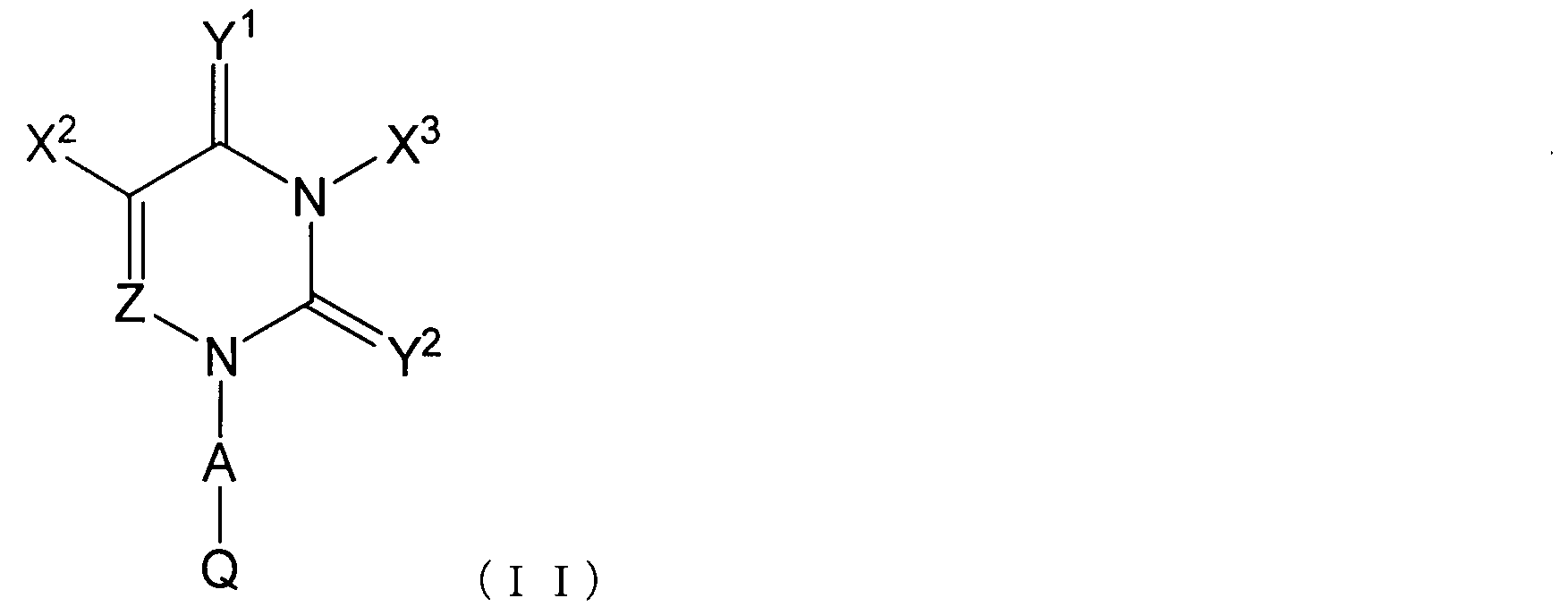
Y1は、酸素原子または硫黄原子を示し;
Y2は、酸素原子または硫黄原子を示し;
Zは、C-X1で表される基または窒素原子を示し;
X1は、水素原子、ハロゲノ基、置換若しくは無置換のC1~6アルキル基、置換若しくは無置換のC2~6アルケニル基、置換若しくは無置換のC2~6アルキニル基、水酸基、置換若しくは無置換のC1~6アルコキシ基、置換若しくは無置換のC2~6アルケニルオキシ基、置換若しくは無置換のC2~6アルキニルオキシ基、置換若しくは無置換のC1~6アルキルチオ基、置換若しくは無置換のC1~6アルキルスルフィニル基、置換若しくは無置換のC1~6アルキルスルホニル基、置換若しくは無置換のC3~6シクロアルキル基、置換若しくは無置換のC3~6シクロアルキルオキシ基、置換若しくは無置換のC6~10アリール基、置換若しくは無置換のC6~10アリールオキシ基、置換若しくは無置換のC6~10アリールチオ基、置換若しくは無置換のC6~10アリールスルフィニル基、置換若しくは無置換のC6~10アリールスルホニル基、置換若しくは無置換の5~6員環のヘテロシクリル基、置換若しくは無置換の5~6員環のヘテロシクリルオキシ基、ニトロ基、シアノ基、R1-CO-で表される基、カルボキシ基、R2-O-CO-で表される基、R3R4N-で表される基、R3R4N-CO-で表される基、R1-CO-O-で表される基、R1-CO-NR5-で表される基、R2-O-CO-O-で表される基、R2-O-CO-NR5-で表される基、R3R4N-CO-O-で表される基、R3R4N-CO-NR5-で表される基、R2SO2-NR5-で表される基、R3R4N-SO2-で表される基、またはR1O-N=CR6-で表される基を示し;
R1は、それぞれ独立に、水素原子、置換若しくは無置換のC1~6アルキル基、置換若しくは無置換のC2~6アルケニル基、置換若しくは無置換のC2~6アルキニル基、置換若しくは無置換のC3~6シクロアルキル基、置換若しくは無置換のC6~10アリール基、または置換若しくは無置換の5~6員環のヘテロシクリル基を示し、
R2は、それぞれ独立に、置換若しくは無置換のC1~6アルキル基、置換若しくは無置換のC2~6アルケニル基、置換若しくは無置換のC2~6アルキニル基、置換若しくは無置換のC3~6シクロアルキル基、置換若しくは無置換のC6~10アリール基、または置換若しくは無置換の5~6員環のヘテロシクリル基を示し、
R3は、それぞれ独立に、水素原子、置換若しくは無置換のC1~6アルキル基、置換若しくは無置換のC2~6アルケニル基、置換若しくは無置換のC2~6アルキニル基、置換若しくは無置換のC3~6シクロアルキル基、置換若しくは無置換のC6~10アリール基、または置換若しくは無置換の5~6員環のヘテロシクリル基を示し、
R4は、それぞれ独立に、水素原子、置換若しくは無置換のC1~6アルキル基、または置換若しくは無置換のC6~10アリール基を示し、
ここで、R3とR4は、一緒になって二価の有機基を形成してもよく、
R5は、それぞれ独立に、水素原子、置換若しくは無置換のC1~6アルキル基、または置換若しくは無置換のC6~10アリール基を示し、
R6は、水素原子、ハロゲノ基、アミノ基、置換若しくは無置換のモノC1~6アルキルアミノ基、置換若しくは無置換のジC1~6アルキルアミノ基、置換若しくは無置換のC1~6アルキル基、置換もしくは無置換のC1~6アルコキシ基、置換若しくは無置換のC1~6アルキルチオ基、または置換若しくは無置換の5~6員環のヘテロシクリル基を示し;
X2は、R1O-N=CR6-で表される基、R1CO-O-N=CR6-で表される基、R3R4N-CO-O-N=CR6-で表される基、R3R4N-N=CR6-で表される基、またはR7-N=CR6-で表される基を示し;R1、R3、R4、およびR6は、X1における
それらと同様の意味を示し;R7は、置換若しくは無置換の5員環のヘテロシクリル基を示し;
X3は、置換若しくは無置換の直鎖C1~6アルキル基、置換若しくは無置換の直鎖C2~6アルケニル基、置換若しくは無置換の直鎖C2~6アルキニル基、R1-CO-で表される基、置換若しくは無置換のC3~6シクロアルキル基、置換若しくは無置換のC6~10アリール基、または置換若しくは無置換の4~6員環のヘテロシクリル基を示し;
Aは、置換若しくは無置換のC1~6アルキレン基、置換若しくは無置換のC2~6アルケニレン基、置換若しくは無置換のC2~6アルキニレン基、または置換若しくは無置換のC3~6シクロアルキレン基を示し;
Qは、置換若しくは無置換のC6~10アリール基、または置換若しくは無置換の5~10員環のヘテロシクリル基を示す。〕
〔2〕 式(II)が式(I)で表される、〔1〕に記載の化合物またはその塩。
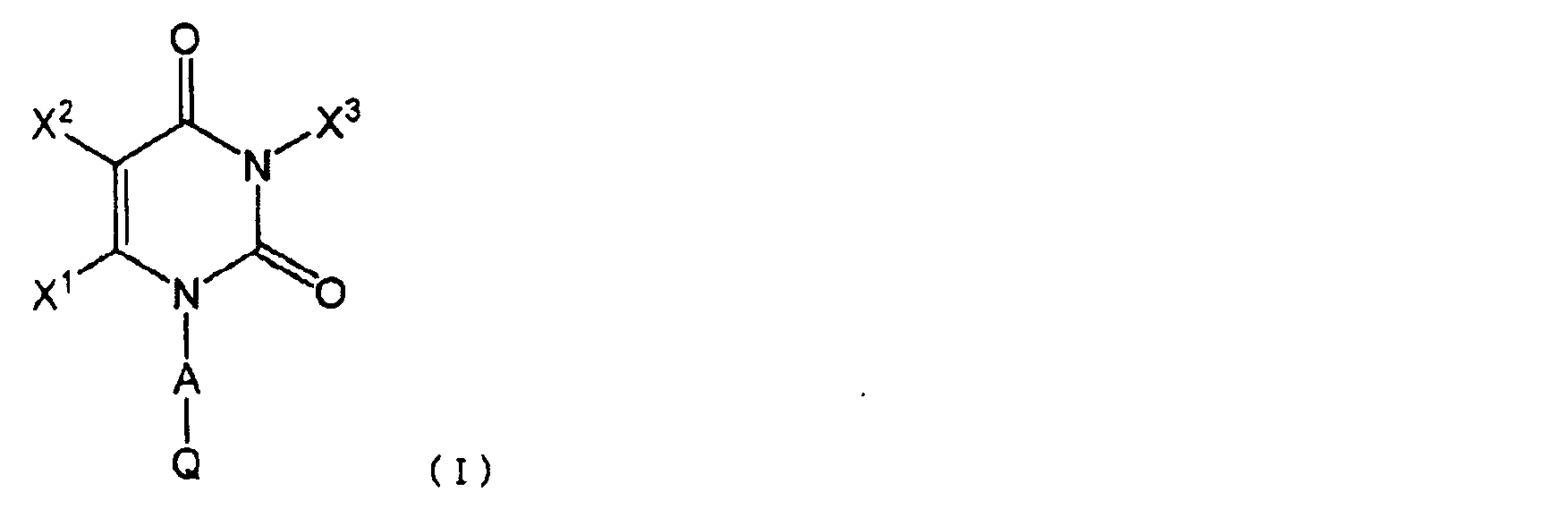
〔3〕
X3における直鎖C1~6アルキル基上の置換基、直鎖C2~6アルケニル基上の置換基、直鎖C2~6アルキニル基上の置換基、C3~6シクロアルキル基上の置換基、C6~10アリール基上の置換基、または4~6員環のヘテロシクリル基上の置換基が、
ハロゲノ基、置換若しくは無置換のC1~6アルキル基、置換若しくは無置換のC2~6アルケニル基、置換若しくは無置換のC2~6アルキニル基、水酸基、置換若しくは無置換のC1~6アルコキシ基、置換若しくは無置換のC2~6アルケニルオキシ基、置換若しくは無置換のC2~6アルキニルオキシ基、置換若しくは無置換のC1~6アルキルチオ基、置換若しくは無置換のC1~6アルキルスルフィニル基、置換若しくは無置換のC1~6アルキルスルホニル基、置換若しくは無置換のC3~6シクロアルキル基、置換若しくは無置換のC3~6シクロアルキルオキシ基、置換若しくは無置換のC6~10アリール基、置換若しくは無置換のC6~10アリールオキシ基、置換若しくは無置換のC6~10アリールチオ基、置換若しくは無置換のC6~10アリールスルフィニル基、置換若しくは無置換のC6~10アリールスルホニル基、置換若しくは無置換の3~10員環のヘテロシクリル基、置換若しくは無置換の3~10員環のヘテロシクリルオキシ基、ニトロ基、シアノ基、Ra-CO-で表される基、カルボキシ基、Rb-O-CO-で表される基、RcRdN-で表される基、RcRdN-CO-で表される基、RcRdN-NRd-CO-で表される基、Ra-CO-O-で表される基、Ra-CO-NRe-で表される基、Ra-CO-CO-NRe-で表される基、Ra-CO-NRe-NRe-で表される基、Ra-CO-NRe-NRe-CO-で表される基、Rb-O-CO-O-で表される基、Rb-O-CO-NRe-で表される基、RcRdN-CO-O-で表される基、RcRdN-CO-NRe-で表される基、RcRdN-CO-CO-NRe-で表される基、Ra-CS-NRe-で表される基、RcRdN-CS-NRe-で表される基、RbSO2-NRe-で表される基、RcRdN-SO2-で表される基、RaO-N=CRf-で表される基、RhRjC=N-O-で表される基、Ra-C(=NRg)-NRe-で表される基、RcRdN-C(=NRg)-で表される基、RhRiS(=O)=N-CO-で表される基、およびRhRiS=N-CO-で表される基からなる群より選択される1または2以上の置換基であって;
Raは、それぞれ独立に、水素原子、置換若しくは無置換のC1~6アルキル基、置換若しくは無置換のC2~6アルケニル基、置換若しくは無置換のC2~6アルキニル基、置換若しくは無置換のC3~6シクロアルキル基、置換若しくは無置換のC6~10アリール基、または置換若しくは無置換の3~10員環のヘテロシクリル基を示し、
Rbは、それぞれ独立に、置換若しくは無置換のC1~6アルキル基、置換若しくは無置換のC2~6アルケニル基、置換若しくは無置換のC2~6アルキニル基、置換若しくは無置換のC3~6シクロアルキル基、置換若しくは無置換のC6~10アリール基、または置換若しくは無置換の5~10員環のヘテロシクリル基を示し、
Rcは、それぞれ独立に、水素原子、置換若しくは無置換のC1~6アルキル基、置換若しくは無置換のC2~6アルケニル基、置換若しくは無置換のC2~6アルキニル基、置換若しくは無置換のC3~6シクロアルキル基、置換若しくは無置換のC6~10アリール基、または置換若しくは無置換の5~6員環のヘテロシクリル基を示し、
Rdは、それぞれ独立に、水素原子、置換若しくは無置換のC1~6アルキル基、置換若しくは無置換のC1~6アルコキシ基、または置換若しくは無置換のC6~10アリール基を示し、ここで、RcとRdは、一緒になって二価の有機基を形成してもよく、
Reは、それぞれ独立に、水素原子、置換若しくは無置換のC1~6アルキル基、置換若しくは無置換のC1~6アルコキシ基、または置換若しくは無置換のC6~10アリール基を示し、
Rfは、水素原子、アミノ基、または置換若しくは無置換のC1~6アルキル基を示し、
Rgは、それぞれ独立に、水素原子、置換若しくは無置換のC1~6アルキル基、または置換若しくは無置換のC6~10アリール基を示し、
Rhは、それぞれ独立に、置換若しくは無置換のC1~6アルキル基、または置換若しくは無置換のC6~10アリール基を示し、
Riは、それぞれ独立に、置換若しくは無置換のC1~6アルキル基、または置換若しくは無置換のC6~10アリール基を示し、ここで、RhとRiは、一緒になって二価の有機基を形成してもよく;
直鎖C1~6アルキル基上の置換基は2以上ある場合、そのうちの2つが一緒になって二価の有機基を形成してもよいものである;
〔1〕または〔2〕に記載の化合物またはその塩。
〔4〕AにおけるC1~6アルキレン基またはC2~6アルケニレン基上の置換基が、
ハロゲノ基、置換若しくは無置換のC1~6アルキル基、置換若しくは無置換のC2~6アルケニル基、置換若しくは無置換のC2~6アルキニル基、水酸基、置換若しくは無置換のC1~6アルコキシ基、置換若しくは無置換のC2~6アルケニルオキシ基、置換若しくは無置換のC2~6アルキニルオキシ基、メルカプト基、置換若しくは無置換のC1~6アルキルチオ基、置換若しくは無置換のC1~6アルキルスルフィニル基、置換若しくは無置換のC1~6アルキルスルホニル基、置換若しくは無置換のC3~6シクロアルキル基、置換若しくは無置換のC3~6シクロアルキルオキシ基、置換若しくは無置換のC6~10アリール基、置換若しくは無置換のC6~10アリールオキシ基、置換若しくは無置換のC6~10アリールチオ基、置換若しくは無置換のC6~10アリールスルフィニル基、置換若しくは無置換のC6~10アリールスルホニル基、置換若しくは無置換の3~6員環のヘテロシクリル基、置換若しくは無置換の3~6員環のヘテロシクリルオキシ基、ニトロ基、シアノ基、Ra1-CO-で表される基、カルボキシ基、Rb1-O-CO-で表される基、Rc1Rd1N-で表される基、Rc1Rd1N-CO-で表される基、Ra1-CO-O-で表される基、Ra1-CO-NRe1-で表される基、Rb1-O-CO-O-で表される基、Rb1-O-CO-NRe1-で表される基、Rc1Rd1N-CO-O-で表される基、Rc1Rd1N-CO-NRe1-で表される基、Rb1SO2-NRe1-で表される基、Rc1Rd1N-SO2-で表される基、Ra1O-N=CRf1-で表される基、Rg1Rh1C=N-O-で表される基、オキソ基(O=)、チオキソ基(S=)、Ra1-N=で表される二価の基、Ra1O-N=で表される二価の基、Rc1Rd1N-N=で表される二価の基、Ra1-CO-NRe1-N=で表される二価の基、Rb1-O-CO-NRe1-N=で表される二価の基、Rb1SO2-NRe1-N=で表される二価の基からなる群より選択される1または2以上の置換基であって;
Ra1は、それぞれ独立に、水素原子、置換若しくは無置換のC1~6アルキル基、置換若しくは無置換のC2~6アルケニル基、置換若しくは無置換のC2~6アルキニル基、置換若しくは無置換のC3~6シクロアルキル基、置換若しくは無置換のC6~10アリール基、または置換若しくは無置換の5~6員環のヘテロシクリル基を示し、
Rb1は、それぞれ独立に、置換若しくは無置換のC1~6アルキル基、置換若しくは無置換のC2~6アルケニル基、置換若しくは無置換のC2~6アルキニル基、置換若しくは無置換のC3~6シクロアルキル基、置換若しくは無置換のC6~10アリール基、または置換若しくは無置換の5~6員環のヘテロシクリル基を示し、
Rc1は、それぞれ独立に、水素原子、置換若しくは無置換のC1~6アルキル基、置換若しくは無置換のC2~6アルケニル基、置換若しくは無置換のC2~6アルキニル基、置換若しくは無置換のC3~6シクロアルキル基、置換若しくは無置換のC6~10アリール基、または置換若しくは無置換の5~6員環のヘテロシクリル基を示し、
Rd1は、それぞれ独立に、水素原子、置換若しくは無置換のC1~6アルキル基、または置換若しくは無置換のC6~10アリール基を示し、ここで、Rc1とRd1は、一緒になって二価の有機基を形成してもよく、
Re1は、それぞれ独立に、水素原子、置換若しくは無置換のC1~6アルキル基、または置換若しくは無置換のC6~10アリール基を示し、
Rf1は、水素原子、または置換若しくは無置換のC1~6アルキル基を示し、
Rg1は、置換若しくは無置換のC1~6アルキル基、置換若しくは無置換のC2~6アルケニル基、置換若しくは無置換のC2~6アルキニル基、置換若しくは無置換のC3~6シクロアルキル基、置換若しくは無置換のC6~10アリール基、または置換若しくは無置換の5~6員環のヘテロシクリル基を示し、
Rh1は、水素原子、または置換若しくは無置換のC1~6アルキル基を示し、ここで、Rg1とRh1は、一緒になって二価の有機基を形成してもよく;
C1~6アルキレン基またはC2~6アルケニレン基上の置換基は2以上ある場合、そのうちの2つが一緒になって二価の有機基を形成してもよいものである;
〔1〕~〔3〕のいずれかに記載の化合物またはその塩。
〔5〕〔1〕~〔4〕のいずれかに記載の化合物、およびそれらの塩からなる群から選ばれる少なくとも1つを有効成分として含有する農園芸用殺菌剤。
〔6〕種子処理用である、〔5〕に記載の農園芸用殺菌剤。
〔7〕〔1〕~〔4〕のいずれかに記載の化合物、およびそれらの塩からなる群から選ばれる少なくとも1つを有効成分として含有する殺線虫剤。
〔8〕〔1〕~〔4〕のいずれかに記載の化合物、およびそれらの塩からなる群から選ばれる少なくとも1つを有効成分として含有する医療用・動物用抗真菌剤。
〔9〕式(III)で表される化合物またはその塩。

X1は、水素原子、ハロゲノ基、置換若しくは無置換のC1~6アルキル基、置換若しくは無置換のC2~6アルケニル基、置換若しくは無置換のC2~6アルキニル基、水酸基、置換若しくは無置換のC1~6アルコキシ基、置換若しくは無置換のC2~6アルケニルオキシ基、置換若しくは無置換のC2~6アルキニルオキシ基、置換若しくは無置換のC1~6アルキルチオ基、置換若しくは無置換のC1~6アルキルスルフィニル基、置換若しくは無置換のC1~6アルキルスルホニル基、置換若しくは無置換のC3~6シクロアルキル基、置換若しくは無置換のC3~6シクロアルキルオキシ基、置換若しくは無置換のC6~10アリール基、置換若しくは無置換のC6~10アリールオキシ基、置換若しくは無置換のC6~10アリールチオ基、置換若しくは無置換のC6~10アリールスルフィニル基、置換若しくは無置換のC6~10アリールスルホニル基、置換若しくは無置換の5~6員環のヘテロシクリル基、置換若しくは無置換の5~6員環のヘテロシクリルオキシ基、ニトロ基、シアノ基、R1-CO-で表される基、カルボキシ基、R2-O-CO-で表される基、R3R4N-で表される基、R3R4N-CO-で表される基、R1-CO-O-で表される基、R1-CO-NR5-で表される基、R2-O-CO-O-で表される基、R2-O-CO-NR5-で表される基、R3R4N-CO-O-で表される基、R3R4N-CO-NR5-で表される基、R2SO2-NR5-で表される基、R3R4N-SO2-で表される基、またはR1O-N=CR6-で表される基を示し;
R1は、それぞれ独立に、水素原子、置換若しくは無置換のC1~6アルキル基、置換若しくは無置換のC2~6アルケニル基、置換若しくは無置換のC2~6アルキニル基、置換若しくは無置換のC3~6シクロアルキル基、置換若しくは無置換のC6~10アリール基、または置換若しくは無置換の5~6員環のヘテロシクリル基を示し、
R2は、それぞれ独立に、置換若しくは無置換のC1~6アルキル基、置換若しくは無置換のC2~6アルケニル基、置換若しくは無置換のC2~6アルキニル基、置換若しくは無置換のC3~6シクロアルキル基、置換若しくは無置換のC6~10アリール基、または置換若しくは無置換の5~6員環のヘテロシクリル基を示し、
R3は、それぞれ独立に、水素原子、置換若しくは無置換のC1~6アルキル基、置換若しくは無置換のC2~6アルケニル基、置換若しくは無置換のC2~6アルキニル基、置換若しくは無置換のC3~6シクロアルキル基、置換若しくは無置換のC6~10アリール基、または置換若しくは無置換の5~6員環のヘテロシクリル基を示し、
R4は、それぞれ独立に、水素原子、置換若しくは無置換のC1~6アルキル基、または置換若しくは無置換のC6~10アリール基を示し、
ここで、R3とR4は、一緒になって二価の有機基を形成してもよく、
R5は、それぞれ独立に、水素原子、置換若しくは無置換のC1~6アルキル基、または置換若しくは無置換のC6~10アリール基を示し、
R6は、水素原子、ハロゲノ基、アミノ基、置換若しくは無置換のモノC1~6アルキルアミノ基、置換若しくは無置換のジC1~6アルキルアミノ基、置換若しくは無置換のC1~6アルキル基、置換もしくは無置換のC1~6アルコキシ基、置換若しくは無置換のC1~6アルキルチオ基、または置換若しくは無置換の5~6員環のヘテロシクリル基を示し;
X2は、R1O-N=CR6-で表される基、R1CO-O-N=CR6-で表される基、R3R4N-CO-O-N=CR6-で表される基、R3R4N-N=CR6-で表される基、またはR7-N=CR6-で表される基を示し;R1、R3、R4、およびR6は、X1におけるそれらと同様の意味を示し;R7は、置換若しくは無置換の5員環のヘテロシクリル基を示し;
Aは、置換若しくは無置換のC1~6アルキレン基、置換若しくは無置換のC2~6アルケニレン基、置換若しくは無置換のC2~6アルキニレン基、または置換若しくは無置換のC3~6シクロアルキレン基を示し;
Qは、置換若しくは無置換のC6~10アリール基、または置換若しくは無置換の5~10員環のヘテロシクリル基を示す。〕
〔10〕式(IV)で表される化合物またはその塩。

X1は、水素原子、ハロゲノ基、置換若しくは無置換のC1~6アルキル基、置換若しくは無置換のC2~6アルケニル基、置換若しくは無置換のC2~6アルキニル基、水酸基、置換若しくは無置換のC1~6アルコキシ基、置換若しくは無置換のC2~6アルケニルオキシ基、置換若しくは無置換のC2~6アルキニルオキシ基、置換若しくは無置換のC1~6アルキルチオ基、置換若しくは無置換のC1~6アルキルスルフィニル基、置換若しくは無置換のC1~6アルキルスルホニル基、置換若しくは無置換のC3~6シクロアルキル基、置換若しくは無置換のC3~6シクロアルキルオキシ基、置換若しくは無置換のC6~10アリール基、置換若しくは無置換のC6~10アリールオキシ基、置換若しくは無置換のC6~10アリールチオ基、置換若しくは無置換のC6~10アリールスルフィニル基、置換若しくは無置換のC6~10アリールスルホニル基、置換若しくは無置換の5~6員環のヘテロシクリル基、置換若しくは無置換の5~6員環のヘテロシクリルオキシ基、ニトロ基、シアノ基、R1-CO-で表される基、カルボキシ基、R2-O-CO-で表される基、R3R4N-で表される基、R3R4N-CO-で表される基、R1-CO-O-で表される基、R1-CO-NR5-で表される基、R2-O-CO-O-で表される基、R2-O-CO-NR5-で表される基、R3R4N-CO-O-で表される基、R3R4N-CO-NR5-で表される基、R2SO2-NR5-で表される基、R3R4N-SO2-で表される基、またはR1O-N=CR6-で表される基を示し;
R1は、それぞれ独立に、水素原子、置換若しくは無置換のC1~6アルキル基、置換若しくは無置換のC2~6アルケニル基、置換若しくは無置換のC2~6アルキニル基、置換若しくは無置換のC3~6シクロアルキル基、置換若しくは無置換のC6~10アリール基、または置換若しくは無置換の5~6員環のヘテロシクリル基を示し、
R2は、それぞれ独立に、置換若しくは無置換のC1~6アルキル基、置換若しくは無置換のC2~6アルケニル基、置換若しくは無置換のC2~6アルキニル基、置換若しくは無置換のC3~6シクロアルキル基、置換若しくは無置換のC6~10アリール基、または置換若しくは無置換の5~6員環のヘテロシクリル基を示し、
R3は、それぞれ独立に、水素原子、置換若しくは無置換のC1~6アルキル基、置換若しくは無置換のC2~6アルケニル基、置換若しくは無置換のC2~6アルキニル基、置換若しくは無置換のC3~6シクロアルキル基、置換若しくは無置換のC6~10アリール基、または置換若しくは無置換の5~6員環のヘテロシクリル基を示し、
R4は、それぞれ独立に、水素原子、置換若しくは無置換のC1~6アルキル基、または置換若しくは無置換のC6~10アリール基を示し、
ここで、R3とR4は、一緒になって二価の有機基を形成してもよく、
R5は、それぞれ独立に、水素原子、置換若しくは無置換のC1~6アルキル基、または置換若しくは無置換のC6~10アリール基を示し、
R6は、水素原子、ハロゲノ基、アミノ基、置換若しくは無置換のモノC1~6アルキルアミノ基、置換若しくは無置換のジC1~6アルキルアミノ基、置換若しくは無置換のC1~6アルキル基、置換もしくは無置換のC1~6アルコキシ基、置換若しくは無置換のC1~6アルキルチオ基、または置換若しくは無置換の5~6員環のヘテロシクリル基を示し;
X2は、R1O-N=CR6-で表される基、R1CO-O-N=CR6-で表される基、R3R4N-CO-O-N=CR6-で表される基、R3R4NR3R4N-N=CR6-で表される基、またはR7-N=CR6-で表される基を示し;R1、R3、R4、およびR6は、X1におけるそれらと同様の意味を示し;R7は、置換若しくは無置換の5員環のヘテロシクリル基を示し;
X3は、置換若しくは無置換の直鎖C1~6アルキル基、置換若しくは無置換の直鎖C2~6アルケニル基、置換若しくは無置換の直鎖C2~6アルキニル基、R1-CO-で表される基、置換若しくは無置換のC3~6シクロアルキル基、置換若しくは無置換のC6~10アリール基、または置換若しくは無置換の4~6員環のヘテロシクリル基を示し;
X4は、水素原子またはC1~6アルコキシメチル基を示す。〕
本発明の農園芸用殺菌剤及び殺線虫剤は、優れた防除効果を有し、植物体に薬害を生じることがなく、人畜魚類に対する毒性や環境への影響が少ない。
本発明の医療用・動物用抗真菌剤は、優れた抗菌効果を有し、人畜魚類に対する毒性が少ない。
本発明のジヒドロピリミジン化合物は、式(II)で表される化合物(以下、化合物(II)と表記することがある。)または化合物(II)の塩である。

好ましくは、式(I)で表される化合物(以下、化合物(I)と表記することがある。)または化合物(I)の塩である。

一方、用語「置換(substituted)」は、母核となる基のいずれかの水素原子が、母核と同一または異なる構造の基で置換されていることを意味する。従って、「置換基」は、母核となる基に結合した他の基である。置換基は1個であってもよいし、2個以上であってもよい。2個以上の置換基は同一であってもよいし、異なるものであってもよい。
「置換基」となり得る基の具体例としては、以下の基を挙げることができる。
フルオロ基、クロロ基、ブロモ基、イオド基などのハロゲノ基;
メチル基、エチル基、n-プロピル基、i-プロピル基、n-ブチル基、s-ブチル基、i-ブチル基、t-ブチル基、n-ペンチル基、n-ヘキシル基などのC1~6アルキル基;
ビニル基、1-プロペニル基、2-プロペニル基、1-ブテニル基、2-ブテニル基、3-ブテニル基、1-メチル-2-プロペニル基、2-メチル-2-プロペニル基、1-ペンテニル基、2-ペンテニル基、3-ペンテニル基、4-ペンテニル基、1-メチル-2-ブテニル基、2-メチル-2-ブテニル基、1-ヘキセニル基、2-ヘキセニル基、3-ヘキセニル基、4-ヘキセニル基、5-ヘキセニル基などのC2~6アルケニル基;
エチニル基、1-プロピニル基、2-プロピニル基、1-ブチニル基、2-ブチニル基、3-ブチニル基、1-メチル-2-プロピニル基、2-メチル-3-ブチニル基、1-ペンチニル基、2-ペンチニル基、3-ペンチニル基、4-ペンチニル基、1-メチル-2-ブチニル基、2-メチル-3-ペンチニル基、1-ヘキシニル基、1,1-ジメチル-2-ブチニル基などのC2~6アルキニル基;
2-シクロプロペニル基、2-シクロペンテニル基、3-シクロヘキセニル基などのC3~6シクロアルケニル基;
フェニル基、ナフチル基などのC6~10アリール基;
ベンジル基、フェネチル基などのC6~10アリールC1~6アルキル基;
3~6員環のヘテロシクリル基;
3~6員環のへテロシクリルC1~6アルキル基;
メトキシ基、エトキシ基、n-プロポキシ基、i-プロポキシ基、n-ブトキシ基、s-ブトキシ基、i-ブトキシ基、t-ブトキシ基などのC1~6アルコキシ基;
ビニルオキシ基、アリルオキシ基、プロペニルオキシ基、ブテニルオキシ基などのC2~6アルケニルオキシ基;
エチニルオキシ基、プロパルギルオキシ基などのC2~6アルキニルオキシ基;
フェノキシ基、ナフトキシ基などのC6~10アリールオキシ基;
ベンジルオキシ基、フェネチルオキシ基などのC6~10アリールC1~6アルコキシ基;
ホルミル基;
アセチル基、プロピオニル基などのC1~6アルキルカルボニル基;
ホルミルオキシ基;
アセチルオキシ基、プロピオニルオキシ基などのC1~6アルキルカルボニルオキシ基;
メトキシカルボニル基、エトキシカルボニル基、n-プロポキシカルボニル基、i-プロポキシカルボニル基、n-ブトキシカルボニル基、t-ブトキシカルボニル基などのC1~6アルコキシカルボニル基;
2-クロロ-1-プロペニル基、2-フルオロ-1-ブテニル基などのC2~6ハロアルケニル基;
4,4-ジクロロ-1-ブチニル基、4-フルオロ-1-ペンチニル基、5-ブロモ-2-ペンチニル基などのC2~6ハロアルキニル基;
3,3-ジフルオロシクロブチル基などのC3~6ハロシクロアルキル基;
2-クロロ-n-プロポキシ基、2,3-ジクロロブトキシ基、トリフルオロメトキシ基、2,2,2-トリフルオロエトキシ基などのC1~6ハロアルコキシ基;
2-クロロプロペニルオキシ基、3-ブロモブテニルオキシ基などのC2~6ハロアルケニルオキシ基;
クロロアセチル基、トリフルオロアセチル基、トリクロロアセチル基などのC1~6ハロアルキルカルボニル基;
メチルアミノ基、ジメチルアミノ基、ジエチルアミノ基などのC1~6アルキル置換アミノ基;
アニリノ基、ナフチルアミノ基などのC6~10アリールアミノ基;
ベンジルアミノ基、フェネチルアミノ基などのC6~10アリールC1~6アルキルアミノ基;
アセチルアミノ基、プロピオニルアミノ基、ブチリルアミノ基、i-プロピルカルボニルアミノ基などのC1~6アルキルカルボニルアミノ基;
メトキシカルボニルアミノ基、エトキシカルボニルアミノ基、n-プロポキシカルボニルアミノ基、i-プロポキシカルボニルアミノ基などのC1~6アルコキシカルボニルアミノ基;
カルバモイル基、ジメチルアミノカルボニル基、フェニルアミノカルボニル基、N-フェニル-N-メチルアミノカルボニル基などの無置換若しくは置換基を有するアミノカルボニル基;
イミノメチル基、(1-イミノ)エチル基、(1-イミノ)-n-プロピル基などのイミノC1~6アルキル基;
N-ヒドロキシ-イミノメチル基、(1-(N-ヒドロキシ)-イミノ)エチル基、(1-(N-ヒドロキシ)-イミノ)プロピル基、N-メトキシ-イミノメチル基、(1-(N-メトキシ)-イミノ)エチル基などの置換若しくは無置換のN-ヒドロキシイミノC1~6アルキル基;
アミノカルボニルオキシ基;
エチルアミノカルボニルオキシ基、ジメチルアミノカルボニルオキシ基などのC1~6アルキル置換アミノカルボニルオキシ基;
メチルチオ基、エチルチオ基、n-プロピルチオ基、i-プロピルチオ基、n-ブチルチオ基、i-ブチルチオ基、s-ブチルチオ基、t-ブチルチオ基などのC1~6アルキルチオ基;
トリフルオロメチルチオ基、2,2,2-トリフルオロエチルチオ基などのC1~6ハロアルキルチオ基;
ビニルチオ基、アリルチオ基などのC2~6アルケニルチオ基;
エチニルチオ基、プロパルギルチオ基などのC2~6アルキニルチオ基;
メチルスルフィニル基、エチルスルフィニル基、t-ブチルスルフィニル基などのC1~6アルキルスルフィニル基;
トリフルオロメチルスルフィニル基、2,2,2-トリフルオロエチルスルフィニル基などのC1~6ハロアルキルスルフィニル基;
アリルスルフィニル基などのC2~6アルケニルスルフィニル基;
プロパルギルスルフィニル基などのC2~6アルキニルスルフィニル基;
メチルスルホニル基、エチルスルホニル基、t-ブチルスルホニル基などのC1~6アルキルスルホニル基;
トリフルオロメチルスルホニル基、2,2,2-トリフルオロエチルスルホニル基などのC1~6ハロアルキルスルホニル基;
アリルスルホニル基などのC2~6アルケニルスルホニル基;
プロパルギルスルホニル基などのC2~6アルキニルスルホニル基;
アミノチオカルボニル基;
S,S-ジメチルスルホキシイミノ基などのC1~6アルキルスルホキシイミノ基;
トリフェニルシリル基などのトリC6~10アリール置換シリル基;
シアノ基;
ニトロ基;
6員環のヘテロアリール基としては、ピリジル基、ピラジニル基、ピリミジニル基、ピリダジニル基、トリアジニル基などを挙げることができる。
5員環の部分不飽和へテロシクリル基としては、ピロリニル基、ジヒドロフラニル基、イミダゾリニル基、ピラゾリニル基、オキサゾリニル基などを挙げることができる。
6員環の部分不飽和ヘテロシクリル基としては、イソオキサゾリニル基、ジヒドロピラニル基などを挙げることができる。
これらの「置換基」は、当該置換基中のいずれかの水素原子が、異なる構造の基で置換されていてもよい。
Y1は、酸素原子または硫黄原子を示し、Y2は、酸素原子または硫黄原子を示す。
本発明においては、好ましいY1は酸素原子であり、好ましいY2は酸素原子である。
ZはC-X1で表される基または窒素原子を示す。
X1は、水素原子、ハロゲノ基、置換若しくは無置換のC1~6アルキル基、置換若しくは無置換のC2~6アルケニル基、置換若しくは無置換のC2~6アルキニル基、水酸基、置換若しくは無置換のC1~6アルコキシ基、置換若しくは無置換のC2~6アルケニルオキシ基、置換若しくは無置換のC2~6アルキニルオキシ基、置換若しくは無置換のC1~6アルキルチオ基、置換若しくは無置換のC1~6アルキルスルフィニル基、置換若しくは無置換のC1~6アルキルスルホニル基、置換若しくは無置換のC3~6シクロアルキル基、置換若しくは無置換のC3~6シクロアルキルオキシ基、置換若しくは無置換のC6~10アリール基、置換若しくは無置換のC6~10アリールオキシ基、置換若しくは無置換のC6~10アリールチオ基、置換若しくは無置換のC6~10アリールスルフィニル基、置換若しくは無置換のC6~10アリールスルホニル基、置換若しくは無置換の5~6員環のヘテロシクリル基、置換若しくは無置換の5~6員環のヘテロシクリルオキシ基、ニトロ基、シアノ基、R1-CO-で表される基、カルボキシ基、R2-O-CO-で表される基、R3R4N-で表される基、R3R4N-CO-で表される基、R1-CO-O-で表される基、R1-CO-NR5-で表される基、R2-O-CO-O-で表される基、R2-O-CO-NR5-で表される基、R3R4N-CO-O-で表される基、R3R4N-CO-NR5-で表される基、R2SO2-NR5-で表される基、R3R4N-SO2-で表される基、またはR1O-N=CR6-で表される基を示す。
R2は、それぞれ独立に、置換若しくは無置換のC1~6アルキル基、置換若しくは無置換のC2~6アルケニル基、置換若しくは無置換のC2~6アルキニル基、置換若しくは無置換のC3~6シクロアルキル基、置換若しくは無置換のC6~10アリール基、または置換若しくは無置換の5~6員環のヘテロシクリル基を示す。
R3は、それぞれ独立に、水素原子、置換若しくは無置換のC1~6アルキル基、置換若しくは無置換のC2~6アルケニル基、置換若しくは無置換のC2~6アルキニル基、置換若しくは無置換のC3~6シクロアルキル基、置換若しくは無置換のC6~10アリール基、または置換若しくは無置換の5~6員環のヘテロシクリル基を示す。
R4は、それぞれ独立に、水素原子、置換若しくは無置換のC1~6アルキル基、または置換若しくは無置換のC6~10アリール基を示す。
ここで、R3とR4は、一緒になって二価の有機基を形成してもよい。
R5は、それぞれ独立に、水素原子、置換若しくは無置換のC1~6アルキル基、または置換若しくは無置換のC6~10アリール基を示す。
R6は、水素原子、ハロゲノ基、アミノ基、置換若しくは無置換のC1~6アルキル基、置換もしくは無置換のC1~6アルコキシ基、置換若しくは無置換のC1~6アルキルチオ基、または置換若しくは無置換の5~6員環のヘテロシクリル基を示す。
X1における「C2~6アルケニルオキシ基」としては、ビニルオキシ基、アリルオキシ基、プロペニルオキシ基、ブテニルオキシ基などを挙げることができる。
X1における「C2~6アルキニルオキシ基」としては、エチニルオキシ基、プロパルギルオキシ基などを挙げることができる。
X1における「C1~6アルキルスルフィニル基」としては、メチルスルフィニル基、エチルスルフィニル基、t-ブチルスルフィニル基などを挙げることができる。
X1における「C1~6アルキルスルホニル基」としては、メチルスルホニル基、エチルスルホニル基、t-ブチルスルホニル基などを挙げることができる。
X1における「C3~6シクロアルキルオキシ基」としては、シクロプロピルオキシ基、シクロブチルオキシ基、シクロペンチルオキシ基、シクロヘキシルオキシ基などを挙げることができる。
X1における「C6~10アリールオキシ基」としては、フェノキシ基、ナフトキシ基などを挙げることができる。
X1における「C6~10アリールスルフィニル基」としては、フェニルスルフィニル基、ナフチルスルフィニル基などを挙げることができる。
X1における「C6~10アリールスルホニル基」としては、フェニルスルホニル基、ナフチルスルホニル基などを挙げることができる。
5~6員環のヘテロアリール基としては、ピロリル基、フリル基、チエニル基、イミダゾリル基、ピラゾリル基、オキサゾリル基、イソオキサゾリル基、チアゾリル基、イソチアゾリル基、トリアゾリル基、オキサジアゾリル基、チアジアゾリル基、テトラゾリル基などの5員環のヘテロアリール基;ピリジル基、ピラジニル基、ピリミジニル基、ピリダジニル基、トリアジニル基などの6員環のヘテロアリール基を挙げることができる。
5~6員環の部分不飽和へテロシクリル基としては、ピロリニル基、ジヒドロフラニル基、イミダゾリニル基、ピラゾリニル基、オキサゾリニル基などの5員環の部分不飽和ヘテロシクリル基;イソオキサゾリニル基、ジヒドロピラニル基などの6員環の部分不飽和へテロシクリル基を挙げることができる。
さらに、「C3~6シクロアルキル基」、「C3~6シクロアルキルオキシ基」、「5~6員環のヘテロシクリル基」、または「5~6員環のヘテロシクリルオキシ基」上の置換基としては、オキソ基も好ましい。
R1における「C2~6アルケニル基」としては、ビニル基、1-プロペニル基などを挙げることができる。
R1における「C2~6アルキニル基」としては、エチニル基、1-プロピニル基などを挙げることができる。
R1における「C1~6アルキル基」、「C2~6アルケニル基」、または「C2~6アルキニル基」上の置換基としては、フルオロ基、クロロ基、ブロモ基、イオド基などのハロゲノ基;水酸基;メトキシ基、エトキシ基、n-プロポキシ基、i-プロポキシ基、n-ブトキシ基、s-ブトキシ基、i-ブトキシ基、t-ブトキシ基などのC1~6アルコキシ基;2-クロロ-n-プロポキシ基、2,3-ジクロロブトキシ基、トリフルオロメトキシ基などのC1~6ハロアルコキシ基;シクロプロピル基、シクロブチル基、シクロペンチル基、シクロヘキシル基などのC3~6シクロアルキル基;フェニル基、ナフチル基などのC6~10アリール基;4-メチルフェニル基、4-メトキシフェニル基、4-クロロフェニル基、4-トリフルオロメチルフェニル基、4-トリフルオロメトキシフェニル基などの、C1~6アルキル基、C1~6アルコキシ基、ハロゲノ基、C1~6ハロアルキル基、またはC1~6ハロアルコキシ基のいずれか1以上の置換基で置換されたC6~10アリール基;ピロリル基、フリル基、チエニル基、イミダゾリル基、ピラゾリル基、オキサゾリル基、イソオキサゾリル基、チアゾリル基、イソチアゾリル基、トリアゾリル基、オキサジアゾリル基、チアジアゾリル基、テトラゾリル基など5員環のヘテロアリール基;C1~6アルキル基、C1~6アルコキシ基、ハロゲノ基、C1~6ハロアルキル基、またはC1~6ハロアルコキシ基のいずれか1以上の置換基で置換された5員環のヘテロアリール基;ピリジル基、ピラジニル基、ピリミジニル基、ピリダジニル基、トリアジニル基などの6員環のヘテロアリール基;C1~6アルキル基、C1~6アルコキシ基、ハロゲノ基、C1~6ハロアルキル基、またはC1~6ハロアルコキシ基のいずれか1以上の置換基で置換された6員環のヘテロアリール基;またはシアノ基が好ましい。
R1における「C6~10アリール基」としては、フェニル基、ナフチル基、インデニル基、インダニル基、テトラリニル基などを挙げることができる。
5~6員環の飽和ヘテロシクリル基としては、ピロリジニル基、テトラヒドロフラニル基、チアゾリジニル基、テトラヒドロ-2H-ピラニル基、ピペリジル基、ピペラジニル基、モルホリニル基、ジオキソラニル基、ジオキサニル基などを挙げることができる。
5~6員環のヘテロアリール基としては、ピロリル基、フリル基、チエニル基、イミダゾリル基、ピラゾリル基、オキサゾリル基、イソオキサゾリル基、チアゾリル基、イソチアゾリル基、トリアゾリル基、オキサジアゾリル基、チアジアゾリル基、テトラゾリル基などの5員環のヘテロアリール基;ピリジル基、ピラジニル基、ピリミジニル基、ピリダジニル基、トリアジニル基などの6員環のヘテロアリール基を挙げることができる。
5~6員環の部分不飽和へテロシクリル基としては、ピロリニル基、ジヒドロフラニル基、イミダゾリニル基、ピラゾリニル基、オキサゾリニル基などの5員環の部分不飽和ヘテロシクリル基;イソオキサゾリニル基、ジヒドロピラニル基などの6員環の部分不飽和へテロシクリル基が挙げられる。
さらに、「C3~6シクロアルキル基」、または「5~6員環のヘテロシクリル基」上の置換基としては、オキソ基も好ましい。
R2における置換基の具体例は、R1において例示したものと同じものを挙げることができる。
R3またはR4における置換基の具体例は、R1において例示したものと同じものを挙げることができる。
形成できる二価の有機基としては、置換若しくは無置換のC2~5アルキレン基または置換若しくは無置換のC1~3アルキレンオキシC1~3アルキレン基を挙げることができる。
「C2~5アルキレン基」としては、ジメチレン基、トリメチレン基、テトラメチレン基などを挙げることができる。
「C1~3アルキレンオキシC1~3アルキレン基」としては、ジメチレンオキシジメチレン基などを挙げることができる。
「C2~5アルキレン基」または「C1~3アルキレンオキシC1~3アルキレン基」上の置換基としては、フルオロ基、クロロ基、ブロモ基、イオド基などのハロゲノ基;メチル基、エチル基、n-プロピル基、i-プロピル基、n-ブチル基、s-ブチル基、i-ブチル基、t-ブチル基などのC1~6アルキル基;またはクロロメチル基、クロロエチル基、トリフルオロメチル基、1,2-ジクロロ-n-プロピル基、1-フルオロ-n-ブチル基などのC1~6ハロアルキル基が好ましい。
「R3R4N-CO-で表される基」の具体例としては、カルバモイル基、N,N-ジメチルアミノカルボニル基、N-(i-プロピル)アミノカルボニル基、N-(i-プロピル)-N-メチルアミノカルボニル基などを挙げることができる。
「R1-CO-O-で表される基」の具体例としては、アセチルオキシ基、i-プロピルカルボニルオキシ基などを挙げることができる。
R5は、水素原子、置換若しくは無置換のC1~6アルキル基、または置換若しくは無置換のC6~10アリール基を示す。
R5における置換基の具体例は、R1において例示したものと同じものを挙げることができる。
「R1-CO-NR5-で表される基」の具体例としては、アセチルアミノ基、i-プロピルカルボニルアミノ基などを挙げることができる。
「R2-O-CO-O-で表される基」の具体例としては、メトキシカルボニルオキシ基、エトキシカルボニルオキシ基などを挙げることができる。
「R2-O-CO-NR5-で表される基」の具体例としては、メトキシカルボニルアミノ基などを挙げることができる。
「R3R4N-CO-O-で表される基」の具体例としては、カルバモイルオキシ基、N,N-ジメチルアミノカルボニルオキシ基などを挙げることができる。
「R3R4N-CO-NR5-で表される基」の具体例としては、カルバモイルアミノ基、N,N-ジメチルアミノカルボニルアミノ基などを挙げることができる。
「R2SO2-NR5-で表される基」の具体例としては、メタンスルホニルアミノ基などを挙げることができる。
「R3R4N-SO2-で表される基」の具体例としては、N,N-ジメチルアミノスルホニル基などを挙げることができる。
R6は、水素原子、ハロゲノ基、アミノ基、置換若しくは無置換のモノC1~6アルキルアミノ基、置換若しくは無置換のジC1~6アルキルアミノ基、置換若しくは無置換のC1~6アルキル基、置換もしくは無置換のC1~6アルコキシ基、置換若しくは無置換のC1~6アルキルチオ基、または置換若しくは無置換の5~6員環のヘテロシクリル基を示す。
R6における「置換若しくは無置換のC1~6アルキル基」または「置換若しくは無置換の5~6ヘテロシクリル基」の具体例は、R1において例示したものと同じものを挙げることができる。
R6における「ハロゲノ基」としては、フルオロ基、クロロ基、ブロモ基、イオド基などを挙げることができる。
R6における「置換若しくは無置換のモノC1~6アルキルアミノ基」の「モノC1~6アルキルアミノ基」としては、メチルアミノ基、エチルアミノ基、i-プロピルアミノ基などを挙げることができる。
R6における「置換若しくは無置換のジC1~6アルキルアミノ基」の「ジC1~6アルキルアミノ基」としては、ジメチルアミノ基、ジエチルアミノ基、N-メチル-N-i-プロピルアミノ基などを挙げることができる。
R6における「置換もしくは無置換のC1~6アルコキシ基」の「C1~6アルコキシ基」としては、メトキシ基、エトキシ基、n-プロポキシ基、n-ブトキシ基、n-ペンチルオキシ基、n-ヘキシルオキシ基、i-プロポキシ基、i-ブトキシ基、s-ブトキシ基、t-ブトキシ基、i-ヘキシルオキシ基などを挙げることができる。
R6における「置換若しくは無置換のC1~6アルキルチオ基」の「C1~6アルキルチオ基」としては、メチルチオ基、エチルチオ基、n-プロピルチオ基、n-ブチルチオ基、n-ペンチルチオ基、n-ヘキシルチオ基、i-プロピルチオ基などを挙げることができる。
R6における「C1~6アルコキシ基」、「モノC1~6アルキルアミノ基」、「ジC1~6アルキルアミノ基」、または「C1~6アルキルチオ基」上の置換基としては、R1において「C1~6アルキル基」上の置換基として例示した置換基と同じものを挙げることができる。
「R1O-N=CR6-で表される基」の具体例としては、(ヒドロキシイミノ)メチル基、(エトキシイミノ)メチル基、1-(i-プロポキシイミノ)エチル基などを挙げることができる。
X2は、R1O-N=CR6-で表される基、R1CO-O-N=CR6-で表される基、R3R4N-CO-O-N=CR6-で表される基、R3R4N-N=CR6-で表される基、またはR7-N=CR6-で表される基を示す。
また、R1、R3、R4、およびR6は、X1におけるそれらと同様の意味を示す。
R7は、置換若しくは無置換の5員環のヘテロシクリル基を示す。
X2における置換基の具体例は、X1において例示したものと同じものを挙げることができる。
R7における「5員環のヘテロシクリル基」とは、窒素原子、酸素原子および硫黄原子からなる群から選ばれる1~4個のヘテロ原子を環の構成原子として含む。「5員環のヘテロシクリル基」としては、5員環の飽和ヘテロシクリル基、5員環のヘテロアリール基、5員環の部分不飽和ヘテロシクリル基などを挙げることができる。
5員環の飽和ヘテロシクリル基としては、ピロリジニル基、テトラヒドロフラニル基、チアゾリジニル基、ジオキソラニル基などを挙げることができる。
5員環のヘテロアリール基としては、ピロリル基、フリル基、チエニル基、イミダゾリル基、ピラゾリル基、オキサゾリル基、イソオキサゾリル基、チアゾリル基、イソチアゾリル基、トリアゾリル基、オキサジアゾリル基、チアジアゾリル基、テトラゾリル基などを挙げることができる。
5員環の部分不飽和へテロシクリル基としては、ピロリニル基、ジヒドロフラニル基、イミダゾリニル基、ピラゾリニル基、オキサゾリニル基などを挙げることができる。
R1としては、水素原子、置換若しくは無置換のC1~6アルキル基、置換若しくは無置換のC2~6アルケニル基、置換若しくは無置換のC2~6アルキニル基、置換若しくは無置換のC3~6シクロアルキル基、置換若しくは無置換のC6~10アリール基、または置換若しくは無置換の5~6員環のヘテロシクリル基が好ましい。
R6としては、水素原子または置換若しくは無置換のC1~6アルキル基が好ましい。
「R1O-N=CR6-で表される基」の具体例としては、(ヒドロキシイミノ)メチル基、(エトキシイミノ)メチル基、1-(エトキシイミノ)エチル基、1-(i-プロポキシイミノ)エチル基などを挙げることができる。
Qは、置換若しくは無置換のC6~10アリール基、または置換若しくは無置換の5~10員環のヘテロシクリル基を示す。
「5~10員環のヘテロシクリル基」としては、5~6員環の飽和ヘテロシクリル基、5~10員環のヘテロアリール基、5~10員環の部分不飽和ヘテロシクリル基などを挙げることができる。
5~10員環のヘテロアリール基としては、ピロリル基、フリル基、チエニル基、イミダゾリル基、ピラゾリル基、オキサゾリル基、イソオキサゾリル基、チアゾリル基、イソチアゾリル基、トリアゾリル基、オキサジアゾリル基、チアジアゾリル基、テトラゾリル基などの5員環のヘテロアリール基;ピリジル基、ピラジニル基、ピリミジニル基、ピリダジニル基、トリアジニル基などの6員環のヘテロアリール基;インドリル基、イソインドリル基、ベンゾフラニル基、ベンゾチエニル基、インダゾリル基、ベンゾイミダゾリル基、ベンゾオキサゾリル基、ベンゾイソオキサオゾリル基、ベンゾチアゾリル基、ベンゾイソチアゾリル基などの9員ヘテロアリール基;キノリニル基、イソキノリニル基、シンノリニル基、フタラジニル基、キナゾリニル基、キノキサリニル基などの10員ヘテロアリール基;を挙げることができる。
5~10員環の部分不飽和へテロシクリル基としては、ピロリニル基、ジヒドロフラニル基、イミダゾリニル基、ピラゾリニル基、オキサゾリニル基などの5員環の部分不飽和ヘテロシクリル基;イソオキサゾリニル基、ジヒドロピラニル基などの6員環の部分不飽和へテロシクリル基;インドリニル基、イソインドリニル基、2,3-ジヒドロベンゾフラニル基、1,3-ジヒドロベンゾフラニル基などの9員環の部分不飽和ヘテロシクリル基;1,2,3,4-テトラヒドロキノリニル基などの10員環の部分不飽和ヘテロシクリル基;を挙げることができる。
RQ1-CO-で表される基 (式中、RQ1は、水素原子;C1~6アルキル基;ハロゲノ基、C1~6アルコキシ基、C1~6ハロアルコキシ基、C3~6シクロアルキル基、フェニル基、若しくは5~6員環のヘテロアリール基のいずれか1以上の置換基で置換されたC1~6アルキル基;(C1~6アルキル基、C1~6アルコキシ基、ハロゲノ基、C1~6ハロアルキル基、若しくはC1~6ハロアルコキシ基のいずれか1以上の置換基で置換されたC6~10アリール)C1~6アルキル基;(C1~6アルキル基、C1~6アルコキシ基、ハロゲノ基、C1~6ハロアルキル基、若しくはC1~6ハロアルコキシ基のいずれか1以上の置換基で置換された5~6員環のヘテロアリール)C1~6アルキル基;C2~6アルケニル基;C2~6ハロアルケニル基;C2~6アルキニル基;C2~6ハロアルキニル基;C3~6シクロアルキル基;C1~6アルキル基、C1~6アルコキシ基、ハロゲノ基、C1~6ハロアルキル基、C1~6ハロアルコキシ基、若しくはシアノ基のいずれか1以上の置換基で置換されたC3~6シクロアルキル基;C6~10アリール基;C1~6アルキル基、C1~6アルコキシ基、ハロゲノ基、C1~6ハロアルキル基、若しくはC1~6ハロアルコキシ基のいずれか1以上の置換基で置換されたC6~10アリール基;5~6員環のヘテロアリール基;または;C1~6アルキル基、C1~6アルコキシ基、ハロゲノ基、C1~6ハロアルキル基、若しくはC1~6ハロアルコキシ基のいずれか1以上の置換基で置換された5~6員環のヘテロアリール基;を示す。以下のRQ1においても同じ。);
カルボキシ基;
RQ2-O-CO-で表される基 (式中、RQ2は、C1~6アルキル基;ハロゲノ基、C1~6アルコキシ基、C1~6ハロアルコキシ基、C3~6シクロアルキル基、フェニル基、若しくは5~6員環のヘテロアリール基のいずれか1以上の置換基で置換されたC1~6アルキル基;(C1~6アルキル基、C1~6アルコキシ基、ハロゲノ基、C1~6ハロアルキル基、若しくはC1~6ハロアルコキシ基のいずれか1以上の置換基で置換されたC6~10アリール)C1~6アルキル基;(C1~6アルキル基、C1~6アルコキシ基、ハロゲノ基、C1~6ハロアルキル基、若しくはC1~6ハロアルコキシ基のいずれか1以上の置換基で置換された5~6員環のヘテロアリール)C1~6アルキル基;C2~6アルケニル基;C2~6ハロアルケニル基;C2~6アルキニル基;C2~6ハロアルキニル基;C3~6シクロアルキル基;C1~6アルキル基、C1~6アルコキシ基、ハロゲノ基、C1~6ハロアルキル基、C1~6ハロアルコキシ基、若しくはシアノ基で置換されたC3~6シクロアルキル基;C6~10アリール基;C1~6アルキル基、C1~6アルコキシ基、ハロゲノ基、C1~6ハロアルキル基、若しくはC1~6ハロアルコキシ基のいずれか1以上の置換基で置換されたC6~10アリール基;5~6員環のヘテロアリール基;または;C1~6アルキル基、C1~6アルコキシ基、ハロゲノ基、C1~6ハロアルキル基、若しくはC1~6ハロアルコキシ基のいずれか1以上の置換基で置換された5~6員環のヘテロアリール基;を示す。以下のRQ2においても同じ。);
RQ1RQ1N-で表される基(式中のRQ1は同一でも異なっていてもよい。RQ1同士は一緒になって、トリメチレン基、テトラメチレン基、ペンタメチレン基、またはジメチレンオキシジメチレン基を形成してもよい。);
RQ1RQ1N-CO-で表される基(式中のRQ1は同一でも異なっていてもよい。RQ1同士は一緒になって、トリメチレン基、テトラメチレン基、ペンタメチレン基、またはジメチレンオキシジメチレン基を形成してもよい。);
RQ1-CO-O-で表される基;RQ1-CO-NRQ3-で表される基(式中、RQ3は、水素原子;C1~6アルキル基;ハロゲノ基、C1~6アルコキシ基、C1~6ハロアルコキシ基、C3~6シクロアルキル基、フェニル基、若しくは5~6員環のヘテロアリール基のいずれか1以上の置換基で置換されたC1~6アルキル基;(C1~6アルキル基、C1~6アルコキシ基、ハロゲノ基、C1~6ハロアルキル基、若しくはC1~6ハロアルコキシ基のいずれか1以上の置換基で置換されたC6~10アリール)C1~6アルキル基;または(C1~6アルキル基、C1~6アルコキシ基、ハロゲノ基、C1~6ハロアルキル基、若しくはC1~6ハロアルコキシ基のいずれか1以上の置換基で置換された5~6員環のヘテロアリール)C1~6アルキル基;を示す。以下のRQ3においても同じ。);
RQ2-O-CO-O-で表される基;RQ2-O-CO-NRQ3-で表される基;RQ1RQ1N-CO-O-で表される基(式中のRQ1は同一でも異なっていてもよい。RQ1同士は一緒になって、トリメチレン基、テトラメチレン基、ペンタメチレン基、またはジメチレンオキシジメチレン基を形成してもよい。);
RQ1RQ1N-CO-NRQ3-で表される基(式中のRQ1は同一でも異なっていてもよい。Rq1同士は一緒になって、トリメチレン基、テトラメチレン基、ペンタメチレン基、またはジメチレンオキシジメチレン基を形成してもよい。);RQ2SO2-NRQ3-で表される基;RQ1RQ1N-SO2-で表される基(式中のRQ1は同一でも異なっていてもよい。RQ1同士は一緒になって、トリメチレン基、テトラメチレン基、ペンタメチレン基、またはジメチレンオキシジメチレン基を形成してもよい。);
RQ1-O-N=C(RQ4)-で表される基(式中、RQ4は、水素原子またはC1~6アルキル基を示す。);(RQ1)2C=N-O-で表される基(式中のRQ1は同一でも異なっていてもよい。RQ1同士は一緒になって、トリメチレン基、テトラメチレン基、ペンタメチレン基、またはジメチレンオキシジメチレン基を形成してもよい。);
ペンタフルオロスルファニル基、トリメチルシリルエチニル基、ニトロ基、またはシアノ基が好ましい。
さらに、「5~10員環のヘテロシクリル基」上の置換基としては、オキソ基も好ましい。
X3は、置換若しくは無置換の直鎖C1~6アルキル基、置換若しくは無置換の直鎖C2~6アルケニル基、置換若しくは無置換の直鎖C2~6アルキニル基、R1-CO-で表される基、置換若しくは無置換のC3~6シクロアルキル基、置換若しくは無置換のC6~10アリール基、または置換若しくは無置換の4~6員環のヘテロシクリル基を示す。
X3における「直鎖C2~6アルケニル基」としては、ビニル基、1-プロペニル基、2-プロペニル基、1-ブテニル基、2-ブテニル基、3-ブテニル基、1-ペンテニル基、2-ペンテニル基、3-ペンテニル基、4-ペンテニル基、1-ヘキセニル基、2-ヘキセニル基、3-ヘキセニル基、4-ヘキセニル基、5-ヘキセニル基を挙げることができる。
X3における「直鎖C2~6アルキニル基」としては、エチニル基、1-プロピニル基、2-プロピニル基、1-ブチニル基、2-ブチニル基、3-ブチニル基、1-ペンチニル基、2-ペンチニル基、3-ペンチニル基、4-ペンチニル基、1-ヘキシニル基などを挙げることができる。
X3における「4員環のヘテロシクリル基」しては、アゼチジニル基、オキセタニル基を挙げることができる。
X3におけるその他の置換基の具体例は、X1において例示したものと同じものを挙げることができる。
また、置換基(G)は2以上ある場合、そのうちの2つが一緒になって二価の有機基を形成してもよい。以下に置換基群を示す。
ハロゲノ基、置換若しくは無置換のC1~6アルキル基、置換若しくは無置換のC2~6アルケニル基、置換若しくは無置換のC2~6アルキニル基、水酸基、置換若しくは無置換のC1~6アルコキシ基、置換若しくは無置換のC2~6アルケニルオキシ基、置換若しくは無置換のC2~6アルキニルオキシ基、置換若しくは無置換のC1~6アルキルチオ基、置換若しくは無置換のC1~6アルキルスルフィニル基、置換若しくは無置換のC1~6アルキルスルホニル基、置換若しくは無置換のC3~6シクロアルキル基、置換若しくは無置換のC3~6シクロアルキルオキシ基、置換若しくは無置換のC6~10アリール基、置換若しくは無置換のC6~10アリールオキシ基、置換若しくは無置換のC6~10アリールチオ基、置換若しくは無置換のC6~10アリールスルフィニル基、置換若しくは無置換のC6~10アリールスルホニル基、置換若しくは無置換の3~10員環のヘテロシクリル基、置換若しくは無置換の3~10員環のヘテロシクリルオキシ基、ニトロ基、シアノ基、Ra-CO-で表される基、カルボキシ基、Rb-O-CO-で表される基、RcRdN-で表される基、RcRdN-CO-で表される基、RcRdN-NRd-CO-で表される基、Ra-CO-O-で表される基、Ra-CO-NRe-で表される基、Ra-CO-CO-NRe-で表される基、Ra-CO-NRe-NRe-で表される基、Ra-CO-NRe-NRe-CO-で表される基、Rb-O-CO-O-で表される基、Rb-O-CO-NRe-で表される基、RcRdN-CO-O-で表される基、RcRdN-CO-NRe-で表される基、RcRdN-CO-CO-NRe-で表される基、Ra-CS-NRe-で表される基、RcRdN-CS-NRe-で表される基、RbSO2-NRe-で表される基、RcRdN-SO2-で表される基、RaO-N=CRf-で表される基、RhRjC=N-O-で表される基、Ra-C(=NRg)-NRe-で表される基、RcRdN-C(=NRg)-で表される基、RhRiS(=O)=N-CO-で表される基、RhRiS=N-CO-で表される基。
Rbは、それぞれ独立に、置換若しくは無置換のC1~6アルキル基、置換若しくは無置換のC2~6アルケニル基、置換若しくは無置換のC2~6アルキニル基、置換若しくは無置換のC3~6シクロアルキル基、置換若しくは無置換のC6~10アリール基、または置換若しくは無置換の5~6員環のヘテロシクリル基を示す。
Rcは、それぞれ独立に、水素原子、置換若しくは無置換のC1~6アルキル基、置換若しくは無置換のC2~6アルケニル基、置換若しくは無置換のC2~6アルキニル基、置換若しくは無置換のC3~6シクロアルキル基、置換若しくは無置換のC6~10アリール基、または置換若しくは無置換の5~6員環のヘテロシクリル基を示す。
Rdは、それぞれ独立に、水素原子、置換若しくは無置換のC1~6アルキル基、置換若しくは無置換のC1~6アルコキシ基、または置換若しくは無置換のC6~10アリール基を示し、ここで、RcとRdは、一緒になって二価の有機基を形成してもよい。
Reは、それぞれ独立に、水素原子、置換若しくは無置換のC1~6アルキル基、置換若しくは無置換のC1~6アルコキシ基、または置換若しくは無置換のC6~10アリール基を示す。
Rfは、水素原子、アミノ基、または置換若しくは無置換のC1~6アルキル基を示す。
Rgは、それぞれ独立に、水素原子、置換若しくは無置換のC1~6アルキル基、または置換若しくは無置換のC6~10アリール基を示す。
Rhは、それぞれ独立に、置換若しくは無置換のC1~6アルキル基、または置換若しくは無置換のC6~10アリール基を示す。
Riは、それぞれ独立に、置換若しくは無置換のC1~6アルキル基、または置換若しくは無置換のC6~10アリール基を示し、ここで、RhとRiは、一緒になって二価の有機基を形成してもよい。
Gにおける「C1~6アルキル基」としては、メチル基、エチル基、n-プロピル基、n-ブチル基、n-ペンチル基、n-ヘキシル基、i-プロピル基、i-ブチル基、s-ブチル基、t-ブチル基、i-ペンチル基、ネオペンチル基、2-メチルブチル基、i-ヘキシル基などを挙げることができる。
Gにおける「C2~6アルケニルオキシ基」としては、ビニルオキシ基、アリルオキシ基、プロペニルオキシ基、ブテニルオキシ基などを挙げることができる。
Gにおける「C2~6アルキニルオキシ基」としては、エチニルオキシ基、プロパルギルオキシ基などを挙げることができる。
Gにおける「C1~6アルキルスルフィニル基」としては、メチルスルフィニル基、エチルスルフィニル基、t-ブチルスルフィニル基などを挙げることができる。
Gにおける「C1~6アルキルスルホニル基」としては、メチルスルホニル基、エチルスルホニル基、t-ブチルスルホニル基などを挙げることができる。
Gにおける「C3~6シクロアルキルオキシ基」としては、シクロプロピルオキシ基、シクロブチルオキシ基、シクロペンチルオキシ基、シクロヘキシルオキシ基などを挙げることができる。
Gにおける「C6~10アリールオキシ基」としては、フェノキシ基、ナフトキシ基などを挙げることができる。
Gにおける「C6~10アリールスルフィニル基」としては、フェニルスルフィニル基、ナフチルスルフィニル基などを挙げることができる。
Gにおける「C6~10アリールスルホニル基」としては、フェニルスルホニル基、ナフチルスルホニル基などを挙げることができる。
「3~10員環のヘテロシクリル基」としては、3~6員環の飽和ヘテロシクリル基、5~10員環のヘテロアリール基、5~10員環の部分不飽和ヘテロシクリル基などを挙げることができる。
5~10員環のヘテロアリール基としては、ピロリル基、フリル基、チエニル基、イミダゾリル基、ピラゾリル基、オキサゾリル基、イソオキサゾリル基、チアゾリル基、イソチアゾリル基、トリアゾリル基、オキサジアゾリル基、チアジアゾリル基、テトラゾリル基などの5員環のヘテロアリール基;ピリジル基、ピラジニル基、ピリミジニル基、ピリダジニル基、トリアジニル基などの6員環のヘテロアリール基;インドリル基、イソインドリル基、ベンゾフラニル基、ベンゾチエニル基、インダゾリル基、ベンゾイミダゾリル基、ベンゾオキサゾリル基、ベンゾイソオキサオゾリル基、ベンゾチアゾリル基、ベンゾイソチアゾリル基などの9員ヘテロアリール基;キノリニル基、イソキノリニル基、シンノリニル基、フタラジニル基、キナゾリニル基、キノキサリニル基などの10員ヘテロアリール基;を挙げることができる。
5~10員環の部分不飽和へテロシクリル基としては、ピロリニル基、ジヒドロフラニル基、イミダゾリニル基、ピラゾリニル基、オキサゾリニル基などの5員環の部分不飽和ヘテロシクリル基;イソオキサゾリニル基、ジヒドロピラニル基などの6員環の部分不飽和へテロシクリル基;インドリニル基、イソインドリニル基、2,3-ジヒドロベンゾフラニル基、1,3-ジヒドロベンゾフラニル基などの9員環の部分不飽和ヘテロシクリル基;1,2,3,4-テトラヒドロキノリニル基などの10員環の部分不飽和ヘテロシクリル基;を挙げることができる。
RG1-CO-で表される基 (式中、RG1は、水素原子;C1~6アルキル基;ハロゲノ基、C1~6アルコキシ基、C1~6ハロアルコキシ基、C3~6シクロアルキル基、フェニル基、若しくは5~6員環のヘテロアリール基のいずれか1以上の置換基で置換されたC1~6アルキル基;(C1~6アルキル基、C1~6アルコキシ基、ハロゲノ基、C1~6ハロアルキル基、若しくはC1~6ハロアルコキシ基のいずれか1以上の置換基で置換されたC6~10アリール)C1~6アルキル基;(C1~6アルキル基、C1~6アルコキシ基、ハロゲノ基、C1~6ハロアルキル基、若しくはC1~6ハロアルコキシ基のいずれか1以上の置換基で置換された5~6員環のヘテロアリール)C1~6アルキル基;C2~6アルケニル基;C2~6ハロアルケニル基;C2~6アルキニル基;C2~6ハロアルキニル基;C3~6シクロアルキル基;C1~6アルキル基、C1~6アルコキシ基、ハロゲノ基、C1~6ハロアルキル基、C1~6ハロアルコキシ基、若しくはシアノ基のいずれか1以上の置換基で置換されたC3~6シクロアルキル基;C6~10アリール基;C1~6アルキル基、C1~6アルコキシ基、ハロゲノ基、C1~6ハロアルキル基、若しくはC1~6ハロアルコキシ基のいずれか1以上の置換基で置換されたC6~10アリール基;5~6員環のヘテロアリール基;または;C1~6アルキル基、C1~6アルコキシ基、ハロゲノ基、C1~6ハロアルキル基、若しくはC1~6ハロアルコキシ基のいずれか1以上の置換基で置換された5~6員環のヘテロアリール基;を示す。以下のRG1においても同じ。);
カルボキシ基;
RG2-O-CO-で表される基 (式中、RG2は、C1~6アルキル基;ハロゲノ基、C1~6アルコキシ基、C1~6ハロアルコキシ基、C3~6シクロアルキル基、フェニル基、若しくは5~6員環のヘテロアリール基のいずれか1以上の置換基で置換されたC1~6アルキル基;(C1~6アルキル基、C1~6アルコキシ基、ハロゲノ基、C1~6ハロアルキル基、若しくはC1~6ハロアルコキシ基のいずれか1以上の置換基で置換されたC6~10アリール)C1~6アルキル基;(C1~6アルキル基、C1~6アルコキシ基、ハロゲノ基、C1~6ハロアルキル基、若しくはC1~6ハロアルコキシ基のいずれか1以上の置換基で置換された5~6員環のヘテロアリール)C1~6アルキル基;C2~6アルケニル基;C2~6ハロアルケニル基;C2~6アルキニル基;C2~6ハロアルキニル基;C3~6シクロアルキル基;C1~6アルキル基、C1~6アルコキシ基、ハロゲノ基、C1~6ハロアルキル基、C1~6ハロアルコキシ基、若しくはシアノ基で置換されたC3~6シクロアルキル基;C6~10アリール基;C1~6アルキル基、C1~6アルコキシ基、ハロゲノ基、C1~6ハロアルキル基、若しくはC1~6ハロアルコキシ基のいずれか1以上の置換基で置換されたC6~10アリール基;5~6員環のヘテロアリール基;または;C1~6アルキル基、C1~6アルコキシ基、ハロゲノ基、C1~6ハロアルキル基、若しくはC1~6ハロアルコキシ基のいずれか1以上の置換基で置換された5~6員環のヘテロアリール基;を示す。以下のRG2においても同じ。);
RG1RG1N-で表される基(式中のRq1は同一でも異なっていてもよい。RG1同士は一緒になって、トリメチレン基、テトラメチレン基、ペンタメチレン基、またはジメチレンオキシジメチレン基を形成してもよい。);
RG1RG1N-CO-で表される基(式中のRG1は同一でも異なっていてもよい。RG1同士は一緒になって、トリメチレン基、テトラメチレン基、ペンタメチレン基、またはジメチレンオキシジメチレン基を形成してもよい。);
RG1-CO-O-で表される基;RG1-CO-NRG3-で表される基(式中、RG3は、水素原子;C1~6アルキル基;ハロゲノ基、C1~6アルコキシ基、C1~6ハロアルコキシ基、C3~6シクロアルキル基、フェニル基、若しくは5~6員環のヘテロアリール基のいずれか1以上の置換基で置換されたC1~6アルキル基;(C1~6アルキル基、C1~6アルコキシ基、ハロゲノ基、C1~6ハロアルキル基、若しくはC1~6ハロアルコキシ基のいずれか1以上の置換基で置換されたC6~10アリール)C1~6アルキル基;または(C1~6アルキル基、C1~6アルコキシ基、ハロゲノ基、C1~6ハロアルキル基、若しくはC1~6ハロアルコキシ基のいずれか1以上の置換基で置換された5~6員環のヘテロアリール)C1~6アルキル基;を示す。以下のRG3においても同じ。);
RG2-O-CO-O-で表される基;RG2-O-CO-NRG3-で表される基;RG1RG1N-CO-O-で表される基(式中のRG1は同一でも異なっていてもよい。RG1同士は一緒になって、トリメチレン基、テトラメチレン基、ペンタメチレン基、またはジメチレンオキシジメチレン基を形成してもよい。);
RG1RG1N-CO-NRG3-で表される基(式中のRG1は同一でも異なっていてもよい。RG1同士は一緒になって、トリメチレン基、テトラメチレン基、ペンタメチレン基、またはジメチレンオキシジメチレン基を形成してもよい。);RG2SO2-NRG3-で表される基;RG1RG1N-SO2-で表される基(式中のRG1は同一でも異なっていてもよい。RG1同士は一緒になって、トリメチレン基、テトラメチレン基、ペンタメチレン基、またはジメチレンオキシジメチレン基を形成してもよい。);
RG1-O-N=C(RG4)-で表される基(式中、RG4は、水素原子またはC1~6アルキル基を示す。);(RG1)2C=N-O-で表される基(式中のRG1は同一でも異なっていてもよい。RG1同士は一緒になって、トリメチレン基、テトラメチレン基、ペンタメチレン基、またはジメチレンオキシジメチレン基を形成してもよい。);
ペンタフルオロスルファニル基、ニトロ基、またはシアノ基が好ましい。
さらに、「C3~6シクロアルキル基」、「C3~6シクロアルキルオキシ基」、「3~10員環のヘテロシクリル基」、または「3~10員環のヘテロシクリルオキシ基」上の置換基としては、オキソ基も好ましい。
Raにおける「C2~6アルケニル基」としては、ビニル基、1-プロペニル基などを挙げることができる。
Raにおける「C2~6アルキニル基」としては、エチニル基、1-プロピニル基などを挙げることができる。
Raにおける「C1~6アルキル基」、「C2~6アルケニル基」、または「C2~6アルキニル基」上の置換基としては、フルオロ基、クロロ基、ブロモ基、イオド基などのハロゲノ基;水酸基;メトキシ基、エトキシ基、n-プロポキシ基、i-プロポキシ基、n-ブトキシ基、s-ブトキシ基、i-ブトキシ基、t-ブトキシ基などのC1~6アルコキシ基;2-クロロ-n-プロポキシ基、2,3-ジクロロブトキシ基、トリフルオロメトキシ基などのC1~6ハロアルコキシ基;メチルチオ基、エチルチオ基などのC1~6アルキルチオ基:メチルスルフィニル基、エチルスルフィニル基などのC1~6アルキルスルフィニル基;メチルスルホニル基、エチルスルホニル基などのC1~6アルキルスルホニル基;カルボキシ基;メトキシカルボニル基、エトキシカルボニル基、n-プロポキシカルボニル基、i-プロポキシカルボニル基、n-ブトキシカルボニル基、t-ブトキシカルボニル基などのC1~6アルコキシカルボニル基;シクロプロピル基、シクロブチル基、シクロペンチル基、シクロヘキシル基などのC3~6シクロアルキル基;フェニル基、ナフチル基などのC6~10アリール基;4-メチルフェニル基、4-メトキシフェニル基、4-クロロフェニル基、4-トリフルオロメチルフェニル基、4-トリフルオロメトキシフェニル基などの、C1~6アルキル基、C1~6アルコキシ基、ハロゲノ基、C1~6ハロアルキル基、またはC1~6ハロアルコキシ基のいずれか1以上の置換基で置換されたC6~10アリール基;ピロリル基、フリル基、チエニル基、イミダゾリル基、ピラゾリル基、オキサゾリル基、イソオキサゾリル基、チアゾリル基、イソチアゾリル基、トリアゾリル基、オキサジアゾリル基、チアジアゾリル基、テトラゾリル基など5員環のヘテロアリール基;C1~6アルキル基、C1~6アルコキシ基、ハロゲノ基、C1~6ハロアルキル基、またはC1~6ハロアルコキシ基のいずれか1以上の置換基で置換された5員環のヘテロアリール基;ピリジル基、ピラジニル基、ピリミジニル基、ピリダジニル基、トリアジニル基などの6員環のヘテロアリール基;C1~6アルキル基、C1~6アルコキシ基、ハロゲノ基、C1~6ハロアルキル基、またはC1~6ハロアルコキシ基のいずれか1以上の置換基で置換された6員環のヘテロアリール基;またはシアノ基が好ましい。
Raにおける「C6~10アリール基」としては、フェニル基、ナフチル基、インデニル基、インダニル基、テトラリニル基などを挙げることができる。
「3~10員環のヘテロシクリル基」としては、3~6員環の飽和ヘテロシクリル基、5~10員環のヘテロアリール基、5~10員環の部分不飽和ヘテロシクリル基などを挙げることができる。
3~6員環の飽和ヘテロシクリル基としては、アジリジニル基、エポキシ基、アゼチジニル基、オキセタニル基、ピロリジニル基、テトラヒドロフラニル基、チアゾリジニル基、テトラヒドロ-2H-ピラニル基、ピペリジル基、ピペラジニル基、モルホリニル基、ジオキソラニル基、ジオキサニル基などを挙げることができる。
5~10員環のヘテロアリール基としては、ピロリル基、フリル基、チエニル基、イミダゾリル基、ピラゾリル基、オキサゾリル基、イソオキサゾリル基、チアゾリル基、イソチアゾリル基、トリアゾリル基、オキサジアゾリル基、チアジアゾリル基、テトラゾリル基などの5員環のヘテロアリール基;ピリジル基、ピラジニル基、ピリミジニル基、ピリダジニル基、トリアジニル基などの6員環のヘテロアリール基;インドリル基、イソインドリル基、ベンゾフラニル基、ベンゾチエニル基、インダゾリル基、ベンゾイミダゾリル基、ベンゾオキサゾリル基、ベンゾイソオキサオゾリル基、ベンゾチアゾリル基、ベンゾイソチアゾリル基などの9員ヘテロアリール基;キノリニル基、イソキノリニル基、シンノリニル基、フタラジニル基、キナゾリニル基、キノキサリニル基などの10員ヘテロアリール基;を挙げることができる。
5~10員環の部分不飽和へテロシクリル基としては、ピロリニル基、ジヒドロフラニル基、イミダゾリニル基、ピラゾリニル基、オキサゾリニル基などの5員環の部分不飽和ヘテロシクリル基;イソオキサゾリニル基、ジヒドロピラニル基などの6員環の部分不飽和へテロシクリル基;インドリニル基、イソインドリニル基、2,3-ジヒドロベンゾフラニル基、1,3-ジヒドロベンゾフラニル基などの9員環の部分不飽和ヘテロシクリル基;1,2,3,4-テトラヒドロキノリニル基などの10員環の部分不飽和ヘテロシクリル基;を挙げることができる。
Rq1-CO-で表される基 (式中、Rq1は、水素原子;C1~6アルキル基;ハロゲノ基、C1~6アルコキシ基、C1~6ハロアルコキシ基、C3~6シクロアルキル基、フェニル基、若しくは5~6員環のヘテロアリール基のいずれか1以上の置換基で置換されたC1~6アルキル基;(C1~6アルキル基、C1~6アルコキシ基、ハロゲノ基、C1~6ハロアルキル基、若しくはC1~6ハロアルコキシ基のいずれか1以上の置換基で置換されたC6~10アリール)C1~6アルキル基;(C1~6アルキル基、C1~6アルコキシ基、ハロゲノ基、C1~6ハロアルキル基、若しくはC1~6ハロアルコキシ基のいずれか1以上の置換基で置換された5~6員環のヘテロアリール)C1~6アルキル基;C2~6アルケニル基;C2~6ハロアルケニル基;C2~6アルキニル基;C2~6ハロアルキニル基;C3~6シクロアルキル基;C1~6アルキル基、C1~6アルコキシ基、ハロゲノ基、C1~6ハロアルキル基、C1~6ハロアルコキシ基、若しくはシアノ基のいずれか1以上の置換基で置換されたC3~6シクロアルキル基;C6~10アリール基;C1~6アルキル基、C1~6アルコキシ基、ハロゲノ基、C1~6ハロアルキル基、若しくはC1~6ハロアルコキシ基のいずれか1以上の置換基で置換されたC6~10アリール基;5~6員環のヘテロアリール基;または;C1~6アルキル基、C1~6アルコキシ基、ハロゲノ基、C1~6ハロアルキル基、若しくはC1~6ハロアルコキシ基のいずれか1以上の置換基で置換された5~6員環のヘテロアリール基;を示す。以下のRq1においても同じ。);
カルボキシ基;
Rq2-O-CO-で表される基 (式中、Rq2は、C1~6アルキル基;ハロゲノ基、C1~6アルコキシ基、C1~6ハロアルコキシ基、C3~6シクロアルキル基、フェニル基、若しくは5~6員環のヘテロアリール基のいずれか1以上の置換基で置換されたC1~6アルキル基;(C1~6アルキル基、C1~6アルコキシ基、ハロゲノ基、C1~6ハロアルキル基、若しくはC1~6ハロアルコキシ基のいずれか1以上の置換基で置換されたC6~10アリール)C1~6アルキル基;(C1~6アルキル基、C1~6アルコキシ基、ハロゲノ基、C1~6ハロアルキル基、若しくはC1~6ハロアルコキシ基のいずれか1以上の置換基で置換された5~6員環のヘテロアリール)C1~6アルキル基;C2~6アルケニル基;C2~6ハロアルケニル基;C2~6アルキニル基;C2~6ハロアルキニル基;C3~6シクロアルキル基;C1~6アルキル基、C1~6アルコキシ基、ハロゲノ基、C1~6ハロアルキル基、C1~6ハロアルコキシ基、若しくはシアノ基のいずれか1以上の置換基で置換されたC3~6シクロアルキル基;C6~10アリール基;C1~6アルキル基、C1~6アルコキシ基、ハロゲノ基、C1~6ハロアルキル基、若しくはC1~6ハロアルコキシ基のいずれか1以上の置換基で置換されたC6~10アリール基;5~6員環のヘテロアリール基;または;C1~6アルキル基、C1~6アルコキシ基、ハロゲノ基、C1~6ハロアルキル基、若しくはC1~6ハロアルコキシ基のいずれか1以上の置換基で置換された5~6員環のヘテロアリール基;を示す。以下のRq2において同じ。);
Rq1Rq1N-で表される基(式中のRq1は同一でも異なっていてもよい。Rq1同士は一緒になって、トリメチレン基、テトラメチレン基、ペンタメチレン基、またはジメチレンオキシジメチレン基を形成してもよい。);
Rq1Rq1N-CO-で表される基(式中のRq1は同一でも異なっていてもよい。Rq1同士は一緒になって、トリメチレン基、テトラメチレン基、ペンタメチレン基、またはジメチレンオキシジメチレン基を形成してもよい。);
Rq1-CO-O-で表される基;Rq1-CO-NRq3-で表される基(式中、Rq3は、水素原子;C1~6アルキル基;ハロゲノ基、C1~6アルコキシ基、C1~6ハロアルコキシ基、C3~6シクロアルキル基、フェニル基、若しくは5~6員環のヘテロアリール基のいずれか1以上の置換基で置換されたC1~6アルキル基;(C1~6アルキル基、C1~6アルコキシ基、ハロゲノ基、C1~6ハロアルキル基、若しくはC1~6ハロアルコキシ基のいずれか1以上の置換基で置換されたC6~10アリール)C1~6アルキル基;または(C1~6アルキル基、C1~6アルコキシ基、ハロゲノ基、C1~6ハロアルキル基、若しくはC1~6ハロアルコキシ基のいずれか1以上の置換基で置換された5~6員環のヘテロアリール)C1~6アルキル基;を示す。以下のRq3において同じ。);
Rq2-O-CO-O-で表される基;Rq2-O-CO-NRq3-で表される基;Rq1Rq1N-CO-O-で表される基(式中のRq1は同一でも異なっていてもよい。Rq1同士は一緒になって、トリメチレン基、テトラメチレン基、ペンタメチレン基、またはジメチレンオキシジメチレン基を形成してもよい。);
Rq1Rq1N-CO-NRq3-で表される基(式中のRq1は同一でも異なっていてもよい。Rq1同士は一緒になって、トリメチレン基、テトラメチレン基、ペンタメチレン基、またはジメチレンオキシジメチレン基を形成してもよい。);Rq2SO2-NRq3-で表される基;Rq1Rq1N-SO2-で表される基(式中のRq1は同一でも異なっていてもよい。Rq1同士は一緒になって、トリメチレン基、テトラメチレン基、ペンタメチレン基、またはジメチレンオキシジメチレン基を形成してもよい。);
Rq1-O-N=C(Rq4)-で表される基(式中、Rq4は、水素原子またはC1~6アルキル基を示す。);(Rq1)2C=N-O-で表される基(式中のRq1は同一でも異なっていてもよい。Rq1同士は一緒になって、トリメチレン基、テトラメチレン基、ペンタメチレン基、またはジメチレンオキシジメチレン基を形成してもよい。);
ペンタフルオロスルファニル基、ニトロ基、またはシアノ基が好ましい。
さらに、「C3~6シクロアルキル基」、または「3~10員環のヘテロシクリル基」上の置換基としては、オキソ基も好ましい。
Rbにおける置換基の具体例は、Raにおいて例示したものと同じものを挙げることができる。
RcまたはRdにおける置換基の具体例は、Raにおいて例示したものと同じものを挙げることができる。
Rdにおける「C1~6アルコキシ基」としては、メトキシ基、エトキシ基、n-プロポキシ基、n-ブトキシ基、n-ペンチルオキシ基、n-ヘキシルオキシ基、i-プロポキシ基、i-ブトキシ基、s-ブトキシ基、t-ブトキシ基、i-ヘキシルオキシ基などを挙げることができる。
Rdにおける「C1~6アルコキシ基」上の置換基としては、フルオロ基、クロロ基、ブロモ基、イオド基などのハロゲノ基;水酸基;メトキシ基、エトキシ基、n-プロポキシ基、i-プロポキシ基、n-ブトキシ基、s-ブトキシ基、i-ブトキシ基、t-ブトキシ基などのC1~6アルコキシ基;2-クロロ-n-プロポキシ基、2,3-ジクロロブトキシ基、トリフルオロメトキシ基などのC1~6ハロアルコキシ基;シクロプロピル基、シクロブチル基、シクロペンチル基、シクロヘキシル基などのC3~6シクロアルキル基;フェニル基、ナフチル基などのC6~10アリール基;4-メチルフェニル基、4-メトキシフェニル基、4-クロロフェニル基、4-トリフルオロメチルフェニル基、4-トリフルオロメトキシフェニル基などの、C1~6アルキル基、C1~6アルコキシ基、ハロゲノ基、C1~6ハロアルキル基、またはC1~6ハロアルコキシ基のいずれか1以上の置換基で置換されたC6~10アリール基;またはシアノ基が好ましい。
形成できる二価の有機基としては、置換若しくは無置換のC2~5アルキレン基、置換若しくは無置換のC1~3アルキレンオキシC1~3アルキレン基、置換若しくは無置換のC1~3アルキレンチオC1~3アルキレン基、または置換若しくは無置換のC1~3アルキレンイミノC1~3アルキレン基などを挙げることができる。
さらに、-CH2CH2-Si(CH3)2-CH2CH2-などのケイ素含有の2価炭化水素基を挙げることができる。
「C2~5アルキレン基」としては、ジメチレン基、トリメチレン基、テトラメチレン基などを挙げることができる。
「C1~3アルキレンオキシC1~3アルキレン基」としては、ジメチレンオキシジメチレン基などを挙げることができる。
「C1~3アルキレンチオC1~3アルキレン基」としては、ジメチレンチオジメチレン基などを挙げることができる。
「C1~3アルキレンイミノC1~3アルキレン基」としては、ジメチレンイミノジメチレン基、などを挙げることができる。
ここで、「C1~3アルキレンアルキレンイミノC1~3アルキレン基」のイミノ基とは、-NH-を意味する。
「C2~5アルキレン基」、「C1~3アルキレンオキシC1~3アルキレン基」、「C1~3アルキレンチオC1~3アルキレン基」及び「C1~3アルキレンイミノC1~3アルキレン基」上の置換基としては、フルオロ基、クロロ基、ブロモ基、イオド基などのハロゲノ基;メチル基、エチル基、n-プロピル基、i-プロピル基、n-ブチル基、s-ブチル基、i-ブチル基、t-ブチル基などのC1~6アルキル基;メチリデン基;またはクロロメチル基、クロロエチル基、トリフルオロメチル基、1,2-ジクロロ-n-プロピル基、1-フルオロ-n-ブチル基などのC1~6ハロアルキル基が好ましい。
「RcRdN-CO-で表される基」の具体例としては、カルバモイル基、N,N-ジメチルアミノカルボニル基、N-(i-プロピル)アミノカルボニル基、N-(i-プロピル)-N-メチルアミノカルボニル基などを挙げることができる。
「RcRdN-NRd-CO-で表される基」の具体例としては、2,2-ジメチルヒドラジン-1-カルボニル基などを挙げることができる。
「Ra-CO-O-で表される基」の具体例としては、アセチルオキシ基などを挙げることができる。
Reは、水素原子、置換若しくは無置換のC1~6アルキル基、置換若しくは無置換のC1~6アルコキシ基、または置換若しくは無置換のC6~10アリール基を示す。
Reにおける置換基の具体例は、Raにおいて例示したものと同じものを挙げることができる。
「Ra-CO-NRe-で表される基」の具体例としては、アセチルアミノ基、プロピオニルアミノ基、ブチリルアミノ基、i-プロピルカルボニルアミノ基などを挙げることができる。
「Ra-CO-CO-NRe-で表される基」の具体例としては、オキソプロパンアミド基などを挙げることができる。
「Ra-CO-NRe-NRe-で表される基」の具体例としては、アセチルヒドラジニル基、i-プロピルカルボニルヒドラジニル基などを挙げることができる。
「Ra-CO-NRe-NRe-CO-で表される基」の具体例としては、2-アセチルヒドラジン-1-カルボニル基などを挙げることができる。
「Rb-O-CO-O-で表される基」の具体例としては、メトキシカルボニルオキシ基、エトキシカルボニルオキシ基などを挙げることができる。
「Rb-O-CO-NRe-で表される基」の具体例としては、メトキシカルボニルアミノ基などを挙げることができる。
「RcRdN-CO-O-で表される基」の具体例としては、カルバモイルオキシ基、N,N-ジメチルアミノカルボニルオキシ基などを挙げることができる。
「RcRdN-CO-NRe-で表される基」の具体例としては、カルバモイルアミノ基、N,N-ジメチルアミノカルボニルアミノ基などを挙げることができる。
「RcRdN-CO-CO-NRe-で表される基」の具体例としては、2-(メチルアミノ)-2-オキソアセトアミド基、2-(t-ブチルアミノ)-2-オキソアセトアミド基などを挙げることができる。
「Ra-CS-NRe-で表される基」の具体例としては、エタンチオアミド基、プロパンチオアミド基、2-メチルプロパンチオアミド基などを挙げることができる。
「RcRdN-CS-NRe-で表される基」の具体例としては、3,3-ジメチルチオウレイド基などを挙げることができる。
「RbSO2-NRe-で表される基」の具体例としては、メタンスルホニルアミノ基などを挙げることができる。
「RcRdN-SO2-で表される基」の具体例としては、N,N-ジメチルアミノスルホニル基などを挙げることができる。
Rfは、水素原子、アミノ基、または置換若しくは無置換のC1~6アルキル基を示す。
Rfにおける置換基の具体例は、Raにおいて例示したものと同じものを挙げることができる。
「RaO-N=CRf-で表される基」の具体例としては、(ヒドロキシイミノ)メチル基、(エトキシイミノ)メチル基などを挙げることができる。
Rgは、それぞれ独立に、水素原子、置換若しくは無置換のC1~6アルキル基、または置換若しくは無置換のC6~10アリール基を示す。
Rgにおける置換基の具体例は、Raにおいて例示したものと同じものを挙げることができる。
RhまたはRiにおける置換基の具体例は、Raにおいて例示したものと同じものを挙げることができる。
形成できる二価の有機基としては、置換若しくは無置換のC2~5アルキレン基または置換若しくは無置換のC1~3アルキレンオキシC1~3アルキレン基を挙げることができる。
「C2~5アルキレン基」としては、ジメチレン基、トリメチレン基、テトラメチレン基などを挙げることができる。
「C1~3アルキレンオキシC1~3アルキレン基」としては、ジメチレンオキシジメチレン基などを挙げることができる。
「C2~5アルキレン基」または「C1~3アルキレンオキシC1~3アルキレン基」上の置換基としては、フルオロ基、クロロ基、ブロモ基、イオド基などのハロゲノ基;メチル基、エチル基、n-プロピル基、i-プロピル基、n-ブチル基、s-ブチル基、i-ブチル基、t-ブチル基などのC1~6アルキル基;またはクロロメチル基、クロロエチル基、トリフルオロメチル基、1,2-ジクロロ-n-プロピル基、1-フルオロ-n-ブチル基などのC1~6ハロアルキル基が好ましい。
「RhRjC=N-O-で表される基」の具体例としては、(プロパン-2-イリデンアミノ)オキシ基などを挙げることができる。
「C1~5アルキレン基」としては、メチレン基、ジメチレン基、トリメチレン基、テトラメチレン基などを挙げることができる。
「オキシC1~4アルキレン基」としては、オキシメチレン基、オキシジメチレン基などを挙げることができる。
「オキシC2~3アルキレンオキシ基」としては、オキシジメチレンオキシ基などを挙げることができる。
「C1~3アルキレンオキシC1~3アルキレン基」としては、ジメチレンオキシジメチレン基などを挙げることができる。
「C1~5アルキレン基」、「オキシC1~4アルキレン基」、「オキシC2~3アルキレンオキシ基」、「C1~3アルキレンオキシC1~3アルキレン基」上の置換基としては、フルオロ基、クロロ基、ブロモ基、イオド基などのハロゲノ基;メチル基、エチル基、n-プロピル基、i-プロピル基、n-ブチル基、s-ブチル基、i-ブチル基、t-ブチル基などのC1~6アルキル基;またはクロロメチル基、クロロエチル基、トリフルオロメチル基、1,2-ジクロロ-n-プロピル基、1-フルオロ-n-ブチル基などのC1~6ハロアルキル基が好ましい。
Aは、置換若しくは無置換のC1~6アルキレン基、置換若しくは無置換のC2~6アルケニレン基、置換若しくは無置換のC2~6アルキニレン基、または置換若しくは無置換のC3~6シクロアルキレン基を示す。
Aにおける「C2~6アルケニレン基」としては、ビニレン基(-CH=CH-)、ジビニレン基(-CH=CH-CH=CH-)、プロペニレン基(-CH=CH-CH2-、-CH2-CH=CH-)などを挙げることができる。
Aにおける「C2~6アルキニレン基」としては、エチニレン基(-C≡C-)、プロピニレン基(-CH2-C≡C-、-C≡C-CH2-)、などを挙げることができる。
Aにおける「C3~6シクロアルキレン基」としては、1,2-シクロプロピレン基、1,2-シクロブタンジイル基、1,3-シクロブタンジイル基などを挙げることができる。
C1~6アルキレン基またはC2~6アルケニレン基上の置換基としては、以下の置換基群より選択される1または2以上の置換基を挙げることができる(以下、この置換基を記号「Ga」で表すことがある。)。
また、置換基(Ga)は2以上ある場合、そのうちの2つが一緒になって二価の有機基を形成してもよい。以下に置換基群を示す。
ハロゲノ基、置換若しくは無置換のC1~6アルキル基、置換若しくは無置換のC2~6アルケニル基、置換若しくは無置換のC2~6アルキニル基、水酸基、置換若しくは無置換のC1~6アルコキシ基、置換若しくは無置換のC2~6アルケニルオキシ基、置換若しくは無置換のC2~6アルキニルオキシ基、メルカプト基、置換若しくは無置換のC1~6アルキルチオ基、置換若しくは無置換のC1~6アルキルスルフィニル基、置換若しくは無置換のC1~6アルキルスルホニル基、置換若しくは無置換のC3~6シクロアルキル基、置換若しくは無置換のC3~6シクロアルキルオキシ基、置換若しくは無置換のC6~10アリール基、置換若しくは無置換のC6~10アリールオキシ基、置換若しくは無置換のC6~10アリールチオ基、置換若しくは無置換のC6~10アリールスルフィニル基、置換若しくは無置換のC6~10アリールスルホニル基、置換若しくは無置換の3~6員環のヘテロシクリル基、置換若しくは無置換の3~6員環のヘテロシクリルオキシ基、ニトロ基、シアノ基、Ra1-CO-で表される基、カルボキシ基、Rb1-O-CO-で表される基、Rc1Rd1N-で表される基、Rc1Rd1N-CO-で表される基、Ra1-CO-O-で表される基、Ra1-CO-NRe1-で表される基、Rb1-O-CO-O-で表される基、Rb1-O-CO-NRe1-で表される基、Rc1Rd1N-CO-O-で表される基、Rc1Rd1N-CO-NRe1-で表される基、Rb1SO2-NRe1-で表される基、Rc1Rd1N-SO2-で表される基、Ra1O-N=CRf1-で表される基、Rg1Rh1C=N-O-で表される基、オキソ基(O=)、チオキソ基(S=)、Ra1-N=で表される二価の基、Ra1O-N=で表される二価の基、Rc1Rd1N-N=で表される二価の基、Ra1-CO-NRe1-N=で表される二価の基、Rb1-O-CO-NRe1-N=で表される二価の基、Rb1SO2-NRe1-N=で表される二価の基。
Rb1は、それぞれ独立に、置換若しくは無置換のC1~6アルキル基、置換若しくは無置換のC2~6アルケニル基、置換若しくは無置換のC2~6アルキニル基、置換若しくは無置換のC3~6シクロアルキル基、置換若しくは無置換のC6~10アリール基、または置換若しくは無置換の5~6員環のヘテロシクリル基を示し、
Rc1は、それぞれ独立に、水素原子、置換若しくは無置換のC1~6アルキル基、置換若しくは無置換のC2~6アルケニル基、置換若しくは無置換のC2~6アルキニル基、置換若しくは無置換のC3~6シクロアルキル基、置換若しくは無置換のC6~10アリール基、または置換若しくは無置換の5~6員環のヘテロシクリル基を示し、
Rd1は、それぞれ独立に、水素原子、置換若しくは無置換のC1~6アルキル基、または置換若しくは無置換のC6~10アリール基を示し、ここで、Rc1とRd1は、一緒になって二価の有機基を形成してもよい。
Re1は、それぞれ独立に、水素原子、置換若しくは無置換のC1~6アルキル基、または置換若しくは無置換のC6~10アリール基を示し、
Rf1は、水素原子、または置換若しくは無置換のC1~6アルキル基を示し、
Rg1は、置換若しくは無置換のC1~6アルキル基、置換若しくは無置換のC2~6アルケニル基、置換若しくは無置換のC2~6アルキニル基、置換若しくは無置換のC3~6シクロアルキル基、置換若しくは無置換のC6~10アリール基、または置換若しくは無置換の5~6員環のヘテロシクリル基を示し、
Rh1は、水素原子、または置換若しくは無置換のC1~6アルキル基を示し、ここで、Rg1とRh1は、一緒になって二価の有機基を形成してもよい。
Gaにおける「C2~6アルケニルオキシ基」としては、ビニルオキシ基、アリルオキシ基、プロペニルオキシ基、ブテニルオキシ基などを挙げることができる。
Gaにおける「C2~6アルキニルオキシ基」としては、エチニルオキシ基、プロパルギルオキシ基などを挙げることができる。
Gaにおける「C1~6アルキルスルフィニル基」としては、メチルスルフィニル基、エチルスルフィニル基、t-ブチルスルフィニル基などを挙げることができる。
Gaにおける「C1~6アルキルスルホニル基」としては、メチルスルホニル基、エチルスルホニル基、t-ブチルスルホニル基などを挙げることができる。
Gaにおける「C3~6シクロアルキルオキシ基」としては、シクロプロピルオキシ基、シクロブチルオキシ基、シクロペンチルオキシ基、シクロヘキシルオキシ基などを挙げることができる。
Gaにおける「C6~10アリールオキシ基」としては、フェノキシ基、ナフトキシ基などを挙げることができる。
Gaにおける「C6~10アリールスルフィニル基」としては、フェニルスルフィニル基、ナフチルスルフィニル基などを挙げることができる。
Gaにおける「C6~10アリールスルホニル基」としては、フェニルスルホニル基、ナフチルスルホニル基などを挙げることができる。
5~6員環のヘテロアリール基としては、ピロリル基、フリル基、チエニル基、イミダゾリル基、ピラゾリル基、オキサゾリル基、イソオキサゾリル基、チアゾリル基、イソチアゾリル基、トリアゾリル基、オキサジアゾリル基、チアジアゾリル基、テトラゾリル基などの5員環のヘテロアリール基;ピリジル基、ピラジニル基、ピリミジニル基、ピリダジニル基、トリアジニル基などの6員環のヘテロアリール基を挙げることができる。
5~6員環の部分不飽和へテロシクリル基としては、ピロリニル基、ジヒドロフラニル基、イミダゾリニル基、ピラゾリニル基、オキサゾリニル基などの5員環の部分不飽和ヘテロシクリル基;イソオキサゾリニル基、ジヒドロピラニル基などの6員環の部分不飽和へテロシクリル基を挙げることができる。
Ra1における「C2~6アルケニル基」としては、ビニル基、1-プロペニル基などを挙げることができる。
Ra1における「C2~6アルキニル基」としては、エチニル基、1-プロピニル基などを挙げることができる。
Ra1における「C1~6アルキル基」、「C2~6アルケニル基」、または「C2~6アルキニル基」上の置換基としては、フルオロ基、クロロ基、ブロモ基、イオド基などのハロゲノ基;水酸基;メトキシ基、エトキシ基、n-プロポキシ基、i-プロポキシ基、n-ブトキシ基、s-ブトキシ基、i-ブトキシ基、t-ブトキシ基などのC1~6アルコキシ基;2-クロロ-n-プロポキシ基、2,3-ジクロロブトキシ基、トリフルオロメトキシ基などのC1~6ハロアルコキシ基;シクロプロピル基、シクロブチル基、シクロペンチル基、シクロヘキシル基などのC3~6シクロアルキル基;フェニル基、ナフチル基などのC6~10アリール基;4-クロロフェニル基、4-トリフルオロメチルフェニル基、4-トリフルオロメトキシフェニル基などの、ハロゲノ基、C1~6ハロアルキル基、またはC1~6ハロアルコキシ基のいずれか1以上の置換基で置換されたC6~10アリール基;またはシアノ基が好ましい。
Ra1における「C6~10アリール基」としては、フェニル基、ナフチル基などを挙げることができる。
5~6員環の飽和ヘテロシクリル基としては、ピロリジニル基、テトラヒドロフラニル基、チアゾリジニル基、テトラヒドロ-2H-ピラニル基、ピペリジル基、ピペラジニル基、モルホリニル基、ジオキソラニル基、ジオキサニル基などを挙げることができる。
5~6員環のヘテロアリール基としては、ピロリル基、フリル基、チエニル基、イミダゾリル基、ピラゾリル基、オキサゾリル基、イソオキサゾリル基、チアゾリル基、イソチアゾリル基、トリアゾリル基、オキサジアゾリル基、チアジアゾリル基、テトラゾリル基などの5員環のヘテロアリール基;ピリジル基、ピラジニル基、ピリミジニル基、ピリダジニル基、トリアジニル基などの6員環のヘテロアリール基を挙げることができる。
5~6員環の部分不飽和へテロシクリル基としては、ピロリニル基、ジヒドロフラニル基、イミダゾリニル基、ピラゾリニル基、オキサゾリニル基などの5員環の部分不飽和ヘテロシクリル基;イソオキサゾリニル基、ジヒドロピラニル基などの6員環の部分不飽和へテロシクリル基を挙げることができる。
Rb1における置換基の具体例は、Ra1において例示したものと同じものを挙げることができる。
Rc1またはRd1における置換基の具体例は、Ra1において例示したものと同じものを挙げることができる。
ここで、Rc1とRd1は、一緒になって二価の有機基を形成してもよい。
形成できる二価の有機基としては、置換若しくは無置換のC2~5アルキレン基または置換若しくは無置換のC1~3アルキレンオキシC1~3アルキレン基を挙げることができる。
「C2~5アルキレン基」としては、ジメチレン基、トリメチレン基、テトラメチレン基などを挙げることができる。
「C1~3アルキレンオキシC1~3アルキレン基」としては、ジメチレンオキシジメチレン基などを挙げることができる。
「C2~5アルキレン基」または「C1~3アルキレンオキシC1~3アルキレン基」上の置換基としては、フルオロ基、クロロ基、ブロモ基、イオド基などのハロゲノ基;メチル基、エチル基、n-プロピル基、i-プロピル基、n-ブチル基、s-ブチル基、i-ブチル基、t-ブチル基などのC1~6アルキル基;またはクロロメチル基、クロロエチル基、トリフルオロメチル基、1,2-ジクロロ-n-プロピル基、1-フルオロ-n-ブチル基などのC1~6ハロアルキル基が好ましい。
「Rc1Rd1N-CO-で表される基」の具体例としては、カルバモイル基、N,N-ジメチルアミノカルボニル基、N-(i-プロピル)アミノカルボニル基、N-(i-プロピル)-N-メチルアミノカルボニル基などを挙げることができる。
「Ra1-CO-O-で表される基」の具体例としては、アセチルオキシ基などを挙げることができる。
Re1は、水素原子、置換若しくは無置換のC1~6アルキル基、または置換若しくは無置換のC6~10アリール基を示す。
Re1における置換基の具体例は、Ra1において例示したものと同じものを挙げることができる。
「Ra1-CO-NRe1-で表される基」の具体例としては、アセチルアミノ基などを挙げることができる。
「Rb1-O-CO-O-で表される基」の具体例としては、メトキシカルボニルオキシ基、エトキシカルボニルオキシ基などを挙げることができる。
「Rb1-O-CO-NRe1-で表される基」の具体例としては、メトキシカルボニルアミノ基などを挙げることができる。
「Rc1Rd1N-CO-O-で表される基」の具体例としては、カルバモイルオキシ基、N,N-ジメチルアミノカルボニルオキシ基などを挙げることができる。
「Rc1Rd1N-CO-NRe1-で表される基」の具体例としては、カルバモイルアミノ基、N,N-ジメチルアミノカルボニルアミノ基などを挙げることができる。
「Rb1SO2-NRe1-で表される基」の具体例としては、メタンスルホニルアミノ基などを挙げることができる。
「Rc1Rd1N-SO2-で表される基」の具体例としては、N,N-ジメチルアミノスルホニル基などを挙げることができる。
Rf1は、水素原子、または置換若しくは無置換のC1~6アルキル基を示す。
Rf1における置換基の具体例は、Raにおいて例示したものと同じものを挙げることができる。
「Ra1O-N=CRf1-で表される基」の具体例としては、(ヒドロキシイミノ)メチル基、(エトキシイミノ)メチル基などを挙げることができる。
Rg1またはRh1における置換基の具体例は、Ra1において例示したものと同じものを挙げることができる。
ここで、Rg1とRh1は、一緒になって二価の有機基を形成してもよい。
形成できる二価の有機基としては、置換若しくは無置換のC2~5アルキレン基または置換若しくは無置換のC1~3アルキレンオキシC1~3アルキレン基を挙げることができる。
「C2~5アルキレン基」としては、ジメチレン基、トリメチレン基、テトラメチレン基などを挙げることができる。
「C1~3アルキレンオキシC1~3アルキレン基」としては、ジメチレンオキシジメチレン基などを挙げることができる。
「C2~5アルキレン基」または「C1~3アルキレンオキシC1~3アルキレン基」上の置換基としては、フルオロ基、クロロ基、ブロモ基、イオド基などのハロゲノ基; メチル基、エチル基、n-プロピル基、i-プロピル基、n-ブチル基、s-ブチル基、i-ブチル基、t-ブチル基などのC1~6アルキル基;またはクロロメチル基、クロロエチル基、トリフルオロメチル基、1,2-ジクロロ-n-プロピル基、1-フルオロ-n-ブチル基などのC1~6ハロアルキル基が好ましい。
「Rg1Rh1C=N-O-で表される基」の具体例としては、(プロパン-2-イリデンアミノ)オキシ基などを挙げることができる。
「Ra1-N=で表される二価の基」の具体例としては、イミノ基(HN=)、メチルイミノ基などを挙げることができる。
「Ra1O-N=で表される二価の基」の具体例としては、N-ヒドロキシイミノ基、N-メトキシイミノ基などを挙げることができる。
「Rc1Rd1N-N=で表される二価の基」の具体例としては、2,2-ジメチルヒドラジニリデン基などを挙げることができる。
「C1~5アルキレン基」としては、メチレン基、ジメチレン基、トリメチレン基、テトラメチレン基などを挙げることができる。
「オキシC1~4アルキレン基」としては、オキシメチレン基、オキシジメチレン基などを挙げることができる。
「オキシC2~3アルキレンオキシ基」としては、オキシジメチレンオキシ基などを挙げることができる。
「C1~3アルキレンオキシC1~3アルキレン基」としては、ジメチレンオキシジメチレン基などを挙げることができる。
「C1~5アルキレン基」、「オキシC1~4アルキレン基」、「オキシC2~3アルキレンオキシ基」、「C1~3アルキレンオキシC1~3アルキレン基」上の置換基としては、フルオロ基、クロロ基、ブロモ基、イオド基などのハロゲノ基;メチル基、エチル基、n-プロピル基、i-プロピル基、n-ブチル基、s-ブチル基、i-ブチル基、t-ブチル基などのC1~6アルキル基;またはクロロメチル基、クロロエチル基、トリフルオロメチル基、1,2-ジクロロ-n-プロピル基、1-フルオロ-n-ブチル基などのC1~6ハロアルキル基が好ましい。
この場合、好ましい置換若しくは無置換の5~6員環のヘテロシクリルオキシ基としては、テトラヒドロ-2H-ピラン-4-イル基を挙げることができる。
化合物(II)の塩は、農園芸学的に許容される塩であれば、特に制限されない。例えば、塩酸、硫酸などの無機酸の塩;酢酸、乳酸などの有機酸の塩;リチウム、ナトリウム、カリウムなどのアルカリ金属の塩;カルシウム、マグネシウムなどのアルカリ土類金属の塩;鉄、銅などの遷移金属の塩;トリエチルアミン、トリブチルアミン、ピリジン、ヒドラジンなどの有機塩基の塩;アンモニアなどを挙げることができる。
化合物(II)または化合物(II)の塩の製造方法は、限定されない。例えば、本発明の化合物(II)または化合物(II)の塩は、実施例などに記載したような公知の手法によって得ることができる。また、化合物(II)の塩は、化合物(II)から公知の手法によって得ることができる。
例えば、化合物(II)の内で、以下に示す式(I-1)の化合物については、以下の反応スキーム1に示されるように、式(III-1)の化合物と式(A)の化合物を縮合させることで調製され得る。

式(III-1)中の記号は式(I-1)中のそれらと同様の意味を示す。
式(A)中のX3#は式(I-1)中のそれと同様の意味を示す。Lは脱離基を示す。
例えば、Lにメタンスルホニルオキシ基などの脱離基を有する式(A)の化合物を用いる場合は、無機塩基存在下反応させることで調製され得る。
例えば、Lが水酸基である式(A)の化合物を用いる場合は、光延反応を用いることで調製され得る。
式(III-1)の化合物は、以下の反応スキーム2に示されるように、式(B)の化合物と式(C)の化合物を縮合させることで調製され得る。

例えば、式(B)の化合物と式(C)の化合物を、無機塩基存在下反応させることで調製され得る。
式(B)の化合物の内で、X2部分がR1O-N=CR6-で表される基である式(B-1)の化合物は、以下の反応スキーム3に示すように、式(D)の化合物と式(E)の化合物を縮合させることで調製され得る。

式(D)中のR6は式(II)中のそれと同様の意味を示す。X1#は、式(I-1)中のそれと同様の意味を示す。
式(E)中のR1は式(II)中のそれと同様の意味を示す。なお、式(E)の化合物はその塩酸塩を用いてもよい。
例えば、式(D)の化合物と式(E)の化合物を、アルコール溶媒中、反応させることで調製され得る。
式(I-1)の化合物の内で、X2部分がR1O-N=CR6-で表される基である式(I-2)の化合物は、以下の反応スキーム4に示すように、式(F)の化合物と式(E)の化合物を縮合させることで調製され得る。

式(F)中のR6は式(II)中のそれと同様の意味を示す。その他の記号は、式(I-1)中のそれと同様の意味を示す。
式(E)中のR1は式(II)中のそれと同様の意味を示す。なお、式(E)の化合物はその塩酸塩を用いてもよい。
例えば、式(D)の化合物と式(E)の化合物を、アルコール溶媒中、反応させることで調製され得る。
式(I-1)の化合物は、以下の反応スキーム5に示されるように、式(IV-1)の化合物と式(C)の化合物を縮合させることでも調製され得る。

例えば、式(IV-1)の化合物と式(C)の化合物を、無機塩基存在下反応させることで調製され得る。
下記式(III)で表される化合物またはその塩は、式(II)で表される化合物を製造する際の製造中間体として用いることが可能である。

R1は、それぞれ独立に、水素原子、置換若しくは無置換のC1~6アルキル基、置換若しくは無置換のC2~6アルケニル基、置換若しくは無置換のC2~6アルキニル基、置換若しくは無置換のC3~6シクロアルキル基、置換若しくは無置換のC6~10アリール基、または置換若しくは無置換の5~6員環のヘテロシクリル基を示し、
R2は、それぞれ独立に、置換若しくは無置換のC1~6アルキル基、置換若しくは無置換のC2~6アルケニル基、置換若しくは無置換のC2~6アルキニル基、置換若しくは無置換のC3~6シクロアルキル基、置換若しくは無置換のC6~10アリール基、または置換若しくは無置換の5~6員環のヘテロシクリル基を示し、
R3は、それぞれ独立に、水素原子、置換若しくは無置換のC1~6アルキル基、置換若しくは無置換のC2~6アルケニル基、置換若しくは無置換のC2~6アルキニル基、置換若しくは無置換のC3~6シクロアルキル基、置換若しくは無置換のC6~10アリール基、または置換若しくは無置換の5~6員環のヘテロシクリル基を示し、
R4は、それぞれ独立に、水素原子、置換若しくは無置換のC1~6アルキル基、または置換若しくは無置換のC6~10アリール基を示し、
ここで、R3とR4は、一緒になって二価の有機基を形成してもよく、
R5は、それぞれ独立に、水素原子、置換若しくは無置換のC1~6アルキル基、または置換若しくは無置換のC6~10アリール基を示し、
R6は、水素原子、ハロゲノ基、アミノ基、置換若しくは無置換のモノC1~6アルキルアミノ基、置換若しくは無置換のジC1~6アルキルアミノ基、置換若しくは無置換のC1~6アルキル基、置換もしくは無置換のC1~6アルコキシ基、置換若しくは無置換のC1~6アルキルチオ基、または置換若しくは無置換の5~6員環のヘテロシクリル基を示し;
X2は、R1O-N=CR6-で表される基、R1CO-O-N=CR6-で表される基、R3R4N-CO-O-N=CR6-で表される基、R3R4N-N=CR6-で表される基、またはR7-N=CR6-で表される基を示し;R1、R3、R4、およびR6は、X1におけるそれらと同様の意味を示し;R7は、置換若しくは無置換の5員環のヘテロシクリル基を示し;
Aは、置換若しくは無置換のC1~6アルキレン基、置換若しくは無置換のC2~6アルケニレン基、置換若しくは無置換のC2~6アルキニレン基、または置換若しくは無置換のC3~6シクロアルキレン基を示し;
Qは、置換若しくは無置換のC6~10アリール基、または置換若しくは無置換の5~10員環のヘテロシクリル基を示す。

R1は、それぞれ独立に、水素原子、置換若しくは無置換のC1~6アルキル基、置換若しくは無置換のC2~6アルケニル基、置換若しくは無置換のC2~6アルキニル基、置換若しくは無置換のC3~6シクロアルキル基、置換若しくは無置換のC6~10アリール基、または置換若しくは無置換の5~6員環のヘテロシクリル基を示し、
R2は、それぞれ独立に、置換若しくは無置換のC1~6アルキル基、置換若しくは無置換のC2~6アルケニル基、置換若しくは無置換のC2~6アルキニル基、置換若しくは無置換のC3~6シクロアルキル基、置換若しくは無置換のC6~10アリール基、または置換若しくは無置換の5~6員環のヘテロシクリル基を示し、
R3は、それぞれ独立に、水素原子、置換若しくは無置換のC1~6アルキル基、置換若しくは無置換のC2~6アルケニル基、置換若しくは無置換のC2~6アルキニル基、置換若しくは無置換のC3~6シクロアルキル基、置換若しくは無置換のC6~10アリール基、または置換若しくは無置換の5~6員環のヘテロシクリル基を示し、
R4は、それぞれ独立に、水素原子、置換若しくは無置換のC1~6アルキル基、または置換若しくは無置換のC6~10アリール基を示し、
ここで、R3とR4は、一緒になって二価の有機基を形成してもよく、
R5は、それぞれ独立に、水素原子、置換若しくは無置換のC1~6アルキル基、または置換若しくは無置換のC6~10アリール基を示し、
R6は、水素原子、ハロゲノ基、アミノ基、置換若しくは無置換のモノC1~6アルキルアミノ基、置換若しくは無置換のジC1~6アルキルアミノ基、置換若しくは無置換のC1~6アルキル基、置換もしくは無置換のC1~6アルコキシ基、置換若しくは無置換のC1~6アルキルチオ基、または置換若しくは無置換の5~6員環のヘテロシクリル基を示し;
X2は、R1O-N=CR6-で表される基、R1CO-O-N=CR6-で表される基、R3R4N-CO-O-N=CR6-で表される基、R3R4N-N=CR6-で表される基、またはR7-N=CR6-で表される基を示し;R1、R3、R4、およびR6は、X1におけるそれらと同様の意味を示し;R7は、置換若しくは無置換の5員環のヘテロシクリル基を示し;
X3は、置換若しくは無置換の直鎖C1~6アルキル基、置換若しくは無置換の直鎖C2~6アルケニル基、置換若しくは無置換の直鎖C2~6アルキニル基、置換若しくは無置換のC3~6シクロアルキル基、置換若しくは無置換のC6~10アリール基、または置換若しくは無置換の5~6員環のヘテロシクリル基を示し;
X4は、水素原子またはC1~6アルコキシメチル基を示す。
X4の「C1~6アルコキシメチル基」の「C1~6アルコキシ基」としては、メトキシ基、エトキシ基、n-プロポキシ基、n-ブトキシ基、n-ペンチルオキシ基、n-ヘキシルオキシ基、i-プロポキシ基、i-ブトキシ基、s-ブトキシ基、t-ブトキシ基、i-ヘキシルオキシ基などを挙げることができる。


化合物11:1H-NMR (CDCl3) 7.49(1H, s), 5.21-3.70(7H, m), 3.43(3H, s), 2.16(3H, s), 1.35-1.20(9H, m).
本発明の農園芸用殺菌剤は、化合物(II)およびその塩から選ばれる少なくともひとつを有効成分として含有するものである。本発明の農園芸用殺菌剤に含まれる化合物(II)またはその塩の量は、殺菌効果を示す限りにおいて特に制限されない。
テンサイ:褐斑病(Cercospora beticola)、黒根病(Aphanomyces cochlioides )、根腐病(Thanatephorus cucumeris)、葉腐病(Thanatephorus cucumeris)、さび病(Uromyces betae)、うどんこ病(Oidium sp.)、斑点病(Ramularia beticola)、苗立枯病(Aphanomyces cochlioides、Pythium ultimum)など
ラッカセイ:褐斑病(Mycosphaerella arachidis)、汚斑病(Ascochyta sp.)、さび病(Puccinia arachidis)、立枯病(Pythium debaryanum)、さび斑病(Alternaria alternata)、白絹病(Sclerotium rolfsii)黒渋病(Mycosphaerella berkeleyi)、黒根腐病(Calonectria ilicicola)など
キュウリ:うどんこ病(Sphaerotheca fuliginea)、べと病(Pseudoperonospora cubensis)、つる枯病(Mycosphaerella melonis)、つる割病(Fusarium oxysporum)、菌核病(Sclerotinia sclerotiorum)、灰色かび病(Botrytis cinerea)、炭そ病(Colletotrichum orbiculare)、黒星病(Cladosporium cucumerinum)、褐斑病(Corynespora cassiicola)、苗立枯病(Pythium debaryanum、Rhizoctonia solani Kuhn)、ホモプシス根腐病(Phomopsis sp.)斑点細菌病(Pseudomonas syringae pv. Lachrymans)など
トマト:灰色かび病(Botrytis cinerea)、葉かび病(Cladosporium fulvum)、疫病(Phytophthora infestans)、半身萎凋病(Verticillium albo-atrum、 Verticillium dahliae)、うどんこ病(Oidium neolycopersici)、輪紋病(Alternaria solani)、すすかび病(Pseudocercospora fuligena)、青枯病(Ralstonia solanacearum)、菌核病(Sclerotinia sclerotiorum)など
ナス:灰色かび病(Botrytis cinerea)、黒枯病(Corynespora melongenae)、うどんこ病(Erysiphe cichoracearum)、すすかび病(Mycovellosiella nattrassii)、菌核病(Sclerotinia sclerotiorum)、半身萎凋病(Verticillium dahliae)、褐紋病(Phomopsis vexans)など
トウガラシ:疫病(Phytophthora capsici)、灰色かび病(Botrytis cinerea)、菌核病(Sclerotinia sclerotiorum)、炭疽病(Colletotrichum aenigma、Colletotrichum capsici、 Colletotrichum fructicola、 Colletotrichum jiangxiense)、うどんこ病(Leveillula taurica)など
イチゴ:灰色かび病(Botrytis cinerea)、うどんこ病(Sphaerotheca humuli)、炭そ病(Colletotrichum acutatum、Colletotrichum fragariae)、疫病(Phytophthora cactorum)、軟腐病(Rhizopus stolonifer)、萎黄病(Fusarium oxysporum)、萎凋病(Verticillium dahliae)、菌核病(Sclerotinia sclerotiorum)など
タマネギ:灰色腐敗病(Botrytis allii)、灰色かび病(Botrytis cinerea)、白斑葉枯病(Botrytis squamosa)、べと病(Peronospora destructor)、白色疫病(Phytophthora porri)、小菌核病(Ciborinia allii)、小菌核腐敗病(Botrytis squamosa)、乾腐病(Fusarium oxysporum)、紅色根腐病(Pyrenochaeta terrestris)、黒腐菌核病(Sclerotium cepivorum)、さび病(Puccinia allii)、白絹病(Sclerotium rolfsii)など
ネギ:軟腐病(Pectobacterium carotovorum)、べと病(Peronospora destructor)、葉枯病(Pleospora allii)、黒腐菌核病(Sclerotium cepivorum)、さび病(Puccinia allii)、白斑葉枯病(Botrytis squamosa)、白絹病(Sclerotium rolfsii)、紅色根腐病(Pyrenochaeta terrestris)など
キャベツ:根こぶ病(Plasmodiophora brassicae)、軟腐病(Erwinia carotovora)、黒腐病(Xanthomonas campesrtis pv. campestris)、黒斑細菌病(Pseudomonas syringae pv. maculicola、P. s. pv. alisalensis)、べと病(Peronospora parasitica)、菌核病(Sclerotinia sclerotiorum)、黒すす病(Alternaria brassicicola)、灰色かび病(Botrytis cinerea)、根朽病(Phoma lingam)、ピシウム腐敗病(Pythium aphanidermatum, Pythium ultimum)、白さび病(Albugo macrospora)など
レタス:腐敗病(Pseudomonas cichorii, Pseudomonas marginalis)、軟腐病(Pectobacterium carotovorum)、べと病(Bremia lactucae)、灰色かび病(Botrytis cinerea)、菌核病(Sclerotinia sclerotiorum)、ビッグベイン病(Mirafiori lettuce big-vein ophiovirus)、根腐病(Fusarium oxysporum)、すそ枯病(Rhizoctonia solani)、うどんこ病(Golovinomyces orontii)など
インゲン:菌核病(Sclerotinia sclerotiorum)、灰色かび病(Botrytis cinerea)、炭疽病(Colletotrichum lindemuthianum)、角斑病(Phaeoisariopsis griseola)など
エンドウ:褐紋病(Mycosphaerella blight)、灰色かび病(Botrytis cinerea)、菌核病(Sclerotinia sclerotiorum)、うどんこ病(Erysiphe pisi)など
ウメ:黒星病(Cladosporium carpophilum)、灰色かび病(Botrytis cinerea)、灰星病(Monilinia mumecola)、すす斑病(Peltaster sp.)、ふくろ実病(Taphrina pruni)、褐色せん孔病(Phloeosporella padi)など
カキ:うどんこ病(Phyllactinia kakicola)、炭そ病(Gloeosporium kaki)、角斑落葉病(Cercospora kaki)、円星落葉病(Mycosphaerella nawae)、灰色かび病(Botrytis cinerea)、すす点病(Zygophiala jamaicensis)など
モモ:灰星病(Monilinia fructicola、Monilia fructigena)、黒星病(Cladosporium carpophilum)、ホモプシス腐敗病(Phomopsis sp.)、穿孔細菌病(Xanthomonas campestris pv. pruni)、縮葉病(Taphrina deformans)、炭そ病(Colletotrichum gloeosporioides)、褐色せん孔病(Phloeosporella padi)、かわらたけ病(Coriolus versicolor)など
アーモンド:灰星病(Monilinia laxa)、斑点病(Stigmina carpophila)、黒星病(Cladosporium carpophilum)、葉ぶくれ病(Polystigma rubrum)、斑点落葉病(Alternaria alternata)、炭疽病(Colletotrichum gloeospoides)など
オウトウ:灰星病(Monilinia fructicola)、炭そ病(Colletotrichum acutatum)、黒斑病(Alternaria sp.)、幼果菌核病(Monilinia kusanoi)、褐色せん孔病(Mycosphaerella cerasella)、うどんこ病(Podosphaera tridactyla)など
ブドウ:灰色かび病(Botrytis cinerea)、うどんこ病(Uncinula necator)、晩腐病(Glomerella cingulata、Colletotrichum acutatum)、べと病(Plasmopara viticola)、黒とう病(Elsinoe ampelina)、褐斑病(Pseudocercospora vitis)、黒腐病(Guignardia bidwellii)、白腐病(Coniella castaneicola)、さび病(Phakopsora ampelopsidis)、白色綿雪症(病原菌未同定)、根頭がんしゅ病(Rhizobium radiobacter、 Rhizobium vitis)など
ナシ:黒星病(Venturia nashicola)、赤星病(Gymnosporangium asiaticum)、黒斑病(Alternaria kikuchiana)、輪紋病(Botryosphaeria berengeriana)、うどんこ病(Phyllactinia mali)、胴枯病(Phomopsis fukushii)、褐色斑点病(Stemphylium vesicarium)、炭そ病(Glomerella cingulata)など
チャ:輪斑病(Pestalotiopsis longiseta、 P. theae)、炭そ病(Colletotrichum theae-sinensis)、網もち病(Exobasidium reticulatum)、赤焼病(Pseudomonas syringae)、もち病(Exobasidium vexans)など
カンキツ:そうか病(Elsinoe fawcettii)、青かび病(Penicillium italicum)、緑かび病(Penicillium digitatum)、灰色かび病(Botrytis cinerea)、黒点病(Diaporthe citri)、かいよう病(Xanthomonas campestris pv.Citri)、うどんこ病(Oidium sp.)、疫病(Phytophthora citrophthora)、炭そ病(Colletotrichum fioriniae)など
キウイフルーツ:花腐細菌病(Pseudomonas marginalis、Pseudomonas syringae、Pseudomonas viridiflava)、かいよう病(Pseudomonas syringae)、灰色かび病(Botrytis cinerea)、果実軟腐病(Botryosphaeria dothidea、Diaporthe sp.、Lasiodiplodia theobromae)、すす斑病(Pseudocercospora actinidiae)など
オリーブ:炭疽病(Colletotrichum acutatum, Colletotrichum gloeosporioides)、Peacock spot(Spilocaea oleaginea)など
クリ:炭疽病(Colletotrichum gloeosporioides)など
オオムギ:斑葉病(Pyrenophora graminea)、網斑病(Pyrenophora teres)、雲形病(Rhynchosporium secalis)、裸黒穂病(Ustilago tritici、U.nuda)、Damping off(Pythium spp.、Fusarium spp.、Rhizoctonia spp.)、Seedling blight(Pythium spp.、Fusarium spp.、Rhizoctonia spp.)など
イネ:いもち病(Pyricularia oryzae)、紋枯病(Rhizoctonia solani)、馬鹿苗病(Gibberella fujikuroi)、ごま葉枯病(Cochliobolus miyabeanus)、苗立枯病(Pythium graminicola)、白葉枯病(Xanthomonas oryzae)、苗立枯細菌病(Burkholderia plantarii)、褐条病(Acidovorax avenae)、もみ枯細菌病(Burkholderia glumae)、すじ葉枯病(Cercospora oryzae)、稲こうじ病(Ustilaginoidea virens)、褐色米(Alternaria alternata、Curvularia intermedia)、腹黒米(Alternaria padwickii)、紅変米(Epicoccum purpurascens)など
タバコ:菌核病(Sclerotinia sclerotiorum)、うどんこ病(Erysiphe cichoracearum)、疫病(Phytophthora nicotianae)、など
チューリップ:灰色かび病(Botrytis cinerea)、褐色斑点病(Botrytis tulipae)、葉腐病(Rhizoctonia solani)、球根腐敗病(Fusarium oxysporum)、皮腐病(Rhizoctonia solani)など
バラ:黒星病(Diplocarpon rosae)、うどんこ病(Erysiphe simulans、Podosphaera pannosa)、灰色かび病(Botrytis cinerea)など
キク:灰色かび病(Botrytis cinerea)、白さび病(Puccinia horiana)、べと病(Paraperonospora minor, Peronospora danica)、ピシウム立枯病(Pythium aphanidermatum、Pythium dissotocum、Pythium helicoides、Pythium oedochilum、Pythium sylvaticum)、立枯病(Rhizoctonia solani)、フザリウム立枯病(Fusarium solani)など
ガーベラ:灰色かび病(Botrytis cinerea)、うどんこ病(Podosphaera xanthii)など
ユリ:葉枯病(Botrytis elliptica, Pestalotiopsis sp.)、灰色かび病(Botrytis cinerea)など
ヒマワリ:べと病(Plasmopara halstedii)、菌核病(Sclerotinia sclerotiorum)、灰色かび病(Botrytis cinerea)など
ベントグラス:雪腐大粒菌核病(Sclerotinia borealis)、ラージパッチ(Rhizoctonia solani)、ブラウンパッチ(Rhizoctonia solani)、ダラースポット(Sclerotinia homoeocarpa)、いもち病(Pyricularia sp.)、赤焼病(Pythium aphanidermatum)、炭そ病(Colletotrichum graminicola)など
オーチャードグラス:うどんこ病(Erysiphe graminis)など
ダイズ:紫斑病(Cercospora kikuchii)、べと病(Peronospora manshurica)、茎疫病(Phytophthora sojae)、さび病(Phakopsora pachyrhizi)、菌核病(Sclerotinia sclerotiorum)、炭そ病(Colletotrichum truncatum)、灰色かび病(Botrytis cinerea)、黒とう病(Elsinoe glycines)、黒点病(Diaporthe phaseolorum var. sojae)、Damping off(Pythium spp.、Fusarium spp.、Rhizoctonia spp.)、Seedling blight(Pythium spp.、Fusarium spp.、Rhizoctonia spp.)など
ジャガイモ:疫病(Phytophthora infestans)、夏疫病(Alternaria solani)、黒あざ病(Thanatephorus cucumeris)、半身萎凋病(Verticillium albo-atrum、V. dahliae、V. nigrescens)、黒あし病(Pectobacterium atrosepticum)、軟腐病(Pectobacterium carotovorum)、灰色かび病(Botrytis cinerea)、そうか病(Streptomyces spp.)、菌核病(Sclerotinia sclerotiorum)など
ヤマノイモ:葉渋病(Cylindrosporium dioscoreae)、炭疽病(Colletotrichum gloeosporioides)、青かび病(Penicillium sclerotigenum)など
サツマイモ:紫紋羽病(Helicobasidium mompa)、つる割病(Fusarium oxysporum)など
サトイモ:疫病(Phytophthora colocasiae)、茎腐病(Rhizoctonia solani)など
ショウガ:根茎腐敗病(Pythium ultimum、Pythium myriotylum)、白星病(Phyllosticta zingiberis)など
バナナ:パナマ病(Fusarium oxysporum)、シガトカ病(Mycosphaerella fijiensis、M. musicola)など
マンゴー:炭そ病(Colletotrichum aenigma)、かいよう病(Xanthomonas campestris)、軸腐病(Diaporthe pseudophoenicicola、Lasiodiplodia theobromae、Lasiodiplodia spp.、Neofusicoccum parvum、Neofusicoccum sp.)、灰色かび病(Botrytis cinerea)など
ナタネ:菌核病(Sclerotinia sclerotiorum)、根朽病(Phoma lingam)、黒斑病(Alternaria brassicae)、うどんこ病(Erysiphe cruciferarum、Erysiphe cichoracearum、Oidium matthiolae)、べと病(Peronospora parasitica)など
コーヒー:さび病(Hemileia vastatrix)、炭疽病(Colletotrichum coffeanum)、褐眼病(Cercospora coffeicola)など
サトウキビ:褐さび病(Puccinia melanocephala)など
トウモロコシ:ひょう紋病(Gloeocercospora sorghi)、さび病(Puccinia sorghi)、南方さび病(Puccinia polysora)、黒穂病(Ustilago maydis)、ごま葉枯病(Cochliobolus heterostrophus)、すす紋病(Setosphaeria turcica)、Damping off(Pythium spp.、Fusarium spp.、Rhizoctonia spp.)、Seedling blight(Pythium spp.、Fusarium spp.、Rhizoctonia spp.)など
ワタ:苗立枯病(Pythium sp.)、さび病(Phakopsora gossypii)、白かび病(Mycosphaerella areola)、炭疽病(Glomerella gossypii)など
ホップ:べと病(Pseudoperonospora humuli)、うどんこ病(Oidium sp.、Podosphaera macularis)、灰色かび病(Botrytis cinerea)など
本発明のジヒドロピリミジン化合物は、植物の生育に影響する各種の線虫類の防除効果にも優れている。
本発明の殺線虫剤は、化合物(II)およびその塩から選ばれる少なくともひとつを有効成分として含有するものである。本発明の殺線虫剤に含まれる化合物(II)またはその塩の量は、線虫の防除効果を示す限りにおいて特に制限されない。
(a)アングイナ科(Anguinidae)の、例えば、アングイナ属種(Anguina spp.)の、アングイナ・フネスタ(Anguina funesta)、コムギツブセンチュウ (Anguina tritici);ジチレンクス属種(Ditylenchus spp.)の、イモグサレセンチュウ (Ditylenchus destructor)、ナミクキセンチュウ(Ditylenchus dipsaci)、キノコセンチュウ (Ditylenchus myceliophagus);
(b)アフェレンコイデス科(Aphelenchoididae)の、例えば、アフェレンコイデス属種(Aphelenchoides spp.)の、イネシンガレセンチュウ (Aphelenchoides besseyi)、イチゴセンチュウ (Aphelenchoides fragariae)、ハガレセンチュウ (Aphelenchoides ritzemabosi)、イネシンガレセンチュウ(Aphelenchoides besseyi);ブルサフェレンクス属種(Bursaphelenchus spp.)の、マツノザイセンチュウ(Bursaphelenchus xylophilus);
(c)ベロノライムス科(Belonolaimidae)の、例えば、ベロノライムス属種(Belonolaimus spp.)の、ベロノライムス・ロンギカウダツス(Belonolaimus longicaudatus);チレンコリンクス属種(Tylenchorhynchus spp.)の、ナミイシュクセンチュウ (Tylenchorhynchus claytoni)、チレンコリンクス・ズビウス(Tylenchorhynchus dubius);
(d)クリコネマ科(Criconematidae)の、例えば、クリコネマ・ムタビル(Criconema mutabile);
(e)ドリコドルス科(Dolichodoridae)の、例えば、ドリコドルス・メディテラネウス(Dolichodorus mediterraneus);
(f)エクフャドフォラ科(Ecphyadophoridae)の、例えば、エクフャドフォラ・テヌイシマ(Ecphyadophora tenuissima)
(g)ヘミシクリオフォラ科(Hemicycliophoridae)の、例えば、ローフィア・チエネマニ(Loofia thienemanni);
(h)ヘテロデラ科(Heteroderidae)の、例えば、グロボデラ属種(Globodera spp.)の、ジャガイモシストセンチュウ (Globodera rostochiensis)、ジャガイモシロシストセンチュウ (Globodera pallida)、タバコシストセンチュウ (Globodera tabacum);ヘテロデア属種(Heterodera spp.)の、ムギシストセンチュウ (Heterodera avenae)、ヘテロデア・フルシフェラ(Heterodera cruciferae)、ダイズシストセンチュウ (Heterodera glycines)、テンサイシストセンチュウ (Heterodera schachtii)、クローバシストセンチュウ (Heterodera trifolii);
(i)ホプロライムス科(Hoplolaimidae)の、例えば、ヘリコチレンクス属種(Helicotylenchus spp.)の、ナミラセンセンチュウ (Helicotylenchus dihystera)、ヘリコチレンクス・ムルチシンクツス(Helicotylenchus multicinctus);ホプロライムス属種(Hoplolaimus spp.)の、ホプロライムス・コロンブス(Hoplolaimus columbus)、ホプロライムス・ガレアツス(Hoplolaimus galeatus);その他の、ロチレンカス・ロブスタス(Rotylenchus robustus)、ロチレンクルス・レニホルミス(Rotylenchulus reniformis);
(j)メロイドギネ科(Meloidogynidae)の、例えば、メロイドギネ属種の(Meloidogyne spp.)、アレナリアネコブセンチュウ (Meloidogyne arenaria)、コロンビアネコブセンチュウ (Meloidogyne chitwoodi)、キタネコブセンチュウ (Meloidogyne hapla)、サツマイモネコブセンチュウ (Meloidogyne incognita)、ジャワネコブセンチュウ (Meloidogyne javanica)、テムズネコブセンチュウ(Meloidogyne thamesi);
(k)ノスティレンクス科(Nothotylenchidae)の、例えば、イチゴメセンチュウ(Nothotylenchus acris);
(l)パラティレンクス科(Paratylenchidae)の、例えば、パラティレンクス属種(Paratylenchus spp.)の、チャピンセンチュウ(Paratylenchus curvitatus)、ヒメピンセンチュウ(Paratylenchus elachistus);
(m)プラティレンクス科(Pratylenchidae)の、例えば、プラティレンクス属(Pratylenchus spp.)種の、プラティレンクスネグサレセンチュウ (Pratylenchus brachyurus)、ミナミネグサレセンチュウ (Pratylenchus coffeae)、ピンセンチュウ (Pratylenchus curvitatus)、キクネグサレセンチュウ(Pratylenchus fallax)、プラティレンクス・ゴーデイ(Pratylenchus goodeyi)、プラティレンクス・ネグレクツス(Pratylencus neglectus)、キタネグサレセンチュウ (Pratylenchus penetrans)、プラティレンクス・スクリブネリ(Pratylenchus scribneri)、クルミネグサレセンチュウ (Pratylenchus vulnus)、モロコシネグサレセンチュウ (Pratylenchus zeae);その他の、ニセネコブセンチュウ(Nacobbus aberrans)、バナナネモグリセンチュウ (Radopholus similis)、ミカンネセンチュウ (Tylenchulus semipenetrans)、カンキツネモグリセンチュウ(Radopholus citrophilus)。
(a)ロンギドルス科(Longidoridae)の、例えば、ロンギドルス属種(Longidorus spp.)の、ロンギドルス・エロンガテス(Longidorus elongates);キシフィネマ属種(Xiphinema)の、アメリカオオハリセンチュウ (Xiphinema americanum)、キシフィネマ・ブレビコーレ(Xiphinema brevicolle)、ブドウオオハリセンチュウ (Xiphinema index)、キシフィネマ・ディバーシカウダツム(Xiphinema diversicaudatum)。
(a)トリコドルス科(Trichodoridae)の、例えば、トリコドルス・プリミチブス(Trichodorus primitivus)、ヒメユミハリセンチュウ(Paratrichodorus minor)。
本発明の農園芸用殺菌剤または殺線虫剤は、穀物類;野菜類;根菜類;イモ類;果樹類、茶、コーヒー、カカオなどの樹木類;牧草類;芝類;ワタなどの植物に対して用いることが好ましい。
すなわち、本発明の態様のひとつとしては、1つ以上のさらなる殺菌剤を含む農園芸用殺菌剤を挙げることができる。
(1)核酸生合成阻害剤:
(a)RNAポリメラーゼI阻害剤:ベナラキシル、ベナラキシル-M、フララキシル、メタラキシル、メタラキシル-M;オキサジキシル;クロジラコン、オフレース;
(b)アデノシンデアミナーゼ阻害剤:ブピリメート、ジメチリモール、エチリモール;
(c)DNA/RNA合成阻害剤:ヒメキサゾール、オクチリノン;
(d)DNAトポイソメラーゼII阻害剤:オキソリン酸。
(a)β-チューブリン重合阻害剤:ベノミル、カルベンダジム、クロルフェナゾール、フベリダゾール、チアベンダゾール;チオファネート、チオファネートメチル;ジエトフェンカルブ;ゾキサミド;エタボキサム;
(b)細胞分裂阻害剤:ペンシクロン;
(c)スペクトリン様タンパク質の非局在化阻害剤:フルオピコリド、フルオピモミド。
(a)複合体I-NADH酸化還元酵素阻害剤:ジフルメトリム;トルフェンピラド;
(b)複合体II-コハク酸脱水素酵素阻害剤:ベノダニル、フルトラニル、メプロニル;イソフェタミド;フルオピラム;フェンフラム、フルメシクロックス;カルボキシン、オキシカルボキシン;チフルザミド;ベンゾビンジフルピル、ビキサフェン、フルキサピロキサド、フラメトピル、イソピラザム、ペンフルフェン、ペンチオピラド、セダキサン;ボスカリド、ピジフルメトフェン、イソフルシフラム、ピラジフルミド、インピルフルキサム(inpyrfluxam);
(c)複合体III-ユビキノールオキシダーゼQo阻害剤:アゾキシストロビン、クモキシストロビン、クメトキシストロビン、エノキサストロビン、フルフェノキシストロビン、ピコキシストロビン、ピラオキシストロビン;ピラクロストロビン、ピラメトストロビン、トリクロピリカルブ;クレソキシム-メチル、トリフロキシストロビン;ジモキシストロビン、フェナミンストロビン、メトミノストロビン、オリサストロビン;ファモキサドン;フルオキサストロビン;フェンアミドン;ピリベンカルブ;メチルテトラプロール;マンデストロビン;
(d)複合体III-ユビキノール還元酵素Qi阻害剤:シアゾファミド;アミスルブロム;フェンピコキサミド;
(e)酸化的リン酸化の脱共役剤:ビナパクリル、メプチルジノカップ、ジノカップ;フルアジナム;フェリムゾン;
(f)酸化的リン酸化阻害剤(ATP合成酵素の阻害剤):フェンチンアセテート、塩化フェンチン、水酸化フェンチン;
(g)ATP生産阻害剤:シルチオファム;
(h)複合体III:チトクロームbc1(ユビキノン還元酵素)のQx(未知)阻害剤:アメトクトラジン。
(a)メチオニン生合成阻害剤:アンドプリム、シプロジニル、メパニピリム、ピリメタニル;
(b)タンパク質合成阻害剤:ブラストサイジン-S、カスガマイシン、カスガマイシン塩酸塩、ストレプトマイシン、オキシテトラサイクリン。
(a)シグナル伝達阻害剤:キノキシフェン、プロキナジド;
(b)浸透圧シグナル伝達におけるMAP・ヒスチジンキナーゼ阻害剤:フェンピクロニル、フルジオキソニル;クロゾリネート、イプロジオン、プロシミドン、ビンクロゾリン。
(a)リン脂質生合成、メチルトランスフェラーゼ阻害剤:エジフェンホス、イプロベンホス、ピラゾホス;イソプロチオラン;
(b)脂質の過酸化剤:ビフェニル、クロロネブ、ジクロラン、キントゼン、テクナゼン、トルクロホスメチル;エトリジアゾール;
(c)細胞膜に作用する剤:ヨードカルブ、プロパモカルブ、プロパモカルブ塩酸塩、プロパモカルブホセチレート、プロチオカルブ;
(d)病原菌細胞膜を撹乱する微生物:バチルスズブチリス菌、バチルスズブチリスQST713株、バチルスズブチリスFZB24株、バチルスズブチリスMBI600株、バチルスズブチリスD747株;
(e)細胞膜を撹乱する剤:ゴセイカユプテ(ティーツリー)の抽出物。
(a)ステロール生合成におけるC14位の脱メチル化阻害剤:トリホリン;ピリフェノックス、ピリソキサゾール;フェナリモル、フルルプリミドール、ヌアリモル;イマザリル、イマザリル硫酸塩、オキスポコナゾール、ペフラゾエート、プロクロラズ、トリフルミゾール、ビニコナゾール;アザコナゾール、ビテルタノール、ブロムコナゾール、シプロコナゾール、ジクロブトラゾール、ジフェノコナゾール、ジニコナゾール、ジニコナゾール-M、エポキシコナゾール、エタコナゾール、フェンブコナゾール、フルキンコナゾール、フルシラゾール、フルトリアホール、フルコナゾール、フルコナゾール-シス、ヘキサコナゾール、イミベンコナゾール、イプコナゾール、メトコナゾール、ミクロブタニル、ペンコナゾール、プロピコナゾール、シメコナゾール、テブコナゾール、テトラコナゾール、トリアジメホン、トリアジメノール、トリチコナゾール;プロチオコナゾール、ボリコナゾール、メフェントリフルコナゾール;
(b)ステロール生合成におけるΔ14還元酵素およびΔ8→Δ7-イソメラーゼの阻害剤:アルジモルフ、ドデモルフ、ドデモルフ酢酸塩、フェンプロピモルフ、トリデモルフ;フェンプロピジン、ピペラリン;スピロキサミン;
(c)ステロール生合成系のC4位脱メチル化における3-ケト還元酵素阻害剤:フェンヘキサミド;フェンピラザミン;
(d)ステロール生合成系のスクワレンエポキシダーゼ阻害剤:ピリブチカルブ;ナフチフィン、テルビナフィン。
(a)トレハラーゼ阻害剤:バリダマイシン;
(b)キチン合成酵素阻害剤:ポリオキシン、ポリオクソリム;
(c)セルロース合成酵素阻害剤:ジメトモルフ、フルモルフ、ピリモルフ;ベンチアバリカルブ、イプロバリカルブ、バリフェナレート;マンジプロパミド。
(a)メラニン生合成の還元酵素阻害剤:フサライド;ピロキロン;トリシクラゾール;
(b)メラニン生合成の脱水酵素阻害剤:カルプロパミド;ジクロシメット;フェノキサニル;
(c)メラニン生合成のポリケタイド合成阻害剤:トルプロカルブ。
(a)サリチル酸合成経路に作用する剤:アシベンゾラル-S-メチル;
(b)その他:プロベナゾール、チアジニル、イソチアニル、ジクロベンチアゾクス、イプフェントリフルコナゾール、ラミナリン、オオイタドリ抽出液。
(1A)アセチルコリンエステラーゼ(AChE)阻害剤(カーバメート系):
アラニカルブ、アルジカルブ、ベンダイオカルブ、ベンフラカルブ、ブトカルボキシム、ブトキシカルボキシム、カルバリル、カルボフラン、カルボスルファン、エチオフェンカルブ、フェノブカルブ、ホルメタネート、フラチオカルブ、イソプロカルブ、メチオカルブ、メソミル、メトルカルブ、オキサミル、ピリミカーブ、プロポキスル、チオジカルブ、チオファノックス、トリアザメート、トリメタカルブ、XMC、キシリルカルブ。
アセフェート、アザメチホス、アジンホスエチル、アジンホスメチル、カズサホス、クロレトキシホス、クロルフェンビンホス、クロルメホス、クロルピリホス、クロルピリホスメチル、クマホス、シアノホス、ジメトン-S-メチル、ダイアジノン、ジクロルボス、
ジクロトホス、ジメトエート、ジメチルビンホス、ジスルホトン、EPN、エチオン、エトプロホス、ファンフル、フェナミホス、フェニトロチオン、フェンチオン、ホスチアゼート、ヘプテノホス、イミシアホス、イソフェンホス、イソプロピル=O-(メトキシアミノチオホスホリル)サリチラート、イソキサチオン、マラチオン、メカルバム、メタミドホス、メチダチオン、メビンホス、モノクロトホス、ナレッド、オメトエート、オキシジメトンメチル、パラチオン、パラチオンメチル、フェントエート、ホレート、ホサロン、ホスメット、ホスファミドン、ホキシム、ピリミホスメチル、プロフェノホス、プロペタムホス、プロチオホス、ピラクロホス、ピリダフェンチオン、キナルホス、スルホテップ、テブピリムホス、テメホス、テルブホス、テトラクロルビンホス、チオメトン、トリアゾホス、トリクロルホン、バミドチオン。
クロルデン、エンドスルファン;エチプロール、フィプロニル。
フルフィプロル。
(3A)ナトリウムチャネルモジュレーター(ピレスロイド系):
アクリナトリン、アレスリン、d-シス-トランス-アレスリン、d-トランス-アレスリン、ビフェントリン、ビオアレスリン、ビオアレスリン-S-シクロペンテニル-異性体、ビオレスメトリン、シクロプロトリン、シフルトリン、β-シフルトリン、シハロトリン、λ-シハロトリン、γ-シハロトリン、シペルメトリン、α-シペルメトリン、β-シペルメトリン、θ-シペルメトリン、ζ-シペルメトリン、シフェノトリン[(1R)-トランス異性体]、デルタメトリン、エンペントリン[(EZ)-(1R)-異性体]、エスフェンバレレート、エトフェンプロックス、フェンプロパトリン、フェンバレレート、フルシトリネート、フルメトリン、τ-フルバリネート、ハルフェンプロックス、イミプリトリン、カデスリン、ペルメトリン、フェノトリン[(1R)-トランス異性体]、プラレトリン、ピレトリン、レスメトリン、シラフルオフェン、テフルトリン、テトラメスリン、テトラメスリン[(1R)-異性体]、トラロメトリン、トランスフルトリン。
κ-ビフェントリン、クロロプラレスルン、ヘプタフルスリン、メペルフルスリン、ε-メトフルトリン、モンフルオロトリン、ε-モンフルオロトリン、κ-テフルトリン、テトラメチルフルスリン;ビオエタノメトリン。
(3B)ナトリウムチャネルモジュレーター(DDT類):
DDT、メトキシクロル。
アセタミプリド、クロチアニジン、ジノテフラン、イミダクロプリド、ニテンピラム、チアクロプリド、チアメトキサム;ニコチン;スルホキサフロル;フルピラジフロン;トリフルメゾピリム。
ジクロロメゾチアズ、フルピリミン。
(5)ニコチン性アセチルコリン受容体(nAChR)アロステリックモジュレーター:
スピネトラム、スピノサド。
(6)グルタミン酸作動性塩化物イオン(塩素イオン)チャネル(GluCl) アロステリックモジュレーター:
アバメクチン、エマメクチン、エマメクチン安息香酸塩、レピメクチン、ミルベメクチン。
ドラメクチン、エプリノメクチン、イベルメクチン、モキシデクチン、セラメクチン。
(7)幼若ホルモン類似剤:
ヒドロプレン、キノプレン、メトプレン;フェノキシカルブ;ピリプロキシフェン。
(8)その他の非特異的(マルチサイト)阻害剤:
臭化メチル、ハロゲン化アルキル類;クロルピクリン;弗化アルミニウムナトリウム、フッ化スルフリル;ホウ砂、ホウ酸、オクタホウ酸ニナトリウム塩、ホウ酸ナトリウム塩、メタホウ酸ナトリウム塩;吐酒石;ダゾメット、メタム、メタムカリウム塩、メタムナトリウム塩。
(9)弦音器官TRPVチャネルモジュレーター:
ピメトロジン、ピリフルキナゾン;アフィドピロペン。
クロフェンテジン、ジフロビダジン、ヘキシチアゾクス;エトキサゾール。
(11)微生物由来昆虫中腸内膜破壊剤:
B.t. subsp. israelensis、B.t. subsp. aizawai、B.t. subsp. kurstaki、B.t. subsp. tenebrionis;B.t.作物に含まれるタンパク質:Cry1Ab、Cry1Ac、Cry1Fa、Cry1A.105、Cry2Ab、Vip3A、mCry3A、Cry3Ab、Cry3Bb、Cry34Ab1/Cry35Ab1;Bacillus sphaericus。
(12)ミトコンドリアATP合成酵素阻害剤:
ジアフェンチウロン;アゾシクロチン、シヘキサチン、酸化フェンブタスズ;プロパルギット;テトラジホン。
(13)プロトン勾配を撹乱する酸化的リン酸化脱共役剤:
クロルフェナピル、DNOC、スルフルミド。
(14)ニコチン性アセチルコリン受容体(nAChR)チャネルブロッカー:
ベンスルタップ、カルタップ塩酸塩、チオシクラム、チオスルタップ-ナトリウム塩。
(15)キチン生合成阻害剤、タイプ0:
ビストリフルロン、クロルフルアズロン、ジフルベンズロン、フルシクロクスロン、フルフェノクスロン、ヘキサフルムロン、ルフェヌロン、ノバルロン、ノビフルムロン、テフルベンズロン、トリフルムロン。
(16)キチン生合成阻害剤、タイプ1:
ブプロフェジン。
(17)脱皮阻害剤:
シロマジン。
(18)脱皮ホルモン(エクダイソン)受容体アゴニスト:
クロマフェノジド、ハロフェノジド、メトキシフェノジド、テブフェノジド。
(19)オクトパミン受容体アゴニスト:
アミトラズ。
ヒドラメチルノン;アセキノシル;フルアクリピリム;ビフェナゼート。
(21)ミトコンドリア電子伝達系複合体I阻害剤(METI):
フェナザキン、フェンピロキシメート、ピリダベン、ピリミジフェン、テブフェンピラド、トルフェンピラド;ロテノン。
(22)電位依存性ナトリウムチャネルブロッカー:
インドキサカルブ;メタフルミゾン。
(23)アセチルCoAカルボキシラーゼ阻害剤:
スピロジクロフェン、スピロメシフェン、スピロテトラマト。
スピロピジオン。
(24)ミトコンドリア電子伝達系複合体IV阻害剤:
リン化アルミニウム、リン化カルシウム、リン化亜鉛、ホスフィン;シアン化カルシウム、シアン化ナトリウム、シアン化カリウム。
(25)ミトコンドリア電子伝達系複合体II阻害剤:
シエノピラフェン、シフルメトフェン;ピフルブミド。
(28)リアノジン受容体モジュレーター:
クロラントラニリプロール、シアントラニリプロール、シクラニリプロール、フルベンジアミド。
シハロジアミド、テトラクロラントラニリプロール、テトラニリプロール。
(29)弦音器官モジュレーター 標的部位未特定:
フロニカミド。
(30)GABA作動性塩化物イオン(塩素イオン)チャネルアロステリックモジュレーター:
ブロフラニリド、フルキサメタミド。
イソシクロセラム;アフォキソラネル、フルララネル、ロチネラル、サロラネル。
その他の殺虫剤、殺ダニ剤:
アザジラクチン、ベンゾキシメート、ブロモプロピレート、キノメチオナート、ジコホル、石灰硫黄合剤、マンコゼブ、ピリダリル、硫黄。
アシノナピル、ベンズピリモキサン、フロメトキン、フルヘキサホン、オキサゾスルフィル、チクロピラゾフロル。
(a)ベンズイミダゾール系:フェンベンダゾール、アルベンダゾール、トリクラベンダゾール、オキシベンダゾール、メベンダゾール、オクスフェンダゾール、パーベンダゾール、フルベンダゾール;フェバンテル、ネトビミン、チオファネート;チアベンダゾール、カンベンダゾール;
(b)サリチルアニリド系:クロサンテル、オキシクロザニド、ラフォキサニド、ニクロサミド;
(c)置換フェノール系:ニトロキシニル、ニトロスカネート;
(d)ピリミジン系:ピランテル、モランテル;
(e)イミダゾチアゾール系:レバミソール、テトラミソール;
(f)テトラヒドロピリミジン系:プラジカンテル、エプシプランテル;
(g)その他の駆虫薬:シクロジエン、リアニア、クロルスロン、メトロニダゾール、デミジトラズ;ピペラジン、ジエチルカルバマジン、ジクロロフェン、モネパンテル、トリベンジミジン、アミダンテル;チアセタルサミド、メラルソミン、アルセナマイド。
アブシジン酸、カイネチン、ベンジルアミノプリン、1,3-ジフェニルウレア、ホルクロルフェヌロン、チジアズロン、クロルフェヌロン、ジヒドロゼアチン、ジベレリンA、ジベレリンA4、ジベレリンA7、ジベレリンA3、1-メチルシクロプロパン、N-アセチルアミノエトキシビニルグリシン(別名:アビグリシン)、アミノオキシ酢酸、硝酸銀、塩化コバルト、IAA、4-CPA、クロプロップ、2,4-D、MCPB、インドール-3-酪酸、ジクロルプロップ、フェノチオール、1-ナフチルアセトアミド、エチクロゼート、クロキシホナック、マレイン酸ヒドラジド、2,3,5-トリヨード安息香酸、サリチル酸、サリチル酸メチル、(-)-ジャスモン酸、ジャスモン酸メチル、(+)-ストリゴール、(+)-デオキシストリゴール、(+)-オロバンコール、(+)-ソルゴラクトン、4-オキソ-4-(2-フェニルエチル)アミノ酪酸;エテホン、クロルメコート、メピコートクロリド、ベンジルアデニン、5-アミノレブリン酸。
本発明の農園芸用殺菌剤または殺線虫剤は、剤形によって特に限定されない。たとえば、水和剤、乳剤、粉剤、粒剤、水溶剤、懸濁剤、顆粒水和剤、錠剤などの剤形を挙げることができる。製剤への調製方法は、特に制限されず、剤形に応じて公知の調製方法を採用することができる。
以下に、製剤実施例を若干示す。なお、以下に示す製剤処方は単なる例示であり、本発明の主旨に反しない範囲で修正することができ、本発明は以下の製剤実施例によって何ら制限されるものではない。「部」は特段の断りが無い限り「重量部」を意味する。
本発明のジヒドロピリミジン化合物40部、珪藻土53部、高級アルコール硫酸エステル4部およびアルキルナフタレンスルホン酸塩3部を均一に混合して微細に粉砕して、有効成分40%の水和剤を得る。
(製剤例2:乳剤)
本発明のジヒドロピリミジン化合物30部、キシレン33部、ジメチルホルムアミド30部およびポリオキシエチレンアルキルアリルエーテル7部を混合し溶解させて、有効成分30%の乳剤を得る。
(製剤例3:粒剤)
本発明のジヒドロピリミジン化合物5部、タルク40部、クレー38部、ベントナイト10部およびアルキル硫酸ソーダ7部を均一に混合し、微細に粉砕し、その後、粒子直径0.5~1.0mmに造粒して有効成分5%の粒剤を得る。
(製剤例4:粒剤)
本発明のジヒドロピリミジン化合物5部、クレー73部、ベントナイト20部、ジオクチルスルホサクシネートナトリウム塩1部およびリン酸カリウム1部を均一に混合し、粉砕した。これに水を加えてよく練り合せ、その後、造粒し、乾燥させて、有効成分5%の粒剤を得る。
(製剤例5:懸濁剤)
本発明のジヒドロピリミジン化合物10部、ポリオキシエチレンアルキルアリルエーテル4部、ポリカルボン酸ナトリウム塩2部、グリセリン10部、キサンタンガム0.2部および水73.8部を混合し、粒度が3ミクロン以下になるまで湿式粉砕し、有効成分10%の懸濁剤を得る。
(製剤例6:顆粒水和剤)
本発明のジヒドロピリミジン化合物40部、クレー36部、塩化カリウム10部、アルキルベンゼンスルホン酸ナトリウム塩1部、リグニンスルホン酸ナトリウム塩8部およびアルキルベンゼンスルホン酸ナトリウム塩のホルムアルデヒド縮合物5部を均一に混合して微細に粉砕後、適量の水を加えてから練り込んで粘土状にする。粘土状物を造粒し、次いで乾燥させて有効成分40%の顆粒水和剤を得る。
本発明のジヒドロピリミジン化合物は、人または動物に感染する有害な病原菌、特に真菌を防除対象とした予防薬、治療薬として用いることができる。
本発明の医療用・動物用抗真菌剤は、化合物(II)およびその塩から選ばれる少なくともひとつを有効成分として含有するものである。本発明の医療用抗真菌剤に含まれる化合物(II)またはその塩の量は、抗真菌効果を示す限りにおいて特に制限されない。
ヒツジ、ヤギ、ブタ、ウマ、ウシ、スイギュウ、ロバ、ラバ、ラクダ、ラマ、アルパカ、イノシシ、トナカイ、シカ、ミンク、ゾウ、クマ、カンガルー、キツネ、イヌ、ネコ、リス、ウサギ、マウス、ラット、モルモット、ハムスター、サル、フェレット等の哺乳類。
ハト、インコ、オウム、ブンチョウ、ジュウシマツ、カナリア、ニワトリ、アヒル、シチメンチョウ、カモ、キジ、クジャク、ダチョウ、ハクチョウ、スズメ、ウズラ、フクロウ、ワシ、タカ、ウミウなどの鳥類。
カメレオン、イグアナ、トカゲ、ヘビ、カメ、ワニ、ヤモリなどの爬虫類。
カエル、イモリなどの両生類。
コイ、キンギョ、メダカ、熱帯魚、ブリ・ハマチ、タイ、カンパチ、サケ、サバ、スズキ、クエ、マグロ、アジ、ヒラメ、フグなどの魚類。
例えば、absidia corymbiferaなどのAbsidia属;Acremonium属;Alternaria alternataなどのAlternaria属;Aspergillus flavus、Aspergillus fumigatus、Aspergillus nidulans、Aspergillus niger、Aspergillus parasiticus、Aspergillus terreusなどのAspergillus属;Bipolaris属;Blastomyces dermatitidis などのBlastomyces属;Blumeria graminis などのBlumeria属;Candida albicans、Candida glabrata、Candida krusei、Candida parapsilosis、Candida tropicalis などのCandida属;Cladosporium cladosporoides、Cladosporium herbarium などのCladosporium属;Coccidioides immitis、Coccidioides posadasii などのCoccidioides属;Colletotrichium trifolii などのColletotrichium属;Cryptococcus neoformans などのCryptococcus属;Curvularia lunata などのCurvularia属;Encephalitozoon cuniculiなどのEncephalitozoon属;Epicoccum nigrum などのEpicoccum属;Epidermophyton floccosum などのEpidermophyton属;Exophiala属; Exserohilum rostratum などのExserohilum属;Fusarium graminarium、Fusarium solani、Fusarium sporotrichoides などのFusarium属;Fonsecaea monophora などのFonsecaea属; Histoplasma capsulatumなどのHistoplasma属;Leptosphaeria nodorumなどのLeptosphaeria属; Malassezia globosa などのMalassezia 属; Microsporum canis などのMicrosporum属;Mycosphaerella graminicolaなどのMycosphaerella属;Neurospora属;Paecilomyces lilanicus、Paecilomyces varioti などのPaecilomyces属;Penicillium chrysogenumなどのPenicillium属; Phytophthora capsici、Phytophthora infestansなどのPhytophthora属;Plasmopara viticola などのPlasmopara属;Pneumocystis jiroveciiなどのPneumocystis属;Pyricularia oryzaeなどのPyricularia属;Pythium ultimumなどのPythium属;Puccinia coronata、Puccinia graminis などのPuccinia属;Rhizoctonia solaniなどのRhizoctonia属;Rhizomucor属;Fusarium apiospermum、Scedosporium prolificansなどのScedosporium属;Scopulariopsis brevicaulisなどのScopulariopsis属; Sporothrix schenckii などのSporothrix 属; Talaromyces marneffeiなどのTalaromyces属、Trichophyton mentagrophytes、Trichophyton interdigitale、Trichophyton rubrum、Trichophyton tonsurans、Trichophyton verrucosumなどのTrichophyton属;Trichosporon asahii、Trichosporon beigeliiなどのTrichosporon属;Ustilago属など。
これらの中、本発明の抗真菌剤は、Aspergillus属、Trichophyton属またはCandida属に対して好適であり、Aspergillus fumigatusまたはTrichophyton tonsuransに対して特に好適である。
また、本発明の抗真菌剤は、真菌によって引き起こされるアレルギー疾患、例えば、アレルギー性気管支肺喘息(allergic bronchopulmonary asthma)(ABPA);喘息、鼻副鼻腔炎、または副鼻腔炎等にも適用可能である。
本発明の医療用抗真菌剤の投与は、公知の方法で行うことができる。投与方法としては、例えば、皮下、静脈内、筋肉内、胸骨内(intrasternally)等への注入(注射);肛門、膣などへの挿入、皮膚表面への塗布や散布、滴下などの経皮投与;口から服用などの経口投与;吸気などによる経鼻投与などを挙げることができる。
本発明の医療用・動物用抗真菌剤の用量は、投与方法、感染した真菌の種類、患者の年齢、体重、症状等に応じて適宜選択することができる。例えば、成人に対しては、経口または非経口(注射、点滴等)的投与の場合、1日に1または数回、0.1~100mg/kg-体重にて投与することができる。
また、本発明の医療用・動物用抗真菌剤は、化合物(II)以外の他の薬剤と組み合わせで使用することができる。
〔実施例1〕
2-(3-(2-(2-cyanoethoxy)-2-(5-fluoro-2-methoxyphenyl)ethyl)-5-((isopropoxyimino)methyl)-2,6-dioxo-3,6-dihydropyrimidin-1(2H)-yl)-N-isopropylpropanamide(化合物番号A-14)の合成
(工程1)
2-(5-(((tert-butyldimethylsilyl)oxy)methyl)-3-(2-(5-fluoro-2-methoxyphenyl)-2-oxoethyl)-2,6-dioxo-3,6-dihydropyrimidin-1(2H)-yl)-N-isopropylpropanamideの合成

得られた固体をN,N-ジメチルホルムアミド(60ml)に溶解させ、炭酸カリウム(0.98g)、2-ブロモ-N-イソプロピルプロパンアミド(1.40g)を加え、45℃にて一晩撹拌した。
反応液に水を加え、酢酸エチルで抽出、水、飽和食塩水で洗浄した後、無水硫酸ナトリウムで乾燥した。溶媒を減圧留去し、得られた残渣をシリカゲルカラムクロマトグラフィー(展開溶媒:ヘキサン/酢酸エチル)で精製し、目的化合物2.13gを得た。収率68%
得られた目的物の1H-NMRを以下に示す。
1H-NMR (CDCl3) δ: 7.63-6.97 (3H, m), 7.08 (1H, s), 5.47-5.01 (4H, m), 4.54 (2H,s), 4.10-4.03 (1H, m), 3.98 (3H, s), 1.61(3H, d), 1.12 (6H, d), 0.91(9H, s), 0.12(6H, s)
(工程2)
2-(5-(((tert-butyldimethylsilyl)oxy)methyl)-3-(2-(2-cyanoethoxy)-2-(5-fluoro-2-methoxyphenyl)ethyl)-2,6-dioxo-3,6-dihydropyrimidin-1(2H)-yl)-N-isopropylpropanamideの合成

反応液に飽和塩化アンモニウム水溶液を加え、酢酸エチルで抽出、水、飽和食塩水で洗浄した後、無水硫酸ナトリウムで乾燥した。溶媒を減圧留去し、得られた残渣をテトラヒドロフラン(1.5ml)に溶解させ、アクリロニトリル(0.2g)と40%水酸化カリウム水溶液(0.1ml)を加え、室温にて一晩撹拌した。
反応液に水を加え、クロロホルムで抽出した後、無水硫酸ナトリウムで乾燥した。溶媒を減圧留去し、得られた残渣をシリカゲルカラムクロマトグラフィー(展開溶媒:ヘキサン/酢酸エチル)で精製し、目的化合物0.08gを得た。収率48%
得られた目的物の1H-NMRを以下に示す。
1H-NMR (CDCl3) δ: 7.19-6.82 (4H, m), 5.82-5.07 (3H, m), 4.49 (2H, s), 4.20-3.41(5H, m), 3.82 (3H, s), 2.53(2H, t), 1.55(3H, d), 1.12(6H, d), 0.91(9H, s), 0.12(6H, s)
(工程3)
2-(3-(2-(2-cyanoethoxy)-2-(5-fluoro-2-methoxyphenyl)ethyl)-5-((isopropoxyimino)methyl)-2,6-dioxo-3,6-dihydropyrimidin-1(2H)-yl)-N-isopropylpropanamideの合成

反応液に水を加え、酢酸エチルで抽出、飽和炭酸水素ナトリウム水溶液、飽和食塩水で洗浄した後、無水硫酸ナトリウムで乾燥した。溶媒を減圧留去し、得られた残渣をクロロホルム(80ml)に溶解させ、二酸化マンガン(2.00g)を加え室温にて3時間撹拌した。
反応液を濾過し、母液を濃縮して得られた残渣をクロロホルム(20ml)、エタノール(20ml)に溶解させ、室温にてピリジン(0.40g)、イソプロポキシアミン塩酸塩(0.6g)を加え30分間攪拌した。
反応液を減圧濃縮し、得られた残渣をシリカゲルカラムクロマトグラフィー(展開溶媒:n-ヘキサン/酢酸エチル)で精製し、目的化合物1.26g(E:Z=1:1)を得た。収率70%
得られた目的物の1H-NMRを以下に示す。
1H-NMR (CDCl3) δ: 8.84-7.51(2H, m) 7.14-6.80(3H, m), 5.85-5.07 (3H, m), 4.40-3.41 (6H, m), 3.82 (3H, s), 2.65-2.51(2H, m), 1.55(3H, d), 1.29-1.13(12H, m)
N-(2-(3-(2-(2-cyanoethoxy)-2-(5-fluoro-2-methoxyphenyl)ethyl)-5-(1-(ethoxyimino)ethyl)-2,6-dioxo-3,6-dihydropyrimidin-1(2H)-yl)ethyl)isobutyramide(化合物番号A-38)の合成
(工程1)
tert-butyl(2-(5-acetyl-3-(2-(5-fluoro-2-methoxyphenyl)-2-oxoethyl)-2,6-dioxo-3,6-dihydropyrimidin-1(2H)-yl)ethyl)carbamateの合成
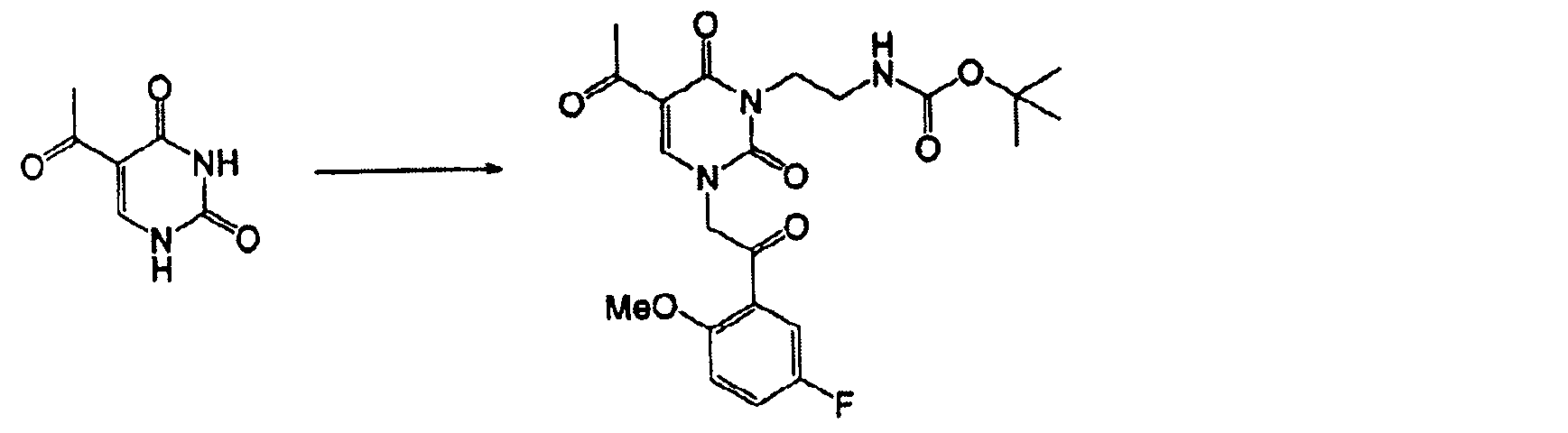
得られた固体をN,N-ジメチルホルムアミド(120ml)に溶解させ、炭酸カリウム(2.40g)、N-(2-ブロモエチル)カルバミン酸 tert-ブチル(4.80g)を加え、80℃にて5時間攪拌した。
反応液に水を加え、酢酸エチルで抽出、水、飽和食塩水で洗浄した後、無水硫酸ナトリウムで乾燥した。溶媒を減圧留去し、得られた残渣をシリカゲルカラムクロマトグラフィー(展開溶媒:クロロホルム/酢酸エチル)で精製し、目的化合物4.60gを得た。収率61%
得られた目的物の1H-NMRを以下に示す。
1H-NMR (CDCl3) δ: 8.09 (1H, s), 7.64-6.99 (3H, m), 5.21 (2H, s), 4.87 (1H, m), 4.17-3.42 (4H, m), 4.00 (3H, s), 2.65(3H, s), 1.40 (9H, s)
(工程2)
N-(2-(5-acetyl-3-(2-(5-fluoro-2-methoxyphenyl)-2-oxoethyl)-2,6-dioxo-3,6-dihydropyrimidin-1(2H)-yl)ethyl)isobutyramideの合成
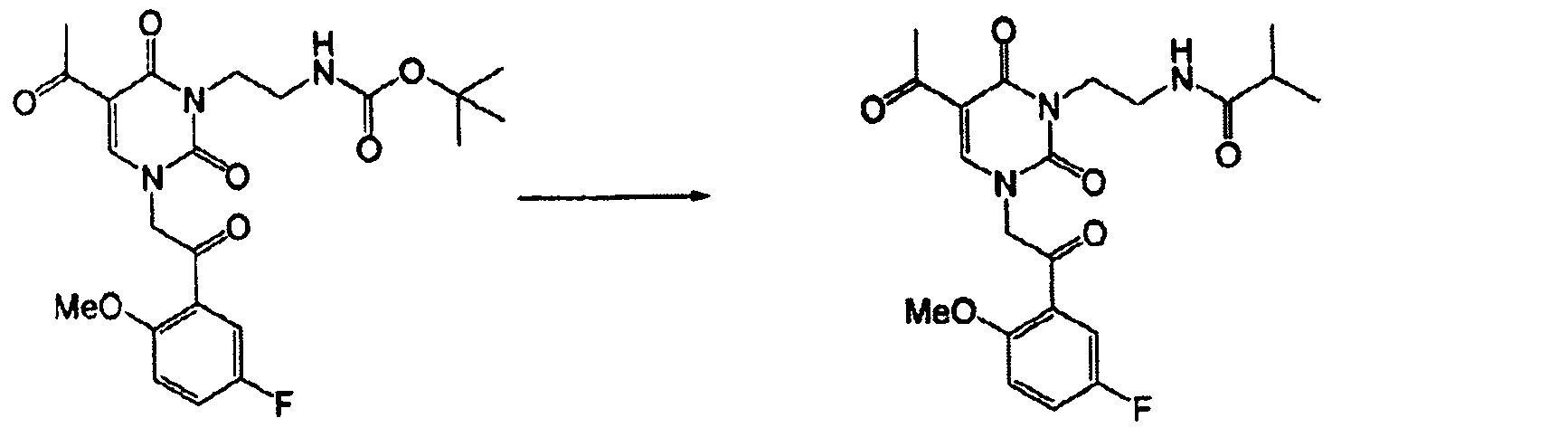
反応液を濃縮し、得られた残渣を塩化メチレン(50ml)に溶解させ、トリエチルアミン(1.5ml)、イソ酪酸クロリド(0.7ml)を加え室温にて3時間撹拌した。
反応液を減圧濃縮し、得られた残渣をシリカゲルカラムクロマトグラフィー(展開溶媒:クロロホルム/酢酸エチル)で精製し、目的化合物0.95gを得た。収率64%
得られた目的物の1H-NMRを以下に示す。
1H-NMR (CDCl3) δ: 8.10 (1H, s), 7.64-7.00 (3H, m), 6.00 (1H, m), 5.21(2H, s), 4.22-3.57 (4H, m), 4.00 (3H, s), 2.64(3H, s), 2.34-2.27(1H, m), 1.10 (6H, d)
(工程3)
N-(2-(5-(1-(ethoxyimino)ethyl)-3-(2-(5-fluoro-2-methoxyphenyl)-2-oxoethyl)-2,6-dioxo-3,6-dihydropyrimidin-1(2H)-yl)ethyl)isobutyramide(化合物番号A-36)の合成

反応液を減圧濃縮し、得られた残渣をシリカゲルカラムクロマトグラフィー(展開溶媒:n-ヘキサン/酢酸エチル)で精製し、目的化合物0.45gを得た。収率82%
得られた目的物の1H-NMRを以下に示す。
1H-NMR (CDCl3) δ: 7.64-7.00 (3H, m), 7.33(1H, s), 6.15 (1H, m),5.13 (2H, s), 4.20-3.53 (6H, m), 3.99 (3H, s), 2.34-2.27(1H, m), 2.19(3H, s), 1.27(3H, t), 1.10 (6H, d)
(工程4)
N-(2-(5-(1-(ethoxyimino)ethyl)-3-(2-(5-fluoro-2-methoxyphenyl)-2-hydroxyethyl)-2,6-dioxo-3,6-dihydropyrimidin-1(2H)-yl)ethyl)isobutyramide(化合物番号A-37)の合成
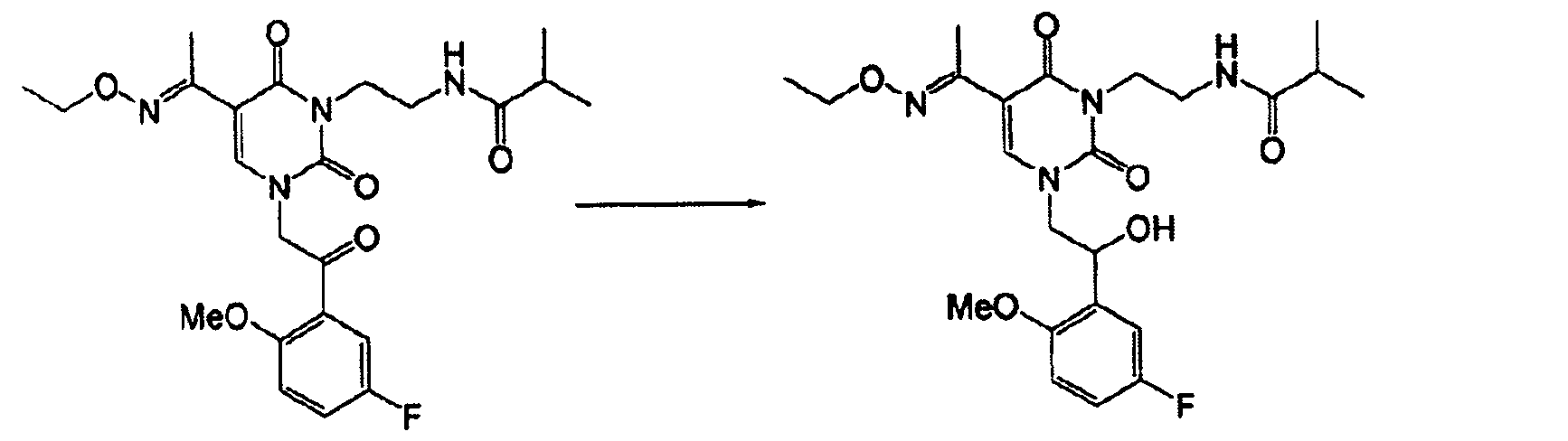
反応液に飽和塩化アンモニウム水溶液を加え、酢酸エチルで抽出、水、飽和食塩水で洗浄した後、無水硫酸ナトリウムで乾燥した。得られた残渣をシリカゲルカラムクロマトグラフィー(展開溶媒:n-ヘキサン/酢酸エチル)で精製し、目的化合物0.25gを得た。収率99%
得られた目的物の1H-NMRを以下に示す。
1H-NMR (CDCl3) δ: 7.40(1H, s),7.35-6.80 (3H, m), 5.90-5.48 (2H, m), 4.44-3.24 (9H, m), 3.85 (3H, s), 2.34-2.27(1H, m), 2.14(3H, s), 1.27(3H, t), 1.10 (6H, d)
(工程5)
N-(2-(3-(2-(2-cyanoethoxy)-2-(5-fluoro-2-methoxyphenyl)ethyl)-5-(1-(ethoxyimino)ethyl)-2,6-dioxo-3,6-dihydropyrimidin-1(2H)-yl)ethyl)isobutyramideの合成

反応液に水を加え、クロロホルムで抽出した後、無水硫酸ナトリウムで乾燥した。溶媒を減圧留去し、得られた残渣をシリカゲルカラムクロマトグラフィー(展開溶媒:ヘキサン/酢酸エチル)で精製し、目的化合物0.12gを得た。収率47%
得られた目的物の1H-NMRを以下に示す。
1H-NMR (CDCl3) δ: 7.46(1H, s),7.15-6.83 (3H, m), 6.28-5.18 (2H, m), 4.32-3.48 (10H, m), 3.84 (3H, s), 2.64(2H, t), 2.34-2.27(1H, m), 2.16(3H, s), 1.30(3H, t), 1.10 (6H, d)
N-((2S)-1-(3-(2-(5-fluoro-2-methoxyphenyl)-2-hydroxyethyl)-5-((E)-1-(isopropoxyimino)ethyl)-2,6-dioxo-3,6-dihydropyrimidin-1(2H)-yl)propan-2-yl)isobutyramide(化合物番号A-74およびA-75)の合成
(工程1)
(E)-5-(1-(isopropoxyimino)ethyl)pyrimidine-2,4(1H,3H)-dioneの合成

反応液に水を加え、塩化メチレンで抽出した後、無水硫酸ナトリウムで乾燥した。溶媒を減圧留去し、目的化合物20.6gを得た。収率98%
得られた目的物の1H-NMRを以下に示す。
1H-NMR (DMSO-D6) δ: 11.26 (1H, s), 11.11 (1H, d, J = 5.9 Hz), 7.42 (1H, d, J = 5.9 Hz), 4.31-4.25 (1H, m), 1.99 (3H, s), 1.20 (6H, d, J= 6.3 Hz).
(工程2)
(E)-1-(2-(5-fluoro-2-methoxyphenyl)-2-oxoethyl)-5-(1-(isopropoxyimino)ethyl)pyrimidine-2,4(1H,3H)-dione(製造中間体7)の合成
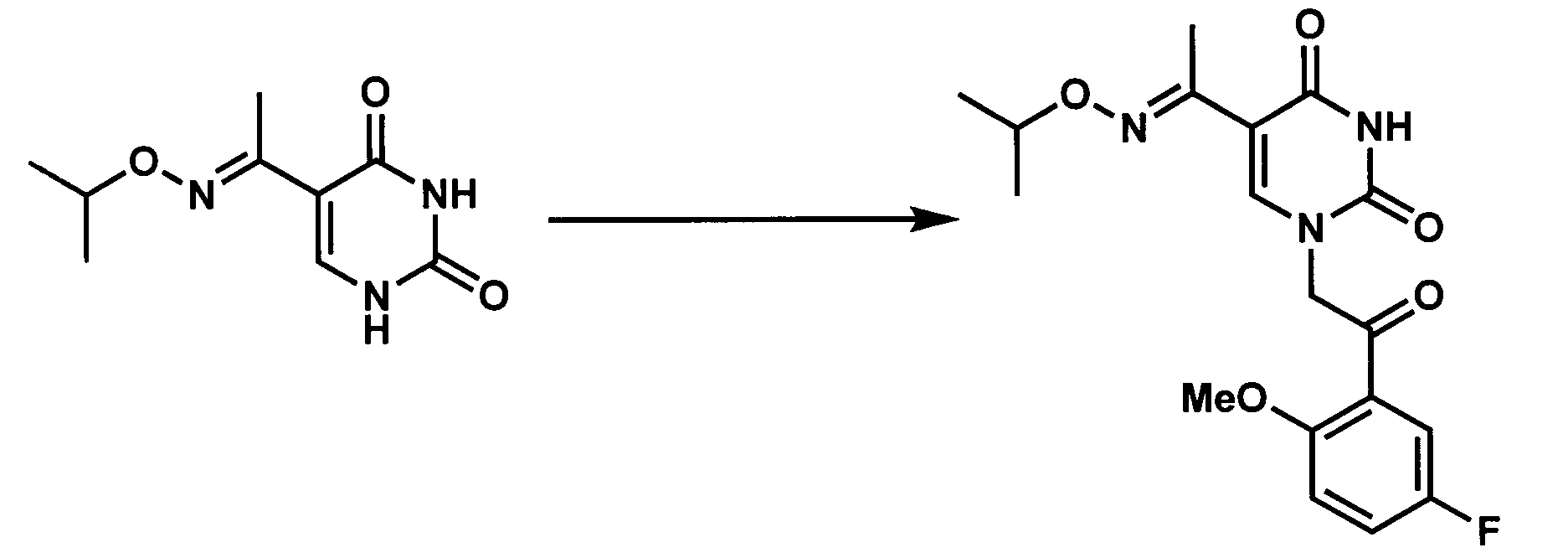
得られた目的物の1H-NMRを以下に示す。
1H-NMR (CDCl3) δ: 8.23 (1H, s), 7.67-6.98(3H, m), 7.34(1H, s), 5.13(2H, s), 4.35-4.32 (1H, m), 3.98(3H, s), 2.19 (3H, s), 1.25 (6H, d, J = 6.3 Hz).
(工程3)
(S,E)-N-(1-(3-(2-(5-fluoro-2-methoxyphenyl)-2-oxoethyl)-5-(1-(isopropoxyimino)ethyl)-2,6-dioxo-3,6-dihydropyrimidin-1(2H)-yl)propan-2-yl)isobutyramide(化合物番号C-221)の合成
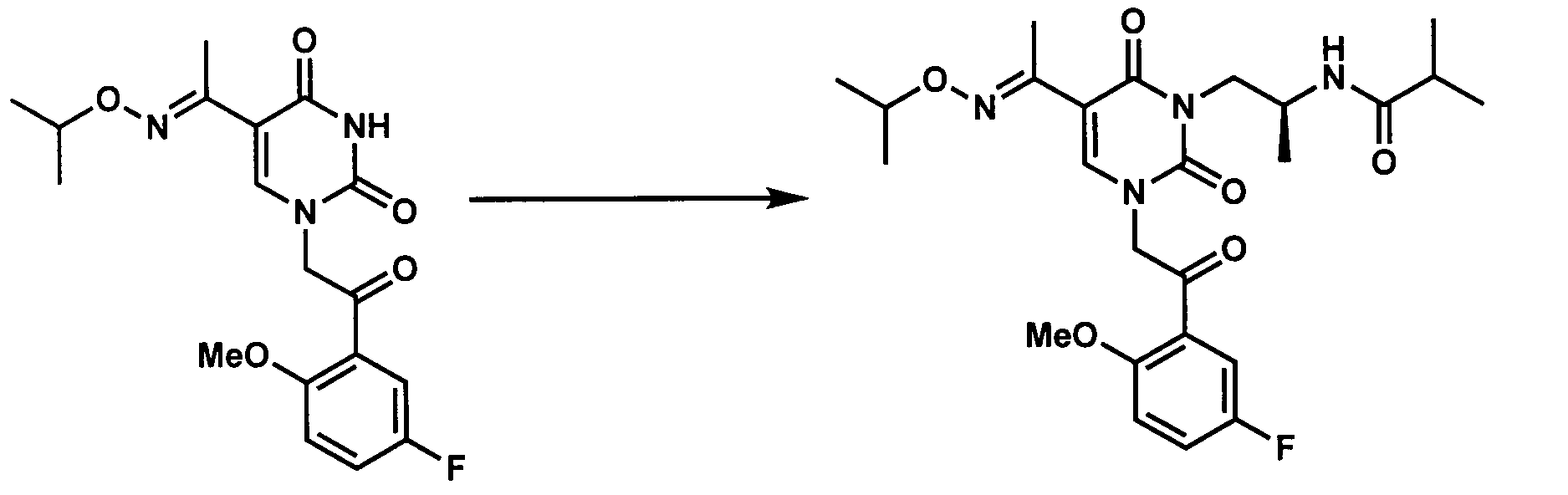
反応液をシリカゲルカラムクロマトグラフィー(展開溶媒:ヘキサン/酢酸エチル)で精製し、得られたものを1,4-ジオキサン(7ml)に溶解させ、4規定塩化水素/1,4-ジオキサン溶液(7ml)を加え、室温にて4時間撹拌した。反応液を濃縮し、得られた残渣を塩化メチレン(7ml)に溶解させ、氷冷下、トリエチルアミン(3ml)、isobutanoyl chloride(0.1ml)を加え30分撹拌した。反応液を減圧濃縮し、得られた残渣をシリカゲルカラムクロマトグラフィー(展開溶媒:クロロホルム/酢酸エチル)で精製し、目的化合物0.45gを得た。収率60%
得られた目的物の1H-NMRを以下に示す。
1H-NMR (CDCl3) δ: 7.62-6.99 (3H, m), 7.30(1H, s), 6.08-2.20(8H, m), 3.98 (3H, s), 2.15(3H, s), 1.25-1.03 (15H, m)
(工程4)
N-((2S)-1-(3-(2-(5-fluoro-2-methoxyphenyl)-2-hydroxyethyl)-5-((E)-1-(isopropoxyimino)ethyl)-2,6-dioxo-3,6-dihydropyrimidin-1(2H)-yl)propan-2-yl)isobutyramide(化合物番号A-74およびA-75)の合成

反応液に飽和塩化アンモニウム水溶液を加え、酢酸エチルで抽出、水、飽和食塩水で洗浄した後、無水硫酸ナトリウムで乾燥した。溶媒を減圧留去し得られた残渣をシリカゲルカラムクロマトグラフィー(展開溶媒:n-ヘキサン/酢酸エチル)で精製し、目的化合物A-74(0.11g)とA-75(0.11g)を得た。収率はそれぞれ44%
得られた目的物の1H-NMRを以下に示す。
化合物番号A-75:1H-NMR (CDCl3) δ: 7.38(1H, s),7.36-6.79 (3H, m), 5.64-4.22 (7H, m), 3.84 (3H, s), 3.80-3.11(2H, m), 2.25-2.16(1H, m), 2.12(3H, s), 1.24-1.02(15H, m)
化合物番号A-74:1H-NMR (CDCl3) δ: 7.42(1H, s),7.39-6.79 (3H, m), 5.72-2.16 (10H, m), 3.84 (3H, s), 2.14(3H, s), 1.27-1.02(15H, m)
N-((2S)-1-(3-(2-hydroxy-2-(2-(trifluoromethoxy)phenyl)ethyl)-5-((E)-1-(isopropoxyimino)ethyl)-2,6-dioxo-3,6-dihydropyrimidin-1(2H)-yl)propan-2-yl)isobutyramide(化合物番号C-193およびC-194)の合成
(工程1)
(E)-5-(1-(isopropoxyimino)ethyl)-1-(methoxymethyl)pyrimidine-2,4(1H,3H)-dioneの合成

反応液をシリカゲルクロマトグラフィー(展開溶媒:ヘキサン・酢酸エチル)で精製し、目的物3.00gを得た。収率99%
得られた目的物の1H-NMRを以下に示す。
1H-NMR (CDCl3) δ: 8.32 (1H, s), 7.53 (1H, s), 5.15 (2H, s), 4.40-4.34 (1H, m), 3.44 (3H, s), 2.16 (3H, s), 1.27 (6H, d, J = 15.2 Hz).
(工程2)
(S,E)-N-(1-(5-(1-(isopropoxyimino)ethyl)-3-(methoxymethyl)-2,6-dioxo-3,6-dihydropyrimidin-1(2H)-yl)propan-2-yl)isobutyramide(製造中間体10)の合成

反応液をシリカゲルカラムクロマトグラフィー(展開溶媒:ヘキサン/酢酸エチル)で精製し、得られたものを1,4-ジオキサン(20ml)に溶解させ、4規定塩化水素/1,4-ジオキサン溶液(12ml)を加え、室温にて3時間撹拌した。反応液を濃縮し、得られた残渣を塩化メチレン(40ml)に溶解させ、氷冷下、トリエチルアミン(3ml)、isobutanoyl chloride(1.3ml)を加え30分撹拌した。反応液を減圧濃縮し、得られた残渣をシリカゲルカラムクロマトグラフィー(展開溶媒:クロロホルム/酢酸エチル)で精製し、目的化合物2.90gを得た。収率77%
得られた目的物の1H-NMRを以下に示す。
1H-NMR (CDCl3) δ: 7.49 (1H, s), 5.93 (1H, d, J = 8.2 Hz), 5.19-5.13 (2H, m), 4.42-4.32 (2H, m), 4.15-3.87 (2H, m), 3.43 (3H, s), 2.30-2.18 (1H, m), 2.14 (3H, s), 1.37-0.93 (15H, m).
(工程3)
(S,E)-N-(1-(5-(1-(isopropoxyimino)ethyl)-2,6-dioxo-3,6-dihydropyrimidin-1(2H)-yl)propan-2-yl)isobutyramide(製造中間体9)の合成

溶媒を減圧留去し、得られた残渣をシリカゲルクロマトグラフィー(展開溶媒:ヘキサン・酢酸エチル)で精製し、目的物0.32gを得た。収率72%
得られた目的物の1H-NMRを以下に示す。
1H-NMR (CDCl3) δ: 9.33 (1H, d, J = 6.3 Hz), 7.42 (1H, d, J= 6.3 Hz), 5.94 (1H, d, J = 8.2 Hz), 4.48-3.84 (4H, m), 2.25-2.21 (1H, m), 2.12 (3H, s), 1.26-1.01 (15H, m).
(工程4)
(S,E)-N-(1-(5-(1-(isopropoxyimino)ethyl)-2,6-dioxo-3-(2-oxo-2-(2-(trifluoromethoxy)phenyl)ethyl)-3,6-dihydropyrimidin-1(2H)-yl)propan-2-yl)isobutyramide(化合物番号C-195)の合成

反応液に水を加え、酢酸エチルで抽出後、無水硫酸ナトリウムで乾燥した。溶媒を減圧留去し、得られた残渣をシリカゲルクロマトグラフィー(展開溶媒:ヘキサン・酢酸エチル)で精製し、目的物0.23gを得た。収率72%
得られた目的物の1H-NMRを以下に示す。
1H-NMR (CDCl3) δ: 7.98-7.36 (4H, m), 7.33 (1H, s), 6.07-3.90 (7H, m), 2.28-2.21 (1H, m), 2.17 (3H, s), 1.26-1.05 (15H, m).
(工程5)
N-((2S)-1-(3-(2-hydroxy-2-(2-(trifluoromethoxy)phenyl)ethyl)-5-((E)-1-(isopropoxyimino)ethyl)-2,6-dioxo-3,6-dihydropyrimidin-1(2H)-yl)propan-2-yl)isobutyramide(化合物番号C-193およびC-194)の合成

得られた目的物の1H-NMRを以下に示す。
化合物番号C-194: 1H-NMR (CDCl3) δ: 7.76-7.27 (4H, m), 7.41 (1H, s), 5.75-5.43 (3H, m), 4.77-4.24 (4H, m), 3.81-3.13 (2H, m), 2.21-2.18 (1H, m), 2.12 (3H, s), 1.28-1.00 (15H, m).
化合物番号C-193:1H-NMR (CDCl3) δ: 7.84-7.35 (4H, m), 7.42 (1H, s), 5.64-3.74 (9H, m), 2.25-2.18 (1H, m), 2.14 (3H, s), 1.28-1.01 (15H, m).
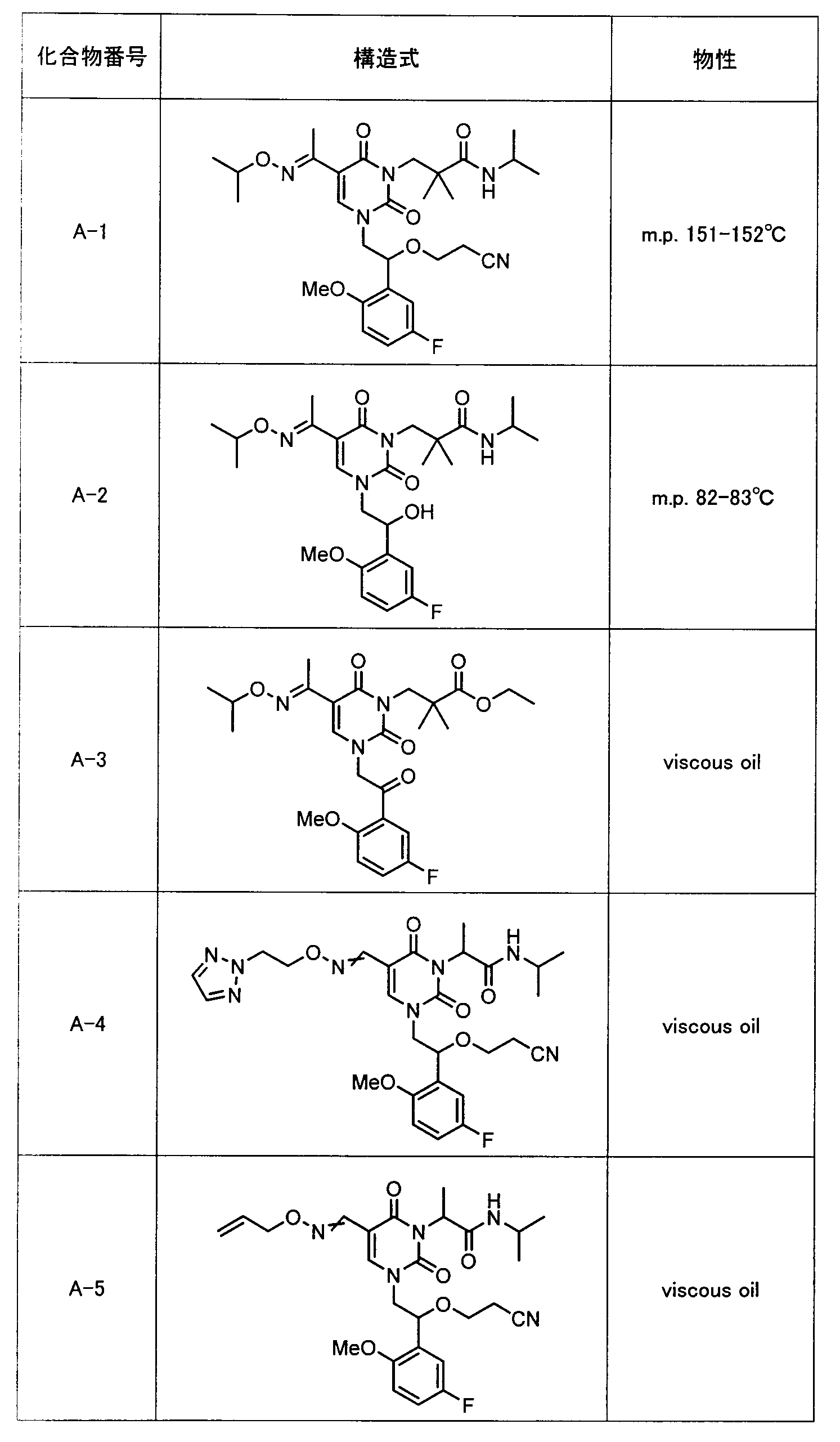
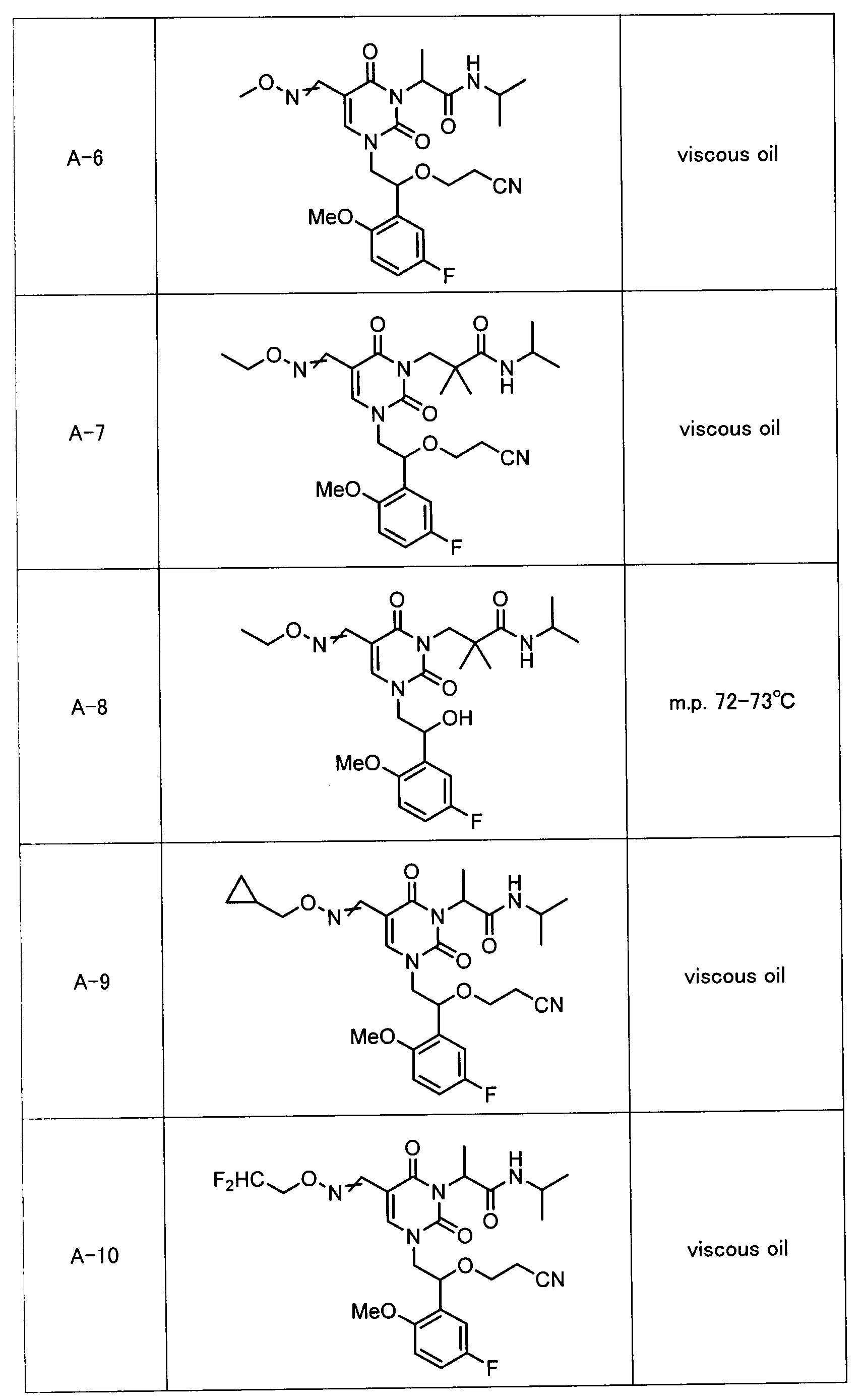


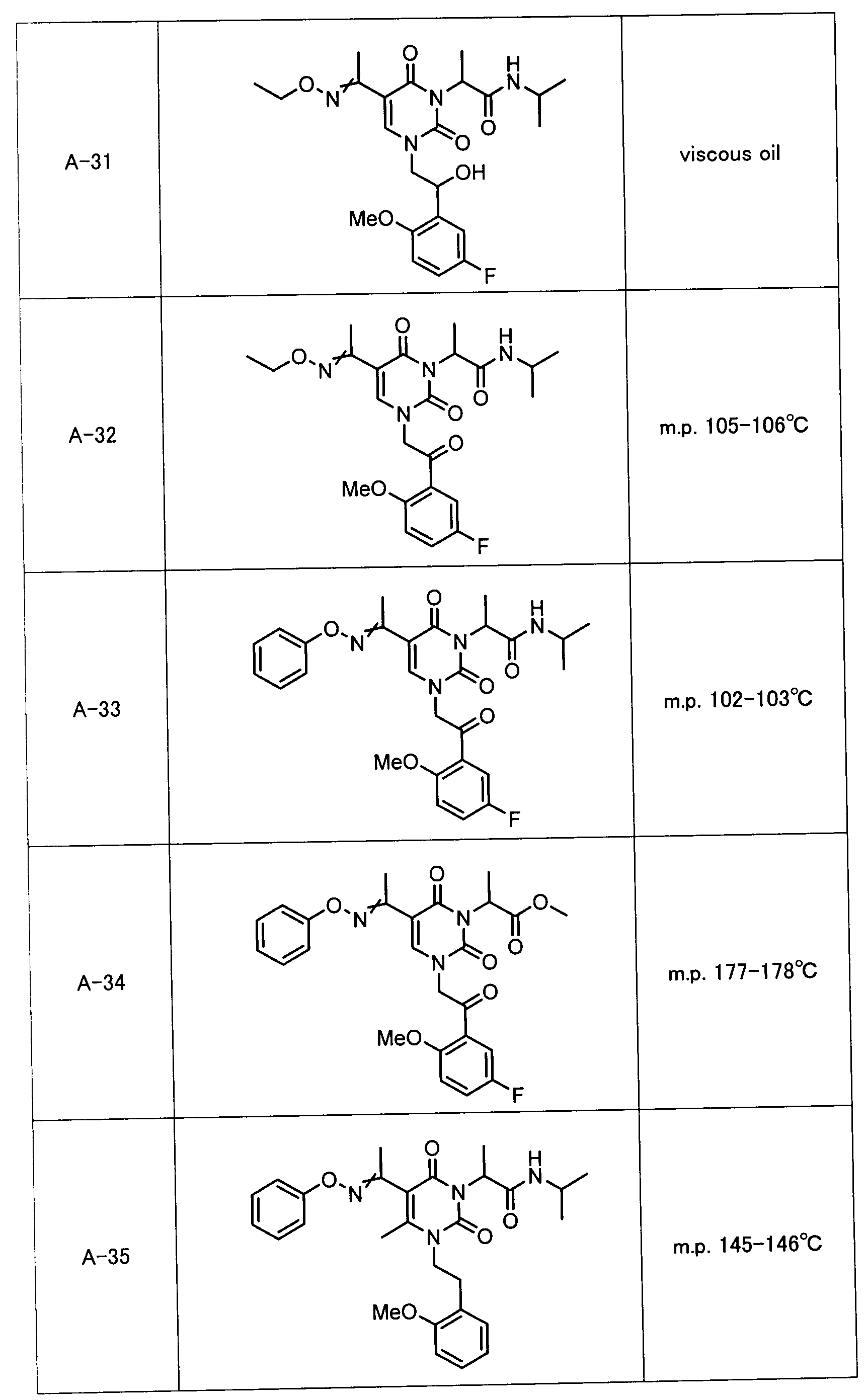


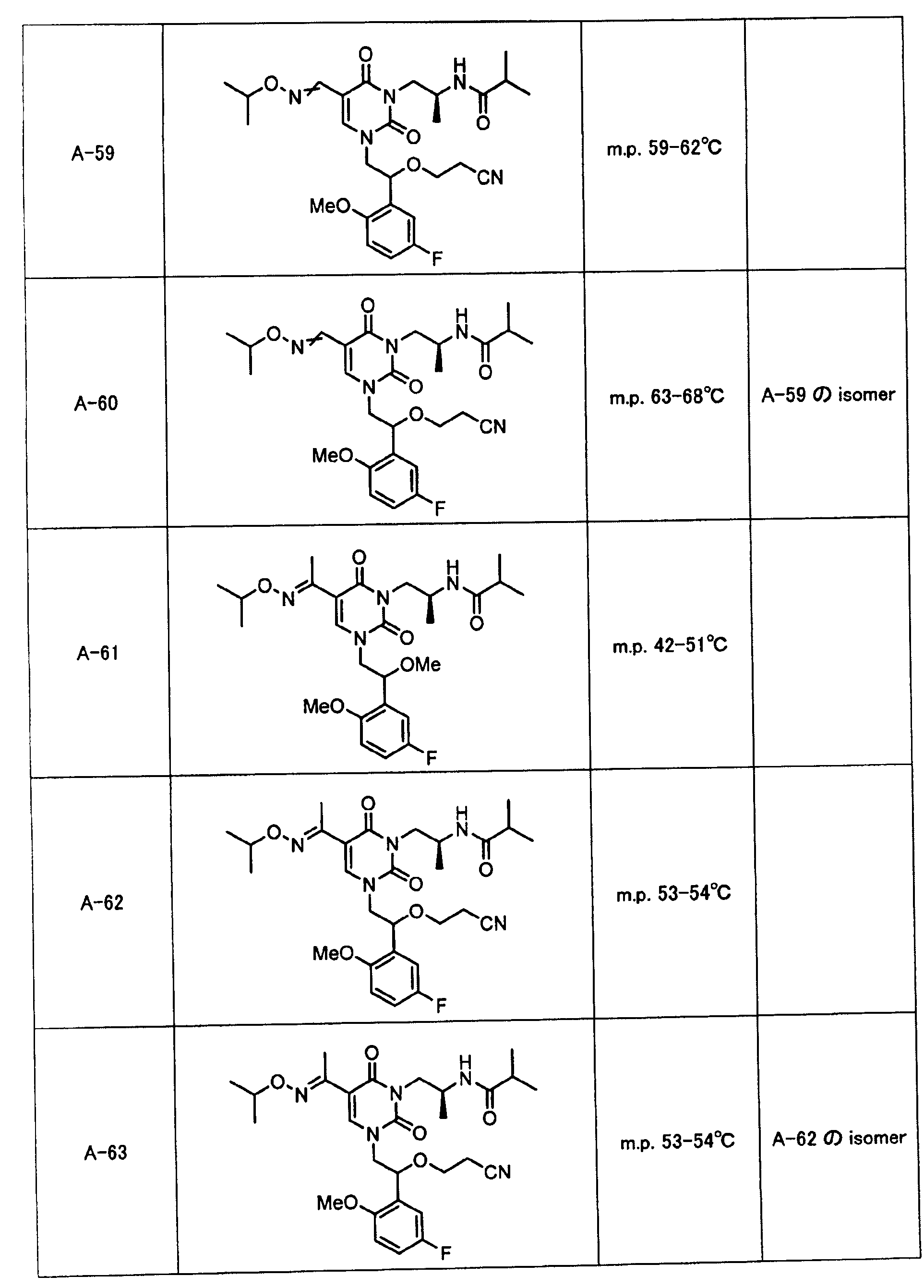


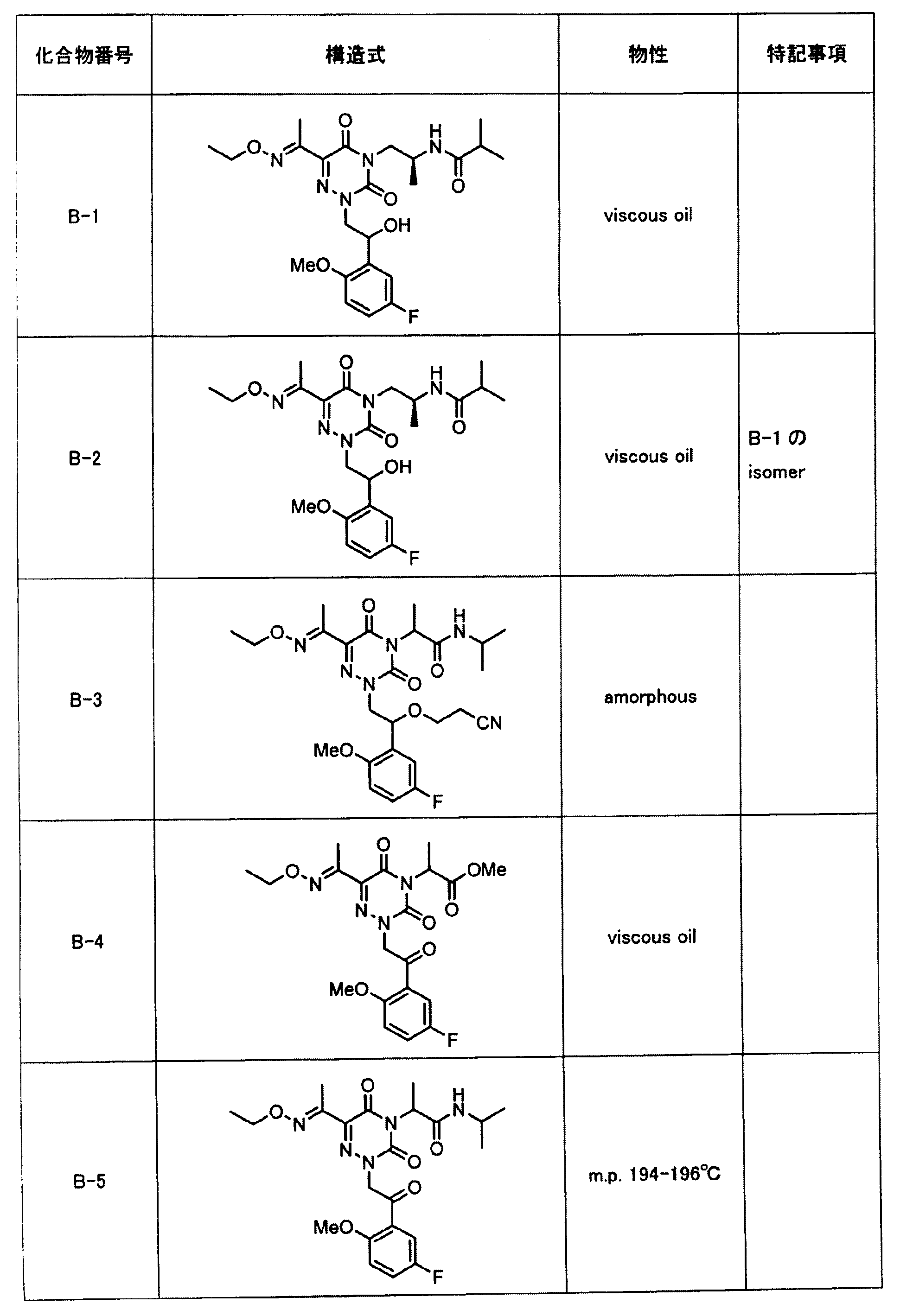

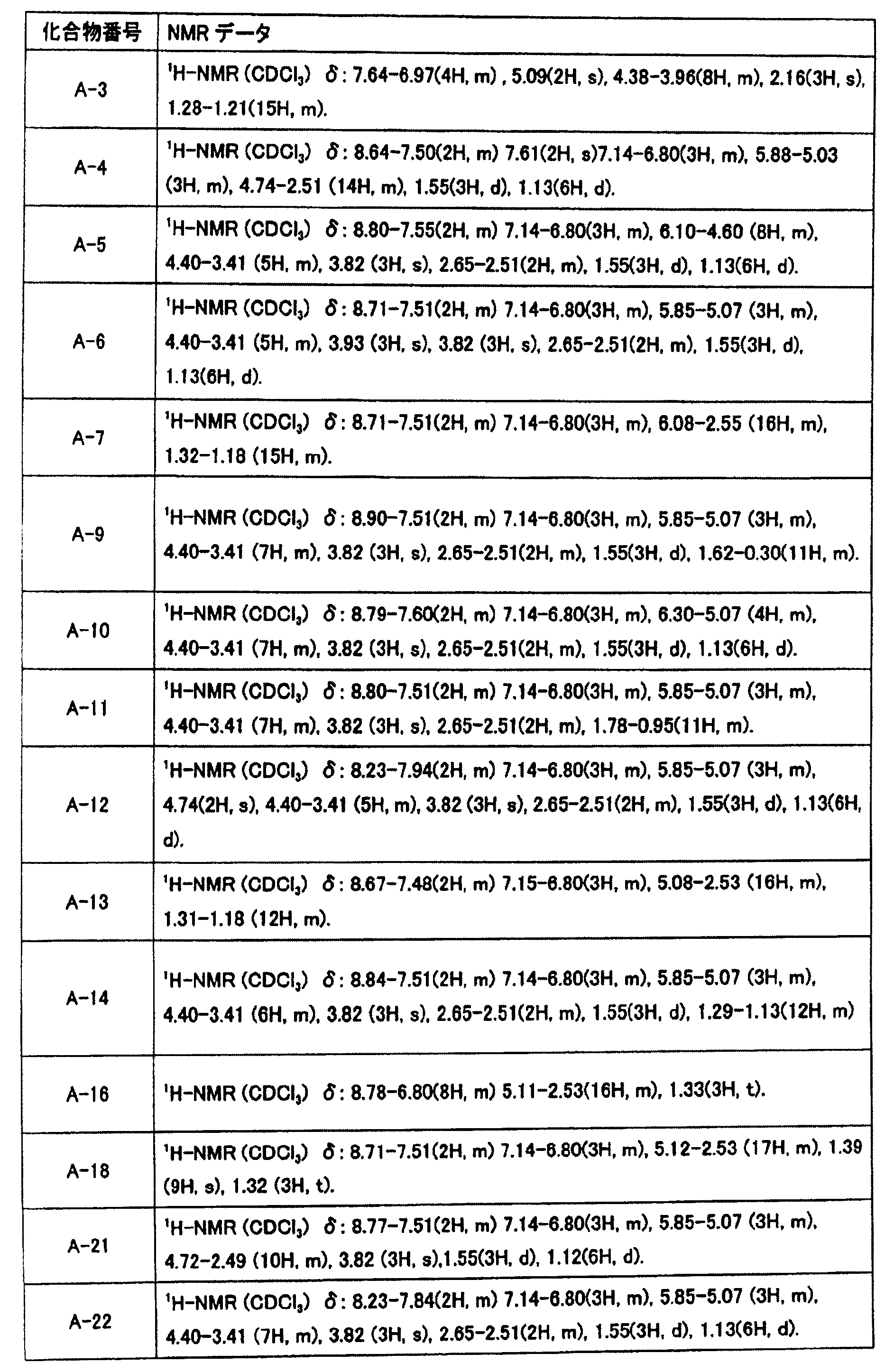


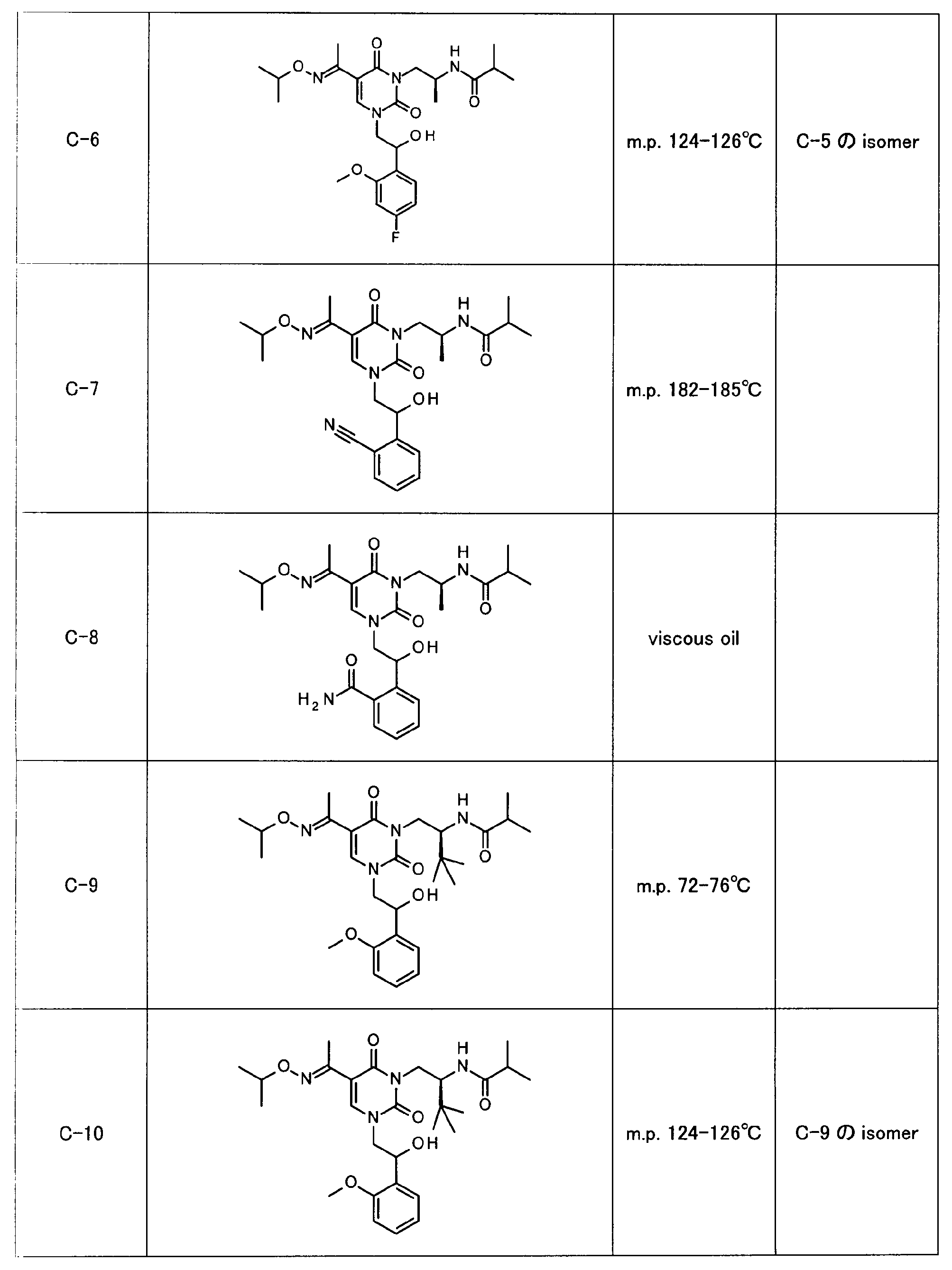

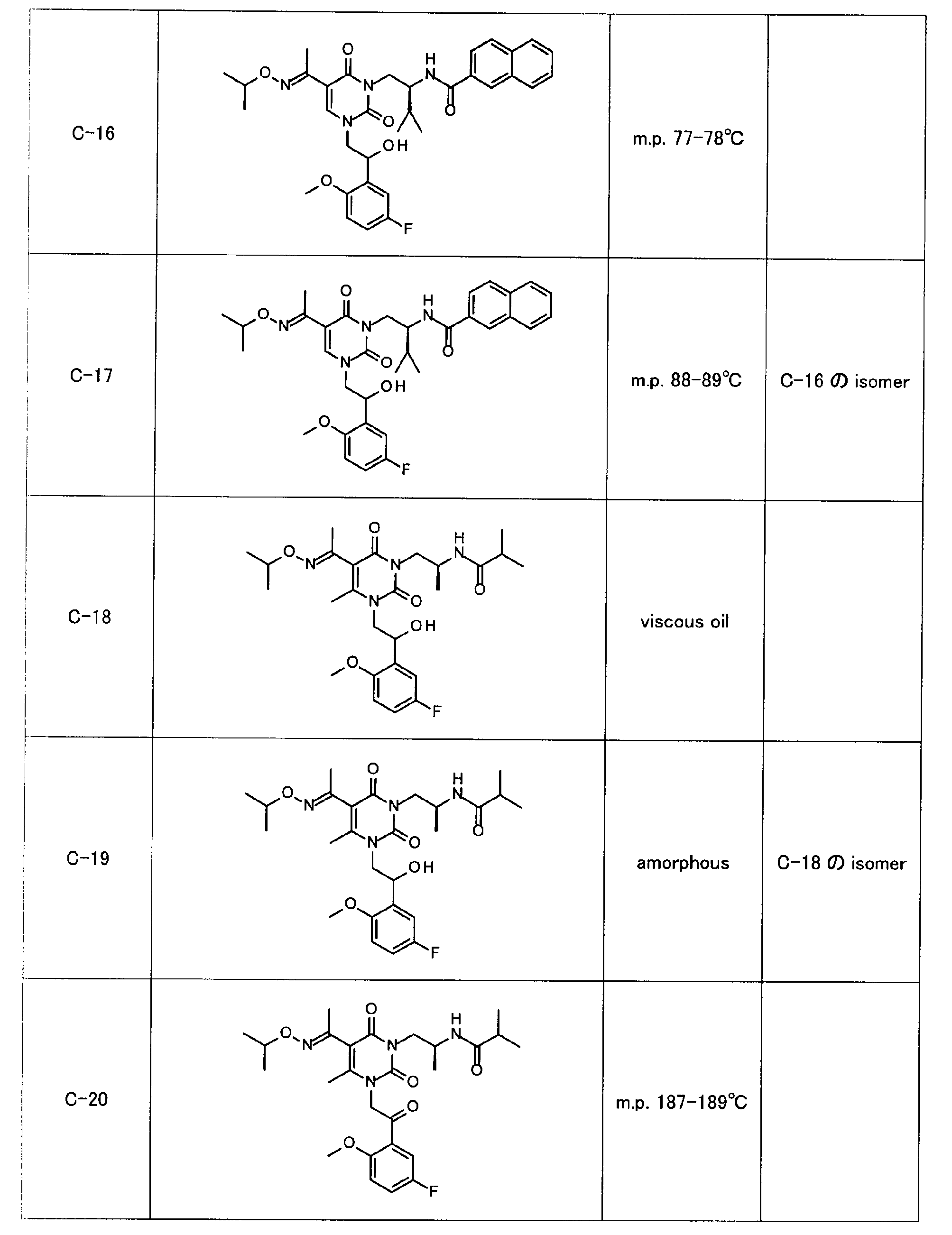
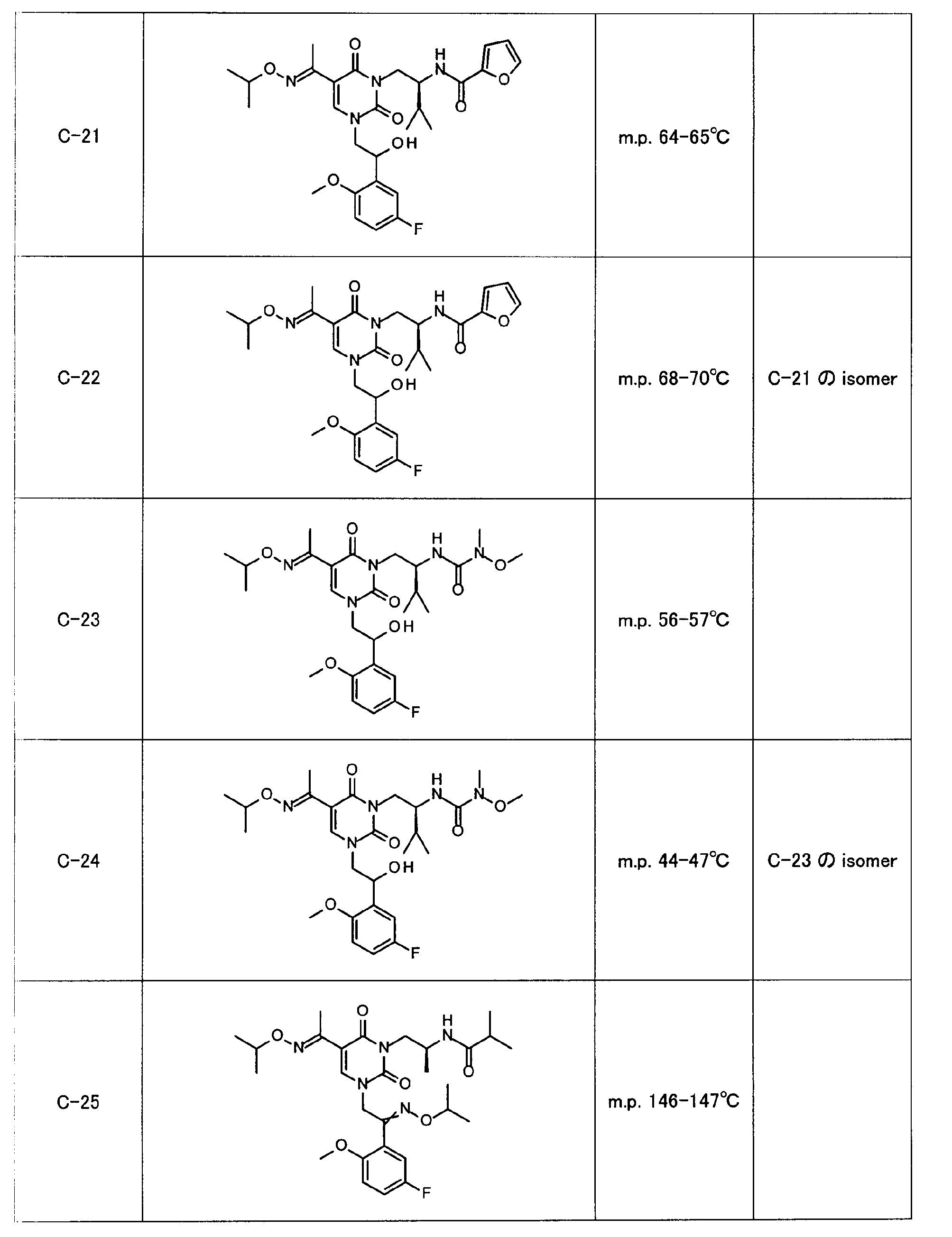
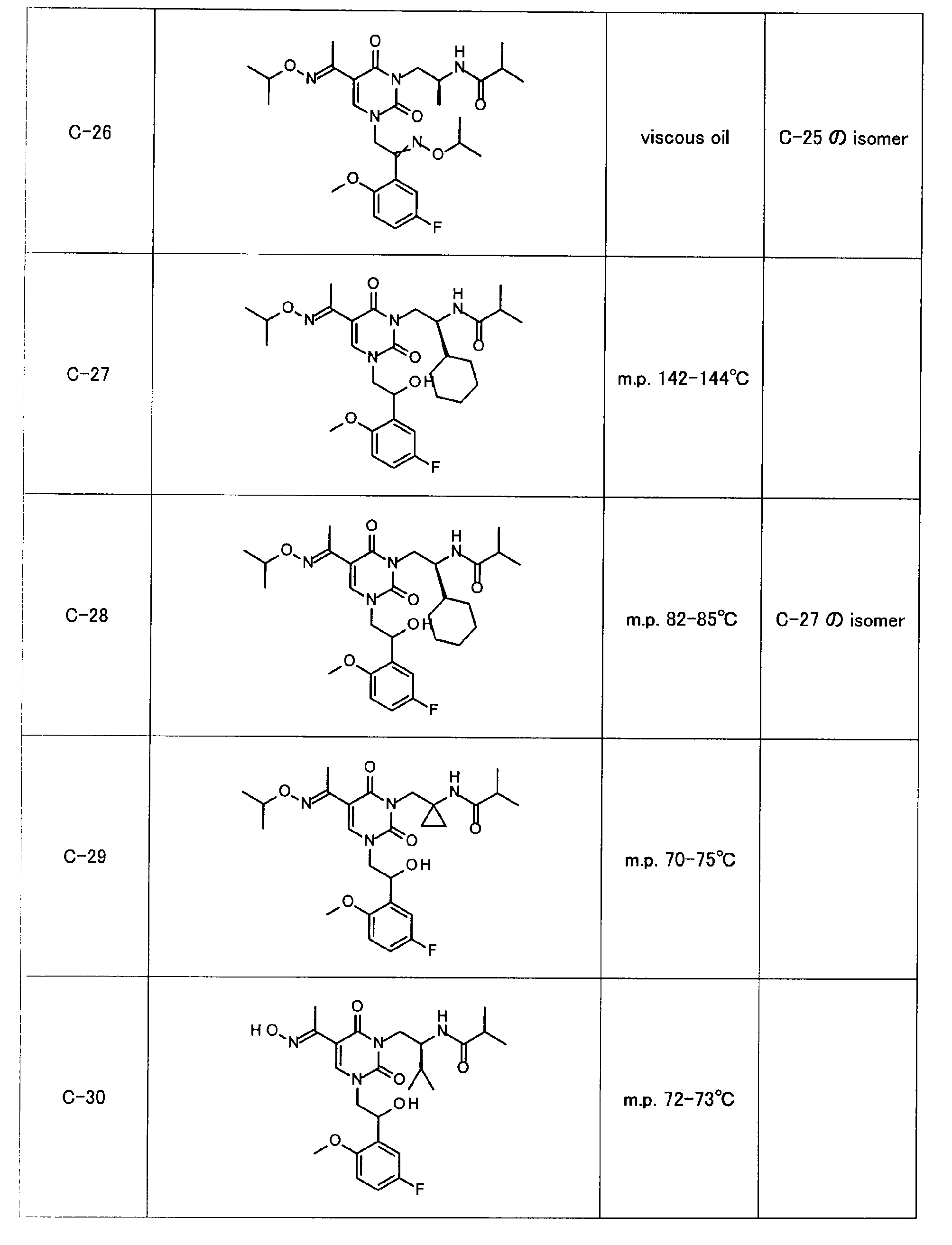
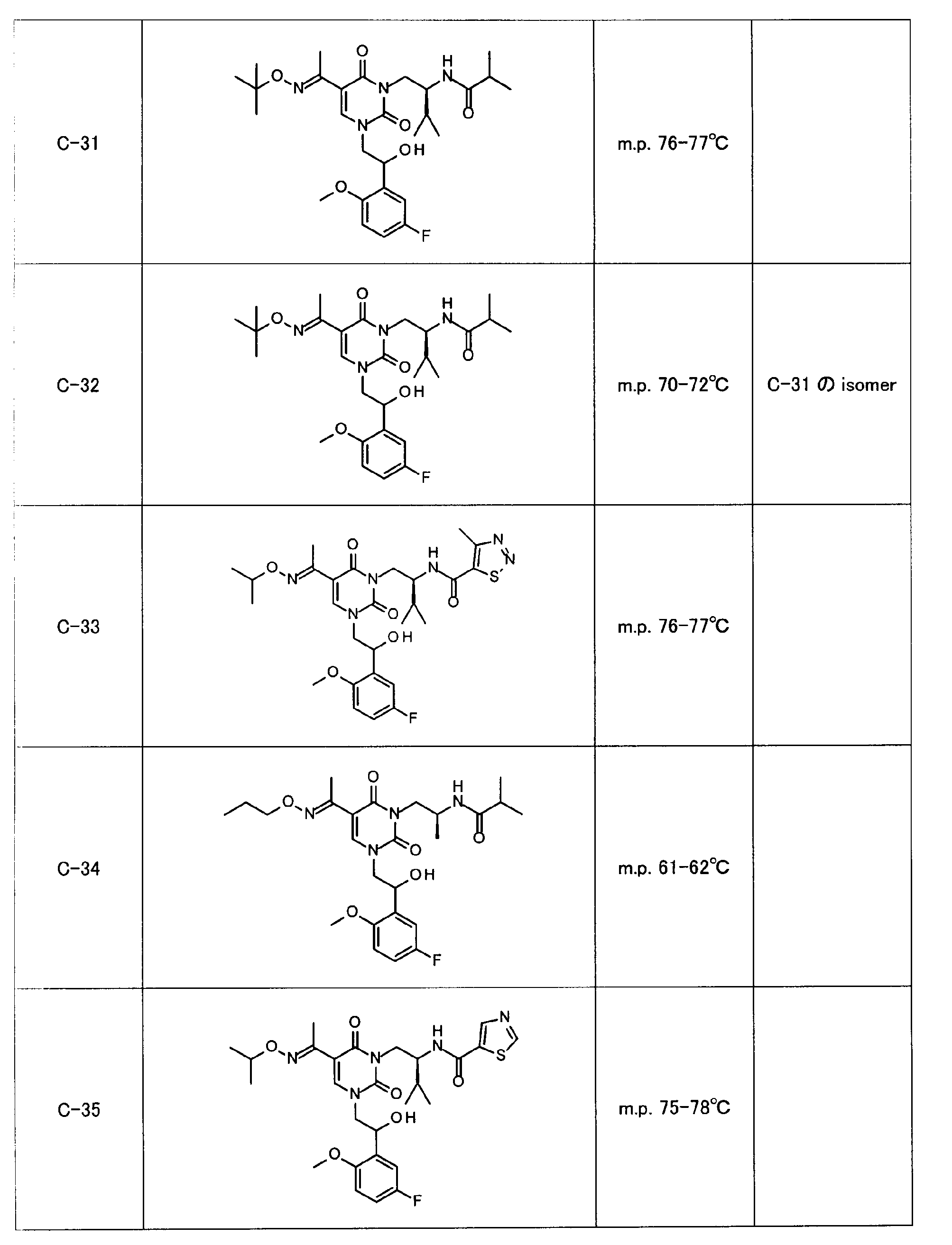


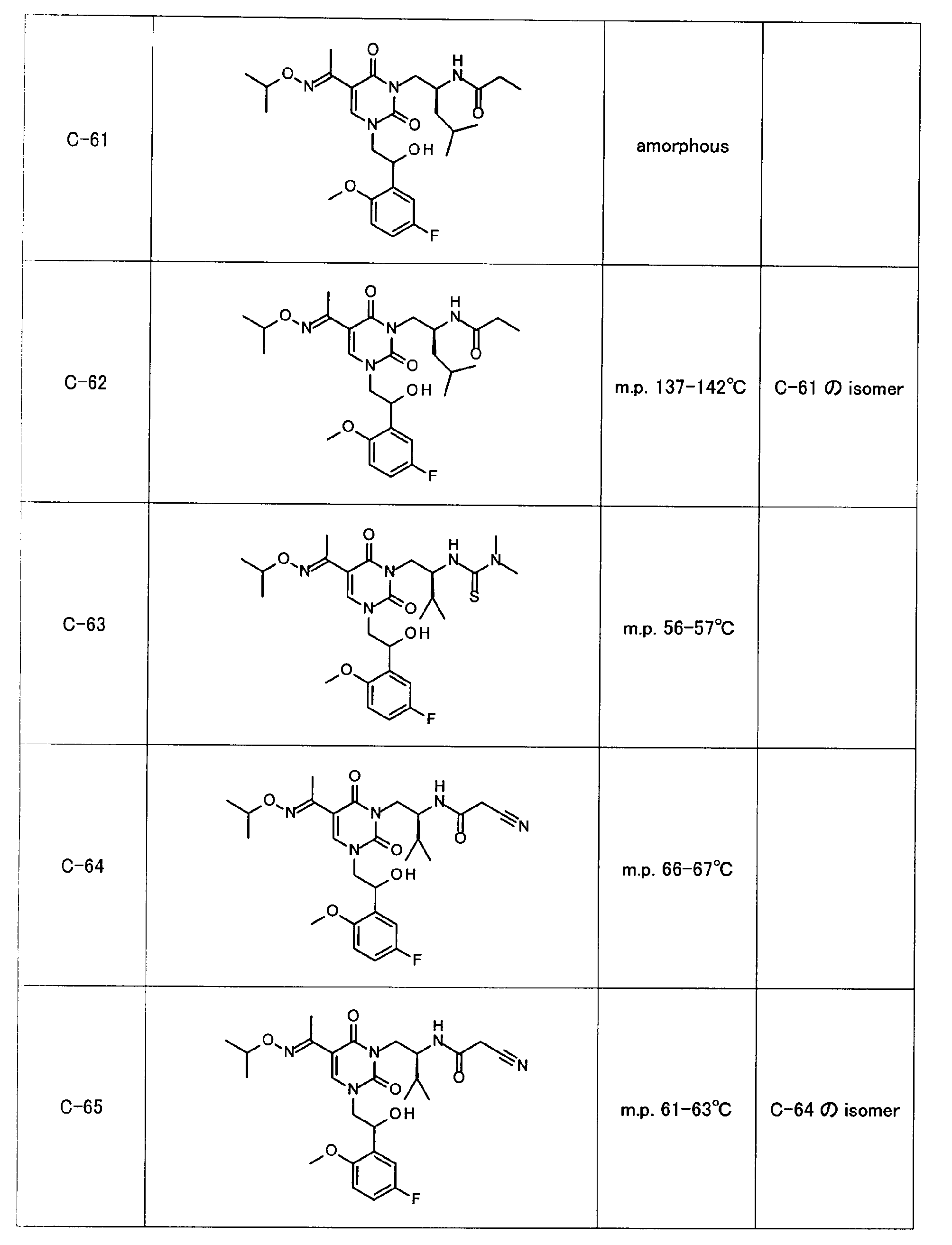
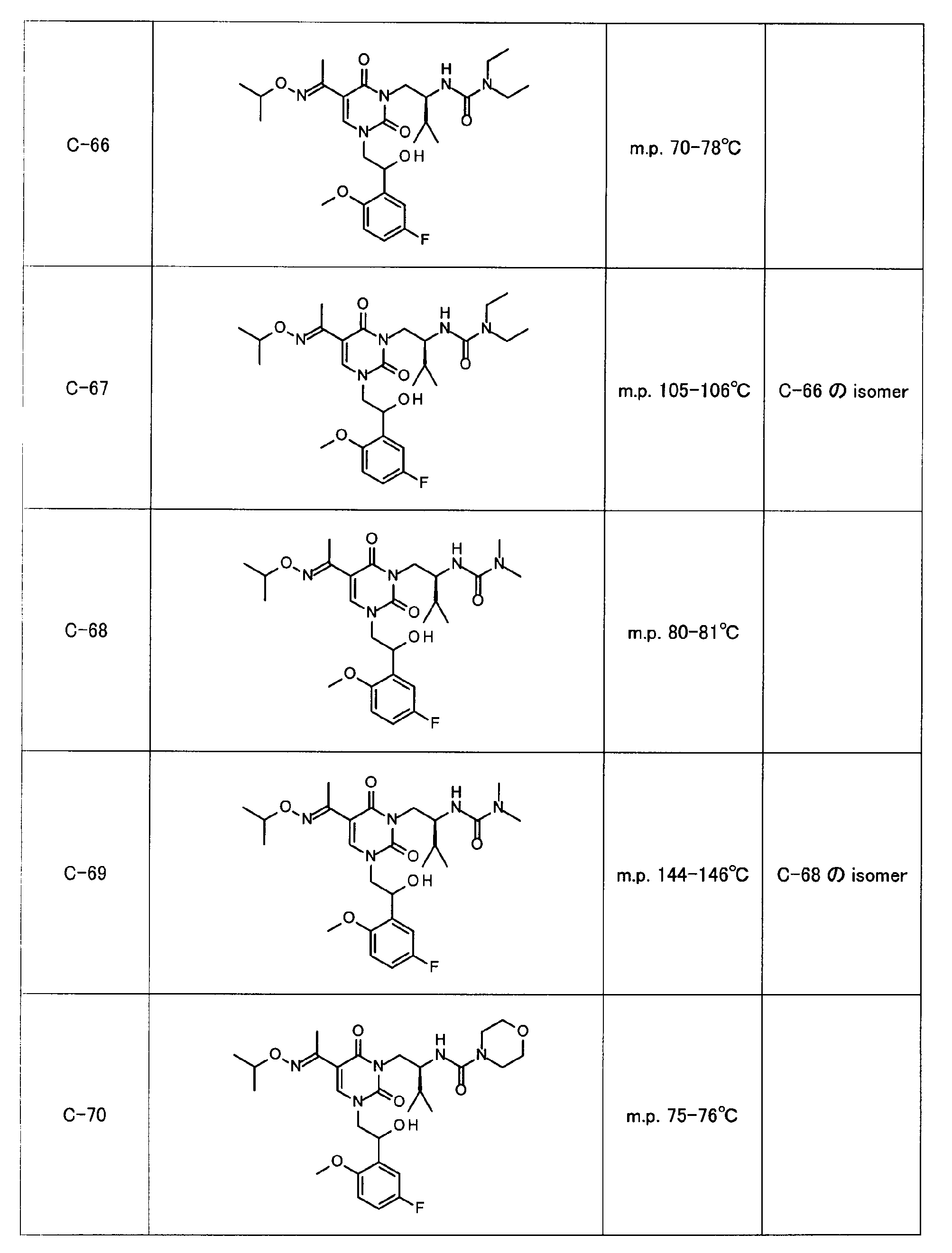


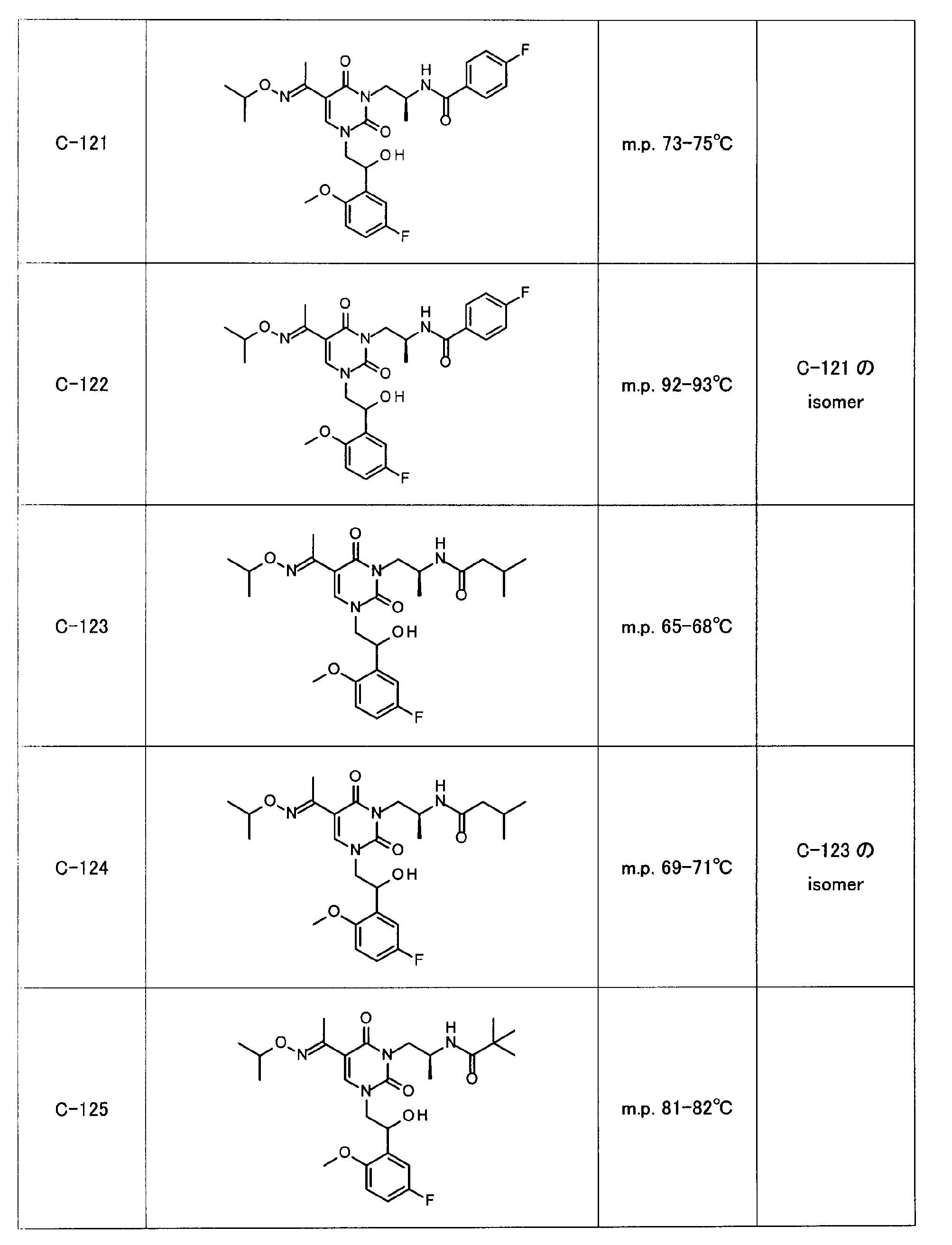
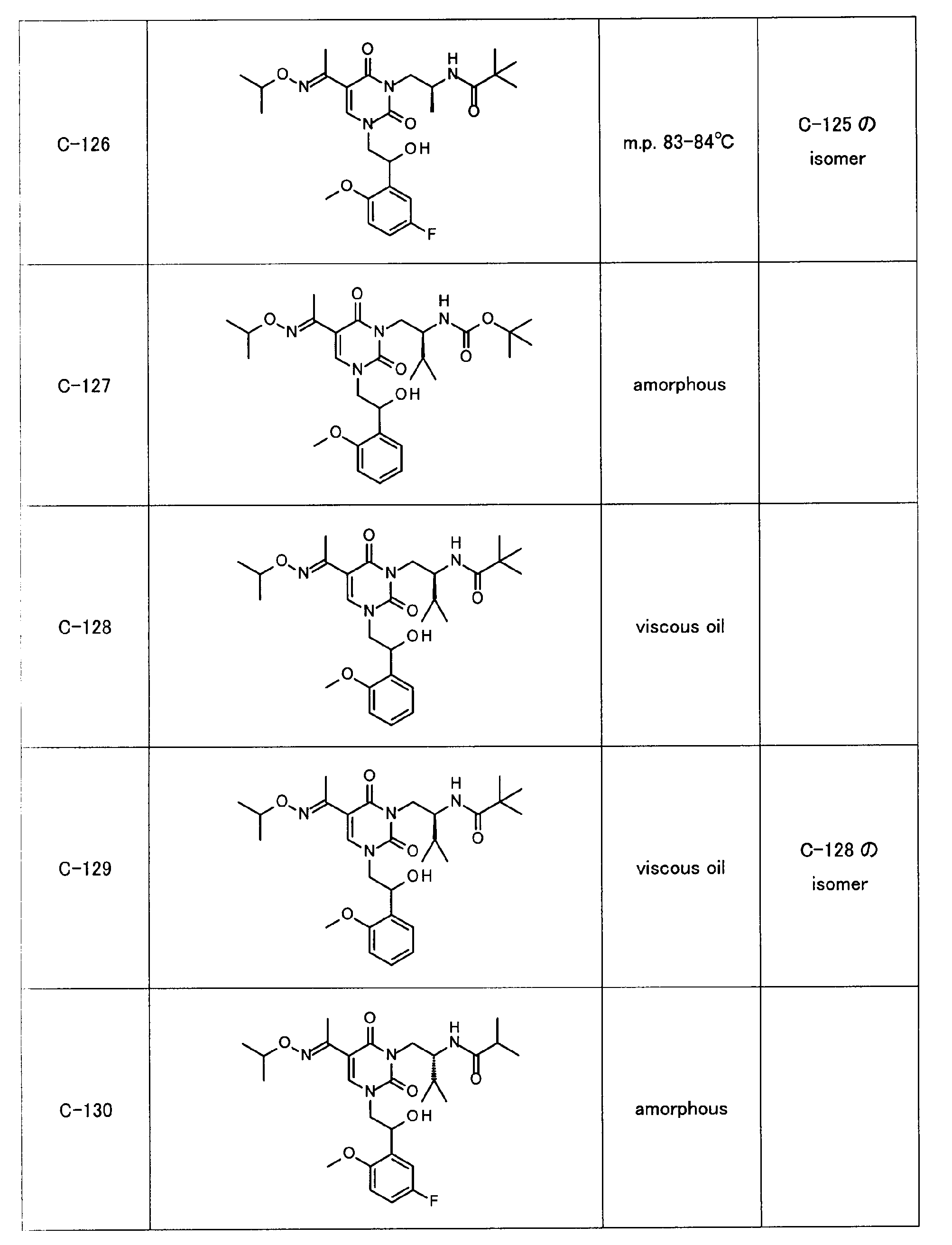


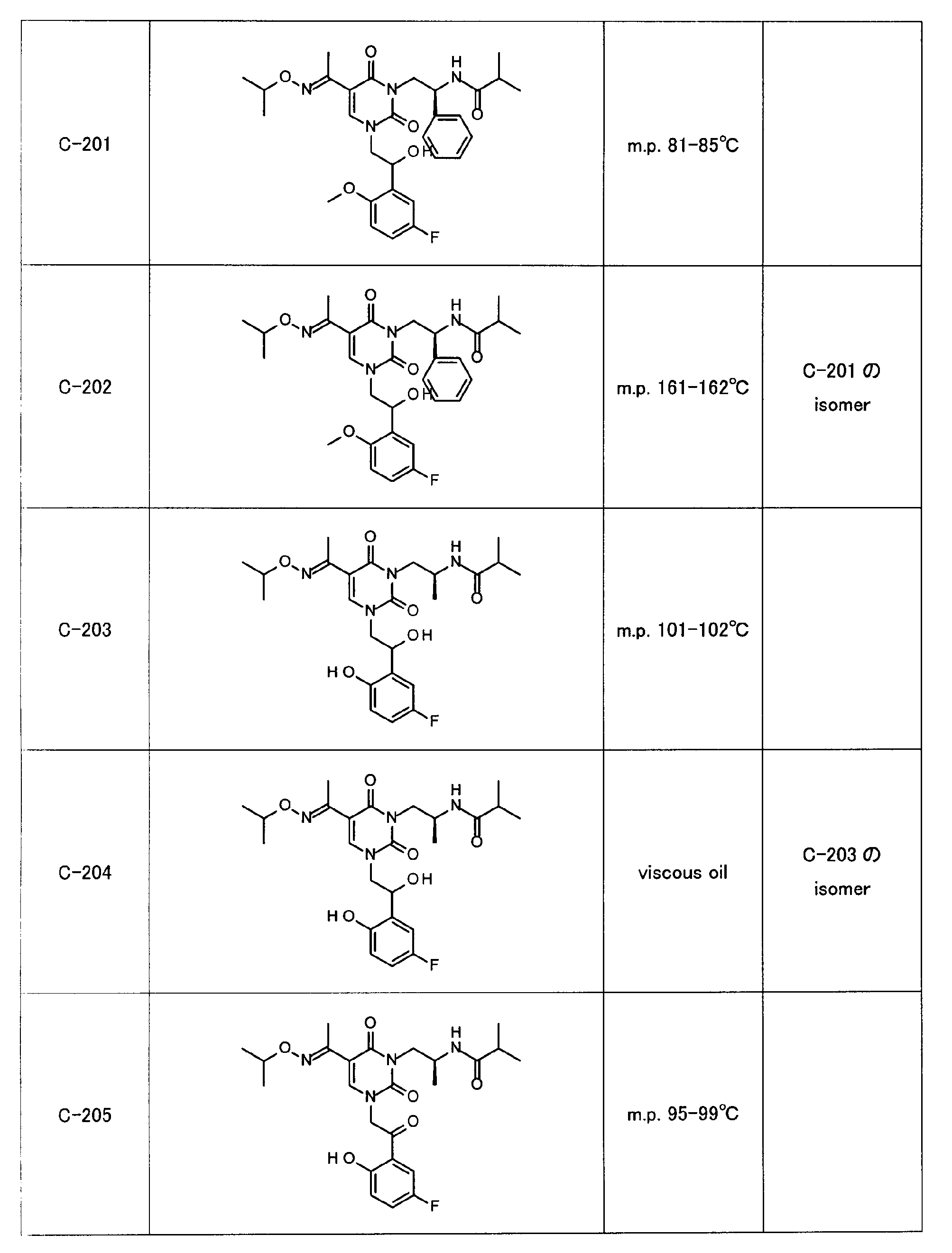


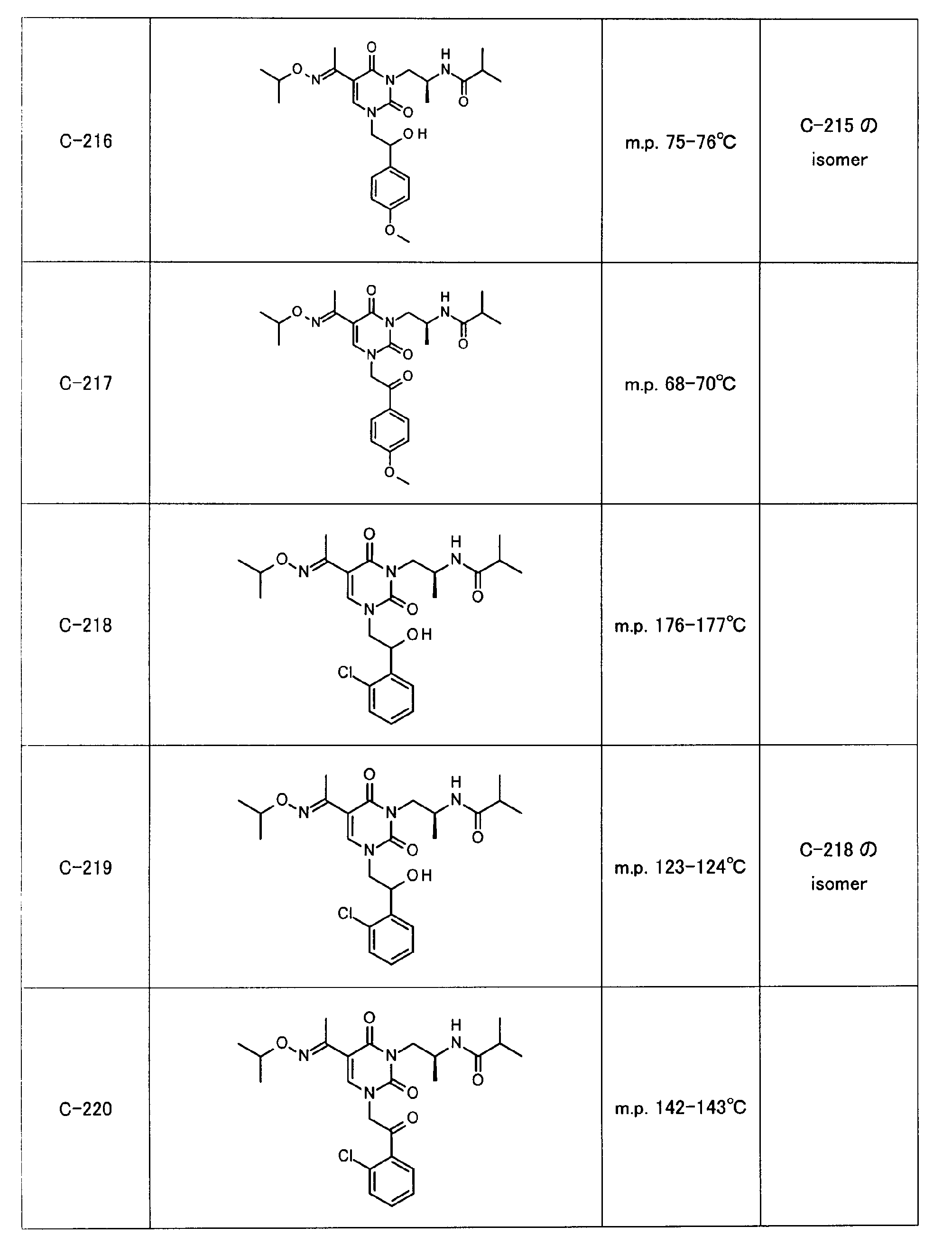


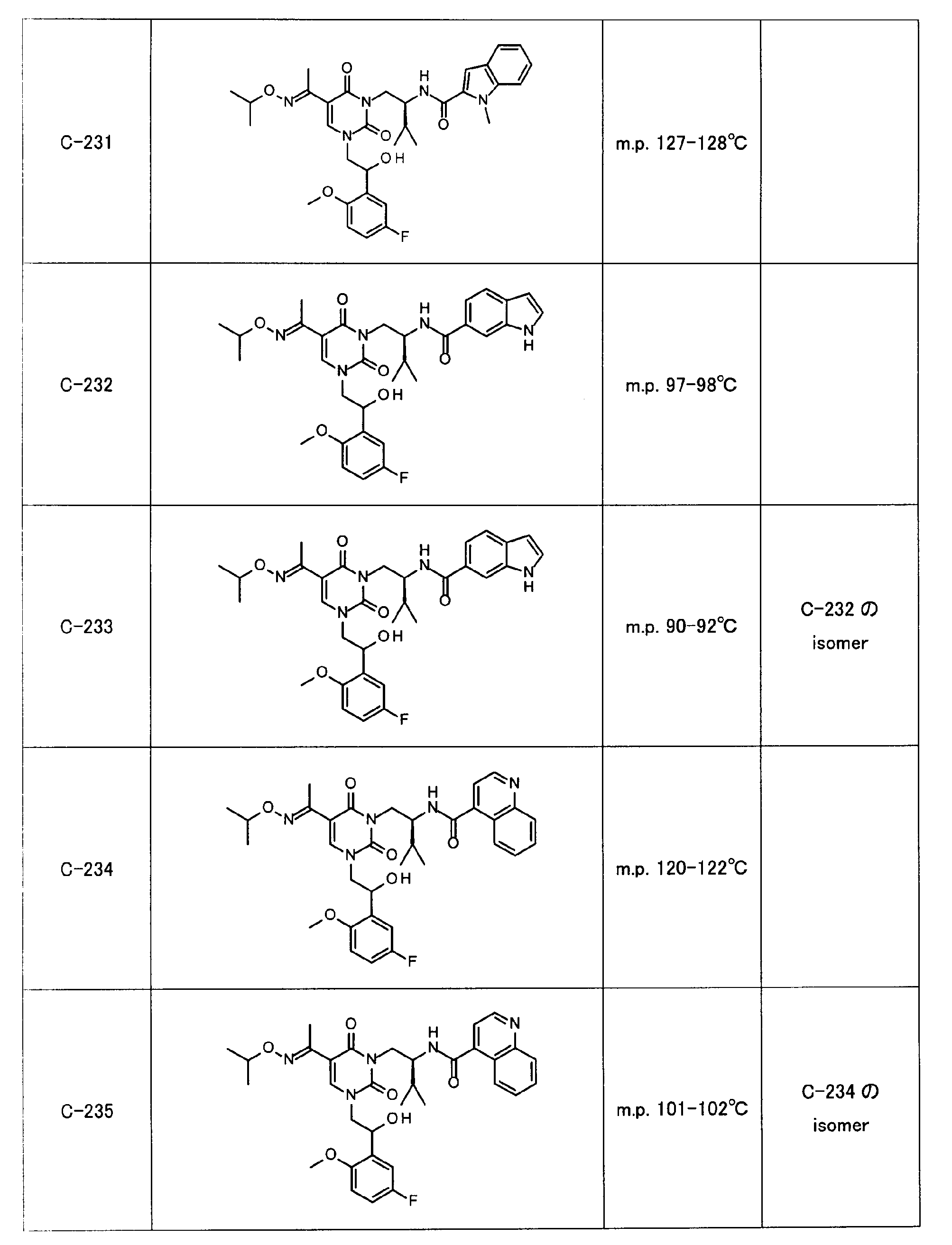

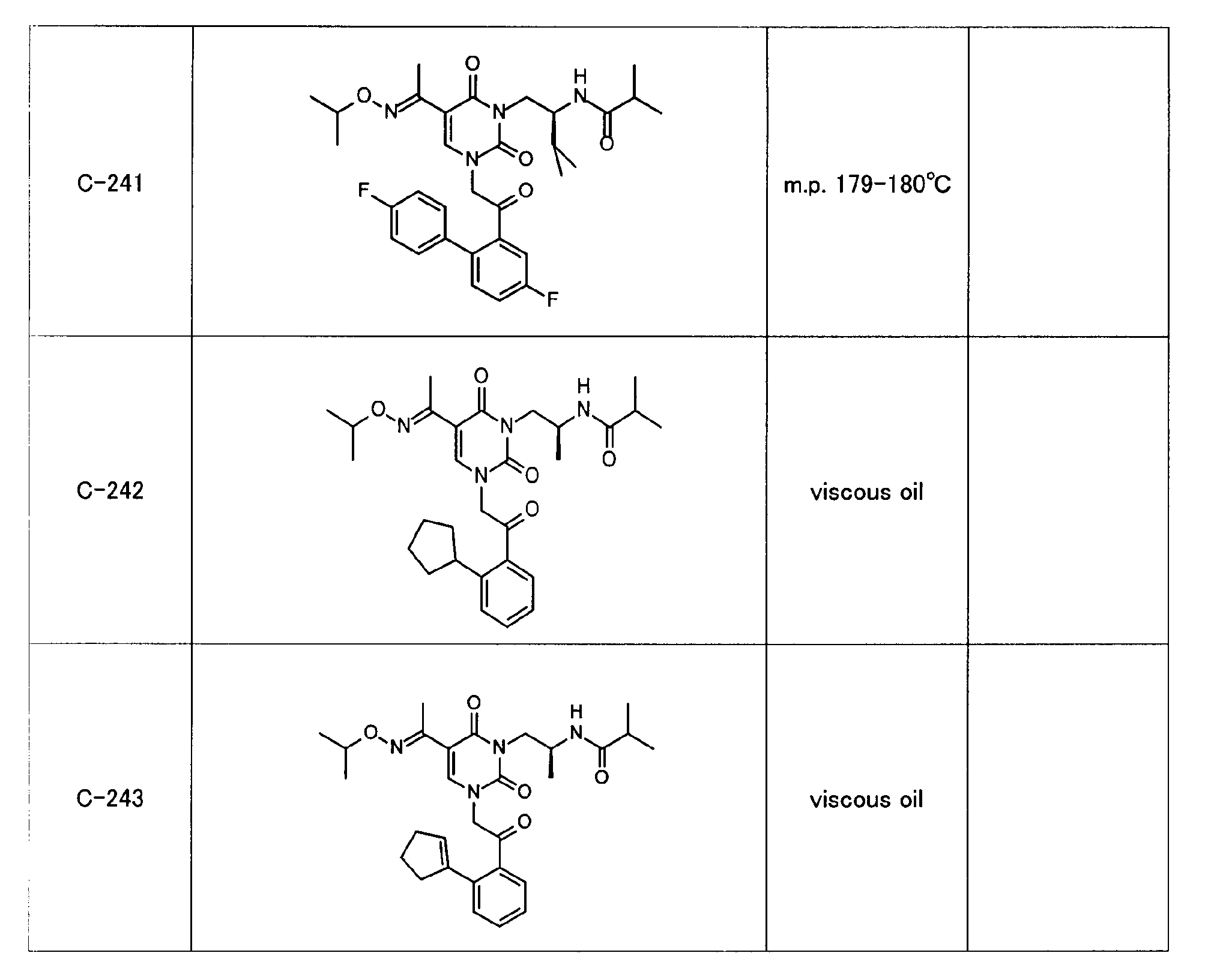

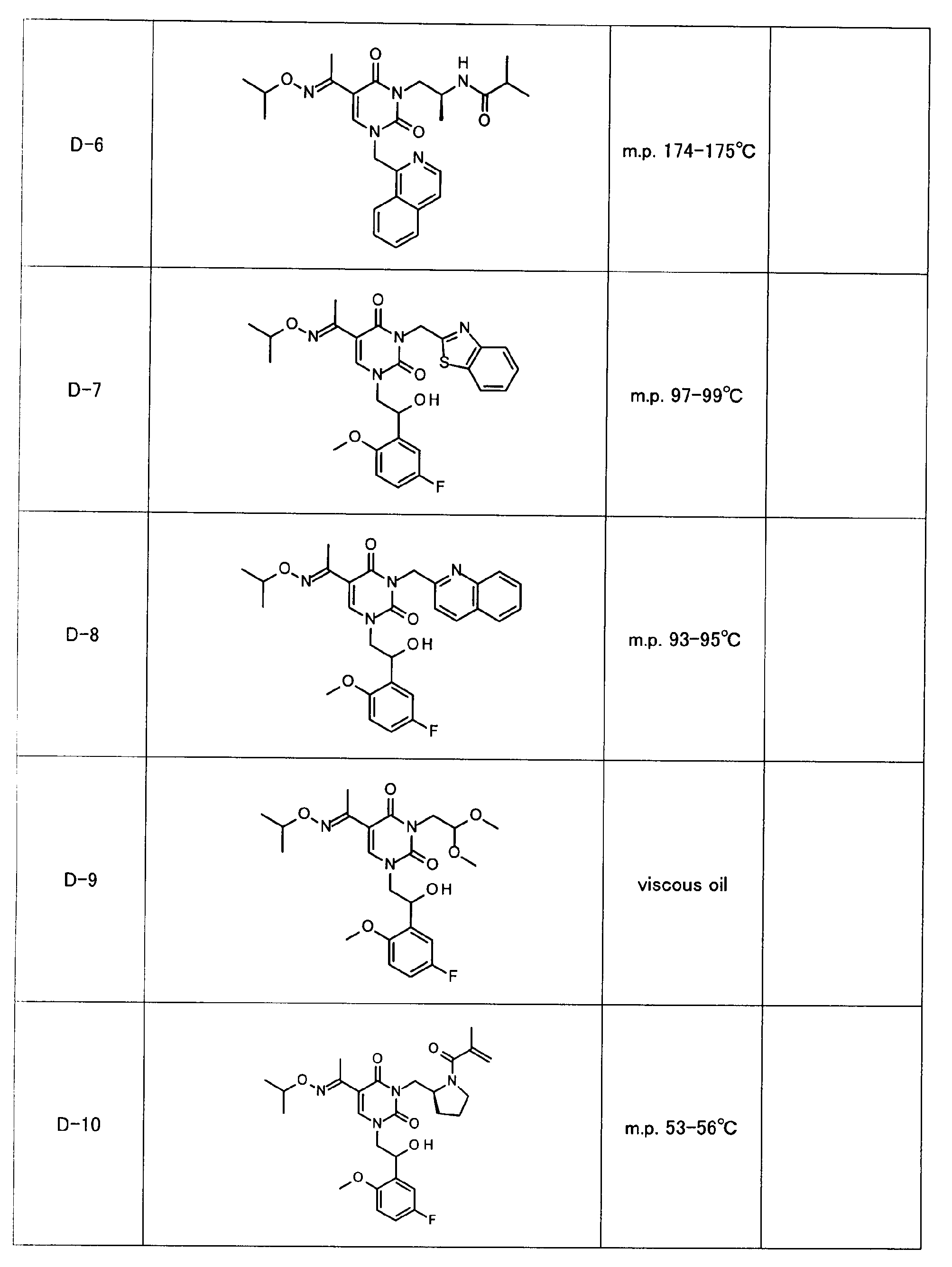

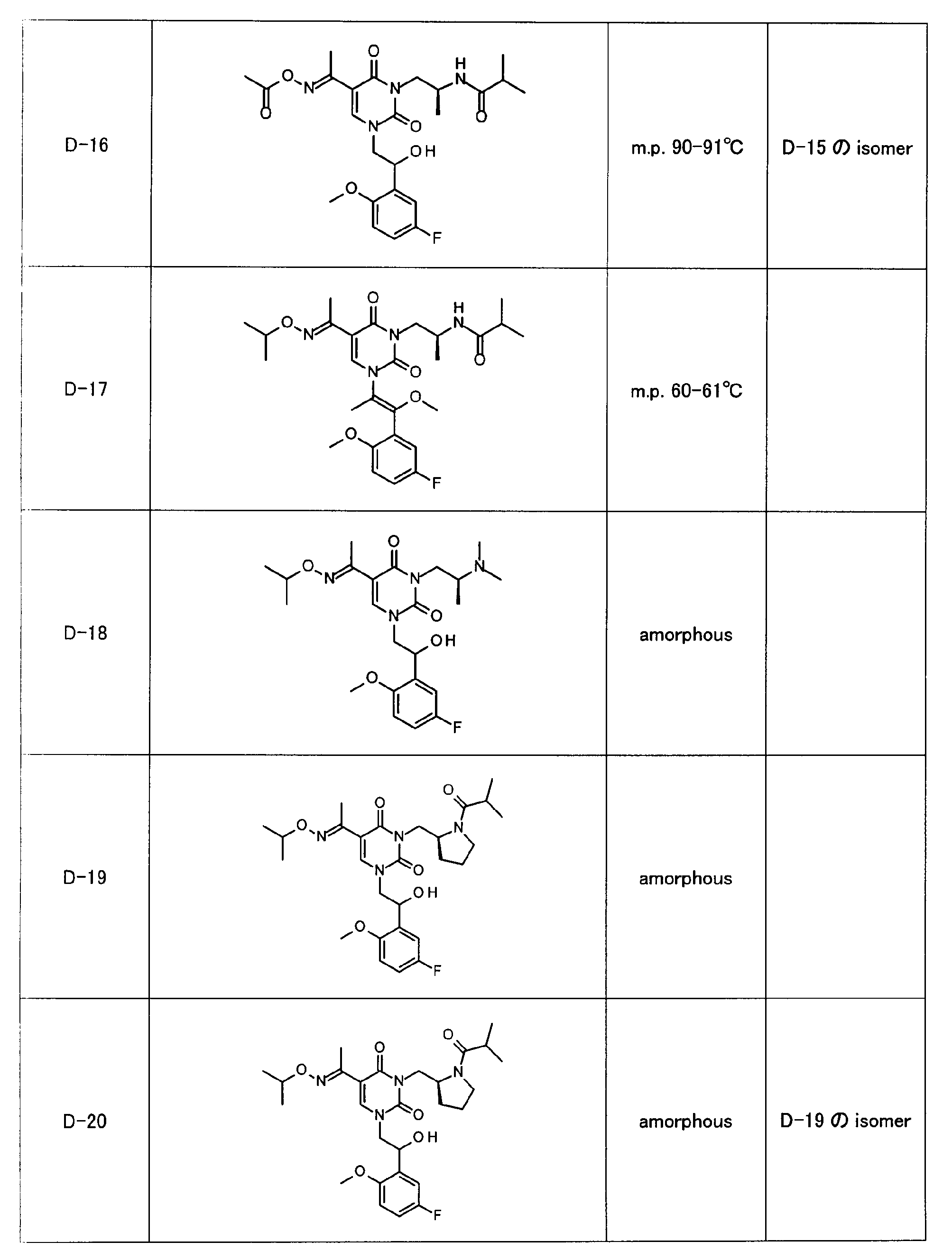


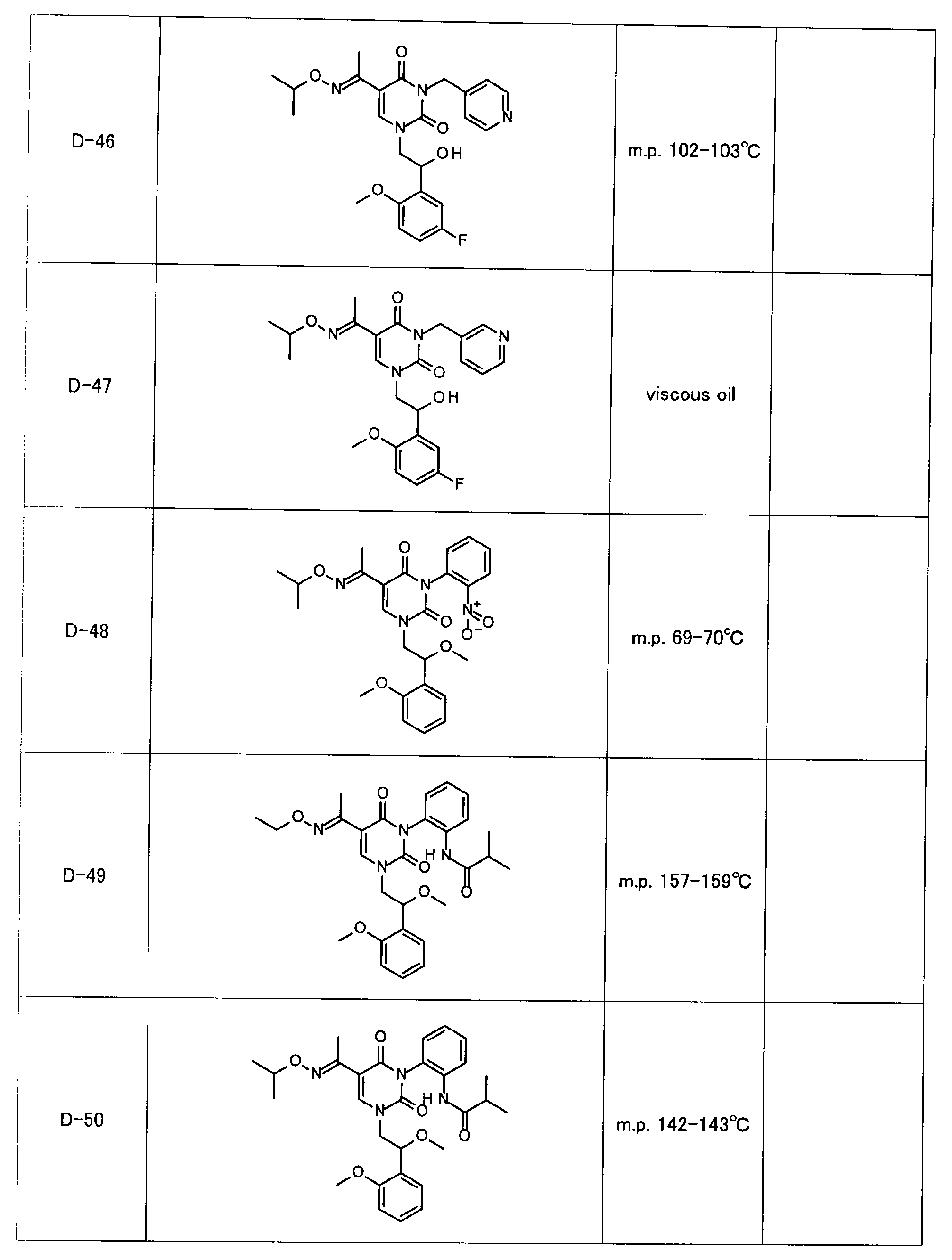


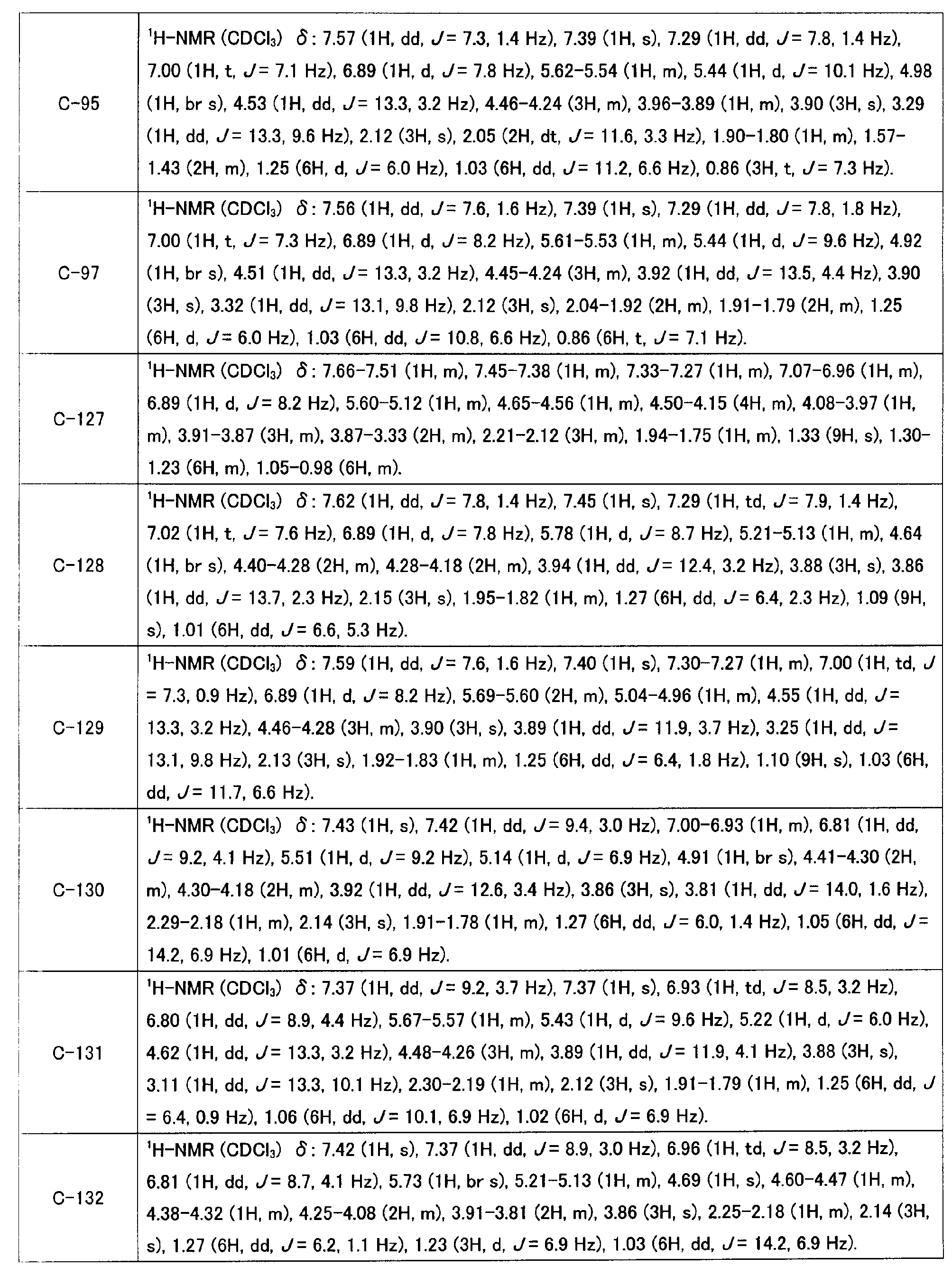


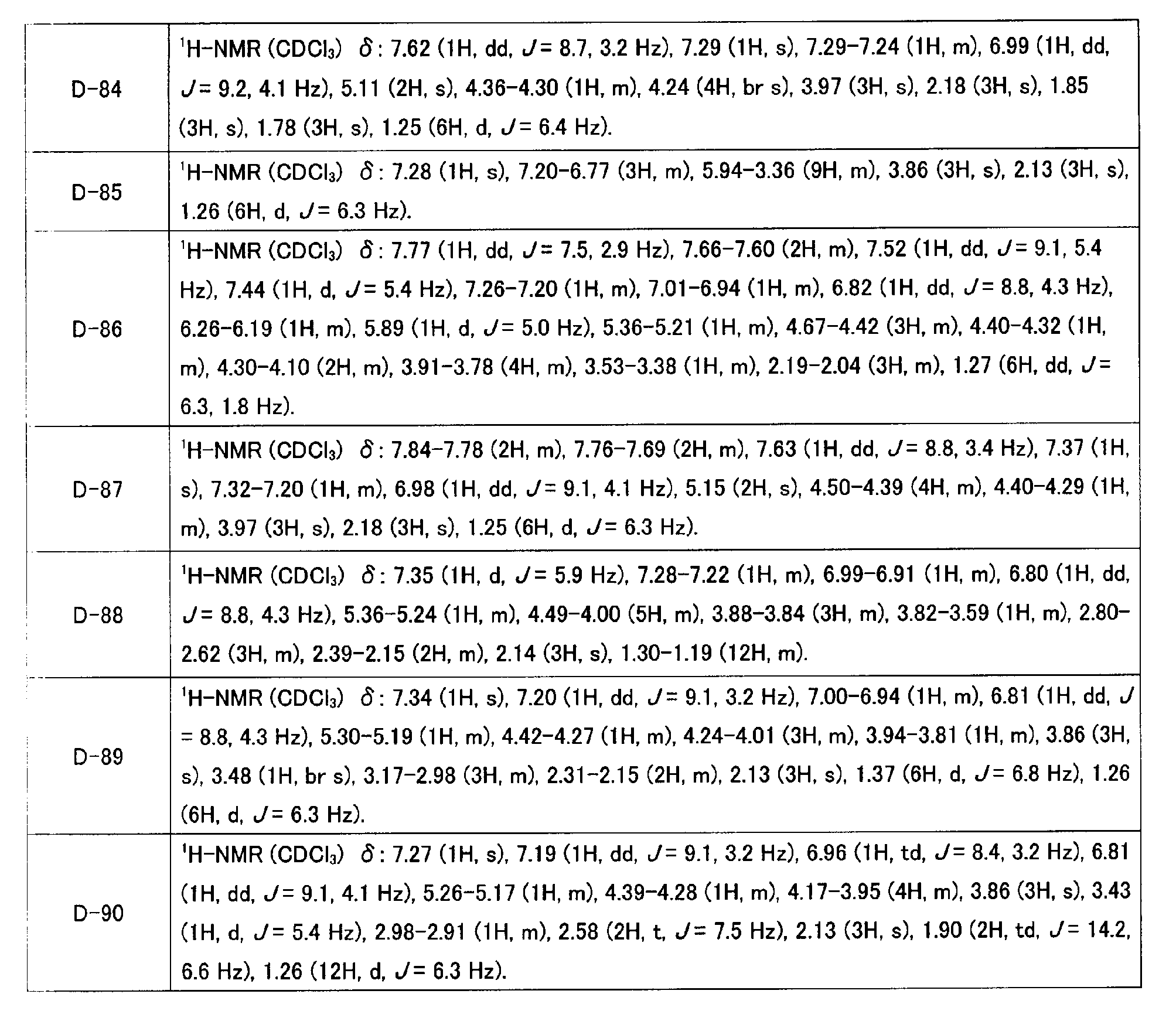
本発明のジヒドロピリミジン化合物が、農園芸用殺菌剤の有効成分として有用であることを以下の試験例で示す。
試験に使用したジヒドロピリミジン化合物を試験ごとに以下の表9および表10に示す。表9中の化合物番号は、表2~表4の化合物番号に対応する。表10中の化合物番号は、表6および表7の化合物番号に対応する。


本発明のジヒドロピリミジン化合物5重量部、N,N-ジメチルホルムアミド93.5重量部、およびポリオキシエチレンソルビタンモノラウレート(TWEEN(登録商標)20)1.5重量部を混合し、溶解させて、有効成分5%の乳剤(I)を得た。
防除価(%)=100-{処理区における病斑面積率/無処理区における病斑面積率}×100
乳剤(I)にジヒドロピリミジン化合物の濃度が125ppmになるように水を加え、溶解させて薬剤溶液を得た。続いて育苗用ポットで栽培したリンゴ幼苗(品種「王林」、3~4葉期)に、前記薬剤溶液を散布した。風乾後、リンゴ黒星病菌(Venturia inaequalis)の分生胞子を接種した(処理区)。対照として、薬剤溶液を散布しなかったリンゴ幼苗に同様に接種した(無処理区)。それらを、明暗を12時間毎に繰り返す20℃の湿室に静置した。
接種から2週間経過した日にリンゴ幼苗の葉を目視観察して、病斑面積率を求め、防除価を算出した。
乳剤(I)にジヒドロピリミジン化合物の濃度が125ppmになるように水を加え、溶解させて薬剤溶液を得た。続いて育苗用ポットで栽培したコムギ幼苗(品種「チホク」、1~2葉期)に前記薬剤溶液を散布した。風乾後、コムギうどんこ病菌(Erysiphe graminis f.sp.tritici)の分生胞子を振りかけて接種した(処理区)。対照として、薬剤溶液を散布しなかったコムギ幼苗に上記と同じ方法で接種した(無処理区)。それらを20℃の温室に静置した。
接種から6日間経過した日にコムギ幼苗の葉を目視観察して、病斑面積率を求め、防除価を算出した。
乳剤(I)にジヒドロピリミジン化合物の濃度が125ppmになるように水を加え、溶解させて薬剤溶液を得た。続いて育苗用ポットで栽培したコムギ幼苗(品種「農林61号」、1~2葉期)に前記薬剤溶液を散布した。風乾後、薬剤溶液を散布したコムギ幼苗にコムギ赤さび病菌(Puccinia recondita)の夏胞子をふり掛けて接種した(処理区)。対照として、薬剤溶液を散布しなかったコムギ幼苗に上記と同様にして接種した(無処理区)。それらを20℃の温室に静置した。
接種から12日間経過した日にコムギ苗の葉を目視観察して、病斑面積率を求め、防除価を算出した。
乳剤(I)にジヒドロピリミジン化合物の濃度が125ppmになるように水を加え、溶解させて薬剤溶液を得た。続いて育苗用ポットで栽培したキュウリ幼苗(品種「地這」系、子葉期)に、前記薬剤溶液を散布した。風乾後、キュウリ灰色かび病菌(Botrytis cinerea)の分生胞子懸濁液を滴下接種した(処理区)。対照として、薬剤溶液を散布しなかったキュウリ幼苗に上記と同じ方法で滴下接種した(無処理区)。それらを20℃の湿室に静置した。
接種から4日間経過した日にキュウリ幼苗の葉を目視観察して、病斑面積率を求め、防除価を算出した。
コムギ種子(品種「チホク」)に対して、(ジヒドロピリミジン化合物の重量)/(種子の重量)が100g/100kgとなるように乳剤(I)を種子処理した。これら種子をポットに播種し、8~10日後にコムギうどんこ病菌(Erysiphe graminis f.sp.tritici)の分生胞子を振りかけて接種した(処理区)。対照として、薬剤を処理しなかったコムギ幼苗に上記と同じ方法で接種した(無処理区)。それらを20℃の温室に静置した。
接種から7日間経過した日にコムギ幼苗の葉を目視観察して、病斑面積率を求め、防除価を算出した。
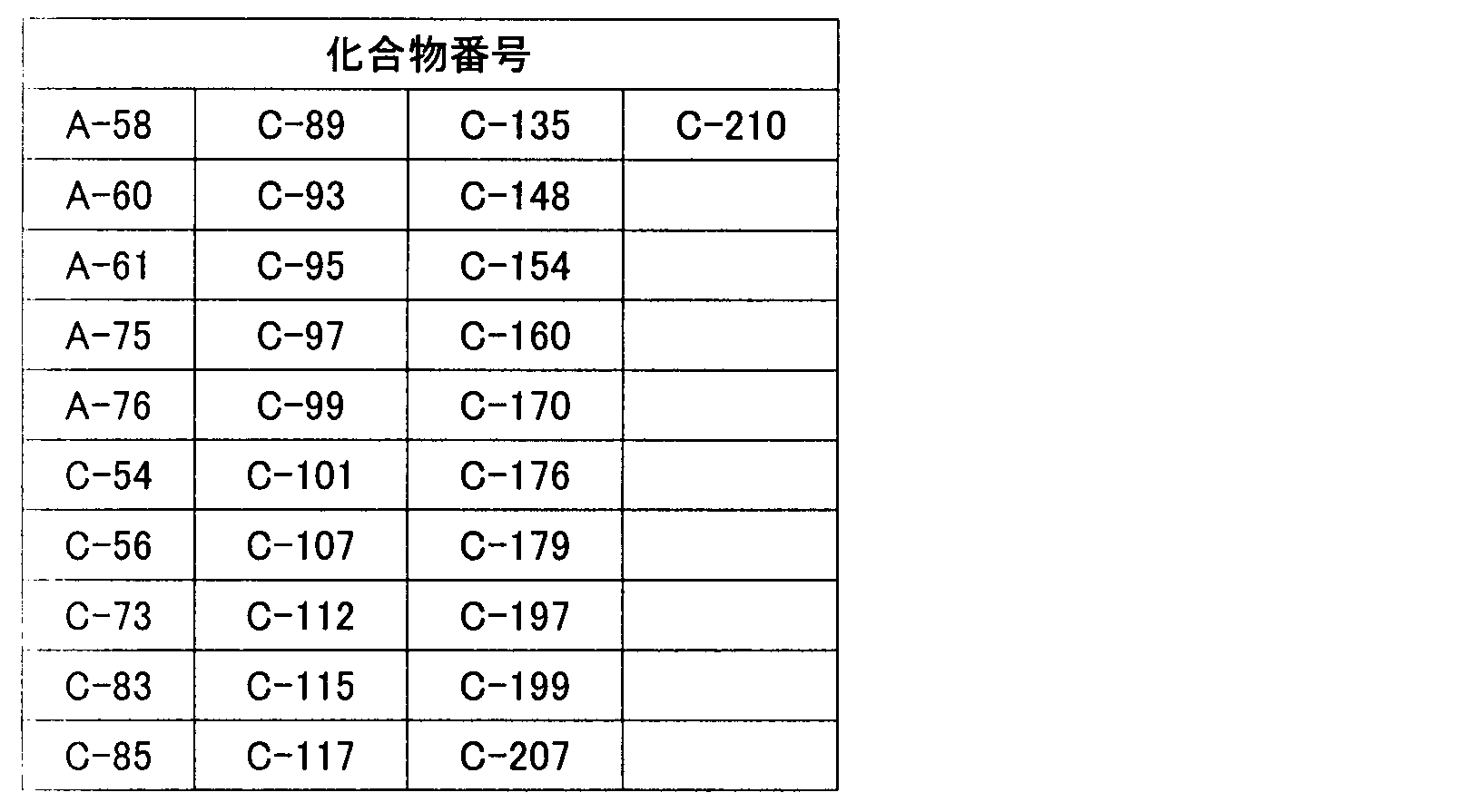
コムギ種子(品種「チホク」)を播種したポット(5.5cm×5.5cm)に、乳剤(I)に水を加えてジヒドロピリミジン化合物の濃度を100ppmにした薬剤溶液を10mL潅注し、8~10日後にコムギうどんこ病菌(Erysiphe graminis f.sp.tritici)の分生胞子を振りかけて接種した(処理区)。対照として、薬剤を処理しなかったコムギ幼苗に上記と同じ方法で接種した(無処理区)。それらを20℃の温室に静置した。
接種から7日間経過した日にコムギ幼苗の葉を目視観察して、病斑面積率を求め、防除価を算出した。

(試験例7)サツマイモネコブセンチュウに対する効力
96穴マイクロプレートに、サツマイモネコブセンチュウの2齢幼虫(L2)約50頭/0.16mLを含む懸濁液を1ウェル当たり160μL注ぎ入れ、次いで乳剤(I)に水を加えてジヒドロピリミジン化合物の濃度を125ppmにした薬剤溶液を、1ウェル当たり40μL注ぎ入れた。該プレートを20℃条件下に4日間放置した。
その後、生死判定を行い、殺線虫率を算出した。動きが10秒間認められない個体を死亡として判定した。試験は2反復で行った。
(試験例8)Fusarium graminearumに対する抗菌試験
乳剤(I)にジヒドロピリミジン化合物の濃度が125ppmになるように水を加え、溶解させて薬剤溶液を得た。
ジャガイモショ糖酵母エキス培地にFusarium graminearumの胞子を添加して分散させ、さらに上記の薬剤溶液を、ジヒドロピリミジン化合物の培養液中の濃度が15.6ppmとなるように添加混合し、これらを96穴マイクロプレート上に分注し、暗所、20℃で4日間培養した。
培養後、マイクロプレートリーダーで波長405nmにおける濁度を測定し、無処理の場合と比較してFusarium graminearumの生育阻害率(%)を求めた。
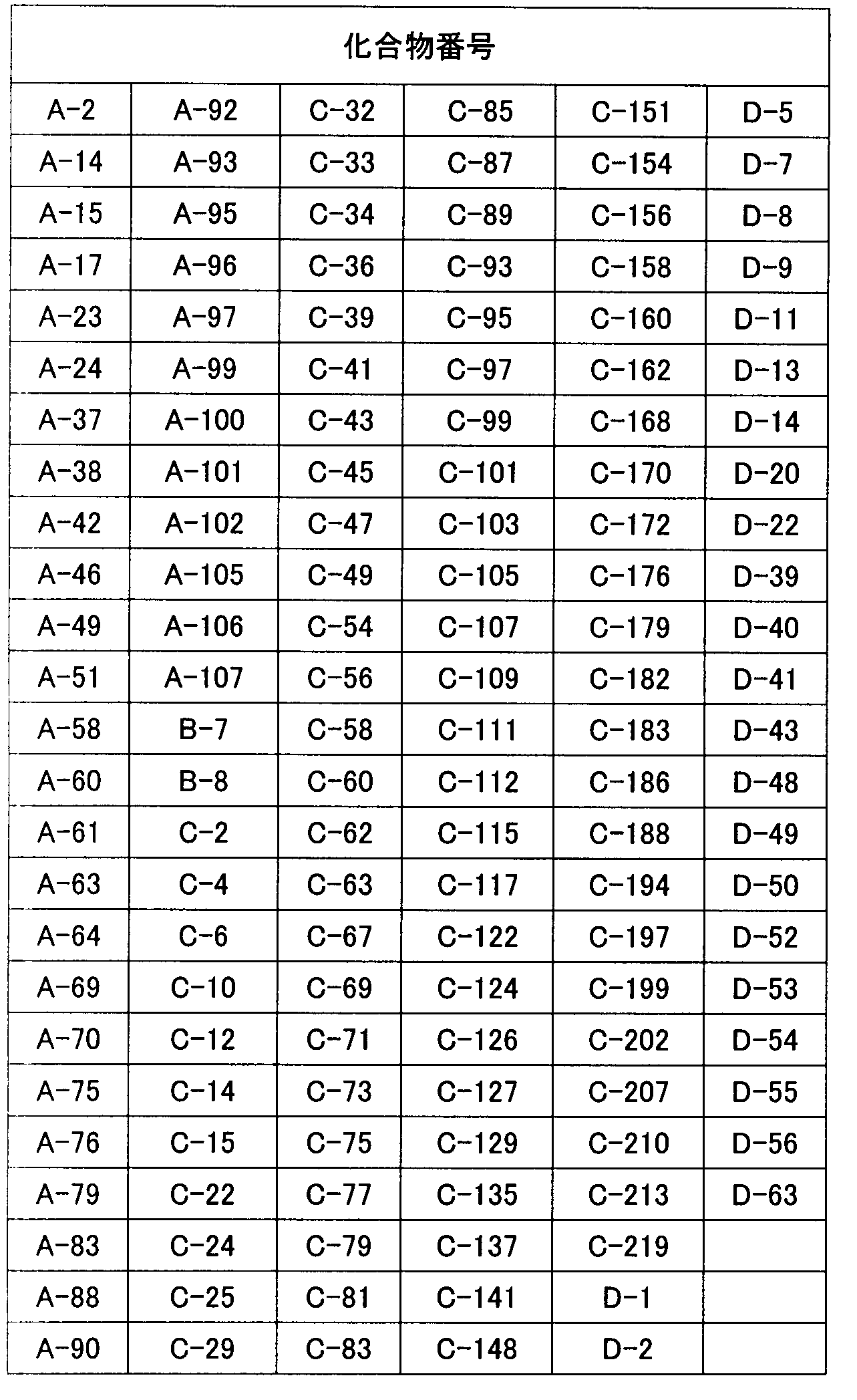
Vogel培地にAspergillus nigerの胞子を添加して分散させ、さらにジメチルスルホキシドに溶解したジヒドロピリミジン化合物を25ppmとなるように添加混合し、これらを96穴マイクロプレート上に分注し、暗所、25℃で4日間培養した。
培養後、マイクロプレートリーダーで波長405nmにおける濁度を測定し、無処理の場合と比較してAspergillus nigerの生育阻害率(%)を求めた。

Claims (10)
- 式(II)で表される化合物またはその塩。
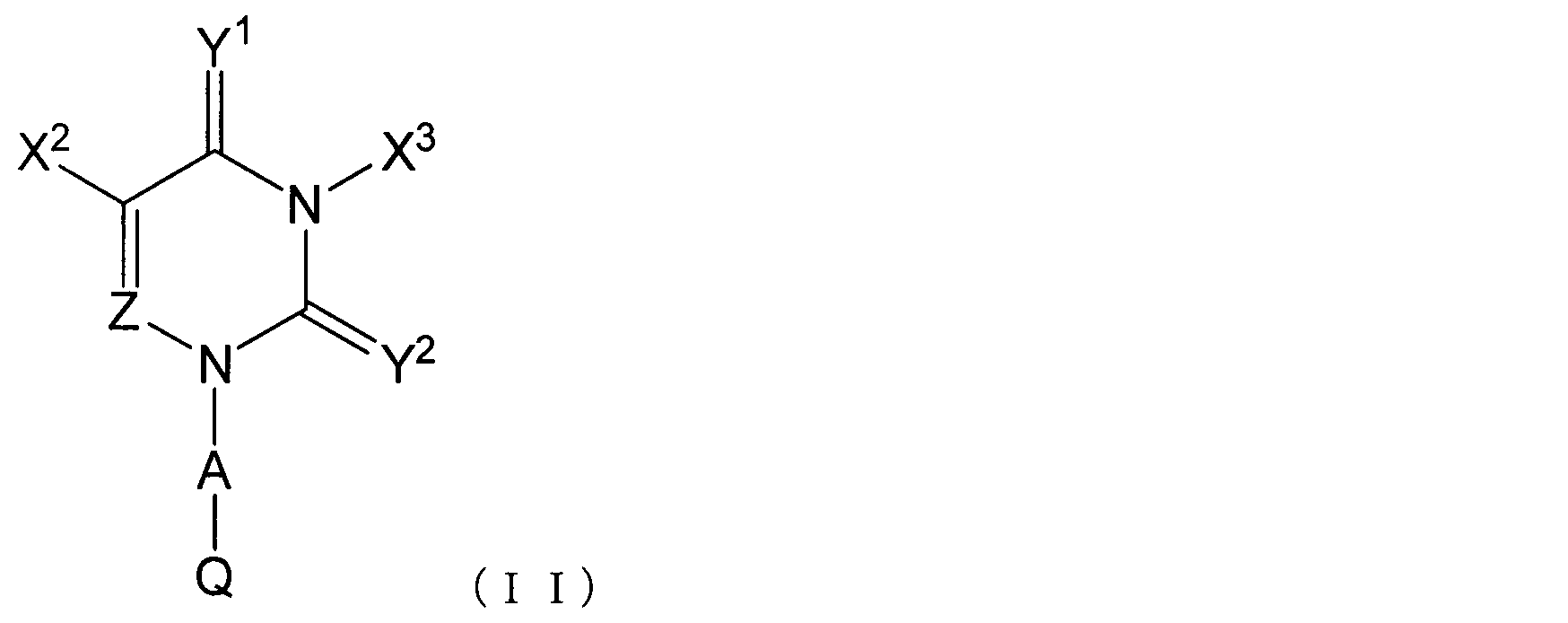
Y1は、酸素原子または硫黄原子を示し;
Y2は、酸素原子または硫黄原子を示し;
Zは、C-X1で表される基または窒素原子を示し;
X1は、水素原子、ハロゲノ基、置換若しくは無置換のC1~6アルキル基、置換若しくは無置換のC2~6アルケニル基、置換若しくは無置換のC2~6アルキニル基、水酸基、置換若しくは無置換のC1~6アルコキシ基、置換若しくは無置換のC2~6アルケニルオキシ基、置換若しくは無置換のC2~6アルキニルオキシ基、置換若しくは無置換のC1~6アルキルチオ基、置換若しくは無置換のC1~6アルキルスルフィニル基、置換若しくは無置換のC1~6アルキルスルホニル基、置換若しくは無置換のC3~6シクロアルキル基、置換若しくは無置換のC3~6シクロアルキルオキシ基、置換若しくは無置換のC6~10アリール基、置換若しくは無置換のC6~10アリールオキシ基、置換若しくは無置換のC6~10アリールチオ基、置換若しくは無置換のC6~10アリールスルフィニル基、置換若しくは無置換のC6~10アリールスルホニル基、置換若しくは無置換の5~6員環のヘテロシクリル基、置換若しくは無置換の5~6員環のヘテロシクリルオキシ基、ニトロ基、シアノ基、R1-CO-で表される基、カルボキシ基、R2-O-CO-で表される基、R3R4N-で表される基、R3R4N-CO-で表される基、R1-CO-O-で表される基、R1-CO-NR5-で表される基、R2-O-CO-O-で表される基、R2-O-CO-NR5-で表される基、R3R4N-CO-O-で表される基、R3R4N-CO-NR5-で表される基、R2SO2-NR5-で表される基、R3R4N-SO2-で表される基、またはR1O-N=CR6-で表される基を示し;
R1は、それぞれ独立に、水素原子、置換若しくは無置換のC1~6アルキル基、置換若しくは無置換のC2~6アルケニル基、置換若しくは無置換のC2~6アルキニル基、置換若しくは無置換のC3~6シクロアルキル基、置換若しくは無置換のC6~10アリール基、または置換若しくは無置換の5~6員環のヘテロシクリル基を示し、
R2は、それぞれ独立に、置換若しくは無置換のC1~6アルキル基、置換若しくは無置換のC2~6アルケニル基、置換若しくは無置換のC2~6アルキニル基、置換若しくは無置換のC3~6シクロアルキル基、置換若しくは無置換のC6~10アリール基、または置換若しくは無置換の5~6員環のヘテロシクリル基を示し、
R3は、それぞれ独立に、水素原子、置換若しくは無置換のC1~6アルキル基、置換若しくは無置換のC2~6アルケニル基、置換若しくは無置換のC2~6アルキニル基、置換若しくは無置換のC3~6シクロアルキル基、置換若しくは無置換のC6~10アリール基、または置換若しくは無置換の5~6員環のヘテロシクリル基を示し、
R4は、それぞれ独立に、水素原子、置換若しくは無置換のC1~6アルキル基、または置換若しくは無置換のC6~10アリール基を示し、
ここで、R3とR4は、一緒になって二価の有機基を形成してもよく、
R5は、それぞれ独立に、水素原子、置換若しくは無置換のC1~6アルキル基、または置換若しくは無置換のC6~10アリール基を示し、
R6は、水素原子、ハロゲノ基、アミノ基、置換若しくは無置換のモノC1~6アルキルアミノ基、置換若しくは無置換のジC1~6アルキルアミノ基、置換若しくは無置換のC1~6アルキル基、置換もしくは無置換のC1~6アルコキシ基、置換若しくは無置換のC1~6アルキルチオ基、または置換若しくは無置換の5~6員環のヘテロシクリル基を示し;
X2は、R1O-N=CR6-で表される基、R1CO-O-N=CR6-で表される基、R3R4N-CO-O-N=CR6-で表される基、R3R4N-N=CR6-で表される基、またはR7-N=CR6-で表される基を示し;R1、R3、R4、およびR6は、X1におけるそれらと同様の意味を示し;R7は、置換若しくは無置換の5員環のヘテロシクリル基を示し;
X3は、置換若しくは無置換の直鎖C1~6アルキル基、置換若しくは無置換の直鎖C2~6アルケニル基、置換若しくは無置換の直鎖C2~6アルキニル基、R1-CO-で表される基、置換若しくは無置換のC3~6シクロアルキル基、置換若しくは無置換のC6~10アリール基、または置換若しくは無置換の4~6員環のヘテロシクリル基を示し;
Aは、置換若しくは無置換のC1~6アルキレン基、置換若しくは無置換のC2~6アルケニレン基、置換若しくは無置換のC2~6アルキニレン基、または置換若しくは無置換のC3~6シクロアルキレン基を示し;
Qは、置換若しくは無置換のC6~10アリール基、または置換若しくは無置換の5~10員環のヘテロシクリル基を示す。〕 - 式(II)が式(I)で表される、請求項1に記載の化合物またはその塩。
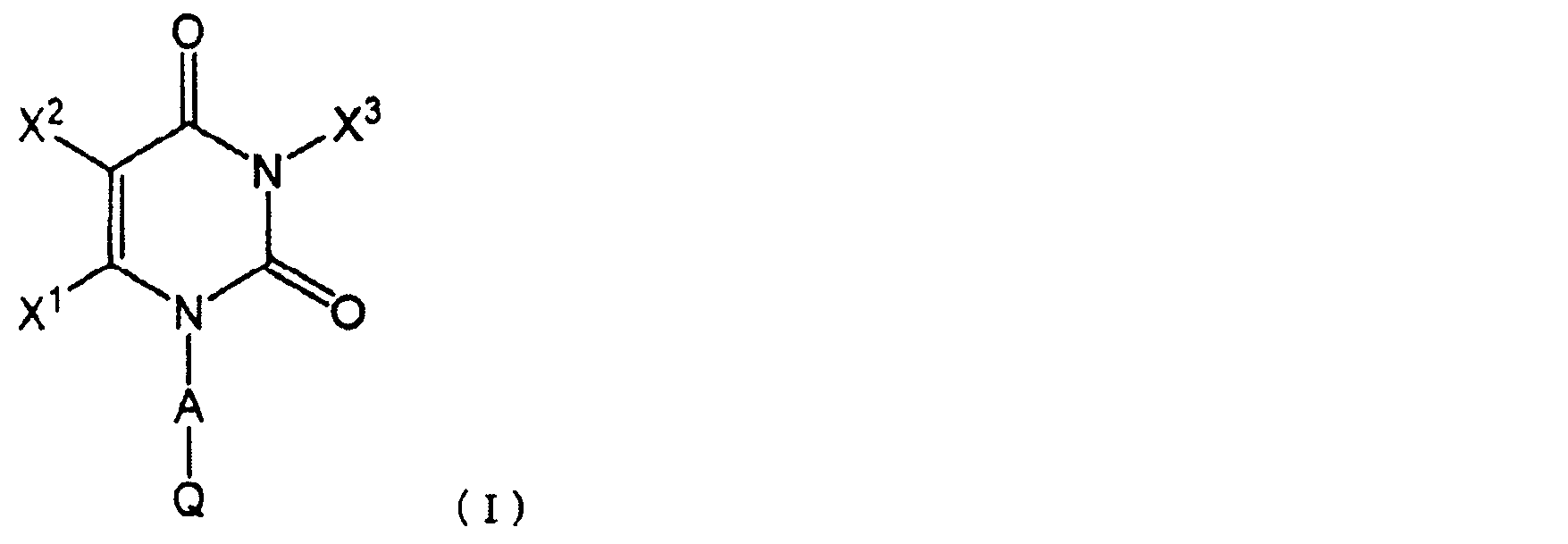
- X3における直鎖C1~6アルキル基上の置換基、直鎖C2~6アルケニル基上の置換基、直鎖C2~6アルキニル基上の置換基、C3~6シクロアルキル基上の置換基、C6~10アリール基上の置換基、または4~6員環のヘテロシクリル基上の置換基が、
ハロゲノ基、置換若しくは無置換のC1~6アルキル基、置換若しくは無置換のC2~6アルケニル基、置換若しくは無置換のC2~6アルキニル基、水酸基、置換若しくは無置換のC1~6アルコキシ基、置換若しくは無置換のC2~6アルケニルオキシ基、置換若しくは無置換のC2~6アルキニルオキシ基、置換若しくは無置換のC1~6アルキルチオ基、置換若しくは無置換のC1~6アルキルスルフィニル基、置換若しくは無置換のC1~6アルキルスルホニル基、置換若しくは無置換のC3~6シクロアルキル基、置換若しくは無置換のC3~6シクロアルキルオキシ基、置換若しくは無置換のC6~10アリール基、置換若しくは無置換のC6~10アリールオキシ基、置換若しくは無置換のC6~10アリールチオ基、置換若しくは無置換のC6~10アリールスルフィニル基、置換若しくは無置換のC6~10アリールスルホニル基、置換若しくは無置換の3~10員環のヘテロシクリル基、置換若しくは無置換の3~10員環のヘテロシクリルオキシ基、ニトロ基、シアノ基、Ra-CO-で表される基、カルボキシ基、Rb-O-CO-で表される基、RcRdN-で表される基、RcRdN-CO-で表される基、RcRdN-NRd-CO-で表される基、Ra-CO-O-で表される基、Ra-CO-NRe-で表される基、Ra-CO-CO-NRe-で表される基、Ra-CO-NRe-NRe-で表される基、Ra-CO-NRe-NRe-CO-で表される基、Rb-O-CO-O-で表される基、Rb-O-CO-NRe-で表される基、RcRdN-CO-O-で表される基、RcRdN-CO-NRe-で表される基、RcRdN-CO-CO-NRe-で表される基、Ra-CS-NRe-で表される基、RcRdN-CS-NRe-で表される基、RbSO2-NRe-で表される基、RcRdN-SO2-で表される基、RaO-N=CRf-で表される基、RhRiC=N-O-で表される基、Ra-C(=NRg)-NRe-で表される基、RcRdN-C(=NRg)-で表される基、RhRiS(=O)=N-CO-で表される基、およびRhRiS=N-CO-で表される基からなる群より選択される1または2以上の置換基であって;
Raは、それぞれ独立に、水素原子、置換若しくは無置換のC1~6アルキル基、置換若しくは無置換のC2~6アルケニル基、置換若しくは無置換のC2~6アルキニル基、置換若しくは無置換のC3~6シクロアルキル基、置換若しくは無置換のC6~10アリール基、または置換若しくは無置換の3~10員環のヘテロシクリル基を示し、
Rbは、それぞれ独立に、置換若しくは無置換のC1~6アルキル基、置換若しくは無置換のC2~6アルケニル基、置換若しくは無置換のC2~6アルキニル基、置換若しくは無置換のC3~6シクロアルキル基、置換若しくは無置換のC6~10アリール基、または置換若しくは無置換の5~6員環のヘテロシクリル基を示し、
Rcは、それぞれ独立に、水素原子、置換若しくは無置換のC1~6アルキル基、置換若しくは無置換のC2~6アルケニル基、置換若しくは無置換のC2~6アルキニル基、置換若しくは無置換のC3~6シクロアルキル基、置換若しくは無置換のC6~10アリール基、または置換若しくは無置換の5~6員環のヘテロシクリル基を示し、
Rdは、それぞれ独立に、水素原子、置換若しくは無置換のC1~6アルキル基、置換若しくは無置換のC1~6アルコキシ基、または置換若しくは無置換のC6~10アリール基を示し、ここで、RcとRdは、一緒になって二価の有機基を形成してもよく、
Reは、それぞれ独立に、水素原子、置換若しくは無置換のC1~6アルキル基、置換若しくは無置換のC1~6アルコキシ基、または置換若しくは無置換のC6~10アリール基を示し、
Rfは、水素原子、アミノ基、または置換若しくは無置換のC1~6アルキル基を示し、
Rgは、それぞれ独立に、水素原子、置換若しくは無置換のC1~6アルキル基、または置換若しくは無置換のC6~10アリール基を示し、
Rhは、それぞれ独立に、置換若しくは無置換のC1~6アルキル基、または置換若しくは無置換のC6~10アリール基を示し、
Riは、それぞれ独立に、置換若しくは無置換のC1~6アルキル基、または置換若しくは無置換のC6~10アリール基を示し、ここで、RhとRiは、一緒になって二価の有機基を形成してもよく;
直鎖C1~6アルキル基上の置換基は2以上ある場合、そのうちの2つが一緒になって二価の有機基を形成してもよいものである;
請求項1または2に記載の化合物またはその塩。 - AにおけるC1~6アルキレン基またはC2~6アルケニレン基上の置換基が、
ハロゲノ基、置換若しくは無置換のC1~6アルキル基、置換若しくは無置換のC2~6アルケニル基、置換若しくは無置換のC2~6アルキニル基、水酸基、置換若しくは無置換のC1~6アルコキシ基、置換若しくは無置換のC2~6アルケニルオキシ基、置換若しくは無置換のC2~6アルキニルオキシ基、メルカプト基、置換若しくは無置換のC1~6アルキルチオ基、置換若しくは無置換のC1~6アルキルスルフィニル基、置換若しくは無置換のC1~6アルキルスルホニル基、置換若しくは無置換のC3~6シクロアルキル基、置換若しくは無置換のC3~6シクロアルキルオキシ基、置換若しくは無置換のC6~10アリール基、置換若しくは無置換のC6~10アリールオキシ基、置換若しくは無置換のC6~10アリールチオ基、置換若しくは無置換のC6~10アリールスルフィニル基、置換若しくは無置換のC6~10アリールスルホニル基、置換若しくは無置換の3~6員環のヘテロシクリル基、置換若しくは無置換の3~6員環のヘテロシクリルオキシ基、ニトロ基、シアノ基、Ra1-CO-で表される基、カルボキシ基、Rb1-O-CO-で表される基、Rc1Rd1N-で表される基、Rc1Rd1N-CO-で表される基、Ra1-CO-O-で表される基、Ra1-CO-NRe1-で表される基、Rb1-O-CO-O-で表される基、Rb1-O-CO-NRe1-で表される基、Rc1Rd1N-CO-O-で表される基、Rc1Rd1N-CO-NRe1-で表される基、Rb1SO2-NRe1-で表される基、Rc1Rd1N-SO2-で表される基、Ra1O-N=CRf1-で表される基、Rg1Rh1C=N-O-で表される基、オキソ基(O=)、チオキソ基(S=)、Ra1-N=で表される二価の基、Ra1O-N=で表される二価の基、Rc1Rd1N-N=で表される二価の基、Ra1-CO-NRe1-N=で表される二価の基、Rb1-O-CO-NRe1-N=で表される二価の基、Rb1SO2-NRe1-N=で表される二価の基からなる群より選択される1または2以上の置換基であって;
Ra1は、それぞれ独立に、水素原子、置換若しくは無置換のC1~6アルキル基、置換若しくは無置換のC2~6アルケニル基、置換若しくは無置換のC2~6アルキニル基、置換若しくは無置換のC3~6シクロアルキル基、置換若しくは無置換のC6~10アリール基、または置換若しくは無置換の5~6員環のヘテロシクリル基を示し、
Rb1は、それぞれ独立に、置換若しくは無置換のC1~6アルキル基、置換若しくは無置換のC2~6アルケニル基、置換若しくは無置換のC2~6アルキニル基、置換若しくは無置換のC3~6シクロアルキル基、置換若しくは無置換のC6~10アリール基、または置換若しくは無置換の5~6員環のヘテロシクリル基を示し、
Rc1は、それぞれ独立に、水素原子、置換若しくは無置換のC1~6アルキル基、置換若しくは無置換のC2~6アルケニル基、置換若しくは無置換のC2~6アルキニル基、置換若しくは無置換のC3~6シクロアルキル基、置換若しくは無置換のC6~10アリール基、または置換若しくは無置換の5~6員環のヘテロシクリル基を示し、
Rd1は、それぞれ独立に、水素原子、置換若しくは無置換のC1~6アルキル基、または置換若しくは無置換のC6~10アリール基を示し、ここで、Rc1とRd1は、一緒になって二価の有機基を形成してもよく、
Re1は、それぞれ独立に、水素原子、置換若しくは無置換のC1~6アルキル基、または置換若しくは無置換のC6~10アリール基を示し、
Rf1は、水素原子、または置換若しくは無置換のC1~6アルキル基を示し、
Rg1は、置換若しくは無置換のC1~6アルキル基、置換若しくは無置換のC2~6アルケニル基、置換若しくは無置換のC2~6アルキニル基、置換若しくは無置換のC3~6シクロアルキル基、置換若しくは無置換のC6~10アリール基、または置換若しくは無置換の5~6員環のヘテロシクリル基を示し、
Rh1は、水素原子、または置換若しくは無置換のC1~6アルキル基を示し、ここで、Rg1とRh1は、一緒になって二価の有機基を形成してもよく;
C1~6アルキレン基またはC2~6アルケニレン基上の置換基は2以上ある場合、そのうちの2つが一緒になって二価の有機基を形成してもよいものである;
請求項1~3のいずれかに記載の化合物またはその塩。 - 請求項1~4のいずれかに記載の化合物、およびそれらの塩からなる群から選ばれる少なくとも1つを有効成分として含有する農園芸用殺菌剤。
- 種子処理用である、請求項5に記載の農園芸用殺菌剤。
- 請求項1~4のいずれかに記載の化合物、およびそれらの塩からなる群から選ばれる少なくとも1つを有効成分として含有する殺線虫剤。
- 請求項1~4のいずれかに記載の化合物、およびそれらの塩からなる群から選ばれる少なくとも1つを有効成分として含有する医療用・動物用抗真菌剤。
- 式(III)で表される化合物またはその塩。
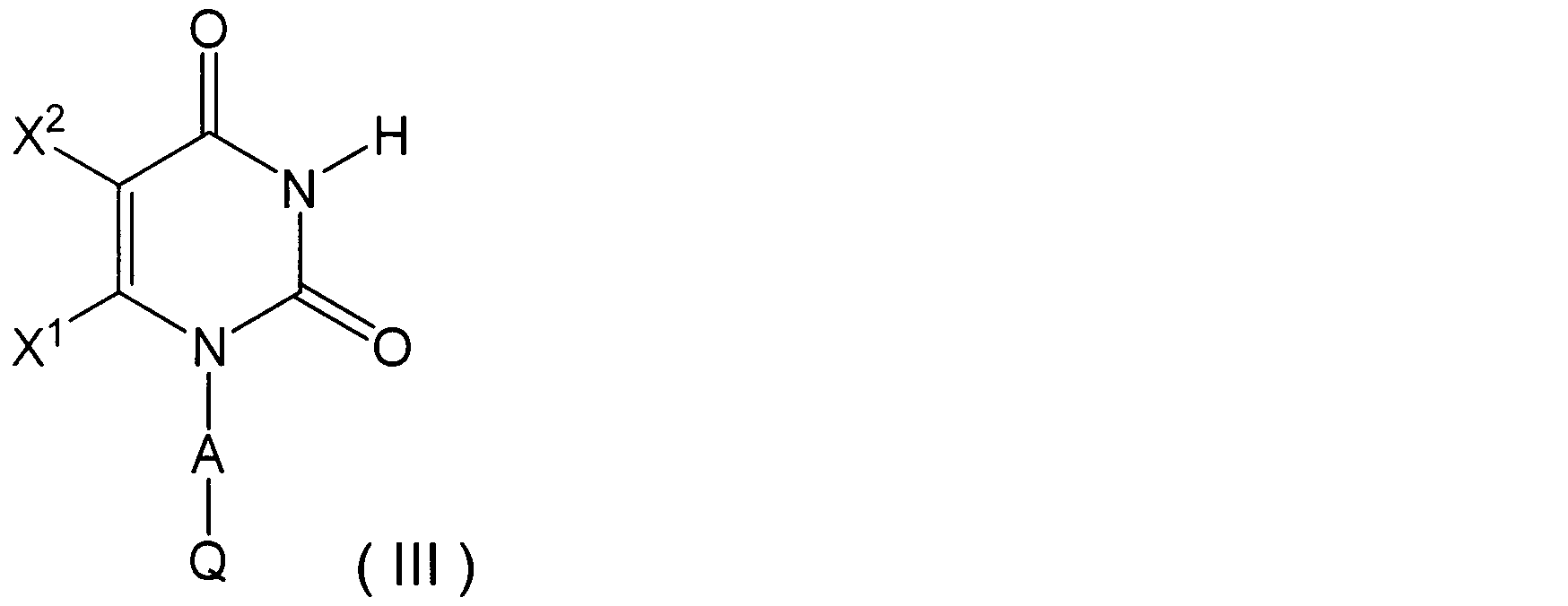
X1は、水素原子、ハロゲノ基、置換若しくは無置換のC1~6アルキル基、置換若しくは無置換のC2~6アルケニル基、置換若しくは無置換のC2~6アルキニル基、水酸基、置換若しくは無置換のC1~6アルコキシ基、置換若しくは無置換のC2~6アルケニルオキシ基、置換若しくは無置換のC2~6アルキニルオキシ基、置換若しくは無置換のC1~6アルキルチオ基、置換若しくは無置換のC1~6アルキルスルフィニル基、置換若しくは無置換のC1~6アルキルスルホニル基、置換若しくは無置換のC3~6シクロアルキル基、置換若しくは無置換のC3~6シクロアルキルオキシ基、置換若しくは無置換のC6~10アリール基、置換若しくは無置換のC6~10アリールオキシ基、置換若しくは無置換のC6~10アリールチオ基、置換若しくは無置換のC6~10アリールスルフィニル基、置換若しくは無置換のC6~10アリールスルホニル基、置換若しくは無置換の5~6員環のヘテロシクリル基、置換若しくは無置換の5~6員環のヘテロシクリルオキシ基、ニトロ基、シアノ基、R1-CO-で表される基、カルボキシ基、R2-O-CO-で表される基、R3R4N-で表される基、R3R4N-CO-で表される基、R1-CO-O-で表される基、R1-CO-NR5-で表される基、R2-O-CO-O-で表される基、R2-O-CO-NR5-で表される基、R3R4N-CO-O-で表される基、R3R4N-CO-NR5-で表される基、R2SO2-NR5-で表される基、R3R4N-SO2-で表される基、またはR1O-N=CR6-で表される基を示し;
R1は、それぞれ独立に、水素原子、置換若しくは無置換のC1~6アルキル基、置換若しくは無置換のC2~6アルケニル基、置換若しくは無置換のC2~6アルキニル基、置換若しくは無置換のC3~6シクロアルキル基、置換若しくは無置換のC6~10アリール基、または置換若しくは無置換の5~6員環のヘテロシクリル基を示し、
R2は、それぞれ独立に、置換若しくは無置換のC1~6アルキル基、置換若しくは無置換のC2~6アルケニル基、置換若しくは無置換のC2~6アルキニル基、置換若しくは無置換のC3~6シクロアルキル基、置換若しくは無置換のC6~10アリール基、または置換若しくは無置換の5~6員環のヘテロシクリル基を示し、
R3は、それぞれ独立に、水素原子、置換若しくは無置換のC1~6アルキル基、置換若しくは無置換のC2~6アルケニル基、置換若しくは無置換のC2~6アルキニル基、置換若しくは無置換のC3~6シクロアルキル基、置換若しくは無置換のC6~10アリール基、または置換若しくは無置換の5~6員環のヘテロシクリル基を示し、
R4は、それぞれ独立に、水素原子、置換若しくは無置換のC1~6アルキル基、または置換若しくは無置換のC6~10アリール基を示し、
ここで、R3とR4は、一緒になって二価の有機基を形成してもよく、
R5は、それぞれ独立に、水素原子、置換若しくは無置換のC1~6アルキル基、または置換若しくは無置換のC6~10アリール基を示し、
R6は、水素原子、ハロゲノ基、アミノ基、置換若しくは無置換のモノC1~6アルキルアミノ基、置換若しくは無置換のジC1~6アルキルアミノ基、置換若しくは無置換のC1~6アルキル基、置換もしくは無置換のC1~6アルコキシ基、置換若しくは無置換のC1~6アルキルチオ基、または置換若しくは無置換の5~6員環のヘテロシクリル基を示し;
X2は、R1O-N=CR6-で表される基、R1CO-O-N=CR6-で表される基、R3R4N-CO-O-N=CR6-で表される基、R3R4N-N=CR6-で表される基、またはR7-N=CR6-で表される基を示し;R1、R3、R4、およびR6は、X1におけるそれらと同様の意味を示し;R7は、置換若しくは無置換の5員環のヘテロシクリル基を示し;
Aは、置換若しくは無置換のC1~6アルキレン基、置換若しくは無置換のC2~6アルケニレン基、置換若しくは無置換のC2~6アルキニレン基、または置換若しくは無置換のC3~6シクロアルキレン基を示し;
Qは、置換若しくは無置換のC6~10アリール基、または置換若しくは無置換の5~10員環のヘテロシクリル基を示す。〕 - 式(IV)で表される化合物またはその塩。

X1は、水素原子、ハロゲノ基、置換若しくは無置換のC1~6アルキル基、置換若しくは無置換のC2~6アルケニル基、置換若しくは無置換のC2~6アルキニル基、水酸基、置換若しくは無置換のC1~6アルコキシ基、置換若しくは無置換のC2~6アルケニルオキシ基、置換若しくは無置換のC2~6アルキニルオキシ基、置換若しくは無置換のC1~6アルキルチオ基、置換若しくは無置換のC1~6アルキルスルフィニル基、置換若しくは無置換のC1~6アルキルスルホニル基、置換若しくは無置換のC3~6シクロアルキル基、置換若しくは無置換のC3~6シクロアルキルオキシ基、置換若しくは無置換のC6~10アリール基、置換若しくは無置換のC6~10アリールオキシ基、置換若しくは無置換のC6~10アリールチオ基、置換若しくは無置換のC6~10アリールスルフィニル基、置換若しくは無置換のC6~10アリールスルホニル基、置換若しくは無置換の5~6員環のヘテロシクリル基、置換若しくは無置換の5~6員環のヘテロシクリルオキシ基、ニトロ基、シアノ基、R1-CO-で表される基、カルボキシ基、R2-O-CO-で表される基、R3R4N-で表される基、R3R4N-CO-で表される基、R1-CO-O-で表される基、R1-CO-NR5-で表される基、R2-O-CO-O-で表される基、R2-O-CO-NR5-で表される基、R3R4N-CO-O-で表される基、R3R4N-CO-NR5-で表される基、R2SO2-NR5-で表される基、R3R4N-SO2-で表される基、またはR1O-N=CR6-で表される基を示し;
R1は、それぞれ独立に、水素原子、置換若しくは無置換のC1~6アルキル基、置換若しくは無置換のC2~6アルケニル基、置換若しくは無置換のC2~6アルキニル基、置換若しくは無置換のC3~6シクロアルキル基、置換若しくは無置換のC6~10アリール基、または置換若しくは無置換の5~6員環のヘテロシクリル基を示し、
R2は、それぞれ独立に、置換若しくは無置換のC1~6アルキル基、置換若しくは無置換のC2~6アルケニル基、置換若しくは無置換のC2~6アルキニル基、置換若しくは無置換のC3~6シクロアルキル基、置換若しくは無置換のC6~10アリール基、または置換若しくは無置換の5~6員環のヘテロシクリル基を示し、
R3は、それぞれ独立に、水素原子、置換若しくは無置換のC1~6アルキル基、置換若しくは無置換のC2~6アルケニル基、置換若しくは無置換のC2~6アルキニル基、置換若しくは無置換のC3~6シクロアルキル基、置換若しくは無置換のC6~10アリール基、または置換若しくは無置換の5~6員環のヘテロシクリル基を示し、
R4は、それぞれ独立に、水素原子、置換若しくは無置換のC1~6アルキル基、または置換若しくは無置換のC6~10アリール基を示し、
ここで、R3とR4は、一緒になって二価の有機基を形成してもよく、
R5は、それぞれ独立に、水素原子、置換若しくは無置換のC1~6アルキル基、または置換若しくは無置換のC6~10アリール基を示し、
R6は、水素原子、ハロゲノ基、アミノ基、置換若しくは無置換のモノC1~6アルキルアミノ基、置換若しくは無置換のジC1~6アルキルアミノ基、置換若しくは無置換のC1~6アルキル基、置換もしくは無置換のC1~6アルコキシ基、置換若しくは無置換のC1~6アルキルチオ基、または置換若しくは無置換の5~6員環のヘテロシクリル基を示し;
X2は、R1O-N=CR6-で表される基、R1CO-O-N=CR6-で表される基、R3R4N-CO-O-N=CR6-で表される基、R3R4N-N=CR6-で表される基、またはR7-N=CR6-で表される基を示し;R1、R3、R4、およびR6は、X1におけるそれらと同様の意味を示し;R7は、置換若しくは無置換の5員環のヘテロシクリル基を示し;
X3は、置換若しくは無置換の直鎖C1~6アルキル基、置換若しくは無置換の直鎖C2~6アルケニル基、置換若しくは無置換の直鎖C2~6アルキニル基、R1-CO-で表される基、置換若しくは無置換のC3~6シクロアルキル基、置換若しくは無置換のC6~10アリール基、または置換若しくは無置換の4~6員環のヘテロシクリル基を示し;
X4は、水素原子またはC1~6アルコキシメチル基を示す。〕
Priority Applications (17)
| Application Number | Priority Date | Filing Date | Title |
|---|---|---|---|
| IL292321A IL292321A (en) | 2019-10-28 | 2020-10-26 | A 2,6-dioxo-3,6-dihydropyrimidine compound, an agricultural and horticultural bactericide, a nematode, and a medical and veterinary antifungal agent |
| MX2022004804A MX2022004804A (es) | 2019-10-28 | 2020-10-26 | Compuesto de 2,6-dioxo-3,6-dihidropirimidina, bactericida agricola y horticola, nematicida y agente antifungico medico y veterinario. |
| CA3157658A CA3157658C (en) | 2019-10-28 | 2020-10-26 | COMPOUND 2,6-DIOXO-3,6-DIHYDROPYRIMIDINE, AGRICULTURAL AND HORTICULTURAL BACTERICIDE, NEMATICIDE AND MEDICAL AND VETERINARY ANTIFUNGAL AGENT |
| BR112022005467A BR112022005467A2 (pt) | 2019-10-28 | 2020-10-26 | Composto, fungicida para agricultura e horticultura, nematicida, e, agente antifúngico |
| US17/767,749 US12593845B2 (en) | 2019-10-28 | 2020-10-26 | 2,6-dioxo-3,6-dihydropyrimidine compound, agricultural and horticultural bactericide, nematicide, and medical and veterinary antifungal agent |
| EP20880556.4A EP4053120A4 (en) | 2019-10-28 | 2020-10-26 | COMPOUND 2,6-DIOXO-3,6-DIHYDROPYRIMIDINE, AGRICULTURAL AND HORTICULTURAL BACTERICIDE, NEMATICIDE AND MEDICAL AND VETERINARY ANTIFUNGAL AGENT |
| UAA202201251A UA129957C2 (uk) | 2019-10-28 | 2020-10-26 | 2,6-діоксо-3,6-дигідропіримідин, сільськогосподарський і садовий бактерицид, нематоцид і медичний і ветеринарний протигрибковий агент |
| KR1020227012761A KR102945882B1 (ko) | 2019-10-28 | 2020-10-26 | 2,6-디옥소-3,6-디하이드로피리미딘 화합물 그리고 농원예용 살균제, 살선충제, 및 의료용·동물용 항진균제 |
| JP2021553609A JP7651464B2 (ja) | 2019-10-28 | 2020-10-26 | 2,6-ジオキソ-3,6-ジヒドロピリミジン化合物並びに農園芸用殺菌剤、殺線虫剤、および医療用・動物用抗真菌剤 |
| CN202080071868.4A CN114585610A (zh) | 2019-10-28 | 2020-10-26 | 2,6-二氧代-3,6-二氢嘧啶化合物以及农业园艺用杀菌剂、杀线虫剂、及医疗用·动物用抗真菌剂 |
| PH1/2022/551004A PH12022551004A1 (en) | 2019-10-28 | 2020-10-26 | 2,6-dioxo-3,6-dihydropyrimidine compound, agricultural and horticultural bactericide, nematicide, and medical and veterinary antifungal agent |
| AU2020376386A AU2020376386B2 (en) | 2019-10-28 | 2020-10-26 | 2,6-dioxo-3,6-dihydropyrimidine compound, agricultural and horticultural bactericide, nematicide, and medical and veterinary antifungal agent |
| PE2022000660A PE20220954A1 (es) | 2019-10-28 | 2020-10-26 | Compuesto de 2,6-dioxo-3,6-dihidropirimidina, bactericida agricola y horticola, nematicida y agente antifungico medico y veterinario |
| ZA2022/02296A ZA202202296B (en) | 2019-10-28 | 2022-02-23 | 2,6-dioxo-3,6-dihydropyrimidine compound, agricultural andhorticultural and horticultural bactericide, nematicide, and medical and veterinary antifungal agent |
| CONC2022/0004999A CO2022004999A2 (es) | 2019-10-28 | 2022-04-21 | Compuesto de 2,6-dioxo-3,6-dihidropirimidina, bactericida agrícola y hortícola, nematicida y agente antifúngico médico y veterinario |
| JP2025022212A JP7846807B2 (ja) | 2019-10-28 | 2025-02-14 | 2,6-ジオキソ-3,6-ジヒドロピリミジン化合物 |
| JP2025243699A JP2026048774A (ja) | 2019-10-28 | 2025-12-09 | 2,6-ジオキソ-3,6-ジヒドロピリミジン化合物 |
Applications Claiming Priority (4)
| Application Number | Priority Date | Filing Date | Title |
|---|---|---|---|
| JP2019195484 | 2019-10-28 | ||
| JP2019-195484 | 2019-10-28 | ||
| JP2020053191 | 2020-03-24 | ||
| JP2020-053191 | 2020-03-24 |
Publications (1)
| Publication Number | Publication Date |
|---|---|
| WO2021085389A1 true WO2021085389A1 (ja) | 2021-05-06 |
Family
ID=75715971
Family Applications (1)
| Application Number | Title | Priority Date | Filing Date |
|---|---|---|---|
| PCT/JP2020/040135 Ceased WO2021085389A1 (ja) | 2019-10-28 | 2020-10-26 | 2,6-ジオキソ-3,6-ジヒドロピリミジン化合物並びに農園芸用殺菌剤、殺線虫剤、および医療用・動物用抗真菌剤 |
Country Status (18)
| Country | Link |
|---|---|
| US (1) | US12593845B2 (ja) |
| EP (1) | EP4053120A4 (ja) |
| JP (3) | JP7651464B2 (ja) |
| KR (1) | KR102945882B1 (ja) |
| CN (1) | CN114585610A (ja) |
| AU (1) | AU2020376386B2 (ja) |
| BR (1) | BR112022005467A2 (ja) |
| CA (1) | CA3157658C (ja) |
| CO (1) | CO2022004999A2 (ja) |
| EC (1) | ECSP22031738A (ja) |
| IL (1) | IL292321A (ja) |
| MX (1) | MX2022004804A (ja) |
| PE (1) | PE20220954A1 (ja) |
| PH (1) | PH12022551004A1 (ja) |
| TW (1) | TWI861264B (ja) |
| UA (1) | UA129957C2 (ja) |
| WO (1) | WO2021085389A1 (ja) |
| ZA (1) | ZA202202296B (ja) |
Cited By (7)
| Publication number | Priority date | Publication date | Assignee | Title |
|---|---|---|---|---|
| WO2022224924A1 (ja) * | 2021-04-23 | 2022-10-27 | 日本曹達株式会社 | 含窒素ヘテロアリール化合物並びに農園芸用殺菌剤、殺線虫剤、および医療用・動物用抗真菌剤 |
| WO2022230804A1 (ja) * | 2021-04-28 | 2022-11-03 | 日本曹達株式会社 | 農園芸用殺菌性組成物 |
| WO2023286719A1 (ja) | 2021-07-13 | 2023-01-19 | 日本曹達株式会社 | ウラシル化合物の製造方法 |
| WO2023017699A1 (ja) * | 2021-08-12 | 2023-02-16 | 日本曹達株式会社 | 3-置換ウラシル化合物並びに農園芸用殺菌剤、殺線虫剤、および医療用・動物用抗真菌剤 |
| WO2023106175A1 (ja) * | 2021-12-08 | 2023-06-15 | 日本曹達株式会社 | ウラシル化合物並びに農園芸用殺菌剤、殺線虫剤、および医療用・動物用抗真菌剤 |
| JP2025081445A (ja) * | 2019-10-28 | 2025-05-27 | 日本曹達株式会社 | 2,6-ジオキソ-3,6-ジヒドロピリミジン化合物 |
| US12522605B2 (en) | 2019-05-13 | 2026-01-13 | Relay Therapeutics, Inc. | FGFR inhibitors and methods of use thereof |
Families Citing this family (6)
| Publication number | Priority date | Publication date | Assignee | Title |
|---|---|---|---|---|
| WO2020085504A1 (ja) | 2018-10-26 | 2020-04-30 | 大鵬薬品工業株式会社 | 光照射ザンドマイヤー反応を用いたクロロアゾールカルボキシレート誘導体の製造方法 |
| UA129778C2 (uk) | 2019-10-28 | 2025-07-30 | Мерк Шарп Енд Доум Елелсі | Низькомолекулярні інгібітори g12c-мутантного kras |
| EP4067343A4 (en) | 2019-11-29 | 2024-01-03 | Taiho Pharmaceutical Co., Ltd. | NEW PHENOLIC COMPOUND OR SALT THEREOF |
| TW202233625A (zh) | 2020-11-18 | 2022-09-01 | 美商傳達治療有限公司 | Fgfr抑制劑及其製造及使用方法 |
| CN116508647B (zh) * | 2023-05-17 | 2024-03-15 | 广西壮族自治区农业科学院 | 一种引进外源种属的甘蔗杂交方法 |
| AU2024361909A1 (en) | 2023-10-20 | 2026-03-26 | Merck Sharp & Dohme Llc | Small molecule inhibitors of kras proteins |
Citations (6)
| Publication number | Priority date | Publication date | Assignee | Title |
|---|---|---|---|---|
| JPH09100269A (ja) * | 1995-06-09 | 1997-04-15 | F Hoffmann La Roche Ag | α1−アドレナリン受容体拮抗剤としてのピリミジンジオン、ピリミジントリオン、トリアジンジオン、テトラヒドロキナゾリンジオン誘導体 |
| US5859014A (en) * | 1995-06-09 | 1999-01-12 | Syntex (U.S.A.) Inc. | Pyrimidinedione, pyrimidinetrione, triazinedione and tetrahydroquinazolinedione derivatives as α1 -adrenergic receptor antagonists |
| JP2010538068A (ja) * | 2007-09-06 | 2010-12-09 | シェーリング コーポレイション | ガンマセクレターゼモジュレーター |
| WO2013071169A1 (en) | 2011-11-11 | 2013-05-16 | Nimbus Apollo, Inc. | Acc inhibitors and uses thereof |
| JP2019195484A (ja) | 2018-05-10 | 2019-11-14 | 三協立山株式会社 | 物干し竿 |
| JP2020053191A (ja) | 2018-09-25 | 2020-04-02 | 東芝ライテック株式会社 | 照明装置 |
Family Cites Families (8)
| Publication number | Priority date | Publication date | Assignee | Title |
|---|---|---|---|---|
| CZ281007B6 (cs) | 1989-03-09 | 1996-05-15 | Basf Aktiengesellschaft | Fungicidní prostředek a způsob výroby jeho účinné složky |
| JPH0910026A (ja) * | 1995-06-30 | 1997-01-14 | Etsuko Koike | 髪止め具 |
| NZ514877A (en) | 1999-05-19 | 2004-10-29 | Pharmacia Corp | Substituted polycyclic aryl and heteroaryl uracils as anticoagulative agents |
| EA200870404A1 (ru) | 2006-04-03 | 2009-04-28 | Глэксо Груп Лимитед | Производные азабицикло[3.1.0.]гексила в качестве модуляторов рецепторов допамина d3 |
| WO2008008397A2 (en) * | 2006-07-14 | 2008-01-17 | Stiefel Research Australia Pty Ltd | Fatty acid pharmaceutical foam |
| CN104822674B (zh) | 2012-10-04 | 2017-04-12 | 拜耳农作物科学股份公司 | 1,2,4‑三嗪‑3,5‑二酮‑6‑甲酰胺及其作为除草剂的用途 |
| US20210177828A1 (en) | 2018-01-17 | 2021-06-17 | Nanjing Transthera Biosciences Co., Ltd. | Tam family kinase /and csf1r kinase inhibitor and use thereof |
| CN114585610A (zh) | 2019-10-28 | 2022-06-03 | 日本曹达株式会社 | 2,6-二氧代-3,6-二氢嘧啶化合物以及农业园艺用杀菌剂、杀线虫剂、及医疗用·动物用抗真菌剂 |
-
2020
- 2020-10-26 CN CN202080071868.4A patent/CN114585610A/zh active Pending
- 2020-10-26 US US17/767,749 patent/US12593845B2/en active Active
- 2020-10-26 PE PE2022000660A patent/PE20220954A1/es unknown
- 2020-10-26 PH PH1/2022/551004A patent/PH12022551004A1/en unknown
- 2020-10-26 JP JP2021553609A patent/JP7651464B2/ja active Active
- 2020-10-26 MX MX2022004804A patent/MX2022004804A/es unknown
- 2020-10-26 BR BR112022005467A patent/BR112022005467A2/pt unknown
- 2020-10-26 IL IL292321A patent/IL292321A/en unknown
- 2020-10-26 AU AU2020376386A patent/AU2020376386B2/en active Active
- 2020-10-26 WO PCT/JP2020/040135 patent/WO2021085389A1/ja not_active Ceased
- 2020-10-26 CA CA3157658A patent/CA3157658C/en active Active
- 2020-10-26 KR KR1020227012761A patent/KR102945882B1/ko active Active
- 2020-10-26 EP EP20880556.4A patent/EP4053120A4/en active Pending
- 2020-10-26 UA UAA202201251A patent/UA129957C2/uk unknown
- 2020-10-27 TW TW109137289A patent/TWI861264B/zh active
-
2022
- 2022-02-23 ZA ZA2022/02296A patent/ZA202202296B/en unknown
- 2022-04-21 CO CONC2022/0004999A patent/CO2022004999A2/es unknown
- 2022-04-21 EC ECSENADI202231738A patent/ECSP22031738A/es unknown
-
2025
- 2025-02-14 JP JP2025022212A patent/JP7846807B2/ja active Active
- 2025-12-09 JP JP2025243699A patent/JP2026048774A/ja active Pending
Patent Citations (6)
| Publication number | Priority date | Publication date | Assignee | Title |
|---|---|---|---|---|
| JPH09100269A (ja) * | 1995-06-09 | 1997-04-15 | F Hoffmann La Roche Ag | α1−アドレナリン受容体拮抗剤としてのピリミジンジオン、ピリミジントリオン、トリアジンジオン、テトラヒドロキナゾリンジオン誘導体 |
| US5859014A (en) * | 1995-06-09 | 1999-01-12 | Syntex (U.S.A.) Inc. | Pyrimidinedione, pyrimidinetrione, triazinedione and tetrahydroquinazolinedione derivatives as α1 -adrenergic receptor antagonists |
| JP2010538068A (ja) * | 2007-09-06 | 2010-12-09 | シェーリング コーポレイション | ガンマセクレターゼモジュレーター |
| WO2013071169A1 (en) | 2011-11-11 | 2013-05-16 | Nimbus Apollo, Inc. | Acc inhibitors and uses thereof |
| JP2019195484A (ja) | 2018-05-10 | 2019-11-14 | 三協立山株式会社 | 物干し竿 |
| JP2020053191A (ja) | 2018-09-25 | 2020-04-02 | 東芝ライテック株式会社 | 照明装置 |
Non-Patent Citations (2)
| Title |
|---|
| ŞAHIN KADER, DURDAĞI SERDAR: "Identifying the Novel Pyrimidine-Based CDK2 Inhibitors as Anticancer Agents Using Text-Mining and Combined Molecular Modeling Approaches", JOURNAL OF THE TURKISH CHEMICAL SOCIETY SECTION A: CHEMISTRY, vol. 7, no. 2, 23 June 2020 (2020-06-23), pages 383 - 404, XP055822346, Retrieved from the Internet <URL:https://dergipark.org.tr/tr/pub/jotcsa/issue/52506/701243> * |
| See also references of EP4053120A4 |
Cited By (13)
| Publication number | Priority date | Publication date | Assignee | Title |
|---|---|---|---|---|
| US12522605B2 (en) | 2019-05-13 | 2026-01-13 | Relay Therapeutics, Inc. | FGFR inhibitors and methods of use thereof |
| JP7846807B2 (ja) | 2019-10-28 | 2026-04-15 | 日本曹達株式会社 | 2,6-ジオキソ-3,6-ジヒドロピリミジン化合物 |
| JP2025081445A (ja) * | 2019-10-28 | 2025-05-27 | 日本曹達株式会社 | 2,6-ジオキソ-3,6-ジヒドロピリミジン化合物 |
| WO2022224924A1 (ja) * | 2021-04-23 | 2022-10-27 | 日本曹達株式会社 | 含窒素ヘテロアリール化合物並びに農園芸用殺菌剤、殺線虫剤、および医療用・動物用抗真菌剤 |
| EP4344545A4 (en) * | 2021-04-28 | 2025-03-26 | Nippon Soda Co., Ltd. | AGRICULTURAL AND HORTICULTURAL FUNGICIDE COMPOSITION |
| WO2022230804A1 (ja) * | 2021-04-28 | 2022-11-03 | 日本曹達株式会社 | 農園芸用殺菌性組成物 |
| EP4371978A4 (en) * | 2021-07-13 | 2025-09-10 | Nippon Soda Co | PROCESS FOR PRODUCING A URACIL COMPOUND |
| JPWO2023286719A1 (ja) * | 2021-07-13 | 2023-01-19 | ||
| JP7802077B2 (ja) | 2021-07-13 | 2026-01-19 | 日本曹達株式会社 | ウラシル化合物の製造方法 |
| WO2023286719A1 (ja) | 2021-07-13 | 2023-01-19 | 日本曹達株式会社 | ウラシル化合物の製造方法 |
| JPWO2023017699A1 (ja) * | 2021-08-12 | 2023-02-16 | ||
| WO2023017699A1 (ja) * | 2021-08-12 | 2023-02-16 | 日本曹達株式会社 | 3-置換ウラシル化合物並びに農園芸用殺菌剤、殺線虫剤、および医療用・動物用抗真菌剤 |
| WO2023106175A1 (ja) * | 2021-12-08 | 2023-06-15 | 日本曹達株式会社 | ウラシル化合物並びに農園芸用殺菌剤、殺線虫剤、および医療用・動物用抗真菌剤 |
Also Published As
| Publication number | Publication date |
|---|---|
| AU2020376386A1 (en) | 2022-03-24 |
| KR102945882B1 (ko) | 2026-03-30 |
| US12593845B2 (en) | 2026-04-07 |
| EP4053120A4 (en) | 2023-11-01 |
| PE20220954A1 (es) | 2022-06-07 |
| ZA202202296B (en) | 2024-01-31 |
| PH12022551004A1 (en) | 2023-03-13 |
| TW202128633A (zh) | 2021-08-01 |
| CA3157658A1 (en) | 2021-05-06 |
| TWI861264B (zh) | 2024-11-11 |
| JP7846807B2 (ja) | 2026-04-15 |
| MX2022004804A (es) | 2022-05-16 |
| CA3157658C (en) | 2025-02-18 |
| AU2020376386B2 (en) | 2025-10-23 |
| JP2025081445A (ja) | 2025-05-27 |
| UA129957C2 (uk) | 2025-09-24 |
| IL292321A (en) | 2022-06-01 |
| US20240114908A1 (en) | 2024-04-11 |
| KR20220091475A (ko) | 2022-06-30 |
| JPWO2021085389A1 (ja) | 2021-05-06 |
| ECSP22031738A (es) | 2022-05-31 |
| JP2026048774A (ja) | 2026-03-17 |
| JP7651464B2 (ja) | 2025-03-26 |
| CO2022004999A2 (es) | 2022-05-10 |
| CN114585610A (zh) | 2022-06-03 |
| EP4053120A1 (en) | 2022-09-07 |
| BR112022005467A2 (pt) | 2022-06-14 |
Similar Documents
| Publication | Publication Date | Title |
|---|---|---|
| JP7846807B2 (ja) | 2,6-ジオキソ-3,6-ジヒドロピリミジン化合物 | |
| CN108430976B (zh) | 芳基唑化合物和有害生物防除剂 | |
| JP2020534334A (ja) | 動物用外部寄生虫長期防除剤 | |
| KR102447094B1 (ko) | 디아릴이미다졸 화합물 및 유해 생물 방제제 | |
| JP2014114246A (ja) | 殺虫、殺ダニ、殺線虫、殺軟体動物、殺菌又は殺バクテリア組成物及び病害虫の防除方法 | |
| JP6508540B2 (ja) | ピリジン化合物およびその用途 | |
| JP6837052B2 (ja) | ピリジン化合物およびその用途 | |
| JP2021008403A (ja) | 1,3,5,6−テトラ置換チエノ[2,3−d]ピリミジン−2,4(1H,3H)ジオン化合物および農園芸用殺菌剤 | |
| JP2021028298A (ja) | 1,3,5,6−テトラ置換チエノ[2,3−d]ピリミジン−2,4(1H,3H)ジオン化合物および農園芸用殺菌剤 | |
| JP2014037382A (ja) | 殺虫、殺ダニ、殺線虫、殺軟体動物、殺菌又は殺バクテリア剤組成物及び病害虫の防除方法 | |
| JP7738656B2 (ja) | ピリダジノン化合物並びに農園芸用殺菌剤、殺線虫剤、および医療用・動物用抗真菌剤 | |
| WO2023017699A1 (ja) | 3-置換ウラシル化合物並びに農園芸用殺菌剤、殺線虫剤、および医療用・動物用抗真菌剤 | |
| WO2022224924A1 (ja) | 含窒素ヘテロアリール化合物並びに農園芸用殺菌剤、殺線虫剤、および医療用・動物用抗真菌剤 | |
| WO2023106175A1 (ja) | ウラシル化合物並びに農園芸用殺菌剤、殺線虫剤、および医療用・動物用抗真菌剤 | |
| WO2023204124A1 (ja) | ピリダジノン化合物並びに農園芸用殺菌剤、殺線虫剤、および医療用・動物用抗真菌剤 | |
| JP2022167333A (ja) | 2,6-ジオキソ-3,6-ジヒドロピリミジン化合物並びに農園芸用殺菌剤、殺線虫剤、および医療用・動物用抗真菌剤 | |
| WO2021112213A1 (ja) | 2,4-ジオキソ-1,4-ジヒドロチエノピリミジン化合物、及びそれを含有する農園芸用殺菌剤又は医療用・動物用抗真菌剤 | |
| WO2021054393A1 (ja) | 2,3-ジヒドロチエノピリミジン-4(h)-オン化合物および農園芸用殺菌剤 | |
| RU2837454C1 (ru) | 2,6-диоксо-3,6-дигидропиримидин, сельскохозяйственный и садоводческий бактерицид, нематоцид и медицинское и ветеринарное фунгицидное средство | |
| JP2020097575A (ja) | 1,3,5,6−テトラ置換チエノ[2,3−d]ピリミジン−2,4(1H,3H)ジオン化合物および農園芸用殺菌剤 | |
| JP2022035834A (ja) | 2,4-ジオキソ-1,4-ジヒドロチエノピリミジン化合物及び農園芸用殺菌剤 | |
| JP2019163223A (ja) | 1,3,5,6−テトラ置換チエノ[2,3−d]ピリミジン−2,4(1H,3H)ジオン化合物および農園芸用殺菌剤 | |
| JP2021066672A (ja) | ピロール化合物を有効成分として含有する農園芸用殺菌剤または医用抗真菌剤 | |
| JP2023078623A (ja) | 3-置換チエノピリミジンジオン化合物を含有する農園芸用殺菌剤 | |
| WO2020255946A1 (ja) | 2,4-ジオキソ-1,4-ジヒドロチエノピリミジン化合物及び農園芸用殺菌剤 |
Legal Events
| Date | Code | Title | Description |
|---|---|---|---|
| 121 | Ep: the epo has been informed by wipo that ep was designated in this application |
Ref document number: 20880556 Country of ref document: EP Kind code of ref document: A1 |
|
| ENP | Entry into the national phase |
Ref document number: 2021553609 Country of ref document: JP Kind code of ref document: A |
|
| ENP | Entry into the national phase |
Ref document number: 2020376386 Country of ref document: AU Date of ref document: 20201026 Kind code of ref document: A |
|
| REG | Reference to national code |
Ref country code: BR Ref legal event code: B01A Ref document number: 112022005467 Country of ref document: BR |
|
| ENP | Entry into the national phase |
Ref document number: 3157658 Country of ref document: CA |
|
| WWE | Wipo information: entry into national phase |
Ref document number: 17767749 Country of ref document: US |
|
| WWE | Wipo information: entry into national phase |
Ref document number: NC2022/0004999 Country of ref document: CO |
|
| NENP | Non-entry into the national phase |
Ref country code: DE |
|
| WWP | Wipo information: published in national office |
Ref document number: NC2022/0004999 Country of ref document: CO |
|
| ENP | Entry into the national phase |
Ref document number: 2020880556 Country of ref document: EP Effective date: 20220530 |
|
| ENP | Entry into the national phase |
Ref document number: 112022005467 Country of ref document: BR Kind code of ref document: A2 Effective date: 20220323 |
|
| WWD | Wipo information: divisional of initial pct application |
Ref document number: 202548010938 Country of ref document: IN |
|
| WWG | Wipo information: grant in national office |
Ref document number: 2022111050 Country of ref document: RU |
|
| WWP | Wipo information: published in national office |
Ref document number: 202548010938 Country of ref document: IN |
|
| WWG | Wipo information: grant in national office |
Ref document number: 17767749 Country of ref document: US |