WO2021085631A1 - フルオロ酢酸エステルの製造方法 - Google Patents
フルオロ酢酸エステルの製造方法 Download PDFInfo
- Publication number
- WO2021085631A1 WO2021085631A1 PCT/JP2020/040943 JP2020040943W WO2021085631A1 WO 2021085631 A1 WO2021085631 A1 WO 2021085631A1 JP 2020040943 W JP2020040943 W JP 2020040943W WO 2021085631 A1 WO2021085631 A1 WO 2021085631A1
- Authority
- WO
- WIPO (PCT)
- Prior art keywords
- formula
- compound represented
- mass
- composition
- group
- Prior art date
- Legal status (The legal status is an assumption and is not a legal conclusion. Google has not performed a legal analysis and makes no representation as to the accuracy of the status listed.)
- Ceased
Links
- 0 CC(C)*CC(CN)=O Chemical compound CC(C)*CC(CN)=O 0.000 description 1
Classifications
-
- C—CHEMISTRY; METALLURGY
- C07—ORGANIC CHEMISTRY
- C07C—ACYCLIC OR CARBOCYCLIC COMPOUNDS
- C07C69/00—Esters of carboxylic acids; Esters of carbonic or haloformic acids
- C07C69/62—Halogen-containing esters
- C07C69/63—Halogen-containing esters of saturated acids
-
- C—CHEMISTRY; METALLURGY
- C07—ORGANIC CHEMISTRY
- C07C—ACYCLIC OR CARBOCYCLIC COMPOUNDS
- C07C67/00—Preparation of carboxylic acid esters
- C07C67/30—Preparation of carboxylic acid esters by modifying the acid moiety of the ester, such modification not being an introduction of an ester group
- C07C67/307—Preparation of carboxylic acid esters by modifying the acid moiety of the ester, such modification not being an introduction of an ester group by introduction of halogen; by substitution of halogen atoms by other halogen atoms
-
- C—CHEMISTRY; METALLURGY
- C07—ORGANIC CHEMISTRY
- C07C—ACYCLIC OR CARBOCYCLIC COMPOUNDS
- C07C69/00—Esters of carboxylic acids; Esters of carbonic or haloformic acids
- C07C69/003—Esters of saturated alcohols having the esterified hydroxy group bound to an acyclic carbon atom
Definitions
- This disclosure relates to a method for producing a fluoroacetic acid ester and the like.
- Fluoroacetic acid ester is a compound useful as a raw material for pharmaceuticals, pesticides, etc.
- a method for producing a fluoroacetic acid ester a method of reacting a chloroacetic acid ester with KF in the presence of an additive is known.
- a method that does not use additives is also known.
- Non-Patent Document 1 describes a method in which a chloroacetic acid ester is reacted with 1.2 equivalents of KF, ether is added, the inorganic substance is filtered, and the target product is isolated by distillation.
- Non-Patent Document 2 describes a method in which a chloroacetic acid ester is reacted with 1.1 equivalents of KF, then distilled as it is to extract an organic substance, and then rectified to isolate the target substance. There is.
- Non-Patent Documents 1 and 2 that do not use additives are in a wet crystalline state in a reaction vessel, cannot be agitated efficiently, and are difficult to carry out industrially. Yes, productivity is reduced.
- An object of the present disclosure is to provide a method for producing a fluoroacetic acid ester, which is excellent in economy, quality, productivity, etc.
- Equation (1) (In the formula, R is an organic group.) It is a method for producing a compound represented by Equation (2): (In the formula, X is a leaving group other than fluorine, and R has the same meaning as described above.) The compound represented by the formula (3): MF n (3) (In the formula, M is a cation and n is an integer corresponding to the valence of the cation.) Including the step of reacting with the compound represented by A production method in which the amount of the compound represented by the formula (3) used is 0.9 mol or less with respect to 1 mol of the compound represented by the formula (2).
- Item 2. Item 2.
- Item 1 The production method according to Item 1, wherein the reaction is substantially carried out only with the compound represented by the formula (2) and the compound represented by the formula (3).
- Item 3. Item 3. The production method according to Item 1 or 2, wherein the amount of the compound represented by the formula (3) used is 0.8 mol or less with respect to 1 mol of the compound represented by the formula (2).
- Item 4. Item 6. The item according to any one of Items 1 to 3, wherein the amount of the compound represented by the formula (3) used is 0.7 mol or less with respect to 1 mol of the compound represented by the formula (2). Manufacturing method.
- Item 6. The item according to any one of Items 1 to 4, wherein the amount of the compound represented by the formula (3) used is 0.6 mol or less with respect to 1 mol of the compound represented by the formula (2).
- Item 6. Item 8. The production method according to any one of Items 1 to 5, wherein the reaction is carried out in the range of 100 to 250 ° C.
- Item 7. Item 6. The production method according to any one of Items 1 to 6, which comprises a step of distilling the product obtained by the above step.
- Item 8. Item 8. The production method according to any one of Items 1 to 7, wherein R is a hydrocarbon group which may have one or more substituents.
- Item 9. Item 8. The production method according to any one of Items 1 to 8, wherein R is an alkyl group, a fluoroalkyl group, or an aryl group which may have one or more substituents.
- a composition containing a compound represented by The content of the compound represented by the formula (2) is within a range of more than 0.001 parts by mass and 2.5 parts by mass or less with respect to 100 parts by mass of the compound represented by the formula (1).
- compositions that are within range.
- Equation (1) (In the formula, R is an organic group.) Compound represented by, and formula (5): (In the formula, X is a halogen other than fluorine, an alkylsulfonyloxy group, a haloalkylsulfonyloxy group, or an arylsulfonyloxy group.) A composition containing a compound represented by A composition in which the content of the compound represented by the formula (5) is 0.001% by mass or less, or 0.002 to 1% by mass. Item 25.
- Equation (1) (In the formula, R is an organic group.) Compound represented by, and formula (5): (In the formula, X is a halogen other than fluorine, an alkylsulfonyloxy group, a haloalkylsulfonyloxy group, or an arylsulfonyloxy group.)
- a composition containing a compound represented by The content of the compound represented by the formula (5) is 0.001 part by mass or less, or within the range of 0.002 to 1 part by mass with respect to 100 parts by mass of the compound represented by the formula (1).
- Item 6. The composition according to any one of Items 18 to 32, wherein R is an alkyl group, a fluoroalkyl group, or an aryl group which may have one or more substituents.
- Item 34. The composition according to any one of Items 18, 19, 24, and 25, wherein X is chlorine or bromine. Item 35.
- Equation (1) (In the formula, R is an organic group.) Compounds represented by, and Equation (3): MF n (3) (In the formula, M is a cation and n is an integer corresponding to the valence of the cation.) Compound represented by, and formula (3'): MCl n (3') (In the formula, M and n have the same meaning as described above.) A composition containing at least one inorganic salt selected from the group consisting of the compounds represented by. Item 36. A composition containing methyl 2-fluoroacetate and ethyl 2-fluoroacetate.
- a method for producing a fluoroacetic acid ester which is excellent in economy, quality, productivity, etc., is provided.
- halogen atom examples include fluorine, chlorine, bromine, and iodine.
- organic group means a group formed by removing one hydrogen atom from an organic compound.
- the "organic group” includes, for example, Hydrocarbon groups, which may have one or more substituents, Non-aromatic heterocyclic group which may have one or more substituents Heteroaryl group which may have one or more substituents, Cyano group, Aldehyde group, QO-, QS-, QCO-, QSO 2- , QOCO- and QOSO 2- (In these equations, Q is independent, Hydrocarbon groups, which may have one or more substituents, A non-aromatic heterocyclic group which may have one or more substituents, or a heteroaryl group which may have one or more substituents). Can be mentioned.
- substituted examples include a halogen atom, a cyano group, an amino group, an alkoxy group, and an alkylthio group.
- the two or more substituents may be the same or different from each other.
- hydrocarbon group in the present specification includes, for example, an alkyl group, an alkenyl group, an alkynyl group, a cycloalkyl group, a cycloalkenyl group, a cycloalkazienyl group, an aryl group, and an aralkyl group. Can be mentioned.
- alkyl group in the present specification includes, for example, methyl, ethyl, propyl (n-propyl, isopropyl), butyl (n-butyl, isobutyl, sec-butyl, tert-butyl), and the like. Examples thereof include linear or branched C 1-20 alkyl groups such as pentyl and hexyl.
- alkoxy group in the present specification includes, for example, methoxy, ethoxy, propoxy (n-propoxy, isopropoxy), butoxy (n-butoxy, isobutoxy, sec-butoxy, tert-butoxy). , Pentyloxy, and hexyloxy, which are linear or branched chain C 1-20 alkoxy groups.
- alkylthio group in the present specification includes, for example, methylthio, ethylthio, propylthio (n-propylthio, isopropylthio), butylthio (n-butylthio, isobutylthio, sec-butylthio, tert-butylthio). ), Pentilthio, and hexylthio, which are linear or branched C 1-20 alkylthio groups.
- aryloxy group examples include C 6-18 aryloxy groups such as phenyloxy and naphthyloxy.
- alkenyl groups in the present specification include, for example, vinyl, 1-propen-1-yl, 2-propen-1-yl, isopropenyl, 2-butene-1-yl, 4 Examples thereof include linear or branched C 2-20 alkenyl groups such as -pentene-1-yl and 5-hexene-1-yl.
- alkynyl group in the present specification includes, for example, ethynyl, 1-propyne-1-yl, 2-propin-1-yl, 4-pentyne-1-yl, and 5-hexyne. Examples thereof include linear or branched C 2-20 alkynyl groups such as -1-yl.
- examples of the "cycloalkyl group" in the present specification include C 3-10 cycloalkyl groups such as cyclopropyl, cyclobutyl, cyclopentyl, cyclohexyl, and cycloheptyl.
- examples of the "cycloalkenyl group" in the present specification include C 3-10 cycloalkenyl groups such as cyclopropenyl, cyclobutenyl, cyclopentenyl, cyclohexenyl, and cycloheptenyl.
- cyclo-alkazienyl group includes, for example, cyclobutadienyl, cyclopentadienyl, cyclohexadienyl, cycloheptadienyl, cyclooctadienyl, cyclononadi. Examples thereof include C 4-10 cycloalkadienyl groups such as enyl and cyclodecadienyl.
- the "aryl group” can be monocyclic, bicyclic, tricyclic, or tetracyclic. In the present specification, unless otherwise specified, the "aryl group” can be a C 6-18 aryl group. Unless otherwise specified, examples of the "aryl group” in the present specification include phenyl, 1-naphthyl, 2-naphthyl, 2-biphenyl, 3-biphenyl, 4-biphenyl, and 2-anthrill.
- the "aralkyl group" in the present specification includes, for example, benzyl, phenethyl, diphenylmethyl, 1-naphthylmethyl, 2-naphthylmethyl, 2,2-diphenylethyl, 3-phenylpropyl, 4 Included are -phenylbutyl, 5-phenylpentyl, 2-biphenylmethyl, 3-biphenylmethyl, and 4-biphenylmethyl.
- non-aromatic heterocyclic group means a group formed by removing one hydrogen atom from a non-aromatic heterocycle.
- the "non-aromatic heterocyclic group” can be monocyclic, bicyclic, tricyclic or tetracyclic.
- the "non-aromatic heterocyclic group” may be saturated or unsaturated.
- the "non-aromatic heterocyclic group” can be, for example, a 5- to 18-membered non-aromatic heterocyclic group.
- the "non-aromatic heterocyclic group” is, for example, 1 to 4 selected from oxygen atom, sulfur atom, and nitrogen atom in addition to carbon atom as a ring-constituting atom. It can be a non-aromatic heterocyclic group containing a hetero atom.
- the "non-aromatic heterocyclic group” in the present specification includes, for example, tetrahydrofuryl, oxazolidinyl, imidazolinyl (eg, 1-imidazolinyl, 2-imidazolinyl, 4-imidazolinyl), aziridinyl (eg, eg).
- pyrrolidinyl eg 1-pyrrolidinyl, 2-pyrrolidinyl, 3-pyrrolidinyl
- piperidinyl eg 1-piperidinyl, 2-piperidinyl, 3-piperidinyl
- azepanyl eg 1-azepanyl
- 2-azepanyl eg 1-azepanyl
- 4-azepanyl eg 1-azepanyl
- azocanyl eg 1-azocanyl, 2-azocanyl, 3-azocanyl, 4-azocanyl
- piperazinyl eg 1,4-piperazin-1-yl, 1) , 4-Piperazine-2-yl
- diazepinyl eg 1,4-diazepine-1-yl, 1,4-diazepine-2-yl, 1,4-diazepine-5-yl, 1,4-diazepine- 6-yl
- the "heteroaryl group” can be monocyclic, bicyclic, tricyclic, or tetracyclic. Unless otherwise specified in the present specification, the “heteroaryl group” can be, for example, a 5- to 18-membered heteroaryl group. Unless otherwise specified, in the present specification, the “heteroaryl group” includes, for example, 1 to 4 heteroatoms selected from an oxygen atom, a sulfur atom, and a nitrogen atom in addition to a carbon atom as a ring-constituting atom. It can be a heteroaryl group contained.
- heteroaryl group includes a “monocyclic heteroaryl group” and an "aromatic condensed heterocyclic group”.
- the "monocyclic heteroaryl group” in the present specification includes, for example, pyrrolyl (eg, 1-pyrrolyl, 2-pyrrolill, 3-pyrrolill), frill (eg, 2-furyl, 3).
- thienyl eg 2-thienyl, 3-thienyl
- pyrazolyl eg 1-pyrazolyl, 3-pyrazolyl, 4-pyrazolyl
- imidazolyl eg 1-imidazolyl, 2-imidazolyl, 4-imidazolyl
- Isooxazolyl eg 3-isooxazolyl, 4-isooxazolyl, 5-isooxazolyl
- oxazolyl eg 2-oxazolyl, 4-oxazolyl, 5-oxazolyl
- isothiazolyl eg 3-isothiazolyl, 4-isothiazolyl, 5-isothiazolyl
- Thiazolyl eg 2-thiazolyl, 4-thiazolyl, 5-thiazolyl
- triazolyl eg 1,2,3-triazole-3-yl, 1,2,4-triazole-4-yl
- oxadiazolyl eg, 1,2,4
- the "aromatically fused heterocyclic group" in the present specification includes, for example, isoindolyl (eg, 1-isoindrill, 2-isoindrill, 3-isoindrill, 4-isoindrill, 5-isoindrill, 6- Isoindrill, 7-isoindrill), indrill (eg 1-indrill, 2-indrill, 3-indrill, 4-indrill, 5-indrill, 6-indrill, 7-indrill), benzo [b] furanyl (eg 2-indrill) Benzo [b] flanyl, 3-benzo [b] flanyl, 4-benzo [b] flanyl, 5-benzo [b] flanyl, 6-benzo [b] flanil, 7-benzo [b] flanyl), benzo [c] ] Furanyl (eg 1-benzo [c] flanyl, 4-benz
- the formula (1) (In the formula, R is an organic group.)
- the method for producing the compound represented by is Equation (2): (In the formula, X is a leaving group other than fluorine, and R has the same meaning as described above.)
- step A Including a step of reacting with the compound represented by (hereinafter, referred to as “step A”). This is a production method in which the amount of the compound represented by the formula (3) used is 0.9 mol or less with respect to 1 mol of the compound represented by the formula (2).
- a hydrocarbon group which may have one or more substituents is preferable, and an alkyl group which may have one or more substituents or one or more substituents is used.
- a optionally aryl group is more preferred, a C 1-4 alkyl group which may have one or more substituents, or a C 6-12 aryl group which may have one or more substituents. More preferably, a C 1-4 alkyl group which may have one or more substituents is particularly preferable.
- R is an alkyl group which may have one or more substituents
- the substituent is preferably At least one selected from the group consisting of fluorine, aryl groups, alkoxy groups, and aryloxy groups; More preferably At least one selected from the group consisting of fluorine, C 6-12 aryl groups, C 1-4 alkoxy groups, and C 6-12 aryloxy; More preferably At least one selected from fluorine and C 6-12 aryl groups; Especially preferably It can be fluorine.
- R is an aryl group which may have one or more substituents
- the substituent is preferably At least one selected from the group consisting of fluorine, alkyl groups, and alkoxy groups; More preferably It can be at least one selected from the group consisting of fluorine, C 1-4 alkyl groups, and C 1-4 alkoxy groups.
- the number of substituents to be substituted with an alkyl group or an aryl group can be selected from a range of 0 or more and the maximum number of substituents or less, and varies depending on the type of substituents. It can be 2, 3, 4, or 5.
- the leaving group represented by X is not particularly limited as long as it is a group that can be eliminated by reaction, and examples thereof include halogens other than fluorine, alkylsulfonyloxy groups, haloalkylsulfonyloxy groups, and arylsulfonyloxy groups. Be done.
- alkylsulfonyloxy group examples include C 1-6 alkylsulfonyloxy groups such as methanesulfonyloxy and ethanesulfonyloxy.
- haloalkylsulfonyloxy group examples include haloC 1-6 alkylsulfonyloxy groups such as trifluoromethanesulfonyloxy and nonaflatebutanesulfonyloxy.
- the arylsulfonyloxy group e.g., benzenesulfonyloxy, such as p- toluenesulfonyloxy, include C 6-18 arylsulfonyloxy group.
- X is preferably Halogen other than fluorine, methanesulfonyloxy group, benzenesulfonyloxy group, p-toluenesulfonyloxy group, trifluoromethanesulfonyloxy group, or nonaflatebutanesulfonyloxy group; More preferably Halogen other than fluorine; More preferably Chlorine or bromine; Especially preferably Can be chlorine.
- the cation represented by M is not particularly limited as long as it is a counter ion of a fluorine ion, but is a monovalent or divalent cation such as a hydrogen ion, an alkali metal ion, an alkaline earth metal ion, and an ammonium ion. Can be mentioned.
- alkali metal ion examples include Na + , K + , and Cs + .
- alkaline earth metal ion examples include Mg 2+ and Ca 2+ .
- Ammonium ion, NH 4 +, primary ammonium ion, a secondary ammonium ion, can include tertiary ammonium ion, and a quaternary ammonium ion.
- Examples of the primary ammonium ion include C 1-6 alkylamines such as methylamine, ethylamine, propylamine (n-propylamine, isopropylamine) and butylamine, and primary ammonium ions derived from aniline and the like. ..
- Examples of the secondary ammonium ion include diC 1-6 alkylamines such as dimethylamine, diethylamine, ethylmethylamine and dipropylamine, and secondary ammonium ions derived from pyrrolidine, imidazole, piperidine, morpholine and the like. Be done.
- tertiary ammonium ion examples include a tertiary ammonium ion derived from tri-C 1-6 alkylamine such as trimethylamine and triethylamine, pyridine and quinoline.
- Examples of the quaternary ammonium ion include tetra C 1-6 alkyl ammonium ions such as tetramethylammonium ion and tetraethylammonium ion.
- M is preferably Hydrogen ion, alkali metal ion, or alkaline earth metal ion; More preferably It can be a hydrogen ion or an alkali metal ion.
- N can be appropriately selected depending on the valence of the cation, and can be, for example, 1 or 2.
- the compound represented by the formula (3) is preferably preferred. At least one selected from the group consisting of HF, NaF, KF, CsF, and CaF 2; more preferably. It can be at least one selected from the group consisting of KF and CsF.
- the upper limit of the water content of the compound represented by the formula (3) can be preferably 1.0% by mass, more preferably 0.5% by mass, and even more preferably 0.2% by mass.
- the lower limit of the water content of the compound represented by the formula (3) can usually be 0.01% by mass.
- the water content of the compound represented by the formula (3) can be preferably in the range of 1.0% by mass or less, more preferably 0.01 to 0.5% by mass.
- the compound represented by the formula (3) can be, for example, a powder. Further, the compound represented by the formula (3) can be, for example, a spray-dried product (spray-dried product).
- the average particle size of the powder can be selected from the range of 0.5 to 300 ⁇ m, for example, preferably in the range of 0.5 to 200 ⁇ m, preferably in the range of 0.5 to 150 ⁇ m from the viewpoint of reaction efficiency. More preferably, the range of 0.5 to 100 ⁇ m is further preferable, and the range of 0.5 to 50 ⁇ m is particularly preferable.
- the average particle size can usually be measured by a dynamic light scattering method, a laser diffraction method, or a centrifugal sedimentation method.
- the specific surface area of the powder for example, can be selected from the range of 0.1 ⁇ 5.0m 2 / g, from the viewpoint of reaction efficiency, preferably in the range of 0.5 ⁇ 5.0m 2 / g, The range of 1.0 to 5.0 m 2 / g is more preferable.
- the specific surface area can usually be measured by a permeation method, a gas adsorption method, or a mercury pressure injection method.
- the amount of the compound represented by the formula (3) to be used is 0.9 mol or less, preferably 0.8 mol or less, and 0.7 mol or less, based on 1 mol of the compound represented by the formula (2). Is more preferable, and 0.6 mol or less is further preferable.
- the amount of the compound represented by the formula (3) to be used is preferably 0.1 mol or more, more preferably 0.2 mol or more, and 0. 3 mol or more is more preferable.
- the reaction of step A may be carried out in the presence of an additive.
- the additive include a catalyst (eg, phase transfer catalyst).
- the reaction in step A is preferably carried out in the absence of a catalyst (eg, phase transfer catalyst), and more preferably in the absence of additives, from the viewpoint of avoiding contamination of the target product with impurities. ..
- the compound represented by the formula (2) can be used as a solvent.
- the reaction of step A may be carried out in the presence of one or more additional solvents.
- Further solvents include, for example, aliphatic hydrocarbons (eg, hexane), aromatic hydrocarbons (eg, toluene, xylene), halogenated hydrocarbons (eg, dichloromethane, dichloroethane), ethers (eg, diethyl ether, tetrahydrofuran). ), Ketone (eg acetone, methyl ethyl ketone), nitrile (eg acetonitrile). From the viewpoint of simplicity of purification and yield, the reaction of step A is preferably carried out in the absence of a further solvent.
- reaction in step A is substantially carried out only with the compound represented by the formula (2) and the compound represented by the formula (3).
- the upper limit of the viscosity of the reaction solution in step A at 25 ° C. can be preferably 3 Pa ⁇ s, 2 Pa ⁇ s, or 1 Pa ⁇ s.
- the lower limit of the viscosity of the reaction solution of step A at 25 ° C. can be preferably 0.01 Pa ⁇ s.
- the viscosity of the reaction solution of step A at 25 ° C. can be preferably in the range of 0.01 to 3 Pa ⁇ s, 0.01 to 2 Pa ⁇ s, or 0.01 to 1 Pa ⁇ s. Within such a range, the amount of solid precipitation is small, the stirring efficiency is excellent, and the productivity can be improved.
- the viscosity can be measured using a conventional viscometer (eg, SV-10 manufactured by A & D Co., Ltd.).
- the lower limit of the reaction temperature in step A can be preferably 100 ° C., more preferably 120 ° C., and even more preferably 150 ° C.
- the upper limit of the reaction temperature in step A can be preferably 250 ° C., more preferably 240 ° C., and even more preferably 230 ° C.
- the reaction temperature in step A can be preferably in the range of 100 to 250 ° C, more preferably in the range of 120 to 240 ° C, and even more preferably in the range of 150 to 230 ° C.
- the lower limit of the reaction time in step A is preferably 0.5 hours, more preferably 1 hour, still more preferably 2 hours, even more preferably 5 hours, and particularly preferably 10 hours from the viewpoint of conversion rate. it can.
- the upper limit of the reaction time of step A can be preferably 48 hours, more preferably 36 hours, still more preferably 24 hours, and particularly preferably 15 hours from the viewpoint of selectivity.
- the reaction time of step A is preferably in the range of 0.5 to 48 hours, more preferably in the range of 1 to 36 hours, further preferably in the range of 2 to 24 hours, and particularly preferably in the range of 5 to 15 hours. be able to.
- the method for producing the compound represented by the formula (1) preferably further includes a step of distilling the product obtained in step A (hereinafter, may be referred to as "step B").
- step B a step of distilling the product obtained in step A
- the compound represented by the formula (1) can be obtained with a high selectivity even if the product obtained in the step A is distilled as it is without being subjected to an operation such as extraction. ..
- the distillation in step B is preferably vacuum distillation.
- the pressure for vacuum distillation can usually be in the range of 0.1 to 98 kPa, preferably in the range of 0.1 to 70 kPa, and more preferably in the range of 0.1 to 40 kPa.
- the temperature of the vacuum distillation may be higher than the boiling point of the compound represented by the formula (1), preferably in the range of 20 to 200 ° C, and more preferably in the range of 60 to 200 ° C. it can.
- the method for producing the compound represented by the formula (1) preferably further includes a step of rectifying the product obtained in step B (hereinafter, may be referred to as "step C").
- the rectification in step C is preferably performed using a rectification tower.
- a rectification column for example, a plate type column, a concentric cylindrical type column, a rotary band type column, a filling column, or the like can be used.
- the rectification in step C can be performed under normal pressure or reduced pressure.
- the rectification pressure can usually be in the range of 0.1 to 98 kPa, preferably in the range of 0.1 to 70 kPa, more preferably in the range of 0.1 to 40 kPa.
- the rectification temperature may be any temperature as long as the compound represented by the formula (1) and the compound represented by the formula (2) can be separated by the boiling point difference, preferably in the range of 20 to 140 ° C., more preferably. Can be in the range of 60-140 ° C.
- composition of the present disclosure includes a compound represented by the formula (1) and -Compound represented by the formula (2); ⁇ Equation (4): R-OH (4) (In the formula, R has the same meaning as described above.) Compound represented by; ⁇ 2-Fluoroacetic acid; ⁇ Equation (5): (In the formula, X has the same meaning as described above.) Compound represented by; ⁇ Acetic acid; ⁇ Equation (6): CH 3 COOR (6) (In the formula, R has the same meaning.) Compound represented by; ⁇ Equation (7): (In the formula, R has the same meaning as described above.) Compound represented by; ⁇ Equation (8): (In the formula, R has the same meaning as described above.) Compound represented by; ⁇ Equation (9): (In the formula, X has the same meaning as described above.) The compound represented by; and the compound represented by the formula (3), and the formula (3'): MCl n (3') (In the formula, M and n have
- composition a containing the compound represented by the formula (1) and the compound represented by the formula (2)>
- the composition a is not particularly limited as long as it contains the compound represented by the formula (1) and the compound represented by the formula (2).
- the compound represented by the formula (2) can be, for example, an unreacted raw material in the reaction of step A.
- the composition a can be, for example, the composition after the reaction of step A, the composition after distillation of step B, or the composition after rectification of step C.
- the upper limit of the content of the compound represented by the formula (2) is preferably 2.5% by mass, more preferably 2.2% by mass, and further preferably 2.0% by mass. It can be 0.001% by mass, or may be the detection limit.
- the lower limit of the content of the compound represented by the formula (2) can be preferably the detection limit, 0.001% by mass, 0.002% by mass, or 0.003% by mass.
- the content of the compound represented by the formula (2) is preferably in the range of more than 0.001% by mass and 2.5% by mass or less, more preferably 0.002 to 2.5% by mass. Can be in the range of%.
- the upper limit of the content of the compound represented by the formula (2) is preferably 2.5 parts by mass, more preferably 2.3 parts by mass, and further, with respect to 100 parts by mass of the compound represented by the formula (1). It can preferably be 2.2 parts by mass, 0.001% by mass, or a detection limit.
- the lower limit of the content of the compound represented by the formula (2) may preferably be the detection limit, which is 0.001 part by mass or 0 with respect to 100 parts by mass of the compound represented by the formula (1). It may be .002 parts by mass or 0.003 parts by mass.
- the content of the compound represented by the formula (2) is preferably in the range of more than 0.001 part by mass and 2.5 parts by mass or less with respect to 100 parts by mass of the compound represented by the formula (1). More preferably, it can be in the range of 0.002 to 2.5 parts by mass.
- the content of each compound in the composition a can be measured by gas chromatography-mass spectrometry.
- the conditions for gas chromatography can be as follows. (conditions) Column: J & W HP-1 manufactured by Agilent Technologies, Inc. (1.00 ⁇ m, 30 m, 0.32 mm ID) Column oven: 40 ° C (5 minutes) ⁇ temperature rise (10 ° C / min) ⁇ 300 ° C (10 minutes) or 40 ° C (5 minutes) ⁇ temperature rise (7 ° C / min) ⁇ 280 ° C (0 minutes) Vaporization chamber temperature: 250 ° C Detector: FID (flame ionization detector)
- composition a A composition further containing other components; (A-2) The composition according to (a-1), wherein the other component contains a compound represented by the formula (4); (A-3) The composition according to (a-1) or (a-2), wherein the other component contains 2-fluoroacetic acid; (A-4) The composition according to any one of (a-1) to (a-3), wherein the other component contains a compound represented by the formula (5); (A-5) The composition according to any one of (a-1) to (a-4), wherein the other component contains acetic acid; (A-6) The composition according to any one of (a-1) to (a-5), wherein the other component contains a compound represented by the formula (6); (A-7) The composition according to any one of (a-1) to (a-6), wherein the other component contains a compound represented by the formula (7); (A-8) The composition according to any one of (a-1) to (a-7), wherein the other component contains a compound represented by the formula (8); (A-9) The composition according to any
- composition a the compound represented by the formula (4), 2-fluoroacetic acid, the compound represented by the formula (5), acetic acid, the compound represented by the formula (6), and the compound represented by the formula (7).
- the contents of the compound, the compound represented by the formula (8), the compound represented by the formula (9), and the inorganic salt are the compositions b, c, d, e, f, g, h, which will be described later, respectively. It can be the same as the content described in i and j.
- composition b containing the compound represented by the formula (1) and the compound represented by the formula (4)>
- the composition b is not particularly limited as long as it contains the compound represented by the formula (1) and the compound represented by the formula (4).
- the compound represented by the formula (4) can be, for example, a by-product of the reaction of step A.
- the composition b can be, for example, the composition after the reaction of step A, the composition after distillation of step B, or the composition after rectification of step C.
- the upper limit of the content of the compound represented by the formula (4) is preferably 2.5% by mass, more preferably 2.3% by mass, and further preferably 2.2% by mass. It may be 1.0% by mass, 0.9% by mass, or a detection limit.
- the lower limit of the content of the compound represented by the formula (4) may be the detection limit or 0.001% by mass, or 1.1% by mass or 1.2% by mass. Good.
- the content of the compound represented by the formula (4) is preferably 1.0% by mass or less, more preferably 0.9% by mass or less, or 1.1 to 2.5% by mass. Of these, it can be more preferably in the range of 1.2 to 2.5% by mass.
- the upper limit of the content of the compound represented by the formula (4) is preferably 2.5 parts by mass, more preferably 2.4 parts by mass, and further, with respect to 100 parts by mass of the compound represented by the formula (1). It can preferably be 2.3 parts by mass, 1.0 parts by mass, 0.9 parts by mass, or a detection limit.
- the lower limit of the content of the compound represented by the formula (4) may preferably be the detection limit, 0.001 part by mass and 1 part by mass with respect to 100 parts by mass of the compound represented by the formula (1). It may be 1 part by mass or 1.2 parts by mass.
- the content of the compound represented by the formula (4) is preferably 1.0 part by mass or less, more preferably 0.9 part by mass or less, or less than 100 parts by mass with respect to 100 parts by mass of the compound represented by the formula (1). It can be in the range of 1.1 to 2.5 parts by mass, more preferably in the range of 1.2 to 2.5 parts by mass.
- Composition b (B-1) A composition further containing other components; (B-2) The composition according to (b-1), wherein the other component contains 2-fluoroacetic acid; (B-3) The composition according to (b-1) or (b-2), wherein the other component contains a compound represented by the formula (5); (B-4) The composition according to any one of (b-1) to (b-3), wherein the other component contains acetic acid; (B-5) The composition according to any one of (b-1) to (b-4), wherein the other component contains a compound represented by the formula (6); (B-6) The composition according to any one of (b-1) to (b-5), wherein the other component contains a compound represented by the formula (7); (B-7) The composition according to any one of (b-1) to (b-6), wherein the other component contains a compound represented by the formula (8); (B-8) The composition according to any one of (b-1) to (b-7), wherein the other component contains a compound represented by the formula (9); or (b-9)
- composition b 2-fluoroacetic acid, a compound represented by the formula (5), acetic acid, a compound represented by the formula (6), a compound represented by the formula (7), and a compound represented by the formula (8).
- the contents of the compound, the compound represented by the formula (9), and the inorganic salt are the same as those described in the compositions c, d, e, f, g, h, i, and j described later, respectively. There can be.
- composition c containing the compound represented by the formula (1) and 2-fluoroacetic acid
- the composition c is not particularly limited as long as it contains the compound represented by the formula (1) and 2-fluoroacetic acid.
- 2-Fluoroacetic acid can be, for example, a by-product of the reaction of step A, that is, a hydrolyzate of the compound represented by the formula (1).
- the composition c can be, for example, the composition after the reaction of step A, the composition after distillation of step B, or the composition after rectification of step C.
- the upper limit of the content of 2-fluoroacetic acid is preferably 0.9% by mass, more preferably 0.8% by mass, still more preferably 0.7% by mass, and particularly preferably 0.6% by mass. Can be.
- the lower limit of the content of 2-fluoroacetic acid can usually be the detection limit, or 0.001% by weight.
- the content of 2-fluoroacetic acid can be preferably in the range of 0.9% by mass or less, more preferably 0.001 to 0.8% by mass.
- the upper limit of the content of 2-fluoroacetic acid is preferably 0.9 parts by mass, more preferably 0.8 parts by mass, and further preferably 0.7 with respect to 100 parts by mass of the compound represented by the formula (1). It can be parts by mass, particularly preferably 0.6 parts by mass.
- the lower limit of the content of 2-fluoroacetic acid can usually be 0.001 part by mass with respect to the detection limit or 100 parts by mass of the compound represented by the formula (1).
- the content of 2-fluoroacetic acid is preferably 0.9 parts by mass or less, more preferably within the range of 0.001 to 0.8 parts by mass, based on 100 parts by mass of the compound represented by the formula (1). There can be.
- Composition c (C-1) A composition further containing other components; (C-2) The composition according to (c-1), wherein the other component contains a compound represented by the formula (5); (C-3) The composition according to (c-1) or (c-2), wherein the other component contains acetic acid; (C-4) The composition according to any one of (c-1) to (c-3), wherein the other component contains a compound represented by the formula (6); (C-5) The composition according to any one of (c-1) to (c-4), wherein the other component contains a compound represented by the formula (7); (C-6) The composition according to any one of (c-1) to (c-5), wherein the other component contains a compound represented by the formula (8); (C-7) The composition according to any one of (c-1) to (c-6), wherein the other component contains a compound represented by the formula (9); or (c-8) another. The composition according to any one of (c-1) to (c-7), wherein the component contains an inorganic salt.
- composition c the compound represented by the formula (5), acetic acid, the compound represented by the formula (6), the compound represented by the formula (7), the compound represented by the formula (8), and the compound represented by the formula (9).
- the contents of the compound represented by () and the inorganic salt can be the same as the contents described in the compositions d, e, f, g, h, i, and j described later, respectively.
- composition d containing the compound represented by the formula (1) and the compound represented by the formula (5)>
- the composition d is not particularly limited as long as it contains the compound represented by the formula (1) and the compound represented by the formula (5).
- the compound represented by the formula (5) can be, for example, a by-product of the reaction of step A, that is, a hydrolyzate of the compound represented by the formula (2).
- the composition d can be, for example, the composition after the reaction of step A, the composition after distillation of step B, or the composition after rectification of step C.
- the upper limit of the content of the compound represented by the formula (5) can be preferably 1% by mass, more preferably 0.5% by mass, and further preferably 0.1% by mass. It may be 0.001% by mass or a detection limit.
- the lower limit of the content of the compound represented by the formula (5) can be preferably the detection limit, 0.002% by mass, 0.003% by mass, or 0.004% by mass.
- the content of the compound represented by the formula (5) can be preferably 0.001% by mass or less, or 0.002 to 1% by mass.
- the upper limit of the content of the compound represented by the formula (5) is preferably 1 part by mass, more preferably 0.5 part by mass, and further preferably 0.5 part by mass with respect to 100 parts by mass of the compound represented by the formula (1). It can be 0.1 parts by mass, 0.001 parts by mass, or a detection limit.
- the lower limit of the content of the compound represented by the formula (5) may preferably be the detection limit, which is 0.002 parts by mass or 0 with respect to 100 parts by mass of the compound represented by the formula (1). It may be .003 parts by mass or 0.004 parts by mass.
- the content of the compound represented by the formula (5) is preferably 0.001 part by mass or less, or within the range of 0.002 to 1 part by mass with respect to 100 parts by mass of the compound represented by the formula (1). Can be.
- Composition d (D-1) Composition further containing other components; (D-2) The composition according to (d-1), wherein the other component contains acetic acid; (D-3) The composition according to (d-1) or (d-2), wherein the other component contains a compound represented by the formula (6); (D-4) The composition according to any one of (d-1) to (d-3), wherein the other component contains a compound represented by the formula (7); (D-5) The composition according to any one of (d-1) to (d-4), wherein the other component contains a compound represented by the formula (8); (D-6) The composition according to any one of (d-1) to (d-5), wherein the other component contains a compound represented by the formula (9); or (d-7) another. The composition according to any one of (d-1) to (d-6), wherein the component contains an inorganic salt.
- composition d acetic acid, a compound represented by the formula (6), a compound represented by the formula (7), a compound represented by the formula (8), a compound represented by the formula (9), and an inorganic salt.
- the content of the above can be the same as the content described in the compositions e, f, g, h, i, and j described later, respectively.
- composition e is not particularly limited as long as it contains the compound represented by the formula (1) and acetic acid.
- Acetic acid can be, for example, a by-product of the reaction of step A.
- the composition e can be, for example, the composition after the reaction of step A, the composition after distillation of step B, or the composition after rectification of step C.
- the upper limit of the acetic acid content can be preferably 2.5% by mass, more preferably 1.5% by mass, and even more preferably 1.0% by mass.
- the lower limit of the acetic acid content can usually be the detection limit, or 0.001% by mass.
- the content of acetic acid can be preferably in the range of 2.5% by mass or less, more preferably 0.001 to 1.0% by mass.
- the upper limit of the acetic acid content is preferably 2.5 parts by mass, more preferably 1.5 parts by mass, and further preferably 1.0 part by mass with respect to 100 parts by mass of the compound represented by the formula (1). There can be.
- the lower limit of the acetic acid content can usually be 0.001 part by mass with respect to the detection limit or 100 parts by mass of the compound represented by the formula (1).
- the content of acetic acid is preferably in the range of 2.5 parts by mass or less, more preferably 0.001 to 1.0 parts by mass with respect to 100 parts by mass of the compound represented by the formula (1). it can.
- Composition e (E-1) A composition further containing other components; (E-2) The composition according to (e-1), wherein the other component contains a compound represented by the formula (6); (E-3) The composition according to (e-1) or (e-2), wherein the other component contains a compound represented by the formula (7); (E-4) The composition according to any one of (e-1) to (e-3), wherein the other component contains a compound represented by the formula (8); (E-5) The composition according to any one of (e-1) to (e-4), wherein the other component contains a compound represented by the formula (9); or (e-6) another. The composition according to any one of (e-1) to (e-5), wherein the component contains an inorganic salt.
- the composition e contains a compound represented by the formula (6), a compound represented by the formula (7), a compound represented by the formula (8), a compound represented by the formula (9), and an inorganic salt.
- the amount can be the same as the content described in the compositions f, g, h, i, and j described later, respectively.
- composition f containing the compound represented by the formula (1) and the compound represented by the formula (6)>
- the composition f is not particularly limited as long as it contains the compound represented by the formula (1) and the compound represented by the formula (6).
- the compound represented by the formula (6) can be a by-product of the reaction of step A.
- the composition f can be, for example, the composition after the reaction of step A, the composition after distillation of step B, or the composition after rectification of step C.
- the upper limit of the content of the compound represented by the formula (6) is preferably 0.01% by mass, more preferably 0.009% by mass, and further preferably 0.008% by mass. it can.
- the lower limit of the content of the compound represented by the formula (6) can usually be the detection limit or 0.001% by mass.
- the content of the compound represented by the formula (6) can be preferably in the range of less than 0.01% by mass, more preferably 0.001 to 0.009% by mass.
- the upper limit of the content of the compound represented by the formula (6) is preferably 0.01 parts by mass, more preferably 0.009 parts by mass, and further, with respect to 100 parts by mass of the compound represented by the formula (1). It can preferably be 0.008 parts by mass.
- the lower limit of the content of the compound represented by the formula (6) can usually be the detection limit or 0.001 part by mass with respect to 100 parts by mass of the compound represented by the formula (1).
- the content of the compound represented by the formula (6) is preferably less than 0.01 parts by mass, more preferably 0.001 to 0.009 parts by mass, based on 100 parts by mass of the compound represented by the formula (1). Can be within the range of the part.
- the composition f is (F-1) Composition further containing other components; (F-2) The composition according to (f-1), wherein the other component contains a compound represented by the formula (7); (F-3) The composition according to (f-1) or (f-2), wherein the other component contains a compound represented by the formula (8); (F-4) The composition according to any one of (f-1) to (f-3), wherein the other component contains a compound represented by the formula (9); or (f-5) another The composition according to any one of (f-1) to (f-4), wherein the component contains an inorganic salt.
- the contents of the compound represented by the formula (7), the compound represented by the formula (8), the compound represented by the formula (9), and the inorganic salt are the contents of the composition g described later, respectively.
- H, i, and j can be the same as the content described.
- composition g containing the compound represented by the formula (1) and the compound represented by the formula (7) is not particularly limited as long as it contains the compound represented by the formula (1) and the compound represented by the formula (7).
- the compound represented by the formula (7) can be a by-product of the reaction of step A.
- the composition g can be, for example, the composition after the reaction of step A, the composition after distillation of step B, or the composition after rectification of step C.
- the upper limit of the content of the compound represented by the formula (7) is preferably 0.01% by mass, more preferably 0.009% by mass, and further preferably 0.008% by mass. it can.
- the lower limit of the content of the compound represented by the formula (7) can usually be the detection limit or 0.001% by mass.
- the content of the compound represented by the formula (7) can be preferably in the range of less than 0.01% by mass, more preferably 0.001 to 0.009% by mass.
- the upper limit of the content of the compound represented by the formula (7) is preferably 0.01 parts by mass, more preferably 0.009 parts by mass, and further, with respect to 100 parts by mass of the compound represented by the formula (1). It can preferably be 0.008 parts by mass.
- the lower limit of the content of the compound represented by the formula (7) can usually be 0.001 part by mass with respect to the detection limit or 100 parts by mass of the compound represented by the formula (1).
- the content of the compound represented by the formula (7) is preferably less than 0.01 parts by mass, more preferably 0.001 to 0.009 parts by mass, based on 100 parts by mass of the compound represented by the formula (1). Can be within the range of the part.
- composition g is (G-1) Composition further containing other components; (G-2) The composition according to (g-1), wherein the other component contains a compound represented by the formula (8); (G-3) The composition according to (g-1) or (g-2), wherein the other component contains a compound represented by the formula (9); or (g-4) the other component is inorganic.
- the contents of the compound represented by the formula (8), the compound represented by the formula (9), and the inorganic salt are the contents described in the compositions h, i, and j described later, respectively. Can be the same as.
- composition h containing the compound represented by the formula (1) and the compound represented by the formula (8)>
- the composition h is not particularly limited as long as it contains the compound represented by the formula (1) and the compound represented by the formula (8).
- the compound represented by the formula (8) can be a by-product of the reaction of step A.
- the composition h can be, for example, the composition after the reaction of step A, the composition after distillation of step B, or the composition after rectification of step C.
- the upper limit of the content of the compound represented by the formula (8) can be preferably 0.5% by mass, more preferably 0.1% by mass, 0.005% by mass, 0. It may be .004% by mass, or the detection limit.
- the lower limit of the content of the compound represented by the formula (8) can be usually 0.006% by mass or 0.007% by mass.
- the content of the compound represented by the formula (8) is preferably in the range of 0.006 to 0.5% by mass, more preferably in the range of 0.007 to 0.1% by mass. There can be.
- the upper limit of the content of the compound represented by the formula (8) is preferably 0.5 parts by mass, more preferably 0.1 parts by mass with respect to 100 parts by mass of the compound represented by the formula (1). It may be 0.005 parts by mass, 0.004 parts by mass, or a detection limit.
- the lower limit of the content of the compound represented by the formula (8) is usually 0.006 parts by mass or 0.007 parts by mass with respect to 100 parts by mass of the compound represented by the formula (1). it can.
- the content of the compound represented by the formula (8) is preferably in the range of 0.006 to 0.5 parts by mass, more preferably 0, with respect to 100 parts by mass of the compound represented by the formula (1). It can be in the range of 007 to 0.1 parts by mass.
- composition h (H-1) Composition further containing other components; (H-2) The composition according to (h-1), wherein the other component contains a compound represented by the formula (9); or (h-3) The other component contains an inorganic salt, ( It can be the composition according to h-1) or (h-2).
- the contents of the compound represented by the formula (9) and the inorganic salt can be the same as the contents described in the compositions i and j described later, respectively.
- the compound represented by the formula (9) can be, for example, a by-product of the reaction of step A.
- the composition i can be, for example, the composition after the reaction of step A, the composition after distillation of step B, or the composition after rectification of step C.
- the upper limit of the content of the compound represented by the formula (9) is preferably 1.0% by mass, more preferably 0.9% by mass, and further preferably 0.8% by mass. it can.
- the lower limit of the content of the compound represented by the formula (9) can usually be the detection limit or 0.001% by mass.
- the content of the compound represented by the formula (9) preferably exceeds the detection limit and is in the range of 1.0% by mass or less, more preferably in the range of 0.001 to 0.9% by mass. Can be within.
- the upper limit of the content of the compound represented by the formula (9) is preferably 1.0 part by mass, more preferably 0.9 part by mass, and further, with respect to 100 parts by mass of the compound represented by the formula (1). It can preferably be 0.8 parts by mass.
- the lower limit of the content of the compound represented by the formula (9) can usually be the detection limit or 0.001 part by mass with respect to 100 parts by mass of the compound represented by the formula (1).
- the content of the compound represented by the formula (9) preferably exceeds the detection limit and is 1.0 part by mass or less, more preferably 0, with respect to 100 parts by mass of the compound represented by the formula (1). It can be in the range of .001 to 0.9 parts by mass.
- Composition i can be a composition further containing an inorganic salt.
- the content of the inorganic salt can be the same as the content described in the composition j described later.
- composition j containing at least one selected from the group consisting of the compound represented by the formula (1), the compound represented by the formula (3), and the compound represented by the formula (3')>
- the composition j is a compound represented by the formula (1), a compound represented by the formula (3), and a formula (3'): MCl n (3') (In the formula, M and n have the same meaning as described above.) It is not particularly limited as long as it contains at least one inorganic salt selected from the group consisting of the compounds represented by.
- the compound represented by the formula (3) can be, for example, an unreacted raw material for the reaction in step A.
- the compound represented by the formula (3') can be, for example, a by-product of the reaction of step A.
- the composition j can be, for example, the composition after the reaction of step A, the composition after distillation of step B, or the composition after rectification of step C.
- the upper limit of the content of the inorganic salt can be preferably 0.01% by mass.
- the lower limit of the content of the inorganic salt can usually be the detection limit.
- the content of the inorganic salt can preferably exceed the detection limit and be in the range of 0.01% by mass or less.
- the upper limit of the content of the inorganic salt can be preferably 0.01 part by mass with respect to 100 parts by mass of the compound represented by the formula (1).
- the lower limit of the content of the inorganic salt can usually be the detection limit.
- the content of the inorganic salt may exceed the detection limit and be preferably in the range of 0.01 parts by mass or less with respect to 100 parts by mass of the compound represented by the formula (1).
- the content of the inorganic salt in the composition j can be measured by ion chromatography-mass spectrometry.
- the conditions for ion chromatography can be as follows. (conditions) Column: Thermo Fisher Scientific's Dionex IonPac AS4A-SC 4 x 250 mm Column oven: 45 ° C Eluent: 4 mM sodium carbonate aqueous solution Eluent flow rate: 0.8 ml / min Detector: Electrical conductivity meter
- composition k containing 2-fluoroacetate methyl and 2-fluoroacetate ethyl>
- the composition k is not particularly limited as long as it contains methyl 2-fluoroacetate and ethyl 2-fluoroacetate.
- the upper limit of the content of 2-fluoroacetate can be preferably 0.019% by mass, more preferably 0.015% by mass, and further preferably 0.010% by mass.
- the lower limit of the content of ethyl 2-fluoroacetate can usually be the detection limit, or 0.001% by weight.
- the content of ethyl 2-fluoroacetate can be preferably in the range of 0.019% by mass or less, more preferably 0.001 to 0.015% by mass.
- the upper limit of the content of 2-fluoroacetate is preferably 0.019 parts by mass, more preferably 0.015 parts by mass, and further preferably 0.010 parts by mass with respect to 100 parts by mass of methyl 2-fluoroacetate.
- the lower limit of the content of 2-fluoroacetate can usually be the detection limit, or 0.001 part by weight with respect to 100 parts by weight of methyl 2-fluoroacetate.
- the content of ethyl 2-fluoroacetate is preferably in the range of 0.019 parts by mass or less, more preferably 0.001 to 0.015 parts by mass with respect to 100 parts by mass of methyl 2-fluoroacetate. it can.
- composition k (K-1) Composition further containing other components; (K-2) The composition according to (k-1), wherein the other component contains a compound represented by the formula (2); (K-3) The composition according to (k-1) or (k-2), wherein the other component contains a compound represented by the formula (4); (K-4) The composition according to any one of (k-1) to (k-3), wherein the other component contains 2-fluoroacetic acid; (K-5) The composition according to any one of (k-1) to (k-4), wherein the other component contains a compound represented by the formula (5); (K-6) The composition according to any one of (k-1) to (k-5), wherein the other component contains acetic acid; (K-7) The composition according to any one of (k-1) to (k-6), wherein the other component contains a compound represented by the formula (6); (K-8) The composition according to any one of (k-1) to (k-7), wherein the other component contains a compound represented by the formula (7); (K-9) The composition
- the compound represented by the formula (2), the compound represented by the formula (4), 2-fluoroacetic acid, the compound represented by the formula (5), acetic acid, and the compound represented by the formula (6) are the compositions a, b, c, respectively. It can be the same as the content described in d, e, f, g, h, i, and j.
- a suspension consisting of methyl chloroacetate and 1.0 molar equivalent of potassium fluoride (corresponding to the reaction solution of Comparative Example) and a suspension consisting of methyl chloroacetate and 0.5 molar equivalent of potassium fluoride (implemented).
- the viscosity at 25 ° C. (corresponding to the reaction solution of the example) was measured using a viscometer (SV-10 manufactured by A & D Co., Ltd.). The results are shown in Table 1.
- SV-10 manufactured by A & D Co., Ltd.
- MFAc Methyl fluoroacetate
- MCAc methyl chloroacetate
- MeOH Methanol
- FAA Fluoroacetic acid
- CAA Chloroacetic acid
Landscapes
- Chemical & Material Sciences (AREA)
- Organic Chemistry (AREA)
- Organic Low-Molecular-Weight Compounds And Preparation Thereof (AREA)
Abstract
経済性、品質、生産性等に優れたフルオロ酢酸エステルの製造方法等の提供を課題とする。当該課題は、式(2):(式中、Xは、フッ素以外の脱離基であり、Rは、前記と同意義である。)で表される化合物を、式(3):MFn (3)(式中、Mは、カチオンであり、nは、カチオンの価数に対応する整数である。)で表される化合物と反応する工程を含む、式(1):(式中、Rは、有機基である。)で表される化合物の製造方法において、前記式(3)で表される化合物を、前記式(2)で表される化合物1モルに対して、0.9モル以下で使用することにより解決することができる。
Description
本開示は、フルオロ酢酸エステルの製造方法等に関する。
フルオロ酢酸エステルは、医薬、農薬等の原料として有用な化合物である。フルオロ酢酸エステルの製造方法としては、添加剤の存在下でクロロ酢酸エステルをKFと反応させる方法が知られている。一方、添加剤を使用しない方法も知られている。その例として、非特許文献1には、クロロ酢酸エステルを1.2当量のKFと反応させた後、エーテルを添加して無機物をろ過し、蒸留により目的物を単離する方法が記載されている。また、非特許文献2には、クロロ酢酸エステルを1.1当量のKFと反応させた後、そのまま蒸留して有機物を抜き出した後、精留して目的物を単離する方法が記載されている。
Saunders, B.C.ら, Journal of the Chemical Society (1948) p.1773-1779
Gryszkiewicz-Trochimowski, E.ら, Rec. trav. Chim. (1947) 66, p.413
添加剤を用いる方法は、経済性に劣るうえ、添加剤が不純物として目的物に混入する危険性があり、品質に懸念がある。一方、添加剤を用いない、非特許文献1及び2に記載の方法は、反応釜の中で湿った結晶状態となり、効率的に撹拌することができず、工業的に実施することは困難であり、生産性が低下する。
本開示は、経済性、品質、生産性等に優れたフルオロ酢酸エステルの製造方法等を提供することを目的とする。
本開示は、次の態様を包含する。
項1.
式(1):

(式中、Rは、有機基である。)
で表される化合物の製造方法であって、
式(2):

(式中、Xは、フッ素以外の脱離基であり、Rは、前記と同意義である。)
で表される化合物を、式(3):
MFn (3)
(式中、Mは、カチオンであり、nは、カチオンの価数に対応する整数である。)
で表される化合物と反応する工程を含み、
前記式(3)で表される化合物の使用量が、前記式(2)で表される化合物1モルに対して、0.9モル以下である製造方法。
項2.
前記反応が、実質的に、前記式(2)で表される化合物及び前記式(3)で表される化合物のみで行われる、項1に記載の製造方法。
項3.
前記式(3)で表される化合物の使用量が、前記式(2)で表される化合物1モルに対して、0.8モル以下である、項1又は2に記載の製造方法。
項4.
前記式(3)で表される化合物の使用量が、前記式(2)で表される化合物1モルに対して、0.7モル以下である、項1~3のいずれか一項に記載の製造方法。
項5.
前記式(3)で表される化合物の使用量が、前記式(2)で表される化合物1モルに対して、0.6モル以下である、項1~4のいずれか一項に記載の製造方法。
項6.
前記反応が、100~250℃の範囲内で行われる、項1~5のいずれか一項に記載の製造方法。
項7.
前記工程により得られた生成物を蒸留する工程を含む、項1~6のいずれか一項に記載の製造方法。
項8.
Rが、1個以上の置換基を有していてもよい炭化水素基である、項1~7のいずれか一項に記載の製造方法。
項9.
Rが、アルキル基、フルオロアルキル基、又は1個以上の置換基を有していてもよいアリール基である、項1~8のいずれか一項に記載の製造方法。
項10.
Xは、フッ素以外のハロゲン、アルキルスルホニルオキシ基、ハロアルキルスルホニルオキシ基、又はアリールスルホニルオキシ基である、項1~9のいずれか一項に記載の製造方法。
項11.
Xが、塩素、又は臭素である、項1~10のいずれか一項に記載の製造方法。
項12.
Xが、塩素である、項1~11のいずれか一項に記載の製造方法。
項13.
Mが、水素イオン、アルカリ金属イオン、アルカリ土類金属イオン、又はアンモニウムイオンである、項1~12のいずれか一項に記載の製造方法。
項14.
Mが、水素イオン、又はアルカリ金属イオンである、項1~13のいずれか一項に記載の製造方法。
項15.
前記式(3)で表される化合物が、HF、NaF、KF、CsF、及びCaF2から選択される少なくとも一種である、項1~13のいずれか一項に記載の製造方法。
項16.
前記式(3)で表される化合物が、KF、及びCsFから選択される少なくとも一種である、項1~15のいずれか一項に記載の製造方法。
項17.
前記式(3)で表される化合物の含水率が、1.0質量%以下である、項1~16のいずれか一項に記載の製造方法。
項18.
式(1):

(式中、Rは、有機基である。)
で表される化合物、及び式(2):

(式中、Xは、フッ素以外のハロゲン、アルキルスルホニルオキシ基、ハロアルキルスルホニルオキシ基、又はアリールスルホニルオキシ基であり、Rは、有機基である。)
で表される化合物を含有する組成物であって、
前記式(2)で表される化合物の含有量が、0.001質量%を超えて2.5質量%以下の範囲内である組成物。
項19.
式(1):

(式中、Rは、有機基である。)
で表される化合物、及び式(2):

(式中、Xは、フッ素以外のハロゲン、アルキルスルホニルオキシ基、ハロアルキルスルホニルオキシ基、又はアリールスルホニルオキシ基であり、Rは、有機基である。)
で表される化合物を含有する組成物であって、
前記式(2)で表される化合物の含有量が、前記式(1)で表される化合物100質量部に対して、0.001質量部を超えて2.5質量部以下の範囲内である組成物。
項20.
式(1):

(式中、Rは、有機基である。)
で表される化合物、及び式(4):
R-OH (4)
(式中、Rは、前記と同意義である。)
で表される化合物を含有する組成物であって、
前記式(4)で表される化合物の含有量が、1.0質量%以下、又は1.1~2.5質量%の範囲内である組成物。
項21.
式(1):

(式中、Rは、有機基である。)
で表される化合物、及び式(4):
R-OH (4)
(式中、Rは、前記と同意義である。)
で表される化合物を含有する組成物であって、
前記式(4)で表される化合物の含有量が、前記式(1)で表される化合物100質量部に対して、1.0質量部以下、又は1.1~2.5質量部の範囲内である組成物。
項22.
式(1):

(式中、Rは、有機基である。)
で表される化合物、及び2-フルオロ酢酸を含有する組成物であって、
2-フルオロ酢酸の含有量が、0.9質量%以下である組成物。
項23.
式(1):

(式中、Rは、有機基である。)
で表される化合物、及び2-フルオロ酢酸を含有する組成物であって、
2-フルオロ酢酸の含有量が、前記式(1)で表される化合物100質量部に対して、0.9質量部以下である組成物。
項24.
式(1):

(式中、Rは、有機基である。)
で表される化合物、及び式(5):

(式中、Xは、フッ素以外のハロゲン、アルキルスルホニルオキシ基、ハロアルキルスルホニルオキシ基、又はアリールスルホニルオキシ基である。)
で表される化合物を含有する組成物であって、
前記式(5)で表される化合物の含有量が、0.001質量%以下、又は0.002~1質量%の範囲内である組成物。
項25.
式(1):

(式中、Rは、有機基である。)
で表される化合物、及び式(5):

(式中、Xは、フッ素以外のハロゲン、アルキルスルホニルオキシ基、ハロアルキルスルホニルオキシ基、又はアリールスルホニルオキシ基である。)
で表される化合物を含有する組成物であって、
前記式(5)で表される化合物の含有量が、前記式(1)で表される化合物100質量部に対して、0.001質量部以下、又は0.002~1質量部の範囲内である組成物。
項26.
式(1):

(式中、Rは、有機基である。)
で表される化合物、及び式(6):
CH3COOR (6)
(式中、Rは、前記と同意義である。)
で表される化合物を含有する組成物であって、
前記式(6)で表される化合物の含有量が、0.01質量%未満である組成物。
項27.
式(1):

(式中、Rは、有機基である。)
で表される化合物、及び式(6):
CH3COOR (6)
(式中、Rは、前記と同意義である。)
で表される化合物を含有する組成物であって、
前記式(6)で表される化合物の含有量が、前記式(1)で表される化合物100質量部に対して、0.01質量部未満である組成物。
項28.
式(1):

(式中、Rは、有機基である。)
で表される化合物、及び式(7):

(式中、Rは、前記と同意義である。)
で表される化合物を含有する組成物であって、
前記式(7)で表される化合物の含有量が、0.01質量%未満である組成物。
項29.
式(1):

(式中、Rは、有機基である。)
で表される化合物、及び式(7):

(式中、Rは、前記と同意義である。)
で表される化合物を含有する組成物であって、
前記式(7)で表される化合物の含有量が、前記式(1)で表される化合物100質量部に対して、0.01質量部未満である組成物。
項30.
式(1):

(式中、Rは、有機基である。)
で表される化合物、及び式(8):

(式中、Rは、前記と同意義である。)
で表される化合物を含有する組成物であって、
前記式(8)で表される化合物の含有量が、0.006~0.5質量%の範囲内である組成物。
項31.
式(1):

(式中、Rは、有機基である。)
で表される化合物、及び式(8):

(式中、Rは、前記と同意義である。)
で表される化合物を含有する組成物であって、
前記式(8)で表される化合物の含有量が、前記式(1)で表される化合物100質量部に対して、0.006~0.5質量部の範囲内である組成物。
項32.
Rが、1個以上の置換基を有していてもよい炭化水素基である、項18~31のいずれか一項に記載の組成物。
項33.
Rが、アルキル基、フルオロアルキル基、又は1個以上の置換基を有していてもよいアリール基である、項18~32のいずれか一項に記載の組成物。
項34.
Xが、塩素、又は臭素である、項18、19、24、及び25のいずれか一項に記載の組成物。
項35.
式(1):

(式中、Rは、有機基である。)
で表される化合物、並びに、
式(3):
MFn (3)
(式中、Mは、カチオンであり、nは、カチオンの価数に対応する整数である。)
で表される化合物、及び
式(3’):
MCln (3’)
(式中、M及びnは、前記と同意義である。)
で表される化合物からなる群より選択される少なくとも一種の無機塩を含有する組成物。項36.
2-フルオロ酢酸メチル及び2-フルオロ酢酸エチルを含有する組成物。
項1.
式(1):
で表される化合物の製造方法であって、
式(2):
で表される化合物を、式(3):
MFn (3)
(式中、Mは、カチオンであり、nは、カチオンの価数に対応する整数である。)
で表される化合物と反応する工程を含み、
前記式(3)で表される化合物の使用量が、前記式(2)で表される化合物1モルに対して、0.9モル以下である製造方法。
項2.
前記反応が、実質的に、前記式(2)で表される化合物及び前記式(3)で表される化合物のみで行われる、項1に記載の製造方法。
項3.
前記式(3)で表される化合物の使用量が、前記式(2)で表される化合物1モルに対して、0.8モル以下である、項1又は2に記載の製造方法。
項4.
前記式(3)で表される化合物の使用量が、前記式(2)で表される化合物1モルに対して、0.7モル以下である、項1~3のいずれか一項に記載の製造方法。
項5.
前記式(3)で表される化合物の使用量が、前記式(2)で表される化合物1モルに対して、0.6モル以下である、項1~4のいずれか一項に記載の製造方法。
項6.
前記反応が、100~250℃の範囲内で行われる、項1~5のいずれか一項に記載の製造方法。
項7.
前記工程により得られた生成物を蒸留する工程を含む、項1~6のいずれか一項に記載の製造方法。
項8.
Rが、1個以上の置換基を有していてもよい炭化水素基である、項1~7のいずれか一項に記載の製造方法。
項9.
Rが、アルキル基、フルオロアルキル基、又は1個以上の置換基を有していてもよいアリール基である、項1~8のいずれか一項に記載の製造方法。
項10.
Xは、フッ素以外のハロゲン、アルキルスルホニルオキシ基、ハロアルキルスルホニルオキシ基、又はアリールスルホニルオキシ基である、項1~9のいずれか一項に記載の製造方法。
項11.
Xが、塩素、又は臭素である、項1~10のいずれか一項に記載の製造方法。
項12.
Xが、塩素である、項1~11のいずれか一項に記載の製造方法。
項13.
Mが、水素イオン、アルカリ金属イオン、アルカリ土類金属イオン、又はアンモニウムイオンである、項1~12のいずれか一項に記載の製造方法。
項14.
Mが、水素イオン、又はアルカリ金属イオンである、項1~13のいずれか一項に記載の製造方法。
項15.
前記式(3)で表される化合物が、HF、NaF、KF、CsF、及びCaF2から選択される少なくとも一種である、項1~13のいずれか一項に記載の製造方法。
項16.
前記式(3)で表される化合物が、KF、及びCsFから選択される少なくとも一種である、項1~15のいずれか一項に記載の製造方法。
項17.
前記式(3)で表される化合物の含水率が、1.0質量%以下である、項1~16のいずれか一項に記載の製造方法。
項18.
式(1):
で表される化合物、及び式(2):
で表される化合物を含有する組成物であって、
前記式(2)で表される化合物の含有量が、0.001質量%を超えて2.5質量%以下の範囲内である組成物。
項19.
式(1):
で表される化合物、及び式(2):
で表される化合物を含有する組成物であって、
前記式(2)で表される化合物の含有量が、前記式(1)で表される化合物100質量部に対して、0.001質量部を超えて2.5質量部以下の範囲内である組成物。
項20.
式(1):
で表される化合物、及び式(4):
R-OH (4)
(式中、Rは、前記と同意義である。)
で表される化合物を含有する組成物であって、
前記式(4)で表される化合物の含有量が、1.0質量%以下、又は1.1~2.5質量%の範囲内である組成物。
項21.
式(1):
で表される化合物、及び式(4):
R-OH (4)
(式中、Rは、前記と同意義である。)
で表される化合物を含有する組成物であって、
前記式(4)で表される化合物の含有量が、前記式(1)で表される化合物100質量部に対して、1.0質量部以下、又は1.1~2.5質量部の範囲内である組成物。
項22.
式(1):
で表される化合物、及び2-フルオロ酢酸を含有する組成物であって、
2-フルオロ酢酸の含有量が、0.9質量%以下である組成物。
項23.
式(1):
で表される化合物、及び2-フルオロ酢酸を含有する組成物であって、
2-フルオロ酢酸の含有量が、前記式(1)で表される化合物100質量部に対して、0.9質量部以下である組成物。
項24.
式(1):
で表される化合物、及び式(5):
で表される化合物を含有する組成物であって、
前記式(5)で表される化合物の含有量が、0.001質量%以下、又は0.002~1質量%の範囲内である組成物。
項25.
式(1):
で表される化合物、及び式(5):
で表される化合物を含有する組成物であって、
前記式(5)で表される化合物の含有量が、前記式(1)で表される化合物100質量部に対して、0.001質量部以下、又は0.002~1質量部の範囲内である組成物。
項26.
式(1):
で表される化合物、及び式(6):
CH3COOR (6)
(式中、Rは、前記と同意義である。)
で表される化合物を含有する組成物であって、
前記式(6)で表される化合物の含有量が、0.01質量%未満である組成物。
項27.
式(1):
で表される化合物、及び式(6):
CH3COOR (6)
(式中、Rは、前記と同意義である。)
で表される化合物を含有する組成物であって、
前記式(6)で表される化合物の含有量が、前記式(1)で表される化合物100質量部に対して、0.01質量部未満である組成物。
項28.
式(1):
で表される化合物、及び式(7):
で表される化合物を含有する組成物であって、
前記式(7)で表される化合物の含有量が、0.01質量%未満である組成物。
項29.
式(1):
で表される化合物、及び式(7):
で表される化合物を含有する組成物であって、
前記式(7)で表される化合物の含有量が、前記式(1)で表される化合物100質量部に対して、0.01質量部未満である組成物。
項30.
式(1):
で表される化合物、及び式(8):
で表される化合物を含有する組成物であって、
前記式(8)で表される化合物の含有量が、0.006~0.5質量%の範囲内である組成物。
項31.
式(1):
で表される化合物、及び式(8):
で表される化合物を含有する組成物であって、
前記式(8)で表される化合物の含有量が、前記式(1)で表される化合物100質量部に対して、0.006~0.5質量部の範囲内である組成物。
項32.
Rが、1個以上の置換基を有していてもよい炭化水素基である、項18~31のいずれか一項に記載の組成物。
項33.
Rが、アルキル基、フルオロアルキル基、又は1個以上の置換基を有していてもよいアリール基である、項18~32のいずれか一項に記載の組成物。
項34.
Xが、塩素、又は臭素である、項18、19、24、及び25のいずれか一項に記載の組成物。
項35.
式(1):
で表される化合物、並びに、
式(3):
MFn (3)
(式中、Mは、カチオンであり、nは、カチオンの価数に対応する整数である。)
で表される化合物、及び
式(3’):
MCln (3’)
(式中、M及びnは、前記と同意義である。)
で表される化合物からなる群より選択される少なくとも一種の無機塩を含有する組成物。項36.
2-フルオロ酢酸メチル及び2-フルオロ酢酸エチルを含有する組成物。
本開示によれば、経済性、品質、生産性等に優れたフルオロ酢酸エステルの製造方法等が提供される。
本開示の前記概要は、本開示の各々の開示された実施形態または全ての実装を記述することを意図するものではない。
本開示の後記説明は、実例の実施形態をより具体的に例示する。
本開示のいくつかの箇所では、例示を通してガイダンスが提供され、及びこの例示は、様々な組み合わせにおいて使用できる。
それぞれの場合において、例示の群は、非排他的な、及び代表的な群として機能できる。
本明細書で引用した全ての刊行物、特許及び特許出願はそのまま引用により本明細書に組み入れられる。
本開示の後記説明は、実例の実施形態をより具体的に例示する。
本開示のいくつかの箇所では、例示を通してガイダンスが提供され、及びこの例示は、様々な組み合わせにおいて使用できる。
それぞれの場合において、例示の群は、非排他的な、及び代表的な群として機能できる。
本明細書で引用した全ての刊行物、特許及び特許出願はそのまま引用により本明細書に組み入れられる。
用語
本明細書中の記号及び略号は、特に限定のない限り、本明細書の文脈に沿い、本開示が属する技術分野において通常用いられる意味に理解できる。
本明細書中、語句「含有する」は、語句「から本質的になる」、及び語句「からなる」を包含することを意図して用いられる。
特に限定されない限り、本明細書中に記載されている工程、処理、又は操作は、室温で実施され得る。
本明細書中、室温は、10~40℃の範囲内の温度を意味することができる。
本明細書中、表記「Cn-m」(ここで、n、及びmは、それぞれ、数である。)は、当業者が通常理解する通り、炭素数がn以上、且つm以下であることを表す。
本明細書中の記号及び略号は、特に限定のない限り、本明細書の文脈に沿い、本開示が属する技術分野において通常用いられる意味に理解できる。
本明細書中、語句「含有する」は、語句「から本質的になる」、及び語句「からなる」を包含することを意図して用いられる。
特に限定されない限り、本明細書中に記載されている工程、処理、又は操作は、室温で実施され得る。
本明細書中、室温は、10~40℃の範囲内の温度を意味することができる。
本明細書中、表記「Cn-m」(ここで、n、及びmは、それぞれ、数である。)は、当業者が通常理解する通り、炭素数がn以上、且つm以下であることを表す。
本明細書中、特に断りのない限り、「ハロゲン原子」としては、例えば、フッ素、塩素、臭素、及びヨウ素が挙げられる。
本明細書中、「有機基」とは、有機化合物から1個の水素原子を除去して形成される基を意味する。
当該「有機基」としては、例えば、
1個以上の置換基を有していてもよい炭化水素基、
1個以上の置換基を有していてもよい非芳香族複素環基
1個以上の置換基を有していてもよいヘテロアリール基、
シアノ基、
アルデヒド基、
QO-、
QS-、
QCO-、
QSO2-、
QOCO-、及び
QOSO2-
(これらの式中、Qは、独立して、
1個以上の置換基を有していてもよい炭化水素基、
1個以上の置換基を有していてもよい非芳香族複素環基、又は
1個以上の置換基を有していてもよいヘテロアリール基である)
が挙げられる。
当該「有機基」としては、例えば、
1個以上の置換基を有していてもよい炭化水素基、
1個以上の置換基を有していてもよい非芳香族複素環基
1個以上の置換基を有していてもよいヘテロアリール基、
シアノ基、
アルデヒド基、
QO-、
QS-、
QCO-、
QSO2-、
QOCO-、及び
QOSO2-
(これらの式中、Qは、独立して、
1個以上の置換基を有していてもよい炭化水素基、
1個以上の置換基を有していてもよい非芳香族複素環基、又は
1個以上の置換基を有していてもよいヘテロアリール基である)
が挙げられる。
「置換基」としては、例えば、ハロゲン原子、シアノ基、アミノ基、アルコキシ基、及びアルキルチオ基が挙げられる。なお、2個以上の置換基は、互いに同一であってもよく、異なっていてもよい。
本明細書中、特に断りのない限り、「炭化水素基」としては、例えば、アルキル基、アルケニル基、アルキニル基、シクロアルキル基、シクロアルケニル基、シクロアルカジエニル基、アリール基、及びアラルキル基が挙げられる。
本明細書中、特に断りのない限り、「アルキル基」としては、例えば、メチル、エチル、プロピル(n-プロピル、イソプロピル)、ブチル(n-ブチル、イソブチル、sec-ブチル、tert-ブチル)、ペンチル、及びヘキシル等の、直鎖又は分岐鎖状のC1-20アルキル基が挙げられる。
本明細書中、特に断りのない限り、「アルコキシ基」としては、例えば、メトキシ、エトキシ、プロポキシ(n-プロポキシ、イソプロポキシ)、ブトキシ(n-ブトキシ、イソブトキシ、sec-ブトキシ、tert-ブトキシ)、ペンチルオキシ、及びヘキシルオキシ等の、直鎖状又は分岐鎖状のC1-20アルコキシ基が挙げられる。
本明細書中、特に断りのない限り、「アルキルチオ基」としては、例えば、メチルチオ、エチルチオ、プロピルチオ(n-プロピルチオ、イソプロピルチオ)、ブチルチオ(n-ブチルチオ、イソブチルチオ、sec-ブチルチオ、tert-ブチルチオ)、ペンチルチオ、及びヘキシルチオ等の、直鎖状又は分岐鎖状のC1-20アルキルチオ基が挙げられる。
本明細書中、特に断りのない限り、「アリールオキシ基」としては、例えば、フェニルオキシ、及びナフチルオキシ等の、C6-18アリールオキシ基が挙げられる。
本明細書中、特に断りのない限り、「アルケニル基」としては、例えば、ビニル、1-プロペン-1-イル、2-プロペン-1-イル、イソプロペニル、2-ブテン-1-イル、4-ペンテン-1-イル、及び5-ヘキセン-1-イル等の、直鎖状又は分岐鎖状のC2-20アルケニル基が挙げられる。
本明細書中、特に断りのない限り、「アルキニル基」としては、例えば、エチニル、1-プロピン-1-イル、2-プロピン-1-イル、4-ペンチン-1-イル、及び5-ヘキシン-1-イル等の、直鎖状又は分岐鎖状のC2-20アルキニル基が挙げられる。
本明細書中、特に断りのない限り、「シクロアルキル基」としては、例えば、シクロプロピル、シクロブチル、シクロペンチル、シクロヘキシル、及びシクロヘプチル等の、C3-10シクロアルキル基が挙げられる。
本明細書中、特に断りのない限り、「シクロアルケニル基」としては、例えば、シクロプロペニル、シクロブテニル、シクロペンテニル、シクロヘキセニル、及びシクロヘプテニル等の、C3-10シクロアルケニル基が挙げられる。
本明細書中、特に断りのない限り、「シクロアルカジエニル基」としては、例えば、シクロブタジエニル、シクロペンタジエニル、シクロヘキサジエニル、シクロヘプタジエニル、シクロオクタジエニル、シクロノナジエニル、及びシクロデカジエニル等の、C4-10シクロアルカジエニル基が挙げられる。
本明細書中、特に断りのない限り、「アリール基」は、単環性、2環性、3環性、又は4環性であることができる。
本明細書中、特に断りのない限り、「アリール基」は、C6-18アリール基であることができる。
本明細書中、特に断りのない限り、「アリール基」としては、例えば、フェニル、1-ナフチル、2-ナフチル、2-ビフェニル、3-ビフェニル、4-ビフェニル、及び2-アンスリルが挙げられる。
本明細書中、特に断りのない限り、「アリール基」は、C6-18アリール基であることができる。
本明細書中、特に断りのない限り、「アリール基」としては、例えば、フェニル、1-ナフチル、2-ナフチル、2-ビフェニル、3-ビフェニル、4-ビフェニル、及び2-アンスリルが挙げられる。
本明細書中、特に断りのない限り、「アラルキル基」としては、例えば、ベンジル、フェネチル、ジフェニルメチル、1-ナフチルメチル、2-ナフチルメチル、2,2-ジフェニルエチル、3-フェニルプロピル、4-フェニルブチル、5-フェニルペンチル、2-ビフェニルメチル、3-ビフェニルメチル、及び4-ビフェニルメチルが挙げられる。
本明細書中、「非芳香族複素環基」とは、非芳香族複素環から1個の水素原子を除去して形成される基を意味する。
本明細書中、特に断りのない限り、「非芳香族複素環基」は、単環性、2環性、3環性、又は4環性であることができる。
本明細書中、特に断りのない限り、「非芳香族複素環基」は、飽和、又は不飽和であることができる。
本明細書中、特に断りのない限り、「非芳香族複素環基」は、例えば、5~18員の非芳香族複素環基であることができる。
本明細書中、特に断りのない限り、「非芳香族複素環基」は、例えば、環構成原子として、炭素原子に加えて酸素原子、硫黄原子、及び窒素原子から選ばれる1~4個のヘテロ原子を含有する非芳香族複素環基であることができる。
本明細書中、特に断りのない限り、「非芳香族複素環基」としては、例えば、テトラヒドロフリル、オキサゾリジニル、イミダゾリニル(例:1-イミダゾリニル、2-イミダゾリニル、4-イミダゾリニル)、アジリジニル(例:1-アジリジニル、2-アジリジニル)、ピロリジニル(例:1-ピロリジニル、2-ピロリジニル、3-ピロリジニル)、ピペリジニル(例:1-ピペリジニル、2-ピペリジニル、3-ピペリジニル)、アゼパニル(例:1-アゼパニル、2-アゼパニル、3-アゼパニル、4-アゼパニル)、アゾカニル(例:1-アゾカニル、2-アゾカニル、3-アゾカニル、4-アゾカニル)、ピペラジニル(例:1,4-ピペラジン-1-イル、1,4-ピペラジン-2-イル)、ジアゼピニル(例:1,4-ジアゼピン-1-イル、1,4-ジアゼピン-2-イル、1,4-ジアゼピン-5-イル、1,4-ジアゼピン-6-イル)、ジアゾカニル(例:1,4-ジアゾカン-1-イル、1,4-ジアゾカン-2-イル、1,4-ジアゾカン-5-イル、1,4-ジアゾカン-6-イル、1,5-ジアゾカン-1-イル、1,5-ジアゾカン-2-イル、1,5-ジアゾカン-3-イル)、テトラヒドロピラニル(例:テトラヒドロフラン-4-イル)、モルホリニル(例:4-モルホリニル)、チオモルホリニル(例:4-チオモルホリニル)、2-オキサゾリジニル、ジヒドロフリル、ジヒドロピラニル、及びジヒドロキノリル等が挙げられる。
本明細書中、特に断りのない限り、「非芳香族複素環基」は、単環性、2環性、3環性、又は4環性であることができる。
本明細書中、特に断りのない限り、「非芳香族複素環基」は、飽和、又は不飽和であることができる。
本明細書中、特に断りのない限り、「非芳香族複素環基」は、例えば、5~18員の非芳香族複素環基であることができる。
本明細書中、特に断りのない限り、「非芳香族複素環基」は、例えば、環構成原子として、炭素原子に加えて酸素原子、硫黄原子、及び窒素原子から選ばれる1~4個のヘテロ原子を含有する非芳香族複素環基であることができる。
本明細書中、特に断りのない限り、「非芳香族複素環基」としては、例えば、テトラヒドロフリル、オキサゾリジニル、イミダゾリニル(例:1-イミダゾリニル、2-イミダゾリニル、4-イミダゾリニル)、アジリジニル(例:1-アジリジニル、2-アジリジニル)、ピロリジニル(例:1-ピロリジニル、2-ピロリジニル、3-ピロリジニル)、ピペリジニル(例:1-ピペリジニル、2-ピペリジニル、3-ピペリジニル)、アゼパニル(例:1-アゼパニル、2-アゼパニル、3-アゼパニル、4-アゼパニル)、アゾカニル(例:1-アゾカニル、2-アゾカニル、3-アゾカニル、4-アゾカニル)、ピペラジニル(例:1,4-ピペラジン-1-イル、1,4-ピペラジン-2-イル)、ジアゼピニル(例:1,4-ジアゼピン-1-イル、1,4-ジアゼピン-2-イル、1,4-ジアゼピン-5-イル、1,4-ジアゼピン-6-イル)、ジアゾカニル(例:1,4-ジアゾカン-1-イル、1,4-ジアゾカン-2-イル、1,4-ジアゾカン-5-イル、1,4-ジアゾカン-6-イル、1,5-ジアゾカン-1-イル、1,5-ジアゾカン-2-イル、1,5-ジアゾカン-3-イル)、テトラヒドロピラニル(例:テトラヒドロフラン-4-イル)、モルホリニル(例:4-モルホリニル)、チオモルホリニル(例:4-チオモルホリニル)、2-オキサゾリジニル、ジヒドロフリル、ジヒドロピラニル、及びジヒドロキノリル等が挙げられる。
本明細書中、特に断りのない限り、「ヘテロアリール基」は、単環性、2環性、3環性、又は4環性であることができる。
本明細書中、特に断りのない限り、「ヘテロアリール基」は、例えば、5~18員のヘテロアリール基であることができる。
本明細書中、特に断りのない限り、「ヘテロアリール基」は、例えば、環構成原子として、炭素原子に加えて酸素原子、硫黄原子、及び窒素原子から選ばれる1~4個のヘテロ原子を含有するヘテロアリール基であることができる。
本明細書中、特に断りのない限り、「ヘテロアリール基」は、「単環性ヘテロアリール基」、及び「芳香族縮合複素環基」を包含する。
本明細書中、特に断りのない限り、「単環性へテロアリール基」としては、例えば、ピロリル(例:1-ピロリル、2-ピロリル、3-ピロリル)、フリル(例:2-フリル、3-フリル)、チエニル(例:2-チエニル、3-チエニル)、ピラゾリル(例:1-ピラゾリル、3-ピラゾリル、4-ピラゾリル)、イミダゾリル(例:1-イミダゾリル、2-イミダゾリル、4-イミダゾリル)、イソオキサゾリル(例:3-イソオキサゾリル、4-イソオキサゾリル、5-イソオキサゾリル)、オキサゾリル(例:2-オキサゾリル、4-オキサゾリル、5-オキサゾリル)、イソチアゾリル(例:3-イソチアゾリル、4-イソチアゾリル、5-イソチアゾリル)、チアゾリル(例:2-チアゾリル、4-チアゾリル、5-チアゾリル)、トリアゾリル(例:1,2,3-トリアゾール-3-イル、1,2,4-トリアゾール-4-イル)、オキサジアゾリル(例:1,2,4-オキサジアゾール-3-イル、1,2,4-オキサジアゾール-5-イル)、チアジアゾリル(例:1,2,4-チアジアゾール-3-イル、1,2,4-5-イル)、テトラゾリル、ピリジル(例:2-ピリジル、3-ピリジル、4-ピリジル)、ピリダジニル(例:3-ピリダジニル、4-ピリダジニル)、ピリミジニル(例:2-ピリミジニル、4-ピリミジニル、5-ピリミジニル)、及びピラジニル等が挙げられる。
本明細書中、特に断りのない限り、「芳香族縮合複素環基」としては、例えば、イソインドリル(例:1-イソインドリル、2-イソインドリル、3-イソインドリル、4-イソインドリル、5-イソインドリル、6-イソインドリル、7-イソインドリル)、インドリル(例:1-インドリル、2-インドリル、3-インドリル、4-インドリル、5-インドリル、6-インドリル、7-インドリル)、ベンゾ[b]フラニル(例:2-ベンゾ[b]フラニル、3-ベンゾ[b]フラニル、4-ベンゾ[b]フラニル、5-ベンゾ[b]フラニル、6-ベンゾ[b]フラニル、7-ベンゾ[b]フラニル)、ベンゾ[c]フラニル(例:1-ベンゾ[c]フラニル、4-ベンゾ[c]フラニル、5-ベンゾ[c]フラニル)、ベンゾ[b]チエニル、(例:2-ベンゾ[b]チエニル、3-ベンゾ[b]チエニル、4-ベンゾ[b]チエニル、5-ベンゾ[b]チエニル、6-ベンゾ[b]チエニル、7-ベンゾ[b]チエニル)、ベンゾ[c]チエニル(例:1-ベンゾ[c]チエニル、4-ベンゾ[c]チエニル、5-ベンゾ[c]チエニル)、インダゾリル(例:1-インダゾリル、2-インダゾリル、3-インダゾリル、4-インダゾリル、5-インダゾリル、6-インダゾリル、7-インダゾリル)、ベンゾイミダゾリル(例:1-ベンゾイミダゾリル、2-ベンゾイミダゾリル、4-ベンゾイミダゾリル、5-ベンゾイミダゾリル)、1,2-ベンゾイソオキサゾリル(例:1,2-ベンゾイソオキサゾール-3-イル、1,2-ベンゾイソオキサゾール-4-イル、1,2-ベンゾイソオキサゾール-5-イル、1,2-ベンゾイソオキサゾール-6-イル、1,2-ベンゾイソオキサゾール-7-イル)、ベンゾオキサゾリル(例:2-ベンゾオキサゾリル、4-ベンゾオキサゾリル、5-ベンゾオキサゾリル、6-ベンゾオキサゾリル、7-ベンゾオキサゾリル)、1,2-ベンゾイソチアゾリル(例:1,2-ベンゾイソチアゾール-3-イル、1,2-ベンゾイソチアゾール-4-イル、1,2-ベンゾイソチアゾール-5-イル、1,2-ベンゾイソチアゾール-6-イル、1,2-ベンゾイソチアゾール-7-イル)、ベンゾチアゾリル(例:2-ベンゾチアゾリル、4-ベンゾチアゾリル、5-ベンゾチアゾリル、6-ベンゾチアゾリル、7-ベンゾチアゾリル)、イソキノリル(例:1-イソキノリル、3-イソキノリル、4-イソキノリル、5-イソキノリル)、キノリル(例:2-キノリル、3-キノリル、4-キノリル、5-キノリル、8-キノリル)、シンノリニル(例:3-シンノリニル、4-シンノリニル、5-シンノリニル、6-シンノリニル、7-シンノリニル、8-シンノリニル)、フタラジニル(例:1-フタラジニル、4-フタラジニル、5-フタラジニル、6-フタラジニル、7-フタラジニル、8-フタラジニル)、キナゾリニル(例:2-キナゾリニル、4-キナゾリニル、5-キナゾリニル、6-キナゾリニル、7-キナゾリニル、8-キナゾリニル)、キノキサリニル(例:2-キノキサリニル、3-キノキサリニル、5-キノキサリニル、6-キノキサリニル、7-キノキサリニル、8-キノキサリニル)、ピラゾロ[1,5-a]ピリジル(例:ピラゾロ[1,5-a]ピリジン-2-イル、ピラゾロ[1,5-a]ピリジン-3-イル、ピラゾロ[1,5-a]ピリジン-4-イル、ピラゾロ[1,5-a]ピリジン-5-イル、ピラゾロ[1,5-a]ピリジン-6-イル、ピラゾロ[1,5-a]ピリジン-7-イル)、イミダゾ[1,2-a]ピリジル(例:イミダゾ[1,2-a]ピリジン-2-イル、イミダゾ[1,2-a]ピリジン-3-イル、イミダゾ[1,2-a]ピリジン-5-イル、イミダゾ[1,2-a]ピリジン-6-イル、イミダゾ[1,2-a]ピリジン-7-イル、及びイミダゾ[1,2-a]ピリジン-8-イル)等が挙げられる。
本明細書中、特に断りのない限り、「ヘテロアリール基」は、例えば、5~18員のヘテロアリール基であることができる。
本明細書中、特に断りのない限り、「ヘテロアリール基」は、例えば、環構成原子として、炭素原子に加えて酸素原子、硫黄原子、及び窒素原子から選ばれる1~4個のヘテロ原子を含有するヘテロアリール基であることができる。
本明細書中、特に断りのない限り、「ヘテロアリール基」は、「単環性ヘテロアリール基」、及び「芳香族縮合複素環基」を包含する。
本明細書中、特に断りのない限り、「単環性へテロアリール基」としては、例えば、ピロリル(例:1-ピロリル、2-ピロリル、3-ピロリル)、フリル(例:2-フリル、3-フリル)、チエニル(例:2-チエニル、3-チエニル)、ピラゾリル(例:1-ピラゾリル、3-ピラゾリル、4-ピラゾリル)、イミダゾリル(例:1-イミダゾリル、2-イミダゾリル、4-イミダゾリル)、イソオキサゾリル(例:3-イソオキサゾリル、4-イソオキサゾリル、5-イソオキサゾリル)、オキサゾリル(例:2-オキサゾリル、4-オキサゾリル、5-オキサゾリル)、イソチアゾリル(例:3-イソチアゾリル、4-イソチアゾリル、5-イソチアゾリル)、チアゾリル(例:2-チアゾリル、4-チアゾリル、5-チアゾリル)、トリアゾリル(例:1,2,3-トリアゾール-3-イル、1,2,4-トリアゾール-4-イル)、オキサジアゾリル(例:1,2,4-オキサジアゾール-3-イル、1,2,4-オキサジアゾール-5-イル)、チアジアゾリル(例:1,2,4-チアジアゾール-3-イル、1,2,4-5-イル)、テトラゾリル、ピリジル(例:2-ピリジル、3-ピリジル、4-ピリジル)、ピリダジニル(例:3-ピリダジニル、4-ピリダジニル)、ピリミジニル(例:2-ピリミジニル、4-ピリミジニル、5-ピリミジニル)、及びピラジニル等が挙げられる。
本明細書中、特に断りのない限り、「芳香族縮合複素環基」としては、例えば、イソインドリル(例:1-イソインドリル、2-イソインドリル、3-イソインドリル、4-イソインドリル、5-イソインドリル、6-イソインドリル、7-イソインドリル)、インドリル(例:1-インドリル、2-インドリル、3-インドリル、4-インドリル、5-インドリル、6-インドリル、7-インドリル)、ベンゾ[b]フラニル(例:2-ベンゾ[b]フラニル、3-ベンゾ[b]フラニル、4-ベンゾ[b]フラニル、5-ベンゾ[b]フラニル、6-ベンゾ[b]フラニル、7-ベンゾ[b]フラニル)、ベンゾ[c]フラニル(例:1-ベンゾ[c]フラニル、4-ベンゾ[c]フラニル、5-ベンゾ[c]フラニル)、ベンゾ[b]チエニル、(例:2-ベンゾ[b]チエニル、3-ベンゾ[b]チエニル、4-ベンゾ[b]チエニル、5-ベンゾ[b]チエニル、6-ベンゾ[b]チエニル、7-ベンゾ[b]チエニル)、ベンゾ[c]チエニル(例:1-ベンゾ[c]チエニル、4-ベンゾ[c]チエニル、5-ベンゾ[c]チエニル)、インダゾリル(例:1-インダゾリル、2-インダゾリル、3-インダゾリル、4-インダゾリル、5-インダゾリル、6-インダゾリル、7-インダゾリル)、ベンゾイミダゾリル(例:1-ベンゾイミダゾリル、2-ベンゾイミダゾリル、4-ベンゾイミダゾリル、5-ベンゾイミダゾリル)、1,2-ベンゾイソオキサゾリル(例:1,2-ベンゾイソオキサゾール-3-イル、1,2-ベンゾイソオキサゾール-4-イル、1,2-ベンゾイソオキサゾール-5-イル、1,2-ベンゾイソオキサゾール-6-イル、1,2-ベンゾイソオキサゾール-7-イル)、ベンゾオキサゾリル(例:2-ベンゾオキサゾリル、4-ベンゾオキサゾリル、5-ベンゾオキサゾリル、6-ベンゾオキサゾリル、7-ベンゾオキサゾリル)、1,2-ベンゾイソチアゾリル(例:1,2-ベンゾイソチアゾール-3-イル、1,2-ベンゾイソチアゾール-4-イル、1,2-ベンゾイソチアゾール-5-イル、1,2-ベンゾイソチアゾール-6-イル、1,2-ベンゾイソチアゾール-7-イル)、ベンゾチアゾリル(例:2-ベンゾチアゾリル、4-ベンゾチアゾリル、5-ベンゾチアゾリル、6-ベンゾチアゾリル、7-ベンゾチアゾリル)、イソキノリル(例:1-イソキノリル、3-イソキノリル、4-イソキノリル、5-イソキノリル)、キノリル(例:2-キノリル、3-キノリル、4-キノリル、5-キノリル、8-キノリル)、シンノリニル(例:3-シンノリニル、4-シンノリニル、5-シンノリニル、6-シンノリニル、7-シンノリニル、8-シンノリニル)、フタラジニル(例:1-フタラジニル、4-フタラジニル、5-フタラジニル、6-フタラジニル、7-フタラジニル、8-フタラジニル)、キナゾリニル(例:2-キナゾリニル、4-キナゾリニル、5-キナゾリニル、6-キナゾリニル、7-キナゾリニル、8-キナゾリニル)、キノキサリニル(例:2-キノキサリニル、3-キノキサリニル、5-キノキサリニル、6-キノキサリニル、7-キノキサリニル、8-キノキサリニル)、ピラゾロ[1,5-a]ピリジル(例:ピラゾロ[1,5-a]ピリジン-2-イル、ピラゾロ[1,5-a]ピリジン-3-イル、ピラゾロ[1,5-a]ピリジン-4-イル、ピラゾロ[1,5-a]ピリジン-5-イル、ピラゾロ[1,5-a]ピリジン-6-イル、ピラゾロ[1,5-a]ピリジン-7-イル)、イミダゾ[1,2-a]ピリジル(例:イミダゾ[1,2-a]ピリジン-2-イル、イミダゾ[1,2-a]ピリジン-3-イル、イミダゾ[1,2-a]ピリジン-5-イル、イミダゾ[1,2-a]ピリジン-6-イル、イミダゾ[1,2-a]ピリジン-7-イル、及びイミダゾ[1,2-a]ピリジン-8-イル)等が挙げられる。
式(1)で表される化合物の製造方法
一実施態様において、式(1):

(式中、Rは、有機基である。)
で表される化合物の製造方法は、
式(2):

(式中、Xは、フッ素以外の脱離基であり、Rは、前記と同意義である。)
で表される化合物を、式(3):
MFn (3)
(式中、Mは、カチオンであり、nは、カチオンの価数に対応する整数である。)
で表される化合物と反応する工程(以下、「工程A」と称する。)を含み、
前記式(3)で表される化合物の使用量が、前記式(2)で表される化合物1モルに対して、0.9モル以下である製造方法である。
一実施態様において、式(1):
で表される化合物の製造方法は、
式(2):
で表される化合物を、式(3):
MFn (3)
(式中、Mは、カチオンであり、nは、カチオンの価数に対応する整数である。)
で表される化合物と反応する工程(以下、「工程A」と称する。)を含み、
前記式(3)で表される化合物の使用量が、前記式(2)で表される化合物1モルに対して、0.9モル以下である製造方法である。
<式(2)で表される化合物>
Rとしては、1個以上の置換基を有していてもよい炭化水素基が好ましく、1個以上の置換基を有していてもよいアルキル基、又は1個以上の置換基を有していてもよいアリール基がより好ましく、1個以上の置換基を有していてもよいC1-4アルキル基、又は1個以上の置換基を有していてもよいC6-12アリール基がさらに好ましく、1個以上の置換基を有していてもよいC1-4アルキル基が特に好ましい。
Rとしては、1個以上の置換基を有していてもよい炭化水素基が好ましく、1個以上の置換基を有していてもよいアルキル基、又は1個以上の置換基を有していてもよいアリール基がより好ましく、1個以上の置換基を有していてもよいC1-4アルキル基、又は1個以上の置換基を有していてもよいC6-12アリール基がさらに好ましく、1個以上の置換基を有していてもよいC1-4アルキル基が特に好ましい。
Rが、1個以上の置換基を有していてもよいアルキル基である場合、
該置換基は、好ましくは、
フッ素、アリール基、アルコキシ基、及びアリールオキシ基からなる群より選択される少なくとも一種;
より好ましくは、
フッ素、C6-12アリール基、C1-4アルコキシ基、及びC6-12アリールオキシからなる群より選択される少なくとも一種;
さらに好ましくは、
フッ素、及びC6-12アリール基から選択される少なくとも一種;
特に好ましくは、
フッ素
であることができる。
該置換基は、好ましくは、
フッ素、アリール基、アルコキシ基、及びアリールオキシ基からなる群より選択される少なくとも一種;
より好ましくは、
フッ素、C6-12アリール基、C1-4アルコキシ基、及びC6-12アリールオキシからなる群より選択される少なくとも一種;
さらに好ましくは、
フッ素、及びC6-12アリール基から選択される少なくとも一種;
特に好ましくは、
フッ素
であることができる。
Rが、1個以上の置換基を有していてもよいアリール基である場合、
該置換基は、好ましくは、
フッ素、アルキル基、及びアルコキシ基からなる群より選択される少なくとも一種;
より好ましくは、
フッ素、C1-4アルキル基、及びC1-4アルコキシ基からなる群より選択される少なくとも一種
であることができる。
該置換基は、好ましくは、
フッ素、アルキル基、及びアルコキシ基からなる群より選択される少なくとも一種;
より好ましくは、
フッ素、C1-4アルキル基、及びC1-4アルコキシ基からなる群より選択される少なくとも一種
であることができる。
Rにおいて、アルキル基又はアリール基に置換する置換基の数は、0個以上置換可能な最大数以下の範囲から選択することができ、置換基の種類によっても異なるが、例えば、0、1、2、3、4、又は5個であることができる。
Xで表される脱離基としては、反応により脱離可能な基である限り特に制限されないが、例えば、フッ素以外のハロゲン、アルキルスルホニルオキシ基、ハロアルキルスルホニルオキシ基、及びアリールスルホニルオキシ基が挙げられる。
アルキルスルホニルオキシ基としては、例えば、メタンスルホニルオキシ、エタンスルホニルオキシ等の、C1-6アルキルスルホニルオキシ基が挙げられる。
ハロアルキルスルホニルオキシ基としては、例えば、トリフルオロメタンスルホニルオキシ、ノナフルオロブタンスルホニルオキシ等の、ハロC1-6アルキルスルホニルオキシ基が挙げられる。
アリールスルホニルオキシ基としては、例えば、ベンゼンスルホニルオキシ、p-トルエンスルホニルオキシ等の、C6-18アリールスルホニルオキシ基が挙げられる。
Xは、好ましくは、
フッ素以外のハロゲン、メタンスルホニルオキシ基、ベンゼンスルホニルオキシ基、p-トルエンスルホニルオキシ基、トリフルオロメタンスルホニルオキシ基、又はノナフルオロブタンスルホニルオキシ基;
より好ましくは、
フッ素以外のハロゲン;
さらに好ましくは、
塩素又は臭素;
特に好ましくは、
塩素
であることができる。
フッ素以外のハロゲン、メタンスルホニルオキシ基、ベンゼンスルホニルオキシ基、p-トルエンスルホニルオキシ基、トリフルオロメタンスルホニルオキシ基、又はノナフルオロブタンスルホニルオキシ基;
より好ましくは、
フッ素以外のハロゲン;
さらに好ましくは、
塩素又は臭素;
特に好ましくは、
塩素
であることができる。
<式(3)で表される化合物>
Mで表されるカチオンとしては、フッ素イオンのカウンターイオンである限り特に限定されないが、例えば、水素イオン、アルカリ金属イオン、アルカリ土類金属イオン、及びアンモニウムイオン等の、1価又は2価のカチオンが挙げられる。
Mで表されるカチオンとしては、フッ素イオンのカウンターイオンである限り特に限定されないが、例えば、水素イオン、アルカリ金属イオン、アルカリ土類金属イオン、及びアンモニウムイオン等の、1価又は2価のカチオンが挙げられる。
アルカリ金属イオンとしては、例えば、Na+、K+、及びCs+が挙げられる。
アルカリ土類金属イオンとしては、例えば、Mg2+、及びCa2+が挙げられる。
アンモニウムイオンは、NH4
+、第1級アンモニウムイオン、第2級アンモニウムイオン、第3級アンモニウムイオン、及び第4級アンモニウムイオンを包含することができる。
第1級アンモニウムイオンとしては、例えば、メチルアミン、エチルアミン、プロピルアミン(n-プロピルアミン、イソプロピルアミン)、ブチルアミン等のC1-6アルキルアミン、アニリン等に由来する第1級アンモニウムイオンが挙げられる。
第2級アンモニウムイオンとしては、例えば、ジメチルアミン、ジエチルアミン、エチルメチルアミン、ジプロピルアミン等のジC1-6アルキルアミン、ピロリジン、イミダゾール、ピペリジン、モルホリン等に由来する第2級アンモニウムイオンが挙げられる。
第3級アンモニウムイオンとしては、例えば、トリメチルアミン、トリエチルアミン等のトリC1-6アルキルアミン、ピリジン、キノリン等に由来する第3級アンモニウムイオンが挙げられる。
第4級アンモニウムイオンとしては、例えば、テトラメチルアンモニウムイオン、テトラエチルアンモニウムイオン等のテトラC1-6アルキルアンモニウムイオンが挙げられる。
Mは、好ましくは、
水素イオン、アルカリ金属イオン、又はアルカリ土類金属イオン;
より好ましくは、
水素イオン、又はアルカリ金属イオン
であることができる。
水素イオン、アルカリ金属イオン、又はアルカリ土類金属イオン;
より好ましくは、
水素イオン、又はアルカリ金属イオン
であることができる。
nは、カチオンの価数に応じて適宜選択することができ、例えば、1又は2であることができる。
式(3)で表される化合物は、好ましくは、
HF、NaF、KF、CsF、及びCaF2からなる群より選択される少なくとも一種;より好ましくは、
KF、及びCsFからなる群より選択される少なくとも一種
であることができる。
HF、NaF、KF、CsF、及びCaF2からなる群より選択される少なくとも一種;より好ましくは、
KF、及びCsFからなる群より選択される少なくとも一種
であることができる。
式(3)で表される化合物の含水率の上限は、好ましくは1.0質量%、より好ましくは0.5質量%、さらに好ましくは0.2質量%であることができる。
式(3)で表される化合物の含水率の下限は、通常、0.01質量%であることができる。
式(3)で表される化合物の含水率は、好ましくは1.0質量%以下、より好ましくは0.01~0.5質量%の範囲内であることができる。
式(3)で表される化合物の含水率の下限は、通常、0.01質量%であることができる。
式(3)で表される化合物の含水率は、好ましくは1.0質量%以下、より好ましくは0.01~0.5質量%の範囲内であることができる。
式(3)で表される化合物は、例えば、粉末であることができる。また、式(3)で表される化合物は、例えば、噴霧乾燥物(スプレードライ物)であることができる。
粉末の平均粒子径は、例えば、0.5~300μmの範囲内から選択することができ、反応効率の点から、0.5~200μmの範囲内が好ましく、0.5~150μmの範囲内がより好ましく、0.5~100μmの範囲内がさらに好ましく、0.5~50μmの範囲内が特に好ましい。なお、平均粒子径は、通常、動的光散乱法、レーザー回折法、又は遠心沈降法により測定することができる。
粉末の比表面積は、例えば、0.1~5.0m2/gの範囲内から選択することができ、反応効率の点から、0.5~5.0m2/gの範囲内が好ましく、1.0~5.0m2/gの範囲内がより好ましい。なお、比表面積の測定方法は、通常、透過法、気体吸着法、又は水銀圧投入法により測定することができる。
式(3)で表される化合物の使用量は、式(2)で表される化合物1モルに対して、0.9モル以下であり、0.8モル以下が好ましく、0.7モル以下がより好ましく、0.6モル以下がさらに好ましい。また、式(3)で表される化合物の使用量は、式(2)で表される化合物1モルに対して、0.1モル以上が好ましく、0.2モル以上がより好ましく、0.3モル以上がさらに好ましい。
工程Aの反応は、添加剤の存在下で行ってもよい。添加剤としては、例えば、触媒(例:相間移動触媒)が挙げられる。目的物に不純物が混入することを回避する点から、工程Aの反応は、触媒(例:相間移動触媒)の不存在下で行うことが好ましく、添加剤の不存在下で行うことがさらに好ましい。
式(2)で表される化合物は、溶媒として使用することができる。工程Aの反応は、1種又は2種以上の更なる溶媒の存在下で行ってもよい。更なる溶媒としては、例えば、脂肪族炭化水素(例:ヘキサン)、芳香族炭化水素(例:トルエン、キシレン)、ハロゲン化炭化水素(例:ジクロロメタン、ジクロロエタン)、エーテル(例:ジエチルエーテル、テトラヒドロフラン)、ケトン(例:アセトン、メチルエチルケトン)、ニトリル(例:アセトニトリル)が挙げられる。精製の簡便性及び収率の点から、工程Aの反応は、更なる溶媒の不存在下で行うことが好ましい。
工程Aの反応は、実質的に、式(2)で表される化合物及び式(3)で表される化合物のみで行うことが好ましい。
工程Aの反応溶液の25℃における粘度の上限は、好ましくは3Pa・s、2Pa・s、又は1Pa・sであることができる。
工程Aの反応溶液の25℃における粘度の下限は、好ましくは0.01Pa・sであることができる。
工程Aの反応溶液の25℃における粘度は、好ましくは0.01~3Pa・s、0.01~2Pa・s、又は0.01~1Pa・sの範囲内であることができる。このような範囲にあると、固体析出量が少なく、撹拌効率に優れ、生産性を向上することができる。なお、上記粘度は、慣用の粘度計(例:株式会社エー・アンド・ディ製SV-10)を用いて測定することができる。
工程Aの反応溶液の25℃における粘度の下限は、好ましくは0.01Pa・sであることができる。
工程Aの反応溶液の25℃における粘度は、好ましくは0.01~3Pa・s、0.01~2Pa・s、又は0.01~1Pa・sの範囲内であることができる。このような範囲にあると、固体析出量が少なく、撹拌効率に優れ、生産性を向上することができる。なお、上記粘度は、慣用の粘度計(例:株式会社エー・アンド・ディ製SV-10)を用いて測定することができる。
工程Aの反応温度の下限は、好ましくは100℃、より好ましくは120℃、さらに好ましくは150℃であることができる。
工程Aの反応温度の上限は、好ましくは250℃、より好ましくは240℃、さらに好ましくは230℃であることができる。
工程Aの反応温度は、好ましくは100~250℃の範囲内、より好ましくは120~240℃の範囲内、さらに好ましくは150~230℃の範囲内であることができる。
工程Aの反応温度の上限は、好ましくは250℃、より好ましくは240℃、さらに好ましくは230℃であることができる。
工程Aの反応温度は、好ましくは100~250℃の範囲内、より好ましくは120~240℃の範囲内、さらに好ましくは150~230℃の範囲内であることができる。
工程Aの反応時間の下限は、変換率の点から、好ましくは0.5時間、より好ましくは1時間、さらに好ましくは2時間、さらにより好ましくは5時間、特に好ましくは10時間であることができる。
工程Aの反応時間の上限は、選択率の点から、好ましくは48時間、より好ましくは36時間、さらに好ましくは24時間、特に好ましくは15時間であることができる。
工程Aの反応時間は、好ましくは0.5~48時間の範囲内、より好ましくは1~36時間、さらに好ましくは2~24時間の範囲内、特に好ましくは5~15時間の範囲内であることができる。
工程Aの反応時間の上限は、選択率の点から、好ましくは48時間、より好ましくは36時間、さらに好ましくは24時間、特に好ましくは15時間であることができる。
工程Aの反応時間は、好ましくは0.5~48時間の範囲内、より好ましくは1~36時間、さらに好ましくは2~24時間の範囲内、特に好ましくは5~15時間の範囲内であることができる。
式(1)で表される化合物の製造方法は、さらに工程Aにより得られた生成物を蒸留する工程(以下、「工程B」と称する場合がある。)を含むことが好ましい。本開示の方法によれば、工程Aにより得られた生成物を抽出等の操作に供することなく、そのまま蒸留しても、式(1)で表される化合物を高選択率で得ることができる。
工程Bの蒸留は、減圧蒸留であることが好ましい。減圧蒸留の圧力は、通常、0.1~98kPaの範囲内、好ましくは0.1~70kPaの範囲内、さらに好ましくは0.1~40kPaの範囲内であることができる。減圧蒸留の温度は、式(1)で表される化合物の沸点よりも高い温度であればよく、好ましくは20~200℃の範囲内、さらに好ましくは60~200℃の範囲内であることができる。
式(1)で表される化合物の製造方法は、さらに工程Bにより得られた生成物を精留する工程(以下、「工程C」と称する場合がある。)を含むことが好ましい。工程Cの精留は、精留塔を用いて行うことが好ましい。精留塔としては、例えば、プレート型カラム、同心円筒型カラム、回転バンド型カラム、充填カラム等を使用することができる。
工程Cの精留は、常圧下又は減圧下で行うことができる。精留の圧力は、通常、0.1~98kPaの範囲内、好ましくは0.1~70kPaの範囲内、さらに好ましくは0.1~40kPaの範囲内であることができる。精留の温度は、式(1)で表される化合物と式(2)で表される化合物とを沸点差により分離できる温度であればよく、好ましくは20~140℃の範囲内、さらに好ましくは60~140℃の範囲内であることができる。
<組成物>
本開示の組成物は、式(1)で表される化合物と、
・式(2)で表される化合物;
・式(4):
R-OH (4)
(式中、Rは、前記と同意義である。)
で表される化合物;
・2-フルオロ酢酸;
・式(5):

(式中、Xは、前記と同意義である。)
で表される化合物;
・酢酸;
・式(6):
CH3COOR (6)
(式中、Rは、同意義である。)
で表される化合物;
・式(7):

(式中、Rは、前記と同意義である。)
で表される化合物;
・式(8):

(式中、Rは、前記と同意義である。)
で表される化合物;
・式(9):

(式中、Xは、前記と同意義である。)
で表される化合物;並びに
・式(3)で表される化合物、及び式(3’):
MCln (3’)
(式中、M及びnは、前記と同意義である。)
で表される化合物からなる群より選択される少なくとも一種の無機塩
(以下、単に「無機塩」と称する。)
からなる群より選択される少なくとも一種の化合物とを含有することができる。
本開示の組成物は、式(1)で表される化合物と、
・式(2)で表される化合物;
・式(4):
R-OH (4)
(式中、Rは、前記と同意義である。)
で表される化合物;
・2-フルオロ酢酸;
・式(5):
で表される化合物;
・酢酸;
・式(6):
CH3COOR (6)
(式中、Rは、同意義である。)
で表される化合物;
・式(7):
で表される化合物;
・式(8):
で表される化合物;
・式(9):
で表される化合物;並びに
・式(3)で表される化合物、及び式(3’):
MCln (3’)
(式中、M及びnは、前記と同意義である。)
で表される化合物からなる群より選択される少なくとも一種の無機塩
(以下、単に「無機塩」と称する。)
からなる群より選択される少なくとも一種の化合物とを含有することができる。
<式(1)で表される化合物、及び式(2)で表される化合物を含有する組成物a>
組成物aは、式(1)で表される化合物、及び式(2)で表される化合物を含有する限り、特に制限されない。式(2)で表される化合物は、例えば、工程Aの反応における未反応の原料であることができる。組成物aは、例えば、工程Aの反応後の組成物、工程Bの蒸留後の組成物、又は工程Cの精留後の組成物であることができる。
組成物aは、式(1)で表される化合物、及び式(2)で表される化合物を含有する限り、特に制限されない。式(2)で表される化合物は、例えば、工程Aの反応における未反応の原料であることができる。組成物aは、例えば、工程Aの反応後の組成物、工程Bの蒸留後の組成物、又は工程Cの精留後の組成物であることができる。
組成物aにおいて、式(2)で表される化合物の含有量の上限は、好ましくは2.5質量%、より好ましくは2.2質量%、さらに好ましくは2.0質量%であることができ、0.001質量%、又は検出限界であってもよい。
組成物aにおいて、式(2)で表される化合物の含有量の下限は、好ましくは検出限界、0.001質量%、0.002質量%、又は0.003質量%であることができる。
組成物aにおいて、式(2)で表される化合物の含有量は、好ましくは0.001質量%を超えて2.5質量%以下の範囲内、より好ましくは0.002~2.5質量%の範囲内であることができる。
組成物aにおいて、式(2)で表される化合物の含有量の下限は、好ましくは検出限界、0.001質量%、0.002質量%、又は0.003質量%であることができる。
組成物aにおいて、式(2)で表される化合物の含有量は、好ましくは0.001質量%を超えて2.5質量%以下の範囲内、より好ましくは0.002~2.5質量%の範囲内であることができる。
式(2)で表される化合物の含有量の上限は、式(1)で表される化合物100質量部に対して、好ましくは2.5質量部、より好ましくは2.3質量部、さらに好ましくは2.2質量部であることができ、0.001質量%、又は検出限界であってもよい。
式(2)で表される化合物の含有量の下限は、好ましくは、検出限界であってもよく、式(1)で表される化合物100質量部に対して、0.001質量部、0.002質量部、又は0.003質量部であってもよい。
式(2)で表される化合物の含有量は、式(1)で表される化合物100質量部に対して、好ましくは0.001質量部を超えて2.5質量部以下の範囲内、より好ましくは0.002~2.5質量部の範囲内であることができる。
式(2)で表される化合物の含有量の下限は、好ましくは、検出限界であってもよく、式(1)で表される化合物100質量部に対して、0.001質量部、0.002質量部、又は0.003質量部であってもよい。
式(2)で表される化合物の含有量は、式(1)で表される化合物100質量部に対して、好ましくは0.001質量部を超えて2.5質量部以下の範囲内、より好ましくは0.002~2.5質量部の範囲内であることができる。
なお、組成物aにおける各化合物の含有量は、ガスクロマトグラフィー-質量分析法により測定できる。ガスクロマトグラフィーの条件は、下記の条件であることができる。
(条件)
カラム: アジレント・テクノロジー株式会社製 J&W HP-1
(1.00μm、30m、0.32mmID)
カラムオーブン:40℃(5分間)→昇温(10℃/分)→300℃
(10分間)又は
40℃(5分間)→昇温(7℃/分)→280℃
(0分間)
気化室温度: 250℃
検出器: FID(水素炎イオン化型検出器)
(条件)
カラム: アジレント・テクノロジー株式会社製 J&W HP-1
(1.00μm、30m、0.32mmID)
カラムオーブン:40℃(5分間)→昇温(10℃/分)→300℃
(10分間)又は
40℃(5分間)→昇温(7℃/分)→280℃
(0分間)
気化室温度: 250℃
検出器: FID(水素炎イオン化型検出器)
後述の組成物b~kにおける各化合物の含有量も同様に測定できる。
組成物aは、
(a-1)他の成分をさらに含有する組成物;
(a-2)他の成分が式(4)で表される化合物を含有する、(a-1)に記載の組成物;
(a-3)他の成分が2-フルオロ酢酸を含有する、(a-1)又は(a-2)に記載の組成物;
(a-4)他の成分が式(5)で表される化合物を含有する、(a-1)~(a-3)のいずれかに記載の組成物;
(a-5)他の成分が酢酸を含有する、(a-1)~(a-4)のいずれかに記載の組成物;
(a-6)他の成分が式(6)で表される化合物を含有する、(a-1)~(a-5)のいずれかに記載の組成物;
(a-7)他の成分が式(7)で表される化合物を含有する、(a-1)~(a-6)のいずれかに記載の組成物;
(a-8)他の成分が式(8)で表される化合物を含有する、(a-1)~(a-7)のいずれかに記載の組成物;
(a-9)他の成分が式(9)で表される化合物を含有する、(a-1)~(a-8)のいずれかに記載の組成物;又は
(a-10)他の成分が無機塩を含有する、(a-1)~(a-9)のいずれかに記載の組成物
であることができる。
(a-1)他の成分をさらに含有する組成物;
(a-2)他の成分が式(4)で表される化合物を含有する、(a-1)に記載の組成物;
(a-3)他の成分が2-フルオロ酢酸を含有する、(a-1)又は(a-2)に記載の組成物;
(a-4)他の成分が式(5)で表される化合物を含有する、(a-1)~(a-3)のいずれかに記載の組成物;
(a-5)他の成分が酢酸を含有する、(a-1)~(a-4)のいずれかに記載の組成物;
(a-6)他の成分が式(6)で表される化合物を含有する、(a-1)~(a-5)のいずれかに記載の組成物;
(a-7)他の成分が式(7)で表される化合物を含有する、(a-1)~(a-6)のいずれかに記載の組成物;
(a-8)他の成分が式(8)で表される化合物を含有する、(a-1)~(a-7)のいずれかに記載の組成物;
(a-9)他の成分が式(9)で表される化合物を含有する、(a-1)~(a-8)のいずれかに記載の組成物;又は
(a-10)他の成分が無機塩を含有する、(a-1)~(a-9)のいずれかに記載の組成物
であることができる。
組成物aにおいて、式(4)で表される化合物、2-フルオロ酢酸、式(5)で表される化合物、酢酸、式(6)で表される化合物、式(7)で表される化合物、式(8)で表される化合物、式(9)で表される化合物、及び無機塩の含有量は、それぞれ、後述の組成物b、c、d、e、f、g、h、i、及びjに記載の含有量と同一であることができる。
<式(1)で表される化合物、及び式(4)で表される化合物を含有する組成物b>
組成物bは、式(1)で表される化合物、及び式(4)で表される化合物を含有する限り、特に制限されない。式(4)で表される化合物は、例えば、工程Aの反応の副生成物であることができる。組成物bは、例えば、工程Aの反応後の組成物、工程Bの蒸留後の組成物、又は工程Cの精留後の組成物であることができる。
組成物bは、式(1)で表される化合物、及び式(4)で表される化合物を含有する限り、特に制限されない。式(4)で表される化合物は、例えば、工程Aの反応の副生成物であることができる。組成物bは、例えば、工程Aの反応後の組成物、工程Bの蒸留後の組成物、又は工程Cの精留後の組成物であることができる。
組成物bにおいて、式(4)で表される化合物の含有量の上限は、好ましくは2.5質量%、より好ましくは2.3質量%、さらに好ましくは2.2質量%であることができ、1.0質量%、0.9質量%、又は検出限界であってもよい。
組成物bにおいて、式(4)で表される化合物の含有量の下限は、検出限界又は0.001質量%であってもよく、1.1質量%又は1.2質量%であってもよい。
組成物bにおいて、式(4)で表される化合物の含有量は、好ましくは1.0質量%以下、より好ましくは0.9質量%以下、又は1.1~2.5質量%の範囲内、より好ましくは1.2~2.5質量%の範囲内であることができる。
組成物bにおいて、式(4)で表される化合物の含有量の下限は、検出限界又は0.001質量%であってもよく、1.1質量%又は1.2質量%であってもよい。
組成物bにおいて、式(4)で表される化合物の含有量は、好ましくは1.0質量%以下、より好ましくは0.9質量%以下、又は1.1~2.5質量%の範囲内、より好ましくは1.2~2.5質量%の範囲内であることができる。
式(4)で表される化合物の含有量の上限は、式(1)で表される化合物100質量部に対して、好ましくは2.5質量部、より好ましくは2.4質量部、さらに好ましくは2.3質量部であることができ、1.0質量部、0.9質量部、又は検出限界であってもよい。
式(4)で表される化合物の含有量の下限は、好ましくは、検出限界であってもよく、式(1)で表される化合物100質量部に対して、0.001質量部、1.1質量部、又は1.2質量部であってもよい。
式(4)で表される化合物の含有量は、式(1)で表される化合物100質量部に対して、好ましくは1.0質量部以下、より好ましくは0.9質量部以下、又は1.1~2.5質量部の範囲内、より好ましくは1.2~2.5質量部の範囲内であることができる。
式(4)で表される化合物の含有量の下限は、好ましくは、検出限界であってもよく、式(1)で表される化合物100質量部に対して、0.001質量部、1.1質量部、又は1.2質量部であってもよい。
式(4)で表される化合物の含有量は、式(1)で表される化合物100質量部に対して、好ましくは1.0質量部以下、より好ましくは0.9質量部以下、又は1.1~2.5質量部の範囲内、より好ましくは1.2~2.5質量部の範囲内であることができる。
組成物bは、
(b-1)他の成分をさらに含有する組成物;
(b-2)他の成分が2-フルオロ酢酸を含有する、(b-1)に記載の組成物;
(b-3)他の成分が式(5)で表される化合物を含有する、(b-1)又は(b-2)に記載の組成物;
(b-4)他の成分が酢酸を含有する、(b-1)~(b-3)のいずれかに記載の組成物;
(b-5)他の成分が式(6)で表される化合物を含有する、(b-1)~(b-4)のいずれかに記載の組成物;
(b-6)他の成分が式(7)で表される化合物を含有する、(b-1)~(b-5)のいずれかに記載の組成物;
(b-7)他の成分が式(8)で表される化合物を含有する、(b-1)~(b-6)のいずれかに記載の組成物;
(b-8)他の成分が式(9)で表される化合物を含有する、(b-1)~(b-7)のいずれかに記載の組成物;又は
(b-9)他の成分が無機塩を含有する、(b-1)~(b-8)のいずれかに記載の組成物
であることができる。
(b-1)他の成分をさらに含有する組成物;
(b-2)他の成分が2-フルオロ酢酸を含有する、(b-1)に記載の組成物;
(b-3)他の成分が式(5)で表される化合物を含有する、(b-1)又は(b-2)に記載の組成物;
(b-4)他の成分が酢酸を含有する、(b-1)~(b-3)のいずれかに記載の組成物;
(b-5)他の成分が式(6)で表される化合物を含有する、(b-1)~(b-4)のいずれかに記載の組成物;
(b-6)他の成分が式(7)で表される化合物を含有する、(b-1)~(b-5)のいずれかに記載の組成物;
(b-7)他の成分が式(8)で表される化合物を含有する、(b-1)~(b-6)のいずれかに記載の組成物;
(b-8)他の成分が式(9)で表される化合物を含有する、(b-1)~(b-7)のいずれかに記載の組成物;又は
(b-9)他の成分が無機塩を含有する、(b-1)~(b-8)のいずれかに記載の組成物
であることができる。
組成物bにおいて、2-フルオロ酢酸、式(5)で表される化合物、酢酸、式(6)で表される化合物、式(7)で表される化合物、式(8)で表される化合物、式(9)で表される化合物、及び無機塩の含有量は、それぞれ、後述の組成物c、d、e、f、g、h、i、及びjに記載の含有量と同一であることができる。
<式(1)で表される化合物、及び2-フルオロ酢酸を含有する組成物c>
組成物cは、式(1)で表される化合物、及び2-フルオロ酢酸を含有する限り、特に制限されない。2-フルオロ酢酸は、例えば、工程Aの反応の副生成物、すなわち、式(1)で表される化合物の加水分解物であることができる。組成物cは、例えば、工程Aの反応後の組成物、工程Bの蒸留後の組成物、又は工程Cの精留後の組成物であることができる。
組成物cは、式(1)で表される化合物、及び2-フルオロ酢酸を含有する限り、特に制限されない。2-フルオロ酢酸は、例えば、工程Aの反応の副生成物、すなわち、式(1)で表される化合物の加水分解物であることができる。組成物cは、例えば、工程Aの反応後の組成物、工程Bの蒸留後の組成物、又は工程Cの精留後の組成物であることができる。
組成物cにおいて、2-フルオロ酢酸の含有量の上限は、好ましくは0.9質量%、より好ましくは0.8質量%、さらに好ましくは0.7質量%、特に好ましくは0.6質量%であることができる。
組成物cにおいて、2-フルオロ酢酸の含有量の下限は、通常、検出限界、又は0.001質量%であることができる。
組成物cにおいて、2-フルオロ酢酸の含有量は、好ましくは0.9質量%以下、より好ましくは0.001~0.8質量%の範囲内であることができる。
組成物cにおいて、2-フルオロ酢酸の含有量の下限は、通常、検出限界、又は0.001質量%であることができる。
組成物cにおいて、2-フルオロ酢酸の含有量は、好ましくは0.9質量%以下、より好ましくは0.001~0.8質量%の範囲内であることができる。
2-フルオロ酢酸の含有量の上限は、式(1)で表される化合物100質量部に対して、好ましくは0.9質量部、より好ましくは0.8質量部、さらに好ましくは0.7質量部、特に好ましくは0.6質量部であることができる。
2-フルオロ酢酸の含有量の下限は、通常、検出限界、又は式(1)で表される化合物100質量部に対して、0.001質量部であることができる。
2-フルオロ酢酸の含有量は、式(1)で表される化合物100質量部に対して、好ましくは0.9質量部以下、より好ましくは0.001~0.8質量部の範囲内であることができる。
2-フルオロ酢酸の含有量の下限は、通常、検出限界、又は式(1)で表される化合物100質量部に対して、0.001質量部であることができる。
2-フルオロ酢酸の含有量は、式(1)で表される化合物100質量部に対して、好ましくは0.9質量部以下、より好ましくは0.001~0.8質量部の範囲内であることができる。
組成物cは、
(c-1)他の成分をさらに含有する組成物;
(c-2)他の成分が式(5)で表される化合物を含有する、(c-1)に記載の組成物;
(c-3)他の成分が酢酸を含有する、(c-1)又は(c-2)に記載の組成物;
(c-4)他の成分が式(6)で表される化合物を含有する、(c-1)~(c-3)のいずれかに記載の組成物;
(c-5)他の成分が式(7)で表される化合物を含有する、(c-1)~(c-4)のいずれかに記載の組成物;
(c-6)他の成分が式(8)で表される化合物を含有する、(c-1)~(c-5)のいずれかに記載の組成物;
(c-7)他の成分が式(9)で表される化合物を含有する、(c-1)~(c-6)のいずれかに記載の組成物;又は
(c-8)他の成分が無機塩を含有する、(c-1)~(c-7)のいずれかに記載の組成物
であることができる。
(c-1)他の成分をさらに含有する組成物;
(c-2)他の成分が式(5)で表される化合物を含有する、(c-1)に記載の組成物;
(c-3)他の成分が酢酸を含有する、(c-1)又は(c-2)に記載の組成物;
(c-4)他の成分が式(6)で表される化合物を含有する、(c-1)~(c-3)のいずれかに記載の組成物;
(c-5)他の成分が式(7)で表される化合物を含有する、(c-1)~(c-4)のいずれかに記載の組成物;
(c-6)他の成分が式(8)で表される化合物を含有する、(c-1)~(c-5)のいずれかに記載の組成物;
(c-7)他の成分が式(9)で表される化合物を含有する、(c-1)~(c-6)のいずれかに記載の組成物;又は
(c-8)他の成分が無機塩を含有する、(c-1)~(c-7)のいずれかに記載の組成物
であることができる。
組成物cにおいて、式(5)で表される化合物、酢酸、式(6)で表される化合物、式(7)で表される化合物、式(8)で表される化合物、式(9)で表される化合物、及び無機塩の含有量は、それぞれ、後述の組成物d、e、f、g、h、i、及びjに記載の含有量と同一であることができる。
<式(1)で表される化合物、及び式(5)で表される化合物を含有する組成物d>
組成物dは、式(1)で表される化合物、及び式(5)で表される化合物を含有する限り、特に制限されない。式(5)で表される化合物は、例えば、工程Aの反応の副生成物、すなわち、式(2)で表される化合物の加水分解物であることができる。組成物dは、例えば、工程Aの反応後の組成物、工程Bの蒸留後の組成物、又は工程Cの精留後の組成物であることができる。
組成物dは、式(1)で表される化合物、及び式(5)で表される化合物を含有する限り、特に制限されない。式(5)で表される化合物は、例えば、工程Aの反応の副生成物、すなわち、式(2)で表される化合物の加水分解物であることができる。組成物dは、例えば、工程Aの反応後の組成物、工程Bの蒸留後の組成物、又は工程Cの精留後の組成物であることができる。
組成物dにおいて、式(5)で表される化合物の含有量の上限は、好ましくは1質量%、より好ましくは0.5質量%、さらに好ましくは0.1質量%であることができ、0.001質量%、又は検出限界であってもよい。
組成物dにおいて、式(5)で表される化合物の含有量の下限は、好ましくは検出限界、0.002質量%、0.003質量%、又は0.004質量%であることができる。
組成物dにおいて、式(5)で表される化合物の含有量は、好ましくは0.001質量%以下、又は0.002~1質量%の範囲内であることができる。
組成物dにおいて、式(5)で表される化合物の含有量の下限は、好ましくは検出限界、0.002質量%、0.003質量%、又は0.004質量%であることができる。
組成物dにおいて、式(5)で表される化合物の含有量は、好ましくは0.001質量%以下、又は0.002~1質量%の範囲内であることができる。
式(5)で表される化合物の含有量の上限は、式(1)で表される化合物100質量部に対して、好ましくは1質量部、より好ましくは0.5質量部、さらに好ましくは0.1質量部であることができ、0.001質量部、又は検出限界であってもよい。
式(5)で表される化合物の含有量の下限は、好ましくは、検出限界であってもよく、式(1)で表される化合物100質量部に対して、0.002質量部、0.003質量部、又は0.004質量部であってもよい。
式(5)で表される化合物の含有量は、式(1)で表される化合物100質量部に対して、好ましくは0.001質量部以下、又は0.002~1質量部の範囲内であることができる。
式(5)で表される化合物の含有量の下限は、好ましくは、検出限界であってもよく、式(1)で表される化合物100質量部に対して、0.002質量部、0.003質量部、又は0.004質量部であってもよい。
式(5)で表される化合物の含有量は、式(1)で表される化合物100質量部に対して、好ましくは0.001質量部以下、又は0.002~1質量部の範囲内であることができる。
組成物dは、
(d-1)他の成分をさらに含有する組成物;
(d-2)他の成分が酢酸を含有する、(d-1)に記載の組成物;
(d-3)他の成分が式(6)で表される化合物を含有する、(d-1)又は(d-2)に記載の組成物;
(d-4)他の成分が式(7)で表される化合物を含有する、(d-1)~(d-3)のいずれかに記載の組成物;
(d-5)他の成分が式(8)で表される化合物を含有する、(d-1)~(d-4)のいずれかに記載の組成物;
(d-6)他の成分が式(9)で表される化合物を含有する、(d-1)~(d-5)のいずれかに記載の組成物;又は
(d-7)他の成分が無機塩を含有する、(d-1)~(d-6)のいずれかに記載の組成物
であることができる。
(d-1)他の成分をさらに含有する組成物;
(d-2)他の成分が酢酸を含有する、(d-1)に記載の組成物;
(d-3)他の成分が式(6)で表される化合物を含有する、(d-1)又は(d-2)に記載の組成物;
(d-4)他の成分が式(7)で表される化合物を含有する、(d-1)~(d-3)のいずれかに記載の組成物;
(d-5)他の成分が式(8)で表される化合物を含有する、(d-1)~(d-4)のいずれかに記載の組成物;
(d-6)他の成分が式(9)で表される化合物を含有する、(d-1)~(d-5)のいずれかに記載の組成物;又は
(d-7)他の成分が無機塩を含有する、(d-1)~(d-6)のいずれかに記載の組成物
であることができる。
組成物dにおいて、酢酸、式(6)で表される化合物、式(7)で表される化合物、式(8)で表される化合物、式(9)で表される化合物、及び無機塩の含有量は、それぞれ、後述の組成物e、f、g、h、i、及びjに記載の含有量と同一であることができる。
<式(1)で表される化合物、及び酢酸を含有する組成物e>
組成物eは、式(1)で表される化合物、及び酢酸を含有する限り、特に制限されない。酢酸は、例えば、工程Aの反応の副生成物であることができる。組成物eは、例えば、工程Aの反応後の組成物、工程Bの蒸留後の組成物、又は工程Cの精留後の組成物であることができる。
組成物eは、式(1)で表される化合物、及び酢酸を含有する限り、特に制限されない。酢酸は、例えば、工程Aの反応の副生成物であることができる。組成物eは、例えば、工程Aの反応後の組成物、工程Bの蒸留後の組成物、又は工程Cの精留後の組成物であることができる。
組成物eにおいて、酢酸の含有量の上限は、好ましくは2.5質量%、より好ましくは1.5質量%、さらに好ましくは1.0質量%であることができる。
組成物eにおいて、酢酸の含有量の下限は、通常、検出限界、又は0.001質量%であることができる。
組成物eにおいて、酢酸の含有量は、好ましくは2.5質量%以下、より好ましくは0.001~1.0質量%の範囲内であることができる。
組成物eにおいて、酢酸の含有量の下限は、通常、検出限界、又は0.001質量%であることができる。
組成物eにおいて、酢酸の含有量は、好ましくは2.5質量%以下、より好ましくは0.001~1.0質量%の範囲内であることができる。
酢酸の含有量の上限は、式(1)で表される化合物100質量部に対して、好ましくは2.5質量部、より好ましくは1.5質量部、さらに好ましくは1.0質量部であることができる。
酢酸の含有量の下限は、通常、検出限界、又は式(1)で表される化合物100質量部に対して、0.001質量部であることができる。
酢酸の含有量は、式(1)で表される化合物100質量部に対して、好ましくは2.5質量部以下、より好ましくは0.001~1.0質量部の範囲内であることができる。
酢酸の含有量の下限は、通常、検出限界、又は式(1)で表される化合物100質量部に対して、0.001質量部であることができる。
酢酸の含有量は、式(1)で表される化合物100質量部に対して、好ましくは2.5質量部以下、より好ましくは0.001~1.0質量部の範囲内であることができる。
組成物eは、
(e-1)他の成分をさらに含有する組成物;
(e-2)他の成分が式(6)で表される化合物を含有する、(e-1)に記載の組成物;
(e-3)他の成分が式(7)で表される化合物を含有する、(e-1)又は(e-2)に記載の組成物;
(e-4)他の成分が式(8)で表される化合物を含有する、(e-1)~(e-3)のいずれかに記載の組成物;
(e-5)他の成分が式(9)で表される化合物を含有する、(e-1)~(e-4)のいずれかに記載の組成物;又は
(e-6)他の成分が無機塩を含有する、(e-1)~(e-5)のいずれかに記載の組成物であることができる。
(e-1)他の成分をさらに含有する組成物;
(e-2)他の成分が式(6)で表される化合物を含有する、(e-1)に記載の組成物;
(e-3)他の成分が式(7)で表される化合物を含有する、(e-1)又は(e-2)に記載の組成物;
(e-4)他の成分が式(8)で表される化合物を含有する、(e-1)~(e-3)のいずれかに記載の組成物;
(e-5)他の成分が式(9)で表される化合物を含有する、(e-1)~(e-4)のいずれかに記載の組成物;又は
(e-6)他の成分が無機塩を含有する、(e-1)~(e-5)のいずれかに記載の組成物であることができる。
組成物eにおいて、式(6)で表される化合物、式(7)で表される化合物、式(8)で表される化合物、式(9)で表される化合物、及び無機塩の含有量は、それぞれ、後述の組成物f、g、h、i、及びjに記載の含有量と同一であることができる。
<式(1)で表される化合物、及び式(6)で表される化合物を含有する組成物f>
組成物fは、式(1)で表される化合物、及び式(6)で表される化合物を含有する限り、特に制限されない。式(6)で表される化合物は、工程Aの反応の副生成物であることができる。組成物fは、例えば、工程Aの反応後の組成物、工程Bの蒸留後の組成物、又は工程Cの精留後の組成物であることができる。
組成物fは、式(1)で表される化合物、及び式(6)で表される化合物を含有する限り、特に制限されない。式(6)で表される化合物は、工程Aの反応の副生成物であることができる。組成物fは、例えば、工程Aの反応後の組成物、工程Bの蒸留後の組成物、又は工程Cの精留後の組成物であることができる。
組成物fにおいて、式(6)で表される化合物の含有量の上限は、好ましくは0.01質量%、より好ましくは0.009質量%、さらに好ましくは0.008質量%であることができる。
組成物fにおいて、式(6)で表される化合物の含有量の下限は、通常、検出限界、又は0.001質量%であることができる。
組成物fにおいて、式(6)で表される化合物の含有量は、好ましくは0.01質量%未満、より好ましくは0.001~0.009質量%の範囲内であることができる。
組成物fにおいて、式(6)で表される化合物の含有量の下限は、通常、検出限界、又は0.001質量%であることができる。
組成物fにおいて、式(6)で表される化合物の含有量は、好ましくは0.01質量%未満、より好ましくは0.001~0.009質量%の範囲内であることができる。
式(6)で表される化合物の含有量の上限は、式(1)で表される化合物100質量部に対して、好ましくは0.01質量部、より好ましくは0.009質量部、さらに好ましくは0.008質量部であることができる。
式(6)で表される化合物の含有量の下限は、通常、検出限界、又は式(1)で表される化合物100質量部に対して、0.001質量部であることができる。
式(6)で表される化合物の含有量は、式(1)で表される化合物100質量部に対して、好ましくは0.01質量部未満、より好ましくは0.001~0.009質量部の範囲内であることができる。
式(6)で表される化合物の含有量の下限は、通常、検出限界、又は式(1)で表される化合物100質量部に対して、0.001質量部であることができる。
式(6)で表される化合物の含有量は、式(1)で表される化合物100質量部に対して、好ましくは0.01質量部未満、より好ましくは0.001~0.009質量部の範囲内であることができる。
組成物fは、
(f-1)他の成分をさらに含有する組成物;
(f-2)他の成分が式(7)で表される化合物を含有する、(f-1)に記載の組成物;
(f-3)他の成分が式(8)で表される化合物を含有する、(f-1)又は(f-2)に記載の組成物;
(f-4)他の成分が式(9)で表される化合物を含有する、(f-1)~(f-3)のいずれかに記載の組成物;又は
(f-5)他の成分が無機塩を含有する、(f-1)~(f-4)のいずれかに記載の組成物
であることができる。
(f-1)他の成分をさらに含有する組成物;
(f-2)他の成分が式(7)で表される化合物を含有する、(f-1)に記載の組成物;
(f-3)他の成分が式(8)で表される化合物を含有する、(f-1)又は(f-2)に記載の組成物;
(f-4)他の成分が式(9)で表される化合物を含有する、(f-1)~(f-3)のいずれかに記載の組成物;又は
(f-5)他の成分が無機塩を含有する、(f-1)~(f-4)のいずれかに記載の組成物
であることができる。
組成物fにおいて、式(7)で表される化合物、式(8)で表される化合物、式(9)で表される化合物、及び無機塩の含有量は、それぞれ、後述の組成物g、h、i、及びjに記載の含有量と同一であることができる。
<式(1)で表される化合物、及び式(7)で表される化合物を含有する組成物g>
組成物gは、式(1)で表される化合物、及び式(7)で表される化合物を含有する限り、特に制限されない。式(7)で表される化合物は、工程Aの反応の副生成物であることができる。組成物gは、例えば、工程Aの反応後の組成物、工程Bの蒸留後の組成物、又は工程Cの精留後の組成物であることができる。
組成物gは、式(1)で表される化合物、及び式(7)で表される化合物を含有する限り、特に制限されない。式(7)で表される化合物は、工程Aの反応の副生成物であることができる。組成物gは、例えば、工程Aの反応後の組成物、工程Bの蒸留後の組成物、又は工程Cの精留後の組成物であることができる。
組成物gにおいて、式(7)で表される化合物の含有量の上限は、好ましくは0.01質量%、より好ましくは0.009質量%、さらに好ましくは0.008質量%であることができる。
組成物gにおいて、式(7)で表される化合物の含有量の下限は、通常、検出限界、又は0.001質量%であることができる。
組成物gにおいて、式(7)で表される化合物の含有量は、好ましくは0.01質量%未満、より好ましくは0.001~0.009質量%の範囲内であることができる。
組成物gにおいて、式(7)で表される化合物の含有量の下限は、通常、検出限界、又は0.001質量%であることができる。
組成物gにおいて、式(7)で表される化合物の含有量は、好ましくは0.01質量%未満、より好ましくは0.001~0.009質量%の範囲内であることができる。
式(7)で表される化合物の含有量の上限は、式(1)で表される化合物100質量部に対して、好ましくは0.01質量部、より好ましくは0.009質量部、さらに好ましくは0.008質量部であることができる。
式(7)で表される化合物の含有量の下限は、通常、検出限界、又は式(1)で表される化合物100質量部に対して、0.001質量部であることができる。
式(7)で表される化合物の含有量は、式(1)で表される化合物100質量部に対して、好ましくは0.01質量部未満、より好ましくは0.001~0.009質量部の範囲内であることができる。
式(7)で表される化合物の含有量の下限は、通常、検出限界、又は式(1)で表される化合物100質量部に対して、0.001質量部であることができる。
式(7)で表される化合物の含有量は、式(1)で表される化合物100質量部に対して、好ましくは0.01質量部未満、より好ましくは0.001~0.009質量部の範囲内であることができる。
組成物gは、
(g-1)他の成分をさらに含有する組成物;
(g-2)他の成分が式(8)で表される化合物を含有する、(g-1)に記載の組成物;
(g-3)他の成分が式(9)で表される化合物を含有する、(g-1)又は(g-2)に記載の組成物;又は
(g-4)他の成分が無機塩を含有する、(g-1)~(g-3)のいずれかに記載の組成物
であることができる。
(g-1)他の成分をさらに含有する組成物;
(g-2)他の成分が式(8)で表される化合物を含有する、(g-1)に記載の組成物;
(g-3)他の成分が式(9)で表される化合物を含有する、(g-1)又は(g-2)に記載の組成物;又は
(g-4)他の成分が無機塩を含有する、(g-1)~(g-3)のいずれかに記載の組成物
であることができる。
組成物gにおいて、式(8)で表される化合物、式(9)で表される化合物、及び無機塩の含有量は、それぞれ、後述の組成物h、i、及びjに記載の含有量と同一であることができる。
<式(1)で表される化合物、及び式(8)で表される化合物を含有する組成物h>
組成物hは、式(1)で表される化合物、及び式(8)で表される化合物を含有する限り、特に制限されない。式(8)で表される化合物は、工程Aの反応の副生成物であることができる。組成物hは、例えば、工程Aの反応後の組成物、工程Bの蒸留後の組成物、又は工程Cの精留後の組成物であることができる。
組成物hは、式(1)で表される化合物、及び式(8)で表される化合物を含有する限り、特に制限されない。式(8)で表される化合物は、工程Aの反応の副生成物であることができる。組成物hは、例えば、工程Aの反応後の組成物、工程Bの蒸留後の組成物、又は工程Cの精留後の組成物であることができる。
組成物hにおいて、式(8)で表される化合物の含有量の上限は、好ましくは0.5質量%、より好ましくは0.1質量%であることができ、0.005質量%、0.004質量%、又は検出限界であってもよい。
組成物hにおいて、式(8)で表される化合物の含有量の下限は、通常、0.006質量%、又は0.007質量%であることができる。
組成物hにおいて、式(8)で表される化合物の含有量は、好ましくは0.006~0.5質量%の範囲内、より好ましくは0.007~0.1質量%の範囲内であることができる。
組成物hにおいて、式(8)で表される化合物の含有量の下限は、通常、0.006質量%、又は0.007質量%であることができる。
組成物hにおいて、式(8)で表される化合物の含有量は、好ましくは0.006~0.5質量%の範囲内、より好ましくは0.007~0.1質量%の範囲内であることができる。
式(8)で表される化合物の含有量の上限は、式(1)で表される化合物100質量部に対して、好ましくは0.5質量部、より好ましくは0.1質量部であることができ、0.005質量部、0.004質量部、又は検出限界であってもよい。
式(8)で表される化合物の含有量の下限は、式(1)で表される化合物100質量部に対して、通常、0.006質量部、又は0.007質量部であることができる。
式(8)で表される化合物の含有量は、式(1)で表される化合物100質量部に対して、好ましくは0.006~0.5質量部の範囲内、より好ましくは0.007~0.1質量部の範囲内であることができる。
式(8)で表される化合物の含有量の下限は、式(1)で表される化合物100質量部に対して、通常、0.006質量部、又は0.007質量部であることができる。
式(8)で表される化合物の含有量は、式(1)で表される化合物100質量部に対して、好ましくは0.006~0.5質量部の範囲内、より好ましくは0.007~0.1質量部の範囲内であることができる。
組成物hは、
(h-1)他の成分をさらに含有する組成物;
(h-2)他の成分が式(9)で表される化合物を含有する、(h-1)に記載の組成物;又は(h-3)他の成分が無機塩を含有する、(h-1)又は(h-2)に記載の組成物
であることができる。
(h-1)他の成分をさらに含有する組成物;
(h-2)他の成分が式(9)で表される化合物を含有する、(h-1)に記載の組成物;又は(h-3)他の成分が無機塩を含有する、(h-1)又は(h-2)に記載の組成物
であることができる。
組成物hにおいて、式(9)で表される化合物、及び無機塩の含有量は、それぞれ、後述の組成物i、及びjに記載の含有量と同一であることができる。
<式(1)で表される化合物、及び式(9)で表される化合物を含有する組成物i>
式(1)で表される化合物、及び式(9)で表される化合物を含有する限り、特に制限されない。式(9)で表される化合物は、例えば、工程Aの反応の副生成物であることができる。組成物iは、例えば、工程Aの反応後の組成物、工程Bの蒸留後の組成物、又は工程Cの精留後の組成物であることができる。
式(1)で表される化合物、及び式(9)で表される化合物を含有する限り、特に制限されない。式(9)で表される化合物は、例えば、工程Aの反応の副生成物であることができる。組成物iは、例えば、工程Aの反応後の組成物、工程Bの蒸留後の組成物、又は工程Cの精留後の組成物であることができる。
組成物iにおいて、式(9)で表される化合物の含有量の上限は、好ましくは1.0質量%、より好ましくは0.9質量%、さらに好ましくは0.8質量%であることができる。
組成物iにおいて、式(9)で表される化合物の含有量の下限は、通常、検出限界、又は0.001質量%であることができる。
組成物iにおいて、式(9)で表される化合物の含有量は、好ましくは検出限界を超えて1.0質量%以下の範囲内、より好ましくは0.001~0.9質量%の範囲内であることができる。
組成物iにおいて、式(9)で表される化合物の含有量の下限は、通常、検出限界、又は0.001質量%であることができる。
組成物iにおいて、式(9)で表される化合物の含有量は、好ましくは検出限界を超えて1.0質量%以下の範囲内、より好ましくは0.001~0.9質量%の範囲内であることができる。
式(9)で表される化合物の含有量の上限は、式(1)で表される化合物100質量部に対して、好ましくは1.0質量部、より好ましくは0.9質量部、さらに好ましくは0.8質量部であることができる。
式(9)で表される化合物の含有量の下限は、通常、検出限界、又は式(1)で表される化合物100質量部に対して、0.001質量部であることができる。
式(9)で表される化合物の含有量は、好ましくは、検出限界を超えて、式(1)で表される化合物100質量部に対して、1.0質量部以下、より好ましくは0.001~0.9質量部の範囲内であることができる。
式(9)で表される化合物の含有量の下限は、通常、検出限界、又は式(1)で表される化合物100質量部に対して、0.001質量部であることができる。
式(9)で表される化合物の含有量は、好ましくは、検出限界を超えて、式(1)で表される化合物100質量部に対して、1.0質量部以下、より好ましくは0.001~0.9質量部の範囲内であることができる。
組成物iは、無機塩をさらに含有する組成物であることができる。組成物iにおいて、無機塩の含有量は、後述の組成物jに記載の含有量と同一であることができる。
<式(1)で表される化合物、並びに、式(3)で表される化合物及び式(3’)で表される化合物からなる群より選択される少なくとも一種を含有する組成物j>
組成物jは、式(1)で表される化合物、並びに、式(3)で表される化合物及び式(3’):
MCln (3’)
(式中、M及びnは、前記と同意義である。)
で表される化合物からなる群より選択される少なくとも一種の無機塩を含有する限り、特に制限されない。式(3)で表される化合物は、例えば、工程Aの反応の未反応原料であることができる。式(3’)で表される化合物は、例えば、工程Aの反応の副生成物であることができる。組成物jは、例えば、工程Aの反応後の組成物、工程Bの蒸留後の組成物、又は工程Cの精留後の組成物であることができる。
組成物jは、式(1)で表される化合物、並びに、式(3)で表される化合物及び式(3’):
MCln (3’)
(式中、M及びnは、前記と同意義である。)
で表される化合物からなる群より選択される少なくとも一種の無機塩を含有する限り、特に制限されない。式(3)で表される化合物は、例えば、工程Aの反応の未反応原料であることができる。式(3’)で表される化合物は、例えば、工程Aの反応の副生成物であることができる。組成物jは、例えば、工程Aの反応後の組成物、工程Bの蒸留後の組成物、又は工程Cの精留後の組成物であることができる。
組成物jにおいて、無機塩の含有量の上限は、好ましくは0.01質量%であることができる。
組成物jにおいて、無機塩の含有量の下限は、通常、検出限界であることができる。
組成物jにおいて、無機塩の含有量は、好ましくは検出限界を超えて0.01質量%以下の範囲内であることができる。
組成物jにおいて、無機塩の含有量の下限は、通常、検出限界であることができる。
組成物jにおいて、無機塩の含有量は、好ましくは検出限界を超えて0.01質量%以下の範囲内であることができる。
無機塩の含有量の上限は、式(1)で表される化合物100質量部に対して、好ましくは0.01質量部であることができる。
無機塩の含有量の下限は、通常、検出限界であることができる。
無機塩の含有量は、検出限界を超えて、式(1)で表される化合物100質量部に対して、好ましくは0.01質量部以下の範囲内であることができる。
無機塩の含有量の下限は、通常、検出限界であることができる。
無機塩の含有量は、検出限界を超えて、式(1)で表される化合物100質量部に対して、好ましくは0.01質量部以下の範囲内であることができる。
なお、組成物jにおける無機塩の含有量は、イオンクロマトグラフィー-質量分析法により測定できる。イオンクロマトグラフィーの条件は、下記の条件であることができる。(条件)
カラム: Thermo Fisher Scientific社製
Dionex IonPac AS4A-SC
4×250mm
カラムオーブン:45℃
溶離液: 4mM 炭酸ナトリウム 水溶液
溶離液流量: 0.8ml/min
検出器: 電気伝導度計
カラム: Thermo Fisher Scientific社製
Dionex IonPac AS4A-SC
4×250mm
カラムオーブン:45℃
溶離液: 4mM 炭酸ナトリウム 水溶液
溶離液流量: 0.8ml/min
検出器: 電気伝導度計
<2-フルオロ酢酸メチル及び2-フルオロ酢酸エチルを含有する組成物k>
組成物kは、2-フルオロ酢酸メチル、及び2-フルオロ酢酸エチルを含有する限り、特に制限されない。
組成物kは、2-フルオロ酢酸メチル、及び2-フルオロ酢酸エチルを含有する限り、特に制限されない。
組成物kにおいて、2-フルオロ酢酸エチルの含有量の上限は、好ましくは0.019質量%、より好ましくは0.015質量%、さらに好ましくは0.010質量%であることができる。
組成物kにおいて、2-フルオロ酢酸エチルの含有量の下限は、通常、検出限界、又は0.001質量%であることができる。
組成物kにおいて、2-フルオロ酢酸エチルの含有量は、好ましくは0.019質量%以下、より好ましくは0.001~0.015質量%の範囲内であることができる。
組成物kにおいて、2-フルオロ酢酸エチルの含有量の下限は、通常、検出限界、又は0.001質量%であることができる。
組成物kにおいて、2-フルオロ酢酸エチルの含有量は、好ましくは0.019質量%以下、より好ましくは0.001~0.015質量%の範囲内であることができる。
2-フルオロ酢酸エチルの含有量の上限は、2-フルオロ酢酸メチル100質量部に対して、好ましくは0.019質量部、より好ましくは0.015質量部、さらに好ましくは0.010質量部であることができる。
2-フルオロ酢酸エチルの含有量の下限は、通常、検出限界、又は2-フルオロ酢酸メチル100質量部に対して、0.001質量部であることができる。
2-フルオロ酢酸エチルの含有量は、2-フルオロ酢酸メチル100質量部に対して、好ましくは0.019質量部以下、より好ましくは0.001~0.015質量部の範囲内であることができる。
2-フルオロ酢酸エチルの含有量の下限は、通常、検出限界、又は2-フルオロ酢酸メチル100質量部に対して、0.001質量部であることができる。
2-フルオロ酢酸エチルの含有量は、2-フルオロ酢酸メチル100質量部に対して、好ましくは0.019質量部以下、より好ましくは0.001~0.015質量部の範囲内であることができる。
組成物kは、
(k-1)他の成分をさらに含有する組成物;
(k-2)他の成分が式(2)で表される化合物を含有する、(k-1)に記載の組成物;
(k-3)他の成分が式(4)で表される化合物を含有する、(k-1)又は(k-2)に記載の組成物;
(k-4)他の成分が2-フルオロ酢酸を含有する、(k-1)~(k-3)のいずれかに記載の組成物;
(k-5)他の成分が式(5)で表される化合物を含有する、(k-1)~(k-4)のいずれかに記載の組成物;
(k-6)他の成分が酢酸を含有する、(k-1)~(k-5)のいずれかに記載の組成物;
(k-7)他の成分が式(6)で表される化合物を含有する、(k-1)~(k-6)のいずれかに記載の組成物;
(k-8)他の成分が式(7)で表される化合物を含有する、(k-1)~(k-7)のいずれかに記載の組成物;
(k-9)他の成分が式(8)で表される化合物を含有する、(k-1)~(k-7)のいずれかに記載の組成物;
(k-10)他の成分が式(9)で表される化合物を含有する、(k-1)~(k-9)のいずれかに記載の組成物;又は
(k-11)他の成分が無機塩を含有する、(k-1)~(k-10)のいずれかに記載の組成物
であることができる。
(k-1)他の成分をさらに含有する組成物;
(k-2)他の成分が式(2)で表される化合物を含有する、(k-1)に記載の組成物;
(k-3)他の成分が式(4)で表される化合物を含有する、(k-1)又は(k-2)に記載の組成物;
(k-4)他の成分が2-フルオロ酢酸を含有する、(k-1)~(k-3)のいずれかに記載の組成物;
(k-5)他の成分が式(5)で表される化合物を含有する、(k-1)~(k-4)のいずれかに記載の組成物;
(k-6)他の成分が酢酸を含有する、(k-1)~(k-5)のいずれかに記載の組成物;
(k-7)他の成分が式(6)で表される化合物を含有する、(k-1)~(k-6)のいずれかに記載の組成物;
(k-8)他の成分が式(7)で表される化合物を含有する、(k-1)~(k-7)のいずれかに記載の組成物;
(k-9)他の成分が式(8)で表される化合物を含有する、(k-1)~(k-7)のいずれかに記載の組成物;
(k-10)他の成分が式(9)で表される化合物を含有する、(k-1)~(k-9)のいずれかに記載の組成物;又は
(k-11)他の成分が無機塩を含有する、(k-1)~(k-10)のいずれかに記載の組成物
であることができる。
組成物kにおいて、式(2)で表される化合物、式(4)で表される化合物、2-フルオロ酢酸、式(5)で表される化合物、酢酸、式(6)で表される化合物、式(7)で表される化合物、式(8)で表される化合物、式(9)で表される化合物、及び無機塩の含有量は、それぞれ、組成物a、b、c、d、e、f、g、h、i、及びjに記載の含有量と同一であることができる。
以下、実施例によって本開示の一実施態様を更に詳細に説明するが、本開示はこれに限定されるものではない。
クロロ酢酸メチル及び1.0モル当量のフッ化カリウムからなる懸濁液(比較例の反応溶液に相当)、並びに、クロロ酢酸メチル及び0.5モル当量のフッ化カリウムからなる懸濁液(実施例の反応溶液に相当)について、25℃の粘度を粘度計(株式会社エー・アンド・ディ製SV-10)を用いて測定した。結果は、表1の通りである。

0.5モル当量のフッ化カリウムを用いた場合の方が、1.0モル当量のフッ化カリウムを用いた場合よりも粘度を低減でき(固体析出量を低減でき)、撹拌効率に優れ、生産性を向上できることが分かった。
オートクレーブにフッ化カリウム(30.7g、0.53mol)、クロロ酢酸メチル(116g、1.07mol)を添加した後、密閉した。撹拌しながら、内温を208℃まで昇温し、12時間反応させた。なお、反応開始から2時間、5時間、及び12時間経過した時点の変換率及び選択率は、表2の通りである。

冷却後、減圧蒸留にて粗体溶液を取り出した後、精留してフルオロ酢酸メチルを単離した。反応直後、減圧蒸留後、及び精留後の組成物の組成は、表3の通りである。
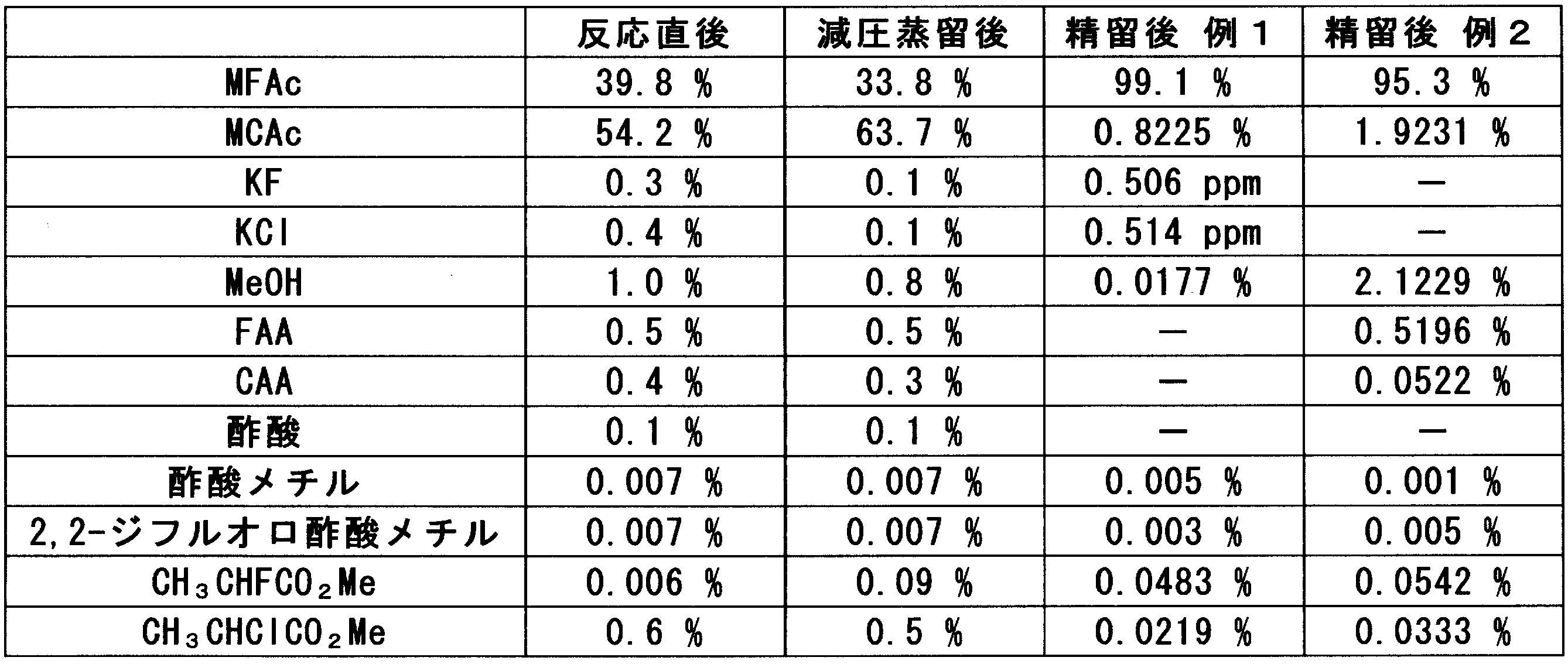
(略語)
MFAc:フルオロ酢酸メチル
MCAc:クロロ酢酸メチル
MeOH:メタノール
FAA:フルオロ酢酸
CAA:クロロ酢酸
(組成の分析方法)
KF及びKCl以外の各成分の含有率は、ガスクロマトグラフィー(下記条件)により分析した。
(条件)
カラム: アジレント・テクノロジー株式会社製 J&W HP-1
(1.00μm、30m、0.32mmID)
カラムオーブン:40℃(5分間)→昇温(10℃/分)→300℃
(10分間)又は40℃(5分間)→昇温(7℃/分)→
280℃(0分間)
気化室温度: 250℃
検出器: FID(水素炎イオン化型検出器)
KF及びKCl以外の各成分の含有率は、ガスクロマトグラフィー(下記条件)により分析した。
(条件)
カラム: アジレント・テクノロジー株式会社製 J&W HP-1
(1.00μm、30m、0.32mmID)
カラムオーブン:40℃(5分間)→昇温(10℃/分)→300℃
(10分間)又は40℃(5分間)→昇温(7℃/分)→
280℃(0分間)
気化室温度: 250℃
検出器: FID(水素炎イオン化型検出器)
KFはFイオンとして、KClはClイオンとして、イオンクロマトグラフィー(下記条件)により含有率を分析した。
(条件)
カラム: Thermo Fisher Scientific社製
Dionex IonPac AS4A-SC
4×250mm
カラムオーブン:45℃
溶離液: 4mM 炭酸ナトリウム 水溶液
溶離液流量: 0.8ml/min
検出器: 電気伝導度計
(条件)
カラム: Thermo Fisher Scientific社製
Dionex IonPac AS4A-SC
4×250mm
カラムオーブン:45℃
溶離液: 4mM 炭酸ナトリウム 水溶液
溶離液流量: 0.8ml/min
検出器: 電気伝導度計
Claims (36)
- 式(1):

で表される化合物の製造方法であって、
式(2):

で表される化合物を、式(3):
MFn (3)
(式中、Mは、カチオンであり、nは、カチオンの価数に対応する整数である。)
で表される化合物と反応する工程を含み、
前記式(3)で表される化合物の使用量が、前記式(2)で表される化合物1モルに対して、0.9モル以下である製造方法。 - 前記反応が、実質的に、前記式(2)で表される化合物及び前記式(3)で表される化合物のみで行われる、請求項1に記載の製造方法。
- 前記式(3)で表される化合物の使用量が、前記式(2)で表される化合物1モルに対して、0.8モル以下である、請求項1又は2に記載の製造方法。
- 前記式(3)で表される化合物の使用量が、前記式(2)で表される化合物1モルに対して、0.7モル以下である、請求項1~3のいずれか一項に記載の製造方法。
- 前記式(3)で表される化合物の使用量が、前記式(2)で表される化合物1モルに対して、0.6モル以下である、請求項1~4のいずれか一項に記載の製造方法。
- 前記反応が、100~250℃の範囲内で行われる、請求項1~5のいずれか一項に記載の製造方法。
- 前記工程により得られた生成物を蒸留する工程を含む、請求項1~6のいずれか一項に記載の製造方法。
- Rが、1個以上の置換基を有していてもよい炭化水素基である、請求項1~7のいずれか一項に記載の製造方法。
- Rが、アルキル基、フルオロアルキル基、又は1個以上の置換基を有していてもよいアリール基である、請求項1~8のいずれか一項に記載の製造方法。
- Xは、フッ素以外のハロゲン、アルキルスルホニルオキシ基、ハロアルキルスルホニルオキシ基、又はアリールスルホニルオキシ基である、請求項1~9のいずれか一項に記載の製造方法。
- Xが、塩素、又は臭素である、請求項1~10のいずれか一項に記載の製造方法。
- Xが、塩素である、請求項1~11のいずれか一項に記載の製造方法。
- Mが、水素イオン、アルカリ金属イオン、アルカリ土類金属イオン、又はアンモニウムイオンである、請求項1~12のいずれか一項に記載の製造方法。
- Mが、水素イオン、又はアルカリ金属イオンである、請求項1~13のいずれか一項に記載の製造方法。
- 前記式(3)で表される化合物が、HF、NaF、KF、CsF、及びCaF2から選択される少なくとも一種である、請求項1~13のいずれか一項に記載の製造方法。
- 前記式(3)で表される化合物が、KF、及びCsFから選択される少なくとも一種である、請求項1~15のいずれか一項に記載の製造方法。
- 前記式(3)で表される化合物の含水率が、1.0質量%以下である、請求項1~16のいずれか一項に記載の製造方法。
- 式(1):

で表される化合物、及び式(2):

で表される化合物を含有する組成物であって、
前記式(2)で表される化合物の含有量が、0.001質量%を超えて2.5質量%以下の範囲内である組成物。 - 式(1):

で表される化合物、及び式(2):

で表される化合物を含有する組成物であって、
前記式(2)で表される化合物の含有量が、前記式(1)で表される化合物100質量部に対して、0.001質量部を超えて2.5質量部以下の範囲内である組成物。 - 式(1):

で表される化合物、及び式(4):
R-OH (4)
(式中、Rは、前記と同意義である。)
で表される化合物を含有する組成物であって、
前記式(4)で表される化合物の含有量が、1.0質量%以下、又は1.1~2.5質量%の範囲内である組成物。 - 式(1):

で表される化合物、及び式(4):
R-OH (4)
(式中、Rは、前記と同意義である。)
で表される化合物を含有する組成物であって、
前記式(4)で表される化合物の含有量が、前記式(1)で表される化合物100質量部に対して、1.0質量部以下、又は1.1~2.5質量部の範囲内である組成物。 - 式(1):

で表される化合物、及び2-フルオロ酢酸を含有する組成物であって、
2-フルオロ酢酸の含有量が、0.9質量%以下である組成物。 - 式(1):

で表される化合物、及び2-フルオロ酢酸を含有する組成物であって、
2-フルオロ酢酸の含有量が、前記式(1)で表される化合物100質量部に対して、0.9質量部以下である組成物。 - 式(1):

で表される化合物、及び式(5):

で表される化合物を含有する組成物であって、
前記式(5)で表される化合物の含有量が、0.001質量%以下、又は0.002~1質量%の範囲内である組成物。 - 式(1):

で表される化合物、及び式(5):

で表される化合物を含有する組成物であって、
前記式(5)で表される化合物の含有量が、前記式(1)で表される化合物100質量部に対して、0.001質量部以下、又は0.002~1質量部の範囲内である組成物。 - 式(1):

で表される化合物、及び式(6):
CH3COOR (6)
(式中、Rは、前記と同意義である。)
で表される化合物を含有する組成物であって、
前記式(6)で表される化合物の含有量が、0.01質量%未満である組成物。 - 式(1):

で表される化合物、及び式(6):
CH3COOR (6)
(式中、Rは、前記と同意義である。)
で表される化合物を含有する組成物であって、
前記式(6)で表される化合物の含有量が、前記式(1)で表される化合物100質量部に対して、0.01質量部未満である組成物。 - 式(1):

で表される化合物、及び式(7):

で表される化合物を含有する組成物であって、
前記式(7)で表される化合物の含有量が、0.01質量%未満である組成物。 - 式(1):

で表される化合物、及び式(7):

で表される化合物を含有する組成物であって、
前記式(7)で表される化合物の含有量が、前記式(1)で表される化合物100質量部に対して、0.01質量部未満である組成物。 - 式(1):

で表される化合物、及び式(8):

で表される化合物を含有する組成物であって、
前記式(8)で表される化合物の含有量が、0.006~0.5質量%の範囲内である組成物。 - 式(1):

で表される化合物、及び式(8):

で表される化合物を含有する組成物であって、
前記式(8)で表される化合物の含有量が、前記式(1)で表される化合物100質量部に対して、0.006~0.5質量部の範囲内である組成物。 - Rが、1個以上の置換基を有していてもよい炭化水素基である、請求項18~31のいずれか一項に記載の組成物。
- Rが、アルキル基、フルオロアルキル基、又は1個以上の置換基を有していてもよいアリール基である、請求項18~32のいずれか一項に記載の組成物。
- Xが、塩素、又は臭素である、請求項18、19、24、及び25のいずれか一項に記載の組成物。
- 式(1):

で表される化合物、並びに、
式(3):
MFn (3)
(式中、Mは、カチオンであり、nは、カチオンの価数に対応する整数である。)
で表される化合物、及び
式(3’):
MCln (3’)
(式中、M及びnは、前記と同意義である。)
で表される化合物からなる群より選択される少なくとも一種の無機塩を含有する組成物。 - 2-フルオロ酢酸メチル及び2-フルオロ酢酸エチルを含有する組成物。
Priority Applications (4)
| Application Number | Priority Date | Filing Date | Title |
|---|---|---|---|
| EP20880470.8A EP4053098A4 (en) | 2019-10-31 | 2020-10-30 | METHOD FOR PRODUCING A FLUOROACETIC ACID ESTER |
| CN202080074692.8A CN114599632A (zh) | 2019-10-31 | 2020-10-30 | 氟乙酸酯的制造方法 |
| CN202411334290.3A CN119080620A (zh) | 2019-10-31 | 2020-10-30 | 氟乙酸酯的制造方法 |
| US17/730,768 US20220259135A1 (en) | 2019-10-31 | 2022-04-27 | Method for manufacturing fluoroacetic acid ester |
Applications Claiming Priority (2)
| Application Number | Priority Date | Filing Date | Title |
|---|---|---|---|
| JP2019-198220 | 2019-10-31 | ||
| JP2019198220 | 2019-10-31 |
Related Child Applications (1)
| Application Number | Title | Priority Date | Filing Date |
|---|---|---|---|
| US17/730,768 Continuation US20220259135A1 (en) | 2019-10-31 | 2022-04-27 | Method for manufacturing fluoroacetic acid ester |
Publications (1)
| Publication Number | Publication Date |
|---|---|
| WO2021085631A1 true WO2021085631A1 (ja) | 2021-05-06 |
Family
ID=75715546
Family Applications (1)
| Application Number | Title | Priority Date | Filing Date |
|---|---|---|---|
| PCT/JP2020/040943 Ceased WO2021085631A1 (ja) | 2019-10-31 | 2020-10-30 | フルオロ酢酸エステルの製造方法 |
Country Status (5)
| Country | Link |
|---|---|
| US (1) | US20220259135A1 (ja) |
| EP (1) | EP4053098A4 (ja) |
| JP (2) | JP7476076B2 (ja) |
| CN (2) | CN119080620A (ja) |
| WO (1) | WO2021085631A1 (ja) |
Citations (3)
| Publication number | Priority date | Publication date | Assignee | Title |
|---|---|---|---|---|
| JP2003267931A (ja) * | 2002-03-18 | 2003-09-25 | Mitsubishi Chemicals Corp | 飽和フッ化カルボン酸エステルの製造方法 |
| JP2012508731A (ja) * | 2008-11-14 | 2012-04-12 | イファ ユニバーシティ−インダストリー コラボレーション ファウンデーション | 高分子微粒球の製造方法及びその方法により製造された高分子微粒球 |
| JP2014522398A (ja) * | 2011-06-01 | 2014-09-04 | ロディア オペレーションズ | フッ素化有機化合物の調製方法 |
Family Cites Families (2)
| Publication number | Priority date | Publication date | Assignee | Title |
|---|---|---|---|---|
| CN102976934A (zh) * | 2012-12-21 | 2013-03-20 | 王学军 | 一种氟乙酸酯的制备方法 |
| CN104292104B (zh) * | 2014-03-04 | 2016-06-22 | 多氟多化工股份有限公司 | 一种氟乙酸甲酯的制备方法及设备 |
-
2020
- 2020-10-30 EP EP20880470.8A patent/EP4053098A4/en not_active Withdrawn
- 2020-10-30 CN CN202411334290.3A patent/CN119080620A/zh active Pending
- 2020-10-30 WO PCT/JP2020/040943 patent/WO2021085631A1/ja not_active Ceased
- 2020-10-30 JP JP2020182707A patent/JP7476076B2/ja active Active
- 2020-10-30 CN CN202080074692.8A patent/CN114599632A/zh active Pending
-
2021
- 2021-11-24 JP JP2021190056A patent/JP2022031779A/ja active Pending
-
2022
- 2022-04-27 US US17/730,768 patent/US20220259135A1/en not_active Abandoned
Patent Citations (3)
| Publication number | Priority date | Publication date | Assignee | Title |
|---|---|---|---|---|
| JP2003267931A (ja) * | 2002-03-18 | 2003-09-25 | Mitsubishi Chemicals Corp | 飽和フッ化カルボン酸エステルの製造方法 |
| JP2012508731A (ja) * | 2008-11-14 | 2012-04-12 | イファ ユニバーシティ−インダストリー コラボレーション ファウンデーション | 高分子微粒球の製造方法及びその方法により製造された高分子微粒球 |
| JP2014522398A (ja) * | 2011-06-01 | 2014-09-04 | ロディア オペレーションズ | フッ素化有機化合物の調製方法 |
Non-Patent Citations (5)
| Title |
|---|
| BHADURY P S, PANDEY M, JAISWAL D K: "A facile synthesis of organofluorine compounds using a semi-molten mixture of tetrabutylammonium bromide and an alkali metal fluoride", JOURNAL OF FLUORINE CHEMISTRY, ELSEVIER, NL, vol. 73, no. 2, 1 January 1995 (1995-01-01), NL , pages 185 - 187, XP002244058, ISSN: 0022-1139, DOI: 10.1016/0022-1139(95)03226-4 * |
| GRYSZKIEWICZ-TROCHIMOWSKI, E. ET AL., REC. TRAV. CHIM., no. 66, 1947, pages 413 |
| ISHIKAWA NOBUO, KITAZUME TOMOYA, YAMAZAKI TAKASHI, MOCHIDA YOSHIHARU, TATSUNO TOSHIO: "ENHANCED EFFECT OF SPRAY-DRIED POTASSIUM FLUORIDE ON FLUORINATION", CHEMISTRY LETTERS, CHEMICAL SOCIETY OF JAPAN,NIPPON KAGAKUKAI, JP, vol. 10, no. 6, 5 June 1981 (1981-06-05), JP , pages 761 - 764, XP055931249, ISSN: 0366-7022, DOI: 10.1246/cl.1981.761 * |
| SAUNDERS, B.C. ET AL., JOURNAL OF THE CHEMICAL SOCIETY, 1948, pages 1773 - 1779 |
| See also references of EP4053098A4 |
Also Published As
| Publication number | Publication date |
|---|---|
| JP2021075527A (ja) | 2021-05-20 |
| US20220259135A1 (en) | 2022-08-18 |
| JP7476076B2 (ja) | 2024-04-30 |
| CN114599632A (zh) | 2022-06-07 |
| EP4053098A1 (en) | 2022-09-07 |
| EP4053098A4 (en) | 2023-12-13 |
| JP2022031779A (ja) | 2022-02-22 |
| CN119080620A (zh) | 2024-12-06 |
Similar Documents
| Publication | Publication Date | Title |
|---|---|---|
| US9802963B2 (en) | Fluorine-containing complex compound, and production method for fluorine-containing organic compound employing same | |
| US3412095A (en) | Chlorination of alkyl pyridines | |
| JP2018108959A (ja) | ハロゲン化スルホニウム塩の製造方法 | |
| WO2021085631A1 (ja) | フルオロ酢酸エステルの製造方法 | |
| RU2807292C9 (ru) | Способ производства сложного эфира фторуксусной кислоты | |
| RU2807292C1 (ru) | Способ производства сложного эфира фторуксусной кислоты | |
| JP6919733B2 (ja) | プロピオン酸誘導体の製造方法 | |
| US20230416180A1 (en) | Haloether, method for producing same, vinyl ether, and method for producing same | |
| JP4302322B2 (ja) | 2−ヒドロキシ−6−トリフルオロメチルピリジンを調製するための化学プロセス | |
| NO156610B (no) | Silaner. | |
| JP2022065082A (ja) | 環状カーボネート化合物、及びその製造方法 | |
| JP2018145113A (ja) | トリアリールアミン類の製造方法 | |
| CN113260602A (zh) | 氟代醇盐的制造方法 | |
| JPH0140832B2 (ja) | ||
| JP2021520354A (ja) | 3,4−ジクロロ−n−(2−シアノフェニル)−5−イソチアゾールカルボキサミドの製造方法 | |
| JP6851712B2 (ja) | 置換されたオレフィンの製造方法 | |
| Kochikyan | Spiroheterocyclic compounds based on 2-bromobutanolides | |
| TW202421609A (zh) | α-氯丙烯酸酯類之製造方法 | |
| JPH04283524A (ja) | トリフルオロメチル置換芳香族化合物の製造法 | |
| JP2018150264A (ja) | 環状カーボネート化合物、及びその製造方法 | |
| SE430155B (sv) | Sett att framstella 2-arylpropionsyror | |
| WO2000005212A1 (en) | 3-substituted pyridine compounds and related synthesis | |
| JP2018150263A (ja) | 環状カーボネート化合物、及びその製造方法 | |
| JPH0436269A (ja) | ビス(2―ヒドロキシエチルチオメチル)エーテルの製造方法 | |
| CN106008234A (zh) | N,n-二异丙基-2-异丙氧基乙胺的合成方法 |
Legal Events
| Date | Code | Title | Description |
|---|---|---|---|
| 121 | Ep: the epo has been informed by wipo that ep was designated in this application |
Ref document number: 20880470 Country of ref document: EP Kind code of ref document: A1 |
|
| NENP | Non-entry into the national phase |
Ref country code: DE |
|
| ENP | Entry into the national phase |
Ref document number: 2020880470 Country of ref document: EP Effective date: 20220531 |
|
| WWW | Wipo information: withdrawn in national office |
Ref document number: 2020880470 Country of ref document: EP |